EP1537066B1 - Cyclopentenone derivatives as potent activators of hsf-1 - Google Patents
Cyclopentenone derivatives as potent activators of hsf-1 Download PDFInfo
- Publication number
- EP1537066B1 EP1537066B1 EP03766493.5A EP03766493A EP1537066B1 EP 1537066 B1 EP1537066 B1 EP 1537066B1 EP 03766493 A EP03766493 A EP 03766493A EP 1537066 B1 EP1537066 B1 EP 1537066B1
- Authority
- EP
- European Patent Office
- Prior art keywords
- group
- compound
- mmol
- compounds
- substituted
- Prior art date
- Legal status (The legal status is an assumption and is not a legal conclusion. Google has not performed a legal analysis and makes no representation as to the accuracy of the status listed.)
- Expired - Lifetime
Links
- BZKFMUIJRXWWQK-UHFFFAOYSA-N Cyclopentenone Chemical class O=C1CCC=C1 BZKFMUIJRXWWQK-UHFFFAOYSA-N 0.000 title claims description 47
- 230000003389 potentiating effect Effects 0.000 title description 6
- 239000012190 activator Substances 0.000 title description 3
- 101100124874 Caenorhabditis elegans hsf-1 gene Proteins 0.000 title 1
- 150000001875 compounds Chemical class 0.000 claims description 202
- 208000037265 diseases, disorders, signs and symptoms Diseases 0.000 claims description 77
- XLYOFNOQVPJJNP-UHFFFAOYSA-N water Substances O XLYOFNOQVPJJNP-UHFFFAOYSA-N 0.000 claims description 43
- 230000000694 effects Effects 0.000 claims description 37
- -1 1, 2-dimethylethyl Chemical group 0.000 claims description 33
- 125000000217 alkyl group Chemical group 0.000 claims description 30
- 125000004432 carbon atom Chemical group C* 0.000 claims description 28
- LFQSCWFLJHTTHZ-UHFFFAOYSA-N Ethanol Chemical compound CCO LFQSCWFLJHTTHZ-UHFFFAOYSA-N 0.000 claims description 27
- 238000000034 method Methods 0.000 claims description 24
- 125000003342 alkenyl group Chemical group 0.000 claims description 22
- 239000008194 pharmaceutical composition Substances 0.000 claims description 22
- 125000003118 aryl group Chemical group 0.000 claims description 21
- 229910052739 hydrogen Inorganic materials 0.000 claims description 21
- 125000003710 aryl alkyl group Chemical group 0.000 claims description 20
- 239000001257 hydrogen Substances 0.000 claims description 20
- 230000001225 therapeutic effect Effects 0.000 claims description 20
- 125000000304 alkynyl group Chemical group 0.000 claims description 19
- 230000001404 mediated effect Effects 0.000 claims description 18
- OKTJSMMVPCPJKN-UHFFFAOYSA-N Carbon Chemical group [C] OKTJSMMVPCPJKN-UHFFFAOYSA-N 0.000 claims description 17
- 239000003814 drug Substances 0.000 claims description 14
- 125000005842 heteroatom Chemical group 0.000 claims description 14
- 230000003612 virological effect Effects 0.000 claims description 13
- 231100001274 therapeutic index Toxicity 0.000 claims description 12
- 241001465754 Metazoa Species 0.000 claims description 10
- 125000004435 hydrogen atom Chemical group [H]* 0.000 claims description 10
- 125000001997 phenyl group Chemical group [H]C1=C([H])C([H])=C(*)C([H])=C1[H] 0.000 claims description 10
- 206010028980 Neoplasm Diseases 0.000 claims description 9
- LMBFAGIMSUYTBN-MPZNNTNKSA-N teixobactin Chemical compound C([C@H](C(=O)N[C@@H]([C@@H](C)CC)C(=O)N[C@@H](CO)C(=O)N[C@H](CCC(N)=O)C(=O)N[C@H]([C@@H](C)CC)C(=O)N[C@@H]([C@@H](C)CC)C(=O)N[C@@H](CO)C(=O)N[C@H]1C(N[C@@H](C)C(=O)N[C@@H](C[C@@H]2NC(=N)NC2)C(=O)N[C@H](C(=O)O[C@H]1C)[C@@H](C)CC)=O)NC)C1=CC=CC=C1 LMBFAGIMSUYTBN-MPZNNTNKSA-N 0.000 claims description 9
- 150000003573 thiols Chemical class 0.000 claims description 9
- UFHFLCQGNIYNRP-UHFFFAOYSA-N Hydrogen Chemical compound [H][H] UFHFLCQGNIYNRP-UHFFFAOYSA-N 0.000 claims description 8
- 238000006957 Michael reaction Methods 0.000 claims description 7
- 230000006378 damage Effects 0.000 claims description 7
- 230000001965 increasing effect Effects 0.000 claims description 7
- 238000004519 manufacturing process Methods 0.000 claims description 7
- BGTOWKSIORTVQH-HOSYLAQJSA-N cyclopentanone Chemical group O=[13C]1CCCC1 BGTOWKSIORTVQH-HOSYLAQJSA-N 0.000 claims description 6
- 150000002431 hydrogen Chemical group 0.000 claims description 6
- 125000001449 isopropyl group Chemical group [H]C([H])([H])C([H])(*)C([H])([H])[H] 0.000 claims description 6
- 230000005855 radiation Effects 0.000 claims description 6
- 239000003963 antioxidant agent Substances 0.000 claims description 5
- 235000006708 antioxidants Nutrition 0.000 claims description 5
- 238000002405 diagnostic procedure Methods 0.000 claims description 5
- 150000002148 esters Chemical class 0.000 claims description 5
- 208000027866 inflammatory disease Diseases 0.000 claims description 5
- 208000028867 ischemia Diseases 0.000 claims description 5
- 150000002576 ketones Chemical class 0.000 claims description 5
- 230000032683 aging Effects 0.000 claims description 4
- 230000001580 bacterial effect Effects 0.000 claims description 4
- 125000002915 carbonyl group Chemical group [*:2]C([*:1])=O 0.000 claims description 4
- 230000004663 cell proliferation Effects 0.000 claims description 4
- 230000003247 decreasing effect Effects 0.000 claims description 4
- 206010012601 diabetes mellitus Diseases 0.000 claims description 4
- 210000000987 immune system Anatomy 0.000 claims description 4
- 230000002147 killing effect Effects 0.000 claims description 4
- 208000015122 neurodegenerative disease Diseases 0.000 claims description 4
- 230000036542 oxidative stress Effects 0.000 claims description 4
- 108090000765 processed proteins & peptides Proteins 0.000 claims description 4
- 238000002560 therapeutic procedure Methods 0.000 claims description 4
- 206010003210 Arteriosclerosis Diseases 0.000 claims description 3
- OYPRJOBELJOOCE-UHFFFAOYSA-N Calcium Chemical compound [Ca] OYPRJOBELJOOCE-UHFFFAOYSA-N 0.000 claims description 3
- 150000001299 aldehydes Chemical class 0.000 claims description 3
- 125000003368 amide group Chemical group 0.000 claims description 3
- 150000001408 amides Chemical class 0.000 claims description 3
- 150000001412 amines Chemical class 0.000 claims description 3
- 230000003078 antioxidant effect Effects 0.000 claims description 3
- 208000011775 arteriosclerosis disease Diseases 0.000 claims description 3
- 229910052791 calcium Inorganic materials 0.000 claims description 3
- 239000011575 calcium Substances 0.000 claims description 3
- 201000011510 cancer Diseases 0.000 claims description 3
- 125000003178 carboxy group Chemical group [H]OC(*)=O 0.000 claims description 3
- 150000001732 carboxylic acid derivatives Chemical class 0.000 claims description 3
- 150000001734 carboxylic acid salts Chemical class 0.000 claims description 3
- 125000001188 haloalkyl group Chemical group 0.000 claims description 3
- 125000002887 hydroxy group Chemical group [H]O* 0.000 claims description 3
- 125000002924 primary amino group Chemical group [H]N([H])* 0.000 claims description 3
- 125000001453 quaternary ammonium group Chemical group 0.000 claims description 3
- 125000004172 4-methoxyphenyl group Chemical group [H]C1=C([H])C(OC([H])([H])[H])=C([H])C([H])=C1* 0.000 claims description 2
- 208000024827 Alzheimer disease Diseases 0.000 claims description 2
- 125000001559 cyclopropyl group Chemical group [H]C1([H])C([H])([H])C1([H])* 0.000 claims description 2
- 230000007812 deficiency Effects 0.000 claims description 2
- 239000003937 drug carrier Substances 0.000 claims description 2
- 229910052736 halogen Inorganic materials 0.000 claims description 2
- 150000002367 halogens Chemical class 0.000 claims description 2
- 230000004770 neurodegeneration Effects 0.000 claims description 2
- 125000003854 p-chlorophenyl group Chemical group [H]C1=C([H])C(*)=C([H])C([H])=C1Cl 0.000 claims description 2
- 125000000636 p-nitrophenyl group Chemical group [H]C1=C([H])C(=C([H])C([H])=C1*)[N+]([O-])=O 0.000 claims description 2
- 230000001737 promoting effect Effects 0.000 claims description 2
- 230000029663 wound healing Effects 0.000 claims description 2
- 125000004185 ester group Chemical group 0.000 claims 1
- XEKOWRVHYACXOJ-UHFFFAOYSA-N ethyl acetate Substances CCOC(C)=O XEKOWRVHYACXOJ-UHFFFAOYSA-N 0.000 description 174
- HEDRZPFGACZZDS-MICDWDOJSA-N Trichloro(2H)methane Chemical compound [2H]C(Cl)(Cl)Cl HEDRZPFGACZZDS-MICDWDOJSA-N 0.000 description 150
- YMWUJEATGCHHMB-UHFFFAOYSA-N Dichloromethane Chemical compound ClCCl YMWUJEATGCHHMB-UHFFFAOYSA-N 0.000 description 124
- VLKZOEOYAKHREP-UHFFFAOYSA-N n-Hexane Chemical compound CCCCCC VLKZOEOYAKHREP-UHFFFAOYSA-N 0.000 description 119
- VYPSYNLAJGMNEJ-UHFFFAOYSA-N Silicium dioxide Chemical compound O=[Si]=O VYPSYNLAJGMNEJ-UHFFFAOYSA-N 0.000 description 74
- 239000000243 solution Substances 0.000 description 73
- 210000004027 cell Anatomy 0.000 description 61
- RTZKZFJDLAIYFH-UHFFFAOYSA-N Diethyl ether Chemical compound CCOCC RTZKZFJDLAIYFH-UHFFFAOYSA-N 0.000 description 60
- 239000000203 mixture Substances 0.000 description 60
- 235000019439 ethyl acetate Nutrition 0.000 description 55
- 239000007787 solid Substances 0.000 description 45
- 238000002360 preparation method Methods 0.000 description 43
- HEDRZPFGACZZDS-UHFFFAOYSA-N Chloroform Chemical compound ClC(Cl)Cl HEDRZPFGACZZDS-UHFFFAOYSA-N 0.000 description 40
- 238000003818 flash chromatography Methods 0.000 description 39
- 208000035475 disorder Diseases 0.000 description 38
- RWSXRVCMGQZWBV-WDSKDSINSA-N glutathione Chemical compound OC(=O)[C@@H](N)CCC(=O)N[C@@H](CS)C(=O)NCC(O)=O RWSXRVCMGQZWBV-WDSKDSINSA-N 0.000 description 33
- 239000000377 silicon dioxide Substances 0.000 description 33
- CSNNHWWHGAXBCP-UHFFFAOYSA-L Magnesium sulfate Chemical compound [Mg+2].[O-][S+2]([O-])([O-])[O-] CSNNHWWHGAXBCP-UHFFFAOYSA-L 0.000 description 31
- 201000010099 disease Diseases 0.000 description 31
- ZMANZCXQSJIPKH-UHFFFAOYSA-N Triethylamine Chemical compound CCN(CC)CC ZMANZCXQSJIPKH-UHFFFAOYSA-N 0.000 description 30
- 125000002496 methyl group Chemical group [H]C([H])([H])* 0.000 description 27
- 108010057466 NF-kappa B Proteins 0.000 description 26
- 102000003945 NF-kappa B Human genes 0.000 description 26
- 239000011541 reaction mixture Substances 0.000 description 25
- 238000011282 treatment Methods 0.000 description 25
- BWHMMNNQKKPAPP-UHFFFAOYSA-L potassium carbonate Chemical compound [K+].[K+].[O-]C([O-])=O BWHMMNNQKKPAPP-UHFFFAOYSA-L 0.000 description 24
- RIOQSEWOXXDEQQ-UHFFFAOYSA-N triphenylphosphine Chemical compound C1=CC=CC=C1P(C=1C=CC=CC=1)C1=CC=CC=C1 RIOQSEWOXXDEQQ-UHFFFAOYSA-N 0.000 description 24
- 238000006243 chemical reaction Methods 0.000 description 21
- 239000003921 oil Substances 0.000 description 21
- 235000019198 oils Nutrition 0.000 description 20
- 241000700605 Viruses Species 0.000 description 18
- 208000015181 infectious disease Diseases 0.000 description 18
- 108010024636 Glutathione Proteins 0.000 description 16
- 229910052799 carbon Inorganic materials 0.000 description 16
- 229960003180 glutathione Drugs 0.000 description 16
- 238000011084 recovery Methods 0.000 description 16
- 239000000725 suspension Substances 0.000 description 16
- DRDVJQOGFWAVLH-UHFFFAOYSA-N tert-butyl n-hydroxycarbamate Chemical compound CC(C)(C)OC(=O)NO DRDVJQOGFWAVLH-UHFFFAOYSA-N 0.000 description 16
- KRKNYBCHXYNGOX-UHFFFAOYSA-N citric acid Chemical compound OC(=O)CC(O)(C(O)=O)CC(O)=O KRKNYBCHXYNGOX-UHFFFAOYSA-N 0.000 description 15
- 229910052681 coesite Inorganic materials 0.000 description 15
- 229910052906 cristobalite Inorganic materials 0.000 description 15
- 239000012043 crude product Substances 0.000 description 15
- 239000012299 nitrogen atmosphere Substances 0.000 description 15
- 229910052682 stishovite Inorganic materials 0.000 description 15
- 229910052905 tridymite Inorganic materials 0.000 description 15
- 238000003556 assay Methods 0.000 description 14
- KBPLFHHGFOOTCA-UHFFFAOYSA-N caprylic alcohol Natural products CCCCCCCCO KBPLFHHGFOOTCA-UHFFFAOYSA-N 0.000 description 14
- 239000003480 eluent Substances 0.000 description 14
- 229940125782 compound 2 Drugs 0.000 description 13
- 125000001495 ethyl group Chemical group [H]C([H])([H])C([H])([H])* 0.000 description 13
- 229910052943 magnesium sulfate Inorganic materials 0.000 description 12
- 229910052757 nitrogen Inorganic materials 0.000 description 12
- 229940094443 oxytocics prostaglandins Drugs 0.000 description 12
- 229910000027 potassium carbonate Inorganic materials 0.000 description 12
- 238000012360 testing method Methods 0.000 description 12
- VXUYXOFXAQZZMF-UHFFFAOYSA-N titanium(IV) isopropoxide Chemical compound CC(C)O[Ti](OC(C)C)(OC(C)C)OC(C)C VXUYXOFXAQZZMF-UHFFFAOYSA-N 0.000 description 12
- 239000012044 organic layer Substances 0.000 description 11
- 230000002829 reductive effect Effects 0.000 description 11
- XJDNKRIXUMDJCW-UHFFFAOYSA-J titanium tetrachloride Chemical compound Cl[Ti](Cl)(Cl)Cl XJDNKRIXUMDJCW-UHFFFAOYSA-J 0.000 description 11
- 239000013543 active substance Substances 0.000 description 10
- 235000013305 food Nutrition 0.000 description 10
- 239000002904 solvent Substances 0.000 description 10
- 229940086542 triethylamine Drugs 0.000 description 10
- UHOVQNZJYSORNB-UHFFFAOYSA-N Benzene Chemical compound C1=CC=CC=C1 UHOVQNZJYSORNB-UHFFFAOYSA-N 0.000 description 9
- 102000002812 Heat-Shock Proteins Human genes 0.000 description 9
- 108010004889 Heat-Shock Proteins Proteins 0.000 description 9
- 229910052786 argon Inorganic materials 0.000 description 9
- 230000015572 biosynthetic process Effects 0.000 description 9
- 208000006454 hepatitis Diseases 0.000 description 9
- 231100000283 hepatitis Toxicity 0.000 description 9
- 230000006698 induction Effects 0.000 description 9
- 230000002401 inhibitory effect Effects 0.000 description 9
- 150000003180 prostaglandins Chemical class 0.000 description 9
- 125000001424 substituent group Chemical group 0.000 description 9
- XKRFYHLGVUSROY-UHFFFAOYSA-N Argon Chemical compound [Ar] XKRFYHLGVUSROY-UHFFFAOYSA-N 0.000 description 8
- AMIMRNSIRUDHCM-UHFFFAOYSA-N Isopropylaldehyde Chemical compound CC(C)C=O AMIMRNSIRUDHCM-UHFFFAOYSA-N 0.000 description 8
- 231100000111 LD50 Toxicity 0.000 description 8
- 108060001084 Luciferase Proteins 0.000 description 8
- UIIMBOGNXHQVGW-UHFFFAOYSA-M Sodium bicarbonate Chemical compound [Na+].OC([O-])=O UIIMBOGNXHQVGW-UHFFFAOYSA-M 0.000 description 8
- 230000004913 activation Effects 0.000 description 8
- HUMNYLRZRPPJDN-UHFFFAOYSA-N benzaldehyde Chemical compound O=CC1=CC=CC=C1 HUMNYLRZRPPJDN-UHFFFAOYSA-N 0.000 description 8
- 230000036772 blood pressure Effects 0.000 description 8
- LLPILMUHGPFVJK-UHFFFAOYSA-N n-(4-oxocyclopent-2-en-1-yl)benzamide Chemical compound C=1C=CC=CC=1C(=O)NC1CC(=O)C=C1 LLPILMUHGPFVJK-UHFFFAOYSA-N 0.000 description 8
- 108090000623 proteins and genes Proteins 0.000 description 8
- LEHBURLTIWGHEM-UHFFFAOYSA-N pyridinium chlorochromate Chemical compound [O-][Cr](Cl)(=O)=O.C1=CC=[NH+]C=C1 LEHBURLTIWGHEM-UHFFFAOYSA-N 0.000 description 8
- 230000004044 response Effects 0.000 description 8
- UWWUTEZECIYOCW-UHFFFAOYSA-N tert-butyl n-(4-hydroxycyclopent-2-en-1-yl)carbamate Chemical compound CC(C)(C)OC(=O)NC1CC(O)C=C1 UWWUTEZECIYOCW-UHFFFAOYSA-N 0.000 description 8
- 238000011200 topical administration Methods 0.000 description 8
- QTBSBXVTEAMEQO-UHFFFAOYSA-M Acetate Chemical compound CC([O-])=O QTBSBXVTEAMEQO-UHFFFAOYSA-M 0.000 description 7
- 0 CCCCN*C*1=*(C)C1C Chemical compound CCCCN*C*1=*(C)C1C 0.000 description 7
- 102100032606 Heat shock factor protein 1 Human genes 0.000 description 7
- 206010035664 Pneumonia Diseases 0.000 description 7
- 239000004480 active ingredient Substances 0.000 description 7
- 239000012267 brine Substances 0.000 description 7
- TVMXDCGIABBOFY-UHFFFAOYSA-N n-Octanol Natural products CCCCCCCC TVMXDCGIABBOFY-UHFFFAOYSA-N 0.000 description 7
- 238000000746 purification Methods 0.000 description 7
- 150000003839 salts Chemical class 0.000 description 7
- 239000011734 sodium Substances 0.000 description 7
- HPALAKNZSZLMCH-UHFFFAOYSA-M sodium;chloride;hydrate Chemical compound O.[Na+].[Cl-] HPALAKNZSZLMCH-UHFFFAOYSA-M 0.000 description 7
- 238000003756 stirring Methods 0.000 description 7
- 230000009385 viral infection Effects 0.000 description 7
- WEVYAHXRMPXWCK-UHFFFAOYSA-N Acetonitrile Chemical compound CC#N WEVYAHXRMPXWCK-UHFFFAOYSA-N 0.000 description 6
- IJGRMHOSHXDMSA-UHFFFAOYSA-N Atomic nitrogen Chemical compound N#N IJGRMHOSHXDMSA-UHFFFAOYSA-N 0.000 description 6
- OKKJLVBELUTLKV-UHFFFAOYSA-N Methanol Chemical compound OC OKKJLVBELUTLKV-UHFFFAOYSA-N 0.000 description 6
- 241000711408 Murine respirovirus Species 0.000 description 6
- HEMHJVSKTPXQMS-UHFFFAOYSA-M Sodium hydroxide Chemical compound [OH-].[Na+] HEMHJVSKTPXQMS-UHFFFAOYSA-M 0.000 description 6
- 208000036142 Viral infection Diseases 0.000 description 6
- 239000012298 atmosphere Substances 0.000 description 6
- 150000001721 carbon Chemical group 0.000 description 6
- BGTOWKSIORTVQH-UHFFFAOYSA-N cyclopentanone Chemical compound O=C1CCCC1 BGTOWKSIORTVQH-UHFFFAOYSA-N 0.000 description 6
- 238000001727 in vivo Methods 0.000 description 6
- 235000019341 magnesium sulphate Nutrition 0.000 description 6
- 239000000843 powder Substances 0.000 description 6
- 210000003491 skin Anatomy 0.000 description 6
- JKCMHTNELDNMNY-UHFFFAOYSA-N tert-butyl 3-oxa-2-azabicyclo[2.2.1]hept-5-ene-2-carboxylate Chemical compound C1C2N(C(=O)OC(C)(C)C)OC1C=C2 JKCMHTNELDNMNY-UHFFFAOYSA-N 0.000 description 6
- KBNIZHSVECIKLH-UHFFFAOYSA-N tert-butyl n-(4-oxocyclopent-2-en-1-yl)carbamate Chemical compound CC(C)(C)OC(=O)NC1CC(=O)C=C1 KBNIZHSVECIKLH-UHFFFAOYSA-N 0.000 description 6
- 230000000699 topical effect Effects 0.000 description 6
- 230000029812 viral genome replication Effects 0.000 description 6
- RGQWWSKLLHCKFI-UHFFFAOYSA-N 3-oxa-2-azabicyclo[2.2.1]hept-5-en-2-yl(phenyl)methanone Chemical compound O1C(C=C2)CC2N1C(=O)C1=CC=CC=C1 RGQWWSKLLHCKFI-UHFFFAOYSA-N 0.000 description 5
- 206010012735 Diarrhoea Diseases 0.000 description 5
- 241000196324 Embryophyta Species 0.000 description 5
- 101000867525 Homo sapiens Heat shock factor protein 1 Proteins 0.000 description 5
- 206010061218 Inflammation Diseases 0.000 description 5
- 239000005089 Luciferase Substances 0.000 description 5
- DBTDEFJAFBUGPP-UHFFFAOYSA-N Methanethial Chemical compound S=C DBTDEFJAFBUGPP-UHFFFAOYSA-N 0.000 description 5
- QTBSBXVTEAMEQO-UHFFFAOYSA-N acetic acid Substances CC(O)=O QTBSBXVTEAMEQO-UHFFFAOYSA-N 0.000 description 5
- 230000000840 anti-viral effect Effects 0.000 description 5
- 230000008901 benefit Effects 0.000 description 5
- 230000008499 blood brain barrier function Effects 0.000 description 5
- 210000001218 blood-brain barrier Anatomy 0.000 description 5
- 239000003795 chemical substances by application Substances 0.000 description 5
- 239000006071 cream Substances 0.000 description 5
- 125000002711 cysteinyl group Chemical group 0.000 description 5
- 230000001120 cytoprotective effect Effects 0.000 description 5
- 206010014599 encephalitis Diseases 0.000 description 5
- 239000000284 extract Substances 0.000 description 5
- 230000004054 inflammatory process Effects 0.000 description 5
- 239000003112 inhibitor Substances 0.000 description 5
- 239000010410 layer Substances 0.000 description 5
- 239000002609 medium Substances 0.000 description 5
- MZEXYGQEHJETMM-UHFFFAOYSA-N n-[5-(2-methylpropylidene)-4-oxocyclopent-2-en-1-yl]benzamide Chemical compound C1=CC(=O)C(=CC(C)C)C1NC(=O)C1=CC=CC=C1 MZEXYGQEHJETMM-UHFFFAOYSA-N 0.000 description 5
- 239000001301 oxygen Substances 0.000 description 5
- 229910052760 oxygen Inorganic materials 0.000 description 5
- 239000003208 petroleum Substances 0.000 description 5
- 238000010992 reflux Methods 0.000 description 5
- 230000035939 shock Effects 0.000 description 5
- 238000003786 synthesis reaction Methods 0.000 description 5
- 231100000331 toxic Toxicity 0.000 description 5
- 230000002588 toxic effect Effects 0.000 description 5
- 241000251468 Actinopterygii Species 0.000 description 4
- 101710163595 Chaperone protein DnaK Proteins 0.000 description 4
- 208000010859 Creutzfeldt-Jakob disease Diseases 0.000 description 4
- 241000238424 Crustacea Species 0.000 description 4
- 101710178376 Heat shock 70 kDa protein Proteins 0.000 description 4
- 101710152018 Heat shock cognate 70 kDa protein Proteins 0.000 description 4
- 206010037660 Pyrexia Diseases 0.000 description 4
- 206010057190 Respiratory tract infections Diseases 0.000 description 4
- 238000004458 analytical method Methods 0.000 description 4
- 238000009360 aquaculture Methods 0.000 description 4
- 244000144974 aquaculture Species 0.000 description 4
- 239000007864 aqueous solution Substances 0.000 description 4
- QVGXLLKOCUKJST-UHFFFAOYSA-N atomic oxygen Chemical compound [O] QVGXLLKOCUKJST-UHFFFAOYSA-N 0.000 description 4
- 239000012455 biphasic mixture Substances 0.000 description 4
- 239000002775 capsule Substances 0.000 description 4
- 230000003197 catalytic effect Effects 0.000 description 4
- ZSWFCLXCOIISFI-UHFFFAOYSA-N cyclopentadiene Chemical compound C1C=CC=C1 ZSWFCLXCOIISFI-UHFFFAOYSA-N 0.000 description 4
- 230000001419 dependent effect Effects 0.000 description 4
- 239000003085 diluting agent Substances 0.000 description 4
- 229940079593 drug Drugs 0.000 description 4
- 235000019688 fish Nutrition 0.000 description 4
- 238000011534 incubation Methods 0.000 description 4
- 230000001939 inductive effect Effects 0.000 description 4
- 230000002757 inflammatory effect Effects 0.000 description 4
- 230000005764 inhibitory process Effects 0.000 description 4
- 208000014674 injury Diseases 0.000 description 4
- 239000002502 liposome Substances 0.000 description 4
- 239000007788 liquid Substances 0.000 description 4
- 239000002808 molecular sieve Substances 0.000 description 4
- BBVOWJKVTFVMEY-UHFFFAOYSA-N n-(4-hydroxycyclopent-2-en-1-yl)benzamide Chemical compound C1=CC(O)CC1NC(=O)C1=CC=CC=C1 BBVOWJKVTFVMEY-UHFFFAOYSA-N 0.000 description 4
- 231100000587 neutral red assay Toxicity 0.000 description 4
- QNGNSVIICDLXHT-UHFFFAOYSA-N para-ethylbenzaldehyde Natural products CCC1=CC=C(C=O)C=C1 QNGNSVIICDLXHT-UHFFFAOYSA-N 0.000 description 4
- 239000000651 prodrug Substances 0.000 description 4
- 229940002612 prodrug Drugs 0.000 description 4
- 235000018102 proteins Nutrition 0.000 description 4
- 102000004169 proteins and genes Human genes 0.000 description 4
- 150000003254 radicals Chemical class 0.000 description 4
- 230000010076 replication Effects 0.000 description 4
- 238000011160 research Methods 0.000 description 4
- 239000000741 silica gel Substances 0.000 description 4
- 229910002027 silica gel Inorganic materials 0.000 description 4
- URGAHOPLAPQHLN-UHFFFAOYSA-N sodium aluminosilicate Chemical compound [Na+].[Al+3].[O-][Si]([O-])=O.[O-][Si]([O-])=O URGAHOPLAPQHLN-UHFFFAOYSA-N 0.000 description 4
- 229910000030 sodium bicarbonate Inorganic materials 0.000 description 4
- 235000017557 sodium bicarbonate Nutrition 0.000 description 4
- 239000003826 tablet Substances 0.000 description 4
- DYHSDKLCOJIUFX-UHFFFAOYSA-N tert-butoxycarbonyl anhydride Chemical compound CC(C)(C)OC(=O)OC(=O)OC(C)(C)C DYHSDKLCOJIUFX-UHFFFAOYSA-N 0.000 description 4
- GMUHWNPCIMABDA-UHFFFAOYSA-N tert-butyl n-[5-(2-methylpropylidene)-4-oxocyclopent-2-en-1-yl]carbamate Chemical compound CC(C)C=C1C(NC(=O)OC(C)(C)C)C=CC1=O GMUHWNPCIMABDA-UHFFFAOYSA-N 0.000 description 4
- 210000001519 tissue Anatomy 0.000 description 4
- HBAQYPYDRFILMT-UHFFFAOYSA-N 8-[3-(1-cyclopropylpyrazol-4-yl)-1H-pyrazolo[4,3-d]pyrimidin-5-yl]-3-methyl-3,8-diazabicyclo[3.2.1]octan-2-one Chemical class C1(CC1)N1N=CC(=C1)C1=NNC2=C1N=C(N=C2)N1C2C(N(CC1CC2)C)=O HBAQYPYDRFILMT-UHFFFAOYSA-N 0.000 description 3
- RZVAJINKPMORJF-UHFFFAOYSA-N Acetaminophen Chemical compound CC(=O)NC1=CC=C(O)C=C1 RZVAJINKPMORJF-UHFFFAOYSA-N 0.000 description 3
- CSCPPACGZOOCGX-UHFFFAOYSA-N Acetone Chemical compound CC(C)=O CSCPPACGZOOCGX-UHFFFAOYSA-N 0.000 description 3
- 241000349731 Afzelia bipindensis Species 0.000 description 3
- 208000009828 Arbovirus Infections Diseases 0.000 description 3
- 201000009030 Carcinoma Diseases 0.000 description 3
- 241000711573 Coronaviridae Species 0.000 description 3
- 102000004127 Cytokines Human genes 0.000 description 3
- 108090000695 Cytokines Proteins 0.000 description 3
- 101100125027 Dictyostelium discoideum mhsp70 gene Proteins 0.000 description 3
- WSFSSNUMVMOOMR-UHFFFAOYSA-N Formaldehyde Chemical compound O=C WSFSSNUMVMOOMR-UHFFFAOYSA-N 0.000 description 3
- 101150031823 HSP70 gene Proteins 0.000 description 3
- 102000000039 Heat Shock Transcription Factor Human genes 0.000 description 3
- 108050008339 Heat Shock Transcription Factor Proteins 0.000 description 3
- 102000000589 Interleukin-1 Human genes 0.000 description 3
- 108010002352 Interleukin-1 Proteins 0.000 description 3
- 206010025323 Lymphomas Diseases 0.000 description 3
- 102000018745 NF-KappaB Inhibitor alpha Human genes 0.000 description 3
- 108010052419 NF-KappaB Inhibitor alpha Proteins 0.000 description 3
- 201000004681 Psoriasis Diseases 0.000 description 3
- 108060008682 Tumor Necrosis Factor Proteins 0.000 description 3
- 102000000852 Tumor Necrosis Factor-alpha Human genes 0.000 description 3
- 208000025865 Ulcer Diseases 0.000 description 3
- 206010046306 Upper respiratory tract infection Diseases 0.000 description 3
- 238000010521 absorption reaction Methods 0.000 description 3
- 230000003213 activating effect Effects 0.000 description 3
- 239000008346 aqueous phase Substances 0.000 description 3
- 239000002585 base Substances 0.000 description 3
- 210000004556 brain Anatomy 0.000 description 3
- 230000015556 catabolic process Effects 0.000 description 3
- 230000003833 cell viability Effects 0.000 description 3
- 239000013078 crystal Substances 0.000 description 3
- 238000002784 cytotoxicity assay Methods 0.000 description 3
- 231100000263 cytotoxicity test Toxicity 0.000 description 3
- 238000006731 degradation reaction Methods 0.000 description 3
- 238000010790 dilution Methods 0.000 description 3
- 239000012895 dilution Substances 0.000 description 3
- LOKCTEFSRHRXRJ-UHFFFAOYSA-I dipotassium trisodium dihydrogen phosphate hydrogen phosphate dichloride Chemical compound P(=O)(O)(O)[O-].[K+].P(=O)(O)([O-])[O-].[Na+].[Na+].[Cl-].[K+].[Cl-].[Na+] LOKCTEFSRHRXRJ-UHFFFAOYSA-I 0.000 description 3
- 101150052825 dnaK gene Proteins 0.000 description 3
- 238000012377 drug delivery Methods 0.000 description 3
- 239000002158 endotoxin Substances 0.000 description 3
- CYSKUYNOHZLCPM-UHFFFAOYSA-N ethyl n-(4-oxocyclopent-2-en-1-yl)carbamate Chemical compound CCOC(=O)NC1CC(=O)C=C1 CYSKUYNOHZLCPM-UHFFFAOYSA-N 0.000 description 3
- 239000000706 filtrate Substances 0.000 description 3
- 239000012909 foetal bovine serum Substances 0.000 description 3
- 210000001035 gastrointestinal tract Anatomy 0.000 description 3
- 210000002865 immune cell Anatomy 0.000 description 3
- 229920006008 lipopolysaccharide Polymers 0.000 description 3
- IHLVCKWPAMTVTG-UHFFFAOYSA-N lithium;carbanide Chemical compound [Li+].[CH3-] IHLVCKWPAMTVTG-UHFFFAOYSA-N 0.000 description 3
- 210000002540 macrophage Anatomy 0.000 description 3
- FPYJFEHAWHCUMM-UHFFFAOYSA-N maleic anhydride Chemical compound O=C1OC(=O)C=C1 FPYJFEHAWHCUMM-UHFFFAOYSA-N 0.000 description 3
- 230000007246 mechanism Effects 0.000 description 3
- 125000000956 methoxy group Chemical group [H]C([H])([H])O* 0.000 description 3
- 201000009240 nasopharyngitis Diseases 0.000 description 3
- PGSADBUBUOPOJS-UHFFFAOYSA-N neutral red Chemical compound Cl.C1=C(C)C(N)=CC2=NC3=CC(N(C)C)=CC=C3N=C21 PGSADBUBUOPOJS-UHFFFAOYSA-N 0.000 description 3
- MWUXSHHQAYIFBG-UHFFFAOYSA-N nitrogen oxide Inorganic materials O=[N] MWUXSHHQAYIFBG-UHFFFAOYSA-N 0.000 description 3
- 239000002674 ointment Substances 0.000 description 3
- ZRSNZINYAWTAHE-UHFFFAOYSA-N p-methoxybenzaldehyde Chemical class COC1=CC=C(C=O)C=C1 ZRSNZINYAWTAHE-UHFFFAOYSA-N 0.000 description 3
- 238000007911 parenteral administration Methods 0.000 description 3
- 230000008506 pathogenesis Effects 0.000 description 3
- 239000002953 phosphate buffered saline Substances 0.000 description 3
- 229920005862 polyol Polymers 0.000 description 3
- 150000003077 polyols Chemical class 0.000 description 3
- 230000034190 positive regulation of NF-kappaB transcription factor activity Effects 0.000 description 3
- 238000001953 recrystallisation Methods 0.000 description 3
- BOLDJAUMGUJJKM-LSDHHAIUSA-N renifolin D Natural products CC(=C)[C@@H]1Cc2c(O)c(O)ccc2[C@H]1CC(=O)c3ccc(O)cc3O BOLDJAUMGUJJKM-LSDHHAIUSA-N 0.000 description 3
- 208000020029 respiratory tract infectious disease Diseases 0.000 description 3
- 239000002002 slurry Substances 0.000 description 3
- 239000000126 substance Substances 0.000 description 3
- CNNQCGFSPCPZNK-UHFFFAOYSA-N tert-butyl n-ethoxycarbonyl-n-(4-oxocyclopent-2-en-1-yl)carbamate Chemical compound CCOC(=O)N(C(=O)OC(C)(C)C)C1CC(=O)C=C1 CNNQCGFSPCPZNK-UHFFFAOYSA-N 0.000 description 3
- 238000004448 titration Methods 0.000 description 3
- 231100000419 toxicity Toxicity 0.000 description 3
- 230000001988 toxicity Effects 0.000 description 3
- 238000013518 transcription Methods 0.000 description 3
- 230000035897 transcription Effects 0.000 description 3
- 231100000397 ulcer Toxicity 0.000 description 3
- 241000701161 unidentified adenovirus Species 0.000 description 3
- 235000015112 vegetable and seed oil Nutrition 0.000 description 3
- 239000008158 vegetable oil Substances 0.000 description 3
- 238000005406 washing Methods 0.000 description 3
- ATVFTGTXIUDKIZ-YFKPBYRVSA-N (2r)-2-[(2-methylpropan-2-yl)oxycarbonylamino]-3-sulfanylpropanoic acid Chemical compound CC(C)(C)OC(=O)N[C@@H](CS)C(O)=O ATVFTGTXIUDKIZ-YFKPBYRVSA-N 0.000 description 2
- AUMMRUAJFORWJE-XAYZDUKSSA-N (2r)-3-[(1r,2r,3e)-3-benzylidene-2-[(2-methylpropan-2-yl)oxycarbonylamino]-4-oxocyclopentyl]sulfanyl-2-[(2-methylpropan-2-yl)oxycarbonylamino]propanoic acid Chemical compound CC(C)(C)OC(=O)N[C@H]1[C@H](SC[C@H](NC(=O)OC(C)(C)C)C(O)=O)CC(=O)\C1=C\C1=CC=CC=C1 AUMMRUAJFORWJE-XAYZDUKSSA-N 0.000 description 2
- VBICKXHEKHSIBG-UHFFFAOYSA-N 1-monostearoylglycerol Chemical compound CCCCCCCCCCCCCCCCCC(=O)OCC(O)CO VBICKXHEKHSIBG-UHFFFAOYSA-N 0.000 description 2
- RUMORPMPZWAZOZ-UHFFFAOYSA-N 2-chloro-n-(4-oxocyclopent-2-en-1-yl)acetamide Chemical compound ClCC(=O)NC1CC(=O)C=C1 RUMORPMPZWAZOZ-UHFFFAOYSA-N 0.000 description 2
- IZHVBANLECCAGF-UHFFFAOYSA-N 2-hydroxy-3-(octadecanoyloxy)propyl octadecanoate Chemical compound CCCCCCCCCCCCCCCCCC(=O)OCC(O)COC(=O)CCCCCCCCCCCCCCCCC IZHVBANLECCAGF-UHFFFAOYSA-N 0.000 description 2
- AZKSAVLVSZKNRD-UHFFFAOYSA-M 3-(4,5-dimethylthiazol-2-yl)-2,5-diphenyltetrazolium bromide Chemical compound [Br-].S1C(C)=C(C)N=C1[N+]1=NC(C=2C=CC=CC=2)=NN1C1=CC=CC=C1 AZKSAVLVSZKNRD-UHFFFAOYSA-M 0.000 description 2
- UOQXIWFBQSVDPP-UHFFFAOYSA-N 4-fluorobenzaldehyde Chemical compound FC1=CC=C(C=O)C=C1 UOQXIWFBQSVDPP-UHFFFAOYSA-N 0.000 description 2
- BXRFQSNOROATLV-UHFFFAOYSA-N 4-nitrobenzaldehyde Chemical class [O-][N+](=O)C1=CC=C(C=O)C=C1 BXRFQSNOROATLV-UHFFFAOYSA-N 0.000 description 2
- 208000030507 AIDS Diseases 0.000 description 2
- 102100034452 Alternative prion protein Human genes 0.000 description 2
- 241000894006 Bacteria Species 0.000 description 2
- 206010006448 Bronchiolitis Diseases 0.000 description 2
- 208000008889 California Encephalitis Diseases 0.000 description 2
- 241000282693 Cercopithecidae Species 0.000 description 2
- 102000019034 Chemokines Human genes 0.000 description 2
- 108010012236 Chemokines Proteins 0.000 description 2
- 206010010741 Conjunctivitis Diseases 0.000 description 2
- XDTMQSROBMDMFD-UHFFFAOYSA-N Cyclohexane Chemical compound C1CCCCC1 XDTMQSROBMDMFD-UHFFFAOYSA-N 0.000 description 2
- 108020004414 DNA Proteins 0.000 description 2
- 241000450599 DNA viruses Species 0.000 description 2
- 206010012310 Dengue fever Diseases 0.000 description 2
- 241000709661 Enterovirus Species 0.000 description 2
- 201000005866 Exanthema Subitum Diseases 0.000 description 2
- 239000001828 Gelatine Substances 0.000 description 2
- PEDCQBHIVMGVHV-UHFFFAOYSA-N Glycerine Chemical compound OCC(O)CO PEDCQBHIVMGVHV-UHFFFAOYSA-N 0.000 description 2
- 206010061192 Haemorrhagic fever Diseases 0.000 description 2
- 101710190344 Heat shock factor protein 1 Proteins 0.000 description 2
- 208000009889 Herpes Simplex Diseases 0.000 description 2
- 208000007514 Herpes zoster Diseases 0.000 description 2
- 241000700588 Human alphaherpesvirus 1 Species 0.000 description 2
- 241000725303 Human immunodeficiency virus Species 0.000 description 2
- 241000713772 Human immunodeficiency virus 1 Species 0.000 description 2
- WTDHULULXKLSOZ-UHFFFAOYSA-N Hydroxylamine hydrochloride Chemical compound Cl.ON WTDHULULXKLSOZ-UHFFFAOYSA-N 0.000 description 2
- XQFRJNBWHJMXHO-RRKCRQDMSA-N IDUR Chemical compound C1[C@H](O)[C@@H](CO)O[C@H]1N1C(=O)NC(=O)C(I)=C1 XQFRJNBWHJMXHO-RRKCRQDMSA-N 0.000 description 2
- 241000712431 Influenza A virus Species 0.000 description 2
- 108090000723 Insulin-Like Growth Factor I Proteins 0.000 description 2
- 102000004218 Insulin-Like Growth Factor I Human genes 0.000 description 2
- 108090001117 Insulin-Like Growth Factor II Proteins 0.000 description 2
- 102000048143 Insulin-Like Growth Factor II Human genes 0.000 description 2
- 102000008070 Interferon-gamma Human genes 0.000 description 2
- 108010074328 Interferon-gamma Proteins 0.000 description 2
- 241000701372 Iridovirus Species 0.000 description 2
- KFZMGEQAYNKOFK-UHFFFAOYSA-N Isopropanol Chemical compound CC(C)O KFZMGEQAYNKOFK-UHFFFAOYSA-N 0.000 description 2
- PWKSKIMOESPYIA-BYPYZUCNSA-N L-N-acetyl-Cysteine Chemical compound CC(=O)N[C@@H](CS)C(O)=O PWKSKIMOESPYIA-BYPYZUCNSA-N 0.000 description 2
- ZDXPYRJPNDTMRX-VKHMYHEASA-N L-glutamine Chemical compound OC(=O)[C@@H](N)CCC(N)=O ZDXPYRJPNDTMRX-VKHMYHEASA-N 0.000 description 2
- 229930182816 L-glutamine Natural products 0.000 description 2
- 201000009908 La Crosse encephalitis Diseases 0.000 description 2
- 206010023927 Lassa fever Diseases 0.000 description 2
- 102000004882 Lipase Human genes 0.000 description 2
- 108090001060 Lipase Proteins 0.000 description 2
- 239000004367 Lipase Substances 0.000 description 2
- 206010024971 Lower respiratory tract infections Diseases 0.000 description 2
- 241001505329 Lymphocystis disease virus 1 Species 0.000 description 2
- 201000005505 Measles Diseases 0.000 description 2
- 201000009906 Meningitis Diseases 0.000 description 2
- BZLVMXJERCGZMT-UHFFFAOYSA-N Methyl tert-butyl ether Chemical compound COC(C)(C)C BZLVMXJERCGZMT-UHFFFAOYSA-N 0.000 description 2
- ZOKXTWBITQBERF-UHFFFAOYSA-N Molybdenum Chemical compound [Mo] ZOKXTWBITQBERF-UHFFFAOYSA-N 0.000 description 2
- 208000005647 Mumps Diseases 0.000 description 2
- IOVCWXUNBOPUCH-UHFFFAOYSA-M Nitrite anion Chemical compound [O-]N=O IOVCWXUNBOPUCH-UHFFFAOYSA-M 0.000 description 2
- 208000002193 Pain Diseases 0.000 description 2
- 206010033645 Pancreatitis Diseases 0.000 description 2
- 238000006647 Pauson-Khand annulation reaction Methods 0.000 description 2
- 102000003728 Peroxisome Proliferator-Activated Receptors Human genes 0.000 description 2
- 108090000029 Peroxisome Proliferator-Activated Receptors Proteins 0.000 description 2
- 241000709664 Picornaviridae Species 0.000 description 2
- 108091000054 Prion Proteins 0.000 description 2
- JUJWROOIHBZHMG-UHFFFAOYSA-N Pyridine Chemical compound C1=CC=NC=C1 JUJWROOIHBZHMG-UHFFFAOYSA-N 0.000 description 2
- 239000012979 RPMI medium Substances 0.000 description 2
- 208000000453 Skin Neoplasms Diseases 0.000 description 2
- CDBYLPFSWZWCQE-UHFFFAOYSA-L Sodium Carbonate Chemical compound [Na+].[Na+].[O-]C([O-])=O CDBYLPFSWZWCQE-UHFFFAOYSA-L 0.000 description 2
- NINIDFKCEFEMDL-UHFFFAOYSA-N Sulfur Chemical group [S] NINIDFKCEFEMDL-UHFFFAOYSA-N 0.000 description 2
- 102000040945 Transcription factor Human genes 0.000 description 2
- 108091023040 Transcription factor Proteins 0.000 description 2
- 241000700647 Variola virus Species 0.000 description 2
- 241000726445 Viroids Species 0.000 description 2
- 208000027418 Wounds and injury Diseases 0.000 description 2
- BIGZRMGCTHNYCW-UHFFFAOYSA-N [3-(4-oxocyclopent-2-en-1-yl)cyclohexyl]carbamic acid Chemical compound C1C(NC(=O)O)CCCC1C1C=CC(=O)C1 BIGZRMGCTHNYCW-UHFFFAOYSA-N 0.000 description 2
- MWHYUWZGXHSSCR-UHFFFAOYSA-N [4-methyl-3-(4-oxocyclopent-2-en-1-yl)phenyl]sulfonylcarbamic acid Chemical compound CC1=CC=C(S(=O)(=O)NC(O)=O)C=C1C1C=CC(=O)C1 MWHYUWZGXHSSCR-UHFFFAOYSA-N 0.000 description 2
- 238000002835 absorbance Methods 0.000 description 2
- 229960004308 acetylcysteine Drugs 0.000 description 2
- 239000000443 aerosol Substances 0.000 description 2
- 208000007502 anemia Diseases 0.000 description 2
- 239000003242 anti bacterial agent Substances 0.000 description 2
- 229940088710 antibiotic agent Drugs 0.000 description 2
- 239000003443 antiviral agent Substances 0.000 description 2
- 125000002619 bicyclic group Chemical group 0.000 description 2
- 230000036760 body temperature Effects 0.000 description 2
- 230000037396 body weight Effects 0.000 description 2
- 239000000872 buffer Substances 0.000 description 2
- 239000000969 carrier Substances 0.000 description 2
- 230000005779 cell damage Effects 0.000 description 2
- 208000037887 cell injury Diseases 0.000 description 2
- 238000005356 chiral GC Methods 0.000 description 2
- 238000003776 cleavage reaction Methods 0.000 description 2
- 239000012230 colorless oil Substances 0.000 description 2
- 231100000135 cytotoxicity Toxicity 0.000 description 2
- 230000003013 cytotoxicity Effects 0.000 description 2
- VILAVOFMIJHSJA-UHFFFAOYSA-N dicarbon monoxide Chemical compound [C]=C=O VILAVOFMIJHSJA-UHFFFAOYSA-N 0.000 description 2
- 239000002552 dosage form Substances 0.000 description 2
- 241001493065 dsRNA viruses Species 0.000 description 2
- 235000013601 eggs Nutrition 0.000 description 2
- 239000000839 emulsion Substances 0.000 description 2
- 230000002708 enhancing effect Effects 0.000 description 2
- 230000002255 enzymatic effect Effects 0.000 description 2
- XBNDCMDAYMDOQA-FMIVXFBMSA-N ethyl n-[(5e)-5-[(4-fluorophenyl)methylidene]-4-oxocyclopent-2-en-1-yl]carbamate Chemical compound CCOC(=O)NC1C=CC(=O)\C1=C\C1=CC=C(F)C=C1 XBNDCMDAYMDOQA-FMIVXFBMSA-N 0.000 description 2
- VKQQAPWPBNMKOA-ZRDIBKRKSA-N ethyl n-[(5e)-5-benzylidene-4-oxocyclopent-2-en-1-yl]carbamate Chemical compound CCOC(=O)NC1C=CC(=O)\C1=C\C1=CC=CC=C1 VKQQAPWPBNMKOA-ZRDIBKRKSA-N 0.000 description 2
- PQVSTLUFSYVLTO-UHFFFAOYSA-N ethyl n-ethoxycarbonylcarbamate Chemical compound CCOC(=O)NC(=O)OCC PQVSTLUFSYVLTO-UHFFFAOYSA-N 0.000 description 2
- 238000002474 experimental method Methods 0.000 description 2
- 230000001605 fetal effect Effects 0.000 description 2
- 238000001914 filtration Methods 0.000 description 2
- 239000006260 foam Substances 0.000 description 2
- 239000000499 gel Substances 0.000 description 2
- 229920000159 gelatin Polymers 0.000 description 2
- 235000019322 gelatine Nutrition 0.000 description 2
- 239000008187 granular material Substances 0.000 description 2
- 210000005260 human cell Anatomy 0.000 description 2
- 238000000338 in vitro Methods 0.000 description 2
- 239000000411 inducer Substances 0.000 description 2
- 201000006747 infectious mononucleosis Diseases 0.000 description 2
- 239000007924 injection Substances 0.000 description 2
- 238000002347 injection Methods 0.000 description 2
- 239000002054 inoculum Substances 0.000 description 2
- NOESYZHRGYRDHS-UHFFFAOYSA-N insulin Chemical compound N1C(=O)C(NC(=O)C(CCC(N)=O)NC(=O)C(CCC(O)=O)NC(=O)C(C(C)C)NC(=O)C(NC(=O)CN)C(C)CC)CSSCC(C(NC(CO)C(=O)NC(CC(C)C)C(=O)NC(CC=2C=CC(O)=CC=2)C(=O)NC(CCC(N)=O)C(=O)NC(CC(C)C)C(=O)NC(CCC(O)=O)C(=O)NC(CC(N)=O)C(=O)NC(CC=2C=CC(O)=CC=2)C(=O)NC(CSSCC(NC(=O)C(C(C)C)NC(=O)C(CC(C)C)NC(=O)C(CC=2C=CC(O)=CC=2)NC(=O)C(CC(C)C)NC(=O)C(C)NC(=O)C(CCC(O)=O)NC(=O)C(C(C)C)NC(=O)C(CC(C)C)NC(=O)C(CC=2NC=NC=2)NC(=O)C(CO)NC(=O)CNC2=O)C(=O)NCC(=O)NC(CCC(O)=O)C(=O)NC(CCCNC(N)=N)C(=O)NCC(=O)NC(CC=3C=CC=CC=3)C(=O)NC(CC=3C=CC=CC=3)C(=O)NC(CC=3C=CC(O)=CC=3)C(=O)NC(C(C)O)C(=O)N3C(CCC3)C(=O)NC(CCCCN)C(=O)NC(C)C(O)=O)C(=O)NC(CC(N)=O)C(O)=O)=O)NC(=O)C(C(C)CC)NC(=O)C(CO)NC(=O)C(C(C)O)NC(=O)C1CSSCC2NC(=O)C(CC(C)C)NC(=O)C(NC(=O)C(CCC(N)=O)NC(=O)C(CC(N)=O)NC(=O)C(NC(=O)C(N)CC=1C=CC=CC=1)C(C)C)CC1=CN=CN1 NOESYZHRGYRDHS-UHFFFAOYSA-N 0.000 description 2
- 210000003734 kidney Anatomy 0.000 description 2
- 208000032839 leukemia Diseases 0.000 description 2
- 235000019421 lipase Nutrition 0.000 description 2
- GLXDVVHUTZTUQK-UHFFFAOYSA-M lithium hydroxide monohydrate Substances [Li+].O.[OH-] GLXDVVHUTZTUQK-UHFFFAOYSA-M 0.000 description 2
- 229940040692 lithium hydroxide monohydrate Drugs 0.000 description 2
- 239000002207 metabolite Substances 0.000 description 2
- 229910052750 molybdenum Inorganic materials 0.000 description 2
- 239000011733 molybdenum Substances 0.000 description 2
- 239000001788 mono and diglycerides of fatty acids Substances 0.000 description 2
- 208000010805 mumps infectious disease Diseases 0.000 description 2
- VMGAPWLDMVPYIA-HIDZBRGKSA-N n'-amino-n-iminomethanimidamide Chemical compound N\N=C\N=N VMGAPWLDMVPYIA-HIDZBRGKSA-N 0.000 description 2
- UKNBCKXMKWHQFH-UHFFFAOYSA-N n-(3-ethoxypropyl)-2,5-dimethoxy-4-methylbenzenesulfonamide Chemical compound CCOCCCNS(=O)(=O)C1=CC(OC)=C(C)C=C1OC UKNBCKXMKWHQFH-UHFFFAOYSA-N 0.000 description 2
- ODSUXKMDWVEWSE-UHFFFAOYSA-N n-(4-oxocyclopent-2-en-1-yl)benzenesulfonamide Chemical compound C1=CC(=O)CC1NS(=O)(=O)C1=CC=CC=C1 ODSUXKMDWVEWSE-UHFFFAOYSA-N 0.000 description 2
- 210000003928 nasal cavity Anatomy 0.000 description 2
- 210000001331 nose Anatomy 0.000 description 2
- 239000012074 organic phase Substances 0.000 description 2
- 230000001590 oxidative effect Effects 0.000 description 2
- 238000005192 partition Methods 0.000 description 2
- 239000006072 paste Substances 0.000 description 2
- 239000000546 pharmaceutical excipient Substances 0.000 description 2
- 230000000144 pharmacologic effect Effects 0.000 description 2
- KYAZGCZYEOSFSL-UHFFFAOYSA-N phenyl n-(4-oxocyclopent-2-en-1-yl)carbamate Chemical compound C=1C=CC=CC=1OC(=O)NC1CC(=O)C=C1 KYAZGCZYEOSFSL-UHFFFAOYSA-N 0.000 description 2
- GJTAIAFBZZZJQK-FOWTUZBSSA-N phenyl n-[(5e)-5-[(4-fluorophenyl)methylidene]-4-oxocyclopent-2-en-1-yl]carbamate Chemical compound C1=CC(F)=CC=C1\C=C/1C(=O)C=CC\1NC(=O)OC1=CC=CC=C1 GJTAIAFBZZZJQK-FOWTUZBSSA-N 0.000 description 2
- IPYNQTMOOXIQIY-DTQAZKPQSA-N phenyl n-[(5e)-5-benzylidene-4-oxocyclopent-2-en-1-yl]carbamate Chemical compound C=1C=CC=CC=1OC(=O)NC1C=CC(=O)\C1=C\C1=CC=CC=C1 IPYNQTMOOXIQIY-DTQAZKPQSA-N 0.000 description 2
- 230000026731 phosphorylation Effects 0.000 description 2
- 238000006366 phosphorylation reaction Methods 0.000 description 2
- 239000013612 plasmid Substances 0.000 description 2
- 239000002243 precursor Substances 0.000 description 2
- 230000000770 proinflammatory effect Effects 0.000 description 2
- 230000000069 prophylactic effect Effects 0.000 description 2
- 230000000241 respiratory effect Effects 0.000 description 2
- 230000002441 reversible effect Effects 0.000 description 2
- 229920006395 saturated elastomer Polymers 0.000 description 2
- 230000007017 scission Effects 0.000 description 2
- 230000011664 signaling Effects 0.000 description 2
- 210000004894 snout Anatomy 0.000 description 2
- 239000012279 sodium borohydride Substances 0.000 description 2
- 229910000033 sodium borohydride Inorganic materials 0.000 description 2
- AKHNMLFCWUSKQB-UHFFFAOYSA-L sodium thiosulfate Chemical compound [Na+].[Na+].[O-]S([O-])(=O)=S AKHNMLFCWUSKQB-UHFFFAOYSA-L 0.000 description 2
- 235000019345 sodium thiosulphate Nutrition 0.000 description 2
- 239000007921 spray Substances 0.000 description 2
- 238000010561 standard procedure Methods 0.000 description 2
- 230000000638 stimulation Effects 0.000 description 2
- 239000006188 syrup Substances 0.000 description 2
- 235000020357 syrup Nutrition 0.000 description 2
- PYVXLMQALOZKES-UHFFFAOYSA-M tetrabutylazanium;periodate Chemical compound [O-]I(=O)(=O)=O.CCCC[N+](CCCC)(CCCC)CCCC PYVXLMQALOZKES-UHFFFAOYSA-M 0.000 description 2
- 230000008733 trauma Effects 0.000 description 2
- 241001529453 unidentified herpesvirus Species 0.000 description 2
- 241000712461 unidentified influenza virus Species 0.000 description 2
- 238000010626 work up procedure Methods 0.000 description 2
- MZOFCQQQCNRIBI-VMXHOPILSA-N (3s)-4-[[(2s)-1-[[(2s)-1-[[(1s)-1-carboxy-2-hydroxyethyl]amino]-4-methyl-1-oxopentan-2-yl]amino]-5-(diaminomethylideneamino)-1-oxopentan-2-yl]amino]-3-[[2-[[(2s)-2,6-diaminohexanoyl]amino]acetyl]amino]-4-oxobutanoic acid Chemical compound OC[C@@H](C(O)=O)NC(=O)[C@H](CC(C)C)NC(=O)[C@H](CCCN=C(N)N)NC(=O)[C@H](CC(O)=O)NC(=O)CNC(=O)[C@@H](N)CCCCN MZOFCQQQCNRIBI-VMXHOPILSA-N 0.000 description 1
- SHTCKVGIZGDTDH-FMIVXFBMSA-N (5e)-5-benzylidene-4-methylcyclopent-2-en-1-one Chemical compound CC1C=CC(=O)\C1=C\C1=CC=CC=C1 SHTCKVGIZGDTDH-FMIVXFBMSA-N 0.000 description 1
- CKZBRKLFMRHHMA-UHFFFAOYSA-N 1,3-dimethoxy-2-phenylbenzene Chemical compound COC1=CC=CC(OC)=C1C1=CC=CC=C1 CKZBRKLFMRHHMA-UHFFFAOYSA-N 0.000 description 1
- HTSGKJQDMSTCGS-UHFFFAOYSA-N 1,4-bis(4-chlorophenyl)-2-(4-methylphenyl)sulfonylbutane-1,4-dione Chemical compound C1=CC(C)=CC=C1S(=O)(=O)C(C(=O)C=1C=CC(Cl)=CC=1)CC(=O)C1=CC=C(Cl)C=C1 HTSGKJQDMSTCGS-UHFFFAOYSA-N 0.000 description 1
- BWDWSCGQEMSUQL-UHFFFAOYSA-N 1-ethoxy-4-[2-(4-ethylphenyl)ethynyl]benzene Chemical compound C1=CC(OCC)=CC=C1C#CC1=CC=C(CC)C=C1 BWDWSCGQEMSUQL-UHFFFAOYSA-N 0.000 description 1
- UUFQTNFCRMXOAE-UHFFFAOYSA-N 1-methylmethylene Chemical compound C[CH] UUFQTNFCRMXOAE-UHFFFAOYSA-N 0.000 description 1
- TUXFWOHFPFBNEJ-GJGHEGAFSA-N 13,14-dihydro-Delta(12)-prostaglandin J2 Chemical compound CCCCC[C@H](O)C\C=C1/[C@@H](C\C=C/CCCC(O)=O)C=CC1=O TUXFWOHFPFBNEJ-GJGHEGAFSA-N 0.000 description 1
- HIKRJHFHGKZKRI-UHFFFAOYSA-N 2,4,6-trimethylbenzaldehyde Chemical compound CC1=CC(C)=C(C=O)C(C)=C1 HIKRJHFHGKZKRI-UHFFFAOYSA-N 0.000 description 1
- AFUKNJHPZAVHGQ-UHFFFAOYSA-N 2,5-dimethoxy-Benzaldehyde Chemical compound COC1=CC=C(OC)C(C=O)=C1 AFUKNJHPZAVHGQ-UHFFFAOYSA-N 0.000 description 1
- RFCQDOVPMUSZMN-UHFFFAOYSA-N 2-Naphthalenethiol Chemical compound C1=CC=CC2=CC(S)=CC=C21 RFCQDOVPMUSZMN-UHFFFAOYSA-N 0.000 description 1
- MOVMEFHWBOWMFU-UHFFFAOYSA-N 2-chloroacetyl isocyanate Chemical compound ClCC(=O)N=C=O MOVMEFHWBOWMFU-UHFFFAOYSA-N 0.000 description 1
- VHYFNPMBLIVWCW-UHFFFAOYSA-N 4-Dimethylaminopyridine Chemical compound CN(C)C1=CC=NC=C1 VHYFNPMBLIVWCW-UHFFFAOYSA-N 0.000 description 1
- AVPYQKSLYISFPO-UHFFFAOYSA-N 4-chlorobenzaldehyde Chemical compound ClC1=CC=C(C=O)C=C1 AVPYQKSLYISFPO-UHFFFAOYSA-N 0.000 description 1
- VLJQDHDVZJXNQL-UHFFFAOYSA-N 4-methyl-n-(oxomethylidene)benzenesulfonamide Chemical compound CC1=CC=C(S(=O)(=O)N=C=O)C=C1 VLJQDHDVZJXNQL-UHFFFAOYSA-N 0.000 description 1
- YVBMXGVGOLXFFS-UHFFFAOYSA-N 6,8-dimethylbenzo[7]annulen-7-one Chemical compound C1=C(C)C(=O)C(C)=CC2=CC=CC=C21 YVBMXGVGOLXFFS-UHFFFAOYSA-N 0.000 description 1
- VNBUMBNLPGLBML-UHFFFAOYSA-N 8-methoxy-9-methylfuro[2,3-b]quinolin-4-one Chemical compound COC1=CC=CC(C2=O)=C1N(C)C1=C2C=CO1 VNBUMBNLPGLBML-UHFFFAOYSA-N 0.000 description 1
- 206010001052 Acute respiratory distress syndrome Diseases 0.000 description 1
- 208000010507 Adenocarcinoma of Lung Diseases 0.000 description 1
- 241000701242 Adenoviridae Species 0.000 description 1
- 208000010370 Adenoviridae Infections Diseases 0.000 description 1
- 206010060931 Adenovirus infection Diseases 0.000 description 1
- NLXLAEXVIDQMFP-UHFFFAOYSA-N Ammonia chloride Chemical compound [NH4+].[Cl-] NLXLAEXVIDQMFP-UHFFFAOYSA-N 0.000 description 1
- 241000150489 Andes orthohantavirus Species 0.000 description 1
- 208000006400 Arbovirus Encephalitis Diseases 0.000 description 1
- 208000028130 Arbovirus fever Diseases 0.000 description 1
- 241000712892 Arenaviridae Species 0.000 description 1
- 208000006820 Arthralgia Diseases 0.000 description 1
- 241001533362 Astroviridae Species 0.000 description 1
- 241000972773 Aulopiformes Species 0.000 description 1
- 208000023275 Autoimmune disease Diseases 0.000 description 1
- 208000035143 Bacterial infection Diseases 0.000 description 1
- 241000710946 Barmah Forest virus Species 0.000 description 1
- 241000150488 Bayou orthohantavirus Species 0.000 description 1
- 241000219495 Betulaceae Species 0.000 description 1
- 241000150523 Black Creek Canal orthohantavirus Species 0.000 description 1
- 208000020084 Bone disease Diseases 0.000 description 1
- 108091003079 Bovine Serum Albumin Proteins 0.000 description 1
- 241000724268 Bromovirus Species 0.000 description 1
- 208000008371 Bunyaviridae Infections Diseases 0.000 description 1
- SZAPQVCWAOUTDP-DTIOYNMSSA-N CC(C)(C)O[IH](N[C@@H](CSC(CC1)CC1=O)C(OC)=O)=O Chemical compound CC(C)(C)O[IH](N[C@@H](CSC(CC1)CC1=O)C(OC)=O)=O SZAPQVCWAOUTDP-DTIOYNMSSA-N 0.000 description 1
- WXVAUXMASJPPAF-USFYMYEYSA-N CC(C)/C=C(\C(\C=C1)=N\CC(OC(C)(C)C)=O)/C1=O Chemical compound CC(C)/C=C(\C(\C=C1)=N\CC(OC(C)(C)C)=O)/C1=O WXVAUXMASJPPAF-USFYMYEYSA-N 0.000 description 1
- BNSZDEGQFYSXTM-OQLLNIDSSA-N CC1C2C(C=C3)CC3C2C(=O)\C1=C\C1=CC=CC=C1 Chemical compound CC1C2C(C=C3)CC3C2C(=O)\C1=C\C1=CC=CC=C1 BNSZDEGQFYSXTM-OQLLNIDSSA-N 0.000 description 1
- 101100297347 Caenorhabditis elegans pgl-3 gene Proteins 0.000 description 1
- UXVMQQNJUSDDNG-UHFFFAOYSA-L Calcium chloride Chemical compound [Cl-].[Cl-].[Ca+2] UXVMQQNJUSDDNG-UHFFFAOYSA-L 0.000 description 1
- 241000714198 Caliciviridae Species 0.000 description 1
- 206010007572 Cardiac hypertrophy Diseases 0.000 description 1
- 208000006029 Cardiomegaly Diseases 0.000 description 1
- 241000701459 Caulimovirus Species 0.000 description 1
- 201000006082 Chickenpox Diseases 0.000 description 1
- 241001502567 Chikungunya virus Species 0.000 description 1
- VEXZGXHMUGYJMC-UHFFFAOYSA-M Chloride anion Chemical compound [Cl-] VEXZGXHMUGYJMC-UHFFFAOYSA-M 0.000 description 1
- ZAMOUSCENKQFHK-UHFFFAOYSA-N Chlorine atom Chemical compound [Cl] ZAMOUSCENKQFHK-UHFFFAOYSA-N 0.000 description 1
- 206010008874 Chronic Fatigue Syndrome Diseases 0.000 description 1
- 229910021012 Co2(CO)8 Inorganic materials 0.000 description 1
- 241001505951 Coconut cadang-cadang viroid Species 0.000 description 1
- 208000003606 Congenital Rubella Syndrome Diseases 0.000 description 1
- 206010062343 Congenital infection Diseases 0.000 description 1
- RYGMFSIKBFXOCR-UHFFFAOYSA-N Copper Chemical compound [Cu] RYGMFSIKBFXOCR-UHFFFAOYSA-N 0.000 description 1
- 229920002261 Corn starch Polymers 0.000 description 1
- 241000700626 Cowpox virus Species 0.000 description 1
- 241000709687 Coxsackievirus Species 0.000 description 1
- 208000000307 Crimean Hemorrhagic Fever Diseases 0.000 description 1
- 201000003075 Crimean-Congo hemorrhagic fever Diseases 0.000 description 1
- 206010011416 Croup infectious Diseases 0.000 description 1
- 102000010907 Cyclooxygenase 2 Human genes 0.000 description 1
- 108010037462 Cyclooxygenase 2 Proteins 0.000 description 1
- 241000701022 Cytomegalovirus Species 0.000 description 1
- 208000001490 Dengue Diseases 0.000 description 1
- 208000018035 Dental disease Diseases 0.000 description 1
- 201000004624 Dermatitis Diseases 0.000 description 1
- 208000012239 Developmental disease Diseases 0.000 description 1
- 241000150528 Dobrava-Belgrade orthohantavirus Species 0.000 description 1
- 239000006144 Dulbecco’s modified Eagle's medium Substances 0.000 description 1
- 241001520695 Duvenhage lyssavirus Species 0.000 description 1
- 102000015689 E-Selectin Human genes 0.000 description 1
- 108010024212 E-Selectin Proteins 0.000 description 1
- 238000002965 ELISA Methods 0.000 description 1
- 241000710945 Eastern equine encephalitis virus Species 0.000 description 1
- 201000011001 Ebola Hemorrhagic Fever Diseases 0.000 description 1
- 241001115402 Ebolavirus Species 0.000 description 1
- 206010014596 Encephalitis Japanese B Diseases 0.000 description 1
- 206010014584 Encephalitis california Diseases 0.000 description 1
- 241000792859 Enema Species 0.000 description 1
- 241000991587 Enterovirus C Species 0.000 description 1
- 206010014978 Epidemic pleurodynia Diseases 0.000 description 1
- 206010066919 Epidemic polyarthritis Diseases 0.000 description 1
- 241000465885 Everglades virus Species 0.000 description 1
- 208000010201 Exanthema Diseases 0.000 description 1
- 206010016654 Fibrosis Diseases 0.000 description 1
- 241000711950 Filoviridae Species 0.000 description 1
- 241000192125 Firmicutes Species 0.000 description 1
- 241000710781 Flaviviridae Species 0.000 description 1
- 241000710831 Flavivirus Species 0.000 description 1
- 208000007212 Foot-and-Mouth Disease Diseases 0.000 description 1
- 241000710198 Foot-and-mouth disease virus Species 0.000 description 1
- 208000005577 Gastroenteritis Diseases 0.000 description 1
- 241000702463 Geminiviridae Species 0.000 description 1
- 206010018691 Granuloma Diseases 0.000 description 1
- 241000190708 Guanarito mammarenavirus Species 0.000 description 1
- 241000150562 Hantaan orthohantavirus Species 0.000 description 1
- 206010019143 Hantavirus pulmonary infection Diseases 0.000 description 1
- 101710154606 Hemagglutinin Proteins 0.000 description 1
- 208000032982 Hemorrhagic Fever with Renal Syndrome Diseases 0.000 description 1
- 241000711549 Hepacivirus C Species 0.000 description 1
- 241000700739 Hepadnaviridae Species 0.000 description 1
- 241000700721 Hepatitis B virus Species 0.000 description 1
- 241000724675 Hepatitis E virus Species 0.000 description 1
- 241000709721 Hepatovirus A Species 0.000 description 1
- 201000006219 Herpangina Diseases 0.000 description 1
- 241000700586 Herpesviridae Species 0.000 description 1
- SQUHHTBVTRBESD-UHFFFAOYSA-N Hexa-Ac-myo-Inositol Natural products CC(=O)OC1C(OC(C)=O)C(OC(C)=O)C(OC(C)=O)C(OC(C)=O)C1OC(C)=O SQUHHTBVTRBESD-UHFFFAOYSA-N 0.000 description 1
- 241000282412 Homo Species 0.000 description 1
- 241001330464 Hop stunt viroid - citrus Species 0.000 description 1
- 241000598436 Human T-cell lymphotropic virus Species 0.000 description 1
- 241000701085 Human alphaherpesvirus 3 Species 0.000 description 1
- 241000701044 Human gammaherpesvirus 4 Species 0.000 description 1
- 241001502974 Human gammaherpesvirus 8 Species 0.000 description 1
- VEXZGXHMUGYJMC-UHFFFAOYSA-N Hydrochloric acid Chemical compound Cl VEXZGXHMUGYJMC-UHFFFAOYSA-N 0.000 description 1
- DGAQECJNVWCQMB-PUAWFVPOSA-M Ilexoside XXIX Chemical compound C[C@@H]1CC[C@@]2(CC[C@@]3(C(=CC[C@H]4[C@]3(CC[C@@H]5[C@@]4(CC[C@@H](C5(C)C)OS(=O)(=O)[O-])C)C)[C@@H]2[C@]1(C)O)C)C(=O)O[C@H]6[C@@H]([C@H]([C@@H]([C@H](O6)CO)O)O)O.[Na+] DGAQECJNVWCQMB-PUAWFVPOSA-M 0.000 description 1
- 206010061598 Immunodeficiency Diseases 0.000 description 1
- 102000004877 Insulin Human genes 0.000 description 1
- 108090001061 Insulin Proteins 0.000 description 1
- 108010064593 Intercellular Adhesion Molecule-1 Proteins 0.000 description 1
- 102000015271 Intercellular Adhesion Molecule-1 Human genes 0.000 description 1
- 108010002350 Interleukin-2 Proteins 0.000 description 1
- 102000000588 Interleukin-2 Human genes 0.000 description 1
- 208000005168 Intussusception Diseases 0.000 description 1
- 201000005807 Japanese encephalitis Diseases 0.000 description 1
- 241000710842 Japanese encephalitis virus Species 0.000 description 1
- 241000712890 Junin mammarenavirus Species 0.000 description 1
- 208000007766 Kaposi sarcoma Diseases 0.000 description 1
- 206010023424 Kidney infection Diseases 0.000 description 1
- GUBGYTABKSRVRQ-QKKXKWKRSA-N Lactose Natural products OC[C@H]1O[C@@H](O[C@H]2[C@H](O)[C@@H](O)C(O)O[C@@H]2CO)[C@H](O)[C@@H](O)[C@H]1O GUBGYTABKSRVRQ-QKKXKWKRSA-N 0.000 description 1
- 241000150547 Laguna Negra orthohantavirus Species 0.000 description 1
- 241000712899 Lymphocytic choriomeningitis mammarenavirus Species 0.000 description 1
- 241000711828 Lyssavirus Species 0.000 description 1
- 231100000002 MTT assay Toxicity 0.000 description 1
- 238000000134 MTT assay Methods 0.000 description 1
- 241000712898 Machupo mammarenavirus Species 0.000 description 1
- 235000019759 Maize starch Nutrition 0.000 description 1
- 241001115401 Marburgvirus Species 0.000 description 1
- 241000608292 Mayaro virus Species 0.000 description 1
- 241000712079 Measles morbillivirus Species 0.000 description 1
- 241000725171 Mokola lyssavirus Species 0.000 description 1
- 108010006519 Molecular Chaperones Proteins 0.000 description 1
- 102000005431 Molecular Chaperones Human genes 0.000 description 1
- 241000700559 Molluscipoxvirus Species 0.000 description 1
- 241000700627 Monkeypox virus Species 0.000 description 1
- 241000711386 Mumps virus Species 0.000 description 1
- 201000005805 Murray valley encephalitis Diseases 0.000 description 1
- 208000000112 Myalgia Diseases 0.000 description 1
- 208000009525 Myocarditis Diseases 0.000 description 1
- 206010028629 Myoglobinuria Diseases 0.000 description 1
- 201000002481 Myositis Diseases 0.000 description 1
- 229910004068 NO2Cl Inorganic materials 0.000 description 1
- 206010064997 Necrotising retinitis Diseases 0.000 description 1
- 208000020241 Neonatal disease Diseases 0.000 description 1
- 208000037129 Newborn Diseases Infant Diseases 0.000 description 1
- 102000008299 Nitric Oxide Synthase Human genes 0.000 description 1
- 108010021487 Nitric Oxide Synthase Proteins 0.000 description 1
- 241000710944 O'nyong-nyong virus Species 0.000 description 1
- RKNGOAJKTFOTKA-UHFFFAOYSA-N O=C(Nc1ccccc1)OCC(C1)C=CC1=O Chemical compound O=C(Nc1ccccc1)OCC(C1)C=CC1=O RKNGOAJKTFOTKA-UHFFFAOYSA-N 0.000 description 1
- 241001428748 Ockelbo virus Species 0.000 description 1
- 208000022873 Ocular disease Diseases 0.000 description 1
- 208000011448 Omsk hemorrhagic fever Diseases 0.000 description 1
- 241000150452 Orthohantavirus Species 0.000 description 1
- 241000712464 Orthomyxoviridae Species 0.000 description 1
- 241000150218 Orthonairovirus Species 0.000 description 1
- 101710093908 Outer capsid protein VP4 Proteins 0.000 description 1
- 101710135467 Outer capsid protein sigma-1 Proteins 0.000 description 1
- 229910019142 PO4 Inorganic materials 0.000 description 1
- 241001631646 Papillomaviridae Species 0.000 description 1
- 241000711504 Paramyxoviridae Species 0.000 description 1
- 208000002606 Paramyxoviridae Infections Diseases 0.000 description 1
- 206010033976 Paravaccinia Diseases 0.000 description 1
- 241000701945 Parvoviridae Species 0.000 description 1
- 241000150350 Peribunyaviridae Species 0.000 description 1
- 208000037581 Persistent Infection Diseases 0.000 description 1
- 238000003527 Peterson olefination reaction Methods 0.000 description 1
- 201000000239 Phlebotomus fever Diseases 0.000 description 1
- 241000713137 Phlebovirus Species 0.000 description 1
- 206010035742 Pneumonitis Diseases 0.000 description 1
- 208000000474 Poliomyelitis Diseases 0.000 description 1
- 206010036030 Polyarthritis Diseases 0.000 description 1
- 241001505332 Polyomavirus sp. Species 0.000 description 1
- 241000710007 Potexvirus Species 0.000 description 1
- 241000710078 Potyvirus Species 0.000 description 1
- 241000700625 Poxviridae Species 0.000 description 1
- 102000029797 Prion Human genes 0.000 description 1
- XBDQKXXYIPTUBI-UHFFFAOYSA-N Propionic acid Chemical class CCC(O)=O XBDQKXXYIPTUBI-UHFFFAOYSA-N 0.000 description 1
- 101710176177 Protein A56 Proteins 0.000 description 1
- 241000150264 Puumala orthohantavirus Species 0.000 description 1
- 206010037596 Pyelonephritis Diseases 0.000 description 1
- 239000012980 RPMI-1640 medium Substances 0.000 description 1
- 206010037742 Rabies Diseases 0.000 description 1
- 241000711798 Rabies lyssavirus Species 0.000 description 1
- 241000700159 Rattus Species 0.000 description 1
- 241000700157 Rattus norvegicus Species 0.000 description 1
- 241000702247 Reoviridae Species 0.000 description 1
- 206010063837 Reperfusion injury Diseases 0.000 description 1
- 208000013616 Respiratory Distress Syndrome Diseases 0.000 description 1
- 241000725643 Respiratory syncytial virus Species 0.000 description 1
- 206010038910 Retinitis Diseases 0.000 description 1
- 238000006742 Retro-Diels-Alder reaction Methods 0.000 description 1
- 241000712907 Retroviridae Species 0.000 description 1
- 201000007981 Reye syndrome Diseases 0.000 description 1
- 241000711931 Rhabdoviridae Species 0.000 description 1
- 208000000705 Rift Valley Fever Diseases 0.000 description 1
- 241000538730 Rocio Species 0.000 description 1
- 241000710942 Ross River virus Species 0.000 description 1
- 241000702670 Rotavirus Species 0.000 description 1
- 241000710799 Rubella virus Species 0.000 description 1
- 241000192617 Sabia mammarenavirus Species 0.000 description 1
- 206010039491 Sarcoma Diseases 0.000 description 1
- 241000710961 Semliki Forest virus Species 0.000 description 1
- 241000150278 Seoul orthohantavirus Species 0.000 description 1
- 208000009714 Severe Dengue Diseases 0.000 description 1
- 241000700584 Simplexvirus Species 0.000 description 1
- 241000150288 Sin Nombre orthohantavirus Species 0.000 description 1
- 241000710960 Sindbis virus Species 0.000 description 1
- 241001502514 Small round structured virus Species 0.000 description 1
- PMZURENOXWZQFD-UHFFFAOYSA-L Sodium Sulfate Chemical compound [Na+].[Na+].[O-]S([O-])(=O)=O PMZURENOXWZQFD-UHFFFAOYSA-L 0.000 description 1
- 244000061456 Solanum tuberosum Species 0.000 description 1
- 235000002595 Solanum tuberosum Nutrition 0.000 description 1
- 208000029033 Spinal Cord disease Diseases 0.000 description 1
- 206010041896 St. Louis Encephalitis Diseases 0.000 description 1
- 235000021355 Stearic acid Nutrition 0.000 description 1
- 208000037065 Subacute sclerosing leukoencephalitis Diseases 0.000 description 1
- 206010042297 Subacute sclerosing panencephalitis Diseases 0.000 description 1
- 108700026226 TATA Box Proteins 0.000 description 1
- 241000712908 Tacaribe mammarenavirus Species 0.000 description 1
- 241000404000 Tanapox virus Species 0.000 description 1
- 208000004006 Tick-borne encephalitis Diseases 0.000 description 1
- LCKIEQZJEYYRIY-UHFFFAOYSA-N Titanium ion Chemical compound [Ti+4] LCKIEQZJEYYRIY-UHFFFAOYSA-N 0.000 description 1
- 241000710924 Togaviridae Species 0.000 description 1
- 241000711517 Torovirus Species 0.000 description 1
- 206010044314 Tracheobronchitis Diseases 0.000 description 1
- 206010052779 Transplant rejections Diseases 0.000 description 1
- 229920004890 Triton X-100 Polymers 0.000 description 1
- 239000013504 Triton X-100 Substances 0.000 description 1
- 241000700618 Vaccinia virus Species 0.000 description 1
- 206010046980 Varicella Diseases 0.000 description 1
- 108010000134 Vascular Cell Adhesion Molecule-1 Proteins 0.000 description 1
- 102100023543 Vascular cell adhesion protein 1 Human genes 0.000 description 1
- 208000035868 Vascular inflammations Diseases 0.000 description 1
- 241000710959 Venezuelan equine encephalitis virus Species 0.000 description 1
- XTXRWKRVRITETP-UHFFFAOYSA-N Vinyl acetate Chemical compound CC(=O)OC=C XTXRWKRVRITETP-UHFFFAOYSA-N 0.000 description 1
- 108010067390 Viral Proteins Proteins 0.000 description 1
- 206010057293 West Nile viral infection Diseases 0.000 description 1
- 241000710951 Western equine encephalitis virus Species 0.000 description 1
- 238000002441 X-ray diffraction Methods 0.000 description 1
- 208000003152 Yellow Fever Diseases 0.000 description 1
- 238000009825 accumulation Methods 0.000 description 1
- WETWJCDKMRHUPV-UHFFFAOYSA-N acetyl chloride Chemical compound CC(Cl)=O WETWJCDKMRHUPV-UHFFFAOYSA-N 0.000 description 1
- 239000012346 acetyl chloride Substances 0.000 description 1
- 230000002378 acidificating effect Effects 0.000 description 1
- 208000011589 adenoviridae infectious disease Diseases 0.000 description 1
- 108700010877 adenoviridae proteins Proteins 0.000 description 1
- 208000011341 adult acute respiratory distress syndrome Diseases 0.000 description 1
- 201000000028 adult respiratory distress syndrome Diseases 0.000 description 1
- 230000002776 aggregation Effects 0.000 description 1
- 238000004220 aggregation Methods 0.000 description 1
- 150000001298 alcohols Chemical class 0.000 description 1
- 229910052783 alkali metal Inorganic materials 0.000 description 1
- 229910052784 alkaline earth metal Inorganic materials 0.000 description 1
- 159000000013 aluminium salts Chemical class 0.000 description 1
- 150000003863 ammonium salts Chemical class 0.000 description 1
- 229940124599 anti-inflammatory drug Drugs 0.000 description 1
- 230000003110 anti-inflammatory effect Effects 0.000 description 1
- 230000001028 anti-proliverative effect Effects 0.000 description 1
- 239000002246 antineoplastic agent Substances 0.000 description 1
- 229940041181 antineoplastic drug Drugs 0.000 description 1
- 239000003125 aqueous solvent Substances 0.000 description 1
- 206010003246 arthritis Diseases 0.000 description 1
- 244000309743 astrovirus Species 0.000 description 1
- 208000022362 bacterial infectious disease Diseases 0.000 description 1
- VDEUYMSGMPQMIK-UHFFFAOYSA-N benzhydroxamic acid Chemical compound ONC(=O)C1=CC=CC=C1 VDEUYMSGMPQMIK-UHFFFAOYSA-N 0.000 description 1
- 125000001797 benzyl group Chemical group [H]C1=C([H])C([H])=C(C([H])=C1[H])C([H])([H])* 0.000 description 1
- 230000004071 biological effect Effects 0.000 description 1
- 210000004369 blood Anatomy 0.000 description 1
- 239000008280 blood Substances 0.000 description 1
- 239000001110 calcium chloride Substances 0.000 description 1
- 229910001628 calcium chloride Inorganic materials 0.000 description 1
- 230000030833 cell death Effects 0.000 description 1
- 239000003153 chemical reaction reagent Substances 0.000 description 1
- 231100000045 chemical toxicity Toxicity 0.000 description 1
- 239000000460 chlorine Substances 0.000 description 1
- 229910052801 chlorine Inorganic materials 0.000 description 1
- 125000004218 chloromethyl group Chemical group [H]C([H])(Cl)* 0.000 description 1
- HVYWMOMLDIMFJA-DPAQBDIFSA-N cholesterol Chemical compound C1C=C2C[C@@H](O)CC[C@]2(C)[C@@H]2[C@@H]1[C@@H]1CC[C@H]([C@H](C)CCCC(C)C)[C@@]1(C)CC2 HVYWMOMLDIMFJA-DPAQBDIFSA-N 0.000 description 1
- 230000007882 cirrhosis Effects 0.000 description 1
- 208000019425 cirrhosis of liver Diseases 0.000 description 1
- 150000001860 citric acid derivatives Chemical class 0.000 description 1
- 239000011248 coating agent Substances 0.000 description 1
- 150000004700 cobalt complex Chemical class 0.000 description 1
- 230000000052 comparative effect Effects 0.000 description 1
- 229940125904 compound 1 Drugs 0.000 description 1
- 229940126214 compound 3 Drugs 0.000 description 1
- 238000004590 computer program Methods 0.000 description 1
- 238000013270 controlled release Methods 0.000 description 1
- 238000001816 cooling Methods 0.000 description 1
- 229910052802 copper Inorganic materials 0.000 description 1
- 239000010949 copper Substances 0.000 description 1
- 230000002596 correlated effect Effects 0.000 description 1
- 230000000875 corresponding effect Effects 0.000 description 1
- 201000010549 croup Diseases 0.000 description 1
- 238000002425 crystallisation Methods 0.000 description 1
- 125000004122 cyclic group Chemical group 0.000 description 1
- FWFSEYBSWVRWGL-UHFFFAOYSA-N cyclohex-2-enone Chemical class O=C1CCCC=C1 FWFSEYBSWVRWGL-UHFFFAOYSA-N 0.000 description 1
- LAGWVZPUXSKERV-UHFFFAOYSA-N cyclohexane;isocyanic acid Chemical compound N=C=O.C1CCCCC1 LAGWVZPUXSKERV-UHFFFAOYSA-N 0.000 description 1
- 125000001511 cyclopentyl group Chemical group [H]C1([H])C([H])([H])C([H])([H])C([H])(*)C1([H])[H] 0.000 description 1
- XUJNEKJLAYXESH-UHFFFAOYSA-N cysteine Natural products SCC(N)C(O)=O XUJNEKJLAYXESH-UHFFFAOYSA-N 0.000 description 1
- 235000018417 cysteine Nutrition 0.000 description 1
- 102000003675 cytokine receptors Human genes 0.000 description 1
- 108010057085 cytokine receptors Proteins 0.000 description 1
- 230000001086 cytosolic effect Effects 0.000 description 1
- 231100000433 cytotoxic Toxicity 0.000 description 1
- 229940127089 cytotoxic agent Drugs 0.000 description 1
- 230000001472 cytotoxic effect Effects 0.000 description 1
- 230000009849 deactivation Effects 0.000 description 1
- 230000034994 death Effects 0.000 description 1
- 231100000517 death Toxicity 0.000 description 1
- 230000001934 delay Effects 0.000 description 1
- 208000025729 dengue disease Diseases 0.000 description 1
- 201000002950 dengue hemorrhagic fever Diseases 0.000 description 1
- 238000001514 detection method Methods 0.000 description 1
- 235000014113 dietary fatty acids Nutrition 0.000 description 1
- 230000029087 digestion Effects 0.000 description 1
- 230000008034 disappearance Effects 0.000 description 1
- 239000006196 drop Substances 0.000 description 1
- 229940088679 drug related substance Drugs 0.000 description 1
- 238000010828 elution Methods 0.000 description 1
- 239000003995 emulsifying agent Substances 0.000 description 1
- 210000002889 endothelial cell Anatomy 0.000 description 1
- 239000007920 enema Substances 0.000 description 1
- 229940079360 enema for constipation Drugs 0.000 description 1
- 208000010227 enterocolitis Diseases 0.000 description 1
- 210000002615 epidermis Anatomy 0.000 description 1
- 201000005884 exanthem Diseases 0.000 description 1
- 230000001747 exhibiting effect Effects 0.000 description 1
- 231100000573 exposure to toxins Toxicity 0.000 description 1
- 239000003889 eye drop Substances 0.000 description 1
- 229940012356 eye drops Drugs 0.000 description 1
- 239000003925 fat Substances 0.000 description 1
- 201000006061 fatal familial insomnia Diseases 0.000 description 1
- 239000000194 fatty acid Substances 0.000 description 1
- 229930195729 fatty acid Natural products 0.000 description 1
- 150000004665 fatty acids Chemical class 0.000 description 1
- 210000001105 femoral artery Anatomy 0.000 description 1
- 239000012894 fetal calf serum Substances 0.000 description 1
- 230000037406 food intake Effects 0.000 description 1
- 235000003599 food sweetener Nutrition 0.000 description 1
- 238000009472 formulation Methods 0.000 description 1
- 239000012634 fragment Substances 0.000 description 1
- 239000003205 fragrance Substances 0.000 description 1
- VZCYOOQTPOCHFL-OWOJBTEDSA-L fumarate(2-) Chemical class [O-]C(=O)\C=C\C([O-])=O VZCYOOQTPOCHFL-OWOJBTEDSA-L 0.000 description 1
- 229940044627 gamma-interferon Drugs 0.000 description 1
- 230000002496 gastric effect Effects 0.000 description 1
- 201000004946 genital herpes Diseases 0.000 description 1
- 235000011187 glycerol Nutrition 0.000 description 1
- 229940074045 glyceryl distearate Drugs 0.000 description 1
- 229940075507 glyceryl monostearate Drugs 0.000 description 1
- 239000001963 growth medium Substances 0.000 description 1
- 230000001492 haemagglutinating effect Effects 0.000 description 1
- 125000005843 halogen group Chemical group 0.000 description 1
- 201000005648 hantavirus pulmonary syndrome Diseases 0.000 description 1
- 239000000185 hemagglutinin Substances 0.000 description 1
- 201000005473 herpetic whitlow Diseases 0.000 description 1
- 239000000833 heterodimer Substances 0.000 description 1
- 150000003840 hydrochlorides Chemical class 0.000 description 1
- 230000028993 immune response Effects 0.000 description 1
- 208000026278 immune system disease Diseases 0.000 description 1
- 201000001371 inclusion conjunctivitis Diseases 0.000 description 1
- 238000010348 incorporation Methods 0.000 description 1
- 230000002458 infectious effect Effects 0.000 description 1
- 230000003960 inflammatory cascade Effects 0.000 description 1
- 230000028709 inflammatory response Effects 0.000 description 1
- 206010022000 influenza Diseases 0.000 description 1
- CDAISMWEOUEBRE-GPIVLXJGSA-N inositol Chemical compound O[C@H]1[C@H](O)[C@@H](O)[C@H](O)[C@H](O)[C@@H]1O CDAISMWEOUEBRE-GPIVLXJGSA-N 0.000 description 1
- 229960000367 inositol Drugs 0.000 description 1
- 229940125396 insulin Drugs 0.000 description 1
- 230000010354 integration Effects 0.000 description 1
- 229960003130 interferon gamma Drugs 0.000 description 1
- 230000003834 intracellular effect Effects 0.000 description 1
- 238000007918 intramuscular administration Methods 0.000 description 1
- 238000001990 intravenous administration Methods 0.000 description 1
- 206010023332 keratitis Diseases 0.000 description 1
- 150000003893 lactate salts Chemical class 0.000 description 1
- 239000008101 lactose Substances 0.000 description 1
- 231100000636 lethal dose Toxicity 0.000 description 1
- 210000004185 liver Anatomy 0.000 description 1
- 239000006210 lotion Substances 0.000 description 1
- 239000007937 lozenge Substances 0.000 description 1
- 210000004072 lung Anatomy 0.000 description 1
- 201000005249 lung adenocarcinoma Diseases 0.000 description 1
- 206010025135 lupus erythematosus Diseases 0.000 description 1
- 239000012139 lysis buffer Substances 0.000 description 1
- 159000000003 magnesium salts Chemical class 0.000 description 1
- 150000002688 maleic acid derivatives Chemical class 0.000 description 1
- 239000000463 material Substances 0.000 description 1
- 201000001441 melanoma Diseases 0.000 description 1
- QZBYYNVHLGYAKP-DTIOYNMSSA-N methyl (2r)-2-[(2-methylpropan-2-yl)oxycarbonylamino]-3-(3-oxocyclopentyl)sulfanylpropanoate Chemical compound CC(C)(C)OC(=O)N[C@H](C(=O)OC)CSC1CCC(=O)C1 QZBYYNVHLGYAKP-DTIOYNMSSA-N 0.000 description 1
- NJGIAKIPSDCYAC-LURJTMIESA-N methyl (2r)-2-[(2-methylpropan-2-yl)oxycarbonylamino]-3-sulfanylpropanoate Chemical compound COC(=O)[C@H](CS)NC(=O)OC(C)(C)C NJGIAKIPSDCYAC-LURJTMIESA-N 0.000 description 1
- ZPPAEOLVCFCGBV-ARFHVFGLSA-N methyl (2r)-3-[(1r,2r)-2-[tert-butyl(dimethyl)silyl]oxy-4-oxocyclopentyl]sulfanyl-2-[(2-methylpropan-2-yl)oxycarbonylamino]propanoate Chemical compound CC(C)(C)OC(=O)N[C@H](C(=O)OC)CS[C@@H]1CC(=O)C[C@H]1O[Si](C)(C)C(C)(C)C ZPPAEOLVCFCGBV-ARFHVFGLSA-N 0.000 description 1
- ZPPAEOLVCFCGBV-JYJNAYRXSA-N methyl (2r)-3-[(1s,2s)-2-[tert-butyl(dimethyl)silyl]oxy-4-oxocyclopentyl]sulfanyl-2-[(2-methylpropan-2-yl)oxycarbonylamino]propanoate Chemical compound CC(C)(C)OC(=O)N[C@H](C(=O)OC)CS[C@H]1CC(=O)C[C@@H]1O[Si](C)(C)C(C)(C)C ZPPAEOLVCFCGBV-JYJNAYRXSA-N 0.000 description 1
- 238000000386 microscopy Methods 0.000 description 1
- 208000020298 milker nodule Diseases 0.000 description 1
- 150000007522 mineralic acids Chemical class 0.000 description 1
- 208000008588 molluscum contagiosum Diseases 0.000 description 1
- 208000005871 monkeypox Diseases 0.000 description 1
- BQJCRHHNABKAKU-KBQPJGBKSA-N morphine Chemical class O([C@H]1[C@H](C=C[C@H]23)O)C4=C5[C@@]12CCN(C)[C@@H]3CC5=CC=C4O BQJCRHHNABKAKU-KBQPJGBKSA-N 0.000 description 1
- 239000002324 mouth wash Substances 0.000 description 1
- 201000006417 multiple sclerosis Diseases 0.000 description 1
- 210000002464 muscle smooth vascular Anatomy 0.000 description 1
- 208000029766 myalgic encephalomeyelitis/chronic fatigue syndrome Diseases 0.000 description 1
- 125000004108 n-butyl group Chemical group [H]C([H])([H])C([H])([H])C([H])([H])C([H])([H])* 0.000 description 1
- 239000007923 nasal drop Substances 0.000 description 1
- 229940100662 nasal drops Drugs 0.000 description 1
- 239000007922 nasal spray Substances 0.000 description 1
- 230000009826 neoplastic cell growth Effects 0.000 description 1
- 230000001613 neoplastic effect Effects 0.000 description 1
- 210000000440 neutrophil Anatomy 0.000 description 1
- SJYNFBVQFBRSIB-UHFFFAOYSA-N norbornadiene Chemical compound C1=CC2C=CC1C2 SJYNFBVQFBRSIB-UHFFFAOYSA-N 0.000 description 1
- QIQXTHQIDYTFRH-UHFFFAOYSA-N octadecanoic acid Chemical compound CCCCCCCCCCCCCCCCCC(O)=O QIQXTHQIDYTFRH-UHFFFAOYSA-N 0.000 description 1
- OQCDKBAXFALNLD-UHFFFAOYSA-N octadecanoic acid Natural products CCCCCCCC(C)CCCCCCCCC(O)=O OQCDKBAXFALNLD-UHFFFAOYSA-N 0.000 description 1
- 239000012053 oil suspension Substances 0.000 description 1
- 239000003883 ointment base Substances 0.000 description 1
- 239000006186 oral dosage form Substances 0.000 description 1
- 201000005737 orchitis Diseases 0.000 description 1
- 150000007524 organic acids Chemical class 0.000 description 1
- 230000004792 oxidative damage Effects 0.000 description 1
- 125000004430 oxygen atom Chemical group O* 0.000 description 1
- 208000003154 papilloma Diseases 0.000 description 1
- 229960005489 paracetamol Drugs 0.000 description 1
- 208000012237 paracetamol poisoning Diseases 0.000 description 1
- FIKAKWIAUPDISJ-UHFFFAOYSA-L paraquat dichloride Chemical compound [Cl-].[Cl-].C1=C[N+](C)=CC=C1C1=CC=[N+](C)C=C1 FIKAKWIAUPDISJ-UHFFFAOYSA-L 0.000 description 1
- 239000002245 particle Substances 0.000 description 1
- 235000010603 pastilles Nutrition 0.000 description 1
- 230000001717 pathogenic effect Effects 0.000 description 1
- 230000001575 pathological effect Effects 0.000 description 1
- 230000037361 pathway Effects 0.000 description 1
- 230000037368 penetrate the skin Effects 0.000 description 1
- FSZKLYCUEQGCKW-UHFFFAOYSA-N phenyl n-(oxomethylidene)carbamate Chemical compound O=C=NC(=O)OC1=CC=CC=C1 FSZKLYCUEQGCKW-UHFFFAOYSA-N 0.000 description 1
- 235000021317 phosphate Nutrition 0.000 description 1
- 239000008363 phosphate buffer Substances 0.000 description 1
- 150000003013 phosphoric acid derivatives Chemical class 0.000 description 1
- 230000000704 physical effect Effects 0.000 description 1
- 230000004962 physiological condition Effects 0.000 description 1
- 230000009894 physiological stress Effects 0.000 description 1
- 208000030428 polyarticular arthritis Diseases 0.000 description 1
- 159000000001 potassium salts Chemical class 0.000 description 1
- 239000003755 preservative agent Substances 0.000 description 1
- 230000002265 prevention Effects 0.000 description 1
- 206010036807 progressive multifocal leukoencephalopathy Diseases 0.000 description 1
- 230000035755 proliferation Effects 0.000 description 1
- 230000002035 prolonged effect Effects 0.000 description 1
- UQOQENZZLBSFKO-POPPZSFYSA-N prostaglandin J2 Chemical compound CCCCC[C@H](O)\C=C\[C@@H]1[C@@H](C\C=C/CCCC(O)=O)C=CC1=O UQOQENZZLBSFKO-POPPZSFYSA-N 0.000 description 1
- 230000002997 prostaglandinlike Effects 0.000 description 1
- UMJSCPRVCHMLSP-UHFFFAOYSA-N pyridine Natural products COC1=CC=CN=C1 UMJSCPRVCHMLSP-UHFFFAOYSA-N 0.000 description 1
- 238000007348 radical reaction Methods 0.000 description 1
- 239000002516 radical scavenger Substances 0.000 description 1
- 206010037844 rash Diseases 0.000 description 1
- 230000009257 reactivity Effects 0.000 description 1
- 230000007115 recruitment Effects 0.000 description 1
- 239000001044 red dye Substances 0.000 description 1
- 230000009467 reduction Effects 0.000 description 1
- 230000001105 regulatory effect Effects 0.000 description 1
- 230000008439 repair process Effects 0.000 description 1
- 238000003571 reporter gene assay Methods 0.000 description 1
- 230000008458 response to injury Effects 0.000 description 1
- 230000006335 response to radiation Effects 0.000 description 1
- 208000037803 restenosis Diseases 0.000 description 1
- 230000000717 retained effect Effects 0.000 description 1
- 206010039073 rheumatoid arthritis Diseases 0.000 description 1
- 201000005404 rubella Diseases 0.000 description 1
- 235000019515 salmon Nutrition 0.000 description 1
- CDAISMWEOUEBRE-UHFFFAOYSA-N scyllo-inosotol Natural products OC1C(O)C(O)C(O)C(O)C1O CDAISMWEOUEBRE-UHFFFAOYSA-N 0.000 description 1
- 230000035945 sensitivity Effects 0.000 description 1
- 239000012679 serum free medium Substances 0.000 description 1
- 125000003808 silyl group Chemical group [H][Si]([H])([H])[*] 0.000 description 1
- 201000000849 skin cancer Diseases 0.000 description 1
- 210000002460 smooth muscle Anatomy 0.000 description 1
- 229910052708 sodium Inorganic materials 0.000 description 1
- 229910000029 sodium carbonate Inorganic materials 0.000 description 1
- 229910052938 sodium sulfate Inorganic materials 0.000 description 1
- 235000011152 sodium sulphate Nutrition 0.000 description 1
- 239000012453 solvate Substances 0.000 description 1
- 241000894007 species Species 0.000 description 1
- 238000004611 spectroscopical analysis Methods 0.000 description 1
- 238000001228 spectrum Methods 0.000 description 1
- 239000003381 stabilizer Substances 0.000 description 1
- 239000008117 stearic acid Substances 0.000 description 1
- 230000004936 stimulating effect Effects 0.000 description 1
- 210000002784 stomach Anatomy 0.000 description 1
- 238000007920 subcutaneous administration Methods 0.000 description 1
- 125000000547 substituted alkyl group Chemical group 0.000 description 1
- 238000006467 substitution reaction Methods 0.000 description 1
- 239000000758 substrate Substances 0.000 description 1
- 150000003890 succinate salts Chemical class 0.000 description 1
- 235000000346 sugar Nutrition 0.000 description 1
- 150000008163 sugars Chemical class 0.000 description 1
- 150000003467 sulfuric acid derivatives Chemical class 0.000 description 1
- 239000006228 supernatant Substances 0.000 description 1
- 239000000829 suppository Substances 0.000 description 1
- 238000013268 sustained release Methods 0.000 description 1
- 239000012730 sustained-release form Substances 0.000 description 1
- 239000003765 sweetening agent Substances 0.000 description 1
- 230000008961 swelling Effects 0.000 description 1
- 208000024891 symptom Diseases 0.000 description 1
- 208000011580 syndromic disease Diseases 0.000 description 1
- 238000007910 systemic administration Methods 0.000 description 1
- 150000003892 tartrate salts Chemical class 0.000 description 1
- 125000000999 tert-butyl group Chemical group [H]C([H])([H])C(*)(C([H])([H])[H])C([H])([H])[H] 0.000 description 1
- DTNRAPYSPDBFRW-YTBHAWNYSA-N tert-butyl n-[(1s,5e)-4-oxo-5-[(2,4,6-trimethylphenyl)methylidene]cyclopent-2-en-1-yl]carbamate Chemical compound CC1=CC(C)=CC(C)=C1\C=C/1C(=O)C=C[C@@H]\1NC(=O)OC(C)(C)C DTNRAPYSPDBFRW-YTBHAWNYSA-N 0.000 description 1
- SEDXYXCPVOQEHP-GOFCXVBSSA-N tert-butyl n-[(1s,5e)-5-[(2,5-dimethoxyphenyl)methylidene]-4-oxocyclopent-2-en-1-yl]carbamate Chemical compound COC1=CC=C(OC)C(\C=C/2C(C=C[C@@H]\2NC(=O)OC(C)(C)C)=O)=C1 SEDXYXCPVOQEHP-GOFCXVBSSA-N 0.000 description 1
- JSUJBEUWGGTPDC-JLHYYAGUSA-N tert-butyl n-[(5e)-5-[(4-chlorophenyl)methylidene]-4-oxocyclopent-2-en-1-yl]carbamate Chemical compound CC(C)(C)OC(=O)NC1C=CC(=O)\C1=C\C1=CC=C(Cl)C=C1 JSUJBEUWGGTPDC-JLHYYAGUSA-N 0.000 description 1
- 150000005621 tetraalkylammonium salts Chemical class 0.000 description 1
- 229940100611 topical cream Drugs 0.000 description 1
- 229940100615 topical ointment Drugs 0.000 description 1
- 239000012049 topical pharmaceutical composition Substances 0.000 description 1
- ZHPPJUUSHATRPV-UHFFFAOYSA-N tortuosine Chemical compound COC1=C(OC)C=C2C3=CC(OC)=CC(CC4)=C3[N+]4=CC2=C1 ZHPPJUUSHATRPV-UHFFFAOYSA-N 0.000 description 1
- 238000002723 toxicity assay Methods 0.000 description 1
- 239000003053 toxin Substances 0.000 description 1
- 231100000765 toxin Toxicity 0.000 description 1
- 108700012359 toxins Proteins 0.000 description 1
- 206010044325 trachoma Diseases 0.000 description 1
- 230000005945 translocation Effects 0.000 description 1
- CWMFRHBXRUITQE-UHFFFAOYSA-N trimethylsilylacetylene Chemical group C[Si](C)(C)C#C CWMFRHBXRUITQE-UHFFFAOYSA-N 0.000 description 1
- 210000004881 tumor cell Anatomy 0.000 description 1
- 241001430294 unidentified retrovirus Species 0.000 description 1
- 238000011144 upstream manufacturing Methods 0.000 description 1
- 238000002255 vaccination Methods 0.000 description 1
- 239000001993 wax Substances 0.000 description 1
- 239000000080 wetting agent Substances 0.000 description 1
- 238000002424 x-ray crystallography Methods 0.000 description 1
- 150000003751 zinc Chemical class 0.000 description 1
Classifications
-
- C—CHEMISTRY; METALLURGY
- C07—ORGANIC CHEMISTRY
- C07C—ACYCLIC OR CARBOCYCLIC COMPOUNDS
- C07C323/00—Thiols, sulfides, hydropolysulfides or polysulfides substituted by halogen, oxygen or nitrogen atoms, or by sulfur atoms not being part of thio groups
- C07C323/50—Thiols, sulfides, hydropolysulfides or polysulfides substituted by halogen, oxygen or nitrogen atoms, or by sulfur atoms not being part of thio groups containing thio groups and carboxyl groups bound to the same carbon skeleton
- C07C323/51—Thiols, sulfides, hydropolysulfides or polysulfides substituted by halogen, oxygen or nitrogen atoms, or by sulfur atoms not being part of thio groups containing thio groups and carboxyl groups bound to the same carbon skeleton having the sulfur atoms of the thio groups bound to acyclic carbon atoms of the carbon skeleton
- C07C323/57—Thiols, sulfides, hydropolysulfides or polysulfides substituted by halogen, oxygen or nitrogen atoms, or by sulfur atoms not being part of thio groups containing thio groups and carboxyl groups bound to the same carbon skeleton having the sulfur atoms of the thio groups bound to acyclic carbon atoms of the carbon skeleton the carbon skeleton being further substituted by nitrogen atoms, not being part of nitro or nitroso groups
- C07C323/58—Thiols, sulfides, hydropolysulfides or polysulfides substituted by halogen, oxygen or nitrogen atoms, or by sulfur atoms not being part of thio groups containing thio groups and carboxyl groups bound to the same carbon skeleton having the sulfur atoms of the thio groups bound to acyclic carbon atoms of the carbon skeleton the carbon skeleton being further substituted by nitrogen atoms, not being part of nitro or nitroso groups with amino groups bound to the carbon skeleton
- C07C323/59—Thiols, sulfides, hydropolysulfides or polysulfides substituted by halogen, oxygen or nitrogen atoms, or by sulfur atoms not being part of thio groups containing thio groups and carboxyl groups bound to the same carbon skeleton having the sulfur atoms of the thio groups bound to acyclic carbon atoms of the carbon skeleton the carbon skeleton being further substituted by nitrogen atoms, not being part of nitro or nitroso groups with amino groups bound to the carbon skeleton with acylated amino groups bound to the carbon skeleton
-
- A—HUMAN NECESSITIES
- A61—MEDICAL OR VETERINARY SCIENCE; HYGIENE
- A61P—SPECIFIC THERAPEUTIC ACTIVITY OF CHEMICAL COMPOUNDS OR MEDICINAL PREPARATIONS
- A61P25/00—Drugs for disorders of the nervous system
- A61P25/28—Drugs for disorders of the nervous system for treating neurodegenerative disorders of the central nervous system, e.g. nootropic agents, cognition enhancers, drugs for treating Alzheimer's disease or other forms of dementia
-
- A—HUMAN NECESSITIES
- A61—MEDICAL OR VETERINARY SCIENCE; HYGIENE
- A61P—SPECIFIC THERAPEUTIC ACTIVITY OF CHEMICAL COMPOUNDS OR MEDICINAL PREPARATIONS
- A61P29/00—Non-central analgesic, antipyretic or antiinflammatory agents, e.g. antirheumatic agents; Non-steroidal antiinflammatory drugs [NSAID]
-
- A—HUMAN NECESSITIES
- A61—MEDICAL OR VETERINARY SCIENCE; HYGIENE
- A61P—SPECIFIC THERAPEUTIC ACTIVITY OF CHEMICAL COMPOUNDS OR MEDICINAL PREPARATIONS
- A61P31/00—Antiinfectives, i.e. antibiotics, antiseptics, chemotherapeutics
- A61P31/12—Antivirals
-
- A—HUMAN NECESSITIES
- A61—MEDICAL OR VETERINARY SCIENCE; HYGIENE
- A61P—SPECIFIC THERAPEUTIC ACTIVITY OF CHEMICAL COMPOUNDS OR MEDICINAL PREPARATIONS
- A61P31/00—Antiinfectives, i.e. antibiotics, antiseptics, chemotherapeutics
- A61P31/12—Antivirals
- A61P31/14—Antivirals for RNA viruses
- A61P31/16—Antivirals for RNA viruses for influenza or rhinoviruses
-
- A—HUMAN NECESSITIES
- A61—MEDICAL OR VETERINARY SCIENCE; HYGIENE
- A61P—SPECIFIC THERAPEUTIC ACTIVITY OF CHEMICAL COMPOUNDS OR MEDICINAL PREPARATIONS
- A61P35/00—Antineoplastic agents
-
- C—CHEMISTRY; METALLURGY
- C07—ORGANIC CHEMISTRY
- C07C—ACYCLIC OR CARBOCYCLIC COMPOUNDS
- C07C205/00—Compounds containing nitro groups bound to a carbon skeleton
- C07C205/45—Compounds containing nitro groups bound to a carbon skeleton the carbon skeleton being further substituted by at least one doubly—bound oxygen atom, not being part of a —CHO group
-
- C—CHEMISTRY; METALLURGY
- C07—ORGANIC CHEMISTRY
- C07C—ACYCLIC OR CARBOCYCLIC COMPOUNDS
- C07C225/00—Compounds containing amino groups and doubly—bound oxygen atoms bound to the same carbon skeleton, at least one of the doubly—bound oxygen atoms not being part of a —CHO group, e.g. amino ketones
- C07C225/20—Compounds containing amino groups and doubly—bound oxygen atoms bound to the same carbon skeleton, at least one of the doubly—bound oxygen atoms not being part of a —CHO group, e.g. amino ketones having amino groups bound to carbon atoms of rings other than six-membered aromatic rings of the carbon skeleton
-
- C—CHEMISTRY; METALLURGY
- C07—ORGANIC CHEMISTRY
- C07C—ACYCLIC OR CARBOCYCLIC COMPOUNDS
- C07C233/00—Carboxylic acid amides
- C07C233/01—Carboxylic acid amides having carbon atoms of carboxamide groups bound to hydrogen atoms or to acyclic carbon atoms
- C07C233/30—Carboxylic acid amides having carbon atoms of carboxamide groups bound to hydrogen atoms or to acyclic carbon atoms having the nitrogen atom of at least one of the carboxamide groups bound to a carbon atom of a hydrocarbon radical substituted by doubly-bound oxygen atoms
- C07C233/32—Carboxylic acid amides having carbon atoms of carboxamide groups bound to hydrogen atoms or to acyclic carbon atoms having the nitrogen atom of at least one of the carboxamide groups bound to a carbon atom of a hydrocarbon radical substituted by doubly-bound oxygen atoms with the substituted hydrocarbon radical bound to the nitrogen atom of the carboxamide group by a carbon atom of a ring other than a six-membered aromatic ring
-
- C—CHEMISTRY; METALLURGY
- C07—ORGANIC CHEMISTRY
- C07C—ACYCLIC OR CARBOCYCLIC COMPOUNDS
- C07C233/00—Carboxylic acid amides
- C07C233/64—Carboxylic acid amides having carbon atoms of carboxamide groups bound to carbon atoms of six-membered aromatic rings
- C07C233/76—Carboxylic acid amides having carbon atoms of carboxamide groups bound to carbon atoms of six-membered aromatic rings having the nitrogen atom of at least one of the carboxamide groups bound to a carbon atom of a hydrocarbon radical substituted by doubly-bound oxygen atoms
-
- C—CHEMISTRY; METALLURGY
- C07—ORGANIC CHEMISTRY
- C07C—ACYCLIC OR CARBOCYCLIC COMPOUNDS
- C07C271/00—Derivatives of carbamic acids, i.e. compounds containing any of the groups, the nitrogen atom not being part of nitro or nitroso groups
- C07C271/06—Esters of carbamic acids
- C07C271/08—Esters of carbamic acids having oxygen atoms of carbamate groups bound to acyclic carbon atoms
- C07C271/24—Esters of carbamic acids having oxygen atoms of carbamate groups bound to acyclic carbon atoms with the nitrogen atom of at least one of the carbamate groups bound to a carbon atom of a ring other than a six-membered aromatic ring
-
- C—CHEMISTRY; METALLURGY
- C07—ORGANIC CHEMISTRY
- C07C—ACYCLIC OR CARBOCYCLIC COMPOUNDS
- C07C271/00—Derivatives of carbamic acids, i.e. compounds containing any of the groups, the nitrogen atom not being part of nitro or nitroso groups
- C07C271/06—Esters of carbamic acids
- C07C271/32—Esters of carbamic acids having oxygen atoms of carbamate groups bound to carbon atoms of rings other than six-membered aromatic rings
- C07C271/36—Esters of carbamic acids having oxygen atoms of carbamate groups bound to carbon atoms of rings other than six-membered aromatic rings with the nitrogen atom of at least one of the carbamate groups bound to a carbon atom of a ring other than a six-membered aromatic ring
-
- C—CHEMISTRY; METALLURGY
- C07—ORGANIC CHEMISTRY
- C07C—ACYCLIC OR CARBOCYCLIC COMPOUNDS
- C07C271/00—Derivatives of carbamic acids, i.e. compounds containing any of the groups, the nitrogen atom not being part of nitro or nitroso groups
- C07C271/06—Esters of carbamic acids
- C07C271/40—Esters of carbamic acids having oxygen atoms of carbamate groups bound to carbon atoms of six-membered aromatic rings
- C07C271/56—Esters of carbamic acids having oxygen atoms of carbamate groups bound to carbon atoms of six-membered aromatic rings with the nitrogen atom of at least one of the carbamate groups bound to a carbon atom of a ring other than a six-membered aromatic ring
-
- C—CHEMISTRY; METALLURGY
- C07—ORGANIC CHEMISTRY
- C07C—ACYCLIC OR CARBOCYCLIC COMPOUNDS
- C07C271/00—Derivatives of carbamic acids, i.e. compounds containing any of the groups, the nitrogen atom not being part of nitro or nitroso groups
- C07C271/62—Compounds containing any of the groups, X being a hetero atom, Y being any atom, e.g. N-acylcarbamates
- C07C271/66—Y being a hetero atom
-
- C—CHEMISTRY; METALLURGY
- C07—ORGANIC CHEMISTRY
- C07C—ACYCLIC OR CARBOCYCLIC COMPOUNDS
- C07C311/00—Amides of sulfonic acids, i.e. compounds having singly-bound oxygen atoms of sulfo groups replaced by nitrogen atoms, not being part of nitro or nitroso groups
- C07C311/15—Sulfonamides having sulfur atoms of sulfonamide groups bound to carbon atoms of six-membered aromatic rings
- C07C311/20—Sulfonamides having sulfur atoms of sulfonamide groups bound to carbon atoms of six-membered aromatic rings having the nitrogen atom of at least one of the sulfonamide groups bound to a carbon atom of a ring other than a six-membered aromatic ring
-
- C—CHEMISTRY; METALLURGY
- C07—ORGANIC CHEMISTRY
- C07C—ACYCLIC OR CARBOCYCLIC COMPOUNDS
- C07C311/00—Amides of sulfonic acids, i.e. compounds having singly-bound oxygen atoms of sulfo groups replaced by nitrogen atoms, not being part of nitro or nitroso groups
- C07C311/50—Compounds containing any of the groups, X being a hetero atom, Y being any atom
- C07C311/52—Y being a hetero atom
- C07C311/53—X and Y not being nitrogen atoms, e.g. N-sulfonylcarbamic acid
-
- C—CHEMISTRY; METALLURGY
- C07—ORGANIC CHEMISTRY
- C07C—ACYCLIC OR CARBOCYCLIC COMPOUNDS
- C07C323/00—Thiols, sulfides, hydropolysulfides or polysulfides substituted by halogen, oxygen or nitrogen atoms, or by sulfur atoms not being part of thio groups
- C07C323/23—Thiols, sulfides, hydropolysulfides or polysulfides substituted by halogen, oxygen or nitrogen atoms, or by sulfur atoms not being part of thio groups containing thio groups and nitrogen atoms, not being part of nitro or nitroso groups, bound to the same carbon skeleton
- C07C323/39—Thiols, sulfides, hydropolysulfides or polysulfides substituted by halogen, oxygen or nitrogen atoms, or by sulfur atoms not being part of thio groups containing thio groups and nitrogen atoms, not being part of nitro or nitroso groups, bound to the same carbon skeleton at least one of the nitrogen atoms being part of any of the groups, X being a hetero atom, Y being any atom
- C07C323/43—Y being a hetero atom
-
- C—CHEMISTRY; METALLURGY
- C07—ORGANIC CHEMISTRY
- C07C—ACYCLIC OR CARBOCYCLIC COMPOUNDS
- C07C45/00—Preparation of compounds having >C = O groups bound only to carbon or hydrogen atoms; Preparation of chelates of such compounds
- C07C45/61—Preparation of compounds having >C = O groups bound only to carbon or hydrogen atoms; Preparation of chelates of such compounds by reactions not involving the formation of >C = O groups
- C07C45/67—Preparation of compounds having >C = O groups bound only to carbon or hydrogen atoms; Preparation of chelates of such compounds by reactions not involving the formation of >C = O groups by isomerisation; by change of size of the carbon skeleton
- C07C45/673—Preparation of compounds having >C = O groups bound only to carbon or hydrogen atoms; Preparation of chelates of such compounds by reactions not involving the formation of >C = O groups by isomerisation; by change of size of the carbon skeleton by change of size of the carbon skeleton
-
- C—CHEMISTRY; METALLURGY
- C07—ORGANIC CHEMISTRY
- C07C—ACYCLIC OR CARBOCYCLIC COMPOUNDS
- C07C49/00—Ketones; Ketenes; Dimeric ketenes; Ketonic chelates
- C07C49/587—Unsaturated compounds containing a keto groups being part of a ring
- C07C49/647—Unsaturated compounds containing a keto groups being part of a ring having unsaturation outside the ring
-
- C—CHEMISTRY; METALLURGY
- C07—ORGANIC CHEMISTRY
- C07C—ACYCLIC OR CARBOCYCLIC COMPOUNDS
- C07C49/00—Ketones; Ketenes; Dimeric ketenes; Ketonic chelates
- C07C49/587—Unsaturated compounds containing a keto groups being part of a ring
- C07C49/647—Unsaturated compounds containing a keto groups being part of a ring having unsaturation outside the ring
- C07C49/653—Unsaturated compounds containing a keto groups being part of a ring having unsaturation outside the ring polycyclic
-
- C—CHEMISTRY; METALLURGY
- C07—ORGANIC CHEMISTRY
- C07C—ACYCLIC OR CARBOCYCLIC COMPOUNDS
- C07C49/00—Ketones; Ketenes; Dimeric ketenes; Ketonic chelates
- C07C49/587—Unsaturated compounds containing a keto groups being part of a ring
- C07C49/657—Unsaturated compounds containing a keto groups being part of a ring containing six-membered aromatic rings
-
- C—CHEMISTRY; METALLURGY
- C07—ORGANIC CHEMISTRY
- C07C—ACYCLIC OR CARBOCYCLIC COMPOUNDS
- C07C49/00—Ketones; Ketenes; Dimeric ketenes; Ketonic chelates
- C07C49/587—Unsaturated compounds containing a keto groups being part of a ring
- C07C49/753—Unsaturated compounds containing a keto groups being part of a ring containing ether groups, groups, groups, or groups
-
- C—CHEMISTRY; METALLURGY
- C07—ORGANIC CHEMISTRY
- C07C—ACYCLIC OR CARBOCYCLIC COMPOUNDS
- C07C2601/00—Systems containing only non-condensed rings
- C07C2601/06—Systems containing only non-condensed rings with a five-membered ring
- C07C2601/08—Systems containing only non-condensed rings with a five-membered ring the ring being saturated
-
- C—CHEMISTRY; METALLURGY
- C07—ORGANIC CHEMISTRY
- C07C—ACYCLIC OR CARBOCYCLIC COMPOUNDS
- C07C2601/00—Systems containing only non-condensed rings
- C07C2601/06—Systems containing only non-condensed rings with a five-membered ring
- C07C2601/10—Systems containing only non-condensed rings with a five-membered ring the ring being unsaturated
Definitions
- the present invention relates to certain cyclopentanone and cyclopentenone derivatives. It also relates to the preparation of such derivatives, and to their use in medicine and other fields.
- the invention further relates to certain cyclopentanone derivatives with enhanced water solubility, lipophilicity and/or therapeutic indices, and to methods of enhancing the water solubility, lipophilicity and/or therapeutic indices of pharmaceutically active cyclopentenone derivatives.
- cyclopentenone ring structure also known as the cyclopentenone nucleus
- the heat shock response is a finely regulated and highly conserved mechanism to protect cells against different types of injury, including extreme temperatures, oxidative stress, exposure to toxins and viral infection (1).
- triggering of the heat shock response requires activation of a transregulatory protein, the heat shock transcription factor type 1 (HSF 1), which controls the expression of cytoprotective heat shock proteins (HSPs) (1).
- HSF 1 heat shock transcription factor type 1
- HSPs cytoprotective heat shock proteins
- HSP induction was at first interpreted as a signal for detection of physiological stress
- HSPs are utilised by cells as molecular chaperones in the repair process following different types of injury to prevent damage resulting from the accumulation and aggregation of non-native proteins (1).
- a cytoprotective role of the heat shock protein HSP70 has now been described in a wide variety of human diseases, including ischemia, inflammation and viral infection (2-5).
- HSF 1 is considered a novel, attractive target for cytoprotective and antiviral drugs.
- PGs prostaglandins
- HSP70 inducers via HSF1 activation (6,7).
- PGAs prostaglandins of the A type
- PG containing an ⁇ , ⁇ -unsaturated carbonyl group in the cyclopentane ring structure possess activity against a wide variety of DNA and RNA viruses, including herpes viruses, paramyxo viruses, orthomyxo viruses and retroviruses in in vitro and in vivo experimental models (9).
- the mechanism of the antiviral activity is distinct from any other known antiviral agent and is thought to involve the induction of heat shock proteins and the inhibition of the transcription factor NF- ⁇ B (nuclear factor- ⁇ B) in the infected cell.
- NF- ⁇ B is an inducible eukaryotic transcription factor which has a critical role in promoting inflammation and viral replication (11).
- NF- ⁇ B exists in an inactive cytoplasmic complex, whose predominant form is a heterodimer composed of p50 and p65 subunits, bound to inhibitory proteins of the I ⁇ B family, usually I ⁇ B ⁇ , and is activated in response to primary (viruses, bacteria, UV) or secondary. (inflammatory cytokines) pathogenic stimuli (12).
- Stimulation triggers rapid phosphorylation and degradation of I ⁇ B ⁇ , resulting in NF- ⁇ B translocation to the nucleus, where the factor binds to DNA at specific ⁇ B-sites, inducing a variety of genes encoding signalling proteins.
- Target genes include those coding for inflammatory and chemotactic cytokines, cytokine receptors and viral proteins.
- NF- ⁇ B is involved in many pathological events including progression of AIDS by enhancing HIV-1 transcription and is considered an attractive therapeutic target for novel antiviral and anti-inflammatory drugs (12).
- cyclopent-2-en-1-one also known as 2-cyclopenten-1-one
- cyclopent-2-en-1-one has been shown to be able to activate HSF1 and to rapidly and selectively trigger the synthesis of cytoprotective HSP70.
- cyclopent-2-en-1-one has been shown to be able to block NF- ⁇ B activation by chemical or physiological inducers.
- a family of pharmaceutically active cyclopent-2-en-1-one derivatives is described in International patent application no. PCT/GB00/01086 , published as WO00/56341 .
- the experimental results set out in this document show members of this family of compounds to be potent activators of HSF and inhibitors of NF- ⁇ B activity. They also show such compounds to be potent inhibitors of HSV-1 and Sendai virus replication.
- All of the compounds disclosed in this reference include a group -OX bound to the carbon atom in the 4 or 5 position in the cyclopentenone ring, in which X can be an alkyl, aryl or aralkyl group, or an alkyl, aryl or aralkyl substituted silyl group.
- a further family of pharmaceutically active cyclopentenone derivatives is described in International application no. PCT/GB00/04868 , published as WO01/44254 .
- Members of this family also comprise a cyclopent-2-en-1-one ring with a similarly defined group -OX bound to the carbon atom in the 4 position in the ring. They also include a double bond to the carbon atom in the 5 position in the ring, ⁇ to the carbonyl carbon.
- R 1 is preferably hydrogen or an alkyl group containing 1, 2, 3 or 4 carbon atoms, and, more preferably, is hydrogen.
- R 2 preferably contains 1, 2, 3, 4, 5, 6, 7, 8, 9, 10 or 11 carbon atoms and, more preferably, is an unsubstituted alkyl, or a substituted or unsubstituted aryl or aralkyl group.
- R 2 is an alkyl group containing 3, 4, 5, or 6 carbon atoms or an, optionally substituted, phenyl group. When R 2 is a substituted phenyl group, it can be halo-, nitro-, alkyl- or alkoxy-substituted.
- R 2 is an isopropyl, cyclopropyl, 1, 2-dimethylethyl, n -pentanyl, n -hexanyl, phenyl, 4-methoxyphenyl, 4-flourophenyl, 4-chlorophenyl, 2, 4, 6-trimethylphenyl, 2,5-dimethoxyphenyl or 4-nitrophenyl group.
- R 2 is most preferably an isopropyl or a phenyl group.
- R 3 can be an R x CH 2 - group, such that the group -SR 3 is an -SCH 2 R x group, wherein R x is hydrogen or a substituted or unsubstituted alkyl, alkenyl, alkynyl, aryl, aralkyl aralkenyl, or aralkynyl group, that optionally includes at least one heteroatom in its carbon skeleton.
- R 3 preferably, contains 1-12 carbon atoms.
- the group R 3 or R x preferably, includes at least one hydrophilic group.
- Said hydrophilic group can be or include a hydroxyl, carbonyl, carboxyl, amino, amido, quaternary ammonium or thiolyl group.
- R 3 or R x therefore, can provide the functionality of an amine, amide, peptide, ester, carboxylic acid, carboxylic acid salt, alcohol, aldehyde, ketone or thiol to an inventive compound.
- the group -SR 3 is an S-cysteinyl or a hydrophilic substituted S-cysteinyl group.
- Preferred substituted S-cysteinyl groups include di- and tri-peptide groups that include an S-cysteinyl moiety, such as an S-glutathionyl group.
- the group R 3 or R x can include at least one lipophilic group and/or is lipophilic.
- lipophilic groups include substituted and unsubstituted alkyl, alkenyl, alkynyl, aryl, aralkyl, aralkenyl, or aralkynyl groups that, optionally, include at least one heteroatom in their carbon skeletons, but which do not carry any substituents that render them hydrophilic.
- Preferred such groups include substituted and unsubstituted phenyl and napthyl groups and N-tert-butoxycarbonyl S-cysteinyl ester (e.g. methyl and ethyl) groups.
- the group -SR 3 is an S-cysteinyl or a substituted S-cysteinyl group.
- Preferred substituted S-cysteinyl groups include di- and tri-peptide groups that include an S-cysteinyl moiety, such as S-glutathionyl, S-cysteinyl ester and other like groups, including N-tert-butoxycaxbonyl S-cysteinyl and N-tert-butoxycarbonyl S-cysteinyl ester (e.g. methyl and ethyl) groups.
- Y and Z are preferably chlorine or hydrogen and, more preferably, hydrogen.
- X is preferably -NR 4 R 5 .
- R 4 is preferably a phenyl group, -COOR 8 or -COR 8 .
- R 5 is preferably hydrogen or a COO-alkyl group, wherein the alkyl group contains 1-4 carbon atoms, but is more preferably hydrogen.
- R 7 is preferably an alkyl group containing 1, 2, 3, 4 or 5 carbon atoms.
- R 7 is more preferably a methyl or n -butyl group.
- R 8 preferably, is an optionally halo-substituted alkyl group containing 1, 2, 3, 4 or 5 carbon atoms, or an aryl group.
- R 8 is a t -butyl group, wherein R 4 is a t -butoxycarbonyl group, a phenyl group, wherein R 4 is a benzyl group, a chloromethyl or an ethyl group.
- Certain compounds in accordance with the invention can exist in the form of a least two enantiomers and all such enantiomers, unequal mixtures thereof and racemates are encompassed by the present invention. Both R- and S-enantiomers of these compounds are useful. They can each be provided in a form substantially free of the other enantiomer (e.g. at least 75%, 85%, 90%, 95% or 99% free (w/w)). Mixtures of enantiomers (e.g. racemic mixtures) may however also be used.
- cyclopentenone derivatives are biologically and pharmaceutically active
- many such compounds are also poorly soluble in water or highly lipophilic. As such, these latter compounds are less suited to being administered to patients orally than by other routes of systemic administration, that are generally less favoured by patients, such as by parenteral injection.
- such compounds are often biologically active in a manner that suggest usefulness in the topical treatment of skin conditions such as, for example, psoriasis and skin cancers.
- many are insufficiently lipophilic to penetrate the skin to the degree required to be therapeutic effective in such treatments.
- the therapeutic index of a drug or pharmaceutically active compound is indicated by the ratio of its median lethal dose, or LD 50 , to its medium effective dose, or ED 50 . Because its use would generally involve a lower risk of causing toxic side effects in individual patients given a therapeutically effective dose, a compound with a larger therapeutic index would normally be preferred over an alternative with a smaller therapeutic index. Accordingly, if the therapeutic index of a particular pharmaceutically active compound could be increased without ill effect, this would be an attractive result.
- Preferred compounds of formula II are either:-
- n -octanol/aqueous solubility i.e. the n -octanol/water partition coefficient
- the ratio of n -octanol to aqueous solubility i.e. the n -octanol/water partition coefficient
- the ratio of n -octanol to aqueous solubility i.e. the n -octanol/water partition coefficient
- n- octanol The ratio of n- octanol to aqueous solubility is usually expressed in terms of its base ten logarithm, "logP", and a compound with a logP value of 1 will be 10 times more soluble in n- octanol than it is in water, a compound with a logP value of 2 will be 100 times more soluble in n -octanol than it is in water and so on. LogP values can be measured by experiment, or calculated using one of several available computer programs or algorithms. Examples of these include the Pomona College Medicinal Chemistry program, the MacLogP application from BioByte Corp. (Claremont USA), and the method described by Moriguchi et al.(20).
- the logP values are preferably calculated values derived from applying one of the aforementioned programs or algorithms.
- Certain preferred compounds of formula II have calculated or measured logP values that are at least 0.25, 0.5, 0.75, 1 or 1.25 higher or lower than the logP values for their equivalents of formula I, wherein the logP values for each compound of formula II and its equivalent of formula I are calculated or measured using the same technique.
- compounds of formula II have a logP value of 5 or less, and preferably of no more than 4.15, 4, 3, 2, or 1, when calculated by the method described by Moriguchi et al. (20). Compounds with logP values in these latter preferred ranges are generally more readily absorbed from the gastro-intestinal tract and, therefore, are more suited to oral administration. See Lipinski et al. (21).
- compounds of formula II can have a logP value of at least 3.5, 4.2, or 5 and preferably of up to 6 or 7 and such compounds are suitable, therefore, for use in topical formulations for application to the skin.
- Compounds in accordance with the invention can include an -SR 3 group bound to a substituent, itself bound to the cyclopentanone or cyclopentenone ring, or an -SR 3 group forming a part or all of at least one of the groups R 1 and R 2 .
- Compounds in accordance with the invention can also include a plurality of -SR 3 groups. Certain such compounds are of formula II and include a second -SR 3 group bound to a substituent, itself bound to the cyclopentanone or cyclopentenone ring, or a second -SR 3 group forming a part or all of at least one of the groups R 1 and R 2 .
- compounds in accordance with the invention can comprise an additional group -SR 3 bound to the first carbon atom in a side chain carried by the ring carbon atom adjacent ( ⁇ ) to the carbonyl ring carbon atom.
- R 3 can be an R x CH 2 - group, such that the group -SR 3 is an -SCH 2 R x group, wherein R x is hydrogen or a substituted or unsubstituted alkyl, alkenyl, alkynyl, aryl, aralkyl aralkenyl, or aralkynyl group, that optionally includes at least one heteroatom in its carbon skeleton.
- R 3 preferably, contains 1-12 carbon atoms.
- the group R 3 or R x preferably, includes at least one hydrophilic group.
- Said hydrophilic group can be or include a hydroxyl, carbonyl, carboxyl, amino, amido, quaternary ammonium or thiolyl group.
- R 3 or R x can provide the functionality of an amine, amide, peptide, ester, carboxylic acid, carboxylic acid salt, alcohol, aldehyde, ketone or thiol to an inventive compound.
- the group -SR 3 is an S-cysteinyl or a hydrophilic substituted S-cysteinyl group.
- Preferred substituted S-cysteinyl groups include di- and tri-peptide groups that include an S-cysteinyl moiety, such as an S-glutathionyl group.
- the group R 3 or R x preferably, includes at least one lipophilic group and/or is lipophilic.
- lipophilic groups include substituted and unsubstituted alkyl, alkenyl, alkynyl, aryl, aralkyl, aralkenyl, or aralkynyl groups that, optionally, include at least one heteroatom in their carbon skeletons, but which do not carry any substituents that render them hydrophilic.
- Preferred such groups include substituted and unsubstituted phenyl and napthyl groups and N-tert-butoxycarbonyl S-cysteinyl ester (e.g. methyl and ethyl) groups.
- compositions for oral administration comprising a compound of formula II that is more soluble in water at a temperature of 20 - 40°C and/or less lipophilic than an equivalent compound of formula I in which a hydrogen atom replaces said - SR 3 group.
- Such compositions can include one or more pharmaceutically acceptable diluent, carrier and/or other excipient suitable for use in compositions for oral administration.
- compositions for topical administration preferably to the skin, comprising a compound of formula II that is less soluble in water at a temperature of 20 - 40°C and/or more lipophilic than an equivalent compound of formula I in which a hydrogen atom replaces said - SR 3 group.
- Such compositions can include one or more pharmaceutically acceptable diluent, carrier and/or other excipient suitable for use in compositions for topical administration.
- the pharmaceutically active compounds of formula II can also have a greater therapeutic index than their equivalents without an -SR 3 substituent, they are potentially more useful in a therapeutic context.
- an anti-tumour drug In the pharmaceutical industry, a major problem with any potential drug is that it may be very biologically active but somewhat toxic. For example, an anti-tumour drug must be toxic towards certain groups of cells but not potentially harmful to other cells.
- Cyclopentenone compounds are known to undergo Michael reactions with glutathione in the cell. Glutathione is found throughout the body and plays crucial roles in protecting cells from oxidative damage (maintaining redox balance). In this regard, work by Uchida et al. (22) and others has suggested a role for glutathione in protecting cells from oxidative stress as a radical scavenger. Uchida's work showed that cells with depleted glutathione retain higher concentration of radical oxygen species. It also demonstrated that, when such cells were treated with N-acetylcysteine and cell viability was measured, an increase in cell life and a decrease in the production of radical oxygen species was observed. Uchida et al.
- Glutathione is also known to protect cells from dangerous electrophilic species. For example, morphine type compounds undergo a Michael reaction with glutathione that results in complete deactivation of the drug (23). If large amounts of paracetamol (acetaminophen) are taken then glutathione in the liver is depleted [in 1999 there were 150 deaths in the UK from paracetamol poisoning]. If N- acetyl cysteine is taken intravenously or orally less than 15 h after the overdose it effectively removes the offending electrophilic paracetamol metabolite (24).
- a glutathione group cannot be added to a saturated moiety, such as a cyclopentanone group, via a Michael reaction.
- compounds in accordance with the invention that comprise a cyclopentanone group may be less likely to react with glutathione in vivo than are these unsaturated equivalents.
- Such saturated compounds therefore, may be less likely to deplete the levels of glutathione in a patient's cells, and thereby compromise their anti-oxidant defences, than the equivalent cyclopent-2-en-1-one derivatives.
- this may explain why some compounds in accordance with the invention that include one or more -SR 3 group have significantly enhanced therapeutic indices, in addition to enhanced or reduced water solubility and reduced or enhanced lipophilicity.
- the group -SR 3 renders these compounds in accordance with the invention more suited to a chosen mode of administration (e.g., oral or topical to the skin) and that in vivo cleavage of the -SR 3 group releases, via a reverse Michael reaction, the more potent cyclopent-2-en-1-one equivalent.
- compounds of formula II in accordance with the invention are transformable into equivalent cyclohex-2-en-1-one derivatives of formula I by a reverse Michael reaction, or are pro-drugs for such equivalents.
- the group -SR 3 is an S-cysteinyl or a substituted S-cysteinyl group.
- a substituted or unsubstituted S-cysteinyl group comprises a cysteinyl moiety that is bound to the ring via its sulphur atom, with the ring replacing the hydrogen atom that is bound to the equivalent sulphur atom in cysteine.
- Preferred substituted S-cysteinyl groups include di- and tri-peptide groups that include an S-cysteinyl moiety, such as S-glutathionyl, S-cysteinyl ester and other like groups, including N-tert-butoxycarbonyl S-cysteinyl and N-tert-butoxycarbonyl S-cysteinyl ester (e.g. methyl and ethyl) groups.
- S-cysteinyl moiety such as S-glutathionyl, S-cysteinyl ester and other like groups, including N-tert-butoxycarbonyl S-cysteinyl and N-tert-butoxycarbonyl S-cysteinyl ester (e.g. methyl and ethyl) groups.
- compounds in accordance with these latter embodiments of the invention are also capable of providing a secondary therapeutic effect resulting from their incorporation of a substituted or unsubstituted cysteinyl moiety.
- such compounds when acting as pro-drugs in the aforementioned manner, such compounds may be capable of delivering both the equivalent cyclopent-2-en-1-one derivative and the reduced form of the substituted or unsubstituted cysteinyl moiety to target cells in a patient's body, where both may exert their therapeutic effects.
- the therapeutic effect exerted by the reduced form of the substituted or unsubstituted cysteinyl moiety can be the prevention of glutathione depletion, especially when the reduced moiety is glutathione, an analogue or precursor.
- the reduced, substituted or unsubstituted cysteinyl moiety may compete with native glutathione, to reduce the amount of the latter that is bound by the cyclopent-2-en-1-one derivative (formed after in vivo cleavage) or a metabolite, or it may replace or lead to the replacement of glutathione bound by the derivative or a metabolite.
- Such activity is thought to contribute significantly to the reducing the toxicity of the inventive compounds and, hence, to the increased therapeutic indices enjoyed by these compounds, in comparison to the equivalent cyclopent-2-en-1-one.
- compounds in accordance with the invention have a level of activity in at least one of the foregoing respects that is at least twice the level of cyclopent-2-en-1-one. More preferably, it is at least 10 times that of cyclopent-2-en-1-one.
- the present invention provides a compound in accordance with the invention for use in medicine (including veterinary medicine).
- a compound in accordance with the invention for use in medicine (including veterinary medicine).
- Preferred such uses include the treatment of the human or animal body by therapy and diagnostic methods practised upon the human or animal body.
- the treatment may be prophylactic or may be in respect of an existing condition.
- Therapeutic (including prophylactic) and diagnostic methods, involving the use of a compound in accordance with the invention are also within the remit of the invention.
- the preferred uses for compounds in accordance with the invention include the treatment of disorders which can be treated in a host by the activation of a heat shock transcription factor (e.g. HSF1), by the induction of heat shock proteins (e.g. hsp70) and/or by the inhibition of NF- ⁇ B.
- a heat shock transcription factor e.g. HSF1
- hsp70 heat shock proteins
- Certain preferred compounds in accordance with the invention can be used in therapeutic applications that involve activating HSF and inhibiting the activity of NF- ⁇ B.
- compounds in accordance with the invention can be used to treat diseases or conditions in which such activity is indicated or can be of advantage. They can also be used in the manufacture of medicaments for use in such treatments. The preferred therapeutic and diagnostic applications for the inventive compounds are discussed in detail below.
- a method of changing the lipophilicity, water solubility and/or the therapeutic index of a pharmaceutically active compound of formula I comprising forming an adduct of said compound of formula I and a thiol of the formula HSR 3 , wherein R 3 is as herein before defined and the adduct is a compound of formula II, as defined above.
- this method involves decreasing the lipophilicity and/or increasing the water solubility and/or the therapeutic index of the pharmaceutically active compound of formula I.
- the method involves decreasing the water solubility and/or increasing the lipophilicity and/or the therapeutic index of the pharmaceutically active compound of formula I.
- the adduct may act as a pro-drug in the manner discussed above, or it may be pharmaceutically active in its own right.
- the adduct is formed via a Michael reaction between the unsaturated second compound and the thiol. Preferred methods of forming the adduct are described in the examples that follow.
- a further -SR 3 group can, optionally, be added into a side chain bound to the cyclopentanone ring of compounds of formula II.
- the present invention provides an adduct as herein before defined, prepared or preparable by a method in accordance with the invention.
- alkenyl denotes a group with one or more double bonds in its carbon skeleton and the term “alkynyl” denotes a group with one or more triple bonds in its carbon skeleton.
- alkynyl groups may include both double and single bonds in their carbon skeletons.
- groups referred to in this specification as alkyl, alkenyl or alkynyl groups can be straight chained or branched, or be or include cyclic groups. However, unless the contrary is indicated, they are preferably straight chained or branched.
- the preferred uses for compounds in accordance with the invention include the treatment of disorders which can be treated in a host by the activation of a heat shock transcription factor (e.g. HSF1), by the induction of heat shock proteins (e.g. hsp70) and/or by the inhibition of NF- ⁇ B.
- a heat shock transcription factor e.g. HSF1
- hsp70 heat shock proteins
- Certain preferred compounds in accordance with the invention can be used in therapeutic applications that involve activating HSF and inhibiting the activity of NF- ⁇ B.
- such compounds can be used to treat diseases or conditions in which such activity is indicated or can be of advantage. They can also be used in the manufacture of medicaments for use in such treatments. Preferred therapeutic and diagnostic applications for such compounds are discussed below.
- NF- ⁇ B is implicated in the pathogenesis of certain viral infections. It is known that heat shock proteins (e.g. HSP70) can offer protection against the pathogenesis of viral infection. Compounds in accordance with the invention may be active in reducing the replication of viruses.
- HSP70 heat shock proteins
- Compounds in accordance with the invention may be useful in treating viral-mediated disorders. These include disorders mediated by RNA viruses, as well as disorders mediated by DNA viruses.
- Examples of viral disorders that may be treated using compounds in accordance with the invention include the following.
- Diseases caused by or associated with members of the Adenoviridae family including (but not limited to): diarrhea or intussusception caused by or associated with enteric adenoviruses, upper or lower respiratory tract infections (including the common cold or pneumonia) caused by or associated with respiratory adenoviruses; conjunctivitis, keratitis or trachoma caused by or associated with adenovirus infection of the eye; tonsillar or kidney infections caused by or associated with adenoviruses
- Lassa fever caused by Lassa fever virus including (but not limited to): Lassa fever caused by Lassa fever virus; meningitis caused by or associated with lymphocytic choriomeningitis virus; hemorrhagic fevers including (but not limited to) those caused by Machupo virus, Junin virus, Sabia virus, Guanarito virus or Tacaribe virus.
- hepatitis caused by or associated with hepatitis E virus diarrhea caused by or associated with caliciviruses or small round structured viruses
- Coronaviridaes Diseases caused by or associated with members of the Coronaviridae family, including (but not limited to): lower or upper respiratory tract infections (including the common cold) caused by or associated with coronaviruses; diarrhea, enterocolitis or gastroenteritis caused by or associated with coronaviruses or toroviruses.
- arbovirus infections including (but not limited to) yellow fever, Kyansur Forest disease, Omsk hemorrhagic fever, other tick-borne encephalitis infections, Rocio, Japanese encephalitis, St. Louis encephalitis, West Nile virus infection, Murray Valley encephalitis, Dengue fever, or Dengue hemorrhagic fever caused by or associated with flaviviruses; hepatitis caused by or associated with hepatitis C virus
- hepatitis caused by or associated with members of the Hepadnaviridae family including (but not limited to): hepatitis caused by or associated with hepatitis B virus
- Herpesviridae family including (but not limited to): orolabial herpes, genital herpes, herpetic dermatitis, herpetic whitlow, zosteriform herpes simplex, ocular disease, encephalitis or neonatal herpes caused by or associated with herpes simplex viruses types 1 or 2; chickenpox, shingles, zoster-associated pain, pneumonia, encephalitis, fetal infection or retinal necrosis caused by or associated with varicella-zoster virus; transplant rejection, congenital infection, infectious mononucleosis, retinitis or other diseases of the immunocompromised caused by or associated with cytomegalovirus; infectious mononucleosis, lymphomas, carcinomas or other cancers caused by or associated with Epstein-Barr virus; exanthem subitum, roseola infantum, pneumonitis or hepatitis caused by or associated with human herpe
- Orthomyxoviridae family including (but not limited to): influenza, pneumonia, other respiratory infections, myositis, myoglobinuria, or Reye's syndrome caused by or associated with influenza viruses A, B or C.
- papillomas comdylomas, neoplasias and carcinomas caused by or associated with papillomaviruses
- diseases caused by BKV or JCV viruses progressive multifocal leukoencephalopathy caused by polyomaviruses.
- Parvoviridae family Diseases caused by or associated with members of the Parvoviridae family, including (but not limited to): anemia, fever, fetal infection or hepatitis caused by or associated with parvorvirus B19.
- hepatitis caused by or associated with hepatitis A virus
- upper respiratory tract infections including the common cold
- poliomyelitis caused by polioviruses
- Diseases caused by or associated with members of the Poxviridae family including (but not limited to): smallpox caused by smallpox virus; human forms of monkeypox or cowpox virus infections; infections with vaccinia virus including (but not limited to) complications of vaccination; orf or paravaccinia caused by paxapoxviruses; molluscum contagiosum caused by molluscipoxviruses; infections with Tanapox virus.
- Retroviridae family Diseases caused by or associated with members of the Retroviridae family, including (but not limited to): acquired immune deficiency syndrome and associated disorders caused by or associated with human immunodeficiency virus (HIV); leukaemias, lymphomas, or myelopathies caused by or associated with HTLV viruses.
- HIV human immunodeficiency virus
- rabies caused by rabies virus
- other lyssavirus diseases including (but not limited to) those caused by Duvenhage or Mokola viruses.
- rubella or congenital rubella syndrome caused by rubella virus
- fever or encephalitis caused by eastern equine encephalitis virus, Venezuelan equine encephalitis virus, western equine encephalitis virus, Everglades virus or Semliki Forest virus
- fever, rash polyarthritis, myalgia or arthralgia caused by Sindbis virus, Ockelbo virus, Ross River virus, Barmah Forest virus, Chikungunya virus, O'nyong-nyong virus, Mayaro virus or Igo Ora virus.
- HDV delta agent
- CJD Creutzfeld-Jakob disease
- GSS GSS
- Compounds of the present invention may be particularly useful in treating viral and other disorders affecting aquatic organisms (e.g. fish, crustaceans, etc.). Such disorders include disorders mediated by the snout ulcer virus, by the iridovirus, by the lymphocystis disease virus, etc.
- Compounds in accordance with the invention may therefore be used in aquaculture. They may be used in food for aquatic organisms. Such food is within the scope of the present invention. It will generally be sold in sealed containers and labelled appropriately (e.g. as fish food, food for crustaceans, food for aquatic organisms, etc.). Alternatively, compounds in accordance with the invention may be used for water treatment or for direct application to aquatic organisms. Such compounds do not therefore need to be present in foodstuffs in order to be useful in aquaculture.
- NF- ⁇ B is activated in response to bacterial infections.
- Compounds in accordance with the invention can be useful in treating disorders arising from such infections, e.g. in treating NF- ⁇ B stimulated inflammation. Most commonly this will arise due to infection with gram negative bacteria. However it may also arise due to infection with gram positive bacteria (e.g. S. aureus ).
- NF- ⁇ B is activated in response to radiation (e.g. UV-radiation).
- Compounds in accordance with the invention can be useful in treating disorders mediated by radiation.
- disorders include cell and tissue trauma, cell and tissue ageing and cancer (e.g. skin cancer).
- NF- ⁇ B is activated in response to inflammatory cytokines. It is believed to be an early mediator of the immune and inflammatory responses.
- Compounds in accordance with the invention can be useful in treating immune disorders (e.g. auto-immune disorders) and in treating inflammatory disorders.
- immune disorders e.g. auto-immune disorders
- specific inflammatory disorders and disorders of the immune system that may be treated with such compounds include psoriasis, rheumatoid arthritis, multiple sclerosis, adult respiratory distress syndrome, hepatitis and/or cirrhosis, vascular inflammation (including lupus erythematosis disseminata), and inflammatory disorders of the gastro-intestinal tract (e.g. ulcers).
- Preferred amongst these uses is the treatment of psoriasis, particularly by the topical application of a compound in accordance with the invention formulated in a suitable composition, such as a cream, ointment or the like.
- NF- ⁇ B has been implicated in the pathogenesis of ischemia and anteriosclerosis.
- Compounds in accordance with the invention are therefore useful in treating such disorders, including reperfusion damage (e.g. in the heart or brain) and cardiac hypertrophy.
- NF- ⁇ B is implicated in cell proliferation.
- Compounds in accordance with the invention can be useful as anti-proliferatives. They are therefore useful in treating inflammatory granulomas, neointimal proliferation in arterial and venous restenosis, and cancers (including lymphomas, leukemias, sarcomas, carcinomas and melanomas).
- Heat shock proteins are known to provide a cytoprotective effect.
- Compounds in accordance with the invention can be useful in treating disorders involving damage to or killing of cells.
- These disorders include chemical toxicity (e.g. due to ingestion of toxins, such as paraquat, or to overdosing with medicaments, such as paracetamol), oxidative cell damage, cell and tissue ageing trauma, hepatitis diabetes and the effect of burns.
- inventive compounds also, can be used to combat the effects of ageing in a human or animal, and to promote wound healing.
- oxidative stress and degenerative diseases especially neuro-degenerative diseases such as BSE, new variant CJD and Alzheimer's disease.
- Cyclopentenone prostaglandins are of known utility in stimulating peroxisome proliferator activated receptors (PPARs).
- PPARs peroxisome proliferator activated receptors
- Compounds in accordance with the invention can be useful in treating diabetes (including complications arising therefrom).
- Such compounds can also be used in the treatment of disorders in which calcium loss or deficiency is implicated or involved (including bone disorders, skeletal disorders, dental disorders, developmental disorders, etc.).
- a medicament will usually be supplied as part of a pharmaceutical composition, which may include a pharmaceutically acceptable carrier.
- This pharmaceutical composition will generally be provided in a sterile form. It may be provided in unit dosage form. It will generally be provided in a sealed container, and can be provided as part of a kit. Such a kit is within the scope of the present invention. It would normally (although not necessarily) include instructions for use.
- a plurality of unit dosage forms may be provided.
- compositions within the scope of the present invention may include one or more of the following: preserving agents, solubilising agents, stabilising agents, wetting agents, emulsifiers, sweeteners, colourants, odourants, salts (compounds of the present invention may themselves be provided in the form of a pharmaceutically acceptable salt, as explained in greater detail below), buffers, coating agents or antioxidants. They may also contain other therapeutically active agents in addition to a compound of the present invention.
- Compounds of the present invention may themselves be provided in any suitable form, i.e. they may be used as such or may be used in the form of a pharmaceutically effective derivative.
- Pharmaceutically acceptable salts include alkali metal salts (e.g. sodium or potassium salts), alkaline earth metal salts (e.g. calcium or magnesium salts) aluminium salts, zinc salts, ammonium salts (e.g. tetra-alkyl ammonium salts), etc.
- Inorganic acid addition salts e.g. hydrochlorides, sulphates, or phosphates
- organic acid addition salts e.g. citrates, maleates, fumarates, succinates, lactates, propionates or tartrates
- citrates e.g. citrates, maleates, fumarates, succinates, lactates, propionates or tartrates
- compositions of the present invention may be provided in controlled release form. This can be achieved by providing a pharmaceutically active agent in association with a substance that degrades under physiological conditions in a predetermined manner. Degradation may be enzymatic or may be pH-dependent.
- compositions may be designed to pass across the blood brain barrier (BBB).
- BBB blood brain barrier
- a carrier such as a fatty acid, inositol or cholestrol may be selected that is able to penetrate the BBB.
- the carrier may be a substance that enters the brain through a specific transport system in brain endothelial cells, such as insulin-like growth factor I or II.
- the carrier may be coupled to the active agent or may contain/be in admixture with the active agent.
- Liposomes can be used to cross the BBB.
- WO91/04014 describes a liposome delivery system in which an active agent can be encapsulated/embedded and in which molecules that are normally transported across the BBB (e.g. insulin or insulin-like growth factor I or II) are present on the liposome outer surface. Liposome delivery systems are also discussed in US Patent No. 4,704,355 .
- a pharmaceutical composition within the scope of the present invention may be adapted for administration by any appropriate route, for example by the oral (including buccal or sublingual), rectal, nasal, topical (including buccal, sublingual or transdermal), vaginal or parenteral (including subcutaneous, intramuscular, intravenous or intradermal) routes.
- Such a composition may be prepared by any method known in the art of pharmacy, for example by admixing one or more active ingredients with a suitable carrier.
- compounds in accordance with the invention are formulated into oral dosage forms and, therefore, are preferably provided in tablet or capsule form.
- Different drug delivery systems can be used to administer pharmaceutical compositions of the present invention, depending upon the desired route of administration.
- Drug delivery systems are described, for example, by Langer (Science 249, 1527 - 1533 (1991 )) and Illum and Davis (Current Opinions in Biotechnology 2m 254 - 259 (1991 )). Different routes of administration for drug delivery will now be considered in greater detail.
- compositions adapted for oral administration may be provided as capsules or tablets; as powders or granules; as solutions, syrups or suspensions (in aqueous or non-aqueous liquids); as edible foams or whips; or as emulsions.
- Tablets or hard gelatine capsules may comprise lactose, maize starch or derivatives thereof, stearic acid or salts thereof.
- Soft gelatine capsules may comprise vegetable oils, waxes, fats, semi-solid, or liquid polyols etc.
- Solutions and syrups may comprise water, polyols and sugars.
- oils e.g. vegetable oils
- suspensions oils (e.g. vegetable oils) may be used to provide oil-in-water or water-in-oil suspensions.
- An active agent intended for oral administration may be coated with or admixed with a material that delays integration and/or absorption of the active agent in the gastrointestinal tract (e.g. glyceryl monostearate or glyceryl distearate may be used).
- a material that delays integration and/or absorption of the active agent in the gastrointestinal tract e.g. glyceryl monostearate or glyceryl distearate may be used.
- a material that delays integration and/or absorption of the active agent in the gastrointestinal tract e.g. glyceryl monostearate or glyceryl distearate may be used.
- glyceryl monostearate or glyceryl distearate may be used.
- Pharmaceutical compositions for oral administration may be formulated to facilitate release of an active agent at a particular gastrointestinal location due to specific pH or enzymatic conditions.
- compositions adapted for transdermal administration may be provided as discrete patches intended to remain in intimate contact with the epidermis of the recipient for a prolonged period of time.
- the active ingredient may be delivered from the patch by iontophoresis. (Iontophoresis is described in Pharmaceutical Research, 3(6):318 (1986 ).
- compositions adapted for topical administration may be provided as ointments, creams, suspensions, lotions, powders, solutions, pastes, gels, sprays, aerosols or oils.
- a topical ointment or cream is preferably used.
- the active ingredient may be employed with either a paraffinic or a water-miscible ointment base.
- the active ingredient may be formulated in a cream with an oil-in-water base or a water-in-oil base.
- Pharmaceutical compositions adapted for topical administration to the eye include eye drops.
- the active ingredient can be dissolved or suspended in a suitable carrier, e.g. in an aqueous solvent.
- Pharmaceutical compositions adapted for topical administration in the mouth include lozenges, pastilles and mouthwashes.
- compositions adapted for rectal administration may be provided as suppositories or enemas.
- compositions adapted for nasal administration may use solid carriers, e.g. powders (preferably having a particle size in the range of 20 to 500 microns). Powders can be administered in the manner in which snuff is taken, i.e. by rapid inhalation through the nose from a container of powder held close to the nose.
- Compositions adopted for nasal administration may alternatively use liquid carriers, e.g. include nasal sprays or nasal drops. These may comprise aqueous or oil solutions of the active ingredient.
- compositions for administration by inhalation may be supplied in specially adapted devices, e.g. in pressurised aerosols, nebulizers or insufflators. These devices can be constructed so as to provide predetermined dosages of the active ingredient.
- compositions adapted for vaginal administration may be provided as pessaries, tampons, creams, gels, pastes, foams or spray formulations.
- compositions adapted for parenteral administration include aqueous and non-aqueous sterile injectable solutions or suspensions. These may contain antioxidants, buffers, bacteriostats and solutes that render the compositions substantially isotonic with the blood of an intended recipient. Other components that may be present in such compositions include water, alcohols, polyols, glycerine and vegetable oils, for example.
- Compositions adapted for parenteral administration may be presented in unit-dose or multi-dose containers, for example sealed ampoules and vials, and may be stored in a freeze-dried (lyophilised) condition requiring only the addition of a sterile liquid carrier, e.g. sterile water for injections, immediately prior to use. Extemporaneous injection solutions and suspensions may be prepared from sterile powders, granules and tablets.
- compositions of the present invention can be formulated in many different ways.
- Dosages of a compound of the present invention can vary between wide limits, depending upon the nature of the treatment, the age and condition of the individual to be treated, etc. and physician will ultimately determine appropriate dosages to be used.
- a daily dosage of a compound of the present invention of from 10 ⁇ g to 100mg/kg body weight may be suitable.
- the dosage is from 5 to 50mg/kg body weight/day.
- the dosage may be repeated as often as appropriate. If side effects develop, the amount and/or frequency of the dosage can be reduced, in accordance with good clinical practice.
- Compounds of the present invention are useful in research. For example, they can be used as research tools for the analysis of one or more of the following: HSF, NF- B, the heat shock response, viral replication, viral-mediated disorders, bacterial-mediated disorders, disorders mediated by radiation (e.g. by UV-radiation), inflammatory disorders, disorders of the immune system, ischemia, arteriosclerosis, disorders involving cell proliferation (e.g. cancers), disorders involving damage to, or killing of cells (e.g. oxidative cell damage), and diabetes.
- Compounds of the present invention can also be useful in treating plant viral disorders. Given that the basic mechanism of the heat shock response are believed to operate in a similar fashion in plants and animals and that it is reasonable to expect that direct antiviral effects will be produced by the compounds of invention in a similar fashion in plants and animals, the use of compounds of the present invention in treating viral infections of plants is within the scope of the present invention. These infections include, but are not limited to, infections by plants of geminiviruses, rhabdoviruses, caulimoviruses, bromoviruses, tobramoviruses, potyviruses and potexviruses. The use of compounds of the present invention in treating infections by viroids (including, but not limited to, potato spindle tumour viroid, hop stunt viroid, and coconut cadang-cadang viroid) is also within the scope of the invention.
- viroids including, but not limited to, potato spindle tumour viroid, hop stunt viroid, and coconut cadang-cadang viroid
- Compounds of the present invention may be particularly useful in treating viral and other disorders affecting aquatic organisms (e.g. fish, crustaceans, etc.). Such disorders include disorders mediated by the snout ulcer virus, iridovirus, lymphocystis disease virus, infectious salmon anaemia, nodaviruses etc.
- Compounds of the present invention may therefore be used in aquaculture. They may be used in food for aquatic organisms. Such food is within the scope of the present invention. It will generally be sold in sealed containers and labelled appropriately (e.g. as fish food, food for crustaceans, food for aquatic organisms, etc.). Alternatively, compounds of the present invention may be used for water treatment or for direct application to aquatic organisms. Such compounds do not therefore need to be present in foodstuffs in order to be useful in aquaculture.
- Norbornadiene (1.2 cm 3 , 11.12 mmol, 1.1 eq.) was added and the reaction was cooled to 0°C and NMO (11.93 g 101.84 mmol, 10 eq.) was added in five portions. Stirring was continued for 3 days before silica ( ca. 25 g) was added and the solvent was removed under reduced pressure. Purification by flash column chromatography (Hex-Et 2 O; 19:1) afforded initially exo- 3 (1.20 g, 54 %) followed by endo- 3 (0.130 g, 6 %) [ exo- 3 :endo- 3 ; 9:1].
- adduct 7 (220 mg, 0.746 mmol, 1 eq.) and maleic anhydride (365 mg, 3.72 mmol, 5 eq.) in DCM (20 cm 3 ) was treated with a 1.0 M solution of MeAlCl 2 in hexane (0.75 cm 3 , 0.75 mmol, 1 eq.) and heated to reflux for 3.5 h. The reaction was cooled before Et 2 O (50 cm 3 ) and 0.5 M NaOH (50 cm 3 ) were added. The resultant aqueous layer was extracted with Et 2 O (2 x 50 cm 3 ) and the combined organic extracts were dried over MgSO 4 . Filtration, pre-absorption onto silica ( ca.
- Molybdenum hexacarbonyl (1.46 g, 5.53 mmol) was added to a solution of the bicycle 2 (0.70 g, 3.55 mmol) in a 7:1 mixture of acetonitrile and water (24 cm 3 ). The suspension was stirred for 10 minutes at room temperature, then sodium borohydride (0.07 g, 1.85 mmol) was added and the suspension was heated under reflux for 3 hours. Upon completion of reaction, the mixture was allowed to cool to room temperature, filtered through a celite plug, and evaporated to dryness to give a dark oil.
- Triphenylphosphine (262 mg, 1.00 mmol) was added to a solution of the enone 4 (197 mg, 1.00 mmol) in anhydrous dichloromethane (3 cm 3 ). The solution was cooled to -50 °C, then titanium (IV) isopropoxide (148 ⁇ L, 0.50 mmol) and titanium (IV) chloride (55 ⁇ L, 0.50 mmol) were successively added to the mixture. After 15 minutes stirring at -50 °C, isobutyraldehyde (0.27 cm 3 , 3.00 mmol) was added and the mixture was allowed to warm up to room temperature, then stirred for 17 hours at room temperature.
- Lithium hydroxide monohydrate (0.17 g, 4.05 mmol) was added to a solution of the optically active acetate 6 (0.64 g, 2.66 mmol) in 75% aqueous ethanol (40 cm 3 ). The solution was stirred for 4 hours at room temperature. Upon completion of reaction, the mixture was partitioned between water (40 cm 3 ) and ethyl acetate (40 cm 3 ), and the aqueous layer was further extracted with ethyl acetate (2 x 30 cm 3 ). The combined organic layers were washed successively with sodium hydrogen carbonate (sat'd.
- Triphenylphosphine (525 mg, 2.00 mmol) was added to a solution of the enone (+)-4 (395 mg, 2.00 mmol) in anhydrous dichloromethane (8 cm 3 ). The solution was cooled to -50 °C, then titanium (IV) isopropoxide (295 ⁇ L, 1.00 mmol) and titanium (IV) chloride (110 ⁇ L, 1.00 mmol) were successively added to the mixture. After 15 minutes stirring at -50 °C, isobutyraldehyde (545 ⁇ L, 6.00 mmol) was added and the mixture was allowed to warm up to room temperature, then stirred for 17 hours at room temperature.
- Lithium hydroxide monohydrate (0.22 g, 5.24 mmol) was added to a solution of the optically active acetate (-)-6 (0.84 g, 3.49 mmol) in 75% aqueous ethanol (48 cm 3 ). The solution was stirred overnight at room temperature. Upon completion of reaction, the mixture was partitioned between water (50 cm 3 ) and ethyl acetate (50 cm 3 ), and the aqueous layer was further extracted with ethyl acetate (2 x 50 cm 3 ). The combined organic layers were washed successively with sodium hydrogen carbonate (sat'd.
- Triphenylphosphine (0.73 g, 2.78 mmol) was added to a solution of the optically active enone (-)-4 (0.55 g, 2.79 mmol) in anhydrous dichloromethane (12 cm 3 ). The solution was cooled to -50 °C, then titanium (IV) isopropoxide (0.41 cm 3 , 1.39 mmol) and titanium (IV) chloride (0.15 cm 3 , 1.37 mmol) were successively added to the mixture. After 15 minutes stirring at -50 °C, isobutyraldehyde (0.76 cm 3 , 8.37 mmol) was added and the mixture was allowed to warm up to room temperature, then stirred for 17 hours at room temperature.
- Tetra- n -butylammonium periodate (17.3 g, 39.9 mmol) was added to a solution of freshly cracked cyclopentadiene (4.00 g, 60.6 mmol) in dichloromethane (150 cm 3 ).
- Benzohydroxamic acid (5.50 g, 40.1 mmol) was then added portionwise over 5 minutes and the solution was stirred overnight at room temperature.
- the organic solution was washed successively with sodium thiosulfate (10 % aq. soln., 2 x 400 cm 3 ) and sodium hydrogen carbonate (sat'd.
- Molybdenum hexacarbonyl (12.1 g, 45.8 mmol) was added to a solution of the bicycle 7 (6.10 g, 30.3 mmol) in a 7:1 mixture of acetonitrile and water (280 cm 3 ). The suspension was stirred for 30 minutes at room temperature, then sodium borohydride (0.60 g, 15.9 mmol) was added and the suspension was heated under reflux for 4 hours. Upon completion of reaction, the mixture was allowed to cool to room temperature, filtered though a celite plug, and evaporated to dryness to give a brown solid.
- Triphenylphosphine (525 mg, 2.00 mmol) was added to a solution of the enone 9 (402 mg, 2.00 mmol) in anhydrous dichloromethane (12 cm 3 ). The solution was cooled to -50 °C, then titanium (IV) isopropoxide (0.30 cm 3 , 1.02 mmol) and titanium (IV) chloride (110 ⁇ L, 1.00 mmol) were successively added to the mixture. After 15 minutes stirring at -50 °C, isobutyraldehyde (0.55 cm 3 , 6.06 mmol) was added and the mixture was allowed to warm up to room temperature, then stirred for 17 hours at room temperature.
- Triphenyl phosphine (333 mg, 1.27 mmol) was added to a stirred solution of the enone CTC-132 (250 mg, 1.27 mmol) in dichloromethane (6 ml) at room temperature, under an atmosphere of argon. The resulting mixture was then cooled to -50 °C and titanium (IV) isopropoxide (0.19 ml, 0.64 mmol) and then titanium (IV) chloride (70 ⁇ l, 0.64 mmol) were added dropwise over 3 minutes each.
- Triphenyl phosphine (333 mg, 1.27 mmol) was added to a stirred solution of the enone CTC-132 (250 mg, 1.27 mmol) in dichloromethane (6 ml) at room temperature, under an atmosphere of argon. The resulting mixture was then cooled to -50 °C and titanium (IV) isopropoxide (0.19 ml, 0.64 mmol) and then titanium (IV) chloride (70 ⁇ l, 0.64 mmol) were added dropwise over 3 minutes each. The mixture was stirred at -50 °C for a further 15 minutes, then benzaldehyde (0.39 ml, 3.84 mmol) was added over 3 minutes.
- reaction mixture was then allowed to warm to room temperature over 16 hours.
- An aqueous solution of potassium carbonate (10 % aq., 6 ml) was then added, the biphasic mixture was stirred for 90 minutes and the mixture was extracted with diethyl ether (5 x 6 ml). The combined organic extracts were then dried over MgSO 4 and evaporated in vacuo.
- Triphenyl phosphine (267 mg, 1.02 mmol) was added to a stirred solution of the enone (R)-CTC-132 (201 mg, 1.02 mmol) in dichloromethane (5 ml) at room temperature, under an atmosphere of argon. The resulting mixture was then cooled to -50 °C and titanium (IV) isopropoxide (0.15 ml, 0.51 mmol) and then titanium (IV). chloride (56 ⁇ l, 0.51 mmol) were added dropwise over 3 minutes each. The mixture was stirred at -50 °C for a further 15 minutes, then mesitaldehyde (0.45 ml, 3.05 mmol) was added over 3 minutes.
- reaction mixture was then allowed to warm to room temperature over 15 hours.
- An aqueous solution of potassium carbonate (10 % aq., 6 ml) was then added and the biphasic mixture was stirred for 2 hours then filtered through a small pad of celite washing with dichloromethane (10 ml) and diethyl ether (10 ml).
- the organic phase of the filtrate was then separated and the aqueous phase was extracted with diethyl ether (4 x 5 ml).
- the combined organics were then dried over MgSO 4 , and evaporated in vacuo.
- Triphenyl phosphine (267 mg, 1.02 mmol) was added to a stirred solution of the enone (R)-CTC-132 (201 mg, 1.02 mmol) in dichloromethane (5 ml) at room temperature, under an atmosphere of argon. The resulting mixture was then cooled to -50 °C and titanium (IV) isopropoxide (0.15 ml, 0.51 mmol) and then titanium (IV) chloride (56 ⁇ l, 0.51 mmol) were added dropwise over 3 minutes each.
- Boc-Cys-OH (3.68 g, 16.7 mmol) and triethylamine (2.4 ml, 17.5mmol) were added successively to a stirred solution of dienone (S)-CTC-248 (5.00 g, 17.5 mmol) in chloroform (150 ml) at room temperature. The mixture was stirred at room temperature for 40 hours, then evaporated in vacuo. Recrystallisation from dichloromethane then gave the thiol adduct CTM-228 as a DCM solvate (1:1) as a white crystal suitable for X-ray structure determination.
- Preferred compounds of the present invention have activity in one or more of the assays described in Examples 3 to 8 below.
- Certain compounds of the present invention may be advantageous in avoiding the affect of lowering blood pressure that is associated with various prostaglandins.
- An assay for this is set out in Example 8 below.
- HeLa cell clone 13B stably transfected with a luciferase reporter plasmid controlled by the human hsp70 promoter
- HeLa ⁇ B-transformed cells stably transfected with a luciferase reporter plasmid controlled by a synthetic NF- ⁇ B-STM construct
- DMEM medium supplemented with 10% FBS, L-glutamine (2 mM) and G418 (250 ⁇ g/ml) at 37 °C in a 5% CO 2 humidified atmosphere.
- Cells were seeded at a density of 4 ⁇ 10 4 cells/well in 96-well plates. After 18-20 h, the medium was removed and cells were treated for 8 h with the test compounds (100 ⁇ l) at the appropriate dilutions in serum-free medium. For the NF- ⁇ B-dependent reporter gene assay, cells were stimulated with TPA (25 ng/ml) 2h after exposure to the compounds.
- luciferase activity was determined by adding 100 ⁇ l of substrate and measuring the release of light using a Victor 1420 microplate reader (Wallac, Finland).
- HeLa cells were plated in 96-well microtiter plates in 100 ⁇ l culture medium (4 ⁇ 10 4 /well). After 20 hours, the cells were exposed to the test compounds at different dilutions and incubated for the next 8 h at 37°C in a 5% CO 2 humidified atmosphere. After 6 h incubation, the Alamar Blue was added in an amount equal to 10% of the culture volume (10 ⁇ l). Two hours after the addition of the Alamar Blue, the fluorescence was measured using a Victor 1420 microplate reader.
- This assay was carried out on HeLa cells using a technique analogous to that described below in Example 36(b) for Monkey Kidney 37RC cells.
- the fragment Kpn I-BamH I from the pGL3 basic vector containing the luciferase gene (PROMEGA) was inserted in the pcDNA3 vector (INVITROGEN) digested with Bgl II-KpnI. (This digestion removes the CMV-promoter from pcDNA3.)
- the resulting new vector was digested with Kpn I-Hind III and a promoter containing a '5xNF- ⁇ B binding sites - TATA box' sequence was inserted upstream of the luciferase gene. This vector has been named STM.
- HeLa cells were transfected (using lipofectamine plus GIBCO) with the STM-Pvu I linearized vector, and selected for 20 days with G418 (800 ⁇ g/ml). After selection, the resistant HeLa cell pool was controlled (in quadruplicate samples) for luciferase activity after stimulation with TNF ⁇ , IL-1 and TPA.
- the respective luciferase activities were:
- CTC-164 >100 40 >800 n.d.
- the AC 200 / ⁇ M for HSF is the concentration at which the tested compound doubled the HSF activity in this assay.
- the IC 50 / ⁇ M for NF- ⁇ B is the concentration at which the tested compound halved the NF- ⁇ B activity in this assay.
- Monkey kidney 37RC cells were grown at 37°C in RPMI medium supplemented with 5% foetal bovine serum (FBS), L-glutamine (2 mM) and antibiotics. Sendai virus was grown in the allantoic cavity of 10-day-old embryonated eggs. Viral titre was expressed in haemagglutinating units (HAU) per ml; haemagglutinin titration was done according to standard procedures, as described in C. Amici et al. (J. Virol. 68: 6890-6899, 1994 ). 37RC cells were seeded at density of 6 x 10 4 cells/well in 24-well plates and incubated for 24 h.
- HAU haemagglutinating units
- Confluent 37RC monolayers were infected with Sendai Virus (5 HAU/ml) for 1 h at 37°C. After 1 hour incubation, viral inoculum was removed and cells were treated with the test compounds at different concentrations. Virus yields were determined 24 h post infection by haemagglutinin titration. Mock-infected cells were treated identically and processed for cytotoxicity assay (Neutral Red assay) at the same time (see below). The results were expressed as HAU/ml (each point represents the mean of duplicate samples).
- the ID 50 (the 50% inhibitory dose/concentration) values at 24 hours in the assay described in part (a) and the TD 100 (the dose or concentration at which the tested compound was 100% toxic to uninfected cells, determined visually by microscopy) for the tested compounds are given below, together with the LC 50 (the 50% lethal dose/concentration) values from the neutral red assay.
- Human lung adenocarcinoma A549 cells are grown at 37°C in RPMI-1640 medium, supplemented with 10% fetal calf serum (FCS, Gibco) and antibiotics.
- Influenza A virus A/WSN/33 (H1N1) (WSN virus) is grown in the allantoic cavity of 10-day-old embryonated eggs.
- Virus titers are determined by hemagglutinin titration, according to standard procedures (Pica F, Palamara AT, Rossi A, De Marco A, Amici C and Santoro MG: ⁇ 12 -Prostaglandin J 2 is a potent inhibitor of influenza A virus replication. Antimicrob. Agents Chemother., 44: 200-204, 2000 ).
- Confluent A549 monolayers are infected with WSN virus (10 HAU/10 5 cells) for 1 h at 37°C. After this time, viral inoculum is removed and cells are treated with different concentrations of inventive compound or ethanol-diluent. Viral yields are determined 24 and 48 h post infection (p.i.) and expressed as HAU/ml.
- Cell viability is determined by the 3-(4,5-dimethylthiazol-2-yl)-2,5-diphenyltetrazolium bromide (MTT) assay.
- Uninfected A549 (7.5 x 10 4 cells/well in 96 well plates) or 37RC cells (2.5 x 10 4 cells/well in 96 well plates) are treated with different concentrations of inventive compound or ethanol diluent for 24 hours. After this time, 10 ml of a 0.5% MTT solution in PBS is added to the monolayers and the mixture is incubated for 2 h at 37°C.
- Reduced MTT (formazan) is extracted from cells by adding 100 ⁇ l of acidic isopropanol containing 10% Triton X-100, and formazan absorbance is measured in an ELISA microplate reader at two different wavelengths (540 and 690 nm).
- Immune cells such as neutrophils and macrophages are activated in response to injury and infection. When activated they produce nitric oxide and superoxide radicals to kill foreign cells and cancer cells. They also produce a variety of cytokines and chemokines to cause further recruitment of immune cells in a cascade leading to the cardinal symptoms of inflammation; heat, redness, swelling, pain, and loss of function.
- NF- ⁇ B transcription factor nuclear factor ⁇ B
- NF- ⁇ B regulates the transcription of a spectrum of pro-inflammatory genes such as IL-1, IL-2, TNF- ⁇ , ICAM-1, VCAM-1, and E-selectin as well as the inducible form of nitric oxide synthase (iNOS) and cyclooxygenase II.
- NF- ⁇ B occupies a critical position in the inflammatory cascade.
- a test compound can be tested for its effects on the induction of iNOS in a mouse macrophage model.
- Mouse macrophages of the cell line RA W264.7 can be stimulated with gamma interferon and 0.1 U/ml of bacterial lipopolysaccharide (LPS) in 96-well plates (17).
- the induction of iNOS can be measured by determination of the levels of nitrite (NO 2 - ) formed in the supernatant, using the Griess reagent.
- test compound It can be determined whether or not a test compound has an inhibitory effect on nitrite formation (preferably at submicromolar concentrations).
- the natural cyclopentenone prostaglandin PG-J 2 can be used for comparison. (IC50 values obtained for PGJ 2 and a test compound can be compared).
- test compound is inhibiting the activation of the NF- ⁇ B pathway.
- Prostaglandins A 1 and E 1 can be used for comparison.
- Test drugs can be infused intravenously. Blood pressure and heart rate can be recorded from the femoral artery.
- Prostaglandins A 1 and E 1 cause dose-dependant falls in blood pressure in doses from 30 ⁇ g/kg/min. It can be determined whether or not a test compound affects blood pressure at various dosages. As a control, solvent alone can be used.
- a compound does not cause significant changes in blood pressure, it may be devoid of the generalised effects on smooth muscle characteristic of natural cyclopentenone prostaglandins.
Landscapes
- Chemical & Material Sciences (AREA)
- Organic Chemistry (AREA)
- Health & Medical Sciences (AREA)
- Life Sciences & Earth Sciences (AREA)
- Chemical Kinetics & Catalysis (AREA)
- Public Health (AREA)
- General Chemical & Material Sciences (AREA)
- Medicinal Chemistry (AREA)
- Nuclear Medicine, Radiotherapy & Molecular Imaging (AREA)
- Veterinary Medicine (AREA)
- Pharmacology & Pharmacy (AREA)
- Animal Behavior & Ethology (AREA)
- General Health & Medical Sciences (AREA)
- Virology (AREA)
- Engineering & Computer Science (AREA)
- Communicable Diseases (AREA)
- Neurosurgery (AREA)
- Neurology (AREA)
- Oncology (AREA)
- Bioinformatics & Cheminformatics (AREA)
- Biomedical Technology (AREA)
- Hospice & Palliative Care (AREA)
- Molecular Biology (AREA)
- Pulmonology (AREA)
- Psychiatry (AREA)
- Pain & Pain Management (AREA)
- Rheumatology (AREA)
- Acyclic And Carbocyclic Compounds In Medicinal Compositions (AREA)
- Organic Low-Molecular-Weight Compounds And Preparation Thereof (AREA)
- Pharmaceuticals Containing Other Organic And Inorganic Compounds (AREA)
Description
- The present invention relates to certain cyclopentanone and cyclopentenone derivatives. It also relates to the preparation of such derivatives, and to their use in medicine and other fields. The invention further relates to certain cyclopentanone derivatives with enhanced water solubility, lipophilicity and/or therapeutic indices, and to methods of enhancing the water solubility, lipophilicity and/or therapeutic indices of pharmaceutically active cyclopentenone derivatives.
- Various compounds comprising the cyclopentenone ring structure (also known as the cyclopentenone nucleus) are capable of inducing the heat shock response. The heat shock response is a finely regulated and highly conserved mechanism to protect cells against different types of injury, including extreme temperatures, oxidative stress, exposure to toxins and viral infection (1). In human cells, triggering of the heat shock response requires activation of a transregulatory protein, the heat shock transcription factor type 1 (HSF 1), which controls the expression of cytoprotective heat shock proteins (HSPs) (1). Whereas HSP induction was at first interpreted as a signal for detection of physiological stress, it is now accepted that HSPs are utilised by cells as molecular chaperones in the repair process following different types of injury to prevent damage resulting from the accumulation and aggregation of non-native proteins (1). In particular, a cytoprotective role of the heat shock protein HSP70 has now been described in a wide variety of human diseases, including ischemia, inflammation and viral infection (2-5). For these reasons HSF 1 is considered a novel, attractive target for cytoprotective and antiviral drugs. In the case of viral infection, Santoro et al. have shown that a class of prostaglandins (PGs) with potent antiviral activity function as HSP70 inducers via HSF1 activation (6,7).
- The ability of prostaglandins of the A type (PGAs) to inhibit viral replication and prevent the establishment of persistent infections was first reported in 1980 (8). It is now well established that PG containing an α, β-unsaturated carbonyl group in the cyclopentane ring structure (cyclopentenone PG, cyPG) possess activity against a wide variety of DNA and RNA viruses, including herpes viruses, paramyxo viruses, orthomyxo viruses and retroviruses in in vitro and in vivo experimental models (9). The mechanism of the antiviral activity is distinct from any other known antiviral agent and is thought to involve the induction of heat shock proteins and the inhibition of the transcription factor NF-κB (nuclear factor- κB) in the infected cell.
- NF-κB is an inducible eukaryotic transcription factor which has a critical role in promoting inflammation and viral replication (11). In most cells, NF-κB exists in an inactive cytoplasmic complex, whose predominant form is a heterodimer composed of p50 and p65 subunits, bound to inhibitory proteins of the IκB family, usually IκBα, and is activated in response to primary (viruses, bacteria, UV) or secondary. (inflammatory cytokines) pathogenic stimuli (12). Stimulation triggers rapid phosphorylation and degradation of IκBα, resulting in NF-κB translocation to the nucleus, where the factor binds to DNA at specific κB-sites, inducing a variety of genes encoding signalling proteins. Target genes include those coding for inflammatory and chemotactic cytokines, cytokine receptors and viral proteins. NF-κB is involved in many pathological events including progression of AIDS by enhancing HIV-1 transcription and is considered an attractive therapeutic target for novel antiviral and anti-inflammatory drugs (12). Santoro et al. have shown that cyclopentenone prostaglandins inhibit NF-κB activation and NF-κB dependent HIV-1 transcription in human cells, by preventing IκBα phosphorylation and degradation, and that this effect is strictly associated with HSF1 activation (11).
- Santoro et al. have identified the molecular structure of natural prostaglandins responsible for HSF activation and NF-κB inhibition (13). One component of the PGA molecule, cyclopent-2-en-1-one (also known as 2-cyclopenten-1-one), at a concentration of 125-500µM, has been shown to be able to activate HSF1 and to rapidly and selectively trigger the synthesis of cytoprotective HSP70. At the same concentration, cyclopent-2-en-1-one has been shown to be able to block NF-κB activation by chemical or physiological inducers. These effects are associated with antiviral activity during infection with rhabdoviruses (13).
- A family of pharmaceutically active cyclopent-2-en-1-one derivatives is described in International patent application no.
PCT/GB00/01086 WO00/56341 PCT/GB00/04868 WO01/44254 - There is no suggestion in the literature that any cyclopentenone derivatives, other than the natural prostaglandins and those substituted in either or both of the 4 and 5 positions in the cyclopentenone ring with an oxy moiety, have a capacity to exhibit biological activity of the above discussed nature.
- Surprisingly, it has now been found that certain cyclopentenone derivatives, in which neither of the carbon atoms in the 4 and 5 positions are bound to an oxygen atom and which do not include prostaglandin like side chains, are pharmaceutically active in at least one of the aforementioned ways.
- According to the present invention, there is provided a compound of formula Ia or II:-

- A is hydrogen or =CR1R2;
- Y and Z are each, independently, hydrogen or a halogen;
- When the compound is of formula Ia, X is -NR4R5
- When the compound is of formula II, X is -NR4R5, or R7;
- R1 is hydrogen, or a substituted or unsubstituted alkyl or alkenyl group containing 1-4 carbon atoms;
- R1 is preferably hydrogen or an alkyl group containing 1, 2, 3 or 4 carbon atoms, and, more preferably, is hydrogen. R2 preferably contains 1, 2, 3, 4, 5, 6, 7, 8, 9, 10 or 11 carbon atoms and, more preferably, is an unsubstituted alkyl, or a substituted or unsubstituted aryl or aralkyl group. In preferred embodiments, R2 is an alkyl group containing 3, 4, 5, or 6 carbon atoms or an, optionally substituted, phenyl group. When R2 is a substituted phenyl group, it can be halo-, nitro-, alkyl- or alkoxy-substituted. In more preferred embodiments R2 is an isopropyl, cyclopropyl, 1, 2-dimethylethyl, n-pentanyl, n-hexanyl, phenyl, 4-methoxyphenyl, 4-flourophenyl, 4-chlorophenyl, 2, 4, 6-trimethylphenyl, 2,5-dimethoxyphenyl or 4-nitrophenyl group. R2 is most preferably an isopropyl or a phenyl group.
- R3 can be an RxCH2- group, such that the group -SR3 is an -SCH2Rx group, wherein Rx is hydrogen or a substituted or unsubstituted alkyl, alkenyl, alkynyl, aryl, aralkyl aralkenyl, or aralkynyl group, that optionally includes at least one heteroatom in its carbon skeleton. R3, preferably, contains 1-12 carbon atoms.
- The group R3 or Rx, preferably, includes at least one hydrophilic group. Said hydrophilic group can be or include a hydroxyl, carbonyl, carboxyl, amino, amido, quaternary ammonium or thiolyl group. R3 or Rx, therefore, can provide the functionality of an amine, amide, peptide, ester, carboxylic acid, carboxylic acid salt, alcohol, aldehyde, ketone or thiol to an inventive compound. In preferred such compounds the group -SR3 is an S-cysteinyl or a hydrophilic substituted S-cysteinyl group. Preferred substituted S-cysteinyl groups include di- and tri-peptide groups that include an S-cysteinyl moiety, such as an S-glutathionyl group.
- Alternatively, the group R3 or Rx can include at least one lipophilic group and/or is lipophilic. Such lipophilic groups include substituted and unsubstituted alkyl, alkenyl, alkynyl, aryl, aralkyl, aralkenyl, or aralkynyl groups that, optionally, include at least one heteroatom in their carbon skeletons, but which do not carry any substituents that render them hydrophilic. Preferred such groups include substituted and unsubstituted phenyl and napthyl groups and N-tert-butoxycarbonyl S-cysteinyl ester (e.g. methyl and ethyl) groups.
- In preferred embodiments, the group -SR3 is an S-cysteinyl or a substituted S-cysteinyl group. Preferred substituted S-cysteinyl groups include di- and tri-peptide groups that include an S-cysteinyl moiety, such as S-glutathionyl, S-cysteinyl ester and other like groups, including N-tert-butoxycaxbonyl S-cysteinyl and N-tert-butoxycarbonyl S-cysteinyl ester (e.g. methyl and ethyl) groups.
- Y and Z are preferably chlorine or hydrogen and, more preferably, hydrogen.
- X is preferably -NR4R5.
- R4 is preferably a phenyl group, -COOR8 or -COR8. R5 is preferably hydrogen or a COO-alkyl group, wherein the alkyl group contains 1-4 carbon atoms, but is more preferably hydrogen.
- R7 is preferably an alkyl group containing 1, 2, 3, 4 or 5 carbon atoms. R7 is more preferably a methyl or n-butyl group. R8, preferably, is an optionally halo-substituted alkyl group containing 1, 2, 3, 4 or 5 carbon atoms, or an aryl group. In further preferred embodiments, R8 is a t-butyl group, wherein R4 is a t-butoxycarbonyl group, a phenyl group, wherein R4 is a benzyl group, a chloromethyl or an ethyl group.
- Certain compounds in accordance with the invention can exist in the form of a least two enantiomers and all such enantiomers, unequal mixtures thereof and racemates are encompassed by the present invention. Both R- and S-enantiomers of these compounds are useful. They can each be provided in a form substantially free of the other enantiomer (e.g. at least 75%, 85%, 90%, 95% or 99% free (w/w)). Mixtures of enantiomers (e.g. racemic mixtures) may however also be used.
- Compounds in accordance with the invention exist in both E and Z forms, i.e. with R1 or R2 being cis- or trans to the carbonyl carbon in the cyclopentenone ring. The present invention encompasses all such individual isomers and mixtures thereof. Preferred compounds in accordance with the present invention include the following compounds CTC-121, CTC-172, CTC-195, CTC-199, and CTM-126.


- Further preferred compounds in accordance with the present invention are described in Examples 4, 5, 8, 9, 12, 13, 16, 17, and 21-32. The most preferred compound in accordance with the invention is (2R)-3-((1R,2R)-(E)-3-Benzylidene-2-tert-butoxycarbonylamino-4-oxocyclopentylsulfanyl)-2-tert-butoxycarbonylaminopropionic acid (CTM-228), but all forms of 3-Benzylidene-2-tert-butoxycarbonylamino-4-oxocyclopentylsulfanyl)-2-tert-butoxycarbonylaminopropionic acid are within the scope of the present invention.
- Although many cyclopentenone derivatives are biologically and pharmaceutically active, many such compounds are also poorly soluble in water or highly lipophilic. As such, these latter compounds are less suited to being administered to patients orally than by other routes of systemic administration, that are generally less favoured by patients, such as by parenteral injection. Moreover, such compounds are often biologically active in a manner that suggest usefulness in the topical treatment of skin conditions such as, for example, psoriasis and skin cancers. However, many are insufficiently lipophilic to penetrate the skin to the degree required to be therapeutic effective in such treatments.
- The therapeutic index of a drug or pharmaceutically active compound is indicated by the ratio of its median lethal dose, or LD50, to its medium effective dose, or ED50. Because its use would generally involve a lower risk of causing toxic side effects in individual patients given a therapeutically effective dose, a compound with a larger therapeutic index would normally be preferred over an alternative with a smaller therapeutic index. Accordingly, if the therapeutic index of a particular pharmaceutically active compound could be increased without ill effect, this would be an attractive result.
- Preferred compounds of formula II are either:-
- (a) more soluble in water at a temperature of 20-40°C;
- (b) less lipophilic; and/or,
- (c) have a greater therapeutic index; or;
- (d) less soluble in water at a temperature of 20 - 40°C;
- (e) more lipophilic; and/or,
- (f) have a greater therapeutic index;
- Where a preferred compound in accordance with the invention is required to be less lipophilic than an "equivalent" compound, this means that the ratio of n-octanol to aqueous solubility (i.e. the n-octanol/water partition coefficient) for the preferred compound is lower than it is for the "equivalent" compound. Similarly, where a preferred compound in accordance with the invention is required to be more lipophilic than an "equivalent" compound, this means that the ratio of n-octanol to aqueous solubility (i.e. the n-octanol/water partition coefficient) for the preferred compound is higher than it is for the "equivalent" compound. The ratio of n-octanol to aqueous solubility is usually expressed in terms of its base ten logarithm, "logP", and a compound with a logP value of 1 will be 10 times more soluble in n-octanol than it is in water, a compound with a logP value of 2 will be 100 times more soluble in n-octanol than it is in water and so on. LogP values can be measured by experiment, or calculated using one of several available computer programs or algorithms. Examples of these include the Pomona College Medicinal Chemistry program, the MacLogP application from BioByte Corp. (Claremont USA), and the method described by Moriguchi et al.(20). Thus, it is preferred that compounds, required in this specification to be less lipophilic (or have greater water solubility) than equivalent compounds, will have lower logP values than such equivalents, and that compounds, required in this specification to be more lipophilic (or be less water soluble) than equivalent compounds, will have higher logP values than such equivalents. In this context, the logP values are preferably calculated values derived from applying one of the aforementioned programs or algorithms.
- For each compound of formula I, there are many compounds of formula II that differ from each other solely by the nature of their -SR3 substituents. The useful biological and pharmacological properties of equivalent compounds of formula I are often retained and sometimes even enhanced in the related -SR3 substituted compounds of formula II. It has also been found that the lipophilicity and water solubility of compounds of formula II is highly dependent upon the nature of the-SR3 group which they carry. In essence, increasing the lipophilicity of the group R3 (in the -SR3 substituent) will result in a compound of formula II that is more lipophilic and less water soluble, and vice versa, and the degree to which the lipophilicity or water solubility of an equivalent compound of formula I can be manipulated in this way is sufficient for many such compounds to be "adaptable" for both topical and oral use. Thus, compounds of formula II provide those skilled in the art with the means to adapt the physical properties of any given equivalent compound of formula I to suit a particular mode of delivery, e. g. oral or topical, without prejudicing its pharmacological properties. This represents a highly significant and surprising advantage of the present invention.
- Where a preferred compound in accordance with the invention is required to have a greater therapeutic index than an "equivalent", this relationship must hold true for at least one therapeutic application. For the purposes of this specification, the existence of such a relationship can be established either by observation of in vivo effects, or via in vitro tests or assays of the type conventionally employed by persons skilled in the art for the purpose of predicting the therapeutic indices of putative drug substances. For example, an assay for one of the properties discussed below could be used in combination with a toxicity assay, to provide the required information for a particular pair of inventive compound and equivalent. Examples of appropriate assays are set out in Examples 35-38 below.
- Certain preferred compounds of formula II have calculated or measured logP values that are at least 0.25, 0.5, 0.75, 1 or 1.25 higher or lower than the logP values for their equivalents of formula I, wherein the logP values for each compound of formula II and its equivalent of formula I are calculated or measured using the same technique. In embodiments, compounds of formula II have a logP value of 5 or less, and preferably of no more than 4.15, 4, 3, 2, or 1, when calculated by the method described by Moriguchi et al. (20). Compounds with logP values in these latter preferred ranges are generally more readily absorbed from the gastro-intestinal tract and, therefore, are more suited to oral administration. See Lipinski et al. (21). In alternative embodiments, compounds of formula II can have a logP value of at least 3.5, 4.2, or 5 and preferably of up to 6 or 7 and such compounds are suitable, therefore, for use in topical formulations for application to the skin.
- Compounds in accordance with the invention can include an -SR3 group bound to a substituent, itself bound to the cyclopentanone or cyclopentenone ring, or an -SR3 group forming a part or all of at least one of the groups R1 and R2. Compounds in accordance with the invention can also include a plurality of -SR3 groups. Certain such compounds are of formula II and include a second -SR3 group bound to a substituent, itself bound to the cyclopentanone or cyclopentenone ring, or a second -SR3 group forming a part or all of at least one of the groups R1 and R2. Thus, in preferred embodiments of compounds of formula II, compounds in accordance with the invention can comprise an additional group -SR3 bound to the first carbon atom in a side chain carried by the ring carbon atom adjacent (α) to the carbonyl ring carbon atom.
- As noted, R3 can be an RxCH2- group, such that the group -SR3 is an -SCH2Rx group, wherein Rx is hydrogen or a substituted or unsubstituted alkyl, alkenyl, alkynyl, aryl, aralkyl aralkenyl, or aralkynyl group, that optionally includes at least one heteroatom in its carbon skeleton. R3, preferably, contains 1-12 carbon atoms.
- In those compounds of formula II which are more water soluble and/or less lipophilic than the equivalent compounds of formula I, the group R3 or Rx, preferably, includes at least one hydrophilic group. Said hydrophilic group can be or include a hydroxyl, carbonyl, carboxyl, amino, amido, quaternary ammonium or thiolyl group. In such compounds, therefore, R3 or Rx can provide the functionality of an amine, amide, peptide, ester, carboxylic acid, carboxylic acid salt, alcohol, aldehyde, ketone or thiol to an inventive compound. In preferred such compounds the group -SR3 is an S-cysteinyl or a hydrophilic substituted S-cysteinyl group. Preferred substituted S-cysteinyl groups include di- and tri-peptide groups that include an S-cysteinyl moiety, such as an S-glutathionyl group.
- In those compounds of formula II which are less water soluble and/or more lipophilic than the equivalent compounds of formula I, the group R3 or Rx, preferably, includes at least one lipophilic group and/or is lipophilic. Such lipophilic groups include substituted and unsubstituted alkyl, alkenyl, alkynyl, aryl, aralkyl, aralkenyl, or aralkynyl groups that, optionally, include at least one heteroatom in their carbon skeletons, but which do not carry any substituents that render them hydrophilic. Preferred such groups include substituted and unsubstituted phenyl and napthyl groups and N-tert-butoxycarbonyl S-cysteinyl ester (e.g. methyl and ethyl) groups.
- As has been noted, an advantage of certain compounds of formula II is that, because they are less lipophilic and/or more soluble in water at around room temperature and/or body temperature than are analogous compounds of formula I that do not include an -SR3 substituent, they are more suited to use in orally administered pharmaceutical compositions. Thus, in a further preferred aspect, the present invention provides pharmaceutical compositions for oral administration, comprising a compound of formula II that is more soluble in water at a temperature of 20 - 40°C and/or less lipophilic than an equivalent compound of formula I in which a hydrogen atom replaces said - SR3 group. Such compositions can include one or more pharmaceutically acceptable diluent, carrier and/or other excipient suitable for use in compositions for oral administration.
- As has also been noted, an advantage of certain other compounds of formula II is that, because they are more lipophilic and/or less soluble in water at around room temperature and/or body temperature than are analogous compounds of formula I that do not include an -SR3 substituent, they are more suited to use in pharmaceutical compositions for topical administration, particularly to the skin. Thus, in a yet further preferred aspect, the present invention provides pharmaceutical compositions for topical administration, preferably to the skin, comprising a compound of formula II that is less soluble in water at a temperature of 20 - 40°C and/or more lipophilic than an equivalent compound of formula I in which a hydrogen atom replaces said - SR3 group. Such compositions can include one or more pharmaceutically acceptable diluent, carrier and/or other excipient suitable for use in compositions for topical administration.
- Moreover, because the pharmaceutically active compounds of formula II can also have a greater therapeutic index than their equivalents without an -SR3 substituent, they are potentially more useful in a therapeutic context.
- In the pharmaceutical industry, a major problem with any potential drug is that it may be very biologically active but somewhat toxic. For example, an anti-tumour drug must be toxic towards certain groups of cells but not potentially harmful to other cells.
- Cyclopentenone compounds are known to undergo Michael reactions with glutathione in the cell. Glutathione is found throughout the body and plays crucial roles in protecting cells from oxidative damage (maintaining redox balance). In this regard, work by Uchida et al. (22) and others has suggested a role for glutathione in protecting cells from oxidative stress as a radical scavenger. Uchida's work showed that cells with depleted glutathione retain higher concentration of radical oxygen species. It also demonstrated that, when such cells were treated with N-acetylcysteine and cell viability was measured, an increase in cell life and a decrease in the production of radical oxygen species was observed. Uchida et al. came to the conclusion that species capable of reducing glutathione levels in the cell, also reduce the cell's anti-oxidant defences and increase the induction of radical oxygen species. They also showed that cyclopentenone mediated production of radical oxygen species was well correlated with cytotoxicity and, thus, demonstrated a potentially important mode of cytotoxicity or induction of cell death by cyclopentenone compounds.
- Glutathione is also known to protect cells from dangerous electrophilic species. For example, morphine type compounds undergo a Michael reaction with glutathione that results in complete deactivation of the drug (23). If large amounts of paracetamol (acetaminophen) are taken then glutathione in the liver is depleted [in 1999 there were 150 deaths in the UK from paracetamol poisoning]. If N-acetyl cysteine is taken intravenously or orally less than 15 h after the overdose it effectively removes the offending electrophilic paracetamol metabolite (24).
- Other studies have shown that a reduction of intracellular thiol content can increase the sensitivity of tumour cells to radiation treatment. Moreover, cells exhibiting depleted levels of glutathione have been shown to be more susceptible to radiation, chemotherapeutic agents and oxygen radical species that otherwise would have been destroyed via radical reaction with glutathione (25).
- A glutathione group cannot be added to a saturated moiety, such as a cyclopentanone group, via a Michael reaction. Thus, unless they are metabolised into the equivalent unsaturated cyclopent-2-en-1-ones, compounds in accordance with the invention that comprise a cyclopentanone group may be less likely to react with glutathione in vivo than are these unsaturated equivalents. Such saturated compounds, therefore, may be less likely to deplete the levels of glutathione in a patient's cells, and thereby compromise their anti-oxidant defences, than the equivalent cyclopent-2-en-1-one derivatives. Without wishing to be bound by theory, this may explain why some compounds in accordance with the invention that include one or more -SR3 group have significantly enhanced therapeutic indices, in addition to enhanced or reduced water solubility and reduced or enhanced lipophilicity.
- Without again wishing to be bound by theory, it is considered that compounds in accordance with the present invention, wherein the carbon atom in the 3 position in their cyclopentanone rings carries an -SR3 group, enjoy their enhanced properties partially because they can act as pro-drugs for the equivalent cyclopent-2-en-1-ones, in the sense that it is thought that they are converted into the latter in vivo. In this regard, it is considered that, before it is cleaved, the group -SR3 renders these compounds in accordance with the invention more suited to a chosen mode of administration (e.g., oral or topical to the skin) and that in vivo cleavage of the -SR3 group releases, via a reverse Michael reaction, the more potent cyclopent-2-en-1-one equivalent.
- Thus, in embodiments, compounds of formula II in accordance with the invention are transformable into equivalent cyclohex-2-en-1-one derivatives of formula I by a reverse Michael reaction, or are pro-drugs for such equivalents.
- In further preferred embodiments, the group -SR3 is an S-cysteinyl or a substituted S-cysteinyl group. In the context of this application, a substituted or unsubstituted S-cysteinyl group comprises a cysteinyl moiety that is bound to the ring via its sulphur atom, with the ring replacing the hydrogen atom that is bound to the equivalent sulphur atom in cysteine. Preferred substituted S-cysteinyl groups include di- and tri-peptide groups that include an S-cysteinyl moiety, such as S-glutathionyl, S-cysteinyl ester and other like groups, including N-tert-butoxycarbonyl S-cysteinyl and N-tert-butoxycarbonyl S-cysteinyl ester (e.g. methyl and ethyl) groups.
- Without once again wishing to be bound by theory, it is considered that compounds in accordance with these latter embodiments of the invention are also capable of providing a secondary therapeutic effect resulting from their incorporation of a substituted or unsubstituted cysteinyl moiety. For example, when acting as pro-drugs in the aforementioned manner, such compounds may be capable of delivering both the equivalent cyclopent-2-en-1-one derivative and the reduced form of the substituted or unsubstituted cysteinyl moiety to target cells in a patient's body, where both may exert their therapeutic effects. The therapeutic effect exerted by the reduced form of the substituted or unsubstituted cysteinyl moiety can be the prevention of glutathione depletion, especially when the reduced moiety is glutathione, an analogue or precursor. For example, the reduced, substituted or unsubstituted cysteinyl moiety may compete with native glutathione, to reduce the amount of the latter that is bound by the cyclopent-2-en-1-one derivative (formed after in vivo cleavage) or a metabolite, or it may replace or lead to the replacement of glutathione bound by the derivative or a metabolite. Such activity is thought to contribute significantly to the reducing the toxicity of the inventive compounds and, hence, to the increased therapeutic indices enjoyed by these compounds, in comparison to the equivalent cyclopent-2-en-1-one.
- Compounds in accordance with the invention preferably are capable of one or more of the following:
- a) activating HSF
- b) inhibiting NF-κB
- c) inhibiting the replication of HSV-1
- d) inhibiting the replication of Sendai virus.
- A skilled person can readily assay for the above activities and examples of suitable assays are set out in Examples 35 and 36 below.
- Compounds that have greater activity in at least one of the foregoing respects than cyclopent-2-en-1-one (at least at certain concentrations) represent preferred embodiments of the invention; those that enjoy such activity at a concentration within the range of 1-200 µM, or over the whole or a part of said range, being particularly preferred. Preferably, compounds in accordance with the invention have a level of activity in at least one of the foregoing respects that is at least twice the level of cyclopent-2-en-1-one. More preferably, it is at least 10 times that of cyclopent-2-en-1-one.
- Activity in one of the above respects is indicative of a compound's capacity to be pharmaceutically active. Accordingly, in a yet further aspect, the present invention provides a compound in accordance with the invention for use in medicine (including veterinary medicine). Preferred such uses include the treatment of the human or animal body by therapy and diagnostic methods practised upon the human or animal body. The treatment may be prophylactic or may be in respect of an existing condition. Therapeutic (including prophylactic) and diagnostic methods, involving the use of a compound in accordance with the invention, are also within the remit of the invention.
- The use of such compounds for the manufacture of medicament for use in therapeutic or diagnostic methods to be practised on the human or animal body, lie within the scope of a further aspect of the invention.
- The preferred uses for compounds in accordance with the invention include the treatment of disorders which can be treated in a host by the activation of a heat shock transcription factor (e.g. HSF1), by the induction of heat shock proteins (e.g. hsp70) and/or by the inhibition of NF-κB. Certain preferred compounds in accordance with the invention can be used in therapeutic applications that involve activating HSF and inhibiting the activity of NF-κB.
- Thus, in accordance with the invention, compounds in accordance with the invention can be used to treat diseases or conditions in which such activity is indicated or can be of advantage. They can also be used in the manufacture of medicaments for use in such treatments. The preferred therapeutic and diagnostic applications for the inventive compounds are discussed in detail below.
- In a further embodiment of the present invention, there is provided a method of changing the lipophilicity, water solubility and/or the therapeutic index of a pharmaceutically active compound of formula I, as defined above, said method comprising forming an adduct of said compound of formula I and a thiol of the formula HSR3, wherein R3 is as herein before defined and the adduct is a compound of formula II, as defined above. In an embodiment, this method involves decreasing the lipophilicity and/or increasing the water solubility and/or the therapeutic index of the pharmaceutically active compound of formula I. In an alterative embodiment, the method involves decreasing the water solubility and/or increasing the lipophilicity and/or the therapeutic index of the pharmaceutically active compound of formula I.
- The adduct may act as a pro-drug in the manner discussed above, or it may be pharmaceutically active in its own right.
- In preferred embodiments of the inventive method, the adduct is formed via a Michael reaction between the unsaturated second compound and the thiol. Preferred methods of forming the adduct are described in the examples that follow.
- A further -SR3 group can, optionally, be added into a side chain bound to the cyclopentanone ring of compounds of formula II.
- In a further aspect, the present invention provides an adduct as herein before defined, prepared or preparable by a method in accordance with the invention.
- For the avoidance of doubt, it is confirmed that the term "alkenyl" denotes a group with one or more double bonds in its carbon skeleton and the term "alkynyl" denotes a group with one or more triple bonds in its carbon skeleton. It should also be understood that, for the purposes of this specification, alkynyl groups may include both double and single bonds in their carbon skeletons. Unless otherwise specified, groups referred to in this specification as alkyl, alkenyl or alkynyl groups can be straight chained or branched, or be or include cyclic groups. However, unless the contrary is indicated, they are preferably straight chained or branched.
- The preferred uses for compounds in accordance with the invention include the treatment of disorders which can be treated in a host by the activation of a heat shock transcription factor (e.g. HSF1), by the induction of heat shock proteins (e.g. hsp70) and/or by the inhibition of NF-κB.
- Certain preferred compounds in accordance with the invention can be used in therapeutic applications that involve activating HSF and inhibiting the activity of NF-κB. Thus, in accordance with the invention, such compounds can be used to treat diseases or conditions in which such activity is indicated or can be of advantage. They can also be used in the manufacture of medicaments for use in such treatments. Preferred therapeutic and diagnostic applications for such compounds are discussed below.
- It should be appreciated that certain compounds in accordance with the invention do not exhibit activity in all of the respects discussed above. Such compounds, therefore, may only find use in those of the therapeutic and diagnostic applications detailed below where their properties are indicative of potential usefulness.
- It should be appreciated that certain disorders, e.g. cancers, may be mediated by viruses and by non-viral factors. In the absence of any indication to the contrary, treatment of any given disorder is covered whether or not the disorder is mediated by viruses. It should also be appreciated that there is some overlap between the various categories of treatment discussed, i.e. the categories are not intended to be mutually exclusive.
- NF-κB is implicated in the pathogenesis of certain viral infections. It is known that heat shock proteins (e.g. HSP70) can offer protection against the pathogenesis of viral infection. Compounds in accordance with the invention may be active in reducing the replication of viruses.
- Compounds in accordance with the invention may be useful in treating viral-mediated disorders. These include disorders mediated by RNA viruses, as well as disorders mediated by DNA viruses.
- Examples of viral disorders that may be treated using compounds in accordance with the invention include the following.
- Diseases caused by or associated with members of the Adenoviridae family, including (but not limited to): diarrhea or intussusception caused by or associated with enteric adenoviruses, upper or lower respiratory tract infections (including the common cold or pneumonia) caused by or associated with respiratory adenoviruses; conjunctivitis, keratitis or trachoma caused by or associated with adenovirus infection of the eye; tonsillar or kidney infections caused by or associated with adenoviruses
- Diseases caused by or associated with members of the Arenaviridae family, including (but not limited to): Lassa fever caused by Lassa fever virus; meningitis caused by or associated with lymphocytic choriomeningitis virus; hemorrhagic fevers including (but not limited to) those caused by Machupo virus, Junin virus, Sabia virus, Guanarito virus or Tacaribe virus.
- Diseases caused by or associated with members of the Astroviridae family, including (but not limited to): diarrhea caused by or associated with astroviruses.
- Diseases caused by or associated with members of the Bunyaviridae family, including (but not limited to): hemorrhagic fever with renal syndrome, hantavirus pulmonary syndrome, or other diseases caused by or associated with hantaviruses including (but not limited to) Hantaan virus, Puumala virus, Seoul virus, Dobrava virus, Sin Nombre virus, bayou virus, Black Creek canal virus, New York 1 virus, Monogahela virus, Andes virus, Laguna Negra virus; arbovirus infections including (but not limited to) La Crosse encephalitis, California encephalitis, or other bunyavirus infections; Rift Valley fever, sandfly fever, Uukuniemi or other arbovirus infections associated with phleboviruses; Crimean-Congo hemorrhagic fever or other infections caused by Nairoviruses
- Diseases caused by or associated with members of the Caliciviridae family or related agents, including (but not limited to): hepatitis caused by or associated with hepatitis E virus, diarrhea caused by or associated with caliciviruses or small round structured viruses
- Diseases caused by or associated with members of the Coronaviridae family, including (but not limited to): lower or upper respiratory tract infections (including the common cold) caused by or associated with coronaviruses; diarrhea, enterocolitis or gastroenteritis caused by or associated with coronaviruses or toroviruses.
- Diseases caused by or associated with members of the Filoviridae family, including (but not limited to): hemorrhagic fevers caused by Ebola or Marburg viruses
- Diseases caused by or associated with members of the Flaviviridae family, including (but not limited to): arbovirus infections, fevers or encephalitides including (but not limited to) yellow fever, Kyansur Forest disease, Omsk hemorrhagic fever, other tick-borne encephalitis infections, Rocio, Japanese encephalitis, St. Louis encephalitis, West Nile virus infection, Murray Valley encephalitis, Dengue fever, or Dengue hemorrhagic fever caused by or associated with flaviviruses; hepatitis caused by or associated with hepatitis C virus
- Diseases caused by or associated with members of the Hepadnaviridae family, including (but not limited to): hepatitis caused by or associated with hepatitis B virus
- Diseases caused by or associated with members of the Herpesviridae family, including (but not limited to): orolabial herpes, genital herpes, herpetic dermatitis, herpetic whitlow, zosteriform herpes simplex, ocular disease, encephalitis or neonatal herpes caused by or associated with herpes simplex viruses types 1 or 2; chickenpox, shingles, zoster-associated pain, pneumonia, encephalitis, fetal infection or retinal necrosis caused by or associated with varicella-zoster virus; transplant rejection, congenital infection, infectious mononucleosis, retinitis or other diseases of the immunocompromised caused by or associated with cytomegalovirus; infectious mononucleosis, lymphomas, carcinomas or other cancers caused by or associated with Epstein-Barr virus; exanthem subitum, roseola infantum, pneumonitis or hepatitis caused by or associated with human herpesviruses 6 or 7; Kaposi's sarcoma or other neoplastic disease caused by or associated with human herpesvirus 8 (KSV).
- Diseases caused by or associated with members of the Orthomyxoviridae family, including (but not limited to): influenza, pneumonia, other respiratory infections, myositis, myoglobinuria, or Reye's syndrome caused by or associated with influenza viruses A, B or C.
- Diseases caused by or associated with members of the Papovaviridae family, including (but not limited to): papillomas, comdylomas, neoplasias and carcinomas caused by or associated with papillomaviruses; diseases caused by BKV or JCV viruses; progressive multifocal leukoencephalopathy caused by polyomaviruses.
- Diseases caused by or associated with members of the Parvoviridae family, including (but not limited to): anemia, fever, fetal infection or hepatitis caused by or associated with parvorvirus B19.
- Diseases caused by or associated with members of the Paramyxoviridae family, including (but not limited to): pneumonia, bronchiolitis, tracheobronchitis or croup caused by or associated with parainfluenza viruses; bronchiolitis or pneumonia caused by or associated with respiratory syncytial virus; encephalitis, measles or complications of measles including (but not limited to) pneumonia or sub-acute sclerosing panencephalitis (SSPE) caused by or associated with measles virus; mumps or complications of mumps including (but not limited to) orchitis or pancreatitis caused by or associated with mumps virus
- Diseases caused by or associated with members of the Picornaviridae family, including (but not limited to): hepatitis caused by or associated with hepatitis A virus; upper respiratory tract infections (including the common cold) caused by or associated with rhinoviruses or other respiratory picornaviruses; poliomyelitis caused by polioviruses; Bornholm disease, encephalitis, meningitis, herpangina, myocarditis, neonatal disease, pancreatitis, fever, conjunctivitis, chronic fatigue syndrome (ME) or hand, foot and mouth disease caused by coxsackieviruses or enteroviruses
- Diseases caused by or associated with members of the Poxviridae family, including (but not limited to): smallpox caused by smallpox virus; human forms of monkeypox or cowpox virus infections; infections with vaccinia virus including (but not limited to) complications of vaccination; orf or paravaccinia caused by paxapoxviruses; molluscum contagiosum caused by molluscipoxviruses; infections with Tanapox virus.
- Diseases caused by or associated with members of the Reoviridae family, including (but not limited to): diarrhea caused by or associated with rotaviruses
- Diseases caused by or associated with members of the Retroviridae family, including (but not limited to): acquired immune deficiency syndrome and associated disorders caused by or associated with human immunodeficiency virus (HIV); leukaemias, lymphomas, or myelopathies caused by or associated with HTLV viruses.
- Diseases caused by or associated with members of the Rhabdoviridae family, including (but not limited to): rabies caused by rabies virus; other lyssavirus diseases including (but not limited to) those caused by Duvenhage or Mokola viruses.
- Diseases caused by or associated with members of the Togaviridae family, including (but not limited to): rubella or congenital rubella syndrome caused by rubella virus; fever or encephalitis caused by eastern equine encephalitis virus, Venezuelan equine encephalitis virus, western equine encephalitis virus, Everglades virus or Semliki Forest virus; fever, rash, polyarthritis, myalgia or arthralgia caused by Sindbis virus, Ockelbo virus, Ross River virus, Barmah Forest virus, Chikungunya virus, O'nyong-nyong virus, Mayaro virus or Igo Ora virus.
- Diseases caused by or associated with viroid-like agents, including (but not limited to): hepatitis caused by or associated with the delta agent (HDV).
- Diseases caused by or associated with prions, including (but not limited to): Creutzfeld-Jakob disease (CJD), new variant CJD, GSS, and fatal familial insomnia.
- Compounds of the present invention may be particularly useful in treating viral and other disorders affecting aquatic organisms (e.g. fish, crustaceans, etc.). Such disorders include disorders mediated by the snout ulcer virus, by the iridovirus, by the lymphocystis disease virus, etc.
- Compounds in accordance with the invention may therefore be used in aquaculture. They may be used in food for aquatic organisms. Such food is within the scope of the present invention. It will generally be sold in sealed containers and labelled appropriately (e.g. as fish food, food for crustaceans, food for aquatic organisms, etc.). Alternatively, compounds in accordance with the invention may be used for water treatment or for direct application to aquatic organisms. Such compounds do not therefore need to be present in foodstuffs in order to be useful in aquaculture.
- NF-κB is activated in response to bacterial infections.
- Compounds in accordance with the invention can be useful in treating disorders arising from such infections, e.g. in treating NF-κB stimulated inflammation. Most commonly this will arise due to infection with gram negative bacteria. However it may also arise due to infection with gram positive bacteria (e.g. S. aureus).
- NF-κB is activated in response to radiation (e.g. UV-radiation).
- Compounds in accordance with the invention can be useful in treating disorders mediated by radiation. Such disorders include cell and tissue trauma, cell and tissue ageing and cancer (e.g. skin cancer).
- NF-κB is activated in response to inflammatory cytokines. It is believed to be an early mediator of the immune and inflammatory responses.
- Compounds in accordance with the invention can be useful in treating immune disorders (e.g. auto-immune disorders) and in treating inflammatory disorders. Examples of specific inflammatory disorders and disorders of the immune system that may be treated with such compounds include psoriasis, rheumatoid arthritis, multiple sclerosis, adult respiratory distress syndrome, hepatitis and/or cirrhosis, vascular inflammation (including lupus erythematosis disseminata), and inflammatory disorders of the gastro-intestinal tract (e.g. ulcers). Preferred amongst these uses is the treatment of psoriasis, particularly by the topical application of a compound in accordance with the invention formulated in a suitable composition, such as a cream, ointment or the like.
- NF-κB has been implicated in the pathogenesis of ischemia and anteriosclerosis. Compounds in accordance with the invention are therefore useful in treating such disorders, including reperfusion damage (e.g. in the heart or brain) and cardiac hypertrophy.
- NF-κB is implicated in cell proliferation.
- Compounds in accordance with the invention can be useful as anti-proliferatives. They are therefore useful in treating inflammatory granulomas, neointimal proliferation in arterial and venous restenosis, and cancers (including lymphomas, leukemias, sarcomas, carcinomas and melanomas).
- Heat shock proteins are known to provide a cytoprotective effect.
- Compounds in accordance with the invention can be useful in treating disorders involving damage to or killing of cells.
- These disorders include chemical toxicity (e.g. due to ingestion of toxins, such as paraquat, or to overdosing with medicaments, such as paracetamol), oxidative cell damage, cell and tissue ageing trauma, hepatitis diabetes and the effect of burns. The inventive compounds, also, can be used to combat the effects of ageing in a human or animal, and to promote wound healing.
- Other conditions of this general nature, that can be treated using compounds of the present invention, include oxidative stress and degenerative diseases, especially neuro-degenerative diseases such as BSE, new variant CJD and Alzheimer's disease.
- Cyclopentenone prostaglandins are of known utility in stimulating peroxisome proliferator activated receptors (PPARs). Compounds in accordance with the invention, thus, can be useful in treating diabetes (including complications arising therefrom). Such compounds can also be used in the treatment of disorders in which calcium loss or deficiency is implicated or involved (including bone disorders, skeletal disorders, dental disorders, developmental disorders, etc.).
- A medicament will usually be supplied as part of a pharmaceutical composition, which may include a pharmaceutically acceptable carrier. This pharmaceutical composition will generally be provided in a sterile form. It may be provided in unit dosage form. It will generally be provided in a sealed container, and can be provided as part of a kit. Such a kit is within the scope of the present invention. It would normally (although not necessarily) include instructions for use. A plurality of unit dosage forms may be provided.
- Pharmaceutical compositions within the scope of the present invention may include one or more of the following: preserving agents, solubilising agents, stabilising agents, wetting agents, emulsifiers, sweeteners, colourants, odourants, salts (compounds of the present invention may themselves be provided in the form of a pharmaceutically acceptable salt, as explained in greater detail below), buffers, coating agents or antioxidants. They may also contain other therapeutically active agents in addition to a compound of the present invention.
- Compounds of the present invention may themselves be provided in any suitable form, i.e. they may be used as such or may be used in the form of a pharmaceutically effective derivative. For example they may be used in the form of a pharmaceutically acceptable salt or hydrate. Pharmaceutically acceptable salts include alkali metal salts (e.g. sodium or potassium salts), alkaline earth metal salts (e.g. calcium or magnesium salts) aluminium salts, zinc salts, ammonium salts (e.g. tetra-alkyl ammonium salts), etc. Inorganic acid addition salts (e.g. hydrochlorides, sulphates, or phosphates) or organic acid addition salts (e.g. citrates, maleates, fumarates, succinates, lactates, propionates or tartrates) may be used.
- Pharmaceutical compositions of the present invention may be provided in controlled release form. This can be achieved by providing a pharmaceutically active agent in association with a substance that degrades under physiological conditions in a predetermined manner. Degradation may be enzymatic or may be pH-dependent.
- Pharmaceutical compositions may be designed to pass across the blood brain barrier (BBB). For example, a carrier such as a fatty acid, inositol or cholestrol may be selected that is able to penetrate the BBB. The carrier may be a substance that enters the brain through a specific transport system in brain endothelial cells, such as insulin-like growth factor I or II. The carrier may be coupled to the active agent or may contain/be in admixture with the active agent. Liposomes can be used to cross the BBB.
WO91/04014 US Patent No. 4,704,355 . - A pharmaceutical composition within the scope of the present invention may be adapted for administration by any appropriate route, for example by the oral (including buccal or sublingual), rectal, nasal, topical (including buccal, sublingual or transdermal), vaginal or parenteral (including subcutaneous, intramuscular, intravenous or intradermal) routes. Such a composition may be prepared by any method known in the art of pharmacy, for example by admixing one or more active ingredients with a suitable carrier. In preferred embodiments, compounds in accordance with the invention are formulated into oral dosage forms and, therefore, are preferably provided in tablet or capsule form.
- Different drug delivery systems can be used to administer pharmaceutical compositions of the present invention, depending upon the desired route of administration. Drug delivery systems are described, for example, by Langer (Science 249, 1527 - 1533 (1991)) and Illum and Davis (Current Opinions in Biotechnology 2m 254 - 259 (1991)). Different routes of administration for drug delivery will now be considered in greater detail.
- Pharmaceutical compositions adapted for oral administration may be provided as capsules or tablets; as powders or granules; as solutions, syrups or suspensions (in aqueous or non-aqueous liquids); as edible foams or whips; or as emulsions. Tablets or hard gelatine capsules may comprise lactose, maize starch or derivatives thereof, stearic acid or salts thereof. Soft gelatine capsules may comprise vegetable oils, waxes, fats, semi-solid, or liquid polyols etc. Solutions and syrups may comprise water, polyols and sugars. For the preparation of suspensions, oils (e.g. vegetable oils) may be used to provide oil-in-water or water-in-oil suspensions.
- An active agent intended for oral administration may be coated with or admixed with a material that delays integration and/or absorption of the active agent in the gastrointestinal tract (e.g. glyceryl monostearate or glyceryl distearate may be used). Thus, the sustained release of an active agent may be achieved over many hours and, if necessary, the active agent can be protected from being degraded within the stomach. Pharmaceutical compositions for oral administration may be formulated to facilitate release of an active agent at a particular gastrointestinal location due to specific pH or enzymatic conditions.
- Pharmaceutical compositions adapted for transdermal administration may be provided as discrete patches intended to remain in intimate contact with the epidermis of the recipient for a prolonged period of time. For example, the active ingredient may be delivered from the patch by iontophoresis. (Iontophoresis is described in Pharmaceutical Research, 3(6):318 (1986).
- Pharmaceutical compositions adapted for topical administration may be provided as ointments, creams, suspensions, lotions, powders, solutions, pastes, gels, sprays, aerosols or oils. For topical administration to the skin, mouth, eye or other external tissues a topical ointment or cream is preferably used. When formulated in an ointment, the active ingredient may be employed with either a paraffinic or a water-miscible ointment base. Alternatively, the active ingredient may be formulated in a cream with an oil-in-water base or a water-in-oil base. Pharmaceutical compositions adapted for topical administration to the eye include eye drops. Here the active ingredient can be dissolved or suspended in a suitable carrier, e.g. in an aqueous solvent. Pharmaceutical compositions adapted for topical administration in the mouth include lozenges, pastilles and mouthwashes.
- Pharmaceutical compositions adapted for rectal administration may be provided as suppositories or enemas.
- This includes not only administration to the nasal cavity, but also administration via the nasal cavity to another location, e.g. to the lungs.
- Pharmaceutical compositions adapted for nasal administration may use solid carriers, e.g. powders (preferably having a particle size in the range of 20 to 500 microns). Powders can be administered in the manner in which snuff is taken, i.e. by rapid inhalation through the nose from a container of powder held close to the nose. Compositions adopted for nasal administration may alternatively use liquid carriers, e.g. include nasal sprays or nasal drops. These may comprise aqueous or oil solutions of the active ingredient.
- Compositions for administration by inhalation may be supplied in specially adapted devices, e.g. in pressurised aerosols, nebulizers or insufflators. These devices can be constructed so as to provide predetermined dosages of the active ingredient.
- Pharmaceutical compositions adapted for vaginal administration may be provided as pessaries, tampons, creams, gels, pastes, foams or spray formulations.
- Pharmaceutical compositions adapted for parenteral administration include aqueous and non-aqueous sterile injectable solutions or suspensions. These may contain antioxidants, buffers, bacteriostats and solutes that render the compositions substantially isotonic with the blood of an intended recipient. Other components that may be present in such compositions include water, alcohols, polyols, glycerine and vegetable oils, for example. Compositions adapted for parenteral administration may be presented in unit-dose or multi-dose containers, for example sealed ampoules and vials, and may be stored in a freeze-dried (lyophilised) condition requiring only the addition of a sterile liquid carrier, e.g. sterile water for injections, immediately prior to use. Extemporaneous injection solutions and suspensions may be prepared from sterile powders, granules and tablets.
- From the above description it will be appreciated that compositions of the present invention can be formulated in many different ways.
- Dosages of a compound of the present invention can vary between wide limits, depending upon the nature of the treatment, the age and condition of the individual to be treated, etc. and physician will ultimately determine appropriate dosages to be used.
- However, without being bound by any particular dosages, a daily dosage of a compound of the present invention of from 10µg to 100mg/kg body weight may be suitable.
- More preferably the dosage is from 5 to 50mg/kg body weight/day. The dosage may be repeated as often as appropriate. If side effects develop, the amount and/or frequency of the dosage can be reduced, in accordance with good clinical practice.
- Compounds of the present invention are useful in research. For example, they can be used as research tools for the analysis of one or more of the following: HSF, NF-B, the heat shock response, viral replication, viral-mediated disorders, bacterial-mediated disorders, disorders mediated by radiation (e.g. by UV-radiation), inflammatory disorders, disorders of the immune system, ischemia, arteriosclerosis, disorders involving cell proliferation (e.g. cancers), disorders involving damage to, or killing of cells (e.g. oxidative cell damage), and diabetes.

- Compounds of the present invention can also be useful in treating plant viral disorders. Given that the basic mechanism of the heat shock response are believed to operate in a similar fashion in plants and animals and that it is reasonable to expect that direct antiviral effects will be produced by the compounds of invention in a similar fashion in plants and animals, the use of compounds of the present invention in treating viral infections of plants is within the scope of the present invention. These infections include, but are not limited to, infections by plants of geminiviruses, rhabdoviruses, caulimoviruses, bromoviruses, tobramoviruses, potyviruses and potexviruses. The use of compounds of the present invention in treating infections by viroids (including, but not limited to, potato spindle tumour viroid, hop stunt viroid, and coconut cadang-cadang viroid) is also within the scope of the invention.
- Compounds of the present invention may be particularly useful in treating viral and other disorders affecting aquatic organisms (e.g. fish, crustaceans, etc.). Such disorders include disorders mediated by the snout ulcer virus, iridovirus, lymphocystis disease virus, infectious salmon anaemia, nodaviruses etc.
- Compounds of the present invention may therefore be used in aquaculture. They may be used in food for aquatic organisms. Such food is within the scope of the present invention. It will generally be sold in sealed containers and labelled appropriately (e.g. as fish food, food for crustaceans, food for aquatic organisms, etc.). Alternatively, compounds of the present invention may be used for water treatment or for direct application to aquatic organisms. Such compounds do not therefore need to be present in foodstuffs in order to be useful in aquaculture.
-

- Synthesis of exo-2-trimethylsilanyl-3a,4,7,7a-tetrahydro-4,7-methano-inde-1-one 3: Under nitrogen at room temperature a solution of trimethylsilanylacetylene 1 (1.44 cm3, 10.19 mmol, 1 eq.) in DCM (40 cm3) was treated with Co2(CO)8 (3.50 g, 10.24 mmol, 1 eq.). Stirring was continued for 24 hours. TLC analysis (Hexane) indicated formation of the corresponding cobalt complex. Norbornadiene (1.2 cm3, 11.12 mmol, 1.1 eq.) was added and the reaction was cooled to 0°C and NMO (11.93 g 101.84 mmol, 10 eq.) was added in five portions. Stirring was continued for 3 days before silica (ca. 25 g) was added and the solvent was removed under reduced pressure. Purification by flash column chromatography (Hex-Et2O; 19:1) afforded initially exo- 3 (1.20 g, 54 %) followed by endo- 3 (0.130 g, 6 %) [exo- 3 :endo- 3; 9:1]. R f = 0.25 (Hex-Et2O; 19:1) [endo- 3; Rf = 0.15 (Hex-Et2O; 19:1)]; δH (400 MHz, CDCl3) -0.17 (9H, s, CH3), 1.05 (1H, d, J 11.25 Hz, CH2), 1.22 (1H, d, J 11.25 Hz, CH2), 2.01 (1H, d, J 6.25 Hz, CH), 2.52 (1H, s, CH), 2.72-2.74 (1H, m, CH), 2.80 (1H, s, CH), 6.11-6.18 (1H, m, CH), 6.21-6.30 (1H, m, CH), 7.65 (1H, d, J 2.5 Hz, CH); δC (100 MHz, CDCl3) -2.1, 41.1, 42.8, 43.7, 51.9, 53.2, 137.2, 138.1, 152.0, 172.7, 213.0; m/z (CI) 219 (MH+, 100%); Found C, 71.50; H, 8.31%, C13H18SiO requires C, 71.60; H, 8.30%.
- At -78°C under nitrogen a slurry of CuI (636 mg, 3.34 mmol, 1.5 eq.) in Et2O (25 cm3) was treated dropwise with a 1.6 M solution of MeLi in hexane (4.2 cm3, 6.72 mmol, 3.0 eq.). The reaction was warmed to -10°C over a period of 2 h. This solution was cooled to -20°C before a cooled (-20°C) solution of the enone 3 (485 mg, 2.23 mmol, 1 eq.) in Et2O (25 cm3) was added dropwise. The flask containing 3 was washed, Et2O (5 cm3) and this was transferred to the reaction mixture. Stirring was continued for 1.5 h during which time the temperature rose to 10°C. Upon cooling to -78°C, benzaldehyde (0.35 cm3, 3.44 mmol, 1.5 eq.) was added. The reaction was stirred for 3 h and warmed from -78°C to 10°C. NH4Cl (25 cm3) was added and the resultant aqueous phase was further extracted with Et2O (3 x 25 cm3). The combined organic extracts were dried over MgSO4, filtered and the solvent removed in vacuo. The crude product was purified by flash column chromatography (Hex-Et2O; 19:1) affording 5 as a colourless solid (520 g, 93%). Recrystallisation from hexane gave crystals of 5 suitable for X-ray crystallography. Rf = 0.15 (Hex-Et2O; 19:1); δH (400 MHz, CDCl3) 1.25 (3H, d, J 7.0 Hz, CH3), 1.28 (1H, dt, J 1.5, 9.5 Hz, CH2), 1.36 (1H, d, J 9.5 Hz, CH2), 1.93 (1H, d, J 7.5 Hz, CH), 2.48 (1H, d, J 7.5 Hz, CH), 2.86 (1H, s, CH), 3.12 (1H, s, CH), 3.19 (1H, q, J 7.0 Hz, CH), 6.18-6.26 (2H, m, CH), 7.28 (1H, d, J 2.0 Hz, CH), 7.34-7.44 (3H, m, ArH), 7.57 (2H, d, J 7.5 Hz, ArH); δC (100 MHz, CDCl3) 21.2, 38.9, 43.2, 48.5, 49.2, 49.5, 53.3, 128.8, 129.4, 130.7, 133.4, 135.9, 137.6, 139.0, 145.1, 209.0; m/z (EI) 250 (M+, 25%), 183 (100%), 156 (50%), 141 (50%), 128 (40%), 115 (70%), 91 (50%), 66 (90%); Found C, 85.95; H, 7.42%, C18H18O requires C, 86.36; H, 7.25%.
- Under nitrogen a solution of 5 (250 mg, 1 mmol, 1 eq.) and maleic anhydride (490 mg, 5 mmol, 5 eq.) in DCM (10 cm3) was treated with a 1.0 M solution of MeAlCl2 in hexane (1.1 cm3, 1.1 mmol, 1.1 eq.). This mixture was heated to reflux for 5 h. Silica (ca. 2.5 g) was added and the solvent was removed under reduced pressure. Flash column chromatography (Hex-EtOAc; 3:1) gave the title compound 6 (138 mg, 75%) as a colourless solid. Rf = 0.5 (Hex-EtOAc; 3:1); δH (400 MHz, CDCl3) 1.22 (3H, d, J 7.0 Hz, CH3), 3.84-4.00 (1H, m, CH), 6.40 (1H, dd, J 1.75, 5.75 Hz, CH), 7.39-7.44 (4H, ArH), 7.54 (2H, d, J 7.0 Hz, ArH), 7.60 (1H, ddd, J 1.0, 2.5, 5.75 Hz, CH); δC (100 MHz, CDCl3) 16.3, 38.8, 128.7, 129.3, 130.6, 131.7, 133.6, 134.8, 138.3, 163.9, 197.4; Found C, 84.66; H, 6.60%, C13H12O requires C, 84.78; H, 6.57%.
-

- Following the procedure described above, 3 (485 mg, 2.22 mmol, 1 eq.), prepared in the manner described above, in Et2O (10 cm3) was treated with a solution of Me2CuLi in Et2O (25 cm3) generated from CuI (636 mg, 3.34 mmol, 1.5 eq.) and a 1.6 M solution of MeLi in Et2O (4.2 cm3, 6.72 mmol, 3 eq.). After TLC indicated formation of the conjugate adduct 4-nitrobenzaldehyde (504 mg, 3.33 mmol, 1.5 eq.) in benzene (5 cm3) [washed with THF (5 cm3)]. Standard work-up as above followed by flash column chromatography (Hex-EtOAc; 3:1) afforded adduct 7 (600 mg, 92%) as a yellow crystalline solid. Analytically pure 7 was obtained on recrystallisation from EtOAc. Rf = 0.35 (Hex-EtOAc; 3:1); δH (400 MHz, CDCl3) 1.24 (3H, d, J 7.0 Hz, CH3), 1.30-1.35 (2H, m, CH2), 2.01 (1H, d, J 7.5 Hz, CH), 2.54 (1H, d, J 7.5 Hz, CH), 2.92 (1H, s (br), CH), 3.14 (1H, s (br), CH), 3.22 (1H, q, J 7.0 Hz, CH), 6.23 (1H, dd, J 2.5, 5.5 Hz, CH), 6.28 (1H, dd, J 3.0, 5.5 Hz, CH), 7.28 (1H, d, J 2.25 Hz, CH), 7.72 (2H, d, J 8.5 Hz, ArH), 8.27 (2H, d, J 8.5 Hz, ArH); δC (100 MHz, CDCl3) 21.1, 38.9, 43.5, 48.6, 49.2, 49.4, 53.3, 123.9, 130.2, 130.9, 137.5, 139.0, 141.3, 147.5, 148.8, 208.6; m/z (CI) 313 (MNH4 +, 80%), 296 (MH+, 35%), 266 (90%), 247 (65%), 230 (MH-C5H6 +, 100%); Found 296.12835, C18H18NO3 requires 296.12866; Found C, 72.73; H, 5.75; N, 4.52%, C18H17NO3 requires C, 73.21; H, 5.80; N, 4.74%.
- Following the general procedure described adduct 7 (220 mg, 0.746 mmol, 1 eq.) and maleic anhydride (365 mg, 3.72 mmol, 5 eq.) in DCM (20 cm3) was treated with a 1.0 M solution of MeAlCl2 in hexane (0.75 cm3, 0.75 mmol, 1 eq.) and heated to reflux for 3.5 h. The reaction was cooled before Et2O (50 cm3) and 0.5 M NaOH (50 cm3) were added. The resultant aqueous layer was extracted with Et2O (2 x 50 cm3) and the combined organic extracts were dried over MgSO4. Filtration, pre-absorption onto silica (ca. 5 g) and purification by flash column chromatography (Hex-EtOAc; 3:1) afforded the cyclopentenone 8 (145 mg, 85%) as a pale yellow solid. Rf = 0.30 (Hex-EtOAc; 3:1); δH (400 MHz, CDCl3) 1.20 (3H, d, J 7.5 Hz, CH3), 3.93-4.01 (1 H, m, CH), 6.47 (1 H, dd, J 1.75, 6.0 Hz, CH), 7.42 (1 H, s, CH), 7.66 (1H, dd, J 2.5, 6.0 Hz, CH), 7.68 (2H, d, J 8.5 Hz, ArH), 8.28 (2H, d, J 8.5 Hz, ArH); δC (100 MHz, CDCl3) 16.4, 38.6, 123.9, 128.8, 130.8, 131.2, 133.6, 141.2, 141.6, 164.3, 196.6; m/z (CI) 247 (MNH4 +, 5%), 230 (MH+, 10%), 200 (100%); Found 230.08171, C13H12NO3 requires 230.08164, (-0.3 ppm); Found C, 67.93; H, 4.85; N, 6.10%, C13H11NO3 requires C, 69.09; H, 4.84; N, 6.11%.
-

- Following the general procedure outlined above a solution of Me2CuLi in Et2O (25 cm3); prepared from CuI (636 mg, 3.33 mmol, 1.5 eq.) and a 1.6 M solution of MeLi in hexanes (4.2 cm3, 6.72 mmol, 3.0 eq.), was treated with 3 (485 mg, 2.22 mmol, 1 eq.), prepared in the manner described above. On formation of the conjugate adduct (judged by TLC analysis) p-methoxybenzaldehyde (455 mg, 3.34 mmol, 1.5 eq.). Following standard work-up described above and purification by flash column chromatography (Hex-EtOAc; 3:1) the adduct 9 (281 mg, 45%) was isolated as a colourless solid. Rf = 0.35 (Hex-EtOAc; 3:1); δH (400 MHz, CDCl3) 1.25 (3H, d, J 7.25 Hz, CH3), 1.23-1.28 (1H, m, CH2), 1.94 (1H, d, J 7.5 Hz, CH), 7.48 (1H, d, J 7.5 Hz, CH), 2.85 (1H, s, CH), 3.09-3.18 (2H, m, CH), 3.86 (3H, s, CH3), 6.20 (1H, dd, J 3.0, 5.5 Hz, CH), 6.23 (1H, dd, J 3.0, 5.5 Hz, ArH), 6.95 (2H, d, J 8.5 Hz, ArH), 7.28 (1H, s, CH), 7.54 (2H, d, J 8.5 Hz, ArH); m/z (CI) 281 (MNH4 +, 70%), 215 (MH-C5H6 +, 100%); Found 281.15390, C19H21O2 requires 281.15414, (-0.9 ppm); Found C, 81.60; H, 7.31%, C19H20O2 requires C, 81.43; H, 7.14%.
- Following the standard retro-Diels-Alder procedure described 9 (350 mg, 1.25 mmol, 1 eq.) and maleic anhydride (613 mg, 6.26 mmol, 5 eq.) in DCM (25 cm3) was treated with a 1.0 M solution of MeAlCl2 in hexane (1.25 cm3, 1.25 mmol, 1 eq.) and heated to reflux for 35 h. Et2O (50 cm3) and 0.5 M NaOH (50 cm3) were added. The resultant aqueous layer was extracted with Et2O (2 x 50 cm3) and the combined organic extracts were dried over MgSO4. Filtration, pre-absorption onto silica (ca. 5 g) and purification by flash column chromatography (Hex-EtOAc; 3:1) afforded 10 (182 mg, 68%) as a colourless solid. Rf = 0.25 (Hex-EtOAc; 3:1); δH (400 MHz, CDCl3) 1.21 (3H, d, J 7.5 Hz, CH3), 3.83-3.92 (1H, m, CH), 3.85 (3H, s, CH3), 6.38 (1H, dd, J 2.0, 6.0 Hz, CH), 6.90 (2H, d, J 8.5 Hz, ArH), 7.34 (1H, s, CH), 7.49 (2H, d, J 8.5 Hz, ArH), 7.57 (1H, ddd, J 1.0, 2.5, 6.0 Hz, ArH); δC (100 MHz, CDCl3) 16.3, 38.8, 55.3, 114.2, 127.1, 131.4, 133.5, 136.1 160.5, 163.4, 197.5; m/z (CI) 214 (MH+, 100%), 186 (75%), 171 (100%); Found 214.09934, C14H14O2 requires 214.09937, (-0.1 ppm).
-

- Water (5 cm3) and sodium carbonate (23.9 g, 0.23 mol) were added to a suspension of hydroxylamine hydrochloride (24.0 g, 0.35 mol) in diethyl ether (150 cm3). The suspension was stirred at room temperature for 1 hour, then cooled to 0 °C. Subsequently, a solution of di-tert-butyl dicarbonate (50.2 g, 0.23 mol) in diethyl ether (50 cm3) was added dropwise over 30 minutes and the suspension was allowed to warm up to room temperature, then stirred for 3 hours. Upon completion of reaction, the mixture was filtered and washed with ether (2 x 100 cm3). The filtrate was evaporated to dryness to yield a colourless oil. Upon addition of cyclohexane, compound 1 was crystallised as colourless needles (27.2 g, 0.20 mol, 89 %, 2 crops). Tetra-n-butylammonium periodate (2.0 g, 4.67 mmol) was added to a solution of freshly cracked cyclopentadiene (0.46 g, 6.97 mmol) in dichloromethane (15 cm3). tert-Butyl-N-hydroxycarbamate 1 (0.62 g, 4.67 mmol, 1 eq.) was then added portionwise over 5 minutes and the solution was stirred for 1 hour at room temperature. Upon completion of reaction, the organic solution was washed successively with sodium thiosulfate (10 % aq. soln., 2 x 50 cm3) and sodium hydrogen carbonate (sat'd. aq., 80 cm3), then dried over anhydrous magnesium sulfate, filtered and concentrated to give a crude black oil. Flash chromatography (SiO2, 20 % ethyl acetate in petrol) gave the bicyclic adduct 2 (0.73 g, 3.71 mmol, 79 %) as a yellow oil, which solidified upon standing in the freezer; δH (400 MHz, CDCl3) 6.41 (2H, m, CH=CH), 5.20 (1H, m, CHNBoc), 4.98 (1H, m, CHON), 1.98 (1H, dt, J 8.5 & 1.9Hz, CHH), 1.73 (1H, m, CHH), 1.46 (9H, s, CO2C(CH 3)3); δC (100 MHz, CDCl3) 158.6 (s), 134.1 (d), 132.9 (d), 83.5 (d), 81.8 (s), 65.0 (d), 48.1 (t), 28.2 (q).
-

- Molybdenum hexacarbonyl (1.46 g, 5.53 mmol) was added to a solution of the bicycle 2 (0.70 g, 3.55 mmol) in a 7:1 mixture of acetonitrile and water (24 cm3). The suspension was stirred for 10 minutes at room temperature, then sodium borohydride (0.07 g, 1.85 mmol) was added and the suspension was heated under reflux for 3 hours. Upon completion of reaction, the mixture was allowed to cool to room temperature, filtered through a celite plug, and evaporated to dryness to give a dark oil. Flash chromatography (SiO2, 50 % ethyl acetate in petrol) gave the alcohol 3 (0.46 g, 2.31 mmol, 65 %) as a colourless oil; δH (200 MHz, CDCl3) 5.97 (1H, m, CH=CH), 5.85 (1H, dt, J 5.8 & 1.8Hz, CH=CH), 4.80 (1H, m), 4.69 (1H, m), 4.42 (1H, m), 2.74 (2H, dt, J 14.3 & 7.1Hz, CH 2), 1.55 (1H, m, OH), 1.44 (9H, s, CO2C(CH 3)3); m/z (CI) Found [MH]+ 200.1285 ([MH]+ C10H18NO3 requires 200.1287).
-

- 4Å powdered, activated, molecular sieves (0.5 g) and pyridinium chlorochromate (0.60 g, 2.8 mmol) were successively added to a solution of the alcohol 3 (0.46 g, 2.31 mmol) in anhydrous dichloromethane (20 cm3). The suspension was stirred for 2 hours at room temperature. Upon completion of reaction, the mixture was filtered over a short silica gel column (50 % ethyl acetate in petrol) to give the ketone 4 (0.38 g, 1.93 mmol, 83%) as a white solid; δH (400 MHz, CDCl3) 7.51 (1H, m, CH=CHC=O), 6.21 (1H, dd, J 5.7 & 0.7Hz, CH=CHC=O), 4.94 (2H, m, NH + CHNH), 2.83 (1H, m, CHH), 2.17 (1H, m, CHH), 1.45 (9H, s, CO2C(CH 3)3); δC (100 MHz, CDCl3) 206.9 (s), 162.6 (d), 155.5 (s), 135.5 (d), 80.6 (s), 51.5 (d), 42.7 (t), 28.7 (q); m/z (EI) Found [M]+ 197.1057 ([M]+ C10H15NO3 requires 197.1052).
-

- Triphenylphosphine (262 mg, 1.00 mmol) was added to a solution of the enone 4 (197 mg, 1.00 mmol) in anhydrous dichloromethane (3 cm3). The solution was cooled to -50 °C, then titanium (IV) isopropoxide (148 □ L, 0.50 mmol) and titanium (IV) chloride (55 µL, 0.50 mmol) were successively added to the mixture. After 15 minutes stirring at -50 °C, isobutyraldehyde (0.27 cm3, 3.00 mmol) was added and the mixture was allowed to warm up to room temperature, then stirred for 17 hours at room temperature. Upon completion of reaction, the mixture was quenched with potassium carbonate (10 % aq. soln., 10 cm3) and extracted with diethyl ether (3 x 10 cm3). The combined organic layers were dried over anhydrous magnesium sulfate, filtered and evaporated to dryness to give a yellow oil. Flash chromatography (SiO2, 20 % ethyl acetate in petrol) gave the dieneone 5 (20 mg, 0.08 mmol, 8 %) as a white solid; δH (400 MHz, CDCl3) 7.40 (1H, ddd, J 6.0, 2.5 & 0.8Hz, CH=CHC=O), 6.49 (1H, d, J 10.7Hz, C=CH), 6.38 (1H, dd, J 6.0 & 1.7Hz, CH=CHC=O), 5.46 (1H, m, NH), 4.56 (1H, m, CHNH), 2.75 (1H, m, CH(CH3)2), 1.47 (9H, s, CO2C(CH 3)3), 1.06 (6H, m, CH(CH 3)2); m/z (CI) Found [MH]+ 252.1596 ([MH]+ C14H22NO3 requires 252.1600).
-

- Vinyl acetate (7.0 cm3, 76 mmol) and PS Amano lipase (1.51 g) were successively added to a solution of the racemic alcohol (±)-3 (1.51 g, 7.59 mmol) in anhydrous dichloromethane (40 cm3) and the slurry was stirred for 72 hours at 35°C. The mixture was filtered and evaporated to dryness to give a yellow oil. Flash chromatography (SiO2, 50 % ethyl acetate in petrol) gave the optically active acetate 6 (0.76 g, 3.15 mmol, 42%) and the optically enriched alcohol (-)-3 (0.82 g, 4.12 mmol, 55% recovery). Crystallisation from petroleum ether afforded the optically active acetate 6 (0.64 g) as white orthorombic crystals, whose stereochemistry was shown by obtaining an X-ray structure.
-

- Lithium hydroxide monohydrate (0.17 g, 4.05 mmol) was added to a solution of the optically active acetate 6 (0.64 g, 2.66 mmol) in 75% aqueous ethanol (40 cm3). The solution was stirred for 4 hours at room temperature. Upon completion of reaction, the mixture was partitioned between water (40 cm3) and ethyl acetate (40 cm3), and the aqueous layer was further extracted with ethyl acetate (2 x 30 cm3). The combined organic layers were washed successively with sodium hydrogen carbonate (sat'd. aq., 40 cm3), water (40 cm3) and brine (40 cm3), then dried over anhydrous magnesium sulfate and evaporated to give the optically active alcohol (+)-3 (0.50 g, 2.51 mmol, 95 %) as a light yellow oil, which solidified upon standing at room temperature; [α]D = +64.0 (c 1.0, CHCl3); δH (200 MHz, CDCl3) 5.97 (1H, m, CH=CH), 5.84 (1H, dt, J 5.8 & 1.8Hz, CH=CH), 5.11 (1H, m), 4.66 (1H, m), 4.45 (1H, m), 2.72 (2H, dt, J 14.3 & 7.1Hz, CH 2), 1.53 (1H, m, OH), 1.44 (9H, s, CO2C(CH 3)3); m/z (CI) Found [MH]+ 200.1285 ([MH]+ C10H18NO3 requires 200.1287).
-
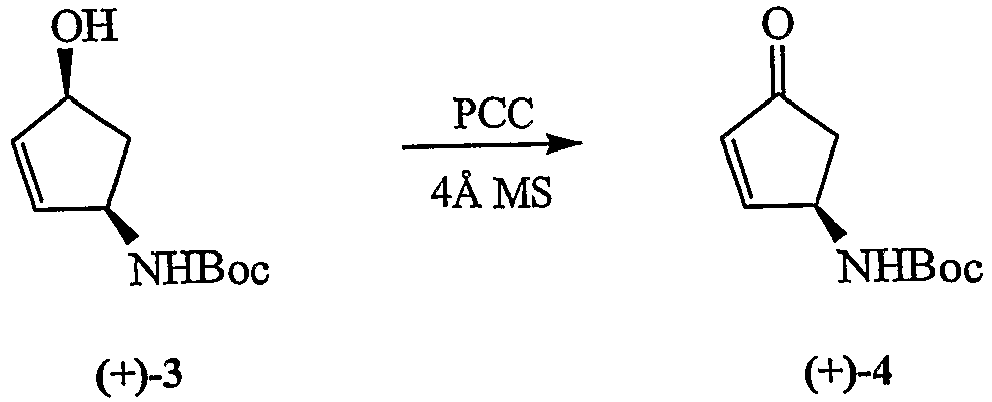
- 4Å powdered, activated, molecular sieves (0.5 g) and pyridinium chlorochromate (0.65 g, 3.02 mmol) were successively added to a solution of the optically active alcohol (+)-3 (0.50 g, 2.54 mmol) in anhydrous dichloromethane (20 cm3). The suspension was stirred for 1.5 hours at room temperature. Upon completion of reaction, the mixture was filtered over a short silica gel column (50 % ethyl acetate in petrol) to give the optically active cyclopentenone (+)-4 (0.40 g, 2.03 mmol, 80 %) as a white solid; e.e. = 92% (determined by chiral GC); [α]D = +71.0 (c 1.0, CHCl3); δH (400 MHz, CDCl3) 7.51 (1H, m, CH=CHC=O), 6.21 (1H, dd, J 5.7 & 0.7Hz, CH=CHC=O), 4.94 (2H, m, NH + CHNH), 2.83 (1H, m, CHH), 2.17 (1H, m, CHH), 1.45 (9H, s, CO2C(CH 3)3); δC (100 MHz, CDCl3) 206.9 (s), 162.6 (d), 155.5 (s), 135.5 (d), 80.6 (s), 51.5 (d), 42.7 (t), 28.7 (q); m/z (EI) Found [M]+ 197.1057 ([M]+ C10H15NO3 requires 197.1052).
-

- Triphenylphosphine (525 mg, 2.00 mmol) was added to a solution of the enone (+)-4 (395 mg, 2.00 mmol) in anhydrous dichloromethane (8 cm3). The solution was cooled to -50 °C, then titanium (IV) isopropoxide (295 µL, 1.00 mmol) and titanium (IV) chloride (110 µL, 1.00 mmol) were successively added to the mixture. After 15 minutes stirring at -50 °C, isobutyraldehyde (545 µL, 6.00 mmol) was added and the mixture was allowed to warm up to room temperature, then stirred for 17 hours at room temperature. Upon completion of reaction, the mixture was quenched with potassium carbonate (10 % aq. soln., 20 cm3) and extracted with diethyl ether (5 x 50 cm3). The combined organic layers were dried over anhydrous magnesium sulfate, filtered and evaporated to give a red residue. Flash chromatography (SiO2, 20 % ethyl acetate in petrol) gave the starting enone (+)-4 (110 mg, 0.56 mmol, 28 % recovery) as a white solid, after giving the less polar dieneone (+)-5 (220 mg, 0.88 mmol, 44 % (61 % based on recovery)) also as a white solid; [α]D = +56.0 (c 1.0, CHCl3); δH (400 MHz, CDCl3) 7.40 (1H, ddd, J 6.0, 2.5 & 0.8Hz, CH=CHC=O), 6.48 (1H, d, J 10.7Hz, C=CH), 6.38 (1H, dd, J 6.0 & 1.7Hz, CH=CHC=O), 5.47 (1H, m, NH), 4.65 (1H, m, CHNH), 2.75 (1H, m, CH(CH3)2), 1.47 (9H, s, CO2C(CH3 ) 3 ), 1.06 (6H, m, CH(CH 3)2); δC (100 MHz, CDCl3) 195.7 (s), 157.4 (d), 155.3 (s), 145.7 (d), 136.6 (d), 133.3 (s), 80.7 (s), 51.9 (d), 28.9 (d), 28.7 (q), 22.4 (q), 22.3 (q); m/z (CI) Found [MH]+ 252.1596 ([MH]+ C14H22NO3 requires 252.1600).
-

- A solution of acetyl chloride (0.53 cm3, 7.45 mmol) in anhydrous dichloromethane (10 cm3) was added slowly to a solution of the enriched alcohol (-)-3 (1.13 g, 5.68 mmol) in a mixture of pyridine (10 cm3) and anhydrous dichloromethane (10 cm3), cooled to 0°C. The mixture was stirred overnight at 0°C. Upon completion of reaction, the mixture was evaporated and diluted with ethyl acetate (200 cm3), then washed with citric acid (10 % aq. soln., 200 cm3). The aqueous layer was then extracted with ethyl acetate (150 cm3). The combined organic layers were washed with brine (200 cm3), dried over anhydrous magnesium sulfate, filtered and evaporated to give a yellow oil. Flash chromatography (SiO2, 50 % ethyl acetate in petrol) gave the optically enriched acetate (-)-6 (1.15 g, 4.77 mmol, 84 %) as a yellow oil, which showed identical spectroscopic data to its enantiomer (+)-6.

- PS Amano lipase (1.15 g) was added to an emulsion of the enriched acetate (-)-6 (1.15 g, 4.77 mmol) in a mixture of acetone (20 cm3) and phosphate buffer (c = 0.1M, pH = 7.4, 20 cm3). The slurry was stirred for 54 hours at 35°C. The mixture was filtered and evaporated to dryness to give a yellow oil. Flash chromatography (SiO2, 50 % ethyl acetate in petrol) gave in the order of elution, the optically active acetate (-)-6 (0.84 g, 3.49 mmol, 73 % recovery), and the optically enriched alcohol (+)-3 (0.19 g, 0.95 mmol, 20 %).
-

- Lithium hydroxide monohydrate (0.22 g, 5.24 mmol) was added to a solution of the optically active acetate (-)-6 (0.84 g, 3.49 mmol) in 75% aqueous ethanol (48 cm3). The solution was stirred overnight at room temperature. Upon completion of reaction, the mixture was partitioned between water (50 cm3) and ethyl acetate (50 cm3), and the aqueous layer was further extracted with ethyl acetate (2 x 50 cm3). The combined organic layers were washed successively with sodium hydrogen carbonate (sat'd. aq., 50 cm3), water (50 cm3) and brine (50 cm3), then dried over anhydrous magnesium sulphate and evaporated to give the optically active alcohol (-)-6 (0.70 g, 100%) as a light yellow oil, which solidified upon standing at room temperature; [α]D = -67.0 (c 1.0, CHCl3).
-

- 4Å powdered, activated, molecular sieves (0.75 g) and pyridinium chlorochromate (0.91 g, 4.22 mmol) were successively added to a solution of the optically active alcohol (-)-3 (0.70 g, 3.52 mmol) in anhydrous dichloromethane (30 cm3). The suspension was stirred for 1 hour at room temperature. Upon completion of reaction, the mixture was filtered over a short silica gel column (50 % ethyl acetate in petrol) to give the optically active cyclopentenone (-)-4 (0.55 g, 2.79 mmol, 79 %) as a white solid; e.e. = 99 % (determined by chiral GC); [α]D = -72.0 (c 1.0, CHCl3).
-

- Triphenylphosphine (0.73 g, 2.78 mmol) was added to a solution of the optically active enone (-)-4 (0.55 g, 2.79 mmol) in anhydrous dichloromethane (12 cm3). The solution was cooled to -50 °C, then titanium (IV) isopropoxide (0.41 cm3, 1.39 mmol) and titanium (IV) chloride (0.15 cm3, 1.37 mmol) were successively added to the mixture. After 15 minutes stirring at -50 °C, isobutyraldehyde (0.76 cm3, 8.37 mmol) was added and the mixture was allowed to warm up to room temperature, then stirred for 17 hours at room temperature. Upon completion of reaction, the mixture was quenched with potassium carbonate (10 % aq. soln., 20 cm3) and extracted with diethyl ether (5 x 50 cm3). The combined organic layers were dried over anhydrous magnesium sulphate, filtered and evaporated to dryness to give a red residue. Flash chromatography (SiO2, 20 % ethyl acetate in petrol) gave the starting enone (-)-4 (180 mg, 0.91 mmol, 33 % recovery) as a white solid, after giving the less polar dieneone (-)-5 (335 mg, 1.33 mmol, 48 % (71 % based on recovery)) also as a white solid; [α]D = -59.0 (c 1.0, CHCl3);
-

- Tetra-n-butylammonium periodate (17.3 g, 39.9 mmol) was added to a solution of freshly cracked cyclopentadiene (4.00 g, 60.6 mmol) in dichloromethane (150 cm3). Benzohydroxamic acid (5.50 g, 40.1 mmol) was then added portionwise over 5 minutes and the solution was stirred overnight at room temperature. Upon completion of reaction, the organic solution was washed successively with sodium thiosulfate (10 % aq. soln., 2 x 400 cm3) and sodium hydrogen carbonate (sat'd. aq., 500 cm3), then dried over anhydrous magnesium sulfate, filtered and concentrated to give a crude black oil. Flash chromatography (SiO2, 40 % ethyl acetate in petrol) gave the bicyclic adduct 7 (6.23 g, 31.0 mmol, 78 %) as a light brown oil, which solidified upon standing at room temperature; δH (250 MHz, CDCl3) 7.75 (2H, m, ArH), 7.52-7.37 (3H, m, ArH), 6.50 (1H, m, CH=CH), 6.37 (1H, m, CH=CH), 5.35 (1H, m, CHNBz), 5.28 (1H, m, CHON), 2.13 (1H, dt, J 8.6 & 1.9Hz, CHH), 1.84 (1H, m, CHH).
-

- Molybdenum hexacarbonyl (12.1 g, 45.8 mmol) was added to a solution of the bicycle 7 (6.10 g, 30.3 mmol) in a 7:1 mixture of acetonitrile and water (280 cm3). The suspension was stirred for 30 minutes at room temperature, then sodium borohydride (0.60 g, 15.9 mmol) was added and the suspension was heated under reflux for 4 hours. Upon completion of reaction, the mixture was allowed to cool to room temperature, filtered though a celite plug, and evaporated to dryness to give a brown solid. Flash chromatography (SiO2, 80 % ethyl acetate in petrol) gave the alcohol 8 (3.60 g, 17.7 mmol, 58 %) as a light yellow solid; m/z (EI) Found [M]+ 203.0945 ([M]+ C12H13NO2 requires 203.0946).
-

- 4Å powdered, activated, molecular sieves (3.50 g) and pyridinium chlorochromate (4.20 g, 19.5 mmol) were successively added to a solution of the alcohol 8 (3.30 g, 16.3 mmol) in anhydrous dichloromethane (150 cm3). The suspension was stirred for 2 hours at room temperature. Upon completion of reaction, the mixture was filtered over a short silica gel column (60 % ethyl acetate in cyclohexane) to give the ketone 9 (2.60 g, 12.9 mmol, 80 %) as a slightly yellow solid; δH (250 MHz, CDCl3) 7.78 (2H, m, ArH), 7.63 (1H, dd, J 5.7 & 1.7Hz, CH=CHC=O), 7.57-7.41 (3H, m, ArH), 6.56 (1H, m, NH), 6.29 (1H, dd, J 5.7 & 1.7Hz, CH=CHC=O), 5.47 (1H, m, CHNH), 2.95 (1H, m, CHH), 2.28 (1H, m, CHH); m/z (EI) Found [M]+ 201.0795 ([M]+ C12H11NO2 requires 201.0790).
-

- Triphenylphosphine (525 mg, 2.00 mmol) was added to a solution of the enone 9 (402 mg, 2.00 mmol) in anhydrous dichloromethane (12 cm3). The solution was cooled to -50 °C, then titanium (IV) isopropoxide (0.30 cm3, 1.02 mmol) and titanium (IV) chloride (110 µL, 1.00 mmol) were successively added to the mixture. After 15 minutes stirring at -50 °C, isobutyraldehyde (0.55 cm3, 6.06 mmol) was added and the mixture was allowed to warm up to room temperature, then stirred for 17 hours at room temperature. Upon completion of reaction, the mixture was quenched with potassium carbonate (10 % aq. soln., 10 cm3) and extracted with diethyl ether (5 × 10 cm3). The combined organic layers were dried over anhydrous magnesium sulfate, filtered and evaporated to dryness to give a yellow oil. Flash chromatography (SiO2, 50 % ethyl acetate in petrol) gave the starting enone 9 (170 mg, 0.85 mmol, 42 % recovery) as a white solid, after giving the less polar dieneone 10 (101 mg, 0.40 mmol, 20 % (34 % based on recovery)) also as a white solid; δH (400 MHz, CDCl3) 7.88 (2H, m, ArH), 7.53 (1H, m, CH=CHC=O), 7.49 (3H, m, ArH), 6.81 (1H, d, J 8.9Hz, NH), 6.48 (1H, d, J 10.8Hz, C=CH), 6.38 (1H, dd, J 5.9 & 1.6Hz, CH=CHC=O), 6.04 (1H, m, CHNH), 2.72 (1H, m, CH(CH3)2), 1.05 (6H, m, CH(CH 3)2); δC (100 MHz, CDCl3) 195.8 (s), 166.6 (s), 157.0 (d), 145.7 (d), 136.4 (d), 133.4 (s), 132.5 (s), 131.9 (d), 128.7 (d), 127.0 (d), 50.4 (d), 28.7 (d), 21.9 (q); m/z (EI) Found [M]+ 255.1257 ([M]+ C16H17NO2 requires 255.1259).
-

- To a solution of the enone 1 (1.46 g, 14.90 mmol) in dry dichloromethane (10 cm3) was added p-tolyl sulfonyl isocyanate (2.94 g, 14.90 mmol) under nitrogen atmosphere and the reaction mixture was stirred at room temperature for 5 hours. The dichloromethane was removed in vacuo and the crude product was purified by flash chromatography over silica using ethyl acetate in hexane (2:3) as eluent to afford the title compound 2 (1.93 g, 6.54 mmol, 44 %) as a light yellow solid; Rf 0.25 (ethyl acetate/hexane, 1:1); δH (400 MHz, CDCl3) 7.87-7.76 (2H, m, ArH), 7.39-7.32 (3H, m, HC=CH & ArH), 6.20 (1H, dd, J 5.6 & 1.8 Hz, HC=CH), 4.96 (1H, d, J 9.1 Hz, NH), 4.63 (1H, m, NCH), 2.58 (1H, dd, J 18.8 & 6.7 Hz, CHH), 2.45 (3H, s, CH3 ), 1.98 (1H, dd, J 18.8 & 2.5 Hz, CHH); δC (100.6 MHz, CDCl3) 205.3 (s), 160.9 (d), 145.7 (s), 144.3 (s), 137.2 (s), 136.0 (d), 130.1 (d), 127.2 (d), 53.6 (d), 42.1 (t), 21.6 (q).
-

- To a solution of the enone 1 (1.04 g, 0.01 mol) in dry dichloromethane (15 cm3) was added cyclohexane isocyanate (1.25 g, 0.01 mol) under nitrogen atmosphere and the reaction mixture was stirred at room temperature. After 48 hours, triethyl amine was added (1.01 g, 0.01 mol) and the reaction mixture was stirred for 24 hours more. The dichloromethane was removed in vacuo and the crude product was purified by flash chromatography over silica using ethyl acetate in hexane (2:3) as eluent to afford the title compound 2 (0.56 g, 2.51 mmol, 25 %) as a solid; Rf 0.7 (ethyl acetate/hexane, 3:2); δH (400 MHz, CDCl3) 7.58 (1H, dd, J 5.5 & 2.2 Hz, HC=CH), 6.29 (1H, d, J 5.5 Hz, HC=CH), 5.80 (1H, d, J 4.6 Hz, NH), 4.65 (1H, br. s, OCH), 3.56-3.43 (1H, m, NCH), 2.81 (1H, dd, J 18.6 & 6.2 Hz, CHH), 2.36-2.28 (1H, m, CHH), 1.98-1.10 (10 H, m, CH 2); δC (100.6 MHz, CDCl3) 205.3 (s), 169.9 (d), 154.7 (s), 136.5 (d), 72.0 (d), 50.0 (d), 41.3 (t), 33.3 (t), 25.4 (t), 24.7 (t); m/z (CI) 241 ([M+NH3]+, 12.3 %), 224 ([M+H]+, 100 %), 223 (M+, 5.2 %), 180 ([MH-CO2]+, 24.6 %), Found [M+H]+ 224.1286 ([M+H]+ C12H18NO3 requires 224.1287) (CTC-305).
-

- To a solution of the enone 1 (1.18 g, 12.00 mmol) in dry dichloromethane (15 cm3) was added phenyl isocyanatoformate (2.00 g, 12.00 mmol) under nitrogen atmosphere and the reaction mixture was stirred at room temperature for 24 hours. The dichloromethane was removed in vacuo and the crude product was purified by flash chromatography over silica using ethyl acetate in hexane (1:4) as eluent to afford the title compound 2 (0.85 g, 3.26 mmol, 27 %) as a white solid; Rf 0.4 (ethyl acetate/hexane, 1:1); δH (400 MHz, CDCl3) 7.60 (1H, dd, J 5.7 & 2.4 Hz, HC=CH), 7.38 (2H, t, J 7.9 Hz, ArH), 7.23 (1H, t, J 7.5 Hz, ArH), 7.14 (2H, m, ArH), 6.30 (1H, dd, J 5.7 & 1.7 Hz, HC=CH), 5.33 (1H, m, NH), 5.07 (1H, m, NCH), 2.93 (1H, dd, J 18.8 & 6.8 Hz, CHH), 2.28 (1H, dd, J 18.8 & 2.5 Hz, CHH); δC (100.6 MHz, CDCl3) 205.8 (s), 161.2 (d), 154.0 (s), 150.7 (s), 135.8 (d), 129.4 (d), 125.7 (d), 121.4 (d), 120.5 (s), 51.6 (d), 42.0 (t).
-

- To a solution of the enone 1 (0.53 g, 2.44 mmol) in dry chloroform (20 cm3) was added triethyl amine (0.31 g, 3.05 mmol) under nitrogen atmosphere and the reaction mixture was stirred at room temperature for 4 hours. The chloroform was removed in vacuo and the crude product was purified by flash chromatography over silica using ethyl acetate in hexane (1:6) as eluent to afford the title compound 2 (0.40 g, 2.31 mmol, 95 %) as a yellow crystalline solid; Rf 0.5 (ethyl acetate/hexane, 2:3); δH (400 MHz, CDCl3) 7.67 (1H, dd, J 5.7 & 2.4 Hz, HC=CH), 7.26-7.19 (2H, m, ArH), 6.84-6.78 (1H, m, ArH), 6.71-6.65 (2H, m, ArH), 6.31 (1H, dd, J 5.7 & 1.8 Hz, HC=CH), 4.78 (1H, br. s, NH), 3.75 (1H, br. s, NCH), 2.91 (1H, dd, J 18.6 & 6.2 Hz, CHH), 2.23 (1H, dd, J 18.6 & 2.4 Hz, CHH); δC (100.6 MHz, CDCl3) 206.7 (s), 162.2 (d), 146.4 (s), 135.5 (d), 129.6 (d), 118.8 (d), 113.6 (d), 54.0 (d), 43.0 (t); m/z (CI) 174 ([M+H]+, 100 %), 173 (M+, 19 %), Found [M+H]+ 174.0925 ([M+H]+ C11H12NO requires 174.0919).
-

- To a solution of the enone 1 (0.96 g, 9.80 mmol) in dry dichloromethane (10 cm3) was added chloroacetyl isocyanate (1.17 g, 9.80 mmol) under nitrogen atmosphere and the reaction mixture was stirred at room temperature for 20 hours. The dichloromethane was removed in vacuo and the crude product was purified by flash chromatography over silica using ethyl acetate in hexane (1:4) as eluent to afford the title compound 2 (0.68 g, 3.18 mmol, 41 %) as a white solid; Rf 0.5 (ethyl acetate); δH (400 MHz, CDCl3) 7.53 (1H, dd, J 5.6 & 2.4 Hz, HC=CH), 6.71 (1H, s, NH), 6.33 (1H, dd, J 5.6 & 1.8 Hz, HC=CH), 5.31-5.23 (1H, m, NCH), 4.09 (2H, s, ClCH2), 2.91 (1H, dd, J 18.8 & 6.8 Hz, CHH), 2.22 (1H, dd, J 18.8 & 2.7 Hz, CHH); δC (100.6 MHz, CDCl3) 205.5 (s), 165.8 (s), 160.6 (d), 136.2 (d), 50.0 (d), 42.4 (t), 41.7 (t); m/z (CI) 191 ([M+NH3]+, 100 %), 174 ([M+H]+, 39.2 %), 173 (M+, 3.7 %), 157 ([M+NH3-Cl]+, 52.5 %), 140 ([M+H-Cl]+, 69.7 %), Found [M+H]+ 174.0321 ([M+H]+ C7H9NO2Cl requires 174.0322) (CTC-304).
-

- To a solution of the enone 1 (0.60 g, 2.10 mmol) in dry chloroform (10 cm3) was added triethyl amine (0.23 g, 2.30 mmol) and the reaction mixture was stirred at room temperature for 19 hours under nitrogen atmosphere. The chloroform was removed in vacuo and the crude product was purified by flash chromatography over silica using ethyl acetate in hexane (2:3) as eluent to afford the title compound 2 (0.22 g, 0.93 mmol, 43 %) as a white crystalline solid; Rf 0.4 (ethyl acetate/hexane, 3:2); δH (400 MHz, CDCl3) 7.91-7.87 (2H, m, ArH), 7.65-7.60 (1H, m, ArH), 7.57-7.51 (2H, m, ArH), 7.35 (1H, dd, J 5.7 & 2.5 Hz, HC=CH), 6.17 (1H, dd, J 5.7 & 1.8 Hz, HC=CH), 5.64 (1H, d, J 8.9 Hz, NH), 4.63-4.57 (1H, m, NCH), 2.55 (1H, dd, J 18.8 & 6.8 Hz, CHH), 2.02 (1H, dd, J 18.8 & 2.7 Hz, CHH); δC (100.6 MHz, CDCl3) 205.6 (s), 161.0 (d), 140.2 (s), 135.7 (d), 133.1 (d), 129.4 (d), 127.0 (d), 53.5 (d), 41.8 (t); m/z (CI) 255 ([M+NH3]+, 100 %), 238 ([M+H]+, 17 %), 237 (M+, 2.5 %), 96 ([M-SO2Ph]+, 70.5 %), Found [M+H]+ 238.0534 ([M+H]+ C11H12NO3S requires 238.0538).
-

- To a solution of the enone 1 (0.41 g, 1.57 mmol) in dry chloroform (10 cm3) was added triethyl amine (0.16 mg, 1.65 mmol) and the reaction mixture was stirred at room temperature for 4 hours under nitrogen atmosphere. The solvent was removed in vacuo to afford the title compound 2 (0.40 g, 1.84 mmol, 96 %) as a copper coloured solid; Rf 0.4 (ethyl acetate/hexane, 1:1); δH (400 MHz, CDCl3) 7.58 (1H, dd, J 5.6 & 2.4 Hz, HC=CH), 7.40-7.33 (2H, m, ArH), 7.24-7.19 (1H, m, ArH), 7.15-7.10 (2H, m, ArH), 6.29 (1H, dd, J 5.6 & 1.8 Hz, HC=CH), 5.28 (1H, br.s, NH), 5.09-5.01 (1H, m, NCH), 2.91 (1H, dd, J 18.6 & 6.8 Hz, CHH), 2.27 (1H, dd, J 18.6 & 2.2 Hz, CHH); δC (100.6 MHz, CDCl3) 205.7 (s), 161.1 (d), 153.9 (s), 150.7 (s), 135.8 (d), 129.4 (d), 125.7 (d), 121.4 (d), 51.6 (d), 42.0 (t)□ m/z (CI) 235 ([M+NH3]+, 100 %), 218 ([M+H]+, 15.8 %), 217 (M+, 0.3 %), Found [M+H]+ 218.0824 ([M+H]+ C12H12NO3 requires 218.0817).
-

- To a solution of the enone 1 (1.15 g, 5.40 mmol) in dry chloroform (20 cm3) was added triethyl amine (0.60 g, 5.90 mmol) under nitrogen atmosphere and the reaction mixture was stirred at room temperature for 3 hours. The chloroform was removed in vacuo and the crude product was purified by flash chromatography over silica using ethyl acetate in hexane (1:1) as eluent to afford the title compound 2 (0.95 g, 5.62 mmol, 85 %) as a white crystalline solid; Rf 0.3 (ethyl acetate/hexane, 1:1); δH (400 MHz, CDCl3) 7.53 (1H, m, HC=CH), 6.25 (1H, m, HC=CH), 5.00 (1H, br. s, NH), 4.91 (1H, br. s, NCH), 4.15 (2H, q, J 7.1 Hz, CH3CH 2), 2.86 (1H, dd, J 18.7 & 6.5 Hz, CHH), 2.18 (1H, dd, J 18.7 & 2.4 Hz, CHH), 1.26 (3H, t, J 7.1 Hz, CH2CH3 ); δC (100.6 MHz, CDCl3) 206.2 (s), 161.7 (d), 155.9 (s), 135.4 (d), 61.4 (t), 51.4 (d), 42.3 (t), 14.5 (q); m/z (CI) 187 ([M+NH3]+, 100 %), 170 ([M+H]+, 91.6 %), 169 (M+, 14 %), Found [M+H]+ 170.0814 ([M+H]+ C8H12NO3 requires 170.0817).
-

- To a solution of the enone 1 (0.08 g, 0.46 mmol) and di-tert-butyl dicarbonate (0.12 g, 0.55 mmol) in dry THF (10 cm3) was added triethyl amine (0.52 g, 5.10 mmol) and a catalytic amount of 4-(dimethylamino) pyridine, the reaction mixture was stirred at room temperature for 20 hours under nitrogen atmosphere. The THF was removed in vacuo and the crude product was purified by flash chromatography over silica using ethyl acetate in hexane (1:1) as eluent to afford the title compound 2 (0.02 g, 0.07 mmol, 32 %) as an oil; Rf 0.6 (ethyl acetate/hexane, 1:1); δH (400 MHz, CDCl3) δ 7.50 (1H, dd, J 5.7 & 2.4 Hz, HC=CH), 6.22 (1H, dd, J 5.7 & 2.4 Hz, HC=CH), 5.59 (1H, m, NCH), 4.25 (2H, q, J 7.2 Hz, CH 2CH3), 2.73 (1H, dd, J 18.2 & 7.0 Hz, CHH), 2.55 (1H, dd, J 18.2 & 3.2 Hz, CHH), 1.48 (9H, s, C(CH3 )3), 1.31 (3H, t, J 7.2 Hz, CH2CH3 ); δC (100.6 MHz, CDCl3) 205.8 (s), 162.2 (d), 153.8 (s), 151.6 (s), 134.1 (d), 84.0 (s), 63.4 (t), 56.2 (d), 40.3 (t), 27.9 (q), 14.1 (q); m/z (CI) 287 ([M+NH3]+, 2.2 %), 270 ([M+H]+, 1.8 %), 187 ([1+NH3]+, 68.2 %), 170 ([1+H]+, 100 %), 169 (1+, 14 %), Found [M+H]+ 270.1339 ([M+H]+ C13H20NO5 requires 270.1341).
-

- To a solution of the enone 1 (0.12 g, 0.56 mmol) and triphenyl phosphine (0.15 g, 0.56 mmol) in dry dichloromethane (20 cm3) was added titanium (IV) chloride (0.05 g, 0.28 mmol) and titanium (IV) isopropoxide (0.08 g, 0.28 mmol) at -50 °C under nitrogen atmosphere. After 15 minutes, the reaction mixture was treated with 4-fluorobenzaldehyde (0.21 g, 1.68 mM) and maintained at -50 °C for 3 hours then warmed to room temperature overnight. Potassium carbonate (10 % aq. soln, 1.5 cm3) was added to the reaction mixture and then stirred for 15 minutes. The organic layer was extracted with dichloromethane (200 cm3), washed with citric acid (10%) (2×10 cm3), water (2×15 cm3), brine (2×15 cm3) and dried over magnesium sulfate. The solvent was removed in vacuo and the crude product was purified by flash chromatography over silica using ethyl acetate in hexane (1:4) as eluent to afford the title compound 2 (0.03 g, 0.09 mmol, 19 %) as a white solid; Rf 0.5 (ethyl acetate/hexane, 1:1); δH (400 MHz, CDCl3) 7.67-7.58 (3H, m, ArH & HC=CH), 7.51 (1H, s, ArH), 7.38 (2H, t, J 7.9 Hz, ArH), 7.25-7.21 (1H, m, ArH), 7.18-7.12 (2H, m, ArH), 7.05-7.00 (2H, d, J 7.9 Hz, ArH), 6.58 (1H, dd, J 4.3 & 1.6 Hz, HC=CH), 5.89 (1H, dd, J 8.7 & 1.6 Hz, NH), 4.88 (1H, d, J 8.7 Hz, NCH); δC (100.6 MHz, CDCl3) 194.6 (s), 164.9 (s), 162.4 (s), 156.4 (d), 154.2 (s), 150.5 (s), 136.0 (d), 133.3 (d), 133.1 (dd, J 8.5 Hz), 131.3 (s), 129.1 (d), 125.6 (d), 121.2 (d), 116.0 (dd, J 21.7 Hz), 52.4 (d); m/z (CI) 341 ([M+NH3]+, 25.8 %), 324 ([M+H]+, 14.2 %), 247 ([M-OPh+NH3]+, 38.6 %), 230 ([M-OPh]+, 100 %), Found [M+H]+ 324.1024 ([M+H]+ C19H15FNO3 requires 324.1036).
-

- To a solution of the enone 1 (0.12 g, 0.56 mmol) and triphenyl phosphine (0.15 g, 0.56 mmol) in dry dichloromethane (20 cm3) was added titanium (IV) chloride (0.05 g, 0.28 mmol) and titanium (IV) isopropoxide (0.08 g, 0.28 mmol) at -50 °C under nitrogen atmosphere. After 15 minutes, the reaction mixture was treated with benzaldehyde (0.18 g, 1.68 mmol) and maintained at -50 °C for 3 hours then warmed to room temperature overnight. Potassium carbonate (10 % aq. soln, 1.5 cm3) was added to the reaction mixture and then stirred for 15 minutes. The organic layer was extracted with dichloromethane (200 cm3), washed with citric acid (10%) (2×10 cm3), water (2x15 cm3), brine (2x15 cm3) and dried over sodium sulfate. The solvent was removed in vacuo and the crude product was purified by flash chromatography over silica using ethyl acetate in hexane (1:4) as eluent to afford the title compound 2 (0.03 g, 0.10 mmol, 21 %) as a white crystalline solid; Rf 0.4 (ethyl acetate/hexane, 1:1); δH (400 MHz, CDCl3) 7.67 (1H, dd, J 5.8 & 1.9 Hz, HC=CH), 7.64-7.59 (2H, m, ArH), 7.56 (1H, s, ArH), 7.48-7.44 (2H, m, ArH), 7.36 (2H, t, J 7.8 Hz, ArH), 7.22 (1H, t, J 7.5 Hz, ArH), 7.02 (2H, d, J 7.8 Hz, ArH), 6.58 (1H, dd, J 5.8 & 1.4 Hz, HC=CH), 5.94-5.89 (1H, m, NH), 4.90 (1H, d, J 8.3 Hz, NCH); δC (100.6 MHz, CDCl3) 195.0 (s), 156.8 (d), 154.4 (s), 150.8 (s), 136.2 (d), 134.8 (d), 133.1 (s), 131.8 (s), 131.2 (d), 130.5 (d), 129.4 (d), 128.9 (d), 125.7 (d), 121.5 (d), 52.8 (d); m/z (CI) 323 ([M+NH3]+, 4.4 %), 306 ([M+H]+, 6.7 %), 229 ([M-OPh +NH3]+, 19.8 %), 212 ([M-OPh]+, 100 %), Found [M+H]+ 306.1138 ([M+H]+ C19H16NO3 requires 306.1130).
-

- To a solution of the enone 1 (0.20 g, 1.18 mmol) and triphenyl phosphine (0.32 g, 1.22 mmol) in dry dichloromethane (20 cm3) was added titanium (IV) chloride (0.11 g, 0.59 mmol) and titanium (IV) isopropoxide (0.17 g, 0.59 mmol) at -50 °C under nitrogen atmosphere. After 15 minutes, the reaction mixture was treated with 4-fluorobenzaldehyde (0.44 g, 3.55 mmol) and maintained at -50 °C for 3 hours then warmed to room temperature overnight. Potassium carbonate (10 % aq. soln, 2 cm3) was added to the reaction mixture and then stirred for 30 minutes. The organic layer was extracted with dichloromethane (100 cm3), washed with citric acid (10%) (2×10 cm3), water (2×10 cm3), brine (2×10 cm3) and dried over magnesium sulfate. The solvent was removed in vacuo and the crude product was purified by flash chromatography over silica using ethyl acetate in hexane (1:4) as eluent to afford the title compound 2 (0.06 g, 0.22 mmol, 18 %) as a white crystalline solid; Rf 0.7 (ethyl acetate/hexane, 3:2); δH (400 MHz, CDCl3) 7.61-7.54 (3H, m, HC=CH & ArH), 7.45 (1H, br. s, C=CH), 7.14-7.07 (2H, m, ArH), 6.51 (1H, dd, J 5.9 & 1.6 Hz, HC=CH), 5.80 (1H, d, J 7.8 Hz, NH), 4.55 (1H, d, J 7.8 Hz, NCH), 4.22-4.11 (2H, m, CH2CH3), 1.24-1.19 (3H, t, J 6.8 Hz, CH2CH 3); δC (100.6 MHz, CDCl3) 195.1 (s), 165.0 (s), 162.5 (s), 157.2 (d), 150.9 (s), 135.7 (d), 133.4 (dd, J 8.8 Hz), 133.2 (d), 129.3 (sd, J 3.2 Hz), 116.0 (dd, J 22.4 Hz), 61.6 (t), 52.4 (d), 14.6 (q); m/z (CI) 293 ([M+NH3]+, 24 %), 276 ([M+H]+, 100 %), 275 (M+, 26 %), Found [M+H]+ 276.1044 ([M+H]+ C15H15FNO3 requires 276.1036).
-

- To a solution of the enone 1 (0.13 g, 0.80 mmol) and triphenyl phosphine (0.21 g, 0.81 mmol) in dry dichloromethane (20 cm3) was added titanium (IV) chloride (0.07 g, 0.40 mmol) and titanium (IV) isopropoxide (0.11 g, 0.40 mmol) at -50 °C under nitrogen atmosphere. After 15 minutes, the reaction mixture was treated with benzaldehyde (0.26 g, 2.40 mmol) and maintained at -50 °C for 3 hours then warmed to room temperature overnight. Potassium carbonate (10 % aq. soln, 2 cm3) was added to the reaction mixture and then stirred for 15 minutes. The organic layer was extracted with dichloromethane (100 cm3), washed with citric acid (10%) (2×10 cm3), water (2×10 cm3), brine (2×10 cm3) and dried over magnesium sulfate. The solvent was removed in vacuo and the crude product was purified by flash chromatography over silica using ethyl acetate in hexane (1:4) as eluent to afford the title compound 2 (0.06 mg, 0.25 mmol, 32 %) as a white crystalline solid; Rf 0.4 (ethyl acetate/hexane, 2:3); δH (400 MHz, CDCl3) 7.55-7.46 (3H, m, HC=CH & ArH), 7.45 (1H, br.s, C=CH), 7.35-7.30 (3H, m, ArH), 6.49 (1H, dd, J 5.9 & 1.6 Hz, HC=CH), 5.75 (1H, d, J 7.8 Hz, NH), 4.46 (1H, d, J 7.8 Hz, NCH), 4.11-4.00 (2H, m, CH 2CH3), 1.15-1.08 (3H, t, J 6.5 Hz, CH2CH3 ); δC (100.6 MHz, CDCl3) 195.1 (s), 161.7 (s), 157.4 (d), 135.6 (d), 134.5 (d), 133.0 (s), 132.1 (s), 131.3 (d), 130.2 (d), 128.8 (d), 61.5 (t), 52.6 (d), 14.6 (q); m/z (CI) 275 ([M+NH3]+, 43.5 %), 258 ([M+H]+, 100 %), 257 (M+, 28.7 %), Found [M+H]+ 258.1138 ([M+H]+ C15H16NO3 requires 258.1130).
-

- To a solution of the the enone 1 (89 mg, 0.41 mmol) and 2-Naphtalene thiol (73 mg, 0.45 mmol) in dry chloroform (5 cm3) was added a catalytic amount of triethyl amine at room temperature under nitrogen atmosphere and the reaction mixture was stirred for 1 hour. The chloroform was removed in vacuo and the crude product was purified by flash chromatography over silica using ethyl acetate in hexane (1:6) as eluent to afford the esters 2 (71 mg, 0.18 mmol) and 3 (12 mg, 0.03 mmol) with a ratio of 6:1 (53 %) as white solids; Rf 0.8 (2) & 0.7 (3) (ethyl acetate/hexane, 1:1); (2) δH (400 MHz, CDCl3) 8.04 (1H, s, ArH), 7.86-7.77 (3H, m, ArH), 7.59-7.55 (1H, dd, J 8.4 & 1.6 Hz, ArH), 7.54-7.48 (2H, m, ArH), 7.39-7.32 (2H, m, ArH), 7.24-7.19 (1H, m, ArH), 7.08-7.03 (2H, d, J 8.0 Hz, ArH), 5.36-5.22 (1H, br. s, NH), 4.32-4.21 (1H, m, NCH), 4.04-3.92 (1H, m, SCH), 3.03-2.93 (1H, dd, J 18.6 & 7.3 Hz, CHH), 2.92-2.83 (1H, dd, J 18.6 & 7.8 Hz, CHH), 2.43-2.30 (2H, m, CH2 ); δC (100.6 MHz, CDCl3) 211.5 (s), 153.9 (s), 150.6 (s), 133.7 (s), 132.7 (s), 132.2 (d), 129.9 (d), 129.6 (s), 129.4 (d), 129.0 (d), 127.7 (d), 127.6 (d), 126.8 (d), 126.7 (d), 125.6 (d), 121.4 (d), 54.4 (d), 48.1 (d), 43.9 (t), 43.7 (t); m/z (ES+) Found [M+Na]+ 400.0994 ([M+Na]+ C22H19NO3SNa requires 400.0983); Expt.No.MC1/51/A; (3) δH (400 MHz, CDCl3) 7.96 (1H, s, ArH), 7.84-7.75 (3H, m, ArH), 7.54-7.48 (3H, m, ArH), 7.31-7.26 (2H, m, ArH), 7.19-7.12 (1H, m, ArH), 6.94-6.89 (2H, d, J 8.0 Hz, ArH), 5.70-5.61 (1H, s, NH), 4.64-4.56 (1H, m, NCH), 4.39-4.31 (1H, m, SCH), 2.79-2.71 (1H, dd, J 18.9 & 7.5 Hz, CHH), 2.69-2.63 (2H, dd, J 7.8 & 2.7 Hz, CH 2), 2.61-2.53 (1H, dd, J 18.9 & 4.6 Hz, CHH); δC (100.6 MHz, CDCl3) 211.3 (s), 154.1 (s), 150.7 (s), 133.8 (s), 132.7 (s), 130.9 (s), 129.4 (d), 129.3 (d), 129.2 (d), 128.9 (d), 127.8 (d), 127.5 (d), 127.0 (d), 126.7 (d), 125.5 (d), 121.4 (d), 51.7 (d), 48.5 (d), 44.6 (t), 42.7 (t); m/z (ES+) Found [M+Na]+ 400.0972 ([M+Na]+ C22H19NO3SNa requires 400.0983); Expt.No.MC1/51/C.
-

- To a solution of the enone 1 (86 mg, 0.40 mmol) and Boc-Cys-OMe (0.14 g, 0.60 mmol) in dry chloroform (5 cm3) was added a catalytic amount of triethyl amine at room temperature under nitrogen atmosphere and the reaction mixture was stirred for 4 hours. The chloroform was removed in vacuo and the crude product was purified by flash chromatography over silica using ethyl acetate in hexane (2:3) as eluent to afford the ester 2 (0.12 g, 0.27 mmol, 67 %) as a white solid; Rf 0.4 (ethyl acetate/hexane, 1:1); δH (400 MHz, CDCl3) 7.39-7.33 (2H, m, ArH), 7.24-7.18 (1H, m, ArH), 7.17-7.12 (2H, m, ArH), 6.05 (1H, br.s, NH), 5.77 (1H, br.s, No, 5.44-5.32 (1H, m, CH3OCOCH), 4.66-4.56 (1H, m, NCH), 4.55-4.45 (1H, m, SCH), 3.78 (3H, s, OCH3 ), 3.19-3.08 (1H, m, CHH), 3.05-2.96 (1H, m, CHH), 2.71-2.56 (3H, m, CHH & SCH 2), 2.47-2.35 (1H, m, CHH), 1.47-1.44 (9H, d, J 2.2 Hz, OC(CH 3)3); δC (100.6 MHz, CDCl3) 211.6 (s), 171.0 (s), 154.3 (s), 150.8 (s), 150.7(s), 129.3 (d), 125.6 (d), 121.5 (d), 80.6 (s), 52.8 (q) 51.4 (d), 51.0 (d), 45.9 (d), 44.8 (t), 44.1 (t), 34.1 (t), 28.3 (q); m/z (ES+) Found [M+Na]+ 475.1526 ([M+Na]+ C21H28N2O7SNa requires 475.1515); Expt.No.MC1/52/B.
-

-

- Triphenyl phosphine (333 mg, 1.27 mmol) was added to a stirred solution of the enone CTC-132 (250 mg, 1.27 mmol) in dichloromethane (6 ml) at room temperature, under an atmosphere of argon. The resulting mixture was then cooled to -50 °C and titanium (IV) isopropoxide (0.19 ml, 0.64 mmol) and then titanium (IV) chloride (70 µl, 0.64 mmol) were added dropwise over 3 minutes each. The mixture was stirred at -50 °C for a further 15 minutes, then a solution of 4-chlorobenzaldehyde (535 mg, 3.81 mmol) in dichloromethane (1 ml) was added over 3 minutes. The reaction mixture was then allowed to warm to room temperature over 18 hours. An aqueous solution of potassium carbonate (10 % aq., 6 ml) was then added, the biphasic mixture was stirred for 90 minutes and the mixture was extracted with diethyl ether (5 x 6 ml). The combined organic extracts were then dried over MgSO4, and evaporated in vacuo. Flash chromatography (SiO2, 20 %, then 35 % ethyl acetate in hexane) gave the starting enone CTC-132 (93 mg, 0.47 mmol, 37 % recovery) as a white solid, after giving the less polar dieneone CTC-247 (210 mg, 0.66 mmol, 52 % (82 % based on recovery) also as a white solid; δH (400 MHz, CDCl3) 7.58 (1H, ddd J 5.9, 2.4 & 0.7Hz, CH=CHC=O), 7.51 (2H, dt J 8.6 & 1.9Hz, ArH), 7.43 (1H, br. s, C=CHAr), 7.38 (2H, dt J 8.6 & 1.9Hz, ArH), 6.51 (1H, dd J 5.9 & 1.7Hz, CH=CHC=O), 5.79 (1H, br. d J 8.0Hz, NH), 4.41 (1H, br. d J 8.0Hz, CHNH), 1.45 (9H, s, CO2C(CH 3)3); δC (100 MHz, CDCl3) 195.2 (s), 157.7 (d), 155.3 (s), 136.3 (s), 135.6 (s), 135.5 (d), 132.8 (d), 132.5 (d), 131.6 (s), 129.0 (d), 80.6 (s), 52.0 (d), 28.3 (q).
-

- Triphenyl phosphine (333 mg, 1.27 mmol) was added to a stirred solution of the enone CTC-132 (250 mg, 1.27 mmol) in dichloromethane (6 ml) at room temperature, under an atmosphere of argon. The resulting mixture was then cooled to -50 °C and titanium (IV) isopropoxide (0.19 ml, 0.64 mmol) and then titanium (IV) chloride (70 µl, 0.64 mmol) were added dropwise over 3 minutes each. The mixture was stirred at -50 °C for a further 15 minutes, then benzaldehyde (0.39 ml, 3.84 mmol) was added over 3 minutes. The reaction mixture was then allowed to warm to room temperature over 16 hours. An aqueous solution of potassium carbonate (10 % aq., 6 ml) was then added, the biphasic mixture was stirred for 90 minutes and the mixture was extracted with diethyl ether (5 x 6 ml). The combined organic extracts were then dried over MgSO4 and evaporated in vacuo. Flash chromatography (SiO2, 20 %, then 35 % ethyl acetate in hexane) gave the starting enone CTC-132 (98 mg, 0.50 mmol, 39 % recovery) as a white solid, after giving the less polar dieneone CTC-248 (180 mg, 0.63 mmol, 50 % (82 % based on recovery) also as a white solid; δH (400 MHz, CDCl3) 7.62-7.56 (3H, m, CH=CHC=O + ArH), 7.49 (1H, br. s, C=CHAr), 7.44-7.39 (3H, m, ArH), 6.50 (1H, dd J 5.9 & 1.6Hz, CH=CHC=O), 5.81 (1H, br. d J 7.2Hz, NH), 4.42 (1H, br. d J 7.2Hz, CHNH), 1.44 (9H, s, CO2C(CH 3)3); δC (100 MHz, CDCl3) 195.5 (s), 157.7 (d), 155.3 (s), 135.4 (d), 134.3 (d), 133.1 (s), 132.2 (s), 131.4 (d), 130.1 (d), 128.7 (d), 80.4 (s), 52.1 (d), 28.3 (q).
-

- Triphenyl phosphine (267 mg, 1.02 mmol) was added to a stirred solution of the enone (R)-CTC-132 (201 mg, 1.02 mmol) in dichloromethane (5 ml) at room temperature, under an atmosphere of argon. The resulting mixture was then cooled to -50 °C and titanium (IV) isopropoxide (0.15 ml, 0.51 mmol) and then titanium (IV). chloride (56 µl, 0.51 mmol) were added dropwise over 3 minutes each. The mixture was stirred at -50 °C for a further 15 minutes, then mesitaldehyde (0.45 ml, 3.05 mmol) was added over 3 minutes. The reaction mixture was then allowed to warm to room temperature over 15 hours. An aqueous solution of potassium carbonate (10 % aq., 6 ml) was then added and the biphasic mixture was stirred for 2 hours then filtered through a small pad of celite washing with dichloromethane (10 ml) and diethyl ether (10 ml). The organic phase of the filtrate was then separated and the aqueous phase was extracted with diethyl ether (4 x 5 ml). The combined organics were then dried over MgSO4, and evaporated in vacuo. Flash chromatography (SiO2, 20 %, then 35 % ethyl acetate in hexane) gave the starting enone (R)-CTC-132 (135 mg, 0.68 mmol, 67 % recovery) as a white solid, after giving the less polar dieneone CTC-285 (80 mg, 0.24 mmol, 24 % (73 % based on recovery) also as a white solid; δH (400 MHz, CDCl3) 7.57 (1H, s, C=CHAr), 7.44 (1H, dd J 6.3 & 2.2Hz, CH=CHC=O), 6.87 (2H, s, ArH), 6.48 (1H, dd J 6.0 & 1.9Hz, CH=CHC=O), 5.33 (1H, br. d J 5.6Hz, NH), 4.10 (1H, br. d J 5.6Hz, CHNH), 2.26 (3H, s, p-ArCH3), 2.20 (6H, s, o-Ar(CH 3)2), 1.22 (9H, s, CO2C(CH 3)3); δC (100 MHz, CDCl3) 194.4 (s), 158.1 (d), 154.3 (s), 137.6 (s), 137.5 (s), 135.9 (d), 135.1 (s), 134.3 (d), 130.4 (s), 128.4 (d), 79.7 (s), 52.6 (d), 28.1 (q), 20.9 (q), 20.2 (q).
-

- Triphenyl phosphine (267 mg, 1.02 mmol) was added to a stirred solution of the enone (R)-CTC-132 (201 mg, 1.02 mmol) in dichloromethane (5 ml) at room temperature, under an atmosphere of argon. The resulting mixture was then cooled to -50 °C and titanium (IV) isopropoxide (0.15 ml, 0.51 mmol) and then titanium (IV) chloride (56 µl, 0.51 mmol) were added dropwise over 3 minutes each. The mixture was stirred at -50 °C for a further 15 minutes, then a solution of 2,5-dimethoxybenzaldehyde (508 mg, 3.06 mmol) in dichloromethane (1 ml) was added over 3 minutes. The reaction mixture was then allowed to warm to room temperature over 18 hours. An aqueous solution of potassium carbonate (10 % aq., 6 ml) was then added and the biphasic mixture was stirred for 2 hours then filtered through a small pad of celite washing with dichloromethane (10 ml) and diethyl ether (10 ml). The organic phase of the filtrate was then separated and the aqueous phase was extracted with diethyl ether (4 × 5 ml). The combined organics were then dried over MgSO4 and evaporated in vacuo. Flash chromatography (SiO2, 20 %, then 35 % ethyl acetate in hexane) gave the starting enone (R)-CTC-132 (51 mg, 0.26 mmol, 25 % recovery) as a white solid, after giving the less polar dieneone CTC-286 (210 mg, 0.61 mmol, 60 % (80 % based on recovery) also as a yellow solid; δH (400 MHz, CDCl3) 7.87 (1H, s, C=CHAr), 7.57 (1H, dd J 5.9 & 2.0Hz, CH=CHC=O), 7.09 (1H, d J 2.9Hz, o-ArH), 6.93 (1H, dd J 9.1 & 2.9Hz, p-ArH), 6.86 (1H, d J 9.1Hz, m-ArH), 6.49 (1H, dd J 5.9 & 1.6Hz, CH=CHC=O), 5.77 (1H, br. d J 7.0Hz, NH), 4.41 (1H, br. d J 7.0Hz, CHNH), 3.85 (3H, s, OCH 3), 3.80 (3H, s, OCH 3), 1.38 (9H, s, CO2C(CH 3)3); δC (100 MHz, CDCl3) 195.4 (s), 157.5 (d), 153.4 (s), 138.5 (s), 135.5 (d), 132.6 (s), 129.1 (d), 122.7 (d), 118.1 (s), 115.8 (s), 114.6 (d), 112.0 (d), 80.2 (s), 56.1 (q), 55.6 (q), 52.3 (d), 28.2 (q).
-

- Boc-Cys-OH (3.68 g, 16.7 mmol) and triethylamine (2.4 ml, 17.5mmol) were added successively to a stirred solution of dienone (S)-CTC-248 (5.00 g, 17.5 mmol) in chloroform (150 ml) at room temperature. The mixture was stirred at room temperature for 40 hours, then evaporated in vacuo. Recrystallisation from dichloromethane then gave the thiol adduct CTM-228 as a DCM solvate (1:1) as a white crystal suitable for X-ray structure determination. This was dissolved in TBME (100 ml), evaporated in vacuo, then dissolved in TBME (50 ml) and hexane (50 ml), and evaporated in vacuo again in order to give CTM-228 (3.82 g, 7.54 mmol, 45 %) as a white solvent-free solid; δH (400 MHz, CDCl3) 7.66 (1H, d J 1.4Hz, C=CH), 7.59-7.55 (2H, m, ArH), 7.47-7.44 (3H, m, ArH), 5.73 (1H, br. s, NHBoc), 5.08 (1H, br. s, NHBoc), 4.89 (1H, br. s, CHNHBoc), 4.62 (1H, br. s, CHNHBoc), 3.73 (1H, d J 6.2Hz, CHSR), 3.34 (1H, dd J 14.0 & 6.5Hz, CHCHHSR), 3.15-3.06 (1H, m, CHCHHSR), 2.97 (1H, dd J 18.8 & 7.9Hz, CHHCHSR), 2.35 (1H, d J 18.8Hz, CHHCHSR), 1.49 (9H, s, CO2C(CH 3)3), 1.43 (9H, s, CO2C(CH 3)3); m/z (ES) 529.1979 ([MNa]+ C25H34N2O7NaS requires 529.1984).
-

- A solution of enone 1 (0.30 g, 1.41 mmol) in anhydrous chloroform (5 cm3) was added to a solution of Boc-cysteine (0.33 g, 1.41 mmol) and a catalytic amount of triethylamine (3 drops) in anhydrous chloroform (5 cm3). The reaction was stirred under N2 for 16 hours until TLC analysis confirmed the disappearance of the enone. The solvent was removed under reduced pressure giving a pale yellow oil. Purification by flash column chromatography [Rf = 0.25 (ethyl acetate-petroleum ether; 1: 4)] gave the adduct 2 (0.50 g, 80% yield) as a colorless oil which solidified on standing at -2° C; m.p. 52-53 °C; v max (film)/cm-1 3470, 3054, 2955, 2950, 2857, 1747, 1713; [α]D 22 -40.4 (c = 0.52, MeOH); δH (400 MHz, CDCl3) 0.09 (3H, s, CH3), 0.12 (3H, s, CH3), 0.88 (9H, s, CH3), 1.45 (9H, s, CH3), 2.14 (1H, dd, J 4.5 and 18.5 Hz, 5-CH AHB), 2.16 (1H, dd, J 2.5 and 18.0 Hz, 3-CH AHB), 2.68 (1H, dd, J 5.5 and 18.0 Hz, 3-CHA H B), 2.84 (1H, dd, J 7.5 and 18.5 Hz, 5-CHA H B), 2.99 (1H, dd, J 5.5 and 13.5 Hz, CH2S), 3.13(1H, dd, J 5.0 and 13.5 Hz, CH2S), 3.30-3.36 (1H, m, 1-CHS), 3.77 (3H, s, CH3), 4.23-4.27 (1H, m, 2-CHO), 4.56-4.61 (1H, m, CH), 5.34 (1H, d, J 7.5 Hz, NH); δC (100 MHz; CDCl3); -4.40, -4.39, 18.0, 26.0, 28.7, 34.5, 43.9, 46.4, 48.9, 53.0, 53.4, 75.1, 80.6, 155.4, 178.4, 214.4; m/z (CI) 465 ([M + NH4]+, 5 %), 448 ([M + H]+, 5 %), 136 (100). 155 (54), 230 (46), Found: [M + H]+, 448.21794, C20H37SiSO6N H requires [M + H]+, 448.21893; Found C, 53.78; H, 8.33; N, 3.00%, C20H37NO6SSi requires C, 53.66; H, 8.33; N, 3.13%. For the general method adapted see: V. van Axel Castelli, A. Dalla Cort, L. Mandolini, J. Am. Chem. Soc., 1998, 120, 12688-12689.
-

- The compound was prepared using the general procedure described previously. Purification by flash column chromatography [Rf = 0.2 (ethyl acetate-petroleum ether; 1: 4)] gave 4 as a colorless oil (79 % yield); v max (film)/cm-1 3367, 2953, 2929, 2856, 1750, 1715; [α]D 19 + 18.5 (c = 0.54, MeOH); δH (400 MHz, CDCl3); 0.08 (3H, s, CH3), 0.12 (3H, s, CH3), 0.88, (9H, s, CH3) 1.45 (9H, s, CH3), 2.14 (1H, dd, J 2.5 and 18.5 Hz, 5-CH ACHB), 2.16 (1H, dd, J 4.5 and 18.0 Hz, 3-CH AHB), 2.70 (1H, dd, J 5.5 and 18.5 Hz, 5-CHA H B), 2.77 (1H dd, J 7.5 and 18.0 Hz, 3-CHA H B), 3.05 (1H, dd, J 5.0 and 13.5 Hz, CH2S), 3.09 (1H, dd, J 4.75 and 13.5 Hz, CH2S), 3.34-3.39 (1H, m, 1-CHS), 3.78 (3H, s, OCH3), 4.31-4.36 (1H, m, 2-CHO), 4.55-4.63 (1H, m, CH), 5.35 (1H, d, J 7.5 Hz, NH); δC (100 MHz; CDCl3); -4.81, -4.79, 17.8, 25.6, 28.2, 33.9, 42.8, 45.0, 48.7, 52.6, 53.4, 74.6, 80.3, 155.0, 171.1, 214.1; m/z (CI) 465 ([M + NH4]+, 10 %), 448 ([M + H]+, 5 %) 136 (100). 155 (35), 230 (54), Found: [M + H]+, 448.21794, C20H37SiSO6N H requires [M + H]+, 448.21893.
-

- The compound was prepared using the general procedure described previously. Purification by flash column chromatography (ethyl acetate-petroleum ether; 1: 2) gave 6 as a colorless waxy solid (23 % yield) as a mixture of diastereomers. Rf = 0.16 (ethyl acetate-petroleum ether; 1: 2); v max (film)/cm-1 3355, 2976, 2940, 1745, 1713, 1506, 1368, 1161; δH (400 MHz, CDCl3); 1.45 (9H, s, CH3), 1.89-2.00 (1H, m, CH2), 2.14-2.24 (2H, m, CH2), 2.32-2.49 (2H, m, CH2), 2.58 (1H, dd, J 7.5 and 18.5 Hz, CHA H B), 2.93-3.13 (2H, m CH2S), 3.47-3.55 (1H, m, 1-CHS), 3.77 (3H, s, OCH3), 4.55 (1H, m, CH), 5.36 (1H, s (br), NH); δC (100 MHz; CDCl3) 28.3, 29.8 and 29.9, 33.5 and 33.7, 36.9, 40.8, 45.0 and 45.6, 52.6, 80.2, 155.1, 171.3, 214.8; m/z (CI) 335 ([M + NH4]+, 25 %), 318 ([M + H]+, 9 %), 277 (30 %), 218 (70 %); (Found: [M + H]+, 318.13747, C14H23NO5S H requires [M + H]+, 317.13754; Found C, 52.39; H, 7.19; N 4.22 %, C14H23NO5S requires C, 52.96; H, 7.30; N, 4.43 %.
- Preferred compounds of the present invention have activity in one or more of the assays described in Examples 3 to 8 below.
- Certain compounds of the present invention may be advantageous in avoiding the affect of lowering blood pressure that is associated with various prostaglandins. An assay for this is set out in Example 8 below.
- HeLa cell clone 13B, stably transfected with a luciferase reporter plasmid controlled by the human hsp70 promoter, and HeLa κB-transformed cells, stably transfected with a luciferase reporter plasmid controlled by a synthetic NF-κB-STM construct, were maintained in DMEM medium supplemented with 10% FBS, L-glutamine (2 mM) and G418 (250 µg/ml) at 37 °C in a 5% CO2 humidified atmosphere.
- Cells were seeded at a density of 4×10⁴ cells/well in 96-well plates. After 18-20 h, the medium was removed and cells were treated for 8 h with the test compounds (100 µl) at the appropriate dilutions in serum-free medium. For the NF-κB-dependent reporter gene assay, cells were stimulated with TPA (25 ng/ml) 2h after exposure to the compounds.
- After incubation, the medium was removed and cells were lysed in 10 µl of lysis buffer. The luciferase activity was determined by adding 100 µl of substrate and measuring the release of light using a Victor 1420 microplate reader (Wallac, Finland).
- HeLa cells were plated in 96-well microtiter plates in 100 µl culture medium (4×10⁴/well). After 20 hours, the cells were exposed to the test compounds at different dilutions and incubated for the next 8 h at 37°C in a 5% CO2 humidified atmosphere. After 6 h incubation, the Alamar Blue was added in an amount equal to 10% of the culture volume (10 µl). Two hours after the addition of the Alamar Blue, the fluorescence was measured using a Victor 1420 microplate reader.
- This assay was carried out on HeLa cells using a technique analogous to that described below in Example 36(b) for Monkey Kidney 37RC cells.
- The fragment Kpn I-BamH I from the pGL3 basic vector containing the luciferase gene (PROMEGA) was inserted in the pcDNA3 vector (INVITROGEN) digested with Bgl II-KpnI. (This digestion removes the CMV-promoter from pcDNA3.) The resulting new vector was digested with Kpn I-Hind III and a promoter containing a '5xNF-κB binding sites - TATA box' sequence was inserted upstream of the luciferase gene. This vector has been named STM.
- To obtain stable HeLa cell lines expressing the luciferase gene under the control of NF-κB, HeLa cells were transfected (using lipofectamine plus GIBCO) with the STM-Pvu I linearized vector, and selected for 20 days with G418 (800 µg/ml). After selection, the resistant HeLa cell pool was controlled (in quadruplicate samples) for luciferase activity after stimulation with TNFα, IL-1 and TPA. The respective luciferase activities were:
- 1) Control: 1369 ± 149
- 2) TNFα: 6111 ± 1231
- 3) IL-1: 11814 ± 1151
- 4) TPA: 7181 ± 444
- Clones were selected.
- The results obtained from the assays described in parts (a) and (b) of this example for the following compounds in accordance with the invention were as follows (with the exception of compounds CTC-122, CTC-145, CTC-150, CTC-154, CTC-162, CTC-164, CTC-177 and CTC-191 which are listed as comparative examples not in accordance with the invention) :
Compound HSF NF-κB Toxicity Alamar Blue Toxicity Neutral Red AC200/µM IC50/µM LC50/µM LC50/µM CTC-110 30 47 >800 n.d. CTC-121 2.8 4.7 >800 n.d. CTC-122 13 12 227 n.d. CTC-132 51 52 >800 n.d. CTC-133 13 14 >800 n.d. CTC-145 13 38 506 n.d. CTC-150 3 7 314 n.d. CTC-154 13 14 >800 n.d. CTC-162 <6.2 <6.2 234 n.d. CTC-164 >100 40 >800 n.d. CTC-171 51 38 >800 n.d. CTC-172 <6.2 <6.2 50 n.d. CTC-177 8 14 239 n.d. CTC-191 2 7 >800 n.d. CTC-195 5 6.6 >800 n.d. CTC-199 1.8 5 >800 n.d. CTM-126 18 21 >800 n.d. CTC-253 13 18 >800 n.d. CTC-252 27 57 >800 n.d. CTC-304 <6.2 <6.2 n.d. 79 CTC-229 12 19 n.d. 98 CTC-260 10 9 n.d. 74 CTC-271 49 39 n.d. 104 CTC-267 18 35 n.d. 233 CTM-238 26 17 n.d. 113 CTM-237 28 9 n.d. 183 CTM-236 13 10 n.d. 76 CTC-247 2 9 >800 72 CTC-248 1.8 4 >800 33 CTC-285 <6.2 10 n.d. 25 CTM-228 <6.2 <6.2 n.d. 25 - The AC200/µM for HSF is the concentration at which the tested compound doubled the HSF activity in this assay. The IC50/µM for NF- κB is the concentration at which the tested compound halved the NF- κB activity in this assay. These results show the tested compounds to be powerful activators of HSF and powerful inhibitors of NF- κB. The LC50/µM is the concentration at which the tested compound killed half the cells in each assay. These results show that the tested compounds do not become significantly cytotoxic to HeLa cells until their concentration has very considerably exceeded that at which they were shown to activate HSF and inhibit the activity of NF- κB. (n.d. means not done)
- Monkey kidney 37RC cells were grown at 37°C in RPMI medium supplemented with 5% foetal bovine serum (FBS), L-glutamine (2 mM) and antibiotics. Sendai virus was grown in the allantoic cavity of 10-day-old embryonated eggs. Viral titre was expressed in haemagglutinating units (HAU) per ml; haemagglutinin titration was done according to standard procedures, as described in C. Amici et al. (J. Virol. 68: 6890-6899, 1994). 37RC cells were seeded at density of 6 x 10⁴ cells/well in 24-well plates and incubated for 24 h. Confluent 37RC monolayers were infected with Sendai Virus (5 HAU/ml) for 1 h at 37°C. After 1 hour incubation, viral inoculum was removed and cells were treated with the test compounds at different concentrations. Virus yields were determined 24 h post infection by haemagglutinin titration. Mock-infected cells were treated identically and processed for cytotoxicity assay (Neutral Red assay) at the same time (see below). The results were expressed as HAU/ml (each point represents the mean of duplicate samples).
- Cell viability was determined using the Neutral Red assay. 37RC cells were seeded at density of 6 x 10⁴ cells/well in 24-well plates and incubated for 24 h. Confluent 37RC monolayers were treated with the test compounds at different dilutions for 24 h at 37°C. After incubation, the medium was removed and the cells were incubated with RPMI medium containing 40 µg/ml Neutral Red dye (500 µl/well). After 2 h at 37°C, the monolayers were washed with phosphate-buffered saline (PBS) and then with a solution containing 1% CaCl2 and 0.5% formaldehyde. After washing, a solution containing 1% acetic acid/50% ethanol was added to the monolayers (250 µl/well). After 10 min at room temperature, the absorbance was determined with a microplate reader (Victor 1420, Wallac) at 540 nm.
- The ID50 (the 50% inhibitory dose/concentration) values at 24 hours in the assay described in part (a) and the TD100 (the dose or concentration at which the tested compound was 100% toxic to uninfected cells, determined visually by microscopy) for the tested compounds are given below, together with the LC50 (the 50% lethal dose/concentration) values from the neutral red assay.
Compound ID50 /µM TD100 /µM LC50/µM CTC-121 1 50 4 CTC-122 0.3 50 CTC-145 0.3 10 CTC-150 0.9 50 CTC-132 20 100 CTC-199 1 50 4 CTC-195 0.4 10 4 CTC-171 20 100 59 CTC-172 0.3 10 4 CTC-247 0.6 10 3.4 CTC-248 0.6 10 33 - These latter results show that all of the compounds tested are inhibitors of Sendai virus replication at concentrations well below those at which they become toxic to uninfected 37RC cells.
- Human lung adenocarcinoma A549 cells are grown at 37°C in RPMI-1640 medium, supplemented with 10% fetal calf serum (FCS, Gibco) and antibiotics. Influenza A virus A/WSN/33 (H1N1) (WSN virus) is grown in the allantoic cavity of 10-day-old embryonated eggs. Virus titers are determined by hemagglutinin titration, according to standard procedures (Pica F, Palamara AT, Rossi A, De Marco A, Amici C and Santoro MG: Δ12-Prostaglandin J2 is a potent inhibitor of influenza A virus replication. Antimicrob. Agents Chemother., 44: 200-204, 2000). Confluent A549 monolayers are infected with WSN virus (10 HAU/105 cells) for 1 h at 37°C. After this time, viral inoculum is removed and cells are treated with different concentrations of inventive compound or ethanol-diluent. Viral yields are determined 24 and 48 h post infection (p.i.) and expressed as HAU/ml.
- Cell viability is determined by the 3-(4,5-dimethylthiazol-2-yl)-2,5-diphenyltetrazolium bromide (MTT) assay. Uninfected A549 (7.5 x 10⁴ cells/well in 96 well plates) or 37RC cells (2.5 x 10⁴ cells/well in 96 well plates) are treated with different concentrations of inventive compound or ethanol diluent for 24 hours. After this time, 10 ml of a 0.5% MTT solution in PBS is added to the monolayers and the mixture is incubated for 2 h at 37°C. Reduced MTT (formazan) is extracted from cells by adding 100 µl of acidic isopropanol containing 10% Triton X-100, and formazan absorbance is measured in an ELISA microplate reader at two different wavelengths (540 and 690 nm).
- Immune cells such as neutrophils and macrophages are activated in response to injury and infection. When activated they produce nitric oxide and superoxide radicals to kill foreign cells and cancer cells. They also produce a variety of cytokines and chemokines to cause further recruitment of immune cells in a cascade leading to the cardinal symptoms of inflammation; heat, redness, swelling, pain, and loss of function.
- A key signalling step in the activation of the immune cells is the transcription factor nuclear factor κ B (NF- κB) (16). NF- κB regulates the transcription of a spectrum of pro-inflammatory genes such as IL-1, IL-2, TNF-α, ICAM-1, VCAM-1, and E-selectin as well as the inducible form of nitric oxide synthase (iNOS) and cyclooxygenase II.
- Thus the activation of NF- κB occupies a critical position in the inflammatory cascade. A test compound can be tested for its effects on the induction of iNOS in a mouse macrophage model.
- Mouse macrophages of the cell line RA W264.7 can be stimulated with gamma interferon and 0.1 U/ml of bacterial lipopolysaccharide (LPS) in 96-well plates (17). The induction of iNOS can be measured by determination of the levels of nitrite (NO2 -) formed in the supernatant, using the Griess reagent.
- It can be determined whether or not a test compound has an inhibitory effect on nitrite formation (preferably at submicromolar concentrations). The natural cyclopentenone prostaglandin PG-J2 can be used for comparison. (IC50 values obtained for PGJ2 and a test compound can be compared).
- If the results of the experiment indicated that the induction of the pro-inflammatory iNOS genes by interferon gamma and LPS treatment is suppressed by a test compound, the most likely explanation is that the test compound is inhibiting the activation of the NF- κB pathway.
- Most prostaglandins have strong effects on vascular smooth muscle, and will lower blood pressure in animals and humans. A compound can be tested for its effect on the blood pressure of the anaestheized rat. Prostaglandins A1 and E1 can be used for comparison.
- Male Wistar rats were anaesthetized and test drugs can be infused intravenously. Blood pressure and heart rate can be recorded from the femoral artery.
- Prostaglandins A1 and E1 cause dose-dependant falls in blood pressure in doses from 30µg/kg/min. It can be determined whether or not a test compound affects blood pressure at various dosages. As a control, solvent alone can be used.
- If a compound does not cause significant changes in blood pressure, it may be devoid of the generalised effects on smooth muscle characteristic of natural cyclopentenone prostaglandins.
- Where preferred or optional features are described in connection with particular aspects of the present invention, they shall be deemed to apply mutatis mutandis to other aspects of the invention unless the context indicates otherwise.
-
- 1. Feige U, Morimoto R, Yahara I, Polia BS. Stress-inducible Cellular Responses. Birkhaüser Verlag, Basel Boston Berlin, 1996.
- 2. Marber MS, Walker JM, Latchman DS, 'Yellon DM. J. Clin. Invest. 93, 1087 - 1094, 1994.
- 3. Feinstein DL e al. J. Biol. Chem. 271, 17724 - 17732, 1996.
- 4. Amici C, Giorgi C, Rossi A, Santoro MG. J. Virol 68, 6890 - 6897, 1994.
- 5. Santoro MG, in Stress-inducible Cellular Responses. (Fiege U et al. eds, Birkhaüser Verlag, Basel Boston Berlin) pp. 337 - 357, 1996.
- 6. Santoro MG, Garaci 9, Amici C. P.N.A.S. USA 86, 8407 - 8411, 1989.
- 7. Amici C, Sistonen L, Santoro MG, Morimoto RI. P.N.A.S. USA 89, 6227-6231, 1992.
- 8. Santoro MG, Benedetto A. Carruba G, Garaci E, Jaffe B. Science 209, 1032 - 1034, 1980.
- 9. Santoro MG, Trends Microbiol. 5, 276 - 281, 1997.
- 10. Rozera C, Carattoli A, De Marco A, Amici C, Giorgi C, Santoro MG J. Clin. Invest. 97; 1795 - 1803, 1996.
- 11. Rossi A, Elia G, Santoro MG. P.N.A.S. USA 94, 746 - 750, 1997.
- 12. Thanos D, Maniatis T. Cell 80, 529-532, 1995.
- 13. Rossi A, Elia G, Santoro MG. J. Biol. Chem. 271, 32192-32196, 1996.
- 14. Shield MJ. Pharmacol. Ther. 65, 125 - 137, 1995.
- 15. Sinclair SB et al. J. Clin. Invest. 84, 1063 - 1067, 1989.
- 16. Baeuerle PA and Henkel T (1994). Function and Activation of NF-Kappa B in the Immune System. Annual Reviews of Immunology 12: 141 - 179.
- 17. Colville-Nash PR et al. (1998). Inhibition of Inducible Nitric Oxide Synthase by Peroxisome Proliferator-Activated Receptor Agonists: Correlation with Induction of Heme Oxygenase 1. Journal of Immunology 161, 978 - 984.
- 18. K. J. Stone, R. D. Little, JOC, 1984, 49, 1849-1853.
- 19. A. Kawamoto, H. Kosugi, H. Uda, Chem. Lett., 1972, 807-810.
- 20. Moriguchi I, Hirono S, Liu Q, Nakagome Y, and Matsushita Y, (1992) Simple method of calculating octanol/water partition coefficient. Chem. Pharm. Bull. 40, 127 -130.
- 21. Lipinski C, Lombardo F, Dominy B, Feeney P, (1997) Experimental and computational approaches to estimate solubility and permeability in drug discovery and development settings. Advanced Drug Delivery Reviews 23 (1997) 3 -25.
- 22. Kondo, M.; Oya-Ito, T.; Kumagai, T.; Osawa, T.; Uchida, K. J. Biolog. Chem. 2001, 296, 12076-12083.
- 23. Silverman, R. B., In The Organic Chemistry of Drug Design and Drug Action; Academic Press; A Harcourt Science and Technology Company: San Diego, 1992, 336-338.
- 24. R. J. Flanagan, Chemistry in Britain, 2002, 28.
- 25. Meister, A., Anderson, M., E., Ann. Rev. Biochem. 1983, 52, 711-760.
when X is R3, R2 is an unsubstituted alkyl, alkenyl of alkynyl group, or a substituted or unsubstituted aryl, aralkyl aralkenyl, or aralkynyl group, that optionally includes at least one heteroatom in its carbon skeleton and contains 1-12 carbon atoms;
R3 is a substituted or unsubstituted alkyl, alkenyl, alkynyl, aryl, aralkyl aralkenyl, or aralkynyl group, that optionally includes at least one heteroatom in its carbon skeleton and contains 1-12 carbon atoms;
R4 is hydrogen, a substituted or unsubstituted alkyl, alkenyl, alkynyl, aryl, aralkyl aralkenyl, or aralkynyl group, that optionally includes at least one heteroatom in its carbon skeleton and contains 1-12 carbon atoms, -COOR8, or -COR8;
R5 is hydrogen, or a substituted or unsubstituted alkyl or alkenyl group containing 1-5 carbon atoms;
R7 is an unsubstituted alkyl, alkenyl, or alkynyl group, that contains 1-4 carbon atoms; and,
Rs is an unsubstituted or halo-substituted alkyl, aryl, or aralkyl group, that contains 1-12 carbon atoms. When, in preferred embodiments A is =CR1R2, the inventive compound II is of formula, IIa:-

Claims (10)
- A compound of formula Ia or II:-
 A is hydrogen or =CR1R2;Y and Z are each, independently, hydrogen or a halogen;When the compound is of formula Ia, X is -NR4R5When the compound is of formula II, X is -NR4R5, or R7;R1 is hydrogen, or a substituted or unsubstituted alkyl or alkenyl group containing 1-4 carbon atoms;when X is -NR4R5, R2 is a substituted or unsubstituted alkyl, alkenyl, alkynyl, aryl, aralkyl aralkenyl, or aralkynyl group, that optionally includes at least one heteroatom in its carbon skeleton and contains 1-12 carbon atoms;
when X is R7, R2 is an unsubstituted alkyl, alkenyl or alkynyl group, or a substituted or unsubstituted aryl, aralkyl aralkenyl, or aralkynyl group, that optionally includes at least one heteroatom in its carbon skeleton and contains 1-12 carbon atoms;
R3 is a substituted or unsubstituted alkyl, alkenyl, alkynyl, aryl, aralkyl aralkenyl, or aralkynyl group, that optionally includes at least one heteroatom in its carbon skeleton and contains 1-12 carbon atoms;
R4 is hydrogen, a substituted or unsubstituted alkyl, alkenyl, alkynyl, aryl, aralkyl aralkynyl, or aralkynyl group, that optionally includes at least one heteroatom in its carbon skeleton and contains 1-12 carbon atoms, -COOR8, or -COR8;
R5 is hydrogen, or a substituted or unsubstituted alkyl or alkenyl group containing 1-5 carbon atoms;
R7 is an unsubstituted alkyl, alkenyl, or alkynyl group, that contains 1-4 carbon atoms; and,
R8 is an unsubstituted or halo-substituted alkyl, aryl, or aralkyl group, that contains 1-12 carbon atoms. - A compound as claimed in claim 1 wherein A is =CR1R2 and the inventive compounds are of the IIa:-

- A compound as claimed in claim 1 or 2, wherein R2: -(a) contains 1, 2, 3, 4, 5, 6, 7, 8, 9, 10 or 11 carbon atoms;(b) is an unsubstituted alkyl, or a substituted or unsubstituted aryl or aralkyl group;(c) is an alkyl group containing 3, 4, 5, or 6 carbon atoms or an, optionally substituted, phenyl group; and/or,(d) is an isopropyl, cyclopropyl, 1, 2-dimethylethyl, n-pentanyl, n-hexanyl, phenyl, 4-methoxyphenyl, 4-flourophenyl, 4-chlorophenyl, 2, 4, 6-trimethylphenyl, 2,5-dimethoxyphenyl or 4-nitrophenyl group.
- A compound as claimed in any one of the preceding claims, wherein R3 is an RxCH2- group, and Rx is hydrogen or a substituted or unsubstituted alkyl, alkenyl, alkynyl, aryl, aralkyl aralkenyl, or aralkynyl group, that optionally includes at least one heteroatom in its carbon skeleton, preferably wherein R3 or Rx includes either: -(a) at least one hydrophilic group that can be or include a hydroxyl, carbonyl, carboxyl, amino, amido, quaternary ammonium or thiolyl group that optionally allows R3 or RX to provide the functionality of an amine, amide, peptide, ester, carboxylic acid, carboxylic acid salt, alcohol, aldehyde, ketone or thiol; or,(b) at least one lipophilic group and/or is lipophilic, wherein the lipophilic group optionally includes a substituted or unsubstituted alkyl, alkenyl, alkynyl, aryl, aralkyl, aralkynyl, or aralkynyl group that, optionally, includes at least one heteroatom in its carbon skeleton.
- A compound as claimed in any of the preceding claims, wherein the group -SR3 is an S-cysteinyl or a substituted S-cysteinyl group that optionally is a di- or tri- peptide group that includes an S-cysteinyl moiety and preferably is an S-glutathionyl or S-cysteinyl ester group.
- A compound of formula II, as claimed in any preceding claim, having a calculated or measured logP value that is at least 0.25. 0.5, 0.75, 1 or 1.25 higher or lower than the logP value for the equivalent compound of formula Ia,
wherein the logP values for said compounds
are calculated or measured using the same technique. - A compound as claimed in any preceding claim for use in medicine, and preferably for use in treating the human or animal body by therapy, or a diagnostic method practiced upon the human or animal body.
- A pharmaceutical composition comprising a compound according to any of the preceding claims and optionally including a pharmaceutically acceptable carrier.
- Use of a compound as claimed in any of claims 1-7 for the manufacture of a medicament for use in a therapeutic or diagnostic method practiced on the human or animal body and, preferably, for: -(a) treating a viral-mediated disorder, a bacterial-mediated disorder, a disorder mediated by radiation, an inflammatory disorder, a disorder of the immune system, ischemia, arteriosclerosis, a disorder involving cell proliferation, cancer, a disorder involving damage to cells or killing of cells, diabetes, oxidative stress, a degenerative disease, burns, a disorder involving calcium loss or deficiency, or a disorder effecting an aquatic organism;(b) use as an anti-oxidant, in promoting wound healing or use in combating the effects of ageing; or,(c) use in treating a neurodegenerative disease, preferably BSE, new variant CJD, or Alzheimer's disease.
- A method of decreasing or increasing the lipophilicity and/or increasing or decreasing the water solubility and/or the therapeutic index of a pharmaceutically active compound of formula Ia as defined in any of claims 1-7, said method comprising forming an adduct of said compound of formula I and a thiol of the formula HSR3, wherein R3 is a group as defined in any of claims 1 and 4-6 and the adduct is a compound of formula II as defined in any of claims 1-7, preferably via a Michael reaction between the unsaturated second compound and the thiol, and optionally comprising a further step of adding an additional -SR3 group into a side chain bound to the cyclopentenone or cyclopentanone group in the adduct.
Applications Claiming Priority (3)
| Application Number | Priority Date | Filing Date | Title |
|---|---|---|---|
| GBGB0218261.6A GB0218261D0 (en) | 2002-08-06 | 2002-08-06 | Improvements in pharmaceutically useful compounds |
| GB0218261 | 2002-08-06 | ||
| PCT/GB2003/003413 WO2004013077A2 (en) | 2002-08-06 | 2003-08-06 | Cyclopentanone and cyclopentanone derivatives as potent activators of hsf-1 |
Publications (2)
| Publication Number | Publication Date |
|---|---|
| EP1537066A2 EP1537066A2 (en) | 2005-06-08 |
| EP1537066B1 true EP1537066B1 (en) | 2017-01-25 |
Family
ID=9941837
Family Applications (1)
| Application Number | Title | Priority Date | Filing Date |
|---|---|---|---|
| EP03766493.5A Expired - Lifetime EP1537066B1 (en) | 2002-08-06 | 2003-08-06 | Cyclopentenone derivatives as potent activators of hsf-1 |
Country Status (6)
| Country | Link |
|---|---|
| US (1) | US7183440B2 (en) |
| EP (1) | EP1537066B1 (en) |
| AU (1) | AU2003249069A1 (en) |
| CA (1) | CA2495030A1 (en) |
| GB (1) | GB0218261D0 (en) |
| WO (1) | WO2004013077A2 (en) |
Families Citing this family (4)
| Publication number | Priority date | Publication date | Assignee | Title |
|---|---|---|---|---|
| DE10141650C1 (en) | 2001-08-24 | 2002-11-28 | Lohmann Therapie Syst Lts | Safe transdermal therapeutic system for administration of fentanyl or analogous analgesics, having matrix layer of carboxy group-free polyacrylate adhesive providing high permeation rate |
| EP1505663A4 (en) * | 2002-05-15 | 2009-08-19 | Seiko Epson Corp | PIEZOELECTRIC ACTUATOR AND INKJET HEAD |
| GB0910856D0 (en) * | 2009-06-23 | 2009-08-05 | Univ Aston | Antimicrobial agent |
| JP2014522844A (en) | 2011-06-29 | 2014-09-08 | ザ ペン ステート リサーチ ファウンデーション | Composition, method and kit for treating leukemia |
Family Cites Families (5)
| Publication number | Priority date | Publication date | Assignee | Title |
|---|---|---|---|---|
| JPH0623141B2 (en) * | 1985-07-01 | 1994-03-30 | 住友化学工業株式会社 | Aminocyclopentenone derivative and process for producing the same |
| EA001888B1 (en) * | 1997-03-05 | 2001-10-22 | Такара Сузо Ко., Лтд. | Cyclopentanone derivatives, method for manufacture same and pharmaceutical compositions based thereon |
| HK1041200A1 (en) * | 1999-03-22 | 2002-07-05 | Charterhouse Therapeutics Ltd. | Cyclopentanone derivatives and their use |
| GB9929702D0 (en) * | 1999-12-16 | 2000-02-09 | Charterhouse Therapeutics Ltd | Chemical compounds and their uses |
| GB0207028D0 (en) * | 2002-03-25 | 2002-05-08 | Charterhouse Therapeutics Ltd | A new synthetic method and novel chemical compounds |
-
2002
- 2002-08-06 GB GBGB0218261.6A patent/GB0218261D0/en not_active Ceased
-
2003
- 2003-08-06 AU AU2003249069A patent/AU2003249069A1/en not_active Abandoned
- 2003-08-06 WO PCT/GB2003/003413 patent/WO2004013077A2/en not_active Ceased
- 2003-08-06 CA CA002495030A patent/CA2495030A1/en not_active Abandoned
- 2003-08-06 EP EP03766493.5A patent/EP1537066B1/en not_active Expired - Lifetime
-
2005
- 2005-02-07 US US11/059,086 patent/US7183440B2/en not_active Expired - Fee Related
Non-Patent Citations (1)
| Title |
|---|
| None * |
Also Published As
| Publication number | Publication date |
|---|---|
| AU2003249069A8 (en) | 2004-02-23 |
| GB0218261D0 (en) | 2002-09-11 |
| EP1537066A2 (en) | 2005-06-08 |
| CA2495030A1 (en) | 2004-02-12 |
| WO2004013077A3 (en) | 2004-04-22 |
| US7183440B2 (en) | 2007-02-27 |
| AU2003249069A1 (en) | 2004-02-23 |
| WO2004013077A2 (en) | 2004-02-12 |
| US20060040869A1 (en) | 2006-02-23 |
Similar Documents
| Publication | Publication Date | Title |
|---|---|---|
| JP3565847B2 (en) | Vitamin D-based 25-carboxylic acid derivative and pharmaceutical preparation containing the derivative | |
| JP2004536879A (en) | Retinoid derivatives with anti-angiogenic, anti-tumor and pro-apoptotic activity | |
| HUT77612A (en) | 18,19-dinor-vitamin d compounds, pharmaceutical compositions containing the same, their use | |
| CN1360572A (en) | Vitamin D3Analogues | |
| US7183440B2 (en) | Pharmaceutically useful compounds | |
| WO2004013117A1 (en) | Bicyclic cylopentanone and cyclopentenone derivatives as potent activators of hsf | |
| US20030186941A1 (en) | Cyclopenteneone derivatives | |
| EP1165092A1 (en) | Cyclopentanone derivatives and their use | |
| US7759399B2 (en) | Pharmaceutical compositions | |
| US20050124665A1 (en) | Pharmaceutical compositions | |
| JP2007126458A (en) | 25-Hydroxy-16-ene-26,27-bishomo-cholecalciferols | |
| EP2064170B1 (en) | Cyclohexanone derivatives | |
| US20050124696A1 (en) | Pharmaceutical compositions |
Legal Events
| Date | Code | Title | Description |
|---|---|---|---|
| PUAI | Public reference made under article 153(3) epc to a published international application that has entered the european phase |
Free format text: ORIGINAL CODE: 0009012 |
|
| 17P | Request for examination filed |
Effective date: 20050304 |
|
| AK | Designated contracting states |
Kind code of ref document: A2 Designated state(s): AT BE BG CH CY CZ DE DK EE ES FI FR GB GR HU IE IT LI LU MC NL PT RO SE SI SK TR |
|
| AX | Request for extension of the european patent |
Extension state: AL LT LV MK |
|
| DAX | Request for extension of the european patent (deleted) | ||
| RIN1 | Information on inventor provided before grant (corrected) |
Inventor name: SANTORO, G.M.,U Inventor name: HAPPE, ALAN M. Inventor name: JADHAV, VASUDEV Inventor name: DAUVERNE, JEROME Inventor name: ROBERTS, STANLEY M.,THE ROBERT ROBINSON LABORAT. |
|
| RIN1 | Information on inventor provided before grant (corrected) |
Inventor name: DAUVERGNE, JEROME Inventor name: ROBERTS, STANLEY M.,THE ROBERT ROBINSON LABORAT. Inventor name: JADHAV, VASUDEV Inventor name: HAPPE, ALAN M. Inventor name: SANTORO, G.M.,U |
|
| RAP1 | Party data changed (applicant data changed or rights of an application transferred) |
Owner name: ROSANTO PHARMACEUTICALS LTD. |
|
| 111Z | Information provided on other rights and legal means of execution |
Free format text: AT BE BG CH CY CZ DE DK EE ES FI FR GB GR HU IE IT LU MC NL PT RO SE SI SK TR Effective date: 20081028 |
|
| 17Q | First examination report despatched |
Effective date: 20101104 |
|
| RAP1 | Party data changed (applicant data changed or rights of an application transferred) |
Owner name: CRAWFORD HEALTHCARE HOLDINGS LIMITED |
|
| RAP1 | Party data changed (applicant data changed or rights of an application transferred) |
Owner name: BIOGEM S.C.AR.L |
|
| GRAP | Despatch of communication of intention to grant a patent |
Free format text: ORIGINAL CODE: EPIDOSNIGR1 |
|
| INTG | Intention to grant announced |
Effective date: 20160616 |
|
| GRAJ | Information related to disapproval of communication of intention to grant by the applicant or resumption of examination proceedings by the epo deleted |
Free format text: ORIGINAL CODE: EPIDOSDIGR1 |
|
| GRAR | Information related to intention to grant a patent recorded |
Free format text: ORIGINAL CODE: EPIDOSNIGR71 |
|
| GRAS | Grant fee paid |
Free format text: ORIGINAL CODE: EPIDOSNIGR3 |
|
| STAA | Information on the status of an ep patent application or granted ep patent |
Free format text: STATUS: GRANT OF PATENT IS INTENDED |
|
| RIN1 | Information on inventor provided before grant (corrected) |
Inventor name: HAPPE, ALAN M. Inventor name: ROBERTS, STANLEY M., Inventor name: SANTORO, MARIA GABRIELLA, UNI. OF ROME DEPARTMENT Inventor name: DAUVERGNE, JEROME Inventor name: JADHAV, VASUDEV |
|
| INTC | Intention to grant announced (deleted) | ||
| RIN1 | Information on inventor provided before grant (corrected) |
Inventor name: HAPPE, ALAN M. Inventor name: DAUVERGNE, JEROME Inventor name: ROBERTS, STANLEY M., Inventor name: SANTORO, MARIA GABRIELLA, UNI. OF ROME DEPARTMENT Inventor name: JADHAV, VASUDEV |
|
| GRAA | (expected) grant |
Free format text: ORIGINAL CODE: 0009210 |
|
| STAA | Information on the status of an ep patent application or granted ep patent |
Free format text: STATUS: THE PATENT HAS BEEN GRANTED |
|
| INTG | Intention to grant announced |
Effective date: 20161122 |
|
| AK | Designated contracting states |
Kind code of ref document: B1 Designated state(s): AT BE BG CH CY CZ DE DK EE ES FI FR GB GR HU IE IT LI LU MC NL PT RO SE SI SK TR |
|
| REG | Reference to a national code |
Ref country code: GB Ref legal event code: FG4D |
|
| REG | Reference to a national code |
Ref country code: CH Ref legal event code: EP |
|
| REG | Reference to a national code |
Ref country code: AT Ref legal event code: REF Ref document number: 864012 Country of ref document: AT Kind code of ref document: T Effective date: 20170215 |
|
| REG | Reference to a national code |
Ref country code: IE Ref legal event code: FG4D |
|
| REG | Reference to a national code |
Ref country code: DE Ref legal event code: R096 Ref document number: 60349856 Country of ref document: DE |
|
| REG | Reference to a national code |
Ref country code: NL Ref legal event code: MP Effective date: 20170125 |
|
| REG | Reference to a national code |
Ref country code: AT Ref legal event code: MK05 Ref document number: 864012 Country of ref document: AT Kind code of ref document: T Effective date: 20170125 |
|
| PG25 | Lapsed in a contracting state [announced via postgrant information from national office to epo] |
Ref country code: NL Free format text: LAPSE BECAUSE OF FAILURE TO SUBMIT A TRANSLATION OF THE DESCRIPTION OR TO PAY THE FEE WITHIN THE PRESCRIBED TIME-LIMIT Effective date: 20170125 |
|
| PG25 | Lapsed in a contracting state [announced via postgrant information from national office to epo] |
Ref country code: FI Free format text: LAPSE BECAUSE OF FAILURE TO SUBMIT A TRANSLATION OF THE DESCRIPTION OR TO PAY THE FEE WITHIN THE PRESCRIBED TIME-LIMIT Effective date: 20170125 Ref country code: GR Free format text: LAPSE BECAUSE OF FAILURE TO SUBMIT A TRANSLATION OF THE DESCRIPTION OR TO PAY THE FEE WITHIN THE PRESCRIBED TIME-LIMIT Effective date: 20170426 |
|
| PG25 | Lapsed in a contracting state [announced via postgrant information from national office to epo] |
Ref country code: PT Free format text: LAPSE BECAUSE OF FAILURE TO SUBMIT A TRANSLATION OF THE DESCRIPTION OR TO PAY THE FEE WITHIN THE PRESCRIBED TIME-LIMIT Effective date: 20170525 Ref country code: AT Free format text: LAPSE BECAUSE OF FAILURE TO SUBMIT A TRANSLATION OF THE DESCRIPTION OR TO PAY THE FEE WITHIN THE PRESCRIBED TIME-LIMIT Effective date: 20170125 Ref country code: ES Free format text: LAPSE BECAUSE OF FAILURE TO SUBMIT A TRANSLATION OF THE DESCRIPTION OR TO PAY THE FEE WITHIN THE PRESCRIBED TIME-LIMIT Effective date: 20170125 Ref country code: BG Free format text: LAPSE BECAUSE OF FAILURE TO SUBMIT A TRANSLATION OF THE DESCRIPTION OR TO PAY THE FEE WITHIN THE PRESCRIBED TIME-LIMIT Effective date: 20170425 Ref country code: SE Free format text: LAPSE BECAUSE OF FAILURE TO SUBMIT A TRANSLATION OF THE DESCRIPTION OR TO PAY THE FEE WITHIN THE PRESCRIBED TIME-LIMIT Effective date: 20170125 |
|
| REG | Reference to a national code |
Ref country code: DE Ref legal event code: R097 Ref document number: 60349856 Country of ref document: DE |
|
| PG25 | Lapsed in a contracting state [announced via postgrant information from national office to epo] |
Ref country code: IT Free format text: LAPSE BECAUSE OF FAILURE TO SUBMIT A TRANSLATION OF THE DESCRIPTION OR TO PAY THE FEE WITHIN THE PRESCRIBED TIME-LIMIT Effective date: 20170125 Ref country code: SK Free format text: LAPSE BECAUSE OF FAILURE TO SUBMIT A TRANSLATION OF THE DESCRIPTION OR TO PAY THE FEE WITHIN THE PRESCRIBED TIME-LIMIT Effective date: 20170125 Ref country code: CZ Free format text: LAPSE BECAUSE OF FAILURE TO SUBMIT A TRANSLATION OF THE DESCRIPTION OR TO PAY THE FEE WITHIN THE PRESCRIBED TIME-LIMIT Effective date: 20170125 Ref country code: RO Free format text: LAPSE BECAUSE OF FAILURE TO SUBMIT A TRANSLATION OF THE DESCRIPTION OR TO PAY THE FEE WITHIN THE PRESCRIBED TIME-LIMIT Effective date: 20170125 Ref country code: EE Free format text: LAPSE BECAUSE OF FAILURE TO SUBMIT A TRANSLATION OF THE DESCRIPTION OR TO PAY THE FEE WITHIN THE PRESCRIBED TIME-LIMIT Effective date: 20170125 |
|
| PG25 | Lapsed in a contracting state [announced via postgrant information from national office to epo] |
Ref country code: DK Free format text: LAPSE BECAUSE OF FAILURE TO SUBMIT A TRANSLATION OF THE DESCRIPTION OR TO PAY THE FEE WITHIN THE PRESCRIBED TIME-LIMIT Effective date: 20170125 |
|
| PLBE | No opposition filed within time limit |
Free format text: ORIGINAL CODE: 0009261 |
|
| STAA | Information on the status of an ep patent application or granted ep patent |
Free format text: STATUS: NO OPPOSITION FILED WITHIN TIME LIMIT |
|
| 26N | No opposition filed |
Effective date: 20171026 |
|
| PG25 | Lapsed in a contracting state [announced via postgrant information from national office to epo] |
Ref country code: SI Free format text: LAPSE BECAUSE OF FAILURE TO SUBMIT A TRANSLATION OF THE DESCRIPTION OR TO PAY THE FEE WITHIN THE PRESCRIBED TIME-LIMIT Effective date: 20170125 |
|
| REG | Reference to a national code |
Ref country code: DE Ref legal event code: R119 Ref document number: 60349856 Country of ref document: DE |
|
| REG | Reference to a national code |
Ref country code: CH Ref legal event code: PL |
|
| PG25 | Lapsed in a contracting state [announced via postgrant information from national office to epo] |
Ref country code: MC Free format text: LAPSE BECAUSE OF FAILURE TO SUBMIT A TRANSLATION OF THE DESCRIPTION OR TO PAY THE FEE WITHIN THE PRESCRIBED TIME-LIMIT Effective date: 20170125 |
|
| GBPC | Gb: european patent ceased through non-payment of renewal fee |
Effective date: 20170806 |
|
| PG25 | Lapsed in a contracting state [announced via postgrant information from national office to epo] |
Ref country code: LI Free format text: LAPSE BECAUSE OF NON-PAYMENT OF DUE FEES Effective date: 20170831 Ref country code: CH Free format text: LAPSE BECAUSE OF NON-PAYMENT OF DUE FEES Effective date: 20170831 |
|
| REG | Reference to a national code |
Ref country code: FR Ref legal event code: ST Effective date: 20180430 |
|
| REG | Reference to a national code |
Ref country code: IE Ref legal event code: MM4A |
|
| REG | Reference to a national code |
Ref country code: BE Ref legal event code: MM Effective date: 20170831 |
|
| PG25 | Lapsed in a contracting state [announced via postgrant information from national office to epo] |
Ref country code: LU Free format text: LAPSE BECAUSE OF NON-PAYMENT OF DUE FEES Effective date: 20170806 |
|
| PG25 | Lapsed in a contracting state [announced via postgrant information from national office to epo] |
Ref country code: DE Free format text: LAPSE BECAUSE OF NON-PAYMENT OF DUE FEES Effective date: 20180301 Ref country code: GB Free format text: LAPSE BECAUSE OF NON-PAYMENT OF DUE FEES Effective date: 20170806 Ref country code: IE Free format text: LAPSE BECAUSE OF NON-PAYMENT OF DUE FEES Effective date: 20170806 |
|
| PG25 | Lapsed in a contracting state [announced via postgrant information from national office to epo] |
Ref country code: BE Free format text: LAPSE BECAUSE OF NON-PAYMENT OF DUE FEES Effective date: 20170831 Ref country code: FR Free format text: LAPSE BECAUSE OF NON-PAYMENT OF DUE FEES Effective date: 20170831 |
|
| PG25 | Lapsed in a contracting state [announced via postgrant information from national office to epo] |
Ref country code: HU Free format text: LAPSE BECAUSE OF FAILURE TO SUBMIT A TRANSLATION OF THE DESCRIPTION OR TO PAY THE FEE WITHIN THE PRESCRIBED TIME-LIMIT; INVALID AB INITIO Effective date: 20030806 |
|
| PG25 | Lapsed in a contracting state [announced via postgrant information from national office to epo] |
Ref country code: CY Free format text: LAPSE BECAUSE OF NON-PAYMENT OF DUE FEES Effective date: 20170125 |
|
| PG25 | Lapsed in a contracting state [announced via postgrant information from national office to epo] |
Ref country code: TR Free format text: LAPSE BECAUSE OF FAILURE TO SUBMIT A TRANSLATION OF THE DESCRIPTION OR TO PAY THE FEE WITHIN THE PRESCRIBED TIME-LIMIT Effective date: 20170125 |