EP1535968A2 - Process for the preparation of cyanine dyes with polysulfonate anions - Google Patents
Process for the preparation of cyanine dyes with polysulfonate anions Download PDFInfo
- Publication number
- EP1535968A2 EP1535968A2 EP04027416A EP04027416A EP1535968A2 EP 1535968 A2 EP1535968 A2 EP 1535968A2 EP 04027416 A EP04027416 A EP 04027416A EP 04027416 A EP04027416 A EP 04027416A EP 1535968 A2 EP1535968 A2 EP 1535968A2
- Authority
- EP
- European Patent Office
- Prior art keywords
- substituted
- unsubstituted
- methyl
- alkyl
- dihydroxy
- Prior art date
- Legal status (The legal status is an assumption and is not a legal conclusion. Google has not performed a legal analysis and makes no representation as to the accuracy of the status listed.)
- Withdrawn
Links
- 239000000975 dye Substances 0.000 title claims abstract description 29
- 238000000034 method Methods 0.000 title claims abstract description 29
- ANRHNWWPFJCPAZ-UHFFFAOYSA-M thionine Chemical compound [Cl-].C1=CC(N)=CC2=[S+]C3=CC(N)=CC=C3N=C21 ANRHNWWPFJCPAZ-UHFFFAOYSA-M 0.000 title claims abstract description 22
- 150000001450 anions Chemical class 0.000 title claims description 13
- 238000002360 preparation method Methods 0.000 title description 4
- 125000000623 heterocyclic group Chemical group 0.000 claims abstract description 6
- 125000001570 methylene group Chemical group [H]C([H])([*:1])[*:2] 0.000 claims abstract description 5
- -1 diphenylamino Chemical group 0.000 claims description 40
- 125000000217 alkyl group Chemical group 0.000 claims description 25
- 125000003118 aryl group Chemical group 0.000 claims description 18
- 150000003839 salts Chemical class 0.000 claims description 18
- 229910052739 hydrogen Inorganic materials 0.000 claims description 17
- 239000011541 reaction mixture Substances 0.000 claims description 17
- 150000001875 compounds Chemical class 0.000 claims description 12
- 125000003545 alkoxy group Chemical group 0.000 claims description 11
- 239000001257 hydrogen Substances 0.000 claims description 11
- 125000004435 hydrogen atom Chemical group [H]* 0.000 claims description 11
- 229910052760 oxygen Inorganic materials 0.000 claims description 10
- XXAXVMUWHZHZMJ-UHFFFAOYSA-N Chymopapain Chemical compound OC1=CC(S(O)(=O)=O)=CC(S(O)(=O)=O)=C1O XXAXVMUWHZHZMJ-UHFFFAOYSA-N 0.000 claims description 9
- 125000002252 acyl group Chemical group 0.000 claims description 9
- 125000002496 methyl group Chemical group [H]C([H])([H])* 0.000 claims description 9
- 125000003710 aryl alkyl group Chemical group 0.000 claims description 8
- 238000001914 filtration Methods 0.000 claims description 8
- 125000001273 sulfonato group Chemical group [O-]S(*)(=O)=O 0.000 claims description 8
- 125000004391 aryl sulfonyl group Chemical group 0.000 claims description 7
- 125000005843 halogen group Chemical group 0.000 claims description 7
- 125000002023 trifluoromethyl group Chemical group FC(F)(F)* 0.000 claims description 7
- 125000003178 carboxy group Chemical group [H]OC(*)=O 0.000 claims description 6
- 125000001495 ethyl group Chemical group [H]C([H])([H])C([H])([H])* 0.000 claims description 6
- 125000004108 n-butyl group Chemical group [H]C([H])([H])C([H])([H])C([H])([H])C([H])([H])* 0.000 claims description 6
- 125000004123 n-propyl group Chemical group [H]C([H])([H])C([H])([H])C([H])([H])* 0.000 claims description 6
- 125000000449 nitro group Chemical group [O-][N+](*)=O 0.000 claims description 6
- 125000004429 atom Chemical group 0.000 claims description 5
- 125000005605 benzo group Chemical group 0.000 claims description 5
- 125000004093 cyano group Chemical group *C#N 0.000 claims description 5
- IPZJQDSFZGZEOY-UHFFFAOYSA-N dimethylmethylene Chemical compound C[C]C IPZJQDSFZGZEOY-UHFFFAOYSA-N 0.000 claims description 5
- 125000000951 phenoxy group Chemical group [H]C1=C([H])C([H])=C(O*)C([H])=C1[H] 0.000 claims description 5
- NSMMFSKPGXCMOE-UHFFFAOYSA-N 2-[2-(2-sulfophenyl)ethenyl]benzenesulfonic acid Chemical compound OS(=O)(=O)C1=CC=CC=C1C=CC1=CC=CC=C1S(O)(=O)=O NSMMFSKPGXCMOE-UHFFFAOYSA-N 0.000 claims description 4
- 229910052736 halogen Inorganic materials 0.000 claims description 4
- 229910052757 nitrogen Inorganic materials 0.000 claims description 3
- ZUOUZKKEUPVFJK-UHFFFAOYSA-N phenylbenzene Natural products C1=CC=CC=C1C1=CC=CC=C1 ZUOUZKKEUPVFJK-UHFFFAOYSA-N 0.000 claims description 3
- 229910052717 sulfur Inorganic materials 0.000 claims description 3
- ABSXMLODUTXQDJ-UHFFFAOYSA-N 4-(4-sulfophenyl)benzenesulfonic acid Chemical compound C1=CC(S(=O)(=O)O)=CC=C1C1=CC=C(S(O)(=O)=O)C=C1 ABSXMLODUTXQDJ-UHFFFAOYSA-N 0.000 claims description 2
- 239000004305 biphenyl Substances 0.000 claims description 2
- 235000010290 biphenyl Nutrition 0.000 claims description 2
- 125000006267 biphenyl group Chemical group 0.000 claims description 2
- 125000001309 chloro group Chemical group Cl* 0.000 claims description 2
- 238000006243 chemical reaction Methods 0.000 abstract description 21
- 238000007639 printing Methods 0.000 abstract description 12
- 239000002243 precursor Substances 0.000 abstract description 8
- 239000002904 solvent Substances 0.000 abstract description 6
- 238000009833 condensation Methods 0.000 abstract description 2
- 230000005494 condensation Effects 0.000 abstract description 2
- 239000013067 intermediate product Substances 0.000 abstract description 2
- 238000004519 manufacturing process Methods 0.000 abstract description 2
- 239000011877 solvent mixture Substances 0.000 abstract description 2
- LFQSCWFLJHTTHZ-UHFFFAOYSA-N Ethanol Chemical compound CCO LFQSCWFLJHTTHZ-UHFFFAOYSA-N 0.000 description 29
- XLYOFNOQVPJJNP-UHFFFAOYSA-N water Substances O XLYOFNOQVPJJNP-UHFFFAOYSA-N 0.000 description 27
- 239000000543 intermediate Substances 0.000 description 25
- XEKOWRVHYACXOJ-UHFFFAOYSA-N Ethyl acetate Chemical compound CCOC(C)=O XEKOWRVHYACXOJ-UHFFFAOYSA-N 0.000 description 18
- 239000000243 solution Substances 0.000 description 16
- VEXZGXHMUGYJMC-UHFFFAOYSA-N Hydrochloric acid Chemical compound Cl VEXZGXHMUGYJMC-UHFFFAOYSA-N 0.000 description 13
- ZWEHNKRNPOVVGH-UHFFFAOYSA-N 2-Butanone Chemical compound CCC(C)=O ZWEHNKRNPOVVGH-UHFFFAOYSA-N 0.000 description 12
- 230000005855 radiation Effects 0.000 description 12
- 238000003384 imaging method Methods 0.000 description 11
- 239000000463 material Substances 0.000 description 11
- 238000003756 stirring Methods 0.000 description 11
- IAZDPXIOMUYVGZ-WFGJKAKNSA-N Dimethyl sulfoxide Chemical compound [2H]C([2H])([2H])S(=O)C([2H])([2H])[2H] IAZDPXIOMUYVGZ-WFGJKAKNSA-N 0.000 description 10
- 239000002253 acid Substances 0.000 description 10
- 238000005580 one pot reaction Methods 0.000 description 9
- 239000000203 mixture Substances 0.000 description 8
- 0 *c(cc1)cc2c1c([Sg])cc(*)c2 Chemical compound *c(cc1)cc2c1c([Sg])cc(*)c2 0.000 description 7
- 125000004432 carbon atom Chemical group C* 0.000 description 7
- 239000002244 precipitate Substances 0.000 description 7
- HEMHJVSKTPXQMS-UHFFFAOYSA-M Sodium hydroxide Chemical compound [OH-].[Na+] HEMHJVSKTPXQMS-UHFFFAOYSA-M 0.000 description 6
- 239000011230 binding agent Substances 0.000 description 6
- RMVRSNDYEFQCLF-UHFFFAOYSA-N thiophenol Chemical compound SC1=CC=CC=C1 RMVRSNDYEFQCLF-UHFFFAOYSA-N 0.000 description 6
- CQZKSRCKSMZXKF-UHFFFAOYSA-N 4,5-dihydroxybenzene-1,3-disulfonic acid;sodium Chemical compound [Na].[Na].OC1=CC(S(O)(=O)=O)=CC(S(O)(=O)=O)=C1O CQZKSRCKSMZXKF-UHFFFAOYSA-N 0.000 description 5
- UYZZHENGTKPYMN-UHFFFAOYSA-N 4-hydroxy-5-(2-hydroxy-4-methoxy-5-sulfobenzoyl)-2-methoxybenzenesulfonic acid Chemical compound C1=C(S(O)(=O)=O)C(OC)=CC(O)=C1C(=O)C1=CC(S(O)(=O)=O)=C(OC)C=C1O UYZZHENGTKPYMN-UHFFFAOYSA-N 0.000 description 5
- ZMXDDKWLCZADIW-UHFFFAOYSA-N N,N-dimethylformamide Substances CN(C)C=O ZMXDDKWLCZADIW-UHFFFAOYSA-N 0.000 description 5
- 125000001997 phenyl group Chemical group [H]C1=C([H])C([H])=C(*)C([H])=C1[H] 0.000 description 5
- 238000000425 proton nuclear magnetic resonance spectrum Methods 0.000 description 5
- GDIYMWAMJKRXRE-UHFFFAOYSA-N (2z)-2-[(2e)-2-[2-chloro-3-[(z)-2-(1,3,3-trimethylindol-1-ium-2-yl)ethenyl]cyclohex-2-en-1-ylidene]ethylidene]-1,3,3-trimethylindole Chemical compound CC1(C)C2=CC=CC=C2N(C)C1=CC=C1C(Cl)=C(C=CC=2C(C3=CC=CC=C3[N+]=2C)(C)C)CCC1 GDIYMWAMJKRXRE-UHFFFAOYSA-N 0.000 description 4
- ZTUKGBOUHWYFGC-UHFFFAOYSA-N 1,3,3-trimethyl-2-methylideneindole Chemical compound C1=CC=C2N(C)C(=C)C(C)(C)C2=C1 ZTUKGBOUHWYFGC-UHFFFAOYSA-N 0.000 description 4
- PAYRUJLWNCNPSJ-UHFFFAOYSA-N Aniline Chemical compound NC1=CC=CC=C1 PAYRUJLWNCNPSJ-UHFFFAOYSA-N 0.000 description 4
- 125000004390 alkyl sulfonyl group Chemical group 0.000 description 4
- 239000003054 catalyst Substances 0.000 description 4
- 150000001768 cations Chemical class 0.000 description 4
- 230000005660 hydrophilic surface Effects 0.000 description 4
- BDERNNFJNOPAEC-UHFFFAOYSA-N propan-1-ol Chemical compound CCCO BDERNNFJNOPAEC-UHFFFAOYSA-N 0.000 description 4
- 239000000758 substrate Substances 0.000 description 4
- QTBSBXVTEAMEQO-UHFFFAOYSA-N Acetic acid Chemical compound CC(O)=O QTBSBXVTEAMEQO-UHFFFAOYSA-N 0.000 description 3
- WFDIJRYMOXRFFG-UHFFFAOYSA-N Acetic anhydride Chemical compound CC(=O)OC(C)=O WFDIJRYMOXRFFG-UHFFFAOYSA-N 0.000 description 3
- UHOVQNZJYSORNB-UHFFFAOYSA-N Benzene Chemical compound C1=CC=CC=C1 UHOVQNZJYSORNB-UHFFFAOYSA-N 0.000 description 3
- WSNMPAVSZJSIMT-UHFFFAOYSA-N COc1c(C)c2COC(=O)c2c(O)c1CC(O)C1(C)CCC(=O)O1 Chemical compound COc1c(C)c2COC(=O)c2c(O)c1CC(O)C1(C)CCC(=O)O1 WSNMPAVSZJSIMT-UHFFFAOYSA-N 0.000 description 3
- OKKJLVBELUTLKV-UHFFFAOYSA-N Methanol Chemical compound OC OKKJLVBELUTLKV-UHFFFAOYSA-N 0.000 description 3
- VMHLLURERBWHNL-UHFFFAOYSA-M Sodium acetate Chemical compound [Na+].CC([O-])=O VMHLLURERBWHNL-UHFFFAOYSA-M 0.000 description 3
- VFKQWKQWRNVXTA-JLTRPUCESA-N [(3e)-3-(anilinomethylidene)-2-chlorocyclohexen-1-yl]methylidene-phenylazanium;chloride Chemical compound Cl.ClC1=C(C=NC=2C=CC=CC=2)CCC\C1=C/NC1=CC=CC=C1 VFKQWKQWRNVXTA-JLTRPUCESA-N 0.000 description 3
- 229940125904 compound 1 Drugs 0.000 description 3
- 239000003431 cross linking reagent Substances 0.000 description 3
- 125000000219 ethylidene group Chemical group [H]C(=[*])C([H])([H])[H] 0.000 description 3
- 150000002367 halogens Chemical group 0.000 description 3
- 229920005989 resin Polymers 0.000 description 3
- 239000011347 resin Substances 0.000 description 3
- 239000001632 sodium acetate Substances 0.000 description 3
- 235000017281 sodium acetate Nutrition 0.000 description 3
- FWCJTOOQIVQKBD-UHFFFAOYSA-N (2z)-1,3,3-trimethyl-2-[(2z)-2-[2-phenylsulfanyl-3-[(e)-2-(1,3,3-trimethylindol-1-ium-2-yl)ethenyl]cyclohex-2-en-1-ylidene]ethylidene]indole Chemical compound CC1(C)C2=CC=CC=C2N(C)C1=CC=C1CCCC(C=CC=2C(C3=CC=CC=C3[N+]=2C)(C)C)=C1SC1=CC=CC=C1 FWCJTOOQIVQKBD-UHFFFAOYSA-N 0.000 description 2
- YIDDLNUOWCXZDC-UHFFFAOYSA-N (2z)-2-[(2z)-2-[2-(4-methoxyphenyl)sulfanyl-3-[(e)-2-(1,3,3-trimethylindol-1-ium-2-yl)ethenyl]cyclohex-2-en-1-ylidene]ethylidene]-1,3,3-trimethylindole Chemical compound C1=CC(OC)=CC=C1SC1=C(C=CC=2C(C3=CC=CC=C3[N+]=2C)(C)C)CCCC1=CC=C1C(C)(C)C2=CC=CC=C2N1C YIDDLNUOWCXZDC-UHFFFAOYSA-N 0.000 description 2
- 125000001637 1-naphthyl group Chemical group [H]C1=C([H])C([H])=C2C(*)=C([H])C([H])=C([H])C2=C1[H] 0.000 description 2
- JWUQFQYYMGMPKE-UHFFFAOYSA-N 2-chloro-3-(hydroxymethylidene)cyclohexene-1-carbaldehyde Chemical compound OC=C1CCCC(C=O)=C1Cl JWUQFQYYMGMPKE-UHFFFAOYSA-N 0.000 description 2
- 125000001622 2-naphthyl group Chemical group [H]C1=C([H])C([H])=C2C([H])=C(*)C([H])=C([H])C2=C1[H] 0.000 description 2
- 150000001298 alcohols Chemical class 0.000 description 2
- 230000015572 biosynthetic process Effects 0.000 description 2
- 239000000460 chlorine Substances 0.000 description 2
- 229940125782 compound 2 Drugs 0.000 description 2
- JHIVVAPYMSGYDF-UHFFFAOYSA-N cyclohexanone Chemical compound O=C1CCCCC1 JHIVVAPYMSGYDF-UHFFFAOYSA-N 0.000 description 2
- 239000005457 ice water Substances 0.000 description 2
- 125000001624 naphthyl group Chemical group 0.000 description 2
- 238000001953 recrystallisation Methods 0.000 description 2
- 229920003987 resole Polymers 0.000 description 2
- 239000007787 solid Substances 0.000 description 2
- 238000003786 synthesis reaction Methods 0.000 description 2
- 125000000391 vinyl group Chemical group [H]C([*])=C([H])[H] 0.000 description 2
- SVHAPJNXSKCQLL-UHFFFAOYSA-N (2z)-1,3,3-trimethyl-2-[(2z)-2-[2-phenylsulfanyl-3-[(e)-2-(1,3,3-trimethylindol-1-ium-2-yl)ethenyl]cyclopent-2-en-1-ylidene]ethylidene]indole Chemical compound CC1(C)C2=CC=CC=C2N(C)C1=CC=C1CCC(C=CC=2C(C3=CC=CC=C3[N+]=2C)(C)C)=C1SC1=CC=CC=C1 SVHAPJNXSKCQLL-UHFFFAOYSA-N 0.000 description 1
- IJAAKWMYDXJJAR-UHFFFAOYSA-N (2z)-2-[(2z)-2-[2-(4-chlorophenyl)sulfanyl-3-[(e)-2-(1,3,3-trimethylindol-1-ium-2-yl)ethenyl]cyclohex-2-en-1-ylidene]ethylidene]-1,3,3-trimethylindole Chemical compound CC1(C)C2=CC=CC=C2N(C)C1=CC=C1CCCC(C=CC=2C(C3=CC=CC=C3[N+]=2C)(C)C)=C1SC1=CC=C(Cl)C=C1 IJAAKWMYDXJJAR-UHFFFAOYSA-N 0.000 description 1
- MXPJNKUYLFSVGS-UHFFFAOYSA-N (2z)-2-[(2z)-2-[2-chloro-3-[(e)-2-(1,3,3-trimethylindol-1-ium-2-yl)ethenyl]cyclopent-2-en-1-ylidene]ethylidene]-1,3,3-trimethylindole Chemical compound CC1(C)C2=CC=CC=C2N(C)C1=CC=C1C(Cl)=C(C=CC=2C(C3=CC=CC=C3[N+]=2C)(C)C)CC1 MXPJNKUYLFSVGS-UHFFFAOYSA-N 0.000 description 1
- JSULBGPSGDBITL-UHFFFAOYSA-N 1,3,3,5,6-pentamethyl-2-methylideneindole Chemical compound CC1=C(C)C=C2N(C)C(=C)C(C)(C)C2=C1 JSULBGPSGDBITL-UHFFFAOYSA-N 0.000 description 1
- JIHQDMXYYFUGFV-UHFFFAOYSA-N 1,3,5-triazine Chemical class C1=NC=NC=N1 JIHQDMXYYFUGFV-UHFFFAOYSA-N 0.000 description 1
- GKIYSZCDLDAYKO-UHFFFAOYSA-N 1,3-dimethyl-2-methylidenebenzimidazole Chemical compound C1=CC=C2N(C)C(=C)N(C)C2=C1 GKIYSZCDLDAYKO-UHFFFAOYSA-N 0.000 description 1
- QPWYTPZXELONDJ-UHFFFAOYSA-N 1-butyl-3,3-dimethyl-2-methylideneindole Chemical compound C1=CC=C2N(CCCC)C(=C)C(C)(C)C2=C1 QPWYTPZXELONDJ-UHFFFAOYSA-N 0.000 description 1
- MWYTVFRHPLPLKF-UHFFFAOYSA-N 1-ethyl-3,3-dimethyl-2-methylideneindole Chemical compound C1=CC=C2N(CC)C(=C)C(C)(C)C2=C1 MWYTVFRHPLPLKF-UHFFFAOYSA-N 0.000 description 1
- SOYTWMRDZHRLEZ-UHFFFAOYSA-N 2-chloro-3-(hydroxymethylidene)cyclohexene-1-carbaldehyde;hydrochloride Chemical compound Cl.OC=C1CCCC(C=O)=C1Cl SOYTWMRDZHRLEZ-UHFFFAOYSA-N 0.000 description 1
- 125000004493 2-methylbut-1-yl group Chemical group CC(C*)CC 0.000 description 1
- 125000003229 2-methylhexyl group Chemical group [H]C([H])([H])C([H])([H])C([H])([H])C([H])([H])C([H])(C([H])([H])[H])C([H])([H])* 0.000 description 1
- 125000005916 2-methylpentyl group Chemical group 0.000 description 1
- HAZQZUFYRLFOLC-UHFFFAOYSA-N 2-phenyl-4,6-bis(trichloromethyl)-1,3,5-triazine Chemical compound ClC(Cl)(Cl)C1=NC(C(Cl)(Cl)Cl)=NC(C=2C=CC=CC=2)=N1 HAZQZUFYRLFOLC-UHFFFAOYSA-N 0.000 description 1
- 125000000094 2-phenylethyl group Chemical group [H]C1=C([H])C([H])=C(C([H])=C1[H])C([H])([H])C([H])([H])* 0.000 description 1
- 125000005917 3-methylpentyl group Chemical group 0.000 description 1
- 125000006201 3-phenylpropyl group Chemical group [H]C1=C([H])C([H])=C(C([H])=C1[H])C([H])([H])C([H])([H])C([H])([H])* 0.000 description 1
- GSFWUNOPQXILSI-UHFFFAOYSA-M 4-anilino-2-methoxybenzenediazonium;octyl sulfate Chemical compound CCCCCCCCOS([O-])(=O)=O.C1=C([N+]#N)C(OC)=CC(NC=2C=CC=CC=2)=C1 GSFWUNOPQXILSI-UHFFFAOYSA-M 0.000 description 1
- 125000004800 4-bromophenyl group Chemical group [H]C1=C([H])C(*)=C([H])C([H])=C1Br 0.000 description 1
- 125000004801 4-cyanophenyl group Chemical group [H]C1=C([H])C(C#N)=C([H])C([H])=C1* 0.000 description 1
- 125000001255 4-fluorophenyl group Chemical group [H]C1=C([H])C(*)=C([H])C([H])=C1F 0.000 description 1
- 125000004172 4-methoxyphenyl group Chemical group [H]C1=C([H])C(OC([H])([H])[H])=C([H])C([H])=C1* 0.000 description 1
- 125000006418 4-methylphenylsulfonyl group Chemical group 0.000 description 1
- XMTNBWZOUFSMFM-UHFFFAOYSA-N 5,6-dichloro-1,3,3-trimethyl-2-methylideneindole Chemical compound ClC1=C(Cl)C=C2N(C)C(=C)C(C)(C)C2=C1 XMTNBWZOUFSMFM-UHFFFAOYSA-N 0.000 description 1
- VDMXGJJMPKAYQP-UHFFFAOYSA-N 5-chloro-1,3,3-trimethyl-2-methylideneindole Chemical compound ClC1=CC=C2N(C)C(=C)C(C)(C)C2=C1 VDMXGJJMPKAYQP-UHFFFAOYSA-N 0.000 description 1
- BGXWEEHVMWADRH-UHFFFAOYSA-N 5-methoxy-1,3,3-trimethyl-2-methylideneindole Chemical compound COC1=CC=C2N(C)C(=C)C(C)(C)C2=C1 BGXWEEHVMWADRH-UHFFFAOYSA-N 0.000 description 1
- ZCYVEMRRCGMTRW-UHFFFAOYSA-N 7553-56-2 Chemical compound [I] ZCYVEMRRCGMTRW-UHFFFAOYSA-N 0.000 description 1
- QGZKDVFQNNGYKY-UHFFFAOYSA-O Ammonium Chemical compound [NH4+] QGZKDVFQNNGYKY-UHFFFAOYSA-O 0.000 description 1
- IJGRMHOSHXDMSA-UHFFFAOYSA-N Atomic nitrogen Chemical compound N#N IJGRMHOSHXDMSA-UHFFFAOYSA-N 0.000 description 1
- WKBOTKDWSSQWDR-UHFFFAOYSA-N Bromine atom Chemical compound [Br] WKBOTKDWSSQWDR-UHFFFAOYSA-N 0.000 description 1
- FNIXVZOZJXRZLV-KZPLRYLVSA-N CC(C)(C(/C=C/C(CC/C1=C\C=C(/C2(C)C)\N(C)c3c2cccc3)=C1Cl)=O)c1ccccc1NC Chemical compound CC(C)(C(/C=C/C(CC/C1=C\C=C(/C2(C)C)\N(C)c3c2cccc3)=C1Cl)=O)c1ccccc1NC FNIXVZOZJXRZLV-KZPLRYLVSA-N 0.000 description 1
- PGDURIHXHIPXBG-UHFFFAOYSA-N C[S+](C(NC1=C2)=C)C1=CC=C2Cl Chemical compound C[S+](C(NC1=C2)=C)C1=CC=C2Cl PGDURIHXHIPXBG-UHFFFAOYSA-N 0.000 description 1
- MATVGRKOAVJVQI-UHFFFAOYSA-N C[S+]1C2=CC=CC=C2NC1=C Chemical compound C[S+]1C2=CC=CC=C2NC1=C MATVGRKOAVJVQI-UHFFFAOYSA-N 0.000 description 1
- VEXZGXHMUGYJMC-UHFFFAOYSA-M Chloride anion Chemical compound [Cl-] VEXZGXHMUGYJMC-UHFFFAOYSA-M 0.000 description 1
- ZAMOUSCENKQFHK-UHFFFAOYSA-N Chlorine atom Chemical compound [Cl] ZAMOUSCENKQFHK-UHFFFAOYSA-N 0.000 description 1
- SNRUBQQJIBEYMU-UHFFFAOYSA-N Dodecane Natural products CCCCCCCCCCCC SNRUBQQJIBEYMU-UHFFFAOYSA-N 0.000 description 1
- JOYRKODLDBILNP-UHFFFAOYSA-N Ethyl urethane Chemical compound CCOC(N)=O JOYRKODLDBILNP-UHFFFAOYSA-N 0.000 description 1
- PXGOKWXKJXAPGV-UHFFFAOYSA-N Fluorine Chemical compound FF PXGOKWXKJXAPGV-UHFFFAOYSA-N 0.000 description 1
- 229920000084 Gum arabic Polymers 0.000 description 1
- DGAQECJNVWCQMB-PUAWFVPOSA-M Ilexoside XXIX Chemical compound C[C@@H]1CC[C@@]2(CC[C@@]3(C(=CC[C@H]4[C@]3(CC[C@@H]5[C@@]4(CC[C@@H](C5(C)C)OS(=O)(=O)[O-])C)C)[C@@H]2[C@]1(C)O)C)C(=O)O[C@H]6[C@@H]([C@H]([C@@H]([C@H](O6)CO)O)O)O.[Na+] DGAQECJNVWCQMB-PUAWFVPOSA-M 0.000 description 1
- WHXSMMKQMYFTQS-UHFFFAOYSA-N Lithium Chemical compound [Li] WHXSMMKQMYFTQS-UHFFFAOYSA-N 0.000 description 1
- 229920000877 Melamine resin Polymers 0.000 description 1
- ZLMJMSJWJFRBEC-UHFFFAOYSA-N Potassium Chemical compound [K] ZLMJMSJWJFRBEC-UHFFFAOYSA-N 0.000 description 1
- 241000978776 Senegalia senegal Species 0.000 description 1
- 239000006096 absorbing agent Substances 0.000 description 1
- 235000010489 acacia gum Nutrition 0.000 description 1
- 239000000205 acacia gum Substances 0.000 description 1
- 125000002777 acetyl group Chemical group [H]C([H])([H])C(*)=O 0.000 description 1
- 150000003863 ammonium salts Chemical class 0.000 description 1
- 239000007864 aqueous solution Substances 0.000 description 1
- 150000008366 benzophenones Polymers 0.000 description 1
- 125000003236 benzoyl group Chemical group [H]C1=C([H])C([H])=C(C([H])=C1[H])C(*)=O 0.000 description 1
- 125000001797 benzyl group Chemical group [H]C1=C([H])C([H])=C(C([H])=C1[H])C([H])([H])* 0.000 description 1
- GDTBXPJZTBHREO-UHFFFAOYSA-N bromine Substances BrBr GDTBXPJZTBHREO-UHFFFAOYSA-N 0.000 description 1
- 229910052794 bromium Inorganic materials 0.000 description 1
- 239000011203 carbon fibre reinforced carbon Substances 0.000 description 1
- BVKZGUZCCUSVTD-UHFFFAOYSA-N carbonic acid Chemical compound OC(O)=O BVKZGUZCCUSVTD-UHFFFAOYSA-N 0.000 description 1
- 125000002915 carbonyl group Chemical group [*:2]C([*:1])=O 0.000 description 1
- 229910052801 chlorine Inorganic materials 0.000 description 1
- 230000000295 complement effect Effects 0.000 description 1
- 238000001816 cooling Methods 0.000 description 1
- 125000001995 cyclobutyl group Chemical group [H]C1([H])C([H])([H])C([H])(*)C1([H])[H] 0.000 description 1
- 125000000113 cyclohexyl group Chemical group [H]C1([H])C([H])([H])C([H])([H])C([H])(*)C([H])([H])C1([H])[H] 0.000 description 1
- 125000001511 cyclopentyl group Chemical group [H]C1([H])C([H])([H])C([H])([H])C([H])(*)C1([H])[H] 0.000 description 1
- 125000001559 cyclopropyl group Chemical group [H]C1([H])C([H])([H])C1([H])* 0.000 description 1
- 238000000354 decomposition reaction Methods 0.000 description 1
- 125000002704 decyl group Chemical group [H]C([H])([H])C([H])([H])C([H])([H])C([H])([H])C([H])([H])C([H])([H])C([H])([H])C([H])([H])C([H])([H])C([H])([H])* 0.000 description 1
- UXGNZZKBCMGWAZ-UHFFFAOYSA-N dimethylformamide dmf Chemical compound CN(C)C=O.CN(C)C=O UXGNZZKBCMGWAZ-UHFFFAOYSA-N 0.000 description 1
- 229910001873 dinitrogen Inorganic materials 0.000 description 1
- USIUVYZYUHIAEV-UHFFFAOYSA-N diphenyl ether Polymers C=1C=CC=CC=1OC1=CC=CC=C1 USIUVYZYUHIAEV-UHFFFAOYSA-N 0.000 description 1
- RSJLWBUYLGJOBD-UHFFFAOYSA-M diphenyliodanium;chloride Chemical compound [Cl-].C=1C=CC=CC=1[I+]C1=CC=CC=C1 RSJLWBUYLGJOBD-UHFFFAOYSA-M 0.000 description 1
- 125000003438 dodecyl group Chemical group [H]C([H])([H])C([H])([H])C([H])([H])C([H])([H])C([H])([H])C([H])([H])C([H])([H])C([H])([H])C([H])([H])C([H])([H])C([H])([H])C([H])([H])* 0.000 description 1
- 125000001033 ether group Chemical group 0.000 description 1
- 125000001301 ethoxy group Chemical group [H]C([H])([H])C([H])([H])O* 0.000 description 1
- 125000006125 ethylsulfonyl group Chemical group 0.000 description 1
- 239000004744 fabric Substances 0.000 description 1
- 239000000706 filtrate Substances 0.000 description 1
- 229910052731 fluorine Inorganic materials 0.000 description 1
- 239000011737 fluorine Substances 0.000 description 1
- 239000011521 glass Substances 0.000 description 1
- VPVSTMAPERLKKM-UHFFFAOYSA-N glycoluril Chemical compound N1C(=O)NC2NC(=O)NC21 VPVSTMAPERLKKM-UHFFFAOYSA-N 0.000 description 1
- 125000003187 heptyl group Chemical group [H]C([*])([H])C([H])([H])C([H])([H])C([H])([H])C([H])([H])C([H])([H])C([H])([H])[H] 0.000 description 1
- 125000004051 hexyl group Chemical group [H]C([H])([H])C([H])([H])C([H])([H])C([H])([H])C([H])([H])C([H])([H])* 0.000 description 1
- 125000002887 hydroxy group Chemical group [H]O* 0.000 description 1
- 229910052740 iodine Inorganic materials 0.000 description 1
- 239000011630 iodine Substances 0.000 description 1
- 125000000959 isobutyl group Chemical group [H]C([H])([H])C([H])(C([H])([H])[H])C([H])([H])* 0.000 description 1
- 125000004491 isohexyl group Chemical group C(CCC(C)C)* 0.000 description 1
- 125000001972 isopentyl group Chemical group [H]C([H])([H])C([H])(C([H])([H])[H])C([H])([H])C([H])([H])* 0.000 description 1
- 125000001449 isopropyl group Chemical group [H]C([H])([H])C([H])(*)C([H])([H])[H] 0.000 description 1
- 229910052744 lithium Inorganic materials 0.000 description 1
- 125000000040 m-tolyl group Chemical group [H]C1=C([H])C(*)=C([H])C(=C1[H])C([H])([H])[H] 0.000 description 1
- 229910052751 metal Inorganic materials 0.000 description 1
- 239000002184 metal Substances 0.000 description 1
- 125000000956 methoxy group Chemical group [H]C([H])([H])O* 0.000 description 1
- 125000004170 methylsulfonyl group Chemical group [H]C([H])([H])S(*)(=O)=O 0.000 description 1
- 238000002156 mixing Methods 0.000 description 1
- 238000007040 multi-step synthesis reaction Methods 0.000 description 1
- 230000007935 neutral effect Effects 0.000 description 1
- 125000001400 nonyl group Chemical group [H]C([*])([H])C([H])([H])C([H])([H])C([H])([H])C([H])([H])C([H])([H])C([H])([H])C([H])([H])C([H])([H])[H] 0.000 description 1
- 229920003986 novolac Polymers 0.000 description 1
- 239000012038 nucleophile Substances 0.000 description 1
- 125000003261 o-tolyl group Chemical group [H]C1=C([H])C(*)=C(C([H])=C1[H])C([H])([H])[H] 0.000 description 1
- 125000002347 octyl group Chemical group [H]C([*])([H])C([H])([H])C([H])([H])C([H])([H])C([H])([H])C([H])([H])C([H])([H])C([H])([H])[H] 0.000 description 1
- 238000007645 offset printing Methods 0.000 description 1
- 125000003854 p-chlorophenyl group Chemical group [H]C1=C([H])C(*)=C([H])C([H])=C1Cl 0.000 description 1
- 125000001037 p-tolyl group Chemical group [H]C1=C([H])C(=C([H])C([H])=C1*)C([H])([H])[H] 0.000 description 1
- 239000000123 paper Substances 0.000 description 1
- 125000000538 pentafluorophenyl group Chemical group FC1=C(F)C(F)=C(*)C(F)=C1F 0.000 description 1
- 125000001147 pentyl group Chemical group C(CCCC)* 0.000 description 1
- 125000003170 phenylsulfonyl group Chemical group C1(=CC=CC=C1)S(=O)(=O)* 0.000 description 1
- XHXFXVLFKHQFAL-UHFFFAOYSA-N phosphoryl trichloride Chemical compound ClP(Cl)(Cl)=O XHXFXVLFKHQFAL-UHFFFAOYSA-N 0.000 description 1
- 239000004033 plastic Substances 0.000 description 1
- 239000002952 polymeric resin Substances 0.000 description 1
- 229910052700 potassium Inorganic materials 0.000 description 1
- 239000011591 potassium Substances 0.000 description 1
- 125000001501 propionyl group Chemical group O=C([*])C([H])([H])C([H])([H])[H] 0.000 description 1
- 238000010992 reflux Methods 0.000 description 1
- 125000002914 sec-butyl group Chemical group [H]C([H])([H])C([H])([H])C([H])(*)C([H])([H])[H] 0.000 description 1
- 229910052708 sodium Inorganic materials 0.000 description 1
- 239000011734 sodium Substances 0.000 description 1
- NESLWCLHZZISNB-UHFFFAOYSA-M sodium phenolate Chemical class [Na+].[O-]C1=CC=CC=C1 NESLWCLHZZISNB-UHFFFAOYSA-M 0.000 description 1
- RZWQDAUIUBVCDD-UHFFFAOYSA-M sodium;benzenethiolate Chemical compound [Na+].[S-]C1=CC=CC=C1 RZWQDAUIUBVCDD-UHFFFAOYSA-M 0.000 description 1
- PJANXHGTPQOBST-UHFFFAOYSA-N stilbene Polymers C=1C=CC=CC=1C=CC1=CC=CC=C1 PJANXHGTPQOBST-UHFFFAOYSA-N 0.000 description 1
- YZRSKFVRNOLGTJ-UHFFFAOYSA-N stilbene Polymers C1(=CC=CC=C1)C=CC1=CC=CC=C1.C1(=CC=CC=C1)C=CC1=CC=CC=C1.C1(=CC=CC=C1)C=CC1=CC=CC=C1 YZRSKFVRNOLGTJ-UHFFFAOYSA-N 0.000 description 1
- ZRIUSVITVGWLSQ-UHFFFAOYSA-N stilbene Polymers C=1C=CC=CC=1C=CC1=CC=CC=C1.C=1C=CC=CC=1C=CC1=CC=CC=C1 ZRIUSVITVGWLSQ-UHFFFAOYSA-N 0.000 description 1
- 125000001424 substituent group Chemical group 0.000 description 1
- 229940124530 sulfonamide Drugs 0.000 description 1
- 150000003456 sulfonamides Chemical class 0.000 description 1
- 125000000472 sulfonyl group Chemical group *S(*)(=O)=O 0.000 description 1
- 229920003002 synthetic resin Polymers 0.000 description 1
- 125000000999 tert-butyl group Chemical group [H]C([H])([H])C(*)(C([H])([H])[H])C([H])([H])[H] 0.000 description 1
- 125000002948 undecyl group Chemical group [H]C([*])([H])C([H])([H])C([H])([H])C([H])([H])C([H])([H])C([H])([H])C([H])([H])C([H])([H])C([H])([H])C([H])([H])C([H])([H])[H] 0.000 description 1
- 229920003169 water-soluble polymer Polymers 0.000 description 1
Classifications
-
- B—PERFORMING OPERATIONS; TRANSPORTING
- B41—PRINTING; LINING MACHINES; TYPEWRITERS; STAMPS
- B41M—PRINTING, DUPLICATING, MARKING, OR COPYING PROCESSES; COLOUR PRINTING
- B41M5/00—Duplicating or marking methods; Sheet materials for use therein
- B41M5/26—Thermography ; Marking by high energetic means, e.g. laser otherwise than by burning, and characterised by the material used
- B41M5/40—Thermography ; Marking by high energetic means, e.g. laser otherwise than by burning, and characterised by the material used characterised by the base backcoat, intermediate, or covering layers, e.g. for thermal transfer dye-donor or dye-receiver sheets; Heat, radiation filtering or absorbing means or layers; combined with other image registration layers or compositions; Special originals for reproduction by thermography
- B41M5/46—Thermography ; Marking by high energetic means, e.g. laser otherwise than by burning, and characterised by the material used characterised by the base backcoat, intermediate, or covering layers, e.g. for thermal transfer dye-donor or dye-receiver sheets; Heat, radiation filtering or absorbing means or layers; combined with other image registration layers or compositions; Special originals for reproduction by thermography characterised by the light-to-heat converting means; characterised by the heat or radiation filtering or absorbing means or layers
- B41M5/465—Infrared radiation-absorbing materials, e.g. dyes, metals, silicates, C black
-
- C—CHEMISTRY; METALLURGY
- C09—DYES; PAINTS; POLISHES; NATURAL RESINS; ADHESIVES; COMPOSITIONS NOT OTHERWISE PROVIDED FOR; APPLICATIONS OF MATERIALS NOT OTHERWISE PROVIDED FOR
- C09B—ORGANIC DYES OR CLOSELY-RELATED COMPOUNDS FOR PRODUCING DYES, e.g. PIGMENTS; MORDANTS; LAKES
- C09B69/00—Dyes not provided for by a single group of this subclass
- C09B69/02—Dyestuff salts, e.g. salts of acid dyes with basic dyes
- C09B69/06—Dyestuff salts, e.g. salts of acid dyes with basic dyes of cationic dyes with organic acids or with inorganic complex acids
-
- G—PHYSICS
- G03—PHOTOGRAPHY; CINEMATOGRAPHY; ANALOGOUS TECHNIQUES USING WAVES OTHER THAN OPTICAL WAVES; ELECTROGRAPHY; HOLOGRAPHY
- G03C—PHOTOSENSITIVE MATERIALS FOR PHOTOGRAPHIC PURPOSES; PHOTOGRAPHIC PROCESSES, e.g. CINE, X-RAY, COLOUR, STEREO-PHOTOGRAPHIC PROCESSES; AUXILIARY PROCESSES IN PHOTOGRAPHY
- G03C1/00—Photosensitive materials
- G03C1/005—Silver halide emulsions; Preparation thereof; Physical treatment thereof; Incorporation of additives therein
- G03C1/06—Silver halide emulsions; Preparation thereof; Physical treatment thereof; Incorporation of additives therein with non-macromolecular additives
- G03C1/08—Sensitivity-increasing substances
- G03C1/10—Organic substances
- G03C1/12—Methine and polymethine dyes
- G03C1/127—Methine and polymethine dyes the polymethine chain forming part of a carbocyclic ring
-
- B—PERFORMING OPERATIONS; TRANSPORTING
- B41—PRINTING; LINING MACHINES; TYPEWRITERS; STAMPS
- B41C—PROCESSES FOR THE MANUFACTURE OR REPRODUCTION OF PRINTING SURFACES
- B41C1/00—Forme preparation
- B41C1/10—Forme preparation for lithographic printing; Master sheets for transferring a lithographic image to the forme
- B41C1/1008—Forme preparation for lithographic printing; Master sheets for transferring a lithographic image to the forme by removal or destruction of lithographic material on the lithographic support, e.g. by laser or spark ablation; by the use of materials rendered soluble or insoluble by heat exposure, e.g. by heat produced from a light to heat transforming system; by on-the-press exposure or on-the-press development, e.g. by the fountain of photolithographic materials
-
- B—PERFORMING OPERATIONS; TRANSPORTING
- B41—PRINTING; LINING MACHINES; TYPEWRITERS; STAMPS
- B41C—PROCESSES FOR THE MANUFACTURE OR REPRODUCTION OF PRINTING SURFACES
- B41C2210/00—Preparation or type or constituents of the imaging layers, in relation to lithographic printing forme preparation
- B41C2210/04—Negative working, i.e. the non-exposed (non-imaged) areas are removed
-
- B—PERFORMING OPERATIONS; TRANSPORTING
- B41—PRINTING; LINING MACHINES; TYPEWRITERS; STAMPS
- B41C—PROCESSES FOR THE MANUFACTURE OR REPRODUCTION OF PRINTING SURFACES
- B41C2210/00—Preparation or type or constituents of the imaging layers, in relation to lithographic printing forme preparation
- B41C2210/06—Developable by an alkaline solution
-
- B—PERFORMING OPERATIONS; TRANSPORTING
- B41—PRINTING; LINING MACHINES; TYPEWRITERS; STAMPS
- B41C—PROCESSES FOR THE MANUFACTURE OR REPRODUCTION OF PRINTING SURFACES
- B41C2210/00—Preparation or type or constituents of the imaging layers, in relation to lithographic printing forme preparation
- B41C2210/22—Preparation or type or constituents of the imaging layers, in relation to lithographic printing forme preparation characterised by organic non-macromolecular additives, e.g. dyes, UV-absorbers, plasticisers
-
- B—PERFORMING OPERATIONS; TRANSPORTING
- B41—PRINTING; LINING MACHINES; TYPEWRITERS; STAMPS
- B41C—PROCESSES FOR THE MANUFACTURE OR REPRODUCTION OF PRINTING SURFACES
- B41C2210/00—Preparation or type or constituents of the imaging layers, in relation to lithographic printing forme preparation
- B41C2210/24—Preparation or type or constituents of the imaging layers, in relation to lithographic printing forme preparation characterised by a macromolecular compound or binder obtained by reactions involving carbon-to-carbon unsaturated bonds, e.g. acrylics, vinyl polymers
-
- G—PHYSICS
- G03—PHOTOGRAPHY; CINEMATOGRAPHY; ANALOGOUS TECHNIQUES USING WAVES OTHER THAN OPTICAL WAVES; ELECTROGRAPHY; HOLOGRAPHY
- G03C—PHOTOSENSITIVE MATERIALS FOR PHOTOGRAPHIC PURPOSES; PHOTOGRAPHIC PROCESSES, e.g. CINE, X-RAY, COLOUR, STEREO-PHOTOGRAPHIC PROCESSES; AUXILIARY PROCESSES IN PHOTOGRAPHY
- G03C1/00—Photosensitive materials
- G03C1/005—Silver halide emulsions; Preparation thereof; Physical treatment thereof; Incorporation of additives therein
- G03C1/06—Silver halide emulsions; Preparation thereof; Physical treatment thereof; Incorporation of additives therein with non-macromolecular additives
- G03C1/08—Sensitivity-increasing substances
- G03C1/10—Organic substances
- G03C1/12—Methine and polymethine dyes
- G03C1/14—Methine and polymethine dyes with an odd number of CH groups
- G03C1/20—Methine and polymethine dyes with an odd number of CH groups with more than three CH groups
-
- G—PHYSICS
- G03—PHOTOGRAPHY; CINEMATOGRAPHY; ANALOGOUS TECHNIQUES USING WAVES OTHER THAN OPTICAL WAVES; ELECTROGRAPHY; HOLOGRAPHY
- G03C—PHOTOSENSITIVE MATERIALS FOR PHOTOGRAPHIC PURPOSES; PHOTOGRAPHIC PROCESSES, e.g. CINE, X-RAY, COLOUR, STEREO-PHOTOGRAPHIC PROCESSES; AUXILIARY PROCESSES IN PHOTOGRAPHY
- G03C5/00—Photographic processes or agents therefor; Regeneration of such processing agents
- G03C5/16—X-ray, infrared, or ultraviolet ray processes
- G03C5/164—Infrared processes
Definitions
- the invention relates to lithographic printing.
- this invention relates to a convenient and economical method for preparing infrared absorbing cyanine dyes useful in lithographic printing plate precursors.
- ink receptive regions are generated on a hydrophilic surface.
- the hydrophilic regions retain the water and repel the ink, and the ink receptive regions accept the ink and repel the water.
- the ink is transferred to the surface of a material upon which the image is to be reproduced.
- the ink is first transferred to an intermediate blanket, which in turn transfers the ink to the surface of the material upon which the image is to be reproduced.
- Imageable elements useful as lithographic printing plate precursors typically comprise an imageable layer applied over the hydrophilic surface of a substrate.
- the imageable layer includes one or more radiation-sensitive components, which may be dispersed in a suitable binder. Alternatively, the radiation-sensitive component can also be the binder material.
- the imaged regions or the unimaged regions of the imageable layer are removed by a suitable developer, revealing the underlying hydrophilic surface of the substrate. If the imaged regions are removed, the precursor is positive working. Conversely, if the unimaged regions are removed, the precursor is negative working.
- the regions of the imageable layer i.e., the image areas
- the regions of the hydrophilic surface revealed by the developing process accept water and aqueous solutions, typically a fountain solution, and repel ink.
- Imaging of the imageable element with ultraviolet and/or visible radiation is typically carried out through a mask, which has clear and opaque regions. Imaging takes place in the regions under the clear regions of the mask but does not occur in the regions under the opaque regions.
- direct digital imaging which obviates the need for imaging through a mask, is becoming increasingly important in the printing industry.
- Imageable elements for the preparation of lithographic printing plates have been developed for use with infrared lasers. Thermally imageable elements are disclosed, for example, in Shimazu, U.S. Pat. No. 6,294,311, U.S. Pat. No. 6,352,812, and U.S. Pat. No. 6,593,055; Patel, U.S. Pat. No.
- Thermally imageable elements that are to be imaged with infrared radiation, such as with a laser or an array of lasers emitting modulated near infrared or infrared radiation in the range of about 800 nm to about 1200 nm, typically about 830 nm, about 1056 nm, or about 1064 nm, typically comprise an infrared absorber known as a photothermal conversion material. Photothermal conversion materials absorb radiation and convert it to heat.
- Tao US 2004/0180285 A1 discloses thermally imageable elements in which the photothermal conversion material is a cyanine dye in which the anion is polysulfonate anion.
- the photothermal conversion material is a cyanine dye in which the anion is polysulfonate anion.
- the resulting printing plates have improved dot stability.
- these dyes are difficult to prepare and must be prepared by multistep syntheses. Thus, a need exists for a more convenient method for preparing these dyes.
- the invention is a method for preparing an infrared absorbing cyanine dye of the structure: in which R 1 is hydrogen, or R 1 is one or more alkyl, aralkyl, alkoxy, carboxyl, nitro, cyano, trifluoromethyl, acyl, alkyl sulfonyl, aryl sulfonyl, or halogen groups, or R 1 is the atoms necessary to form a substituted or unsubstituted benzo group; R 2 is alkyl, aryl, or aralkyl; Nu is halogen, substituted or unsubstituted phenoxy, substituted or unsubstituted thiophenoxy, or substituted or unsubstituted diphenylamino; Y is O, S, NR', or C(R') 2 , where R' is hydrogen or alkyl; m is zero or one; n is two, three, or four; and A is an aromatic group that has n
- the intermediate is not isolated and/or purified.
- the method of the invention provides convenient and economical way to synthesize infrared absorbing cyanine dyes in a one-pot reaction because it is unnecessary to isolate and/or purify intermediates during the synthesis.
- the invention is a one-pot method for preparing infrared absorbing cyanine dyes of Structure I.
- the cation preferably absorbs infrared radiation, preferably in the range of 700 nm to 1200 nm.
- the anion has two to four sulfonate groups.
- R 1 is preferably hydrogen. However, R 1 may be one or more alkyl, aralkyl, alkoxy, carboxyl, nitro, cyano, trifluoromethyl, acyl, alkyl or aryl sulfonyl, or halogen groups, or a combination thereof, or R 1 may be the atoms necessary to form a substituted or unsubstituted benzo group.
- Typical alkyl groups are alkyl groups of one to twelve carbon atoms, such as 2-methylbutyl, 3-methylbutyl, pentyl, hexyl, heptyl, octyl, nonyl, decyl, undecyl, dodecyl, 4-methylpentyl, 3-methylpentyl, 2-methylpentyl, 2-methylhexyl, 2-ethylpentyl, 5-methylhexyl, 2,2,4-trimethylpentyl, cyclopentyl, cyclohexyl, and alkyl groups of one to four carbon atoms.
- the preferred alkyl groups are alkyl groups of one to four carbon atoms, such as methyl, ethyl, cyclopropyl, i -propyl, n -propyl, cyclobutyl, i -butyl, s -butyl, t -butyl, and n -butyl.
- Typical alkoxy groups are alkoxy groups of one to twelve carbon atoms, such as methoxy, ethoxy, n-propoxy, i-propoxy, n-butoxy, i-butoxy, s-butoxy, t-butoxy, n-pentoxy, 2,2,dimethylpropoxy, n-hexyloxy, n-heptyloxy, n-octyloxy, n-nonyloxy, and n -decyoxy.
- R 1 is alkoxy
- the preferred alkoxy groups are methoxy and ethoxy.
- R 1 may be aralkyl group, preferably one containing seven to twelve carbon atoms.
- An aralkyl is an alkyl group substituted with a substituted or unsubstituted aryl group.
- Aryl refers to an aromatic cyclic six-membered ring such as a phenyl group or an aromatic 10-membered ring such as a naphthalene group.
- the aryl groups may be substituted with one of more alkyl, alkoxy, carboxyl, nitro, acyl, alkyl or aryl sulfonyl; trifluoromethyl; or halogen groups, such as are described herein.
- Typical aryl groups are, for example, phenyl; substituted phenyl, such as 4-methylphenyl ( p -tosyl), 3-methylphenyl ( m -tosyl), 2-methylphenyl ( o -tosyl), 4-methoxyphenyl, 4-chlorophenyl, 4-bromophenyl, 4-cyanophenyl, 4-fluorophenyl, pentafluorophenyl, p -trifluoromethylphenyl, 3,5-dimethylphenyl, and 3,5-dichlorophenyl; 1-naphthyl; 2-naphthyl; and substituted 1- and 2-naphthyl.
- substituted phenyl such as 4-methylphenyl ( p -tosyl), 3-methylphenyl ( m -tosyl), 2-methylphenyl ( o -tosyl), 4-methoxyphenyl, 4-chlorophenyl
- aralkyl groups include, for example, benzyl, (4-methylphenyl)methyl-, (4-chlorophenyl)methyl-, (3-methylphenyl)methyl-, (4-cyanophenyl)methyl-, (4-methoxyphenyl)methyl-, 2-phenylethyl, 2-(4-cyanophenyl)methyl)ethyl- and 3-phenyl propyl.
- Halogens include fluorine (F), chlorine (Cl), bromine (Br), and iodine (I).
- R 1 may be an acyl group, preferably an acyl group of seven or fewer carbon atoms such as acetyl, propionyl, or benzoyl.
- R 1 may be an alkyl sulfonyl or an aryl sulfonyl group, preferably of seven or fewer carbon atoms such as phenyl sulfonyl, 4-methylphenyl sulfonyl, methyl sulfonyl, and ethyl sulfonyl.
- R 1 may be nitro, carboxyl, trifluoromethyl, or cyano.
- R 1 may be the atoms necessary to form a substituted or unsubstituted benzo group.
- the cation may have, for example, the structure:
- Compounds containing 2,3-benzo groups and compounds containing 3,4-benzo groups may also be prepared by the method of the invention.
- the benzo group may be unsubstituted or it may be substituted with one or more alkyl, alkoxy, carboxyl, nitro, cyano, trifluoromethyl, acyl, alkyl sulfonyl, aryl sulfonyl, or halogen groups, such as are described herein.
- R 2 is alkyl, aryl, or aralkyl. These groups are described above.
- Nu is halogen, or substituted or unsubstituted phenoxy, substituted or unsubstituted thiophenoxy, or substituted or unsubstituted diphenylamino.
- the phenoxy, thiophenoxy, and diphenylamino groups may be substituted with one of more alkyl, alkoxy, carboxyl, nitro, acyl, alkyl sulfonyl, aryl sulfonyl, trifluoromethyl, or halogen groups, such as are described above.
- Y is O, S, NR', or C(R') 2 , where R' is hydrogen or alkyl.
- Alkyl groups are described above. A preferred alkyl group is methyl.
- n is zero or one.
- n is two, three, or four, preferably two.
- A is a group that contains n aromatic sulfonate groups.
- A may contain a single aromatic group such as single phenyl group or naphthyl group substituted with two to four sulfonate groups, preferably two sulfonate groups.
- the aromatic group or groups may only be substituted with the sulfonyl groups, or they may contain one or more other substituents such as hydroxyl, alkoxy, acyl
- a preferred polysulfonate containing anion is the 4, 5-dihydroxy-1,3-benzenedisulfonate anion.
- the method is a "one pot” synthesis of the infrared absorbing cyanine dyes.
- “One pot method” means that it is unnecessary to isolate and purify intermediates during the course of the reaction. All the reactions necessary for production of the infrared absorbing cyanine dye may be carried out in one reaction vessel without isolating any intermediate products.
- the overall reaction can be represented by the following, in which Nu is a substituted or unsubstituted phenoxy, thiophenoxy, or phenylamino anion.
- the first step is generally carried out by condensation of a heterocyclic base containing an activated methylene group with a compound of structure III in a solvent or solvent mixture at about 20-150°C.
- the heterocyclic base containing an activated methylene group is represented by Structure II, in which Y, R 1 , and R 2 are as defined above.
- the heterocyclic base is selected to provide the R 1 , Y, and R 2 groups desired in the final infrared absorbing cyanine dye.
- a useful compound of structure II is 1,3,3-trimethyl-2-methyleneindoline (Fischer's base) in which R 1 is hydrogen, R 2 is methyl, and Y is C(CH 3 ) 2 . This compound has the structure:
- compounds of structure II include: 1-ethyl-3,3-dimethyl-2-methyleneindoline; 1-butyl-3,3-dimethyl-2-methyleneindoline; 5-chloro-1,3,3-trimethyl-2-methyleneindoline; 5,6-dichloro-1,3,3-trimethyl-2-methyleneindoline; 5-methoxy-1,3,3-trimethyl-2-methyleneindoline; 1,3,3,5,6-pentamethyl-2-methyleneindoline; 1-methyl-2-methylenebezoxazole; 5-methoxy-1-methyl-2-methylenebezoxazole; 5-methoxy-1-ethyl-2-methylenebezoxazole; 5-cyano-1-methyl-2-methylenebezoxazole; 1,3-dimethyl-2-methylenebenzimidazole; 1-methyl-2-methylenebenzothiazole; 5-chloro-1-methyl-2-methylenebenzothiazole;1,3,3,-trimethyl-2-m
- Compounds of structure III are those of the structure: in which each W is independently O or Ar-N, Ar is an aromatic group, X is an anion such as chloride, and m is zero or one.
- Useful compounds that have this structure are 2-chloro-1-formyl-3-hydroxymethylenecyclohexene monohydrochloride (the hydrochloride of Intermediate A) and N-[(3-(anilinomethylene)-2-chloro-1-cyclohexen-1yl)methylene]aniline monohydrochloride (Intermediate B in which Ar is phenyl).
- Suitable solvents include alcohols, especially lower alcohols such as methanol, ethanol and n-propanol; acetic acid; and acetic anhydride.
- the reaction may be carried out in the presence of a catalyst, such as sodium acetate. Alternatively, the reaction may be carried out without a catalyst. When no catalyst is used, water may removed from the reaction mixture with a water separator, such as with an azeotrope using a Dean-Stark trap.
- a catalyst such as sodium acetate.
- water may removed from the reaction mixture with a water separator, such as with an azeotrope using a Dean-Stark trap.
- the chloro group may be replaced by a substituted or unsubstituted phenoxy, thiophenoxy, or diphenylamino group.
- the reaction can proceed from the previous step by directly adding a nucleophile such as a substituted or unsubstituted sodium phenolate or sodium thiophenolate directly to the reaction mixture, without separating and isolating the intermediate containing the chloro-substituted cyanine cation.
- the infrared absorbing cyanine dye may be obtained by adding a water soluble or water/alcohol soluble salt, such as a sodium, potassium, lithium, ammonium, or substituted ammonium salt, containing the polysulfonate anion in water or water/alcohol mixture, again without separating the intermediate from the previous step.
- a water soluble or water/alcohol soluble salt such as a sodium, potassium, lithium, ammonium, or substituted ammonium salt
- the infrared absorbing cyanine dye with the polysulfonate anion precipitates and may be isolated by filtration and dried.
- the infrared absorbing cyanine dye may be purified by recrystallization from an appropriate solvent, such as, for example, ethyl acetate or methyl ethyl ketone/ethyl acetate.
- Infrared absorbing cyanine dyes that may be prepared by the method of the invention include, for example, 2-[2-[2-chloro-3-[(1,3-dihydro-1,3,3-trimethyl-2H-indol-2-ylidene)ethylidene]-1-cyclohexen-1-yl]ethenyl]-1,3,3-trimethyl-3H-indolium, salt with 2,2'-dihydroxy-4,4'-dimethoxybenzophenone-5,5'-disulfonic acid (2:1); 2-[2-[2-chloro-3-[(1,3-dihydro-1,3,3-trimethyl-2H-indol-2-ylidene)ethylidene]-1-cyclopenten-1-yl]ethenyl]-1,3,3-trimethyl-3H-indolium, salt with 2,2'-dihydroxy-4,4'-dimethoxybenzophenone-5,5'-disulfonic acid
- infrared absorbing cyanine dyes that may be prepared by the method of the invention are shown below.
- each of the various representative cations shown has been shown with specific anions, each cation could be combined with other anions that contain more than one sulfonate group, such as, for example, with each of the anions mentioned or shown above.
- the infrared absorbing cyanine dyes prepared by the method of the invention may be used in imageable elements useful as lithographic printing plate precursors. As disclosed in Tao, US 2004/0180285 A1, imageable elements that contain these dyes have improved dot stability following imaging.
- Negative working imageable compositions are disclosed, for example, in Haley, U.S. Pat. No. 5,372,907; Nguyen, U.S. Pat. No. 5,919,601; Kobayashi, U.S. Pat. No. 5,965,319; Busman, U.S. Pat. No. 5,763,134; WO 00/17711, and Tao, U.S. Pat. No. 6,787,281.
- These precursors comprise an imageable layer over a lithographic substrate.
- the imageable layer comprises a photothermal conversion material, an acid generator, an acid activatable crosslinking agent, and a polymeric binder.
- the acid generators include precursors that form a Brönsted acid by thermally initiated decomposition.
- Non-ionic acid generators include haloalkyl-substituted s-triazines, such as 2-phenyl-4,6-bis(trichloromethyl)-s-triazine.
- lonic acid generators include onium salts such as diphenyl iodonium chloride, triphenyl sulfonium hexafluoroantimonate, triphenyl sulfonium tetrafluoroborate, 2-methoxy-4-aminophenyl diazonium hexafluorophosphate, 4,4'-dicumyl iodonium p -tolyl sulfate, and 2-methoxy-4-(phenylamino)-benzenediazonium octyl sulfate.
- 5,919,601 discloses radiation-sensitive compositions in which the polymeric binder contains reactive pendant groups selected from hydroxy, carboxylic acid, sulfonamide, and alkoxymethylamides; and the polymeric resin is a resole resin, a C 1 -C 5 alkoxymethyl melamine or glycoluril resin, a poly(C 1 -C 5 -alkoxymethylstyrene), a poly(C 1 -C 5 -alkoxymethylacrylamide), a derivative thereof, or a combination thereof.
- the polymeric binder contains reactive pendant groups selected from hydroxy, carboxylic acid, sulfonamide, and alkoxymethylamides
- the polymeric resin is a resole resin, a C 1 -C 5 alkoxymethyl melamine or glycoluril resin, a poly(C 1 -C 5 -alkoxymethylstyrene), a poly(C 1 -C 5 -alkoxymethylacrylamide), a derivative thereof, or
- the element may be thermally imaged with a laser or an array of lasers emitting modulated near infrared or infrared radiation in a wavelength region that is absorbed by the imageable element.
- Infrared radiation especially infrared radiation in the range of about 800 nm to about 1200 nm, is typically used for imaging. Imaging is conveniently carried out with a laser emitting at about 830 nm, about 1056 nm, or about 1064 nm.
- Suitable commercially available imaging devices include image setters such as the CREO® Trendsetter (Creo, Burnaby, British Columbia, Canada), the Screen Plate Rite model 4300, model 8600, and model 8800 (Screen, Rolling Meadows, Chicago, Illinois, USA), and the Gerber Crescent 42T (Gerber).
- image setters such as the CREO® Trendsetter (Creo, Burnaby, British Columbia, Canada), the Screen Plate Rite model 4300, model 8600, and model 8800 (Screen, Rolling Meadows, Chicago, Illinois, USA), and the Gerber Crescent 42T (Gerber).
- the imaged element may be heated in an oven to about 110°C to 150°C for about one to five minutes.
- the imaged element which comprises a latent image made up of imaged and unimaged regions, is developed to produce an image. Development may be carried out using high pH developers (pH of at least about 11) or with a solvent based developer.
- a gumming solution that contains a water-soluble
- printing can be carried out by applying a fountain solution and then a lithographic ink to the image on its surface.
- Fountain solution is taken up by the surface of the substrate exposed by imaging and development, and the ink is taken up by the complementary regions.
- the ink is transferred to a suitable receiving material (such as cloth, paper, metal, glass or plastic) either directly or indirectly using an offset printing blanket to provide a desired impression of the image thereon.
- the mixture was heated at 55°C for 3 hours in a water bath, and was then slowly poured into a mixture of 600 g of ice and 400 g of water. After the reaction mixture was stirred for about 15 h, the precipitate was filtered and washed with water until a neutral filtrate was obtained. The resulting yellow solid was collected and dried at ambient temperature in the dark overnight. The yield was 26 g.
- This example illustrates the one pot synthesis of 2-[2-[2-chloro-3-[(1,3-dihydro-1,3,3-trimethyl-2H-indol-2-ylidene)ethylidene]-1-cyclohexen-1-yl]ethenyl)-1,3,3-trimethyl-3H-Indolium, salt with 4,5-dihydroxy-1,3-benzenedisulfonic acid (2:1) (Compound 1) from intermediate A, without a catalyst.
Landscapes
- Chemical & Material Sciences (AREA)
- Physics & Mathematics (AREA)
- Inorganic Chemistry (AREA)
- Organic Chemistry (AREA)
- Spectroscopy & Molecular Physics (AREA)
- Chemical Kinetics & Catalysis (AREA)
- Engineering & Computer Science (AREA)
- Materials Engineering (AREA)
- General Physics & Mathematics (AREA)
- Optics & Photonics (AREA)
- Indole Compounds (AREA)
- Photosensitive Polymer And Photoresist Processing (AREA)
Abstract
A convenient and economical method for preparing infrared absorbing
cyanine dyes useful in lithographic printing plate precursors is disclosed. The
reaction is generally carried out by condensation of a heterocyclic base containing
an activated methylene group and an unsaturated bisaldehyde or its equivalent in
a solvent or solvent mixture at about 20-150°C. All the reactions necessary for
production of the infrared absorbing cyanine dye may be carried out in one
reaction vessel without isolating any intermediate products.
Description
The invention relates to lithographic printing. In particular, this invention
relates to a convenient and economical method for preparing infrared absorbing
cyanine dyes useful in lithographic printing plate precursors.
In conventional or "wet" lithographic printing, ink receptive regions, known
as image areas, are generated on a hydrophilic surface. When the surface is
moistened with water and ink is applied, the hydrophilic regions retain the water
and repel the ink, and the ink receptive regions accept the ink and repel the water.
The ink is transferred to the surface of a material upon which the image is to be
reproduced. Typically, the ink is first transferred to an intermediate blanket, which
in turn transfers the ink to the surface of the material upon which the image is to
be reproduced.
Imageable elements useful as lithographic printing plate precursors
typically comprise an imageable layer applied over the hydrophilic surface of a
substrate. The imageable layer includes one or more radiation-sensitive
components, which may be dispersed in a suitable binder. Alternatively, the
radiation-sensitive component can also be the binder material. Following imaging,
either the imaged regions or the unimaged regions of the imageable layer are
removed by a suitable developer, revealing the underlying hydrophilic surface of
the substrate. If the imaged regions are removed, the precursor is positive
working. Conversely, if the unimaged regions are removed, the precursor is
negative working. In each instance, the regions of the imageable layer (i.e., the
image areas) that remain are ink-receptive, and the regions of the hydrophilic
surface revealed by the developing process accept water and aqueous solutions,
typically a fountain solution, and repel ink.
Imaging of the imageable element with ultraviolet and/or visible radiation is
typically carried out through a mask, which has clear and opaque regions.
Imaging takes place in the regions under the clear regions of the mask but does
not occur in the regions under the opaque regions. However, direct digital
imaging, which obviates the need for imaging through a mask, is becoming
increasingly important in the printing industry. Imageable elements for the
preparation of lithographic printing plates have been developed for use with
infrared lasers. Thermally imageable elements are disclosed, for example, in
Shimazu, U.S. Pat. No. 6,294,311, U.S. Pat. No. 6,352,812, and U.S. Pat. No.
6,593,055; Patel, U.S. Pat. No. 6,352,811; Savariar-Hauck, U.S. Pat. No.
6,358,669, U.S. Pat. No. 6,528,228; West, U.S. Pat. No. 6,090,532; Parsons, U.S.
Pat. No. 6,280,899; McCullough, U.S. Pat. Pub. No. 2002/0136961; and
W099/21715; Haley, U.S. Pat. No. 5,372,907; Nguyen, U.S. Pat. No. 5,919,601;
Kobayashi, U.S. Pat. No. 5,965,319; Busman, U.S. Pat. No. 5,763,134; and WO
00/17711.
Thermally imageable elements that are to be imaged with infrared
radiation, such as with a laser or an array of lasers emitting modulated near
infrared or infrared radiation in the range of about 800 nm to about 1200 nm,
typically about 830 nm, about 1056 nm, or about 1064 nm, typically comprise an
infrared absorber known as a photothermal conversion material. Photothermal
conversion materials absorb radiation and convert it to heat.
Tao, US 2004/0180285 A1 discloses thermally imageable elements in
which the photothermal conversion material is a cyanine dye in which the anion is
polysulfonate anion. When these dyes are used as photothermal conversion
materials in imageable elements, especially in negative working imageable
elements in which the imageable layer comprises a photothermal conversion
material, an acid generator, an acid activatable crosslinking agent, and a
polymeric binder, the resulting printing plates have improved dot stability.
However, these dyes are difficult to prepare and must be prepared by multistep
syntheses. Thus, a need exists for a more convenient method for preparing
these dyes.
The invention is a method for preparing an infrared absorbing cyanine dye
of the structure:
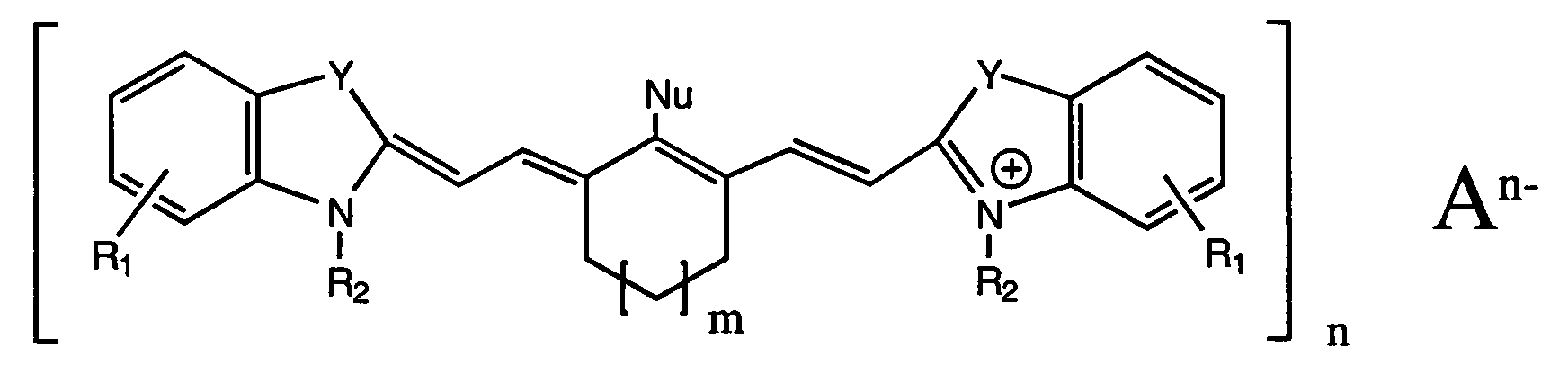 in which
R1 is hydrogen, or R1 is one or more alkyl, aralkyl, alkoxy, carboxyl, nitro, cyano, trifluoromethyl, acyl, alkyl sulfonyl, aryl sulfonyl, or halogen groups, or R1 is the atoms necessary to form a substituted or unsubstituted benzo group;
R2 is alkyl, aryl, or aralkyl;
Nu is halogen, substituted or unsubstituted phenoxy, substituted or unsubstituted thiophenoxy, or substituted or unsubstituted diphenylamino;
Y is O, S, NR', or C(R')2, where R' is hydrogen or alkyl;
m is zero or one;
n is two, three, or four; and
A is an aromatic group that has n sulfonate groups.
The method comprises the steps of:
R1 is hydrogen, or R1 is one or more alkyl, aralkyl, alkoxy, carboxyl, nitro, cyano, trifluoromethyl, acyl, alkyl sulfonyl, aryl sulfonyl, or halogen groups, or R1 is the atoms necessary to form a substituted or unsubstituted benzo group;
R2 is alkyl, aryl, or aralkyl;
Nu is halogen, substituted or unsubstituted phenoxy, substituted or unsubstituted thiophenoxy, or substituted or unsubstituted diphenylamino;
Y is O, S, NR', or C(R')2, where R' is hydrogen or alkyl;
m is zero or one;
n is two, three, or four; and
A is an aromatic group that has n sulfonate groups.
The method comprises the steps of:
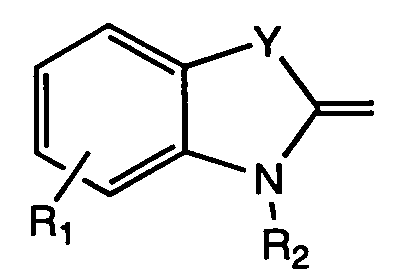
and forming an intermediate in a reaction mixture;
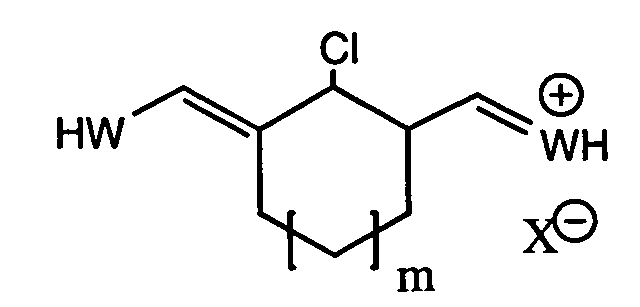
in which the infrared absorbing cyanine dye is the only compound isolated in the method.
The intermediate is not isolated and/or purified. The method of the
invention provides convenient and economical way to synthesize infrared
absorbing cyanine dyes in a one-pot reaction because it is unnecessary to isolate
and/or purify intermediates during the synthesis.
The invention is a one-pot method for preparing infrared absorbing cyanine
dyes of Structure I. The cation preferably absorbs infrared radiation, preferably in
the range of 700 nm to 1200 nm. The anion has two to four sulfonate groups.
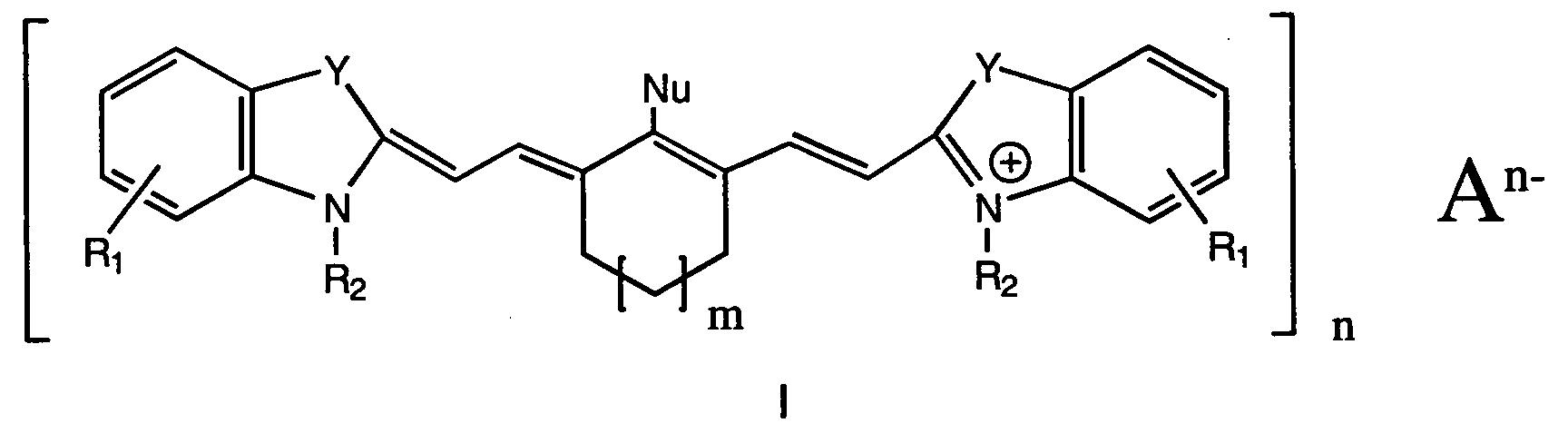
R1 is preferably hydrogen. However, R1 may be one or more alkyl, aralkyl,
alkoxy, carboxyl, nitro, cyano, trifluoromethyl, acyl, alkyl or aryl sulfonyl, or
halogen groups, or a combination thereof, or R1 may be the atoms necessary to
form a substituted or unsubstituted benzo group.
Typical alkyl groups are alkyl groups of one to twelve carbon atoms, such
as 2-methylbutyl, 3-methylbutyl, pentyl, hexyl, heptyl, octyl, nonyl, decyl, undecyl,
dodecyl, 4-methylpentyl, 3-methylpentyl, 2-methylpentyl, 2-methylhexyl, 2-ethylpentyl,
5-methylhexyl, 2,2,4-trimethylpentyl, cyclopentyl, cyclohexyl, and alkyl
groups of one to four carbon atoms. When R1 is alkyl, the preferred alkyl groups
are alkyl groups of one to four carbon atoms, such as methyl, ethyl, cyclopropyl, i-propyl,
n-propyl, cyclobutyl, i-butyl, s-butyl, t-butyl, and n-butyl.
Typical alkoxy groups are alkoxy groups of one to twelve carbon atoms,
such as methoxy, ethoxy, n-propoxy, i-propoxy, n-butoxy, i-butoxy, s-butoxy,
t-butoxy, n-pentoxy, 2,2,dimethylpropoxy, n-hexyloxy, n-heptyloxy, n-octyloxy, n-nonyloxy,
and n-decyoxy. When R1 is alkoxy, the preferred alkoxy groups are
methoxy and ethoxy.
R1 may be aralkyl group, preferably one containing seven to twelve carbon
atoms. An aralkyl is an alkyl group substituted with a substituted or unsubstituted
aryl group. Aryl refers to an aromatic cyclic six-membered ring such as a phenyl
group or an aromatic 10-membered ring such as a naphthalene group. The aryl
groups may be substituted with one of more alkyl, alkoxy, carboxyl, nitro, acyl,
alkyl or aryl sulfonyl; trifluoromethyl; or halogen groups, such as are described
herein. Typical aryl groups are, for example, phenyl; substituted phenyl, such as
4-methylphenyl (p-tosyl), 3-methylphenyl (m-tosyl), 2-methylphenyl (o-tosyl), 4-methoxyphenyl,
4-chlorophenyl, 4-bromophenyl, 4-cyanophenyl, 4-fluorophenyl,
pentafluorophenyl, p-trifluoromethylphenyl, 3,5-dimethylphenyl, and 3,5-dichlorophenyl;
1-naphthyl; 2-naphthyl; and substituted 1- and 2-naphthyl.
Typically aralkyl groups include, for example, benzyl, (4-methylphenyl)methyl-, (4-chlorophenyl)methyl-,
(3-methylphenyl)methyl-, (4-cyanophenyl)methyl-, (4-methoxyphenyl)methyl-,
2-phenylethyl, 2-(4-cyanophenyl)methyl)ethyl- and 3-phenyl
propyl.
Halogens include fluorine (F), chlorine (Cl), bromine (Br), and iodine (I). R1
may be an acyl group, preferably an acyl group of seven or fewer carbon atoms
such as acetyl, propionyl, or benzoyl. R1 may be an alkyl sulfonyl or an aryl
sulfonyl group, preferably of seven or fewer carbon atoms such as phenyl sulfonyl,
4-methylphenyl sulfonyl, methyl sulfonyl, and ethyl sulfonyl. R1 may be nitro,
carboxyl, trifluoromethyl, or cyano.
R1 may be the atoms necessary to form a substituted or unsubstituted
benzo group. When R1 is the atoms necessary to form, for example, an
unsubstituted 4,5-benzo group, the cation may have, for example, the structure:

Compounds containing 2,3-benzo groups and compounds containing 3,4-benzo
groups may also be prepared by the method of the invention. The benzo
group may be unsubstituted or it may be substituted with one or more alkyl,
alkoxy, carboxyl, nitro, cyano, trifluoromethyl, acyl, alkyl sulfonyl, aryl sulfonyl, or
halogen groups, such as are described herein.
R2 is alkyl, aryl, or aralkyl. These groups are described above.
Nu is halogen, or substituted or unsubstituted phenoxy, substituted or
unsubstituted thiophenoxy, or substituted or unsubstituted diphenylamino. The
phenoxy, thiophenoxy, and diphenylamino groups may be substituted with one of
more alkyl, alkoxy, carboxyl, nitro, acyl, alkyl sulfonyl, aryl sulfonyl, trifluoromethyl,
or halogen groups, such as are described above.
Y is O, S, NR', or C(R')2, where R' is hydrogen or alkyl. Alkyl groups are
described above. A preferred alkyl group is methyl.
m is zero or one.
n is two, three, or four, preferably two.
A is a group that contains n aromatic sulfonate groups. A may contain a
single aromatic group such as single phenyl group or naphthyl group substituted
with two to four sulfonate groups, preferably two sulfonate groups. Or A may
contain two or more aromatic groups, attached by, for example, a carbon-carbon
bond, such as in a polysulfonated biphenyl, for example, biphenyl-4,4'-disulfonate;
an ether group, such as in a polysulfonated diphenyl ether, for example, diphenyl
ether-4,4'-disulfonate; a C=C group, such as in a polysulfonated stilbene, for
example, stilbene-2,2'-disulfonate; a carbonyl group, such as a polysulfonated
benzophenone, for example, 2,2'-dihydroxy-4,4'-dimethoxybenzophenone-5,5'-disulfonate,
or a urethane linkage. In either case, the aromatic group or groups
may only be substituted with the sulfonyl groups, or they may contain one or more
other substituents such as hydroxyl, alkoxy, acyl, or alkyl.
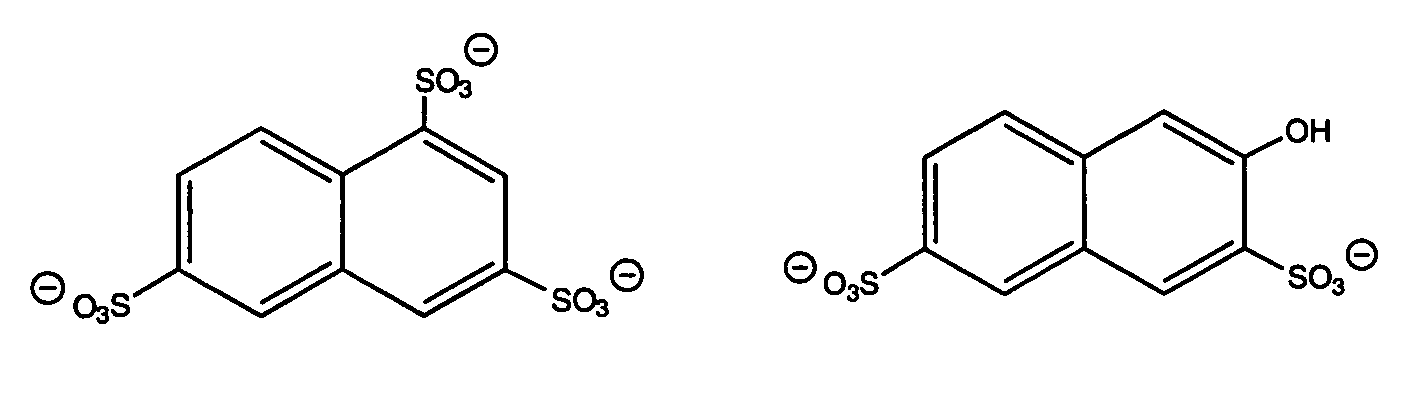
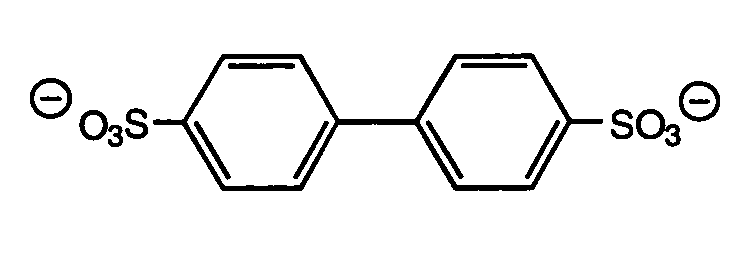
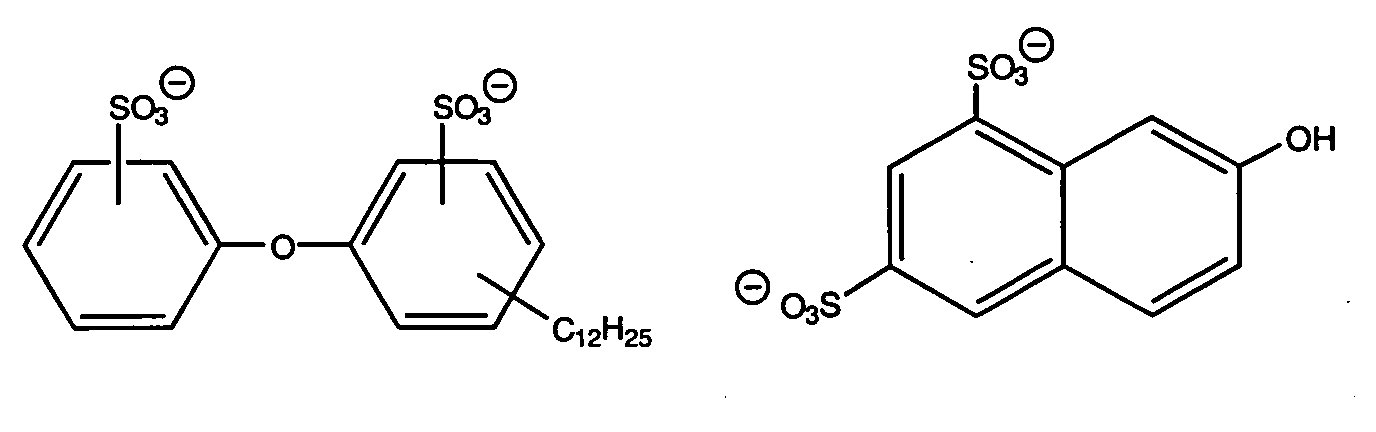
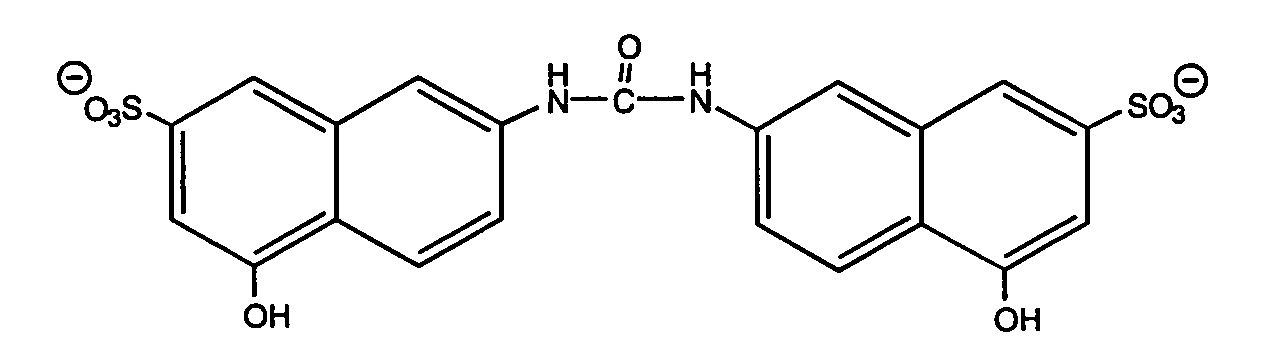
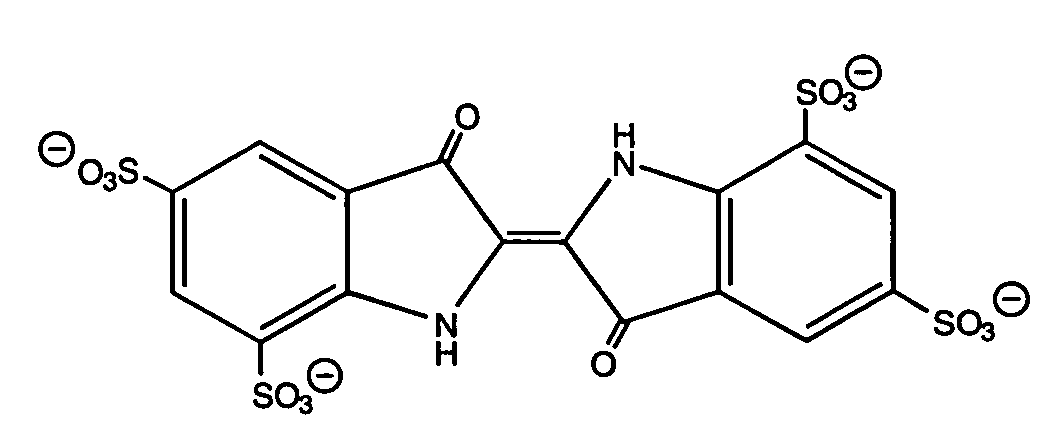
Representative aromatic groups that have n sulfonate groups are shown
below. A preferred polysulfonate containing anion is the 4, 5-dihydroxy-1,3-benzenedisulfonate
anion.

The method is a "one pot" synthesis of the infrared absorbing cyanine
dyes. "One pot method" means that it is unnecessary to isolate and purify
intermediates during the course of the reaction. All the reactions necessary for
production of the infrared absorbing cyanine dye may be carried out in one
reaction vessel without isolating any intermediate products. The overall reaction
can be represented by the following, in which Nu is a substituted or unsubstituted
phenoxy, thiophenoxy, or phenylamino anion.

The first step is generally carried out by condensation of a heterocyclic
base containing an activated methylene group with a compound of structure III in
a solvent or solvent mixture at about 20-150°C. The heterocyclic base containing
an activated methylene group is represented by Structure II, in which Y, R1, and
R2 are as defined above.

The heterocyclic base is selected to provide the R1, Y, and R2 groups
desired in the final infrared absorbing cyanine dye. A useful compound of
structure II is 1,3,3-trimethyl-2-methyleneindoline (Fischer's base) in which R1 is
hydrogen, R2 is methyl, and Y is C(CH3)2. This compound has the structure:

Other examples of compounds of structure II include: 1-ethyl-3,3-dimethyl-2-methyleneindoline;
1-butyl-3,3-dimethyl-2-methyleneindoline; 5-chloro-1,3,3-trimethyl-2-methyleneindoline;
5,6-dichloro-1,3,3-trimethyl-2-methyleneindoline; 5-methoxy-1,3,3-trimethyl-2-methyleneindoline;
1,3,3,5,6-pentamethyl-2-methyleneindoline;
1-methyl-2-methylenebezoxazole; 5-methoxy-1-methyl-2-methylenebezoxazole;
5-methoxy-1-ethyl-2-methylenebezoxazole; 5-cyano-1-methyl-2-methylenebezoxazole;
1,3-dimethyl-2-methylenebenzimidazole; 1-methyl-2-methylenebenzothiazole;
5-chloro-1-methyl-2-methylenebenzothiazole;1,3,3,-trimethyl-2-methylene
4,5-benzo-3H-indole; 1,3,3,-trimethyl-2-methylene
5,6-benzo-3H-indole; and 1,3,3,-trimethyl-2-methylene 6,7-benzo-3H-indole.
Compounds of structure III are those of the structure:
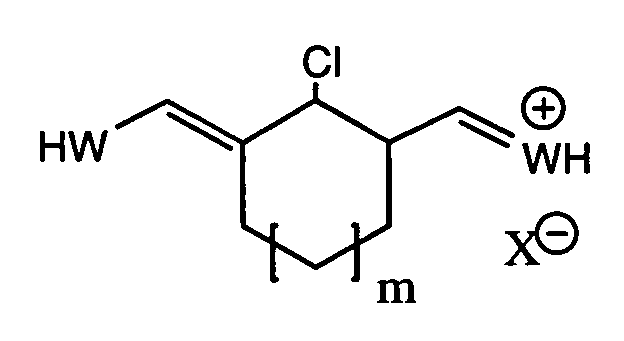 in which each W is independently O or Ar-N, Ar is an aromatic group, X is
an anion such as chloride, and m is zero or one.
in which each W is independently O or Ar-N, Ar is an aromatic group, X is
an anion such as chloride, and m is zero or one.
Useful compounds that have this structure are 2-chloro-1-formyl-3-hydroxymethylenecyclohexene
monohydrochloride (the hydrochloride of
Intermediate A) and N-[(3-(anilinomethylene)-2-chloro-1-cyclohexen-1yl)methylene]aniline
monohydrochloride (Intermediate B in which Ar is phenyl).

Suitable solvents include alcohols, especially lower alcohols such as
methanol, ethanol and n-propanol; acetic acid; and acetic anhydride.
The reaction may be carried out in the presence of a catalyst, such as
sodium acetate. Alternatively, the reaction may be carried out without a catalyst.
When no catalyst is used, water may removed from the reaction mixture with a
water separator, such as with an azeotrope using a Dean-Stark trap.
After initial reaction to form an intermediate containing a chloro-substituted
infrared absorbing cyanine cation, if desired, the chloro group may be replaced by
a substituted or unsubstituted phenoxy, thiophenoxy, or diphenylamino group.
The reaction can proceed from the previous step by directly adding a nucleophile
such as a substituted or unsubstituted sodium phenolate or sodium thiophenolate
directly to the reaction mixture, without separating and isolating the intermediate
containing the chloro-substituted cyanine cation.
Finally, the infrared absorbing cyanine dye may be obtained by adding a
water soluble or water/alcohol soluble salt, such as a sodium, potassium, lithium,
ammonium, or substituted ammonium salt, containing the polysulfonate anion in
water or water/alcohol mixture, again without separating the intermediate from the
previous step. The infrared absorbing cyanine dye with the polysulfonate anion
precipitates and may be isolated by filtration and dried. If desired, the infrared
absorbing cyanine dye may be purified by recrystallization from an appropriate
solvent, such as, for example, ethyl acetate or methyl ethyl ketone/ethyl acetate.
Infrared absorbing cyanine dyes that may be prepared by the method of the
invention include, for example, 2-[2-[2-chloro-3-[(1,3-dihydro-1,3,3-trimethyl-2H-indol-2-ylidene)ethylidene]-1-cyclohexen-1-yl]ethenyl]-1,3,3-trimethyl-3H-indolium,
salt with 2,2'-dihydroxy-4,4'-dimethoxybenzophenone-5,5'-disulfonic acid (2:1); 2-[2-[2-chloro-3-[(1,3-dihydro-1,3,3-trimethyl-2H-indol-2-ylidene)ethylidene]-1-cyclopenten-1-yl]ethenyl]-1,3,3-trimethyl-3H-indolium,
salt with 2,2'-dihydroxy-4,4'-dimethoxybenzophenone-5,5'-disulfonic
acid (2:1); 2-[2-[3-[(1,3-dihydro-1,3,3-trimethyl-2H-indol-2-ylidene)ethylidene]-2-(4-methoxy-phenylthio)-1-cyclohexen-1-yl]ethenyl]-1,3,3-trimethyl-3H-indolium,
salt with 2,2'-dihydroxy-4,4'-dimethoxybenzophenone-5,5'-disulfonic
acid (2:1); 2-[2-[3-[(1,3-dihydro-1,3,3-trimethyl-2H-indol-2-ylidene)ethylidene]-2-diphenylamino-1-cydohexen-1-yl]ethenyl]-1
,3,3-trimethyl-3H-indolium, salt with 2,2'-dihydroxy-4,4'-dimethoxybenzophenone-5,5'-disulfonic
acid (2:1); 2-[2-[3-[(1,3-dihydro-1,3,3-trimethyl-2H-indol-2-ylidene)ethylidene]-2-(4-methoxy-phenylthio)-1-cyclohexen-1-yl]ethenyl]-1,3,3-trimethyl-3H-indolium,
salt with 4,5-dihydroxy-1,3-benzenedisulfonic
acid (2:1); 2-[2-[2-chloro-3-[(1,3-dihydro-1,3,3-trimethyl-2H-indol-2-ylidene)ethylidene]-1-cyclohexen-1-yl]ethenyl]-1,3,3-trimethyl-3H-indolium,
salt with diphenylether-4,4'-disulfonic acid (2:1); 2-[2-[3-[(1,3-dihydro-1,3,3-trimethyl-2H-indol-2-ylidene)ethylidene]-2-(4-chloro-phenylthio)-1-cyclohexen-1-yl]ethenyl]-1,3,3-trimethyl-3H-indolium,
salt with 2,2'-dihydroxy-4,4'-dimethoxybenzophenone-5,5'-disulfonic
acid (2:1); 2-[2-[3-[(1,3-dihydro-1,3,3-trimethyl-2H-indol-2-ylidene)ethylidene]-2-phenylthio-1-cyclopenten-1-yl]ethenyl]-1,3,3-trimethyl-3H-indolium
, salt with stilbene-2,2'-disulfonic acid (2:1); and 2-[2-[3-[(1,3-dihydro-1,3,3-trimethyl-2H-indol-2-yldene)ethylidene]-2-phenylthio-1-cyclohexen-1-yl]ethenyl]-1,3,3-trimethyl-3H-indolium
, salt with stilbene-2,2'-disulfonic
acid (2:1).
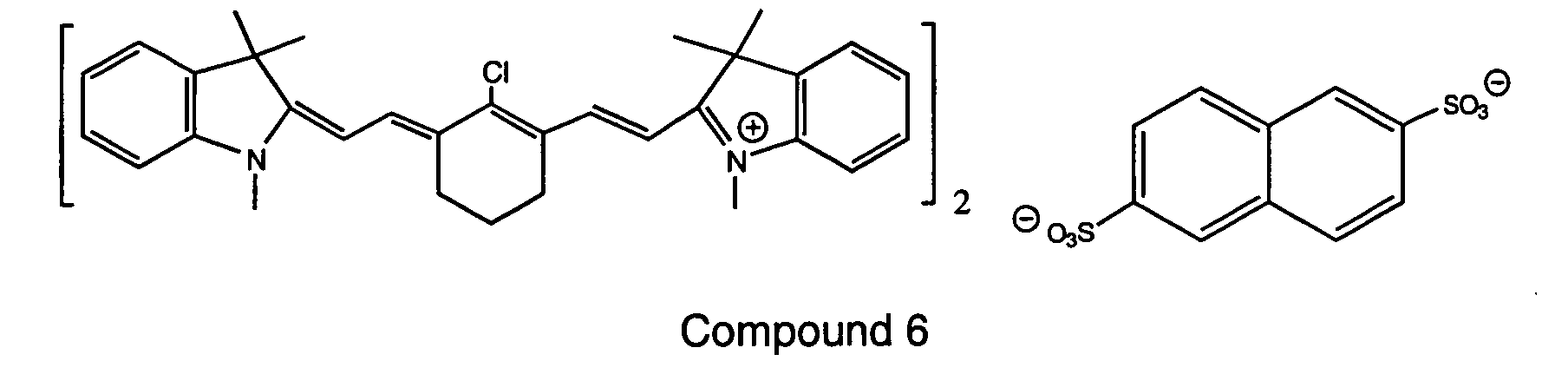
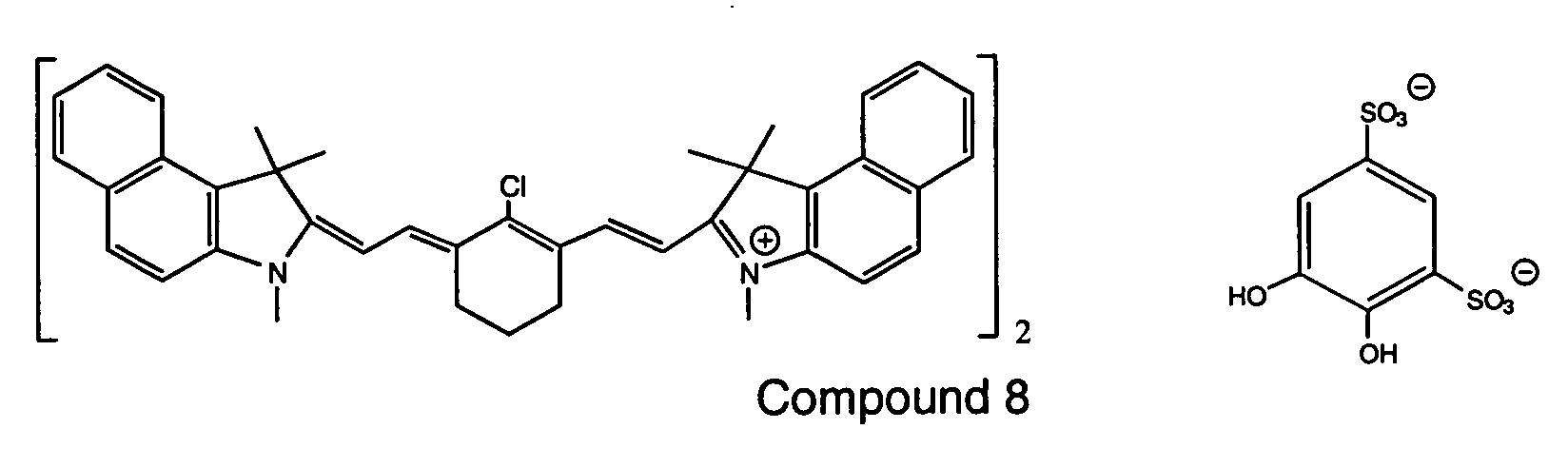
Representative, non-limiting examples of infrared absorbing cyanine dyes
that may be prepared by the method of the invention are shown below. As will be
apparent to those skilled in the art, although each of the various representative
cations shown has been shown with specific anions, each cation could be
combined with other anions that contain more than one sulfonate group, such as,
for example, with each of the anions mentioned or shown above.





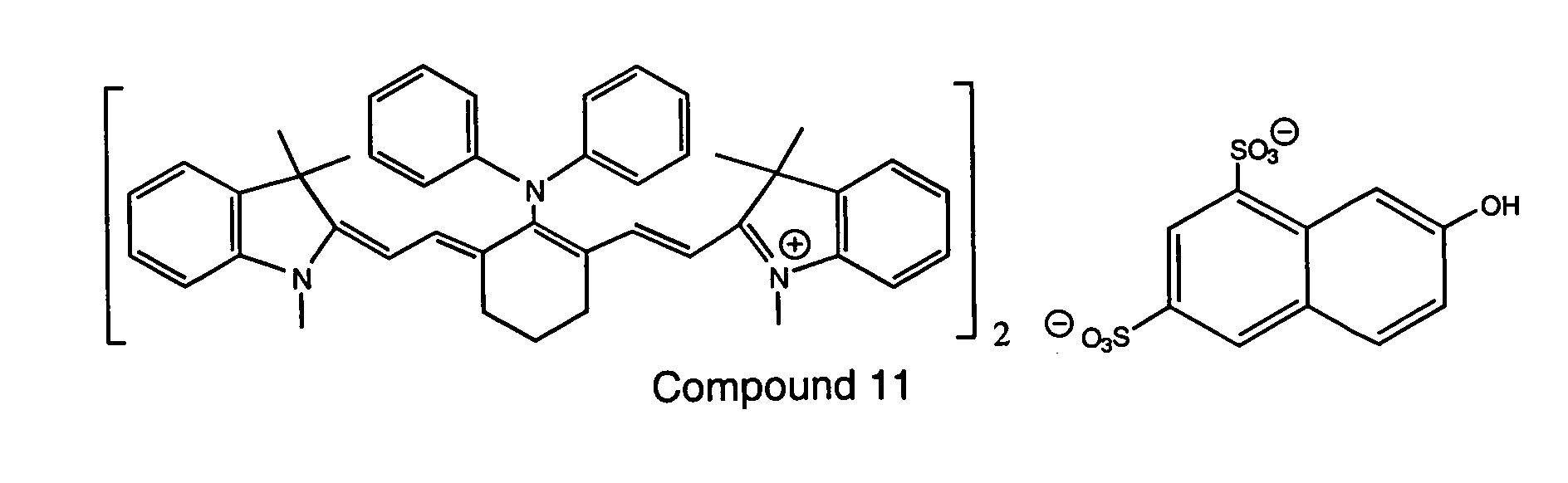





The infrared absorbing cyanine dyes prepared by the method of the
invention may be used in imageable elements useful as lithographic printing plate
precursors. As disclosed in Tao, US 2004/0180285 A1, imageable elements that
contain these dyes have improved dot stability following imaging.
Negative working imageable compositions are disclosed, for example, in
Haley, U.S. Pat. No. 5,372,907; Nguyen, U.S. Pat. No. 5,919,601; Kobayashi,
U.S. Pat. No. 5,965,319; Busman, U.S. Pat. No. 5,763,134; WO 00/17711, and
Tao, U.S. Pat. No. 6,787,281. These precursors comprise an imageable layer
over a lithographic substrate. The imageable layer comprises a photothermal
conversion material, an acid generator, an acid activatable crosslinking agent, and
a polymeric binder. The acid generators include precursors that form a Brönsted
acid by thermally initiated decomposition. Non-ionic acid generators include
haloalkyl-substituted s-triazines, such as 2-phenyl-4,6-bis(trichloromethyl)-s-triazine.
lonic acid generators include onium salts such as diphenyl iodonium
chloride, triphenyl sulfonium hexafluoroantimonate, triphenyl sulfonium
tetrafluoroborate, 2-methoxy-4-aminophenyl diazonium hexafluorophosphate, 4,4'-dicumyl
iodonium p-tolyl sulfate, and 2-methoxy-4-(phenylamino)-benzenediazonium
octyl sulfate. Haley, U.S. Pat. No. 5,372,907, discloses a
radiation-sensitive composition in which a novolac resin is the polymeric binder
and a resole resin is the acid activatable crosslinking agent. Nguyen, U.S. Pat.
No. 5,919,601, discloses radiation-sensitive compositions in which the polymeric
binder contains reactive pendant groups selected from hydroxy, carboxylic acid,
sulfonamide, and alkoxymethylamides; and the polymeric resin is a resole resin, a
C1-C5 alkoxymethyl melamine or glycoluril resin, a poly(C1-C5-alkoxymethylstyrene),
a poly(C1-C5-alkoxymethylacrylamide), a derivative thereof, or a
combination thereof.
The element may be thermally imaged with a laser or an array of lasers
emitting modulated near infrared or infrared radiation in a wavelength region that
is absorbed by the imageable element. Infrared radiation, especially infrared
radiation in the range of about 800 nm to about 1200 nm, is typically used for
imaging. Imaging is conveniently carried out with a laser emitting at about 830
nm, about 1056 nm, or about 1064 nm. Suitable commercially available imaging
devices include image setters such as the CREO® Trendsetter (Creo, Burnaby,
British Columbia, Canada), the Screen Plate Rite model 4300, model 8600, and
model 8800 (Screen, Rolling Meadows, Chicago, Illinois, USA), and the Gerber
Crescent 42T (Gerber). After the imaging, the imaged element may be heated in
an oven to about 110°C to 150°C for about one to five minutes. The imaged
element, which comprises a latent image made up of imaged and unimaged
regions, is developed to produce an image. Development may be carried out
using high pH developers (pH of at least about 11) or with a solvent based
developer. Following development, the printing plate is rinsed with water and
dried. A gumming solution that contains a water-soluble polymer such as gum
arabic may be applied to the resulting developed image.
Once the imageable element has been imaged and processed to form a
printing plate, printing can be carried out by applying a fountain solution and then
a lithographic ink to the image on its surface. Fountain solution is taken up by the
surface of the substrate exposed by imaging and development, and the ink is
taken up by the complementary regions. The ink is transferred to a suitable
receiving material (such as cloth, paper, metal, glass or plastic) either directly or
indirectly using an offset printing blanket to provide a desired impression of the
image thereon.
The advantageous properties of this invention can be observed by
reference to the following examples, which illustrate but do not limit the invention.
Unless otherwise specified, all percentages are percentages by weight.
| DMF | N,N-dimethylformamide |
| Fisher's base | 1,3,3-trimethyl-2-methyleneindoline; CAS# 118-12-7 (TCI America, Portland, OR, USA)) |
| Intermediate A | 2-chloro-1-formyl-3-hydroxymethylenecyclohexene |
| Intermediate B | N-[(3-(anilinomethylene)-2-chloro-1 -cyclohexen-1-yl)methylene]aniline monohydrochloride |
This example illustrates preparation of 2-chloro-1-formyl-3-hydroxymethylenecyclohexene
(Intermediate A).

80 ml of DMF was placed in a 50ml round bottom flask equipped with a
magnetic stirrer, a nitrogen gas inlet, a condenser, a thermometer and a pressure-equalizing
additional funnel. The flask was cooled in an ice-water bath and 74 ml
of phosphorous oxychloride was slowly added to the DMF while the reaction
temperature was maintained between 10 and 15°C for one hour. Upon the
completion of the addition, the reaction mixture was allowed to warm to room
temperature for 30 minutes. A mixture of 20 g of cyclohexanone and 100 ml of
DMF was slowly added to the flask, and the reaction temperature was maintained
between 40 and 50°C. The mixture was heated at 55°C for 3 hours in a water
bath, and was then slowly poured into a mixture of 600 g of ice and 400 g of
water. After the reaction mixture was stirred for about 15 h, the precipitate was
filtered and washed with water until a neutral filtrate was obtained. The resulting
yellow solid was collected and dried at ambient temperature in the dark overnight.
The yield was 26 g.
This example illustrate preparation of N-[(3-(anilinomethylene)-2-chloro-1-cyclohexen-1-yl)methylene]aniline
monohydrochloride (Intermediate B).
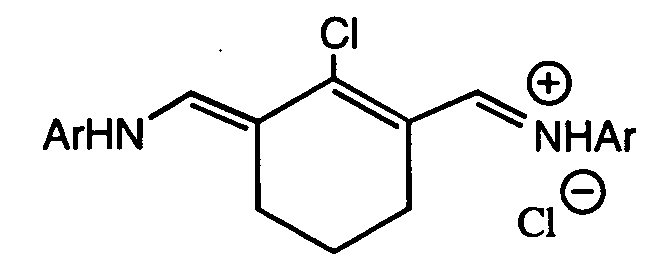
A solution containing 30 g of aniline dissolved in 150 ml of ethanol was
slowly added into a solution containing 25 g of Intermediate A in 100 ml of DMF
and 37.5 ml of concentrated hydrochloric acid (Note: mixing hydrochloric acid with
DMF is highly exothermic!). The reaction temperature was maintained around 15-20°C
with an ice-water bath during the addition of aniline. After the reaction
mixture was stirred for an additional 20 minutes, it was poured, with stirring, into 1
L of water and stirring continued for another 20 minutes. The deep-brown solid
was collected by filtration and dried at ambient temperature overnight. Yield: 46 g.
This example illustrates the one pot synthesis of 2-[2-[2-chloro-3-[(1,3-dihydro-1,3,3-trimethyl-2H-indol-2-ylidene)ethylidene]-1-cyclohexen-1-yl]ethenyl]-1,3,3-trimethyl-3H-Indolium,
salt with 4,5-dihydroxy-1,3-benzenedisulfonic acid
(2:1) (Compound 1) from intermediate A.
In a 250 ml flask equipped with a stirring bar and a condenser, 6.6 g of
Fisher's base, 3.3 g of intermediate A, 2.0 g of sodium acetate, 3 ml of 36.5%
hydrochloric acid and 50 ml of ethanol were stirred in an oil bath at 70°C for 6 h.
The reaction mixture was cooled to room temperature and mixed with 50 g of
water. The resulting dark-green solution was then added to a solution containing
5.0 g of disodium 4,5-dihydroxy-1,3-benzenedisulfonic acid (from Aldrich) in 500 g
of water and 100 g of ethanol. The resulting precipitate was collected by filtration,
recrystallized from methyl ethyl ketone/ethyl acetate, and dried in vacuum at
ambient temperature overnight. Yield: 4.8 g.
Proton NMR (in DMSO-d6): delta: 1.66 (24H, s), 1.86 (4H, br), 2.71 (8H, t),
3.68 (12H, s), 6.30 (4H, d), 6.97 (1 H, s), 7.20-7.35 (5H, m), 7.35-7.50 (8H, m),
7.62 (4H, d), 8.25 (4H, d), 8.88 (1 H, s), and 10.60 (1 H, s).
This example illustrates the one pot synthesis of 2-[2-[2-chloro-3-[(1,3-dihydro-1,3,3-trimethyl-2H-indol-2-ylidene)ethylidene]-1-cyclohexen-1-yl]ethenyl]-1,3,3-trimethyl-3H-Indolium,
salt with 4,5-dihydroxy-1,3-benzenedisulfonic acid
(2:1) (Compound 1) from intermediate B.
In a 250 ml flask equipped with a stirring bar and a condenser, 2.7 g of
intermediate B, and 2.6 g of Fisher's base was stirred with 75 g of ethanol in a
70°C oil bath for 4 h. The reaction mixture was cooled to room temperature and
was mixed 80 g of water. The resulting dark-green solution was then added to a 1-I
container containing 1.4 g of disodium 4,5-dihydroxy-1,3-benzenedisulfonic acid
(Aldrich) in 20 g of water and 20 g of ethanol. The precipitate was collected by
filtration and dried in vacuum at room temperature overnight: Yield: 3.8 g. The
dye can be further purified by recrystallization from methyl ethyl ketone/ethyl
acetate.
Proton NMR (in DMSO-d6): delta: 1.67 (24H, s), 1.86 (4H, br), 2.72 (8H, t),
3.68 (12H, s), 6.30 (4H, d), 6.97 (1 H, s), 7.20-7.35 (5H, m), 7.35-7.50 (8H, m),
7.63 (4H, d), 8.25 (4H, d), 8.88 (1 H, s) and 10.58 (1 H, s).
This example illustrates the one pot synthesis of 2-[2-[3-[(1,3-dihydro-1,3,3-trimethyl-2H-indol-2-ylidene)ethylidene]-2-phenylthio-1-cyclohexen-1-yl]ethenyl]-1,3,3-trimethyl-3H-indolium,
salt with 4,5-dihydroxy-1,3-benzenedisulfonic acid
(2:1 ) (Compound 2) from intermediate A.
In a 250 ml flask equipped with a stirring bar and a condenser, 6.6 g of
Fisher's base (from TCl America), 3.3 g of intermediate A, 2.0 g of sodium
acetate, 3 ml of 36.5% hydrochloric acid and 50 ml of ethanol were stirred in a oil
bath at 70°C for 7 h. The reaction mixture was cooled to room temperature. A
solution containing 7.7 g of ethanol, 0.6 g of NaOH and 1.7 g of thiophenol was
added to the reaction mixture and stirring was continued for another 15 h. The
resulting dark-green solution was then added to a solution containing 5.0 g of
disodium 4,5-dihydroxy-1,3-benzenedisulfonic acid (from Aldrich) in 500 g of water
and 100 g of ethanol. The resulting precipitate was collected by filtration,
recrystallized in methyl ethyl ketone/ethyl acetate, and dried in vacuum at room
temperature overnight. Yield: 7.1 g.
Proton NMR (in DMSO-d6): delta: 1.42 (24H, s), 1.92 (4H, br), 2.76 (8H, t),
3.63 (12H, s), 6.31 (4H, d), 6.98 (1H, s), 7.05-7.45 (23H, m), 7.52 (4H, d), 8.61
(4H, d), 8.87 (1H, s) and 10.61 (1H, s).
This example illustrates the one pot synthesis of 2-[2-[3-[(1,3-Dihydro-1,3,3-trimethyl-2H-indol-2-ylidene)ethylidene]-2-phenylthio-1-cyclohexen-1-yl]ethenyl]-1,3,3-trimethyl-3H-indolium
, salt with 4,5-dihydroxy-1,3-benzenedisulfonic
acid (2:1) (Compound 2) from intermediate B.
In a 500 ml flask equipped with a stirring bar and a condenser, 10.9 g of
Intermediate B and 10.5 g of Fisher's base was stirred with 300 g of ethanol in a
70°C water bath for 4 h. After cooling to room temperature, the reaction mixture
was mixed with a solution containing 15.5 g of ethanol, 1.2 g of NaOH and 3.3 g of
thiophenol and stirred for another 15 h. The mixture was then poured into a 4-1
container containing 300 ml water and 10 g concentrated hydrochloric acid while
stirring. 2-L water at about 42°C followed by a solution of 10 g of disodium 4,5-dihydroxy-1,3-benzenedisulfonic
acid (Aldrich) in 100 g of water was added to the
reaction mixture while stirring. The resulting precipitate was collected by filtration
and dried in vacuum at room temperature overnight. Yield: 18.7 g of maroon dye.
Proton NMR (in DMSO-d6): delta: 1.41 (24H, s), 1.92 (4H, br), 2.76 (8H, t),
3.64 (12H, s), 6.30 (4H, d), 6.98 (1H, s), 7.05-7.45 (23H, m), 7.52 (4H, d), 8.60
(4H, d), 8.87 (1H, s) and 10.58 (1H, s).
This example illustrates the one pot synthesis of 2-[2-[2-chloro-3-[(1,3-dihydro-1,3,3-trimethyl-2H-indol-2-ylidene)ethylidene]-1-cyclohexen-1-yl]ethenyl)-1,3,3-trimethyl-3H-Indolium,
salt with 4,5-dihydroxy-1,3-benzenedisulfonic acid
(2:1) (Compound 1) from intermediate A, without a catalyst.
In a 250 ml flask equipped with a stirring bar and a condenser attached to a
Dean-Stark trap, 11.8 g of Fisher's base, 3.45 g of intermediate A, 5.0 g of 36.5%
hydrochloric acid, 50 ml of benzene and 100 ml of n-propanol were heated at
reflux in an oil bath heated at 100°C for 3 h. After 3 h , no further water was
collected in the Dean-Stark trap. The reaction flask was attached to a rotary
evaporator and the solvents evaporated. The residual green material was
dissolved in 150 g of ethanol and 150 g of water was added. The resulting dark-green
solution was then added drop-wise to a solution containing 10 g of disodium
4,5-dihydroxy-1 ,3-benzenedisulfonic acid (from Aldrich) in 50 g of water and 50 g
of ethanol while stirring. The resulting precipitate was collected by filtration,
washed with 2 x 50 ml of ethyl acetate, and dried at ambient temperature
overnight. Yield: 11.5 g.
Proton NMR (in DMSO-d6): delta: 1.66 (24H, s), 1.86 (4H, br), 2.71 (8H, t),
3.68 (12H, s), 6.30 (4H, d), 6.97 (1H, s), 7.20-7.35 (5H, m), 7.35-7.50 (8H, m),
7.62 (4H, d), 8.25 (4H, d), 8.88 (1H, s), and 10.60 (1H, s).
Having described the invention, we now claim the following and their
equivalents.
Claims (9)
- A method for preparing infrared absorbing cyanine dyes of the structure:in which:
 the method comprising the steps of:R1 is hydrogen, or R1 is one or more alkyl, alkoxy, carboxyl, nitro, cyano, trifluoromethyl, acyl, alkyl or aryl sulfonyl, or halogen groups, or R1 is the atoms necessary to form a substituted or unsubstituted benzo group;R2 is alkyl, aryl, or aralkyl;Nu is halogen, substituted or unsubstituted phenoxy, substituted or unsubstituted thiophenoxy, or substituted or unsubstituted diphenylamino;Y is O, S, NR', or C(R')2, where R' is hydrogen or alkyl;m is zero or one;n is two, three, or four; andA is an aromatic group that has n sulfonate groups;a) reacting an activated methylene group containing a heterocyclic base of the structure:with a compound of the structure: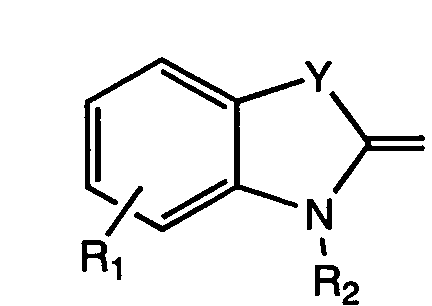
and forming an intermediate in a reaction mixture;in which W is O or Ar-N, Ar is an aromatic group, X- is an anion, and m is zero or one, and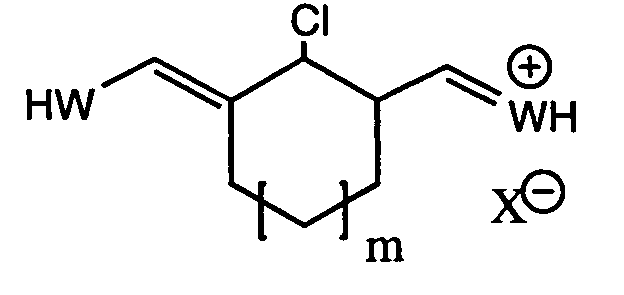 b) adding a salt of A to the reaction mixture; andc) isolating the infrared absorbing cyanine dye;
in which the infrared absorbing cyanine dye is the only compound isolated in the method. - The method of claim 1 in which R1 is hydrogen; R2 is methyl, ethyl, n-propyl, or n-butyl; Nu is chloro, phenoxy, thiophenoxy, or diphenyl amino; and Y is C(CH3)2, O, or S.
- The method of claim 1 or 2 in which A is selected from the group consisting of biphenyl-4,4'-disulfonate; diphenyl ether-4,4'-disulfonate; stilbene-2,2'-disulfonate; 2,2'-dihydroxy-4,4'-dimethoxybenzophenone-5,5'-disulfonate,
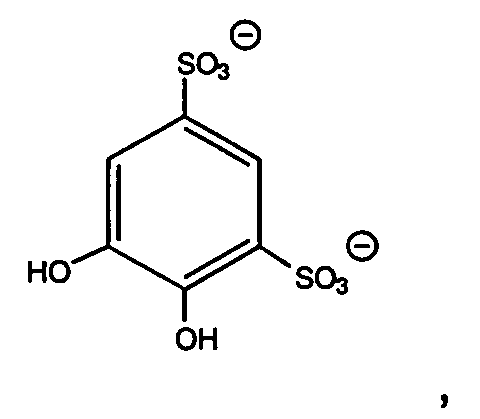


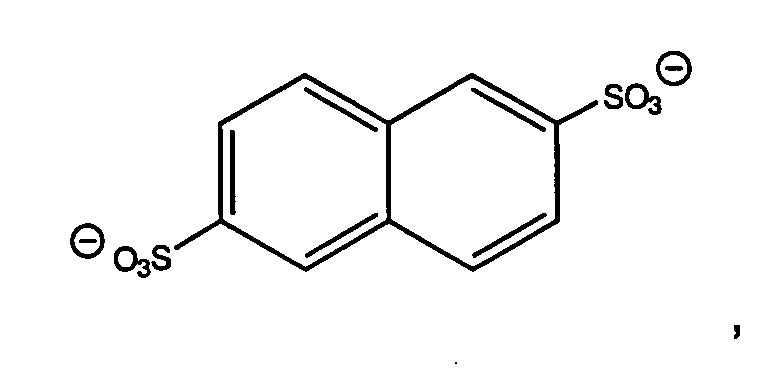
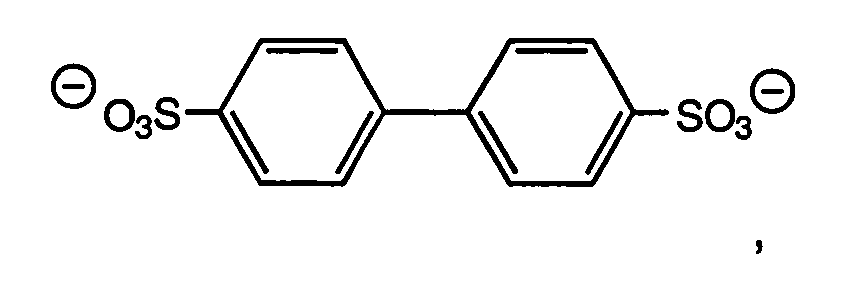


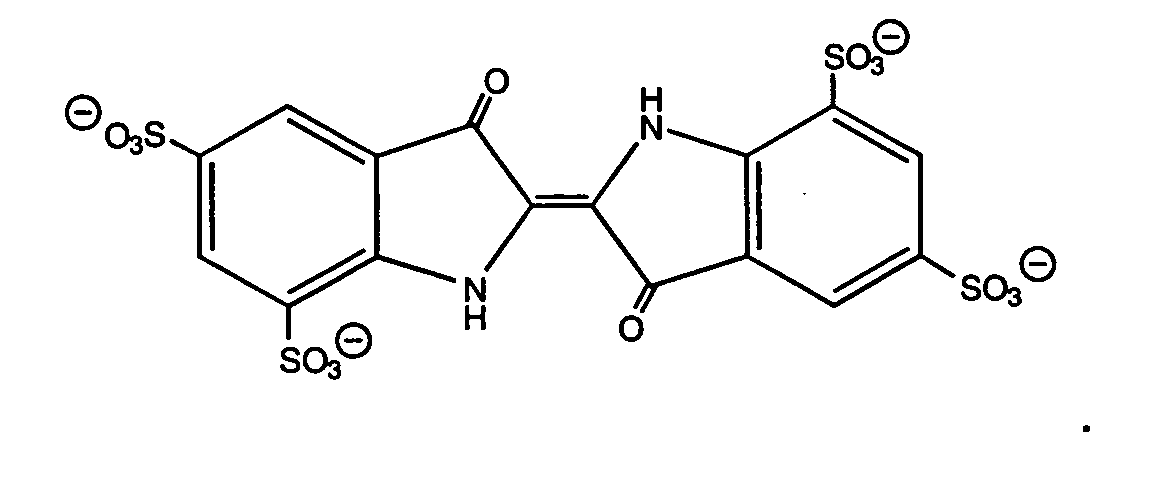
- The method of any proceeding claim additionally comprising, after step a) and before step b), an additional step of adding a substituted or unsubstituted phenoxy, a substituted or unsubstituted thiophenoxy, or a substituted or unsubstituted diphenylamino compound to the reaction mixture.
- The method of any proceeding claim in which R1 is hydrogen; R2 is methyl, ethyl, n-propyl, or n-butyl; and Y is C(CH3)2, O, or S.
- The method of any proceeding claim in which n is 2 and A is 4,5-dihydroxy-1,3-benzenedisulfonate.
- The method of claim 1 in which:R1 is hydrogen; R2 is methyl, ethyl, n-propyl, or n-butyl; Nu is chloro; Y is C(CH3)2, O, or S; and A is 4,5-dihydroxy-1 ,3-benzenedisulfonate; and
the method consists essentially of steps a), b), and c). - The method of claim 1 in which:R1 is hydrogen; R2 is methyl, ethyl, n-propyl, or n-butyl; Nu is phenoxy, thiophenoxy, or diphenyl amino; R2 is methyl, ethyl, n-propyl, or n-butyl; Y is C(CH3)2, O, or S; and A is 4,5-dihydroxy-1,3-benzenedisulfonate; and
the method consists essentially of steps a), b), c), and an additional step of adding a substituted or unsubstituted phenoxy, a substituted or unsubstituted thiophenoxy, or a substituted or unsubstituted diphenylamino compound to the reaction mixture. - The method of any proceeding claim in which the dye is isolated by filtration.
Applications Claiming Priority (2)
| Application Number | Priority Date | Filing Date | Title |
|---|---|---|---|
| US10/722,257 US7132550B2 (en) | 2003-11-25 | 2003-11-25 | Process for the preparation of cyanine dyes with polysulfonate anions |
| US722257 | 2003-11-25 |
Publications (1)
| Publication Number | Publication Date |
|---|---|
| EP1535968A2 true EP1535968A2 (en) | 2005-06-01 |
Family
ID=34465681
Family Applications (1)
| Application Number | Title | Priority Date | Filing Date |
|---|---|---|---|
| EP04027416A Withdrawn EP1535968A2 (en) | 2003-11-25 | 2004-11-18 | Process for the preparation of cyanine dyes with polysulfonate anions |
Country Status (3)
| Country | Link |
|---|---|
| US (1) | US7132550B2 (en) |
| EP (1) | EP1535968A2 (en) |
| JP (1) | JP2005163039A (en) |
Cited By (1)
| Publication number | Priority date | Publication date | Assignee | Title |
|---|---|---|---|---|
| EP1956054A3 (en) * | 2007-02-06 | 2009-04-08 | Xerox Corporation | Colorant compounds |
Families Citing this family (3)
| Publication number | Priority date | Publication date | Assignee | Title |
|---|---|---|---|---|
| US7807473B2 (en) * | 2005-10-26 | 2010-10-05 | General Electric Company | Material compositions for sensors for determination of chemical species at trace concentrations and method of using sensors |
| US7883898B2 (en) * | 2007-05-07 | 2011-02-08 | General Electric Company | Method and apparatus for measuring pH of low alkalinity solutions |
| CN108410202A (en) * | 2018-02-12 | 2018-08-17 | 成都驷博生物科技有限公司 | A kind of preparation method of seven methine cyanine dyes of quinoline |
Family Cites Families (6)
| Publication number | Priority date | Publication date | Assignee | Title |
|---|---|---|---|---|
| EP0591820A1 (en) * | 1992-10-05 | 1994-04-13 | E.I. Du Pont De Nemours And Company | Near-infrared absorbing dyes prepared from Stenhouse salts |
| US5330884A (en) * | 1993-05-26 | 1994-07-19 | E. I. Du Pont De Nemours And Company | Photographic element with near-infrared antihalation layer |
| JP3770509B2 (en) | 1997-02-13 | 2006-04-26 | 富士写真フイルム株式会社 | Optical information recording medium and information recording method |
| JP3802202B2 (en) | 1997-10-08 | 2006-07-26 | 富士写真フイルム株式会社 | Laser direct drawing lithographic printing plate material |
| US6159657A (en) * | 1999-08-31 | 2000-12-12 | Eastman Kodak Company | Thermal imaging composition and member containing sulfonated ir dye and methods of imaging and printing |
| JP2001277718A (en) | 2000-03-29 | 2001-10-10 | Fuji Photo Film Co Ltd | Optical information recording medium using cyanine coloring matter compound and recording method |
-
2003
- 2003-11-25 US US10/722,257 patent/US7132550B2/en not_active Expired - Fee Related
-
2004
- 2004-11-18 EP EP04027416A patent/EP1535968A2/en not_active Withdrawn
- 2004-11-25 JP JP2004340997A patent/JP2005163039A/en active Pending
Cited By (1)
| Publication number | Priority date | Publication date | Assignee | Title |
|---|---|---|---|---|
| EP1956054A3 (en) * | 2007-02-06 | 2009-04-08 | Xerox Corporation | Colorant compounds |
Also Published As
| Publication number | Publication date |
|---|---|
| US20050113546A1 (en) | 2005-05-26 |
| JP2005163039A (en) | 2005-06-23 |
| US7132550B2 (en) | 2006-11-07 |
Similar Documents
| Publication | Publication Date | Title |
|---|---|---|
| EP1555299B1 (en) | Infrared absorbing N-alkylsulfate cyanine compounds | |
| US6083658A (en) | Negative working image recording material | |
| CN101689023B (en) | Radiation-sensitive compositions and elements with solvent resistant poly(vinyl acetal)s | |
| CN102497988B (en) | Positive-working radiation-sensitive imageable elements | |
| BRPI0707574A2 (en) | new materials for coating lithographic plates, lithographic plates and coatings containing lithographic plates, methods of preparation and use | |
| EP1587880B1 (en) | Infrared absorbing compounds and their use in imageable elements | |
| US6902861B2 (en) | Infrared absorbing compounds and their use in photoimageable elements | |
| US7132550B2 (en) | Process for the preparation of cyanine dyes with polysulfonate anions | |
| CN104159976B (en) | Color-developing composition, color-developing curing composition, lithographic printing plate precursor and plate-making method, and color-developing compound | |
| JPH11212252A (en) | Lithographic printing plate | |
| JPH11231535A (en) | Lithographic printing plate | |
| ES3039232T3 (en) | Lithographic printing plate precursor, method for making a printing plate precursor and method for making a printing plate | |
| US6844139B2 (en) | Method for forming a lithographic printing plate | |
| EP1093015B1 (en) | IR-photographic sensitizing dyes | |
| US6461804B1 (en) | IR-photographic sensitizing dyes | |
| DE10257188B3 (en) | Preparation of meso-substituted cyanine dye, for radiation-sensitive coating, e.g. for making printing plate, printed circuit boards or DVD, from 2-halo-cyclo-pentene or -hexene-dianil involves 1-stage introduction of end and meso-groups | |
| JP4183966B2 (en) | Laser thermal recording medium and image recording method | |
| JP3821588B2 (en) | Image recording medium and image recording method | |
| EP1490227B1 (en) | Compositions for positive heat sensitive lithographic printing plates | |
| JP2000280643A (en) | Heat-sensitive lithographic printing block | |
| JP2001206873A (en) | Infrared light-sensitive oxonol compound | |
| JP3717029B2 (en) | Photosensitive composition and photosensitive lithographic printing plate | |
| JPH05124337A (en) | Thermal recording material for infrared laser | |
| JP2000071612A (en) | Novel image recording medium and image recording method | |
| DE102004029503A1 (en) | New polymer modified with infra red-absorber (obtained by reaction of a polymer with phenolic groups and/or sulfonamide groups, with a photo-thermal transformation material), useful for the production of radiation-sensitive elements |
Legal Events
| Date | Code | Title | Description |
|---|---|---|---|
| PUAI | Public reference made under article 153(3) epc to a published international application that has entered the european phase |
Free format text: ORIGINAL CODE: 0009012 |
|
| AK | Designated contracting states |
Kind code of ref document: A2 Designated state(s): AT BE BG CH CY CZ DE DK EE ES FI FR GB GR HU IE IS IT LI LU MC NL PL PT RO SE SI SK TR |
|
| AX | Request for extension of the european patent |
Extension state: AL HR LT LV MK YU |
|
| RAP1 | Party data changed (applicant data changed or rights of an application transferred) |
Owner name: EASTMAN KODAK COMPANY |
|
| STAA | Information on the status of an ep patent application or granted ep patent |
Free format text: STATUS: THE APPLICATION HAS BEEN WITHDRAWN |
|
| 18W | Application withdrawn |
Effective date: 20071025 |