EP1535895A1 - Process for production of formylcyclopropanecarboxylic esters - Google Patents
Process for production of formylcyclopropanecarboxylic esters Download PDFInfo
- Publication number
- EP1535895A1 EP1535895A1 EP03741207A EP03741207A EP1535895A1 EP 1535895 A1 EP1535895 A1 EP 1535895A1 EP 03741207 A EP03741207 A EP 03741207A EP 03741207 A EP03741207 A EP 03741207A EP 1535895 A1 EP1535895 A1 EP 1535895A1
- Authority
- EP
- European Patent Office
- Prior art keywords
- group
- formylcyclopropanecarboxylate
- compound
- production method
- cyclopropanecarboxylate
- Prior art date
- Legal status (The legal status is an assumption and is not a legal conclusion. Google has not performed a legal analysis and makes no representation as to the accuracy of the status listed.)
- Granted
Links
Classifications
-
- C—CHEMISTRY; METALLURGY
- C07—ORGANIC CHEMISTRY
- C07C—ACYCLIC OR CARBOCYCLIC COMPOUNDS
- C07C67/00—Preparation of carboxylic acid esters
- C07C67/30—Preparation of carboxylic acid esters by modifying the acid moiety of the ester, such modification not being an introduction of an ester group
- C07C67/313—Preparation of carboxylic acid esters by modifying the acid moiety of the ester, such modification not being an introduction of an ester group by introduction of doubly bound oxygen containing functional groups, e.g. carboxyl groups
-
- C—CHEMISTRY; METALLURGY
- C07—ORGANIC CHEMISTRY
- C07C—ACYCLIC OR CARBOCYCLIC COMPOUNDS
- C07C67/00—Preparation of carboxylic acid esters
- C07C67/48—Separation; Purification; Stabilisation; Use of additives
- C07C67/62—Use of additives, e.g. for stabilisation
-
- C—CHEMISTRY; METALLURGY
- C07—ORGANIC CHEMISTRY
- C07C—ACYCLIC OR CARBOCYCLIC COMPOUNDS
- C07C69/00—Esters of carboxylic acids; Esters of carbonic or haloformic acids
- C07C69/74—Esters of carboxylic acids having an esterified carboxyl group bound to a carbon atom of a ring other than a six-membered aromatic ring
- C07C69/743—Esters of carboxylic acids having an esterified carboxyl group bound to a carbon atom of a ring other than a six-membered aromatic ring of acids with a three-membered ring and with unsaturation outside the ring
- C07C69/747—Chrysanthemumic acid esters
Definitions
- the present invention relates to a process for production of a formylcyclopropanecarboxylate compound.
- a formylcyclopropanecarboxylate compound of formula (2) can be produced by oxidizing a cyclopropanecarboxylate compound of formula (2) with the advantage of avoiding the problem of waste-treatment or the temperature control and byproduction of the malodorous substance.
- the present invention provides a production method of formylcyclopropanecarboxylate compound of formula (2): wherein R 1 and R 2 are as defined below, which comprises reacting a cyclopropanecarboxylate compound of formula (1): wherein R 1 represent a linear, branched or cyclic alkyl group, a substituted or unsubstituted aryl group, or a substituted or unsubstituted aralkyl group, R 2 represents a hydrogen atom or a methyl group, with at least one oxidizer selected from the group consisting of hypochlorite, N-halosuccinimide, a trichloroisocyanuric acid and iodine, in the presence of a nitroxy radical compound.
- R 1 and R 2 are as defined below, which comprises reacting a cyclopropanecarboxylate compound of formula (1): wherein R 1 represent a linear, branched or cyclic alkyl group, a substituted or unsubsti
- examples of the linear, branched or cyclic alkyl group represented by R 1 include, for example, a C1-15 linear, branched or cyclic alkyl group such as methyl, ethyl, n-propyl, isopropyl, n-butyl, isobutyl, see-butyl, tert-butyl, n-pentyl, n-hexyl, cyclohexyl, n-heptyl, n-octyl, n-nonyl, n-decyl, menthyl, undecyl, dodecyl, tridecyl, tetradecyl, pentadecyl, or the like.
- a C1-15 linear, branched or cyclic alkyl group such as methyl, ethyl, n-propyl, isopropyl, n-butyl, isobutyl, see-buty
- Examples of the substituted or unsubstituted aryl group represented by R 1 include, for example, an unsubstituted aryl group such as phenyl, naphthyl or the like, and such a group as composed of these aryl groups in which one or two or more hydrogen atoms on the aromatic ring are replaced, for example, by a group selected from the alkyl group described above, a halogen atom such as fluorine, chlorine, or the like, an alkoxy group such as methoxy, ethoxy or the like, an aryl group such as phenyl, an aryloxy group such as phenoxy or the like, or an alkoxycarbonyl group such as methoxycarbonyl or the like. Specific examples thereof include, for example, 4-methylphenyl group, 2,6-di(tert-butyl)-4-methylphenyl group, a 4-phenoxyphenyl group and the like.
- Examples of the substituted or unsubstituted aralkyl group represented by R 1 include, for example, those groups composed of the alkyl group described above and the substituted or unsubstituted aryl group described above, and specific examples thereof include, for example, benzyl, 4-methoxybenzyl, 3-phenoxybenzyl, 2,3,5,6-tetrafluorobenzyl, 2,3,5,6-tetrafluoro-4-methylbenzyl, 2,3,5,6-tetrafluoro-4-methoxymethylbenzyl and the like.
- Examples of the cyclopropanecarboxylate compound (1) include, for example, methyl 2-(hydroxymethyl)cyclopropanecarboxylate, ethyl 2-(hydroxymethyl)cyclopropanecarboxylate, n-propyl 2-(hydroxymethyl)cyclopropanecarboxylate, isopropyl 2-(hydroxymethyl)cyclopropanecarboxylate, n-butyl 2-(hydroxymethyl)cyclopropanecarboxylate, isobutyl 2-(hydroxymethyl)cyclopropanecarboxylate, sec-butyl 2-(hydroxymethyl)cyclopropanecarboxylate, tert-butyl 2-(hydroxymethyl)cyclopropanecarboxylate, n-pentyl 2-(hydroxymethyl)cyclopropanecarboxylate, n-hexyl 2-(hydroxymethyl)cyclopropanecarboxylate, cyclohexyl 2-(hydroxymethyl)cyclopropanecarboxylate, n-heptyl
- cyclopropanecarboxylate compound (1) have two isomers, which are a cis-isomer having the group shown by -CO 2 R 1 and the group shown by -CH 2 OH on the same side with respect to the cyclopropane ring plane and a trans-isomer having the groups on the opposite side, and any one of the cis-isomer and the trans-isomer or a mixture thereof may be used in the present invention.
- the cyclopropanecarboxylate compound (1) has four optical isomers due to the presence of the two asymmetric carbon atoms and any one optical isomer thereof or a mixture of two or more of them may be used.
- nitroxyl radical compound a compound having the following structure represented by: and having no hydrogen atom at the ⁇ -position to the nitrogen atom in the structure above may be used, and preferred is a nitroxy radical compound of formula (3): wherein R 4 , R 5 , R 6 and R 7 are the same or different and represent a linear, branched or cyclic lower alkyl group, or a linear, or branched lower alkenyl group, an aryl group, an aralkyl group, or an acyl group, and A represents a group represented by -CH 2 COCH 2 -, -COCH 2 (CH 2 ) n -, or -CHXCHY(CHZ) n -, wherein n represents 0 or 1, X, Y and Z are the same or different and represent a hydrogen atom, a hydroxyl group, a halogen atom, an amino group, an acylamino group, a carbamoyl group, a linear,
- linear, branched or cyclic lower alkyl group examples include, for example, a C1-6 linear, branched or cyclic alkyl group such as methyl, ethyl, n-propyl, isopropyl, n-butyl, isobutyl, sec-butyl, tert-butyl, n-pentyl, neopentyl, cyclopentyl, n-hexyl, cyclohexyl or the like.
- a C1-6 linear, branched or cyclic alkyl group such as methyl, ethyl, n-propyl, isopropyl, n-butyl, isobutyl, sec-butyl, tert-butyl, n-pentyl, neopentyl, cyclopentyl, n-hexyl, cyclohexyl or the like.
- Examples of the lower alkenyl group include, for example, a C2-6 linear, or branched alkenyl group such as vinyl , allyl, isopropenyl, 4-pentenyl, 5-hexenyl or the like.
- aryl group examples include, for example, a C6-10, aryl group such as phenyl, naphthyl or the like.
- aralkyl group examples include, for example, a C1-3 alkyl group substituted with the C6-C10 aryl group, and specific examples thereof include, for example, benzyl, phenylethyl, diphenylmethyl, phenylpropyl and the like.
- acyl group examples include, for example, a C1-6 aliphatic acyl group such as formyl, acetyl,propionyl, butyryl, valeryl, pivaloyl, hexanoyl or the like, or a C7-11 aromatic acyl group such as benzoyl or naphthoyl group or the like.
- halogen atom examples include, for example, a fluorine atom, a chlorine atom, a bromine atom, an iodine atom, and the like.
- acylamino group examples include, for example, an amino group substituted with the aliphatic or aromatic acyl group as described above such as acetylamino group, benzoylamino group or the like.
- linear, branched or cyclic alkoxy group examples include, for example, those composed of the lower alkyl groups as described above and an oxygen atom such as a C1-6 linear, branched or cyclic alkoxy group (e.g. methoxy, ethoxy, n-proxy, isoproxy, n-butoxy, sec-butoxy, tert-butoxy, n-pentyloxy, n-hexyloxy, cyclohexyloxy and the like).
- a C1-6 linear, branched or cyclic alkoxy group e.g. methoxy, ethoxy, n-proxy, isoproxy, n-butoxy, sec-butoxy, tert-butoxy, n-pentyloxy, n-hexyloxy, cyclohexyloxy and the like.
- lower alkenyloxy group examples include, for example, those groups composed of the linear or branched lower alkenyl group described above and an oxygen atom such as a C2-6 linear or branched alkenyl group, (e.g. vinyloxy, 2-propenyloxy, 1-methylethenyloxy, 4-pentenyloxy, and 5-hexenyloxy and the like).
- aryloxy group examples include, for example, those composed of the aryl group as described above and an oxygen atom such as phenoxy, naphthoxy or the like.
- aralkyloxy group examples include, for example, those composed of the aralkyl group as described above and an oxygen atom such as a benzyloxy group, a phenethyloxy group or the like.
- acyloxy group examples include, for example, those composed of the acyl groups described above and an oxygen atom such as an acetoxy, propionyloxy, benzoyloxy or naphthoyloxy group or the like.
- nitroxy radical compound examples include, for example, 2,2,6,6-tetramethylpiperidine-1-oxyl, 4-acetoxy-2,2,6,6-tetramethylpiperidine-1-oxyl, 4-propionyloxy-2,2,6,6-tetramethylpiperidine-1-oxyl, 4-benzoyloxy-2,2,6,6-tetramethylpiperidine-1-oxyl, 4-methoxy-2,2,6,6-tetramethylpiperidine-1-oxyl, 4-ethoxy -2,2,6,6-tetramethylpiperidine-1-oxyl, 4-benzyloxy-2,2,6,6-tetramethylpiperidine-1-oxyl, 4-acetamide-2,2,6,6-tetramethylpiperidine-1-oxyl, 4-oxo-2,2,6,6-tetramethylpiperidine-1-oxyl, 2,2,5,5-tetramethylpyrrolidine-1-oxyl and the like.
- nitroxy radical compound a commercially available compound or a compound produced according to a similar manner disclosed in JP2002-145861A and the like may be used.
- the nitroxy radical compound may be used as it is or after being dissolved or suspend in the solvent described below.
- the amount of the nitroxy radical compound that may be used is not limited, and for example, an equivalent amount thereof is sufficient, and preferably, it may be a catalytic amount, which is less than the equivalent amount such as about 0.01 to 10 mol% to the cyclopropanecarboxylate compound (1).
- hypohalite examples include, for example, an alkali metal or alkaline earth metal salt of hypohalogenic acid such sodium hypochlorite, potassium hypochlorite, calcium hypochlorite, and sodium hypobromite.
- hypohalogenic acid such sodium hypochlorite, potassium hypochlorite, calcium hypochlorite, and sodium hypobromite.
- N-halosuccinimide examples include, for example, N-chlorosuccinimide, N-bromosuccinimide, and the like.
- the aqueous solution of the alkali metal hypohalite is preferred, more preferred is sodium hypochlorite.
- the oxidizer may be used independently, or it may be used in combination as a mixture, moreover, it may be used as it is or it may be used, for example, in a form of an aqueous solution.
- the oxidizer is usually used in the amount of about 1 to 5 moles, preferably about 1.5 to 4 moles per 1 mol of the cyclopropanecarboxylate compound (1).
- the reaction of the invention is usually carried out by contacting or mixing the nitroxy radical, cyclopropanecarboxylate compound (1), and the oxidizer, and the mixing order is not particularly limited.
- the reaction of the present invention is preferably conducted by keeping the pH of the reaction system at a range of from 6 to 13, more preferably at a range of from 6 to 10, still more preferably at a range of from 8 to 10.
- an acid such as a mineral acid or an organic acid
- a base such as carbonate, bicarbonate, an alkali metal or alkaline earth metal hydroxide, or an alkali metal or alkaline earth metal carbonate
- phosphate, hydrogenphosphate an optional mixture of the acid, base, phosphate and hydrogenphosphate described above or a suitable buffer solution for maintaining the pH range described above is used.
- mineral acid examples include, for example, hydrochloric acid, sulfuric acid, phosphoric acid, boric acid, and the like.
- organic acid examples include, for example, acetic acid, propionic acid, benzoic acid, citric acid, p-toluenesulfonic acid, etc.
- Examples of the carbonate include, for example, alkali metal carbonate such as sodium carbonate, potassium carbonate, or the like.
- bicarbonate examples include, for example, alkali metal hydrogencarbonate such as sodium hydrogencarbonate, potassium hydrogencarbonate or the like.
- alkali metal hydroxide or the alkaline earth metal hydroxide examples include, for example, sodium hydroxide, potassium hydroxide, calcium hydroxide, and the like.
- alkaline earth metal carbonate examples include, for example, calcium carbonate and the like.
- phosphate examples include, for example, alkali metal phosphate such as sodium phosphate, potassium phosphate or the like, and alkali hydrogenphosphate such as potassium dihydrogenphosphate, dipotassium hydrogenphosphate, sodiumdihydrogenphosphate, disodium hydrogenphosphate or the like.
- alkali metal phosphate such as sodium phosphate, potassium phosphate or the like
- alkali hydrogenphosphate such as potassium dihydrogenphosphate, dipotassium hydrogenphosphate, sodiumdihydrogenphosphate, disodium hydrogenphosphate or the like.
- the acid, base, phosphate, hydrogenphosphate or mixtures thereof may be used as it is or may be used, for example, in a form of an aqueous solution.
- the bicarbonate and more preferred is, for example, sodium hydrogencarbonate, also preferred is the hydrogenphosphate, and more preferred is, for example, alkali dihydrogenphosphate such as potassium dihydrogenphosphate, sodium dihydrogenphosphate or the like.
- An effective amount of the acid, base, phosphate, hydrogenphosphate or mixtures thereof is used to maintain the pH of the aqueous phase of the reaction system within the prescribed pH range, and can be added by selecting a suitable addition method such as an consecutive addition to the reaction system or addition as one portion at one time, and the reaction may be conducted using the same amount irrespective of the use of water solvent or the aqueous solution of them.
- the reaction of the invention may be conducted in the absence of a solvent, for example, when the cyclopropanecarboxylate compound (1) is liquid, but it is usually conducted in the presence of a solvent.
- a solvent for example, when the cyclopropanecarboxylate compound (1) is liquid, but it is usually conducted in the presence of a solvent.
- the solvent There is no limitation as to the solvent as long as it is inert to the reaction.
- the solvent examples include, for example, aromatic hydrocarbon solvent such as toluene, xylene or mesitylene, halogenated hydrocarbon solvent such as dichloromethane, chloroform, carbontetrachloride, 1,2-dichloroethane or the like, an ether solvent such as diethyl ether, diisopropyl ether, or methyl tert-butyl ether or the like, a ketone solvent such as methyl isobutyl ketone, methyl tert-butyl ketone, or the like, water and mixtures of the solvents.
- aromatic hydrocarbon solvent such as toluene, xylene or mesitylene
- halogenated hydrocarbon solvent such as dichloromethane, chloroform, carbontetrachloride, 1,2-dichloroethane or the like
- an ether solvent such as diethyl ether, diisopropyl ether, or methyl tert-butyl ether or
- the amount of the solvent is not restricted. Moreover, when the reaction is conducted using a water-immiscible organic solvent and water, in a biphase a phase transfer catalyst may be also used in the reaction system.
- phase transfer catalyst examples include, for example, a quaternary ammonium halide such as tetra(n-butyl)ammonium bromide, tetra(n-butyl)ammonium chloride, benzyltriethylammonium chloride, or tetraethylammonium chloride or the like.
- a quaternary ammonium halide such as tetra(n-butyl)ammonium bromide, tetra(n-butyl)ammonium chloride, benzyltriethylammonium chloride, or tetraethylammonium chloride or the like.
- the reaction temperature is usually -5oC to 50oC.
- an organic phase containing the formylcyclopropanecarboxylate compound of formula (2) hereinafter referred to as formylcyclopropanecarboxylate compound (2), can be obtained, for example, by decomposing remaining oxidizer in the reaction solution with a reducing agent such as sodium thiosulfate, if necessary, and then adding water and/or a water-immiscible organic solvent to extract, and the organic phase is concentrated to isolate the formylcyclopropanecarboxylate compound (2).
- the isolated formylcyclopropanecarboxylate compound (2) may be further purified, if necessary, by conventionally employed purification process such as distillation, column chromatography or the like.
- optically active compound When an optically active compound is used as the cyclopropanecarboxylate compound (1), optically active formylcyclopropanecarboxylate compound (2) is obtained with the retention of configuration.
- Examples of the thus obtained formylcyclopropanecarboxylate compound (2) include, for example, methyl 2-formylcyclopropanecarboxylate, ethyl 2-formylcyclopropanecarboxylate, n-propyl 2-formylcyclopropanecarboxylate, isopropyl 2-formylcyclopropanecarboxylate, n-butyl 2-formylcyclopropanecarboxylate, isobutyl 2-formylcyclopropanecarboxylate, sec-butyl 2-formylcyclopropanecarboxylate, tert-butyl 2-formylcyclopropanecarboxylate, n-pentyl 2-formylcyclopropanecarboxylate, n-hexyl 2-formylcyclopropanecarboxylate, cyclohexyl 2-formylcyclopropanecarboxylate, n-heptyl 2-formylcycloprop
- reaction solution was maintained under stirring at that temperature for 30 minutes and then 1 ml of aqueous 5wt% sodium thiosulfate was added thereto and stirred for 5 minutes. After settled, phase separation gave an organic phase containing ethyl 2,2-dimethyl-3-formylcyclopropanecarboxylate. Yield: 90%.
- the organic phase containing ethyl 2,2-dimethyl-3-formylcyclopropanecarboxylate was obtained in a similar manner as in Example 2 except that 13 mg of sodium hydrogencarbonate was employed in place of 20 mg of potassium dihydrogenphosphate employed in Example 2. Yield: 89%.
- reaction solution was maintained under stirring at that temperature for 30 minutes and then 5 ml of aqueous 5 wt% sodium thiosulfate was added thereto and stirred for 5 minutes. After settled, phase separation gave an organic phase containing methyl 2,2-dimethyl-3-formylcyclopropanecarboxylate. Yield: 97%.
- the organic phase containing methyl 2,2-dimethyl-3-formylcyclopropanecarboxylate was obtained in a similar manner as in Example 4 except that 8.94 g of 12 wt% aqueous calcium hypochlorite was employed in place of 9.31 g of 12 wt% aqueous sodium hypochlorite employed in Example 4. Yield: 29%.
- reaction solution was maintained under stirring at that temperature for 30 minutes and then 5 ml of aqueous 5wt% sodium thiosulfate was added thereto and stirred for 5 minutes. After settled, phase separation gave an organic phase containing methyl 2,2-dimethyl-3-formylcyclopropanecarboxylate. Yield: 64%.
- the organic phase containing methyl 2,2-dimethyl-3-formylcyclopropanecarboxylate was obtained in a similar manner as in Example 9 except that 217 mg of citric acid and 534 mg of disodium dygrogenphosphate were used in place of 15.4 mg of citric acid and 829 mg of disodium hygrogenphosphate.
- the pH of the aqueous phase of the reaction solution changed from 6 to 9 during the reaction. Yield: 19%.
- the organic phase containing methyl 2,2-dimethyl-3-formylcyclopropanecarboxylate was obtained in a similar manner as in Example 9 except that 45.9 mg of sodium hydrogencarbonate and 43.7 mg of sodium hydroxide were used in place of 15.4 mg of citric acid and 829 mg of disodium hygrogenphosphate.
- the pH of aqueous phase of reaction solution changed from 10 to 11. Yield: 12%.
- formylcyclopropanecarboxylate compound which is a useful as synthetic intermediate for pyrethroid or furanone derivative can be produced with the advantage of avoiding a troublesome after-treatment after the reaction and byproduction of a malodorous substance (e.g. JP46-24695B, U.S. H No. 49, Tetrahedron, 57, 6083 (2001)).
- a malodorous substance e.g. JP46-24695B, U.S. H No. 49, Tetrahedron, 57, 6083 (2001)
Landscapes
- Chemical & Material Sciences (AREA)
- Organic Chemistry (AREA)
- Organic Low-Molecular-Weight Compounds And Preparation Thereof (AREA)
Abstract
Description

which comprises reacting
a cyclopropanecarboxylate compound of formula (1):
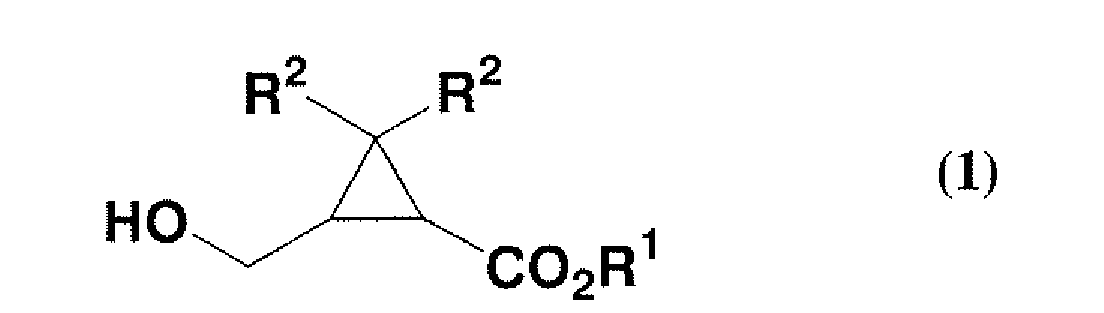
R2 represents a hydrogen atom or a methyl group, with at least one oxidizer selected from the group consisting of hypochlorite, N-halosuccinimide, a trichloroisocyanuric acid and iodine,
in the presence of a nitroxy radical compound.
a halogen atom such as fluorine, chlorine, or the like,
an alkoxy group such as methoxy, ethoxy or the like,
an aryl group such as phenyl,
an aryloxy group such as phenoxy or the like, or
an alkoxycarbonyl group such as methoxycarbonyl or the like. Specific examples thereof include, for example, 4-methylphenyl group, 2,6-di(tert-butyl)-4-methylphenyl group, a 4-phenoxyphenyl group and the like.
methyl 2-(hydroxymethyl)cyclopropanecarboxylate, ethyl 2-(hydroxymethyl)cyclopropanecarboxylate, n-propyl 2-(hydroxymethyl)cyclopropanecarboxylate, isopropyl 2-(hydroxymethyl)cyclopropanecarboxylate, n-butyl 2-(hydroxymethyl)cyclopropanecarboxylate, isobutyl 2-(hydroxymethyl)cyclopropanecarboxylate, sec-butyl 2-(hydroxymethyl)cyclopropanecarboxylate, tert-butyl 2-(hydroxymethyl)cyclopropanecarboxylate, n-pentyl 2-(hydroxymethyl)cyclopropanecarboxylate, n-hexyl 2-(hydroxymethyl)cyclopropanecarboxylate, cyclohexyl 2-(hydroxymethyl)cyclopropanecarboxylate, n-heptyl 2-(hydroxymethyl)cyclopropanecarboxylate, n-octyl 2-(hydroxymethyl)cyclopropanecarboxylate, n-decyl 2-(hydroxymethyl)cyclopropanecarboxylate, menthyl 2-(hydroxymethyl)cyclopropanecarboxylate, 2,6-di(tert-butyl)-4-methylphenyl 2-(hydroxymethyl)-cyclopropanecarboxylate, benzyl 2-(hydroxymethyl)cyclopropanecarboxylate, 4-methoxybenzyl 2-(hydroxymethyl)cyclopropanecarboxylate, 3-phenoxybenzyl 2-(hydroxymethyl)cyclopropanecarboxylate, 2,3,5,6-tetrafluoro-4-methoxymethylbenzyl 2-(hydroxylmethyl)cyclopropanecarboxylate, methyl 3-(hydroxymethyl)-2,2-dimethylcyclopropanecarboxylate, ethyl 3-(hydroxymethyl)-2,2-dimethylcyclopropanecarboxylate, n-propyl 3-(hydroxymethyl)-2,2-dimethylcyclopropanecarboxylate, isopropyl 3-(hydroxymethyl)-2,2-dimethylcyclopropanecarboxylate, n-butyl 3-(hydroxymethyl)-2,2-dimethylcyclopropanecarboxylate, isobutyl 3-(hydroxymethyl)-2,2-dimethylcyclopropanecarboxylate, sec-butyl 3-(hydroxymethyl)-2,2-dimethylcyclopropanecarboxylate, tert-butyl 3-(hydroxymethyl)-2,2-dimethylcyclopropanecarboxylate, n-pentyl 3-(hydroxymethyl)-2,2-dimethylcyclopropanecarboxylate, n-hexyl 3-(hydroxymethyl)-2,2-dimethylcyclopropanecarboxylate, cyclohexyl 3-(hydroxymethyl)-2,2-dimethylcyclopropanecarboxylate, n-heptyl 3-(hydroxymethyl)-2,2-dimethylcyclopropanecarboxylate, n-octyl 3-(hydroxymethyl)-2,2-dimethylcyclopropanecarboxylate, n-decyl 3-(hydroxymethyl)-2,2-dimethylcyclopropanecarboxylate, menthyl 3-(hydroxymethyl)-2,2-dimethylcyclopropanecarboxylate, 2,6-di(tert-butyl)-4-methylphenyl 3-(hydroxymethyl)-2,2-dimethylcyclopropanecarboxylate, benzyl 3-(hydroxymethyl)-2,2-dimethylcyclopropanecarboxylate, 4-methoxybenzyl 3-(hydroxymethyl)-2,2-dimethylcyclopropanecarboxylate, 3-phenoxybenzyl 3-(hydroxymethyl)-2,2-dimethylcyclopropanecarboxylate, 2,3,5,6-tetrafluoro-4-methoxymethylbenzyl 3-(hydroxylmethyl)-2,2-dimethylcyclopropanecarboxylate, and the like.

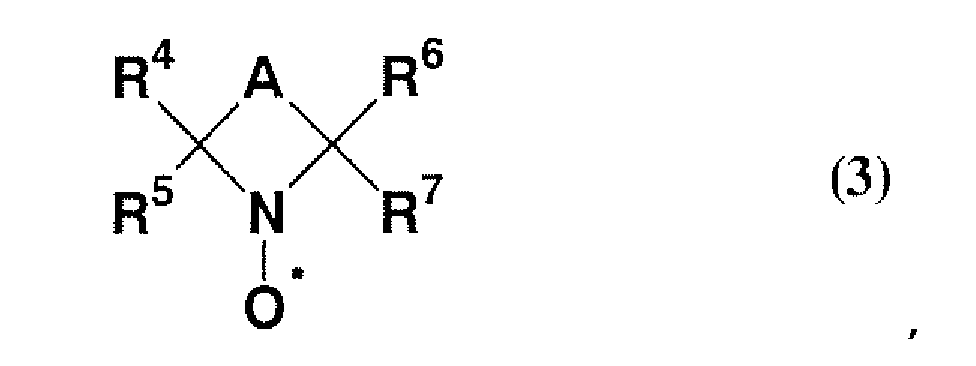
a linear, or branched lower alkenyl group,
an aryl group, an aralkyl group, or an acyl group, and
A represents a group represented by
-CH2COCH2-, -COCH2(CH2)n-, or -CHXCHY(CHZ)n-,
wherein n represents 0 or 1,
X, Y and Z are the same or different and represent a hydrogen atom, a hydroxyl group, a halogen atom, an amino group, an acylamino group, a carbamoyl group,
a linear, branched or cyclic lower alkoxy group,
a lower alkenyloxy group, an aryloxy group,
an aralkyloxy group, or an acyloxy group.
Moreover, when the reaction is conducted using a water-immiscible organic solvent and water, in a biphase a phase transfer catalyst may be also used in the reaction system.
methyl 2-formylcyclopropanecarboxylate, ethyl 2-formylcyclopropanecarboxylate, n-propyl 2-formylcyclopropanecarboxylate, isopropyl 2-formylcyclopropanecarboxylate, n-butyl 2-formylcyclopropanecarboxylate, isobutyl 2-formylcyclopropanecarboxylate, sec-butyl 2-formylcyclopropanecarboxylate, tert-butyl 2-formylcyclopropanecarboxylate, n-pentyl 2-formylcyclopropanecarboxylate, n-hexyl 2-formylcyclopropanecarboxylate, cyclohexyl 2-formylcyclopropanecarboxylate, n-heptyl 2-formylcyclopropanecarboxylate, n-octyl 2-formylcyclopropanecarboxylate, n-decyl 2-formylcyclopropanecarboxylate, menthyl 2-formylcyclopropanecarboxylate, 2,6-di(tert-butyl)-4-methylphenyl 2-formylcyclopropanecarboxylate, benzyl 2-formylcyclopropanecarboxylate, 4-methoxybenzyl 2-formylcyclopropanecarboxylate, 3-phenoxybenzyl 2-formylcyclopropanecarboxylate, 2,3,5,6-tetrafluoro-4-methoxymethylbenzyl 2-formylcyclopropanecarboxylate, methyl 2,2-dimethyl-3-formylcyclopropanecarboxylate, ethyl 2,2-dimethyl-3-formylcyclopropanecarboxylate, n-propyl 2,2-dimethyl-3-formylcyclopropanecarboxylate, isopropyl 2,2-dimethyl-3-formylcyclopropanecarboxylate, n-butyl 2,2-dimethyl-3-formylcyclopropanecarboxylate, isobutyl 2,2-dimethyl-3-formylcyclopropanecarboxylate, sec-butyl 2,2-dimethyl-3-formylcyclopropanecarboxylate, tert-butyl 2,2-dimethyl-3-formylcyclopropanecarboxylate, n-pentyl 2,2-dimethyl-3-formylcyclopropanecarboxylate, n-hexyl 2,2-dimethyl-3-formylcyclopropanecarboxylate, cyclohexyl 2,2-dimethyl-3-formylcyclopropanecarboxylate, n-heptyl 2,2-dimethyl-3-formylcyclopropanecarboxylate, n-octyl 2,2-dimethyl-3-formylcyclopropanecarboxylate, n-decyl 2,2-dimethyl-3-formylcyclopropanecarboxylate, menthyl 2,2-dimethyl-3-formylcyclopropanecarboxylate, 2,6-di(tert-butyl)-4-methylpheny 2,2-dimethyl-3-formylcyclopropanecarboxylate, benzyl 2,2-dimethyl-3-formylcyclopropanecarboxylate, 4-methoxybenzyl 2,2-dimethyl-3-formylcyclopropanecarboxylate, 3-phenoxybenzyl 2,2-dimethyl-3-formylcyclopropanecarboxylate, 2,3,5,6-tetrafluoro-4-methoxymethylbenzyl 2,2-dimethyl-3-formylcyclopropanecarboxylate and the like.
Yield: 22%.
Yield: 90%.
Yield: 89%.
Yield: 97%.
Yield: 29%.
Yield: 47%.
Yield: 37%.
Yield: 71%.
Yield: 64%.
Yield: 19%.
Yield: 12%.
Claims (8)
- A production method of formylcyclopropanecarboxylate compound of formula (2):wherein R1 and R2 are as defined below,

which comprises reacting
a cyclopropanecarboxylate compound of formula (1):wherein and R1 represent a linear, branched or cyclic alkyl group, a substituted or unsubstituted aryl group, or a substituted or unsubstituted aralkyl group,
R2 represents a hydrogen atom or a methyl group, with at least one oxidizer selected from the group consisting of hypochlorite, N-halosuccinimide, a trichloroisocyanuric acid, and iodine,
in the presence of a nitroxy radical compound. - A production method according to claim 1, wherein the nitroxy radical compound is a nitrocy radical compound of formula (3):wherein R4, R5, R6 and R7 are the same or different and represent

a linear, branched or cyclic lower alkyl group, or
a linear or branched lower alkenyl group,
an aryl group, an aralkyl group, or an acyl group, and
A represents the group represented by
-CH2COCH2-, -COCH2(CH2)n-, or -CHXCHY(CHZ)n-,
wherein n represents 0 or 1,
X , Y and Z are the same or different and represent a hydrogen atom, a hydroxyl group, a halogen atom, an amino group, an acylamino group, a carbamoyl group,
a linear, branched or cyclic lower alkoxy group,
a lower alkenyloxy group, an aryloxy group,
an aralkyloxy group, or an acyloxy group. - A production method according to claim 2, wherein nitroxy radical compound of formula (3) is 2,2,6,6-tetramethylpiperidine-1-oxyl.
- A production method according to claim 1 or 2, wherein the reaction is conducted at a pH range of 6-13.
- A production method according to claim 4, wherein the reaction is conducted at a pH range of 8-10.
- A production method according to claim 4, wherein the reaction is conducted in the presence of hydrogencarbonate or hydrogenphosphate.
- A production method according to claim 5, wherein the reaction is conducted in the presence of hydrogencarbonate or hydrogenphosphate.
- A production method according to claim 1 or 2, wherein the oxidizing agent is hypochlorite.
Applications Claiming Priority (3)
| Application Number | Priority Date | Filing Date | Title |
|---|---|---|---|
| JP2002208056 | 2002-07-17 | ||
| JP2002208056 | 2002-07-17 | ||
| PCT/JP2003/008555 WO2004007419A1 (en) | 2002-07-17 | 2003-07-04 | Process for production of formylcyclopropanecarboxylic esters |
Publications (3)
| Publication Number | Publication Date |
|---|---|
| EP1535895A1 true EP1535895A1 (en) | 2005-06-01 |
| EP1535895A4 EP1535895A4 (en) | 2006-08-02 |
| EP1535895B1 EP1535895B1 (en) | 2012-04-25 |
Family
ID=30112835
Family Applications (1)
| Application Number | Title | Priority Date | Filing Date |
|---|---|---|---|
| EP03741207A Expired - Lifetime EP1535895B1 (en) | 2002-07-17 | 2003-07-04 | Process for production of formylcyclopropanecarboxylic esters |
Country Status (9)
| Country | Link |
|---|---|
| US (1) | US20050240050A1 (en) |
| EP (1) | EP1535895B1 (en) |
| KR (1) | KR20050027110A (en) |
| CN (1) | CN100341842C (en) |
| AT (1) | ATE555075T1 (en) |
| AU (1) | AU2003281038A1 (en) |
| ES (1) | ES2382906T3 (en) |
| IL (1) | IL166288A0 (en) |
| WO (1) | WO2004007419A1 (en) |
Cited By (2)
| Publication number | Priority date | Publication date | Assignee | Title |
|---|---|---|---|---|
| EP1666441A1 (en) * | 2004-12-03 | 2006-06-07 | Daiso Co., Ltd. | Oxidation method for primary or secondary alcohols |
| EP2053037A4 (en) * | 2006-08-18 | 2012-01-11 | Sumitomo Chemical Co | PROCESS FOR PRODUCING CARBOXYLIC ACID ESTER OF TRANS-2,2-DIMETHYL-3-FORMYLCYCLOPROPANE |
Families Citing this family (1)
| Publication number | Priority date | Publication date | Assignee | Title |
|---|---|---|---|---|
| JP5076313B2 (en) * | 2005-12-13 | 2012-11-21 | 住友化学株式会社 | Process for producing purified 2,2-dimethyl-3-formylcyclopropanecarboxylic acid ester and intermediate thereof |
Family Cites Families (8)
| Publication number | Priority date | Publication date | Assignee | Title |
|---|---|---|---|---|
| FR2491920A1 (en) * | 1980-10-10 | 1982-04-16 | Roussel Uclaf | NOVEL METHYL ESTERS DERIVED FROM 2,2-DIMETHYL CYCLOPROPANE 1,3-DICARBOXYLIC ACID, THEIR PREPARATION AND NOVEL INTERMEDIATES OBTAINED |
| JPH05310632A (en) * | 1992-04-28 | 1993-11-22 | Sumitomo Chem Co Ltd | Method for producing m-phenoxybenzaldehyde |
| EP0619605B1 (en) * | 1993-04-05 | 1996-08-28 | STMicroelectronics S.r.l. | Combination of an electronic semiconductor device and a heat sink |
| NL194919C (en) * | 1993-09-07 | 2003-07-04 | Tno | Process for oxidizing carbohydrates. |
| JPH07330654A (en) * | 1994-06-01 | 1995-12-19 | Kuraray Co Ltd | Method for producing ether-substituted aldehydes |
| JPH0987226A (en) * | 1995-09-21 | 1997-03-31 | Ihara Nikkei Kagaku Kogyo Kk | Production of aromatic aldehyde compounds |
| US5821374A (en) * | 1995-11-21 | 1998-10-13 | Hoffmann-La Roche Inc. | Process for the oxidation of alcohols |
| JPH10237006A (en) * | 1997-02-21 | 1998-09-08 | Kuraray Co Ltd | Method for producing hydroxyterpene aldehyde |
-
2003
- 2003-07-04 WO PCT/JP2003/008555 patent/WO2004007419A1/en not_active Ceased
- 2003-07-04 US US10/521,158 patent/US20050240050A1/en not_active Abandoned
- 2003-07-04 KR KR1020057000711A patent/KR20050027110A/en not_active Ceased
- 2003-07-04 AU AU2003281038A patent/AU2003281038A1/en not_active Abandoned
- 2003-07-04 EP EP03741207A patent/EP1535895B1/en not_active Expired - Lifetime
- 2003-07-04 AT AT03741207T patent/ATE555075T1/en active
- 2003-07-04 ES ES03741207T patent/ES2382906T3/en not_active Expired - Lifetime
- 2003-07-04 CN CNB038169010A patent/CN100341842C/en not_active Expired - Lifetime
-
2005
- 2005-01-13 IL IL16628805A patent/IL166288A0/en unknown
Non-Patent Citations (3)
| Title |
|---|
| OGIBIN, YU. N. ET AL: "Electrochemical and chemical oxidation of alcohols in a two-phase system using N-oxopiperidinium salt: synthesis of 4-chlorobutanal, formylcyclopropanes, and m-phenoxybenzaldehyde" BULLETIN OF THE RUSSIAN ACADEMY OF SCIENCES. DIVISION OF CHEMICAL SCIENCE., vol. 41, no. 4, 1992, pages 735-739, XP008065147 USPLENUM PUBLISHING CO, NEW YORK, NY. * |
| See also references of WO2004007419A1 * |
| SEMMELHACK, M. F. ET AL: "Nitroxyl -mediated electrooxidation of alcohols to aldehydes and ketones" JOURNAL OF THE AMERICAN CHEMICAL SOCIETY , 105(13), 4492-4 CODEN: JACSAT; ISSN: 0002-7863, 1983, XP002385263 * |
Cited By (2)
| Publication number | Priority date | Publication date | Assignee | Title |
|---|---|---|---|---|
| EP1666441A1 (en) * | 2004-12-03 | 2006-06-07 | Daiso Co., Ltd. | Oxidation method for primary or secondary alcohols |
| EP2053037A4 (en) * | 2006-08-18 | 2012-01-11 | Sumitomo Chemical Co | PROCESS FOR PRODUCING CARBOXYLIC ACID ESTER OF TRANS-2,2-DIMETHYL-3-FORMYLCYCLOPROPANE |
Also Published As
| Publication number | Publication date |
|---|---|
| KR20050027110A (en) | 2005-03-17 |
| CN100341842C (en) | 2007-10-10 |
| EP1535895B1 (en) | 2012-04-25 |
| ES2382906T3 (en) | 2012-06-14 |
| ATE555075T1 (en) | 2012-05-15 |
| AU2003281038A1 (en) | 2004-02-02 |
| CN1668570A (en) | 2005-09-14 |
| EP1535895A4 (en) | 2006-08-02 |
| WO2004007419A1 (en) | 2004-01-22 |
| IL166288A0 (en) | 2006-01-15 |
| US20050240050A1 (en) | 2005-10-27 |
Similar Documents
| Publication | Publication Date | Title |
|---|---|---|
| KR100214191B1 (en) | Process for the preparation of e-oximethers from phenylglyoxylic acid esters | |
| JPH09169685A (en) | Method for oxidizing primary or secondary alcohol | |
| EP1535895B1 (en) | Process for production of formylcyclopropanecarboxylic esters | |
| Fernandez-Megia et al. | Studies towards the synthesis of the C29-C51 fragment of altohyrtin A | |
| JPH0358956A (en) | Production of alpha-ketocarboxylic acid ester | |
| JP2004099595A (en) | Method for producing formylcyclopropanecarboxylic acid esters | |
| US6750371B2 (en) | Process for the oxidation of alcohols to aldehydes and ketones in the presence of nitroxyl compounds as catalysts | |
| US6489505B2 (en) | Process for producing 3,3-dimethyl-2-formylcyclopropane-carboxylic acid ester | |
| Nakamura et al. | Stereoselective aldol reaction of α-seleno carbonyl compounds: preparation of (Z)-α, β-unsaturated carbonyl compounds | |
| JP4345413B2 (en) | Process for producing 2- (hydroxymethyl) cyclopropanecarboxylic acid compound | |
| EP0679629B1 (en) | Process for preparing optically active alpha-(hydroxy-phenoxy)alkane carboxylic acid and its derivatives | |
| FR2483404A1 (en) | PROCESS FOR THE PREPARATION OF 2,2-DIHALOVINYL-CYCLOPROPANECARBOXYLATES | |
| US6624331B1 (en) | Process for the preparation of benzyloxyacetaldehyde | |
| JP2003261547A (en) | Method of producing 4-alkyl-5-formylthiazole derivative | |
| FR2892411A1 (en) | Forming hydroxy-ester, useful to prepare hydroxy-acids that are useful in cosmetic field, comprises reacting phosphonate compound with lactol by Wittig-Horner reaction and subjecting ester under saponification reaction to give hydroxy-acid | |
| JP2002371027A (en) | Method for producing 3-acyl-2-butanone | |
| JP3265142B2 (en) | Method for producing 4-alkylbenzoic acids | |
| EP1097917A1 (en) | Preparing method of alpha-ketocarboxylic acid derivatives | |
| SYDNES et al. | ALDEHYDE ACYLALS–VALUABLE COMPOUNDS IN SYNTHESIS VVHEN TREATED PROPERLY | |
| JP2615780B2 (en) | Method for producing 2-cyclopentenone derivative | |
| JP2004315505A (en) | Production method of aldehyde | |
| JP2762643B2 (en) | Method for producing 4-hydroxycyclopentenone derivative | |
| JP2002145861A (en) | Method for producing sterically hindered n-oxyl compound | |
| KR890002823B1 (en) | Manufacturing method of pyridoid insecticide | |
| JP2002220367A (en) | Method for producing (R) -4-cyano-3-hydroxybutyric acid lower alkyl ester |
Legal Events
| Date | Code | Title | Description |
|---|---|---|---|
| PUAI | Public reference made under article 153(3) epc to a published international application that has entered the european phase |
Free format text: ORIGINAL CODE: 0009012 |
|
| 17P | Request for examination filed |
Effective date: 20050112 |
|
| AK | Designated contracting states |
Kind code of ref document: A1 Designated state(s): AT BE BG CH CY CZ DE DK EE ES FI FR GB GR HU IE IT LI LU MC NL PT RO SE SI SK TR |
|
| AX | Request for extension of the european patent |
Extension state: AL LT LV MK |
|
| DAX | Request for extension of the european patent (deleted) | ||
| RIN1 | Information on inventor provided before grant (corrected) |
Inventor name: ITAGAKI, MAKOTO Inventor name: HAGIYA, KOJI Inventor name: MINAMIDA, RYO |
|
| A4 | Supplementary search report drawn up and despatched |
Effective date: 20060703 |
|
| 17Q | First examination report despatched |
Effective date: 20070209 |
|
| GRAP | Despatch of communication of intention to grant a patent |
Free format text: ORIGINAL CODE: EPIDOSNIGR1 |
|
| GRAS | Grant fee paid |
Free format text: ORIGINAL CODE: EPIDOSNIGR3 |
|
| GRAA | (expected) grant |
Free format text: ORIGINAL CODE: 0009210 |
|
| AK | Designated contracting states |
Kind code of ref document: B1 Designated state(s): AT BE BG CH CY CZ DE DK EE ES FI FR GB GR HU IE IT LI LU MC NL PT RO SE SI SK TR |
|
| REG | Reference to a national code |
Ref country code: GB Ref legal event code: FG4D |
|
| REG | Reference to a national code |
Ref country code: CH Ref legal event code: NV Representative=s name: BOHEST AG Ref country code: CH Ref legal event code: EP |
|
| REG | Reference to a national code |
Ref country code: AT Ref legal event code: REF Ref document number: 555075 Country of ref document: AT Kind code of ref document: T Effective date: 20120515 |
|
| REG | Reference to a national code |
Ref country code: IE Ref legal event code: FG4D |
|
| REG | Reference to a national code |
Ref country code: ES Ref legal event code: FG2A Ref document number: 2382906 Country of ref document: ES Kind code of ref document: T3 Effective date: 20120614 |
|
| REG | Reference to a national code |
Ref country code: DE Ref legal event code: R096 Ref document number: 60340728 Country of ref document: DE Effective date: 20120621 |
|
| REG | Reference to a national code |
Ref country code: NL Ref legal event code: VDEP Effective date: 20120425 |
|
| REG | Reference to a national code |
Ref country code: AT Ref legal event code: MK05 Ref document number: 555075 Country of ref document: AT Kind code of ref document: T Effective date: 20120425 |
|
| PG25 | Lapsed in a contracting state [announced via postgrant information from national office to epo] |
Ref country code: SE Free format text: LAPSE BECAUSE OF FAILURE TO SUBMIT A TRANSLATION OF THE DESCRIPTION OR TO PAY THE FEE WITHIN THE PRESCRIBED TIME-LIMIT Effective date: 20120425 Ref country code: CY Free format text: LAPSE BECAUSE OF FAILURE TO SUBMIT A TRANSLATION OF THE DESCRIPTION OR TO PAY THE FEE WITHIN THE PRESCRIBED TIME-LIMIT Effective date: 20120425 Ref country code: FI Free format text: LAPSE BECAUSE OF FAILURE TO SUBMIT A TRANSLATION OF THE DESCRIPTION OR TO PAY THE FEE WITHIN THE PRESCRIBED TIME-LIMIT Effective date: 20120425 |
|
| PG25 | Lapsed in a contracting state [announced via postgrant information from national office to epo] |
Ref country code: SI Free format text: LAPSE BECAUSE OF FAILURE TO SUBMIT A TRANSLATION OF THE DESCRIPTION OR TO PAY THE FEE WITHIN THE PRESCRIBED TIME-LIMIT Effective date: 20120425 Ref country code: GR Free format text: LAPSE BECAUSE OF FAILURE TO SUBMIT A TRANSLATION OF THE DESCRIPTION OR TO PAY THE FEE WITHIN THE PRESCRIBED TIME-LIMIT Effective date: 20120726 Ref country code: PT Free format text: LAPSE BECAUSE OF FAILURE TO SUBMIT A TRANSLATION OF THE DESCRIPTION OR TO PAY THE FEE WITHIN THE PRESCRIBED TIME-LIMIT Effective date: 20120827 |
|
| PG25 | Lapsed in a contracting state [announced via postgrant information from national office to epo] |
Ref country code: BE Free format text: LAPSE BECAUSE OF FAILURE TO SUBMIT A TRANSLATION OF THE DESCRIPTION OR TO PAY THE FEE WITHIN THE PRESCRIBED TIME-LIMIT Effective date: 20120425 |
|
| PG25 | Lapsed in a contracting state [announced via postgrant information from national office to epo] |
Ref country code: NL Free format text: LAPSE BECAUSE OF FAILURE TO SUBMIT A TRANSLATION OF THE DESCRIPTION OR TO PAY THE FEE WITHIN THE PRESCRIBED TIME-LIMIT Effective date: 20120425 Ref country code: AT Free format text: LAPSE BECAUSE OF FAILURE TO SUBMIT A TRANSLATION OF THE DESCRIPTION OR TO PAY THE FEE WITHIN THE PRESCRIBED TIME-LIMIT Effective date: 20120425 Ref country code: CZ Free format text: LAPSE BECAUSE OF FAILURE TO SUBMIT A TRANSLATION OF THE DESCRIPTION OR TO PAY THE FEE WITHIN THE PRESCRIBED TIME-LIMIT Effective date: 20120425 Ref country code: EE Free format text: LAPSE BECAUSE OF FAILURE TO SUBMIT A TRANSLATION OF THE DESCRIPTION OR TO PAY THE FEE WITHIN THE PRESCRIBED TIME-LIMIT Effective date: 20120425 Ref country code: SK Free format text: LAPSE BECAUSE OF FAILURE TO SUBMIT A TRANSLATION OF THE DESCRIPTION OR TO PAY THE FEE WITHIN THE PRESCRIBED TIME-LIMIT Effective date: 20120425 Ref country code: DK Free format text: LAPSE BECAUSE OF FAILURE TO SUBMIT A TRANSLATION OF THE DESCRIPTION OR TO PAY THE FEE WITHIN THE PRESCRIBED TIME-LIMIT Effective date: 20120425 Ref country code: RO Free format text: LAPSE BECAUSE OF FAILURE TO SUBMIT A TRANSLATION OF THE DESCRIPTION OR TO PAY THE FEE WITHIN THE PRESCRIBED TIME-LIMIT Effective date: 20120425 |
|
| PG25 | Lapsed in a contracting state [announced via postgrant information from national office to epo] |
Ref country code: MC Free format text: LAPSE BECAUSE OF NON-PAYMENT OF DUE FEES Effective date: 20120731 |
|
| REG | Reference to a national code |
Ref country code: HU Ref legal event code: AG4A Ref document number: E015007 Country of ref document: HU |
|
| PLBE | No opposition filed within time limit |
Free format text: ORIGINAL CODE: 0009261 |
|
| STAA | Information on the status of an ep patent application or granted ep patent |
Free format text: STATUS: NO OPPOSITION FILED WITHIN TIME LIMIT |
|
| 26N | No opposition filed |
Effective date: 20130128 |
|
| REG | Reference to a national code |
Ref country code: IE Ref legal event code: MM4A |
|
| REG | Reference to a national code |
Ref country code: DE Ref legal event code: R097 Ref document number: 60340728 Country of ref document: DE Effective date: 20130128 |
|
| PG25 | Lapsed in a contracting state [announced via postgrant information from national office to epo] |
Ref country code: IE Free format text: LAPSE BECAUSE OF NON-PAYMENT OF DUE FEES Effective date: 20120704 Ref country code: BG Free format text: LAPSE BECAUSE OF FAILURE TO SUBMIT A TRANSLATION OF THE DESCRIPTION OR TO PAY THE FEE WITHIN THE PRESCRIBED TIME-LIMIT Effective date: 20120725 |
|
| PGFP | Annual fee paid to national office [announced via postgrant information from national office to epo] |
Ref country code: ES Payment date: 20130628 Year of fee payment: 11 Ref country code: CH Payment date: 20130712 Year of fee payment: 11 Ref country code: HU Payment date: 20130612 Year of fee payment: 11 |
|
| PGFP | Annual fee paid to national office [announced via postgrant information from national office to epo] |
Ref country code: FR Payment date: 20130724 Year of fee payment: 11 Ref country code: GB Payment date: 20130703 Year of fee payment: 11 |
|
| PG25 | Lapsed in a contracting state [announced via postgrant information from national office to epo] |
Ref country code: TR Free format text: LAPSE BECAUSE OF FAILURE TO SUBMIT A TRANSLATION OF THE DESCRIPTION OR TO PAY THE FEE WITHIN THE PRESCRIBED TIME-LIMIT Effective date: 20120425 |
|
| PG25 | Lapsed in a contracting state [announced via postgrant information from national office to epo] |
Ref country code: LU Free format text: LAPSE BECAUSE OF NON-PAYMENT OF DUE FEES Effective date: 20120704 |
|
| REG | Reference to a national code |
Ref country code: CH Ref legal event code: PCAR Free format text: NEW ADDRESS: HOLBEINSTRASSE 36-38, 4051 BASEL (CH) |
|
| PGFP | Annual fee paid to national office [announced via postgrant information from national office to epo] |
Ref country code: DE Payment date: 20140702 Year of fee payment: 12 |
|
| PGFP | Annual fee paid to national office [announced via postgrant information from national office to epo] |
Ref country code: IT Payment date: 20140709 Year of fee payment: 12 |
|
| REG | Reference to a national code |
Ref country code: CH Ref legal event code: PL |
|
| GBPC | Gb: european patent ceased through non-payment of renewal fee |
Effective date: 20140704 |
|
| REG | Reference to a national code |
Ref country code: FR Ref legal event code: ST Effective date: 20150331 |
|
| PG25 | Lapsed in a contracting state [announced via postgrant information from national office to epo] |
Ref country code: LI Free format text: LAPSE BECAUSE OF NON-PAYMENT OF DUE FEES Effective date: 20140731 Ref country code: CH Free format text: LAPSE BECAUSE OF NON-PAYMENT OF DUE FEES Effective date: 20140731 Ref country code: HU Free format text: LAPSE BECAUSE OF NON-PAYMENT OF DUE FEES Effective date: 20140705 |
|
| PG25 | Lapsed in a contracting state [announced via postgrant information from national office to epo] |
Ref country code: FR Free format text: LAPSE BECAUSE OF NON-PAYMENT OF DUE FEES Effective date: 20140731 Ref country code: GB Free format text: LAPSE BECAUSE OF NON-PAYMENT OF DUE FEES Effective date: 20140704 |
|
| REG | Reference to a national code |
Ref country code: ES Ref legal event code: FD2A Effective date: 20150828 |
|
| PG25 | Lapsed in a contracting state [announced via postgrant information from national office to epo] |
Ref country code: ES Free format text: LAPSE BECAUSE OF NON-PAYMENT OF DUE FEES Effective date: 20140705 |
|
| REG | Reference to a national code |
Ref country code: DE Ref legal event code: R119 Ref document number: 60340728 Country of ref document: DE |
|
| PG25 | Lapsed in a contracting state [announced via postgrant information from national office to epo] |
Ref country code: IT Free format text: LAPSE BECAUSE OF NON-PAYMENT OF DUE FEES Effective date: 20150704 Ref country code: DE Free format text: LAPSE BECAUSE OF NON-PAYMENT OF DUE FEES Effective date: 20160202 |