EP1535881B1 - Shaped expanded graphite article and method for producing the same - Google Patents
Shaped expanded graphite article and method for producing the same Download PDFInfo
- Publication number
- EP1535881B1 EP1535881B1 EP03795279.3A EP03795279A EP1535881B1 EP 1535881 B1 EP1535881 B1 EP 1535881B1 EP 03795279 A EP03795279 A EP 03795279A EP 1535881 B1 EP1535881 B1 EP 1535881B1
- Authority
- EP
- European Patent Office
- Prior art keywords
- boron
- phosphorus
- expanded graphite
- oxidation
- coating layer
- Prior art date
- Legal status (The legal status is an assumption and is not a legal conclusion. Google has not performed a legal analysis and makes no representation as to the accuracy of the status listed.)
- Expired - Lifetime
Links
- OKTJSMMVPCPJKN-UHFFFAOYSA-N Carbon Chemical compound [C] OKTJSMMVPCPJKN-UHFFFAOYSA-N 0.000 title claims description 123
- 229910002804 graphite Inorganic materials 0.000 title claims description 121
- 239000010439 graphite Substances 0.000 title claims description 121
- 238000004519 manufacturing process Methods 0.000 title claims description 17
- 239000011574 phosphorus Substances 0.000 claims description 77
- 229910052698 phosphorus Inorganic materials 0.000 claims description 77
- ZOXJGFHDIHLPTG-UHFFFAOYSA-N Boron Chemical compound [B] ZOXJGFHDIHLPTG-UHFFFAOYSA-N 0.000 claims description 73
- 229910052796 boron Inorganic materials 0.000 claims description 73
- OAICVXFJPJFONN-UHFFFAOYSA-N Phosphorus Chemical compound [P] OAICVXFJPJFONN-UHFFFAOYSA-N 0.000 claims description 69
- 230000003647 oxidation Effects 0.000 claims description 56
- 238000007254 oxidation reaction Methods 0.000 claims description 56
- 239000000463 material Substances 0.000 claims description 48
- 239000011247 coating layer Substances 0.000 claims description 33
- 150000001875 compounds Chemical class 0.000 claims description 23
- 239000002245 particle Substances 0.000 claims description 22
- 229910052580 B4C Inorganic materials 0.000 claims description 17
- INAHAJYZKVIDIZ-UHFFFAOYSA-N boron carbide Chemical compound B12B3B4C32B41 INAHAJYZKVIDIZ-UHFFFAOYSA-N 0.000 claims description 17
- 238000010438 heat treatment Methods 0.000 claims description 15
- 238000000034 method Methods 0.000 claims description 14
- 229910052582 BN Inorganic materials 0.000 claims description 12
- PZNSFCLAULLKQX-UHFFFAOYSA-N Boron nitride Chemical compound N#B PZNSFCLAULLKQX-UHFFFAOYSA-N 0.000 claims description 12
- WTEOIRVLGSZEPR-UHFFFAOYSA-N boron trifluoride Chemical compound FB(F)F WTEOIRVLGSZEPR-UHFFFAOYSA-N 0.000 claims description 12
- 229910021332 silicide Inorganic materials 0.000 claims description 12
- FVBUAEGBCNSCDD-UHFFFAOYSA-N silicide(4-) Chemical compound [Si-4] FVBUAEGBCNSCDD-UHFFFAOYSA-N 0.000 claims description 12
- -1 phosphorus nitride Chemical class 0.000 claims description 10
- 229910015900 BF3 Inorganic materials 0.000 claims description 9
- 229910001392 phosphorus oxide Inorganic materials 0.000 claims description 9
- FAIAAWCVCHQXDN-UHFFFAOYSA-N phosphorus trichloride Chemical compound ClP(Cl)Cl FAIAAWCVCHQXDN-UHFFFAOYSA-N 0.000 claims description 9
- FAQYAMRNWDIXMY-UHFFFAOYSA-N trichloroborane Chemical compound ClB(Cl)Cl FAQYAMRNWDIXMY-UHFFFAOYSA-N 0.000 claims description 9
- 150000001639 boron compounds Chemical class 0.000 claims description 7
- 229910052810 boron oxide Inorganic materials 0.000 claims description 6
- ILAHWRKJUDSMFH-UHFFFAOYSA-N boron tribromide Chemical compound BrB(Br)Br ILAHWRKJUDSMFH-UHFFFAOYSA-N 0.000 claims description 6
- YMEKEHSRPZAOGO-UHFFFAOYSA-N boron triiodide Chemical compound IB(I)I YMEKEHSRPZAOGO-UHFFFAOYSA-N 0.000 claims description 6
- JKWMSGQKBLHBQQ-UHFFFAOYSA-N diboron trioxide Chemical compound O=BOB=O JKWMSGQKBLHBQQ-UHFFFAOYSA-N 0.000 claims description 6
- VVRKSAMWBNJDTH-UHFFFAOYSA-N difluorophosphane Chemical compound FPF VVRKSAMWBNJDTH-UHFFFAOYSA-N 0.000 claims description 6
- 150000002903 organophosphorus compounds Chemical class 0.000 claims description 6
- OJMIONKXNSYLSR-UHFFFAOYSA-N phosphorous acid Chemical compound OP(O)O OJMIONKXNSYLSR-UHFFFAOYSA-N 0.000 claims description 6
- IPNPIHIZVLFAFP-UHFFFAOYSA-N phosphorus tribromide Chemical compound BrP(Br)Br IPNPIHIZVLFAFP-UHFFFAOYSA-N 0.000 claims description 6
- VSAISIQCTGDGPU-UHFFFAOYSA-N tetraphosphorus hexaoxide Chemical compound O1P(O2)OP3OP1OP2O3 VSAISIQCTGDGPU-UHFFFAOYSA-N 0.000 claims description 6
- 238000007493 shaping process Methods 0.000 claims description 5
- 239000010410 layer Substances 0.000 claims description 4
- NBIIXXVUZAFLBC-UHFFFAOYSA-N Phosphoric acid Chemical compound OP(O)(O)=O NBIIXXVUZAFLBC-UHFFFAOYSA-N 0.000 description 22
- 235000011007 phosphoric acid Nutrition 0.000 description 11
- XLYOFNOQVPJJNP-UHFFFAOYSA-N water Substances O XLYOFNOQVPJJNP-UHFFFAOYSA-N 0.000 description 9
- QVGXLLKOCUKJST-UHFFFAOYSA-N atomic oxygen Chemical compound [O] QVGXLLKOCUKJST-UHFFFAOYSA-N 0.000 description 8
- 229910052760 oxygen Inorganic materials 0.000 description 8
- 239000001301 oxygen Substances 0.000 description 8
- 239000011248 coating agent Substances 0.000 description 7
- 238000000576 coating method Methods 0.000 description 7
- 238000012856 packing Methods 0.000 description 7
- UEZVMMHDMIWARA-UHFFFAOYSA-N Metaphosphoric acid Chemical compound OP(=O)=O UEZVMMHDMIWARA-UHFFFAOYSA-N 0.000 description 6
- NBIIXXVUZAFLBC-UHFFFAOYSA-L Phosphate ion(2-) Chemical compound OP([O-])([O-])=O NBIIXXVUZAFLBC-UHFFFAOYSA-L 0.000 description 6
- ILRRQNADMUWWFW-UHFFFAOYSA-K aluminium phosphate Chemical compound O1[Al]2OP1(=O)O2 ILRRQNADMUWWFW-UHFFFAOYSA-K 0.000 description 6
- 229910000147 aluminium phosphate Inorganic materials 0.000 description 6
- 229940001007 aluminium phosphate Drugs 0.000 description 6
- 229910000389 calcium phosphate Inorganic materials 0.000 description 6
- 230000000052 comparative effect Effects 0.000 description 6
- 238000000354 decomposition reaction Methods 0.000 description 6
- LWIHDJKSTIGBAC-UHFFFAOYSA-K tripotassium phosphate Chemical compound [K+].[K+].[K+].[O-]P([O-])([O-])=O LWIHDJKSTIGBAC-UHFFFAOYSA-K 0.000 description 6
- YWEUIGNSBFLMFL-UHFFFAOYSA-N diphosphonate Chemical compound O=P(=O)OP(=O)=O YWEUIGNSBFLMFL-UHFFFAOYSA-N 0.000 description 4
- 229910052751 metal Inorganic materials 0.000 description 4
- DLYUQMMRRRQYAE-UHFFFAOYSA-N phosphorus pentoxide Inorganic materials O1P(O2)(=O)OP3(=O)OP1(=O)OP2(=O)O3 DLYUQMMRRRQYAE-UHFFFAOYSA-N 0.000 description 4
- 239000004411 aluminium Substances 0.000 description 3
- 229910052782 aluminium Inorganic materials 0.000 description 3
- XAGFODPZIPBFFR-UHFFFAOYSA-N aluminium Chemical compound [Al] XAGFODPZIPBFFR-UHFFFAOYSA-N 0.000 description 3
- 235000010210 aluminium Nutrition 0.000 description 3
- 230000009286 beneficial effect Effects 0.000 description 3
- YYRMJZQKEFZXMX-UHFFFAOYSA-L calcium bis(dihydrogenphosphate) Chemical compound [Ca+2].OP(O)([O-])=O.OP(O)([O-])=O YYRMJZQKEFZXMX-UHFFFAOYSA-L 0.000 description 3
- 239000001506 calcium phosphate Substances 0.000 description 3
- 229960001714 calcium phosphate Drugs 0.000 description 3
- 235000011010 calcium phosphates Nutrition 0.000 description 3
- XPPKVPWEQAFLFU-UHFFFAOYSA-N diphosphoric acid Chemical compound OP(O)(=O)OP(O)(O)=O XPPKVPWEQAFLFU-UHFFFAOYSA-N 0.000 description 3
- 239000007770 graphite material Substances 0.000 description 3
- GVALZJMUIHGIMD-UHFFFAOYSA-H magnesium phosphate Chemical compound [Mg+2].[Mg+2].[Mg+2].[O-]P([O-])([O-])=O.[O-]P([O-])([O-])=O GVALZJMUIHGIMD-UHFFFAOYSA-H 0.000 description 3
- 239000004137 magnesium phosphate Substances 0.000 description 3
- 229910000157 magnesium phosphate Inorganic materials 0.000 description 3
- 229960002261 magnesium phosphate Drugs 0.000 description 3
- 235000010994 magnesium phosphates Nutrition 0.000 description 3
- QQFLQYOOQVLGTQ-UHFFFAOYSA-L magnesium;dihydrogen phosphate Chemical compound [Mg+2].OP(O)([O-])=O.OP(O)([O-])=O QQFLQYOOQVLGTQ-UHFFFAOYSA-L 0.000 description 3
- 239000000203 mixture Substances 0.000 description 3
- 235000019691 monocalcium phosphate Nutrition 0.000 description 3
- 229910000401 monomagnesium phosphate Inorganic materials 0.000 description 3
- 235000019785 monomagnesium phosphate Nutrition 0.000 description 3
- LFGREXWGYUGZLY-UHFFFAOYSA-N phosphoryl Chemical class [P]=O LFGREXWGYUGZLY-UHFFFAOYSA-N 0.000 description 3
- 229920000137 polyphosphoric acid Polymers 0.000 description 3
- 229910000160 potassium phosphate Inorganic materials 0.000 description 3
- 229940093916 potassium phosphate Drugs 0.000 description 3
- 235000011009 potassium phosphates Nutrition 0.000 description 3
- 229940005657 pyrophosphoric acid Drugs 0.000 description 3
- 239000000126 substance Substances 0.000 description 3
- QORWJWZARLRLPR-UHFFFAOYSA-H tricalcium bis(phosphate) Chemical compound [Ca+2].[Ca+2].[Ca+2].[O-]P([O-])([O-])=O.[O-]P([O-])([O-])=O QORWJWZARLRLPR-UHFFFAOYSA-H 0.000 description 3
- CSCPPACGZOOCGX-UHFFFAOYSA-N Acetone Chemical compound CC(C)=O CSCPPACGZOOCGX-UHFFFAOYSA-N 0.000 description 2
- MHAJPDPJQMAIIY-UHFFFAOYSA-N Hydrogen peroxide Chemical compound OO MHAJPDPJQMAIIY-UHFFFAOYSA-N 0.000 description 2
- GRYLNZFGIOXLOG-UHFFFAOYSA-N Nitric acid Chemical compound O[N+]([O-])=O GRYLNZFGIOXLOG-UHFFFAOYSA-N 0.000 description 2
- 229910019142 PO4 Inorganic materials 0.000 description 2
- 239000002253 acid Substances 0.000 description 2
- CREMABGTGYGIQB-UHFFFAOYSA-N carbon carbon Chemical compound C.C CREMABGTGYGIQB-UHFFFAOYSA-N 0.000 description 2
- 239000011203 carbon fibre reinforced carbon Substances 0.000 description 2
- 239000007789 gas Substances 0.000 description 2
- 239000003112 inhibitor Substances 0.000 description 2
- 239000011229 interlayer Substances 0.000 description 2
- 229910017604 nitric acid Inorganic materials 0.000 description 2
- 230000001590 oxidative effect Effects 0.000 description 2
- 239000010452 phosphate Substances 0.000 description 2
- NBIIXXVUZAFLBC-UHFFFAOYSA-K phosphate Chemical compound [O-]P([O-])([O-])=O NBIIXXVUZAFLBC-UHFFFAOYSA-K 0.000 description 2
- 150000003839 salts Chemical class 0.000 description 2
- BTBUEUYNUDRHOZ-UHFFFAOYSA-N Borate Chemical compound [O-]B([O-])[O-] BTBUEUYNUDRHOZ-UHFFFAOYSA-N 0.000 description 1
- ZAMOUSCENKQFHK-UHFFFAOYSA-N Chlorine atom Chemical compound [Cl] ZAMOUSCENKQFHK-UHFFFAOYSA-N 0.000 description 1
- LFQSCWFLJHTTHZ-UHFFFAOYSA-N Ethanol Chemical compound CCO LFQSCWFLJHTTHZ-UHFFFAOYSA-N 0.000 description 1
- NINIDFKCEFEMDL-UHFFFAOYSA-N Sulfur Chemical compound [S] NINIDFKCEFEMDL-UHFFFAOYSA-N 0.000 description 1
- 239000003963 antioxidant agent Substances 0.000 description 1
- 230000003078 antioxidant effect Effects 0.000 description 1
- 230000004888 barrier function Effects 0.000 description 1
- 239000011230 binding agent Substances 0.000 description 1
- 239000004327 boric acid Substances 0.000 description 1
- 150000001720 carbohydrates Chemical class 0.000 description 1
- 229910052799 carbon Inorganic materials 0.000 description 1
- 239000000460 chlorine Substances 0.000 description 1
- 229910052801 chlorine Inorganic materials 0.000 description 1
- 230000006835 compression Effects 0.000 description 1
- 238000007906 compression Methods 0.000 description 1
- 238000011109 contamination Methods 0.000 description 1
- 230000001771 impaired effect Effects 0.000 description 1
- 239000011810 insulating material Substances 0.000 description 1
- 238000011835 investigation Methods 0.000 description 1
- 239000007788 liquid Substances 0.000 description 1
- 239000002184 metal Substances 0.000 description 1
- 229910021382 natural graphite Inorganic materials 0.000 description 1
- 239000007800 oxidant agent Substances 0.000 description 1
- 230000000149 penetrating effect Effects 0.000 description 1
- 150000003018 phosphorus compounds Chemical class 0.000 description 1
- 239000004033 plastic Substances 0.000 description 1
- 238000000197 pyrolysis Methods 0.000 description 1
- 238000005096 rolling process Methods 0.000 description 1
- 238000007789 sealing Methods 0.000 description 1
- 239000002904 solvent Substances 0.000 description 1
- 238000005507 spraying Methods 0.000 description 1
- 229910052717 sulfur Inorganic materials 0.000 description 1
- 239000011593 sulfur Substances 0.000 description 1
- QAOWNCQODCNURD-UHFFFAOYSA-N sulfuric acid Substances OS(O)(=O)=O QAOWNCQODCNURD-UHFFFAOYSA-N 0.000 description 1
- 238000005303 weighing Methods 0.000 description 1
Images
Classifications
-
- C—CHEMISTRY; METALLURGY
- C04—CEMENTS; CONCRETE; ARTIFICIAL STONE; CERAMICS; REFRACTORIES
- C04B—LIME, MAGNESIA; SLAG; CEMENTS; COMPOSITIONS THEREOF, e.g. MORTARS, CONCRETE OR LIKE BUILDING MATERIALS; ARTIFICIAL STONE; CERAMICS; REFRACTORIES; TREATMENT OF NATURAL STONE
- C04B41/00—After-treatment of mortars, concrete, artificial stone or ceramics; Treatment of natural stone
- C04B41/009—After-treatment of mortars, concrete, artificial stone or ceramics; Treatment of natural stone characterised by the material treated
-
- C—CHEMISTRY; METALLURGY
- C04—CEMENTS; CONCRETE; ARTIFICIAL STONE; CERAMICS; REFRACTORIES
- C04B—LIME, MAGNESIA; SLAG; CEMENTS; COMPOSITIONS THEREOF, e.g. MORTARS, CONCRETE OR LIKE BUILDING MATERIALS; ARTIFICIAL STONE; CERAMICS; REFRACTORIES; TREATMENT OF NATURAL STONE
- C04B35/00—Shaped ceramic products characterised by their composition; Ceramics compositions; Processing powders of inorganic compounds preparatory to the manufacturing of ceramic products
- C04B35/515—Shaped ceramic products characterised by their composition; Ceramics compositions; Processing powders of inorganic compounds preparatory to the manufacturing of ceramic products based on non-oxide ceramics
- C04B35/52—Shaped ceramic products characterised by their composition; Ceramics compositions; Processing powders of inorganic compounds preparatory to the manufacturing of ceramic products based on non-oxide ceramics based on carbon, e.g. graphite
- C04B35/536—Shaped ceramic products characterised by their composition; Ceramics compositions; Processing powders of inorganic compounds preparatory to the manufacturing of ceramic products based on non-oxide ceramics based on carbon, e.g. graphite based on expanded graphite or complexed graphite
-
- C—CHEMISTRY; METALLURGY
- C04—CEMENTS; CONCRETE; ARTIFICIAL STONE; CERAMICS; REFRACTORIES
- C04B—LIME, MAGNESIA; SLAG; CEMENTS; COMPOSITIONS THEREOF, e.g. MORTARS, CONCRETE OR LIKE BUILDING MATERIALS; ARTIFICIAL STONE; CERAMICS; REFRACTORIES; TREATMENT OF NATURAL STONE
- C04B35/00—Shaped ceramic products characterised by their composition; Ceramics compositions; Processing powders of inorganic compounds preparatory to the manufacturing of ceramic products
- C04B35/622—Forming processes; Processing powders of inorganic compounds preparatory to the manufacturing of ceramic products
- C04B35/62218—Forming processes; Processing powders of inorganic compounds preparatory to the manufacturing of ceramic products obtaining ceramic films, e.g. by using temporary supports
-
- C—CHEMISTRY; METALLURGY
- C04—CEMENTS; CONCRETE; ARTIFICIAL STONE; CERAMICS; REFRACTORIES
- C04B—LIME, MAGNESIA; SLAG; CEMENTS; COMPOSITIONS THEREOF, e.g. MORTARS, CONCRETE OR LIKE BUILDING MATERIALS; ARTIFICIAL STONE; CERAMICS; REFRACTORIES; TREATMENT OF NATURAL STONE
- C04B41/00—After-treatment of mortars, concrete, artificial stone or ceramics; Treatment of natural stone
- C04B41/45—Coating or impregnating, e.g. injection in masonry, partial coating of green or fired ceramics, organic coating compositions for adhering together two concrete elements
- C04B41/50—Coating or impregnating, e.g. injection in masonry, partial coating of green or fired ceramics, organic coating compositions for adhering together two concrete elements with inorganic materials
- C04B41/5076—Coating or impregnating, e.g. injection in masonry, partial coating of green or fired ceramics, organic coating compositions for adhering together two concrete elements with inorganic materials with masses bonded by inorganic cements
- C04B41/5092—Phosphate cements
-
- C—CHEMISTRY; METALLURGY
- C04—CEMENTS; CONCRETE; ARTIFICIAL STONE; CERAMICS; REFRACTORIES
- C04B—LIME, MAGNESIA; SLAG; CEMENTS; COMPOSITIONS THEREOF, e.g. MORTARS, CONCRETE OR LIKE BUILDING MATERIALS; ARTIFICIAL STONE; CERAMICS; REFRACTORIES; TREATMENT OF NATURAL STONE
- C04B41/00—After-treatment of mortars, concrete, artificial stone or ceramics; Treatment of natural stone
- C04B41/80—After-treatment of mortars, concrete, artificial stone or ceramics; Treatment of natural stone of only ceramics
- C04B41/81—Coating or impregnation
- C04B41/85—Coating or impregnation with inorganic materials
-
- C—CHEMISTRY; METALLURGY
- C04—CEMENTS; CONCRETE; ARTIFICIAL STONE; CERAMICS; REFRACTORIES
- C04B—LIME, MAGNESIA; SLAG; CEMENTS; COMPOSITIONS THEREOF, e.g. MORTARS, CONCRETE OR LIKE BUILDING MATERIALS; ARTIFICIAL STONE; CERAMICS; REFRACTORIES; TREATMENT OF NATURAL STONE
- C04B2235/00—Aspects relating to ceramic starting mixtures or sintered ceramic products
- C04B2235/60—Aspects relating to the preparation, properties or mechanical treatment of green bodies or pre-forms
- C04B2235/608—Green bodies or pre-forms with well-defined density
-
- C—CHEMISTRY; METALLURGY
- C04—CEMENTS; CONCRETE; ARTIFICIAL STONE; CERAMICS; REFRACTORIES
- C04B—LIME, MAGNESIA; SLAG; CEMENTS; COMPOSITIONS THEREOF, e.g. MORTARS, CONCRETE OR LIKE BUILDING MATERIALS; ARTIFICIAL STONE; CERAMICS; REFRACTORIES; TREATMENT OF NATURAL STONE
- C04B2235/00—Aspects relating to ceramic starting mixtures or sintered ceramic products
- C04B2235/70—Aspects relating to sintered or melt-casted ceramic products
- C04B2235/74—Physical characteristics
- C04B2235/77—Density
-
- C—CHEMISTRY; METALLURGY
- C04—CEMENTS; CONCRETE; ARTIFICIAL STONE; CERAMICS; REFRACTORIES
- C04B—LIME, MAGNESIA; SLAG; CEMENTS; COMPOSITIONS THEREOF, e.g. MORTARS, CONCRETE OR LIKE BUILDING MATERIALS; ARTIFICIAL STONE; CERAMICS; REFRACTORIES; TREATMENT OF NATURAL STONE
- C04B2235/00—Aspects relating to ceramic starting mixtures or sintered ceramic products
- C04B2235/70—Aspects relating to sintered or melt-casted ceramic products
- C04B2235/96—Properties of ceramic products, e.g. mechanical properties such as strength, toughness, wear resistance
- C04B2235/9669—Resistance against chemicals, e.g. against molten glass or molten salts
- C04B2235/9684—Oxidation resistance
-
- Y—GENERAL TAGGING OF NEW TECHNOLOGICAL DEVELOPMENTS; GENERAL TAGGING OF CROSS-SECTIONAL TECHNOLOGIES SPANNING OVER SEVERAL SECTIONS OF THE IPC; TECHNICAL SUBJECTS COVERED BY FORMER USPC CROSS-REFERENCE ART COLLECTIONS [XRACs] AND DIGESTS
- Y10—TECHNICAL SUBJECTS COVERED BY FORMER USPC
- Y10T—TECHNICAL SUBJECTS COVERED BY FORMER US CLASSIFICATION
- Y10T428/00—Stock material or miscellaneous articles
- Y10T428/30—Self-sustaining carbon mass or layer with impregnant or other layer
Definitions
- the present invention relates to a shaped expanded graphite article having excellent oxidation resistance, and also to a method for producing the shaped expanded graphite article.
- a shaped expanded graphite article is produced through the steps of treating a graphite material such as natural graphite, kish graphite, pyrolytic graphite, etc., with a strong oxidant or the like such as concentrated sulfuric acid, concentrated nitric acid, hydrogen peroxide, etc., to thereby form a graphite interlayer compound; rapidly heating the graphite material (i.e., oxidized graphite material), which includes therein the graphite interlayer compound, at a high temperature of, e.g., 950 degrees C or higher for 1-10 seconds, so as to generate pyrolysis gas whose gas pressure is used to expand a space between graphite layers and to form expanded graphite particles; and compression-forming or roll-forming the expanded graphite particles with or without using a binder.
- a graphite material such as natural graphite, kish graphite, pyrolytic graphite, etc.
- a strong oxidant or the like such as concentrated sulfuric acid
- the shaped expanded graphite article produced in the above-described manner has various excellent properties, and is used as heat insulating materials, cushioning materials, and the like.
- An expanded graphite sheet obtained by forming the expanded graphite into a sheet shape using a roll, etc., is also widely used as gaskets, packings, sealings, and the like.
- an expanded graphite sheet contains a boron component derived from a borate ester in order to obtain improved oxidation resistance.
- this expanded graphite sheet was tried out as a gasket and a packing, there arose a problem that the boron component decomposed and scattered at a high temperature.
- the present applicant has also proposed producing an oxidation-resistant expanded graphite sheet that contains phosphorus pentoxide and phosphate (in International Publication WO01/05703A1 ).
- the expanded graphite sheet proposed therein incurs no problem when used in the air at 600 degrees C.
- a rate of its oxidation loss is rapidly increase because a larger amount of carbon combines with oxygen contained in the air.
- there has been a problem that such an expanded graphite sheet can never be used at 750 degrees C or higher.
- An object of the present invention is to provide a shaped expanded graphite article that suffers little oxidation loss even at a high temperature in an oxygen-containing atmosphere, and also to provide a method for producing such a shaped expanded graphite article.
- US4244934 discloses a process for producing a flexible graphite product.
- Wet graphite particles are obtained by subjecting graphite particles to oxidizing treatment with nitric acid of comparatively low concentration and a permanganic acid salt and impregnating the treated graphite particles with a specific antioxidant comprising a metal salt of a boric acid ester of a saccharide. These particles are heated to form expanded graphite masses, which are then compressed together to obtain a flexible graphite product.
- the thus obtained flexible graphite product is not only excellent in heat resistance and chemical inertness but also free of contamination with sulfur and chlorine, and is very useful in various applications.
- US4837073 mentions a method for utilizing the inherent oxygen-blocking characteristics of a barrier coating for a carbon-carbon material by penetrating cracked, porous areas of the coating with an oxygen inhibitor.
- the inhibitor will complex with active carbon-carbon material sites at the base of the cracks.
- the resulting system provides very effective oxidation protection at intermediate temperatures of approximately 650°C.
- US3719608 (A ) describes a vermicular expanded graphite composition having enhanced oxidation resistance.
- the composition comprises an admixture of vermicular graphite with from 0.5 to 10 weight percent, based on the total weight of the mixture, of an oxide of boron or phosphorus or meta borate or phosphate wherein said admixture has been compressed to a density of from 10 to 120 pounds per cubic foot.
- a shaped expanded graphite article of the present invention as defined in claim 1 has an oxidation-resistant coating layer. Further beneficial embodiments of the shaped expanded graphite article are disclosed in claims 2 to 6.
- the oxidation-resistant coating layer contains a boron element and a phosphorus element.
- a rate of its oxidation loss at 800 degrees C can surely be lowered to 30 mass% or less.
- a shaped expanded graphite article of the present invention is contacted with a solution containing a phosphorus element and a boron element, and then subjected to a heat treatment. Further beneficial embodiments of the method are defined in claims 8 to 10.
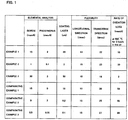
- FIG. 1 is a table of characteristics exhibited in Examples and Comparative Examples of the present invention.
- a shaped expanded graphite article of the present invention which has an oxidation-resistant coating layer and therefore has excellent oxidation resistance.
- a shaped expanded graphite article is a generic idea including sheet-shaped graphite and block-shaped expanded graphite.
- the sheet-shaped graphite is obtained by subjecting graphite powder, as a material, to an expanding treatment to thereby form an expanded graphite which is subsequently formed into a sheet shape using a shaping means such as rolling mills, compression forming machines, or the like.
- the state where an oxidation-resistant coating layer is formed in an outer layer portion includes at least a state where the oxidation-resistant coating layer is formed only in a surface portion or a state where a whole body, i.e., from a surface to a core, is formed of the oxidation-resistant coating layer.
- Oxidation resistance means that a rate of oxidation loss at 800 degrees C in an oxygen-containing atmosphere, e.g., in the atmosphere is 30 mass% or less.
- Forming a coating layer includes forming a so-called coating on a surface of a shaped expanded graphite article, forming the coating on a shaped expanded graphite article and at the same time incorporating (impregnating) a part of the coating into the shaped expanded graphite article, and incorporating (impregnating) the coating to a certain depth (including to a core) of the shaped expanded graphite article, all of which are defined as being within the scope of the idea of coating layer.
- the oxidation-resistant coating layer contains a boron element and a phosphorus element.
- a rate of its oxidation loss at 800 degrees C can securely be lowered to 30 mass% or less.
- a shaped expanded graphite article contains only one of a boron element and a phosphorus element, the object mentioned above cannot be accomplished.
- a content of the boron element in the oxidation-resistant coating layer is 1 mass% or more.
- a content (mass%) referred to in the present invention is a percentage of each component contained in the total mass, which is defined as 100, of an expanded graphite sheet, a material containing a boron component, and a material containing a phosphorus element.
- a content of the phosphorus element in the oxidation-resistant coating layer is 0.1 mass% or more.
- the content of the phosphorus element is less than 0.1 mass%, an obtained shaped expanded graphite article cannot have sufficient oxidation resistance.
- the content of the phosphorus element is 0.1-10 mass%.
- the oxidation-resistant coating layer has a thickness of 0.5 ⁇ m or more.
- the thickness of the coating layer is less than 0.5 ⁇ m, the rate of oxidation loss at 800 degrees C cannot be lowered to 30 mass% or less.
- An oxidation-resistant coating layer having a thickness of more than 1 mm is not preferable, because flexibility is impaired when shaped into, e.g., a sheet shape. It is therefore further preferable that the above-described oxidation-resistant coating layer has a thickness of 0.5 to 500 ⁇ m.
- the boron element contained in the oxidation-resistant coating layer is preferably contained in one material or a combination of two or more materials selected from a group consisting of: simple boron; boron carbide; boron chloride; boron fluoride; boron bromide; boron iodide; boron nitride; boron oxide; boron silicide; an organic boron compound; and a compound containing boron and phosphorus.
- boron, boron carbide, boron trichloride, boron trifluoride, boron nitride, borosilicate, and the like among which further preferable are the boron carbide and the boron nitride because they are not easily decomposed (i.e., their decomposition temperature is high) and therefore can improve oxidation resistance.
- the material that contains a boron element has an average particle diameter of 200 ⁇ m or less.
- an average particle diameter of more than 200 ⁇ m is not preferable, because, in such a case, a gap formed between the boron compounds becomes larger, to enable oxygen to pass therethrough so that oxidation starts thereat. Therefore, it is further preferable that the compound containing a boron element has an average particle diameter of 0.5 to 50 ⁇ m.
- the phosphorus element contained in the oxidation-resistant coating layer is preferably contained in one material or a combination of two or more materials selected from a group consisting of: simple phosphorus; phosphorus oxide; phosphorus carbide; phosphorus chloride; phosphorus fluoride; phosphorus bromide; phosphorus hydroxide; phosphorus nitride; phosphorus silicide; an organic phosphorous compound; and a compound containing phosphorus and boron.
- phosphorus oxides such as phosphorus pentoxide, orthophosphoric acid, metaphosphoric acid, pyrophosphoric acid, polyphosphoric acid, biphosphate, etc.
- phosphorus carbide such as phosphorus trichloride; a compound of the foregoing phosphorus compound and other metallic or non-metallic elements such as aluminium phosphate, magnesium phosphate, calcium phosphate, potassium phosphate, aluminium biphosphate, magnesium biphosphate, calcium biphosphate, etc., among which further preferable are the aluminium phosphate, the orthophosphoric acid, and the metaphosphoric acid because their decomposition temperature is high and therefore they can improve oxidation resistance.
- the shaped expanded graphite article of the present invention is preferably a sheet-shaped article.
- an article having a thickness of, e.g., 0.1 to 3 mm is referred to as a "sheet".
- a sheet having a thickness of less than 0.1 mm fails to provide sufficient strength required as a sheet, and a sheet having a thickness of more than 3 mm fails to provide sufficient impermeability.
- An expanded graphite formed into a sheet shape can be used as various kinds of packings, gaskets, and the like.
- a shaped expanded graphite article of the present invention is contacted with a solution containing a phosphorus element and a boron element, and then subjected to a heat treatment.
- an expanded graphite or an expanded graphite sheet having been subjected to an expanding treatment is contacted, by spraying or applying, etc., with liquid (hereinafter referred to as a "solution") which has been obtained by dispersing or dissolving a compound containing a phosphorus element and a compound containing a boron element into a solvent such as water, alcohol, and acetone.
- a solution liquid which has been obtained by dispersing or dissolving a compound containing a phosphorus element and a compound containing a boron element into a solvent such as water, alcohol, and acetone.
- a material containing a boron element is preferably one material or a combination of two or more materials selected from a group consisting of: simple boron; boron carbide; boron chloride; boron fluoride; boron bromide; boron iodide; boron nitride; boron oxide; boron silicide; an organic boron compound; and a compound containing boron and phosphorus.
- boron, boron carbide, boron trichloride, boron trifluoride, boron nitride, borosilicate, and the like among which further preferable are the boron carbide and the boron nitride because they are not easily decomposed (i.e., their decomposition temperature is high) and besides can easily be dissolved or dispersed in a solution.
- the material containing a boron element has an average particle diameter of 200 ⁇ m or less.
- the compound containing a boron element has an average particle diameter of more than 200 ⁇ m, because such particles exhibit deteriorated dispersibility when dispersed or dissolved in water, etc., in order to form a solution. It is further preferable that the average particle diameter is 0.5 to 50 ⁇ m.
- a material containing a phosphorus element is preferably one material or a combination of two or more materials selected from a group consisting of: simple phosphorus; phosphorus oxide; phosphorus carbide; phosphorus chloride; phosphorus fluoride; phosphorus bromide; phosphorus hydroxide; phosphorus nitride; phosphorus silicide; an organic phosphorous compound; and a compound containing phosphorus and boron.
- phosphorus oxides such as phosphorus pentoxide, orthophosphoric acid, metaphosphoric acid, pyrophosphoric acid, polyphosphoric acid, biphosphate, etc.
- phosphorus carbide such as phosphorus trichloride; compounds of the foregoing phosphorus compound and other metallic or non-metallic elements such as aluminium phosphate, magnesium phosphate, calcium phosphate, potassium phosphate, aluminium biphosphate, magnesium biphosphate, calcium biphosphate, etc., among which further preferable are the aluminium phosphate, the orthophosphoric acid, and the metaphosphoric acid because their decomposition temperature is high and besides they exhibit good water-solubility.
- the heat treatment is performed at 200 degrees C or higher.
- the terminal rate of oxidation loss cannot be lowered for unknown reasons.
- an atmosphere in which the heat treatment can be performed is exemplified by the air, an inert atmosphere and the like, no particular limitation is put thereon.
- the heat treatment is preferably performed in the air from the viewpoint of simplification of equipment or economical efficiency.
- Pressure applied during the heat treatment can also be exemplified by atmospheric pressure, reduced pressure, and the like.
- the atmospheric pressure is preferable for the same reason.
- graphite as a material is contacted with a solution containing a phosphorus element and a boron element, and then subjected to an expanding treatment followed by a shaping.
- graphite as a material is dipped in a solution containing a phosphorus element and a boron element, and then taken out and dried up to be thereafter subjected to an expanding treatment which is followed by a shaping with rolls, compression-forming machines, or the like. After this, further, a heat treatment can be performed if necessary.
- This method is preferable for the purpose of forming an oxidation-resistant coating layer throughout the inside of the shaped expanded graphite article.
- a material containing a boron element is preferably one material or a combination of two or more materials selected from a group consisting of: simple boron; boron carbide; boron chloride; boron fluoride; boron bromide; boron iodide; boron nitride; boron oxide; boron silicide; an organic boron compound; and a compound containing a boron and a phosphorus.
- boron, boron carbide, boron trichloride, boron trifluoride, boron nitride, borosilicate, and the like among which further preferable are the boron carbide and the boron nitride because they are not easily decomposed (i.e., their decomposition temperature is high) and besides they can easily be dissolved or dispersed in a solution.
- the material containing a boron element has an average particle diameter of 200 ⁇ m or less.
- the compound containing a boron element has an average particle diameter of more than 200 ⁇ m, because such particles exhibit deteriorated dispersibility when dispersed or dissolved in water, etc., to form a solution. It is further preferable that the average particle diameter is 0.5 to 50 ⁇ m.
- a material containing a phosphorus element is preferably one material or a combination of two or more materials selected from a group consisting of: simple phosphorus; phosphorus oxide; phosphorus carbide; phosphorus chloride; phosphorus fluoride; phosphorus bromide; phosphorus hydroxide; phosphorus nitride; phosphorus silicide; an organic phosphorous compound; and a compound containing phosphorus and boron.
- phosphorus oxides such as phosphorus pentoxide, orthophosphoric acid, metaphosphoric acid, pyrophosphoric acid, polyphosphoric acid, biphosphate, etc.
- phosphorus carbide such as phosphorus trichloride; compounds of the foregoing phosphorus compounds and other metallic or non-metallic elements such as aluminium phosphate, magnesium phosphate, calcium phosphate, potassium phosphate, aluminium biphosphate, magnesium biphosphate, calcium biphosphate, etc., among which further preferable are the aluminium phosphate, the orthophosphoric acid, and the metaphosphoric acid because their decomposition temperature is high and besides they exhibit good water-solubility.
- Boron carbide having an average particle diameter of 30 ⁇ m (manufactured by KCM Corporation) and orthophosphoric acid (manufactured by Wako Pure Chemical Industries, Ltd.) were weighed out 56 g and 14 g, respectively, and were dispersed in pure water 200 ml.
- the expanded graphite was compression-formed with a roll into a sheet having a thickness of 3 mm and a bulk density of 0.17 g/cm 3 . Then, the solution 200 ml prepared in (2) was sprayed on the obtained sheet by means of a sprayer.
- the expanded graphite sheet obtained in (4) was heat-treated at 700 degrees C in the air under atmospheric pressure, to form an expanded graphite sheet which was subsequently rolled with a roll into an expanded graphite sheet having a thickness of 0.5 mm and a bulk density of 1.0 g/cm 3 .
- Example 1 The same boron carbide as used in Example 1 having an average particle diameter of 30 ⁇ m and the same orthophosphoric acid as used in Example 1 were weighed out 5.6 g and 1.1 g, respectively, and were dispersed in pure water 200 ml. Thus, the amount of phosphorus element which would be sprayed on the expanded graphite was changed. Except the above, the same operations as (1), (3), (4), and (5) of Example 1 were performed under the same conditions.
- Example 1 The same boron carbide as used in Example 1 and the same orthophosphoric acid as used in Example 1 were weighed out 112 g and 21 g, respectively, and were dispersed in pure water 200 ml. Thus, the amount of phosphorus element and the amount of boron element which would be sprayed on the expanded graphite were changed. Except the above, the same operations as (1), (3), (4), and (5) of Example 1 were performed under the same conditions, to obtain an expanded graphite sheet.
- Example 1 The same boron carbide as used in Example 1 was weighed 56 g and dispersed in pure water 200 ml. Except the above, the same operations as (1), (3), (4), and (5) of Example 1 were performed under the same conditions, to obtain an expanded graphite sheet.
- Example 1 The same orthophosphoric acid as used in Example 1 was weighed 20 g and dispersed in pure water 200 ml. Except the above, the same operations as (1), (3), (4), and (5) of Example 1 were performed under the same conditions, to obtain an expanded graphite sheet.
- Example 1 The same boron carbide as used in Example 1 and the same orthophosphoric acid as used in Example 1 were weighed out 2.8 g and 0.5 g, respectively, and were dispersed in pure water 200 ml. Except the above, the same operations as (1), (3), (4), and (5) of Example 1 were performed under the same conditions, to obtain an expanded graphite sheet.
- the shaped expanded graphite article of the present invention suffers little oxidation loss even at a high temperature of 800 degrees C or higher (where a certain amount of oxygen exists), and therefore can widely be applied to, for example, general industrial equipment used at high temperatures such as gaskets used in automobiles or industrial packings used in oil plants and the like.
Landscapes
- Chemical & Material Sciences (AREA)
- Engineering & Computer Science (AREA)
- Ceramic Engineering (AREA)
- Materials Engineering (AREA)
- Structural Engineering (AREA)
- Organic Chemistry (AREA)
- Inorganic Chemistry (AREA)
- Manufacturing & Machinery (AREA)
- Carbon And Carbon Compounds (AREA)
- Ceramic Products (AREA)
Description
- The present invention relates to a shaped expanded graphite article having excellent oxidation resistance, and also to a method for producing the shaped expanded graphite article.
- A shaped expanded graphite article is produced through the steps of treating a graphite material such as natural graphite, kish graphite, pyrolytic graphite, etc., with a strong oxidant or the like such as concentrated sulfuric acid, concentrated nitric acid, hydrogen peroxide, etc., to thereby form a graphite interlayer compound; rapidly heating the graphite material (i.e., oxidized graphite material), which includes therein the graphite interlayer compound, at a high temperature of, e.g., 950 degrees C or higher for 1-10 seconds, so as to generate pyrolysis gas whose gas pressure is used to expand a space between graphite layers and to form expanded graphite particles; and compression-forming or roll-forming the expanded graphite particles with or without using a binder. The shaped expanded graphite article produced in the above-described manner has various excellent properties, and is used as heat insulating materials, cushioning materials, and the like. An expanded graphite sheet obtained by forming the expanded graphite into a sheet shape using a roll, etc., is also widely used as gaskets, packings, sealings, and the like.
- Recent years see a rapidly increasing need for general industrial equipment used at a high temperature such as gaskets used in automobiles or industrial packings used in oil plants and the like. The packings for general industries and the gaskets for automobiles are used in the air (i.e., in an oxygen-containing atmosphere) and at the same time used at a high temperature of 600 degrees C or higher. Accordingly, it is required that a shaped expanded graphite article used for such packings and gaskets has a sheet form and suffers little oxidation loss.
- According to a technique proposed in Japanese Patent Publication No.
57-15046 - The present applicant has also proposed producing an oxidation-resistant expanded graphite sheet that contains phosphorus pentoxide and phosphate (in International Publication
WO01/05703A1 - An object of the present invention is to provide a shaped expanded graphite article that suffers little oxidation loss even at a high temperature in an oxygen-containing atmosphere, and also to provide a method for producing such a shaped expanded graphite article.
-
US4244934 (A ) discloses a process for producing a flexible graphite product. Wet graphite particles are obtained by subjecting graphite particles to oxidizing treatment with nitric acid of comparatively low concentration and a permanganic acid salt and impregnating the treated graphite particles with a specific antioxidant comprising a metal salt of a boric acid ester of a saccharide. These particles are heated to form expanded graphite masses, which are then compressed together to obtain a flexible graphite product. The thus obtained flexible graphite product is not only excellent in heat resistance and chemical inertness but also free of contamination with sulfur and chlorine, and is very useful in various applications. -
US4837073 (A ) mentions a method for utilizing the inherent oxygen-blocking characteristics of a barrier coating for a carbon-carbon material by penetrating cracked, porous areas of the coating with an oxygen inhibitor. The inhibitor will complex with active carbon-carbon material sites at the base of the cracks. The resulting system provides very effective oxidation protection at intermediate temperatures of approximately 650°C. -
US3719608 (A ) describes a vermicular expanded graphite composition having enhanced oxidation resistance. The composition comprises an admixture of vermicular graphite with from 0.5 to 10 weight percent, based on the total weight of the mixture, of an oxide of boron or phosphorus or meta borate or phosphate wherein said admixture has been compressed to a density of from 10 to 120 pounds per cubic foot. - Wholehearted investigation the present inventors conducted in order to solve the aforementioned problem has revealed that an application of an oxidation-resistant coating to an expanded graphite sheet allows production of a shaped expanded graphite article which suffers little oxidation loss even at a high temperature in an oxygen-containing atmosphere or, to be more specific, even at 750 degrees C or higher in the atmosphere. In this way, the present invention has been accomplished. Thus, a shaped expanded graphite article of the present invention as defined in
claim 1 has an oxidation-resistant coating layer. Further beneficial embodiments of the shaped expanded graphite article are disclosed inclaims 2 to 6. - In a shaped expanded graphite article of the present invention,
the oxidation-resistant coating layer contains a boron element and a phosphorus element. - When a shaped expanded graphite article contains both of a boron element and a phosphorus element, a rate of its oxidation loss at 800 degrees C can surely be lowered to 30 mass% or less.
- In a method for producing a shaped expanded graphite article of the present invention as defined in claim 7, a shaped expanded graphite article is contacted with a solution containing a phosphorus element and a boron element, and then subjected to a heat treatment. Further beneficial embodiments of the method are defined in claims 8 to 10.
- In a method for producing a shaped expanded graphite article of the present invention as defined in claim 11, in addition, graphite as a material is contacted with a solution containing a phosphorus element and a boron element, and then subjected to an expanding treatment followed by a shaping. Further beneficial embodiments of the method are defined in claims 12 to 14.
-
FIG. 1 is a table of characteristics exhibited in Examples and Comparative Examples of the present invention. - Here will be described a shaped expanded graphite article of the present invention, which has an oxidation-resistant coating layer and therefore has excellent oxidation resistance. In the present invention, a shaped expanded graphite article is a generic idea including sheet-shaped graphite and block-shaped expanded graphite. The sheet-shaped graphite is obtained by subjecting graphite powder, as a material, to an expanding treatment to thereby form an expanded graphite which is subsequently formed into a sheet shape using a shaping means such as rolling mills, compression forming machines, or the like. The state where an oxidation-resistant coating layer is formed in an outer layer portion includes at least a state where the oxidation-resistant coating layer is formed only in a surface portion or a state where a whole body, i.e., from a surface to a core, is formed of the oxidation-resistant coating layer. Oxidation resistance means that a rate of oxidation loss at 800 degrees C in an oxygen-containing atmosphere, e.g., in the atmosphere is 30 mass% or less. Forming a coating layer includes forming a so-called coating on a surface of a shaped expanded graphite article, forming the coating on a shaped expanded graphite article and at the same time incorporating (impregnating) a part of the coating into the shaped expanded graphite article, and incorporating (impregnating) the coating to a certain depth (including to a core) of the shaped expanded graphite article, all of which are defined as being within the scope of the idea of coating layer.
- In the shaped expanded graphite article of the present invention,
the oxidation-resistant coating layer contains a boron element and a phosphorus element. - When a shaped expanded graphite article contains both of a boron element and a phosphorus element, a rate of its oxidation loss at 800 degrees C can securely be lowered to 30 mass% or less. When a shaped expanded graphite article contains only one of a boron element and a phosphorus element, the object mentioned above cannot be accomplished.
- In the shaped expanded graphite article of the present invention, a content of the boron element in the oxidation-resistant coating layer is 1 mass% or more.
- When the content of the boron element is less than 1 mass%, an obtained shaped expanded graphite article cannot have sufficient oxidation resistance. Thus, it is preferable that the content of the boron element is 1-30 mass%. A content (mass%) referred to in the present invention is a percentage of each component contained in the total mass, which is defined as 100, of an expanded graphite sheet, a material containing a boron component, and a material containing a phosphorus element.
- In the shaped expanded graphite article of the present invention, a content of the phosphorus element in the oxidation-resistant coating layer is 0.1 mass% or more.
- When the content of the phosphorus element is less than 0.1 mass%, an obtained shaped expanded graphite article cannot have sufficient oxidation resistance. Thus, it is preferable that the content of the phosphorus element is 0.1-10 mass%.
- In the shaped expanded graphite article of the present invention, it is preferable that the oxidation-resistant coating layer has a thickness of 0.5 µm or more.
- When the thickness of the coating layer is less than 0.5 µm, the rate of oxidation loss at 800 degrees C cannot be lowered to 30 mass% or less. An oxidation-resistant coating layer having a thickness of more than 1 mm is not preferable, because flexibility is impaired when shaped into, e.g., a sheet shape. It is therefore further preferable that the above-described oxidation-resistant coating layer has a thickness of 0.5 to 500 µm.
- In the shaped expanded graphite article of the present invention, moreover, the boron element contained in the oxidation-resistant coating layer is preferably contained in one material or a combination of two or more materials selected from a group consisting of: simple boron; boron carbide; boron chloride; boron fluoride; boron bromide; boron iodide; boron nitride; boron oxide; boron silicide; an organic boron compound; and a compound containing boron and phosphorus.
- Specific examples thereof include: boron, boron carbide, boron trichloride, boron trifluoride, boron nitride, borosilicate, and the like, among which further preferable are the boron carbide and the boron nitride because they are not easily decomposed (i.e., their decomposition temperature is high) and therefore can improve oxidation resistance.
- In the shaped expanded graphite article of the present invention, moreover, it is preferable that the material that contains a boron element has an average particle diameter of 200 µm or less.
- An average particle diameter of more than 200 µm is not preferable, because, in such a case, a gap formed between the boron compounds becomes larger, to enable oxygen to pass therethrough so that oxidation starts thereat. Therefore, it is further preferable that the compound containing a boron element has an average particle diameter of 0.5 to 50 µm.
- In the shaped expanded graphite article of the present invention, moreover, the phosphorus element contained in the oxidation-resistant coating layer is preferably contained in one material or a combination of two or more materials selected from a group consisting of: simple phosphorus; phosphorus oxide; phosphorus carbide; phosphorus chloride; phosphorus fluoride; phosphorus bromide; phosphorus hydroxide; phosphorus nitride; phosphorus silicide; an organic phosphorous compound; and a compound containing phosphorus and boron.
- Specific examples thereof include: phosphorus oxides such as phosphorus pentoxide, orthophosphoric acid, metaphosphoric acid, pyrophosphoric acid, polyphosphoric acid, biphosphate, etc.; phosphorus carbide; phosphorus trichloride; a compound of the foregoing phosphorus compound and other metallic or non-metallic elements such as aluminium phosphate, magnesium phosphate, calcium phosphate, potassium phosphate, aluminium biphosphate, magnesium biphosphate, calcium biphosphate, etc., among which further preferable are the aluminium phosphate, the orthophosphoric acid, and the metaphosphoric acid because their decomposition temperature is high and therefore they can improve oxidation resistance.
- In addition, the shaped expanded graphite article of the present invention is preferably a sheet-shaped article.
- Although the sheet is not particularly limited in its thickness, an article having a thickness of, e.g., 0.1 to 3 mm is referred to as a "sheet". A sheet having a thickness of less than 0.1 mm fails to provide sufficient strength required as a sheet, and a sheet having a thickness of more than 3 mm fails to provide sufficient impermeability. An expanded graphite formed into a sheet shape can be used as various kinds of packings, gaskets, and the like.
- In a method for producing a shaped expanded graphite article of the present invention, a shaped expanded graphite article is contacted with a solution containing a phosphorus element and a boron element, and then subjected to a heat treatment.
- To be more specific, an expanded graphite or an expanded graphite sheet having been subjected to an expanding treatment is contacted, by spraying or applying, etc., with liquid (hereinafter referred to as a "solution") which has been obtained by dispersing or dissolving a compound containing a phosphorus element and a compound containing a boron element into a solvent such as water, alcohol, and acetone. Thereby, the phosphorus element and the boron element are contained into the expanded graphite or the expanded graphite sheet which is subsequently subjected to a heat treatment. This method is preferable for the purpose of forming an oxidation-resistant coating layer only in an outer layer portion of the shaped expanded graphite article.
- In the method for producing a shaped expanded graphite article of the present invention, moreover, a material containing a boron element is preferably one material or a combination of two or more materials selected from a group consisting of: simple boron; boron carbide; boron chloride; boron fluoride; boron bromide; boron iodide; boron nitride; boron oxide; boron silicide; an organic boron compound; and a compound containing boron and phosphorus.
- Specific examples thereof include: boron, boron carbide, boron trichloride, boron trifluoride, boron nitride, borosilicate, and the like, among which further preferable are the boron carbide and the boron nitride because they are not easily decomposed (i.e., their decomposition temperature is high) and besides can easily be dissolved or dispersed in a solution.
- In the method for producing a shaped expanded graphite article of the present invention, moreover, it is preferable that the material containing a boron element has an average particle diameter of 200 µm or less.
- It is not preferable that the compound containing a boron element has an average particle diameter of more than 200 µm, because such particles exhibit deteriorated dispersibility when dispersed or dissolved in water, etc., in order to form a solution. It is further preferable that the average particle diameter is 0.5 to 50 µm.
- In the method for producing a shaped expanded graphite article of the present invention, moreover, a material containing a phosphorus element is preferably one material or a combination of two or more materials selected from a group consisting of: simple phosphorus; phosphorus oxide; phosphorus carbide; phosphorus chloride; phosphorus fluoride; phosphorus bromide; phosphorus hydroxide; phosphorus nitride; phosphorus silicide; an organic phosphorous compound; and a compound containing phosphorus and boron.
- Specific examples thereof include: phosphorus oxides such as phosphorus pentoxide, orthophosphoric acid, metaphosphoric acid, pyrophosphoric acid, polyphosphoric acid, biphosphate, etc.; phosphorus carbide; phosphorus trichloride; compounds of the foregoing phosphorus compound and other metallic or non-metallic elements such as aluminium phosphate, magnesium phosphate, calcium phosphate, potassium phosphate, aluminium biphosphate, magnesium biphosphate, calcium biphosphate, etc., among which further preferable are the aluminium phosphate, the orthophosphoric acid, and the metaphosphoric acid because their decomposition temperature is high and besides they exhibit good water-solubility.
- In the method for producing a shaped expanded graphite article of the present invention as defined in claim 7, moreover, the heat treatment is performed at 200 degrees C or higher.
- When the heat treatment is performed at lower than 200 degrees C, the terminal rate of oxidation loss cannot be lowered for unknown reasons. Although an atmosphere in which the heat treatment can be performed is exemplified by the air, an inert atmosphere and the like, no particular limitation is put thereon. However, the heat treatment is preferably performed in the air from the viewpoint of simplification of equipment or economical efficiency. Pressure applied during the heat treatment can also be exemplified by atmospheric pressure, reduced pressure, and the like. However, the atmospheric pressure is preferable for the same reason.
- In the method for producing a shaped expanded graphite article of the present invention, in addition, graphite as a material is contacted with a solution containing a phosphorus element and a boron element, and then subjected to an expanding treatment followed by a shaping.
- To be more specific, graphite as a material is dipped in a solution containing a phosphorus element and a boron element, and then taken out and dried up to be thereafter subjected to an expanding treatment which is followed by a shaping with rolls, compression-forming machines, or the like. After this, further, a heat treatment can be performed if necessary. This method is preferable for the purpose of forming an oxidation-resistant coating layer throughout the inside of the shaped expanded graphite article.
- In the method for producing a shaped expanded graphite article of the present invention, moreover, a material containing a boron element is preferably one material or a combination of two or more materials selected from a group consisting of: simple boron; boron carbide; boron chloride; boron fluoride; boron bromide; boron iodide; boron nitride; boron oxide; boron silicide; an organic boron compound; and a compound containing a boron and a phosphorus.
- Specific examples thereof include: boron, boron carbide, boron trichloride, boron trifluoride, boron nitride, borosilicate, and the like, among which further preferable are the boron carbide and the boron nitride because they are not easily decomposed (i.e., their decomposition temperature is high) and besides they can easily be dissolved or dispersed in a solution.
- In the method for producing a shaped expanded graphite article of the present invention, moreover, it is preferable that the material containing a boron element has an average particle diameter of 200 µm or less.
- It is not preferable that the compound containing a boron element has an average particle diameter of more than 200 µm, because such particles exhibit deteriorated dispersibility when dispersed or dissolved in water, etc., to form a solution. It is further preferable that the average particle diameter is 0.5 to 50 µm.
- In the method for producing a shaped expanded graphite article of the present invention, moreover, a material containing a phosphorus element is preferably one material or a combination of two or more materials selected from a group consisting of: simple phosphorus; phosphorus oxide; phosphorus carbide; phosphorus chloride; phosphorus fluoride; phosphorus bromide; phosphorus hydroxide; phosphorus nitride; phosphorus silicide; an organic phosphorous compound; and a compound containing phosphorus and boron.
- Specific examples thereof include: phosphorus oxides such as phosphorus pentoxide, orthophosphoric acid, metaphosphoric acid, pyrophosphoric acid, polyphosphoric acid, biphosphate, etc.; phosphorus carbide; phosphorus trichloride; compounds of the foregoing phosphorus compounds and other metallic or non-metallic elements such as aluminium phosphate, magnesium phosphate, calcium phosphate, potassium phosphate, aluminium biphosphate, magnesium biphosphate, calcium biphosphate, etc., among which further preferable are the aluminium phosphate, the orthophosphoric acid, and the metaphosphoric acid because their decomposition temperature is high and besides they exhibit good water-solubility.
- There has not been identified a detailed mechanism concerning why the oxidation loss of the shaped expanded graphite article of the present invention is reduced (i.e., why the oxidation-resistance thereof is improved). Supposedly, the phosphorus element and the boron element combine with each other as a result of the heat treatment to thereby form a compound of phosphorus and boron, which improves the oxidation resistance all the more as compared with a shaped expanded graphite article that contains a phosphorus element alone or a boron element alone.
- The above-described preferable embodiments can variously be combined to carry out the present invention.
- Given in the following is a specific description of the present invention in conjunction with Examples, to which the present invention is not limited however.
- First, acid-treated graphite (manufactured by Sumitomo Chemical Company, Limited) was put into an expansion furnace heated to 1000 degrees C, and thus subjected to an expanding treatment to be expanded 200 times. An obtained expanded graphite had a bulk density of 0.003 g/cm3.
- Boron carbide having an average particle diameter of 30 µm (manufactured by KCM Corporation) and orthophosphoric acid (manufactured by Wako Pure Chemical Industries, Ltd.) were weighed out 56 g and 14 g, respectively, and were dispersed in pure water 200 ml.
- Of the expanded graphite obtained in (1), 280 g was weighed out and put into a plastic case.
- The expanded graphite was compression-formed with a roll into a sheet having a thickness of 3 mm and a bulk density of 0.17 g/cm3. Then, the solution 200 ml prepared in (2) was sprayed on the obtained sheet by means of a sprayer.
- The expanded graphite sheet obtained in (4) was heat-treated at 700 degrees C in the air under atmospheric pressure, to form an expanded graphite sheet which was subsequently rolled with a roll into an expanded graphite sheet having a thickness of 0.5 mm and a bulk density of 1.0 g/cm3.
- The same boron carbide as used in Example 1 having an average particle diameter of 30 µm and the same orthophosphoric acid as used in Example 1 were weighed out 5.6 g and 1.1 g, respectively, and were dispersed in pure water 200 ml. Thus, the amount of phosphorus element which would be sprayed on the expanded graphite was changed. Except the above, the same operations as (1), (3), (4), and (5) of Example 1 were performed under the same conditions.
- The same boron carbide as used in Example 1 and the same orthophosphoric acid as used in Example 1 were weighed out 112 g and 21 g, respectively, and were dispersed in pure water 200 ml. Thus, the amount of phosphorus element and the amount of boron element which would be sprayed on the expanded graphite were changed. Except the above, the same operations as (1), (3), (4), and (5) of Example 1 were performed under the same conditions, to obtain an expanded graphite sheet.
- The same boron carbide as used in Example 1 was weighed 56 g and dispersed in pure water 200 ml. Except the above, the same operations as (1), (3), (4), and (5) of Example 1 were performed under the same conditions, to obtain an expanded graphite sheet.
- The same orthophosphoric acid as used in Example 1 was weighed 20 g and dispersed in pure water 200 ml. Except the above, the same operations as (1), (3), (4), and (5) of Example 1 were performed under the same conditions, to obtain an expanded graphite sheet.
- The same boron carbide as used in Example 1 and the same orthophosphoric acid as used in Example 1 were weighed out 2.8 g and 0.5 g, respectively, and were dispersed in pure water 200 ml. Except the above, the same operations as (1), (3), (4), and (5) of Example 1 were performed under the same conditions, to obtain an expanded graphite sheet.
- The expanded graphite sheets manufactured in Examples 1 to 3 and Comparative Examples 1 to 3 were examined for the following characteristics.
- (1) A 50 g sample of each expanded graphite sheet was heated at 900 degrees C for 50 hours to be ashed, and then examined for existence of phosphorus and boron by use of XMA (i.e., X-rays Micro Analyzer).
- (2) A coating layer formed on a surface of each of the expanded graphite sheets was measured for thickness by use of an electron microscope.
- (3) Flexibility was measured by a method disclosed in International Publication No.
WO01/05703A1 - (4) Each of the expanded graphite sheets was processed into a size of 25 × 25 x 0.5 (mm), and left in an electric furnace (of air atmosphere) at 800 degrees C for three hours. Based on its weight change associated with the heating in the electric furnace, rate of its oxidation loss (mass (%)) was calculated out.
- Results obtained therefrom are shown in TABLE 1 of
FIG. 1 . - Seen from TABLE 1 is that the expanded graphite sheets of Examples 1 to 3 hardly lost their flexibility, etc., and besides rates of their oxidation loss at 800 degrees C were conspicuously lower than those of the expanded graphite sheets of Comparative Examples.
- The shaped expanded graphite article of the present invention suffers little oxidation loss even at a high temperature of 800 degrees C or higher (where a certain amount of oxygen exists), and therefore can widely be applied to, for example, general industrial equipment used at high temperatures such as gaskets used in automobiles or industrial packings used in oil plants and the like.
Claims (14)
- A shaped expanded graphite article having, at least in its outer layer portion, an oxidation-resistant coating layer and said shaped expanded graphite article is characterized in that the oxidation-resistant coating layer contains a boron element and a phosphorus element, wherein a content of the boron element in the oxidation-resistant coating layer is 1 mass% or more and a content of the phosphorus element in the oxidation-resistant coating layer is 0.1 mass% or more.
- The shaped expanded graphite article according to Claim 1, wherein the oxidation-resistant coating layer has a thickness of 0.5 µm or more.
- The shaped expanded graphite article according to Claim 1, wherein the boron element contained in the oxidation-resistant coating layer is contained in one material or a combination of two or more materials selected from a group consisting of: simple boron; boron carbide; boron chloride; boron fluoride; boron bromide; boron iodide; boron nitride; boron oxide; boron silicide; an organic boron compound; and a compound containing boron and phosphorus.
- The shaped expanded graphite article according to Claim 3, wherein the material that contains the boron element has an average particle diameter of 200 µm or less.
- The shaped expanded graphite article according to Claim 1, wherein the phosphorus element contained in the oxidation-resistant coating layer is contained in one material or a combination of two or more materials selected from a group consisting of: simple phosphorus; phosphorus oxide; phosphorus carbide; phosphorus chloride; phosphorus fluoride; phosphorus bromide; phosphorus hydroxide; phosphorus nitride; phosphorus silicide; an organic phosphorous compound; and a compound containing phosphorus and boron.
- The shaped expanded graphite article according to Claim 2, wherein a shaped expanded graphite article is a sheet shape.
- A method for producing the shaped expanded graphite article according to claim 1, wherein a shaped expanded graphite article is contacted with a solution containing a phosphorus element and a boron element, and then subjected to a heat treatment, wherein the heat treatment is performed at 200 degrees C or higher, and forming the shaped expanded graphite article having the oxidation-resistant coating layer as defined in claim 1, wherein a content of the boron element in the oxidation-resistant coating layer is 1 mass% or more and a content of the phosphorus element in the oxidation-resistant coating layer is 0.1 mass% or more.
- The method according to Claim 7, wherein a material containing a boron element is one material or a combination of two or more materials selected from a group consisting of: simple boron; boron carbide; boron chloride; boron fluoride; boron bromide; boron iodide; boron nitride; boron oxide; boron silicide; an organic boron compound; and a compound containing boron and phosphorus.
- The method according to Claim 8, wherein the material containing a boron element has an average particle diameter of 200 µm or less.
- The method according to Claim 7, wherein a material containing a phosphorus element is one material or a combination of two or more materials selected from a group consisting of: simple phosphorus; phosphorus oxide; phosphorus carbide; phosphorus chloride; phosphorus fluoride; phosphorus bromide; phosphorus hydroxide; phosphorus nitride; phosphorus silicide; an organic phosphorous compound; and a compound containing phosphorus and boron.
- A method for producing the shaped expanded graphite article according to claim 1, wherein graphite as a material is contacted with a solution containing a phosphorus element and a boron element, and then subjected to an expanding treatment followed by a shaping, and forming the shaped expanded graphite article that has the oxidation-resistant coating layer as defined in claim 1, wherein a content of the boron element in the oxidation-resistant coating layer is 1 mass% or more and a content of the phosphorus element in the oxidation-resistant coating layer is 0.1 mass% or more.
- The method according to Claim 11, wherein a material containing a boron element is one material or a combination of two or more materials selected from a group consisting of: simple boron; boron carbide; boron chloride; boron fluoride; boron bromide; boron iodide; boron nitride; boron oxide; boron silicide; an organic boron compound; and a compound containing boron and phosphorus.
- The method according to Claim 12, wherein the material containing a boron element has an average particle diameter of 200 µm or less.
- The method according to Claim 11, wherein a material containing a phosphorus element is one material or a combination of two or more materials selected from a group consisting of: simple phosphorus; phosphorus oxide; phosphorus carbide; phosphorus chloride; phosphorus fluoride; phosphorus bromide; phosphorus hydroxide; phosphorus nitride; phosphorus silicide; an organic phosphorous compound; and a compound containing phosphorus and boron.
Applications Claiming Priority (3)
| Application Number | Priority Date | Filing Date | Title |
|---|---|---|---|
| JP2002259402A JP4264802B2 (en) | 2002-09-04 | 2002-09-04 | Expanded graphite molded body and method for producing the same |
| JP2002259402 | 2002-09-04 | ||
| PCT/JP2003/011224 WO2004024624A1 (en) | 2002-09-04 | 2003-09-03 | Shaped expanded graphite article and method for producing the same |
Publications (3)
| Publication Number | Publication Date |
|---|---|
| EP1535881A1 EP1535881A1 (en) | 2005-06-01 |
| EP1535881A4 EP1535881A4 (en) | 2011-11-30 |
| EP1535881B1 true EP1535881B1 (en) | 2016-12-21 |
Family
ID=31986328
Family Applications (1)
| Application Number | Title | Priority Date | Filing Date |
|---|---|---|---|
| EP03795279.3A Expired - Lifetime EP1535881B1 (en) | 2002-09-04 | 2003-09-03 | Shaped expanded graphite article and method for producing the same |
Country Status (4)
| Country | Link |
|---|---|
| US (1) | US8048527B2 (en) |
| EP (1) | EP1535881B1 (en) |
| JP (1) | JP4264802B2 (en) |
| WO (1) | WO2004024624A1 (en) |
Families Citing this family (5)
| Publication number | Priority date | Publication date | Assignee | Title |
|---|---|---|---|---|
| JP5277536B2 (en) * | 2006-12-07 | 2013-08-28 | オイレス工業株式会社 | Heat-resistant expanded graphite sheet and method for producing the same |
| DE102009020678A1 (en) * | 2009-05-10 | 2010-11-18 | Sgl Carbon Se | Graphite foil for stuffing box packings |
| RU2422406C1 (en) * | 2010-02-10 | 2011-06-27 | Институт новых углеродных материалов и технологий (Закрытое акционерное общество), (ИНУМиТ (ЗАО)) | Method of producing intercalated graphite, intercalated graphite and flexible graphite sheet |
| JP2012246973A (en) * | 2011-05-26 | 2012-12-13 | Nippon Valqua Ind Ltd | Packing |
| CN115159988A (en) * | 2021-04-02 | 2022-10-11 | 国家能源投资集团有限责任公司 | High-temperature-resistant heat storage material, preparation method and application thereof, composition for preparing high-temperature-resistant heat storage material and application thereof |
Family Cites Families (9)
| Publication number | Priority date | Publication date | Assignee | Title |
|---|---|---|---|---|
| US3719608A (en) * | 1968-11-12 | 1973-03-06 | Dow Chemical Co | Oxidation resistant graphite compositions |
| JPS5235205A (en) * | 1975-08-02 | 1977-03-17 | Hitachi Chemical Co Ltd | Manufacture of flexible graphite products |
| JPS5282912A (en) * | 1975-12-31 | 1977-07-11 | Nippon Carbon Co Ltd | Flexible carbon sliders |
| JPS5580711A (en) * | 1978-12-02 | 1980-06-18 | Teruhisa Kondo | Production of flexible graphite product |
| JPS60247041A (en) * | 1984-05-21 | 1985-12-06 | Hitachi Chem Co Ltd | Cylindrical heat resisting gasket |
| US4837073A (en) * | 1987-03-30 | 1989-06-06 | Allied-Signal Inc. | Barrier coating and penetrant providing oxidation protection for carbon-carbon materials |
| JPH10130626A (en) * | 1996-10-24 | 1998-05-19 | Nichias Corp | Sheet gasket and manufacturing method thereof |
| JPH10226573A (en) * | 1997-02-17 | 1998-08-25 | Isuzu Ceramics Kenkyusho:Kk | Oxidation resistant graphite material |
| EP1211221B1 (en) * | 1999-07-14 | 2010-10-06 | Toyo Tanso Co., Ltd. | Heat-resistant expanded graphite sheet and method for producing the same |
-
2002
- 2002-09-04 JP JP2002259402A patent/JP4264802B2/en not_active Expired - Lifetime
-
2003
- 2003-09-03 WO PCT/JP2003/011224 patent/WO2004024624A1/en not_active Ceased
- 2003-09-03 EP EP03795279.3A patent/EP1535881B1/en not_active Expired - Lifetime
- 2003-09-03 US US10/526,350 patent/US8048527B2/en not_active Expired - Fee Related
Non-Patent Citations (1)
| Title |
|---|
| None * |
Also Published As
| Publication number | Publication date |
|---|---|
| WO2004024624A8 (en) | 2005-04-07 |
| JP2004099336A (en) | 2004-04-02 |
| EP1535881A1 (en) | 2005-06-01 |
| WO2004024624A1 (en) | 2004-03-25 |
| US20060093823A1 (en) | 2006-05-04 |
| JP4264802B2 (en) | 2009-05-20 |
| EP1535881A4 (en) | 2011-11-30 |
| US8048527B2 (en) | 2011-11-01 |
Similar Documents
| Publication | Publication Date | Title |
|---|---|---|
| Wang et al. | Influence of expandable graphite on fire resistance and water resistance of flame-retardant coatings | |
| US5902762A (en) | Flexible graphite composite | |
| Nakajima et al. | Preparation and electrical conductivity of fluorine-graphite fiber intercalation compound | |
| US5503717A (en) | Method of manufacturing flexible graphite | |
| Gao et al. | Thermal stability of MXene: current status and future perspectives | |
| EP3793940B1 (en) | A method for the manufacture of pristine graphene from kish graphite | |
| Savchenko et al. | Improvement of the oxidation stability and the mechanical properties of flexible graphite foil by boron oxide impregnation | |
| Boakye et al. | Monazite coatings on fibers: II, coating without strength degradation | |
| EP2801657B1 (en) | Glass fiber board comprising inorganic binder and method for preparing same | |
| Pei et al. | Ti3C2Tx MXene@ STPP novel waterborne long-term anti-corrosion coating with" 3+ 1" multiple high-performance active-passive protection barrier mechanisms | |
| CN116065049B (en) | A nano-carbon material modified copper-tungsten alloy material and its preparation method and application | |
| US5582811A (en) | Stable blister free flexible graphite and method | |
| US8048527B2 (en) | Shaped expanded graphite article and method for producing the same | |
| KR100769920B1 (en) | Heat-resistant expandable graphite sheet and its manufacturing method | |
| Tsou et al. | Design of multilayer plasma-assisted CVD coatings for the oxidation protection of composite materials | |
| JPWO2001005703A1 (en) | Heat-resistant expandable graphite sheet and its manufacturing method | |
| AU732615B2 (en) | Flexible graphite composite | |
| Zhou et al. | Ultrathin 2D VOPO 4 nanosheets: a novel reinforcing agent in polymeric composites | |
| López et al. | Wear resistant coatings: Silica sol–gel reinforced with carbon nanotubes | |
| JP5339321B2 (en) | Oxidation-resistant graphite material and method for producing the same | |
| Yao et al. | Functionalizing MXenes with molybdenum trioxide towards reducing fire hazards of thermoplastic polyurethane | |
| WO1999067188A9 (en) | Formable flexible graphite sealing composites | |
| KR102483223B1 (en) | Method for manufacturing graphene oxide based on chemical exfoliation | |
| RU2779171C1 (en) | Method for protecting metallurgical graphitised electrodes against high-temperature oxidation | |
| CA2357208A1 (en) | Graphite-coated shaped body made of sintered silicon carbide |
Legal Events
| Date | Code | Title | Description |
|---|---|---|---|
| PUAI | Public reference made under article 153(3) epc to a published international application that has entered the european phase |
Free format text: ORIGINAL CODE: 0009012 |
|
| 17P | Request for examination filed |
Effective date: 20050310 |
|
| AK | Designated contracting states |
Kind code of ref document: A1 Designated state(s): DE FR GB |
|
| A4 | Supplementary search report drawn up and despatched |
Effective date: 20111031 |
|
| RIC1 | Information provided on ipc code assigned before grant |
Ipc: C09K 3/10 20060101ALI20111025BHEP Ipc: C04B 35/536 20060101ALI20111025BHEP Ipc: F16J 15/10 20060101ALI20111025BHEP Ipc: C04B 35/622 20060101ALI20111025BHEP Ipc: C01B 31/04 20060101AFI20111025BHEP |
|
| 17Q | First examination report despatched |
Effective date: 20120531 |
|
| GRAP | Despatch of communication of intention to grant a patent |
Free format text: ORIGINAL CODE: EPIDOSNIGR1 |
|
| RIC1 | Information provided on ipc code assigned before grant |
Ipc: C04B 35/536 20060101ALI20160517BHEP Ipc: C01B 31/04 20060101AFI20160517BHEP Ipc: C04B 41/50 20060101ALI20160517BHEP Ipc: C09K 3/10 20060101ALI20160517BHEP Ipc: C04B 41/00 20060101ALI20160517BHEP Ipc: C04B 41/85 20060101ALI20160517BHEP Ipc: F16J 15/10 20060101ALI20160517BHEP Ipc: C04B 35/622 20060101ALI20160517BHEP |
|
| INTG | Intention to grant announced |
Effective date: 20160609 |
|
| GRAS | Grant fee paid |
Free format text: ORIGINAL CODE: EPIDOSNIGR3 |
|
| GRAA | (expected) grant |
Free format text: ORIGINAL CODE: 0009210 |
|
| AK | Designated contracting states |
Kind code of ref document: B1 Designated state(s): DE FR GB |
|
| REG | Reference to a national code |
Ref country code: GB Ref legal event code: FG4D |
|
| REG | Reference to a national code |
Ref country code: DE Ref legal event code: R096 Ref document number: 60349748 Country of ref document: DE |
|
| REG | Reference to a national code |
Ref country code: DE Ref legal event code: R097 Ref document number: 60349748 Country of ref document: DE |
|
| REG | Reference to a national code |
Ref country code: FR Ref legal event code: PLFP Year of fee payment: 15 |
|
| PLBE | No opposition filed within time limit |
Free format text: ORIGINAL CODE: 0009261 |
|
| STAA | Information on the status of an ep patent application or granted ep patent |
Free format text: STATUS: NO OPPOSITION FILED WITHIN TIME LIMIT |
|
| 26N | No opposition filed |
Effective date: 20170922 |
|
| REG | Reference to a national code |
Ref country code: FR Ref legal event code: PLFP Year of fee payment: 16 |
|
| PGFP | Annual fee paid to national office [announced via postgrant information from national office to epo] |
Ref country code: GB Payment date: 20220927 Year of fee payment: 20 Ref country code: DE Payment date: 20220928 Year of fee payment: 20 |
|
| PGFP | Annual fee paid to national office [announced via postgrant information from national office to epo] |
Ref country code: FR Payment date: 20220920 Year of fee payment: 20 |
|
| REG | Reference to a national code |
Ref country code: DE Ref legal event code: R071 Ref document number: 60349748 Country of ref document: DE |
|
| REG | Reference to a national code |
Ref country code: GB Ref legal event code: PE20 Expiry date: 20230902 |
|
| PG25 | Lapsed in a contracting state [announced via postgrant information from national office to epo] |
Ref country code: GB Free format text: LAPSE BECAUSE OF EXPIRATION OF PROTECTION Effective date: 20230902 |