EP1535721A1 - Method for hot crystallization of neck portion in preform of biaxial stretch blow molded bottle and jig for use in the method - Google Patents
Method for hot crystallization of neck portion in preform of biaxial stretch blow molded bottle and jig for use in the method Download PDFInfo
- Publication number
- EP1535721A1 EP1535721A1 EP03792745A EP03792745A EP1535721A1 EP 1535721 A1 EP1535721 A1 EP 1535721A1 EP 03792745 A EP03792745 A EP 03792745A EP 03792745 A EP03792745 A EP 03792745A EP 1535721 A1 EP1535721 A1 EP 1535721A1
- Authority
- EP
- European Patent Office
- Prior art keywords
- neck
- bead ring
- jig
- ring
- molded product
- Prior art date
- Legal status (The legal status is an assumption and is not a legal conclusion. Google has not performed a legal analysis and makes no representation as to the accuracy of the status listed.)
- Granted
Links
Images


Classifications
-
- B—PERFORMING OPERATIONS; TRANSPORTING
- B29—WORKING OF PLASTICS; WORKING OF SUBSTANCES IN A PLASTIC STATE IN GENERAL
- B29C—SHAPING OR JOINING OF PLASTICS; SHAPING OF MATERIAL IN A PLASTIC STATE, NOT OTHERWISE PROVIDED FOR; AFTER-TREATMENT OF THE SHAPED PRODUCTS, e.g. REPAIRING
- B29C49/00—Blow-moulding, i.e. blowing a preform or parison to a desired shape within a mould; Apparatus therefor
- B29C49/42—Component parts, details or accessories; Auxiliary operations
- B29C49/64—Heating or cooling preforms, parisons or blown articles
- B29C49/6409—Thermal conditioning of preforms
-
- B—PERFORMING OPERATIONS; TRANSPORTING
- B29—WORKING OF PLASTICS; WORKING OF SUBSTANCES IN A PLASTIC STATE IN GENERAL
- B29C—SHAPING OR JOINING OF PLASTICS; SHAPING OF MATERIAL IN A PLASTIC STATE, NOT OTHERWISE PROVIDED FOR; AFTER-TREATMENT OF THE SHAPED PRODUCTS, e.g. REPAIRING
- B29C49/00—Blow-moulding, i.e. blowing a preform or parison to a desired shape within a mould; Apparatus therefor
- B29C49/02—Combined blow-moulding and manufacture of the preform or the parison
- B29C49/06905—Using combined techniques for making the preform
-
- B—PERFORMING OPERATIONS; TRANSPORTING
- B29—WORKING OF PLASTICS; WORKING OF SUBSTANCES IN A PLASTIC STATE IN GENERAL
- B29C—SHAPING OR JOINING OF PLASTICS; SHAPING OF MATERIAL IN A PLASTIC STATE, NOT OTHERWISE PROVIDED FOR; AFTER-TREATMENT OF THE SHAPED PRODUCTS, e.g. REPAIRING
- B29C49/00—Blow-moulding, i.e. blowing a preform or parison to a desired shape within a mould; Apparatus therefor
- B29C49/22—Blow-moulding, i.e. blowing a preform or parison to a desired shape within a mould; Apparatus therefor using multilayered preforms or parisons
-
- B—PERFORMING OPERATIONS; TRANSPORTING
- B29—WORKING OF PLASTICS; WORKING OF SUBSTANCES IN A PLASTIC STATE IN GENERAL
- B29C—SHAPING OR JOINING OF PLASTICS; SHAPING OF MATERIAL IN A PLASTIC STATE, NOT OTHERWISE PROVIDED FOR; AFTER-TREATMENT OF THE SHAPED PRODUCTS, e.g. REPAIRING
- B29C71/00—After-treatment of articles without altering their shape; Apparatus therefor
- B29C71/0063—After-treatment of articles without altering their shape; Apparatus therefor for changing crystallisation
-
- B—PERFORMING OPERATIONS; TRANSPORTING
- B29—WORKING OF PLASTICS; WORKING OF SUBSTANCES IN A PLASTIC STATE IN GENERAL
- B29C—SHAPING OR JOINING OF PLASTICS; SHAPING OF MATERIAL IN A PLASTIC STATE, NOT OTHERWISE PROVIDED FOR; AFTER-TREATMENT OF THE SHAPED PRODUCTS, e.g. REPAIRING
- B29C2949/00—Indexing scheme relating to blow-moulding
- B29C2949/07—Preforms or parisons characterised by their configuration
- B29C2949/0715—Preforms or parisons characterised by their configuration the preform having one end closed
-
- B—PERFORMING OPERATIONS; TRANSPORTING
- B29—WORKING OF PLASTICS; WORKING OF SUBSTANCES IN A PLASTIC STATE IN GENERAL
- B29C—SHAPING OR JOINING OF PLASTICS; SHAPING OF MATERIAL IN A PLASTIC STATE, NOT OTHERWISE PROVIDED FOR; AFTER-TREATMENT OF THE SHAPED PRODUCTS, e.g. REPAIRING
- B29C2949/00—Indexing scheme relating to blow-moulding
- B29C2949/20—Preforms or parisons whereby a specific part is made of only one component, e.g. only one layer
- B29C2949/22—Preforms or parisons whereby a specific part is made of only one component, e.g. only one layer at neck portion
-
- B—PERFORMING OPERATIONS; TRANSPORTING
- B29—WORKING OF PLASTICS; WORKING OF SUBSTANCES IN A PLASTIC STATE IN GENERAL
- B29C—SHAPING OR JOINING OF PLASTICS; SHAPING OF MATERIAL IN A PLASTIC STATE, NOT OTHERWISE PROVIDED FOR; AFTER-TREATMENT OF THE SHAPED PRODUCTS, e.g. REPAIRING
- B29C2949/00—Indexing scheme relating to blow-moulding
- B29C2949/20—Preforms or parisons whereby a specific part is made of only one component, e.g. only one layer
- B29C2949/24—Preforms or parisons whereby a specific part is made of only one component, e.g. only one layer at flange portion
-
- B—PERFORMING OPERATIONS; TRANSPORTING
- B29—WORKING OF PLASTICS; WORKING OF SUBSTANCES IN A PLASTIC STATE IN GENERAL
- B29C—SHAPING OR JOINING OF PLASTICS; SHAPING OF MATERIAL IN A PLASTIC STATE, NOT OTHERWISE PROVIDED FOR; AFTER-TREATMENT OF THE SHAPED PRODUCTS, e.g. REPAIRING
- B29C2949/00—Indexing scheme relating to blow-moulding
- B29C2949/20—Preforms or parisons whereby a specific part is made of only one component, e.g. only one layer
- B29C2949/26—Preforms or parisons whereby a specific part is made of only one component, e.g. only one layer at body portion
-
- B—PERFORMING OPERATIONS; TRANSPORTING
- B29—WORKING OF PLASTICS; WORKING OF SUBSTANCES IN A PLASTIC STATE IN GENERAL
- B29C—SHAPING OR JOINING OF PLASTICS; SHAPING OF MATERIAL IN A PLASTIC STATE, NOT OTHERWISE PROVIDED FOR; AFTER-TREATMENT OF THE SHAPED PRODUCTS, e.g. REPAIRING
- B29C2949/00—Indexing scheme relating to blow-moulding
- B29C2949/20—Preforms or parisons whereby a specific part is made of only one component, e.g. only one layer
- B29C2949/28—Preforms or parisons whereby a specific part is made of only one component, e.g. only one layer at bottom portion
-
- B—PERFORMING OPERATIONS; TRANSPORTING
- B29—WORKING OF PLASTICS; WORKING OF SUBSTANCES IN A PLASTIC STATE IN GENERAL
- B29C—SHAPING OR JOINING OF PLASTICS; SHAPING OF MATERIAL IN A PLASTIC STATE, NOT OTHERWISE PROVIDED FOR; AFTER-TREATMENT OF THE SHAPED PRODUCTS, e.g. REPAIRING
- B29C2949/00—Indexing scheme relating to blow-moulding
- B29C2949/30—Preforms or parisons made of several components
- B29C2949/3008—Preforms or parisons made of several components at neck portion
-
- B—PERFORMING OPERATIONS; TRANSPORTING
- B29—WORKING OF PLASTICS; WORKING OF SUBSTANCES IN A PLASTIC STATE IN GENERAL
- B29C—SHAPING OR JOINING OF PLASTICS; SHAPING OF MATERIAL IN A PLASTIC STATE, NOT OTHERWISE PROVIDED FOR; AFTER-TREATMENT OF THE SHAPED PRODUCTS, e.g. REPAIRING
- B29C2949/00—Indexing scheme relating to blow-moulding
- B29C2949/30—Preforms or parisons made of several components
- B29C2949/3012—Preforms or parisons made of several components at flange portion
-
- B—PERFORMING OPERATIONS; TRANSPORTING
- B29—WORKING OF PLASTICS; WORKING OF SUBSTANCES IN A PLASTIC STATE IN GENERAL
- B29C—SHAPING OR JOINING OF PLASTICS; SHAPING OF MATERIAL IN A PLASTIC STATE, NOT OTHERWISE PROVIDED FOR; AFTER-TREATMENT OF THE SHAPED PRODUCTS, e.g. REPAIRING
- B29C2949/00—Indexing scheme relating to blow-moulding
- B29C2949/30—Preforms or parisons made of several components
- B29C2949/3012—Preforms or parisons made of several components at flange portion
- B29C2949/3014—Preforms or parisons made of several components at flange portion partially
-
- B—PERFORMING OPERATIONS; TRANSPORTING
- B29—WORKING OF PLASTICS; WORKING OF SUBSTANCES IN A PLASTIC STATE IN GENERAL
- B29C—SHAPING OR JOINING OF PLASTICS; SHAPING OF MATERIAL IN A PLASTIC STATE, NOT OTHERWISE PROVIDED FOR; AFTER-TREATMENT OF THE SHAPED PRODUCTS, e.g. REPAIRING
- B29C2949/00—Indexing scheme relating to blow-moulding
- B29C2949/30—Preforms or parisons made of several components
- B29C2949/3016—Preforms or parisons made of several components at body portion
-
- B—PERFORMING OPERATIONS; TRANSPORTING
- B29—WORKING OF PLASTICS; WORKING OF SUBSTANCES IN A PLASTIC STATE IN GENERAL
- B29C—SHAPING OR JOINING OF PLASTICS; SHAPING OF MATERIAL IN A PLASTIC STATE, NOT OTHERWISE PROVIDED FOR; AFTER-TREATMENT OF THE SHAPED PRODUCTS, e.g. REPAIRING
- B29C2949/00—Indexing scheme relating to blow-moulding
- B29C2949/30—Preforms or parisons made of several components
- B29C2949/3016—Preforms or parisons made of several components at body portion
- B29C2949/3018—Preforms or parisons made of several components at body portion partially
-
- B—PERFORMING OPERATIONS; TRANSPORTING
- B29—WORKING OF PLASTICS; WORKING OF SUBSTANCES IN A PLASTIC STATE IN GENERAL
- B29C—SHAPING OR JOINING OF PLASTICS; SHAPING OF MATERIAL IN A PLASTIC STATE, NOT OTHERWISE PROVIDED FOR; AFTER-TREATMENT OF THE SHAPED PRODUCTS, e.g. REPAIRING
- B29C2949/00—Indexing scheme relating to blow-moulding
- B29C2949/30—Preforms or parisons made of several components
- B29C2949/302—Preforms or parisons made of several components at bottom portion
-
- B—PERFORMING OPERATIONS; TRANSPORTING
- B29—WORKING OF PLASTICS; WORKING OF SUBSTANCES IN A PLASTIC STATE IN GENERAL
- B29C—SHAPING OR JOINING OF PLASTICS; SHAPING OF MATERIAL IN A PLASTIC STATE, NOT OTHERWISE PROVIDED FOR; AFTER-TREATMENT OF THE SHAPED PRODUCTS, e.g. REPAIRING
- B29C2949/00—Indexing scheme relating to blow-moulding
- B29C2949/30—Preforms or parisons made of several components
- B29C2949/3024—Preforms or parisons made of several components characterised by the number of components or by the manufacturing technique
-
- B—PERFORMING OPERATIONS; TRANSPORTING
- B29—WORKING OF PLASTICS; WORKING OF SUBSTANCES IN A PLASTIC STATE IN GENERAL
- B29C—SHAPING OR JOINING OF PLASTICS; SHAPING OF MATERIAL IN A PLASTIC STATE, NOT OTHERWISE PROVIDED FOR; AFTER-TREATMENT OF THE SHAPED PRODUCTS, e.g. REPAIRING
- B29C2949/00—Indexing scheme relating to blow-moulding
- B29C2949/30—Preforms or parisons made of several components
- B29C2949/3024—Preforms or parisons made of several components characterised by the number of components or by the manufacturing technique
- B29C2949/3026—Preforms or parisons made of several components characterised by the number of components or by the manufacturing technique having two or more components
- B29C2949/3028—Preforms or parisons made of several components characterised by the number of components or by the manufacturing technique having two or more components having three or more components
-
- B—PERFORMING OPERATIONS; TRANSPORTING
- B29—WORKING OF PLASTICS; WORKING OF SUBSTANCES IN A PLASTIC STATE IN GENERAL
- B29C—SHAPING OR JOINING OF PLASTICS; SHAPING OF MATERIAL IN A PLASTIC STATE, NOT OTHERWISE PROVIDED FOR; AFTER-TREATMENT OF THE SHAPED PRODUCTS, e.g. REPAIRING
- B29C2949/00—Indexing scheme relating to blow-moulding
- B29C2949/30—Preforms or parisons made of several components
- B29C2949/3024—Preforms or parisons made of several components characterised by the number of components or by the manufacturing technique
- B29C2949/3026—Preforms or parisons made of several components characterised by the number of components or by the manufacturing technique having two or more components
- B29C2949/3028—Preforms or parisons made of several components characterised by the number of components or by the manufacturing technique having two or more components having three or more components
- B29C2949/303—Preforms or parisons made of several components characterised by the number of components or by the manufacturing technique having two or more components having three or more components having more than three components
-
- B—PERFORMING OPERATIONS; TRANSPORTING
- B29—WORKING OF PLASTICS; WORKING OF SUBSTANCES IN A PLASTIC STATE IN GENERAL
- B29C—SHAPING OR JOINING OF PLASTICS; SHAPING OF MATERIAL IN A PLASTIC STATE, NOT OTHERWISE PROVIDED FOR; AFTER-TREATMENT OF THE SHAPED PRODUCTS, e.g. REPAIRING
- B29C2949/00—Indexing scheme relating to blow-moulding
- B29C2949/30—Preforms or parisons made of several components
- B29C2949/3032—Preforms or parisons made of several components having components being injected
-
- B—PERFORMING OPERATIONS; TRANSPORTING
- B29—WORKING OF PLASTICS; WORKING OF SUBSTANCES IN A PLASTIC STATE IN GENERAL
- B29C—SHAPING OR JOINING OF PLASTICS; SHAPING OF MATERIAL IN A PLASTIC STATE, NOT OTHERWISE PROVIDED FOR; AFTER-TREATMENT OF THE SHAPED PRODUCTS, e.g. REPAIRING
- B29C2949/00—Indexing scheme relating to blow-moulding
- B29C2949/30—Preforms or parisons made of several components
- B29C2949/3032—Preforms or parisons made of several components having components being injected
- B29C2949/3034—Preforms or parisons made of several components having components being injected having two or more components being injected
- B29C2949/3036—Preforms or parisons made of several components having components being injected having two or more components being injected having three or more components being injected
-
- B—PERFORMING OPERATIONS; TRANSPORTING
- B29—WORKING OF PLASTICS; WORKING OF SUBSTANCES IN A PLASTIC STATE IN GENERAL
- B29C—SHAPING OR JOINING OF PLASTICS; SHAPING OF MATERIAL IN A PLASTIC STATE, NOT OTHERWISE PROVIDED FOR; AFTER-TREATMENT OF THE SHAPED PRODUCTS, e.g. REPAIRING
- B29C2949/00—Indexing scheme relating to blow-moulding
- B29C2949/30—Preforms or parisons made of several components
- B29C2949/3032—Preforms or parisons made of several components having components being injected
- B29C2949/3034—Preforms or parisons made of several components having components being injected having two or more components being injected
- B29C2949/3036—Preforms or parisons made of several components having components being injected having two or more components being injected having three or more components being injected
- B29C2949/3038—Preforms or parisons made of several components having components being injected having two or more components being injected having three or more components being injected having more than three components being injected
-
- B—PERFORMING OPERATIONS; TRANSPORTING
- B29—WORKING OF PLASTICS; WORKING OF SUBSTANCES IN A PLASTIC STATE IN GENERAL
- B29C—SHAPING OR JOINING OF PLASTICS; SHAPING OF MATERIAL IN A PLASTIC STATE, NOT OTHERWISE PROVIDED FOR; AFTER-TREATMENT OF THE SHAPED PRODUCTS, e.g. REPAIRING
- B29C49/00—Blow-moulding, i.e. blowing a preform or parison to a desired shape within a mould; Apparatus therefor
- B29C49/02—Combined blow-moulding and manufacture of the preform or the parison
- B29C49/06—Injection blow-moulding
-
- B—PERFORMING OPERATIONS; TRANSPORTING
- B29—WORKING OF PLASTICS; WORKING OF SUBSTANCES IN A PLASTIC STATE IN GENERAL
- B29C—SHAPING OR JOINING OF PLASTICS; SHAPING OF MATERIAL IN A PLASTIC STATE, NOT OTHERWISE PROVIDED FOR; AFTER-TREATMENT OF THE SHAPED PRODUCTS, e.g. REPAIRING
- B29C49/00—Blow-moulding, i.e. blowing a preform or parison to a desired shape within a mould; Apparatus therefor
- B29C49/42—Component parts, details or accessories; Auxiliary operations
- B29C49/64—Heating or cooling preforms, parisons or blown articles
- B29C49/6409—Thermal conditioning of preforms
- B29C49/6436—Thermal conditioning of preforms characterised by temperature differential
- B29C49/6445—Thermal conditioning of preforms characterised by temperature differential through the preform length
- B29C49/6452—Thermal conditioning of preforms characterised by temperature differential through the preform length by heating the neck
-
- B—PERFORMING OPERATIONS; TRANSPORTING
- B29—WORKING OF PLASTICS; WORKING OF SUBSTANCES IN A PLASTIC STATE IN GENERAL
- B29K—INDEXING SCHEME ASSOCIATED WITH SUBCLASSES B29B, B29C OR B29D, RELATING TO MOULDING MATERIALS OR TO MATERIALS FOR MOULDS, REINFORCEMENTS, FILLERS OR PREFORMED PARTS, e.g. INSERTS
- B29K2067/00—Use of polyesters or derivatives thereof, as moulding material
-
- B—PERFORMING OPERATIONS; TRANSPORTING
- B29—WORKING OF PLASTICS; WORKING OF SUBSTANCES IN A PLASTIC STATE IN GENERAL
- B29K—INDEXING SCHEME ASSOCIATED WITH SUBCLASSES B29B, B29C OR B29D, RELATING TO MOULDING MATERIALS OR TO MATERIALS FOR MOULDS, REINFORCEMENTS, FILLERS OR PREFORMED PARTS, e.g. INSERTS
- B29K2067/00—Use of polyesters or derivatives thereof, as moulding material
- B29K2067/003—PET, i.e. poylethylene terephthalate
-
- B—PERFORMING OPERATIONS; TRANSPORTING
- B29—WORKING OF PLASTICS; WORKING OF SUBSTANCES IN A PLASTIC STATE IN GENERAL
- B29K—INDEXING SCHEME ASSOCIATED WITH SUBCLASSES B29B, B29C OR B29D, RELATING TO MOULDING MATERIALS OR TO MATERIALS FOR MOULDS, REINFORCEMENTS, FILLERS OR PREFORMED PARTS, e.g. INSERTS
- B29K2995/00—Properties of moulding materials, reinforcements, fillers, preformed parts or moulds
- B29K2995/0037—Other properties
- B29K2995/0041—Crystalline
Definitions
- This invention relates to a thermal crystallization method of a neck of a primary molded product of a bottle-shaped container having a single layer or a multilayer including a gas barrier material.
- the present invention also relates to a jig to be used for the thermal crystallization method of the neck.
- Bottles formed by biaxially oriented blow-molding of polyethylene terephthalate resin have been made to show a small wall thickness in recent years for the purpose of cost reduction. Bottles having a thin wall are then required to show an effective gas barrier property in order to prolong the shelf life of the beverage contained in the bottle.
- preform a primary molded product having a multilayer structure of PET resin/gas barrier material/PET resin for molding a bottle, or by forming a primary molded product by injection molding of PET resin blended with a gas barrier material such as nylon (MXD-6) so as to provide the bottle, which is the secondary molded product formed from the preform by biaxially-oriented blow molding, with a gas barrier effect.
- MXD-6 a gas barrier material such as nylon
- the preform (primary molded product) is formed by firstly injecting PET resin into a cavity through the nozzle of an injection machine whose injection pressure has been regulated to a predetermined level, then injecting a gas barrier material through the nozzle into the PET resin in the cavity, and subsequently injecting PET resin in the cavity under injection pressure that is also regulated to a predetermined level, in order to realize a multilayer structure.
- the fluidity of the PET resin and the gas barrier material in the cavity can change as a function of a variety of factors including the temperature of the injection machine, the injection pressure, the injection rate, the difference of viscosity between the resin and the gas barrier material, the moisture content of the resin and the temperature of the manifold etc. Particularly, the fluidity is affected remarkably by temperature. Even if the temperature of the injection machine is defined rigorously, it is difficult to accurately control the temperatures of the resin and the gas barrier material in the injection machine.
- part of the leading edge of the flowing gas barrier material is displaced toward the free end of the neck from the defined position on the circular periphery of the neck, while the remaining leading edge is displaced toward the body, because of a delicate change in the fluidity that is caused by fluctuations of various parameters including the injection pressure, the injection rate and temperature.
- the neck of the preform produced by injection molding is a part that is not oriented during the secondary molding operation of biaxially-oriented blow-molding, so that it becomes thicker than the remaining parts of the bottle after the biaxially-oriented blow-molding. Therefore, that neck possesses a satisfactory gas barrier property, and hence it is not necessary to provide the neck with a gas barrier material layer.
- a preform is prepared by placing the leading edge of the gas barrier material layer at the neck ring position of the neck when molding the preform. In other words, the preform is formed such that the gas barrier material is positioned at and below the neck ring.
- the leading edge is defined to be positioned at the neck ring for the molding operation, the leading edge can be partially positioned at the bead ring that operates as functional part of the neck on the circular periphery of the neck. In other words, the leading edge can be positioned above the neck ring.
- the leading edge of the gas barrier material layer cannot be rigorously controlled for its position. If the leading edge is tilted or incorrectly positioned on the circular periphery of the injection-molded neck, the neck is apt to be deformed to show an elliptic profile due to the difference in the coefficient of contraction caused by the difference in the degree of crystallization between the gas barrier material layer and the PET resin layer.
- the functional part of the neck is not molded to the defined dimensions, problems such as a poor sealing effect and a poor screwing performance of the cap can arise. Additionally, even in the case of a bottle having a single layer of polyethylene terephthalate, there can arise an occasion where the neck does not show its proper profile due to the fluidity of resin during the injection molding process. In this case, the neck that is required to correctly show a circular profile may show an elliptic profile.
- This invention is intended to dissolve the above identified problems of the prior art. It is the object of the present invention to provide a thermal crystallization method of the neck of the primary molded product of a biaxially-oriented blow-molded bottle having a single layer or a multilayer including a gas barrier material layer for improving the gas barrier effect of the bottle that is to be formed, wherein after the completion of the heating step, the bead ring is squeezed in the thermal crystallization process, to prevent the functional part of the neck from deforming, in order to make the functional part of the crystallized neck reliably show a satisfactory sealing effect.
- Another object of the present invention is to provide a jig to be used for the thermal crystallization method of the neck of the primary product.
- the above object is achieved by providing a method for thermally crystallizing a neck of a primary molded product for forming a bottle-shaped container made of polyethylene terephthalate as principal ingredient, said neck having a functional part and a neck ring at a lower end thereof, said functional part being formed with screw threads at an upper portion thereof and a bead ring below the screw threads, said method comprising:
- the bead ring of the neck of the primary molded product formed by injection molding is squeezed after the completion of heating, to form an outer diameter of the bead ring within the dimensional tolerance for deformation with regard to sealing effect.
- the bead ring is also prevented from being elliptically deformed by squeezing.
- problems such as a poor screwing performance of the cap and a poor sealing effect can be dissolved.
- the primary molded product includes at least one resin layer(s) made of polyethylene terephthalate as principal ingredient and at least one gas barrier material layer(s), and has a multilayer structure.
- the bead ring is prevent from deformation, and is formed within the dimensional tolerance for deformation with regard to sealing effect, by squeezing the bead ring.
- the bead ring is squeezed by 0.1mm to 0.4mm in terms of an outer diameter of the bead ring immediately after a completion of heating.
- the bead ring is started to be squeezed at 10 seconds to 40 seconds after a completion of heating.
- the neck Immediately after the completion of heating, the neck maintains high temperature and is, therefore, apt to be thermally deformable, so that the dimensions of the bead ring can easily be reduced.
- the bead ring is squeezed under such high temperature, the gas barrier material layer and the PET resin layer in the neck are crystallized too much after the completion of the squeezing, so that they are contracted or shrunk too much.
- lopsided deformation between the bead ring and the neck ring would occur, so that the neck would be bent.
- the bead ring If the bead ring is started to be squeezed at 10 seconds to 40 seconds after a completion of heating, the bead ring has a temperature where the bead ring can be thermally deformed and suitably formed within the dimensional tolerance for deformation with regard to sealing effect.
- the bead ring is squeezed for 3 - 15 seconds.
- the squeezing operation can be arranged smoothly in the thermal crystallization process on the production line.
- the cylinder Since the cylinder is provided with a tapered section outwardly expanding toward an end thereof, it can be engaged with the neck having thermally deformable temperature without touching the primary molded product other than the bead ring with the end of the cylinder, so as not to consequently change the outer profile of the neck.
- the jig can be applied to the crystallization method in which the primary molded product has a multilayer structure including a gas barrier material layer in a resin layer made of polyethylene terephthalate as principal ingredient.
- the jig When the jig is used for such primary molded product as described above, by engaging the cylinder of the jig with the neck, it is possible to squeeze the bead ring from outside by means of the reduced inner diameter section having an inner diameter smaller by 0.1mm to 0.4mm than the outer diameter of the bead ring immediately after the completion of heating, while the bead ring is made to maintain its profile defined at the time of molding the preform so as not to change the external profile thereof.
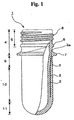
- FIG. 1 is a side view of a preform 1 that is a primary molded product for a biaxially-oriented blow-molded container, illustrated partly in longitudinal cross section.
- the illustrated preform 1 has a multilayer structure of a PET resin layer 2, a gas barrier material layer 3, and a PET resin layer 2, although the present invention is not limited to such structure.
- PET means resin containing polyethylene-terephthalate as principal ingredient, and may be blended with other material.
- the gas barrier material layer is made of polyamide-containing m-xylylenediamine (MXD-6: tradename, available from Mitsubishi Gas Chemical Company Inc.) in view of a difference between the gas barrier material and the PET resin in terms of viscosity and crystallization rate as well as the gas barrier effect, although the present invention is not limited to this material.
- MXD-6 tradename, available from Mitsubishi Gas Chemical Company Inc.
- the preform 1 comprises a neck 4, a shoulder 9, a cylindrical body 10, and a bottom 11.
- the neck 4 has a functional part 5 at an upper portion thereof, and a neck ring 7 at a lower end thereof.
- the functional part 5 is formed with screw threads 8 on an outer surface of its upper portion.
- the functional part 5 is also formed with a bead ring 6 at a lower end thereof. The bead ring 6 is protruded outwardly.
- the gas barrier material layer 3 has a leading edge 3a at an upper end thereof.
- the preform is formed such that the leading edge 3a is arranged or located at a center of the neck ring 7 in a longitudinal direction of the preform.
- a defined position of the leading edge 3a is the center of the neck ring 7 in the longitudinal direction of the preform.
- the location of the leading edge 3a may vary depending on a temperature of an injection machine, an injection pressure, an injection rate, a difference of the viscosity between the PET resin and the gas barrier material, a moisture content of the PET resin, a temperature of a manifold, and other factors. It is difficult to accurately arrange the leading edge 3a at the defined position. For example, at a right end in the Fig. 1, the leading edge 3a may be incorrectly positioned above the defined position, as illustrated in a dotted line in Fig. 1.
- the shrink is insufficient for the desired dimension due to the difference of the shrink between the PET resin and the gas barrier material.
- the neck 4 tends to become larger than the desired dimension. Also, if the leading edge 3a is incorrectly positioned, a cross sectional shape of the neck 4 tends to become ellipse.
- FIG. 2 is a schematic illustration of steps of the process of thermally crystallizing the neck 4.
- the process for thermally crystallizing the neck 4 of the preform 1 comprises (A) heating step, (B) cooling step of the heated preform, (C) squeezing step, and (D) cooling step of the squeezed preform.
- the heating step (A) the neck 4 of the preform 1 supported to a support table 18 is arranged into a heating furnace 12, and heated to a predetermined temperature, to thermally crystallizing the neck 4.
- the cooling step (B) the heated preform is taken out from the heating furnace 12, and gradually cooled at a room temperature, for 10-40 seconds, for example 20 seconds.
- a cylinder 14 of a jig 13 is engaged with the gradually cooled neck 4, and the bead ring 6 is squeezed for 3-15 seconds, for example 5 seconds.
- the cylinder 14 is removed from the bead ring 6, and the preform 1 is gradually cooled for a predetermined period of time at room temperature to complete the thermal crystallization process.
- FIGS. 3A and 3B show an enlarged view of the jig 13 used for the above described thermal crystallization process.
- the jig 13 comprises the cylinder 14, and a piston rod 17 arranged in the cylinder 14.
- the jig has a support table 18.
- the cylinder 14 is formed with a tapered section 16 at a lower end thereof.
- the cylinder 14 is formed with a reduced diameter section 15.
- An inner diameter at the reduced diameter section 15 is somewhat smaller than an outer diameter (x) of the bead ring 6 immediately after the completion of the heating step, and is (x - 0.1)mm to (x - 0.4)mm, for example, (x - 0.2)mm, (x - 0.3)mm or (x - 0.4)mm.
- the cylinder 14 is moved downwardly, so as to insert the bead ring 6 into the reduced diameter section 15.
- the bead ring 6 is squeezed by the reduced diameter section 15, so as to become the bead ring 6 within the dimensional tolerance for deformation with regard to sealing effect.
- the piston rod 17 is moved downwardly to abut an upper end of the neck 4, and the cylinder 14 is pulled up, while the preform 1 is held in position by the piston rod 17, so that it may not be pulled up with the cylinder 14.
- the cylinder 14 Since the cylinder 14 is provided at the lower end thereof with the tapered section 16, the lower end of the cylinder 14 does not contact with the neck 4, so that the cylinder 14 can be smoothly engaged with and released from the neck 4.
- the inner diameter at the reduced diameter section 15 is somewhat smaller than an outer diameter (x) of the bead ring 6 immediately after the completion of the heating step, and is (x - 0.1)mm to (x - 0.4)mm. If the inner diameter of the reduced 'diameter section 15 is larger than (x - 0.1)mm (for example, (x - 0.05)mm), the inner diameter of the reduced diameter section 15 does not show a significant difference from the outer diameter of the bead ring 6, so that the latter would not be squeezed satisfactorily.
- the reduced diameter section 15 would crush the bead ring 6 to deform the bead ring 6. Since the tapered section 16 is outwardly expanding toward the lower end of the cylinder 14, the threads 8 and the bead ring 6 do not contact with the lower end of the cylinder 14 to deform neither the threads 8 nor the bead ring 6, when the cylinder 14 is engaged with the neck 4 which is held in a thermally deformable state.
- the neck 4 with the bead ring 6 has a thermally deformable temperature in the step (C).
- the bead ring 6 can be formed within the dimensional tolerance for deformation with regard to sealing effect.
- the jig 13 is engaged with the neck 4, to insert the bead ring 6 into the reduced diameter section 15, so as to squeeze the bead ring 6, so that the bead ring 6 is formed within the dimensional tolerance for deformation with regard to sealing effect.
- the bead ring 6 can be squeezed without any problem.
- the bead ring 6 is inserted into the reduced diameter section 15 for 3 to 15 seconds. If the bead ring 6 is inserted for less than 3 seconds, the bead ring 6 would not be effectively formed within the dimensional tolerance for deformation with regard to sealing effect. If the bead ring 6 is inserted for more than 15 seconds, production efficiency would be decreased.
- the followings are the examples according to the present invention and the comparative example.
- Three jigs 13 were prepared.
- the bead ring 6 had a diameter X mm immediately after the heat.
- the first jig had the reduced diameter section 15 which diameter was (X - 0.2)mm.
- the second jig had the reduced diameter section 15 which diameter was (X - 0.3)mm.
- the third jig had the reduced diameter section 15 which diameter was (X - 0.4)mm.
- each of the bead rings 6 was squeezed by each of the jigs 13.
- the jig was not used.
- the heated preform was gradually cooled for 20 seconds in the step (B), and was squeezed for 5 seconds in the step (C).
- FIG. 4 shows each of the diameters of the thus obtained bead rings 6.
- FIG. 5 shows each of the diameters below the bead ring 6 (between the bead ring 6 and the neck ring 7).
- the outer diameter of the bead ring 6 was larger than the desired dimension, as seen from FIG. 4.
- each of the parts of the neck 4 other than the bead ring 6 was also observed.
- an outer diameter of the neck ring 7 in case of using each of the above described jigs 13 was substantially same as that of the neck ring 7 in case of non-use of the jig 13.
- an outer diameter of the threads 8 in case of using each of the above described jigs 13 was somewhat larger than that of the threads 8 in case of non-use of the jig 13, although such threads did not affect the sealability and the engagement with a cap.
- FIG. 6 shows the ellipticities at outer peripheries of the bead ring 6.
- FIG. 7 shows the ellipticities below the bead ring 6.
- the "ellipticity” is a quotinent of "the shortest axis of the bead ring 6 in a diametrical direction" divided by "the longest axis of the bead ring 6 in a diametrical direction”. The smaller the ellipticity, the closer the bead ring 6 to a true circle, to prevent deformation.
- the ellipticity of the bead ring 6 was 0.05 or more, which means a cross sectional shape of the bead ring 6 was ellipse.
- the ellipticity was 0.03.
- Substances that can suitably be used for the gas barrier material include resins having a gas barrier effect such as polyamide containing m-xylylenediamine (MXD-6: tradename) and ethylene/vinyl alcohol copolymers (EVOH) etc. Also, they may include an oxygen absorbing resin of an inorganic salt or an organic salt including a transition metal type catalyst (e.g., Co, Fe, Mn, Ni or Ti) in a matrix material of aliphatic nylon and aromatic nylon. Also, polyolefin oligomer may be included.
- MXD-6 polyamide containing m-xylylenediamine
- EVOH ethylene/vinyl alcohol copolymers
- the preform has a three-layered structure of PET - gas barrier material - PET (two different materials) in the above-described embodiment
- the present invention is by no means limited thereto.
- the preform may be a three-layered structure of PET blended with a gas barrier material - PET - PET blended with a gas barrier material.
- the preform may be a five-layered structure of PET - gas barrier material - PET (which may be a regenerated material) - gas barrier material - PET (two or three different materials).
- the present invention is also applicable to the primary molded product having a single layer structure, even if such a primary molded product has a difficulty of providing the neck with a proper profile due to the fluidity of resin at the time of injection molding.
- the present invention provides the following advantages.
- the bead ring of the neck of the primary molded product formed by injection molding is squeezed after the completion of heating, to prevent the bead ring from being deformed in order to reduce the outer diameter of the bead ring within the dimensional tolerance for deformation with regard to sealing effect.
- the neck of the primary molded product that is used for forming a bottle by biaxially-oriented blow molding can be processed reliable for thermal crystallization, and the cap can be screwed well onto the neck of the molded bottle.
- the outer diameter of the bead ring can be formed within the dimensional tolerance for deformation with regard to sealing effect without the deformation, by squeezing the bead ring.
- the operation of squeezing the bead ring is started 10 seconds to 40 seconds after the completion of heating, the operation of squeezing the bead ring is started in a state where the bead ring is still held in a thermally deformable temperature zone after the completion of heating, and where it can be formed within the dimensional tolerance for deformation with regard to sealing effect.
- the squeezing operation can be arranged smoothly in the thermal crystallization process on the production line.
- the bead ring having a thermally deformable temperature is squeezed by the jig of the present invention, the outer profile of the bead ring 6 is reliably prevented from being deformed, and the bead ring 6 dimensionally remains within a tolerable range from the viewpoint of the sealing effect of the bottle.
- the hollow cylinder of the jig is provided with a tapered section, it can be smoothly engaged with the bead ring of the primary molded product, and smoothly removed from the primary molded product by supporting the neck of the preform by means of the piston rod.
- the bead ring can be squeezed with maintaining its profile, by engaging the cylinder of the jig with the neck, said cylinder having an inner diameter smaller than the outer diameter of the bead ring.
Landscapes
- Engineering & Computer Science (AREA)
- Manufacturing & Machinery (AREA)
- Mechanical Engineering (AREA)
- Chemical & Material Sciences (AREA)
- Crystallography & Structural Chemistry (AREA)
- Physics & Mathematics (AREA)
- Thermal Sciences (AREA)
- Blow-Moulding Or Thermoforming Of Plastics Or The Like (AREA)
- Containers Having Bodies Formed In One Piece (AREA)
- Processing And Handling Of Plastics And Other Materials For Molding In General (AREA)
Abstract
said neck (4) having a functional part (5) and a neck ring (7) at a lower end thereof,
said functional part (5) being formed with screw threads (8) at an upper portion thereof and a bead ring (6) below the screw threads (8),
said method comprising:
Description
said neck having a functional part and a neck ring at a lower end thereof,
said functional part being formed with screw threads at an upper portion thereof and a bead ring below the screw threads,
said method comprising:
said neck being formed with screw threads at an upper portion thereof, a bead ring below the screw threads, and a neck ring at a lower end thereof, wherein
said jig comprises a cylinder, and a piston rod in the cylinder,
said cylinder has a reduced diameter section and a tapered section outwardly expanded at a lower end thereof,
said reduced diameter section has a diameter smaller by 0.1mm to 0.4mm than an outer diameter of the bead ring having a thermally deformable temperature immediately after heating, and
said piston rod abuts an upper end of the neck, to prevent the neck from being pulled up.
Claims (7)
- A method for thermally crystallizing a neck (4) of a primary molded product (1) for forming a bottle-shaped container made of polyethylene terephthalate as principal ingredient,
said neck (4) having a functional part (5) and a neck ring (7) at a lower end thereof,
said functional part (5) being formed with screw threads (8) at an upper portion thereof and a bead ring (6) below the screw threads (8),
said method comprising:heating the neck (4), and thensqueezing the bead ring (6) heated to the heat-deformable temperature, from outside so as to form an outer diameter of the bead ring (6) within a dimensional tolerance for deformation with regard to sealing effect. - The method according to claim 1, wherein the primary molded product (1) has a multilayer structure including at least one gas barrier material layers (3) in a resin layer (2) made of polyethylene terephthalate as principal ingredient.
- The method according to claim 1 or 2, wherein the bead ring (6) is squeezed by 0.1mm to 0.4mm in terms of an outer diameter of the bead ring (6) immediately after a completion of heating.
- The method according to claim 1, 2 or 3, wherein the bead ring (6) is started to be squeezed at 10 seconds to 40 seconds after a completion of heating.
- The method according to claim 1, 2, 3 or 4, wherein the bead ring (6) is squeezed for 3 - 15 seconds.
- A jig (13) to be used for a thermal crystallization method of a neck (4) of a primary molded product (1) for forming a bottle-shaped container made of polyethylene terephthalate,
said neck (4) being formed with screw threads (8) at an upper portion thereof, a bead ring (6) below the screw threads (8), and a neck ring (7) at a
lower end thereof, wherein
said jig (13) comprises a cylinder (14), and a piston rod (17) in the cylinder (14),
said cylinder (14) has a reduced diameter section (15) and a tapered section (16) outwardly expanded at a lower end thereof,
said reduced diameter section (15) has a diameter smaller by 0.1mm to 0.4mm than an outer diameter of the bead ring (6) having a thermally deformable temperature immediately after heating, and
said piston rod (17) abuts an upper end of the neck (4), to prevent the neck (4) from being pulled up. - The jig according to claim 6, wherein said primary molded product (1) has a multilayer structure including a gas barrier material layer (3) in a resin layer (2) made of polyethylene terephthalate as principal ingredient.
Applications Claiming Priority (3)
| Application Number | Priority Date | Filing Date | Title |
|---|---|---|---|
| JP2002238960A JP4147863B2 (en) | 2002-08-20 | 2002-08-20 | Method for thermal crystallization of neck and neck of primary molded product of biaxial stretch blow molded housing and jig used in the method |
| JP2002238960 | 2002-08-20 | ||
| PCT/JP2003/010521 WO2004018182A1 (en) | 2002-08-20 | 2003-08-20 | Method for hot crystallization of neck portion in preform of biaxial stretch blow molded bottle and jig for use in the method |
Publications (3)
| Publication Number | Publication Date |
|---|---|
| EP1535721A1 true EP1535721A1 (en) | 2005-06-01 |
| EP1535721A4 EP1535721A4 (en) | 2012-02-29 |
| EP1535721B1 EP1535721B1 (en) | 2013-10-16 |
Family
ID=31943849
Family Applications (1)
| Application Number | Title | Priority Date | Filing Date |
|---|---|---|---|
| EP03792745.6A Expired - Lifetime EP1535721B1 (en) | 2002-08-20 | 2003-08-20 | Method for hot crystallization of neck portion in preform of biaxial stretch blow molded bottle |
Country Status (7)
| Country | Link |
|---|---|
| US (2) | US20050248059A1 (en) |
| EP (1) | EP1535721B1 (en) |
| JP (1) | JP4147863B2 (en) |
| KR (1) | KR100988091B1 (en) |
| CN (1) | CN100381271C (en) |
| AU (1) | AU2003262254A1 (en) |
| WO (1) | WO2004018182A1 (en) |
Families Citing this family (9)
| Publication number | Priority date | Publication date | Assignee | Title |
|---|---|---|---|---|
| US7033656B2 (en) | 2002-04-12 | 2006-04-25 | Graham Packaging Pet Technologies, Inc. | Graded crystallization of container finishes |
| US7476047B2 (en) | 2004-04-30 | 2009-01-13 | Kimberly-Clark Worldwide, Inc. | Activatable cleaning products |
| US7604623B2 (en) | 2005-08-30 | 2009-10-20 | Kimberly-Clark Worldwide, Inc. | Fluid applicator with a press activated pouch |
| US7565987B2 (en) | 2005-08-31 | 2009-07-28 | Kimberly-Clark Worldwide, Inc. | Pull tab activated sealed packet |
| US7575384B2 (en) | 2005-08-31 | 2009-08-18 | Kimberly-Clark Worldwide, Inc. | Fluid applicator with a pull tab activated pouch |
| KR100808671B1 (en) | 2006-11-24 | 2008-02-29 | 용 준 배 | Crystallization method of preform neck portion. |
| CA2708185C (en) * | 2007-12-05 | 2016-01-12 | Invento Sp. Z O. O. | A preform for a plastic container, and the preform holder |
| AU2012290249B2 (en) * | 2011-08-01 | 2015-10-01 | Graham Packaging Company Lp | Plastic aerosol container and method of manufacture |
| US11975905B2 (en) * | 2018-07-30 | 2024-05-07 | Pepsico, Inc. | Multi-layer bottle |
Family Cites Families (9)
| Publication number | Priority date | Publication date | Assignee | Title |
|---|---|---|---|---|
| GB2024087B (en) * | 1978-06-29 | 1982-08-25 | Yoshino Kogyosho Co Ltd | Blow moulding polyester container |
| US4386046A (en) * | 1979-11-07 | 1983-05-31 | Yoshino Kogyosho Co., Ltd. | Neck orienting method of bottles of saturated polyester resins |
| JP2545509B2 (en) * | 1986-06-04 | 1996-10-23 | 株式会社吉野工業所 | Mouth tube processing method for polyethylene terephthalate resin bottle primary molded products |
| FR2619048B1 (en) * | 1987-08-07 | 1990-01-19 | Sidel Sa | DEVICE FOR THE HEAT TREATMENT OF THE PREFORM SHOULDER |
| US6217818B1 (en) * | 1995-07-07 | 2001-04-17 | Continental Pet Technologies, Inc. | Method of making preform and container with crystallized neck finish |
| JP3612405B2 (en) * | 1997-04-04 | 2005-01-19 | 日精エー・エス・ビー機械株式会社 | Method and apparatus for forming preform with crystallized neck |
| ATE523315T1 (en) * | 1997-04-16 | 2011-09-15 | Husky Injection Molding | INJECTION MOLDING DEVICE WITH COOLING CORE |
| JP3808194B2 (en) * | 1997-12-15 | 2006-08-09 | 日精エー・エス・ビー機械株式会社 | Preform crystallization method and apparatus |
| JP3972579B2 (en) * | 2000-11-10 | 2007-09-05 | 東洋製罐株式会社 | Heat-resistant PET bottle and manufacturing method thereof |
-
2002
- 2002-08-20 JP JP2002238960A patent/JP4147863B2/en not_active Expired - Fee Related
-
2003
- 2003-08-20 EP EP03792745.6A patent/EP1535721B1/en not_active Expired - Lifetime
- 2003-08-20 US US10/524,844 patent/US20050248059A1/en not_active Abandoned
- 2003-08-20 CN CNB038196824A patent/CN100381271C/en not_active Expired - Fee Related
- 2003-08-20 AU AU2003262254A patent/AU2003262254A1/en not_active Abandoned
- 2003-08-20 KR KR1020057002558A patent/KR100988091B1/en not_active Expired - Fee Related
- 2003-08-20 WO PCT/JP2003/010521 patent/WO2004018182A1/en not_active Ceased
-
2009
- 2009-05-07 US US12/453,343 patent/US7981351B2/en not_active Expired - Fee Related
Also Published As
| Publication number | Publication date |
|---|---|
| AU2003262254A1 (en) | 2004-03-11 |
| CN1675048A (en) | 2005-09-28 |
| EP1535721A4 (en) | 2012-02-29 |
| WO2004018182A1 (en) | 2004-03-04 |
| JP2004074614A (en) | 2004-03-11 |
| JP4147863B2 (en) | 2008-09-10 |
| US20050248059A1 (en) | 2005-11-10 |
| CN100381271C (en) | 2008-04-16 |
| US20090261506A1 (en) | 2009-10-22 |
| US7981351B2 (en) | 2011-07-19 |
| KR20050056987A (en) | 2005-06-16 |
| EP1535721B1 (en) | 2013-10-16 |
| KR100988091B1 (en) | 2010-10-18 |
Similar Documents
| Publication | Publication Date | Title |
|---|---|---|
| US7981351B2 (en) | Crystallization method of neck of primary molded product for biaxially-oriented blow-molded bottle-shaped container and jig to be used for the same | |
| US4942008A (en) | Process for molding a multiple layer structure | |
| US8235704B2 (en) | Method and apparatus for manufacturing blow molded containers | |
| US5647930A (en) | Method for forming a layered preform and container | |
| EP2578380B1 (en) | Preform opening crystallization method | |
| CN103260851B (en) | Prestretching boom assembly is utilized to control the blow gun of liquid stream | |
| JPH0460004B2 (en) | ||
| JPS6142808Y2 (en) | ||
| US7976918B2 (en) | Biaxially drawn, blow-molded bottle and its preform | |
| EP1708866A1 (en) | Method of swage-forming of container or preform internal threads and container and preform having such internal threads | |
| WO2012037057A2 (en) | Hydroblow preform design | |
| JPH0411374B2 (en) | ||
| US20070059462A1 (en) | Swage-forming of container threads | |
| EP0767046B1 (en) | Process for injection stretch blow molding | |
| EP0466947B1 (en) | A process for molding a multiple layer structure and a container made therefrom | |
| CA2214075C (en) | Method of producing tubular container and apparatus for producing the same | |
| JPH11152122A (en) | Biaxially stretched blow-molded bottle and its manufacture | |
| GB2212435A (en) | Blow moulded container | |
| JPH0443498B2 (en) | ||
| FI103720B (en) | Ways to make a container of plastic material | |
| JP2914521B2 (en) | Biaxial stretch blow molding method | |
| JP2002347778A (en) | Injection blow-molded bottle having an inner plug prevention structure on the inner surface of mouth, method for producing the same, and injection mold | |
| JP2021160265A (en) | Method for manufacturing double container | |
| IE72977B1 (en) | A process for molding a multiple layer structure and a container made therefrom |
Legal Events
| Date | Code | Title | Description |
|---|---|---|---|
| PUAI | Public reference made under article 153(3) epc to a published international application that has entered the european phase |
Free format text: ORIGINAL CODE: 0009012 |
|
| 17P | Request for examination filed |
Effective date: 20050321 |
|
| AK | Designated contracting states |
Kind code of ref document: A1 Designated state(s): AT BE BG CH CY CZ DE DK EE ES FI FR GB GR HU IE IT LI LU MC NL PT RO SE SI SK TR |
|
| AX | Request for extension of the european patent |
Extension state: AL LT LV MK |
|
| DAX | Request for extension of the european patent (deleted) | ||
| RBV | Designated contracting states (corrected) |
Designated state(s): DE FR |
|
| A4 | Supplementary search report drawn up and despatched |
Effective date: 20120201 |
|
| RIC1 | Information provided on ipc code assigned before grant |
Ipc: B29C 49/64 20060101AFI20120126BHEP Ipc: B29C 49/42 20060101ALI20120126BHEP |
|
| 17Q | First examination report despatched |
Effective date: 20120518 |
|
| GRAP | Despatch of communication of intention to grant a patent |
Free format text: ORIGINAL CODE: EPIDOSNIGR1 |
|
| INTG | Intention to grant announced |
Effective date: 20130503 |
|
| GRAS | Grant fee paid |
Free format text: ORIGINAL CODE: EPIDOSNIGR3 |
|
| GRAA | (expected) grant |
Free format text: ORIGINAL CODE: 0009210 |
|
| AK | Designated contracting states |
Kind code of ref document: B1 Designated state(s): DE FR |
|
| REG | Reference to a national code |
Ref country code: DE Ref legal event code: R096 Ref document number: 60345104 Country of ref document: DE Effective date: 20131212 |
|
| REG | Reference to a national code |
Ref country code: DE Ref legal event code: R097 Ref document number: 60345104 Country of ref document: DE |
|
| PLBE | No opposition filed within time limit |
Free format text: ORIGINAL CODE: 0009261 |
|
| STAA | Information on the status of an ep patent application or granted ep patent |
Free format text: STATUS: NO OPPOSITION FILED WITHIN TIME LIMIT |
|
| 26N | No opposition filed |
Effective date: 20140717 |
|
| REG | Reference to a national code |
Ref country code: DE Ref legal event code: R097 Ref document number: 60345104 Country of ref document: DE Effective date: 20140717 |
|
| REG | Reference to a national code |
Ref country code: FR Ref legal event code: PLFP Year of fee payment: 14 |
|
| PGFP | Annual fee paid to national office [announced via postgrant information from national office to epo] |
Ref country code: DE Payment date: 20160816 Year of fee payment: 14 |
|
| PGFP | Annual fee paid to national office [announced via postgrant information from national office to epo] |
Ref country code: FR Payment date: 20160712 Year of fee payment: 14 |
|
| REG | Reference to a national code |
Ref country code: DE Ref legal event code: R119 Ref document number: 60345104 Country of ref document: DE |
|
| REG | Reference to a national code |
Ref country code: FR Ref legal event code: ST Effective date: 20180430 |
|
| PG25 | Lapsed in a contracting state [announced via postgrant information from national office to epo] |
Ref country code: DE Free format text: LAPSE BECAUSE OF NON-PAYMENT OF DUE FEES Effective date: 20180301 |
|
| PG25 | Lapsed in a contracting state [announced via postgrant information from national office to epo] |
Ref country code: FR Free format text: LAPSE BECAUSE OF NON-PAYMENT OF DUE FEES Effective date: 20170831 |