EP1535613A2 - Polymorphic form of atorvastatin calcium - Google Patents
Polymorphic form of atorvastatin calcium Download PDFInfo
- Publication number
- EP1535613A2 EP1535613A2 EP04027375A EP04027375A EP1535613A2 EP 1535613 A2 EP1535613 A2 EP 1535613A2 EP 04027375 A EP04027375 A EP 04027375A EP 04027375 A EP04027375 A EP 04027375A EP 1535613 A2 EP1535613 A2 EP 1535613A2
- Authority
- EP
- European Patent Office
- Prior art keywords
- atorvastatin
- calcium
- salt
- atorvastatin calcium
- solvent
- Prior art date
- Legal status (The legal status is an assumption and is not a legal conclusion. Google has not performed a legal analysis and makes no representation as to the accuracy of the status listed.)
- Granted
Links
Images

Classifications
-
- C—CHEMISTRY; METALLURGY
- C07—ORGANIC CHEMISTRY
- C07D—HETEROCYCLIC COMPOUNDS
- C07D207/00—Heterocyclic compounds containing five-membered rings not condensed with other rings, with one nitrogen atom as the only ring hetero atom
- C07D207/02—Heterocyclic compounds containing five-membered rings not condensed with other rings, with one nitrogen atom as the only ring hetero atom with only hydrogen or carbon atoms directly attached to the ring nitrogen atom
- C07D207/30—Heterocyclic compounds containing five-membered rings not condensed with other rings, with one nitrogen atom as the only ring hetero atom with only hydrogen or carbon atoms directly attached to the ring nitrogen atom having two double bonds between ring members or between ring members and non-ring members
- C07D207/34—Heterocyclic compounds containing five-membered rings not condensed with other rings, with one nitrogen atom as the only ring hetero atom with only hydrogen or carbon atoms directly attached to the ring nitrogen atom having two double bonds between ring members or between ring members and non-ring members with hetero atoms or with carbon atoms having three bonds to hetero atoms with at the most one bond to halogen, e.g. ester or nitrile radicals, directly attached to ring carbon atoms
-
- A—HUMAN NECESSITIES
- A61—MEDICAL OR VETERINARY SCIENCE; HYGIENE
- A61K—PREPARATIONS FOR MEDICAL, DENTAL OR TOILETRY PURPOSES
- A61K31/00—Medicinal preparations containing organic active ingredients
- A61K31/33—Heterocyclic compounds
- A61K31/395—Heterocyclic compounds having nitrogen as a ring hetero atom, e.g. guanethidine or rifamycins
- A61K31/40—Heterocyclic compounds having nitrogen as a ring hetero atom, e.g. guanethidine or rifamycins having five-membered rings with one nitrogen as the only ring hetero atom, e.g. sulpiride, succinimide, tolmetin, buflomedil
-
- A—HUMAN NECESSITIES
- A61—MEDICAL OR VETERINARY SCIENCE; HYGIENE
- A61P—SPECIFIC THERAPEUTIC ACTIVITY OF CHEMICAL COMPOUNDS OR MEDICINAL PREPARATIONS
- A61P3/00—Drugs for disorders of the metabolism
- A61P3/06—Antihyperlipidemics
Definitions
- the present invention relates to a novel crystalline form of atorvastatin calcium, to processes for preparing it and to pharmaceutical compositions and dosages containing it.
- Atorvastatin is a member of the class of drugs called statins.
- Statin drugs are currently the most therapeutically effective drugs available for reducing low density lipoprotein (LDL) particle concentration in the blood stream of patients at risk for cardiovascular disease.
- LDL low density lipoprotein
- a high level of LDL in the bloodstream has been linked to the formation of coronary lesions which obstruct the flow of blood and can rupture and promote thrombosis.
- Goodman and Gilman The Pharmacological Basis of Therapeutics 879 (9th ed. 1996). Reducing plasma LDL levels has been shown to reduce the risk of clinical events in patients with cardiovascular disease and patients who are free of cardiovascular disease but who have hypercholesterolemia.
- Simvastatin Survival Study Group 1994; Lipid Research Clinics Program, 1984a, 1984b.
- statin drugs The mechanism of action of statin drugs has been elucidated in some detail. They interfere with the synthesis of cholesterol and other sterols in the liver by competitively inhibiting the 3-hydroxy-3-methyl-glutaryl-coenzyme A reductase enzyme ("HMG-CoA reductase"). HMG-CoA reductase catalyzes the conversion HMG to mevalonate, which is the rate determining step in the biosynthesis of cholesterol, and so, its inhibition leads to a reduction in the concentration of cholesterol in the liver. Very low density lipoprotein (VLDL) is the biological vehicle for transporting cholesterol and triglycerides from the liver to peripheral cells.
- VLDL Very low density lipoprotein
- VLDL is catabolized in the peripheral cells which releases fatty acids which may be stored in adipocytes or oxidized by muscle.
- the VLDL is converted to intermediate density lipoprotein (IDL), which is either removed by an LDL receptor, or is converted to LDL.
- IDL intermediate density lipoprotein
- Decreased production of cholesterol leads to an increase in the number of LDL receptors and corresponding reduction in the production of LDL particles by metabolism of IDL.
- Atorvastatin is the common chemical name of [ R -( R *, R *)]-2-(4-fluorophenyl)- ⁇ , ⁇ -dihydroxy-5-(1-methylethyl)-3-phenyl-4-[(phenylamino)carbonyl]-1H-pyrrole-1-heptanoic acid.
- the free acid is prone to lactonization.
- the molecular structure of the lactone is represented by formula (I).
- Atorvastatin is marketed as the hemi calcium salt-trihydrate under the name LIPITOR by Warner-Lambert Co.
- Atorvastatin was first disclosed to the public and claimed in U.S. Patent No. 4,681,893.
- the hemi calcium salt depicted in formula (II) (hereafter "atorvastatin calcium") is disclosed in U.S. Patent No. 5,273,995.
- This patent teaches that the calcium salt is obtained by crystallization from a brine solution resulting from the transposition of the sodium salt with CaCl 2 and further purified by recrystallization from a 5:3 mixture of ethyl acetate and hexane. Both of these U.S. patents are hereby incorporated by reference.
- the present invention includes a new crystal form of atorvastatin calcium in both hydrate and anhydrate states.
- Polymorphism is the property of some molecules and molecular complexes to assume more than one crystalline or amorphous form in the solid state.
- a single molecule like the atorvastatin in formula (I) or the salt complex of formula (II), may give rise to a variety of solids having distinct physical properties like solubility, X-ray diffraction pattern and solid state 13 C NMR spectrum.
- the differences in the physical properties of polymorphs result from the orientation and intermolecular interactions of adjacent molecules (complexes) in the bulk solid.
- polymorphs are distinct solids sharing the same molecular formula, which may be thought of as analogous to a unit cell in metallurgy, yet having distinct advantageous and/or disadvantageous physical properties compared to other forms in the polymorph family.
- One of the most important physical properties of pharmaceutical polymorphs is their solubility in aqueous solution, particularly their solubility in the gastric juices of a patient. For example, where absorption through the gastrointestinal tract is slow, it is often desirable for a drug that is unstable to conditions in the patient's stomach or intestine to dissolve slowly so that it does not accumulate in a deleterious environment.
- U.S. Patent No. 5,969,156 discloses three polymorphs of atorvastatin designated Forms I, II, and IV by the inventors of those forms. While the inventors of U.S. Patent No. 5,969,156 claim certain processing and therapeutic advantages of their forms over amorphous atorvastatin calcium, advantages may yet be realized by other heretofore undiscovered forms of atorvastatin calcium.
- the present invention provides new Form V of atorvastatin calcium in both anhydrate and hydrate states, which possesses the advantage of higher solubility in water than atorvastatin Form I.
- the present invention further provides a process for preparing new Form V as well as pharmaceutical compositions and dosages containing the new form.
- the new crystalline form of atorvastatin calcium Form V is well distinguished from the crystal modifications obtained by carrying out the procedures described in U.S. Patents Nos. 5,273,995 and 5,969,156 using X-ray powder diffraction and solid-state 13 C nuclear magnetic resonance techniques.
- the X-ray powder diffractogram of Form V (Fig.1) has two medium peaks at 5.3 ⁇ 0.2 and 8.3 ⁇ 0.2 degrees 2 ⁇ and one large peak in the range 18-23 degrees 26 with a maximum at about 18.3 ⁇ 0.2 degrees two-theta.
- This X-Ray pattern is well distinguished from that of known Forms I, II, III and IV and also is well distinguished from the X-Ray pattern of amorphous atorvastatin calcium which is characterized by two broad humps in the ranges 8-14 degrees 2 ⁇ and 15-26 degrees 2 ⁇ .
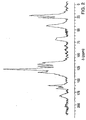
- This solid-state 13 C NMR spectrum (Fig. 2) is well distinguished from those of known Forms I, II, III and IV, and also is distinguished from that of the amorphous form which displays a different pattern with shifts significantly different from that of Form V at 21.0 ppm, 26.4 ppm, one broad peak in the range 60-75 ppm with a maximum at 69.7 ppm and 138.8 ppm.
- the spectrum of Fig. 2 was obtained on a Bruker DMX-500 digital F NMR spectrometer operating at 125.76 MHz. The instrument was equipped with a BL-4 cpmas probehead and a high resolution/high performance (HPHP) 1 H for solids. The magic angle and proton decoupling efficiency were optimized before acquisition. The sample was spun at 5.0 kHz spin rate on 4 mm zirconia rotors.
- Atorvastatin calcium Form V may contain up to 12% water, which corresponds to the stoichiometric value of 9 water molecules per molecule of atorvastatin calcium.
- atorvastatin calcium Form V can be in various states of hydration, between 0 and 9 moles of water.
- the present invention further provides a process for the preparation of atorvastatin calcium Form V.
- the process comprises the steps of dissolving a salt of atorvastatin in a solvent to form an atorvastatin salt solution, optionally removing impurities from the atorvastatin salt solution, contacting the atorvastatin salt solution with a calcium salt and isolating atorvastatin calcium in new Form V.
- the atorvastatin salt of the present invention includes alkali metal salts, e.g. lithium, sodium, and potassium salts; alkaline-earth metal salts such as magnesium salts; as well as ammonium and alkyl, aryl or alkaryl ammonium salts.
- alkali metal salts e.g. lithium, sodium, and potassium salts
- alkaline-earth metal salts such as magnesium salts
- ammonium and alkyl, aryl or alkaryl ammonium salts are preferred.
- Any solvent capable of dissolving the atorvastatin salt and from which atorvastatin calcium Form V may be isolated is a suitable solvent of the invention.
- the choice of solvent will therefore depend upon the selection of the atorvastatin salt and the calcium salt.
- the solvent should be selected from those in which the atorvastatin salt and calcium salt are at least sparingly soluble.
- sparingly soluble is meant not substantially less soluble than 0.02 g/ml at 50-60°C for the atorvastatin salt and not substantially less soluble than 0.0002 M at 10-15 °C for the calcium salt.
- Suitable solvents include but are not limited to hydroxylic solvents like water, alcohols and mixtures thereof, including hydroxylic solvents and hydroxylic solvent mixtures which have been made either acidic or basic by addition of a mineral acid or base.
- Preferred solvents are water, methanol. ethanol and mixtures thereof.
- the calcium salt of the present invention includes organic and inorganic salts of calcium which are capable of dissociating into Ca 2+ and an anionic component when added to the atorvastatin salt solution.
- organic salts that may be used are carboxylates and sulfonates.
- carboxylates are lower alkyl carboxylates like acetate, proprionate, butyrate and tartrate and aryl carboxylates like benzoate and phthalate as well as higher alkyl carboxylates like stearate, dodecanoate and the like.
- calcium ascorbate and succinate are also included.
- sulfonates that may be used are lower alkyl and aryl sulfonates like calcium methane sulfonate, calcium benzene sulfonate and calcium p -toluene sulfonate.
- the preferred organic calcium salts are lower carboxylate salts, the most preferred organic calcium salt is calcium acetate.
- inorganic salts which may be used include halide salts such as CaCl 2 , CaF 2 , CaBr 2 and CaI 2 , as well as calcium borate (B 4 CaO 7 ), calcium tetrafluoroborate (CaBF 4 ), calcium carbonate (CaCO 3 ), monobasic calcium phosphate (Ca(H 2 PO 4 ) 2 ), dibasic calcium phosphate (CaHPO 4 ) and tribasic calcium phosphate (Ca(PO 4 ) 2 ), calcium sulfate (CaSO 4 ) and calcium hydroxide (Ca(OH) 2 ), and hydrates thereof.
- halide salts such as CaCl 2 , CaF 2 , CaBr 2 and CaI 2 , as well as calcium borate (B 4 CaO 7 ), calcium tetrafluoroborate (CaBF 4 ), calcium carbonate (CaCO 3 ), monobasic calcium phosphate (Ca(H 2 PO 4 ) 2
- the calcium salt is preferably added in an amount that provides one half mole of Ca 2+ per mole of atorvastatin in the atorvastatin salt solution.
- the atorvastatin salt is atorvastatin sodium (atorvastatin - Na + )
- the atorvastatin salt is atorvastatin magnesium ([atorvastatin - ] 2 Mg 2+ )
- the atorvastatin salt is atorvastatin magnesium ([atorvastatin - ] 2 Mg 2+ )
- about one mole of calcium salt per mole of atorvastatin salt is appropriate. Otherwise, mixed salts containing atorvastatin may form.
- the calcium salt may be contacted with the atorvastatin salt solution by adding the calcium salt in substantially pure form, i . e . either as a solid or, if liquid, as a neat liquid, to the atorvastatin salt solution or, preferably, by first forming a calcium salt solution and then contacting the atorvastatin salt solution and calcium salt solution. It is most preferred to contact the calcium salt and the atorvastatin salt solution by first dissolving the calcium salt in a solvent and then adding the calcium salt solution to the atorvastatin salt solution slowly.
- Suitable calcium salt solvents are solvents previously mentioned as being suitable solvents for the atorvastatin salt, provided the calcium salt is at least sparingly soluble in the particular solvent.
- the preferred calcium salt is calcium acetate and the preferred calcium salt solvent is water.
- the calcium salt solvent is water, it is preferably used in an amount that provides about a 20 to 30 millimolar solution of the calcium salt, more preferably about a 25 millimolar solution.
- the atorvastatin and calcium salts are preferably combined at elevated temperature and at concentrations disclosed above and in the examples, which follow, in order that crystallization of Form V may be induced by cooling of the so-formed atorvastatin calcium solution.
- the elevated temperature is preferably above 40°C and below 80°C, more preferably above 50°C and below 70°C and most preferably about 60°C.
- the yield of atorvastatin calcium Form V may be optimized. Crystallization of atorvastatin calcium Form V may also be induced by addition of a seed crystal of atorvastatin calcium, preferably Form V although other forms also may be used.
- the crystals may be isolated by filtration or other conventional means known to the art.
- the isolated crystals may also be dried by conventional means.
- atorvastatin calcium can be crystallized in Form V by dissolving atorvastatin calcium in THF or alcohols like methanol or ethanol, and subsequently adding water as an antisolvent.
- a further aspect of the present invention is a pharmaceutical composition and dosage form containing the novel form of atorvastatin calcium.
- compositions of the invention include powders, granulates, aggregates and other solid compositions comprising novel Form V of atorvastatin calcium.
- Form V solid compositions that are contemplated by the present invention may further included diluents, such as cellulose-derived materials like powdered cellulose, microcrystalline cellulose, microfine cellulose, methyl cellulose, ethyl cellulose, hydroxyethyl cellulose, hydroxypropyl cellulose, hydroxypropylmethyl cellulose, carboxymethyl cellulose salts and other substituted and unsubstituted celluloses; starch; pregelatinized starch; inorganic diluents like calcium carbonate and calcium diphosphate and other diluents known to the pharmaceutical industry.
- suitable diluents include waxes, sugars and sugar alcohols like mannitol and sorbitol, acrylate polymers and copolymers, as well as pectin, dextrin and gelatin.
- excipients that are within the contemplation of the present invention include binders, such as acacia gum, pregelatinized starch, sodium alginate, glucose and other binders used in wet and dry granulation and direct compression tableting processes.
- Excipients that may also be present in a solid composition of Form V atorvastatin calcium further include disintegrants like sodium starch glycolate, crospovidone, low-substituted hydroxypropyl cellulose and others.
- excipients may include tableting lubricants like magnesium and calcium stearate and sodium stearyl fumarate; flavorings; sweeteners; preservatives; pharmaceutically acceptable dyes and glidants such as silicon dioxide.
- the dosages include dosages suitable for oral, buccal, rectal, parenteral (including subcutaneous, intramuscular, and intravenous), inhalant and ophthalmic administration.
- parenteral including subcutaneous, intramuscular, and intravenous
- inhalant and ophthalmic administration are examples of the most suitable route in any given case.
- oral the most preferred route of the present invention is oral.
- the Dosages may be conveniently presented in unit dosage form and prepared by any of the methods well-known in the art of pharmacy.
- Dosage forms include solid dosage forms, like tablets, powders, capsules. suppositories, sachets, troches and losenges as well as liquid suspensions and elixirs. While the description is not intended to be limiting, the invention is also not intended to pertain to true solutions of atorvastatin calcium whereupon the properties that distinguish the solid forms of atorvastatin calcium are lost. However, the use of the novel forms to prepare such solutions (e.g. so as to deliver, in addition to atorvastatin, a solvate to said solution in a certain ratio with a solvate) is considered to be within the contemplated invention.
- Capsule dosages will contain the solid composition within a capsule which may be made of gelatin or other conventional encapsulating material.
- Tablets and powders may be coated. Tablets and powders may be coated with an enteric coating.
- the enteric coated powder forms may have coatings comprising phthalic acid cellulose acetate, hydroxypropylmethyl-cellulose phthalate, polyvinyl alcohol phthalate, carboxymethylethylcellulose, a copolymer of styrene and maleic acid, a copolymer of methacrylic acid and methyl methacrylate, and like materials, and if desired, they may be employed with suitable plasticizers and/or extending agents.
- a coated tablet may have a coating on the surface of the tablet or may be a tablet comprising a powder or granules with an enteric-coating.
- Preferred unit dosages of the pharmaceutical compositions of this invention typically contain from 0.5 to 100 mg of the novel atorvastatin calcium Form V, or mixtures thereof with other forms of atorvastatin calcium. More usually, the combined weight of the atorvastatin calcium forms of a unit dosage are from 2.5 mg. to 80 mg.
- the sodium salt of atorvastatin (52.2 g) was dissolved in methanol (510 ml) and then diluted with water (1 L). The resulting solution was transferred to a separatory funnel containing 1:1 ethyl acetate/hexane (1 L). The phases were mixed by bubbling nitrogen gas through the separatory funnel. Upon cessation of nitrogen flow, the phases separated and the upper, organic, phase was removed. The lower, aqueous, phase was washed with 1:1 ethyl acetate/hexane (1 L) and then transferred to a round bottom flask. Active charcoal (10.2 g) was added. The flask was heated to 50 °C and the solution was stirred for two hours. The activated charcoal was then removed by filtration through celite, the charcoal and celite being rinsed with methanol (1540 ml), and the rinsate and filtrate then being combined into one atorvastatin sodium salt solution.
- the quantity of atorvastatin obtained by purification was determined by calibrated HPLC analysis of the purified atorvastatin sodium salt solution. Based on this analysis, a quantity of calcium acetate (8.38 g, 0.5 eq.) was dissolved in water (1.9 L) and heated to 60 °C. The atorvastatin sodium salt solution was heated to 63 °C and the solutions were combined by slow addition of the calcium acetate solution to the atorvastatin sodium salt solution. Upon completing the addition, the mixture was cooled. Crystallization of Form V began to occur at a temperature of 43 °C and cooling was continued until the flask temperature reached 13 °C.
- the crystals were isolated by slow vacuum filtration and then dried over anhydrous silica for 5 days to yield atorvastatin calcium salt Form V.
- Atorvastatin calcium (10 g) was dissolved in methanol (400 ml) at room temperature. Water (300 ml) was added slowly to the methanolic solution with stirring and the resulting solution was heated to 60°C. The solution was then cooled to between 10 and 15 °C within 3 h. Precipitation started at about 40°C. The thick slurry was then dried at 50°C under reduced pressure for 48 h to yield atorvastatin calcium Form V.
- Atorvastatin calcium (5 g) was dissolved in methanol (100 ml) at room temperature. To this methanolic solution, water (100 ml) was added while stirring. Precipitation occurred instantly and after cooling the slurry to 15°C the precipitate was filtered and dried at 50°C under reduced pressure for 48 h to yield atorvastatin calcium Form V.
- Atorvastatin calcium (5 g) was dissolved in methanol (200 ml). The methanolic solution was placed into a stirred reactor containing water (150 ml) at 45°C. The obtained slurry was cooled to 10°C, filtered and dried at 50°C under reduced pressure for 48 h to yield atorvastatin calcium Form V.
- Atorvastatin calcium (1 g) was dissolved in ethanol (15 ml) after heating. To this ethanolic solution, water (10 ml) was added while stirring. Precipitation occurred instantly. The gel-like precipitate was filtered without vacuum and dried at 50°C under reduced pressure for 24 h to yield atorvastatin calcium Form V.
- Atorvastatin calcium (1 g) was dissolved in THF (25 ml) at room temperature. To this solution, water (60 ml) was added while stirring. The reaction mixture was stirred for 18 hours at room temperature and the precipitate (gel) was filtered without vacuum and dried at 50°C under reduced pressure for 24 h to yield atorvastatin calcium Form V.
Landscapes
- Health & Medical Sciences (AREA)
- Chemical & Material Sciences (AREA)
- Organic Chemistry (AREA)
- Veterinary Medicine (AREA)
- Public Health (AREA)
- General Health & Medical Sciences (AREA)
- Animal Behavior & Ethology (AREA)
- Life Sciences & Earth Sciences (AREA)
- Medicinal Chemistry (AREA)
- Pharmacology & Pharmacy (AREA)
- Epidemiology (AREA)
- Obesity (AREA)
- Nuclear Medicine, Radiotherapy & Molecular Imaging (AREA)
- General Chemical & Material Sciences (AREA)
- Chemical Kinetics & Catalysis (AREA)
- Hematology (AREA)
- Diabetes (AREA)
- Bioinformatics & Cheminformatics (AREA)
- Engineering & Computer Science (AREA)
- Pyrrole Compounds (AREA)
- Pharmaceuticals Containing Other Organic And Inorganic Compounds (AREA)
- Steroid Compounds (AREA)
Abstract
Description


| δ (ppm) |
| 21.9 |
| 25.9 |
| 40.4 |
| 41.8 |
| 42.3 |
| 63-73 (two broad peaks) |
| 115.6 |
| 118.9 |
| 122.5 |
| 128.7 (strong) |
| 135.1 |
| 161.0 |
| 167.1 |
| 176-186 (broad peak) |
Claims (16)
- Atorvastatin calcium Form V or hydrate thereof.
- The atorvastatin calcium Form V or hydrate thereof of claim 1 having an X-ray powder diffractogram substantially as depicted in Figure 1.
- The atorvastatin calcium Form V or hydrate thereof of claim 1 having X-ray powder diffraction peaks at about 5.5 and 8.3 degrees at 2 and a broad peak at about 18-23 degrees 2.
- The atorvastatin calcium Form V or hydrate thereof of claim 1 having a solid state 13C NMR spectrum substantially as depicted in Figure 2.
- The atorvastatin calcium Form V or hydrate thereof of claim 1 having solid state 13C NMR signals at about 21.9, 25.9, 118.9, 122.5, 128.7, 161.0 and 167.1 ppm.
- Atorvastatin calcium Form V containing up to about 9 moles of water per mole of atorvastatin calcium.
- A process for preparing atorvastatin calcium Form V, or hydrate thereof, comprising the steps ofa) dissolving a metal, ammonium or alkylammonium salt of atorvastatin in a solvent to form an atorvastatin salt solutionb) contacting the atorvastatin salt solution with a calcium salt, andc) isolating atorvastatin calcium Form V or hydrates thereof.
- The process of claim 7 wherein the salt of atorvastatin is a metal salt of atorvastatin.
- The process of claim 8 wherein the metal salt of atorvastatin is a sodium salt of atorvastatin.
- The process of claim 7 wherein the calcium salt is calcium acetate.
- The process of claim 7 wherein the calcium salt is dissolved in a solvent and the atorvastatin salt solution is contacted with the calcium salt by adding the calcium salt solution to the atorvastatin salt solution.
- A process for preparing atorvastatin calcium Form V or hydrates thereof comprising the steps ofa) dissolving atorvastatin calcium in a solvent selected from the group consisting of tetrahydrofuran and hydroxylic solvents to form an atorvastatin calcium salt solution,b) adding water to the atorvastatin calcium salt solution, andc) isolating atorvastatin calcium Form V or hydrates thereof.
- The process of claim 12 wherein the solvent is methanol.
- The process of claim 12 wherein the solvent is ethanol.
- The process of claim 12 wherein the solvent is tetrahydrofuran.
- A pharmaceutical composition comprising a therapeutic amount of atorvastatin Form V or hydrates thereof of claim 1.
Priority Applications (2)
| Application Number | Priority Date | Filing Date | Title |
|---|---|---|---|
| EP10157435A EP2206497A1 (en) | 1999-11-17 | 2000-11-16 | Polymorphic form of atorvastatin calcium |
| SI200031061T SI1535613T1 (en) | 1999-11-17 | 2000-11-16 | Process for preparing a polymorphic form of atorvastatin calcium |
Applications Claiming Priority (3)
| Application Number | Priority Date | Filing Date | Title |
|---|---|---|---|
| US16615399P | 1999-11-17 | 1999-11-17 | |
| US166153P | 1999-11-17 | ||
| EP00978744A EP1235799B1 (en) | 1999-11-17 | 2000-11-16 | Polymorphic form of atorvastatin calcium |
Related Parent Applications (2)
| Application Number | Title | Priority Date | Filing Date |
|---|---|---|---|
| EP00978744A Division EP1235799B1 (en) | 1999-11-17 | 2000-11-16 | Polymorphic form of atorvastatin calcium |
| EP00978744.1 Division | 2000-11-16 |
Related Child Applications (1)
| Application Number | Title | Priority Date | Filing Date |
|---|---|---|---|
| EP10157435.8 Division-Into | 2010-03-23 |
Publications (3)
| Publication Number | Publication Date |
|---|---|
| EP1535613A2 true EP1535613A2 (en) | 2005-06-01 |
| EP1535613A3 EP1535613A3 (en) | 2005-08-31 |
| EP1535613B1 EP1535613B1 (en) | 2010-08-25 |
Family
ID=22602039
Family Applications (3)
| Application Number | Title | Priority Date | Filing Date |
|---|---|---|---|
| EP00978744A Expired - Lifetime EP1235799B1 (en) | 1999-11-17 | 2000-11-16 | Polymorphic form of atorvastatin calcium |
| EP04027375A Expired - Lifetime EP1535613B1 (en) | 1999-11-17 | 2000-11-16 | Process for preparing a polymorphic form of atorvastatin calcium |
| EP10157435A Withdrawn EP2206497A1 (en) | 1999-11-17 | 2000-11-16 | Polymorphic form of atorvastatin calcium |
Family Applications Before (1)
| Application Number | Title | Priority Date | Filing Date |
|---|---|---|---|
| EP00978744A Expired - Lifetime EP1235799B1 (en) | 1999-11-17 | 2000-11-16 | Polymorphic form of atorvastatin calcium |
Family Applications After (1)
| Application Number | Title | Priority Date | Filing Date |
|---|---|---|---|
| EP10157435A Withdrawn EP2206497A1 (en) | 1999-11-17 | 2000-11-16 | Polymorphic form of atorvastatin calcium |
Country Status (20)
| Country | Link |
|---|---|
| EP (3) | EP1235799B1 (en) |
| JP (2) | JP2003514798A (en) |
| KR (1) | KR20020063190A (en) |
| CN (1) | CN1423634A (en) |
| AT (2) | ATE288893T1 (en) |
| AU (1) | AU783002B2 (en) |
| CA (1) | CA2392096C (en) |
| CZ (1) | CZ20021642A3 (en) |
| DE (2) | DE60018100T2 (en) |
| ES (2) | ES2234699T3 (en) |
| HR (1) | HRP20020429B8 (en) |
| HU (1) | HUP0203257A3 (en) |
| IL (2) | IL149681A0 (en) |
| PL (1) | PL355805A1 (en) |
| PT (2) | PT1235799E (en) |
| SI (2) | SI1535613T1 (en) |
| SK (1) | SK286789B6 (en) |
| WO (1) | WO2001036384A1 (en) |
| YU (1) | YU35802A (en) |
| ZA (1) | ZA200203755B (en) |
Cited By (2)
| Publication number | Priority date | Publication date | Assignee | Title |
|---|---|---|---|---|
| US8017647B2 (en) | 2005-08-15 | 2011-09-13 | Arrow International Limited | Crystalline sodium atorvastatin |
| US8097734B2 (en) | 2005-08-15 | 2012-01-17 | Arrow International Limited | Crystalline sodium atorvastatin |
Families Citing this family (54)
| Publication number | Priority date | Publication date | Assignee | Title |
|---|---|---|---|---|
| US7411075B1 (en) | 2000-11-16 | 2008-08-12 | Teva Pharmaceutical Industries Ltd. | Polymorphic form of atorvastatin calcium |
| CN1535139A (en) * | 2000-11-03 | 2004-10-06 | ������ҩ��ҵ����˾ | Atorvastatin hemi-calcium form VII |
| US7501450B2 (en) | 2000-11-30 | 2009-03-10 | Teva Pharaceutical Industries Ltd. | Crystal forms of atorvastatin hemi-calcium and processes for their preparation as well as novel processes for preparing other forms |
| IL156055A0 (en) * | 2000-11-30 | 2003-12-23 | Teva Pharma | Novel crystal forms of atorvastatin hemi calcium and processes for their preparation as well as novel processes for preparing other forms |
| CA2431068C (en) * | 2000-12-27 | 2008-06-10 | Ciba Specialty Chemicals Holding Inc. | Crystalline forms of atorvastatin |
| WO2002057229A1 (en) * | 2001-01-19 | 2002-07-25 | Biocon India Limited | FORM V CRYSTALLINE [R-(R*,R*)]-2-(4-FLUOROPHENYL)-ß,$G(D)-DIHYDROXY-5-(1-METHYLETHYL)-3-PHENYL-4-[(PHENYLAMINO)CARBONYL]-1H-PYRROLE-1- HEPTANOIC ACID HEMI CALCIUM SALT. (ATORVASTATIN) |
| HUP0400381A2 (en) * | 2001-06-29 | 2004-09-28 | Warner-Lambert Company Llc | Crystalline forms of r-(r*,r*)-2-(4-fluorphenyl)-betha, delta dihydroxy-5-(1-methylethyl)-3-phenyl-4-phenylaminocarbonyl-iii-pyrrole-1-heptanoic acid calcium salt (2:1)(atorvastatin) |
| JP2005500351A (en) | 2001-07-30 | 2005-01-06 | ドクター・レディーズ・ラボラトリーズ・リミテッド | Atorvastatin calcium in crystalline form VI and VII |
| US7074818B2 (en) | 2001-07-30 | 2006-07-11 | Dr. Reddy's Laboratories Limited | Crystalline forms VI and VII of Atorvastatin calcium |
| UA77990C2 (en) * | 2001-12-12 | 2007-02-15 | Crystalline calcium salt of (2:1) [r-(r*,r*)]-2-(4-fluorophenyl)-?,?-dihydroxy-5-(1-methylethyl)-3-phenyl-4-[(phenylamino)carbonyl]-1h-pyrroleheptanic acid | |
| PL372303A1 (en) * | 2002-02-15 | 2005-07-11 | Teva Pharmaceutical Industries Ltd. | Novel crystal forms of atorvastatin hemi-calcium and processes for their preparation, as well as novel processes for preparing atorvastatin hemi-calcium forms i, viii and ix |
| JP4422488B2 (en) | 2002-02-19 | 2010-02-24 | テバ ファーマシューティカル インダストリーズ リミティド | Desolvation method of atorvastatin hemi-calcium solvate and atorvastatin hemi-calcium essentially free of organic solvent |
| ES2315510T3 (en) * | 2002-06-13 | 2009-04-01 | Novartis Ag | STATIN CALCIUM SALTS DERIVED FROM INDOL. |
| GB0218781D0 (en) | 2002-08-13 | 2002-09-18 | Astrazeneca Ab | Chemical process |
| EP1424324A1 (en) * | 2002-11-28 | 2004-06-02 | Teva Pharmaceutical Industries Limited | Crystalline form F of Atorvastatin hemi-calcium salt |
| EP1572643A2 (en) * | 2002-11-28 | 2005-09-14 | Teva Pharmaceutical Industries Ltd. | Crystalline form f of atorvastatin hemi-calcium salt |
| GB0312896D0 (en) | 2003-06-05 | 2003-07-09 | Astrazeneca Ab | Chemical process |
| US7790197B2 (en) | 2003-06-09 | 2010-09-07 | Warner-Lambert Company Llc | Pharmaceutical compositions of atorvastatin |
| US20050271717A1 (en) | 2003-06-12 | 2005-12-08 | Alfred Berchielli | Pharmaceutical compositions of atorvastatin |
| US7655692B2 (en) | 2003-06-12 | 2010-02-02 | Pfizer Inc. | Process for forming amorphous atorvastatin |
| CA2465693A1 (en) * | 2003-06-12 | 2004-12-12 | Warner-Lambert Company Llc | Pharmaceutical compositions of atorvastatin |
| UY28501A1 (en) | 2003-09-10 | 2005-04-29 | Astrazeneca Uk Ltd | CHEMICAL COMPOUNDS |
| GB0324791D0 (en) | 2003-10-24 | 2003-11-26 | Astrazeneca Ab | Chemical process |
| EP3581564A1 (en) | 2004-05-05 | 2019-12-18 | Pfizer Products Inc. | Diethylamine salt forms of [r-(r*,r*)]-2-(4-fluorophenyl)-beta, delta-dihydroxy-5-(1-methylethyl)-3-phenyl-4-[(phenylamino)carbonyl]-1h-pyrrole-1-heptanoic acid |
| CA2754932C (en) | 2004-07-20 | 2014-04-01 | Warner-Lambert Company Llc | Novel forms of [r-(r*,r*)]-2-(4-fluorophenyl)-.beta.,.delta.-dihydroxy-5-(1-methylethyl)-3-phenyl-4-[(phenylamino)carbonyl]-1h-pyrrole-1-heptanoic acid calcium salt (2:1) |
| TW200825092A (en) | 2004-09-28 | 2008-06-16 | Teva Pharma | A method for reducing the level of AED in atorvastatin calcium sample |
| KR20090033405A (en) | 2004-10-18 | 2009-04-02 | 테바 파마슈티컬 인더스트리즈 리미티드 | A process for preparing amorphous atorvastatin hemi-calcium by dissolving atorvastatin hemi-calcium salt in an organic solvent which is a mixture of alcohol and ketone and / or ester and removing the solvent. |
| MX2007004722A (en) | 2004-10-28 | 2007-06-15 | Warner Lambert Co | Process for forming amorphous atorvastatin. |
| WO2006048894A1 (en) * | 2004-11-05 | 2006-05-11 | Morepen Laboratories Limited | Novel crystalline forms of atorvastatin calcium and processes for preparing them. |
| WO2006054308A2 (en) | 2004-11-22 | 2006-05-26 | Dexcel Pharma Technologies Ltd. | Stable atorvastatin formulations |
| CA2499047A1 (en) | 2005-03-01 | 2006-09-01 | Apotex Pharmachem Inc. | Process for producing atorvastatin hemicalcium |
| CA2547216A1 (en) | 2005-09-21 | 2007-03-21 | Renuka D. Reddy | Process for annealing amorphous atorvastatin |
| EP1808162A1 (en) | 2005-11-21 | 2007-07-18 | Teva Pharmaceutical Industries Ltd. | Atorvastatin pharmaceutical formulation |
| ES2304335T3 (en) | 2005-11-21 | 2010-05-19 | Warner-Lambert Company Llc | NEW FORMS OF ACID (R- (R *, R *)) - 2- (4-FLUOROPHENYL) -B, B-DIHYDROXI-5- (1-METHYLETY) -3-PHENYL-4 - ((PHENYLAMINE) CARBON) 1H-PIRROL-1-HEPTANOIC, OF MAGNESIUM. |
| EP1923057A1 (en) | 2005-11-21 | 2008-05-21 | Teva Pharmaceutical Industries Ltd | Atorvastatin pharmaceutical formulation |
| US8080672B2 (en) | 2005-12-13 | 2011-12-20 | Teva Pharmaceutical Industries Ltd. | Crystal form of atorvastatin hemi-calcium and processes for preparation thereof |
| EP1810667A1 (en) | 2006-01-20 | 2007-07-25 | KRKA, tovarna zdravil, d.d., Novo mesto | Pharmaceutical composition comprising amorphous atorvastatin |
| AU2007219107B2 (en) * | 2006-02-22 | 2012-12-06 | Mylan Laboratories Ltd. | New crystalline form of Atorvastatin hemi-calcium |
| KR101012917B1 (en) * | 2007-03-02 | 2011-02-08 | 동아제약주식회사 | Novel Crystalline Form of Pyrrole Heptanoic Acid Compound |
| WO2009004374A1 (en) | 2007-06-29 | 2009-01-08 | Generics [Uk] Limited | Process for introduction of hydroxyethoxy side chain in bosentan |
| EP2185527A2 (en) * | 2007-07-11 | 2010-05-19 | Actavis Group PTC EHF | Novel polymorph of atorvastatin calcium and use thereof for the preparation of amorphous atorvastatin calcium |
| US8530488B2 (en) | 2007-10-24 | 2013-09-10 | Generics [Uk] Limited | Crystalline forms of bosentan |
| CA2712860C (en) | 2008-02-08 | 2014-11-18 | Abhay Gaitonde | Process for preparing bosentan |
| JP2012507497A (en) | 2008-11-03 | 2012-03-29 | ジェネリクス・(ユーケー)・リミテッド | HPLC analysis methods for bosentan and related substances, and use of these substances as reference standards or markers |
| EP2327682A1 (en) * | 2009-10-29 | 2011-06-01 | KRKA, D.D., Novo Mesto | Use of amphiphilic compounds for controlled crystallization of statins and statin intermediates |
| WO2010069593A1 (en) * | 2008-12-19 | 2010-06-24 | Krka, D. D., Novo Mesto | Use of amphiphilic compounds for controlled crystallization of statins and statin intermediates |
| CZ201039A3 (en) | 2010-01-19 | 2011-07-27 | Zentiva, K. S | Method of industrial production of amorphous form of (3R,5R) 7-[3-phenyl-4-phenylcarbamoyl-2-(4-fluorophenyl)-5-isopropylpyrrol-1-yl]-3,5-dihydroxyheptanoic acid hemicalcium salt (atorvastatin) with low specific surface and use thereof in medicamento |
| KR20120011249A (en) | 2010-07-28 | 2012-02-07 | 주식회사 경보제약 | Novel crystalline forms of atorvastatin hemicalcium salts, hydrates thereof, and methods for preparing the same |
| CN102249978A (en) * | 2011-06-09 | 2011-11-23 | 浙江金立源药业有限公司 | KY crystal form of Atorvastatin calcium and preparation method thereof |
| CN103483238B (en) * | 2013-08-20 | 2014-12-31 | 蚌埠丰原医药科技发展有限公司 | Preparation method of atorvastatin calcium trihydrate |
| TWI665190B (en) | 2013-11-15 | 2019-07-11 | 阿克比治療有限公司 | Solid form of {[5-(3-chlorophenyl)-3-hydroxypyridine-2-carbonyl]amino}acetic acid, composition and use thereof |
| CN104945300B (en) * | 2015-06-17 | 2017-05-10 | 北京嘉林药业股份有限公司 | Purification method for I-type atorvastatin calcium |
| CN105085362B (en) * | 2015-09-18 | 2018-01-05 | 浙江海森药业有限公司 | The preparation method of high-purity crystallized type Atorvastatin calcium |
| WO2025147589A1 (en) | 2024-01-05 | 2025-07-10 | Osanni Bio, Inc. | Implants, compositions, and methods for treating retinal diseases and disorders |
Family Cites Families (5)
| Publication number | Priority date | Publication date | Assignee | Title |
|---|---|---|---|---|
| US4681893A (en) * | 1986-05-30 | 1987-07-21 | Warner-Lambert Company | Trans-6-[2-(3- or 4-carboxamido-substituted pyrrol-1-yl)alkyl]-4-hydroxypyran-2-one inhibitors of cholesterol synthesis |
| FI94339C (en) | 1989-07-21 | 1995-08-25 | Warner Lambert Co | Process for the preparation of pharmaceutically acceptable [R- (R *, R *)] - 2- (4-fluorophenyl) -, - dihydroxy-5- (1-methylethyl) -3-phenyl-4 - [(phenylamino) carbonyl] -1H- for the preparation of pyrrole-1-heptanoic acid and its pharmaceutically acceptable salts |
| ES2133158T3 (en) * | 1993-01-19 | 1999-09-01 | Warner Lambert Co | FORMULATION CI-981 ORAL, STABLE AND PREPARATION PROCESS OF THE SAME. |
| HRP960313B1 (en) * | 1995-07-17 | 2002-08-31 | Warner Lambert Co | Form iii crystalline (r- (r*, r*)-2- (4-fluorophenyl) -beta-delta-hydroxy-5-(1-methylethyl) -3-phenyl-4- ((phenylamino) carbonyl -1h-pyrrole-1-heptanoic acid calcium salt (2:1) |
| BR9609872A (en) * | 1995-07-17 | 1999-03-23 | Warner Lambert Co | Hemi calcium salt of (R- (R * R *)) - 2- (4-fluorophenyl -) - beta delta-dihydroxy-5- (1-methylethyl) -3-phenyl-4- [(phenylamino) carbonyl ] -1H- pyrrole-1heptanoic (atorvastatin) and ristaline |
-
2000
- 2000-11-16 SI SI200031061T patent/SI1535613T1/en unknown
- 2000-11-16 PT PT00978744T patent/PT1235799E/en unknown
- 2000-11-16 EP EP00978744A patent/EP1235799B1/en not_active Expired - Lifetime
- 2000-11-16 CZ CZ20021642A patent/CZ20021642A3/en unknown
- 2000-11-16 ES ES00978744T patent/ES2234699T3/en not_active Expired - Lifetime
- 2000-11-16 PL PL00355805A patent/PL355805A1/en not_active Application Discontinuation
- 2000-11-16 WO PCT/US2000/031555 patent/WO2001036384A1/en not_active Ceased
- 2000-11-16 HU HU0203257A patent/HUP0203257A3/en unknown
- 2000-11-16 EP EP04027375A patent/EP1535613B1/en not_active Expired - Lifetime
- 2000-11-16 DE DE60018100T patent/DE60018100T2/en not_active Expired - Lifetime
- 2000-11-16 PT PT04027375T patent/PT1535613E/en unknown
- 2000-11-16 CN CN00818409A patent/CN1423634A/en active Pending
- 2000-11-16 EP EP10157435A patent/EP2206497A1/en not_active Withdrawn
- 2000-11-16 KR KR1020027006304A patent/KR20020063190A/en not_active Ceased
- 2000-11-16 AU AU16173/01A patent/AU783002B2/en not_active Ceased
- 2000-11-16 IL IL14968100A patent/IL149681A0/en active IP Right Grant
- 2000-11-16 ES ES04027375T patent/ES2349364T3/en not_active Expired - Lifetime
- 2000-11-16 CA CA002392096A patent/CA2392096C/en not_active Expired - Fee Related
- 2000-11-16 DE DE60044884T patent/DE60044884D1/en not_active Expired - Lifetime
- 2000-11-16 JP JP2001538875A patent/JP2003514798A/en not_active Withdrawn
- 2000-11-16 SI SI200030648T patent/SI1235799T1/en unknown
- 2000-11-16 AT AT00978744T patent/ATE288893T1/en not_active IP Right Cessation
- 2000-11-16 YU YU35802A patent/YU35802A/en unknown
- 2000-11-16 HR HR20020429A patent/HRP20020429B8/en not_active IP Right Cessation
- 2000-11-16 AT AT04027375T patent/ATE478665T1/en not_active IP Right Cessation
- 2000-11-16 SK SK674-2002A patent/SK286789B6/en not_active IP Right Cessation
-
2002
- 2002-05-10 ZA ZA200203755A patent/ZA200203755B/en unknown
- 2002-05-15 IL IL149681A patent/IL149681A/en unknown
-
2009
- 2009-02-12 JP JP2009030514A patent/JP2009102439A/en active Pending
Cited By (3)
| Publication number | Priority date | Publication date | Assignee | Title |
|---|---|---|---|---|
| US8017647B2 (en) | 2005-08-15 | 2011-09-13 | Arrow International Limited | Crystalline sodium atorvastatin |
| US8097734B2 (en) | 2005-08-15 | 2012-01-17 | Arrow International Limited | Crystalline sodium atorvastatin |
| US8329922B2 (en) | 2005-08-15 | 2012-12-11 | Arrow International Limited | Crystalline sodium atorvastatin |
Also Published As
Similar Documents
| Publication | Publication Date | Title |
|---|---|---|
| EP1235799B1 (en) | Polymorphic form of atorvastatin calcium | |
| US6605636B2 (en) | Atorvastatin hemi-calcium form VII | |
| US7144916B2 (en) | Crystal forms of atorvastatin hemi-calcium and processes for their preparation as well as novel processes for preparing other forms | |
| US7732623B2 (en) | Polymorphic form of atorvastatin calcium | |
| US7501450B2 (en) | Crystal forms of atorvastatin hemi-calcium and processes for their preparation as well as novel processes for preparing other forms | |
| CA2475864A1 (en) | Novel crystal forms of atorvastatin hemi-calcium and processes for their preparation, as well as novel processes for preparing atorvastatin hemi-calcium forms i, viii and ix | |
| AU2002241506B2 (en) | Atorvastatin hemi-calcium form VII | |
| AU2002241506A1 (en) | Atorvastatin hemi-calcium form VII | |
| ZA200406579B (en) | Novel crystal forms of atorvastatin hemi-calcium and processes for their preparation, as well as novel processes for preparing atorvastatin hemi-calcium forms I, VIII and IX. |
Legal Events
| Date | Code | Title | Description |
|---|---|---|---|
| PUAI | Public reference made under article 153(3) epc to a published international application that has entered the european phase |
Free format text: ORIGINAL CODE: 0009012 |
|
| 17P | Request for examination filed |
Effective date: 20041118 |
|
| AC | Divisional application: reference to earlier application |
Ref document number: 1235799 Country of ref document: EP Kind code of ref document: P |
|
| AK | Designated contracting states |
Kind code of ref document: A2 Designated state(s): AT BE CH CY DE DK ES FI FR GB GR IE IT LI LU MC NL PT SE TR |
|
| AX | Request for extension of the european patent |
Extension state: SI |
|
| PUAL | Search report despatched |
Free format text: ORIGINAL CODE: 0009013 |
|
| RIN1 | Information on inventor provided before grant (corrected) |
Inventor name: LIFSHITZ, REVITAL Inventor name: NIDDAM, VALERIE Inventor name: AYALON, ARI Inventor name: ARONHIME, JUDITH Inventor name: LEVINGER, MICHAL Inventor name: ROYTBLAT, SOFIA |
|
| AK | Designated contracting states |
Kind code of ref document: A3 Designated state(s): AT BE CH CY DE DK ES FI FR GB GR IE IT LI LU MC NL PT SE TR |
|
| AX | Request for extension of the european patent |
Extension state: SI |
|
| AKX | Designation fees paid |
Designated state(s): AT BE CH CY DE DK ES FI FR GB GR IE IT LI LU MC NL PT SE TR |
|
| AXX | Extension fees paid |
Extension state: SI Payment date: 20041118 |
|
| 17Q | First examination report despatched |
Effective date: 20070910 |
|
| GRAP | Despatch of communication of intention to grant a patent |
Free format text: ORIGINAL CODE: EPIDOSNIGR1 |
|
| RTI1 | Title (correction) |
Free format text: PROCESS FOR PREPARING A POLYMORPHIC FORM OF ATORVASTATIN CALCIUM |
|
| GRAS | Grant fee paid |
Free format text: ORIGINAL CODE: EPIDOSNIGR3 |
|
| GRAA | (expected) grant |
Free format text: ORIGINAL CODE: 0009210 |
|
| AC | Divisional application: reference to earlier application |
Ref document number: 1235799 Country of ref document: EP Kind code of ref document: P |
|
| AK | Designated contracting states |
Kind code of ref document: B1 Designated state(s): AT BE CH CY DE DK ES FI FR GB GR IE IT LI LU MC NL PT SE TR |
|
| AX | Request for extension of the european patent |
Extension state: SI |
|
| REG | Reference to a national code |
Ref country code: GB Ref legal event code: FG4D |
|
| REG | Reference to a national code |
Ref country code: CH Ref legal event code: EP |
|
| REG | Reference to a national code |
Ref country code: IE Ref legal event code: FG4D |
|
| REF | Corresponds to: |
Ref document number: 60044884 Country of ref document: DE Date of ref document: 20101007 Kind code of ref document: P |
|
| REG | Reference to a national code |
Ref country code: NL Ref legal event code: T3 |
|
| REG | Reference to a national code |
Ref country code: ES Ref legal event code: FG2A Effective date: 20101217 |
|
| PG25 | Lapsed in a contracting state [announced via postgrant information from national office to epo] |
Ref country code: FI Free format text: LAPSE BECAUSE OF FAILURE TO SUBMIT A TRANSLATION OF THE DESCRIPTION OR TO PAY THE FEE WITHIN THE PRESCRIBED TIME-LIMIT Effective date: 20100825 Ref country code: AT Free format text: LAPSE BECAUSE OF FAILURE TO SUBMIT A TRANSLATION OF THE DESCRIPTION OR TO PAY THE FEE WITHIN THE PRESCRIBED TIME-LIMIT Effective date: 20100825 |
|
| PG25 | Lapsed in a contracting state [announced via postgrant information from national office to epo] |
Ref country code: CY Free format text: LAPSE BECAUSE OF FAILURE TO SUBMIT A TRANSLATION OF THE DESCRIPTION OR TO PAY THE FEE WITHIN THE PRESCRIBED TIME-LIMIT Effective date: 20100825 |
|
| PGFP | Annual fee paid to national office [announced via postgrant information from national office to epo] |
Ref country code: DE Payment date: 20101119 Year of fee payment: 11 |
|
| PG25 | Lapsed in a contracting state [announced via postgrant information from national office to epo] |
Ref country code: GR Free format text: LAPSE BECAUSE OF FAILURE TO SUBMIT A TRANSLATION OF THE DESCRIPTION OR TO PAY THE FEE WITHIN THE PRESCRIBED TIME-LIMIT Effective date: 20101126 Ref country code: BE Free format text: LAPSE BECAUSE OF FAILURE TO SUBMIT A TRANSLATION OF THE DESCRIPTION OR TO PAY THE FEE WITHIN THE PRESCRIBED TIME-LIMIT Effective date: 20100825 Ref country code: SE Free format text: LAPSE BECAUSE OF FAILURE TO SUBMIT A TRANSLATION OF THE DESCRIPTION OR TO PAY THE FEE WITHIN THE PRESCRIBED TIME-LIMIT Effective date: 20100825 |
|
| PGFP | Annual fee paid to national office [announced via postgrant information from national office to epo] |
Ref country code: GB Payment date: 20101118 Year of fee payment: 11 Ref country code: IT Payment date: 20101123 Year of fee payment: 11 |
|
| PG25 | Lapsed in a contracting state [announced via postgrant information from national office to epo] |
Ref country code: DK Free format text: LAPSE BECAUSE OF FAILURE TO SUBMIT A TRANSLATION OF THE DESCRIPTION OR TO PAY THE FEE WITHIN THE PRESCRIBED TIME-LIMIT Effective date: 20100825 |
|
| PG25 | Lapsed in a contracting state [announced via postgrant information from national office to epo] |
Ref country code: MC Free format text: LAPSE BECAUSE OF NON-PAYMENT OF DUE FEES Effective date: 20101130 |
|
| REG | Reference to a national code |
Ref country code: CH Ref legal event code: PL |
|
| PLBE | No opposition filed within time limit |
Free format text: ORIGINAL CODE: 0009261 |
|
| STAA | Information on the status of an ep patent application or granted ep patent |
Free format text: STATUS: NO OPPOSITION FILED WITHIN TIME LIMIT |
|
| PG25 | Lapsed in a contracting state [announced via postgrant information from national office to epo] |
Ref country code: CH Free format text: LAPSE BECAUSE OF NON-PAYMENT OF DUE FEES Effective date: 20101130 Ref country code: LI Free format text: LAPSE BECAUSE OF NON-PAYMENT OF DUE FEES Effective date: 20101130 |
|
| 26N | No opposition filed |
Effective date: 20110526 |
|
| REG | Reference to a national code |
Ref country code: DE Ref legal event code: R097 Ref document number: 60044884 Country of ref document: DE Effective date: 20110526 |
|
| PG25 | Lapsed in a contracting state [announced via postgrant information from national office to epo] |
Ref country code: IE Free format text: LAPSE BECAUSE OF NON-PAYMENT OF DUE FEES Effective date: 20101116 |
|
| PGFP | Annual fee paid to national office [announced via postgrant information from national office to epo] |
Ref country code: FR Payment date: 20111130 Year of fee payment: 12 Ref country code: ES Payment date: 20111125 Year of fee payment: 12 Ref country code: NL Payment date: 20111124 Year of fee payment: 12 Ref country code: PT Payment date: 20111116 Year of fee payment: 12 |
|
| PG25 | Lapsed in a contracting state [announced via postgrant information from national office to epo] |
Ref country code: LU Free format text: LAPSE BECAUSE OF NON-PAYMENT OF DUE FEES Effective date: 20101116 |
|
| PG25 | Lapsed in a contracting state [announced via postgrant information from national office to epo] |
Ref country code: TR Free format text: LAPSE BECAUSE OF FAILURE TO SUBMIT A TRANSLATION OF THE DESCRIPTION OR TO PAY THE FEE WITHIN THE PRESCRIBED TIME-LIMIT Effective date: 20100825 |
|
| REG | Reference to a national code |
Ref country code: PT Ref legal event code: MM4A Free format text: LAPSE DUE TO NON-PAYMENT OF FEES Effective date: 20130516 |
|
| REG | Reference to a national code |
Ref country code: NL Ref legal event code: V1 Effective date: 20130601 |
|
| GBPC | Gb: european patent ceased through non-payment of renewal fee |
Effective date: 20121116 |
|
| REG | Reference to a national code |
Ref country code: SI Ref legal event code: KO00 Effective date: 20130620 |
|
| REG | Reference to a national code |
Ref country code: FR Ref legal event code: ST Effective date: 20130731 |
|
| PG25 | Lapsed in a contracting state [announced via postgrant information from national office to epo] |
Ref country code: NL Free format text: LAPSE BECAUSE OF NON-PAYMENT OF DUE FEES Effective date: 20130601 Ref country code: PT Free format text: LAPSE BECAUSE OF NON-PAYMENT OF DUE FEES Effective date: 20130516 Ref country code: IT Free format text: LAPSE BECAUSE OF NON-PAYMENT OF DUE FEES Effective date: 20121116 |
|
| REG | Reference to a national code |
Ref country code: DE Ref legal event code: R119 Ref document number: 60044884 Country of ref document: DE Effective date: 20130601 |
|
| PG25 | Lapsed in a contracting state [announced via postgrant information from national office to epo] |
Ref country code: DE Free format text: LAPSE BECAUSE OF NON-PAYMENT OF DUE FEES Effective date: 20130601 |
|
| PG25 | Lapsed in a contracting state [announced via postgrant information from national office to epo] |
Ref country code: GB Free format text: LAPSE BECAUSE OF NON-PAYMENT OF DUE FEES Effective date: 20121116 Ref country code: FR Free format text: LAPSE BECAUSE OF NON-PAYMENT OF DUE FEES Effective date: 20121130 |
|
| REG | Reference to a national code |
Ref country code: ES Ref legal event code: FD2A Effective date: 20140512 |
|
| PG25 | Lapsed in a contracting state [announced via postgrant information from national office to epo] |
Ref country code: ES Free format text: LAPSE BECAUSE OF NON-PAYMENT OF DUE FEES Effective date: 20121117 |