EP1535612A1 - Treatment for hyperuricemia - Google Patents
Treatment for hyperuricemia Download PDFInfo
- Publication number
- EP1535612A1 EP1535612A1 EP03292973A EP03292973A EP1535612A1 EP 1535612 A1 EP1535612 A1 EP 1535612A1 EP 03292973 A EP03292973 A EP 03292973A EP 03292973 A EP03292973 A EP 03292973A EP 1535612 A1 EP1535612 A1 EP 1535612A1
- Authority
- EP
- European Patent Office
- Prior art keywords
- methylpenta
- dienoic acid
- group
- dimethyl
- acid
- Prior art date
- Legal status (The legal status is an assumption and is not a legal conclusion. Google has not performed a legal analysis and makes no representation as to the accuracy of the status listed.)
- Granted
Links
- 238000011282 treatment Methods 0.000 title claims abstract description 21
- 201000001431 Hyperuricemia Diseases 0.000 title claims abstract description 19
- LEHOTFFKMJEONL-UHFFFAOYSA-N Uric Acid Chemical compound N1C(=O)NC(=O)C2=C1NC(=O)N2 LEHOTFFKMJEONL-UHFFFAOYSA-N 0.000 claims abstract description 57
- TVWHNULVHGKJHS-UHFFFAOYSA-N Uric acid Natural products N1C(=O)NC(=O)C2NC(=O)NC21 TVWHNULVHGKJHS-UHFFFAOYSA-N 0.000 claims abstract description 36
- 229940116269 uric acid Drugs 0.000 claims abstract description 36
- 208000037265 diseases, disorders, signs and symptoms Diseases 0.000 claims abstract description 24
- 239000003814 drug Substances 0.000 claims abstract description 23
- 210000002966 serum Anatomy 0.000 claims abstract description 23
- SDVVLIIVFBKBMG-ONEGZZNKSA-N (E)-penta-2,4-dienoic acid Chemical class OC(=O)\C=C\C=C SDVVLIIVFBKBMG-ONEGZZNKSA-N 0.000 claims abstract description 21
- 201000010099 disease Diseases 0.000 claims abstract description 14
- 239000000203 mixture Substances 0.000 claims abstract description 12
- 208000035475 disorder Diseases 0.000 claims abstract description 10
- 230000002265 prevention Effects 0.000 claims abstract description 6
- 238000002360 preparation method Methods 0.000 claims abstract description 4
- 125000003545 alkoxy group Chemical group 0.000 claims description 44
- 125000005843 halogen group Chemical group 0.000 claims description 35
- 125000000217 alkyl group Chemical group 0.000 claims description 26
- 125000006527 (C1-C5) alkyl group Chemical group 0.000 claims description 18
- 125000000041 C6-C10 aryl group Chemical group 0.000 claims description 16
- 201000005569 Gout Diseases 0.000 claims description 15
- 125000004435 hydrogen atom Chemical group [H]* 0.000 claims description 14
- 125000001570 methylene group Chemical group [H]C([H])([*:1])[*:2] 0.000 claims description 12
- 150000003839 salts Chemical class 0.000 claims description 11
- 125000001997 phenyl group Chemical group [H]C1=C([H])C([H])=C(*)C([H])=C1[H] 0.000 claims description 10
- 125000002496 methyl group Chemical group [H]C([H])([H])* 0.000 claims description 9
- 125000002950 monocyclic group Chemical group 0.000 claims description 9
- 230000008021 deposition Effects 0.000 claims description 8
- 239000002253 acid Substances 0.000 claims description 7
- 125000003118 aryl group Chemical group 0.000 claims description 7
- 239000013078 crystal Substances 0.000 claims description 7
- 125000000392 cycloalkenyl group Chemical group 0.000 claims description 7
- 229940079593 drug Drugs 0.000 claims description 7
- 150000002148 esters Chemical class 0.000 claims description 7
- 125000002023 trifluoromethyl group Chemical group FC(F)(F)* 0.000 claims description 7
- 125000006702 (C1-C18) alkyl group Chemical group 0.000 claims description 6
- 125000003342 alkenyl group Chemical group 0.000 claims description 6
- 206010003246 arthritis Diseases 0.000 claims description 6
- 125000000753 cycloalkyl group Chemical group 0.000 claims description 6
- 206010012601 diabetes mellitus Diseases 0.000 claims description 6
- 125000005842 heteroatom Chemical group 0.000 claims description 6
- 229910052760 oxygen Inorganic materials 0.000 claims description 6
- 229910052717 sulfur Inorganic materials 0.000 claims description 6
- 208000032928 Dyslipidaemia Diseases 0.000 claims description 5
- 230000001154 acute effect Effects 0.000 claims description 5
- 125000002947 alkylene group Chemical group 0.000 claims description 5
- 125000004494 ethyl ester group Chemical group 0.000 claims description 5
- 210000003734 kidney Anatomy 0.000 claims description 5
- 208000017169 kidney disease Diseases 0.000 claims description 5
- 229910052757 nitrogen Inorganic materials 0.000 claims description 5
- PWLUGEPZNOHVIT-PEGOPYGQSA-N (2e,4e)-5-(3,3-dimethyl-2h-1-benzoxepin-5-yl)-3-methylpenta-2,4-dienoic acid Chemical compound OC(=O)\C=C(/C)\C=C\C1=CC(C)(C)COC2=CC=CC=C12 PWLUGEPZNOHVIT-PEGOPYGQSA-N 0.000 claims description 4
- 125000006732 (C1-C15) alkyl group Chemical group 0.000 claims description 4
- 125000006652 (C3-C12) cycloalkyl group Chemical group 0.000 claims description 4
- 201000001320 Atherosclerosis Diseases 0.000 claims description 4
- 206010007027 Calculus urinary Diseases 0.000 claims description 4
- 125000000304 alkynyl group Chemical group 0.000 claims description 4
- 125000002619 bicyclic group Chemical group 0.000 claims description 4
- 125000000876 trifluoromethoxy group Chemical group FC(F)(F)O* 0.000 claims description 4
- 208000008281 urolithiasis Diseases 0.000 claims description 4
- FVGXANXBVWECQE-BYWGDBCOSA-N (2e,4e)-5-(7-methoxy-3,3-dimethyl-2h-1-benzoxepin-5-yl)-3-methylpenta-2,4-dienoic acid Chemical compound O1CC(C)(C)C=C(\C=C\C(\C)=C\C(O)=O)C2=CC(OC)=CC=C21 FVGXANXBVWECQE-BYWGDBCOSA-N 0.000 claims description 3
- 125000006552 (C3-C8) cycloalkyl group Chemical group 0.000 claims description 3
- 208000014767 Myeloproliferative disease Diseases 0.000 claims description 3
- 125000003178 carboxy group Chemical group [H]OC(*)=O 0.000 claims description 3
- 229940127089 cytotoxic agent Drugs 0.000 claims description 3
- 239000002254 cytotoxic agent Substances 0.000 claims description 3
- 231100000599 cytotoxic agent Toxicity 0.000 claims description 3
- 239000002934 diuretic Substances 0.000 claims description 3
- 229940030606 diuretics Drugs 0.000 claims description 3
- 230000001506 immunosuppresive effect Effects 0.000 claims description 3
- 230000002757 inflammatory effect Effects 0.000 claims description 3
- RCTQNTPZXVRVPV-PYQVDZTPSA-N (2E,4E)-3-methyl-5-(2-non-6-enyl-2H-chromen-3-yl)penta-2,4-dienoic acid Chemical compound C1=CC=C2C=C(\C=C\C(\C)=C\C(O)=O)C(CCCCCC=CCC)OC2=C1 RCTQNTPZXVRVPV-PYQVDZTPSA-N 0.000 claims description 2
- VHJDTQXMJMPNBW-FNIFWQFPSA-N (2e,4e)-3-methyl-5-(2-nonyl-2h-chromen-3-yl)penta-2,4-dienoic acid Chemical compound C1=CC=C2C=C(\C=C\C(\C)=C\C(O)=O)C(CCCCCCCCC)OC2=C1 VHJDTQXMJMPNBW-FNIFWQFPSA-N 0.000 claims description 2
- GCGTXVDVHPSJBP-NOVYJZLUSA-N (2e,4e)-3-methyl-5-(2-pentyl-2h-chromen-3-yl)penta-2,4-dienoic acid Chemical compound C1=CC=C2C=C(\C=C\C(\C)=C\C(O)=O)C(CCCCC)OC2=C1 GCGTXVDVHPSJBP-NOVYJZLUSA-N 0.000 claims description 2
- NFYUWTYMOUQRPK-NOVYJZLUSA-N (2e,4e)-3-methyl-5-(2-phenyl-2h-chromen-3-yl)penta-2,4-dienoic acid Chemical compound OC(=O)\C=C(/C)\C=C\C1=CC2=CC=CC=C2OC1C1=CC=CC=C1 NFYUWTYMOUQRPK-NOVYJZLUSA-N 0.000 claims description 2
- LQAYLNYULNKSKU-PHVXBZEFSA-N (2e,4e)-3-methyl-5-(2-undecyl-2h-chromen-3-yl)penta-2,4-dienoic acid Chemical compound C1=CC=C2C=C(\C=C\C(\C)=C\C(O)=O)C(CCCCCCCCCCC)OC2=C1 LQAYLNYULNKSKU-PHVXBZEFSA-N 0.000 claims description 2
- ODZLLWSWAKZNNV-XOBXVUKQSA-N (2e,4e)-3-methyl-5-(3,3,7-trimethyl-2h-1-benzoxepin-5-yl)penta-2,4-dienoic acid Chemical compound OC(=O)\C=C(/C)\C=C\C1=CC(C)(C)COC2=CC=C(C)C=C12 ODZLLWSWAKZNNV-XOBXVUKQSA-N 0.000 claims description 2
- HOGYYMFTSUVEFA-MFDVASPDSA-N (2e,4e)-3-methyl-5-(4-methyl-2h-chromen-3-yl)penta-2,4-dienoic acid Chemical compound C1=CC=C2OCC(/C=C/C(/C)=C/C(O)=O)=C(C)C2=C1 HOGYYMFTSUVEFA-MFDVASPDSA-N 0.000 claims description 2
- LHNAXIHZMDPLSK-NOVYJZLUSA-N (2e,4e)-3-methyl-5-(4-phenyl-2h-chromen-3-yl)penta-2,4-dienoic acid Chemical compound C12=CC=CC=C2OCC(/C=C/C(/C)=C/C(O)=O)=C1C1=CC=CC=C1 LHNAXIHZMDPLSK-NOVYJZLUSA-N 0.000 claims description 2
- PPJYICWFCHWGII-NJHWEWLZSA-N (2e,4e)-3-methyl-5-(5-methyl-2,3-dihydro-1-benzoxepin-4-yl)penta-2,4-dienoic acid Chemical compound O1CCC(/C=C/C(/C)=C/C(O)=O)=C(C)C2=CC=CC=C21 PPJYICWFCHWGII-NJHWEWLZSA-N 0.000 claims description 2
- UTEUPCQEFODICA-IHFZGXTKSA-N (2e,4e)-3-methyl-5-(6-nonyl-2h-chromen-3-yl)penta-2,4-dienoic acid Chemical compound O1CC(\C=C\C(\C)=C\C(O)=O)=CC2=CC(CCCCCCCCC)=CC=C21 UTEUPCQEFODICA-IHFZGXTKSA-N 0.000 claims description 2
- ASATUKAJEOCNSI-XHBXSBNISA-N (2e,4e)-3-methyl-5-(6-phenyl-2h-chromen-3-yl)penta-2,4-dienoic acid Chemical compound C=1C=C2OCC(/C=C/C(/C)=C/C(O)=O)=CC2=CC=1C1=CC=CC=C1 ASATUKAJEOCNSI-XHBXSBNISA-N 0.000 claims description 2
- HQNACJPTYLCSFG-CDKJVOIVSA-N (2e,4e)-5-(2,2-dimethylchromen-3-yl)-3-methylpenta-2,4-dienoic acid Chemical compound C1=CC=C2OC(C)(C)C(/C=C/C(/C)=C/C(O)=O)=CC2=C1 HQNACJPTYLCSFG-CDKJVOIVSA-N 0.000 claims description 2
- XYWXRSGWGWXWAH-AOQSKOSGSA-N (2e,4e)-5-(2,3-dihydro-1-benzoxepin-4-yl)-3-methylpenta-2,4-dienoic acid Chemical compound O1CCC(/C=C/C(/C)=C/C(O)=O)=CC2=CC=CC=C21 XYWXRSGWGWXWAH-AOQSKOSGSA-N 0.000 claims description 2
- JTEZGRJWVMALHU-HRCSPUOPSA-N (2e,4e)-5-(2h-chromen-3-yl)-3-methylpenta-2,4-dienoic acid Chemical compound C1=CC=C2OCC(/C=C/C(/C)=C/C(O)=O)=CC2=C1 JTEZGRJWVMALHU-HRCSPUOPSA-N 0.000 claims description 2
- VQXRNBGBQQZNDU-QDNZWQKDSA-N (2e,4e)-5-(3,3-dimethyl-7-phenyl-2h-1-benzoxepin-5-yl)-3-methylpenta-2,4-dienoic acid Chemical compound C1=C2C(/C=C/C(/C)=C/C(O)=O)=CC(C)(C)COC2=CC=C1C1=CC=CC=C1 VQXRNBGBQQZNDU-QDNZWQKDSA-N 0.000 claims description 2
- JLQJQJYSMFEYGL-HFACTSAFSA-N (2e,4e)-5-(6-methoxy-2,2-dimethylchromen-3-yl)-3-methylpenta-2,4-dienoic acid Chemical compound O1C(C)(C)C(\C=C\C(\C)=C\C(O)=O)=CC2=CC(OC)=CC=C21 JLQJQJYSMFEYGL-HFACTSAFSA-N 0.000 claims description 2
- UDETXIDFZNYGNM-LJIKRCSCSA-N (2e,4e)-5-(7,8-dichloro-3,3-dimethyl-2h-1-benzoxepin-5-yl)-3-methylpenta-2,4-dienoic acid Chemical compound OC(=O)\C=C(/C)\C=C\C1=CC(C)(C)COC2=CC(Cl)=C(Cl)C=C12 UDETXIDFZNYGNM-LJIKRCSCSA-N 0.000 claims description 2
- SUZQVNYQNMNFJF-GTTXMNNRSA-N (2e,4e)-5-(7,8-dimethoxy-3,3-dimethyl-2h-1-benzoxepin-5-yl)-3-methylpenta-2,4-dienoic acid Chemical compound O1CC(C)(C)C=C(\C=C\C(\C)=C\C(O)=O)C2=C1C=C(OC)C(OC)=C2 SUZQVNYQNMNFJF-GTTXMNNRSA-N 0.000 claims description 2
- VMAXFGFBMGJXQT-CGJKORLASA-N (2e,4e)-5-(7-bromo-3,3-dimethyl-2h-1-benzoxepin-5-yl)-3-methylpenta-2,4-dienoic acid Chemical compound OC(=O)\C=C(/C)\C=C\C1=CC(C)(C)COC2=CC=C(Br)C=C12 VMAXFGFBMGJXQT-CGJKORLASA-N 0.000 claims description 2
- JMHHVDMTVSKODK-CGJKORLASA-N (2e,4e)-5-(7-chloro-3,3-dimethyl-2h-1-benzoxepin-5-yl)-3-methylpenta-2,4-dienoic acid Chemical compound OC(=O)\C=C(/C)\C=C\C1=CC(C)(C)COC2=CC=C(Cl)C=C12 JMHHVDMTVSKODK-CGJKORLASA-N 0.000 claims description 2
- KACQPKJPNDHWAB-CGJKORLASA-N (2e,4e)-5-(7-fluoro-3,3-dimethyl-2h-1-benzoxepin-5-yl)-3-methylpenta-2,4-dienoic acid Chemical compound OC(=O)\C=C(/C)\C=C\C1=CC(C)(C)COC2=CC=C(F)C=C12 KACQPKJPNDHWAB-CGJKORLASA-N 0.000 claims description 2
- OOUNJITVKWECET-BXCLKCLZSA-N (2e,4e)-5-(7-methoxy-3,3-dimethyl-2h-1-benzoxepin-5-yl)-3-phenylpenta-2,4-dienoic acid Chemical compound C12=CC(OC)=CC=C2OCC(C)(C)C=C1\C=C\C(=C/C(O)=O)\C1=CC=CC=C1 OOUNJITVKWECET-BXCLKCLZSA-N 0.000 claims description 2
- SYKKBXNVZSLECG-LJIKRCSCSA-N (2e,4e)-5-(8-chloro-7-fluoro-3,3-dimethyl-2h-1-benzoxepin-5-yl)-3-methylpenta-2,4-dienoic acid Chemical compound OC(=O)\C=C(/C)\C=C\C1=CC(C)(C)COC2=CC(Cl)=C(F)C=C12 SYKKBXNVZSLECG-LJIKRCSCSA-N 0.000 claims description 2
- AZRSYSPAYGVSEJ-PEGOPYGQSA-N (2e,4e)-5-(9-methoxy-3,3-dimethyl-2h-1-benzoxepin-5-yl)-3-methylpenta-2,4-dienoic acid Chemical compound O1CC(C)(C)C=C(\C=C\C(\C)=C\C(O)=O)C2=C1C(OC)=CC=C2 AZRSYSPAYGVSEJ-PEGOPYGQSA-N 0.000 claims description 2
- CPCVVZVEPJLMQC-CGJKORLASA-N (2e,4e)-5-[3,3-dimethyl-7-(trifluoromethyl)-2h-1-benzoxepin-5-yl]-3-methylpenta-2,4-dienoic acid Chemical compound OC(=O)\C=C(/C)\C=C\C1=CC(C)(C)COC2=CC=C(C(F)(F)F)C=C12 CPCVVZVEPJLMQC-CGJKORLASA-N 0.000 claims description 2
- ZDOYYZVQBRBCSM-PIBYZNJNSA-N (2e,4e)-5-[7-(4-chlorobenzoyl)-3,3-dimethyl-2h-1-benzoxepin-5-yl]-3-methylpenta-2,4-dienoic acid Chemical compound C1=C2C(/C=C/C(/C)=C/C(O)=O)=CC(C)(C)COC2=CC=C1C(=O)C1=CC=C(Cl)C=C1 ZDOYYZVQBRBCSM-PIBYZNJNSA-N 0.000 claims description 2
- GCGTXVDVHPSJBP-UDPMFAINSA-N (2z,4e)-3-methyl-5-(2-pentyl-2h-chromen-3-yl)penta-2,4-dienoic acid Chemical compound C1=CC=C2C=C(\C=C\C(\C)=C/C(O)=O)C(CCCCC)OC2=C1 GCGTXVDVHPSJBP-UDPMFAINSA-N 0.000 claims description 2
- HQNACJPTYLCSFG-ZLNDROGTSA-N (2z,4e)-5-(2,2-dimethylchromen-3-yl)-3-methylpenta-2,4-dienoic acid Chemical compound C1=CC=C2OC(C)(C)C(/C=C/C(/C)=C\C(O)=O)=CC2=C1 HQNACJPTYLCSFG-ZLNDROGTSA-N 0.000 claims description 2
- JTEZGRJWVMALHU-VEQVDCDKSA-N (2z,4e)-5-(2h-chromen-3-yl)-3-methylpenta-2,4-dienoic acid Chemical compound C1=CC=C2OCC(/C=C/C(/C)=C\C(O)=O)=CC2=C1 JTEZGRJWVMALHU-VEQVDCDKSA-N 0.000 claims description 2
- FVGXANXBVWECQE-OCPSBLJHSA-N (2z,4e)-5-(7-methoxy-3,3-dimethyl-2h-1-benzoxepin-5-yl)-3-methylpenta-2,4-dienoic acid Chemical compound O1CC(C)(C)C=C(\C=C\C(\C)=C/C(O)=O)C2=CC(OC)=CC=C21 FVGXANXBVWECQE-OCPSBLJHSA-N 0.000 claims description 2
- OOUNJITVKWECET-WRJNCIKXSA-N (2z,4e)-5-(7-methoxy-3,3-dimethyl-2h-1-benzoxepin-5-yl)-3-phenylpenta-2,4-dienoic acid Chemical compound C12=CC(OC)=CC=C2OCC(C)(C)C=C1\C=C\C(=C\C(O)=O)\C1=CC=CC=C1 OOUNJITVKWECET-WRJNCIKXSA-N 0.000 claims description 2
- 125000006545 (C1-C9) alkyl group Chemical group 0.000 claims description 2
- JLIDBLDQVAYHNE-IBPUIESWSA-N (s)-(+)-Abscisic acid Natural products OC(=O)\C=C(/C)\C=C\[C@@]1(O)C(C)=CC(=O)CC1(C)C JLIDBLDQVAYHNE-IBPUIESWSA-N 0.000 claims description 2
- 150000007513 acids Chemical class 0.000 claims description 2
- 125000004453 alkoxycarbonyl group Chemical group 0.000 claims description 2
- 125000004104 aryloxy group Chemical group 0.000 claims description 2
- 125000003236 benzoyl group Chemical group [H]C1=C([H])C([H])=C(C([H])=C1[H])C(*)=O 0.000 claims description 2
- 125000004093 cyano group Chemical group *C#N 0.000 claims description 2
- 125000004465 cycloalkenyloxy group Chemical group 0.000 claims description 2
- 125000000000 cycloalkoxy group Chemical group 0.000 claims description 2
- 125000000449 nitro group Chemical group [O-][N+](*)=O 0.000 claims description 2
- 229910052705 radium Inorganic materials 0.000 claims description 2
- 229910052701 rubidium Inorganic materials 0.000 claims description 2
- 238000002054 transplantation Methods 0.000 claims description 2
- 230000037396 body weight Effects 0.000 claims 2
- 208000017170 Lipid metabolism disease Diseases 0.000 claims 1
- 150000001875 compounds Chemical class 0.000 description 22
- -1 methoxy, ethoxy, isopropyloxy, butoxy Chemical group 0.000 description 13
- 238000000034 method Methods 0.000 description 10
- 229940126062 Compound A Drugs 0.000 description 8
- NLDMNSXOCDLTTB-UHFFFAOYSA-N Heterophylliin A Natural products O1C2COC(=O)C3=CC(O)=C(O)C(O)=C3C3=C(O)C(O)=C(O)C=C3C(=O)OC2C(OC(=O)C=2C=C(O)C(O)=C(O)C=2)C(O)C1OC(=O)C1=CC(O)=C(O)C(O)=C1 NLDMNSXOCDLTTB-UHFFFAOYSA-N 0.000 description 8
- 230000000694 effects Effects 0.000 description 6
- 229940068196 placebo Drugs 0.000 description 6
- 239000000902 placebo Substances 0.000 description 6
- 239000000843 powder Substances 0.000 description 5
- 206010022489 Insulin Resistance Diseases 0.000 description 4
- VYPSYNLAJGMNEJ-UHFFFAOYSA-N Silicium dioxide Chemical compound O=[Si]=O VYPSYNLAJGMNEJ-UHFFFAOYSA-N 0.000 description 4
- 239000003795 chemical substances by application Substances 0.000 description 4
- 230000003247 decreasing effect Effects 0.000 description 4
- 125000000524 functional group Chemical group 0.000 description 4
- 208000024172 Cardiovascular disease Diseases 0.000 description 3
- 241000282412 Homo Species 0.000 description 3
- MUBZPKHOEPUJKR-UHFFFAOYSA-N Oxalic acid Chemical compound OC(=O)C(O)=O MUBZPKHOEPUJKR-UHFFFAOYSA-N 0.000 description 3
- ZMANZCXQSJIPKH-UHFFFAOYSA-N Triethylamine Chemical compound CCN(CC)CC ZMANZCXQSJIPKH-UHFFFAOYSA-N 0.000 description 3
- 125000004432 carbon atom Chemical group C* 0.000 description 3
- 230000001684 chronic effect Effects 0.000 description 3
- 230000029142 excretion Effects 0.000 description 3
- 239000008187 granular material Substances 0.000 description 3
- 125000001072 heteroaryl group Chemical group 0.000 description 3
- 150000007524 organic acids Chemical class 0.000 description 3
- 230000003389 potentiating effect Effects 0.000 description 3
- 230000008569 process Effects 0.000 description 3
- 208000001072 type 2 diabetes mellitus Diseases 0.000 description 3
- LWZYUACNWRVDDJ-UHFFFAOYSA-N 1-benzoxepine Chemical compound O1C=CC=CC2=CC=CC=C12 LWZYUACNWRVDDJ-UHFFFAOYSA-N 0.000 description 2
- HZAXFHJVJLSVMW-UHFFFAOYSA-N 2-Aminoethan-1-ol Chemical compound NCCO HZAXFHJVJLSVMW-UHFFFAOYSA-N 0.000 description 2
- CFKMVGJGLGKFKI-UHFFFAOYSA-N 4-chloro-m-cresol Chemical compound CC1=CC(O)=CC=C1Cl CFKMVGJGLGKFKI-UHFFFAOYSA-N 0.000 description 2
- XZIIFPSPUDAGJM-UHFFFAOYSA-N 6-chloro-2-n,2-n-diethylpyrimidine-2,4-diamine Polymers CCN(CC)C1=NC(N)=CC(Cl)=N1 XZIIFPSPUDAGJM-UHFFFAOYSA-N 0.000 description 2
- KDCGOANMDULRCW-UHFFFAOYSA-N 7H-purine Chemical compound N1=CNC2=NC=NC2=C1 KDCGOANMDULRCW-UHFFFAOYSA-N 0.000 description 2
- QGZKDVFQNNGYKY-UHFFFAOYSA-N Ammonia Chemical compound N QGZKDVFQNNGYKY-UHFFFAOYSA-N 0.000 description 2
- 241000416162 Astragalus gummifer Species 0.000 description 2
- RTZKZFJDLAIYFH-UHFFFAOYSA-N Diethyl ether Chemical compound CCOCC RTZKZFJDLAIYFH-UHFFFAOYSA-N 0.000 description 2
- 108010010803 Gelatin Proteins 0.000 description 2
- 206010018634 Gouty Arthritis Diseases 0.000 description 2
- DGAQECJNVWCQMB-PUAWFVPOSA-M Ilexoside XXIX Chemical compound C[C@@H]1CC[C@@]2(CC[C@@]3(C(=CC[C@H]4[C@]3(CC[C@@H]5[C@@]4(CC[C@@H](C5(C)C)OS(=O)(=O)[O-])C)C)[C@@H]2[C@]1(C)O)C)C(=O)O[C@H]6[C@@H]([C@H]([C@@H]([C@H](O6)CO)O)O)O.[Na+] DGAQECJNVWCQMB-PUAWFVPOSA-M 0.000 description 2
- 235000010643 Leucaena leucocephala Nutrition 0.000 description 2
- 240000007472 Leucaena leucocephala Species 0.000 description 2
- 235000006679 Mentha X verticillata Nutrition 0.000 description 2
- 235000002899 Mentha suaveolens Nutrition 0.000 description 2
- 235000001636 Mentha x rotundifolia Nutrition 0.000 description 2
- 208000001145 Metabolic Syndrome Diseases 0.000 description 2
- YNAVUWVOSKDBBP-UHFFFAOYSA-N Morpholine Chemical compound C1COCCN1 YNAVUWVOSKDBBP-UHFFFAOYSA-N 0.000 description 2
- GLUUGHFHXGJENI-UHFFFAOYSA-N Piperazine Chemical compound C1CNCCN1 GLUUGHFHXGJENI-UHFFFAOYSA-N 0.000 description 2
- NQRYJNQNLNOLGT-UHFFFAOYSA-N Piperidine Chemical compound C1CCNCC1 NQRYJNQNLNOLGT-UHFFFAOYSA-N 0.000 description 2
- 229920001615 Tragacanth Polymers 0.000 description 2
- 229940116731 Uricosuric agent Drugs 0.000 description 2
- 201000000690 abdominal obesity-metabolic syndrome Diseases 0.000 description 2
- 230000002411 adverse Effects 0.000 description 2
- POJWUDADGALRAB-UHFFFAOYSA-N allantoin Chemical compound NC(=O)NC1NC(=O)NC1=O POJWUDADGALRAB-UHFFFAOYSA-N 0.000 description 2
- 239000002585 base Substances 0.000 description 2
- 239000011230 binding agent Substances 0.000 description 2
- GDTBXPJZTBHREO-UHFFFAOYSA-N bromine Chemical compound BrBr GDTBXPJZTBHREO-UHFFFAOYSA-N 0.000 description 2
- 239000004359 castor oil Substances 0.000 description 2
- 235000019438 castor oil Nutrition 0.000 description 2
- 230000008859 change Effects 0.000 description 2
- 208000020832 chronic kidney disease Diseases 0.000 description 2
- 239000003086 colorant Substances 0.000 description 2
- 229940125782 compound 2 Drugs 0.000 description 2
- 230000007547 defect Effects 0.000 description 2
- 125000001495 ethyl group Chemical group [H]C([H])([H])C([H])([H])* 0.000 description 2
- 239000000945 filler Substances 0.000 description 2
- 235000019264 food flavour enhancer Nutrition 0.000 description 2
- 239000008273 gelatin Substances 0.000 description 2
- 229920000159 gelatin Polymers 0.000 description 2
- 229940014259 gelatin Drugs 0.000 description 2
- 235000019322 gelatine Nutrition 0.000 description 2
- 235000011852 gelatine desserts Nutrition 0.000 description 2
- ZEMPKEQAKRGZGQ-XOQCFJPHSA-N glycerol triricinoleate Natural products CCCCCC[C@@H](O)CC=CCCCCCCCC(=O)OC[C@@H](COC(=O)CCCCCCCC=CC[C@@H](O)CCCCCC)OC(=O)CCCCCCCC=CC[C@H](O)CCCCCC ZEMPKEQAKRGZGQ-XOQCFJPHSA-N 0.000 description 2
- 238000001802 infusion Methods 0.000 description 2
- 238000002347 injection Methods 0.000 description 2
- 239000007924 injection Substances 0.000 description 2
- 150000007529 inorganic bases Chemical class 0.000 description 2
- 125000001449 isopropyl group Chemical group [H]C([H])([H])C([H])(*)C([H])([H])[H] 0.000 description 2
- 230000007774 longterm Effects 0.000 description 2
- 239000000314 lubricant Substances 0.000 description 2
- HQKMJHAJHXVSDF-UHFFFAOYSA-L magnesium stearate Chemical compound [Mg+2].CCCCCCCCCCCCCCCCCC([O-])=O.CCCCCCCCCCCCCCCCCC([O-])=O HQKMJHAJHXVSDF-UHFFFAOYSA-L 0.000 description 2
- 238000004519 manufacturing process Methods 0.000 description 2
- 150000007522 mineralic acids Chemical class 0.000 description 2
- NAFSTSRULRIERK-UHFFFAOYSA-M monosodium urate Chemical compound [Na+].N1C([O-])=NC(=O)C2=C1NC(=O)N2 NAFSTSRULRIERK-UHFFFAOYSA-M 0.000 description 2
- 150000007530 organic bases Chemical class 0.000 description 2
- 238000012261 overproduction Methods 0.000 description 2
- 239000000244 polyoxyethylene sorbitan monooleate Substances 0.000 description 2
- 235000010482 polyoxyethylene sorbitan monooleate Nutrition 0.000 description 2
- 229920000053 polysorbate 80 Polymers 0.000 description 2
- 229940068968 polysorbate 80 Drugs 0.000 description 2
- 239000003755 preservative agent Substances 0.000 description 2
- 230000002335 preservative effect Effects 0.000 description 2
- 125000001436 propyl group Chemical group [H]C([*])([H])C([H])([H])C([H])([H])[H] 0.000 description 2
- 230000009467 reduction Effects 0.000 description 2
- 239000000377 silicon dioxide Substances 0.000 description 2
- 229910052708 sodium Inorganic materials 0.000 description 2
- 239000011734 sodium Substances 0.000 description 2
- GEHJYWRUCIMESM-UHFFFAOYSA-L sodium sulfite Chemical compound [Na+].[Na+].[O-]S([O-])=O GEHJYWRUCIMESM-UHFFFAOYSA-L 0.000 description 2
- 239000002904 solvent Substances 0.000 description 2
- 239000003381 stabilizer Substances 0.000 description 2
- 125000001424 substituent group Chemical group 0.000 description 2
- 239000000375 suspending agent Substances 0.000 description 2
- 230000001225 therapeutic effect Effects 0.000 description 2
- VZCYOOQTPOCHFL-UHFFFAOYSA-N trans-butenedioic acid Natural products OC(=O)C=CC(O)=O VZCYOOQTPOCHFL-UHFFFAOYSA-N 0.000 description 2
- 239000003383 uricosuric agent Substances 0.000 description 2
- 239000003981 vehicle Substances 0.000 description 2
- DTGKSKDOIYIVQL-WEDXCCLWSA-N (+)-borneol Chemical compound C1C[C@@]2(C)[C@@H](O)C[C@@H]1C2(C)C DTGKSKDOIYIVQL-WEDXCCLWSA-N 0.000 description 1
- REPVLJRCJUVQFA-UHFFFAOYSA-N (-)-isopinocampheol Natural products C1C(O)C(C)C2C(C)(C)C1C2 REPVLJRCJUVQFA-UHFFFAOYSA-N 0.000 description 1
- QBYIENPQHBMVBV-HFEGYEGKSA-N (2R)-2-hydroxy-2-phenylacetic acid Chemical compound O[C@@H](C(O)=O)c1ccccc1.O[C@@H](C(O)=O)c1ccccc1 QBYIENPQHBMVBV-HFEGYEGKSA-N 0.000 description 1
- KMGUEILFFWDGFV-UHFFFAOYSA-N 2-benzoyl-2-benzoyloxy-3-hydroxybutanedioic acid Chemical compound C=1C=CC=CC=1C(=O)C(C(C(O)=O)O)(C(O)=O)OC(=O)C1=CC=CC=C1 KMGUEILFFWDGFV-UHFFFAOYSA-N 0.000 description 1
- QTWJRLJHJPIABL-UHFFFAOYSA-N 2-methylphenol;3-methylphenol;4-methylphenol Chemical compound CC1=CC=C(O)C=C1.CC1=CC=CC(O)=C1.CC1=CC=CC=C1O QTWJRLJHJPIABL-UHFFFAOYSA-N 0.000 description 1
- AGMZSYQMSHMXLT-UHFFFAOYSA-N 3-aminobutan-1-ol Chemical compound CC(N)CCO AGMZSYQMSHMXLT-UHFFFAOYSA-N 0.000 description 1
- ZCYVEMRRCGMTRW-UHFFFAOYSA-N 7553-56-2 Chemical group [I] ZCYVEMRRCGMTRW-UHFFFAOYSA-N 0.000 description 1
- 208000009304 Acute Kidney Injury Diseases 0.000 description 1
- POJWUDADGALRAB-PVQJCKRUSA-N Allantoin Natural products NC(=O)N[C@@H]1NC(=O)NC1=O POJWUDADGALRAB-PVQJCKRUSA-N 0.000 description 1
- 241001156002 Anthonomus pomorum Species 0.000 description 1
- KZBUYRJDOAKODT-UHFFFAOYSA-N Chlorine Chemical compound ClCl KZBUYRJDOAKODT-UHFFFAOYSA-N 0.000 description 1
- 244000223760 Cinnamomum zeylanicum Species 0.000 description 1
- 229920002261 Corn starch Polymers 0.000 description 1
- FBPFZTCFMRRESA-FSIIMWSLSA-N D-Glucitol Natural products OC[C@H](O)[C@H](O)[C@@H](O)[C@H](O)CO FBPFZTCFMRRESA-FSIIMWSLSA-N 0.000 description 1
- FBPFZTCFMRRESA-JGWLITMVSA-N D-glucitol Chemical compound OC[C@H](O)[C@@H](O)[C@H](O)[C@H](O)CO FBPFZTCFMRRESA-JGWLITMVSA-N 0.000 description 1
- 239000004375 Dextrin Substances 0.000 description 1
- 229920001353 Dextrin Polymers 0.000 description 1
- FEWJPZIEWOKRBE-JCYAYHJZSA-N Dextrotartaric acid Chemical compound OC(=O)[C@H](O)[C@@H](O)C(O)=O FEWJPZIEWOKRBE-JCYAYHJZSA-N 0.000 description 1
- SNRUBQQJIBEYMU-UHFFFAOYSA-N Dodecane Natural products CCCCCCCCCCCC SNRUBQQJIBEYMU-UHFFFAOYSA-N 0.000 description 1
- 108090000790 Enzymes Proteins 0.000 description 1
- 102000004190 Enzymes Human genes 0.000 description 1
- 239000001856 Ethyl cellulose Substances 0.000 description 1
- ZZSNKZQZMQGXPY-UHFFFAOYSA-N Ethyl cellulose Chemical compound CCOCC1OC(OC)C(OCC)C(OCC)C1OC1C(O)C(O)C(OC)C(CO)O1 ZZSNKZQZMQGXPY-UHFFFAOYSA-N 0.000 description 1
- PXGOKWXKJXAPGV-UHFFFAOYSA-N Fluorine Chemical compound FF PXGOKWXKJXAPGV-UHFFFAOYSA-N 0.000 description 1
- WQZGKKKJIJFFOK-GASJEMHNSA-N Glucose Natural products OC[C@H]1OC(O)[C@H](O)[C@@H](O)[C@@H]1O WQZGKKKJIJFFOK-GASJEMHNSA-N 0.000 description 1
- VEXZGXHMUGYJMC-UHFFFAOYSA-N Hydrochloric acid Chemical compound Cl VEXZGXHMUGYJMC-UHFFFAOYSA-N 0.000 description 1
- CPELXLSAUQHCOX-UHFFFAOYSA-N Hydrogen bromide Chemical compound Br CPELXLSAUQHCOX-UHFFFAOYSA-N 0.000 description 1
- 229920000663 Hydroxyethyl cellulose Polymers 0.000 description 1
- 239000004354 Hydroxyethyl cellulose Substances 0.000 description 1
- 229920002153 Hydroxypropyl cellulose Polymers 0.000 description 1
- 206010020751 Hypersensitivity Diseases 0.000 description 1
- 206010020772 Hypertension Diseases 0.000 description 1
- 206010061218 Inflammation Diseases 0.000 description 1
- 208000032382 Ischaemic stroke Diseases 0.000 description 1
- GUBGYTABKSRVRQ-QKKXKWKRSA-N Lactose Natural products OC[C@H]1O[C@@H](O[C@H]2[C@H](O)[C@@H](O)C(O)O[C@@H]2CO)[C@H](O)[C@@H](O)[C@H]1O GUBGYTABKSRVRQ-QKKXKWKRSA-N 0.000 description 1
- FYYHWMGAXLPEAU-UHFFFAOYSA-N Magnesium Chemical compound [Mg] FYYHWMGAXLPEAU-UHFFFAOYSA-N 0.000 description 1
- 235000019759 Maize starch Nutrition 0.000 description 1
- 241000124008 Mammalia Species 0.000 description 1
- MBBZMMPHUWSWHV-BDVNFPICSA-N N-methylglucamine Chemical compound CNC[C@H](O)[C@@H](O)[C@H](O)[C@H](O)CO MBBZMMPHUWSWHV-BDVNFPICSA-N 0.000 description 1
- 206010028980 Neoplasm Diseases 0.000 description 1
- 206010029148 Nephrolithiasis Diseases 0.000 description 1
- 229920003171 Poly (ethylene oxide) Polymers 0.000 description 1
- 239000002202 Polyethylene glycol Substances 0.000 description 1
- 201000004681 Psoriasis Diseases 0.000 description 1
- IWYDHOAUDWTVEP-UHFFFAOYSA-N R-2-phenyl-2-hydroxyacetic acid Natural products OC(=O)C(O)C1=CC=CC=C1 IWYDHOAUDWTVEP-UHFFFAOYSA-N 0.000 description 1
- 208000001647 Renal Insufficiency Diseases 0.000 description 1
- 208000033626 Renal failure acute Diseases 0.000 description 1
- 229920001800 Shellac Polymers 0.000 description 1
- CZMRCDWAGMRECN-UGDNZRGBSA-N Sucrose Chemical compound O[C@H]1[C@H](O)[C@@H](CO)O[C@@]1(CO)O[C@@H]1[C@H](O)[C@@H](O)[C@H](O)[C@@H](CO)O1 CZMRCDWAGMRECN-UGDNZRGBSA-N 0.000 description 1
- 229930006000 Sucrose Natural products 0.000 description 1
- QAOWNCQODCNURD-UHFFFAOYSA-L Sulfate Chemical compound [O-]S([O-])(=O)=O QAOWNCQODCNURD-UHFFFAOYSA-L 0.000 description 1
- FEWJPZIEWOKRBE-UHFFFAOYSA-N Tartaric acid Natural products [H+].[H+].[O-]C(=O)C(O)C(O)C([O-])=O FEWJPZIEWOKRBE-UHFFFAOYSA-N 0.000 description 1
- 244000299461 Theobroma cacao Species 0.000 description 1
- 235000009470 Theobroma cacao Nutrition 0.000 description 1
- 108010092464 Urate Oxidase Proteins 0.000 description 1
- 206010046337 Urate nephropathy Diseases 0.000 description 1
- DFPAKSUCGFBDDF-ZQBYOMGUSA-N [14c]-nicotinamide Chemical compound N[14C](=O)C1=CC=CN=C1 DFPAKSUCGFBDDF-ZQBYOMGUSA-N 0.000 description 1
- NYRAVIYBIHCEGB-UHFFFAOYSA-N [K].[Ca] Chemical compound [K].[Ca] NYRAVIYBIHCEGB-UHFFFAOYSA-N 0.000 description 1
- DPXJVFZANSGRMM-UHFFFAOYSA-N acetic acid;2,3,4,5,6-pentahydroxyhexanal;sodium Chemical compound [Na].CC(O)=O.OCC(O)C(O)C(O)C(O)C=O DPXJVFZANSGRMM-UHFFFAOYSA-N 0.000 description 1
- 230000002378 acidificating effect Effects 0.000 description 1
- 239000012190 activator Substances 0.000 description 1
- 201000011040 acute kidney failure Diseases 0.000 description 1
- 208000012998 acute renal failure Diseases 0.000 description 1
- 239000000853 adhesive Substances 0.000 description 1
- 230000001070 adhesive effect Effects 0.000 description 1
- 239000003513 alkali Substances 0.000 description 1
- 229910052783 alkali metal Inorganic materials 0.000 description 1
- 150000001340 alkali metals Chemical class 0.000 description 1
- 229910052784 alkaline earth metal Inorganic materials 0.000 description 1
- 150000001342 alkaline earth metals Chemical class 0.000 description 1
- 229960000458 allantoin Drugs 0.000 description 1
- 208000026935 allergic disease Diseases 0.000 description 1
- OFCNXPDARWKPPY-UHFFFAOYSA-N allopurinol Chemical compound OC1=NC=NC2=C1C=NN2 OFCNXPDARWKPPY-UHFFFAOYSA-N 0.000 description 1
- 229960003459 allopurinol Drugs 0.000 description 1
- 239000004411 aluminium Substances 0.000 description 1
- 229910052782 aluminium Inorganic materials 0.000 description 1
- XAGFODPZIPBFFR-UHFFFAOYSA-N aluminium Chemical compound [Al] XAGFODPZIPBFFR-UHFFFAOYSA-N 0.000 description 1
- 150000001413 amino acids Chemical class 0.000 description 1
- 150000001414 amino alcohols Chemical class 0.000 description 1
- 229910021529 ammonia Inorganic materials 0.000 description 1
- 230000002961 anti-hyperuricemic effect Effects 0.000 description 1
- 230000002917 arthritic effect Effects 0.000 description 1
- 125000005161 aryl oxy carbonyl group Chemical group 0.000 description 1
- 229960002529 benzbromarone Drugs 0.000 description 1
- WHQCHUCQKNIQEC-UHFFFAOYSA-N benzbromarone Chemical compound CCC=1OC2=CC=CC=C2C=1C(=O)C1=CC(Br)=C(O)C(Br)=C1 WHQCHUCQKNIQEC-UHFFFAOYSA-N 0.000 description 1
- 125000003785 benzimidazolyl group Chemical group N1=C(NC2=C1C=CC=C2)* 0.000 description 1
- 125000004618 benzofuryl group Chemical group O1C(=CC2=C1C=CC=C2)* 0.000 description 1
- 125000001164 benzothiazolyl group Chemical group S1C(=NC2=C1C=CC=C2)* 0.000 description 1
- 125000004196 benzothienyl group Chemical group S1C(=CC2=C1C=CC=C2)* 0.000 description 1
- WQZGKKKJIJFFOK-VFUOTHLCSA-N beta-D-glucose Chemical compound OC[C@H]1O[C@@H](O)[C@H](O)[C@@H](O)[C@@H]1O WQZGKKKJIJFFOK-VFUOTHLCSA-N 0.000 description 1
- 229940116229 borneol Drugs 0.000 description 1
- CKDOCTFBFTVPSN-UHFFFAOYSA-N borneol Natural products C1CC2(C)C(C)CC1C2(C)C CKDOCTFBFTVPSN-UHFFFAOYSA-N 0.000 description 1
- 229910052794 bromium Inorganic materials 0.000 description 1
- 125000000484 butyl group Chemical group [H]C([*])([H])C([H])([H])C([H])([H])C([H])([H])[H] 0.000 description 1
- FNAQSUUGMSOBHW-UHFFFAOYSA-H calcium citrate Chemical compound [Ca+2].[Ca+2].[Ca+2].[O-]C(=O)CC(O)(CC([O-])=O)C([O-])=O.[O-]C(=O)CC(O)(CC([O-])=O)C([O-])=O FNAQSUUGMSOBHW-UHFFFAOYSA-H 0.000 description 1
- 239000001354 calcium citrate Substances 0.000 description 1
- MIOPJNTWMNEORI-UHFFFAOYSA-N camphorsulfonic acid Chemical compound C1CC2(CS(O)(=O)=O)C(=O)CC1C2(C)C MIOPJNTWMNEORI-UHFFFAOYSA-N 0.000 description 1
- 201000011510 cancer Diseases 0.000 description 1
- 239000002775 capsule Substances 0.000 description 1
- 239000001768 carboxy methyl cellulose Substances 0.000 description 1
- 230000015556 catabolic process Effects 0.000 description 1
- 230000001364 causal effect Effects 0.000 description 1
- 239000001913 cellulose Substances 0.000 description 1
- 229920002678 cellulose Polymers 0.000 description 1
- 239000007795 chemical reaction product Substances 0.000 description 1
- 239000000460 chlorine Substances 0.000 description 1
- 229910052801 chlorine Inorganic materials 0.000 description 1
- 229960002242 chlorocresol Drugs 0.000 description 1
- 208000022831 chronic renal failure syndrome Diseases 0.000 description 1
- 235000017803 cinnamon Nutrition 0.000 description 1
- 125000000259 cinnolinyl group Chemical group N1=NC(=CC2=CC=CC=C12)* 0.000 description 1
- IAKHMKGGTNLKSZ-UHFFFAOYSA-N colchicine Chemical compound C1CC(NC(C)=O)C2=CC(=O)C(OC)=CC=C2C2=C1C=C(OC)C(OC)=C2OC IAKHMKGGTNLKSZ-UHFFFAOYSA-N 0.000 description 1
- 238000013270 controlled release Methods 0.000 description 1
- 239000003246 corticosteroid Substances 0.000 description 1
- 229960001334 corticosteroids Drugs 0.000 description 1
- 239000006071 cream Substances 0.000 description 1
- 229930003836 cresol Natural products 0.000 description 1
- 238000002425 crystallisation Methods 0.000 description 1
- 230000008025 crystallization Effects 0.000 description 1
- 125000001995 cyclobutyl group Chemical group [H]C1([H])C([H])([H])C([H])(*)C1([H])[H] 0.000 description 1
- 125000000582 cycloheptyl group Chemical group [H]C1([H])C([H])([H])C([H])([H])C([H])([H])C([H])(*)C([H])([H])C1([H])[H] 0.000 description 1
- 125000000113 cyclohexyl group Chemical group [H]C1([H])C([H])([H])C([H])([H])C([H])(*)C([H])([H])C1([H])[H] 0.000 description 1
- 125000006547 cyclononyl group Chemical group [H]C1([H])C([H])([H])C([H])([H])C([H])([H])C([H])([H])C([H])(*)C([H])([H])C([H])([H])C1([H])[H] 0.000 description 1
- 125000000640 cyclooctyl group Chemical group [H]C1([H])C([H])([H])C([H])([H])C([H])([H])C([H])(*)C([H])([H])C([H])([H])C1([H])[H] 0.000 description 1
- 125000001511 cyclopentyl group Chemical group [H]C1([H])C([H])([H])C([H])([H])C([H])(*)C1([H])[H] 0.000 description 1
- 125000001559 cyclopropyl group Chemical group [H]C1([H])C([H])([H])C1([H])* 0.000 description 1
- 125000002704 decyl group Chemical group [H]C([H])([H])C([H])([H])C([H])([H])C([H])([H])C([H])([H])C([H])([H])C([H])([H])C([H])([H])C([H])([H])C([H])([H])* 0.000 description 1
- 230000006735 deficit Effects 0.000 description 1
- 238000011161 development Methods 0.000 description 1
- 235000019425 dextrin Nutrition 0.000 description 1
- 235000005911 diet Nutrition 0.000 description 1
- 230000000378 dietary effect Effects 0.000 description 1
- 235000014113 dietary fatty acids Nutrition 0.000 description 1
- HPNMFZURTQLUMO-UHFFFAOYSA-N diethylamine Chemical compound CCNCC HPNMFZURTQLUMO-UHFFFAOYSA-N 0.000 description 1
- NBIIXXVUZAFLBC-UHFFFAOYSA-M dihydrogenphosphate Chemical compound OP(O)([O-])=O NBIIXXVUZAFLBC-UHFFFAOYSA-M 0.000 description 1
- 230000003292 diminished effect Effects 0.000 description 1
- DTGKSKDOIYIVQL-UHFFFAOYSA-N dl-isoborneol Natural products C1CC2(C)C(O)CC1C2(C)C DTGKSKDOIYIVQL-UHFFFAOYSA-N 0.000 description 1
- 125000003438 dodecyl group Chemical group [H]C([H])([H])C([H])([H])C([H])([H])C([H])([H])C([H])([H])C([H])([H])C([H])([H])C([H])([H])C([H])([H])C([H])([H])C([H])([H])C([H])([H])* 0.000 description 1
- 230000008406 drug-drug interaction Effects 0.000 description 1
- 230000002526 effect on cardiovascular system Effects 0.000 description 1
- 208000028208 end stage renal disease Diseases 0.000 description 1
- 201000000523 end stage renal failure Diseases 0.000 description 1
- 239000003623 enhancer Substances 0.000 description 1
- BEFDCLMNVWHSGT-UHFFFAOYSA-N ethenylcyclopentane Chemical compound C=CC1CCCC1 BEFDCLMNVWHSGT-UHFFFAOYSA-N 0.000 description 1
- 125000001301 ethoxy group Chemical group [H]C([H])([H])C([H])([H])O* 0.000 description 1
- 235000019325 ethyl cellulose Nutrition 0.000 description 1
- 229920001249 ethyl cellulose Polymers 0.000 description 1
- 235000010228 ethyl p-hydroxybenzoate Nutrition 0.000 description 1
- 239000004403 ethyl p-hydroxybenzoate Substances 0.000 description 1
- 229940043351 ethyl-p-hydroxybenzoate Drugs 0.000 description 1
- NUVBSKCKDOMJSU-UHFFFAOYSA-N ethylparaben Chemical compound CCOC(=O)C1=CC=C(O)C=C1 NUVBSKCKDOMJSU-UHFFFAOYSA-N 0.000 description 1
- 230000001747 exhibiting effect Effects 0.000 description 1
- 239000000194 fatty acid Substances 0.000 description 1
- 229930195729 fatty acid Natural products 0.000 description 1
- 150000004665 fatty acids Chemical class 0.000 description 1
- 229910052731 fluorine Inorganic materials 0.000 description 1
- 239000011737 fluorine Substances 0.000 description 1
- VZCYOOQTPOCHFL-OWOJBTEDSA-L fumarate(2-) Chemical compound [O-]C(=O)\C=C\C([O-])=O VZCYOOQTPOCHFL-OWOJBTEDSA-L 0.000 description 1
- 230000006870 function Effects 0.000 description 1
- 125000002541 furyl group Chemical group 0.000 description 1
- 239000000499 gel Substances 0.000 description 1
- 239000007903 gelatin capsule Substances 0.000 description 1
- 230000024924 glomerular filtration Effects 0.000 description 1
- 239000008103 glucose Substances 0.000 description 1
- 229910052736 halogen Inorganic materials 0.000 description 1
- 150000002367 halogens Chemical class 0.000 description 1
- 125000003187 heptyl group Chemical group [H]C([*])([H])C([H])([H])C([H])([H])C([H])([H])C([H])([H])C([H])([H])C([H])([H])[H] 0.000 description 1
- 125000004051 hexyl group Chemical group [H]C([H])([H])C([H])([H])C([H])([H])C([H])([H])C([H])([H])C([H])([H])* 0.000 description 1
- QAOWNCQODCNURD-UHFFFAOYSA-M hydrogensulfate Chemical compound OS([O-])(=O)=O QAOWNCQODCNURD-UHFFFAOYSA-M 0.000 description 1
- 229940071826 hydroxyethyl cellulose Drugs 0.000 description 1
- 235000019447 hydroxyethyl cellulose Nutrition 0.000 description 1
- 239000001863 hydroxypropyl cellulose Substances 0.000 description 1
- 235000010977 hydroxypropyl cellulose Nutrition 0.000 description 1
- 229920003088 hydroxypropyl methyl cellulose Polymers 0.000 description 1
- 229940071676 hydroxypropylcellulose Drugs 0.000 description 1
- 230000009610 hypersensitivity Effects 0.000 description 1
- 125000002883 imidazolyl group Chemical group 0.000 description 1
- 239000012729 immediate-release (IR) formulation Substances 0.000 description 1
- 239000003018 immunosuppressive agent Substances 0.000 description 1
- 229940125721 immunosuppressive agent Drugs 0.000 description 1
- 238000000338 in vitro Methods 0.000 description 1
- 125000003453 indazolyl group Chemical group N1N=C(C2=C1C=CC=C2)* 0.000 description 1
- 125000003406 indolizinyl group Chemical group C=1(C=CN2C=CC=CC12)* 0.000 description 1
- 125000001041 indolyl group Chemical group 0.000 description 1
- 230000006698 induction Effects 0.000 description 1
- 230000004054 inflammatory process Effects 0.000 description 1
- 229940102223 injectable solution Drugs 0.000 description 1
- 238000010255 intramuscular injection Methods 0.000 description 1
- 239000007927 intramuscular injection Substances 0.000 description 1
- 238000010253 intravenous injection Methods 0.000 description 1
- 238000011835 investigation Methods 0.000 description 1
- 229910052740 iodine Inorganic materials 0.000 description 1
- 125000000959 isobutyl group Chemical group [H]C([H])([H])C([H])(C([H])([H])[H])C([H])([H])* 0.000 description 1
- 125000000904 isoindolyl group Chemical group C=1(NC=C2C=CC=CC12)* 0.000 description 1
- 125000001786 isothiazolyl group Chemical group 0.000 description 1
- 125000000842 isoxazolyl group Chemical group 0.000 description 1
- 201000006370 kidney failure Diseases 0.000 description 1
- 230000003907 kidney function Effects 0.000 description 1
- 239000008101 lactose Substances 0.000 description 1
- 229910052749 magnesium Inorganic materials 0.000 description 1
- 239000011777 magnesium Substances 0.000 description 1
- 235000019359 magnesium stearate Nutrition 0.000 description 1
- VZCYOOQTPOCHFL-UPHRSURJSA-N maleic acid Chemical compound OC(=O)\C=C/C(O)=O VZCYOOQTPOCHFL-UPHRSURJSA-N 0.000 description 1
- 230000036210 malignancy Effects 0.000 description 1
- 229960002510 mandelic acid Drugs 0.000 description 1
- 125000002960 margaryl group Chemical group [H]C([*])([H])C([H])([H])C([H])([H])C([H])([H])C([H])([H])C([H])([H])C([H])([H])C([H])([H])C([H])([H])C([H])([H])C([H])([H])C([H])([H])C([H])([H])C([H])([H])C([H])([H])C([H])([H])C([H])([H])[H] 0.000 description 1
- 239000003550 marker Substances 0.000 description 1
- 238000002483 medication Methods 0.000 description 1
- 229960003194 meglumine Drugs 0.000 description 1
- 230000002503 metabolic effect Effects 0.000 description 1
- 229910052751 metal Inorganic materials 0.000 description 1
- 239000002184 metal Substances 0.000 description 1
- 150000002739 metals Chemical class 0.000 description 1
- 125000000956 methoxy group Chemical group [H]C([H])([H])O* 0.000 description 1
- 235000010270 methyl p-hydroxybenzoate Nutrition 0.000 description 1
- 239000004292 methyl p-hydroxybenzoate Substances 0.000 description 1
- LXCFILQKKLGQFO-UHFFFAOYSA-N methylparaben Chemical compound COC(=O)C1=CC=C(O)C=C1 LXCFILQKKLGQFO-UHFFFAOYSA-N 0.000 description 1
- 238000002156 mixing Methods 0.000 description 1
- 208000031225 myocardial ischemia Diseases 0.000 description 1
- 125000001421 myristyl group Chemical group [H]C([*])([H])C([H])([H])C([H])([H])C([H])([H])C([H])([H])C([H])([H])C([H])([H])C([H])([H])C([H])([H])C([H])([H])C([H])([H])C([H])([H])C([H])([H])C([H])([H])[H] 0.000 description 1
- KVBGVZZKJNLNJU-UHFFFAOYSA-N naphthalene-2-sulfonic acid Chemical compound C1=CC=CC2=CC(S(=O)(=O)O)=CC=C21 KVBGVZZKJNLNJU-UHFFFAOYSA-N 0.000 description 1
- 125000001624 naphthyl group Chemical group 0.000 description 1
- 208000022437 nephrolithiasis susceptibility caused by SLC26A1 Diseases 0.000 description 1
- 125000004433 nitrogen atom Chemical group N* 0.000 description 1
- 229940021182 non-steroidal anti-inflammatory drug Drugs 0.000 description 1
- 125000001400 nonyl group Chemical group [H]C([*])([H])C([H])([H])C([H])([H])C([H])([H])C([H])([H])C([H])([H])C([H])([H])C([H])([H])C([H])([H])[H] 0.000 description 1
- 125000002347 octyl group Chemical group [H]C([*])([H])C([H])([H])C([H])([H])C([H])([H])C([H])([H])C([H])([H])C([H])([H])C([H])([H])[H] 0.000 description 1
- 239000003921 oil Substances 0.000 description 1
- 235000019198 oils Nutrition 0.000 description 1
- 125000001715 oxadiazolyl group Chemical group 0.000 description 1
- 235000006408 oxalic acid Nutrition 0.000 description 1
- 125000002971 oxazolyl group Chemical group 0.000 description 1
- 125000004430 oxygen atom Chemical group O* 0.000 description 1
- 125000000913 palmityl group Chemical group [H]C([*])([H])C([H])([H])C([H])([H])C([H])([H])C([H])([H])C([H])([H])C([H])([H])C([H])([H])C([H])([H])C([H])([H])C([H])([H])C([H])([H])C([H])([H])C([H])([H])C([H])([H])C([H])([H])[H] 0.000 description 1
- 230000001575 pathological effect Effects 0.000 description 1
- 230000007170 pathology Effects 0.000 description 1
- 239000001814 pectin Substances 0.000 description 1
- 235000010987 pectin Nutrition 0.000 description 1
- 229920001277 pectin Polymers 0.000 description 1
- SDVVLIIVFBKBMG-UHFFFAOYSA-N penta-2,4-dienoic acid Chemical class OC(=O)C=CC=C SDVVLIIVFBKBMG-UHFFFAOYSA-N 0.000 description 1
- 125000002958 pentadecyl group Chemical group [H]C([*])([H])C([H])([H])C([H])([H])C([H])([H])C([H])([H])C([H])([H])C([H])([H])C([H])([H])C([H])([H])C([H])([H])C([H])([H])C([H])([H])C([H])([H])C([H])([H])C([H])([H])[H] 0.000 description 1
- 125000006340 pentafluoro ethyl group Chemical group FC(F)(F)C(F)(F)* 0.000 description 1
- 125000001147 pentyl group Chemical group C(CCCC)* 0.000 description 1
- 125000005010 perfluoroalkyl group Chemical group 0.000 description 1
- 210000002824 peroxisome Anatomy 0.000 description 1
- 239000008194 pharmaceutical composition Substances 0.000 description 1
- 230000000144 pharmacologic effect Effects 0.000 description 1
- 125000004592 phthalazinyl group Chemical group C1(=NN=CC2=CC=CC=C12)* 0.000 description 1
- OXNIZHLAWKMVMX-UHFFFAOYSA-N picric acid Chemical compound OC1=C([N+]([O-])=O)C=C([N+]([O-])=O)C=C1[N+]([O-])=O OXNIZHLAWKMVMX-UHFFFAOYSA-N 0.000 description 1
- 230000036470 plasma concentration Effects 0.000 description 1
- 125000003367 polycyclic group Chemical group 0.000 description 1
- 229920001223 polyethylene glycol Polymers 0.000 description 1
- 229920002451 polyvinyl alcohol Polymers 0.000 description 1
- 238000001556 precipitation Methods 0.000 description 1
- 229960003081 probenecid Drugs 0.000 description 1
- DBABZHXKTCFAPX-UHFFFAOYSA-N probenecid Chemical compound CCCN(CCC)S(=O)(=O)C1=CC=C(C(O)=O)C=C1 DBABZHXKTCFAPX-UHFFFAOYSA-N 0.000 description 1
- 230000035755 proliferation Effects 0.000 description 1
- 210000000512 proximal kidney tubule Anatomy 0.000 description 1
- 125000001042 pteridinyl group Chemical group N1=C(N=CC2=NC=CN=C12)* 0.000 description 1
- 239000002213 purine nucleotide Substances 0.000 description 1
- 150000003212 purines Chemical class 0.000 description 1
- 125000000561 purinyl group Chemical group N1=C(N=C2N=CNC2=C1)* 0.000 description 1
- 125000003373 pyrazinyl group Chemical group 0.000 description 1
- 125000003226 pyrazolyl group Chemical group 0.000 description 1
- 125000002098 pyridazinyl group Chemical group 0.000 description 1
- 125000004076 pyridyl group Chemical group 0.000 description 1
- 125000000168 pyrrolyl group Chemical group 0.000 description 1
- 125000002294 quinazolinyl group Chemical group N1=C(N=CC2=CC=CC=C12)* 0.000 description 1
- 125000005493 quinolyl group Chemical group 0.000 description 1
- 125000001567 quinoxalinyl group Chemical group N1=C(C=NC2=CC=CC=C12)* 0.000 description 1
- 230000009103 reabsorption Effects 0.000 description 1
- 230000000306 recurrent effect Effects 0.000 description 1
- 229920006395 saturated elastomer Polymers 0.000 description 1
- 150000003335 secondary amines Chemical class 0.000 description 1
- 230000028327 secretion Effects 0.000 description 1
- 238000000926 separation method Methods 0.000 description 1
- 238000007493 shaping process Methods 0.000 description 1
- 239000004208 shellac Substances 0.000 description 1
- 229940113147 shellac Drugs 0.000 description 1
- 235000013874 shellac Nutrition 0.000 description 1
- ZLGIYFNHBLSMPS-ATJNOEHPSA-N shellac Chemical compound OCCCCCC(O)C(O)CCCCCCCC(O)=O.C1C23[C@H](C(O)=O)CCC2[C@](C)(CO)[C@@H]1C(C(O)=O)=C[C@@H]3O ZLGIYFNHBLSMPS-ATJNOEHPSA-N 0.000 description 1
- 235000012239 silicon dioxide Nutrition 0.000 description 1
- 235000019812 sodium carboxymethyl cellulose Nutrition 0.000 description 1
- 229920001027 sodium carboxymethylcellulose Polymers 0.000 description 1
- 235000010265 sodium sulphite Nutrition 0.000 description 1
- 239000008247 solid mixture Substances 0.000 description 1
- 239000000243 solution Substances 0.000 description 1
- 235000010199 sorbic acid Nutrition 0.000 description 1
- 239000004334 sorbic acid Substances 0.000 description 1
- 229940075582 sorbic acid Drugs 0.000 description 1
- 239000000600 sorbitol Substances 0.000 description 1
- 125000004079 stearyl group Chemical group [H]C([*])([H])C([H])([H])C([H])([H])C([H])([H])C([H])([H])C([H])([H])C([H])([H])C([H])([H])C([H])([H])C([H])([H])C([H])([H])C([H])([H])C([H])([H])C([H])([H])C([H])([H])C([H])([H])C([H])([H])C([H])([H])[H] 0.000 description 1
- 238000010254 subcutaneous injection Methods 0.000 description 1
- 239000007929 subcutaneous injection Substances 0.000 description 1
- 239000005720 sucrose Substances 0.000 description 1
- 229960003329 sulfinpyrazone Drugs 0.000 description 1
- MBGGBVCUIVRRBF-UHFFFAOYSA-N sulfinpyrazone Chemical compound O=C1N(C=2C=CC=CC=2)N(C=2C=CC=CC=2)C(=O)C1CCS(=O)C1=CC=CC=C1 MBGGBVCUIVRRBF-UHFFFAOYSA-N 0.000 description 1
- 229910021653 sulphate ion Inorganic materials 0.000 description 1
- 230000009885 systemic effect Effects 0.000 description 1
- 238000009121 systemic therapy Methods 0.000 description 1
- 239000000454 talc Substances 0.000 description 1
- 229910052623 talc Inorganic materials 0.000 description 1
- 235000002906 tartaric acid Nutrition 0.000 description 1
- 239000011975 tartaric acid Substances 0.000 description 1
- 125000000999 tert-butyl group Chemical group [H]C([H])([H])C(*)(C([H])([H])[H])C([H])([H])[H] 0.000 description 1
- 150000003512 tertiary amines Chemical class 0.000 description 1
- 238000002560 therapeutic procedure Methods 0.000 description 1
- 125000001113 thiadiazolyl group Chemical group 0.000 description 1
- 125000000335 thiazolyl group Chemical group 0.000 description 1
- 125000001544 thienyl group Chemical group 0.000 description 1
- 210000001519 tissue Anatomy 0.000 description 1
- JOXIMZWYDAKGHI-UHFFFAOYSA-M toluene-4-sulfonate Chemical class CC1=CC=C(S([O-])(=O)=O)C=C1 JOXIMZWYDAKGHI-UHFFFAOYSA-M 0.000 description 1
- 239000012929 tonicity agent Substances 0.000 description 1
- 229910052723 transition metal Inorganic materials 0.000 description 1
- 150000003624 transition metals Chemical class 0.000 description 1
- 125000004306 triazinyl group Chemical group 0.000 description 1
- 125000001425 triazolyl group Chemical group 0.000 description 1
- 235000013337 tricalcium citrate Nutrition 0.000 description 1
- 125000002889 tridecyl group Chemical group [H]C([*])([H])C([H])([H])C([H])([H])C([H])([H])C([H])([H])C([H])([H])C([H])([H])C([H])([H])C([H])([H])C([H])([H])C([H])([H])C([H])([H])C([H])([H])[H] 0.000 description 1
- GXPHKUHSUJUWKP-UHFFFAOYSA-N troglitazone Chemical compound C1CC=2C(C)=C(O)C(C)=C(C)C=2OC1(C)COC(C=C1)=CC=C1CC1SC(=O)NC1=O GXPHKUHSUJUWKP-UHFFFAOYSA-N 0.000 description 1
- 229960001641 troglitazone Drugs 0.000 description 1
- GXPHKUHSUJUWKP-NTKDMRAZSA-N troglitazone Natural products C([C@@]1(OC=2C(C)=C(C(=C(C)C=2CC1)O)C)C)OC(C=C1)=CC=C1C[C@H]1SC(=O)NC1=O GXPHKUHSUJUWKP-NTKDMRAZSA-N 0.000 description 1
- 230000007306 turnover Effects 0.000 description 1
- 125000002948 undecyl group Chemical group [H]C([*])([H])C([H])([H])C([H])([H])C([H])([H])C([H])([H])C([H])([H])C([H])([H])C([H])([H])C([H])([H])C([H])([H])C([H])([H])[H] 0.000 description 1
- 230000003424 uricosuric effect Effects 0.000 description 1
- 210000002700 urine Anatomy 0.000 description 1
- 235000015112 vegetable and seed oil Nutrition 0.000 description 1
- 239000008158 vegetable oil Substances 0.000 description 1
- 239000003064 xanthine oxidase inhibitor Substances 0.000 description 1
- 229910052727 yttrium Inorganic materials 0.000 description 1
Images
Classifications
-
- A—HUMAN NECESSITIES
- A61—MEDICAL OR VETERINARY SCIENCE; HYGIENE
- A61K—PREPARATIONS FOR MEDICAL, DENTAL OR TOILETRY PURPOSES
- A61K31/00—Medicinal preparations containing organic active ingredients
- A61K31/33—Heterocyclic compounds
- A61K31/335—Heterocyclic compounds having oxygen as the only ring hetero atom, e.g. fungichromin
- A61K31/35—Heterocyclic compounds having oxygen as the only ring hetero atom, e.g. fungichromin having six-membered rings with one oxygen as the only ring hetero atom
- A61K31/352—Heterocyclic compounds having oxygen as the only ring hetero atom, e.g. fungichromin having six-membered rings with one oxygen as the only ring hetero atom condensed with carbocyclic rings, e.g. methantheline
-
- C—CHEMISTRY; METALLURGY
- C07—ORGANIC CHEMISTRY
- C07D—HETEROCYCLIC COMPOUNDS
- C07D311/00—Heterocyclic compounds containing six-membered rings having one oxygen atom as the only hetero atom, condensed with other rings
- C07D311/02—Heterocyclic compounds containing six-membered rings having one oxygen atom as the only hetero atom, condensed with other rings ortho- or peri-condensed with carbocyclic rings or ring systems
- C07D311/04—Benzo[b]pyrans, not hydrogenated in the carbocyclic ring
- C07D311/06—Benzo[b]pyrans, not hydrogenated in the carbocyclic ring with oxygen or sulfur atoms directly attached in position 2
- C07D311/08—Benzo[b]pyrans, not hydrogenated in the carbocyclic ring with oxygen or sulfur atoms directly attached in position 2 not hydrogenated in the hetero ring
- C07D311/12—Benzo[b]pyrans, not hydrogenated in the carbocyclic ring with oxygen or sulfur atoms directly attached in position 2 not hydrogenated in the hetero ring substituted in position 3 and unsubstituted in position 7
-
- A—HUMAN NECESSITIES
- A61—MEDICAL OR VETERINARY SCIENCE; HYGIENE
- A61K—PREPARATIONS FOR MEDICAL, DENTAL OR TOILETRY PURPOSES
- A61K31/00—Medicinal preparations containing organic active ingredients
- A61K31/33—Heterocyclic compounds
- A61K31/335—Heterocyclic compounds having oxygen as the only ring hetero atom, e.g. fungichromin
- A61K31/35—Heterocyclic compounds having oxygen as the only ring hetero atom, e.g. fungichromin having six-membered rings with one oxygen as the only ring hetero atom
-
- A—HUMAN NECESSITIES
- A61—MEDICAL OR VETERINARY SCIENCE; HYGIENE
- A61K—PREPARATIONS FOR MEDICAL, DENTAL OR TOILETRY PURPOSES
- A61K31/00—Medicinal preparations containing organic active ingredients
- A61K31/33—Heterocyclic compounds
- A61K31/335—Heterocyclic compounds having oxygen as the only ring hetero atom, e.g. fungichromin
- A61K31/35—Heterocyclic compounds having oxygen as the only ring hetero atom, e.g. fungichromin having six-membered rings with one oxygen as the only ring hetero atom
- A61K31/352—Heterocyclic compounds having oxygen as the only ring hetero atom, e.g. fungichromin having six-membered rings with one oxygen as the only ring hetero atom condensed with carbocyclic rings, e.g. methantheline
- A61K31/353—3,4-Dihydrobenzopyrans, e.g. chroman, catechin
-
- A—HUMAN NECESSITIES
- A61—MEDICAL OR VETERINARY SCIENCE; HYGIENE
- A61K—PREPARATIONS FOR MEDICAL, DENTAL OR TOILETRY PURPOSES
- A61K31/00—Medicinal preparations containing organic active ingredients
- A61K31/33—Heterocyclic compounds
- A61K31/38—Heterocyclic compounds having sulfur as a ring hetero atom
- A61K31/382—Heterocyclic compounds having sulfur as a ring hetero atom having six-membered rings, e.g. thioxanthenes
-
- A—HUMAN NECESSITIES
- A61—MEDICAL OR VETERINARY SCIENCE; HYGIENE
- A61K—PREPARATIONS FOR MEDICAL, DENTAL OR TOILETRY PURPOSES
- A61K31/00—Medicinal preparations containing organic active ingredients
- A61K31/70—Carbohydrates; Sugars; Derivatives thereof
- A61K31/7042—Compounds having saccharide radicals and heterocyclic rings
- A61K31/7048—Compounds having saccharide radicals and heterocyclic rings having oxygen as a ring hetero atom, e.g. leucoglucosan, hesperidin, erythromycin, nystatin, digitoxin or digoxin
-
- A—HUMAN NECESSITIES
- A61—MEDICAL OR VETERINARY SCIENCE; HYGIENE
- A61P—SPECIFIC THERAPEUTIC ACTIVITY OF CHEMICAL COMPOUNDS OR MEDICINAL PREPARATIONS
- A61P13/00—Drugs for disorders of the urinary system
- A61P13/02—Drugs for disorders of the urinary system of urine or of the urinary tract, e.g. urine acidifiers
-
- A—HUMAN NECESSITIES
- A61—MEDICAL OR VETERINARY SCIENCE; HYGIENE
- A61P—SPECIFIC THERAPEUTIC ACTIVITY OF CHEMICAL COMPOUNDS OR MEDICINAL PREPARATIONS
- A61P13/00—Drugs for disorders of the urinary system
- A61P13/04—Drugs for disorders of the urinary system for urolithiasis
-
- A—HUMAN NECESSITIES
- A61—MEDICAL OR VETERINARY SCIENCE; HYGIENE
- A61P—SPECIFIC THERAPEUTIC ACTIVITY OF CHEMICAL COMPOUNDS OR MEDICINAL PREPARATIONS
- A61P13/00—Drugs for disorders of the urinary system
- A61P13/12—Drugs for disorders of the urinary system of the kidneys
-
- A—HUMAN NECESSITIES
- A61—MEDICAL OR VETERINARY SCIENCE; HYGIENE
- A61P—SPECIFIC THERAPEUTIC ACTIVITY OF CHEMICAL COMPOUNDS OR MEDICINAL PREPARATIONS
- A61P19/00—Drugs for skeletal disorders
- A61P19/02—Drugs for skeletal disorders for joint disorders, e.g. arthritis, arthrosis
-
- A—HUMAN NECESSITIES
- A61—MEDICAL OR VETERINARY SCIENCE; HYGIENE
- A61P—SPECIFIC THERAPEUTIC ACTIVITY OF CHEMICAL COMPOUNDS OR MEDICINAL PREPARATIONS
- A61P19/00—Drugs for skeletal disorders
- A61P19/06—Antigout agents, e.g. antihyperuricemic or uricosuric agents
-
- A—HUMAN NECESSITIES
- A61—MEDICAL OR VETERINARY SCIENCE; HYGIENE
- A61P—SPECIFIC THERAPEUTIC ACTIVITY OF CHEMICAL COMPOUNDS OR MEDICINAL PREPARATIONS
- A61P3/00—Drugs for disorders of the metabolism
-
- A—HUMAN NECESSITIES
- A61—MEDICAL OR VETERINARY SCIENCE; HYGIENE
- A61P—SPECIFIC THERAPEUTIC ACTIVITY OF CHEMICAL COMPOUNDS OR MEDICINAL PREPARATIONS
- A61P3/00—Drugs for disorders of the metabolism
- A61P3/06—Antihyperlipidemics
-
- A—HUMAN NECESSITIES
- A61—MEDICAL OR VETERINARY SCIENCE; HYGIENE
- A61P—SPECIFIC THERAPEUTIC ACTIVITY OF CHEMICAL COMPOUNDS OR MEDICINAL PREPARATIONS
- A61P3/00—Drugs for disorders of the metabolism
- A61P3/08—Drugs for disorders of the metabolism for glucose homeostasis
- A61P3/10—Drugs for disorders of the metabolism for glucose homeostasis for hyperglycaemia, e.g. antidiabetics
-
- A—HUMAN NECESSITIES
- A61—MEDICAL OR VETERINARY SCIENCE; HYGIENE
- A61P—SPECIFIC THERAPEUTIC ACTIVITY OF CHEMICAL COMPOUNDS OR MEDICINAL PREPARATIONS
- A61P9/00—Drugs for disorders of the cardiovascular system
- A61P9/10—Drugs for disorders of the cardiovascular system for treating ischaemic or atherosclerotic diseases, e.g. antianginal drugs, coronary vasodilators, drugs for myocardial infarction, retinopathy, cerebrovascula insufficiency, renal arteriosclerosis
-
- C—CHEMISTRY; METALLURGY
- C07—ORGANIC CHEMISTRY
- C07D—HETEROCYCLIC COMPOUNDS
- C07D313/00—Heterocyclic compounds containing rings of more than six members having one oxygen atom as the only ring hetero atom
- C07D313/02—Seven-membered rings
- C07D313/06—Seven-membered rings condensed with carbocyclic rings or ring systems
- C07D313/08—Seven-membered rings condensed with carbocyclic rings or ring systems condensed with one six-membered ring
-
- C—CHEMISTRY; METALLURGY
- C07—ORGANIC CHEMISTRY
- C07D—HETEROCYCLIC COMPOUNDS
- C07D313/00—Heterocyclic compounds containing rings of more than six members having one oxygen atom as the only ring hetero atom
- C07D313/02—Seven-membered rings
- C07D313/06—Seven-membered rings condensed with carbocyclic rings or ring systems
- C07D313/10—Seven-membered rings condensed with carbocyclic rings or ring systems condensed with two six-membered rings
-
- C—CHEMISTRY; METALLURGY
- C07—ORGANIC CHEMISTRY
- C07D—HETEROCYCLIC COMPOUNDS
- C07D335/00—Heterocyclic compounds containing six-membered rings having one sulfur atom as the only ring hetero atom
- C07D335/04—Heterocyclic compounds containing six-membered rings having one sulfur atom as the only ring hetero atom condensed with carbocyclic rings or ring systems
- C07D335/06—Benzothiopyrans; Hydrogenated benzothiopyrans
-
- C—CHEMISTRY; METALLURGY
- C07—ORGANIC CHEMISTRY
- C07D—HETEROCYCLIC COMPOUNDS
- C07D337/00—Heterocyclic compounds containing rings of more than six members having one sulfur atom as the only ring hetero atom
- C07D337/02—Seven-membered rings
- C07D337/06—Seven-membered rings condensed with carbocyclic rings or ring systems
- C07D337/08—Seven-membered rings condensed with carbocyclic rings or ring systems condensed with one six-membered ring
Definitions
- the present invention relates to methods for decreasing plasma uric acid levels and treating gout related conditions, using pentadienoic acid derivatives, which have been identified as potent oral hypouricemic agents.
- Uric acid is an end product of purine nucleotide catabolism in humans. Most mammals, but not humans, express the enzyme uricase, which further degrades uric acid to allantoin. Consequently, statistically normal uric acid levels in men and premenopausal women (7 mg per decilitre or 420 ⁇ mol/litre and 6 mg per decilitre or 360 ⁇ mol/litre respectively) are close to the limits of urate solubility (approximately 7 mg /decilitre at 37°) in vitro, imposing a delicate physiologic urate balance. Uric acid is a weak organic acid. In serum condition of pH 7.40 and temperature 37°C, about 98% of uric acid is ionised as monosodium urate.
- Hyperuricemia in humans is common and becomes more common with increased age, diverse pathological states and the use of some medications.
- Increased serum urate levels may be due to enhanced uric acid production and/or reduced renal excretion of uric acid.
- Uric acid overproduction may be related to excessive dietary purine intake, specific disease states (malignancy, psoriasis), increased turn over of ATP or inherited enzyme defects.
- Renal underexcretion of uric acid may be related to defects in the renal handling of uric acid, reduced glomerular filtration of urate or altered reabsorption - secretion by the proximal tubule.
- Hyperuricemia is a metabolic disturbance that may lead to gout, which is a commun medical problem, affecting at least 1 percent of men in Western countries. Increased levels of urate may leads to precipitation of urate crystals and tissue deposition of urate, leading to other manifestations of gout: attacks of acute inflammatory arthritis, tophaceous deposition of urate crystals in and around joints, chronic arthritis, deposition of urate crystals in renal parenchyma, and urolithiasis (all, either alone or in combination).
- gouty arthritis The incidence of gouty arthritis is increased 5 fold in subjects with a serum urate level of 7 to 8.9 mg per decilitre and up to 50 fold in subjects with a serum urate level of at least 9 mg per decilitre (530 ⁇ mol per liter).
- Patients with gout may develop renal insufficiency and end stage renal disease.
- the renal disease which has been termed "gouty nephropathy", is characterized by a chronic interstitial nephropathy, which is promoted by medullary deposition of monosodium urate.
- increased serum urate levels are related to a diminished renal excretion of uric acid.
- secondary hyperuricemia i.e. diuretics, immunosuppressive and cytotoxic agents
- drug related i.e. diuretics, immunosuppressive and cytotoxic agents
- diverse medical conditions i.e. various nephropathies, myeloproliferative disorders, conditions associated with insulin resistance and in transplant recipients
- Overproduction of urate and acid urine also increase the risk of calcium oxalate urolithiasis.
- gout involves not only treating acute arthritic inflammation and urolithiasis but also lowering urate levels with the goal of preventing recurrent disease and progression.
- All available systemic therapies for acute gouty arthritis nonsteroidal anti-inflammatory drugs, systemic corticosteroids and colchine
- systemic corticosteroids and colchine have significant and potentially severe adverse effects, which may contraindicate their use and justify the need of alternative treatments and preventing occurrence or recurrences by lowering plasma urate level, especially in subjects with serum urate level over 9 mg/dL (530 ⁇ mol/L).
- Reduction of serum uric acid below the saturation level may involve any of several therapeutic strategies.
- the use of xanthine oxidase inhibitors e.g.
- allopurinol results in decreased production of uric acid, but are also associated with side effects sufficiently severe to often warrant discontinuation of therapy, including e.g. induction of hypersensitivity and adverse drug-drug interactions.
- the use of uricosuric agents increase the excretion of uric acid thereby reducing the plasma concentration.
- probenecid, sulfinpyrazone and benzbromarone are the best known. All are not universally available and have many side effects or contraindications.
- Activators of peroxisome proliferation - activated receptor as uricosuric agents were proposed in WO 00/47209.
- Certain insulin sensitivity enhancers of this class such as troglitazone were proposed to prevent or treat hyperuricemia and related disorders in EP-A-0919232. Little is known about possible relationship between hyperuricemia and cardiovascular diseases and the association of hyperuricemia and such diseases was said to be linked to insulin resistance (Wortmann RL, Gout and hyperuricemia Curr. Opin. Rheumatol 2002 May ; 14(3):281-6) .
- the present invention provides a method for the prevention and/or the treatment of hyperuricemia and/or associated disorders or diseases by administering to a subject in need thereof, an effective amount of at least one pentadienoic acid derivative of formula (I).
- the diseases associated with hyperuricemia to be treated according to the invention comprise one or several of the following : gout, acute inflammatory arthritis, tophaceous deposition of urate crystals in and around joints, chronic arthritis, deposition of urate crystals in renal parenchyma, urolithiasis, and related renal disease also termed gouty nephropaty.
- the hyperuricemiae able to be treated do not only comprise primary hyperuricemiae but also secondary hyperuricemiae, such as drug related to hyperuricemiae (e.g. by diuretics, immunosuppressive of cytotoxic agents), or hyperuricemiae related to diverse medical conditions (e.g. nephropaties, myeloproliferative disorders, conditions associated with insulin resistance and transplantations).
- secondary hyperuricemiae such as drug related to hyperuricemiae (e.g. by diuretics, immunosuppressive of cytotoxic agents), or hyperuricemiae related to diverse medical conditions (e.g. nephropaties, myeloproliferative disorders, conditions associated with insulin resistance and transplantations).
- the subject to be treated according to the method of the invention may or may not suffer from other diseases or disorders such as for example, dyslipidemias, atherosclerosis or diabetes, or diabetes related disorders.
- the invention also provides a method for decreasing serum uric acid levels in a subject by administering to the subject an amount of at least one 2,4-pentadienoic acid derivative of formula (I) effective to reduce the serum uric acid level.
- subjects to be treated have serum uric acid levels, before treatment, equal or above 7 mg/dL (420 ⁇ mol/L).
- the conditions to be treated are gout or any condition brought about by high levels of uric acid in the joints or kidneys or a serum level over 9 mg/dL (530 ⁇ mol/L).
- the amount to be administered to a subject for decreasing the serum level is an amount which achieves normal uric acid levels.
- the treatment of the invention is preferably conducted by administering the 2,4-pentadienoic acid derivative of formula (I) by the oral route, but it can also be conducted by any other route including parenteral route such as, for example, by injection or infusion.
- the treatment according to the invention is preferably performed by administering the effective amount of 2,4-pentadienoic acid derivative according to formula (I) once or twice per day.
- the duration of the treatment can easily be adapted to the conditions of the patient, preferably with the aim to obtain a long term normal acid uric serum level.
- the invention also provides the use of a pentadienoic acid derivative of formula (I) for the preparation of a medicament for the prevention or treatment of hyperuricemia and/or one or several of the above mentioned associated disorders or diseases, and/or for reducing the serum uric acid level of a subject.
- the use allows to prepare medicaments for subjects having serum uric acid levels, before treatment, equal or above 7 mg/dL (420 ⁇ mol/L), and more preferably, where the conditions to be treated are gout or any condition brought about by high levels of uric acid in the joints or kidneys or a serum level over 9 mg/dL (530 ⁇ mol/L).
- the use according to the invention is preferably conducted for preparing a medicament suitable for administering the 2,4-pentadienoic acid derivative of formula (I) by the oral route, but it can also be conducted by any other route including parenteral route such as, for example, by injection or infusion.
- the use according to the invention allows to prepare a medicament for administering the effective amount of 2,4-pentadienoic acid or derivative according to formula (I) once or twice per day.
- the invention also provides new medical compositions for the treatment of hyperuricemiae and/or the above mentioned associated diseases or disorders which comprise, in a vehicle acceptable for a human, an effective amount of at least one 2,4-pentadienoic acid derivative of formula (I).
- this effective amount is substantially lower than the amount needed for the relevant 2,4-pentadienoic acid derivative used in the treatment of dyslipidaemia, atherosclerosis and diabetes.
- This effective amount is preferably 50% lower and more preferably 90% or even 95% lower.
- the effective amount in a dose for a one day administration for an adult human is comprised between 0.15 and 4 mg/kg of a human body, more preferably between 0.3 and 1.mg/kg.
- R 1 and R 2 independently represent the Z chain defined below; a hydrogen atom; a (C 1 -C 18 )alkyl group; a (C 2 -C 18 )alkenyl group; a (C 2 -C 18 )alkynyl group; a (C 6 -C 10 )aryl group optionally substituted by a halogen atom, by an optionally halogenated (C 1 -C 5 )alkyl group or by an optionally halogenated (C 1 -C 5 )alkoxy group; or a mono- or bicyclic (C 4 -C 12 )heteroaryl group comprising one or more heteroatoms chosen from O, N and S which is optionally substituted by a halogen atom, by an optionally halogenated (C 1 -C 5 )alkyl group or by an optionally halogenated (C 1 -C 5 )alkoxy group;
- the R' groups independently represent a hydrogen atom; a (C 1 -C 5 )alkyl group; a (C 6 -C 10 )aryl group optionally substituted by a halogen atom, by an optionally halogenated (C 1 -C 5 )alkyl group or by optionally halogenated (C 1 -C 5 )alkoxy; or a mono- or bicyclic (C 4 -C 12 )heteroaryl group comprising one or more heteroatoms chosen from O, N and S which is optionally substituted by a halogen atom, by an optionally halogenated (C 1 -C 5 )alkyl group or by an optionally halogenated (C 1 -C 5 )alkoxy group; Y represents -OH; (C 1 -C 5 )alkoxy; or the -NR c R d group (in which R c and R d independently represent a hydrogen atom; (C 1 -C 5 )al
- the invention is also targeted, depending on the functional groups present in the molecule, at the salts of these compounds with pharmaceutically acceptable acids or bases, and at esters of those compounds.
- the compound of formula (I) comprises an acidic functional group, for example a carboxyl functional group
- the latter can form a salt with an inorganic or organic base.
- salts with organic or inorganic bases of the salts formed with metals and in particular alkali, alkaline earth and transition metals (such as sodium, potassium calcium, magnesium or aluminium) or with bases, such as ammonia or secondary or tertiary amines (such as diethylamine, triethylamine, piperidine, piperazine or morpholine), or with basic amino acids or with osamines (such as meglumine) or with aminoalcohols (such as 3-aminobutanol and 2-aminoethanol).
- alkali alkaline earth and transition metals
- bases such as ammonia or secondary or tertiary amines (such as diethylamine, triethylamine, piperidine, piperazine or morpholine), or with basic amino acids or with osamines (such as meglumine) or with aminoalcohols (such as 3-aminobutanol and 2-aminoethanol).
- the compound of formula (I) comprises a basic functional group, for example a nitrogen atom
- the latter can form a salt with an organic or inorganic acid.
- the salts with organic or inorganic acids are, for example, the hydrochloride, hydrobromide, sulphate, hydrogensulphate, dihydrogenphosphate, maleate, fumarate, 2-naphthalenesulphonate and para-toluene-sulphonate salts.
- the invention also covers the salts which make possible a suitable separation or a suitable crystallization of the compounds of formula (I), such as picric acid, oxalic acid or an optically active acid, for example tartaric acid, dibenzoyltartaric acid, mandelic acid or camphorsulphonic acid.
- the formula (I) encompasses all the types of geometric isomers and stereoisomers of the compounds of formula (I).
- alkyl denotes a linear or branched hydrocarbon-comprising radical, such as methyl, ethyl, propyl, isopropyl, butyl, tert-butyl, isobutyl, pentyl, hexyl, heptyl, octyl, nonyl, decyl, undecyl, dodecyl, tridecyl, tetradecyl, pentadecyl, hexadecyl, heptadecyl or octadecyl.
- the alkyl group is substituted by one or more halogen atoms, it is preferable for it to represent perfluoroalkyl and in particular pentafluoroethyl or trifluoromethyl.
- alkoxy denotes an alkyl group as defined above bonded to an oxygen atom. Examples thereof are the methoxy, ethoxy, isopropyloxy, butoxy and hexyloxy radicals.
- alkylene group is understood to mean linear or branched alkylene groups, that is to say bivalent radicals which are linear or branched bivalent alkyl chains.
- cycloalkyl denotes saturated hydrocarbon-comprising groups which can be mono- or polycyclic and comprise from 3 to 12 carbon atoms, preferably from 3 to 8. Preference is more particularly given to monocyclic cycloalkyl groups, such as cyclopropyl, cyclobutyl, cyclopentyl, cyclohexyl, cycloheptyl, cyclooctyl, cyclononyl, cyclodecyl, cycloundecyl and cyclododecyl.
- cycloalkenyl is understood to mean, according to the invention, a cycloalkyl group exhibiting one or more double bonds.
- halogen is understood to mean a fluorine, chlorine, bromine or iodine atom.
- aryl represents a mono- or bicyclic aromatic hydrocarbon-comprising group comprising 6 to 10 carbon atoms, such as phenyl or naphthyl.
- mono- or bicyclic heteroaryl denotes monocyclic or bicyclic aromatic groups comprising one or more endocyclic heteroatoms. Examples thereof are the furyl, thienyl, pyrrolyl, oxazolyl, isoxazolyl, thiazolyl, isothiazolyl, imidazolyl, pyrazolyl, oxadiazolyl, triazolyl, thiadiazolyl, pyridinyl, pyridazinyl, pyrazinyl, triazinyl, indolizinyl, indolyl, isoindolyl, benzofuryl, benzothienyl, indazolyl, benzimidazolyl, benzothiazolyl, purinyl, quinolyl, quinolizinyl, iqoquinolyl, cinnolinyl, phthalazinyl, quinazolinyl, quinoxalinyl
- Preferred heteroaryls comprise from 4 to 10 carbon atoms and from 1 to 2 heteroatoms.
- the alkenyl and alkynyl groups can comprise more than one unsaturation.
- the alkenyl groups comprise unsaturations of ethylenic type and the alkynyl groups comprise unsaturations of acetylenic type.
- the (C 6 -C 10 )aryl, (C 3 -C 8 ) cycloalkyl, heteroaryl and cycloalkenyl groups are optionally substituted.
- the expression "optionally substituted by a halogen atom, by an optionally halogenated (C 1 -C 5 )alkyl group or by an optionally halogenated (C 1 -C 5 )alkoxy group" indicates that the said aryl, cycloalkyl, heteroaryl and cycloalkenyl groups are optionally substituted by one or more substituents chosen from:
- the alkylene chain when it is substituted, can comprise one or more identical or different substituents chosen from halogen atoms and optionally halogenated alkoxy groups.
- halogenated means, in the context of the invention, optionally substituted by one or more halogen atoms.
- benzoxepine has been used to denote the benzo[b]oxepine structure of formula:
- A represents the radical: - (CH 2 ) s -CR 3 R 4 -(CH 2 ) t - where s, t, R 3 and R 4 are as defined above for the formula (I) .
- Another preferred group of compounds of formula (I) is composed:
- the compounds of the groups which are preferred defined above are such that p and Y take one of these meanings.
- the most preferred compound to be administered in the methods according to the invention, and to be used for the preparation of the medicaments according to the invention, and to be contained as the active principle in the new medicaments is the
- the compounds of formula (I) can be prepared by using one of the processes described in EP-A-1,140,893 or US-B-6,596,758.
- the invention additionally relates to pharmaceutical compositions comprising a pharmaceutically effective amount according to the invention of a compound of formula (I) as defined above in combination with one or more pharmaceutically acceptable vehicles.
- compositions can be administered orally in the form of immediate-release or controlled-release granules, hard gelatin capsules or tablets, intravenously in the form of an injectable solution, transdermally in the form of an adhesive transdermal device, or locally in the form of a solution, cream or gel.
- a solid composition for oral administration is prepared by addition of a filler and, if appropriate, a binder, a disintegration agent, a lubricant, a colorant or a flavour enhancer to the active principle and by shaping the mixture as a tablet, a coated tablet, a granule, a powder or a capsule.
- fillers encompass lactose, maize starch, sucrose, glucose, sorbitol, crystalline cellulose and silicon dioxide
- binders encompass poly(vinyl alcohol), poly(vinyl ether), ethylcellulose, methycellulose, acacia, gum tragacanth, gelatin, shellac, hydroxypropylcellulose, hydroxypropylmethycellulose, calcium citrate, dextrin and pectin.
- lubricants encompass magnesium stearate, talc, polyethylene glycol, silica and hardened vegetable oils.
- the colorant can be any of those authorized for use in medicaments.
- flavour enhancers encompass cocoa powder, mint in herbal form, aromatic powder, mint in oil form, borneol and cinnamon powder.
- the tablet or the granule can be suitably coated with sugar, gelatin or the like.
- An injectable form comprising the compound of the present invention as active principle is prepared, if appropriate, by mixing the said compound with a pH regulator, a buffer, a suspending agent, a solubilizing agent, a stabilizer, a tonicity agent and/or a preservative and by converting the mixture into a form for intravenous, subcutaneous or intramuscular injection, according to a conventional process. If appropriate, the injectable form obtained can be lyophilized by a conventional process.
- suspending agents encompass methycellulose, polysorbate 80, hydroxyethyl-cellulose, acacia, gum tragacanth powder, sodium carboxymethylcellulose and polyethoxylated sorbitan monolaurate.
- solubilizing agent encompass castor oil solidified with polyoxyethylene, polysorbate 80, nicotinamide, polyethoxylated sorbitan monolaurate and the ethyl ester of castor oil fatty acid.
- the stabilizer encompasses sodium sulphite, sodium metasulphite and ether, while the preservative encompasses methyl p-hydroxybenzoate, ethyl p-hydroxybenzoate, sorbic acid, phenyl, cresol and chlorocresol.
- Part 7 Disorders of Bone, Cartilage and Connective Tissue. Dequeker J., van de Putte L.
Landscapes
- Health & Medical Sciences (AREA)
- Chemical & Material Sciences (AREA)
- Organic Chemistry (AREA)
- Life Sciences & Earth Sciences (AREA)
- Veterinary Medicine (AREA)
- Public Health (AREA)
- General Health & Medical Sciences (AREA)
- Animal Behavior & Ethology (AREA)
- Medicinal Chemistry (AREA)
- Pharmacology & Pharmacy (AREA)
- Engineering & Computer Science (AREA)
- Bioinformatics & Cheminformatics (AREA)
- Chemical Kinetics & Catalysis (AREA)
- General Chemical & Material Sciences (AREA)
- Nuclear Medicine, Radiotherapy & Molecular Imaging (AREA)
- Epidemiology (AREA)
- Diabetes (AREA)
- Urology & Nephrology (AREA)
- Hematology (AREA)
- Obesity (AREA)
- Physical Education & Sports Medicine (AREA)
- Molecular Biology (AREA)
- Rheumatology (AREA)
- Cardiology (AREA)
- Vascular Medicine (AREA)
- Endocrinology (AREA)
- Pain & Pain Management (AREA)
- Emergency Medicine (AREA)
- Heart & Thoracic Surgery (AREA)
- Immunology (AREA)
- Orthopedic Medicine & Surgery (AREA)
- Pharmaceuticals Containing Other Organic And Inorganic Compounds (AREA)
- Acyclic And Carbocyclic Compounds In Medicinal Compositions (AREA)
- Heterocyclic Compounds Containing Sulfur Atoms (AREA)
- Pyrane Compounds (AREA)
Abstract

Description
- The present invention relates to methods for decreasing plasma uric acid levels and treating gout related conditions, using pentadienoic acid derivatives, which have been identified as potent oral hypouricemic agents.
- It also relates to the use of these derivatives for preparing medicaments for these methods, and to new medicaments for these purposes.
- Uric acid is an end product of purine nucleotide catabolism in humans. Most mammals, but not humans, express the enzyme uricase, which further degrades uric acid to allantoin. Consequently, statistically normal uric acid levels in men and premenopausal women (7 mg per decilitre or 420 µmol/litre and 6 mg per decilitre or 360 µmol/litre respectively) are close to the limits of urate solubility (approximately 7 mg /decilitre at 37°) in vitro, imposing a delicate physiologic urate balance. Uric acid is a weak organic acid. In serum condition of pH 7.40 and temperature 37°C, about 98% of uric acid is ionised as monosodium urate.
- Hyperuricemia in humans is common and becomes more common with increased age, diverse pathological states and the use of some medications. Increased serum urate levels may be due to enhanced uric acid production and/or reduced renal excretion of uric acid. Uric acid overproduction may be related to excessive dietary purine intake, specific disease states (malignancy, psoriasis), increased turn over of ATP or inherited enzyme defects. Renal underexcretion of uric acid may be related to defects in the renal handling of uric acid, reduced glomerular filtration of urate or altered reabsorption - secretion by the proximal tubule.
- Hyperuricemia is a metabolic disturbance that may lead to gout, which is a commun medical problem, affecting at least 1 percent of men in Western countries. Increased levels of urate may leads to precipitation of urate crystals and tissue deposition of urate, leading to other manifestations of gout: attacks of acute inflammatory arthritis, tophaceous deposition of urate crystals in and around joints, chronic arthritis, deposition of urate crystals in renal parenchyma, and urolithiasis (all, either alone or in combination). The incidence of gouty arthritis is increased 5 fold in subjects with a serum urate level of 7 to 8.9 mg per decilitre and up to 50 fold in subjects with a serum urate level of at least 9 mg per decilitre (530 µmol per liter). Patients with gout may develop renal insufficiency and end stage renal disease. The renal disease, which has been termed "gouty nephropathy", is characterized by a chronic interstitial nephropathy, which is promoted by medullary deposition of monosodium urate. In the vast majority of patients with gout (80 - 90%), increased serum urate levels are related to a diminished renal excretion of uric acid.
- On the other hand, secondary hyperuricemia, drug related (i.e. diuretics, immunosuppressive and cytotoxic agents), or related to diverse medical conditions (i.e. various nephropathies, myeloproliferative disorders, conditions associated with insulin resistance and in transplant recipients) may also worsen kidney function leading to chronic and acute renal failure. Overproduction of urate and acid urine also increase the risk of calcium oxalate urolithiasis.
- All clinical data and the management of hyperuricemia and gout are supported by references in Oxford Textbook of Clinical Nephrology, The Kidney (Brenner & Rector's), Renal Pathology with Clinical and Functional Correlations, Rheumatology, Principles of Internal Medicine (Harrison's), The Pharmacological Basis of Therapeutics (Goodman & Gilman's) and Terkeltaub R.A. Gout: Clinical Practice.
- There has been recent renewed interest in hyperuricemia and its effect on cardiovasucular system. The relation between uric acid and cardiovascular disease has been examined in at least 20 epidemiological and clinical studies. Hyperuricemia is associated with cardiovascular impairment over the long term. Recent epidemiological studies have shown that an elevated uric acid is a common feature of the metabolic syndrome, which confers an increased risk for the development of hypertension, ischemic heart disease and stroke. Whether hyperuricemia is a risk factor for cardiovascular disease (causal role), or only a marker part of the metabolic syndrome, is still debated (Watanabe S et al).
- The management of gout involves not only treating acute arthritic inflammation and urolithiasis but also lowering urate levels with the goal of preventing recurrent disease and progression. All available systemic therapies for acute gouty arthritis (nonsteroidal anti-inflammatory drugs, systemic corticosteroids and colchine) have significant and potentially severe adverse effects, which may contraindicate their use and justify the need of alternative treatments and preventing occurrence or recurrences by lowering plasma urate level, especially in subjects with serum urate level over 9 mg/dL (530 µmol/L). Reduction of serum uric acid below the saturation level may involve any of several therapeutic strategies. The use of xanthine oxidase inhibitors (e.g. allopurinol) results in decreased production of uric acid, but are also associated with side effects sufficiently severe to often warrant discontinuation of therapy, including e.g. induction of hypersensitivity and adverse drug-drug interactions. The use of uricosuric agents increase the excretion of uric acid thereby reducing the plasma concentration. Among these, probenecid, sulfinpyrazone and benzbromarone are the best known. All are not universally available and have many side effects or contraindications. Activators of peroxisome proliferation - activated receptor as uricosuric agents were proposed in WO 00/47209. Certain insulin sensitivity enhancers of this class, such as troglitazone were proposed to prevent or treat hyperuricemia and related disorders in EP-A-0919232. Little is known about possible relationship between hyperuricemia and cardiovascular diseases and the association of hyperuricemia and such diseases was said to be linked to insulin resistance (Wortmann RL, Gout and hyperuricemia Curr. Opin. Rheumatol 2002 May ; 14(3):281-6) .
- Thus, there is a need for further investigation into more potent and safe hypouricemic agents (including uricosuric) to provide new therapeutic treatments offering advantages to existing methods.
- Now it was unexpectedly discovered that certain 2,4-pentadienoic acids derivatives, which were disclosed as able to be used in the treatment of dyslipidaemias, artherosclerosis and diabetes, are potent anti-hyperuricemic agents.
- These pentadienoic acid derivatives are disclosed in European patent application EP-A-1,140,893 and US patent, 6,596,758 claiming French priority 98 16574 of December 29, 1998 and which are herein incorporated by reference.
- The present invention provides a method for the prevention and/or the treatment of hyperuricemia and/or associated disorders or diseases by administering to a subject in need thereof, an effective amount of at least one pentadienoic acid derivative of formula (I).
- The diseases associated with hyperuricemia to be treated according to the invention comprise one or several of the following : gout, acute inflammatory arthritis, tophaceous deposition of urate crystals in and around joints, chronic arthritis, deposition of urate crystals in renal parenchyma, urolithiasis, and related renal disease also termed gouty nephropaty.
- According to the invention the hyperuricemiae able to be treated do not only comprise primary hyperuricemiae but also secondary hyperuricemiae, such as drug related to hyperuricemiae (e.g. by diuretics, immunosuppressive of cytotoxic agents), or hyperuricemiae related to diverse medical conditions (e.g. nephropaties, myeloproliferative disorders, conditions associated with insulin resistance and transplantations).
- The subject to be treated according to the method of the invention may or may not suffer from other diseases or disorders such as for example, dyslipidemias, atherosclerosis or diabetes, or diabetes related disorders.
- The invention also provides a method for decreasing serum uric acid levels in a subject by administering to the subject an amount of at least one 2,4-pentadienoic acid derivative of formula (I) effective to reduce the serum uric acid level.
- According to a preferred embodiment of the invention, subjects to be treated have serum uric acid levels, before treatment, equal or above 7 mg/dL (420 µmol/L).
- Preferably the conditions to be treated are gout or any condition brought about by high levels of uric acid in the joints or kidneys or a serum level over 9 mg/dL (530 µ mol/L).
- Preferably the amount to be administered to a subject for decreasing the serum level is an amount which achieves normal uric acid levels.
- It is also possible to obtain, if needed, serum level reduction up to 80% from the normal serum level in men or women.
- The treatment of the invention is preferably conducted by administering the 2,4-pentadienoic acid derivative of formula (I) by the oral route, but it can also be conducted by any other route including parenteral route such as, for example, by injection or infusion.
- The treatment according to the invention is preferably performed by administering the effective amount of 2,4-pentadienoic acid derivative according to formula (I) once or twice per day.
- The duration of the treatment can easily be adapted to the conditions of the patient, preferably with the aim to obtain a long term normal acid uric serum level.
- The invention also provides the use of a pentadienoic acid derivative of formula (I) for the preparation of a medicament for the prevention or treatment of hyperuricemia and/or one or several of the above mentioned associated disorders or diseases, and/or for reducing the serum uric acid level of a subject.
- Preferably the use, according to the invention, allows to prepare medicaments for subjects having serum uric acid levels, before treatment, equal or above 7 mg/dL (420 µmol/L), and more preferably, where the conditions to be treated are gout or any condition brought about by high levels of uric acid in the joints or kidneys or a serum level over 9 mg/dL (530µ mol/L).
- The use according to the invention is preferably conducted for preparing a medicament suitable for administering the 2,4-pentadienoic acid derivative of formula (I) by the oral route, but it can also be conducted by any other route including parenteral route such as, for example, by injection or infusion.
- Preferably the use according to the invention allows to prepare a medicament for administering the effective amount of 2,4-pentadienoic acid or derivative according to formula (I) once or twice per day.
- The invention also provides new medical compositions for the treatment of hyperuricemiae and/or the above mentioned associated diseases or disorders which comprise, in a vehicle acceptable for a human, an effective amount of at least one 2,4-pentadienoic acid derivative of formula (I).
- Preferably this effective amount is substantially lower than the amount needed for the relevant 2,4-pentadienoic acid derivative used in the treatment of dyslipidaemia, atherosclerosis and diabetes.
- This effective amount is preferably 50% lower and more preferably 90% or even 95% lower.
- For example, the effective amount in a dose for a one day administration for an adult human is comprised between 0.15 and 4 mg/kg of a human body, more preferably between 0.3 and 1.mg/kg.
- The compounds used according to the invention correspond to the formula (I) below:in which:

- X represents O or S;
- A represents either the divalent radical - (CH2)s-CO- (CH2)t- or the divalent radical - (CH2)s-CR3R4-(CH2)t- in which radicals s = t = 0 or else one of s and t has the
-
- R1 and R2 independently represent the Z chain defined below; a hydrogen atom; a (C1-C18)alkyl group; a (C2-C18)alkenyl group; a (C2-C18)alkynyl group; a (C6-C10)aryl group optionally substituted by a halogen atom, by an optionally halogenated (C1-C5)alkyl group or by an optionally halogenated (C1-C5)alkoxy group; or a mono- or bicyclic (C4-C12)heteroaryl group comprising one or more heteroatoms chosen from O, N and S which is optionally substituted by a halogen atom, by an optionally halogenated (C1-C5)alkyl group or by an optionally halogenated (C1-C5)alkoxy group;
- R3 and R4 independantly takes any one of the meanings given above for R1 and R2, with the exception of the Z chain; or else
- R3 and R4 together form a (C2-C6) alkylene chain optionally substituted by a halogen atom or by optionally halogenated (C1-C5)alkoxy;
- R is chosen from a halogen atom; a cyano group; a nitro group; a carboxy group; an optionally halogenated (C1-C18)alkoxycarbonyl group; an Ra-CO-NH- or RaRbN-CO- group [in which Ra and Rb independently represent optionally halogenated (C1-C18)alkyl; a hydrogen atom; (C6-C10)aryl or (C6-C10) aryl (C1-C5) alkyl (where the aryl parts are optionally substituted by a halogen atom, by an optionally halogenated (C1-C5)alkyl group or by an optionally halogenated (C1-C5)alkoxy group); (C3-C12) cycloalkyl optionally substituted by a halogen atom, by an optionally halogenated (C1-C5)alkyl group or by an optionally halogenated (C1-C5)alkoxy group]; an optionally halogenated (C1-C18)alkyl group; optionally halogenated (C1-C18)alkoxy; and (C6-C10)aryl, (C6-C10) aryl (C1-C5) alkyl, (C6-C10)aryloxy, (C3-C12)cyclo-alkyl, (C3-C12) cycloalkenyl, (C3-C12)cycloalkyloxy, (C3-C12)cycloalkenyloxy or (C6-C10)aryloxycarbonyl in which the aryl, cycloalkyl and cycloalkenyl parts are optionally substituted by a halogen atom, by optionally halogenated (C1-C5)alkyl or by optionally halogenated (C1-C5)alkoxy; -OH;
- p represents 0, 1, 2, 3 or 4;
- Z represents the radical:
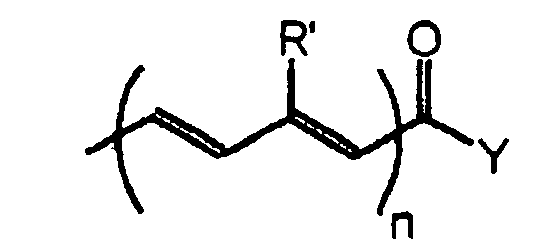 where n is 1 or 2;
 -
- The R' groups independently represent a hydrogen atom; a (C1-C5)alkyl group; a (C6-C10)aryl group optionally substituted by a halogen atom, by an optionally halogenated (C1-C5)alkyl group or by optionally halogenated (C1-C5)alkoxy; or a mono- or bicyclic (C4-C12)heteroaryl group comprising one or more heteroatoms chosen from O, N and S which is optionally substituted by a halogen atom, by an optionally halogenated (C1-C5)alkyl group or by an optionally halogenated (C1-C5)alkoxy group;
Y represents -OH; (C1-C5)alkoxy; or the -NRcRd group (in which Rc and Rd independently represent a hydrogen atom; (C1-C5)alkyl; (C3-C8)cycloalkyl optionally substituted by a halogen atom, by optionally halogenated (C1-C5)alkyl or by optionally halogenated (C1-C5)alkoxy; (C6-C10)aryl optionally substituted by a halogen atom, by optionally halogenated (C1-C5)alkyl or by optionally halogenated (C1-C5)alkoxy;
Or Y represents glucomic acidit being understood that one and one alone from R1 and R2 represents the Z chain.
- The invention is also targeted, depending on the functional groups present in the molecule, at the salts of these compounds with pharmaceutically acceptable acids or bases, and at esters of those compounds.
- When the compound of formula (I) comprises an acidic functional group, for example a carboxyl functional group, the latter can form a salt with an inorganic or organic base.
- Mention may be made, as example of salts with organic or inorganic bases, of the salts formed with metals and in particular alkali, alkaline earth and transition metals (such as sodium, potassium calcium, magnesium or aluminium) or with bases, such as ammonia or secondary or tertiary amines (such as diethylamine, triethylamine, piperidine, piperazine or morpholine), or with basic amino acids or with osamines (such as meglumine) or with aminoalcohols (such as 3-aminobutanol and 2-aminoethanol).
- When the compound of formula (I) comprises a basic functional group, for example a nitrogen atom, the latter can form a salt with an organic or inorganic acid.
- The salts with organic or inorganic acids are, for example, the hydrochloride, hydrobromide, sulphate, hydrogensulphate, dihydrogenphosphate, maleate, fumarate, 2-naphthalenesulphonate and para-toluene-sulphonate salts.
- The invention also covers the salts which make possible a suitable separation or a suitable crystallization of the compounds of formula (I), such as picric acid, oxalic acid or an optically active acid, for example tartaric acid, dibenzoyltartaric acid, mandelic acid or camphorsulphonic acid.
- The formula (I) encompasses all the types of geometric isomers and stereoisomers of the compounds of formula (I).
- According to the invention, the term "alkyl" denotes a linear or branched hydrocarbon-comprising radical, such as methyl, ethyl, propyl, isopropyl, butyl, tert-butyl, isobutyl, pentyl, hexyl, heptyl, octyl, nonyl, decyl, undecyl, dodecyl, tridecyl, tetradecyl, pentadecyl, hexadecyl, heptadecyl or octadecyl.
- When the alkyl group is substituted by one or more halogen atoms, it is preferable for it to represent perfluoroalkyl and in particular pentafluoroethyl or trifluoromethyl.
- The term "alkoxy" denotes an alkyl group as defined above bonded to an oxygen atom. Examples thereof are the methoxy, ethoxy, isopropyloxy, butoxy and hexyloxy radicals.
- The term "alkylene group" is understood to mean linear or branched alkylene groups, that is to say bivalent radicals which are linear or branched bivalent alkyl chains.
- The term "cycloalkyl" denotes saturated hydrocarbon-comprising groups which can be mono- or polycyclic and comprise from 3 to 12 carbon atoms, preferably from 3 to 8. Preference is more particularly given to monocyclic cycloalkyl groups, such as cyclopropyl, cyclobutyl, cyclopentyl, cyclohexyl, cycloheptyl, cyclooctyl, cyclononyl, cyclodecyl, cycloundecyl and cyclododecyl.
- The term "cycloalkenyl" is understood to mean, according to the invention, a cycloalkyl group exhibiting one or more double bonds.
- The term "halogen" is understood to mean a fluorine, chlorine, bromine or iodine atom.
- The term "aryl" represents a mono- or bicyclic aromatic hydrocarbon-comprising group comprising 6 to 10 carbon atoms, such as phenyl or naphthyl.
- The term "mono- or bicyclic heteroaryl" denotes monocyclic or bicyclic aromatic groups comprising one or more endocyclic heteroatoms. Examples thereof are the furyl, thienyl, pyrrolyl, oxazolyl, isoxazolyl, thiazolyl, isothiazolyl, imidazolyl, pyrazolyl, oxadiazolyl, triazolyl, thiadiazolyl, pyridinyl, pyridazinyl, pyrazinyl, triazinyl, indolizinyl, indolyl, isoindolyl, benzofuryl, benzothienyl, indazolyl, benzimidazolyl, benzothiazolyl, purinyl, quinolyl, quinolizinyl, iqoquinolyl, cinnolinyl, phthalazinyl, quinazolinyl, quinoxalinyl, pteridinyl and benzoxepinyl groups.
- Preferred heteroaryls comprise from 4 to 10 carbon atoms and from 1 to 2 heteroatoms.
- The alkenyl and alkynyl groups can comprise more than one unsaturation.
- The alkenyl groups comprise unsaturations of ethylenic type and the alkynyl groups comprise unsaturations of acetylenic type.
- The (C6-C10)aryl, (C3-C8) cycloalkyl, heteroaryl and cycloalkenyl groups are optionally substituted. The expression "optionally substituted by a halogen atom, by an optionally halogenated (C1-C5)alkyl group or by an optionally halogenated (C1-C5)alkoxy group" indicates that the said aryl, cycloalkyl, heteroaryl and cycloalkenyl groups are optionally substituted by one or more substituents chosen from:
- halogen atoms;
- alkyl groups optionally substituted by one or more halogen atoms; and
- alkoxy groups optionally substituted by one or more halogen atoms.
- In the same way, the alkylene chain, when it is substituted, can comprise one or more identical or different substituents chosen from halogen atoms and optionally halogenated alkoxy groups.
- The expression "optionally halogenated" means, in the context of the invention, optionally substituted by one or more halogen atoms.
- In the context of the present invention, the term "benzoxepine" has been used to denote the benzo[b]oxepine structure of formula:
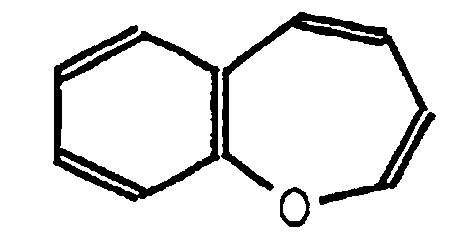
- According to the invention, preference is given to the compounds in which A represents the radical:
- Another preferred group of compounds of formula (I) is composed:
- of the compounds in which:
- X represents O;
- A represents -CR3R4- or -CH2-CR3R4- in which the unsubstituted methylene group is bonded to X;
- R1 and R2 independently represent Z; H; (C1-C15)alkyl; (C1-C15) alkenyl ; or phenyl optionally substituted by (C1-C5)alkyl, (C1-C5)alkoxy, a halogen atom or -CF3;
- R3 takes any one of the meanings given above for R1 and R2, with the exception of Z;
- R is chosen from (C1-C9)alkyl; (C1-C5)alkoxy; phenyl or phenylcarbonyl optionally substituted by a halogen atom, (C1-C5)alkyl, (C1-C5)alkoxy, -CF3 or -OCF3; a halogen atom; -CF3 and -OCF3;
- Z represents the radical:
where n represents 1;

- R' represents (C1-C5)alkyl. Preference is given, among these compounds, to those in which:
- X represents O;
- A represents -CR3R4-;
- Z represents
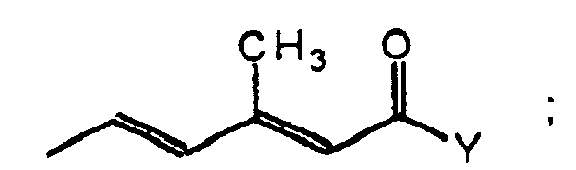
- or alternatively those in which:
- X represents O;
- A represents -CH2-CR3R4- in which the unsubstituted methylene group is bonded to X;
- R1 and R2 independently represent Z, a hydrogen atom or (C1-C5)alkyl; preferably, R1 represents Z ; preferably R2 represents a hydrogen atom.
- R3 and R4 independently takes any one of the meanings given above for R1 and R2, with the exception of Z; Preferably R3 and R4 independently represent a (C1-C5) alkyl group, more preferably a methyl, ethyl, isopropyl, propyl and most preferably a methyl.
- Z represents
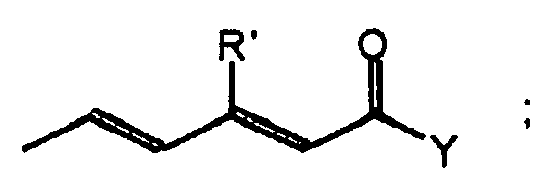
- R' represents (C1-C5) alkyl, notably a methyl or phenyl, preferably a methyl.
- Preferred meanings of Y are:
- -OH
- -(C1-C5)alkoxy; and
- -NRcRd where Rc and Rd are as defined above for the formula (I). Very preferably, Y represents -OH or -(C1-C5)alkoxy, notably a methoxy, ethoxy, isopropryloxy and most preferably ethoxy.Preferably R represents a (C1-C5) alkoxy, notably a methoxy, ethoxy, isopropyloxy, preferably methoxy. Likewise, it is preferable for p to have the
- [X represents O ;
- A represents -CH2-CR3R4- in which the unsubstituted methylene group is bonded to X ;
- R1 is Z and R2 is H;
- R3 and R4 independently represents a (C1-C5) alkyl group;
- R is a (C1-C5) alkoxy;
- Z represents
wherein R' represents a methyl or phenyl ; and y represents a (C1-C5)alkoxy].

- According to a particularly advantageous embodiment of the invention, the compounds of the groups which are preferred defined above are such that p and Y take one of these meanings.
- Mention may be made, as example of preferred compounds, of the following compounds:
- (2E, 4E)-5-(2-pentyl-2H-1-benzopyran-3-yl)-3-methylpenta-2,4-dienoic acid;
- (2Z, 4E)-5-(2-pentyl-2H-1-benzopyran-3-yl)-3-methylpenta-2,4-dienoic acid;
- (2E, 4E)-5-(2,2-dimethyl-6-methoxy-2H-1-benzopyran-3-yl)-3-methylpenta-2,4-dienoic acid;
- (2E, 4E)-5-(2H-1-benzopyran-3-yl)-3-methylpenta-2,4-dienoic acid;
- (2E, 4E)-5-(2,2-dimethyl-2H-1-benzopyran-3-yl)-3-methylpenta-2,4-dienoic acid;
- (2Z, 4E)-5-(2,2-dimethyl-2H-1-benzopyran-3-yl)-3-methylpenta-2,4-dienoic acid;
- (2E, 4E)-5-[2-(non-6-enyl)-2H-1-benzopyran-3-yl]-3-methylpenta-2,4-dienoic acid;
- (2E, 4E)-5-(4-phenyl-2H-1-benzopyran-3-yl)-3-methylpenta-2,4-dienoic acid;
- (2E, 4E)-5-(6-nonyl-2H-1-benzopyran-3-yl)-3-methyl-penta-2,4-dienoic acid;
- (2E, 4E)-5-(6-phenyl-2H-1-benzopyran-3-yl)-3-methylpenta-2,4-dienoic acid;
- (2E, 4E)-5-(2-nonyl-2H-1-benzopyran-3-yl)-3-methyl-penta-2,4-dienoic acid;
- (2E, 4E)-5-(4-methyl-2H-1-benzopyran-3-yl)-3-methylpenta-2,4-dienoic acid;
- (2Z, 4E)-5-(2H-1-benzopyran-3-yl)-3-methylpenta-2,4-dienoic acid;
- (2E, 4E)-5-(2-undecanyl-2H-1-benzopyran-3-yl)-3-methylpenta-2,4-dienoic acid;
- (2E, 4E)-5-(2-phenyl-2H-1-benzopyran-3-yl)-3-methylpenta-2,4-dienoic acid;
- (2E, 4E)-5-(5-methyl-2,3-dihydrobenzoxepin-4-yl)-3-methylpenta-2,4-dienoic acid;
- (2E, 4E)-5-(3,3-dimethyl-7-methoxy-2,3-dihydrobenzoxepin-5-yl)-3-methylpenta-2,4-dienoic acid; and [sic]
- (2E, 4E)-5-(2,3-dihydrobenzoxepin-4-yl)-3-methylpenta-2,4-dienoic acid;
- (2E, 4E)-5-(3,3-dimethyl-7-methoxy-2,3-dihydrobenzoxepin-5-yl)-3-phenylpenta-2,4-dienoic acid;
- (2Z, 4E)-5-(3,3-dimethyl-7-methoxy-2,3-dihydrobenzoxepin-5-yl)-3-phenylpenta-2,4-dienoic acid;
- (2Z, 4E)-5-(3,3-dimethyl-7-methoxy-2,3-dihydrobenzoxepin-5-yl)-3-methylpenta-2,4-dienoic acid;
- (2E, 4E)-5-(3,3-dimethyl-7,8-dimethoxy-2,3-dihydrobenzoxepin-5-yl)-3-methylpenta-2,4-dienoic acid;
- (2E, 4E)-5-(3,3-dimethyl-2,3-dihydrobenzoxepin-5-yl)-3-methylpenta-2,4-dienoic acid;
- (2E, 4E)-5-(3,3-dimethyl-2,3-dihydro-7-(para-chlorobenzoyl)benzoxepin-5-yl)-3-methylpenta-2,4-dienoic acid;
- (2E, 4E)-5-(3,3-dimethyl-7-chloro-2,3-dihydrobenzoxepin-5-yl)-3-methylpenta-2,4-dienoic acid;
- (2E, 4E)-5-(3,3-dimethyl-7,8-dichloro-2,3-dihydrobenzoxepin-5-yl)-3-methylpenta-2,4-dienoic acid;
- (2E, 4E)-5-(3,3-dimethyl-7-bromo-2,3-dihydrobenzoxepin-5-yl)-3-methylpenta-2,4-dienoic acid;
- (2E, 4E)-5-(3,3-dimethyl-7-fluoro-8-chloro-2,3-dihydrobenzoxepin-5-yl)-3-methylpenta-2,4-dienoic acid;
- (2E, 4E)-5-(3,3-dimethyl-7-fluoro-2,3-dihydrobenzoxepin-5-yl)-3-methylpenta-2,4-dienoic acid;
- (2E, 4E)-5-(3,3-dimethyl-7-trifluoromethyl-2,3-dihydrobenzoxepin-5-yl)-3-methylpenta-2,4-dienoic acid;
- (2E, 4E)-5-(3,3-dimethyl-7-phenyl-2,3-dihydrobenzoxepin-5-yl)-3-methylpenta-2,4-dienoic acid;
- (2E, 4E)-5-(3,3,7-trimethyl-2,3-dihydrobenzoxepin-5-yl)-3-methylpenta-2,4-dienoic acid;
- (2E, 4E)-5-(3,3-dimethyl-2,3-dihydrobenzoxepin-5-yl)-3-methylpenta-2,4-dienoic acid;
- (2E, 4E)-5-(9-methoxy-3,3-dimethyl-2,3-dihydrobenzoxepin-5-yl)-3-methylpenta-2,4-dienoic acid;
- The most preferred compound to be administered in the methods according to the invention, and to be used for the preparation of the medicaments according to the invention, and to be contained as the active principle in the new medicaments is the
- (2E,4E)-5-(3,3-dimethyl-7-methoxy-2,3-dihydrobenzoxepin-5-yl)-3-methylpenta-2,4-dienoic acid (compound A), or its pharmaceutically acceptable salts or esters, among which its ethyl ester.
- The compounds of formula (I) can be prepared by using one of the processes described in EP-A-1,140,893 or US-B-6,596,758.
- The invention additionally relates to pharmaceutical compositions comprising a pharmaceutically effective amount according to the invention of a compound of formula (I) as defined above in combination with one or more pharmaceutically acceptable vehicles.
- These compositions can be administered orally in the form of immediate-release or controlled-release granules, hard gelatin capsules or tablets, intravenously in the form of an injectable solution, transdermally in the form of an adhesive transdermal device, or locally in the form of a solution, cream or gel.
- A solid composition for oral administration is prepared by addition of a filler and, if appropriate, a binder, a disintegration agent, a lubricant, a colorant or a flavour enhancer to the active principle and by shaping the mixture as a tablet, a coated tablet, a granule, a powder or a capsule.
- Examples of fillers encompass lactose, maize starch, sucrose, glucose, sorbitol, crystalline cellulose and silicon dioxide, and examples of binders encompass poly(vinyl alcohol), poly(vinyl ether), ethylcellulose, methycellulose, acacia, gum tragacanth, gelatin, shellac, hydroxypropylcellulose, hydroxypropylmethycellulose, calcium citrate, dextrin and pectin. Examples of lubricants encompass magnesium stearate, talc, polyethylene glycol, silica and hardened vegetable oils. The colorant can be any of those authorized for use in medicaments. Examples of flavour enhancers encompass cocoa powder, mint in herbal form, aromatic powder, mint in oil form, borneol and cinnamon powder. Of course, the tablet or the granule can be suitably coated with sugar, gelatin or the like.
- An injectable form comprising the compound of the present invention as active principle is prepared, if appropriate, by mixing the said compound with a pH regulator, a buffer, a suspending agent, a solubilizing agent, a stabilizer, a tonicity agent and/or a preservative and by converting the mixture into a form for intravenous, subcutaneous or intramuscular injection, according to a conventional process. If appropriate, the injectable form obtained can be lyophilized by a conventional process.
- Examples of suspending agents encompass methycellulose, polysorbate 80, hydroxyethyl-cellulose, acacia, gum tragacanth powder, sodium carboxymethylcellulose and polyethoxylated sorbitan monolaurate.
- Examples of solubilizing agent encompass castor oil solidified with polyoxyethylene, polysorbate 80, nicotinamide, polyethoxylated sorbitan monolaurate and the ethyl ester of castor oil fatty acid.
- In addition, the stabilizer encompasses sodium sulphite, sodium metasulphite and ether, while the preservative encompasses methyl p-hydroxybenzoate, ethyl p-hydroxybenzoate, sorbic acid, phenyl, cresol and chlorocresol.
- Examples of compounds useful in the present invention are given in Table 1.
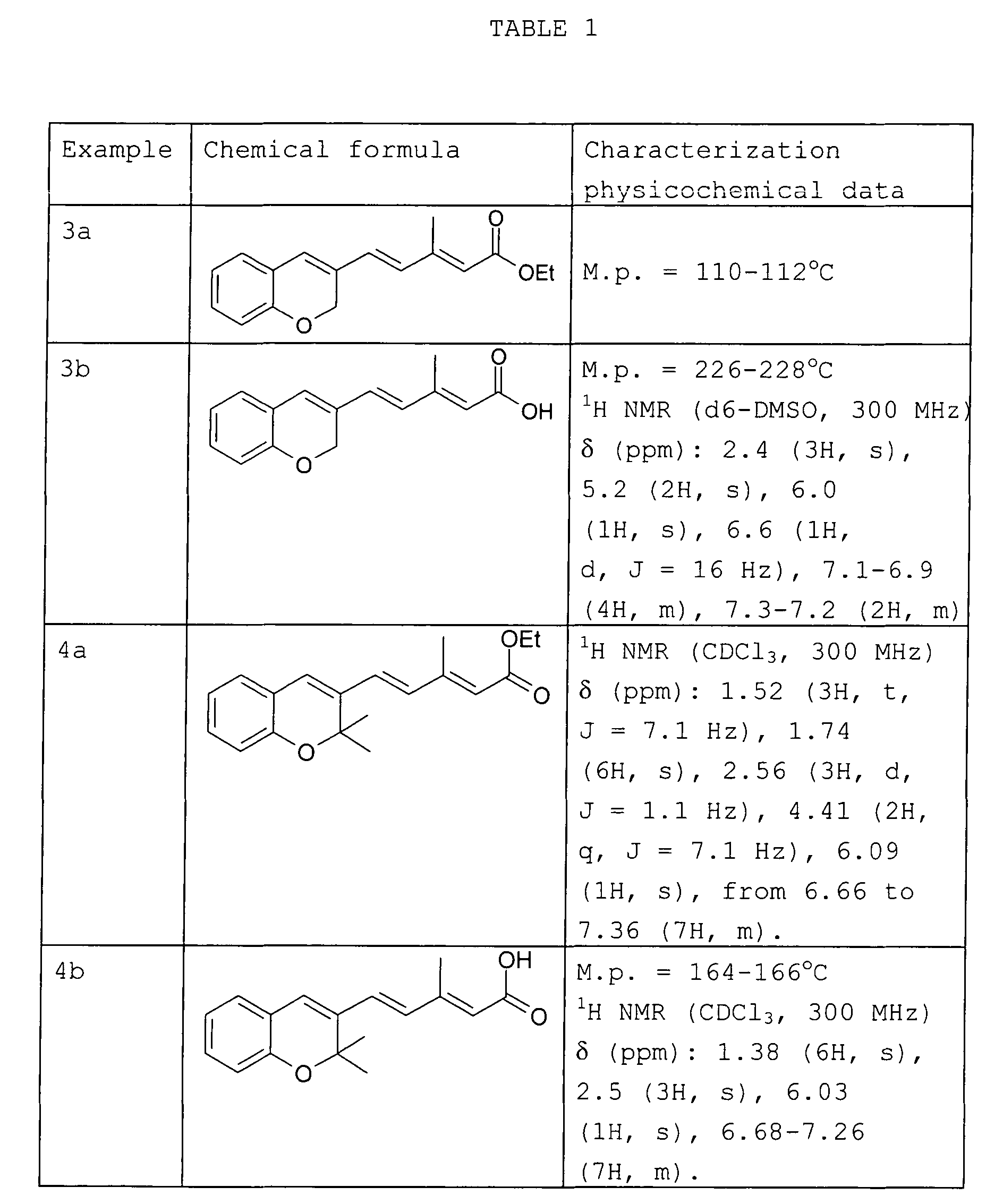
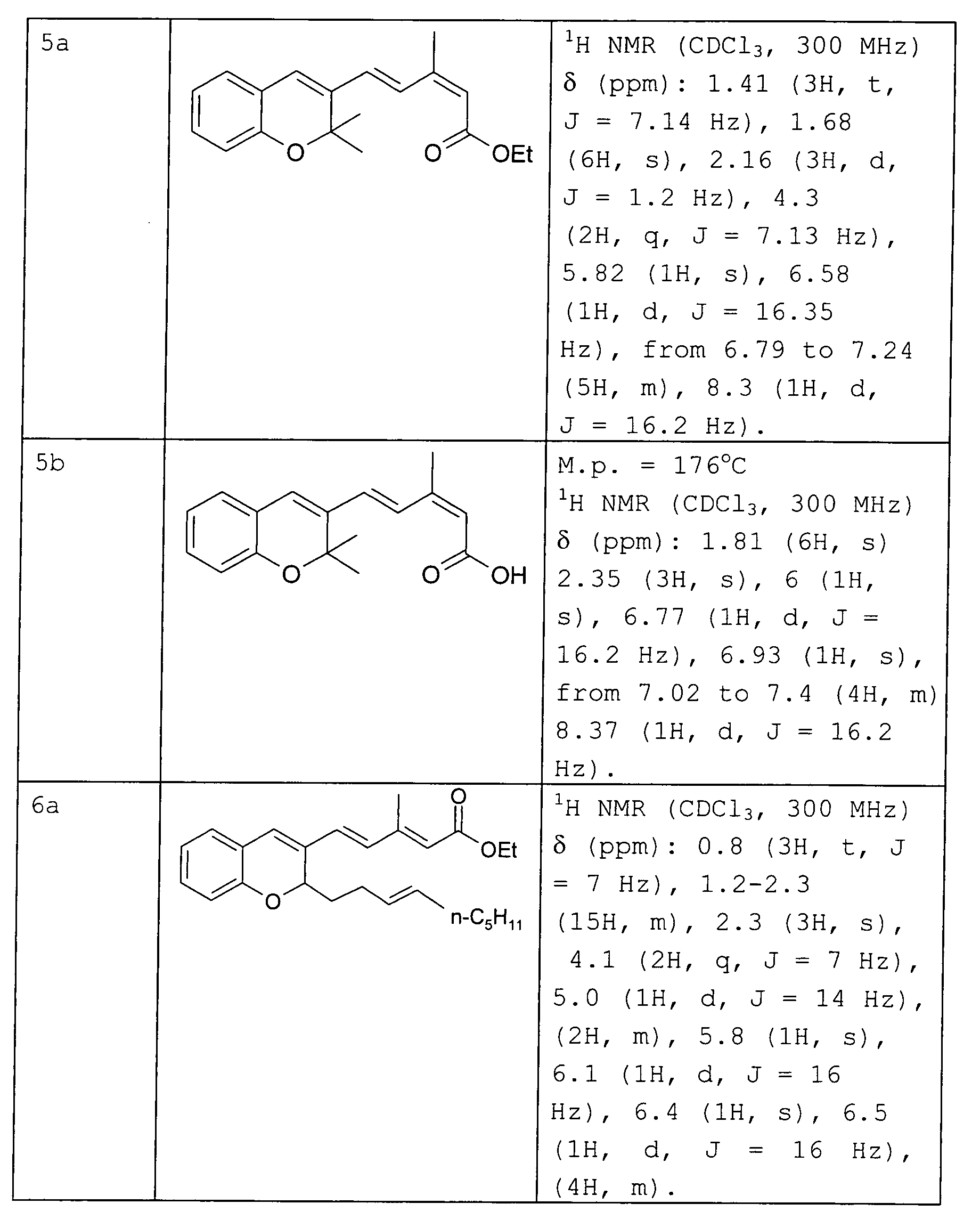
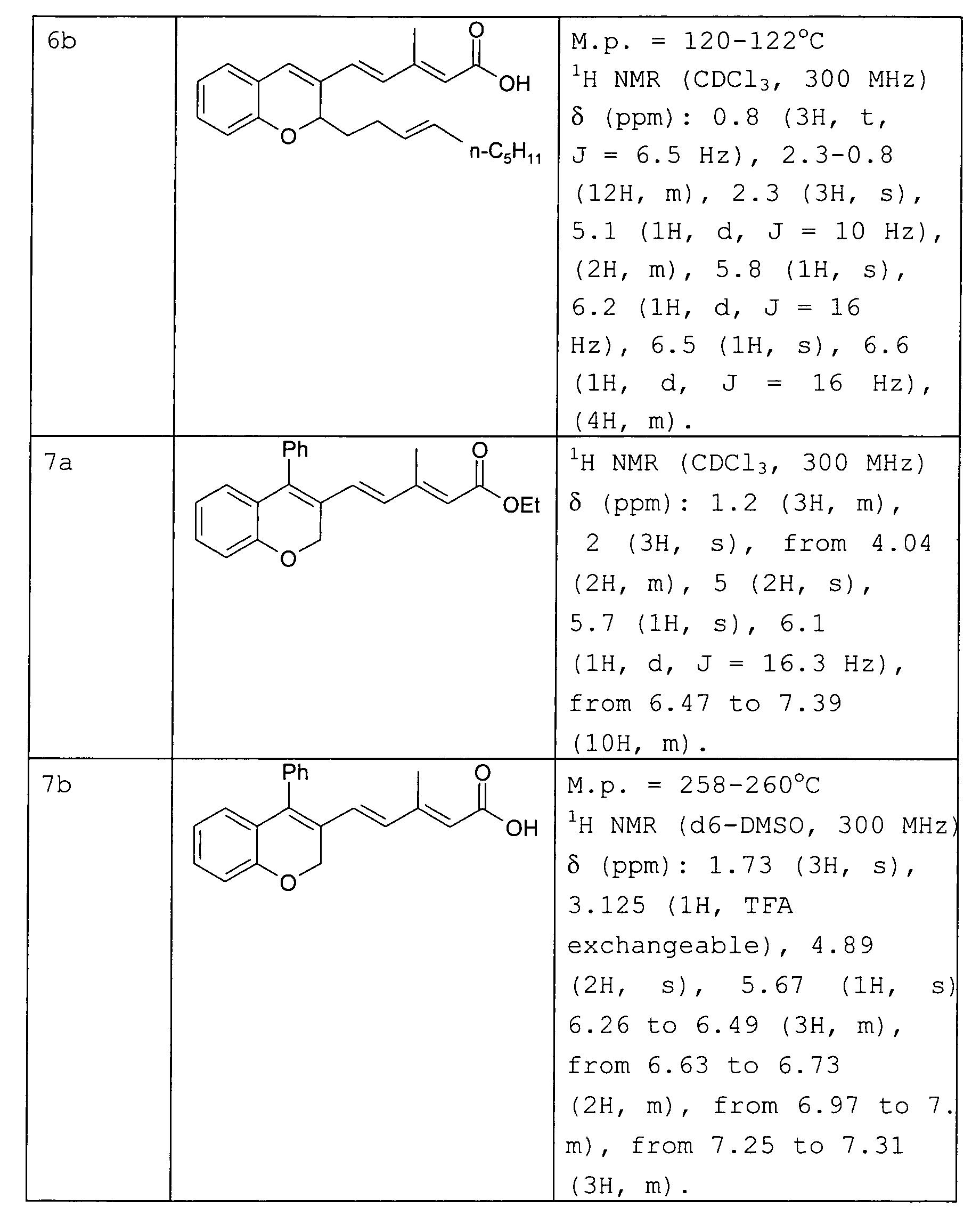

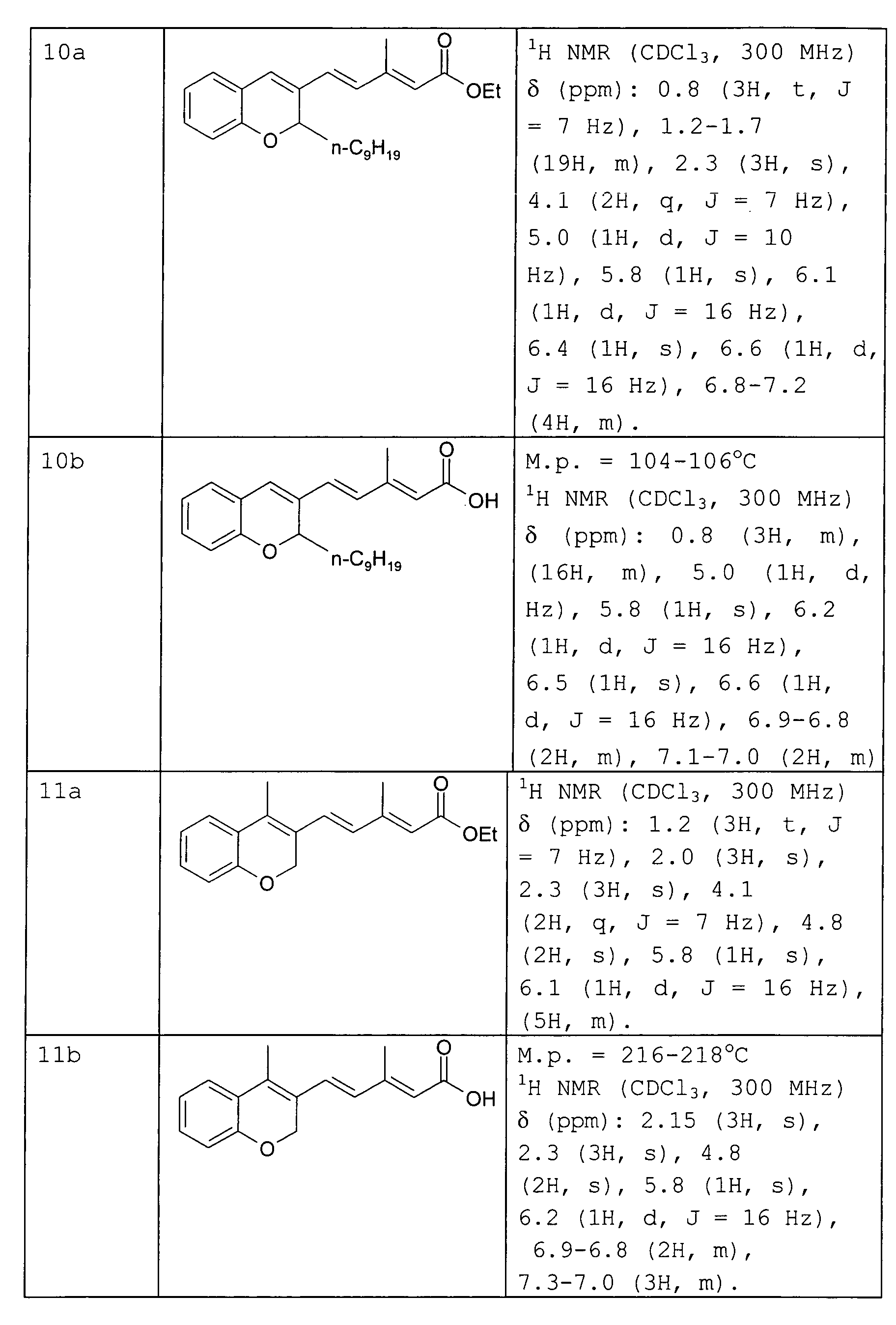


- Other coumpound examples are given in the following Table 2.
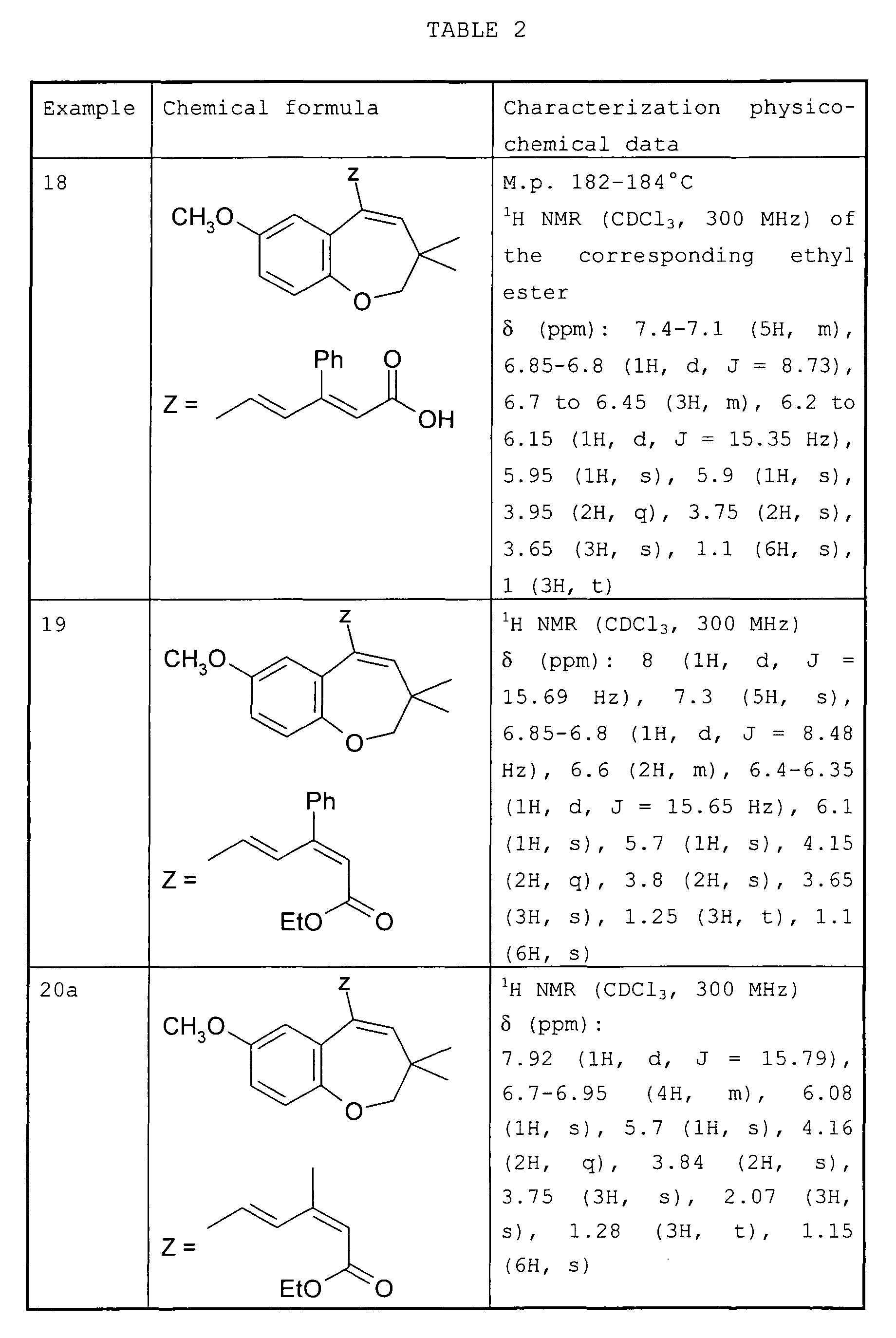


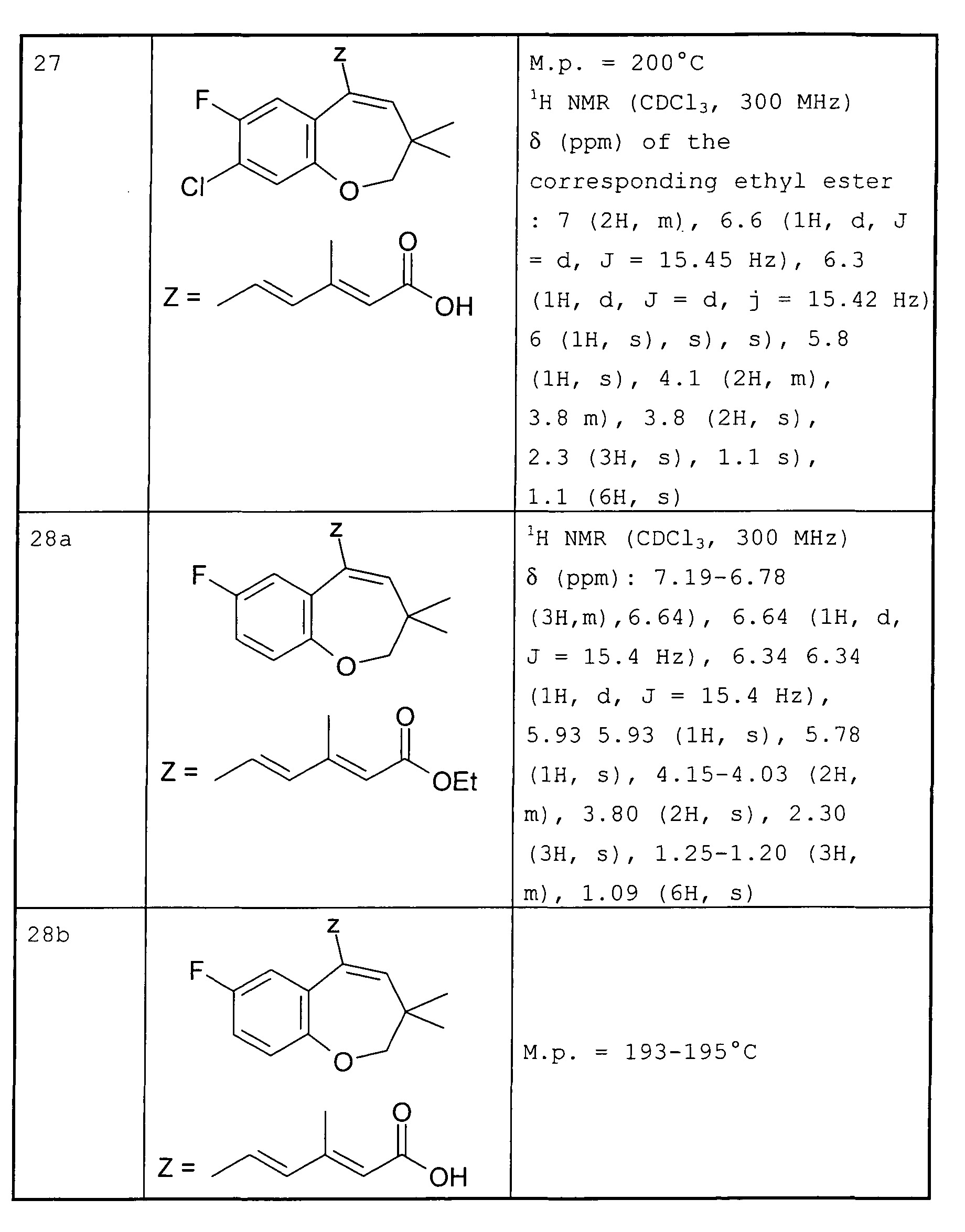
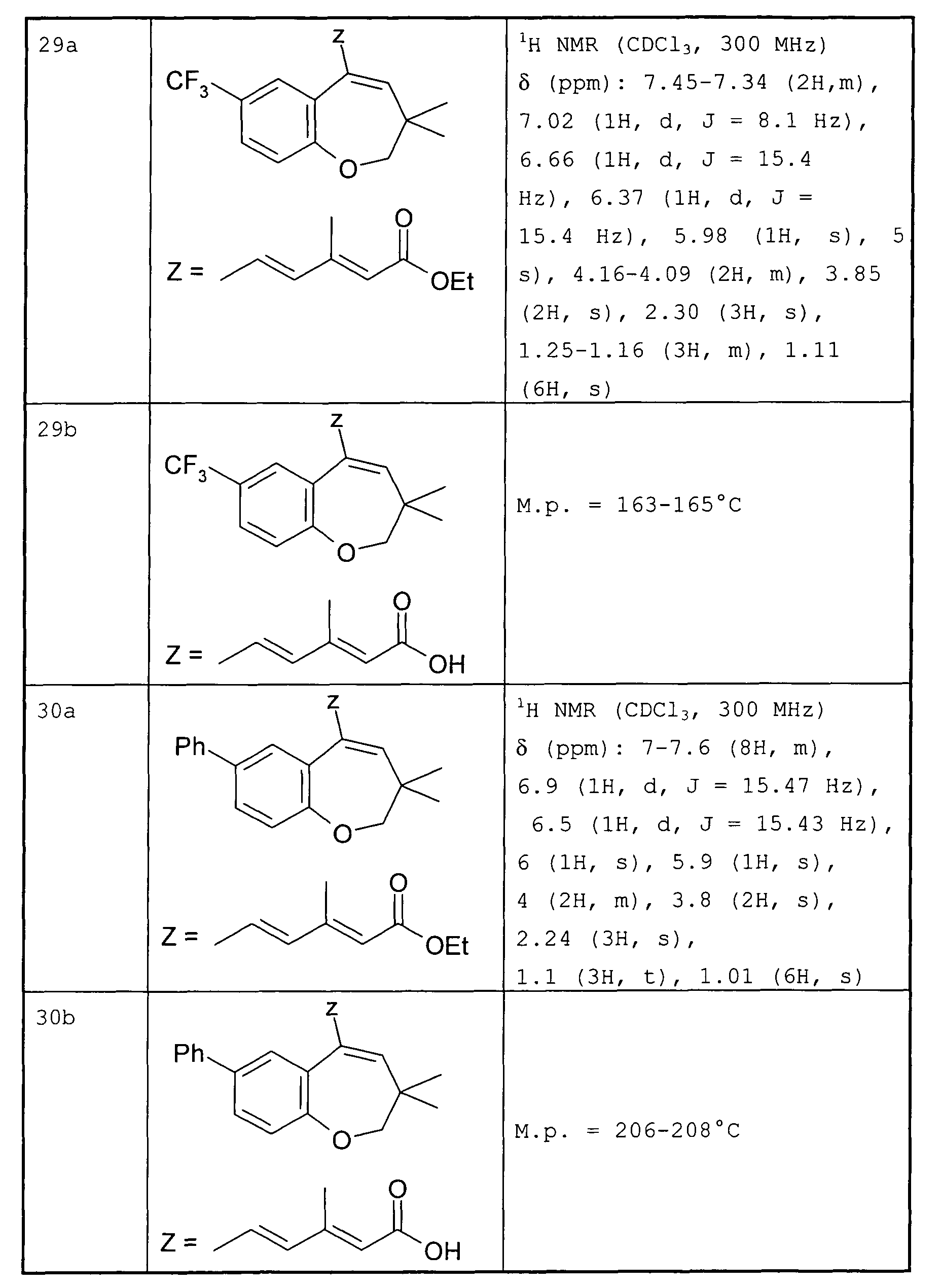


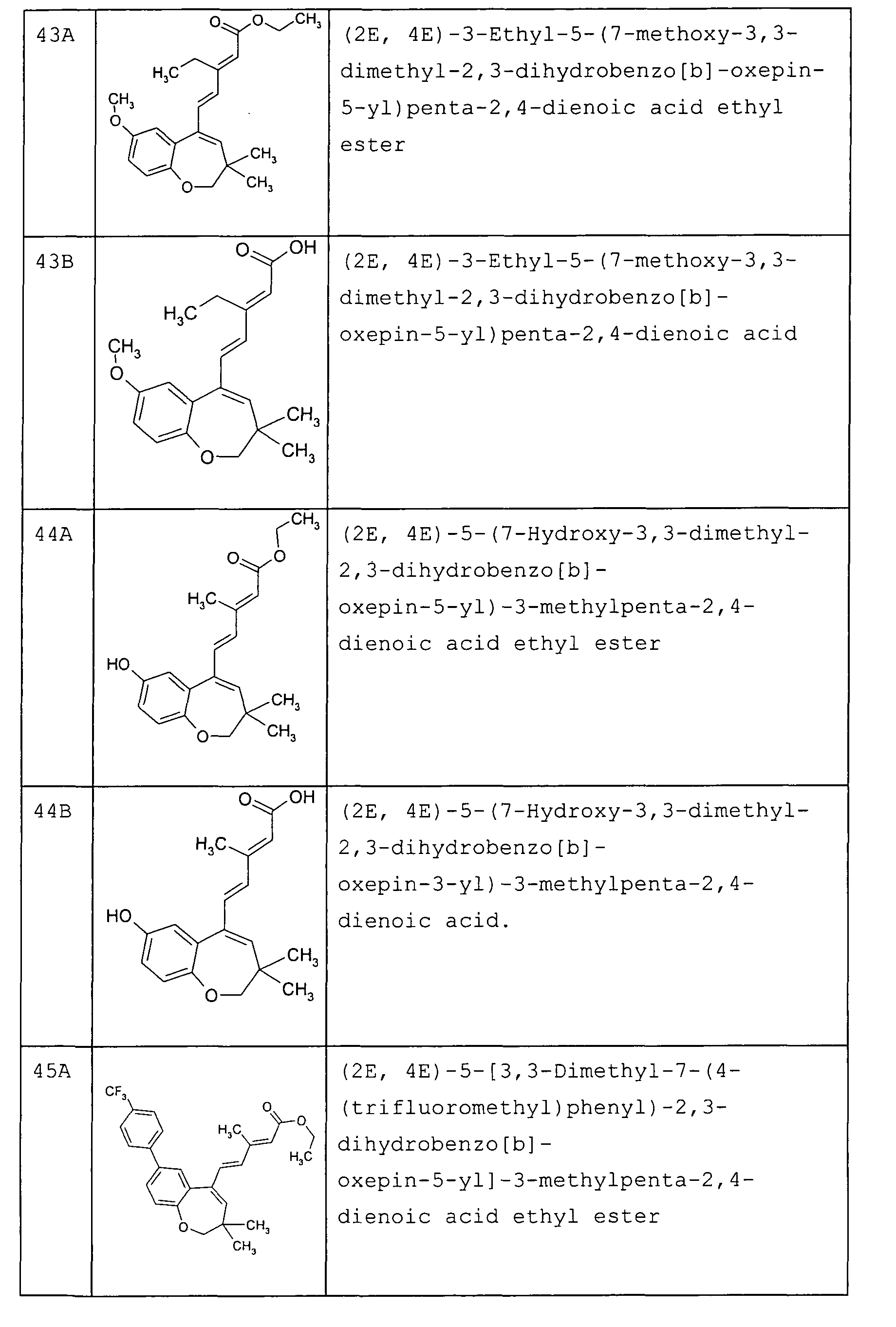


- The invention will now be described with reference to compound A.
- Hypouricemic effect of compound A in healthy male volunteers
- Forty-eight healthy male volunteers received orally either EMD or a placebo as a single administration in the morning. Six doses were administered 50 mg, 100 mg, 200 mg, 400 mg, 800 mg and 1200 mg once daily. In each group of dose, 6 subjects received compound A and 2 subjects received a placebo. Plasma uric acid concentrations were assessed in all dose groups.
- In all subjects receiving compound A, a dose dependant decrease in plasma uric acid concentration was observed at 24 hours in all groups of dose. The drop of plasma uric acid concentration was around 45 % for the lowest tested dose (50 mg) and the maximum effect was observed from the 800 mg dose (80 %). No change was observed in placebo.
- Figure 1:
- Mean plasma uric acid concentration in each group of dose before and 24 hours after drug intake (single dose) in subjects receiving compound A.
- Sixteen healthy male volunteers received orally either EMD or a placebo as a single administration in the morning (Day 1) followed 3 days later by a repeated administration during 7 days (Day 4 to Day 10); 100 mg and 200 mg were administered once daily. In each group of dose, 6 subjects received compound A and 2 subjects received a placebo. No change was observed in placebo.
- Figure 2 :
- Mean plasma uric acid concentration per dose group as a function of time and drug dose in subjects receiving repeated administration of compound A.
- Second Edition. Edited by Davison A.M., Cameron J.S., Grünfeld J.P., Kerr D.N.S., Ritz E. and Winearls C.G. Oxford University Press.
- 6. The patient with chronic interstitial disease
- 6.4 Uric acid and the kidney. Cameron S.J., Moro F. and Simmonds H.A. 1157-1173
- 8. The patient with renal stone disease
- 8.1 Aetiological factors in stone formation. Watts
R.W.E.,
Uric acid and urate stones, 1333-1334 - 8.2 The medical management of stone disease. Sutton
R.A.L.
Uric acid stones, 1352-1353 - 19.2 Handling of drugs in kidney disease.
Carmichael D.J.S.
Hyperuricemia, anti-inflammatory agents, 2671-2672 - Fifth Edition. Edited by Brenner B.M. W.B. Saunders Company.
- 15. Renal hanling of organic anions and cations and
renal excretion on uric acid. Sica D.A.,
Schoolwerth A.C.
Urate transport 613-617 - 28. Acute renal failure. Brady H.R., Brenner B.M.,
Lieberthal W.
Acute tubule necrosis. 1204-1207
Intrinsic renal azotemia, prevention. 1232 - 31. Secondary glomerular diseases. Adler S.G.,
Cohen A.H., Glassock R. J.
Medications, immunizations, and allergens. 1563-1566 - 33. Tubulointerstitial Diseases. Kelly C.J.,
Neilson E.G.
Acute interstitial nephritis. 1661-1665
Chronic interstitial nephritis, uric acid nephropathy. 1669 - 34. Toxic Nephropathy. Cronin R., Henrich W.L,
Nephrotoxicity of tumor cell lysis 1692 - 40. Nephrolithiasis. Asplin J.R., Favus M.J., Coe
F.L.
Hyperuricosuria 1912-1915
Uric acid stones. 1922-1924 - 2nd Edition Edited by Tisher C. C., Brenner B. J.B. Lippincott company
- - 45. Urate and Uric Acid Nephropathy, Cystinosis,
and Oxalosis. Chonko A.M., Richardson W.P.
Urate and uric acid nephropathy. 1413-1423 -
- Edited by Klippel J.H., Dieppe P.A., Brooks p, Carette S., Dequeker J., Gerber L.H., Hazleman B.L., Keat A.C.S., Kimberly R.P., Liang M.H., Maini R.N., van de Putte L., Sturrock R.D., Urowitz M.B., Wollheim F.A., Kimberly R.P., Zvaifler N.J. Mosby.
- Part 7: Disorders of Bone, Cartilage and Connective Tissue. Dequeker J., van de Putte L.
- 12. Crystal arthropathies: Gout. Cohen M. G. & Emmerson B.T. 12.1-12.16
- Part 8: Management of Rheumatic Diseases. Brooks P.M. & Gerber L.H
- Pharmacologic approaches, NSAIDs. Brooks P., 10.1-10.6
- Pharmacologic approaches, Systemic corticosteroids in rheumatology. Kirwan J.R. 11.1-11.6
- Pharmacological approaches, Antihyperuricemics. Emmerson B.T. 15.1-15.5
- 14th Edition edited by Fauci A.S., Martin J.B., Braunwald E., Kasper D.L., Isselbacher K.J., Hauser S. L., Wilson J.D., Longo D.L. McGraw-Hill
- Part Ten: Disorders of the Kidney and Urinary Tract
- 270: Acute renal failure. Brady H.R., Brenner B.M. 1504-1513
- 271: Chronic renal failure. Lazarus J.M., Brenner B.M. 1513-1520
- 276: Tubulointerstitial diseases of the kidney. Brenner B.M., Levy E., Hostetter T.H. 1553-1556
- Part Thirteen: Endocrinology and Metabolism
- Section 2: Disorders of Intermediary Metabolism 344: Gout and other disorders of purine metabolism. Wortmann R.L. 2158-2166
- Ninth Edition, Edited by Hardman J.G., Limbird L.E., Molinoff P.B., Ruddon R.W., Goodman Gilman A. McGraw-Hill
- Section IV, Autacoïds; Drug Therapy of Inflammation
- 27. Analgesic-antipyretic and antiinflammatory
agents and drugs employed in the treatment of gout.
Insel P.A.
Drug employed in the treatment of gout 647-650;
Uricosuric agents 650-653
Treatment of gout and hyperuricemia 653-655
Claims (33)
- The use of a pentadienoic acid derivative of formula (I) for the preparation of a medicament for the prevention or treatment of hyperuricemia and/or one or several associated disorders or diseases, and/or for reducing the serum uric acid level of a subject.in which:
 in which radicals s = t = 0 or else one of s and t has the value 0 and the other has the value 1;X represents O or S;A represents either the divalent radical - (CH2)s-CO-(CH2)t- or the divalent radical - (CH2)s-CR3R4-(CH2)t-and their pharmaceutically acceptable salts with acids or bases, or esters.R4 represents a hydrogen atom or a (C1-C15)alkyl group;R1 and R2 independently represent the Z chain defined below; a hydrogen atom; a (C1-C18)alkyl group; a (C2-C18)alkenyl group; a (C2-C18)alkynyl group; a (C6-C10)aryl group optionally substituted by a halogen atom, by an optionally halogenated (C1-C5)alkyl group or by an optionally halogenated (C1-C5)alkoxy group; or a mono- or bicyclic (C4-C12)heteroaryl group comprising one or more heteroatoms chosen from O, N and S which is optionally substituted by a halogen atom, by an optionally halogenated (C1-C5)alkyl group or by an optionally halogenated (C1-C5)alkoxy group;R3 and R4 independently takes any one of the meanings given above for R1 and R2, with the exception of the Z chain; or elseR3 and R4 together form a (C2-C6)alkylene chain optionally substituted by a halogen atom or by optionally halogenated (C1-C5)alkoxy;R is chosen from a halogen atom; a cyano group; a nitro group; a carboxy group; an optionally halogenated (C1-C18)alkoxycarbonyl group; an Ra-CO-NH- or RaRbN-CO- group [in which Ra and Rb independently represent optionally halogenated (C1-C18)alkyl; a hydrogen atom; (C6-C10)aryl or (C6-C10)aryl (C1-C5) alkyl (where the aryl parts are optionally substituted by a halogen atom, by an optionally halogenated (C1-C5)alkyl group or by an optionally halogenated (C1-C5)alkoxy group); (C3-C12) cycloalkyl optionally substituted by a halogen atom, by an optionally halogenated C1-C5 alkyl [sic] group or by an optionally halogenated (C1-C5)alkoxy group]; an optionally halogenated (C1-C18)alkyl group; optionally halogenated (C1-C18)alkoxy; and (C6-C10)aryl, (C6-C10)aryl (C1-C5)alkyl, (C6-C10)aryloxy, (C3-C12)cycloalkyl, (C3-C12)cycloalkenyl, (C3-C12)cycloalkyloxy or (C3-C12)cycloalkenyloxy in which the aryl, cycloalkyl and cycloalkenyl parts are optionally substituted by a halogen atom, by optionally halogenated (C1-C5)alkyl or by optionally halogenated (C1-C5)alkoxy; -OH;p represents 0, 1, 2, 3 or 4;Z represents the radical:where n is 1 or 2;
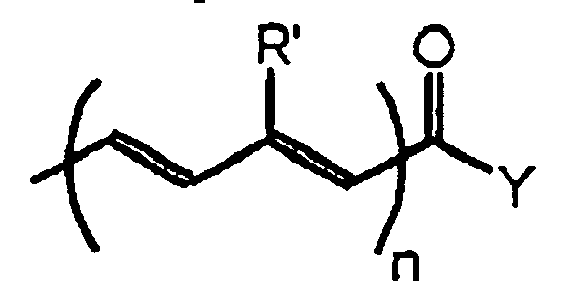 the R' groups independently represent a hydrogen atom; a (C1-C5)alkyl group; a (C6-C10)aryl group optionally substituted by a halogen atom, by an optionally halogenated (C1-C5)alkyl group or by optionally halogenated (C1-C5)alkoxy; or a mono- or bicyclic (C4-C12)heteroaryl group comprising one or more heteroatoms chosen from O, N and S which is optionally substituted by a halogen atom, by an optionally halogenated (C1-C5)alkyl group or by an optionally halogenated (C1-C5)alkoxy group;Y represents -OH; (C1-C5)alkoxy; or the -NRcRd group (in which Rc and Rd independently represent a hydrogen atom; (C1-C5)alkyl; (C3-C8)cycloalkyl optionally substituted by a halogen atom, by optionally halogenated (C1-C5)alkyl or by optionally halogenated (C1-C5)alkoxy; (C6-C10)aryl optionally substituted by a halogen atom, by optionally halogenated (C1-C5)alkyl or by optionally halogenated (C1-C5)alkoxy;Or Y represents glucomic acidit being understood that one and one alone from R1 and R2 represents the Z chain;
- The use according to Claim 1, characterized in that A represents the divalent radical -(CH2)s-CR3R4-(CH2)t- in which s, t, R3 and R4 are as defined in Claim 1.
- The use according to Claim 1, characterized in that:X represents O;A represents -CR3R4- or -CH2-CR3R4- in which the unsubstituted methylene group is bonded to X;R1 and R2 independently represent Z; H; (C1-C15)alkyl; (C2-C15)alkenyl; or phenyl optionally substituted by (C1-C5)alkyl, (C1-C5)alkoxy, a halogen atom or -CF3;R3 and R4 independently takes any one of the meanings given above for R1 and R2, with the exception of Z;R is chosen from (C1-C9)alkyl; (C1-C5)alkoxy; phenyl or phenylcarbonyl optionally substituted by a halogen atom, (C1-C5)alkyl, (C1-C5)alkoxy, -CF3 or -OCF3; a halogen atom;-CF3 and -OCF3;Z represents the radical:where n represents 1; and
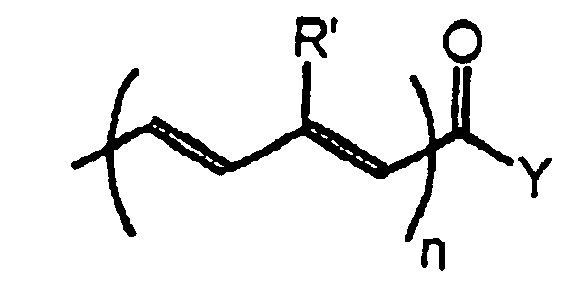 R' represents (C1-C5)alkyl or (C6-C10)aryl.
 - The use according to any one of Claims 1 to 3, wherein :X represents O;A represents -CH2-CR3R4- in which the unsubstituted methylene group is bonded to X;R1 and R2 independently represent Z, a hydrogen atom or (C1-C5)alkyl;R3 and R4 independently takes any one of the meanings given above for R1 and R2, with the exception of Z;Z representsand
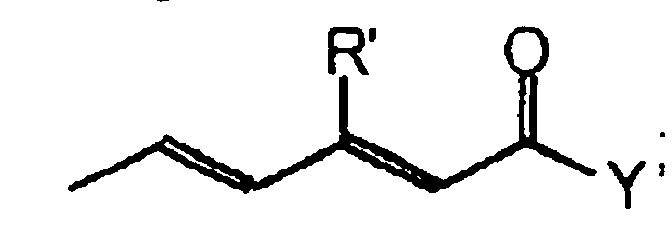 R' represents methyl or phenyl.
 - The use according to anyone of claims 1 to 4, wherein R1 represents Z.
- The use according to anyone of claims 1 to 5, wherein R2 represents a hydrogen atom.
- The use according to anyone of claims 1 to 6, wherein Y is a (C1-C5) alkoxy.
- The use according to any one of Claims 1 to 6, wherein :Y represents -OH; (C1-C5)alkoxy; or -NRcRd in which Rc and Rd are as defined in Claim 1.
- The use according to anyone of claims 1 to 8, wherein R' is methyl.
- The use according to any of claims 1 to 9, wherein R is (C1-C5) alkoxy.
- The use according to any one of Claims 1 to 6, wherein p represents 0, 1 or 2.
- The use according to claim 1, wherein :wherein R' represents a methyl or phenyl ; and y represents a (C1-C5)alkoxy] .[X represents O ;A represents -CH2-CR3R4- in which the unsubstituted methylene group is bonded to X ;R1 is Z and R2 is H;R3 and R4 independently represents a (C1-C5) alkyl group;R is a (C1-C5) alkoxy;Z represents

- The use according to claim 1 wherein said derivative is selected from the group consisting ofand their pharmaceutically acceptable esters.(2E, 4E)-5-(2-pentyl-2H-1-benzopyran-3-yl)-3-methylpenta-2,4-dienoic acid;(2Z, 4E)-5-(2-pentyl-2H-1-benzopyran-3-yl)-3-methylpenta-2,4-dienoic acid;(2E, 4E)-5-(2,2-dimethyl-6-methoxy-2H-1-benzopyran-3-yl)-3-methylpenta-2,4-dienoic acid;(2E, 4E)-5-(2H-1-benzopyran-3-yl)-3-methylpenta-2,4-dienoic acid;(2E, 4E)-5-(2,2-dimethyl-2H-1-benzopyran-3-yl)-3-methylpenta-2,4-dienoic acid;(2Z, 4E)-5-(2,2-dimethyl-2H-1-benzopyran-3-yl)-3-methylpenta-2,4-dienoic acid;(2E, 4E)-5-[2-(non-6-enyl)-2H-1-benzopyran-3-yl]-3-methylpenta-2,4-dienoic acid;(2E, 4E)-5-(4-phenyl-2H-1-benzopyran-3-yl)-3-methylpenta-2,4-dienoic acid;(2E, 4E)-5-(6-nonyl-2H-1-benzopyran-3-yl)-3-methylpenta-2,4-dienoic acid;(2E, 4E)-5-(6-phenyl-2H-1-benzopyran-3-yl)-3-methylpenta-2,4-dienoic acid;(2E, 4E)-5-(2-nonyl-2H-1-benzopyran-3-yl)-3-methylpenta-2,4-dienoic acid;(2E, 4E)-5-(4-methyl-2H-1-benzopyran-3-yl)-3-methylpenta-2,4-dienoic acid;(2Z, 4E)-5-(2H-1-benzopyran-3-yl)-3-methylpenta-2,4-dienoic acid;(2E, 4E)-5-(2-undecanyl-2H-1-benzopyran-3-yl)-3-methylpenta-2,4-dienoic acid;(2E, 4E)-5-(2-phenyl-2H-1-benzopyran-3-yl)-3-methylpenta-2,4-dienoic acid;(2E, 4E)-5-(5-methyl-2,3-dihydrobenzoxepin-4-yl)-3-methylpenta-2,4-dienoic acid;(2E, 4E)-5-(3,3-dimethyl-7-methoxy-2,3-dihydrobenzoxepin-5-yl)-3-methylpenta-2,4-dienoic acid; and(2E, 4E)-5-(2,3-dihydrobenzoxepin-4-yl)-3-methylpenta-2,4-dienoic acid;(2E, 4E)-5-(3,3-dimethyl-7-methoxy-2,3-dihydrobenzoxepin-5-yl)-3-phenylpenta-2,4-dienoic acid;(2Z, 4E)-5-(3,3-dimethyl-7-methoxy-2,3-dihydrobenzoxepin-5-yl)-3-phenylpenta-2,4-dienoic acid;(2Z, 4E)-5-(3,3-dimethyl-7-methoxy-2,3-dihydrobenzoxepin-5-yl)-3-methylpenta-2,4-dienoic acid;(2E, 4E)-5-(3,3-dimethyl-7,8-dimethoxy-2,3-dihydrobenzoxepin-5-yl)-3-methylpenta-2,4-dienoic acid;(2E, 4E)-5-(3,3-dimethyl-2,3-dihydrobenzoxepin-5-yl)-3-methylpenta-2,4-dienoic acid;(2E, 4E)-5-(3,3-dimethyl-2,3-dihydro-7-(parachlorobenzoyl)benzoxepin-5-yl)-3-methylpenta-2,4-dienoic acid;(2E, 4E)-5-(3,3-dimethyl-7-chloro-2,3-dihydrobenzoxepin-5-yl)-3-methylpenta-2,4-dienoic acid;(2E, 4E)-5-(3,3-dimethyl-7,8-dichloro-2,3-dihydrobenzoxepin-5-yl)-3-methylpenta-2,4-dienoic acid;(2E, 4E)-5-(3,3-dimethyl-7-bromo-2,3-dihydrobenzoxepin-5-yl)-3-methylpenta-2,4-dienoic acid;(2E, 4E)-5-(3,3-dimethyl-7-fluoro-8-chloro-2,3-dihydrobenzoxepin-5-yl)-3-methylpenta-2,4-dienoic acid;(2E, 4E)-5-(3,3-dimethyl-7-fluoro-2,3-dihydrobenzoxepin-5-yl)-3-methylpenta-2,4-dienoic acid;(2E, 4E)-5-(3,3-dimethyl-7-trifluoromethyl-2,3-dihydrobenzoxepin-5-yl)-3-methylpenta-2,4-dienoic acid;(2E, 4E)-5-(3,3-dimethyl-7-phenyl-2,3-dihydrobenzoxepin-5-yl)-3-methylpenta-2,4-dienoic acid;(2E, 4E)-5-(3,3,7-trimethyl-2,3-dihydrobenzoxepin-5-yl)-3-methylpenta-2,4-dienoic acid;(2E, 4E)-5-(3,3-dimethyl-2,3-dihydrobenzoxepin-5-yl)-3-methylpenta-2,4-dienoic acid;(2E, 4E)-5-(9-methoxy-3,3-dimethyl-2,3-dihydrobenzoxepin-5-yl)-3-methylpenta-2,4-dienoic acid;
- The use according to anyone of claims 1 to 13 wherein the diseases associated with hyperuricemia to be treated comprise one or several of the following : gout, acute inflammatory arthritis, tophaceous deposition of urate crystals in and around joints, chronic arthritis, deposition of urate crystals in renal parenchyma, urolithiasis, and related renal disease also termed gouty nephropaty.
- The use according to anyone of claims 1 to 13 wherein the hyperuricemiae to be treated comprises primary and secondary hyperuricemiae, such as drug related to hyperuricemiae (e.g. by diuretics, immunosuppressive of cytotoxic agents), or hyperuricemiae related to diverse medical conditions (e.g. nephropaties, myeloproliferative disorders, conditions associated with insuline resistance and transplantations).
- The use according to any one of claims 1 to 13 to prepare medicaments for subjects having serum uric acid levels, before treatment, equal or above 7 mg/dL (420 %m/L).
- The use according to claim 16 where the conditions to be treated are gout or any condition brought about by high levels of uric acid in the joints or kidneys or a serum level over 9 mg/dL (530µ mol/L).
- The use according to any of claims 1 to 17 for preparing a medicament suitable for administering the 2,4-pentadienoic acid derivative of formula (I) by the oral route.
- The use according to one of claims 1 to 18 for preparing a medicament for administering the effective amount of 2,4-pentadienoic acid or derivative according to formula (I) once or twice per day.
- The use according to any one of claims 1 to 19, wherein the amount of said pentadienoic acid derivative is substantially lower than the amount needed for the relevant derivative as used in the treatment of dyslipidemia, atherosclerosis and diabetes.
- The use according to claim 20 wherein said amount is at least 50% lower.
- The use according to claim 21 wherein said amount is at least 90% lower.
- The use according to any one of claims 1 to 20, wherein the amount of said pentadienoic acid derivative is from 0.15 to 4 mg/Kg of human body weight.
- The use according to claim 23, wherein said amount is from 0.3 to 1.0 mg/Kg human body weight.
- The use according to one of claims 1 to 24 wherein said derivative is (2E,4E)-5-(3,3-dimethyl-7-methoxy-2,3-dihydrobenzo-xepin-5-yl)-3-methylpenta-2,4-dienoic acid, or its pharmaceutically acceptable salts or esters, among which its ethyl ester.
- New medical compositions for the treatment of hyperuricemiae and/or the above mentioned associated diseases or disorders and/or for reducing serum uric acid levels which comprise, in a vehicle acceptable for a human, an effective amount of at least one 2,4-pentadienoic acid derivative as defined in anyone of claims 1 to 13.
- Medical compositions according to claim 26 wherein this effective amount is substantially lower than the amount needed for the relevant 2,4-pentadienoic acid derivative used in the treatment of dyslipidaemia, atherosclerosis and diabetes.
- Medical compositions according to claim 27 wherein this effective amount is at least 50% lower.
- Medical compositions according to claim 28 wherein this effective amount is at least 90% lower.
- Medical compositions according to claim 26 wherein the effective amount in a dose for a one day administration for an adult is from 0.15 to 4 mg/kg of a human body.
- Medical compositions according to anyone of claims 26 to 30, wherein said effective amount is from 0.3 to 1.0 mg/Kg of a human body.
- Medical compositions according to anyone of claims 26 to 31 formulated for oral administration.
- A medicament according to anyone of claims 26 to 32 wherein said derivative is (2E,4E)-5-(3,3-dimethyl-7-methoxy-2,3-dihydrobenzo-xepin-5-yl)-3-methylpenta-2,4-dienoic acid, or its pharmaceutically acceptable salts or esters, among which its ethyl ester.
Priority Applications (24)
| Application Number | Priority Date | Filing Date | Title |
|---|---|---|---|
| DK03292973T DK1535612T3 (en) | 2003-11-28 | 2003-11-28 | Treatment of hyperuricemia |
| EP03292973A EP1535612B1 (en) | 2003-11-28 | 2003-11-28 | Treatment for hyperuricemia |
| PT03292973T PT1535612E (en) | 2003-11-28 | 2003-11-28 | Treatment for hyperuricemia |
| SI200330497T SI1535612T1 (en) | 2003-11-28 | 2003-11-28 | Treatment for hyperuricemia |
| DE60308390T DE60308390T2 (en) | 2003-11-28 | 2003-11-28 | Treatment of hyperuricemia |
| ES03292973T ES2272926T3 (en) | 2003-11-28 | 2003-11-28 | HYPERURICEMIA TREATMENT. |
| AT03292973T ATE339200T1 (en) | 2003-11-28 | 2003-11-28 | TREATMENT OF HYPERURICEMIA |
| KR1020067010499A KR20060111541A (en) | 2003-11-28 | 2004-11-02 | Use of pentadienoic acid derivatives for the treatment of hyperuricemia |
| JP2006540224A JP2007512267A (en) | 2003-11-28 | 2004-11-02 | Use of pentadienoic acid derivatives for the treatment of hyperuricemia |
| BRPI0417003-2A BRPI0417003A (en) | 2003-11-28 | 2004-11-02 | use of pentadenoic acid derivatives for the treatment of hyperuricemia |
| EP04797525A EP1686983B1 (en) | 2003-11-28 | 2004-11-02 | Use of pentadienoic acid derivates for treatement of hyperuricemia |
| ES04797525T ES2286692T3 (en) | 2003-11-28 | 2004-11-02 | USE OF PENTADIENIC ACID DERIVATIVES FOR THE TREATMENT OF HYPERURICEMIA. |
| RU2006122852/15A RU2006122852A (en) | 2003-11-28 | 2004-11-02 | APPLICATION OF PENTADIC ACID DERIVATIVES FOR THE TREATMENT OF HYPERURUREMIA |
| DE602004007546T DE602004007546T2 (en) | 2003-11-28 | 2004-11-02 | Use of pentadienoic acid derivatives for the treatment of hyperuricemia |
| US10/580,602 US20070099854A1 (en) | 2003-11-28 | 2004-11-02 | Use of pentadienoic acid derivatives for the treatment of hyperuricemia |
| AU2004294686A AU2004294686B2 (en) | 2003-11-28 | 2004-11-02 | Use of pentadienoic acid derivatives for the treatment of hyperuricemia |
| CNA2004800352128A CN1886129A (en) | 2003-11-28 | 2004-11-02 | Use of pentadienoic acid derivates for treatment of hyperuricemia |
| AT04797525T ATE366570T1 (en) | 2003-11-28 | 2004-11-02 | USE OF PENTADIENIC ACID DERIVATIVES TO TREAT HYPERURICEMIA |
| PCT/EP2004/012381 WO2005053676A1 (en) | 2003-11-28 | 2004-11-02 | Use of pentadienoic acid derivatives for the treatment of hyperuricemia |
| CA002547543A CA2547543A1 (en) | 2003-11-28 | 2004-11-02 | Use of pentadienoic acid derivatives for the treatment of hyperuricemia |
| ARP040104384A AR046676A1 (en) | 2003-11-28 | 2004-11-26 | USE OF PENTADIENIC ACID DERIVATIVES FOR THE TREATMENT OF HYPERURICEMIA |
| ZA200605302A ZA200605302B (en) | 2003-11-28 | 2006-06-27 | Use of pentadienoic acid derivatives for the treatment of hyperuricemia |
| CY20061101337T CY1105308T1 (en) | 2003-11-28 | 2006-09-20 | THERAPEIA FOR ΙΠEP-URIKAMIA |
| US12/686,709 US20100160410A1 (en) | 2003-11-28 | 2010-01-13 | Use of pentadienoic acid derivatives for the treatment of hyperuricemia |
Applications Claiming Priority (1)
| Application Number | Priority Date | Filing Date | Title |
|---|---|---|---|
| EP03292973A EP1535612B1 (en) | 2003-11-28 | 2003-11-28 | Treatment for hyperuricemia |
Publications (2)
| Publication Number | Publication Date |
|---|---|
| EP1535612A1 true EP1535612A1 (en) | 2005-06-01 |
| EP1535612B1 EP1535612B1 (en) | 2006-09-13 |
Family
ID=34443102
Family Applications (2)
| Application Number | Title | Priority Date | Filing Date |
|---|---|---|---|
| EP03292973A Expired - Lifetime EP1535612B1 (en) | 2003-11-28 | 2003-11-28 | Treatment for hyperuricemia |
| EP04797525A Expired - Lifetime EP1686983B1 (en) | 2003-11-28 | 2004-11-02 | Use of pentadienoic acid derivates for treatement of hyperuricemia |
Family Applications After (1)
| Application Number | Title | Priority Date | Filing Date |
|---|---|---|---|
| EP04797525A Expired - Lifetime EP1686983B1 (en) | 2003-11-28 | 2004-11-02 | Use of pentadienoic acid derivates for treatement of hyperuricemia |
Country Status (19)
| Country | Link |
|---|---|
| US (2) | US20070099854A1 (en) |
| EP (2) | EP1535612B1 (en) |
| JP (1) | JP2007512267A (en) |
| KR (1) | KR20060111541A (en) |
| CN (1) | CN1886129A (en) |
| AR (1) | AR046676A1 (en) |
| AT (2) | ATE339200T1 (en) |
| AU (1) | AU2004294686B2 (en) |
| BR (1) | BRPI0417003A (en) |
| CA (1) | CA2547543A1 (en) |
| CY (1) | CY1105308T1 (en) |
| DE (2) | DE60308390T2 (en) |
| DK (1) | DK1535612T3 (en) |
| ES (2) | ES2272926T3 (en) |
| PT (1) | PT1535612E (en) |
| RU (1) | RU2006122852A (en) |
| SI (1) | SI1535612T1 (en) |
| WO (1) | WO2005053676A1 (en) |
| ZA (1) | ZA200605302B (en) |
Families Citing this family (4)
| Publication number | Priority date | Publication date | Assignee | Title |
|---|---|---|---|---|
| US7823417B2 (en) * | 2005-11-04 | 2010-11-02 | Ocv Intellectual Capital, Llc | Method of manufacturing high performance glass fibers in a refractory lined melter and fiber formed thereby |
| CN103980267B (en) * | 2013-02-08 | 2018-02-06 | 镇江新元素医药科技有限公司 | The compound and its pharmaceutical composition of a kind of new xanthine oxidase inhibitor |
| WO2025021184A1 (en) * | 2023-07-27 | 2025-01-30 | 上海复宏汉霖生物医药有限公司 | Polynucleotide encoding uricase, and related composition and method thereof |
| CN121337784B (en) * | 2025-12-19 | 2026-04-17 | 济南微生态生物医学省实验室 | Application of 3-hydroxyglutarate in preparing medicament for preventing and/or treating hyperuricemia related diseases and medicament for preventing and treating hyperuricemia related diseases |
Citations (1)
| Publication number | Priority date | Publication date | Assignee | Title |
|---|---|---|---|---|
| US6596758B1 (en) * | 1998-12-29 | 2003-07-22 | Merck Patent Gmbh | Benzopyrans and benzoxepines, pharmaceutical compositions comprising them and preparation process |
Family Cites Families (5)
| Publication number | Priority date | Publication date | Assignee | Title |
|---|---|---|---|---|
| AU2852100A (en) * | 1999-01-19 | 2000-08-29 | Tularik Inc. | Methods of modulating uric acid levels |
| MXPA02010651A (en) * | 2000-04-28 | 2003-03-10 | Sankyo Co | PPARggr; MODULATORS. |
| JP2004528329A (en) * | 2001-04-18 | 2004-09-16 | メルク エンド カムパニー インコーポレーテッド | Ligand or agonist of PPARα-γ for treating inflammation |
| SE0101981D0 (en) * | 2001-06-01 | 2001-06-01 | Astrazeneca Ab | Pharmaceutical combination |
| US20030220374A1 (en) * | 2002-01-14 | 2003-11-27 | Pharmacia Corporation | Compositions and methods of treatment involving peroxisome proliferator-activated receptor-gamma agonists and cyclooxygenase-2 selective inhibitors |
-
2003
- 2003-11-28 AT AT03292973T patent/ATE339200T1/en active
- 2003-11-28 DK DK03292973T patent/DK1535612T3/en active
- 2003-11-28 ES ES03292973T patent/ES2272926T3/en not_active Expired - Lifetime
- 2003-11-28 DE DE60308390T patent/DE60308390T2/en not_active Expired - Lifetime
- 2003-11-28 EP EP03292973A patent/EP1535612B1/en not_active Expired - Lifetime
- 2003-11-28 PT PT03292973T patent/PT1535612E/en unknown
- 2003-11-28 SI SI200330497T patent/SI1535612T1/en unknown
-
2004
- 2004-11-02 RU RU2006122852/15A patent/RU2006122852A/en unknown
- 2004-11-02 ES ES04797525T patent/ES2286692T3/en not_active Expired - Lifetime
- 2004-11-02 BR BRPI0417003-2A patent/BRPI0417003A/en not_active Application Discontinuation
- 2004-11-02 US US10/580,602 patent/US20070099854A1/en not_active Abandoned
- 2004-11-02 EP EP04797525A patent/EP1686983B1/en not_active Expired - Lifetime
- 2004-11-02 AT AT04797525T patent/ATE366570T1/en not_active IP Right Cessation
- 2004-11-02 JP JP2006540224A patent/JP2007512267A/en active Pending
- 2004-11-02 KR KR1020067010499A patent/KR20060111541A/en not_active Withdrawn
- 2004-11-02 AU AU2004294686A patent/AU2004294686B2/en not_active Ceased
- 2004-11-02 WO PCT/EP2004/012381 patent/WO2005053676A1/en not_active Ceased
- 2004-11-02 DE DE602004007546T patent/DE602004007546T2/en not_active Expired - Lifetime
- 2004-11-02 CN CNA2004800352128A patent/CN1886129A/en active Pending
- 2004-11-02 CA CA002547543A patent/CA2547543A1/en not_active Abandoned
- 2004-11-26 AR ARP040104384A patent/AR046676A1/en unknown
-
2006
- 2006-06-27 ZA ZA200605302A patent/ZA200605302B/en unknown
- 2006-09-20 CY CY20061101337T patent/CY1105308T1/en unknown
-
2010
- 2010-01-13 US US12/686,709 patent/US20100160410A1/en not_active Abandoned
Patent Citations (1)
| Publication number | Priority date | Publication date | Assignee | Title |
|---|---|---|---|---|
| US6596758B1 (en) * | 1998-12-29 | 2003-07-22 | Merck Patent Gmbh | Benzopyrans and benzoxepines, pharmaceutical compositions comprising them and preparation process |
Also Published As
| Publication number | Publication date |
|---|---|
| EP1686983B1 (en) | 2007-07-11 |
| AU2004294686B2 (en) | 2010-07-15 |
| US20070099854A1 (en) | 2007-05-03 |
| WO2005053676A1 (en) | 2005-06-16 |
| PT1535612E (en) | 2006-12-29 |
| ES2286692T3 (en) | 2007-12-01 |
| DE602004007546D1 (en) | 2007-08-23 |
| ZA200605302B (en) | 2007-04-25 |
| JP2007512267A (en) | 2007-05-17 |
| DE602004007546T2 (en) | 2008-01-31 |
| AR046676A1 (en) | 2005-12-14 |
| RU2006122852A (en) | 2008-01-10 |
| DK1535612T3 (en) | 2007-02-12 |
| CN1886129A (en) | 2006-12-27 |
| BRPI0417003A (en) | 2007-01-16 |
| CA2547543A1 (en) | 2005-06-16 |
| EP1686983A1 (en) | 2006-08-09 |
| ATE339200T1 (en) | 2006-10-15 |
| ES2272926T3 (en) | 2007-05-01 |
| DE60308390T2 (en) | 2007-09-06 |
| ATE366570T1 (en) | 2007-08-15 |
| EP1535612B1 (en) | 2006-09-13 |
| SI1535612T1 (en) | 2006-12-31 |
| AU2004294686A1 (en) | 2005-06-16 |
| CY1105308T1 (en) | 2010-03-03 |
| US20100160410A1 (en) | 2010-06-24 |
| KR20060111541A (en) | 2006-10-27 |
| DE60308390D1 (en) | 2006-10-26 |
Similar Documents
| Publication | Publication Date | Title |
|---|---|---|
| EP1878428A1 (en) | 1-(substituted phenyl)-5- methyl- 2 - (1h) pyridone in the manufacture of medicaments for treating fibrosis in organs or tissues | |
| EP0619116A2 (en) | Use of synthetic retinoids for osteopathy | |
| WO2006029155A2 (en) | Improved ghb compositions | |
| JP2003531856A (en) | Phosphate transport inhibitors | |
| US20100160410A1 (en) | Use of pentadienoic acid derivatives for the treatment of hyperuricemia | |
| CA2149691A1 (en) | Medicament for therapeutic and prophylactic treatment of diseases caused by smooth muscle cell hyperplasia | |
| KR20260011783A (en) | Pharmaceutical Composition for Preventing or Treating Non-alcoholic Fatty Liver Disease containing Sodium-Glucose Cotransporter-2 Inhibitor and Angiotensin Ⅱ Receptor Blocker | |
| US5021448A (en) | Method of reducing serum uric acid and/or increasing renal uric acid clearance with thromboxane synthetase inhibitor inhibitor and/or thromboxane receptor antagonist | |
| JP4814789B2 (en) | Pharmaceutical composition comprising 6-hydroxybenzbromarone or a salt thereof | |
| JP3276762B2 (en) | Pharmaceutical composition containing isoquinoline derivative | |
| KR101492552B1 (en) | Therapeutic agent for urinary excretion disorder | |
| DE60022341T2 (en) | TRICYCLIC CONDENSED HETEROCYCLIC COMPOUNDS, PROCESS FOR THEIR PREPARATION AND THEIR USE | |
| US5789439A (en) | Pharmaceutical use of forskolin derivatives | |
| US7273860B2 (en) | Method and pharmaceutical compositions for treating or inhibiting renal dysfunctions, diseases or disorders, particularly in diabetic patients | |
| MXPA06005788A (en) | Use of pentadienoic acid derivatives for the treatment of hyperuricemia | |
| JPWO2000075127A1 (en) | Tricyclic fused heterocyclic compounds, their production method and uses | |
| CA1309658C (en) | Pharmaceutical compositions for treatment of hyperproliferate skin disease | |
| CN115998734A (en) | Application of β-carboline-1-propionic acid in drugs for prevention and treatment of hyperuricemia | |
| IE61934B1 (en) | Hypouricaemic agent containing ponalrestat | |
| EP1990053A1 (en) | Pharmaceutical composition for enhancing adiponectin production | |
| WO2005054225A1 (en) | Antidiabetic compounds comprising benzofuran and benzothiophene derivatives | |
| JPH04342526A (en) | Peripheral circulation improver of extremity and inhibitor of blood vessel contracture | |
| CA2598645A1 (en) | Methods for selectively treating cox-2 mediated disorders by administering gamma-tocopherol | |
| WO2004028537A1 (en) | Use of thiazolidinedione derivatives as aldose reductase inhibitors | |
| JPH06211657A (en) | Uric acid excretion agent |
Legal Events
| Date | Code | Title | Description |
|---|---|---|---|
| PUAI | Public reference made under article 153(3) epc to a published international application that has entered the european phase |
Free format text: ORIGINAL CODE: 0009012 |
|
| AK | Designated contracting states |
Kind code of ref document: A1 Designated state(s): AT BE BG CH CY CZ DE DK EE ES FI FR GB GR HU IE IT LI LU MC NL PT RO SE SI SK TR |
|
| AX | Request for extension of the european patent |
Extension state: AL LT LV MK |
|
| 17P | Request for examination filed |
Effective date: 20050607 |
|
| AKX | Designation fees paid |
Designated state(s): AT BE BG CH CY CZ DE DK EE ES FI FR GB GR HU IE IT LI LU MC NL PT RO SE SI SK TR |
|
| AXX | Extension fees paid |
Extension state: LV Payment date: 20050607 Extension state: LT Payment date: 20050607 |
|
| GRAP | Despatch of communication of intention to grant a patent |
Free format text: ORIGINAL CODE: EPIDOSNIGR1 |
|
| GRAS | Grant fee paid |
Free format text: ORIGINAL CODE: EPIDOSNIGR3 |
|
| GRAA | (expected) grant |
Free format text: ORIGINAL CODE: 0009210 |
|
| AK | Designated contracting states |
Kind code of ref document: B1 Designated state(s): AT BE BG CH CY CZ DE DK EE ES FI FR GB GR HU IE IT LI LU MC NL PT RO SE SI SK TR |
|
| AX | Request for extension of the european patent |
Extension state: LT LV |
|
| PG25 | Lapsed in a contracting state [announced via postgrant information from national office to epo] |
Ref country code: IT Free format text: LAPSE BECAUSE OF FAILURE TO SUBMIT A TRANSLATION OF THE DESCRIPTION OR TO PAY THE FEE WITHIN THE PRESCRIBED TIME-LIMIT;WARNING: LAPSES OF ITALIAN PATENTS WITH EFFECTIVE DATE BEFORE 2007 MAY HAVE OCCURRED AT ANY TIME BEFORE 2007. THE CORRECT EFFECTIVE DATE MAY BE DIFFERENT FROM THE ONE RECORDED. Effective date: 20060913 |
|
| REG | Reference to a national code |
Ref country code: GB Ref legal event code: FG4D |
|
| REG | Reference to a national code |
Ref country code: CH Ref legal event code: EP |
|
| REG | Reference to a national code |
Ref country code: CH Ref legal event code: NV Representative=s name: A. BRAUN, BRAUN, HERITIER, ESCHMANN AG PATENTANWAE |
|
| REG | Reference to a national code |
Ref country code: IE Ref legal event code: FG4D |
|
| REF | Corresponds to: |
Ref document number: 60308390 Country of ref document: DE Date of ref document: 20061026 Kind code of ref document: P |
|
| REG | Reference to a national code |
Ref country code: RO Ref legal event code: EPE |
|
| REG | Reference to a national code |
Ref country code: GR Ref legal event code: EP Ref document number: 20060403252 Country of ref document: GR |
|
| REG | Reference to a national code |
Ref country code: EE Ref legal event code: FG4A Ref document number: E000609 Country of ref document: EE Effective date: 20061109 |
|
| REG | Reference to a national code |
Ref country code: SE Ref legal event code: TRGR |
|
| REG | Reference to a national code |
Ref country code: PT Ref legal event code: SC4A Free format text: AVAILABILITY OF NATIONAL TRANSLATION Effective date: 20061030 |
|
| ET | Fr: translation filed | ||
| REG | Reference to a national code |
Ref country code: DK Ref legal event code: T3 |
|
| REG | Reference to a national code |
Ref country code: ES Ref legal event code: FG2A Ref document number: 2272926 Country of ref document: ES Kind code of ref document: T3 |
|
| REG | Reference to a national code |
Ref country code: HU Ref legal event code: AG4A Ref document number: E001213 Country of ref document: HU |
|
| PLBE | No opposition filed within time limit |
Free format text: ORIGINAL CODE: 0009261 |
|
| STAA | Information on the status of an ep patent application or granted ep patent |
Free format text: STATUS: NO OPPOSITION FILED WITHIN TIME LIMIT |
|
| 26N | No opposition filed |
Effective date: 20070614 |
|
| REG | Reference to a national code |
Ref country code: CH Ref legal event code: PFA Owner name: MERCK SANTE Free format text: MERCK SANTE#37, RUE SAINT ROMAIN#69008 LYON (FR) -TRANSFER TO- MERCK SANTE#37, RUE SAINT ROMAIN#69008 LYON (FR) |
|
| PGFP | Annual fee paid to national office [announced via postgrant information from national office to epo] |
Ref country code: RO Payment date: 20101026 Year of fee payment: 8 |
|
| PGFP | Annual fee paid to national office [announced via postgrant information from national office to epo] |
Ref country code: LU Payment date: 20121022 Year of fee payment: 10 |
|
| PGFP | Annual fee paid to national office [announced via postgrant information from national office to epo] |
Ref country code: DK Payment date: 20121026 Year of fee payment: 10 |
|
| PGFP | Annual fee paid to national office [announced via postgrant information from national office to epo] |
Ref country code: HU Payment date: 20121024 Year of fee payment: 10 Ref country code: IE Payment date: 20121025 Year of fee payment: 10 Ref country code: BG Payment date: 20121031 Year of fee payment: 10 Ref country code: EE Payment date: 20121017 Year of fee payment: 10 Ref country code: MC Payment date: 20121019 Year of fee payment: 10 Ref country code: DE Payment date: 20121113 Year of fee payment: 10 Ref country code: CZ Payment date: 20121018 Year of fee payment: 10 Ref country code: FI Payment date: 20121018 Year of fee payment: 10 Ref country code: FR Payment date: 20121204 Year of fee payment: 10 Ref country code: CH Payment date: 20121112 Year of fee payment: 10 |
|
| PGFP | Annual fee paid to national office [announced via postgrant information from national office to epo] |
Ref country code: SI Payment date: 20121019 Year of fee payment: 10 Ref country code: SK Payment date: 20121017 Year of fee payment: 10 Ref country code: GR Payment date: 20121029 Year of fee payment: 10 Ref country code: PT Payment date: 20120528 Year of fee payment: 10 Ref country code: BE Payment date: 20121129 Year of fee payment: 10 Ref country code: SE Payment date: 20121123 Year of fee payment: 10 Ref country code: ES Payment date: 20121123 Year of fee payment: 10 Ref country code: TR Payment date: 20121121 Year of fee payment: 10 Ref country code: IT Payment date: 20121122 Year of fee payment: 10 Ref country code: GB Payment date: 20121127 Year of fee payment: 10 |
|
| PGFP | Annual fee paid to national office [announced via postgrant information from national office to epo] |
Ref country code: NL Payment date: 20121016 Year of fee payment: 10 Ref country code: AT Payment date: 20121019 Year of fee payment: 10 |
|
| PGFP | Annual fee paid to national office [announced via postgrant information from national office to epo] |
Ref country code: CY Payment date: 20121112 Year of fee payment: 10 |
|
| BERE | Be: lapsed |
Owner name: *MERCK SANTE Effective date: 20131130 |
|
| REG | Reference to a national code |
Ref country code: PT Ref legal event code: MM4A Free format text: LAPSE DUE TO NON-PAYMENT OF FEES Effective date: 20140528 |
|
| REG | Reference to a national code |
Ref country code: NL Ref legal event code: V1 Effective date: 20140601 |
|
| REG | Reference to a national code |
Ref country code: DK Ref legal event code: EBP Effective date: 20131130 |
|
| REG | Reference to a national code |
Ref country code: CH Ref legal event code: PL |
|
| REG | Reference to a national code |
Ref country code: SE Ref legal event code: EUG |
|
| REG | Reference to a national code |
Ref country code: AT Ref legal event code: MM01 Ref document number: 339200 Country of ref document: AT Kind code of ref document: T Effective date: 20131128 |
|
| GBPC | Gb: european patent ceased through non-payment of renewal fee |
Effective date: 20131128 |
|
| REG | Reference to a national code |
Ref country code: LT Ref legal event code: MM9D Effective date: 20131128 |
|
| PG25 | Lapsed in a contracting state [announced via postgrant information from national office to epo] |
Ref country code: CH Free format text: LAPSE BECAUSE OF NON-PAYMENT OF DUE FEES Effective date: 20131130 Ref country code: MC Free format text: LAPSE BECAUSE OF NON-PAYMENT OF DUE FEES Effective date: 20131202 Ref country code: EE Free format text: LAPSE BECAUSE OF NON-PAYMENT OF DUE FEES Effective date: 20131130 Ref country code: LI Free format text: LAPSE BECAUSE OF NON-PAYMENT OF DUE FEES Effective date: 20131130 |
|
| REG | Reference to a national code |
Ref country code: GR Ref legal event code: ML Ref document number: 20060403252 Country of ref document: GR Effective date: 20140603 |
|
| REG | Reference to a national code |
Ref country code: SK Ref legal event code: MM4A Ref document number: E 1226 Country of ref document: SK Effective date: 20131128 |
|
| REG | Reference to a national code |
Ref country code: EE Ref legal event code: MM4A Ref document number: E000609 Country of ref document: EE Effective date: 20131130 |
|
| REG | Reference to a national code |
Ref country code: FR Ref legal event code: ST Effective date: 20140731 |
|
| REG | Reference to a national code |
Ref country code: IE Ref legal event code: MM4A |
|
| PG25 | Lapsed in a contracting state [announced via postgrant information from national office to epo] |
Ref country code: RO Free format text: LAPSE BECAUSE OF NON-PAYMENT OF DUE FEES Effective date: 20131128 Ref country code: GR Free format text: LAPSE BECAUSE OF NON-PAYMENT OF DUE FEES Effective date: 20140603 Ref country code: PT Free format text: LAPSE BECAUSE OF NON-PAYMENT OF DUE FEES Effective date: 20140528 Ref country code: SE Free format text: LAPSE BECAUSE OF NON-PAYMENT OF DUE FEES Effective date: 20131129 Ref country code: SK Free format text: LAPSE BECAUSE OF NON-PAYMENT OF DUE FEES Effective date: 20131128 Ref country code: AT Free format text: LAPSE BECAUSE OF NON-PAYMENT OF DUE FEES Effective date: 20131128 Ref country code: CY Free format text: LAPSE BECAUSE OF NON-PAYMENT OF DUE FEES Effective date: 20131128 Ref country code: IT Free format text: LAPSE BECAUSE OF NON-PAYMENT OF DUE FEES Effective date: 20131128 Ref country code: BG Free format text: LAPSE BECAUSE OF NON-PAYMENT OF DUE FEES Effective date: 20140630 Ref country code: NL Free format text: LAPSE BECAUSE OF NON-PAYMENT OF DUE FEES Effective date: 20140601 Ref country code: DE Free format text: LAPSE BECAUSE OF NON-PAYMENT OF DUE FEES Effective date: 20140603 Ref country code: FI Free format text: LAPSE BECAUSE OF NON-PAYMENT OF DUE FEES Effective date: 20131128 Ref country code: CZ Free format text: LAPSE BECAUSE OF NON-PAYMENT OF DUE FEES Effective date: 20131128 Ref country code: SI Free format text: LAPSE BECAUSE OF NON-PAYMENT OF DUE FEES Effective date: 20131129 |
|
| REG | Reference to a national code |
Ref country code: SI Ref legal event code: KO00 Effective date: 20140711 |
|
| REG | Reference to a national code |
Ref country code: DE Ref legal event code: R119 Ref document number: 60308390 Country of ref document: DE Effective date: 20140603 |
|
| PG25 | Lapsed in a contracting state [announced via postgrant information from national office to epo] |
Ref country code: BE Free format text: LAPSE BECAUSE OF NON-PAYMENT OF DUE FEES Effective date: 20131130 Ref country code: BG Free format text: LAPSE BECAUSE OF NON-PAYMENT OF DUE FEES Effective date: 20131130 Ref country code: HU Free format text: LAPSE BECAUSE OF NON-PAYMENT OF DUE FEES Effective date: 20131129 |
|
| PG25 | Lapsed in a contracting state [announced via postgrant information from national office to epo] |
Ref country code: IE Free format text: LAPSE BECAUSE OF NON-PAYMENT OF DUE FEES Effective date: 20131128 Ref country code: DK Free format text: LAPSE BECAUSE OF NON-PAYMENT OF DUE FEES Effective date: 20131130 Ref country code: BG Free format text: LAPSE BECAUSE OF NON-PAYMENT OF DUE FEES Effective date: 20140930 |
|
| PG25 | Lapsed in a contracting state [announced via postgrant information from national office to epo] |
Ref country code: GB Free format text: LAPSE BECAUSE OF NON-PAYMENT OF DUE FEES Effective date: 20131128 Ref country code: FR Free format text: LAPSE BECAUSE OF NON-PAYMENT OF DUE FEES Effective date: 20131202 |
|
| REG | Reference to a national code |
Ref country code: ES Ref legal event code: FD2A Effective date: 20150709 |
|
| PG25 | Lapsed in a contracting state [announced via postgrant information from national office to epo] |
Ref country code: ES Free format text: LAPSE BECAUSE OF NON-PAYMENT OF DUE FEES Effective date: 20131129 Ref country code: LU Free format text: LAPSE BECAUSE OF NON-PAYMENT OF DUE FEES Effective date: 20131128 |
|
| PG25 | Lapsed in a contracting state [announced via postgrant information from national office to epo] |
Ref country code: TR Free format text: LAPSE BECAUSE OF NON-PAYMENT OF DUE FEES Effective date: 20131128 |