EP1534709B1 - Pyrazolopyrimidines as cyclin dependent kinase inhibitors - Google Patents
Pyrazolopyrimidines as cyclin dependent kinase inhibitors Download PDFInfo
- Publication number
- EP1534709B1 EP1534709B1 EP03749317A EP03749317A EP1534709B1 EP 1534709 B1 EP1534709 B1 EP 1534709B1 EP 03749317 A EP03749317 A EP 03749317A EP 03749317 A EP03749317 A EP 03749317A EP 1534709 B1 EP1534709 B1 EP 1534709B1
- Authority
- EP
- European Patent Office
- Prior art keywords
- compound
- pharmaceutically acceptable
- solvate
- group
- alkyl
- Prior art date
- Legal status (The legal status is an assumption and is not a legal conclusion. Google has not performed a legal analysis and makes no representation as to the accuracy of the status listed.)
- Expired - Lifetime
Links
- 0 CCCN(*)C* Chemical compound CCCN(*)C* 0.000 description 12
- CUYKNJBYIJFRCU-UHFFFAOYSA-N Nc1cnccc1 Chemical compound Nc1cnccc1 CUYKNJBYIJFRCU-UHFFFAOYSA-N 0.000 description 3
- JVVRJMXHNUAPHW-UHFFFAOYSA-N Nc1n[nH]cc1 Chemical compound Nc1n[nH]cc1 JVVRJMXHNUAPHW-UHFFFAOYSA-N 0.000 description 2
- LNPNQONGIFRELR-UHFFFAOYSA-N BrC(C=NCC12)=C1N=C(CC1CCCCC1)C=C2Nc1cccnc1 Chemical compound BrC(C=NCC12)=C1N=C(CC1CCCCC1)C=C2Nc1cccnc1 LNPNQONGIFRELR-UHFFFAOYSA-N 0.000 description 1
- PQWKNMUCBWDFHQ-UHFFFAOYSA-N Brc(cn[n]1c(NC2S=CC=N2)c2)c1nc2-c1ccccc1 Chemical compound Brc(cn[n]1c(NC2S=CC=N2)c2)c1nc2-c1ccccc1 PQWKNMUCBWDFHQ-UHFFFAOYSA-N 0.000 description 1
- YZDQSAYGBLXSNJ-UHFFFAOYSA-N Brc(cn[n]1c(Nc2cccnc2)c2)c1nc2-c1c[o]cc1 Chemical compound Brc(cn[n]1c(Nc2cccnc2)c2)c1nc2-c1c[o]cc1 YZDQSAYGBLXSNJ-UHFFFAOYSA-N 0.000 description 1
- WGCRORINMGQFHU-UHFFFAOYSA-N Brc(cn[n]1c(Nc2cccnc2)c2)c1nc2-c1ccc[o]1 Chemical compound Brc(cn[n]1c(Nc2cccnc2)c2)c1nc2-c1ccc[o]1 WGCRORINMGQFHU-UHFFFAOYSA-N 0.000 description 1
- YXRWTXLXOJDPAI-UHFFFAOYSA-N Brc(cn[n]1c(Nc2cccnc2)c2)c1nc2-c1ccccc1 Chemical compound Brc(cn[n]1c(Nc2cccnc2)c2)c1nc2-c1ccccc1 YXRWTXLXOJDPAI-UHFFFAOYSA-N 0.000 description 1
- CICQDABRWYFBGQ-UHFFFAOYSA-N Brc(cn[n]1c(Nc2ccncc2)c2)c1nc2-c1ccc[o]1 Chemical compound Brc(cn[n]1c(Nc2ccncc2)c2)c1nc2-c1ccc[o]1 CICQDABRWYFBGQ-UHFFFAOYSA-N 0.000 description 1
- BNPNAOADGFTUTR-UHFFFAOYSA-N Brc(cn[n]1c(Nc2ccncc2)c2)c1nc2-c1ccccc1 Chemical compound Brc(cn[n]1c(Nc2ccncc2)c2)c1nc2-c1ccccc1 BNPNAOADGFTUTR-UHFFFAOYSA-N 0.000 description 1
- PPTSSZWKWLOZCA-UHFFFAOYSA-N Brc(cn[n]1c(Nc2cnccc2)c2)c1nc2-c1ccc[s]1 Chemical compound Brc(cn[n]1c(Nc2cnccc2)c2)c1nc2-c1ccc[s]1 PPTSSZWKWLOZCA-UHFFFAOYSA-N 0.000 description 1
- WGDWDYUQQKXVRH-UHFFFAOYSA-N Brc1c2nc(C3CCCCC3)cc(Nc3cnccc3)[n]2nc1 Chemical compound Brc1c2nc(C3CCCCC3)cc(Nc3cnccc3)[n]2nc1 WGDWDYUQQKXVRH-UHFFFAOYSA-N 0.000 description 1
- XKXWMRLCUHMPEH-UHFFFAOYSA-N Brc1c2nc(CC3CCCCC3)cc(Nc3ncccc3)[n]2nc1 Chemical compound Brc1c2nc(CC3CCCCC3)cc(Nc3ncccc3)[n]2nc1 XKXWMRLCUHMPEH-UHFFFAOYSA-N 0.000 description 1
- ADQZQBQACQHDJT-ZPOUSACNSA-N C/C=C\C=C(/C=C)\c(cc(Nc1ccncc1)[n]1nc2)nc1c2Br Chemical compound C/C=C\C=C(/C=C)\c(cc(Nc1ccncc1)[n]1nc2)nc1c2Br ADQZQBQACQHDJT-ZPOUSACNSA-N 0.000 description 1
- YIPQTXJUYAUEFV-UHFFFAOYSA-N CC(C)C1CNNOCCCC1 Chemical compound CC(C)C1CNNOCCCC1 YIPQTXJUYAUEFV-UHFFFAOYSA-N 0.000 description 1
- UJHHDCBXLFHSOF-UHFFFAOYSA-N CC(C)CNc(cc(Nc1cccnc1)[n]1nc2)nc1c2Br Chemical compound CC(C)CNc(cc(Nc1cccnc1)[n]1nc2)nc1c2Br UJHHDCBXLFHSOF-UHFFFAOYSA-N 0.000 description 1
- KMGXDBXQMGHTMF-ZDUSSCGKSA-N CC(C)[C@H](CO)Nc(cc(Nc1cccnc1)[n]1nc2)nc1c2Br Chemical compound CC(C)[C@H](CO)Nc(cc(Nc1cccnc1)[n]1nc2)nc1c2Br KMGXDBXQMGHTMF-ZDUSSCGKSA-N 0.000 description 1
- GRQIXJHNWSPHKI-UHFFFAOYSA-N CC(C)c1nc2ccn[n]2c(Cl)c1 Chemical compound CC(C)c1nc2ccn[n]2c(Cl)c1 GRQIXJHNWSPHKI-UHFFFAOYSA-N 0.000 description 1
- ASYASKBLHYSMEG-UHFFFAOYSA-N CCOC(CC(C1CCCCC1)=O)=O Chemical compound CCOC(CC(C1CCCCC1)=O)=O ASYASKBLHYSMEG-UHFFFAOYSA-N 0.000 description 1
- OQRIUDRGMXITRM-UHFFFAOYSA-N CCOC(CC(CC1CCCCC1)=O)=O Chemical compound CCOC(CC(CC1CCCCC1)=O)=O OQRIUDRGMXITRM-UHFFFAOYSA-N 0.000 description 1
- PVOAHINGSUIXLS-UHFFFAOYSA-N CN1CCNCC1 Chemical compound CN1CCNCC1 PVOAHINGSUIXLS-UHFFFAOYSA-N 0.000 description 1
- ZQTFSHACOWEHTH-UHFFFAOYSA-N COCc(cn[n]1c(Nc2ccncc2)c2)c1nc2-c1ccccc1 Chemical compound COCc(cn[n]1c(Nc2ccncc2)c2)c1nc2-c1ccccc1 ZQTFSHACOWEHTH-UHFFFAOYSA-N 0.000 description 1
- ZHZWETJMPDGISA-LLVKDONJSA-N C[C@H](CCC1)N1c(cc(Nc1cnccc1)[n]1nc2)nc1c2Br Chemical compound C[C@H](CCC1)N1c(cc(Nc1cnccc1)[n]1nc2)nc1c2Br ZHZWETJMPDGISA-LLVKDONJSA-N 0.000 description 1
- CQQMEMOXZRLVLC-UHFFFAOYSA-N Cc([n]1nc2)cc(-c3c[o]cc3)nc1c2Br Chemical compound Cc([n]1nc2)cc(-c3c[o]cc3)nc1c2Br CQQMEMOXZRLVLC-UHFFFAOYSA-N 0.000 description 1
- CJBGLNXWBFZIPG-UHFFFAOYSA-N Cc(cn[n]1c(Nc2c[n-]ccc2)c2)c1nc2-c(ccc([BrH]c(cn[n]1c(Nc2ccncc2)c2)c1nc2-c(cccc1-c2n[n](C(CC(c3ccccc3)=N3)Nc4cccnc4)c3c2C)c1F)c1)c1F Chemical compound Cc(cn[n]1c(Nc2c[n-]ccc2)c2)c1nc2-c(ccc([BrH]c(cn[n]1c(Nc2ccncc2)c2)c1nc2-c(cccc1-c2n[n](C(CC(c3ccccc3)=N3)Nc4cccnc4)c3c2C)c1F)c1)c1F CJBGLNXWBFZIPG-UHFFFAOYSA-N 0.000 description 1
- HSDRMRSEFDJVSO-UHFFFAOYSA-N Cc(cn[n]1c(Nc2cccnc2)c2)c1nc2NC1CCCCC1 Chemical compound Cc(cn[n]1c(Nc2cccnc2)c2)c1nc2NC1CCCCC1 HSDRMRSEFDJVSO-UHFFFAOYSA-N 0.000 description 1
- QLCPOMTYKWQFMS-UHFFFAOYSA-N Cc(cn[n]1c(Nc2ccncc2)c2)c1nc2-c1c[o]cc1 Chemical compound Cc(cn[n]1c(Nc2ccncc2)c2)c1nc2-c1c[o]cc1 QLCPOMTYKWQFMS-UHFFFAOYSA-N 0.000 description 1
- DRAOBZRNPPRQJG-HXUWFJFHSA-O Cc1c(CC(C=C(Nc2ccccn2)[IH][C@@H]2[NH+]=C3)=NC2=C3Br)c(Cl)ccc1 Chemical compound Cc1c(CC(C=C(Nc2ccccn2)[IH][C@@H]2[NH+]=C3)=NC2=C3Br)c(Cl)ccc1 DRAOBZRNPPRQJG-HXUWFJFHSA-O 0.000 description 1
- UFOWBQLNZIBTOS-UHFFFAOYSA-N Cc1c2nc(CC3CCCCC3)cc(Nc3ccncc3)[n]2nc1 Chemical compound Cc1c2nc(CC3CCCCC3)cc(Nc3ccncc3)[n]2nc1 UFOWBQLNZIBTOS-UHFFFAOYSA-N 0.000 description 1
- GWTDRLPYUXGZJI-UHFFFAOYSA-N Cc1cc(-c2c[o]cc2)nc2ccn[n]12 Chemical compound Cc1cc(-c2c[o]cc2)nc2ccn[n]12 GWTDRLPYUXGZJI-UHFFFAOYSA-N 0.000 description 1
- CRDSZNQJHWZQIJ-UHFFFAOYSA-N ClC1=CC(C2CCCCC2)Nc2ccn[n]12 Chemical compound ClC1=CC(C2CCCCC2)Nc2ccn[n]12 CRDSZNQJHWZQIJ-UHFFFAOYSA-N 0.000 description 1
- FTHDDAOAEFYFRV-UHFFFAOYSA-N ClC1[n]2nccc2N=C(CC2CCCCC2)C1 Chemical compound ClC1[n]2nccc2N=C(CC2CCCCC2)C1 FTHDDAOAEFYFRV-UHFFFAOYSA-N 0.000 description 1
- USQWNIQBFNUEIY-UHFFFAOYSA-N Clc([n]1nc2)cc(-c3ccc[o]3)nc1c2Br Chemical compound Clc([n]1nc2)cc(-c3ccc[o]3)nc1c2Br USQWNIQBFNUEIY-UHFFFAOYSA-N 0.000 description 1
- UPHKMPGSQIOAPM-UHFFFAOYSA-N Clc([n]1nc2)cc(-c3ccccc3)nc1c2Br Chemical compound Clc([n]1nc2)cc(-c3ccccc3)nc1c2Br UPHKMPGSQIOAPM-UHFFFAOYSA-N 0.000 description 1
- CJIKMWXLGRVJMI-UHFFFAOYSA-N Clc([n]1nc2)cc(Cl)nc1c2Br Chemical compound Clc([n]1nc2)cc(Cl)nc1c2Br CJIKMWXLGRVJMI-UHFFFAOYSA-N 0.000 description 1
- UJIZUCXMSLDOLF-UHFFFAOYSA-N Clc1cc(-c2ccccc2)nc2c(C3CC3)cn[n]12 Chemical compound Clc1cc(-c2ccccc2)nc2c(C3CC3)cn[n]12 UJIZUCXMSLDOLF-UHFFFAOYSA-N 0.000 description 1
- DGZSKNQZFQFYTN-UHFFFAOYSA-N Clc1cccc(-c(cc(Nc2ccncc2)[n]2nc3)nc2c3Br)c1Cl Chemical compound Clc1cccc(-c(cc(Nc2ccncc2)[n]2nc3)nc2c3Br)c1Cl DGZSKNQZFQFYTN-UHFFFAOYSA-N 0.000 description 1
- KNQYSTFPHSUHEB-UHFFFAOYSA-N Clc1cccc(-c(cc([n]2nc3)Cl)nc2c3Br)c1Cl Chemical compound Clc1cccc(-c(cc([n]2nc3)Cl)nc2c3Br)c1Cl KNQYSTFPHSUHEB-UHFFFAOYSA-N 0.000 description 1
- PIAXNDWXBYIQBF-UHFFFAOYSA-N Clc1cccc(C(CC2Nc3cccnc3)NC3N2N=CC3Br)c1Cl Chemical compound Clc1cccc(C(CC2Nc3cccnc3)NC3N2N=CC3Br)c1Cl PIAXNDWXBYIQBF-UHFFFAOYSA-N 0.000 description 1
- ZUHYHNABHOTCGV-UHFFFAOYSA-N Clc1cccc(Cl)c1Cc(cc(Nc1cnccc1)[n]1nc2)nc1c2Br Chemical compound Clc1cccc(Cl)c1Cc(cc(Nc1cnccc1)[n]1nc2)nc1c2Br ZUHYHNABHOTCGV-UHFFFAOYSA-N 0.000 description 1
- KFJVGXASFIQWKC-UHFFFAOYSA-N Fc(cccc1)c1-c(cc(Nc1cccnc1)[n]1nc2)nc1c2Br Chemical compound Fc(cccc1)c1-c(cc(Nc1cccnc1)[n]1nc2)nc1c2Br KFJVGXASFIQWKC-UHFFFAOYSA-N 0.000 description 1
- WKTUEQXCXNFSDA-UHFFFAOYSA-N N#Cc(cn[n]1c(Cl)c2)c1nc2-c1ccccc1 Chemical compound N#Cc(cn[n]1c(Cl)c2)c1nc2-c1ccccc1 WKTUEQXCXNFSDA-UHFFFAOYSA-N 0.000 description 1
- PDNZJLMPXLQDPL-UHFFFAOYSA-N NC1(CO)CCCC1 Chemical compound NC1(CO)CCCC1 PDNZJLMPXLQDPL-UHFFFAOYSA-N 0.000 description 1
- FVLAYJRLBLHIPV-UHFFFAOYSA-N Nc1cncnc1 Chemical compound Nc1cncnc1 FVLAYJRLBLHIPV-UHFFFAOYSA-N 0.000 description 1
- DVBOCIBHSSEARW-UHFFFAOYSA-N O=C(C1)Nc2c(C3CC3)cn[n]2C1=O Chemical compound O=C(C1)Nc2c(C3CC3)cn[n]2C1=O DVBOCIBHSSEARW-UHFFFAOYSA-N 0.000 description 1
- ZVUZTSCLPLGNCN-UHFFFAOYSA-N O=C1[n]2nccc2NC(c(cc2)ccc2Cl)=C1 Chemical compound O=C1[n]2nccc2NC(c(cc2)ccc2Cl)=C1 ZVUZTSCLPLGNCN-UHFFFAOYSA-N 0.000 description 1
- KJBVDDOAOZTBJC-UHFFFAOYSA-N O=C1[n]2nccc2NC(c(cccc2)c2Cl)=C1 Chemical compound O=C1[n]2nccc2NC(c(cccc2)c2Cl)=C1 KJBVDDOAOZTBJC-UHFFFAOYSA-N 0.000 description 1
- YWNNDRQSSBMGMD-UHFFFAOYSA-N OCC(CCCC1)N1C(C=C(Nc1cnccc1)N1[Ar]=C2)=NC1=C2Br Chemical compound OCC(CCCC1)N1C(C=C(Nc1cnccc1)N1[Ar]=C2)=NC1=C2Br YWNNDRQSSBMGMD-UHFFFAOYSA-N 0.000 description 1
- FOTDKVKAVQTASL-GFCCVEGCSA-N OC[C@@H](CCC1)N1c(cc(Nc1cnccc1)[n]1nc2)nc1c2Br Chemical compound OC[C@@H](CCC1)N1c(cc(Nc1cnccc1)[n]1nc2)nc1c2Br FOTDKVKAVQTASL-GFCCVEGCSA-N 0.000 description 1
- CGHAMWIQAVEFOT-UHFFFAOYSA-N OCc(cn[n]1c(Nc2cccnc2)c2)c1nc2-c1ccccc1 Chemical compound OCc(cn[n]1c(Nc2cccnc2)c2)c1nc2-c1ccccc1 CGHAMWIQAVEFOT-UHFFFAOYSA-N 0.000 description 1
- AFGTXOTVYUDZNM-UHFFFAOYSA-N [Cs]C1CCNCC1 Chemical compound [Cs]C1CCNCC1 AFGTXOTVYUDZNM-UHFFFAOYSA-N 0.000 description 1
Classifications
-
- C—CHEMISTRY; METALLURGY
- C07—ORGANIC CHEMISTRY
- C07D—HETEROCYCLIC COMPOUNDS
- C07D487/00—Heterocyclic compounds containing nitrogen atoms as the only ring hetero atoms in the condensed system, not provided for by groups C07D451/00 - C07D477/00
- C07D487/02—Heterocyclic compounds containing nitrogen atoms as the only ring hetero atoms in the condensed system, not provided for by groups C07D451/00 - C07D477/00 in which the condensed system contains two hetero rings
- C07D487/04—Ortho-condensed systems
-
- A—HUMAN NECESSITIES
- A61—MEDICAL OR VETERINARY SCIENCE; HYGIENE
- A61K—PREPARATIONS FOR MEDICAL, DENTAL OR TOILETRY PURPOSES
- A61K31/00—Medicinal preparations containing organic active ingredients
- A61K31/33—Heterocyclic compounds
- A61K31/395—Heterocyclic compounds having nitrogen as a ring hetero atom, e.g. guanethidine or rifamycins
- A61K31/495—Heterocyclic compounds having nitrogen as a ring hetero atom, e.g. guanethidine or rifamycins having six-membered rings with two or more nitrogen atoms as the only ring heteroatoms, e.g. piperazine or tetrazines
- A61K31/505—Pyrimidines; Hydrogenated pyrimidines, e.g. trimethoprim
- A61K31/519—Pyrimidines; Hydrogenated pyrimidines, e.g. trimethoprim ortho- or peri-condensed with heterocyclic rings
-
- A—HUMAN NECESSITIES
- A61—MEDICAL OR VETERINARY SCIENCE; HYGIENE
- A61P—SPECIFIC THERAPEUTIC ACTIVITY OF CHEMICAL COMPOUNDS OR MEDICINAL PREPARATIONS
- A61P19/00—Drugs for skeletal disorders
- A61P19/02—Drugs for skeletal disorders for joint disorders, e.g. arthritis, arthrosis
-
- A—HUMAN NECESSITIES
- A61—MEDICAL OR VETERINARY SCIENCE; HYGIENE
- A61P—SPECIFIC THERAPEUTIC ACTIVITY OF CHEMICAL COMPOUNDS OR MEDICINAL PREPARATIONS
- A61P25/00—Drugs for disorders of the nervous system
-
- A—HUMAN NECESSITIES
- A61—MEDICAL OR VETERINARY SCIENCE; HYGIENE
- A61P—SPECIFIC THERAPEUTIC ACTIVITY OF CHEMICAL COMPOUNDS OR MEDICINAL PREPARATIONS
- A61P25/00—Drugs for disorders of the nervous system
- A61P25/28—Drugs for disorders of the nervous system for treating neurodegenerative disorders of the central nervous system, e.g. nootropic agents, cognition enhancers, drugs for treating Alzheimer's disease or other forms of dementia
-
- A—HUMAN NECESSITIES
- A61—MEDICAL OR VETERINARY SCIENCE; HYGIENE
- A61P—SPECIFIC THERAPEUTIC ACTIVITY OF CHEMICAL COMPOUNDS OR MEDICINAL PREPARATIONS
- A61P29/00—Non-central analgesic, antipyretic or antiinflammatory agents, e.g. antirheumatic agents; Non-steroidal antiinflammatory drugs [NSAID]
-
- A—HUMAN NECESSITIES
- A61—MEDICAL OR VETERINARY SCIENCE; HYGIENE
- A61P—SPECIFIC THERAPEUTIC ACTIVITY OF CHEMICAL COMPOUNDS OR MEDICINAL PREPARATIONS
- A61P31/00—Antiinfectives, i.e. antibiotics, antiseptics, chemotherapeutics
- A61P31/10—Antimycotics
-
- A—HUMAN NECESSITIES
- A61—MEDICAL OR VETERINARY SCIENCE; HYGIENE
- A61P—SPECIFIC THERAPEUTIC ACTIVITY OF CHEMICAL COMPOUNDS OR MEDICINAL PREPARATIONS
- A61P31/00—Antiinfectives, i.e. antibiotics, antiseptics, chemotherapeutics
- A61P31/12—Antivirals
-
- A—HUMAN NECESSITIES
- A61—MEDICAL OR VETERINARY SCIENCE; HYGIENE
- A61P—SPECIFIC THERAPEUTIC ACTIVITY OF CHEMICAL COMPOUNDS OR MEDICINAL PREPARATIONS
- A61P35/00—Antineoplastic agents
-
- A—HUMAN NECESSITIES
- A61—MEDICAL OR VETERINARY SCIENCE; HYGIENE
- A61P—SPECIFIC THERAPEUTIC ACTIVITY OF CHEMICAL COMPOUNDS OR MEDICINAL PREPARATIONS
- A61P35/00—Antineoplastic agents
- A61P35/02—Antineoplastic agents specific for leukemia
-
- A—HUMAN NECESSITIES
- A61—MEDICAL OR VETERINARY SCIENCE; HYGIENE
- A61P—SPECIFIC THERAPEUTIC ACTIVITY OF CHEMICAL COMPOUNDS OR MEDICINAL PREPARATIONS
- A61P35/00—Antineoplastic agents
- A61P35/04—Antineoplastic agents specific for metastasis
-
- A—HUMAN NECESSITIES
- A61—MEDICAL OR VETERINARY SCIENCE; HYGIENE
- A61P—SPECIFIC THERAPEUTIC ACTIVITY OF CHEMICAL COMPOUNDS OR MEDICINAL PREPARATIONS
- A61P43/00—Drugs for specific purposes, not provided for in groups A61P1/00-A61P41/00
-
- A—HUMAN NECESSITIES
- A61—MEDICAL OR VETERINARY SCIENCE; HYGIENE
- A61P—SPECIFIC THERAPEUTIC ACTIVITY OF CHEMICAL COMPOUNDS OR MEDICINAL PREPARATIONS
- A61P9/00—Drugs for disorders of the cardiovascular system
Definitions
- Patient includes both human and animals.
- Alkynyl means an aliphatic hydrocarbon group containing at least one carbon-carbon triple bond and which may be straight or branched and comprising about 2 to about 15 carbon atoms in the chain.
- Preferred alkynyl groups have about 2 to about 12 carbon atoms in the chain; and more preferably about 2 to about 4 carbon atoms in the chain.
- Branched means that one or more lower alkyl groups such as methyl, ethyl or propyl, are attached to a linear alkynyl chain.
- “Lower alkynyl” means about 2 to about 6 carbon atoms in the chain which may be straight or branched.
- Hydroxyalkyl means a HO-alkyl- group in which alkyl is as previously defined. Preferred hydroxyalkyls contain lower alkyl. Non-limiting examples of suitable hydroxyalkyl groups include hydroxymethyl and 2-hydroxyethyl.
- Exemplary acid addition salts include acetates, adipates, alginates, ascorbates, aspartates, benzoates, benzenesulfonates, bisulfates, borates, butyrates, citrates, camphorates, camphorsulfonates, cyclopentanepropionates, digluconates, dodecylsulfates, ethanesulfonates, fumarates, glucoheptanoates, glycerophosphates, hemisulfates, heptanoates, hexanoates, hydrochlorides, hydrobromides, hydroiodides, 2-hydroxyethanesulfonates, lactates, maleates, methanesulfonates, methyl sulfates, 2-naphthalenesulfonates, nicotinates, nitrates, oxalates, pamoates, pectinates, persulfates, 3-
Landscapes
- Health & Medical Sciences (AREA)
- Chemical & Material Sciences (AREA)
- Organic Chemistry (AREA)
- Life Sciences & Earth Sciences (AREA)
- Medicinal Chemistry (AREA)
- Pharmacology & Pharmacy (AREA)
- Animal Behavior & Ethology (AREA)
- General Health & Medical Sciences (AREA)
- Public Health (AREA)
- Veterinary Medicine (AREA)
- General Chemical & Material Sciences (AREA)
- Nuclear Medicine, Radiotherapy & Molecular Imaging (AREA)
- Chemical Kinetics & Catalysis (AREA)
- Engineering & Computer Science (AREA)
- Bioinformatics & Cheminformatics (AREA)
- Oncology (AREA)
- Biomedical Technology (AREA)
- Neurosurgery (AREA)
- Neurology (AREA)
- Rheumatology (AREA)
- Communicable Diseases (AREA)
- Hospice & Palliative Care (AREA)
- Immunology (AREA)
- Cardiology (AREA)
- Hematology (AREA)
- Psychiatry (AREA)
- Pain & Pain Management (AREA)
- Virology (AREA)
- Heart & Thoracic Surgery (AREA)
- Orthopedic Medicine & Surgery (AREA)
- Physical Education & Sports Medicine (AREA)
- Epidemiology (AREA)
- Pharmaceuticals Containing Other Organic And Inorganic Compounds (AREA)
- Nitrogen Condensed Heterocyclic Rings (AREA)
- Medicines That Contain Protein Lipid Enzymes And Other Medicines (AREA)
Abstract
Description
- The present invention relates to pyrazolo[1,5-a]pyrimidine compounds useful as protein kinase inhibitors, pharmaceutical compositions containing the compounds, and methods of treatment using the compounds and compositions to treat diseases such as, for example, cancer, inflammation, arthritis, viral diseases, neurodegenerative diseases such as Alzheimer's disease, cardiovascular diseases, and fungal diseases. This application claims the benefit of priority from
U.S. Provisional Patent Application Serial No. 60/408,030, filed on September 4, 2002 - The cyclin-dependent kinases (CDKs) are serine/threonine protein kinases, which are the driving force behind the cell cycle and cell proliferation. Individual CDK's, such as, CDK1, CDK2, CDK3, CDK4, CDK5, CDK6 and CDK7, CDK8 and the like, perform distinct roles in cell cycle progression and can be classified as either G1, S, or G2M phase enzymes. Uncontrolled proliferation is a hallmark of cancer cells, and misregulation of CDK function occurs with high frequency in many important solid tumors. CDK2 and CDK4 are of particular interest because their activities are frequently misregulated in a wide variety of human cancers. CDK2 activity is required for progression through G1 to the S phase of the cell cycle, and CDK2 is one of the key components of the G1 checkpoint. Checkpoints serve to maintain the proper sequence of cell cycle events and allow the cell to respond to insults or to proliferative signals, while the loss of proper checkpoint control in cancer cells contributes to tumorgenesis. The CDK2 pathway influences tumorgenesis at the level of tumor suppressor function (e.g. p52, RB, and p27) and oncogene activation (cyclin E). Many reports have demonstrated that both the coactivator, cyclin E, and the inhibitor, p27, of CDK2 are either over - or underexpressed, respectively, in breast, colon, nonsmall cell lung, gastric, prostate, bladder, non-Hodgkin's lymphoma, ovarian, and other cancers. Their altered expression has been shown to correlate with increased CDK2 activity levels and poor overall survival. This observation makes CDK2 and its regulatory pathways compelling targets for the development years, a number of adenosine 5'-triphosphate (ATP) competitive small organic molecules as well as peptides have been reported in the literature as CDK inhibitors for the potential treatment of cancers.
U.S. 6,413,974 , col. 1, line 23- col. 15, line 10 offers a good description of the various CDKs and their relationship to various types of cancer. - CDK inhibitors are known. For example, flavopiridol (Formula I) is a nonselective CDK inhibitor that is currently undergoing human clinical trials, A. M. Sanderowicz et al, J. Clin. Oncol. (1998) 16, 2986-2999.

- Other known inhibitors of the CDKs include, for example, olomoucine (J. Vesely et al, Eur. J. Biochem., (1994) 224, 771-786) and roscovitine (I. Meijer et al, Eur. J. Biochem., (1997) 243, 527-536).
U.S. 6,107,305 describes certain pyrazolo[3,4-b] pyridine compounds as CDK inhibitors. An illustrative compound from the '305 patent has the Formula II:
- K. S. Kim et al, J. Med. Chem. 45 (2002) 3905-3927 and
WO 02/10162 - Pyrazolopyrimidines are known. For Example,
WO92/18504 WO02/50079 WO95/35298 WO02/40485 EP94304104.6 EP0628559 (equivalent toUS Patents 5,602,136 ,5,602,137 and5,571,813 ),U.S. 6,383,790 , Chem. Pharm. Bull., (1999) 47 928, J. Med. Chem., (1977) 20, 296, J. Med. Chem., (1976) 19 517 and Chem. Pharm. Bull., (1962) 10 620 disclose various pyrazolopyrimidines. - There is a need for new compounds, formulations, treatments and therapies to treat diseases and disorders associated with CDKs. It is, therefore, an object of this invention to provide compounds useful in the treatment or prevention or amelioration of such diseases and disorders.
- In its many embodiments, the present invention provides a novel class of pyrazolo[1,5-a]pyrimidine compounds as inhibitors of cyclin dependent kinases, methods of preparing such compounds, pharmaceutical compositions comprising one or more such compounds, methods of preparing pharmaceutical formulations comprising one or more such compounds, and methods of treatment, prevention, inhibition or amelioration of one or more diseases associated with the CDKs using such compounds or pharmaceutical compositions.
- In one aspect, the present application discloses a compound, or pharmaceutically acceptable salts or solvates of said compound, said compound having the general structure shown in Formula III:

- R is heteroaryl, wherein said heteroaryl can be unsubstituted or optionally independently substituted with one or more moieties which can be the same or different, each moiety being independently selected from the group consisting of halogen, alkyl, aryl, cycloalkyl, CF3, OCF3, CN, -OR , -NR5R6, -C(R4R5)nOR5, - C(O2)R5, -C(O)R5, -C(O)NR5R6, -SR6, -S(O2)R7, -S(O2)NR5R6, -N(R5)S(O2)R7, -N(R5)C(O)R7 and -N(R5)C(O)NR5R6;
- R2 is selected from the group consisting of R9, alkyl, alkynyl, aryl, heteroaryl, CF3, heterocyclylalkyl, alkynylalkyl, cycloalkyl, -C(O)OR4, alkyl substituted with 1-6 R9 groups which can be the same or different and are independently selected from the list of R9 shown later below,


- R3 is selected from the group consisting of H, halogen, -NR5R6, -C(O)OR4, -C(O)NR5R6, alkyl, alkynyl, cycloalkyl, cycloalkylalkyl, aryl, arylalkyl, heterocyclyl, heterocyclylalkyl, heteroaryl,

- R4 is H, halo or alkyl;
- R5 is H or alkyl;
- R6 is selected from the group consisting of H, alkyl, aryl, arylalkyl, cycloalkyl, heterocyclyl, heterocyclylalkyl, heteroaryl, and heteroarylalkyl, wherein each of said alkyl, aryl, arylalkyl, cycloalkyl, heterocyclyl, heterocyclylalkyl, heteroaryl, and heteroarylalkyl can be unsubstituted or optionally substituted with one or more moieties which can be the same or different, each moiety being independently selected from the group consisting of halogen, alkyl, aryl, cycloalkyl, CF3, OCF3, CN, -OR5, -NR5R10, -N(R5)Boc, -(CR4R5)nOR5, -C(O2)R5, -C(O)R5, -C(O)NR5R10, -SO3H, -SR10, -S(O2)R7, -S(O2)NR5R10, -N(R5)S(O2)R7, -N(R5)C(O)R7 and -N(R5)C(O)NR5R10;
- R10 is selected from the group consisting of H, alkyl, aryl, arylalkyl, cycloalkyl, heterocyclyl, heterocyclylalkyl, heteroaryl, and heteroarylalkyl, wherein each of said alkyl, aryl, arylalkyl, cycloalkyl, heterocyclyl, heterocyclylalkyl, heteroaryl, and heteroarylalkyl can be unsubstituted or optionally substituted with one or more moieties which can be the same or different, each moiety being independently selected from the group consisting of halogen, alkyl, aryl, cycloalkyl, CF3, OCF3, CN, -OR5, -NR4R5, -N(R5)Boc, -(CR4R5)nOR5, -C(O2)R5, -C(O)NR4R5, -C(O)R5, -SO3H, -SR5, -S(O2)R7, -S(O2)NR4R5, -N(R5)S(O2)R7, -N(R5)C(O)R7 and -N(R5)C(O)NR4R5;
- or optionally (i) R5 and R10 in the moiety -NR5R10, or (ii) R5 and R6 in the moiety -NR5R6, may be joined together to form a cycloalkyl or heterocyclyl moiety, with each of said cycloalkyl or heterocyclyl moiety being unsubstituted or optionally independently being substituted with one or more R9 groups;
- R7 is selected from the group consisting of alkyl, cycloalkyl, aryl, heteroaryl, arylalkyl and heteroarylalkyl, wherein each of said alkyl, cycloalkyl, heteroarylalkyl, aryl, heteroaryl and arylalkyl for R7 can be unsubstituted or optionally independently substituted with one or more moieties which can be the same or different, each moiety being independently selected from the group consisting of halogen, alkyl, aryl, cycloalkyl, CF3, OCF3, CN, -OR5, -NR5R10, -CH2OR5,-C(O2)R5, -C(O)NR5R10, -C(O)R5, -SR10, -S(O2)R10, -S(O2)NR5R10, -N(R5)S(O2)R10, -N(R5)C(O)R10 and -N(R5)C(O)NR5R10;
- R8 is selected from the group consisting of R6, -C(O)NR5R10, -CH2OR4, -C(O)OR6, -C(O)R7 and -S(O2)R7;
- R9 is selected from the group consisting of halogen, -CN, -NR5R6, -(CH2)nOR4, -C(O2)R6, -C(O)NR5R6, -OR6, -SR6, -S(O2)R7, -S(O2)NR5R6, -N(R5)S(O2)R7, -N(R5)C(O)R7 and -N(R5)C(O)NR5R6;
- m is 0 to 4; and
- n is 1 to 4.
- The compounds of Formula III can be useful as protein kinase inhibitors and can be useful in the treatment and prevention of proliferative diseases, for example, cancer, inflammation and arthritis. They may also be useful in the treatment of neurodegenerative diseases such Alzheimer's disease, cardiovascular diseases, viral diseases and fungal diseases.
- In one embodiment, the present invention discloses pyrazolo[1,5-a]pyrimidine compounds which are represented by structural Formula III, or a pharmaceutically acceptable salt or solvate thereof, wherein the various moieties are as described above.
- In another embodiment, 2-pyridyl, 4-pyridyl, 3-pyridyl, 4-pyridyl-N-oxide, 3-pyridyl-N-oxide, 1,3-thiazol-2-yl, pyrimidin-5-yl, pyrazin-3-yl and pyridazin-3-yl wherein each of said pyridyl, thiazolyl, pyrimidinyl, pyrazinyl and pyridazinyl moieties can be unsubstituted or optionally independently substituted with one or more moieties which can be the same or different, each moiety being independently selected from the group consisting of halogen, alkyl, arylCF3, OCF3, CN, -OR5, -NR5R6, -CH2OR5, -C(O2)R5, -C(O)NR5R6, -S(O2)NRSR6, and -N(R5)S(O2)R7.
- In another embodiment, R2 is halogen, CF3, CN, lower alkyl, cycloalkyl, - OR6, -C(O)OR4, -CH2OR6, aryl or heteroaryl.
- In another embodiment, R3 is H, halogen, lower alkyl, aryl, heteroaryl, - C(O)OR4, cycloalkyl, -NR5R6, heterocyclylalkyl, cycloalkylalkyl,


- In another embodiment, R4 is H, halo, or lower alkyl.
- In another embodiment, R5 is H or lower alkyl.
- In another embodiment, m is 0 to 2.
- In another embodiment, n is 1 to 2.
- In an additional embodiment, R is 2-pyridyl, 4-pyridyl, 3-pyridyl, 4-pyridyl-N-oxide, 3-pyridyl-N-oxide, 1,3-thiazol-2-yl, pyrimidin-5-yl, pyrazin-3-yl and pyridazin-3-yl.
- In an additional embodiment, F, Cl, Br, CF3, CN, lower alkyl, cycloalkyl or-(CH2)nOR6.
- In an additional embodiment, R3 is H, lower alkyl, cycloalkyl, -C(O)OR4, aryl, heteroaryl, cycloalkylalkyl,


- In an additional embodiment, R3 is:


- In a still additional embodiment, R3 is

- In an additional embodiment, R4 is H.
- In an additional embodiment, R5 is H.
- In an additional embodiment, m is 0.
- In an additional embodiment, n is 1.
- An inventive group of compounds are shown in Table 1.

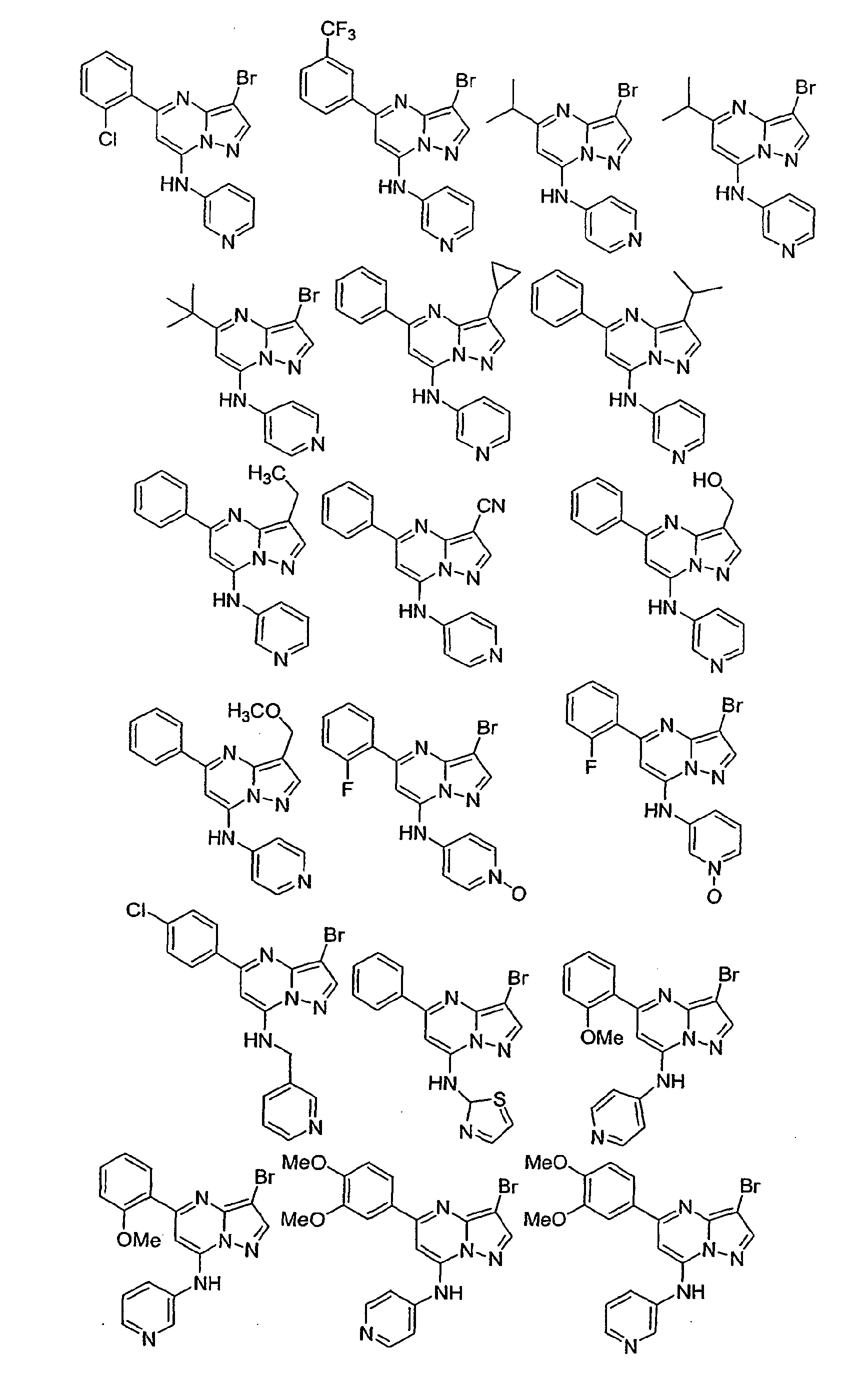
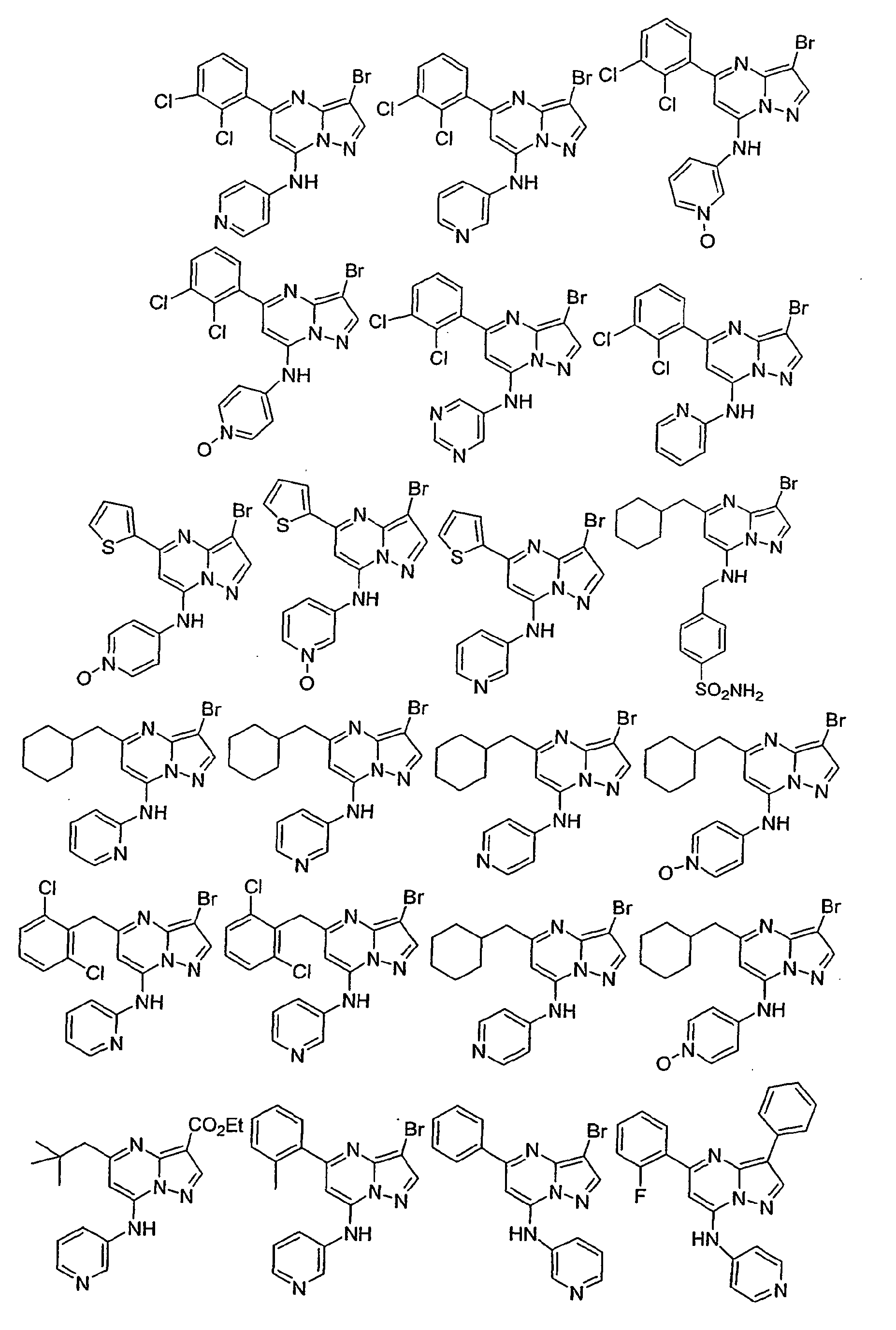

- As used above, and throughout this disclosure, the following terms, unless otherwise indicated, shall be understood to have the following meanings:
- "Patient" includes both human and animals.
- "Mammal" means humans and other mammalian animals.
- "Alkyl" means an aliphatic hydrocarbon group which may be straight or branched and comprising about 1 to about 20 carbon atoms in the chain. Preferred alkyl groups contain about 1 to about 12 carbon atoms in the chain. More preferred alkyl groups contain about 1 to about 6 carbon atoms in the chain. Branched means that one or more lower alkyl groups such as methyl, ethyl or propyl, are attached to a linear alkyl chain. "Lower alkyl" means a group having about 1 to about 6 carbon atoms in the chain which may be straight or branched. The term "substituted alkyl" means that the alkyl group may be substituted by one or more substituents which may be the same or different, each substituent being independently selected from the group consisting of halo, alkyl, aryl, cycloalkyl, cyano, hydroxy, alkoxy, alkylthio, amino, -NH(alkyl), -NH(cycloalkyl), -N(alkyl)2, carboxy and -C(O)O-alkyl. Non-limiting examples of suitable alkyl groups include methyl, ethyl, n-propyl, isopropyl and t-butyl.
- "Alkynyl" means an aliphatic hydrocarbon group containing at least one carbon-carbon triple bond and which may be straight or branched and comprising about 2 to about 15 carbon atoms in the chain. Preferred alkynyl groups have about 2 to about 12 carbon atoms in the chain; and more preferably about 2 to about 4 carbon atoms in the chain. Branched means that one or more lower alkyl groups such as methyl, ethyl or propyl, are attached to a linear alkynyl chain. "Lower alkynyl" means about 2 to about 6 carbon atoms in the chain which may be straight or branched. Non-limiting examples of suitable alkynyl groups include ethynyl, propynyl, 2-butynyl and 3-methylbutynyl. The term "substituted alkynyl" means that the alkynyl group may be substituted by one or more substituents which may be the same or different, each substituent being independently selected from the group consisting of alkyl, aryl and cycloalkyl.
- "Aryl" means an aromatic monocyclic or multicyclic ring system comprising about 6 to about 14 carbon atoms, preferably about 6 to about 10 carbon atoms. The aryl group can be optionally substituted with one or more "ring system substituents" which may be the same or different, and are as defined herein. Non-limiting examples of suitable aryl groups include phenyl and naphthyl.
- "Heteroaryl" means an aromatic monocyclic or multicyclic ring system comprising about 5 to about 14 ring atoms, preferably about 5 to about 10 ring atoms, in which one or more of the ring atoms is an element other than carbon, for example nitrogen, oxygen or sulfur, alone or in combination. Preferred heteroaryls contain about 5 to about 6 ring atoms. The "heteroaryl" can be optionally substituted by one or more "ring system substituents" which may be the same or different, and are as defined herein. The prefix aza, oxa or thia before the heteroaryl root name means that at least a nitrogen, oxygen or sulfur atom respectively, is present as a ring atom. A nitrogen atom of a heteroaryl can be optionally oxidized to the corresponding N-oxide. Non-limiting examples of suitable heteroaryls include pyridyl, pyrazinyl, furanyl, thienyl, pyrimidinyl, isoxazolyl, isothiazolyl, oxazolyl, thiazolyl, pyrazolyl, furazanyl, pyrrolyl, pyrazolyl, triazolyl, 1,2,4-thiadiazolyl, pyrazinyl, pyridazinyl; quinoxalinyl, phthalazinyl, imidazo[1,2-a]pyridinyl, imidazo[2,1-b]thiazolyl, benzofurazanyl, indolyl, azaindolyl, benzimidazolyl, benzothienyl, quinolinyl, imidazolyl, thienopyridyl, quinazolinyl, thienopyrimidyl, pyrrolopyridyl, imidazopyridyl, isoquinolinyl, benzoazaindolyl, 1,2,4-triazinyl, benzothiazolyl and the like.
- "Aralkyl" or "arylalkyl" means an aryl-alkyl- group in which the aryl and alkyl are as previously described. Preferred aralkyls comprise a lower alkyl group. Non-limiting examples of suitable aralkyl groups include benzyl, 2-phenethyl and naphthalenylmethyl. The bond to the parent moiety is through the alkyl.
- "Alkylaryl" means an alkyl-aryl- group in which the alkyl and aryl are as previously described. Preferred alkylaryls comprise a lower alkyl group. Non-limiting example of a suitable alkylaryl group is tolyl. The bond to the parent moiety is through the aryl.
- "Cycloalkyl" means a non-aromatic mono- or multicyclic ring system comprising about 3 to about 10 carbon atoms, preferably about 5 to about 10 carbon atoms. Preferred cycloalkyl rings contain about 5 to about 7 ring atoms. The cycloalkyl can be optionally substituted with one or more "ring system substituents" which may be the same or different, and are as defined above. Non-limiting examples of suitable monocyclic cycloalkyls include cyclopropyl, cyclopentyl, cyclohexyl, cycloheptyl and the like. Non-limiting examples of suitable multicyclic cycloalkyls include 1-decalinyl, norbornyl, adamantyl and the like.
- "Halogen" means fluorine, chlorine, bromine, or iodine. Preferred are fluorine, chlorine and bromine.
- "Ring system substituent" means a substituent attached to an aromatic or non-aromatic ring system which, for example, replaces an available hydrogen on the ring system. Ring system substituents may be the same or different, each being independently selected from the group consisting of aryl, heteroaryl, aralkyl, alkylaryl, heteroaralkyl, alkylheteroaryl, hydroxy, hydroxyalkyl, alkoxy, aryloxy, aralkoxy, acyl, aroyl, halo, nitro, cyano, carboxy, alkoxycarbonyl, aryloxycarbonyl, aralkoxycarbonyl, alkylsulfonyl, arylsulfonyl, heteroarylsulfonyl, alkylthio, arylthio, heteroarylthio, aralkylthio, heteroaralkylthio, cycloalkyl, heterocyclyl, Y1Y2N-, Y1Y2N-alkyl-, Y1Y2NC(O)- and Y1Y2NSO2-, wherein Y1 and Y2 may be the same or different and are independently selected from the group consisting of hydrogen, alkyl, aryl, and aralkyl.
- "Heterocyclyl" means a non-aromatic saturated monocyclic or multicyclic ring system comprising about 3 to about 10 ring atoms, preferably about 5 to about 10 ring atoms, in which one or more of the atoms in the ring system is an element other than carbon, for example nitrogen, oxygen or sulfur, alone or in combination. There are no adjacent oxygen and/or sulfur atoms present in the ring system. Preferred heterocyclyls contain about 5 to about 6 ring atoms. The prefix aza, oxa or thia before the heterocyclyl root name means that at least a nitrogen, oxygen or sulfur atom respectively is present as a ring atom. Any-NH in a heterocyclyl ring may exist protected such as, for example, as an -N(Boc), - N(CBz), -N(Tos) group and the like; such protected moieties are also considered part of this invention. The heterocyclyl can be optionally substituted by one or more "ring system substituents" which may be the same or different, and are as defined herein. The nitrogen or sulfur atom of the heterocyclyl can be optionally oxidized to the corresponding N-oxide, S-oxide or S,S-dioxide. Non-limiting examples of suitable monocyclic heterocyclyl rings include piperidyl, pyrrolidinyl, piperazinyl, morpholinyl, thiomorpholinyl, thiazolidinyl, 1,4-dioxanyl, tetrahydrofuranyl, tetrahydrothiophenyl, and the like.
- It should be noted that in hetero-atom containing ring systems of this invention, there are no hydroxyl groups on carbon atoms adjacent to a N, O or S, as well as there are no N or S groups on carbon adjacent to another heteroatom. Thus, for example, in the ring:

- "Alkynylalkyl" means an alkynyl-alkyl- group in which the alkynyl and alkyl are as previously described. Preferred alkynylalkyls contain a lower alkynyl and a lower alkyl group. The bond to the parent moiety is through the alkyl. Non-limiting examples of suitable alkynylalkyl groups include propargylmethyl.
- "Heteroaralkyl" means a heteroaryl-alkyl- group in which the heteroaryl and alkyl are as previously described. Preferred heteroaralkyls contain a lower alkyl group. Non-limiting examples of suitable aralkyl groups include pyridylmethyl, and quinolin-3-ylmethyl. The bond to the parent moiety is through the alkyl.
- "Hydroxyalkyl" means a HO-alkyl- group in which alkyl is as previously defined. Preferred hydroxyalkyls contain lower alkyl. Non-limiting examples of suitable hydroxyalkyl groups include hydroxymethyl and 2-hydroxyethyl.
- "Acyl" means an H-C(O)-, alkyl-C(O)- or cydoalkyl-C(O)-, group in which the various groups are as previously described. The bond to the parent moiety is through the carbonyl. Preferred acyls contain a lower alkyl. Non-limiting examples of suitable acyl groups include formyl, acetyl and propanoyl.
- "Aroyl" means an aryl-C(O)- group in which the aryl group is as previously described. The bond to the parent moiety is through the carbonyl. Non-limiting examples of suitable groups include benzoyl and 1- naphthoyl.
- "Alkoxy" means an alkyl-O- group in which the alkyl group is as previously described. Non-limiting examples of suitable alkoxy groups-include methoxy, ethoxy, n-propoxy, isopropoxy and n-butoxy. The bond to the parent moiety is through the ether oxygen.
- "Aryloxy" means an aryl-O- group in which the aryl group is as previously described. Non-limiting examples of suitable aryloxy groups include phenoxy and naphthoxy. The bond to the parent moiety is through the ether oxygen.
- "Aralkyloxy" means an aralkyl-O- group in which the aralkyl group is as previously described. Non-limiting examples of suitable aralkyloxy groups include benzyloxy and 1- or 2-naphthalenemethoxy. The bond to the parent moiety is through the ether oxygen.
- "Alkylthio" means an alkyl-S- group in which the alkyl group is as previously described. Non-limiting examples of suitable alkylthio groups include methylthio and ethylthio. The bond to the parent moiety is through the sulfur.
- "Arylthio" means an aryl-S- group in which the aryl group is as previously described. Non-limiting examples of suitable arylthio groups include phenylthio and naphthylthio. The bond to the parent moiety is through the sulfur.
- "Aralkylthio" means an aralkyl-S- group in which the aralkyl group is as previously described. Non-limiting example of a suitable aralkylthio group is benzylthio. The bond to the parent moiety is through the sulfur.
- "Alkoxycarbonyl" means an alkyl-O-CO- group. Non-limiting examples of suitable alkoxycarbonyl groups include methoxycarbonyl and ethoxycarbonyl. The bond to the parent moiety is through the carbonyl.
- "Aryloxycarbonyl" means an aryl-O-C(O)- group. Non-limiting examples of suitable aryloxycarbonyl groups include phenoxycarbonyl and naphthoxycarbonyl. The bond to the parent moiety is through the carbonyl.
- "Aralkoxycarbonyl" means an aralkyl-O-C(O)- group. Non-limiting example of a suitable aralkoxycarbonyl group is benzyloxycarbonyl. The bond to the parent moiety is through the carbonyl.
- "Alkylsulfonyl" means an alkyl-S(O2)- group. Preferred groups are those in which the alkyl group is lower alkyl. The bond to the parent moiety is through the sulfonyl.
- "Arylsulfonyl" means an aryl-S(O2)- group. The bond to the parent moiety is through the sulfonyl.
- The term "substituted" means that one or more hydrogens on the designated atom is replaced with a selection from the indicated group, provided that the designated atom's normal valency under the existing circumstances is not exceeded, and that the substitution results in a stable compound. Combinations of substituents and/or variables are permissible only if such combinations result in stable compounds. By "stable compound' or "stable structure" is meant a compound that is sufficiently robust to survive isolation to a useful degree of purity from a reaction mixture, and formulation into an efficacious therapeutic agent.
- The term "optionally substituted" means optional substitution with the specified groups, radicals or moieties:
- It should also be noted that any heteroatom with unsatisfied valences in the text, schemes, examples and Tables herein is assumed to have the hydrogen atom to satisfy the valences.
- When a functional group in a compound is termed "protected", this means that the group is in modified form to preclude undesired side reactions at the protected site when the compound is subjected to a reaction. Suitable protecting groups will be recognized by those with ordinary skill in the art as well as by reference to standard textbooks such as, for example, T. W. Greene et al, Protective Groups in organic Synthesis (1991), Wiley, New York.
- When any variable (e.g., aryl, heterocycle, R2, etc.) occurs more than one time in any constituent or in Formula III or other Formulas, its definition on each occurrence is independent of its definition at every other occurrence.
- As used herein, the term "composition" is intended to encompass a product comprising the specified ingredients in the specified amounts, as well as any product which results, directly or indirectly, from combination of the specified ingredients in the specified amounts.
- Prodrugs and solvates of the compounds of the invention are also contemplated herein. The term "prodrug", as employed herein, denotes a compound that is a drug precursor which, upon administration to a subject, undergoes chemical conversion by metabolic or chemical processes to yield a compound of Formula III or a salt and/or solvate thereof. A discussion of prodrugs is provided in T. Higuchi and V. Stella, Pro-drugs as Novel Delivery Systems (1987) 14 of the A.C.S. Symposium Series, and in Bioreversible Carriers in Drug Design, (1987) Edward B. Roche, ed., American Pharmaceutical Association and Pergamon Press, both of which are incorporated herein by reference thereto.
- "Solvate" means a physical association of a compound of this invention with one or more solvent molecules. This physical association involves varying degrees of ionic and covalent bonding, including hydrogen bonding. In certain instances the solvate will be capable of isolation, for example when one or more solvent molecules are incorporated in the crystal lattice of the crystalline solid. "Solvate" encompasses both solution-phase and isolatable solvates. Non-limiting examples of suitable solvates include ethanolates, methanolates, and the like. "Hydrate" is a solvate wherein the solvent molecule is H2O.
- "Effective amount" or "therapeutically effective amount" is meant to describe an amount of compound or a composition of the present invention effective in inhibiting the CDK(s) and thus producing the desired therapeutic, ameliorative, inhibitory or preventative effect.
- The compounds of Formula III can form salts which are also within the scope of this invention. Reference to a compound of Formula III herein is understood to include reference to salts thereof, unless otherwise indicated. The term "salt(s)", as employed herein, denotes acidic salts formed with inorganic and/or organic acids, as well as basic salts formed with inorganic and/or organic bases. In addition, when a compound of formula I contains both a basic moiety, such as, but not limited to a pyridine or imidazole, and an acidic moiety, such as, but not limited to a carboxylic acid, zwitterions ("inner salts") may be formed and are included within the term "salt(s)" as used herein. Pharmaceutically acceptable (i.e., non-toxic, physiologically acceptable) salts are preferred, although other salts are also useful. Salts of the compounds of the formula I may be formed, for example, by reacting a compound of formula I with an amount of acid or base, such as an equivalent amount, in a medium such as one in which the salt precipitates or in an aqueous medium followed by lyophilization. Acids (and bases) which are generally considered suitable for the formation of pharmaceutically useful salts from basic (or acidic) pharmaceutical compounds are discussed, for example, by S. Berge et al, Journal of Pharmaceutical Sciences (1977) 66(1) 1-19; P. Gould, International J. of Pharmaceutics (1986) 33 201-217; Anderson et al, The Practice of Medicinal Chemistry (1996), Academic Press, New York; in The Orange Book (Food & Drug Administration, Washington, D.C. on their website); and P. Heinrich Stahl, Camille G. Wermuth (Eds.), Handbook of Pharmaceutical Salts: Properties, Selection, and Use, (2002) Int'l. Union of Pure and Applied Chemistry, pp. 330-331. These disclosures are incorporated herein by reference thereto.
- Exemplary acid addition salts include acetates, adipates, alginates, ascorbates, aspartates, benzoates, benzenesulfonates, bisulfates, borates, butyrates, citrates, camphorates, camphorsulfonates, cyclopentanepropionates, digluconates, dodecylsulfates, ethanesulfonates, fumarates, glucoheptanoates, glycerophosphates, hemisulfates, heptanoates, hexanoates, hydrochlorides, hydrobromides, hydroiodides, 2-hydroxyethanesulfonates, lactates, maleates, methanesulfonates, methyl sulfates, 2-naphthalenesulfonates, nicotinates, nitrates, oxalates, pamoates, pectinates, persulfates, 3-phenylpropionates, phosphates, picrates, pivalates, propionates, salicylates, succinates, sulfates, sulfonates (such as those mentioned herein), tartarates, thiocyanates, toluenesulfonates (also known as tosylates,) undecanoates, and the like.
- Exemplary basic salts include ammonium salts, alkali metal salts such as sodium, lithium, and potassium salts, alkaline earth metal salts such as calcium and magnesium salts, aluminum salts, zinc salts, salts with organic bases (for example, organic amines) such as benzathines, diethylamine, dicyclohexylamines, hydrabamines (formed with N,N-bis(dehydroabietyl)ethylenediamine), N-methyl-D-glucamines, N-methyl-D-glucamides, t-butyl amines, piperazine, phenylcyclohexylamine, choline, tromethamine, and salts with amino acids such as arginine, lysine and the like. Basic nitrogen-containing groups may be quartemized with agents such as lower alkyl halides (e.g. methyl, ethyl, propyl, and butyl chlorides, bromides and iodides), dialkyl sulfates (e.g. dimethyl, diethyl, dibutyl, and diamyl sulfates), long chain halides (e.g. decyl, lauryl, myristyl and stearyl chlorides, bromides and iodides), aralkyl halides (e.g. benzyl and phenethyl bromides), and others.
- All such acid salts and base salts are intended to be pharmaceutically acceptable salts within the scope of the invention and all acid and base salts are considered equivalent to the free forms of the corresponding compounds for purposes of the invention.
- Compounds of Formula III, and salts, solvates and prodrugs thereof, may exist in their tautomeric form (for example, as an amide or imino ether). All such tautomeric forms are contemplated herein as part of the present invention.
- All stereoisomers (for example, geometric isomers, optical isomers and the like) of the present compounds (including those of the salts, solvates and prodrugs of the compounds as well as the salts and solvates of the prodrugs), such as those which may exist due to asymmetric carbons on various substituents, including enantiomeric forms (which may exist even in the absence of asymmetric carbons), rotameric forms, atropisomers, and diastereomeric forms, are contemplated within the scope of this invention. Individual stereoisomers of the compounds of the invention may, for example, be substantially free of other isomers, or may be admixed, for example, as racemates or with all other, or other selected, stereoisomers. The chiral centers of the present invention can have the S or R configuration as defined by the IUPAC 1974 Recommendations. The use of the terms "salt", "solvate" "prodrug" and the like, is intended to equally apply to the salt, solvate and prodrug of enantiomers, stereoisomers, rotamers, tautomers, racemates or prodrugs of the inventive compounds.
- The compounds according to the invention have pharmacological properties; in particular, the compounds of Formula III can be inhibitors of protein kinases such as the cyclin dependent kinases (CDKs), for example, CDC2 (CDK1), CDK2, and CDK4, CDK4, CDK5, CDK6, CDK7 and CDK8. The novel compounds of Formula III are expected to be useful in the therapy of proliferative diseases such as cancer, autoimmune diseases, viral diseases, fungal diseases, neurological/neurodegenerative disorders, arthritis, inflammation, anti-proliferative (e.g., ocular retinopathy), neuronal, alopecia and cardiovascular disease. Many of these diseases and disorders are listed in
U.S. 6,413,974 cited earlier, the disclosure of which is incorporated herein. - More specifically, the compounds of Formula III can be useful in the treatment of a variety of cancers, including (but not limited to) the following:
- carcinoma, including that of the bladder, breast, colon, kidney, liver, lung, including small cell lung cancer, esophagus, gall bladder, ovary, pancreas, stomach, cervix, thyroid, prostate, and skin, including squamous cell carcinoma;
- hematopoietic tumors of lymphoid lineage, including leukemia, acute lymphocytic leukemia, acute lymphoblastic leukemia, B-cell lymphoma, T- cell lymphoma, Hodgkins lymphoma, non-Hodgkins lymphoma, hairy cell lymphoma and Burkett's lymphoma;
- hematopoietic tumors of myeloid lineage, including acute and chronic myelogenous leukemias, myelodysplastic syndrome and promyelocytic leukemia;
- tumors of mesenchymal origin, including fibrosarcoma and rhabdomyosarcoma;
- tumors of the central and peripheral nervous system, including astrocytoma, neuroblastoma, glioma and schwannomas; and
- other tumors, including melanoma, seminoma, teratocarcinoma, osteosarcoma, xenoderoma pigmentosum, keratoctanthoma, thyroid follicular cancer and Kaposi's sarcoma.
- Due to the key role of CDKs in the regulation of cellular proliferation in general, inhibitors could act as reversible cytostatic agents which may be useful in the treatment of any disease process which features abnormal cellular proliferation, e.g., benign prostate hyperplasia, familial adenomatosis polyposis, neuro-fibromatosis, atherosclerosis, pulmonary fibrosis, arthritis, psoriasis, glomerulonephritis, restenosis following angioplasty or vascular surgery, hypertrophic scar formation, inflammatory bowel disease, transplantation rejection, endotoxic shock, and fungal infections.
- Compounds of Formula III may also be useful in the treatment of Alzheimer's disease, as suggested by the recent finding that CDK5 is involved in the phosphorylation of tau protein (J. Biochem, (1995) 117, 741-749).
- Compounds of Formula III may induce or inhibit apoptosis. The apoptotic response is aberrant in a variety of human diseases. Compounds of Formula III, as modulators of apoptosis, will be useful in the treatment of cancer (including but not limited to those types mentioned hereinabove), viral infections (including but not limited to herpevirus, poxvirus, Epstein- Barr virus, Sindbis virus and adenovirus), prevention of AIDS development in HIV-infected individuals, autoimmune diseases (including but not limited to systemic lupus, erythematosus, autoimmune mediated glomerulonephritis, rheumatoid arthritis, psoriasis, inflammatory bowel disease, and autoimmune diabetes mellitus), neurodegenerative disorders (including but not limited to Alzheimer's disease, AIDS-related dementia, Parkinson's disease, amyotrophic lateral sclerosis, retinitis pigmentosa, spinal muscular atrophy and cerebellar degeneration), myelodysplastic syndromes, aplastic anemia, ischemic injury associated with myocardial infarctions, stroke and reperfusion injury, arrhythmia, atherosclerosis, toxin-induced or alcohol related liver diseases, hematological diseases (including but not limited to chronic anemia and aplastic anemia), degenerative diseases of the musculoskeletal system (including but not limited to osteoporosis and arthritis) aspirin-sensitive rhinosinusitis, cystic fibrosis, multiple sclerosis, kidney diseases and cancer pain.
- Compounds of Formula III, as inhibitors of the CDKs, can modulate the level of cellular RNA and DNA synthesis. These agents would therefore be useful in the treatment of viral infections (including but not limited to HIV, human papilloma virus, herpesvirus, poxvirus, Epstein-Barr virus, Sindbis virus and adenovirus).
- Compounds of Formula III may also be useful in the chemoprevention of cancer. Chemoprevention is defined as inhibiting the development of invasive cancer by either blocking the initiating mutagenic event or by blocking the progression of pre-malignant cells that have already suffered an insult or inhibiting tumor relapse.
- Compounds of Formula III may also be useful in inhibiting tumor angiogenesis and metastasis.
- Compounds of Formula III may also act as inhibitors of other protein kinases, e.g., protein kinase C, her2, raf 1, MEK1, MAP kinase, EGF receptor, PDGF receptor, IGF receptor, P13 kinase, wee1 kinase, Src, Abl and thus be effective in the treatment of diseases associated with other protein kinases.
- Another aspect of this invention is a method of treating a mammal (e.g., human) having a disease or condition associated with the CDKs by administering a therapeutically effective amount of at least one compound of Formula III, or a pharmaceutically acceptable salt or solvate of said compound to the mammal.
- A preferred dosage is about 0.001 to 500 mg/kg of body weight/day of the compound of Formula III. An especially preferred dosage is about 0.01 to 25 mg/kg of body weight/day of a compound of Formula III, or a pharmaceutically acceptable salt or solvate of said compound.
- The compounds of this invention may also be useful in combination (administered together or sequentially) with one or more of anti-cancer treatments such as radiation therapy, and/or one or more anti-cancer agents selected from the group consisting of cytostatic agents, cytotoxic agents (such as for example, but not limited to, DNA interactive agents (such as cisplatin or doxorubicin)); taxanes (e.g. taxotere, taxol); topoisomerase II inhibitors (such as etoposide); topoisomerase inhibitors (such as irinotecan (or CPT-11), camptostar, or topotecan); tubulin interacting agents (such as paclitaxel, docetaxel or the epothilones); hormonal agents (such as tamoxifen); thymidilate synthase inhibitors (such as 5-fluorouracil); anti-metabolites (such as methoxtrexate); alkylating agents (such as temozolomide (TEMODAR™ from Schering-Plough Corporation, Kenilworth, New Jersey), cyclophosphamide); Farnesyl protein transferase inhibitors (such as, SARASAR™(4-[2-[4-[(11R)-3,10-dibromo-8-chloro-6,11-dihydro-5H-benzo[5,6]cyclohepta[1,2-b]pyridin-11-yl]-1-piperidinyl]-2-oxoehtyl]-1-piperidinecarboxamide, or SCH 66336 from Schering-Plough Corporation, Kenilworth, New Jersey), tipifarnib (Zarnestra® or R115777 from Janssen Pharmaceuticals), L778,123 (a farnesyl protein transferase inhibitor from Merck & Company, Whitehouse Station, New Jersey), BMS 214662 (a farnesyl protein transferase inhibitor from Bristol-Myers Squibb Pharmaceuticals, Princeton, New Jersey); signal transduction inhibitors (such as, Iressa (from Astra Zeneca Pharmaceuticals, England), Tarceva (EGFR kinase inhibitors), antibodies to EGFR (e.g., C225), GLEEVEC™ (C-abl kinase inhibitor from Novartis Pharmaceuticals, East Hanover, New Jersey); interferons such as, for example, intron (from Schering-Plough Corporation), Peg-Intron (from Schering-Plough Corporation); hormonal therapy combinations; aromatase combinations; ara-C, adriamycin, cytoxan, and gemcitabine.
- Other anti-cancer (also known as anti-neoplastic) agents include but are not limited to Uracil mustard, Chlormethine, Ifosfamide, Melphalan, Chlorambucil, Pipobroman, Triethylenemelamine, Triethylenethiophosphoramine, Busulfan, Carmustine, Lomustine, Streptozocin, Dacarbazine, Floxuridine, Cytarabine, 6-Mercaptopurine, 6-Thioguanine, Fludarabine phosphate, oxaliplatin, leucovirin, oxaliplatin (ELOXATIN™ from Sanofi-Synthelabo Pharmaeuticals, France), Pentostatine, Vinblastine, Vincristine, Vindesine, Bleomycin, Dactinomycin, Daunorubicin, Doxorubicin, Epirubicin, Idarubicin, Mithramycin, Deoxycoformycin, Mitomycin-C, L-Asparaginase, Teniposide 17α-Ethinylestradiol, Diethylstilbestrol, Testosterone, Prednisone, Fluoxymesterone, Dromostanolone propionate, Testolactone, Megestrolacetate, Methylprednisolone, Methyltestosterone, Prednisolone, Triamcinolone, Chlorotrianisene, Hydroxyprogesterone, Aminoglutethimide, Estramustine, Medroxyprogesteroneacetate, Leuprolide, Flutamide, Toremifene, goserelin, Cisplatin, Carboplatin, Hydroxyurea, Amsacrine, Procarbazine, Mitotane, Mitoxantrone, Levamisole, Navelbene, Anastrazole, Letrazole, Capecitabine, Reloxafine, Droloxafine, or Hexamethylmelamine.
- If formulated as a fixed dose, such combination products employ the compounds of this invention within the dosage range described herein and the other pharmaceutically active agent or treatment within its dosage range. For example, the CDC2 inhibitor olomucine has been found to act synergistically with known cytotoxic agents in inducing apoptosis (J. Cell Sci., (1995) 108, 2897. Compounds of Formula III may also be administered sequentially with known anticancer or cytotoxic agents when a combination formulation is inappropriate. The invention is not limited in the sequence of administration; compounds of Formula III may be administered either prior to or after administration of the known anticancer or cytotoxic agent. For example, the cytotoxic activity of the cyclin-dependent kinase inhibitor flavopiridol is affected by the sequence of administration with anticancer agents. Cancer Research, (1997) 57, 3375. Such techniques are within the skills of persons skilled in the art as well as attending physicians.
- Accordingly, in an aspect, this invention includes combinations comprising an amount of at least one compound of Formula III, or a pharmaceutically acceptable salt or solvate thereof, and an amount of one or more anti-cancer treatments and anti-cancer agents listed above wherein the amounts of the compounds/ treatments result in desired therapeutic effect.
- The pharmacological properties of the compounds of this invention may be confirmed by a number of pharmacological assays. The exemplified pharmacological assays which are described later have been carried out with the compounds according to the invention and their salts.
- This invention is also directed to pharmaceutical compositions which comprise at least one compound of Formula III, or a pharmaceutically acceptable salt or solvate of said compound and at least one pharmaceutically acceptable carrier.
- For preparing pharmaceutical compositions from the compounds described by this invention, inert, pharmaceutically acceptable carriers can be either solid or liquid. Solid form preparations include powders, tablets, dispersible granules, capsules, cachets and suppositories. The powders and tablets may be comprised of from about 5 to about 95 percent active ingredient. Suitable solid carriers are known in the art, e.g., magnesium carbonate, magnesium stearate, talc, sugar or lactose. Tablets, powders, cachets and capsules can be used as solid dosage forms suitable for oral administration. Examples of pharmaceutically acceptable carriers and methods of manufacture for various compositions may be found in A. Gennaro (ed.), Remington's Pharmaceutical Sciences, 18th Edition, (1990), Mack Publishing Co., Easton, Pennsylvania.
- Liquid form preparations include solutions, suspensions and emulsions. As an example may be mentioned water or water-propylene glycol solutions for parenteral injection or addition of sweeteners and opacifiers for oral solutions, suspensions and emulsions. Liquid form preparations may also include solutions for intranasal administration.
- Aerosol preparations suitable for inhalation may include solutions and solids in powder form, which may be in combination with a pharmaceutically acceptable carrier, such as an inert compressed gas, e.g. nitrogen.
- Also included are solid form preparations that are intended to be converted, shortly before use, to liquid form preparations for either oral or parenteral administration. Such liquid forms include solutions, suspensions and emulsions.
- The compounds of the invention may also be deliverable transdermally. The transdermal compositions can take the form of creams, lotions, aerosols and/or emulsions and can be included in a transdermal patch of the matrix or reservoir type as are conventional in the art for this purpose.
- The compounds of this invention may also be delivered subcutaneously.
- Preferably the compound is administered orally.
- Preferably, the pharmaceutical preparation is in a unit dosage form. In such form, the preparation is subdivided into suitably sized unit doses containing appropriate quantities of the active component, e.g., an effective amount to achieve the desired purpose.
- The quantity of active compound in a unit dose of preparation may be varied or adjusted from about 1 mg to about 100 mg, preferably from about 1 mg to about 50 mg, more preferably from about 1 mg to about 25 mg, according to the particular application.
- The actual dosage employed may be varied depending upon the requirements of the patient and the severity of the condition being treated. Determination of the proper dosage regimen for a particular situation is within the skill of the art. For convenience, the total daily dosage may be divided and administered in portions during the day as required.
- The amount and frequency of administration of the compounds of the invention and/or the pharmaceutically acceptable salts thereof will be regulated according to the judgment of the attending clinician considering such factors as age, condition and size of the patient as well as severity of the symptoms being treated. A typical recommended daily dosage regimen for oral administration can range from about 1 mg/day to about 500 mg/day, preferably 1 mg/day to 200 mg/day, in two to four divided doses.
- Another aspect of this invention is a kit comprising a therapeutically effective amount of at least one compound of Formula III, or a pharmaceutically acceptable salt or solvate of said compound and a pharmaceutically acceptable carrier, vehicle or diluent.
- Yet another aspect of this invention is a kit comprising an amount of at least one compound of Formula III, or a pharmaceutically acceptable salt or solvate of said compound and an amount of at least one anticancer therapy and/or anti-cancer agent listed above, wherein the amounts of the two or more ingredients result in desired therapeutic effect.
- The invention disclosed herein is exemplified by the following preparations and examples which should not be construed to limit the scope of the disclosure. Alternative mechanistic pathways and analogous structures will be apparent to those skilled in the art.
- Where NMR data are presented, 1H spectra were obtained on either a Varian VXR-200 (200 MHz, 1H), Varian Gemini-300 (300 MHz) or XL-400 (400 MHz) and are reported as ppm down field from Me4Si with number of protons, multiplicities, and coupling constants in Hertz indicated parenthetically. Where LC/MS data are presented, analyses was performed using an Applied Biosystems API-100 mass spectrometer and Shimadzu SCL-10A LC column: Altech platinum C18, 3 micron, 33mm x 7mm ID; gradient flow: 0 min-10% CH3CN, 5 min - 95% CH3CN, 7 min - 95% CH3CN, 7.5 min-10% CH3CN, 9 min - stop. The retention time and observed parent ion are given.
- The following solvents and reagents may be referred to by their abbreviations in parenthesis:
- Thin layer chromatography: TLC
- dichloromethane: CH2Cl2
- ethyl acetate: AcOEt or EtOAc
- methanol: MeOH
- trifluoroacetate: TFA
- triethylamine: Et3N or TEA
- butoxycarbonyl: n-Boc or Boc
- nuclear magnetic resonance spectroscopy: NMR
- liquid chromatography mass spectrometry: LCMS
- high resolution mass spectrometry: HRMS
- milliliters: mL
- millimoles: mmol
- microliters: µl
- grams: g
- milligrams: mg
- room temperature or rt (ambient): about 25°C.
- In general, the compounds of the present invention can be prepared through the general routes described below in Scheme 1. Treatment of the


- The chlorides of type 9 can be prepared by treatment of the pyridones 8 with POCl3. When R2 is equal to H, substitution in this position is possible on the compounds of type 9 by electrophilic halogenation, acylation, and various other electrophilic aromatic substitutions.
- Introduction of the N7-amino functionality can be accomplished through displacement of the chloride of compounds of type 9 by reaction with the appropriate amine as shown in Scheme 3.
- When R3 = OEt in compounds of type 6, the dichlorides of type 12 can easily be prepared as outlined in Scheme 4. Selective displacements of the 7-chloride gives rise to compounds of type 13, which can readily be converted to products of type 14.


-

-

- A procedure in
German patent DE 19834047 A1 , p 19 was followed. To a solution of KOtBu (6.17 g, 0.055 mol) in anhydrous THF (40 mL) was added, dropwise, a solution of cyclopropylacetonitrile (2.0 g, 0.025 mol) and ethyl formate (4.07 g, 0.055 mol) in anhydrous THF (4 mL). A precipitate formed immediately. This mixture was stirred for 12 hr. It was concentrated under vacuum and the residue stirred with Et2O (50 mL). The resulting residue was decanted and washed with Et2O (2 x 50 mL) and Et2O removed from the residue under vacuum. The residue was dissolved in cold H2O (20 mL) and pH adjusted to 4 - 5 with 12 N HCl. The mixture was extracted with CH2Cl2 (2 x 50 mL). The organic layers were combined, dried over MgSO4 and concentrated under vacuum to give the aldehyde as a tan liquid. -

- The product from Preparative Example 1, Step A (2.12 g, 0.0195 mol), NH2NH2· H2O (1.95 g, 0.039 mol) and 1.8 g (0.029 mole) of glacial CH3CO2H (1.8 g, 0.029 mol) were dissolved in EtOH (10 mL). It was refluxed for 6 hr and concentrated under vacuum. The residue was slurried in CH2Cl2 (150 mL) and the pH adjusted to 9 with 1 N NaOH. The organic layer was washed with brine, dried over MgSO4 and concentrated under vacuum to give the product as a waxy orange solid.
- By essentially the same procedure set forth in Preparative Example 1, only substituting the nitrile shown in Column 2 of Table 2, the compounds in Column 3 of Table 2 were prepared:
TABLE 2 Prep. Ex. Column 2 Column 3 2 

3 

-

- The reactions were done as outlined in (K. O. Olsen, J. Org. Chem., (1987) 52, 4531 - 4536). Thus, to a stirred solution of lithium diisopropylamide in THF at -65 to -70°C was added freshly distilled ethyl acetate, dropwise. The resulting solution was stirred for 30 min and the acid chloride was added as a solution in THF. The reaction mixture was stirred at -65 to -70°C for 30 min and then terminated by the addition of 1 N HCl solution. The resulting two-phased mixture was allowed to warm to ambient temperature. The resulting mixture was diluted with EtOAc (100 mL) the organic layer was collected. The aqueous layer was extracted with EtOAc (100 mL). The organic layers were combined, washed with brine, dried (Na2SO4), and concentrated in vacuo to give the crude β-keto esters, which were used in the subsequent condensations.
- By essentially the same procedure set forth in Preparative Example 4 only substituting the acid chlorides shown in Column 2 of Table 3, the β-keto esters shown in Column 3 of Table 3 were prepared:
TABLE 3 Prep. Ex. Column 2 Column 3 DATA 5 

Yield = 99% LCMS: MH+= 223 6 

Yield = 99% LCMS: MH+=253 7 
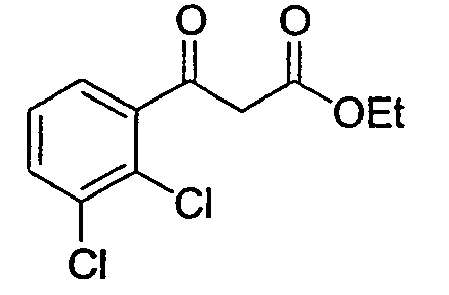
Yield = 80% LCMS: MH+= 261 8 

Yield = 93% MH+ = 199 9 

Yield=93% 10 

Yield=100% -

- To a solution of the acid in THF was added Et3N, followed by isobutyl chloroformate at -20 to -30°C. After the mixture was stirred for 30 min at -20 to -30°C, triethylamine hydrochloride was filtered off under argon, and the filtrate was added to the LDA-EtOAc reaction mixture (prepared as outlined in Method A) at -65 to -70°C. After addition of 1 N HCl, followed by routine workup of the reaction mixture and evaporation of the solvents, the crude β-keto esters were isolated. The crude material was used in the subsequent condensations.
- By essentially the same conditions set forth in Preparative Example 11 only substituting the carboxylic acid shown in Column 2 of Table 4, the compounds shown in Column 3 of Table 4 were prepared:
TABLE 4 Prep. Ex. Column 2 Column 3 DATA 12 

Yield = 99% MH+=213 13 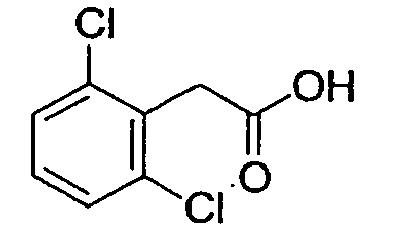

Yield = 70% MH+ = 275 13.10 

Yield = 99 MH+=199 13.11 

Yield = 99 MH+ = 334 13.12 

Yield = 99 MH+ = 334 -
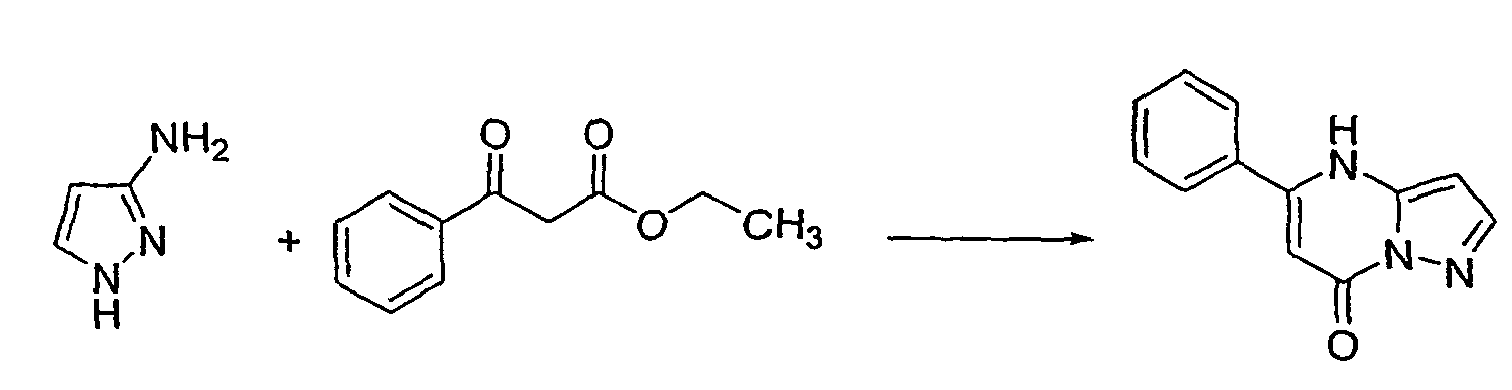
- A solution of 3-aminopyrazole (2.0g, 24.07 mmol) and ethyl benzoylacetate (4.58 mL, 1.1 eq.) in AcOH (15 mL) was heated at reflux for 3 hours. The reaction mixture was cooled to room temperature and concentrated in vacuo. The resulting solid was diluted with EtOAc and filtered to give a white solid (2.04 g, 40% yield).
- By essentially the same procedure set forth in Preparative Example 14 only substituting the aminopyrazole shown in Column 2 of Table 5 and the ester shown in Column 3 of Table 5, the compounds shown in Column 4 of Table 5 were prepared:
TABLE 5 Prep. Ex. Column 2 Column 3 Column 4 15 


16 


17 


18 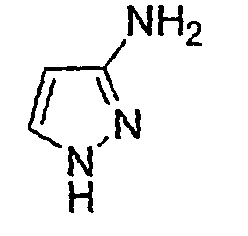


19 


20 


21 


22 


23 


24 


25 


26 


27 


28 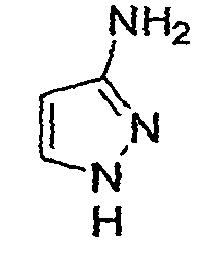


29 
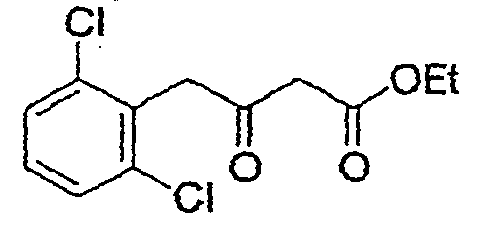

30 


31 


32 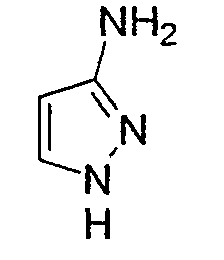


32.11 


32.12 


32.13 


32.14 


32.15 


-

- Ethyl benzoylacetate (1.76 mL, 1.1 eq.) and 3-amino-4-cyanopyrazole (1.0 g, 9.25 mmol) in AcOH (5.0 mL) and H2O (10 mL) was heated at reflux 72 hours. The resulting solution was cooled to room temperature, concentrated in vacuo, and diluted with EtOAc. The resulting precipitate was filtered, washed with EtOAc, and dried in vacuo (0.47 g, 21 % yield).
-

- A procedure in
US patent 3,907,799 was followed. Sodium (2.3 g, 2 eq.) was added to EtOH (150 mL) portionwise. When the sodium was completely dissolved, 3-aminopyrazole (4.2 g, 0.05 mol) and diethyl malonate (8.7 g, 1.1 eq.) were added and the resulting solution heated to reflux for 3 hours. The resulting suspension was cooled to room temperature and filtered. The filter cake was washed with EtOH (100 mL) and dissolved in water (250 mL). The resulting solution was cooled in an ice bath and the pH adjusted to 1-2 with concentrated HCl. The resulting suspension was filtered, washed with water (100 mL) and dried under vacuum to give a white solid (4.75 g, 63% yield). - By essentially the same procedure set forth in Preparative Example 33.10 only substituting the compound shown in Column 2 of Table 5.1, the compounds shown in Column 3 of Table 5.1 are prepared:
TABLE 5.1 Prep. Ex. Column 2 Column 3 33.11 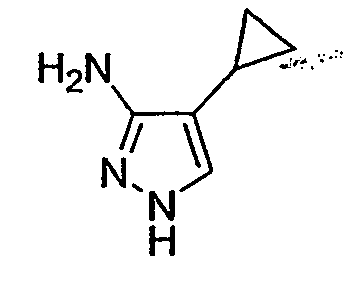

33.12 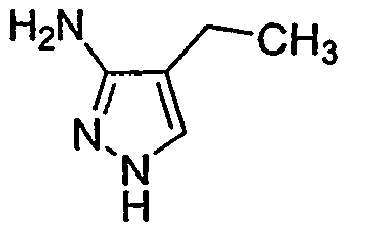

-

- A solution of the compound prepared in Preparative Example 14 (1.0 g, 4.73 mmol) in POCl3 (5 mL) and pyridine (0.25 mL) was stirred at room temperature 3 days. The resulting slurry was diluted with Et2O, filtered, and the solid residue washed with Et2O. The combined Et2O washings were cooled to 0°C and treated with ice. When the vigorous reaction ceased, the resulting mixture was diluted with H2O, separated, and the aqueous layer extracted with Et2O. The combined organics were washed with H2O and saturated NaCl, dried over Na2SO4, filtered, and concentrated to give a pale yellow solid (0.86 g, 79% yield). LCMS: MH+=230.
- By essentially the same procedure set forth in Preparative Example 34, only substituting the compound shown in Column 2 of Table 6, the compounds shown in Column 3 of Table 6 were prepared:
TABLE 6 Prep. Ex. Column 2 Column 3 DATA 35 

LCMS: MH+=248 36 

37 

LCMS: MH+=298 38 

LCMS: MH+=196 39 

LCMS: MH+=210 40 

41 

LCMS: MH+=272 42 

43 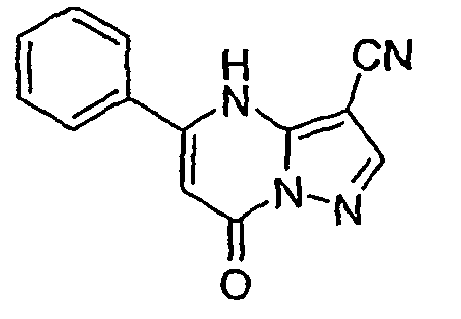
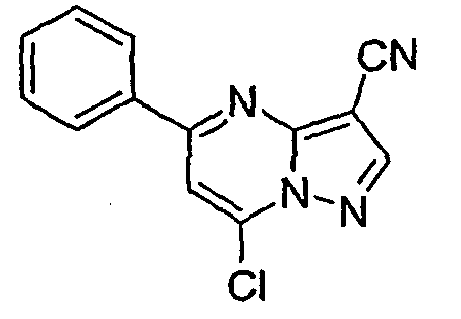
LCMS: MH+=255 44 

45 

Yield = 65% LCMS:MH+= 260 46 

Yield = 35% LCMS:MH+= 290 47 

Yield = 32% LCMS:MH+= 298 48 

Yield = 45% LCMS:MH+= 236 49 

Yield = 100% LCMS:MH+= 250 50 

Yield = 88% LCMS:MH+= 314 51 

Yield=43% LCMS: MH+=223 52 

Yield=30% LCMS: MH+=295 53 

Yield=98% LCMS: MH+=244 53.11 

53.12 

53.13 
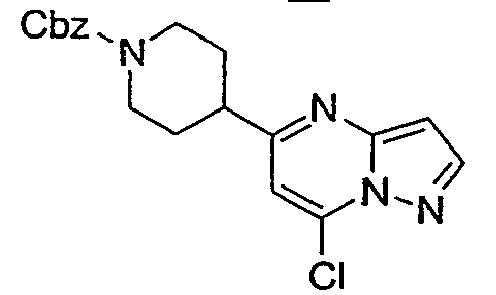
Yield = 96 MH+ =371 53.14 

Yield = 99 MH+ =371 53.15 
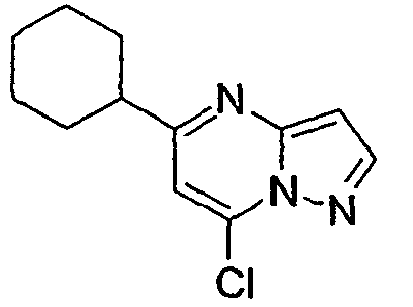
Yield = quant. MH+ =236 -

- POCl3 (62 mL) was cooled to 5 °C under nitrogen and dimethylaniline (11.4 g, 2.8 eq.) and the compound prepared in Preparative Example 33.10 (4.75 g, 0.032 mol). The reaction mixture was warmed to 60 °C and stirred overnight. The reaction mixture was cooled to 30 °C and the POCl3 was distilled off under reduced pressure. The residue was dissolved in CH2Cl2 (300 mL) and poured onto ice. After stirring 15 minutes, the pH of the mixture was adjusted to 7-8 with solid NaHCO3. The layers were separated and the organic layer was washed with H2O (3 x 200 mL), dried over MgSO4, filtered, and concentrated. The crude product was purified by flash chromatography using a 50 : 50 CH2Cl2 : hexanes solution as eluent to elute the dimethyl aniline. The eluent was then changed to 75 : 25 CH2Cl2 : hexanes to elute the desired product (4.58 g, 77% yield). MS: MH+=188.
- By essentially the same procedure set forth in Preparative Example 53.16 only substituting the compound in Column 2 of Table 6.10, the compounds shown in Column 3 of Table 6.10 are prepared:
TABLE 6.10 Prep. Ex. Column 2 Column 3 53.17 

53.18 

-

- A solution of the compound prepared in Preparative Example 34 (0.10 g, 0.435 mmol) in CH3CN (3 mL) was treated with N-bromosuccinimide ("NBS") (0.085 g, 1.1 eq.). The reaction mixture was stirred at room temperature 1 hour and concentrated under reduced pressure. The crude product was purified by flash chromatography using a 20% EtOAc-in-hexanes solution as eluent (0.13 g, 100% yield). LCMS: MH+=308.
- By essentially the same procedure set forth in Preparative Example 54 only substituting the compounds shown in Column 2 of Table 7, the compounds shown in Column 3 of Table 7 were prepared:
TABLE 7 Prep. Ex. Column 2 Column 3 DATA 55 

LCMS: MH+= 326 56 

LCMS: MH+= 342 57 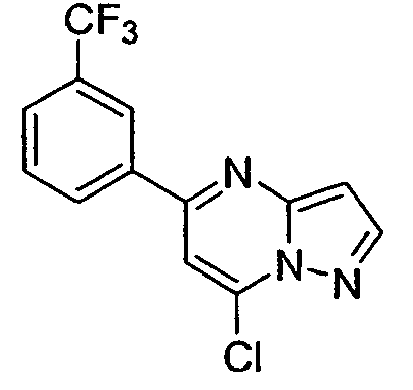

LCMS: MH+= 376 58 

LCMS: MH+=274 59 

LCMS: MH+=288 60 

61 

Yield = 75% LCMS: MH+= 338 62 

Yield = 52% LCMS: MH+ = 368 63 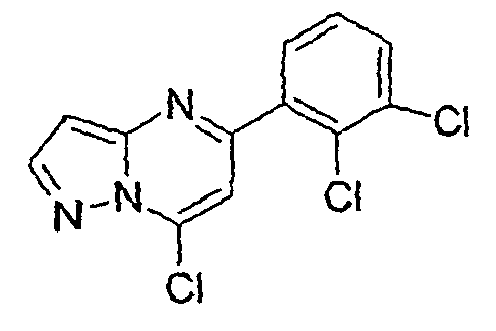

Yield = 87% LCMS: MH+ = 376 64 

Yield = 100% LCMS: MH+ = 316 65 

Yield = 92% LCMS: MH+ = 330 66 

Yield = 82% LCMS: MH+ = 395 67 

Yield=88% LCMS: MH+=308 68 

Yield=100% LCMS: MH+=322 68.10 

68.11 

68.12 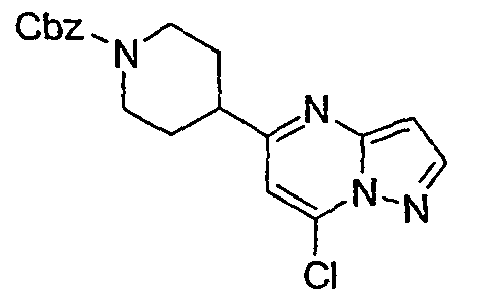

Yield = 99 MH+ =449 68.13 

Yield = 95 MH+ =449 68.14 

MH+=266 68.15 

Yield =quant. MH+ =314 -

- A solution of the compound prepared in Preparative Example 35 (0.3 g, 1.2 mmol) in CH3CN (15 mL) was treated with NCS (0.18 g, 1.1 eq.) and the resulting solution heated to reflux 4 hours. Additional NCS (0.032 g, 0.2 eq.) added and the resulting solution was stirred at reflux overnight. The reaction mixture was cooled to room temperature, concentrated in vacuo and the residue purified by flash chromatography using a 20% EtOAc in hexanes solution as eluent (0.28 g, 83% yield). LCMS: MH+= 282.
- By essentially the same procedure set forth in Preparative Example 69 only substituting the compound shown in Column 2 of Table 8, the compound shown in Column 3 of Table 8 was prepared:
TABLE 8 Prep. Ex. Column 2 Column 3 DATA 70 

Yield = 82% LCMS: MH+ = 286 -

- To a solution of the compound from Preparative Example 34 (1.0 g, 4.35 mmol) in DMF (6 mL) was added POCl3 (1.24 mL, 3.05 eq.) and the resulting mixture was stirred at room temperature overnight. The reaction mixture was cooled to 0°C and the excess POCl3 was quenched by the addition of ice. The resulting solution was neutralized with 1 N NaOH, diluted with H2O, and extracted with CH2Cl2. The combined organics were dried over Na2SO4, filtered and concentrated in vacuo. The crude product was purified by flash chromatography using a 5% MeOH in CH2Cl2 solution as eluent (0.95 g, 85% yield). LCMS: MH+=258.
-

- To a solution of the product of Preparative Example 71 (0.25 g, 0.97 mmol) in THF was added NaBH4 (0.041 g, 1.1 eq.) and the resulting solution was stirred at room temperature overnight. The reaction mixture was quenched by the addition of H2O and extracted with CH2Cl2. The combined organics were dried over Na2SO4, filtered, and concentrated under reduced pressure. The crude product was purified by flash chromatography using a 60: 40 hexanes: EtOAc mix as eluent (0.17 g, 69% yield). LCMS: MH+=260.
-

- A solution of the compound prepared in Preparative Example 72 (0.12 g, 0.462 mmol), dimethyl sulfate (0.088 mL, 2.0 eq), 50% NaOH (0.26 mL) and catalytic Bu4NBr in CH2Cl2 (4 mL) was stirred at room temperature overnight. The reaction mixture was diluted with H2O and extracted with CH2Cl2. The combined organics were dried over Na2SO4, filtered, and concentrated under reduced pressure. The crude product was purified by flash chromatography using a 30% EtOAc-in-hexanes solution as eluent (0.062 g, 48% yield).
-
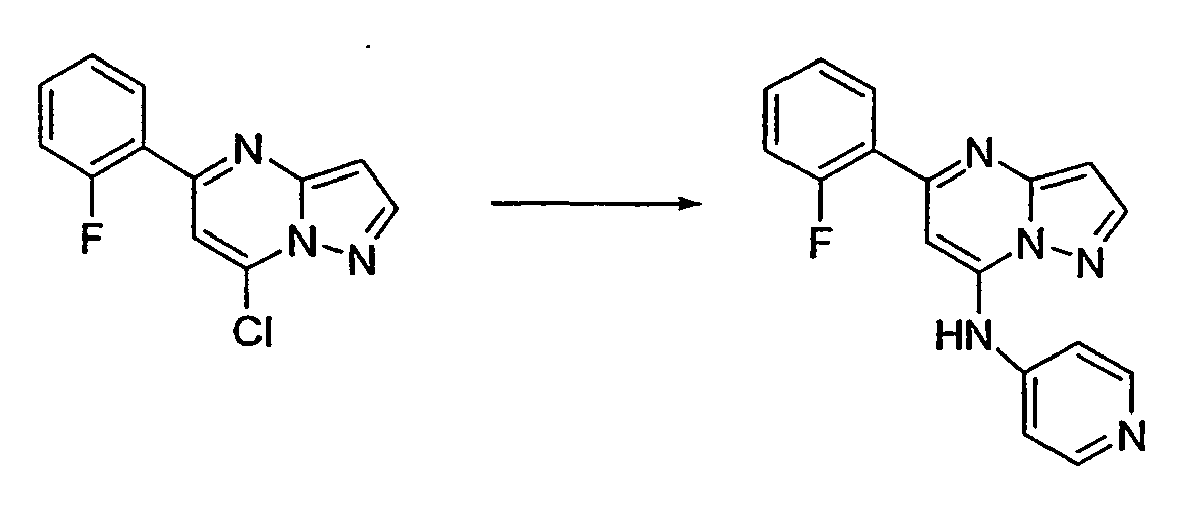
- The compound prepared in Preparative Example 35 (0.3 g, 1.2 mmol), K2CO3 (0.33 g, 2 eq.), and 4-aminompyridine (1.1 eq.) are reacted in 5 mL CH3CN for two days and concentrated under reduced pressure. The residue is partitioned between H2O and CH2Cl2. The organic layer is dried over Na2SO4, filtered and, concentrated. The crude product is purified by flash chromatography using a 5% (10% NH4OH in MeOH) solution in CH2Cl2 as eluent to give the desired product.
-

- The compound from Preparative Example 74 (0.91 mmol), BOC20 (0.22 g, 1.1 eq), and DMAP (0.13 g, 1.1 eq.) are reacted in dioxane (10 mL) at room temperature for 3 days. Additional BOC2O (0.10g, 0.5 eq.) is added and stirred for 4 hours. It is then concentrated in vacuo, diluted with saturated NaHCO3 (15 mL), and extracted with CH2Cl2 (2 x 100 mL). The combined organic layers are dried over Na2SO4, filter, and concentrate under reduced pressure. The crude product is purified by flash chromatography using a 5% (10% NH4OH in MeOH) solution in CH2Cl2 as eluent to give the product.
-

- By essentially the same procedure set forth in Preparative Example 54 only substituting the compound prepared in Preparative Example 75, the above product is prepared.
-

- The product of Preparative Example 76 (0.3 mmol), phenylboronic acid (0.073 g, 2.0 eq.), K3PO4 (0.19 g, 3.0 eq.), and Pd(PPh3)4 (0.017 g, 5 mol %) are reacted in refluxing DME (16 mL) and H2O (4 mL) for 7 hours. The resulting solution is cooled to room temperature, diluted with H2O (10 mL), and extracted with CH2Cl2 (3 x 50 mL). The combined organics are dried over Na2SO4, filtered, and concentrated. The crude product is purified by flash chromatography using a 2.5% (10% NH4OH in MeOH) in CH2Cl2 solution as eluent to obtain the product.
-
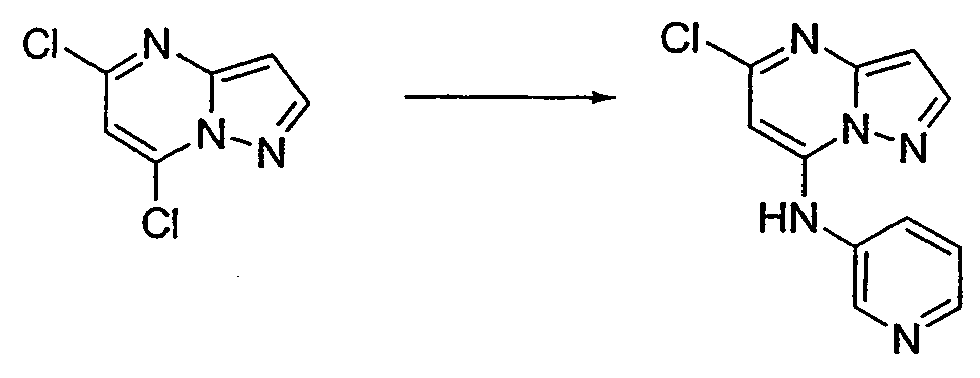
- To a solution of the compound prepared in Preparative Example 53.15 (0.25 g, 1.3 mmol) in dioxane (5 mL) is added iPr2NEt (0.47 mL, 2.0 eq.) and 3-aminomethylpyridine (0.15 ml, 1.1 eq.). The resulting solution is stirred at room temperature 72 hours. The reaction mixture is diluted with H2O and extracted with EtOAc. The combined organics are washed with H2O and saturated NaCl, dried over Na2SO4, filtered, and concentrated in vacuo. The crude product is purified by flash chromatography.
- By essentially the same procedure set forth in Preparative Example 78 only substituting the compound shown in Column 2 of Table 8.10, the compounds shown in Column 3 of Table 8.10 are prepared.
TABLE 8.10 Prep. Ex. Column 2 Column 3 79 

80 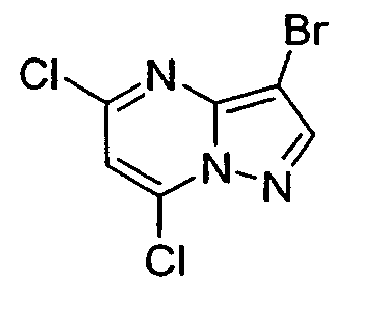

81 

-

- By essentially the same procedure set forth in Preparative Example 75 only substituting the compound from Preparative Example 80, the above compound is prepared.
-

- The product from Preparative Example 54 (0.875 mmol), 4-aminopyridine (0.12 g, 1.3 eq.), and K2CO3 (0.24 g, 2 eq.) are reacted in CH3CN (5 mL) as described in Preparative Example 74 to obtain the product.
- By following essentially the same procedure described in Example 1 only using the reactants shown in Columns 2 and 3 of Table 9, the products shown in Column 4 can be obtained.
TABLE 9 Ex. Column 2 Column 3 Column 4 2 


3 


4 


5 


6 


7 


8 


9 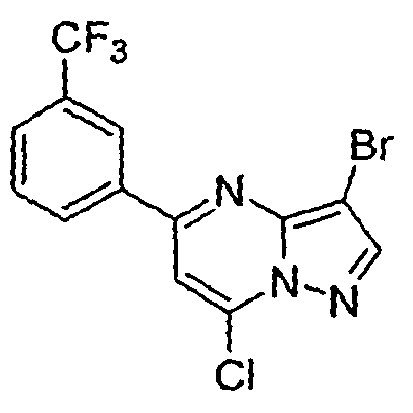


10 


11 


12 


13 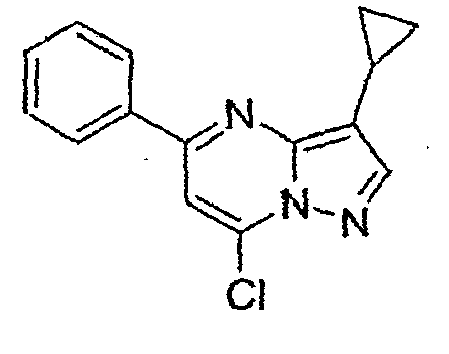


14 


15 


16 


17 


18 


19 


20 


21 


22 

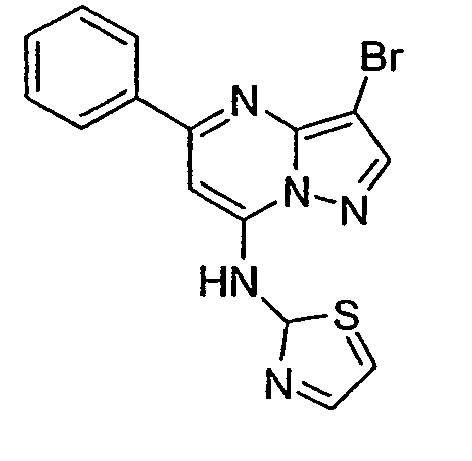
23 


24 


25 


26 


27 


28 


29 


30 


31 


32 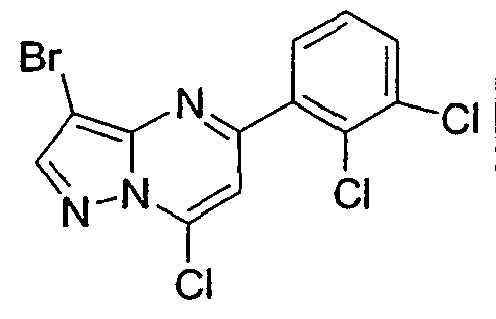


33 


34 


35 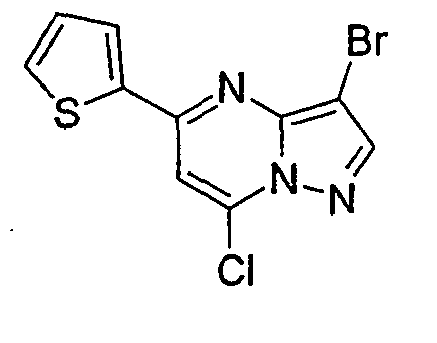


36 


37 


38 


39 


40 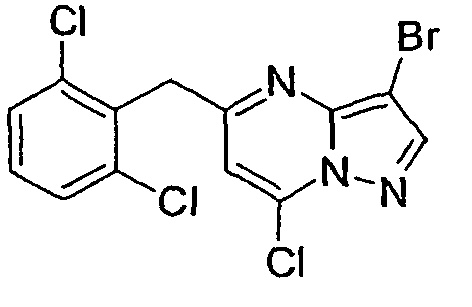


41 


42 


43 


44 


45 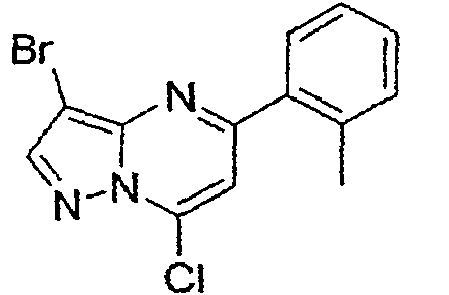


46 


46.10 


46.11 

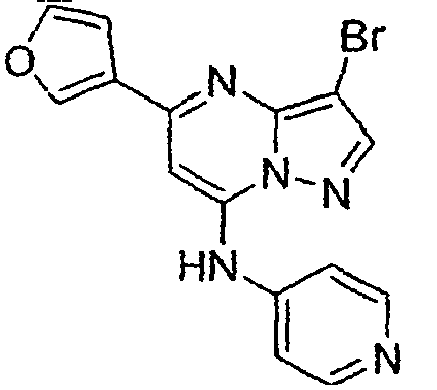
46.12 


46.13 


46.14 


46.15 


46.16 
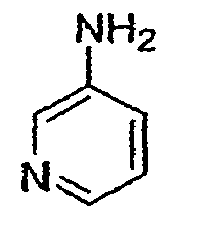

46.17 


46.18 


-

- TFA (0.5 mL) was added to a solution of the compound prepared in Preparative Example 76 (0.16 mmol) in CH2Cl2 (2.0 mL) at 0°C and the solution stirred for 2.5 hours. It was stored at 4°C overnight at which time an additional TFA (0.5 mL) is added. It was stirred for 4 hours and concentrated in vacuo. It was neutralized with 1 N NaOH and extracted with CH2Cl2. The combined organic layers were dried over Na2SO4, filter, and concentrated under reduced pressure. The crude product was purified by flash chromatography using a 2.5% (10% NH4OH in MeOH) in CH2Cl2 solution as eluent to give the product.
-

- To a solution of 5-chloro adduct in dioxane/DIPEA (2.5/1.0) at rt is added cyclopentylamine (1.2 eq.) dropwise. The resulting solution is stirred at reflux for 16h, cooled to rt, and concentrated under reduced pressure. The crude material is purified by preparative thin-layer chromatography (8 x 1000 µM).
- To a solution of the compound prepared in Example 48, Step A in CH2Cl2 at rt is added TFA (5 eq.) dropwise. The resulting solution is stirred for 18 h at rt and is concentrated under reduced pressure. The crude material is redissolved in CH2Cl2 and the organic layer is sequentially washed with sat. aq. NaHCO3 (2 x 2 mL) and brine (1 x 2 mL). The organic layer is dried (Na2SO4), filtered, and concentrated under reduced pressure. The crude material is purified by preparative thin-layer chromatography (8 x 1000 µM).
- By essentially the same procedure set forth in Example 48 only substituting the chlorides in Column 2 of Table 10 the compounds shown in Column 3 of Table 10 are prepared.
Table 10 Ex. Column 2 Column 4 49 

50 

51 

52 

53 

54 

55 

56 

57 

58 

-
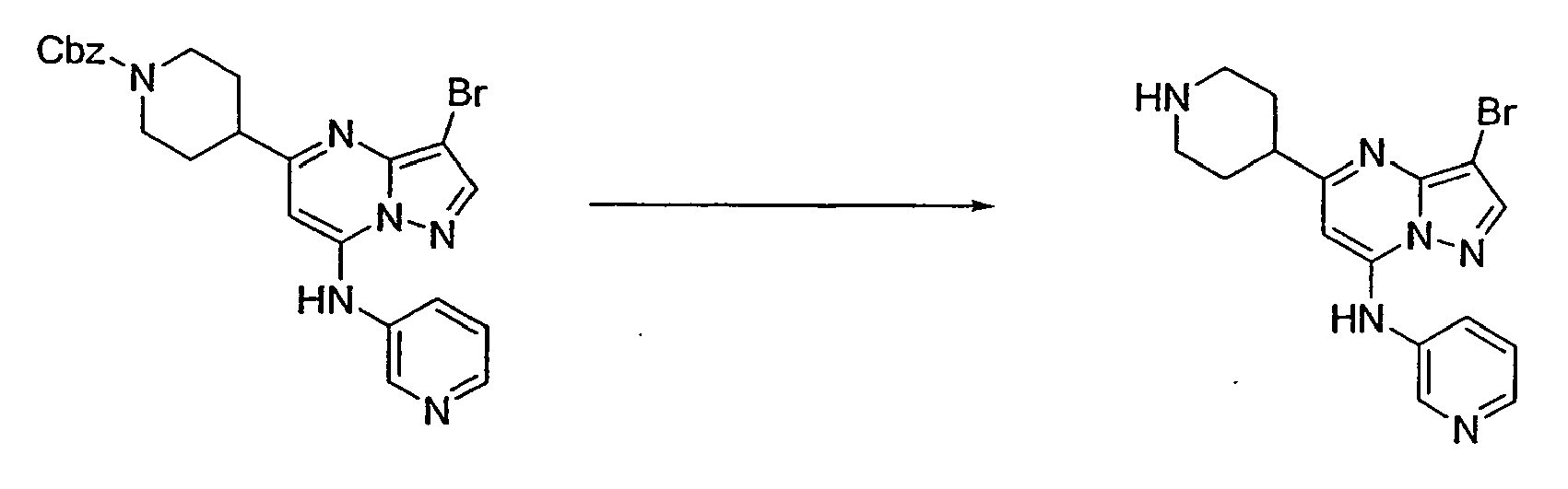
- To a solution of the compound prepared in Example 46.14 in anhydrous acetonitrile is added TMSI (4 eq.), dropwise at ambient temperature. After 10 minutes the acetonitrile is removed in vacuo. The resulting yellow foam is treated with 2 N HCl solution (7 mL) and then washed immediately with Et2O (5X). The pH of the aqueous is adjusted to 10 with 50 % NaOH (aq) and the product is isolated by saturation of the solution with NaCl (s) followed by extraction with CH2Cl2 (5X) to give the desired product.
- By essentially the same procedure set forth in Example 58 only substituting the compounds shown in Column 2 of Table 11, the compounds shown in Column 3 of Table 11 were prepared.
TABLE 11 Ex. Column 2 Column 3 60 

61 

62 

- BACULOVIRUS CONSTRUCTIONS: Cyclin E is cloned into pVL1393 (Pharmingen, La Jolla, California) by PCR, with the addition of 5 histidine residues at the amino-terminal end to allow purification on nickel resin. The expressed protein is approximately 45kDa. CDK2 is cloned into pVL1393 by PCR, with the addition of a haemaglutinin epitope tag at the carboxy-terminal end (YDVPDYAS). The expressed protein is approximately 34kDa in size.
- ENZYME PRODUCTION: Recombinant baculoviruses expressing cyclin E and CDK2 are co-infected into SF9 cells at an equal multiplicity of infection (MOI=5), for 48 hrs. Cells are harvested by centrifugation at 1000 RPM for 10 minutes, then pellets lysed on ice for 30 minutes in five times the pellet volume of lysis buffer containing 50mM Tris pH 8.0, 150mM NaCl, 1% NP40, 1 mM DTT and protease inhibitors (Roche Diagnostics GmbH, Mannheim, Germany). Lysates are spun down at 15000 RPM for 10 minutes and the supernatant retained. 5ml of nickel beads (for one liter of SF9 cells) are washed three times in lysis buffer (Qiagen GmbH, Germany). Imidazole is added to the baculovirus supernatant to a final concentration of 20mM, then incubated with the nickel beads for 45 minutes at 4° C. Proteins are eluted with lysis buffer containing 250mM imidazole. Eluate is dialyzed overnight in 2 liters of kinase buffer containing 50mM Tris pH 8.0, 1 mM DTT, 10mM MgCl2, 100uM sodium orthovanadate and 20% glycerol. Enzyme is stored in aliquots at -70°C.
- IN VITRO KINASE ASSAY: Cyclin E/CDK2 kinase assays are performed in low protein binding 96-well plates (Corning Inc, Corning, New York). Enzyme is diluted to a final concentration of 50 µg/ml in kinase buffer containing 50mM Tris pH 8.0, 10mM MgCl2,1 mM DTT, and 0.1 mM sodium orthovanadate. The substrate used in these reactions is a biotinylated peptide derived from Histone H1 (from Amersham, UK). The substrate is thawed on ice and diluted to 2 µM in kinase buffer. Compounds are diluted in 10%DMSO to desirable concentrations. For each kinase reaction, 20 µl of the 50 µg/ml enzyme solution (1 µg of enzyme) and 20 µl of the 2 µM substrate solution are mixed, then combined with 10 µl of diluted compound in each well for testing. The kinase reaction is started by addition of 50 µl of 2 µM ATP and 0.1 µCi of 33P-ATP (from Amersham, UK). The reaction is allowed to run for 1 hour at room temperature. The reaction is stopped by adding 200 µl of stop buffer containing 0.1 % Triton X-100, 1 mM ATP, 5mM EDTA, and 5 mg/ml streptavidine coated SPA beads (from Amersham, UK) for 15 minutes. The SPA beads are then captured onto a 96-well GF/B filter plate (Packard/Perkin Elmer Life Sciences) using a Filtermate universal harvester (Packard/Perkin Elmer Life Sciences.). Non-specific signals are eliminated by washing the beads twice with 2M NaCl then twice with 2 M NaCl with 1% phosphoric acid. The radioactive signal is then measured using a TopCount 96 well liquid scintillation counter (from Packard/Perkin Elmer Life Sciences).
- IC 50 DETERMINATION: Dose-response curves are be plotted from inhibition data generated, each in duplicate, from 8 point serial dilutions of inhibitory compounds. Concentration of compound is plotted against % kinase activity, calculated by CPM of treated samples divided by CPM of untreated samples. To generate IC50 values, the dose-response curves are then fitted to a standard sigmoidal curve and IC50 values are derived by nonlinear regression analysis.
Claims (35)
- A compound represented by the structural formula:

wherein:R is heteroaryl, wherein said heteroaryl can be unsubstituted or optionally independently substituted with one or more moieties which can be the same or different, each moiety being independently selected from the group consisting of halogen, alkyl, aryl, cycloalkyl, CF3, OCF3, CN, -OR5, -NR5R6, -C(R4R5)nOR5, - C(O2)R5, -C(O)R5, -C(O)NR5R6, -SR6, -S(O2)R7, -S(O2)NR5R6, -N(R5)S(O2)R7, -N(R5)C(O)R7 and -N(R5)C(O)NR5R6;R2 is selected from the group consisting of R9, alkyl, alkynyl, aryl, heteroaryl, CF3, heterocyclylalkyl, alkynylalkyl, cycloalkyl, -C(O)OR4, alkyl substituted with 1-6 R9 groups which can be the same or different and are independently selected from the list of R9 shown later below,
 R3 is selected from the group consisting of H, halogen, -NR5R 6, -C(O)OR4, -C(O)NR5R6, alkyl, alkynyl, cycloalkyl, cycloalkylalkyl, aryl, arylalkyl, heterocyclyl, heterocyclylalkyl, heteroaryl,
 R4 is H, halo or alkyl;R5 is H or alkyl;R6 is selected from the group consisting of H, alkyl, aryl, arylalkyl, cycloalkyl, heterocyclyl, heterocyclylalkyl, heteroaryl, and heteroarylalkyl, wherein each of said alkyl, aryl, arylalkyl, cycloalkyl, heterocyclyl, heterocyclylalkyl, heteroaryl, and heteroarylalkyl can be unsubstituted or optionally substituted with one or more moieties which can be the same or different, each moiety being independently selected from the group consisting of halogen, alkyl, aryl, cycloalkyl, CF3, OCF3, CN, -OR5, -NR5R10, -N(R5)Boc, -(CR4R5)nOR5, -C(O2)R5, -C(O)R5, -C(O)NR5R10, -SO3H, -SR10, -S(O2)R7, -S(O2)NR5R10, -N(R5)S(O2)R7, -N(R5)C(O)R7 and -N(R5)C(O)NR5R10;R10 is selected from the group consisting of H, alkyl, aryl, arylalkyl, cycloalkyl, heterocyclyl, heterocyclylalkyl, heteroaryl, and heteroarylalkyl, wherein each of said alkyl, aryl, arylalkyl, cycloalkyl, heterocyclyl, heterocyclylalkyl, heteroaryl, and heteroarylalkyl can be unsubstituted or optionally substituted with one or more moieties which can be the same or different, each moiety being independently selected from the group consisting of halogen, alkyl, aryl, cycloalkyl, CF3, OCF3, CN, -OR5, -NR4R5, -N(R5)Boc, -(CR4R5)nOR5, -C(O2)R5, -C(O)NR4R5, -C(O)R5, -SO3H, -SR5 -S(O2)R7, -S(O2)NR4R5, -N(R5)S(O2)R7, -N(R5)C(O)R7 and -N(R5)C(O)NR4R5;or optionally (i) R5 and R10 in the moiety-NR5R10, or (ii) R5 and R6 in the moiety -NR5R6, may be joined together to form a cycloalkyl or heterocyclyl moiety, with each of said cycloalkyl or heterocyclyl moiety being unsubstituted or optionally independently being substituted with one or more R9 groups;R7 is selected from the group consisting of alkyl, cycloalkyl, aryl, heteroaryl, arylalkyl and heteroarylalkyl, wherein each of said alkyl, cycloalkyl, heteroarylalkyl, aryl, heteroaryl and arylalkyl for R7 can be unsubstituted or optionally independently substituted with one or more moieties which can be the same or different, each moiety being independently selected from the group consisting of halogen, alkyl, aryl, cycloalkyl, CF3, OCF3, CN, -OR5, -NR5R10, -CH2OR5, - C(O2)R5, -C(O)NR5R10, -C(O)R5, -SR10, -S(O2)R10, -S(O2)NR5R10, -N(R5)S(O2)R10, -N(R5)C(O)R10 and -N(R5)C(O)NR5R10;R8 is selected from the group consisting of R6, -C(O)NR5R10, -CH2OR4, -C(O)OR6, -C(O)R7 and -S(O2)R7;R9 is selected from the group consisting of halogen, -CN, -NR5R6 , -(CH2)nOR4 , -C(O2)R6, -C(O)NR5R6, -OR6 , -SR6, -S(O2)R7, -S(O2)NR5R6, -N(R5)S(O2)R7, -N(R5)C(O)R7 and -N(R5)C(O)NR5R6;m is 0 to 4; andn is 1 to 4.
 - The compound of claim 1 or a pharmaceutically acceptable salt or solvate thereof, wherein R is selected from the group consisting of 2-pyridyl, 4-pyridyl, 3-pyridyl, 4-pyridyl-N-oxide, 3-pyridyl-N-oxide, 1,3-thiazol-2-yl, pyrimidin-5-yl, pyrazin-3-yl and pyridazin-3-yl wherein each of said pyridyl, thiazolyl, pyrimidinyl, pyrazinyl and pyridazinyl moieties can be unsubstituted or optionally independently substituted with one or more moieties which can be the same or different, each moiety being independently selected from the group consisting of halogen, alkyl, arylCF3, OCF3, CN, -OR5, -NR5R , -CH2OR5,-C(O2)R5, -C(O)NR5R6, -S(O2)NR5R6, and -N(R5)S(O2)R7;R2 is halogen, CF3, CN, lower alkyl, cycloalkyl, -OR6, -C(O)OR4, -(CH2)nOR6, aryl or heteroaryl;R3 is H, halogen, lower alkyl, aryl, heteroaryl, -C(O)OR4, cycloalkyl, -NR5R6, heterocyclylalkyl, cycloalkylalkyl,

 R4 is H or lower alkyl;R5 is H or lower alkyl;m is 0 to 2; andn is 1 or 2.
 - The compound of claim 2 or a pharmaceutically acceptable salt or solvate thereof, wherein R is selected from the group consisting of 2-pyridyl, 4-pyridyl, 3-pyridyl, 4-pyridyl-N-oxide, 3-pyridyl-N-oxide, 1,3-thiazo(-2-yl and pyrimidin-5-yl.
- The compound of claim 2 or a pharmaceutically acceptable salt or solvate thereof, wherein R2 is F, Cl, Br, CF3, CN, lower alkyl, cycloalkyl or -(CH2)nOR6.
- The compound of claim 2 or a pharmaceutically acceptable salt or solvate thereof, wherein R3 is H, lower alkyl, cycloalkyl, -C(O)OR4, aryl, heteroaryl, cycloalkylalkyl,


- The compound of claim 2 or a pharmaceutically acceptable salt or solvate thereof, wherein R4 is H.
- The compound of claim 2 or a pharmaceutically acceptable salt or solvate thereof, wherein R5 is H.
- The compound of claim 2 or a pharmaceutically acceptable salt or solvate thereof, wherein m is 0.
- The compound of claim 2 or a pharmaceutically acceptable salt or solvate thereof, wherein n is 1.
- The compound of claim 2 or a pharmaceutically acceptable salt or solvate thereof, wherein R is 2-pyridyl.
- The compound of claim 2 or a pharmaceutically acceptable salt or solvate thereof, wherein R is 3-pyridyl.
- The compound of claim 2 or a pharmaceutically acceptable salt or solvate thereof, wherein R is 4-pyridyl.
- The compound of claim 2 or a pharmaceutically acceptable salt or solvate thereof, wherein R is the N-oxide of 4-pyridyl.
- The compound of claim 4 or a pharmaceutically acceptable salt or solvate thereof, wherein said R2 is Br.
- The compound of claim 4 or a pharmaceutically acceptable salt or solvate thereof, wherein said R2 is Cl.
- The compound of claim 4 or a pharmaceutically acceptable salt or solvate thereof, wherein R2 is isopropyl or ethyl.
- The compound of claim 4 or a pharmaceutically acceptable salt or solvate thereof, wherein R2 is -CH2OH or -CH2OCH3.
- The compound of claim 4 or a pharmaceutically acceptable salt or solvate thereof, wherein R2 is cyclopropyl.
- The compound of claim 4 or a pharmaceutically acceptable salt or solvate thereof, wherein R2 is CN.
- The compound of claim 4 or a pharmaceutically acceptable salt or solvate thereof, wherein R3 is lower alkyl, cycloalkyl, cycloalkylalkyl, aryl, -NR5R6,

- The compound of claim 20 or a pharmaceutically acceptable salt or solvate thereof, wherein R3 is isopropyl.
- The compound of claim 21 or a pharmaceutically acceptable salt or solvate thereof, wherein R3 is

- The compound of claim 20 or a pharmaceutically acceptable salt or solvate thereof, wherein R3 is unsubstituted phenyl or phenyl substituted with one or more moieties selected from the group consisting of F, Br, Cl, OMe, CH3 and CF3.
- The compound of claim 20 or a pharmaceutically acceptable salt or solvate thereof, wherein R3 is cyclohexylmethyl.
- A compound selected from the group consisting of:


- A compound of the formula:


- Use of at least one compound of claims 1 to 26 or a pharmaceutically acceptable salt or solvate thereof for the preparation of a medicament for the treatment or prevention of a disease selected from the group consisting of proliferative diseases, autoimmune diseases, viral diseases, fungal diseases, neurodegenerative diseases, arthritis, inflammation, and cardiovascular diseases.
- The use of claim 27 wherein said neurodegenerative disease is Alzheimer's disease.
- The use of claim 27 wherein said proliferative disease is cancer.
- The use of claim 29 wherein said cancer is selected from the group consisting of: cancer of the bladder, breast, colon, kidney, liver, lung, small cell lung cancer, esophagus, gall bladder, ovary, pancreas, stomach, cervix, thyroid, prostate, and skin, squamous cell carcinoma; leukemia, acute lymphocytic leukemia, acute lymphoblastic leukemia, B-cell lymphoma, T- cell lymphoma, Hodgkins lymphoma, non-Hodgkins lymphoma, hairy cell lymphoma, Burkett's lymphoma; acute and chronic myelogenous leukemia, myelodysplastic syndrome, promyelocytic leukemia; fibrosarcoma, rhabdomyosarcoma; astrocytoma, neuroblastoma, glioma and schwannomas; melanoma, seminoma, teratocarcinoma, osteosarcoma, xenoderoma pigmentosum, keratoctanthoma, thyroid follicular cancer and Kaposi's sarcoma.
- The use of claim 29 or 30 wherein the use is in combination with at least one anti-cancer agent.
- The use of claim 31, wherein said anti-cancer agent is selected from the group consisting of a cytostatic agent, cisplatin, doxorubicin, taxotere, taxol, etoposide, irinotecan (or CPT-11), camptostar, topotecan, paclitaxel, docetaxel, epothilones, tamoxifen, 5-fluorouracil, methoxtrexate, 5-Fluorouracil, temozolomide, cyclophosphamide, 4-[2-[4-[(11R)-3,10-dibromo-8-chloro-6,11-dihydro-5H-benzo[5,6]cyclohepta[1 ,2-b]pyridin-11-yl-]-1-piperidinyl]-2-oxoehtyl]-1-piperidinecarboxamide, tipifamib, L778,123 (a farnesyl protein transferase inhibitor), BMS 214662 (a farnesyl protein transferase inhibitor), Iressa, Tarceva, antibodies to EGFR, Gleevec, intron, ara-C, adriamycin, cytoxan, gemcitabine, Uracil mustard, Chlormethine, lfosfamide, Melphalan, Chlorambucil, Pipobroman, Triethylenemelamine, Triethylenethiophosphoramine, Busulfan, Carmustine, Lomustine, Streptozocin, Dacarbazine, Floxuridine, Cytarabine, 6-Mercaptopurine, 6-Thioguanine, Fludarabine phosphate, oxaliplatin, leucovirin, oxaliplatin, Pentostatine, Vinblastine, Vincristine, Vindesine, Bleomycin, Dactinomycin, Daunorubicin, Doxorubicin, Epirubicin, Idarubicin, Mithramycin, Deoxycoformycin, Mitomycin-C, L-Asparaginase, Teniposide 17α-Ethinylestradiol, Diethylstilbestrol, Testosterone, Prednisone, Fluoxymesterone, Dromostanolone propionate, Testolactone, Megestrolacetate, Methylprednisolone, Methyltestosterone, Prednisolone, Triamcinolone, Chlorotrianisene, Hydroxyprogesterone, Aminoglutethimide, Estramustine, Medroxyprogesteroneacetate, Leuprolide, Flutamide, Toremifene, goserelin, Cisplatin, Carboplatin, Hydroxyurea, Amsacrine, Procarbazine, Mitotane, Mitoxantrone, Levamisole, Navelbene, Anastrazole, Letrazole, Capecitabine, Reloxafine, Droloxafine, or Hexamethylmelamine.
- The use of any one of claims 29 to 32 wherein the use further comprises radiation therapy.
- A pharmaceutical composition comprising at least one compound of claims 1 to 26 or a pharmaceutically acceptable salt or solvate thereof in combination with at least one pharmaceutically acceptable carrier.
- : The pharmaceutical composition of claim 34, additionally comprising one or more anti-cancer agents selected from the group consisting of cytostatic agent, cisplatin, doxorubicin, taxotere, taxol, etoposide, CPT-11, irinotecan, camptostar, topotecan, paclitaxel, docetaxel, epothilones, tamoxifen, 5-fluorouracil, methoxtrexate, 5-fluorouracil, temozolomide, cyclophosphamide, 4-[2-[4-[(11 R)-3,10-dibromo-8-chloro-6,11-dihydro-5H-benzo[5,6]cyclohepta[1,2-b] pyridin-11-yl-]-1-piperidinyl]-2-oxoehtyl]-1-piperidinecarboxamide, Zarnestra® (tipifamib), L778,123 (a farnesyl protein transferase inhibitor), BMS 214662 (a farnesyl protein transferase inhibitor), Iressa, Tarceva, antibodies to EGFR, Gleevec, intron, ara-C, adriamycin, cytoxan, gemcitabine, Uracil mustard, Chlormethine, Ifosfamide, Melphalan, Chlorambucil, Pipobroman, Triethylenemelamine, Triethylenethiophosphoramine, Busulfan, Carmustine, Lomustine, Streptozocin, Dacarbazine, Floxuridine, Cytarabine, 6-Mercaptopurine, 6-Thioguanine, Fludarabine phosphate, Pentostatine, Vinblastine, Vincristine, Vindesine, Bleomycin, Dactinomycin, Daunorubicin, Doxorubicin, Epirubicin, Idarubicin, Mithramycin, Deoxycoformycin, Mitomycin-C, L-Asparaginase, Teniposide 17α-Ethinylestradiol, Diethylstilbestrol, Testosterone, Prednisone, Fluoxymesterone, Dromostanolone propionate, Testolactone, Megestrolacetate, Methylprednisolone, Methyltestosterone, Prednisolone, Triamcinolone, Chlorotrianisene, Hydroxyprogesterone, Aminoglutethimide, Estramustine, Medroxyprogesteroneacetate, Leuprolide, Flutamide, Toremifene, goserelin, Cisplatin, Carboplatin, Hydroxyurea, Amsacrine, Procarbazine, Mitotane, Mitoxantrone, Levamisole, Navelbene, Anastrazole, Letrazole, Capecitabine, Reloxafine, Droloxafine, or Hexamethylmelamine.
Applications Claiming Priority (3)
| Application Number | Priority Date | Filing Date | Title |
|---|---|---|---|
| US40803002P | 2002-09-04 | 2002-09-04 | |
| US408030P | 2002-09-04 | ||
| PCT/US2003/027405 WO2004022559A1 (en) | 2002-09-04 | 2003-09-03 | Pyrazolopyrimidines as cyclin dependent kinase inhibitors |
Publications (2)
| Publication Number | Publication Date |
|---|---|
| EP1534709A1 EP1534709A1 (en) | 2005-06-01 |
| EP1534709B1 true EP1534709B1 (en) | 2007-06-13 |
Family
ID=31978549
Family Applications (1)
| Application Number | Title | Priority Date | Filing Date |
|---|---|---|---|
| EP03749317A Expired - Lifetime EP1534709B1 (en) | 2002-09-04 | 2003-09-03 | Pyrazolopyrimidines as cyclin dependent kinase inhibitors |
Country Status (17)
| Country | Link |
|---|---|
| US (2) | US7078525B2 (en) |
| EP (1) | EP1534709B1 (en) |
| JP (2) | JP2006501260A (en) |
| KR (1) | KR20050058507A (en) |
| CN (1) | CN1310918C (en) |
| AR (1) | AR041134A1 (en) |
| AT (1) | ATE364608T1 (en) |
| CA (1) | CA2497444C (en) |
| DE (1) | DE60314427T2 (en) |
| ES (1) | ES2285164T3 (en) |
| MX (1) | MXPA05002573A (en) |
| MY (1) | MY139336A (en) |
| NZ (1) | NZ539162A (en) |
| PE (1) | PE20041076A1 (en) |
| TW (1) | TW200413377A (en) |
| WO (1) | WO2004022559A1 (en) |
| ZA (1) | ZA200501851B (en) |
Families Citing this family (59)
| Publication number | Priority date | Publication date | Assignee | Title |
|---|---|---|---|---|
| US6242469B1 (en) * | 1996-12-03 | 2001-06-05 | Sloan-Kettering Institute For Cancer Research | Synthesis of epothilones, intermediates thereto, analogues and uses thereof |
| US20020058286A1 (en) * | 1999-02-24 | 2002-05-16 | Danishefsky Samuel J. | Synthesis of epothilones, intermediates thereto and analogues thereof |
| WO2004018478A2 (en) | 2002-08-23 | 2004-03-04 | Sloan-Kettering Institute For Cancer Research | Synthesis of epothilones, intermediates thereto, analogues and uses thereof |
| US6921769B2 (en) | 2002-08-23 | 2005-07-26 | Sloan-Kettering Institute For Cancer Research | Synthesis of epothilones, intermediates thereto and analogues thereof |
| US7649006B2 (en) | 2002-08-23 | 2010-01-19 | Sloan-Kettering Institute For Cancer Research | Synthesis of epothilones, intermediates thereto and analogues thereof |
| US7119200B2 (en) * | 2002-09-04 | 2006-10-10 | Schering Corporation | Pyrazolopyrimidines as cyclin dependent kinase inhibitors |
| MXPA05002571A (en) * | 2002-09-04 | 2005-09-08 | Schering Corp | Pyrazolopyrimidines as cyclin-dependent kinase inhibitors. |
| US7605155B2 (en) * | 2002-09-04 | 2009-10-20 | Schering Corporation | Substituted pyrazolo[1,5-a]pyrimidines as protein kinase inhibitors |
| US7205308B2 (en) | 2002-09-04 | 2007-04-17 | Schering Corporation | Trisubstituted 7-aminopyrazolopyrimidines as cyclin dependent kinase inhibitors |
| CA2497544C (en) * | 2002-09-04 | 2010-11-02 | Schering Corporation | Pyrazolo[1,5-a]pyrimidines compounds as cyclin dependent kinase inhibitors |
| US7563798B2 (en) * | 2002-09-04 | 2009-07-21 | Schering Corporation | Substituted pyrazolo[1,5-a]pyrimidines as protein kinase inhibitors |
| US7196092B2 (en) * | 2002-09-04 | 2007-03-27 | Schering Corporation | N-heteroaryl pyrazolopyrimidines as cyclin dependent kinase inhibitors |
| CN1310918C (en) * | 2002-09-04 | 2007-04-18 | 先灵公司 | Novel pyrazolopyrimidines as cyclin dependent kinase inhibitors |
| KR20050115252A (en) * | 2003-02-28 | 2005-12-07 | 데이진 화-마 가부시키가이샤 | Pyrazolo[1,5-a]pyrimidine derivatives |
| GB0305559D0 (en) * | 2003-03-11 | 2003-04-16 | Teijin Ltd | Compounds |
| US20070179161A1 (en) * | 2003-03-31 | 2007-08-02 | Vernalis (Cambridge) Limited. | Pyrazolopyrimidine compounds and their use in medicine |
| WO2004108136A1 (en) * | 2003-06-04 | 2004-12-16 | Vernalis (Cambridge) Limited | Triazolo `1 , 5-a!pyrimidines and their use in medicine |
| MXPA06002618A (en) * | 2003-09-09 | 2006-06-05 | Ono Pharmaceutical Co | Crf antagonists and heterobicyclic compounds. |
| EP1799667B1 (en) | 2004-09-20 | 2013-03-20 | Xenon Pharmaceuticals Inc. | Heterocyclic derivatives and their use as therapeutic agents |
| MX2007003319A (en) | 2004-09-20 | 2007-06-05 | Xenon Pharmaceuticals Inc | Pyridazine derivatives for inhibiting human stearoyl-coa- desaturase. |
| JP4958786B2 (en) | 2004-09-20 | 2012-06-20 | ゼノン・ファーマシューティカルズ・インコーポレイテッド | Heterocyclic derivatives and their use as therapeutic agents |
| MX2007003327A (en) | 2004-09-20 | 2007-06-05 | Xenon Pharmaceuticals Inc | Heterocyclic derivatives and their use as mediators of stearoyl-coa desaturase. |
| EP2269610A3 (en) | 2004-09-20 | 2011-03-09 | Xenon Pharmaceuticals Inc. | Heterocyclic derivatives and their use as stearoyl-coa desaturase inhibitors |
| MX2007003332A (en) | 2004-09-20 | 2007-06-05 | Xenon Pharmaceuticals Inc | Heterocyclic derivatives and their use as stearoyl-coa desaturase inhibitors. |
| EP2289510A1 (en) | 2004-09-20 | 2011-03-02 | Xenon Pharmaceuticals Inc. | Heterocyclic derivatives for the treatment of diseases mediated by stearoyl-coa desaturase enzymes |
| BRPI0611187A2 (en) | 2005-06-03 | 2010-08-24 | Xenon Pharmaceuticals Inc | amino thiazide derivatives as inhibitors of human stearoyl coa desaturase |
| US7700773B2 (en) | 2005-09-09 | 2010-04-20 | Schering Corporation | 4-cyano, 4-amino, and 4-aminomethyl derivatives of pyrazolo[1,5-a]pyridines, pyrazolo[1,5-c]pyrimidines and 2H-indazole compounds and 5-cyano, 5-amino, and 5-aminomethyl derivatives of imidazo[1,2-a]pyridines, and imidazo[1,5-a]pyrazines as cyclin dependent kinase inhibitors |
| US7642266B2 (en) * | 2005-10-06 | 2010-01-05 | Schering Corporation | Substituted pyrazolo[1,5-a]pyrimidines as protein kinase inhibitors |
| BRPI0616985B1 (en) * | 2005-10-06 | 2021-10-26 | Merck Sharp & Dohme Corp. | PIRAZOLE[1,5-A]PYRIMIDINE COMPOUND, E, USE OF A COMPOUND |
| TWI403320B (en) | 2005-12-16 | 2013-08-01 | Infinity Discovery Inc | Compounds and methods for inhibiting the interaction of bcl proteins with binding partners |
| US8008307B2 (en) | 2006-08-08 | 2011-08-30 | Millennium Pharmaceuticals, Inc. | Heteroaryl compounds useful as inhibitors of E1 activating enzymes |
| GB0704652D0 (en) | 2007-03-09 | 2007-04-18 | Syngenta Participations Ag | Novel herbicides |
| MX2009013336A (en) * | 2007-06-07 | 2010-01-20 | Schering Corp | Synthesis of substituted-3-aminopyrazoles. |
| DE102008022221A1 (en) * | 2008-05-06 | 2009-11-12 | Universität des Saarlandes | Inhibitors of human aldosterone synthase CYP11B2 |
| US20100190747A1 (en) | 2009-01-27 | 2010-07-29 | Hideo Suzuki | Fused ring compound and use thereof |
| EP2473041B1 (en) | 2009-09-04 | 2018-03-07 | Merck Sharp & Dohme Corp. | Modulators of cell cycle checkpoints and their use in combination with checkpoint kinase inhibitors |
| US10953012B2 (en) | 2011-04-26 | 2021-03-23 | Bioenergenix Llc | Heterocyclic compounds for the inhibition of pask |
| JP2014517079A (en) | 2011-06-22 | 2014-07-17 | バーテックス ファーマシューティカルズ インコーポレイテッド | Compounds useful as ATR kinase inhibitors |
| US9290500B2 (en) | 2012-02-17 | 2016-03-22 | Millennium Pharmaceuticals, Inc. | Pyrazolopyrimidinyl inhibitors of ubiquitin-activating enzyme |
| US9278973B2 (en) | 2012-10-25 | 2016-03-08 | Bioenergenix Llc | Heterocyclic compounds for the inhibition of PASK |
| WO2014066795A1 (en) | 2012-10-25 | 2014-05-01 | Bioenergenix | Heterocyclic compounds for the inhibition of pask |
| JP6377068B2 (en) | 2012-11-16 | 2018-08-22 | ユニバーシティ・ヘルス・ネットワーク | Pyrazolopyrimidine compounds |
| SMT202000713T1 (en) | 2012-12-07 | 2021-03-15 | Vertex Pharma | Pyrazolo[1,5-a]pyrimidines useful as inhibitors of atr kinase for the treatment of cancer diseases |
| RU2015143517A (en) * | 2013-03-13 | 2017-04-19 | Дженентек, Инк. | Pyrazole-containing compounds and their use |
| EP2970288A1 (en) | 2013-03-15 | 2016-01-20 | Vertex Pharmaceuticals Incorporated | Compounds useful as inhibitors of atr kinase |
| JP2016512815A (en) | 2013-03-15 | 2016-05-09 | バーテックス ファーマシューティカルズ インコーポレイテッドVertex Pharmaceuticals Incorporated | Condensed pyrazolopyrimidine derivatives useful as inhibitors of ATR kinase |
| WO2014143241A1 (en) | 2013-03-15 | 2014-09-18 | Vertex Pharmaceuticals Incorporated | Compounds useful as inhibitors of atr kinase |
| WO2015002994A2 (en) | 2013-07-02 | 2015-01-08 | Millennium Pharmaceuticals, Inc. | Heteroaryl compounds useful as inhibitors of sumo activating enzyme |
| HUE046727T2 (en) | 2013-12-06 | 2020-03-30 | Vertex Pharma | 2-amino-6-fluoro-n-[5-fluoro-pyridin-3-yl]pyrazolo[1,5-a]pyrimidin-3-carboxamide compound useful as atr kinase inhibitor, its preparation, different solid forms and radiolabelled derivatives thereof |
| CN107074863B (en) | 2014-06-05 | 2019-12-03 | 沃泰克斯药物股份有限公司 | Methods of making ATR kinase inhibitors and their different solid forms |
| PL3157566T3 (en) | 2014-06-17 | 2019-10-31 | Vertex Pharma | Method for treating cancer using a combination of chk1 and atr inhibitors |
| HUE045748T2 (en) | 2014-07-01 | 2020-01-28 | Millennium Pharm Inc | Heteroaryl compounds useful as inhibitors of sumo activating enzyme |
| CN106699785A (en) * | 2015-07-13 | 2017-05-24 | 南开大学 | 2-(N-oxide pyridine-2-ylamino)-pyrido[2,3-d]pyrimidin-7-one compound as CDK4/6 inhibitor |
| KR20180032611A (en) * | 2015-07-23 | 2018-03-30 | 브리스톨-마이어스 스큅 컴퍼니 | TGF beta receptor antagonist |
| KR102678021B1 (en) | 2015-09-30 | 2024-06-26 | 버텍스 파마슈티칼스 인코포레이티드 | Pharmaceutical composition for cancer treatment comprising an ATR inhibitor, used in combination with a DNA damaging agent |
| JP6895963B2 (en) | 2015-11-18 | 2021-06-30 | ジェンザイム・コーポレーション | Biomarkers for polycystic kidney disease and their use |
| CN108017641B (en) * | 2016-11-02 | 2021-01-05 | 深圳铂立健医药有限公司 | Pyrazolopyrimidine compound as PI3K inhibitor and application thereof |
| FI3612030T3 (en) * | 2017-04-21 | 2026-03-20 | Pahr Therapeutics Inc | AHR INDOLES AND THEIR USES |
| MX2022006308A (en) | 2019-11-26 | 2022-06-22 | Ikena Oncology Inc | Polymorphic carbazole derivatives and uses thereof. |
Family Cites Families (22)
| Publication number | Priority date | Publication date | Assignee | Title |
|---|---|---|---|---|
| JPS6157587A (en) * | 1984-08-29 | 1986-03-24 | Shionogi & Co Ltd | Condensed heterocyclic derivative and antiulcerative |
| WO1992018504A1 (en) * | 1991-04-22 | 1992-10-29 | Otsuka Pharmaceutical Factory, Inc. | PYRAZOLO[1,5-a]PYRIMIDINE DERIVATIVE AND ANTI-INFLAMMATORY CONTAINING THE SAME |
| US5571813A (en) * | 1993-06-10 | 1996-11-05 | Beiersdorf-Lilly Gmbh | Fused pyrimidine compounds and their use as pharmaceuticals |
| EP0628559B1 (en) | 1993-06-10 | 2002-04-03 | Beiersdorf-Lilly GmbH | Pyrimidine compounds and their use as pharmaceuticals |
| KR100315837B1 (en) * | 1994-06-21 | 2002-02-28 | 고리 히데아끼 | PYRAZOLO[1,5-a]PYRAMIDINE DERIVATIVE |
| US5919815A (en) * | 1996-05-22 | 1999-07-06 | Neuromedica, Inc. | Taxane compounds and compositions |
| US6191131B1 (en) * | 1997-07-23 | 2001-02-20 | Dupont Pharmaceuticals Company | Azolo triazines and pyrimidines |
| US6040321A (en) * | 1997-11-12 | 2000-03-21 | Bristol-Myers Squibb Company | Aminothiazole inhibitors of cyclin dependent kinases |
| US6262096B1 (en) * | 1997-11-12 | 2001-07-17 | Bristol-Myers Squibb Company | Aminothiazole inhibitors of cyclin dependent kinases |
| US6413974B1 (en) * | 1998-02-26 | 2002-07-02 | Aventis Pharmaceuticals Inc. | 6,9,-disubstituted 2-[trans-(4-aminocyclohexyl) amino] purines |
| FR2805160B1 (en) | 2000-02-23 | 2002-04-05 | Oreal | COMPOSITIONS FOR OXIDATION DYEING OF KERATINIC FIBERS COMPRISING N (2-HYDROXYBENZENE) -CARBRAMATE OR N- (2-HYDROXYBENZENE) -UREA AND PYRAZOLOPYRIMIDINE, AND DYEING METHODS |
| US6282096B1 (en) * | 2000-04-28 | 2001-08-28 | Siliconware Precision Industries Co., Ltd. | Integration of heat conducting apparatus and chip carrier in IC package |
| US7067520B2 (en) | 2000-11-17 | 2006-06-27 | Ishihara Sangyo Kaisha, Ltd. | Preventive or therapeutic medicines for diabetes containing fused-heterocyclic compounds or their salts |
| FR2817469B1 (en) | 2000-12-04 | 2003-04-18 | Oreal | COLORING COMPOSITION, PROCESS FOR OBTAINING AND USE FOR COLORING KERATINIC FIBERS |
| CA2432417A1 (en) | 2000-12-20 | 2002-06-27 | Societe De Conseils De Recherches Et D'applications Scientifiques (S.C.R .A.S.) | Cyclin-dependent kinase (cdk) and glycolene synthase kinase-3 (gsk-3) inhibitors |
| JP4733794B2 (en) * | 2000-12-26 | 2011-07-27 | 共栄電工株式会社 | Method and apparatus for surface treatment of inner surface of member |
| US6919815B2 (en) * | 2002-01-24 | 2005-07-19 | Emerson Electric Co. | Appliance control communication methods and apparatus |
| KR20040097375A (en) | 2002-04-23 | 2004-11-17 | 시오노기 앤드 컴파니, 리미티드 | Pyrazolo[1, 5-a]pyrimidine derivative and NAD(P)H oxidase inhibitor containing the same |
| DE10223917A1 (en) | 2002-05-29 | 2003-12-11 | Bayer Cropscience Ag | New 7-amino-6-aryl-pyrazolo-(1,5-a)-pyrimidine derivatives, useful as pesticides, e.g. insecticides, acaricides, nematocides, bactericides or especially fungicides for protection of plants or materials |
| CN1310918C (en) * | 2002-09-04 | 2007-04-18 | 先灵公司 | Novel pyrazolopyrimidines as cyclin dependent kinase inhibitors |
| MXPA05002571A (en) * | 2002-09-04 | 2005-09-08 | Schering Corp | Pyrazolopyrimidines as cyclin-dependent kinase inhibitors. |
| US20070179161A1 (en) * | 2003-03-31 | 2007-08-02 | Vernalis (Cambridge) Limited. | Pyrazolopyrimidine compounds and their use in medicine |
-
2003
- 2003-09-03 CN CNB038244489A patent/CN1310918C/en not_active Expired - Fee Related
- 2003-09-03 US US10/654,157 patent/US7078525B2/en not_active Expired - Lifetime
- 2003-09-03 AT AT03749317T patent/ATE364608T1/en not_active IP Right Cessation
- 2003-09-03 WO PCT/US2003/027405 patent/WO2004022559A1/en not_active Ceased
- 2003-09-03 TW TW092124349A patent/TW200413377A/en unknown
- 2003-09-03 DE DE60314427T patent/DE60314427T2/en not_active Expired - Lifetime
- 2003-09-03 KR KR1020057003150A patent/KR20050058507A/en not_active Ceased
- 2003-09-03 ES ES03749317T patent/ES2285164T3/en not_active Expired - Lifetime
- 2003-09-03 JP JP2004534424A patent/JP2006501260A/en not_active Withdrawn
- 2003-09-03 MY MYPI20033320A patent/MY139336A/en unknown
- 2003-09-03 MX MXPA05002573A patent/MXPA05002573A/en active IP Right Grant
- 2003-09-03 EP EP03749317A patent/EP1534709B1/en not_active Expired - Lifetime
- 2003-09-03 AR ARP030103189A patent/AR041134A1/en unknown
- 2003-09-03 CA CA2497444A patent/CA2497444C/en not_active Expired - Fee Related
- 2003-09-03 NZ NZ539162A patent/NZ539162A/en not_active IP Right Cessation
- 2003-09-04 PE PE2003000901A patent/PE20041076A1/en not_active Application Discontinuation
-
2005
- 2005-03-03 ZA ZA200501851A patent/ZA200501851B/en unknown
-
2006
- 2006-03-31 US US11/395,974 patent/US7470695B2/en not_active Expired - Lifetime
-
2010
- 2010-03-02 JP JP2010045900A patent/JP2010132704A/en active Pending
Also Published As
| Publication number | Publication date |
|---|---|
| ATE364608T1 (en) | 2007-07-15 |
| TW200413377A (en) | 2004-08-01 |
| PE20041076A1 (en) | 2005-01-22 |
| ES2285164T3 (en) | 2007-11-16 |
| WO2004022559A1 (en) | 2004-03-18 |
| KR20050058507A (en) | 2005-06-16 |
| CA2497444C (en) | 2010-11-30 |
| EP1534709A1 (en) | 2005-06-01 |
| US20040102451A1 (en) | 2004-05-27 |
| US7078525B2 (en) | 2006-07-18 |
| AR041134A1 (en) | 2005-05-04 |
| US20060235025A1 (en) | 2006-10-19 |
| CA2497444A1 (en) | 2004-03-18 |
| AU2003268357A1 (en) | 2004-03-29 |
| ZA200501851B (en) | 2005-09-08 |
| US7470695B2 (en) | 2008-12-30 |
| MY139336A (en) | 2009-09-30 |
| NZ539162A (en) | 2006-07-28 |
| DE60314427T2 (en) | 2008-06-12 |
| CN1310918C (en) | 2007-04-18 |
| JP2010132704A (en) | 2010-06-17 |
| HK1071570A1 (en) | 2005-07-22 |
| DE60314427D1 (en) | 2007-07-26 |
| CN1738821A (en) | 2006-02-22 |
| MXPA05002573A (en) | 2005-09-08 |
| JP2006501260A (en) | 2006-01-12 |
Similar Documents
| Publication | Publication Date | Title |
|---|---|---|
| EP1534712B1 (en) | Pyrazolo[1,5-a]pyrimidine compounds as cyclin dependent kinase inhibitors | |
| US7470695B2 (en) | N-heteroaryl pyrazolopyrimidines as cyclin dependent kinase inhibitors | |
| EP1534710B1 (en) | Pyrazolopyrimidines as cyclin dependent kinase inhibitors | |
| EP1543008B1 (en) | Imidazopyrazines as cyclin dependent kinase inhibitors | |
| AU2003265901B2 (en) | Pyrazolopyrimidines as cyclin dependent kinase inhibitors | |
| US20100137326A1 (en) | NOVEL 4-CYANO, 4-AMINO, AND 4-AMINOMETHYL DERIVATIVES OF PYRAZOLO[1,5-a]PYRIDINES, PYRAZOLO[1,5-c]PYRIMIDINES AND 2H-INDAZOLE COMPOUNDS AND 5-CYANO, 5-AMINO, AND 5-AMINOMETHYL DERIVATIVES OF IMIDAZO[1,2-a]PYRIDINES, AND IMIDAZO[1,5-a]PYRAZINES AS CYCLIN DEPENDENT KINASE INHIBITORS | |
| AU2003268357B2 (en) | Pyrazolopyrimidines as cyclin dependent kinase inhibitors | |
| HK1071570B (en) | Pyrazolopyrimidines as cyclin dependent kinase inhibitors | |
| HK1071572B (en) | Pyrazolo[1,5-a]pyrimidine compounds as cyclin dependent kinase inhibitors | |
| HK1071569B (en) | Pyrazolopyrimidines as cyclin dependent kinase inhibitors | |
| HK1112229B (en) | Novel 4-cyano, 4-amino, and 4-aminomethyl derivatives of pyrazolo[1,5-a]pyridines, pyrazolo[1,5-c]pyrimidines and 2h-indazole compounds and 5-cyano, 5-amino, and 5-aminomethyl derivatives of imidazo[1,2-a]pyridines, and imidazo[1,5-a]pyrazines compounds as cyclin dependent kinase inhi | |
| HK1072056B (en) | Imidazopyrazines as cyclin dependent kinase inhibitors | |
| HK1112233B (en) | Pyrazolopyrimidines as cyclin dependent kinase inhibitors for the treatment of cancer | |
| HK1112233A1 (en) | Pyrazolopyrimidines as cyclin dependent kinase inhibitors for the treatment of cancer |
Legal Events
| Date | Code | Title | Description |
|---|---|---|---|
| PUAI | Public reference made under article 153(3) epc to a published international application that has entered the european phase |
Free format text: ORIGINAL CODE: 0009012 |
|
| 17P | Request for examination filed |
Effective date: 20050222 |
|
| AK | Designated contracting states |
Kind code of ref document: A1 Designated state(s): AT BE BG CH CY CZ DE DK EE ES FI FR GB GR HU IE IT LI LU MC NL PT RO SE SI SK TR |
|
| AX | Request for extension of the european patent |
Extension state: AL LT LV MK |
|
| REG | Reference to a national code |
Ref country code: HK Ref legal event code: DE Ref document number: 1071570 Country of ref document: HK |
|
| RIN1 | Information on inventor provided before grant (corrected) |
Inventor name: TRAN, VINH, D. Inventor name: GIRIJAVALLABHAN, VIYYOOR, MOOPIL Inventor name: DOLL, RONALD, J. Inventor name: PARUCH, KAMIL Inventor name: HE, ZHEN MIN Inventor name: GUZI, TIMOTHY, J. Inventor name: DILLARD, LAWRENCE, W. Inventor name: DWYER, MICHAEL, P. Inventor name: JAMES, RAY, ANTHONY Inventor name: PARK, HAENGSOON |
|
| GRAP | Despatch of communication of intention to grant a patent |
Free format text: ORIGINAL CODE: EPIDOSNIGR1 |
|
| GRAS | Grant fee paid |
Free format text: ORIGINAL CODE: EPIDOSNIGR3 |
|
| GRAA | (expected) grant |
Free format text: ORIGINAL CODE: 0009210 |
|
| AK | Designated contracting states |
Kind code of ref document: B1 Designated state(s): AT BE BG CH CY CZ DE DK EE ES FI FR GB GR HU IE IT LI LU MC NL PT RO SE SI SK TR |
|
| AX | Request for extension of the european patent |
Extension state: AL LT LV MK |
|
| PG25 | Lapsed in a contracting state [announced via postgrant information from national office to epo] |
Ref country code: LI Free format text: LAPSE BECAUSE OF FAILURE TO SUBMIT A TRANSLATION OF THE DESCRIPTION OR TO PAY THE FEE WITHIN THE PRESCRIBED TIME-LIMIT Effective date: 20070613 Ref country code: CH Free format text: LAPSE BECAUSE OF FAILURE TO SUBMIT A TRANSLATION OF THE DESCRIPTION OR TO PAY THE FEE WITHIN THE PRESCRIBED TIME-LIMIT Effective date: 20070613 |
|
| REG | Reference to a national code |
Ref country code: GB Ref legal event code: FG4D |
|
| REG | Reference to a national code |
Ref country code: CH Ref legal event code: EP |
|
| REG | Reference to a national code |
Ref country code: IE Ref legal event code: FG4D |
|
| REF | Corresponds to: |
Ref document number: 60314427 Country of ref document: DE Date of ref document: 20070726 Kind code of ref document: P |
|
| REG | Reference to a national code |
Ref country code: HK Ref legal event code: GR Ref document number: 1071570 Country of ref document: HK |
|
| PG25 | Lapsed in a contracting state [announced via postgrant information from national office to epo] |
Ref country code: SE Free format text: LAPSE BECAUSE OF FAILURE TO SUBMIT A TRANSLATION OF THE DESCRIPTION OR TO PAY THE FEE WITHIN THE PRESCRIBED TIME-LIMIT Effective date: 20070913 |
|
| REG | Reference to a national code |
Ref country code: ES Ref legal event code: FG2A Ref document number: 2285164 Country of ref document: ES Kind code of ref document: T3 |
|
| PG25 | Lapsed in a contracting state [announced via postgrant information from national office to epo] |
Ref country code: AT Free format text: LAPSE BECAUSE OF FAILURE TO SUBMIT A TRANSLATION OF THE DESCRIPTION OR TO PAY THE FEE WITHIN THE PRESCRIBED TIME-LIMIT Effective date: 20070613 |
|
| LTIE | Lt: invalidation of european patent or patent extension |
Effective date: 20070613 |
|
| ET | Fr: translation filed | ||
| NLV1 | Nl: lapsed or annulled due to failure to fulfill the requirements of art. 29p and 29m of the patents act | ||
| REG | Reference to a national code |
Ref country code: CH Ref legal event code: PL |
|
| PG25 | Lapsed in a contracting state [announced via postgrant information from national office to epo] |
Ref country code: BE Free format text: LAPSE BECAUSE OF FAILURE TO SUBMIT A TRANSLATION OF THE DESCRIPTION OR TO PAY THE FEE WITHIN THE PRESCRIBED TIME-LIMIT Effective date: 20070613 |
|
| PG25 | Lapsed in a contracting state [announced via postgrant information from national office to epo] |
Ref country code: SI Free format text: LAPSE BECAUSE OF FAILURE TO SUBMIT A TRANSLATION OF THE DESCRIPTION OR TO PAY THE FEE WITHIN THE PRESCRIBED TIME-LIMIT Effective date: 20070613 Ref country code: PT Free format text: LAPSE BECAUSE OF FAILURE TO SUBMIT A TRANSLATION OF THE DESCRIPTION OR TO PAY THE FEE WITHIN THE PRESCRIBED TIME-LIMIT Effective date: 20071113 Ref country code: NL Free format text: LAPSE BECAUSE OF FAILURE TO SUBMIT A TRANSLATION OF THE DESCRIPTION OR TO PAY THE FEE WITHIN THE PRESCRIBED TIME-LIMIT Effective date: 20070613 Ref country code: CZ Free format text: LAPSE BECAUSE OF FAILURE TO SUBMIT A TRANSLATION OF THE DESCRIPTION OR TO PAY THE FEE WITHIN THE PRESCRIBED TIME-LIMIT Effective date: 20070613 Ref country code: BG Free format text: LAPSE BECAUSE OF FAILURE TO SUBMIT A TRANSLATION OF THE DESCRIPTION OR TO PAY THE FEE WITHIN THE PRESCRIBED TIME-LIMIT Effective date: 20070913 |
|
| PG25 | Lapsed in a contracting state [announced via postgrant information from national office to epo] |
Ref country code: SK Free format text: LAPSE BECAUSE OF FAILURE TO SUBMIT A TRANSLATION OF THE DESCRIPTION OR TO PAY THE FEE WITHIN THE PRESCRIBED TIME-LIMIT Effective date: 20070613 |
|
| PLBE | No opposition filed within time limit |
Free format text: ORIGINAL CODE: 0009261 |
|
| REG | Reference to a national code |
Ref country code: FR Ref legal event code: CD |
|
| STAA | Information on the status of an ep patent application or granted ep patent |
Free format text: STATUS: NO OPPOSITION FILED WITHIN TIME LIMIT |
|
| PG25 | Lapsed in a contracting state [announced via postgrant information from national office to epo] |
Ref country code: GR Free format text: LAPSE BECAUSE OF FAILURE TO SUBMIT A TRANSLATION OF THE DESCRIPTION OR TO PAY THE FEE WITHIN THE PRESCRIBED TIME-LIMIT Effective date: 20070914 Ref country code: DK Free format text: LAPSE BECAUSE OF FAILURE TO SUBMIT A TRANSLATION OF THE DESCRIPTION OR TO PAY THE FEE WITHIN THE PRESCRIBED TIME-LIMIT Effective date: 20070613 Ref country code: MC Free format text: LAPSE BECAUSE OF NON-PAYMENT OF DUE FEES Effective date: 20070930 |
|
| 26N | No opposition filed |
Effective date: 20080314 |
|
| PG25 | Lapsed in a contracting state [announced via postgrant information from national office to epo] |
Ref country code: RO Free format text: LAPSE BECAUSE OF FAILURE TO SUBMIT A TRANSLATION OF THE DESCRIPTION OR TO PAY THE FEE WITHIN THE PRESCRIBED TIME-LIMIT Effective date: 20070613 |
|
| PG25 | Lapsed in a contracting state [announced via postgrant information from national office to epo] |
Ref country code: IE Free format text: LAPSE BECAUSE OF NON-PAYMENT OF DUE FEES Effective date: 20070903 |
|
| PG25 | Lapsed in a contracting state [announced via postgrant information from national office to epo] |
Ref country code: EE Free format text: LAPSE BECAUSE OF FAILURE TO SUBMIT A TRANSLATION OF THE DESCRIPTION OR TO PAY THE FEE WITHIN THE PRESCRIBED TIME-LIMIT Effective date: 20070613 |
|
| PG25 | Lapsed in a contracting state [announced via postgrant information from national office to epo] |
Ref country code: FI Free format text: LAPSE BECAUSE OF FAILURE TO SUBMIT A TRANSLATION OF THE DESCRIPTION OR TO PAY THE FEE WITHIN THE PRESCRIBED TIME-LIMIT Effective date: 20070613 |
|
| REG | Reference to a national code |
Ref country code: ES Ref legal event code: PC2A |
|
| PG25 | Lapsed in a contracting state [announced via postgrant information from national office to epo] |
Ref country code: CY Free format text: LAPSE BECAUSE OF FAILURE TO SUBMIT A TRANSLATION OF THE DESCRIPTION OR TO PAY THE FEE WITHIN THE PRESCRIBED TIME-LIMIT Effective date: 20070613 |
|
| PG25 | Lapsed in a contracting state [announced via postgrant information from national office to epo] |
Ref country code: LU Free format text: LAPSE BECAUSE OF NON-PAYMENT OF DUE FEES Effective date: 20070903 |
|
| PG25 | Lapsed in a contracting state [announced via postgrant information from national office to epo] |
Ref country code: HU Free format text: LAPSE BECAUSE OF FAILURE TO SUBMIT A TRANSLATION OF THE DESCRIPTION OR TO PAY THE FEE WITHIN THE PRESCRIBED TIME-LIMIT Effective date: 20071214 Ref country code: TR Free format text: LAPSE BECAUSE OF FAILURE TO SUBMIT A TRANSLATION OF THE DESCRIPTION OR TO PAY THE FEE WITHIN THE PRESCRIBED TIME-LIMIT Effective date: 20070613 |
|
| REG | Reference to a national code |
Ref country code: GB Ref legal event code: 732E Free format text: REGISTERED BETWEEN 20100923 AND 20100929 |
|
| PGFP | Annual fee paid to national office [announced via postgrant information from national office to epo] |
Ref country code: ES Payment date: 20100922 Year of fee payment: 8 |
|
| REG | Reference to a national code |
Ref country code: FR Ref legal event code: TQ |
|
| PGFP | Annual fee paid to national office [announced via postgrant information from national office to epo] |
Ref country code: IT Payment date: 20100918 Year of fee payment: 8 |
|
| PG25 | Lapsed in a contracting state [announced via postgrant information from national office to epo] |
Ref country code: IT Free format text: LAPSE BECAUSE OF NON-PAYMENT OF DUE FEES Effective date: 20110903 |
|
| REG | Reference to a national code |
Ref country code: ES Ref legal event code: FD2A Effective date: 20130417 |
|
| REG | Reference to a national code |
Ref country code: FR Ref legal event code: CD Owner name: PHARMACOPEIA INC, US Effective date: 20130319 Ref country code: FR Ref legal event code: CD Owner name: SCHERING CORPORATION, US Effective date: 20130319 Ref country code: FR Ref legal event code: CD Owner name: PHARMACOPEIA LLC, US Effective date: 20130319 |
|
| PG25 | Lapsed in a contracting state [announced via postgrant information from national office to epo] |
Ref country code: ES Free format text: LAPSE BECAUSE OF NON-PAYMENT OF DUE FEES Effective date: 20110904 |
|
| REG | Reference to a national code |
Ref country code: DE Ref legal event code: R081 Ref document number: 60314427 Country of ref document: DE Owner name: MERCK SHARP DOHME CORP., RAHWAY, US Free format text: FORMER OWNERS: PHARMACOPEIA, LLC (N.D.GES.D. STAATES DELAWARE), SAN DIEGO, CALIF., US; SCHERING CORP., 07033-0530 KENILWORTH, NEW JERSEY, US Effective date: 20130516 Ref country code: DE Ref legal event code: R081 Ref document number: 60314427 Country of ref document: DE Owner name: PHARMACOPEIA, LLC (N.D.GES.D. STAATES DELAWARE, US Free format text: FORMER OWNER: PHARMACOPEIA, LLC (N.D.GES.D. S, SCHERING CORP., , US Effective date: 20130516 Ref country code: DE Ref legal event code: R082 Ref document number: 60314427 Country of ref document: DE Representative=s name: UEXKUELL & STOLBERG, DE Effective date: 20130516 Ref country code: DE Ref legal event code: R081 Ref document number: 60314427 Country of ref document: DE Owner name: MERCK SHARP & DOHME CORP., US Free format text: FORMER OWNER: PHARMACOPEIA, LLC (N.D.GES.D. S, SCHERING CORP., , US Effective date: 20130516 Ref country code: DE Ref legal event code: R081 Ref document number: 60314427 Country of ref document: DE Owner name: MERCK SHARP & DOHME CORP., RAHWAY, US Free format text: FORMER OWNER: PHARMACOPEIA, LLC (N.D.GES.D. S, SCHERING CORP., , US Effective date: 20130516 Ref country code: DE Ref legal event code: R081 Ref document number: 60314427 Country of ref document: DE Owner name: MERCK SHARP & DOHME CORP., RAHWAY, US Free format text: FORMER OWNERS: PHARMACOPEIA, LLC (N.D.GES.D. STAATES DELAWARE), SAN DIEGO, CALIF., US; SCHERING CORP., 07033-0530 KENILWORTH, NEW JERSEY, US Effective date: 20130516 Ref country code: DE Ref legal event code: R081 Ref document number: 60314427 Country of ref document: DE Owner name: PHARMACOPEIA, LLC (N.D.GES.D. STAATES DELAWARE, US Free format text: FORMER OWNERS: PHARMACOPEIA, LLC (N.D.GES.D. STAATES DELAWARE), SAN DIEGO, CALIF., US; SCHERING CORP., 07033-0530 KENILWORTH, NEW JERSEY, US Effective date: 20130516 Ref country code: DE Ref legal event code: R082 Ref document number: 60314427 Country of ref document: DE Representative=s name: UEXKUELL & STOLBERG PARTNERSCHAFT VON PATENT- , DE Effective date: 20130516 |
|
| REG | Reference to a national code |
Ref country code: FR Ref legal event code: PLFP Year of fee payment: 14 |
|
| REG | Reference to a national code |
Ref country code: FR Ref legal event code: PLFP Year of fee payment: 15 |
|
| REG | Reference to a national code |
Ref country code: FR Ref legal event code: PLFP Year of fee payment: 16 |
|
| REG | Reference to a national code |
Ref country code: DE Ref legal event code: R081 Ref document number: 60314427 Country of ref document: DE Owner name: PHARMACOPEIA, LLC (N.D.GES.D. STAATES DELAWARE, US Free format text: FORMER OWNERS: MERCK SHARP & DOHME CORP., RAHWAY, N.J., US; PHARMACOPEIA, LLC (N.D.GES.D. STAATES DELAWARE), SAN DIEGO, CALIF., US Ref country code: DE Ref legal event code: R081 Ref document number: 60314427 Country of ref document: DE Owner name: MERCK SHARP & DOHME LLC, RAHWAY, US Free format text: FORMER OWNERS: MERCK SHARP & DOHME CORP., RAHWAY, N.J., US; PHARMACOPEIA, LLC (N.D.GES.D. STAATES DELAWARE), SAN DIEGO, CALIF., US |
|
| REG | Reference to a national code |
Ref country code: GB Ref legal event code: 732E Free format text: REGISTERED BETWEEN 20220908 AND 20220914 |
|
| PGFP | Annual fee paid to national office [announced via postgrant information from national office to epo] |
Ref country code: GB Payment date: 20220810 Year of fee payment: 20 Ref country code: DE Payment date: 20220615 Year of fee payment: 20 |
|
| PGFP | Annual fee paid to national office [announced via postgrant information from national office to epo] |
Ref country code: FR Payment date: 20220810 Year of fee payment: 20 |
|
| REG | Reference to a national code |
Ref country code: DE Ref legal event code: R071 Ref document number: 60314427 Country of ref document: DE |
|
| REG | Reference to a national code |
Ref country code: GB Ref legal event code: PE20 Expiry date: 20230902 |
|
| PG25 | Lapsed in a contracting state [announced via postgrant information from national office to epo] |
Ref country code: GB Free format text: LAPSE BECAUSE OF EXPIRATION OF PROTECTION Effective date: 20230902 |