EP1533369A1 - Isolated phages and their use as disinfectant in food or for sanitation of factory environment - Google Patents
Isolated phages and their use as disinfectant in food or for sanitation of factory environment Download PDFInfo
- Publication number
- EP1533369A1 EP1533369A1 EP03026432A EP03026432A EP1533369A1 EP 1533369 A1 EP1533369 A1 EP 1533369A1 EP 03026432 A EP03026432 A EP 03026432A EP 03026432 A EP03026432 A EP 03026432A EP 1533369 A1 EP1533369 A1 EP 1533369A1
- Authority
- EP
- European Patent Office
- Prior art keywords
- fsm
- phage
- sakazakii
- phage isolate
- milk
- Prior art date
- Legal status (The legal status is an assumption and is not a legal conclusion. Google has not performed a legal analysis and makes no representation as to the accuracy of the status listed.)
- Granted
Links
Images
Classifications
-
- C—CHEMISTRY; METALLURGY
- C12—BIOCHEMISTRY; BEER; SPIRITS; WINE; VINEGAR; MICROBIOLOGY; ENZYMOLOGY; MUTATION OR GENETIC ENGINEERING
- C12N—MICROORGANISMS OR ENZYMES; COMPOSITIONS THEREOF; PROPAGATING, PRESERVING, OR MAINTAINING MICROORGANISMS; MUTATION OR GENETIC ENGINEERING; CULTURE MEDIA
- C12N7/00—Viruses; Bacteriophages; Compositions thereof; Preparation or purification thereof
-
- A—HUMAN NECESSITIES
- A23—FOODS OR FOODSTUFFS; TREATMENT THEREOF, NOT COVERED BY OTHER CLASSES
- A23B—PRESERVATION OF FOODS, FOODSTUFFS OR NON-ALCOHOLIC BEVERAGES; CHEMICAL RIPENING OF FRUIT OR VEGETABLES
- A23B11/00—Preservation of milk or dairy products
- A23B11/60—Preservation of cheese or cheese preparations
- A23B11/65—Preservation of cheese or cheese preparations by addition of preservatives
- A23B11/67—Preservation of cheese or cheese preparations by addition of preservatives of antibiotics
-
- A—HUMAN NECESSITIES
- A23—FOODS OR FOODSTUFFS; TREATMENT THEREOF, NOT COVERED BY OTHER CLASSES
- A23B—PRESERVATION OF FOODS, FOODSTUFFS OR NON-ALCOHOLIC BEVERAGES; CHEMICAL RIPENING OF FRUIT OR VEGETABLES
- A23B2/00—Preservation of foods or foodstuffs, in general
- A23B2/70—Preservation of foods or foodstuffs, in general by treatment with chemicals
- A23B2/725—Preservation of foods or foodstuffs, in general by treatment with chemicals in the form of liquids or solids
- A23B2/729—Organic compounds; Microorganisms; Enzymes
-
- A—HUMAN NECESSITIES
- A23—FOODS OR FOODSTUFFS; TREATMENT THEREOF, NOT COVERED BY OTHER CLASSES
- A23C—DAIRY PRODUCTS, e.g. MILK, BUTTER OR CHEESE; MILK OR CHEESE SUBSTITUTES; PREPARATION THEREOF
- A23C9/00—Milk preparations; Milk powder or milk powder preparations
- A23C9/12—Fermented milk preparations; Treatment using microorganisms or enzymes
- A23C9/13—Fermented milk preparations; Treatment using microorganisms or enzymes using additives
- A23C9/1322—Inorganic compounds; Minerals, including organic salts thereof, oligo-elements; Amino-acids, peptides, protein-hydrolysates or derivatives; Nucleic acids or derivatives; Yeast extract or autolysate; Vitamins; Antibiotics; Bacteriocins
-
- A—HUMAN NECESSITIES
- A23—FOODS OR FOODSTUFFS; TREATMENT THEREOF, NOT COVERED BY OTHER CLASSES
- A23K—FODDER
- A23K20/00—Accessory food factors for animal feeding-stuffs
- A23K20/10—Organic substances
- A23K20/195—Antibiotics
-
- A—HUMAN NECESSITIES
- A23—FOODS OR FOODSTUFFS; TREATMENT THEREOF, NOT COVERED BY OTHER CLASSES
- A23K—FODDER
- A23K50/00—Feeding-stuffs specially adapted for particular animals
- A23K50/40—Feeding-stuffs specially adapted for particular animals for carnivorous animals, e.g. cats or dogs
-
- A—HUMAN NECESSITIES
- A61—MEDICAL OR VETERINARY SCIENCE; HYGIENE
- A61P—SPECIFIC THERAPEUTIC ACTIVITY OF CHEMICAL COMPOUNDS OR MEDICINAL PREPARATIONS
- A61P31/00—Antiinfectives, i.e. antibiotics, antiseptics, chemotherapeutics
- A61P31/04—Antibacterial agents
-
- C—CHEMISTRY; METALLURGY
- C12—BIOCHEMISTRY; BEER; SPIRITS; WINE; VINEGAR; MICROBIOLOGY; ENZYMOLOGY; MUTATION OR GENETIC ENGINEERING
- C12N—MICROORGANISMS OR ENZYMES; COMPOSITIONS THEREOF; PROPAGATING, PRESERVING, OR MAINTAINING MICROORGANISMS; MUTATION OR GENETIC ENGINEERING; CULTURE MEDIA
- C12N2795/00—Bacteriophages
- C12N2795/00011—Details
- C12N2795/00021—Viruses as such, e.g. new isolates, mutants or their genomic sequences
Definitions
- the present invention relates to phage isolates having a strong lytic activity against Enterobacter sakazakii strains and their use as anti-microbial agent in food products, in particular infant formula, and for sanitation of factory environments.
- Enterobacteria represent a dominant portion of the "recontamination flora" of dairy products made from pasteurised milk. Their presence often indicates inadequate sanitization and/or faulty construction of the processing equipment. Members of the genus Enterobacter are frequently found in dried products such as milk powder.
- E. sakazakii can cause serious infections especially among very young. It has been implicated in a rare but severe form of neonatal meningitis among neonates and infants, with dried-infant formula being implicated as the mode of transmission.
- the problem of the present invention resides in providing a food, in particular milk based products such as infant formulas, which may be safe even after storage in conditions favouring the growth of E . sakazakii. Also, the invention aims to develop a safe agent that can be used for decontamination of E. sakazakii in any food product and for sanitation of factory environments.
- the present invention relates to the use of at least one phage isolate or cocktail as described above, for decontamination of food products and sanitation of factory environment or in the preparation of a composition intended to prevent or treat infections caused by E. sakazakii in humans or animals.
- a major advantage of the present invention is that it provides for a decontaminant having a high specificity for E . sakazakii. It may prevent contamination and outgrowth of E. sakazakii in any food product, being particularly useful for milk based products such as infant formulas. It can also be efficient for the treatment or prevention of infections caused by E. sakazakii in humans or animals.
- Another advantage of the present invention is that it provides an agent which helps to disinfect, clean and decontaminate working surfaces or processing equipment in factories, as well as floors; walls and the like.
- Another advantage of the present invention is that it provides an agent that is environmentally safe and non-toxic for humans.
- FSM-phage designates the Food Safety Microbiology bacteriophage collection (Nestlé Research Centre, Vers-chez-les-Blanc, Lausanne, Switzerland).
- an agent for decontamination of food and sanitation of factory environment comprises at least one phage isolate with substantial lytic potential towards E. sakazakii, is concerned.
- the phages according to the present invention may be obtained by screening candidate bacteriophages for those which infect E. sakazakii strains using the spot assay test (Pelczar, M.J., E.C.S. Chan, and N.R. Krieg. Microbiology concepts and applications, Chapter 16 Viruses: cultivation methods, pathogencity p.436-452, McGraw-Hill, Inc. New York 1993), or in liquid culture (H.W. Ackermann and M.S.
- phage isolate having the ability to infect:
- the phage isolates are FSM-Phage 67/33/1, FSM-Phage F, FSM-Phage 9/261, FSM-Phage F/316and FSM-Phage 73/311/2, FSM-Phage 73/261, FSM-Phage 33/33/1, FSM-Phage 28/145/2 and FSM-Phage 10/261/1.
- the phages FSM-Phage 10/261/1, FSM-Phage 73/261, FSM-Phage 33/33/1, FSM-Phage 67/33/1, FSM-Phage F/316, FSM-Phage 9/261, and FSM-Phage 73/311/2 together with their corresponding propagation strains have been deposited by way of example at the Institut Pasteur, 28 rue du Dondel Roux, F-75024 Paris CEDEX 15, FRANCE, on 14/11/2003, under the deposit number CNCM 1-3127, CNCM 1-3128, CNCM 1-3129, CNCM 1-3130, CNCM I- 3131, CNCM I-3132 and CNCM I-3133, respectively.
- the phages deposited are able to lyse at least 80 % out of the E . sakazakii from the Nestlé Research Centre collection composed of 39 strains. This collection is representative for the E . sakazakii that can be found in food products, in particular infant formula.
- coverage of about 97 per cent can be obtained by using a phage cocktail of at least two phages.
- the phages are not able to recognize non-related bacteria such as the gram-negative lactic acid bacteria.
- the invention relates to the use of at least one phage isolate as described above, in any food product or nutritional supplement, for preventing contamination and outgrowth of E . sakazakii.
- food or pharmaceuticals products are milk, yoghurt, curd, cheese, fermented milks, milk based fermented products, ice-creams, fermented cereal based products, milk based powders, infant formulae or tablets, liquid suspensions, dried oral supplement, wet oral supplement, dry-tube-feeding. Methods for preparing them are common knowledge.
- composition according to the invention may also comprise usual excipients, in particular sweeteners, flavouring agents or preservatives. It can further comprise a prebiotic and/or a probiotic microorganism.
- compositions of the invention may be formulated according to any one of a number of techniques that are well known to this art.
- a food composition containing at least one phage isolate according to the present invention is prepared.
- This composition may be a nutritional complete formula, an infant formula, a dairy product, a chilled or shelf stable beverage, water, a soup, a dietary supplement, a meal replacement, a nutritional bar or a confectionery.
- phages may be added to a dry powdered infant formula.
- a usual food product may be enriched with at least one phage isolate according to the present invention.
- said phage isolate may be included alone or in a phage cocktail, into a product as mentioned above in an amount of at least about 10 4 pfu (plaque forming unit)/ml or gram (depending if the phages are added in a dry or liquid state), and more preferably from about 10 6 to about 10 11 pfu/ml or gram.
- the phage isolate may be prepared by spray-drying, freeze-drying, or in liquid sample container using the product as support material, e.g. milk powder for infant formula. It can also be used as a supplement to be mixed with the product before serving, as additional packaging (e.g. sachet).
- phages according to the invention are performed with the objective to inhibit growth of the target bacteria.
- Such compositions may be prepared by conventional methods.
- the amount of phages is preferably of at least about 10 6 pfu (plaque forming unit)/ml or gram, and more preferably from about 10 6 to about 10 11 pfu/ml or gram.
- Example 1 Selection of phages according to the invention
- the above pre-treated samples have been tested in parallel with or without pre-amplification. Once the presence of phage is detected, they are amplified and stored.
- phage isolates that are active against at least 9 out of the 39 E . sakazakii strains selected from the group :FSM-16; 33; 261; 265; 266,269;270;271;272;273;274;280;281;284;286;288;290;292;297;298;300; 303; 305; 308; 309; 311; 313; 314; 316; 318; 322; 323; 1360; 1387/2NL; MC7; MC8; MC9; MM10 and MM11, are selected.
- the 11 phage isolates (including the phages FSM-Phage 67/33/1, FSM-Phage F/316, FSM-Phage 9/261, and FSM-Phage 73/311/2) are presented in Table 3. Some phage isolates proved to be efficient against at least 20 out of the 39 bacterial strains.
- phage isolate recognize more than 80 % of the 39 E. sakazakii strains. Other isolates, however, recognize not even 10 % of the strains tested.
- the phages isolates that are further active in liquid medium against at least 9 out of the 39 E.
- FSM-16 selected from the group : FSM-16; FSM-33; FSM-261; FSM-265; FSM-266, FSM-269; FSM-270; FSM-271; FSM-272; FSM-273; FSM-274; FSM-280; FSM-281; FSM-284; FSM-286; FSM-288; FSM-290; FSM-292; FSM-297; FSM-298; FSM-300; FSM-303; FSM-305; FSM-308; FSM-309; FSM-311; FSM-313; FSM-314; FSM-316; FSM-318; FSM-322; FSM-323; FSM-1360; FSM-1387-2NL; FSM-MC7; FSM-MC8; FSM-MC9; FSM-MM10 and FSM-MM11, are selected phage isolates that can be used in the present invention.
- the following 8 phage isolates FSM-Phage 67/33/1 (CNCM I-3130), FSM-Phage F/316 (CNCM I-3131), FSM-Phage 9/261 (CNCM I-3132), and FSM-Phage 73/311/2 (CNCM I-3133), FSM-Phage 73/261(CNCM I-3128), FMS 33/33/1, (CNCM I-3129) FSM-Phage 28/145/2, FSM-Phage 10/261/1 (CNCM I-3127).
- Example 2 Evaluation of bacteriophage cocktail efficacy against a mix of various strains of Enterobacter sakazakii in BHI and Reconstituted Infant Formula (RIF)
- the phage isolate cocktail containing FSM_phage 67/33/1 (CNCM I-3130), FSM_phage F/316 (CNCM I-3131), FSM_phage 9/261 (CNCM I-3132) and FSM_phage 73/311/2 (CNCM I-3133) has been tested.
- a variable amount of each phage is added to the tubes containing E. sakazakii mix to reach a final concentration of about 8 log pfu/ml.
- Negative control without addition of phage (BHI or RIF 9.9ml + E. sakazakii mix 100 ⁇ l) is also included.
Landscapes
- Life Sciences & Earth Sciences (AREA)
- Chemical & Material Sciences (AREA)
- Engineering & Computer Science (AREA)
- Health & Medical Sciences (AREA)
- Polymers & Plastics (AREA)
- Zoology (AREA)
- Food Science & Technology (AREA)
- Wood Science & Technology (AREA)
- Organic Chemistry (AREA)
- Bioinformatics & Cheminformatics (AREA)
- Biochemistry (AREA)
- Medicinal Chemistry (AREA)
- General Health & Medical Sciences (AREA)
- Microbiology (AREA)
- Genetics & Genomics (AREA)
- Animal Husbandry (AREA)
- Pharmacology & Pharmacy (AREA)
- Virology (AREA)
- Veterinary Medicine (AREA)
- Public Health (AREA)
- Animal Behavior & Ethology (AREA)
- Nuclear Medicine, Radiotherapy & Molecular Imaging (AREA)
- Molecular Biology (AREA)
- Nutrition Science (AREA)
- Proteomics, Peptides & Aminoacids (AREA)
- General Chemical & Material Sciences (AREA)
- Immunology (AREA)
- Birds (AREA)
- Chemical Kinetics & Catalysis (AREA)
- Biomedical Technology (AREA)
- Biotechnology (AREA)
- Oncology (AREA)
- Communicable Diseases (AREA)
- General Engineering & Computer Science (AREA)
- Micro-Organisms Or Cultivation Processes Thereof (AREA)
- Food Preservation Except Freezing, Refrigeration, And Drying (AREA)
- Measuring Or Testing Involving Enzymes Or Micro-Organisms (AREA)
Abstract
Description
- The present invention relates to phage isolates having a strong lytic activity against Enterobacter sakazakii strains and their use as anti-microbial agent in food products, in particular infant formula, and for sanitation of factory environments.
- Enterobacteria represent a dominant portion of the "recontamination flora" of dairy products made from pasteurised milk. Their presence often indicates inadequate sanitization and/or faulty construction of the processing equipment. Members of the genus Enterobacter are frequently found in dried products such as milk powder.
- Among the Enterobacteria, E. sakazakii can cause serious infections especially among very young. It has been implicated in a rare but severe form of neonatal meningitis among neonates and infants, with dried-infant formula being implicated as the mode of transmission.
- Aseptic manufacturing of dried infant formula is not feasible because the costs for the production will be too elevated. Therefore, the manufacturers rely on the use of disinfectants and specific hygienic work zones during processing to provide safe products. Nevertheless, low numbers of bacteria can grow to considerable counts when a reconstituted infant formula is not consumed rapidly and kept at ambient temperature. This may render the product potentially dangerous for the infant consuming it.
- In view of the deficiencies in the prior art, the problem of the present invention resides in providing a food, in particular milk based products such as infant formulas, which may be safe even after storage in conditions favouring the growth of E. sakazakii. Also, the invention aims to develop a safe agent that can be used for decontamination of E. sakazakii in any food product and for sanitation of factory environments.
- This problem has been solved by providing bacteriophage preparations with substantial lytic potential towards E. sakazakii, that are safe and non-toxic.
- It is an object of the present invention to develop new and useful phage isolates with substantial lytic potential towards E. sakazakii and which can be used alone or in cocktail to prevent or to treat food products and factory environments from contaminations caused by E. sakazakii, in particular infant formulas.
- It is thus another object of the present invention to provide a food product that contains phage isolates selected to lyse E.sakazakii., in particular a milk based formula, a nutritional composition, a pet food product, a dietary supplement or any food at risk of contamination by E. sakazakii.
- It is a further object of the present invention to provide an agent for decontamination of food product and sanitation of factory environment, which comprises an effective amount of at least one phage isolate or cocktail as described above.
- In another embodiment the present invention relates to the use of at least one phage isolate or cocktail as described above, for decontamination of food products and sanitation of factory environment or in the preparation of a composition intended to prevent or treat infections caused by E. sakazakii in humans or animals.
- It is yet another object of the present invention to provide a method of decontamination of food products or sanitation of factory environment, which comprises using at least one bacteriophage preparation with substantial lytic potential towards E. sakazaki as described above.
- It further relates to a method for selecting phage isolate with substantial lytic potential towards E. sakazakii as described above.
- A major advantage of the present invention is that it provides for a decontaminant having a high specificity for E. sakazakii. It may prevent contamination and outgrowth of E. sakazakii in any food product, being particularly useful for milk based products such as infant formulas. It can also be efficient for the treatment or prevention of infections caused by E. sakazakii in humans or animals.
- Another advantage of the present invention is that it provides an agent which helps to disinfect, clean and decontaminate working surfaces or processing equipment in factories, as well as floors; walls and the like.
- Another advantage of the present invention is that it provides an agent that is environmentally safe and non-toxic for humans.
- Within the following description, the term "FSM-phage" designates the Food Safety Microbiology bacteriophage collection (Nestlé Research Centre, Vers-chez-les-Blanc, Lausanne, Switzerland).
- According to a first aspect, an agent for decontamination of food and sanitation of factory environment, comprises at least one phage isolate with substantial lytic potential towards E. sakazakii, is concerned.
- The phages according to the present invention may be obtained by screening candidate bacteriophages for those which infect E. sakazakii strains using the spot assay test (Pelczar, M.J., E.C.S. Chan, and N.R. Krieg. Microbiology concepts and applications, Chapter 16 Viruses: cultivation methods, pathogencity p.436-452, McGraw-Hill, Inc. New York 1993), or in liquid culture (H.W. Ackermann and M.S.
- DuBow. Viruses of
Prokaryotes volume 1.Chapter 6. Description and identification of new phages p. 103-142. CRC Press Inc, Boca Raton, Florida, USA.). The method for selecting the Bacteriophages according to the present invention is detailled in example 1. Preferably, the phage isolate having the ability to infect: - i) at least 9 bacterial strains of E.sakazakii from the group consisting of FSM-16; FSM-33; FSM-261; FSM-265; FSM-266, FSM-269; FSM-270; FSM-271; FSM-272; FSM-273; FSM-274; FSM-280; FSM-281; FSM-284; FSM-286; FSM-288; FSM-290; FSM-292; FSM-297; FSM-298; FSM-300; FSM-303; FSM-305; FSM-308; FSM-309; FSM-311; FSM-313; FSM-314; FSM-316; FSM-318; FSM-322; FSM-323; FSM-1360; FSM-1387-2NL; FSM-MC7; FSM-MC8; FSM-MC9; FSM-MM10 and FSM-MM11, on solid medium and,
- ii) at least 9 bacterial strains of E.sakazakii from the group consisting of FSM-16; FSM-33; FSM-261; FSM-265; FSM-266, FSM-269; FSM-270; FSM-271; FSM-272; FSM-273; FSM-274; FSM-280; FSM-281; FSM-284; FSM-286; FSM-288; FSM-290; FSM-292; FSM-297; FSM-298; FSM-300; FSM-303; FSM-305; FSM-308; FSM-309; FSM-311; FSM-313; FSM-314; FSM-316; FSM-318; FSM-322; FSM-323; FSM-1360; FSM-1387-2NL; FSM-MC7; FSM-MC8; FSM-MC9; FSM-MM10 and FSM-MM11, in liquid medium, were selected.
-
- In a preferred embodiment, the phage isolates are FSM-Phage 67/33/1, FSM-Phage F, FSM-Phage 9/261, FSM-Phage F/316and FSM-Phage 73/311/2, FSM-Phage 73/261, FSM-Phage 33/33/1, FSM-Phage 28/145/2 and FSM-Phage 10/261/1.
- In a most preferred embodiment, the phages FSM-Phage 10/261/1, FSM-Phage 73/261, FSM-Phage 33/33/1, FSM-Phage 67/33/1, FSM-Phage F/316, FSM-Phage 9/261, and FSM-Phage 73/311/2 together with their corresponding propagation strains have been deposited by way of example at the Institut Pasteur, 28 rue du Docteur Roux, F-75024 Paris CEDEX 15, FRANCE, on 14/11/2003, under the deposit number CNCM 1-3127, CNCM 1-3128, CNCM 1-3129, CNCM 1-3130, CNCM I- 3131, CNCM I-3132 and CNCM I-3133, respectively.
- Advantageously, the phages deposited are able to lyse at least 80 % out of the E. sakazakii from the Nestlé Research Centre collection composed of 39 strains. This collection is representative for the E. sakazakii that can be found in food products, in particular infant formula. With the phage material according to the invention, coverage of about 97 per cent can be obtained by using a phage cocktail of at least two phages. Preferably, the phages are not able to recognize non-related bacteria such as the gram-negative lactic acid bacteria.
- Thus, according to a further aspect, the invention relates to the use of at least one phage isolate as described above, in any food product or nutritional supplement, for preventing contamination and outgrowth of E. sakazakii. Examples for food or pharmaceuticals products are milk, yoghurt, curd, cheese, fermented milks, milk based fermented products, ice-creams, fermented cereal based products, milk based powders, infant formulae or tablets, liquid suspensions, dried oral supplement, wet oral supplement, dry-tube-feeding. Methods for preparing them are common knowledge.
- The composition according to the invention may also comprise usual excipients, in particular sweeteners, flavouring agents or preservatives. It can further comprise a prebiotic and/or a probiotic microorganism. The compositions of the invention may be formulated according to any one of a number of techniques that are well known to this art.
- In another embodiment, a food composition containing at least one phage isolate according to the present invention is prepared. This composition may be a nutritional complete formula, an infant formula, a dairy product, a chilled or shelf stable beverage, water, a soup, a dietary supplement, a meal replacement, a nutritional bar or a confectionery. In a most preferred embodiment, phages may be added to a dry powdered infant formula.
- In another embodiment, a usual food product may be enriched with at least one phage isolate according to the present invention. For example, a fermented milk, a yoghurt, a fresh cheese, a renneted milk, article of confectionery, for example a sweet or sweetened beverage, a confectionery bar, breakfast cereal flakes or bars, drinks, milk powders, soy-based products, non-milk fermented products or nutritional supplements for clinical nutrition.
- Once a phage isolate has been selected according to the present invention, said phage isolate may be included alone or in a phage cocktail, into a product as mentioned above in an amount of at least about 104 pfu (plaque forming unit)/ml or gram (depending if the phages are added in a dry or liquid state), and more preferably from about 106 to about 1011 pfu/ml or gram. The phage isolate may be prepared by spray-drying, freeze-drying, or in liquid sample container using the product as support material, e.g. milk powder for infant formula. It can also be used as a supplement to be mixed with the product before serving, as additional packaging (e.g. sachet).
- Also, application of phages according to the invention or spraying or otherwise applying phages in a factory environment is performed with the objective to inhibit growth of the target bacteria. Such compositions may be prepared by conventional methods. For this application, the amount of phages is preferably of at least about 106 pfu (plaque forming unit)/ml or gram, and more preferably from about 106 to about 1011 pfu/ml or gram.
- The following examples are given by way of illustration only and in no way should be construed as limiting the subject matter of the present application. The examples are preceded by a brief description of the figures.
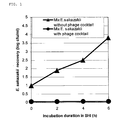
- Figures 1 is a diagram showing the growth of the E. sakazakii strain mixture (FSMCC # 145, 286, 290, 305, 1987/2NL) in BHI broth inoculated with 108 pfu/ml phage cocktail (FSMCC-phage # 67/33/1, F/316, 9/261, 73/311/2) () or without phage cocktail (▴).
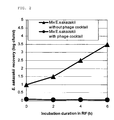
- Figure 2 is a diagram showing the growth of the E. sakazakii strain mixture (FSMCC # 145, 286, 290, 305, 1987/2NL) in Reconstituted Infant Formulas inoculated with 108 pfu/ml phage cocktail (FSMCC-phage # 67/33/1, F/316, 9/261, 73/311/2) () or without phage cocktail (▴).
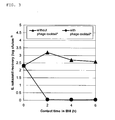
- Figure 3 is a diagram showing the growth of the E. sakazakii strain mixture (FSMCC # 145, 286, 290, 305, 1987/2NL) on the surface of stainless steel discs treated with 108 pfu/ml phage in the phage cocktail (FSMCC-phage # 67/33/1, F/316, 9/261, 73/311/2) (), or without phage cocktail (▴).
-
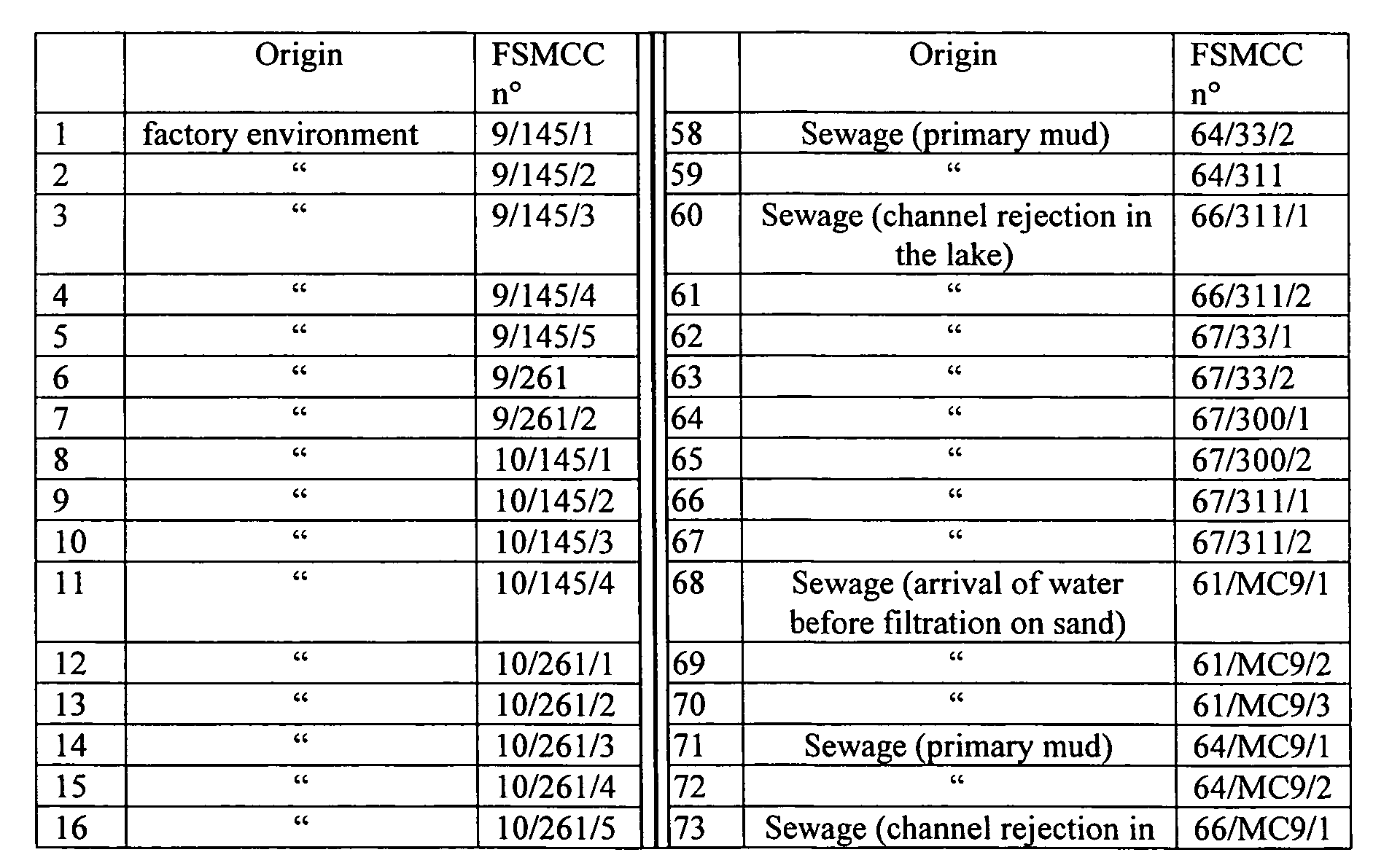
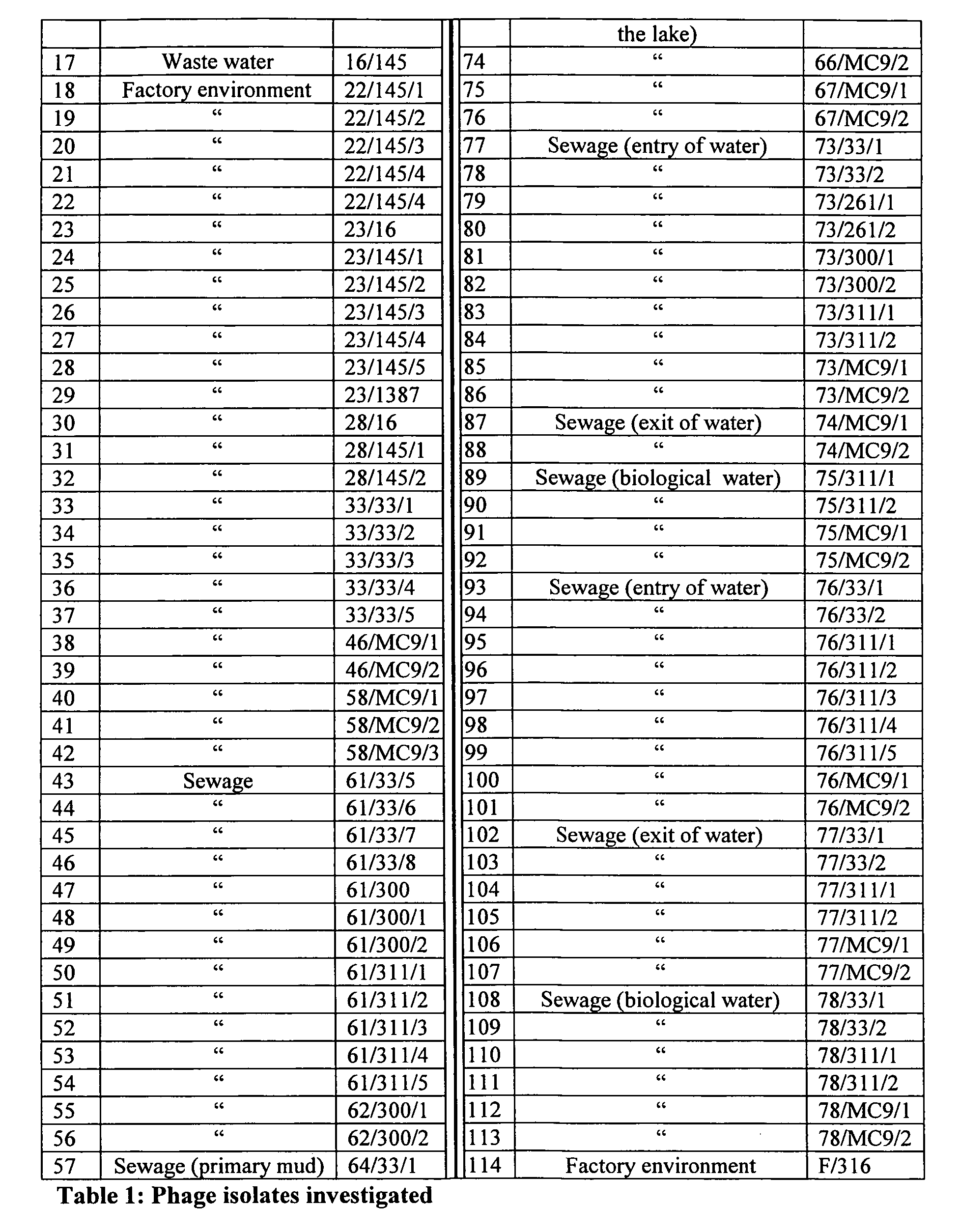
- A collection of 114 phage isolates originating from the Nestlé Food Safety Microbiology bacteriophage collection, were tested against 39 strains of E. sakazakii originating from Food Safety Microbiology culture collection (FSMCC). The strains are listed in Table 1 and 2, respectively.

- Take sewage water samples (approx. 50 ml) for the research for bacteriophages. Measure the pH of each sample using pH paper strips (if pH lower than 5, to adjust to 7 with NaOH 1N).
- The samples are then submitted to the following steps:
- 1. Centrifugation 10 min at 2500g (to eliminate the large remains).
- 2. Filtration of the supernatant using a filter of 0.20 µm (to eliminate bacteria)
- 3. Perform the tests as follows or keep samples at 4°C for 1 or 2 days MAXIMUM.
-
- For the isolation of bacteriophages, the above pre-treated samples have been tested in parallel with or without pre-amplification. Once the presence of phage is detected, they are amplified and stored.
-
- Step 1: Preparation of the bacterial culture:A culture of E. sakazakii having grown overnight at 30°C in Brain Heart Infusion (BHI, Oxoid CM225) is prepared, and then 0.5 ml of this culture is transferred in 4ml of fresh BHI and incubated 1h at 40°C.
- Step 2: Add samples to bacteria:Add in a tube containing 3ml soft BHI agar (BHI broth + 0.6% agar) maintained at 45 ± 1 °C, 100 µl of the E. sakazakii culture (prepared as above) + 100 µl of treated sample to be tested.
- Step 3: Inoculation of Petri dishes:Mix the tube content with a Vortex (± 2sec.). Then, pour the whole tube content on the surface of a Petri dish containing a thin layer of BHI agar and let solidify on the bench. Incubate inverted plates overnight at 30°C.
- Step 4: Interpretation of results:Note the presence or absence of plaques of lysis on each Petri dish.
- Step 5: ControlsPrepare a positive control (E. sakazakii strain n° 261 + active phage against this
strain at a concentration of 2-3 log pfu/ml): Apply steps 1 to 4.
Prepare a negative control without phage added: Apply steps 1 to 4 without addition of phage or sample to be tested. -
-
- Step 1- Day 1: Preparation of the bacterial culture:A culture of E. sakazakii having grown overnight at 30°C in Brain Heart Infusion (BHI, Oxoid CM225) is prepared, then 0.5 ml of this culture is transferred in 4ml of fresh BHI and incubated 1h at 40°C.
- Step 2 - Day 1: Amplification of phage in the sample:In a tube containing 4ml BHI broth, 100µl of the E. sakazakii culture (prepared as in step 1) + 1 ml of treated sample to be tested, are added and incubated 3-5h at 30°C under agitation at 150-200 rpm. They are left overnight on the bench.
- Step 3 - Day 2: Centrifugation 10 min at 2500 rpm
- Step 4 - Day 2: Preparation of the bacterial culture:A culture of E. sakazakii having grown overnight at 30°C in Brain Heart Infusion (BHI, Oxoid CM225) is prepared, then 0.5 ml of this culture is transferred in 4ml of fresh BHI and incubated 1h at 40°C.
- Step 5 - Day 2: Add samples to bacteria:Add in a tube containing 3ml soft BHI agar (BHI broth + 0.6% agar) maintained at
45 ± 1 °C, 100 µl of the E. sakazakii culture (prepared as above) + 100 µl of sample
obtained in
step 3. - Step 6 - Day 2: Inoculation of Petri dishes:Mix the tube content with a Vortex (± 2sec.). Then, pour the whole tube content on the surface of a Petri dish containing a thin layer of BHI agar and let solidify on the bench. Incubate inverted plates overnight at 30°C.
- Step 7 - Day 3: Interpretation of results: Note the presence or absence of plaques of lyses on each Petri dish.
-
- When the presence of phage is detected, they are amplified and stored.
-
- Step 1: Preparation of the bacterial culture:A culture of E. sakazakii having grown overnight at 30°C in Brain Heart Infusion (BHI, Oxoid CM225) is prepared, then 0.5 ml of this culture is transferred in 4ml of fresh BHI and incubated 1h at 40°C.
- Step 2: Amplification of the pfu:In a tube containing 4ml BHI broth, 100 µl of the E. sakazakii culture (prepared as in step 1) + 1 isolated pfu (cut from Agar) are added and incubated 3-5h at 30°C under agitation at 150-200 rpm. Tubes are left overnight on the bench.
- Step 3: Centrifugation 10 min at 2500rpm.
- Step 4: Filtration of the supernatant using a filter of 0.20 µm (to eliminate bacteria)
-
-
- Step 5: Preparation of the bacterial culture:A culture of E. sakazakii having grown overnight at 30°C in Brain Heart Infusion (BHI, Oxoid CM225) is prepared and then 0.5 ml of this culture is transferred in 4ml of fresh BHI and incubated 1h at 40°C.
- Step 6: Add phages to bacteria:Add in a tube containing 3ml soft BHI agar (BHI broth + 0.6% agar) maintained at
45 ± 1 °C, 100 µl of the E. sakazakii culture (prepared as above) + 100 µl of serially
diluted sample obtained in
step 4. - Step 7: Inoculation of Petri dishes: Mix the tube content with a Vortex (± 2sec.) and pour the whole tube content on the surface of a Petri dish containing a thin layer of BHI agar. Then, let solidify on the bench and incubate inverted plates overnight at 30°C.
- Step 8: Interpretation of results:Enumerate lyses plaques on each Petri dish.
-
-
- Step 1: Preparation of aliquots:Distribute into cryo-tubes approx. 1.5ml of the filtered amplified phage solution
(obtained in
step 4 of the "Amplification of one lyses plaque" paragraph) - Step 2: Addition of glycerol:In each tube 15% of sterile glycerol is added and mixed quickly using a Vortex.
- Step 3: Quickly freeze the tubes in liquid nitrogen
- Step 4: Storage of the tubes in a freezer at -20°C
-
-
-
Step 1, Day 0: Preparation of the bacterial culture:A culture of E. sakazakii having grown overnight at 30°C in Brain Heart Infusion (BHI, Oxoid CM225) is prepared. -
Step 2, Day 1: Preparation of the bacterial culture:Transfer 0.1 ml of this culture in 4ml of fresh BHI and incubated 6h at 40°C (stationary growth phase of cells). Dilute cells up to 3 log cfu/ml in Tryptone Salt (TS, Oxoid L42). -
Step 3, Day 1: Microtiterplate assayEffectiveness of phages against E. sakazakii was investigated in a microtiterplate assay. Each plate was set up with each of the test microorganisms as follows: external wells, 200 µl of sterile BHI (blank control), other wells, 20 µl of diluted E. sakazakii prepared instep 2. Store overnight microtiterplates at 4°C. -
Step 4, Day 2: Microtiterplate assayLeave the microtiterplates from the refrigerator. Add in negative control wells, 180µl BHI and in test wells, 160µl BHI plus 20µl phage suspension (final concentration of 8 log pfu/ml). Read at 620nm the optical density (time zero) of the microtiterplate by using a microplate reader Multiskan MCC340. Plates are then incubated at 37°C in ambient air and OD620nm was read after 6h30 and 8h30 incubation. -
Step 5, Day 3: Microtiterplate assayAfter the last reading, plates are left at ambient temperature for one total duration of 24h. After which the OD620nm is last once read. -
- Following to the test on solid medium, phage isolates that are active against at least 9 out of the 39 E. sakazakii strains selected from the group :FSM-16; 33; 261; 265; 266,269;270;271;272;273;274;280;281;284;286;288;290;292;297;298;300; 303; 305; 308; 309; 311; 313; 314; 316; 318; 322; 323; 1360; 1387/2NL; MC7; MC8; MC9; MM10 and MM11, are selected. Thus, the 11 phage isolates (including the phages FSM-Phage 67/33/1, FSM-Phage F/316, FSM-Phage 9/261, and FSM-Phage 73/311/2) are presented in Table 3. Some phage isolates proved to be efficient against at least 20 out of the 39 bacterial strains.

- The said phages were further tested on liquid medium in order to select the phage isolates according to the present invention. The results are then presented in Table 4.


- As may be derived from Table 4, some phage isolate recognize more than 80 % of the 39 E. sakazakii strains. Other isolates, however, recognize not even 10 % of the strains tested. The phages isolates that are further active in liquid medium against at least 9 out of the 39 E. sakazakii strains selected from the group : FSM-16; FSM-33; FSM-261; FSM-265; FSM-266, FSM-269; FSM-270; FSM-271; FSM-272; FSM-273; FSM-274; FSM-280; FSM-281; FSM-284; FSM-286; FSM-288; FSM-290; FSM-292; FSM-297; FSM-298; FSM-300; FSM-303; FSM-305; FSM-308; FSM-309; FSM-311; FSM-313; FSM-314; FSM-316; FSM-318; FSM-322; FSM-323; FSM-1360; FSM-1387-2NL; FSM-MC7; FSM-MC8; FSM-MC9; FSM-MM10 and FSM-MM11, are selected phage isolates that can be used in the present invention. Preferably, the following 8 phage isolates FSM-Phage 67/33/1 (CNCM I-3130), FSM-Phage F/316 (CNCM I-3131), FSM-Phage 9/261 (CNCM I-3132), and FSM-Phage 73/311/2 (CNCM I-3133), FSM-Phage 73/261(CNCM I-3128), FMS 33/33/1, (CNCM I-3129) FSM-Phage 28/145/2, FSM-Phage 10/261/1 (CNCM I-3127).
- It will be appreciated that a skilled person may well examine and select other phage isolates according to the present invention, by subjecting them to the screening tests on solid and liquid medium as detailed above.
- In order to evaluate the efficacy of the phage cocktail against E. sakazakii strain mixture, the following experiment was carried out.
- A mixture of the E. sakazakii strains FSM-145, 286, 290, 305 and 1387/2NL as described in example 1 and in P. Breeuwer et al., 2003, Journal of Applied Microbiology 95: 967-973, is used. Individual overnight culture (18h at 30°C) of these strains is diluted 1:1 in fresh BHI and incubated 2h at 30°C. A mix of these strains is carried-out by mixing equal quantities of each stock. Then, the BHI broth or RIF are inoculated with 100 µl of the E. sakazakii mix (prepared as described above) so that the final concentration is of about 10 cfu/ml.
- The phage isolate cocktail containing FSM_phage 67/33/1 (CNCM I-3130), FSM_phage F/316 (CNCM I-3131), FSM_phage 9/261 (CNCM I-3132) and FSM_phage 73/311/2 (CNCM I-3133) has been tested. For this, a variable amount of each phage is added to the tubes containing E. sakazakii mix to reach a final concentration of about 8 log pfu/ml. Negative control without addition of phage (BHI or RIF 9.9ml + E. sakazakii mix 100µl) is also included.
- All inoculates are incubated at 30°C and samples are taken at various time intervals: 0 - 2 - 4 - 6h. For each sample, the number of bacteria present in the medium was determined by standard plate counting method.
- The results are presented in figures 1 and 2. It shows that a bacterial mixture will grow out to high number in the absence of phage cocktail whereas no growth is observed in the presence of the phage cocktail for a period of
minimum 6 hours and up to 24 hours. - In conclusion, these experiments demonstrate that adding bacteriophage preparation according to the present invention against E. sakazakii to reconstituted infant formulas (RIF) should prevent outgrowth of E. sakazakii for at least 6 hours.
- In order to evaluate the efficacy of the phage cocktail on artificially contaminated surfaces by a E. sakazakii strain mixture, the following experiment was carried out.
- Step 1: Preparation of bacteria cellsA mixture of the E. sakazakii strains (FSM-145, 286, 290, 305 and 1387/2NL (see examples 1 and 2)) is used. Individual overnight culture (18h at 30°C) of these strains is centrifuged at 3000rpm for 10min at 4°C. Cell pellet is harvested and diluted in BHI to reach a cell concentration of about 8 log cfu/ml. A mix of these strains is carried-out by mixing equal quantities of each stock.
- Step 2: AdhesionStainless steel disc of 1 cm2 are plunged in the bacterial solution prepared as
described in
step 1. Leave at room temperature under gentle shaking for 1h. - Step 3: Washing and DryingTo remove unattached cells, stainless steel discs are withdrawn and washed 3 times
in Phosphate Buffer solution (PBS: pH 7.0, Merck). The excess of liquid is absorbed
with Watman paper, the discs are then dried during 30min under laminar flow. To
determine the level of attached cells,
step 6 is applied on some discs. - Step 4: Addition of phage cocktailHalf of stainless steel discs are plunged in a 8 log pfu/ml phage cocktail solution containing the following phages: FSM_phage 67/33/1 (CNCM I-3130), FSM_phage F/316 (CNCM I-3131), FSM_phage 9/261 (CNCM I-3132) and FSM_phage 73/311/2 (CNCM I-3133). Leave the container at room temperature under gentle shaking for 6 hours. Withdraw some discs at various intervals for bacteria enumeration. In parallel, controls without phage added are carried-out.
- Step 5: WashingAt defined intervals some discs are withdrawn, washed 3 times in sterile PBS and dry quickly on sterile absorbent paper.
- Step 6: Cell detachment and
enumeration After step 5, put each disc into tubes containing 9ml TS. Tubes are placed into sonication bath (filled with water and ice mix) for 1min at 50KHz afterwards; tubes are agitated for 10 seconds by using a Vortex. Cell enumeration is performed using a standard plating method. -
- The results are presented in Figure 3 which demonstrates that the E. sakazakii bacteria in the strain mixture (FSMCC # 145, 286, 290, 305, 1987/2NL) can not be recovered anymore from the surface of stainless steel discs treated with 108 pfu/ml phage in the phage cocktail (FSMCC-phage # 67/33/1, F/316, 9/261, 73/311/2), whereas without phage cocktail the bacteria remain viable and can even grow slightly.
In conclusion, the treatment of stainless steel surfaces with at least 108 phages per ml result in killing of the E. sakazakii bacteria.
Claims (27)
- A phage isolate with substantial lytic potential towards E. sakazakii.
- A phage isolate according to claim 1, having the ability to infect :i) at least 9 bacterial strains of E.sakazakii from the group consisting of FSM-16; FSM-33; FSM-261; FSM-265; FSM-266, FSM-269; FSM-270; FSM-271; FSM-272; FSM-273; FSM-274; FSM-280; FSM-281; FSM-284; FSM-286; FSM-288; FSM-290; FSM-292; FSM-297; FSM-298; FSM-300; FSM-303; FSM-305; FSM-308; FSM-309; FSM-311; FSM-313; FSM-314; FSM-316; FSM-318; FSM-322; FSM-323; FSM-1360; FSM-1387-2NL; FSM-MC7; FSM-MC8; FSM-MC9; FSM-MM10 and FSM-MM11, in a test on solid medium using the spot assay test and,ii) at least 9 bacterial strains of E.sakazakii from the group consisting of FSM-16; FSM-33; FSM-261; FSM-265; FSM-266, FSM-269; FSM-270; FSM-271; FSM-272; FSM-273; FSM-274; FSM-280; FSM-281; FSM-284; FSM-286; FSM-288; FSM-290; FSM-292; FSM-297; FSM-298; FSM-300; FSM-303; FSM-305; FSM-308; FSM-309; FSM-311; FSM-313; FSM-314; FSM-316; FSM-318; FSM-322; FSM-323; FSM-1360; FSM-1387-2NL; FSM-MC7; FSM-MC8; FSM-MC9; FSM-MM10 and FSM-MM11, in liquid medium.
- A phage isolate according to claim 1 or 2, deposited under the reference CNCM I-3127.
- A phage isolate according to claim 1 or 2, deposited under the reference CNCM I-3128.
- A phage isolate according to claim 1 or 2, deposited under the reference CNCM I-3129.
- A phage isolate according to claim 1 or 2, deposited under the reference CNCM I-3130.
- A phage isolate according to claim 1 or 2, deposited under the reference CNCM I-3131.
- A phage isolate according to claim 1 or 2, deposited under the reference CNCM I-3132.
- A phage isolate according to claim 1 or 2, deposited under the reference CNCM I-3133.
- A phage cocktail, containing at least one phage isolate according to one of claims 1 to 9, which infects at least 80% of E. sakazakii strains from the group consisting of FSM-16; FSM-33; FSM-261; FSM-265; FSM-266, FSM-269; FSM-270; FSM-271; FSM-272; FSM-273; FSM-274; FSM-280; FSM-281; FSM-284; FSM-286; FSM-288; FSM-290; FSM-292; FSM-297; FSM-298; FSM-300; FSM-303; FSM-305; FSM-308; FSM-309; FSM-311; FSM-313; FSM-314; FSM-316; FSM-318; FSM-322; FSM-323; FSM-1360; FSM-1387-2NL; FSM-MC7; FSM-MC8; FSM-MC9; FSM-MM10 and FSM-MM11.
- A food product containing at least one phage isolate or cocktail with substantial lytic potential towards E. sakazakii.
- A food product according to claim 11, wherein the phage isolate or cocktail is according to claims 1 to 10.
- A food product according to claim 11 or 12, in the form of a milk based product, a nutritional composition, a pet food, a dietary supplement or any food at risk of contamination by E. sakazakii.
- A food product according to claim 13, wherein the milk based product is a fermented milk, a yoghurt, a curd, a cheese, a fresh cheese, a fermented product, a renneted milk, a drink, a milk based powder, an infant formula or a dried powdered infant formula.
- A food product according to one of claims 11 to 14, in which the phage isolate or cocktail is in an amount effective to prevent contamination and outgrowth of E. sakazakii in said product.
- A food product according to claim 15, wherein the phage isolate is present in an amount of at least 1.104 pfu per ml, or gram if solid, of the food product.
- An agent for decontamination of food product by prevention of contamination and outgrowth of E. sakazakii and sanitation of factory environment, which comprises an effective amount of at least one phage isolate or cocktail according to one of claims 1 to 10.
- An agent according to claim 17, wherein the phage isolate is present in an amount of at least 1.104 pfu per ml, or gram if solid.
- An agent according to one of claims 17 or 18, wherein the food product is a milk based product, such as a fermented milk, a yoghurt, curd, cheese, fresh cheese, milk based fermented products, renneted milk, drinks, milk based powders, an infant formula, a dried powdered infant formula; a non-milk fermented product; a soy-based product, a nutritional formula, a dairy product, a chilled or shelf stable beverage, water, soup, a dietary supplement, a meal replacement, a nutritional bar or a confectionery, a pet food product, a sweet or sweetened beverage, an ice-cream, a confectionery bar, breakfast cereal flakes or bars or nutritional supplement for clinical nutrition or any food at risk of contamination by E. sakazakii.
- Use of at least one phage isolate or cocktail according to one of claims 1 to 10, for decontamination of food products and sanitation of factory environment.
- The use according to claim 20, wherein the food product is a milk based product, such as a fermented milk, a yoghurt, a curd, a cheese, a fresh cheese, milk based fermented products, renneted milk, drinks, milk based powders, an infant formula, a dried powdered infant formula; a non-milk fermented product; a soy-based product, a nutritional formula, a dairy product, a chilled or shelf stable beverage, water, soup, a dietary supplement, a meal replacement, a nutritional bar or a confectionery, a pet food product, a sweet or sweetened beverage, an ice-cream, a confectionery bar, breakfast cereal flakes or bars or nutritional supplement for clinical nutrition or any food at risk of contamination by E. sakazakii.
- Use of at least one phage isolate according to one of claims 1 to 10, in the preparation of a composition intended to prevent or treat infections caused by E. sakazakii in humans or animals.
- The use according to one of claims 20 to 22, in which the phage isolate is present in an amount efficient to prevent contamination and outgrowth of Enterobacter sakazakii.
- The use according to one of claims 20 to 23, wherein the phage isolate or cocktail is used in an amount of at least 1.104 pfu per ml.
- A method for decontamination of food products or sanitation of factory environment, which comprises using at least one phage isolate or cocktail with substantial lytic potential towards E. sakazakii.
- A method according to claim 25, in which the phage isolate is according to one of claims 1 to 10.
- A method for selection of phage isolate with substantial lytic potential towards E. sakazakii consisting of screening phage isolate having the ability to infect:i) at least 9 bacterial strains of Esakazakii from the group consisting of FSM-16; FSM-33; FSM-261; FSM-265; FSM-266, FSM-269; FSM-270; FSM-271; FSM-272; FSM-273; FSM-274; FSM-280; FSM-281; FSM-284; FSM-286; FSM-288; FSM-290; FSM-292; FSM-297; FSM-298; FSM-300; FSM-303; FSM-305; FSM-308; FSM-309; FSM-311; FSM-313; FSM-314; FSM-316; FSM-318; FSM-322; FSM-323; FSM-1360; FSM-1387-2NL; FSM-MC7; FSM-MC8; FSM-MC9; FSM-MM10 and FSM-MM11, in a test on solid medium using the spot assay test and,ii) at least 9 bacterial strains of E.sakazakii from the group consisting of FSM-16; FSM-33; FSM-261; FSM-265; FSM-266, FSM-269; FSM-270; FSM-271; FSM-272; FSM-273; FSM-274; FSM-280; FSM-281; FSM-284; FSM-286; FSM-288; FSM-290; FSM-292; FSM-297; FSM-298; FSM-300; FSM-303; FSM-305; FSM-308; FSM-309; FSM-311; FSM-313; FSM-314; FSM-316; FSM-318; FSM-322; FSM-323; FSM-1360; FSM-1387-2NL; FSM-MC7; FSM-MC8; FSM-MC9; FSM-MM10 and FSM-MM11, in liquid medium.
Priority Applications (11)
| Application Number | Priority Date | Filing Date | Title |
|---|---|---|---|
| DE60336480T DE60336480D1 (en) | 2003-11-19 | 2003-11-19 | Isolated bacteriophage and its use in food or for refurbishment of the factory environment |
| AT03026432T ATE503007T1 (en) | 2003-11-19 | 2003-11-19 | ISOLATED BACTERIOPHAGE AND THEIR USE IN FOOD OR FOR FACTORY ENVIRONMENT SANITIZATION |
| ES03026432T ES2363497T3 (en) | 2003-11-19 | 2003-11-19 | ISOLATED PAYMENTS AND ITS USE AS A DISINFECTANT IN FOODS AND FOR THE HYGIENIZATION OF A MANUFACTURING ENVIRONMENT. |
| EP03026432A EP1533369B1 (en) | 2003-11-19 | 2003-11-19 | Isolated phages and their use as disinfectant in food or for sanitation of factory environment |
| PCT/EP2004/012585 WO2005049813A1 (en) | 2003-11-19 | 2004-11-06 | Isolated phages and their use as disinfectant in food or for sanitation of factory environment |
| CN200480036371XA CN1890366B (en) | 2003-11-19 | 2004-11-06 | Isolated bacteriophages and their use as disinfectants in food or for environmental sanitation in factories |
| BRPI0416768-6A BRPI0416768A (en) | 2003-11-19 | 2004-11-06 | isolated phages and their use as food disinfectants or for sanitizing factory environments |
| ARP040104265A AR047126A1 (en) | 2003-11-19 | 2004-11-18 | ISOLATED PAYMENTS AND ITS USE AS A DISINFECTANT IN FOOD OR FOR THE HYGIENIZATION OF THE INDUSTRIAL ENVIRONMENT |
| CR8382A CR8382A (en) | 2003-11-19 | 2006-05-05 | ISOLATED PAYMENTS AND ITS USE AS A DISINFECTANT IN FOOD OR FOR THE HYGIENIZATION OF THE INDUSTRIAL ENVIRONMENT |
| EC2006006556A ECSP066556A (en) | 2003-11-19 | 2006-05-10 | ISOLATED PAYMENTS AND ITS USE AS A DISINFECTANT IN FOOD OR FOR THE HYGIENIZATION OF THE INDUSTRIAL ENVIRONMENT |
| CO06047629A CO5690610A2 (en) | 2003-11-19 | 2006-05-18 | ISOLATED PAYMENTS AND ITS USE AS A DISINFECTANT IN FOOD OR FOR HYGIENIZATION OF THE INDUSTRIAL ENVIRONMENT |
Applications Claiming Priority (1)
| Application Number | Priority Date | Filing Date | Title |
|---|---|---|---|
| EP03026432A EP1533369B1 (en) | 2003-11-19 | 2003-11-19 | Isolated phages and their use as disinfectant in food or for sanitation of factory environment |
Publications (2)
| Publication Number | Publication Date |
|---|---|
| EP1533369A1 true EP1533369A1 (en) | 2005-05-25 |
| EP1533369B1 EP1533369B1 (en) | 2011-03-23 |
Family
ID=34429383
Family Applications (1)
| Application Number | Title | Priority Date | Filing Date |
|---|---|---|---|
| EP03026432A Expired - Lifetime EP1533369B1 (en) | 2003-11-19 | 2003-11-19 | Isolated phages and their use as disinfectant in food or for sanitation of factory environment |
Country Status (11)
| Country | Link |
|---|---|
| EP (1) | EP1533369B1 (en) |
| CN (1) | CN1890366B (en) |
| AR (1) | AR047126A1 (en) |
| AT (1) | ATE503007T1 (en) |
| BR (1) | BRPI0416768A (en) |
| CO (1) | CO5690610A2 (en) |
| CR (1) | CR8382A (en) |
| DE (1) | DE60336480D1 (en) |
| EC (1) | ECSP066556A (en) |
| ES (1) | ES2363497T3 (en) |
| WO (1) | WO2005049813A1 (en) |
Cited By (5)
| Publication number | Priority date | Publication date | Assignee | Title |
|---|---|---|---|---|
| KR101188611B1 (en) * | 2010-01-08 | 2012-10-08 | 가천대학교 산학협력단 | Virulent Phages inhibiting the Growth of Cronobacter sakazakii |
| US9980507B2 (en) | 2010-11-02 | 2018-05-29 | Abbott Laboratories | Stable concentrated liquid human milk fortifier |
| US11154077B2 (en) | 2009-07-31 | 2021-10-26 | Mars, Incorporated | Process for dusting animal food |
| CN114369579A (en) * | 2021-09-27 | 2022-04-19 | 东北农业大学 | Bacteriophage for efficiently cracking cronobacter sakazakii and application thereof |
| US11388914B2 (en) | 2015-04-28 | 2022-07-19 | Mars, Incorporated | Process of preparing a wet pet food, wet pet food produced by the process and uses thereof |
Families Citing this family (9)
| Publication number | Priority date | Publication date | Assignee | Title |
|---|---|---|---|---|
| EP2130440A1 (en) | 2008-06-06 | 2009-12-09 | N.V. Nutricia | Inhibiting E. sakazakii growth |
| US10104903B2 (en) | 2009-07-31 | 2018-10-23 | Mars, Incorporated | Animal food and its appearance |
| AU2010212280B2 (en) * | 2009-08-12 | 2015-09-24 | Buddhist Tzu Chi Medical Foundation | Phage of acinetobacter Baumannii |
| CN101775444A (en) * | 2010-03-05 | 2010-07-14 | 中国检验检疫科学研究院 | Method for rapidly determining titer of bacteriophage of Enterobacter sakazakii |
| EP2465509A1 (en) * | 2010-11-23 | 2012-06-20 | Nestec S.A. | Oligosaccharide composition for treating acute respiratory tract infections |
| CN107828743B (en) * | 2017-11-09 | 2019-09-17 | 扬州大学 | A kind of bacteriophage of Enterobacter sakazakii EspYZU05 and application thereof |
| CN109730235A (en) * | 2019-02-01 | 2019-05-10 | 珠海横琴普罗恩能医用食品有限公司 | A kind of preservative for medical food |
| CN112063732B (en) * | 2020-09-17 | 2022-05-31 | 扬州大学 | Rapid quantitative detection method capable of specifically identifying survival cells of enterobacter sakazakii and primers thereof |
| CN115011564B (en) * | 2022-01-19 | 2023-06-20 | 华中农业大学 | A broad-spectrum phage LPCS28 capable of lysing Enterobacter sakazakii and its application |
Citations (2)
| Publication number | Priority date | Publication date | Assignee | Title |
|---|---|---|---|---|
| US6322783B1 (en) * | 1996-08-26 | 2001-11-27 | Seishi Takahashi | Bacteriophages, method for screening same and bactericidal compositions using same, and detection kits using same |
| WO2003054173A1 (en) * | 2001-12-13 | 2003-07-03 | Societe Des Produits Nestle S.A. | Isolated phages and their use in food or pet food products |
-
2003
- 2003-11-19 EP EP03026432A patent/EP1533369B1/en not_active Expired - Lifetime
- 2003-11-19 DE DE60336480T patent/DE60336480D1/en not_active Expired - Lifetime
- 2003-11-19 ES ES03026432T patent/ES2363497T3/en not_active Expired - Lifetime
- 2003-11-19 AT AT03026432T patent/ATE503007T1/en not_active IP Right Cessation
-
2004
- 2004-11-06 CN CN200480036371XA patent/CN1890366B/en not_active Expired - Fee Related
- 2004-11-06 BR BRPI0416768-6A patent/BRPI0416768A/en not_active Application Discontinuation
- 2004-11-06 WO PCT/EP2004/012585 patent/WO2005049813A1/en not_active Ceased
- 2004-11-18 AR ARP040104265A patent/AR047126A1/en unknown
-
2006
- 2006-05-05 CR CR8382A patent/CR8382A/en not_active Application Discontinuation
- 2006-05-10 EC EC2006006556A patent/ECSP066556A/en unknown
- 2006-05-18 CO CO06047629A patent/CO5690610A2/en not_active Application Discontinuation
Patent Citations (2)
| Publication number | Priority date | Publication date | Assignee | Title |
|---|---|---|---|---|
| US6322783B1 (en) * | 1996-08-26 | 2001-11-27 | Seishi Takahashi | Bacteriophages, method for screening same and bactericidal compositions using same, and detection kits using same |
| WO2003054173A1 (en) * | 2001-12-13 | 2003-07-03 | Societe Des Produits Nestle S.A. | Isolated phages and their use in food or pet food products |
Non-Patent Citations (3)
| Title |
|---|
| BREEUWER P ET AL: "Desiccation and heat tolerance of Enterobacter sakazakii.", JOURNAL OF APPLIED MICROBIOLOGY, vol. 95, no. 5, 2003, pages 967 - 973, XP002273937, ISSN: 1364-5072 * |
| GRIMONT F ET AL: "Characteristics of five bacteriophages of yellow-pigmented enterobacteria", CURRENT MICROBIOLOGY 1981 UNITED STATES, vol. 5, no. 1, 1981, pages 61 - 66, XP009027826 * |
| GRIMONT F ET AL: "DNA relatedness among bacteriophages of the morphological group C3", CURRENT MICROBIOLOGY 1981 UNITED STATES, vol. 6, no. 2, 1981, pages 65 - 69, XP009027844 * |
Cited By (6)
| Publication number | Priority date | Publication date | Assignee | Title |
|---|---|---|---|---|
| US11154077B2 (en) | 2009-07-31 | 2021-10-26 | Mars, Incorporated | Process for dusting animal food |
| KR101188611B1 (en) * | 2010-01-08 | 2012-10-08 | 가천대학교 산학협력단 | Virulent Phages inhibiting the Growth of Cronobacter sakazakii |
| US9980507B2 (en) | 2010-11-02 | 2018-05-29 | Abbott Laboratories | Stable concentrated liquid human milk fortifier |
| US11388914B2 (en) | 2015-04-28 | 2022-07-19 | Mars, Incorporated | Process of preparing a wet pet food, wet pet food produced by the process and uses thereof |
| CN114369579A (en) * | 2021-09-27 | 2022-04-19 | 东北农业大学 | Bacteriophage for efficiently cracking cronobacter sakazakii and application thereof |
| CN114369579B (en) * | 2021-09-27 | 2023-03-14 | 东北农业大学 | Bacteriophage for efficiently cracking cronobacter sakazakii and application thereof |
Also Published As
| Publication number | Publication date |
|---|---|
| DE60336480D1 (en) | 2011-05-05 |
| CO5690610A2 (en) | 2006-10-31 |
| WO2005049813A1 (en) | 2005-06-02 |
| ES2363497T3 (en) | 2011-08-05 |
| ATE503007T1 (en) | 2011-04-15 |
| EP1533369B1 (en) | 2011-03-23 |
| AR047126A1 (en) | 2006-01-11 |
| CN1890366B (en) | 2011-05-11 |
| CR8382A (en) | 2008-09-23 |
| CN1890366A (en) | 2007-01-03 |
| BRPI0416768A (en) | 2007-02-27 |
| ECSP066556A (en) | 2006-11-24 |
Similar Documents
| Publication | Publication Date | Title |
|---|---|---|
| Joosten et al. | Detection, growth, and amine-producing capacity of lactobacilli in cheese | |
| El-Ziney et al. | The Effect of Reuterin on Listeria monocytogenes and Escherichia coliO157: H7 in Milk and Cottage Cheese | |
| Sarlak et al. | Probiotic biological strategies to decontaminate aflatoxin M1 in a traditional Iranian fermented milk drink (Doogh) | |
| Gardiner et al. | A spray-dried culture for probiotic Cheddar cheese manufacture | |
| Vinderola et al. | Influence of compounds associated with fermented dairy products on the growth of lactic acid starter and probiotic bacteria | |
| EP1533369B1 (en) | Isolated phages and their use as disinfectant in food or for sanitation of factory environment | |
| El Kholy et al. | Screening of antagonistic activity of probiotic bacteria against some food-borne pathogens | |
| KR100386144B1 (en) | Food or drink product with a disinfection property of helicobacter pylori | |
| US7854950B2 (en) | Pressure treating food to reduce spoilage | |
| Lopez‐Brea et al. | Spore‐forming bacteria in dairy products | |
| Tsegaye et al. | Fate of Escherichia coli O157: H7 during the processing and storage of Ergo and Ayib, traditional Ethiopian dairy products | |
| El‐Kholy et al. | Microbiological Quality of Domiati Cheese and the Influence of Probiotics on the Behavior of S taphylococcus aureus and E scherichia coli O 157: H 7 in Domiati Cheese | |
| Delbès-Paus et al. | Behavior of Escherichia coli O26: H11 in the presence of Hafnia alvei in a model cheese ecosystem | |
| US20040191233A1 (en) | Bifidobacteria and siderophores produced thereby and methods of use | |
| Rukure et al. | Survival and growth of Bacillus cereus during Gouda cheese manufacturing | |
| Iranmanesh et al. | Isolation of lactic acid bacteria from ewe milk, traditional yoghurt and sour buttermilk in Iran. | |
| Meera et al. | Partial characterization and optimization of parameters for Bacteriocin production by Probiotic Lactic acid bacteria | |
| Teanpaisan et al. | Survival rates of human-derived probiotic Lactobacillus paracasei SD1 in milk powder using spray drying | |
| Adam et al. | Microbiological quality of some commercial dairy products and cheese analogues focused on Mideast | |
| Sulieman | Starter cultures: nature, types, characteristics, preparation and maintenance | |
| El-Shenawy et al. | Antimicrobial activity of some lactic acid bacteria isolated from local environment in Egypt | |
| HK1078898A (en) | Isolated phages and their use as disinfectant in food or for sanitation of factory environment | |
| Olaniyi et al. | Antimicrobial characteristics of lactic acid bacteria in African yam bean-based drink. | |
| EP1495109B1 (en) | Method of preparing a probiotic preparation | |
| JP4426588B2 (en) | Edible olives containing probiotic microorganisms |
Legal Events
| Date | Code | Title | Description |
|---|---|---|---|
| PUAI | Public reference made under article 153(3) epc to a published international application that has entered the european phase |
Free format text: ORIGINAL CODE: 0009012 |
|
| AK | Designated contracting states |
Kind code of ref document: A1 Designated state(s): AT BE BG CH CY CZ DE DK EE ES FI FR GB GR HU IE IT LI LU MC NL PT RO SE SI SK TR |
|
| AX | Request for extension of the european patent |
Extension state: AL LT LV MK |
|
| 17P | Request for examination filed |
Effective date: 20051125 |
|
| AKX | Designation fees paid |
Designated state(s): AT BE BG CH CY CZ DE DK EE ES FI FR GB GR HU IE IT LI LU MC NL PT RO SE SI SK TR |
|
| REG | Reference to a national code |
Ref country code: HK Ref legal event code: DE Ref document number: 1078898 Country of ref document: HK |
|
| GRAP | Despatch of communication of intention to grant a patent |
Free format text: ORIGINAL CODE: EPIDOSNIGR1 |
|
| GRAS | Grant fee paid |
Free format text: ORIGINAL CODE: EPIDOSNIGR3 |
|
| GRAA | (expected) grant |
Free format text: ORIGINAL CODE: 0009210 |
|
| AK | Designated contracting states |
Kind code of ref document: B1 Designated state(s): AT BE BG CH CY CZ DE DK EE ES FI FR GB GR HU IE IT LI LU MC NL PT RO SE SI SK TR |
|
| REG | Reference to a national code |
Ref country code: GB Ref legal event code: FG4D |
|
| REG | Reference to a national code |
Ref country code: CH Ref legal event code: EP |
|
| REG | Reference to a national code |
Ref country code: IE Ref legal event code: FG4D |
|
| REF | Corresponds to: |
Ref document number: 60336480 Country of ref document: DE Date of ref document: 20110505 Kind code of ref document: P |
|
| REG | Reference to a national code |
Ref country code: DE Ref legal event code: R096 Ref document number: 60336480 Country of ref document: DE Effective date: 20110505 |
|
| REG | Reference to a national code |
Ref country code: NL Ref legal event code: T3 |
|
| REG | Reference to a national code |
Ref country code: SE Ref legal event code: TRGR |
|
| REG | Reference to a national code |
Ref country code: ES Ref legal event code: FG2A Ref document number: 2363497 Country of ref document: ES Kind code of ref document: T3 Effective date: 20110805 |
|
| REG | Reference to a national code |
Ref country code: GR Ref legal event code: EP Ref document number: 20110401490 Country of ref document: GR Effective date: 20110714 |
|
| PG25 | Lapsed in a contracting state [announced via postgrant information from national office to epo] |
Ref country code: BG Free format text: LAPSE BECAUSE OF FAILURE TO SUBMIT A TRANSLATION OF THE DESCRIPTION OR TO PAY THE FEE WITHIN THE PRESCRIBED TIME-LIMIT Effective date: 20110623 Ref country code: SI Free format text: LAPSE BECAUSE OF FAILURE TO SUBMIT A TRANSLATION OF THE DESCRIPTION OR TO PAY THE FEE WITHIN THE PRESCRIBED TIME-LIMIT Effective date: 20110323 Ref country code: AT Free format text: LAPSE BECAUSE OF FAILURE TO SUBMIT A TRANSLATION OF THE DESCRIPTION OR TO PAY THE FEE WITHIN THE PRESCRIBED TIME-LIMIT Effective date: 20110323 Ref country code: CY Free format text: LAPSE BECAUSE OF FAILURE TO SUBMIT A TRANSLATION OF THE DESCRIPTION OR TO PAY THE FEE WITHIN THE PRESCRIBED TIME-LIMIT Effective date: 20110323 |
|
| PG25 | Lapsed in a contracting state [announced via postgrant information from national office to epo] |
Ref country code: EE Free format text: LAPSE BECAUSE OF FAILURE TO SUBMIT A TRANSLATION OF THE DESCRIPTION OR TO PAY THE FEE WITHIN THE PRESCRIBED TIME-LIMIT Effective date: 20110323 Ref country code: PT Free format text: LAPSE BECAUSE OF FAILURE TO SUBMIT A TRANSLATION OF THE DESCRIPTION OR TO PAY THE FEE WITHIN THE PRESCRIBED TIME-LIMIT Effective date: 20110725 |
|
| PG25 | Lapsed in a contracting state [announced via postgrant information from national office to epo] |
Ref country code: CZ Free format text: LAPSE BECAUSE OF FAILURE TO SUBMIT A TRANSLATION OF THE DESCRIPTION OR TO PAY THE FEE WITHIN THE PRESCRIBED TIME-LIMIT Effective date: 20110323 Ref country code: SK Free format text: LAPSE BECAUSE OF FAILURE TO SUBMIT A TRANSLATION OF THE DESCRIPTION OR TO PAY THE FEE WITHIN THE PRESCRIBED TIME-LIMIT Effective date: 20110323 Ref country code: RO Free format text: LAPSE BECAUSE OF FAILURE TO SUBMIT A TRANSLATION OF THE DESCRIPTION OR TO PAY THE FEE WITHIN THE PRESCRIBED TIME-LIMIT Effective date: 20110323 |
|
| PLBE | No opposition filed within time limit |
Free format text: ORIGINAL CODE: 0009261 |
|
| STAA | Information on the status of an ep patent application or granted ep patent |
Free format text: STATUS: NO OPPOSITION FILED WITHIN TIME LIMIT |
|
| 26N | No opposition filed |
Effective date: 20111227 |
|
| PG25 | Lapsed in a contracting state [announced via postgrant information from national office to epo] |
Ref country code: DK Free format text: LAPSE BECAUSE OF FAILURE TO SUBMIT A TRANSLATION OF THE DESCRIPTION OR TO PAY THE FEE WITHIN THE PRESCRIBED TIME-LIMIT Effective date: 20110323 |
|
| REG | Reference to a national code |
Ref country code: DE Ref legal event code: R097 Ref document number: 60336480 Country of ref document: DE Effective date: 20111227 |
|
| PG25 | Lapsed in a contracting state [announced via postgrant information from national office to epo] |
Ref country code: MC Free format text: LAPSE BECAUSE OF NON-PAYMENT OF DUE FEES Effective date: 20111130 |
|
| REG | Reference to a national code |
Ref country code: HK Ref legal event code: WD Ref document number: 1078898 Country of ref document: HK |
|
| REG | Reference to a national code |
Ref country code: IE Ref legal event code: MM4A |
|
| PG25 | Lapsed in a contracting state [announced via postgrant information from national office to epo] |
Ref country code: IE Free format text: LAPSE BECAUSE OF NON-PAYMENT OF DUE FEES Effective date: 20111119 |
|
| PG25 | Lapsed in a contracting state [announced via postgrant information from national office to epo] |
Ref country code: LU Free format text: LAPSE BECAUSE OF NON-PAYMENT OF DUE FEES Effective date: 20111119 |
|
| PG25 | Lapsed in a contracting state [announced via postgrant information from national office to epo] |
Ref country code: TR Free format text: LAPSE BECAUSE OF FAILURE TO SUBMIT A TRANSLATION OF THE DESCRIPTION OR TO PAY THE FEE WITHIN THE PRESCRIBED TIME-LIMIT Effective date: 20110323 |
|
| PG25 | Lapsed in a contracting state [announced via postgrant information from national office to epo] |
Ref country code: HU Free format text: LAPSE BECAUSE OF FAILURE TO SUBMIT A TRANSLATION OF THE DESCRIPTION OR TO PAY THE FEE WITHIN THE PRESCRIBED TIME-LIMIT Effective date: 20110323 |
|
| REG | Reference to a national code |
Ref country code: FR Ref legal event code: PLFP Year of fee payment: 13 |
|
| PGFP | Annual fee paid to national office [announced via postgrant information from national office to epo] |
Ref country code: IT Payment date: 20151124 Year of fee payment: 13 Ref country code: FI Payment date: 20151111 Year of fee payment: 13 Ref country code: GR Payment date: 20151015 Year of fee payment: 13 |
|
| PGFP | Annual fee paid to national office [announced via postgrant information from national office to epo] |
Ref country code: BE Payment date: 20151111 Year of fee payment: 13 |
|
| REG | Reference to a national code |
Ref country code: FR Ref legal event code: PLFP Year of fee payment: 14 |
|
| PGFP | Annual fee paid to national office [announced via postgrant information from national office to epo] |
Ref country code: FR Payment date: 20161014 Year of fee payment: 14 Ref country code: CH Payment date: 20161115 Year of fee payment: 14 Ref country code: DE Payment date: 20161116 Year of fee payment: 14 Ref country code: GB Payment date: 20161116 Year of fee payment: 14 Ref country code: NL Payment date: 20161110 Year of fee payment: 14 |
|
| PG25 | Lapsed in a contracting state [announced via postgrant information from national office to epo] |
Ref country code: BE Free format text: LAPSE BECAUSE OF NON-PAYMENT OF DUE FEES Effective date: 20161130 |
|
| PGFP | Annual fee paid to national office [announced via postgrant information from national office to epo] |
Ref country code: ES Payment date: 20161011 Year of fee payment: 14 Ref country code: SE Payment date: 20161111 Year of fee payment: 14 |
|
| PG25 | Lapsed in a contracting state [announced via postgrant information from national office to epo] |
Ref country code: GR Free format text: LAPSE BECAUSE OF NON-PAYMENT OF DUE FEES Effective date: 20170612 Ref country code: FI Free format text: LAPSE BECAUSE OF NON-PAYMENT OF DUE FEES Effective date: 20161119 |
|
| PG25 | Lapsed in a contracting state [announced via postgrant information from national office to epo] |
Ref country code: IT Free format text: LAPSE BECAUSE OF NON-PAYMENT OF DUE FEES Effective date: 20161119 |
|
| REG | Reference to a national code |
Ref country code: BE Ref legal event code: MM Effective date: 20161130 |
|
| REG | Reference to a national code |
Ref country code: DE Ref legal event code: R119 Ref document number: 60336480 Country of ref document: DE |
|
| REG | Reference to a national code |
Ref country code: SE Ref legal event code: EUG |
|
| REG | Reference to a national code |
Ref country code: NL Ref legal event code: MM Effective date: 20171201 |
|
| GBPC | Gb: european patent ceased through non-payment of renewal fee |
Effective date: 20171119 |
|
| PG25 | Lapsed in a contracting state [announced via postgrant information from national office to epo] |
Ref country code: LI Free format text: LAPSE BECAUSE OF NON-PAYMENT OF DUE FEES Effective date: 20171130 Ref country code: CH Free format text: LAPSE BECAUSE OF NON-PAYMENT OF DUE FEES Effective date: 20171130 |
|
| PG25 | Lapsed in a contracting state [announced via postgrant information from national office to epo] |
Ref country code: SE Free format text: LAPSE BECAUSE OF NON-PAYMENT OF DUE FEES Effective date: 20171120 |
|
| REG | Reference to a national code |
Ref country code: FR Ref legal event code: ST Effective date: 20180731 |
|
| PG25 | Lapsed in a contracting state [announced via postgrant information from national office to epo] |
Ref country code: FR Free format text: LAPSE BECAUSE OF NON-PAYMENT OF DUE FEES Effective date: 20171130 Ref country code: DE Free format text: LAPSE BECAUSE OF NON-PAYMENT OF DUE FEES Effective date: 20180602 Ref country code: NL Free format text: LAPSE BECAUSE OF NON-PAYMENT OF DUE FEES Effective date: 20171201 |
|
| PG25 | Lapsed in a contracting state [announced via postgrant information from national office to epo] |
Ref country code: GB Free format text: LAPSE BECAUSE OF NON-PAYMENT OF DUE FEES Effective date: 20171119 |
|
| PG25 | Lapsed in a contracting state [announced via postgrant information from national office to epo] |
Ref country code: ES Free format text: LAPSE BECAUSE OF NON-PAYMENT OF DUE FEES Effective date: 20171120 |