EP1533368A1 - Method of screening insulin resistance improving drug - Google Patents

Method of screening insulin resistance improving drug Download PDF

Info

Publication number
EP1533368A1
EP1533368A1 EP03738614A EP03738614A EP1533368A1 EP 1533368 A1 EP1533368 A1 EP 1533368A1 EP 03738614 A EP03738614 A EP 03738614A EP 03738614 A EP03738614 A EP 03738614A EP 1533368 A1 EP1533368 A1 EP 1533368A1
Authority
EP
European Patent Office
Prior art keywords
pparγ
rna helicase
test substance
screening
insulin resistance
Prior art date
Legal status (The legal status is an assumption and is not a legal conclusion. Google has not performed a legal analysis and makes no representation as to the accuracy of the status listed.)
Withdrawn
Application number
EP03738614A
Other languages
German (de)
French (fr)
Other versions
EP1533368A4 (en
Inventor
Makoto c/o Yamanouchi Pharmaceut. Co. Ltd OGINO
Hideki c/o Yamanouchi Pharmaceut. Co. Ltd ENDOH
Current Assignee (The listed assignees may be inaccurate. Google has not performed a legal analysis and makes no representation or warranty as to the accuracy of the list.)
Astellas Pharma Inc
Original Assignee
Yamanouchi Pharmaceutical Co Ltd
Priority date (The priority date is an assumption and is not a legal conclusion. Google has not performed a legal analysis and makes no representation as to the accuracy of the date listed.)
Filing date
Publication date
Application filed by Yamanouchi Pharmaceutical Co Ltd filed Critical Yamanouchi Pharmaceutical Co Ltd
Publication of EP1533368A1 publication Critical patent/EP1533368A1/en
Publication of EP1533368A4 publication Critical patent/EP1533368A4/en
Withdrawn legal-status Critical Current

Links

Images

Classifications

    • GPHYSICS
    • G01MEASURING; TESTING
    • G01NINVESTIGATING OR ANALYSING MATERIALS BY DETERMINING THEIR CHEMICAL OR PHYSICAL PROPERTIES
    • G01N33/00Investigating or analysing materials by specific methods not covered by groups G01N1/00 - G01N31/00
    • G01N33/48Biological material, e.g. blood, urine; Haemocytometers
    • G01N33/50Chemical analysis of biological material, e.g. blood, urine; Testing involving biospecific ligand binding methods; Immunological testing
    • G01N33/5005Chemical analysis of biological material, e.g. blood, urine; Testing involving biospecific ligand binding methods; Immunological testing involving human or animal cells
    • G01N33/5008Chemical analysis of biological material, e.g. blood, urine; Testing involving biospecific ligand binding methods; Immunological testing involving human or animal cells for testing or evaluating the effect of chemical or biological compounds, e.g. drugs, cosmetics
    • G01N33/502Chemical analysis of biological material, e.g. blood, urine; Testing involving biospecific ligand binding methods; Immunological testing involving human or animal cells for testing or evaluating the effect of chemical or biological compounds, e.g. drugs, cosmetics for testing non-proliferative effects
    • G01N33/5023Chemical analysis of biological material, e.g. blood, urine; Testing involving biospecific ligand binding methods; Immunological testing involving human or animal cells for testing or evaluating the effect of chemical or biological compounds, e.g. drugs, cosmetics for testing non-proliferative effects on expression patterns
    • AHUMAN NECESSITIES
    • A61MEDICAL OR VETERINARY SCIENCE; HYGIENE
    • A61PSPECIFIC THERAPEUTIC ACTIVITY OF CHEMICAL COMPOUNDS OR MEDICINAL PREPARATIONS
    • A61P3/00Drugs for disorders of the metabolism
    • A61P3/08Drugs for disorders of the metabolism for glucose homeostasis
    • AHUMAN NECESSITIES
    • A61MEDICAL OR VETERINARY SCIENCE; HYGIENE
    • A61PSPECIFIC THERAPEUTIC ACTIVITY OF CHEMICAL COMPOUNDS OR MEDICINAL PREPARATIONS
    • A61P3/00Drugs for disorders of the metabolism
    • A61P3/08Drugs for disorders of the metabolism for glucose homeostasis
    • A61P3/10Drugs for disorders of the metabolism for glucose homeostasis for hyperglycaemia, e.g. antidiabetics
    • CCHEMISTRY; METALLURGY
    • C07ORGANIC CHEMISTRY
    • C07KPEPTIDES
    • C07K14/00Peptides having more than 20 amino acids; Gastrins; Somatostatins; Melanotropins; Derivatives thereof
    • C07K14/435Peptides having more than 20 amino acids; Gastrins; Somatostatins; Melanotropins; Derivatives thereof from animals; from humans
    • C07K14/46Peptides having more than 20 amino acids; Gastrins; Somatostatins; Melanotropins; Derivatives thereof from animals; from humans from vertebrates
    • C07K14/47Peptides having more than 20 amino acids; Gastrins; Somatostatins; Melanotropins; Derivatives thereof from animals; from humans from vertebrates from mammals
    • C07K14/4701Peptides having more than 20 amino acids; Gastrins; Somatostatins; Melanotropins; Derivatives thereof from animals; from humans from vertebrates from mammals not used
    • C07K14/4702Regulators; Modulating activity
    • GPHYSICS
    • G01MEASURING; TESTING
    • G01NINVESTIGATING OR ANALYSING MATERIALS BY DETERMINING THEIR CHEMICAL OR PHYSICAL PROPERTIES
    • G01N33/00Investigating or analysing materials by specific methods not covered by groups G01N1/00 - G01N31/00
    • G01N33/48Biological material, e.g. blood, urine; Haemocytometers
    • G01N33/50Chemical analysis of biological material, e.g. blood, urine; Testing involving biospecific ligand binding methods; Immunological testing
    • G01N33/5005Chemical analysis of biological material, e.g. blood, urine; Testing involving biospecific ligand binding methods; Immunological testing involving human or animal cells
    • G01N33/5008Chemical analysis of biological material, e.g. blood, urine; Testing involving biospecific ligand binding methods; Immunological testing involving human or animal cells for testing or evaluating the effect of chemical or biological compounds, e.g. drugs, cosmetics
    • CCHEMISTRY; METALLURGY
    • C07ORGANIC CHEMISTRY
    • C07KPEPTIDES
    • C07K2319/00Fusion polypeptide
    • C07K2319/70Fusion polypeptide containing domain for protein-protein interaction
    • C07K2319/71Fusion polypeptide containing domain for protein-protein interaction containing domain for transcriptional activaation, e.g. VP16
    • CCHEMISTRY; METALLURGY
    • C07ORGANIC CHEMISTRY
    • C07KPEPTIDES
    • C07K2319/00Fusion polypeptide
    • C07K2319/80Fusion polypeptide containing a DNA binding domain, e.g. Lacl or Tet-repressor

Definitions

  • the present invention relates to a substance promoting the transcription induction activity of PPAR ⁇ , and/or a method for screening an agent for improving insulin resistance.
  • a thiazolidine derivative which is recognized by its effect as an agent for improving insulin resistance is shown to have function as an agonist of peroxisome proliferator activated receptor gamma (PPAR ⁇ ) (Lehmann, et al ., J. Biol. Chem . Vol. 270, pp. 12953-12956, 1995). It has been known that PPAR ⁇ belongs to the nuclear receptor super family and binds to a response element in upstream region of a target gene as a transcriptional activation factor which is activated via ligand binding to induce the transcription (Mangelsdorf, et al ., Cell, Vol. 83, pp. 835-839, 1995).
  • PPAR ⁇ peroxisome proliferator activated receptor gamma
  • PPAR ⁇ agonists were reported to arrest cellular proliferation and promote cellular differentiation (Kitamura, et al ., Jpn. J . Cancer Res., Vol. 90, Item 75, 1999).
  • the expression of PPAR ⁇ is especially recognized in fat tissues (Tontonoz, et al., Genes and Development, Vol.8, pp. 1224-1234, 1994; Tontonoz, et al ., Cell, Vol.79, pp. 1147-1156, 1994).
  • the induction of the differentiation of fat cells is not occurred in homozygous PPAR ⁇ -deficient mice.
  • thiazolidine derivatives acting as PPAR ⁇ agonists decrease the number of large fat cells and increase the number of small fat cells (Kubota, et al., Mol. Cell, Vol.4, pp. 597-609, 1999).
  • the mechanism of the improving insulin resistance by thiazolidine derivatives is considered as follows.
  • the generation of TNF ⁇ as the causative factor inducing insulin resistance is suppressed, while the expression of glucose transporter is promoted in peripheral tissues and the generation of free fatty acids is suppressed.
  • glucose uptake into cells is activated to improve hyperglycemia (Lehmann, et al., J.
  • nuclear receptors have two transcriptional activation domains in the structure.
  • the N-terminal domain is called as AF-1 while the C-terminal domain is called as AF-2. Since it is reported that the AF-2 is involved in the transcriptional activation depending on the ligand (Mangelsdorf, et al., Cell , Vol. 83, pp. 841-850, 1995), a great number of research works have been carried out so far and have also been used for screening the agonists and the like.
  • the AF-1 alternatively, not many findings exist other than the finding that the AF-1 relates to the ligand-independent transcriptional activation.
  • the transcription induction activity of PPAR ⁇ requires an interaction with transcriptional cofactors like other nuclear receptors and attempts have been carried out to identify a factor interactive with PPAR ⁇ .
  • PPAR ⁇ nuclear receptor-interactive factors
  • SRC-1 Zaku, et al ., Gene Expr. Vol.6, pp. 185-195, 1996)
  • CBP/p300 Gelman, et al., J. Biol. Chem., Vol.274, pp.7681-7688, 1999
  • p68 RNA helicase The nucleotide sequence and amino acid sequence of p68 RNA helicase are registered on a database (genpept X52104, genpept X15729, genpept BC016027, genpept AF015812).
  • the upstream nucleotide sequence thereof is described in the non-patent reference 5.
  • molecules highly homologous with p68 RNA helicase are described in the patent reference 1, the patent reference 2, the patent reference 3 and the patent reference 4, which describe that the molecules which relates to wound healing and are useful as tumor markers.
  • p68 RNA helicase is a transcriptional coactivator binding to the AF-1 of estrogen receptor ⁇ as one of nuclear receptors (see non-patent reference 6). More recently, further, the possibility that p68 RNA helicase relates to the differentiation of fat cells has been indicated (see non-patent reference 7 and non-patent reference 8). However, the detailed molecular mechanism thereof has not yet been elucidated.
  • the inventors of the present invention identified p68 RNA helicase as a protein binding to the AF-1 of PPAR ⁇ and found that p68 RNA helicase was expressed in human fat tissues. Further, it was found that the transcription induction activity of PPAR ⁇ is promoted when p68 RNA helicase is expressed too much. Subsequently, it was found that pioglitazone which is an agent for improving insulin resistance induced the expression of p68 RNA helicase and that the increase of the protein led to the improvement of diabetic conditions. Additionally, it was found that a region regulating the transcription in a suppressive manner by the analysis of the upstream region of p68 RNA helicase gene.
  • the present invention relates to those described below:
  • p68 RNA helicase binds to the AF-1 of PPAR ⁇ and act as its transcriptional coactivator. Additionally, a method for identifying and screening a new substance promoting the transcription induction activity of PPAR ⁇ to improve insulin resistance by promoting the interaction between PPAR ⁇ and p68 RNA helicase and/or inducing the expression of p68 RNA helicase, and a method for producing a pharmaceutical composition for improving insulin resistance are inventions achieved for the first time by the inventors of the present invention.
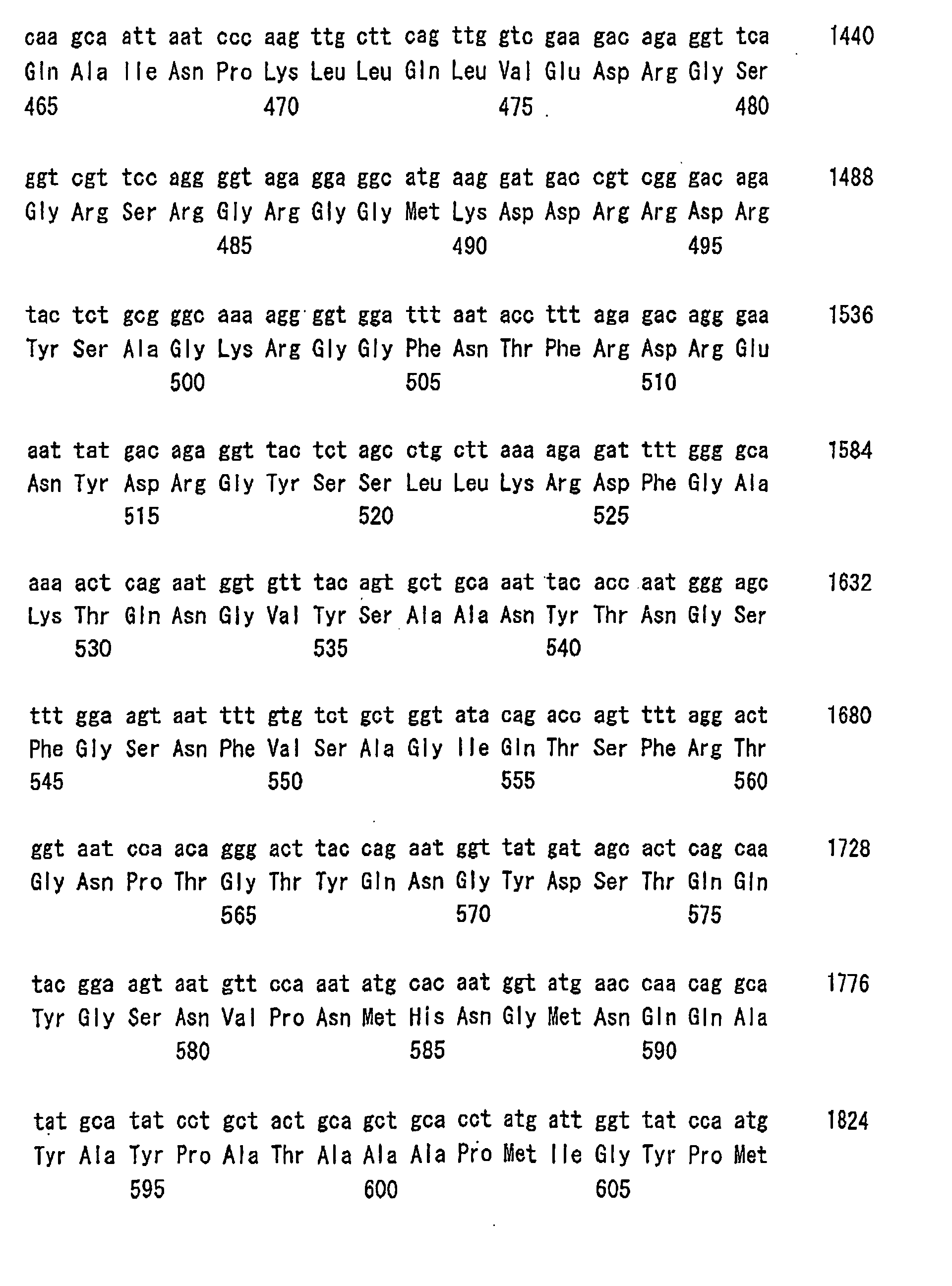
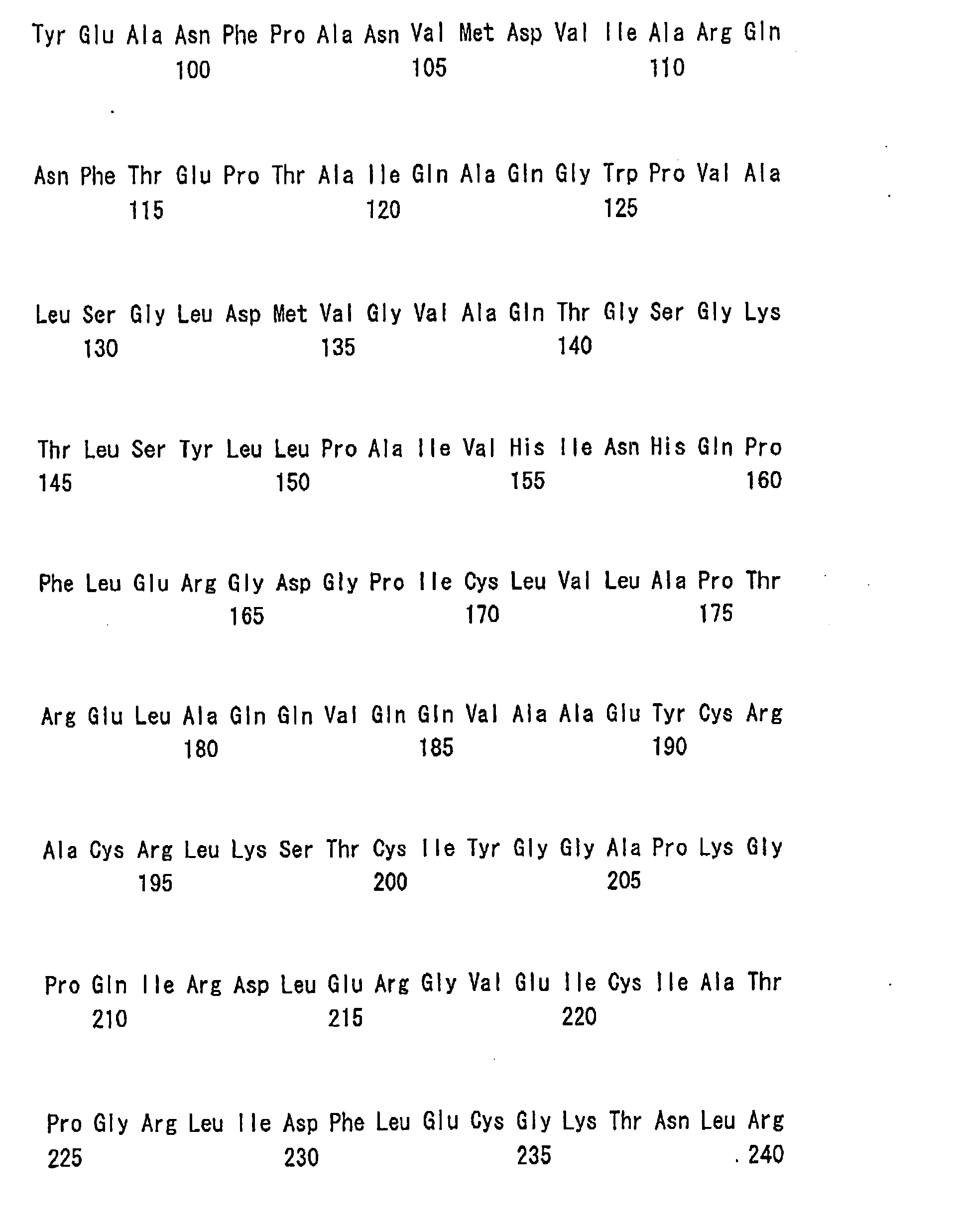
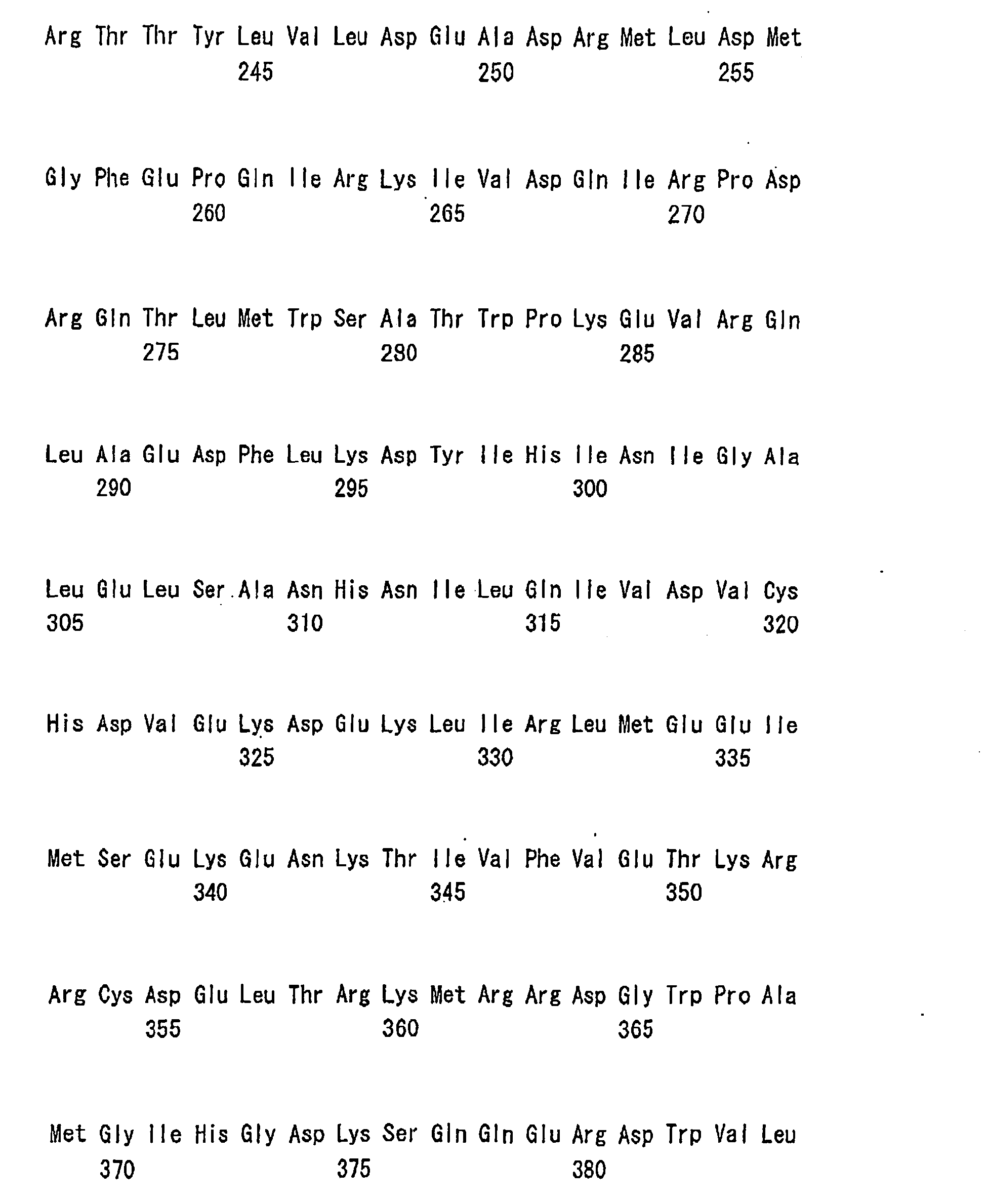
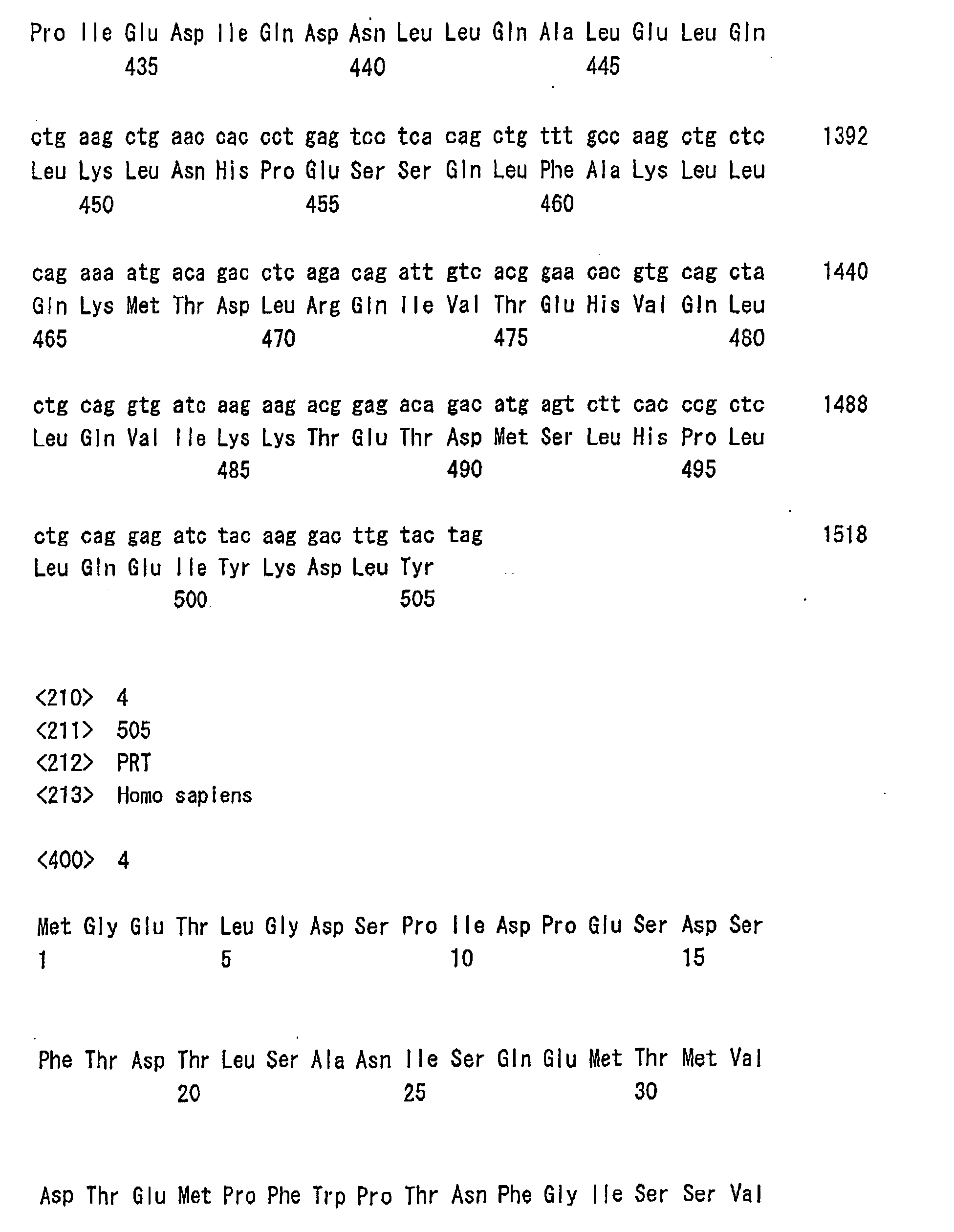
  • the polypeptide consisting of the amino acid sequence represented by SEQ ID NO:2 is the known natural type p68 RNA helicase derived from humans.
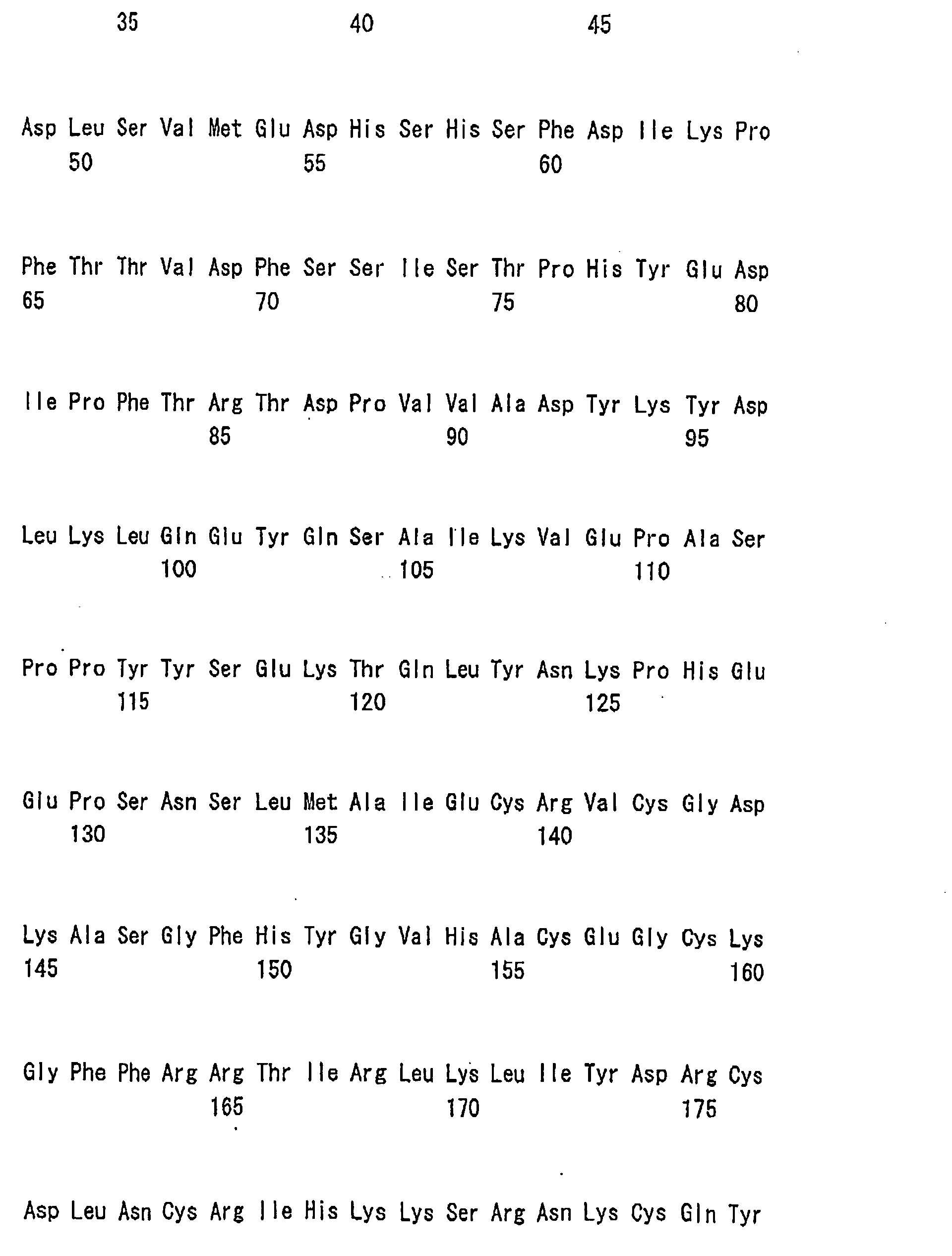
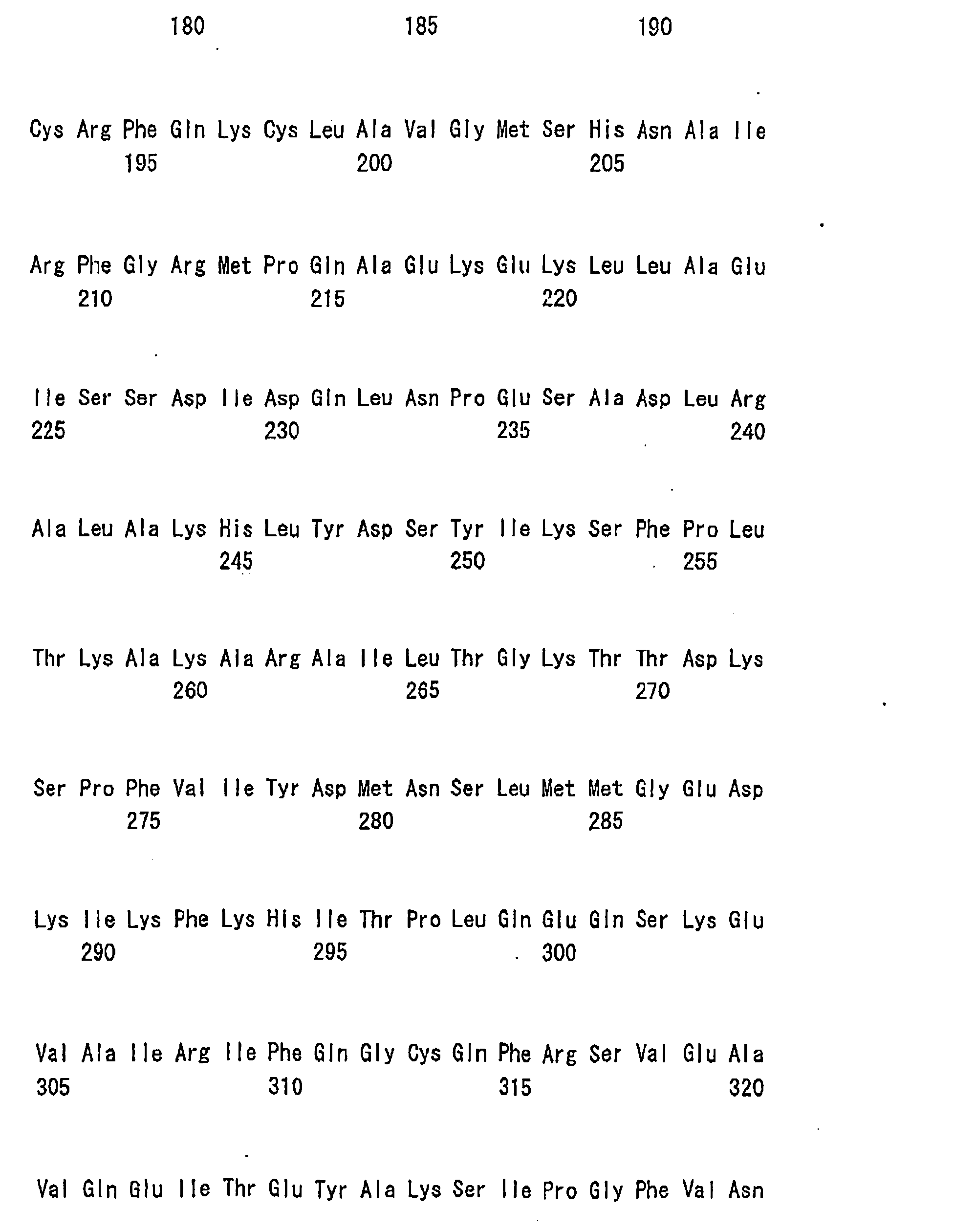
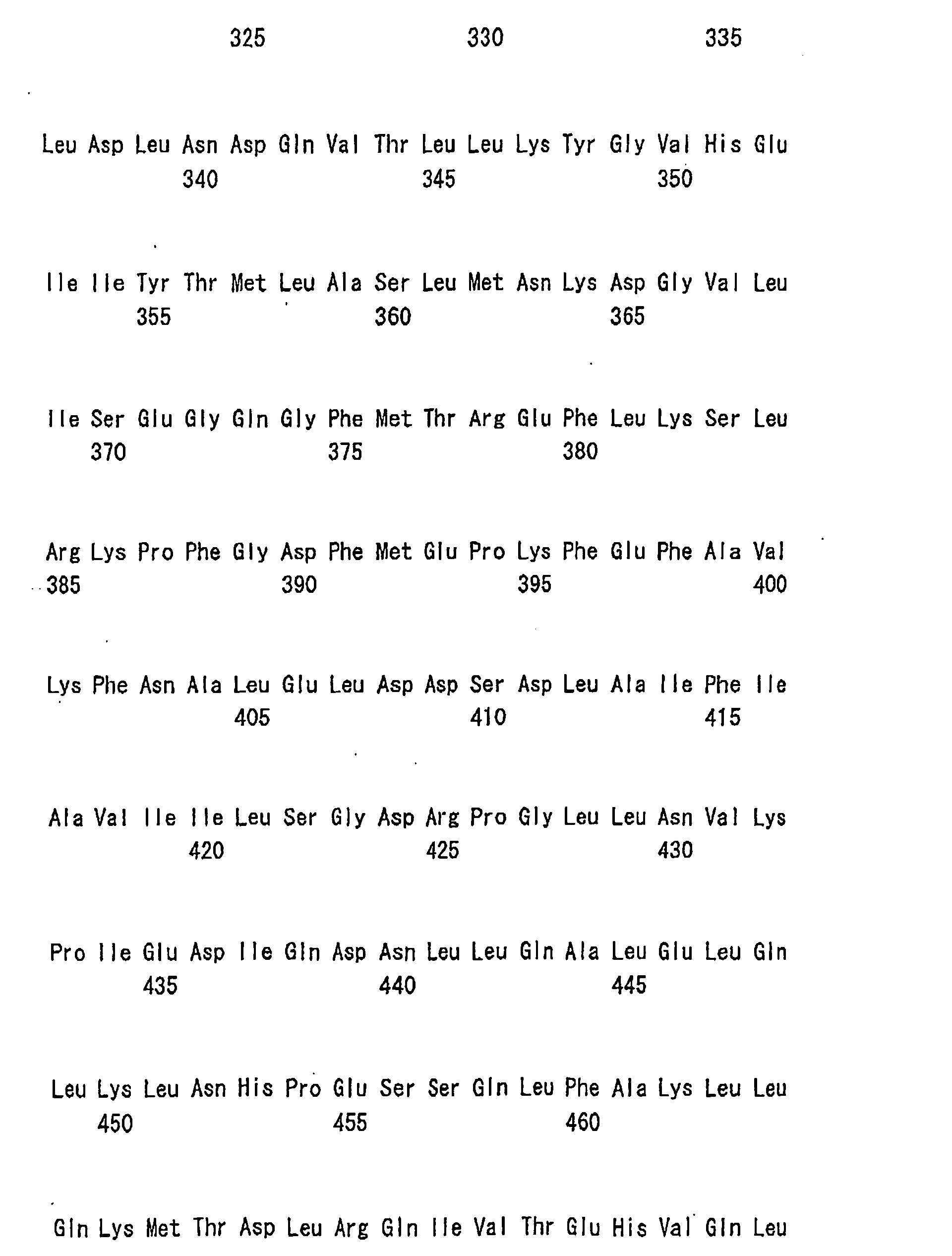
  • the polypeptide consisting of the amino acid sequence represented by SEQ ID NO:4 is the known natural type PPAR ⁇ derived from humans.
  • Polypeptides interactive with PPAR ⁇ for preparing the cell of the present invention for testing PPAR ⁇ transcription activity include:
  • the functionally equivalent variant includes "a polypeptide which comprises the amino acid sequence represented by SEQ ID NO:2 and which is a protein interactive with the AF-1 of PPAR ⁇ " and "a polypeptide which comprises an amino acid sequence represented by SEQ ID NO:2 in which 1 to 10, preferably 1 to 7, more preferably 1 to 5 amino acids are deleted, substituted and/or inserted and which is a protein interactive with the AF-1 of PPAR ⁇ ".
  • the homologous peptide is not particularly limited as far as it consists of an amino acid sequence with 90% or more homology with the amino acid sequence represented by SEQ XD NO:2 and is a protein which interacts with AF-1 of PPAR ⁇ .
  • the homologous peptide consists of an amino acid sequence has homology with preferably 90% or more, more preferably with 95% or more, further more preferably with 98% or more with the amino acid sequence represented by SEQ ID NO:2 and is preferably a protein interactive with the AF-1 of PPAR ⁇ .
  • the term "homology” means the value Identities obtained by using the default parameters prepared by screening on the Clustal program (Higgins & Sharp, Gene , Vol.73, pp. 237-244, 1998; Thompson, et al ., Nucleic Acid Res., Vol.22, pp. 4673-4680, 1994). The parameters are defined as follows.
  • polypeptide consisting of the amino acid represented by SEQ ID NO.:2, functionally equivalent variants thereof and homologous polypeptides thereof are collectively referred to as "PPAR-interactive p68 RNA helicase" hereinafter.
  • the gene encoding the PPAR ⁇ -fused protein for preparing the cell of the present invention for the PPAR ⁇ transcription induction test may be any gene encoding a fused protein consisting of at least the AF-1 of the PPAR ⁇ protein represented by SEQ ID NO:4 and the DNA binding domain of a transcription factor.
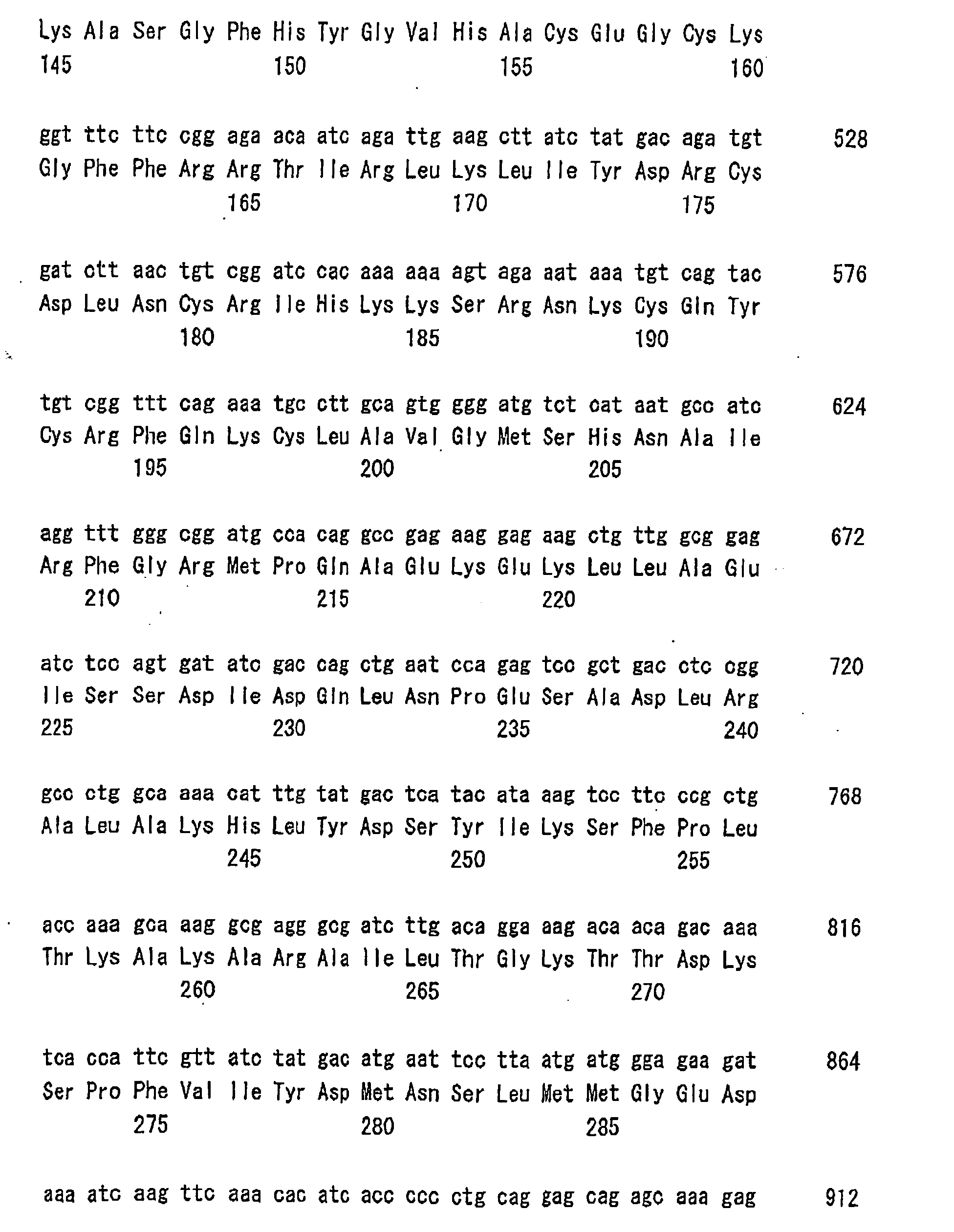
  • the AF-1 of the PPAR ⁇ is a region represented by the nucleotide sequence at the first to 504-th positions of the nucleotide sequence represented by SEQ ID NO:3.
  • the DNA binding domain of any transcription factor may be used.
  • “DNA binding domain" is a domain functioning for binding to DNA and means such domain having a DNA binding potency to a response element but never having the transcription induction potency by itself.
  • the "transcription factor" for use of detecting the transcription induction ability of PPAR ⁇ is not limited as far as it is a transcription factor from eukaryote which have a domain binding to a specific DNA sequence in cellular nuclei.
  • the DNA binding domain of such transcription factor may be the one which has a DNA binding ability to a response element but does not have any transcription induction ability by itself.
  • Such transcription factor includes for example yeast GAL4 protein (Keegan, et al., Science, Vol.231, p. 699-704, 1986; Ma, et al ., Cell , Vol. 48, p. 847-853, 1987).
  • the DNA binding domain and transcription induction domain of the GAL4 transcription factor exist for example on the N-terminal side (a domain containing amino acids, approximately at position 1 to position 147) in case of GAL4.
  • a DNA sequence is used, to which the DNA binding domain of a transcription factor is capable of binding.
  • the region may be scissored out from the upstream region of the gene or the sequence may be chemically synthesized, for use. More detailed definition and examples of such "response element” are described in the fourth edition of " Molecular Cell Biology (Bunshi Saibo Seibutsu-gaku)", (translated by Maruyama et al ., Tokyo Kagaku Dojin, 2001).
  • the "reporter gene” to be arranged downstream of the response element is not specifically limited as far as it is a reporter gene for general use. As such genes, enzyme encoding genes which can be assayed easily are preferable.
  • the reporter gene includes for example chloramphenicol acetyltransferase gene (CAT) from bacteria transposon, luciferase gene (Luc) from firefly, and green fluorescence protein gene (GFP) from jellyfish.
  • CAT chloramphenicol acetyltransferase gene
  • Luc luciferase gene
  • GFP green fluorescence protein gene
  • Polynucleotides encoding PPAR ⁇ , the DNA binding domain of a transcription factor, and the PPAR-interactive p68 RNA helicase can be isolated from cDNA libraries, by the screening of the polymerase chain reaction (PCR) or hybridization, using primers and probes designed and synthesized on the basis of the information of known amino acid sequences and nucleotide sequences.
  • the PPAR-interactive p68 RNA helicase may be derived from any species as far as it is identified as the counterpart and interacts with PPAR ⁇ to effect on the transcription induction ability of the receptor in the presence of a ligand thereof.
  • the PPAR-interactive p68 RNA helicase includes for example those from mammalian animals, such as humans (GenBank Accession No. X15729, X52104 and AF015812), mouse (GenBank Accession No. X65627), and lynx (GenBank accession No. AF110009).
  • PPAR ⁇ includes but is not limited to any PPAR ⁇ from any species, as far as it can be identified as the same molecular species and can play the biological functions as a nuclear receptor.
  • PPAR ⁇ includes for example those derived from mammalian animals, for example humans (GenBank Accession No. U79012), mouse (GenBank Accession No. U09138), and rat (GenBank Accession No. AB019561).
  • PPAR ⁇ there are two isoform types, namely PPAR ⁇ 1 and PPAR ⁇ 2.
  • PPAR ⁇ 1 lacks the 30 amino acids in the N-terminal side.
  • the remaining amino acid sequence is totally the same and is known that both of them are expressed in fat tissues.
  • a polynucleotide encoding PPAR ⁇ , the DNA binding domain of a transcription factor, or the PPAR-interactive p68 RNA helicase can be obtained for example in the following ways. However, these can be obtained not only by the following method but by the known procedures in " Molecular Cloning " [Sambrook, J., et al ., Cold Spring Harbor Laboratory Press, 1989] as well.
  • the following methods can be listed: (1) the PCR method; (2) a method using routine genetic engineering technique (in other words, a method for selecting a transformant strain containing desired amino acids from transformant strains obtained by transformation with cDNA libraries); or (3) a chemical synthesis method.
  • the each production method can be carried out as described in WO 01/34785.
  • the polynucleotide described in this specification can be produced by procedures described in "the Mode for Carrying out the Invention", 1) Production method of protein gene a) First production method of the patent reference mentioned above.
  • the term "human cell or tissue with an ability of generating the protein of the present invention” includes for example human fat tissue. A mRNA is extracted from human fat tissues. Then, the mRNA is subjected to reverse-transcriptase reaction in the presence of random primer or oligo dT primer, to synthesize a first cDNA chain.
  • polymerase chain reaction PCR
  • PCR polymerase chain reaction
  • a polynucleotide encoding PPAR ⁇ , the DNA binding domain of a transcription factor, or the PPAR-interactive p68 RNA helicase in this specification can be produced by the procedures described in "the Mode for Carrying out the Invention", 1) Production method of protein gene a) Second production method of the patent reference mentioned above.
  • a polynucleotide encoding PPAR ⁇ , the DNA binding domain of a transcription factor, or the PPAR-interactive p68 RNA helicase in this specification can be produced by the methods described in "the Mode for Carrying out the Invention", 1) Production method of protein gene c) Third production method and d) Fourth production method of the patent reference mentioned above.
  • DNAs encoding these individual regions are used singly or are ligated together, for conjugation to the downstream of an appropriate promoter to construct an expression system of PPAR ⁇ and PPAR-interactive p68 RNA helicase in test cells.
  • the polynucleotide thus obtained may be integrated in an appropriate vector plasmid and then be utilized with transfection into a host cell. These may be constructed so that the two may be included in one plasmid or the two may be included separately in individually different plasmids. Otherwise, a cell with such construction integrated in the chromosomal DNA may be obtained and then be used.
  • the reporter gene ligated to a response element is used by being constructed by general gene recombination techniques; integrating the construct in a vector plasmid; and transfecting the recombinant plasmid into a host cell. Otherwise, the reporter gene can be used after obtaining a cell in which such substitution is integrated in the chromosomal DNA.
  • PPAR ⁇ may be externally introduced.
  • a cell in which endogenous PPAR ⁇ is expressed abundantly is used as a host cell, for example in case when a cell is a fat-derived cell, among constitutions mentioned above, only a construct consisting of a reporter ligated to a response element and the PPAR-interactive p68 RNA helicase excluding PPAR ⁇ may be introduced.
  • a fragment containing the isolated polynucleotide is again integrated in an appropriate vector plasmid and is able to thereby transform eukaryotic or prokaryotic host cells.
  • an appropriate promoter and a sequence involved in gene expression into such vectors, a gene can be expressed in the individual host cells.
  • a method for transforming host cell to express gene for example, the method described in "the Mode for Carrying out the Invention", 2) Method for producing vector, host cell and recombinant protein of the present invention in the patent reference above can be used.
  • An expression vector is not limited as far as the it carries a desired polynucleotide.
  • an expression vector obtained by inserting a desired polynucleotide into a known expression vector selected appropriately which is dependent on the host cell used can be cited.
  • the cell of the present invention can be obtained by co-transfection of a desired host cell with the said expression vector. More specifically, for example, a desired polynucleotide is integrated in an expression vector pcDNA3.1 for mammalian cells as described in Example 2, to obtain an expression vector for a desired protein, which is incorporated in COS-1 cells using a commercially available transfection reagent Lipofectamine 2000 to produce the transformant cell of the present invention.
  • the desired transformant cell obtained above can be cultured by routine methods and a desired protein is produced by the culture.
  • the culture medium used in the culture various culture medium routinely used according to the employed host cell can be selected appropriately.
  • the Dulbecco's modified Eagle's minimum essential culture medium supplemented for example with the serum component of fetal bovine serum (FBS) and additionally supplemented with G418 may be used.
  • FBS fetal bovine serum
  • the method of the present invention for identifying and screening a novel substance improving insulin resistance through the promotion of the transcription induction activity of PPAR ⁇ by promoting the interaction between PPAR ⁇ and the PPAR-interactive p68 RNA helicase or by inducing the expression of the PPAR-interactive p68 RNA helicase are described below.
  • testing cell is cultured in the presence of a test substance to detect and assay the promotion of the promoting activity of the PPAR-interactive p68 RNA helicase for PPAR ⁇ transcription induction ability via the expression of the reporter gene.
  • test substance induces the expression of PPAR-interactive p68 RNA helicase or suppresses the degradation of PPAR-interactive p68 RNA helicase, the increase of the expressed reporter activity is observed.
  • Such substance is identified as a promoting agent for the transcription induction activity of PPAR ⁇ .
  • Any of them has a structure different from those of conventional PPAR agonists, and is expected to act as an agent for improving insulin resistance with the stronger main activity dissociating from side effects.
  • One mode for carrying out the present invention is a method for selecting and screening a substance promoting the transcription induction activity of PPAR ⁇ and a substance improving insulin resistance, including a step of allowing a test substance to contact with (1) a cell (testing cell) transformed with i) a polynucleotide encoding the PPAR-interactive p68 RNA helicase, ii) a polynucleotide encoding a fusion protein consisting of at least of the AF-1 of the PPAR ⁇ protein and the DNA binding domain of a transcription factor, and iii) a reporter gene fused to a response element to which the DNA binding domain of said transcription factor is able to bind, or 2) a cell transformed by i) a polynucleotide encoding the PPAR-interactive p68 RNA helicase and ii) a reporter gene fused to a response element to which the PPAR ⁇ protein is able to bind, and expressing a) PP
  • One hybrid system is a method for detecting the protein-protein interaction using the expression of reporter gene as a marker.
  • transcription factor has functionally different two regions of DNA binding domain and transcription activating domain.
  • two types of 1) a fusion protein consisting of the DNA binding domain of transcription factor and X and 2) Y are simultaneously expressed in a culture cell.
  • these proteins of X and Y interact together, these form one transcription complex, which binds to the response element (specifically binding DNA site) of the transcription factor in the cell nucleus to activate the transcription of the reporter gene arranged in the downstream thereof.
  • the interaction of two proteins can be replaced for the expression of the reporter gene, and can be detected.
  • the detection can be carried out by the method of Castillo, et al . ( EMBO J., Vol. 18, pp. 3676-3687, 1999).
  • the activity of test substance on the interaction between PPAR ⁇ and the PPAR-interactive p68 RNA helicase can be replaced for the expression of the reporter gene for assay.
  • a substance promoting the interaction between the PPAR-interactive p68 RNA helicase and PPAR ⁇ namely, a substance promoting the transcription induction activity of PPAR ⁇
  • a substance improving insulin resistance can be detected and/or screened for.
  • a substance promoting the PPAR ⁇ transcription induction activity and a substance improving insulin resistance is the full-length PPAR ⁇ protein
  • a PPAR ⁇ ligand is added to the assay system. Since it is reported that as the result of the change of the tertiary structure of nuclear receptor due to the ligand binding to the AF-2, transcriptional cofactors are recruited into the AF-1 and AF-2 to occur activation of transcription. More specifically, the screening can be carried out by the method described in Example 2.
  • the preferable PPAR ⁇ ligand to be added in using the full-length PPAR ⁇ is any PPAR ⁇ ligand may be used as far as it is capable of triggering the transcription induction ability of PPAR ⁇ and includes such ligand capable of triggering the transcription induction ability of PPAR ⁇ , at a final concentration of for example 1 to 1,000 nM, preferably 1 to 100 nM and more preferably 1 to 30 nM.
  • the PPAR ⁇ ligand includes for example thiazolidine derivatives such as pioglitazone (Lehmann, et al., J . Biol. Vol. 270, pp. 12953-12956, 1995).
  • Another mode of the method including assaying the activity of a test substance on the interaction between PPAR ⁇ and the PPAR-interactive p68 RNA helicase is for example a biochemical assay method.
  • binding between the PPAR-interactive p68 RNA helicase labeled with for example RI and a fusion protein consisting of an appropriate tag protein such as glutathione-S-transferase (GST), protein A, ⁇ -galactosidase, and maltose-binding protein (MBP) and the AF-1 of PPAR ⁇ is directly detected in the presence of test substance. More specifically, the method can be carried out by procedures described in Example 1.
  • Still another method is an immunochemical method (ELISA).
  • ELISA immunochemical method
  • X is preliminarily immobilized, Y and a test substance are mixed. Subsequently, the resulting mixture is washed by an appropriate method so as to remove non-specific binding and an antibody specifically reacting with Y by an antigen-antibody reaction is added. The amount of Y bound to the immobilized X can be replaced with the amount of the antibody specifically reacting with Y and can be detected.
  • a substance promoting the interaction between the PPAR-interactive p68 RNA helicase and PPAR ⁇ and a substance improving insulin resistance can be detected and/or screened for.
  • the method for detecting and/or screening a substance promoting the transduction induction ability of PPAR ⁇ and a substance improving insulin resistance includes the methods described above.
  • the PPAR for use in the mode may be either of 1) the AF-1, and 2) the full-length PPAR preferably together with ligand addition.
  • Method for screening an agent for improving insulin resistance including a step of analyzing the change of the expression of the PPAR-interactive p68 RNA helicase>
  • the "cell” may be any cell as far as it expresses the PPAR-interactive p68 RNA helicase or a cell obtained by transforming an expression vector of the PPAR-interactive p68 RNA helicase.
  • the cell is a culture cell 3T3L1 described in Example 4 is cited.
  • Whether or not the "cell expressing the PPAR-interactive p68 RNA helicase” expresses p68 RNA helicase can be identified by Northern blotting using a gene having the nucleotide sequence encoding p68 RNA helicase or a part thereof or by Western blotting using an antibody specific to p68 RNA helicase.
  • the cells are collected after culturing for a certain period.
  • the change of the expression level of the PPAR-interactive p68 RNA helicase depending on the test substance can be assayed as the change of the amount of mRNA as a transcription product of the gene or the change of the amount of a protein encoded by the mRNA.
  • the change of the expression level of the PPAR-interactive p68 RNA helicase which is dependent on the test substance can be analyzed. From the harvested cells, RNA or a cell extract solution can be obtained.
  • the amount of the mRNA in the PPAR-interactive p68 RNA helicase in the recovered RNA can be detected for example by real-time PCR. More specifically, the screening can be carried out by the method described in Example 4. Additionally, the amount of the protein of PPAR-interactive p68 RNA helicase in the harvested cell extract solution can be detected for example by immunochemical methods (Western blotting, etc .). An agent for improving insulin resistance can be screened for by analyzing of the change of the expression level of the PPAR-interactive p68 RNA helicase.
  • An agent for improving insulin resistance can be screened for by i) a step of allowing a cell transformed with a reporter gene fused to the promoter region of p68 RNA helicase-consisting of the nucleotide sequence represented by SEQ ID NO:5 to contact with a test substance and ii) a step of analyzing the change of the transcription induction activity which depends on the test substance, using the expression of the reporter gene as an index.
  • the reporter gene assay (Tamura, et al ., Transcription Factor Research Method, Yodosha, 1993) is a method for assaying the regulation of gene expression using the expression of a reporter gene as an index.
  • gene expression is regulated with a part called promoter region existing in the 5'-upstream region thereof.
  • the gene expression level at the stage of transcription can be estimated by assaying the activity of the promoter.
  • a test substance activates a promoter
  • the transcription of the reporter gene fused in downstream of the promoter region is activated.
  • the promoter-activating activity namely the expression promoting activity
  • the activity of a test substance on the regulation of the expression of the PPAR-interactive p68 RNA helicase can be replaced by the expression of the reporter gene and detected by the reporter gene assay using promoter region of p68 RNA helicase.
  • reporter gene fused to the promoter region p68 RNA helicase consisting of the nucleotide sequence represented by SEQ ID NO:5 is not limited as far as it is used generally, and preferably, the reporter gene encodes enzyme which can be assayed quantitatively.
  • the reporter gene includes chloramphenicol acetyltransferase gene (CAT) derived from bacteria transposon, luciferase gene (Luc) derived from firefly and green fluorescence protein gene (GFP) derived from jellyfish.
  • the reporter gene may be fused functionally to the promoter region of p68 RNA helicase consisting of the nucleotide sequence represented by SEQ ID NO:5.
  • the change of the transcription induction activity depending on the test substance can be analyzed.
  • screening a substance activating the expression of the PPAR-interactive p68 RNA helicase and a substance improving insulin resistance can be carried out. Specifically, said screening can be carried out by the method described in Example 5.
  • test substance used in the screening method of the present invention is not particularly limited and includes for example commercially available compounds (including peptides), various known compounds (including peptides) registered in the chemical files, a group of compounds obtained by the combinatorial chemistry technique (Terrett, et al ., J. Steele, Tetrahedron , Vol. 51, pp. 8135-8173, 1995), bacterial culture supernatants, natural components derived from plants and marine organisms, animal tissue extracts or chemically and biologically modified compounds (including peptides) of compounds (including peptides) selected by the screening method of the present invention.
  • the present invention includes a method for producing a pharmaceutical composition for improving insulin resistance, of which feature is including a screening step using the screening method of the present invention and a formulation step using a substance obtained by the screening described above.
  • the formulation containing the substance obtained by the screening method of the present invention as the active component can be prepared, using carriers, excipients and/or other additives for general use in the formulation of the active component, depending on the type of the active component.
  • the administration includes oral administration via tablets, pills, capsules, granules, fine granules, powders or oral liquids, or parenteral administration via injections intravenous and intramuscular injections or injections into joints, suppositories, transcutaneous administration preparations or transmucosal administration preparations.
  • parenteral administration such as intravenous injection is preferable.
  • a solid composition for oral administration contains one or more active substances and at least one inert diluent, such as lactose, mannitol, glucose, microcrystalline cellulose, hydroxypropyl cellulose, starch, polyvinylpyrrolidone or magnesium aluminate metasilicate.
  • the composition may contain additives other than inert diluents, for example lubricants, disintegrators, stabilizers or dissolution agents or auxiliary dissolution agents according to general methods. If necessary, tablets or pills may be coated with films such as sugar coating, or gastric or enteric coatings.
  • the oral liquid composition may include for example emulsions, solutions, suspensions, syrups or elixirs and may contain inert diluents for general use, for example distilled water or ethanol.
  • the composition may contain additives other than inert diluents, for example, a moistening agent, a suspending agent, sweeteners, a flavoring agent or antiseptic.
  • Non-parenteral injections may include aseptic, aqueous or non-aqueous solutions, suspensions or emulsions.
  • the aqueous solutions or suspensions may contain for example distilled water for injection or physiological saline as diluents.
  • the diluents for non-aqueous solutions or suspensions include for example propylene glycol, polyethylene glycol, plant oils (for example, olive oil) and alcohols (for example, ethanol), or polysorbate 80.
  • the composition described above may contain a moistening agent, an emulsifying agent, a dispersant, a stabilizer, a dissolution agent or an auxiliary dissolution agent, or antiseptic.
  • the said composition can be sterilized by filtration through bacteria-trapping filters, blending of sterilizing agents or irradiation. Additionally, an aseptic solid composition is produced, which is then dissolved in aseptic water or other aseptic medium for injection prior to use and can be then used.
  • the dose can be appropriately determined, in view of the intensity of the activity of the active component, namely a substance obtained by the screening method of the present invention, the symptom, and age or sex of a subject for administration.
  • the dose is about 0.1 to 100 mg, preferably 0.1 to 50 mg per adult (with a body weight of 60 kg) per day.
  • the dose is 0.01 to 50 mg, preferably 0.01 to 10 mg per day.
  • the present invention is now described in detail in the following Examples. However, the present invention is not limited by the Examples. Unless otherwise described, the present invention may be carried out according to the known method (" Molecular Cloning ", Sambrook, J., et al., Cold Spring Harbor Laboratory Press, 1989, etc .). In case of using commercially available reagents or kits, the present invention can be carried out according to the instructions attached to the commercially available products.
  • a cDNA fragment of 1518 bp (base pairs) encoding the full-length PPAR ⁇ 2 was obtained from the human fat tissue cDNA library (Clontech) by PCR [using DNA polymerase (LA Taq DNA polymerase: Takara Shuzo Co., Ltd.) at 94°C (5 minutes) and subsequently 35 times of a cycle of 94°C (30 seconds), 55°C (30 seconds) and 72°C (90 seconds), followed by heating at 72°C for 7 minutes].
  • DNA polymerase LA Taq DNA polymerase: Takara Shuzo Co., Ltd.
  • the cDNA encoding the full-length PPAR ⁇ 2 was inserted in an expression vector for animal cells, namely pcDNA3.1/V5-His-TOPO vector (Invitrogen) by the TOPO cloning method (Invitrogen) using in vitro recombination to prepare a plasmid of pcDNA-PPAR ⁇ for expression in animal cells.
  • Example 2 After binding the GST-PPAR ⁇ -AF-1 fusion protein prepared in Example 1 (2) was bound to a gel (glutathione Sepharose 4B; Amersham Pharmacia), the gel was washed with an appropriate buffer to remove non-specific protein binding.
  • a gel glutathione Sepharose 4B; Amersham Pharmacia
  • Cultured cells of COS-1 were cultured in 100 ⁇ l of the minimum essential culture medium DMEM (Gibco) supplemented with 10% fetal bovine serum (Sigma) per well in a 96-well culture plate (Asahi Technoglass) to become 90% confluence.
  • the following substances (A), (B), (C) and (D) were transiently co-transfected in the cell using a lipofection reagent (Lipofectamine 2000; Invitrogen) according to the protocol attached to the lipofection reagent.
  • the cell was cultured for 24 hours. The culture medium was discarded and the cell was washed with phosphate buffered saline(PBS). Per each well, 80 ⁇ l each of lysis solution (100 mM potassium phosphate, pH 7.8, 0.2% Triton X-100) was added, for cell lysis. To 20 ⁇ l of the cytolytic solution, 100 ⁇ l of a luciferase substrate solution (Wako Pure Chemical Co., Ltd.) was added to assay the luminescence with a chemiluminescence meter (Type ML3000; Dynatech Laboratories).
  • lysis solution 100 ⁇ l of luciferase substrate solution (Wako Pure Chemical Co., Ltd.) was added to assay the luminescence with a chemiluminescence meter (Type ML3000; Dynatech Laboratories).
  • the ⁇ -galactosidase activity of the cytolytic solution was assayed with a kit for detecting the ⁇ -galactosidase activity (Galacto-Light PlusTM system; TROPIX), and the resulting value was digitized. This was used as the transfection efficiency of introduced gene, to correct the said luciferase activity per each well.
  • the agonist-dependent transcription induction activity of PPAR ⁇ was promoted depending on the amount of p68 RNA helicase by the co-expression of p68 RNA helicase (Fig.1).
  • p68 RNA helicase is one of transcriptional coactivators of PPAR ⁇ .
  • transcription induction ability of PPAR ⁇ was promoted.
  • activity similar to PPAR ⁇ agonist namely activity of improving insulin resistance can be expected.
  • the detection and/or screening of a substance promoting the transcription induction activity of PPAR ⁇ and a substance improving insulin resistance are enabled.
  • a culture plate 60-mm diameter; Asahi Technoglass
  • 2 ml of the minimum essential culture medium of DMEM (Gibco) supplemented with 10% fetal bovine serum (Sigma) was, added and a culture cell 3T3L1 cell was cultured therein to become confluence.
  • the culture medium was replaced with a differentiation culture medium [the minimum essential culture medium DMEM (Gibco) supplemented with insulin (at a final concentration of 10 ⁇ g/ml; Sigma), dexamethazone (at a final concentration of 250 ⁇ M; Sigma) and 3-isobutyl-1-methoxylxanthine (at a final concentration of 500 ⁇ M; Sigma)], to which pioglitazone (at a final concentration of 1 ⁇ M) as an agent for improving insulin resistance was added or was not added. Then, it was examined as to whether or not the expression level of p68 RNA helicase changed between the culture medium with or without adding pioglitazone.
  • DMEM minimum essential culture medium
  • dexamethazone at a final concentration of 250 ⁇ M
  • 3-isobutyl-1-methoxylxanthine at a final concentration of 500 ⁇ M; Sigma
  • RNA extraction reagent ISOGEN; Wako Pure Chemical Co., Ltd.
  • a reverse transcription reaction kit Thermoscript RT-PCR System; Invitrogen.
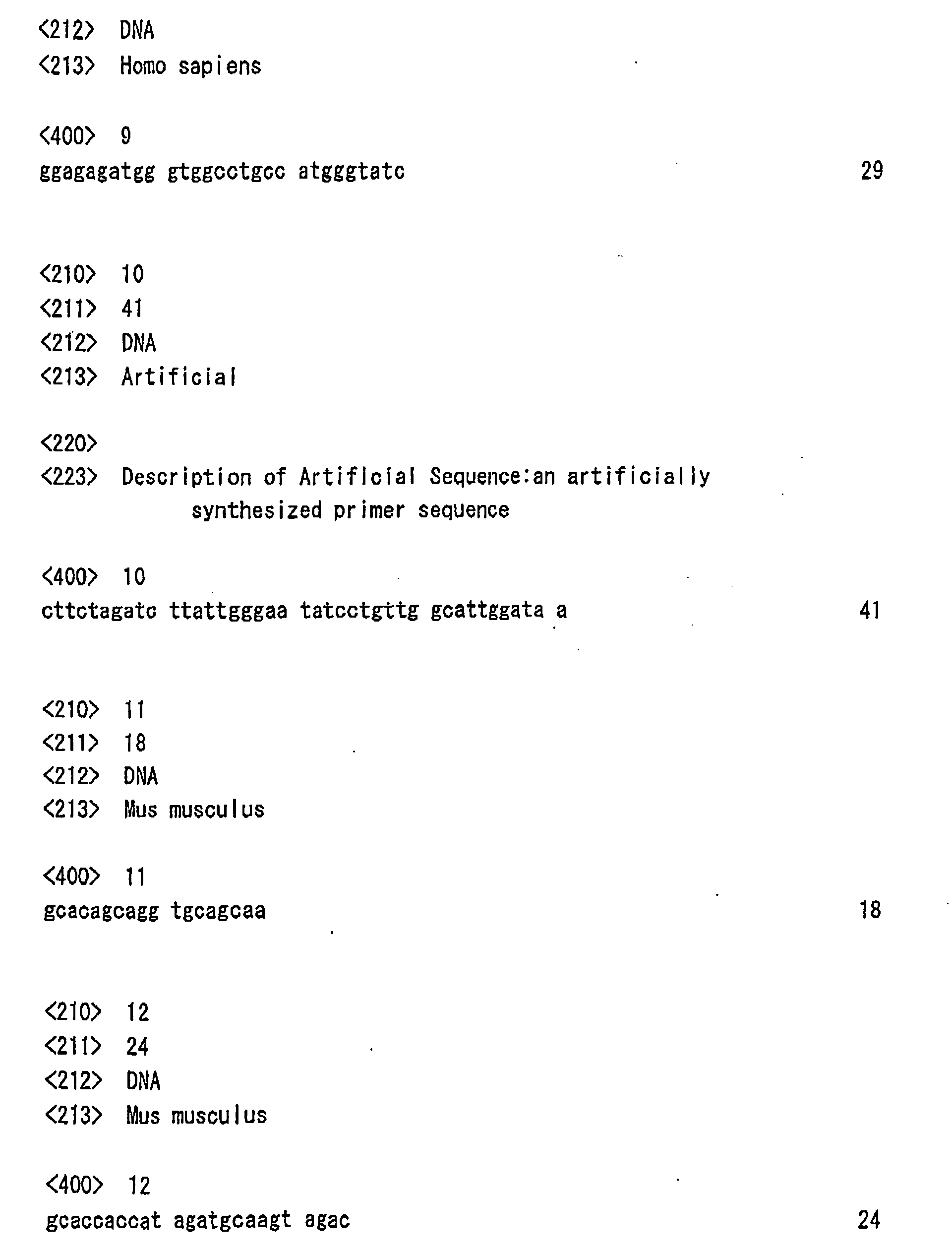
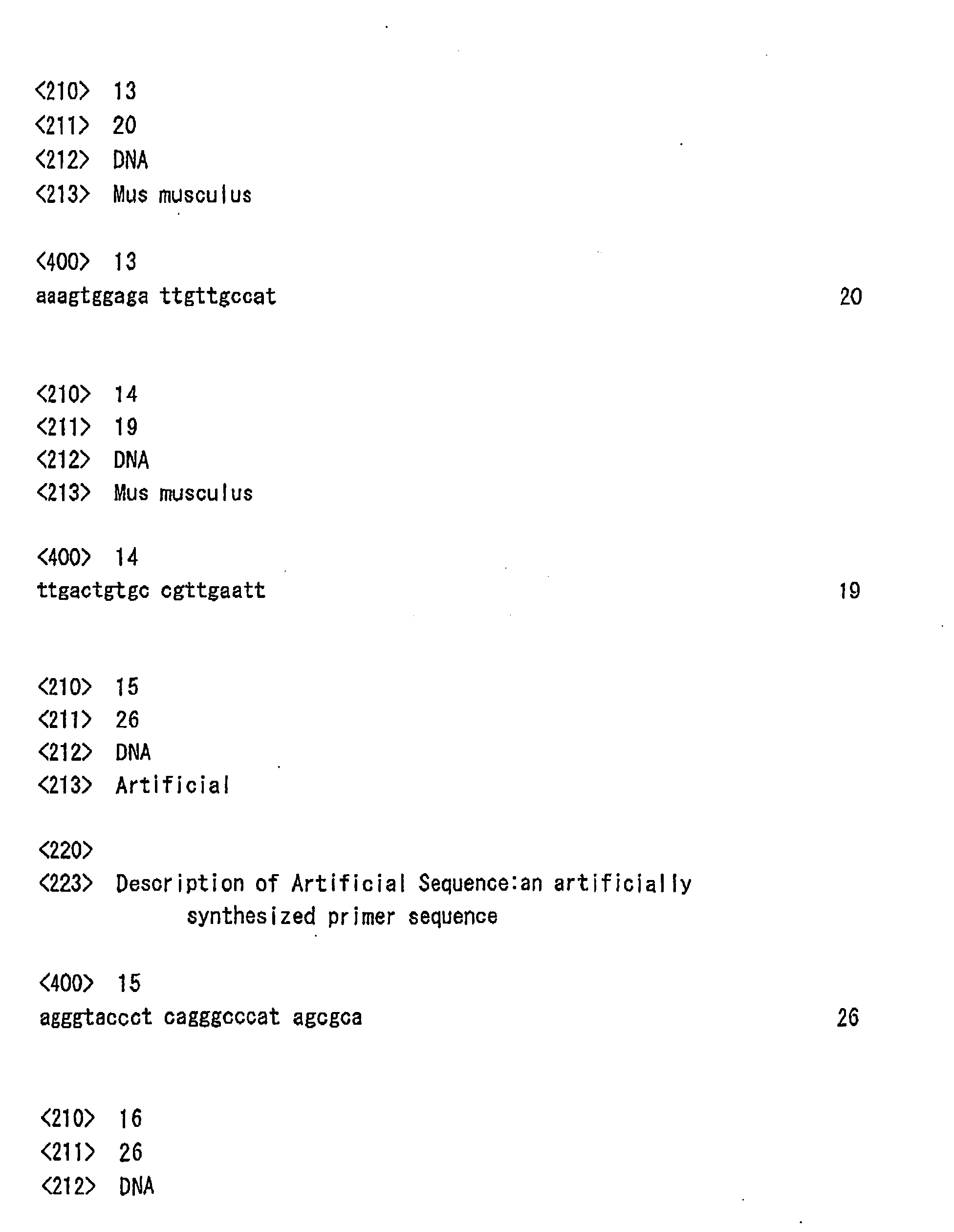
  • a primer set represented by SEQ In NOS:11 and 12 p68 RNA helicase
  • SEQ ID NOS:13 and 14 G3PDH
  • a detection reagent 2X SYBR Green Master Mix; Applied Biosystems
  • the expression level of the p68 RNA helicase gene was corrected on the basis of the expression level of the G3PDH gene by the following formula.
  • [Corrected expression level of p68 RNA helicase] [expression level of p68 RNA helicase (raw data)] / [expression level of G3PDH (raw data)]
  • the expression level of p68 RNA helicase in the culture medium with pioglitazone addition was about 1.7 fold. This supported that pioglitazone which is an agent for improving insulin resistance had an activity of increasing the expression level of p68 RNA helicase and that the increase of the expression of p68 RNA helicase improves insulin resistance.
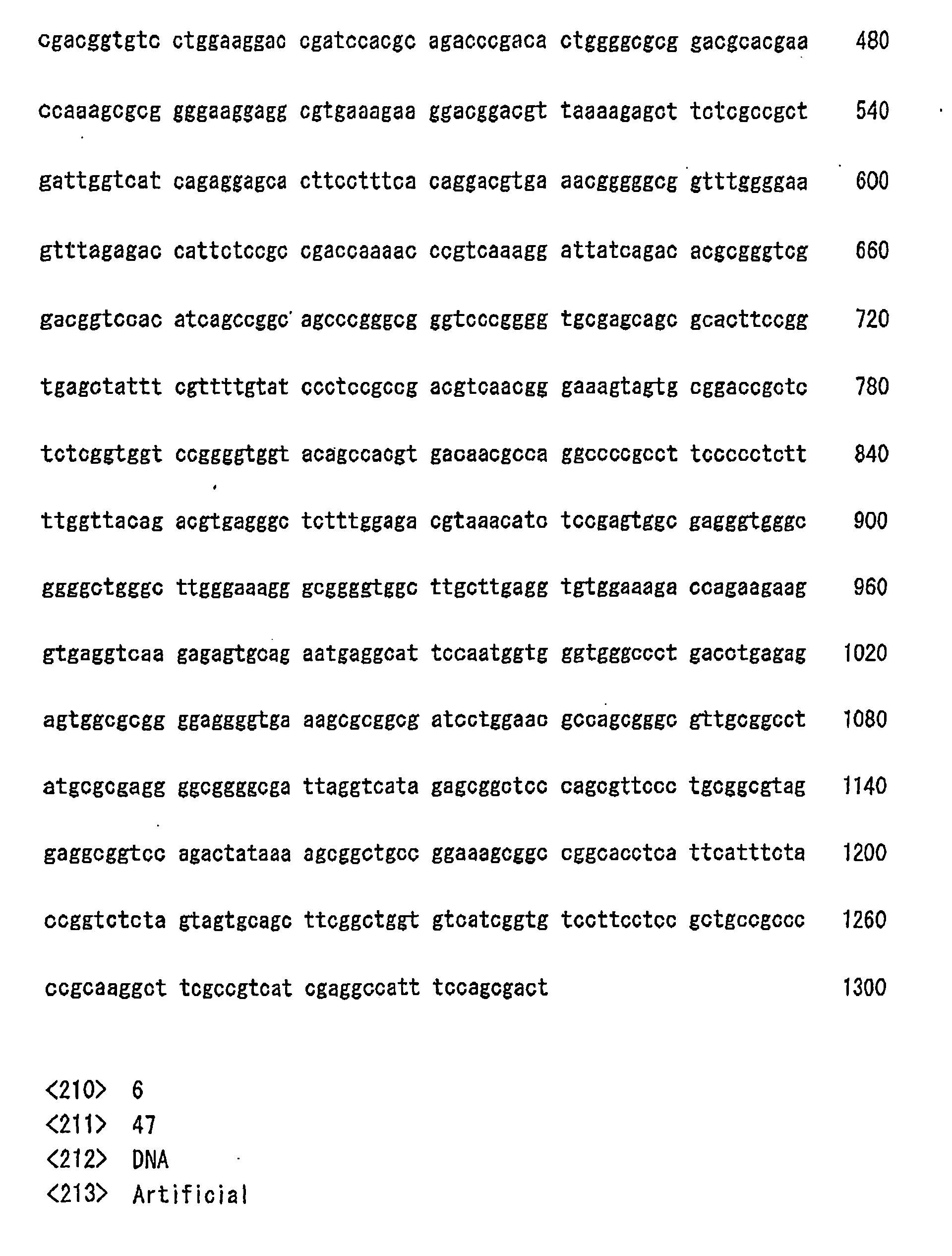
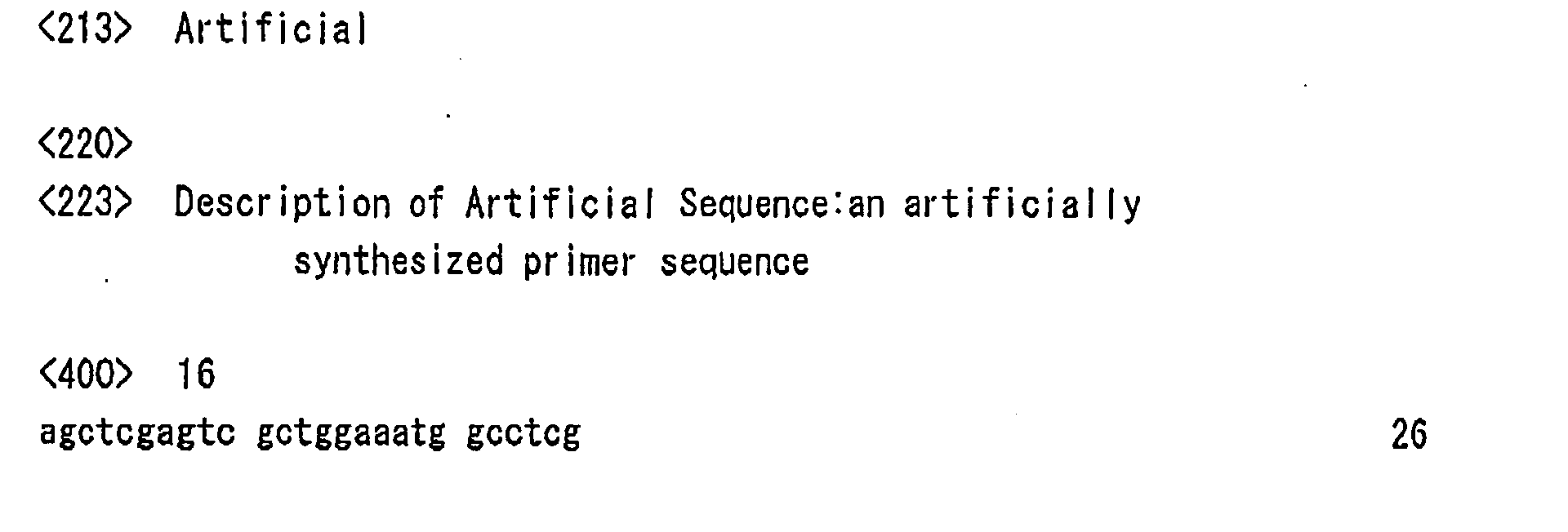
  • primers represented by SEQ ID NOS:14 and 15 designed on the basis of the nucleotide sequence of the promoter of p68 RNA helicase gene as previously reported (Rbssler, et al ., Nucleic Acids Res., Vol.28, pp. 932-939, 2000) and the human genome DNA sequence (GenBank accession No.
  • the DNA fragment was treated with restriction enzymes ( Kpn I and Xho I; Takara Shuzo Co., Ltd.), to be ligated to the luciferase reporter vector similarly treated with restriction enzymes (pGL3-Basic vector; Promega).
  • restriction enzymes Kpn I and Xho I; Takara Shuzo Co., Ltd.
  • pGL3-Basic vector a p68 RNA helicase gene promoter-fused reporter vector
  • the pGL3-p68-1184bp was treated with restriction enzymes ( Nhe I and Xho I; Takara Shuzo Co., Ltd.), to obtain a DNA fragment comprising the promoter region of p68 RNA helicase gene up to the -899 bp.
  • the DNA fragment was then ligated to the pGL3-Basic vector similarly treated with restriction enzymes, to construct a p68 RNA helicase gene promoter-fused reporter vector (pGL3-p68-899bp).
  • pGL3-p68-899bp pGL3-p68-1184bp constructed in Example 5(1) or pGL3-Basic as a negative control (100 ng/well) was individually transiently co-transfected together with a ⁇ -galactosidase-expression vector (pCMV- ⁇ -galactosidase control vector; Roche Diagnostics)(10 ng/well) into the COS-1 cells.
  • Co-transfection was carried out by the same method as in Example 2 (1). After culturing for 48 hours, the luminescence of luciferase was assayed in the same manner as in Example 2.
  • the ⁇ -galactosidase activity was assayed and used as the transfection efficiency of the introduced gene to correct the luciferase activity per each well.
  • the promoter activity of p68 RNA helicase gene was very strong compared with the negative control pGL3-Basic (about 202 fold in case of pGL3-p68-1184bp and about 94 fold in case of pGL3-p68-899bp). Since the activity obtained with pGL3-p68-1184 bp was about half the activity obtained with pGL3-p68-899 bp, it was shown that the region from -1184 bp to -899 bp was involved in the suppressive regulation of transcription. Thus, it was expected that the substance with an activity of removing the suppressive regulation would consequently have an activity of promoting the transcription of p68 RNA helicase gene. Therefore, such substance can be screened for according to the present invention using pGL3-p68-1184bp.
  • Example 5 After adding pioglitazone as one of agents for improving insulin resistance to the co-transfected cell in Example 5 (2) to a final concentration of 10 ⁇ M, and culturing for 24 hours, the luciferase activity was assayed in the same manner as in Example 2. As in Example 2, the ⁇ -galactosidase activity was assayed to correct the said luciferase activity per each well using the ⁇ -galactosidase activity as the transfection efficiency of the introduced gene.
  • the promoter activity of p68 RNA helicase gene was activated depending on the agent for improving insulin resistance (Fig.2).
  • Fig.2 the agent for improving insulin resistance
  • the fact demonstrates that the transcription of p68 RNA helicase gene is activated by pioglitazone as one of agents for improving insulin resistance and that the mechanism of improving insulin resistance is the activation of the transcription of p68 RNA helicase gene.
  • the activation of the promoter activity of p68 RNA helicase gene with pioglitazone as one of agents for improving insulin resistance is observed with both pGL3-p68-899bp and pGL3-p68-1184bp, it is considered that the function point for the transcription activation with pioglitazone exists in 3'-downstream of the -899 bp. Accordingly, the activation is not the removal of the transcription suppressive regulation in the region from -1184 bp to -899 bp.
  • screening a substance with an activity of removing the suppressive regulation of p68 RNA helicase gene more specifically a substance activating the reporter activity of pGL3-p68-1184bp enabled the detection of or screening a substance inducing the expression of p68 RNA helicase and improving insulin resistance, which is different from a conventional agent for improving insulin resistance.
  • p68 RNA helicase When the expression of p68 RNA helicase is increased using this, biological energy sources can be directed toward glucose metabolism to decrease blood glucose value.
  • the experimental system enabled the detection of and/or screening a substance improving insulin resistance.
  • the screening system using the interaction between PPAR ⁇ and the PPAR-interactive p68 RNA helicase and the screening system using the induction of the PPAR-interactive p68 RNA helicase expression can be used for screening a new type of a pharmaceutical agent which is different from PPAR ⁇ synthetic ligands as a conventional agent for improving insulin resistance.
  • the cell of the present invention can be used for constructing said screening system.
  • a pharmaceutical composition for improving insulin resistance can be produced by using a substance obtainable by the screening method of the present invention as the active ingredient and using a carrier, an excipient and/or other additives for preparation.

Landscapes

  • Health & Medical Sciences (AREA)
  • Life Sciences & Earth Sciences (AREA)
  • Engineering & Computer Science (AREA)
  • Chemical & Material Sciences (AREA)
  • Immunology (AREA)
  • Biomedical Technology (AREA)
  • Hematology (AREA)
  • Molecular Biology (AREA)
  • Urology & Nephrology (AREA)
  • General Health & Medical Sciences (AREA)
  • Medicinal Chemistry (AREA)
  • Biochemistry (AREA)
  • Bioinformatics & Cheminformatics (AREA)
  • Toxicology (AREA)
  • Organic Chemistry (AREA)
  • Diabetes (AREA)
  • Physics & Mathematics (AREA)
  • Food Science & Technology (AREA)
  • Pathology (AREA)
  • General Physics & Mathematics (AREA)
  • Analytical Chemistry (AREA)
  • Microbiology (AREA)
  • Cell Biology (AREA)
  • Tropical Medicine & Parasitology (AREA)
  • Biotechnology (AREA)
  • Veterinary Medicine (AREA)
  • Zoology (AREA)
  • Chemical Kinetics & Catalysis (AREA)
  • Obesity (AREA)
  • Animal Behavior & Ethology (AREA)
  • Endocrinology (AREA)
  • Pharmacology & Pharmacy (AREA)
  • Emergency Medicine (AREA)
  • Nuclear Medicine, Radiotherapy & Molecular Imaging (AREA)
  • General Chemical & Material Sciences (AREA)
  • Public Health (AREA)
  • Gastroenterology & Hepatology (AREA)
  • Biophysics (AREA)
  • Genetics & Genomics (AREA)
  • Proteomics, Peptides & Aminoacids (AREA)

Abstract

A method for identifying and screening a novel substance promoting the transcription induction activity of PPARγ and improving insulin resistance by promoting the interaction between PPAR promoting the transcription induction activity of PPARγ and p68 RNA helicase and/or promoting the expression of p68RNA helicase is disclosed. The method is a new type method for screening an agent for improving insulin resistance by promoting the transcription induction activity of PPARγ which is different from the conventional PPAR agonist. Furthermore, the method for producing a pharmaceutical composition for improving insulin resistance which comprises the substance obtainable by the above method for screening as an active ingredient is disclosed.

Description

Technical Field
The present invention relates to a substance promoting the transcription induction activity of PPARγ, and/or a method for screening an agent for improving insulin resistance.
Background of the Invention
A thiazolidine derivative which is recognized by its effect as an agent for improving insulin resistance is shown to have function as an agonist of peroxisome proliferator activated receptor gamma (PPARγ) (Lehmann, et al., J. Biol. Chem. Vol. 270, pp. 12953-12956, 1995). It has been known that PPARγ belongs to the nuclear receptor super family and binds to a response element in upstream region of a target gene as a transcriptional activation factor which is activated via ligand binding to induce the transcription (Mangelsdorf, et al., Cell, Vol. 83, pp. 835-839, 1995). PPARγ agonists were reported to arrest cellular proliferation and promote cellular differentiation (Kitamura, et al., Jpn. J. Cancer Res., Vol. 90, Item 75, 1999). The expression of PPARγ is especially recognized in fat tissues (Tontonoz, et al., Genes and Development, Vol.8, pp. 1224-1234, 1994; Tontonoz, et al., Cell, Vol.79, pp. 1147-1156, 1994). The induction of the differentiation of fat cells is not occurred in homozygous PPARγ-deficient mice. Additionally, administration of thiazolidine derivatives acting as PPARγ agonists decrease the number of large fat cells and increase the number of small fat cells (Kubota, et al., Mol. Cell, Vol.4, pp. 597-609, 1999). Based on the above findings, the mechanism of the improving insulin resistance by thiazolidine derivatives is considered as follows. As the result of rapid promotion of fat cell differentiation by the PPARγ agonists, the generation of TNFα as the causative factor inducing insulin resistance is suppressed, while the expression of glucose transporter is promoted in peripheral tissues and the generation of free fatty acids is suppressed. As a result, glucose uptake into cells is activated to improve hyperglycemia (Lehmann, et al., J. Biol. Chem., Vol. 270, pp. 12953-12956, 1995). Since the affinity of thiazolidine derivatives with PPARγ has a correlation with the hypoglycemic activity in vivo, the activity of the compound group for improving insulin resistance is considered to be the activity mediated by PPARγ activation (Willson, et al., J. Med. Chem., Vol.39, pp.665-668, 1996). These have suggested that the promotion of the transcription induction activity of PPARγ improves insulin resistance and that the method for detecting PPARγ agonist is therefore an effective method for screening a therapeutic agent for improving insulin-resistant diabetes.
However, from recent clinical findings using thiazolidine derivatives, conventional synthetic ligands which have the PPARγ agonistic activity not only have the activity to improve insulin resistance but also cause disorders of liver functions without exception and additionally increase circulating plasma volume in vivo to trigger edema (see non-patent reference 1, non-patent reference 2 and non-patent reference 3). Since the disorders of liver functions induced by the synthetic PPARγ agonists are serious side effects and edema triggered is a very serious side effect causing cardiomegaly, the detachment of the main activity, namely insulin-resistance improvement from such serious side effects has been strongly desired. However, the molecular mechanism of the induction of such side effects by thiazolidine derivatives has not yet been elucidated.
Generally, nuclear receptors have two transcriptional activation domains in the structure. The N-terminal domain is called as AF-1 while the C-terminal domain is called as AF-2. Since it is reported that the AF-2 is involved in the transcriptional activation depending on the ligand (Mangelsdorf, et al., Cell, Vol. 83, pp. 841-850, 1995), a great number of research works have been carried out so far and have also been used for screening the agonists and the like. With regard to the AF-1, alternatively, not many findings exist other than the finding that the AF-1 relates to the ligand-independent transcriptional activation. In recent years, nonetheless, it is reported that a characteristic phenotype in some of humans with a point mutation in the AF-1 of PPARγ exists and that a human with the mutation of the 12-th proline into alanine is particularly more resistant to obesity compared with the wild type and shows good insulin sensitivity (see non-patent reference 4).
The transcription induction activity of PPARγ requires an interaction with transcriptional cofactors like other nuclear receptors and attempts have been carried out to identify a factor interactive with PPARγ. Actually, the binding of PPARγ with existing nuclear receptor-interactive factors has been examined, and plural molecules such as SRC-1 (Zhu, et al., Gene Expr. Vol.6, pp. 185-195, 1996) and CBP/p300 (Gelman, et al., J. Biol. Chem., Vol.274, pp.7681-7688, 1999) are reported to be interactive with PPARγ. However, the group of these cofactors is believed to mainly bind to the AF-2, while what has been known as a cofactor binding to the AF-1 until now is only PGC-2 (Castillo, et al., EMBO J., Vol. 18, pp. 3676-3687, 1999).
The nucleotide sequence and amino acid sequence of p68 RNA helicase are registered on a database (genpept X52104, genpept X15729, genpept BC016027, genpept AF015812). The upstream nucleotide sequence thereof is described in the non-patent reference 5. Additionally, molecules highly homologous with p68 RNA helicase are described in the patent reference 1, the patent reference 2, the patent reference 3 and the patent reference 4, which describe that the molecules which relates to wound healing and are useful as tumor markers. Meanwhile, it is demonstrated that p68 RNA helicase is a transcriptional coactivator binding to the AF-1 of estrogen receptor α as one of nuclear receptors (see non-patent reference 6). More recently, further, the possibility that p68 RNA helicase relates to the differentiation of fat cells has been indicated (see non-patent reference 7 and non-patent reference 8). However, the detailed molecular mechanism thereof has not yet been elucidated.
  • (Patent reference 1)
    Pamphlet of International Publication No. 02/28999
  • (Patent reference 2)
    Specification of Canada No. 2325226
  • (Patent reference 3)
    Pamphlet of International Publication No. 01/60860
  • (Patent reference 4)
    Pamphlet of International Publication No. 01/64707
  • (Non-patent reference 1)
    The Lancet, (USA), 2000, Vol. 355,
  • (Non-patent reference 2)
    Diabetes Frontier, 1999, Vol.10, p.811-818
  • (Non-patent reference 3)
    Diabetes Frontier, 1999, Vol. 10, p. 819-824
  • (Non-patent reference 4)
    Nature Genetics, (USA), 1998, Vol. 20, p.284-287
  • (Non-patent reference 5)
    Nucleic Acids Research, (UK), 2000, Vol.28, p.932-939
  • (Non-patent reference 6)
    Molecular and Cellular Biology, (USA), 1999, Vol.19, p.5363-5372
  • (Non-patent reference 7)
    Biochemical and Biophysical Research Communications, (USA), 2001, vol.287, p. 435-439
  • (Non-patent reference 8)
    Animal Genetics, (UK), 2000, Vol.31, p. 166-170
  • Disclosure of the Invention
    The inventors of the present invention identified p68 RNA helicase as a protein binding to the AF-1 of PPARγ and found that p68 RNA helicase was expressed in human fat tissues. Further, it was found that the transcription induction activity of PPARγ is promoted when p68 RNA helicase is expressed too much. Subsequently, it was found that pioglitazone which is an agent for improving insulin resistance induced the expression of p68 RNA helicase and that the increase of the protein led to the improvement of diabetic conditions. Additionally, it was found that a region regulating the transcription in a suppressive manner by the analysis of the upstream region of p68 RNA helicase gene. More additionally, it was found that the effect point for the activation of PPARγ transcription by pioglitazone never removed the transcription suppressive regulation and that a substance elevating the expression level of p68 RNA helicase and a substance improving insulin resistance unlike conventional drugs improving insulin resistance could be detected and/or screened for by screening substances which has activity of removing the suppressive regulation of p68 RNA helicase gene.
    Based on these findings, it was constructed that a method for identifying and screening a new substance promoting the transcription induction activity of PPARγ to improve insulin resistance by promoting the interaction between PPARγ and p68 RNA helicase and/or increase the expression of p68 RNA helicase. Thus, a method for screening a new type of an agent for improving insulin resistance which is different from conventional PPARγ agonists is provided by promoting the transcription induction activity of PPARγ, as well as a method for producing a pharmaceutical composition for improving insulin resistance. Thus, the present invention has been achieved.
    Specifically, the present invention relates to those described below:
  • [1] A cell transformed by
  • i) a polynucleotide encoding a polypeptide which comprises an amino acid sequence represented by SEQ ID NO:2 in which 1 to 10 amino acids are deleted, substituted and/or inserted and which interacts with PPARγ,
  • ii) a polynucleotide encoding a fusion protein comprising at least the AF-1 of the PPARγ protein represented by SEQ ID NO:4 and the DNA binding domain of a transcription factor, and
  • iii) a reporter gene fused to a response element to which the DNA binding domain of said transcription factor can bind; or
  •    a cell transformed by
    • i) a polynucleotide encoding a polypeptide comprising an amino acid sequence represented by SEQ ID NO:2 in which 1 to 10 amino acids are deleted, substituted and/or inserted and which interacts with PPARγ and
    • ii) a reporter gene fused to a response element to which the PPARγ protein represented by SEQ ID NO:4 is able to bind, and expressing
    • a) a polypeptide comprising a protein consisting of an amino acid sequence represented by SEQ ID NO:2 in which 1 to 10 amino acids are deleted, substituted, and/or inserted, and which interacts with PPARγ and b) the PPARγ protein represented by SEQ ID NO:4.
  • [2] The cell according to [1], wherein the transcription factor is a yeast GAL4 protein.
  • [3] The cell according to [1], wherein the reporter gene is a luciferase gene.
  • [4] A method for detecting whether or not a test substance promotes the transcription induction activity of PPARγ, comprising
  • i) a step of allowing the cell according to one of [1] to [3] to contact with the test substance, and
  • ii) a step of analyzing the change of the test substance-dependent interaction or the change of the test substance-dependent transcription induction activity of PPARγ, in which expression of the reporter gene is used as an index.
  • [5] A method for screening a substance promoting the transcription induction activity of PPARγ, comprising
  • i) a step of allowing the cell according to one of [1] to [3] to contact with a test substance,
  • ii) a step of analyzing the change of the test substance-dependent interaction or the change of the test substance-dependent transcription induction activity of PPARγ, in which expression of the reporter gene is used as an index and
  • iii) a step of selecting a test substance which activates the reporter activity.
  • [6] The method for screening according to [5], wherein the substance promoting the transcription induction activity of PPARγ is an agent for improving insulin resistance.
  • [7] A method for screening an agent for improving insulin resistance, comprising
  • i) a step of allowing a cell expressing PPAR-interactive p68 RNA helicase to contact with a test substance, and
  • ii) a step of analyzing the change of the test substance-dependent expression level of PPAR-interactive p68 RNA helicase.
  • [8] A screening method for an agent for improving insulin resistance, comprising
  • i) a step of allowing a cell transformed with a reporter gene fused with the promoter region of p68 RNA helicase represented by SEQ ID NO:5 to contact with a test substance, and
  • ii) a step of analyzing the change of the test substance-dependent transcription induction activity, in which the expression of the reporter gene is used as an index.
  • [9] A method for producing a pharmaceutical composition for improving insulin resistance, comprising
       a screening step using the screening method according to one of [5] to [8], and
       a formulation step using a substance obtainable by said screening.
  • Although in patent reference 1, it is described that a molecule highly homologous with p68 RNA helicase and names of numerous diseases for which the molecule relates to, it is not described that the relation of p68 RNA helicase with insulin resistance and the relation of p68 RNA helicase with PPARγ. It is said that a molecule highly homologous with p68 RNA helicase which is described in the patent reference 2 relates to wound healing. Additionally, it is described that a molecule highly homologous with p68 RNA helicase described in the patent references 3 or 4 is useful as a tumor marker and relates to various tumors. In none of the patent reference, it is described the relation of p68 RNA helicase or highly homologous molecules thereof with insulin resistance or PPARγ.
    Therefore, it is a novel finding found by the inventors of the present invention that p68 RNA helicase binds to the AF-1 of PPARγ and act as its transcriptional coactivator. Additionally, a method for identifying and screening a new substance promoting the transcription induction activity of PPARγ to improve insulin resistance by promoting the interaction between PPARγ and p68 RNA helicase and/or inducing the expression of p68 RNA helicase, and a method for producing a pharmaceutical composition for improving insulin resistance are inventions achieved for the first time by the inventors of the present invention.
    Brief Description of the Drawings
  • Fig. 1 is a graph which shows the luciferase activity in Example 2, where the luciferase activity is shown in the vertical axis and the amount of an expression vector of p68 RNA helicase is shown in the horizontal axis; and
  • Fig. 2 is a graph which shows the luciferase activity in Example 5 (3), where the luciferase activity is shown in the vertical axis and the co-transfected plasmid is shown in the horizontal axis. The diagonal bar shows the results without reagent addition and the black bar shows the results with reagent addition.
  • Best Mode for Carrying out the Invention
    The present invention is now described in detail herein below.
    [1] Cell of the present invention
    The polypeptide consisting of the amino acid sequence represented by SEQ ID NO:2 is the known natural type p68 RNA helicase derived from humans. The polypeptide consisting of the amino acid sequence represented by SEQ ID NO:4 is the known natural type PPARγ derived from humans.
    Polypeptides interactive with PPARγ for preparing the cell of the present invention for testing PPARγ transcription activity include:
  • (1) a polypeptide consisting of the amino acid sequence represented by SEQ ID NO:2;
  • (2) a polynucleotide encoding a polypeptide which comprises an amino acid sequence represented by SEQ ID No:2 in which 1 to 10 amino acids are deleted, substituted and/or inserted and which interacts with the AF-1 of PPARγ (called functionally equivalent variant hereinafter); and
  • (3) a polypeptide comprising a protein consisting of an amino acid sequence with 90% or more homology with the amino acid sequence represented by SEQ ID NO:2 and interacting with the AF-1 of PPARγ (called homologous peptide hereinafter).
  • The functionally equivalent variant includes "a polypeptide which comprises the amino acid sequence represented by SEQ ID NO:2 and which is a protein interactive with the AF-1 of PPARγ" and "a polypeptide which comprises an amino acid sequence represented by SEQ ID NO:2 in which 1 to 10, preferably 1 to 7, more preferably 1 to 5 amino acids are deleted, substituted and/or inserted and which is a protein interactive with the AF-1 of PPARγ".
    The homologous peptide is not particularly limited as far as it consists of an amino acid sequence with 90% or more homology with the amino acid sequence represented by SEQ XD NO:2 and is a protein which interacts with AF-1 of PPARγ. The homologous peptide consists of an amino acid sequence has homology with preferably 90% or more, more preferably with 95% or more, further more preferably with 98% or more with the amino acid sequence represented by SEQ ID NO:2 and is preferably a protein interactive with the AF-1 of PPARγ. In the present specification, the term "homology" means the value Identities obtained by using the default parameters prepared by screening on the Clustal program (Higgins & Sharp, Gene, Vol.73, pp. 237-244, 1998; Thompson, et al., Nucleic Acid Res., Vol.22, pp. 4673-4680, 1994). The parameters are defined as follows.
    As pair wise alignment parameters, those described below are listed.
    K tuple 1
    Gap Penalty 3
    Window 5
    Diagonals Saved 5.
    The polypeptide consisting of the amino acid represented by SEQ ID NO.:2, functionally equivalent variants thereof and homologous polypeptides thereof are collectively referred to as "PPAR-interactive p68 RNA helicase" hereinafter.
    The gene encoding the PPARγ-fused protein for preparing the cell of the present invention for the PPARγ transcription induction test may be any gene encoding a fused protein consisting of at least the AF-1 of the PPARγ protein represented by SEQ ID NO:4 and the DNA binding domain of a transcription factor. The AF-1 of the PPARγ is a region represented by the nucleotide sequence at the first to 504-th positions of the nucleotide sequence represented by SEQ ID NO:3. As the DNA binding domain, the DNA binding domain of any transcription factor may be used. "DNA binding domain " is a domain functioning for binding to DNA and means such domain having a DNA binding potency to a response element but never having the transcription induction potency by itself.
    In the mode for carrying out the present invention, the "transcription factor" for use of detecting the transcription induction ability of PPARγ is not limited as far as it is a transcription factor from eukaryote which have a domain binding to a specific DNA sequence in cellular nuclei. Further, the DNA binding domain of such transcription factor may be the one which has a DNA binding ability to a response element but does not have any transcription induction ability by itself. Such transcription factor includes for example yeast GAL4 protein (Keegan, et al., Science, Vol.231, p. 699-704, 1986; Ma, et al., Cell, Vol. 48, p. 847-853, 1987). The DNA binding domain and transcription induction domain of the GAL4 transcription factor exist for example on the N-terminal side (a domain containing amino acids, approximately at position 1 to position 147) in case of GAL4.
    As the "response element", a DNA sequence is used, to which the DNA binding domain of a transcription factor is capable of binding. The region may be scissored out from the upstream region of the gene or the sequence may be chemically synthesized, for use. More detailed definition and examples of such "response element" are described in the fourth edition of "Molecular Cell Biology (Bunshi Saibo Seibutsu-gaku)", (translated by Maruyama et al., Tokyo Kagaku Dojin, 2001).
    The "reporter gene" to be arranged downstream of the response element is not specifically limited as far as it is a reporter gene for general use. As such genes, enzyme encoding genes which can be assayed easily are preferable. The reporter gene includes for example chloramphenicol acetyltransferase gene (CAT) from bacteria transposon, luciferase gene (Luc) from firefly, and green fluorescence protein gene (GFP) from jellyfish. As the reporter gene, a gene which is functionally ligated to the downstream of the response element or a gene in which a response element is inserted in a promoter is used.
    Polynucleotides encoding PPARγ, the DNA binding domain of a transcription factor, and the PPAR-interactive p68 RNA helicase can be isolated from cDNA libraries, by the screening of the polymerase chain reaction (PCR) or hybridization, using primers and probes designed and synthesized on the basis of the information of known amino acid sequences and nucleotide sequences. The PPAR-interactive p68 RNA helicase may be derived from any species as far as it is identified as the counterpart and interacts with PPARγ to effect on the transcription induction ability of the receptor in the presence of a ligand thereof. The PPAR-interactive p68 RNA helicase includes for example those from mammalian animals, such as humans (GenBank Accession No. X15729, X52104 and AF015812), mouse (GenBank Accession No. X65627), and lynx (GenBank accession No. AF110009). PPARγ includes but is not limited to any PPARγ from any species, as far as it can be identified as the same molecular species and can play the biological functions as a nuclear receptor. PPARγ includes for example those derived from mammalian animals, for example humans (GenBank Accession No. U79012), mouse (GenBank Accession No. U09138), and rat (GenBank Accession No. AB019561). Additionally, in PPARγ, there are two isoform types, namely PPARγ1 and PPARγ2. Compared with PPARγ2, PPARγ1 lacks the 30 amino acids in the N-terminal side. The remaining amino acid sequence is totally the same and is known that both of them are expressed in fat tissues.
    A polynucleotide encoding PPARγ, the DNA binding domain of a transcription factor, or the PPAR-interactive p68 RNA helicase can be obtained for example in the following ways. However, these can be obtained not only by the following method but by the known procedures in "Molecular Cloning" [Sambrook, J., et al., Cold Spring Harbor Laboratory Press, 1989] as well.
    For example, the following methods can be listed: (1) the PCR method; (2) a method using routine genetic engineering technique (in other words, a method for selecting a transformant strain containing desired amino acids from transformant strains obtained by transformation with cDNA libraries); or (3) a chemical synthesis method. The each production method can be carried out as described in WO 01/34785.
    By the PCR method, for example, the polynucleotide described in this specification can be produced by procedures described in "the Mode for Carrying out the Invention", 1) Production method of protein gene a) First production method of the patent reference mentioned above. In the description, the term "human cell or tissue with an ability of generating the protein of the present invention" includes for example human fat tissue. A mRNA is extracted from human fat tissues. Then, the mRNA is subjected to reverse-transcriptase reaction in the presence of random primer or oligo dT primer, to synthesize a first cDNA chain. Using the resulting first cDNA chain and two primer types directed for a partial region of the intended gene by polymerase chain reaction (PCR) was carried out to obtain the polynucleotide of the present invention as a whole or as a part. More specifically, the polynucleotide of the present invention can be produced for example by the method described in Example 1.
    By the method using routine genetic engineering technique, for example, a polynucleotide encoding PPARγ, the DNA binding domain of a transcription factor, or the PPAR-interactive p68 RNA helicase in this specification can be produced by the procedures described in "the Mode for Carrying out the Invention", 1) Production method of protein gene a) Second production method of the patent reference mentioned above.
    By the method using chemical synthesis, for example, a polynucleotide encoding PPARγ, the DNA binding domain of a transcription factor, or the PPAR-interactive p68 RNA helicase in this specification can be produced by the methods described in "the Mode for Carrying out the Invention", 1) Production method of protein gene c) Third production method and d) Fourth production method of the patent reference mentioned above.
    By the method described in "Molecular Cloning" [Sambrook, J., et al., Cold Spring Harbor Laboratory Press, 1989], DNAs encoding these individual regions are used singly or are ligated together, for conjugation to the downstream of an appropriate promoter to construct an expression system of PPARγ and PPAR-interactive p68 RNA helicase in test cells. Specifically, the polynucleotide thus obtained may be integrated in an appropriate vector plasmid and then be utilized with transfection into a host cell. These may be constructed so that the two may be included in one plasmid or the two may be included separately in individually different plasmids. Otherwise, a cell with such construction integrated in the chromosomal DNA may be obtained and then be used.
    The reporter gene ligated to a response element is used by being constructed by general gene recombination techniques; integrating the construct in a vector plasmid; and transfecting the recombinant plasmid into a host cell. Otherwise, the reporter gene can be used after obtaining a cell in which such substitution is integrated in the chromosomal DNA.
    PPARγ may be externally introduced. In case when a cell in which endogenous PPARγ is expressed abundantly is used as a host cell, for example in case when a cell is a fat-derived cell, among constitutions mentioned above, only a construct consisting of a reporter ligated to a response element and the PPAR-interactive p68 RNA helicase excluding PPARγ may be introduced.
    More specifically, a fragment containing the isolated polynucleotide is again integrated in an appropriate vector plasmid and is able to thereby transform eukaryotic or prokaryotic host cells. By further inserting an appropriate promoter and a sequence involved in gene expression into such vectors, a gene can be expressed in the individual host cells. As a method for transforming host cell to express gene, for example, the method described in "the Mode for Carrying out the Invention", 2) Method for producing vector, host cell and recombinant protein of the present invention in the patent reference above can be used. An expression vector is not limited as far as the it carries a desired polynucleotide. For example, an expression vector obtained by inserting a desired polynucleotide into a known expression vector selected appropriately which is dependent on the host cell used can be cited.
    The cell of the present invention can be obtained by co-transfection of a desired host cell with the said expression vector. More specifically, for example, a desired polynucleotide is integrated in an expression vector pcDNA3.1 for mammalian cells as described in Example 2, to obtain an expression vector for a desired protein, which is incorporated in COS-1 cells using a commercially available transfection reagent Lipofectamine 2000 to produce the transformant cell of the present invention.
    The desired transformant cell obtained above can be cultured by routine methods and a desired protein is produced by the culture. As the culture medium used in the culture, various culture medium routinely used according to the employed host cell can be selected appropriately. For the COS-1 cells, for example, the Dulbecco's modified Eagle's minimum essential culture medium supplemented for example with the serum component of fetal bovine serum (FBS) and additionally supplemented with G418 may be used.
    [2] Detection and screening method of the invention
    The method of the present invention for identifying and screening a novel substance improving insulin resistance through the promotion of the transcription induction activity of PPARγ by promoting the interaction between PPARγ and the PPAR-interactive p68 RNA helicase or by inducing the expression of the PPAR-interactive p68 RNA helicase are described below.
    The cell of the present invention (called testing cell hereinafter) is cultured in the presence of a test substance to detect and assay the promotion of the promoting activity of the PPAR-interactive p68 RNA helicase for PPARγ transcription induction ability via the expression of the reporter gene.
    Additionally when the test substance induces the expression of PPAR-interactive p68 RNA helicase or suppresses the degradation of PPAR-interactive p68 RNA helicase, the increase of the expressed reporter activity is observed. Such substance is identified as a promoting agent for the transcription induction activity of PPARγ.
    Any of them has a structure different from those of conventional PPAR agonists, and is expected to act as an agent for improving insulin resistance with the stronger main activity dissociating from side effects.
    <Method for detecting and/or screening a substance promoting the transcription induction activity of PPARγ and a substance improving insulin resistance>
    One mode for carrying out the present invention is a method for selecting and screening a substance promoting the transcription induction activity of PPARγ and a substance improving insulin resistance, including a step of allowing a test substance to contact with (1) a cell (testing cell) transformed with i) a polynucleotide encoding the PPAR-interactive p68 RNA helicase, ii) a polynucleotide encoding a fusion protein consisting of at least of the AF-1 of the PPARγ protein and the DNA binding domain of a transcription factor, and iii) a reporter gene fused to a response element to which the DNA binding domain of said transcription factor is able to bind, or 2) a cell transformed by i) a polynucleotide encoding the PPAR-interactive p68 RNA helicase and ii) a reporter gene fused to a response element to which the PPARγ protein is able to bind, and expressing a) PPAR-interactive p68 RNA helicase and b) the PPARγ protein to detect and assay the change of the promoting activity of the transcription activating ability of PPARγ with the test substance in the testing cell, using the expression of the reporter gene as an index.
    One hybrid system is a method for detecting the protein-protein interaction using the expression of reporter gene as a marker. Generally, transcription factor has functionally different two regions of DNA binding domain and transcription activating domain. In order to examine the interaction between two types of proteins of X and Y by the one hybrid system, two types of 1) a fusion protein consisting of the DNA binding domain of transcription factor and X and 2) Y are simultaneously expressed in a culture cell. When the proteins of X and Y interact together, these form one transcription complex, which binds to the response element (specifically binding DNA site) of the transcription factor in the cell nucleus to activate the transcription of the reporter gene arranged in the downstream thereof. As described above, the interaction of two proteins can be replaced for the expression of the reporter gene, and can be detected. More specifically, the detection can be carried out by the method of Castillo, et al. (EMBO J., Vol. 18, pp. 3676-3687, 1999). Thus, the activity of test substance on the interaction between PPARγ and the PPAR-interactive p68 RNA helicase can be replaced for the expression of the reporter gene for assay. A substance promoting the interaction between the PPAR-interactive p68 RNA helicase and PPARγ (namely, a substance promoting the transcription induction activity of PPARγ) and a substance improving insulin resistance can be detected and/or screened for. When PPARγ expressed in the cell used in the method for detecting and/or screening a substance promoting the PPARγ transcription induction activity and a substance improving insulin resistance is the full-length PPARγ protein, preferably, a PPARγ ligand is added to the assay system. Since it is reported that as the result of the change of the tertiary structure of nuclear receptor due to the ligand binding to the AF-2, transcriptional cofactors are recruited into the AF-1 and AF-2 to occur activation of transcription. More specifically, the screening can be carried out by the method described in Example 2.
    The preferable PPARγ ligand to be added in using the full-length PPARγ is any PPARγ ligand may be used as far as it is capable of triggering the transcription induction ability of PPARγ and includes such ligand capable of triggering the transcription induction ability of PPARγ, at a final concentration of for example 1 to 1,000 nM, preferably 1 to 100 nM and more preferably 1 to 30 nM. The PPARγ ligand includes for example thiazolidine derivatives such as pioglitazone (Lehmann, et al., J. Biol. Vol. 270, pp. 12953-12956, 1995).
    Another mode of the method including assaying the activity of a test substance on the interaction between PPARγ and the PPAR-interactive p68 RNA helicase is for example a biochemical assay method. By such method, binding between the PPAR-interactive p68 RNA helicase labeled with for example RI and a fusion protein consisting of an appropriate tag protein such as glutathione-S-transferase (GST), protein A, β-galactosidase, and maltose-binding protein (MBP) and the AF-1 of PPARγ is directly detected in the presence of test substance. More specifically, the method can be carried out by procedures described in Example 1.
    Additionally, still another method is an immunochemical method (ELISA). In such a method, for example, in order to examine the interaction between two types of proteins of X and Y, X is preliminarily immobilized, Y and a test substance are mixed. Subsequently, the resulting mixture is washed by an appropriate method so as to remove non-specific binding and an antibody specifically reacting with Y by an antigen-antibody reaction is added. The amount of Y bound to the immobilized X can be replaced with the amount of the antibody specifically reacting with Y and can be detected. Using this, a substance promoting the interaction between the PPAR-interactive p68 RNA helicase and PPARγ and a substance improving insulin resistance can be detected and/or screened for.
    The method for detecting and/or screening a substance promoting the transduction induction ability of PPARγ and a substance improving insulin resistance includes the methods described above. The PPAR for use in the mode may be either of 1) the AF-1, and 2) the full-length PPAR preferably together with ligand addition.
    <Method for screening an agent for improving insulin resistance including a step of analyzing the change of the expression of the PPAR-interactive p68 RNA helicase>
  • i) An agent for improving insulin resistance can be screened for by a method of which feature is including a step of allowing a test substance in contact to a cell expressing the PPAR-interactive p68 RNA helicase to contact with a test substance, and ii) a step of analyzing the change of the expression level of the PPAR-interactive p68 RNA helicase which is dependent on the test substance.
  • The "cell" may be any cell as far as it expresses the PPAR-interactive p68 RNA helicase or a cell obtained by transforming an expression vector of the PPAR-interactive p68 RNA helicase. Preferably, the cell is a culture cell 3T3L1 described in Example 4 is cited. Whether or not the "cell expressing the PPAR-interactive p68 RNA helicase" expresses p68 RNA helicase can be identified by Northern blotting using a gene having the nucleotide sequence encoding p68 RNA helicase or a part thereof or by Western blotting using an antibody specific to p68 RNA helicase. With or without adding a test substance to the cells expressing the PPAR-interactive p68 RNA helicase, the cells are collected after culturing for a certain period. The change of the expression level of the PPAR-interactive p68 RNA helicase depending on the test substance can be assayed as the change of the amount of mRNA as a transcription product of the gene or the change of the amount of a protein encoded by the mRNA. By comparing the change of the expression level between in case of the with or without the addition of the test substance, the change of the expression level of the PPAR-interactive p68 RNA helicase which is dependent on the test substance can be analyzed. From the harvested cells, RNA or a cell extract solution can be obtained. The amount of the mRNA in the PPAR-interactive p68 RNA helicase in the recovered RNA can be detected for example by real-time PCR. More specifically, the screening can be carried out by the method described in Example 4. Additionally, the amount of the protein of PPAR-interactive p68 RNA helicase in the harvested cell extract solution can be detected for example by immunochemical methods (Western blotting, etc.). An agent for improving insulin resistance can be screened for by analyzing of the change of the expression level of the PPAR-interactive p68 RNA helicase.
    <Method for screening an agent for improving insulin resistance using promoter of the PPAR-interactive p68 RNA helicase>
    An agent for improving insulin resistance can be screened for by i) a step of allowing a cell transformed with a reporter gene fused to the promoter region of p68 RNA helicase-consisting of the nucleotide sequence represented by SEQ ID NO:5 to contact with a test substance and ii) a step of analyzing the change of the transcription induction activity which depends on the test substance, using the expression of the reporter gene as an index. The reporter gene assay (Tamura, et al., Transcription Factor Research Method, Yodosha, 1993) is a method for assaying the regulation of gene expression using the expression of a reporter gene as an index. Generally, gene expression is regulated with a part called promoter region existing in the 5'-upstream region thereof. The gene expression level at the stage of transcription can be estimated by assaying the activity of the promoter. When a test substance activates a promoter, the transcription of the reporter gene fused in downstream of the promoter region is activated. In such manner, the promoter-activating activity, namely the expression promoting activity can be replaced by the expression of the reporter gene and be detected. Thus, the activity of a test substance on the regulation of the expression of the PPAR-interactive p68 RNA helicase can be replaced by the expression of the reporter gene and detected by the reporter gene assay using promoter region of p68 RNA helicase. The "reporter gene" fused to the promoter region p68 RNA helicase consisting of the nucleotide sequence represented by SEQ ID NO:5 is not limited as far as it is used generally, and preferably, the reporter gene encodes enzyme which can be assayed quantitatively. For example, the reporter gene includes chloramphenicol acetyltransferase gene (CAT) derived from bacteria transposon, luciferase gene (Luc) derived from firefly and green fluorescence protein gene (GFP) derived from jellyfish. The reporter gene may be fused functionally to the promoter region of p68 RNA helicase consisting of the nucleotide sequence represented by SEQ ID NO:5. By comparing the expression level of the reporter gene between in case of contact with or without a test substance, the change of the transcription induction activity depending on the test substance can be analyzed. By carrying out the steps, screening a substance activating the expression of the PPAR-interactive p68 RNA helicase and a substance improving insulin resistance can be carried out. Specifically, said screening can be carried out by the method described in Example 5.
    The test substance used in the screening method of the present invention is not particularly limited and includes for example commercially available compounds (including peptides), various known compounds (including peptides) registered in the chemical files, a group of compounds obtained by the combinatorial chemistry technique (Terrett, et al., J. Steele, Tetrahedron, Vol. 51, pp. 8135-8173, 1995), bacterial culture supernatants, natural components derived from plants and marine organisms, animal tissue extracts or chemically and biologically modified compounds (including peptides) of compounds (including peptides) selected by the screening method of the present invention.
    [3] Method for producing a pharmaceutical composition for improving insulin resistance
    The present invention includes a method for producing a pharmaceutical composition for improving insulin resistance, of which feature is including a screening step using the screening method of the present invention and a formulation step using a substance obtained by the screening described above.
    The formulation containing the substance obtained by the screening method of the present invention as the active component can be prepared, using carriers, excipients and/or other additives for general use in the formulation of the active component, depending on the type of the active component.
    The administration includes oral administration via tablets, pills, capsules, granules, fine granules, powders or oral liquids, or parenteral administration via injections intravenous and intramuscular injections or injections into joints, suppositories, transcutaneous administration preparations or transmucosal administration preparations. For peptides to be digested in stomach, in particular, parenteral administration such as intravenous injection is preferable.
    A solid composition for oral administration contains one or more active substances and at least one inert diluent, such as lactose, mannitol, glucose, microcrystalline cellulose, hydroxypropyl cellulose, starch, polyvinylpyrrolidone or magnesium aluminate metasilicate. The composition may contain additives other than inert diluents, for example lubricants, disintegrators, stabilizers or dissolution agents or auxiliary dissolution agents according to general methods. If necessary, tablets or pills may be coated with films such as sugar coating, or gastric or enteric coatings.
    The oral liquid composition may include for example emulsions, solutions, suspensions, syrups or elixirs and may contain inert diluents for general use, for example distilled water or ethanol. The composition may contain additives other than inert diluents, for example, a moistening agent, a suspending agent, sweeteners, a flavoring agent or antiseptic.
    Non-parenteral injections may include aseptic, aqueous or non-aqueous solutions, suspensions or emulsions. The aqueous solutions or suspensions may contain for example distilled water for injection or physiological saline as diluents. The diluents for non-aqueous solutions or suspensions include for example propylene glycol, polyethylene glycol, plant oils (for example, olive oil) and alcohols (for example, ethanol), or polysorbate 80. The composition described above may contain a moistening agent, an emulsifying agent, a dispersant, a stabilizer, a dissolution agent or an auxiliary dissolution agent, or antiseptic. The said composition can be sterilized by filtration through bacteria-trapping filters, blending of sterilizing agents or irradiation. Additionally, an aseptic solid composition is produced, which is then dissolved in aseptic water or other aseptic medium for injection prior to use and can be then used.
    The dose can be appropriately determined, in view of the intensity of the activity of the active component, namely a substance obtained by the screening method of the present invention, the symptom, and age or sex of a subject for administration.
    In case of oral dosing, for example, the dose is about 0.1 to 100 mg, preferably 0.1 to 50 mg per adult (with a body weight of 60 kg) per day. In case of parenteral dosing in the form of an injection, the dose is 0.01 to 50 mg, preferably 0.01 to 10 mg per day.
    Examples
    The present invention is now described in detail in the following Examples. However, the present invention is not limited by the Examples. Unless otherwise described, the present invention may be carried out according to the known method ("Molecular Cloning", Sambrook, J., et al., Cold Spring Harbor Laboratory Press, 1989, etc.). In case of using commercially available reagents or kits, the present invention can be carried out according to the instructions attached to the commercially available products.
    (Example 1) Identification of binding protein to the AF-1 of PPARγ (1) Isolation of PPARγ gene and preparation of plasmid pcDNA-PPARγ for expression in animal cells
    Using the primers of SEQ ID NOS:6 and 7, a cDNA fragment of 1518 bp (base pairs) encoding the full-length PPARγ2 was obtained from the human fat tissue cDNA library (Clontech) by PCR [using DNA polymerase (LA Taq DNA polymerase: Takara Shuzo Co., Ltd.) at 94°C (5 minutes) and subsequently 35 times of a cycle of 94°C (30 seconds), 55°C (30 seconds) and 72°C (90 seconds), followed by heating at 72°C for 7 minutes]. The cDNA encoding the full-length PPARγ2 was inserted in an expression vector for animal cells, namely pcDNA3.1/V5-His-TOPO vector (Invitrogen) by the TOPO cloning method (Invitrogen) using in vitro recombination to prepare a plasmid of pcDNA-PPARγ for expression in animal cells.
    (2) Preparation of plasmid of pGEX-PPARγ-AF-1 for expressing glutathione S-transferase (GST)-fused protein and expression of GST-PPARγ-AF-1 fusion protein
    Using the primers of SEQ ID NOS:6 and 8 and the pcDNA-PPARγ prepared in Example 1 (1) as template for PCR [using DNA polymerase (Taq DNA polymerase; Sigma) at 94°C (5 minutes) and subsequently 25 times of a cycle of 94°C (30 seconds), 55°C (30 seconds) and 72°C (30 seconds), followed by heating at 72°C for 7 minutes], a cDNA fragment of about 600 bp encoding a region including the AF-1 of PPARγ was obtained. This was treated by restriction enzymes (EcoRI and NotI; Takara Shuzo Co., Ltd.), and inserted in pGEX-6P-1 (Amersham Biosciences) similarly treated with restriction enzymes to prepare a plasmid of pGEX-PPARγ-AF-1 for expressing GST fusion protein. Escherichia coli transformed with the plasmid was cultured at 37°C for 3 hours, to which isopropyl-β-D-thioglactopyranoside (IPTG; Nakarai Tesque) was added to become a final concentration of 2.5 mM to induce the expression of the fusion protein, followed by further culturing at 27°C for another 6 hours. Subsequently, the Escherichia coli was collected. The cell was disrupted with an ultrasonic generator (201M; Kubota) to prepare GST-PPARγ-AF-1 fusion protein.
    (3) GST pull-down assay
    After binding the GST-PPARγ-AF-1 fusion protein prepared in Example 1 (2) was bound to a gel (glutathione Sepharose 4B; Amersham Pharmacia), the gel was washed with an appropriate buffer to remove non-specific protein binding. Using an expression vector of p68 RNA helicase, namely pSG5-p68 (Endoh, et al., Mol. Cell. Biol. Vol.19, pp.5363-5372, 1999) as a template and according to the protocol attached to the kit, the in vitro protein expression kit (TNTRT7 Quick Coupled Transcription/Translation System; Promega) and the full-length p68 RNA helicase protein which is radio-labeled with radioactive methionine (EASYTAG™ EXPRESS PROTEIN LABELING MIX [35S]-; NEN Life Sciences) were mixed with the gel bound with the said GST-PPARγ-AF-1 fusion protein and binding reaction was carried out at 4°C for one hour, followed by washing. This was separated, using sodium dodecyl sulfate-modified polyacrylamide gel (SDS-PAGE), and analyzed by an imaging analyzer (Typhoon 8600; Pharmacia Biosciences). As a result, the binding of the AF-1 of PPARγ to p68 RNA helicase was confirmed. This apparently indicates that p68 RNA helicase is a factor binding to the AF-1 of PPARγ.
    (Example 2) Detection of the regulatory activity of p68 RNA helicase on the transcription induction ability of PPARγ in the presence of ligand
    The above results indicate that p68 RNA helicase interacts with the AF-1 of PPARγ. It was examined by reporter assay using cultured cells of COS-1 that what kind of effects p68 RNA helicase had on the transcription induction activity of PPARγ. A thiazolidine derivative reported to act as a ligand of PPARγ, namely pioglitazone [(+)-5-[4-[2-(5-ethyl-2-pyridinyl)ethoxy]benzyl]-2,4-thiazolidinedione; Takeda Pharmaceutical Co., Ltd.: Patent No. 1853588] was synthesized by the method described in the specification.
    (1) Detection of the regulatory activity of p68 RNA helicase on the transcription induction ability of PPARγ
    Cultured cells of COS-1 were cultured in 100 µl of the minimum essential culture medium DMEM (Gibco) supplemented with 10% fetal bovine serum (Sigma) per well in a 96-well culture plate (Asahi Technoglass) to become 90% confluence. The following substances (A), (B), (C) and (D) were transiently co-transfected in the cell using a lipofection reagent (Lipofectamine 2000; Invitrogen) according to the protocol attached to the lipofection reagent.
  • (A) pcDNA-PPARγ (30 ng/well) prepared in Example 1 (1)
  • (B) Reporter construct with the PPAR binding sequence arranged upstream of the luciferase gene (Kliewer, et al., Nature, Vol. 358, pp. 771-774, 1992) (100 ng/well)
  • (C) p68 RNA helicase-expressing vector of pSG5-p68 (Endoh, et al., Mol. Cell. Biol., Vol.19, pp. 5363-5372, 1999) (0-10 ng/well)
  • (D) Plasmid of pCMV-β-galactosidase control vector with the gene expressing β-galactosidase (Roche Diagnostics) 10 ng/well
  • After adding pioglitazone which is a PPARγ agonist to the co-transfected cell to become a final concentration of 30 nM, the cell was cultured for 24 hours. The culture medium was discarded and the cell was washed with phosphate buffered saline(PBS). Per each well, 80 µl each of lysis solution (100 mM potassium phosphate, pH 7.8, 0.2% Triton X-100) was added, for cell lysis. To 20 µl of the cytolytic solution, 100 µl of a luciferase substrate solution (Wako Pure Chemical Co., Ltd.) was added to assay the luminescence with a chemiluminescence meter (Type ML3000; Dynatech Laboratories). Separately, the β-galactosidase activity of the cytolytic solution was assayed with a kit for detecting the β-galactosidase activity (Galacto-Light Plus™ system; TROPIX), and the resulting value was digitized. This was used as the transfection efficiency of introduced gene, to correct the said luciferase activity per each well.
    As the results of the experiments, the agonist-dependent transcription induction activity of PPARγ was promoted depending on the amount of p68 RNA helicase by the co-expression of p68 RNA helicase (Fig.1). The fact shows that p68 RNA helicase is one of transcriptional coactivators of PPARγ. Using the finding, it is possible to decrease the blood glucose level through the increase of the amount of p68 RNA helicase by directing biological energy sources toward glucose metabolism. In other words, by the increase of the amount of p68 RNA helicase, transcription induction ability of PPARγ was promoted. As a result, activity similar to PPARγ agonist, namely activity of improving insulin resistance can be expected. By the experimental system, the detection and/or screening of a substance promoting the transcription induction activity of PPARγ and a substance improving insulin resistance are enabled.
    (Example 3) Confirmation of expression of p68 RNA helicase in human tissue
    Using primers of SEQ ID NOS:9 and 10 and according to PCR [using DNA polymerase (Taq DNA polymerase; Sigma) at 94°C (5 minutes) and subsequently 35 times of a cycle of 94°C (30 seconds), 55°C (30 seconds) and 72°C (90 seconds), followed by heating at 72°C for 7 minutes], the amplification of a cDNA fragment of about 800 bp encoding p68 RNA helicase in the human cDNA library (Clontech) was detected by agarose gel electrophoresis. Consequently, it was found that p68 RNA helicase was expressed in fat tissue and muscle known to have the PPARγ activity. This was supported even on the basis of the expression sites that p68 RNA helicase was a transcriptional coactivator of PPARγ.
    (Example 4) Comparison of the expression level of mRNA of p68 RNA helicase during the differentiation course of 3T3L1 cell into fat cell
    To a culture plate (60-mm diameter; Asahi Technoglass), 2 ml of the minimum essential culture medium of DMEM (Gibco) supplemented with 10% fetal bovine serum (Sigma) was, added and a culture cell 3T3L1 cell was cultured therein to become confluence. Subsequently, the culture medium was replaced with a differentiation culture medium [the minimum essential culture medium DMEM (Gibco) supplemented with insulin (at a final concentration of 10 µg/ml; Sigma), dexamethazone (at a final concentration of 250 µM; Sigma) and 3-isobutyl-1-methoxylxanthine (at a final concentration of 500 µM; Sigma)], to which pioglitazone (at a final concentration of 1 µM) as an agent for improving insulin resistance was added or was not added. Then, it was examined as to whether or not the expression level of p68 RNA helicase changed between the culture medium with or without adding pioglitazone. 24 hours after pioglitazone addition, the cell was harvested, to extract RNA using an RNA extraction reagent (ISOGEN; Wako Pure Chemical Co., Ltd.) for reverse transcription with a reverse transcription reaction kit (Thermoscript RT-PCR System; Invitrogen). Using the resulting product as template and additionally using a primer set represented by SEQ In NOS:11 and 12 (p68 RNA helicase) or by SEQ ID NOS:13 and 14 (G3PDH) and a detection reagent (2X SYBR Green Master Mix; Applied Biosystems), the changes of the expression levels of p68 RNA helicase and G3PDH were examined by the real-time PCR (Prism 7700 Sequence Detection System; Applied Biosystems). The expression level of the p68 RNA helicase gene was corrected on the basis of the expression level of the G3PDH gene by the following formula. [Corrected expression level of p68 RNA helicase] = [expression level of p68 RNA helicase (raw data)] / [expression level of G3PDH (raw data)]
    As a result, compared with the culture medium without pioglitazone addition, the expression level of p68 RNA helicase in the culture medium with pioglitazone addition was about 1.7 fold. This supported that pioglitazone which is an agent for improving insulin resistance had an activity of increasing the expression level of p68 RNA helicase and that the increase of the expression of p68 RNA helicase improves insulin resistance.
    (Example 5) Detection of promoter activity of p68 RNA helicase gene (1) Isolation of promoter region of p68 RNA helicase gene and preparation of reporter vector
    Using primers represented by SEQ ID NOS:14 and 15 designed on the basis of the nucleotide sequence of the promoter of p68 RNA helicase gene as previously reported (Rbssler, et al., Nucleic Acids Res., Vol.28, pp. 932-939, 2000) and the human genome DNA sequence (GenBank accession No. AC009994) and additionally using the human genome DNA (Clontech) as template for PCR [using DNA polymerase (LA Taq DNA polymerase; Takara Shuzo Co., Ltd.), and at 98°C (5 minutes) and subsequently 35 times of a cycle of 96°C (30 seconds), 55°C (30 seconds) and 72°C (90 seconds), followed by heating at 72°C for 7 minutes], a DNA fragment comprising the promoter region of p68 RNA helicase gene represented by SEQ ID NO.5 was obtained. The DNA fragment was treated with restriction enzymes (KpnI and XhoI; Takara Shuzo Co., Ltd.), to be ligated to the luciferase reporter vector similarly treated with restriction enzymes (pGL3-Basic vector; Promega). Thus, a p68 RNA helicase gene promoter-fused reporter vector (pGL3-p68-1184bp) was constructed. Further, the pGL3-p68-1184bp was treated with restriction enzymes (NheI and XhoI; Takara Shuzo Co., Ltd.), to obtain a DNA fragment comprising the promoter region of p68 RNA helicase gene up to the -899 bp. The DNA fragment was then ligated to the pGL3-Basic vector similarly treated with restriction enzymes, to construct a p68 RNA helicase gene promoter-fused reporter vector (pGL3-p68-899bp).
    (2) Detection of promoter activity of p68 RNA helicase gene
    pGL3-p68-899bp, pGL3-p68-1184bp constructed in Example 5(1) or pGL3-Basic as a negative control (100 ng/well) was individually transiently co-transfected together with a β-galactosidase-expression vector (pCMV-β-galactosidase control vector; Roche Diagnostics)(10 ng/well) into the COS-1 cells. Co-transfection was carried out by the same method as in Example 2 (1). After culturing for 48 hours, the luminescence of luciferase was assayed in the same manner as in Example 2. As in Example 2, the β-galactosidase activity was assayed and used as the transfection efficiency of the introduced gene to correct the luciferase activity per each well.
    As the results of the experiments, the promoter activity of p68 RNA helicase gene was very strong compared with the negative control pGL3-Basic (about 202 fold in case of pGL3-p68-1184bp and about 94 fold in case of pGL3-p68-899bp). Since the activity obtained with pGL3-p68-1184 bp was about half the activity obtained with pGL3-p68-899 bp, it was shown that the region from -1184 bp to -899 bp was involved in the suppressive regulation of transcription. Thus, it was expected that the substance with an activity of removing the suppressive regulation would consequently have an activity of promoting the transcription of p68 RNA helicase gene. Therefore, such substance can be screened for according to the present invention using pGL3-p68-1184bp.
    (3) Detection of regulatory activity of an agent for improving insulin resistance on promoter activity of p68 RNA helicase gene
    After adding pioglitazone as one of agents for improving insulin resistance to the co-transfected cell in Example 5 (2) to a final concentration of 10 µM, and culturing for 24 hours, the luciferase activity was assayed in the same manner as in Example 2. As in Example 2, the β-galactosidase activity was assayed to correct the said luciferase activity per each well using the β-galactosidase activity as the transfection efficiency of the introduced gene.
    As the result of the experiments, the promoter activity of p68 RNA helicase gene was activated depending on the agent for improving insulin resistance (Fig.2). The fact demonstrates that the transcription of p68 RNA helicase gene is activated by pioglitazone as one of agents for improving insulin resistance and that the mechanism of improving insulin resistance is the activation of the transcription of p68 RNA helicase gene.
    Additionally, since the activation of the promoter activity of p68 RNA helicase gene with pioglitazone as one of agents for improving insulin resistance is observed with both pGL3-p68-899bp and pGL3-p68-1184bp, it is considered that the function point for the transcription activation with pioglitazone exists in 3'-downstream of the -899 bp. Accordingly, the activation is not the removal of the transcription suppressive regulation in the region from -1184 bp to -899 bp. Thus, screening a substance with an activity of removing the suppressive regulation of p68 RNA helicase gene, more specifically a substance activating the reporter activity of pGL3-p68-1184bp enabled the detection of or screening a substance inducing the expression of p68 RNA helicase and improving insulin resistance, which is different from a conventional agent for improving insulin resistance.
    These supported a possibility of improving insulin resistance by the increased expression of p68 RNA helicase. When the expression of p68 RNA helicase is increased using this, biological energy sources can be directed toward glucose metabolism to decrease blood glucose value. The experimental system enabled the detection of and/or screening a substance improving insulin resistance.
    Industrial Applicability
    The screening system using the interaction between PPARγ and the PPAR-interactive p68 RNA helicase and the screening system using the induction of the PPAR-interactive p68 RNA helicase expression can be used for screening a new type of a pharmaceutical agent which is different from PPARγ synthetic ligands as a conventional agent for improving insulin resistance. The cell of the present invention can be used for constructing said screening system.
    Additionally, a pharmaceutical composition for improving insulin resistance can be produced by using a substance obtainable by the screening method of the present invention as the active ingredient and using a carrier, an excipient and/or other additives for preparation.
    Free Text of Sequence Listings
    In the numerical title [223] in the Sequence Listing below, the [Artificial Sequence] is described. Specifically, individual nucleotide sequences of SEQ ID NOS.:6-8, 10, 14, and 15 in the Sequence Listing are primer sequences artificially synthesized.
    Although the present invention has been described hereinabove with the reference to the specific embodiments, variations and modifications thereof obvious to persons skilled in the art are also included within the scope of the present invention.
    Figure 00480001
    Figure 00490001
    Figure 00500001
    Figure 00510001
    Figure 00520001
    Figure 00530001
    Figure 00540001
    Figure 00550001
    Figure 00560001
    Figure 00570001
    Figure 00580001
    Figure 00590001
    Figure 00600001
    Figure 00610001
    Figure 00620001
    Figure 00630001
    Figure 00640001
    Figure 00650001
    Figure 00660001
    Figure 00670001
    Figure 00680001
    Figure 00690001
    Figure 00700001

    Claims (9)

    1. A cell transformed by
      i) a polynucleotide encoding a polypeptide which comprises an amino acid sequence represented by SEQ ID NO:2 in which 1 to 10 amino acids are deleted, substituted and/or inserted and which interacts with PPARγ,
      ii) a polynucleotide encoding a fusion protein comprising at least the AF-1 of the PPARγ protein represented by SEQ ID NO:4 and the DNA binding domain of a transcription factor, and
      iii) a reporter gene fused to a response element to which the DNA binding domain of said transcription factor can bind; or
         a cell transformed by
      i) a polynucleotide encoding a polypeptide comprising an amino acid sequence represented by SEQ ID NO:2 in which 1 to 10 amino acids are deleted, substituted and/or inserted and which interacts with PPARγ and
      ii) a reporter gene fused to a response element to which the PPARγ protein represented by SEQ ID NO:4 is able to bind, and expressing
      a) a polypeptide comprising a protein consisting of an amino acid sequence represented by SEQ ID NO:2 in which 1 to 10 amino acids are deleted, substituted, and/or inserted, and which interacts with PPARγ and b) the PPARγ protein represented by SEQ ID NO:4.
    2. The cell according to claim 1, wherein the transcription factor is a yeast GAL4 protein.
    3. The cell according to claim 1, wherein the reporter gene is a luciferase gene.
    4. A method for detecting whether or not a test substance promotes the transcription induction activity of PPARγ, comprising
      i) a step of allowing the cell according to one of claims 1 to 3 to contact with the test substance, and
      ii) a step of analyzing the change of the test substance-dependent interaction or the change of the test substance-dependent transcription induction activity of PPARγ, in which expression of the reporter gene is used as an index.
    5. A method for screening a substance promoting the transcription induction activity of PPARγ, comprising
      (i) a step of allowing the cell according to one of claims 1 to 3 to contact with a test substance,
      ii) a step of analyzing the change of the test substance-dependent interaction or the change of the test substance-dependent transcription induction activity of PPARγ, in which expression of the reporter gene is used as an index and
      iii) a step of selecting a test substance which activates the reporter activity.
    6. The method for screening according to claim 5, wherein the substance promoting the transcription induction activity of PPARγ is an agent for improving insulin resistance.
    7. A method for screening an agent for improving insulin resistance, comprising
      i) a step of allowing a cell expressing PPAR-interactive p68 RNA helicase to contact with a test substance, and
      ii) a step of analyzing the change of the test substance-dependent expression level of PPAR-interactive p68 RNA helicase.
    8. A screening method for an agent for improving insulin resistance, comprising
      i) a step of allowing a cell transformed with a reporter gene fused with the promoter region of p68 RNA helicase represented by SEQ ID NO:5 to contact with a test substance, and
      ii) a step of analyzing the change of the test substance-dependent transcription induction activity, in which the expression of the reporter gene is used as an index.
    9. A method for producing a pharmaceutical composition for improving insulin resistance, comprising
         a screening step using the screening method according to one of claims 5 to 8, and
         a formulation step using a substance obtainable by said screening.
    EP03738614A 2002-07-02 2003-07-01 Method of screening insulin resistance improving drug Withdrawn EP1533368A4 (en)

    Applications Claiming Priority (3)

    Application Number Priority Date Filing Date Title
    JP2002193814 2002-07-02
    JP2002193814 2002-07-02
    PCT/JP2003/008367 WO2004005497A1 (en) 2002-07-02 2003-07-01 Method of screening insulin resistance improving drug

    Publications (2)

    Publication Number Publication Date
    EP1533368A1 true EP1533368A1 (en) 2005-05-25
    EP1533368A4 EP1533368A4 (en) 2006-06-21

    Family

    ID=30112289

    Family Applications (1)

    Application Number Title Priority Date Filing Date
    EP03738614A Withdrawn EP1533368A4 (en) 2002-07-02 2003-07-01 Method of screening insulin resistance improving drug

    Country Status (6)

    Country Link
    US (1) US20050244829A1 (en)
    EP (1) EP1533368A4 (en)
    JP (1) JPWO2004005497A1 (en)
    AU (1) AU2003246177A1 (en)
    CA (1) CA2491417A1 (en)
    WO (1) WO2004005497A1 (en)

    Families Citing this family (1)

    * Cited by examiner, † Cited by third party
    Publication number Priority date Publication date Assignee Title
    JP2014014293A (en) * 2012-07-06 2014-01-30 Kri Inc Ppar active substance-detecting transformed yeast and ppar active substance-detecting method

    Family Cites Families (2)

    * Cited by examiner, † Cited by third party
    Publication number Priority date Publication date Assignee Title
    JP4296608B2 (en) * 1997-08-27 2009-07-15 田辺三菱製薬株式会社 PPAR agonist and antagonist screening method
    CA2393045A1 (en) * 1999-12-07 2001-06-14 Sumitomo Chemical Co., Ltd. Mutant er.alpha. and test systems for transactivation

    Also Published As

    Publication number Publication date
    WO2004005497A1 (en) 2004-01-15
    AU2003246177A1 (en) 2004-01-23
    JPWO2004005497A1 (en) 2005-11-04
    US20050244829A1 (en) 2005-11-03
    CA2491417A1 (en) 2004-01-15
    EP1533368A4 (en) 2006-06-21

    Similar Documents

    Publication Publication Date Title
    US20040077535A1 (en) Novel physiologically active peptide and use thereof
    JP3064015B2 (en) Prostaglandin receptor DP
    US20010010921A1 (en) GPR10 as a target for identifying weight modulating compounds
    CA2471307A1 (en) Protein complexes and methods for their use
    US20050119174A1 (en) Novel blood sugar controller and method of screening the same
    AU2001290179B2 (en) Mechanism of conditional regulation of the hypoxia-inducible factor-1 by the von hippel-lindau tumor suppressor protein
    NZ565253A (en) Novel physiological substance nesfatin, substance relevant thereto, and use of the substances
    US8148056B2 (en) Methods of identifying modulators of GPR81 receptors
    EP1533368A1 (en) Method of screening insulin resistance improving drug
    JP4638354B2 (en) Gene encoding G protein-coupled receptor and gene product thereof
    US20090041754A1 (en) Method for identifying target protein of drug and method for screening therapeutic agent for diabetes using the target protein
    CA2487098A1 (en) Novel targets for obesity from fat tissue
    US20050084840A1 (en) Method for screening drug for improving insulin resistance
    US20090176243A1 (en) Novel monkey GPR103 and monkey QRFP and method of evaluating compound by using GPR103
    US20040121395A1 (en) Sequence #115 as a target for identifying weight modulating compounds
    JP4016280B2 (en) Screening method for lipid metabolism improving substances
    JP4960951B2 (en) Use of MGC4504
    JP2001309792A (en) Method for screening
    JP2005312364A (en) Diabetes therapeutic screening method
    EP1884568A1 (en) Method for identification of compound having antidepressant effect
    EP2085484A1 (en) Method for identification of compound having antianxiety effect
    US20040005997A1 (en) Methods for identifying compounds for regulating muscle mass of function using amylin receptors
    HK1118901A (en) Use of mgc4504

    Legal Events

    Date Code Title Description
    PUAI Public reference made under article 153(3) epc to a published international application that has entered the european phase

    Free format text: ORIGINAL CODE: 0009012

    17P Request for examination filed

    Effective date: 20041230

    AK Designated contracting states

    Kind code of ref document: A1

    Designated state(s): AT BE BG CH CY CZ DE DK EE ES FI FR GB GR HU IE IT LI LU MC NL PT RO SE SI SK TR

    AX Request for extension of the european patent

    Extension state: AL LT LV MK

    RAP1 Party data changed (applicant data changed or rights of an application transferred)

    Owner name: ASTELLAS PHARMA INC.

    DAX Request for extension of the european patent (deleted)
    RAP1 Party data changed (applicant data changed or rights of an application transferred)

    Owner name: ASTELLAS PHARMA INC.

    A4 Supplementary search report drawn up and despatched

    Effective date: 20060523

    17Q First examination report despatched

    Effective date: 20070619

    STAA Information on the status of an ep patent application or granted ep patent

    Free format text: STATUS: THE APPLICATION IS DEEMED TO BE WITHDRAWN

    18D Application deemed to be withdrawn

    Effective date: 20071030