EP1533316A1 - Ferrocene compound and use thereof - Google Patents

Ferrocene compound and use thereof Download PDF

Info

Publication number
EP1533316A1
EP1533316A1 EP03738537A EP03738537A EP1533316A1 EP 1533316 A1 EP1533316 A1 EP 1533316A1 EP 03738537 A EP03738537 A EP 03738537A EP 03738537 A EP03738537 A EP 03738537A EP 1533316 A1 EP1533316 A1 EP 1533316A1
Authority
EP
European Patent Office
Prior art keywords
group
compound
optionally substituted
substituted lower
vitamin
Prior art date
Legal status (The legal status is an assumption and is not a legal conclusion. Google has not performed a legal analysis and makes no representation as to the accuracy of the status listed.)
Withdrawn
Application number
EP03738537A
Other languages
German (de)
French (fr)
Other versions
EP1533316A4 (en
Inventor
Masaki Ishigai
Naoaki Murao
Nobuo Sekiguchi
Tadakatsu Takahashi
Current Assignee (The listed assignees may be inaccurate. Google has not performed a legal analysis and makes no representation or warranty as to the accuracy of the list.)
Chugai Pharmaceutical Co Ltd
Original Assignee
Chugai Pharmaceutical Co Ltd
Priority date (The priority date is an assumption and is not a legal conclusion. Google has not performed a legal analysis and makes no representation as to the accuracy of the date listed.)
Filing date
Publication date
Application filed by Chugai Pharmaceutical Co Ltd filed Critical Chugai Pharmaceutical Co Ltd
Publication of EP1533316A1 publication Critical patent/EP1533316A1/en
Publication of EP1533316A4 publication Critical patent/EP1533316A4/en
Withdrawn legal-status Critical Current

Links

Images

Classifications

    • C—CHEMISTRY; METALLURGY
    • C07—ORGANIC CHEMISTRY
    • C07C—ACYCLIC OR CARBOCYCLIC COMPOUNDS
    • C07C401/00—Irradiation products of cholesterol or its derivatives; Vitamin D derivatives, 9,10-seco cyclopenta[a]phenanthrene or analogues obtained by chemical preparation without irradiation
    • C—CHEMISTRY; METALLURGY
    • C07—ORGANIC CHEMISTRY
    • C07F—ACYCLIC, CARBOCYCLIC OR HETEROCYCLIC COMPOUNDS CONTAINING ELEMENTS OTHER THAN CARBON, HYDROGEN, HALOGEN, OXYGEN, NITROGEN, SULFUR, SELENIUM OR TELLURIUM
    • C07F17/00—Metallocenes
    • C07F17/02—Metallocenes of metals of Groups 8, 9 or 10 of the Periodic Table
    • G—PHYSICS
    • G01—MEASURING; TESTING
    • G01N—INVESTIGATING OR ANALYSING MATERIALS BY DETERMINING THEIR CHEMICAL OR PHYSICAL PROPERTIES
    • G01N33/00—Investigating or analysing materials by specific methods not covered by groups G01N1/00 - G01N31/00
    • G01N33/48—Biological material, e.g. blood, urine; Haemocytometers
    • G01N33/50—Chemical analysis of biological material, e.g. blood, urine; Testing involving biospecific ligand binding methods; Immunological testing
    • G01N33/82—Chemical analysis of biological material, e.g. blood, urine; Testing involving biospecific ligand binding methods; Immunological testing involving vitamins or their receptors
    • G—PHYSICS
    • G01—MEASURING; TESTING
    • G01N—INVESTIGATING OR ANALYSING MATERIALS BY DETERMINING THEIR CHEMICAL OR PHYSICAL PROPERTIES
    • G01N31/00—Investigating or analysing non-biological materials by the use of the chemical methods specified in the subgroup; Apparatus specially adapted for such methods

Definitions

  • the present invention provides a novel ferrocene compound, a reagent comprising the compound, a high-sensitivity method of measuring a vitamin D compound using the reagent, and a combined compound of the ferrocene compound and a vitamin D compound.
  • calcitriol (trade name: Rocaltrol (registered trademark)
  • alfacalcidol (trade name: Alfarol (registered trademark)
  • maxacalcitol (trade name: Oxarol (registered trademark)
  • tacalcitol (trade name: Bonalfa (registered trademark)
  • calcipotriol (trade name: Dovonex (registered trademark)
  • falecalcitriol (trade name: Hornel (registered trademark); trade name: Fulstan (registered trademark)
  • 2 ⁇ -(3-hydroxypropyloxy)-1 ⁇ ,25-dihydroxyvitamin D 3 (ED-71(codename), Chugai Pharmaceutical Co., Ltd.) etc.
  • VD compounds vitamin D compounds
  • VD compound Since a VD compound exhibits its pharmaceutical effects only in a trace amount and also exerts a hypercalcemic action as a side effect, its measurement with a high sensitivity is required.
  • mass spectrometry and liquid chromatography/mass spectrometry (LC/MS) as well as tandem liquid chromatography/mass spectrometry/mass spectrometry (LC/MS/MS) have been widely used for high sensitivity analysis of drugs and drug metabolite studies.
  • electrospray ionization (ESI) and atmospheric pressure chemical ionization (APCI) are most frequently used.
  • ESI electrospray ionization
  • APCI atmospheric pressure chemical ionization
  • VD compounds like maxacalcitol, ED-71, etc., having hetero atoms such as an ester bond, ether bond, thioether bond, amide bond, etc. in their molecules can be measured with a high sensitivity
  • VD compounds like alfacalcidol, cholecalciferol (VD 3 ), etc. having no hetero atoms such as an ester bond, ether bond, thioether bond, amide bond, etc. in the molecules only about 1/5 to 1/100 sensitivity is achieved as compared to VD compounds having hetero atoms therein. It has thus been desired to develop a high sensitivity measurement method applicable to all VD compounds.
  • a method of measuring a vitamin D compound with a high sensitivity which method is applicable to all kinds of the vitamin D compound and readily utilizable, a derivatization agent used for the method, and a combined compound of the derivatization agent and a vitamin D compound, are not available at the moment.
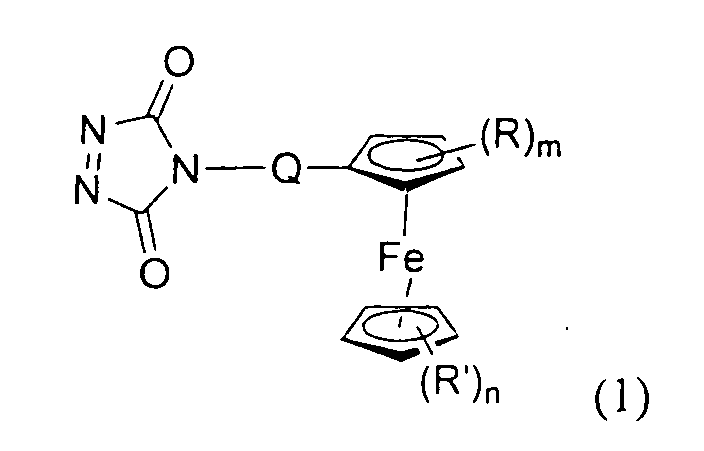
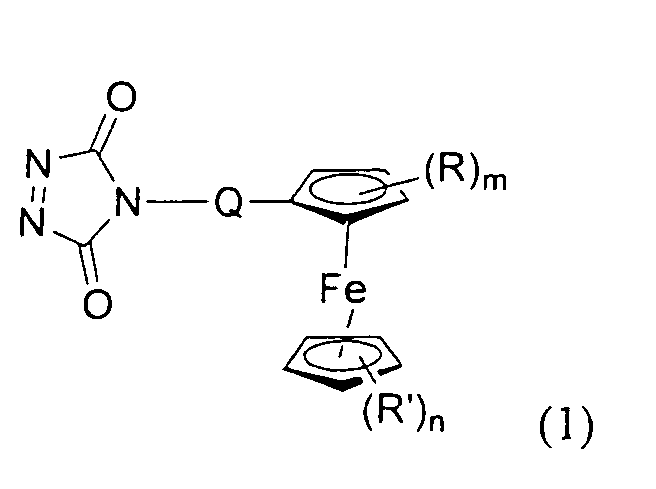
  • the present invention relates to a ferrocene compound represented by formula (1) described below.
  • the present invention further relates to the ferrocene compound wherein R and R' are hydrogen atoms.
  • the present invention further relates to the ferrocene compound wherein Q represents a direct bond or alkylene.
  • the present invention further relates to the ferrocene compound wherein Q is methylene and the ferrocene compound wherein Q is a direct bond.
  • ferrocene compound of the present invention is 4-(ferrocenylmethyl)-1,2.4-triazoline-3,5-dione (FMTAD), 4-ferrocenyl-1,2,4-triazoline-3,5-dione (FTAD), and the like.
  • the present invention relates to a reagent comprising the ferrocene compound described above for measuring a compound having a triene structure.
  • a reagent can further contain a solvent which is capable of dissolving the ferrocene compound.
  • the present invention further relates to the combined compound of a ferrocene compound and a vitamin D compound, wherein the ferrocene compound and the vitamin D compound have been combined with each other through a covalent bond.
  • the present invention further relates to the compound, wherein R and R' are a hydrogen atom.
  • the present invention further relates to the combined compound of the ferrocene compound and a vitamin D compound, wherein Q represents a direct bond or alkylene. Still further, the present invention relates to the combined compound of the ferrocene compound and a vitamin D compound, wherein Q is methylene, and the combined compound of the ferrocene compound and a vitamin D compound, wherein Q is a direct bond. In the combined compound of the ferrocene compound and a vitamin D compound, the present invention still further relates to the combined compound of the ferrocene compound and a vitamin D compound, wherein the vitamin D compound is vitamin D 3 compound.
  • the present invention further relates to the method of measuring a vitamin D compound, wherein the combined compound of the ferrocene compound and a vitamin D compound is a compound wherein the ferrocene compound and the vitamin D compound have been combined with each other through a covalent bond.
  • the present invention still further relates to the method of measuring a vitamin D compound, wherein, in the compound described above and the combined compound of the ferrocene compound and a vitamin D compound described above,
  • R 1 represents a hydrogen atom or hydroxy group;
  • R 2 represents a hydrogen atom or hydroxypropoxy group;
  • R 3 represents a hydrogen atom;
  • each of R 4 , R 5 and R 6 independently represents a hydrogen atom, hydroxy group, lower alkyl group which may optionally be substituted with halogen, or a lower cycloalkyl group which may optionally be substituted with halogen;
  • R 7 and R 8 represent a hydrogen atom, or, R 7 and R 8 are linked together to form a double bond.
  • the present invention still further relates to the method of measuring a vitamin D compound, wherein R and R' are a hydrogen atom in the compound described above and the combined compound of the ferrocene compound and a vitamin D compound described above.
  • the present invention still further relates to the method of measuring a vitamin D compound, wherein the combined compound of the ferrocene compound and a vitamin D compound is a combined compound of the ferrocene compound and a VD compound among the compounds represented by the formula above, wherein Q represents a direct bond or alkylene.
  • the present invention still further relates to the method of measuring a vitamin D compound, wherein the combined compound is a combined compound of the ferrocene compound and a vitamin D compound, wherein Q is methylene; and the method of measuring a vitamin D compound, wherein the combined compound is a combined compound of the ferrocene compound and a vitamin D compound, wherein Q is a direct bond.
  • the present invention still further relates to the method of measuring a vitamin D compound, wherein the combined compound is a combined compound of the ferrocene compound and a vitamin D compound in which the vitamin D compound is a vitamin D 3 compound.
  • the present invention still further relates to the method of measuring a vitamin D compound, wherein the sample (analyte sample) is a sample taken from a living body.
  • the present invention still further relates to the method of measuring a vitamin D compound, wherein the liquid chromatography/mass spectrometry (LC/MS) is liquid chromatography/electrospray ionization-mass spectrometry/mass spectrometry (LC/ESI-MS/MS).
  • LC/MS liquid chromatography/mass spectrometry
  • LC/ESI-MS/MS liquid chromatography/electrospray ionization-mass spectrometry/mass spectrometry
  • R a represents a lower alkyl group
  • the "lower alkyl group” means a straight or branched alkyl group having 1 to 6 carbon atoms such as methyl, ethyl, propyl, isopropyl, butyl, isobutyl, s-butyl, t-butyl, pentyl, isopentyl, neopentyl, hexyl, etc.
  • alkylene in Q. "W 1 and W 2 " described above means a straight or branched alkylene chain having 1 to 6 carbon atoms such as methylene, ethylene, propylene, isopropylene, butylenes, etc.
  • the "phenylene” in W 1 means o-phenylene, m-phenylene or p-phenylene.
  • R independently represents hydrogen atom, hydroxy group, nitro group, cyano group, halogen, optionally substituted lower alkyl group, optionally substituted lower alkenyl group, optionally substituted lower alkynyl group, optionally substituted lower alkoxy group, optionally substituted lower acyl group, optionally substituted carboxy group or optionally substituted carbamoyl group; preferably, hydrogen atom, hydroxy group, halogen or lower alkyl group, and more preferably, hydrogen atom.
  • the "halogen” means chlorine, fluorine, bromine, iodine, etc.
  • the "lower alkyl group” means a straight or branched alkyl group having 1 to 6 carbon atoms such as methyl, ethyl, propyl, isopropyl, butyl, isobutyl, s-butyl, t-butyl, pentyl, isopentyl, neopentyl, hexyl, etc.
  • the "lower alkenyl group” means a straight or branched alkenyl group having 1 to 6 carbon atoms, such as ethenyl, 1-propenyl, allyl, 1-butenyl, 2-butenyl, 3-butenyl, pentenyl, hexenyl, etc.
  • the "lower alkynyl group” means a straight or branched alkynyl group having 1 to 6 carbon atoms, such as ethyn
  • substituents may optionally have 1 or more (e.g., 1 to 3) substituents, including hydroxy group; nitro group; cyano group; halogen such as chlorine, fluorine, bromine, iodine, etc.; a straight or branched alkyl group having 1 to 6 carbon atoms such as methyl, ethyl, propyl, isopropyl, butyl, isobutyl, s-butyl, t-butyl, pentyl, isopentyl, neopentyl, hexyl, etc.; a straight or branched alkenyl group having 1 to 6 carbon atoms, such as ethenyl, 1-propenyl, allyl, 1-butenyl, 2-butenyl, 3-butenyl, pentenyl, hexenyl, etc.; a straight or branched alkynyl
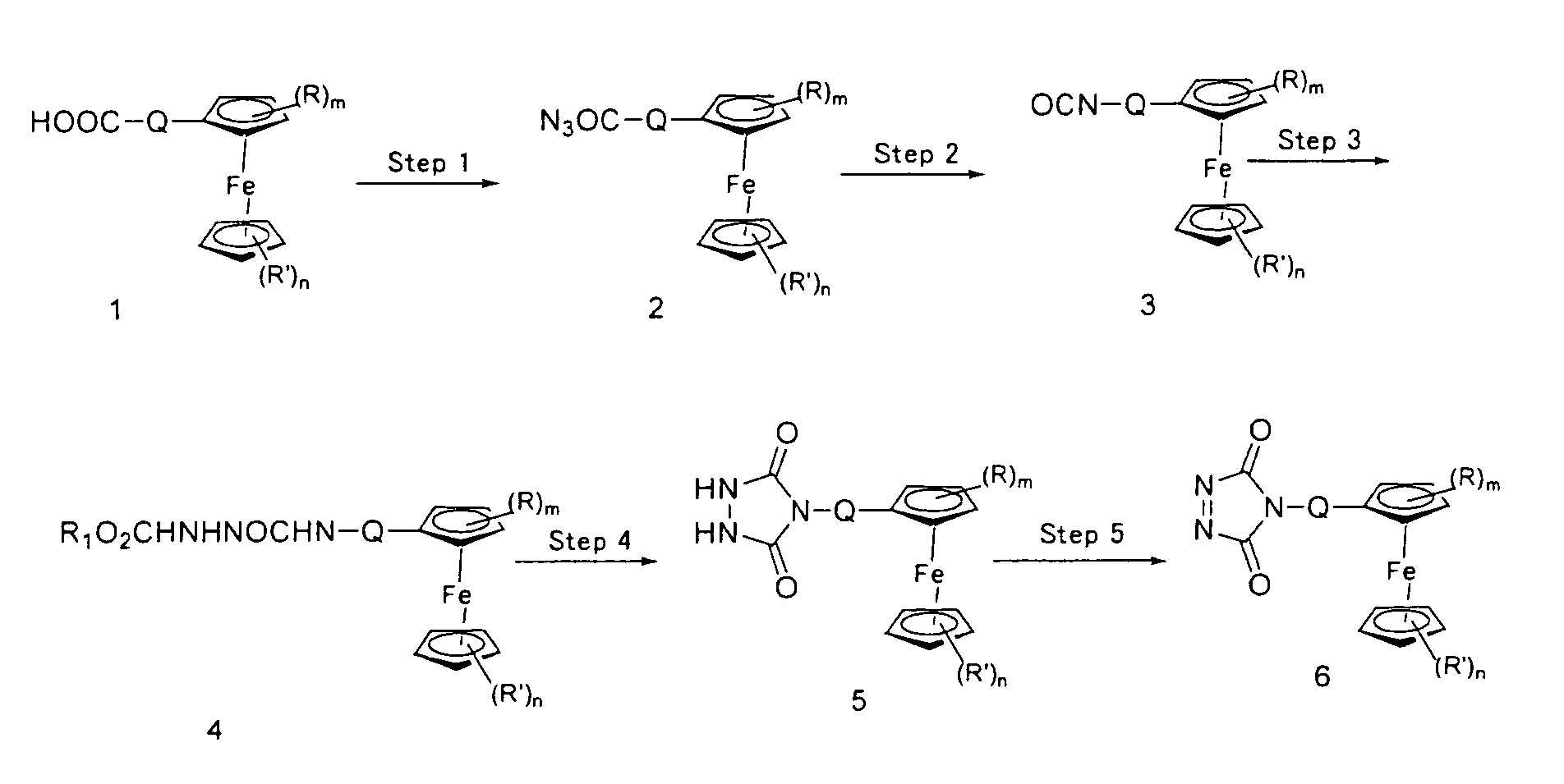
  • the ferrocene compound of the present invention (Compound 6 in the production scheme described below) can be produced in accordance with the production scheme below: (wherein Q, R, R', m and n have the same significance as defined in formula (1) described above).
  • Step 1 Compound 2 can be synthesized from Compound 1 by a process which involves reacting with diphenylphosphorylazide and a base, a process which involves converting the carboxylic acid into the acid chloride or acid anhydride followed by reacting with sodium azide, a process which involves converting the carboxylic acid into the ester, reacting with hydrazine, converting into the amide with hydrazine and then reacting with nitric acid or a nitric acid ester, etc.; preferably by the process which involves reacting with diphenylphosphorylazide and a base.
  • Compound 1, which is the starting material is known or can be readily synthesized from known compounds by known synthesis techniques.
  • Compound 1 is commercially available and can be purchased from, e.g., Tokyo Kasei Kogyo Co., Ltd.
  • examples of the base used are triethylamine, diisopropylethylamine, etc., preferably triethylamine.
  • examples of solvents used are dichloromethane, chloroform, dichloroethane, benzene, toluene, xylene, tetrahydrofuran, diethyl ether, dioxane, dimethoxyethane, etc., preferably dichloromethane.
  • the reaction temperature is not particularly limited so long as it is a temperature at which the reaction proceeds, but the reaction is carried out generally at -78 to 50°C, preferably at -10 to 10°C.
  • Step 2 Compound 3 can be synthesized by heating Compound 2.
  • solvents used in Step 2 described above are dichloromethane, chloroform, dichloroethane, benzene, toluene, xylene, tetrahydrofuran, diethyl ether, dioxane, dimethoxyethane, etc., preferably toluene.
  • reaction temperature is not particularly limited so long as it is a temperature at which the reaction proceeds, the reaction is carried out generally at 20 to 200°C, preferably at 50 to 150°C.
  • Step 3 Compound 4 can be produced by reacting Compound 3 with a carbazinic acid ester.
  • solvents used in Step 3 described above are dichloromethane, chloroform, dichloroethane, benzene, toluene, xylene, tetrahydrofuran, diethyl ether, dioxane, dimethoxyethane, etc., preferably toluene.
  • reaction temperature is not particularly limited so long as it is a temperature at which the reaction proceeds, the reaction is carried out generally at 0 to 200°C, preferably at 20 to 120°C.
  • Step 4 Compound 5 can be produced by reacting Compound 4 with a base.
  • the base used in Step 4 described above include sodium methoxide, sodium ethoxide, sodium tert-butoxylate, potassium methoxide, potassium ethoxide, potassium tert-butoxide, n-butyl lithium, sec-butyl lithium, tert-butyl lithium, lithium diisopropylamide, lithium dicyclohexylamide, lithium bis(trimethylsilyl)amide, potassium bis(trimethylsilyl)amide, sodium hydride, potassium hydride, sodium hydrogencarbonate, potassium hydrogencarbonate, potassium carbonate, sodium carbonate, calcium carbonate, cesium carbonate, etc., preferably potassium carbonate.
  • solvents used in Step 4 described above are methanol, ethanol, isopropanol, dichloromethane, chloroform, dichloroethane, benzene, toluene, xylene, tetrahydrofuran, diethyl ether, dioxane, dimethoxyethane, etc., preferably ethanol.
  • the reaction temperature is not particularly limited so long as it is a temperature at which the reaction proceeds, the reaction is carried out generally at 0 to 200°C, preferably at 20 to 120°C.
  • Step 5 Compound 6 can be produced by reacting Compound 5 with iodobenzene diacetate.
  • solvents used in Step 4 described above are ethyl acetate, dichloromethane, chloroform, dichloroethane, benzene, toluene, xylene, tetrahydrofuran (THF), diethyl ether, dioxane, dimethoxyethane, etc., preferably tetrahydrofuran (THF) or dioxane.
  • THF tetrahydrofuran
  • the reaction temperature is not particularly limited so long as it is a temperature at which the reaction proceeds, the reaction is carried out generally at -78 to 100°C, preferably at -10 to 50°C.
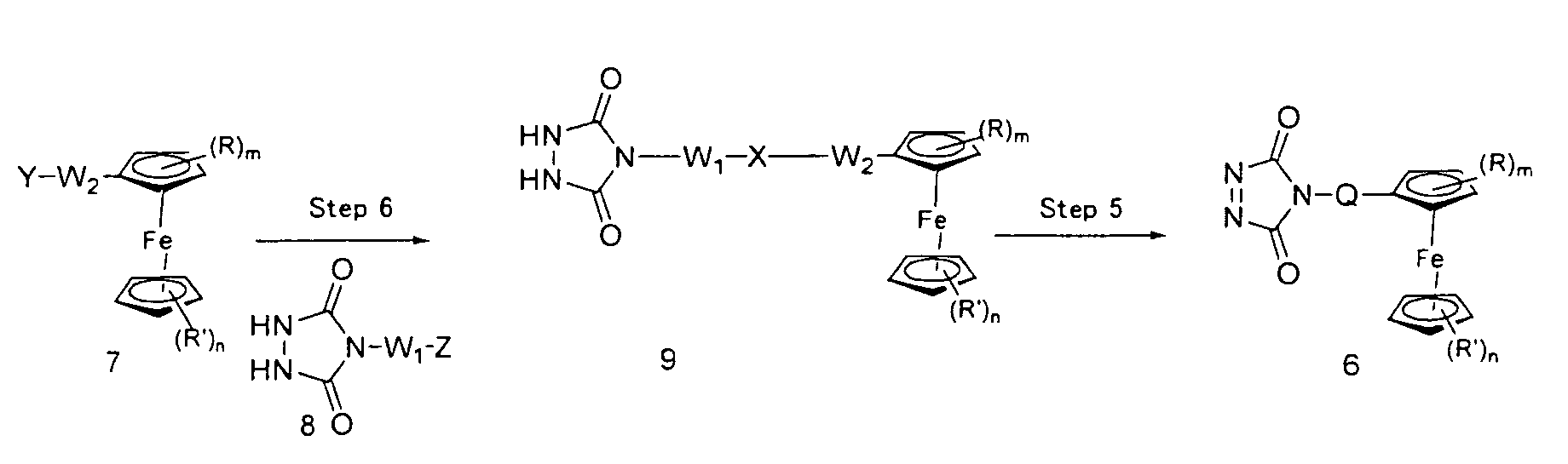
  • the ferrocene compound of the present invention in Compound 6, the compound wherein Q is W 1 -X-W 2
  • Step 6 Compound 9 can also be synthesized by reacting Compound 7 (Y represents a hydroxy group, carboxylic acid chloride residue, carboxylic acid anhydride residue, carboxylic acid ester group, isocyanate group, sulfonyl chloride residue, halogen atom, alkylsulfonyloxy group or arylsulfonyloxy group) with Compound 8 (Z represents a hydroxy group, optionally substituted amino group, halogen atom, alkylsulfonyloxy group or arylsulfonyloxy group) (Step 6). In this case, the reaction is carried out preferably in the presence of a base.
  • Y and Z there are the combination of Compound 7 wherein Y is a carboxylic acid chloride residue, carboxylic acid anhydride residue, carboxylic acid ester group, isocyanate group or sulfonyl chloride residue and Compound 8 wherein Z is a hydroxy group or optionally substituted amino group; the combination of Compound 7 wherein Y is a hydroxy group and Compound 8 wherein Z is a halogen atom, alkylsulfonyloxy group or arylsulfonyloxy group; or the combination of Compound 7 wherein Y is a halogen atom, alkylsulfonyloxy group or arylsulfonyloxy group and Compound 8 wherein Z is a hydroxy group.
  • Compound 7 and Compound 8, which are the starting materials, are known or can readily be synthesized from known compounds by known processes.
  • Compound 7 is also commercially available and can be purchased from Tokyo Kasei Kogyo Co., Ltd.
  • Examples of the base used in Step 6 described above include sodium hydroxide, potassium hydroxide, sodium hydrogencarbonate, potassium hydrogencarbonate, sodium hydride, potassium hydride, potassium carbonate, sodium carbonate, calcium carbonate, cesium carbonate, triethylamine, diisopropylethylamine, pyridine, 2,6-dimethylpyridine, 2,4,6-trimethylpyridine, 4-(dimethylamino)pyridine, etc.
  • solvents used in Step 6 described above include water, methanol, ethanol, isopropanol, dichloromethane, chloroform, dichloroethane, benzene, toluene, xylene, tetrahydrofuran, diethyl ether, dioxane, dimethoxyethane, etc.
  • reaction temperature is not particularly limited so long as it is a temperature at which the reaction proceeds, the reaction is carried out generally at -78 to 200°C, preferably at -10 to 150°C.
  • the ferrocene compound of the present invention thus obtained can be isolated, if necessary, by applying operations like purification, drying, etc. in accordance with known techniques.
  • the ferrocene compound obtained may be sometimes unstable and in such a case, can be stored in a solvent in which the compound can be stably present (e.g., tetrahydrofuran, dioxane, etc.).
  • the ferrocene compound of the present invention is useful as a reagent (derivatization agent) when compounds having a triene structure, e.g., vitamin D compounds (VD compounds), etc. are measured by liquid chromatography/mass spectrometry (LC/MS), especially liquid chromatography/electrospray ionization-mass spectrometry/mass spectrometry (LC/ESI-MS/MS).
  • LC/MS liquid chromatography/mass spectrometry
  • LC/ESI-MS/MS liquid chromatography/electrospray ionization-mass spectrometry/mass spectrometry
  • the reagent of the present invention means both the aforesaid ferrocene compound itself and a solution containing the ferrocene compound described above.
  • solvents which can be used for the reagent of the present invention include ethyl acetate, dichloromethane, chloroform, dichloroethane, benzene, toluene, xylene, tetrahydrofuran (THF), diethyl ether, dioxane, dimethoxyethane, etc., preferably tetrahydrofuran (THF) or dioxane.
  • the content of the ferrocene compound in the solution is not particularly limited, it is appropriately chosen from the range of, e.g., 0.001 to 99% by weight, preferably 0.005 to 50% by weight, and more preferably 0.01 to 10% by weight.
  • a target compound is measured using the reagent of the present invention, specifically the ferrocene compound in the reagent is reacted with a VD compound, and the resulting compound obtained by combining the ferrocene compound and the VD compound, is applied to LC/ESI-MS/MS, etc., thereby to measure the VD compound. Details of the measurement will be described later.
  • the VD compound, with which the ferrocene compound of the present invention is to be combined is preferably a vitamin D 3 compound (a VD 3 compound).
  • the VD 3 compound includes a compound having the 9,10-secocholesta-5,7,10(19)-triene structure, preferably a compound having the (5Z,7E)-9,10-secocholesta-5,7,10(19)-triene structure, more preferably, a compound having the (1 ⁇ ,5Z,7E)-9,10-secocholesta-5,7,10(19)-trien-1-ol structure, a compound having the (3 ⁇ ,5Z,7E)-9,10-secocholesta-5,7,10(19)-trien-3-ol structure, or a compound having the (1 ⁇ ,5Z,7E)-9,10-secocholesta-5,7,10(19)-triene-1,3-dio
  • VD 3 cholecalciferol
  • calcitriol (1 ⁇ ,25(OH) 2 D 3
  • alfacalcidol ALF; trade name: Alfarol (registered trademark), Chugai Pharmaceutical Co., Ltd.; Japanese Patent Publication (KOKAI) No.
  • tacalcitol (trade name: Bonalfa (registered trademark), Teijin Ltd.), calcipotriol (trade name: Dovonex (registered trademark), imported by Teikoku Seiyaku Co., Ltd., sold by Fujisawa Pharmaceutical Co., Ltd., Teikoku Medix Co., Ltd.), falecalcitriol (trade name: Hornel (registered trademark), Taisho Pharmaceutical Co., Ltd.; trade name: Fulstan (registered trademark), manufactured by Sumitomo Pharmaceuticals Co., Ltd., sold by Kissei Pharmaceutical Co., Ltd.), 2 ⁇ -(3-hydroxypropyloxy)-1 ⁇ ,25-dihydroxyvitamin D 3 (ED-71 (code name), Chugai Pharmaceutical Co., Ltd.; Japanese Patent Publication (KOKAI) No.
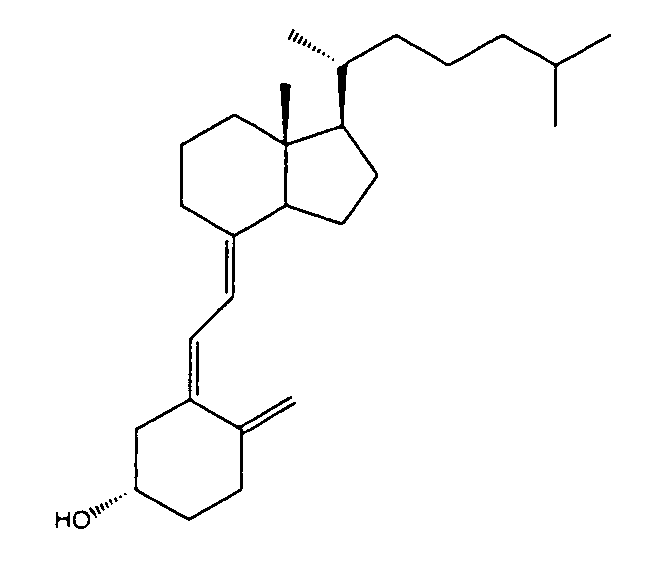
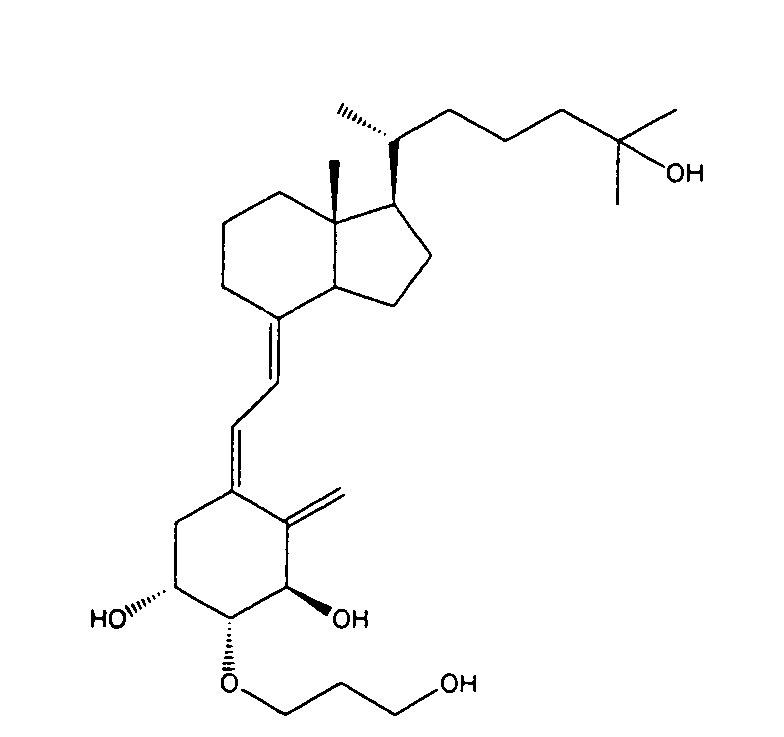
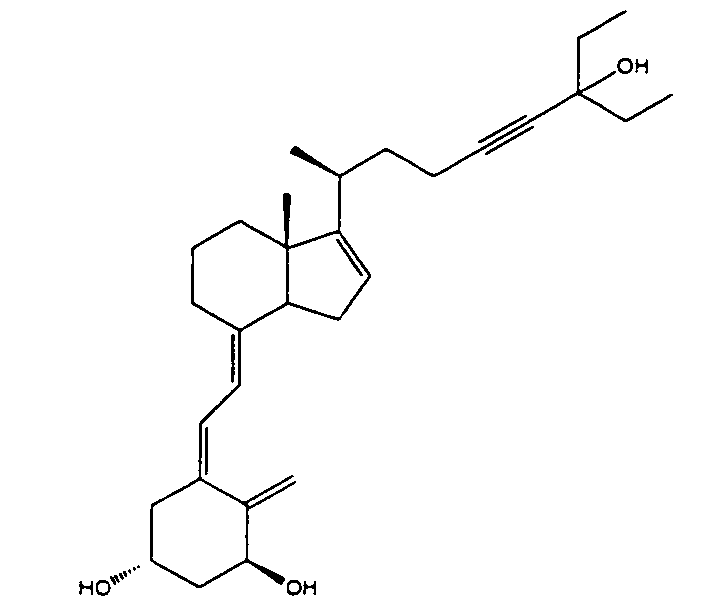
  • VD 3 , 1 ⁇ ,25(OH) 2 D 3 , ALF, etc. are commercially available and can be purchased from, e.g., Solvay Pharmaceutical, Inc., CALBIO, Inc., FLUKA Inc., FORMOSA Corp., WAKO, etc. Typical structures of these compounds are shown below.
  • VD compounds i.e., VD compounds as analytes
  • VD compounds having no hetero atom such as an ester bond, ether bond, thioether bond, amide bond, etc.
  • VD 3 calcipotriol, 1 ⁇ ,25(OH) 2 D 3 , ALF, falecalcitriol, EB1089 and Compound A described above, etc.
  • the triazone skeleton of the ferrocene compound of the present invention may be selectively reacted with the triene structure of the VD compound by the Diels-Alder reaction.
  • the ferrocene compound of the present invention is reacted with the VD compound for 5 minutes to 5 hours (preferably 15 minutes to 3 hours) in a suitable solvent such as ethyl acetate, dichloromethane, chloroform, dichloroethane, benzene, toluene, xylene, tetrahydrofuran (THF), diethyl ether, dioxane, dimethoxyethane (preferably tetrahydrofuran (THF) or dioxane), etc.
  • a suitable solvent such as ethyl acetate, dichloromethane, chloroform, dichloroethane, benzene, toluene, xylene, tetrahydrofuran (THF), diethyl ether, dioxane, dimethoxyethane (preferably tetrahydrofuran (THF) or dioxane), etc.
  • THF tetrahydrofur
  • water or an alcoholic solvent such as methanol, ethanol, propanol, isopropanol, etc. may be added.
  • the compound thus obtained by combining the ferrocene compound and the VD compound can be isolated, if necessary, by performing operations such as purification, drying, etc., following known methods.
  • the combined compound thus obtained which comprises the ferrocene compound and the VD compound which have been combined with each other, is a compound in which the ferrocene compound and the VD compound have been combined with each other through a covalent bond.
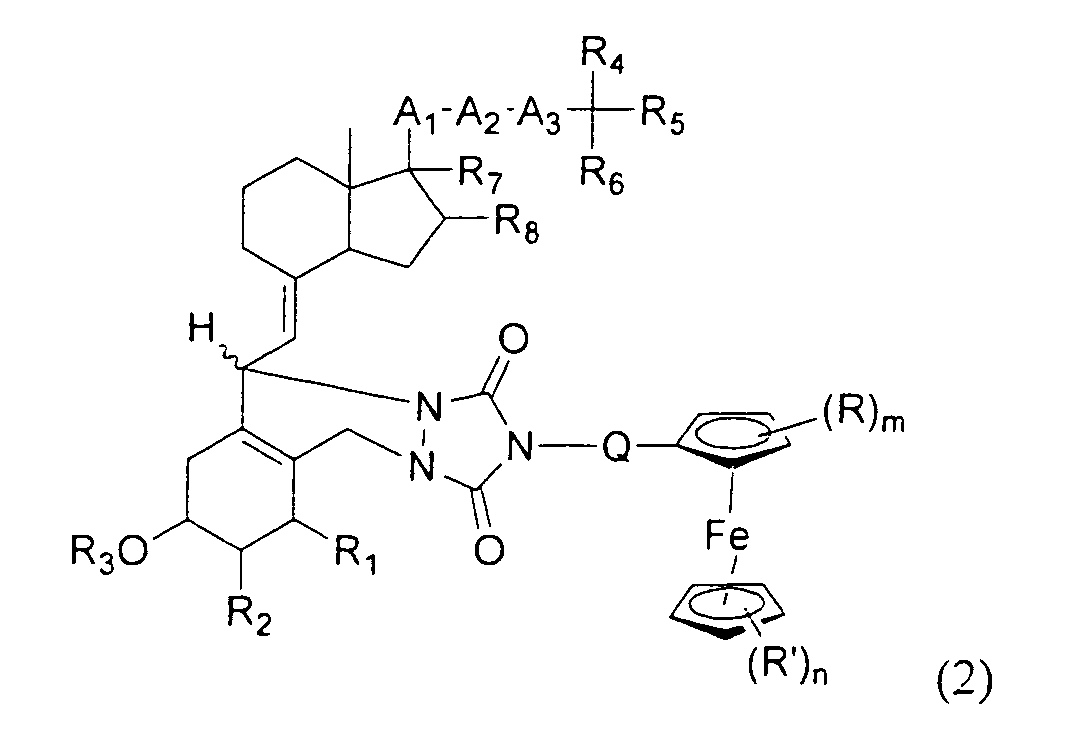
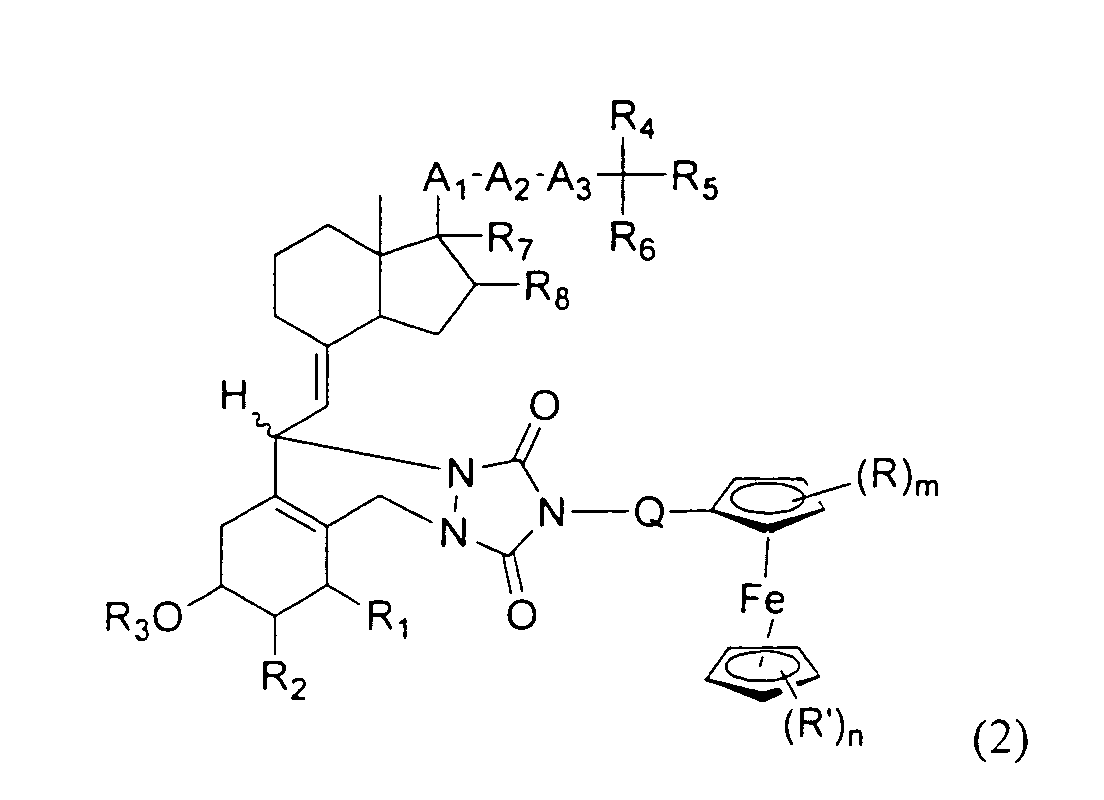
  • the combined compound of the ferrocene compound and the VD compound is represented by formula (2) below.
  • Q, R, R', m and n in the formula above have the same significance as defined in formula (1) described above.
  • Each of “A 1 and A 3 " independently represents optionally substituted lower alkylene, optionally substituted lower alkenylene or optionally substituted lower alkynylene.
  • R 1 represents a hydrogen atom or -OR 9 (R 9 represents a hydrogen atom or protecting group), preferably a hydrogen atom or hydroxy group.
  • R 2 represents a hydrogen atom, hydroxy group, halogen, optionally substituted lower alkyl group, optionally substituted lower alkenyl group, optionally substituted lower alkynyl group, optionally substituted lower alkoxy group or optionally substituted lower acyl group, preferably a hydrogen atom or hydroxypropoxy group.
  • R 3 represents a hydrogen atom or protecting group, preferably a hydrogen atom.
  • R 4 , R 5 and R 6 independently represents a hydrogen atom, hydroxy group, nitro group, cyano group, halogen, optionally substituted lower alkyl group, optionally substituted cycloalkyl group, optionally substituted lower alkenyl group, optionally substituted lower alkynyl group, optionally substituted lower alkoxy group, optionally substituted lower acyl group, optionally substituted carboxy group, optionally substituted carbamoyl group or optionally substituted amino group, preferably, each independently represents a hydrogen atom, hydroxy group, lower alkyl group which may optionally be substituted with a halogen, or lower cycloalkyl group which may optionally be substituted with a halogen.
  • R 7 and R 8 independently represents a hydrogen atom or hydroxy group, or, R 7 and R 8 are linked together to form a double bond, preferably a hydrogen atom or R 7 and R 8 are linked together to form a double bond.
  • the "lower alkylene” means a straight or branched alkylene chain having 1 to 6 carbon atoms
  • the "lower alkenylene” means a straight or branched alkenylene chain having 1 to 6 carbon atoms
  • the "lower alkynylene” means a straight or branched alkynylene chain having 1 to 6 carbon atoms.
  • substituents such as a hydroxy group; nitro group; cyano group; halogen such as chlorine, fluorine, bromine, iodine, etc.; straight or branched alkyl group having 1 to 6 carbon atoms such as methyl, ethyl, propyl, isopropyl, butyl, isobutyl, s-butyl, t-butyl, pentyl, isopentyl, neopentyl, hexyl, etc.; straight or branched alkenyl group having 1 to 6 carbon atoms, such as ethenyl, 1-propenyl, allyl, 1-butenyl, 2-butenyl, 3-butenyl, pentenyl, hexenyl, etc.; straight or branched alkynyl group having 1 to 6 carbon atoms, such as a hydroxy group; nitro group; cyano group; halogen such as chlorine, fluorine, bromine
  • the "halogen” means chlorine, fluorine, bromine, iodine, etc.
  • the "lower alkyl” means a straight or branched alkyl group having 1 to 6 carbon atoms such as methyl, ethyl, propyl, isopropyl, butyl, isobutyl, s-butyl, t-butyl, pentyl, isopentyl, neopentyl, hexyl, etc.
  • the "lower alkenyl” means a straight or branched alkenyl group such as ethenyl, 1-propenyl, allyl, 1-butenyl, 2-butenyl, 3-butenyl, pentenyl, hexenyl, etc.
  • the "lower alkynyl” means a straight or branched alkynyl group having 1 to 6 carbon atoms, such as ethy
  • cycloalkyl group in R 4 , R 5 and R 6 means a cycloalkyl group having 3 to 8 carbon atoms, such as cyclopropyl, cyclobutyl, cyclopentyl, cyclohexyl, cycloheptyl, cyclooctyl, etc.
  • substituents may optionally have 1 or more (e.g., 1 to 3) substituents, including a hydroxy group; nitro group; cyano group; halogen such as chlorine, fluorine, bromine, iodine, etc.; straight or branched alkyl group having 1 to 6 carbon atoms such as methyl, ethyl, propyl, isopropyl, butyl, isobutyl, s-butyl, t-butyl, pentyl, isopentyl, neopentyl, hexyl, etc.; straight or branched alkenyl group having 1 to 6 carbon atoms, such as ethenyl, 1-propenyl, allyl, 1-butenyl, 2-butenyl, 3-butenyl, pentenyl, hexenyl, etc.; straight or branched alkynyl group having
  • the "protecting group” is not particularly limited and may be any group, as long as the group is appropriate as a protecting group of hydroxy group; the protecting group includes, for example, a lower acyl group, optionally substituted lower alkyl group, optionally substituted lower alkylsulfonyl group, optionally substituted lower alkoxycarbonyl group, a substituted silyl group, etc.
  • the "lower acyl group”, “lower alkyl group”, “lower alkoxy group”, optionally substitutable "substituents,” etc. are as defined in the foregoing paragraph.
  • the combined compound of the ferrocene compound and the VD compound which is obtained by reacting the ferrocene compound of the present invention described above with a VD compound, is useful as, e.g., a reference standard in measuring the VD compound by LC/ESI-MS/MS, etc.
  • the ferrocene compound of the present invention may be combined with the VD compound, following the method described above.
  • the sample is preferably a sample from a living body.
  • the sample from the living body means body fluids (blood, lymphatic fluid, spinal fluid), urine, etc., preferably plasma, serum or urine.
  • the term from the living body means preferably from mammals, more preferably from human, monkey, dog, rabbit, guinea pig, rat or mouse.
  • necessary pre-treatments like protein precipitation by known techniques such as protein precipitation with ethanol, etc.
  • the ferrocene compound of the present invention is combined with the VD compound present in the sample as in the method described above, and the resulting combined compound of the ferrocene compound and the VD compound, which is obtained by reacting the ferrocene compound of the present invention with the VD compound can be used for the following measurement.
  • the sample is subjected to protein precipitation as a pre-treatment of the sample and then to solid phase extraction of the sample before the ferrocene compound of the present invention is reacted with the VD compound present in the sample. It is also preferred that after the ferrocene compound of the present invention is reacted with the VD compound present in the sample, the sample is subjected to solid phase extraction. Particularly preferably, after the sample is subjected to protein precipitation and then to solid phase extraction, the ferrocene compound of the present invention is reacted with the VD compound present in the sample, followed by solid phase extraction of the sample again.
  • the solid phase extraction after protein precipitation of the sample and prior to the reaction of the ferrocene compound of the present invention with the VD compound present in the sample is preferably performed using a solid phase extraction cartridge on a normal phase system, particularly preferably using a solid phase extraction cartridge on a silica gel system.
  • the solid phase extraction after the reaction of the ferrocene compound of the present invention with the VD compound in the sample is carried out preferably using a solid phase extraction cartridge on a reversed phase system.
  • LC/MS means the measurement techniques or measurement instruments, utilizing or applying the measurement principle by LC/MS (liquid chromatography/mass spectrometry) thereto, specifically including the measurement techniques or measurement instruments by liquid chromatography/mass spectrometry (LC/MS) and tandem liquid chromatography/mass spectrometry/mass spectrometry (LC/MS/MS), as well as these techniques in combination with electrospray ionization (ESI) and atmospheric pressure chemical ionization (APCI).
  • ESI electrospray ionization
  • APCI atmospheric pressure chemical ionization
  • the residue containing the combined compound of the ferrocene compound and the VD compound obtained as described above is dissolved in a mobile phase and the solution is injected into LC/ESI-MS/MS, followed by the measurement.
  • specific operations including measurement conditions of LC/ESI-MS/MS in each measurement, and the like may be appropriately adjusted/set forth by known technique, depending on the amount or kind of analyte sample, the amount or kind of a VD compound present in a sample, sensitivity required for measurement, kind of the ferrocene compound of the present invention used as a derivatization agent, construction of LC/ESI-MS/MS instruments used for measurement, etc.
  • conditions for MRM Multiple Reaction Monitoring
  • an analyte of known concentrations with concentration gradients is added to a blank sample, internal standard (I.S., preferably an analyte labeled with a stable isotope) is added to each of the mixtures, which are measured, respectively.
  • the peak area ratio (or peak height ratio) of the analyte to I.S. is determined.
  • a calibration curve is prepared and from the calibration curve and the peak area ratio (or peak height ratio) of the analyte, the concentration in a biological sample is calculated.
  • Mass Spectrometry first edition, published by Kagaku Dojin, edited by Toshimitsu Niwa, 1995
  • Biological Mass Spectrometry published by Kagaku Dojin, edited by Tamio Ueno, Kazuo Hirayama, Ken-ichi Harada, 1997)
  • LC/MS-NO-JISSAI Practice of LC/MS
  • the method of the present invention for measuring a VD compound thus performed is a measurement method with a higher sensitivity than in conventional techniques. Furthermore, in the measurement of a VD compound having no hetero atom such as an ester bond, an ether bond, a thioether bond, an amide bond, etc. in the molecule (specifically, VD 3 , calcipotriol, 1 ⁇ , 25(OH) 2 D 3 , ALF, falecalcitriol, EB1089 and Compound A described above, etc.) which were measured with an insufficient sensitivity in conventional methods, the measurement method of the present invention is a high-sensitivity method which can achieve the sensitivity of higher even by several hundred times than in conventional methods.
  • the high-sensitivity measurement method is applicable to all VD compounds, not only to VD compounds having hetero atoms such as an ester bond, an ether bond, a thioether bond, an amide bond, etc. (specifically, OCT, ED-71, etc. described above) but also to VD compounds having no such hetero atom.
  • nuclear magnetic resonance was measured using EX-270 (manufactured by JEOL). Also, high performance liquid chromatograph Alliance 2790 (manufactured by Waters Co.) and a quadrupole mass spectrometer Quattro LC (manufactured by Micromass UK Ltd.) were used as electrospray ionization LC/MS/MS (LC/ESI-MS/MS). For data analysis, Masslynx Ver. 3.3 (manufactured by Micromass UK, Inc.) and Microsoft Excel 2000 (manufactured by Microsoft Corp.) were used.
  • alfacalcidol/4-(ferrocenylmethyl)-1,2,4-triazoline-3,5-dione adduct (ALF-FMTAD) prepared with reference to EXAMPLE 2-1 and the alfacalcidol/4-ferrocenyl-1,2,4-triazoline-3,5-dione adduct (ALF-FTAD) prepared with reference to EXAMPLE 2-2 were dissolved, respectively, in 50 ⁇ L of a mobile phase (10 mmol/L ammonium acetate/acetonitrile (1:9, v/v)) and 20 ⁇ L of the solution was injected into LC/ESI-MS/MS.
  • Capcell Pak C18 UG-120 (5 ⁇ m, 150 x 2.0 mm i.d.: manufactured by Shiseido Co., Ltd.) as HPLC column
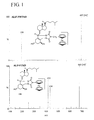
  • ESI mass spectra of ALF-FMTAD and ALF-FTAD were measured in a positive ion mode to give the molecular ions [M] + at m/z 697 and m/z 683 as the base peaks.
  • An example of the measurement results is shown in FIG. 1. When the corn voltage was set at 70V and 66V, respectively, the intensity reached the maximum.
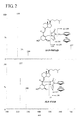
  • the product ion spectrum was assayed using these molecular ions as precursor ions and strong fragment ions having the ferrocene skeleton were given at m/z 199 and m/z 227, respectively.
  • An example of the assay results is shown in FIG. 2.
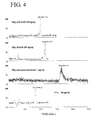
  • the sensitivity of cholecalciferol (VD 3 ) when directly determined and the sensitivity of 3-(ferrocenylcarbamoyloxy)cholecalciferol (VD 3 -ferrocene carbamate) were 50 pg (130 fmol)/inj (S/N ratio of about 8) and 1 pg (1.64 fmol)/inj (S/N ratio of about 5), indicating that the measurement method of the present invention was higher by about 200 times than in the direct assay and by 4 times or more, even when compared to the measurement by derivatization with the ferrocene carbamate.
  • An example of these measurement results is shown in FIG. 4.
  • EXAMPLE 6 Compound A/4-(ferrocenylmethyl)-1,2,4-triazoline-3,5-dione adduct (Compound A-FMTAD)
  • the conditions for measurement were optimized as in EXAMPLE 3-1 so that the sensitivities of 300 fg (381 amol)/inj and 500 fg (668 amol)/inj were obtained.
  • the sensitivities of ED-71 and Compound A when directly determined were 10 pg (20 fmol)/inj and 50 pg (111 fmol)/inj, respectively.
  • a solution of alfacalcidol (ALF) in ethanol prepared by the procedure described in Japanese Patent Publication (KOKAI) No. 48-62750, Tetrahedron Lett., 1973, 2339 and Tetrahedron, 30, 2701 (1974) was added to 100 ⁇ L of rat blank plasma to prepare calibration sample solutions of 0, 0.08, 0.25, 0.8, 2.5, 8 and 25 ng/mL.
  • 20 ⁇ L of 40ng/mL d 4 -ALF prepared in accordance with the procedure described in Chem. Pharm. Bull., 48, 215 (2000) was added as an internal standard (I.S.).
  • Ionization mode ESI(+) Capillary voltage: 2.5 kV Cone Voltage: 70 V Source block temperature: 150°C Desolvator temperature: 450°C Collision energy: 46 eV Conditions for MRM (Multiple Reaction Monitoring): ALF-FMTAD: m / z 697 [M] + > 199 [M-C 29 H 44 O 4 N 3 ] + d 4 -ALF-FMTAD: m / z 701 [M] + > 199 [M-C 29 H 40 D 4 O 4 N 3 ] +
  • the calibration lower limit was estimated in the S/N ratio of approximately 3 to 5. As a result, the calibration lower limit was found to be 0.08 ng/mL in the measurement method of the present invention, indicating that the sensitivity was higher by 125 times as compared to direct assay (10 ng/mL) shown in COMPARATIVE EXAMPLE 4-1 and by 12.5 times as compared to measurement (1 ng/mL) by derivatization with PTAD shown in COMPARATIVE EXAMPLE 4-2. Using 1 mL of rat plasma, the calibration lower limit was estimated as described above. As a result, the calibration lower limit in the measurement method of the present invention was found to be 0.01 ng/mL. An example of chromatograms in the calibration lower limits is shown in FIG. 6.
  • the samples used in the first paragraph of (2) described above were monitored, respectively, for 3 days to determine the peak area ratio for analyte versus I.S.
  • the calibration curve was produced by the method of least squares (1/y 2 weighting) to determine a correlation coefficient (r) and trueness of the inverse value at each concentration. Based on the calibration curve and the peak area ratio of each sample, the measured value was determined in ng/mL unit by 3 effective digits.
  • two isomers (6R/6S) were formed. The peak showing a larger S/N ratio was selected (retention time (R.T.) of about 8.8 mins.) and quantification was carried out.
  • the correlation coefficients (r) of the calibration curves were 0.991277 to 0.999741 (l/y 2 weighting) in the range of 0.08 to 25 ng/mL and the accuracies of back calculated concentrations ranged from -7.6 to 9.9%, indicating a good linearity.
  • CV values (found standard deviation/found mean value) x 100 (%)
  • Accuracy ⁇ (found mean value - theoretical value)/theoretical value ⁇ x 100(%)
  • the CV values at the respective concentrations were 15% or less (20% or less in the lower limit of quantification) and the trueness was within ⁇ 15% (within ⁇ 20% in the lower limit of quantification), showing a good precision and trueness.
  • the CV values at the respective concentrations were 15% or less (20% or less in the lower limit of quantification) and the trueness was within ⁇ 15% (within ⁇ 20% in the lower limit of quantification), showing a good precision and trueness.
  • ED-71 in rat plasma was measured by derivatization with FMTAD in a manner similar to EXAMPLE 4-1 (2), first paragraph, except that ED-71 was used as a vitamin D compound. Conditions for the measurement are shown in TABLE 8. Conditions for measurement of ED-71-FMTAD: Column Capcell Pak C18 UG-120 (5 ⁇ m, 150 x 2.0 mm i.d.) Mobile phase Solution A: 10 mmol/L ammonium acetate Solution B: acetonitrile (A: 45%, B: 55%) Column temperature 30°C Flow rate 0.2 mL/min.
  • the calibration lower limit was estimated in the S/N ratio of about 3, and was 0.25 ng/mL in the measurement method of the present invention.
  • the calibration lower limit was estimated in the S/N ratio of about 3 and found to be 0.25 ng/mL in the measurement method of the present invention.
  • Alfacalcidol was added to rat blank plasma as in EXAMPLE 4-1 (2) to prepare samples for generating calibration curves of 0, 1, 3, 10, 30, 100, 300 and 1000 ng/mL.
  • 20 ⁇ L of 400 ng/mL d 4 -ALF was added as internal standard (I.S.) to 100 ⁇ L of the sample at each concentration, the sample was subjected to protein precipitation with ethanol and then solid phase extraction with a solid phase extraction cartridge (Bond Elut SI, 3 cc, 500 mg: manufactured by Varian SPP). After evaporation to dryness in nitrogen, the residue was dissolved in 40 ⁇ L of the mobile phase and 10 ⁇ L of the solution was injected into LC/ESI-MS/MS.
  • Conditions for measurement are shown in TABLE 10. Conditions for measurement of ALF: Column Capcell Pak C18 UG-120 (5 ⁇ m, 150 x 2.0 mm i.d.) Mobile phase Solution A: 10 mmol/L ammonium acetate Solution B: methanol (A: 15%, B: 85%) Column temperature 30°C Flow rate 0.2 mL/min.
  • the calibration lower limit was estimated in the S/N ratio of about 3. As a result, the calibration lower limit was found to be 10 ng/mL in the direct assay.
  • An example of chromatograms in the calibration lower limit is shown in FIG. 6, along with the results of EXAMPLE 4-1 (2) and the results of COMPARATIVE EXAMPLE 4-2 later described.
  • alfacalcidol ALF
  • PTAD 4-phenyl-1,2,4-triazoline-3,5-dione
  • Alfacalcidol was added to rat blank plasma as in EXAMPLE 4-1 (2) to prepare the samples of 0, 0.1, 0.3, 1, 3, 10, 30, 100 and 300 ng/mL for generating calibration curves.
  • 20 ⁇ L of 40 ng/mL d 4 -ALF was added as internal standard (I.S.) to 100 ⁇ L of the sample at each concentration, the sample was subjected to protein precipitation with ethanol and then solid phase extraction with a solid phase extraction cartridge (Bond Elut SI, 3 cc, 500 mg: manufactured by Varian SPP), followed by derivatization with 4-phenyl-1,2,4-triazoline-3,5-dione (PTAD: manufactured by SIGMA) by the procedures described in the article (Biological Mass Spectrometry 1993; 22: 621-632, Journal of Chromatography 1993; 645: 115-123, etc.).
  • the calibration lower limit was estimated in the S/N ratio of about 2. As a result, the calibration lower limit was found to be 1 ng/mL when measured by derivatization with PTAD. An example of chromatograms in the calibration lower limit is shown in FIG. 6, along with the results of EXAMPLE 4-1 (2) and the results of COMPARATIVE EXAMPLE 4-1.
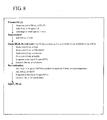
  • Pretreatment for the sample shown in FIG. 5 was simplified as follows. To alfacalcidol (ALF)-added rat blank plasma (100 ⁇ L), 20 ⁇ L of 40 ng/mL d4-ALF (I.S.) was added and after protein precipitation with acetonitrile, the mixture was subjected to solid phase extraction with a 96-well solid phase extraction cartridge (Oasis HLB 96-well plate, 1 cc, 10 mg: manufactured by Waters).
  • a solution of 100 ng/mL ALF in ethanol was diluted with rat blank plasma to prepare samples for generating calibration curves for 0, 0.05, 0.15, 0.5, 1.5, 5 and 15 ng/mL.
  • 100 ⁇ L of the samples for generating calibration curves were treated for monitoring.
  • the samples were monitored for 3 days.
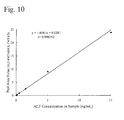
  • the peak area ratio for analyte versus I.S. was determined and in relation to the added concentration, the calibration curve was produced by the method of least squares (1/x weighting) to determine a correlation coefficient (r) and the accuracies of back calculated concentrations.
  • the correlation coefficients (r) of the calibration curves were 0.996552 to 0.999950 in the range of 0.05 to 15 ng/mL and the trueness of inverse value at each concentration ranged from -17.6 to 9.8%, indicating a good linearity.
  • the 100 ng/mL ALF ethanol solution was diluted with rat blank plasma to prepare the samples of 0.05, 0.15, 1.5 and 15 ng/mL for within-run reproducibility.
  • the samples were treated for monitoring, respectively.
  • the CV values at the respective concentrations were 15% or less (20% or less in the lower limit of quantification) and the trueness was within ⁇ 15% (within ⁇ 20% in the lower limit of quantification), showing a good precision and trueness.
  • the CV values at the respective concentrations were 15% or less (20% or less in the lower limit of quantification) and the trueness was within ⁇ 15% (within ⁇ 20% in the lower limit of quantification), showing a good precision and trueness.
  • control samples for calculating recovery rates 100 ⁇ L each of the ethanol solutions with 0.05, 0.15, 1.5 and 15 ng/mL ALF, which were prepared in (3) above, was dispensed to the pre-treated rat blank plasma to prepare three samples for each. After derivatization, the samples were monitored. When the average peak area of reference sample 1 was made 100%, the recovery rate of ALF was determined by comparing with the analyte peak area. The results are shown in TABLE 16. The recovery rates were all efficient enough for practical use. Added Cone.
  • the reference samples (1) prepared in (5) above were utilized as control samples for derivatization rates.
  • As control samples for calculating the derivatization rates (reference samples 2) three samples for each were prepared by adding to the pre-treated and derivatized rat blank plasma 100 ⁇ L each of the ethanol solutions with 0.0436, 0.0871, 1.39 and 13.9 ng/mL ALF-FMTAD, and the samples were monitored.
  • the average peak area of the reference sample 2 was made 100%, the extraction efficiency of ALF was determined by comparing with the analyte peak area. The results are shown in TABLE 16.
  • the derivatization rates were all efficient enough for practical use.
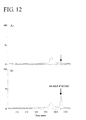
  • Chromatograms for rat blank plasma, the calibration blank used in (2) above (0 ng/mL) described above and the calibration lower limit (0.05 ng/mL) were compared.
  • the chromatogram of ALF-FMTAD is shown in FIG. 11 and the chromatogram of d 4 -ALF-FMTAD is shown in FIG. 12.
  • the recovery rate could be improved and the lower limit of quantification could be made 0.05 ng/mL, resulting in a higher sensitivity.
  • the method of the invention is an excellent quantification method in terms of the sensitivity, linearity and precision and considered to be efficiently applicable also to analysis of multiple samples.
  • the ferrocene compound of the present invention is reacted with a VD compound, and the combined compound of these compounds is subjected to LC/ESI-MS/MS, whereby the VD compound can be measured with a higher sensitivity than in conventional techniques.
  • a VD compound having no hetero atom such as an ester bond, an ether bond, a thioether bond, an amide bond, etc. in the molecule (specifically, VD 3 , calcipotriol, 1 ⁇ , 25(OH) 2 D 3 , ALF, falecalcitriol, EB1089, Compound A, etc.
  • the measurement method of the present invention is a high-sensitivity method which can achieve the sensitivity of higher even by several hundred times than in conventional methods. Accordingly, the high-sensitivity measurement method is applicable to all VD compounds, including not only VD compounds having hetero atoms such as an ester bond, an ether bond, a thioether bond, an amide bond, etc. (specifically, OCT, ED-71, etc. described above) but also VD compounds having no such hetero atom. Moreover, the method of measuring a VD compound is easily handled, since the reaction conditions require no heating or the like, as in the case of using ferrocenyl azide as a derivatization agent.
  • the ferrocene compound of the present invention is very useful as a derivatization agent in measuring a VD compound by LC/ESI-MS/MS, as described above.
  • the compound obtained, wherein the ferrocene compound and a VD compound have been combined with each other, is useful as, e.g., a reference standard in measuring a VD compound by LC/ESI-MS/MS.

Landscapes

  • Chemical & Material Sciences (AREA)
  • Organic Chemistry (AREA)
  • Health & Medical Sciences (AREA)
  • Life Sciences & Earth Sciences (AREA)
  • Engineering & Computer Science (AREA)
  • Molecular Biology (AREA)
  • Biomedical Technology (AREA)
  • Urology & Nephrology (AREA)
  • Hematology (AREA)
  • Immunology (AREA)
  • Biotechnology (AREA)
  • Biochemistry (AREA)
  • Cell Biology (AREA)
  • Food Science & Technology (AREA)
  • Medicinal Chemistry (AREA)
  • Physics & Mathematics (AREA)
  • Analytical Chemistry (AREA)
  • Microbiology (AREA)
  • General Health & Medical Sciences (AREA)
  • General Physics & Mathematics (AREA)
  • Pathology (AREA)
  • Organic Low-Molecular-Weight Compounds And Preparation Thereof (AREA)
  • Other Investigation Or Analysis Of Materials By Electrical Means (AREA)
  • Pharmaceuticals Containing Other Organic And Inorganic Compounds (AREA)

Abstract

The present invention provides a novel ferrocene compound; a reagent containing the compound; a high-sensitivity method of measuring a vitamin D compound using the reagent; etc. Specifically, a ferrocene compound represented by the following formula (1): <CHEM> is reacted with a vitamin D compound and the combined compound of these compounds is subjected to LC/ESI-MS/MS. Thus, the VD compound can be measured with higher sensitivity than in conventional techniques. The ferrocene compound of the present invention is extremely useful as a derivatization agent when a VD compound is measured by LC/ESI-MS/MS. The obtained compound wherein the ferrocene compound and the VD compound have been combined with each other, is useful as, e.g., a labeled compound, when the VD compound is measured by LC/ESI-MS/MS.

Description

TECHNICAL FIELD
The present invention provides a novel ferrocene compound, a reagent comprising the compound, a high-sensitivity method of measuring a vitamin D compound using the reagent, and a combined compound of the ferrocene compound and a vitamin D compound.
BACKGROND ART
At present, various compounds such as calcitriol (trade name: Rocaltrol (registered trademark)), alfacalcidol (trade name: Alfarol (registered trademark)), maxacalcitol (trade name: Oxarol (registered trademark)), tacalcitol (trade name: Bonalfa (registered trademark)), calcipotriol (trade name: Dovonex (registered trademark)), falecalcitriol (trade name: Hornel (registered trademark); trade name: Fulstan (registered trademark)), 2β-(3-hydroxypropyloxy)-1α,25-dihydroxyvitamin D3 (ED-71(codename), Chugai Pharmaceutical Co., Ltd.) etc., are commercially available or under clinical development as vitamin D compounds (VD compounds) provided as drugs. Since a VD compound exhibits its pharmaceutical effects only in a trace amount and also exerts a hypercalcemic action as a side effect, its measurement with a high sensitivity is required. In recent years, with remarkable advances in mass spectrometry and liquid chromatography/mass spectrometry (LC/MS) as well as tandem liquid chromatography/mass spectrometry/mass spectrometry (LC/MS/MS) have been widely used for high sensitivity analysis of drugs and drug metabolite studies. Among others, electrospray ionization (ESI) and atmospheric pressure chemical ionization (APCI) are most frequently used. For VD compounds, LC/MS is often used as well. VD compounds like maxacalcitol, ED-71, etc., having hetero atoms such as an ester bond, ether bond, thioether bond, amide bond, etc. in their molecules, can be measured with a high sensitivity, whereas in VD compounds like alfacalcidol, cholecalciferol (VD3), etc. having no hetero atoms such as an ester bond, ether bond, thioether bond, amide bond, etc. in the molecules, only about 1/5 to 1/100 sensitivity is achieved as compared to VD compounds having hetero atoms therein. It has thus been desired to develop a high sensitivity measurement method applicable to all VD compounds.
To achieve high sensitivity measurement of a VD compound by mass spectrometry, it is considered that derivatization is useful. For derivatization of a VD compound, triazoline derivatives (Cookson-type reagents), which selectively react with the triene structure in the Diels-Alder reaction, are frequently used [(1) Analytical Biochemistry 1992; 194: 77-81, (2) YAKUGAKU ZASSHI (Journal of the Pharmaceutical Society of Japan) 1998; 118(6): 206-215, (3) YAKUGAKU ZASSHI (Journal of the Pharmaceutical Society of Japan) 1999; 119(12): 898-920, (4) Biological Mass Spectrometry 1993; 22: 621-632, (5) Journal of Chromatography 1993; 645: 115-123, (6) Analytical Biochemistry 1996; 243: 28-40, etc.], and include PTAD (4-phenyl-1,2,4-triazoline-3,5- dione) [(4), (5) supra], PFBTAD (4-pentafluorobenzyl-1,2,4-triazoline-3,5-dione) [(5) supra], etc., utilizing resonance electron capture in LC/MS. It is reported that postcolumn derivatization of PTAD increases the sensitivity by 7 to 70 times but any case of applying PTAD to biological samples is unknown [(4) supra]. PFBTAD achieves 25 pg/mL (human plasma 1 mL), which is the lower limit of quantification [(6) supra] but this sensitivity is insufficient. According to our investigations, the sensitivity of only about 5 times was attained by derivatization in the technique utilizing PFPTAD (4-pentafluorophenyl-1,2,4-triazoline-3,5-dione) analogous to PFBTAD, and when applied to biological samples, sufficient sensitivity was not achieved because of a poor derivatization rate, etc. Therefore, it has been desired to develop reagents (derivatization agents) having atomic groups responsive to LC/MS with a high sensitivity.
Berkel et al. reported that ferrocene compounds are responsive with a high sensitivity and enable high sensitivity measurement when ferrocenyl azide is used as a derivatization agent for hydroxy group-containing compounds [(7) Analytical Chemistry 1998; 70: 1544-1554]. In ESI, ionic compounds can be measured with a high sensitivity and this derivatization technique takes advantage that ferrocene is readily oxidized upon ionization (positive ion mode) to produce stable ions efficiently. However, there is no report on the case in which this technique is applied to a method of measuring a VD compound. Moreover, when ferrocenyl azide is used as a derivatization agent, the technique encounters problems of difficult handling, since not only the reaction conditions require heating but also ferrocenyl azide itself is explosive.
As stated above, a method of measuring a vitamin D compound with a high sensitivity, which method is applicable to all kinds of the vitamin D compound and readily utilizable, a derivatization agent used for the method, and a combined compound of the derivatization agent and a vitamin D compound, are not available at the moment.
DISCLOSURE OF THE INVENTION
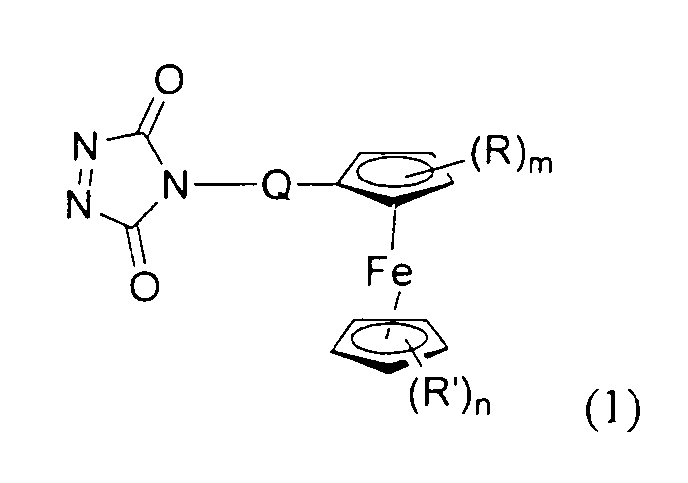
In order to solve these problems, the present inventors have made extensive investigations and found that, by combining a ferrocene compound represented by formula (1) below:
Figure 00030001
wherein Q represents a direct bond, alkylene or -W1-X-W2- (wherein W1 represents an alkylene or phenylene; W2 represents alkylene; X represents -O-, -N(Ra)C(=O)-, -N(Ra)C(=O)NH-, -OC(=O)NH- or -N(Ra)OS(=O)-; and Ra represents a lower alkyl group); each of R and R' independently represents a hydrogen atom, hydroxy group, nitro group, cyano group, halogen, optionally substituted lower alkyl group, optionally substituted lower alkenyl group, optionally substituted lower alkynyl group, optionally substituted lower alkoxy group, optionally substituted lower acyl group, optionally substituted carboxy group, or optionally substituted carbamoyl group; m represents an integer of 1 to 3; and n represents an integer of 1 to 4,
   with a vitamin D compound (VD compound), and measuring the obtained compound by liquid chromatography/mass spectrometry (LC/MS), especially liquid chromatography/electrospray ionization-mass spectrometry/mass spectrometry (LC/ESI-MS/MS), the VD compound can be measured in a manner applicable to all VD compounds and readily available and further with a higher sensitivity than never before. The present invention has thus been accomplished.
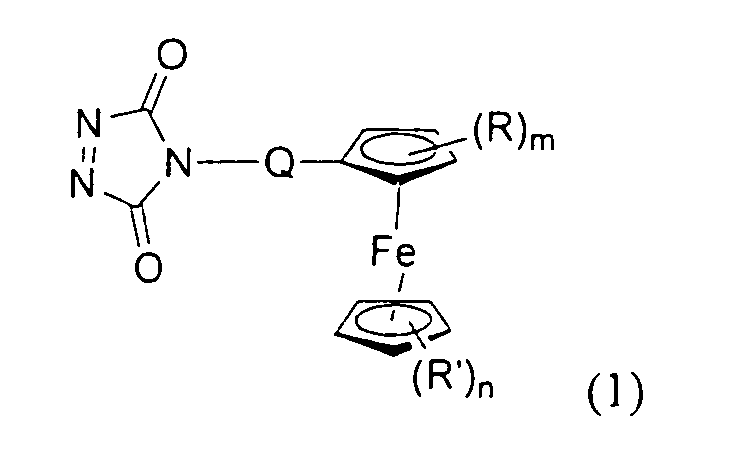
That is, the present invention relates to a ferrocene compound represented by formula (1) described below.
Figure 00040001
wherein Q represents a direct bond, alkylene or -W1-X-W2- (wherein W1 represents alkylene or phenylene; W2 represents alkylene; X represents -O-, -N(Ra)C(=O)-, -N(Ra)C(=O)NH-, -OC(=O)NH- or -N(Ra)OS(=O)-; and Ra represents a lower alkyl group); each of R and R' independently represents a hydrogen atom, hydroxy group, nitro group, cyano group, halogen, optionally substituted lower alkyl group, optionally substituted lower alkenyl group, optionally substituted lower alkynyl group, optionally substituted lower alkoxy group, optionally substituted lower acyl group, optionally substituted carboxy group, or optionally substituted carbamoyl group; m represents an integer of 1 to 3; and n represents an integer of 1 to 4.
In the compound represented by the formula (1) described above, the present invention further relates to the ferrocene compound wherein R and R' are hydrogen atoms. In the compound represented by the formula (1) described above, the present invention further relates to the ferrocene compound wherein Q represents a direct bond or alkylene. The present invention further relates to the ferrocene compound wherein Q is methylene and the ferrocene compound wherein Q is a direct bond.
Specific examples of the ferrocene compound of the present invention are 4-(ferrocenylmethyl)-1,2.4-triazoline-3,5-dione (FMTAD), 4-ferrocenyl-1,2,4-triazoline-3,5-dione (FTAD), and the like.
Furthermore, the present invention relates to a reagent comprising the ferrocene compound described above for measuring a compound having a triene structure. Such a reagent can further contain a solvent which is capable of dissolving the ferrocene compound.
The present invention further relates to a combined compound of a ferrocene compound represented by formula (1) described below, and a vitamin D compound:
Figure 00050001
wherein Q represents a direct bond, alkylene or -W1-X-W2- (wherein W1 represents alkylene or phenylene; W2 represents alkylene; X represents -O-, -N(Ra)C(=O)-, -N(Ra)C(=O)NH-, -OC(=O)NH- or -N(Ra)OS(=O)-; and Ra represents a lower alkyl group); each of R and R' independently represents a hydrogen atom, hydroxy group, nitro group, cyano group, halogen, optionally substituted lower alkyl group, optionally substituted lower alkenyl group, optionally substituted lower alkynyl group, optionally substituted lower alkoxy group, optionally substituted lower acyl group, optionally substituted carboxy group, or optionally substituted carbamoyl group; m represents an integer of 1 to 3; and n represents an integer of 1 to 4.
In the compound described above, the present invention further relates to the combined compound of a ferrocene compound and a vitamin D compound, wherein the ferrocene compound and the vitamin D compound have been combined with each other through a covalent bond.
The present invention still further relates to a combined compound of a ferrocene compound and a vitamin D compound, wherein the combined compound of the ferrocene compound and a vitamin D compound is represented by formula (2) below:
Figure 00050002
wherein each of A1 and A3 independently represents optionally substituted lower alkylene, optionally substituted lower alkenylene, or optionally substituted lower alkynylene; A2 represents a direct bond, -CH=CH-, -C=C-, -O-, -S- or -NH-; R1 represents a hydrogen atom or -OR9 (R9 represents hydrogen atom or a protecting group); R2 represents a hydrogen atom, hydroxy group, halogen, optionally substituted lower alkyl group, optionally substituted lower alkenyl group, optionally substituted lower alkynyl group, optionally substituted lower alkoxy group or optionally substituted lower acyl group; R3 represents a hydrogen atom or protecting group; each of R4, R5 and R6 independently represents a hydrogen atom, hydroxy group, nitro group, cyano group, halogen, optionally substituted lower alkyl group, optionally substituted cycloalkyl group, optionally substituted lower alkenyl group, optionally substituted lower alkynyl group, optionally substituted lower alkoxy group, optionally substituted lower acyl group, optionally substituted carboxy group, optionally substituted carbamoyl group or optionally substituted amino group; each of R7 and R8 independently represents a hydrogen atom or hydroxy group, or, R7 and R8 are linked together to form a double bond; Q represents a direct bond, alkylene or -W1-X-W2- (wherein W1 represents alkylene or phenylene; W2 represents alkylene; X represents -O-, -N(Ra)C(=O)-, -N(Ra)C(=O)NH-, -OC(=O)NH- or -N(Ra)OS(=O)-, and Ra represents a lower alkyl group); each of R and R' independently represents a hydrogen atom, hydroxy group, nitro group, cyano group, halogen, optionally substituted lower alkyl group, optionally substituted lower alkenyl group, optionally substituted lower alkynyl group, optionally substituted lower alkoxy group, optionally substituted lower acyl group, optionally substituted carboxy group or optionally substituted carbamoyl group; m represents an integer of 1 to 3; and n represents an integer of 1 to 4.).
In the compound represented by formula (2) described above, the present invention further relates to the compound, wherein A1-A2-A3 represents -CH(CH3)-(CH2)3-, -CH(CH3)-CH=CH- or -CH(CH3)-CH=CH-CH=CH-; R1 represents a hydrogen atom or hydroxy group; R2 represents a hydrogen atom or hydroxypropoxy group; R3 represents a hydrogen atom; each of R4, R5 and R6 independently represents a hydrogen atom, hydroxy group, lower alkyl group which may optionally be substituted with halogen, or lower cycloalkyl group which may optionally be substituted with a halogen; R7 and R8 represent a hydrogen atom, or, R7 and R8 are linked together to form a double bond. In the compound represented by formula (2) described above, the present invention further relates to the compound, wherein R and R' are a hydrogen atom.
In the compound represented by formula (2) described above, the present invention further relates to the combined compound of the ferrocene compound and a vitamin D compound, wherein Q represents a direct bond or alkylene. Still further, the present invention relates to the combined compound of the ferrocene compound and a vitamin D compound, wherein Q is methylene, and the combined compound of the ferrocene compound and a vitamin D compound, wherein Q is a direct bond. In the combined compound of the ferrocene compound and a vitamin D compound, the present invention still further relates to the combined compound of the ferrocene compound and a vitamin D compound, wherein the vitamin D compound is vitamin D3 compound.
The present invention still further relates to a method of measuring a vitamin D compound contained in a sample, which comprises reacting a ferrocene compound represented by formula (1) below:
Figure 00070001
wherein Q represents a direct bond, alkylene or -W1-X-W2- (wherein W1 represents alkylene or phenylene; W2 represents alkylene; X represents -O-, -N(Ra)C(=O)-, -N(Ra)C(=O)NH-, -OC(=O)NH- or -N(Ra)OS(=O)-; and Ra represents a lower alkyl group); each of R and R' independently represents a hydrogen atom, hydroxy group, nitro group, cyano group, halogen, optionally substituted lower alkyl group, optionally substituted lower alkenyl group, optionally substituted lower alkynyl group, optionally substituted lower alkoxy group, optionally substituted lower acyl group, optionally substituted carboxy group, or optionally substituted carbamoyl group; m represents an integer of 1 to 3; and n represents an integer of 1 to 4,
   with the vitamin D compound in a sample, and measuring the resulting combined compound of the ferrocene compound and the vitamin D compound, which have been combined with each other, by liquid chromatography/mass spectrometry (LC/MS).
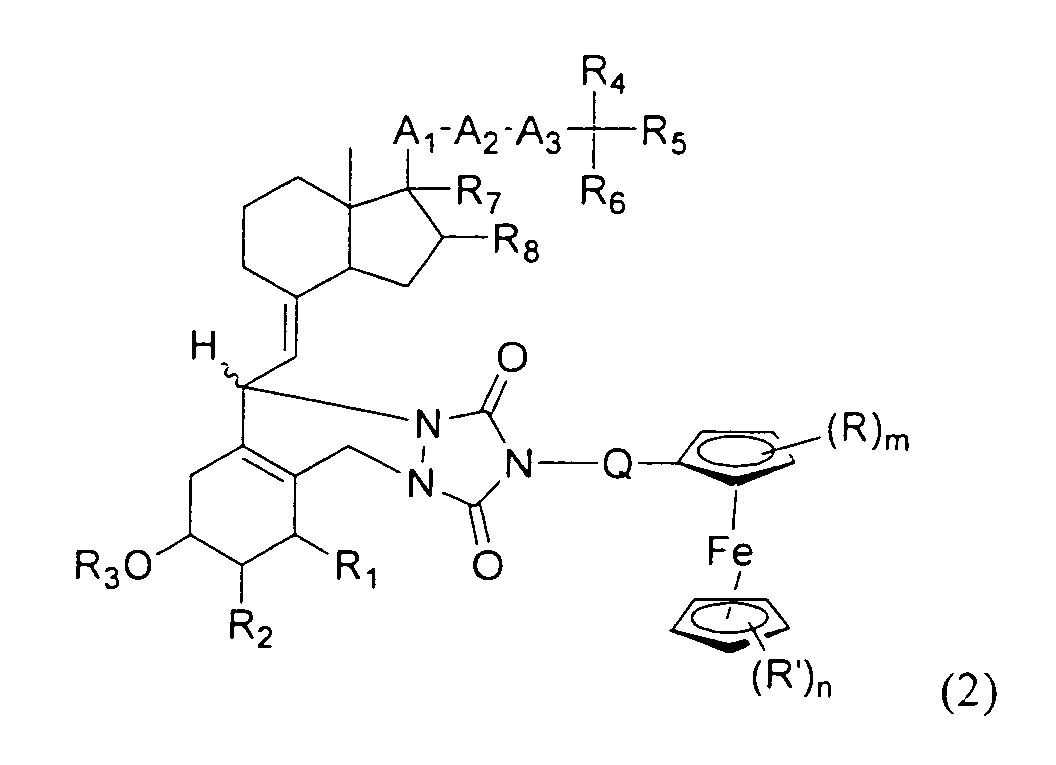
The present invention further relates to the method of measuring a vitamin D compound, wherein the combined compound of the ferrocene compound and a vitamin D compound is a compound wherein the ferrocene compound and the vitamin D compound have been combined with each other through a covalent bond.
The present invention still further relates to the method of measuring a vitamin D compound, wherein the combined compound of the ferrocene compound and the vitamin D compound is represented by formula (2) below:
Figure 00080001
wherein each of A1 and A3 independently represents optionally substituted lower alkylene, optionally substituted lower alkenylene, or optionally substituted lower alkynylene; A2 represents a direct bond, -CH=CH-, -C=C-, -O-, -S- or -NH-; R1 represents a hydrogen atom or -OR9 (R9 represents hydrogen atom or a protecting group); R2 represents a hydrogen atom, hydroxy group, halogen, optionally substituted lower alkyl group, optionally substituted lower alkenyl group, optionally substituted lower alkynyl group, optionally substituted lower alkoxy group or optionally substituted lower acyl group; R3 represents a hydrogen atom or protecting group; each of R4, R5 and R6 independently represents a hydrogen atom, hydroxy group, nitro group, cyano group, halogen, optionally substituted lower alkyl group, optionally substituted cycloalkyl group, optionally substituted lower alkenyl group, optionally substituted lower alkynyl group, optionally substituted lower alkoxy group, optionally substituted lower acyl group, optionally substituted carboxy group, optionally substituted carbamoyl group or optionally substituted amino group; each of R7 and R8 independently represents a hydrogen atom or hydroxy group, or, R7 and R8 are linked together to form a double bond; Q represents a direct bond, alkylene or -W1-X-W2- (wherein W1 represents alkylene or phenylene; W2 represents alkylene; X represents -O-, -N(Ra)C(=O)-, -N(Ra)C(=O)NH-, -OC(=O)NH- or -N(Ra)OS(=O)-, and Ra represents a lower alkyl group); each of R and R' independently represents a hydrogen atom, hydroxy group, nitro group, cyano group, halogen, optionally substituted lower alkyl group, optionally substituted lower alkenyl group, optionally substituted lower alkynyl group, optionally substituted lower alkoxy group, optionally substituted lower acyl group, optionally substituted carboxy group or optionally substituted carbamoyl group; m represents an integer of 1 to 3; and n represents an integer of 1 to 4.
The present invention still further relates to the method of measuring a vitamin D compound, wherein, in the compound described above and the combined compound of the ferrocene compound and a vitamin D compound described above, A1-A2-A3 represents -CH(CH3)-(CH2)3-, -CH(CH3)-CH=CH- or -CH(CH3)-CH=CH-CH=CH-; R1 represents a hydrogen atom or hydroxy group; R2 represents a hydrogen atom or hydroxypropoxy group; R3 represents a hydrogen atom; each of R4, R5 and R6 independently represents a hydrogen atom, hydroxy group, lower alkyl group which may optionally be substituted with halogen, or a lower cycloalkyl group which may optionally be substituted with halogen; R7 and R8 represent a hydrogen atom, or, R7 and R8 are linked together to form a double bond. The present invention still further relates to the method of measuring a vitamin D compound, wherein R and R' are a hydrogen atom in the compound described above and the combined compound of the ferrocene compound and a vitamin D compound described above. The present invention still further relates to the method of measuring a vitamin D compound, wherein the combined compound of the ferrocene compound and a vitamin D compound is a combined compound of the ferrocene compound and a VD compound among the compounds represented by the formula above, wherein Q represents a direct bond or alkylene. The present invention still further relates to the method of measuring a vitamin D compound, wherein the combined compound is a combined compound of the ferrocene compound and a vitamin D compound, wherein Q is methylene; and the method of measuring a vitamin D compound, wherein the combined compound is a combined compound of the ferrocene compound and a vitamin D compound, wherein Q is a direct bond.
The present invention still further relates to the method of measuring a vitamin D compound, wherein the combined compound is a combined compound of the ferrocene compound and a vitamin D compound in which the vitamin D compound is a vitamin D3 compound.
The present invention still further relates to the method of measuring a vitamin D compound, wherein the sample (analyte sample) is a sample taken from a living body.
The present invention still further relates to the method of measuring a vitamin D compound, wherein the liquid chromatography/mass spectrometry (LC/MS) is liquid chromatography/electrospray ionization-mass spectrometry/mass spectrometry (LC/ESI-MS/MS).
BRIEF DESCRIPTION OF THE DRAWINGS
  • FIG. 1 illustrates an example of the results when the ESI mass spectra of ALF-FMTAD and ALF-FTAD were measured.
  • FIG. 2 illustrates an example of the results when the product ion spectra were measured using molecular ions [M]+ of ALF-FMTAD and molecular ions [M]+ of ALF-FTAD as precursor ions.
  • FIG. 3 illustrates an example of the results in direct assay (control) of ALF-FMTAD, ALF-FTAD and ALF under the optimized conditions for measurement by LC/ESI-MS/MS.
  • FIG. 4 illustrates an example of the results in direct assay (control) of VD3-FMTAD, VD3-FTAD and VD3 and in measurement of VD3-ferrocene carbamates (control), under the optimized conditions for measurement by LC/ESI-MS/MS.
  • FIG. 5 illustrates an example of specific treatment schemes for pre-treatment in the measurement method of the present invention, when rat plasma was used as a sample.
  • FIG. 6 illustrates an example of chromatograms in the calibration lower limits by the measurement method of the present invention and conventional method. A) is a chromatogram in the calibration lower limit by the measurement method of the present invention when 1 mL of rat plasma is used; B) is a chromatogram in the calibration lower limit by the measurement method of the present invention when 100 µL of rat plasma is used; C) is a chromatogram in the calibration lower limit when measured by PTAD derivatization (control); and D) is a chromatogram in the calibration lower limit by direct assay.
  • FIG. 7 illustrates an example of typical graphs showing the calibration curve for the measurement method of the present invention by ALF-FMTAD.
  • FIG. 8 is an example of specific treatment scheme for pre-treatment in the measurement method of the present invention when rat plasma is used as a sample, which simplifies the treatment procedures in FIG. 5.
  • FIG. 9 illustrates column switching in the measurement method of the present invention.
  • FIG. 10 shows an example of typical calibration curves for the measurement method of the present invention, when measured under the conditions of FIG. 8, FIG. 9 and TABLE 12.
  • FIG. 11 illustrates chromatograms of ALF-FMTAD specificity in the measurement method of the present invention, when measured under the conditions of FIG. 8, FIG. 9 and TABLE 12. A) is a chromatogram of rat blank plasma, B) is a chromatogram of calibration blank (ALF: 0 ng/mL) and C) is a chromatogram of the calibration lower limit (ALF: 0.05 ng/mL).
  • FIG. 12 illustrates chromatograms of d4-ALF-FMTAD specificity in the measurement method of the present invention, when measured under the conditions of FIG. 8, FIG. 9 and TABLE 12. A) is a chromatogram of rat blank plasma, and B) is a chromatogram of the calibration lower limit (corresponding to ALF: 0.05 ng/mL, d4-ALF: 8 ng/mL).
  • BEST MODE FOR CARRYING OUT THE INVENTION
    Hereinafter, the present invention will be described more specifically.
    In the ferrocene compound represented by formula (1) below:
    Figure 00110001
    "Q" represents a direct bond, alkylene or -W1-X-W2- (wherein W1 represents alkylene or phenylene; W2 represents alkylene; X represents -O-, -N(Ra)C(=O)-. -N(Ra)C(=O)NH-, -OC(=O)NH- or -N(Ra)OS(=O)-, and Ra represents a lower alkyl group), preferably represents a direct bond, alkylene or -W1-X-W2- (wherein W1 represents methylene or phenylene; W2 represents methylene; X represents -O-, -N(CH3)C(=O)-, -N(CH3)C(=O)NH- or -OC(=O)NH-); more preferably, Q represents a direct bond or an alkylene, much more preferably, alkylene, and most preferably, methylene. In "Ra", the "lower alkyl group" means a straight or branched alkyl group having 1 to 6 carbon atoms such as methyl, ethyl, propyl, isopropyl, butyl, isobutyl, s-butyl, t-butyl, pentyl, isopentyl, neopentyl, hexyl, etc.
    The "alkylene" in Q. "W1 and W2" described above means a straight or branched alkylene chain having 1 to 6 carbon atoms such as methylene, ethylene, propylene, isopropylene, butylenes, etc. The "phenylene" in W1 means o-phenylene, m-phenylene or p-phenylene.
    Each of "R" and "R"' described above independently represents hydrogen atom, hydroxy group, nitro group, cyano group, halogen, optionally substituted lower alkyl group, optionally substituted lower alkenyl group, optionally substituted lower alkynyl group, optionally substituted lower alkoxy group, optionally substituted lower acyl group, optionally substituted carboxy group or optionally substituted carbamoyl group; preferably, hydrogen atom, hydroxy group, halogen or lower alkyl group, and more preferably, hydrogen atom. Herein, the "halogen" means chlorine, fluorine, bromine, iodine, etc.; the "lower alkyl group" means a straight or branched alkyl group having 1 to 6 carbon atoms such as methyl, ethyl, propyl, isopropyl, butyl, isobutyl, s-butyl, t-butyl, pentyl, isopentyl, neopentyl, hexyl, etc.; the "lower alkenyl group" means a straight or branched alkenyl group having 1 to 6 carbon atoms, such as ethenyl, 1-propenyl, allyl, 1-butenyl, 2-butenyl, 3-butenyl, pentenyl, hexenyl, etc.; the "lower alkynyl group" means a straight or branched alkynyl group having 1 to 6 carbon atoms, such as ethynyl, propynyl, butynyl, pentynyl, hexynyl, etc.; the "lower alkoxy group" means an alkoxy group having 1 to 6 carbon atoms, such as methoxy, ethoxy, propoxy, isopropoxy, butoxy, pentyloxy, hexyloxy, phenoxy, etc.; and the "lower acyl group" means an acyl group having 1 to 6 carbon atoms, such as fonnyl, acetyl, propionyl, butyryl, isobutyryl, valeryl, isovaleryl, pivaloyl, hexanoyl, etc.
    In the substituent(s) described above, "optionally substituted" means that these groups may optionally have 1 or more (e.g., 1 to 3) substituents, including hydroxy group; nitro group; cyano group; halogen such as chlorine, fluorine, bromine, iodine, etc.; a straight or branched alkyl group having 1 to 6 carbon atoms such as methyl, ethyl, propyl, isopropyl, butyl, isobutyl, s-butyl, t-butyl, pentyl, isopentyl, neopentyl, hexyl, etc.; a straight or branched alkenyl group having 1 to 6 carbon atoms, such as ethenyl, 1-propenyl, allyl, 1-butenyl, 2-butenyl, 3-butenyl, pentenyl, hexenyl, etc.; a straight or branched alkynyl group having 1 to 6 carbon atoms, such as ethynyl, propynyl, butynyl, pentynyl, hexynyl, etc.; an alkoxy group having 1 to 6 carbon atoms, such as methoxy, ethoxy, propoxy, isopropoxy, butoxy, pentyloxy, hexyloxy, phenoxy, etc.; an acyl group having 1 to 6 carbon atoms, such as formyl, acetyl, propionyl, butyryl, isobutyryl, valeryl, isovaleryl, pivaloyl, hexanoyl, etc.; carboxy group; carbamoyl group; and/or amino group, etc.
    The ferrocene compound of the present invention (Compound 6 in the production scheme described below) can be produced in accordance with the production scheme below:
    Figure 00130001
    (wherein Q, R, R', m and n have the same significance as defined in formula (1) described above).
    In Step 1, Compound 2 can be synthesized from Compound 1 by a process which involves reacting with diphenylphosphorylazide and a base, a process which involves converting the carboxylic acid into the acid chloride or acid anhydride followed by reacting with sodium azide, a process which involves converting the carboxylic acid into the ester, reacting with hydrazine, converting into the amide with hydrazine and then reacting with nitric acid or a nitric acid ester, etc.; preferably by the process which involves reacting with diphenylphosphorylazide and a base. Compound 1, which is the starting material, is known or can be readily synthesized from known compounds by known synthesis techniques. In addition, Compound 1 is commercially available and can be purchased from, e.g., Tokyo Kasei Kogyo Co., Ltd. In the process of reacting with diphenylphosphorylazide and a base, examples of the base used are triethylamine, diisopropylethylamine, etc., preferably triethylamine. In the process of reacting with diphenylphosphorylazide and a base, examples of solvents used are dichloromethane, chloroform, dichloroethane, benzene, toluene, xylene, tetrahydrofuran, diethyl ether, dioxane, dimethoxyethane, etc., preferably dichloromethane. In the process of reacting with diphenylphosphorylazide and a base, the reaction temperature is not particularly limited so long as it is a temperature at which the reaction proceeds, but the reaction is carried out generally at -78 to 50°C, preferably at -10 to 10°C.
    In Step 2, Compound 3 can be synthesized by heating Compound 2. Examples of solvents used in Step 2 described above are dichloromethane, chloroform, dichloroethane, benzene, toluene, xylene, tetrahydrofuran, diethyl ether, dioxane, dimethoxyethane, etc., preferably toluene. Though reaction temperature is not particularly limited so long as it is a temperature at which the reaction proceeds, the reaction is carried out generally at 20 to 200°C, preferably at 50 to 150°C.
    In Step 3, Compound 4 can be produced by reacting Compound 3 with a carbazinic acid ester. Examples of solvents used in Step 3 described above are dichloromethane, chloroform, dichloroethane, benzene, toluene, xylene, tetrahydrofuran, diethyl ether, dioxane, dimethoxyethane, etc., preferably toluene. While the reaction temperature is not particularly limited so long as it is a temperature at which the reaction proceeds, the reaction is carried out generally at 0 to 200°C, preferably at 20 to 120°C.
    In Step 4, Compound 5 can be produced by reacting Compound 4 with a base. Examples of the base used in Step 4 described above include sodium methoxide, sodium ethoxide, sodium tert-butoxylate, potassium methoxide, potassium ethoxide, potassium tert-butoxide, n-butyl lithium, sec-butyl lithium, tert-butyl lithium, lithium diisopropylamide, lithium dicyclohexylamide, lithium bis(trimethylsilyl)amide, potassium bis(trimethylsilyl)amide, sodium hydride, potassium hydride, sodium hydrogencarbonate, potassium hydrogencarbonate, potassium carbonate, sodium carbonate, calcium carbonate, cesium carbonate, etc., preferably potassium carbonate. Examples of solvents used in Step 4 described above are methanol, ethanol, isopropanol, dichloromethane, chloroform, dichloroethane, benzene, toluene, xylene, tetrahydrofuran, diethyl ether, dioxane, dimethoxyethane, etc., preferably ethanol. Although the reaction temperature is not particularly limited so long as it is a temperature at which the reaction proceeds, the reaction is carried out generally at 0 to 200°C, preferably at 20 to 120°C.
    In Step 5, Compound 6 can be produced by reacting Compound 5 with iodobenzene diacetate. Examples of solvents used in Step 4 described above are ethyl acetate, dichloromethane, chloroform, dichloroethane, benzene, toluene, xylene, tetrahydrofuran (THF), diethyl ether, dioxane, dimethoxyethane, etc., preferably tetrahydrofuran (THF) or dioxane. Though the reaction temperature is not particularly limited so long as it is a temperature at which the reaction proceeds, the reaction is carried out generally at -78 to 100°C, preferably at -10 to 50°C.
    In addition, the ferrocene compound of the present invention (in Compound 6, the compound wherein Q is W1-X-W2) can also be produced in accordance with the production scheme described below:
    Figure 00150001
    (wherein Q, R, R', W1, X, W2, m and n have the same significance as defined in formula (1) described above).
    In Step 6, Compound 9 can also be synthesized by reacting Compound 7 (Y represents a hydroxy group, carboxylic acid chloride residue, carboxylic acid anhydride residue, carboxylic acid ester group, isocyanate group, sulfonyl chloride residue, halogen atom, alkylsulfonyloxy group or arylsulfonyloxy group) with Compound 8 (Z represents a hydroxy group, optionally substituted amino group, halogen atom, alkylsulfonyloxy group or arylsulfonyloxy group) (Step 6). In this case, the reaction is carried out preferably in the presence of a base. For the combination of Y and Z, there are the combination of Compound 7 wherein Y is a carboxylic acid chloride residue, carboxylic acid anhydride residue, carboxylic acid ester group, isocyanate group or sulfonyl chloride residue and Compound 8 wherein Z is a hydroxy group or optionally substituted amino group; the combination of Compound 7 wherein Y is a hydroxy group and Compound 8 wherein Z is a halogen atom, alkylsulfonyloxy group or arylsulfonyloxy group; or the combination of Compound 7 wherein Y is a halogen atom, alkylsulfonyloxy group or arylsulfonyloxy group and Compound 8 wherein Z is a hydroxy group. Compound 7 and Compound 8, which are the starting materials, are known or can readily be synthesized from known compounds by known processes. Compound 7 is also commercially available and can be purchased from Tokyo Kasei Kogyo Co., Ltd. Examples of the base used in Step 6 described above include sodium hydroxide, potassium hydroxide, sodium hydrogencarbonate, potassium hydrogencarbonate, sodium hydride, potassium hydride, potassium carbonate, sodium carbonate, calcium carbonate, cesium carbonate, triethylamine, diisopropylethylamine, pyridine, 2,6-dimethylpyridine, 2,4,6-trimethylpyridine, 4-(dimethylamino)pyridine, etc. Examples of solvents used in Step 6 described above include water, methanol, ethanol, isopropanol, dichloromethane, chloroform, dichloroethane, benzene, toluene, xylene, tetrahydrofuran, diethyl ether, dioxane, dimethoxyethane, etc. While the reaction temperature is not particularly limited so long as it is a temperature at which the reaction proceeds, the reaction is carried out generally at -78 to 200°C, preferably at -10 to 150°C.
    The ferrocene compound of the present invention thus obtained can be isolated, if necessary, by applying operations like purification, drying, etc. in accordance with known techniques. The ferrocene compound obtained may be sometimes unstable and in such a case, can be stored in a solvent in which the compound can be stably present (e.g., tetrahydrofuran, dioxane, etc.).
    The ferrocene compound of the present invention is useful as a reagent (derivatization agent) when compounds having a triene structure, e.g., vitamin D compounds (VD compounds), etc. are measured by liquid chromatography/mass spectrometry (LC/MS), especially liquid chromatography/electrospray ionization-mass spectrometry/mass spectrometry (LC/ESI-MS/MS).
    The reagent of the present invention means both the aforesaid ferrocene compound itself and a solution containing the ferrocene compound described above. Examples of solvents which can be used for the reagent of the present invention include ethyl acetate, dichloromethane, chloroform, dichloroethane, benzene, toluene, xylene, tetrahydrofuran (THF), diethyl ether, dioxane, dimethoxyethane, etc., preferably tetrahydrofuran (THF) or dioxane. While the content of the ferrocene compound in the solution is not particularly limited, it is appropriately chosen from the range of, e.g., 0.001 to 99% by weight, preferably 0.005 to 50% by weight, and more preferably 0.01 to 10% by weight. Where a target compound is measured using the reagent of the present invention, specifically the ferrocene compound in the reagent is reacted with a VD compound, and the resulting compound obtained by combining the ferrocene compound and the VD compound, is applied to LC/ESI-MS/MS, etc., thereby to measure the VD compound. Details of the measurement will be described later.
    Herein, the VD compound, with which the ferrocene compound of the present invention is to be combined (namely, the VD compound as an analyte), is preferably a vitamin D3 compound (a VD3 compound). Herein, the VD3 compound includes a compound having the 9,10-secocholesta-5,7,10(19)-triene structure, preferably a compound having the (5Z,7E)-9,10-secocholesta-5,7,10(19)-triene structure, more preferably, a compound having the (1α,5Z,7E)-9,10-secocholesta-5,7,10(19)-trien-1-ol structure, a compound having the (3β,5Z,7E)-9,10-secocholesta-5,7,10(19)-trien-3-ol structure, or a compound having the (1α,5Z,7E)-9,10-secocholesta-5,7,10(19)-triene-1,3-diol structure. Specific examples of these VD3 compounds are cholecalciferol (VD3), calcitriol (1α,25(OH)2D3; trade name: Rocaltrol (registered trademark), capsule/manufactured and sold by Chugai Pharmaceutical Co., Ltd., sold by Kyorin Pharmaceutical Co., Ltd., note/import origin: Chugai Pharmaceutical Co., Ltd., sales destination: Kirin Brewery Co., Ltd.), alfacalcidol (ALF; trade name: Alfarol (registered trademark), Chugai Pharmaceutical Co., Ltd.; Japanese Patent Publication (KOKAI) No. 48-62750 and Tetrahedron Lett., 1973, 2339, Tetrahedron, 30, 2701(1974), etc.), maxacalcitol (OCT; trade name: Oxarol (registered trademark), ointment/sales destination: Maruho Co., Ltd., manufactured by Chugai Seiyaku Co., Ltd. Chugai Pharmaceutical Co., Ltd., note/manufactured and sold by Chugai Pharmaceutical Co., Ltd.; Japanese Patent Publication (KOKAI) No. 61-267550, etc.), tacalcitol (trade name: Bonalfa (registered trademark), Teijin Ltd.), calcipotriol (trade name: Dovonex (registered trademark), imported by Teikoku Seiyaku Co., Ltd., sold by Fujisawa Pharmaceutical Co., Ltd., Teikoku Medix Co., Ltd.), falecalcitriol (trade name: Hornel (registered trademark), Taisho Pharmaceutical Co., Ltd.; trade name: Fulstan (registered trademark), manufactured by Sumitomo Pharmaceuticals Co., Ltd., sold by Kissei Pharmaceutical Co., Ltd.), 2β-(3-hydroxypropyloxy)-1α,25-dihydroxyvitamin D3 (ED-71 (code name), Chugai Pharmaceutical Co., Ltd.; Japanese Patent Publication (KOKAI) No. 61-267548, etc.), EB1089 (code name, Leo Pharmaceutical Products, Inc.; J. Chromatogr. B, 740, 117-128 (2000), etc.), compounds described in International Publications WO 95/27697, WO 98/28266, WO 00/49403, WO 00/61776, WO 00/64870, WO 00/66548, WO 01/16099, WO 01/62723, WO 01/79166, WO 01/90061, WO 01/96293, WO 02/13832, etc. Herein, VD3, 1α,25(OH)2D3, ALF, etc. are commercially available and can be purchased from, e.g., Solvay Pharmaceutical, Inc., CALBIO, Inc., FLUKA Inc., FORMOSA Corp., WAKO, etc. Typical structures of these compounds are shown below.
    • Cholecalciferol (VD3)
      Figure 00180001
    • Alfacalcidol (ALF)
      Figure 00180002
    • 2β-(3-Hydroxypropyloxy)-1α,25-dihydroxyvitamin D3 (ED-71)
      Figure 00180003
    • Compound described in International Publication WO 02/13832, EXAMPLE 6 (hereinafter referred to as Compound A)
      Figure 00190001
    In VD compounds (i.e., VD compounds as analytes) which are to be combined with the ferrocene compounds of the present invention described above, particularly preferred are VD compounds having no hetero atom such as an ester bond, ether bond, thioether bond, amide bond, etc., in the molecule (specifically VD3, calcipotriol, 1α,25(OH)2D3, ALF, falecalcitriol, EB1089 and Compound A described above, etc.).
    To combine the ferrocene compound of the present invention with the VD compound, the triazone skeleton of the ferrocene compound of the present invention may be selectively reacted with the triene structure of the VD compound by the Diels-Alder reaction. Specifically, the ferrocene compound of the present invention is reacted with the VD compound for 5 minutes to 5 hours (preferably 15 minutes to 3 hours) in a suitable solvent such as ethyl acetate, dichloromethane, chloroform, dichloroethane, benzene, toluene, xylene, tetrahydrofuran (THF), diethyl ether, dioxane, dimethoxyethane (preferably tetrahydrofuran (THF) or dioxane), etc. Though the reaction temperature is not particularly limited so long as it is a temperature at which the reaction proceeds, the reaction is carried out generally at -78 to 100°C, preferably at -10 to 50°C. In order to terminate the reaction depending on necessity, water or an alcoholic solvent such as methanol, ethanol, propanol, isopropanol, etc. may be added. The compound thus obtained by combining the ferrocene compound and the VD compound, can be isolated, if necessary, by performing operations such as purification, drying, etc., following known methods.
    The combined compound thus obtained, which comprises the ferrocene compound and the VD compound which have been combined with each other, is a compound in which the ferrocene compound and the VD compound have been combined with each other through a covalent bond.
    Preferably, the combined compound of the ferrocene compound and the VD compound is represented by formula (2) below.
    Figure 00200001
    Herein, "Q, R, R', m and n" in the formula above have the same significance as defined in formula (1) described above. Each of "A1 and A3" independently represents optionally substituted lower alkylene, optionally substituted lower alkenylene or optionally substituted lower alkynylene. "A2" represents a direct bond, -CH=CH-, -C=C-, -O-, -S- or -NH-, preferably a direct bond, -CH=CH- or -C=C-. Preferably, A1-A2-A3 is -CH(CH3)-(CH2)3-, -CH(CH3)-CH=CH- or -CH(CH3)-CH=CH-CH=CH-, and most preferably -CH(CH3)-(CH2)3-. "R1" represents a hydrogen atom or -OR9 (R9 represents a hydrogen atom or protecting group), preferably a hydrogen atom or hydroxy group. "R2" represents a hydrogen atom, hydroxy group, halogen, optionally substituted lower alkyl group, optionally substituted lower alkenyl group, optionally substituted lower alkynyl group, optionally substituted lower alkoxy group or optionally substituted lower acyl group, preferably a hydrogen atom or hydroxypropoxy group. "R3" represents a hydrogen atom or protecting group, preferably a hydrogen atom. Each of "R4, R5 and R6" independently represents a hydrogen atom, hydroxy group, nitro group, cyano group, halogen, optionally substituted lower alkyl group, optionally substituted cycloalkyl group, optionally substituted lower alkenyl group, optionally substituted lower alkynyl group, optionally substituted lower alkoxy group, optionally substituted lower acyl group, optionally substituted carboxy group, optionally substituted carbamoyl group or optionally substituted amino group, preferably, each independently represents a hydrogen atom, hydroxy group, lower alkyl group which may optionally be substituted with a halogen, or lower cycloalkyl group which may optionally be substituted with a halogen. Each of "R7 and R8" independently represents a hydrogen atom or hydroxy group, or, R7 and R8 are linked together to form a double bond, preferably a hydrogen atom or R7 and R8 are linked together to form a double bond.
    In A1 and A3 described above, the "lower alkylene" means a straight or branched alkylene chain having 1 to 6 carbon atoms, the "lower alkenylene" means a straight or branched alkenylene chain having 1 to 6 carbon atoms, and the "lower alkynylene" means a straight or branched alkynylene chain having 1 to 6 carbon atoms. The term "optionally substituted" means that these groups may optionally have 1 or more (e.g., 1 to 3) substituents, such as a hydroxy group; nitro group; cyano group; halogen such as chlorine, fluorine, bromine, iodine, etc.; straight or branched alkyl group having 1 to 6 carbon atoms such as methyl, ethyl, propyl, isopropyl, butyl, isobutyl, s-butyl, t-butyl, pentyl, isopentyl, neopentyl, hexyl, etc.; straight or branched alkenyl group having 1 to 6 carbon atoms, such as ethenyl, 1-propenyl, allyl, 1-butenyl, 2-butenyl, 3-butenyl, pentenyl, hexenyl, etc.; straight or branched alkynyl group having 1 to 6 carbon atoms, such as ethynyl, propynyl, butynyl, pentynyl, hexynyl, etc.; alkoxy group having 1 to 6 carbon atoms, such as methoxy, ethoxy, propoxy, isopropoxy, butoxy, pentyloxy, hexyloxy, phenoxy, etc.; acyl group having 1 to 6 carbon atoms, such as formyl, acetyl, propionyl, butyryl, isobutyryl, valeryl, isovaleryl, pivaloyl, hexanoyl, etc.; carboxy group; carbamoyl group; and/or amino group, etc.
    In R2, R4, R5 and R6 described above, the "halogen" means chlorine, fluorine, bromine, iodine, etc.; the "lower alkyl" means a straight or branched alkyl group having 1 to 6 carbon atoms such as methyl, ethyl, propyl, isopropyl, butyl, isobutyl, s-butyl, t-butyl, pentyl, isopentyl, neopentyl, hexyl, etc.; the "lower alkenyl" means a straight or branched alkenyl group such as ethenyl, 1-propenyl, allyl, 1-butenyl, 2-butenyl, 3-butenyl, pentenyl, hexenyl, etc.; the "lower alkynyl" means a straight or branched alkynyl group having 1 to 6 carbon atoms, such as ethynyl, propynyl, butynyl, pentynyl, hexynyl, etc.; the "lower alkoxy group" means an alkoxy group having 1 to 6 carbon atoms, such as methoxy, ethoxy, propoxy, isopropoxy, butoxy, pentyloxy, hexyloxy, phenoxy, etc.; the "lower acyl group" means an acyl group having 1 to 6 carbon atoms, such as formyl, acetyl, propionyl, butyryl, isobutyryl, valeryl, isovaleryl, pivaloyl, hexanoyl, etc. The "cycloalkyl group" in R4, R5 and R6 means a cycloalkyl group having 3 to 8 carbon atoms, such as cyclopropyl, cyclobutyl, cyclopentyl, cyclohexyl, cycloheptyl, cyclooctyl, etc.
    In the substituent(s) described above, the term "optionally substituted" means that these groups may optionally have 1 or more (e.g., 1 to 3) substituents, including a hydroxy group; nitro group; cyano group; halogen such as chlorine, fluorine, bromine, iodine, etc.; straight or branched alkyl group having 1 to 6 carbon atoms such as methyl, ethyl, propyl, isopropyl, butyl, isobutyl, s-butyl, t-butyl, pentyl, isopentyl, neopentyl, hexyl, etc.; straight or branched alkenyl group having 1 to 6 carbon atoms, such as ethenyl, 1-propenyl, allyl, 1-butenyl, 2-butenyl, 3-butenyl, pentenyl, hexenyl, etc.; straight or branched alkynyl group having 1 to 6 carbon atoms, such as ethynyl, propynyl, butynyl, pentynyl, hexynyl, etc.; alkoxy group having 1 to 6 carbon atoms, such as methoxy, ethoxy, propoxy, isopropoxy, butoxy, pentyloxy, hexyloxy, phenoxy, etc.; acyl group having 1 to 6 carbon atoms, such as formyl, acetyl, propionyl, butyryl, isobutyryl, valeryl, isovaleryl, pivaloyl, hexanoyl, etc.; carboxy group; carbamoyl group; and/or amino group, etc.
    In R1 and R3 described above, the "protecting group" is not particularly limited and may be any group, as long as the group is appropriate as a protecting group of hydroxy group; the protecting group includes, for example, a lower acyl group, optionally substituted lower alkyl group, optionally substituted lower alkylsulfonyl group, optionally substituted lower alkoxycarbonyl group, a substituted silyl group, etc. The "lower acyl group", "lower alkyl group", "lower alkoxy group", optionally substitutable "substituents," etc. are as defined in the foregoing paragraph.
    The combined compound of the ferrocene compound and the VD compound, which is obtained by reacting the ferrocene compound of the present invention described above with a VD compound, is useful as, e.g., a reference standard in measuring the VD compound by LC/ESI-MS/MS, etc.
    Also in measuring a VD compound present in a sample, the ferrocene compound of the present invention may be combined with the VD compound, following the method described above. Herein, the sample is preferably a sample from a living body. The sample from the living body means body fluids (blood, lymphatic fluid, spinal fluid), urine, etc., preferably plasma, serum or urine. Furthermore, the term from the living body means preferably from mammals, more preferably from human, monkey, dog, rabbit, guinea pig, rat or mouse. Where a VD compound present in a sample from the living body is measured, necessary pre-treatments like protein precipitation by known techniques such as protein precipitation with ethanol, etc. are made, then the ferrocene compound of the present invention is combined with the VD compound present in the sample as in the method described above, and the resulting combined compound of the ferrocene compound and the VD compound, which is obtained by reacting the ferrocene compound of the present invention with the VD compound can be used for the following measurement.
    Herein, it is preferred that at this stage the sample is subjected to protein precipitation as a pre-treatment of the sample and then to solid phase extraction of the sample before the ferrocene compound of the present invention is reacted with the VD compound present in the sample. It is also preferred that after the ferrocene compound of the present invention is reacted with the VD compound present in the sample, the sample is subjected to solid phase extraction. Particularly preferably, after the sample is subjected to protein precipitation and then to solid phase extraction, the ferrocene compound of the present invention is reacted with the VD compound present in the sample, followed by solid phase extraction of the sample again. The solid phase extraction after protein precipitation of the sample and prior to the reaction of the ferrocene compound of the present invention with the VD compound present in the sample is preferably performed using a solid phase extraction cartridge on a normal phase system, particularly preferably using a solid phase extraction cartridge on a silica gel system. The solid phase extraction after the reaction of the ferrocene compound of the present invention with the VD compound in the sample is carried out preferably using a solid phase extraction cartridge on a reversed phase system.
    The thus obtained combined compound of the ferrocene compound and the VD compound is applied on LC/MS for the measurement. Herein, LC/MS means the measurement techniques or measurement instruments, utilizing or applying the measurement principle by LC/MS (liquid chromatography/mass spectrometry) thereto, specifically including the measurement techniques or measurement instruments by liquid chromatography/mass spectrometry (LC/MS) and tandem liquid chromatography/mass spectrometry/mass spectrometry (LC/MS/MS), as well as these techniques in combination with electrospray ionization (ESI) and atmospheric pressure chemical ionization (APCI). Among them, it is particularly preferred to apply liquid chromatography/electrospray ionization-mass spectrometry/mass spectrometry (LC/ESI-MS/MS) in performing the measurement method of the present invention.
    According to the measurement by LC/ESI-MS/MS, the residue containing the combined compound of the ferrocene compound and the VD compound obtained as described above is dissolved in a mobile phase and the solution is injected into LC/ESI-MS/MS, followed by the measurement. Herein, specific operations including measurement conditions of LC/ESI-MS/MS in each measurement, and the like may be appropriately adjusted/set forth by known technique, depending on the amount or kind of analyte sample, the amount or kind of a VD compound present in a sample, sensitivity required for measurement, kind of the ferrocene compound of the present invention used as a derivatization agent, construction of LC/ESI-MS/MS instruments used for measurement, etc. Specifically, conditions for MRM (Multiple Reaction Monitoring) of the combined compound of the ferrocene compound and a VD compound are closely examined to appropriately set various conditions, and also set conditions for LC enabling to efficient ionization. In measuring the concentration in a biological sample, an analyte of known concentrations with concentration gradients is added to a blank sample, internal standard (I.S., preferably an analyte labeled with a stable isotope) is added to each of the mixtures, which are measured, respectively. The peak area ratio (or peak height ratio) of the analyte to I.S. is determined. In relation to the added concentration, a calibration curve is prepared and from the calibration curve and the peak area ratio (or peak height ratio) of the analyte, the concentration in a biological sample is calculated. For the details of these techniques, reference can be made to the latest issue of Mass Spectrometry (first edition, published by Kagaku Dojin, edited by Toshimitsu Niwa, 1995), Biological Mass Spectrometry (published by Kagaku Dojin, edited by Tamio Ueno, Kazuo Hirayama, Ken-ichi Harada, 1997), LC/MS-NO-JISSAI (Practice of LC/MS) (first edition, published by Kodansha Scientific, edited by Ken-ichi Harada, Hisao Oka, 1996), etc.
    The method of the present invention for measuring a VD compound thus performed is a measurement method with a higher sensitivity than in conventional techniques. Furthermore, in the measurement of a VD compound having no hetero atom such as an ester bond, an ether bond, a thioether bond, an amide bond, etc. in the molecule (specifically, VD3, calcipotriol, 1α, 25(OH)2D3, ALF, falecalcitriol, EB1089 and Compound A described above, etc.) which were measured with an insufficient sensitivity in conventional methods, the measurement method of the present invention is a high-sensitivity method which can achieve the sensitivity of higher even by several hundred times than in conventional methods. Accordingly, the high-sensitivity measurement method is applicable to all VD compounds, not only to VD compounds having hetero atoms such as an ester bond, an ether bond, a thioether bond, an amide bond, etc. (specifically, OCT, ED-71, etc. described above) but also to VD compounds having no such hetero atom.
    The present invention will be described in more detail with reference to preferred working examples, but is not limited to these working examples.
    EXAMPLES
    In EXAMPLES below, nuclear magnetic resonance (NMR) was measured using EX-270 (manufactured by JEOL). Also, high performance liquid chromatograph Alliance 2790 (manufactured by Waters Co.) and a quadrupole mass spectrometer Quattro LC (manufactured by Micromass UK Ltd.) were used as electrospray ionization LC/MS/MS (LC/ESI-MS/MS). For data analysis, Masslynx Ver. 3.3 (manufactured by Micromass UK, Inc.) and Microsoft Excel 2000 (manufactured by Microsoft Corp.) were used.
    EXAMPLE 1 Synthesis of derivatization agent [EXAMPLE 1-1] Synthesis of 4-(ferrocenylmethyl)-1,2,4-triazoline-3,5-dione (FMTAD) (1) Synthesis of ethyl 3-(ferrocenylmethyl)carbamoylcarbazate
    Under ice cooling, 0.57 mL (4 mmols) of triethylamine was added to a mixture of 0.5 g (2 mmols) of ferroceneacetic acid (manufactured by Tokyo Kasei Kogyo Co., Ltd.), 0.44 mL (2 mmols) of diphenylphosphyrylazide and 4 mL of toluene. The mixture was stirred at room temperature for 30 minutes. The reaction mixture was diluted with dichloromethane. The dilution was washed sequentially with a 1% hydrochloric acid aqueous solution and saturated sodium hydrogencarbonate solution. After drying over anhydrous magnesium sulfate, the organic layer was filtered and concentrated under reduced pressure to give 4 mL of the toluene solution. To the toluene solution obtained, 2 mL of toluene was added and 0.32 g (3 mmols) of ethyl carbazate was added to the mixture while stirring at room temperature. The mixture was then heated under reflux for 3 hours and diluted with dichloromethane. The dilution was washed sequentially with a 1% hydrochloric acid aqueous solution and saturated sodium hydrogencarbonate solution. After drying over anhydrous magnesium sulfate, the organic layer was filtered and concentrated under reduced pressure. The resulting residue was purified by silica gel column chromatography (chloroform : methanol = 20:1) to give 0.55 g (78%) of ethyl 3-(ferrocenylmethyl)carbamoylcarbazate as a yellow oily substance.
       1H NMR (CDCl3) δ: 1.27 (3H, t, J=7.3 Hz), 4.0-4.3 (13H, m), 5.59 (1H, m), 6.59 (1H, s), 6.66 (1H, s)
    (2) Synthesis of 4-(ferrocenylmethyl)urazole
    A mixture of 0.55 g (1.6 mmol) of ethyl 3-(ferrocenylmethyl)carbamoylcarbazate obtained in (1) above, 460 mg (3.3 mmols) of potassium carbonate and 16 mL of ethanol was heated under reflux for 14 hours. After filtration, the reaction mixture was concentrated under reduced pressure. The residue obtained was purified by silica gel column chromatography (chloroform : methanol = 10:1) to give 376 mg (78%) of 4-(ferrocenylmethyl)urazole.
       1H NMR (THF-d8) δ: 3.86 (2H, m), 3.96 (5H, s), 4.10 (2H, m), 4.13 (2H, s), 8.38 (2H, brs)
    (3) Synthesis of 4-(ferrocenylmethyl)-1,2,4-triazoline-3,5-dione
    To a mixture of 10 mg (0.033 mmol) of 4-(ferrocenylmethyl)urazole obtained in (2) above and 0.5 mL of tetrahydrofuran-d8, 11 mg (0.034 mmol) of iodobenzene diacetate was added at room temperature. The mixture was stirred for 2 hours to give the tetrahydrofuran solution of 4-(ferrocenylmethyl)-1,2,4-triazoline-3,5-dione.
       1H NMR (THF-d8) δ: 3.98 (2H, m), 4.04 (5H, s), 4.16 (2H, m), 4.38 (2H, s)
    [EXAMPLE 1-2] Synthesis of 4-ferrocenyl-1,2,4-triazoline-3,5-dione (FTAD) (1) Synthesis of ethyl 3-ferrocenylcarbamoylcarbazate
    Under ice cooling, 0.6 mL (4.3 mmols) of triethylamine was added to a mixture of 0.5 g (2.17 mmols) of ferrocenecarboxylic acid (manufactured by Tokyo Kasei Kogyo Co., Ltd.), 0.47 mL (2.17 mmols) of diphenylphosphorylazide and 4 mL of toluene and the mixture was stirred at room temperature for 30 minutes. The reaction mixture was diluted with dichloromethane. The dilution was washed sequentially with a 1% hydrochloric acid aqueous solution and saturated sodium hydrogencarbonate solution. After drying over anhydrous magnesium sulfate, the organic layer was filtered and concentrated under reduced pressure to give 4 mL of the toluene solution. To the toluene solution obtained, 2 mL of toluene was added and 0.34 g (3.27 mmols) of ethyl carbazate was added to the mixture while stirring at room temperature. The reaction mixture was heated under reflux for an hour and then diluted with dichloromethane. The dilution was washed sequentially with a 1% hydrochloric acid aqueous solution and saturated sodium hydrogencarbonate solution. After drying over anhydrous magnesium sulfate, the organic layer was filtered and then concentrated under reduced pressure. The resulting residue was washed with a hexane-dichloromethane (1:1) mixture to give 0.52 g (72%) of ethyl 3-ferrocenylcarbamoylcarbazate as yellow powders.
       1H NMR (CDCl3) δ: 1.31 (3H, t, J=7.1Hz), 4.03 (2H, s), 4.20 (5H, s), 4.25 (2H, q, J=7.1 Hz), 4.47 (2H, s), 6.24 (1H, brs), 6.40 (1H, brs), 6.55 (1H, brs) MS (ESI): m/z 332 (M++1), 331 (M+)
    (2) Synthesis of 4-ferrocenylurazole
    A mixture of 0.52 g (1.57 mmol) of ethyl 3-ferrocenylcarbamoylcarbazate obtained in (1) above, 434 mg (3.14 mmols) of potassium carbonate and 16 mL of ethanol was heated under reflux for 13 hours. The mixture was concentrated under reduced pressure and then rendered acidic with 2N hydrochloric acid. Thereafter, the mixture was extracted with a dichloromethane-methanol (10:1) solvent mixture. After washing with water, the organic layer was dried over anhydrous magnesium sulfate, filtered and then concentrated under reduced pressure. The resulting residue was purified by silica gel column chromatography (dichloromethane-methanol = 20:1) to give 320 mg (71%) of 4-ferrocenylurazole.
       1H NMR (THF-d8) δ: 3.87 (2H, t, J = 2.0 Hz), 3.96 (5H, s), 4.86 (2H, t, J = 2.0 Hz), 8.64 (2H, brs)
       MS (ESI): m/z 286 (M++1), 285 (M+)
    (3) Synthesis of 4-ferrocenyl-1,2,4-triazoline-3,5-dione
    To a mixture of 10 mg (0.035 mmol) of 4-ferrocenylurazole obtained in (2) above and 0.5 mL of tetrahydrofuran-d8, 11 mg (0.034 mmol) of iodobenzene diacetate was added at room temperature, followed by stirring for an hour. Thus, the tetrafuran solution of 4-ferrocenyl-1,2,4-triazoline-3,5-dione was obtained.
       1H NMR (THF-d8) δ: 4.0-4.1 (7H, m), 4.66 (2H, t, J = 2.0 Hz)
    (4) Synthesis (2) of 4-ferrocenyl-1,2,4-triazoline-3,5-dione
    To a mixture of 10 mg (0.035 mmol) of 4-ferrocenylurazole obtained in (2) above and 0.5 mL of 1,4-dioxane-d8, 11 mg (0.034 mmol) of iodobenzene diacetate was added at room temperature, followed by stirring for 2 hours. Thus, the 1,4-dioxane solution of 4-ferrocenyl-1,2,4-triazoline-3,5-dione was obtained.
       1H NMR (1,4-dioxane-d8) δ: 4.2-4.3 (7H, m), 4.87 (2H, m)
    EXAMPLE 2 Synthesis of the combined compound of a derivatization agent and a vitamin D compound [EXAMPLE 2-1] Synthesis of the alfacalcidol/4-(ferrocenylmethyl)-1,2,4-triazoline-3,5-dione adduct (ALF-FMTAD)
    With reference to EXAMPLE 1-1, 5 mg (0.016 mmol) of iodobenzene diacetate was added to a mixture of 5 mg (0.017 mmol) of 4-(ferrocenylmethyl)urazole and 0.25 mL of tetrahydrofuran at room temperature. The mixture was stirred for 2 hours to give the tetrahydrofuran solution of 4-(ferrocenylmethyl)-1,2,4-triazoline-3,5-dione. A tetrahydrofuran (0.25 mL) solution of 1 mg (0.0025 mmol) of alfacalcidol prepared in accordance with the method described in Japanese Patent Publication (KOKAI) No. 48-62750, Tetrahedron Lett., 1973, 2339 and Tetrahedron, 30, 2701 (1974) was added to the resulting solution, followed by stirring at room temperature for an hour. The resulting mixture was concentrated under reduced pressure and the residue obtained was purified by thin layer silica gel chromatography (hexane : ethyl acetate = 1:2) to give 1 mg (57%) of the titled alfacalcidol/4-(ferrocenylmethyl)-1,2,4-triazoline-3,5-dione adduct (ALF-FMTAD) as a yellow oily substance.
       1H NMR (CDCl3) δ: 0.4-0.6 (3H, m), 3.6-3.8 (1H, m), 4.0-4.6 (16H, m), 4.6-4.8 (1 H, m), 4.8-4.9 (1H, m)
    [EXAMPLE 2-2] Synthesis of the alfacalcidol/4-ferrocenyl-1,2,4-triazoline-3,5-dione adduct (ALF-FTAD)
    With reference to EXAMPLE 1-2, 4.5 mg (0.014 mmol) of iodobenzene diacetate was added to a mixture of 5 mg (0.017 mmol) of 4-ferrocenylurazole and 0.25 mL of tetrahydrofuran at room temperature, followed by stirring for an hour. Thus, the tetrahydrofuran solution of 4-ferrocenyl-1,2,4-triazoline-3,5-dione was obtained. A tetrahydrofuran (0.25 mL) solution of 1 mg (0.0025 mmol) of alfacalcidol prepared in accordance with the method described in Japanese Patent Publication (KOKAl) No. 48-62750, Tetrahedron Lett., 1973, 2339 and Tetrahedron, 30, 2701 (1974) was added to the solution obtained. The mixture was stirred at room temperature for an hour. The reaction mixture was concentrated under reduced pressure and the residue obtained was purified by thin layer silica gel chromatography (hexane : ethyl acetate = 1:2) to give 1 mg (57%) of the titled alfacalcidol/4-ferrocenyl-1,2,4-triazoline-3,5-dione adduct (ALF-FTAD) as a yellow oily substance.
       1H NMR (CDCl3) δ: 0.54 (3H, s), 0.85 (6H, d, J = 6.3 Hz). 0.89 (3H, d, J = 5.3 Hz), 3.79 (1H, brd, J = 15.5 Hz), 4.0-4.4 (11H, m), 4.66 (1H, d, J = 17.6 Hz), 4.9-5.1 (3H, m)
    [EXAMPLE 2-3] Synthesis of the cholecalciferol/4-(ferrocenylmethyl)-1,2,4-triazoline-3,5-dione adduct (VD3-FMTAD)
    With reference to EXAMPLE 1-1, 11 mg (0.034 mmol) of iodobenzene diacetate was added to a mixture of 10 mg (0.033 mmol) of 4-(ferrocenylmethyl)urazole and 0.5 mL of tetrahydrofuran-d8 at room temperature. The mixture was stirred for 2 hours to give the tetrahydrofuran solution of 4-(ferrocenylmethyl)-1,2,4-triazoline-3,5-dione. A tetrahydrofuran (0.5 mL) solution of 5 mg (0.013 mmol) of cholecalciferol (VD3, manufactured by Solvay Pharmaceutical, Co.) was added to the resulting solution, followed by stirring at room temperature for an hour. The reaction mixture was concentrated under reduced pressure and the residue obtained was purified by thin layer silica gel chromatography (hexane : ethyl acetate = 1:2) to give 8 mg (90%) of the titled cholecalciferol/4-(ferrocenylmethyl)-1,2,4-triazoline-3,5-dione adduct (VD3-FMTAD) as a yellow oily substance.
       1H NMR (CDCl3) δ: 0.47 (3H, s), 0.87 (6H, d, J = 6.4 Hz), 0.92 (3H, d, J = 5.9 Hz), 3.71 (1H, brd, J = 15.2 Hz), 4.0-4.5 (15H, m), 4.60 (1H, d, J = 9.9 Hz), 4.86 (1H, d, J = 9.6Hz)
    [EXAMPLE 2-4] Synthesis of the cholecalciferol/4-ferrocenyl-1,2,4-triazoline-3,5-dione adduct (VD3-FTAD)
    With reference to EXAMPLE 1-2, 11 mg (0.034 mmol) of iodobenzene diacetate was added to a mixture of 10 mg (0.035 mmol) of 4-ferrocenylurazole and 0.5 mL of tetrahydrofuran at room temperature. The mixture was stirred for an hour to give the tetrahydrofuran solution of 4-ferrocenyl-1,2,4-triazoline-3,5-dione. A tetrahydrofuran (0.5 mL) solution of 10 mg (0.026 mmol) of cholecalciferol (VD3, manufactured by Solvay Pharmaceutical, Co.) was added to the solution obtained, followed by stirring at room temperature for an hour. The resulting mixture was concentrated under reduced pressure and the residue obtained was purified by thin layer silica gel chromatography (hexane : ethyl acetate = 2:1) to give 11 mg (63%) of the titled cholecalciferol/4-ferrocenyl-1,2,4-triazoline-3,5-dione adduct (VD3-FTAD) as a yellow oily substance.
       1H NMR (CDCl3) δ: 0.60 (3H, s), 0.85 (6H, d, J = 6.6Hz), 0.92 (3H, d, J = 5.8Hz), 3.81 (1H, brd, J = 15.5Hz), 4.0-4.3 (11H, m), 4.73 (1H, d, J = 9.9Hz), 4.9-5.0 (2H, m), 5.05 (1H, d, J = 1.5Hz)
    [COMPARATIVE EXAMPLE 2-1] Synthesis of 3-(ferrocenylcarbamoyloxy)cholecalciferol (VD3-ferrocene carbamate)
    Under ice cooling, 0.015 mL (0.108 mmol) of triethylamine was added to a mixture of 10 mg (0.043 mmol) of ferrocenecarboxylic acid, 0.01 mL (0.046 mmol) of diphenylphosphyrylazide and 0.5 mL of toluene. The mixture was stirred at room temperature for 30 minutes. The reaction mixture was diluted with dichloromethane and the dilution was washed with 1% hydrochloric acid and saturated sodium bicarbonate aqueous solution. After the organic layer was dried over anhydrous magnesium sulfate and filtered, dichloromethane was distilled off under reduced pressure to give the unpurified toluene solution. To the toluene solution obtained, 10 mg (0.026 mmol) of cholecalciferol (VD3, manufactured by Solvay Pharmaceutical, Co.) was added and the mixture was stirred at 100°C for an hour. The reaction mixture was concentrated under reduced pressure. The residue obtained was purified by thin layer silica gel column chromatography (hexane : ethyl acetate = 5:1) to give 6 mg of 3-(ferrocenylcarbamoyloxy)cholecalciferol (VD3-ferrocene carbamate) as a yellow oily substance.
       1H NMR (CDCl3) δ: 0.55 (3H, s), 0.87 (6H, d, J = 6.4Hz), 0.92 (3H, d, J = 6.1Hz), 3.99 (2H, brs), 4.17 (7H, brs), 4.48 (2H, brs), 4.86 (1H, s), 4.94 (1H, brs), 5.08 (1H, s), 5.7-5.9 (1H, m), 6.06 (1H, d, J = 11.1Hz), 6.25 (1H, d, J = 11.1Hz)
    EXAMPLE 3 Determination of the combined compound of a derivatization agent and a vitamin D compound [EXAMPLE 3-1] Determination of the alfacalcidol/4-(ferrocenylmethyl)-1,2,4-triazoline-3,5-dione adduct (ALF-FMTAD) and the alfacalcidol/4-ferrocenyl-1,2,4-triazoline-3,5-dione adduct (ALF-FTAD)
    The alfacalcidol/4-(ferrocenylmethyl)-1,2,4-triazoline-3,5-dione adduct (ALF-FMTAD) prepared with reference to EXAMPLE 2-1 and the alfacalcidol/4-ferrocenyl-1,2,4-triazoline-3,5-dione adduct (ALF-FTAD) prepared with reference to EXAMPLE 2-2 were dissolved, respectively, in 50 µL of a mobile phase (10 mmol/L ammonium acetate/acetonitrile (1:9, v/v)) and 20 µL of the solution was injected into LC/ESI-MS/MS. Using Capcell Pak C18 UG-120 (5 µm, 150 x 2.0 mm i.d.: manufactured by Shiseido Co., Ltd.) as HPLC column, ESI mass spectra of ALF-FMTAD and ALF-FTAD were measured in a positive ion mode to give the molecular ions [M]+ at m/z 697 and m/z 683 as the base peaks. An example of the measurement results is shown in FIG. 1. When the corn voltage was set at 70V and 66V, respectively, the intensity reached the maximum.
    The product ion spectrum was assayed using these molecular ions as precursor ions and strong fragment ions having the ferrocene skeleton were given at m/z 199 and m/z 227, respectively. An example of the assay results is shown in FIG. 2. After close examination of MRM (Multiple Reaction Monitoring) conditions for ALF-FMTAD and ALF-FTAD, the collision energy was set to 44 eV using m/z 697 [M]+>199 [M-C29H44O4N3]+ and m/z 683 [M]+>227 [M-C28H44O3N2]+ as monitoring channels, respectively, so that ultra-sensitive measurement could be made to give the sensitivity of 250 fg (359 amol, 366 amol)/inj (S/N ratio was approximately 6 to 8) in both cases. On the other hand, the sensitivity of alfacalcidol (ALF) when directly determined was 75 pg (188 fmol)/inj (S/N ratio was about 6), indicating that the measurement method of the present invention was higher by about 300 times than in the direct assay. An example of these measurement results is shown in FIG. 3.
    [EXAMPLE 3-2] Determination of the cholecalciferol/4-(ferrocenylmethyl)-1,2,4-triazoline-3,5-dione adduct (VD3-FMTAD) and the cholecalciferol/4-ferrocenyl-1,2,4-triazoline-3,5-dione adduct (VD3-FTAD)
    Using the cholecalciferol/4-(ferrocenylmethyl)-1,2,4-triazoline-3,5-dione adduct (VD3-FMTAD) synthesized with reference to EXAMPLE 2-3 and the cholecalciferol/4-ferrocenyl-,2,4-triazoline-3,5-dione adduct (VD3-FTAD) synthesized with reference to EXAMPLE 2-4, the conditions for measurement were optimized as in EXAMPLE 3-1 so that the sensitivity of 250 fg (367 amol, 375 amol)/inj (S/N ratio of approximately 8 to 11) was obtained. On the other hand, the sensitivity of cholecalciferol (VD3) when directly determined and the sensitivity of 3-(ferrocenylcarbamoyloxy)cholecalciferol (VD3-ferrocene carbamate) (cf. COMPARATIVE EXAMPLE 2-1) were 50 pg (130 fmol)/inj (S/N ratio of about 8) and 1 pg (1.64 fmol)/inj (S/N ratio of about 5), indicating that the measurement method of the present invention was higher by about 200 times than in the direct assay and by 4 times or more, even when compared to the measurement by derivatization with the ferrocene carbamate. An example of these measurement results is shown in FIG. 4.
    [EXAMPLE 3-3] Determination of the ED-71/4-(ferrocenylmethyl)-1,2,4-triazoline-3,5-dione adduct (ED-71-FMTAD) and the compound described in WO 02/13832, EXAMPLE 6 (Compound A)/4-(ferrocenylmethyl)-1,2,4-triazoline-3,5-dione adduct (Compound A-FMTAD)
    Using the ED-71/4-(ferrocenylmethyl)-1,2,4-triazoline-3,5-dione adduct (ED-71-FMTAD) synthesized with reference to EXAMPLE 2 and the compound described in WO 02/13832, EXAMPLE 6 (Compound A)/4-(ferrocenylmethyl)-1,2,4-triazoline-3,5-dione adduct (Compound A-FMTAD), the conditions for measurement were optimized as in EXAMPLE 3-1 so that the sensitivities of 300 fg (381 amol)/inj and 500 fg (668 amol)/inj were obtained. On the other hand, the sensitivities of ED-71 and Compound A when directly determined were 10 pg (20 fmol)/inj and 50 pg (111 fmol)/inj, respectively.
    The results of EXAMPLES 3-1, 3-2 and 3-3 described above are summarized in TABLE 1.
    Compound Conditions for MRM Sensitivity of determination (per injection) S/N Ratio
    ALF (direct assay, control) m/z 418 [M+NH4]+ > 383 [M-H2O+H]+ 75 pg (188 fmol) 6
    ALF-FTAD m/z 683 [M]+ > 227 [M-C28H44O3N2]+ 250 fg (366 amol) 6
    ALF-FMTAD m/z 697 [M]+ > 199 [M-C29H44O4N3]+ 250 fg (359 amol) 8
    VD3 (direct assay, control) m/z 385 [M+H]+ > 367 [M-H2O+H]+ 50 pg (130 fmol) 8
    VD3-Ferrocene carbamate (control) m/z 611 [M]+ > 245 [M-C27H42]+ 1 pg (1.64 fmol) 5
    VD3-FTAD m/z 667 [M]+ > 227 [M-C28H44O2N2]+ 250 fg (375 amol) 11
    VD3-FMTAD m/z 681 [M]+ > 199 [M-C29H44O3N3]+ 250 fg (367 amol) 8
    ED-7] (direct assay, control) m/z 508 [M+NH4]+ > 397 [M-C3H8O2-H2O+H]+ 10 pg (20 fmol) 10
    ED-71-FMTAD m/z 787 [M]+ > 199 [M-C33H50O7N3]+ 300 fg (381 amol) 10
    Compound A (direct assay, control) m/z 470 [M+NH4]+ > 435 [M-H2O+H]+ 50 pg (111 fmol) 8
    Compound A-FMTAD m/z 749 [M]+ > 199 [M-C32H44O5N3]+ 500 fg (668 amol) 6
    EXAMPLE 4 Measurement of vitamin D compounds in biological samples [EXAMPLE 4-1] Determination of alfacalcidol (ALF) in rat plasma by derivatization with FMTAD (1) Preparation of rat blank plasma
    Blood was collected from SD strain intact rats (SPF grade, purchased from Slc, Inc.) using sodium heparin as an anticoagulant and centrifuged. The plasma obtained from several individuals were mixed and used. Pooled plasma were stored at -20°C or below.
    (2) Study of calibration lower limit for alfacalcidol (ALF) (derivatization with FMTAD)
    A solution of alfacalcidol (ALF) in ethanol prepared by the procedure described in Japanese Patent Publication (KOKAI) No. 48-62750, Tetrahedron Lett., 1973, 2339 and Tetrahedron, 30, 2701 (1974) was added to 100 µL of rat blank plasma to prepare calibration sample solutions of 0, 0.08, 0.25, 0.8, 2.5, 8 and 25 ng/mL. To 100 µL of the solution of each concentration, 20 µL of 40ng/mL d4-ALF prepared in accordance with the procedure described in Chem. Pharm. Bull., 48, 215 (2000) was added as an internal standard (I.S.). After protein precipitation with ethanol and solid phase extraction through a solid phase extraction cartridge (Bond Elut SI, 3 cc, 500 mg: manufactured by Varian Inc.) were performed, the extract was subjected to derivatization with FMTAD. After the derivatization, solid phase extraction was again performed through a solid phase extraction cartridge (Oasis HLB, 1 cc, 30 mg: manufactured by Waters, Inc.) followed by evaporation to dryness in nitrogen. The residue was then dissolved in 40 µL of a mobile phase and 10 µL of the solution was injected into LC/ESI-MS/MS. A specific treatment scheme for the sample pretreatment is shown in FIG. 5. Determination conditions for LC/ESI-MS/MS are shown in TABLE 2.
    Determination conditions for ALF-FMTAD:
    Column: Capcell Pak C18 UG-120 (5 µm, 150 x 2.0 mm i.d.)
    Mobile phase: Solution A: 10 mmol/L ammonium acetate
    Column temperature: Solution B: acetonitrile (A: 15%, B: 85%) 30°C
    Flow rate: 0.2 mL/min.
    Ionization mode: ESI(+)
    Capillary voltage: 2.5 kV
    Cone Voltage: 70 V
    Source block temperature: 150°C
    Desolvator temperature: 450°C
    Collision energy: 46 eV
    Conditions for MRM (Multiple Reaction Monitoring):
    ALF-FMTAD: m/z 697 [M]+> 199 [M-C29H44O4N3]+
    d4-ALF-FMTAD: m/z 701 [M]+> 199 [M-C29H40D4O4N3]+
    The calibration lower limit was estimated in the S/N ratio of approximately 3 to 5. As a result, the calibration lower limit was found to be 0.08 ng/mL in the measurement method of the present invention, indicating that the sensitivity was higher by 125 times as compared to direct assay (10 ng/mL) shown in COMPARATIVE EXAMPLE 4-1 and by 12.5 times as compared to measurement (1 ng/mL) by derivatization with PTAD shown in COMPARATIVE EXAMPLE 4-2. Using 1 mL of rat plasma, the calibration lower limit was estimated as described above. As a result, the calibration lower limit in the measurement method of the present invention was found to be 0.01 ng/mL. An example of chromatograms in the calibration lower limits is shown in FIG. 6.
    (3) Study of specificity
    Chromatograms for the calibration blank (0 ng/mL) used in the first paragraph of (2) described above and the calibration lower limit (0.08 ng/mL) were compared. As a result, any peak interfering the measurement of ALF-FMTAD and d4-ALF-FMTAD was not noted, or no interfering peak in the elution time of ALF-FMTAD was observed with the calibration blank sample, either.
    (4) Study of the range and linearity of calibration curves
    The samples used in the first paragraph of (2) described above were monitored, respectively, for 3 days to determine the peak area ratio for analyte versus I.S. In relation to the added concentration, the calibration curve was produced by the method of least squares (1/y2 weighting) to determine a correlation coefficient (r) and trueness of the inverse value at each concentration. Based on the calibration curve and the peak area ratio of each sample, the measured value was determined in ng/mL unit by 3 effective digits. In derivatization with FMTAD, two isomers (6R/6S) were formed. The peak showing a larger S/N ratio was selected (retention time (R.T.) of about 8.8 mins.) and quantification was carried out.
    The results of calibration curves prepared for 3 days are shown in TABLE 3 and its typical graph is shown in FIG. 7.
    Added Concentration (ng/mL) Day 1 Day 2 Day 3
    Found (ng/mL) Accuracy (%) Found (ng/mL) Accuracy (%) Found (ng/mL) Accuracy (%)
    0.08 0.0769 -3.9 0.0790 -1.3 0.0812 1.5
    0.25 0.260 4.0 0.251 0.4 0.240 -4.0
    0.8 0.858 7.2 0.879 9.9 0.830 3.7
    2.5 2.55 2.0 2.4 -2.4 2.58 3.2
    8 8.01 0.1 8.12 1.5 7.70 -3.8
    25 23.1 -7.6 23.6 -5.6 25.1 0.4
    Linear regression equation:
  • Day 1 y=0.954488x+0.0550209 r=0.991277 (l/y2 weighting)
  • Day 2 y=1.15772x+0.0282662 r=0.995203 (l/y2 weighting)
  • Day 3 y=1.05255x+0.0404921 r=0.999741 (l/y2 weighting)
  • The correlation coefficients (r) of the calibration curves were 0.991277 to 0.999741 (l/y2 weighting) in the range of 0.08 to 25 ng/mL and the accuracies of back calculated concentrations ranged from -7.6 to 9.9%, indicating a good linearity.
    (5) Study of within-run reproducibility
    By adding ALF to rat blank plasma (100 µL) as in the first paragraph of (2) described above, the samples of 0.08, 0.25, 2.5 and 25 ng/mL were prepared for within-run reproducibility, treated and monitored, respectively. The samples were monitored daily for 3 days in n=5 at the respective concentrations to find coefficients of variation (hereinafter CV values) and trueness for every monitoring. The CV values and trueness were calculated by the following equations. CV value = (found standard deviation/found mean value) x 100 (%) Accuracy = {(found mean value - theoretical value)/theoretical value } x 100(%)
    An example of the results is shown in TABLE 4.
    Day 1
    Added Concentration (ng/mL) Found (ng/mL) Mean ± SD (ng/mL) CV (%) Accuracy (%)
    0.08 0.0675 0.0659 ± 0.0094 14.3 -17.6
    0.0593
    0.0795
    0.0551
    0.0679
    0.25 0.274 0.282 ± 0.039 13.8 12.8
    0.295
    0.319
    0.219
    0.304
    2.5 2.75 2.71 ± 0.08 3.0 8.4
    2.70
    2.57
    2.77
    2.77
    25 24.6 23.4 ± 1.5 6.4 -6.4
    24.6
    21.7
    24.1
    21.9
    Day 2
    Added Concentration (ng/mL) Found (ng/mL) Mean ± SD (ng/mL) CV (%) Accuracy (%)
    0.08 0.0878 0.0854 ± 0.0104 12.2 6.8
    0.0949
    0.0727
    0.0763
    0.0951
    0.25 0.263 0.267 ± 0.015 5.6 6.8
    0.256
    0.275
    0.290
    0.252
    2.5 2.75 2.33 ± 0.33 14.2 -6.8
    1.98
    2.06
    2.30
    2.58
    25 24.8 25.2 ± 1.0 4.0 0.8
    24.5
    26.8
    25.6
    24.5
    Day 3
    Added Concentration (ng/mL) Found (ng/mL) Mean ± SD (ng/mL) CV (%) Accuracy (%)
    0.08 0.101 0.0799 ± 0.0149 18.6 -0.1
    0.0827
    0.0683
    0.0844
    0.0632
    0.25 0.270 0.256 ± 0.025 9.8 2.4
    0.267
    0.282
    0.221
    0.240
    2.5 2.68 2.58 ± 0.16 6.2 3.2
    2.45
    2.56
    2.41
    2.79
    25 25.3 24.9 ± 2.3 9.2 -0.4
    22.8
    23.0
    24.8
    28.5
    The CV values at the respective concentrations were 15% or less (20% or less in the lower limit of quantification) and the trueness was within ± 15% (within ± 20% in the lower limit of quantification), showing a good precision and trueness.
    (6) Study of between-run reproducibility
    Based on the measurement results in (5) described above, the CV values and trueness over the entire 3 days were determined in a similar manner.
    An example of the results is shown in TABLE 5.
    Figure 00390001
    The CV values at the respective concentrations were 15% or less (20% or less in the lower limit of quantification) and the trueness was within ± 15% (within ± 20% in the lower limit of quantification), showing a good precision and trueness.
    (7) Study of recovery rate
    The samples for within-run reproducibility used in (5) above were utilized as samples for recovery rates. As control samples for calculation of the recovery rates (reference samples), 100 µL each of ALF-FMTAD with 0.145, 0.436, 4.36 and 43.6 ng/mL was dispensed to the pre-treated rat blank plasma to prepare two samples for each. By monitoring each sample, the recovery rate of ALF was determined by comparing the average peak area of the reference sample with the analyte peak area when the average peak area was made 100%. Recovery rate = (peak area of sample for recovery rate/average peak area of reference sample) x 100 (%)
    An example of the results is shown in TABLE 6. The recovery rates were all efficient enough for practical use.
    Added concentration (ng/mL) Peak area of analyte Peak area reference sample of Recovery rate (%) Average (%) SD
    0.08 70 137 53.8 37.7 11.6
    51 123 39.2
    33 25.4
    55 42.3
    36 27.7
    0.25 148 239 44.2 39.1 8.0
    149 431 44.5
    85 25.4
    129 38.5
    143 42.7
    2.5 1193 3127 40.1 41.2 9.5
    1313 2828 44.1
    757 25.4
    1394 46.8
    1474 49.5
    25 5207 22412 20.7 24.5 4.8
    5406 27884 21.5
    5323 21.2
    7820 31.1
    7075 28.1
    (7) Study of derivatization rate
    The samples for within-run reproducibility used in (5) above were utilized as samples for derivatization rate. After protein precipitation with ethanol, solid phase extraction with a solid phase extraction cartridge (Bond Elut SI, 3 cc, 500 mg: manufactured by Varian SPP) followed by adding ALF-FMTAD to rat blank plasma added with FMTAD, two samples for each were prepared as control samples for calculating derivatization rates (reference samples). Each sample was monitored and the derivatization rate of ALF was determined by comparing the average peak area of the reference sample with the analyte peak area when the average peak area was made 100%. Derivatization rate = (peak area of sample for derivatization rate/average peak area of reference sample) x 100 (%)
    An example of the results is shown in TABLE 7. The derivatization rates were all efficient enough for practical use.
    Added concentration (ng/mL) Peak area of analyte Peak area of reference sample Derivatization rate (%) Average (%)
    0.08 99 92 114.5 89.6
    56 81 64.7
    0.25 191 338 52.9 54.3
    201 384 55.7
    2.5 1734 3023 57.3 46.3
    1069 3034 35.3
    25 11141 26204 45.1 45.3
    11239 23215 45.5
    (8) Study of stability in a sample cooler
    By adding ALF to rat blank plasma (100 µL) as in the first paragraph of (2) described above, the samples of 0.08, 0.25, 2.5 and 25 ng/mL were prepared, treated and monitored, respectively, to examine stability. A variation rate was calculated by the following equation at each concentration in n=3, based on the found value on the day when the sample was prepared (Initial Value) and the found value after storage in a sample cooler at 5°C for 24 hours (Post Value). Variation rate = {mean Post Value/mean Initial Value} x 100 (%)
    In analysis of the variation rate, any large variation was not observed at any concentration, indicating that any problem was not noted in stability.
    [EXAMPLE 4-2] Determination of ED-71 in rat plasma by derivatization with FMTAD
    Using LC/ESI-MS/MS, ED-71 in rat plasma was measured by derivatization with FMTAD in a manner similar to EXAMPLE 4-1 (2), first paragraph, except that ED-71 was used as a vitamin D compound. Conditions for the measurement are shown in TABLE 8.
    Conditions for measurement of ED-71-FMTAD:
    Column Capcell Pak C18 UG-120 (5 µm, 150 x 2.0 mm i.d.)
    Mobile phase Solution A: 10 mmol/L ammonium acetate
    Solution B: acetonitrile (A: 45%, B: 55%)
    Column temperature 30°C
    Flow rate 0.2 mL/min.
    Ionization mode ESI (+)
    Capillary voltage 1.0 kV
    Cone Voltage 72 V
    Source block temperature 150°C
    Desolvator temperature 450°C
    Collision energy 52 eV
    Conditions for MRM (Multiple Reaction Monitoring)
    ED-71-FMTAD: m/z 787 [M]+ > 199 [M-C33H50O7N3]+
    d6-ED-71-FMTAD: m/z 793 [M]+ > 199 [M- C33H44D6O7N3]+
    The calibration lower limit was estimated in the S/N ratio of about 3, and was 0.25 ng/mL in the measurement method of the present invention.
    [EXAMPLE 4-3] Determination of the compound described in EXAMPLE 6 of WO 02/13832 (Compound A) in rat plasma by derivatization with FMTAD
    Using LC/ESI-MS/MS, the compound described in EXAMPLE 6 of WO 02/13832 (Compound A) in rat plasma was measured by derivatization with FMTAD in a manner similar to EXAMPLE 3-2, first paragraph, except that Compound A was used in place of ED-71. Conditions for the measurement are shown in TABLE 9.
    Conditions for measurement of Compound A-FMTAD:
    Column Capcell Pak C18 UG-120 (5 µm, 150 x 2.0 mm i.d.)
    Mobile phase Solution A: 10 mmol/L ammonium acetate
    Solution B: acetonitrile (A: 35%, B: 65%)
    Column temperature 30°C
    Flow rate 0.2 mL/min.
    Ionization mode ESI (+)
    Capillary voltage 1.0 kV
    Cone Voltage 65 V
    Source block temperature 150°C
    Desolvator temperature 450°C
    Collision energy 55 eV
    Conditions for MRM (Multiple Reaction Monitoring):
    Compound A - FMTAD: m/z 749 [M]+ > 199 [M-C32H44O5N3]+
    The calibration lower limit was estimated in the S/N ratio of about 3 and found to be 0.25 ng/mL in the measurement method of the present invention.
    [COMPARATIVE EXAMPLE 4-1] Direct assay of alfacalcidol (ALF) in rat plasma without derivatization
    Alfacalcidol (ALF) was added to rat blank plasma as in EXAMPLE 4-1 (2) to prepare samples for generating calibration curves of 0, 1, 3, 10, 30, 100, 300 and 1000 ng/mL. After 20 µL of 400 ng/mL d4-ALF was added as internal standard (I.S.) to 100 µL of the sample at each concentration, the sample was subjected to protein precipitation with ethanol and then solid phase extraction with a solid phase extraction cartridge (Bond Elut SI, 3 cc, 500 mg: manufactured by Varian SPP). After evaporation to dryness in nitrogen, the residue was dissolved in 40 µL of the mobile phase and 10 µL of the solution was injected into LC/ESI-MS/MS. Conditions for measurement are shown in TABLE 10.
    Conditions for measurement of ALF:
    Column Capcell Pak C18 UG-120 (5 µm, 150 x 2.0 mm i.d.)
    Mobile phase Solution A: 10 mmol/L ammonium acetate
    Solution B: methanol (A: 15%, B: 85%)
    Column temperature 30°C
    Flow rate 0.2 mL/min.
    Ionization mode ESI (+)
    Capillary voltage 2.8 kV
    Cone Voltage 15 V
    Source block temperature 110°C
    Desolvator temperature 350°C
    Collision energy
    10 eV
    Conditions for MRM (Multiple Reaction Monitoring):
    ALF: m/z 418 [M+NH4]+ > 383 [M-H2O+H]+
    d4-ALF-FMTAD: m/z 422 [M+NH4]+ > 387 [M-H2O+H]+
    The calibration lower limit was estimated in the S/N ratio of about 3. As a result, the calibration lower limit was found to be 10 ng/mL in the direct assay. An example of chromatograms in the calibration lower limit is shown in FIG. 6, along with the results of EXAMPLE 4-1 (2) and the results of COMPARATIVE EXAMPLE 4-2 later described.
    [COMPARATIVE EXAMPLE 4-2] Determination of alfacalcidol (ALF) in rat plasma by derivatization with PTAD (4-phenyl-1,2,4-triazoline-3,5-dione)
    Alfacalcidol (ALF) was added to rat blank plasma as in EXAMPLE 4-1 (2) to prepare the samples of 0, 0.1, 0.3, 1, 3, 10, 30, 100 and 300 ng/mL for generating calibration curves. After 20 µL of 40 ng/mL d4-ALF was added as internal standard (I.S.) to 100 µL of the sample at each concentration, the sample was subjected to protein precipitation with ethanol and then solid phase extraction with a solid phase extraction cartridge (Bond Elut SI, 3 cc, 500 mg: manufactured by Varian SPP), followed by derivatization with 4-phenyl-1,2,4-triazoline-3,5-dione (PTAD: manufactured by SIGMA) by the procedures described in the article (Biological Mass Spectrometry 1993; 22: 621-632, Journal of Chromatography 1993; 645: 115-123, etc.). Following the derivatization, the sample was evaporated to dryness in nitrogen and the residue was dissolved in 40 µL of a mobile phase and 10 µL of the solution was injected into LC/ESI-MS/MS. Conditions for measurement are shown in TABLE 11.
    Conditions for measurement of ALF-PTAD:
    Column Capcell Pak C18 UG-120 (5 µm, 150 x 2.0 mm i.d.)
    Mobile phase Solution A: 10 mmol/L ammonium acetate/acetonitrile (1:1)
    Solution B: 10 mmol/L ammonium acetate/acetonitrile (A: 35%, B: 65%)
    Column temperature 40°C
    Flow rate 0.2 mL/min.
    Ionization mode ESI (+)
    Capillary voltage 3.5 kV
    Cone Voltage 26 V
    Source block temperature 110°C
    Desolvator temperature 350°C
    Collision energy 16 eV
    Conditions for MRM (Multiple Reaction Monitoring):
    ALF-PTAD: m/z 576 [M+H]+> 314 [M-C19H33]+
    d4-ALF-PTAD: m/z 580 [M+H]+ > 314 [M-C 19H 29 D4 ] +
    The calibration lower limit was estimated in the S/N ratio of about 2. As a result, the calibration lower limit was found to be 1 ng/mL when measured by derivatization with PTAD. An example of chromatograms in the calibration lower limit is shown in FIG. 6, along with the results of EXAMPLE 4-1 (2) and the results of COMPARATIVE EXAMPLE 4-1.
    [EXAMPLE 4-4] Simplification of pre-treatment for measurement of vitamin D derivatives in biological samples (1) Simplification of pre-treatment conditions
    Pretreatment for the sample shown in FIG. 5 was simplified as follows. To alfacalcidol (ALF)-added rat blank plasma (100 µL), 20 µL of 40 ng/mL d4-ALF (I.S.) was added and after protein precipitation with acetonitrile, the mixture was subjected to solid phase extraction with a 96-well solid phase extraction cartridge (Oasis HLB 96-well plate, 1 cc, 10 mg: manufactured by Waters). After derivatization with FMTAD and evaporation to dryness in nitrogen, the product was dissolved in 100 µL of 10 mmols/L ammonium acetate/acetonitrile (23:77, v/v) and 30 µL of the solution was injected into LC/ESI-MS/MS using column switching. A specific scheme for treating the samples is shown in FIG. 8. Conditions for measurement of LC/ESI-MS/MS are shown in TABLE 12.
    Conditions (2) for measurement of ALF-FMTAD:
    Trapping column Cadenza CD-C 18 (3 µm, 50 x 2.0 mm i.d.)
       Column temperature: room temperature
    Analysis column Capcell Pak C18 UG-120 (5 µm, 150 x 2.0 mm i.d.)
       Column temperature room temperature
    Mobile phase
    1 Solution A: 10 mmol/L ammonium acetate
    Solution B: acetonitrile
       Flow rate 0.5 mL/min
    0 min - 5.20 mins. A: 23%, B: 77%
    5.21 min - 8.00 mins. A: 0%, B: 100%
    8.01 min - 14.00 mins. A: 23%, B: 77%
    Mobile phase
    2 10 mmol/L ammonium acetate/acetonitrile (10:90, v/v)
    Flow rate 0.2 mL/min
    Valve switching 0 min: Position 1
    4.25 min: Position 2
    5.2 min: Position 1
    Ionization mode ESI (+)
    Capillary voltage 1.0 kV
    Cone Voltage 70 V
    Source block temperature 150°C
    Desolvator temperature 450°C
    Collision energy 46 eV
    Conditions for MRM (Multiple Reaction Monitoring):
    ALF-FMTAD: m/z 697 [M]+ > 199 [M-C 29H44O4N3]+
    d4-ALF-FMTAD: m/z 701 [M]+> 199 [M-C29H40D4O4N4]+
    Column switching is illustrated in FIG. 9. In the derivatization reaction with FMTAD, two kinds of isomers (6R/6S) were formed. However, because the isomer initially eluted by HPLC had a higher S/N ratio, conditions for the column switching were set forth so as to pass the eluted fraction of only this isomer having a higher S/N ratio from the trapping column to the analytical column.
    (2) Study of calibration range and linearity
    A solution of 100 ng/mL ALF in ethanol was diluted with rat blank plasma to prepare samples for generating calibration curves for 0, 0.05, 0.15, 0.5, 1.5, 5 and 15 ng/mL. Under the conditions shown in (1) above, 100 µL of the samples for generating calibration curves were treated for monitoring. The samples were monitored for 3 days. The peak area ratio for analyte versus I.S. was determined and in relation to the added concentration, the calibration curve was produced by the method of least squares (1/x weighting) to determine a correlation coefficient (r) and the accuracies of back calculated concentrations.
    The results of the calibration curves prepared over 3 days are shown in Table 3 and a typical graph is shown in FIG. 10.
    Added Concentration (ng/mL) Day 1 Day 2 Day 3
    Found (ng/mL) Accuracy (%) Found (ng/mL) Accuracy (%) Found (ng/mL) Accuracy (%)
    0.05 0.0412 -17.6 0.0497 -0.7 0.0470 -5.9
    0.15 0.152 1.5 0.139 -7.3 0.161 7.5
    0.5 0.541 8.3 0.517 3.3 0.513 2.5
    1.5 1.53 1.7 1.5 1.6 1.42 -5.1
    5 5.49 9.8 5.24 4.8 5.05 1.0
    15 14.4 -3.7 14.7 -1.8 15.0 0.0
    Linear regression equation:
    Day 1   y=1.64608x+0.0281324   r=0.996552 (1/x weighting)
    Day 2   y=1.63152x+0.0257574   r=0.999206 (1/x weighting)
    Day 3   y=1.58456x+0.0548324   r=0.999950 (1/x weighting)
    The correlation coefficients (r) of the calibration curves were 0.996552 to 0.999950 in the range of 0.05 to 15 ng/mL and the trueness of inverse value at each concentration ranged from -17.6 to 9.8%, indicating a good linearity.
    (3) Study of within-run reproducibility
    As in the first paragraph of (2) described above, the 100 ng/mL ALF ethanol solution was diluted with rat blank plasma to prepare the samples of 0.05, 0.15, 1.5 and 15 ng/mL for within-run reproducibility. The samples were treated for monitoring, respectively. The samples were monitored daily for 3 days in n=5 at the respective concentrations to find CV values and trueness for every monitoring. The results are shown in TABLE 14.
    Day 1
    Added Concentration (ng/mL) Found (ng/mL) Mean ± SD (ng/mL) CV (%) Accuracy (%)
    0.05 0.0545 0.0546 ± 0.0021 3.8 9.2
    0.0546
    0.0575
    0.0517
    0.0547
    0.15 0.175 0.160 ± 0.014 8.8 6.7
    0.158
    0.166
    0.137
    0.167
    1.5 1.40 1.67 ± 0.16 9.6 11.3
    1.73
    1.69
    1.74
    1.79
    15 15.6 16.8 ± 1.11 6.5 12.0
    16.7
    16.0
    17.0
    18.5
    Day 2
    Added Concentration (ng/mL) Found (ng/mL) Mean ± SD (ng/mL) CV (%) Accuracy (%)
    0.05 0.0526 0.0407 ± 0.0069 17.0 -18.6
    0.0365
    0.0357
    0.0401
    0.0384
    0.15 0.145 0.149 ± 0.010 6.7 -0.7
    0.144
    0.138
    0.165
    0.152
    1.5 1.67 1.68 ± 0.05 3.0 12.0
    1.68
    1.68
    1.75
    1.62
    15 16.2 15.9 ± 0.2 1.3 6.0
    16.0
    15.6
    15.9
    15.7
    On any of the days measured, the CV values at the respective concentrations were 15% or less (20% or less in the lower limit of quantification) and the trueness was within ± 15% (within ± 20% in the lower limit of quantification), showing a good precision and trueness.
    (4) Study of between-run reproducibility
    Based on the results in (3) described above, the CV values and trueness over the entire 3 days were determined. The results are shown in TABLE 15.
    Figure 00520001
    The CV values at the respective concentrations were 15% or less (20% or less in the lower limit of quantification) and the trueness was within ± 15% (within ± 20% in the lower limit of quantification), showing a good precision and trueness.
    (5) Study of recovery rate
    The samples for within-run reproducibility used in (3) above were utilized as samples for recovery rates. As control samples for calculating recovery rates (reference samples 1), 100 µL each of the ethanol solutions with 0.05, 0.15, 1.5 and 15 ng/mL ALF, which were prepared in (3) above, was dispensed to the pre-treated rat blank plasma to prepare three samples for each. After derivatization, the samples were monitored. When the average peak area of reference sample 1 was made 100%, the recovery rate of ALF was determined by comparing with the analyte peak area. The results are shown in TABLE 16. The recovery rates were all efficient enough for practical use.
    Added Cone. (ng/mL) Recovery Rate (%) Mean ± SD (%) Derivetization Rate (%) Mean ± SD (%)
    0.05 86.5 73.8 ± 8.8 65.5 50.5 ± 13.5
    66.2 39.3
    64.9 46.6
    77.0
    74.3
    0.15 84.9 72.3 ± 12.3 58.7 56.8 ± 2.0
    71.9 54.8
    52.8 57.0
    80.4
    71.4
    1.5 61.0 87.9 ± 15.9 68.6 60.7 ± 7.0
    96.6 55.4
    86.0 58.0
    98.6
    97.4
    15 77.0 85.4 ± 7.8 74.2 65.5 ± 9.4
    85.4 55.5
    98.1 66.8
    84.3
    82.4
    (6) Study of derivatization rate
    The reference samples (1) prepared in (5) above were utilized as control samples for derivatization rates. As control samples for calculating the derivatization rates (reference samples 2), three samples for each were prepared by adding to the pre-treated and derivatized rat blank plasma 100 µL each of the ethanol solutions with 0.0436, 0.0871, 1.39 and 13.9 ng/mL ALF-FMTAD, and the samples were monitored. When the average peak area of the reference sample 2 was made 100%, the extraction efficiency of ALF was determined by comparing with the analyte peak area. The results are shown in TABLE 16. The derivatization rates were all efficient enough for practical use.
    (7) Study of specificity
    Chromatograms for rat blank plasma, the calibration blank used in (2) above (0 ng/mL) described above and the calibration lower limit (0.05 ng/mL) were compared. The chromatogram of ALF-FMTAD is shown in FIG. 11 and the chromatogram of d4-ALF-FMTAD is shown in FIG. 12.
    Any peak of interfering with the measurement of ALF-FMTAD and d4-ALF-FMTAD was not observed with rat blank plasma. Furthermore, any peak of interfering with the measurement of ALF-FMTAD was not observed with the calibration blank (0 ng/mL).
    (Summary)
    As shown in EXAMPLES above, by simplifying the pre-treatment in the derivatization of vitamin D derivatives with FMTAD and adopting the LC/ESI-MS/MS techniques using column switching, the recovery rate could be improved and the lower limit of quantification could be made 0.05 ng/mL, resulting in a higher sensitivity. The method of the invention is an excellent quantification method in terms of the sensitivity, linearity and precision and considered to be efficiently applicable also to analysis of multiple samples.
    INDUSTRIAL APPLCABILITY
    As described above, the ferrocene compound of the present invention is reacted with a VD compound, and the combined compound of these compounds is subjected to LC/ESI-MS/MS, whereby the VD compound can be measured with a higher sensitivity than in conventional techniques. Furthermore, in the measurement of a VD compound having no hetero atom such as an ester bond, an ether bond, a thioether bond, an amide bond, etc. in the molecule (specifically, VD3, calcipotriol, 1α, 25(OH)2D3, ALF, falecalcitriol, EB1089, Compound A, etc. described above) which were measured with an insufficient sensitivity in conventional methods, the measurement method of the present invention is a high-sensitivity method which can achieve the sensitivity of higher even by several hundred times than in conventional methods. Accordingly, the high-sensitivity measurement method is applicable to all VD compounds, including not only VD compounds having hetero atoms such as an ester bond, an ether bond, a thioether bond, an amide bond, etc. (specifically, OCT, ED-71, etc. described above) but also VD compounds having no such hetero atom. Moreover, the method of measuring a VD compound is easily handled, since the reaction conditions require no heating or the like, as in the case of using ferrocenyl azide as a derivatization agent.
    Furthermore, the ferrocene compound of the present invention is very useful as a derivatization agent in measuring a VD compound by LC/ESI-MS/MS, as described above.
    The compound obtained, wherein the ferrocene compound and a VD compound have been combined with each other, is useful as, e.g., a reference standard in measuring a VD compound by LC/ESI-MS/MS.

    Claims (28)

    1. A ferrocene compound represented by formula (1) below:
      Figure 00560001
      wherein Q represents a direct bond, alkylene or -W1-X-W2- (wherein W1 represents alkylene or phenylene; W2 represents alkylene; X represents -O-, -N(Ra)C(=O)-, -N(Ra)C(=O)NH-. -OC(=O)NH- or -N(Ra)OS(=O)-; and Ra represents a lower alkyl group); each of R and R' independently represents a hydrogen atom, hydroxy group, nitro group, cyano group, halogen, optionally substituted lower alkyl group, optionally substituted lower alkenyl group, optionally substituted lower alkynyl group, optionally substituted lower alkoxy group, optionally substituted lower acyl group, optionally substituted carboxy group, or optionally substituted carbamoyl group; m represents an integer of 1 to 3; and n represents an integer of 1 to 4.
    2. The ferrocene compound according to claim 1, wherein R and R' are a hydrogen atom.
    3. The ferrocene compound according to claim 1 or 2, wherein Q represents a direct bond or alkylene.
    4. The ferrocene compound according to claim 1 or 2, wherein Q is methylene.
    5. The ferrocene compound according to claim 1 or 2, wherein Q is a direct bond.
    6. The ferrocene compound according to claim 1, which is 4-(ferrocenylmethyl)-1,2,4-triazoline-3,5-dione or 4-ferrocenyl-1,2,4-triazoline-3,5-dione.
    7. A reagent for measuring a triene structure, comprising the ferrocene compound according to claim 1.
    8. The reagent according to claim 7, which further comprises a solvent capable of dissolving the ferrocene compound.
    9. A combined compound of a ferrocene compound represented by formula
      (1) below, and a vitamin D compound:
      Figure 00570001
      wherein Q represents a direct bond, alkylene or -W1-X-W2- (wherein W1 represents alkylene or phenylene; W2 represents alkylene; X represents -O-, -N(Ra)C(=O)-, -N(Ra)C(=O)NH-, -OC(=O)NH- or -N(Ra)OS(=O)-; and Ra represents a lower alkyl group); each of R and R' independently represents a hydrogen atom, hydroxy group, nitro group, cyano group, halogen, optionally substituted lower alkyl group, optionally substituted lower alkenyl group, optionally substituted lower alkynyl group, optionally substituted lower alkoxy group, optionally substituted lower acyl group, optionally substituted carboxy group, or optionally substituted carbamoyl group; m represents an integer of 1 to 3; and n represents an integer of 1 to 4.
    10. The compound according to claim 9, wherein the combined compound of the ferrocene compound and a vitamin D compound is a combined compound wherein the ferrocene compound and the vitamin D compound have been combined with each other through a covalent bond.
    11. The compound according to claim 9, wherein the combined compound of the ferrocene compound and a vitamin D compound is a compound represented by formula (2):
      Figure 00570002
      wherein each of A1 and A3 independently represents optionally substituted lower alkylene, optionally substituted lower alkenylene, or optionally substituted lower alkynylene; A2 represents a direct bond, -CH=CH-, -C=C-, -O-, -S- or -NH-; R1 represents a hydrogen atom or -OR9 (R9 represents a hydrogen atom or protecting group); R2 represents a hydrogen atom, hydroxy group, halogen, optionally substituted lower alkyl group, optionally substituted lower alkenyl group, optionally substituted lower alkynyl group, optionally substituted lower alkoxy group or optionally substituted fewer acyl group; R3 represents a hydrogen atom or protecting group; each of R4, R5 and R6 independently represents a hydrogen atom, hydroxy group, nitro group, cyano group, halogen, optionally substituted lower alkyl group, optionally substituted cycloalkyl group, optionally substituted lower alkenyl group, optionally substituted lower alkynyl group, optionally substituted lower alkoxy group, optionally substituted lower acyl group, optionally substituted carboxy group, optionally substituted carbamoyl group or optionally substituted amino group; each of R7 and R8 independently represents a hydrogen atom or hydroxy group, or, R7 and R8 are linked together to form a double bond; Q represents a direct bond, alkylene or -W1-X-W2- (wherein W1 represents alkylene or phenylene; W2 represents alkylene; X represents -O-, -N(Ra)C(=O)-, -N(Ra)C(=O)NH-, -OC(=O)NH- or -N(Ra)OS(=O)-, and Ra represents a lower alkyl group); each of R and R' independently represents a hydrogen atom, hydroxy group, nitro group, cyano group, halogen, optionally substituted lower alkyl group, optionally substituted lower alkenyl group, optionally substituted lower alkynyl group, optionally substituted lower alkoxy group, optionally substituted lower acyl group, optionally substituted carboxy group or optionally substituted carbamoyl group; m represents an integer of 1 to 3; and n represents an integer of 1 to 4.
    12. The compound according to claim 9, 10 or 11, wherein A1-A2-A3 represents -CH(CH3)-(CH2)3-, -CH(CH3)-CH=CH- or -CH(CH3)-CH=CH-CH=CH-; R1 represents a hydrogen atom or hydroxy group; R2 represents a hydrogen atom or hydroxypropoxy group; R3 is a hydrogen atom; each of R4, R5 and R6 independently represents a hydrogen atom, hydroxy group, lower alkyl group which may optionally be substituted with halogen, or lower cycloalkyl group which may optionally be substituted with halogen; R7 and R8 are a hydrogen atom, or, R7 and R8 are linked together to form a double bond.
    13. The compound according to any one of claims 9 through 12, wherein R and R' are a hydrogen atom.
    14. The compound according to any one of claims 9 through 13, wherein Q represents a direct bond or alkylene.
    15. The compound according to any one of claims 9 through 13, wherein Q is methylene.
    16. The compound according to any one of claims 9 through 13, wherein Q is a direct bond.
    17. The compound according to any one of claims 9 through 16, wherein the vitamin D compound is a vitamin D3 compound.
    18. A method of measuring a vitamin D compound contained in a sample, which comprises reacting a ferrocene compound represented by formula (1) below:
      Figure 00590001
      wherein Q represents a direct bond, alkylene or -W1-X-W2- (wherein W1 represents alkylene or phenylene; W2 represents alkylene; X represents -O-, -N(Ra)C(=O)-, -N(Ra)C(=O)NH-, -OC(=O)NH- or -N(Ra)OS(=O)-; and Ra represents a lower alkyl group); each of R and R' independently represents a hydrogen atom, hydroxy group, nitro group, cyano group, halogen, optionally substituted lower alkyl group, optionally substituted lower alkenyl group, optionally substituted lower alkynyl group, optionally substituted lower alkoxy group, optionally substituted lower acyl group, optionally substituted carboxy group, or optionally substituted carbamoyl group; m represents an integer of 1 to 3; and n represents an integer of 1 to 4,
         with a vitamin D compound, and measuring the resulting combined compound of the ferrocene compound and the vitamin D compound by liquid chromatography/mass spectrometry (LC/MS).
    19. The method of measuring a vitamin D compound according to claim 18, wherein the combined compound of the ferrocene compound and a vitamin D compound is a combined compound wherein the ferrocene compound and the vitamin D compound have been combined with each other through a covalent bond.
    20. The method of measuring a vitamin D compound according to claim 18, wherein the combined compound of the ferrocene compound and a vitamin D compound is a compound represented by formula (2) below:
      Figure 00600001
      wherein each of A1 and A3 independently represents optionally substituted lower alkylene, optionally substituted lower alkenylene, or optionally substituted lower alkynylene; A2 represents a direct bond, -CH=CH-, -C=C-, -O-, -S- or -NH-; R1 represents a hydrogen atom or -OR9 (R9 represents a hydrogen atom or protecting group); R2 represents a hydrogen atom, hydroxy group, halogen, optionally substituted lower alkyl group, optionally substituted lower alkenyl group, optionally substituted lower alkynyl group, optionally substituted lower alkoxy group or optionally substituted lower acyl group; R3 represents a hydrogen atom or protecting group; each of R4, R5 and R6 independently represents a hydrogen atom, hydroxy group, nitro group, cyano group, halogen, optionally substituted lower alkyl group, optionally substituted cycloalkyl group, optionally substituted lower alkenyl group, optionally substituted lower alkynyl group, optionally substituted lower alkoxy group, optionally substituted lower acyl group, optionally substituted carboxy group, optionally substituted carbamoyl group or optionally substituted amino group; each of R7 and R8 independently represents a hydrogen atom or hydroxy group, or, R7 and R8 are linked together to form a double bond; Q represents a direct bond, alkylene or -W1-X-W2- (wherein W1 represents alkylene or phenylene; W2 represents alkylene; X represents -O-, -N(Ra)C(=O)-, -N(Ra)C(=O)NH-, -OC(=O)NH- or -N(Ra)OS(=O)-, and Ra represents a lower alkyl group); each of R and R' independently represents a hydrogen atom, hydroxy group, nitro group, cyano group, halogen, optionally substituted lower alkyl group, optionally substituted lower alkenyl group, optionally substituted lower alkynyl group, optionally substituted lower alkoxy group, optionally substituted lower acyl group, optionally substituted carboxy group or optionally substituted carbamoyl group; m represents an integer of 1 to 3; and n represents an integer of 1 to 4.
    21. The method of measuring a vitamin D compound according to claim 18, 19 or 20, wherein, in the ferrocene compound and the combined compound of the ferrocene compound and a vitamin D compound, A1-A2-A3 represents -CH(CH3)-(CH2)3-, -CH(CH3)-CH=CH- or -CH(CH3)-CH=CH-CH=CH-; R, represents a hydrogen atom or hydroxy group: R2 represents a hydrogen atom or hydroxypropoxy group; R3 is a hydrogen atom; each of R4, R5 and R6 independently represents a hydrogen atom, hydroxy group, lower alkyl group which may optionally be substituted with a halogen, or a lower cycloalkyl group which may optionally be substituted with a halogen; R7 and R8 are a hydrogen atom, or, R7 and R8 are linked together to form a double bond.
    22. The method of measuring a vitamin D compound according to any one of claims 18 through 21, wherein, in the ferrocene compound and the combined compound of the ferrocene compound and a vitamin D compound, R and R' are a hydrogen atom.
    23. The method of measuring a vitamin D compound according to any one of claims 18 through 22, wherein, in the ferrocene compound and the combined compound of the ferrocene compound and a vitamin D compound, Q represents a direct bond or alkylene.
    24. The method of measuring a vitamin D compound according to any one of claims 18 through 22, wherein, in the ferrocene compound and the combined compound of the ferrocene compound and a vitamin D compound, Q is methylene.
    25. The method of measuring a vitamin D compound according to any one of claims 18 through 22, wherein, in the ferrocene compound and the combined compound of the ferrocene compound and a vitamin D compound, Q is a direct bond.
    26. The method of measuring a vitamin D compound according to any one of claims 18 through 25, wherein the vitamin D compound in a sample is a vitamin D3 compound.
    27. The method of measuring a vitamin D compound according to any one of claims 18 through 26, wherein the sample is taken from a living body.
    28. The method of measuring a vitamin D compound according to any one of claims 18 through 27, wherein the liquid chromatography/mass spectrometry (LC/MS) is liquid chromatography/electrospray ionization-mass spectrometry/mass spectrometry (LC/ESI-MS/MS).
    EP03738537A 2002-06-27 2003-06-27 FERROCENE TYPE COMPOUND AND USE THEREOF Withdrawn EP1533316A4 (en)

    Applications Claiming Priority (3)

    Application Number Priority Date Filing Date Title
    JP2002188541 2002-06-27
    JP2002188541 2002-06-27
    PCT/JP2003/008166 WO2004002996A1 (en) 2002-06-27 2003-06-27 Ferrocene compound and use thereof

    Publications (2)

    Publication Number Publication Date
    EP1533316A1 true EP1533316A1 (en) 2005-05-25
    EP1533316A4 EP1533316A4 (en) 2009-11-11

    Family

    ID=29996825

    Family Applications (1)

    Application Number Title Priority Date Filing Date
    EP03738537A Withdrawn EP1533316A4 (en) 2002-06-27 2003-06-27 FERROCENE TYPE COMPOUND AND USE THEREOF

    Country Status (6)

    Country Link
    US (1) US7019146B1 (en)
    EP (1) EP1533316A4 (en)
    JP (1) JP4468806B2 (en)
    AU (1) AU2003246083A1 (en)
    TW (1) TWI286554B (en)
    WO (1) WO2004002996A1 (en)

    Cited By (5)

    * Cited by examiner, † Cited by third party
    Publication number Priority date Publication date Assignee Title
    US7901942B2 (en) 2005-11-08 2011-03-08 Tohoku University Method of quantifying membrane protein by mass spectrometry using peptide selection criteria
    CN102812356A (en) * 2009-12-11 2012-12-05 奎斯特诊断投资公司 Mass Spectrometry of Steroids in Multiplexed Samples
    CN111830158A (en) * 2020-07-17 2020-10-27 大连美创药业有限公司 A kind of liquid chromatography detection method of synthesizing idecalcidol intermediate
    CN111855851A (en) * 2020-07-17 2020-10-30 大连美创药业有限公司 A kind of liquid chromatography detection method of synthesizing idecalcidol intermediate
    CN112326820A (en) * 2020-10-22 2021-02-05 大连美创药业有限公司 High performance liquid chromatography-mass spectrometry combined detection method for drug concentration of eldecalcitol in blood

    Families Citing this family (14)

    * Cited by examiner, † Cited by third party
    Publication number Priority date Publication date Assignee Title
    GB0205455D0 (en) 2002-03-07 2002-04-24 Molecular Sensing Plc Nucleic acid probes, their synthesis and use
    US20060054805A1 (en) * 2004-09-13 2006-03-16 Flanagan Michael J Multi-inlet sampling device for mass spectrometer ion source
    US7745226B2 (en) 2005-04-06 2010-06-29 Quest Diagnostics Investments Incorporated Methods for detecting vitamin D metabolites
    ATE508750T1 (en) * 2005-12-12 2011-05-15 Women And Infants Hospital Of Rhode Island DERIVATIVES OF VITAMIN D AND THEIR USE IN THERAPY
    US7972868B2 (en) * 2007-11-28 2011-07-05 Quest Diagnostics Investments Incorporated Methods for detecting dihydroxyvitamin D metabolites by mass spectrometry
    JP5449202B2 (en) * 2008-02-25 2014-03-19 ウオーターズ・テクノロジーズ・コーポレイシヨン Methods and kits for determining the presence and amount of vitamin D analogs in a sample
    US7977117B2 (en) 2009-12-03 2011-07-12 Quest Diagnostics Investments Incorprated Vitamin D metabolite determination utilizing mass spectrometry following derivatization
    CN102753964A (en) * 2009-12-11 2012-10-24 奎斯特诊断投资公司 Mass spectrometric determination of non-derivatized, non-metabolized vitamin d
    WO2011088209A2 (en) * 2010-01-13 2011-07-21 Cytochroma Inc. 1-deoxy analogs of vitamin d-related compounds
    WO2011091436A1 (en) * 2010-01-25 2011-07-28 Dh Technologies Development Pte. Ltd. Quantitative analysis of vitamin d3, vitamin d2, and metabolites thereof
    CN103288885B (en) * 2013-06-09 2015-03-11 内蒙古大学 Synthesis method of mono-substituted ferrocene ramification containing 1,2,3-triazole heterocycle
    EP3708562B1 (en) 2018-06-12 2022-08-17 Tokuyama Corporation Method for producing semicarbazide compound
    KR102227595B1 (en) * 2019-04-10 2021-03-15 고려대학교 세종산학협력단 Electrochemical indicator for 25(OH)D3 detection and manufacturing method thereof and electrochemical detection method of 25(OH)D3
    TWI743005B (en) * 2021-02-25 2021-10-11 國立臺北科技大學 A compound for detecting formaldehyde and a formaldehyde detection method

    Family Cites Families (1)

    * Cited by examiner, † Cited by third party
    Publication number Priority date Publication date Assignee Title
    JP2638253B2 (en) 1990-04-20 1997-08-06 株式会社バイオセンサー研究所 Vitamin D quantification reagent and method for producing the same

    Non-Patent Citations (2)

    * Cited by examiner, † Cited by third party
    Title
    No further relevant documents disclosed *
    See also references of WO2004002996A1 *

    Cited By (5)

    * Cited by examiner, † Cited by third party
    Publication number Priority date Publication date Assignee Title
    US7901942B2 (en) 2005-11-08 2011-03-08 Tohoku University Method of quantifying membrane protein by mass spectrometry using peptide selection criteria
    CN102812356A (en) * 2009-12-11 2012-12-05 奎斯特诊断投资公司 Mass Spectrometry of Steroids in Multiplexed Samples
    CN111830158A (en) * 2020-07-17 2020-10-27 大连美创药业有限公司 A kind of liquid chromatography detection method of synthesizing idecalcidol intermediate
    CN111855851A (en) * 2020-07-17 2020-10-30 大连美创药业有限公司 A kind of liquid chromatography detection method of synthesizing idecalcidol intermediate
    CN112326820A (en) * 2020-10-22 2021-02-05 大连美创药业有限公司 High performance liquid chromatography-mass spectrometry combined detection method for drug concentration of eldecalcitol in blood

    Also Published As

    Publication number Publication date
    AU2003246083A1 (en) 2004-01-19
    WO2004002996A1 (en) 2004-01-08
    TW200404810A (en) 2004-04-01
    EP1533316A4 (en) 2009-11-11
    JPWO2004002996A1 (en) 2005-10-27
    US7019146B1 (en) 2006-03-28
    TWI286554B (en) 2007-09-11
    JP4468806B2 (en) 2010-05-26

    Similar Documents

    Publication Publication Date Title
    US7019146B1 (en) Ferrocene compound and use thereof
    Higashi et al. Determination of 24, 25‐dihydroxyvitamin D3 in human plasma using liquid chromatography‐mass spectrometry after derivatization with a Cookson‐type reagent
    CA3000272C (en) Methods for detecting dihydroxyvitamin d metabolites by mass spectrometry
    US10761102B2 (en) Method for derivatizing an s-cis-diene compound, derivatization reagent kit, and method for analyzing an s-cis-diene compound
    JP2017037088A (en) Mass label
    US11885818B2 (en) Reagent for mass spectrometry
    Thevis et al. Characterization of two major urinary metabolites of the PPARδ-agonist GW1516 and implementation of the drug in routine doping controls
    Murao et al. Ferrocene-based Diels–Alder derivatization for the determination of 1α-hydroxyvitamin D3 in rat plasma by high-performance liquid chromatography–electrospray tandem mass spectrometry
    AU2018275011A1 (en) Quantitation of tamoxifen and metabolites thereof by mass spectrometry
    EP3826994A1 (en) Reagent for mass spectrometry
    Higashi et al. Liquid chromatography–mass spectrometric method combined with derivatization for determination of 1α-hydroxyvitamin D3 in human plasma
    Zhong et al. Derivatization in Sample Preparation for LC‐MS Bioanalysis
    US20240110922A1 (en) Derivatization Method, Mass Spectrometry Method, Derivatization Reagent, and Derivatization Reagent Kit for Estrogen
    Gao et al. Binding specificity of post‐activated neocarzinostatin chromophore drug‐bulged DNA complex studied using electrospray ionization mass spectrometry
    CN115667934A (en) Reagent for mass spectrometry
    Mohammadi et al. 9-Fluorenylmethyl chloroformate as a fluorescence-labeling reagent for derivatization of carboxylic acid moiety of sodium valproate using liquid chromatography/tandem mass spectrometry for binding characterization: A human pharmacokinetic study
    Zhang et al. A novel pyrimidine‐based stable‐isotope labeling reagent and its application to quantitative analysis using matrix‐assisted laser desorption/ionization mass spectrometry
    Müller et al. Direct aqueous measurement of 25-hydroxyvitamin D levels in a cellular environment by LC-MS/MS using the novel chemical derivatization reagent MDBP: MJ Müller et al.
    Yokokawa et al. Simultaneous determination of androstenedione, 11β-hydroxyandrostenedione, and testosterone in human plasma by stable isotope dilution mass spectrometry
    Kajiro et al. Development of water-soluble fluorogenic reagents having a 2, 1, 3-benzoxadiazole structure and their application to the determination of peptides
    Dugheri et al. A new automated gas chromatography/solid phase microextraction procedure for determining α-fluoro-β-alanine in urine
    US12630505B2 (en) Alkyne compound, vitamin D compound, analytical method, and production method
    Ochiai et al. Validation of an analytical method for a potent antitumor agent, TZT-1027, in plasma using liquid chromatography–mass spectrometry
    Kratena et al. Synthesis and characterization of stanozolol N-glucuronide metabolites
    Zeng et al. 4-Diazomethylpyridine as a Derivatization Reagent and Its Application to the Determination of Prostaglandin E2 by LC–MS/MS

    Legal Events

    Date Code Title Description
    PUAI Public reference made under article 153(3) epc to a published international application that has entered the european phase

    Free format text: ORIGINAL CODE: 0009012

    17P Request for examination filed

    Effective date: 20041223

    AK Designated contracting states

    Kind code of ref document: A1

    Designated state(s): AT BE BG CH CY CZ DE DK EE ES FI FR GB GR HU IE IT LI LU MC NL PT RO SE SI SK TR

    AX Request for extension of the european patent

    Extension state: AL LT LV MK

    DAX Request for extension of the european patent (deleted)
    A4 Supplementary search report drawn up and despatched

    Effective date: 20091008

    RIC1 Information provided on ipc code assigned before grant

    Ipc: G01N 30/88 20060101ALI20091002BHEP

    Ipc: G01N 30/72 20060101ALI20091002BHEP

    Ipc: G01N 30/06 20060101ALI20091002BHEP

    Ipc: G01N 27/62 20060101ALI20091002BHEP

    Ipc: C07F 17/02 20060101ALI20091002BHEP

    Ipc: C07C 401/00 20060101AFI20091002BHEP

    17Q First examination report despatched

    Effective date: 20100727

    GRAP Despatch of communication of intention to grant a patent

    Free format text: ORIGINAL CODE: EPIDOSNIGR1

    STAA Information on the status of an ep patent application or granted ep patent

    Free format text: STATUS: THE APPLICATION IS DEEMED TO BE WITHDRAWN

    18D Application deemed to be withdrawn

    Effective date: 20111101