EP1533299A1 - Indole derivatives and drugs containing the same - Google Patents
Indole derivatives and drugs containing the same Download PDFInfo
- Publication number
- EP1533299A1 EP1533299A1 EP03765343A EP03765343A EP1533299A1 EP 1533299 A1 EP1533299 A1 EP 1533299A1 EP 03765343 A EP03765343 A EP 03765343A EP 03765343 A EP03765343 A EP 03765343A EP 1533299 A1 EP1533299 A1 EP 1533299A1
- Authority
- EP
- European Patent Office
- Prior art keywords
- indole
- nmr
- methoxy
- indole derivative
- salt
- Prior art date
- Legal status (The legal status is an assumption and is not a legal conclusion. Google has not performed a legal analysis and makes no representation as to the accuracy of the status listed.)
- Withdrawn
Links
- 0 COC1C=CC=C[C@]1C=C(*)C(OC)=O Chemical compound COC1C=CC=C[C@]1C=C(*)C(OC)=O 0.000 description 1
Classifications
-
- C—CHEMISTRY; METALLURGY
- C07—ORGANIC CHEMISTRY
- C07D—HETEROCYCLIC COMPOUNDS
- C07D209/00—Heterocyclic compounds containing five-membered rings, condensed with other rings, with one nitrogen atom as the only ring hetero atom
- C07D209/02—Heterocyclic compounds containing five-membered rings, condensed with other rings, with one nitrogen atom as the only ring hetero atom condensed with one carbocyclic ring
- C07D209/04—Indoles; Hydrogenated indoles
- C07D209/10—Indoles; Hydrogenated indoles with substituted hydrocarbon radicals attached to carbon atoms of the hetero ring
- C07D209/12—Radicals substituted by oxygen atoms
-
- A—HUMAN NECESSITIES
- A61—MEDICAL OR VETERINARY SCIENCE; HYGIENE
- A61P—SPECIFIC THERAPEUTIC ACTIVITY OF CHEMICAL COMPOUNDS OR MEDICINAL PREPARATIONS
- A61P25/00—Drugs for disorders of the nervous system
-
- A—HUMAN NECESSITIES
- A61—MEDICAL OR VETERINARY SCIENCE; HYGIENE
- A61P—SPECIFIC THERAPEUTIC ACTIVITY OF CHEMICAL COMPOUNDS OR MEDICINAL PREPARATIONS
- A61P25/00—Drugs for disorders of the nervous system
- A61P25/28—Drugs for disorders of the nervous system for treating neurodegenerative disorders of the central nervous system, e.g. nootropic agents, cognition enhancers, drugs for treating Alzheimer's disease or other forms of dementia
-
- A—HUMAN NECESSITIES
- A61—MEDICAL OR VETERINARY SCIENCE; HYGIENE
- A61P—SPECIFIC THERAPEUTIC ACTIVITY OF CHEMICAL COMPOUNDS OR MEDICINAL PREPARATIONS
- A61P43/00—Drugs for specific purposes, not provided for in groups A61P1/00-A61P41/00
Definitions
- This invention relates to an indole derivative which has excellent action of inducing neuron differentiation, and which is useful as a prophylactic or therapeutic drug for brain dysfunction, neuropathy, or the like caused by loss or injury of whole neuron including the brain cell.
- This invention also relates to a drug containing such indole derivative as its effective component.
- Dementia of the Alzheimer type and Parkinson's disease are brain dysfunctions caused by degeneration or loss of neurons. Dementia of the Alzheimer type have been treated by using anticholinesterases or muscarinic receptor agonist. Parkinson' s disease has been treated by administration of dopamine or dopamine agonist. Although the symptoms are temporarily improved by the treatments using such drugs, progress of the pathological conditions could be neither stopped nor retarded.
- Motor paralysis is a disease wherein voluntary movement is inhibited by the dysfunction of motor nerve extending from the motor center to the muscle.
- the motor paralysis caused by the dysfunction of the upper motor nerve extending from the cerebrum to the anterior horn cell is called central paralysis
- the motor paralysis caused by the dysfunction of the lower motor nerve extending from the anterior horn cell to muscle is called peripheral paralysis.
- Motor paralysis is divided into monoplegia (paralysis of a single limb), hemiplegia (paralysis of upper and lower limbs on one side of the body), paraplegia (paralysis of both lower limbs), and quadriplegia depending on the paralyzed part.
- neurotrophic factor such as nerve growth factor (NGF) or brain-derived neurotrophic factor (BDNF)
- NGF nerve growth factor
- BDNF brain-derived neurotrophic factor
- these factors are peptides with high molecular weight, and they are easily decomposed in the living body, and also, they are unable to pass the blood-brain barrier. Accordingly, these factors are strictly limited in their administration route.
- an object of the present invention is to provide a compound which has a sufficiently low molecular weight so that the compound can pass the blood-brain barrier, and which is capable of repairing and regenerating the degenerated or lost neurons to thereby improve various neuropathies.
- the inventors of the present invention conducted an extensive investigation in search of a low molecular weight compound capable of inducing differentiation of neural stem cell into the neuron, and found the indole derivative represented by the general formula (1) as shown below.
- the present invention has been completed on the bases of such finding.
- the present invention provides an indole derivative represented by the following general formula (1): wherein at least one of R 1 , R 2 , R 3 , and R 4 represents an alkoxy group containing 1 to 20 carbon atoms, and other groups of the R 1 , R 2 , R 3 , and R 4 represent hydrogen, an alkyl group containing 1 to 6 carbon atoms, acetyl group, or hydroxyl group; and either one of X and Y represents -(CH 2 ) n OH wherein n is an integer of 0 to 30, and the other one of the X and Y represents hydrogen atom; or a salt thereof; and a drug and an agent for promoting differentiation of a stem cell containing such indole derivative or its salt as an effective component.
- R 1 , R 2 , R 3 , and R 4 represents an alkoxy group containing 1 to 20 carbon atoms, and other groups of the R 1 , R 2 , R 3 , and R 4 represent hydrogen, an alkyl group
- This invention also provides a pharmaceutical composition containing the indole derivative represented by the above general formula (1) or a its salt, and a pharmaceutically acceptable carrier.
- This invention also provides a method for treating brain dysfunction or neuropathy wherein the indole derivative represented by the above general formula (1) or its salt is administered.
- This invention also provides use of the indole derivative represented by the above general formula (1) or its salt for producing a drug.
- the indole derivative of the present invention is the one represented by the general formula (1).
- the alkoxy group represented by R 1 , R 2 , R 3 , or R 4 is an alkoxy group containing 1 to 20 carbon atoms, and preferably 1 to 15 carbon atoms. Examples of such alkoxy group include methoxy group, ethoxy group, and propoxygroup,with morepreferred being methoxy group. Examples of the alkyl group containing 1 to 6 carbon atoms include methyl group, ethyl group, n-propyl group, isopropyl group, and butyl group.
- n is a number of 0 to 30, more preferably 1 to 20.
- the indole derivative (1) of the present invention is preferably the one wherein at least one of R 1 , R 2 , R 3 , and R 4 is an alkoxy group containing 1 to 10 carbon atom, and the remainder of the R 1 , R 2 , R 3 , and R 4 is hydrogen atom, and n in X or Y is 10 to 20.
- an alkoxybenzaldehyde is reacted with methyl azide acetate to produce azide ester (2).
- This azide ester (2) is dissolved in xylene, and refluxed to produce indole carboxylic acid ester (3).
- This indole carboxylic acid ester (3) is added to aqueous solution of sodium hydroxide, and the solution was refluxed to produce indole carboxylic acid (4), and this indole carboxylic acid (4) is refluxed in the presence of copper powder and quinoline to produce alkoxy indole (5).
- alkoxy indole (5) N,N-dimethylformamide and sodium pyrophosphate, and the solution is refluxed to produce aldehyde (6).
- This aldehyde (6) is reacted with alkoxybenzene sulfonylchloride to produce aldehyde (7), and this aldehyde (7) is reacted with benzyloxy alkyltriphenyl phosphonium bromide to produce alkene (8).
- the alkane (8) is hydrogenated to produce compound (9), and this compound (9) is desulfonated to produce indole derivative (1-1).
- the one wherein X is hydrogen atom and Y is -(CH 2 ) n OH may be produced by the following reaction scheme.
- hydroxyl group of a bromo- ⁇ -alkanol (11) is protected with silyl group (TBDMSC1), and the bromo-group is substituted by using lithium acetylide to produce alkyne (13).
- aniline (14) is protected with tert-butyl carbamic acid, and iodized to produce iodized aromatic carbarmate ester (16).
- the resulting iodized aromatic carbarmate ester (16) and the alkyne (13) are allowed to undergo Sonogashira coupling by using Pd(PPh 3 ) 4 , CuI, and Et 3 N to produce aromatic carbamic acid derivative (17).
- indole derivative (1-2) indole derivative (1-2).
- 15 equivalents of tetrabutylammonium fluoride is required, and the reaction time (24 to 48 hours) may vary depending on the reactivity of the aniline employed.
- the intermediates produced in various steps of the reaction as described above and the resulting indole derivative (1) may be isolated and purified by a method commonly used for the purification in the synthetic organic chemistry, for example, filtration, extraction, washing, drying, concentration, recrystallization, and various chromatographic processes.
- the intermediates may be used in the subsequent step with no further purification.
- the indole derivative (1) of the present invention may be in the form of a pharmaceutically acceptable salt, a solvate or a hydrate thereof.
- the compound may also be one of various isomers of the compound, and all of such isomers are within the scope of the present invention.
- the salt of the indole derivative (1) may be an alkaline metal salt such as sodium, potassium, or lithium salt or an alkaline earth metal salt such as magnesium or calcium salt.
- the thus produced indole derivative (1) or its salt of the presentinvention hasaction of inducing differentiation of neural stem cell specifically into neuron, and therefore, this indole derivative is useful as a drug such as a prophylactic or therapeutic drug for brain dysfunction (such as dementia.of the Alzheimer type or Parkinson's disease) and neuropathy (such as motor paralysis) caused by neuron loss or degeneration or as a promoter for stem cell differentiation.
- a prophylactic or therapeutic drug for brain dysfunction such as dementia.of the Alzheimer type or Parkinson's disease
- neuropathy such as motor paralysis
- the drug of the present invention contains the indole derivative (1) or its salt as its effective component, and this derivative (1) and its salt has a low molecular weight. Therefore, the drug can be administered by either by oral administration or perenteral administration (such as intramuscular, subcutaneous, venous or suppository administration).
- the drug of the present invention may be combined with an excipient, and if desired, further with a binder, a disintegrant, a lubricant, a colorant, a corrective, or the like, and produced into a tablet, a coated tablet, granules, a capsule, a solution, a syrup, an elixir, an oil-base or water-base suspension, or the like by a method commonly used in the art.
- Exemplary excipients include lactose, corn starch, white sugar, glucose, sorbite, and crystalline cellulose
- exemplary binders include polyvinyl alcohol, polyvinyl ether, ethylcellulosemethylcellulose, gumarabic, tragacanth, gelatin, shellac, hydroxypropyl cellulose, hydroxypropyl starch, and polyvinyl pyrrolidone.
- Exemplary disintegrants include starch, agar, gelatin powder, crystalline cellulose, calcium carbonate, sodium hydrogencarbonate, calcium citrate, dextran, and pectin, and exemplary lubricants include magnesium stearate, talc, polyethylene glycol, silica, and hardened vegetable oil.
- Exemplary colorants are those approved for use in the drugs, and exemplary correctives include cocoa powder, peppermint camphor, aromatic acid, peppermint oil, borneol, and cinnamon powder.
- the tablets and the granules may be provided with an optional coating such as sugar coating and gelatin coating.
- the drug of the present invention may be combined with a pH adjusting agent, a buffer, apreservative, or other additives as desired, and produced into the desired preparation by a method commonly used in the art.
- the solution prepared may be placed in a vessel and produced into a solid preparation, for example, by freeze-drying, and in this case, the solid preparation may be prepared into the desired dosage form immediatelybefore its use.
- the solution placed in the vessel may be either the solution of the amount corresponding to a single dose or multiple doses.
- the drug of the present invention may be administered at different amount depending on the patient's body weight, age, sex, symptoms, and the like.
- Typical dose in the case of an adult is 0. 001 to 3000 mg, and in particular, 0.01 to 1000 mg per day of the compound represented by the general formula (1), and this dose may be administered as a single dose or in several doses.
- the azide ester (2a) (3.7 g, 15.86 mmol, 1 eq) obtained in (1-1) was dissolved in 250 mL of xylene in argon atmosphere.
- Neural stem cell was produced from ES cell in accordance with the method of Weiss and Reynolds (1996). More specifically, striate body was extirpated from mouse embryo, and the cells were dispersed in a culture medium containing EGF (20 ng/mL). The cells were cultured under the conditions of 5%CO 2 and 37°C for 5 days. The culture was then centrifuged at 400 rpm in Dissociation Medium (manufactured by Sigma) for 5 minutes, and neurospheres which are cluster of the neural stem cells were obtained. The neurospheres were dispersed in the culture medium, and cultivation was conducted under the same conditions to produce secondary neurospheres.
- a sterilized cover glass was placed in the well of 24 well plate, treated overnight with polyornithine solution (30 ⁇ g/mL), and washed three times with phosphate buffered saline.
- Neurospheres were inoculated on the cover glass at 20 to 50 cells/cover glass.
- the test compound that has been adjusted to the concentration of 10 -6 M with ethanol was applied to the cover glass, and the cultivation was continued for a period sufficient for differentiation of the neurospheres (typically 24 hours).
- the indole derivatives obtained in the Examples were used for the test compounds, and the control cells were cultivated without using such test compound.
- the indole derivative (1) of the present invention has the action of inducing differentiation of neural stem cell specifically into neuron, and this indole derivative is useful as a prophylactic or therapeutic drug for brain dysfunction (e.g. dementia of the Alzheimer type and Parkinson's disease) or neuropathy (e.g. motor paralysis) caused by loss or degeneration of the neuron, and as an agent for promoting differentiation of the stem cell.
- brain dysfunction e.g. dementia of the Alzheimer type and Parkinson's disease
- neuropathy e.g. motor paralysis
Landscapes
- Organic Chemistry (AREA)
- Health & Medical Sciences (AREA)
- Chemical & Material Sciences (AREA)
- Bioinformatics & Cheminformatics (AREA)
- Engineering & Computer Science (AREA)
- Life Sciences & Earth Sciences (AREA)
- Veterinary Medicine (AREA)
- Nuclear Medicine, Radiotherapy & Molecular Imaging (AREA)
- General Chemical & Material Sciences (AREA)
- Pharmacology & Pharmacy (AREA)
- Chemical Kinetics & Catalysis (AREA)
- Animal Behavior & Ethology (AREA)
- General Health & Medical Sciences (AREA)
- Public Health (AREA)
- Medicinal Chemistry (AREA)
- Biomedical Technology (AREA)
- Neurosurgery (AREA)
- Neurology (AREA)
- Hospice & Palliative Care (AREA)
- Psychiatry (AREA)
- Pharmaceuticals Containing Other Organic And Inorganic Compounds (AREA)
- Indole Compounds (AREA)
Abstract

Description


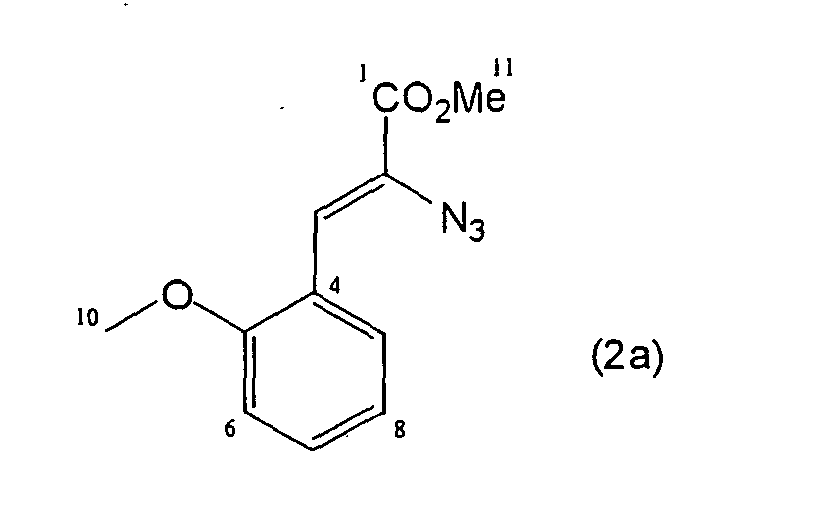
TLC: (hexane-AcOEt: 8-2) Rf=0.51
1H NMR (300 M Hz), δ: 3.87 (s, 3H, H-11), 3.91 (s, 3H, H-10), 6.89 (d, J=7.9 Hz, 1H, H-6), 6.99 (t, J=7.7 Hz, 1H, H-8), 7.32(dt, J=7.9 Hz, J=1.5 Hz, 1H, H-7), 7.40(s, 1H, H-3), 8.19(dd, J=7.7 Hz, J=1.5 Hz, 1H, H-9).
13C NMR (75MHz), δ: 52.81(C-10), 55.57 (C-11), 110.44 (C-6), 119. 64, 120.35(C-3,8), 122.02(C-4), 125.05(C-2), 130.56, 130.85(C-7,9), 157.56(C-5), 164.23(C-1).
TLC: (hexane-AcOEt: 8-2) Rf=0.53
1H NMR (300 M Hz), δ: 3. 84 (s, 3H, H-11), 3. 91 (s, 3H, H-10), 6.89(s, 1H, H-3), 6.92(m, 1H, H-7), 7.30(s, 1H, H-5), 7.33(m, 1H, H-9), 7.43(m, 1H, H-8).
13C NMR (75 M Hz), δ: 52.91(C-10), 55.29(C-11), 115.34, 115.48(C-5,7), 123.40(C-9), 125.43(C-3), 125.53(C-2), 129.39(C-8), 134.34(C-4), 159.44(C-6), 163.96(C-1).
TLC: (hexane-AcOEt: 8-2) Rf=0.51
1H NMR (300 M Hz), δ: 3.84(s, 3H, H-11), 3.89(s, 3H, H-10), 6.89(s, 1H, H-3), 6.91(d, J=9.1 Hz, 1H, H-5,9), 7.79(d, J=9.1 Hz, 1H, H-6,8).
13C NMR (75 MHz), δ: 52.73(C-10), 55.31(C-11), 113.92(C-6,8), 123.07(C-4), 125.69(C-3), 125.96(C-2), 132.39(C-5,9), 160.50(C-5), 164.25(C-1).

TLC: (hexane-AcOEt: 8-2) Rf=0.26
1H NMR (300 M Hz), δ: 3.95(s, 3H, H-9), 3.96(s, 3H, H-10), 6.51(d, J=8.1 Hz, 1H, H-5), 7.03(d, J=8.1 Hz, 1H, H-7), 7.24(t, J=8.1 Hz, 1H, H-6), 7.36(s, 1H, H-3), 9.17(s, 1H, H-1).
13C NMR (75 M Hz), δ: 51.95(C-9), 55.32(C-10), 99.74(C-5), 104.84(C-7), 106.51(C-3), 118.96(C-3'), 125.78(C-2), 126.45(C-6), 138.31(C-7'), 154.61(C-4), 162.51(C-8).
TLC: (hexane-CH2Cl2: 5-5) Rf=0.11
1H NMR (300MHz), δ: 3. 85 (s, 3H, H-10), 3.94(s, 3H, H-9), 7.00(dd, J=8.9 Hz, J=2.2 Hz, 1H, H-6), 7.08(d, J=2.2 Hz, 1H, H-4), 7.14(s, 1H, H-3), 7.32(d, J=8.9 Hz, 1H, H-7), 8.91(s, 1H, H-1).
13C NMR (75 M Hz), δ: 51.94(C-9), 55.66(C-10), 102.52(C-4), 108.32(C-3), 112.75(C-6), 117.09(C-7), 127.47(C-2), 127.81(C-3'), 132.21(C-7'), 154.72(C-5), 162.35(C-8).
TLC: (hexane-AcOEt: 8-2) Rf=0.19
1H NMR (300 M Hz), δ: 3. 85 (s, 3H, H-9), 3.94 (s, 3H, H-10), 6.83 (dd, J=9.5 Hz, J=2.2 Hz, 1H, H-5), 6.84(s, 1H, H-3), 7.17(d, J=2.2 Hz, 1H, H-7), 7.55(d, J=9.5 Hz, 1H, H-4), 9.02(s, 1H, H-1).
13C NMR (75 M Hz), δ: 51.83(C-9), 55.45(C-10), 93.71(C-7), 109.18(C-3), 112.34(C-5), 121.81(C-3'), 123.38(C-4), 125.99(C-2), 138.03(C-7'), 158.90(C-6), 162.50(C-8).
TLC: (hexane-CH2Cl2: 5-5) Rf=0.30
1H NMR (300 M Hz), δ: 3.95(s, 3H, H-9), 3.98(s, 3H, H-10), 6.74(d, J=7. 9 Hz, 1H, H-6), 7.08(t, J=7.9Hz, 1H, H-5), 7.21(s, 1H, H-3), 7.29(d, J=7.9 Hz, 1H, H-4), 9.09(s, 1H, H-1).
13C NMR (75 M Hz), δ: 52.05(C-9), 55.50(C-10), 104.24(C-6), 109.05(C-3), 114.89(C-5), 121.31(C-4), 126.93(C-7'), 128.23(C-3'), 128.71(C-2), 146.58(C-7), 162.32(C-8).
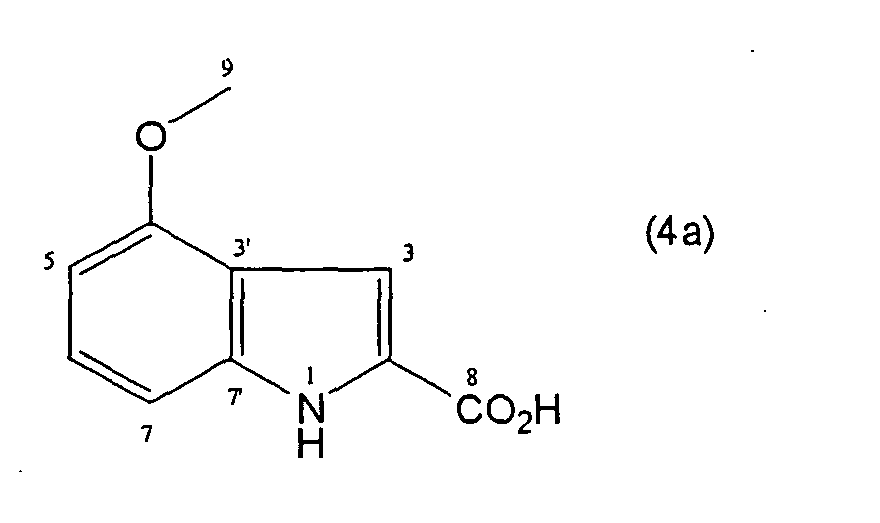
1H NMR (300MHz), δ: 3. 91 (s, 3H, H-9), 6.55(d, J=7.9 Hz, 1H, H-5), 7.06(d, J=7.9 Hz, 1H, H-7), 7.09(s, 1H, H-3), 7.19(t, J=7.9 Hz, 1H, H-6), 11.79(s, 1H, H-1), 12.87(s, 1H, H-8).
13C NMR (75MHz), δ: 55.40(C-9), 99.67(C-5), 104.87, 105.83(C-3,7), 118.38(C-3'), 125.76(C-6), 127.42(C-2), 138.92(C-7'), 154.09(C-4), 162.97(C-8).
1H NMR (300 M Hz), δ: 3.79(s, 3H, H-9), 6.93(dd, J=8.9 Hz, J=2.2 Hz, 1H, H-6), 7.03(s, 1H, H-3), 7. 13 (d, J=2.2 Hz, 1H, H-4), 7.36(d, J=8.9 Hz, 1H, H-7), 11.64(s, 1H, H-8), 12.86(s, 1H, H-1).
13C NMR (75 M Hz), δ: 55.12(C-9), 101.89(C-4), 106.84(C-3), 113.26(C-6), 115.70(C-7), 127.06(C-2), 128.52(C-3'), 132.48(C-7'), 153.73(C-4), 162.65(C-8).
1H NMR (300 M Hz), δ: 3.81(s, 3H, H-9), 6.75(dd, J=8.8 Hz, J=1.9 Hz, 1H, H-5), 6.90(s, 1H, H-3), 7.05(d, J=1.9 Hz, 1H, H-7), 7.55(d, J=8.8 Hz, 1H, H-4), 11.58(s, 1H, H-1), 12.73(s, 1H, H-8).
13C NMR (75 M Hz), δ: 55.00(C-9), 93.85(C-7), 107.70(C-3), 111.48(C-5), 121.10(C-3'), 122.68(C-4), 127.09(C-2), 138.22(C-7'), 157.60(C-6), 162.62(C-8).
1H NMR (300 M Hz), δ: 3. 94 (s, 3H, H-9), 6. 80 (d, J=7.8 Hz, 1H, H-6), 7.02(d, J=7.8 Hz, 1H, H-5), 7.11(s, 1H, H-3), 7.25(d, J=7.8 Hz, 1H, H-3), 11.65(s, 1H, H-8), 12.82(s, 1H, H-1).
13C NMR (75 M Hz), δ: 56.24(C-9), 105.02(C-6), 109.09(C-3), 115.12(C-5), 121.55(C-4), 129.06, 129.24, 129.53(C-2,3',7'), 147.65(C-7), 163.46(C-8).

TLC: (hexane-AcOEt: 8-2) Rf=0.4
1H NMR (300 M Hz), δ: 3.99(s, 3H, H-8), 6.57(d, J=7.9 Hz, 1H, H-5), 6.70(t, J=2.5 Hz, 1H, H-3), 7.03(t, J=7.9 Hz, 1H, H-7), 7.10(t, J=2.5Hz, 1H, H-2), 7.16(t, J=7.9Hz, 1H, H-6), 8.13(s, 1H, H-1).
13C NMR (75MHz), δ: 53.34 (C-8), 99. 59, 99.79(C-3,5), 104.52(C-7), 118.56(C-3'), 122.73, 122.78(C-2,6), 137.25(C-7'), 153.39(C-4).
TLC: (hexane-AcOEt: 8-2) Rf=0.39
1H NMR (300 M Hz), δ: 3.87(s, 3H, H-8), 6.50 (t, J=2, 8 Hz, 1H, H-3), 6. 89 (dd, J=8.8 Hz, J=2. 4 Hz, 1H, H-6), 7.13(d, J=2.4 Hz, 1H, H-4), 7.19(t, J=2.8 Hz, 1H, H-2), 7.28(d, J=8.8 Hz, 1H, H-7), 8.06(s, 1H, H-1).
13C NMR (75 M Hz), δ: 55.86(C-8), 102.34, 102.37(C-3,6), 111.70(C-4), 112.35(C-7), 124.87(C-2), 130.12(C-3'), 130.97(C-7'), 154.20(C-5).
TLC: (hexane-AcOEt: 8-2) Rf=0.38
1H NMR (300 M Hz), δ: 3. 87 (s, 3H, H-8), 6. 52 (d, J=2. 6 Hz, 1H, H-3), 6.85(m, 2H, H-5, 7), 7.08(t, J=2.6 Hz, 1H, H-2), 7.55(d, J=9.1 Hz, 1H, H-4), 7.99(s, 1H, H-1).
13C NMR (75 M Hz), δ: 55.68(C-8), 94.57(C-7), 102.39(C-3), 109.91(C-5), 121.26(C-4), 122.15(C-3'), 123.09(C-2), 136.55(C-7'), 156.40(C-6).
TLC: (hexane-AcOEt: 8-2) Rf=0.45
1H NMR (300 M Hz), δ: 3.98(s, 3H, H-8), 6.56 (t, J=2.7 Hz, 1H, H-3), 6.67(d, J=7.7 Hz, 1H, H-6), 7.06(t, J=7.7 Hz, 1H, H-5), 7.19(t, J=2.7Hz, 1H, H-2), 7.29(d, J=7.7Hz, 1H, H-4), 8.39(s, 1H, H-1).
13C NMR (75 M Hz), δ: 57.63(C-8), 104.04(C-6), 105.21(C-3), 115.76(C-5), 122.47(C-4), 125.98(C-2), 128.79(C-3'), 131.52(C-7'), 148.52(C-7).
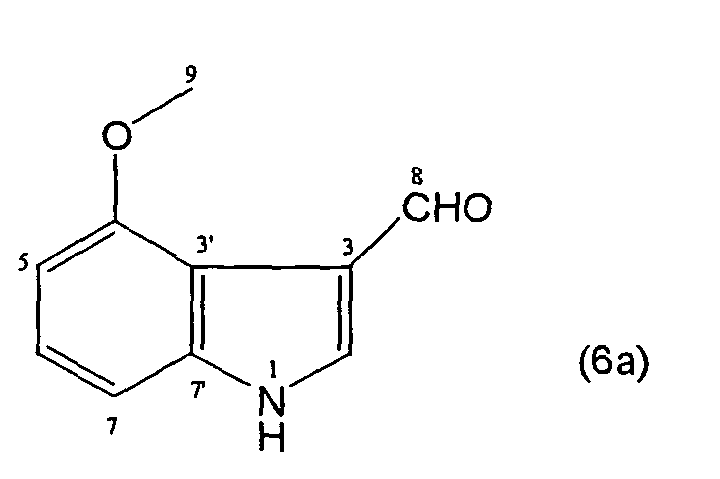
TLC: (hexane-AcOEt: 6-4) Rf=0.24
1H NMR (300 M Hz), δ: 4.00 (s, 3H, H-9), 6.72 (d, J=8.1 Hz, 1H, H-5), 7.09(d, J=8.1 Hz, 1H, H-7), 7.21(t, J=8.1 Hz, 1H, H-6), 7. 92 (d, J=3.1 Hz, 1H, H-2), 9.36(s, 1H, H-1), 10.50(s, 1H, H-8).
13C NMR (75 M Hz), δ: 55.24(C-9), 102.18(C-5), 105.74(C-7), 115.49(C-3), 118.03(C-3'), 123.46(C-6), 129.53(C-2), 137.82(C-7'), 153.75(C-4), 186.24(C-8).
TLC: (hexane-AcOEt: 5-5) Rf=0.30
1H NMR (200 M Hz), δ: 3.83(s, 3H, H-9), 6.92(dd, J=8.9 Hz, J=2.5 Hz, 1H, H-6), 7.44(d, J=8.9 Hz, 1H, H-7), 7.63(d, J=2.5 Hz, 1H, H-4), 8.25(s, 1H, H-2), 9.93(s, 1H, H-8), 12.06(s, 1H, H-1).
13C NMR (50 M Hz), δ: 55.22(C-9), 102.46(C-4), 113.10, 113.19(C-6,7), 117.97(C-3), 124.82(C-3'), 131.73(C-7'), 138.29(C-2), 155.57(C-5), 184.72(C-8).
TLC: (hexane-AcOEt: 6-4) Rf=0.14
1H NMR (300 M Hz), δ: 3. 82 (s, 3H, H-9), 6.85(dd, J=8.6 Hz, J=2.2 Hz, 1H, H-5), 6.99(d, J=2.2 Hz, 1H, H-7), 7.98(d, J=8.6 Hz, 1H, H-4), 8.05(s, 1H, H-2), 9.89(s, 1H, H-8), 12.08(s, 1H, H-1).
13C NMR (75 M Hz), δ: 55.03(C-9), 95.24(C-7), 111.56(C-5), 117.94, 118.24(C-3,3'), 121.34(C-4), 137.00(C-2), 137.92(C-7'), 156.66(C-6), 184.25(C-8).
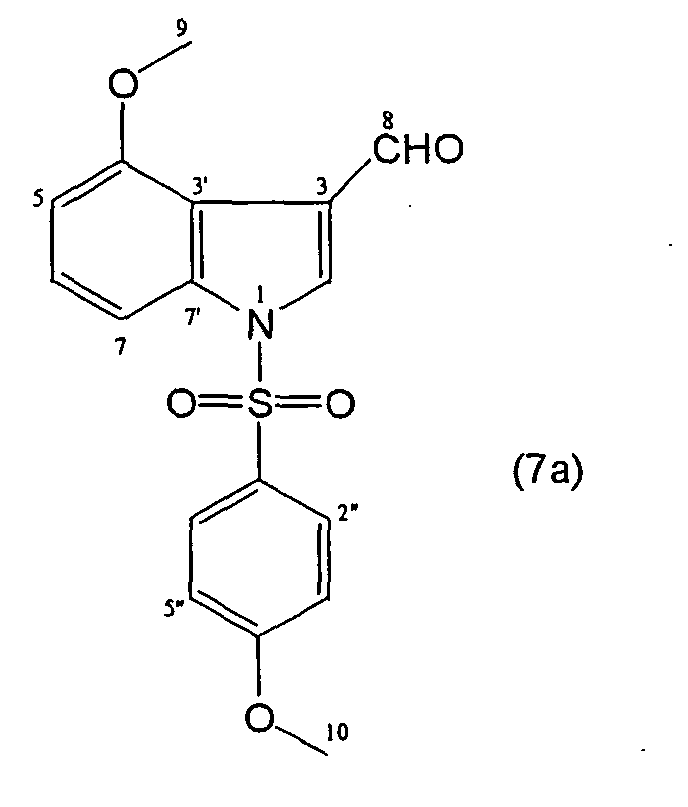
TLC: (hexane-AcOEt: 6-4) Rf=0.45
1H NMR (300 M Hz), δ: 3.84(s, 3H, H-9), 3.95(s, 3H, H-10), 6. 99 (d, J=8.2Hz, 1H, H-5), 7.15(d, J=9. 0 Hz, 2H, H-3",5"), 7.41(t, J=8.2 Hz, 1H, H-6), 7.61(d, J=8.2 Hz, 1H, H-7), 8.12(d, J=9.0 Hz, 2H, H-2",6"), 8.40(s, 1H, H-2), 10.40(s, 1H, H-8).
13C NMR (75 M Hz), δ: 55.71, 55,90(C-9,10), 105. 47, 105.97(C-5,7), 115.21(C-3",5"), 116.43(C-3'), 121.43(C-3), 126.82(C-6), 127.20(C-7'), 129.14(C-2), 129.86(C-2",6"), 135.28(C-1"), 153.88(C-4), 164.32(C-4"), 186.98(C-8).
TLC: (hexane-AcOEt: 5-5) Rf=0.57
1H NMR (300 M Hz), δ: 3. 81 (s, 3H, H-9), 3. 84 (s, 3H, H-10), 6. 93 (d, J=8.9 Hz, 2H, H-3",5"), 6.99(dd, J=9.1 Hz, J=2.5 Hz, 1H, H-6), 7.71(d, J=2.5 Hz, 1H, H-4), 7.81(d, J=9.1 Hz, 1H, H-7), 7.88(d, J=8.9 Hz, 2H, H-2",6"), 8.17(s, 1H, H-2), 10.05(s, 1H, H-8).
13C NMR (75 M Hz), δ: 55. 82 (C-9,10), 104.12(C-4), 114.14(C-6), 114.94(C-3",5"), 116.16(C-7), 122.21(C-3), 127.40(C-3'), 128.70(C-7'), 129.57(C-2",6"), 135.23(C-1"), 136.69(C-2), 157.80(C-5), 164.51(C-4"), 185.51(C-8).
TLC: (hexane-AcOEt: 6-4) Rf=0.39
1H NMR (300 M Hz), δ: 3. 85 (s, 3H, H-9), 3. 99 (s, 3H, H-10), 7.07(dd, J=8.8 Hz, J=2.2 Hz, 1H, H-5), 7.18(d, J=8.9 Hz, 2H, H-3",5"), 7.44(d, J=2.2 Hz, 1H, H-7), 8.01(d, J=8.8 Hz, 1H, H-4), 8.10(d, J=8.9 Hz, 2H, H-2",6"), 8.77(s, 1H, H-2), 10.05(s, 1H, H-8).
13C NMR (75 M Hz), δ: 55.55, 55.88(C-9,10), 97.23(C-7), 113.53(C-5), 115.32(C-3",5"), 119.12(C-3'), 121.48(C-3), 122.41(C-4), 127.23(C-7'), 129.69(C-2",6"), 135.42(C-1"), 137.32(C-2), 158.21(C-6), 164.30(C-4"), 186.53(C-8).
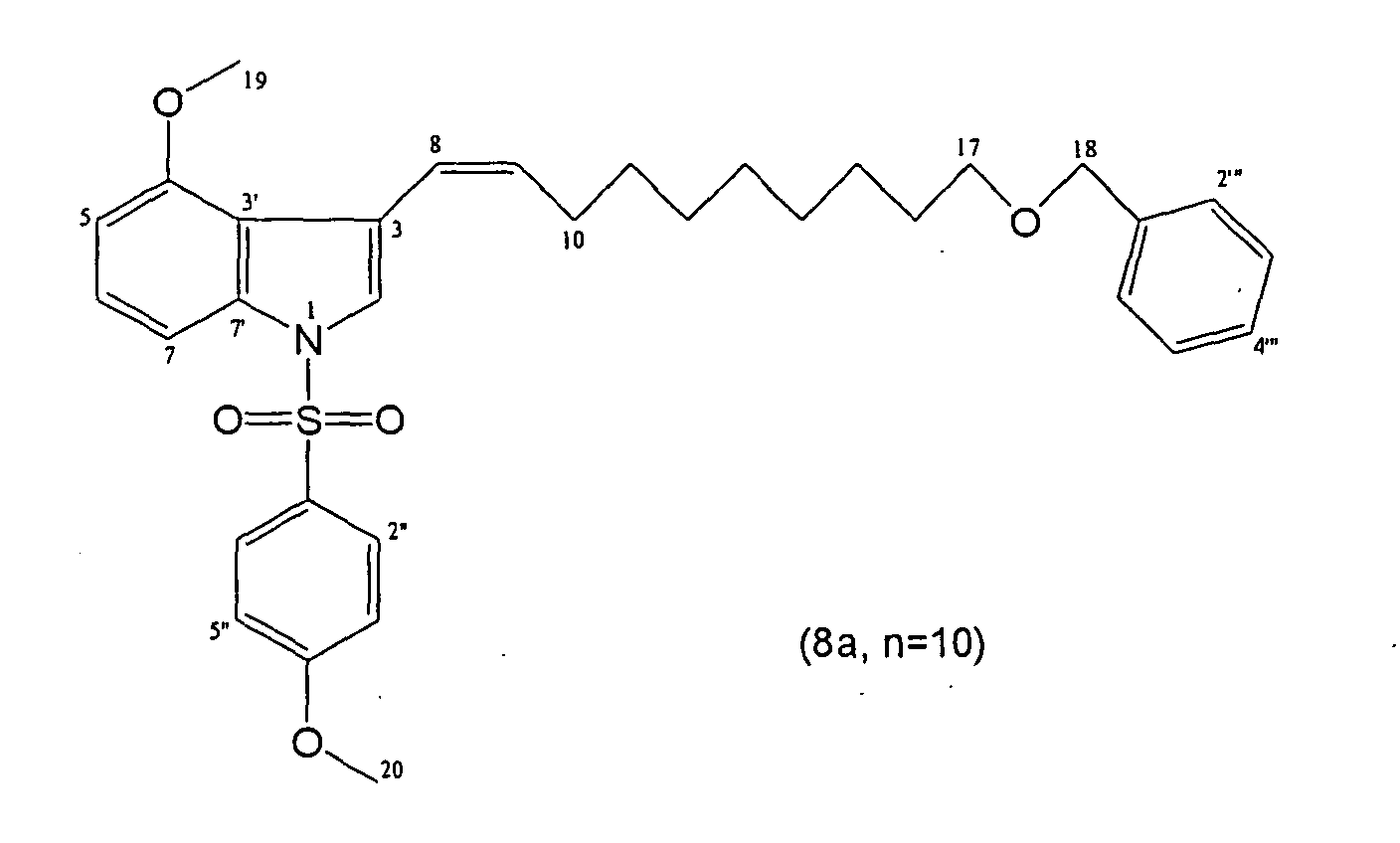
TLC: (hexane-AcOEt: 8-2) Rf=0.40
1H NMR (300 M Hz), δ: 1.33(sbr, 8H, H-12 to 15), 1.47(m, 2H, H-16), 1.62(m, 2H, H-11), 2.32(q, J=6.9 Hz, 2H, H-10), 3.47(t, J=6.9 Hz, 2H, H-17), 3.77 (s, 3H, H-19), 3.86(s, 3H, H-20), 4.51(s, 2H, H-18), 5.70(dt, J=10.6 Hz, J=6.9Hz, 1H, H-9), 6.63(d, J=7. 8 Hz, 1H, H-5), 6.80(d, J=10.6 Hz, 1H, H-8), 6.86(d, J=8.9 Hz, 2H, H-3",5"), 7.16-7.37(m, 6H, H-7, H-2''' to 6'''), 7.38(s, 1H, H-2), 7.58(t, J=7.8 Hz, 1H, H-6), 7.80(d, J=8.9 Hz, 2H, H-2",6").
13C NMR (75 M Hz), δ: 26.16(C-10), 29.18-29.76 (C-11 to 16), 55. 36, 55.58(C-19,20), 70. 49 (C-17), 72.84(C-18), 103. 87, 104.05(C-3,5), 106.57(C-7), 114.36(C-3",5"), 119.47(C-3'), 120.53(C-2), 122.46 (C-6), 125.58 (C-8), 127.43 (C-4'''), 127.60(C-2''', 6'''), 128.31(C-2",6"), 129.01(C-3''',5'''), 131.69(C-1"), 132.71(C-9), 136.56(C-7'), 138.71(C-1'''), 154.87(C-4), 163.65(C-4").
TLC: (hexane-AcOEt: 7-3) Rf=0.49
1H NMR (200 MHz), δ: 1.31 (s br, 8H, H-12 to 15), 1.48 (m, 2H, H-16), 1.61(m, 2H, H-11), 2.30(q, J=6.9 Hz, 2H, H-10), 3.46(t, J=6.4 Hz, 2H, H-17), 3.77(s, 3H, H-19), 3.82(s, 3H, H-20), 4.50(s, 2H, H-18), 5.80(dt, J=11.3 Hz, J=6.9 Hz, 1H, H-9), 6.34(d, J=11.3 Hz, 1H, H-8), 6.85(d, J=8.9 Hz, 2H, H-3",5"), 6.89-6.94(m, 2H, H-4,6), 7.33(m, 5H, H-2"' to 6'''), 7.45(s, 1H, H-2), 7.78 (d, J=8.9 Hz, 2H, H-2",6"), 7.87(d, J=9.6 Hz, 1H, H-7).
13C NMR (50 M Hz), δ: 26.24(C-10), 29.52-29.82(C-11 to 16), 55.71(C-19,20), 70.56(C-17), 72.92(C-18), 102.03(C-4), 113.91(C-6), 114.43(C-3",5"), 114.60(C-3), 117.55(C-7), 119.42(C-3'), 124.33(C-2), 127.51(C-8), 127.68(C-2''',6'''), 128.39(C-3''',5'''), 128.99(C-2",6"), 129.23(C-4'''), 129.60(C-7'), 131.86(C-1"), 134.85(C-9), 138.53(C-1'''), 156.35(C-5), 163.73(C-4").
TLC: (hexane-AcOEt: 8-2) Rf=0.32
1H NMR (300 M Hz), δ: 1.31(sbr, 8H, H-12 to 15), 1.48(m, 2H, H-16), 1.61(m, 2H, H-11), 2.30(q, J=6.7 Hz, 2H, H-10), 3.46(t, J=6.6 Hz, 2H, H-17), 3.78 (s, 3H, H-19), 3.88(s, 3H, H-20), 4.50(s, 2H, H-18), 5.79(dt, J=11.5 Hz, J=6.7 Hz, 1H, H-9), 6.35(d, J=11.5 Hz, 1H, H-8), 6.87(d, J=8.9 Hz, 2H, H-3",5"), 6.88(m, 1H, H-5), 7.33(m, 6H, H-4, H-2''' to 6'''), 7.39(s, 1H, H-2), 7.52(d, J=2.0 Hz, 1H, H-7), 7.80(d, J=8.9 Hz, 2H, H-2",6").
13C NMR (75MHz), δ: 26.15(C-10), 29.31-29.75(C-11 to 16), 55.59, 55.79(C-19,20), 70.48(C-17), 72.84(C-18), 97.92(C-7), 112.25(C-5), 114.39(C-3",5"), 117.54(C-4), 119.23(C-3), 120.02(C-2), 122.16(C-8), 124.73(C-3'), 127.43-128.92(C-2",6", C-2''' to 6'''), 129.64(C-1"), 134.73(C-9), 135.60(C-7'), 138.71(C-1'''), 158.09(C-5), 163.70(C-4").
| R | X=- (CH2)nOH n | Formula | MW | Yield | |
| 8a | 4-MeO | 10 | C33H39NO5S | 561.73 | 74% |
| 12 | C35H43NO5S | 589.79 | 71% | ||
| 14 | C37H47NO5S | 617.84 | 45% | ||
| 16 | C39H51NO5S | 645.89 | 69% | ||
| 18 | C41H55NO5S | 673.95 | 68% | ||
| 8b | 5-MeO | 10 | C33H39NO5S | 561.73 | 65% |
| 12 | C35H43NO5S | 589.79 | 62% | ||
| 14 | C37H47NO5S | 617.84 | 84% | ||
| 16 | C39H51NO5S | 645.89 | 94% | ||
| 18 | C41H55NO5S | 673.95 | 71% % | ||
| 8c | 6-MeO | 10 | C33H39NO5S | 561.73 | 91% |
| 12 | C35H43NO5S | 589.79 | 78% |

TLC: (hexane-AcOEt: 7-3) Rf=0.13
1H NMR (300 M Hz), δ: 1.27(s br, 12H, H-10 to 15), 1.59(m, 4H, H-9,16), 2.76(t, J=7.3 Hz, 2H, H-8), 3.64(t, J=6.2 Hz, 2H, H-17), 3.78(s, 3H, H-18), 3.85(s, 3H, H-19), 6.61(d, J=8.2 Hz, 1H, H-5), 6.85(d, J=8.9 Hz, 2H, H-3",5"), 7.15(s, 1H, H-2), 7.18 (t, J=8.2 Hz, 1H, H-6), 7.56(d, J=8.2 Hz, 1H, H-7), 7.77(d, J=8.9 Hz, 2H, H-2", 6").
13C NMR (75MHz), δ: 25.72(C-15), 26.85(C-9), 29.34-29.80(C-8,10 to 14), 32.79(C-16), 55.18, 55.55(C-18,19), 63.09(C-17), 103.55(C-5), 106.62(C-7), 114.25(C-3",5"), 120.59(C-3), 121.24(C-6), 124.10(C-3'), 125.27(C-2), 128.93(C-2",6"), 129.83(C-1"), 136.95(C-7'), 154.62(C-4), 163.50(C-4").
1H NMR (200 M Hz), δ: 1.29(s br, 12H, H-10 to 15), 1.60(m, 4H, H-9,16), 2.58(t, J=7.4 Hz, 2H, H-8), 3.64(t, J=6.4 Hz, 2H, H-17), 3.77(s, 3H, H-18), 3.82(s, 3H, H-19), 6.83(d, J=8.9 Hz, 2H, H-3",5"), 6.88-6.93(m, 2H, H-4, 6), 7.24(s, 1H, H-2), 7.86(d, J=9. 6 Hz, 1H, H-7), 7.75(d, J=8.9 Hz, 2H, H-2",6").
13C NMR (50 M Hz), δ: 24.92(C-15), 25.79(C-9), 28.71(C-8), 29.42-29.59(C-10 to 14), 32.85(C-16), 55.63, 55.76(C-18,19), 63.10(C-17), 102.31(C-4), 113.20(C-6), 114.31(C-3",5"), 114.74(C-7), 123.56(C-2), 123.95(C-3), 128.92(C-2",6"), 129.87(C-7'), 130.19(C-3'), 132.35(C-1"), 156.31(C-5), 163.58(C-4").
TLC: (hexane-AcOEt: 7-3) Rf=0.21
1H NMR (300 M Hz), δ: 1.28(s br, 12H, H-10 to 15), 1.58 (m, 4H, H-9,16), 2.58(t, J=7.3 Hz, 2H, H-8), 3.63(t, J=6.6Hz, 2H, H-17), 3.78(s, 3H, H-18), 3.87(s, 3H, H-19), 6.85(d, J=8.9 Hz, 2H, H-3",5"), 6.86(m, 1H, H-5), 7.17 (s, 1H, H-2), 7.32 (d, J=8. 6 Hz, 1H, H-4), 7.52(d, J=2.2 Hz, 1H, H-7), 7.77(d, J=8.9 Hz, 2H, H-2",6").
13C NMR (75 M Hz), δ: 24.89(C-15), 25.70(C-9), 28.81(C-8), 29.34-29.52(C-10 to 14), 32.77(C-16), 55.56, 55.78(C-18,19), 63.03(C-17), 98.22(C-7), 111.88(C-5), 114.28(C-3",5"), 119.94(C-4), 121.29(C-2), 123.60(C-3), 125.09(C-3'), 128.85(C-2",6"), 129.84(C-1"), 136.39(C-7'), 157.87(C-6), 163.53(C-4").
| R | X=- (CH2)nOH n | Formula | MW | Yield | |
| 9a | 4-MeO | 10 | C26H35NO5S | 473.63 | 93% |
| 12 | C28H39NO5S | 501.68 | 94% | ||
| 14 | C30H43NO5S | 529.73 | 57% | ||
| 16 | C32H47NO5S | 557.79 | 47% | ||
| 18 | C34H51NO5S | 585.84 | 50% | ||
| 9b | 5-MeO | 10 | C26H35NO5S | 473.63 | 84% |
| 12 | C28H39NO5S | 501.68 | 95% | ||
| 14 | C30H43NO5S | 529.73 | 91% | ||
| 16 | C32H47NO5S | 557.79 | 91% | ||
| 18 | C34H51NO5S | 585.84 | 94% | ||
| 9c | 6-MeO | 10 | C26H35NO5S | 473.63 | 80% |
| 12 | C28H39NO5S | 501.68 | 85% |
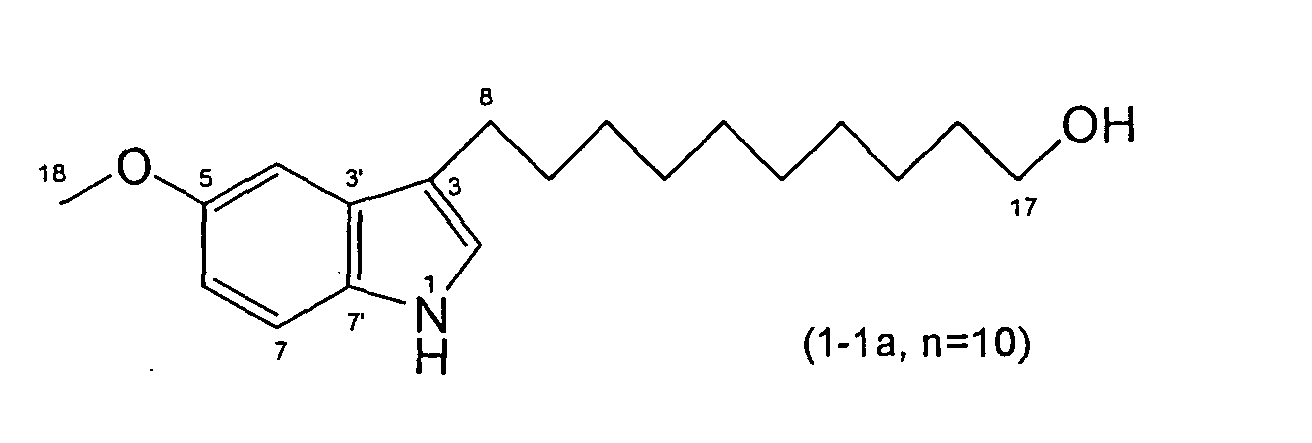
TLC: (hexane-AcOEt: 6-4) Rf=0.38
1H NMR (200 M Hz), δ: 1.30(s br, 12H, H-10 to 15), 1.57(m, 2H, H-16), 1.71(m, 2H, H-9), 2.71(t, J=7.4Hz, 2H, H-8), 3.64(t, J=6.4 Hz, 2H, H-17), 3.88(s, 3H, H-18), 6.85(dd, J=8.9 Hz, J=2.2 Hz, 1H, H-6), 6.94(s, 1H, H-2), 7.05(d, J=2.2 Hz, 1H, H-4), 7.24(d, J=8.9 Hz, 1H, H-7), 7.86(s, 1H, H-1).
13C NMR (50 M Hz), δ: 25.22(C-15), 25.79(C-9), 29.48-29.64(C-10 to 14), 30.04(C-8), 32.87(C-16), 56.0.8(C-18), 63.15(C-17), 101.15(C-4), 111.75, 111.92(C-6,7), 116.95(C-3), 121.99(C-2), 128.08(C-3'), 131.65(C-7'), 153.82(C-5).
TLC: (hexane-AcOEt: 6-4) Rf=0.43
1H NMR (300 M Hz), δ: 1.31(s br, 12H, H-10 to 15), 1.57(m, 2H, H-16), 1.68(m, 2H, H-9), 2.87(t, J=7.5Hz, 2H, H-8), 3.64(t, J=6.2 Hz, 2H, H-17), 3.92(s, 3H, H-18), 6.48(d, J=7.8 Hz, 1H, H-5), 6.82(s, 1H, H-2), 6.94(d, J=7.8 Hz, 1H, H-7), 7.07(t, J=7.8 Hz, 1H, H-6), 7.88(s, 1H, H-1).
13C NMR (75 M Hz), δ: 25.73 (C-15), 26.87 (C-9), 29.43-29.60(C-10 to 14), 31.15(C-8), 32.79(C-16), 55.08(C-18), 63.10(C-17), 99.25(C-7), 104.32(C-5), 117.46(C-3), 117.84(C-3'), 119.68(C-6), 122.52(C-2), 138.10(C-7'), 155.02(C-4).
TLC: (hexane-AcOEt: 7-3) Rf=0.25
1H NMR (300 M Hz), δ: 1.27(s br, 12H, H-10 to 19), 1.57(m, 2H, H-20), 1.68(m, 2H, H-9), 2.86(t, J=7.3Hz, 2H, H-8), 3.64(t, J=6.4 Hz, 2H, H-21), 3.92(s, 3H, H-22), 6.47(d, J=7.8 Hz, 1H, H-5), 6.82(s, 1H, H-2), 6.94(d, J=7.8 Hz, 1H, H-7), 7.07(t, J=7.8 Hz, 1H, H-6), 7.88(s, 1H, H-1).
13C NMR (75 M Hz), δ: 25.72 (C-19), 26.88(C-9), 29.42-29.69(C-10 to 18), 31.18(C-8), 32.80(C-20), 55.07(C-22), 63.10(C-21), 99.23(C-7), 104.31(C-5), 117.45(C-3), 117.88(C-3'), 119.65(C-6), 122.52(C-2), 138.08(C-7'), 155.02(C-4).
TLC: (hexane-AcOEt: 7-3) Rf=0.14
1H NMR (300 M Hz), δ: 1.30(s br, 12H, H-10 to 15), 1.56(m, 2H, H-16), 1.69(m, 2H, H-9), 2.71(t, J=7.3Hz, 2H, H-8), 3.64(m, 2H, H-17), 3.85(s, 3H, H-18), 6.79(dd, J=8.6Hz, J=2.2 Hz, 1H, H-5), 6.85(s, 1H, H-2), 6.87(m, 1H, H-7), 7.47(d, J=8.6 Hz, 1H, H-4), 7.81(s, 1H, H-1).
13C NMR (75 M Hz), δ: 25.20(C-15), 25.71(C-9), 29.39-29.57(C-10 to 14), 30.14(C-8), 32.79(C-16), 55.69(C-18), 63.08(C-17), 94.62(C-7), 108.95(C-5), 117.11(C-3), 119.56, 119.71(C-2,4), 122.12(C-3'), 137.04(C-7'), 156.37(C-6).
| R | X=-(CH2)nOH n | Formula | MW | Yield | |
| 1-1b | 4-MeO | 10 | C19H29NO2 | 303.44 | 85% |
| 12 | C21H33NO2 | 331.49 | 82% | ||
| 14 | C23H37NO2 | 359.55 | 99% | ||
| 16 | C25H41NO2 | 387.60 | 92% | ||
| 18 | C27H45NO2 | 415.65 | 96% | ||
| 1-1a | 5-MeO | 10 | C19H29NO2 | 303.44 | 84% |
| 12 | C21H33NO2 | 331.49 | 95% | ||
| 14 | C23H37NO2 | 359.55 | 87% | ||
| 16 | C25H41NO2 | 387.60 | 91% | ||
| 18 | C27H45NO2 | 415.65 | 85% | ||
| 1-1c | 6-MeO | 10 | C19H29NO2 | 303.44 | 84% |
| 12 | C21H33NO2 | 331.49 | 80% | ||
| 14 | C23H37NO2 | 359.55 | 92% | ||
| 16 | C25H41NO2 | 387.60 | 91% |
| R | n | Analysis | |
| 1-1b | 4-Me O | 10 | m.p: 66-67°C UV (acetonitrile): λmax: 225 nm (ε 301465); 270 nm (ε 71091) ; 283 nm (ε 67263) ; 293 nm (ε 68010) MS (EI): 303.4(M+, 25); 160.3(C10H10NO, 100); 130.4(C9H8N, 17) Analysis(%): calculated: C: 75.21, H: 9.63, N: 4.62, O: 10.55 found: C: 75.45, H: 9.71, N: 4.54, O: 10.30 |
| 12 | m.p: 45-46°C UV (acetonitrile): λmax: 226 nm (ε 287495); 270 nm (ε 81272) ; 283 nm (ε 75913) ; 292 nm (ε 73019) MS (EI): 331.4(M+, 32); 160.3(C10H10NO, 100); 130.4(C9H8N, 16) Analysis (%): calculated: C: 76.09, H: 10.03, N: 4.23, O: 9.65 found: C: 76.02, H: 10.10, N: 4.12, O: 9.76 | ||
| 14 | m.p: 48-49°C UV (acetonitrile): λmax: 225 nm (ε 288010) ; 270 nm (ε 66570) ; 283 nm (ε 62650) ; 293 nm (ε 60840) MS (EI): 359.5(M+, 35) ; 160.3(C10H10NO, 100); 130.4(C9H8N, 16) Analysis (%): calculated: C: 76.83, H: 10.37, N: 3.90, O: 8.90 found: C: 77.15, H: 10.52, N: 3.77, O: 8.56 | ||
| 16 | m.p: 53-54°C UV (acetonitrile): λmax: 225 nm (ε 295827); 270 nm (ε 68194); 283 nm (ε 64214); 293 nm (ε 62969) MS (EI): 387.5(M+, 43); 160.3(C10H10NO, 100); 130.3(C9H8N, 15) Analysis (%): calculated: C: 77.47, H: 10.66, N: 3.61, O: 8.26 found: C: 77.62, H: 10.76, N: 3.54, O: 8.08 | ||
| 18 | m.p: 65-66°C UV (acetonitrile): λmax: 225 nm (ε 290535); 270 nm (ε 69000); 283 nm (ε 64861); 293 nm (ε 63535) MS (EI): 415.5(M+, 41); 160.3(C10H10NO, 100); 130.3(C9H8N, 15) Analysis (%): Calculated C: 78.02, H: 10.91, N: 3.37, O: 7.70 found: C: 78.01, H: 10.98, N: 3.29, O: 7.72 |
| R | n | Analysis | |
| 1-1a | 5-Me O | 10 | m.p: 75-76°C UV (acetonitrile): λmax: 206 nm (ε 209091) ; 225 nm (ε 218030) ; 278 nm (ε 57697) ; 297 nm (ε 45465) MS (EI) : 303.4 (M+, 25); 160.3 (C10H10NO, 100); 145.3 (C9H7NO, 7) Analysis (%): calculated: C: 75.21, H: 9.63, N: 4.62, O: 10.55 found: C: 75.59, H: 9.79, N: 4.51, O: 10.11 |
| 12 | m.p: 82-83°C UV (acetonitrile) : λmax: 206 nm (ε 229893); 226 nm (ε 256951); 278 nm (ε 77806); 298 nm (ε 58825) MS (EI) : 331.4 (M+, 28) ; 160.3 (C10H10NO, 100) ; 145.3 (C9H7NO, 6) Analysis (%): calculated: C: 76.09, H: 10.03, N: 4.23, O: 9.65 found: C: 76.43, H: 10.15, N: 4.11, O: 9.31 | ||
| 14 | m.p: 87-88°C UV (acetonitrile): λmax: 207 nm (ε 245040) ; 225 nm (ε 272280); 278 nm (ε 84870); 297 nm (ε 64200) MS (EI): 359.5 (M+, 35); 160.3 (C10H10NO, 100); 145.3 (C9H7NO, 6) Analysis (%): calculated: C: 76.83, H: 10.37, N: 3.90, O: 8.90 found: C: 76.86, H: 10.49, N: 3.81, O: 8.84 | ||
| 16 | m.p: 92-93°C UV (acetonitrile) : λmax: 207 nm (ε 231449) ; 225 nm (ε 249020) ; 278 nm (ε 78327) ; 297 nm (ε 58439) MS (EI) : 387.5 (M+, 35) ; 160.3 (C10H10NO, 100) ; 145.3 (C9H7NO, 5) Analysis (%): calculated: C: 77.47, H: 10.66, N: 3.61, O: 8.26 found: C: 77.76, H: 10.78, N: 3.57, O: 7.89 | ||
| 18 | m.p: 94-95°C UV (acetonitrile) : λmax: 207 nm (ε 250653); 225 nm (ε 285366) ; 278 nm (ε 94624) ; 297 nm (ε 70594) MS (EI) : 415.5 (M+, 38) ; 160.3 (C10H10NO, 100) ; 145.3 (C9H7NO, 5) Analysis (%): Calculated C: 78.02, H: 10.91, N: 3.37, O: 7.70 Found C: 77.88, H: 10.99, N: 3.29, O: 7.84 |
| R | n | Analysis | |
| 1-1c | 6-Me O | 10 | m.p: 88-89°C UV (acetonitrile): λmax: 206 nm (ε 189323); 228 nm (ε 279970); 275 nm (ε 56545); 292 nm (ε 57990) MS (EI): 303.3 (M+, 31); 160.3 (C10H10NO, 100); 145.3 (C9H7NO, 8) Analysis (%): calculated: C: 75.21, H: 9.63, N: 4.62, O: 10.55 found: C: 75.51, H: 9.80, N: 4.48, O: 10.21 |
| 12 | m.p: 95-96°C UV (acetonitrile): λmax: 204 nm (ε 165544); 229 nm (ε 252631); 276 nm (ε 39748); 294 nm (ε 44272) MS (EI) : 331.4 (M+, 32); 160.3 (C10H10NO, 100); 145.3 (C9H7NO, 7) Analysis (%): calculated: C: 76.09, H: 10.03, N: 4.23, O: 9.65 found: C: 76.31, H: 10.16, N: 4.17, O: 9.36 |
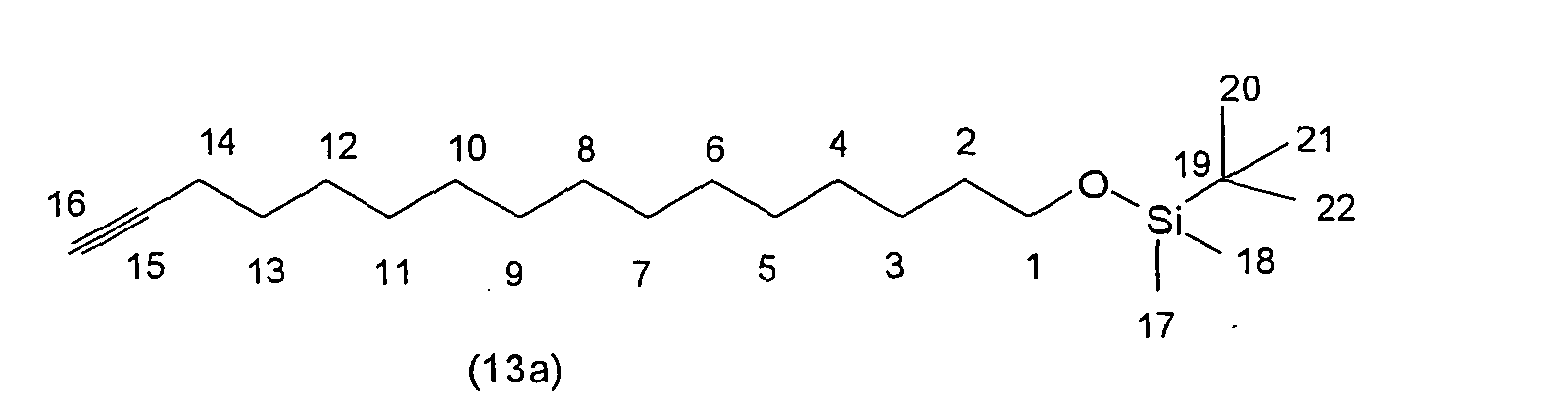
MW: (C22H44OSi) 352.67.
TLC: (hexane-CH2Cl2: 9-1) Rf=0.38.
1H NMR (300 M Hz, CDCl3), δ: 0.04(s, 6H, H-17,18), 0.90(s, 9H, H-20,21,22), 1.25-1.55(m, 24H, H-3 to 13), 1.93(t, J=2.5 Hz, 1H, H-16), 2.15(td, J=7.0 Hz, J=2.7 Hz, 2H, H-14), 3.59(t, J=6.6 Hz, 2H, H-1).
13C NMR (75 M Hz, CDCl3), δ: -5.28(C-17,18), 18.38(C-14), 18.41(C-19), 25.96(C-20,21,22), 28.48-29.61(C-3 to 13), 32.86(C-2), 63.33(C-1), 67.98(C-16), 84.80(C-15).
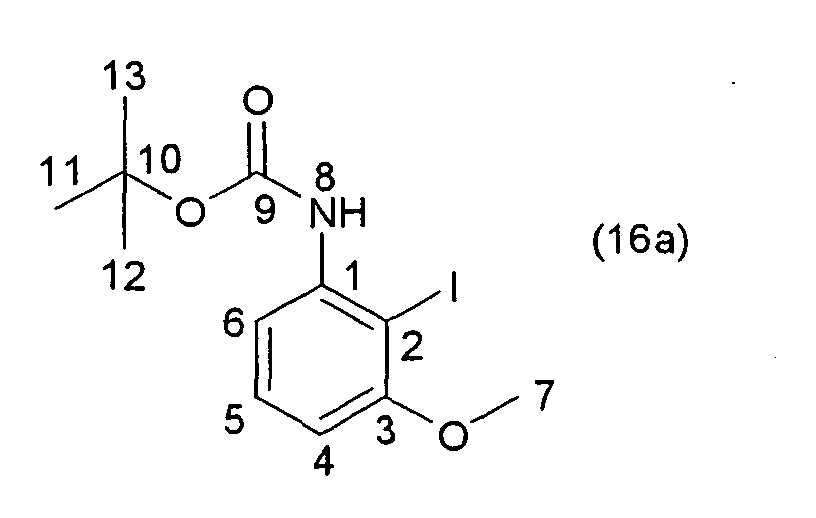
MW: (C12H16INO3) 349.17.
TLC: (hexane-AcOEt: 8-2) Rf=0.59.
m.p.: 69-71°C.
1H NMR (300 M Hz, CDCl3), δ: 1.53(s, 9H, H-11,12,13), 3.88(s, 3H, H-7), 6.53 (dd, J=8.4 Hz, J=1.3 Hz, 1H, H-6), 7.04(s, 1H, H-8), 7.25(td, J=8.4 Hz, J=0.4 Hz, 1H, H-5), 7.73(dd, J=8.4 Hz, J=1.3 Hz, 1H, H-4).
13C NMR (75 M Hz, CDCl3), δ: -28.3(C-11,12,13), 56.5(C-7), 80.95(C-10), 90.10(C-2), 105.40(C-4), 112.5(C-6), 129.63(C-5), 13.76(C-1), 153.39(C-3), 158.23(C-9).

MW: (C34H59NO4Si) 573.92.
TLC: (hexane-AcOEt: 9-1) Rf=0.49.
1H NMR (300 M Hz, CDCl3), δ: 0.04(s, 6H, H-30,31), 0. 89(s, 9H, H-33,34,35), 1.26-1.70(m, 24H, H-17 to 28), 1.50(s, 9H, H-32,33,34), 2.48(t, J=6.9 Hz, 2H, H-16), 3.59(t, J=6.6 Hz, 2H, H-29), 3.76 (s, 3H, H-7), 6.81(m,2H, H-3, 5), 7.07(s, H-8), 7.96(d, J=8.8 Hz, 1H, H-6).
13C NMR (75 M Hz, CDCl3), δ: -5.28(C-30,31), 18.35(C-32), 19.55(C-16), 25.78(C-33,34,35), 25.96(C-27), 28.34-29.64(C-17 to C-26), 32.87(C-28), 55.52(C-7), 63.32(C-29), 76.05(C-14), 80.29(C-10), 97.29(C-15), 115.01(C-5), 116.06(C-6), 118.96(C-3), 133.12(C-1), 152.69(C-4), 154.32(C-9).
| R | Y =-(CH2)nOH n | Yield | |
| 17a | 4-MeO | 14 | 92% |
| 16 | 90% | ||
| 17b | 3-MeO | 14 | 75% |
| 16 | 61% | ||
| 17c | 6-MeO | 14 | 57% |
| 16 | 37% |
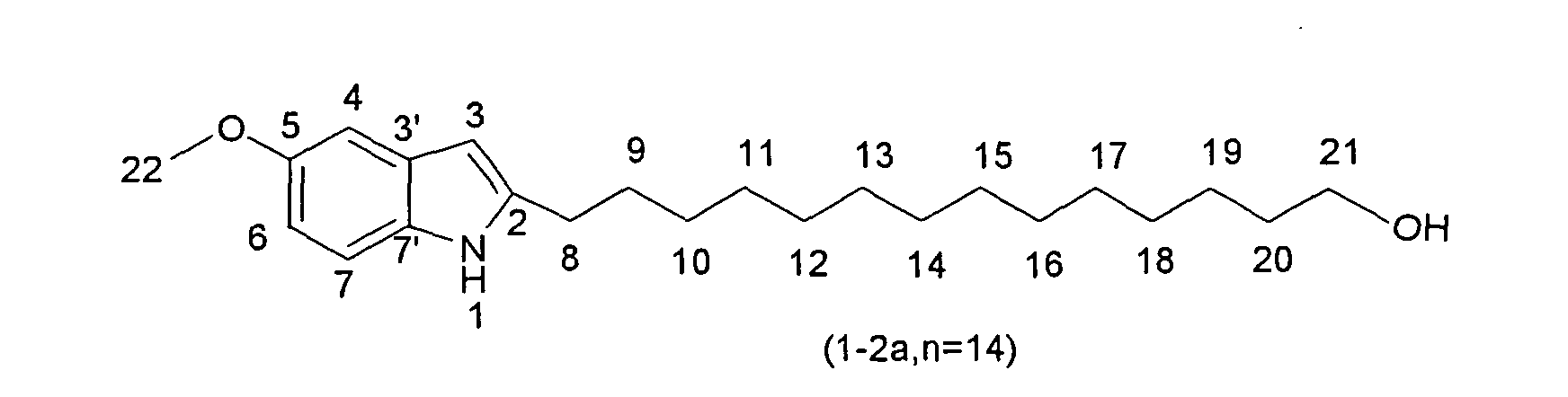
MW: (C23H37NO2) 359.55.
TLC: (hexane-AcOEt: 7-3) Rf=0.3.
m.p.: 68-69°C.
1H NMR (300 M Hz, CDCl3), δ: 1.26(sbr, 20H, H-10 to 19), 1.52-1.72(m, 4H, H-9,20), 2.72(t, J=7.4 Hz, 2H, H-8), 3.64(t, J=6.6 Hz, 2H, H-21), 3.84(s, 3H, H-22), 6.16(s, 1H, H-3), 6.77(dd, J=8.8 Hz, J=2.2 Hz, 1H, H-6), 7.0(d, J=2.2 Hz, 1H, H-4), 7.17(d, J=8.8 Hz, 1H, H-7), 7.78(s, 1H, H-1).
13C NMR (75 M Hz, CDCl3), δ: 25.71(C-19), 28.35(C-8), 29.22-29.58(C-9 to 18), 32.79(C-20), 55.90(C-22), 63.08(C-21), 99.33(C-3), 101.99(C-6), 110.67(C-7), 110.83(C-4), 129.31(C-3'), 130.90(C-7'), 140.89(C-2), 154.07(C-5).
analysis (%): calculated in terms of C23H37NO2: C=76.83, H=10.37, N=3.9
found: C=76.99, H=10.51, N=3.82.
MW: (C25H41NO2) 387.60
TLC: (hexane-AcOEt: 7-3) Rf=0.29.
1H NMR (300 M Hz, CDCl3), δ: 1.26(s br, 24H, H-10 to 21), 1.52-1.72(m, 4H, H-9,22), 2.72(t, J=7.4 Hz, 2H, H-8), 3.64(t, J=6.6 Hz, 2H, H-23), 3.84(s, 3H, H-24), 6.16(s, 1H, H-3), 6.76(dd, J=8.8 Hz, J=2.2 Hz, 1H, H-6), 7.01(d, J=2.2 Hz, 1H, H-4), 7.17(d, J=8.8 Hz, 1H, H-7), 7.77(s, 1H, H-1).
13C NMR (75 M Hz, CDCl3), δ: 25.71(C-21), 28.35(C-8), 29.22-29.58(C-9 to 20), 32.79(C-22), 55.90(C-24), 63.08(C-23), 99.33(C-3), 101.99(C-6), 110.67(C-7), 110.83(C-4), 129.31(C-3'), 130.90(C-7'), 140.89(C-2), 154.07(C-5).
analysis (%): calculated in terms of C25H41NO2: C=77. 47, H=10.66, N=3.61
found: C=77.64, H=10.84, N=3.43.
MW: (C23H37NO2) 359.55
TLC: (hexane-AcOEt: 7-3) Rf=0.37.
1H NMR (300MHz, CDCl3), δ: 1.26(sbr, 20H, H-10 to 19), 1.52-1.75(m, 4H, H-9,20), 2.73(t, J=7.6 Hz, 2H, H-8), 3.64(t, J=6.9 Hz, 2H, H-21), 3.95(s, 3H, H-22), 6.33(s, 1H, H-3), 6.50(d, J=7.9 Hz, 1H, H-5), 6.93(d, J=7.9 Hz, 1H, H-7), 7.04(t, J=7.9 Hz, 1H, H-6), 7.91(s, 1H, H-1).
13C NMR (75 M Hz, CDCl3), δ: 25.71(C-19), 28.18(C-8), 29.19-29.59(C-9 to 18), 32.79(C-20), 55.29(C-22), 63.10(C-21), 96.46(C-3), 99.58(C-7), 103.86(C-5), 119.14(C-3'), 121.59(C-6), 137.10(C-7'), 138.45(C-2), 152.59(C-4).
analysis (%): calculated in terms of C23H37NO2: C=76.83, H=10.37, N=3.9
found: C=76.90, H=10.45, N=3.79.
MW: (C25H41NO2) 387.60
TLC: (hexane-AcOEt: 7-3) Rf=0.37.
1H NMR (300 MHz, CDCl3), δ: 1.25(sbr, 24H, H-10 to 21), 1.52-1.73(m, 4H, H-9,22), 2.73(t, J=7.6 Hz, 2H, H-8), 3.64(t, J=6.9 Hz, 2H, H-23), 3.94(s, 3H, H-24), 6.33(s, 1H, H-3), 6.50(d, J=7.9 Hz, 1H, H-5), 6.93(d, J=7.9 Hz, 1H, H-7), 7.03(t, J=7.9 Hz, 1H, H-6), 7.89(s, 1H, H-1).
13C NMR (75 M Hz, CDCl3), δ: 25.72(C-21), 28.18(C-8), 29.19-29.62(C-9 to 20), 32.79(C-22), 55.29(C-24), 63.10(C-23), 96. 47 (C-3), 99.58(C-7), 103. 85 (C-5), 119.14(C-3'), 121.59(C-6), 137.11(C-7'), 138.45(C-2), 152.59 (C-4).
analysis (%): calculated in terms of C25H41NO2: C=77.47, H=10. 66, N=3.61
found: C=77.40, H=10.82, N=3.46.
MW: (C23H37NO2) 359.55
TLC: (hexane-AcOEt: 7-3) Rf=0.48.
1HNMR (300MHz, CDCl3), δ: 1.26 (sbr, 20H, H-10 to 19), 1.52-1.73(m, 4H, H-9,20), 2.74(t, J=7.7 Hz, 2H, H-8), 3.64(t, J=6.6 Hz, 2H, H-21), 3.95(s, 3H, H-22), 6.21(s, 1H, H-3), 6.58(d, J=7.8 Hz, 1H, H-6), 6. 98 (t, J=7.8 Hz, 1H, H-5), 7.14(d, J=7.8 Hz, 1H, H-4), 8.12 (s, 1H, H-1).
13C NMR (75 M Hz, CDCl3), δ: 25.72(C-19), 28.05(C-8), 28.88-29.59(C-9 to 18), 32.79(C-20), 55.21(C-22), 63.09(C-21), 99.75(C-3), 101.07(C-6), 112.63(C-4), 119.80(C-5), 122.58(C-3'), 130.08(C-7'), 139.60(C-2), 145.50(C-7).
analysis (%): calculated in terms of C23H37NO2: C=76.83, H=10.37, N=3.9
found: C=75.51, H=10.30, N=3.40.
MW: (C25H41NO2) 387.60
TLC: (hexane-AcOEt: 7-3) Rf=0.49.
1HNMR (300MHz, CDCl3), δ: 1.26(sbr, 24H, H-10 to 21) , 1.52-1.73 (m, 4H, H-9,22), 2.74(t, J=7.7 Hz, 2H, H-8), 3.64(t, J=6.6 Hz, 2H, H-23), 3.95(s, 3H, H-24), 6.20(s, 1H, H-3), 6.58(d, J=7.8 Hz, 1H, H-6), 6. 98 (t, J=7.8 Hz, 1H, H-5), 7.14 (d, J=7.8 Hz, 1H, H-4), 8.13(s, 1H, H-1).
13C NMR (75 M Hz, CDCl3), δ: 25.72(C-21), 28.23(C-8), 29.27-29.61(C-9 to 20), 32.79(C-22), 55.24(C-24), 63.09(C-23), 99.76(C-3), 101.04(C-6), 112.62(C-4), 119.80(C-5), 122.59(C-3'), 130.06(C-7'), 139.62(C-2), 145.52(C-7).
analysis (%): calculated in terms of C25H41NO2: C=77.47, H=10. 66, N=3.61
found: C=77.65, H=10.92, N=3.32.
| R | Y =-(CH2)nOH n | Yield | |
| 1-2a | 5-MeO | 14 | 81% |
| 16 | 77% | ||
| 1-2b | 4-MeO | 14 | 84% |
| 16 | 76% | ||
| 1-2c | 7-MeO | 14 | 66% |
| 16 | 58% |
| R | X=-(CH2)nOH n | Y=-(CH2)nOH n | Percentage of neuron in relation to control | Induction of differentiation | |
| Control | 100 | + | |||
| 1-1b | 4-MeO | 16 | 133 | + | |
| 1-1a | 5-MeO | 14 | 143 | ++ | |
| 16 | 168 | ++ | |||
| 18 | 169 | ++ | |||
| 1-1c | 6-MeO | 16 | 135 | ++ | |
| 18 | 156 | ++ | |||
| 1-2a | 4-MeO | 16 | 135 | ++ | |
| 1-2b | 5-MeO | 14 | 147 | ++ | |
| 16 | 184 | ++ | |||
| 1-2c | 7-MeO | 16 | 128 | + |
Claims (8)
- An indole derivative represented by the following general formula (1):wherein at least one of R1, R2, R3, and R4 represents an alkoxy group containing 1 to 20 carbon atoms, and other groups of the R1, R2, R3, and R4 represent hydrogen, an alkyl group containing 1 to 6 carbon atoms, acetyl group, or hydroxyl group; and either one of X and Y represents -(CH2)nOH wherein n is an integer of 0 to 30, and the other one of the X and Y represents hydrogen atom; or a salt thereof.
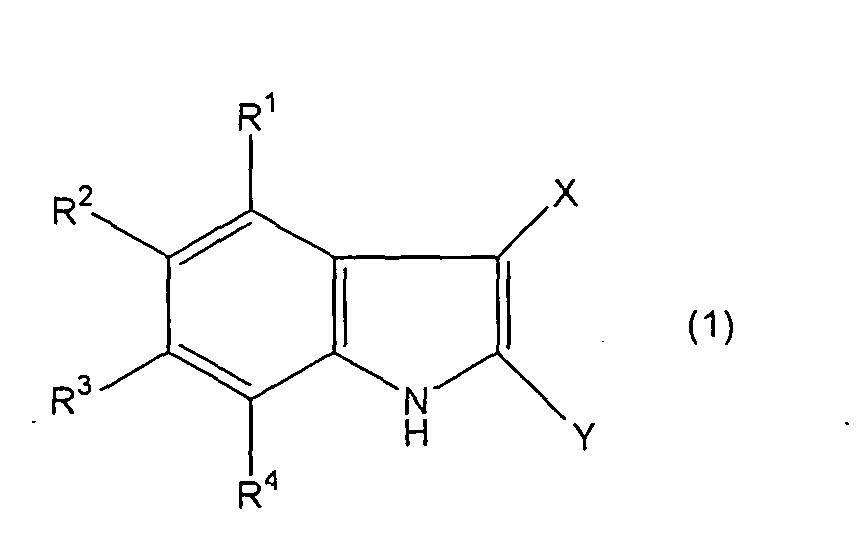
- The indole derivative or its salt according to claim 1 wherein one of R1, R2, R3, an R4 is an alkoxy group containing 1 to 10 carbon atoms; and other groups of the R1, R2, R3, and R4 are hydrogen; and n is 10 to 20.
- A drug containing the indole derivative or its salt of claim 1 or 2 as its effective component.
- The drug according to claim 3 wherein the drug is a prophylactic or therapeutic drug for brain dysfunction or neuropathy.
- An agent for promoting differentiation of a stem cell, comprising the indole derivative or its salt of claim 1 or 2 as its effective component.
- A pharmaceutical composition comprising the indole derivative or its salt of claim 1 or 2 and a pharmaceutically acceptable carrier.
- A method for treating brain dysfunction or neuropathy wherein the indole derivative or its salt of claim 1 or 2 is administered.
- Use of the indole derivative or its salt of claim 1 or 2 for producing a drug.
Applications Claiming Priority (3)
| Application Number | Priority Date | Filing Date | Title |
|---|---|---|---|
| JP2002211327 | 2002-07-19 | ||
| JP2002211327 | 2002-07-19 | ||
| PCT/JP2003/009244 WO2004009545A1 (en) | 2002-07-19 | 2003-07-22 | Indole derivatives and drugs containing the same |
Publications (2)
| Publication Number | Publication Date |
|---|---|
| EP1533299A1 true EP1533299A1 (en) | 2005-05-25 |
| EP1533299A4 EP1533299A4 (en) | 2007-04-04 |
Family
ID=30767767
Family Applications (1)
| Application Number | Title | Priority Date | Filing Date |
|---|---|---|---|
| EP03765343A Withdrawn EP1533299A4 (en) | 2002-07-19 | 2003-07-22 | INDOLE DERIVATIVES AND MEDICAMENTS CONTAINING THESE DERIVATIVES |
Country Status (7)
| Country | Link |
|---|---|
| US (1) | US7307098B2 (en) |
| EP (1) | EP1533299A4 (en) |
| JP (1) | JP4520851B2 (en) |
| CN (1) | CN1668587A (en) |
| AU (1) | AU2003248091A1 (en) |
| CA (1) | CA2490878C (en) |
| WO (1) | WO2004009545A1 (en) |
Families Citing this family (2)
| Publication number | Priority date | Publication date | Assignee | Title |
|---|---|---|---|---|
| US7407983B2 (en) * | 2002-02-13 | 2008-08-05 | Meiji Dairies Corporation | Indole derivatives substituted with long-chain alcohols and medicaments containing them |
| JP5370957B2 (en) * | 2008-08-20 | 2013-12-18 | 学校法人日本大学 | Apoptosis inhibitor |
Family Cites Families (13)
| Publication number | Priority date | Publication date | Assignee | Title |
|---|---|---|---|---|
| JPS4934986B1 (en) * | 1968-12-27 | 1974-09-19 | ||
| US3974179A (en) * | 1971-06-01 | 1976-08-10 | American Home Products Corporation | 1,3,4,9-Tetrahydropyrano[3,4-b]indole-1-acetamides and derivatives |
| JPS5442028B2 (en) | 1972-08-02 | 1979-12-12 | ||
| DE2358973A1 (en) * | 1973-11-27 | 1975-05-28 | Boehringer Mannheim Gmbh | BLOOD GLUCOSE REDUCING INDOLDER DERIVATIVES AND PROCESS FOR THEIR PRODUCTION |
| DE2426439A1 (en) * | 1974-05-31 | 1975-12-11 | Boehringer Mannheim Gmbh | BLOOD SUGAR-LOWERING INDOL-2-CARBALDEHYDE AND PROCESS FOR THEIR PRODUCTION |
| ZA76475B (en) * | 1975-03-10 | 1977-08-31 | Ciba Geigy Ag | Indolyalkylpiperidines |
| US4147786A (en) * | 1976-02-02 | 1979-04-03 | Ciba-Geigy Corporation | 1-Indolylalkyl-3-or 4-trimethyleneurido-piperidines |
| JPH06166672A (en) | 1992-03-18 | 1994-06-14 | Mitsui Toatsu Chem Inc | Novel method for producing 6-methoxyindole derivative |
| FR2735129B1 (en) | 1995-06-07 | 1997-07-11 | Adir | NOVEL INDOLE, INDAZOLE AND BENZISOXAZOLE DERIVATIVES, PROCESS FOR THEIR PREPARATION AND THE PHARMACEUTICAL COMPOSITIONS CONTAINING THEM |
| US5948808A (en) * | 1997-03-07 | 1999-09-07 | The Texas A&M University System | Indole-3-carbinol, diindolylmethane and substituted analogs as antiestrogens |
| US6228893B1 (en) | 1997-08-13 | 2001-05-08 | Meiji Milk Products Co., Ltd. | Cyclohexenone long-chain alcohol and medicament containing same |
| JP4745491B2 (en) | 2000-10-11 | 2011-08-10 | 株式会社明治 | Indole long-chain alcohol and medicine containing the same |
| US6605605B2 (en) * | 2000-11-13 | 2003-08-12 | Milton Hammerly | Estrogenic substances combined with cruciferous indole compounds |
-
2003
- 2003-07-22 AU AU2003248091A patent/AU2003248091A1/en not_active Abandoned
- 2003-07-22 CN CNA038171937A patent/CN1668587A/en active Pending
- 2003-07-22 WO PCT/JP2003/009244 patent/WO2004009545A1/en not_active Ceased
- 2003-07-22 CA CA2490878A patent/CA2490878C/en not_active Expired - Fee Related
- 2003-07-22 JP JP2004522771A patent/JP4520851B2/en not_active Expired - Fee Related
- 2003-07-22 US US10/520,136 patent/US7307098B2/en not_active Expired - Fee Related
- 2003-07-22 EP EP03765343A patent/EP1533299A4/en not_active Withdrawn
Also Published As
| Publication number | Publication date |
|---|---|
| WO2004009545A1 (en) | 2004-01-29 |
| AU2003248091A1 (en) | 2004-02-09 |
| JP4520851B2 (en) | 2010-08-11 |
| JPWO2004009545A1 (en) | 2005-11-17 |
| CA2490878C (en) | 2011-03-01 |
| CA2490878A1 (en) | 2004-01-29 |
| US20050261357A1 (en) | 2005-11-24 |
| CN1668587A (en) | 2005-09-14 |
| EP1533299A4 (en) | 2007-04-04 |
| US7307098B2 (en) | 2007-12-11 |
Similar Documents
| Publication | Publication Date | Title |
|---|---|---|
| TWI466877B (en) | Bicyclic compounds and their medical uses | |
| CN111295372B (en) | Nitroquinoline prodrug and use thereof | |
| MXPA97002601A (en) | Agonistasó-adrenergicos heterocicli | |
| JPH0347157A (en) | Biocidal aromatic compounds, their synthesis and their use as medicines | |
| JPWO1997048693A1 (en) | Isocoumarin derivatives and their medicinal uses | |
| KR0178469B1 (en) | Excitatory aminoacid antagonists | |
| PT86459B (en) | PROCESS FOR THE PREPARATION OF SUBSTITUTED CUMARAN DERIVATIVES, NAPOSYL 3 | |
| EP0557404B1 (en) | ANTIVIRAL USE OF A 2,6-DI-t-BUTYLPHENOL COMPOUND SUBSTITUTED IN POSITION 4, PARTICULARLY IN RELATION TO HERPESVIRUSES AND PAPILLOMAVIRUSES | |
| KR20010053277A (en) | Thyroid hormone analogues and methods for their preparation | |
| SK135493A3 (en) | Pharmacological effective compounds, the method of their preparation and pharmaceutical compositions, which these compounds contain | |
| Porter et al. | DL-2-Indaneglycine and DL-. beta.-trimethylsilylalanine | |
| US7307098B2 (en) | Indole derivatives and drugs containing the same | |
| WO2020103851A1 (en) | Spiro compound and medical uses thereof | |
| JPH0737459B2 (en) | Substituted 1,3,4,9-tetrahydropyrano [3,4-b] indole-1-acetic acid | |
| EP0625153B1 (en) | Isoindolinone derivative, preparation thereof, and pharmaceutical compositions containing same | |
| JP5451628B2 (en) | Protein phosphatase inhibitor | |
| KR20020016793A (en) | 1-Trifluoromethyl-4-Hydroxy-7-Piperidinyl-Aminomethylchroman Derivatives | |
| KR20050023358A (en) | Indole derivatives and drugs containing the same | |
| BR112017020615B1 (en) | INDOL ANALOG COMPOUNDS, PHARMACEUTICAL COMPOSITION AND COMBINATION COMPRISING THE SAME AND THERAPEUTIC USES OF SAID COMPOUNDS | |
| CN113880747B (en) | Indole derivative and application thereof | |
| FR2534919A1 (en) | 4-HYDROXY-2-METHYL-2H-1,2-BENZOTHIAZINE-3-CARBOXAMIDE 1,1-DIOXIDE DERIVATIVES AND PROCESS FOR THEIR PREPARATION | |
| CA2476490C (en) | Indole derivatives substituted with long-chain alcohols and medicaments containing them | |
| WO2007085204A1 (en) | γ-BUTYROLACTONE COMPOUNDS, THE PREPARATION METHODS AND MEDICAL USES THEREOF | |
| US5952376A (en) | Trienyl compounds | |
| WO1997028114A1 (en) | 2,3-disubstituted cyclopentanone derivatives, process for producing the same, and medicinal use thereof |
Legal Events
| Date | Code | Title | Description |
|---|---|---|---|
| PUAI | Public reference made under article 153(3) epc to a published international application that has entered the european phase |
Free format text: ORIGINAL CODE: 0009012 |
|
| 17P | Request for examination filed |
Effective date: 20050104 |
|
| AK | Designated contracting states |
Kind code of ref document: A1 Designated state(s): AT BE BG CH CY CZ DE DK EE ES FI FR GB GR HU IE IT LI LU MC NL PT RO SE SI SK TR |
|
| AX | Request for extension of the european patent |
Extension state: AL LT LV MK |
|
| DAX | Request for extension of the european patent (deleted) | ||
| RBV | Designated contracting states (corrected) |
Designated state(s): CH DE FR GB IT LI SE |
|
| A4 | Supplementary search report drawn up and despatched |
Effective date: 20070301 |
|
| 17Q | First examination report despatched |
Effective date: 20080205 |
|
| RAP1 | Party data changed (applicant data changed or rights of an application transferred) |
Owner name: MEIJI CO., LTD. |
|
| RAP1 | Party data changed (applicant data changed or rights of an application transferred) |
Owner name: MEIJI CO., LTD. Owner name: CENTRE NATIONAL DE LA RECHERCHE SCIENTIFIQUE Owner name: UNIVERSITE DE STRASBOURG |
|
| GRAP | Despatch of communication of intention to grant a patent |
Free format text: ORIGINAL CODE: EPIDOSNIGR1 |
|
| INTG | Intention to grant announced |
Effective date: 20131108 |
|
| STAA | Information on the status of an ep patent application or granted ep patent |
Free format text: STATUS: THE APPLICATION IS DEEMED TO BE WITHDRAWN |
|
| 18D | Application deemed to be withdrawn |
Effective date: 20140319 |