EP1532131B1 - Motilide compounds - Google Patents
Motilide compounds Download PDFInfo
- Publication number
- EP1532131B1 EP1532131B1 EP03755757A EP03755757A EP1532131B1 EP 1532131 B1 EP1532131 B1 EP 1532131B1 EP 03755757 A EP03755757 A EP 03755757A EP 03755757 A EP03755757 A EP 03755757A EP 1532131 B1 EP1532131 B1 EP 1532131B1
- Authority
- EP
- European Patent Office
- Prior art keywords
- substituted
- unsubstituted
- ethyl
- compound according
- compounds
- Prior art date
- Legal status (The legal status is an assumption and is not a legal conclusion. Google has not performed a legal analysis and makes no representation as to the accuracy of the status listed.)
- Expired - Lifetime
Links
- WMRNIQLVTAYCBL-YUMZJUHSSA-N CC(C)N(C)[C@@H](CC(C)OC12)C1OC2O Chemical compound CC(C)N(C)[C@@H](CC(C)OC12)C1OC2O WMRNIQLVTAYCBL-YUMZJUHSSA-N 0.000 description 1
- BOIFYUMXYWZGRZ-UWWAEOQPSA-N CC([C@@H]1OC1(C1)OC)OC1OC Chemical compound CC([C@@H]1OC1(C1)OC)OC1OC BOIFYUMXYWZGRZ-UWWAEOQPSA-N 0.000 description 1
Classifications
-
- C—CHEMISTRY; METALLURGY
- C07—ORGANIC CHEMISTRY
- C07D—HETEROCYCLIC COMPOUNDS
- C07D407/00—Heterocyclic compounds containing two or more hetero rings, at least one ring having oxygen atoms as the only ring hetero atoms, not provided for by group C07D405/00
- C07D407/14—Heterocyclic compounds containing two or more hetero rings, at least one ring having oxygen atoms as the only ring hetero atoms, not provided for by group C07D405/00 containing three or more hetero rings
-
- C—CHEMISTRY; METALLURGY
- C07—ORGANIC CHEMISTRY
- C07H—SUGARS; DERIVATIVES THEREOF; NUCLEOSIDES; NUCLEOTIDES; NUCLEIC ACIDS
- C07H17/00—Compounds containing heterocyclic radicals directly attached to hetero atoms of saccharide radicals
- C07H17/04—Heterocyclic radicals containing only oxygen as ring hetero atoms
- C07H17/08—Hetero rings containing eight or more ring members, e.g. erythromycins
-
- A—HUMAN NECESSITIES
- A61—MEDICAL OR VETERINARY SCIENCE; HYGIENE
- A61P—SPECIFIC THERAPEUTIC ACTIVITY OF CHEMICAL COMPOUNDS OR MEDICINAL PREPARATIONS
- A61P1/00—Drugs for disorders of the alimentary tract or the digestive system
-
- A—HUMAN NECESSITIES
- A61—MEDICAL OR VETERINARY SCIENCE; HYGIENE
- A61P—SPECIFIC THERAPEUTIC ACTIVITY OF CHEMICAL COMPOUNDS OR MEDICINAL PREPARATIONS
- A61P1/00—Drugs for disorders of the alimentary tract or the digestive system
- A61P1/04—Drugs for disorders of the alimentary tract or the digestive system for ulcers, gastritis or reflux esophagitis, e.g. antacids, inhibitors of acid secretion, mucosal protectants
-
- A—HUMAN NECESSITIES
- A61—MEDICAL OR VETERINARY SCIENCE; HYGIENE
- A61P—SPECIFIC THERAPEUTIC ACTIVITY OF CHEMICAL COMPOUNDS OR MEDICINAL PREPARATIONS
- A61P1/00—Drugs for disorders of the alimentary tract or the digestive system
- A61P1/06—Anti-spasmodics, e.g. drugs for colics, esophagic dyskinesia
-
- A—HUMAN NECESSITIES
- A61—MEDICAL OR VETERINARY SCIENCE; HYGIENE
- A61P—SPECIFIC THERAPEUTIC ACTIVITY OF CHEMICAL COMPOUNDS OR MEDICINAL PREPARATIONS
- A61P1/00—Drugs for disorders of the alimentary tract or the digestive system
- A61P1/08—Drugs for disorders of the alimentary tract or the digestive system for nausea, cinetosis or vertigo; Antiemetics
-
- A—HUMAN NECESSITIES
- A61—MEDICAL OR VETERINARY SCIENCE; HYGIENE
- A61P—SPECIFIC THERAPEUTIC ACTIVITY OF CHEMICAL COMPOUNDS OR MEDICINAL PREPARATIONS
- A61P1/00—Drugs for disorders of the alimentary tract or the digestive system
- A61P1/14—Prodigestives, e.g. acids, enzymes, appetite stimulants, antidyspeptics, tonics, antiflatulents
-
- A—HUMAN NECESSITIES
- A61—MEDICAL OR VETERINARY SCIENCE; HYGIENE
- A61P—SPECIFIC THERAPEUTIC ACTIVITY OF CHEMICAL COMPOUNDS OR MEDICINAL PREPARATIONS
- A61P1/00—Drugs for disorders of the alimentary tract or the digestive system
- A61P1/16—Drugs for disorders of the alimentary tract or the digestive system for liver or gallbladder disorders, e.g. hepatoprotective agents, cholagogues, litholytics
-
- C—CHEMISTRY; METALLURGY
- C12—BIOCHEMISTRY; BEER; SPIRITS; WINE; VINEGAR; MICROBIOLOGY; ENZYMOLOGY; MUTATION OR GENETIC ENGINEERING
- C12N—MICROORGANISMS OR ENZYMES; COMPOSITIONS THEREOF; PROPAGATING, PRESERVING, OR MAINTAINING MICROORGANISMS; MUTATION OR GENETIC ENGINEERING; CULTURE MEDIA
- C12N15/00—Mutation or genetic engineering; DNA or RNA concerning genetic engineering, vectors, e.g. plasmids, or their isolation, preparation or purification; Use of hosts therefor
- C12N15/09—Recombinant DNA-technology
- C12N15/11—DNA or RNA fragments; Modified forms thereof; Non-coding nucleic acids having a biological activity
- C12N15/52—Genes encoding for enzymes or proenzymes
-
- C—CHEMISTRY; METALLURGY
- C12—BIOCHEMISTRY; BEER; SPIRITS; WINE; VINEGAR; MICROBIOLOGY; ENZYMOLOGY; MUTATION OR GENETIC ENGINEERING
- C12P—FERMENTATION OR ENZYME-USING PROCESSES TO SYNTHESISE A DESIRED CHEMICAL COMPOUND OR COMPOSITION OR TO SEPARATE OPTICAL ISOMERS FROM A RACEMIC MIXTURE
- C12P19/00—Preparation of compounds containing saccharide radicals
- C12P19/44—Preparation of O-glycosides, e.g. glucosides
- C12P19/60—Preparation of O-glycosides, e.g. glucosides having an oxygen of the saccharide radical directly bound to a non-saccharide heterocyclic ring or a condensed ring system containing a non-saccharide heterocyclic ring, e.g. coumermycin, novobiocin
- C12P19/62—Preparation of O-glycosides, e.g. glucosides having an oxygen of the saccharide radical directly bound to a non-saccharide heterocyclic ring or a condensed ring system containing a non-saccharide heterocyclic ring, e.g. coumermycin, novobiocin the hetero ring having eight or more ring members and only oxygen as ring hetero atoms, e.g. erythromycin, spiramycin, nystatin
Definitions
- the present invention provides prokinetic agents with superior pharmacological and pharmacokinetic properties for the treatment of gastrointestinal motility disorders.
- the invention relates to the fields of chemistry, medicinal chemistry, medicine, molecular biology, and pharmacology
- Gastrointestinal motility regulates the orderly movement of ingested material through the gut to insure adequate absorption of nutrients, electrolytes and fluids. Appropriate transit through the esophagus, stomach, small intestine and colon depends on regional control of intraluminal pressure and several sphincters that regulate forward movement and prevent back-flow of GI contents. The normal GI motility pattern may be impaired by a variety of circumstances including disease and surgery.
- Gastroparesis is the delayed emptying of stomach contents. Symptoms of gastroparesis include stomach upset, heartburn, nausea, and vomiting. Acute gastroparesis may be caused by, for example, drugs (e.g., opiates), viral enteritis, and hyperglycemia, and is usually managed by treating the underlying disease rather than the motility disorder. The most common causes of chronic gastroparesis are associated with long standing diabetes or idiopathic pseudo-obstruction, often with so-called "non-ulcer” or "functional" dyspepsia.
- GERD refers to the varied clinical manifestations of reflux of stomach and duodenal contents into the esophagus. The most common symptoms are heartburn and dysphasia; blood loss may also occur from esophageal erosion. GERD may be associated with low tone and inappropriate relaxation of the lower esophageal sphincter and occurs with gastroparesis in about 40% of cases. In most cases, GERD appears to be treatable with agents that reduce the release of acidic irritant by the stomach (e.g., Prilosec) or agents that increase the tone of the lower esophageal sphincter (e.g., cisapride).
- agents that reduce the release of acidic irritant by the stomach e.g., Prilosec
- agents that increase the tone of the lower esophageal sphincter e.g., cisapride.
- disorders whose symptoms include impaired gastrointestinal motility are anorexia, gall bladder stasis, postoperative paralytic ileus, scleroderma, intestinal pseudoobstruction, gastritis, emesis, and chronic constipation (colonic inertia).
- MMC Migrating Motor Complexes
- erythromycin A ( 1 ) has been known to cause GI side effects such as nausea, vomiting, and abdominal discomfort. Erythromycin A undergoes acid catalyzed degradation in the stomach, forming initially 8,9-anhydro-6,9-hemiacetal 2 (also known as erythromycin A enol ether) and then spiroketal 3, as shown in Scheme A.
- the GI side effects are largely explained by motilin agonist activity in erythromycin A itself and hemiacetal 2. (Spiroketal 3 is inactive.)
- Omura et al. "Gastrointestinal motor-stimulating activity of macrolide antibiotics and the structure-activity relationship," J. Antibiotics (1985) 38: 1631-2 , discloses the relative ability of erythromycin A, 9-dihydroerythromycin A, and other macrolides to stimulate gut contraction in conscious dogs.
- 9-dihydroerythromycin A was reported to be 65% as active as erythromycin at a dose of 1 mg/kg.
- 9-dihydroerythromycin cannot form an enol ether, it is clear that enol ether formation is not essential for motilide activity.
- Erythromycin A is currently used to treat motility disorders, even though its antibacterial activity raises concerns over generation of resistant microorganisms.
- 9-dihydroerythromycin also shows antibacterial activity, there are similar concerns with its use as a motilide.
- erythromycin enol ether analogs have been prepared as motilides, including EM-523 ( 4 ); EM-574 ( 5 ); LY267,108 ( 6 ); GM-611 ( 7 ); and ABT-229 ( 8 ) whose structures are shown below. See U.S. Patent Nos. 5,578,579 ; 5,658,888 ; 5,922,849 ; 6,077,943 ; and 6,084,079 .
- motilides of interest include lactam enol ethers and lactam epoxide derivatives. See U.S. Patent Nos. 5,712,253 ; 5,523,401 ; 5,523,418 ; 5,538,961 ; and 5,554,605 .
- WO-A-00/63225 discloses macrolides represented by a Markush formula which partially overlaps with present formula (I), and their use as antimicrobial agents.
- US-B2-6 437 151 discloses erythromycins with particular substituents in C-13 and their use for inter alia the reduction of gastric motility.
- the present invention provides analogs of 9-dihydroerythromycin that meet this need.
- R 1 is substituted or unsubstituted C 1 -C 10 alkyl, substituted or unsubstituted C 2 -C 10 alkenyl, substituted or unsubstituted C 2 -C 10 alkynyl, substituted or unsubstituted aryl, or substituted or unsubstituted heterocyclo
- R 2 is H, substituted or unsubstituted C 1 -C 5 alkyl, substituted or unsubstituted C 2 -C 5 alkenyl, substituted or unsubstituted C 2 -C 5 alkynyl, substituted or unsubstituted aryl, or substituted or unsubstituted heterocyclo
- R 3 is H or OH
- a compound of this invention for treating a disorder of gastric motility in a patient suffering therefrom.
- a pharmaceutical composition comprising a compound of this invention and a pharmaceutically acceptable carrier.
- compounds (I) of this invention are used for the preparation of a medicament for treating a gastric motility disorder in a subject.
- a recombinant host cell that produces 11-deoxyerythromycins (particularly 11-deoxyerythromycin B), along with the modified polyketide synthase genes they express and the vectors that are used to engineer them.
- the 11-deoxyerythromycins are useful as intermediates for the synthesis of compounds of this invention.
- the recombinant host cell has an eryAI gene engineered by replacement of the ketoreductase domain in module 2 thereof with a cassette containing a dehydratase domain, an enoylreductase domain, and a ketoreductase domain.
- a method of making 11-deoxyerythromycins comprising culturing such a recombinant host cell.
- Alkyl means a straight or branched chain hydrocarbon moiety having the specified number of carbon atoms in the chain or, where the number of carbon atoms is not specified, up to 5 carbon atoms in the chain.
- Alkenyl means a straight or branched chain hydrocarbon moiety having at least one carbon-carbon double bond and the specified number of carbon atoms in the chain or, where the number of carbon atoms is not specified, up to 5 carbon atoms in the chain.
- Alkynyl means a straight or branched chain hydrocarbon moiety having at least one carbon-carbon triple bond and the specified number of carbon atoms in the chain or, where the number of carbon atoms is not specified, up to 5 carbon atoms in the chain.
- Alkylaryl mean an aryl, heterocyclic, or heteroaryl group, as the case may be, bonded directly to an alkyl moiety, as in benzyl, phenethyl.
- Aryl means a monocyclic or bicyclic aromatic hydrocarbon ring system having 6 to 12 carbon atoms in the ring portion, such as phenyl, napthyl, and biphenyl moieties, each of which is optionally substituted at one or more positions.
- Cycloalkyl means an optionally substituted, saturated cyclic hydrocarbon ring system, preferably containing 1 to 3 rings and 3 to 7 carbons per ring which may be further fused with an unsaturated C 3 -C 7 carbocyclic ring.
- exemplary cycloalkyl ring systems include cyclopropyl, cyclobutyl, cyclopentyl, cyclohexyl, cycloheptyl, cyclooctyl, cyclodecyl, cyclododecyl, and adamantyl.
- Halogen or "halo" means fluorine, chlorine, bromine and iodine.
- Heterocycle means an optionally substituted, fully saturated or unsaturated, aromatic or nonaromatic ring system, for example, which is a 4 to 7 membered monocyclic, 7 to 11 membered bicyclic, or 10 to 15 membered tricyclic ring system, which has at least one heteroatom in at least one carbon atom-containing ring.
- Heteroaryl means a heterocycle in which the ring system is aryl. Each ring of the heterocyclic group containing a heteroatom may have 1, 2 or 3 heteroatoms selected from N, O and S, where the N and S optionally may be oxidized and the N optionally may be quaternized.
- Exemplary monocyclic heterocyclic ring systems include pyrrolidinyl, pyrrolyl, indolyl, pyrazolyl, oxetanyl, pyrazolinyl, imidazolyl, imidazolinyl, imidazolidinyl, oxazolyl, oxazolidinyl, isoxazolinyl, isoxazolyl, thizaolyl, thiadiazolyl, thiazolidinyl, isothiazolyl, isothiazolidinyl, furyl, tetrahydrofuryl, thienyl, oxadiazolyl, piperidinyl, piperazinyl, 2-oxopiperazinyl, 2-oxopiperidinyl, 2-oxopyrrolidinyl, 2-oxazepinyl, azepinyl, 4-piperidonyl, pyridinyl, N-oxo-pyridy
- Preferred heterocyclo groups include pyridinyl, pyrazinyl, pyrimidinyl, pyrroyl, pyrazolyl, imidazolyl, thiazolyl, oxazolyl, isoxazolyl, thiadiazolyl, oxadiazolyl, thienyl, furanyl, quinolinyl, isoquinolinyl.
- “Pharmaceutically acceptable salt” means a salt of a compound suitable for pharmaceutical formulation. Suitable pharmaceutically acceptable salts include acid addition salts which may, for example, be formed by mixing a solution of a compound with a solution of a pharmaceutically acceptable acid such as hydrochloric acid, hydrobromic acid, sulfuric acid, fumaric acid, maleic acid, succinic acid, benzoic acid, acetic acid, citric acid, tartaric acid, phosphoric acid, carbonic acid .
- a pharmaceutically acceptable acid such as hydrochloric acid, hydrobromic acid, sulfuric acid, fumaric acid, maleic acid, succinic acid, benzoic acid, acetic acid, citric acid, tartaric acid, phosphoric acid, carbonic acid .
- pharmaceutically acceptable salts may be formed by treatment of a solution of the compound with a solution of a pharmaceutically acceptable base, such as lithium hydroxide, sodium hydroxide, potassium hydroxide, tetraalkylammonium hydroxide, lithium carbonate, sodium carbonate, potassium carbonate, ammonia, alkylamines.
- a pharmaceutically acceptable base such as lithium hydroxide, sodium hydroxide, potassium hydroxide, tetraalkylammonium hydroxide, lithium carbonate, sodium carbonate, potassium carbonate, ammonia, alkylamines.
- substituents and substitution patterns can be selected by one of ordinary skill in the art to provide compounds that are chemically stable and that can be synthesized by techniques known in the art as well as the methods set forth herein.
- substituents include alkyl, alkenyl, alkynyl, aryl, halo, trifluoromethoxy, trifluoromethyl, hydroxy, alkoxy, cycloalkyl-oxy, heterocyclooxy, alkanoyl, alkanoyloxy, amino, alkylamino quarternary ammonium, aralkylamino, cycloalkylamino, heterocycloamino, dialkylamino, alkanoylamino, thio, alkylthio, cycloalkylthio, heterocyclothio, ureido, nitro, cyano, carboxy, caroboxylalkyl, carbamyl, alkoxycarbonyl, alkylthiono, arylthiono, alkylsulfonyl, sulfonamindo, aryloxy, in addition to those specified herein.
- the substituent may be further substituted, for example, by halo, hydroxy
- prodrugs of the compounds of this invention are in general functional derivatives of the compounds that are readily convertible in vivo into the required compound. Conventional procedures for the selection and preparation of suitable prodrug derivatives are described, for example, in Design of Prodrugs, Bundgaard, ed., Elsevier, 1985 .
- R 1 is substituted or unsubstituted C 1 -C 10 alkyl, substituted or unsubstituted C 2 -C 10 alkenyl, substituted or unsubstituted C 2 -C 10 alkynyl, substituted or unsubstituted aryl, or substituted or unsubstituted heterocyclo;
- R 2 is H, ethyl, propyl, isopropyl, or 2-butyl;
- R 3 is H or OH;
- R 1 is substituted or unsubstituted C 1 -C 5 alkyl
- R 2 is H, substituted or unsubstituted C 1 -C 5 alkyl, substituted or unsubstituted C 2 -C 5 alkenyl, or substituted or unsubstituted C 2 -C 5 alkynyl
- R 3 is H or OH
- R 1 is ethyl
- R 2 is substituted or unsubstituted C 2 -C 5 alkyl, substituted or unsubstituted C 2 -C 5 alkenyl, or substituted or unsubstituted C 2 -C 5 alkynyl
- R 3 is H or OH
- R 1 is ethyl
- R 2 is ethyl, propyl, isopropyl, or 2-butyl
- R 3 is H or OH
- R 1 is substituted ethyl
- R 2 is H, substituted or unsubstituted C 1 -C 5 alkyl, substituted or unsubstituted C 2 -C 5 alkenyl, or substituted or unsubstituted C 2 -C 5 alkynyl
- R 3 is H or OH
- R 1 is fluoroethyl or azidoethyl
- R 2 is H, substituted or unsubstituted C 1 -C 5 alkyl, substituted or unsubstituted C 2 -C 5 alkenyl, or substituted or unsubstituted C 2 -C 5 akynyl
- R 3 is H or OH
- R 1 is substituted ethyl
- R 2 is H, ethyl, propyl, isopropyl, or 2-butyl
- R 3 is H or OH
- R 1 is fluoroethyl or azidoethyl
- R 2 is H, ethyl, propyl, isopropyl, or 2-butyl
- R 3 is H or OH
- R 1 is propyl
- R 2 is H, substituted or unsubstituted C 1 -C 5 alkyl, substituted or unsubstituted C 2 -C 5 alkenyl, or substituted or unsubstituted C 2 -C 5 alkynyl
- R 3 is H or OH
- R 1 is propyl
- R 2 is H, ethyl, propyl, isopropyl, or 2-butyl
- R 3 is H or OH
- R 1 is vinyl, butyl, benzyl, but-3-en-1-yl, phenyl, or 4-hydroxyphenyl
- R 2 is H, substituted or unsubstituted C 1 -C 5 alkyl, substituted or unsubstituted C 2 -C 5 alkenyl, or substituted or unsubstituted C 2 -C 5 alkynyl
- R 3 is H or OH
- R 1 is vinyl, butyl, benzyl, but-3-en-1-yl, phenyl, or 4-hydroxyphenyl
- R 2 is H, ethyl, propyl, isopropyl, or 2-butyl
- R 3 is H or OH
- R 3 and R 4 are independently H or OH;
- R 1 is selected from the group consisting of ethyl, 2-fluoroethyl, and 1-propyl; and
- R 2 is selected from the group consisting of methyl, ethyl, isopropyl, and 2-butyl; with the proviso that when R 1 is ethyl and R 3 is OH, then R 2 is not methyl.
- R 1 is substituted or unsubstituted C 1 -C 5 alkyl (preferably ethyl);
- R 2 is H, methyl, ethyl, propyl, isopropyl, or 2-butyl;
- R 3 is H; and
- R 4 is H or OH.
- the compounds of formula (I) are prepared from the corresponding erythromycins (II) as illustrated in Scheme 1.
- the erythromycin (II) is treated with sodium borohydride in methanol at provide the ( 9S )-9-dihydroerythromycin, (III).
- Compound (III) is demethylated, for example using iodine and light in buffered methanol or using N-iodosuccinimide in acetonitrile, to provide compound (IV).
- Reaction of the erythromycin (II) wherein R 3 and R 4 are both OH with a carbonylating reagent, for example ethylene carbonate or 1,1-carbonyldiimidazole, in the presence of a base, for example potassium carbonate or 4-(dimethylamino)pyridine provides the 11,12-cyclic carbonate.
- the cyclic carbonates are then converted into the final products according to the method illustrated in Scheme 1.
- the erythromycins of formula (II) are prepared as illustrated in Scheme 3 and described in U.S. Patents 6,066,721 ; 6,261,816 ; and 6,395,710 .
- a diketide thioester of formula (V) is supplied to a polyketide synthase to produce a polyketide of structure (VI).
- the preparation of diketide thioesters is described in WO 00/44717 .
- the polyketide synthase is a 6-deoxyerythronolide B synthase or an 8,8a-deoxyoleandolide synthase.
- 6-deoxyerythronolide B synthases are found in, for example, Saccharopolyspora erythraea , as described in U.S. Patent 5,824,513 , and in Micromonospora megalomicea , as described in WO 01/27284 .
- An example of an 8,8a-deoxyoleandolide synthase is found in Streptomyces antibioticus , as described in U.S. Patent 6,251,636 .
- These polyketide synthases are modified so as to prevent the incorporation of their native starter units. Methods of mutating polyketide synthases so as to prevent the incorporation of native starter units, for example by inactivation of the module 1 ketosynthase, are described in U.S. Patent 6,066,721 .
- the diketide thioester (V) may be supplied to a cell-free form of the polyketide synthase, as described in U.S. Patent 6,080,555 , it is more convenient to feed (V) to a culture of an organism expressing the mutated polyketide synthase.
- the organism can be an actinomycete, such as a Streptomyces or Saccharopolyspora , preferably Streptomyces coelicolor , as described in U.S. Patent 6,066,721 and in PCT publication WO 01/83803 , or a non-actinomycete such as Escherichia coli or Saccharomyces cerevesiae as described in WO 01/31035 .
- Methods for producing suitable mutated polyketide synthases are described, for example, in U.S. patents 6,391,594 and 6,403,775 .
- Polyketide (VI) is converted into a erythromycin (II) through a series of tailoring steps that include hydroxylation at C-6, addition of mycarose to the 3-OH, addition of desosamine to the 5-OH, hydroxylation at C-12, and methylation at the mycarose 3"-OH.
- Other forms of the erythromycin can be prepared using the appropriate subset of tailoring enzymes.
- This tailoring is most conveniently done by supplying polyketide (VI) to a culture of an organism expressing all the necessary enzymes for the transformations, for example a mutant of Saccharopolyspora erythraea comprising an inactive polyketide synthase as described in U.S. Patent 6,395,710 .
- a method for this process is detailed in Example 2 below.
- the compounds of formula (I) are agonists of the motilin receptor.
- Table 1 shows the EC 50 values for activation of the motilin receptor, as measured by a calcium-influx assay as described in Carreras et al., Anal. Biochem. 300,146-151 (2002 ).
- Table 1 Motilin Receptor Activation Compound Ref.
- R 1 R 2 R 3 R 4 EC 50 ( ⁇ M) Erythromycin
- Antibacterial activity was determined by in vitro susceptibility tests against Streptococcus pneumoniae ATCC 6301, a macrolide-sensitive strain, using methods known in the microbiological art.
- Table 2 In vitro Minimum Inhibitory Concentrations Against ATCC 6301 Compound I MIC ( ⁇ g/mL) Erythromycin A 0.03 A 0.3 F 1 G >100 J >100
- Another aspect of the present invention provides the use of compounds having formula (I) for the preparation of a medicament for the treatment of impaired gastric motility.
- using the compounds of the present invention comprises administering to a subject in need thereof a therapeutically effective amount of a compound of the present invention.
- disorders include gastroparesis, gastroesophageal reflux disease, anorexia, gall bladder stasis, postoperative paralytic ileus, scleroderma, intestinal pseudo-obstruction, gastritis, emesis, and chronic constipation (colonic inertia).
- the therapeutically effective amount can be expressed as a total daily dose of the compound or compounds of this invention and may be administered to a subject in a single or in divided doses.
- the total daily dose can be in amounts, for example, of from about 0.01 to about 10 mg/kg body weight, or more usually, from about 0.1 to about 2 mg/kg body weight.
- Single dose compositions may contain such amounts or submultiples thereof as to make up the daily dose.
- treatment regimens according to the present invention comprise administration to a subject in need of such treatment of from about 10 mg to about 1000 mg of the compound(s) of the present invention per day in single or multiple doses.
- the inventive compound will be part of a pharmaceutical composition or preparation that may be in any suitable form such as solid, semisolid, or liquid form.
- the pharmaceutical preparation will contain one or more of the compounds of the invention as an active ingredient and a pharmaceutically acceptable carrier.
- the active ingredient is in admixture with an organic or inorganic carrier or excipient suitable for external, enteral, or parenteral application.
- the active ingredient may be compounded, for example, with the usual non-toxic, pharmaceutically acceptable carriers for tablets, pellets, capsules, suppositories, pessaries, solutions, emulsions, suspensions, and any other form suitable for use.
- Oral dosage forms may be prepared essentially as described by Hondo et al., 1987, Transplantation Proceedings XIX, Supp. 6: 17-22 ,.
- the carriers that can be used include water, glucose, lactose, gum acacia, gelatin, mannitol, starch paste, magnesium trisilicate, talc, cornstarch, keratin, colloidal silica, potato starch, urea, and other carriers suitable for use in manufacturing preparations, in solid, semi-solid, or liquified form.
- auxiliary stabilizing, thickening, and coloring agents and perfumes may be used.
- the compounds of the invention may be utilized with hydroxypropyl methylcellulose essentially as described in U.S. Patent No. 4,916,138 , or with a surfactant essentially as described in EPO patent publication No. 428,169 .
- the present invention provides motilide compounds and their use, which are further illustrated by the following examples.
- 15-methyl-6-deoxyerythronolide B also referred to as 13-propyl-6-dEB or 15-methyl-6-dEB
- 15-fluoro-6-dEB 15-fluoro-6-dEB
- a 1 mL vial of the CH999/pJRJ2 Streptomyces coelicolor that contains a PKS in which the ketosynthase domain of module 1 has been inactivated by mutation
- working cell bank is thawed and the contents of the vial are added to 50 mL of Medium 1 in a 250 mL baffled flask.
- Medium 1 comprises 45 g/L cornstarch; 10 g/L corn steep liquor; 10 g/L dried, inactivated brewers yeast; and 1 g/L CaCO 3 .
- This solution is sterilized by autoclaving for 90 minutes at 121°C. After sterizilization, 1 mL/L of sterile filtered 50 mg/ml thiostrepton in 100% DMSO and 1 mL/L autoclaved 100% antifoam B silicon emulsion (J.T. Baker) are added prior to use.
- the flask containing the thawed cells and Medium 1 is placed in an incubator/shaker maintained at 30 ⁇ 1°C and 175 ⁇ 25 RPM for 48 ⁇ 10 hours.
- the 50 mL culture is then added to a 2.8 L baffled flask containing 500 mL of Medium 1.
- This flask is incubated in an incubator/ shaker at 30 ⁇ 1°C and 175 ⁇ 25 RPM for 48 ⁇ 10 hours.
- the 500 mL culture is than used to inoculate a 10 L fermenter containing 5 L of Medium 1.
- the fermenter is controlled at 30°C, pH 6.5 by addition of 2.5 N H 2 SO 4 and 2.5 N NaOH, agitation rate 600 RPM, and air flow rate 1-2 LPM.
- Foam is controlled by the addition of a 50% solution of Antifoam B as needed.
- the fermenter culture is allowed to grow under these conditions for 24 ⁇ 5 hours.
- a 150 L fermenter is prepared by sterilizing 100 L of Medium 1 at 121°C for 45 minutes. After the growth period, the contents from the 10 L fermenter are aseptically added to a 150 L fermenter.
- the fermenter is controlled at 30°C, pH 6.5 by addition of 2.5 N H 2 SO 4 and 2.5 N NaOH, dissolved oxygen ⁇ 80% air saturation by agitation rate (500-700 RPM), air flow rate (10-50 LPM), and/ or back pressure control (0.1-0.4 bar).
- Foam is controlled by the addition of a 50% solution of Antifoam B as needed.
- HP20 resin Mitsubishi resin (Mitsubishi). Column size is selected based on supernatant volume and titer, so that the loading capacity of 15 g 15-methyl-6-dEB per liter HP20 resin is not exceeded.
- the centrifuged broth is passed through the resin bed at a linear flow rate of 300 ⁇ 20 cm/h. The pressure on the column should not exceed 15 psi.
- the resin is then washed with 2 column volumes (CV) of water and then 2 CV of 30 % methanol, each at a rate of 300 ⁇ 20 cm/ h. 13-propyl-6-dEB is eluted using 7-10 CV 100% methanol at a rate of 300 ⁇ 20 cm/h.
- fractions of 1 CV are collected.
- the fractions are then analyzed, and those containing product are combined to yield a product pool containing >95% of the original 15-methyl-6-dEB in the centrifuged broth.
- the product pool is reduced to solids using rotary evaporation.
- Product purity at this stage is 5-35%.
- Methanol-insoluble material is removed from the product pool by suspending the solids in 3 L 100% methanol per 100 L original broth volume, mixing for 20 minutes, and filtering.
- the final purification step is chromatography using HP20SS resin (Mitsubishi). Column size is selected based on amount of product, so that the loading capacity of 15 g 15-methyl-6-dEB per liter HP20SS resin is not exceeded.
- the filtered methanol solution is diluted by adding an equal volume of water.
- the 50% methanol solution is passed through the resin bed at a linear flow rate of 300 ⁇ 20 cm/h.
- the column is then washed with 2 CV of 50% methanol at a rate of 300 ⁇ 20 cm/h.
- Product is eluted using 12 CV 70% methanol at a rate of 300 ⁇ 20 cm/h. During elution, fractions of 1 CV are collected.
- fractions are then analyzed, and those containing >50 mg/L 15-methyl-6-dEB and having >20% chromatographic purity are combined.
- the product pool is reduced to solids using rotary evaporation. Product purity at this stage is >65% and is suitable for bioconversion to the appropriate erythromycin.
- a 1 mL vial from working cell bank K39-14V (an eryA mutant of S. erythraea that is incapable of producing 6-dEB) is thawed and the contents of the vial are added to 50 mL of Medium 2 in a 250 mL baffled flask.
- Medium 2 comprises 16 g/L cornstarch; 10 g/L corn dextrin; 15 g/L soy meal flour; 4 g/L CaCO 3 ; 5 g/L corn steep liquor; 6 g/L soy bean oil; 2.5 g/L NaCl; and 1 g/L (NH 4 ) 2 SO 4 .
- This solution is sterilized by autoclaving for 60 minutes at 121 °C and 1 mL/L autoclaved 100% antifoam B silicon emulsion (J.T. Baker) is added prior to use.
- the flask containing the thawed cells and Medium 2 is placed in an incubator/shaker maintained at 34 ⁇ 1°C and 175 ⁇ 25 RPM for 48 ⁇ 10 hours.
- the 50 mL culture is then added to a 2.8 L baffled flask containing 500 mL of Medium 2.
- the flask is incubated in an incubator/shaker at 34 ⁇ 1°C and 175 ⁇ 25 RPM for 48 ⁇ 10 hours.
- the 500 mL culture is than used to inoculate a 10 L fermenter containing 5 L of Medium 2.
- the fermenter is controlled at 34°C, pH 7.0 by addition of 2.5 N H 2 SO 4 and 2.5 N NaOH, agitation rate 600 RPM, and air flow rate 1-2 LPM.
- Foam is controlled by the addition of a 50% solution of Antifoam B as needed.
- the fermenter culture is allowed to grow under these conditions for 24 ⁇ 5 hours.
- a 150 L fermenter is prepared by sterilizing 100 L of Medium 3 at 121°C for 45 minutes.
- Medium 3 comprises 17.5 g/L cornstarch; 16 g/L corn dextrin; 16.5 g/L soy meal flour; 4 g/L CaCO 3 ; 6 g/L corn steep liquor; 3 g/L soy bean oil; 3.5 g/L NaCl; and 1 g/L (NH 4 ) 2 SO 4 .
- the contents from the 10 L fermenter are aseptically transferred to the 150 L fermenter.
- the fermenter is controlled at 34°C, pH 7.0 by addition of 2.5 N H 2 SO 4 and 2.5 N NaOH, dissolved oxygen ⁇ 80% air saturation by agitation rate (500-700 RPM), air flow rate (15-50 LPM), and/or back pressure control (0.1-0.4 bar).
- Foam is controlled by the addition of a 50 % solution of Antifoam B.
- a 58-60 mL/hour 15% dextrin (w/v) feed is initiated.
- the dextrin solution is continuously mixed during the feed period.
- 25 grams of 13-propyl-6dEB are added to the fermenter.
- the 13-propyl-6dEB is prepared by solubolizing 25 grams of 13-propyl-6dEB in 400-600 mL of 100% ethanol and filtering (0.2 ⁇ m, nylon filter). Conversion of 13-propyl-6dEB to 13-propyl-erythromycin A ceases after 60 ⁇ 10 hours and the fermenter is harvested.
- the fermentation broth is centrifuged at 20,500 g in an Alpha Laval AS-26 centrifuge. The product is predominantly in the supernatant; the centrifuged cell mass is discarded.
- HP20 resin Mitsubishi resin (Mitsubishi). Column size is selected based on supernatant volume and titer, so that the loading capacity of 15 g 15-methylerythromycin A per liter HP20 resin is not exceeded.
- the centrifuged broth is adjusted to pH 9, then passed through the resin bed at a linear flow rate of 275 ⁇ 25 cm/h. The pressure on the column should not exceed 15 psi.
- the resin is then washed with 1 column volume (CV) of water at a rate of 275 ⁇ 25 cm/h.
- the 15-methylerythromycin is eluted using 5 CV 100% methanol at a rate of 275 ⁇ 25 cm/h.
- fractions of 1 CV are collected.
- the fractions are then analyzed, and those containing product are combined to yield a product pool.
- the product pool is reduced to solids using rotary evaporation.
- Methanol-insoluble material is removed from the product pool by suspending the solids in 1L 100% methanol per 100 L original broth volume, adjusting to pH 9, and filtering.
- the product pool (filtrate) is reduced to solids using rotary evaporation.
- the 15-methylerythromycin A is extracted from the product pool (solids) by adding 2 L 4:1 hexane:acetone per 100 L original broth volume, mixing for 20 minutes, and filtering. The remaining solids are extracted the same way two more times and filtrates are combined.
- the product pool is reduced to solids using rotary evaporation.
- the final purification step is chromatography using HP20SS resin (Mitsubishi). Column size is selected based on amount of product, so that the loading capacity of 15 g 15-methylerythromycin A per liter HP20SS resin is not exceeded.
- the solids from the previous steps are dissolved in 1 L methanol per 100 L original broth volume, and an equal volume of water is added.
- the 50% methanol solution is passed through the resin bed at a linear flow rate of 275 ⁇ 25 cm/h.
- the column is then washed with 1 CV of 50% methanol, then 3 CV 60% methanol, each at a rate of 275 ⁇ 25 cm/h.
- Product is eluted using 3 CV 70% methanol, then 10 CV 75% methanol, each at a rate of 275 ⁇ 25 cm/h.
- fractions of 1 CV are collected.
- the fractions are then analyzed, and those containing 15-methylerythromycin A are combined.
- the product pool is reduced to solids using rotary evaporation.
- 15-fluoroerythromycin A is prepared using 15-fluoro-6-dEB.
- the crude product was purified via silica gel column chromatography (3:1 hexane-acetone, 1% triethylamine) to give pure N-desmethyl-N-isopropyl-15-methylerythromycin A (1.80 g, 75% yield for 2 steps). ).
- N-desmethyl-N-isopropyl-15-methylerythromycin A (1.74 g, 2.24 mmol) was dissolved in methanol-ether (1:3 V/V, 50 mL), then cooled to -20 °C.
- Sodium borohydride (189 mg, 5.0 mmol) was added.
- the mixture was then warmed slowly to room temperature over a period of 3 h.
- the excess sodium borohydride was destroyed by addition of pH 6.0 phosphate buffer, followed by triethanolamine (10 mL). After 30 min the mixture was extracted with ethyl acetate and dried over magnesium sulfate.
- the crude product was purified by silica gel column chromatography (3:1 hexane-acetone with 1% triethylamine).
- This example describes the construction of a strain of Saccharopolyspora erythraea (K24-1/159-44) capable of the biosynthesis of 11-deoxyerythromycins, with particular reference to 11-deoxyerythromycin B, which are useful as intermediates for the synthesis of certain compounds of this invention.
- 11-Deoxyerythromycin B can be prepared in a single fermentation in a genetically engineered host cell expressing a modified version of the DEBS suite of genes ( eryAI, eryAII , and enyAIII ).
- the enyAI gene is engineered by replacement of the ketoreductase domain in module 2 with a cassette containing a dehydratase domain, an enoylreductase domain, and a ketoreductase domain, for example taken from module 1 of the rapamycin PKS.
- Methods for domain replacement are provided in, for example, McDaniel, US 6,403,775 (2002 ), which is incorporated herein by reference.
- the engineered eryAI gene is incorporated along with the eryAII and eryAIII genes into a host cell competent in the production of erythromycins once the engineered PKS genes have been added.
- these host cells are "clean hosts," wherein their native PKS genes have been removed.
- suitable hosts include but are not limited to the clean host Saccharopolyspora erythraea K24-1 and strains of Saccharopolyspora erythraea having mutated PKS genes such as those described in Santi et al., US 2002/ 0004229 A1 ( 2002 ).
- Strain K24-1 has had the native eryAI, eryAII, and eryAIII genes replaced with the attB phage attachment site of the actinophage ⁇ C31, described in U.S. Patent 5,190,871 , incorporated herein by reference, and followed by the ermE * promoter.
- This allows plasmid vectors comprising the complementary attP phage attachment site along with the genes to be delivered to integrate into the chromosome at the attB site in the presence of a phage integrase.
- suitable integrating phage vectors include but are not limited to pSET152 and its derivatives.
- pKOS159-8 and pKOS159-10 are derivatives of pSET152 containing the eryA genes under the control of the ermE p* promoter and the actI p/ actII -ORF4 promoter-activator pair, respectively.
- a 35 kb Nsi I fragment from pKAO127 carrying the eryA genes and the actI p/ actII -ORF4 region was cloned into pKOS97-64c (a pSET152 derivative containing the ermE p* promoter and a ⁇ cos site) to make pKOS159-10.
- the fd transcriptional terminator from the pKAO127 fragment prevents expression of any genes from the ermE p* promoter in this plasmid.
- the fragment containing the fd terminator and actI p/ actII -ORF4 segment in pKOS159-10 was removed by digestion with Pac I and self-ligation to generate pKOS159-8.
- pKOS159-31 For expression of eryA genes under their natural promoter, pKOS159-31 was constructed by cloning the Nde I- Xba I fragment carrying the eryA genes (and ⁇ cos site) from pKOS159-10 and the Xba I- Nde I digested PCR amplified eryAI left flank fragment from above into pSET152 digested with Xba I. pKOS159-33, which contains the eryA genes from S. erythraea K41-135 was constructed in an analogous way using the eryA fragment from pKOS108-04. Likewise, all engineered DEBS expression plasmids were made using pKOS159-31 as a scaffold and appropriate restriction enzymes to move the genetically modified eryA fragment from existing plasmids.
- pKOS159-44 is a pSET152 ( Bierman et al., Gene 116, 43-49 (1992 ), "Plasmid cloning vectors for the conjugal transfer of DNA from Escherichia coli to Streptomyces spp.") derivative plasmid that has genetically modified eryA genes (KR2 ⁇ rapDH/ER/KR1) under the control of eryAI promoter ( Rodriguez et al., J. Ind. Microbio. Biotechnol., "Rapid Engineering of Polyketide Overproduction by Gene Transfer to Industrially Optimized Strains," web-published as document no. 10.1007/s10295-003-0045-1 (http://link.springer-ny.com) (16 Apr.
- a 30 kb Nde I- Nsi I fragment (carrying genetically modified eryA genes) from pKOS11-66 ( Xue et al., Proc. Natl. Acad. Sci. U.S.A., 96,11740-11745 (1999 ), "A multiplasmid approach to preparing large libraries of polyketides" was isolated and ligated to a 8 kb Nde I- Nsi I fragment from pKOS159-33 (Rodriguez et al., cited supra ), containing the vector pSET152, eryAp promoter and cos ⁇ site).
- the ligation mixture was packaged using Gigapack III Gold packaging extract (Stratagene), and used to infect E . coli XL-1 Blue. Recombinats were selected on LB agar plates containing 60 ⁇ g/ml apramycin. pKOS159-44 plasmid DNA was isolated and checked by restriction digestions.
- S . erythraea strain K24-1 which contains a chromosomal deletion of the three eryA genes and insertion of the attB loci for the Streptomyces phage ⁇ C31 from Streptomyces lividans, followed by the ermE * promoter in their place, was prepared by harvesting spores from strains grown on 1-2 M1 plates (per liter, 5 g glucose, 5 g tryptone, 0.5g betaine hydrochoride, 5g corn starch, 1g corn steep liquor (50%), 200 mg MgSO 4 •7H 2 O, 2 mg ZnSO 4 •7H 2 O, 0.8 mg CuSO 4 •5H 2 O, 0.2 mg CoCl 2 •6H 2 O, 4 mg FeSO 4 •7H 2 O, 80 mg CaCl 2 •6H 2 O, 150 mg KH 2 PO 4 , 10 g NaCl, 20 g agar) filtering the spores through sterile cotton, and resuspending
- the cells were grown at 37°C for 3-4 h (OD 600 of 0.4-0.6), collected by centrifugation, washed in 5 mL LB, centrifuged, and resuspended in 100 ⁇ L of LB. Conjugal transfer between the donor and recipient cells was performed by resuspending the recipient cells in the 100 ⁇ l donor suspension and the cells were spread on R5 plates ( Hopwood et al., Genetic Manipulation of Streptomyces: A Laboratory Manual (The John Innes Foundation, Norwich, UK, 1985 ) containing 50 ⁇ g/mL nalidixic acid and incubated at 34°C for 16 h. The plates were then overlayed with 3 mL of soft nutrient agar containing 1 mg nalidixic acid and 2 mg apramycin. Exconjugants K24-1/159-44 were observed after 48 h of further incubation.
- This example describes the biosynthesis of 11-deoxyerythromycin B, an intermediate for the synthesis of certain compounds of this invention, using the strain described in the preceding example.
- Seed medium V1 contained 16 g/L corn starch, 10 g/L dextrin (D-2256, Sigma-Aldrich), 15 g/L soybean flour (S-9633, Sigma-Aldrich), 2.5 g/L sodium chloride, 5 g/L corn steep liquor, 1 g/L ammonium sulfate (A-2939, Sigma-Aldrich), 6 g/L soybean oil (S-7381, Sigma-Aldrich), and 4 g/L calcium carbonate (C-4830, Sigma Aldrich).
- Fermentation medium F2 contained 28 g/L corn starch, 24 g/L soybean meal, 5.5 g/L sodium chloride, 8 g/L corn steep liquor, and 1.5 g/L ammonium sulfate, 4.5 g/L soybean oil, and 6 g/L calcium carbonate. All media were sterilized by autoclaving at 121°C for 90 min.
- Two seed flasks were started by taking a 1 mL vial of Saccharopolyspora erythraea K24-1/pKOS159-44 from a frozen cell bank, thawing, and adding the vial contents into 50 mL of medium V1 and incubating at 34 °C for 40-48 h.
- Two secondary seeds were then created by transferring 50 mL aliquots from the seed flask to 500 mL of medium V1 and incubating at 34 °C for 40-48 h.
- Both 500 mL secondary seed cultures were transferred to a B. Braun B10 fermenter containing 9 L of medium V1.
- the fermenter was operated at 34°C and maintained at pH 7.0 by addition of 2.5 N sulfuric acid and 2.5 N sodium hydroxide. Aeration at 3 LPM and agitation at 600 to 800 rpm were provided, maintaining the dissolved oxygen tension at greater than 40%. Harvesting took place after about 24 h.
- Foaming was controlled by the addition of a 50% solution of antifoam B (JT Baker) as needed.
- the fermentation broth was clarified by centrifugation and was subjected to solid phase extraction using HP20 resin (Mitsubishi). Adsorbed product was eluted with methanol and dried. The crude product was then subjected to ethyl acetate:water liquid:liquid extraction. The combined ethyl acetate extracts were dried. The product was purified by chromatography using HP20SS resin, eluting with a step-gradient from 50% to 80% methanol. The product containing fractions were pooled and dried, to provide 11-deoxyerythromycin B.
- 11-Deoxyerythromycin B (200 mg, 0.285 mmol) was reduced generally following the procedure of Example 8 to give (9S)-9-dihydroerythromycin B (94 mg, 47% yield).
Landscapes
- Health & Medical Sciences (AREA)
- Chemical & Material Sciences (AREA)
- Organic Chemistry (AREA)
- Engineering & Computer Science (AREA)
- Life Sciences & Earth Sciences (AREA)
- Genetics & Genomics (AREA)
- Bioinformatics & Cheminformatics (AREA)
- General Health & Medical Sciences (AREA)
- Chemical Kinetics & Catalysis (AREA)
- General Chemical & Material Sciences (AREA)
- Zoology (AREA)
- Biotechnology (AREA)
- Wood Science & Technology (AREA)
- Pharmacology & Pharmacy (AREA)
- Biomedical Technology (AREA)
- Public Health (AREA)
- Animal Behavior & Ethology (AREA)
- Nuclear Medicine, Radiotherapy & Molecular Imaging (AREA)
- Biochemistry (AREA)
- General Engineering & Computer Science (AREA)
- Medicinal Chemistry (AREA)
- Molecular Biology (AREA)
- Veterinary Medicine (AREA)
- Microbiology (AREA)
- Physics & Mathematics (AREA)
- Biophysics (AREA)
- Plant Pathology (AREA)
- Otolaryngology (AREA)
- Hospice & Palliative Care (AREA)
- Nutrition Science (AREA)
- Gastroenterology & Hepatology (AREA)
- Pharmaceuticals Containing Other Organic And Inorganic Compounds (AREA)
- Saccharide Compounds (AREA)
- Micro-Organisms Or Cultivation Processes Thereof (AREA)
- Preparation Of Compounds By Using Micro-Organisms (AREA)
- Nitrogen Condensed Heterocyclic Rings (AREA)
- Cephalosporin Compounds (AREA)
- Pyrrole Compounds (AREA)
Abstract
Description
- The present invention provides prokinetic agents with superior pharmacological and pharmacokinetic properties for the treatment of gastrointestinal motility disorders. The invention relates to the fields of chemistry, medicinal chemistry, medicine, molecular biology, and pharmacology
- Gastrointestinal ("GI") motility regulates the orderly movement of ingested material through the gut to insure adequate absorption of nutrients, electrolytes and fluids. Appropriate transit through the esophagus, stomach, small intestine and colon depends on regional control of intraluminal pressure and several sphincters that regulate forward movement and prevent back-flow of GI contents. The normal GI motility pattern may be impaired by a variety of circumstances including disease and surgery.
- Disorders of gastrointestinal motility include, for example, gastroparesis and gastroesophageal reflux disease ("GERD"). Gastroparesis is the delayed emptying of stomach contents. Symptoms of gastroparesis include stomach upset, heartburn, nausea, and vomiting. Acute gastroparesis may be caused by, for example, drugs (e.g., opiates), viral enteritis, and hyperglycemia, and is usually managed by treating the underlying disease rather than the motility disorder. The most common causes of chronic gastroparesis are associated with long standing diabetes or idiopathic pseudo-obstruction, often with so-called "non-ulcer" or "functional" dyspepsia.
- GERD refers to the varied clinical manifestations of reflux of stomach and duodenal contents into the esophagus. The most common symptoms are heartburn and dysphasia; blood loss may also occur from esophageal erosion. GERD may be associated with low tone and inappropriate relaxation of the lower esophageal sphincter and occurs with gastroparesis in about 40% of cases. In most cases, GERD appears to be treatable with agents that reduce the release of acidic irritant by the stomach (e.g., Prilosec) or agents that increase the tone of the lower esophageal sphincter (e.g., cisapride). Other examples of disorders whose symptoms include impaired gastrointestinal motility are anorexia, gall bladder stasis, postoperative paralytic ileus, scleroderma, intestinal pseudoobstruction, gastritis, emesis, and chronic constipation (colonic inertia).
- These GI disorders are generally treated with prokinetic agents that enhance propulsive motility. Motilides are macrolide compounds such as erythromycin and its derivatives that are agonists of the motilin receptor. Evidence of the potential clinical utility of motilides includes their ability to induce phase III of Migrating Motor Complexes ("MMC"). MMC refers to the four phases (I-IV) of electrical activity displayed by the stomach and small intestine in the fasting state. Muscular contraction occurs in phases III and IV, coincident with a peristaltic wave that propels enteric contents distally during fasting. Other clinically relevant effects include: increase in esophageal peristalsis and LES pressure in normal volunteers and patients with GERD; acceleration of gastric emptying in patients with gastric paresis; and stimulation of gallbladder contractions in normal volunteers, patients after gallstone removal, and diabetics with autonomic neuropathy.
- The erythromycins are a family of macrolide antibiotics made by the fermentation of the Actinomycetes Saccharopolyspora erythraea (formerly Streptomyces erythreus). Erythromycin A, a commonly used antibiotic, is the most abundant and important member of the family.

Erythromycin A Ra = OH Rb = Me Erythromycin B Ra = H Rb = Me Erythromycin C Ra = OH Rb = H Erythromycin D Ra = H Rb = H - Since the 1950's, erythromycin A (1) has been known to cause GI side effects such as nausea, vomiting, and abdominal discomfort. Erythromycin A undergoes acid catalyzed degradation in the stomach, forming initially 8,9-anhydro-6,9-hemiacetal 2 (also known as erythromycin A enol ether) and then spiroketal 3, as shown in Scheme A. The GI side effects are largely explained by motilin agonist activity in erythromycin A itself and hemiacetal 2. (Spiroketal 3 is inactive.)

- Omura et al., "Gastrointestinal motor-stimulating activity of macrolide antibiotics and the structure-activity relationship," J. Antibiotics (1985) 38: 1631-2, discloses the relative ability of erythromycin A, 9-dihydroerythromycin A, and other macrolides to stimulate gut contraction in conscious dogs. In this assay, 9-dihydroerythromycin A was reported to be 65% as active as erythromycin at a dose of 1 mg/kg. As 9-dihydroerythromycin cannot form an enol ether, it is clear that enol ether formation is not essential for motilide activity. Erythromycin A is currently used to treat motility disorders, even though its antibacterial activity raises concerns over generation of resistant microorganisms. As 9-dihydroerythromycin also shows antibacterial activity, there are similar concerns with its use as a motilide.
- A number of erythromycin enol ether analogs have been prepared as motilides, including EM-523 (4); EM-574 (5); LY267,108 (6); GM-611 (7); and ABT-229 (8) whose structures are shown below. See
U.S. Patent Nos. 5,578,579 ;5,658,888 ;5,922,849 ;6,077,943 ; and6,084,079 .
- Other motilides of interest include lactam enol ethers and lactam epoxide derivatives. See
U.S. Patent Nos. 5,712,253 ;5,523,401 ;5,523,418 ;5,538,961 ; and5,554,605 . -
WO-A-00/63225 -
US-B2-6 437 151 discloses erythromycins with particular substituents in C-13 and their use for inter alia the reduction of gastric motility. - Despite the high potency of the erythromycin enol ethers as motilides, their metabolic instability has hindered their development in the clinic. Further, compounds such as 7 and 8 show motilin receptor desensitization in both cell-based and muscle strip contractility assays. This desensitization may portend a decrease in efficacy upon multiple dosing of the motilide.
- There thus exists a need for new motilide compounds having decreased antibacterial activity, increased metabolic stability, and decreased receptor desensitization. The present invention provides analogs of 9-dihydroerythromycin that meet this need.
- One aspect of the present invention provides compounds having the formula (I):

- In a second aspect, there is provided a compound of this invention for treating a disorder of gastric motility in a patient suffering therefrom.
- In a third aspect, there is provided a pharmaceutical composition comprising a compound of this invention and a pharmaceutically acceptable carrier.
- In a fourth aspect, compounds (I) of this invention are used for the preparation of a medicament for treating a gastric motility disorder in a subject.
- Also disclosed is a recombinant host cell that produces 11-deoxyerythromycins (particularly 11-deoxyerythromycin B), along with the modified polyketide synthase genes they express and the vectors that are used to engineer them. The 11-deoxyerythromycins are useful as intermediates for the synthesis of compounds of this invention. The recombinant host cell has an eryAI gene engineered by replacement of the ketoreductase domain in module 2 thereof with a cassette containing a dehydratase domain, an enoylreductase domain, and a ketoreductase domain. Also disclosed is a method of making 11-deoxyerythromycins, comprising culturing such a recombinant host cell.
- The definitions of the terms given below apply to the terms as they are used throughout this specification and the appended claims, unless the context clearly indicates otherwise.
- "Alkyl" means a straight or branched chain hydrocarbon moiety having the specified number of carbon atoms in the chain or, where the number of carbon atoms is not specified, up to 5 carbon atoms in the chain.
- "Alkenyl" means a straight or branched chain hydrocarbon moiety having at least one carbon-carbon double bond and the specified number of carbon atoms in the chain or, where the number of carbon atoms is not specified, up to 5 carbon atoms in the chain.
- "Alkynyl" means a straight or branched chain hydrocarbon moiety having at least one carbon-carbon triple bond and the specified number of carbon atoms in the chain or, where the number of carbon atoms is not specified, up to 5 carbon atoms in the chain.
- "Alkylaryl," "arylalkyl," "heterocycloalkyl," "alkylheteroaryl," "alkylheterocycle" mean an aryl, heterocyclic, or heteroaryl group, as the case may be, bonded directly to an alkyl moiety, as in benzyl, phenethyl.
- "Aryl" means a monocyclic or bicyclic aromatic hydrocarbon ring system having 6 to 12 carbon atoms in the ring portion, such as phenyl, napthyl, and biphenyl moieties, each of which is optionally substituted at one or more positions.
- "Cycloalkyl" means an optionally substituted, saturated cyclic hydrocarbon ring system, preferably containing 1 to 3 rings and 3 to 7 carbons per ring which may be further fused with an unsaturated C3-C7 carbocyclic ring. Exemplary cycloalkyl ring systems include cyclopropyl, cyclobutyl, cyclopentyl, cyclohexyl, cycloheptyl, cyclooctyl, cyclodecyl, cyclododecyl, and adamantyl.
- "Halogen" or "halo" means fluorine, chlorine, bromine and iodine.
- "Heterocycle", "heterocyclic,' or "heterocyclo" means an optionally substituted, fully saturated or unsaturated, aromatic or nonaromatic ring system, for example, which is a 4 to 7 membered monocyclic, 7 to 11 membered bicyclic, or 10 to 15 membered tricyclic ring system, which has at least one heteroatom in at least one carbon atom-containing ring. "Heteroaryl" means a heterocycle in which the ring system is aryl. Each ring of the heterocyclic group containing a heteroatom may have 1, 2 or 3 heteroatoms selected from N, O and S, where the N and S optionally may be oxidized and the N optionally may be quaternized.
- Exemplary monocyclic heterocyclic ring systems include pyrrolidinyl, pyrrolyl, indolyl, pyrazolyl, oxetanyl, pyrazolinyl, imidazolyl, imidazolinyl, imidazolidinyl, oxazolyl, oxazolidinyl, isoxazolinyl, isoxazolyl, thizaolyl, thiadiazolyl, thiazolidinyl, isothiazolyl, isothiazolidinyl, furyl, tetrahydrofuryl, thienyl, oxadiazolyl, piperidinyl, piperazinyl, 2-oxopiperazinyl, 2-oxopiperidinyl, 2-oxopyrrolidinyl, 2-oxazepinyl, azepinyl, 4-piperidonyl, pyridinyl, N-oxo-pyridyl, pyrazinyl, pyrimidinyl, pyridazinyl, tetrahydropyranyl, tetrahydrothiopyranyl, tetrahydrothiopyranyl sulfone, morpholinyl, thiomorpholinyl, thiomorpholinyl sulfoxide, thiomorpholinyl sulfone, 1,3-dioxolane and tetrahydro-1,1-dioxothienyl, dioxanyl, isothiazolidinyl, thietanyl, thiiranyl, triazinyl, and triazolyl. Preferred heterocyclo groups include pyridinyl, pyrazinyl, pyrimidinyl, pyrroyl, pyrazolyl, imidazolyl, thiazolyl, oxazolyl, isoxazolyl, thiadiazolyl, oxadiazolyl, thienyl, furanyl, quinolinyl, isoquinolinyl.
- "Pharmaceutically acceptable salt" means a salt of a compound suitable for pharmaceutical formulation. Suitable pharmaceutically acceptable salts include acid addition salts which may, for example, be formed by mixing a solution of a compound with a solution of a pharmaceutically acceptable acid such as hydrochloric acid, hydrobromic acid, sulfuric acid, fumaric acid, maleic acid, succinic acid, benzoic acid, acetic acid, citric acid, tartaric acid, phosphoric acid, carbonic acid . Where a compound carries one or more acidic moieties, pharmaceutically acceptable salts may be formed by treatment of a solution of the compound with a solution of a pharmaceutically acceptable base, such as lithium hydroxide, sodium hydroxide, potassium hydroxide, tetraalkylammonium hydroxide, lithium carbonate, sodium carbonate, potassium carbonate, ammonia, alkylamines.
- Where a group is characterized as being substituted (as in "substituted alkyl," substituted alkenyl," etc.), such group may have one or more independently selected substituents, preferably one to five in number, more preferably one or two in number. It is understood that substituents and substitution patterns can be selected by one of ordinary skill in the art to provide compounds that are chemically stable and that can be synthesized by techniques known in the art as well as the methods set forth herein. Examples of suitable substituents include alkyl, alkenyl, alkynyl, aryl, halo, trifluoromethoxy, trifluoromethyl, hydroxy, alkoxy, cycloalkyl-oxy, heterocyclooxy, alkanoyl, alkanoyloxy, amino, alkylamino quarternary ammonium, aralkylamino, cycloalkylamino, heterocycloamino, dialkylamino, alkanoylamino, thio, alkylthio, cycloalkylthio, heterocyclothio, ureido, nitro, cyano, carboxy, caroboxylalkyl, carbamyl, alkoxycarbonyl, alkylthiono, arylthiono, alkylsulfonyl, sulfonamindo, aryloxy, in addition to those specified herein. The substituent may be further substituted, for example, by halo, hydroxy, alkyl, alkoxy; aryl, substituted aryl, substituted alkyl, substituted aralkyl.
- Unless particular stereoisomers are specifically indicated (e.g., by a bolded or dashed bond at a relevant stereocenter in a structural formula), all stereoisomers are included within the scope of the invention, as pure compounds as well as mixtures thereof. Unless otherwise indicated, individual enantiomers, diastereomers, geometrical isomers, and combinations and mixtures thereof are all encompassed by the present invention. Polymorphic crystalline forms and solvates are also encompassed within the scope of this invention.
- It is possible to make prodrugs of the compounds of this invention. Such prodrugs are in general functional derivatives of the compounds that are readily convertible in vivo into the required compound. Conventional procedures for the selection and preparation of suitable prodrug derivatives are described, for example, in Design of Prodrugs, Bundgaard, ed., Elsevier, 1985.
- In one embodiment, compounds having the formula (I) are provided wherein R1 is substituted or unsubstituted C1-C10 alkyl, substituted or unsubstituted C2-C10 alkenyl, substituted or unsubstituted C2-C10 alkynyl, substituted or unsubstituted aryl, or substituted or unsubstituted heterocyclo; R2 is H, ethyl, propyl, isopropyl, or 2-butyl; R3 is H or OH; and R4 is H or OH, or R3 and R4 taken together form O-C(=O)-O, with the proviso that when R1 is ethyl and R3 is OH or R3 and R4 taken together form O-C(=O)-O then R2 is not H or methyl.
- In another embodiment of the invention, compounds having formula (I) are provided wherein R1 is substituted or unsubstituted C1-C5 alkyl; R2 is H, substituted or unsubstituted C1-C5 alkyl, substituted or unsubstituted C2-C5 alkenyl, or substituted or unsubstituted C2-C5 alkynyl; R3 is H or OH; and R4 is H or OH, or R3 and R4 taken together form O-C(=O)-O, with the proviso that when (a) R1 is ethyl and (b) R3 is OH or R3 and R4 taken together form O-C(=O)-O, then R2 is not H or methyl.
- In another embodiment of the invention, compounds having formula (I) are provided wherein R1 is ethyl; R2 is substituted or unsubstituted C2-C5 alkyl, substituted or unsubstituted C2-C5 alkenyl, or substituted or unsubstituted C2-C5 alkynyl; R3 is H or OH; and R4 is H or OH, or R3 and R4 taken together form O-C(=O)-O.
- In another embodiment of the invention, compounds having formula (I) are provided wherein R1 is ethyl; R2 is ethyl, propyl, isopropyl, or 2-butyl; R3 is H or OH; and R4 is H or OH, or R3 and R4 taken together form O-C(=O)-O.
- In another embodiment of the invention, compounds having formula (I) are provided wherein R1 is substituted ethyl; R2 is H, substituted or unsubstituted C1-C5 alkyl, substituted or unsubstituted C2-C5 alkenyl, or substituted or unsubstituted C2-C5 alkynyl; R3 is H or OH; and R4 is H or OH, or R3 and R4 taken together form O-C(=O)-O.
- In another embodiment of the invention, compounds having formula (I) are provided wherein R1 is fluoroethyl or azidoethyl; R2 is H, substituted or unsubstituted C1-C5 alkyl, substituted or unsubstituted C2-C5 alkenyl, or substituted or unsubstituted C2-C5 akynyl; R3 is H or OH; and R4 is H or OH, or R3 and R4 taken together form O-C(=O)-O.
- In another embodiment of the invention, compounds having formula (I) are provided wherein R1 is substituted ethyl; R2 is H, ethyl, propyl, isopropyl, or 2-butyl; R3 is H or OH; and R4 is H or OH, or R3 and R4 taken together form O-C(=O)-O.
- In another embodiment of the invention, compounds having formula (I) are provided wherein R1 is fluoroethyl or azidoethyl; R2 is H, ethyl, propyl, isopropyl, or 2-butyl; R3 is H or OH; and R4 is H or OH, or R3 and R4 taken together form O-C(=O)-O.
- In another embodiment of the invention, compounds having formula (I) are provided wherein R1 is propyl; R2 is H, substituted or unsubstituted C1-C5 alkyl, substituted or unsubstituted C2-C5 alkenyl, or substituted or unsubstituted C2-C5 alkynyl; R3 is H or OH; and R4 is H or OH, or R3 and R4 taken together form O-C(=O)-O.
- In another embodiment of the invention, compounds having formula (I) are provided wherein R1 is propyl; R2 is H, ethyl, propyl, isopropyl, or 2-butyl; R3 is H or OH; and R4 is H or OH, or R3 and R4 taken together form O-C(=O)-O.
- In another embodiment of the invention, compounds having formula (I) are provided wherein R1 is vinyl, butyl, benzyl, but-3-en-1-yl, phenyl, or 4-hydroxyphenyl; R2 is H, substituted or unsubstituted C1-C5 alkyl, substituted or unsubstituted C2-C5 alkenyl, or substituted or unsubstituted C2-C5 alkynyl; R3 is H or OH; and R4 is H or OH, or R3 and R4 taken together form O-C(=O)-O.
- In another embodiment of the invention, compounds having formula (I) are provided wherein R1 is vinyl, butyl, benzyl, but-3-en-1-yl, phenyl, or 4-hydroxyphenyl; R2 is H, ethyl, propyl, isopropyl, or 2-butyl; R3 is H or OH; and R4 is H or OH, or R3 and R4 taken together form O-C(=O)-O.
- In another embodiment of the invention, having formula (I) are provided, wherein R3 and R4 are independently H or OH; R1 is selected from the group consisting of ethyl, 2-fluoroethyl, and 1-propyl; and R2 is selected from the group consisting of methyl, ethyl, isopropyl, and 2-butyl; with the proviso that when R1 is ethyl and R3 is OH, then R2 is not methyl.
- In another embodiment, R1 is substituted or unsubstituted C1-C5 alkyl (preferably ethyl); R2 is H, methyl, ethyl, propyl, isopropyl, or 2-butyl; R3 is H; and R4 is H or OH.
- In another embodiment of the invention, there is provided compounds having the structures:


- Also disclosed are methods for the preparation of the compounds of formula (I). In one embodiment, the compounds of formula (I) are prepared from the corresponding erythromycins (II) as illustrated in Scheme 1.

- Alternatively, the sequence of the demethylation/alkylation steps and the borohydride reduction step can be reversed, as shown in Scheme 1A:

- In another embodiment of the invention, the erythromycins (II) wherein R3 and R4 taken together form O-C(=O)-O are prepared as illustrated in Scheme 2.

- The erythromycins of formula (II) are prepared as illustrated in Scheme 3 and described in
U.S. Patents 6,066,721 ;6,261,816 ; and6,395,710 .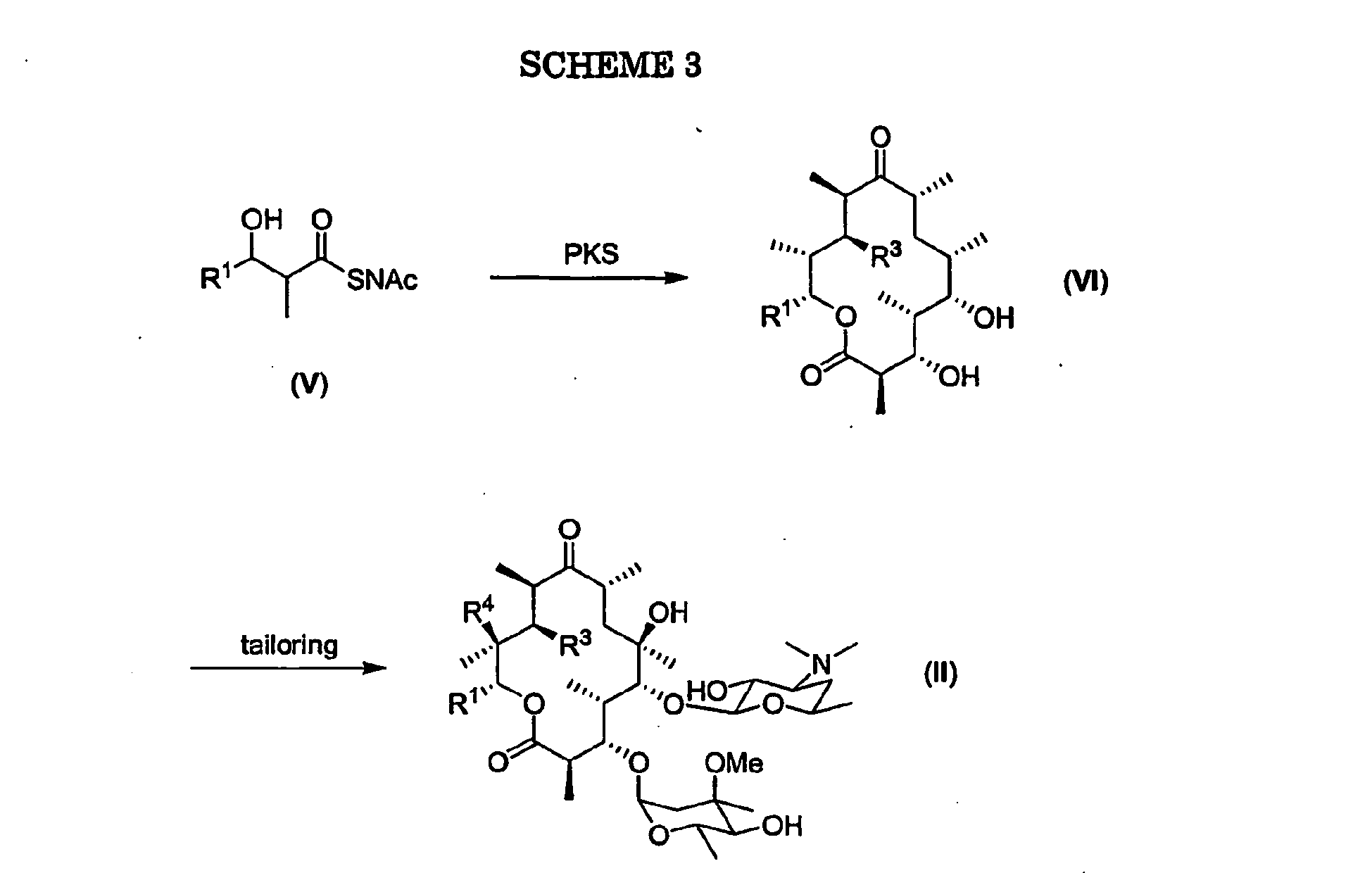
WO 00/44717 U.S. Patent 5,824,513 , and in Micromonospora megalomicea, as described inWO 01/27284 U.S. Patent 6,251,636 . These polyketide synthases are modified so as to prevent the incorporation of their native starter units. Methods of mutating polyketide synthases so as to prevent the incorporation of native starter units, for example by inactivation of the module 1 ketosynthase, are described inU.S. Patent 6,066,721 . - While the diketide thioester (V) may be supplied to a cell-free form of the polyketide synthase, as described in
U.S. Patent 6,080,555 , it is more convenient to feed (V) to a culture of an organism expressing the mutated polyketide synthase. The organism can be an actinomycete, such as a Streptomyces or Saccharopolyspora, preferably Streptomyces coelicolor, as described inU.S. Patent 6,066,721 and inPCT publication WO 01/83803 WO 01/31035 - In one method, the native polyketide synthase has been mutated so as to produce a polyketide having R3 = H. Methods for producing suitable mutated polyketide synthases are described, for example, in
U.S. patents 6,391,594 and6,403,775 . - Polyketide (VI) is converted into a erythromycin (II) through a series of tailoring steps that include hydroxylation at C-6, addition of mycarose to the 3-OH, addition of desosamine to the 5-OH, hydroxylation at C-12, and methylation at the mycarose 3"-OH. Other forms of the erythromycin can be prepared using the appropriate subset of tailoring enzymes. For example, the erythromycin B (R4 = H) is prepared by omitting the hydroxylation at C-12.
- This tailoring is most conveniently done by supplying polyketide (VI) to a culture of an organism expressing all the necessary enzymes for the transformations, for example a mutant of Saccharopolyspora erythraea comprising an inactive polyketide synthase as described in
U.S. Patent 6,395,710 . A method for this process is detailed in Example 2 below. - The compounds of formula (I) are agonists of the motilin receptor. Table 1 shows the EC50 values for activation of the motilin receptor, as measured by a calcium-influx assay as described in Carreras et al., Anal. Biochem. 300,146-151 (2002).
Table 1 Motilin Receptor Activation Compound Ref. R1 R2 R3 R4 EC50 (µM) Erythromycin A 1 CH3CH2 CH3 OH OH 1.1 A 1 CH3CH2 CH3 OH OH 2.5 B CH3CH2 CH(CH3)2 OH OH 0.49 C FCH2CH2 CH3 OH OH 5 D FCH2CH2 CH2CH3 OH OH 2 E FCH2CH2 CH(CH3)2 OH OH 0.52 F CH3CH2CH2 CH3 OH OH 8.6 G CH3CH2CH2 CH(CH3)2 OH OH 1.4 H CH3CH2CH2 C(CH3)CH2CH3 OH OH 3.3 J CH3CH2 CH(CH3)2 H H 0.16 1 Comparative compound not according to this invention - Antibacterial activity (Table 2) was determined by in vitro susceptibility tests against Streptococcus pneumoniae ATCC 6301, a macrolide-sensitive strain, using methods known in the microbiological art.
Table 2 In vitro Minimum Inhibitory Concentrations Against ATCC 6301 Compound I MIC (µg/mL) Erythromycin A 0.03 A 0.3 F 1 G >100 J >100 - Compounds were tested for motilin receptor desensitization using the cell-based assay described in
Carreras et al., US 2002/ 0192709 A1 (2002 ), "Methods for Evaluating Therapeutic Efficacy". As shown in Table 3 below, compounds showed little or no desensitization after exposure to 1 or 10 µM amounts of compound tested.Table 3 Motilin Receptor Desensitization Compound Activity following exposure to compound (% of original activity retained) 1 µM Compound 10 µM Compound F 100 100 G 100 100 J 88 88 - Another aspect of the present invention provides the use of compounds having formula (I) for the preparation of a medicament for the treatment of impaired gastric motility. In general, using the compounds of the present invention comprises administering to a subject in need thereof a therapeutically effective amount of a compound of the present invention. Illustrative examples of disorders that may be treated with the inventive compounds include gastroparesis, gastroesophageal reflux disease, anorexia, gall bladder stasis, postoperative paralytic ileus, scleroderma, intestinal pseudo-obstruction, gastritis, emesis, and chronic constipation (colonic inertia).
- The therapeutically effective amount can be expressed as a total daily dose of the compound or compounds of this invention and may be administered to a subject in a single or in divided doses. The total daily dose can be in amounts, for example, of from about 0.01 to about 10 mg/kg body weight, or more usually, from about 0.1 to about 2 mg/kg body weight. Single dose compositions may contain such amounts or submultiples thereof as to make up the daily dose. In general, treatment regimens according to the present invention comprise administration to a subject in need of such treatment of from about 10 mg to about 1000 mg of the compound(s) of the present invention per day in single or multiple doses.
- Typically, the inventive compound will be part of a pharmaceutical composition or preparation that may be in any suitable form such as solid, semisolid, or liquid form. In general, the pharmaceutical preparation will contain one or more of the compounds of the invention as an active ingredient and a pharmaceutically acceptable carrier. Typically the active ingredient is in admixture with an organic or inorganic carrier or excipient suitable for external, enteral, or parenteral application. The active ingredient may be compounded, for example, with the usual non-toxic, pharmaceutically acceptable carriers for tablets, pellets, capsules, suppositories, pessaries, solutions, emulsions, suspensions, and any other form suitable for use. Oral dosage forms may be prepared essentially as described by Hondo et al., 1987, Transplantation Proceedings XIX, Supp. 6: 17-22,.
- The carriers that can be used include water, glucose, lactose, gum acacia, gelatin, mannitol, starch paste, magnesium trisilicate, talc, cornstarch, keratin, colloidal silica, potato starch, urea, and other carriers suitable for use in manufacturing preparations, in solid, semi-solid, or liquified form. In addition, auxiliary stabilizing, thickening, and coloring agents and perfumes may be used. For example, the compounds of the invention may be utilized with hydroxypropyl methylcellulose essentially as described in
U.S. Patent No. 4,916,138 , or with a surfactant essentially as described inEPO patent publication No. 428,169 - In summary, the present invention provides motilide compounds and their use, which are further illustrated by the following examples.
- This example describes the making of 15-methyl-6-deoxyerythronolide B (also referred to as 13-propyl-6-dEB or 15-methyl-6-dEB), an intermediate used in the synthesis of certain compounds of this invention. (Other erythronolides are analogously named; for example the erythronolide with a fluoro group instead of a methyl group at the 15-position is referred to as 15-fluoro-6-dEB.)

- A 1 mL vial of the CH999/pJRJ2 (Streptomyces coelicolor that contains a PKS in which the ketosynthase domain of module 1 has been inactivated by mutation) working cell bank is thawed and the contents of the vial are added to 50 mL of Medium 1 in a 250 mL baffled flask.
- Medium 1 comprises 45 g/L cornstarch; 10 g/L corn steep liquor; 10 g/L dried, inactivated brewers yeast; and 1 g/L CaCO3. This solution is sterilized by autoclaving for 90 minutes at 121°C. After sterizilization, 1 mL/L of sterile filtered 50 mg/ml thiostrepton in 100% DMSO and 1 mL/L autoclaved 100% antifoam B silicon emulsion (J.T. Baker) are added prior to use.
- The flask containing the thawed cells and Medium 1 is placed in an incubator/shaker maintained at 30±1°C and 175±25 RPM for 48±10 hours. The 50 mL culture is then added to a 2.8 L baffled flask containing 500 mL of Medium 1. This flask is incubated in an incubator/ shaker at 30±1°C and 175±25 RPM for 48±10 hours. The 500 mL culture is than used to inoculate a 10 L fermenter containing 5 L of Medium 1. The fermenter is controlled at 30°C, pH 6.5 by addition of 2.5 N H2SO4 and 2.5 N NaOH, agitation rate 600 RPM, and air flow rate 1-2 LPM. Foam is controlled by the addition of a 50% solution of Antifoam B as needed. The fermenter culture is allowed to grow under these conditions for 24±5 hours.
- A 150 L fermenter is prepared by sterilizing 100 L of Medium 1 at 121°C for 45 minutes. After the growth period, the contents from the 10 L fermenter are aseptically added to a 150 L fermenter. The fermenter is controlled at 30°C, pH 6.5 by addition of 2.5 N H2SO4 and 2.5 N NaOH, dissolved oxygen ≥ 80% air saturation by agitation rate (500-700 RPM), air flow rate (10-50 LPM), and/ or back pressure control (0.1-0.4 bar). Foam is controlled by the addition of a 50% solution of Antifoam B as needed.
- At 35±5 hours, after dissolved oxygen has reached a minimum and CO2 content in fermenter off gas has reached a maximum, (±)-(2R*,3S*)-2-methyl-3-hydroxyhexanoyl-N-propionylcysteamine (propyl diketide) is added to a final concentration of 4 g/L. Propyl diketide is prepared by dissolving in methylsulfoxide at a ratio of 2:3 (diketide to DMSO) and then filter sterilized (0.2 µm, nylon filter). Production of 15-methyl-6-deoxyerythonolide B (13-propyl-6-dEB) ceases on day 8 and the fermenter is harvested. The fermentation broth is centrifuged at 20,500 g in an Alpha Laval AS-26 centrifuge. The product is predominantly in the supernatant; the centrifuged cell mass is discarded.
- After centrifugation, solid phase extraction is performed using HP20 resin (Mitsubishi). Column size is selected based on supernatant volume and titer, so that the loading capacity of 15 g 15-methyl-6-dEB per liter HP20 resin is not exceeded. The centrifuged broth is passed through the resin bed at a linear flow rate of 300±20 cm/h. The pressure on the column should not exceed 15 psi. The resin is then washed with 2 column volumes (CV) of water and then 2 CV of 30 % methanol, each at a rate of 300±20 cm/ h. 13-propyl-6-dEB is eluted using 7-10 CV 100% methanol at a rate of 300±20 cm/h. During elution, fractions of 1 CV are collected. The fractions are then analyzed, and those containing product are combined to yield a product pool containing >95% of the original 15-methyl-6-dEB in the centrifuged broth. The product pool is reduced to solids using rotary evaporation. Product purity at this stage is 5-35%. Methanol-insoluble material is removed from the product pool by suspending the solids in 3 L 100% methanol per 100 L original broth volume, mixing for 20 minutes, and filtering.
- The final purification step is chromatography using HP20SS resin (Mitsubishi). Column size is selected based on amount of product, so that the loading capacity of 15 g 15-methyl-6-dEB per liter HP20SS resin is not exceeded. The filtered methanol solution is diluted by adding an equal volume of water. The 50% methanol solution is passed through the resin bed at a linear flow rate of 300±20 cm/h. The column is then washed with 2 CV of 50% methanol at a rate of 300±20 cm/h. Product is eluted using 12 CV 70% methanol at a rate of 300±20 cm/h. During elution, fractions of 1 CV are collected. The fractions are then analyzed, and those containing >50 mg/L 15-methyl-6-dEB and having >20% chromatographic purity are combined. The product pool is reduced to solids using rotary evaporation. Product purity at this stage is >65% and is suitable for bioconversion to the appropriate erythromycin.
- Other modified 6-dEB analogs are prepared according to the same procedure, substituting the appropriate dikeitde thioester in place of the propyl diketide. Thus, 15-fluoro-6-dEB is prepared using (±)-(2R*,3S*)-5-fluoro-2-methyl-3-hydroxypentanoyl-N-propionylcysteamine. Also, the syntheses of 15-methyl-6-dEB and 15-fluoro-6-dEB are taught in
Ashley et al., WO 00/44717 A2 2000 - This example describes the conversion of 15-methyl-6-deoxyerythronolide B to 15-methylerythromycin A (formula II, R1 = -CH2CH2CH3; R3 = R4 = OH). Conversion techniques are also taught in Carreras et al., J. Biotechnology, 92, 217-228 (2002).
- A 1 mL vial from working cell bank K39-14V (an eryA mutant of S. erythraea that is incapable of producing 6-dEB) is thawed and the contents of the vial are added to 50 mL of Medium 2 in a 250 mL baffled flask.
- Medium 2 comprises 16 g/L cornstarch; 10 g/L corn dextrin; 15 g/L soy meal flour; 4 g/L CaCO3; 5 g/L corn steep liquor; 6 g/L soy bean oil; 2.5 g/L NaCl; and 1 g/L (NH4)2SO4. This solution is sterilized by autoclaving for 60 minutes at 121 °C and 1 mL/L autoclaved 100% antifoam B silicon emulsion (J.T. Baker) is added prior to use.
- The flask containing the thawed cells and Medium 2 is placed in an incubator/shaker maintained at 34±1°C and 175±25 RPM for 48±10 hours. The 50 mL culture is then added to a 2.8 L baffled flask containing 500 mL of Medium 2. The flask is incubated in an incubator/shaker at 34±1°C and 175±25 RPM for 48±10 hours. The 500 mL culture is than used to inoculate a 10 L fermenter containing 5 L of Medium 2. The fermenter is controlled at 34°C, pH 7.0 by addition of 2.5 N H2SO4 and 2.5 N NaOH, agitation rate 600 RPM, and air flow rate 1-2 LPM. Foam is controlled by the addition of a 50% solution of Antifoam B as needed. The fermenter culture is allowed to grow under these conditions for 24±5 hours.
- A 150 L fermenter is prepared by sterilizing 100 L of Medium 3 at 121°C for 45 minutes. Medium 3 comprises 17.5 g/L cornstarch; 16 g/L corn dextrin; 16.5 g/L soy meal flour; 4 g/L CaCO3; 6 g/L corn steep liquor; 3 g/L soy bean oil; 3.5 g/L NaCl; and 1 g/L (NH4)2SO4. After the growth period, the contents from the 10 L fermenter are aseptically transferred to the 150 L fermenter. The fermenter is controlled at 34°C, pH 7.0 by addition of 2.5 N H2SO4 and 2.5 N NaOH, dissolved oxygen ≥ 80% air saturation by agitation rate (500-700 RPM), air flow rate (15-50 LPM), and/or back pressure control (0.1-0.4 bar). Foam is controlled by the addition of a 50 % solution of Antifoam B.
- At 24±5 hours a 58-60 mL/hour 15% dextrin (w/v) feed is initiated. The dextrin solution is continuously mixed during the feed period. At 24±5 hours 25 grams of 13-propyl-6dEB are added to the fermenter. The 13-propyl-6dEB is prepared by solubolizing 25 grams of 13-propyl-6dEB in 400-600 mL of 100% ethanol and filtering (0.2 µm, nylon filter). Conversion of 13-propyl-6dEB to 13-propyl-erythromycin A ceases after 60±10 hours and the fermenter is harvested. The fermentation broth is centrifuged at 20,500 g in an Alpha Laval AS-26 centrifuge. The product is predominantly in the supernatant; the centrifuged cell mass is discarded.
- After centrifugation, solid phase extraction is performed using HP20 resin (Mitsubishi). Column size is selected based on supernatant volume and titer, so that the loading capacity of 15 g 15-methylerythromycin A per liter HP20 resin is not exceeded. The centrifuged broth is adjusted to pH 9, then passed through the resin bed at a linear flow rate of 275±25 cm/h. The pressure on the column should not exceed 15 psi. The resin is then washed with 1 column volume (CV) of water at a rate of 275±25 cm/h. The 15-methylerythromycin is eluted using 5 CV 100% methanol at a rate of 275±25 cm/h. During elution, fractions of 1 CV are collected. The fractions are then analyzed, and those containing product are combined to yield a product pool. The product pool is reduced to solids using rotary evaporation.
- Methanol-insoluble material is removed from the product pool by suspending the solids in 1L 100% methanol per 100 L original broth volume, adjusting to pH 9, and filtering. The product pool (filtrate) is reduced to solids using rotary evaporation.
- The 15-methylerythromycin A is extracted from the product pool (solids) by adding 2 L 4:1 hexane:acetone per 100 L original broth volume, mixing for 20 minutes, and filtering. The remaining solids are extracted the same way two more times and filtrates are combined. The product pool is reduced to solids using rotary evaporation.
- The final purification step is chromatography using HP20SS resin (Mitsubishi). Column size is selected based on amount of product, so that the loading capacity of 15 g 15-methylerythromycin A per liter HP20SS resin is not exceeded. The solids from the previous steps are dissolved in 1 L methanol per 100 L original broth volume, and an equal volume of water is added. The 50% methanol solution is passed through the resin bed at a linear flow rate of 275±25 cm/h. The column is then washed with 1 CV of 50% methanol, then 3 CV 60% methanol, each at a rate of 275±25 cm/h. Product is eluted using 3 CV 70% methanol, then 10 CV 75% methanol, each at a rate of 275±25 cm/h. During elution, fractions of 1 CV are collected. The fractions are then analyzed, and those containing 15-methylerythromycin A are combined. The product pool is reduced to solids using rotary evaporation.
- Other modified erythromycins are prepared using the same procedure and substituting the appropriate 6-dEB analog in place of 15-methyl-6-dEB. Thus, 15-fluoroerythromycin A is prepared using 15-fluoro-6-dEB.
- This example describes a general method for the preparation of (9S)-9-dihydroerythromycins (formula II), with reference to Scheme 1.
- A solution of the erythromycin (0.36 mmol) in 1:3 ethanol/ether (20 mL) is cooled to -15 °C and treated with sodium borohydride (0.9 mmol). The reaction is allowed to warm slowly to ambient temperature over 4 hours. The excess borohydride is destroyed by addition of phosphate buffer, pH 6, and 10 mL of triethanolamine is added. After 1 hour, the mixture is extracted with ethyl acetate, dried over MgSO4, filtered, and concentrated to dryness under reduced pressure. The product is purified by silica gel chromatography using 1:1 acetone-hexanes with 1 % triethylamine. The following compounds were prepared using this procedure:
- (9S)-9-dihydroerythromycin A;
- (9S)-9-dihydro-15-methylerythromycin A; and
- (9S)-9-dihydro-15-fluoroerythromycin A.
- This example describes a general procedure for the preparation of N-desmethyl-(9S)-9-dihydroerythromycins (formula III), with reference to Scheme 1.
- Sodium acetate trihydrate (139 mg) and iodine (52 mg) are added sequentially to a solution of the (9S)-9-dihydroerythromycin (150 mg) in 10 mL of 8:2 methanol/water. A 0.2 M solution of LiOH (1 mL) is added in 4 portions over 1 hour. Complete reaction is determined by thin-layer chromatographic analysis. Excess reagents are quenched by addition of saturated sodium thiosulfate solution, and the volatiles are removed under reduced pressure and the mixture is extracted with ethyl acetate. The organic phase is washed with saturated NaHCO3, dried over Na2SO4, filtered, and concentrated to give the crude product. Silica gel chromatography (acetone/hexanes + 2% Et3N) gives the pure product. The following compounds were prepared using this procedure:
- N-desmethyl (9S)-9-dihydroerythromycin A;
- N-desmethyl (9S)-9-dihydro-15-methylerythromycin A; and
- N-desmethyl (9S)-9-dihydro-15-fluoroerythromycin A.
- This example describes the preparation of N-desmethyl-N-R2-(9S)-9-dihydroerythromycins, with particular reference to Scheme 1, compounds having formula II (R3 = R4 = OH).
- A mixture of the N-desmethyl (9S)-9-dihydro-erythromycin A analog (0.035 mmol), diisopropylethylamine (62.5 uL), R2I (1.3 mmol), and acetonitrile (1 mL) is sealed and stirred at 70 °C overnight. The mixture is cooled, diluted with aqueous NaHCO3, and extracted with ethyl acetate. The extract is dried over MgSO4, filtered, and evaporated to dryness. The product is purified by silica gel chromatography using 2:1 hexanes/acetone + 1% Et3N. The following compounds were prepared according to this procedure:
- (a) N-desmethyl-N-ethyl (9S)-9-dihydro-15-fluoroerythromycin A, using N-desmethyl (9S)-9-dihydro-15-fluoroerythromycin A and ethyl iodide;
- (b) N-desmethyl-N-isopropyl (9S)-9-dihydro-15-fluoroerythromycin A, using N- demethyl (9S)-9-dihydro-15-fluoroerythromycin A and isopropyl iodide;
- (c) N-desmethyl-N-isopropyl (9S)-9-dihydro-15-methylerythromycin A, using N-demethyl (9S)-9-dihydro-15-methylerythromycin A and isopropyl iodide; and
- (d) N-desmethyl-N-(2-butyl) (9S)-9-dihydro-15-methylerythromycin A, using N-demethyl (9S)-9-dihydro-15-methylerythromycin A and 2-iodobutane.
- This example illustrates the demethylation step of the Scheme 1A, with specific reference to N-desmethyl-15-methylerythromycin A (compound III'; R1 = 1-propyl; R3 = R4 = OH), although it is to be understood that the procedure is generally applicable to other analogous compounds.
- A mixture of 15-methylerythromycin A (compound III, R1 = 1-propyl; R3 = R4 = OH; 5.00 g, 6.15 mmol) and sodium acetate trihydrate (4.18 g, 30.75 mmol) in methanol-water (8:2 V/V, 100 mL) was stirred at 50 °C. Iodine (1.56 g, 6.15 mmol) was then added. During the reaction 1N sodium hydroxide (6.15 mL) was added in small portions. Complete reaction was determined by thin-layer chromatographic analysis. After removal of solvent, the mixture was extracted three times with ethyl acetate, dried over sodium sulfate. Crude product (4.97 g) was obtained as a yellow solid, which was used for next step without further purification.
- This example illustrates the alkylation step of Scheme 1A, with specific reference to N-desmethyl-N-isopropyl-15-methylerythromycin A (compound IV', R1 = 1-propyl; R2 = isopropyl; R3 = R4 = OH), though it is to be understood that the procedure is generally applicable to other analogous compounds.
- A mixture of the crude N-desmethyl-15-methylerythromycin A from the previous example (2.50 g, 3.41 mmol), diisopropylethylamine (6.1 mL, 10 equiv), 2-iodopropane (10.2 mL, 30 equiv) in acetonitrile (50 mL) was heated in a 70 °C bath for 24 h. Water and saturated sodium bicarbonate were added. The solution was extracted three times with ethyl acetate and dried over magnesium sulfate. The crude product was purified via silica gel column chromatography (3:1 hexane-acetone, 1% triethylamine) to give pure N-desmethyl-N-isopropyl-15-methylerythromycin A (1.80 g, 75% yield for 2 steps). ). m/z: 777.0 (MH); 13C-NMR (CDCl3): 221.86, 175.62, 103.11, 96.15, 83.30, 79.85, 78.01, 75.10, 74.90, 74.59, 72.58, 70.35, 68.91, 68.75, 65.48, 62.79, 52.49, 49.47, 45.12, 44.76, 39.32, 38.43, 37.85, 34.96, 33.06, 30.76, 30.19, 26.93, 21.48, 21.41, 20.99, 20.46, 19.47, 18.62, 18.27, 16.15, 15.84, 14.00,12.04,9.01.
- This example illustrates the carbonyl reduction step of Scheme 1A, with particular reference to N-desmethyl-N-isopropyl-15-methyl-(9S)-9-dihydroerythromycin A (compound I, R1 = 1-propyl; R2 = isopropyl; R3 = R4 = OH), although it is to be understood that the procedure is generally applicable to other analogous compounds.
- N-desmethyl-N-isopropyl-15-methylerythromycin A (1.74 g, 2.24 mmol) was dissolved in methanol-ether (1:3 V/V, 50 mL), then cooled to -20 °C. Sodium borohydride (189 mg, 5.0 mmol) was added. The mixture was then warmed slowly to room temperature over a period of 3 h. The excess sodium borohydride was destroyed by addition of pH 6.0 phosphate buffer, followed by triethanolamine (10 mL). After 30 min the mixture was extracted with ethyl acetate and dried over magnesium sulfate. The crude product was purified by silica gel column chromatography (3:1 hexane-acetone with 1% triethylamine). Pure N-desmethyl-N-isopropyl-15-methyl-(9S)-9-dihydroerythromycin A (1.63 g, 93% yield) was obtained. m/ z: 779.0 (MH); 13C-NMR (CDCl3): 177.28, 102.59, 95.81, 83.45, 82.76, 78.81, 77.86, 75.68, 75.03, 74.67, 72.68, 70.38, 70.24, 69.26, 65.97, 62.28, 52.52, 49.34, 44.83, 42.00, 36.78, 34.80, 34.37, 33.01, 31.96, 31.02, 30.76, 25.46, 21.58, 21.28, 21.10, 20.41, 19.93, 19.74, 18.27, 16.37, 14.86, 14.30, 14.02, 9.17.
- This example describes the construction of a strain of Saccharopolyspora erythraea (K24-1/159-44) capable of the biosynthesis of 11-deoxyerythromycins, with particular reference to 11-deoxyerythromycin B, which are useful as intermediates for the synthesis of certain compounds of this invention.
- 11-Deoxyerythromycin B can be prepared in a single fermentation in a genetically engineered host cell expressing a modified version of the DEBS suite of genes (eryAI, eryAII, and enyAIII). The enyAI gene is engineered by replacement of the ketoreductase domain in module 2 with a cassette containing a dehydratase domain, an enoylreductase domain, and a ketoreductase domain, for example taken from module 1 of the rapamycin PKS. Methods for domain replacement are provided in, for example,
McDaniel, US 6,403,775 (2002 ), which is incorporated herein by reference. The engineered eryAI gene is incorporated along with the eryAII and eryAIII genes into a host cell competent in the production of erythromycins once the engineered PKS genes have been added. In preferred embodiments, these host cells are "clean hosts," wherein their native PKS genes have been removed. Examples of suitable hosts include but are not limited to the clean host Saccharopolyspora erythraea K24-1 and strains of Saccharopolyspora erythraea having mutated PKS genes such as those described inSanti et al., US 2002/ 0004229 A1 (2002 ). Strain K24-1 has had the native eryAI, eryAII, and eryAIII genes replaced with the attB phage attachment site of the actinophage ΦC31, described inU.S. Patent 5,190,871 , incorporated herein by reference, and followed by the ermE* promoter. This allows plasmid vectors comprising the complementary attP phage attachment site along with the genes to be delivered to integrate into the chromosome at the attB site in the presence of a phage integrase. Examples of suitable integrating phage vectors include but are not limited to pSET152 and its derivatives. - Preparation of starting host strain Saccharopolyspora erythraea K24-1 is described in
Santi et al., US 2002/0004229 A1 (2002 ), and the strain was deposited with the American Type Culture Collection, P.O. Box 1549, Manassas, Virginia 20108, USA, according to the terms of the Budapest Treaty on March 12, 2003, with accession number PTA-5061. - pKOS159-8 and pKOS159-10 are derivatives of pSET152 containing the eryA genes under the control of the ermEp* promoter and the actIp/actII-ORF4 promoter-activator pair, respectively. A 35 kb NsiI fragment from pKAO127 carrying the eryA genes and the actIp/actII-ORF4 region was cloned into pKOS97-64c (a pSET152 derivative containing the ermEp* promoter and a λ cos site) to make pKOS159-10. The fd transcriptional terminator from the pKAO127 fragment prevents expression of any genes from the ermEp* promoter in this plasmid. The fragment containing the fd terminator and actIp/actII-ORF4 segment in pKOS159-10 was removed by digestion with PacI and self-ligation to generate pKOS159-8. For expression of eryA genes under their natural promoter, pKOS159-31 was constructed by cloning the NdeI-XbaI fragment carrying the eryA genes (and λ cos site) from pKOS159-10 and the XbaI-NdeI digested PCR amplified eryAI left flank fragment from above into pSET152 digested with XbaI. pKOS159-33, which contains the eryA genes from S. erythraea K41-135 was constructed in an analogous way using the eryA fragment from pKOS108-04. Likewise, all engineered DEBS expression plasmids were made using pKOS159-31 as a scaffold and appropriate restriction enzymes to move the genetically modified eryA fragment from existing plasmids.
- pKOS159-44 is a pSET152 (Bierman et al., Gene 116, 43-49 (1992), "Plasmid cloning vectors for the conjugal transfer of DNA from Escherichia coli to Streptomyces spp.") derivative plasmid that has genetically modified eryA genes (KR2 → rapDH/ER/KR1) under the control of eryAI promoter (Rodriguez et al., J. Ind. Microbio. Biotechnol., "Rapid Engineering of Polyketide Overproduction by Gene Transfer to Industrially Optimized Strains," web-published as document no. 10.1007/s10295-003-0045-1 (http://link.springer-ny.com) (16 Apr. 2003)). A 30 kb NdeI-NsiI fragment (carrying genetically modified eryA genes) from pKOS11-66 (Xue et al., Proc. Natl. Acad. Sci. U.S.A., 96,11740-11745 (1999), "A multiplasmid approach to preparing large libraries of polyketides") was isolated and ligated to a 8 kb NdeI-NsiI fragment from pKOS159-33 (Rodriguez et al., cited supra), containing the vector pSET152, eryAp promoter and cos λ site). The ligation mixture was packaged using Gigapack III Gold packaging extract (Stratagene), and used to infect E. coli XL-1 Blue. Recombinats were selected on LB agar plates containing 60 µg/ml apramycin. pKOS159-44 plasmid DNA was isolated and checked by restriction digestions.
- S. erythraea strain K24-1, which contains a chromosomal deletion of the three eryA genes and insertion of the attB loci for the Streptomyces phage φC31 from Streptomyces lividans, followed by the ermE* promoter in their place, was prepared by harvesting spores from strains grown on 1-2 M1 plates (per liter, 5 g glucose, 5 g tryptone, 0.5g betaine hydrochoride, 5g corn starch, 1g corn steep liquor (50%), 200 mg MgSO4•7H2O, 2 mg ZnSO4•7H2O, 0.8 mg CuSO4•5H2O, 0.2 mg CoCl2•6H2O, 4 mg FeSO4•7H2O, 80 mg CaCl2•6H2O, 150 mg KH2PO4, 10 g NaCl, 20 g agar) filtering the spores through sterile cotton, and resuspending in 1 ml of 20% glycerol. Spore suspensions were stored at -20 °C. A 20 µL aliquot of the spore suspension was added to 5 mL of 2xYT and incubated at 30°C with shaking. After 1 h the spores were collected by centrifugation (recipient cells). Donor cells were prepared by transforming E. coli ET12567/pUZ8002 with pKOS159-44 and selecting for apramycin resistance only. Several colonies were picked off the primary transformation plate and used to inoculate 5 ml of LB with chloramphenicol (10 µg/mL) kanamycin (100 µg/mL) and apramycin (60 µg/mL). The cells were grown at 37°C for 3-4 h (OD600 of 0.4-0.6), collected by centrifugation, washed in 5 mL LB, centrifuged, and resuspended in 100 µL of LB. Conjugal transfer between the donor and recipient cells was performed by resuspending the recipient cells in the 100 µl donor suspension and the cells were spread on R5 plates (Hopwood et al., Genetic Manipulation of Streptomyces: A Laboratory Manual (The John Innes Foundation, Norwich, UK, 1985) containing 50 µg/mL nalidixic acid and incubated at 34°C for 16 h. The plates were then overlayed with 3 mL of soft nutrient agar containing 1 mg nalidixic acid and 2 mg apramycin. Exconjugants K24-1/159-44 were observed after 48 h of further incubation.
- Strain K24-1/159-44 was deposited with the American Type Culture Collection, P.O. Box 1549, Manassas, Virginia 20108, USA, according to the terms of the Budapest Treaty on March 12, 2003, with accession number PTA-5054.
- This example describes the biosynthesis of 11-deoxyerythromycin B, an intermediate for the synthesis of certain compounds of this invention, using the strain described in the preceding example.

- Fermentation techniques disclosed in Frykman et al., Biotechnol. Bioeng., 76,303-310 (2001) "Precursor-Directed Production of Erythromycin Analogs by Saccharopolyspora erythraea ," and Rodriguez et al., cited supra, were followed.
- The following media were used: (a) Seed medium V1 contained 16 g/L corn starch, 10 g/L dextrin (D-2256, Sigma-Aldrich), 15 g/L soybean flour (S-9633, Sigma-Aldrich), 2.5 g/L sodium chloride, 5 g/L corn steep liquor, 1 g/L ammonium sulfate (A-2939, Sigma-Aldrich), 6 g/L soybean oil (S-7381, Sigma-Aldrich), and 4 g/L calcium carbonate (C-4830, Sigma Aldrich). (b) Fermentation medium F2 contained 28 g/L corn starch, 24 g/L soybean meal, 5.5 g/L sodium chloride, 8 g/L corn steep liquor, and 1.5 g/L ammonium sulfate, 4.5 g/L soybean oil, and 6 g/L calcium carbonate. All media were sterilized by autoclaving at 121°C for 90 min.
- Two seed flasks were started by taking a 1 mL vial of Saccharopolyspora erythraea K24-1/pKOS159-44 from a frozen cell bank, thawing, and adding the vial contents into 50 mL of medium V1 and incubating at 34 °C for 40-48 h. Two secondary seeds were then created by transferring 50 mL aliquots from the seed flask to 500 mL of medium V1 and incubating at 34 °C for 40-48 h.
- Both 500 mL secondary seed cultures were transferred to a B. Braun B10 fermenter containing 9 L of medium V1. The fermenter was operated at 34°C and maintained at pH 7.0 by addition of 2.5 N sulfuric acid and 2.5 N sodium hydroxide. Aeration at 3 LPM and agitation at 600 to 800 rpm were provided, maintaining the dissolved oxygen tension at greater than 40%. Harvesting took place after about 24 h.
- Then, 10 L of the fermenter seed culture was transferred to a B. Braun Biostat UD500 fermenter containing 300 L medium F2. The Biostat UD500 fermenter was operated at 34 °C and maintained at pH 7.0 by the addition of 2.5 N sulfuric acid and 2.5 N sodium hydroxide. Agitation at 200-300 rpm and aeration at 40-250 LPM were provided, maintaining the dissolved oxygen tension at greater than 40%. Dextrin (150 g/L) was fed at a rate of 675 mL/h from 24 to 98 h. Soybean oil was fed at a rate of 64 mL/h from 24 to 140 h. n-Propanol was fed at a rate of 26 mL/h from 24 to 140 h. Harvesting took place after 180 h.
- Foaming was controlled by the addition of a 50% solution of antifoam B (JT Baker) as needed.
- The fermentation broth was clarified by centrifugation and was subjected to solid phase extraction using HP20 resin (Mitsubishi). Adsorbed product was eluted with methanol and dried. The crude product was then subjected to ethyl acetate:water liquid:liquid extraction. The combined ethyl acetate extracts were dried. The product was purified by chromatography using HP20SS resin, eluting with a step-gradient from 50% to 80% methanol. The product containing fractions were pooled and dried, to provide 11-deoxyerythromycin B. m/z: 702.64 (MH); 13C-NMR (CDCl3): 219.13, 175.56, 102.48, 95.92, 82.73, 79.40, 78.92, 77.79, 74.88, 72.52, 70.79, 68.80, 65.52, 65.13, 49.25, 45.98, 44.31, 43.40, 40.15 (2x), 38.11, 37.20, 36.54, 34.79, 33.19, 28.52, 26.37, 24.55, 21.37, 21.19, 18.54, 18.31, 15.69, 14.68, 11.96, 10.36, 9.16 ppm.
- This example describes the conversion of 11-deoxyerythromycin B to N-desmethyl-N-isopropyl-11-deoxy-(9S)-9-dihydroerythromycin B (compound I, R1 = ethyl, R2 = isopropyl, and R3 = R4 = H; compound J, Table 1), using the approach of Scheme 1.
- 11-Deoxyerythromycin B (200 mg, 0.285 mmol) was reduced generally following the procedure of Example 8 to give (9S)-9-dihydroerythromycin B (94 mg, 47% yield). m/z: 705.0 (MH); 13C-NMR (CDCl3): 176.82,102.38, 95.82, 83.04, 80.95, 80.23, 79.01, 77.82, 74.89, 72.71, 70.89, 69.14, 66.04, 65.12, 49.28, 44.67, 42.23, 40.28 (2x), 37.36,34.81 (2x), 33.50, 32.58, 29.39, 28.90, 25.29, 25.17, 21.53, 21.16, 20.04, 18.13, 17.98, 13.82, 10.59, 10.22, 9.24.
- Generally following the procedures of Examples 6 and 7,11-deoxy-(9S)-9-dihydroerythromycin B (94 mg, 0.134 mmol) was then converted to N-desmethyl-N-isopropyl-11-deoxy-(9S)-9-dihydroerythromycin B (57 mg, 58% yield). m/z: 733.0 (MH); 13C-NMR (CDCl3): 176.98, 102.05, 95.55, 82.33, 81.11, 80.22, 78.90, 77.89, 74.93, 72.69, 70.29, 69.11, 65.98, 65.16, 52.53, 49.28, 44.52, 42.38, 37.27, 34.91, 34.73, 33.38, 32.96, 32.60, 30.99, 29.38, 25.18 (2x), 21.54, 21.22, 21.05, 20.34, 19.91, 18.12, 17.85,13.68,10.45,10.21,9.10.
Claims (15)
- A compound having the formula (I)
 R1 is substituted or unsubstituted C1-C10 alkyl, substituted or unsubstituted C2-C10 alkenyl, substituted or unsubstituted C4-C10 alkynyl, substituted or unsubstituted aryl, or substituted or unsubstituted heterocyclo;R2 is H, substituted or unsubstituted C1-C5 alkyl, substituted or unsubstituted C2-C5 alkenyl, substituted or unsubstituted C2-C5 alkynyl, substituted or unsubstituted aryl, or substituted or unsubstituted heterocyclo;R3 is H or OH; andR4 is H or OH, or R3 and R4 taken together form O-(C=O)-O;with the proviso that when (a) R1 is ethyl and (b) R3 is OH or R3 and R4 taken together form O-C(=O)-O, then R2 is not H or methyl.
 - A compound according to Claim 1 whereinR1 is substituted or unsubstituted C1-C10 alkyl, substituted or unsubstituted C2-C10 alkenyl, substituted or unsubstituted C2-C10 alkynyl, substituted or unsubstituted aryl, or substituted or unsubstituted heterocyclo;R2 is H, ethyl, propyl, isopropyl, or 2-butyl; andR3 and R4 are OH,with the proviso that when R1 is ethyl, then R2 is not H or methyl.
- A compound according to Claim 1 wherein:R1 is substituted or unsubstituted C1-C5 alkyl;R2 is H, substituted or unsubstituted C1-C5 alkyl, substituted or unsubstituted C2-C5 alkenyl, or substituted or unsubstituted C2-C5 alkynyl; andR3 and R4 are OH,with the proviso that when R1 is ethyl, then R2 is not H or methyl.
- A compound according to Claim 1 wherein:R1 is ethyl;R2 is ethyl, propyl, isopropyl or 2-butyl; andR3 and R4 are OH.
- A compound according to Claim 1 wherein:R1 is substituted ethyl;R2 is H, substituted or unsubstituted C1-C5 alkyl, substituted or unsubstituted C2-C5 alkenyl, or substituted or unsubstituted C2-C5 alkynyl; andR3 and R4 are OH.
- A compound according to Claim 1 wherein:R1 is substituted ethyl;R2 is H, ethyl, propyl, isopropyl, or 2-butyl; andR3 and R4 are OH.
- A compound according to Claim 1 wherein:R1 is propyl;R2 is H, substituted or unsubstituted C1-C5 alkyl, substituted or unsubstituted C2-C5 alkenyl, or substituted or unsubstituted C2-C5 alkynyl; andR3 and R4 are OH.
- A compound according to claim 1, whereinR3 and R4 are independently H or OH;R1 is selected from the group consisting of ethyl, 2-fluoroethyl, and 1-propyl; andR2 is selected from the group consisting of methyl, ethyl, isopropyl, and 2-butyl; with the proviso that when R1 is ethyl and R3 is OH, then R2 is not methyl.
- A compound according to claim 1, wherein R1, R2, R3 and R4 are according to the combinations set forth in the table below:
R1 R2 R3 R4 CH3CH2 CH(CH3)2 OH OH FCH2CH2 CH3 OH OH FCH2CH2 CH2CH3 OH OH FCH2CH2 CH(CH3)2 OH OH CH3CH2CH2 CH3 OH OH CH3CH2CH2 CH(CH3)2 OH OH CH3CH2CH2 C(CH3)CH2CH3 OH OH CH3CH2 CH(CH3)2 H H - A compound according to Claim 1 selected from the group consisting of:


- A compound according to claim 1, having a structure of the formula:

- A compound according to Claim 1, having a structure of the formula:
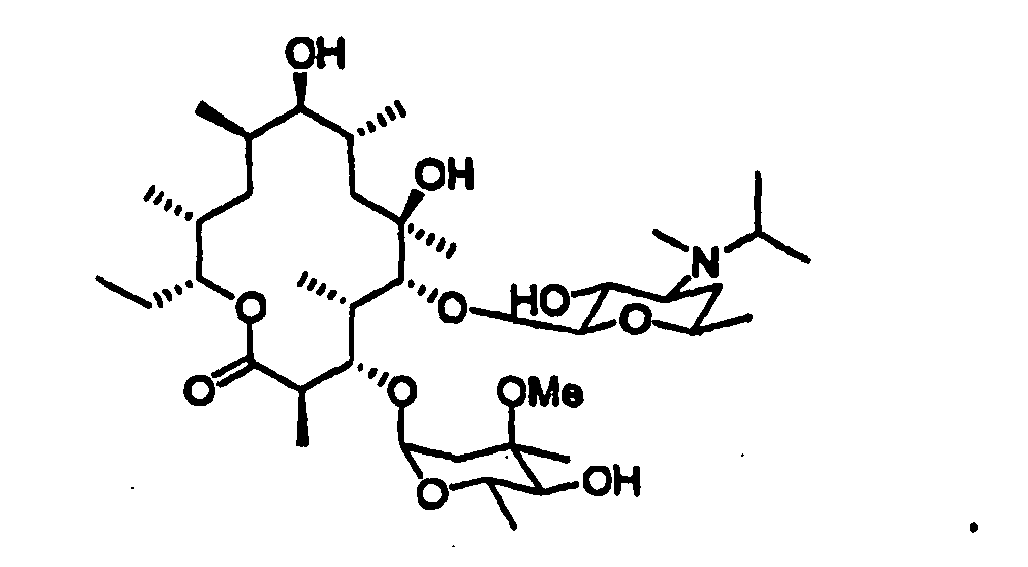
- A pharmaceutical composition comprising a compound according to any one of claims 1 to 12 together with a pharmaceutically acceptable carrier.
- A compound according to any one of claims 1 to 12 for use in the treatment of a disorder of gastric motility.
- The use of a compound according to any one of claims 1 to 12 for the preparation of a medicament for treating a gastric disorder in a patient.
Priority Applications (2)
| Application Number | Priority Date | Filing Date | Title |
|---|---|---|---|
| SI200331492T SI1532131T1 (en) | 2002-08-29 | 2003-08-26 | Motilide compounds |
| CY20091100165T CY1108808T1 (en) | 2002-08-29 | 2009-02-13 | MOTORCYCLE UNITS |
Applications Claiming Priority (3)
| Application Number | Priority Date | Filing Date | Title |
|---|---|---|---|
| US40734502P | 2002-08-29 | 2002-08-29 | |
| US407345P | 2002-08-29 | ||
| PCT/US2003/026991 WO2004019879A2 (en) | 2002-08-29 | 2003-08-26 | Motilide compounds |
Publications (3)
| Publication Number | Publication Date |
|---|---|
| EP1532131A2 EP1532131A2 (en) | 2005-05-25 |
| EP1532131A4 EP1532131A4 (en) | 2007-05-30 |
| EP1532131B1 true EP1532131B1 (en) | 2008-12-17 |
Family
ID=31978464
Family Applications (1)
| Application Number | Title | Priority Date | Filing Date |
|---|---|---|---|
| EP03755757A Expired - Lifetime EP1532131B1 (en) | 2002-08-29 | 2003-08-26 | Motilide compounds |
Country Status (15)
| Country | Link |
|---|---|
| US (1) | US6946482B2 (en) |
| EP (1) | EP1532131B1 (en) |
| JP (1) | JP4796300B2 (en) |
| KR (1) | KR101051613B1 (en) |
| CN (1) | CN100363359C (en) |
| AT (1) | ATE417856T1 (en) |
| AU (1) | AU2003273254B2 (en) |
| CA (1) | CA2492846C (en) |
| CY (1) | CY1108808T1 (en) |
| DE (1) | DE60325377D1 (en) |
| DK (1) | DK1532131T3 (en) |
| ES (1) | ES2316805T3 (en) |
| PT (1) | PT1532131E (en) |
| SI (1) | SI1532131T1 (en) |
| WO (1) | WO2004019879A2 (en) |
Families Citing this family (15)
| Publication number | Priority date | Publication date | Assignee | Title |
|---|---|---|---|---|
| US8063021B2 (en) | 2002-01-17 | 2011-11-22 | Kosan Biosciences Incorporated | Ketolide anti-infective compounds |
| US7407941B2 (en) * | 2003-08-26 | 2008-08-05 | Pfizer, Inc. | N-desmethyl-N-substituted-11-deoxyerythromycin compounds |
| GB0327720D0 (en) * | 2003-11-28 | 2003-12-31 | Biotica Tech Ltd | Erythromycins and process for their preparation |
| US7211568B2 (en) * | 2003-12-18 | 2007-05-01 | Kosan Biosciences Incorporated | 9-Desoxoerythromycin compounds as prokinetic agents |
| US7468428B2 (en) * | 2004-03-17 | 2008-12-23 | App Pharmaceuticals, Llc | Lyophilized azithromycin formulation |
| US20060116336A1 (en) * | 2004-03-17 | 2006-06-01 | American Pharmaceutical Partners, Inc. | Lyophilized azithromycin formulation |
| US7582611B2 (en) * | 2005-05-24 | 2009-09-01 | Pfizer Inc. | Motilide compounds |
| UA87569C2 (en) * | 2005-05-24 | 2009-07-27 | Пфайзер Инк. | Compound for treatment of gastrointestinal motility disorders |
| NZ568763A (en) * | 2005-12-08 | 2010-04-30 | Pfizer | Method for demethylating the 3'-dimethylamino group of erythromycin compounds |
| EP2431380A3 (en) | 2006-09-11 | 2013-07-03 | Tranzyme Pharma, Inc. | Macrocyclic antagonist of the motilin receptor for treatment of gastrointestinal dysmotility disorders |
| ES2401467T3 (en) | 2006-12-05 | 2013-04-19 | Bristol-Myers Squibb Company | Motilide polymorphs |
| US20080287371A1 (en) * | 2007-05-17 | 2008-11-20 | Tranzyme Pharma Inc. | Macrocyclic antagonists of the motilin receptor for modulation of the migrating motor complex |
| CN106138038B (en) * | 2015-04-28 | 2021-04-20 | 天津国际生物医药联合研究院 | Macrolide derivative and application thereof |
| CN106478541A (en) * | 2016-10-17 | 2017-03-08 | 南开大学 | Derivative of macrolides and application thereof |
| CN106478542A (en) * | 2016-10-17 | 2017-03-08 | 南开大学 | A kind of macrolide derivative salt, Preparation Method And The Use |
Family Cites Families (41)
| Publication number | Priority date | Publication date | Assignee | Title |
|---|---|---|---|---|
| US391594A (en) * | 1888-10-23 | Arc-extinguisher for electric switches or cut-outs | ||
| US4382085A (en) | 1982-03-01 | 1983-05-03 | Pfizer Inc. | 4"-Epi erythromycin A and derivatives thereof as useful antibacterial agents |
| US4382086A (en) | 1982-03-01 | 1983-05-03 | Pfizer Inc. | 9-Dihydro-11,12-ketal derivatives of erythromycin A and epi-erythromycin A |
| PL136968B1 (en) | 1983-02-10 | 1986-04-30 | Tarchominskie Zaklad Farma | Process for preparing cyclic 11,12-carbonate of erythromycin a |
| JPS60218321A (en) | 1984-04-13 | 1985-11-01 | Satoshi Omura | Agent for promoting contraction of digestive tract |
| EP0184921A3 (en) * | 1984-12-08 | 1986-10-29 | Beecham Group Plc | Erythromycin derivatives |
| GB8608080D0 (en) | 1986-04-02 | 1986-05-08 | Fujisawa Pharmaceutical Co | Solid dispersion composition |
| US4742049A (en) * | 1986-06-04 | 1988-05-03 | Abbott Laboratories | Semisynthetic erythromycin antibiotics |
| US4857641A (en) | 1987-08-14 | 1989-08-15 | Pfizer Inc. | C.12 modified erythromycin A derivatives |
| EP0465581B1 (en) | 1989-03-28 | 1995-10-04 | Abbott Laboratories | Erythromycin derivatives |
| US5190871A (en) | 1989-06-12 | 1993-03-02 | Eli Lilly And Company | Use of the site-specific integrating function of phage φC31 |
| US5824513A (en) | 1991-01-17 | 1998-10-20 | Abbott Laboratories | Recombinant DNA method for producing erythromycin analogs |
| ATE139697T1 (en) | 1991-04-09 | 1996-07-15 | Abbott Lab | MACROCYCLIC LACTAM PROKINETICS |
| US5554605A (en) | 1991-04-09 | 1996-09-10 | Abbott Laboratories | Macrocyclic lactam prokinetic agents |
| DE69317877T2 (en) | 1992-01-21 | 1998-10-29 | Abbott Lab | 4 '' DEOXYERYTHROMYCINE DERIVATIVES |
| MY113693A (en) | 1992-05-26 | 2002-05-31 | Chugai Pharmaceutical Co Ltd | Erythromycin derivatives having an enterokinesis stimulating action |
| US6066721A (en) | 1995-07-06 | 2000-05-23 | Stanford University | Method to produce novel polyketides |
| US5712146A (en) | 1993-09-20 | 1998-01-27 | The Leland Stanford Junior University | Recombinant combinatorial genetic library for the production of novel polyketides |
| JP3633629B2 (en) | 1995-07-06 | 2005-03-30 | ザ レランド スタンフォード ジュニア ユニバーシティ | Cell-free synthesis of polyketides |
| US6077943A (en) | 1996-03-01 | 2000-06-20 | Takeda Chemical Industries, Ltd. | Method of producing erythromycin derivative |
| WO1997035590A1 (en) * | 1996-03-25 | 1997-10-02 | Platt Chris E | 10-aza-9-deoxo-11-deoxy-erythromycin a and derivatives combined with sulfisoxazole |
| US5712253A (en) | 1996-06-18 | 1998-01-27 | Abbott Laboratories | Macrocyclic 13-membered ring derivatives of erythromycins A and B |
| US6271255B1 (en) * | 1996-07-05 | 2001-08-07 | Biotica Technology Limited | Erythromycins and process for their preparation |
| US5922849A (en) | 1996-11-22 | 1999-07-13 | Abbott Laboratories | Process for preparation of N-demethyl-4"-deoxy-erthromycins A and B |
| WO1998040392A1 (en) * | 1997-03-10 | 1998-09-17 | Taisho Pharmaceutical Co., Ltd. | Erythromycin a derivatives |
| AU9645998A (en) | 1997-10-29 | 1999-05-17 | Taisho Pharmaceutical Co., Ltd. | Erythromycin a derivatives |
| US6169168B1 (en) | 1997-10-29 | 2001-01-02 | Taisho Pharmaceuticals Co., Ltd. | Erythromycin A derivatives |
| US6084079A (en) | 1998-05-15 | 2000-07-04 | Keyes; Robert F. | Process for preparing N-demethyl-N-alkyl erythromycin derivatives |
| CA2347128A1 (en) | 1998-10-28 | 2000-05-04 | Kosan Biosciences, Inc. | Library of novel "unnatural" natural products |
| CA2347412A1 (en) | 1998-10-29 | 2000-05-11 | Kosan Biosciences, Inc. | Recombinant oleandolide polyketide synthase |
| US6492562B1 (en) | 1999-01-27 | 2002-12-10 | Kosan Biosciences, Inc. | Racemic thioesters for production of polyketides |
| US6395710B1 (en) * | 1999-04-16 | 2002-05-28 | Kosan Biosciences, Inc. | Macrolide antiinfective agents |
| US6524841B1 (en) | 1999-10-08 | 2003-02-25 | Kosan Biosciences, Inc. | Recombinant megalomicin biosynthetic genes and uses thereof |
| MXPA02004153A (en) | 1999-10-27 | 2002-10-17 | Kosan Biosciences Inc | Heterologous production of polyketides. |
| US6562795B2 (en) | 2000-02-18 | 2003-05-13 | Kosan Biosciences, Inc. | Motilide compounds |
| EP1278882A4 (en) | 2000-05-02 | 2004-08-18 | Kosan Biosciences Inc | OVERPRODUCTION OF HOSTS USED IN POLYKETIDE BIOSYNTHESIS |
| EP1337540A2 (en) * | 2000-12-01 | 2003-08-27 | Kosan Biosciences, Inc. | Motilide compounds |
| US20020094962A1 (en) | 2000-12-01 | 2002-07-18 | Gary Ashley | Motilide compounds |
| CA2437576A1 (en) | 2001-02-15 | 2002-08-22 | Kosan Biosciences, Inc. | Method for evaluating therapeutic efficacy |
| JP4509553B2 (en) * | 2001-07-03 | 2010-07-21 | ノバルティス バクシンズ アンド ダイアグノスティックス,インコーポレーテッド | C12-modified erythromycin macrolide and ketolide having antibacterial activity |
| ITMI20021726A1 (en) * | 2002-08-01 | 2004-02-02 | Zambon Spa | MACROLIDS WITH ANTI-INFLAMMATORY ACTIVITY. |
-
2003
- 2003-08-26 WO PCT/US2003/026991 patent/WO2004019879A2/en not_active Ceased
- 2003-08-26 CN CNB038150530A patent/CN100363359C/en not_active Expired - Fee Related
- 2003-08-26 US US10/648,946 patent/US6946482B2/en not_active Expired - Lifetime
- 2003-08-26 AU AU2003273254A patent/AU2003273254B2/en not_active Ceased
- 2003-08-26 DE DE60325377T patent/DE60325377D1/en not_active Expired - Lifetime
- 2003-08-26 CA CA2492846A patent/CA2492846C/en not_active Expired - Fee Related
- 2003-08-26 PT PT03755757T patent/PT1532131E/en unknown
- 2003-08-26 JP JP2004531645A patent/JP4796300B2/en not_active Expired - Fee Related
- 2003-08-26 SI SI200331492T patent/SI1532131T1/en unknown
- 2003-08-26 ES ES03755757T patent/ES2316805T3/en not_active Expired - Lifetime
- 2003-08-26 AT AT03755757T patent/ATE417856T1/en active
- 2003-08-26 KR KR1020047021161A patent/KR101051613B1/en not_active Expired - Fee Related
- 2003-08-26 EP EP03755757A patent/EP1532131B1/en not_active Expired - Lifetime
- 2003-08-26 DK DK03755757T patent/DK1532131T3/en active
-
2009
- 2009-02-13 CY CY20091100165T patent/CY1108808T1/en unknown
Also Published As
| Publication number | Publication date |
|---|---|
| JP4796300B2 (en) | 2011-10-19 |
| JP2005537317A (en) | 2005-12-08 |
| DK1532131T3 (en) | 2009-02-09 |
| US20040138150A1 (en) | 2004-07-15 |
| PT1532131E (en) | 2009-02-18 |
| CY1108808T1 (en) | 2014-04-09 |
| AU2003273254A1 (en) | 2004-03-19 |
| WO2004019879A3 (en) | 2004-06-03 |
| EP1532131A4 (en) | 2007-05-30 |
| ATE417856T1 (en) | 2009-01-15 |
| CA2492846A1 (en) | 2004-03-11 |
| WO2004019879A2 (en) | 2004-03-11 |
| AU2003273254B2 (en) | 2008-10-30 |
| SI1532131T1 (en) | 2009-04-30 |
| KR101051613B1 (en) | 2011-07-25 |
| ES2316805T3 (en) | 2009-04-16 |
| DE60325377D1 (en) | 2009-01-29 |
| CA2492846C (en) | 2012-09-25 |
| EP1532131A2 (en) | 2005-05-25 |
| CN1665799A (en) | 2005-09-07 |
| US6946482B2 (en) | 2005-09-20 |
| WO2004019879A8 (en) | 2004-07-29 |
| CN100363359C (en) | 2008-01-23 |
| KR20050038594A (en) | 2005-04-27 |
Similar Documents
| Publication | Publication Date | Title |
|---|---|---|
| US6458771B1 (en) | Ketolide antibacterials | |
| ES2337424T3 (en) | SYNTHETIC POLYCHETTE GENE I HYBRID. | |
| US6946482B2 (en) | Motilide compounds | |
| US6750205B2 (en) | Motilide compounds | |
| AU4457800A (en) | Macrolide antiinfective agents | |
| US20040147461A1 (en) | Motilide compounds | |
| JP2004517819A (en) | Ketolide antibacterial agent | |
| EP1694339A2 (en) | 9-desoxoerythromycin compounds as prokinetic agents | |
| WO2002051855A2 (en) | Motilide compounds | |
| CA2533583C (en) | N-desmethyl-n-substituted-11-deoxyerythromycin compounds | |
| US20030199458A1 (en) | Amido macrolides | |
| US20050113319A1 (en) | 11-Deoxy-6,9-ether erythromycin compounds | |
| EP1471923A1 (en) | Amido macrolides |
Legal Events
| Date | Code | Title | Description |
|---|---|---|---|
| PUAI | Public reference made under article 153(3) epc to a published international application that has entered the european phase |
Free format text: ORIGINAL CODE: 0009012 |
|
| 17P | Request for examination filed |
Effective date: 20041209 |
|
| AK | Designated contracting states |
Kind code of ref document: A2 Designated state(s): AT BE BG CH CY CZ DE DK EE ES FI FR GB GR HU IE IT LI LU MC NL PT RO SE SI SK TR |
|
| AX | Request for extension of the european patent |
Extension state: AL LT LV MK |
|
| DAX | Request for extension of the european patent (deleted) | ||
| RAP1 | Party data changed (applicant data changed or rights of an application transferred) |
Owner name: PFIZER INC. |
|
| A4 | Supplementary search report drawn up and despatched |
Effective date: 20070504 |
|
| RIC1 | Information provided on ipc code assigned before grant |
Ipc: C07H 17/08 20060101AFI20070426BHEP Ipc: C07D 313/00 20060101ALI20070426BHEP Ipc: A61K 31/335 20060101ALI20070426BHEP |
|
| RIN1 | Information on inventor provided before grant (corrected) |
Inventor name: SANTI, DANIEL Inventor name: MCDANIEL, ROBERT Inventor name: METCALF, BRIAN Inventor name: RODRIGUEZ, EDUARDO, J. Inventor name: LIU, YAOQUAN Inventor name: CARRERAS, CHRISTOPHER |
|
| 17Q | First examination report despatched |
Effective date: 20071009 |
|
| GRAP | Despatch of communication of intention to grant a patent |
Free format text: ORIGINAL CODE: EPIDOSNIGR1 |
|
| RIC1 | Information provided on ipc code assigned before grant |
Ipc: A61P 1/04 20060101ALI20080325BHEP Ipc: A61K 31/7048 20060101ALI20080325BHEP Ipc: A61P 1/16 20060101ALI20080325BHEP Ipc: A61P 1/14 20060101ALI20080325BHEP Ipc: A61P 1/08 20060101ALI20080325BHEP Ipc: A61P 1/06 20060101ALI20080325BHEP Ipc: C07D 313/00 20060101ALI20080325BHEP Ipc: C07H 17/08 20060101AFI20080325BHEP |
|
| GRAS | Grant fee paid |
Free format text: ORIGINAL CODE: EPIDOSNIGR3 |
|
| GRAA | (expected) grant |
Free format text: ORIGINAL CODE: 0009210 |
|
| AK | Designated contracting states |
Kind code of ref document: B1 Designated state(s): AT BE BG CH CY CZ DE DK EE ES FI FR GB GR HU IE IT LI LU MC NL PT RO SE SI SK TR |
|
| REG | Reference to a national code |
Ref country code: GB Ref legal event code: FG4D |
|
| REG | Reference to a national code |
Ref country code: CH Ref legal event code: EP Ref country code: CH Ref legal event code: NV Representative=s name: E. BLUM & CO. AG PATENT- UND MARKENANWAELTE VSP |
|
| REG | Reference to a national code |
Ref country code: IE Ref legal event code: FG4D |
|
| REF | Corresponds to: |
Ref document number: 60325377 Country of ref document: DE Date of ref document: 20090129 Kind code of ref document: P |
|
| REG | Reference to a national code |
Ref country code: DK Ref legal event code: T3 |
|
| REG | Reference to a national code |
Ref country code: RO Ref legal event code: EPE |
|
| REG | Reference to a national code |
Ref country code: PT Ref legal event code: SC4A Free format text: AVAILABILITY OF NATIONAL TRANSLATION Effective date: 20090210 |
|
| REG | Reference to a national code |
Ref country code: SE Ref legal event code: TRGR |
|
| REG | Reference to a national code |
Ref country code: GR Ref legal event code: EP Ref document number: 20090400433 Country of ref document: GR |
|
| REG | Reference to a national code |
Ref country code: ES Ref legal event code: FG2A Ref document number: 2316805 Country of ref document: ES Kind code of ref document: T3 |
|
| REG | Reference to a national code |
Ref country code: HU Ref legal event code: AG4A Ref document number: E005089 Country of ref document: HU |
|
| PLBE | No opposition filed within time limit |
Free format text: ORIGINAL CODE: 0009261 |
|
| STAA | Information on the status of an ep patent application or granted ep patent |
Free format text: STATUS: NO OPPOSITION FILED WITHIN TIME LIMIT |
|
| 26N | No opposition filed |
Effective date: 20090918 |
|
| PG25 | Lapsed in a contracting state [announced via postgrant information from national office to epo] |
Ref country code: MC Free format text: LAPSE BECAUSE OF NON-PAYMENT OF DUE FEES Effective date: 20090831 |
|
| REG | Reference to a national code |
Ref country code: CH Ref legal event code: PUE Owner name: BRISTOL-MYERS SQUIBB COMPANY Free format text: PFIZER INC.#235 EAST 42ND STREET#NEW YORK, N.Y. 10017 (US) -TRANSFER TO- BRISTOL-MYERS SQUIBB COMPANY#ROUTE 206 AND PROVINCE LINE ROAD#PRINCETON, NJ 08543-4000 (US) |
|
| PGFP | Annual fee paid to national office [announced via postgrant information from national office to epo] |
Ref country code: SE Payment date: 20120813 Year of fee payment: 10 Ref country code: IE Payment date: 20120810 Year of fee payment: 10 Ref country code: FI Payment date: 20120810 Year of fee payment: 10 |
|
| REG | Reference to a national code |
Ref country code: DE Ref legal event code: R082 Ref document number: 60325377 Country of ref document: DE Representative=s name: PATENT- UND RECHTSANWAELTE KRAUS & WEISERT, DE |
|
| REG | Reference to a national code |
Ref country code: DE Ref legal event code: R081 Ref document number: 60325377 Country of ref document: DE Owner name: BRISTOL-MYERS SQUIBB COMPANY, PRINCETON, US Free format text: FORMER OWNER: PFIZER INC., 10017 NEW YORK, N.Y., US Effective date: 20130528 Ref country code: DE Ref legal event code: R082 Ref document number: 60325377 Country of ref document: DE Representative=s name: KRAUS & WEISERT PATENTANWAELTE PARTGMBB, DE Effective date: 20130528 Ref country code: DE Ref legal event code: R081 Ref document number: 60325377 Country of ref document: DE Owner name: BRISTOL-MYERS SQUIBB COMPANY, US Free format text: FORMER OWNER: PFIZER INC., NEW YORK, US Effective date: 20130528 Ref country code: DE Ref legal event code: R082 Ref document number: 60325377 Country of ref document: DE Representative=s name: PATENT- UND RECHTSANWAELTE KRAUS & WEISERT, DE Effective date: 20130528 |
|
| PGFP | Annual fee paid to national office [announced via postgrant information from national office to epo] |
Ref country code: ES Payment date: 20130711 Year of fee payment: 11 Ref country code: LU Payment date: 20130902 Year of fee payment: 11 Ref country code: HU Payment date: 20130813 Year of fee payment: 11 Ref country code: DK Payment date: 20130812 Year of fee payment: 11 Ref country code: EE Payment date: 20130716 Year of fee payment: 11 Ref country code: BG Payment date: 20130718 Year of fee payment: 11 Ref country code: PT Payment date: 20130227 Year of fee payment: 11 Ref country code: AT Payment date: 20130726 Year of fee payment: 11 Ref country code: CZ Payment date: 20130808 Year of fee payment: 11 Ref country code: NL Payment date: 20130810 Year of fee payment: 11 Ref country code: SI Payment date: 20130717 Year of fee payment: 11 Ref country code: RO Payment date: 20130711 Year of fee payment: 11 Ref country code: CH Payment date: 20130813 Year of fee payment: 11 Ref country code: SK Payment date: 20130812 Year of fee payment: 11 Ref country code: GR Payment date: 20130723 Year of fee payment: 11 Ref country code: CY Payment date: 20130718 Year of fee payment: 11 |
|
| PGFP | Annual fee paid to national office [announced via postgrant information from national office to epo] |
Ref country code: TR Payment date: 20130719 Year of fee payment: 11 |
|
| PGFP | Annual fee paid to national office [announced via postgrant information from national office to epo] |
Ref country code: IT Payment date: 20130819 Year of fee payment: 11 |
|
| PGFP | Annual fee paid to national office [announced via postgrant information from national office to epo] |
Ref country code: BE Payment date: 20130819 Year of fee payment: 11 |
|
| REG | Reference to a national code |
Ref country code: FR Ref legal event code: TP Owner name: BRISTOL-MYERS SQUIBB COMPANY, US Effective date: 20131230 |
|
| REG | Reference to a national code |
Ref country code: SE Ref legal event code: EUG |
|
| REG | Reference to a national code |
Ref country code: GB Ref legal event code: 732E Free format text: REGISTERED BETWEEN 20140306 AND 20140312 |
|
| PG25 | Lapsed in a contracting state [announced via postgrant information from national office to epo] |
Ref country code: SE Free format text: LAPSE BECAUSE OF NON-PAYMENT OF DUE FEES Effective date: 20130827 Ref country code: FI Free format text: LAPSE BECAUSE OF NON-PAYMENT OF DUE FEES Effective date: 20130826 |
|
| REG | Reference to a national code |
Ref country code: IE Ref legal event code: MM4A |
|
| PG25 | Lapsed in a contracting state [announced via postgrant information from national office to epo] |
Ref country code: IE Free format text: LAPSE BECAUSE OF NON-PAYMENT OF DUE FEES Effective date: 20130826 |
|
| REG | Reference to a national code |
Ref country code: PT Ref legal event code: MM4A Free format text: LAPSE DUE TO NON-PAYMENT OF FEES Effective date: 20150226 |
|
| REG | Reference to a national code |
Ref country code: NL Ref legal event code: V1 Effective date: 20150301 |
|
| REG | Reference to a national code |
Ref country code: DK Ref legal event code: EBP Effective date: 20140831 |
|
| PG25 | Lapsed in a contracting state [announced via postgrant information from national office to epo] |
Ref country code: LU Free format text: LAPSE BECAUSE OF NON-PAYMENT OF DUE FEES Effective date: 20140826 |
|
| REG | Reference to a national code |
Ref country code: CH Ref legal event code: PL |
|
| REG | Reference to a national code |
Ref country code: AT Ref legal event code: MM01 Ref document number: 417856 Country of ref document: AT Kind code of ref document: T Effective date: 20140826 Ref country code: EE Ref legal event code: MM4A Ref document number: E002952 Country of ref document: EE Effective date: 20140831 |
|
| REG | Reference to a national code |
Ref country code: GR Ref legal event code: ML Ref document number: 20090400433 Country of ref document: GR Effective date: 20150304 |
|
| PG25 | Lapsed in a contracting state [announced via postgrant information from national office to epo] |
Ref country code: HU Free format text: LAPSE BECAUSE OF NON-PAYMENT OF DUE FEES Effective date: 20140827 Ref country code: NL Free format text: LAPSE BECAUSE OF NON-PAYMENT OF DUE FEES Effective date: 20150301 Ref country code: CH Free format text: LAPSE BECAUSE OF NON-PAYMENT OF DUE FEES Effective date: 20140831 Ref country code: IT Free format text: LAPSE BECAUSE OF NON-PAYMENT OF DUE FEES Effective date: 20140826 Ref country code: BG Free format text: LAPSE BECAUSE OF NON-PAYMENT OF DUE FEES Effective date: 20150331 Ref country code: SK Free format text: LAPSE BECAUSE OF NON-PAYMENT OF DUE FEES Effective date: 20140826 Ref country code: EE Free format text: LAPSE BECAUSE OF NON-PAYMENT OF DUE FEES Effective date: 20140831 Ref country code: CZ Free format text: LAPSE BECAUSE OF NON-PAYMENT OF DUE FEES Effective date: 20140826 Ref country code: PT Free format text: LAPSE BECAUSE OF NON-PAYMENT OF DUE FEES Effective date: 20150226 Ref country code: BE Free format text: LAPSE BECAUSE OF NON-PAYMENT OF DUE FEES Effective date: 20140831 Ref country code: RO Free format text: LAPSE BECAUSE OF NON-PAYMENT OF DUE FEES Effective date: 20140826 Ref country code: LI Free format text: LAPSE BECAUSE OF NON-PAYMENT OF DUE FEES Effective date: 20140831 |
|
| REG | Reference to a national code |
Ref country code: SK Ref legal event code: MM4A Ref document number: E 5006 Country of ref document: SK Effective date: 20140826 |
|
| PG25 | Lapsed in a contracting state [announced via postgrant information from national office to epo] |
Ref country code: AT Free format text: LAPSE BECAUSE OF NON-PAYMENT OF DUE FEES Effective date: 20140826 Ref country code: SI Free format text: LAPSE BECAUSE OF NON-PAYMENT OF DUE FEES Effective date: 20140827 Ref country code: GR Free format text: LAPSE BECAUSE OF NON-PAYMENT OF DUE FEES Effective date: 20150304 Ref country code: CY Free format text: LAPSE BECAUSE OF NON-PAYMENT OF DUE FEES Effective date: 20140826 |
|
| REG | Reference to a national code |
Ref country code: SI Ref legal event code: KO00 Effective date: 20150409 |
|
| PG25 | Lapsed in a contracting state [announced via postgrant information from national office to epo] |
Ref country code: DK Free format text: LAPSE BECAUSE OF NON-PAYMENT OF DUE FEES Effective date: 20140831 |
|
| REG | Reference to a national code |
Ref country code: ES Ref legal event code: FD2A Effective date: 20150925 |
|
| PG25 | Lapsed in a contracting state [announced via postgrant information from national office to epo] |
Ref country code: ES Free format text: LAPSE BECAUSE OF NON-PAYMENT OF DUE FEES Effective date: 20140827 |
|
| REG | Reference to a national code |
Ref country code: FR Ref legal event code: PLFP Year of fee payment: 14 |
|
| REG | Reference to a national code |
Ref country code: FR Ref legal event code: PLFP Year of fee payment: 15 |
|
| PG25 | Lapsed in a contracting state [announced via postgrant information from national office to epo] |
Ref country code: TR Free format text: LAPSE BECAUSE OF NON-PAYMENT OF DUE FEES Effective date: 20140826 |
|
| REG | Reference to a national code |
Ref country code: FR Ref legal event code: PLFP Year of fee payment: 16 |
|
| PGFP | Annual fee paid to national office [announced via postgrant information from national office to epo] |
Ref country code: GB Payment date: 20220707 Year of fee payment: 20 Ref country code: DE Payment date: 20220705 Year of fee payment: 20 |
|
| PGFP | Annual fee paid to national office [announced via postgrant information from national office to epo] |
Ref country code: FR Payment date: 20220709 Year of fee payment: 20 |
|
| REG | Reference to a national code |
Ref country code: DE Ref legal event code: R071 Ref document number: 60325377 Country of ref document: DE |
|
| REG | Reference to a national code |
Ref country code: GB Ref legal event code: PE20 Expiry date: 20230825 |
|
| PG25 | Lapsed in a contracting state [announced via postgrant information from national office to epo] |
Ref country code: GB Free format text: LAPSE BECAUSE OF EXPIRATION OF PROTECTION Effective date: 20230825 |