EP1531170A1 - Ultraviolet blocking composition for protection of package or container contents - Google Patents
Ultraviolet blocking composition for protection of package or container contents Download PDFInfo
- Publication number
- EP1531170A1 EP1531170A1 EP04027092A EP04027092A EP1531170A1 EP 1531170 A1 EP1531170 A1 EP 1531170A1 EP 04027092 A EP04027092 A EP 04027092A EP 04027092 A EP04027092 A EP 04027092A EP 1531170 A1 EP1531170 A1 EP 1531170A1
- Authority
- EP
- European Patent Office
- Prior art keywords
- composition
- weight percent
- concentration
- ultraviolet
- present
- Prior art date
- Legal status (The legal status is an assumption and is not a legal conclusion. Google has not performed a legal analysis and makes no representation as to the accuracy of the status listed.)
- Granted
Links
- 239000000203 mixture Substances 0.000 title claims abstract description 66
- 230000004224 protection Effects 0.000 title abstract description 5
- 230000000903 blocking effect Effects 0.000 title abstract description 3
- 230000003287 optical effect Effects 0.000 claims abstract description 47
- 229920000642 polymer Polymers 0.000 claims abstract description 25
- 239000006097 ultraviolet radiation absorber Substances 0.000 claims abstract description 24
- 238000012216 screening Methods 0.000 claims abstract description 20
- 239000006096 absorbing agent Substances 0.000 claims abstract description 18
- 229920000728 polyester Polymers 0.000 claims description 25
- 229940124543 ultraviolet light absorber Drugs 0.000 claims description 11
- 235000021286 stilbenes Nutrition 0.000 claims description 9
- 239000000463 material Substances 0.000 claims description 7
- ORACIQIJMCYPHQ-MDZDMXLPSA-N 2-[4-[(e)-2-[4-(1,3-benzoxazol-2-yl)phenyl]ethenyl]phenyl]-1,3-benzoxazole Chemical compound C1=CC=C2OC(C3=CC=C(C=C3)/C=C/C=3C=CC(=CC=3)C=3OC4=CC=CC=C4N=3)=NC2=C1 ORACIQIJMCYPHQ-MDZDMXLPSA-N 0.000 claims description 6
- PJANXHGTPQOBST-UHFFFAOYSA-N stilbene Chemical compound C=1C=CC=CC=1C=CC1=CC=CC=C1 PJANXHGTPQOBST-UHFFFAOYSA-N 0.000 claims description 6
- PJANXHGTPQOBST-VAWYXSNFSA-N Stilbene Natural products C=1C=CC=CC=1/C=C/C1=CC=CC=C1 PJANXHGTPQOBST-VAWYXSNFSA-N 0.000 claims description 5
- JYEUMXHLPRZUAT-UHFFFAOYSA-N 1,2,3-triazine Chemical compound C1=CN=NN=C1 JYEUMXHLPRZUAT-UHFFFAOYSA-N 0.000 claims description 4
- UFWIBTONFRDIAS-UHFFFAOYSA-N Naphthalene Chemical compound C1=CC=CC2=CC=CC=C21 UFWIBTONFRDIAS-UHFFFAOYSA-N 0.000 claims description 4
- YTPLMLYBLZKORZ-UHFFFAOYSA-N Thiophene Chemical compound C=1C=CSC=1 YTPLMLYBLZKORZ-UHFFFAOYSA-N 0.000 claims description 4
- QRUDEWIWKLJBPS-UHFFFAOYSA-N benzotriazole Chemical compound C1=CC=C2N[N][N]C2=C1 QRUDEWIWKLJBPS-UHFFFAOYSA-N 0.000 claims description 4
- 239000012964 benzotriazole Substances 0.000 claims description 4
- HQQTZCPKNZVLFF-UHFFFAOYSA-N 4h-1,2-benzoxazin-3-one Chemical compound C1=CC=C2ONC(=O)CC2=C1 HQQTZCPKNZVLFF-UHFFFAOYSA-N 0.000 claims description 3
- 229920001651 Cyanoacrylate Polymers 0.000 claims description 3
- 239000012965 benzophenone Substances 0.000 claims description 3
- GOLORTLGFDVFDW-UHFFFAOYSA-N 3-(1h-benzimidazol-2-yl)-7-(diethylamino)chromen-2-one Chemical compound C1=CC=C2NC(C3=CC4=CC=C(C=C4OC3=O)N(CC)CC)=NC2=C1 GOLORTLGFDVFDW-UHFFFAOYSA-N 0.000 claims description 2
- PNKUSGQVOMIXLU-UHFFFAOYSA-N Formamidine Chemical compound NC=N PNKUSGQVOMIXLU-UHFFFAOYSA-N 0.000 claims description 2
- OFOBLEOULBTSOW-UHFFFAOYSA-L Malonate Chemical compound [O-]C(=O)CC([O-])=O OFOBLEOULBTSOW-UHFFFAOYSA-L 0.000 claims description 2
- MWCLLHOVUTZFKS-UHFFFAOYSA-N Methyl cyanoacrylate Chemical compound COC(=O)C(=C)C#N MWCLLHOVUTZFKS-UHFFFAOYSA-N 0.000 claims description 2
- 230000015556 catabolic process Effects 0.000 claims description 2
- 238000006731 degradation reaction Methods 0.000 claims description 2
- 229930192474 thiophene Natural products 0.000 claims description 2
- GWEVSGVZZGPLCZ-UHFFFAOYSA-N Titan oxide Chemical compound O=[Ti]=O GWEVSGVZZGPLCZ-UHFFFAOYSA-N 0.000 claims 4
- 238000000034 method Methods 0.000 claims 3
- RWCCWEUUXYIKHB-UHFFFAOYSA-N benzophenone Chemical compound C=1C=CC=CC=1C(=O)C1=CC=CC=C1 RWCCWEUUXYIKHB-UHFFFAOYSA-N 0.000 claims 2
- 239000002245 particle Substances 0.000 claims 2
- 239000004408 titanium dioxide Substances 0.000 claims 2
- 125000000355 1,3-benzoxazolyl group Chemical group O1C(=NC2=C1C=CC=C2)* 0.000 claims 1
- GLIKXZUJKIVGIE-UHFFFAOYSA-N 2-[2-(2-phenylethenyl)phenyl]-1,3-benzoxazole Chemical class C=1C=CC=C(C=2OC3=CC=CC=C3N=2)C=1C=CC1=CC=CC=C1 GLIKXZUJKIVGIE-UHFFFAOYSA-N 0.000 claims 1
- 235000013361 beverage Nutrition 0.000 claims 1
- FTWUXYZHDFCGSV-UHFFFAOYSA-N n,n'-diphenyloxamide Chemical compound C=1C=CC=CC=1NC(=O)C(=O)NC1=CC=CC=C1 FTWUXYZHDFCGSV-UHFFFAOYSA-N 0.000 claims 1
- 238000010521 absorption reaction Methods 0.000 abstract description 12
- 238000004806 packaging method and process Methods 0.000 abstract description 9
- 235000013305 food Nutrition 0.000 abstract description 4
- 230000005855 radiation Effects 0.000 abstract description 4
- 230000006750 UV protection Effects 0.000 abstract description 3
- 239000000796 flavoring agent Substances 0.000 abstract description 3
- 235000019634 flavors Nutrition 0.000 abstract description 3
- 238000002845 discoloration Methods 0.000 abstract description 2
- 125000006552 (C3-C8) cycloalkyl group Chemical group 0.000 description 25
- -1 Oxanilides Chemical class 0.000 description 21
- 229910052739 hydrogen Inorganic materials 0.000 description 17
- 239000001257 hydrogen Substances 0.000 description 17
- 125000004435 hydrogen atom Chemical group [H]* 0.000 description 17
- FMRHJJZUHUTGKE-UHFFFAOYSA-N Ethylhexyl salicylate Chemical compound CCCCC(CC)COC(=O)C1=CC=CC=C1O FMRHJJZUHUTGKE-UHFFFAOYSA-N 0.000 description 15
- 125000003118 aryl group Chemical group 0.000 description 11
- 229910052736 halogen Inorganic materials 0.000 description 9
- 150000002367 halogens Chemical group 0.000 description 9
- 125000004191 (C1-C6) alkoxy group Chemical group 0.000 description 7
- 239000012141 concentrate Substances 0.000 description 7
- 125000004169 (C1-C6) alkyl group Chemical group 0.000 description 6
- 125000000217 alkyl group Chemical group 0.000 description 6
- 230000005540 biological transmission Effects 0.000 description 6
- 229920001634 Copolyester Polymers 0.000 description 5
- 125000004432 carbon atom Chemical group C* 0.000 description 5
- 125000004356 hydroxy functional group Chemical group O* 0.000 description 5
- 239000000126 substance Substances 0.000 description 5
- OLFNXLXEGXRUOI-UHFFFAOYSA-N 2-(benzotriazol-2-yl)-4,6-bis(2-phenylpropan-2-yl)phenol Chemical compound C=1C(N2N=C3C=CC=CC3=N2)=C(O)C(C(C)(C)C=2C=CC=CC=2)=CC=1C(C)(C)C1=CC=CC=C1 OLFNXLXEGXRUOI-UHFFFAOYSA-N 0.000 description 4
- 150000001875 compounds Chemical class 0.000 description 4
- 125000001072 heteroaryl group Chemical group 0.000 description 4
- 150000001629 stilbenes Chemical class 0.000 description 4
- ZAMOUSCENKQFHK-UHFFFAOYSA-N Chlorine atom Chemical group [Cl] ZAMOUSCENKQFHK-UHFFFAOYSA-N 0.000 description 3
- LYCAIKOWRPUZTN-UHFFFAOYSA-N Ethylene glycol Chemical compound OCCO LYCAIKOWRPUZTN-UHFFFAOYSA-N 0.000 description 3
- 239000000654 additive Substances 0.000 description 3
- 229910052801 chlorine Chemical group 0.000 description 3
- 239000000460 chlorine Chemical group 0.000 description 3
- 238000005259 measurement Methods 0.000 description 3
- 125000001997 phenyl group Chemical group [H]C1=C([H])C([H])=C(*)C([H])=C1[H] 0.000 description 3
- 150000003254 radicals Chemical class 0.000 description 3
- 230000035945 sensitivity Effects 0.000 description 3
- 125000001424 substituent group Chemical group 0.000 description 3
- HJIAMFHSAAEUKR-UHFFFAOYSA-N (2-hydroxyphenyl)-phenylmethanone Chemical compound OC1=CC=CC=C1C(=O)C1=CC=CC=C1 HJIAMFHSAAEUKR-UHFFFAOYSA-N 0.000 description 2
- 125000004174 2-benzimidazolyl group Chemical group [H]N1C(*)=NC2=C([H])C([H])=C([H])C([H])=C12 0.000 description 2
- IJGRMHOSHXDMSA-UHFFFAOYSA-N Atomic nitrogen Chemical compound N#N IJGRMHOSHXDMSA-UHFFFAOYSA-N 0.000 description 2
- WKBOTKDWSSQWDR-UHFFFAOYSA-N Bromine atom Chemical compound [Br] WKBOTKDWSSQWDR-UHFFFAOYSA-N 0.000 description 2
- 239000004215 Carbon black (E152) Substances 0.000 description 2
- KKEYFWRCBNTPAC-UHFFFAOYSA-N Terephthalic acid Chemical compound OC(=O)C1=CC=C(C(O)=O)C=C1 KKEYFWRCBNTPAC-UHFFFAOYSA-N 0.000 description 2
- GDTBXPJZTBHREO-UHFFFAOYSA-N bromine Substances BrBr GDTBXPJZTBHREO-UHFFFAOYSA-N 0.000 description 2
- 229910052794 bromium Inorganic materials 0.000 description 2
- 239000003795 chemical substances by application Substances 0.000 description 2
- 125000004093 cyano group Chemical group *C#N 0.000 description 2
- 238000009472 formulation Methods 0.000 description 2
- 229930195733 hydrocarbon Natural products 0.000 description 2
- QQVIHTHCMHWDBS-UHFFFAOYSA-N isophthalic acid Chemical compound OC(=O)C1=CC=CC(C(O)=O)=C1 QQVIHTHCMHWDBS-UHFFFAOYSA-N 0.000 description 2
- 230000031700 light absorption Effects 0.000 description 2
- 125000002496 methyl group Chemical group [H]C([H])([H])* 0.000 description 2
- 238000012552 review Methods 0.000 description 2
- 229930195734 saturated hydrocarbon Natural products 0.000 description 2
- 238000001429 visible spectrum Methods 0.000 description 2
- 238000004383 yellowing Methods 0.000 description 2
- 125000004516 1,2,4-thiadiazol-5-yl group Chemical group S1N=CN=C1* 0.000 description 1
- 125000004509 1,3,4-oxadiazol-2-yl group Chemical group O1C(=NN=C1)* 0.000 description 1
- 125000004521 1,3,4-thiadiazol-2-yl group Chemical group S1C(=NN=C1)* 0.000 description 1
- PAGOWSONGPVQDD-UHFFFAOYSA-N 2-[1-phenyl-4-(2-phenylethenyl)cyclohexa-2,4-dien-1-yl]-1,3-benzoxazole Chemical class C1=CC(C=2C=CC=CC=2)(C=2OC3=CC=CC=C3N=2)CC=C1C=CC1=CC=CC=C1 PAGOWSONGPVQDD-UHFFFAOYSA-N 0.000 description 1
- SVNDCMCAPDWHPV-UHFFFAOYSA-N 2-[2-(1,3-benzoxazol-2-yl)-1,2-diphenylethenyl]-1,3-benzoxazole Chemical class C1=CC=CC=C1C(C=1OC2=CC=CC=C2N=1)=C(C=1C=CC=CC=1)C1=NC2=CC=CC=C2O1 SVNDCMCAPDWHPV-UHFFFAOYSA-N 0.000 description 1
- UMGOOSNOQOSWAI-UHFFFAOYSA-N 2-[2-(2-phenylethenyl)phenyl]-1h-pyrrole Chemical class C=1C=CC=CC=1C=CC1=CC=CC=C1C1=CC=CN1 UMGOOSNOQOSWAI-UHFFFAOYSA-N 0.000 description 1
- JAONWSWNLZLNFS-UHFFFAOYSA-N 2-[4-(2-phenylethenyl)phenyl]benzo[e]benzotriazole Chemical class C=1C=C(N2N=C3C4=CC=CC=C4C=CC3=N2)C=CC=1C=CC1=CC=CC=C1 JAONWSWNLZLNFS-UHFFFAOYSA-N 0.000 description 1
- GZYQGFKCEFYEGH-UHFFFAOYSA-N 2-[4-[2-[4-(1,3-benzoxazol-2-yl)phenyl]ethenyl]phenyl]-4-methyl-1,3-benzoxazole Chemical compound C1=CC=C2OC(C3=CC=C(C=C3)C=CC3=CC=C(C=C3)C=3OC=4C=CC=C(C=4N=3)C)=NC2=C1 GZYQGFKCEFYEGH-UHFFFAOYSA-N 0.000 description 1
- 125000002941 2-furyl group Chemical group O1C([*])=C([H])C([H])=C1[H] 0.000 description 1
- 125000004105 2-pyridyl group Chemical group N1=C([*])C([H])=C([H])C([H])=C1[H] 0.000 description 1
- 125000000389 2-pyrrolyl group Chemical group [H]N1C([*])=C([H])C([H])=C1[H] 0.000 description 1
- 125000000175 2-thienyl group Chemical group S1C([*])=C([H])C([H])=C1[H] 0.000 description 1
- 125000003682 3-furyl group Chemical group O1C([H])=C([*])C([H])=C1[H] 0.000 description 1
- 125000003349 3-pyridyl group Chemical group N1=C([H])C([*])=C([H])C([H])=C1[H] 0.000 description 1
- 125000001397 3-pyrrolyl group Chemical group [H]N1C([H])=C([*])C([H])=C1[H] 0.000 description 1
- 125000001541 3-thienyl group Chemical group S1C([H])=C([*])C([H])=C1[H] 0.000 description 1
- ZYAZMWBZEZSOQQ-UHFFFAOYSA-N 4-methyl-2-[4-[2-[4-(4-methyl-1,3-benzoxazol-2-yl)phenyl]ethenyl]phenyl]-1,3-benzoxazole Chemical compound C1=CC=C2OC(C3=CC=C(C=C3)C=CC3=CC=C(C=C3)C=3OC=4C=CC=C(C=4N=3)C)=NC2=C1C ZYAZMWBZEZSOQQ-UHFFFAOYSA-N 0.000 description 1
- 125000000339 4-pyridyl group Chemical group N1=C([H])C([H])=C([*])C([H])=C1[H] 0.000 description 1
- AIXZBGVLNVRQSS-UHFFFAOYSA-N 5-tert-butyl-2-[5-(5-tert-butyl-1,3-benzoxazol-2-yl)thiophen-2-yl]-1,3-benzoxazole Chemical compound CC(C)(C)C1=CC=C2OC(C3=CC=C(S3)C=3OC4=CC=C(C=C4N=3)C(C)(C)C)=NC2=C1 AIXZBGVLNVRQSS-UHFFFAOYSA-N 0.000 description 1
- ZCYVEMRRCGMTRW-UHFFFAOYSA-N 7553-56-2 Chemical compound [I] ZCYVEMRRCGMTRW-UHFFFAOYSA-N 0.000 description 1
- 125000004406 C3-C8 cycloalkylene group Chemical group 0.000 description 1
- PXGOKWXKJXAPGV-UHFFFAOYSA-N Fluorine Chemical compound FF PXGOKWXKJXAPGV-UHFFFAOYSA-N 0.000 description 1
- 239000004698 Polyethylene Substances 0.000 description 1
- 239000004793 Polystyrene Substances 0.000 description 1
- NINIDFKCEFEMDL-UHFFFAOYSA-N Sulfur Chemical compound [S] NINIDFKCEFEMDL-UHFFFAOYSA-N 0.000 description 1
- YIMQCDZDWXUDCA-UHFFFAOYSA-N [4-(hydroxymethyl)cyclohexyl]methanol Chemical compound OCC1CCC(CO)CC1 YIMQCDZDWXUDCA-UHFFFAOYSA-N 0.000 description 1
- 229920006397 acrylic thermoplastic Polymers 0.000 description 1
- 125000004423 acyloxy group Chemical group 0.000 description 1
- 230000000996 additive effect Effects 0.000 description 1
- 125000002178 anthracenyl group Chemical group C1(=CC=CC2=CC3=CC=CC=C3C=C12)* 0.000 description 1
- 125000005428 anthryl group Chemical group [H]C1=C([H])C([H])=C2C([H])=C3C(*)=C([H])C([H])=C([H])C3=C([H])C2=C1[H] 0.000 description 1
- 150000005840 aryl radicals Chemical class 0.000 description 1
- 125000000732 arylene group Chemical group 0.000 description 1
- QVGXLLKOCUKJST-UHFFFAOYSA-N atomic oxygen Chemical compound [O] QVGXLLKOCUKJST-UHFFFAOYSA-N 0.000 description 1
- 150000008366 benzophenones Chemical class 0.000 description 1
- 125000004190 benzothiazol-2-yl group Chemical group [H]C1=C([H])C([H])=C2N=C(*)SC2=C1[H] 0.000 description 1
- 150000001565 benzotriazoles Chemical class 0.000 description 1
- 125000004541 benzoxazolyl group Chemical group O1C(=NC2=C1C=CC=C2)* 0.000 description 1
- 238000005282 brightening Methods 0.000 description 1
- 125000000484 butyl group Chemical group [H]C([*])([H])C([H])([H])C([H])([H])C([H])([H])[H] 0.000 description 1
- 238000005266 casting Methods 0.000 description 1
- NLCKLZIHJQEMCU-UHFFFAOYSA-N cyano prop-2-enoate Chemical class C=CC(=O)OC#N NLCKLZIHJQEMCU-UHFFFAOYSA-N 0.000 description 1
- 230000003247 decreasing effect Effects 0.000 description 1
- 230000007812 deficiency Effects 0.000 description 1
- 230000002950 deficient Effects 0.000 description 1
- 125000001495 ethyl group Chemical group [H]C([H])([H])C([H])([H])* 0.000 description 1
- 238000001125 extrusion Methods 0.000 description 1
- 239000006081 fluorescent whitening agent Substances 0.000 description 1
- 229910052731 fluorine Inorganic materials 0.000 description 1
- 239000011737 fluorine Substances 0.000 description 1
- 125000003827 glycol group Chemical group 0.000 description 1
- 125000003187 heptyl group Chemical group [H]C([*])([H])C([H])([H])C([H])([H])C([H])([H])C([H])([H])C([H])([H])C([H])([H])[H] 0.000 description 1
- 125000005842 heteroatom Chemical group 0.000 description 1
- 125000004051 hexyl group Chemical group [H]C([H])([H])C([H])([H])C([H])([H])C([H])([H])C([H])([H])C([H])([H])* 0.000 description 1
- 125000002768 hydroxyalkyl group Chemical group 0.000 description 1
- 125000003037 imidazol-2-yl group Chemical group [H]N1C([*])=NC([H])=C1[H] 0.000 description 1
- 239000011630 iodine Substances 0.000 description 1
- 229910052740 iodine Inorganic materials 0.000 description 1
- 125000000959 isobutyl group Chemical group [H]C([H])([H])C([H])(C([H])([H])[H])C([H])([H])* 0.000 description 1
- 125000001449 isopropyl group Chemical group [H]C([H])([H])C([H])(*)C([H])([H])[H] 0.000 description 1
- 125000004501 isothiazol-5-yl group Chemical group S1N=CC=C1* 0.000 description 1
- 238000011068 loading method Methods 0.000 description 1
- 150000002690 malonic acid derivatives Chemical class 0.000 description 1
- 125000001624 naphthyl group Chemical group 0.000 description 1
- 125000001971 neopentyl group Chemical group [H]C([*])([H])C(C([H])([H])[H])(C([H])([H])[H])C([H])([H])[H] 0.000 description 1
- 229910052757 nitrogen Inorganic materials 0.000 description 1
- 125000002347 octyl group Chemical group [H]C([*])([H])C([H])([H])C([H])([H])C([H])([H])C([H])([H])C([H])([H])C([H])([H])C([H])([H])[H] 0.000 description 1
- 229910052760 oxygen Inorganic materials 0.000 description 1
- 239000001301 oxygen Substances 0.000 description 1
- 125000001147 pentyl group Chemical group C(CCCC)* 0.000 description 1
- 229920003229 poly(methyl methacrylate) Polymers 0.000 description 1
- 229920000515 polycarbonate Polymers 0.000 description 1
- 239000004417 polycarbonate Substances 0.000 description 1
- 229920001225 polyester resin Polymers 0.000 description 1
- 239000004645 polyester resin Substances 0.000 description 1
- 229920000573 polyethylene Polymers 0.000 description 1
- 229920000139 polyethylene terephthalate Polymers 0.000 description 1
- 239000005020 polyethylene terephthalate Substances 0.000 description 1
- 238000012667 polymer degradation Methods 0.000 description 1
- 229920002223 polystyrene Polymers 0.000 description 1
- 125000001436 propyl group Chemical group [H]C([*])([H])C([H])([H])C([H])([H])[H] 0.000 description 1
- DNXIASIHZYFFRO-UHFFFAOYSA-N pyrazoline Chemical compound C1CN=NC1 DNXIASIHZYFFRO-UHFFFAOYSA-N 0.000 description 1
- 125000005493 quinolyl group Chemical group 0.000 description 1
- 238000001228 spectrum Methods 0.000 description 1
- 239000011593 sulfur Substances 0.000 description 1
- 229910052717 sulfur Inorganic materials 0.000 description 1
- 125000000999 tert-butyl group Chemical group [H]C([H])([H])C(*)(C([H])([H])[H])C([H])([H])[H] 0.000 description 1
- ISXSCDLOGDJUNJ-UHFFFAOYSA-N tert-butyl prop-2-enoate Chemical compound CC(C)(C)OC(=O)C=C ISXSCDLOGDJUNJ-UHFFFAOYSA-N 0.000 description 1
- 229920001169 thermoplastic Polymers 0.000 description 1
- 150000003918 triazines Chemical class 0.000 description 1
- 125000002023 trifluoromethyl group Chemical group FC(F)(F)* 0.000 description 1
- 239000000326 ultraviolet stabilizing agent Substances 0.000 description 1
- 229920001567 vinyl ester resin Polymers 0.000 description 1
- 125000000391 vinyl group Chemical group [H]C([*])=C([H])[H] 0.000 description 1
Images


Classifications
-
- C—CHEMISTRY; METALLURGY
- C08—ORGANIC MACROMOLECULAR COMPOUNDS; THEIR PREPARATION OR CHEMICAL WORKING-UP; COMPOSITIONS BASED THEREON
- C08K—Use of inorganic or non-macromolecular organic substances as compounding ingredients
- C08K5/00—Use of organic ingredients
- C08K5/16—Nitrogen-containing compounds
- C08K5/34—Heterocyclic compounds having nitrogen in the ring
-
- C—CHEMISTRY; METALLURGY
- C08—ORGANIC MACROMOLECULAR COMPOUNDS; THEIR PREPARATION OR CHEMICAL WORKING-UP; COMPOSITIONS BASED THEREON
- C08K—Use of inorganic or non-macromolecular organic substances as compounding ingredients
- C08K5/00—Use of organic ingredients
- C08K5/16—Nitrogen-containing compounds
- C08K5/34—Heterocyclic compounds having nitrogen in the ring
- C08K5/35—Heterocyclic compounds having nitrogen in the ring having also oxygen in the ring
- C08K5/357—Six-membered rings
-
- Y—GENERAL TAGGING OF NEW TECHNOLOGICAL DEVELOPMENTS; GENERAL TAGGING OF CROSS-SECTIONAL TECHNOLOGIES SPANNING OVER SEVERAL SECTIONS OF THE IPC; TECHNICAL SUBJECTS COVERED BY FORMER USPC CROSS-REFERENCE ART COLLECTIONS [XRACs] AND DIGESTS
- Y10—TECHNICAL SUBJECTS COVERED BY FORMER USPC
- Y10T—TECHNICAL SUBJECTS COVERED BY FORMER US CLASSIFICATION
- Y10T428/00—Stock material or miscellaneous articles
- Y10T428/13—Hollow or container type article [e.g., tube, vase, etc.]
-
- Y—GENERAL TAGGING OF NEW TECHNOLOGICAL DEVELOPMENTS; GENERAL TAGGING OF CROSS-SECTIONAL TECHNOLOGIES SPANNING OVER SEVERAL SECTIONS OF THE IPC; TECHNICAL SUBJECTS COVERED BY FORMER USPC CROSS-REFERENCE ART COLLECTIONS [XRACs] AND DIGESTS
- Y10—TECHNICAL SUBJECTS COVERED BY FORMER USPC
- Y10T—TECHNICAL SUBJECTS COVERED BY FORMER US CLASSIFICATION
- Y10T428/00—Stock material or miscellaneous articles
- Y10T428/13—Hollow or container type article [e.g., tube, vase, etc.]
- Y10T428/1352—Polymer or resin containing [i.e., natural or synthetic]
Definitions
- This invention belongs to the field of polymers, in particular polymeric packaging or containers.
- the invention provides new polymeric compositions which can provide ultraviolet protection to materials which they cover or contain. More particularly, the invention provides a polyester composition comprising a mixture of one or more ultraviolet absorbers and one or more optical brighteners.
- UV absorbers for the protection of polymeric compositions.
- the use of ultraviolet absorbers for the protection of polymeric compositions is well-known.
- a review of the various product types is provided by J.E. Pickett, Handbook of Pofymer Degradation, 2 nd Ed., S. Halim Hamid, ed. Marcel Dekker, NY, pp 163-190, (2000).
- the common structural types are: Benzophenones, Benzotriazoles, Triazines, Oxanilides, Cyanoacrylates, Malonates, Formamidines and Benzoxazinones.
- These products are generally designed to absorb solar ultraviolet . radiation in the 290-390nm wavelength range, with maximum absorption in the regions where the commercial polymers exhibit their greatest sensitivity.
- the greatest sensitivity to yellowing of various polymers is as follows: polycarbonates (295 and 310-340nm), polystyrene (319nm), polyethylene (310nm), ABS (330nm), and PVC (308-325nm): N.D. Searle, Handbook of Polymer Degradation, p. 615. Since most polymers have their greatest sensitivity at wavelengths below 340nm, or the UVB region, the ultraviolet absorbers will generally show weaker absorption in the wavelengths above 340nm, or the UVA region of the solar spectrum. An additional reason for the relatively short wavelength absorption of the commercial ultraviolet stabilizers is to prevent their absorption from extending into the visible region greater than 400nm, thereby imparting color to the polymeric materials in which they are incorporated.
- ultraviolet absorbers are used alone for ultraviolet screening applications, they will show deficient light absorption in the UVA region, to which many foods are sensitive, and if they are used at sufficiently high concentrations to provide strong absorption in the UVA region, they will impart color to the polymers in which they are incorporated.
- Optical brighteners also known as fluorescent whitening agents and optical bleaches
- Optical brighteners have been used for many years to impart a desirable "blueness" to polymers. These are compounds which absorb ultraviolet radiation in the ultraviolet region and re-emit it as fluorescence in the blue region of the visible spectrum.
- Detailed reviews of optical brightener structures, properties and end-uses have been provided in: Kirk-Othmer Encyclopedia of Chemical Technology , 3 rd Ed., Interscience, NY, 4 , 213-220 (1978); and J.T. Lutz, Jr., Thermoplastic Polymer Additives, Marcel Dekker, NY, pp 315-343 (1989).
- This invention provides polymeric compositions which overcome the deficiencies of the ultraviolet absorbers alone as screening agents, and which provide excellent screening protection throughout the solar ultraviolet region without adding undue color to the polymeric compositions.
- the present invention provides, in one embodiment, an ultraviolet absorption composition which is useful in packaging or containers, which provides considerable protection for its contents in the ultraviolet range of 290nm to 400nm, thereby offering effective screening from all wavelengths of solar radiation.
- the invention provides a polymer composition comprising
- said composition exhibits a CIE b* value of no greater than 6.0 in a 50 micrometer thick film prepared from said composition.
- Some packaging polymers such as acrylics and vinyl esters exhibit >80% transmission in the ultraviolet range of 290nm to 400nm; polyesters such as poly(ethylene terephthalate) exhibit ⁇ 10% transmission in the 290nm to 320nm range, but show >80% transmission in the 320 to 400nm range.
- the contents will not be effectively screened by the packaging polymer alone. It is desirable to limit the exposure of contents to less than 10% transmitted light of wavelengths from 290nm to 390nm. While it is possible to screen throughout the entire 290nm to 400nm range, this would be undesirable because of the color which would be imparted to the packaging polymer.
- the ultraviolet absorption composition of the present invention will typically be in the form of: a film having a thickness of from 10 to 250 micrometers; a container having a thickness of from 250 to 1000 micrometers; or a sheet having a thickness of from 500 to 5000 micrometers. While these are typical thicknesses for the ultraviolet absorption compositions, it should be recognized that other useful thicknesses will lie outside those noted for the film, container, and sheet compositions
- Stilbene brighteners such as Eastman Chemical Company's EASTOBRITE OB-1 are preferred for this invention because of their high absorptivity and good compatibility with polyesters. This extended range of ultraviolet blocking over what can be achieved with ultraviolet absorbers alone is especially valuable in food and drink packaging applications where the contents of the packages need ultraviolet protection to prevent discoloration or development of undesirable flavors.
- the present invention provides a polymer composition
- a polymer composition comprising
- said composition exhibits a CIE b* value of no greater than 6.0 in a 50 micrometer thick film prepared from said composition.
- concentrations of ultraviolet absorber(s) and optical brightener(s) are chosen to provide the level of screening required to protect the material that the polyester composition is covering; these concentrations will generally be a level which will permit less than 15 % of the incident light at any wavelength throughout the 290 to 380nm region to pass through the polyester composition.
- concentrations of (b) and (c) to be used will depend on the thickness of the polyester composition. For example, one-half as much (b) and (c) would be required for a 100 micrometer thick film as for one which is 50 micrometer thick.
- an optical brightener concentration of from 0.05 to 0.6 wt% may be utilized; in a further embodiment, 0.1 to 0.3 wt% may be utilized.
- Such optical brightener amounts may then be utilized, in combination with an ultraviolet absorber, in one embodiment, in a concentration of from 0.1 to 4 wt%, and in another embodiment, in a concentration of about 0.4 to 2 wt%.
- an optical brightener concentration of from 0.005 to 0.08 wt% may be utilized in one embodiment, while in another embodiment 0.01 to 0.03 wt% may be utilized.
- optical brightener amounts may then be utilized, in combination with an ultraviolet absorber, in one embodiment, in a concentration of from 0.01 to 0.8 wt%, and in another embodiment, in a concentration of from 0.05 to 0.2 wt%.
- an optical brightener concentration of from 0.0005 to 0.01 wt% may be utilized in one embodiment, while in another embodiment 0.0005 to 0.006 wt% may be utilized.
- Such optical brightener amounts may be utilized, in one embodiment, in combination with an ultraviolet absorber in a concentration of from 0.001 to 0.08 wt%,in one embodiment, and from 0.004 to 0.04 wt% in another embodiment will be useful.
- Optical brighteners are generally used at concentrations of from 5 to 500 parts per million (0.05 wt% or less) for brightening of polymers, while ultraviolet absorbers are used at 0.5 to 4 wt%.
- the optical brightener will always be used at concentrations greater than 0.0004 wt%, with a maximum of 0.6 wt.%, depending on the thickness of the ultraviolet absorption composition as discussed above.
- the high level of screening obtained by the combination of the ultraviolet absorber and optical brightener without imparting undesirable yellowness to the polymer is unusual; to achieve such high levels of screening with the ultraviolet absorber alone would in some cases be impossible, and in others, significant yellowing of the polymer would occur.
- the high level of screening provided by this invention is thus very useful for protecting wrapped and bottled foods from undergoing color and flavor changes when exposed to ultraviolet light from sunlight, or from artificial lighting sources.
- optical brighteners useful in the present invention can be any class of materials having an absorption in the range of 280-405 nanometers (nm) and an emission in the visible spectrum of from about 400-450 nanometers.
- the most useful optical brighteners include stilbenes, substituted stilbenes and stilbene derivatives. Suitable examples of such optical brighteners include bis(benzoxazolyl) stilbenes such as those disclosed in U.S. Patent No. 4,794,071, the disclosure of which is incorporated herein by reference.
- the optical brighteners include the optical brightener OB-1TM, a stilbene available from Eastman Chemical Company, Kingsport Tennessee described in U.S.
- optical brighteners include mono(azol-2-yl)stilbenes, such as, 2-(stilben-4-yl)naphthotriazoles and 2-(4-phenylstilben-4-yl)benzoxazoles; wherein R 1 is hydrogen or C ⁇ N and R 2 is hydrogen or chlorine. wherein R 3 is hydrogen or alkyl.
- Bis(benzoxazol-2-yl) derivatives such as: wherein R 5 is C 2 H 2 and R 4 and R 6 are independently selected from alkyl or CH 3 , R 5 is and R 4 and R 6 are independently selected from hydrogen and alkyl, R 5 is and R 4 and R 6 are independently selected from hydrogen, alkyl, COO-alkyl, and SO 2 -alkyl, and R 5 is and R 4 and R 6 are independently selected from hydrogen and alkyl, wherein in all cases R 5 above represents a conjugated system.
- the optical brighteners include 4,4'-bis(2-benzoxazolyl)stilbene; (available from Eastman Chemical Company under the trademark EASTOBRITE OB-1); 2,5-bis(5-tert-butyl-2-benzoxazolyl)thiophene (available from Ciba Specialty Chemicals under the trademark UVITEX OB); 4,4'-bis(methyl-2-benzoxazolyl)stilbene; 4-(methyl-2-benzoxazolyl)-4'-(2-benzoxazolyl)stilbene; and mixtures thereof.
- the ultraviolet light absorbers are known in the art. Examples of suitable ultraviolet light absorbers include the following: wherein R 9 , R 10 , and R 11 are independently selected from hydrogen, hydroxy, C 1 -C 22 -alkyl, substituted C 1 -C 22 -alkyl, C 3 -C 8 -cycloalkyl, substituted C 3 -C 8 -cycloalkyl and OR 14 ; R 12 and R 13 are independently selected from hydrogen and -SO 3 R 15 ; R 14 is selected from C 1 -C 22 -alkyl, substituted C 1 -C 22 -alkyl, C 3 -C 8 -cycloalkyl, and substituted C 3 -C 8 -cycloalkyl; R 15 and R 16 are independently selected from hydrogen, C 1 -C 22 -alkyl, substituted C 1 -C 22 -alkyl, C 3 -C 8 -cycloalkyl, substituted C 3 -C 8 -cycloalkyl and may be
- C 1 -C 22 -alkyl denotes a saturated hydrocarbon radical which contains one to twenty-two carbons and which may be straight or branched-chain.
- Such C 1 -C 22 alkyl groups can be methyl, ethyl, propyl, butyl, pentyl, hexyl, heptyl, octyl, isopropyl, isobutyl, tertbutyl, neopentyl, 2-ethylheptyl, 2-ethylhexyl, and the like.
- substituted C 1 -C 22 -alkyl refers to C 1 -C 22 -alkyl radicals as described above which may be substituted with one or more substituents selected from hydroxy, halogen, cyano, aryl, heteroaryl, C 3 -C 8 -cycloalkyl, substituted C 3 -C 8 -cycloalkyl, C 1 -C 6 -alkoxy, C 2 -C 6 alkanoyloxy and the like.
- C 3 -C 8 -cycloalkyl is used to denote a cycloaliphatic hydrocarbon radical containing three to eight carbon atoms.
- substituted C 3 -C 8 -cycloalkyl is used to describe a C 3 -C 8 -cycloalkyl radical as detailed above containing at least one group selected from C 1 -C 6 -alkyl, C 1 -C 6 -alkoxy, hydroxy, halogen, and the like.
- aryl is used to denote an aromatic radical containing 6,10 or 14 carbon atoms in the conjugated aromatic ring structure and these radicals substituted with one or more groups selected from C 1 -C 6 -alkyl; C 1 -C 6 -alkoxy; phenyl, and phenyl substituted with C 1 -C 6 -alkyl; C 1 -C 6 -alkoxy; halogen and the like; C 3 -C 8 -cycloalkyl; halogen; hydroxy, cyano, trifluoromethyl and the like.
- Typical aryl groups include phenyl, naphthyl, phenylnaphthyl, anthryl (anthracenyl) and the like.
- heteroaryl is used to describe conjugated cyclic radicals containing at least one hetero atom selected from sulfur, oxygen, nitrogen or a combination of these in combination with from two to about ten carbon atoms and these heteroaryl radicals substituted with the groups mentioned above as possible substituents on the aryl radical.
- Typical heteroaryl radicals include: 2-and 3-furyl, 2- and 3-thienyl, 2- and 3-pyrrolyl, 2-, 3-, and 4-pyridyl, benzothiophen-2-yl; benzothiazol-2-yl, benzoxazol-2-yl, benzimidazol-2-yl, 1, 3, 4-oxadiazol-2-yl, 1,3, 4-thiadiazol-2-yl, 1,2,4-thiadiazol-5-yl, isothiazol-5-yl, imidazol-2-yl, quinolyl and the like.
- C 1 -C 6 -alkoxy and “C 2 -C 6 -alkanoyloxy” are used to represent the groups -O-C 1 -C 6 -alkyl and -OCOC 1 -C 6 -alkyl, respectively, wherein “C 1 -C 6 -alkyl” denotes a saturated hydrocarbon that contains 1-6 carbon atoms, which may be straight or branched-chain, and which may be further substituted with one or more groups selected from halogen, methoxy, ethoxy, phenyl, hydroxy, acetyloxy and propionyloxy.
- halogen is used to represent fluorine, chlorine, bromine, and iodine; however, chlorine and bromine are preferred.
- C 2 -C 22 -alkylene is used to denote a divalent hydrocarbon radical that contains from two to twenty-two carbons and which may be straight or branched chain and which may be substituted with one or more substituents selected from hydroxy, halogen, C 1 -C 6 -alkoxy, C 2 -C 6 -alkanolyloxy and aryl.
- C 3 -C 8 -cycloalkylene is used to denote divalent cycloaliphatic radicals containing three to eight carbon atoms and these are optionally substituted with one or more C 1 -C 6 -alkyl groups.
- arylene is used to denote 1,2-, 1,3-, and 1,4-phenylene radicals and these optionally substituted with C 1 -C 6 - alkyl, C 1 -C 6 -alkoxy and halogen.
- the ultraviolet light absorbers useful in the present invention belong to the class of bis-benzoxazolylstilbenes.
- a polyester having diacid residues of from 70 to 100% terephthalic acid and from 0 to 30% isophthalic acid, and glycol residues of from 0 to 100% 1,4-cyclohexanedimethanol and from 0 to 100% ethylene glycol.
- the ultraviolet absorber Will be one or more compounds chosen from the hydroxybenzophenone, benzotriazole, triazine, cyanoacrylate, malonate or benzoxazinone classes, and the optical brightener will be one or more compounds chosen from the stilbene, naphthalene, coumarin, pyrazoline or thiophene classes.
- a polyester comprising one or more stilbene optical brighteners and one or more hydroxybenzophenone, benzotriazole or triazine ultraviolet absorbers.
- the formulation containing polyester, ultraviolet absorber and optical brightener was made into film to show screening of 90% of the UV region up to 400 nm.
- the success of the optical brightener to provide additional screening while decreasing the level of UV absorber in the film can be demonstrated.
- Sample 152-2 has 1.65 wt. % of UV absorber UVINUL 3049 and the effectiveness ofthe films ability for UV absorption can be seen in figure 1.
- sample 177-4 which has 64% less UV absorber
- sample 177-4 which has 64% less UV absorber
- Incorporating the OB1 into the film increases the films ability to provide a greater screening window while lowering the amount of UV absorber in the formula.
- This example is repeated in Figure 2 where sample 152-3 has 1.65 wt. % UVINUL 3050 and sample 152-3 has 1.65 wt. % UVINUL 3050 and sample 177-5 has .6 wt % UVINUL 3050 with .17 wt. % OB1 optical brightener and again the increased UV screening is demonstrated.
- Figure 3 shows sample 152-1 which has a composition of .9 wt. % TINUVIN 234 UV absorber and .17 wt. % OB1 optical brightener in comparison to the other samples.
- the film samples were extruded on conventional extrusion equipment that consisted of a 50 mm (2 inch) extruder using a 760 mm (30 inch) die and casting the film on a chilled roll.
- the film formulations were let down from three different UV concentrates and one OB concentrate, all four concentrates were compounded into the base polyester resin.
- the UV concentrates were X-26030-132-1 consisting of 10 wt.% TINUVIN 234 in copolyester 21214, UV concentrate X-26030-132-3 consisting of 5 wt. % UVINUL 3049 in copolyester 21214 and X-26030-132-4 consisting of 5 wt. % UVINUL 3050 in copolyester 21214.
- the OB concentrate was X-26030-132-2 consisting of 10 wt. % of Eastman's OB-1 in copolyester 21214.
- the film samples were produced using the concentrates let down into copolyester 21214 at various ratios. Table 1 shows the five film samples and the different wt. % loadings of the OB additive and different UV additives. All film samples were 50 micrometers in thickness.
Landscapes
- Chemical & Material Sciences (AREA)
- Health & Medical Sciences (AREA)
- Chemical Kinetics & Catalysis (AREA)
- Medicinal Chemistry (AREA)
- Polymers & Plastics (AREA)
- Organic Chemistry (AREA)
- Compositions Of Macromolecular Compounds (AREA)
- Manufacture Of Macromolecular Shaped Articles (AREA)
- Packages (AREA)
- Wrappers (AREA)
Abstract
Description
- This invention belongs to the field of polymers, in particular polymeric packaging or containers. The invention provides new polymeric compositions which can provide ultraviolet protection to materials which they cover or contain. More particularly, the invention provides a polyester composition comprising a mixture of one or more ultraviolet absorbers and one or more optical brighteners.
- The use of ultraviolet absorbers for the protection of polymeric compositions is well-known. A review of the various product types is provided by J.E. Pickett, Handbook of Pofymer Degradation, 2nd Ed., S. Halim Hamid, ed. Marcel Dekker, NY, pp 163-190, (2000). The common structural types are: Benzophenones, Benzotriazoles, Triazines, Oxanilides, Cyanoacrylates, Malonates, Formamidines and Benzoxazinones.
- These products are generally designed to absorb solar ultraviolet . radiation in the 290-390nm wavelength range, with maximum absorption in the regions where the commercial polymers exhibit their greatest sensitivity. For example, the greatest sensitivity to yellowing of various polymers is as follows: polycarbonates (295 and 310-340nm), polystyrene (319nm), polyethylene (310nm), ABS (330nm), and PVC (308-325nm): N.D. Searle, Handbook of Polymer Degradation, p. 615. Since most polymers have their greatest sensitivity at wavelengths below 340nm, or the UVB region, the ultraviolet absorbers will generally show weaker absorption in the wavelengths above 340nm, or the UVA region of the solar spectrum. An additional reason for the relatively short wavelength absorption of the commercial ultraviolet stabilizers is to prevent their absorption from extending into the visible region greater than 400nm, thereby imparting color to the polymeric materials in which they are incorporated.
- If ultraviolet absorbers are used alone for ultraviolet screening applications, they will show deficient light absorption in the UVA region, to which many foods are sensitive, and if they are used at sufficiently high concentrations to provide strong absorption in the UVA region, they will impart color to the polymers in which they are incorporated.
- Optical brighteners (also known as fluorescent whitening agents and optical bleaches) have been used for many years to impart a desirable "blueness" to polymers. These are compounds which absorb ultraviolet radiation in the ultraviolet region and re-emit it as fluorescence in the blue region of the visible spectrum. Detailed reviews of optical brightener structures, properties and end-uses have been provided in: Kirk-Othmer Encyclopedia of Chemical Technology, 3rd Ed., Interscience, NY, 4, 213-220 (1978); and J.T. Lutz, Jr., Thermoplastic Polymer Additives, Marcel Dekker, NY, pp 315-343 (1989).
- This invention provides polymeric compositions which overcome the deficiencies of the ultraviolet absorbers alone as screening agents, and which provide excellent screening protection throughout the solar ultraviolet region without adding undue color to the polymeric compositions.
- The present invention provides, in one embodiment, an ultraviolet absorption composition which is useful in packaging or containers, which provides considerable protection for its contents in the ultraviolet range of 290nm to 400nm, thereby offering effective screening from all wavelengths of solar radiation. Thus, in one embodiment, the invention provides a polymer composition comprising
- (a) a polyester;
- (b) at least one ultraviolet absorber; and
- (c) at least one optical brightener in a concentration of greater than 0.0004 wt%, based on the total weight of the polyester composition; wherein said composition is comprised of no more than 5 weight percent of polymers which are other than polyesters;
-
- In a further embodiment, said composition exhibits a CIE b* value of no greater than 6.0 in a 50 micrometer thick film prepared from said composition.
- Some packaging polymers such as acrylics and vinyl esters exhibit >80% transmission in the ultraviolet range of 290nm to 400nm; polyesters such as poly(ethylene terephthalate) exhibit <10% transmission in the 290nm to 320nm range, but show >80% transmission in the 320 to 400nm range. Thus, regardless of the thickness of the packaging, the contents will not be effectively screened by the packaging polymer alone. It is desirable to limit the exposure of contents to less than 10% transmitted light of wavelengths from 290nm to 390nm. While it is possible to screen throughout the entire 290nm to 400nm range, this would be undesirable because of the color which would be imparted to the packaging polymer.
- The ultraviolet absorption composition of the present invention will typically be in the form of: a film having a thickness of from 10 to 250 micrometers; a container having a thickness of from 250 to 1000 micrometers; or a sheet having a thickness of from 500 to 5000 micrometers. While these are typical thicknesses for the ultraviolet absorption compositions, it should be recognized that other useful thicknesses will lie outside those noted for the film, container, and sheet compositions
- A combination of an optical brightener with an ultraviolet absorber has been found to provide effective screening without adding significant color to the polymer composition. Stilbene brighteners such as Eastman Chemical Company's EASTOBRITE OB-1 are preferred for this invention because of their high absorptivity and good compatibility with polyesters. This extended range of ultraviolet blocking over what can be achieved with ultraviolet absorbers alone is especially valuable in food and drink packaging applications where the contents of the packages need ultraviolet protection to prevent discoloration or development of undesirable flavors.
-
- Figure 1 is a plot of the % transmission versus wavelength (nm) for a sample containing (designated 152-2) which had 1.65 wt. % of UV absorber UVINUL 3049 (BASF Aktiengesellschaft) compared to a sample (designated 177-4), which has 64% less UV absorber, i.e., with 0.6 wt. % of the UVINUL 3049 and .17 wt. % EASTOBRITE OB1 optical brightener.
- Figure 2 is a transmission plot comparison of sample 152-3 has 1.65 Wt. % UVINUL 3050 and sample 177-5 has 0.6 wt % UVINUL 3050 with 0.17 wt. % OB1 optical brightener and again the increased UV screening is demonstrated.
- Figure 3 is a transmission plot of sample 152-1 which has a composition of 0.9 wt. % TINUVIN 234 UV absorber and 0:17 wt. % EASTOBRITE OB-1 optical brightener in comparison to the other samples. The amounts of optical brightener and ultraviolet light absorber in each sample is set forth in Table 1 below.
-
- The present invention provides a polymer composition comprising
- (a) a polyester;
- (b) at least one ultraviolet absorber; and
- (c) at least one optical brightener in a concentration of greater than 0.0004 wt%, based on the total weight of the polyester composition; wherein said composition is comprised of no more than 5 weight percent of polymers which are other than polyesters;
-
- In a further embodiment, said composition exhibits a CIE b* value of no greater than 6.0 in a 50 micrometer thick film prepared from said composition.
- The CIE (Commission International d'Eclairage) b* value, an internationally accepted yellowness measurement was used as an indication of the yellowness resulting from the absorption of light of wavelengths greater than 400 nanometers. Color measurement theory and practice are discussed in greater detail in Anni Berger-Schunn in Practical Color Measurement, pp. 39-56 and 91-98, Wiley, NY (1994). See also, U.S. Patent Nos. 6,492,032 and 6,312,822, incorporated herein by reference.
- The concentrations of ultraviolet absorber(s) and optical brightener(s) are chosen to provide the level of screening required to protect the material that the polyester composition is covering; these concentrations will generally be a level which will permit less than 15 % of the incident light at any wavelength throughout the 290 to 380nm region to pass through the polyester composition. The exact concentrations of (b) and (c) to be used will depend on the thickness of the polyester composition. For example, one-half as much (b) and (c) would be required for a 100 micrometer thick film as for one which is 50 micrometer thick.
- In one embodiment, for a 50 micrometer thick film, an optical brightener concentration of from 0.05 to 0.6 wt% may be utilized; in a further embodiment, 0.1 to 0.3 wt% may be utilized. Such optical brightener amounts may then be utilized, in combination with an ultraviolet absorber, in one embodiment, in a concentration of from 0.1 to 4 wt%, and in another embodiment, in a concentration of about 0.4 to 2 wt%. Similarly, for a 500 micrometer thick composition, an optical brightener concentration of from 0.005 to 0.08 wt% may be utilized in one embodiment, while in another embodiment 0.01 to 0.03 wt% may be utilized. Such optical brightener amounts may then be utilized, in combination with an ultraviolet absorber, in one embodiment, in a concentration of from 0.01 to 0.8 wt%, and in another embodiment, in a concentration of from 0.05 to 0.2 wt%. Similarly, for a sheet having a thickness of 3000 micrometers, an optical brightener concentration of from 0.0005 to 0.01 wt% may be utilized in one embodiment, while in another embodiment 0.0005 to 0.006 wt% may be utilized. Such optical brightener amounts may be utilized, in one embodiment, in combination with an ultraviolet absorber in a concentration of from 0.001 to 0.08 wt%,in one embodiment, and from 0.004 to 0.04 wt% in another embodiment will be useful.
- Optical brighteners are generally used at concentrations of from 5 to 500 parts per million (0.05 wt% or less) for brightening of polymers, while ultraviolet absorbers are used at 0.5 to 4 wt%. For this invention, the optical brightener will always be used at concentrations greater than 0.0004 wt%, with a maximum of 0.6 wt.%, depending on the thickness of the ultraviolet absorption composition as discussed above. The high level of screening obtained by the combination of the ultraviolet absorber and optical brightener without imparting undesirable yellowness to the polymer is unusual; to achieve such high levels of screening with the ultraviolet absorber alone would in some cases be impossible, and in others, significant yellowing of the polymer would occur. The high level of screening provided by this invention is thus very useful for protecting wrapped and bottled foods from undergoing color and flavor changes when exposed to ultraviolet light from sunlight, or from artificial lighting sources.
- The optical brighteners useful in the present invention can be any class of materials having an absorption in the range of 280-405 nanometers (nm) and an emission in the visible spectrum of from about 400-450 nanometers. The most useful optical brighteners include stilbenes, substituted stilbenes and stilbene derivatives. Suitable examples of such optical brighteners include bis(benzoxazolyl) stilbenes such as those disclosed in U.S. Patent No. 4,794,071, the disclosure of which is incorporated herein by reference. In a preferred embodiment, the optical brighteners include the optical brightener OB-1™, a stilbene available from Eastman Chemical Company, Kingsport Tennessee described in U.S. Patents 3,260,715 and 3,322,680, and HOSTALUX™ KS, a mixture of stilbenes available from Hoechst AG described in U.S. Patent U.S. 4,794,071, the entire disclosures of each being incorporated herein by reference.
- Other optical brighteners include mono(azol-2-yl)stilbenes, such as, 2-(stilben-4-yl)naphthotriazoles and 2-(4-phenylstilben-4-yl)benzoxazoles;wherein R1 is hydrogen or C≡N and R2 is hydrogen or chlorine.

 wherein R3 is hydrogen or alkyl.
 Bis(benzoxazol-2-yl) derivatives, such as:
 wherein R5 is C2H2 and R4 and R6 are independently selected from alkyl or CH3, R5 is
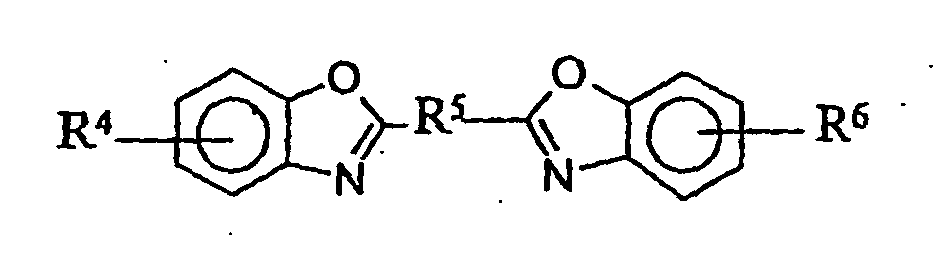 and R4 and R6 are independently selected from hydrogen and alkyl, R5 is
 and R4 and R6 are independently selected from hydrogen, alkyl, COO-alkyl, and SO2-alkyl, and R5 is
 and R4 and R6 are independently selected from hydrogen and alkyl, wherein in all cases R5 above represents a conjugated system.
Bis(benzimidazol-2-yl) derivatives of the formula :wherein "X" is -C2H2- or and R7 and R8 are independently selected from hydrogen, alkyl, hydroxyalkyl, and the like.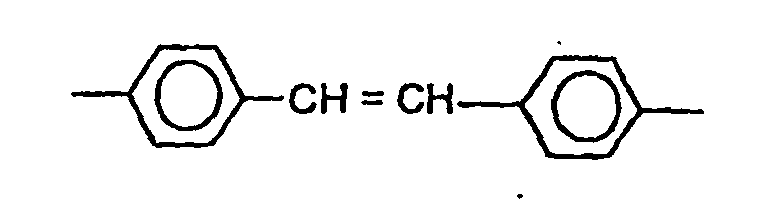
- In yet another embodiment, the optical brighteners include 4,4'-bis(2-benzoxazolyl)stilbene; (available from Eastman Chemical Company under the trademark EASTOBRITE OB-1); 2,5-bis(5-tert-butyl-2-benzoxazolyl)thiophene (available from Ciba Specialty Chemicals under the trademark UVITEX OB); 4,4'-bis(methyl-2-benzoxazolyl)stilbene; 4-(methyl-2-benzoxazolyl)-4'-(2-benzoxazolyl)stilbene; and mixtures thereof.
- The ultraviolet light absorbers are known in the art. Examples of suitable ultraviolet light absorbers include the following:


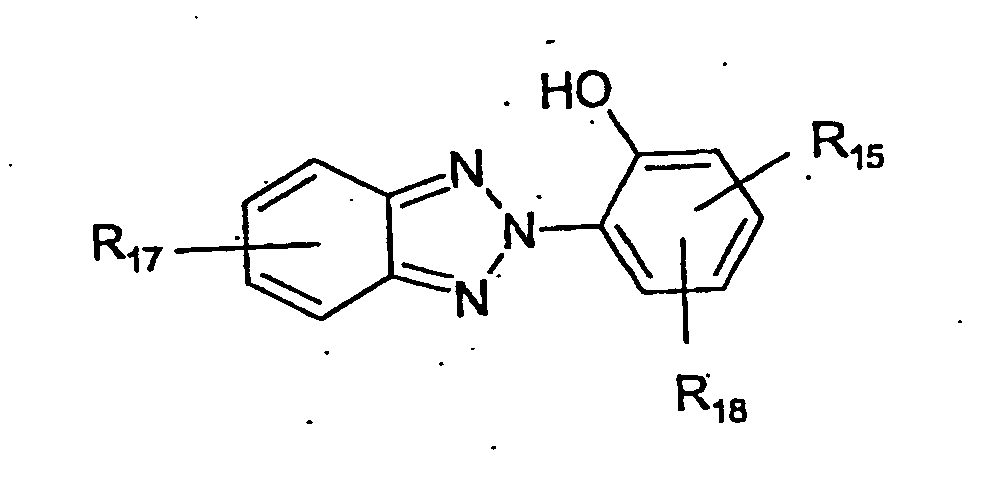

 wherein
R9, R10, and R11 are independently selected from hydrogen, hydroxy, C1-C22-alkyl, substituted C1-C22-alkyl, C3-C8-cycloalkyl, substituted C3-C8-cycloalkyl and OR14;
R12 and R13 are independently selected from hydrogen and -SO3R15;
R14 is selected from C1-C22-alkyl, substituted C1-C22-alkyl, C3-C8-cycloalkyl, and substituted C3-C8-cycloalkyl;
R15 and R16 are independently selected from hydrogen, C1-C22-alkyl, substituted C1-C22-alkyl, C3-C8-cycloalkyl, substituted C3-C8-cycloalkyl and may be located at the 3', 4', 5' or 6' positions on the aromatic ring;
R17 and R19 are independently selected from hydrogen, halogen, C1-C22-alkyl, substituted C1-C22-alkyl, C3-C8-cycloalkyl, substituted C3-C8-cycloalkyl, and may be located at the 4, 5, 6 or 7 positions on the aromatic ring;
wherein R18 is selected from -(CH2CH2-Y1)N2-CH2CH2-R20, a group having the formulaand may be located at the 3', 4', 5' or 6' positions on the aromatic ring;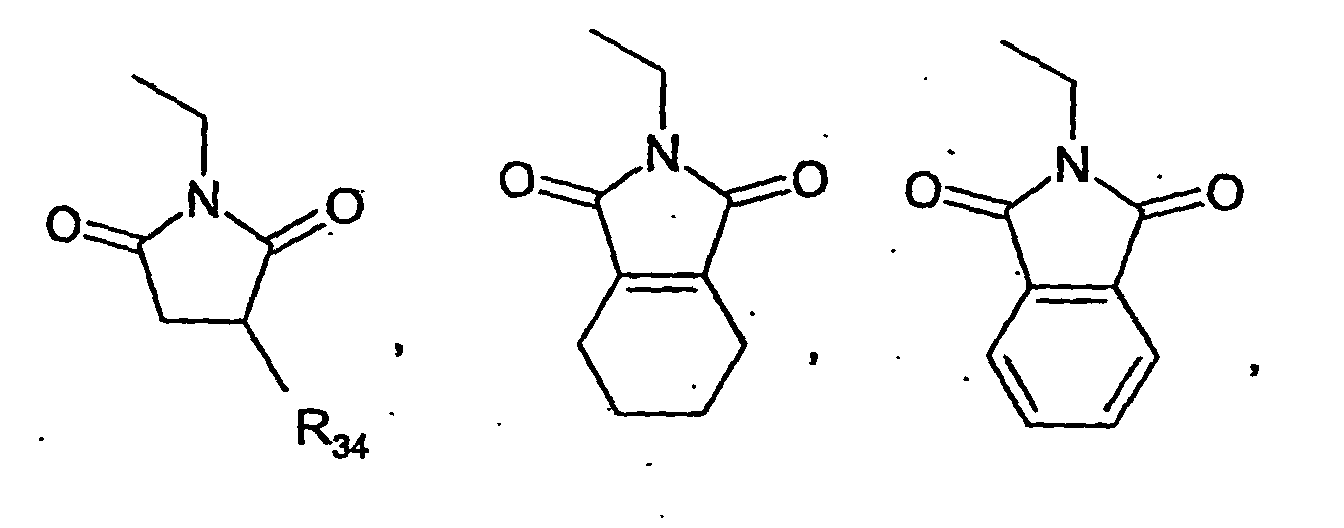
R22 and R23 are independently selected from hydrogen, C1-C22-alkyl, substituted C1-C22-alkyl, C3-C8-cycloalkyl, and substituted C3-C8-cycloalkyl;
R24, R25, R26, R27, R28 and R33 are independently selected from hydrogen, C1-C22-alkyl, substituted C1-C22-alkyl, C3-C8-cycloalkyl, and substituted C3-C8-cycloalkyl;
R29 is selected from hydrogen, C1-C22-alkyl, substituted C1-C22-alkyl, C3-C8-cycloalkyl, substituted C3-C8-cycloalkyl and -OR21;
R30 and R31 are independently selected from hydrogen, C1-C22-alkyl, substituted C1-C22-alkyl, C3-C8-cycloalkyl, substituted C3-C8-cycloalkyl and may be located at the 5, 5', 6, 6', 7, 7', 8 or 8' positions on the aromatic ring, respectively;
R34 is selected from hydrogen, C1-C22-alkyl, substituted C1-C22-alkyl, C3-C8-cycloalkyl, substituted C3-C8-cycloalkyl, heteroaryl, and aryl;
Y1 is selected from -OC(O)-, -NHC(O)-, -O-, -S-, -N(R35)-;
R35 is selected from hydrogen, C1-C22-alkyl, substituted C1-C22-alkyl, C3-C8-cycloalkyl, substituted C3-C8-cycloalkyl, heteroaryl, and aryl;
N2 is a positive integer selected from 1 to about 20; - Whenever an R group, Y group or N group is defined herein, the definition for a particular group remains the same throughout this description regardless of whether it is used for multiple formulas or types of compounds unless otherwise specified.
- The term "C1-C22-alkyl" denotes a saturated hydrocarbon radical which contains one to twenty-two carbons and which may be straight or branched-chain. Such C1-C22 alkyl groups can be methyl, ethyl, propyl, butyl, pentyl, hexyl, heptyl, octyl, isopropyl, isobutyl, tertbutyl, neopentyl, 2-ethylheptyl, 2-ethylhexyl, and the like. The term "substituted C1-C22-alkyl" refers to C1-C22-alkyl radicals as described above which may be substituted with one or more substituents selected from hydroxy, halogen, cyano, aryl, heteroaryl, C3-C8-cycloalkyl, substituted C3-C8-cycloalkyl, C1-C6-alkoxy, C2-C6 alkanoyloxy and the like.
- The term "C3-C8-cycloalkyl" is used to denote a cycloaliphatic hydrocarbon radical containing three to eight carbon atoms. The term "substituted C3-C8-cycloalkyl" is used to describe a C3-C8-cycloalkyl radical as detailed above containing at least one group selected from C1-C6-alkyl, C1-C6-alkoxy, hydroxy, halogen, and the like.
- The term "aryl" is used to denote an aromatic radical containing 6,10 or 14 carbon atoms in the conjugated aromatic ring structure and these radicals substituted with one or more groups selected from C1-C6-alkyl; C1-C6-alkoxy; phenyl, and phenyl substituted with C1-C6-alkyl; C1-C6-alkoxy; halogen and the like; C3-C8-cycloalkyl; halogen; hydroxy, cyano, trifluoromethyl and the like. Typical aryl groups include phenyl, naphthyl, phenylnaphthyl, anthryl (anthracenyl) and the like. The term "heteroaryl" is used to describe conjugated cyclic radicals containing at least one hetero atom selected from sulfur, oxygen, nitrogen or a combination of these in combination with from two to about ten carbon atoms and these heteroaryl radicals substituted with the groups mentioned above as possible substituents on the aryl radical. Typical heteroaryl radicals include: 2-and 3-furyl, 2- and 3-thienyl, 2- and 3-pyrrolyl, 2-, 3-, and 4-pyridyl, benzothiophen-2-yl; benzothiazol-2-yl, benzoxazol-2-yl, benzimidazol-2-yl, 1, 3, 4-oxadiazol-2-yl, 1,3, 4-thiadiazol-2-yl, 1,2,4-thiadiazol-5-yl, isothiazol-5-yl, imidazol-2-yl, quinolyl and the like.
- The terms "C1-C6-alkoxy" and "C2-C6-alkanoyloxy" are used to represent the groups -O-C1-C6-alkyl and -OCOC1-C6-alkyl, respectively, wherein "C1-C6-alkyl" denotes a saturated hydrocarbon that contains 1-6 carbon atoms, which may be straight or branched-chain, and which may be further substituted with one or more groups selected from halogen, methoxy, ethoxy, phenyl, hydroxy, acetyloxy and propionyloxy. The term "halogen" is used to represent fluorine, chlorine, bromine, and iodine; however, chlorine and bromine are preferred.
- The term "C2-C22-alkylene" is used to denote a divalent hydrocarbon radical that contains from two to twenty-two carbons and which may be straight or branched chain and which may be substituted with one or more substituents selected from hydroxy, halogen, C1-C6-alkoxy, C2-C6-alkanolyloxy and aryl. The term "C3-C8-cycloalkylene" is used to denote divalent cycloaliphatic radicals containing three to eight carbon atoms and these are optionally substituted with one or more C1-C6-alkyl groups. The term "arylene" is used to denote 1,2-, 1,3-, and 1,4-phenylene radicals and these optionally substituted with C1-C6- alkyl, C1-C6-alkoxy and halogen.
- In one mbodiment, the ultraviolet light absorbers useful in the present invention belong to the class of bis-benzoxazolylstilbenes.
- In one preferred embodiment of this invention, there is provided a polyester having diacid residues of from 70 to 100% terephthalic acid and from 0 to 30% isophthalic acid, and glycol residues of from 0 to 100% 1,4-cyclohexanedimethanol and from 0 to 100% ethylene glycol. The ultraviolet absorber Will be one or more compounds chosen from the hydroxybenzophenone, benzotriazole, triazine, cyanoacrylate, malonate or benzoxazinone classes, and the optical brightener will be one or more compounds chosen from the stilbene, naphthalene, coumarin, pyrazoline or thiophene classes.
- In another preferred embodiment of this invention, there is provided a polyester comprising one or more stilbene optical brighteners and one or more hydroxybenzophenone, benzotriazole or triazine ultraviolet absorbers.
- The formulation containing polyester, ultraviolet absorber and optical brightener was made into film to show screening of 90% of the UV region up to 400 nm. The success of the optical brightener to provide additional screening while decreasing the level of UV absorber in the film can be demonstrated.
- Referring to Figure 1, Sample 152-2 has 1.65 wt. % of UV absorber UVINUL 3049 and the effectiveness ofthe films ability for UV absorption can be seen in figure 1. When compared to sample 177-4, which has 64% less UV absorber, with .6 wt. % of the UVINUL 3049 and .17 wt. % OB1 optical brightener. Incorporating the OB1 into the film increases the films ability to provide a greater screening window while lowering the amount of UV absorber in the formula. This example is repeated in Figure 2 where sample 152-3 has 1.65 wt. % UVINUL 3050 and sample 152-3 has 1.65 wt. % UVINUL 3050 and sample 177-5 has .6 wt % UVINUL 3050 with .17 wt. % OB1 optical brightener and again the increased UV screening is demonstrated.
- Figure 3 shows sample 152-1 which has a composition of .9 wt. % TINUVIN 234 UV absorber and .17 wt. % OB1 optical brightener in comparison to the other samples.
- The film samples were extruded on conventional extrusion equipment that consisted of a 50 mm (2 inch) extruder using a 760 mm (30 inch) die and casting the film on a chilled roll. The film formulations were let down from three different UV concentrates and one OB concentrate, all four concentrates were compounded into the base polyester resin. The UV concentrates were X-26030-132-1 consisting of 10 wt.% TINUVIN 234 in copolyester 21214, UV concentrate X-26030-132-3 consisting of 5 wt. % UVINUL 3049 in copolyester 21214 and X-26030-132-4 consisting of 5 wt. % UVINUL 3050 in copolyester 21214. The OB concentrate was X-26030-132-2 consisting of 10 wt. % of Eastman's OB-1 in copolyester 21214. The film samples were produced using the concentrates let down into copolyester 21214 at various ratios. Table 1 shows the five film samples and the different wt. % loadings of the OB additive and different UV additives. All film samples were 50 micrometers in thickness.
Film Samples X-26021 152-1 152-2 152-3 177-4 177-5 Optical Brightener .17 wt.%
OB-1.17 wt.%
OB-1.17 wt.%
OB-1Ultraviolet Absorber .9 wt.%
Tinuvin 2341.65 wt.%
Uvinul 30491.65 wt.%
Uvinul 3050.6 wt.%
Uvinul 3049.6 wt.%
Uvinul 3050
wherein said composition is effective at screening of at least 85% of the light of wavelengths of 290-390 nm.
wherein said composition is effective at screening of at least 85% of the light of wavelengths of 290-390 nm.
Claims (24)
- A polymer composition comprisingwherein said polymer is comprised of no more than 5 weight percent of polymers which are other than polyesters;(a) a polyester;(b) at least one ultraviolet absorber; and(c) at least one optical brightener in a concentration of greater than 0.0004 wt%, based on the total weight of the polyester composition;
wherein said composition is effective at screening of at least 85% of the light of wavelengths of 290-390 nm. - The polymer composition of claim 1, wherein said composition exhibits a CIE b* value of no greater than 6.0 in a 50 micrometer thick film prepared from said composition.
- The composition of claim 1 where the ultraviolet absorber is selected from the group consisting of the benzophenone, benzotriazole, triazine, oxanilide, cyanoacrylate, malonate, formamidine and benzoxazinone classes
- The composition of claim 1 where the optical brightener is selected from the group consisting of the stilbene, coumarin, naphthalene and thiophene classes.
- The composition of claim 3 where the ultraviolet absorbers are selected from the benzophenone, benzotriazole and triazine classes.
- The composition of claim 4 where the brighteners contain a benzoxazole functionality.
- The composition of claim 6 where the brighteners are benzoxazolyl-stilbenes.
- The composition of claim 6 where at least one of the brighteners is 4,4'-bis(2-benzoxazolyl)stilbene.
- The composition of claim 1, wherein the ultraviolet light absorber is present in a concentration of 0.1 to 4.0 weight percent and the optical brightener is present in a concentration of 0.5 to 0.6 weight percent.
- The composition of claim 1, wherein the ultraviolet light absorber is present in a concentration of 0.1 to 4 weight percent and the optical brightener is present in a concentration of 0.05 to 0.6 weight percent.
- The composition of claim 1, wherein the ultraviolet light absorber is present in a concentration of 0.4 to 2 weight percent and the optical brightener is present in a concentration of 0.1 to 0.3 weight percent.
- The composition of claim 1, wherein the ultraviolet light absorber is present in a concentration of 0.01 to 0.8 weight percent and the optical brightener is present in a concentration of 0.005 to 0.08 weight percent.
- The composition of claim 1, wherein the ultraviolet light absorber is present in a concentration of 0.05 to 0.2 weight percent and the optical brightener is present in a concentration of 0.1 to 0.03 weight percent.
- The composition of claim 1, wherein the ultraviolet light absorber is present in a concentration of 0.001 to 0.08 weight percent and the optical brightener is present in a concentration of 0.0005 to 0.01 weight percent.
- The composition of claim 1, wherein the ultraviolet light absorber is present in a concentration of 0.004 to 0.04 weight percent and the optical brightener is present in a concentration of 0.0005 to 0.006 weight percent.
- The composition of claim 1, further comprising 0.2 to 15 weight percent of titanium dioxide having a mean particle size of less than or equal to 0.1 microns.
- A shaped or formed article comprising the polyester composition of claim 1.
- The article of claim 17, further comprising 0.2 to 15 weight percent of titanium dioxide having a mean particle size of less than or equal to 0.1 microns
- The article of claim 17, wherein the polyester composition is in the form of a film.
- The article of claim 17 wherein the polyester composition is in the form of a container.
- The article of claim 17, wherein the polyester composition is in the form of a flat or formed sheet.
- A method for protecting a material susceptible to degradation via ultraviolet light, which comprises surrounding at least part of said material with a polymer composition comprisingwherein said polymer is comprised of no more than 5 weight percent of polymers which are other than polyesters;(a) a polyester;(b) at least one ultraviolet absorber; and(c) at least one optical brightener in a concentration of greater than 0.0004 wt%, based on the total weight of the polyester composition;
wherein said composition is effective at screening of at least 85% of the light of wavelengths of 290-390 nm. - The method of claim 22, wherein said composition exhibits a CIE b* value of no greater than 6.0 in a 50 micrometer thick film prepared from said composition.
- The method of claim 22, wherein the material is a foodstuff or beverage.
Applications Claiming Priority (2)
| Application Number | Priority Date | Filing Date | Title |
|---|---|---|---|
| US712606 | 2003-11-13 | ||
| US10/712,606 US7157547B2 (en) | 2003-11-13 | 2003-11-13 | Ultraviolet blocking composition for protection of package or container contents |
Publications (2)
| Publication Number | Publication Date |
|---|---|
| EP1531170A1 true EP1531170A1 (en) | 2005-05-18 |
| EP1531170B1 EP1531170B1 (en) | 2014-10-29 |
Family
ID=34435669
Family Applications (1)
| Application Number | Title | Priority Date | Filing Date |
|---|---|---|---|
| EP04027092.8A Expired - Lifetime EP1531170B1 (en) | 2003-11-13 | 2004-11-15 | Ultraviolet blocking composition for protection of package or container contents |
Country Status (3)
| Country | Link |
|---|---|
| US (1) | US7157547B2 (en) |
| EP (1) | EP1531170B1 (en) |
| JP (1) | JP2005146278A (en) |
Cited By (1)
| Publication number | Priority date | Publication date | Assignee | Title |
|---|---|---|---|---|
| WO2011135250A1 (en) | 2010-04-28 | 2011-11-03 | Societe Lotoise D'evaporation (Solev) | Single-use packaging for a cosmetic product sensitive to exposure to ultraviolet radiation |
Families Citing this family (11)
| Publication number | Priority date | Publication date | Assignee | Title |
|---|---|---|---|---|
| US20070138661A1 (en) * | 2005-12-19 | 2007-06-21 | Paragon Vision Sciences, Inc. | Gas permeable liquid vessel |
| JP5308039B2 (en) | 2007-02-20 | 2013-10-09 | 富士フイルム株式会社 | Polymer materials containing UV absorbers |
| US20100130638A1 (en) | 2007-03-30 | 2010-05-27 | Fujifilm Corporation | Ultraviolet absorbent composition |
| WO2009022736A1 (en) | 2007-08-16 | 2009-02-19 | Fujifilm Corporation | Heterocyclic compound, ultraviolet ray absorbent, and composition comprising the ultraviolet ray absorbent |
| JP5244437B2 (en) | 2008-03-31 | 2013-07-24 | 富士フイルム株式会社 | UV absorber composition |
| JP5250289B2 (en) | 2008-03-31 | 2013-07-31 | 富士フイルム株式会社 | UV absorber composition |
| JP2009270062A (en) | 2008-05-09 | 2009-11-19 | Fujifilm Corp | Ultraviolet absorbent composition |
| JP2010180345A (en) * | 2009-02-06 | 2010-08-19 | Mitsubishi Plastics Inc | Polyester film |
| KR20160065553A (en) * | 2014-12-01 | 2016-06-09 | 삼성전자주식회사 | Organic photoelectronic device and image sensor |
| CN111526730B (en) | 2017-12-29 | 2024-02-23 | 卡夫食品集团品牌有限责任公司 | Improved oxidative stability of oil-in-water emulsions using natural stabilizers |
| US12521309B2 (en) * | 2020-10-02 | 2026-01-13 | Icu Medical, Inc. | Compositions and devices for containing medical fluids |
Citations (5)
| Publication number | Priority date | Publication date | Assignee | Title |
|---|---|---|---|---|
| US4129412A (en) * | 1976-07-02 | 1978-12-12 | Hoechst Aktiengesellschaft | Brightener mixtures and their use |
| US5071993A (en) * | 1988-09-16 | 1991-12-10 | Ciba-Geigy Corporation | Bis(dibenzoxazoyl)thiophene fluorescent brighteners |
| US6312822B1 (en) | 1998-05-28 | 2001-11-06 | Eastman Chem Co | Dispersion aids for optical brighteners in polyolefins |
| US6492032B1 (en) | 2000-10-12 | 2002-12-10 | Eastman Chemical Company | Multi-component optically brightened polyolefin blend |
| US20030096889A1 (en) * | 2001-10-22 | 2003-05-22 | Sarkar Asim K. | Low color, low sodium benzoxazinone UV absorbers and process for making same |
Family Cites Families (20)
| Publication number | Priority date | Publication date | Assignee | Title |
|---|---|---|---|---|
| GB1072914A (en) * | 1962-12-17 | 1967-06-21 | Kodak Ltd | Bisbenzoxazolyl stilbenes and their use as fluorescent brightening agents |
| US3260715A (en) * | 1962-12-17 | 1966-07-12 | Eastman Kodak Co | Fluorescent bis-benzoxazolyl stilbenes |
| US3501298A (en) * | 1966-04-08 | 1970-03-17 | Eastman Kodak Co | Photographic papers |
| US3449257A (en) * | 1966-11-03 | 1969-06-10 | Eastman Kodak Co | Brightener compositions |
| US4106941A (en) * | 1974-07-17 | 1978-08-15 | Eastman Kodak Company | Photographic silver halide elements containing optical brightening water-soluble interpolymers |
| US4859539A (en) * | 1987-03-23 | 1989-08-22 | Eastman Kodak Company | Optically brightened polyolefin coated paper support |
| US4794071A (en) * | 1987-03-23 | 1988-12-27 | Eastman Kodak Company | Optically brightened photographic silver halide element with a polyolefin paper coated support |
| US4882412A (en) * | 1987-11-30 | 1989-11-21 | Eastman Kodak Company | Polyester polymer containing the residue of the UV absorbing benzopyran compound and shaped articles produced therefrom |
| US5173397A (en) * | 1989-03-28 | 1992-12-22 | Mitsubishi Paper Mills Limited | Photographic support with titanium dioxide pigmented polyolefin layer |
| US5061610A (en) * | 1990-10-22 | 1991-10-29 | Eastman Kodak Company | Reduction of optical brightener migration in polyolefin coated paper bases |
| US5198330A (en) * | 1991-10-11 | 1993-03-30 | Eastman Kodak Company | Photographic element with optical brighteners having reduced migration |
| JPH0848793A (en) * | 1994-03-22 | 1996-02-20 | Skc Ltd | Polyester film |
| EP1110716A3 (en) | 1996-03-12 | 2001-08-22 | Mitsubishi Polyester Film Corporation | Laminated polyester film |
| JPH09239883A (en) | 1996-03-12 | 1997-09-16 | Diafoil Co Ltd | Laminated polyester film containing fine air bubbles and image-receiving paper for the color printer comprising the film |
| US5783307A (en) * | 1996-11-04 | 1998-07-21 | Eastman Chemical Company | UV stabilized multi-layer structures with detectable UV protective layers and a method of detection |
| JP2000067629A (en) * | 1998-08-25 | 2000-03-03 | Mitsubishi Rayon Co Ltd | Lighting cover |
| US6756350B1 (en) * | 1999-12-29 | 2004-06-29 | Unilever Home & Personal Care Usa, A Division Of Conopco, Inc. | Transparent/translucent bottles |
| US6177574B1 (en) * | 2000-03-02 | 2001-01-23 | Eastman Chemical Company | Preparation of mixtures of benzoxazolyl-stilbene compounds |
| US6773104B2 (en) * | 2000-07-24 | 2004-08-10 | Optical Technologies Corp. | Ultraviolet filter coating |
| JP2003237825A (en) * | 2002-02-12 | 2003-08-27 | Nakagawa Kaseihin Kk | Transparent resin composition for food container and packaging material |
-
2003
- 2003-11-13 US US10/712,606 patent/US7157547B2/en not_active Expired - Lifetime
-
2004
- 2004-11-09 JP JP2004325207A patent/JP2005146278A/en active Pending
- 2004-11-15 EP EP04027092.8A patent/EP1531170B1/en not_active Expired - Lifetime
Patent Citations (5)
| Publication number | Priority date | Publication date | Assignee | Title |
|---|---|---|---|---|
| US4129412A (en) * | 1976-07-02 | 1978-12-12 | Hoechst Aktiengesellschaft | Brightener mixtures and their use |
| US5071993A (en) * | 1988-09-16 | 1991-12-10 | Ciba-Geigy Corporation | Bis(dibenzoxazoyl)thiophene fluorescent brighteners |
| US6312822B1 (en) | 1998-05-28 | 2001-11-06 | Eastman Chem Co | Dispersion aids for optical brighteners in polyolefins |
| US6492032B1 (en) | 2000-10-12 | 2002-12-10 | Eastman Chemical Company | Multi-component optically brightened polyolefin blend |
| US20030096889A1 (en) * | 2001-10-22 | 2003-05-22 | Sarkar Asim K. | Low color, low sodium benzoxazinone UV absorbers and process for making same |
Non-Patent Citations (3)
| Title |
|---|
| "Kirk-Othmer Encyclopedia of Chemical Technology", vol. 4, 1978, INTERSCIENCE, pages: 213 - 220 |
| ANNI BERGER-SCHUNN: "Practical Color Measurement", 1994, WILEY, pages: 39 - 56,91-98 |
| J.T. LUTZ, JR.: "Thermoplastic Polymer Additives", 1989, MARCEL DEKKER, pages: 315 - 343 |
Cited By (1)
| Publication number | Priority date | Publication date | Assignee | Title |
|---|---|---|---|---|
| WO2011135250A1 (en) | 2010-04-28 | 2011-11-03 | Societe Lotoise D'evaporation (Solev) | Single-use packaging for a cosmetic product sensitive to exposure to ultraviolet radiation |
Also Published As
| Publication number | Publication date |
|---|---|
| US20050107574A1 (en) | 2005-05-19 |
| EP1531170B1 (en) | 2014-10-29 |
| JP2005146278A (en) | 2005-06-09 |
| US7157547B2 (en) | 2007-01-02 |
Similar Documents
| Publication | Publication Date | Title |
|---|---|---|
| EP1531170B1 (en) | Ultraviolet blocking composition for protection of package or container contents | |
| US5985389A (en) | Polyester and optical brightener blend having improved properties | |
| DE10009286A1 (en) | White, biaxially oriented, flame-retardant and UV-stabilized polyester film with cycloolefin copolymer, process for its production and its use | |
| US6312822B1 (en) | Dispersion aids for optical brighteners in polyolefins | |
| CA2474779A1 (en) | Containers or films comprising hydroxyphenlbenzotriazole uv absorbers for protecting contents against the effects of uv radiation | |
| US3449257A (en) | Brightener compositions | |
| US20080146703A1 (en) | Mono- or Multilayer Stabilized Polyester Film | |
| Baumberg et al. | Effect of polymer matrix on photo-stability of photo-luminescent dyes in multi-layer polymeric structures | |
| BR0114376B1 (en) | mixture of optical brighteners, optically brightened polyolefin resin, and photo-forming material. | |
| JP2016033021A (en) | Ultraviolet blocking container | |
| DE69514624T2 (en) | Method of preventing fluorescence emission from polyalkylene naphthalene-2,6-dicarboxylate | |
| CN101490148B (en) | Method of protecting organic material from light | |
| US20080311372A1 (en) | Use of UV Absorbers and Naphthalate Containing Polymers for Enhancing UV Stability of Fibers and Fabrics | |
| CN111936594B (en) | Particulate ultraviolet absorber and resin composition | |
| TWI309664B (en) | A polycarbonate or polyester carbonate containing optical brighteners | |
| JPH101563A (en) | Fluorescent brightener mixture for synthetic resin | |
| US3340225A (en) | 1, 8-naphthalimides as ultraviolet light stabilizers for plastic materials | |
| JP4879752B2 (en) | How to protect organic materials from light | |
| US4265804A (en) | Oriented polyester articles having improved ultraviolet stability (III) | |
| KR100359986B1 (en) | A Resin Composition of Shirinking Film and Sheet for Shutting out UV | |
| Keck-Antoine et al. | Additives to design and improve the performance of multilayer flexible packaging | |
| US20160083525A1 (en) | Silicone polymers containing UV stabilizing groups | |
| JP2025133956A (en) | Resin compositions for miscellaneous goods, molded articles and miscellaneous goods | |
| US3313771A (en) | Alpha-phenylsulfonyl cinnamates and cinnamonitriles as ultraviolet light stabilizers for plastic materials | |
| CN112004905B (en) | Particulate ultraviolet absorber and resin composition |
Legal Events
| Date | Code | Title | Description |
|---|---|---|---|
| PUAI | Public reference made under article 153(3) epc to a published international application that has entered the european phase |
Free format text: ORIGINAL CODE: 0009012 |
|
| AK | Designated contracting states |
Kind code of ref document: A1 Designated state(s): AT BE BG CH CY CZ DE DK EE ES FI FR GB GR HU IE IS IT LI LU MC NL PL PT RO SE SI SK TR |
|
| AX | Request for extension of the european patent |
Extension state: AL HR LT LV MK YU |
|
| 17P | Request for examination filed |
Effective date: 20051116 |
|
| AKX | Designation fees paid |
Designated state(s): AT BE BG CH CY CZ DE DK EE ES FI FR GB GR HU IE IS IT LI LU MC NL PL PT RO SE SI SK TR |
|
| 17Q | First examination report despatched |
Effective date: 20071213 |
|
| GRAP | Despatch of communication of intention to grant a patent |
Free format text: ORIGINAL CODE: EPIDOSNIGR1 |
|
| INTG | Intention to grant announced |
Effective date: 20140526 |
|
| GRAS | Grant fee paid |
Free format text: ORIGINAL CODE: EPIDOSNIGR3 |
|
| GRAA | (expected) grant |
Free format text: ORIGINAL CODE: 0009210 |
|
| AK | Designated contracting states |
Kind code of ref document: B1 Designated state(s): AT BE BG CH CY CZ DE DK EE ES FI FR GB GR HU IE IS IT LI LU MC NL PL PT RO SE SI SK TR |
|
| REG | Reference to a national code |
Ref country code: GB Ref legal event code: FG4D |
|
| REG | Reference to a national code |
Ref country code: CH Ref legal event code: EP |
|
| REG | Reference to a national code |
Ref country code: AT Ref legal event code: REF Ref document number: 693594 Country of ref document: AT Kind code of ref document: T Effective date: 20141115 |
|
| REG | Reference to a national code |
Ref country code: IE Ref legal event code: FG4D |
|
| REG | Reference to a national code |
Ref country code: DE Ref legal event code: R096 Ref document number: 602004046054 Country of ref document: DE Effective date: 20141204 |
|
| REG | Reference to a national code |
Ref country code: AT Ref legal event code: MK05 Ref document number: 693594 Country of ref document: AT Kind code of ref document: T Effective date: 20141029 |
|
| REG | Reference to a national code |
Ref country code: NL Ref legal event code: VDEP Effective date: 20141029 |
|
| PG25 | Lapsed in a contracting state [announced via postgrant information from national office to epo] |
Ref country code: IS Free format text: LAPSE BECAUSE OF FAILURE TO SUBMIT A TRANSLATION OF THE DESCRIPTION OR TO PAY THE FEE WITHIN THE PRESCRIBED TIME-LIMIT Effective date: 20150228 Ref country code: PT Free format text: LAPSE BECAUSE OF FAILURE TO SUBMIT A TRANSLATION OF THE DESCRIPTION OR TO PAY THE FEE WITHIN THE PRESCRIBED TIME-LIMIT Effective date: 20150302 Ref country code: ES Free format text: LAPSE BECAUSE OF FAILURE TO SUBMIT A TRANSLATION OF THE DESCRIPTION OR TO PAY THE FEE WITHIN THE PRESCRIBED TIME-LIMIT Effective date: 20141029 Ref country code: NL Free format text: LAPSE BECAUSE OF FAILURE TO SUBMIT A TRANSLATION OF THE DESCRIPTION OR TO PAY THE FEE WITHIN THE PRESCRIBED TIME-LIMIT Effective date: 20141029 Ref country code: FI Free format text: LAPSE BECAUSE OF FAILURE TO SUBMIT A TRANSLATION OF THE DESCRIPTION OR TO PAY THE FEE WITHIN THE PRESCRIBED TIME-LIMIT Effective date: 20141029 |
|
| PG25 | Lapsed in a contracting state [announced via postgrant information from national office to epo] |
Ref country code: AT Free format text: LAPSE BECAUSE OF FAILURE TO SUBMIT A TRANSLATION OF THE DESCRIPTION OR TO PAY THE FEE WITHIN THE PRESCRIBED TIME-LIMIT Effective date: 20141029 Ref country code: GR Free format text: LAPSE BECAUSE OF FAILURE TO SUBMIT A TRANSLATION OF THE DESCRIPTION OR TO PAY THE FEE WITHIN THE PRESCRIBED TIME-LIMIT Effective date: 20150130 Ref country code: SE Free format text: LAPSE BECAUSE OF FAILURE TO SUBMIT A TRANSLATION OF THE DESCRIPTION OR TO PAY THE FEE WITHIN THE PRESCRIBED TIME-LIMIT Effective date: 20141029 Ref country code: PL Free format text: LAPSE BECAUSE OF FAILURE TO SUBMIT A TRANSLATION OF THE DESCRIPTION OR TO PAY THE FEE WITHIN THE PRESCRIBED TIME-LIMIT Effective date: 20141029 Ref country code: CY Free format text: LAPSE BECAUSE OF FAILURE TO SUBMIT A TRANSLATION OF THE DESCRIPTION OR TO PAY THE FEE WITHIN THE PRESCRIBED TIME-LIMIT Effective date: 20141029 |
|
| REG | Reference to a national code |
Ref country code: DE Ref legal event code: R119 Ref document number: 602004046054 Country of ref document: DE |
|
| PG25 | Lapsed in a contracting state [announced via postgrant information from national office to epo] |
Ref country code: BE Free format text: LAPSE BECAUSE OF NON-PAYMENT OF DUE FEES Effective date: 20141130 |
|
| REG | Reference to a national code |
Ref country code: CH Ref legal event code: PL |
|
| PG25 | Lapsed in a contracting state [announced via postgrant information from national office to epo] |
Ref country code: CH Free format text: LAPSE BECAUSE OF NON-PAYMENT OF DUE FEES Effective date: 20141130 Ref country code: CZ Free format text: LAPSE BECAUSE OF FAILURE TO SUBMIT A TRANSLATION OF THE DESCRIPTION OR TO PAY THE FEE WITHIN THE PRESCRIBED TIME-LIMIT Effective date: 20141029 Ref country code: EE Free format text: LAPSE BECAUSE OF FAILURE TO SUBMIT A TRANSLATION OF THE DESCRIPTION OR TO PAY THE FEE WITHIN THE PRESCRIBED TIME-LIMIT Effective date: 20141029 Ref country code: SK Free format text: LAPSE BECAUSE OF FAILURE TO SUBMIT A TRANSLATION OF THE DESCRIPTION OR TO PAY THE FEE WITHIN THE PRESCRIBED TIME-LIMIT Effective date: 20141029 Ref country code: RO Free format text: LAPSE BECAUSE OF FAILURE TO SUBMIT A TRANSLATION OF THE DESCRIPTION OR TO PAY THE FEE WITHIN THE PRESCRIBED TIME-LIMIT Effective date: 20141029 Ref country code: MC Free format text: LAPSE BECAUSE OF FAILURE TO SUBMIT A TRANSLATION OF THE DESCRIPTION OR TO PAY THE FEE WITHIN THE PRESCRIBED TIME-LIMIT Effective date: 20141029 Ref country code: DK Free format text: LAPSE BECAUSE OF FAILURE TO SUBMIT A TRANSLATION OF THE DESCRIPTION OR TO PAY THE FEE WITHIN THE PRESCRIBED TIME-LIMIT Effective date: 20141029 Ref country code: LI Free format text: LAPSE BECAUSE OF NON-PAYMENT OF DUE FEES Effective date: 20141130 |
|
| REG | Reference to a national code |
Ref country code: IE Ref legal event code: MM4A |
|
| PG25 | Lapsed in a contracting state [announced via postgrant information from national office to epo] |
Ref country code: IT Free format text: LAPSE BECAUSE OF FAILURE TO SUBMIT A TRANSLATION OF THE DESCRIPTION OR TO PAY THE FEE WITHIN THE PRESCRIBED TIME-LIMIT Effective date: 20141029 |
|
| PLBE | No opposition filed within time limit |
Free format text: ORIGINAL CODE: 0009261 |
|
| STAA | Information on the status of an ep patent application or granted ep patent |
Free format text: STATUS: NO OPPOSITION FILED WITHIN TIME LIMIT |
|
| GBPC | Gb: european patent ceased through non-payment of renewal fee |
Effective date: 20150129 |
|
| 26N | No opposition filed |
Effective date: 20150730 |
|
| REG | Reference to a national code |
Ref country code: FR Ref legal event code: ST Effective date: 20150909 |
|
| PG25 | Lapsed in a contracting state [announced via postgrant information from national office to epo] |
Ref country code: DE Free format text: LAPSE BECAUSE OF NON-PAYMENT OF DUE FEES Effective date: 20150602 Ref country code: GB Free format text: LAPSE BECAUSE OF NON-PAYMENT OF DUE FEES Effective date: 20150129 Ref country code: IE Free format text: LAPSE BECAUSE OF NON-PAYMENT OF DUE FEES Effective date: 20141115 |
|
| PG25 | Lapsed in a contracting state [announced via postgrant information from national office to epo] |
Ref country code: FR Free format text: LAPSE BECAUSE OF NON-PAYMENT OF DUE FEES Effective date: 20141229 |
|
| PG25 | Lapsed in a contracting state [announced via postgrant information from national office to epo] |
Ref country code: SI Free format text: LAPSE BECAUSE OF FAILURE TO SUBMIT A TRANSLATION OF THE DESCRIPTION OR TO PAY THE FEE WITHIN THE PRESCRIBED TIME-LIMIT Effective date: 20141029 |
|
| PG25 | Lapsed in a contracting state [announced via postgrant information from national office to epo] |
Ref country code: BG Free format text: LAPSE BECAUSE OF FAILURE TO SUBMIT A TRANSLATION OF THE DESCRIPTION OR TO PAY THE FEE WITHIN THE PRESCRIBED TIME-LIMIT Effective date: 20141029 |
|
| PG25 | Lapsed in a contracting state [announced via postgrant information from national office to epo] |
Ref country code: LU Free format text: LAPSE BECAUSE OF NON-PAYMENT OF DUE FEES Effective date: 20141115 Ref country code: TR Free format text: LAPSE BECAUSE OF FAILURE TO SUBMIT A TRANSLATION OF THE DESCRIPTION OR TO PAY THE FEE WITHIN THE PRESCRIBED TIME-LIMIT Effective date: 20141029 Ref country code: HU Free format text: LAPSE BECAUSE OF FAILURE TO SUBMIT A TRANSLATION OF THE DESCRIPTION OR TO PAY THE FEE WITHIN THE PRESCRIBED TIME-LIMIT; INVALID AB INITIO Effective date: 20041115 |