EP1529945A1 - System and method for controlling fuel injection - Google Patents
System and method for controlling fuel injection Download PDFInfo
- Publication number
- EP1529945A1 EP1529945A1 EP03025197A EP03025197A EP1529945A1 EP 1529945 A1 EP1529945 A1 EP 1529945A1 EP 03025197 A EP03025197 A EP 03025197A EP 03025197 A EP03025197 A EP 03025197A EP 1529945 A1 EP1529945 A1 EP 1529945A1
- Authority
- EP
- European Patent Office
- Prior art keywords
- engine
- signal
- combustion chamber
- control unit
- computer readable
- Prior art date
- Legal status (The legal status is an assumption and is not a legal conclusion. Google has not performed a legal analysis and makes no representation as to the accuracy of the status listed.)
- Granted
Links
Images



Classifications
-
- F—MECHANICAL ENGINEERING; LIGHTING; HEATING; WEAPONS; BLASTING
- F02—COMBUSTION ENGINES; HOT-GAS OR COMBUSTION-PRODUCT ENGINE PLANTS
- F02D—CONTROLLING COMBUSTION ENGINES
- F02D41/00—Electrical control of supply of combustible mixture or its constituents
- F02D41/009—Electrical control of supply of combustible mixture or its constituents using means for generating position or synchronisation signals
-
- F—MECHANICAL ENGINEERING; LIGHTING; HEATING; WEAPONS; BLASTING
- F02—COMBUSTION ENGINES; HOT-GAS OR COMBUSTION-PRODUCT ENGINE PLANTS
- F02D—CONTROLLING COMBUSTION ENGINES
- F02D41/00—Electrical control of supply of combustible mixture or its constituents
- F02D41/02—Circuit arrangements for generating control signals
- F02D41/04—Introducing corrections for particular operating conditions
- F02D41/06—Introducing corrections for particular operating conditions for engine starting or warming up
- F02D41/062—Introducing corrections for particular operating conditions for engine starting or warming up for starting
-
- F—MECHANICAL ENGINEERING; LIGHTING; HEATING; WEAPONS; BLASTING
- F02—COMBUSTION ENGINES; HOT-GAS OR COMBUSTION-PRODUCT ENGINE PLANTS
- F02D—CONTROLLING COMBUSTION ENGINES
- F02D41/00—Electrical control of supply of combustible mixture or its constituents
- F02D41/009—Electrical control of supply of combustible mixture or its constituents using means for generating position or synchronisation signals
- F02D2041/0092—Synchronisation of the cylinders at engine start
-
- F—MECHANICAL ENGINEERING; LIGHTING; HEATING; WEAPONS; BLASTING
- F02—COMBUSTION ENGINES; HOT-GAS OR COMBUSTION-PRODUCT ENGINE PLANTS
- F02N—STARTING OF COMBUSTION ENGINES; STARTING AIDS FOR SUCH ENGINES, NOT OTHERWISE PROVIDED FOR
- F02N11/00—Starting of engines by means of electric motors
- F02N11/04—Starting of engines by means of electric motors the motors being associated with current generators
Definitions
- the present invention relates to a method for controlling fuel injection in a vehicle combustion engine comprising at least one combustion chamber and means for supplying fuel into the combustion chamber.
- the present invention also relates to a motor vehicle comprising an internal combustion engine comprising at least one combustion chamber, means for generating a first signal comprising information about a desire to start the engine, an electronic control unit adapted to control fuel supply to said combustion chamber.
- the present invention further relates to a computer program for carrying out a method for controlling fuel injection in a vehicle combustion engine.
- An object of the invention relates to the problem of achieving an improved operation of a combustion engine of a motorised vehicle.
- a further object of the invention is to provide a combustion engine with reduced exhaust emissions, especially with reduced HC emissions during start of the engine.
- the method will reduce the number of pump-outs when starting up the engine.
- the number of pump-outs when starting up the engine is minimised. Consequently this results in less hydro carbons (HC) in an exhaust system of the vehicle. This may further have a positive effect on the environment of the vehicle.
- HC hydro carbons
- a favourable aspect of the invention is that a part of the residual fuel in the combustion chambers will be used for combustion as purposed.
- a more stable voltage will be achieved in a power supply system of the vehicle due to no starter is activated during the fuel supply.
- the fuel supply bears upon pre-injections.
- the method provides an improved control of fuel injection due to the possibility to await a correct fuel pressure value.
- a starter of the engine is not activated as early as in prior art, and there is therefore no need to quickly inject fuel in combustion chambers when there is too low pressure in a fuel rail.
- the second signal comprising information about cylinder status in response to said first signal is acquired. This provides a positive effect relating to the control of fuel supply to the combustion chambers.
- FIG. 1 shows schematically a vehicle drivetrain 10 and a control system therefore.
- the drivetrain comprises an internal combustion engine 120 and a drivetrain member in the form of a gear unit 140.
- a shaft 150 is coupled between the engine 120 and the gear unit 140, which shaft 150 works as force transmitting means.
- a transmission output shaft 170 drives wheels (not shown) of the vehicle for its propulsion.
- An electronic control unit 180 such as an Engine Control Unit (ECU) is adapted to receive signals from an accelerator member 190 of the drivetrain, said member 190 may be an accelerator pedal, and to receive condition parameters, such as engine condition parameters, from sensors 114 and/or 110.
- the sensors 114 are adapted to communicate with the control unit 180 and a control unit 100 by means of a cable 160 and a cable 155, respectively.
- the sensors 110 are adapted to communicate with the control unit 180 by means of a cable 152.
- the sensors 110 are adapted to detect various engine parameters, such as engine temperature, or other parameters, which may be used in a calculation or simulation performed in the control unit 180, so as to perform a pre-injection of fuel into one or several combustion chambers of the engine.
- the sensors 110 are provided at adequate positions in the engine, so as to detect or measure a certain parameter's quantity or quality.
- the accelerator member 190 is adapted for communication with the control unit 180 via a cable 153.
- the electronic control unit 180 is adapted to send signals to a plurality of devices as to control the operation of the engine.
- the control unit 180 is adapted to process received signals from said sensors.
- the electronic control unit 180 is programmable.
- the electronic control unit 100 is adapted to receive signals from a gear selecting unit 116 via a cable 158, said gear selector unit may be a manual electronic gear selector. Alternatively the vehicle 10 has a manual gear shift lever.
- the control unit 100 is adapted to control gear changes of the gear unit by means of control signals sent to the gearbox via a cable 159.
- control unit 180 and the control unit 100 are adapted for communication with each other by means of a cable 156.
- a subroutine is performed in the control unit 180 it may alternatively be performed in the control unit 100.
- a start device 112 is adapted for communication with the control unit 180 by means of a cable 154.
- the start device is arranged for generating a start signal in response to an action taken by a user of the vehicle.
- the start device is further arranged for sending the start signal to the control unit 180.
- the start device comprises a key hole adapted to closely receive a key.
- the start device may generate the start signal when the user turns the inserted key from a first position to a second position.
- the control unit 180 is adapted for communication with a starter 185 via a cable 183.
- the starter 185 is arranged for cranking up the engine when starting the engine.
- the control unit 180 is adapted to control the starter.
- the control unit controls the starter in dependence of the start signal generated by the start device 112. A control procedure of the starter performed after a pre-injection of fuel into combustion chambers of the engine will be described in more detail below.
- the emission system is arranged downstream the engine 120.
- the emission system comprises a first pipe 122, which is adapted to lead emission products from the combustion chambers of the engine to a house 124.
- the house may comprise a catalyst (not shown).
- a second pipe 126 is adapted to lead emission products from the house 124 out of the emission system.
- FIG 2 is illustrating the engine 120 of the vehicle 10 and a control system therefore according to an embodiment of the invention.
- the engine 120 is comprising a plurality of cylinders, five cylinders 235a, 235b, 235c, 235d and 235e of which are shown in Figure 1, are controlled by the electronic control unit 180 via the cable 157.
- the electronic control unit 180 is adapted for communication with engine members, e.g. spark plugs 232a, 232b, 232c, 232d and 232e, via the cable 157.
- the cable 157 may comprise a plurality of independent signal paths, as indicated in the figure.
- the control unit 180 is adapted for communication with a spark plug via a separate cable.
- inlet- and outlet valves are controlled by the control unit 180, which is illustrated by a cable 211, which is connected between the control unit 180 and the inlet valve 230e.
- the inlet- and outlet valves are controlled by a camshaft (not shown), which is in mechanical communication with a crankshaft 240.
- a camshaft not shown
- the control unit is adapted to control the spark plugs 232a-e.
- the spark plugs are adopted to generate sparks in combustion chambers 234a, 234b, 234c, 234d and 234e, respectively, so as to initiate combustion of fuel injected to combustion chambers, which are corresponding to the cylinders 235a, 235b, 235c, 235d and 235e.
- the cylinders have cylinder walls 231a, 231b, 231c, 231d and 231e, respectively.
- Each cylinder is provided with a piston 237a, 237b, 237c, 237d and 237e, respectively, positioned therein and connected in one end to crankshaft 240 by means of a connecting rod 238a, 238b, 238c, 238d and 238e.
- Each connecting rod having a fastening device 239a, 239b, 239c, 239d and 239e fixedly secured in a second end with the crankshaft 240.
- the engine may be configured such that the fuel is injected directly into the cylinder of the engine, which is known to those skilled in the art as a direct injection engine.
- Figure 3 is illustrating a part of the engine 120 in greater detail. Shown in Figure 3 is the engine cylinder 235a comprising the combustion chamber 234a.
- the control unit 180 is adapted to receive various signals from sensors coupled to engine 120 (also see Fig. 1). For example, the control unit 180 is adapted to receive, via a cable 311a, a crankshaft position signal (CPS) from a sensor 310a coupled to the fastening device 239a, or, alternatively, to the crankshaft 240 (not shown).
- CPS crankshaft position signal
- Combustion chamber 234a is known communicating with intake manifold 245a and exhaust manifold 246a via respective intake valve 230a and exhaust valve 242a.
- the control unit 180 is adapted for communication with a fuel injector 243a, the intake valve 230, the spark plug 232a and the exhaust valve 242a.
- the control unit 180 is adapted to control the fuel injector 243a via a cable 253.
- the control unit 180 is adapted to control the spark plug 232a via a cable 251.
- the cables 251 and 253 are in this embodiment parts of the cable 157.
- Intake manifold 245a is shown communicating with throttle body 248 via throttle plate 247. Intake manifold 245a is also shown having fuel injector 243a coupled thereto for delivering liquid fuel in proportion to the pulse width of a signal fed via the cable 253 from the control unit 180. Fuel is delivered to fuel injector 243a by means of a conventional fuel system (not shown) including a fuel tank, fuel pump, and fuel rail.
- Figure 4 is illustrating a sequence schedule in time T, according an embodiment of the invention.
- a user of the vehicle is giving an engine start indication s450, using for example an ignition key
- the start position of the pistons of the cylinders is detected either by means of an angular crankshaft detector or an angular cam detector.
- information being stored in the control unit 180 indicating the start position may be used. This information could be obtained in engine shut of phase, and stored in a non-volatile memory for engine start position. By this alternative, a unique position sensor is not necessary.
- the amount of rest fuel can be estimated using for example a fuel estimation model provided in the control unit 180.
- the information implicitly indicating rest fuel value, in each of the cylinders of the engine is processed s455 by the control unit 180, so as to obtain syncronization set-up data.
- syncronization set-up s460 is implemented by the control unit 180.
- Fuel injection s465 in accordance with the preceding steps s455 and s460 is thereafter performed in one or several combustion chambers of the engine. Fuel injection is, according to an embodiment, performed individually in each of the cylinders of the engine.
- the starter of the engine is activated in a step s470 and the engine thus cranked up.
- step s475 injection is syncronized to normal injection. Compensation for the pre-injections in step s465 could be made to one ore more of the first syncronized injections.
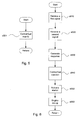
- Figure 5 is illustrating a flowchart depicting a method for controlling fuel injection in a vehicle combustion engine comprising at least one combustion chamber and means for supplying fuel into the combustion chamber.
- the method is characterized by the steps of detecting a first signal comprising information indicating a desire to start the engine and controlling fuel supply to said combustion chamber in dependence of a second signal, said control being performed before the engine is cranked up by a starter.
- said at least one combustion chamber preferably being several combustion chambers.
- the information about cylinder status preferably being dependent on a piston position in a cylinder corresponding to said at least one combustion chamber.
- a method for use in a motorised vehicle comprising an internal combustion engine comprising at least one combustion chamber is characterized by the step of performing a pre-injection of fuel into at least one of said combustion chamber before a starter cranks up the engine.
- Figure 6 is illustrating a flowchart depicting a subroutine of a method for controlling fuel supply in a vehicle combustion engine in greater detail according to one embodiment of the invention.
- a first step s610 the control unit 180 is receiving a first signal from the starting device 112 comprising information about that a user wants to start up the engine.
- the control unit 180 is receiving a second signal, for example crankshaft position signal (CPS), from a sensor 310a.
- the second signal comprising information, which can be used so as to estimate the amount of rest fuel in respective cylinder of the engine.
- the second signal comprises information about piston positions in respective cylinder of the engine.
- crankshaft position signals from sensors 310a-310e, are received in the control unit 180 in the step s620.
- a response to the received signals is generated.
- the response comprising information about a procedure of injecting fuel into a combustion chamber of the engine.
- the response comprising information about a procedure of injecting fuel into a plurality of combustion chamber of the engine.
- the injected amount of fuel in the respective combustion chamber are mutually different.
- the response comprising information about a procedure of injecting fuel into a plurality of combustion chamber of the engine in a sequential manner.
- the response comprising information about a procedure of injecting fuel into a plurality of combustion chamber of the engine substantially simultaneously.
- the response is generated in the control unit 180 by means of a computer program stored therein, as described below.
- control unit 180 is sending at least one control signal, so as to control fuel injection and combustion in a combustion chamber.
- the control unit 180 is sending at least one control signal, so as to control devices, such as the intake valve 230a and the spark plug 231a.
- control unit controls fuel injection and combustion in a plurality of cylinders of the engine.
- step s650 the starter 112 of the engine is activated.
- the starter cranks up the engine.
- step s660 injection is syncronized to normal injection and the engine is reving up. Compensation for the pre-injection in the step s630 could be made to one or more of the first injections. Thereafter the subroutine ends.
- the above mentioned control unit 180 may include an apparatus 700.
- the apparatus 700 comprises a non-volatile memory 720, a data processing device 730 and a read/write memory 740.
- the memory 720 has a first memory portion 750 wherein a computer program, such as an operating system, is stored for controlling the function of the apparatus 700.
- the apparatus 700 comprises a bus controller 770, a serial communication port 771, I/O-means 772, an A/D-converter 773, a time date entry and transmission unit 774, an event counter 775 and an interrupt controller 776.
- the apparatus 700 comprises a data port 799.
- the data processing device 730 may be embodied by, for example, a microprocessor.
- the memory 720 also has a second memory portion 760, where a program for reducing fuel discharge in a vehicle combustion engine is stored.
- the program for reducing fuel discharge in a vehicle combustion engine is stored on a separate non-volatile recording medium 762.
- the program may be stored in an executable manner or in a compressed state.
- the data processing device 730 performs a certain function this is to be understood that the data processing device 730 performs a certain part of the program which is stored in the memory 760 or a certain part of the program which is stored in the recording medium 762.
- An internal clock 777 which is adapted to generate clock cycle pulses having a frequency of F MHz.
- the internal clock 777 is coupled to the data processing means 730 by means of a data bus 781, and to the bus controller 770 by means of a data bus 780.
- the data processing device 730 may communicate with a data port 799 by means of a data bus 783.
- the memory 720 is adapted for communication with the data bus 783 via data bus 785.
- the separate non-volatile recording medium 762 is adapted to communicate with the data processing device 730 via data bus 789.
- the read/write memory 740 is adapted to communicate with the data bus 783 via a data bus 785.
- Internal features 771-775 is fed by the internal clock 777 via a data bus 787 connected to the data bus 780, respectively (only showed for 775 in the figure).
- the bus controller 770 is fed directly by the data bus 780.
- the internal features 770-775 are adapted to communicate with the data bus 783 via a data bus 788 (only showed for 775 in the figure).
- the internal features 771-775 are adapted to communicate with the data bus 782 and each of the internal features 770-775 are adapted for communication with an external unit by a bus 790, respectively (only showed for 775 in the figure).
- the methods described with reference to Figures 4, 5 and 6, respectively, can be performed by the apparatus 700 by means of the data processing device 730 running the program stored in the memory portion 760.
- the apparatus 700 runs the program the method described with reference to Figure 4, 5 and/or Figure 6 is executed.
- the data processing device 730 is set up to wait for reception of a first signal comprising information indicating start of the engine and a second signal comprising information about cylinder status, such as piston positions in respective cylinder of the engine, on the data port 799, or in the I/O unit 710.
- the data is received on the data port 799 said input data is temporarily stored in the read/write memory 740.
- the data processing device is set up to perform the calculations in a manner described above, so as to control fuel supply in a vehicle combustion engine.
Landscapes
- Engineering & Computer Science (AREA)
- Chemical & Material Sciences (AREA)
- Combustion & Propulsion (AREA)
- Mechanical Engineering (AREA)
- General Engineering & Computer Science (AREA)
- Electrical Control Of Air Or Fuel Supplied To Internal-Combustion Engine (AREA)
- Combined Controls Of Internal Combustion Engines (AREA)
Abstract
Description
- The present invention relates to a method for controlling fuel injection in a vehicle combustion engine comprising at least one combustion chamber and means for supplying fuel into the combustion chamber.
- The present invention also relates to a motor vehicle comprising an internal combustion engine comprising at least one combustion chamber, means for generating a first signal comprising information about a desire to start the engine, an electronic control unit adapted to control fuel supply to said combustion chamber.
- The present invention further relates to a computer program for carrying out a method for controlling fuel injection in a vehicle combustion engine.
- In motor vehicle engines there are, after the engine is shut off, some residual fuel in one or several combustion chambers or intake system. This fuel remains in the combustion chambers or intake system during the time when the engine is not in use.
- When a user of the vehicle is starting up the engine again after a period of time some of the residual fuel is pumped out from the engine to the vehicle exhaust system when cranking up the engine with a starter.
- An object of the invention relates to the problem of achieving an improved operation of a combustion engine of a motorised vehicle.
- A further object of the invention is to provide a combustion engine with reduced exhaust emissions, especially with reduced HC emissions during start of the engine.
- These objects are achieved by a method according to the above mentioned kind, further comprising the steps of:
- detecting a first signal comprising information indicating a desire to start the engine;
- controlling fuel supply to said combustion chamber in dependence of a second signal, said control being performed before the engine is cranked up by a starter.
- Advantageously the method, according to an embodiment of the invention, will reduce the number of pump-outs when starting up the engine. Preferably the number of pump-outs when starting up the engine is minimised. Consequently this results in less hydro carbons (HC) in an exhaust system of the vehicle. This may further have a positive effect on the environment of the vehicle.
- A favourable aspect of the invention is that a part of the residual fuel in the combustion chambers will be used for combustion as purposed.
- Further, according to an embodiment of the invention, there is provided a shorter activation time for a starter of the engine and, thus, quicker reving-up in start is achieved.
- Advantageously a more stable voltage will be achieved in a power supply system of the vehicle due to no starter is activated during the fuel supply. The fuel supply bears upon pre-injections.
- The method provides an improved control of fuel injection due to the possibility to await a correct fuel pressure value. A starter of the engine is not activated as early as in prior art, and there is therefore no need to quickly inject fuel in combustion chambers when there is too low pressure in a fuel rail.
- Even further, a more stable fuel pressure in the fuel rail of the engine is achieved due to that the pre-injections do not necessarily have to be performed simultaneously but one by one.
- According to a preferred embodiment of the invention, the second signal comprising information about cylinder status in response to said first signal is acquired. This provides a positive effect relating to the control of fuel supply to the combustion chambers.
- The invention will now be described in greater detail with aid of the enclosed drawings in which:
- Figure 1 is a schematic diagram depicting a vehicle drivetrain and a control system therefore according to an embodiment of the invention.
- Figure 2 is a schematic diagram illustrating a motor vehicle engine in greater detail according to an embodiment of the invention.
- Figure 3 is illustrating a part of the motor vehicle engine in greater detail according to an embodiment of the present invention.
- Figure 4 is illustrating a sequence schedule according to an embodiment of the invention.
- Figure 5 is a flowchart describing a subroutine for controlling fuel supply in a vehicle combustion engine executed by a control unit according to an embodiment of the invention
- Figure 6 is a flowchart describing in greater detail a subroutine for controlling fuel supply in a vehicle combustion engine executed by a control unit according to an embodiment of the invention.
- Figure 7 is a block diagram illustrating an apparatus, according to an embodiment of the invention.
-
- Figure 1 shows schematically a
vehicle drivetrain 10 and a control system therefore. The drivetrain comprises aninternal combustion engine 120 and a drivetrain member in the form of agear unit 140. Ashaft 150 is coupled between theengine 120 and thegear unit 140, whichshaft 150 works as force transmitting means. Atransmission output shaft 170 drives wheels (not shown) of the vehicle for its propulsion. - An
electronic control unit 180, such as an Engine Control Unit (ECU), is adapted to receive signals from anaccelerator member 190 of the drivetrain, saidmember 190 may be an accelerator pedal, and to receive condition parameters, such as engine condition parameters, fromsensors 114 and/or 110. Thesensors 114 are adapted to communicate with thecontrol unit 180 and acontrol unit 100 by means of acable 160 and acable 155, respectively. Thesensors 110 are adapted to communicate with thecontrol unit 180 by means of acable 152. Thesensors 110 are adapted to detect various engine parameters, such as engine temperature, or other parameters, which may be used in a calculation or simulation performed in thecontrol unit 180, so as to perform a pre-injection of fuel into one or several combustion chambers of the engine. Thesensors 110 are provided at adequate positions in the engine, so as to detect or measure a certain parameter's quantity or quality. Theaccelerator member 190 is adapted for communication with thecontrol unit 180 via acable 153. Theelectronic control unit 180 is adapted to send signals to a plurality of devices as to control the operation of the engine. Thecontrol unit 180 is adapted to process received signals from said sensors. Theelectronic control unit 180 is programmable. - The
electronic control unit 100 is adapted to receive signals from agear selecting unit 116 via acable 158, said gear selector unit may be a manual electronic gear selector. Alternatively thevehicle 10 has a manual gear shift lever. Thecontrol unit 100 is adapted to control gear changes of the gear unit by means of control signals sent to the gearbox via acable 159. - The
control unit 180 and thecontrol unit 100 are adapted for communication with each other by means of acable 156. When in the later it is depicted that a subroutine is performed in thecontrol unit 180 it may alternatively be performed in thecontrol unit 100. - A
start device 112 is adapted for communication with thecontrol unit 180 by means of acable 154. The start device is arranged for generating a start signal in response to an action taken by a user of the vehicle. The start device is further arranged for sending the start signal to thecontrol unit 180. Preferably the start device comprises a key hole adapted to closely receive a key. The start device may generate the start signal when the user turns the inserted key from a first position to a second position. - The
control unit 180 is adapted for communication with astarter 185 via acable 183. Thestarter 185 is arranged for cranking up the engine when starting the engine. Thecontrol unit 180 is adapted to control the starter. Typically the control unit controls the starter in dependence of the start signal generated by thestart device 112. A control procedure of the starter performed after a pre-injection of fuel into combustion chambers of the engine will be described in more detail below. - An emission system is arranged downstream the
engine 120. The emission system comprises afirst pipe 122, which is adapted to lead emission products from the combustion chambers of the engine to ahouse 124. The house may comprise a catalyst (not shown). Asecond pipe 126 is adapted to lead emission products from thehouse 124 out of the emission system. - Figure 2 is illustrating the
engine 120 of thevehicle 10 and a control system therefore according to an embodiment of the invention. Theengine 120 is comprising a plurality of cylinders, fivecylinders electronic control unit 180 via thecable 157. Theelectronic control unit 180 is adapted for communication with engine members,e.g. spark plugs cable 157. Thecable 157 may comprise a plurality of independent signal paths, as indicated in the figure. In an alternative embodiment, thecontrol unit 180 is adapted for communication with a spark plug via a separate cable. According to one embodiment, inlet- and outlet valves are controlled by thecontrol unit 180, which is illustrated by acable 211, which is connected between thecontrol unit 180 and theinlet valve 230e. According to one embodiment, the inlet- and outlet valves are controlled by a camshaft (not shown), which is in mechanical communication with acrankshaft 240. It should be noted that the figure is a simplification, which schematically illustrates parts of the engine. For example the form of the crankshaft is simplified for illustrative purposes. - The control unit is adapted to control the
spark plugs 232a-e. The spark plugs are adopted to generate sparks incombustion chambers cylinders cylinder walls piston rod fastening device crankshaft 240. - Alternatively, the engine may be configured such that the fuel is injected directly into the cylinder of the engine, which is known to those skilled in the art as a direct injection engine.
- Figure 3 is illustrating a part of the
engine 120 in greater detail. Shown in Figure 3 is theengine cylinder 235a comprising thecombustion chamber 234a. Thecontrol unit 180 is adapted to receive various signals from sensors coupled to engine 120 (also see Fig. 1). For example, thecontrol unit 180 is adapted to receive, via acable 311a, a crankshaft position signal (CPS) from asensor 310a coupled to thefastening device 239a, or, alternatively, to the crankshaft 240 (not shown). -
Combustion chamber 234a is known communicating withintake manifold 245a andexhaust manifold 246a viarespective intake valve 230a andexhaust valve 242a. Thecontrol unit 180 is adapted for communication with afuel injector 243a, the intake valve 230, thespark plug 232a and theexhaust valve 242a. Thecontrol unit 180 is adapted to control thefuel injector 243a via acable 253. Thecontrol unit 180 is adapted to control thespark plug 232a via acable 251. Thecables cable 157. -
Intake manifold 245a is shown communicating withthrottle body 248 viathrottle plate 247.Intake manifold 245a is also shown havingfuel injector 243a coupled thereto for delivering liquid fuel in proportion to the pulse width of a signal fed via thecable 253 from thecontrol unit 180. Fuel is delivered tofuel injector 243a by means of a conventional fuel system (not shown) including a fuel tank, fuel pump, and fuel rail. - In the above arrangements for the
cylinder 235a is described. Equivalent arrangements are provided for thecylinders 235b-235e as indicated in Figure 2. - Figure 4 is illustrating a sequence schedule in time T, according an embodiment of the invention. When a user of the vehicle is giving an engine start indication s450, using for example an ignition key, the start position of the pistons of the cylinders, respectively, is detected either by means of an angular crankshaft detector or an angular cam detector. Alternatively, information being stored in the
control unit 180 indicating the start position may be used. This information could be obtained in engine shut of phase, and stored in a non-volatile memory for engine start position. By this alternative, a unique position sensor is not necessary. By knowing the start position of the pistons, the amount of rest fuel can be estimated using for example a fuel estimation model provided in thecontrol unit 180. The information implicitly indicating rest fuel value, in each of the cylinders of the engine, is processed s455 by thecontrol unit 180, so as to obtain syncronization set-up data. - In a next step, syncronization set-up s460 is implemented by the
control unit 180. Fuel injection s465 in accordance with the preceding steps s455 and s460 is thereafter performed in one or several combustion chambers of the engine. Fuel injection is, according to an embodiment, performed individually in each of the cylinders of the engine. After the pre-injection in step s465 is performed the starter of the engine is activated in a step s470 and the engine thus cranked up. - In the next step engine reving-up s475 injection is syncronized to normal injection. Compensation for the pre-injections in step s465 could be made to one ore more of the first syncronized injections.
- Figure 5 is illustrating a flowchart depicting a method for controlling fuel injection in a vehicle combustion engine comprising at least one combustion chamber and means for supplying fuel into the combustion chamber. The method is characterized by the steps of detecting a first signal comprising information indicating a desire to start the engine and controlling fuel supply to said combustion chamber in dependence of a second signal, said control being performed before the engine is cranked up by a starter.
- According to one embodiment of the invention said at least one combustion chamber preferably being several combustion chambers.
- According to another embodiment of the invention the information about cylinder status preferably being dependent on a piston position in a cylinder corresponding to said at least one combustion chamber.
- According to one embodiment of the invention a method for use in a motorised vehicle comprising an internal combustion engine comprising at least one combustion chamber is characterized by the step of performing a pre-injection of fuel into at least one of said combustion chamber before a starter cranks up the engine.
- Figure 6 is illustrating a flowchart depicting a subroutine of a method for controlling fuel supply in a vehicle combustion engine in greater detail according to one embodiment of the invention.
- In a first step s610 the
control unit 180 is receiving a first signal from the startingdevice 112 comprising information about that a user wants to start up the engine. - In a next step s620 the
control unit 180 is receiving a second signal, for example crankshaft position signal (CPS), from asensor 310a. The second signal comprising information, which can be used so as to estimate the amount of rest fuel in respective cylinder of the engine. Alternatively, the second signal comprises information about piston positions in respective cylinder of the engine. - According to one embodiment crankshaft position signals, from
sensors 310a-310e, are received in thecontrol unit 180 in the step s620. According to another embodiment there are information relating to actual crankshaft positions stored in thecontrol unit 180, which data substantially immediately can be used in calculations performed by thecontrol unit 180 when a user wants to crank up the engine again by using the start device. - In a step s630 a response to the received signals is generated. The response comprising information about a procedure of injecting fuel into a combustion chamber of the engine. According to one embodiment of the invention, the response comprising information about a procedure of injecting fuel into a plurality of combustion chamber of the engine. In this embodiment the injected amount of fuel in the respective combustion chamber are mutually different. According to one embodiment of the invention, the response comprising information about a procedure of injecting fuel into a plurality of combustion chamber of the engine in a sequential manner. According to one embodiment of the invention, the response comprising information about a procedure of injecting fuel into a plurality of combustion chamber of the engine substantially simultaneously.
- The response is generated in the
control unit 180 by means of a computer program stored therein, as described below. - In a next step s640 the
control unit 180 is sending at least one control signal, so as to control fuel injection and combustion in a combustion chamber. Thecontrol unit 180 is sending at least one control signal, so as to control devices, such as theintake valve 230a and thespark plug 231a. According to one embodiment the control unit controls fuel injection and combustion in a plurality of cylinders of the engine. - In a next step s650 the
starter 112 of the engine is activated. The starter cranks up the engine. - In the next step s660 injection is syncronized to normal injection and the engine is reving up. Compensation for the pre-injection in the step s630 could be made to one or more of the first injections. Thereafter the subroutine ends.
- With reference to Figure 7 there is shown a diagram of one way of embodying an
apparatus 700. The above mentionedcontrol unit 180 may include anapparatus 700. Theapparatus 700 comprises anon-volatile memory 720, adata processing device 730 and a read/write memory 740. Thememory 720 has afirst memory portion 750 wherein a computer program, such as an operating system, is stored for controlling the function of theapparatus 700. Further, theapparatus 700 comprises abus controller 770, aserial communication port 771, I/O-means 772, an A/D-converter 773, a time date entry andtransmission unit 774, anevent counter 775 and an interruptcontroller 776. Even further, theapparatus 700 comprises adata port 799. - The
data processing device 730 may be embodied by, for example, a microprocessor. - The
memory 720 also has asecond memory portion 760, where a program for reducing fuel discharge in a vehicle combustion engine is stored. In another embodiment the program for reducing fuel discharge in a vehicle combustion engine is stored on a separatenon-volatile recording medium 762. The program may be stored in an executable manner or in a compressed state. - When, in the following, it is described that the
data processing device 730 performs a certain function this is to be understood that thedata processing device 730 performs a certain part of the program which is stored in thememory 760 or a certain part of the program which is stored in therecording medium 762. - An
internal clock 777, which is adapted to generate clock cycle pulses having a frequency of F MHz. Theinternal clock 777 is coupled to the data processing means 730 by means of adata bus 781, and to thebus controller 770 by means of adata bus 780. Thedata processing device 730 may communicate with adata port 799 by means of adata bus 783. Thememory 720 is adapted for communication with thedata bus 783 viadata bus 785. The separatenon-volatile recording medium 762 is adapted to communicate with thedata processing device 730 viadata bus 789. The read/write memory 740 is adapted to communicate with thedata bus 783 via adata bus 785. Internal features 771-775 is fed by theinternal clock 777 via adata bus 787 connected to thedata bus 780, respectively (only showed for 775 in the figure). Thebus controller 770 is fed directly by thedata bus 780. Further, the internal features 770-775 are adapted to communicate with thedata bus 783 via a data bus 788 (only showed for 775 in the figure). The internal features 771-775 are adapted to communicate with thedata bus 782 and each of the internal features 770-775 are adapted for communication with an external unit by abus 790, respectively (only showed for 775 in the figure). - The methods described with reference to Figures 4, 5 and 6, respectively, can be performed by the
apparatus 700 by means of thedata processing device 730 running the program stored in thememory portion 760. When theapparatus 700 runs the program the method described with reference to Figure 4, 5 and/or Figure 6 is executed. Thereby thedata processing device 730 is set up to wait for reception of a first signal comprising information indicating start of the engine and a second signal comprising information about cylinder status, such as piston positions in respective cylinder of the engine, on thedata port 799, or in the I/O unit 710. When the data is received on thedata port 799 said input data is temporarily stored in the read/write memory 740. When all the received input data have been temporarily stored, the data processing device is set up to perform the calculations in a manner described above, so as to control fuel supply in a vehicle combustion engine.
Claims (15)
- A method for controlling fuel injection in a vehicle combustion engine comprising at least one combustion chamber and means for supplying fuel into the combustion chamber; characterized by the steps ofdetecting a first signal comprising information indicating a desire to start the engine;controlling fuel supply to said combustion chamber in dependence of a second signal, said control being performed before the engine is cranked up by a starter.
- A method according to claim 1 characterized by the step of:acquiring the second signal comprising information about cylinder status in response to said first signal.
- A method according to claim 1 or 2 characterized by controlling said fuel supply to several combustion chambers.
- A method according to claims 1-3 characterized by using a piston position in at least one cylinder as the information about cylinder status.
- Motor vehicle comprising an internal combustion engine comprising at least one combustion chamber, means for generating a first signal comprising information about a desire to start the engine, an electronic control unit adapted to control fuel supply to said combustion chamber,
characterized by
said electronic control unit being adapted to control the fuel supply, in dependence of a second signal, before the engine is cranked up by a starter. - Motor vehicle according to claim 5 characterized by means for generating the second signal comprising information about cylinder status is arranged for communication with the control unit, said second signal is acquired in dependence of the first signal.
- Motor vehicle according to claim 5 or 6 characterized by a computer readable medium is adapted to temporarily store said information comprising cylinder status thereon.
- Motor vehicle according to claims 5-7 characterized by that said at least one combustion chamber is a plurality of combustion chambers.
- A computer program for causing a computerised apparatus (180; 700) to control fuel supply to a combustion chamber of a combustion engine, comprising
computer readable code means which, when run on a computerised apparatus (8, 700), causes the computerised apparatus (8; 700) to perform the steps according to any one of claims 1-4. - A computer program product comprising
a computer readable medium; and
a computer program according to claim 9,
said computer program being recorded on said computer readable medium. - The computer program product according to claim 10, characterised by said computer readable medium comprising a memory chip.
- A computer program comprising computer readable code means for causing a computer to perform the steps of any of the claims 1-4 when said program is run on a computer.
- A computer program product comprising a computer readable medium; and
a computer program according to claim 9,
said computer program being recorded on said computer readable medium. - A computer readable medium according to claim 12 and 13, characterised by said computer readable medium being a propagated signal.
- The medium according to claim 14, characterised by said propagated signal being a carrier wave.
Priority Applications (2)
| Application Number | Priority Date | Filing Date | Title |
|---|---|---|---|
| DE60329396T DE60329396D1 (en) | 2003-11-04 | 2003-11-04 | System and method for controlling fuel injection in a motor |
| EP20030025197 EP1529945B1 (en) | 2003-11-04 | 2003-11-04 | System and method for controlling fuel injection |
Applications Claiming Priority (1)
| Application Number | Priority Date | Filing Date | Title |
|---|---|---|---|
| EP20030025197 EP1529945B1 (en) | 2003-11-04 | 2003-11-04 | System and method for controlling fuel injection |
Publications (2)
| Publication Number | Publication Date |
|---|---|
| EP1529945A1 true EP1529945A1 (en) | 2005-05-11 |
| EP1529945B1 EP1529945B1 (en) | 2009-09-23 |
Family
ID=34429252
Family Applications (1)
| Application Number | Title | Priority Date | Filing Date |
|---|---|---|---|
| EP20030025197 Expired - Lifetime EP1529945B1 (en) | 2003-11-04 | 2003-11-04 | System and method for controlling fuel injection |
Country Status (2)
| Country | Link |
|---|---|
| EP (1) | EP1529945B1 (en) |
| DE (1) | DE60329396D1 (en) |
Citations (8)
| Publication number | Priority date | Publication date | Assignee | Title |
|---|---|---|---|---|
| US4723523A (en) * | 1985-12-02 | 1988-02-09 | Nippondenso Co., Ltd. | Air/fuel ratio control system for internal combustion engine |
| JPH0783093A (en) * | 1993-09-14 | 1995-03-28 | Nippondenso Co Ltd | Engine control device |
| DE4418579A1 (en) * | 1994-05-27 | 1995-11-30 | Bosch Gmbh Robert | Multi-cylinder IC engine fuel injection and ignition control device |
| US5852998A (en) * | 1996-03-26 | 1998-12-29 | Suzuki Motor Corporation | Fuel-injection control device for outboard motors |
| EP0990784A2 (en) * | 1998-10-03 | 2000-04-05 | Ford Motor Company Limited | Method for the synchronisation of an internal combustion engine |
| US6098585A (en) * | 1997-08-11 | 2000-08-08 | Ford Global Technologies, Inc. | Multi-cylinder four stroke direct injection spark ignition engine |
| FR2827911A1 (en) * | 2001-07-27 | 2003-01-31 | Peugeot Citroen Automobiles Sa | Method of controlling stopping and restarting of motor vehicle internal combustion engine, involves detecting engine component speed and angular position to determine optimum restarting position |
| EP1284349A2 (en) * | 2001-08-15 | 2003-02-19 | Nissan Motor Co., Ltd. | Fuel injection control for start-up of internal combustion engine |
-
2003
- 2003-11-04 DE DE60329396T patent/DE60329396D1/en not_active Expired - Lifetime
- 2003-11-04 EP EP20030025197 patent/EP1529945B1/en not_active Expired - Lifetime
Patent Citations (8)
| Publication number | Priority date | Publication date | Assignee | Title |
|---|---|---|---|---|
| US4723523A (en) * | 1985-12-02 | 1988-02-09 | Nippondenso Co., Ltd. | Air/fuel ratio control system for internal combustion engine |
| JPH0783093A (en) * | 1993-09-14 | 1995-03-28 | Nippondenso Co Ltd | Engine control device |
| DE4418579A1 (en) * | 1994-05-27 | 1995-11-30 | Bosch Gmbh Robert | Multi-cylinder IC engine fuel injection and ignition control device |
| US5852998A (en) * | 1996-03-26 | 1998-12-29 | Suzuki Motor Corporation | Fuel-injection control device for outboard motors |
| US6098585A (en) * | 1997-08-11 | 2000-08-08 | Ford Global Technologies, Inc. | Multi-cylinder four stroke direct injection spark ignition engine |
| EP0990784A2 (en) * | 1998-10-03 | 2000-04-05 | Ford Motor Company Limited | Method for the synchronisation of an internal combustion engine |
| FR2827911A1 (en) * | 2001-07-27 | 2003-01-31 | Peugeot Citroen Automobiles Sa | Method of controlling stopping and restarting of motor vehicle internal combustion engine, involves detecting engine component speed and angular position to determine optimum restarting position |
| EP1284349A2 (en) * | 2001-08-15 | 2003-02-19 | Nissan Motor Co., Ltd. | Fuel injection control for start-up of internal combustion engine |
Non-Patent Citations (1)
| Title |
|---|
| PATENT ABSTRACTS OF JAPAN vol. 1995, no. 06 31 July 1995 (1995-07-31) * |
Also Published As
| Publication number | Publication date |
|---|---|
| DE60329396D1 (en) | 2009-11-05 |
| EP1529945B1 (en) | 2009-09-23 |
Similar Documents
| Publication | Publication Date | Title |
|---|---|---|
| US7706961B2 (en) | Diesel engine system and method of controlling diesel engine | |
| EP1423590B1 (en) | Stop-start control apparatus of internal combustion engine, and control method thereof | |
| US9410498B2 (en) | Method and device for operating a high-pressure accumulator fuel injection system for an internal combustion engine | |
| EP1471236B1 (en) | Method and system for supplying fuel to an engine at engine start | |
| US7900606B2 (en) | Systems and methods for purging air of a fuel injection system | |
| CN103104364A (en) | Method for fueling an engine at start | |
| US20100000496A1 (en) | Method for carrying out a high-pressure start of an internal combustion engine, control facility and internal combustion engine | |
| US7182062B2 (en) | Method for controlling a direct injection of an internal combustion engine | |
| CN101387232B (en) | Engine cranking system with cylinder deactivation for a direct injection engine | |
| JP2002539349A (en) | Fuel supply system especially for automotive internal combustion engines | |
| EP1529945B1 (en) | System and method for controlling fuel injection | |
| CN117657111A (en) | System and method for driveline disconnect clutch destroke and pre-positioning | |
| EP2112358A2 (en) | Fuel injection amount learning control apparatus | |
| CN104011354A (en) | Method for learning a minimum actuation duration of injection valves of an internal combustion engine | |
| JP5052484B2 (en) | Fuel injection amount learning control device for internal combustion engine | |
| CN101871404A (en) | The diagnostic system of pressure transducer and method during idling mode | |
| JP4924310B2 (en) | Diesel engine control device | |
| US9599085B2 (en) | Engine fuel injection device | |
| US11105287B1 (en) | Methods and system for stopping an engine | |
| EP1377737B1 (en) | Fuel injection control apparatus and control method thereof | |
| JPH04246259A (en) | Fuel injection controller for diesel engine | |
| US6273068B1 (en) | Fuel supply system for an internal combustion engine, particularly of a motor vehicle | |
| JP2017110605A (en) | Vehicular control device | |
| US11959449B2 (en) | Control device for hybrid electric vehicle | |
| JP2008215226A (en) | Fuel injection control device of diesel engine |
Legal Events
| Date | Code | Title | Description |
|---|---|---|---|
| PUAI | Public reference made under article 153(3) epc to a published international application that has entered the european phase |
Free format text: ORIGINAL CODE: 0009012 |
|
| AK | Designated contracting states |
Kind code of ref document: A1 Designated state(s): AT BE BG CH CY CZ DE DK EE ES FI FR GB GR HU IE IT LI LU MC NL PT RO SE SI SK TR |
|
| AX | Request for extension of the european patent |
Extension state: AL LT LV MK |
|
| 17P | Request for examination filed |
Effective date: 20050602 |
|
| AKX | Designation fees paid |
Designated state(s): DE GB SE |
|
| RAP1 | Party data changed (applicant data changed or rights of an application transferred) |
Owner name: FORD GLOBAL TECHNOLOGIES, LLC. |
|
| 17Q | First examination report despatched |
Effective date: 20060124 |
|
| GRAP | Despatch of communication of intention to grant a patent |
Free format text: ORIGINAL CODE: EPIDOSNIGR1 |
|
| GRAS | Grant fee paid |
Free format text: ORIGINAL CODE: EPIDOSNIGR3 |
|
| GRAA | (expected) grant |
Free format text: ORIGINAL CODE: 0009210 |
|
| AK | Designated contracting states |
Kind code of ref document: B1 Designated state(s): DE GB SE |
|
| REG | Reference to a national code |
Ref country code: GB Ref legal event code: FG4D |
|
| REF | Corresponds to: |
Ref document number: 60329396 Country of ref document: DE Date of ref document: 20091105 Kind code of ref document: P |
|
| REG | Reference to a national code |
Ref country code: SE Ref legal event code: TRGR |
|
| PLBE | No opposition filed within time limit |
Free format text: ORIGINAL CODE: 0009261 |
|
| STAA | Information on the status of an ep patent application or granted ep patent |
Free format text: STATUS: NO OPPOSITION FILED WITHIN TIME LIMIT |
|
| 26N | No opposition filed |
Effective date: 20100624 |
|
| REG | Reference to a national code |
Ref country code: GB Ref legal event code: 732E Free format text: REGISTERED BETWEEN 20111020 AND 20111025 |
|
| REG | Reference to a national code |
Ref country code: DE Ref legal event code: R082 Ref document number: 60329396 Country of ref document: DE Representative=s name: HOFFMANN - EITLE, DE |
|
| REG | Reference to a national code |
Ref country code: DE Ref legal event code: R082 Ref document number: 60329396 Country of ref document: DE Representative=s name: HOFFMANN - EITLE PATENT- UND RECHTSANWAELTE PA, DE Effective date: 20120207 Ref country code: DE Ref legal event code: R081 Ref document number: 60329396 Country of ref document: DE Owner name: VOLVO CAR CORPORATION, SE Free format text: FORMER OWNER: FORD GLOBAL TECHNOLOGIES, LLC, DEARBORN, MICH., US Effective date: 20120207 |
|
| PGFP | Annual fee paid to national office [announced via postgrant information from national office to epo] |
Ref country code: SE Payment date: 20141126 Year of fee payment: 12 Ref country code: DE Payment date: 20141117 Year of fee payment: 12 Ref country code: GB Payment date: 20141119 Year of fee payment: 12 |
|
| REG | Reference to a national code |
Ref country code: DE Ref legal event code: R119 Ref document number: 60329396 Country of ref document: DE |
|
| GBPC | Gb: european patent ceased through non-payment of renewal fee |
Effective date: 20151104 |
|
| PG25 | Lapsed in a contracting state [announced via postgrant information from national office to epo] |
Ref country code: SE Free format text: LAPSE BECAUSE OF NON-PAYMENT OF DUE FEES Effective date: 20151105 |
|
| PG25 | Lapsed in a contracting state [announced via postgrant information from national office to epo] |
Ref country code: DE Free format text: LAPSE BECAUSE OF NON-PAYMENT OF DUE FEES Effective date: 20160601 Ref country code: GB Free format text: LAPSE BECAUSE OF NON-PAYMENT OF DUE FEES Effective date: 20151104 |