EP1528054A1 - Hydrocyanation of pentenenitriles and/or 2-methyl-3-butenenitrile using promoters obtained from the chlorination of titanium-rich ores - Google Patents
Hydrocyanation of pentenenitriles and/or 2-methyl-3-butenenitrile using promoters obtained from the chlorination of titanium-rich ores Download PDFInfo
- Publication number
- EP1528054A1 EP1528054A1 EP04256674A EP04256674A EP1528054A1 EP 1528054 A1 EP1528054 A1 EP 1528054A1 EP 04256674 A EP04256674 A EP 04256674A EP 04256674 A EP04256674 A EP 04256674A EP 1528054 A1 EP1528054 A1 EP 1528054A1
- Authority
- EP
- European Patent Office
- Prior art keywords
- titanium
- hydrocyanation
- byproduct
- promoter
- methyl
- Prior art date
- Legal status (The legal status is an assumption and is not a legal conclusion. Google has not performed a legal analysis and makes no representation as to the accuracy of the status listed.)
- Granted
Links
- RTAQQCXQSZGOHL-UHFFFAOYSA-N Titanium Chemical compound [Ti] RTAQQCXQSZGOHL-UHFFFAOYSA-N 0.000 title claims abstract description 23
- 239000010936 titanium Substances 0.000 title claims abstract description 23
- 229910052719 titanium Inorganic materials 0.000 title claims abstract description 23
- WBAXCOMEMKANRN-UHFFFAOYSA-N 2-methylbut-3-enenitrile Chemical compound C=CC(C)C#N WBAXCOMEMKANRN-UHFFFAOYSA-N 0.000 title claims abstract description 8
- 238000005669 hydrocyanation reaction Methods 0.000 title claims description 22
- 238000005660 chlorination reaction Methods 0.000 title abstract description 14
- 238000000034 method Methods 0.000 claims abstract description 33
- 239000006227 byproduct Substances 0.000 claims abstract description 29
- PXHVJJICTQNCMI-UHFFFAOYSA-N Nickel Chemical compound [Ni] PXHVJJICTQNCMI-UHFFFAOYSA-N 0.000 claims abstract description 22
- CFEYBLWMNFZOPB-UHFFFAOYSA-N Allylacetonitrile Natural products C=CCCC#N CFEYBLWMNFZOPB-UHFFFAOYSA-N 0.000 claims abstract description 15
- UVKXJAUUKPDDNW-NSCUHMNNSA-N (e)-pent-3-enenitrile Chemical compound C\C=C\CC#N UVKXJAUUKPDDNW-NSCUHMNNSA-N 0.000 claims abstract description 11
- 239000000758 substrate Substances 0.000 claims abstract description 7
- ISBHMJZRKAFTGE-ONEGZZNKSA-N (e)-pent-2-enenitrile Chemical compound CC\C=C\C#N ISBHMJZRKAFTGE-ONEGZZNKSA-N 0.000 claims abstract description 5
- LELOWRISYMNNSU-UHFFFAOYSA-N hydrogen cyanide Chemical compound N#C LELOWRISYMNNSU-UHFFFAOYSA-N 0.000 claims description 18
- 239000003054 catalyst Substances 0.000 claims description 17
- NMCUIPGRVMDVDB-UHFFFAOYSA-L iron dichloride Chemical compound Cl[Fe]Cl NMCUIPGRVMDVDB-UHFFFAOYSA-L 0.000 claims description 10
- XJDNKRIXUMDJCW-UHFFFAOYSA-J titanium tetrachloride Chemical compound Cl[Ti](Cl)(Cl)Cl XJDNKRIXUMDJCW-UHFFFAOYSA-J 0.000 claims description 10
- ZAMOUSCENKQFHK-UHFFFAOYSA-N Chlorine atom Chemical compound [Cl] ZAMOUSCENKQFHK-UHFFFAOYSA-N 0.000 claims description 7
- 239000000460 chlorine Substances 0.000 claims description 7
- 229910052801 chlorine Inorganic materials 0.000 claims description 7
- 229910052759 nickel Inorganic materials 0.000 claims description 6
- 229910021577 Iron(II) chloride Inorganic materials 0.000 claims description 5
- 229910021380 Manganese Chloride Inorganic materials 0.000 claims description 5
- 238000004519 manufacturing process Methods 0.000 claims description 5
- GLFNIEUTAYBVOC-UHFFFAOYSA-L Manganese chloride Chemical compound Cl[Mn]Cl GLFNIEUTAYBVOC-UHFFFAOYSA-L 0.000 claims description 4
- 150000001875 compounds Chemical class 0.000 claims description 4
- 235000002867 manganese chloride Nutrition 0.000 claims description 4
- 239000011565 manganese chloride Substances 0.000 claims description 4
- 239000007795 chemical reaction product Substances 0.000 claims 2
- 239000000203 mixture Substances 0.000 abstract description 20
- 239000000463 material Substances 0.000 description 14
- 239000003446 ligand Substances 0.000 description 13
- BTGRAWJCKBQKAO-UHFFFAOYSA-N adiponitrile Chemical compound N#CCCCCC#N BTGRAWJCKBQKAO-UHFFFAOYSA-N 0.000 description 11
- 125000006539 C12 alkyl group Chemical group [H]C([H])([H])C([H])([H])C([H])([H])C([H])([H])C([H])([H])C([H])([H])C([H])([H])C([H])([H])C([H])([H])C([H])([H])C([H])([H])C([H])([H])* 0.000 description 10
- XEEYBQQBJWHFJM-UHFFFAOYSA-N Iron Chemical compound [Fe] XEEYBQQBJWHFJM-UHFFFAOYSA-N 0.000 description 10
- FPPLREPCQJZDAQ-UHFFFAOYSA-N 2-methylpentanedinitrile Chemical compound N#CC(C)CCC#N FPPLREPCQJZDAQ-UHFFFAOYSA-N 0.000 description 8
- 239000011541 reaction mixture Substances 0.000 description 8
- 239000002904 solvent Substances 0.000 description 8
- UQSXHKLRYXJYBZ-UHFFFAOYSA-N Iron oxide Chemical compound [Fe]=O UQSXHKLRYXJYBZ-UHFFFAOYSA-N 0.000 description 7
- 125000003118 aryl group Chemical group 0.000 description 7
- 239000007789 gas Substances 0.000 description 7
- GWEVSGVZZGPLCZ-UHFFFAOYSA-N titanium dioxide Inorganic materials O=[Ti]=O GWEVSGVZZGPLCZ-UHFFFAOYSA-N 0.000 description 7
- 238000006243 chemical reaction Methods 0.000 description 6
- 150000002825 nitriles Chemical class 0.000 description 6
- 239000000571 coke Substances 0.000 description 5
- 229960002089 ferrous chloride Drugs 0.000 description 5
- 229910052742 iron Inorganic materials 0.000 description 5
- OJMIONKXNSYLSR-UHFFFAOYSA-N phosphorous acid Chemical compound OP(O)O OJMIONKXNSYLSR-UHFFFAOYSA-N 0.000 description 5
- IJGRMHOSHXDMSA-UHFFFAOYSA-N Atomic nitrogen Chemical compound N#N IJGRMHOSHXDMSA-UHFFFAOYSA-N 0.000 description 4
- 125000000217 alkyl group Chemical group 0.000 description 4
- FBAFATDZDUQKNH-UHFFFAOYSA-M iron chloride Chemical compound [Cl-].[Fe] FBAFATDZDUQKNH-UHFFFAOYSA-M 0.000 description 4
- 229910001510 metal chloride Inorganic materials 0.000 description 4
- 229910052760 oxygen Inorganic materials 0.000 description 4
- 238000002360 preparation method Methods 0.000 description 4
- 125000004642 (C1-C12) alkoxy group Chemical group 0.000 description 3
- 229920002292 Nylon 6 Polymers 0.000 description 3
- 229920002302 Nylon 6,6 Polymers 0.000 description 3
- YXFVVABEGXRONW-UHFFFAOYSA-N Toluene Chemical compound CC1=CC=CC=C1 YXFVVABEGXRONW-UHFFFAOYSA-N 0.000 description 3
- 229910002092 carbon dioxide Inorganic materials 0.000 description 3
- 238000001914 filtration Methods 0.000 description 3
- 235000013980 iron oxide Nutrition 0.000 description 3
- 125000001997 phenyl group Chemical group [H]C1=C([H])C([H])=C(*)C([H])=C1[H] 0.000 description 3
- AQSJGOWTSHOLKH-UHFFFAOYSA-N phosphite(3-) Chemical class [O-]P([O-])[O-] AQSJGOWTSHOLKH-UHFFFAOYSA-N 0.000 description 3
- 239000004912 1,5-cyclooctadiene Substances 0.000 description 2
- CURLTUGMZLYLDI-UHFFFAOYSA-N Carbon dioxide Chemical compound O=C=O CURLTUGMZLYLDI-UHFFFAOYSA-N 0.000 description 2
- VEXZGXHMUGYJMC-UHFFFAOYSA-N Hydrochloric acid Chemical compound Cl VEXZGXHMUGYJMC-UHFFFAOYSA-N 0.000 description 2
- QVGXLLKOCUKJST-UHFFFAOYSA-N atomic oxygen Chemical compound [O] QVGXLLKOCUKJST-UHFFFAOYSA-N 0.000 description 2
- 125000004432 carbon atom Chemical group C* 0.000 description 2
- -1 cation compounds Chemical class 0.000 description 2
- JBKVHLHDHHXQEQ-UHFFFAOYSA-N epsilon-caprolactam Chemical compound O=C1CCCCCN1 JBKVHLHDHHXQEQ-UHFFFAOYSA-N 0.000 description 2
- NAQMVNRVTILPCV-UHFFFAOYSA-N hexane-1,6-diamine Chemical compound NCCCCCCN NAQMVNRVTILPCV-UHFFFAOYSA-N 0.000 description 2
- 229910000041 hydrogen chloride Inorganic materials 0.000 description 2
- IXCSERBJSXMMFS-UHFFFAOYSA-N hydrogen chloride Substances Cl.Cl IXCSERBJSXMMFS-UHFFFAOYSA-N 0.000 description 2
- YDZQQRWRVYGNER-UHFFFAOYSA-N iron;titanium;trihydrate Chemical compound O.O.O.[Ti].[Fe] YDZQQRWRVYGNER-UHFFFAOYSA-N 0.000 description 2
- 125000002496 methyl group Chemical group [H]C([H])([H])* 0.000 description 2
- 230000007935 neutral effect Effects 0.000 description 2
- 229910052757 nitrogen Inorganic materials 0.000 description 2
- 239000001301 oxygen Substances 0.000 description 2
- 239000002245 particle Substances 0.000 description 2
- 125000005538 phosphinite group Chemical group 0.000 description 2
- 239000002994 raw material Substances 0.000 description 2
- 238000000926 separation method Methods 0.000 description 2
- 239000002002 slurry Substances 0.000 description 2
- 239000007787 solid Substances 0.000 description 2
- 229910052717 sulfur Inorganic materials 0.000 description 2
- JRTIUDXYIUKIIE-KZUMESAESA-N (1z,5z)-cycloocta-1,5-diene;nickel Chemical compound [Ni].C\1C\C=C/CC\C=C/1.C\1C\C=C/CC\C=C/1 JRTIUDXYIUKIIE-KZUMESAESA-N 0.000 description 1
- VYXHVRARDIDEHS-UHFFFAOYSA-N 1,5-cyclooctadiene Chemical compound C1CC=CCCC=C1 VYXHVRARDIDEHS-UHFFFAOYSA-N 0.000 description 1
- OKTJSMMVPCPJKN-UHFFFAOYSA-N Carbon Chemical compound [C] OKTJSMMVPCPJKN-UHFFFAOYSA-N 0.000 description 1
- UGFAIRIUMAVXCW-UHFFFAOYSA-N Carbon monoxide Chemical compound [O+]#[C-] UGFAIRIUMAVXCW-UHFFFAOYSA-N 0.000 description 1
- KZBUYRJDOAKODT-UHFFFAOYSA-N Chlorine Chemical compound ClCl KZBUYRJDOAKODT-UHFFFAOYSA-N 0.000 description 1
- 229910021578 Iron(III) chloride Inorganic materials 0.000 description 1
- 239000002841 Lewis acid Substances 0.000 description 1
- PWHULOQIROXLJO-UHFFFAOYSA-N Manganese Chemical compound [Mn] PWHULOQIROXLJO-UHFFFAOYSA-N 0.000 description 1
- 239000004952 Polyamide Substances 0.000 description 1
- 229910021550 Vanadium Chloride Inorganic materials 0.000 description 1
- NFGODEMQGQNUKK-UHFFFAOYSA-M [6-(diethylamino)-9-(2-octadecoxycarbonylphenyl)xanthen-3-ylidene]-diethylazanium;chloride Chemical compound [Cl-].CCCCCCCCCCCCCCCCCCOC(=O)C1=CC=CC=C1C1=C2C=CC(=[N+](CC)CC)C=C2OC2=CC(N(CC)CC)=CC=C21 NFGODEMQGQNUKK-UHFFFAOYSA-M 0.000 description 1
- JYNZIOFUHBJABQ-UHFFFAOYSA-N allyl-{6-[3-(4-bromo-phenyl)-benzofuran-6-yloxy]-hexyl-}-methyl-amin Chemical compound C=1OC2=CC(OCCCCCCN(C)CC=C)=CC=C2C=1C1=CC=C(Br)C=C1 JYNZIOFUHBJABQ-UHFFFAOYSA-N 0.000 description 1
- 150000001450 anions Chemical class 0.000 description 1
- RBFQJDQYXXHULB-UHFFFAOYSA-N arsane Chemical class [AsH3] RBFQJDQYXXHULB-UHFFFAOYSA-N 0.000 description 1
- GCPXMJHSNVMWNM-UHFFFAOYSA-N arsenous acid Chemical class O[As](O)O GCPXMJHSNVMWNM-UHFFFAOYSA-N 0.000 description 1
- 230000005587 bubbling Effects 0.000 description 1
- 229910052799 carbon Inorganic materials 0.000 description 1
- 239000001569 carbon dioxide Substances 0.000 description 1
- 229910002091 carbon monoxide Inorganic materials 0.000 description 1
- 150000001805 chlorine compounds Chemical class 0.000 description 1
- 238000004587 chromatography analysis Methods 0.000 description 1
- 238000001816 cooling Methods 0.000 description 1
- 239000000110 cooling liquid Substances 0.000 description 1
- 239000003085 diluting agent Substances 0.000 description 1
- 125000001495 ethyl group Chemical group [H]C([H])([H])C([H])([H])* 0.000 description 1
- 238000001704 evaporation Methods 0.000 description 1
- 230000008020 evaporation Effects 0.000 description 1
- 239000000835 fiber Substances 0.000 description 1
- 238000007429 general method Methods 0.000 description 1
- 239000012456 homogeneous solution Substances 0.000 description 1
- BHEPBYXIRTUNPN-UHFFFAOYSA-N hydridophosphorus(.) (triplet) Chemical compound [PH] BHEPBYXIRTUNPN-UHFFFAOYSA-N 0.000 description 1
- 238000005984 hydrogenation reaction Methods 0.000 description 1
- 239000012535 impurity Substances 0.000 description 1
- 238000011065 in-situ storage Methods 0.000 description 1
- 239000002198 insoluble material Substances 0.000 description 1
- 150000002506 iron compounds Chemical class 0.000 description 1
- RBTARNINKXHZNM-UHFFFAOYSA-K iron trichloride Chemical compound Cl[Fe](Cl)Cl RBTARNINKXHZNM-UHFFFAOYSA-K 0.000 description 1
- VBMVTYDPPZVILR-UHFFFAOYSA-N iron(2+);oxygen(2-) Chemical class [O-2].[Fe+2] VBMVTYDPPZVILR-UHFFFAOYSA-N 0.000 description 1
- 125000001449 isopropyl group Chemical group [H]C([H])([H])C([H])(*)C([H])([H])[H] 0.000 description 1
- 150000007517 lewis acids Chemical class 0.000 description 1
- 125000000040 m-tolyl group Chemical group [H]C1=C([H])C(*)=C([H])C(=C1[H])C([H])([H])[H] 0.000 description 1
- 239000011572 manganese Substances 0.000 description 1
- 229910052751 metal Inorganic materials 0.000 description 1
- 239000002184 metal Substances 0.000 description 1
- 229910001507 metal halide Inorganic materials 0.000 description 1
- 150000005309 metal halides Chemical class 0.000 description 1
- 238000002156 mixing Methods 0.000 description 1
- 125000001624 naphthyl group Chemical group 0.000 description 1
- 239000007800 oxidant agent Substances 0.000 description 1
- 230000003647 oxidation Effects 0.000 description 1
- 238000007254 oxidation reaction Methods 0.000 description 1
- 125000001037 p-tolyl group Chemical group [H]C1=C([H])C(=C([H])C([H])=C1*)C([H])([H])[H] 0.000 description 1
- RPESBQCJGHJMTK-UHFFFAOYSA-I pentachlorovanadium Chemical compound [Cl-].[Cl-].[Cl-].[Cl-].[Cl-].[V+5] RPESBQCJGHJMTK-UHFFFAOYSA-I 0.000 description 1
- 235000020030 perry Nutrition 0.000 description 1
- 150000003003 phosphines Chemical class 0.000 description 1
- 229920002647 polyamide Polymers 0.000 description 1
- 229920000642 polymer Polymers 0.000 description 1
- 239000002243 precursor Substances 0.000 description 1
- 239000000047 product Substances 0.000 description 1
- 238000000746 purification Methods 0.000 description 1
- 239000000376 reactant Substances 0.000 description 1
- 239000004576 sand Substances 0.000 description 1
- 239000002893 slag Substances 0.000 description 1
- 230000003068 static effect Effects 0.000 description 1
- OUULRIDHGPHMNQ-UHFFFAOYSA-N stibane Chemical class [SbH3] OUULRIDHGPHMNQ-UHFFFAOYSA-N 0.000 description 1
- 239000000126 substance Substances 0.000 description 1
- 238000010408 sweeping Methods 0.000 description 1
- 239000011885 synergistic combination Substances 0.000 description 1
- 239000004408 titanium dioxide Substances 0.000 description 1
- 125000003944 tolyl group Chemical group 0.000 description 1
- 125000005023 xylyl group Chemical group 0.000 description 1
Classifications
-
- C—CHEMISTRY; METALLURGY
- C07—ORGANIC CHEMISTRY
- C07C—ACYCLIC OR CARBOCYCLIC COMPOUNDS
- C07C253/00—Preparation of carboxylic acid nitriles
- C07C253/08—Preparation of carboxylic acid nitriles by addition of hydrogen cyanide or salts thereof to unsaturated compounds
- C07C253/10—Preparation of carboxylic acid nitriles by addition of hydrogen cyanide or salts thereof to unsaturated compounds to compounds containing carbon-to-carbon double bonds
Definitions
- the invention relates to the hydrocyanation of either 2-pentenenitrile, 3-pentenenitrile, 4-pentenenitrile, 2-methyl-3-butenenitrile, or mixtures thereof to produce adiponitrile (ADN) and/or 2-methylglutaronitrile (MGN) using a zerovalent nickel catalyst promoted by a byproduct of the chlorination of titanium-rich ores.
- ADN adiponitrile
- MGN 2-methylglutaronitrile
- US Patent 3,496,217 issued 1970 discloses an improvement in hydrocyanation using a large number of metal cation compounds with a variety of anions as catalyst promoters.
- US Patent 3,925,445 issued in 1975 discloses zerovalent nickel hydrocyanation catalysts promoted with metal halides and organoboron compounds.
- US Patent 4,774,353 issued in 1988 discloses zerovalent nickel hydrocyanation catalysts promoted with triorganotin compounds.
- US Patent 4,874,884 issued in 1989 discloses zerovalent hydrocyanation catalysts promoted using a synergistic combination of promoters.
- US Patent 6,048,996 issued in 2000 discloses zerovalent hydrocyanation catalysts promoted using an insoluble Lewis acid promoter.
- the present invention provides a process for the preparation of adiponitrile by the addition of hydrogen cyanide to either 2-pentenenitrile, 3-pentenenitrile, 4-pentenenitrile, or mixtures thereof in the presence of a zerovalent nickel catalyst, and a promoter obtained as a byproduct from the chlorination of titanium-rich ores.
- This byproduct comprises iron (II) chloride and manganese (II) chloride.
- the crude byproduct can be used directly in the hydrocyanation reaction without separation steps.
- the present invention also provides a process for the preparation of 2-methylglutaronitrile by the addition of hydrogen cyanide to 2-methyl-3-butenenitrile in the presence of a zerovalent nickel catalyst, and a promoter obtained as a byproduct from the chlorination of titanium-rich ores, comprising iron (II) chloride and manganese (II) chloride.
- the preparation of adiponitrile and the preparation of 2-methylglutaronitrile may be performed in separate processes or may be performed concurrently in the same process.
- the present invention can be employed to produce a variety of nitriles.
- adiponitrile ADN because it is an intermediate used in the production of hexamethylenediamine, which, in turn, is used to produce polyhexamethyleneadipamide (nylon-6,6), a commercial polyamide useful in forming fibers, films, and molded articles.
- ADN may also serve as a precursor for production of caprolactam, which is used to produce polycaprolactam (nylon-6), via a process involving partial hydrogenation of adiponitrile.
- a preferred embodiment of the invention is a process which comprises reacting either 2-pentenenitrile, 3-pentenenitrile, 4-pentenenitrile, or mixtures thereof with HCN to produce ADN in the presence of a zero-valent nickel catalyst and a promoter obtained as a byproduct from a titanium ore chlorination process.
- 2-methylglutaronitrile(MGN) which is an intermediate useful for the production of modified nylon-6,6 and nylon-6 polymers.
- MGN 2-methylglutaronitrile
- another embodiment of the present invention is a process which comprises reacting 2-methyl-3-butenenitrile with HCN to produce MGN in the presence of a zero-valent nickel catalyst and a promoter obtained as a byproduct from a titanium ore chlorination process.
- a further embodiment of the present invention is a process in which both ADN and MGN are produced via the hydrocyanation of mixtures of pentenenitriles, in any and all proportions, in the presence of a zero-valent nickel catalyst and a promoter obtained as a byproduct from a titanium ore chlorination process.
- the catalysts employed for this process include complexes of zero-valent nickel with ligands such as phosphines, arsines, stibines, phosphites, arsenites, stibites and mixtures thereof.
- Ligand may be added in excess of what can theoretically be coordinated to the nickel at a given time. The use of excess ligand may improve stability for the nickel catalyst.
- the catalysts may be preformed or prepared in situ in the hydrocyanation reaction environment.
- a preferred group of these Ni(0) catalysts have the general structure: wherein L 1 , L 2 , L 3 , and L 4 are neutral ligands which may be the same or different and have the formula P(XYW) wherein X and Y are selected from the group consisting of R and OR', and W is OR", wherein R, R', and R" may be the same or different, and wherein R, R', and R" are selected from the group consisting of alkyl and aryl groups containing up to 18 carbon atoms with aryl being preferred. Alkyl groups may be linear or branched.
- a particularly preferred group within the foregoing zerovalent nickel catalysts is that disclosed in U.S. Patent 3,903,120.
- This preferred group of catalysts can be described by the general formula NiL 4 , where L is a neutral ligand such as a triarylphosphite of the formula P(OAr) 3 wherein Ar is an aryl group of up to 18 carbon atoms.
- L is a neutral ligand such as a triarylphosphite of the formula P(OAr) 3 wherein Ar is an aryl group of up to 18 carbon atoms.
- Illustrative of the aryl groups are methoxyphenyl, tolyl, xylyl, and phenyl.
- Preferred aryl groups are meta-tolyl, para-tolyl, and phenyl, and mixtures thereof.
- Suitable ligands for the present invention are also bidentate phosphorous-containing ligands selected from the group consisting of bidentate phosphites, bidentate phosphinites.
- Preferred ligands are bidentate phosphite ligands.
- the preferred bidentate phosphite ligands are of the following structural formulae: (R 1 O) 2 P(OZO)P(OR 1 ) 2 ,
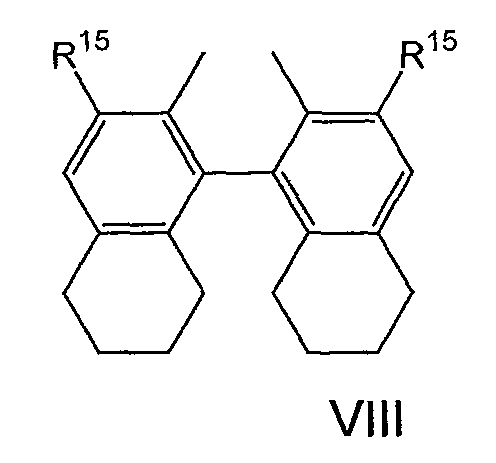
- R 1 is phenyl, unsubstituted or substituted with one or more C 1 to C 12 alkyl or C 1 to C 12 alkoxy groups; or naphthyl, unsubstituted or substituted with one or more C 1 to C 12 alkyl or C 1 to C 12 alkoxy groups; and Z and Z 1 are independently selected from the group consisting of structural formulae IV, V, VI, VII, and VIII: wherein:
- the C 1 to C 12 alkyl, and C 1 to C 12 alkoxy groups may be straight chains or branched.
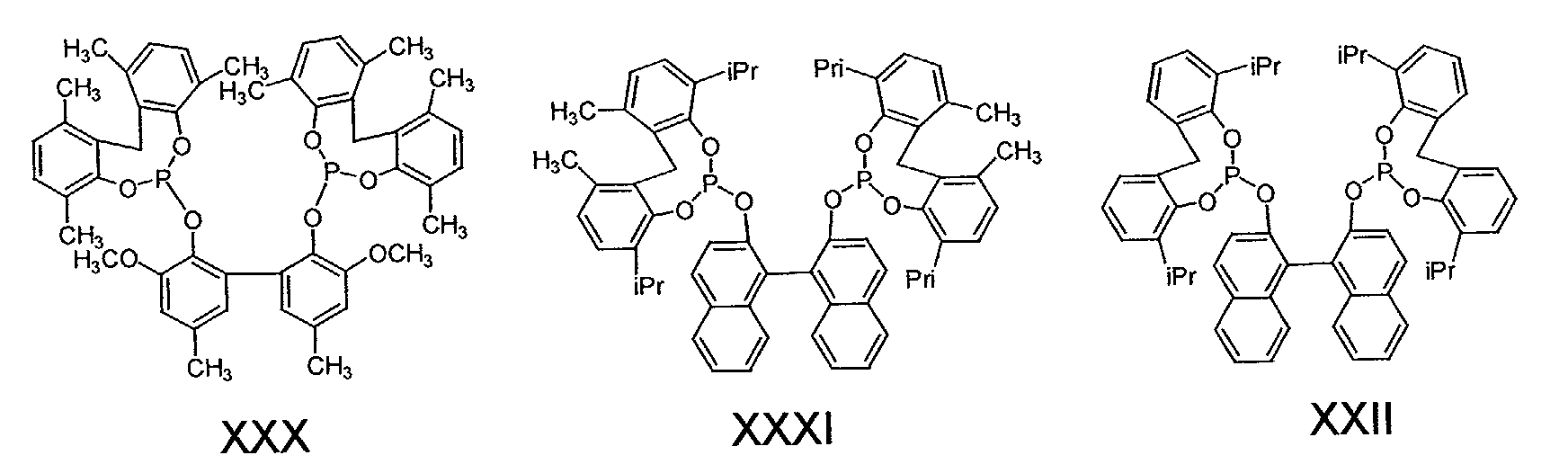
- bidentate phosphite ligands that are useful in the present process include those having the formulae IX to XXXII, shown below wherein for each formula, R 17 is selected from the group consisting of methyl, ethyl or isopropyl, and R 18 and R 19 are independently selected from H or methyl:
- Suitable bidentate phosphites are of the type disclosed in U. S. Patents 5,512,695; 5,512,696; 5,663,369; 5,688,986; 5,723,641; 5,847,191; 5,959,135; 6,120,700; 6,171,996; 6,171,997; and 6,399.
- Suitable bidentate phosphinites are of the type disclosed in U. S. Patents 5,523,453 and 5,693.
- the promoter of the present invention is a byproduct obtained from a chlorination process of titanium-rich ores.
- titanium tetrachloride In the production of titanium tetrachloride, raw materials, including ilmenite or rutile ores or other titanium-rich materials such as those obtained from beneficiating these ores, are reacted with chlorine under reducing conditions to yield a mixture of metal chlorides from which titanium tetrachloride may be recovered.
- Iron chloride is present in the chlorination product of practically every case where iron-containing ores are used in the raw materials. Iron in the form of compounds or complexes is often present in titanium-containing materials that are chlorinated. Often such iron material will be present in an amount of about 0.5 to 50 percent by weight. A major amount of the iron material typically is present as iron oxide.
- iron compounds in the titanium-containing material typically react to form iron chloride, which can be present in the form of ferrous chloride or ferric chloride.
- iron chloride which can be present in the form of ferrous chloride or ferric chloride.
- other metal chlorides such as manganese or vanadium chloride can be present in these mixtures to a smaller extent.
- a typical chlorination process is described in US patent 5,585,078.
- a process of chlorinating titanium-containing material in a fluidized bed reactor is known. Suitable processes are disclosed in the following U.S. patents: 2,701,179; 3,883,636; and 2,446,181.
- particulate coke, particulate titanium-bearing material, chlorine and optionally oxygen or air are fed into a reaction chamber, and a suitable reaction temperature, pressure and flow rates are maintained to sustain the fluidized bed.
- Gaseous titanium tetrachloride and other metal chlorides such as iron-based chlorides are exhausted from the reactor chamber. The gaseous titanium tetrachloride so produced can then be separated, leaving behind a byproduct material that can be used as the promoter in the present invention.
- Typical conditions and specifications for fluidized beds useful for this invention are as follows: reaction temperature of about 900 to 1300°C, pressure of about 1.5 to 3 atomspheres, reactor size of about 6 to 25 feet in diameter with multiple chlorine jets in or near the base, reactor superficial velocity of about 0.5 to 1.5 feet per second, and a settled bed depth of about 6 to 25 feet.
- the titanium-containing material initially fed has a particle size of about 70 to 800 microns in diameter
- the coke initially fed has a particle size of about 300 to 3000 microns in diameter.
- the chlorine jets will be located within 0 to 10 feet of the base of the reactor.
- the titanium-bearing material can be any titanium source material such as titanium-containing ores including rutile, ilmenite or anatase ore; beneficiates thereof; titanium containing by-products or slags; and mixtures thereof.
- the titanium-bearing material contains iron oxide in an amount of about 0.5 to 50 percent by weight and preferably up to about 20 percent by weight.
- a chlorination process that produces the byproduct promoter of this invention is the procedure described in U.S. Patent 4,961,911.
- a fluidized bed reactor can be operated at a temperature of 1000°C. This reactor is fed with an ore blend, containing approximately 74% TiO2 and 21.5% iron oxides and 4.5% other impurities, and with coke.
- a fluidizing gas is fed to a distributor at the bottom of the reactor and consists of about 75% chlorine and a diluent gas consisting primarily of nitrogen, hydrogen chloride, oxides of carbon and oxygen.
- the ore, coke and fluidizing gas are fed to the reactor at rates of 100 to 200 pounds per hour per square foot of reactor cross-sectional area, respectively.
- a stream of about 20 pounds of crude titanium tetrachloride per hour per square foot of reactor cross-sectional area is fed about 5 feet above the level of the static bed.
- the gases leaving the chlorinator contain the following typical components in the following typical percentages by volume: titanium tetrachloride 22%, iron chloride 7%, carbon dioxide 23%, carbon monoxide 3%, nitrogen 36 %, hydrogen chloride 7% and chlorine 0.03%.
- the off-gas titanium tetrachloride is directed to a cooling train and collected.
- a method to obtain the by-product promoter of this invention from this chlorination process of titanium-rich ores is illustrated by a procedure described in U.S. Pat. No. 4,994,255. This procedure illustrates a general method and can be modified as needed by those skilled in the art.
- the FeCl 2 formed in the entrained-flow beneficiator after the chlorination process is separated from crude titanium dioxide in a series of cyclone separators connected by conduits.
- the gaseous ferrous chloride is quenched with cooling liquid titanium tetrachloride introduced through an inlet. This causes the ferrous chloride to solidify, whereby it is conducted as solid particulate ferrous chloride through another conduit into a collection vessel from which the by-product promoter of the invention can be collected.
- This vessel can also function as a direct feed for a ferrous chloride oxidizer, where the further oxidation to ferrous oxide to recycle chlorine gas can be practiced.
- the byproduct (containing iron chloride) produced and collected in this manner can be used as the promoter in the hydrocyanation process of this invention.
- the hydrocyanation reaction can be carried out by charging a reactor with all of the reactants or preferably charging the reactor with the catalyst, or catalyst components, the desired mixture of pentenenitriles and/or 2-methyl-3-butenenitrile, the byproduct promoter, and whatever solvent is used and then sweeping hydrogen cyanide gas over the surface of the reaction mixture or bubbling it through the reaction mixture.
- Another technique is to charge the reactor with the catalyst, the byproduct promoter, hydrogen cyanide and whatever solvent is to be used and feed the desired mixture of pentenenitriles and/or 2-methyl-3-butenenitrile slowly to the reaction mixture.
- the hydrocyanation is conducted continuously in one or more agitated steps or stages.
- the hydrocyanation reaction can be carried out with or without a solvent.
- the byproduct promoter of this invention can be charged to the hydrocyanation reaction mixture either in a solvent or in a mixture of the nitriles.
- the byproduct promoter can be added homogeneously, dissolved in either a solvent or a mixture of the nitriles, or it can be added as a slurry.
- the byproduct promoter can be added to the hydrocyanation reaction mixture without prior purification or separation.
- a typical byproduct promoter contains iron (II) chloride and smaller amounts of manganese (II) chloride and other by-product metal chlorides to a much smaller extent, in addition to other materials such as sand or coke. Some of the components of this byproduct promoter are not soluble in solvents for the hydrocyanation process in mixtures of the substrate the nitriles.
- the byproduct promoter can be added to the hydrocyanation reaction mixture either directly as a solid; or as a slurry in either a hydrocyanation solvent or a mixture of nitriles; or as a homogeneous solution after filtration from materials which are not dissolved in the mixture of substrate nitriles or solvent. Typical methods of filtration applicable to the present invention are taught in Perry's Chemical Engineers' Handbook, McGraw-Hill Publishing Company.
- Catalyst solutions were prepared by mixing a phosphite ligand and Ni(COD) 2 ("COD" means 1,5-cyclooctadiene) in a molar ratio of 1.1 : 1 and dissolving this in toluene.
- the byproduct promoter was added to trans-3-pentenenitrile (t-3PN), and the mixture was agitated. After filtration from insoluble material, the solution was used without further treatment in the hydrocyanation reaction.
- To the catalyst solution was added a solution of the byproduct promoter in the substrate t-3PN.
- the molar ratio of t-3PN to Ni was 200.
- the catalyst solution and the solution of the promoter mixture in t-3PN were combined to form a homogeneous reaction mixture.
- the reaction vessel was placed in a reactor and hydrogen cyanide, placed in a reservoir attached to the reactor, was delivered by slow evaporation of the hydrogen cyanide into the reactor vessel.
- the reaction was run for 24 hours at 50 degrees C, after which time all hydrogen cyanide had been consumed.
- the reaction mixture was analyzed using standard gas chromatographic techniques.
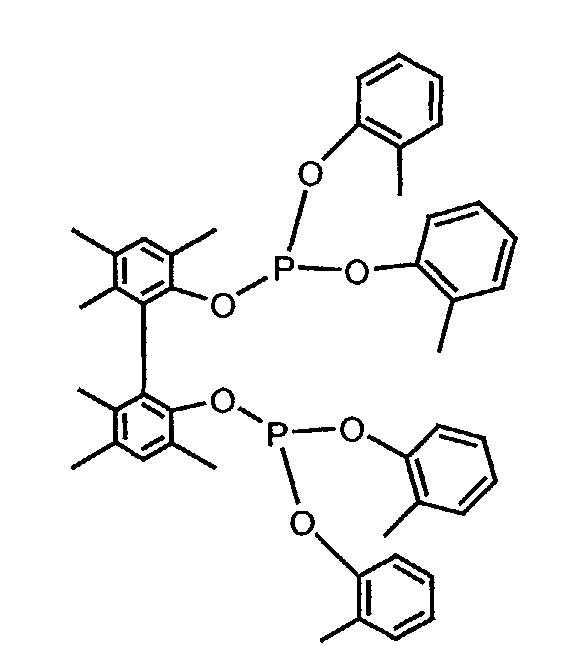
- the following bidentate phosphite ligand was used in this example: The conversion of t-3PN to dinitriles was 92.8 %, and the ratio of adiponitrile over the sum of all dinitriles was 96.1 %.
Landscapes
- Chemical & Material Sciences (AREA)
- Organic Chemistry (AREA)
- Health & Medical Sciences (AREA)
- Toxicology (AREA)
- Organic Low-Molecular-Weight Compounds And Preparation Thereof (AREA)
- Low-Molecular Organic Synthesis Reactions Using Catalysts (AREA)
Abstract
Description
- The invention relates to the hydrocyanation of either 2-pentenenitrile, 3-pentenenitrile, 4-pentenenitrile, 2-methyl-3-butenenitrile, or mixtures thereof to produce adiponitrile (ADN) and/or 2-methylglutaronitrile (MGN) using a zerovalent nickel catalyst promoted by a byproduct of the chlorination of titanium-rich ores.
- US Patent 3,496,217 issued 1970 discloses an improvement in hydrocyanation using a large number of metal cation compounds with a variety of anions as catalyst promoters. US Patent 3,925,445 issued in 1975 discloses zerovalent nickel hydrocyanation catalysts promoted with metal halides and organoboron compounds. US Patent 4,774,353 issued in 1988 discloses zerovalent nickel hydrocyanation catalysts promoted with triorganotin compounds. US Patent 4,874,884 issued in 1989 discloses zerovalent hydrocyanation catalysts promoted using a synergistic combination of promoters. US Patent 6,048,996 issued in 2000 discloses zerovalent hydrocyanation catalysts promoted using an insoluble Lewis acid promoter.
- The present invention provides a process for the preparation of adiponitrile by the addition of hydrogen cyanide to either 2-pentenenitrile, 3-pentenenitrile, 4-pentenenitrile, or mixtures thereof in the presence of a zerovalent nickel catalyst, and a promoter obtained as a byproduct from the chlorination of titanium-rich ores. This byproduct comprises iron (II) chloride and manganese (II) chloride. The crude byproduct can be used directly in the hydrocyanation reaction without separation steps.
- The present invention also provides a process for the preparation of 2-methylglutaronitrile by the addition of hydrogen cyanide to 2-methyl-3-butenenitrile in the presence of a zerovalent nickel catalyst, and a promoter obtained as a byproduct from the chlorination of titanium-rich ores, comprising iron (II) chloride and manganese (II) chloride.
- In the present invention, the preparation of adiponitrile and the preparation of 2-methylglutaronitrile may be performed in separate processes or may be performed concurrently in the same process.
- The present invention can be employed to produce a variety of nitriles. Of particular interest is adiponitrile (ADN) because it is an intermediate used in the production of hexamethylenediamine, which, in turn, is used to produce polyhexamethyleneadipamide (nylon-6,6), a commercial polyamide useful in forming fibers, films, and molded articles. ADN may also serve as a precursor for production of caprolactam, which is used to produce polycaprolactam (nylon-6), via a process involving partial hydrogenation of adiponitrile. Accordingly, a preferred embodiment of the invention is a process which comprises reacting either 2-pentenenitrile, 3-pentenenitrile, 4-pentenenitrile, or mixtures thereof with HCN to produce ADN in the presence of a zero-valent nickel catalyst and a promoter obtained as a byproduct from a titanium ore chlorination process.
- Also of interest is 2-methylglutaronitrile(MGN), which is an intermediate useful for the production of modified nylon-6,6 and nylon-6 polymers. Thus, another embodiment of the present invention is a process which comprises reacting 2-methyl-3-butenenitrile with HCN to produce MGN in the presence of a zero-valent nickel catalyst and a promoter obtained as a byproduct from a titanium ore chlorination process.
- A further embodiment of the present invention is a process in which both ADN and MGN are produced via the hydrocyanation of mixtures of pentenenitriles, in any and all proportions, in the presence of a zero-valent nickel catalyst and a promoter obtained as a byproduct from a titanium ore chlorination process.
- The catalysts employed for this process include complexes of zero-valent nickel with ligands such as phosphines, arsines, stibines, phosphites, arsenites, stibites and mixtures thereof. Ligand may be added in excess of what can theoretically be coordinated to the nickel at a given time. The use of excess ligand may improve stability for the nickel catalyst. The catalysts may be preformed or prepared in situ in the hydrocyanation reaction environment.
- A preferred group of these Ni(0) catalysts have the general structure:wherein L1, L2, L3, and L4 are neutral ligands which may be the same or different and have the formula P(XYW) wherein X and Y are selected from the group consisting of R and OR', and W is OR", wherein R, R', and R" may be the same or different, and wherein R, R', and R" are selected from the group consisting of alkyl and aryl groups containing up to 18 carbon atoms with aryl being preferred. Alkyl groups may be linear or branched. A particularly preferred group within the foregoing zerovalent nickel catalysts is that disclosed in U.S. Patent 3,903,120. This preferred group of catalysts can be described by the general formula NiL4, where L is a neutral ligand such as a triarylphosphite of the formula P(OAr)3 wherein Ar is an aryl group of up to 18 carbon atoms. Illustrative of the aryl groups are methoxyphenyl, tolyl, xylyl, and phenyl. Preferred aryl groups are meta-tolyl, para-tolyl, and phenyl, and mixtures thereof.

- Suitable ligands for the present invention are also bidentate phosphorous-containing ligands selected from the group consisting of bidentate phosphites, bidentate phosphinites. Preferred ligands are bidentate phosphite ligands.
- The preferred bidentate phosphite ligands are of the following structural formulae:

- In formulae I, II, and III, R1 is phenyl, unsubstituted or substituted with one or more C1 to C12 alkyl or C1 to C12 alkoxy groups; or naphthyl, unsubstituted or substituted with one or more C1 to C12 alkyl or C1 to C12 alkoxy groups; and Z and Z1 are independently selected from the group consisting of structural formulae IV, V, VI, VII, and VIII:wherein:
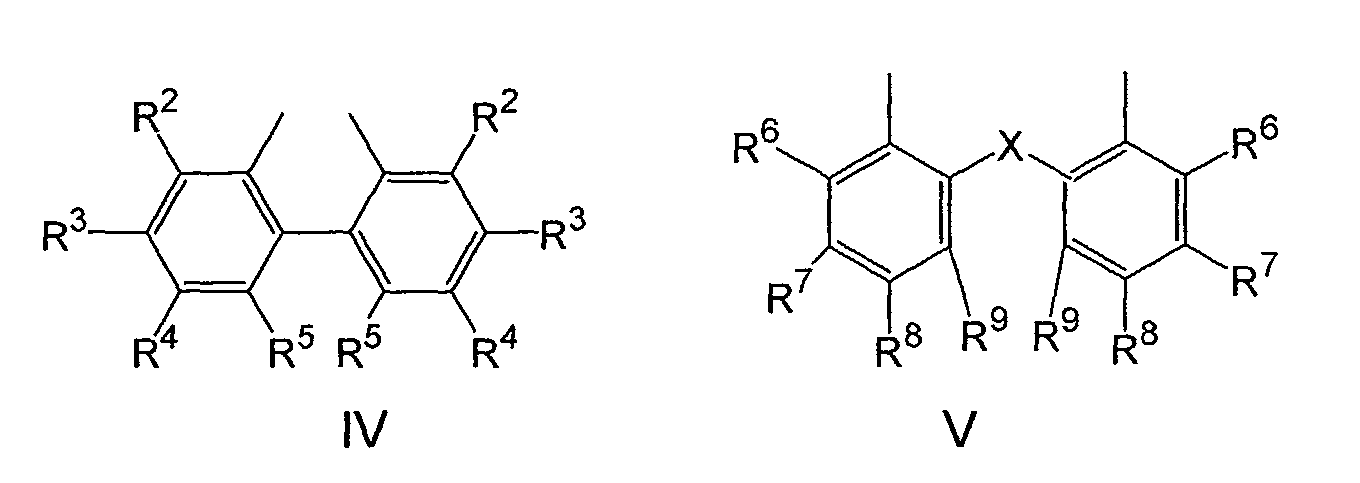
- R2 , R3 , R4, R5, R6, R7, R8, and R9 are independently selected from H, C1 to C12 alkyl, and C1 to C12 alkoxy;
- X is O, S, or CH(R10);
- R10 is H or C1 to C12 alkyl;
 wherein:
- R11 and R12 are independently selected from H, C1 to C12 alkyl, and C1 to C12 alkoxy; and CO2R13,
- R13 is C1 to C12 alkyl or C6 to C10 aryl, unsubstituted or substituted. with C1 to C4 alkyl
- Y is O, S, CH(R14);
- R14 is H or C1 to C12 alkyl
- R15 is selected from H, C1 to C12 alkyl, and C1 to C12 alkoxy; and CO2R16,
- R16 is C1 to C12 alkyl or C6 to C10 aryl, unsubstituted or substituted with C1 to C4 alkyl.
-
- In the structural formulae I through VIII, the C1 to C12 alkyl, and C1 to C12 alkoxy groups may be straight chains or branched.
- Examples of bidentate phosphite ligands that are useful in the present process include those having the formulae IX to XXXII, shown below wherein for each formula, R17 is selected from the group consisting of methyl, ethyl or isopropyl, and R18 and R19 are independently selected from H or methyl:


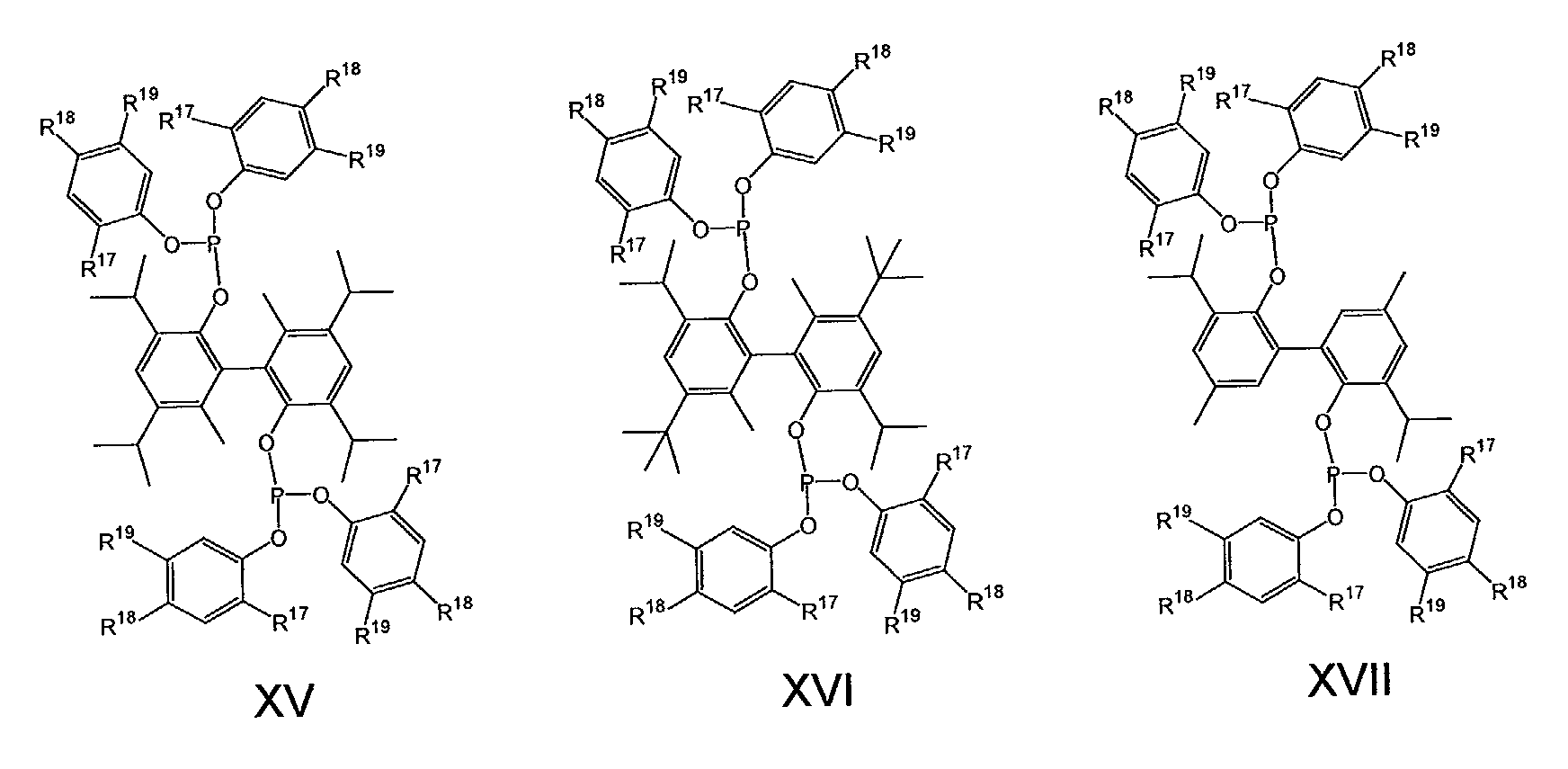
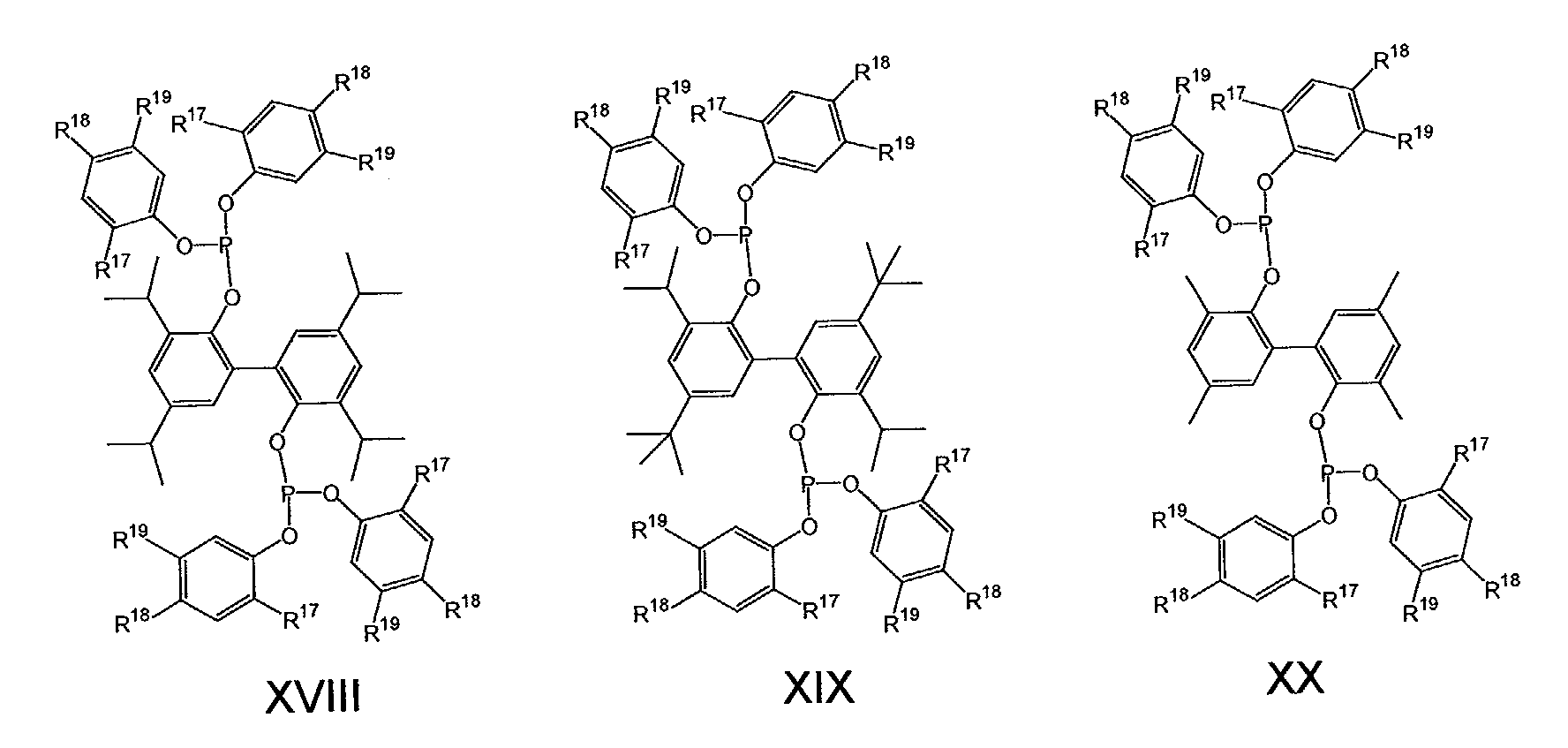

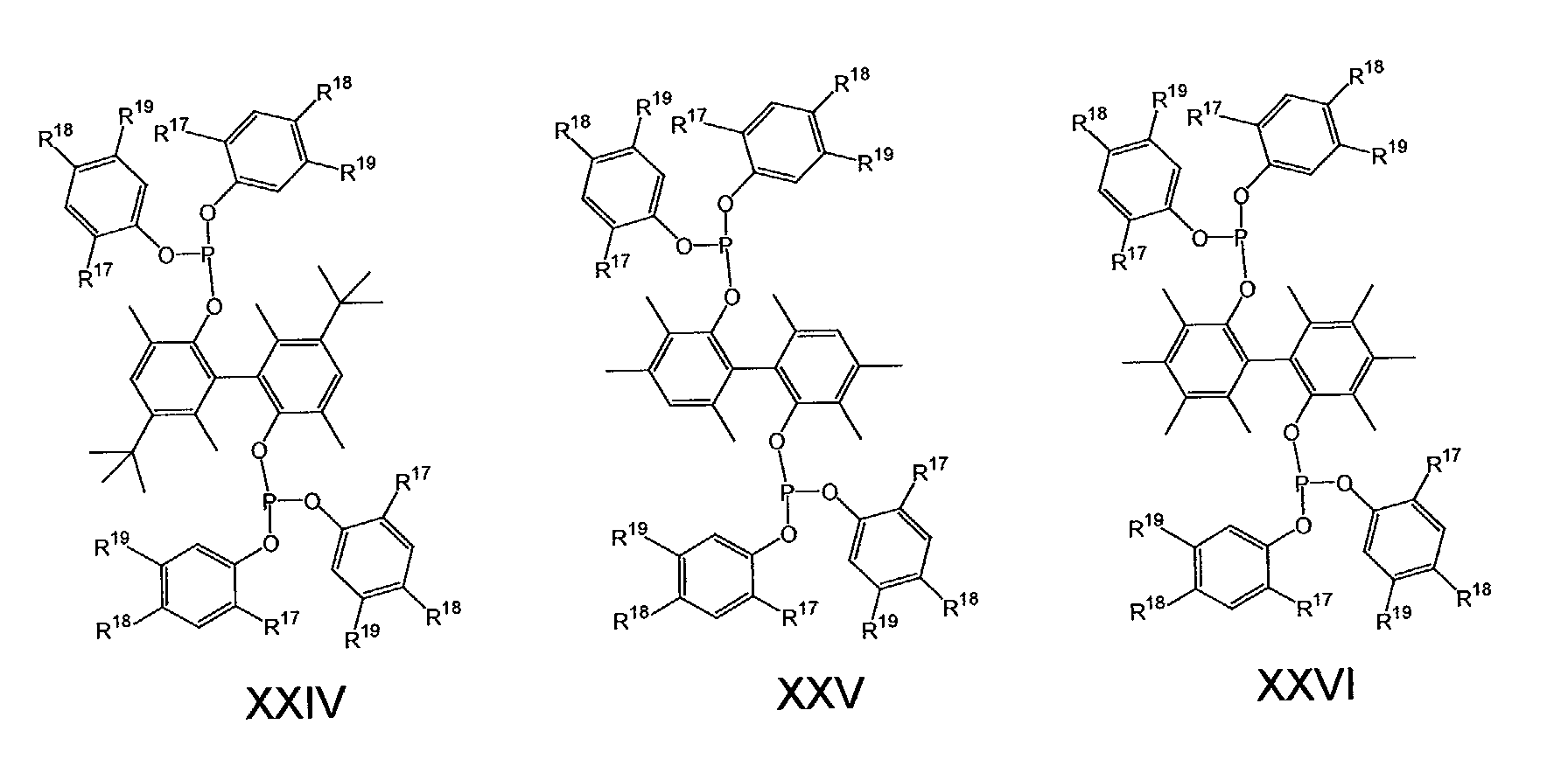

- Suitable bidentate phosphites are of the type disclosed in U. S. Patents 5,512,695; 5,512,696; 5,663,369; 5,688,986; 5,723,641; 5,847,191; 5,959,135; 6,120,700; 6,171,996; 6,171,997; and 6,399. Suitable bidentate phosphinites are of the type disclosed in U. S. Patents 5,523,453 and 5,693.
- The promoter of the present invention is a byproduct obtained from a chlorination process of titanium-rich ores.
- In the production of titanium tetrachloride, raw materials, including ilmenite or rutile ores or other titanium-rich materials such as those obtained from beneficiating these ores, are reacted with chlorine under reducing conditions to yield a mixture of metal chlorides from which titanium tetrachloride may be recovered. Iron chloride is present in the chlorination product of practically every case where iron-containing ores are used in the raw materials. Iron in the form of compounds or complexes is often present in titanium-containing materials that are chlorinated. Often such iron material will be present in an amount of about 0.5 to 50 percent by weight. A major amount of the iron material typically is present as iron oxide. The iron compounds in the titanium-containing material typically react to form iron chloride, which can be present in the form of ferrous chloride or ferric chloride. In addition, other metal chlorides, such as manganese or vanadium chloride can be present in these mixtures to a smaller extent. A typical chlorination process is described in US patent 5,585,078.
- In particular, a process of chlorinating titanium-containing material in a fluidized bed reactor is known. Suitable processes are disclosed in the following U.S. patents: 2,701,179; 3,883,636; and 2,446,181. In such processes, particulate coke, particulate titanium-bearing material, chlorine and optionally oxygen or air are fed into a reaction chamber, and a suitable reaction temperature, pressure and flow rates are maintained to sustain the fluidized bed. Gaseous titanium tetrachloride and other metal chlorides such as iron-based chlorides are exhausted from the reactor chamber. The gaseous titanium tetrachloride so produced can then be separated, leaving behind a byproduct material that can be used as the promoter in the present invention.
- Typical conditions and specifications for fluidized beds useful for this invention are as follows: reaction temperature of about 900 to 1300°C, pressure of about 1.5 to 3 atomspheres, reactor size of about 6 to 25 feet in diameter with multiple chlorine jets in or near the base, reactor superficial velocity of about 0.5 to 1.5 feet per second, and a settled bed depth of about 6 to 25 feet. Typically, the titanium-containing material initially fed has a particle size of about 70 to 800 microns in diameter, and the coke initially fed has a particle size of about 300 to 3000 microns in diameter. Preferably, the chlorine jets will be located within 0 to 10 feet of the base of the reactor.
- The titanium-bearing material can be any titanium source material such as titanium-containing ores including rutile, ilmenite or anatase ore; beneficiates thereof; titanium containing by-products or slags; and mixtures thereof. Ordinarily, the titanium-bearing material contains iron oxide in an amount of about 0.5 to 50 percent by weight and preferably up to about 20 percent by weight.
- A chlorination process that produces the byproduct promoter of this invention is the procedure described in U.S. Patent 4,961,911. A fluidized bed reactor can be operated at a temperature of 1000°C. This reactor is fed with an ore blend, containing approximately 74% TiO2 and 21.5% iron oxides and 4.5% other impurities, and with coke. A fluidizing gas is fed to a distributor at the bottom of the reactor and consists of about 75% chlorine and a diluent gas consisting primarily of nitrogen, hydrogen chloride, oxides of carbon and oxygen. The ore, coke and fluidizing gas are fed to the reactor at rates of 100 to 200 pounds per hour per square foot of reactor cross-sectional area, respectively. A stream of about 20 pounds of crude titanium tetrachloride per hour per square foot of reactor cross-sectional area is fed about 5 feet above the level of the static bed. The gases leaving the chlorinator contain the following typical components in the following typical percentages by volume: titanium tetrachloride 22%, iron chloride 7%, carbon dioxide 23%, carbon monoxide 3%, nitrogen 36 %, hydrogen chloride 7% and chlorine 0.03%. The off-gas titanium tetrachloride is directed to a cooling train and collected.
- A method to obtain the by-product promoter of this invention from this chlorination process of titanium-rich ores is illustrated by a procedure described in U.S. Pat. No. 4,994,255. This procedure illustrates a general method and can be modified as needed by those skilled in the art. The FeCl2 formed in the entrained-flow beneficiator after the chlorination process is separated from crude titanium dioxide in a series of cyclone separators connected by conduits. The gaseous ferrous chloride is quenched with cooling liquid titanium tetrachloride introduced through an inlet. This causes the ferrous chloride to solidify, whereby it is conducted as solid particulate ferrous chloride through another conduit into a collection vessel from which the by-product promoter of the invention can be collected. This vessel can also function as a direct feed for a ferrous chloride oxidizer, where the further oxidation to ferrous oxide to recycle chlorine gas can be practiced. The byproduct (containing iron chloride) produced and collected in this manner can be used as the promoter in the hydrocyanation process of this invention.
- The hydrocyanation reaction can be carried out by charging a reactor with all of the reactants or preferably charging the reactor with the catalyst, or catalyst components, the desired mixture of pentenenitriles and/or 2-methyl-3-butenenitrile, the byproduct promoter, and whatever solvent is used and then sweeping hydrogen cyanide gas over the surface of the reaction mixture or bubbling it through the reaction mixture. Another technique is to charge the reactor with the catalyst, the byproduct promoter, hydrogen cyanide and whatever solvent is to be used and feed the desired mixture of pentenenitriles and/or 2-methyl-3-butenenitrile slowly to the reaction mixture. Preferably, the hydrocyanation is conducted continuously in one or more agitated steps or stages. The hydrocyanation reaction can be carried out with or without a solvent. The byproduct promoter of this invention can be charged to the hydrocyanation reaction mixture either in a solvent or in a mixture of the nitriles. The byproduct promoter can be added homogeneously, dissolved in either a solvent or a mixture of the nitriles, or it can be added as a slurry. The byproduct promoter can be added to the hydrocyanation reaction mixture without prior purification or separation.
- A typical byproduct promoter contains iron (II) chloride and smaller amounts of manganese (II) chloride and other by-product metal chlorides to a much smaller extent, in addition to other materials such as sand or coke. Some of the components of this byproduct promoter are not soluble in solvents for the hydrocyanation process in mixtures of the substrate the nitriles. The byproduct promoter can be added to the hydrocyanation reaction mixture either directly as a solid; or as a slurry in either a hydrocyanation solvent or a mixture of nitriles; or as a homogeneous solution after filtration from materials which are not dissolved in the mixture of substrate nitriles or solvent. Typical methods of filtration applicable to the present invention are taught in Perry's Chemical Engineers' Handbook, McGraw-Hill Publishing Company.
- The following non-limiting, representative example illustrates the process of this invention. All parts, proportions, and percentages are by weight, unless otherwise indicated.
- Catalyst solutions were prepared by mixing a phosphite ligand and Ni(COD)2 ("COD" means 1,5-cyclooctadiene) in a molar ratio of 1.1 : 1 and dissolving this in toluene. The byproduct promoter was added to trans-3-pentenenitrile (t-3PN), and the mixture was agitated. After filtration from insoluble material, the solution was used without further treatment in the hydrocyanation reaction. To the catalyst solution was added a solution of the byproduct promoter in the substrate t-3PN. The molar ratio of t-3PN to Ni was 200. The catalyst solution and the solution of the promoter mixture in t-3PN were combined to form a homogeneous reaction mixture. The reaction vessel was placed in a reactor and hydrogen cyanide, placed in a reservoir attached to the reactor, was delivered by slow evaporation of the hydrogen cyanide into the reactor vessel. The reaction was run for 24 hours at 50 degrees C, after which time all hydrogen cyanide had been consumed. The reaction mixture was analyzed using standard gas chromatographic techniques.
- The following bidentate phosphite ligand was used in this example:The conversion of t-3PN to dinitriles was 92.8 %, and the ratio of adiponitrile over the sum of all dinitriles was 96.1 %.
Claims (1)
- A process for hydrocyanation of at least one substrate selected from the group consisting of 2-pentenenitrile, 3-pentenenitrile, 4-pentenenitrile, and 2-methyl-3-butenenitrile comprising contacting the substrate with hydrogen cyanide in the presence of a zero-valent nickel hydrocyanation catalyst and a promoter, wherein said promoter is obtained as a byproduct from a method for producing titanium tetrachloride from titanium ore, said method comprising the steps of contacting a titanium-containing ore with chlorine under reducing conditions to obtain a gaseous reaction product, recovering titanium tetrachloride from the reaction product, thereby leaving behind a residue, and condensing the residue to obtain a byproduct that comprises at least one compound selected from the group consisting of iron (II) chloride, and manganese (II) chloride.
Applications Claiming Priority (2)
| Application Number | Priority Date | Filing Date | Title |
|---|---|---|---|
| US10/695,015 US7385071B2 (en) | 2003-10-28 | 2003-10-28 | Hydrocyanation of pentenenitriles and/or 2-methyl-3-butenenitrile using promoters obtained from the chlorination of titanium-rich ores |
| US695015 | 2003-10-28 |
Publications (2)
| Publication Number | Publication Date |
|---|---|
| EP1528054A1 true EP1528054A1 (en) | 2005-05-04 |
| EP1528054B1 EP1528054B1 (en) | 2011-02-23 |
Family
ID=34423347
Family Applications (1)
| Application Number | Title | Priority Date | Filing Date |
|---|---|---|---|
| EP04256674A Expired - Lifetime EP1528054B1 (en) | 2003-10-28 | 2004-10-28 | Hydrocyanation of pentenenitriles and/or 2-methyl-3-butenenitrile using promoters obtained from the chlorination of titanium-rich ores |
Country Status (5)
| Country | Link |
|---|---|
| US (1) | US7385071B2 (en) |
| EP (1) | EP1528054B1 (en) |
| CN (1) | CN1660788B (en) |
| AT (1) | ATE499340T1 (en) |
| DE (1) | DE602004031493D1 (en) |
Cited By (4)
| Publication number | Priority date | Publication date | Assignee | Title |
|---|---|---|---|---|
| WO2008008930A3 (en) * | 2006-07-14 | 2008-05-29 | Invista Tech Sarl | Hydrocyanation process with reduced yield losses |
| WO2008008926A3 (en) * | 2006-07-14 | 2008-12-04 | Invista Tech Sarl | Hydrocyanation process with reduced yield losses |
| WO2008008927A3 (en) * | 2006-07-14 | 2008-12-18 | Invista Tech Sarl | Hydrocyanation of 2-pentenenitrile |
| WO2009091790A1 (en) * | 2008-01-15 | 2009-07-23 | Invista Technologies S.A.R.L. | Hydrocyanation of pentenenitriles |
Citations (10)
| Publication number | Priority date | Publication date | Assignee | Title |
|---|---|---|---|---|
| US3496217A (en) | 1967-05-23 | 1970-02-17 | Du Pont | Hydrocyanation of olefins |
| US3798256A (en) * | 1971-08-02 | 1974-03-19 | Du Pont | Hydrocyanation of olefins |
| US3925445A (en) | 1971-08-02 | 1975-12-09 | Du Pont | Hydrocyanation of olefins |
| US4774353A (en) | 1986-06-05 | 1988-09-27 | E. I. Du Pont De Nemours And Company | Triorganotin catalyst promoters for hydrocyanation |
| EP0336314A2 (en) * | 1988-03-31 | 1989-10-11 | E.I. Du Pont De Nemours And Company | Promoter synergism in pentenenitrile hydrocyanation |
| US4874884A (en) | 1988-03-31 | 1989-10-17 | E. I. Du Pont De Nemours And Company | Promoter synergism in pentenenitrile hydrocyanation |
| US4961911A (en) * | 1989-03-02 | 1990-10-09 | E. I. Du Pont De Nemours And Company | Process for reducing carbon monoxide emissions from a fluidized bed titanium dioxide chlorinator |
| US4994255A (en) * | 1986-07-24 | 1991-02-19 | Scm Chemicals, Inc. | Oxidation of ferrous chloride directly to chlorine in a fluid bed reactor |
| US6048996A (en) | 1999-08-26 | 2000-04-11 | E. I. Du Pont De Nemours And Company | Insoluble promoters for nickel-catalyzed hydrocyanation of monoolefins |
| WO2004087314A1 (en) * | 2003-03-31 | 2004-10-14 | Basf Aktiengesellschaft | System suitable for the hydrocyanation of olefinically unsaturated compounds |
Family Cites Families (2)
| Publication number | Priority date | Publication date | Assignee | Title |
|---|---|---|---|---|
| US5512696A (en) * | 1995-07-21 | 1996-04-30 | E. I. Du Pont De Nemours And Company | Hydrocyanation process and multidentate phosphite and nickel catalyst composition therefor |
| US5523453A (en) * | 1995-03-22 | 1996-06-04 | E. I. Du Pont De Nemours And Company | Process for hydrocyanation |
-
2003
- 2003-10-28 US US10/695,015 patent/US7385071B2/en not_active Expired - Fee Related
-
2004
- 2004-10-28 AT AT04256674T patent/ATE499340T1/en not_active IP Right Cessation
- 2004-10-28 DE DE602004031493T patent/DE602004031493D1/en not_active Expired - Lifetime
- 2004-10-28 CN CN2004100471769A patent/CN1660788B/en not_active Expired - Lifetime
- 2004-10-28 EP EP04256674A patent/EP1528054B1/en not_active Expired - Lifetime
Patent Citations (11)
| Publication number | Priority date | Publication date | Assignee | Title |
|---|---|---|---|---|
| US3496217A (en) | 1967-05-23 | 1970-02-17 | Du Pont | Hydrocyanation of olefins |
| US3798256A (en) * | 1971-08-02 | 1974-03-19 | Du Pont | Hydrocyanation of olefins |
| US3925445A (en) | 1971-08-02 | 1975-12-09 | Du Pont | Hydrocyanation of olefins |
| US4774353A (en) | 1986-06-05 | 1988-09-27 | E. I. Du Pont De Nemours And Company | Triorganotin catalyst promoters for hydrocyanation |
| US4994255A (en) * | 1986-07-24 | 1991-02-19 | Scm Chemicals, Inc. | Oxidation of ferrous chloride directly to chlorine in a fluid bed reactor |
| EP0336314A2 (en) * | 1988-03-31 | 1989-10-11 | E.I. Du Pont De Nemours And Company | Promoter synergism in pentenenitrile hydrocyanation |
| US4874884A (en) | 1988-03-31 | 1989-10-17 | E. I. Du Pont De Nemours And Company | Promoter synergism in pentenenitrile hydrocyanation |
| US4961911A (en) * | 1989-03-02 | 1990-10-09 | E. I. Du Pont De Nemours And Company | Process for reducing carbon monoxide emissions from a fluidized bed titanium dioxide chlorinator |
| US6048996A (en) | 1999-08-26 | 2000-04-11 | E. I. Du Pont De Nemours And Company | Insoluble promoters for nickel-catalyzed hydrocyanation of monoolefins |
| WO2001014321A1 (en) * | 1999-08-26 | 2001-03-01 | E.I. Du Pont De Nemours And Company | Insoluble lewis acid promoters for nickel-catalysed hydrocyanation of monoolefins |
| WO2004087314A1 (en) * | 2003-03-31 | 2004-10-14 | Basf Aktiengesellschaft | System suitable for the hydrocyanation of olefinically unsaturated compounds |
Cited By (5)
| Publication number | Priority date | Publication date | Assignee | Title |
|---|---|---|---|---|
| WO2008008930A3 (en) * | 2006-07-14 | 2008-05-29 | Invista Tech Sarl | Hydrocyanation process with reduced yield losses |
| WO2008008926A3 (en) * | 2006-07-14 | 2008-12-04 | Invista Tech Sarl | Hydrocyanation process with reduced yield losses |
| WO2008008927A3 (en) * | 2006-07-14 | 2008-12-18 | Invista Tech Sarl | Hydrocyanation of 2-pentenenitrile |
| US7709674B2 (en) | 2006-07-14 | 2010-05-04 | Invista North America S.A R.L | Hydrocyanation process with reduced yield losses |
| WO2009091790A1 (en) * | 2008-01-15 | 2009-07-23 | Invista Technologies S.A.R.L. | Hydrocyanation of pentenenitriles |
Also Published As
| Publication number | Publication date |
|---|---|
| EP1528054B1 (en) | 2011-02-23 |
| US7385071B2 (en) | 2008-06-10 |
| US20050090681A1 (en) | 2005-04-28 |
| CN1660788B (en) | 2010-04-21 |
| CN1660788A (en) | 2005-08-31 |
| ATE499340T1 (en) | 2011-03-15 |
| DE602004031493D1 (en) | 2011-04-07 |
Similar Documents
| Publication | Publication Date | Title |
|---|---|---|
| JP2911608B2 (en) | Hydocyanation method in the presence of zero-valent nickel, bidentate phosphorus compound and Lewis acid | |
| US3631191A (en) | Synthesis of zero valent nickel-tetrakis triaryl phosphite complexes | |
| CN100361966C (en) | Improved Hydrocyanation Process | |
| CA1204119A (en) | Preparation of zerovalent nickel complexes | |
| KR880002296B1 (en) | Hydrocyanation of olefins | |
| JPH0251901B2 (en) | ||
| JPS63135363A (en) | Continuous hydrocyanization using zinc halide promotor | |
| JP4509125B2 (en) | Method for producing linear pentenenitrile | |
| CN101484417A (en) | Hydrocyanation process with reduced yield losses | |
| EP1587621B1 (en) | Process for the preparation of a nickel/phosphorous ligand catalyst for olefin hydrocyanation | |
| CA2553778A1 (en) | Separation of nickel(0) complexes and phosphorus-containing ligands from nitrile mixtures | |
| US4230634A (en) | Manufacture of organic nitriles | |
| EP1528054B1 (en) | Hydrocyanation of pentenenitriles and/or 2-methyl-3-butenenitrile using promoters obtained from the chlorination of titanium-rich ores | |
| WO2008058444A1 (en) | Process for preparation of 1,1,1,3,3-pentachlorobutane | |
| EP3160933B1 (en) | Integrated process for nitrile manufacture with enhanced liquid-liquid extraction | |
| US20260014552A1 (en) | Bidentate phosphite ligands, catalytic compositions containing such ligands, and catalytic processes utilizing such catalytic compositions | |
| US20260015319A1 (en) | Bidentate phosphite ligands, catalytic compositions containing such ligands, and catalytic processes utilizing such catalytic compositions | |
| US20260035395A1 (en) | Bidentate phosphite ligands, catalytic compositions containing such ligands, and catalytic processes utilizing such catalytic compositions | |
| US12521703B1 (en) | Arsenic-containing ligands, catalytic compositions containing such ligands, and catalytic processes utilizing such catalytic compositions | |
| EP4499605B1 (en) | Processes for producing nitriles and phosphorus-containing catalysts for use in such processes | |
| EP4499604B1 (en) | Processes for producing nitriles and phosphorus-containing catalysts for use in such processes | |
| US20250296076A1 (en) | Multidentate phosphite ligands, catalytic compositions containing such ligands, and catalytic processes utilizing such catalytic compositions | |
| US20260015370A1 (en) | Bidentate phosphite ligands, catalytic compositions containing such ligands, and catalytic processes utilizing such catalytic compositions |
Legal Events
| Date | Code | Title | Description |
|---|---|---|---|
| PUAI | Public reference made under article 153(3) epc to a published international application that has entered the european phase |
Free format text: ORIGINAL CODE: 0009012 |
|
| AK | Designated contracting states |
Kind code of ref document: A1 Designated state(s): AT BE BG CH CY CZ DE DK EE ES FI FR GB GR HU IE IT LI LU MC NL PL PT RO SE SI SK TR |
|
| AX | Request for extension of the european patent |
Extension state: AL HR LT LV MK |
|
| 111Z | Information provided on other rights and legal means of execution |
Free format text: ATBEBGCHCYCZDEDKEEESFIFRGBGRHUIEITLUMCNLPLPTROSESISKTR Effective date: 20050823 |
|
| 17P | Request for examination filed |
Effective date: 20051013 |
|
| AKX | Designation fees paid |
Designated state(s): AT BE BG CH CY CZ DE DK EE ES FI FR GB GR HU IE IT LI LU MC NL PL PT RO SE SI SK TR |
|
| RAP1 | Party data changed (applicant data changed or rights of an application transferred) |
Owner name: INVISTA TECHNOLOGIES S.A.R.L. |
|
| 17Q | First examination report despatched |
Effective date: 20090414 |
|
| GRAP | Despatch of communication of intention to grant a patent |
Free format text: ORIGINAL CODE: EPIDOSNIGR1 |
|
| GRAS | Grant fee paid |
Free format text: ORIGINAL CODE: EPIDOSNIGR3 |
|
| GRAA | (expected) grant |
Free format text: ORIGINAL CODE: 0009210 |
|
| AK | Designated contracting states |
Kind code of ref document: B1 Designated state(s): AT BE BG CH CY CZ DE DK EE ES FI FR GB GR HU IE IT LI LU MC NL PL PT RO SE SI SK TR |
|
| REG | Reference to a national code |
Ref country code: GB Ref legal event code: FG4D |
|
| REG | Reference to a national code |
Ref country code: CH Ref legal event code: EP |
|
| REG | Reference to a national code |
Ref country code: IE Ref legal event code: FG4D |
|
| REF | Corresponds to: |
Ref document number: 602004031493 Country of ref document: DE Date of ref document: 20110407 Kind code of ref document: P |
|
| REG | Reference to a national code |
Ref country code: DE Ref legal event code: R096 Ref document number: 602004031493 Country of ref document: DE Effective date: 20110407 |
|
| REG | Reference to a national code |
Ref country code: NL Ref legal event code: VDEP Effective date: 20110223 |
|
| PG25 | Lapsed in a contracting state [announced via postgrant information from national office to epo] |
Ref country code: ES Free format text: LAPSE BECAUSE OF FAILURE TO SUBMIT A TRANSLATION OF THE DESCRIPTION OR TO PAY THE FEE WITHIN THE PRESCRIBED TIME-LIMIT Effective date: 20110603 Ref country code: GR Free format text: LAPSE BECAUSE OF FAILURE TO SUBMIT A TRANSLATION OF THE DESCRIPTION OR TO PAY THE FEE WITHIN THE PRESCRIBED TIME-LIMIT Effective date: 20110524 Ref country code: SE Free format text: LAPSE BECAUSE OF FAILURE TO SUBMIT A TRANSLATION OF THE DESCRIPTION OR TO PAY THE FEE WITHIN THE PRESCRIBED TIME-LIMIT Effective date: 20110223 Ref country code: PT Free format text: LAPSE BECAUSE OF FAILURE TO SUBMIT A TRANSLATION OF THE DESCRIPTION OR TO PAY THE FEE WITHIN THE PRESCRIBED TIME-LIMIT Effective date: 20110623 |
|
| PG25 | Lapsed in a contracting state [announced via postgrant information from national office to epo] |
Ref country code: SI Free format text: LAPSE BECAUSE OF FAILURE TO SUBMIT A TRANSLATION OF THE DESCRIPTION OR TO PAY THE FEE WITHIN THE PRESCRIBED TIME-LIMIT Effective date: 20110223 Ref country code: NL Free format text: LAPSE BECAUSE OF FAILURE TO SUBMIT A TRANSLATION OF THE DESCRIPTION OR TO PAY THE FEE WITHIN THE PRESCRIBED TIME-LIMIT Effective date: 20110223 Ref country code: FI Free format text: LAPSE BECAUSE OF FAILURE TO SUBMIT A TRANSLATION OF THE DESCRIPTION OR TO PAY THE FEE WITHIN THE PRESCRIBED TIME-LIMIT Effective date: 20110223 Ref country code: CY Free format text: LAPSE BECAUSE OF FAILURE TO SUBMIT A TRANSLATION OF THE DESCRIPTION OR TO PAY THE FEE WITHIN THE PRESCRIBED TIME-LIMIT Effective date: 20110223 Ref country code: AT Free format text: LAPSE BECAUSE OF FAILURE TO SUBMIT A TRANSLATION OF THE DESCRIPTION OR TO PAY THE FEE WITHIN THE PRESCRIBED TIME-LIMIT Effective date: 20110223 Ref country code: BG Free format text: LAPSE BECAUSE OF FAILURE TO SUBMIT A TRANSLATION OF THE DESCRIPTION OR TO PAY THE FEE WITHIN THE PRESCRIBED TIME-LIMIT Effective date: 20110523 Ref country code: BE Free format text: LAPSE BECAUSE OF FAILURE TO SUBMIT A TRANSLATION OF THE DESCRIPTION OR TO PAY THE FEE WITHIN THE PRESCRIBED TIME-LIMIT Effective date: 20110223 |
|
| PG25 | Lapsed in a contracting state [announced via postgrant information from national office to epo] |
Ref country code: EE Free format text: LAPSE BECAUSE OF FAILURE TO SUBMIT A TRANSLATION OF THE DESCRIPTION OR TO PAY THE FEE WITHIN THE PRESCRIBED TIME-LIMIT Effective date: 20110223 Ref country code: DK Free format text: LAPSE BECAUSE OF FAILURE TO SUBMIT A TRANSLATION OF THE DESCRIPTION OR TO PAY THE FEE WITHIN THE PRESCRIBED TIME-LIMIT Effective date: 20110223 |
|
| PG25 | Lapsed in a contracting state [announced via postgrant information from national office to epo] |
Ref country code: CZ Free format text: LAPSE BECAUSE OF FAILURE TO SUBMIT A TRANSLATION OF THE DESCRIPTION OR TO PAY THE FEE WITHIN THE PRESCRIBED TIME-LIMIT Effective date: 20110223 Ref country code: SK Free format text: LAPSE BECAUSE OF FAILURE TO SUBMIT A TRANSLATION OF THE DESCRIPTION OR TO PAY THE FEE WITHIN THE PRESCRIBED TIME-LIMIT Effective date: 20110223 Ref country code: RO Free format text: LAPSE BECAUSE OF FAILURE TO SUBMIT A TRANSLATION OF THE DESCRIPTION OR TO PAY THE FEE WITHIN THE PRESCRIBED TIME-LIMIT Effective date: 20110223 |
|
| PLBE | No opposition filed within time limit |
Free format text: ORIGINAL CODE: 0009261 |
|
| STAA | Information on the status of an ep patent application or granted ep patent |
Free format text: STATUS: NO OPPOSITION FILED WITHIN TIME LIMIT |
|
| 26N | No opposition filed |
Effective date: 20111124 |
|
| PG25 | Lapsed in a contracting state [announced via postgrant information from national office to epo] |
Ref country code: PL Free format text: LAPSE BECAUSE OF FAILURE TO SUBMIT A TRANSLATION OF THE DESCRIPTION OR TO PAY THE FEE WITHIN THE PRESCRIBED TIME-LIMIT Effective date: 20110223 |
|
| REG | Reference to a national code |
Ref country code: DE Ref legal event code: R097 Ref document number: 602004031493 Country of ref document: DE Effective date: 20111124 |
|
| PG25 | Lapsed in a contracting state [announced via postgrant information from national office to epo] |
Ref country code: IT Free format text: LAPSE BECAUSE OF FAILURE TO SUBMIT A TRANSLATION OF THE DESCRIPTION OR TO PAY THE FEE WITHIN THE PRESCRIBED TIME-LIMIT Effective date: 20110223 Ref country code: MC Free format text: LAPSE BECAUSE OF NON-PAYMENT OF DUE FEES Effective date: 20111031 |
|
| REG | Reference to a national code |
Ref country code: CH Ref legal event code: PL |
|
| GBPC | Gb: european patent ceased through non-payment of renewal fee |
Effective date: 20111028 |
|
| REG | Reference to a national code |
Ref country code: FR Ref legal event code: ST Effective date: 20120629 |
|
| PG25 | Lapsed in a contracting state [announced via postgrant information from national office to epo] |
Ref country code: CH Free format text: LAPSE BECAUSE OF NON-PAYMENT OF DUE FEES Effective date: 20111031 Ref country code: LI Free format text: LAPSE BECAUSE OF NON-PAYMENT OF DUE FEES Effective date: 20111031 Ref country code: DE Free format text: LAPSE BECAUSE OF NON-PAYMENT OF DUE FEES Effective date: 20120501 |
|
| REG | Reference to a national code |
Ref country code: IE Ref legal event code: MM4A |
|
| REG | Reference to a national code |
Ref country code: DE Ref legal event code: R119 Ref document number: 602004031493 Country of ref document: DE Effective date: 20120501 |
|
| PG25 | Lapsed in a contracting state [announced via postgrant information from national office to epo] |
Ref country code: GB Free format text: LAPSE BECAUSE OF NON-PAYMENT OF DUE FEES Effective date: 20111028 Ref country code: FR Free format text: LAPSE BECAUSE OF NON-PAYMENT OF DUE FEES Effective date: 20111102 |
|
| PG25 | Lapsed in a contracting state [announced via postgrant information from national office to epo] |
Ref country code: IE Free format text: LAPSE BECAUSE OF NON-PAYMENT OF DUE FEES Effective date: 20111028 |
|
| PG25 | Lapsed in a contracting state [announced via postgrant information from national office to epo] |
Ref country code: LU Free format text: LAPSE BECAUSE OF NON-PAYMENT OF DUE FEES Effective date: 20111028 |
|
| PG25 | Lapsed in a contracting state [announced via postgrant information from national office to epo] |
Ref country code: TR Free format text: LAPSE BECAUSE OF FAILURE TO SUBMIT A TRANSLATION OF THE DESCRIPTION OR TO PAY THE FEE WITHIN THE PRESCRIBED TIME-LIMIT Effective date: 20110223 |
|
| PG25 | Lapsed in a contracting state [announced via postgrant information from national office to epo] |
Ref country code: HU Free format text: LAPSE BECAUSE OF FAILURE TO SUBMIT A TRANSLATION OF THE DESCRIPTION OR TO PAY THE FEE WITHIN THE PRESCRIBED TIME-LIMIT Effective date: 20110223 |