EP1528053A1 - Process for the preparation of (S)- or (R)-4-halo-3-hydroxybutyrates - Google Patents
Process for the preparation of (S)- or (R)-4-halo-3-hydroxybutyrates Download PDFInfo
- Publication number
- EP1528053A1 EP1528053A1 EP03024865A EP03024865A EP1528053A1 EP 1528053 A1 EP1528053 A1 EP 1528053A1 EP 03024865 A EP03024865 A EP 03024865A EP 03024865 A EP03024865 A EP 03024865A EP 1528053 A1 EP1528053 A1 EP 1528053A1
- Authority
- EP
- European Patent Office
- Prior art keywords
- formula
- ligand
- ethyl
- ruthenium complex
- halo
- Prior art date
- Legal status (The legal status is an assumption and is not a legal conclusion. Google has not performed a legal analysis and makes no representation as to the accuracy of the status listed.)
- Withdrawn
Links
- 238000000034 method Methods 0.000 title claims abstract description 16
- 230000008569 process Effects 0.000 title claims abstract description 15
- 238000002360 preparation method Methods 0.000 title claims abstract description 7
- 239000003446 ligand Substances 0.000 claims abstract description 29
- 238000009876 asymmetric hydrogenation reaction Methods 0.000 claims abstract description 15
- 239000012327 Ruthenium complex Substances 0.000 claims abstract description 12
- 125000003118 aryl group Chemical group 0.000 claims abstract description 10
- 239000003054 catalyst Substances 0.000 claims abstract description 10
- 125000003710 aryl alkyl group Chemical group 0.000 claims abstract description 8
- 125000005843 halogen group Chemical group 0.000 claims abstract description 8
- 125000004178 (C1-C4) alkyl group Chemical group 0.000 claims abstract description 5
- 125000004169 (C1-C6) alkyl group Chemical group 0.000 claims abstract description 5
- 238000006243 chemical reaction Methods 0.000 claims description 32
- ZMXDDKWLCZADIW-UHFFFAOYSA-N N,N-Dimethylformamide Chemical compound CN(C)C=O ZMXDDKWLCZADIW-UHFFFAOYSA-N 0.000 claims description 18
- 238000005984 hydrogenation reaction Methods 0.000 claims description 14
- WEVYAHXRMPXWCK-UHFFFAOYSA-N Acetonitrile Chemical compound CC#N WEVYAHXRMPXWCK-UHFFFAOYSA-N 0.000 claims description 13
- IAZDPXIOMUYVGZ-UHFFFAOYSA-N Dimethylsulphoxide Chemical compound CS(C)=O IAZDPXIOMUYVGZ-UHFFFAOYSA-N 0.000 claims description 12
- UFHFLCQGNIYNRP-UHFFFAOYSA-N Hydrogen Chemical compound [H][H] UFHFLCQGNIYNRP-UHFFFAOYSA-N 0.000 claims description 12
- 229910052739 hydrogen Inorganic materials 0.000 claims description 12
- 239000001257 hydrogen Substances 0.000 claims description 12
- HFPZCAJZSCWRBC-UHFFFAOYSA-N p-cymene Chemical compound CC(C)C1=CC=C(C)C=C1 HFPZCAJZSCWRBC-UHFFFAOYSA-N 0.000 claims description 10
- 239000002798 polar solvent Substances 0.000 claims description 9
- 230000000087 stabilizing effect Effects 0.000 claims description 9
- 239000002904 solvent Substances 0.000 claims description 5
- 238000002156 mixing Methods 0.000 claims description 4
- VYXHVRARDIDEHS-UHFFFAOYSA-N 1,5-cyclooctadiene Chemical compound C1CC=CCCC=C1 VYXHVRARDIDEHS-UHFFFAOYSA-N 0.000 claims description 3
- 239000004912 1,5-cyclooctadiene Substances 0.000 claims description 3
- 229910017048 AsF6 Inorganic materials 0.000 claims description 3
- 229910001914 chlorine tetroxide Inorganic materials 0.000 claims description 3
- 239000000203 mixture Substances 0.000 claims description 3
- VLTRZXGMWDSKGL-UHFFFAOYSA-M perchlorate Chemical compound [O-]Cl(=O)(=O)=O VLTRZXGMWDSKGL-UHFFFAOYSA-M 0.000 claims description 3
- 239000000654 additive Substances 0.000 claims description 2
- 150000001336 alkenes Chemical class 0.000 claims description 2
- 150000004945 aromatic hydrocarbons Chemical class 0.000 claims description 2
- 150000001993 dienes Chemical class 0.000 claims description 2
- 125000005913 (C3-C6) cycloalkyl group Chemical group 0.000 claims 1
- 125000006552 (C3-C8) cycloalkyl group Chemical group 0.000 abstract description 4
- LFQSCWFLJHTTHZ-UHFFFAOYSA-N Ethanol Chemical compound CCO LFQSCWFLJHTTHZ-UHFFFAOYSA-N 0.000 description 23
- XKRFYHLGVUSROY-UHFFFAOYSA-N Argon Chemical compound [Ar] XKRFYHLGVUSROY-UHFFFAOYSA-N 0.000 description 20
- YMWUJEATGCHHMB-UHFFFAOYSA-N Dichloromethane Chemical compound ClCCl YMWUJEATGCHHMB-UHFFFAOYSA-N 0.000 description 18
- 239000000243 solution Substances 0.000 description 16
- 125000001495 ethyl group Chemical group [H]C([H])([H])C([H])([H])* 0.000 description 13
- 229910052786 argon Inorganic materials 0.000 description 10
- 239000012300 argon atmosphere Substances 0.000 description 10
- 229910052799 carbon Inorganic materials 0.000 description 10
- 238000001816 cooling Methods 0.000 description 10
- OHLRLMWUFVDREV-UHFFFAOYSA-N ethyl 4-chloro-3-oxobutanoate Chemical compound CCOC(=O)CC(=O)CCl OHLRLMWUFVDREV-UHFFFAOYSA-N 0.000 description 10
- 238000011010 flushing procedure Methods 0.000 description 10
- 125000004218 chloromethyl group Chemical group [H]C([H])(Cl)* 0.000 description 9
- ZAJNMXDBJKCCAT-YFKPBYRVSA-N ethyl (3s)-4-chloro-3-hydroxybutanoate Chemical compound CCOC(=O)C[C@H](O)CCl ZAJNMXDBJKCCAT-YFKPBYRVSA-N 0.000 description 7
- XYFCBTPGUUZFHI-UHFFFAOYSA-N Phosphine Chemical compound P XYFCBTPGUUZFHI-UHFFFAOYSA-N 0.000 description 6
- 239000012018 catalyst precursor Substances 0.000 description 6
- HEDRZPFGACZZDS-MICDWDOJSA-N Trichloro(2H)methane Chemical compound [2H]C(Cl)(Cl)Cl HEDRZPFGACZZDS-MICDWDOJSA-N 0.000 description 4
- 150000001875 compounds Chemical class 0.000 description 4
- DHCWLIOIJZJFJE-UHFFFAOYSA-L dichlororuthenium Chemical compound Cl[Ru]Cl DHCWLIOIJZJFJE-UHFFFAOYSA-L 0.000 description 4
- 125000002496 methyl group Chemical group [H]C([H])([H])* 0.000 description 4
- WHBMMWSBFZVSSR-UHFFFAOYSA-N 3-hydroxybutyric acid Chemical class CC(O)CC(O)=O WHBMMWSBFZVSSR-UHFFFAOYSA-N 0.000 description 3
- UHOVQNZJYSORNB-UHFFFAOYSA-N Benzene Chemical compound C1=CC=CC=C1 UHOVQNZJYSORNB-UHFFFAOYSA-N 0.000 description 3
- KFZMGEQAYNKOFK-UHFFFAOYSA-N Isopropanol Chemical compound CC(C)O KFZMGEQAYNKOFK-UHFFFAOYSA-N 0.000 description 3
- OKKJLVBELUTLKV-UHFFFAOYSA-N Methanol Chemical group OC OKKJLVBELUTLKV-UHFFFAOYSA-N 0.000 description 3
- 229910019891 RuCl3 Inorganic materials 0.000 description 3
- HGMLTMOEYCQDDR-UHFFFAOYSA-N [4-(5-diphenylphosphanyl-2,2-difluoro-1,3-benzodioxol-4-yl)-2,2-difluoro-1,3-benzodioxol-5-yl]-diphenylphosphane Chemical compound C=12OC(F)(F)OC2=CC=C(P(C=2C=CC=CC=2)C=2C=CC=CC=2)C=1C1=C2OC(F)(F)OC2=CC=C1P(C=1C=CC=CC=1)C1=CC=CC=C1 HGMLTMOEYCQDDR-UHFFFAOYSA-N 0.000 description 3
- 125000000217 alkyl group Chemical group 0.000 description 3
- 125000004432 carbon atom Chemical group C* 0.000 description 3
- 125000001449 isopropyl group Chemical group [H]C([H])([H])C([H])(*)C([H])([H])[H] 0.000 description 3
- -1 methoxy, ethoxy, propyloxy, isopropyloxy, n-butyloxy, isobutyloxy, sec-butyloxy, tert-butyloxy Chemical group 0.000 description 3
- 229910000073 phosphorus hydride Inorganic materials 0.000 description 3
- YBCAZPLXEGKKFM-UHFFFAOYSA-K ruthenium(iii) chloride Chemical compound [Cl-].[Cl-].[Cl-].[Ru+3] YBCAZPLXEGKKFM-UHFFFAOYSA-K 0.000 description 3
- 125000000999 tert-butyl group Chemical group [H]C([H])([H])C(*)(C([H])([H])[H])C([H])([H])[H] 0.000 description 3
- 229910052723 transition metal Inorganic materials 0.000 description 3
- 125000000229 (C1-C4)alkoxy group Chemical group 0.000 description 2
- 238000005160 1H NMR spectroscopy Methods 0.000 description 2
- 239000007983 Tris buffer Substances 0.000 description 2
- 238000004458 analytical method Methods 0.000 description 2
- 238000003556 assay Methods 0.000 description 2
- VURFVHCLMJOLKN-UHFFFAOYSA-N diphosphane Chemical class PP VURFVHCLMJOLKN-UHFFFAOYSA-N 0.000 description 2
- ZAJNMXDBJKCCAT-RXMQYKEDSA-N ethyl (3r)-4-chloro-3-hydroxybutanoate Chemical compound CCOC(=O)C[C@@H](O)CCl ZAJNMXDBJKCCAT-RXMQYKEDSA-N 0.000 description 2
- LNBHUCHAFZUEGJ-UHFFFAOYSA-N europium(3+) Chemical compound [Eu+3] LNBHUCHAFZUEGJ-UHFFFAOYSA-N 0.000 description 2
- 125000004108 n-butyl group Chemical group [H]C([H])([H])C([H])([H])C([H])([H])C([H])([H])* 0.000 description 2
- 125000001624 naphthyl group Chemical group 0.000 description 2
- 125000001997 phenyl group Chemical group [H]C1=C([H])C([H])=C(*)C([H])=C1[H] 0.000 description 2
- 125000001436 propyl group Chemical group [H]C([*])([H])C([H])([H])C([H])([H])[H] 0.000 description 2
- 150000003303 ruthenium Chemical class 0.000 description 2
- 229910052707 ruthenium Inorganic materials 0.000 description 2
- 239000003579 shift reagent Substances 0.000 description 2
- 150000003624 transition metals Chemical class 0.000 description 2
- AFENDNXGAFYKQO-UHFFFAOYSA-N 2-hydroxybutyric acid Chemical class CCC(O)C(O)=O AFENDNXGAFYKQO-UHFFFAOYSA-N 0.000 description 1
- AZJPLULJZJRRMZ-UHFFFAOYSA-N 4,4,4-trichloro-3-oxobutanoic acid Chemical class OC(=O)CC(=O)C(Cl)(Cl)Cl AZJPLULJZJRRMZ-UHFFFAOYSA-N 0.000 description 1
- UCTNTYHJFWMUBD-UHFFFAOYSA-N 4-chloro-3-oxobutanoic acid Chemical class OC(=O)CC(=O)CCl UCTNTYHJFWMUBD-UHFFFAOYSA-N 0.000 description 1
- HBAQYPYDRFILMT-UHFFFAOYSA-N 8-[3-(1-cyclopropylpyrazol-4-yl)-1H-pyrazolo[4,3-d]pyrimidin-5-yl]-3-methyl-3,8-diazabicyclo[3.2.1]octan-2-one Chemical class C1(CC1)N1N=CC(=C1)C1=NNC2=C1N=C(N=C2)N1C2C(N(CC1CC2)C)=O HBAQYPYDRFILMT-UHFFFAOYSA-N 0.000 description 1
- XUKUURHRXDUEBC-KAYWLYCHSA-N Atorvastatin Chemical compound C=1C=CC=CC=1C1=C(C=2C=CC(F)=CC=2)N(CC[C@@H](O)C[C@@H](O)CC(O)=O)C(C(C)C)=C1C(=O)NC1=CC=CC=C1 XUKUURHRXDUEBC-KAYWLYCHSA-N 0.000 description 1
- XUKUURHRXDUEBC-UHFFFAOYSA-N Atorvastatin Natural products C=1C=CC=CC=1C1=C(C=2C=CC(F)=CC=2)N(CCC(O)CC(O)CC(O)=O)C(C(C)C)=C1C(=O)NC1=CC=CC=C1 XUKUURHRXDUEBC-UHFFFAOYSA-N 0.000 description 1
- WTVYCPHWWZQPRF-UHFFFAOYSA-N C=C=O.C=C=O.C=C1CC(=O)O1 Chemical compound C=C=O.C=C=O.C=C1CC(=O)O1 WTVYCPHWWZQPRF-UHFFFAOYSA-N 0.000 description 1
- KJTLSVCANCCWHF-UHFFFAOYSA-N Ruthenium Chemical compound [Ru] KJTLSVCANCCWHF-UHFFFAOYSA-N 0.000 description 1
- RZZDRSHFIVOQAF-UHFFFAOYSA-N [4-(5-diphenylphosphanyl-1,3-benzodioxol-4-yl)-1,3-benzodioxol-5-yl]-diphenylphosphane Chemical compound C=12OCOC2=CC=C(P(C=2C=CC=CC=2)C=2C=CC=CC=2)C=1C1=C2OCOC2=CC=C1P(C=1C=CC=CC=1)C1=CC=CC=C1 RZZDRSHFIVOQAF-UHFFFAOYSA-N 0.000 description 1
- 125000001931 aliphatic group Chemical group 0.000 description 1
- 125000003545 alkoxy group Chemical group 0.000 description 1
- 229960005370 atorvastatin Drugs 0.000 description 1
- 150000004718 beta keto acids Chemical class 0.000 description 1
- GSCLMSFRWBPUSK-UHFFFAOYSA-N beta-Butyrolactone Chemical compound CC1CC(=O)O1 GSCLMSFRWBPUSK-UHFFFAOYSA-N 0.000 description 1
- 125000003180 beta-lactone group Chemical group 0.000 description 1
- 230000003197 catalytic effect Effects 0.000 description 1
- 230000000052 comparative effect Effects 0.000 description 1
- 125000001995 cyclobutyl group Chemical group [H]C1([H])C([H])([H])C([H])(*)C1([H])[H] 0.000 description 1
- 125000000582 cycloheptyl group Chemical group [H]C1([H])C([H])([H])C([H])([H])C([H])([H])C([H])(*)C([H])([H])C1([H])[H] 0.000 description 1
- 125000000113 cyclohexyl group Chemical group [H]C1([H])C([H])([H])C([H])([H])C([H])(*)C([H])([H])C1([H])[H] 0.000 description 1
- 125000000640 cyclooctyl group Chemical group [H]C1([H])C([H])([H])C([H])([H])C([H])([H])C([H])(*)C([H])([H])C([H])([H])C1([H])[H] 0.000 description 1
- 125000001511 cyclopentyl group Chemical group [H]C1([H])C([H])([H])C([H])([H])C([H])(*)C1([H])[H] 0.000 description 1
- 125000001559 cyclopropyl group Chemical group [H]C1([H])C([H])([H])C1([H])* 0.000 description 1
- 150000002148 esters Chemical class 0.000 description 1
- RZSBEAZIKBJBBY-UHFFFAOYSA-N ethyl 4,4,4-trichloro-3-hydroxybutanoate Chemical compound CCOC(=O)CC(O)C(Cl)(Cl)Cl RZSBEAZIKBJBBY-UHFFFAOYSA-N 0.000 description 1
- XGIRWPYENXRJMZ-UHFFFAOYSA-N ethyl 4,4,4-trichloro-3-oxobutanoate Chemical compound CCOC(=O)CC(=O)C(Cl)(Cl)Cl XGIRWPYENXRJMZ-UHFFFAOYSA-N 0.000 description 1
- ZWEDFBKLJILTMC-UHFFFAOYSA-N ethyl 4,4,4-trifluoro-3-hydroxybutanoate Chemical compound CCOC(=O)CC(O)C(F)(F)F ZWEDFBKLJILTMC-UHFFFAOYSA-N 0.000 description 1
- 230000008570 general process Effects 0.000 description 1
- 125000004051 hexyl group Chemical group [H]C([H])([H])C([H])([H])C([H])([H])C([H])([H])C([H])([H])C([H])([H])* 0.000 description 1
- 238000011065 in-situ storage Methods 0.000 description 1
- 239000003112 inhibitor Substances 0.000 description 1
- 239000000543 intermediate Substances 0.000 description 1
- 125000000959 isobutyl group Chemical group [H]C([H])([H])C([H])(C([H])([H])[H])C([H])([H])* 0.000 description 1
- 229910052751 metal Inorganic materials 0.000 description 1
- 239000002184 metal Substances 0.000 description 1
- LVJARDSTTGGMSM-UHFFFAOYSA-N methyl 2-(benzamidomethyl)-3-oxobutanoate Chemical compound COC(=O)C(C(C)=O)CNC(=O)C1=CC=CC=C1 LVJARDSTTGGMSM-UHFFFAOYSA-N 0.000 description 1
- SJYNFBVQFBRSIB-UHFFFAOYSA-N norbornadiene Chemical compound C1=CC2C=CC1C2 SJYNFBVQFBRSIB-UHFFFAOYSA-N 0.000 description 1
- 125000001147 pentyl group Chemical group C(CCCC)* 0.000 description 1
- 239000002243 precursor Substances 0.000 description 1
- 229910052703 rhodium Inorganic materials 0.000 description 1
- 239000010948 rhodium Substances 0.000 description 1
- MHOVAHRLVXNVSD-UHFFFAOYSA-N rhodium atom Chemical compound [Rh] MHOVAHRLVXNVSD-UHFFFAOYSA-N 0.000 description 1
- BPRHUIZQVSMCRT-VEUZHWNKSA-N rosuvastatin Chemical compound CC(C)C1=NC(N(C)S(C)(=O)=O)=NC(C=2C=CC(F)=CC=2)=C1\C=C\[C@@H](O)C[C@@H](O)CC(O)=O BPRHUIZQVSMCRT-VEUZHWNKSA-N 0.000 description 1
- 229960000672 rosuvastatin Drugs 0.000 description 1
- 150000003839 salts Chemical class 0.000 description 1
- 125000002914 sec-butyl group Chemical group [H]C([H])([H])C([H])([H])C([H])(*)C([H])([H])[H] 0.000 description 1
- 238000000926 separation method Methods 0.000 description 1
- 229910001494 silver tetrafluoroborate Inorganic materials 0.000 description 1
- 125000003107 substituted aryl group Chemical group 0.000 description 1
- BDHFUVZGWQCTTF-UHFFFAOYSA-M sulfonate Chemical compound [O-]S(=O)=O BDHFUVZGWQCTTF-UHFFFAOYSA-M 0.000 description 1
- FTNVTERIGHWULD-UHFFFAOYSA-N tert-butyl 4-chloro-3-hydroxybutanoate Chemical compound CC(C)(C)OC(=O)CC(O)CCl FTNVTERIGHWULD-UHFFFAOYSA-N 0.000 description 1
- DVOUIKQENBFPRS-UHFFFAOYSA-N tert-butyl 4-chloro-3-oxobutanoate Chemical compound CC(C)(C)OC(=O)CC(=O)CCl DVOUIKQENBFPRS-UHFFFAOYSA-N 0.000 description 1
- 230000007704 transition Effects 0.000 description 1
- 125000003866 trichloromethyl group Chemical group ClC(Cl)(Cl)* 0.000 description 1
- ITMCEJHCFYSIIV-UHFFFAOYSA-M triflate Chemical compound [O-]S(=O)(=O)C(F)(F)F ITMCEJHCFYSIIV-UHFFFAOYSA-M 0.000 description 1
Classifications
-
- C—CHEMISTRY; METALLURGY
- C07—ORGANIC CHEMISTRY
- C07C—ACYCLIC OR CARBOCYCLIC COMPOUNDS
- C07C67/00—Preparation of carboxylic acid esters
- C07C67/30—Preparation of carboxylic acid esters by modifying the acid moiety of the ester, such modification not being an introduction of an ester group
- C07C67/31—Preparation of carboxylic acid esters by modifying the acid moiety of the ester, such modification not being an introduction of an ester group by introduction of functional groups containing oxygen only in singly bound form
-
- C—CHEMISTRY; METALLURGY
- C07—ORGANIC CHEMISTRY
- C07C—ACYCLIC OR CARBOCYCLIC COMPOUNDS
- C07C67/00—Preparation of carboxylic acid esters
- C07C67/30—Preparation of carboxylic acid esters by modifying the acid moiety of the ester, such modification not being an introduction of an ester group
-
- C—CHEMISTRY; METALLURGY
- C07—ORGANIC CHEMISTRY
- C07B—GENERAL METHODS OF ORGANIC CHEMISTRY; APPARATUS THEREFOR
- C07B2200/00—Indexing scheme relating to specific properties of organic compounds
- C07B2200/07—Optical isomers
Definitions
- the invention relates to a process for the preparation of enantiomerically pure ( S )- or ( R )-4-halo-3-hydroxybutyrates of formula wherein R 1 is CH 2 X, CHX 2 or CX 3 and X independently represents Cl and/or Br and wherein R 2 is C 1-6 -alkyl, C 3-8 -cycloalkyl, aryl or aralkyl by asymmetric hydrogenation of 4-halo-3-oxobutyrates of formula wherein R 1 , R 2 and X are as defined above.
- enantiomerically pure compound comprises optically active compounds with an enantiomeric excess (ee) of at least 90 %.
- C 1-6 -alkyl represents a linear or branched alkyl group having 1 to 6 carbon atoms, for example methyl, ethyl, propyl, isopropyl, n -butyl, isobutyl, sec -butyl, tert -butyl, pentyl and hexyl, which can be optionally further substituted by one or more halogen atoms.
- C 1-4 -alkoxy represents a linear or branched alkoxy group having 1 to 6 carbon atoms, for example methoxy, ethoxy, propyloxy, isopropyloxy, n -butyloxy, isobutyloxy, sec -butyloxy, tert -butyloxy, which can be optionally further substituted by one or more halogen atoms.
- C 3-8 -cycloalkyl represents a cycloaliphatic group having 3 to 8 carbon atoms, i.e. cyclopropyl, cyclobutyl, cyclopentyl, cyclohexyl, cycloheptyl and cyclooctyl.
- aryl represents an aromatic group, preferably phenyl or naphthyl, which is , optionally substituted with one or more halogen atoms, C 1-4 -alkyl and/or C 1-4 -alkoxy, wherein the alkyl and alkoxy substituents optionally are further substituted with one or more halogen atoms.
- aralkyl represents a linear C 1-4 -alkyl moiety optionally further substituted by halogen atoms, which is connected to an optionally further substituted aryl moiety as defined above.
- 3-hydroxybutyrates and derivatives thereof are useful key intermediates in preparative industrial chemistry.
- the derivatives especially ethyl ( S )-4-chloro-3-hydroxybutyrate is an important building block for the preparation ofHMG-CoA reductase inhibitors like Rosuvastatin® or Atorvastatin®.
- HMG-CoA reductase inhibitors like Rosuvastatin® or Atorvastatin®.
- the processes for asymmetric hydrogenation should result in high ee, preferably in the range of 90 to 100 %.
- Asymmetric hydrogenation is mostly carried out with chiral transition metal-ligand complexes, wherein the transition metal is ruthenium or rhodium and wherein the ligands are often substituted chiral bidentate diphosphines.
- WO-A-02/40492 discloses asymmetric hydrogenation of ethyl 4-chloro-3-oxobutyrate using a catalyst containing a ( S )-6-methoxy-5,6'-benzo-2,2'-bis(diphenylphosphino)-biphenyl ligand.
- the ( S )-product is obtained with an ee of 83%.
- EP-A-0 955 303 describes the asymmetric hydrogenation of 4-methylene-2-oxetanone (diketene) to 4-methyl-2-oxetanone, a ⁇ -lactone of 3-hydroxybutyric acid using ruthenium iodo derivatives of the ligands disclosed in EP-A-0 850 945.
- the technical problem to be solved by the present invention was to provide an alternative general process for the asymmetric hydrogenation of 4-halo-3-oxobutyrates to yield enantiomerically pure ( S )- or ( R )-4-halo-3-hydroxybutyrates.
- the invention provides a process for the preparation of enantiomerically pure ( S )- or ( R )-4-halo-3-hydroxybutyric acid esters of formula wherein R 1 is CH 2 X, CHX 2 or CX 3 and X independently represents Cl and/or Br and wherein R 2 is C 1-6 -alkyl, C 3-8 -cycloalkyl, aryl or aralkyl, each aryl or aralkyl being optionally further substituted with one or more C 1-4 -alkyl groups and/or halogen atoms, by asymmetric hydrogenation of 4-halo-3-oxobutyric acid esters of formula wherein R 1 , R 2 and X are as defined above in the presence of a catalyst of a ruthenium complex comprising a chiral ligand of formula
- R 1 is CH 2 X and X represents Cl or Br, more preferably R 1 is CH 2 X and X represents Cl.
- WO 03/029259 discloses a process for the asymmetric hydrogenation of alkyl and aryl derivatives of 3-oxoacid esters using a ruthenium complex of the ligand of formula III.
- esters of fluorinated 3-oxoacids are presented, but hydrogenations of compounds of formula II are not disclosed. All fluorinated aliphatic 3-hydroxyacid esters disclosed therein, like ethyl 4,4,4-trifluoro-3-hydroxybutyrate, are obtainable only at moderate ee-levels in the range of 70 to 80%.
- R 2 is selected from the group consisting of methyl, ethyl, propyl, isopropyl, n -butyl and tert -butyl. More preferred R 2 is methyl, ethyl or isopropyl. Particularly preferred R 2 is methyl or ethyl.
- R 2 is, optionally substituted, phenyl or naphthyl.
- the hydrogenation is carried out with a catalyst solution in a polar solvent like C 1-4 -alcohols, dimethylsulfoxide (DMSO), dimethylformamide (DMF), acetonitrile (MeCN) or mixtures thereof.
- a polar solvent like C 1-4 -alcohols, dimethylsulfoxide (DMSO), dimethylformamide (DMF), acetonitrile (MeCN) or mixtures thereof.
- a polar solvent like C 1-4 -alcohols, dimethylsulfoxide (DMSO), dimethylformamide (DMF), acetonitrile (MeCN) or mixtures thereof.
- a polar solvent like C 1-4 -alcohols, dimethylsulfoxide (DMSO), dimethylformamide (DMF), acetonitrile (MeCN) or mixtures thereof.
- the polar solvent is methanol, ethanol or isopropyl alcohol or a mixture thereof.
- the solution may contain further solvent additives
- the catalyst solution can be prepared in situ by dissolving a ruthenium salt Ru n+ Y - n , wherein n is 2 or 3 and wherein Y - is Cl - , Br - , I - , BF 4 - , AsF 6 - , SbF 6 - , PF 6 - , ClO 4 - or OTf - (trifluormethane sulfonate or triflate) or another suitable counterion in a polar solvent and mixing with a suitable amount of the ligand of formula III, optionally further mixed with at least one stabilizing ligand.
- a ruthenium salt Ru n+ Y - n wherein n is 2 or 3 and wherein Y - is Cl - , Br - , I - , BF 4 - , AsF 6 - , SbF 6 - , PF 6 - , ClO 4 - or OTf - (tri
- the catalyst solution can be obtained by mixing a catalyst precursor complex, i.e. a preformed ruthenium complex which already contains at least one stabilizing ligand, in a polar solvent with a suitable amount of further ligands.
- the catalyst precursor complex comprises at least one stabilizing ligand such as a diene, alkene or arene.
- the stabilizing ligand is 1,5-cyclooctadiene (cod), norbornadiene (nbd) or p -cymene (cym).
- the stabilizing ligand is p -cymene.
- the catalyst precursor complex comprises at least one chiral ligand of formula III (Fluoxphos).
- the catalyst precursor complex comprises at least one polar solvent molecule as stabilizing ligand, such as dimethylsulfoxide (DMSO), dimethylformamide (DMF) or acetonitrile (MeCN).
- stabilizing ligand such as dimethylsulfoxide (DMSO), dimethylformamide (DMF) or acetonitrile (MeCN).
- examples for catalyst precursor complexes containing such stabilizing ligands are [Ru 2 Cl 4 (cym) 2 ], [Ru 2 Br 4 (cym) 2 ], [RuCl(Fluoxphos)(benzene)]Cl, [RuCl 2 (Fluoxphos) ⁇ DMF], [RuCl 2 (Fluoxphos) ⁇ DMSO] and [Ru 2 Cl 4 (cod) 2 ⁇ MeCN].
- the catalyst solution can be obtained by dissolving a preformed chiral ruthenium complex which already contains all required ligands.
- the catalyst precursor complex is prepared by mixing bis[(1-isopropyl-4-methylbenzene)dichloro ruthenium] of the formula [Ru 2 Cl 4 (cym) 2 ] with either the (-)-Fluoxphos or the (+)-Fluoxphos ligand in a polar solvent.
- the metal salt Ru n+ Y - n , or the ruthenium complex is mixed with the chiral bidentate phosphine at a ratio of 1:5 to 5:1. More preferably the Ru/phosphine ratio is in the range of 1:2 to 2:1. Most preferably the Ru/phosphine ratio is 1:1.
- the counterion of the transition metal salt, the catalytic precursor complex and the ruthenium complex of the ligand of formula III is Cl - , Br - , I - , BF 4 - , AsF 6 - , SbF 6 - , PF 6 - , ClO 4 - or OTf - , more preferably Cl - , I - or BF 4 - .
- the hydrogen pressure during the reaction is in the range of 1 to 60 bar and more particularly preferred in the range of 2 to 35 bar.
- the hydrogenation can be carried out at a temperature in the range of 20 to 150 °C.
- the temperature is in the range of 70 to 130 °C.
- the temperature is in the range of 80 to 120 °C.
Landscapes
- Chemical & Material Sciences (AREA)
- Organic Chemistry (AREA)
- Organic Low-Molecular-Weight Compounds And Preparation Thereof (AREA)
- Low-Molecular Organic Synthesis Reactions Using Catalysts (AREA)
- Catalysts (AREA)
Abstract
Process for the preparation of enantiomerically pure (S)- or (R)-4-halo-3-hydroxybutyrates
of formula
 wherein R1 is CH2X, CHX2 or CX3 and X independently represents Cl and/or Br and
wherein R2 is C1-6-alkyl, C3-8-cycloalkyl, aryl or aralkyl, each aryl or aralkyl being
optionally further substituted with one or more C1-4-alkyl groups and/or halogen atoms, by
asymmetric hydrogenation of 4-halo-3-oxobutyric acid esters of formula
wherein R1 is CH2X, CHX2 or CX3 and X independently represents Cl and/or Br and
wherein R2 is C1-6-alkyl, C3-8-cycloalkyl, aryl or aralkyl, each aryl or aralkyl being
optionally further substituted with one or more C1-4-alkyl groups and/or halogen atoms, by
asymmetric hydrogenation of 4-halo-3-oxobutyric acid esters of formula
 wherein R1, R2 and X are as defined above
in the presence of a catalyst of a ruthenium complex comprising a chiral ligand of the formula
in the presence of a catalyst of a ruthenium complex comprising a chiral ligand of the formula
Description
- The invention relates to a process for the preparation of enantiomerically pure (S)- or (R)-4-halo-3-hydroxybutyrates of formulawherein R1 is CH2X, CHX2 or CX3 and X independently represents Cl and/or Br and wherein R2 is C1-6-alkyl, C3-8-cycloalkyl, aryl or aralkyl by asymmetric hydrogenation of 4-halo-3-oxobutyrates of formula
 wherein R1, R2 and X are as defined above.
- Here and hereinbelow the term "enantiomerically pure compound" comprises optically active compounds with an enantiomeric excess (ee) of at least 90 %.
- Here and hereinbelow the term "C1-6-alkyl" represents a linear or branched alkyl group having 1 to 6 carbon atoms, for example methyl, ethyl, propyl, isopropyl, n-butyl, isobutyl, sec-butyl, tert-butyl, pentyl and hexyl, which can be optionally further substituted by one or more halogen atoms.
- Here and hereinbelow the term "C1-4-alkoxy" represents a linear or branched alkoxy group having 1 to 6 carbon atoms, for example methoxy, ethoxy, propyloxy, isopropyloxy, n-butyloxy, isobutyloxy, sec-butyloxy, tert-butyloxy, which can be optionally further substituted by one or more halogen atoms.
- Here and hereinbelow the term "C3-8-cycloalkyl" represents a cycloaliphatic group having 3 to 8 carbon atoms, i.e. cyclopropyl, cyclobutyl, cyclopentyl, cyclohexyl, cycloheptyl and cyclooctyl.
- Here and hereinbelow the term "aryl" represents an aromatic group, preferably phenyl or naphthyl, which is , optionally substituted with one or more halogen atoms, C1-4-alkyl and/or C1-4-alkoxy, wherein the alkyl and alkoxy substituents optionally are further substituted with one or more halogen atoms.
- Here and hereinbelow the term "aralkyl" represents a linear C1-4-alkyl moiety optionally further substituted by halogen atoms, which is connected to an optionally further substituted aryl moiety as defined above.
- Generally 3-hydroxybutyrates and derivatives thereof are useful key intermediates in preparative industrial chemistry. Among the derivatives especially ethyl (S)-4-chloro-3-hydroxybutyrate is an important building block for the preparation ofHMG-CoA reductase inhibitors like Rosuvastatin® or Atorvastatin®. To provide said hydroxybutyrates in pharmaceutically acceptable qualities and to avoid costly separation of the enantiomers the processes for asymmetric hydrogenation should result in high ee, preferably in the range of 90 to 100 %.
- Asymmetric hydrogenation is mostly carried out with chiral transition metal-ligand complexes, wherein the transition metal is ruthenium or rhodium and wherein the ligands are often substituted chiral bidentate diphosphines.
- WO-A-02/40492 discloses asymmetric hydrogenation of ethyl 4-chloro-3-oxobutyrate using a catalyst containing a (S)-6-methoxy-5,6'-benzo-2,2'-bis(diphenylphosphino)-biphenyl ligand. The (S)-product is obtained with an ee of 83%.
- A new class of methylenedioxo and ethylenedioxo substituted diphosphine ligands and their use for the asymmetric hydrogenation of methyl 2-benzamidomethyl-3-oxobutyrate has been described in EP-A-0 850 945. Pai, C.-C. et al, Tetrahedron Lett. 2002, 43, 2789-2792 discloses the use of said ligands for the asymmetric hydrogenation of ethyl 4-chloro-3-oxobutyrate.
- EP-A-0 955 303 describes the asymmetric hydrogenation of 4-methylene-2-oxetanone (diketene) to 4-methyl-2-oxetanone, a β-lactone of 3-hydroxybutyric acid using ruthenium iodo derivatives of the ligands disclosed in EP-A-0 850 945.
- The technical problem to be solved by the present invention was to provide an alternative general process for the asymmetric hydrogenation of 4-halo-3-oxobutyrates to yield enantiomerically pure (S)- or (R)-4-halo-3-hydroxybutyrates.
- The problem could be solved according to the process of claim 1.
- The invention provides a process for the preparation of enantiomerically pure (S)- or (R)-4-halo-3-hydroxybutyric acid esters of formulawherein R1 is CH2X, CHX2 or CX3 and X independently represents Cl and/or Br and wherein R2 is C1-6-alkyl, C3-8-cycloalkyl, aryl or aralkyl, each aryl or aralkyl being optionally further substituted with one or more C1-4-alkyl groups and/or halogen atoms, by asymmetric hydrogenation of 4-halo-3-oxobutyric acid esters of formula
 wherein R1, R2 and X are as defined above
in the presence of a catalyst of a ruthenium complex comprising a chiral ligand of formula
- In a preferred embodiment R1 is CH2X and X represents Cl or Br, more preferably R1 is CH2X and X represents Cl.
- WO 03/029259 discloses a process for the asymmetric hydrogenation of alkyl and aryl derivatives of 3-oxoacid esters using a ruthenium complex of the ligand of formula III.
- Several examples for asymmetric hydrogenation of esters of fluorinated 3-oxoacids are presented, but hydrogenations of compounds of formula II are not disclosed. All fluorinated aliphatic 3-hydroxyacid esters disclosed therein, like ethyl 4,4,4-trifluoro-3-hydroxybutyrate, are obtainable only at moderate ee-levels in the range of 70 to 80%.
- Regarding EP-A-0 850 945 in the light of the experimental results of WO 03/029259 it seemed very unlikely that transition metal complexes of 5,5'-bis(diphenylphosphanyl)-2,2,2',2'-tetrafluoro-4,4'-bi[benzo-1,3-dioxolyl] ligands of formula III (Fluoxphos) would be suitable for the asymmetric hydrogenation of compounds of formula II.
- Surprisingly the asymmetric hydrogenation of 4-chloro-3-oxobutyrates and 4,4,4-trichloro-3-oxobutyrates using ruthenium complexes containing the ligand of formula III ((-)-Fluoxphos and (+)-Fluoxphos) gives very high ee-levels.
- In a preferred embodiment R2 is selected from the group consisting of methyl, ethyl, propyl, isopropyl, n-butyl and tert-butyl. More preferred R2 is methyl, ethyl or isopropyl. Particularly preferred R2 is methyl or ethyl.
- In another preferred embodiment R2 is, optionally substituted, phenyl or naphthyl.
- The hydrogenation is carried out with a catalyst solution in a polar solvent like C1-4-alcohols, dimethylsulfoxide (DMSO), dimethylformamide (DMF), acetonitrile (MeCN) or mixtures thereof. Preferably the polar solvent is methanol, ethanol or isopropyl alcohol or a mixture thereof. The solution may contain further solvent additives like dichloromethane.
- The catalyst solution can be prepared in situ by dissolving a ruthenium salt Run+Y- n, wherein n is 2 or 3 and wherein Y- is Cl-, Br-, I-, BF4 -, AsF6 -, SbF6 -, PF6 -, ClO4 - or OTf- (trifluormethane sulfonate or triflate) or another suitable counterion in a polar solvent and mixing with a suitable amount of the ligand of formula III, optionally further mixed with at least one stabilizing ligand.
- Alternatively, the catalyst solution can be obtained by mixing a catalyst precursor complex, i.e. a preformed ruthenium complex which already contains at least one stabilizing ligand, in a polar solvent with a suitable amount of further ligands. The catalyst precursor complex comprises at least one stabilizing ligand such as a diene, alkene or arene. In a preferred embodiment the stabilizing ligand is 1,5-cyclooctadiene (cod), norbornadiene (nbd) or p-cymene (cym). Particularly preferred the stabilizing ligand is p-cymene.
In a further preferred embodiment the catalyst precursor complex comprises at least one chiral ligand of formula III (Fluoxphos).
In a further particularly preferred embodiment the catalyst precursor complex comprises at least one polar solvent molecule as stabilizing ligand, such as dimethylsulfoxide (DMSO), dimethylformamide (DMF) or acetonitrile (MeCN).
Examples for catalyst precursor complexes containing such stabilizing ligands are [Ru2Cl4(cym)2], [Ru2Br4(cym)2], [RuCl(Fluoxphos)(benzene)]Cl, [RuCl2(Fluoxphos)·DMF], [RuCl2(Fluoxphos)·DMSO] and [Ru2Cl4(cod)2·MeCN]. - Furthermore, the catalyst solution can be obtained by dissolving a preformed chiral ruthenium complex which already contains all required ligands.
- Several examples for general applicable methods for the preparations of catalysts and catalyst solutions are disclosed in Ashworth, T. V. et al. S. Afr. J. Chem. 1987, 40, 183-188, WO 00/29370 and Mashima, K. J. Org. Chem. 1994, 59, 3064-3076.
- In a preferred embodiment the catalyst precursor complex is prepared by mixing bis[(1-isopropyl-4-methylbenzene)dichloro ruthenium] of the formula [Ru2Cl4(cym)2] with either the (-)-Fluoxphos or the (+)-Fluoxphos ligand in a polar solvent.
- Preferably the metal salt Run+Y- n, or the ruthenium complex is mixed with the chiral bidentate phosphine at a ratio of 1:5 to 5:1. More preferably the Ru/phosphine ratio is in the range of 1:2 to 2:1. Most preferably the Ru/phosphine ratio is 1:1.
- In a particular embodiment the counterion of the transition metal salt, the catalytic precursor complex and the ruthenium complex of the ligand of formula III is Cl-, Br-, I-, BF4 -, AsF6 -, SbF6 -, PF6 -, ClO4 - or OTf-, more preferably Cl-, I- or BF4 -.
- In a preferred embodiment the hydrogen pressure during the reaction is in the range of 1 to 60 bar and more particularly preferred in the range of 2 to 35 bar.
- The hydrogenation can be carried out at a temperature in the range of 20 to 150 °C. Preferably the temperature is in the range of 70 to 130 °C. Particularly preferred the temperature is in the range of 80 to 120 °C.
- The present invention is illustrated by the following non-limiting examples.
- Ethyl (S)-4-chloro-3-hydroxybutyrate (Formula (S)-I, R1 = CH2Cl, R2 = ethyl):
- In a 150 mL autoclave under argon atmosphere RuCl3 (10.2 mg, 0.049 mmol), (-)-5,5'-bis(diphenylphosphanyl)-2,2,2',2'-tetrafluoro-4,4'-bi[benzo-1,3-dioxolyl] (i.e. (-)-Fluoxphos) (34.2 mg, 0.050 mmol) and ethyl 4-chloro-3-oxobutyrate (0.81 g, 4.9 mmol, approx. 98.5%) is dissolved in degassed ethanol (30 mL). After flushing the autoclave with argon hydrogenation is carried out during 2 hours at 80 °C and at 4 bar hydrogen pressure. After cooling to room temperature the reaction solution is directly analyzed by GC for conversion (column: HP-101 25 m / 0.2 mm) and enantiomeric excess (ee) (column: Lipodex-E 25 m / 0.25 mm). Conversion is 100% at an ee of 97.6%.
-
- Ethyl (S)-4-chloro-3-hydroxybutyrate (Formula (S)-I, R1 = CH2Cl, R2 = ethyl):
- In a 250 mL autoclave in an argon atmosphere bis[(1-isopropyl-4-methylbenzene)dichloro ruthenium] (i.e. [Ru2Cl4(cym)2]) (6.7 mg, 0.011 mmol), (-)-Fluoxphos (16.0 mg, 0.023 mmol) and ethyl 4-chloro-3-oxobutyrate (9.11 g, 54.5 mmol, approx. 98.5%) is dissolved in degassed ethanol (30 mL). After flushing the autoclave with argon hydrogenation is carried out during 2.3 hours at 90 °C and at 30 bar hydrogen pressure. After cooling to room temperature the reaction solution is directly analyzed by GC for conversion (column: HP-101 25 m / 0.2 mm) and ee (column: Lipodex-E 25 m / 0.25 mm). Conversion is 100% at an ee of 95.8%.
-
- Ethyl (R)-4-chloro-3-hydroxybutyrate (Formula (R)-I, R1 = CH2Cl, R2 = ethyl):
- In a 1 L autoclave under argon atmosphere RuCl3 (10.0 mg, 0.048 mmol), (+)-Fluoxphos (36.1 mg, 0.053 mmol) and ethyl 4-chloro-3-oxobutyrate (8.0 g, 48 mmol, approx. 98.5%) is dissolved in degassed ethanol (170 mL) and dichloromethane (40 mL). After flushing the autoclave with argon hydrogenation is carried out during 90 minutes at 82 °C and at 35 bar hydrogen pressure. After cooling to room temperature the reaction solution is directly analyzed by GC for conversion (column: HP-101 25 m / 0.2 mm) and ee (column: Lipodex-E 25 m / 0.25 mm). Conversion is 100% at an ee of 97.8%.
-
- Ethyl (R)-4-chloro-3-hydroxybutyrate (Formula (R)-I, R1 = CH2Cl, R2 = ethyl):
- In a 1 L autoclave under argon atmosphere [Ru2Cl4(cod)2·MeCN] (15.8 mg, 0.026 mmol, prepared from RuCl3 and 1,5-cyclooctadiene as disclosed in Ashworth, T. V. et al. S. Afr. J. Chem. 1987, 40, 183-188, (+)-Fluoxphos (36.1 mg, 0.053 mmol) and ethyl 4-chloro-3-oxobutyrate (8.0 g, 48 mmol, approx. 98.5%) is dissolved in degassed ethanol (170 mL) and dichloromethane (40 mL). After flushing the autoclave with argon hydrogenation is carried out during 80 minutes at 82 °C and at 35 bar hydrogen pressure. After cooling to room temperature the reaction solution is directly analyzed by GC for conversion (column: HP-101 25 m / 0.2 mm) and ee (column: Lipodex-E 25 m / 0.25 mm). Conversion is 100% at an ee of 97.3%.
-
- Ethyl (S)-4-chloro-3-hydroxybutyrate (Formula (S)-I, R1 = CH2Cl, R2 = ethyl):
- In a 1 L autoclave under argon atmosphere [Ru2Cl4(cym)2] (5.0 mg, 0.008 mmol, (-)-Fluoxphos (12.1 mg, 0.018 mmol) and ethyl 4-chloro-3-oxobutyrate (27.0 g, 162 mmol, approx. 98.5%) is dissolved in degassed ethanol (340 mL) and dichloromethane (80 mL). After flushing the autoclave with argon hydrogenation is carried out during 70 minutes at 110 °C and at 22 bar hydrogen pressure. After cooling to room temperature the reaction solution is directly analyzed by GC for conversion (column: HP-101 25 m / 0.2 mm) and ee (column: Lipodex-E 25 m / 0.25 mm). Conversion is 100% at an ee of 98.1%.
-
- Ethyl (S)-4-chloro-3-hydroxybutyrate (Formula (S)-I, R1 = CH2Cl, R2 = ethyl):
- In a 1 L autoclave under argon atmosphere [RuI((-)-Fluoxphos)(cym)]I (35 mg, 0.030 mmol, prepared from (-)-Fluoxphos and [Ru2I4(cym)2] as disclosed in WO 00/29370, and ethyl 4-chloro-3-oxobutyrate (33.4 g, 200 mmol, approx. 98.5%) is dissolved in degassed ethanol (340 mL) and dichloromethane (80 mL). After flushing the autoclave with argon hydrogenation is carried out during 170 minutes at 100 °C and at 22 bar hydrogen pressure. After cooling to room temperature the reaction solution is directly analyzed by GC for conversion (column: HP-101 25 m / 0.2 mm) and ee (column: Lipodex-E 25 m / 0.25 mm). Conversion is 100% at an ee of 97.4%.
-
- Ethyl (S)-4-chloro-3-hydroxybutyrate (Formula (S)-I, R1 = CH2Cl, R2 = ethyl):
- In a 1 L autoclave under argon atmosphere [RuCl((-)-Fluoxphos)(cym)]BF4 (23 mg, 0.022 mmol, prepared from (-)-Fluoxphos and [Ru2Cl4(cym)2] and AgBF4 as disclosed in Mashima, K., J. Org. Chem. 1994, 59, 3064-3076, and ethyl 4-chloro-3-oxobutyrate (33.4 g, 200 mmol, approx. 98.5%) is dissolved in degassed ethanol (340 mL) and dichloromethane (80 mL). After flushing the autoclave with argon hydrogenation is carried out during 180 minutes at 100 °C and at 22 bar hydrogen pressure. After cooling to room temperature the reaction solution is directly analyzed by GC for conversion (column: HP-101 25 m / 0.2 mm) and ee (column: Lipodex-E 25 m / 0.25 mm). Conversion is 100% at an ee of 98.0%.
-
- tert-Butyl 4-chloro-3-hydroxybutyrate (Formula I, R1 = CH2Cl, R2 = tert-butyl):
- In a 150 mL autoclave under argon atmosphere [Ru2Cl4(cym)2] (7.7 mg, 0.013 mmol), (+)-Fluoxphos (17.9 mg, 0.026 mmol) and tert-butyl 4-chloro-3-oxobutyrate (assay 96.9% by GC, 1.0 g, 5.2 mmol) is dissolved in degassed ethanol (30 mL). After flushing the autoclave with argon hydrogenation is carried out during 4 hours at 80 °C and at 4 bar hydrogen pressure. After cooling to room temperature the reaction solution is directly analyzed by GC for conversion (column: HP-101 25 m / 0.2 mm). Analysis for enantiomeric excess is performed by 1H-NMR using europium(III) tris[3-(trifluoromethyl-hydroxymethylene)-(+)-camphorate] as shift reagent and CDCl3 as solvent. Conversion is >99%. Yield is approx. 67% at an ee of one enantiomer of 93.2%.
-
- Ethyl 4,4,4-trichloro-3-hydroxybutyrate (Formula I, R1 = CCl3, R2 = ethyl):
- In a 150 mL autoclave under argon atmosphere [Ru2Cl4(cym)2] (7.6 mg, 0.012 mmol), (+)-Fluoxphos (17.8 mg, 0.026 mmol) and ethyl 4,4,4-trichloro-3-oxobutyrate (assay 97%, 1.21 g, 5.2 mmol) is dissolved in degassed ethanol (30 mL). After flushing the autoclave with argon hydrogenation is carried out during 7.5 hours at 80 °C and at 4 bar hydrogen pressure. After cooling to room temperature the reaction solution is directly analyzed by GC for conversion (column: HP-101 25 m / 0.2 mm). Conversion is 99% at an ee of one enantiomer of 95.3%. Analysis for enantiomeric excess is performed by 1H-NMR using europium(III) tris[3-(trifluoromethylhydroxymethylene)-(+)-camphorate] as shift reagent and CDCl3 as solvent.
-
- Ethyl (S)-4-chloro-3-hydroxybutyrate (Formula (S)-I, R1 = CH2Cl, R2 = ethyl):
- In a 250 mL autoclave in an argon atmosphere [Ru2Cl4(cym)2] (6.7 mg, 0.011 mmol), (-)-5,5'-bis(diphenylphosphanyl)-4,4'-bi[benzo-1,3-dioxolyl] (14.3 mg, 0.023 mmol) and ethyl 4-chloro-3-oxobutyrate (9.10 g, 54.5 mmol, approx. 98.5%) is dissolved in degassed ethanol (30 mL). After flushing the autoclave with argon hydrogenation is carried out during 2.3 hours at 90 °C and at 30 bar hydrogen pressure. After cooling to room temperature the reaction solution is directly analyzed by GC for conversion (column: HP-101 25 m / 0.2 mm) and ee (column: Lipodex-E 25 m / 0.25 mm). Conversion is 100% at an ee of 89.5%.
-
Claims (7)
- Process for the preparation of enantiomerically pure (S)- or (R)-4-halo-3-hydroxybutyrates of formulawherein R1 is CH2X, CHX2 or CX3 and X independently represents Cl and/or Br and wherein R2 is C1-6-alkyl, C3-6-cycloalkyl, aryl or aralkyl, each aryl or aralkyl being optionally further substituted with one or more C1-4-alkyl groups and/or halogen atoms,

which process comprises the asymmetric hydrogenation of 4-halo-3-oxobutyates of formulawherein R1, R2 and X are as defined above
in the presence of a catalyst of a ruthenium complex comprising a chiral ligand of formula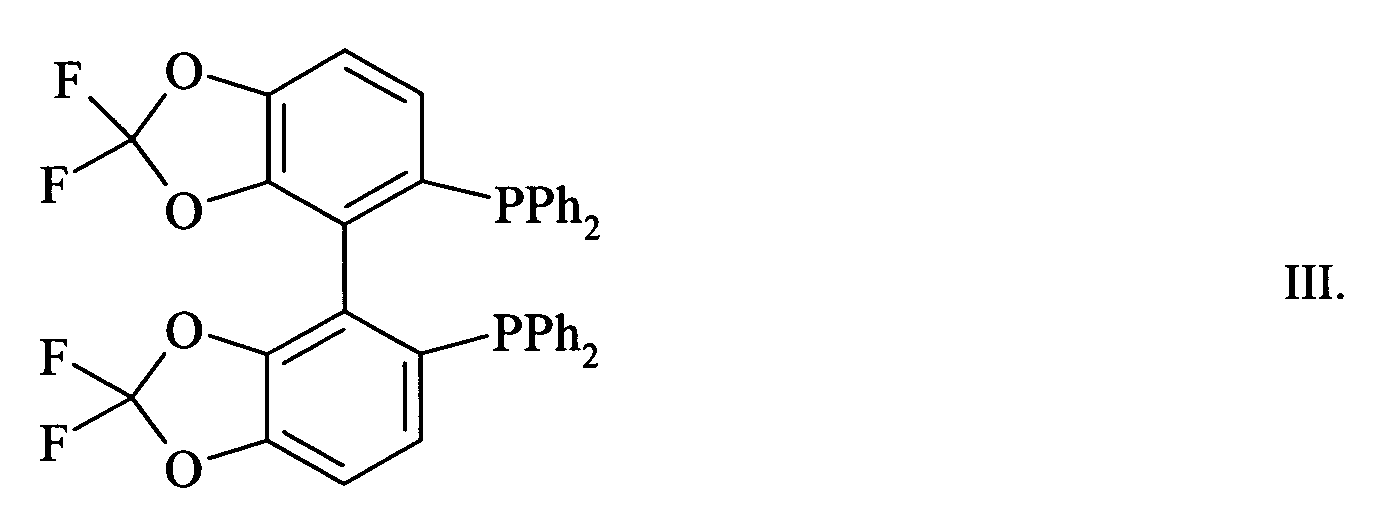
- The process of claim 1, wherein the ruthenium complex comprising aligand of formula III comprises at least one diene, alkene or arene or polar solvent molecule as stabilizing ligand.
- The process of claim 1 or 2, wherein the ruthenium complex comprising a ligand of formula III comprises at least one molecule of 1,5-cyclooctadiene or p-cymene as stabilizing ligand.
- The process of one of claims 1 to 3, wherein the hydrogenation is carried out in a solution comprising a polar solvent selected from the group consisting of C1-4-alcohols, dimethylsulfoxide, dimethylformamide, acetonitrile and mixtures thereof, wherein the solvent optionally contains further solvent additives.
- The process of any one of claims 1 to 4, wherein the counterion of the ruthenium complex is selected from the group consisting of Cl-, Br-, I-, BF4 -, AsF6 -, SbF6 -, PF6 -, ClO4 - and OTf-.
- The process of any one of claims 1 to 5, wherein the ruthenium complex is prepared by mixing the complex of formula [Ru2Cl4(cym)2] with the Fluoxphos ligand in a polar solvent.
- The process of any of claims 1 to 6, wherein the hydrogen pressure during the reaction is in the range of 1 to 60 bar and preferably in the range of 2 to 35 bar.
Priority Applications (17)
| Application Number | Priority Date | Filing Date | Title |
|---|---|---|---|
| EP03024865A EP1528053A1 (en) | 2003-10-31 | 2003-10-31 | Process for the preparation of (S)- or (R)-4-halo-3-hydroxybutyrates |
| AU2004291249A AU2004291249B2 (en) | 2003-10-31 | 2004-10-22 | Process for the preparation of (S)- or (R)-4-halo-3-hydroxybutyrates |
| CN2004800320752A CN1874989B (en) | 2003-10-31 | 2004-10-22 | The preparation method of (S)- or (R)-4-halo-3-hydroxybutyrate |
| EP04790763A EP1682481A1 (en) | 2003-10-31 | 2004-10-22 | Process for the preparation of (s)- or (r)-4-halo-3-hydroxybutyrates |
| KR1020067008041A KR20060095769A (en) | 2003-10-31 | 2004-10-22 | Method for producing (S)-or (R) -4-halo-3-hydroxybutyrate |
| HK07102554.7A HK1095581B (en) | 2003-10-31 | 2004-10-22 | Process for the preparation of (s)- or (r)-4-halo-3-hydroxybutyrates |
| JP2006537143A JP2007509874A (en) | 2003-10-31 | 2004-10-22 | Method for preparing (S)-or (R) -4-halo-3-dihydroxybutyric acid ester |
| PCT/EP2004/011971 WO2005049545A1 (en) | 2003-10-31 | 2004-10-22 | Process for the preparation of (s)- or (r)-4-halo-3-hydroxybutyrates |
| EA200600656A EA009057B1 (en) | 2003-10-31 | 2004-10-22 | Process for the preparation of (s)- or (r)-4-halo-3-hydroxybutyrates |
| CA2541716A CA2541716C (en) | 2003-10-31 | 2004-10-22 | Process for the preparation of (s)- or (r)-4-halo-3-hydroxybutyrates |
| US10/577,385 US20070078279A1 (en) | 2003-10-31 | 2004-10-22 | Process for the preparation of (s)-or (r)-4-halo-3-hydroxybutyrates |
| KR1020127001614A KR20120024990A (en) | 2003-10-31 | 2004-10-22 | Process for the preparation of (s)- or (r)-4-halo-3-hydroxybutyrates |
| NZ546642A NZ546642A (en) | 2003-10-31 | 2004-10-22 | Process for the preparation of (S)-or (R)-4-halo-3-hydroxybutyrates |
| BRPI0416133-5A BRPI0416133A (en) | 2003-10-31 | 2004-10-22 | process for the preparation of (s) - or (r) -4-halo-3-hydroxybutyrates |
| IL175138A IL175138A (en) | 2003-10-31 | 2006-04-24 | Process for the preparation of (s)- or (r)- 4 - halo-3- hydroxybutyrates |
| NO20062131A NO20062131L (en) | 2003-10-31 | 2006-05-12 | Process for the preparation of (S) - or (R) -4-halogen-3-hydroxybutyrates |
| JP2013032463A JP2013144685A (en) | 2003-10-31 | 2013-02-21 | PROCESS FOR PREPARATION OF (S)- OR (R)-4-halo-3-HYDROXYBUTYRATE |
Applications Claiming Priority (1)
| Application Number | Priority Date | Filing Date | Title |
|---|---|---|---|
| EP03024865A EP1528053A1 (en) | 2003-10-31 | 2003-10-31 | Process for the preparation of (S)- or (R)-4-halo-3-hydroxybutyrates |
Publications (1)
| Publication Number | Publication Date |
|---|---|
| EP1528053A1 true EP1528053A1 (en) | 2005-05-04 |
Family
ID=34400493
Family Applications (2)
| Application Number | Title | Priority Date | Filing Date |
|---|---|---|---|
| EP03024865A Withdrawn EP1528053A1 (en) | 2003-10-31 | 2003-10-31 | Process for the preparation of (S)- or (R)-4-halo-3-hydroxybutyrates |
| EP04790763A Ceased EP1682481A1 (en) | 2003-10-31 | 2004-10-22 | Process for the preparation of (s)- or (r)-4-halo-3-hydroxybutyrates |
Family Applications After (1)
| Application Number | Title | Priority Date | Filing Date |
|---|---|---|---|
| EP04790763A Ceased EP1682481A1 (en) | 2003-10-31 | 2004-10-22 | Process for the preparation of (s)- or (r)-4-halo-3-hydroxybutyrates |
Country Status (13)
| Country | Link |
|---|---|
| US (1) | US20070078279A1 (en) |
| EP (2) | EP1528053A1 (en) |
| JP (2) | JP2007509874A (en) |
| KR (2) | KR20120024990A (en) |
| CN (1) | CN1874989B (en) |
| AU (1) | AU2004291249B2 (en) |
| BR (1) | BRPI0416133A (en) |
| CA (1) | CA2541716C (en) |
| EA (1) | EA009057B1 (en) |
| IL (1) | IL175138A (en) |
| NO (1) | NO20062131L (en) |
| NZ (1) | NZ546642A (en) |
| WO (1) | WO2005049545A1 (en) |
Families Citing this family (10)
| Publication number | Priority date | Publication date | Assignee | Title |
|---|---|---|---|---|
| CN101638387A (en) * | 2006-12-12 | 2010-02-03 | 马林克罗特公司 | A process for the preparation of hexahydroisoquinolines from 1, 2, 3, 4-tetrahydroisoquinolines |
| JP5546788B2 (en) * | 2009-04-24 | 2014-07-09 | 高砂香料工業株式会社 | (3S) -3-Hydroxybutanoic acid-l-menthyl production method and cooling agent composition |
| JP2010254622A (en) * | 2009-04-24 | 2010-11-11 | Takasago Internatl Corp | (3R) -3-Hydroxybutanoic acid-1-menthyl, method for producing the same, and cooling agent composition containing the same |
| FR2952638A1 (en) | 2009-11-17 | 2011-05-20 | Univ Strasbourg | PROCESS FOR THE DOUBLE OR TRIPLE CATALYTIC PHOSPHINATION OF DI, TRI OR TETRAHALOBIARYL COMPOUNDS, INTERMEDIATES EMPLOYED, COMPOUNDS OBTAINED AND USES THEREOF |
| EP2386536A1 (en) | 2010-05-11 | 2011-11-16 | Lonza Ltd. | A process for the hydrogenation of ketoesters |
| RU2761829C2 (en) | 2016-06-07 | 2021-12-13 | Зе Дж. Дэвид Глэдстоун Инститьютс | Esters of beta-hydroxybutyrate and butanediol formed by medium-chain fatty acids and compositions and methods based on them |
| BR112020001285A2 (en) * | 2017-07-21 | 2020-07-28 | Buck Institute For Research On Aging | beta-hydroxybutyrate and butanediol s-enantiomers and methods for their use |
| US12037317B2 (en) | 2018-01-25 | 2024-07-16 | Buck Institute For Research On Aging | Synthesis of 3-hydroxybutyryl 3-hydroxybutyrate and related compounds |
| CN109896955A (en) | 2019-03-26 | 2019-06-18 | 沈阳金久奇科技有限公司 | A kind of preparation method of beta-hydroxycarboxylic acids ester |
| DE202019105611U1 (en) | 2019-10-11 | 2019-10-30 | Shenyang Gold Jyouki Technology Co., Ltd. | beta-hydroxycarboxylic acid ester prepared by a carbonylation esterification reaction in a carbon monoxide atmosphere by means of a co-catalyst |
Citations (4)
| Publication number | Priority date | Publication date | Assignee | Title |
|---|---|---|---|---|
| EP0295109A1 (en) * | 1987-06-11 | 1988-12-14 | Takasago International Corporation | Process for preparing optically active alcohol |
| EP0339764A1 (en) * | 1988-02-19 | 1989-11-02 | Takasago International Corporation | Process for preparing carnitine |
| EP1176135A1 (en) * | 2000-07-25 | 2002-01-30 | Takasago International Corporation | Process for producing optically active alcohol |
| WO2003029259A1 (en) * | 2001-09-28 | 2003-04-10 | Synkem | Novel disphospines, their complexes with transition metals and their use in asymmetric synthesis |
Family Cites Families (1)
| Publication number | Priority date | Publication date | Assignee | Title |
|---|---|---|---|---|
| JP3148136B2 (en) * | 1996-12-26 | 2001-03-19 | 高砂香料工業株式会社 | Novel chiral diphosphine compound, intermediate for producing the same, transition metal complex having the diphosphine compound as a ligand, and asymmetric hydrogenation catalyst containing the complex |
-
2003
- 2003-10-31 EP EP03024865A patent/EP1528053A1/en not_active Withdrawn
-
2004
- 2004-10-22 EA EA200600656A patent/EA009057B1/en not_active IP Right Cessation
- 2004-10-22 CA CA2541716A patent/CA2541716C/en not_active Expired - Fee Related
- 2004-10-22 NZ NZ546642A patent/NZ546642A/en not_active IP Right Cessation
- 2004-10-22 WO PCT/EP2004/011971 patent/WO2005049545A1/en not_active Ceased
- 2004-10-22 KR KR1020127001614A patent/KR20120024990A/en not_active Ceased
- 2004-10-22 KR KR1020067008041A patent/KR20060095769A/en not_active Ceased
- 2004-10-22 AU AU2004291249A patent/AU2004291249B2/en not_active Ceased
- 2004-10-22 EP EP04790763A patent/EP1682481A1/en not_active Ceased
- 2004-10-22 CN CN2004800320752A patent/CN1874989B/en not_active Expired - Fee Related
- 2004-10-22 BR BRPI0416133-5A patent/BRPI0416133A/en not_active Application Discontinuation
- 2004-10-22 JP JP2006537143A patent/JP2007509874A/en active Pending
- 2004-10-22 US US10/577,385 patent/US20070078279A1/en not_active Abandoned
-
2006
- 2006-04-24 IL IL175138A patent/IL175138A/en not_active IP Right Cessation
- 2006-05-12 NO NO20062131A patent/NO20062131L/en not_active Application Discontinuation
-
2013
- 2013-02-21 JP JP2013032463A patent/JP2013144685A/en active Pending
Patent Citations (4)
| Publication number | Priority date | Publication date | Assignee | Title |
|---|---|---|---|---|
| EP0295109A1 (en) * | 1987-06-11 | 1988-12-14 | Takasago International Corporation | Process for preparing optically active alcohol |
| EP0339764A1 (en) * | 1988-02-19 | 1989-11-02 | Takasago International Corporation | Process for preparing carnitine |
| EP1176135A1 (en) * | 2000-07-25 | 2002-01-30 | Takasago International Corporation | Process for producing optically active alcohol |
| WO2003029259A1 (en) * | 2001-09-28 | 2003-04-10 | Synkem | Novel disphospines, their complexes with transition metals and their use in asymmetric synthesis |
Non-Patent Citations (1)
| Title |
|---|
| PAI C-C ET AL: "Synthesis of new chiral diphosphine ligand (BisbenzodioxanPhos) and its application in asymmetric catalytic hydrogenation", TETRAHEDRON LETTERS, ELSEVIER SCIENCE PUBLISHERS, AMSTERDAM, NL, vol. 43, no. 15, 8 April 2002 (2002-04-08), pages 2789 - 2792, XP004345895, ISSN: 0040-4039 * |
Also Published As
| Publication number | Publication date |
|---|---|
| AU2004291249A1 (en) | 2005-06-02 |
| KR20120024990A (en) | 2012-03-14 |
| JP2013144685A (en) | 2013-07-25 |
| EP1682481A1 (en) | 2006-07-26 |
| US20070078279A1 (en) | 2007-04-05 |
| NO20062131L (en) | 2006-05-30 |
| WO2005049545A1 (en) | 2005-06-02 |
| IL175138A (en) | 2011-02-28 |
| BRPI0416133A (en) | 2007-01-02 |
| HK1095581A1 (en) | 2007-05-11 |
| AU2004291249B2 (en) | 2010-07-29 |
| NZ546642A (en) | 2008-11-28 |
| CA2541716A1 (en) | 2005-06-02 |
| KR20060095769A (en) | 2006-09-01 |
| CN1874989B (en) | 2011-06-29 |
| CN1874989A (en) | 2006-12-06 |
| CA2541716C (en) | 2013-01-22 |
| EA200600656A1 (en) | 2006-10-27 |
| JP2007509874A (en) | 2007-04-19 |
| EA009057B1 (en) | 2007-10-26 |
| IL175138A0 (en) | 2006-09-05 |
Similar Documents
| Publication | Publication Date | Title |
|---|---|---|
| JP2013144685A (en) | PROCESS FOR PREPARATION OF (S)- OR (R)-4-halo-3-HYDROXYBUTYRATE | |
| US4652657A (en) | Chiral rhodium-diphosphine complexes | |
| EP1176135B1 (en) | Process for producing optically active alcohol | |
| RU2442787C2 (en) | Way of production of optically active aminophosphinylbutanoic acids | |
| US6583312B2 (en) | Process for preparing optically active trimethyllactic acid and its esters | |
| WO2005007662A2 (en) | Biphosphine ruthenium complexes with chiral diamine ligande as catalysts | |
| US7601667B2 (en) | Sulfonate catalyst and method of producing alcohol compound using the same | |
| US5852212A (en) | Process for preparation of optically active α-bromo and α-chlorocarboxylic compounds | |
| JP4226847B2 (en) | A method for producing optically active amides from α, β-unsaturated amide derivatives in the presence of a transition metal complex containing a phosphine-phosphorane compound and a transition metal. | |
| HK1095581B (en) | Process for the preparation of (s)- or (r)-4-halo-3-hydroxybutyrates | |
| JP2005518339A (en) | Process for producing enantiomerically rich N-acyl-β-amino acid derivatives by enantioselective hydrogenation of the corresponding (Z) enamide | |
| EP1778704B1 (en) | Process for the preparation of asymmetrically substituted biaryldiphosphines | |
| EP1609795A1 (en) | Process for the preparation of asymmetrically substituted biaryldiphosphines | |
| JP5087395B2 (en) | Sulfonate catalyst and method for producing alcohol compound using the same | |
| US20040186314A1 (en) | Process for the preparation of enantiomerically enriched n-acyl-beta-amino acid derivatives by enantioselective hydrogenation of the corresponding (z)-enamides | |
| JP5021248B2 (en) | Method for producing optically active compound | |
| JP2001220366A (en) | Method for producing hydroxyester | |
| JP2004256460A (en) | Method for producing iridium complex and optically active amine | |
| JP2001172289A (en) | Method for producing complex and alcohol |
Legal Events
| Date | Code | Title | Description |
|---|---|---|---|
| PUAI | Public reference made under article 153(3) epc to a published international application that has entered the european phase |
Free format text: ORIGINAL CODE: 0009012 |
|
| AK | Designated contracting states |
Kind code of ref document: A1 Designated state(s): AT BE BG CH CY CZ DE DK EE ES FI FR GB GR HU IE IT LI LU MC NL PT RO SE SI SK TR |
|
| AX | Request for extension of the european patent |
Extension state: AL LT LV MK |
|
| STAA | Information on the status of an ep patent application or granted ep patent |
Free format text: STATUS: THE APPLICATION IS DEEMED TO BE WITHDRAWN |
|
| 18D | Application deemed to be withdrawn |
Effective date: 20050301 |