EP1527567B1 - Apparatus and method for conveying private information within a group communication system - Google Patents
Apparatus and method for conveying private information within a group communication system Download PDFInfo
- Publication number
- EP1527567B1 EP1527567B1 EP03733760A EP03733760A EP1527567B1 EP 1527567 B1 EP1527567 B1 EP 1527567B1 EP 03733760 A EP03733760 A EP 03733760A EP 03733760 A EP03733760 A EP 03733760A EP 1527567 B1 EP1527567 B1 EP 1527567B1
- Authority
- EP
- European Patent Office
- Prior art keywords
- users
- extension header
- group
- streamed signal
- data packets
- Prior art date
- Legal status (The legal status is an assumption and is not a legal conclusion. Google has not performed a legal analysis and makes no representation as to the accuracy of the status listed.)
- Expired - Lifetime
Links
Images

Classifications
-
- H—ELECTRICITY
- H04—ELECTRIC COMMUNICATION TECHNIQUE
- H04L—TRANSMISSION OF DIGITAL INFORMATION, e.g. TELEGRAPHIC COMMUNICATION
- H04L49/00—Packet switching elements
- H04L49/20—Support for services
- H04L49/201—Multicast operation; Broadcast operation
-
- H—ELECTRICITY
- H04—ELECTRIC COMMUNICATION TECHNIQUE
- H04L—TRANSMISSION OF DIGITAL INFORMATION, e.g. TELEGRAPHIC COMMUNICATION
- H04L12/00—Data switching networks
- H04L12/02—Details
- H04L12/16—Arrangements for providing special services to substations
- H04L12/18—Arrangements for providing special services to substations for broadcast or conference, e.g. multicast
- H04L12/1813—Arrangements for providing special services to substations for broadcast or conference, e.g. multicast for computer conferences, e.g. chat rooms
- H04L12/1818—Conference organisation arrangements, e.g. handling schedules, setting up parameters needed by nodes to attend a conference, booking network resources, notifying involved parties
-
- G—PHYSICS
- G06—COMPUTING OR CALCULATING; COUNTING
- G06F—ELECTRIC DIGITAL DATA PROCESSING
- G06F15/00—Digital computers in general; Data processing equipment in general
- G06F15/16—Combinations of two or more digital computers each having at least an arithmetic unit, a program unit and a register, e.g. for a simultaneous processing of several programs
- G06F15/163—Interprocessor communication
- G06F15/173—Interprocessor communication using an interconnection network, e.g. matrix, shuffle, pyramid, star, snowflake
- G06F15/17356—Indirect interconnection networks
- G06F15/17368—Indirect interconnection networks non hierarchical topologies
- G06F15/17393—Indirect interconnection networks non hierarchical topologies having multistage networks, e.g. broadcasting scattering, gathering, hot spot contention, combining/decombining
-
- H—ELECTRICITY
- H04—ELECTRIC COMMUNICATION TECHNIQUE
- H04L—TRANSMISSION OF DIGITAL INFORMATION, e.g. TELEGRAPHIC COMMUNICATION
- H04L12/00—Data switching networks
- H04L12/02—Details
- H04L12/16—Arrangements for providing special services to substations
- H04L12/18—Arrangements for providing special services to substations for broadcast or conference, e.g. multicast
-
- H—ELECTRICITY
- H04—ELECTRIC COMMUNICATION TECHNIQUE
- H04L—TRANSMISSION OF DIGITAL INFORMATION, e.g. TELEGRAPHIC COMMUNICATION
- H04L12/00—Data switching networks
- H04L12/02—Details
- H04L12/22—Arrangements for preventing the taking of data from a data transmission channel without authorisation
-
- H—ELECTRICITY
- H04—ELECTRIC COMMUNICATION TECHNIQUE
- H04L—TRANSMISSION OF DIGITAL INFORMATION, e.g. TELEGRAPHIC COMMUNICATION
- H04L47/00—Traffic control in data switching networks
- H04L47/70—Admission control; Resource allocation
- H04L47/80—Actions related to the user profile or the type of traffic
- H04L47/806—Broadcast or multicast traffic
-
- H—ELECTRICITY
- H04—ELECTRIC COMMUNICATION TECHNIQUE
- H04L—TRANSMISSION OF DIGITAL INFORMATION, e.g. TELEGRAPHIC COMMUNICATION
- H04L65/00—Network arrangements, protocols or services for supporting real-time applications in data packet communication
- H04L65/1066—Session management
- H04L65/1101—Session protocols
-
- H—ELECTRICITY
- H04—ELECTRIC COMMUNICATION TECHNIQUE
- H04L—TRANSMISSION OF DIGITAL INFORMATION, e.g. TELEGRAPHIC COMMUNICATION
- H04L65/00—Network arrangements, protocols or services for supporting real-time applications in data packet communication
- H04L65/60—Network streaming of media packets
- H04L65/61—Network streaming of media packets for supporting one-way streaming services, e.g. Internet radio
- H04L65/611—Network streaming of media packets for supporting one-way streaming services, e.g. Internet radio for multicast or broadcast
-
- H—ELECTRICITY
- H04—ELECTRIC COMMUNICATION TECHNIQUE
- H04L—TRANSMISSION OF DIGITAL INFORMATION, e.g. TELEGRAPHIC COMMUNICATION
- H04L65/00—Network arrangements, protocols or services for supporting real-time applications in data packet communication
- H04L65/60—Network streaming of media packets
- H04L65/65—Network streaming protocols, e.g. real-time transport protocol [RTP] or real-time control protocol [RTCP]
-
- H—ELECTRICITY
- H04—ELECTRIC COMMUNICATION TECHNIQUE
- H04L—TRANSMISSION OF DIGITAL INFORMATION, e.g. TELEGRAPHIC COMMUNICATION
- H04L12/00—Data switching networks
- H04L12/02—Details
- H04L12/16—Arrangements for providing special services to substations
- H04L12/18—Arrangements for providing special services to substations for broadcast or conference, e.g. multicast
- H04L12/189—Arrangements for providing special services to substations for broadcast or conference, e.g. multicast in combination with wireless systems
Definitions
- the present invention relates to an apparatus and method for conveying private information within an established group communication. More in detail, the invention relates to communication between two parties within an established IP-multicast group where the group involves more than two participants.
- Media information can be distributed within a communicating group of users by means of so-called IP-multicast transmission.
- This multicast transmission technique relies on the principle that the information is transmitted to a multicast group and further copied in the network to participating parties who require a copy of the information.
- Public information in a network of the above kind is distributed within the group of users by IP-multicast in the form of streamed media.
- IP-multicast in the form of streamed media.
- a special communication channel is established between the sub-group members in parallel with the public multicast communication channel.
- network constraints, such as firewalls or other access limiting security arrangements may impede or even preclude transmission of non-multicast communication from reaching the intended recipient. This is a drawback associated with prior art, which limits the deployment of applications for group communication.
- an apparatus and method for distribution of a streamed signal within a group of users in a computer network, the users accessing client terminals for participation in a multicast session comprising, connecting links adapted to connect the client terminals of users and related equipment, such as capturing means, to the multicast session, preferably via the Internet or other interconnecting network, an extension header being added to data packets of the streamed signal, the extension header comprising identification data relating to the intended recipient of a packet, characterised in that a filtering means associated with the receiving client adapted to filter out data packets having the address of the recipient and receiving the streamed signal.
- the present invention which provides a solution to the mentioned distribution and confidentiality problem is advantageous in many ways.
- the previous need for establishing a dedicated unicast connection in parallel with the existing multicast connection is no longer necessary.
- Communication of non-public interest, possibly of private or sensitive nature, may be executed during a public session.
- the advantage of the invention is hence the ability to reuse the existing communications channel while maintaining the confidentiality if this is desirable.
- IP-multicast Due to network constraints it is desirable to send also this information using IP-multicast even though it will reach non-interested receivers. These network constraints include for example firewalls and other corresponding security arrangements where the receiver might only have IP-multicast access or only access to a portal, i.e. a so-called reflector.
- the Internet is used as a means for distribution of streamed media.
- Use of the Internet is the optimal solution as long as it provides a reliable connection having sufficient transmission rates, without network congestion problems.
- the invention does not lead to undesired overload within the computer networks with unnecessary amounts of raw data, and the raw data can be compressed to require even less transmission capacity.
- the amount of data distributed through the network is reduced, since the data stream sent as a copy from one client terminal to other associated client terminals can be compressed, as a result of which the total amount of data transmitted over the network is reduced.
- the implementation of the invention is based on addition of a special header to private packets being part of transmitted information in a network.
- the packets identify the receivers and these packets are filtered on the receiving side of the distribution channel, although every participating member in a communication group actually receives the identifiable data.
- This is implemented in practice using a special header extension which is available in the Real-time Transport Protocol standard for identifying that header extensions actually exist in the packet.
- the invention is not limited to any particular type of data but is applicable for any type of information transmitted, such as for audio, video, chat, etc.
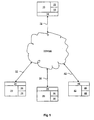
- FIG. 1 a schematic overview illustrates the apparatus for distribution of a streamed signal within a group of users in a computer network.
- the connecting lines may be various wired connections, but likely for use already today or at least in a near future are also wireless transmission technologies, such as access technology based on infrared, Bluetooth or wireless-LAN. Connection means used in association with the present invention will be developing with new and emerging access technologies.
- image capturing means 16, 26, 36, 46 preferably a so-called web-camera, a digital camera or a digital video camera.
- audio capturing means 18, 28, 38, 48 in the form of a microphone arrangement is connected to each client terminal as well as filtering means 14, 24, 34, 44.
- the client terminals themselves arrange the distribution of the data stream to other multicast group members. This is an autonomous function between client terminals as soon as the participants in a group are defined and authorised.
- a central administration entity preferably in the form of a portal handling accessibility of users willing to participate in a multicast group of users. Necessary identification, authentication and authorisation of users to a group is carried out by means of the central administration entity, i.e, the portal interfacing between the entity and users, but a detailed description of those steps clearly goes beyond the scope of this application and is therefore omitted here.
- the protocol comprises a part of the header called the extension bit.
- the extension bit When this bit is determined, the normal RTP header is followed by a new RTP header extension having a content of at least 4 bytes of data.
- This new extension header is placed between the RTP header and the RTP payload, which contains the actual content to be distributed, such as for example the video stream of a multicast session.
- the extension name is set to a common identifier, identifying this extension as a filter destination.
- the filter destination header is identified by the bytes numbered 77 and 65.
- the "length” field is the total length of the header extension including the first 4 bytes. Reference is here made to the RTP specification IETF RFC1889 (request for comments) where the first 4 bytes are defined. "v” which is found far left in Fig 2 defines two bits primarily intended for making changes possible within the header extension. "X” denotes an unused field in the header. "cmd” is a command that allows alternative use of the header extension.
- a stream can only contain one RTP header extension per packet if it is to conform with the RTP specification.
- the command cmd is set to 0.
- "dest number” is the number of destinations in this particular packet, which may be any number relating to the size of the sub-group of intended recipients.
- "real payload” is the type of data being sent in this packet.
- the real RTP header contains a payload type field and just as the case of other applications, and it is not intended to be possible to decode the data by leaving out the extension header.
- This extension header is originally set to the original value of 127. This number denotes, in accordance with the mentioned RTP specification, "unspecified” and then includes the real payload type. This will lead to applications that do not interpret this header extension to dispose of the packet.
- ID1, ID2, ... are the unique identifiers for the intended destination, i.e. who the intended recipient of this packet is.
- Realisation of the addition of an extension header to a data packet can be carried out in accordance with the following embodiment.
- the new packet is composed with the header extension bit set to 1 and header extension is added after the RTP header as previously described with reference to Fig 2 .
- the other users i.e. user1 and user3, will decode the extension header, find themselves in the destination list and handle the data according to the payload type defined in the "real payload" type field.
- software is developed in parallel with the apparatus for distribution of signals.
- the software resides in a memory associated with said apparatus.
- the software is designed for instructing the hardware to carry out sequential method steps previously described in this application.
Landscapes
- Engineering & Computer Science (AREA)
- Multimedia (AREA)
- Computer Networks & Wireless Communication (AREA)
- Signal Processing (AREA)
- General Engineering & Computer Science (AREA)
- Physics & Mathematics (AREA)
- Computer Hardware Design (AREA)
- Theoretical Computer Science (AREA)
- Computer Security & Cryptography (AREA)
- Mathematical Physics (AREA)
- Software Systems (AREA)
- General Physics & Mathematics (AREA)
- General Business, Economics & Management (AREA)
- Business, Economics & Management (AREA)
- Data Exchanges In Wide-Area Networks (AREA)
- Maintenance And Management Of Digital Transmission (AREA)
- Exchange Systems With Centralized Control (AREA)
Abstract
Description
- The present invention relates to an apparatus and method for conveying private information within an established group communication. More in detail, the invention relates to communication between two parties within an established IP-multicast group where the group involves more than two participants.
- Media information can be distributed within a communicating group of users by means of so-called IP-multicast transmission. This multicast transmission technique relies on the principle that the information is transmitted to a multicast group and further copied in the network to participating parties who require a copy of the information.
- Public information in a network of the above kind is distributed within the group of users by IP-multicast in the form of streamed media. However, there may be a need for distribution of information of particular interest to only a sub-part of participating users, and to distribute private messages exclusively within that sub-part of the participating group. According to prior art technology, in such a case a special communication channel is established between the sub-group members in parallel with the public multicast communication channel. However, network constraints, such as firewalls or other access limiting security arrangements may impede or even preclude transmission of non-multicast communication from reaching the intended recipient. This is a drawback associated with prior art, which limits the deployment of applications for group communication. Today, the trend in society is that measures are taken in the direction of enhanced security, and the security consciousness among users and network administrators has increased. Therefore the need for an arrangement enabling communication, while simultaneously respecting network among users and network administrators has increased. Therefore the need for an arrangement enabling communication, while simultaneously respecting network constraints and limitations, such as firewalls and other security measures, has become even greater than before.
- Document "Application-Layer Group Communication Server for Extending Reliable Multicast Protocols Services" Proceedings of the 1997 International Conference on Network Protocols (ICNP '97) by Al-Shaer et al. discloses a system wherein filtering of messages is performed by an intermediate server.
- It is therefore an object of the present invention to alleviate the previously mentioned shortcomings of prior art associated with group communication services. This is accomplished by an apparatus and method for distribution of a streamed signal within a group of users in a computer network, the users accessing client terminals for participation in a multicast session, the apparatus comprising,
connecting links adapted to connect the client terminals of users and related equipment, such as capturing means, to the multicast session, preferably via the Internet or other interconnecting network,
an extension header being added to data packets of the streamed signal, the extension header comprising identification data relating to the intended recipient of a packet,
characterised in that
a filtering means associated with the receiving client adapted to filter out data packets having the address of the recipient and receiving the streamed signal. - Only one copy of the information is transmitted from the sender independently of the amount of receivers. Within a multicast group, as previously described, there may be a need for transmitting private or confidential information exclusively within only a subpart of the group, usually transmission one to one. By means of additional encryption, there is a further possibility of making also strictly confidential information which is distributed accessible to only intended recipients. This could be critical information not to be disclosed to all parties in a business negotiation, keys and solutions to problems during an electronic educational meeting, individual tuition during an electronic meeting being part of distance learning, foreign affairs or political relations, etc.
- The present invention, which provides a solution to the mentioned distribution and confidentiality problem is advantageous in many ways. The previous need for establishing a dedicated unicast connection in parallel with the existing multicast connection is no longer necessary. Communication of non-public interest, possibly of private or sensitive nature, may be executed during a public session. The advantage of the invention is hence the ability to reuse the existing communications channel while maintaining the confidentiality if this is desirable.
- Due to network constraints it is desirable to send also this information using IP-multicast even though it will reach non-interested receivers. These network constraints include for example firewalls and other corresponding security arrangements where the receiver might only have IP-multicast access or only access to a portal, i.e. a so-called reflector.
- The features, objects, and further advantages of this invention will become apparent by reading this description in conjunction with the accompanying drawings, in which like reference numerals refer to like elements and in which:
-
Fig 1 illustrates a schematic overview of the apparatus for distribution of a streamed signal within a group of users according to the present invention. -
Fig 2 is a signalling chart representing the content of a header added to distributed data packets according to the present invention. - The following description is of the best mode presently contemplated for practising the invention. The description is not to be taken in a limiting sense, but is made merely for the purpose of describing the general principles of the invention. The scope of the invention should be ascertained with reference to the issued claims.
- According to the present invention, the Internet is used as a means for distribution of streamed media. Use of the Internet is the optimal solution as long as it provides a reliable connection having sufficient transmission rates, without network congestion problems. The invention does not lead to undesired overload within the computer networks with unnecessary amounts of raw data, and the raw data can be compressed to require even less transmission capacity. The amount of data distributed through the network is reduced, since the data stream sent as a copy from one client terminal to other associated client terminals can be compressed, as a result of which the total amount of data transmitted over the network is reduced.
- The implementation of the invention is based on addition of a special header to private packets being part of transmitted information in a network. The packets identify the receivers and these packets are filtered on the receiving side of the distribution channel, although every participating member in a communication group actually receives the identifiable data. This is implemented in practice using a special header extension which is available in the Real-time Transport Protocol standard for identifying that header extensions actually exist in the packet.
- The invention is not limited to any particular type of data but is applicable for any type of information transmitted, such as for audio, video, chat, etc.
- With reference to
Fig 1 , a schematic overview illustrates the apparatus for distribution of a streamed signal within a group of users in a computer network. A plurality ofclient terminals links - Moreover, audio capturing means 18, 28, 38, 48, in the form of a microphone arrangement is connected to each client terminal as well as filtering means 14, 24, 34, 44.
- The client terminals themselves arrange the distribution of the data stream to other multicast group members. This is an autonomous function between client terminals as soon as the participants in a group are defined and authorised. There may be arranged a central administration entity, preferably in the form of a portal handling accessibility of users willing to participate in a multicast group of users. Necessary identification, authentication and authorisation of users to a group is carried out by means of the central administration entity, i.e, the portal interfacing between the entity and users, but a detailed description of those steps clearly goes beyond the scope of this application and is therefore omitted here.
- With particular reference to
Fig 2 , parts of the previously mentioned Real-time Transfer Protocol (RTP) is depicted. The protocol comprises a part of the header called the extension bit. When this bit is determined, the normal RTP header is followed by a new RTP header extension having a content of at least 4 bytes of data. This new extension header is placed between the RTP header and the RTP payload, which contains the actual content to be distributed, such as for example the video stream of a multicast session. - The extension name is set to a common identifier, identifying this extension as a filter destination. In accordance with a preferred embodiment of the invention, the filter destination header is identified by the bytes numbered 77 and 65. The "length" field is the total length of the header extension including the first 4 bytes. Reference is here made to the RTP specification IETF RFC1889 (request for comments) where the first 4 bytes are defined. "v" which is found far left in
Fig 2 defines two bits primarily intended for making changes possible within the header extension. "X" denotes an unused field in the header. "cmd" is a command that allows alternative use of the header extension. The reason for this possible alternative use is that a stream can only contain one RTP header extension per packet if it is to conform with the RTP specification. In this case the command cmd is set to 0. "dest number" is the number of destinations in this particular packet, which may be any number relating to the size of the sub-group of intended recipients. "real payload" is the type of data being sent in this packet. The real RTP header contains a payload type field and just as the case of other applications, and it is not intended to be possible to decode the data by leaving out the extension header. This extension header is originally set to the original value of 127. This number denotes, in accordance with the mentioned RTP specification, "unspecified" and then includes the real payload type. This will lead to applications that do not interpret this header extension to dispose of the packet. ID1, ID2, ... are the unique identifiers for the intended destination, i.e. who the intended recipient of this packet is. - Realisation of the addition of an extension header to a data packet can be carried out in accordance with the following embodiment. The sender is sending data to every-body in the group, the group by way of example comprising three users. There users are user1 (id=10), user2 (id=20) and user3 (id=30). For any reason, the sender of data may be interested in sending a data packet to only "user1" and "user3". This is denoted a private audio conversation, or a so-called whisper within the group communication. The new packet is composed with the header extension bit set to 1 and header extension is added after the RTP header as previously described with reference to
Fig 2 . This extension header will comprise "dest nummer" = 2 and "ID1" = 10 and "ID2" = 30. Subsequently a packet is sent to the whole group and is received by all three users (user1, user2 and user3). The second user, i.e. user2 will also receive this packet and decode the extension header but will not find itself in the destinations list and it will therefore dispose of the packet. - However, the other users, i.e. user1 and user3, will decode the extension header, find themselves in the destination list and handle the data according to the payload type defined in the "real payload" type field.
- In accordance with the present invention, software is developed in parallel with the apparatus for distribution of signals. The software resides in a memory associated with said apparatus. The software is designed for instructing the hardware to carry out sequential method steps previously described in this application.
Claims (4)
- Apparatus for distribution of a streamed signal within a group of users in a computer network, the users accessing client terminals (10, 20, 30, 40) for participation in a multicast session, the apparatus comprising,
connecting links (12, 22, 32, 42) adapted to connect the client terminals of users and related equipment, (16, 26...; 18, 28...), to the multicast session, via the Internet or other interconnecting network, characterised by
means for adding an extension header to data packets of the streamed signal, the extension header comprising identification data relating to the intended recipient of a packet, and
a filtering means (14, 24, 34, 44) arranged at the receiving client adapted to filter out data packets comprising identification data in the extension header identifying the recipient and receiving the streamed signal. - Apparatus for distribution of a streamed signal according to claim 1, characterised in that
the transmitted signal is encoded by the sending client terminal and decoded by the intended recipient only at the receiving client terminal by means of a separately provided decryption key. - Method for distributing a streamed signal via the Internet or other interconnecting network within a group of users in a computer network, the users accessing client terminals (10, 20, 30, 40) for participation in a multicast session, the method comprising the steps of,
characterised by
adding an extension header to data packets of the streamed signal, the extension header identifying the intended recipient of a packet, and
filtering out data packets comprising identification data in the extension header identifying the recipient and allowing them to pass through a filtering means (14, 24, 34, 44), which is arranged at the receiving client. - Computer program product for distributing a streamed signal within a group of users in a computer network, the computer program being adapted when run on a computer to carry out each of the steps of the method claim 3.
Applications Claiming Priority (3)
| Application Number | Priority Date | Filing Date | Title |
|---|---|---|---|
| SE0201879A SE525271C2 (en) | 2002-06-19 | 2002-06-19 | Device and method for transmitting private information within a group communication system |
| SE0201879 | 2002-06-19 | ||
| PCT/SE2003/001030 WO2004002086A1 (en) | 2002-06-19 | 2003-06-18 | Apparatus and method for conveying private information within a group communication system |
Publications (2)
| Publication Number | Publication Date |
|---|---|
| EP1527567A1 EP1527567A1 (en) | 2005-05-04 |
| EP1527567B1 true EP1527567B1 (en) | 2008-04-02 |
Family
ID=20288239
Family Applications (1)
| Application Number | Title | Priority Date | Filing Date |
|---|---|---|---|
| EP03733760A Expired - Lifetime EP1527567B1 (en) | 2002-06-19 | 2003-06-18 | Apparatus and method for conveying private information within a group communication system |
Country Status (9)
| Country | Link |
|---|---|
| US (1) | US20060041745A1 (en) |
| EP (1) | EP1527567B1 (en) |
| AT (1) | ATE391374T1 (en) |
| AU (1) | AU2003239044A1 (en) |
| CA (1) | CA2487728C (en) |
| DE (1) | DE60320108T2 (en) |
| ES (1) | ES2303594T3 (en) |
| SE (1) | SE525271C2 (en) |
| WO (1) | WO2004002086A1 (en) |
Families Citing this family (28)
| Publication number | Priority date | Publication date | Assignee | Title |
|---|---|---|---|---|
| US8677117B2 (en) * | 2003-12-31 | 2014-03-18 | International Business Machines Corporation | Remote management of boot application |
| KR20060115290A (en) * | 2005-05-04 | 2006-11-08 | 삼성전자주식회사 | Apparatus and method for multi-user packet transmission / reception in mobile communication system |
| KR100741885B1 (en) * | 2005-10-26 | 2007-07-23 | 지유소프트 주식회사 | Application Layer Multicast Group Configuration Using Chopped Tree Structure |
| US7675854B2 (en) | 2006-02-21 | 2010-03-09 | A10 Networks, Inc. | System and method for an adaptive TCP SYN cookie with time validation |
| US20080176618A1 (en) * | 2007-01-19 | 2008-07-24 | Waterleaf Limited | Method and System for Presenting Electronic Casino Games to a Player |
| US8069251B2 (en) | 2007-06-01 | 2011-11-29 | Adobe Systems Incorporated | System and/or method for client-driven server load distribution |
| US8239548B2 (en) | 2007-07-17 | 2012-08-07 | Adobe Systems Incorporated | Endpoint discriminator in network transport protocol startup packets |
| US7992201B2 (en) * | 2007-07-26 | 2011-08-02 | International Business Machines Corporation | Dynamic network tunnel endpoint selection |
| US8145698B1 (en) | 2008-01-03 | 2012-03-27 | Adobe Systems Incorporated | Self organizing peer-to-peer system, method, and/or apparatus |
| US8171147B1 (en) | 2008-02-20 | 2012-05-01 | Adobe Systems Incorporated | System, method, and/or apparatus for establishing peer-to-peer communication |
| US8341401B1 (en) | 2008-05-13 | 2012-12-25 | Adobe Systems Incorporated | Interoperable cryptographic peer and server identities |
| US8312147B2 (en) * | 2008-05-13 | 2012-11-13 | Adobe Systems Incorporated | Many-to-one mapping of host identities |
| US9960967B2 (en) | 2009-10-21 | 2018-05-01 | A10 Networks, Inc. | Determining an application delivery server based on geo-location information |
| US8490003B2 (en) | 2010-12-03 | 2013-07-16 | International Business Machines Corporation | Dynamic proximity based text exchange within a group session |
| US9094364B2 (en) | 2011-12-23 | 2015-07-28 | A10 Networks, Inc. | Methods to manage services over a service gateway |
| US8782221B2 (en) | 2012-07-05 | 2014-07-15 | A10 Networks, Inc. | Method to allocate buffer for TCP proxy session based on dynamic network conditions |
| US9531846B2 (en) | 2013-01-23 | 2016-12-27 | A10 Networks, Inc. | Reducing buffer usage for TCP proxy session based on delayed acknowledgement |
| US10027761B2 (en) | 2013-05-03 | 2018-07-17 | A10 Networks, Inc. | Facilitating a secure 3 party network session by a network device |
| US10230770B2 (en) | 2013-12-02 | 2019-03-12 | A10 Networks, Inc. | Network proxy layer for policy-based application proxies |
| US10020979B1 (en) | 2014-03-25 | 2018-07-10 | A10 Networks, Inc. | Allocating resources in multi-core computing environments |
| US9806943B2 (en) | 2014-04-24 | 2017-10-31 | A10 Networks, Inc. | Enabling planned upgrade/downgrade of network devices without impacting network sessions |
| US10129122B2 (en) | 2014-06-03 | 2018-11-13 | A10 Networks, Inc. | User defined objects for network devices |
| US9986061B2 (en) | 2014-06-03 | 2018-05-29 | A10 Networks, Inc. | Programming a data network device using user defined scripts |
| US9992229B2 (en) | 2014-06-03 | 2018-06-05 | A10 Networks, Inc. | Programming a data network device using user defined scripts with licenses |
| US10581976B2 (en) | 2015-08-12 | 2020-03-03 | A10 Networks, Inc. | Transmission control of protocol state exchange for dynamic stateful service insertion |
| US10243791B2 (en) | 2015-08-13 | 2019-03-26 | A10 Networks, Inc. | Automated adjustment of subscriber policies |
| US10318288B2 (en) | 2016-01-13 | 2019-06-11 | A10 Networks, Inc. | System and method to process a chain of network applications |
| US10389835B2 (en) | 2017-01-10 | 2019-08-20 | A10 Networks, Inc. | Application aware systems and methods to process user loadable network applications |
Family Cites Families (5)
| Publication number | Priority date | Publication date | Assignee | Title |
|---|---|---|---|---|
| US5748958A (en) * | 1996-04-30 | 1998-05-05 | International Business Machines Corporation | System for utilizing batch requests to present membership changes to process groups |
| US6490586B1 (en) * | 1999-12-27 | 2002-12-03 | International Business Machines Corporation | Ordered sub-group messaging in a group communications system |
| US6724770B1 (en) * | 2000-02-17 | 2004-04-20 | Kenneth P. Birman | Multicast protocol with reduced buffering requirements |
| US7116641B2 (en) * | 2000-11-15 | 2006-10-03 | Lg Electronics Inc. | Multicast and broadcast transmission method and apparatus of a CDMA mobile communication network |
| US7035657B2 (en) * | 2002-05-08 | 2006-04-25 | Qualcomm Inc. | Method and apparatus for supporting application-layer media multicasting |
-
2002
- 2002-06-19 SE SE0201879A patent/SE525271C2/en not_active IP Right Cessation
-
2003
- 2003-06-18 AT AT03733760T patent/ATE391374T1/en not_active IP Right Cessation
- 2003-06-18 DE DE60320108T patent/DE60320108T2/en not_active Expired - Lifetime
- 2003-06-18 CA CA2487728A patent/CA2487728C/en not_active Expired - Fee Related
- 2003-06-18 ES ES03733760T patent/ES2303594T3/en not_active Expired - Lifetime
- 2003-06-18 WO PCT/SE2003/001030 patent/WO2004002086A1/en not_active Ceased
- 2003-06-18 AU AU2003239044A patent/AU2003239044A1/en not_active Abandoned
- 2003-06-18 US US10/518,429 patent/US20060041745A1/en not_active Abandoned
- 2003-06-18 EP EP03733760A patent/EP1527567B1/en not_active Expired - Lifetime
Also Published As
| Publication number | Publication date |
|---|---|
| SE525271C2 (en) | 2005-01-18 |
| DE60320108T2 (en) | 2009-05-14 |
| EP1527567A1 (en) | 2005-05-04 |
| ATE391374T1 (en) | 2008-04-15 |
| CA2487728C (en) | 2011-12-06 |
| SE0201879D0 (en) | 2002-06-19 |
| CA2487728A1 (en) | 2003-12-31 |
| WO2004002086A1 (en) | 2003-12-31 |
| AU2003239044A1 (en) | 2004-01-06 |
| ES2303594T3 (en) | 2008-08-16 |
| SE0201879L (en) | 2003-12-20 |
| DE60320108D1 (en) | 2008-05-15 |
| WO2004002086A8 (en) | 2004-12-23 |
| US20060041745A1 (en) | 2006-02-23 |
Similar Documents
| Publication | Publication Date | Title |
|---|---|---|
| CA2487728C (en) | Apparatus and method for conveying private information within a group communication system | |
| EP1145521B1 (en) | SYSTEM AND METHOD FOR ENABLING SECURE CONNECTIONS FOR H.323 VoIP CALLS | |
| US8289900B2 (en) | Apparatus and method for dynamically updating and communicating within flexible networks | |
| JP4299606B2 (en) | Stable multicast flow | |
| US7916861B2 (en) | System and method for establishing secondary channels | |
| US7984178B2 (en) | Synthetic bridging for networks | |
| US20160308921A1 (en) | Method and system for dispatching received sessions between a pluratlity of instances of an application using the same ip port | |
| US20090016347A1 (en) | Applying multicast protocols and vpn tunneling techniques to achieve high quality of service for real time media transport across ip networks | |
| JPS5940786A (en) | CATV communication system | |
| EP2186290B1 (en) | System and method for identifying encrypted conference media traffic | |
| US7643478B2 (en) | Secure and personalized broadcasting of audiovisual streams by a hybrid unicast/multicast system | |
| US10986052B1 (en) | Systems and methods for secure data exchange in a distributed collaborative application | |
| CN109408015A (en) | A kind of multimedia file processing method sends terminal and display terminal | |
| CN115567192B (en) | Method and system for transparent encryption and decryption of multicast data using quantum key distribution | |
| JP2009081855A (en) | Method of transmitting item in electronic form over a plurality of networks, device, and program | |
| CN112534790B (en) | Encryption device, communication system and method for exchanging encrypted data in a communication network | |
| US20050141531A1 (en) | Communication relay method and relay device | |
| US7577837B1 (en) | Method and apparatus for encrypted unicast group communication | |
| EP1506658B1 (en) | Apparatus and method for distribution of streamed real-time information between clients | |
| US20110044453A1 (en) | System and method of encrypted media encapsulation | |
| CN110546947A (en) | Method for conducting audio and/or video conferencing | |
| CN114071058A (en) | Video transmission control method, device, medium and equipment for video conference | |
| CN100521643C (en) | Interaction of IP video frequency terminal apparatus and signalling network | |
| Kirstein et al. | Secure multicast conferencing | |
| JP4556386B2 (en) | Data distribution system and data distribution method used therefor |
Legal Events
| Date | Code | Title | Description |
|---|---|---|---|
| PUAI | Public reference made under article 153(3) epc to a published international application that has entered the european phase |
Free format text: ORIGINAL CODE: 0009012 |
|
| 17P | Request for examination filed |
Effective date: 20050119 |
|
| AK | Designated contracting states |
Kind code of ref document: A1 Designated state(s): AT BE BG CH CY CZ DE DK EE ES FI FR GB GR HU IE IT LI LU MC NL PT RO SE SI SK TR |
|
| AX | Request for extension of the european patent |
Extension state: AL LT LV MK |
|
| DAX | Request for extension of the european patent (deleted) | ||
| 17Q | First examination report despatched |
Effective date: 20061016 |
|
| RAP1 | Party data changed (applicant data changed or rights of an application transferred) |
Owner name: MARRATECH TECHNIK AB |
|
| GRAP | Despatch of communication of intention to grant a patent |
Free format text: ORIGINAL CODE: EPIDOSNIGR1 |
|
| RAP1 | Party data changed (applicant data changed or rights of an application transferred) |
Owner name: GOOGLE SWEDEN TECHNIQUE AB |
|
| GRAS | Grant fee paid |
Free format text: ORIGINAL CODE: EPIDOSNIGR3 |
|
| GRAA | (expected) grant |
Free format text: ORIGINAL CODE: 0009210 |
|
| AK | Designated contracting states |
Kind code of ref document: B1 Designated state(s): AT BE BG CH CY CZ DE DK EE ES FI FR GB GR HU IE IT LI LU MC NL PT RO SE SI SK TR |
|
| REG | Reference to a national code |
Ref country code: GB Ref legal event code: FG4D |
|
| REG | Reference to a national code |
Ref country code: CH Ref legal event code: EP Ref country code: IE Ref legal event code: FG4D |
|
| REF | Corresponds to: |
Ref document number: 60320108 Country of ref document: DE Date of ref document: 20080515 Kind code of ref document: P |
|
| REG | Reference to a national code |
Ref country code: ES Ref legal event code: FG2A Ref document number: 2303594 Country of ref document: ES Kind code of ref document: T3 |
|
| PG25 | Lapsed in a contracting state [announced via postgrant information from national office to epo] |
Ref country code: SI Free format text: LAPSE BECAUSE OF FAILURE TO SUBMIT A TRANSLATION OF THE DESCRIPTION OR TO PAY THE FEE WITHIN THE PRESCRIBED TIME-LIMIT Effective date: 20080402 |
|
| NLV1 | Nl: lapsed or annulled due to failure to fulfill the requirements of art. 29p and 29m of the patents act | ||
| PG25 | Lapsed in a contracting state [announced via postgrant information from national office to epo] |
Ref country code: BG Free format text: LAPSE BECAUSE OF FAILURE TO SUBMIT A TRANSLATION OF THE DESCRIPTION OR TO PAY THE FEE WITHIN THE PRESCRIBED TIME-LIMIT Effective date: 20080702 Ref country code: FI Free format text: LAPSE BECAUSE OF FAILURE TO SUBMIT A TRANSLATION OF THE DESCRIPTION OR TO PAY THE FEE WITHIN THE PRESCRIBED TIME-LIMIT Effective date: 20080402 Ref country code: PT Free format text: LAPSE BECAUSE OF FAILURE TO SUBMIT A TRANSLATION OF THE DESCRIPTION OR TO PAY THE FEE WITHIN THE PRESCRIBED TIME-LIMIT Effective date: 20080903 Ref country code: NL Free format text: LAPSE BECAUSE OF FAILURE TO SUBMIT A TRANSLATION OF THE DESCRIPTION OR TO PAY THE FEE WITHIN THE PRESCRIBED TIME-LIMIT Effective date: 20080402 |
|
| PG25 | Lapsed in a contracting state [announced via postgrant information from national office to epo] |
Ref country code: AT Free format text: LAPSE BECAUSE OF FAILURE TO SUBMIT A TRANSLATION OF THE DESCRIPTION OR TO PAY THE FEE WITHIN THE PRESCRIBED TIME-LIMIT Effective date: 20080402 |
|
| ET | Fr: translation filed | ||
| PG25 | Lapsed in a contracting state [announced via postgrant information from national office to epo] |
Ref country code: DK Free format text: LAPSE BECAUSE OF FAILURE TO SUBMIT A TRANSLATION OF THE DESCRIPTION OR TO PAY THE FEE WITHIN THE PRESCRIBED TIME-LIMIT Effective date: 20080402 Ref country code: CZ Free format text: LAPSE BECAUSE OF FAILURE TO SUBMIT A TRANSLATION OF THE DESCRIPTION OR TO PAY THE FEE WITHIN THE PRESCRIBED TIME-LIMIT Effective date: 20080402 Ref country code: MC Free format text: LAPSE BECAUSE OF NON-PAYMENT OF DUE FEES Effective date: 20080630 Ref country code: SE Free format text: LAPSE BECAUSE OF FAILURE TO SUBMIT A TRANSLATION OF THE DESCRIPTION OR TO PAY THE FEE WITHIN THE PRESCRIBED TIME-LIMIT Effective date: 20080702 |
|
| REG | Reference to a national code |
Ref country code: CH Ref legal event code: PL |
|
| PLBE | No opposition filed within time limit |
Free format text: ORIGINAL CODE: 0009261 |
|
| STAA | Information on the status of an ep patent application or granted ep patent |
Free format text: STATUS: NO OPPOSITION FILED WITHIN TIME LIMIT |
|
| PG25 | Lapsed in a contracting state [announced via postgrant information from national office to epo] |
Ref country code: RO Free format text: LAPSE BECAUSE OF FAILURE TO SUBMIT A TRANSLATION OF THE DESCRIPTION OR TO PAY THE FEE WITHIN THE PRESCRIBED TIME-LIMIT Effective date: 20080402 Ref country code: SK Free format text: LAPSE BECAUSE OF FAILURE TO SUBMIT A TRANSLATION OF THE DESCRIPTION OR TO PAY THE FEE WITHIN THE PRESCRIBED TIME-LIMIT Effective date: 20080402 Ref country code: BE Free format text: LAPSE BECAUSE OF FAILURE TO SUBMIT A TRANSLATION OF THE DESCRIPTION OR TO PAY THE FEE WITHIN THE PRESCRIBED TIME-LIMIT Effective date: 20080402 |
|
| 26N | No opposition filed |
Effective date: 20090106 |
|
| PG25 | Lapsed in a contracting state [announced via postgrant information from national office to epo] |
Ref country code: EE Free format text: LAPSE BECAUSE OF FAILURE TO SUBMIT A TRANSLATION OF THE DESCRIPTION OR TO PAY THE FEE WITHIN THE PRESCRIBED TIME-LIMIT Effective date: 20080402 |
|
| PG25 | Lapsed in a contracting state [announced via postgrant information from national office to epo] |
Ref country code: LI Free format text: LAPSE BECAUSE OF NON-PAYMENT OF DUE FEES Effective date: 20080630 Ref country code: CH Free format text: LAPSE BECAUSE OF NON-PAYMENT OF DUE FEES Effective date: 20080630 |
|
| PG25 | Lapsed in a contracting state [announced via postgrant information from national office to epo] |
Ref country code: IT Free format text: LAPSE BECAUSE OF FAILURE TO SUBMIT A TRANSLATION OF THE DESCRIPTION OR TO PAY THE FEE WITHIN THE PRESCRIBED TIME-LIMIT Effective date: 20080402 |
|
| PG25 | Lapsed in a contracting state [announced via postgrant information from national office to epo] |
Ref country code: CY Free format text: LAPSE BECAUSE OF FAILURE TO SUBMIT A TRANSLATION OF THE DESCRIPTION OR TO PAY THE FEE WITHIN THE PRESCRIBED TIME-LIMIT Effective date: 20080402 |
|
| PG25 | Lapsed in a contracting state [announced via postgrant information from national office to epo] |
Ref country code: LU Free format text: LAPSE BECAUSE OF NON-PAYMENT OF DUE FEES Effective date: 20080618 Ref country code: HU Free format text: LAPSE BECAUSE OF FAILURE TO SUBMIT A TRANSLATION OF THE DESCRIPTION OR TO PAY THE FEE WITHIN THE PRESCRIBED TIME-LIMIT Effective date: 20081003 |
|
| PG25 | Lapsed in a contracting state [announced via postgrant information from national office to epo] |
Ref country code: TR Free format text: LAPSE BECAUSE OF FAILURE TO SUBMIT A TRANSLATION OF THE DESCRIPTION OR TO PAY THE FEE WITHIN THE PRESCRIBED TIME-LIMIT Effective date: 20080402 |
|
| PG25 | Lapsed in a contracting state [announced via postgrant information from national office to epo] |
Ref country code: GR Free format text: LAPSE BECAUSE OF FAILURE TO SUBMIT A TRANSLATION OF THE DESCRIPTION OR TO PAY THE FEE WITHIN THE PRESCRIBED TIME-LIMIT Effective date: 20080703 |
|
| REG | Reference to a national code |
Ref country code: GB Ref legal event code: 732E Free format text: REGISTERED BETWEEN 20101014 AND 20101020 |
|
| REG | Reference to a national code |
Ref country code: FR Ref legal event code: TP |
|
| REG | Reference to a national code |
Ref country code: ES Ref legal event code: PC2A Owner name: GOOGLE INC. Effective date: 20110518 |
|
| REG | Reference to a national code |
Ref country code: DE Ref legal event code: R082 Ref document number: 60320108 Country of ref document: DE Representative=s name: WUESTHOFF & WUESTHOFF, PATENTANWAELTE PARTG MB, DE |
|
| PGFP | Annual fee paid to national office [announced via postgrant information from national office to epo] |
Ref country code: ES Payment date: 20150626 Year of fee payment: 13 |
|
| PGFP | Annual fee paid to national office [announced via postgrant information from national office to epo] |
Ref country code: IE Payment date: 20150630 Year of fee payment: 13 |
|
| REG | Reference to a national code |
Ref country code: FR Ref legal event code: PLFP Year of fee payment: 14 |
|
| PGFP | Annual fee paid to national office [announced via postgrant information from national office to epo] |
Ref country code: GB Payment date: 20160627 Year of fee payment: 14 |
|
| PGFP | Annual fee paid to national office [announced via postgrant information from national office to epo] |
Ref country code: FR Payment date: 20160628 Year of fee payment: 14 |
|
| PGFP | Annual fee paid to national office [announced via postgrant information from national office to epo] |
Ref country code: DE Payment date: 20160628 Year of fee payment: 14 |
|
| REG | Reference to a national code |
Ref country code: IE Ref legal event code: MM4A |
|
| PG25 | Lapsed in a contracting state [announced via postgrant information from national office to epo] |
Ref country code: IE Free format text: LAPSE BECAUSE OF NON-PAYMENT OF DUE FEES Effective date: 20160618 |
|
| REG | Reference to a national code |
Ref country code: DE Ref legal event code: R119 Ref document number: 60320108 Country of ref document: DE |
|
| GBPC | Gb: european patent ceased through non-payment of renewal fee |
Effective date: 20170618 |
|
| REG | Reference to a national code |
Ref country code: FR Ref legal event code: ST Effective date: 20180228 |
|
| PG25 | Lapsed in a contracting state [announced via postgrant information from national office to epo] |
Ref country code: GB Free format text: LAPSE BECAUSE OF NON-PAYMENT OF DUE FEES Effective date: 20170618 Ref country code: DE Free format text: LAPSE BECAUSE OF NON-PAYMENT OF DUE FEES Effective date: 20180103 |
|
| PG25 | Lapsed in a contracting state [announced via postgrant information from national office to epo] |
Ref country code: FR Free format text: LAPSE BECAUSE OF NON-PAYMENT OF DUE FEES Effective date: 20170630 Ref country code: ES Free format text: LAPSE BECAUSE OF NON-PAYMENT OF DUE FEES Effective date: 20160619 |
|
| REG | Reference to a national code |
Ref country code: ES Ref legal event code: FD2A Effective date: 20181203 |
|
| P01 | Opt-out of the competence of the unified patent court (upc) registered |
Effective date: 20230526 |