EP1526728A1 - Storage device, signal processor, and image signal processor, and their methods - Google Patents
Storage device, signal processor, and image signal processor, and their methods Download PDFInfo
- Publication number
- EP1526728A1 EP1526728A1 EP03771418A EP03771418A EP1526728A1 EP 1526728 A1 EP1526728 A1 EP 1526728A1 EP 03771418 A EP03771418 A EP 03771418A EP 03771418 A EP03771418 A EP 03771418A EP 1526728 A1 EP1526728 A1 EP 1526728A1
- Authority
- EP
- European Patent Office
- Prior art keywords
- data
- feature
- focused
- signal processing
- position information
- Prior art date
- Legal status (The legal status is an assumption and is not a legal conclusion. Google has not performed a legal analysis and makes no representation as to the accuracy of the status listed.)
- Granted
Links
Images







Classifications
-
- H—ELECTRICITY
- H04—ELECTRIC COMMUNICATION TECHNIQUE
- H04N—PICTORIAL COMMUNICATION, e.g. TELEVISION
- H04N19/00—Methods or arrangements for coding, decoding, compressing or decompressing digital video signals
- H04N19/42—Methods or arrangements for coding, decoding, compressing or decompressing digital video signals characterised by implementation details or hardware specially adapted for video compression or decompression, e.g. dedicated software implementation
- H04N19/423—Methods or arrangements for coding, decoding, compressing or decompressing digital video signals characterised by implementation details or hardware specially adapted for video compression or decompression, e.g. dedicated software implementation characterised by memory arrangements
-
- H—ELECTRICITY
- H04—ELECTRIC COMMUNICATION TECHNIQUE
- H04N—PICTORIAL COMMUNICATION, e.g. TELEVISION
- H04N5/00—Details of television systems
- H04N5/76—Television signal recording
- H04N5/91—Television signal processing therefor
-
- G—PHYSICS
- G06—COMPUTING OR CALCULATING; COUNTING
- G06T—IMAGE DATA PROCESSING OR GENERATION, IN GENERAL
- G06T7/00—Image analysis
- G06T7/20—Analysis of motion
-
- H—ELECTRICITY
- H04—ELECTRIC COMMUNICATION TECHNIQUE
- H04N—PICTORIAL COMMUNICATION, e.g. TELEVISION
- H04N19/00—Methods or arrangements for coding, decoding, compressing or decompressing digital video signals
- H04N19/42—Methods or arrangements for coding, decoding, compressing or decompressing digital video signals characterised by implementation details or hardware specially adapted for video compression or decompression, e.g. dedicated software implementation
- H04N19/43—Hardware specially adapted for motion estimation or compensation
-
- H—ELECTRICITY
- H04—ELECTRIC COMMUNICATION TECHNIQUE
- H04N—PICTORIAL COMMUNICATION, e.g. TELEVISION
- H04N19/00—Methods or arrangements for coding, decoding, compressing or decompressing digital video signals
- H04N19/50—Methods or arrangements for coding, decoding, compressing or decompressing digital video signals using predictive coding
- H04N19/503—Methods or arrangements for coding, decoding, compressing or decompressing digital video signals using predictive coding involving temporal prediction
- H04N19/51—Motion estimation or motion compensation
-
- H—ELECTRICITY
- H04—ELECTRIC COMMUNICATION TECHNIQUE
- H04N—PICTORIAL COMMUNICATION, e.g. TELEVISION
- H04N19/00—Methods or arrangements for coding, decoding, compressing or decompressing digital video signals
- H04N19/60—Methods or arrangements for coding, decoding, compressing or decompressing digital video signals using transform coding
- H04N19/61—Methods or arrangements for coding, decoding, compressing or decompressing digital video signals using transform coding in combination with predictive coding
-
- H—ELECTRICITY
- H04—ELECTRIC COMMUNICATION TECHNIQUE
- H04N—PICTORIAL COMMUNICATION, e.g. TELEVISION
- H04N19/00—Methods or arrangements for coding, decoding, compressing or decompressing digital video signals
- H04N19/90—Methods or arrangements for coding, decoding, compressing or decompressing digital video signals using coding techniques not provided for in groups H04N19/10-H04N19/85, e.g. fractals
- H04N19/98—Adaptive-dynamic-range coding [ADRC]
Definitions
- the present invention relates to a memory device, a signal processing apparatus, an image signal processing apparatus and signal processing methods applicable to processing requiring matching, such as a motion detection device and an object search device, etc. used, for example, in a motion image compression apparatus, etc.
- a matching processing of a signal particularly, a matching processing of an image signal has a problem of generally causing a large amount of calculation.
- a motion vector detection by block matching as described below is an example of using the matching processing.
- motion detection for obtaining a motion vector indicating a motion of an image is one major technique for effectively performing the motion image compression.
- There are some proposed methods of obtaining the motion vector but one major method is a method called block a matching algorithm.
- FIG. 1 is a block diagram showing an example of a configuration of a motion detection device in an image signal processing apparatus of the related art, wherein the block matching algorithm is applied.
- the motion detection device 1 comprises frame memories 2 and 3 and a motion vector detection portion 4.
- the previous (previously input) information in the frame memory 2 is stored in the frame memory 3, and the currently (this time) input information is stored in the frame memory 2.
- an information of a current frame Fc is stored in the frame memory 2
- an information of a reference frame Fr is stored in the frame memory 3.
- the information of the current frame Fc and the reference frame Fr is sent to the vector detection portion 4 and divided to blocks in the motion vector detection portion 4 where a motion vector (Vx, Vy) is detected and output from a terminal TOUT.
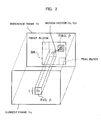
- FIG. 2 is a view for explaining an outline of block matching algorithm. Below, the outline of algorithm will be explained with reference to FIG. 2.
- a motion vector of a focused pixel Fc (x, y) in the current frame Fc is obtained by calculating a differential absolute value sum of corresponding pixels in pixels in a reference block range (L ⁇ L) having the focused pixel Fc (x, y) at its center and pixels in the same block range as the above block range (L ⁇ L) in a search area SR in the reference frame Fr.
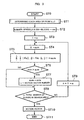
- a search area SR using as a reference the same position in the reference frame as the position (x, y) of the focused pixel is determined after starting processing ST0.
- the maximum value of a calculation formula is substituted to initialize a variable "min" storing the minimum value of a calculation result.
- a variable "min" storing the minimum value of a calculation result.
- a counter variable "n" for counting blocks in a search area SR is initialized to be "1".
- a variable "sum” for being substituted a calculation result is initialized to be "0".
- step ST5 assuming that a range of a reference block is L ⁇ L, a pixel in a certain block in the current frame is Fc (i, j), and a pixel in the k-th block in the search area SR of the reference frame Fr is Frk (i, j), calculation of a differential absolute value sum of corresponding pixels, that is, the formula 1 below is performed and the calculation result is substituted for "sum”.
- step ST6 the relationship of large and small is distinguished between the calculated differential absolute value sum "sum” and the minimum value "min” of the differential absolute value sum.
- the procedure proceeds to a step ST7, while when it is larger (including being equal), the calculation result is not the minimum value, so that the step ST7 is skipped and the procedure proceeds to a step ST8.
- the calculation result "sum” is updated by the minimum value "min”, and a counter value "n" of the block as a motion vector number is set.
- step ST8 if the block counter value "n" is the total number of blocks in the search area SR, that is, the final block comes, it means the finish, so the procedure proceeds to a step ST10, while if it is not the final block, the procedure proceeds to a step ST9.
- step ST9 the block counter value "n” is incremented to "n+1", and the procedure proceeds to the step ST4 to repeat the calculation.
- a motion vector is obtained from the center pixel and (x, y) of a block having a number stored in a motion number and output the same.
- An object of the present invention is to provide a memory device, a signal processing apparatus, an image processing apparatus and signal processing methods capable of performing matching processing, etc. only with a small amount of calculation and accurately detecting a motion vector, etc.
- a first aspect of the present invention is a memory device for storing information, characterized by comprising an input/output means for receiving or outputting the information; and a storage portion for storing the information; wherein the storage portion is at least controlled by an address corresponding to a feature of a focused data in a predetermined signal; and the information is a position information of the focused data in the predetermined signal.
- the memory device is a semiconductor device.
- a second aspect of the present invention is a signal processing apparatus for performing matching processing by using a first signal including a plurality of first data and a second signal including a plurality of second data, characterized by comprising a first feature extraction means for extracting a feature as focused data being data at a focused position in the first signal; and a storage means for storing position information of the second data at a position specified by an address corresponding to the feature of each of the second data; wherein the position information of the second data corresponding to the focused data is obtained by reading the position information to the second data stored in the storage means at an address corresponding to the feature of the focused data.
- the storage means stores the position information of the second data in advance.
- the above signal processing apparatus further comprises a second feature extraction means for extracting a feature of each of second data in the second signal.
- the first feature extraction means further comprises a second feature extraction means for extracting a feature of each of second data in the second signal.
- the first or second signal is an image signal.
- the feature is extracted by using a predetermined number of first or second data.
- the feature is a distribution of values of a predetermined number of first or second data.
- the first or second data is expressed by a plurality of bits
- the feature is a distribution of values of the predetermined number of first or second data wherein predetermined bits are omitted from the plurality of bits.
- the predetermined bits are lower side bits of the first or second data.
- the feature is a distribution of values of predetermined number of re-quantized first or second data.
- a feature is a distribution of values of predetermined number of first or second data subjected to adaptive quantization.
- the adaptive quantization is an ADRC.
- the position information having the shortest distance to a position of the focused data is regarded as position information of the second data corresponding to the focused data.
- a third aspect of the present invention is an image signal processing device for detecting motion vectors by using a first image signal including a plurality of first data and a second image signal including a plurality of second data, characterized by comprising a first feature extraction means for extracting a feature as focused data being data at a focused position in the first image signal; a storage means for storing position information of the second data at a position specified by an address corresponding to the feature of each of the second data; and a motion vector calculation means for obtaining position information of the second data corresponding to the focused data by reading position information of the second data stored in the storage means at an address corresponding to the feature of the focused data and calculating a motion vector of the focused data by using position information of the focused data and the obtained position information of the second data.
- the motion vector calculation means regards the position information having the shortest distance to a position of the focused data as position information of the second data corresponding to the focused data.
- a fourth aspect of the present invention is a signal processing method for performing matching processing by using a first signal including a plurality of data and a second signal including a plurality of second data, comprising a first step for extracting a feature as focused data being data at a focused position in the first signal; a second step for storing position information of the second data at a position specified by an address corresponding to the feature of each of the second data; and a third step for obtaining position information of the second data corresponding to the focused data by reading position information to the second data stored in the second step at an address corresponding to the feature of the focused data.
- a fifth aspect of the present invention is an image signal processing method for detecting a motion vector by using a first image signal including a plurality of first data and a second image signal including a plurality of second data, comprising a first step for extracting a feature as a focused data being data of a focused position in the first images signal; a second step for storing position information of the second data at a position specified by an address corresponding to the feature of each of the second data; a third step for obtaining position information of the second data corresponding to the focused data by reading position information to the second data stored in the storage means at an address corresponding to the feature of the focused data; and a fourth step for calculating a motion vector of the focused data by using position information of the focused data and the obtained position information of the second data.
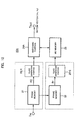
- FIG. 4 is a block diagram showing a signal processing device having a basic configuration of a motion detection device as a principal part of an image signal processing apparatus according to the present invention.
- the signal processing apparatus is for accurately estimating position information (a motion vector) with a small amount of calculation by performing processing of obtaining (determining) position information of second data corresponding to focused data by reading the position information of second data included in a second signal stored in a motion detection memory (hereinafter, referred to as an ME memory) at an address corresponding to a feature of the focused data being data at a focused position in a first signal including a plurality of first data.
- a motion detection memory hereinafter, referred to as an ME memory
- the ME memory (a feature address, i) indicates data stored at a position specified by an address (a feature address, i) in the ME memory.
- the signal processing apparatus 10 comprises a first data storing portion 11, a second data storing portion 12, an ME memory 13 and a matching portion 14.
- first data storing portion 11 configures a first feature extraction means according to the present invention
- second data storing portion 12 configures a second feature extraction means according to the present invention
- the ME memory 13 configures a storage means according to the present invention
- the matching portion 14 configures a motion vector calculation means (matching means) according to the present invention.
- the first data storing portion 11 stores a first signal including a plurality of first data input from an input terminal TIN.
- the first data storing portion 11 receives as an input the next first signal and stores this next first signal and outputs the previously stored first signal as a second signal including a plurality of second data to the second data storing portion 12 and the matching portion 14.
- the first data storing portion 11 extracts a feature of a focused data being data at a focused position from the stored first signal and supplies feature information including position information of the focused data to the matching portion 14.
- the second data storing portion 12 stores the previous (for example, one time before) second signal stored in the first data storing portion 11, extracts a feature of each of the second data from the stored second signal and stores in the ME memory 13.
- FIG. 5 is a block diagram showing an example of a configuration of the first and second data storing portions.
- the first and second data storing portions respectively comprises a memory 111 and a feature extraction portion 112 for extracting a feature from the first or second signal stored in the memory 111.
- the ME memory 13 receives features of second data of the second signal in the second data storing portion 12 and stores position information of the second data at positions specified by addresses corresponding to the features of the second data.
- the matching portion 14 obtains (determines) position information of second data corresponding to the focused data by reading the position information of the second data included in the second signal stored in the ME memory 13 at an address corresponding to a feature of the focused data being data at a focused position input from the first data storing portion 11.
- the matching portion 14 ragards the above position information closest to a position of the focused data as position information of second data corresponding to the focused data.
- FIG. 6 is a block diagram showing an example of a configuration of a matching portion 14.
- the matching portion 14 comprises, as shown in FIG. 6, an input portion 141, a read portion 142 for reading the position information of the second data included in the second signal stored in the ME memory 13 at an address corresponding to a feature of the focused data being data of a focused position based on feature information from the input portion 141, and a determination portion 143 for determining position information of the second data corresponding to the focused data based on the position information of the first data from the input portion 141 and the information read from the ME memory 13.
- the determination portion 413 determines as a motion vector and output the same.
- first and second signals are, for example, image signals.
- feature extraction in the first and second data storing portions 11 and 12 is performed by using predetermined number of first and second data.
- the feature is a distribution of values of the predetermined number of first or second data.
- the first and second data is expressed by a plurality of bits, and the feature is a distribution of values of the above predetermined number of first or second data excluding predetermined bits from the above plurality of bits.
- the predetermined bits are lower side bits of the first or second data.
- the feature is a distribution of values of predetermined number of re-quantized first or second data.
- the feature is a distribution of values of predetermined number of first or second data subjected to adaptive quantization, and the adaptive quantization is ADRC (Adaptive Dynamic Range Coding).
- ADRC Adaptive Dynamic Range Coding
- FIG. 7 is a block diagram showing a first embodiment of a motion detection device as a principal part of an image processing apparatus according to the present invention.
- the motion detection device is provided with an ME memory for storing position information by using a feature as an address and performs matching processing by using a surrounding pixel value as a feature, so that motion vectors can be accurately estimated with a little amount of calculation.
- the motion detection device 20 comprises a second frame memory 21 as a first data storing portion and a second frame memory 22 as a second data storing portion, an ME memory 23 and a matching portion 24 as a matching portion.
- first frame memory 21 configures the first feature extraction means according to the present invention
- second frame memory 22 configures the second feature extraction means according to the present invention
- the ME memory 23 configures the storing means according to the present invention
- the matching portion 24 configures the motion vector calculation means (matching means) according to the present invention.
- the first frame memory 21 stores an information of one frame of an image signal input from an input terminal TIN.
- the first frame memory 21 stores previously stored frame information, that is, the information of the current frame Fc and outputs the information of the current frame Fc to the second frame memory 22 and the matching portion 24.
- the first frame memory 21 supplies a feature of the focused pixel, that is, address information together with information of the current frame Fc to the matching portion 24.
- the second frame memory 22 stores previous (for example, one time before) frame information stored in the first frame memory 21 as information of a reference frame Fr.
- the ME memory 23 stores information including position coordinates of the focused pixel corresponding to a feature by using the feature as an address as a pixel value of a certain block range having the focused pixel at its center based on the information of the reference frame Fr stored in the second frame memory 22.
- the matching portion 24 reads storage information in the ME memory 23 by using the feature of the focused pixel included in the information of the current frame Fc supplied from the first frame memory 21 as a feature address. Differential coordinates based on the focused pixel in the current frame and the stored information read from the ME memory 23 are output as a motion vector (Vx, Vy) of the focused pixel from a terminal TOUT. Note that when there are a plurality of stored information (position coordinates) in a feature address corresponding to the feature of the focused pixel, a motion vector by which a position and distance of the focused pixel become the minimum among the plurality of candidates is output.
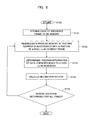
- FIG. 8 is a flowchart showing an outline of motion vector detection according to the present embodiment.
- step ST21 data of the reference frame Fr is stored in the ME memory 23 (step ST21).
- the matching portion 24 reads data from the ME memory 13 at a feature address in accordance with a feature of a pixel Ln in the current frame Fc (Step ST22).
- the matching portion 24 determines the position information of data corresponding to the pixel Ln in the read data (step ST 23). Then, motion vectors are calculated until motion vectors of all pixels are obtained (steps ST23 and ST24).
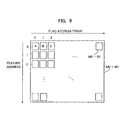
- FIG. 9 is a view showing an example of a configuration of the ME memory wherein the feature address system is applied. Also, FIG. 10 is a flowchart for explaining a procedure of storing information of the reference frame in the ME memory.
- the conventional memory is for storing pixel value by using the position information of a pixel as an address, while the ME memory 23 stores for every feature position information of a pixel having the feature in flag addresses FRGA1, 2, ..., that is, B, C... in FIG. 9 successively.
- one cell ME-B1 has a storage capacity of an amount of position information. Also, the number of position information stored for the feature is stored in a flag address FRGA0.
- the feature is a pixel value in a certain block having a focused pixel at its center.
- a block range is 3 ⁇ 3
- the vertical direction is "i”
- the horizontal direction is "j”
- a pixel value of a position (i, j) is L(i, j)
- a feature in this case becomes as in the next formula (2). ⁇ L(i-1, j-1), L(i-1, j), L(i-1, j+1), L(i, j-1), L(i, j), L(i, j+1), L(i+1, j-1), L(i+1, j), L(i+1, j+1) ⁇
- step ST101 all data in the ME memory is initialized to be “0" by writing "0" or turning on a reset signal.
- a counter variable "n" for counting pixels in one frame memory is initialized to be "0".
- a pixel value of a certain block range having the focused pixel Ln at its center is regarded as a feature (a feature address) in the frame memory 21 in FIG. 4.
- a content in the ME memory (a feature, 0) is incremented by one.
- a feature address is set to be the feature in the step ST103 and the ME memory (a feature, 0) as a content of the ME memory 23 when a flag address is "0" is set to a read flag address.
- the position information of the focused pixel Ln is written to a content of the ME memory (a feature, flag address) as a content of the ME memory 13.
- step ST106 the counter variable "n" is incremented.
- step ST107 whether the focused pixel Ln is the final pixel in the frame or not is judged. When it is not the final pixel, the procedure proceeds to the step ST103 and the same processing is repeated on the next pixel.
- FIG. 11 is a flowchart for explaining the processing procedure of motion vector detection according to the present embodiment.
- step ST201 after storing information of the current frame Fc and the reference frame Fr respectively in the frame memories 21 and 22, information of the reference frame is stored in the ME memory 23 while converting it to a feature address.
- the steps ST100 to ST109 The details are explained above (the steps ST100 to ST109).
- the counter variable "n" for counting pixels in one frame is initialized to be "0".
- a feature of the focused pixel Ln in the first current frame 21 is a pixel value of a certain block range having the focused pixel at its center, so it is sent as a feature to the matching portion 24.
- the matching portion 24 reads a value of a content ME memory (a feature address, 0) from the ME memory 23 by using the received feature as a feature address and substitutes for a variable "kn" meaning the number of options.
- variable "k” meaning a counter of the number of options is initialized to be "1”
- a variable “min” meaning the minimum value of a distance is initialized to be ⁇ or a sufficiently large value
- a variable "L” meaning a distance is initialized to be "0”.
- step ST206 the distinction of large and small between the distance L obtained in the step ST205 and the minimum value "min" of the distance are performed.
- the minimum value "min” of the distance is updated to be L.
- a flag address value that is, "k” is stored to a variable "ans”.
- step ST208 whether the candidate counter indicates the number of candidates or not is judged, and when it is the number of candidates, the procedure proceeds to a step ST210, while when there are still other candidates, the procedure proceeds to the step ST209.
- step ST209 the candidate counter "k" is incremented, then, the procedure proceeds to the step ST 205.
- the position information having the minimum distance to the pixel Ln in the current frame that is, a value of a content ME memory (a feature address, ans) of the ME memory 23 is read and the differential coordinates are regarded as a motion vector.
- a motion vector of the focused pixel is output.
- a counter variable "n" of pixels is incremented.
- step ST213 whether the focused pixel is the final pixel in the current frame or not is judged. As a result of the judgment, when it is the final pixel the procedure proceeds to a step ST214, while not, the procedure proceeds to the step ST203 to obtain a motion vector of the next pixel.
- a first frame memory 21 for storing information of a current frame Fc and outputting address information as a feature of a focused pixel together with the information of the current frame Fc; a second frame memory 12 for storing previous (one time before) frame information stored in the first frame memory 21 as information of a reference frame Fr; an ME memory 23 for converting a feature including a pixel value of a certain block range having the focused pixel at its center based on the information of the reference frame Fr stored in the second frame memory 22 and storing information including position information after the conversion; and a matching portion 24 for reading storage information in the ME memory 23 by using a feature of the focused pixel included in the information of the current frame Fc supplied from the first frame memory 21 as a feature address, calculating a distance between the focused pixel in the current frame and the feature address (position coordinates) read from the ME memory 23, and detecting the differential coordinates based on the position information having the minimum distance in a plurality of candidates as a motion vector (Vx,
- spatial pattern information in a block area is used as a feature and calculation and comparison of a distance are performed only for exactly the number of candidates, so that there is an advantage that highly accurate motion vector detection becomes possible with a smaller amount of calculation than that in the conventional method.
- storage information in the ME memory 23 does not have to be the whole information of one frame and may be divided to some areas.
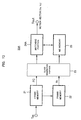
- FIG. 12 is a block diagram showing a second embodiment of a motion detection device as an image processing apparatus according to the present invention.
- a different point in the present second embodiment from the first embodiment explained above is that matching with a preferable feature becomes possible by providing class generation portions 25-1 and 25-2 as feature generation means for obtaining a feature.
- the configuration of providing one class generation portion 25 as in FIG. 13 is also possible.
- the circuit it also has functions of the class generation portion 25-1 and 25-2.
- the class generation portion 25-1 receives information of a current frame Fc of the first frame memory 21, generates a quantization code based on the ADRC as a feature of the current frame and outputs to a matching portion 24A.
- the class generation portion 25-2 receives information of a reference frame Fr of the second frame memory 22, generates a quantization code based on the ADRC as a feature of the current frame and outputs to the ME memory 23.
- the matching portion 24A reads storage information of the ME memory 23 by using a feature of the current frame as a feature address and performs matching of a focused pixel in a current frame and quantization codes of the ADRC included in the feature address read from the ME memory 23 to detect a motion vector of the focused pixel.
- the ADRC is used for generating a feature in the class generation portions 25-1 and 25-2 according to the second embodiment.
- the ADRC Adaptive Dynamic Range Coding
- VTR Video Tape Recorder
- the ADRC is an adaptive quantization method developed for high performance coding of a VTR (Video Tape Recorder) and is capable of effectively expressing a partial pattern of a signal level with a short word length, so that the ADRC is used for code generation of spatial class division in the second embodiment.
- the ADRC is an algorithm for performing re-quantization by evenly dividing between the maximum value MAX and the minimum value MIN by a specified bit length by the formula 3 below, wherein a dynamic range of a spatial class tap is DR, a bit assignment is n, a data level of a pixel of a spatial class tap is L and a re-quantization code is Q.
- DR MAX - MIN + 1
- Q ⁇ (L-MIN+0.5) ⁇ 2 n ⁇ DR ⁇
- all pixels may be used as shown in FIG. 14A or it may be configured to be the shape of a cross, and it may be determined within a limit of an information amount given to the class code.
- the example in FIG. 14C is the case of configuring to be the shape of a cross
- the example in FIG. 14D is the case of configuring to be the shape of a cross and, furthermore, using pixels at corners.
- FIG. 15A and FIG. 15B show a pixel value when certain one line of an image is moved from a reference frame to a current frame for facilitating understanding. Also, FIG. 16 shows a correspondence relationship of decimal number expression and hexadecimal number expression of luminance values.
- the point is whether or not it is possible to correctly detect as the same pattern.
- a coding result in the case of masking lower bits to suppress an effect of noise components when using a surrounding pixel value as a feature is listed.
- quantization coding by the ADRC is resistible to small level fluctuations due to capability of effectively expressing a partial pattern of a signal level with a short word length, and the same coding result can be obtained.
- an ADRC code of a certain line of the reference frame is "01101”
- an ADRC code of a certain line of the current frame is also "01101”, so that the two match.
- a memory device corresponding to motion vector detection was explained. Therefore, a memory device for storing spatial coordinates by using each feather quantity as an address was taken as an example.
- the present invention can be applied to systems performing matching other than motion vector detection.
- a memory device for storing information on first data, characterized by comprising an input means for receiving as an input a first feature indicating a first feature (address) of focused data in second data being different from the above first data;
- a second feature indicating a feature B (second feature) of data may be stored by using each first feature indicating a feature A (first feature) of data as an address.
- the feature A and feature B can be suitably set/changed in accordance with an object of a system/device performing matching. For example, in the present embodiment, an explanation was made assuming that the feature A: a pixel value pattern / the ADRC code, and the feature B: coordinates, but other features may be also used.
- a signal processing apparatus According to a memory device, a signal processing apparatus, an image signal processing apparatus and a signal processing methods of the present invention, highly accurate motion vector detection becomes possible, so that they are applicable to processing requiring matching, such as a motion detection device and an object search device used in a moving image compression apparatus, etc.
Landscapes
- Engineering & Computer Science (AREA)
- Multimedia (AREA)
- Signal Processing (AREA)
- Computer Vision & Pattern Recognition (AREA)
- Physics & Mathematics (AREA)
- General Physics & Mathematics (AREA)
- Theoretical Computer Science (AREA)
- Compression Or Coding Systems Of Tv Signals (AREA)
- Image Analysis (AREA)
- Television Signal Processing For Recording (AREA)
Abstract
Description

Claims (35)
- A memory device for storing information,
characterized by comprisingwhereinan input/output means for receiving or outputting said information; anda storage portion for storing said information;said storage portion is at least controlled by an address corresponding to a feature of a focused data in a predetermined signal; andsaid information is a position information of said focused data in said predetermined signal. - A memory device as set forth in claim 1, characterized in that said memory device is a semiconductor device.
- A signal processing apparatus for performing matching processing by using a first signal including a plurality of first data and a second signal including a plurality of second data, characterized by comprising:wherein:a first feature extraction means for extracting a feature as focused data being data at a focused position in said first signal; anda storage means for storing position information of said second data at a position specified by an address corresponding to said feature of each of said second data;the position information of said second data corresponding to said focused data is obtained by reading the position information to said second data stored in said storage means at an address corresponding to said feature of said focused data.
- A signal processing apparatus as set forth in claim 3, characterized in that said storage means stores the position information of said second data in advance.
- A signal processing apparatus as set forth in claim 3, characterized in that said signal processing apparatus further comprises a second feature extraction means for extracting a feature of each of second data in said second signal.
- A signal processing apparatus as set forth in claim 3, characterized in that said first feature extraction means further comprises a second feature extraction means for extracting a feature of each of second data in said second signal.
- A signal processing apparatus as set forth in claim 3, characterized in that said first or second signal is an image signal.
- A signal processing apparatus as set forth in claim 3, characterized in that said feature is extracted by using a predetermined number of first or second data.
- A signal processing apparatus as set forth in claim 8, characterized in that said feature is a distribution of values of a predetermined number of first or second data.
- A signal processing apparatus as set forth in claim 9, characterized in that:said first or second data is expressed by a plurality of bits; andsaid feature is a distribution of values of said predetermined number of first or second data wherein predetermined bits are omitted from said plurality of bits.
- A signal processing apparatus as set forth in claim 10, characterized in that said predetermined bits are lower side bits of said first or second data.
- A signal processing apparatus as set forth in claim 8, characterized in that said feature is a distribution of values of predetermined number of re-quantized first or second data.
- A signal processing apparatus as set forth in claim 8, characterized in that said feature is a distribution of values of predetermined number of first or second data subjected to adaptive quantization.
- A signal processing apparatus as set forth in claim 13, characterized in that said adaptive quantization is an ADRC.
- A signal processing apparatus as set forth in claim 3, characterized in that, when a plurality of position information of said second data corresponding to a feature of said focused data are read from said storage means, said position information having the shortest distance to a position of said focused data is regarded as position information of said second data corresponding to said focused data.
- An image signal processing apparatus for detecting motion vectors by using a first image signal including a plurality of first data and a second image signal including a plurality of second data, characterized by comprising:a first feature extraction means for extracting a feature as focused data being data at a focused position in said first image signal;a storage means for storing position information of said second data at a position specified by an address corresponding to said feature of each of said second data; anda motion vector calculation means for obtaining the position information of said second data corresponding to said focused data by reading the position information of said second data stored in said storage means at an address corresponding to said feature of said focused data and calculating a motion vector of said focused data by using position information of said focused data and the obtained position information of said second data.
- An image signal processing apparatus as set forth in claim 16, characterized in thatsaid image signal processing apparatus further comprises a second feature extraction means for extracting a feature of each of second data in said second image signal.
- An image signal processing apparatus as set forth in claim 16, characterized in thatsaid first feature extraction means further comprises a second feature extraction means for extracting a feature of each of second data in said second image signal.
- An image signal processing apparatus as set forth in claim 16, characterized in that
when a plurality of position information of said second data corresponding to a feature of said focused data are read from said storage means, said motion vector calculation means regards said position information having the shortest distance to a position of said focused data as position information of said second data corresponding to said focused data. - A signal processing method for performing matching processing by using a first signal including a plurality of data and a second signal including a plurality of second data, characterized by comprising:a first step for extracting a feature as focused data being data at a focused position in said first signal;a second step for storing position information of said second data at a position specified by an address corresponding to said feature of each of said second data; anda third step for obtaining the position information of said second data corresponding to said focused data by reading the position information to said second data stored in said second step at an address corresponding to said feature of said focused data.
- A signal processing method as set forth in claim 20, further including a fourth step for extracting a feature of each of second data in said second signal.
- A signal processing method as set forth in claim 20, characterized in thatsaid first step further includes a fourth step for extracting a feature of each of second data in said second signal.
- A signal processing method as set forth in claim 20, characterized in that said first or second signal is an image signal.
- A signal processing method as set forth in claim 20, characterized in that said feature is extracted by using a predetermined number of first or second data.
- A signal processing method as set forth in claim 24, characterized in that said feature is a distribution of values of a predetermined number of first or second data
- A signal processing method as set forth in claim 25, characterized in that:said first or second data is expressed by a plurality of bits; andsaid feature is a distribution of values of said predetermined number of first or second data wherein predetermined bits are omitted from said plurality of bits.
- A signal processing method as set forth in claim 26, characterized in that said predetermined bits are lower side bits of said first or second data.
- A signal processing method as set forth in claim 24, characterized in that said feature is a distribution of values of predetermined number of re-quantized first or second data.
- A signal processing method as set forth in claim 24, characterized in that said feature is a distribution of values of a predetermined number of first or second data subjected to adaptive quantization.
- A signal processing method as set forth in claim 29, characterized in that said adaptive quantization is an ADRC.
- A signal processing device as set forth in claim 20, characterized in that, when a plurality of position information of said second data corresponding to a feature of said focused data are read from said storage means, said position information having the shortest distance to a position of said focused data is regarded as position information of said second data corresponding to said focused data.
- An image signal processing method for detecting a motion vector by using a first image signal including a plurality of first data and a second image signal including a plurality of second data, characterized by comprising:a first step for extracting a feature as a focused data being data of a focused position in said first images signal;a second step for storing position information of said second data at a position specified by an address corresponding to said feature of each of said second data;a third step for obtaining position information of said second data corresponding to said focused data by reading position information to said second data stored in said storage means at an address corresponding to said feature of said focused data; anda fourth step for calculating a motion vector of said focused data by using position information of said focused data and the obtained position information of said second data.
- An image signal processing method as set forth in claim 32, characterized in that said image signal processing method further includes a fifth step for extracting a feature of each of second data in said second image signal.
- An image signal processing method as set forth in claim 32, characterized in that said first step further includes a fifth step for extracting a feature of each of second data in said second image signal.
- An image signal processing method as set forth in claim 32, characterized in that, when a plurality of position information of said second data corresponding to a feature of said focused data is read from said storage means, said third step regards said position information having the shortest distance to a position of said focused data as position information of said second data corresponding to said focused data.
Applications Claiming Priority (3)
| Application Number | Priority Date | Filing Date | Title |
|---|---|---|---|
| JP2002222008 | 2002-07-30 | ||
| JP2002222008 | 2002-07-30 | ||
| PCT/JP2003/009637 WO2004012450A1 (en) | 2002-07-30 | 2003-07-30 | Storage device, signal processor, and image signal processor, and their methods |
Publications (3)
| Publication Number | Publication Date |
|---|---|
| EP1526728A1 true EP1526728A1 (en) | 2005-04-27 |
| EP1526728A4 EP1526728A4 (en) | 2008-05-28 |
| EP1526728B1 EP1526728B1 (en) | 2013-02-27 |
Family
ID=31184888
Family Applications (1)
| Application Number | Title | Priority Date | Filing Date |
|---|---|---|---|
| EP20030771418 Expired - Lifetime EP1526728B1 (en) | 2002-07-30 | 2003-07-30 | Mage signal processor and method |
Country Status (7)
| Country | Link |
|---|---|
| US (1) | US7800624B2 (en) |
| EP (1) | EP1526728B1 (en) |
| JP (1) | JP4337738B2 (en) |
| KR (1) | KR100964621B1 (en) |
| CN (1) | CN1326394C (en) |
| TW (1) | TWI287927B (en) |
| WO (1) | WO2004012450A1 (en) |
Families Citing this family (5)
| Publication number | Priority date | Publication date | Assignee | Title |
|---|---|---|---|---|
| US7636481B2 (en) * | 2002-10-09 | 2009-12-22 | Sony Corporation | Image processing apparatus, method, storage medium, and program for compressing an input image using a motion vector that is detected based on stored position information of pixels |
| CN100393125C (en) * | 2005-02-05 | 2008-06-04 | 威盛电子股份有限公司 | Methods for processing image frames |
| JP5322416B2 (en) * | 2007-09-12 | 2013-10-23 | 株式会社メガチップス | Block matching circuit and data update method |
| KR101452859B1 (en) | 2009-08-13 | 2014-10-23 | 삼성전자주식회사 | Method and apparatus for encoding and decoding motion vector |
| JP2012043051A (en) * | 2010-08-16 | 2012-03-01 | Fuji Xerox Co Ltd | Information processor and program |
Family Cites Families (25)
| Publication number | Priority date | Publication date | Assignee | Title |
|---|---|---|---|---|
| GB2050752B (en) * | 1979-06-07 | 1984-05-31 | Japan Broadcasting Corp | Motion compensated interframe coding system |
| JPS61107886A (en) | 1984-10-31 | 1986-05-26 | Sony Corp | Smoothins circuit of motion vector |
| CA1251555A (en) | 1984-12-19 | 1989-03-21 | Tetsujiro Kondo | High efficiency technique for coding a digital video signal |
| JPH0793724B2 (en) | 1984-12-21 | 1995-10-09 | ソニー株式会社 | High efficiency coding apparatus and coding method for television signal |
| US4754490A (en) * | 1987-05-22 | 1988-06-28 | Environmental Research Institute Of Michigan | Linked-list image feature extraction |
| JP2953712B2 (en) * | 1989-09-27 | 1999-09-27 | 株式会社東芝 | Moving object detection device |
| JPH0622301A (en) * | 1992-06-30 | 1994-01-28 | Sony Corp | Picture corder |
| JP3106749B2 (en) * | 1992-12-10 | 2000-11-06 | ソニー株式会社 | Adaptive dynamic range coding device |
| JP3271387B2 (en) | 1993-08-19 | 2002-04-02 | ソニー株式会社 | Motion amount detection device and motion amount detection method |
| JP3277417B2 (en) | 1993-09-09 | 2002-04-22 | ソニー株式会社 | Apparatus and method for detecting motion vector |
| JP3277419B2 (en) * | 1993-09-09 | 2002-04-22 | ソニー株式会社 | Apparatus and method for detecting motion vector |
| JP3606597B2 (en) * | 1994-01-21 | 2005-01-05 | ソニー株式会社 | Motion vector detection device |
| JPH0865681A (en) * | 1994-08-25 | 1996-03-08 | Sony Corp | Motion vector detecting device and motion compensation predictive coding system using the same |
| FR2728091B1 (en) | 1994-12-13 | 1997-01-31 | Thomson Consumer Electronics | MOTION VECTOR SELECTION METHOD AND IMAGE PROCESSING DEVICE USING THE SAME |
| KR0171143B1 (en) * | 1995-03-20 | 1999-03-20 | 배순훈 | Triangular Structure Forming Device in Hexagon Grid |
| US5809173A (en) * | 1995-04-18 | 1998-09-15 | Advanced Micro Devices, Inc. | Method and apparatus for improved video decompression using previous frame DCT coefficients |
| US5692063A (en) * | 1996-01-19 | 1997-11-25 | Microsoft Corporation | Method and system for unrestricted motion estimation for video |
| JPH09212650A (en) * | 1996-02-05 | 1997-08-15 | Sony Corp | Motion vector detection device and detection method |
| JP2914441B2 (en) * | 1996-12-27 | 1999-06-28 | 日本電気株式会社 | Motion detection method |
| US6259734B1 (en) * | 1998-04-03 | 2001-07-10 | Matsushita Electric Industrial Co., Ltd. | Image processing method, image processing apparatus, and data storage media |
| JP4161441B2 (en) * | 1998-12-24 | 2008-10-08 | ソニー株式会社 | Motion vector estimation apparatus and motion vector estimation method |
| FI110743B (en) * | 1999-06-28 | 2003-03-14 | Valtion Teknillinen | Procedure and arrangement for performing a motion estimation |
| US6661842B1 (en) * | 2000-09-22 | 2003-12-09 | General Dynamics Decision Systems, Inc. | Methods and apparatus for error-resilient video coding |
| JP2002197061A (en) | 2000-12-25 | 2002-07-12 | Nec Corp | Method and system for user authentication, and recording medium with recorded user authentication program |
| JP4147456B2 (en) | 2002-03-29 | 2008-09-10 | 富士通株式会社 | Infrared image signal processor |
-
2003
- 2003-07-30 CN CNB038011794A patent/CN1326394C/en not_active Expired - Fee Related
- 2003-07-30 KR KR20047004679A patent/KR100964621B1/en not_active Expired - Fee Related
- 2003-07-30 WO PCT/JP2003/009637 patent/WO2004012450A1/en not_active Ceased
- 2003-07-30 EP EP20030771418 patent/EP1526728B1/en not_active Expired - Lifetime
- 2003-07-30 US US10/490,208 patent/US7800624B2/en not_active Expired - Fee Related
- 2003-07-30 JP JP2004524306A patent/JP4337738B2/en not_active Expired - Fee Related
- 2003-07-30 TW TW92120832A patent/TWI287927B/en not_active IP Right Cessation
Also Published As
| Publication number | Publication date |
|---|---|
| WO2004012450A1 (en) | 2004-02-05 |
| EP1526728B1 (en) | 2013-02-27 |
| JPWO2004012450A1 (en) | 2005-11-24 |
| KR100964621B1 (en) | 2010-06-21 |
| JP4337738B2 (en) | 2009-09-30 |
| CN1326394C (en) | 2007-07-11 |
| US7800624B2 (en) | 2010-09-21 |
| US20040252125A1 (en) | 2004-12-16 |
| TW200423714A (en) | 2004-11-01 |
| TWI287927B (en) | 2007-10-01 |
| EP1526728A4 (en) | 2008-05-28 |
| KR20050027206A (en) | 2005-03-18 |
| CN1565123A (en) | 2005-01-12 |
Similar Documents
| Publication | Publication Date | Title |
|---|---|---|
| EP1557840B1 (en) | Memory device, motion vector detection device, and detection method | |
| EP0446001A2 (en) | Motion vector detection circuit used in hierarchical processing of moving picture signal | |
| US7349588B2 (en) | Automatic meter reading | |
| JP4079375B2 (en) | Image stabilizer | |
| US20050163220A1 (en) | Motion vector detection device and moving picture camera | |
| CN112995679A (en) | Motion adaptive coding of video | |
| JPH08154251A (en) | Image signal interpolator | |
| EP1526728A1 (en) | Storage device, signal processor, and image signal processor, and their methods | |
| CN111652186A (en) | Video category identification method and related device | |
| CN110049230B (en) | Image processing apparatus and method for correcting image | |
| KR100843418B1 (en) | Apparatus and method for image coding | |
| CN117156287A (en) | Image compression system, method, device and medium | |
| US20050105620A1 (en) | Motion vector detecting device and motion vector detecting program | |
| CN1565124B (en) | Memory device, signal processing device, image signal processing device and signal processing method | |
| JPH08294129A (en) | Motion vector detection device and detection method | |
| JP4224999B2 (en) | Image processing apparatus and image processing method | |
| US20040126027A1 (en) | Apparatus for deciding and managing coding mode in image coding and method thereof | |
| US20110001882A1 (en) | Method and system for determining motion vectors for flat regions | |
| US7251278B1 (en) | Procedure and system for performing motion estimation | |
| CN115103196A (en) | Image coding method, electronic device, and medium | |
| JP2002305749A (en) | Moving detection method, video compression method, and moving prediction device | |
| US7016541B2 (en) | Image processing method for facilitating data transmission | |
| KR100792960B1 (en) | Apparatus and method for compensating for shaking motion in a mobile terminal | |
| KR20070048919A (en) | Broadcast receiver and method for capturing broadcast signal | |
| JP2004134911A (en) | Data processing apparatus and method, recording medium, and program |
Legal Events
| Date | Code | Title | Description |
|---|---|---|---|
| PUAI | Public reference made under article 153(3) epc to a published international application that has entered the european phase |
Free format text: ORIGINAL CODE: 0009012 |
|
| 17P | Request for examination filed |
Effective date: 20040330 |
|
| AK | Designated contracting states |
Kind code of ref document: A1 Designated state(s): AT BE BG CH CY CZ DE DK EE ES FI FR GB GR HU IE IT LI LU MC NL PT RO SE SI SK TR |
|
| AX | Request for extension of the european patent |
Extension state: AL LT LV MK |
|
| DAX | Request for extension of the european patent (deleted) | ||
| RBV | Designated contracting states (corrected) |
Designated state(s): DE FR GB |
|
| A4 | Supplementary search report drawn up and despatched |
Effective date: 20080424 |
|
| 17Q | First examination report despatched |
Effective date: 20081023 |
|
| REG | Reference to a national code |
Ref country code: DE Ref legal event code: R079 Ref document number: 60343389 Country of ref document: DE Free format text: PREVIOUS MAIN CLASS: H04N0005910000 Ipc: H04N0007260000 |
|
| GRAP | Despatch of communication of intention to grant a patent |
Free format text: ORIGINAL CODE: EPIDOSNIGR1 |
|
| RIC1 | Information provided on ipc code assigned before grant |
Ipc: H04N 7/26 20060101AFI20121002BHEP Ipc: H04N 7/50 20060101ALI20121002BHEP |
|
| GRAS | Grant fee paid |
Free format text: ORIGINAL CODE: EPIDOSNIGR3 |
|
| GRAA | (expected) grant |
Free format text: ORIGINAL CODE: 0009210 |
|
| AK | Designated contracting states |
Kind code of ref document: B1 Designated state(s): DE FR GB |
|
| REG | Reference to a national code |
Ref country code: GB Ref legal event code: FG4D |
|
| REG | Reference to a national code |
Ref country code: DE Ref legal event code: R096 Ref document number: 60343389 Country of ref document: DE Effective date: 20130425 |
|
| PLBE | No opposition filed within time limit |
Free format text: ORIGINAL CODE: 0009261 |
|
| STAA | Information on the status of an ep patent application or granted ep patent |
Free format text: STATUS: NO OPPOSITION FILED WITHIN TIME LIMIT |
|
| 26N | No opposition filed |
Effective date: 20131128 |
|
| REG | Reference to a national code |
Ref country code: DE Ref legal event code: R097 Ref document number: 60343389 Country of ref document: DE Effective date: 20131128 |
|
| GBPC | Gb: european patent ceased through non-payment of renewal fee |
Effective date: 20130730 |
|
| REG | Reference to a national code |
Ref country code: DE Ref legal event code: R119 Ref document number: 60343389 Country of ref document: DE Effective date: 20140201 |
|
| REG | Reference to a national code |
Ref country code: FR Ref legal event code: ST Effective date: 20140331 |
|
| PG25 | Lapsed in a contracting state [announced via postgrant information from national office to epo] |
Ref country code: GB Free format text: LAPSE BECAUSE OF NON-PAYMENT OF DUE FEES Effective date: 20130730 Ref country code: DE Free format text: LAPSE BECAUSE OF NON-PAYMENT OF DUE FEES Effective date: 20140201 |
|
| PG25 | Lapsed in a contracting state [announced via postgrant information from national office to epo] |
Ref country code: FR Free format text: LAPSE BECAUSE OF NON-PAYMENT OF DUE FEES Effective date: 20130731 |