EP1526680A2 - Probable cause fields in telecommunications network alarm indication messages - Google Patents
Probable cause fields in telecommunications network alarm indication messages Download PDFInfo
- Publication number
- EP1526680A2 EP1526680A2 EP04023177A EP04023177A EP1526680A2 EP 1526680 A2 EP1526680 A2 EP 1526680A2 EP 04023177 A EP04023177 A EP 04023177A EP 04023177 A EP04023177 A EP 04023177A EP 1526680 A2 EP1526680 A2 EP 1526680A2
- Authority
- EP
- European Patent Office
- Prior art keywords
- probable cause
- predetermined
- indication message
- alarm indication
- telecommunications network
- Prior art date
- Legal status (The legal status is an assumption and is not a legal conclusion. Google has not performed a legal analysis and makes no representation as to the accuracy of the status listed.)
- Ceased
Links
Classifications
-
- H—ELECTRICITY
- H04—ELECTRIC COMMUNICATION TECHNIQUE
- H04L—TRANSMISSION OF DIGITAL INFORMATION, e.g. TELEGRAPHIC COMMUNICATION
- H04L41/00—Arrangements for maintenance, administration or management of data switching networks, e.g. of packet switching networks
- H04L41/06—Management of faults, events, alarms or notifications
- H04L41/0686—Additional information in the notification, e.g. enhancement of specific meta-data
Definitions
- the present invention relates to methods of, apparatus for and computer programs for generating and processing data included in a probable cause field of a telecommunications network alarm indication message and to signals representing probable cause fields of telecommunications network alarm indication messages.
- Network management systems use information indicating a probable cause of a network event in performance monitoring and in operation and maintenance of telecommunications networks.
- a device in a network detects an event (such as a network element failure) it notifies the network management system by sending an alarm indication message.
- Information identifying the event is included in the alarm indication message in a field known as the "probable cause" field.
- the probable cause field is important because it enables a network operator to begin the process of diagnosis in order to fix any underlying problem.
- the alarm indication message also contains other useful fields such as the object instance (which describes the precise entity where the condition was detected); a timestamp, a severity indication, and so on.
- a list of probable cause codes is defined by the ITU-T in CCITT Recommendations M.3100 (1995) Generic Network Information Model; M.3100 Amendment 2 (1999): 1999; X.721 (1992) ISO/IEC 10165-2: Structure of management information: Definition of management information; and X.733 (1992) ISO/IEC 10164-4: Systems Management: Alarm reporting function.
- Other standards bodies, such as IETF, GSM and 3GPP have also defined standard probable cause codes.
- Another problem is that legacy network management applications or equipment that were developed before a new probable cause code is introduced is unable to understand and process an alarm indication message having that probable cause code and thus evolution or replacement of transport network equipment or software often requires a radical overhaul of network management systems as well.
- the present invention seeks to ameliorate the problems identified above.
- the present invention consists of:
- a method of generating data for inclusion in a probable cause field of a telecommunications network alarm indication message comprising:
- the first predetermined probable cause code identifies a condition effecting an entity of the network.
- the second predetermined probable cause code identifies an attribute of an entity of the network.
- the method comprising mapping the one or more characteristics of the event to a third predetermined probable cause code identifying a qualifier of the attribute, and wherein the generated comprises a third delimited data element indicating the third predetermined probable cause code.
- a method of generating a telecommunications network alarm indication message comprising generating data for inclusion in a probable cause field of a telecommunications network alarm indication message according to the above method; and including the generated data in a telecommunications network alarm indication message.
- a method of processing a telecommunications network alarm indication message comprising:
- the first predetermined probable cause code identifies a condition effecting an entity of a telecommunications network.
- the first predetermined probable cause code identifies an attribute of an entity of a telecommunications network.
- the above method comprises
- the step of processing the alarm indication message comprises displaying the first predetermined probable cause code, or information derived therefrom, on a user display.
- the step of processing the alarm indication message comprises selecting the alarm indication message in dependence on whether the first predetermined probable cause code matches a predetermined criterion.
- a signal representing a probable cause field of a telecommunications network alarm indication message comprising first and second delimited data elements respectively indicating first and second predetermined probable cause codes, the first and second predetermined probable cause codes relating to one or more characteristics of an event occurring or having occurred in a telecommunications network.
- the first predetermined probable cause code identifies a condition effecting an entity of the network.
- the second predetermined probable cause code identifies an attribute of an entity of the network.
- the probable cause field comprises a third delimited data element indicating a third predetermined probable cause, the third predetermined probable cause code relating to the one or more characteristics of an event occurring or having occurred in a telecommunications network, the third predetermined probable cause code identifying a qualifier of the attribute.
- a signal representing a telecommunications network alarm indication message comprising a probable cause field, the probable cause field comprising first and second delimited data elements respectively indicating first and second predetermined probable cause codes, the first and second predetermined probable cause codes relating to one or more characteristics of an event occurring or having occurred in a telecommunications network.
- One advantage of the present invention is that it simplifies extension of standards defining probable cause information.
- new probable causes may be identified by either i) adding new first probable cause codes, while using existing standardised second probable cause codes; ii) adding new second probable cause codes, while using existing standardised first probable cause codes; or iii) adding both new first probable cause codes and new second probable cause codes.
- x*y new probable cause codes where x new conditions are identified for y new attributes of network entities, only x+y new probable cause codes need be standardised. Thus, the combinatory explosion of new possible conditions that may effect new network entities is avoided.
- Another advantage is that it improves the accuracy and precision with which the probable causes of network events may be communicated to network management systems.
- New network events may be mapped to a richer set of standardised probable cause information - ie the set of all valid combinations of first and second probable cause codes.
- the degree of precision with which each of the first and second data elements indicating first and second probable cause codes may be varied independently of each other.
- the attribute of a network entity effected may be indicated with high precision (such as "IAPDlinkProtocol") whereas the condition may be left vague (such as "fault”) or vice versa.
- new network management applications or equipment which can recognise probable cause information comprising first and second delimited data elements respectively indicating first and second predetermined probable cause codes can perform advanced processing of alarm indication messages.
- a network management application that filters (ie selects) alarm indication messages on the basis of prior art probable cause can only simply filter based on the entire probable cause.
- an attempt to filter alarm indication messages on "all failed items" would require either explicitly identifying all probable causes that involve failure or for the application to have these built in. The latter would require the application designer to attempt to anticipate all such possible filters and hard code the detailed prior art probable cause codes that these would implicitly reference. Any added new probable cause codes would not be included in the list, hence the application would need rebuilding to give an accurate response every time a new probable cause code was added to the list.
- the present invention allows the use simple filters (eg on any fail) without the application developer having to anticipate such filters. This is achieved because the notation described above separates the condition (eg fail) from the attribute (eg circuit pack).
- legacy network management applications or equipment developed before a new probable cause code is introduced may be able partially to recognise and process probable cause information comprising first and second delimited data elements respectively indicating first and second predetermined probable cause codes.
- a legacy application will be able partially to process probable cause information when a network entity exploits a new and unrecognised attribute against an existing and recognised condition or vice versa.
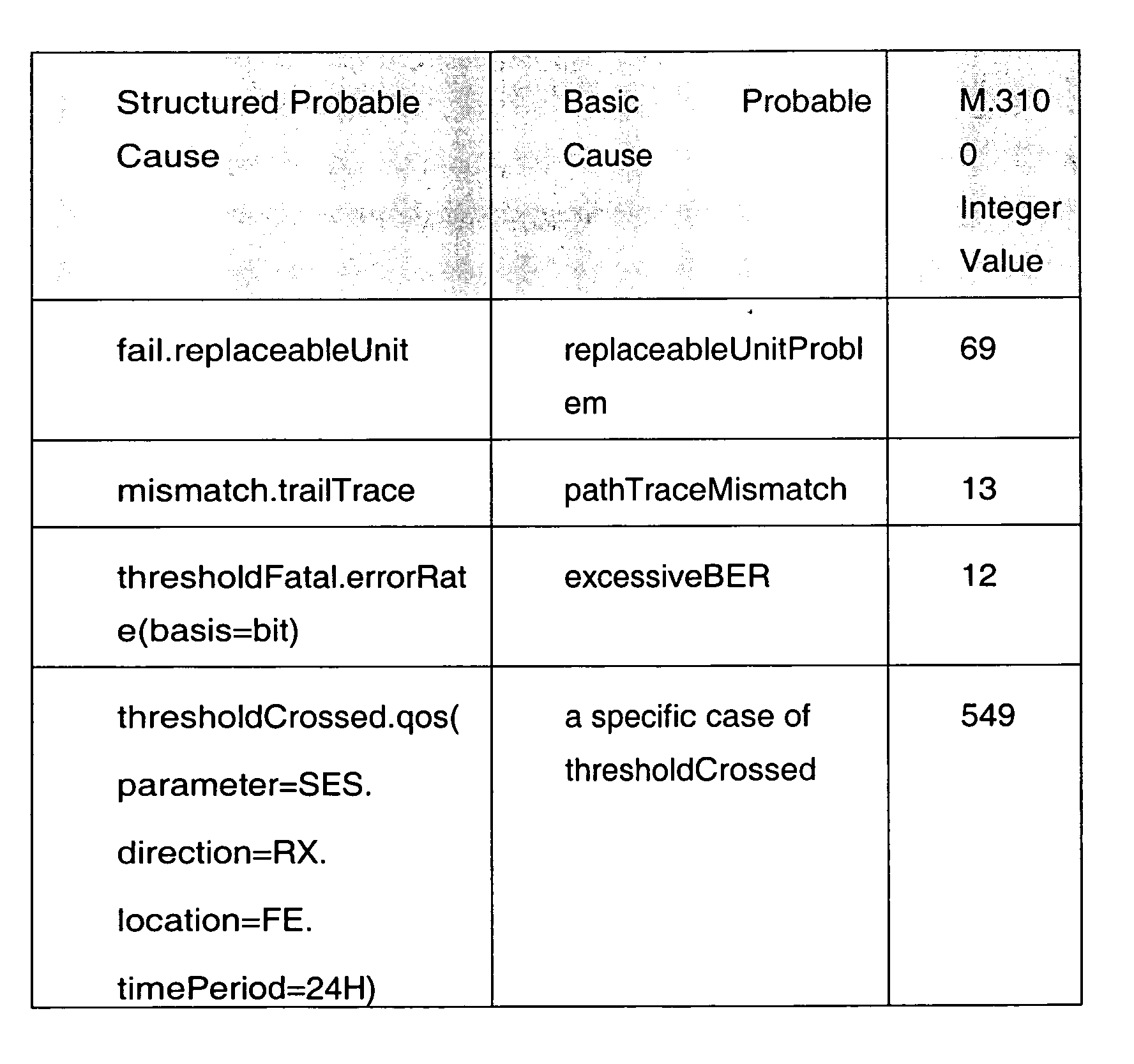
- the structure of the probableCauseText is as follows:
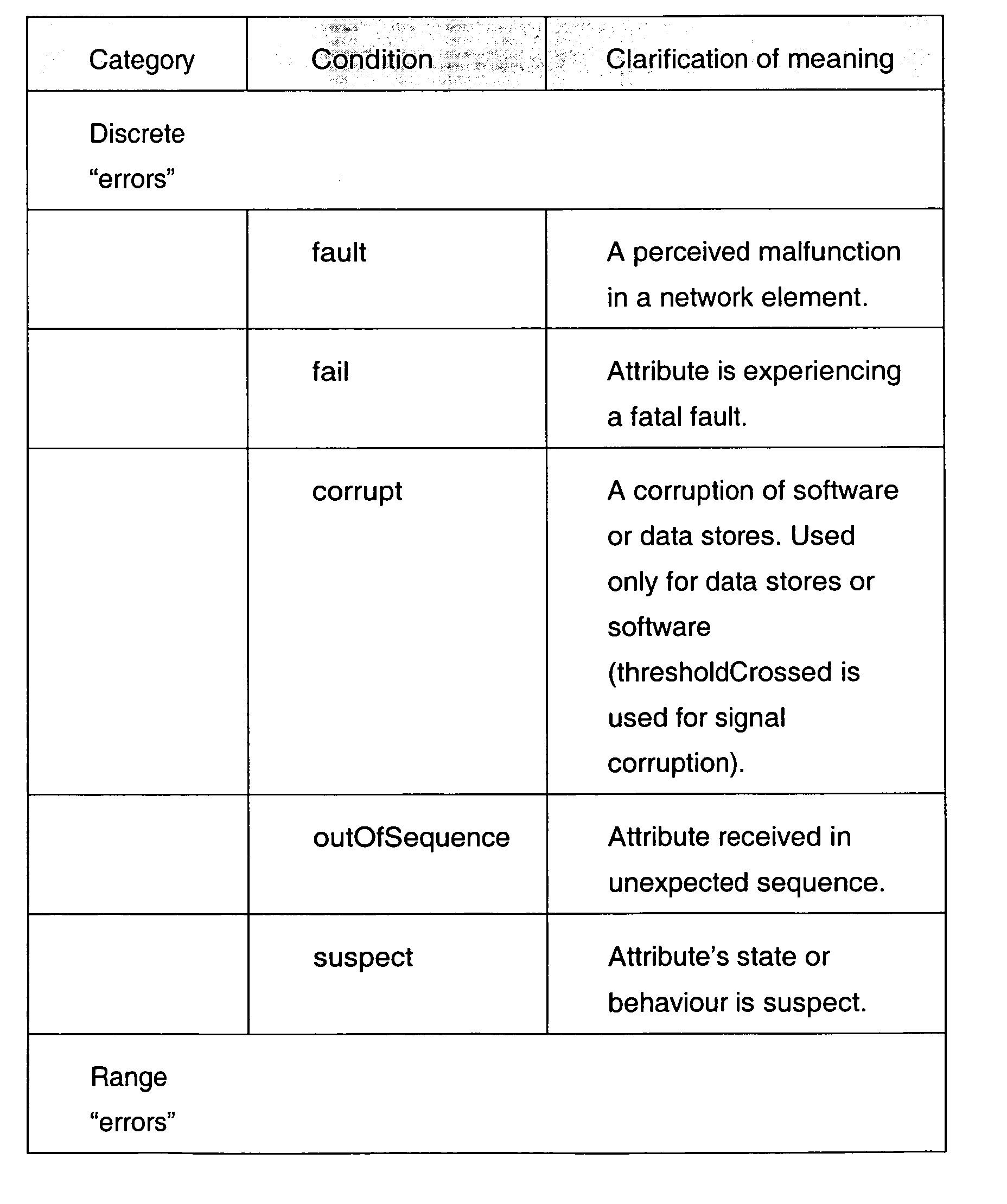
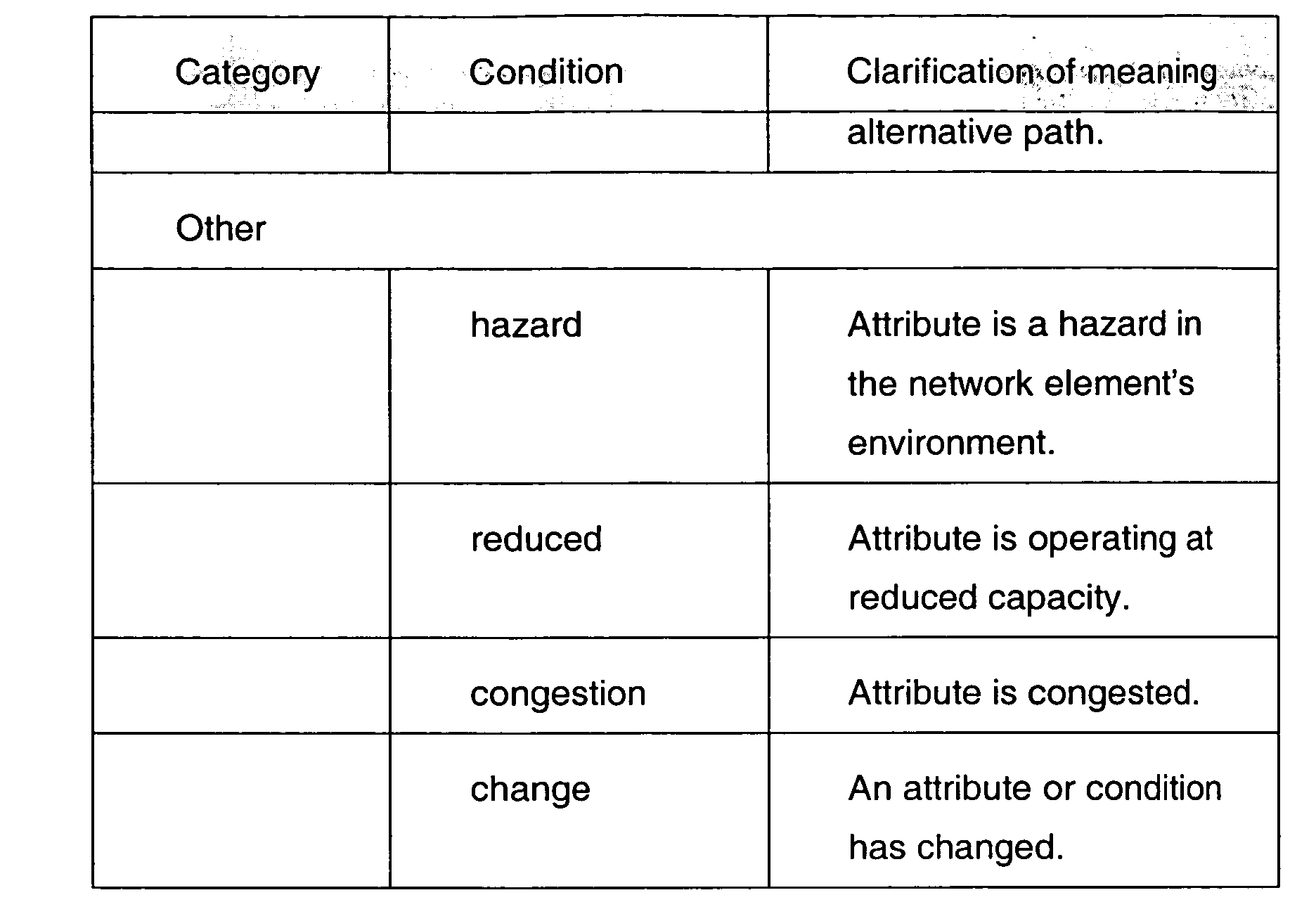
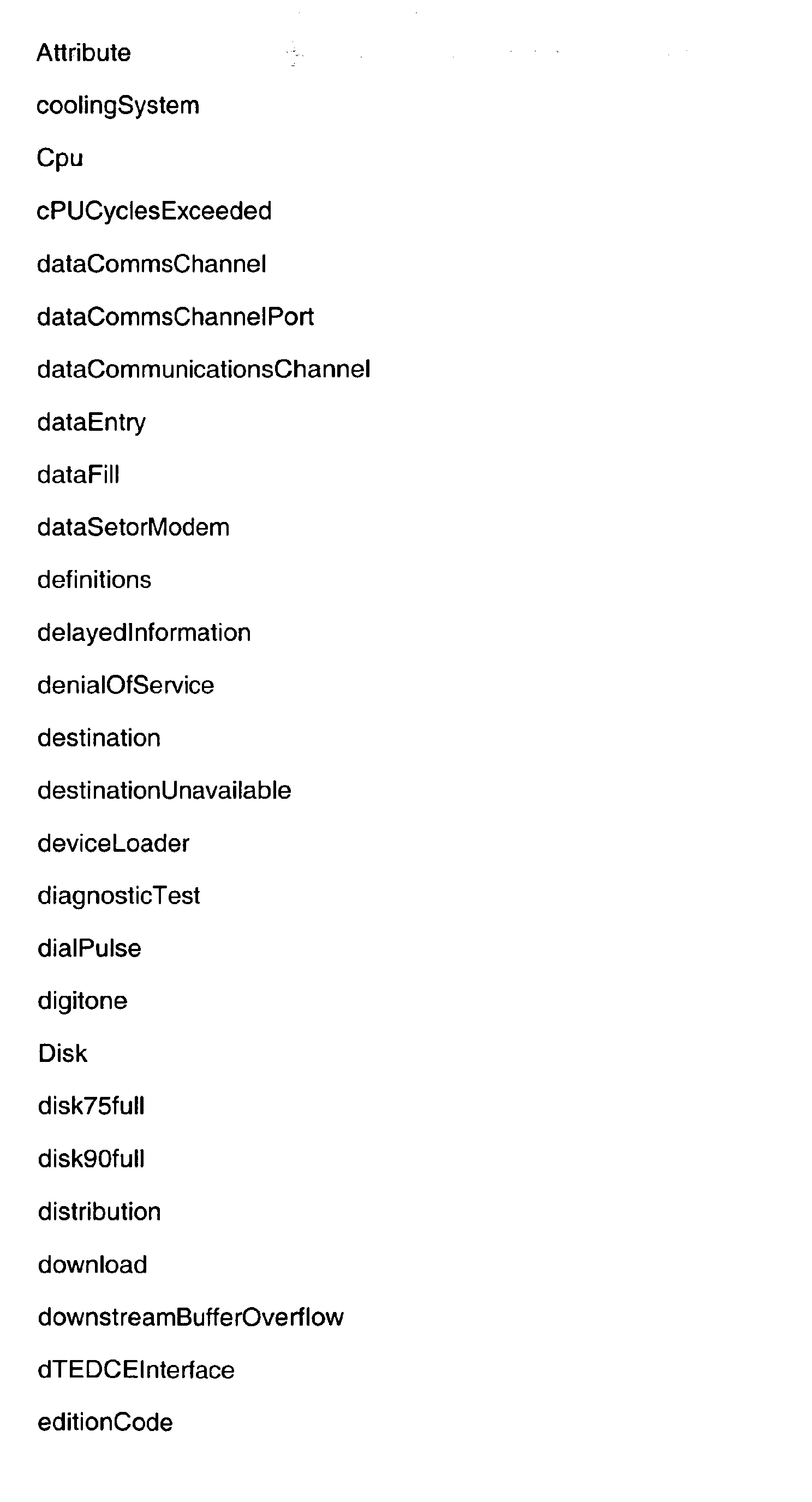
- This section contains the current list of valid condition values and their definitions.
- the list of conditions includes neutral conditions (e.g. inProgress) as well as negative conditions (e.g. fail). Conclusions cannot therefore be drawn on the basis of the condition alone.
- the condition needs to be considered in the context provided by the accompanying attribute.
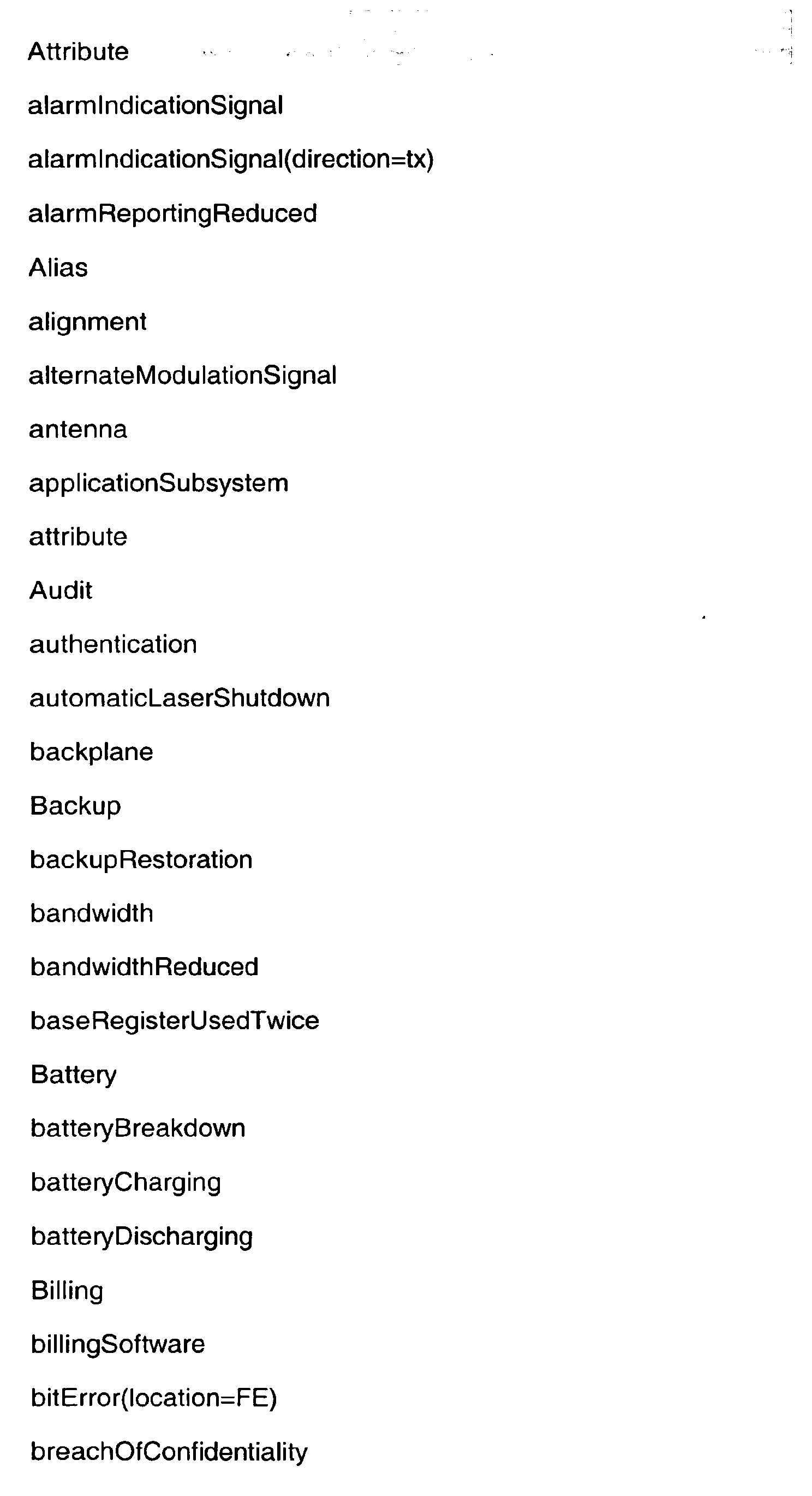
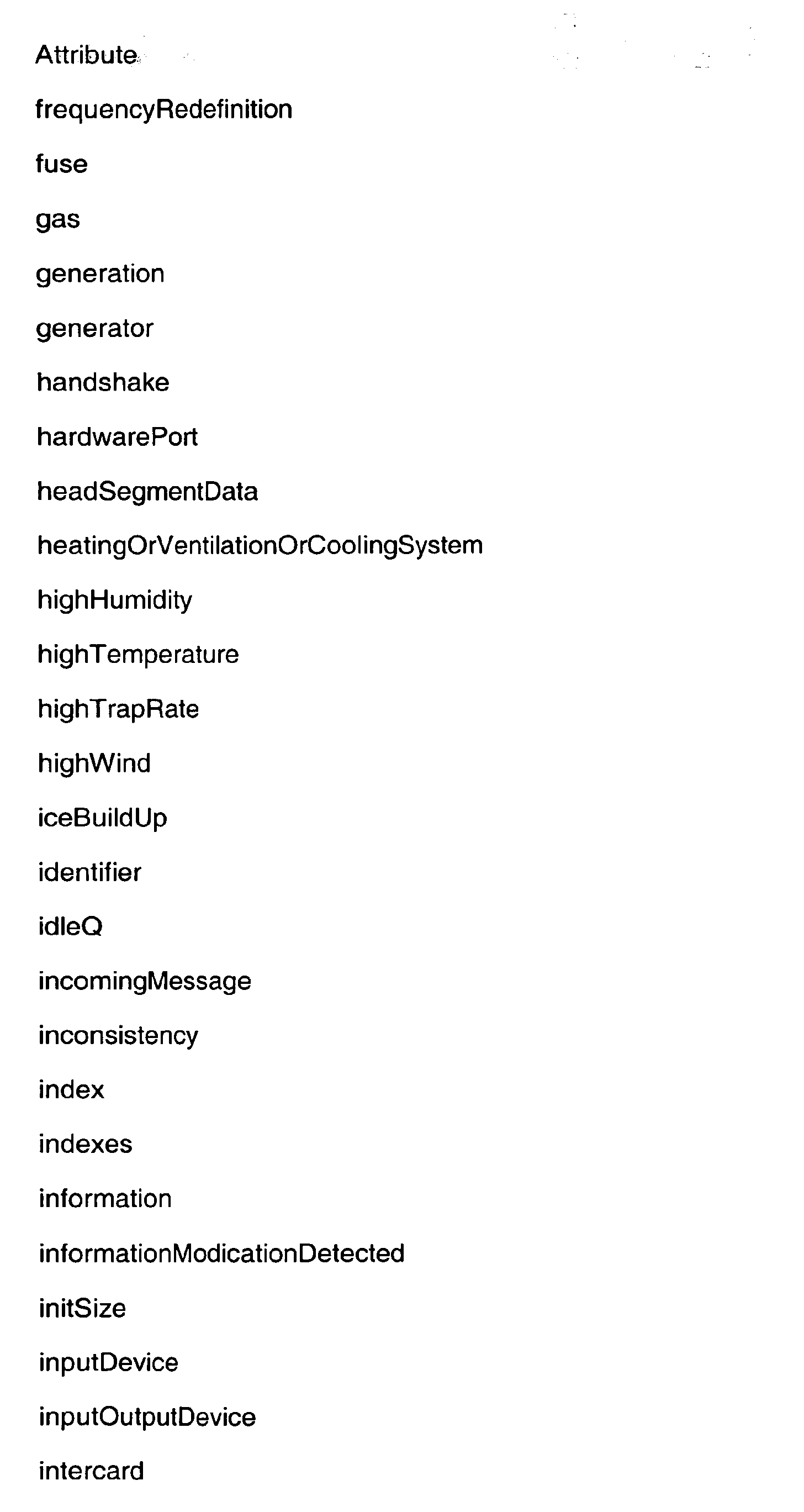
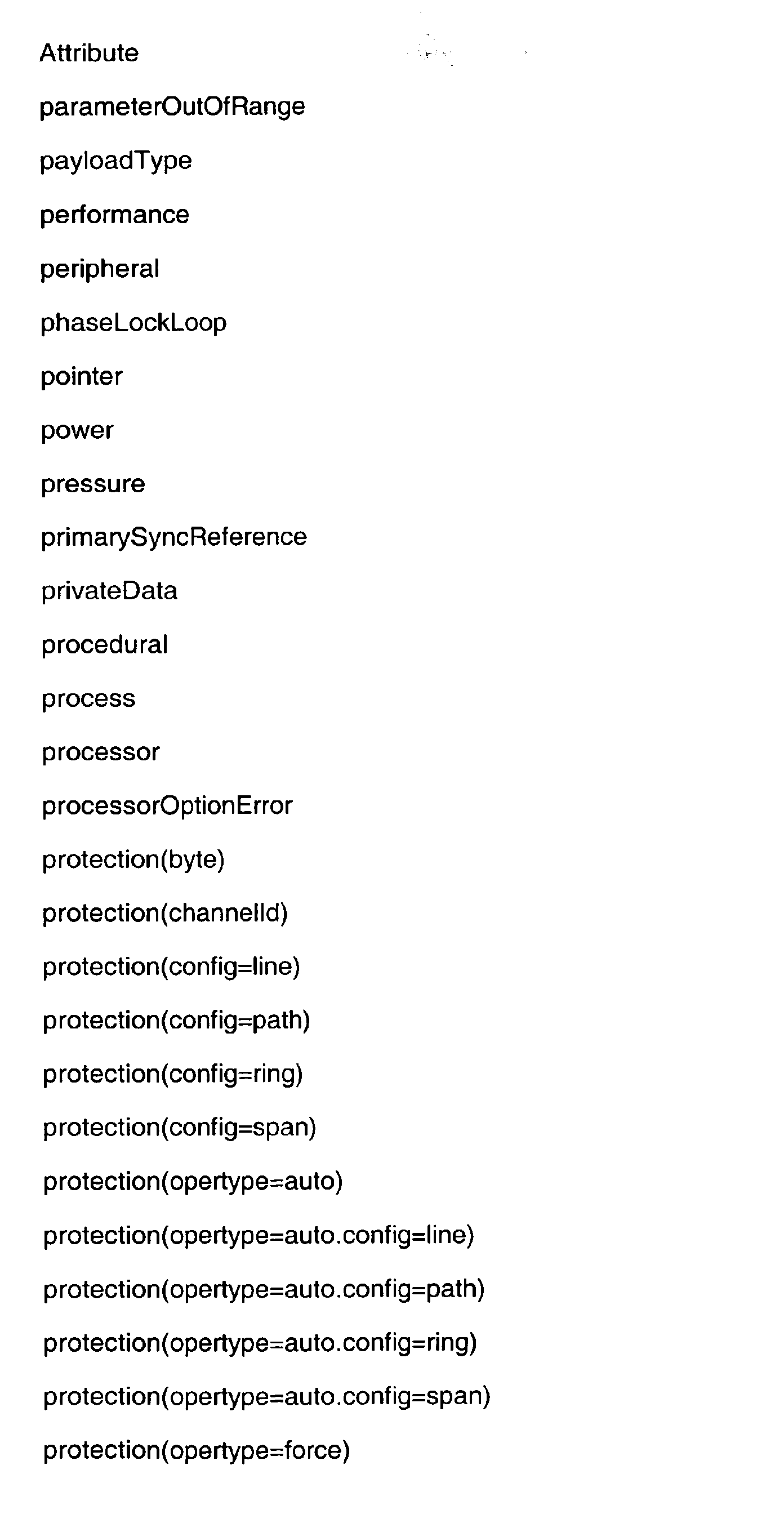
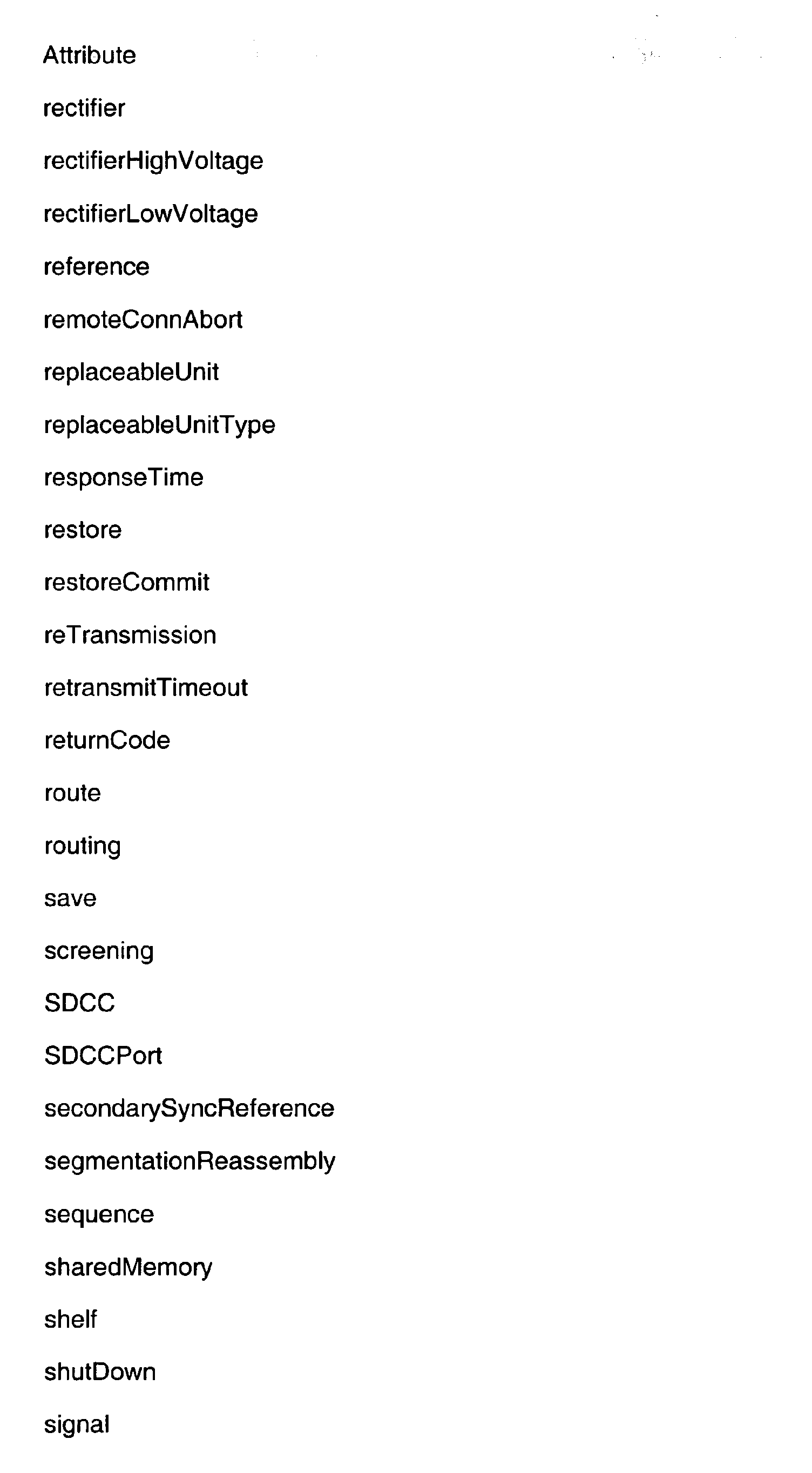
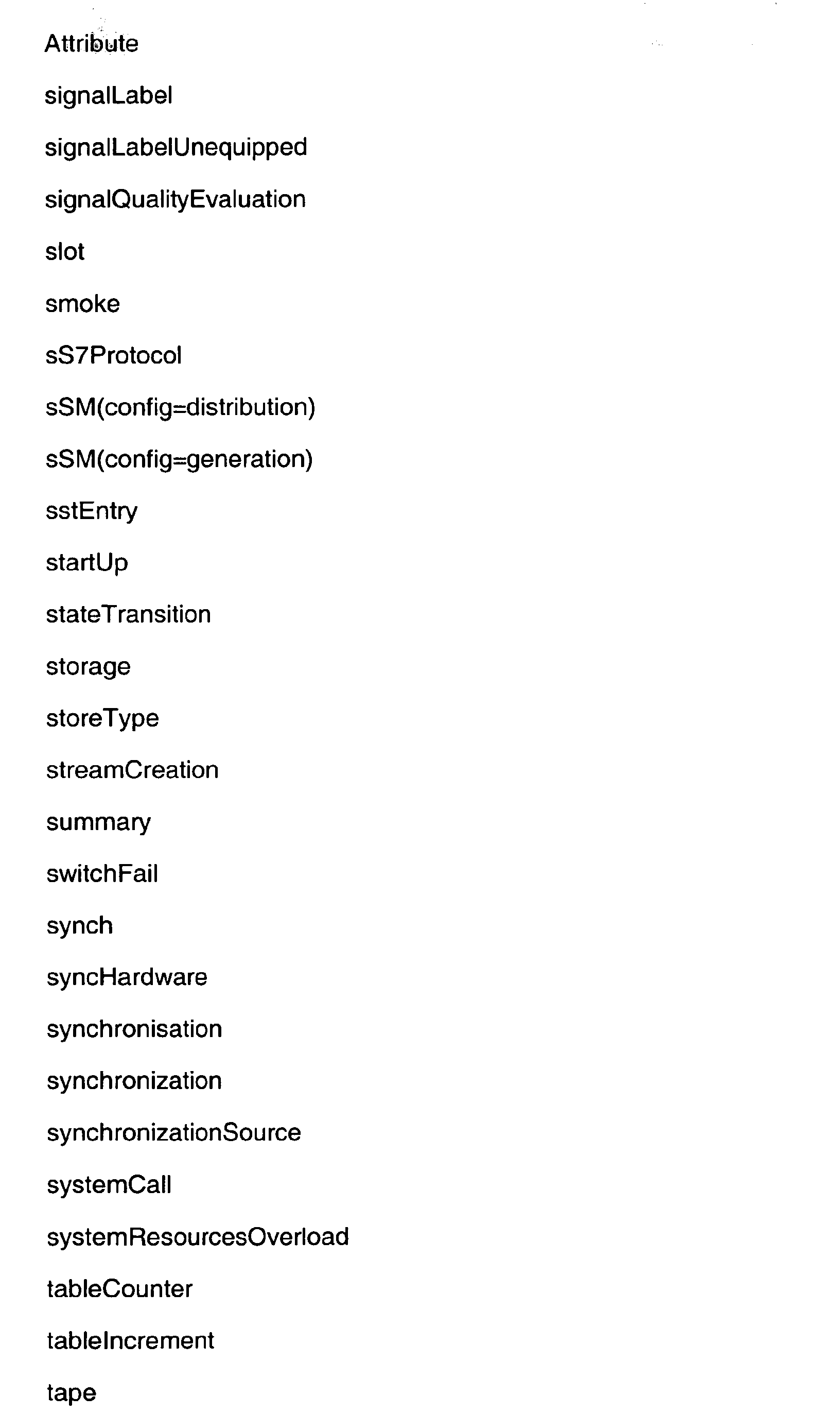
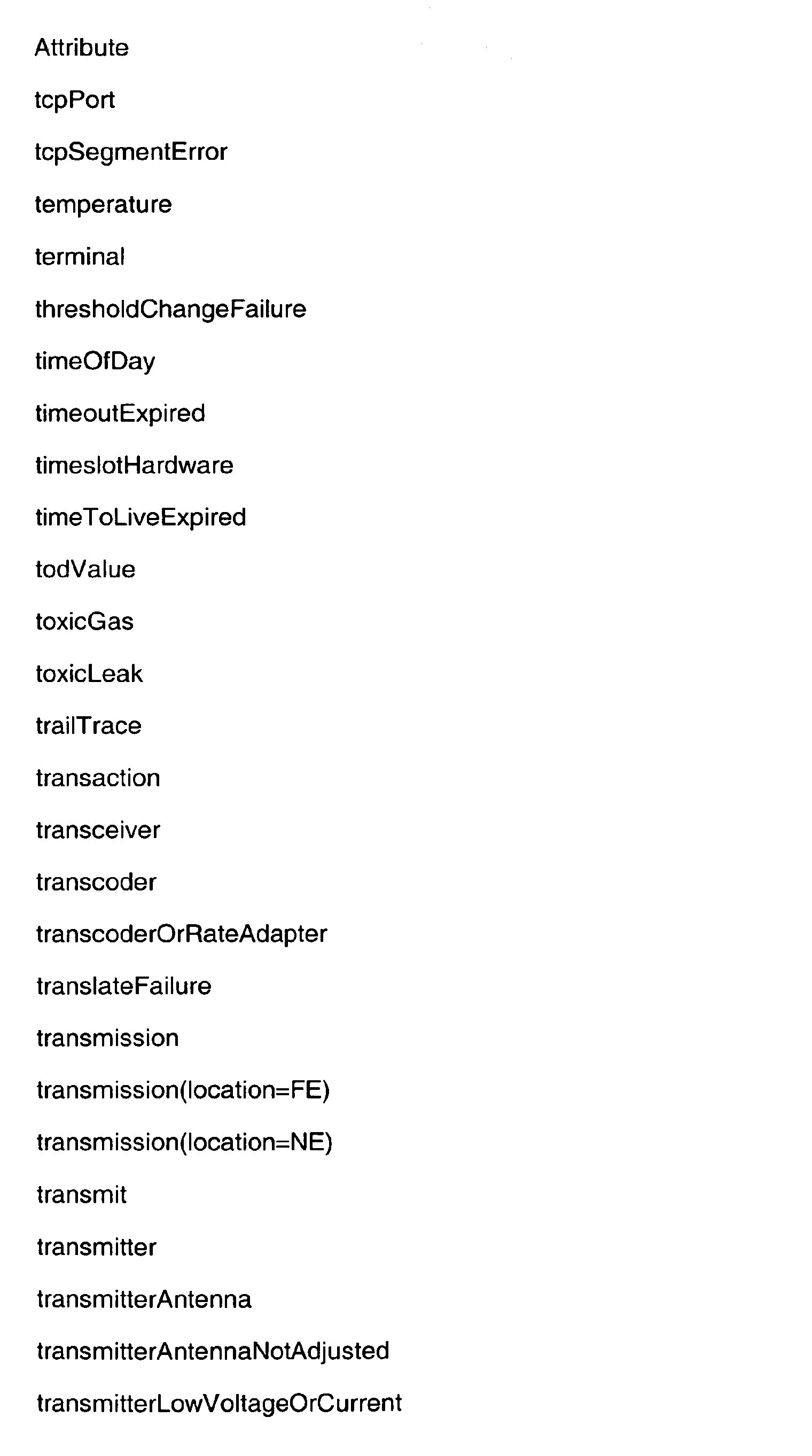
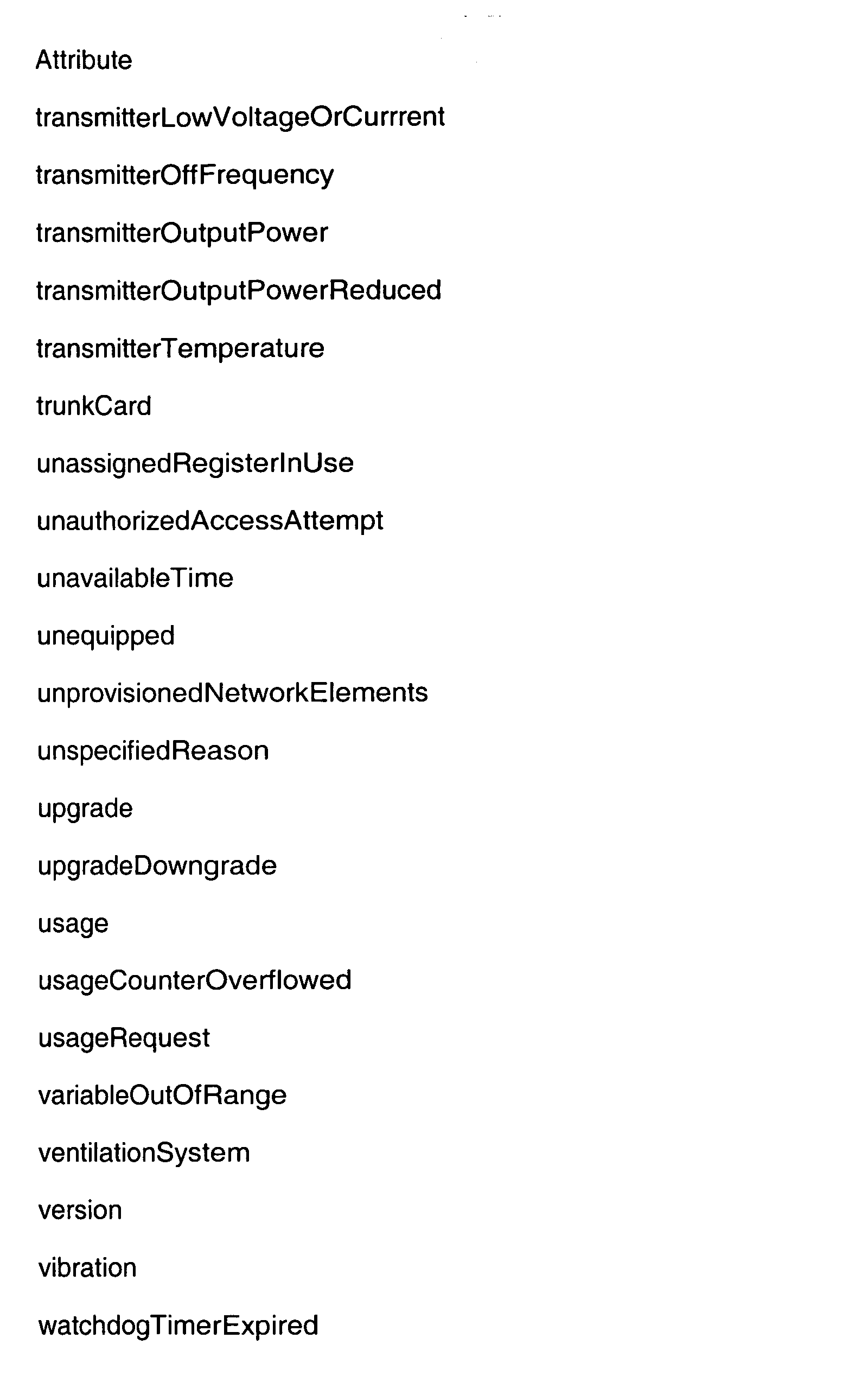
- This section contains the current list of attribute values. This list is expected to be extended.
- Threshold (PM) related attributes are identified as having the following detailed structure:
- the text itself is structured in a flexible way meaning that the ASN.1 definition does not change as texts are added or structured. Note how the ASN.1 does not change as interpreters are designed to exploit the structure within the text string that is the probable cause.
- the text can also be displayed, for human readability, where this is of value to the operator. When displayed, it can be displayed in other languages.
- This proposal defines the display texts for English (which are the same as the engineering mnemonics used on the interface). It does not define display texts for other languages but allows for them.
- the ASN.1 in X.721 and M.3100 will add an ASN.1 cstring attribute, probableCauseText, wherever probableCause exists.
- the probableCauseText field will be used by existing systems in the following manner while migration to this new field occurs:
- a device will store the above texts in their internal memory. When a particular alarm condition is detected, it will construct the text according to the rules and transmit the probable cause to a management application.
- Management application to receive and interpret the probable cause
- This invention allows the customer to use simple filters (eg on any fail) without the application developer having to anticipate such filters. This is achieved because the notation described above separates the condition (eg fail) from the attribute (eg circuit pack).
- An application developer merely develops a parser that takes into account the structure defined in section 2 and parses this structure to separate out the condition, then compares this condition with the condition that the customer entered. The application can then list all alarms that have a condition of fail. This would be much too cumbersome for either the application writer or the customer without the structure of the notation specified in section 2.
- the invention also allows for the application to give a correct display when a device exploits a new attribute (against an existing condition).
- the application will display the correct list of alarms even if it was built before the new attribute was added to the list and implemented in the device.
- the application will also display the correct text for new fields introduced after the application was built. This is achieved by the application displaying the text from the device. Previously this was not possible as it would have to map a number to the text. This mapping would not be available at the time the application was built.
Landscapes
- Engineering & Computer Science (AREA)
- Computer Networks & Wireless Communication (AREA)
- Signal Processing (AREA)
- Data Exchanges In Wide-Area Networks (AREA)
- Maintenance And Management Of Digital Transmission (AREA)
Abstract
Description
- a notation for the probable cause field in messages that network devices send to management systems.
- a method for devices to generate messages with this notation
- an application that interprets these messages.
including the generated data in a telecommunications network alarm indication message.












| Reserved word | Values |
| parameter | SES|ES|UAS|SEFS|CV |
| direction | tx|rx |
| location | NE|FE (NE = near end, FE = far end) |
| loopback | facility|terminal |
| opertype | force|lockout|manual|auto |
| config | ring|span|line|path|interRing |
| period | 15M|24H |
| threshold | T1|T2 |
Claims (38)
- A method of generating data for inclusion in a probable cause field of a telecommunications network alarm indication message, the method comprising:detecting the occurrence of an event in a telecommunications network;mapping one or more characteristics of the event to first and second predetermined probable cause codes; andgenerating the data for inclusion in a probable cause field of a telecommunications network alarm indication message, the generated data comprising first and second delimited data elements respectively indicating the first and second predetermined probable cause codes.
- A method according to claim 1, wherein the first predetermined probable cause code identifies a condition effecting an entity of the network.
- A method according to claim 1 or 2, wherein the second predetermined probable cause code identifies an attribute of an entity of the network.
- A method according to claim 3, comprising mapping the one or more characteristics of the event to a third predetermined probable cause code identifying a qualifier of the attribute, and wherein the generated comprises a third delimited data element indicating the third predetermined probable cause code.
- A method of generating a telecommunications network alarm indication message, the method comprising:generating data for inclusion in a probable cause field of a telecommunications network alarm indication message according to the method of any of claims 1 to 4; andincluding the generated data in a telecommunications network alarm indication message.
- Apparatus for generating data for inclusion in a probable cause field of a telecommunications network alarm indication message, the apparatus comprising:a detector arranged to detect the occurrence of an event in a telecommunications network;a mapper arranged to map one or more characteristics of the event to first and second predetermined probable cause codes; anda data processor arranged to generate the data for inclusion in a probable cause field of a telecommunications network alarm indication message, the generated data comprising first and second delimited data elements respectively indicating the first and second predetermined probable cause codes.
- An apparatus according to claim 6, wherein the first predetermined probable cause code identifies a condition effecting an entity of the network.
- An apparatus according to claim 6 or 7, wherein the second predetermined probable cause code identifies an attribute of an entity of the network.
- An apparatus according to claim 8, wherein the mapper is arranged to map the one or more characteristics of the event to a third predetermined probable cause code identifying a qualifier of the attribute, and wherein the generated data comprises a third delimited data element indicating the third predetermined probable cause code.
- An apparatus for generating a telecommunications network alarm indication message, the apparatus comprising:an apparatus for generating data for inclusion in a probable cause field of a telecommunications network alarm indication message according to any of claims 6 to 9; anda data processor arranged to include the generated data in a telecommunications network alarm indication message.
- A computer program for generating data for inclusion in a probable cause field of a telecommunications network alarm indication message, the computer program comprising:program code arranged to detect the occurrence of an event in a telecommunications network;program code arranged to map one or more characteristics of the event to first and second predetermined probable cause codes; andprogram code arrange to generate the data for inclusion in a probable cause field of a telecommunications network alarm indication message, the generated data comprising first and second delimited data elements respectively indicating the first and second predetermined probable cause codes.
- A computer program according to claim 11, wherein the first predetermined probable cause code identifies a condition effecting an entity of the network.
- A computer program according to claim 11 or 12, wherein the second predetermined probable cause code identifies an attribute of an entity of the network.
- A computer program according to claim 13, comprising program code arranged to map the one or more characteristics of the event to a third predetermined probable cause code identifying a qualifier of the attribute, and wherein the generated data comprises a third delimited data element indicating the third predetermined probable cause code.
- A computer program for generating a telecommunications network alarm indication message, the computer program comprising:program code for generating data for inclusion in a probable cause field of a telecommunications network alarm indication message, according to any of claims 11 to 14; andprogram code arranged to include the generated data in a telecommunications network alarm indication message.
- A method of processing a telecommunications network alarm indication message, the method comprising:identifying first and second delimited data elements in a probable cause field of the alarm indication message;recognising a first predetermined probable cause code from a first one of the first or second data elements; andprocessing the alarm indication message using the first predetermined probable cause code.
- A method according to claim 16, wherein the first predetermined probable cause code identifies a condition effecting an entity of a telecommunications network.
- A method according to claim 16 or 17, wherein the first predetermined probable cause code identifies an attribute of an entity of a telecommunications network.
- A method according to claim 18, comprisingwherein the second predetermined probable cause code identifies a qualifier of the attribute and wherein the step of processing the alarm indication message uses the second predetermined probable cause code.recognising a second predetermined probable cause code from a second one of the first or second data elements,
- A method according to any of claims 16 to 19, wherein the step of processing the alarm indication message comprises displaying the first predetermined probable cause code, or information derived therefrom, on a user display.
- A method according to any of claims 16 to 20, wherein the step of processing the alarm indication message comprises selecting the alarm indication message in dependence on whether the first predetermined probable cause code matches a predetermined criterion.
- Apparatus for processing a telecommunications network alarm indication message, the apparatus comprising:a delimiter arranged to identify first and second delimited data elements in a probable cause field of the alarm indication message;a comparator arranged to recognise a first predetermined probable cause code from a first one of the first or second data elements; anda data processor arranged to process the alarm indication message using the first predetermined probable cause code.
- Apparatus according to claim 22, wherein the first predetermined probable cause code identifies a condition effecting an entity of a telecommunications network.
- Apparatus according to claim 22 or 23, wherein the first predetermined probable cause code identifies an attribute of an entity of a telecommunications network.
- Apparatus according to claim 24, comprisingwherein the second predetermined probable cause code identifies a qualifier of the attribute and wherein the data processor is arranged to process the alarm indication message using the second predetermined probable cause code.a comparator arranged to recognise a second predetermined probable cause code from a second one of the first or second data elements,
- Apparatus according to any of claims 22 to 25, comprising a user display, wherein the data processor is arranged to display the first predetermined probable cause code, or information derived therefrom, on the user display.
- Apparatus according to any of claims 22 to 26, wherein the data processor is arranged to select the alarm indication message in dependence on whether the first predetermined probable cause code matches a predetermined criterion.
- A computer program for processing a telecommunications network alarm indication message, the computer program comprising:program code arranged to identify first and second delimited data elements in a probable cause field of the alarm indication message;program code arranged to recognise a first predetermined probable cause code from a first one of the first or second data elements; andprogram code arranged to process the alarm indication message using the first predetermined probable cause code.
- A computer program according to claim 28, wherein the first predetermined probable cause code identifies a condition effecting an entity of a telecommunications network.
- A computer program according to claim 28 or 29, wherein the first predetermined probable cause code identifies an attribute of an entity of a telecommunications network.
- A computer program according to claim 30, comprisingwherein the second predetermined probable cause code identifies a qualifier of the attribute and wherein the program code arranged to process the alarm indication message uses the second predetermined probable cause code.program code arranged to recognise a second predetermined probable cause code from a second one of the first or second data elements,
- A computer program according to any of claims 28 to 31, wherein the program code arranged to process the alarm indication message is arranged to display the first predetermined probable cause code, or information derived therefrom, on a user display.
- A computer program according to any of claims 28 to 32, wherein the program code arranged to process the alarm indication message is arranged to select the alarm indication message in dependence on whether the first predetermined probable cause code matches a predetermined criterion.
- A signal representing a probable cause field of a telecommunications network alarm indication message, the probable cause field comprising first and second delimited data elements respectively indicating first and second predetermined probable cause codes, the first and second predetermined probable cause codes relating to one or more characteristics of an event occurring or having occurred in a telecommunications network.
- A signal according to claim 34, wherein the first predetermined probable cause code identifies a condition effecting an entity of the network.
- A signal according to claim 34 or 35, wherein the second predetermined probable cause code identifies an attribute of an entity of the network.
- A signal according to claim 36, wherein the probable cause field comprises a third delimited data element indicating a third predetermined probable cause, the third predetermined probable cause code relating to the one or more characteristics of an event occurring or having occurred in a telecommunications network, the third predetermined probable cause code identifying a qualifier of the attribute.
- A signal representing a telecommunications network alarm indication message, the message comprising a probable cause field, the probable cause field comprising first and second delimited data elements respectively indicating first and second predetermined probable cause codes, the first and second predetermined probable cause codes relating to one or more characteristics of an event occurring or having occurred in a telecommunications network.
Applications Claiming Priority (2)
| Application Number | Priority Date | Filing Date | Title |
|---|---|---|---|
| GB0322741 | 2003-09-29 | ||
| GBGB0322741.0A GB0322741D0 (en) | 2003-09-29 | 2003-09-29 | Structured probable causes for management systems and network devices and their exploitation |
Publications (2)
| Publication Number | Publication Date |
|---|---|
| EP1526680A2 true EP1526680A2 (en) | 2005-04-27 |
| EP1526680A3 EP1526680A3 (en) | 2005-10-05 |
Family
ID=29287021
Family Applications (1)
| Application Number | Title | Priority Date | Filing Date |
|---|---|---|---|
| EP04023177A Ceased EP1526680A3 (en) | 2003-09-29 | 2004-09-29 | Probable cause fields in telecommunications network alarm indication messages |
Country Status (3)
| Country | Link |
|---|---|
| US (1) | US7363548B2 (en) |
| EP (1) | EP1526680A3 (en) |
| GB (1) | GB0322741D0 (en) |
Families Citing this family (9)
| Publication number | Priority date | Publication date | Assignee | Title |
|---|---|---|---|---|
| ATE513445T1 (en) | 2005-12-14 | 2011-07-15 | Research In Motion Ltd | METHOD AND DEVICE FOR TERMINAL-BASED RADIO CONTROL IN A UMTS NETWORK |
| US8644829B2 (en) * | 2006-05-17 | 2014-02-04 | Blackberry Limited | Method and system for signaling release cause indication in a UMTS network |
| EP2061192B1 (en) | 2007-11-13 | 2012-04-11 | Research In Motion Limited | Method and apparatus for state/mode transitioning |
| US8294763B2 (en) | 2007-12-14 | 2012-10-23 | Sri International | Method for building and extracting entity networks from video |
| CA2668976A1 (en) * | 2009-06-15 | 2010-12-15 | Fiber Connections Inc. | Network mapping function |
| AU2010320843B2 (en) | 2009-11-23 | 2014-07-10 | Blackberry Limited | Method and apparatus for state/mode transitioning |
| KR101468855B1 (en) | 2009-11-23 | 2014-12-03 | 블랙베리 리미티드 | Method and apparatus for state/mode transitioning |
| CN108990098B (en) * | 2017-06-05 | 2021-09-24 | 成都鼎桥通信技术有限公司 | Retransmission method in cluster system |
| US20250363474A1 (en) * | 2024-05-24 | 2025-11-27 | Toshiba Global Commerce Solutions, Inc. | Synchronizing shelf input/output systems and transaction systems |
Family Cites Families (6)
| Publication number | Priority date | Publication date | Assignee | Title |
|---|---|---|---|---|
| US6131112A (en) * | 1996-05-17 | 2000-10-10 | Cabletron Systems, Inc. | Method and apparatus for integrated network and systems management |
| US6012152A (en) * | 1996-11-27 | 2000-01-04 | Telefonaktiebolaget Lm Ericsson (Publ) | Software fault management system |
| US6263366B1 (en) * | 1996-12-31 | 2001-07-17 | Mci Communications Corporation | System and method therefor of translating a message having a given format for usage in an operations system |
| US6260062B1 (en) * | 1999-02-23 | 2001-07-10 | Pathnet, Inc. | Element management system for heterogeneous telecommunications network |
| US6707795B1 (en) * | 1999-04-26 | 2004-03-16 | Nortel Networks Limited | Alarm correlation method and system |
| US7383191B1 (en) * | 2000-11-28 | 2008-06-03 | International Business Machines Corporation | Method and system for predicting causes of network service outages using time domain correlation |
-
2003
- 2003-09-29 GB GBGB0322741.0A patent/GB0322741D0/en not_active Ceased
-
2004
- 2004-09-28 US US10/952,028 patent/US7363548B2/en not_active Expired - Lifetime
- 2004-09-29 EP EP04023177A patent/EP1526680A3/en not_active Ceased
Also Published As
| Publication number | Publication date |
|---|---|
| US7363548B2 (en) | 2008-04-22 |
| US20050105696A1 (en) | 2005-05-19 |
| EP1526680A3 (en) | 2005-10-05 |
| GB0322741D0 (en) | 2003-10-29 |
Similar Documents
| Publication | Publication Date | Title |
|---|---|---|
| US4965772A (en) | Method and apparatus for communication network alert message construction | |
| US6711127B1 (en) | System for intrusion detection and vulnerability analysis in a telecommunications signaling network | |
| EP0295426B1 (en) | Method and apparatus for generating alert messages in a communication network | |
| US6263455B1 (en) | Method and apparatus for analyzing alarm conditions in a networked computing environment | |
| US5481548A (en) | Technique for diagnosing and locating physical and logical faults in data transmission systems | |
| EP3584658A1 (en) | Method, system, device, and computer readable storage medium for diagnosing vehicle | |
| JP5147741B2 (en) | Alarm processing method in process control system and alarm processing system in process control network | |
| US6009431A (en) | Methods and systems for generating an MIB file | |
| US5771274A (en) | Topology-based fault analysis in telecommunications networks | |
| EP1182822B1 (en) | Network Management Equipment | |
| WO2021104270A1 (en) | Configuration anomaly detection method, server and storage medium | |
| AU720079B2 (en) | Method and apparatus for integrated network management and systems management in communications networks | |
| EP0658032A1 (en) | Location identification in a communications signalling network | |
| CN109189352A (en) | Printer fault monitoring method, device, system and readable storage medium storing program for executing | |
| US20070011300A1 (en) | Monitoring method and system for monitoring operation of resources | |
| US20020069199A1 (en) | Method for managing alarm information in a network management system | |
| US8205116B2 (en) | Common chronics resolution management | |
| US20040006619A1 (en) | Structure for event reporting in SNMP systems | |
| JPH07147592A (en) | Congestion control method, terminal adapter using this method, and communication system having this terminal adapter | |
| US7363548B2 (en) | Probable cause fields in telecommunications network alarm indication messages | |
| FI104032B (en) | Procedure for error checking and systems thereto | |
| CN121356981A (en) | A method, system, device, and storage medium for tracing the root causes of microservice failures. | |
| US7369507B1 (en) | Process for learning the basic finite automation of a protocol implementation | |
| US20020188715A1 (en) | System and method for processing unsolicited messages | |
| US20050154977A1 (en) | Combined alarm log file reporting using XML alarm token tagging |
Legal Events
| Date | Code | Title | Description |
|---|---|---|---|
| PUAI | Public reference made under article 153(3) epc to a published international application that has entered the european phase |
Free format text: ORIGINAL CODE: 0009012 |
|
| AK | Designated contracting states |
Kind code of ref document: A2 Designated state(s): AT BE BG CH CY CZ DE DK EE ES FI FR GB GR HU IE IT LI LU MC NL PL PT RO SE SI SK TR |
|
| AX | Request for extension of the european patent |
Extension state: AL HR LT LV MK |
|
| PUAL | Search report despatched |
Free format text: ORIGINAL CODE: 0009013 |
|
| AK | Designated contracting states |
Kind code of ref document: A3 Designated state(s): AT BE BG CH CY CZ DE DK EE ES FI FR GB GR HU IE IT LI LU MC NL PL PT RO SE SI SK TR |
|
| AX | Request for extension of the european patent |
Extension state: AL HR LT LV MK |
|
| 17P | Request for examination filed |
Effective date: 20060405 |
|
| AKX | Designation fees paid |
Designated state(s): DE FR GB |
|
| 17Q | First examination report despatched |
Effective date: 20060920 |
|
| APBK | Appeal reference recorded |
Free format text: ORIGINAL CODE: EPIDOSNREFNE |
|
| APBN | Date of receipt of notice of appeal recorded |
Free format text: ORIGINAL CODE: EPIDOSNNOA2E |
|
| APBR | Date of receipt of statement of grounds of appeal recorded |
Free format text: ORIGINAL CODE: EPIDOSNNOA3E |
|
| APAF | Appeal reference modified |
Free format text: ORIGINAL CODE: EPIDOSCREFNE |
|
| RAP1 | Party data changed (applicant data changed or rights of an application transferred) |
Owner name: CIENA LUXEMBOURG S.A.R.L. |
|
| APBT | Appeal procedure closed |
Free format text: ORIGINAL CODE: EPIDOSNNOA9E |
|
| STAA | Information on the status of an ep patent application or granted ep patent |
Free format text: STATUS: THE APPLICATION HAS BEEN REFUSED |
|
| 18R | Application refused |
Effective date: 20131022 |