EP1526359A1 - Method for managing map data for vehicle - Google Patents
Method for managing map data for vehicle Download PDFInfo
- Publication number
- EP1526359A1 EP1526359A1 EP04292374A EP04292374A EP1526359A1 EP 1526359 A1 EP1526359 A1 EP 1526359A1 EP 04292374 A EP04292374 A EP 04292374A EP 04292374 A EP04292374 A EP 04292374A EP 1526359 A1 EP1526359 A1 EP 1526359A1
- Authority
- EP
- European Patent Office
- Prior art keywords
- map
- map segments
- segments
- operation memory
- travel guide
- Prior art date
- Legal status (The legal status is an assumption and is not a legal conclusion. Google has not performed a legal analysis and makes no representation as to the accuracy of the status listed.)
- Withdrawn
Links
- 238000000034 method Methods 0.000 title claims abstract description 27
- 238000003780 insertion Methods 0.000 claims description 6
- 230000037431 insertion Effects 0.000 claims description 6
- 230000004044 response Effects 0.000 claims description 5
- 238000012217 deletion Methods 0.000 claims description 3
- 230000037430 deletion Effects 0.000 claims description 3
- 230000007246 mechanism Effects 0.000 description 8
- 230000008901 benefit Effects 0.000 description 2
- 238000012986 modification Methods 0.000 description 2
- 230000004048 modification Effects 0.000 description 2
- 238000013523 data management Methods 0.000 description 1
- 230000003247 decreasing effect Effects 0.000 description 1
- 230000006870 function Effects 0.000 description 1
- 230000008569 process Effects 0.000 description 1
- 230000009467 reduction Effects 0.000 description 1
Images




Classifications
-
- G—PHYSICS
- G08—SIGNALLING
- G08G—TRAFFIC CONTROL SYSTEMS
- G08G1/00—Traffic control systems for road vehicles
- G08G1/09—Arrangements for giving variable traffic instructions
- G08G1/0962—Arrangements for giving variable traffic instructions having an indicator mounted inside the vehicle, e.g. giving voice messages
- G08G1/0968—Systems involving transmission of navigation instructions to the vehicle
- G08G1/0969—Systems involving transmission of navigation instructions to the vehicle having a display in the form of a map
-
- G—PHYSICS
- G01—MEASURING; TESTING
- G01C—MEASURING DISTANCES, LEVELS OR BEARINGS; SURVEYING; NAVIGATION; GYROSCOPIC INSTRUMENTS; PHOTOGRAMMETRY OR VIDEOGRAMMETRY
- G01C21/00—Navigation; Navigational instruments not provided for in groups G01C1/00 - G01C19/00
- G01C21/38—Electronic maps specially adapted for navigation; Updating thereof
- G01C21/3804—Creation or updating of map data
- G01C21/3833—Creation or updating of map data characterised by the source of data
- G01C21/3844—Data obtained from position sensors only, e.g. from inertial navigation
Definitions
- the present invention relates to a method for managing map data for a vehicle, wherein upon display of map data on a display unit by using a navigation system, memory loading for the display of the map data can be quickly performed by reducing the number of access to a physical storage medium with an entire map stored therein.
- a navigation system provides functions of calculating a current location of a traveling vehicle using radio signals transmitted by a plurality of satellites belonging to a global positioning system and signals transmitted by sensors of the vehicle, and guiding the vehicle along an optimum path from a starting place to a destination by map-matching the calculated position to map data.
- Fig. 1 is a view showing a conventional system for managing and displaying map data for a vehicle.
- a GPS receiver 100 detects data on the position of the vehicle by receiving GPS data
- a control unit 150 retrieves map data related to the position data from a physical storage medium 120 such as a CD-ROM or hard disk.
- a display driving unit 130 generates a travel guide map for the vehicle using map data retrieved under the control of the control unit 150 in response to input of user command data through a user command input unit 110 so that the map can be displayed on a display unit 140.
- map data of a new area should be continuously loaded from a physical storage medium such as a CD-ROM as a vehicle travels. Time required for loading the map data from the physical storage medium causes a considerable delay upon display of a travel guide map for the vehicle.
- An object of the present invention is to provide a method for managing map data for a vehicle, wherein upon display of the map data, memory loading for the display of the map data can be quickly performed by reducing the number of access to a physical storage medium with an entire map stored therein.
- map data loading speed can be faster by preventing reusable map segments among map segments loaded on an operation memory from being unnecessarily deleted, retrieved again from the physical storage medium and inserted into the operation memory.
- the navigation system to which the embodiments of the present invention is applied comprises a GPS receiver 100 for calculating data on the position of a vehicle by receiving GPS data transmitted by three or more GPS satellites; a user command input unit 110 for receiving predetermined command data input in response to user's manipulation; a physical storage medium 120 for storing a large amount of data of an entire map consisting of a plurality of map segments; an operation memory 200 for dynamically storing a predetermined number of map segments; a memory manager 210 for managing the map segments stored in the operation memory 200, for example, sequentially inserting map segments into the operation memory 200 or deleting them from the operation memory 200 in a first-in first out (FIFO) manner; a display driving unit 130 for causing a current location and a travel path of the vehicle together with map data to be displayed on a display unit 140; a voice guidance unit 160 for guiding the travel path of the vehicle using voice signals through a speaker 170; and a control unit 150 for controlling the respective units.
- a GPS receiver 100 for calculating data on the
- map segment used herein is defined as partial map data obtained by uniformly dividing a certain entire map into segments with a predetermined size based on latitude and longitude. Respective map segments are identified by identification numbers.
- map segments usable for displaying a travel guide map based on a current vehicle location are selected among a predetermined number of map segments that have been loaded in the operation memory 200 to display a travel guide map based on a previous location.
- a central map segment including the calculated coordinates of the location and a predetermined number of adjacent map segments surrounding the central map segment are detected to display a map with a predetermined size on the display panel.
- map segments identical with the detected central map segment and the adjacent map segments are selected, as map segments usable for displaying a travel guide map based on a current vehicle location, among the predetermined number of map segments that have been loaded in the operation memory 200 to display the travel guide map based on the previous location.
- the adjacent map segments be sequentially detected according to the degree of proximity to the central map segment, and an entire map divided into map segments with a predetermined size based on latitude and longitude be used.
- map segments selected as being usable for displaying the travel guide map based on the current vehicle location are designated as properties, and remaining map segments are designated as victims.
- predetermined different marks be assigned to the respective map segments designated as properties and victims so as to identify them. For example, it is preferred that a binary bit flag of "1" be assigned to the properties, while a binary bit flag of "0" be assigned to the victims.
- the marks are initialized whenever the position of the vehicle varies.
- the map segments designated as the properties are reinserted into the operation memory 200 even though they have been deleted from the operation memory 200 in a predetermined order, e.g., in a first-in first-out (FIFO) manner.
- FIFO first-in first-out
- the map segments designated as the properties are deleted at their turns in the FIFO manner.
- the deleted map segments are added to an insertion queue, and the map segments added to the insertion queue are reinserted into the operation memory 200 in a relevant order.
- the map segments designated as the victims are completely deleted from the operation memory 200, and remaining map segments required for displaying the travel guide map based on the current vehicle location are retrieved from the physical storage medium 120 with the entire map stored therein and are then updated into the operation memory 200.
- the map segments designated as the victims are deleted from the operation memory 200 in the practicable FIFO manner, and the map segments retrieved from the physical storage medium 120 are inserted into the operation memory 200.
- map segments updated into the operation memory in such a manner, and the map segments designated in advance as the properties are loaded on a screen memory.
- the second embodiment of the present invention is to further specify the operation memory managing mechanism described above.
- map segments reusable for displaying a travel guide map based on a new location are selected among the map segments loaded on the operation memory.
- the selected map segments are designated as properties, and remaining map segments are designated as victims.
- the operation memory 200 it is then determined whether the operation memory 200 is full. If it is determined that the operation memory 200 is not full, remaining map segments required for displaying a travel guide map based on a current vehicle location are retrieved from the physical storage medium with the entire map stored therein and are then updated into the operation memory.
- the map segments which have been previously loaded on the operation memory 200 are sequentially deleted one by one in order to fill the interior of the operation memory 200 with map segments usable for displaying the travel guide map based on the current vehicle location.
- the deleted map segments are those designated as properties, they are reinserted into the operation memory. If it is determined that the deleted map segments are those designated as victims, they are completely deleted from the operation memory. Thereafter, remaining map segments required for displaying the travel guide map based on the current vehicle location on the display unit are sequentially retrieved from the physical storage medium with the entire map stored therein and then are updated into the operation memory.
- predetermined different marks be assigned to the respective map segments designated as properties and victims so as to identify them, and the marks be initialized whenever the position of the vehicle varies.
- map data loading speed can be faster by preventing reusable map segments among the map segments loaded on the operation memory from being unnecessarily deleted, retrieved again from the physical storage medium and inserted into the operation memory.
- the speed of loading map data on the screen memory which has been required for displaying a travel guide map on the display unit, becomes faster by loading the map data of the travel guide map on the screen memory while minimizing the number of access to the physical storage medium such as a CD-ROM or hard disk.
- a certain number of map segments required for generating a travel guide map based on a new location are updated into the operation memory 200 as the position of the vehicle varies.
- a position information extracting section of the control unit 150 first calculates coordinates of a current vehicle location using GPS data received by the GPS receiver 100. Then, a map segment including the coordinates of the current vehicle location, and a predetermined number of adjacent map segments surrounding the map segment are detected.
- the memory manager 210 searches the operation memory 200 under the control of the control unit 150, selects map segments identical with the map segments, which have been detected by the position information extracting section, among map segments stored in the operation memory 200, and deletes remaining map segments except the selected map segments from the operation memory 200.
- control unit 150 accesses to the operation memory 200 instead of the physical storage medium 120 with the entire map stored therein in response to a display request input from the outside, and loads the map segments updated into the operation memory 200 on the screen memory (not shown), thereby displaying the travel guide map on the display unit 140 using the map segments loaded on the screen memory as described above.
- the map data loading speed becomes faster in such a manner that the certain number of map segments required for generating the travel guide map based on the new location as the position of the vehicle varies are detected and then updated into the operation memory, and the updated map segments are retrieved from the operation memory and then loaded on the screen memory.
- a predetermined number of map segments required for displaying a travel guide map based on the position of a vehicle on the display unit are loaded on the operation memory.
- map segments usable for displaying a travel guide map based on a new location on the display unit are selected and designated as properties and remaining map segments are designated as victims.
- map segments designated as the properties and victims be distinguishable from each other.
- a binary bit flag of "1” be assigned to the properties and a binary bit flag of "0" be assigned to the victims, as shown in the figure.
- the marks are initialized whenever the position of the vehicle varies.
- the map segments that have been previously loaded on the operation memory are sequentially deleted one by one.
- deleted map segments are those designated as the properties, they are reinserted into the operation memory. If deleted map segments are those designated as the victims, they are completely deleted from the operation memory. Thereafter, remaining map segments required for displaying the travel guide map based on the new location on the display unit are sequentially retrieved from the physical storage medium with the entire map stored therein and are then updated into empty areas of the operation memory which are obtained by deleting the map segments.
- the map data loading speed can be improved by lowering the possibility that latest data will be selected as victims and preventing deletion of data usable for displaying a travel guide map.
- map segments usable for displaying a travel guide map based on a current vehicle location on the display unit are selected among a predetermined number of map segments that have been loaded on the operation memory to display a travel guide map based on a previous location on the display unit, and the selected map segments are designated as properties and remaining map segments are designated as victims.
- the map segments that have been loaded on the operation memory are sequentially deleted one by one.
- the deleted map segments are those designated as properties or victims. If it is determined that the deleted map segments are those designated as the properties, they are reinserted into the operation memory.
- the operation memory is a cache memory managed through queues in the FIFO manner as shown in Fig. 4, in order to fill the cache memory with map segments required for displaying the travel guide map based on the current vehicle location on the display unit, it is first determined whether the cache memory is full. If it is determined that the cache memory is full, map segments loaded on the cache memory are sequentially deleted one by one.
- map segment 22294 positioned at the front is deleted.
- map segment 22294 is a map segment designated as a property with a flag of "1”
- map segment 18310 positioned at the front is deleted.
- map segment 18310 is a map segment designated as a victim with a flag of "0”
- it is not reinserted into but completely deleted from the cache memory.
- Such processes are repeated until all map segments with the flag of "0" are deleted. If an empty area is produced in the cache memory, a map segment designated as a victim is reinserted into the cache memory, or data on a new map segment, i.e. a map segment usable for displaying the travel guide map based on the current vehicle location on the display unit, are retrieved from the physical storage medium and then inserted into the cache memory.
- the present invention allows the operation memory such as a cache memory to be filled with the map segments required for displaying the travel guide map based on the current vehicle location on the display unit as the position of the vehicle varies.
- the number of map segments required for a travel guide map on the display unit is set to 4, and the number of areas managed in the operation memory is accordingly set to 4.
- "A ⁇ B" indicates a travel direction of a vehicle denoted by symbol ⁇ .
- map segments 18311 and 18310 usable for displaying a travel guide map based on a current vehicle location, position (2), on the display unit are selected among a predetermined number of map segments, i.e. map segments 18311, 22295, 18310 and 22294, which have been loaded on the operation memory to display a travel guide map based on a previous location, position (1), on the display unit.
- a mark for identifying a property is assigned to the selected map segments in accordance with the present invention.
- map segments that have been loaded on the operation memory are sequentially deleted one by one.
- map segments 18311 and 18310 are reinserted even though they have been deleted at their turns. Only new map segments 16793 and 16794 that have not been loaded on the operation memory are retrieved from the physical storage medium and newly inserted into the operation memory. Therefore, when a travel guide map based on a new location is generated, the number of access to the physical storage medium such as a CD-ROM or hard disk can be reduced, thereby improving memory loading speed for displaying the map.
- map segments required from displaying a travel guide map based on a current vehicle location on the display unit are first selected among a predetermined number of map segments that have been loaded on the operation memory to display a travel guide map based on a previous location on the display unit.
- GPS data are received (S600) and a current vehicle location is calculated from the received GPS data (S601).
- a central map segment including coordinates of the location calculated in step S601 and a predetermined number of adjacent map segments surrounding the central map segment are detected (S602).
- map segments identical with the detected central map segment and adjacent map segments among a predetermined number of map segments that have been loaded on the operation memory to display a travel guide map based on a previous location are selected as map segments usable for displaying a travel guide map based on the current vehicle location on the display unit (S603).
- the adjacent map segments are sequentially detected according to the degree of proximity to the central map segment, and the entire map is preferably a map divided into map segments with a predetermined size based on latitude and longitude.
- map segments selected as those usable for displaying the travel guide map based on the current vehicle location on the display unit as described above are designated as properties (S604), and remaining map segments are designated as victims.
- predetermined different marks be assigned to the map segments to identify those designated as the properties and victims. For example, it is preferred that a binary bit flag of "1" be assigned to the properties, while a binary bit flag of "0" be assigned to the victims.
- the marks are initialized whenever the position of the vehicle varies.
- the map segments designated as the properties are reinserted into the operation memory (S610) even though they have been deleted from the operation memory in a predetermined order, e.g., in the FIFO manner (S606, S607).
- the map segments designated as the properties are deleted at their turns in the FIFO manner.
- the deleted map segments are added to an insertion queue, and the map segments added to the insertion queue are reinserted into the operation memory in a relevant order.
- the map segments designated as the victims are completely deleted from the operation memory, and remaining map segments required for displaying the travel guide map based on the current vehicle location are retrieved from the physical storage medium with the entire map stored therein (S608, S609) and are then updated into the operation memory (S611).
- the map segments designated as the victims are deleted from the operation memory in the practicable FIFO manner, and the map segments retrieved from the physical storage medium are inserted into the operation memory.
- map segments updated into the operation memory in such a manner, and the map segments designated in advance as the properties are loaded on a screen memory.
- the second embodiment of the present invention is to further specify the operation memory managing mechanism.
- map segment numbers required for displaying a travel guide map based on a new location on the display unit are received from the control unit (S701), and the map segment numbers loaded on the operation memory are compared with the map segment numbers received in step S701 (S702).
- map segments usable for displaying the travel guide map based on the new location on the display unit are selected among the map segments loaded on the operation memory (S702).
- map segments are designated as properties, and remaining map segments are designated as victims.
- the map segments which have been previously loaded on the operation memory are sequentially deleted one by one in order to fill the interior of the operation memory with map segments usable for displaying the travel guide map based on the current vehicle location (S705).
- the deleted map segments are those designated as properties, they are reinserted into the operation memory (S708). If it is determined that the deleted map segments are those designated as victims, they are completely deleted from the operation memory. Thereafter, remaining map segments required for displaying the travel guide map based on the current vehicle location on the display unit are sequentially retrieved from the physical storage medium with the entire map stored therein and then are updated into the operation memory.
- predetermined different marks be assigned to the respective map segments designated as properties and victims so as to identify them, and the marks be initialized whenever the position of the vehicle varies.
- map data loading speed can be faster by preventing reusable map segments among the map segments loaded on the operation memory from being unnecessarily deleted, retrieved again from the physical storage medium and inserted into the operation memory.
- the speed of loading map data on the screen memory which has been required for displaying a travel guide map on the display unit, becomes faster by loading the map data of the travel guide map on the screen memory while minimizing the number of access to the physical storage medium such as a CD-ROM.
- a certain number of map segments required for generating a travel guide map based on a new location are updated into the operation memory as the position of the vehicle varies.
- GPS data are first received (S800), and coordinates of a current vehicle location is calculated using the GPS data (S801). Then, a map segment including the coordinates of the current vehicle location, and a predetermined number of adjacent map segments surrounding the map segment are detected (S802, S803, S804).
- the operation memory is searched (S805), map segments identical with the detected map segments are selected among map segments stored in the operation memory (S806), and remaining map segments except the selected map segments are deleted from the operation memory (S807).
- the physical storage medium with the entire map stored therein is searched (S808) to retrieve remaining map segments required for generating the travel guide map based on the new position, and the retrieved map segments are then updated into empty areas of the operation memory which are obtained by deleting the map segments (S809).
- the map data loading speed becomes faster in such a manner that the certain number of map segments required for generating the travel guide map based on the new location as the position of the vehicle varies are detected and then updated into the operation memory, and the updated map segments are retrieved from the operation memory and then loaded on the screen memory.
- the number of access to a physical storage medium with an entire map stored therein is decreased to reduce access overhead, thereby improving the displaying speed of the map data. Further, there is an advantage in that map segments reusable as the vehicle travels are prevented from being designated as victims, thereby making the loading of the map data on a memory faster.
Landscapes
- Engineering & Computer Science (AREA)
- Radar, Positioning & Navigation (AREA)
- Remote Sensing (AREA)
- Physics & Mathematics (AREA)
- General Physics & Mathematics (AREA)
- Automation & Control Theory (AREA)
- Navigation (AREA)
- Traffic Control Systems (AREA)
Abstract
The present invention relates to a method for managing map data for a vehicle
using a navigation system, wherein upon display of the map data, memory loading for the
display of the map data can be quickly performed by reducing the number of access to a
physical storage medium with an entire map stored therein.
To this end, when a travel guide map is generated again based on a new location as
the position of a vehicle varies, only a certain number of map segments are retrieved from
a physical storage medium such as a CD-ROM to generate the travel guide map, thereby
making map-displaying speed faster. Further, when the travel guide map is generated
again based on the new location as the position of the vehicle varies, map data loading
speed can be faster by preventing reusable map segments among map segments loaded on
an operation memory from being unnecessarily deleted, retrieved again from the physical
storage medium and inserted into the operation memory.
Description
- The present invention relates to a method for managing map data for a vehicle, wherein upon display of map data on a display unit by using a navigation system, memory loading for the display of the map data can be quickly performed by reducing the number of access to a physical storage medium with an entire map stored therein.
- Generally, a navigation system provides functions of calculating a current location of a traveling vehicle using radio signals transmitted by a plurality of satellites belonging to a global positioning system and signals transmitted by sensors of the vehicle, and guiding the vehicle along an optimum path from a starting place to a destination by map-matching the calculated position to map data.
- Particularly, in a full navigation system for guiding a vehicle along a path by displaying the path as well as the position of the vehicle, loading of a nationwide map and relevant map data is inevitably required in order to search for a path, guide a travel and visualize a map.
- However, due to a large amount of map data and limitations on hardware, it is practically impossible to load such map data on a screen memory. This will be described in detail by way of example with reference to Fig. 1.
- Fig. 1 is a view showing a conventional system for managing and displaying map data for a vehicle. As shown in the figure, in the conventional system for managing and displaying map data for a vehicle, when a
GPS receiver 100 detects data on the position of the vehicle by receiving GPS data, acontrol unit 150 retrieves map data related to the position data from aphysical storage medium 120 such as a CD-ROM or hard disk. Adisplay driving unit 130 generates a travel guide map for the vehicle using map data retrieved under the control of thecontrol unit 150 in response to input of user command data through a usercommand input unit 110 so that the map can be displayed on adisplay unit 140. - However, in such a conventional map data management, map data of a new area should be continuously loaded from a physical storage medium such as a CD-ROM as a vehicle travels. Time required for loading the map data from the physical storage medium causes a considerable delay upon display of a travel guide map for the vehicle.
- Therefore, to avoid the time delay of the display, there is a need for improving speed at which the travel guide map is displayed, by minimizing access overhead through reduction in the number of access to the physical storage medium.
- Accordingly, the present invention is conceived to meet the aforementioned need. An object of the present invention is to provide a method for managing map data for a vehicle, wherein upon display of the map data, memory loading for the display of the map data can be quickly performed by reducing the number of access to a physical storage medium with an entire map stored therein.
- In the present invention for achieving the above object, when a travel guide map is generated again based on a new location as the position of a vehicle varies, only a certain number of map segments are retrieved from a physical storage medium such as a CD-ROM or hard disk to generate the travel guide map, thereby making map-displaying speed faster.
- Further, when the travel guide map is generated again based on the new location as the position of the vehicle varies, map data loading speed can be faster by preventing reusable map segments among map segments loaded on an operation memory from being unnecessarily deleted, retrieved again from the physical storage medium and inserted into the operation memory.
- Moreover, when the travel guide map is generated again based on the new location as the position of the vehicle varies, a certain number of necessary map segments are detected and updated into the operation memory so that the updated map segments can be retrieved from the operation memory and then loaded on a screen memory, thereby making map data loading speed faster.
- The above and other objects, features and advantages of the present invention will become apparent from the following description of preferred embodiments given in conjunction with the accompanying drawings, in which:
- Fig. 1 is a view showing a conventional system for managing map data for a vehicle;
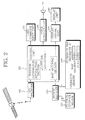
- Fig. 2 is a view showing a system for managing map data for a vehicle to which the present invention is applied;
- Fig. 3 is a view specifically illustrating an operation memory for use in the present invention;
- Fig. 4 is a view specifically illustrating an operation memory managing mechanism for use in the present invention;
- Fig. 5 is a view exemplarily illustrating an operation memory managing mechanism for use in the present invention;
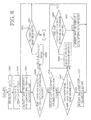
- Fig. 6 is a flowchart illustrating a first embodiment of the present invention;
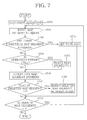
- Fig. 7 is a flowchart illustrating a second embodiment of the present invention; and
- Fig. 8 is a flowchart illustrating a third embodiment of the present invention.
-
- Hereinafter, preferred embodiments of the present invention will be described in detail with reference to the accompanying drawings.
- First to third embodiments of the present invention will be sequentially described in connection with a navigation system shown in Fig. 2.
- As shown in Fig. 2, the navigation system to which the embodiments of the present invention is applied comprises a
GPS receiver 100 for calculating data on the position of a vehicle by receiving GPS data transmitted by three or more GPS satellites; a usercommand input unit 110 for receiving predetermined command data input in response to user's manipulation; aphysical storage medium 120 for storing a large amount of data of an entire map consisting of a plurality of map segments; anoperation memory 200 for dynamically storing a predetermined number of map segments; amemory manager 210 for managing the map segments stored in theoperation memory 200, for example, sequentially inserting map segments into theoperation memory 200 or deleting them from theoperation memory 200 in a first-in first out (FIFO) manner; adisplay driving unit 130 for causing a current location and a travel path of the vehicle together with map data to be displayed on adisplay unit 140; avoice guidance unit 160 for guiding the travel path of the vehicle using voice signals through aspeaker 170; and acontrol unit 150 for controlling the respective units. - The term "map segment" used herein is defined as partial map data obtained by uniformly dividing a certain entire map into segments with a predetermined size based on latitude and longitude. Respective map segments are identified by identification numbers.
- The first embodiment of the present invention will be described below in connection with the navigations system described above.
- In the first embodiment of the present invention, when a travel guide map is generated again based on a new location as the position of a vehicle varies, only a certain number of map segments are retrieved from a physical storage medium such as a CD-ROM or hard disk to generate the travel guide map, thereby making map-displaying speed faster.
- To this end, in the first embodiment of the present invention, map segments usable for displaying a travel guide map based on a current vehicle location are selected among a predetermined number of map segments that have been loaded in the
operation memory 200 to display a travel guide map based on a previous location. - That is, in the first embodiment of the present invention, when the
GPS receiver 100 receives GPS data and calculates coordinates of a current vehicle location, a central map segment including the calculated coordinates of the location and a predetermined number of adjacent map segments surrounding the central map segment are detected to display a map with a predetermined size on the display panel. - Then, map segments identical with the detected central map segment and the adjacent map segments are selected, as map segments usable for displaying a travel guide map based on a current vehicle location, among the predetermined number of map segments that have been loaded in the
operation memory 200 to display the travel guide map based on the previous location. - At this time, it is preferred that the adjacent map segments be sequentially detected according to the degree of proximity to the central map segment, and an entire map divided into map segments with a predetermined size based on latitude and longitude be used.
- Meanwhile, the map segments selected as being usable for displaying the travel guide map based on the current vehicle location are designated as properties, and remaining map segments are designated as victims.
- At this time, it is preferred that predetermined different marks be assigned to the respective map segments designated as properties and victims so as to identify them. For example, it is preferred that a binary bit flag of "1" be assigned to the properties, while a binary bit flag of "0" be assigned to the victims. The marks are initialized whenever the position of the vehicle varies.
- In the first embodiment of the present invention, as for the map segments designated as the properties, they are reinserted into the
operation memory 200 even though they have been deleted from theoperation memory 200 in a predetermined order, e.g., in a first-in first-out (FIFO) manner. For example, the map segments designated as the properties are deleted at their turns in the FIFO manner. The deleted map segments are added to an insertion queue, and the map segments added to the insertion queue are reinserted into theoperation memory 200 in a relevant order. - Then, the map segments designated as the victims are completely deleted from the
operation memory 200, and remaining map segments required for displaying the travel guide map based on the current vehicle location are retrieved from thephysical storage medium 120 with the entire map stored therein and are then updated into theoperation memory 200. At this time, the map segments designated as the victims are deleted from theoperation memory 200 in the practicable FIFO manner, and the map segments retrieved from thephysical storage medium 120 are inserted into theoperation memory 200. - The map segments updated into the operation memory in such a manner, and the map segments designated in advance as the properties are loaded on a screen memory.
- As a result, according to the first embodiment of the present invention, when a travel guide map is generated again based on a new location as the position of the vehicle varies, only a certain number of map segments are retrieved from the physical storage medium such as a CD-ROM or hard disk to generate the travel guide map, thereby making map-displaying speed faster.
- Next, the second embodiment of the present invention will be described with reference to Fig. 2.
- The second embodiment of the present invention is to further specify the operation memory managing mechanism described above.
- In the second embodiment of the present invention, when the position of the vehicle varies in a state where a predetermined number of map segments have been loaded on the operation memory to display a travel guide map based on a previous location on the display unit, map segments reusable for displaying a travel guide map based on a new location are selected among the map segments loaded on the operation memory.
- Then, the selected map segments are designated as properties, and remaining map segments are designated as victims.
- In the second embodiment of the present invention, it is then determined whether the
operation memory 200 is full. If it is determined that theoperation memory 200 is not full, remaining map segments required for displaying a travel guide map based on a current vehicle location are retrieved from the physical storage medium with the entire map stored therein and are then updated into the operation memory. - On the contrary, if it is determined that the operation memory is full, the map segments which have been previously loaded on the
operation memory 200 are sequentially deleted one by one in order to fill the interior of theoperation memory 200 with map segments usable for displaying the travel guide map based on the current vehicle location. - Then, it is determined whether the deleted map segments are those designated as properties or victims.
- If it is determined that the deleted map segments are those designated as properties, they are reinserted into the operation memory. If it is determined that the deleted map segments are those designated as victims, they are completely deleted from the operation memory. Thereafter, remaining map segments required for displaying the travel guide map based on the current vehicle location on the display unit are sequentially retrieved from the physical storage medium with the entire map stored therein and then are updated into the operation memory.
- Here, it is preferred that predetermined different marks be assigned to the respective map segments designated as properties and victims so as to identify them, and the marks be initialized whenever the position of the vehicle varies.
- According to the second embodiment of the present invention, when the travel guide map is generated again based on the new location as the position of the vehicle varies, map data loading speed can be faster by preventing reusable map segments among the map segments loaded on the operation memory from being unnecessarily deleted, retrieved again from the physical storage medium and inserted into the operation memory.
- Next, the third embodiment of the present invention will be described with reference to Fig. 2.
- In the third embodiment of the present invention, the speed of loading map data on the screen memory, which has been required for displaying a travel guide map on the display unit, becomes faster by loading the map data of the travel guide map on the screen memory while minimizing the number of access to the physical storage medium such as a CD-ROM or hard disk.
- To this end, in the third embodiment of the present invention, a certain number of map segments required for generating a travel guide map based on a new location are updated into the
operation memory 200 as the position of the vehicle varies. - More specifically, a position information extracting section of the
control unit 150 first calculates coordinates of a current vehicle location using GPS data received by theGPS receiver 100. Then, a map segment including the coordinates of the current vehicle location, and a predetermined number of adjacent map segments surrounding the map segment are detected. - Subsequently, the
memory manager 210 searches theoperation memory 200 under the control of thecontrol unit 150, selects map segments identical with the map segments, which have been detected by the position information extracting section, among map segments stored in theoperation memory 200, and deletes remaining map segments except the selected map segments from theoperation memory 200. - Thereafter, remaining map segments required for generating the travel guide map based on the new location are retrieved from the physical storage medium with the entire map stored therein and are then updated into empty areas of the operation memory which are obtained by deleting the remaining map segments except the selected map segments.
- Finally, the
control unit 150 accesses to theoperation memory 200 instead of thephysical storage medium 120 with the entire map stored therein in response to a display request input from the outside, and loads the map segments updated into theoperation memory 200 on the screen memory (not shown), thereby displaying the travel guide map on thedisplay unit 140 using the map segments loaded on the screen memory as described above. - According to the third embodiment of the present invention, the map data loading speed becomes faster in such a manner that the certain number of map segments required for generating the travel guide map based on the new location as the position of the vehicle varies are detected and then updated into the operation memory, and the updated map segments are retrieved from the operation memory and then loaded on the screen memory.
- Next, the
operation memory 200 in the present invention will be described in greater detail with reference to Fig. 3. - In the present invention, a predetermined number of map segments required for displaying a travel guide map based on the position of a vehicle on the display unit are loaded on the operation memory. When the position of the vehicle varies, it is determined whether there are map segments usable for displaying a travel guide map based on a new location on the display unit, among the map segments loaded on the operation memory. Relevant usable map segments are selected and designated as properties and remaining map segments are designated as victims.
- At this time, it is preferred that the map segments designated as the properties and victims be distinguishable from each other. To this end, it is preferred that, for example, a binary bit flag of "1" be assigned to the properties and a binary bit flag of "0" be assigned to the victims, as shown in the figure. The marks are initialized whenever the position of the vehicle varies.
- To fill the interior of the
operation memory 200 with the map segments usable for displaying the travel guide map based on the current vehicle location on the display unit, the map segments that have been previously loaded on the operation memory are sequentially deleted one by one. - At this time, if the deleted map segments are those designated as the properties, they are reinserted into the operation memory. If deleted map segments are those designated as the victims, they are completely deleted from the operation memory. Thereafter, remaining map segments required for displaying the travel guide map based on the new location on the display unit are sequentially retrieved from the physical storage medium with the entire map stored therein and are then updated into empty areas of the operation memory which are obtained by deleting the map segments.
- As a result, the map data loading speed can be improved by lowering the possibility that latest data will be selected as victims and preventing deletion of data usable for displaying a travel guide map.
- Next, the operation memory managing mechanism of the present invention will be described in greater detail with reference to Fig. 4.
- In the operation memory managing mechanism of the present invention, map segments usable for displaying a travel guide map based on a current vehicle location on the display unit are selected among a predetermined number of map segments that have been loaded on the operation memory to display a travel guide map based on a previous location on the display unit, and the selected map segments are designated as properties and remaining map segments are designated as victims.
- Then, to fill the operation memory with the map segments required for displaying the travel guide map based on the current vehicle location on the display unit, the map segments that have been loaded on the operation memory are sequentially deleted one by one.
- At this time, it is determined whether the deleted map segments are those designated as properties or victims. If it is determined that the deleted map segments are those designated as the properties, they are reinserted into the operation memory.
- For example, in a case where the operation memory is a cache memory managed through queues in the FIFO manner as shown in Fig. 4, in order to fill the cache memory with map segments required for displaying the travel guide map based on the current vehicle location on the display unit, it is first determined whether the cache memory is full. If it is determined that the cache memory is full, map segments loaded on the cache memory are sequentially deleted one by one.
- As a result,
map segment 22294 positioned at the front is deleted. However, sincemap segment 22294 is a map segment designated as a property with a flag of "1", it is reinserted into the rear even after the deletion thereof. In order to reinsertmap segment 22294,map segment 18310 positioned at the front is deleted. At this time, sincemap segment 18310 is a map segment designated as a victim with a flag of "0", it is not reinserted into but completely deleted from the cache memory. Such processes are repeated until all map segments with the flag of "0" are deleted. If an empty area is produced in the cache memory, a map segment designated as a victim is reinserted into the cache memory, or data on a new map segment, i.e. a map segment usable for displaying the travel guide map based on the current vehicle location on the display unit, are retrieved from the physical storage medium and then inserted into the cache memory. - Accordingly, the present invention allows the operation memory such as a cache memory to be filled with the map segments required for displaying the travel guide map based on the current vehicle location on the display unit as the position of the vehicle varies.
- Next, the operation memory managing mechanism of the present invention will be described by way of example with reference to Fig. 5.
- In the operation memory managing mechanism of the present invention shown in Fig. 5, the number of map segments required for a travel guide map on the display unit is set to 4, and the number of areas managed in the operation memory is accordingly set to 4. "A→B" indicates a travel direction of a vehicle denoted by symbol .
- As shown in Fig. 5, as the position of the vehicle varies from position (1) to position (2),
map segments 18311 and 18310 usable for displaying a travel guide map based on a current vehicle location, position (2), on the display unit are selected among a predetermined number of map segments, i.e.map segments - Thereafter, to fill the operation memory with map segments required for displaying the travel guide map based on current position (2) on the display unit, the map segments that have been loaded on the operation memory are sequentially deleted one by one.
- At this time, since the mark for identifying the property has been assigned to map
segments 18311 and 18310,map segments 18311 and 18310 are reinserted even though they have been deleted at their turns. Onlynew map segments - Next, the preferred embodiments of the present invention will be sequentially described with reference to Figs. 6 to 8.
- In the first embodiment of the present invention, when a travel guide map based on a new location is generated again as the position of a vehicle, only a certain number of map segments are retrieved from the physical storage medium such as a CD-ROM or hard disk to generated the travel guide map, thereby making map displaying speed faster.
- To this end, in the first embodiment of the present invention, map segments required from displaying a travel guide map based on a current vehicle location on the display unit are first selected among a predetermined number of map segments that have been loaded on the operation memory to display a travel guide map based on a previous location on the display unit.
- That is, as shown in Fig. 6, GPS data are received (S600) and a current vehicle location is calculated from the received GPS data (S601). To display a map with a predetermined size on the display unit, a central map segment including coordinates of the location calculated in step S601, and a predetermined number of adjacent map segments surrounding the central map segment are detected (S602).
- Further, map segments identical with the detected central map segment and adjacent map segments among a predetermined number of map segments that have been loaded on the operation memory to display a travel guide map based on a previous location are selected as map segments usable for displaying a travel guide map based on the current vehicle location on the display unit (S603).
- At this time, the adjacent map segments are sequentially detected according to the degree of proximity to the central map segment, and the entire map is preferably a map divided into map segments with a predetermined size based on latitude and longitude.
- Meanwhile, the map segments selected as those usable for displaying the travel guide map based on the current vehicle location on the display unit as described above are designated as properties (S604), and remaining map segments are designated as victims.
- At this time, it is preferred that predetermined different marks be assigned to the map segments to identify those designated as the properties and victims. For example, it is preferred that a binary bit flag of "1" be assigned to the properties, while a binary bit flag of "0" be assigned to the victims. The marks are initialized whenever the position of the vehicle varies.
- In the first embodiment of the present invention, as for the map segments designated as the properties, they are reinserted into the operation memory (S610) even though they have been deleted from the operation memory in a predetermined order, e.g., in the FIFO manner (S606, S607). For example, the map segments designated as the properties are deleted at their turns in the FIFO manner. The deleted map segments are added to an insertion queue, and the map segments added to the insertion queue are reinserted into the operation memory in a relevant order.
- On the other hand, the map segments designated as the victims are completely deleted from the operation memory, and remaining map segments required for displaying the travel guide map based on the current vehicle location are retrieved from the physical storage medium with the entire map stored therein (S608, S609) and are then updated into the operation memory (S611). At this time, the map segments designated as the victims are deleted from the operation memory in the practicable FIFO manner, and the map segments retrieved from the physical storage medium are inserted into the operation memory.
- The map segments updated into the operation memory in such a manner, and the map segments designated in advance as the properties are loaded on a screen memory.
- As a result, according to the first embodiment of the present invention, when a travel guide map is generated again based on a new location as the position of the vehicle varies, only a certain number of map segments are retrieved from the physical storage medium such as a CD-ROM or hard disk to generate the travel guide map, thereby making map-displaying speed faster.
- Next, the second embodiment of the present invention will be described with reference to Fig. 7. The second embodiment of the present invention is to further specify the operation memory managing mechanism.
- As shown in Fig. 7, in the second embodiment of the present invention, when the position of a vehicle varies in a state where a predetermined number of map segments have been loaded on the operation memory to display a travel guide map based on a previous location on the display unit, flags that have been assigned to the map segments loaded on the operation memory are initialized (S700).
- Then, map segment numbers required for displaying a travel guide map based on a new location on the display unit are received from the control unit (S701), and the map segment numbers loaded on the operation memory are compared with the map segment numbers received in step S701 (S702).
- Using the comparison results, map segments usable for displaying the travel guide map based on the new location on the display unit are selected among the map segments loaded on the operation memory (S702).
- Thereafter, the selected map segments are designated as properties, and remaining map segments are designated as victims.
- In the second embodiment of the present invention, it is then determined whether the operation memory is full (S704). If it is determined that the operation memory is not full, remaining map segments required for displaying a travel guide map based on a current vehicle location are retrieved from the physical storage medium with the entire map stored therein and are then updated into the operation memory (S706).
- On the contrary, if it is determined that the operation memory is full, the map segments which have been previously loaded on the operation memory are sequentially deleted one by one in order to fill the interior of the operation memory with map segments usable for displaying the travel guide map based on the current vehicle location (S705).
- Then, it is determined whether the deleted map segments are those designated as properties or victims (S707).
- If it is determined that the deleted map segments are those designated as properties, they are reinserted into the operation memory (S708). If it is determined that the deleted map segments are those designated as victims, they are completely deleted from the operation memory. Thereafter, remaining map segments required for displaying the travel guide map based on the current vehicle location on the display unit are sequentially retrieved from the physical storage medium with the entire map stored therein and then are updated into the operation memory.
- Here, it is preferred that predetermined different marks be assigned to the respective map segments designated as properties and victims so as to identify them, and the marks be initialized whenever the position of the vehicle varies.
- According to the second embodiment of the present invention, when the travel guide map is generated again based on the new location as the position of the vehicle varies, map data loading speed can be faster by preventing reusable map segments among the map segments loaded on the operation memory from being unnecessarily deleted, retrieved again from the physical storage medium and inserted into the operation memory.
- Finally, the third embodiment of the present invention will be described with reference to Fig. 8.
- In the third embodiment of the present invention, the speed of loading map data on the screen memory, which has been required for displaying a travel guide map on the display unit, becomes faster by loading the map data of the travel guide map on the screen memory while minimizing the number of access to the physical storage medium such as a CD-ROM.
- To this end, in the third embodiment of the present invention, a certain number of map segments required for generating a travel guide map based on a new location are updated into the operation memory as the position of the vehicle varies.
- More specifically, GPS data are first received (S800), and coordinates of a current vehicle location is calculated using the GPS data (S801). Then, a map segment including the coordinates of the current vehicle location, and a predetermined number of adjacent map segments surrounding the map segment are detected (S802, S803, S804).
- Subsequently, the operation memory is searched (S805), map segments identical with the detected map segments are selected among map segments stored in the operation memory (S806), and remaining map segments except the selected map segments are deleted from the operation memory (S807).
- Thereafter, the physical storage medium with the entire map stored therein is searched (S808) to retrieve remaining map segments required for generating the travel guide map based on the new position, and the retrieved map segments are then updated into empty areas of the operation memory which are obtained by deleting the map segments (S809).
- Finally, access is made to the operation memory instead of the physical storage medium with the entire map stored therein in response to a display request input from the outside, and the map segments updated into the operation memory are loaded on the screen memory (not shown) as described above (S811), thereby displaying the travel guide map generated in step S812 on the display unit using the map segments loaded on the screen memory (S813).
- According to the third embodiment of the present invention, the map data loading speed becomes faster in such a manner that the certain number of map segments required for generating the travel guide map based on the new location as the position of the vehicle varies are detected and then updated into the operation memory, and the updated map segments are retrieved from the operation memory and then loaded on the screen memory.
- With the method for managing map data for a vehicle according to the present invention described above, upon display of the map data on a display unit, the number of access to a physical storage medium with an entire map stored therein is decreased to reduce access overhead, thereby improving the displaying speed of the map data. Further, there is an advantage in that map segments reusable as the vehicle travels are prevented from being designated as victims, thereby making the loading of the map data on a memory faster.
- Although the present invention has been illustrated and described in connection with the preferred embodiment, it will be readily understood by those skilled in the art that various modifications and changes can be made thereto without departing from the spirit and scope of the present invention defined by the appended claims, and such modifications and changes will fall within the scope of the present invention.
Claims (21)
- A method for managing map data for a vehicle, comprising the steps of:(a) selecting map segments usable for displaying a travel guide map based on a current vehicle location on a display unit, among a predetermined number of map segments which have been loaded on an operation memory to display a travel guide map based on a previous vehicle location on the display unit;(b) designating the map segments selected in step (a) as properties, and remaining map segments as victims; and(c) deleting the map segments designated as the victims in step (b), retrieving remaining map segments required for displaying the travel guide map based on the current vehicle location on the display unit from a physical storage medium with an entire map stored therein, and updating the operation memory with the retrieved map segments.
- The method as claimed in claim 1, after step (c), further comprising the step of:(d) loading the map segments updated into the operation memory and the map segments designated as the properties in step (b) on a screen memory.
- The method as claimed in claim 1, wherein step (a) comprises the steps of:(a-1) calculating coordinates of the current vehicle location using GPS data received by a GPS receiver;(a-2) detecting a central map segment including the coordinates of the current vehicle location calculated in step (a-1), and a predetermined number of adjacent map segments surrounding the central map segment to display a map with a predetermined size on the display unit; and(a-3) selecting map segments, which are identical with the central map segment and adjacent map segments detected in step (a-2) among the predetermined number of map segments loaded on the operation memory to display the travel guide map based on the previous vehicle location on the display unit, as map segments usable for displaying the travel guide map based on the current vehicle location on the display unit.
- The method as claimed in claim 3, wherein the adjacent map segments are detected based on the degree of proximity to the central map segment.
- The method as claimed in claim 1, wherein the entire map is a map divided into map segments with a predetermined size based on latitude and longitude.
- The method as claimed in claim 1, wherein step (c) comprises the step of:deleting the map segments designated as the victims from the operation memory in a first-in first-out (FIFO) manner, and inserting the map segments retrieved from the physical storage medium into the operation memory.
- The method as claimed in claim 1, between steps (b) and (c), further comprising the step of:assigning predetermined marks to the map segments designated as the properties and the victims to identify the map segments, respectively.
- The method as claimed in claim 7, wherein the marks are initialized whenever the position of the vehicle varies.
- The method as claimed in claim 7, wherein the marks are assigned to the map segments such that a binary bit flag of "1" is assigned to the properties while a binary bit flag of "0" is assigned to the victims.
- The method as claimed in claim 7, separately from step (c) after the step of assigning the marks, further comprising the step of:managing the map segments designated as the properties in step (b) so that they can be reinserted even though they have been deleted from the operation memory in a first-in first-out (FIFO) manner.
- The method as claimed in claim 10, the managing step comprises the steps of:deleting the map segments designated as the properties at their turns in the FIFO manner;adding the map segments deleted in the deleting step to an insertion queue; andreinserting the map segments added to the insertion queue in the adding step into the operation memory in a relevant order.
- A method for managing map data for a vehicle, comprising the steps of:(a) selecting map segments usable for displaying a travel guide map based on a current vehicle location on a display unit, among a predetermined number of map segments which have been loaded on an operation memory to display a travel guide map based on a previous vehicle location on the display unit;(b) designating the map segments selected in step (a) as properties, and remaining map segments as victims;(c) deleting the map segments loaded on the operation memory in sequence one by one so as to cause the operation memory to be filled with the map segments usable for displaying the travel guide map based on the current vehicle location on the display unit;(d) determining whether the map segments deleted in step (c) are map segments designated as the properties or victims;(e) if it is determined in step (d) that the deleted map segments are those designated as the properties, reinserting the map segments into the operation memory.
- The method as claimed in claim 12, after step (d), further comprising the step of:(f) if it is determined in step (d) that the deleted map segments are those designated as the victims, completely deleting the map segments from the operation memory, sequentially retrieving remaining map segments required for displaying the travel guide map based on the current vehicle location on the display unit from a physical storage medium with an entire map stored therein, and updating the operation memory with the retrieved map segments.
- The method as claimed in claim 12, wherein the designation of the map segments as the properties and the victims in step (b) is performed using predetermined different marks.
- The method as claimed in claim 14, wherein the marks are initialized whenever the position of the vehicle varies.
- The method as claimed in claim 12, between steps (b) and (c), further comprising the step of:determining whether the operation memory is full.
- The method as claimed in claim 16, further comprising the step of:if it is determined that the operation memory is not full, sequentially retrieving remaining map segments required for displaying the travel guide map based on the current vehicle location on the display unit from a physical storage medium with an entire map stored therein, and updating the operation memory with the retrieved map segments.
- A method for managing map data for a vehicle, comprising the steps of:(a) detecting a predetermined number of map segments required for displaying a travel guide map based on a new location on a display unit as the position of the vehicle varies, and updating an operation memory with the detected map segments; and(b) accessing the operation memory instead of a physical storage medium with an entire map stored therein in response to a display request input from the outside, and loading the map segments updated in step (a) on a screen memory.
- The method as claimed in claim 18, wherein step (a) comprises the steps of:(a-1) detecting the predetermined number of map segments required for displaying the travel guide map based on the new location on the display unit as the position of the vehicle varies;(a-2) searching the operation memory, and selecting map segments identical with the map segments detected in step (a-1) among a predetermined number of map segments which have been loaded on the operation memory to display a travel guide map based on a previous vehicle location on the display unit;(a-3) deleting remaining map segments except the map segments selected in step (a-2); and(a-4) retrieving remaining map segments required for displaying the travel guide map based on the new location on the display unit from the physical storage medium with the entire map stored therein, and updating empty areas of the operation memory obtained through the deletion in step (a-3) with the retrieved map segments.
- The method as claimed in claim 19, wherein step (a-1) comprises the steps of:(a-1-1) calculating coordinates of the current vehicle location using GPS data received by a GPS receiver; and(a-1-2) detecting a central map segment including the coordinates of the current vehicle location calculated in step (a-1-1), and a predetermined number of adjacent map segments surrounding the central map segment to display a map with a predetermined size on the display unit.
- The method as claimed in any one of claims 1 to 20, wherein the operation memory comprises a cache memory.
Applications Claiming Priority (2)
| Application Number | Priority Date | Filing Date | Title |
|---|---|---|---|
| KR1020030072854A KR100982058B1 (en) | 2003-10-20 | 2003-10-20 | How to manage map data of moving objects |
| KR2003072854 | 2003-10-20 |
Publications (1)
| Publication Number | Publication Date |
|---|---|
| EP1526359A1 true EP1526359A1 (en) | 2005-04-27 |
Family
ID=34386775
Family Applications (1)
| Application Number | Title | Priority Date | Filing Date |
|---|---|---|---|
| EP04292374A Withdrawn EP1526359A1 (en) | 2003-10-20 | 2004-10-06 | Method for managing map data for vehicle |
Country Status (4)
| Country | Link |
|---|---|
| US (1) | US7440849B2 (en) |
| EP (1) | EP1526359A1 (en) |
| KR (1) | KR100982058B1 (en) |
| CN (1) | CN1312641C (en) |
Cited By (3)
| Publication number | Priority date | Publication date | Assignee | Title |
|---|---|---|---|---|
| EP1798521A1 (en) * | 2005-12-14 | 2007-06-20 | Alpine Electronics, Inc. | Navigation apparatus |
| EP1737249A3 (en) * | 2005-06-21 | 2009-09-30 | Samsung Electronics Co, Ltd | Apparatus and method for displaying 3-dimensional graphics |
| EP2531815B1 (en) * | 2010-02-04 | 2015-04-01 | TomTom International B.V. | Map rendering for navigation systems |
Families Citing this family (8)
| Publication number | Priority date | Publication date | Assignee | Title |
|---|---|---|---|---|
| KR101047719B1 (en) * | 2005-02-16 | 2011-07-08 | 엘지전자 주식회사 | Method and device for driving route guidance of moving object in navigation system |
| KR20070079385A (en) * | 2006-02-02 | 2007-08-07 | 엘지전자 주식회사 | Access device and method of map data |
| KR101113807B1 (en) * | 2010-02-23 | 2012-02-29 | 나비스오토모티브시스템즈 주식회사 | method for map drawing of navigation system and navigation system |
| JP2013529291A (en) * | 2010-04-09 | 2013-07-18 | トムトム ノース アメリカ インコーポレイテッド | How to resolve the location from the data representing the location |
| US8594923B2 (en) * | 2011-06-14 | 2013-11-26 | Crown Equipment Limited | Method and apparatus for sharing map data associated with automated industrial vehicles |
| US8589012B2 (en) * | 2011-06-14 | 2013-11-19 | Crown Equipment Limited | Method and apparatus for facilitating map data processing for industrial vehicle navigation |
| KR102612960B1 (en) * | 2018-01-23 | 2023-12-13 | 삼성전자주식회사 | Method for receiving a map and apparatus thereof |
| CN114419755B (en) * | 2022-01-20 | 2023-08-04 | 深圳市汉锐信息技术股份有限公司 | Data processing method and system for automobile data recorder based on public cloud |
Citations (4)
| Publication number | Priority date | Publication date | Assignee | Title |
|---|---|---|---|---|
| EP0510939A2 (en) * | 1991-04-25 | 1992-10-28 | Pioneer Electronic Corporation | On-board navigation apparatus |
| US5523765A (en) * | 1993-06-10 | 1996-06-04 | Alpine Electronics, Inc. | Method and apparatus for detecting vehicle location for a vehicle navigation system |
| EP0945706A2 (en) * | 1998-03-27 | 1999-09-29 | Navigation Technologies Corporation | Memory management for navigation system |
| US6604046B1 (en) * | 1999-10-20 | 2003-08-05 | Objectfx Corporation | High-performance server architecture, methods, and software for spatial data |
Family Cites Families (10)
| Publication number | Priority date | Publication date | Assignee | Title |
|---|---|---|---|---|
| US4550317A (en) * | 1982-09-29 | 1985-10-29 | Toyota Jidosha Kabushiki Kaisha | Drive guide display system for motor vehicle |
| US4742558A (en) * | 1984-02-14 | 1988-05-03 | Nippon Telegraph & Telephone Public Corporation | Image information retrieval/display apparatus |
| JP2644935B2 (en) * | 1991-07-25 | 1997-08-25 | 株式会社日立製作所 | Terrain information processing method and device |
| JP3376756B2 (en) * | 1995-05-11 | 2003-02-10 | 松下電器産業株式会社 | Navigation device |
| US5893898A (en) * | 1996-07-30 | 1999-04-13 | Alpine Electronics, Inc. | Navigation system having intersection routing using a road segment based database |
| KR100219161B1 (en) * | 1996-10-23 | 1999-09-01 | 윤종용 | Map data index construction / search method and map database operation system applying it |
| JPH10281777A (en) | 1997-04-04 | 1998-10-23 | Nec Home Electron Ltd | Navigation apparatus |
| JP3449291B2 (en) * | 1999-05-14 | 2003-09-22 | 株式会社デンソー | Map display device |
| JP2001133273A (en) | 1999-11-08 | 2001-05-18 | Pioneer Electronic Corp | Navigation system |
| KR20040016243A (en) * | 2002-08-16 | 2004-02-21 | 현대자동차주식회사 | Method and apparatus for manipulating map data for vehicle navigation |
-
2003
- 2003-10-20 KR KR1020030072854A patent/KR100982058B1/en not_active Expired - Fee Related
-
2004
- 2004-10-06 EP EP04292374A patent/EP1526359A1/en not_active Withdrawn
- 2004-10-12 US US10/964,417 patent/US7440849B2/en active Active
- 2004-10-20 CN CNB2004100864132A patent/CN1312641C/en not_active Expired - Fee Related
Patent Citations (4)
| Publication number | Priority date | Publication date | Assignee | Title |
|---|---|---|---|---|
| EP0510939A2 (en) * | 1991-04-25 | 1992-10-28 | Pioneer Electronic Corporation | On-board navigation apparatus |
| US5523765A (en) * | 1993-06-10 | 1996-06-04 | Alpine Electronics, Inc. | Method and apparatus for detecting vehicle location for a vehicle navigation system |
| EP0945706A2 (en) * | 1998-03-27 | 1999-09-29 | Navigation Technologies Corporation | Memory management for navigation system |
| US6604046B1 (en) * | 1999-10-20 | 2003-08-05 | Objectfx Corporation | High-performance server architecture, methods, and software for spatial data |
Cited By (6)
| Publication number | Priority date | Publication date | Assignee | Title |
|---|---|---|---|---|
| EP1737249A3 (en) * | 2005-06-21 | 2009-09-30 | Samsung Electronics Co, Ltd | Apparatus and method for displaying 3-dimensional graphics |
| US7944970B2 (en) | 2005-06-21 | 2011-05-17 | Samsung Electronics Co., Ltd. | Apparatus and method for displaying 3-dimensional graphics |
| EP1798521A1 (en) * | 2005-12-14 | 2007-06-20 | Alpine Electronics, Inc. | Navigation apparatus |
| EP2531815B1 (en) * | 2010-02-04 | 2015-04-01 | TomTom International B.V. | Map rendering for navigation systems |
| US9470774B2 (en) | 2010-02-04 | 2016-10-18 | Tomtom International B.V. | Map rendering for navigation systems |
| US9746340B2 (en) | 2010-02-04 | 2017-08-29 | Tomtom Navigation B.V. | Map storage for navigation systems |
Also Published As
| Publication number | Publication date |
|---|---|
| KR20050037630A (en) | 2005-04-25 |
| CN1312641C (en) | 2007-04-25 |
| CN1609911A (en) | 2005-04-27 |
| US7440849B2 (en) | 2008-10-21 |
| KR100982058B1 (en) | 2010-09-13 |
| US20050085996A1 (en) | 2005-04-21 |
Similar Documents
| Publication | Publication Date | Title |
|---|---|---|
| US7526492B2 (en) | Data structure of map data, map data storage medium, map data updating method and map data processing apparatus | |
| US8051051B2 (en) | Map data product, map data processing program product, map data processing method, and map data processing device | |
| US8478522B2 (en) | Map-updating-data creating method, and map updating method and apparatus | |
| US5170353A (en) | Bucket-oriented route planning method, and navigation system comprising a route planner for carrying out such a method | |
| US8626442B2 (en) | Navigation apparatus | |
| KR101136684B1 (en) | Data update system, navigation device, server device, and data update method | |
| US20120130944A1 (en) | Map information processing device | |
| US20110106431A1 (en) | Navigation Device, Navigation Method and Navigation System | |
| US20050085997A1 (en) | Method for searching car navigation path by using log file | |
| EP1544832A1 (en) | Map data product and map data processing device | |
| US20080162039A1 (en) | Road map data structure, road map data structure creating method, road map data storage medium, and navigation device | |
| EP1526359A1 (en) | Method for managing map data for vehicle | |
| JP2009245152A (en) | Map update system and program | |
| EP1548686B1 (en) | Map data product and map data processor | |
| WO2008088128A1 (en) | Method for sensing covering state according to velocity and system for providing traffic information using the same method | |
| JP7456714B2 (en) | In-vehicle system | |
| EP0369539B1 (en) | Bucket-oriented route planning method, and navigation system comprising a route planner for carrying out such a method | |
| JP2003156343A (en) | Map information processing device and map information providing device | |
| US7191171B2 (en) | Data representation and retrieval method and apparatus for high speed data search and retrieval | |
| US20100169011A1 (en) | Method of for generating and searching through trajectory content performed in navigation device | |
| JP4455173B2 (en) | Navigation device | |
| WO2010116513A1 (en) | Map data processing device, map data processing method, map data processing program, and recording medium | |
| WO2008153256A1 (en) | Path search method connected with guideboard information and navigation system | |
| JP2012168090A (en) | Navigation device, navigation method and program | |
| JP2008089376A (en) | Data updating system, method, and navigation device |
Legal Events
| Date | Code | Title | Description |
|---|---|---|---|
| PUAI | Public reference made under article 153(3) epc to a published international application that has entered the european phase |
Free format text: ORIGINAL CODE: 0009012 |
|
| 17P | Request for examination filed |
Effective date: 20041013 |
|
| AK | Designated contracting states |
Kind code of ref document: A1 Designated state(s): AT BE BG CH CY CZ DE DK EE ES FI FR GB GR HU IE IT LI LU MC NL PL PT RO SE SI SK TR |
|
| AX | Request for extension of the european patent |
Extension state: AL HR LT LV MK |
|
| AKX | Designation fees paid |
Designated state(s): DE FR GB NL |
|
| STAA | Information on the status of an ep patent application or granted ep patent |
Free format text: STATUS: THE APPLICATION IS DEEMED TO BE WITHDRAWN |
|
| 18D | Application deemed to be withdrawn |
Effective date: 20160503 |