EP1526119A1 - Article excellent in waterdrop slippage from article surface and process for producing such article - Google Patents

Article excellent in waterdrop slippage from article surface and process for producing such article Download PDF

Info

Publication number
EP1526119A1
EP1526119A1 EP03771394A EP03771394A EP1526119A1 EP 1526119 A1 EP1526119 A1 EP 1526119A1 EP 03771394 A EP03771394 A EP 03771394A EP 03771394 A EP03771394 A EP 03771394A EP 1526119 A1 EP1526119 A1 EP 1526119A1
Authority
EP
European Patent Office
Prior art keywords
group
integer
article
fluoroalkylsilane
silica
Prior art date
Legal status (The legal status is an assumption and is not a legal conclusion. Google has not performed a legal analysis and makes no representation as to the accuracy of the status listed.)
Withdrawn
Application number
EP03771394A
Other languages
German (de)
French (fr)
Other versions
EP1526119A4 (en
Inventor
Yoshinori c/o Glass Research Center Akamatsu
Soichi c/o Glass Research Center Kumon
Kaname c/o Glass Research Center Hatakenaka
Haruki c/o Glass Research Center Kuramashi
Hiroaki c/o Glass Research Center Arai
Shigeo c/o Glass Research Center Hamaguchi
Current Assignee (The listed assignees may be inaccurate. Google has not performed a legal analysis and makes no representation or warranty as to the accuracy of the list.)
Central Glass Co Ltd
Original Assignee
Central Glass Co Ltd
Priority date (The priority date is an assumption and is not a legal conclusion. Google has not performed a legal analysis and makes no representation as to the accuracy of the date listed.)
Filing date
Publication date
Priority claimed from JP2003040238A external-priority patent/JP4152769B2/en
Priority claimed from JP2003113085A external-priority patent/JP4014532B2/en
Priority claimed from JP2003155171A external-priority patent/JP4014538B2/en
Application filed by Central Glass Co Ltd filed Critical Central Glass Co Ltd
Publication of EP1526119A1 publication Critical patent/EP1526119A1/en
Publication of EP1526119A4 publication Critical patent/EP1526119A4/en
Withdrawn legal-status Critical Current

Links

Images

Classifications

    • BPERFORMING OPERATIONS; TRANSPORTING
    • B05SPRAYING OR ATOMISING IN GENERAL; APPLYING FLUENT MATERIALS TO SURFACES, IN GENERAL
    • B05DPROCESSES FOR APPLYING FLUENT MATERIALS TO SURFACES, IN GENERAL
    • B05D7/00Processes, other than flocking, specially adapted for applying liquids or other fluent materials to particular surfaces or for applying particular liquids or other fluent materials
    • B05D7/24Processes, other than flocking, specially adapted for applying liquids or other fluent materials to particular surfaces or for applying particular liquids or other fluent materials for applying particular liquids or other fluent materials
    • CCHEMISTRY; METALLURGY
    • C03GLASS; MINERAL OR SLAG WOOL
    • C03CCHEMICAL COMPOSITION OF GLASSES, GLAZES OR VITREOUS ENAMELS; SURFACE TREATMENT OF GLASS; SURFACE TREATMENT OF FIBRES OR FILAMENTS MADE FROM GLASS, MINERALS OR SLAGS; JOINING GLASS TO GLASS OR OTHER MATERIALS
    • C03C19/00Surface treatment of glass, not in the form of fibres or filaments, by mechanical means
    • CCHEMISTRY; METALLURGY
    • C03GLASS; MINERAL OR SLAG WOOL
    • C03CCHEMICAL COMPOSITION OF GLASSES, GLAZES OR VITREOUS ENAMELS; SURFACE TREATMENT OF GLASS; SURFACE TREATMENT OF FIBRES OR FILAMENTS MADE FROM GLASS, MINERALS OR SLAGS; JOINING GLASS TO GLASS OR OTHER MATERIALS
    • C03C17/00Surface treatment of glass, not in the form of fibres or filaments, by coating
    • C03C17/001General methods for coating; Devices therefor
    • C03C17/002General methods for coating; Devices therefor for flat glass, e.g. float glass
    • CCHEMISTRY; METALLURGY
    • C03GLASS; MINERAL OR SLAG WOOL
    • C03CCHEMICAL COMPOSITION OF GLASSES, GLAZES OR VITREOUS ENAMELS; SURFACE TREATMENT OF GLASS; SURFACE TREATMENT OF FIBRES OR FILAMENTS MADE FROM GLASS, MINERALS OR SLAGS; JOINING GLASS TO GLASS OR OTHER MATERIALS
    • C03C17/00Surface treatment of glass, not in the form of fibres or filaments, by coating
    • C03C17/006Surface treatment of glass, not in the form of fibres or filaments, by coating with materials of composite character
    • C03C17/008Surface treatment of glass, not in the form of fibres or filaments, by coating with materials of composite character comprising a mixture of materials covered by two or more of the groups C03C17/02, C03C17/06, C03C17/22 and C03C17/28
    • C03C17/009Mixtures of organic and inorganic materials, e.g. ormosils and ormocers
    • CCHEMISTRY; METALLURGY
    • C03GLASS; MINERAL OR SLAG WOOL
    • C03CCHEMICAL COMPOSITION OF GLASSES, GLAZES OR VITREOUS ENAMELS; SURFACE TREATMENT OF GLASS; SURFACE TREATMENT OF FIBRES OR FILAMENTS MADE FROM GLASS, MINERALS OR SLAGS; JOINING GLASS TO GLASS OR OTHER MATERIALS
    • C03C17/00Surface treatment of glass, not in the form of fibres or filaments, by coating
    • C03C17/22Surface treatment of glass, not in the form of fibres or filaments, by coating with other inorganic material
    • C03C17/23Oxides
    • C03C17/25Oxides by deposition from the liquid phase
    • CCHEMISTRY; METALLURGY
    • C03GLASS; MINERAL OR SLAG WOOL
    • C03CCHEMICAL COMPOSITION OF GLASSES, GLAZES OR VITREOUS ENAMELS; SURFACE TREATMENT OF GLASS; SURFACE TREATMENT OF FIBRES OR FILAMENTS MADE FROM GLASS, MINERALS OR SLAGS; JOINING GLASS TO GLASS OR OTHER MATERIALS
    • C03C17/00Surface treatment of glass, not in the form of fibres or filaments, by coating
    • C03C17/28Surface treatment of glass, not in the form of fibres or filaments, by coating with organic material
    • C03C17/30Surface treatment of glass, not in the form of fibres or filaments, by coating with organic material with silicon-containing compounds
    • CCHEMISTRY; METALLURGY
    • C09DYES; PAINTS; POLISHES; NATURAL RESINS; ADHESIVES; COMPOSITIONS NOT OTHERWISE PROVIDED FOR; APPLICATIONS OF MATERIALS NOT OTHERWISE PROVIDED FOR
    • C09DCOATING COMPOSITIONS, e.g. PAINTS, VARNISHES OR LACQUERS; FILLING PASTES; CHEMICAL PAINT OR INK REMOVERS; INKS; CORRECTING FLUIDS; WOODSTAINS; PASTES OR SOLIDS FOR COLOURING OR PRINTING; USE OF MATERIALS THEREFOR
    • C09D183/00Coating compositions based on macromolecular compounds obtained by reactions forming in the main chain of the macromolecule a linkage containing silicon, with or without sulfur, nitrogen, oxygen, or carbon only; Coating compositions based on derivatives of such polymers
    • C09D183/04Polysiloxanes
    • CCHEMISTRY; METALLURGY
    • C09DYES; PAINTS; POLISHES; NATURAL RESINS; ADHESIVES; COMPOSITIONS NOT OTHERWISE PROVIDED FOR; APPLICATIONS OF MATERIALS NOT OTHERWISE PROVIDED FOR
    • C09DCOATING COMPOSITIONS, e.g. PAINTS, VARNISHES OR LACQUERS; FILLING PASTES; CHEMICAL PAINT OR INK REMOVERS; INKS; CORRECTING FLUIDS; WOODSTAINS; PASTES OR SOLIDS FOR COLOURING OR PRINTING; USE OF MATERIALS THEREFOR
    • C09D183/00Coating compositions based on macromolecular compounds obtained by reactions forming in the main chain of the macromolecule a linkage containing silicon, with or without sulfur, nitrogen, oxygen, or carbon only; Coating compositions based on derivatives of such polymers
    • C09D183/04Polysiloxanes
    • C09D183/08Polysiloxanes containing silicon bound to organic groups containing atoms other than carbon, hydrogen, and oxygen
    • CCHEMISTRY; METALLURGY
    • C03GLASS; MINERAL OR SLAG WOOL
    • C03CCHEMICAL COMPOSITION OF GLASSES, GLAZES OR VITREOUS ENAMELS; SURFACE TREATMENT OF GLASS; SURFACE TREATMENT OF FIBRES OR FILAMENTS MADE FROM GLASS, MINERALS OR SLAGS; JOINING GLASS TO GLASS OR OTHER MATERIALS
    • C03C2217/00Coatings on glass
    • C03C2217/20Materials for coating a single layer on glass
    • C03C2217/21Oxides
    • C03C2217/211SnO2
    • CCHEMISTRY; METALLURGY
    • C03GLASS; MINERAL OR SLAG WOOL
    • C03CCHEMICAL COMPOSITION OF GLASSES, GLAZES OR VITREOUS ENAMELS; SURFACE TREATMENT OF GLASS; SURFACE TREATMENT OF FIBRES OR FILAMENTS MADE FROM GLASS, MINERALS OR SLAGS; JOINING GLASS TO GLASS OR OTHER MATERIALS
    • C03C2217/00Coatings on glass
    • C03C2217/20Materials for coating a single layer on glass
    • C03C2217/21Oxides
    • C03C2217/213SiO2
    • CCHEMISTRY; METALLURGY
    • C03GLASS; MINERAL OR SLAG WOOL
    • C03CCHEMICAL COMPOSITION OF GLASSES, GLAZES OR VITREOUS ENAMELS; SURFACE TREATMENT OF GLASS; SURFACE TREATMENT OF FIBRES OR FILAMENTS MADE FROM GLASS, MINERALS OR SLAGS; JOINING GLASS TO GLASS OR OTHER MATERIALS
    • C03C2217/00Coatings on glass
    • C03C2217/70Properties of coatings
    • C03C2217/76Hydrophobic and oleophobic coatings
    • CCHEMISTRY; METALLURGY
    • C03GLASS; MINERAL OR SLAG WOOL
    • C03CCHEMICAL COMPOSITION OF GLASSES, GLAZES OR VITREOUS ENAMELS; SURFACE TREATMENT OF GLASS; SURFACE TREATMENT OF FIBRES OR FILAMENTS MADE FROM GLASS, MINERALS OR SLAGS; JOINING GLASS TO GLASS OR OTHER MATERIALS
    • C03C2218/00Methods for coating glass
    • C03C2218/10Deposition methods
    • C03C2218/11Deposition methods from solutions or suspensions
    • C03C2218/113Deposition methods from solutions or suspensions by sol-gel processes
    • YGENERAL TAGGING OF NEW TECHNOLOGICAL DEVELOPMENTS; GENERAL TAGGING OF CROSS-SECTIONAL TECHNOLOGIES SPANNING OVER SEVERAL SECTIONS OF THE IPC; TECHNICAL SUBJECTS COVERED BY FORMER USPC CROSS-REFERENCE ART COLLECTIONS [XRACs] AND DIGESTS
    • Y10TECHNICAL SUBJECTS COVERED BY FORMER USPC
    • Y10TTECHNICAL SUBJECTS COVERED BY FORMER US CLASSIFICATION
    • Y10T428/00Stock material or miscellaneous articles
    • Y10T428/31504Composite [nonstructural laminate]
    • Y10T428/31652Of asbestos
    • Y10T428/31663As siloxane, silicone or silane
    • YGENERAL TAGGING OF NEW TECHNOLOGICAL DEVELOPMENTS; GENERAL TAGGING OF CROSS-SECTIONAL TECHNOLOGIES SPANNING OVER SEVERAL SECTIONS OF THE IPC; TECHNICAL SUBJECTS COVERED BY FORMER USPC CROSS-REFERENCE ART COLLECTIONS [XRACs] AND DIGESTS
    • Y10TECHNICAL SUBJECTS COVERED BY FORMER USPC
    • Y10TTECHNICAL SUBJECTS COVERED BY FORMER US CLASSIFICATION
    • Y10T428/00Stock material or miscellaneous articles
    • Y10T428/31504Composite [nonstructural laminate]
    • Y10T428/31652Of asbestos
    • Y10T428/31667Next to addition polymer from unsaturated monomers, or aldehyde or ketone condensation product

Definitions

  • the present invention relates to an article having a functional (waterdrop slippage capable) film superior in making waterdrops slip down the surface of the article.
  • This article can be used for architectural and vehicular windowpanes, mirrors, and industrial glasses.
  • compositions including silicone waxes, organopolysiloxanes, and surfactants have been proposed in the course of improving waterdrop slippage capability.
  • US Patent 3,579,540 corresponding to Japanese Patent Examined Publication JP-B-50-15473, discloses a water repellent composition containing an alkylpolysiloxane and a mineral acid.
  • Japanese Patent Unexamined Publication JP-A-5-301742 discloses a water repellent agent for automotive window glass.
  • This water repellent agent contains an amino-modified silicone oil and a surfactant.
  • JP-A-11-181412 discloses a surface treating agent containing a component that is a fluorine-containing silicone compound and/or its partial hydrolysate.
  • This component contains a first essential unit in which a group (e.g., -(CH 2 ) 3 (CF 2 ) 7 CH 3 and -(CH 2 ) 3 (CF 2 ) 7 CF 3 ) is directly bonded to a silicon atom of an organosiloxane unit, and a second essential unit in which a group (e.g., -(CH 2 ) 3 SiCl 3 ) is directly bonded to a silicon atom of an organosiloxane unit.
  • JP-A-2000-144056 discloses a surface treating liquid that is a mixture of (a) a first or second silicone compound, (b) an acid, and (c) a solvent containing water dissolved therein.
  • the first silicone compound has a hydrolysable functional group at its end.
  • the second silicone compound has a hydrolysable functional group at one end and a fluoroalkyl group at the other end.
  • JP-A-8-12375 discloses a water-repellent article prepared by applying a coating solution to a substrate.
  • This coating solution is prepared by mixing together (a) a first solution obtained by hydrolyzing in a solvent a fluoroalkyl-group-containing silane compound and another compound (polydimethylsiloxane and/or polydimethylsiloxane derivative) and (b) a second solution obtained by hydrolyzing in a solvent an alkoxysilane compound.
  • JP-A-2000-26758 discloses a coating composition containing as essential components (A) a hydroxyl-containing vinyl polymer, (B) an epoxy-terminated siloxane polymer, (C) a sulfonic acid compound, (D) a crosslinking agent component, and (E) a surfactant.
  • JP-A-6-262943 discloses an automotive windshield system having a two-layer-coated front windshield and a resin-coated windshield wiper.
  • JP-A-8-268234 discloses an automotive windshield wiper system with a pressure regulator for regulating the wiper pressure against a front windshield.
  • an article superior in making a waterdrop slip down a surface of the article is prepared by a first process comprising the steps of:
  • an article superior in making a waterdrop slip down a surface of the article is prepared by a second process comprising the steps of:
  • the present invention was made in view of the above problems.
  • the present inventors eagerly examined functional films (i.e., highly waterdrop slippage capable films) that were produced by using a silica precursor that becomes a silica matrix, an alkoxy-group-terminated dimethyl silicone that is a water drop slippage capable component, and a fluoroalkylsilane for providing durability, and developed a functional film that is colorless and transparent and that is superior in waterdrop slippage capability and durability, particularly in mud water abrasion resistance and wear resistance by wipers and the like.
  • the above article article superior in making waterdrops slip down surface thereof; i.e., highly waterdrop slippage capable article
  • the highly waterdrop slippage capable film is wiped with a wiper to remove the waterdrops.
  • the above article (highly waterdrop slippage capable article) is produced by the above first or second process.
  • the total amount of the silica in the first or second process refers to the amount of silica that is obtained from a silica precursor sol (hereinafter "silica sol") and is univocally derived from the amount of an alkoxysilane that is the starting material of the silica sol.
  • the average degree of polymerization n in the general formula [1] is particularly 5-1,000.
  • the alkoxy-group-terminated dimethyl silicone of the general formula [1] contains an alkoxy group at the terminal. Therefore, hydrolysis and polycondensation occur at the alkoxy group site, when the functional film is formed, and it can chemically be bonded with the silica as the matrix.
  • the fluoroalkylsilane of the general formula [2] contains a hydrolysable group at the terminal. Therefore, hydrolysis and polycondensation occur at the hydrolysable group site, when the functional film is formed, and it can chemically be bonded with the silica as the matrix.
  • the functional film of the present invention is produced from a coating solution that has been prepared by mixing the alkoxy-group-terminated dimethyl silicone, which becomes a waterdrop slippage capable component, and the fluoroalkylsilane, which becomes a durability-providing component, with the silica sol, which becomes the silica matrix.
  • a coating solution that has been prepared by mixing the alkoxy-group-terminated dimethyl silicone, which becomes a waterdrop slippage capable component, and the fluoroalkylsilane, which becomes a durability-providing component, with the silica sol, which becomes the silica matrix.
  • the silica as the matrix that is a component constituting the functional film is obtained from the silica sol, which is formed by conducting hydrolysis and polycondensation of the alkoxysilane.
  • an alkoxysilane e.g., tetraethoxysilane [Si(OC 2 H 5 ) 4 ]
  • a solvent e.g., a lower alcohol such as ethyl alcohol and isopropyl alcohol or a mixed solvent thereof is desirable. It is, however, not limited to alcohols, and it is possible to use ethers and ketones, too.
  • an acid aqueous solution and the solvent are mixed together, followed by stirring, thereby obtaining solution B.
  • the solution A and the solution B are mixed together, followed by stirring at room temperature to conduct hydrolysis and polycondensation of the alkoxysilane, thereby obtaining the silica sol.
  • the stirring time is preferably from 10min to several days, particularly preferably from 30min to one day. It is, however, not limited to this in case that the stirring is conducted at a temperature except room temperature.
  • it is possible to conduct hydrolysis of the alkoxysilane by using the alkoxysilane as a starting material and by adding a small amount of water and an acid catalyst such as hydrochloric acid, nitric acid and acetic acid.
  • the process for preparing the silica sol is not limited to the above process, the above process, in which one prepared by diluting the alkoxysilane with a solvent is gradually mixed with an acid aqueous solution prepared by dilution with a solvent, can prevent an abrupt reaction and can obtain a more homogeneous reaction. Therefore, it is preferable.
  • alkoxysilane it is possible to use tetraalkoxysilanes such as tetramethoxysilane, tetraethoxysilane, tetrapropoxysilane, and tetrabutoxysilane, trialkoxysilanes such as methyltriethoxysilane, methyltrimethoxysilane, ethyltrimethoxysilane, ethyltriethoxysilane, propyltrimethoxysilane and propyltriethoxysilane, or dialkoxysilanes.
  • tetraalkoxysilanes such as tetramethoxysilane, tetraethoxysilane, tetrapropoxysilane, and tetrabutoxysilane
  • trialkoxysilanes such as methyltriethoxysilane, methyltrimethoxysilane, ethyltrimethoxysilane,
  • alkoxysilanes tetramethoxysilane, tetraethoxysilane, and trialkoxysilanes such as methyltriethoxysilane, methyltrimethoxysilane, ethyltrimethoxysilane, and ethyltriethoxysilane are preferable.
  • the number (p+q) of the alkoxy groups which is owned by the alkoxy-group-terminated dimethyl silicone represented by the general formula [1] to be mixed with the silica sol, is 3 or greater. If the number of the alkoxy groups of the hydrolysable groups is less than 3, the solubility in the silica sol, which turns into the silica matrix component obtained by hydrolysis and polycondensation of the alkoxysilane, decreases, thereby lowering the film forming capability. Furthermore, the bonding between the alkoxy-group-terminated dimethyl silicone and the silica, which is a matrix component of the film, becomes insufficient, thereby significantly lowering durability of the functional film. Therefore, the total number (p+q) of the alkoxy groups must be 3 or greater.
  • the alkoxy-group-terminated dimethyl silicone represented by the general formula [1] is mixed in an amount of 0.1wt% to 10wt%, relative to the amount of the silica formed from the silica sol.
  • the dimethyl silicone content of the functional film becomes 0.1wt% to 10wt%, based on the total amount (100wt%) of the silica. If it is less than 0.1wt%, the film does not show a sufficient waterdrop slippage capability. If it exceeds 10wt%, its compatibility with the silica sol lowers, and the film forming capability lowers significantly.
  • the average degree of polymerization n of the alkoxy-group-terminated dimethyl silicone exceeds 2,000, its solubility in the silica sol lowers significantly, and insoluble matters, which are difficult for separation, remain, thereby significantly lowering the film forming capability. Therefore, it must be 2,000 or less, particularly preferably 5-1,000. If it is less than 5, volatility of the alkoxy-group-terminated dimethyl silicone becomes high, thereby making it difficult to be introduced into the functional film. On the other hand, if it is greater than 1,000, its compatibility with the silica sol becomes lower. Therefore, the average degree of polymerization is more preferably 1,000 or less.
  • the fluoroalkylsilane represented by the general formula [2] is mixed in an amount of 3wt% to 20wt% relative to the total amount of the silica, which is formed from the silica sol. If it is less than 3wt%, the film lowers significantly in durability. If it exceeds 20wt%, its compatibility with the silica sol, which becomes the matrix, lowers, and the film forming capability lowers significantly.
  • the concentration of the silica precursor, converted into the silica in the coating solution may be 0.05-0.3 wt%.
  • the fluoroalkylsilane represented by the general formula [2] is made to be present in an amount of 20-200 moles relative to one mole of the alkoxy-group-terminated dimethyl silicone. If it is less than 20 moles, the content of the fluoroalkylsilane is low relative to the alkoxy-group-terminated dimethyl silicone. Therefore, a durable film may not be obtained. Although it is possible to prevent the occurrence of judder upon the wiper sliding movement, the film exfoliation may occur by wiping with a wiper. If it exceeds 200 moles, the content of the fluoroalkylsilane becomes high relative to the alkoxy-group-terminated dimethyl silicone. With this, the waterdrop slippage capability may become inferior, and there may occur a malfunction in which judder occurs upon the wiper sliding movement.
  • fluoroalkylsilanes having a hydrolysable group at one terminal such as CF 3 (CF 2 ) 11 CH 2 CH 2 Si(OCH 3 ) 3 , CF 3 (CF 2 ) 11 CH 2 CH 2 SiCH 3 (OCH 3 ) 2 , CF 3 (CF 2 ) 11 CH 2 CH 2 Si(CH 3 ) 2 OCH 3 , CF 3 (CF 2 ) 9 CH 2 CH 2 Si(OCH 3 ) 3 , CF 3 (CF 2 ) 9 CH 2 CH 2 SiCH 3 (OCH 3 ) 2 , CF 3 (CF 2 ) 9 CH 2 CH 2 Si(CH 3 ) 2 OCH 3 , CF 3 (CF 2 ) 7 CH 2 CH 2 Si(OCH 3 ) 3 , CF 3 (CF 2 ) 7 CH 2 CH 2 Si(OCH 3 ) 2 , CF 3 (CF 2 ) 7 CH 2 CH 2 SiCH 3 (OCH 3 ) 2 , CF 3 (CF 2 ) 7 CH 2 CH 2 Si
  • hydrolysable groups represented by X and Y of the above general formula [2] it is possible to use alkoxy groups such as methoxy group, ethoxy group, propoxy group, isopropoxy group and butoxy group or chloro group and isocyanate group and the like.
  • an alkoxy group site and a hydrolysable group site which are not chemically bonded with the silica matrix, are reacted with and bonded with an alkoxy group site of another alkoxy-group-terminated dimethyl silicone and a hydrolysable group site of a fluoroalkylsilane.
  • the above dimethyl silicone and the above fluoroalkylsilane may be bonded with the silica matrix through another dimethyl silicone and another fluoroalkylsilane.
  • a functional film that prevents the occurrence of judder refers to one that is at the level at which chatter of a wiper blade does not occur upon wiping with a wiper, when a wiper blade is slidingly moved in a condition in which water has been scattered on the film by waterdrops, raindrops and the like, and at which there is no driving obstruction. It is possible to use a natural rubber-based one coated with fluororesin, nylon resin, polyisoimide or graphite, as a wiper rubber to be attached to the above wiper blade.
  • the film thickness of the functional film of the present invention is preferably from 10nm to 100nm. If it is less than 10nm, in case that the substrate is a commonly used soda-lime silicate glass, durability lowers by the effect of diffusing components (such alkalis) present in the substrate. Therefore, it is not preferable.
  • the film thickness of the functional film has a film thickness of from 10nm to 30nm by adjusting the silica concentration in the coating solution to 0.05wt% to 0.3wt%.
  • the coating solution for the functional film by mixing the above silica sol, which becomes the silica matrix, with the alkoxy-group-terminated dimethyl silicone represented by the general formula [1] and the fluoroalkylsilane represented by the general formula [2], then by hydrolyzing the alkoxy-group-terminated dimethyl silicone and the fluoroalkylsilane, and then by bonding them with the silica sol through polycondensation.
  • the second process has the step of preparing a solution comprising a composition obtained by hydrolysis and polycondensation of the alkoxy-group-terminated dimethyl silicone represented by the general formula [1] and the fluoroalkylsilane represented by the general formula [2] and the step of obtaining a coating solution by mixing the solution with a solution comprising a composition obtained by hydrolysis and polycondensation of an alkoxysilane.
  • a chemical bond therebetween becomes strong, and it can be provided with both characteristics of the dimethyl silicone, which is superior in waterdrop slippage capability, and the fluoroalkylsilane, which is superior in water repellency and durability.
  • the polycondensation product becomes strong in bonding with the silica of the matrix component comprising the silica. Therefore, the amount of fixation to the substrate increases, and it is possible to achieve superior water repellency and waterdrop slippage capability.
  • the solvent used in the first or second process it is preferable to use lower alcohols such as ethyl alcohol and isopropyl alcohol, ketones such as methyl ethyl ketone, methyl isobutyl ketone, esters such as ethyl acetate and butyl acetate, aromatic hydrocarbons such as toluene, benzene and xylene, ethers such as diethyl ether and diisopropyl ether, chlorine-based solvents such as chloroform and carbon tetrachloride, and mixtures thereof.
  • lower alcohols such as ethyl alcohol and isopropyl alcohol
  • ketones such as methyl ethyl ketone, methyl isobutyl ketone
  • esters such as ethyl acetate and butyl acetate
  • aromatic hydrocarbons such as toluene, benzene and xylene
  • ethers such as diethyl ether and di
  • the obtained coating solution is applied to the substrate surface.
  • various film forming methods such as hand brushing, nozzle flow coating, dip coating, spraying, reverse coating, flexography, printing, flow coating, spin coating, and a combination of these. It can be used as an easy-type, spray-type, water repellent treatment agent.
  • a heat treatment is conducted, thereby allowing a polycondensation of the silica sol and the alkoxy-group-terminated dimethyl silicone and the fluoroalkylsilane to proceed and thereby bonding the dimethyl silicone and the fluoroalkylsilane and the silica matrix together and at the same time fixedly bonding the functional film to the substrate surface.
  • the heat treatment temperature 80°C to 600°C is preferable. If the heat treatment temperature is less than 80°C, not only the above polycondensation becomes insufficient, but also the functional film is not sufficiently bonded to the substrate. As a result, durability lowers, and it is not preferable.
  • the dimethyl silicone and the fluoroalkyl silane are pyrolyzed, thereby significantly lowering waterdrop slippage capability. Therefore, it is not preferable.
  • the substrate is not particularly limited to glass, plastic and the like.
  • an inorganic, transparent plate glass is preferable such as float glass, commonly used for architectural window glass and automotive window glass, or soda-lime silicate glass produced by rollout method.
  • float glass commonly used for architectural window glass and automotive window glass
  • soda-lime silicate glass produced by rollout method.
  • colorlessness or coloredness There are no particular limitations with respect to colorlessness or coloredness, its type or color tone, a combination with other functional films, and glass shape.
  • various tempered glasses such as air-quench tempered glass and chemically strengthened glass and various glasses such as wired glass, borosilicate glass, low-expansion glass, zero expansion glass, TFT glass, PDP glass, and substrate glass for optical filter.
  • the glass can be used in a single plate and as a multiple-layered glass or laminated glass.
  • the film may be formed on one surface or both surfaces of the substrate and may be formed on the entirety or a part of the substrate surface.
  • the functional film of the present invention is provided with high waterdrop slippage capability and durability, particularly mud water abrasion resistance and wear resistance by wipers and the like. Therefore, in case that it is used for vehicular window glass and the like, forward, sideward and rearward visions are easily secured, thereby improving driving safety. Furthermore, significant advantageous effects are achieved such as this effect being maintained for a long time. Furthermore, as shown in the following Examples 2-1 to 2-13, a highly durable, functional film of the present invention is superior in high water repellency, waterdrop slippage capability, and wear resistance by wipers and the like. In addition, it prevents the occurrence of judder upon the wiper sliding movement.
  • Examples 1-1 to 1-13 and Examples 2-1 to 2-13 correspond to the first process.
  • Examples 3-1 to 3-5 correspond to the second process.
  • a silica sol was prepared by conducting hydrolysis and polycondensation of tetraethoxysilane [Si(OC 2 H 5 ) 4 : TEOS].
  • TEOS and 450.0g of EKINEN F1 (a lower alcohol mixture of 90wt% ethanol and 10wt% isopropyl alcohol) were mixed together, followed by stirring for about 30min, thereby obtaining solution A. Furthermore, 7.5g of 60wt% nitric acid aqueous solution, 210.0g of H 2 O, and 20.0g of EKINEN F1 were mixed together, followed by stirring for about 30min, thereby obtaining solution B. Then, solution A and solution B were mixed together, followed by stirring for about 15hr at room temperature, thereby obtaining silica sol X.
  • EKINEN F1 a lower alcohol mixture of 90wt% ethanol and 10wt% isopropyl alcohol
  • a coating solution was obtained by adding the above silica sol X to a mixture obtained by mixing together an alkoxy-group-terminated dimethyl silicone and a fluoroalkylsilane, followed by mixing.
  • the preparation conditions of the sample are shown in Table 1. Alkoxy-terminated dimethyl silicone Fluoroalkylsilane Silica Conc. (wt%) Silicone Conc. (wt%) Fluoro-alkyl-silane Conc. (wt%) Heat Treatment Temp. (°C) Average degree of polymerization No.
  • a surface of a float glass of a size of 1200mm ⁇ 800mm ⁇ 2mm thickness was abraded with an abrasive liquid and then washed and dried with a glass washer.
  • abrasive liquid a suspension in which a glass abrasive agent, MIREK A(T) (made by Mitsui Mining and Smelting Co., Ltd.), was dispersed in tap water was used.
  • the coating solution prepared by the above (2) was applied by a spin coating onto the glass substrate prepared by the above (3).
  • the above glass substrate was placed on a spin coating machine. While it was rotated at a rotation speed of 80rpm, the coating solution of about 200ml was dropped. The rotation speed was maintained for 30 seconds to dry the coated film, thereby obtaining a transparent gel film of a good film forming property.
  • a heating treatment was conducted at 280°C for 10min, followed by cooling down to room temperature, thereby obtaining a glass sample (a highly water drop slippage capable article) with a functional film having a film thickness of 20nm.
  • Water slippage capability in the present invention is evaluated by methods described in the evaluation methods of Examples. It is evaluated by dropping a pure water of 50 ⁇ l onto the sample surface and then by measuring the inclination angle when the water drop starts to move while the sample is gradually inclined.
  • the above inclination angle refers to sliding angle (°), and the sliding angle was measured in the atmosphere (about 25°C) using CA-A type made by Kyowa Interface Science Co., Ltd.
  • the obtained functional film was evaluated by the following evaluation methods. The results are shown in Table 2.
  • the number of rubbings (reciprocations) to make 70% of the abraded area hydrophilic was evaluated.
  • the film thickness of the functional film was measured with a SURF CORDER (made by Kosaka Laboratory Ltd., ET4000A).
  • a natural rubber based, water repellent rubber in contact with a pressing pressure of 16g/cm was operated using a wiper driving system of an actual car.
  • the wiper rubber was reciprocated one time, it was counted as one time of wiping number.
  • the wiper rubber was operated with a wiping speed of 48 times per minute.
  • the left side wiper rubber is referred to as a driver's seat side wiper
  • the right side wiper rubber is referred to as a front passenger's seat side wiper.
  • Example 1-1 was repeated except in that an alkoxy-group-terminated dimethyl silicone [(C 2 H 5 O) 3 SiCH 2 CH 2 [Si(CH 3 ) 2 O] 300 Si(CH 3 ) 2 CH 2 CH 2 Si(OC 2 H 5 ) 3 ] of an average degree of polymerization n of 300 was used.
  • an alkoxy-group-terminated dimethyl silicone [(C 2 H 5 O) 3 SiCH 2 CH 2 [Si(CH 3 ) 2 O] 300 Si(CH 3 ) 2 CH 2 CH 2 Si(OC 2 H 5 ) 3 ] of an average degree of polymerization n of 300 was used.
  • Example 1-1 was repeated except in that an alkoxy-group-terminated dimethyl silicone [(CH 3 O) 3 SiCH 2 CH 2 [Si(CH 3 ) 2 O] 500 Si(CH 3 ) 2 CH 2 CH 2 Si(OCH 3 ) 3 ] of an average degree of polymerization n of 500 was used.
  • an alkoxy-group-terminated dimethyl silicone [(CH 3 O) 3 SiCH 2 CH 2 [Si(CH 3 ) 2 O] 500 Si(CH 3 ) 2 CH 2 CH 2 Si(OCH 3 ) 3 ] of an average degree of polymerization n of 500 was used.
  • Example 1-1 was repeated except in that an alkoxy-group-terminated dimethyl silicone [(CH 3 O) 3 SiCH 2 CH 2 [Si(CH 3 ) 2 O] 50 Si(CH 3 ) 2 CH 2 CH 2 Si(OCH 3 ) 3 ] of an average degree of polymerization n of 50 was used.
  • an alkoxy-group-terminated dimethyl silicone [(CH 3 O) 3 SiCH 2 CH 2 [Si(CH 3 ) 2 O] 50 Si(CH 3 ) 2 CH 2 CH 2 Si(OCH 3 ) 3 ] of an average degree of polymerization n of 50 was used.
  • Example 1-1 was repeated except in that an alkoxy-group-terminated dimethyl silicone [(CH 3 O) 3 SiO[Si(CH 3 ) 2 O] 150 Si(OCH 3 ) 3 ] of an average degree of polymerization n of 150 was used.
  • Example 1-1 was repeated except in that the silicone concentration was 0.5wt%.
  • Example 1-1 was repeated except in that the fluoroalkylsilane concentration was 11wt%.
  • Example 1-1 was repeated except in that an alkoxy-group-terminated dimethyl silicone [(CH 3 O) 3 SiO[Si(CH 3 ) 2 O] 250 Si(OCH 3 ) 3 ] of an average degree of polymerization n of 250 was used and that the fluoroalkylsilane concentration was 9wt%.
  • Example 1-2 was repeated except in that the silicone concentration was 1.5wt%.
  • Example 1-2 was repeated except in that the silicone concentration was 1.5wt% and that the fluoroalkylsilane concentration was 11wt%.
  • Example 1-2 was repeated except in that henicosafluorododecyltrimethoxysilane [CF 3 (CF 2 ) 9 CH 2 CH 2 Si(OCH 3 ) 3 , hereinafter abbreviated to "C10 fluoroalkylsilane”] was used as the fluoroalkylsilane, that the silicone concentration was 1.5wt%, and that the fluoroalkylsilane concentration was 9wt%.
  • C10 fluoroalkylsilane henicosafluorododecyltrimethoxysilane
  • Example 1-11 was repeated except in that the fluoroalkylsilane concentration was 10wt%.
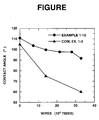
  • the wiper abrasive test results are shown in Figure and Table 3.
  • the contact angle of a region (duplication portion), which was wiped with both wipers on the driver's seat side and the front passenger's seat side, was 92° even after the 330 thousand wipings, showing maintenance of high contact angle. Furthermore, deterioration of an upper reciprocal portion of the front passenger's side wiper was also small, showing a good durability. Number of Rubbings Appearance of Upper Reciprocal Portion of Front Passenger's Side Wiper Example 1-12 Com. Ex.
  • Example 1-1 was repeated except in that the heat treatment was conducted at 150°C for 10min.
  • Example 1-1 was repeated except in that the fluoroalkylsilane concentration was 0wt%. That is, a film containing no fluoroalkylsilane was produced in the present comparative example.
  • Example 1-1 was repeated except in that the silicone concentration was 50.0wt% and that the fluoroalkylsilane concentration was 3wt%.
  • the wiper abrasive test results are shown in Figure and Table 3.
  • an upper reciprocal portion of the front passenger's side wiper also deteriorated in a wide region, showing an inferior durability.
  • Example 1-1 was repeated except in that an alkoxy-group-terminated dimethyl silicone [(CH 3 O) 2 (CH 3 )SiCH 2 CH 2 [Si(CH 3 ) 2 O] 2500 Si(CH 3 ) 2 CH 2 CH 2 Si(CH 3 )(OCH 3 ) 2 ] of an average degree of polymerization n of 2,500 was used.
  • an alkoxy-group-terminated dimethyl silicone [(CH 3 O) 2 (CH 3 )SiCH 2 CH 2 [Si(CH 3 ) 2 O] 2500 Si(CH 3 ) 2 CH 2 CH 2 Si(CH 3 )(OCH 3 ) 2 ] of an average degree of polymerization n of 2,500 was used.
  • Example 1-1 was repeated except in that the silicone concentration was 20wt%.
  • Example 1-1 was repeated except in that the fluoroalkylsilane concentration was 30wt%.
  • Example 1-1 was repeated except in that the silica concentration of the coating solution was 1.0wt%.
  • Example 1-1 was repeated except in that the heat treatment of the obtained film was omitted.
  • a silica sol was obtained by the same process as that of Example 1-1.
  • a coating solution was obtained by adding the above silica sol to a mixture obtained by mixing together an alkoxy-group-terminated dimethyl silicone and a fluoroalkylsilane, followed by mixing.
  • the preparation conditions of the sample are shown in Table 4. Average degree of polymerization Fluoroalkylsilane Silica Conc. (wt%) Silicone Conc. (wt%) FAS Molar Ratio Ex.2-1 2 5 0 C 8 F A S 0. 1 2. 5 8 1 Ex.2-2 2 5 0 C 8 F A S 0. 1 2. 0 1 1 1 Ex.2-3 2 5 0 C 8 F A S 0. 1 1. 7 1 3 6 Ex.2-4 2 5 0 C 8 F A S 0. 1 1. 4 1 7 3 Ex.2-5 2 5 0 C 8 F A S 0.
  • C8FAS heptadecafluorodecyltrimethoxysilane
  • a float glass surface of an actual automotive windshield size (about 1500mm ⁇ 1000mm) was abraded with an abrasive liquid and then washed with water and dried.
  • the same abrasive liquid as that of Example 1-1 was used.
  • the coating solution prepared by the above (2) was applied by a spin coating onto the glass substrate prepared by the above (3).
  • the above glass substrate was placed on a spin coating machine. While it was rotated at a rotation speed of 80rpm, the coating solution of about 300ml was dropped. The rotation speed was maintained for 30 seconds to dry the coated film, thereby obtaining a transparent gel film of a good quality.
  • a heating treatment was conducted at 370°C for 7min, followed by cooling down to room temperature, thereby obtaining a colorless, transparent, highly durable, glass sample with a water drop slippage capable film.
  • the obtained functional film was evaluated by the following evaluation methods. The results are shown in Tables 5 and 6.
  • the contact angle was measured by the same method as that of Example 1-1.
  • the sliding angle was measured by the same method as that of Example 1-1.
  • a wiper blade to which a natural rubber based, water repellent rubber in contact with a pressing pressure of 16g/cm had been attached, was operated using a wiper driving system of an actual car. Upon this, the inclination angle of the above substrate was about 30°.
  • a water repellent wiper rubber (type: 1UT7-67-33H) made by Mazda Motor Corporation was used. Upon this, when the wiper blade was reciprocated one time, it was counted as one time of wiping number. The wiper blade was operated with a wiping speed of 48 times per minute.
  • the contact angle and judder evaluations before the sliding movement and after 270 thousand times sliding movement of the wiper were conducted.
  • the condition of the occurrence of vibration (chatter) of the lower end portion of the wiper blade and of the blade entirety was observed with naked eyes.
  • a level of no driving obstruction due to no chattering was judged as "good”, and a level of driving obstruction due to a loud chattering was judged as "not good”.
  • Example 2-1 was repeated except in that 0.47g of the C8FAS solution and 0.70g of the alkoxy-group-terminated dimethyl silicone solution were used.
  • Example 2-1 was repeated except in that 0.49g of the C8FAS solution and 0.60g of the alkoxy-group-terminated dimethyl silicone solution were used.
  • Example 2-1 was repeated except in that 0.51g of the C8FAS solution and 0.49g of the alkoxy-group-terminated dimethyl silicone solution were used.
  • Example 2-1 was repeated except in that 0.60g of the C8FAS solution and 1.22g of the alkoxy-group-terminated dimethyl silicone solution were used.
  • Example 2-1 was repeated except in that 0.51g of the C8FAS solution were used.
  • Example 2-6 was repeated except in that 1.05g of the alkoxy-group-terminated dimethyl silicone solution were used.
  • Example 2-6 was repeated except in that 1.41g of the alkoxy-group-terminated dimethyl silicone solution were used.
  • Example 2-6 was repeated except in that 1.76g of the alkoxy-group-terminated dimethyl silicone solution were used.
  • Example 2-6 was repeated except in that 2.10g of the alkoxy-group-terminated dimethyl silicone solution were used.
  • Example 2-1 was repeated except in that the average degree of polymerization of an alkoxy-group-terminated dimethyl silicone [(CH 3 O) 3 SiCH 2 CH 2 ⁇ Si(CH 3 ) 2 O ⁇ 150 Si(CH 3 ) 2 CH 2 CH 2 Si(OCH 3 ) 3 ] was 150.
  • Example 2-1 was repeated except in that the average degree of polymerization of an alkoxy-group-terminated dimethyl silicone [(CH 3 O) 3 SiCH 2 CH 2 ⁇ Si(CH 3 ) 2 O ⁇ 200 Si(CH 3 ) 2 CH 2 CH 2 Si(OCH 3 ) 3 ] was 200.
  • Example 2-1 was repeated except in that the average degree of polymerization of an alkoxy-group-terminated dimethyl silicone [(CH 3 O) 3 SiCH 2 CH 2 ⁇ Si(CH 3 ) 2 O ⁇ 300 Si(CH 3 ) 2 CH 2 CH 2 Si(OCH 3 ) 3 ] was 300.
  • Example 2-1 was repeated except in that 0.27g of the C8FAS solution and 0.88g of the alkoxy-group-terminated dimethyl silicone (average degree of polymerization: 250) solution diluted to 4wt% were added.
  • Example 2-1 was repeated except in that the average degree of polymerization of the alkoxy-group-terminated dimethyl silicone was 200, and 0.18g of the solution were added.
  • Example 2-1 was repeated except in that the silicone concentration was 0wt%. That is, there was prepared a film containing only the fluoroalkylsilane in the matrix formed of silica, with no alkoxy-group-terminated dimethyl silicone. As a result, spot-like marks were generated over the entire surface of the film.
  • Example 2-1 was repeated except in that the silica concentration was 0wt%. That is, a film containing no silica as the matrix component was prepared.
  • a silica sol was obtained by the same process as that of Example 1-1.
  • a coating solution was obtained by mixing together a solution previously obtained by hydrolysis and polycondensation of an alkoxy-group-terminated dimethyl silicone and a fluoroalkylsilane, with the above silica sol.
  • C8FASM heptadecafluorodecyltrimethoxysilane
  • a float glass surface of a size of 300mm ⁇ 300mm ⁇ 2mmt was abraded with an abrasive liquid, followed by washing with water and drying with a glass washer.
  • the same abrasive liquid as that of Example 1-1 was used.
  • the coating solution prepared by the above (2) was applied by a spin coating onto the glass substrate prepared by the above (3).
  • the above glass substrate was placed on a spin coating machine. While it was rotated at a rotation speed of 80rpm, the coating solution of about 300ml was dropped. The rotation speed was maintained for 30 seconds to dry the coated film, thereby obtaining a transparent gel film of a good quality.
  • a heating treatment was conducted at 280°C for 10min, followed by cooling down to room temperature, thereby obtaining a glass with a 20nm film thickness, colorless, transparent, highly durable, functional film.
  • the obtained film was evaluated by the following evaluation methods. The results are shown in Table 8.
  • the contact angle was measured by the same method as that of Example 1-1.
  • the sliding angle was measured by the same method as that of Example 1-1.
  • the film thickness of the functional film was measured with an ellipsometer (made by Mizojiri Optical Co., Ltd., DVA-FL3G).
  • the measurement was conducted with a surface roughness meter (made by Solan tech., DEKTAK2A).
  • a cotton cloth was bonded to a metal piece that had a width of 20mm (length: 20mm) and a curved surface of R45 in a longitudinal direction. This was moistened with a ceria suspension (10wt%), in which a glass abrasive agent MIREK A(T) (made by Mitsui Kinzoku Kogyo) was dispersed in tap water, thereby preparing an abrasive member. Upon this, the load onto the abrasive member was set to 3kg.
  • Example 3-1 was repeated except in that heptadecafluorodecyltrichlorosilane [CF 3 (CF 2 ) 7 CH 2 CH 2 SiCl 3 , hereinafter abbreviated to "C8FASC”] was used as the fluoroalkylsilane.
  • C8FASC heptadecafluorodecyltrichlorosilane
  • Example 3-3 was repeated except in that henicosafluorododecyltrichlorosilane [CF 3 (CF 2 ) 9 CH 2 CH 2 SiCl 3 , hereinafter abbreviated to "C10FASC”] was used as the fluoroalkylsilane.
  • C10FASC henicosafluorododecyltrichlorosilane
  • Example 3-1 was repeated except in that the heat treatment was conducted at 150°C for 10min.
  • Example 3-1 was repeated except in that a polydimethylsiloxane [HO[Si(CH 3 ) 2 O] 50 Si(CH 3 ) 2 OH] that had one hydroxyl group at each terminal and an average degree of polymerization of 50 was used as the silicone component.
  • a polydimethylsiloxane [HO[Si(CH 3 ) 2 O] 50 Si(CH 3 ) 2 OH] that had one hydroxyl group at each terminal and an average degree of polymerization of 50 was used as the silicone component.
  • Example 3-1 was repeated except in that the silica concentration was 0.5wt%.
  • Example 3-1 was repeated except in that the heat treatment of the obtained film was omitted.
  • Example 3-1 was repeated except in that the silicone concentration was 0wt%. That is, there was produced in the present comparative example a film that contained only the fluoroalkylsilane in the matrix formed of the silica, with no alkoxy-group-terminated dimethyl silicone.
  • Example 3-1 was repeated except in that the silica concentration was 0wt%. That is, there was produced in the present comparative example a film containing no silica component as the matrix.
Landscapes

  • Chemical & Material Sciences (AREA)
  • Engineering & Computer Science (AREA)
  • Life Sciences & Earth Sciences (AREA)
  • Organic Chemistry (AREA)
  • Chemical Kinetics & Catalysis (AREA)
  • Materials Engineering (AREA)
  • Geochemistry & Mineralogy (AREA)
  • General Chemical & Material Sciences (AREA)
  • Wood Science & Technology (AREA)
  • Mechanical Engineering (AREA)
  • Inorganic Chemistry (AREA)
  • Composite Materials (AREA)
  • Paints Or Removers (AREA)
  • Surface Treatment Of Glass (AREA)
  • Application Of Or Painting With Fluid Materials (AREA)
  • Materials Applied To Surfaces To Minimize Adherence Of Mist Or Water (AREA)

Abstract

The invention relates to an article superior in making a waterdrop slip down a surface of the article. This article can be prepared by a first process including the steps of (a) mixing a silica precursor sol with (i) an alkoxy-terminated dimethyl silicone that is represented by the general formula [1] and that is in an amount of from 0.1wt% to 10wt%, based on a total weight of a silica that is to be produced from the silica precursor sol and (ii) a fluoroalkylsilane represented by the general formula [2], thereby preparing a coating solution; and (b) applying the coating solution to a substrate,
Figure 80000001
B(CF2)rCH2CH2Si(CH3)3-sXs

Description

BACKGROUND OF THE INVENTION
The present invention relates to an article having a functional (waterdrop slippage capable) film superior in making waterdrops slip down the surface of the article. This article can be used for architectural and vehicular windowpanes, mirrors, and industrial glasses.
Various compositions (including silicone waxes, organopolysiloxanes, and surfactants) have been proposed in the course of improving waterdrop slippage capability.
US Patent 3,579,540, corresponding to Japanese Patent Examined Publication JP-B-50-15473, discloses a water repellent composition containing an alkylpolysiloxane and a mineral acid.
Japanese Patent Unexamined Publication JP-A-5-301742 discloses a water repellent agent for automotive window glass. This water repellent agent contains an amino-modified silicone oil and a surfactant.
JP-A-11-181412 discloses a surface treating agent containing a component that is a fluorine-containing silicone compound and/or its partial hydrolysate. This component contains a first essential unit in which a group (e.g., -(CH2)3(CF2)7CH3 and -(CH2)3(CF2)7CF3) is directly bonded to a silicon atom of an organosiloxane unit, and a second essential unit in which a group (e.g., -(CH2)3SiCl3) is directly bonded to a silicon atom of an organosiloxane unit.
JP-A-2000-144056 discloses a surface treating liquid that is a mixture of (a) a first or second silicone compound, (b) an acid, and (c) a solvent containing water dissolved therein. The first silicone compound has a hydrolysable functional group at its end. The second silicone compound has a hydrolysable functional group at one end and a fluoroalkyl group at the other end.
JP-A-8-12375 discloses a water-repellent article prepared by applying a coating solution to a substrate. This coating solution is prepared by mixing together (a) a first solution obtained by hydrolyzing in a solvent a fluoroalkyl-group-containing silane compound and another compound (polydimethylsiloxane and/or polydimethylsiloxane derivative) and (b) a second solution obtained by hydrolyzing in a solvent an alkoxysilane compound.
JP-A-2000-26758 discloses a coating composition containing as essential components (A) a hydroxyl-containing vinyl polymer, (B) an epoxy-terminated siloxane polymer, (C) a sulfonic acid compound, (D) a crosslinking agent component, and (E) a surfactant.
JP-A-6-262943 discloses an automotive windshield system having a two-layer-coated front windshield and a resin-coated windshield wiper.
JP-A-8-268234 discloses an automotive windshield wiper system with a pressure regulator for regulating the wiper pressure against a front windshield.
SUMMARY OF THE INVENTION
It is an object of the present invention to provide an article that is superior in making waterdrops slip down the surface of the article and in wear resistance against the windshield wiper movement.
It is another object of the present invention to provide a process for producing the article.
According to the present invention, there is provided an article superior in making a waterdrop slip down a surface of the article. This article is prepared by a first process comprising the steps of:
  • (a) mixing a silica precursor sol with (i) an alkoxy-terminated dimethyl silicone that is represented by the general formula [1] and that is in an amount of from 0.1wt% to 10wt%, based on a total weight of a silica that is to be produced from the silica precursor sol and (ii) a fluoroalkylsilane represented by the general formula [2], thereby preparing a coating solution; and
  • (b) applying the coating solution to a substrate,
    Figure 00030001
  •    where each of A1 and A2 is independently a bivalent hydrocarbon group, -(CH2)i-NH-COO- group, where i is an integer of from 0 to 9, or oxygen; R is a monovalent hydrocarbon group; n is an integer of 2,000 or less and represents an average degree of polymerization; each of p and q is independently an integer of from 0 to 3; and a total of p and q is 3 or greater, B(CF2)rCH2CH2Si(CH3)3-sXs    where B represents -CF3 group or -CH2CH2Si(CH3)3-tYt group, where Y represents a hydrolysable group and t is an integer of from 1 to 3; X represents a hydrolysable group; r is an integer of from 0 to 12; and s is an integer of from 1 to 3.
    According to the present invention, there is provided an article superior in making a waterdrop slip down a surface of the article. This article is prepared by a second process comprising the steps of:
  • (a) subjecting an alkoxysilane to hydrolysis and polycondensation, thereby preparing a silica precursor sol;
  • (b) subjecting (i) an alkoxy-terminated dimethyl silicone that is represented by the general formula [1] and that is in an amount of from 0.1wt% to 10wt%, based on a total weight of a silica that is to be produced from the silica precursor sol and (ii) a fluoroalkylsilane represented by the general formula [2] to hydrolysis and polycondensation, thereby preparing a polycondensation product;
  • (c) mixing the silica precursor sol with the polycondensation product, thereby preparing a coating solution; and
  • (d) applying the coating solution to a substrate.
  • BRIEF DESCRIPTION OF THE DRAWINGS
  • Figure is a graph showing the contact angle changes in the wiper wear test of Example 1-12 and Comparative 1-3.
  • DESCRIPTION OF THE PREFERRED EMBODIMENTS
    The present invention was made in view of the above problems. The present inventors eagerly examined functional films (i.e., highly waterdrop slippage capable films) that were produced by using a silica precursor that becomes a silica matrix, an alkoxy-group-terminated dimethyl silicone that is a water drop slippage capable component, and a fluoroalkylsilane for providing durability, and developed a functional film that is colorless and transparent and that is superior in waterdrop slippage capability and durability, particularly in mud water abrasion resistance and wear resistance by wipers and the like.
    In case that the above article (article superior in making waterdrops slip down surface thereof; i.e., highly waterdrop slippage capable article) is used as a vehicular windshield, it is needless to say that the highly waterdrop slippage capable film is wiped with a wiper to remove the waterdrops.
    The above article (highly waterdrop slippage capable article) is produced by the above first or second process. The total amount of the silica in the first or second process refers to the amount of silica that is obtained from a silica precursor sol (hereinafter "silica sol") and is univocally derived from the amount of an alkoxysilane that is the starting material of the silica sol.
    It is preferable that the average degree of polymerization n in the general formula [1] is particularly 5-1,000.
    The alkoxy-group-terminated dimethyl silicone of the general formula [1] contains an alkoxy group at the terminal. Therefore, hydrolysis and polycondensation occur at the alkoxy group site, when the functional film is formed, and it can chemically be bonded with the silica as the matrix.
    The fluoroalkylsilane of the general formula [2] contains a hydrolysable group at the terminal. Therefore, hydrolysis and polycondensation occur at the hydrolysable group site, when the functional film is formed, and it can chemically be bonded with the silica as the matrix.
    In the first process, the functional film of the present invention is produced from a coating solution that has been prepared by mixing the alkoxy-group-terminated dimethyl silicone, which becomes a waterdrop slippage capable component, and the fluoroalkylsilane, which becomes a durability-providing component, with the silica sol, which becomes the silica matrix. When the film is formed from the coating solution, hydrolysis and polycondensation occur at the alkoxy group site of the alkoxy-group-terminated dimethyl silicone and the hydrolysable group site of the fluoroalkylsilane. Therefore, the alkoxy-group-terminated dimethyl silicone and the fluoroalkylsilane are chemically bonded with the silica matrix.
    The silica as the matrix that is a component constituting the functional film is obtained from the silica sol, which is formed by conducting hydrolysis and polycondensation of the alkoxysilane. To prepare the silica sol, for example, an alkoxysilane (e.g., tetraethoxysilane [Si(OC2H5)4]) and a solvent are mixed together in predetermined amounts, followed by stirring (e.g., about 30min), thereby obtaining solution A. As the solvent, a lower alcohol such as ethyl alcohol and isopropyl alcohol or a mixed solvent thereof is desirable. It is, however, not limited to alcohols, and it is possible to use ethers and ketones, too. On the other hand, an acid aqueous solution and the solvent are mixed together, followed by stirring, thereby obtaining solution B. Then, the solution A and the solution B are mixed together, followed by stirring at room temperature to conduct hydrolysis and polycondensation of the alkoxysilane, thereby obtaining the silica sol. The stirring time is preferably from 10min to several days, particularly preferably from 30min to one day. It is, however, not limited to this in case that the stirring is conducted at a temperature except room temperature. As mentioned above, it is possible to conduct hydrolysis of the alkoxysilane by using the alkoxysilane as a starting material and by adding a small amount of water and an acid catalyst such as hydrochloric acid, nitric acid and acetic acid. It is possible to obtain a silica sol by stirring the hydrolysate at room temperature or under heating to achieve the polycondensation. Although the process for preparing the silica sol is not limited to the above process, the above process, in which one prepared by diluting the alkoxysilane with a solvent is gradually mixed with an acid aqueous solution prepared by dilution with a solvent, can prevent an abrupt reaction and can obtain a more homogeneous reaction. Therefore, it is preferable.
    As the alkoxysilane, it is possible to use tetraalkoxysilanes such as tetramethoxysilane, tetraethoxysilane, tetrapropoxysilane, and tetrabutoxysilane, trialkoxysilanes such as methyltriethoxysilane, methyltrimethoxysilane, ethyltrimethoxysilane, ethyltriethoxysilane, propyltrimethoxysilane and propyltriethoxysilane, or dialkoxysilanes. Of the above alkoxysilanes, tetramethoxysilane, tetraethoxysilane, and trialkoxysilanes such as methyltriethoxysilane, methyltrimethoxysilane, ethyltrimethoxysilane, and ethyltriethoxysilane are preferable.
    It is important that the number (p+q) of the alkoxy groups, which is owned by the alkoxy-group-terminated dimethyl silicone represented by the general formula [1] to be mixed with the silica sol, is 3 or greater. If the number of the alkoxy groups of the hydrolysable groups is less than 3, the solubility in the silica sol, which turns into the silica matrix component obtained by hydrolysis and polycondensation of the alkoxysilane, decreases, thereby lowering the film forming capability. Furthermore, the bonding between the alkoxy-group-terminated dimethyl silicone and the silica, which is a matrix component of the film, becomes insufficient, thereby significantly lowering durability of the functional film. Therefore, the total number (p+q) of the alkoxy groups must be 3 or greater.
    In the first or second process, it is important that the alkoxy-group-terminated dimethyl silicone represented by the general formula [1] is mixed in an amount of 0.1wt% to 10wt%, relative to the amount of the silica formed from the silica sol. With this, the dimethyl silicone content of the functional film becomes 0.1wt% to 10wt%, based on the total amount (100wt%) of the silica. If it is less than 0.1wt%, the film does not show a sufficient waterdrop slippage capability. If it exceeds 10wt%, its compatibility with the silica sol lowers, and the film forming capability lowers significantly. Furthermore, if the average degree of polymerization n of the alkoxy-group-terminated dimethyl silicone, represented by the general formula [1], exceeds 2,000, its solubility in the silica sol lowers significantly, and insoluble matters, which are difficult for separation, remain, thereby significantly lowering the film forming capability. Therefore, it must be 2,000 or less, particularly preferably 5-1,000. If it is less than 5, volatility of the alkoxy-group-terminated dimethyl silicone becomes high, thereby making it difficult to be introduced into the functional film. On the other hand, if it is greater than 1,000, its compatibility with the silica sol becomes lower. Therefore, the average degree of polymerization is more preferably 1,000 or less.
    In the first or second process of the present invention, it is preferable that the fluoroalkylsilane represented by the general formula [2] is mixed in an amount of 3wt% to 20wt% relative to the total amount of the silica, which is formed from the silica sol. If it is less than 3wt%, the film lowers significantly in durability. If it exceeds 20wt%, its compatibility with the silica sol, which becomes the matrix, lowers, and the film forming capability lowers significantly.
    The concentration of the silica precursor, converted into the silica in the coating solution, may be 0.05-0.3 wt%.
    In the first or second process of the present invention, it is preferable that the fluoroalkylsilane represented by the general formula [2] is made to be present in an amount of 20-200 moles relative to one mole of the alkoxy-group-terminated dimethyl silicone. If it is less than 20 moles, the content of the fluoroalkylsilane is low relative to the alkoxy-group-terminated dimethyl silicone. Therefore, a durable film may not be obtained. Although it is possible to prevent the occurrence of judder upon the wiper sliding movement, the film exfoliation may occur by wiping with a wiper. If it exceeds 200 moles, the content of the fluoroalkylsilane becomes high relative to the alkoxy-group-terminated dimethyl silicone. With this, the waterdrop slippage capability may become inferior, and there may occur a malfunction in which judder occurs upon the wiper sliding movement.
    As the fluoroalkylsilane represented by the above general formula [2], for example, it is possible to use fluoroalkylsilanes having a hydrolysable group at one terminal, such as CF3(CF2)11CH2CH2Si(OCH3)3, CF3(CF2)11CH2CH2SiCH3(OCH3)2, CF3(CF2)11CH2CH2Si(CH3)2OCH3, CF3(CF2)9CH2CH2Si(OCH3)3, CF3(CF2)9CH2CH2SiCH3(OCH3)2, CF3(CF2)9CH2CH2Si(CH3)2OCH3, CF3(CF2)7CH2CH2Si(OCH3)3, CF3(CF2)7CH2CH2SiCH3(OCH3)2, CF3(CF2)7CH2CH2Si(CH3)2OCH3, CF3(CF2)5CH2CH2Si(OCH3)3, CF3(CF2)5CH2CH2SiCH3(OCH3)2, CF3(CF2)5CH2CH2Si(CH3)2OCH3, CF3CH2CH2Si(OCH3)3, CF3CH2CH2SiCH3(OCH3)2, CF3CH2CH2Si(CH3)2OCH3. CF3(CF2)11CH2CH2SiCl3, CF3(CF2)11CH2CH2SiCH3Cl2, CF3(CF2)11CH2CH2Si(CH3)2Cl, CF3(CF2)9CH2CH2SiCl3, CF3(CF2)9CH2CH2SiCH3Cl2, CF3(CF2)9CH2CH2Si(CH3)2Cl, CF3(CF2)7CH2CH2SiCl3, CF3(CF2)7CH2CH2SiCH3Cl2, CF3(CF2)7CH2CH2Si(CH3)2Cl, CF3(CF2)5CH2CH2SiCl3, CF3(CF2)5CH2CH2SiCH3Cl2, CF3(CF2)5CH2CH2Si(CH3)2Cl, CF3CH2CH2SiCl3, CF3CH2CH2SiCH3Cl2, and CF3CH2CH2Si(CH3)2Cl, and fluoroalkylsilanes having hydrolysable groups at both terminals, such as (CH3O)3SiCH2CH2(CF2)12CH2CH2Si(OCH3)3, (CH3O)2CH3SiCH2CH2(CF2)12CH2CH2SiCH3(OCH3)2, CH3O(CH3)2SiCH2CH2(CF2)12CH2CH2Si(CH3)2OCH3, (CH3O)3SiCH2CH2(CF2)10CH2CH2Si(OCH3)3, (CH3O)2CH3SiCH2CH2(CF2)10CH2CH2SiCH3(OCH3)2, CH3O(CH3)2SiCH2CH2(CF2)10CH2CH2Si(CH3)2OCH3, (CH3O)3SiCH2CH2(CF2)8CH2CH2Si(OCH3)3, (CH3O)2CH3SiCH2CH2(CF2)8CH2CH2SiCH3(OCH3)2, CH3O(CH3)2SiCH2CH2(CF2)8CH2CH2Si(CH3)2OCH3, (CH3O)3SiCH2CH2(CF2)6CH2CH2Si(OCH3)3, (CH3O)2CH3SiCH2CH2(CF2)6CH2CH2SiCH3(OCH3)2, CH3O(CH3)2SiCH2CH2(CF2)6CH2CH2Si(CH3)2OCH3, (CH3O)3SiCH2CH2CF2CH2CH2Si(OCH3)3, (CH3O)2CH3SiCH2CH2CF2CH2CH2SiCH3(OCH3)2, CH3O(CH3)2SiCH2CH2CF2CH2CH2Si(CH3)2OCH3, Cl3SiCH2CH2(CF2)12CH2CH2SiCl3, Cl2CH3SiCH2CH2(CF2)12CH2CH2SiCH3Cl2, Cl(CH3)2SiCH2CH2(CF2)12CH2CH2Si(CH3)2Cl, Cl3SiCH2CH2(CF2)10CH2CH2SiCl3, Cl2CH3SiCH2CH2(CF2)10CH2CH2SiCH3Cl2, Cl(CH3)2SiCH2CH2(CF2)10CH2CH2Si(CH3)2Cl, Cl3SiCH2CH2(CF2)8CH2CH2SiCl3, Cl2CH3SiCH2CH2(CF2)8CH2CH2SiCH3Cl2, Cl(CH3)2SiCH2CH2(CF2)8CH2CH2Si(CH3)2Cl, Cl3SiCH2CH2(CF2)6CH2CH2SiCl3, Cl2CH3SiCH2CH2(CF2)6CH2CH2SiCH3Cl2, Cl(CH3)2SiCH2CH2(CF2)6CH2CH2Si(CH3)2Cl, Cl3SiCH2CH2CF2CH2CH2SiCl3, Cl2CH3SiCH2CH2CF2CH2CH2SiCH3Cl2, and Cl(CH3)2SiCH2CH2CF2CH2CH2Si(CH3)2Cl. Furthermore, as the hydrolysable groups represented by X and Y of the above general formula [2], it is possible to use alkoxy groups such as methoxy group, ethoxy group, propoxy group, isopropoxy group and butoxy group or chloro group and isocyanate group and the like.
    In the first or second process, hydrolysis and polycondensation occur at the alkoxy group site of the alkoxy-group-terminated dimethyl silicone and at the hydrolysable group site of the fluoroalkylsilane. Therefore, when the functional film is formed, the dimethyl silicone and the fluoroalkylsilane are chemically bonded with the silica as the matrix, thereby obtaining a film superior in durability. Upon this, it may be possible that an alkoxy group site and a hydrolysable group site, which are not chemically bonded with the silica matrix, are reacted with and bonded with an alkoxy group site of another alkoxy-group-terminated dimethyl silicone and a hydrolysable group site of a fluoroalkylsilane. The above dimethyl silicone and the above fluoroalkylsilane may be bonded with the silica matrix through another dimethyl silicone and another fluoroalkylsilane.
    A functional film that prevents the occurrence of judder refers to one that is at the level at which chatter of a wiper blade does not occur upon wiping with a wiper, when a wiper blade is slidingly moved in a condition in which water has been scattered on the film by waterdrops, raindrops and the like, and at which there is no driving obstruction. It is possible to use a natural rubber-based one coated with fluororesin, nylon resin, polyisoimide or graphite, as a wiper rubber to be attached to the above wiper blade.
    Furthermore, the film thickness of the functional film of the present invention is preferably from 10nm to 100nm. If it is less than 10nm, in case that the substrate is a commonly used soda-lime silicate glass, durability lowers by the effect of diffusing components (such alkalis) present in the substrate. Therefore, it is not preferable. On the other hand, it is necessary to make the silica concentration in the coating solution high in order to obtain a film thickness exceeding 100nm. By making the silica concentration in the coating solution high, the compatibility between the silica and the alkoxy-group-terminated dimethyl silicone or the fluoroalkylsilane lowers, and it becomes difficult to obtain a homogeneous film superior in transparency. Therefore, it is not preferable. In particular, it is an important point in the actual use as automotive windshields, which are required to have superior transparency. In the present invention, it is possible to make the film thickness of the functional film have a film thickness of from 10nm to 30nm by adjusting the silica concentration in the coating solution to 0.05wt% to 0.3wt%.
    In the first process, it is possible to obtain the coating solution for the functional film by mixing the above silica sol, which becomes the silica matrix, with the alkoxy-group-terminated dimethyl silicone represented by the general formula [1] and the fluoroalkylsilane represented by the general formula [2], then by hydrolyzing the alkoxy-group-terminated dimethyl silicone and the fluoroalkylsilane, and then by bonding them with the silica sol through polycondensation. Upon this, it is preferable to previously mixing together the alkoxy-group-terminated dimethyl silicone and the fluoroalkylsilane, since it is possible to uniformly mix the both components in the coating solution.
    The second process has the step of preparing a solution comprising a composition obtained by hydrolysis and polycondensation of the alkoxy-group-terminated dimethyl silicone represented by the general formula [1] and the fluoroalkylsilane represented by the general formula [2] and the step of obtaining a coating solution by mixing the solution with a solution comprising a composition obtained by hydrolysis and polycondensation of an alkoxysilane. With this, in a polycondensation product obtained by previously conducting hydrolysis and polycondensation of the alkoxy-group-terminated dimethyl silicone and the fluoroalkylsilane, a chemical bond therebetween becomes strong, and it can be provided with both characteristics of the dimethyl silicone, which is superior in waterdrop slippage capability, and the fluoroalkylsilane, which is superior in water repellency and durability. In addition, the polycondensation product becomes strong in bonding with the silica of the matrix component comprising the silica. Therefore, the amount of fixation to the substrate increases, and it is possible to achieve superior water repellency and waterdrop slippage capability.
    As the solvent used in the first or second process, it is preferable to use lower alcohols such as ethyl alcohol and isopropyl alcohol, ketones such as methyl ethyl ketone, methyl isobutyl ketone, esters such as ethyl acetate and butyl acetate, aromatic hydrocarbons such as toluene, benzene and xylene, ethers such as diethyl ether and diisopropyl ether, chlorine-based solvents such as chloroform and carbon tetrachloride, and mixtures thereof.
    In the first or second process, the obtained coating solution is applied to the substrate surface. As the application method, it is possible to suitably use various film forming methods such as hand brushing, nozzle flow coating, dip coating, spraying, reverse coating, flexography, printing, flow coating, spin coating, and a combination of these. It can be used as an easy-type, spray-type, water repellent treatment agent.
    Then, a heat treatment is conducted, thereby allowing a polycondensation of the silica sol and the alkoxy-group-terminated dimethyl silicone and the fluoroalkylsilane to proceed and thereby bonding the dimethyl silicone and the fluoroalkylsilane and the silica matrix together and at the same time fixedly bonding the functional film to the substrate surface. As the heat treatment temperature, 80°C to 600°C is preferable. If the heat treatment temperature is less than 80°C, not only the above polycondensation becomes insufficient, but also the functional film is not sufficiently bonded to the substrate. As a result, durability lowers, and it is not preferable. On the other hand, if it exceeds 600°C, the dimethyl silicone and the fluoroalkyl silane are pyrolyzed, thereby significantly lowering waterdrop slippage capability. Therefore, it is not preferable.
    The substrate is not particularly limited to glass, plastic and the like. For example, in the case of glass substrate, an inorganic, transparent plate glass is preferable such as float glass, commonly used for architectural window glass and automotive window glass, or soda-lime silicate glass produced by rollout method. There are no particular limitations with respect to colorlessness or coloredness, its type or color tone, a combination with other functional films, and glass shape. In addition to as flat plate glass and curved plate glass, it is possible to use various tempered glasses such as air-quench tempered glass and chemically strengthened glass and various glasses such as wired glass, borosilicate glass, low-expansion glass, zero expansion glass, TFT glass, PDP glass, and substrate glass for optical filter.
    The glass can be used in a single plate and as a multiple-layered glass or laminated glass. Furthermore, the film may be formed on one surface or both surfaces of the substrate and may be formed on the entirety or a part of the substrate surface.
    In the following, the present invention is explained in detail by examples, but the present invention is not limited to these examples.
    As shown in the following Examples 1-1 to 1-13 and 3-1 and 3-5, the functional film of the present invention is provided with high waterdrop slippage capability and durability, particularly mud water abrasion resistance and wear resistance by wipers and the like. Therefore, in case that it is used for vehicular window glass and the like, forward, sideward and rearward visions are easily secured, thereby improving driving safety. Furthermore, significant advantageous effects are achieved such as this effect being maintained for a long time. Furthermore, as shown in the following Examples 2-1 to 2-13, a highly durable, functional film of the present invention is superior in high water repellency, waterdrop slippage capability, and wear resistance by wipers and the like. In addition, it prevents the occurrence of judder upon the wiper sliding movement. Therefore, in case that it is used for a vehicular windshield glass, it becomes easy to obtain a forward visibility under a rainy weather, and the driving safety is improved without worry about wiper judder. Furthermore, it is possible to achieve remarkable advantageous effects such as that this effect can be maintained for a long time.
    The following Examples 1-1 to 1-13 and Examples 2-1 to 2-13 correspond to the first process. In contrast, the following Examples 3-1 to 3-5 correspond to the second process.
    EXAMPLE 1-1 (1) Silica Sol Preparation
    A silica sol was prepared by conducting hydrolysis and polycondensation of tetraethoxysilane [Si(OC2H5)4: TEOS].
    At first, 312.5g of TEOS and 450.0g of EKINEN F1 (a lower alcohol mixture of 90wt% ethanol and 10wt% isopropyl alcohol) were mixed together, followed by stirring for about 30min, thereby obtaining solution A. Furthermore, 7.5g of 60wt% nitric acid aqueous solution, 210.0g of H2O, and 20.0g of EKINEN F1 were mixed together, followed by stirring for about 30min, thereby obtaining solution B. Then, solution A and solution B were mixed together, followed by stirring for about 15hr at room temperature, thereby obtaining silica sol X.
    (2) Coating Solution Preparation
    A coating solution was obtained by adding the above silica sol X to a mixture obtained by mixing together an alkoxy-group-terminated dimethyl silicone and a fluoroalkylsilane, followed by mixing. The preparation conditions of the sample are shown in Table 1.
    Alkoxy-terminated dimethyl silicone Fluoroalkylsilane Silica Conc. (wt%) Silicone Conc. (wt%) Fluoro-alkyl-silane Conc. (wt%) Heat Treatment Temp. (°C)
    Average degree of polymerization No. of alkoxy groups
    Ex.1-1 2 0 0 6 C8 fluoroalkylsilane 0.1 1.0 1 0 2 8 0
    Ex.1-2 3 0 0 6 C8 fluoroalkylsilane 0.1 1.0 1 0 2 8 0
    Ex.1-3 5 0 0 6 C8 fluoroalkylsilane 0.1 1.0 1 0 2 8 0
    Ex.1-4 5 0 6 C8 fluoroalkylsilane 0.1 1.0 1 0 2 8 0
    Ex.1-5 1 5 0 6 C8 fluoroalkylsilane 0.1 1.0 1 0 2 8 0
    Ex.1-6 2 0 0 6 C8 fluoroalkylsilane 0.1 0.5 1 0 2 8 0
    Ex.1-7 2 0 0 6 C8 fluoroalkylsilane 0.1 1.0 1 1 2 8 0
    Ex.1-8 2 5 0 6 C8 fluoroalkylsilane 0.1 1.0 9 2 8 0
    Ex.1-9 3 0 0 6 C8 fluoroalkylsilane 0.1 1.5 1 0 2 8 0
    Ex.1-10 3 0 0 6 C8 fluoroalkylsilane 0.1 1.5 1 1 2 8 0
    Ex.1-11 3 0 0 6 C10 fluoroalkylsilane 0.1 1.5 9 2 8 0
    Ex.1-12 3 0 0 6 C10 fluoroalkylsilane 0.1 1.5 1 0 2 8 0
    Ex.1-13 2 0 0 6 C8 fluoroalkylsilane 0.1 1.0 1 0 1 5 0
    Com.Ex. 1-1 2 0 0 6 None 0.1 1.0 0 2 8 0
    Com.Ex. 1-2 1 5 0 6 C8 fluoroalkylsilane 0 - - 1 0 0
    Com.Ex. 1-3 2 0 0 6 C8 fluoroalkylsilane 0.1 5 0.0 3 2 8 0
    Com.Ex. 1-4 2 5 0 0 4 C8 fluoroalkylsilane 0.1 1.0 1 0 2 8 0
    Com.Ex. 1-5 2 0 0 6 C8 fluoroalkylsilane 0.1 2 0.0 1 0 2 8 0
    Com.Ex. 1-6 2 0 0 6 C8 fluoroalkylsilane 0.1 1.0 3 0 2 8 0
    Com.Ex. 1-7 2 0 0 6 C8 fluoroalkylsilane 1.0 1.0 1 0 2 8 0
    Com.Ex. 1-8 2 0 0 6 C8 fluoroalkylsilane 0.1 1.0 1 0 No
    At first, there were mixed together 0.72g of a heptadecafluorodecyltrimethoxysilane [CF3(CF2)7CH2CH2Si(OCH3)3, hereinafter abbreviated to "C8 fluoroalkylsilane"] diluted to 1wt% with ethyl acetate, 0.70g of an alkoxy-group-terminated dimethyl silicone solution [(CH3O)3SiCH2CH2[Si(CH3)2O]200Si(CH3)2CH2CH2Si(OCH3)3] that has been diluted to 0.1wt% with ethyl acetate and that has an average degree of polymerization n of 200, 7.00g of methyl ethyl ketone, and 7.00g of isopropyl alcohol, followed by stirring for about 5min. Then, 0.78g of the above silica sol X were added, followed by stirring for about 15hr at room temperature. Then, 26.8g of methyl ethyl ketone and 26.8g of isopropyl alcohol were added, followed by stirring for 30min. By the above process, there was obtained a coating solution in which the silica concentration was 0.1wt%, in which the weight ratio of the alkoxy-group-terminated dimethyl silicone relative to the silica-converted amount of the silica sol (hereinafter written as "silicone concentration) was 1wt%, and the weight ratio of the fluoroalkylsilane relative to the silica-converted amount of the silica sol (hereinafter written as "fluoroalkylsilane concentration") was 10wt%.
    (3) Glass Substrate Washing
    A surface of a float glass of a size of 1200mm × 800mm × 2mm thickness was abraded with an abrasive liquid and then washed and dried with a glass washer. As the abrasive liquid, a suspension in which a glass abrasive agent, MIREK A(T) (made by Mitsui Mining and Smelting Co., Ltd.), was dispersed in tap water was used.
    (4) Functional Film Formation
    The coating solution prepared by the above (2) was applied by a spin coating onto the glass substrate prepared by the above (3). Firstly, the above glass substrate was placed on a spin coating machine. While it was rotated at a rotation speed of 80rpm, the coating solution of about 200ml was dropped. The rotation speed was maintained for 30 seconds to dry the coated film, thereby obtaining a transparent gel film of a good film forming property. Then, a heating treatment was conducted at 280°C for 10min, followed by cooling down to room temperature, thereby obtaining a glass sample (a highly water drop slippage capable article) with a functional film having a film thickness of 20nm.
    Water slippage capability in the present invention is evaluated by methods described in the evaluation methods of Examples. It is evaluated by dropping a pure water of 50µl onto the sample surface and then by measuring the inclination angle when the water drop starts to move while the sample is gradually inclined. The above inclination angle refers to sliding angle (°), and the sliding angle was measured in the atmosphere (about 25°C) using CA-A type made by Kyowa Interface Science Co., Ltd.
    The obtained functional film was evaluated by the following evaluation methods. The results are shown in Table 2.
    [Functional Film Evaluation Methods] (1) Contact Angle
    When about 2µl of pure water were placed on the sample surface having the functional film, the angle between the water drop and the sample surface was measured with a contact angle meter. CA-X type made by Kyowa Interface Science Co., Ltd. was used as the contact angle meter, and the measurement was conducted in the atmosphere (about 25°C).
    (2) Sliding Angle
    In a condition in which the sample was maintained horizontally, pure water of 50µl was dropped onto the sample surface. Then, the sample was inclined gradually, and the inclination angle at the time when the water drop starts to move was defined as sliding angle (°). The sliding angle was measured in the atmosphere (about 25°C) using CA-A type made by KyowaInterface Science Co., Ltd.
    (3) Ceria Abrasion Test
    A cotton cloth moistened with a suspension (10wt%), in which a glass abrasive agent, MIREK A(T) (made by Mitsui Kinzoku Kogyo), was dispersed in tap water, was rubbed against the sample surface with a strength of about 1.5 kg/cm2. The number of rubbings (reciprocations) to make 70% of the abraded area hydrophilic was evaluated.
    (4) Film Thickness
    The film thickness of the functional film was measured with a SURF CORDER (made by Kosaka Laboratory Ltd., ET4000A).
    (5) Wiper Abrasive Test
    While the substrate formed with the functional film was sprinkled with water under a repeating condition of a sprinkling of tap water for 45 seconds with a sprinkling amount of 750ml/min and a cessation for 15 seconds, a natural rubber based, water repellent rubber in contact with a pressing pressure of 16g/cm was operated using a wiper driving system of an actual car. Herein, when the wiper rubber was reciprocated one time, it was counted as one time of wiping number. The wiper rubber was operated with a wiping speed of 48 times per minute. Viewed from the film side, the left side wiper rubber is referred to as a driver's seat side wiper, and the right side wiper rubber is referred to as a front passenger's seat side wiper.
    Film External Appearance Initial Capability Film Thickness (nm) Ceria Abrasion Test (reciprocations)
    Contact Angle (°) Sliding Angle (°)
    Ex.1-1 Uniform & transparent 1 1 4 1 0 2 0 1 4 0
    Ex.1-2 Uniform & transparent 1 1 2 1 2 2 0 1 8 0
    Ex.1-3 Uniform & transparent 1 1 3 1 2 2 0 2 0 0
    Ex.1-4 Uniform & transparent 1 1 3 1 1 2 0 1 4 0
    Ex.1-5 Uniform & transparent 1 1 4 1 0 2 0 1 6 0
    Ex.1-6 Uniform & transparent 1 1 3 1 2 2 0 1 5 0
    Ex.1-7 Uniform & transparent 1 1 3 1 2 3 0 1 7 0
    Ex.1-8 Uniform & transparent 1 1 3 8 3 0 1 2 0
    Ex.1-9 Uniform & transparent 1 1 3 1 0 3 0 1 2 0
    Ex.1-10 Uniform & transparent 1 1 3 1 2 3 0 1 5 0
    Ex.1-11 Uniform & transparent 1 1 1 1 2 3 0 1 3 0
    Ex.1-12 Uniform & transparent 1 1 1 1 2 3 0 1 5 0
    Ex.1-13 Uniform & transparent 1 1 2 1 0 2 0 5 0
    Com. Ex. 1-1 Uniform & transparent 1 0 5 7 2 0 1 0
    Com. Ex. 1-2 Uniform & transparent 1 1 3 1 9 < 1 0 < 5
    Com. Ex. 1-3 Uniform & transparent 1 0 6 1 0 3 0 3 5
    Com. Ex. 1-4 White haze No evaluation 2 0 No evaluation
    Com. Ex. 1-5 White haze No evaluation 3 0 No evaluation
    Com. Ex. 1-6 White haze No evaluation 3 0 No evaluation
    Com. Ex. 1-7 White haze No evaluation 1 3 0 No evaluation
    Com. Ex. 1-8 Uniform & transparent 1 1 2 1 1 3 0 1 0
    EXAMPLE 1-2
    Example 1-1 was repeated except in that an alkoxy-group-terminated dimethyl silicone [(C2H5O)3SiCH2CH2[Si(CH3)2O]300Si(CH3)2CH2CH2Si(OC2H5)3] of an average degree of polymerization n of 300 was used.
    EXAMPLE 1-3
    Example 1-1 was repeated except in that an alkoxy-group-terminated dimethyl silicone [(CH3O)3SiCH2CH2[Si(CH3)2O]500Si(CH3)2CH2CH2Si(OCH3)3] of an average degree of polymerization n of 500 was used.
    EXAMPLE 1-4
    Example 1-1 was repeated except in that an alkoxy-group-terminated dimethyl silicone [(CH3O)3SiCH2CH2[Si(CH3)2O]50Si(CH3)2CH2CH2Si(OCH3)3] of an average degree of polymerization n of 50 was used.
    EXAMPLE 1-5
    Example 1-1 was repeated except in that an alkoxy-group-terminated dimethyl silicone [(CH3O)3SiO[Si(CH3)2O]150Si(OCH3)3] of an average degree of polymerization n of 150 was used.
    EXAMPLE 1-6
    Example 1-1 was repeated except in that the silicone concentration was 0.5wt%.
    EXAMPLE 1-7
    Example 1-1 was repeated except in that the fluoroalkylsilane concentration was 11wt%.
    EXAMPLE 1-8
    Example 1-1 was repeated except in that an alkoxy-group-terminated dimethyl silicone [(CH3O)3SiO[Si(CH3)2O]250Si(OCH3)3] of an average degree of polymerization n of 250 was used and that the fluoroalkylsilane concentration was 9wt%.
    EXAMPLE 1-9
    Example 1-2 was repeated except in that the silicone concentration was 1.5wt%.
    EXAMPLE 1-10
    Example 1-2 was repeated except in that the silicone concentration was 1.5wt% and that the fluoroalkylsilane concentration was 11wt%.
    EXAMPLE 1-11
    Example 1-2 was repeated except in that henicosafluorododecyltrimethoxysilane [CF3(CF2)9CH2CH2Si(OCH3)3, hereinafter abbreviated to "C10 fluoroalkylsilane"] was used as the fluoroalkylsilane, that the silicone concentration was 1.5wt%, and that the fluoroalkylsilane concentration was 9wt%.
    EXAMPLE 1-12
    Example 1-11 was repeated except in that the fluoroalkylsilane concentration was 10wt%. The wiper abrasive test results are shown in Figure and Table 3. The contact angle of a region (duplication portion), which was wiped with both wipers on the driver's seat side and the front passenger's seat side, was 92° even after the 330 thousand wipings, showing maintenance of high contact angle. Furthermore, deterioration of an upper reciprocal portion of the front passenger's side wiper was also small, showing a good durability.
    Number of Rubbings Appearance of Upper Reciprocal Portion of Front Passenger's Side Wiper
    Example 1-12 Com. Ex. 1-3
    0 times No change No change
    50 thousand times No change It was made hydrophilic in the form of streaks
    70 thousand times No change -
    140 thousand times No change It was made hydrophilic in the form of streaks
    280 thousand times No change -
    330 thousand times A part was made hydrophilic in the form of streaks. It was made hydrophilic in the form of bands (3cm width).
    EXAMPLE 1-13
    Example 1-1 was repeated except in that the heat treatment was conducted at 150°C for 10min.
    COMPARATIVE EXAMPLE 1-1
    Example 1-1 was repeated except in that the fluoroalkylsilane concentration was 0wt%. That is, a film containing no fluoroalkylsilane was produced in the present comparative example.
    COMPARATIVE EXAMPLE 1-2
    4.0ml of a solution obtained by mixing and stirring of 0.72g of a C8 fluoroalkylsilane solution diluted to 1wt% with ethyl acetate and 0.70g of an alkoxy-group-terminated dimethyl silicone [(CH3O)3SiO[Si(CH3)2O]150Si(OCH3)3] solution of an average degree of polymerization n of 150 diluted to 0.1wt% with ethyl acetate were dropped onto a glass substrate, followed by a sufficient extension over the entire glass surface with a cotton cloth (trade name: BEMCOT) and then air-drying for about 5min. Then, a heat treatment was conducted in a muffle furnace at 100°C for 10min. A white-haze remainder of the water slippage capable agent was wiped with isopropyl alcohol, thereby obtaining a transparent sample. That is, a film containing no silica matrix was produced in the present comparative example.
    COMPARATIVE EXAMPLE 1-3
    Example 1-1 was repeated except in that the silicone concentration was 50.0wt% and that the fluoroalkylsilane concentration was 3wt%. The wiper abrasive test results are shown in Figure and Table 3. The contact angle of a region (duplication portion), which was wiped with both wipers on the driver's seat side and the front passenger's seat side, was as low as 60° after the 330 thousand wipings. Furthermore, an upper reciprocal portion of the front passenger's side wiper also deteriorated in a wide region, showing an inferior durability.
    COMPARATIVE EXAMPLE 1-4
    Example 1-1 was repeated except in that an alkoxy-group-terminated dimethyl silicone [(CH3O)2(CH3)SiCH2CH2[Si(CH3)2O]2500Si(CH3)2CH2CH2Si(CH3)(OCH3)2] of an average degree of polymerization n of 2,500 was used.
    COMPARATIVE EXAMPLE 1-5
    Example 1-1 was repeated except in that the silicone concentration was 20wt%.
    COMPARATIVE EXAMPLE 1-6
    Example 1-1 was repeated except in that the fluoroalkylsilane concentration was 30wt%.
    COMPARATIVE EXAMPLE 1-7
    Example 1-1 was repeated except in that the silica concentration of the coating solution was 1.0wt%.
    COMPARATIVE EXAMPLE 1-8
    Example 1-1 was repeated except in that the heat treatment of the obtained film was omitted.
    EXAMPLE 2-1 (1) Silica Sol Preparation
    A silica sol was obtained by the same process as that of Example 1-1.
    (2) Coating Solution Preparation
    A coating solution was obtained by adding the above silica sol to a mixture obtained by mixing together an alkoxy-group-terminated dimethyl silicone and a fluoroalkylsilane, followed by mixing. The preparation conditions of the sample are shown in Table 4.
    Average degree of polymerization Fluoroalkylsilane Silica Conc. (wt%) Silicone Conc. (wt%) FAS Molar Ratio
    Ex.2-1 2 5 0 C 8 F A S 0. 1 2. 5 8 1
    Ex.2-2 2 5 0 C 8 F A S 0. 1 2. 0 1 1 1
    Ex.2-3 2 5 0 C 8 F A S 0. 1 1. 7 1 3 6
    Ex.2-4 2 5 0 C 8 F A S 0. 1 1. 4 1 7 3
    Ex.2-5 2 5 0 C 8 F A S 0. 1 3. 5 8 1
    Ex.2-6 2 5 0 C 8 F A S 0. 1 2. 5 9 7
    Ex.2-7 2 5 0 C 8 F A S 0. 1 3. 0 8 1
    Ex.2-8 2 5 0 C 8 F A S 0. 1 4. 0 6 0
    Ex.2-9 2 5 0 C 8 F A S 0. 1 5. 0 4 8
    Ex.2-10 2 5 0 C 8 F A S 0. 1 6. 0 40
    Ex.2-11 1 5 0 C 8 F A S 0. 1 2. 5 49
    Ex.2-12 2 0 0 C 8 F A S 0. 1 2. 5 6 5
    Ex.2-13 3 0 0 C 8 F A S 0. 1 2. 5 9 7
    Com. Ex. 2-1 2 5 0 C 8 F A S 0. 1 5 0 2. 6
    Com. Ex. 2-2 2 0 0 C 8 F A S 0. 1 0. 5 5 5 0
    Com. Ex. 2-3 - C 8 F A S 0. 1 0 -
    Com. Ex. 2-4 2 5 0 C 8 F A S 0 - 8 1
    At first, there were mixed together 0.43g of a heptadecafluorodecyltrimethoxysilane [CF3(CF2)7CH2CH2Si(OCH3)3, hereinafter abbreviated to "C8FAS"] diluted to 1wt% with ethyl acetate, 0.88g of an alkoxy-group-terminated dimethyl silicone [(CH3O)3SiCH2CH2{Si(CH3)2O}250Si(CH3)2CH2CH2Si(OCH3)3] solution that has been diluted to 0.2wt% with ethyl acetate and that has an average degree of polymerization n of 250, 7.00g of methyl ethyl ketone, and 7.00g of isopropyl alcohol, followed by stirring for about 5min. Then, 0.78g of the above silica sol were added, followed by stirring for about 15hr at room temperature. Then, 27.06g of methyl ethyl ketone and 27.06g of isopropyl alcohol were added, followed by stirring for 30min. By the above process, there was obtained a coating solution in which the silica concentration was 0.1wt%, in which the weight ratio of the alkoxy-group-terminated dimethyl silicone relative to the silica-converted amount of the silica sol (hereinafter written as "silicone concentration) was 2.5wt%, and the molar ratio of FAS to the alkoxy-group-terminated dimethyl silicone ((the number of moles of fluoroalkylsilane)/(the number of moles of the alkoxy-group-terminated dimethyl silicone), hereinafter written as "FAS molar ratio") was 81.
    (3) Glass Substrate Washing
    A float glass surface of an actual automotive windshield size (about 1500mm × 1000mm) was abraded with an abrasive liquid and then washed with water and dried. The same abrasive liquid as that of Example 1-1 was used.
    (4) Highly Durable Functional Film Formation
    The coating solution prepared by the above (2) was applied by a spin coating onto the glass substrate prepared by the above (3). Firstly, the above glass substrate was placed on a spin coating machine. While it was rotated at a rotation speed of 80rpm, the coating solution of about 300ml was dropped. The rotation speed was maintained for 30 seconds to dry the coated film, thereby obtaining a transparent gel film of a good quality. Then, a heating treatment was conducted at 370°C for 7min, followed by cooling down to room temperature, thereby obtaining a colorless, transparent, highly durable, glass sample with a water drop slippage capable film.
    The obtained functional film was evaluated by the following evaluation methods. The results are shown in Tables 5 and 6.
    (1) Contact Angle
    The contact angle was measured by the same method as that of Example 1-1.
    (2) Sliding Angle
    The sliding angle was measured by the same method as that of Example 1-1.
    (3) Wiper Sliding Movement Test
    While the film surface of the substrate formed with the highly-durable, functional film was sprinkled with water under a repeating condition of a sprinkling of tap water for 45 seconds with a sprinkling amount of 700ml/min and a cessation for 15 seconds, a wiper blade, to which a natural rubber based, water repellent rubber in contact with a pressing pressure of 16g/cm had been attached, was operated using a wiper driving system of an actual car. Upon this, the inclination angle of the above substrate was about 30°. As the wiper rubber, a water repellent wiper rubber (type: 1UT7-67-33H) made by Mazda Motor Corporation was used. Upon this, when the wiper blade was reciprocated one time, it was counted as one time of wiping number. The wiper blade was operated with a wiping speed of 48 times per minute.
    As to the driver's seat side film, the contact angle and judder evaluations before the sliding movement and after 270 thousand times sliding movement of the wiper were conducted. In the judder evaluation, the condition of the occurrence of vibration (chatter) of the lower end portion of the wiper blade and of the blade entirety was observed with naked eyes. A level of no driving obstruction due to no chattering was judged as "good", and a level of driving obstruction due to a loud chattering was judged as "not good".
    Film External Appearance Initial Capability
    Contact Angle (°) Sliding Angle (°)
    Ex.2-1 Colorless & Transparent 1 0 8 8
    Ex.2-2 Colorless & Transparent 1 1 0 9
    Ex.2-3 Colorless & Transparent 1 1 1 8
    Ex.2-4 Colorless & Transparent 1 1 0 8
    Ex.2-5 Colorless & Transparent 1 0 9 1 4
    Ex.2-6 Colorless & Transparent 1 0 8 1 2
    Ex.2-7 Colorless & Transparent 1 0 8 1 3
    Ex.2-8 Colorless & Transparent 1 0 8 1 4
    Ex.2-9 Colorless & Transparent 1 0 9 1 2
    Ex.2-10 Colorless & Transparent 1 0 9 1 3
    Ex.2-11 Colorless & Transparent 1 0 8 1 0
    Ex.2-12 Colorless & Transparent 1 0 9 1 0
    Ex.2-13 Colorless & Transparent 1 0 8 1 1
    Com. Ex. 2-1 Colorless & Transparent 1 0 5 8
    Com. Ex. 2-2 Colorless & Transparent 1 1 1 2 0
    Com. Ex. 2-3 Spot-like 1 1 3 2 7
    Com. Ex. 2-4 Colorless & Transparent 7 8 2 0
    Initial After 270 Thousand Sliding Movement
    Judder Evaluation Contact Angle Judder Evaluation Contact Angle
    Ex.2-1 Good 1 0 8 Good 8 1
    Ex.2-2 Good 1 1 0 Good 8 1
    Ex.2-3 Good 1 1 1 Good 8 1
    Ex.2-4 Good 1 1 0 Good 9 0
    Ex.2-5 Good 1 0 9 Good 8 7
    Ex.2-6 Good 1 0 8 Good 9 0
    Ex.2-7 Good 1 0 8 Good 8 5
    Ex.2-8 Good 1 0 8 Good 8 7
    Ex.2-9 Good 1 0 9 Good 8 8
    Ex.2-10 Good 1 0 9 Good 9 2
    Ex.2-11 Good 1 0 8 Good 8 7
    Ex.2-12 Good 1 0 9 Good 8 6
    Ex.2-13 Good 1 0 8 Good 8 8
    Com. Ex. 2-1 Good 1 0 5 Good 5 5
    Com. Ex. 2-2 Not Good 1 1 1 Not Good 8 7
    Com. Ex. 2-3 Not Good 1 1 3 Not Good 1 0 0
    Com. Ex. 2-4 No Evaluation
    EXAMPLE 2-2
    Example 2-1 was repeated except in that 0.47g of the C8FAS solution and 0.70g of the alkoxy-group-terminated dimethyl silicone solution were used.
    EXAMPLE 2-3
    Example 2-1 was repeated except in that 0.49g of the C8FAS solution and 0.60g of the alkoxy-group-terminated dimethyl silicone solution were used.
    EXAMPLE 2-4
    Example 2-1 was repeated except in that 0.51g of the C8FAS solution and 0.49g of the alkoxy-group-terminated dimethyl silicone solution were used.
    EXAMPLE 2-5
    Example 2-1 was repeated except in that 0.60g of the C8FAS solution and 1.22g of the alkoxy-group-terminated dimethyl silicone solution were used.
    EXAMPLE 2-6
    Example 2-1 was repeated except in that 0.51g of the C8FAS solution were used.
    EXAMPLE 2-7
    Example 2-6 was repeated except in that 1.05g of the alkoxy-group-terminated dimethyl silicone solution were used.
    EXAMPLE 2-8
    Example 2-6 was repeated except in that 1.41g of the alkoxy-group-terminated dimethyl silicone solution were used.
    EXAMPLE 2-9
    Example 2-6 was repeated except in that 1.76g of the alkoxy-group-terminated dimethyl silicone solution were used.
    EXAMPLE 2-10
    Example 2-6 was repeated except in that 2.10g of the alkoxy-group-terminated dimethyl silicone solution were used.
    EXAMPLE 2-11
    Example 2-1 was repeated except in that the average degree of polymerization of an alkoxy-group-terminated dimethyl silicone [(CH3O)3SiCH2CH2{Si(CH3)2O}150Si(CH3)2CH2CH2Si(OCH3)3] was 150.
    EXAMPLE 2-12
    Example 2-1 was repeated except in that the average degree of polymerization of an alkoxy-group-terminated dimethyl silicone [(CH3O)3SiCH2CH2{Si(CH3)2O}200Si(CH3)2CH2CH2Si(OCH3)3] was 200.
    EXAMPLE 2-13
    Example 2-1 was repeated except in that the average degree of polymerization of an alkoxy-group-terminated dimethyl silicone [(CH3O)3SiCH2CH2{Si(CH3)2O}300Si(CH3)2CH2CH2Si(OCH3)3] was 300.
    COMPARATIVE EXAMPLE 2-1
    Example 2-1 was repeated except in that 0.27g of the C8FAS solution and 0.88g of the alkoxy-group-terminated dimethyl silicone (average degree of polymerization: 250) solution diluted to 4wt% were added.
    COMPARATIVE EXAMPLE 2-2
    Example 2-1 was repeated except in that the average degree of polymerization of the alkoxy-group-terminated dimethyl silicone was 200, and 0.18g of the solution were added.
    COMPARATIVE EXAMPLE 2-3
    Example 2-1 was repeated except in that the silicone concentration was 0wt%. That is, there was prepared a film containing only the fluoroalkylsilane in the matrix formed of silica, with no alkoxy-group-terminated dimethyl silicone. As a result, spot-like marks were generated over the entire surface of the film.
    COMPARATIVE EXAMPLE 2-4
    Example 2-1 was repeated except in that the silica concentration was 0wt%. That is, a film containing no silica as the matrix component was prepared.
    EXAMPLE 3-1 (1) Silica Sol Preparation
    A silica sol was obtained by the same process as that of Example 1-1.
    (2) Coating Solution Preparation
    A coating solution was obtained by mixing together a solution previously obtained by hydrolysis and polycondensation of an alkoxy-group-terminated dimethyl silicone and a fluoroalkylsilane, with the above silica sol.
    At first, there were mixed together 3.60g of a heptadecafluorodecyltrimethoxysilane [CF3(CF2)7CH2CH2Si(OCH3)3, hereinafter abbreviated to "C8FASM"] solution diluted to 1wt% with ethyl acetate, 3.50g of an alkoxy-group-terminated dimethyl silicone [(CH3O)3SiCH2CH2[Si(CH3)2O]200Si(CH3)2CH2CH2Si(OCH3)3] solution that has been diluted to 0.1wt% with ethyl acetate and that has an average degree of polymerization of 200, 0.03g of 0.1mol/l nitric acid aqueous solution, 17.50g of methyl ethyl ketone, and 17.50g of isopropyl alcohol, followed by stirring for about 4hr. Then, 6.00g of a dehydrating agent (molecular sieve : 4A) were added, followed by standing still for about 14hr at room temperature, thereby obtaining solution Y. Then, 33.73g of solution Y, 3.12g of the above silica sol, 14.00g of methyl ethyl ketone, and 14.00g of isopropyl alcohol were added, followed by stirring for about 10hr at room temperature. Then, 107.20g of methyl ethyl ketone and 107.20g of isopropyl alcohol were added, followed by stirring for 30min. By the above process, there was obtained a coating solution in which the silica concentration was 0.1wt%, in which the alkoxy-group-terminated dimethyl silicone concentration (hereinafter abbreviated to "silicone concentration") relative to the silica was 1wt%, and in which the fluoroalkylsilane concentration (hereinafter abbreviated to "FAS concentration") relative to the silica was 10wt%.
    Degree of Polymerization of Silicone Fluoroalkyl-silane Silica Conc. (wt%) Silicone Conc. (wt%) FAS Con. (wt%) Heat Treatment Temp. (°C)
    Ex.3-1 200 C8FASM 0.1 1 10 280
    Ex.3-2 200 C8FASC 0.1 1 10 280
    Ex.3-3 300 C10FASM 0.1 1.5 10 280
    Ex.3-4 300 C10FASC 0.1 1.5 10 280
    Ex.3-5 200 C8FASM 0.1 1 10 150
    Com. Ex. 3-1 50 C8FASM 0.1 1 10 280
    Com. Ex. 3-2 200 C8FASM 0.5 1 10 280
    Com. Ex. 3-3 200 C8FASM 0.1 1 10 No Heat Treatment
    Com. Ex. 3-4 - C8FASM 0.1 0 10 280
    Com. Ex. 3-5 200 C8FASM 0 - 10 280
    (3) Glass Substrate Washing
    A float glass surface of a size of 300mm × 300mm × 2mmt was abraded with an abrasive liquid, followed by washing with water and drying with a glass washer. The same abrasive liquid as that of Example 1-1 was used.
    (4) Functional Film Formation
    The coating solution prepared by the above (2) was applied by a spin coating onto the glass substrate prepared by the above (3). Firstly, the above glass substrate was placed on a spin coating machine. While it was rotated at a rotation speed of 80rpm, the coating solution of about 300ml was dropped. The rotation speed was maintained for 30 seconds to dry the coated film, thereby obtaining a transparent gel film of a good quality. Then, a heating treatment was conducted at 280°C for 10min, followed by cooling down to room temperature, thereby obtaining a glass with a 20nm film thickness, colorless, transparent, highly durable, functional film.
    The obtained film was evaluated by the following evaluation methods. The results are shown in Table 8.
    (1) Contact Angle
    The contact angle was measured by the same method as that of Example 1-1.
    (2) Sliding Angle
    The sliding angle was measured by the same method as that of Example 1-1.
    (3) Film Thickness
    The film thickness of the functional film was measured with an ellipsometer (made by Mizojiri Optical Co., Ltd., DVA-FL3G). As to the films that are not optically transparent and that do not allow the measurement with an ellipsometer, the measurement was conducted with a surface roughness meter (made by Solan tech., DEKTAK2A).
    (4) Ceria Abrasion Test
    A cotton cloth was bonded to a metal piece that had a width of 20mm (length: 20mm) and a curved surface of R45 in a longitudinal direction. This was moistened with a ceria suspension (10wt%), in which a glass abrasive agent MIREK A(T) (made by Mitsui Kinzoku Kogyo) was dispersed in tap water, thereby preparing an abrasive member. Upon this, the load onto the abrasive member was set to 3kg. A region of 100mm × 20mm was abraded with this abrasive member with a sliding movement speed of 60 times per minute, and there was measured the number of the sliding movements (reciprocations) until making a region of a central portion 70mm × 15mm of the abrasion part have hydrophilicity.
    Film External Appearance Film Thickness (nm) Initial Capability Ceria Abrasion Test (times)
    Contact Angle (°) Sliding Angle (°)
    Ex.3-1 Colorless & Transparent 20 110 12 140
    Ex.3-2 Colorless & Transparent 20 109 13 200
    Ex.3-3 Colorless & Transparent 20 112 13 170
    Ex.3-4 Colorless & Transparent 20 112 13 140
    Ex.3-5 Colorless & Transparent 20 112 10 90
    Com. Ex. 3-1 Colorless & Transparent 20 110 14 40
    Com. Ex. 3-2 White Haze 100 107 14 40
    Com. Ex. 3-3 Colorless & Transparent 20 108 11 10
    Com. Ex. 3-4 Spots 20 113 27 100
    Com. Ex. 3-5 Colorless & Transparent Less than 10 78 20 15
    EXAMPLE 3-2
    Example 3-1 was repeated except in that heptadecafluorodecyltrichlorosilane [CF3(CF2)7CH2CH2SiCl3, hereinafter abbreviated to "C8FASC"] was used as the fluoroalkylsilane.
    EXAMPLE 3-3
    [(CH3O)3SiCH2CH2[Si(CH3)2O]300Si(CH3)2CH2CH2Si(OCH3)3] having an average degree of polymerization of 300 was used as the alkoxy-group-terminated dimethyl silicone, and henicosafluorododecyltrimethoxysilane [CF3(CF2)9CH2CH2Si(OCH3)3, hereinafter abbreviated to "C10FASM"] was used as the fluoroalkylsilane. The FAS concentration was set to 10wt%, and the silicone concentration was set to 1.5wt%. The process for preparing the coating solution was the same as that of Example 3-1.
    EXAMPLE 3-4
    Example 3-3 was repeated except in that henicosafluorododecyltrichlorosilane [CF3(CF2)9CH2CH2SiCl3, hereinafter abbreviated to "C10FASC"] was used as the fluoroalkylsilane.
    EXAMPLE 3-5
    Example 3-1 was repeated except in that the heat treatment was conducted at 150°C for 10min.
    COMPARATIVE EXAMPLE 3-1
    Example 3-1 was repeated except in that a polydimethylsiloxane [HO[Si(CH3)2O]50Si(CH3)2OH] that had one hydroxyl group at each terminal and an average degree of polymerization of 50 was used as the silicone component.
    COMPARATIVE EXAMPLE 3-2
    Example 3-1 was repeated except in that the silica concentration was 0.5wt%.
    COMPARATIVE EXAMPLE 3-3
    Example 3-1 was repeated except in that the heat treatment of the obtained film was omitted.
    COMPARATIVE EXAMPLE 3-4
    Example 3-1 was repeated except in that the silicone concentration was 0wt%. That is, there was produced in the present comparative example a film that contained only the fluoroalkylsilane in the matrix formed of the silica, with no alkoxy-group-terminated dimethyl silicone.
    COMPARATIVE EXAMPLE 3-5
    Example 3-1 was repeated except in that the silica concentration was 0wt%. That is, there was produced in the present comparative example a film containing no silica component as the matrix.

    Claims (16)

    1. An article superior in making a waterdrop slip down a surface of the article, the article being prepared by a process comprising the steps of:
      (a) mixing a silica precursor sol with (i) an alkoxy-terminated dimethyl silicone that is represented by the general formula [1] and that is in an amount of from 0.1wt% to 10wt%, based on a total weight of a silica that is to be produced from the silica precursor sol and (ii) a fluoroalkylsilane represented by the general formula [2], thereby preparing a coating solution; and
      (b) applying the coating solution to a substrate,
      Figure 00350001
         where each of A1 and A2 is independently a bivalent hydrocarbon group, -(CH2)i-NH-COO- group, where i is an integer of from 0 to 9, or oxygen; R is a monovalent hydrocarbon group; n is an integer of 2,000 or less and represents an average degree of polymerization; each of p and q is independently an integer of from 0 to 3; and a total of p and q is 3 or greater, B(CF2)rCH2CH2Si(CH3)3-sXs    where B represents -CF3 group or -CH2CH2Si(CH3)3-tYt group, where Y represents a hydrolysable group and t is an integer of from 1 to 3; X represents a hydrolysable group; r is an integer of from 0 to 12; and s is an integer of from 1 to 3.
    2. An article superior in making a waterdrop slip down a surface of the article, the article being prepared by a process comprising the steps of:
      (a) subjecting an alkoxysilane to hydrolysis and polycondensation, thereby preparing a silica precursor sol;
      (b) subjecting an alkoxy-terminated dimethyl silicone represented by the general formula [1] and a fluoroalkylsilane represented by the general formula [2] to hydrolysis and polycondensation, thereby preparing a polycondensation product;
      (c) mixing the silica precursor sol with the polycondensation product, thereby preparing a coating solution; and
      (d) applying the coating solution to a substrate,
      Figure 00360001
         where each of A1 and A2 is independently a bivalent hydrocarbon group, -(CH2)i-NH-COO- group, where i is an integer of from 0 to 9, or oxygen; R is a monovalent hydrocarbon group; n is an integer of 2,000 or less and represents an average degree of polymerization; each of p and q is independently an integer of from 0 to 3; and a total of p and q is 3 or greater, B(CF2)rCH2CH2Si(CH3)3-sXs    where B represents -CF3 group or -CH2CH2Si(CH3)3-tYt group, where Y represents a hydrolysable group and t is an integer of from 1 to 3; X represents a hydrolysable group; r is an integer of from 0 to 12; and s is an integer of from 1 to 3.
    3. An article according to claim 1 or 2, wherein a precursory film that is formed on the substrate by applying the coating solution to the substrate is heated at a temperature of from 80°C to 600°C into a functional film of the article.
    4. An article according to claim 1 or 2, wherein the fluoroalkylsilane is in an amount of from 3wt% to 20wt%, based on the total weight of the silica.
    5. An article according to claim 1 or 2, wherein the fluoroalkylsilane is in an amount of from 20 moles to 200 moles, per mol of the dimethyl silicone.
    6. An article according to any one of claims 1-5 wherein n of the general formula [1] is an integer of from 5 to 1,000.
    7. An article according to any one of claims 1-6 wherein the functional film has a thickness of from 10nm to 100nm.
    8. Use of an article according to any one of claims 1-7 comprising the step of wiping the functional film of the article with a windshield wiper, when the article is used as a vehicular windshield.
    9. A process for producing an article superior in making a waterdrop slip down a surface of the article, the process comprising the steps of:
      (a) mixing a silica precursor sol with (i) an alkoxy-terminated dimethyl silicone that is represented by the general formula [1] and that is in an amount of from 0.1wt% to 10wt%, based on a total weight of a silica that is to be produced from the silica precursor sol and (ii) a fluoroalkylsilane represented by the general formula [2], such that the alkoxy-terminated dimethyl silicone and the fluoroalkylsilane are subjected to hydrolysis and polycondensation to form a polycondensation product and such that a coating solution containing a mixture of the silica precursor sol and the polycondensation product is prepared; and
      (b) applying the coating solution to a substrate,
      Figure 00380001
         where each of A1 and A2 is independently a bivalent hydrocarbon group, -(CH2)i-NH-COO- group, where i is an integer of from 0 to 9, or oxygen; R is a monovalent hydrocarbon group; n is an integer of 2,000 or less and represents an average degree of polymerization; each of p and q is independently an integer of from 0 to 3; and a total of p and q is 3 or greater, B(CF2)rCH2CH2Si(CH3)3-sXs    where B represents -CF3 group or -CH2CH2Si(CH3)3-tYt group, where Y represents a hydrolysable group and t is an integer of from 1 to 3; X represents a hydrolysable group; r is an integer of from 0 to 12; and s is an integer of from 1 to 3.
    10. A process for producing an article superior in making a waterdrop slip down a surface of the article, the process comprising the steps of:
      (a) subjecting an alkoxysilane to hydrolysis and polycondensation, thereby preparing a silica precursor sol;
      (b) subjecting an alkoxy-terminated dimethyl silicone represented by the general formula [1] and a fluoroalkylsilane represented by the general formula [2] to hydrolysis and polycondensation, thereby preparing a polycondensation product;
      (c) mixing the silica precursor sol with the polycondensation product, thereby preparing a coating solution; and
      (d) applying the coating solution to a substrate,
      Figure 00390001
         where each of A1 and A2 is independently a bivalent hydrocarbon group, -(CH2)i-NH-COO- group, where i is an integer of from 0 to 9, or oxygen; R is a monovalent hydrocarbon group; n is an integer of 2,000 or less and represents an average degree of polymerization; each of p and q is independently an integer of from 0 to 3; and a total of p and q is 3 or greater, B(CF2)rCH2CH2Si(CH3)3-sXs    where B represents -CF3 group or -CH2CH2Si(CH3)3-tYt group, where Y represents a hydrolysable group and t is an integer of from 1 to 3; X represents a hydrolysable group; r is an integer of from 0 to 12; and s is an integer of from 1 to 3.
    11. A process according to claim 9 or 10, wherein a precursory film that is formed on the substrate by applying the coating solution to the substrate is heated at a temperature of from 80°C to 600°C into a functional film of the article.
    12. A process according to claim 9 or 10, wherein the fluoroalkylsilane of the step (a) is in an amount of from 3wt% to 20wt%, based on the total weight of the silica that is to be produced from the silica precursor sol.
    13. A process according to claim 9 or 10, wherein the fluoroalkylsilane is in an amount of from 20 moles to 200 moles, per mol of the dimethyl silicone.
    14. A process according to any one of claims 9-13, wherein n of the general formula [1] is from 5 to 1,000.
    15. A process according to any one of claim 9, wherein the silica precursor sol is prepared by subjecting an alkoxysilane to hydrolysis and polycondensation.
    16. A process according to any one of claims 9-15, wherein the silica precursor sol contains water and an acid catalyst.
    EP03771394A 2002-07-30 2003-07-29 Article excellent in waterdrop slippage from article surface and process for producing such article Withdrawn EP1526119A4 (en)

    Applications Claiming Priority (11)

    Application Number Priority Date Filing Date Title
    JP2002220665 2002-07-30
    JP2002220665 2002-07-30
    JP2003040238A JP4152769B2 (en) 2003-02-18 2003-02-18 Method for producing highly durable water slidable coating
    JP2003040237 2003-02-18
    JP2003040238 2003-02-18
    JP2003040237 2003-02-18
    JP2003113085 2003-04-17
    JP2003113085A JP4014532B2 (en) 2002-07-30 2003-04-17 High water-sliding film and method for forming the same
    JP2003155171A JP4014538B2 (en) 2003-02-18 2003-05-30 High durability water slidable coating and method for forming the same
    JP2003155171 2003-05-30
    PCT/JP2003/009565 WO2004011380A1 (en) 2002-07-30 2003-07-29 Article excellent in waterdrop slippage from article surface and process for producing such article

    Publications (2)

    Publication Number Publication Date
    EP1526119A1 true EP1526119A1 (en) 2005-04-27
    EP1526119A4 EP1526119A4 (en) 2009-12-30

    Family

    ID=31192426

    Family Applications (1)

    Application Number Title Priority Date Filing Date
    EP03771394A Withdrawn EP1526119A4 (en) 2002-07-30 2003-07-29 Article excellent in waterdrop slippage from article surface and process for producing such article

    Country Status (7)

    Country Link
    US (1) US6884512B2 (en)
    EP (1) EP1526119A4 (en)
    KR (1) KR100802519B1 (en)
    CN (1) CN1301226C (en)
    MX (1) MXPA05001036A (en)
    TW (1) TWI227706B (en)
    WO (1) WO2004011380A1 (en)

    Cited By (5)

    * Cited by examiner, † Cited by third party
    Publication number Priority date Publication date Assignee Title
    EP1835002A3 (en) * 2006-03-14 2008-05-21 Cerasol Hong Kong Limited Non-stick ceramic coating composition and process
    DE102008002250A1 (en) * 2008-06-06 2009-12-10 Robert Bosch Gmbh Coating material for elastomeric materials
    RU2437848C1 (en) * 2010-08-23 2011-12-27 Юлия Алексеевна Щепочкина Mixture for producing coloured glass
    CN101037351B (en) * 2006-03-14 2012-12-05 易纳塗香港有限公司 Non-stick ceramic coating composition and preparation and processing method thereof
    WO2017056116A1 (en) * 2015-09-29 2017-04-06 Csi Nanotechnology S.R.L. Composition useful as a hydrophobic agent

    Families Citing this family (18)

    * Cited by examiner, † Cited by third party
    Publication number Priority date Publication date Assignee Title
    US7959826B2 (en) * 2004-08-16 2011-06-14 Honeywell International Inc. Methods of preventing frost formation and facilitating the removal of winter precipitation relative to a windshield and compositions for use therein
    JP4876424B2 (en) * 2005-04-06 2012-02-15 セントラル硝子株式会社 Manufacturing method for water slidable articles
    KR100894079B1 (en) * 2004-08-27 2009-04-21 샌트랄 글래스 컴퍼니 리미티드 Treatment agent for obtaining a water soluble coating and a method of manufacturing the water soluble coating
    DE102005060402A1 (en) * 2005-12-15 2007-06-21 Degussa Gmbh Storage-stable coating composition for an abrasion-resistant and weather-resistant finish of smooth inorganic surfaces with "easy-to-clean" properties
    DE102009026746A1 (en) * 2009-06-04 2010-12-09 Sensient Imaging Technologies Gmbh Spray-dried dye composites, process for their preparation and their use
    JP6597596B2 (en) * 2014-02-26 2019-10-30 日立化成株式会社 Airgel
    WO2016068118A1 (en) 2014-10-31 2016-05-06 住友化学株式会社 Transparent coating film
    JP6715530B2 (en) 2014-10-31 2020-07-01 住友化学株式会社 Water- and oil-repellent coating mixed composition
    US10472378B2 (en) 2014-10-31 2019-11-12 Sumitomo Chemical Company, Limited Transparent film
    CN107109128B (en) 2014-11-12 2021-05-25 住友化学株式会社 Hydrophobic and oleophobic coating composition and transparent film
    TWI689560B (en) * 2014-11-12 2020-04-01 日商住友化學股份有限公司 Transparent film
    CN109988310B (en) * 2017-12-29 2022-04-29 乳源东阳光氟有限公司 Fluorosilicone sulfur compound and preparation method and application thereof
    JP6683983B2 (en) * 2018-09-27 2020-04-22 大和製罐株式会社 Liquid repellent film
    EP3880371A1 (en) * 2018-11-13 2021-09-22 Basf Se Easy to clean coating
    CN109868652A (en) * 2019-03-07 2019-06-11 扬州金泉旅游用品有限公司 A method of preparing hydrophobic and antifouling fabric and cloth
    WO2023198748A1 (en) * 2022-04-14 2023-10-19 Optitune Oy Process for preparing an abrasion resistant coating
    WO2025184408A1 (en) * 2024-02-29 2025-09-04 Energizer Auto, Inc. Polish and sealant compositions
    KR102827079B1 (en) * 2025-02-07 2025-06-30 윤승완 Anti-slip coating composition

    Family Cites Families (16)

    * Cited by examiner, † Cited by third party
    Publication number Priority date Publication date Assignee Title
    US3579540A (en) 1968-11-01 1971-05-18 Howard G Ohlhausen Method for protecting nonporous substrates and for rendering them water repellent
    JPS6262943A (en) 1985-09-10 1987-03-19 日本エステル株式会社 Production of high strength polyester fiber
    JPH0669899B2 (en) 1992-04-23 1994-09-07 日本工材株式会社 Water repellent for automobile window glass
    JP2816930B2 (en) * 1993-11-08 1998-10-27 信越化学工業株式会社 Room temperature curable organopolysiloxane composition
    JPH0812375A (en) 1994-06-30 1996-01-16 Nippon Sheet Glass Co Ltd Water repellent article and its production
    EP0696627B1 (en) * 1994-08-12 1999-01-27 Shin-Etsu Chemical Co., Ltd. Water repellent composition
    JPH08268234A (en) 1995-03-30 1996-10-15 Asahi Glass Co Ltd Car wiper device
    JP3196621B2 (en) 1995-04-20 2001-08-06 信越化学工業株式会社 Water-soluble surface treatment agent
    JPH11181412A (en) 1997-12-24 1999-07-06 Asahi Glass Co Ltd Surface treatment agent and treated substrate
    JP2000026758A (en) 1998-07-08 2000-01-25 Kansai Paint Co Ltd Coating composition capable of forming film that can readily repel and glide down water drop
    JP2000144121A (en) * 1998-11-09 2000-05-26 Ikuo Narisawa Surface treatment agent, water-drop sliding base material using the same, and method for producing the same
    JP2000144056A (en) * 1998-11-10 2000-05-26 Ikuo Narisawa Surface-treated substrate excellent in water drop sliding property and method for producing the same
    JP2001172417A (en) * 1999-12-14 2001-06-26 Nippon Sheet Glass Co Ltd Method for producing water-repelling film-coated article, and water repelling film-coating liquid composition used for the method
    JP3883366B2 (en) * 2000-06-28 2007-02-21 セントラル硝子株式会社 Highly slidable substrate and manufacturing method thereof
    JP4231983B2 (en) * 2000-12-22 2009-03-04 信越化学工業株式会社 Water-soluble water and oil repellent treatment agent and method for producing the same
    EP1245658B1 (en) * 2001-03-30 2004-05-26 Central Glass Company, Limited Hydrophobic article

    Cited By (5)

    * Cited by examiner, † Cited by third party
    Publication number Priority date Publication date Assignee Title
    EP1835002A3 (en) * 2006-03-14 2008-05-21 Cerasol Hong Kong Limited Non-stick ceramic coating composition and process
    CN101037351B (en) * 2006-03-14 2012-12-05 易纳塗香港有限公司 Non-stick ceramic coating composition and preparation and processing method thereof
    DE102008002250A1 (en) * 2008-06-06 2009-12-10 Robert Bosch Gmbh Coating material for elastomeric materials
    RU2437848C1 (en) * 2010-08-23 2011-12-27 Юлия Алексеевна Щепочкина Mixture for producing coloured glass
    WO2017056116A1 (en) * 2015-09-29 2017-04-06 Csi Nanotechnology S.R.L. Composition useful as a hydrophobic agent

    Also Published As

    Publication number Publication date
    EP1526119A4 (en) 2009-12-30
    TW200403194A (en) 2004-03-01
    KR20050014847A (en) 2005-02-07
    US20040076840A1 (en) 2004-04-22
    CN1665752A (en) 2005-09-07
    WO2004011380A1 (en) 2004-02-05
    KR100802519B1 (en) 2008-02-12
    US6884512B2 (en) 2005-04-26
    TWI227706B (en) 2005-02-11
    CN1301226C (en) 2007-02-21
    MXPA05001036A (en) 2005-05-16

    Similar Documents

    Publication Publication Date Title
    EP1526119A1 (en) Article excellent in waterdrop slippage from article surface and process for producing such article
    US6291022B1 (en) Process for manufacturing a glass article having a durably water-repellent surface
    JP3454110B2 (en) Water repellent glass
    US6403225B1 (en) Article superior in slipping waterdrops down surface thereof
    EP1245658B1 (en) Hydrophobic article
    JP3883366B2 (en) Highly slidable substrate and manufacturing method thereof
    US20080026163A1 (en) Treatment For Forming Waterdrop Slidable Films And Process For Forming Waterdrop Slidable Films
    JP4014532B2 (en) High water-sliding film and method for forming the same
    JP4014538B2 (en) High durability water slidable coating and method for forming the same
    JP3473833B2 (en) Automotive partially water-repellent glass and method of manufacturing the same
    JP4826226B2 (en) Treatment agent for obtaining water slidable film and method for producing water slidable film
    JP3961349B2 (en) High durability sliding coating and method for producing the same
    JP4152769B2 (en) Method for producing highly durable water slidable coating
    JP3929321B2 (en) Highly slidable coating and method for producing the same
    JP4265925B2 (en) Method for producing slidable coating and coating liquid for forming slidable coating
    JP3929328B2 (en) High water-sliding coating and coating method thereof
    JP3744736B2 (en) Highly slidable base material and method for producing the same
    JP4145034B2 (en) Highly lubricious coating and method for coating the same
    JP4056710B2 (en) Composite high water-sliding coating and method for producing the same
    JPH08319136A (en) Production of water-repellent glass article
    JP4417155B2 (en) Easy-cleaning glass for buildings and its manufacturing method
    JP3841653B2 (en) Highly lubricious coating and method for coating the same
    JPH11130470A (en) Water repellent glass and its production
    JP2003206160A (en) High droplet slidable film and method for applying the same
    JP2001026463A (en) Treating agent for forming surface coating high in water- slipping property

    Legal Events

    Date Code Title Description
    PUAI Public reference made under article 153(3) epc to a published international application that has entered the european phase

    Free format text: ORIGINAL CODE: 0009012

    17P Request for examination filed

    Effective date: 20041125

    AK Designated contracting states

    Kind code of ref document: A1

    Designated state(s): AT BE BG CH CY CZ DE DK EE ES FI FR GB GR HU IE IT LI LU MC NL PT RO SE SI SK TR

    RBV Designated contracting states (corrected)

    Designated state(s): DE ES FR GB IT

    A4 Supplementary search report drawn up and despatched

    Effective date: 20091202

    RIC1 Information provided on ipc code assigned before grant

    Ipc: C03C 17/30 20060101ALI20091126BHEP

    Ipc: C03C 17/25 20060101AFI20040216BHEP

    17Q First examination report despatched

    Effective date: 20100331

    STAA Information on the status of an ep patent application or granted ep patent

    Free format text: STATUS: THE APPLICATION IS DEEMED TO BE WITHDRAWN

    18D Application deemed to be withdrawn

    Effective date: 20150203
