EP1525250B1 - Silicone resin for drilling fluid loss control - Google Patents
Silicone resin for drilling fluid loss control Download PDFInfo
- Publication number
- EP1525250B1 EP1525250B1 EP03772156A EP03772156A EP1525250B1 EP 1525250 B1 EP1525250 B1 EP 1525250B1 EP 03772156 A EP03772156 A EP 03772156A EP 03772156 A EP03772156 A EP 03772156A EP 1525250 B1 EP1525250 B1 EP 1525250B1
- Authority
- EP
- European Patent Office
- Prior art keywords
- silicone resin
- solid particles
- composition according
- units
- liquid carrier
- Prior art date
- Legal status (The legal status is an assumption and is not a legal conclusion. Google has not performed a legal analysis and makes no representation as to the accuracy of the status listed.)
- Expired - Lifetime
Links
- 229920002050 silicone resin Polymers 0.000 title claims abstract description 75
- 238000005553 drilling Methods 0.000 title abstract description 20
- 239000002245 particle Substances 0.000 claims abstract description 55
- 239000007787 solid Substances 0.000 claims abstract description 44
- 239000000203 mixture Substances 0.000 claims description 75
- DNIAPMSPPWPWGF-UHFFFAOYSA-N Propylene glycol Chemical compound CC(O)CO DNIAPMSPPWPWGF-UHFFFAOYSA-N 0.000 claims description 24
- 238000009826 distribution Methods 0.000 claims description 23
- XLYOFNOQVPJJNP-UHFFFAOYSA-N water Substances O XLYOFNOQVPJJNP-UHFFFAOYSA-N 0.000 claims description 21
- 150000002430 hydrocarbons Chemical group 0.000 claims description 18
- 239000007788 liquid Substances 0.000 claims description 18
- LYCAIKOWRPUZTN-UHFFFAOYSA-N Ethylene glycol Chemical group OCCO LYCAIKOWRPUZTN-UHFFFAOYSA-N 0.000 claims description 11
- 239000004094 surface-active agent Substances 0.000 claims description 10
- PEDCQBHIVMGVHV-UHFFFAOYSA-N Glycerine Chemical compound OCC(O)CO PEDCQBHIVMGVHV-UHFFFAOYSA-N 0.000 claims description 6
- 230000009477 glass transition Effects 0.000 claims description 6
- 125000002887 hydroxy group Chemical group [H]O* 0.000 claims description 6
- 229910020388 SiO1/2 Inorganic materials 0.000 claims description 4
- 229910020485 SiO4/2 Inorganic materials 0.000 claims description 4
- 238000005481 NMR spectroscopy Methods 0.000 claims description 3
- 125000003545 alkoxy group Chemical group 0.000 claims description 3
- 125000004432 carbon atom Chemical group C* 0.000 claims description 3
- 150000002009 diols Chemical class 0.000 claims description 3
- 239000001257 hydrogen Substances 0.000 claims description 3
- 229910052739 hydrogen Inorganic materials 0.000 claims description 3
- 125000004435 hydrogen atom Chemical group [H]* 0.000 claims description 3
- 229910020447 SiO2/2 Inorganic materials 0.000 claims description 2
- 238000005227 gel permeation chromatography Methods 0.000 claims description 2
- 239000010695 polyglycol Substances 0.000 claims description 2
- 229920000151 polyglycol Polymers 0.000 claims description 2
- 239000002904 solvent Substances 0.000 claims description 2
- 150000004072 triols Chemical class 0.000 claims description 2
- YPFDHNVEDLHUCE-UHFFFAOYSA-N propane-1,3-diol Chemical compound OCCCO YPFDHNVEDLHUCE-UHFFFAOYSA-N 0.000 claims 2
- 150000002314 glycerols Chemical class 0.000 claims 1
- 229910010272 inorganic material Inorganic materials 0.000 claims 1
- 239000011147 inorganic material Substances 0.000 claims 1
- 239000012530 fluid Substances 0.000 abstract description 43
- 229920005989 resin Polymers 0.000 abstract description 28
- 239000011347 resin Substances 0.000 abstract description 28
- 238000000034 method Methods 0.000 abstract description 15
- 238000004519 manufacturing process Methods 0.000 abstract description 10
- 230000015572 biosynthetic process Effects 0.000 abstract description 6
- 238000012360 testing method Methods 0.000 description 46
- WCUXLLCKKVVCTQ-UHFFFAOYSA-M Potassium chloride Chemical compound [Cl-].[K+] WCUXLLCKKVVCTQ-UHFFFAOYSA-M 0.000 description 37
- 239000003350 kerosene Substances 0.000 description 28
- 229920001296 polysiloxane Polymers 0.000 description 22
- VTYYLEPIZMXCLO-UHFFFAOYSA-L Calcium carbonate Chemical compound [Ca+2].[O-]C([O-])=O VTYYLEPIZMXCLO-UHFFFAOYSA-L 0.000 description 18
- 239000000839 emulsion Substances 0.000 description 18
- 239000001103 potassium chloride Substances 0.000 description 17
- 235000011164 potassium chloride Nutrition 0.000 description 17
- 239000002002 slurry Substances 0.000 description 14
- 239000006185 dispersion Substances 0.000 description 13
- 229930195733 hydrocarbon Natural products 0.000 description 13
- 230000035699 permeability Effects 0.000 description 13
- -1 polyethylene Polymers 0.000 description 13
- 239000003795 chemical substances by application Substances 0.000 description 12
- 239000012065 filter cake Substances 0.000 description 12
- 239000003921 oil Substances 0.000 description 11
- 239000000243 solution Substances 0.000 description 11
- 239000004902 Softening Agent Substances 0.000 description 10
- 229910000019 calcium carbonate Inorganic materials 0.000 description 10
- 238000001914 filtration Methods 0.000 description 9
- 239000000463 material Substances 0.000 description 9
- VLTOSDJJTWPWLS-UHFFFAOYSA-N pent-2-ynal Chemical compound CCC#CC=O VLTOSDJJTWPWLS-UHFFFAOYSA-N 0.000 description 9
- 230000008569 process Effects 0.000 description 9
- RSWGJHLUYNHPMX-UHFFFAOYSA-N Abietic-Saeure Natural products C12CCC(C(C)C)=CC2=CCC2C1(C)CCCC2(C)C(O)=O RSWGJHLUYNHPMX-UHFFFAOYSA-N 0.000 description 8
- KHPCPRHQVVSZAH-HUOMCSJISA-N Rosin Natural products O(C/C=C/c1ccccc1)[C@H]1[C@H](O)[C@@H](O)[C@@H](O)[C@@H](CO)O1 KHPCPRHQVVSZAH-HUOMCSJISA-N 0.000 description 8
- KHPCPRHQVVSZAH-UHFFFAOYSA-N trans-cinnamyl beta-D-glucopyranoside Natural products OC1C(O)C(O)C(CO)OC1OCC=CC1=CC=CC=C1 KHPCPRHQVVSZAH-UHFFFAOYSA-N 0.000 description 8
- 239000004215 Carbon black (E152) Substances 0.000 description 7
- 239000013618 particulate matter Substances 0.000 description 7
- 239000011148 porous material Substances 0.000 description 7
- 239000000654 additive Substances 0.000 description 6
- 238000001238 wet grinding Methods 0.000 description 6
- 229920001577 copolymer Polymers 0.000 description 5
- 150000002148 esters Chemical class 0.000 description 5
- 239000002736 nonionic surfactant Substances 0.000 description 5
- 239000000843 powder Substances 0.000 description 5
- 230000009467 reduction Effects 0.000 description 5
- 239000000758 substrate Substances 0.000 description 5
- 239000001993 wax Substances 0.000 description 5
- VGGSQFUCUMXWEO-UHFFFAOYSA-N Ethene Chemical compound C=C VGGSQFUCUMXWEO-UHFFFAOYSA-N 0.000 description 4
- 239000005977 Ethylene Substances 0.000 description 4
- XUIMIQQOPSSXEZ-UHFFFAOYSA-N Silicon Chemical compound [Si] XUIMIQQOPSSXEZ-UHFFFAOYSA-N 0.000 description 4
- UYXTWWCETRIEDR-UHFFFAOYSA-N Tributyrin Chemical compound CCCC(=O)OCC(OC(=O)CCC)COC(=O)CCC UYXTWWCETRIEDR-UHFFFAOYSA-N 0.000 description 4
- 239000011324 bead Substances 0.000 description 4
- 230000000694 effects Effects 0.000 description 4
- 238000005755 formation reaction Methods 0.000 description 4
- 238000009472 formulation Methods 0.000 description 4
- 239000011342 resin composition Substances 0.000 description 4
- URAYPUMNDPQOKB-UHFFFAOYSA-N triacetin Chemical compound CC(=O)OCC(OC(C)=O)COC(C)=O URAYPUMNDPQOKB-UHFFFAOYSA-N 0.000 description 4
- 229920001285 xanthan gum Polymers 0.000 description 4
- 239000003945 anionic surfactant Substances 0.000 description 3
- 239000002518 antifoaming agent Substances 0.000 description 3
- 239000003153 chemical reaction reagent Substances 0.000 description 3
- 239000012141 concentrate Substances 0.000 description 3
- 235000008504 concentrate Nutrition 0.000 description 3
- PASCYLAFGHJSHW-UHFFFAOYSA-N ethyl 2-[(4-methoxyphenyl)methyl]-3-(methylamino)propanoate Chemical compound CCOC(=O)C(CNC)CC1=CC=C(OC)C=C1 PASCYLAFGHJSHW-UHFFFAOYSA-N 0.000 description 3
- 239000010419 fine particle Substances 0.000 description 3
- 239000006260 foam Substances 0.000 description 3
- WGCNASOHLSPBMP-UHFFFAOYSA-N hydroxyacetaldehyde Natural products OCC=O WGCNASOHLSPBMP-UHFFFAOYSA-N 0.000 description 3
- 238000007689 inspection Methods 0.000 description 3
- 230000033001 locomotion Effects 0.000 description 3
- 125000002496 methyl group Chemical group [H]C([H])([H])* 0.000 description 3
- 239000003755 preservative agent Substances 0.000 description 3
- 230000002335 preservative effect Effects 0.000 description 3
- UKHVLWKBNNSRRR-TYYBGVCCSA-M quaternium-15 Chemical compound [Cl-].C1N(C2)CN3CN2C[N+]1(C/C=C/Cl)C3 UKHVLWKBNNSRRR-TYYBGVCCSA-M 0.000 description 3
- 239000000126 substance Substances 0.000 description 3
- UONOETXJSWQNOL-UHFFFAOYSA-N tungsten carbide Chemical compound [W+]#[C-] UONOETXJSWQNOL-UHFFFAOYSA-N 0.000 description 3
- FYGHSUNMUKGBRK-UHFFFAOYSA-N 1,2,3-trimethylbenzene Chemical compound CC1=CC=CC(C)=C1C FYGHSUNMUKGBRK-UHFFFAOYSA-N 0.000 description 2
- WBIQQQGBSDOWNP-UHFFFAOYSA-N 2-dodecylbenzenesulfonic acid Chemical compound CCCCCCCCCCCCC1=CC=CC=C1S(O)(=O)=O WBIQQQGBSDOWNP-UHFFFAOYSA-N 0.000 description 2
- GJCOSYZMQJWQCA-UHFFFAOYSA-N 9H-xanthene Chemical compound C1=CC=C2CC3=CC=CC=C3OC2=C1 GJCOSYZMQJWQCA-UHFFFAOYSA-N 0.000 description 2
- NLXLAEXVIDQMFP-UHFFFAOYSA-N Ammonia chloride Chemical compound [NH4+].[Cl-] NLXLAEXVIDQMFP-UHFFFAOYSA-N 0.000 description 2
- IJGRMHOSHXDMSA-UHFFFAOYSA-N Atomic nitrogen Chemical compound N#N IJGRMHOSHXDMSA-UHFFFAOYSA-N 0.000 description 2
- VYZAMTAEIAYCRO-UHFFFAOYSA-N Chromium Chemical compound [Cr] VYZAMTAEIAYCRO-UHFFFAOYSA-N 0.000 description 2
- IAYPIBMASNFSPL-UHFFFAOYSA-N Ethylene oxide Chemical class C1CO1 IAYPIBMASNFSPL-UHFFFAOYSA-N 0.000 description 2
- 229920001732 Lignosulfonate Polymers 0.000 description 2
- CTQNGGLPUBDAKN-UHFFFAOYSA-N O-Xylene Chemical compound CC1=CC=CC=C1C CTQNGGLPUBDAKN-UHFFFAOYSA-N 0.000 description 2
- RVGRUAULSDPKGF-UHFFFAOYSA-N Poloxamer Chemical compound C1CO1.CC1CO1 RVGRUAULSDPKGF-UHFFFAOYSA-N 0.000 description 2
- 229920003171 Poly (ethylene oxide) Polymers 0.000 description 2
- CDBYLPFSWZWCQE-UHFFFAOYSA-L Sodium Carbonate Chemical compound [Na+].[Na+].[O-]C([O-])=O CDBYLPFSWZWCQE-UHFFFAOYSA-L 0.000 description 2
- FAPWRFPIFSIZLT-UHFFFAOYSA-M Sodium chloride Chemical compound [Na+].[Cl-] FAPWRFPIFSIZLT-UHFFFAOYSA-M 0.000 description 2
- 229920002472 Starch Polymers 0.000 description 2
- 230000000996 additive effect Effects 0.000 description 2
- 238000004458 analytical method Methods 0.000 description 2
- 239000003139 biocide Substances 0.000 description 2
- 150000001720 carbohydrates Chemical class 0.000 description 2
- 239000000969 carrier Substances 0.000 description 2
- 230000001143 conditioned effect Effects 0.000 description 2
- 238000001816 cooling Methods 0.000 description 2
- 230000008021 deposition Effects 0.000 description 2
- 239000002270 dispersing agent Substances 0.000 description 2
- WSDISUOETYTPRL-UHFFFAOYSA-N dmdm hydantoin Chemical compound CC1(C)N(CO)C(=O)N(CO)C1=O WSDISUOETYTPRL-UHFFFAOYSA-N 0.000 description 2
- 229940060296 dodecylbenzenesulfonic acid Drugs 0.000 description 2
- 238000001035 drying Methods 0.000 description 2
- 238000005187 foaming Methods 0.000 description 2
- 239000001087 glyceryl triacetate Substances 0.000 description 2
- 235000013773 glyceryl triacetate Nutrition 0.000 description 2
- 229930182470 glycoside Natural products 0.000 description 2
- 150000002462 imidazolines Chemical class 0.000 description 2
- 239000004615 ingredient Substances 0.000 description 2
- 230000009545 invasion Effects 0.000 description 2
- 230000001788 irregular Effects 0.000 description 2
- 239000003077 lignite Substances 0.000 description 2
- LXCFILQKKLGQFO-UHFFFAOYSA-N methylparaben Chemical compound COC(=O)C1=CC=C(O)C=C1 LXCFILQKKLGQFO-UHFFFAOYSA-N 0.000 description 2
- 229920000642 polymer Polymers 0.000 description 2
- QELSKZZBTMNZEB-UHFFFAOYSA-N propylparaben Chemical compound CCCOC(=O)C1=CC=C(O)C=C1 QELSKZZBTMNZEB-UHFFFAOYSA-N 0.000 description 2
- YGSDEFSMJLZEOE-UHFFFAOYSA-N salicylic acid Chemical compound OC(=O)C1=CC=CC=C1O YGSDEFSMJLZEOE-UHFFFAOYSA-N 0.000 description 2
- 238000001374 small-angle light scattering Methods 0.000 description 2
- 229910001220 stainless steel Inorganic materials 0.000 description 2
- 239000010935 stainless steel Substances 0.000 description 2
- 235000019698 starch Nutrition 0.000 description 2
- 239000008107 starch Substances 0.000 description 2
- 238000010998 test method Methods 0.000 description 2
- 229910002082 tetragonal zirconia polycrystal Inorganic materials 0.000 description 2
- 239000002562 thickening agent Substances 0.000 description 2
- 229960002622 triacetin Drugs 0.000 description 2
- YZWRNSARCRTXDS-UHFFFAOYSA-N tripropionin Chemical compound CCC(=O)OCC(OC(=O)CC)COC(=O)CC YZWRNSARCRTXDS-UHFFFAOYSA-N 0.000 description 2
- 239000000230 xanthan gum Substances 0.000 description 2
- 235000010493 xanthan gum Nutrition 0.000 description 2
- 229940082509 xanthan gum Drugs 0.000 description 2
- 239000008096 xylene Substances 0.000 description 2
- 229910052845 zircon Inorganic materials 0.000 description 2
- 229940058012 1,3-dimethylol-5,5-dimethylhydantoin Drugs 0.000 description 1
- KKMIHKCGXQMFEU-UHFFFAOYSA-N 2-[dimethyl(tetradecyl)azaniumyl]acetate Chemical compound CCCCCCCCCCCCCC[N+](C)(C)CC([O-])=O KKMIHKCGXQMFEU-UHFFFAOYSA-N 0.000 description 1
- QCDWFXQBSFUVSP-UHFFFAOYSA-N 2-phenoxyethanol Chemical compound OCCOC1=CC=CC=C1 QCDWFXQBSFUVSP-UHFFFAOYSA-N 0.000 description 1
- 125000003903 2-propenyl group Chemical group [H]C([*])([H])C([H])=C([H])[H] 0.000 description 1
- LISBNJIORNYYHL-UHFFFAOYSA-N 3-[diethyl(hexadecyl)azaniumyl]propanoate Chemical compound CCCCCCCCCCCCCCCC[N+](CC)(CC)CCC([O-])=O LISBNJIORNYYHL-UHFFFAOYSA-N 0.000 description 1
- ZFVNBVQBIZJUEY-UHFFFAOYSA-N 4-[dodecyl(dimethyl)azaniumyl]butanoate Chemical compound CCCCCCCCCCCC[N+](C)(C)CCCC([O-])=O ZFVNBVQBIZJUEY-UHFFFAOYSA-N 0.000 description 1
- 229940046305 5-bromo-5-nitro-1,3-dioxane Drugs 0.000 description 1
- 229940100484 5-chloro-2-methyl-4-isothiazolin-3-one Drugs 0.000 description 1
- 125000006043 5-hexenyl group Chemical group 0.000 description 1
- 244000215068 Acacia senegal Species 0.000 description 1
- 229920000856 Amylose Polymers 0.000 description 1
- XMSXQFUHVRWGNA-UHFFFAOYSA-N Decamethylcyclopentasiloxane Chemical compound C[Si]1(C)O[Si](C)(C)O[Si](C)(C)O[Si](C)(C)O[Si](C)(C)O1 XMSXQFUHVRWGNA-UHFFFAOYSA-N 0.000 description 1
- 229920005682 EO-PO block copolymer Polymers 0.000 description 1
- 229930091371 Fructose Natural products 0.000 description 1
- RFSUNEUAIZKAJO-ARQDHWQXSA-N Fructose Chemical compound OC[C@H]1O[C@](O)(CO)[C@@H](O)[C@@H]1O RFSUNEUAIZKAJO-ARQDHWQXSA-N 0.000 description 1
- 239000005715 Fructose Substances 0.000 description 1
- WQZGKKKJIJFFOK-GASJEMHNSA-N Glucose Natural products OC[C@H]1OC(O)[C@H](O)[C@@H](O)[C@@H]1O WQZGKKKJIJFFOK-GASJEMHNSA-N 0.000 description 1
- 229920002907 Guar gum Polymers 0.000 description 1
- 229920000084 Gum arabic Polymers 0.000 description 1
- OAKJQQAXSVQMHS-UHFFFAOYSA-N Hydrazine Chemical compound NN OAKJQQAXSVQMHS-UHFFFAOYSA-N 0.000 description 1
- 239000013032 Hydrocarbon resin Substances 0.000 description 1
- 239000004354 Hydroxyethyl cellulose Substances 0.000 description 1
- 229920000663 Hydroxyethyl cellulose Polymers 0.000 description 1
- 229920002153 Hydroxypropyl cellulose Polymers 0.000 description 1
- DGAQECJNVWCQMB-PUAWFVPOSA-M Ilexoside XXIX Chemical compound C[C@@H]1CC[C@@]2(CC[C@@]3(C(=CC[C@H]4[C@]3(CC[C@@H]5[C@@]4(CC[C@@H](C5(C)C)OS(=O)(=O)[O-])C)C)[C@@H]2[C@]1(C)O)C)C(=O)O[C@H]6[C@@H]([C@H]([C@@H]([C@H](O6)CO)O)O)O.[Na+] DGAQECJNVWCQMB-PUAWFVPOSA-M 0.000 description 1
- 229920000161 Locust bean gum Polymers 0.000 description 1
- 229920000881 Modified starch Polymers 0.000 description 1
- 240000007817 Olea europaea Species 0.000 description 1
- 239000004952 Polyamide Substances 0.000 description 1
- 239000004698 Polyethylene Substances 0.000 description 1
- 239000002202 Polyethylene glycol Substances 0.000 description 1
- GOOHAUXETOMSMM-UHFFFAOYSA-N Propylene oxide Chemical compound CC1CO1 GOOHAUXETOMSMM-UHFFFAOYSA-N 0.000 description 1
- 235000012545 Vaccinium macrocarpon Nutrition 0.000 description 1
- 244000291414 Vaccinium oxycoccus Species 0.000 description 1
- 235000002118 Vaccinium oxycoccus Nutrition 0.000 description 1
- 229920002310 Welan gum Polymers 0.000 description 1
- 235000010489 acacia gum Nutrition 0.000 description 1
- 239000000205 acacia gum Substances 0.000 description 1
- 230000009471 action Effects 0.000 description 1
- 238000005054 agglomeration Methods 0.000 description 1
- 230000002776 aggregation Effects 0.000 description 1
- 238000013019 agitation Methods 0.000 description 1
- 150000001298 alcohols Chemical class 0.000 description 1
- 125000001931 aliphatic group Chemical group 0.000 description 1
- 229920006271 aliphatic hydrocarbon resin Polymers 0.000 description 1
- 125000003342 alkenyl group Chemical group 0.000 description 1
- 125000005250 alkyl acrylate group Chemical group 0.000 description 1
- 150000008055 alkyl aryl sulfonates Chemical class 0.000 description 1
- 125000000217 alkyl group Chemical group 0.000 description 1
- 235000019270 ammonium chloride Nutrition 0.000 description 1
- 239000007864 aqueous solution Substances 0.000 description 1
- 125000003710 aryl alkyl group Chemical group 0.000 description 1
- 125000003118 aryl group Chemical group 0.000 description 1
- 125000001797 benzyl group Chemical group [H]C1=C([H])C([H])=C(C([H])=C1[H])C([H])([H])* 0.000 description 1
- WQZGKKKJIJFFOK-VFUOTHLCSA-N beta-D-glucose Chemical compound OC[C@H]1O[C@@H](O)[C@H](O)[C@@H](O)[C@@H]1O WQZGKKKJIJFFOK-VFUOTHLCSA-N 0.000 description 1
- 229920001222 biopolymer Polymers 0.000 description 1
- 229920001400 block copolymer Polymers 0.000 description 1
- 230000000903 blocking effect Effects 0.000 description 1
- XVBRCOKDZVQYAY-UHFFFAOYSA-N bronidox Chemical compound [O-][N+](=O)C1(Br)COCOC1 XVBRCOKDZVQYAY-UHFFFAOYSA-N 0.000 description 1
- SKKTUOZKZKCGTB-UHFFFAOYSA-N butyl carbamate Chemical compound CCCCOC(N)=O SKKTUOZKZKCGTB-UHFFFAOYSA-N 0.000 description 1
- 239000003093 cationic surfactant Substances 0.000 description 1
- 239000001913 cellulose Substances 0.000 description 1
- 229920002678 cellulose Polymers 0.000 description 1
- 239000000919 ceramic Substances 0.000 description 1
- CETPSERCERDGAM-UHFFFAOYSA-N ceric oxide Chemical compound O=[Ce]=O CETPSERCERDGAM-UHFFFAOYSA-N 0.000 description 1
- 229910000422 cerium(IV) oxide Inorganic materials 0.000 description 1
- DHNRXBZYEKSXIM-UHFFFAOYSA-N chloromethylisothiazolinone Chemical compound CN1SC(Cl)=CC1=O DHNRXBZYEKSXIM-UHFFFAOYSA-N 0.000 description 1
- 239000011248 coating agent Substances 0.000 description 1
- 238000000576 coating method Methods 0.000 description 1
- 150000001875 compounds Chemical class 0.000 description 1
- 238000010276 construction Methods 0.000 description 1
- 235000004634 cranberry Nutrition 0.000 description 1
- 239000010779 crude oil Substances 0.000 description 1
- 230000001186 cumulative effect Effects 0.000 description 1
- 125000000596 cyclohexenyl group Chemical group C1(=CCCCC1)* 0.000 description 1
- 230000003247 decreasing effect Effects 0.000 description 1
- 230000001419 dependent effect Effects 0.000 description 1
- AOIGFPGYIQYNPP-UHFFFAOYSA-N didodecyl sulfate;sodium Chemical compound [Na].CCCCCCCCCCCCOS(=O)(=O)OCCCCCCCCCCCC AOIGFPGYIQYNPP-UHFFFAOYSA-N 0.000 description 1
- 235000014113 dietary fatty acids Nutrition 0.000 description 1
- 239000004205 dimethyl polysiloxane Substances 0.000 description 1
- 238000004090 dissolution Methods 0.000 description 1
- 239000003792 electrolyte Substances 0.000 description 1
- CCIVGXIOQKPBKL-UHFFFAOYSA-M ethanesulfonate Chemical compound CCS([O-])(=O)=O CCIVGXIOQKPBKL-UHFFFAOYSA-M 0.000 description 1
- BEFDCLMNVWHSGT-UHFFFAOYSA-N ethenylcyclopentane Chemical compound C=CC1CCCC1 BEFDCLMNVWHSGT-UHFFFAOYSA-N 0.000 description 1
- 125000001495 ethyl group Chemical group [H]C([H])([H])C([H])([H])* 0.000 description 1
- 239000000194 fatty acid Substances 0.000 description 1
- 229930195729 fatty acid Natural products 0.000 description 1
- 150000004665 fatty acids Chemical class 0.000 description 1
- 150000002191 fatty alcohols Chemical class 0.000 description 1
- 239000007789 gas Substances 0.000 description 1
- 239000008103 glucose Substances 0.000 description 1
- 238000000227 grinding Methods 0.000 description 1
- 239000000665 guar gum Substances 0.000 description 1
- 235000010417 guar gum Nutrition 0.000 description 1
- 229960002154 guar gum Drugs 0.000 description 1
- 239000008240 homogeneous mixture Substances 0.000 description 1
- 229920006270 hydrocarbon resin Polymers 0.000 description 1
- 235000019447 hydroxyethyl cellulose Nutrition 0.000 description 1
- 239000001863 hydroxypropyl cellulose Substances 0.000 description 1
- 235000010977 hydroxypropyl cellulose Nutrition 0.000 description 1
- 229920013818 hydroxypropyl guar gum Polymers 0.000 description 1
- 239000001866 hydroxypropyl methyl cellulose Substances 0.000 description 1
- 229920003088 hydroxypropyl methyl cellulose Polymers 0.000 description 1
- 235000010979 hydroxypropyl methyl cellulose Nutrition 0.000 description 1
- UFVKGYZPFZQRLF-UHFFFAOYSA-N hydroxypropyl methyl cellulose Chemical compound OC1C(O)C(OC)OC(CO)C1OC1C(O)C(O)C(OC2C(C(O)C(OC3C(C(O)C(O)C(CO)O3)O)C(CO)O2)O)C(CO)O1 UFVKGYZPFZQRLF-UHFFFAOYSA-N 0.000 description 1
- MTNDZQHUAFNZQY-UHFFFAOYSA-N imidazoline Chemical compound C1CN=CN1 MTNDZQHUAFNZQY-UHFFFAOYSA-N 0.000 description 1
- ZCTXEAQXZGPWFG-UHFFFAOYSA-N imidurea Chemical compound O=C1NC(=O)N(CO)C1NC(=O)NCNC(=O)NC1C(=O)NC(=O)N1CO ZCTXEAQXZGPWFG-UHFFFAOYSA-N 0.000 description 1
- 238000007654 immersion Methods 0.000 description 1
- 239000002563 ionic surfactant Substances 0.000 description 1
- IZWSFJTYBVKZNK-UHFFFAOYSA-N lauryl sulfobetaine Chemical compound CCCCCCCCCCCC[N+](C)(C)CCCS([O-])(=O)=O IZWSFJTYBVKZNK-UHFFFAOYSA-N 0.000 description 1
- 235000010420 locust bean gum Nutrition 0.000 description 1
- 239000000711 locust bean gum Substances 0.000 description 1
- WSFSSNUMVMOOMR-NJFSPNSNSA-N methanone Chemical compound O=[14CH2] WSFSSNUMVMOOMR-NJFSPNSNSA-N 0.000 description 1
- 229920000609 methyl cellulose Polymers 0.000 description 1
- 229940044591 methyl glucose dioleate Drugs 0.000 description 1
- 239000004292 methyl p-hydroxybenzoate Substances 0.000 description 1
- 235000010270 methyl p-hydroxybenzoate Nutrition 0.000 description 1
- 239000001923 methylcellulose Substances 0.000 description 1
- 235000010981 methylcellulose Nutrition 0.000 description 1
- 229960002216 methylparaben Drugs 0.000 description 1
- 238000003801 milling Methods 0.000 description 1
- 238000002156 mixing Methods 0.000 description 1
- 235000019426 modified starch Nutrition 0.000 description 1
- 125000001624 naphthyl group Chemical group 0.000 description 1
- 229910052757 nitrogen Inorganic materials 0.000 description 1
- SNQQPOLDUKLAAF-UHFFFAOYSA-N nonylphenol Chemical class CCCCCCCCCC1=CC=CC=C1O SNQQPOLDUKLAAF-UHFFFAOYSA-N 0.000 description 1
- JPMIIZHYYWMHDT-UHFFFAOYSA-N octhilinone Chemical compound CCCCCCCCN1SC=CC1=O JPMIIZHYYWMHDT-UHFFFAOYSA-N 0.000 description 1
- 239000003129 oil well Substances 0.000 description 1
- 238000005457 optimization Methods 0.000 description 1
- FJKROLUGYXJWQN-UHFFFAOYSA-N papa-hydroxy-benzoic acid Natural products OC(=O)C1=CC=C(O)C=C1 FJKROLUGYXJWQN-UHFFFAOYSA-N 0.000 description 1
- 239000012188 paraffin wax Substances 0.000 description 1
- 230000035515 penetration Effects 0.000 description 1
- 229940083254 peripheral vasodilators imidazoline derivative Drugs 0.000 description 1
- 239000012169 petroleum derived wax Substances 0.000 description 1
- 235000019381 petroleum wax Nutrition 0.000 description 1
- 229960005323 phenoxyethanol Drugs 0.000 description 1
- 125000001997 phenyl group Chemical group [H]C1=C([H])C([H])=C(*)C([H])=C1[H] 0.000 description 1
- 125000004344 phenylpropyl group Chemical group 0.000 description 1
- 229920000435 poly(dimethylsiloxane) Polymers 0.000 description 1
- 229920002647 polyamide Polymers 0.000 description 1
- 229920000573 polyethylene Polymers 0.000 description 1
- 229920001223 polyethylene glycol Polymers 0.000 description 1
- 229920000098 polyolefin Polymers 0.000 description 1
- 150000003097 polyterpenes Chemical class 0.000 description 1
- 238000002360 preparation method Methods 0.000 description 1
- 238000003672 processing method Methods 0.000 description 1
- 125000002572 propoxy group Chemical group [*]OC([H])([H])C(C([H])([H])[H])([H])[H] 0.000 description 1
- 239000004405 propyl p-hydroxybenzoate Substances 0.000 description 1
- 235000010232 propyl p-hydroxybenzoate Nutrition 0.000 description 1
- 229960003415 propylparaben Drugs 0.000 description 1
- 230000008439 repair process Effects 0.000 description 1
- 230000000717 retained effect Effects 0.000 description 1
- 239000011435 rock Substances 0.000 description 1
- 229960004889 salicylic acid Drugs 0.000 description 1
- 239000012266 salt solution Substances 0.000 description 1
- 238000001507 sample dispersion Methods 0.000 description 1
- 229910052710 silicon Inorganic materials 0.000 description 1
- 239000010703 silicon Substances 0.000 description 1
- 239000004590 silicone sealant Substances 0.000 description 1
- 238000004088 simulation Methods 0.000 description 1
- 150000003385 sodium Chemical class 0.000 description 1
- 239000011734 sodium Substances 0.000 description 1
- 229910052708 sodium Inorganic materials 0.000 description 1
- WXMKPNITSTVMEF-UHFFFAOYSA-M sodium benzoate Chemical compound [Na+].[O-]C(=O)C1=CC=CC=C1 WXMKPNITSTVMEF-UHFFFAOYSA-M 0.000 description 1
- 239000004299 sodium benzoate Substances 0.000 description 1
- 235000010234 sodium benzoate Nutrition 0.000 description 1
- 229910000029 sodium carbonate Inorganic materials 0.000 description 1
- 239000011780 sodium chloride Substances 0.000 description 1
- HLBBKKJFGFRGMU-UHFFFAOYSA-M sodium formate Chemical class [Na+].[O-]C=O HLBBKKJFGFRGMU-UHFFFAOYSA-M 0.000 description 1
- 229920005552 sodium lignosulfonate Polymers 0.000 description 1
- 239000004334 sorbic acid Substances 0.000 description 1
- 235000010199 sorbic acid Nutrition 0.000 description 1
- 229940075582 sorbic acid Drugs 0.000 description 1
- 235000020354 squash Nutrition 0.000 description 1
- 239000007858 starting material Substances 0.000 description 1
- 238000003756 stirring Methods 0.000 description 1
- 150000003512 tertiary amines Chemical class 0.000 description 1
- CXWXQJXEFPUFDZ-UHFFFAOYSA-N tetralin Chemical compound C1=CC=C2CCCCC2=C1 CXWXQJXEFPUFDZ-UHFFFAOYSA-N 0.000 description 1
- 125000000391 vinyl group Chemical group [H]C([*])=C([H])[H] 0.000 description 1
- 229920002554 vinyl polymer Polymers 0.000 description 1
- 239000002699 waste material Substances 0.000 description 1
- 238000009736 wetting Methods 0.000 description 1
Images
Classifications
-
- C—CHEMISTRY; METALLURGY
- C08—ORGANIC MACROMOLECULAR COMPOUNDS; THEIR PREPARATION OR CHEMICAL WORKING-UP; COMPOSITIONS BASED THEREON
- C08J—WORKING-UP; GENERAL PROCESSES OF COMPOUNDING; AFTER-TREATMENT NOT COVERED BY SUBCLASSES C08B, C08C, C08F, C08G or C08H
- C08J3/00—Processes of treating or compounding macromolecular substances
- C08J3/12—Powdering or granulating
-
- C—CHEMISTRY; METALLURGY
- C09—DYES; PAINTS; POLISHES; NATURAL RESINS; ADHESIVES; COMPOSITIONS NOT OTHERWISE PROVIDED FOR; APPLICATIONS OF MATERIALS NOT OTHERWISE PROVIDED FOR
- C09K—MATERIALS FOR MISCELLANEOUS APPLICATIONS, NOT PROVIDED FOR ELSEWHERE
- C09K8/00—Compositions for drilling of boreholes or wells; Compositions for treating boreholes or wells, e.g. for completion or for remedial operations
- C09K8/02—Well-drilling compositions
- C09K8/04—Aqueous well-drilling compositions
- C09K8/06—Clay-free compositions
- C09K8/12—Clay-free compositions containing synthetic organic macromolecular compounds or their precursors
-
- C—CHEMISTRY; METALLURGY
- C09—DYES; PAINTS; POLISHES; NATURAL RESINS; ADHESIVES; COMPOSITIONS NOT OTHERWISE PROVIDED FOR; APPLICATIONS OF MATERIALS NOT OTHERWISE PROVIDED FOR
- C09K—MATERIALS FOR MISCELLANEOUS APPLICATIONS, NOT PROVIDED FOR ELSEWHERE
- C09K8/00—Compositions for drilling of boreholes or wells; Compositions for treating boreholes or wells, e.g. for completion or for remedial operations
- C09K8/02—Well-drilling compositions
- C09K8/04—Aqueous well-drilling compositions
- C09K8/14—Clay-containing compositions
- C09K8/18—Clay-containing compositions characterised by the organic compounds
- C09K8/22—Synthetic organic compounds
- C09K8/24—Polymers
-
- C—CHEMISTRY; METALLURGY
- C09—DYES; PAINTS; POLISHES; NATURAL RESINS; ADHESIVES; COMPOSITIONS NOT OTHERWISE PROVIDED FOR; APPLICATIONS OF MATERIALS NOT OTHERWISE PROVIDED FOR
- C09K—MATERIALS FOR MISCELLANEOUS APPLICATIONS, NOT PROVIDED FOR ELSEWHERE
- C09K8/00—Compositions for drilling of boreholes or wells; Compositions for treating boreholes or wells, e.g. for completion or for remedial operations
- C09K8/50—Compositions for plastering borehole walls, i.e. compositions for temporary consolidation of borehole walls
- C09K8/504—Compositions based on water or polar solvents
- C09K8/506—Compositions based on water or polar solvents containing organic compounds
- C09K8/508—Compositions based on water or polar solvents containing organic compounds macromolecular compounds
-
- C—CHEMISTRY; METALLURGY
- C08—ORGANIC MACROMOLECULAR COMPOUNDS; THEIR PREPARATION OR CHEMICAL WORKING-UP; COMPOSITIONS BASED THEREON
- C08J—WORKING-UP; GENERAL PROCESSES OF COMPOUNDING; AFTER-TREATMENT NOT COVERED BY SUBCLASSES C08B, C08C, C08F, C08G or C08H
- C08J2383/00—Characterised by the use of macromolecular compounds obtained by reactions forming in the main chain of the macromolecule a linkage containing silicon with or without sulfur, nitrogen, oxygen, or carbon only; Derivatives of such polymers
- C08J2383/04—Polysiloxanes
Definitions
- This invention is related to the drilling of wells into subterranean reservoirs, and more particularly to a composition, the process for its manufacture, and its use in drilling such wells, wherein penetration of the reservoir by the composition is minimized. This minimizes the reduction in the permeability of the reservoir, which can typically occur from invasion of reservoirs by any composition.
- the invention particularly relates to such a composition, the process for its manufacture, and its use, in which the composition possesses low fluid loss properties during use, and is capable of ultimately substantially dissolving or dispersing itself into the hydrocarbon fluid with which it comes into contact, i.e., the crude oil.
- a fluid into the well in such a manner that the fluid is in contact with the reservoir penetrated by the well.
- the injected fluid may be used, for example, as a drilling fluid, a hydraulic fracturing fluid, an acidizing fluid, or a fluid for the placement of a gravel pack in the well.
- injected fluids have a tendency to penetrate reservoirs. Since most reservoirs are heterogeneous in permeability at least to some degree, the injected fluid tends to preferentially flow into zones of high permeability termed thief zones. Not only does this flow result in a loss and waste of the fluid, but it also prevents the injected fluid from entering into the zones of lower permeability in substantial quantities, causing poor fluid distribution between zones of different permeability.
- fluid loss control (FLC) agents and in particular plugging agents, have been developed for use in such fluids.
- FLC agents tend to plate out on the face of the reservoir into which the fluid is being injected, and restrict further fluid flow through that portion of the reservoir.
- the fluid loss control or plugging agent be eventually readily removed from the hydrocarbon producing zones to prevent a permanent reduction in oil production rate.
- Removal of the plugging material may be effectively accomplished by utilizing an agent that is soluble in the reservoir fluids, either water or hydrocarbons, and initiate well production.
- an agent that is soluble in the reservoir fluids either water or hydrocarbons
- many of the known materials are either (i) insoluble under bottom hole conditions or (ii) so highly soluble that they are difficult to place in the reservoir before they dissolve, and fail to provide and maintain the required plugging action throughout the treating operation.
- known materials often experience dramatic changes in their properties over the temperature ranges encountered in current drilling operations.
- the fluid loss or plugging agent composition possess the property of controlled solubility, which will remain constant over a broad range of temperatures, whereby a satisfactory solid plug can be formed for the period of time necessary to carry out the well operation, and which can subsequently be removed by dissolving in the reservoir's hydrocarbon fluids.
- US Patent 3,882,029 discloses finely divided particles formed from a mixture of a wax, an oil soluble surface active agent, a water dispersible surface active agent, an ethylene/vinyl acetate copolymer, and a fatty alcohol.
- the particles are dispersed in an aqueous salt solution containing chrome lignite, hydroxyethylcellulose, and xanthan gum.
- US Patent 3,954,629 (May 1976 ) shows finely divided particles formed from a mixture of a polyethylene or ethylene/vinyl acetate copolymer, a polyamide, and a softening agent such as a long chain aliphatic diamide or polyterpene resin.
- the particles are suspended in a liquid carrier.
- compositions such as these generally contain a wax which is an inherently soft particle, an agent that hardens the wax particle, i.e. ethylene/vinyl acetate copolymers, and one or more additives such as chrome lignite, which have low solubility in oil but which are used to improve the fluid loss control properties of the particles.
- the silicone resin is inherently soluble in hydrocarbons, and is completely dissolved even in the presence of hydrocarbons containing dissolved waxes and hydrocarbon resins.
- compositions for use in well construction, repair, and/or abandonment are known, as evidenced by US Patent 6,196,316 (March 6, 2001 ), assigned to the Shell Oil Company, such compositions are silicone sealants rather than silicone resins, and hence lack any particular particle size feature or particle size distribution feature comparable to resinous compositions according to the present invention.
- compositions having improved fluid loss control and which cause reduced permeability damage to hydrocarbon producing zones of reservoirs, especially at high temperatures.
- the composition contains solid particulate matter having a specific distribution of particle size.
- the multi-modal particle size distribution should contain a first (upper) mode of solid particulate with a diameter 30-50 percent of the targeted pore diameter, in order to provide an optimal bridging of the porous substrate.
- the term multi-modal is intended to mean that a multi-modal distribution is obtained when there are multiple peaks in the differential size distribution or frequency curve of particle diameters.
- the inclusion of a second (lower) mode of solid particulate matter its average diameter is 2 ⁇ m (micrometer) or less, termed the fines, necessary for optimum shutoff of the porous substrate.
- a further object of the invention is to provide for the addition of fines to the formulation, and this feature achieves a practically impermeable filter cake in well bore fluid compositions containing solid particulate matter having multi-modal particle size distribution.
- compositions according to the invention contain a first upper mode of solid particulate with a diameter of 30-50 percent of the targeted substrate pore diameter, and a second lower mode of solid particulate matter, i.e., fines, wherein the average diameter of the second mode is 2 ⁇ m (micrometer) or less.
- Most preferred is a particle size distribution wherein (i) at least 90 volume percent of solid particles of silicone resin have an average major axis diameter of 40 ⁇ m or less than 40 ⁇ m, and (ii) at least 10 volume percent of solid particles of silicone resin have an average major axis diameter of 2 ⁇ m or less.
- the term average major axis diameter is used and intended to include types of particulate matter having shapes other than spherical.
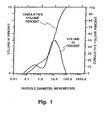
- Figure 1 is a graphical representation showing the particle size distribution of the silicone resin according to the present invention.
- Particle size distribution was determined on a Malvern Mastersizer Model S with an automated sample dispersion unit and flow cell. Malvern Mastersizers employ laser diffraction techniques, specifically low angle laser light scattering (LALLS), in determining particle size.
- LALLS low angle laser light scattering
- one trace is labeled Cumulative Volume Percent of the particles, and a second trace labeled Volume in Percent shows the multi-modal particle size distribution in which there can be seen a first upper mode peak and a second lower mode peak in the distribution.
- compositions which come into contact with an oil containing subterranean reservoir should have fluid loss control properties which are capable of minimizing invasion of the reservoir by the composition used during a well process.
- these compositions should prevent fluid from flowing predominantly into the more permeable portions of reservoirs having heterogeneous permeability.
- injected compositions should be capable of being removed from oil containing portions of the reservoir as completely as possible, in order to minimize reduction in permeability of such strata.
- the two desired attributes of fluid loss control and minimization in reduction of reservoir permeability are difficult to achieve in a single composition, since the former attribute depends in part on the presence of solid particulate matter in the composition, while the latter attribute depends on dissolution of the same type of solid particulate matter.
- the composition of this invention is however, tailored to provide the desired combination of maximum fluid loss control, as well as to provide a minimum of permeability reduction following completion of the well process in which the composition may be employed.
- the composition is characterized by the presence of a silicone resin particulate in a liquid carrier, the liquid carrier being of such nature as to permit fine wet grinding of the solid silicone resin particulate.
- the silicone resin according to the invention is a silicon containing non-linear oligomer or polymer that includes trivalent, i.e., trifunctional, T units (RSiO 3/2 ) and tetravalent, i.e., tetrafunctional Q units (SiO 4/2 ), as the principle building blocks of its network structure.
- the silicone resin may contain divalent, i.e., difunctional D units (R 2 SiO 2/2 ) that can act to modify the resin structure.
- resin structures of this type are end capped with monovalent, i.e., monofunctional M units (R 3 SiO 1/2 ).
- Useful R groups include hydrogen, hydroxyl, monovalent hydrocarbon groups having 1-8 carbon atoms among which are alkyl groups such as methyl and ethyl; aryl groups such as phenyl or naphthyl; alkenyl groups such as vinyl, allyl, 5-hexenyl, and cyclohexenyl; and arylalkyl groups such as phenylmethyl, phenylpropyl, and phenylhexyl; alkoxy groups such as methoxy, ethoxy, and propoxy; and substituted groups such as fluorocarbons including, for example 3,3,3-trifluoropropyl groups CF 3 CH 2 CH 2 -.
- the silicone resin consist of an MQ resin, i.e., the resin containing only the monovalent siloxane units M R 3 SiO 1/2 and tetravalent siloxane units Q SiO 4/2 , that R is methyl, and that it include no more than about 15 mole percent hydroxyl.
- MQ resin i.e., the resin containing only the monovalent siloxane units M R 3 SiO 1/2 and tetravalent siloxane units Q SiO 4/2 , that R is methyl, and that it include no more than about 15 mole percent hydroxyl.
- the number ratio or molar fraction of M units to Q units should be in the range of 0.4:1 to 1.7:1, more preferably in the range of 0.6:1 to 1.5:1.
- the molar fraction of M:Q units in the methyl containing silicone resin consisted of an M fraction of 0.38-0.43 and a Q fraction of 0.57-0.62. Residual hydroxyl content was less than 3.5 weight percent as determined by Nuclear Magnetic Resonance (NMR). The M:Q ratio was selected so that the silicone resin was a solid at any temperature less than about 250 °C. The weight average Molecular weight of the silicone resin was 8,000-30,000 as determined by gel permeation chromatography (gpc).
- Silicone resins with appropriately selected R groups have the unique property of maintaining solubility in hydrocarbons across a wide range of molecular weights, whereas silicone resins with a large proportion of Q units additionally exhibit a very high glass transition temperature ( T g ).
- T g for purposes herein, is the onset of cooperative molecular or segmental motion. Thus, at temperatures below the glass transition value, only vibrational motions exist, and therefore the material appears and acts glassy. This is an important factor when comparing the performance of organic resin systems to the performance of silicone resins at an elevated temperature.
- Very high glass transition temperatures possessed by the silicone resins according to the invention allows well bore fluids to be used at temperatures far higher than comparable fluids formulated with the use of organic resins containing no silicon atoms.
- a particle size distribution such as the one employed herein, is used in an organic resin containing no silicon atoms, and the organic resin is tested at temperatures below its T g , performance is roughly equivalent to that obtained with the silicone resin.
- the organic resin containing no silicon atoms is tested at temperatures above its T g , it fails in performance under standard fluid loss test protocols.
- the Kerosene Solution contained 90 weight percent kerosene and 10 weight percent of a silicone resin.
- the Kerosene Emulsion was a mixture containing 90 weight percent of kerosene and 10 weight percent of an emulsion which consisted of a 50 percent solids concentration of a silicone resin emulsified in water.
- the Kerosene Glycol Mix contained kerosene, the silicone resin, and propylene glycol.
- Pentalyn a solid rosin ester resin composition sold by Hercules Incorporated, Wilmington, Delaware, consisted of fines. Fann 90 Test Procedure Temperature, °C, and Softening Agent or Additive Softening Agent, Volume % in KCl Mud Fann Fluid Loss, mL/s Spurt Loss, mL 0-30 sec Fluid Loss, mL 0-30 min 30 °C Baseline, None ----- 1.69 5.76 Reagent Grade Kerosene 0.2 1.35 5.31 Reagent Grade Kerosene 0.4 1.54 5.26 Kerosene Solution 0.2 0.92 5.59 Kerosene Solution 0.4 1.5 5.06 Kerosene Emulsion 0.4 1.15 4.31 Kerosene Emulsion 0.4 0.68 4.30 Kerosene Emulsion 0.4 0.76 4.60 85 °C Baseline, None ----- 3.86 11.67 Commercial Kerosene 0.2 3.32 10.14 Commercial Kerosene 0.4 3.32 8.76 Kerosene Solution 0.2 2.75 10.27 Ke
- Well bore fluids according to the invention are prepared by first forming the solid silicone resin particulate with the desired particle size distribution from a solution of the silicone resin, and then dispersing the silicone resin solids with the desired particle size distribution into a liquid carrier.
- the liquid carrier can be an aqueous based carrier or a non-aqueous based carrier.
- the liquid carrier should not be a solvent for the silicone resin particulate. Suitable liquid carriers are therefore defined herein as those capable of dissolving only one percent or less of the silicone resin particulate at 70 °C.
- liquid carriers considered suitable for use herein are water; diols and triols such as ethylene glycol, propylene glycol, glycerol, and trimethylene glycol; glycerol esters such as glyceryl triacetate (triacetin), glyceryl tripropionate (tripropionin), and glyceryl tributyrate (tributyrin); and polyglycols such as polyethylene glycol.
- diols and triols such as ethylene glycol, propylene glycol, glycerol, and trimethylene glycol
- glycerol esters such as glyceryl triacetate (triacetin), glyceryl tripropionate (tripropionin), and glyceryl tributyrate (tributyrin)
- polyglycols such as polyethylene glycol.
- the well bore fluid When the well bore fluid is intended to be used as in the form of an aqueous dispersion, then sufficient and appropriate surfactants and dispersing agents will be required, as well as other viscosity modifying agents and biocides to provide shelf stability and dispersion stability at the temperatures and pressures expected in the well.
- surfactants and/or dispersing agents which can be used are lignites, lignosulfonates, and modified lignosulfonates; anionic surfactants such as alkylarylsulfonates including dodecylbenzene sulfonic acid (DBSA), alkylaryl sulfates such as sodium lauryl (dodecyl) sulfate (SDS), poly(ethylene oxide) derivatives of fatty acids, and esters; nonionic surfactants such as block copolymers of ethylene oxide and propylene oxide, poly(ethylene oxide)derivatives of nonyl phenol, and alkyl glycosides; and cationic surfactants such as imidazolines and tertiary amines among which are the imidazoline and imidazoline derivatives sold under the name MIRANOL® by Rhone-Poulenc Incorporated, Cranberry, New Jersey, and compositions such as ⁇ -(tetradecyldimethylammoni
- viscosity modifying agents or thickeners which may be used are sodium alignate; gum arabic; welan gum; guar gum; xanthan; hydroxypropyl guar gum; cellulose derivatives such as methylcellulose, hydroxypropyl methylcellulose, and hydroxypropylcellulose; starch and starch derivatives such as hydroxyethylamylose and starch amylose; locust bean gum; electrolytes such as sodium chloride and ammonium chloride; saccharides such as fructose and glucose; and derivatives of saccharides such as PEG-120 methyl glucose dioleate.
- biocides which can be used include compositions such as formaldehyde, salicylic acid, phenoxyethanol, DMDM hydantoin (1,3-dimethylol-5,5-dimethyl hydantoin), 1-(3-chloroallyl)-3,5,7-triaza-1-azoniaadamantane chloride, 5-bromo-5-nitro-1,3-dioxane, methyl paraben, propyl paraben, sorbic acid, imidazolidinyl urea sold under the name GERMALL® II by Sutton Laboratories, Chatham, New Jersey, sodium benzoate, 5-chloro-2-methyl-4-isothiazolin-3-one sold under the name KATHON CG by Rohm & Haas Company, Philadelphia, Pennsylvania, and iodopropynl butyl carbamate sold under the name GLYCACIL® L by Lonza Incorporated, Fair Lawn, New Jersey.
- compositions such as formal
- the function of the well bore fluid composition of this invention is largely and primarily dependent upon the particular distribution of particle size in the dispersion.
- the particle size is on the one hand based upon a consideration of the pore size to be blocked, and on the other hand consists of the inclusion of fines for obtaining improved fluid loss control.
- the fines can be produced by means of wet grinding.
- Extremely fine particle dispersions when required, can be provided by using one or more surfactant(s) and/or dispersing aide(s) such as listed above.
- the same general result can be achieved by employing non-aqueous fluids in the wet grinding process typically carried out in horizontal type media mills. These fine particle size dispersions are, then mixed with the coarser particle size dispersions. Data providing some examples of blended particle size distributions are shown below in the Table, which also shows the resulting effectiveness,at blocking specific substrate pore sizes.
- the performance of the dispersion can be enhanced by addition of material that tends to lower the Tg of the silicone resin to a Tg closer to the test temperature.
- One way to accomplish this enhancement is by addition to the dispersion of additives such as hydrocarbons capable of functioning to lower softening temperatures of silicone resins. This feature is shown below in the Table.
- the silicone gum in the silicone gum emulsion had a viscosity of about 60,000 centistoke (mm 2 /s).
- the silicone fluid in the silicone fluid emulsion had a viscosity of about 500 centistoke (mm 2 /s).
- the FANN Model 90 is a dynamic radial filtration apparatus, manufactured and sold by the Fann Instrument Company, Houston, Texas.
- the device evaluates the filtration properties of a circulation fluid through a ceramic core.
- Dynamic filtration simulates the effect of fluid movement (shear rate) on the filtration rate and filter cake deposition in an actual oil well.
- the test determines if the fluid is properly conditioned to drill through permeable formations.
- the test results include two numbers, i.e., (i) the dynamic filtration rate, and (ii) the cake deposition index (CDI).
- the dynamic filtration rate is calculated from the slope of the curve of volume versus time.
- the CDI which reflects the erodibility of the wall cake, is calculated from the slope of the curve of volume/time versus time. CDI and dynamic filtration rates are calculated using data collected after thirty minutes.
- the Model 90 is a device used in the industry for conducting filter cake formation and permeability analysis for drilling fluid optimization.
- the Model 90 can be heated and pressurized to provide the closest possible simulation of downhole conditions.
- the filter medium is a thick walled cylinder with rock like characteristics to simulate the formation.
- the filter medium is available in varying porosities and permeabilities.
- Filtration occurs radially from the inside of the filter core to the outside.
- the filter cake is formed on the inside of the filter core to simulate filter cake formation on the wall of a borehole.
- a polished stainless steel shear bob runs through the central axis of the filter core. The shear bob is rotated to produce a concentric cylinder type shear across the filtration surface.
- the mixture was agitated with a mechanical stirrer for 5 minutes, at which time the KCl had completely dissolved.
- the contents of the 100 ml beaker were then added slowly to the KCl solution with continued agitation. After the contents of the 100 ml beaker had been added, the mixture was stirred for an additional 10 minutes.
- the resulting liquid was a 3 percent KCl mud and it appeared homogeneous and slightly opaque. It had a density of 1.02 and a viscosity of 20 centipoise (mm 2 /s). This 3 percent KCl mud was used to test fluid the shutoff properties of various silicone and non-silicone additives.
- This example shows a processing method using a continuous horizontal fine media mill in place of an open top batch wet grinding attritor to eliminate foaming during processing.
- a silicone resin powder was generated and then retained in a Model FM-130 Littleford Brothers® Mixer attritor.
- To 20.89 pounds of the silicone resin powder was added 17.8 pounds of water; and 595 gram of Mazon 40, a nonionic surfactant and alkyl glycoside manufactured by BASF Corporation, Mount Olive, New Jersey.
- Dynasperse LCD an anionic surfactant and modified sodium lignosulfonate manufactured by Lignotech USA Inc., Bridgewater, New Jersey
- Pluronic F68LF a nonionic surfactant and block copolymer of ethylene oxide and propylene oxide manufactured by BASF
- Xanvis L a thickener and xanthan biopolymer manufactured by the Kelco Oil Field Group, Houston, Texas
- Dowicil 75 a preservative of the composition 1-(3-chloroallyl)-3,5,7-triaza-1-azoniaadamantane chloride, manufactured by The Dow Chemical Company, Midland, Michigan.
- the resultant slurry was fed to a DYNO-Mill® ECM horizontal media mill equipped with a 55 percent volumetric load of Ceria stabilized Tetragonal Zirconia Poly-crystal (TZP) 0.8 mm media.
- the slurry was processed using consecutive passes at tip speeds of 10 and 14 meters per second (m/s).
- the dispersion temperature did not exceed 84 °f/28.9 °C, a temperature well below the cloud point of the surfactants, and no foaming occurred.
- 300-500 ppm of a commercial antifoam was added to control foam.
- the antifoam was a water dilutable 30 percent active silicone emulsion designed to control foam in aqueous systems, manufactured by the Dow Corning Corporation, Midland, Michigan, under the name DOW CORNING ® 1430 Antifoam.
- the following two examples are set forth for the purpose of showing a well bore fluid composition containing solid silicone resin particulate having a multi-modal particle size distribution, in which improved results were shown in comparison to calcium carbonate.
- the first upper mode contained solid silicone resin particulate whose diameter was 30-50 percent of the targeted substrate pore diameter
- the second lower mode contained solid silicone particulate where the average diameter of the second mode was 2 ⁇ m or less.
- This Example shows Fann 90 data obtained with calcium carbonate.
- two grades of ground calcium carbonate were obtained, i.e., Baracarb 5 and Gammafil D2.
- the two grades of calcium carbonate were combined in a ratio of one part coarse to two parts fine.
- the dry powders were added sequentially to a three percent KCl standard mud preparation to provide a total of five volume percent solids.
- the mixture was dispersed with moderate stirring in a paddle mixer. Sufficient of the mixture was added to the Fann 90 to fill the test cell.
- the Fann 90 test device was operated using the conditions recommended by Fann Instrument Company instructions, i.e., temperature 30 °C, 100 reciprocal seconds rotation, 10 ⁇ m core, and a differential pressure of 500 psi. Fluid loss results were taken directly from the Fann 90 device and used to calculate a fluid loss at 30 seconds of 13.32 ml, and a fluid loss rate from 30 seconds to 30 minutes of 0.005 ml per minute. The filter cake was observed to be intact upon inspection after removal from the test device.
- Example 3 The improved results provided by use of the silicone resin according to this invention over calcium carbonate in Example 3 is shown as follows.
- the silicone resin was prepared as shown in Example 1. To a three percent standard KCl drilling mud, sufficient of the slurry was added to provide a 5 volume percent solids content. The silicone resin containing slurry was dispersed in the drilling mud by shaking vigorously. Sufficient of the silicone resin mixture was added to the test cell of the Fann 90 test device to fill it.
- the Fann 90 test was initiated using the same program of time, temperature, sheer rate, differential pressure, and filter core pore size, as in Example 3.
- the results determined were a fluid loss at 30 seconds of 1.53 ml, and a fluid loss from 30 seconds to 30 minutes of 0.002 ml per minute.
- the filter cake was extremely thin, uniform, and nearly transparent upon inspection after removal from the test device.
- the equivalent results obtained with calcium carbonate in Example 3 were fluid loss at 30 seconds of 13.32 ml, and fluid loss rate from 30 seconds to 30 minutes of 0.005 ml per minute.
- This example shows the performance of the silicone resin at high temperatures in which the test cell was conditioned at 85 °C.
- a The silicone resin slurry was obtained by the procedure used in Example 1 and consists of a blend of finely divided silicone resin particles and coarser silicone resin particles. A quantity of saturated sodium formate mud was obtained and sufficient of the silicone resin slurry was added to the mud to provide a five volume percent dispersion in the simulated drilling mud. The silicone resin concentrate was dispersed in the mud by shaking. Sufficient of the material was added to the Fann 90 test cell to fill the cell to its prescribed mark.
- the conditions used in the Fann 90 test protocol were 85 °C, 10 ⁇ m core, and differential pressure of 500 psi.
- the results obtained in the Fann 90 test were that the Fluid loss after 30 seconds was 7.76 ml/minute and the Fluid loss rate from 30 seconds to 30 minutes was 0.006.
- the inner surface of the core was observed to have a thin uniform coating of the silicone resin indicating good filter cake build up.
- Pentalyn was selected for the test. Its nominal softening point was about 90 °C. Pentalyn flake rosin ester resin was coarsely ground in a single stage disk mill. The finely ground Pentalyn resin material was separated by sifting through an 80 mesh screen. 100 gram of the sifted Pentalyn was added to 100 gram of water, and the resin was formulated into a slurry according to the procedure used in Example 2. The surfactant combination and their amounts were about the same, and its formulation into the slurry was necessary to permit adequate wetting of the Pentalyn resin particles by water.
- the slurried Pentalyn rosin ester resin formulation was processed in a bead mill using 0.8 mm ZrSiO4 beads rotated at 2,000-3,000 RPM for 40 minutes to reduce particle size. The milling yielded a pale, opaque, solid rosin dispersion in water. Sufficient of the solid rosin dispersion was added to a 3 percent KCl mud to provide a solids concentration of about 5 volume percent. The rosin mixture was tested in the Fann 90 Dynamic Fluid loss testing device using the same general conditions employed in Example 3, i.e., a temperature of 120°C,100 rpm rotation, a 10 ⁇ m Alconox powder core, and a differential pressure of 500 psi.
- This example shows another silicone resin composition being prepared and tested at an elevated temperature.
- 6,350 gram of a silicone MQ resin as a 60 weight percent solution in xylene was employed as starting material.
- the xylene was removed under heated conditions of 120 °C and under vacuum of 200 inches of water.
- the silicone resin was prepared as a slurry using the same general procedure as set forth in Example 2.
- the resulting mixture was processed in a bead mill using 0.8 mm ZrSiO4 beads rotating at 2,000-3,000 RPM for 30 minutes.
- a sufficient amount of the silicone resin dispersion was added to a 3 percent KCl mud to provide a solids concentration of about 5 volume percent.
- the resulting silicone resin mixture was tested in the Fann 90 Dynamic Fluid loss tester using the same protocol and conditions employed in Example 6. The appearance of the filter cake was observed visually and seen to be thin and uniform. The data recorded in the Fann 90 test was that there was an initial 30 second Fluid loss of 11.26 ml, and a Fluid loss rate from 30 seconds to 30 minutes of 0.011 ml per minute.
- This example shows the effect of adding kerosene to silicone resin compositions as a softening agent. Its addition also simulates the presence of oil in drilling muds.
- the simulated three percent KCL drilling mud containing five volume percent of the silicone resin slurry prepared in Example 5 was used for the test procedure in this example.
- To this simulated drilling mud mixture was added 0.4 volume percent of kerosene.
- the Fann 90 test device was operated in the same fashion using the same general protocol and conditions as in previous examples, i.e., a core size of 10 ⁇ m, a temperature of 120 °C, and a pressure of 500 pounds per square inch differential across the filter core.
- the test results showed an initial 30 second Fluid loss of 8.85 ml, and a Fluid loss rate from 30 seconds to 30 minutes of 0.005 ml per minute.
- the appearance of the filter cake was again very uniform and nearly transparent.
- This example demonstrates the effect of the presence of a silicone emulsion on performance properties.
- a silicone resin slurry was prepared as in Example 3, and added to the KCL simulated drilling mud at about five volume percent.
- To the simulated mud was added about 0.2 volume percent of a standard aqueous silicone fluid emulsion of a 500 centistoke (mm 2 /s) polydimethylsiloxane fluid and an ionic surfactant.
- the silicone fluid emulsion was expected to fill very tiny spaces between the solid silicone resin particles in the simulated mud and function as a softening agent when forced into intimate contact with the silicone resin in the filter cake.
- the Fann 90 test device was again operated under the same general conditions as used in previous examples, i.e., a core size of 10 ⁇ , a temperature of 120 °C, and a differential pressure of 500 pounds per square inch.
- the inner face of the Alconox core had a thin but irregular inner surface. This suggests that some agglomeration may have occurred.
- the fluid loss data determined by the Fann 90 test device was slightly improved for this embodiment, showing an initial 30 second Fluid loss of about 8.4 ml, and a Fluid loss rate from 30 seconds to 30 minutes of about 0.007 ml per minute.
- This example demonstrates the stability of the silicone resin in a mud system under harsh conditions known as the hot roll test.
- the silicone resin was prepared as shown in Example 1 and dispersed in the drilling mud as demonstrated in Example 4.
- This sample also contained 0.5 volume percent of Kerosene acting as a softening agent.
- the sample Prior to testing in the Fann 90 test, the sample was poured into a stainless steel cylinder leaving one inch from the top empty. The cylinder was sealed and pressurized with nitrogen at 100 lbs/in 2 . The cylinder was placed in an oven equipped with a roller shaft. The cylinder was connected to the shaft and rotated at 20 RPM and at a temperature of 100 °C for 16 hours. It was removed and cooled by immersion in cold water.
- the pressure was released and the mixture was poured into the Fann 90 test cylinder and tested according to the parameters used in Example 3.
- the results were a fluid loss at 30 seconds of 7.5 ml/minute, and a fluid loss rate from 30 seconds to 30 minutes of 0.003 ml/minute.
- the filter cake was thin, uniform and nearly transparent upon inspection after its removal from the Fann 90 test device.
- This example shows the effect of adding to a drilling mud a blend prepared from a particulate CaCO 3 and the particulate silicone resin composition used in Example 2.
- a three percent KCl drilling mud was added sufficient of the silicone resin containing aqueous slurry to provide 2.5 percent by volume of the silicone resin in the KCl mud.
- the mixture was dispersed by shaking it vigorously in a capped jar for two minutes.
- Sufficient CaC03 particulate sold under the name Baracarb ® 5 was then added to provide a level of 2.5 percent by volume of CaCO 3 .
- the mixture was again shaken vigorously to disperse the CaCO 3 , and the fluid loss properties were determined for the mud using the Fann 90 apparatus.
- the Fann 90 test was performed using the same parameters of time, temperature, sheer rate, differential pressure and filter core size as in Example 3. The results from the test were a fluid loss after 30 seconds of 4.2 ml and after 30 minutes of 11.2 ml. The rate of fluid loss from 30 seconds to 30 minutes was 0.0039 ml/minute.
- the mean particle size was 13.6 micrometer.
- a silicone MQ resin concentrate in an aqueous solution of surfactants and water containing 29 percent of solid silicone MQ resin was prepared. This concentrate was diluted to 6 percent solids in a KCl mud containing a viscosifier. The solution was tested in the Fann 90 test device at 50 °C with a 35 micrometer pore size filter core. The data was recorded manually with the following results: (i) zero to 38 seconds, a 29.3 ml fluid loss, and (ii) at 55 seconds, the fluid loss reached 50 ml which exceeded the capacity of the Fann 90 test device. The filter core was examined and determined to be a thick, very compact cake.
- nonionic surfactants used in this example were (i) Tergitol 15 S-40, an ethoxylated alcohol sold by The Dow Chemical Company, Midland, Michigan, and (ii) a silicone glycol copolymer with an HLB of 10.5 sold under the name Superwetting Agent by the Dow Corning Corporation, Midland, Michigan.
- This example describes a wet grinding method for producing a fine particle size grade of silicone resin in a propylene glycol carrier.
- 21.6 pounds of silicone MQ resin was prepared in a solid particulate form by drying in a high shear mixer under vacuum.
- To the silicone MQ resin was added 25.6 pounds of propylene glycol, 354.4 gram of Mazon 40 nonionic surfactant, 350.6 gram of Dynasperse LCD anionic surfactant, 467.2 gram of Pluronic F68 LF nonionic suractant, 9.4 gram Dowicil 75 preservative, and 774 gram of water.
- 4.2 pounds of this mixture was diluted to a twenty-five percent solids by weight solution, with the further addition of propylene glycol.
Landscapes
- Chemical & Material Sciences (AREA)
- Life Sciences & Earth Sciences (AREA)
- General Life Sciences & Earth Sciences (AREA)
- Organic Chemistry (AREA)
- Engineering & Computer Science (AREA)
- Materials Engineering (AREA)
- Chemical Kinetics & Catalysis (AREA)
- Health & Medical Sciences (AREA)
- Dispersion Chemistry (AREA)
- Medicinal Chemistry (AREA)
- Polymers & Plastics (AREA)
- Compositions Of Macromolecular Compounds (AREA)
- Auxiliary Devices For Machine Tools (AREA)
- Drilling And Boring (AREA)
- Perforating, Stamping-Out Or Severing By Means Other Than Cutting (AREA)
- Drilling Tools (AREA)
- Electrical Discharge Machining, Electrochemical Machining, And Combined Machining (AREA)
- Processes Of Treating Macromolecular Substances (AREA)
Abstract
Description
- This invention is related to the drilling of wells into subterranean reservoirs, and more particularly to a composition, the process for its manufacture, and its use in drilling such wells, wherein penetration of the reservoir by the composition is minimized. This minimizes the reduction in the permeability of the reservoir, which can typically occur from invasion of reservoirs by any composition.
- The invention particularly relates to such a composition, the process for its manufacture, and its use, in which the composition possesses low fluid loss properties during use, and is capable of ultimately substantially dissolving or dispersing itself into the hydrocarbon fluid with which it comes into contact, i.e., the crude oil.
- In various well drilling, completion, treating, and workover operations, in permeable hydrocarbon producing reservoirs, it is often advantageous to inject a fluid into the well in such a manner that the fluid is in contact with the reservoir penetrated by the well. The injected fluid may be used, for example, as a drilling fluid, a hydraulic fracturing fluid, an acidizing fluid, or a fluid for the placement of a gravel pack in the well. Generally, injected fluids have a tendency to penetrate reservoirs. Since most reservoirs are heterogeneous in permeability at least to some degree, the injected fluid tends to preferentially flow into zones of high permeability termed thief zones. Not only does this flow result in a loss and waste of the fluid, but it also prevents the injected fluid from entering into the zones of lower permeability in substantial quantities, causing poor fluid distribution between zones of different permeability.
- Accordingly, fluid loss control (FLC) agents, and in particular plugging agents, have been developed for use in such fluids. These fluid loss control agents tend to plate out on the face of the reservoir into which the fluid is being injected, and restrict further fluid flow through that portion of the reservoir. In the various well operations, it is necessary that the fluid loss control or plugging agent be eventually readily removed from the hydrocarbon producing zones to prevent a permanent reduction in oil production rate.
- Removal of the plugging material may be effectively accomplished by utilizing an agent that is soluble in the reservoir fluids, either water or hydrocarbons, and initiate well production. However, many of the known materials are either (i) insoluble under bottom hole conditions or (ii) so highly soluble that they are difficult to place in the reservoir before they dissolve, and fail to provide and maintain the required plugging action throughout the treating operation. Furthermore, known materials often experience dramatic changes in their properties over the temperature ranges encountered in current drilling operations.
- It is therefore essential that the fluid loss or plugging agent composition possess the property of controlled solubility, which will remain constant over a broad range of temperatures, whereby a satisfactory solid plug can be formed for the period of time necessary to carry out the well operation, and which can subsequently be removed by dissolving in the reservoir's hydrocarbon fluids.
- It is also considered advantageous to utilize additives that are largely soluble in hydrocarbons and insoluble in water, thereby leaving any water producing strata permanently sealed. Thus, selective plugging is effected, the hydrocarbon producing strata are temporarily plugged and the water producing strata remain permanently sealed. Upon removal of the temporary plugging agent from the hydrocarbon producing strata, oil and gas production capability is fully restored, while water production is eliminated or substantially decreased.
- Various slowly oil soluble, water insoluble, particulate agents useful in well drilling and treating operations have been developed in the past. For example,
US Patent 3,302,719 (February 1967 ) describes solid particles of a homogeneous mixture of polymers such as poly-1-olefin or copolymers of ethylene and an alkyl acrylate, waxes such as paraffin petroleum wax, and resins such as esters of rosin or aliphatic hydrocarbon resins. According to the '719 patent, such mixtures can be added to pumpable liquid carrier fluids and injected into wells. -
US Patent 3,882,029 (May 1975 ) discloses finely divided particles formed from a mixture of a wax, an oil soluble surface active agent, a water dispersible surface active agent, an ethylene/vinyl acetate copolymer, and a fatty alcohol. The particles are dispersed in an aqueous salt solution containing chrome lignite, hydroxyethylcellulose, and xanthan gum. -
US Patent 3,954,629 (May 1976 ) shows finely divided particles formed from a mixture of a polyethylene or ethylene/vinyl acetate copolymer, a polyamide, and a softening agent such as a long chain aliphatic diamide or polyterpene resin. The particles are suspended in a liquid carrier. - However, prior art compositions such as these generally contain a wax which is an inherently soft particle, an agent that hardens the wax particle, i.e. ethylene/vinyl acetate copolymers, and one or more additives such as chrome lignite, which have low solubility in oil but which are used to improve the fluid loss control properties of the particles. According to the present invention, however, the silicone resin is inherently soluble in hydrocarbons, and is completely dissolved even in the presence of hydrocarbons containing dissolved waxes and hydrocarbon resins.
- While the use of silicones in compositions for use in well construction, repair, and/or abandonment, is known, as evidenced by
US Patent 6,196,316 (March 6, 2001 ), assigned to the Shell Oil Company, such compositions are silicone sealants rather than silicone resins, and hence lack any particular particle size feature or particle size distribution feature comparable to resinous compositions according to the present invention. - Therefore, in spite of the wide variety of known well treating compositions, some of which have advantages, the need remains for compositions having improved fluid loss control, and which cause reduced permeability damage to hydrocarbon producing zones of reservoirs, especially at high temperatures.
- It is therefore an object of the invention to provide a well treating composition which combines improved fluid loss control properties and reduced permeability damage to reservoirs. It is also an object of the invention to provide a composition containing a minimum of oil insoluble components.
- In particular, the composition contains solid particulate matter having a specific distribution of particle size. The multi-modal particle size distribution should contain a first (upper) mode of solid particulate with a diameter 30-50 percent of the targeted pore diameter, in order to provide an optimal bridging of the porous substrate. As used herein, the term multi-modal is intended to mean that a multi-modal distribution is obtained when there are multiple peaks in the differential size distribution or frequency curve of particle diameters. The inclusion of a second (lower) mode of solid particulate matter its average diameter is 2 µm (micrometer) or less, termed the fines, necessary for optimum shutoff of the porous substrate.
- Thus, a further object of the invention is to provide for the addition of fines to the formulation, and this feature achieves a practically impermeable filter cake in well bore fluid compositions containing solid particulate matter having multi-modal particle size distribution.
- As a result, preferred compositions according to the invention contain a first upper mode of solid particulate with a diameter of 30-50 percent of the targeted substrate pore diameter, and a second lower mode of solid particulate matter, i.e.,fines, wherein the average diameter of the second mode is 2 µm (micrometer) or less. Most preferred is a particle size distribution wherein (i) at least 90 volume percent of solid particles of silicone resin have an average major axis diameter of 40 µm or less than 40 µm, and (ii) at least 10 volume percent of solid particles of silicone resin have an average major axis diameter of 2 µm or less. The term average major axis diameter is used and intended to include types of particulate matter having shapes other than spherical.
- These and other objects and features of the invention will become apparent from a consideration of the detailed description.
- Figure 1 is a graphical representation showing the particle size distribution of the silicone resin according to the present invention. Particle size distribution was determined on a Malvern Mastersizer Model S with an automated sample dispersion unit and flow cell. Malvern Mastersizers employ laser diffraction techniques, specifically low angle laser light scattering (LALLS), in determining particle size.
- In the Figure, one trace is labeled Cumulative Volume Percent of the particles, and a second trace labeled Volume in Percent shows the multi-modal particle size distribution in which there can be seen a first upper mode peak and a second lower mode peak in the distribution.
- Generally, well completion and workover fluid compositions which come into contact with an oil containing subterranean reservoir should have fluid loss control properties which are capable of minimizing invasion of the reservoir by the composition used during a well process. In particular, these compositions should prevent fluid from flowing predominantly into the more permeable portions of reservoirs having heterogeneous permeability. Following completion of the well process, injected compositions should be capable of being removed from oil containing portions of the reservoir as completely as possible, in order to minimize reduction in permeability of such strata.
- The two desired attributes of fluid loss control and minimization in reduction of reservoir permeability are difficult to achieve in a single composition, since the former attribute depends in part on the presence of solid particulate matter in the composition, while the latter attribute depends on dissolution of the same type of solid particulate matter. The composition of this invention is however, tailored to provide the desired combination of maximum fluid loss control, as well as to provide a minimum of permeability reduction following completion of the well process in which the composition may be employed. The composition is characterized by the presence of a silicone resin particulate in a liquid carrier, the liquid carrier being of such nature as to permit fine wet grinding of the solid silicone resin particulate.
- The silicone resin according to the invention is a silicon containing non-linear oligomer or polymer that includes trivalent, i.e., trifunctional, T units (RSiO3/2) and tetravalent, i.e., tetrafunctional Q units (SiO4/2), as the principle building blocks of its network structure. The silicone resin may contain divalent, i.e., difunctional D units (R2SiO2/2) that can act to modify the resin structure. Generally, resin structures of this type are end capped with monovalent, i.e., monofunctional M units (R3SiO1/2).
- Useful R groups include hydrogen, hydroxyl, monovalent hydrocarbon groups having 1-8 carbon atoms among which are alkyl groups such as methyl and ethyl; aryl groups such as phenyl or naphthyl; alkenyl groups such as vinyl, allyl, 5-hexenyl, and cyclohexenyl; and arylalkyl groups such as phenylmethyl, phenylpropyl, and phenylhexyl; alkoxy groups such as methoxy, ethoxy, and propoxy; and substituted groups such as fluorocarbons including, for example 3,3,3-trifluoropropyl groups CF3CH2CH2-.
- It is preferred that the silicone resin consist of an MQ resin, i.e., the resin containing only the monovalent siloxane units M R3SiO1/2 and tetravalent siloxane units Q SiO4/2, that R is methyl, and that it include no more than about 15 mole percent hydroxyl. The number ratio or molar fraction of M units to Q units should be in the range of 0.4:1 to 1.7:1, more preferably in the range of 0.6:1 to 1.5:1.
- In one particularly preferred embodiment, the molar fraction of M:Q units in the methyl containing silicone resin consisted of an M fraction of 0.38-0.43 and a Q fraction of 0.57-0.62. Residual hydroxyl content was less than 3.5 weight percent as determined by Nuclear Magnetic Resonance (NMR). The M:Q ratio was selected so that the silicone resin was a solid at any temperature less than about 250 °C. The weight average Molecular weight of the silicone resin was 8,000-30,000 as determined by gel permeation chromatography (gpc).
- Silicone resins with appropriately selected R groups have the unique property of maintaining solubility in hydrocarbons across a wide range of molecular weights, whereas silicone resins with a large proportion of Q units additionally exhibit a very high glass transition temperature (T g). T g for purposes herein, is the onset of cooperative molecular or segmental motion. Thus, at temperatures below the glass transition value, only vibrational motions exist, and therefore the material appears and acts glassy. This is an important factor when comparing the performance of organic resin systems to the performance of silicone resins at an elevated temperature.
- Very high glass transition temperatures possessed by the silicone resins according to the invention allows well bore fluids to be used at temperatures far higher than comparable fluids formulated with the use of organic resins containing no silicon atoms. When a particle size distribution such as the one employed herein, is used in an organic resin containing no silicon atoms, and the organic resin is tested at temperatures below its T g, performance is roughly equivalent to that obtained with the silicone resin. However, when the organic resin containing no silicon atoms is tested at temperatures above its T g, it fails in performance under standard fluid loss test protocols.
- It is often advantageous to add softening agents to modify the glass transition temperature to improve fluid loss under varying well conditions. Sometimes it is advantageous for reduced fluid loss to add softening agents in emulsion form. These comparisons and performance data can be seen by reference to the Table below. In the Table, the Kerosene Solution contained 90 weight percent kerosene and 10 weight percent of a silicone resin. The Kerosene Emulsion was a mixture containing 90 weight percent of kerosene and 10 weight percent of an emulsion which consisted of a 50 percent solids concentration of a silicone resin emulsified in water. The Kerosene Glycol Mix contained kerosene, the silicone resin, and propylene glycol. Pentalyn, a solid rosin ester resin composition sold by Hercules Incorporated, Wilmington, Delaware, consisted of fines.
Fann 90 Test Procedure Temperature, °C, and Softening Agent or AdditiveSoftening Agent, Volume % in KCl Mud Fann Fluid Loss, mL/s Spurt Loss, mL 0-30 sec Fluid Loss, mL 0-30 min 30 °C Baseline, None ----- 1.69 5.76 Reagent Grade Kerosene 0.2 1.35 5.31 Reagent Grade Kerosene 0.4 1.54 5.26 Kerosene Solution 0.2 0.92 5.59 Kerosene Solution 0.4 1.5 5.06 Kerosene Emulsion 0.4 1.15 4.31 Kerosene Emulsion 0.4 0.68 4.30 Kerosene Emulsion 0.4 0.76 4.60 85 °C Baseline, None ----- 3.86 11.67 Commercial Kerosene 0.2 3.32 10.14 Commercial Kerosene 0.4 3.32 8.76 Kerosene Solution 0.2 2.75 10.27 Kerosene Solution 0.2 1.70 10.50 Kerosene Solution 0.4 3.08 10.33 Kerosene Emulsion 0.2 2.65 9.63 Kerosene Emulsion 0.4 2.80 6.80 Kerosene Glycol Mixture 0.4 1.40 7.0 120 °C Baseline, None ----- 6.45 19.08 Reagent Grade Kerosene 0.2 12.2 22.71 Kerosene Emulsion 0.2 8.99 20.06 Kerosene Emulsion 0.4 9.5 16.37 Pentalyn Rosin Slurry --- > 50.0 > 50.0 - Well bore fluids according to the invention are prepared by first forming the solid silicone resin particulate with the desired particle size distribution from a solution of the silicone resin, and then dispersing the silicone resin solids with the desired particle size distribution into a liquid carrier. The liquid carrier can be an aqueous based carrier or a non-aqueous based carrier. The liquid carrier, however, should not be a solvent for the silicone resin particulate. Suitable liquid carriers are therefore defined herein as those capable of dissolving only one percent or less of the silicone resin particulate at 70 °C.
- Some examples representative of liquid carriers considered suitable for use herein are water; diols and triols such as ethylene glycol, propylene glycol, glycerol, and trimethylene glycol; glycerol esters such as glyceryl triacetate (triacetin), glyceryl tripropionate (tripropionin), and glyceryl tributyrate (tributyrin); and polyglycols such as polyethylene glycol.
- When the well bore fluid is intended to be used as in the form of an aqueous dispersion, then sufficient and appropriate surfactants and dispersing agents will be required, as well as other viscosity modifying agents and biocides to provide shelf stability and dispersion stability at the temperatures and pressures expected in the well.
- Some examples of appropriate surfactants and/or dispersing agents which can be used are lignites, lignosulfonates, and modified lignosulfonates; anionic surfactants such as alkylarylsulfonates including dodecylbenzene sulfonic acid (DBSA), alkylaryl sulfates such as sodium lauryl (dodecyl) sulfate (SDS), poly(ethylene oxide) derivatives of fatty acids, and esters; nonionic surfactants such as block copolymers of ethylene oxide and propylene oxide, poly(ethylene oxide)derivatives of nonyl phenol, and alkyl glycosides; and cationic surfactants such as imidazolines and tertiary amines among which are the imidazoline and imidazoline derivatives sold under the name MIRANOL® by Rhone-Poulenc Incorporated, Cranberry, New Jersey, and compositions such as α-(tetradecyldimethylammonio)acetate, β-(hexadecyldiethylammonio)propionate, γ-(dodecyldimethylammonio)butyrate, 3-(dodecyldimethylammonio)-propane-1-sulfonate, and 3-(tetradecyldimethylammonio)ethane-1-sulfonate.
- Some examples of suitable viscosity modifying agents or thickeners which may be used are sodium alignate; gum arabic; welan gum; guar gum; xanthan; hydroxypropyl guar gum; cellulose derivatives such as methylcellulose, hydroxypropyl methylcellulose, and hydroxypropylcellulose; starch and starch derivatives such as hydroxyethylamylose and starch amylose; locust bean gum; electrolytes such as sodium chloride and ammonium chloride; saccharides such as fructose and glucose; and derivatives of saccharides such as PEG-120 methyl glucose dioleate.
- Some biocides which can be used include compositions such as formaldehyde, salicylic acid, phenoxyethanol, DMDM hydantoin (1,3-dimethylol-5,5-dimethyl hydantoin), 1-(3-chloroallyl)-3,5,7-triaza-1-azoniaadamantane chloride, 5-bromo-5-nitro-1,3-dioxane, methyl paraben, propyl paraben, sorbic acid, imidazolidinyl urea sold under the name GERMALL® II by Sutton Laboratories, Chatham, New Jersey, sodium benzoate, 5-chloro-2-methyl-4-isothiazolin-3-one sold under the name KATHON CG by Rohm & Haas Company, Philadelphia, Pennsylvania, and iodopropynl butyl carbamate sold under the name GLYCACIL® L by Lonza Incorporated, Fair Lawn, New Jersey.
- As noted above, the function of the well bore fluid composition of this invention is largely and primarily dependent upon the particular distribution of particle size in the dispersion. The particle size is on the one hand based upon a consideration of the pore size to be blocked, and on the other hand consists of the inclusion of fines for obtaining improved fluid loss control. The fines can be produced by means of wet grinding. Extremely fine particle dispersions, when required, can be provided by using one or more surfactant(s) and/or dispersing aide(s) such as listed above. Alternatively, the same general result can be achieved by employing non-aqueous fluids in the wet grinding process typically carried out in horizontal type media mills. These fine particle size dispersions are, then mixed with the coarser particle size dispersions. Data providing some examples of blended particle size distributions are shown below in the Table, which also shows the resulting effectiveness,at blocking specific substrate pore sizes.
- In the Table, two particle size distributions of silicone resin produced by a wet grinding process were individually evaluated and then blended to optimize fluid loss in the
Fann 90 test. Unless otherwise noted, theFann 90 test was used under conditions in which the temperature was 30 °C, the device was rotated at 100 reciprocal seconds rotation for 30 minutes using a 10 µm core, and maintained at a differential pressure of 500 psi with a 3 percent KCl mud.Composition Fann Fluid Loss, mL/s Malvern Particle Size, After Fann 90 Test, (µm)Spurt Loss, mL 0-30 sec Fluid Loss, mL 0-30 min D(v,0.1) D(v,0.5) D(v,0.9) 3 % KCl Mud 100 % Grade 1 2.11 6.15 0.54 9.33 30.83 100 % Grade 2 11.58 16.54 0.24 1.560 9.47 25 % Grade 2 1.69 5.76 0.37 6.941 30.09 75 % Grade 1 10 % Grade 2 1.82 5.86 0.45 8.763 34.00 90 % Grade 1 5 % Grade 2 2.00 5.99 0.45 9.203 35.32 95 % Grade 1 50 % Grade 2 1.63 5.93 0.27 4.365 25.11 50% Grade 1 25 % Grade 2 1.57 5.64 0.38 6.050 18.20 75 % Grade 1 50 % Grade 2 1.61 5.95 0.32 4.710 16.33 50 % Grade 1 - The performance of the dispersion can be enhanced by addition of material that tends to lower the Tg of the silicone resin to a Tg closer to the test temperature. One way to accomplish this enhancement is by addition to the dispersion of additives such as hydrocarbons capable of functioning to lower softening temperatures of silicone resins. This feature is shown below in the Table. In the Table, the silicone gum in the silicone gum emulsion had a viscosity of about 60,000 centistoke (mm2/s). The silicone fluid in the silicone fluid emulsion had a viscosity of about 500 centistoke (mm2/s).
Softening Agent or Additive Softening Agent, Volume % in KCl Mud Resin Load, Vol. % in KCl Mud Fann Fluid Loss, mL/s Spurt Loss, mL 0-30 sec Fluid Loss, mL 0-30 min Baseline, None ----- 5.0 4.16 12.37 Trimethylbenzene 0.1 5.0 5.37 12.11 0.2 5.0 5.24 11.77 Tetrahydro naphthalene 0.1 5.0 4.9 12.8 0.2 5.0 4.9 12.3 Pentalyn 2.5 4.25 3.59 9.55 Kerosene 0.1 5.0 4.3 11.6 0.2 5.0 4.7 11.6 0.3 5.0 4.9 10.8 0.4 5.0 4.8 10.5 Decamethylcyclo pentasiloxane 0.1 5.0 4.4 12.6 0.2 5.0 4.2 12.2 Silicone Fluid Emulsion 0.75 4.25 6.05 12.09 15% Silicone Gum Emulsion 15.00 4.25 3.75 8.86 - The following examples are set forth in order to illustrate the invention in more detail.
- The
FANN Model 90 is a dynamic radial filtration apparatus, manufactured and sold by the Fann Instrument Company, Houston, Texas. The device evaluates the filtration properties of a circulation fluid through a ceramic core. Dynamic filtration simulates the effect of fluid movement (shear rate) on the filtration rate and filter cake deposition in an actual oil well. - The test determines if the fluid is properly conditioned to drill through permeable formations. The test results include two numbers, i.e., (i) the dynamic filtration rate, and (ii) the cake deposition index (CDI). The dynamic filtration rate is calculated from the slope of the curve of volume versus time. The CDI, which reflects the erodibility of the wall cake, is calculated from the slope of the curve of volume/time versus time. CDI and dynamic filtration rates are calculated using data collected after thirty minutes.
- The
Model 90 is a device used in the industry for conducting filter cake formation and permeability analysis for drilling fluid optimization. TheModel 90 can be heated and pressurized to provide the closest possible simulation of downhole conditions. The filter medium is a thick walled cylinder with rock like characteristics to simulate the formation. The filter medium is available in varying porosities and permeabilities. - Filtration occurs radially from the inside of the filter core to the outside. At the same time, the filter cake is formed on the inside of the filter core to simulate filter cake formation on the wall of a borehole. A polished stainless steel shear bob runs through the central axis of the filter core. The shear bob is rotated to produce a concentric cylinder type shear across the filtration surface.
- Into a 100 ml beaker were weighed and added 13.47 g of hydoxyethylcellulose, 6.71 g of xanthan gum, 1.84 g of sodium carbonate, and 0.81g of the preservative 1-(3-chloroallyl)-3,5,7-triaza-1-azoniaadamantane chloride, a composition manufactured under the name Dowicil 75 by The Dow Chemical Company, Midland, Michigan. The ingredients were mixed by hand using a spatula until they appeared homogeneous. 50.87 g of potassium chloride (KCL) were weighed into a 3000 ml beaker followed by 1629.5 g of water. The mixture was agitated with a mechanical stirrer for 5 minutes, at which time the KCl had completely dissolved. The contents of the 100 ml beaker were then added slowly to the KCl solution with continued agitation. After the contents of the 100 ml beaker had been added, the mixture was stirred for an additional 10 minutes. The resulting liquid was a 3 percent KCl mud and it appeared homogeneous and slightly opaque. It had a density of 1.02 and a viscosity of 20 centipoise (mm2/s). This 3 percent KCl mud was used to test fluid the shutoff properties of various silicone and non-silicone additives.
- 300 gram of a silicone resin powder obtained by drying in high shear mixer under vacuum were added to a 750 milliliter ball mill along with 300 gram of propylene glycol. A 3/16 inch tungsten carbide media was agitated for 120 minutes. The mixture was diluted with an additional 200 gram of propylene glycol and tungsten carbide media was removed. The particle size was measured and determined to have an average particle size of 10 micrometer. The dynamic fluid loss results were obtained in an aqueous mud system.
- This example shows a processing method using a continuous horizontal fine media mill in place of an open top batch wet grinding attritor to eliminate foaming during processing. Thus, a silicone resin powder was generated and then retained in a Model FM-130 Littleford Brothers® Mixer attritor. To 20.89 pounds of the silicone resin powder was added 17.8 pounds of water; and 595 gram of
Mazon 40, a nonionic surfactant and alkyl glycoside manufactured by BASF Corporation, Mount Olive, New Jersey. To the resultant slurry was added 386.9 gram of Dynasperse LCD, an anionic surfactant and modified sodium lignosulfonate manufactured by Lignotech USA Inc., Bridgewater, New Jersey; 580.3 gram of Pluronic F68LF, a nonionic surfactant and block copolymer of ethylene oxide and propylene oxide manufactured by BASF; 34.2 gram of Xanvis L, a thickener and xanthan biopolymer manufactured by the Kelco Oil Field Group, Houston, Texas; and 7.9 gram Dowicil 75, a preservative of the composition 1-(3-chloroallyl)-3,5,7-triaza-1-azoniaadamantane chloride, manufactured by The Dow Chemical Company, Midland, Michigan. These ingredients were mixed together. A vacuum was applied during the last 3-5 minutes of the mixing step to eliminate any foam that may have generated. The resultant slurry was fed to a DYNO-Mill® ECM horizontal media mill equipped with a 55 percent volumetric load of Ceria stabilized Tetragonal Zirconia Poly-crystal (TZP) 0.8 mm media. The slurry was processed using consecutive passes at tip speeds of 10 and 14 meters per second (m/s). The dispersion temperature did not exceed 84 °f/28.9 °C, a temperature well below the cloud point of the surfactants, and no foaming occurred. When the formulation was processed in an open top batch attritor however, 300-500 ppm of a commercial antifoam was added to control foam. The antifoam was a water dilutable 30 percent active silicone emulsion designed to control foam in aqueous systems, manufactured by the Dow Corning Corporation, Midland, Michigan, under the name DOW CORNING® 1430 Antifoam. - The following two examples are set forth for the purpose of showing a well bore fluid composition containing solid silicone resin particulate having a multi-modal particle size distribution, in which improved results were shown in comparison to calcium carbonate. The first upper mode contained solid silicone resin particulate whose diameter was 30-50 percent of the targeted substrate pore diameter, and the second lower mode contained solid silicone particulate where the average diameter of the second mode was 2 µm or less.
- This Example shows
Fann 90 data obtained with calcium carbonate. To duplicate the particle size distribution obtained by the resin grinding process, two grades of ground calcium carbonate were obtained, i.e., Baracarb 5 and Gammafil D2. The two grades of calcium carbonate were combined in a ratio of one part coarse to two parts fine. The dry powders were added sequentially to a three percent KCl standard mud preparation to provide a total of five volume percent solids. The mixture was dispersed with moderate stirring in a paddle mixer. Sufficient of the mixture was added to theFann 90 to fill the test cell. - The
Fann 90 test device was operated using the conditions recommended by Fann Instrument Company instructions, i.e.,temperature 30 °C, 100 reciprocal seconds rotation, 10 µm core, and a differential pressure of 500 psi. Fluid loss results were taken directly from theFann 90 device and used to calculate a fluid loss at 30 seconds of 13.32 ml, and a fluid loss rate from 30 seconds to 30 minutes of 0.005 ml per minute. The filter cake was observed to be intact upon inspection after removal from the test device. - The improved results provided by use of the silicone resin according to this invention over calcium carbonate in Example 3 is shown as follows. The silicone resin was prepared as shown in Example 1. To a three percent standard KCl drilling mud, sufficient of the slurry was added to provide a 5 volume percent solids content. The silicone resin containing slurry was dispersed in the drilling mud by shaking vigorously. Sufficient of the silicone resin mixture was added to the test cell of the
Fann 90 test device to fill it. - The
Fann 90 test was initiated using the same program of time, temperature, sheer rate, differential pressure, and filter core pore size, as in Example 3. The results determined were a fluid loss at 30 seconds of 1.53 ml, and a fluid loss from 30 seconds to 30 minutes of 0.002 ml per minute. The filter cake was extremely thin, uniform, and nearly transparent upon inspection after removal from the test device. By comparison, the equivalent results obtained with calcium carbonate in Example 3 were fluid loss at 30 seconds of 13.32 ml, and fluid loss rate from 30 seconds to 30 minutes of 0.005 ml per minute. - This example shows the performance of the silicone resin at high temperatures in which the test cell was conditioned at 85 °C. A The silicone resin slurry was obtained by the procedure used in Example 1 and consists of a blend of finely divided silicone resin particles and coarser silicone resin particles. A quantity of saturated sodium formate mud was obtained and sufficient of the silicone resin slurry was added to the mud to provide a five volume percent dispersion in the simulated drilling mud. The silicone resin concentrate was dispersed in the mud by shaking. Sufficient of the material was added to the
Fann 90 test cell to fill the cell to its prescribed mark. - The conditions used in the
Fann 90 test protocol were 85 °C, 10 µm core, and differential pressure of 500 psi. The results obtained in theFann 90 test were that the Fluid loss after 30 seconds was 7.76 ml/minute and the Fluid loss rate from 30 seconds to 30 minutes was 0.006. Upon removal from the test cell, the inner surface of the core was observed to have a thin uniform coating of the silicone resin indicating good filter cake build up. - This example shows the impact of exceeding the softening point or the glass transition temperature of a test material. Pentalyn was selected for the test. Its nominal softening point was about 90 °C. Pentalyn flake rosin ester resin was coarsely ground in a single stage disk mill. The finely ground Pentalyn resin material was separated by sifting through an 80 mesh screen. 100 gram of the sifted Pentalyn was added to 100 gram of water, and the resin was formulated into a slurry according to the procedure used in Example 2. The surfactant combination and their amounts were about the same, and its formulation into the slurry was necessary to permit adequate wetting of the Pentalyn resin particles by water.
- The slurried Pentalyn rosin ester resin formulation was processed in a bead mill using 0.8 mm ZrSiO4 beads rotated at 2,000-3,000 RPM for 40 minutes to reduce particle size. The milling yielded a pale, opaque, solid rosin dispersion in water. Sufficient of the solid rosin dispersion was added to a 3 percent KCl mud to provide a solids concentration of about 5 volume percent. The rosin mixture was tested in the
Fann 90 Dynamic Fluid loss testing device using the same general conditions employed in Example 3, i.e., a temperature of 120°C,100 rpm rotation, a 10 µm Alconox powder core, and a differential pressure of 500 psi. However, the Fluid loss collection exceeded the capacity of theFann 90 test device capacity of 50 milliliter, and so theFann 90 test failed in less than about 5 seconds. After cooling the test device and opening the test cell, the fluid in the test cell was visually observed and seen to have loose chunks of materials floating on the surface. The appearance of the inner face of the filter core was observed as being thick and very irregular. - This example shows another silicone resin composition being prepared and tested at an elevated temperature. Thus, 6,350 gram of a silicone MQ resin as a 60 weight percent solution in xylene was employed as starting material. The xylene was removed under heated conditions of 120 °C and under vacuum of 200 inches of water. The silicone resin was prepared as a slurry using the same general procedure as set forth in Example 2. The resulting mixture was processed in a bead mill using 0.8 mm ZrSiO4 beads rotating at 2,000-3,000 RPM for 30 minutes. A sufficient amount of the silicone resin dispersion was added to a 3 percent KCl mud to provide a solids concentration of about 5 volume percent. The resulting silicone resin mixture was tested in the
Fann 90 Dynamic Fluid loss tester using the same protocol and conditions employed in Example 6. The appearance of the filter cake was observed visually and seen to be thin and uniform. The data recorded in theFann 90 test was that there was an initial 30 second Fluid loss of 11.26 ml, and a Fluid loss rate from 30 seconds to 30 minutes of 0.011 ml per minute. - This example shows the effect of adding kerosene to silicone resin compositions as a softening agent. Its addition also simulates the presence of oil in drilling muds. The simulated three percent KCL drilling mud containing five volume percent of the silicone resin slurry prepared in Example 5 was used for the test procedure in this example. To this simulated drilling mud mixture was added 0.4 volume percent of kerosene. The
Fann 90 test device was operated in the same fashion using the same general protocol and conditions as in previous examples, i.e., a core size of 10 µm, a temperature of 120 °C, and a pressure of 500 pounds per square inch differential across the filter core. The test results showed an initial 30 second Fluid loss of 8.85 ml, and a Fluid loss rate from 30 seconds to 30 minutes of 0.005 ml per minute. The appearance of the filter cake was again very uniform and nearly transparent. - This example demonstrates the effect of the presence of a silicone emulsion on performance properties. A silicone resin slurry was prepared as in Example 3, and added to the KCL simulated drilling mud at about five volume percent. To the simulated mud was added about 0.2 volume percent of a standard aqueous silicone fluid emulsion of a 500 centistoke (mm2/s) polydimethylsiloxane fluid and an ionic surfactant. The silicone fluid emulsion was expected to fill very tiny spaces between the solid silicone resin particles in the simulated mud and function as a softening agent when forced into intimate contact with the silicone resin in the filter cake. The
Fann 90 test device was again operated under the same general conditions as used in previous examples, i.e., a core size of 10 µ, a temperature of 120 °C, and a differential pressure of 500 pounds per square inch. - Upon cooling and removal from the test cell, the inner face of the Alconox core had a thin but irregular inner surface. This suggests that some agglomeration may have occurred. The fluid loss data determined by the
Fann 90 test device was slightly improved for this embodiment, showing an initial 30 second Fluid loss of about 8.4 ml, and a Fluid loss rate from 30 seconds to 30 minutes of about 0.007 ml per minute. - This example demonstrates the stability of the silicone resin in a mud system under harsh conditions known as the hot roll test. The silicone resin was prepared as shown in Example 1 and dispersed in the drilling mud as demonstrated in Example 4. This sample also contained 0.5 volume percent of Kerosene acting as a softening agent. Prior to testing in the
Fann 90 test, the sample was poured into a stainless steel cylinder leaving one inch from the top empty. The cylinder was sealed and pressurized with nitrogen at 100 lbs/in2. The cylinder was placed in an oven equipped with a roller shaft. The cylinder was connected to the shaft and rotated at 20 RPM and at a temperature of 100 °C for 16 hours. It was removed and cooled by immersion in cold water. The pressure was released and the mixture was poured into theFann 90 test cylinder and tested according to the parameters used in Example 3. The results were a fluid loss at 30 seconds of 7.5 ml/minute, and a fluid loss rate from 30 seconds to 30 minutes of 0.003 ml/minute. The filter cake was thin, uniform and nearly transparent upon inspection after its removal from theFann 90 test device. - This example shows the effect of adding to a drilling mud a blend prepared from a particulate CaCO3 and the particulate silicone resin composition used in Example 2. To a three percent KCl drilling mud was added sufficient of the silicone resin containing aqueous slurry to provide 2.5 percent by volume of the silicone resin in the KCl mud. The mixture was dispersed by shaking it vigorously in a capped jar for two minutes. Sufficient CaC03 particulate sold under the name Baracarb® 5 was then added to provide a level of 2.5 percent by volume of CaCO3. The mixture was again shaken vigorously to disperse the CaCO3, and the fluid loss properties were determined for the mud using the
Fann 90 apparatus. - The
Fann 90 test was performed using the same parameters of time, temperature, sheer rate, differential pressure and filter core size as in Example 3. The results from the test were a fluid loss after 30 seconds of 4.2 ml and after 30 minutes of 11.2 ml. The rate of fluid loss from 30 seconds to 30 minutes was 0.0039 ml/minute. - When a sample of the mud was subjected to the hot roll test at 100°C, 100 lbs/in2, and for 16 hours, as described in Example 10, followed by testing using the
Fann 90 test device and protocol, the results provided a fluid loss from 30 seconds of 11.7 ml and a fluid loss from 30 minutes of 22.9 ml. The rate of fluid loss from 30 seconds to 30 minutes was 0.0063 ml. - This example illustrates the poorer performance of muds if only larger particle sizes and no fines are employed. The silicone resin was an MQ type resin in solid particulate form, and it was put through a sieve shaker and the fraction which passed the 325 mesh was collected. Coulter Counter analysis of the powered silicone MQ resin yielded the following particle size distribution:
Percent, by weight 10 25 50.0 75.0 90.0 Micrometer 28 20 11.6 4.9 2.5 - The mean particle size was 13.6 micrometer. A silicone MQ resin concentrate in an aqueous solution of surfactants and water containing 29 percent of solid silicone MQ resin was prepared. This concentrate was diluted to 6 percent solids in a KCl mud containing a viscosifier. The solution was tested in the
Fann 90 test device at 50 °C with a 35 micrometer pore size filter core. The data was recorded manually with the following results: (i) zero to 38 seconds, a 29.3 ml fluid loss, and (ii) at 55 seconds, the fluid loss reached 50 ml which exceeded the capacity of theFann 90 test device. The filter core was examined and determined to be a thick, very compact cake. The nonionic surfactants used in this example were (i) Tergitol 15 S-40, an ethoxylated alcohol sold by The Dow Chemical Company, Midland, Michigan, and (ii) a silicone glycol copolymer with an HLB of 10.5 sold under the name Superwetting Agent by the Dow Corning Corporation, Midland, Michigan. - This example describes a wet grinding method for producing a fine particle size grade of silicone resin in a propylene glycol carrier. 21.6 pounds of silicone MQ resin was prepared in a solid particulate form by drying in a high shear mixer under vacuum. To the silicone MQ resin was added 25.6 pounds of propylene glycol, 354.4 gram of
Mazon 40 nonionic surfactant, 350.6 gram of Dynasperse LCD anionic surfactant, 467.2 gram of Pluronic F68 LF nonionic suractant, 9.4 gram Dowicil 75 preservative, and 774 gram of water. 4.2 pounds of this mixture was diluted to a twenty-five percent solids by weight solution, with the further addition of propylene glycol. A Union Process Model 1-S Attritor was charged with 3/16 inch diameter tungsten carbide media and ground at 180 RPM for six hours. The silicone MQ resin particulate diameter was measured on a Honeywell Microtrac Model X-100 Analyzer and yielded the following volumetric particle size distribution in micrometer: D(v, 0.1) = 0.368; D(v, 0.5) =1.177; and D(v, 0.9) = 3.717. - Other variations may be made in compounds, compositions, and methods described herein without departing from the essential features of the invention. The embodiments of the invention specifically illustrated herein are exemplary only and not intended as limitations on their scope except as defined in the appended claims.
Claims (10)
- A composition comprising solid particles of silicone resin with a glass transition temperature of more than 70 °C, the composition containing solid particles of silicone resin with a particle size distribution wherein (i) at least 90 volume percent of solid particles of silicone resin have an average major axis diameter of 40 µm or less than 40 µm, and (ii) at least 10 volume percent of solid particles of silicone resin have an average major axis diameter of 2 µm or less.
- A composition according to Claim 1 in which the silicone resin includes monovalent monofunctional M units (R3SiO1/2), divalent difunctional D units (R2SiO2/2), trivalent trifunctional T units (RSiO3/2), and tetravalent tetrafunctional Q units (SiO4/2), in which R is hydrogen, hydroxyl, a monovalent hydrocarbon group having 1-8 carbon atoms, an alkoxy group, or a substituted monovalent hydrocarbon group.
- A composition according to Claims 1 or 2 in which the silicone resin contains only monovalent monofunctional M units (R3SiO1/2) and tetravalent tetrafunctional Q units (SiO4/2) where R is hydrogen, hydroxyl, a monovalent hydrocarbon group having 1-8 carbon atoms, an alkoxy group, or a substituted monovalent hydrocarbon group.
- A composition according to Claims 2 or 3 in which the silicone resin contains no more than about 15 mole percent hydroxyl as determined by Nuclear Magnetic Resonance, the number ratio or molar fraction of M units to Q units being in the range of 0.4:1 to 1.7:1, and the weight average Molecular weight of the silicone resin being 8,000-30,000 as determined by gel permeation chromatography.
- A composition according to any of Claims 1 to 4 further comprising a liquid carrier into which the solid particles of silicone resin are dispersed, the liquid carrier being an aqueous based carrier or a non-aqueous based carrier, the liquid carrier being a non-solvent for solid particles of the silicone resin, non-solvency being that the liquid carrier is capable of dissolving only one percent or less of the solid particles of silicone resin at 70 °C.
- A composition according to Claim 5 in which the liquid carrier is selected from the group consisting of water, diols, triols, glycerol esters, polyglycols, and mixtures thereof.
- A composition according to Claim 5 in which the liquid carrier is selected from the group consisting of ethylene glycol, propylene glycol, glycerol, trimethylene glycol, and mixtures thereof.
- A composition according to Claim 6 in which the liquid carrier is water, and the composition further comprises a surfactant.
- A composition according to Claim 6 in which the liquid carrier is a diol, and the composition further comprises a compatible surfactant.
- A composition according to any of Claims 1 to 9 which further comprises solid particles of an inorganic material blended with the solid particles of silicone resin.
Priority Applications (1)
| Application Number | Priority Date | Filing Date | Title |
|---|---|---|---|
| EP03772156A EP1525250B1 (en) | 2002-07-31 | 2003-07-31 | Silicone resin for drilling fluid loss control |
Applications Claiming Priority (4)
| Application Number | Priority Date | Filing Date | Title |
|---|---|---|---|
| EP02255363 | 2002-07-31 | ||
| EP02255363 | 2002-07-31 | ||
| PCT/US2003/024011 WO2004011530A1 (en) | 2002-07-31 | 2003-07-31 | Silicone resin for drilling fluid loss control |
| EP03772156A EP1525250B1 (en) | 2002-07-31 | 2003-07-31 | Silicone resin for drilling fluid loss control |
Publications (2)
| Publication Number | Publication Date |
|---|---|
| EP1525250A1 EP1525250A1 (en) | 2005-04-27 |
| EP1525250B1 true EP1525250B1 (en) | 2007-08-29 |
Family
ID=30775874
Family Applications (1)
| Application Number | Title | Priority Date | Filing Date |
|---|---|---|---|
| EP03772156A Expired - Lifetime EP1525250B1 (en) | 2002-07-31 | 2003-07-31 | Silicone resin for drilling fluid loss control |
Country Status (6)
| Country | Link |
|---|---|
| EP (1) | EP1525250B1 (en) |
| JP (1) | JP2005534746A (en) |
| AT (1) | ATE371696T1 (en) |
| AU (2) | AU2003261326A1 (en) |
| DE (1) | DE60315988T2 (en) |
| WO (2) | WO2004011530A1 (en) |
Families Citing this family (12)
| Publication number | Priority date | Publication date | Assignee | Title |
|---|---|---|---|---|
| US7452849B2 (en) * | 2002-07-31 | 2008-11-18 | Dow Corning Corporation | Silicone resin for drilling fluid loss control |
| GB0711621D0 (en) | 2007-06-18 | 2007-07-25 | 3M Innovative Properties Co | Additive to reduce fluid loss for drilling fluids |
| EP2463349B1 (en) | 2010-12-08 | 2014-06-18 | 3M Innovative Properties Co. | Fluorinated acrylic polymer compositions as fluid loss additives in drilling fluids |
| US9222350B2 (en) | 2011-06-21 | 2015-12-29 | Diamond Innovations, Inc. | Cutter tool insert having sensing device |
| EP2843090A4 (en) | 2012-04-27 | 2015-10-28 | Kureha Corp | Short polyglycolic-acid-resin fibers and well-treatment fluid |
| EP2843024A4 (en) | 2012-04-27 | 2015-10-28 | Kureha Corp | Short polyglycolic-acid-resin fibers for use in well-treatment fluid |
| WO2013183363A1 (en) * | 2012-06-07 | 2013-12-12 | 株式会社クレハ | Member for hydrocarbon resource collection downhole tool |
| CA2873986C (en) * | 2012-08-08 | 2017-06-13 | Kureha Corporation | Ball sealer for hydrocarbon resource collection as well as production method therefor and downhole treatment method using same |
| WO2019016304A1 (en) * | 2017-07-20 | 2019-01-24 | Danmarks Tekniske Universitet | Quick-setting elastomer plugging composition |
| CN111748327B (en) * | 2020-06-30 | 2022-10-18 | 中国石油天然气集团有限公司 | Environment-friendly defoaming agent for drilling fluid and preparation method thereof |
| US11434410B2 (en) * | 2020-07-07 | 2022-09-06 | Halliburton Energy Services, Inc. | Methods of making and using a wellbore servicing fluid for controlling losses in permeable zones |
| CN116083062B (en) * | 2021-11-05 | 2024-05-31 | 中国石油化工股份有限公司 | A high-temperature environmentally friendly clean drilling fluid and preparation method thereof |
Family Cites Families (8)
| Publication number | Priority date | Publication date | Assignee | Title |
|---|---|---|---|---|
| US4207194A (en) * | 1977-06-17 | 1980-06-10 | The Dow Chemical Company | Chemical wash with fluid loss control |
| FR2540879A1 (en) * | 1983-02-14 | 1984-08-17 | Rhone Poulenc Spec Chim | CONCENTRATED SUSPENSIONS OF WATER-SOLUBLE POLYMERS |
| US4957165A (en) * | 1988-02-16 | 1990-09-18 | Conoco Inc. | Well treatment process |
| US5663123A (en) * | 1992-07-15 | 1997-09-02 | Kb Technologies Ltd. | Polymeric earth support fluid compositions and method for their use |
| US6107429A (en) * | 1994-10-24 | 2000-08-22 | Amcol International Corporation | Process for producing an oil and water adsorbent polymer capable of entrapping solid particles and liquids and the product thereof |
| JP3921262B2 (en) * | 1996-07-22 | 2007-05-30 | 東レ・ダウコーニング株式会社 | Silicone resin hollow body and method for producing the same |
| US5981447A (en) * | 1997-05-28 | 1999-11-09 | Schlumberger Technology Corporation | Method and composition for controlling fluid loss in high permeability hydrocarbon bearing formations |
| US5973060A (en) * | 1998-02-10 | 1999-10-26 | Dow Corning Toray Silicone Co., Ltd. | Silicone rubber particulate composition and methods for the preparation thereof |
-
2003
- 2003-07-31 AU AU2003261326A patent/AU2003261326A1/en not_active Abandoned
- 2003-07-31 EP EP03772156A patent/EP1525250B1/en not_active Expired - Lifetime
- 2003-07-31 WO PCT/US2003/024011 patent/WO2004011530A1/en not_active Ceased
- 2003-07-31 WO PCT/EP2003/008574 patent/WO2004013251A1/en not_active Ceased
- 2003-07-31 AT AT03772156T patent/ATE371696T1/en not_active IP Right Cessation
- 2003-07-31 AU AU2003250205A patent/AU2003250205A1/en not_active Abandoned
- 2003-07-31 DE DE60315988T patent/DE60315988T2/en not_active Expired - Lifetime
- 2003-07-31 JP JP2004524257A patent/JP2005534746A/en not_active Withdrawn
Non-Patent Citations (1)
| Title |
|---|
| None * |
Also Published As
| Publication number | Publication date |
|---|---|
| EP1525250A1 (en) | 2005-04-27 |
| WO2004011530A1 (en) | 2004-02-05 |
| WO2004013251A1 (en) | 2004-02-12 |
| AU2003261326A1 (en) | 2004-02-16 |
| DE60315988D1 (en) | 2007-10-11 |
| JP2005534746A (en) | 2005-11-17 |
| AU2003250205A1 (en) | 2004-02-23 |
| ATE371696T1 (en) | 2007-09-15 |
| DE60315988T2 (en) | 2008-05-21 |
Similar Documents
| Publication | Publication Date | Title |
|---|---|---|
| EP1337599B1 (en) | Stable liquid suspension compositions and method of making and use thereof | |
| US4957174A (en) | Method of controlling lost circulation in well drilling | |
| EP1866519B1 (en) | Method of recycling fracturing fluids using a self-degrading foaming composition | |
| US20150027703A1 (en) | Solid state dispersion | |
| US7452849B2 (en) | Silicone resin for drilling fluid loss control | |
| EP1339811A2 (en) | Environmentally acceptable fluid polymer suspension for oil field services | |
| CA2271286C (en) | Invert emulsion well drilling and servicing fluids | |
| EP1525250A1 (en) | Silicone resin for drilling fluid loss control | |
| EP1485572A1 (en) | Compositions for restoring lost circulation | |
| EP2885371B1 (en) | Solubilized polymer concentrates, methods of preparation thereof, and well drilling and servicing fluids containing the same | |
| US12043788B2 (en) | Environmentally acceptable wellbore stability additive | |
| US20040226746A1 (en) | Method and system for minimizing circulating fluid return losses during drilling of a well bore | |
| EP0861120B1 (en) | Oil-free, water-soluble, hydroxyethyl cellulose, liquid, polymer dispersion | |
| AU2017210060A1 (en) | Spacer fluid having sized particulates and methods of using the same | |
| US20250382516A1 (en) | Core-shell particles for subterranean operations | |
| US12503930B1 (en) | Dual-acting delayed filtercake breaker fluid | |
| UA124224C2 (en) | CLAY-FREE DRILLING SOLUTION | |
| HK1211613B (en) | Solubilized polymer concentrates, methods of preparation thereof, and well drilling and servicing fluids containing the same |
Legal Events
| Date | Code | Title | Description |
|---|---|---|---|
| PUAI | Public reference made under article 153(3) epc to a published international application that has entered the european phase |
Free format text: ORIGINAL CODE: 0009012 |
|
| 17P | Request for examination filed |
Effective date: 20050202 |
|
| AK | Designated contracting states |
Kind code of ref document: A1 Designated state(s): AT BE BG CH CY CZ DE DK EE ES FI FR GB GR HU IE IT LI LU MC NL PT RO SE SI SK TR |
|
| AX | Request for extension of the european patent |
Extension state: AL LT LV MK |
|
| DAX | Request for extension of the european patent (deleted) | ||
| GRAP | Despatch of communication of intention to grant a patent |
Free format text: ORIGINAL CODE: EPIDOSNIGR1 |
|
| RIC1 | Information provided on ipc code assigned before grant |
Ipc: C09K 8/02 20060101ALI20070313BHEP Ipc: C08J 3/00 20060101AFI20070313BHEP |
|
| GRAS | Grant fee paid |
Free format text: ORIGINAL CODE: EPIDOSNIGR3 |
|
| GRAA | (expected) grant |
Free format text: ORIGINAL CODE: 0009210 |
|
| AK | Designated contracting states |
Kind code of ref document: B1 Designated state(s): AT BE BG CH CY CZ DE DK EE ES FI FR GB GR HU IE IT LI LU MC NL PT RO SE SI SK TR |
|
| REG | Reference to a national code |
Ref country code: GB Ref legal event code: FG4D |
|
| REG | Reference to a national code |
Ref country code: CH Ref legal event code: EP |
|
| REG | Reference to a national code |
Ref country code: IE Ref legal event code: FG4D |
|
| REF | Corresponds to: |
Ref document number: 60315988 Country of ref document: DE Date of ref document: 20071011 Kind code of ref document: P |
|
| ET | Fr: translation filed | ||
| PG25 | Lapsed in a contracting state [announced via postgrant information from national office to epo] |
Ref country code: NL Free format text: LAPSE BECAUSE OF FAILURE TO SUBMIT A TRANSLATION OF THE DESCRIPTION OR TO PAY THE FEE WITHIN THE PRESCRIBED TIME-LIMIT Effective date: 20070829 Ref country code: ES Free format text: LAPSE BECAUSE OF FAILURE TO SUBMIT A TRANSLATION OF THE DESCRIPTION OR TO PAY THE FEE WITHIN THE PRESCRIBED TIME-LIMIT Effective date: 20071210 Ref country code: FI Free format text: LAPSE BECAUSE OF FAILURE TO SUBMIT A TRANSLATION OF THE DESCRIPTION OR TO PAY THE FEE WITHIN THE PRESCRIBED TIME-LIMIT Effective date: 20070829 |
|
| NLV1 | Nl: lapsed or annulled due to failure to fulfill the requirements of art. 29p and 29m of the patents act | ||
| PG25 | Lapsed in a contracting state [announced via postgrant information from national office to epo] |
Ref country code: AT Free format text: LAPSE BECAUSE OF FAILURE TO SUBMIT A TRANSLATION OF THE DESCRIPTION OR TO PAY THE FEE WITHIN THE PRESCRIBED TIME-LIMIT Effective date: 20070829 Ref country code: LI Free format text: LAPSE BECAUSE OF FAILURE TO SUBMIT A TRANSLATION OF THE DESCRIPTION OR TO PAY THE FEE WITHIN THE PRESCRIBED TIME-LIMIT Effective date: 20070829 Ref country code: CH Free format text: LAPSE BECAUSE OF FAILURE TO SUBMIT A TRANSLATION OF THE DESCRIPTION OR TO PAY THE FEE WITHIN THE PRESCRIBED TIME-LIMIT Effective date: 20070829 |
|
| REG | Reference to a national code |
Ref country code: CH Ref legal event code: PL |
|
| PG25 | Lapsed in a contracting state [announced via postgrant information from national office to epo] |
Ref country code: BE Free format text: LAPSE BECAUSE OF FAILURE TO SUBMIT A TRANSLATION OF THE DESCRIPTION OR TO PAY THE FEE WITHIN THE PRESCRIBED TIME-LIMIT Effective date: 20070829 |
|
| PG25 | Lapsed in a contracting state [announced via postgrant information from national office to epo] |
Ref country code: DK Free format text: LAPSE BECAUSE OF FAILURE TO SUBMIT A TRANSLATION OF THE DESCRIPTION OR TO PAY THE FEE WITHIN THE PRESCRIBED TIME-LIMIT Effective date: 20070829 Ref country code: GR Free format text: LAPSE BECAUSE OF FAILURE TO SUBMIT A TRANSLATION OF THE DESCRIPTION OR TO PAY THE FEE WITHIN THE PRESCRIBED TIME-LIMIT Effective date: 20071130 |
|
| PG25 | Lapsed in a contracting state [announced via postgrant information from national office to epo] |
Ref country code: CZ Free format text: LAPSE BECAUSE OF FAILURE TO SUBMIT A TRANSLATION OF THE DESCRIPTION OR TO PAY THE FEE WITHIN THE PRESCRIBED TIME-LIMIT Effective date: 20070829 Ref country code: PT Free format text: LAPSE BECAUSE OF FAILURE TO SUBMIT A TRANSLATION OF THE DESCRIPTION OR TO PAY THE FEE WITHIN THE PRESCRIBED TIME-LIMIT Effective date: 20080129 Ref country code: SK Free format text: LAPSE BECAUSE OF FAILURE TO SUBMIT A TRANSLATION OF THE DESCRIPTION OR TO PAY THE FEE WITHIN THE PRESCRIBED TIME-LIMIT Effective date: 20070829 |
|
| PG25 | Lapsed in a contracting state [announced via postgrant information from national office to epo] |
Ref country code: SE Free format text: LAPSE BECAUSE OF FAILURE TO SUBMIT A TRANSLATION OF THE DESCRIPTION OR TO PAY THE FEE WITHIN THE PRESCRIBED TIME-LIMIT Effective date: 20071129 Ref country code: RO Free format text: LAPSE BECAUSE OF FAILURE TO SUBMIT A TRANSLATION OF THE DESCRIPTION OR TO PAY THE FEE WITHIN THE PRESCRIBED TIME-LIMIT Effective date: 20070829 |
|
| PLBE | No opposition filed within time limit |
Free format text: ORIGINAL CODE: 0009261 |
|
| STAA | Information on the status of an ep patent application or granted ep patent |
Free format text: STATUS: NO OPPOSITION FILED WITHIN TIME LIMIT |
|
| 26N | No opposition filed |
Effective date: 20080530 |
|
| PG25 | Lapsed in a contracting state [announced via postgrant information from national office to epo] |
Ref country code: MC Free format text: LAPSE BECAUSE OF NON-PAYMENT OF DUE FEES Effective date: 20080731 |
|
| PG25 | Lapsed in a contracting state [announced via postgrant information from national office to epo] |
Ref country code: EE Free format text: LAPSE BECAUSE OF FAILURE TO SUBMIT A TRANSLATION OF THE DESCRIPTION OR TO PAY THE FEE WITHIN THE PRESCRIBED TIME-LIMIT Effective date: 20070829 |
|
| PG25 | Lapsed in a contracting state [announced via postgrant information from national office to epo] |
Ref country code: SI Free format text: LAPSE BECAUSE OF FAILURE TO SUBMIT A TRANSLATION OF THE DESCRIPTION OR TO PAY THE FEE WITHIN THE PRESCRIBED TIME-LIMIT Effective date: 20070829 |
|
| PG25 | Lapsed in a contracting state [announced via postgrant information from national office to epo] |
Ref country code: IE Free format text: LAPSE BECAUSE OF NON-PAYMENT OF DUE FEES Effective date: 20080731 Ref country code: CY Free format text: LAPSE BECAUSE OF FAILURE TO SUBMIT A TRANSLATION OF THE DESCRIPTION OR TO PAY THE FEE WITHIN THE PRESCRIBED TIME-LIMIT Effective date: 20070829 |
|
| PG25 | Lapsed in a contracting state [announced via postgrant information from national office to epo] |
Ref country code: BG Free format text: LAPSE BECAUSE OF FAILURE TO SUBMIT A TRANSLATION OF THE DESCRIPTION OR TO PAY THE FEE WITHIN THE PRESCRIBED TIME-LIMIT Effective date: 20071129 |
|
| PG25 | Lapsed in a contracting state [announced via postgrant information from national office to epo] |
Ref country code: LU Free format text: LAPSE BECAUSE OF NON-PAYMENT OF DUE FEES Effective date: 20080731 Ref country code: HU Free format text: LAPSE BECAUSE OF FAILURE TO SUBMIT A TRANSLATION OF THE DESCRIPTION OR TO PAY THE FEE WITHIN THE PRESCRIBED TIME-LIMIT Effective date: 20080301 |
|
| PG25 | Lapsed in a contracting state [announced via postgrant information from national office to epo] |
Ref country code: TR Free format text: LAPSE BECAUSE OF FAILURE TO SUBMIT A TRANSLATION OF THE DESCRIPTION OR TO PAY THE FEE WITHIN THE PRESCRIBED TIME-LIMIT Effective date: 20070829 |
|
| PG25 | Lapsed in a contracting state [announced via postgrant information from national office to epo] |
Ref country code: IT Free format text: LAPSE BECAUSE OF NON-PAYMENT OF DUE FEES Effective date: 20080731 |
|
| PGFP | Annual fee paid to national office [announced via postgrant information from national office to epo] |
Ref country code: GB Payment date: 20120725 Year of fee payment: 10 |
|
| PGFP | Annual fee paid to national office [announced via postgrant information from national office to epo] |
Ref country code: DE Payment date: 20120725 Year of fee payment: 10 Ref country code: FR Payment date: 20120719 Year of fee payment: 10 |
|
| REG | Reference to a national code |
Ref country code: DE Ref legal event code: R119 Ref document number: 60315988 Country of ref document: DE |
|
| REG | Reference to a national code |
Ref country code: DE Ref legal event code: R082 Ref document number: 60315988 Country of ref document: DE Representative=s name: FLEISCHER, ENGELS & PARTNER MBB, PATENTANWAELT, DE |
|
| GBPC | Gb: european patent ceased through non-payment of renewal fee |
Effective date: 20130731 |
|
| REG | Reference to a national code |
Ref country code: FR Ref legal event code: ST Effective date: 20140331 |
|
| PG25 | Lapsed in a contracting state [announced via postgrant information from national office to epo] |
Ref country code: GB Free format text: LAPSE BECAUSE OF NON-PAYMENT OF DUE FEES Effective date: 20130731 Ref country code: DE Free format text: LAPSE BECAUSE OF NON-PAYMENT OF DUE FEES Effective date: 20140201 |
|
| REG | Reference to a national code |
Ref country code: DE Ref legal event code: R119 Ref document number: 60315988 Country of ref document: DE Effective date: 20140201 |
|
| PG25 | Lapsed in a contracting state [announced via postgrant information from national office to epo] |
Ref country code: FR Free format text: LAPSE BECAUSE OF NON-PAYMENT OF DUE FEES Effective date: 20130731 |