EP1524670A1 - Disk reproducing apparatus and disk reproducing method - Google Patents
Disk reproducing apparatus and disk reproducing method Download PDFInfo
- Publication number
- EP1524670A1 EP1524670A1 EP04022330A EP04022330A EP1524670A1 EP 1524670 A1 EP1524670 A1 EP 1524670A1 EP 04022330 A EP04022330 A EP 04022330A EP 04022330 A EP04022330 A EP 04022330A EP 1524670 A1 EP1524670 A1 EP 1524670A1
- Authority
- EP
- European Patent Office
- Prior art keywords
- rzone
- disk
- title
- unit
- information
- Prior art date
- Legal status (The legal status is an assumption and is not a legal conclusion. Google has not performed a legal analysis and makes no representation as to the accuracy of the status listed.)
- Ceased
Links
- 238000000034 method Methods 0.000 title claims description 82
- 230000003287 optical effect Effects 0.000 description 22
- 230000005236 sound signal Effects 0.000 description 10
- 238000001514 detection method Methods 0.000 description 6
- 230000006835 compression Effects 0.000 description 3
- 238000007906 compression Methods 0.000 description 3
- 239000000470 constituent Substances 0.000 description 3
- 238000010586 diagram Methods 0.000 description 2
- 101000969688 Homo sapiens Macrophage-expressed gene 1 protein Proteins 0.000 description 1
- 102100021285 Macrophage-expressed gene 1 protein Human genes 0.000 description 1
- 239000004065 semiconductor Substances 0.000 description 1
- 238000000926 separation method Methods 0.000 description 1
- 239000002356 single layer Substances 0.000 description 1
Images






Classifications
-
- G—PHYSICS
- G11—INFORMATION STORAGE
- G11B—INFORMATION STORAGE BASED ON RELATIVE MOVEMENT BETWEEN RECORD CARRIER AND TRANSDUCER
- G11B27/00—Editing; Indexing; Addressing; Timing or synchronising; Monitoring; Measuring tape travel
- G11B27/10—Indexing; Addressing; Timing or synchronising; Measuring tape travel
- G11B27/19—Indexing; Addressing; Timing or synchronising; Measuring tape travel by using information detectable on the record carrier
- G11B27/28—Indexing; Addressing; Timing or synchronising; Measuring tape travel by using information detectable on the record carrier by using information signals recorded by the same method as the main recording
- G11B27/32—Indexing; Addressing; Timing or synchronising; Measuring tape travel by using information detectable on the record carrier by using information signals recorded by the same method as the main recording on separate auxiliary tracks of the same or an auxiliary record carrier
- G11B27/327—Table of contents
- G11B27/329—Table of contents on a disc [VTOC]
-
- G—PHYSICS
- G11—INFORMATION STORAGE
- G11B—INFORMATION STORAGE BASED ON RELATIVE MOVEMENT BETWEEN RECORD CARRIER AND TRANSDUCER
- G11B27/00—Editing; Indexing; Addressing; Timing or synchronising; Monitoring; Measuring tape travel
- G11B27/02—Editing, e.g. varying the order of information signals recorded on, or reproduced from, record carriers
- G11B27/031—Electronic editing of digitised analogue information signals, e.g. audio or video signals
- G11B27/034—Electronic editing of digitised analogue information signals, e.g. audio or video signals on discs
-
- G—PHYSICS
- G11—INFORMATION STORAGE
- G11B—INFORMATION STORAGE BASED ON RELATIVE MOVEMENT BETWEEN RECORD CARRIER AND TRANSDUCER
- G11B2220/00—Record carriers by type
- G11B2220/20—Disc-shaped record carriers
- G11B2220/21—Disc-shaped record carriers characterised in that the disc is of read-only, rewritable, or recordable type
- G11B2220/215—Recordable discs
- G11B2220/218—Write-once discs
-
- G—PHYSICS
- G11—INFORMATION STORAGE
- G11B—INFORMATION STORAGE BASED ON RELATIVE MOVEMENT BETWEEN RECORD CARRIER AND TRANSDUCER
- G11B2220/00—Record carriers by type
- G11B2220/20—Disc-shaped record carriers
- G11B2220/25—Disc-shaped record carriers characterised in that the disc is based on a specific recording technology
- G11B2220/2537—Optical discs
- G11B2220/2562—DVDs [digital versatile discs]; Digital video discs; MMCDs; HDCDs
Definitions
- the present invention relates to a disk reproducing apparatus and a disk reproducing method for reproducing an additional description type optical disk, for example, and more particularly, to a disk reproducing apparatus and a disk reproducing method for carrying out data reproduction from a disk before a finalizing process is applied.
- optical disk there are a reproduction only DVD-ROM (Digital Versatile Disk-Read Only Memory); a rewritable DVD-RAM (Random Access Memory); a DVD-RW (Rewritable); +RW; and an additionally describable DVD-R (Recordable).
- DVD-ROM Digital Versatile Disk-Read Only Memory
- rewritable DVD-RAM Random Access Memory
- DVD-RW Rewritable
- +RW +RW
- an additionally describable DVD-R Recordable
- an additional description type optical disk can have compatibility so that by applying a recording end process, a so-called finalizing process, reproduction can be carried out by any DVD recording and reproducing equipment which is commercially available.
- a DVD video title recorded in an optical disk is managed on the optical disk by using a management table produced uniquely for each manufacturer of DVD recording and reproducing equipment.
- Jpn. Pat. Appln. KOKAI Publication No. 2003-132630 there is disclosed a technique of reducing a finalizing processing time.
- compatibility of enabling an optical disk before the finalizing process is applied to be reproduced by DVD recording and reproducing equipment available from any manufacturer is not mentioned.
- the present invention has been made in view of the above-described circumstance. It is an object of the present invention to provide a disk reproducing apparatus and a disk reproducing method capable of reproducing recorded information before a finalizing process is applied to a disk in which information has been recorded by equipment available from any manufacturer.
- a disk reproducing apparatus comprising: a disk reproducing unit configured to reproduce a disk having a recording management area in which an RZone having navigation data is allocated at a head thereof, a plurality of titles are then recorded in a mode in which there is allocated an RZone having presentation data managed by the navigation data, and position information on the RZone is recorded; and a reproduction control unit configured to store position information on the RZone having the navigation data as information indicating a start position of the title and to use the stored information as a title reproduction start position.
- a disk reproducing method comprising: a first step of reproducing a disk having a recording management area in which an RZone having navigation data is allocated at a head thereof, a plurality of titles is then recorded in a mode in which there is allocated an RZone having presentation data managed by the navigation data, and position information on the RZone is recorded; and a second step of storing position information on the RZone having the navigation data as information indicating a start position of the title and using the stored information as a title reproduction start position.
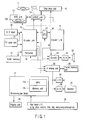
- FIG. 1 shows a disk recording and reproducing apparatus described in the present embodiment.
- This disk recording and reproducing apparatus can handle both of an optical disk and a hard disk, the optical disk including DVD-R which is a recording medium.
- the recording medium for example, a semiconductor memory or the like can be used.
- the disk recording and reproducing apparatus shown in FIG. 1 is roughly divided as follows. That is, on the left side of the figure, a main recording block exists; on the right side of the figure, a main reproducing block exists; and at the lower part of the figure, a main control block exists.
- this disk recording and reproducing apparatus has two types of disk drive units.
- this apparatus has a disk drive unit 12 for rotatably driving an optical disk 11 as a first medium which is an information recording medium capable of constructing a video file, the disk drive unit 12 executing reading and writing of information.
- this apparatus has an HDD (Hard Disk Drive) unit 13 for driving a hard disk 13a as a second medium.
- HDD Hard Disk Drive
- a D-PRO (Data-Processor) unit 14 can supply recording data to the disk drive unit 12 and the HDD unit 13, and can receive a reproduced signal.
- the disk drive unit 12 has a rotation control system for the optical disk 11, a laser drive system, an optical system and the like.
- the D-PRO unit 14 handles data in units of recording or reproducing operation, and includes a buffer circuit, a modulator/demodulator circuit, an error corrector unit and the like.
- this disk recording and reproducing apparatus primarily comprises: an encoder unit 15 configuring a recording side; a decoder unit 16 configuring a reproducing side; and a microcomputer block 17 for controlling an operation of an apparatus main body.
- the encoder unit 15 has: a video and audio analog digital converter for digitizing an analog video signal and an analog audio signal which have been inputted, a video encoder, and an audio encoder. Further, this encoder unit also includes a subsidiary picture encoder.
- An output of the encoder unit 15 is converted into a predetermined DVD-Video format by means of a formatter 19 which includes a buffer memory 18, and the converted output is supplied to the preceding D-PRO unit 14.
- An external analog video signal and an external analog video signal which are obtained from an A/V (Audio Video) input unit 20 or an analog video signal and an analog audio signal which are obtained from a TV (Television) tuner unit 21 are inputted to the encoder unit 15.
- the encoder unit 15 can supply the compressed digital video signal and digital audio signal directly to the formatter 19.
- the encoder unit 15 can supply the analog-digital converted digital video signal and audio signal directly to a V (Video) mixing unit 22 and an audio selector 23.
- V Video
- a digital video signal is converted into a digital video signal compressed at a variable bit rate based on an MPEG (Moving Picture Experts Group) 2 or MPEG1 standard.
- a digital audio signal is converted into a digital audio signal compressed at a fixed bit rate or a digital audio signal for linear PCM (Pulse Code Modulation), based on an MPEG or AC (Audio Compression) -3 standard.
- PCM Pulse Code Modulation
- a sub picture signal for example, a signal from a DVD video player with an independent output terminal for a subsidiary picture signal
- a sub picture signal of the DVD video signals is encoded (run length encoded) by means of the sub picture encoder, and the encoded signal is provided as a sub picture bit map.
- the encoded digital video signal, digital audio signal, and sub picture data are packed by means of the formatter 19. These packed signals and data are provided as a video pack, an audio pack, and a sub picture pack. Further, these packs are collected, and are converted into a format defined in a DVD-Video standard (for example, a standard recorded in the DVD-RAM, DVD-RW, DVD-R or the like).
- a DVD-Video standard for example, a standard recorded in the DVD-RAM, DVD-RW, DVD-R or the like.
- the disk recording and reproducing apparatus shown in FIG. 1 can supply the information (a pack of video, audio, sub picture data, or the like) formatted by the formatter 19 and the produced management information to the HDD unit 13 or disk drive unit 12 via the D-PRO unit 14, and can record the supplied information in the hard disk 13a or the optical disk 11.
- this apparatus can also record the information recorded in the hard disk 13a or optical disk 11 in the optical disk 11 or hard disk 13a via the D-PRO unit 14 and disk drive unit 12.
- the microprocessor block 17 includes an MPU (Micro Processor Unit) 17a and a memory unit 17b.
- the memory unit 17b includes: a ROM having stored therein a control program executed by the MPU 17a; and a RAM for providing to the MPU 17a a work area required for executing the program.
- the content which should be notified to a user is displayed on a display unit 24 incorporated in the disk recording and reproducing apparatus or is an OSD (On Screen Display) displayed on an externally connected monitor display 25. Further, the microcomputer block 17 has a key input unit 26 which provides an operating signal for operating this apparatus.
- the above-described microcomputer block 17 can define a timing of controlling the disk drive unit 12, HDD unit 13, D-PRO unit 14, encoder unit 15, and decoder unit 16, etc. based on time data from an STC (System Time Clock) 27. Although a recording or reproducing operation is generally executed based on the time clock from the STC 27, any other operation may be executed at a timing which is independent of the time clock from the STC 27.
- STC System Time Clock
- the decoder unit 16 has: a separator for separately capturing each pack from a signal in accordance with the DVD-Video format having a pack structure; a memory used during execution of one pack separation and the other signal processing; a V decoder for decoding main picture data (contents of a video pack) separated by the separator; an SP (Sub Picture) decoder for decoding the sub picture data (contents of a sub picture pack) separated by the separator; and an A (Audio) decoder for decoding audio data (contents of an audio pack) separated by the separator.
- this decoder unit comprises a video processor for properly combining the decoded sub picture with the decoded main picture, and outputting a menu, a highlight button, a subtitle and any other sub picture to be superimposed on the main picture.
- An output video signal of the decoder unit 16 is inputted to the V mixing unit 22. Combining of text data is carried out at the V mixing unit 22.
- a line for directly capturing a signal from the TV tuner unit 21 or A/V input unit 20 is also connected to the V mixing unit 22.
- a frame memory unit 28 used as a buffer is connected to the V mixing unit 22.
- V mixing unit 22 When an output of the V mixing unit 22 is an analog output, it is externally outputted via an I/F (Interface) 29. In the case of a digital output, it is outputted to the external monitor display 25 via a D/A (Digital/Analog) converter 30.
- I/F Interface
- D/A Digital/Analog
- the output audio signal of the decoder unit 16 is analog-converted by means of a D/A converter 31 via the selector 23, and the analog-converted signal is outputted to an externally connected speaker 32.
- the selector 23 is controlled by means of a select signal from the microcomputer block 17. In this manner, when a digital signal from the A/V input unit 20 or TV tuner unit 21 is directly monitored, the selector 23 can select a signal through the encoder unit 15 directly.
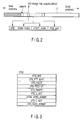
- FIG. 2 shows a DVD video title configuration on the optical disk 11.
- the DVD video standard defines that a DVD video title is composed of: navigation data (VTSI: IFO file) for controlling reproduction; presentation data (VTSM_VOBS, VTSTT_VOBS: VOB file) which is a generic name of video image and voice data; and a navigation data backup (VTSI_BUP: BUP file).
- the navigation data backup is completely identical to navigation data in contents, and is provided as data reserved for the case where the navigation data cannot be read. Therefore, this backup is not required in general reproduction.
- a relative recording location is determined so that navigation data is located at the head of a DVD video title, and is followed by presentation data and navigation data in backup order.
- FIG. 3 shows video title set information configuring navigation data (VTSI), the information having recorded therein control information or the like for reproducing presentation data (VTSTT_VOBS, VTSM_VOBS).
- VTSI video title set information configuring navigation data
- VTSTT_VOBS the information having recorded therein control information or the like for reproducing presentation data
- VTSM_VOBS presentation data
- FIG. 4 shows a format of a video table set information management table (VTSI_MAT).
- VTSI_MAT video table set information management table
- VTSI_MAT information concerning a picture attribute (VTS_V_ATR) of a title included in presentation data; a voice attribute (VTS_AST_ATR); a presentation data menu recording location (VTSM_VOBS_SA); and a title recording location (VTSTT_VOBS_SA).
- VTSTT_VOBS_SA The presentation data address information (VTSTT_VOBS_SA) is recorded in a relative address from the head of this navigation data (VTSI). Namely, when navigation data can be correctly read out, presentation data can also be read out.
- the contents of the navigation data are provided as information for controlling a method for reproducing the presentation data, and thus, cannot be determined until recording of all the presentation data has completed.
- writing into the optical disk 11 is carried out after presentation data recording has completed.
- a move or copy operation is carried out based on the determined data.
- presentation data can be recorded.
- FIG. 5 shows allocation of a recording area with respect to a radial direction of the DVD-R disk.
- a recording information area (R-Information Area) having sequentially allocated therein an output calibration area PCA (Power Calibration Area) and a recording management area RMA (Recording Management Area) is provided from its inner periphery side to its outer periphery side.
- PCA Power Calibration Area
- RMA Recording Management Area
- an information area consisting of a lead-in area, a data area, and a lead-out area is further allocated by recording data in the DVD-R disk.
- the data area is provided as an area in which data is recorded.
- the lead-in area is provided to be adjacent to the inside of the data area.
- the lead-out area is provided to be adjacent to the outside of the data area.
- predetermined management data is recorded when a finalizing process is applied. In this manner, reproduction of the data recorded in the data area can be controlled.
- the power calibration area PCA is provided as an area for carrying out trial recording before recording data in the data area.
- the recording management area RMA is provided as an area for recording an address of an area (RZone) for managing data.
- a write mode provided for this purpose is provided as an IWM (Incremental Write Mode), and user data is managed to be divided into a plurality of areas (RZone), as shown in FIG. 6.
- An address of this RZone itself is recorded in the recording management area RMA.
- a guard area BSGA Block Sync Guard Area
- FIG. 7 shows a method for discontinuously recording data in the DVD-R disk.
- the microcomputer block 17 reserves an area (RZone 1) for carrying out writing from a start position of a data area of the DVD-R disk in step S2.
- the microcomputer block 17 carries out recording in the area (RZone 2) in step S3, and closes the area (RZone 2) in step S4.
- the microcomputer block 17 carries out recording of data used for management of the data recorded in the area (RZone 2) in step S5. Then, this microcomputer block closes the area (RZone 1) in step S6, and terminates a data recording process (step S7).
- FIG. 8 shows a sequence for recording a DVD video title with respect to the DVD-R disk.
- FIG. 9 shows a data layout on the DVD-R disk which corresponds to this sequence.
- the microcomputer block 17 reserves an area (RZone 1) for carrying out writing later from the start position of the data area of the DVD-R disk in step S9.
- This area (RZone 1) is reserved as a VMG (Video Manager) area having written therein information for managing the titles of a file system and an entire disk. These items of information are recorded in a finalizing processing at a time point when recording of all the titles has completed.
- VMG Video Manager
- a DVD video title is recorded from the data area immediately after the area (RZone 1). That is, the microcomputer 17 reserves an area (RZone 2) for recording navigation data in step S10, and records presentation data in an area (RZone 3) immediately after RZone 2 in step 11.
- the presentation data is recorded, whereby management information for reproducing a DVD video title is established.
- the microcomputer block 17 generates navigation data on the presentation data recorded in RZone 3.
- this microcomputer block records backup of that navigation data immediately after the presentation data contained in the area (RZone 3).
- the microcomputer 17 closes the area (RZone 3) in step S13; reverts to the area (RZone 2) to record navigation data in the S14; closes the area (RZone 2) in step S15; and terminates a recording process of a DVD video title (step S16).
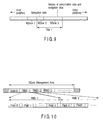
- FIG. 10 shows a detail on the above-described recording management area RMA.
- FIG. 11 shows a detail on Field 4 for managing the start address of each RZone in the RMD which configures the recording management area RMA.
- the recording management area RMA is composed of a lead-in and a plurality of RMDs, and the management information on all RZone areas contained in the disk is recorded.
- Field 4 contained in the RMD the start sector and end sector for each of RZone 1 to RZone 254 are recorded so that each RZone can be managed.
- RZone information is recorded in a new RMD.
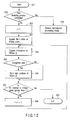
- FIG. 12 shows a sequence for making a search for the start position of a DVD video title from the RZone information by using RMD.
- the microcomputer 17 determines whether or not a finalizing process is applied to the DVD-R disk in step S18.
- the microcomputer block 17 moves to a general reproduction processing mode for the DVD-R disk in step S19.
- the microcomputer 17 sets number "i" of RZone to 1 in step 20; and acquires the number of RZone areas recorded in the DVD-R disk from RMD information in step S21.
- the microcomputer block 17 reads out RMD concerning RZone(i) from the DVD-R disk, and reads data on RZone(i) based on the start address of RZone(i) obtained from that RMD information in step S22.
- the microcomputer block 17 makes a syntax check as to whether or not data on RZone(i) is navigation data in step S23. When it is determined that the data is navigation data (YES), this microcomputer block 17 stores the start address of that RZone(i) in the memory unit 17a in step S24.
- the microcomputer block 17 determines whether or not the number "i" of RZone exceeds the number of RZone areas acquired in step S21, namely, whether or not next RZone exists on the DVD-R disk in step S25.
- step S27 When it is determined that the number "i" of RZone does not exceed the number of RZone areas (NO), the microcomputer block 17 adds "i” by +1 in step S26. Then, processing reverts to step S22. When it is determined that the number "i" of RZone exceeds the number of RZone areas (YES), processing is terminated (step S27).
- RZone having navigation data recorded therein is detected from all RZone areas on the DVD-T disk, and the start address of that RZone is stored, thus making it possible to generate a list of start addresses of all the recorded DVD video titles with respect to the DVD-R disk before the finalizing process is applied.
- reproduction of the DVD video title before the finalizing process is applied can be carried out for the DVD-R disk having information recorded in equipment available from any manufacturer.
- navigation data is recorded after presentation data has been recorded, as described above, and thus, its recording area (RZone) is reserved in a fixed size.
- the presentation data changes depending on a picture and voice compression rate during recording, a compression mode, a recording time or the like, and thus, the size of its recording area (RZone) is obtained as an undefined length.
- RZone of the same size When RZone of the same size is detected from the DVD-R disk, there is a high possibility that navigation data is recorded in that detected RZone. Thus, it becomes possible to define that RZone as a candidate for acquiring information indicating the start position of a DVD video title.
- RZone of the same size may be detected based on the RMD information from the DVD-R disk, thus making it possible to speed up detection of RZone having navigation data recorded therein.
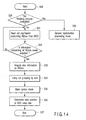
- FIG. 14 shows a sequence for detecting RZone of the same size and making a search for the start position of a DVD video title from that information.
- the microcomputer block 17 determines whether or not a finalizing process is applied to the DVD-R disk in step S29.
- the microcomputer block 17 moves to a general reproduction processing mode with respect to the DVD-R disk in step S30.
- the microcomputer block 17 executes readout of information concerning RZone recorded in the DVD-R disk from the RMD in step S31.
- the microcomputer block 17 acquires all the size information on RZone in step S33; and carries out grouping of each RZone depending on the size in step S34. In this way, by collecting RZone of the same size, it becomes possible to define that RZone as a candidate for acquiring information indicating the start position of the DVD video title.
- step S35 the microcomputer block 17 verifies validity by making a syntax check that VTSI to be recorded at the head of the DVD video title has been recorded, namely, that the VTSI is navigation data.
- step S36 the microcomputer block 17 stores the start address relating to the verified RZone in the memory unit 17b, thereby determining the start position of the DVD video title and terminating processing (step S37).
- FIGS. 16 and 17 each show a sequence for, after detecting the number of RZone areas which configure the DVD video title, when the head of the DVD video title has been detected, skipping RZone by its number and making a search for the start position of the DVD video title.
- step S38 when a process for acquiring the start position of the DVD video title is started (step S38), the microcomputer block 17 determines whether or not a finalizing process is applied to the DVD-T disk in step S39.
- the microcomputer block 17 moves to a general reproduction processing mode with respect to the DVD-R disk in step S40.
- the microcomputer 17 sets number "i" of RZone to 1 in step S41; reads out RMD concerning RZone(i) from the DVD-R disk in step S42; and reads data on RZone(i) based on the start address of RZone(i) obtained from the RMD information.
- step S43 the microcomputer block 17 determines whether or not data on RZone(i) is navigation data, namely, that RZone(i) is at the head of the DVD video title.
- this microcomputer block adds "+1" to "i" in step S44, and processing reverts to step S42.
- step S43 when it is determined that the data on RZone(i) is navigation data (YES), the microcomputer block 17 adds "+1" to "i” in step S45; reads out RMD concerning RZone(i) from the DVD-R disk in step S46; and reads data on RZone(i) based on the start address of RZone(i) acquired from that RMD information.
- step S47 the microcomputer block 17 determines whether or not RZone(i) is the last RZone of the DVD video title. When it is determined that that RZone(i) is not the last RZone (NO), processing reverts to step S45.
- step S47 when it is determined that RZone(i) is the last RZone of the DVD video title in step S47 (YES), the microcomputer block 17 goes to step S48 in which the start address of that RZone is stored in the memory unit 17b as an address of the head of the DVD video title. Then, in step S49, this microcomputer block determines the number "n" of RZone areas which configure that DVD video title.
- step S50 the microcomputer block 17 adds +1 to "i".
- step S51 it is determined whether or not RZone(i) is the last RZone recorded in the DVD-R disk. When it is determined that the RZone(i) is the last RZone (YES), processing is terminated (step S52).
- the microcomputer block 17 reads out RMD concerning RZone(i) from the DVD-R disk, and reads data on RZone(i) based on the start address of RZone(i) acquired from that RMD information in step S53.
- step S54 the microcomputer block 17 determines whether or not RZone(i) is at the head of the DVD video title. When it is negatively determined (NO), this microcomputer block adds +1 to "i" in step S55. Then, processing reverts to step S51.
- step S54 when it is determined that RZone(i) is at the head of the DVD video title in the above step S54 (YES), the microcomputer block 17 stores the start address of that RZone in the memory unit 17b as an address of the head of the DVD video title in step S56. In step S57, this microcomputer block adds +n to "i", and processing reverts to step S51.
- the speedup process shown in FIG. 14 and the speedup processes shown in FIGS. 16 and 17 are operable independently of each other, and all of these processes can be combined with each other.
- the present invention can be applied to all media for recording DVD-video format data in a disk in IWM in real time.
- the present invention is applied in the case where recording is carried out for the DVD-R disk in IWM as well.
- the present invention is not limited to the above-described embodiments, and can be embodied by variously modifying constituent elements without deviating from the spirit of the invention at the stage of carrying out the invention.
- a variety of inventions can be formed. For example, some of all the constituent elements shown in the embodiments may be deleted. Further, the constituent elements according to different embodiments may be combined properly with each other.
Landscapes
- Engineering & Computer Science (AREA)
- Multimedia (AREA)
- Signal Processing For Digital Recording And Reproducing (AREA)
- Management Or Editing Of Information On Record Carriers (AREA)
- Indexing, Searching, Synchronizing, And The Amount Of Synchronization Travel Of Record Carriers (AREA)
Abstract
A disk reproducing apparatus comprises a disk
reproducing unit (12, 16) configured to reproduce a
disk (11) having a recording management area (RMD) in
which an RZone having navigation data is allocated at a
head thereof, a plurality of titles are then recorded
in a mode in which there is allocated an RZone having
presentation data managed by the navigation data, and
position information on the RZone is recorded, and a
reproduction control unit (17) configured to store
position information on the RZone having the navigation
data as information indicating a start position of
the title and to use the stored information as a title
reproduction start position.
Description
The present invention relates to a disk
reproducing apparatus and a disk reproducing method
for reproducing an additional description type optical
disk, for example, and more particularly, to a disk
reproducing apparatus and a disk reproducing method for
carrying out data reproduction from a disk before a
finalizing process is applied.
As well known, in recent years, an information
recording technique with high density has been
promoted, and an optical disk having a recording
capacity of 4.7 GB (Giga Bytes) on a single-sided
single layer has been available in practice.
As this optical disk, there are a reproduction
only DVD-ROM (Digital Versatile Disk-Read Only Memory);
a rewritable DVD-RAM (Random Access Memory); a DVD-RW
(Rewritable); +RW; and an additionally describable
DVD-R (Recordable).
In this case, an additional description type
optical disk can have compatibility so that by
applying a recording end process, a so-called finalizing
process, reproduction can be carried out by
any DVD recording and reproducing equipment which is
commercially available.
In the meantime, before the finalizing process is
applied, a DVD video title recorded in an optical disk
is managed on the optical disk by using a management
table produced uniquely for each manufacturer of DVD
recording and reproducing equipment.
Thus, an optical disk recorded by DVD recording
and reproducing equipment available from a predetermined
manufacturer cannot be reproduced unless the
DVD recording and reproducing equipment available
from the predetermined manufacturer has been used,
before the finalizing process is applied. Currently,
compatibility with DVD recording and reproducing
equipment available from another manufacturer cannot
be obtained.
In Jpn. Pat. Appln. KOKAI Publication
No. 2003-132630, there is disclosed a technique of
reducing a finalizing processing time. However, there
is not mentioned compatibility of enabling an optical
disk before the finalizing process is applied to be
reproduced by DVD recording and reproducing equipment
available from any manufacturer.
The present invention has been made in view of
the above-described circumstance. It is an object of
the present invention to provide a disk reproducing
apparatus and a disk reproducing method capable of
reproducing recorded information before a finalizing
process is applied to a disk in which information has
been recorded by equipment available from any
manufacturer.
According to one aspect of the present invention,
there is provided a disk reproducing apparatus
comprising: a disk reproducing unit configured to
reproduce a disk having a recording management area in
which an RZone having navigation data is allocated at a
head thereof, a plurality of titles are then recorded
in a mode in which there is allocated an RZone having
presentation data managed by the navigation data, and
position information on the RZone is recorded; and a
reproduction control unit configured to store position
information on the RZone having the navigation data
as information indicating a start position of the
title and to use the stored information as a title
reproduction start position.
According to another aspect of the present
invention, there is provided a disk reproducing method
comprising: a first step of reproducing a disk having
a recording management area in which an RZone having
navigation data is allocated at a head thereof, a
plurality of titles is then recorded in a mode in
which there is allocated an RZone having presentation
data managed by the navigation data, and position
information on the RZone is recorded; and a second
step of storing position information on the RZone
having the navigation data as information indicating
a start position of the title and using the stored
information as a title reproduction start position.
This summary of the invention does not necessarily
describe all necessary features so that the invention
may also be a sub-combination of these described
features.
The invention can be more fully understood from
the following detailed description when taken in
conjunction with the accompanying drawings, in which:
Hereinafter, one embodiment of the present
invention will be described in detail with reference
to the accompanying drawings. FIG. 1 shows a disk
recording and reproducing apparatus described in
the present embodiment. This disk recording and
reproducing apparatus can handle both of an optical
disk and a hard disk, the optical disk including DVD-R
which is a recording medium. As the recording medium,
for example, a semiconductor memory or the like can be
used.
That is, the disk recording and reproducing
apparatus shown in FIG. 1 is roughly divided as
follows. That is, on the left side of the figure, a
main recording block exists; on the right side of the
figure, a main reproducing block exists; and at the
lower part of the figure, a main control block exists.
In addition, this disk recording and reproducing
apparatus has two types of disk drive units. First,
this apparatus has a disk drive unit 12 for rotatably
driving an optical disk 11 as a first medium which is
an information recording medium capable of constructing
a video file, the disk drive unit 12 executing reading
and writing of information. Further, this apparatus
has an HDD (Hard Disk Drive) unit 13 for driving a hard
disk 13a as a second medium.
A D-PRO (Data-Processor) unit 14 can supply
recording data to the disk drive unit 12 and the HDD
unit 13, and can receive a reproduced signal. The
disk drive unit 12 has a rotation control system for
the optical disk 11, a laser drive system, an optical
system and the like. The D-PRO unit 14 handles data
in units of recording or reproducing operation, and
includes a buffer circuit, a modulator/demodulator
circuit, an error corrector unit and the like.
Moreover, this disk recording and reproducing
apparatus primarily comprises: an encoder unit 15
configuring a recording side; a decoder unit 16
configuring a reproducing side; and a microcomputer
block 17 for controlling an operation of an apparatus
main body.
The encoder unit 15 has: a video and audio analog
digital converter for digitizing an analog video
signal and an analog audio signal which have been
inputted, a video encoder, and an audio encoder.
Further, this encoder unit also includes a subsidiary
picture encoder.
An output of the encoder unit 15 is converted
into a predetermined DVD-Video format by means of a
formatter 19 which includes a buffer memory 18, and
the converted output is supplied to the preceding
D-PRO unit 14.
An external analog video signal and an external
analog video signal which are obtained from an A/V
(Audio Video) input unit 20 or an analog video signal
and an analog audio signal which are obtained from a TV
(Television) tuner unit 21 are inputted to the encoder
unit 15.
When a compressed digital video signal and digital
audio signal are directly inputted, the encoder unit
15 can supply the compressed digital video signal and
digital audio signal directly to the formatter 19.
In addition, the encoder unit 15 can supply the
analog-digital converted digital video signal and audio
signal directly to a V (Video) mixing unit 22 and an
audio selector 23.
In the video encoder included in the encoder unit
15, a digital video signal is converted into a digital
video signal compressed at a variable bit rate based
on an MPEG (Moving Picture Experts Group) 2 or MPEG1
standard. A digital audio signal is converted into
a digital audio signal compressed at a fixed bit
rate or a digital audio signal for linear PCM (Pulse
Code Modulation), based on an MPEG or AC (Audio
Compression) -3 standard.
When a sub picture signal (for example, a signal
from a DVD video player with an independent output
terminal for a subsidiary picture signal) has been
inputted from the A/V input unit 20 or when a DVD video
signal with a data structure has been broadcast, and
the broadcast signal has been received by the TV tuner
unit 21, a sub picture signal of the DVD video signals
is encoded (run length encoded) by means of the sub
picture encoder, and the encoded signal is provided as
a sub picture bit map.
The encoded digital video signal, digital audio
signal, and sub picture data are packed by means of
the formatter 19. These packed signals and data are
provided as a video pack, an audio pack, and a sub
picture pack. Further, these packs are collected, and
are converted into a format defined in a DVD-Video
standard (for example, a standard recorded in the
DVD-RAM, DVD-RW, DVD-R or the like).
Here, the disk recording and reproducing apparatus
shown in FIG. 1 can supply the information (a pack of
video, audio, sub picture data, or the like) formatted
by the formatter 19 and the produced management information
to the HDD unit 13 or disk drive unit 12 via the
D-PRO unit 14, and can record the supplied information
in the hard disk 13a or the optical disk 11.
In addition, this apparatus can also record the
information recorded in the hard disk 13a or optical
disk 11 in the optical disk 11 or hard disk 13a via the
D-PRO unit 14 and disk drive unit 12.
The microprocessor block 17 includes an MPU (Micro
Processor Unit) 17a and a memory unit 17b. The memory
unit 17b includes: a ROM having stored therein a
control program executed by the MPU 17a; and a RAM for
providing to the MPU 17a a work area required for
executing the program.
Of an execution result of the microcomputer block
17, the content which should be notified to a user is
displayed on a display unit 24 incorporated in the disk
recording and reproducing apparatus or is an OSD (On
Screen Display) displayed on an externally connected
monitor display 25. Further, the microcomputer block
17 has a key input unit 26 which provides an operating
signal for operating this apparatus.
The above-described microcomputer block 17 can
define a timing of controlling the disk drive unit
12, HDD unit 13, D-PRO unit 14, encoder unit 15,
and decoder unit 16, etc. based on time data from an
STC (System Time Clock) 27. Although a recording or
reproducing operation is generally executed based on
the time clock from the STC 27, any other operation may
be executed at a timing which is independent of the
time clock from the STC 27.
The decoder unit 16 has: a separator for separately
capturing each pack from a signal in accordance
with the DVD-Video format having a pack structure;
a memory used during execution of one pack separation
and the other signal processing; a V decoder for
decoding main picture data (contents of a video pack)
separated by the separator; an SP (Sub Picture) decoder
for decoding the sub picture data (contents of a sub
picture pack) separated by the separator; and an A
(Audio) decoder for decoding audio data (contents
of an audio pack) separated by the separator. In
addition, this decoder unit comprises a video processor
for properly combining the decoded sub picture with
the decoded main picture, and outputting a menu, a
highlight button, a subtitle and any other sub picture
to be superimposed on the main picture.
An output video signal of the decoder unit 16 is
inputted to the V mixing unit 22. Combining of text
data is carried out at the V mixing unit 22. In
addition, a line for directly capturing a signal from
the TV tuner unit 21 or A/V input unit 20 is also
connected to the V mixing unit 22.
A frame memory unit 28 used as a buffer is
connected to the V mixing unit 22. When an output
of the V mixing unit 22 is an analog output, it is
externally outputted via an I/F (Interface) 29. In
the case of a digital output, it is outputted to the
external monitor display 25 via a D/A (Digital/Analog)
converter 30.
The output audio signal of the decoder unit 16
is analog-converted by means of a D/A converter 31 via
the selector 23, and the analog-converted signal is
outputted to an externally connected speaker 32. The
selector 23 is controlled by means of a select signal
from the microcomputer block 17. In this manner, when
a digital signal from the A/V input unit 20 or TV tuner
unit 21 is directly monitored, the selector 23 can
select a signal through the encoder unit 15 directly.
FIG. 2 shows a DVD video title configuration on
the optical disk 11. The DVD video standard defines
that a DVD video title is composed of: navigation
data (VTSI: IFO file) for controlling reproduction;
presentation data (VTSM_VOBS, VTSTT_VOBS: VOB file)
which is a generic name of video image and voice data;
and a navigation data backup (VTSI_BUP: BUP file).
The navigation data backup is completely identical
to navigation data in contents, and is provided as data
reserved for the case where the navigation data cannot
be read. Therefore, this backup is not required in
general reproduction.
Although there is no need for allocation of these
files on the optical disk 11 to be always recorded
in a physically continuous area, a relative recording
location is determined so that navigation data is
located at the head of a DVD video title, and is
followed by presentation data and navigation data in
backup order.
FIG. 3 shows video title set information configuring
navigation data (VTSI), the information having
recorded therein control information or the like for
reproducing presentation data (VTSTT_VOBS, VTSM_VOBS).
FIG. 4 shows a format of a video table set
information management table (VTSI_MAT). In this
table, there is described: information concerning a
picture attribute (VTS_V_ATR) of a title included in
presentation data; a voice attribute (VTS_AST_ATR);
a presentation data menu recording location
(VTSM_VOBS_SA); and a title recording location
(VTSTT_VOBS_SA).
The presentation data address information
(VTSTT_VOBS_SA) is recorded in a relative address from
the head of this navigation data (VTSI). Namely, when
navigation data can be correctly read out, presentation
data can also be read out.
The contents of the navigation data are provided
as information for controlling a method for reproducing
the presentation data, and thus, cannot be determined
until recording of all the presentation data has
completed.
Thus, in the case of direct image recording,
writing into the optical disk 11 is carried out after
presentation data recording has completed. As in
dubbing or the like, in the case of copying recorded
presentation data, a move or copy operation is carried
out based on the determined data. Thus, after navigation
data has been recorded, presentation data can be
recorded.
Now, a configuration of a recording area in
a DVD-R disk which is an optical disk 11 will be
described with reference to FIG. 5. FIG. 5 shows
allocation of a recording area with respect to a
radial direction of the DVD-R disk.
In this rewritable DVD-R disk, a recording
information area (R-Information Area) having sequentially
allocated therein an output calibration area
PCA (Power Calibration Area) and a recording management
area RMA (Recording Management Area) is provided from
its inner periphery side to its outer periphery side.
In addition, an information area consisting of a
lead-in area, a data area, and a lead-out area is
further allocated by recording data in the DVD-R disk.
Among them, the data area is provided as an
area in which data is recorded. The lead-in area is
provided to be adjacent to the inside of the data area.
The lead-out area is provided to be adjacent to the
outside of the data area.
In these lead-in area and lead-out area,
predetermined management data is recorded when a
finalizing process is applied. In this manner,
reproduction of the data recorded in the data area
can be controlled.
The power calibration area PCA is provided as an
area for carrying out trial recording before recording
data in the data area. The recording management area
RMA is provided as an area for recording an address of
an area (RZone) for managing data.
When recording is continuously carried out for
the DVD-R disk from its inner periphery side to the
outer periphery side, one management area (RZone) will
suffice. However, when there is a need for discontinuously
carrying out writing, such writing can be carried
out by providing an area called RZone in a plurality of
disks.
A write mode provided for this purpose is provided
as an IWM (Incremental Write Mode), and user data
is managed to be divided into a plurality of areas
(RZone), as shown in FIG. 6. An address of this RZone
itself is recorded in the recording management area
RMA. At the terminal end of each RZone, a guard area
BSGA (Block Sync Guard Area) is written so that next
RZone can be correctly read out.
FIG. 7 shows a method for discontinuously
recording data in the DVD-R disk. First, when data
recording is started (step S1), the microcomputer block
17 reserves an area (RZone 1) for carrying out writing
from a start position of a data area of the DVD-R disk
in step S2.
In this manner, writing into a next area (RZone
2) can be carried out in the DVD-R disk. Thus, the
microcomputer block 17 carries out recording in the
area (RZone 2) in step S3, and closes the area (RZone
2) in step S4.
Next, the microcomputer block 17 carries out
recording of data used for management of the data
recorded in the area (RZone 2) in step S5. Then, this
microcomputer block closes the area (RZone 1) in step
S6, and terminates a data recording process (step S7).
FIG. 8 shows a sequence for recording a DVD video
title with respect to the DVD-R disk. In addition,
FIG. 9 shows a data layout on the DVD-R disk which
corresponds to this sequence.
That is, when data recording is started in the
DVD-R disk in which data is not recorded (step S8),
the microcomputer block 17 reserves an area (RZone 1)
for carrying out writing later from the start position
of the data area of the DVD-R disk in step S9.
This area (RZone 1) is reserved as a VMG (Video
Manager) area having written therein information for
managing the titles of a file system and an entire
disk. These items of information are recorded in a
finalizing processing at a time point when recording
of all the titles has completed.
In this manner, in the DVD-R disk, a DVD video
title is recorded from the data area immediately after
the area (RZone 1). That is, the microcomputer 17
reserves an area (RZone 2) for recording navigation
data in step S10, and records presentation data in an
area (RZone 3) immediately after RZone 2 in step 11.
The presentation data is recorded, whereby
management information for reproducing a DVD video
title is established. Thus, the microcomputer block
17 generates navigation data on the presentation data
recorded in RZone 3. In step S12, this microcomputer
block records backup of that navigation data immediately
after the presentation data contained in the
area (RZone 3).
Then, the microcomputer 17 closes the area (RZone
3) in step S13; reverts to the area (RZone 2) to record
navigation data in the S14; closes the area (RZone 2)
in step S15; and terminates a recording process of a
DVD video title (step S16).
The above-described operation is repeated, whereby
a plurality of DVD video titles can be recorded in
the DVD-R disk. Then, when the finalizing process is
applied, information for managing the titles of the
file system and entire disk is written into a first'
reserved area (RZone 1), and the area (RZone 1) is
closed.
FIG. 10 shows a detail on the above-described
recording management area RMA. FIG. 11 shows a detail
on Field 4 for managing the start address of each RZone
in the RMD which configures the recording management
area RMA.
The recording management area RMA is composed of
a lead-in and a plurality of RMDs, and the management
information on all RZone areas contained in the disk is
recorded. In Field 4 contained in the RMD, the start
sector and end sector for each of RZone 1 to RZone 254
are recorded so that each RZone can be managed. In
the case of the DVD-R disk, every time RMD is updated,
RZone information is recorded in a new RMD.
In descriptions of FIGS. 8 and 9, an example in
which one title is composed of two RZone areas has
been shown. In this case, however, two items of RZone
information per title are recorded in a management
table of Field 4.
FIG. 12 shows a sequence for making a search for
the start position of a DVD video title from the RZone
information by using RMD. First, when processing is
started (step S17) upon a request for accessing RZone,
the microcomputer 17 determines whether or not a finalizing
process is applied to the DVD-R disk in step S18.
When it is determined that the finalizing process
is applied (YES), the microcomputer block 17 moves to a
general reproduction processing mode for the DVD-R disk
in step S19.
In addition, when it is determined that the
finalizing process is not applied in the above step S18
(NO), the microcomputer 17 sets number "i" of RZone to
1 in step 20; and acquires the number of RZone areas
recorded in the DVD-R disk from RMD information in
step S21.
Then, the microcomputer block 17 reads out RMD
concerning RZone(i) from the DVD-R disk, and reads
data on RZone(i) based on the start address of RZone(i)
obtained from that RMD information in step S22.
Then, the microcomputer block 17 makes a syntax
check as to whether or not data on RZone(i) is
navigation data in step S23. When it is determined
that the data is navigation data (YES), this microcomputer
block 17 stores the start address of that
RZone(i) in the memory unit 17a in step S24.
After this step S24 or at the above step S23,
when it is determined that the data on RZone(i) is
not navigation data (NO), the microcomputer block
17 determines whether or not the number "i" of RZone
exceeds the number of RZone areas acquired in step S21,
namely, whether or not next RZone exists on the DVD-R
disk in step S25.
Then, when it is determined that the number "i"
of RZone does not exceed the number of RZone areas
(NO), the microcomputer block 17 adds "i" by +1 in
step S26. Then, processing reverts to step S22. When
it is determined that the number "i" of RZone exceeds
the number of RZone areas (YES), processing is
terminated (step S27).
That is, RZone having navigation data recorded
therein is detected from all RZone areas on the DVD-T
disk, and the start address of that RZone is stored,
thus making it possible to generate a list of start
addresses of all the recorded DVD video titles with
respect to the DVD-R disk before the finalizing process
is applied.
In this manner, reproduction of the DVD video
title before the finalizing process is applied can
be carried out for the DVD-R disk having information
recorded in equipment available from any manufacturer.
Now, another embodiment of the present invention
will be described here. That is, as shown in FIG. 13,
navigation data is recorded after presentation data
has been recorded, as described above, and thus, its
recording area (RZone) is reserved in a fixed size. On
the other hand, the presentation data changes depending
on a picture and voice compression rate during
recording, a compression mode, a recording time or the
like, and thus, the size of its recording area (RZone)
is obtained as an undefined length.
When RZone of the same size is detected from the
DVD-R disk, there is a high possibility that navigation
data is recorded in that detected RZone. Thus, it
becomes possible to define that RZone as a candidate
for acquiring information indicating the start position
of a DVD video title.
By doing this, RZone of the same size may be
detected based on the RMD information from the DVD-R
disk, thus making it possible to speed up detection of
RZone having navigation data recorded therein.
FIG. 14 shows a sequence for detecting RZone
of the same size and making a search for the start
position of a DVD video title from that information.
First, when a process for acquiring the start position
of the DVD video title is started (step S28), the
microcomputer block 17 determines whether or not a
finalizing process is applied to the DVD-R disk in
step S29.
When it is determined that the finalizing process
is applied (YES), the microcomputer block 17 moves to
a general reproduction processing mode with respect to
the DVD-R disk in step S30.
In addition, when it is determined that the
finalizing process is not applied in the above step
S29 (NO), the microcomputer block 17 executes readout
of information concerning RZone recorded in the DVD-R
disk from the RMD in step S31.
When it is determined that all the information
concerning RZone is acquired in step S32 (YES),
the microcomputer block 17 acquires all the size
information on RZone in step S33; and carries out
grouping of each RZone depending on the size in step
S34. In this way, by collecting RZone of the same
size, it becomes possible to define that RZone as a
candidate for acquiring information indicating the
start position of the DVD video title.
Thereafter, in step S35, the microcomputer block
17 verifies validity by making a syntax check that
VTSI to be recorded at the head of the DVD video title
has been recorded, namely, that the VTSI is navigation
data.
Then, in step S36, the microcomputer block 17
stores the start address relating to the verified
RZone in the memory unit 17b, thereby determining the
start position of the DVD video title and terminating
processing (step S37).
According to the technique as described above,
it becomes possible to speedily carry out detection of
RZone having navigation data recorded therein and an
operation for acquiring information which indicates the
start position of the DV video title can be carried out
speedily.
In addition, by incorporating such a speedup
technique, even when independent RZone for leaving
information other than the DVD video title has been
recorded on the DVD-R disk, that RZone is valid because
it is not defined as a candidate for RZone which has
start position information on the DVD video title by
using the above-described sequence.
Now, still another embodiment of the present
invention will be described here. That is, as shown
in FIG. 15, when a plurality of DVD video titles 1, 2
have been recorded in the DVD-R disk, it is possible to
presume that the number of RZone areas configuring each
of the DVD video titles 1, 2 is equal to each other in
that DVD-R disk.
When RZone having navigation data on a specific
DVD video title recorded therein has been detected,
the number of RZone areas configuring the DVD video
title is detected. When RZone having navigation data
on a next DVD video title recorded therein has been
detected, RZone is skipped by the number.
By doing this, even when the DVD video title is
composed of a plurality of RZone areas, information
reading of RZone which does not include navigation data
may not be carried out. Thus, it becomes possible to
speed up detection of RZone having the navigation data
recorded therein.
In addition, there is a high possibility that
navigation data is recorded in next RZone of the
arrived RZone by the above skipping. It becomes
possible to define the RZone as a candidate for
acquiring information which indicates the start
position of the DVD video title.
FIGS. 16 and 17 each show a sequence for, after
detecting the number of RZone areas which configure the
DVD video title, when the head of the DVD video title
has been detected, skipping RZone by its number and
making a search for the start position of the DVD video
title.
First, when a process for acquiring the start
position of the DVD video title is started (step S38),
the microcomputer block 17 determines whether or not a
finalizing process is applied to the DVD-T disk in
step S39.
When it is determined that the finalizing process
is applied (YES), the microcomputer block 17 moves to
a general reproduction processing mode with respect to
the DVD-R disk in step S40.
When it is determined that the finalizing process
is not applied in step S39 (NO), the microcomputer
17 sets number "i" of RZone to 1 in step S41; reads
out RMD concerning RZone(i) from the DVD-R disk in
step S42; and reads data on RZone(i) based on the start
address of RZone(i) obtained from the RMD information.
Then, in step S43, the microcomputer block 17
determines whether or not data on RZone(i) is navigation
data, namely, that RZone(i) is at the head of the
DVD video title. When it is determined that the above
data is not navigation data (NO), this microcomputer
block adds "+1" to "i" in step S44, and processing
reverts to step S42.
In addition, in the above step S43, when it is
determined that the data on RZone(i) is navigation data
(YES), the microcomputer block 17 adds "+1" to "i" in
step S45; reads out RMD concerning RZone(i) from the
DVD-R disk in step S46; and reads data on RZone(i)
based on the start address of RZone(i) acquired from
that RMD information.
In step S47, the microcomputer block 17 determines
whether or not RZone(i) is the last RZone of the DVD
video title. When it is determined that that RZone(i)
is not the last RZone (NO), processing reverts to
step S45.
In addition, when it is determined that RZone(i)
is the last RZone of the DVD video title in step S47
(YES), the microcomputer block 17 goes to step S48 in
which the start address of that RZone is stored in the
memory unit 17b as an address of the head of the DVD
video title. Then, in step S49, this microcomputer
block determines the number "n" of RZone areas which
configure that DVD video title.
Then, in step S50, the microcomputer block 17 adds
+1 to "i". In step S51, it is determined whether or
not RZone(i) is the last RZone recorded in the DVD-R
disk. When it is determined that the RZone(i) is the
last RZone (YES), processing is terminated (step S52).
In addition, when it is determined that RZone(i)
is not the last RZone recorded in the DVD-R disk in the
above step S51 (NO), the microcomputer block 17 reads
out RMD concerning RZone(i) from the DVD-R disk, and
reads data on RZone(i) based on the start address
of RZone(i) acquired from that RMD information in
step S53.
Thereafter, in step S54, the microcomputer block
17 determines whether or not RZone(i) is at the head of
the DVD video title. When it is negatively determined
(NO), this microcomputer block adds +1 to "i" in step
S55. Then, processing reverts to step S51.
Further, when it is determined that RZone(i) is
at the head of the DVD video title in the above step
S54 (YES), the microcomputer block 17 stores the start
address of that RZone in the memory unit 17b as an
address of the head of the DVD video title in step S56.
In step S57, this microcomputer block adds +n to "i",
and processing reverts to step S51.
The speedup process shown in FIG. 14 and the
speedup processes shown in FIGS. 16 and 17 are operable
independently of each other, and all of these processes
can be combined with each other.
Moreover, although, in the above-described
embodiments, various descriptions have been given by
way of example in which a DVD-R disk is shown as the
optical disk 11, the present invention can be applied
to all media for recording DVD-video format data in a
disk in IWM in real time. For example, the present
invention is applied in the case where recording
is carried out for the DVD-R disk in IWM as well.
The present invention is not limited to the above-described
embodiments, and can be embodied by variously
modifying constituent elements without deviating from
the spirit of the invention at the stage of carrying
out the invention. In addition, a variety of inventions
can be formed. For example, some of all the
constituent elements shown in the embodiments may be
deleted. Further, the constituent elements according
to different embodiments may be combined properly with
each other.
Although the present invention has been described using a
DVD as an example for the realization of the present invention
it should be stressed that the present invention is not
limited to this kind of information storage medium and that
other kinds of information storage media not fulfilling the
DVD specification can be used to implement the concept of the
present invention as well.
Claims (14)
- A disk reproducing apparatus characterized by comprising:a disk reproducing unit (12, 16) configured to reproduce a disk (11) having a recording management area (RMD) in which an RZone having navigation data is allocated at a head thereof, a plurality of titles are then recorded in a mode in which there is allocated an RZone having presentation data managed by the navigation data, and position information on the RZone is recorded; anda reproduction control unit (17) configured to store position information on the RZone having the navigation data as information indicating a start position of the title and to use the stored information as a title reproduction start position.
- A disk reproducing apparatus according to claim 1, characterized in that the reproduction control unit (17) comprises:a finalizing process determining unit (17) configured to determine whether or not a finalizing process is applied to the disk (11);a detecting unit (17) configured to detect an RZone having the navigation data from the disk (11) which has been determined that the finalizing process is not applied by the finalizing process determining unit (17); anda recording unit (17) configured to store position information on the RZone detected by the detecting unit (17) as information indicating a start position of the title and to use the stored information as a title reproduction start position.
- A disk reproducing apparatus according to claim 1, characterized in that the position information on the RZone and size information are recorded in the disk (11), and the reproduction control unit (17) comprises:a finalizing process determining unit (17) configured to determine whether or not a finalizing process is applied to the disk (11);a detecting unit (17) configured to detect RZone areas of a same size from the disk (11) which has been determined that the finalizing process is not applied by the finalizing process determining unit (17); anda recording unit (17) configured to store position information of the RZone having the navigation data from among the RZone detected by the detecting unit (17) as information indicating a start position of the title and to use the stored information as a title reproduction start position.
- A disk reproducing apparatus according to claim 1, characterized in that the reproduction control unit (17) comprises:a finalizing process determining unit (17) configured to determine whether or not a finalizing process is applied to the disk (11);a number detecting unit (17) configured to detect the number of RZone areas which configure a specific title by sequentially reading an RZone having navigation data and data following the RZone from among RZone areas which configure the specific title from the disk (11) which has been determined that a finalizing process is not applied by the finalizing process determining unit (17);a skipping unit (17) configured to skip data reading from an RZone following the RZone having navigation data from among the RZone areas which configure a title different from the specific title by RZone areas whose number is detected by the number detecting unit (17); anda recording unit (17) configured to store position information on the RZone having the navigation data as information indicating a start position of the title and to use the stored information as a title reproduction start position.
- A disk reproducing apparatus according to claim 1, characterized in that the reproduction control unit (17) comprises:a finalizing process determining unit configured to determine whether or not a finalizing process is applied to the disk (11);a position information acquiring unit (17) configured to acquire position information for the specific RZone from a recording management area (RMD) thereof, with respect to the disk (11) which has been determined that a finalizing process is not applied by the finalizing process determining unit (17);a data acquiring unit (17) configured to acquire data on the RZone indicated by the position information acquired by the position information acquiring unit (17);a navigation data determining unit (17) configured to determine whether or not the data acquired by the data acquiring unit (17) is the navigation data; anda recording unit (17) configured to store position information on an RZone which has been determined that the acquired data is navigation data by the navigation data determining unit (17) as information indicating a start position of the title, and to use the stored information as a title reproduction start position.
- A disk reproducing apparatus according to claim 1, characterized in that the position information on the RZone and size information are recorded in the disk (11), and the reproduction control unit (17) comprises:a finalizing process determining unit (17) configured to determine whether or not a finalizing process is applied to the disk (11);an acquiring unit (17) configured to acquire position information and size information relevant to all RZone areas from a recording management area (RMD) thereof, with respect to a disk which has been determined that the finalizing process is not applied by the finalizing process determining unit (17);a grouping unit (17) configured to group RZone areas of a same size based on the size information acquired by the acquiring unit (17);a validity verifying unit (17) configured to verify validity by making a syntax check that the acquired data is navigation data with respect to the RZone areas grouped by the grouping unit (17); anda recording unit (17) configured to store the position information acquired by the acquiring unit (17) as information indicating a start position of the title with respect to an RZone which has been verified to be valid by the validity verifying unit (17) and to use the stored information as a title reproduction start position.
- A disk reproducing apparatus according to claim 1, characterized in that the reproduction control unit (17) comprises:a finalizing process determining unit (17) configured to determine whether or.not a finalizing process is applied to the disk (11);a first RZone detecting unit (17) configured to detect an RZone having navigation data from among RZone areas configuring a specific title, from the disk (11) which has been determined that the finalizing process is not applied by the finalizing process determining unit (17);a number detecting unit (17) configured to detect the number of RZone areas configuring the specific title by sequentially reading data on an RZone following the RZone detected by the first RZone detecting unit (17) up to a last RZone configuring the specific title;a second RZone detecting unit (17) configured to detect an RZone having navigation from among RZone areas configuring a title different from the specific title, from the disk (11) which has been determined that the finalizing process is not applied;a skipping unit (17) configured to skip data reading from an RZone following the RZone detected by the second RZone detecting unit (17) by RZone areas whose number is detected by the number detecting unit (17); anda recording unit (17) configured to store position information on the RZone areas detected by the first and second RZone detecting units (17) as information indicating a start position of the title and to use the stored information as a title reproduction start position.
- A disk reproducing method characterized by comprising:a first step of reproducing a disk (11) having a recording management area (RMD) in which an RZone having navigation data is allocated at a head thereof, a plurality of titles is then recorded in a mode in which there is allocated an RZone having presentation data managed by the navigation data, and position information on the RZone is recorded; anda second step of storing position information on the RZone having the navigation data as information indicating a start position of the title and using the stored information as a title reproduction start position.
- A disk reproducing method according to claim 8, characterized in that the second step executes:determining (S18) whether or not a finalizing process is applied to the disk (11);detecting (S23) an RZone having the navigation data from the disk (11) which has been determined that a finalizing process is not applied; andstoring position information on the detected RZone as information indicating a start position of the title and using the stored information as a title reproduction start position (S24).
- A disk reproducing apparatus according to claim 8, characterized in that the position information on the RZone and size information are recorded in the disk (11), and the second step executes:determining (S29) whether or not a finalizing process is applied to the disk (11);detecting (S33) RZone areas of a same size from the disk (11) which has been determined that the finalizing process is not applied; andstoring position information on the RZone having the navigation data from among the detected RZone as information indicating a start position of the title and using the stored information as a title reproduction start position (S36).
- A disk reproducing method according to claim 8, characterized in that the second step executes:determining (S39) whether or not a finalizing process is applied to the disk (11);detecting (S49) the number of RZone areas configuring a specific title by sequentially reading an RZone having navigation data and data following the RZone from among the RZone areas configuring the specific title, from the disk (11) which has been determined that the finalizing process is not applied;skipping (S57) data reading from an RZone following the RZone having navigation data from among RZone areas which configure a title different from the specific title by RZone areas whose number is detected by the number detecting unit; andstoring position information on the RZone having the navigation data as information indicating a start position of the title and using the stored information as a title reproduction start position (S48, S56).
- A disk reproducing method according to claim 8, characterized in that the second step comprises:a step (S18) of determining whether or not a finalizing process is applied to the disk (11);a step (S22) of acquiring position information relevant to the specific RZone from a recording management area (RMD) thereof, with respect to the disk (11) which has been determined that the finalizing process is not applied;a step (S22) of acquiring data on the RZone indicated by the acquired position information;a step (S23) of determining whether or not the acquired data is the navigation data; anda step (S24) of storing position information on the RZone which has been determined that the acquired data is the navigation data as information indicating a start position of the title and using the stored information as a title reproduction start position.
- A disk reproducing method according to claim 8, characterized in that the position information on the RZone and size information are recorded in the disk (11), and the second step comprises:a step (S29) of determining whether or not a finalizing process is applied to the disk (11);a step (S31 to S33) of acquiring position information and size information relevant to all RZone areas from a recording management area (RMD) thereof, with respect to the disk (11) which has been determined that the finalizing process is not applied;a step (S34) of grouping RZone areas of a same size based on the acquired size information;a step (S35) of verifying validity by making a syntax check that the acquired data is navigation data with respect to the RZone areas grouped by the grouping step;a step (S36) of storing the position information as information indicating a start position of the title with respect to the RZone which has been verified to be valid and using the stored information as a title reproduction start position.
- A disk reproducing method according to claim 8, characterized in that the second step comprises:a step (S39) of determining whether or not a finalizing process is applied to the disk (11);a first detecting step (S43) of detecting an RZone having navigation data from among RZone areas configuring a specific title, from the disk (11) which has been determined that the finalizing process is not applied;a number detecting step (S49) of detecting the number of RZone areas configuring the specific title by sequentially reading data on an RZone following the RZone detected by the first RZone detecting step (S43) up to a last RZone configuring the specific title;a second detecting step (S54) of detecting an RZone having navigation from among RZone areas configuring a title different from the specific title, from the disk (11) which has been determined that the finalizing process is not applied;a skipping step (S57) of skipping data reading from an RZone following the RZone detected by the second RZone detecting step (S54) by RZone areas whose number is detected by the number detecting step (S49); anda recording step (S48, S56) of storing position information on the RZone areas detected by the first and second RZone detecting steps (S43, S54) as information indicating a start position of the title and using the stored information as a title reproduction start position.
Applications Claiming Priority (2)
| Application Number | Priority Date | Filing Date | Title |
|---|---|---|---|
| JP2003356493A JP4216687B2 (en) | 2003-10-16 | 2003-10-16 | Disc playback apparatus and disc playback method |
| JP2003356493 | 2003-10-16 |
Publications (1)
| Publication Number | Publication Date |
|---|---|
| EP1524670A1 true EP1524670A1 (en) | 2005-04-20 |
Family
ID=34373597
Family Applications (1)
| Application Number | Title | Priority Date | Filing Date |
|---|---|---|---|
| EP04022330A Ceased EP1524670A1 (en) | 2003-10-16 | 2004-09-20 | Disk reproducing apparatus and disk reproducing method |
Country Status (3)
| Country | Link |
|---|---|
| US (1) | US7266067B2 (en) |
| EP (1) | EP1524670A1 (en) |
| JP (1) | JP4216687B2 (en) |
Families Citing this family (4)
| Publication number | Priority date | Publication date | Assignee | Title |
|---|---|---|---|---|
| JP2005135489A (en) * | 2003-10-29 | 2005-05-26 | Toshiba Corp | Disc recording apparatus and disc recording method |
| JP2006031884A (en) * | 2004-07-20 | 2006-02-02 | Toshiba Corp | Information storage medium, information recording / reproducing apparatus, information reproducing apparatus, information recording method, and information reproducing method |
| KR20060067764A (en) * | 2004-12-15 | 2006-06-20 | 삼성전자주식회사 | Video recording device having title information checking function and title information checking method using the same |
| KR20060067765A (en) * | 2004-12-15 | 2006-06-20 | 삼성전자주식회사 | Video recording apparatus having title information generating function and title information generating method using same |
Family Cites Families (3)
| Publication number | Priority date | Publication date | Assignee | Title |
|---|---|---|---|---|
| JP3797191B2 (en) * | 2001-10-25 | 2006-07-12 | 株式会社日立製作所 | Information recording device |
| JP3861261B2 (en) * | 2002-04-25 | 2006-12-20 | ソニー株式会社 | Optical disc apparatus, optical disc recording method, optical disc recording method program, and recording medium storing optical disc recording method program |
| JP3832432B2 (en) * | 2002-05-09 | 2006-10-11 | ソニー株式会社 | Optical disc recording method, optical disc recording apparatus, and information recording medium |
-
2003
- 2003-10-16 JP JP2003356493A patent/JP4216687B2/en not_active Expired - Fee Related
-
2004
- 2004-09-17 US US10/943,207 patent/US7266067B2/en not_active Expired - Fee Related
- 2004-09-20 EP EP04022330A patent/EP1524670A1/en not_active Ceased
Non-Patent Citations (1)
| Title |
|---|
| No Search * |
Also Published As
| Publication number | Publication date |
|---|---|
| JP4216687B2 (en) | 2009-01-28 |
| US7266067B2 (en) | 2007-09-04 |
| US20050083805A1 (en) | 2005-04-21 |
| JP2005122821A (en) | 2005-05-12 |
Similar Documents
| Publication | Publication Date | Title |
|---|---|---|
| US7212725B2 (en) | Recording/reproducing apparatus and picture recording reservation method of recording/reproducing apparatus | |
| US7099563B1 (en) | Multichannel recording device and method | |
| WO1999038168A1 (en) | Recording media, and recording / reproducing apparatus | |
| EP1515337B1 (en) | Information recording device, information recording/reproduction device and information recording method | |
| JP3680007B2 (en) | Video data playback method and playback apparatus having editing function | |
| JP3612274B2 (en) | Recording / playback device with playlist creation guide function | |
| US20050100308A1 (en) | Image editing apparatus and image editing method | |
| EP1205931B1 (en) | Information recording/reproducing apparatus and information recording medium | |
| US20020168179A1 (en) | Digital recording/reproducing apparatus | |
| US7266067B2 (en) | Disk reproducing apparatus and disk reproducing method | |
| JP2002056609A (en) | Information recording apparatus, information recording method, and information recording medium on which recording control program is recorded | |
| EP1241668A2 (en) | Method and apparatus for image recording and reproduction for plurality of media | |
| US7860374B2 (en) | Information recording method, format changing method, and information reproduction method | |
| EP1705660A1 (en) | Digital versatile disc recording apparatus and cell-by-cell editing method using the same | |
| JP3607596B2 (en) | Recording / playback device with chapter creation guide function | |
| JP3917610B2 (en) | Recording / playback device with chapter creation guide function | |
| JP4071750B2 (en) | Recording / playback device with playlist creation guide function | |
| JP3881676B2 (en) | Optical disc, information reproducing apparatus, information recording apparatus and method | |
| JP4279875B2 (en) | Information reproducing apparatus and information reproducing method, etc. | |
| JP2004364325A (en) | Automatic chapter thumbnail creation method | |
| US8151195B2 (en) | Title editing for slow or fast motion on recordable DVD discs | |
| JP2005135489A (en) | Disc recording apparatus and disc recording method | |
| JP2004328518A (en) | Video information processing apparatus and video information processing method | |
| HK1071960B (en) | Information recording device, information recording/reproduction device and information recording method | |
| JP2005339691A (en) | Recording apparatus and recording method, reproducing apparatus and reproducing method, and recording medium |
Legal Events
| Date | Code | Title | Description |
|---|---|---|---|
| PUAI | Public reference made under article 153(3) epc to a published international application that has entered the european phase |
Free format text: ORIGINAL CODE: 0009012 |
|
| 17P | Request for examination filed |
Effective date: 20040920 |
|
| AK | Designated contracting states |
Kind code of ref document: A1 Designated state(s): AT BE BG CH CY CZ DE DK EE ES FI FR GB GR HU IE IT LI LU MC NL PL PT RO SE SI SK TR |
|
| AX | Request for extension of the european patent |
Extension state: AL HR LT LV MK |
|
| AKX | Designation fees paid |
Designated state(s): DE FR GB |
|
| STAA | Information on the status of an ep patent application or granted ep patent |
Free format text: STATUS: THE APPLICATION HAS BEEN REFUSED |
|
| 18R | Application refused |
Effective date: 20100305 |