EP1524255A1 - Polyalkylbicyclic derivatives - Google Patents
Polyalkylbicyclic derivatives Download PDFInfo
- Publication number
- EP1524255A1 EP1524255A1 EP04251077A EP04251077A EP1524255A1 EP 1524255 A1 EP1524255 A1 EP 1524255A1 EP 04251077 A EP04251077 A EP 04251077A EP 04251077 A EP04251077 A EP 04251077A EP 1524255 A1 EP1524255 A1 EP 1524255A1
- Authority
- EP
- European Patent Office
- Prior art keywords
- methyl
- hydrogen
- ethyl
- compound
- carbon
- Prior art date
- Legal status (The legal status is an assumption and is not a legal conclusion. Google has not performed a legal analysis and makes no representation as to the accuracy of the status listed.)
- Granted
Links
- 125000002496 methyl group Chemical group [H]C([H])([H])* 0.000 claims abstract description 97
- 150000001875 compounds Chemical class 0.000 claims abstract description 88
- 239000001257 hydrogen Substances 0.000 claims abstract description 55
- 229910052739 hydrogen Inorganic materials 0.000 claims abstract description 55
- 125000001495 ethyl group Chemical group [H]C([H])([H])C([H])([H])* 0.000 claims abstract description 39
- 239000003205 fragrance Substances 0.000 claims abstract description 36
- 238000000034 method Methods 0.000 claims abstract description 29
- 239000011203 carbon fibre reinforced carbon Substances 0.000 claims abstract description 25
- 125000004435 hydrogen atom Chemical group [H]* 0.000 claims abstract description 22
- UFHFLCQGNIYNRP-UHFFFAOYSA-N Hydrogen Chemical compound [H][H] UFHFLCQGNIYNRP-UHFFFAOYSA-N 0.000 claims abstract description 20
- 150000002431 hydrogen Chemical group 0.000 claims abstract description 13
- CREMABGTGYGIQB-UHFFFAOYSA-N carbon carbon Chemical compound C.C CREMABGTGYGIQB-UHFFFAOYSA-N 0.000 claims abstract description 11
- 125000000753 cycloalkyl group Chemical group 0.000 claims abstract description 6
- 125000005020 hydroxyalkenyl group Chemical group 0.000 claims abstract description 6
- 125000000217 alkyl group Chemical group 0.000 claims abstract description 5
- 125000005103 alkyl silyl group Chemical group 0.000 claims abstract description 5
- 239000000203 mixture Substances 0.000 claims description 65
- 238000006243 chemical reaction Methods 0.000 claims description 54
- 239000002304 perfume Substances 0.000 claims description 16
- 230000002708 enhancing effect Effects 0.000 claims description 10
- SNRUBQQJIBEYMU-UHFFFAOYSA-N dodecane Chemical compound CCCCCCCCCCCC SNRUBQQJIBEYMU-UHFFFAOYSA-N 0.000 claims description 6
- 239000002253 acid Substances 0.000 claims description 5
- 239000003377 acid catalyst Substances 0.000 claims description 3
- 239000003643 water by type Substances 0.000 claims description 3
- 239000002386 air freshener Substances 0.000 claims description 2
- 230000003197 catalytic effect Effects 0.000 claims description 2
- 239000003638 chemical reducing agent Substances 0.000 claims description 2
- 239000003795 chemical substances by application Substances 0.000 claims description 2
- 239000003599 detergent Substances 0.000 claims description 2
- 238000004851 dishwashing Methods 0.000 claims description 2
- 238000009472 formulation Methods 0.000 claims description 2
- 229910052987 metal hydride Inorganic materials 0.000 claims description 2
- 150000004681 metal hydrides Chemical class 0.000 claims description 2
- 238000005201 scrubbing Methods 0.000 claims description 2
- 238000004140 cleaning Methods 0.000 claims 2
- 230000002194 synthesizing effect Effects 0.000 claims 2
- 238000004519 manufacturing process Methods 0.000 claims 1
- 230000003287 optical effect Effects 0.000 claims 1
- 239000000126 substance Substances 0.000 abstract description 10
- 239000004615 ingredient Substances 0.000 abstract description 5
- 239000000047 product Substances 0.000 description 37
- IJGRMHOSHXDMSA-UHFFFAOYSA-N Atomic nitrogen Chemical compound N#N IJGRMHOSHXDMSA-UHFFFAOYSA-N 0.000 description 22
- 238000003756 stirring Methods 0.000 description 22
- 239000011541 reaction mixture Substances 0.000 description 18
- 238000002360 preparation method Methods 0.000 description 17
- AFVFQIVMOAPDHO-UHFFFAOYSA-N Methanesulfonic acid Chemical compound CS(O)(=O)=O AFVFQIVMOAPDHO-UHFFFAOYSA-N 0.000 description 16
- 238000004821 distillation Methods 0.000 description 16
- 235000009508 confectionery Nutrition 0.000 description 15
- YLQBMQCUIZJEEH-UHFFFAOYSA-N tetrahydrofuran Natural products C=1C=COC=1 YLQBMQCUIZJEEH-UHFFFAOYSA-N 0.000 description 15
- OKKJLVBELUTLKV-UHFFFAOYSA-N Methanol Chemical compound OC OKKJLVBELUTLKV-UHFFFAOYSA-N 0.000 description 12
- 229910052757 nitrogen Inorganic materials 0.000 description 11
- 238000001228 spectrum Methods 0.000 description 10
- YXFVVABEGXRONW-UHFFFAOYSA-N Toluene Chemical compound CC1=CC=CC=C1 YXFVVABEGXRONW-UHFFFAOYSA-N 0.000 description 9
- JOXIMZWYDAKGHI-UHFFFAOYSA-N toluene-4-sulfonic acid Chemical compound CC1=CC=C(S(O)(=O)=O)C=C1 JOXIMZWYDAKGHI-UHFFFAOYSA-N 0.000 description 9
- WQDUMFSSJAZKTM-UHFFFAOYSA-N Sodium methoxide Chemical compound [Na+].[O-]C WQDUMFSSJAZKTM-UHFFFAOYSA-N 0.000 description 8
- WYURNTSHIVDZCO-UHFFFAOYSA-N Tetrahydrofuran Chemical compound C1CCOC1 WYURNTSHIVDZCO-UHFFFAOYSA-N 0.000 description 8
- 229940098779 methanesulfonic acid Drugs 0.000 description 8
- 0 *C1C(*)(*)C2C(O*)=CCCC2C1(*)* Chemical compound *C1C(*)(*)C2C(O*)=CCCC2C1(*)* 0.000 description 7
- 241000207199 Citrus Species 0.000 description 7
- 235000020971 citrus fruits Nutrition 0.000 description 7
- 239000002537 cosmetic Substances 0.000 description 6
- 239000000463 material Substances 0.000 description 6
- 239000012044 organic layer Substances 0.000 description 6
- 239000000344 soap Substances 0.000 description 6
- 239000007795 chemical reaction product Substances 0.000 description 5
- 239000012074 organic phase Substances 0.000 description 5
- 239000002904 solvent Substances 0.000 description 5
- PNEYBMLMFCGWSK-UHFFFAOYSA-N Alumina Chemical compound [O-2].[O-2].[O-2].[Al+3].[Al+3] PNEYBMLMFCGWSK-UHFFFAOYSA-N 0.000 description 4
- CDBYLPFSWZWCQE-UHFFFAOYSA-L Sodium Carbonate Chemical compound [Na+].[Na+].[O-]C([O-])=O CDBYLPFSWZWCQE-UHFFFAOYSA-L 0.000 description 4
- FAPWRFPIFSIZLT-UHFFFAOYSA-M Sodium chloride Chemical compound [Na+].[Cl-] FAPWRFPIFSIZLT-UHFFFAOYSA-M 0.000 description 4
- XXROGKLTLUQVRX-UHFFFAOYSA-N allyl alcohol Chemical compound OCC=C XXROGKLTLUQVRX-UHFFFAOYSA-N 0.000 description 4
- 239000008346 aqueous phase Substances 0.000 description 4
- 230000000694 effects Effects 0.000 description 4
- 239000012071 phase Substances 0.000 description 4
- 238000010992 reflux Methods 0.000 description 4
- 238000007738 vacuum evaporation Methods 0.000 description 4
- XLYOFNOQVPJJNP-UHFFFAOYSA-N water Substances O XLYOFNOQVPJJNP-UHFFFAOYSA-N 0.000 description 4
- DDXNELWZVYEPRE-UHFFFAOYSA-N 1,1,2,3,3-pentamethyl-7-(2-methylprop-2-enoxy)-3a,4,5,6-tetrahydro-2h-indene Chemical compound C1CCC(OCC(C)=C)=C2C(C)(C)C(C)C(C)(C)C21 DDXNELWZVYEPRE-UHFFFAOYSA-N 0.000 description 3
- JSZOAYXJRCEYSX-UHFFFAOYSA-N 1-nitropropane Chemical compound CCC[N+]([O-])=O JSZOAYXJRCEYSX-UHFFFAOYSA-N 0.000 description 3
- QTBSBXVTEAMEQO-UHFFFAOYSA-N Acetic acid Chemical compound CC(O)=O QTBSBXVTEAMEQO-UHFFFAOYSA-N 0.000 description 3
- 241000218645 Cedrus Species 0.000 description 3
- XEKOWRVHYACXOJ-UHFFFAOYSA-N Ethyl acetate Chemical compound CCOC(C)=O XEKOWRVHYACXOJ-UHFFFAOYSA-N 0.000 description 3
- ZMXDDKWLCZADIW-UHFFFAOYSA-N N,N-Dimethylformamide Chemical compound CN(C)C=O ZMXDDKWLCZADIW-UHFFFAOYSA-N 0.000 description 3
- HEMHJVSKTPXQMS-UHFFFAOYSA-M Sodium hydroxide Chemical compound [OH-].[Na+] HEMHJVSKTPXQMS-UHFFFAOYSA-M 0.000 description 3
- ZMANZCXQSJIPKH-UHFFFAOYSA-N Triethylamine Chemical compound CCN(CC)CC ZMANZCXQSJIPKH-UHFFFAOYSA-N 0.000 description 3
- 235000019506 cigar Nutrition 0.000 description 3
- 238000001816 cooling Methods 0.000 description 3
- 239000013058 crude material Substances 0.000 description 3
- 239000000843 powder Substances 0.000 description 3
- -1 tetrahydroindane alkyl enol ethers Chemical class 0.000 description 3
- RJTSHKIIZDXHRG-UHFFFAOYSA-N trimethyl-[(1,1,2,3,3-pentamethyl-5,6,7,7a-tetrahydro-2h-inden-4-yl)oxy]silane Chemical compound C1CCC(O[Si](C)(C)C)=C2C(C)(C)C(C)C(C)(C)C21 RJTSHKIIZDXHRG-UHFFFAOYSA-N 0.000 description 3
- HMGALQZLGRGYEP-UHFFFAOYSA-N 1,1,2,3,3-pentamethyl-7-prop-2-enoxy-3a,4,5,6-tetrahydro-2h-indene Chemical compound C1CCC(OCC=C)=C2C(C)(C)C(C)C(C)(C)C21 HMGALQZLGRGYEP-UHFFFAOYSA-N 0.000 description 2
- BYDRTKVGBRTTIT-UHFFFAOYSA-N 2-methylprop-2-en-1-ol Chemical compound CC(=C)CO BYDRTKVGBRTTIT-UHFFFAOYSA-N 0.000 description 2
- QIGBRXMKCJKVMJ-UHFFFAOYSA-N Hydroquinone Chemical compound OC1=CC=C(O)C=C1 QIGBRXMKCJKVMJ-UHFFFAOYSA-N 0.000 description 2
- 240000007472 Leucaena leucocephala Species 0.000 description 2
- 235000010643 Leucaena leucocephala Nutrition 0.000 description 2
- 239000007832 Na2SO4 Substances 0.000 description 2
- 229910019142 PO4 Inorganic materials 0.000 description 2
- URLKBWYHVLBVBO-UHFFFAOYSA-N Para-Xylene Chemical compound CC1=CC=C(C)C=C1 URLKBWYHVLBVBO-UHFFFAOYSA-N 0.000 description 2
- NBIIXXVUZAFLBC-UHFFFAOYSA-N Phosphoric acid Chemical compound OP(O)(O)=O NBIIXXVUZAFLBC-UHFFFAOYSA-N 0.000 description 2
- VYPSYNLAJGMNEJ-UHFFFAOYSA-N Silicium dioxide Chemical compound O=[Si]=O VYPSYNLAJGMNEJ-UHFFFAOYSA-N 0.000 description 2
- PMZURENOXWZQFD-UHFFFAOYSA-L Sodium Sulfate Chemical compound [Na+].[Na+].[O-]S([O-])(=O)=O PMZURENOXWZQFD-UHFFFAOYSA-L 0.000 description 2
- UIIMBOGNXHQVGW-UHFFFAOYSA-M Sodium bicarbonate Chemical compound [Na+].OC([O-])=O UIIMBOGNXHQVGW-UHFFFAOYSA-M 0.000 description 2
- 235000019568 aromas Nutrition 0.000 description 2
- 230000003190 augmentative effect Effects 0.000 description 2
- 238000009835 boiling Methods 0.000 description 2
- 150000005829 chemical entities Chemical class 0.000 description 2
- 239000012043 crude product Substances 0.000 description 2
- 239000012530 fluid Substances 0.000 description 2
- 238000010438 heat treatment Methods 0.000 description 2
- 239000010410 layer Substances 0.000 description 2
- UWKAYLJWKGQEPM-LBPRGKRZSA-N linalyl acetate Chemical compound CC(C)=CCC[C@](C)(C=C)OC(C)=O UWKAYLJWKGQEPM-LBPRGKRZSA-N 0.000 description 2
- 239000002480 mineral oil Substances 0.000 description 2
- 235000010446 mineral oil Nutrition 0.000 description 2
- 238000012986 modification Methods 0.000 description 2
- 230000004048 modification Effects 0.000 description 2
- NBIIXXVUZAFLBC-UHFFFAOYSA-K phosphate Chemical compound [O-]P([O-])([O-])=O NBIIXXVUZAFLBC-UHFFFAOYSA-K 0.000 description 2
- 239000010452 phosphate Substances 0.000 description 2
- 229910000029 sodium carbonate Inorganic materials 0.000 description 2
- 239000011780 sodium chloride Substances 0.000 description 2
- 229910052938 sodium sulfate Inorganic materials 0.000 description 2
- 238000002470 solid-phase micro-extraction Methods 0.000 description 2
- DCXXKSXLKWAZNO-UHFFFAOYSA-N (2-methyl-6-methylideneoct-7-en-2-yl) acetate Chemical compound CC(=O)OC(C)(C)CCCC(=C)C=C DCXXKSXLKWAZNO-UHFFFAOYSA-N 0.000 description 1
- HLCSDJLATUNSSI-JXMROGBWSA-N (2e)-3,7-dimethylocta-2,6-dienenitrile Chemical compound CC(C)=CCC\C(C)=C\C#N HLCSDJLATUNSSI-JXMROGBWSA-N 0.000 description 1
- OZCRKDNRAAKDAN-IWQZZHSRSA-N (z)-but-1-ene-1,4-diol Chemical compound OCC\C=C/O OZCRKDNRAAKDAN-IWQZZHSRSA-N 0.000 description 1
- GJJSUPSPZIZYPM-UHFFFAOYSA-N 1,4-dioxacyclohexadecane-5,16-dione Chemical compound O=C1CCCCCCCCCCC(=O)OCCO1 GJJSUPSPZIZYPM-UHFFFAOYSA-N 0.000 description 1
- FVUGZKDGWGKCFE-ZBEGNZNMSA-N 1-[(2s,3s)-2,3,8,8-tetramethyl-1,3,4,5,6,7-hexahydronaphthalen-2-yl]ethanone Chemical compound CC1(C)CCCC2=C1C[C@@](C(C)=O)(C)[C@@H](C)C2 FVUGZKDGWGKCFE-ZBEGNZNMSA-N 0.000 description 1
- YZUPZGFPHUVJKC-UHFFFAOYSA-N 1-bromo-2-methoxyethane Chemical compound COCCBr YZUPZGFPHUVJKC-UHFFFAOYSA-N 0.000 description 1
- MBVBLQFHVRGNLW-UHFFFAOYSA-N 1-methyl-3-(4-methylpent-3-enyl)cyclohex-3-ene-1-carbaldehyde Chemical compound CC(C)=CCCC1=CCCC(C)(C=O)C1 MBVBLQFHVRGNLW-UHFFFAOYSA-N 0.000 description 1
- 239000001875 1-phenylethyl acetate Substances 0.000 description 1
- LZYHSPJFFHXHPW-UHFFFAOYSA-N 1H-inden-1-ylsilane Chemical compound C1=CC=C2C([SiH3])C=CC2=C1 LZYHSPJFFHXHPW-UHFFFAOYSA-N 0.000 description 1
- WHHUTBUNHHDROB-UHFFFAOYSA-N 2,3,3a,4,5,6,7,7a-octahydro-1h-inden-1-ol Chemical class C1CCCC2C(O)CCC21 WHHUTBUNHHDROB-UHFFFAOYSA-N 0.000 description 1
- YCOHHRPARVZBHK-JOEFCEOISA-N 2-methyl-3-[[(1S,2R,4S)-1,7,7-trimethyl-2-bicyclo[2.2.1]heptanyl]oxy]propan-1-ol Chemical compound CC(CO)CO[C@@H]1C[C@@H]2CC[C@]1(C2(C)C)C YCOHHRPARVZBHK-JOEFCEOISA-N 0.000 description 1
- 125000003903 2-propenyl group Chemical group [H]C([*])([H])C([H])=C([H])[H] 0.000 description 1
- AYQFTEQCBBWCNZ-UHFFFAOYSA-N 2H-indeno[2,1-b]furan Chemical class C1=CC=C2C3=CCOC3=CC2=C1 AYQFTEQCBBWCNZ-UHFFFAOYSA-N 0.000 description 1
- OXYRENDGHPGWKV-UHFFFAOYSA-N 3-methyl-5-phenylpentan-1-ol Chemical compound OCCC(C)CCC1=CC=CC=C1 OXYRENDGHPGWKV-UHFFFAOYSA-N 0.000 description 1
- HTLBMZKXJYNJSK-UHFFFAOYSA-N 3-naphthalen-2-yl-1,2-oxazol-5-amine Chemical compound O1C(N)=CC(C=2C=C3C=CC=CC3=CC=2)=N1 HTLBMZKXJYNJSK-UHFFFAOYSA-N 0.000 description 1
- HCJQIZXRHDVNMC-UHFFFAOYSA-N 4,4-dimethoxy-1,1,2,3,3-pentamethyl-2,3a-dihydroindene Chemical compound COC1(OC)C=CC=C2C(C)(C)C(C)C(C)(C)C12 HCJQIZXRHDVNMC-UHFFFAOYSA-N 0.000 description 1
- IKTHMQYJOWTSJO-UHFFFAOYSA-N 4-Acetyl-6-tert-butyl-1,1-dimethylindane Chemical compound CC(=O)C1=CC(C(C)(C)C)=CC2=C1CCC2(C)C IKTHMQYJOWTSJO-UHFFFAOYSA-N 0.000 description 1
- IVSFKOZOXCTFPX-UHFFFAOYSA-N 7-cyclohexyloxy-1,1,2,3,3-pentamethyl-3a,4,5,6-tetrahydro-2h-indene Chemical compound C=12C(C)(C)C(C)C(C)(C)C2CCCC=1OC1CCCCC1 IVSFKOZOXCTFPX-UHFFFAOYSA-N 0.000 description 1
- 235000011468 Albizia julibrissin Nutrition 0.000 description 1
- 244000144725 Amygdalus communis Species 0.000 description 1
- 235000011437 Amygdalus communis Nutrition 0.000 description 1
- 244000099147 Ananas comosus Species 0.000 description 1
- 235000007119 Ananas comosus Nutrition 0.000 description 1
- 241000205585 Aquilegia canadensis Species 0.000 description 1
- 101100025412 Arabidopsis thaliana XI-A gene Proteins 0.000 description 1
- 241000167854 Bourreria succulenta Species 0.000 description 1
- ZKBILDLZMZEAMQ-WDZFZDKYSA-N CC1(C(C(C2=C(CCCC12)OCC\C=C/O)(C)C)C)C Chemical compound CC1(C(C(C2=C(CCCC12)OCC\C=C/O)(C)C)C)C ZKBILDLZMZEAMQ-WDZFZDKYSA-N 0.000 description 1
- 235000019499 Citrus oil Nutrition 0.000 description 1
- 238000005821 Claisen rearrangement reaction Methods 0.000 description 1
- 235000009917 Crataegus X brevipes Nutrition 0.000 description 1
- 235000013204 Crataegus X haemacarpa Nutrition 0.000 description 1
- 235000009685 Crataegus X maligna Nutrition 0.000 description 1
- 235000009444 Crataegus X rubrocarnea Nutrition 0.000 description 1
- 235000009486 Crataegus bullatus Nutrition 0.000 description 1
- 235000017181 Crataegus chrysocarpa Nutrition 0.000 description 1
- 235000009682 Crataegus limnophila Nutrition 0.000 description 1
- 240000000171 Crataegus monogyna Species 0.000 description 1
- 235000004423 Crataegus monogyna Nutrition 0.000 description 1
- 235000002313 Crataegus paludosa Nutrition 0.000 description 1
- 235000009840 Crataegus x incaedua Nutrition 0.000 description 1
- 241000612152 Cyclamen hederifolium Species 0.000 description 1
- 241000196324 Embryophyta Species 0.000 description 1
- 241000919496 Erysimum Species 0.000 description 1
- 241000402754 Erythranthe moschata Species 0.000 description 1
- 235000016623 Fragaria vesca Nutrition 0.000 description 1
- 240000009088 Fragaria x ananassa Species 0.000 description 1
- 235000011363 Fragaria x ananassa Nutrition 0.000 description 1
- 240000001972 Gardenia jasminoides Species 0.000 description 1
- 241000208152 Geranium Species 0.000 description 1
- 244000215562 Heliotropium arborescens Species 0.000 description 1
- 241001632576 Hyacinthus Species 0.000 description 1
- DGAQECJNVWCQMB-PUAWFVPOSA-M Ilexoside XXIX Chemical compound C[C@@H]1CC[C@@]2(CC[C@@]3(C(=CC[C@H]4[C@]3(CC[C@@H]5[C@@]4(CC[C@@H](C5(C)C)OS(=O)(=O)[O-])C)C)[C@@H]2[C@]1(C)O)C)C(=O)O[C@H]6[C@@H]([C@H]([C@@H]([C@H](O6)CO)O)O)O.[Na+] DGAQECJNVWCQMB-PUAWFVPOSA-M 0.000 description 1
- PMGCQNGBLMMXEW-UHFFFAOYSA-N Isoamyl salicylate Chemical compound CC(C)CCOC(=O)C1=CC=CC=C1O PMGCQNGBLMMXEW-UHFFFAOYSA-N 0.000 description 1
- 235000010254 Jasminum officinale Nutrition 0.000 description 1
- 240000005385 Jasminum sambac Species 0.000 description 1
- 239000007836 KH2PO4 Substances 0.000 description 1
- 240000006568 Lathyrus odoratus Species 0.000 description 1
- 241000234435 Lilium Species 0.000 description 1
- 241000218378 Magnolia Species 0.000 description 1
- 241000220225 Malus Species 0.000 description 1
- 235000011430 Malus pumila Nutrition 0.000 description 1
- 235000015103 Malus silvestris Nutrition 0.000 description 1
- 235000014749 Mentha crispa Nutrition 0.000 description 1
- 244000246386 Mentha pulegium Species 0.000 description 1
- 235000016257 Mentha pulegium Nutrition 0.000 description 1
- 244000078639 Mentha spicata Species 0.000 description 1
- 235000004357 Mentha x piperita Nutrition 0.000 description 1
- 240000005852 Mimosa quadrivalvis Species 0.000 description 1
- 241000234479 Narcissus Species 0.000 description 1
- 241000233855 Orchidaceae Species 0.000 description 1
- 241000218657 Picea Species 0.000 description 1
- 235000008331 Pinus X rigitaeda Nutrition 0.000 description 1
- 241000018646 Pinus brutia Species 0.000 description 1
- 235000011613 Pinus brutia Nutrition 0.000 description 1
- 244000014047 Polianthes tuberosa Species 0.000 description 1
- 235000016067 Polianthes tuberosa Nutrition 0.000 description 1
- ZLMJMSJWJFRBEC-UHFFFAOYSA-N Potassium Chemical compound [K] ZLMJMSJWJFRBEC-UHFFFAOYSA-N 0.000 description 1
- 235000014443 Pyrus communis Nutrition 0.000 description 1
- 240000001987 Pyrus communis Species 0.000 description 1
- 241001128140 Reseda Species 0.000 description 1
- 240000007651 Rubus glaucus Species 0.000 description 1
- 235000011034 Rubus glaucus Nutrition 0.000 description 1
- 235000009122 Rubus idaeus Nutrition 0.000 description 1
- 244000186561 Swietenia macrophylla Species 0.000 description 1
- 244000297179 Syringa vulgaris Species 0.000 description 1
- 235000004338 Syringa vulgaris Nutrition 0.000 description 1
- 241000219793 Trifolium Species 0.000 description 1
- 235000009499 Vanilla fragrans Nutrition 0.000 description 1
- 244000263375 Vanilla tahitensis Species 0.000 description 1
- 235000012036 Vanilla tahitensis Nutrition 0.000 description 1
- 244000172533 Viola sororia Species 0.000 description 1
- 235000009754 Vitis X bourquina Nutrition 0.000 description 1
- 235000012333 Vitis X labruscana Nutrition 0.000 description 1
- 240000006365 Vitis vinifera Species 0.000 description 1
- 235000014787 Vitis vinifera Nutrition 0.000 description 1
- JEDZLBFUGJTJGQ-UHFFFAOYSA-N [Na].COCCO[AlH]OCCOC Chemical compound [Na].COCCO[AlH]OCCOC JEDZLBFUGJTJGQ-UHFFFAOYSA-N 0.000 description 1
- 239000002671 adjuvant Substances 0.000 description 1
- 235000020224 almond Nutrition 0.000 description 1
- GUUHFMWKWLOQMM-NTCAYCPXSA-N alpha-hexylcinnamaldehyde Chemical compound CCCCCC\C(C=O)=C/C1=CC=CC=C1 GUUHFMWKWLOQMM-NTCAYCPXSA-N 0.000 description 1
- GUUHFMWKWLOQMM-UHFFFAOYSA-N alpha-n-hexylcinnamic aldehyde Natural products CCCCCCC(C=O)=CC1=CC=CC=C1 GUUHFMWKWLOQMM-UHFFFAOYSA-N 0.000 description 1
- 229910000147 aluminium phosphate Inorganic materials 0.000 description 1
- 230000015572 biosynthetic process Effects 0.000 description 1
- 125000002915 carbonyl group Chemical group [*:2]C([*:1])=O 0.000 description 1
- 239000003054 catalyst Substances 0.000 description 1
- 239000003153 chemical reaction reagent Substances 0.000 description 1
- 235000019693 cherries Nutrition 0.000 description 1
- IJOOHPMOJXWVHK-UHFFFAOYSA-N chlorotrimethylsilane Chemical compound C[Si](C)(C)Cl IJOOHPMOJXWVHK-UHFFFAOYSA-N 0.000 description 1
- 238000004587 chromatography analysis Methods 0.000 description 1
- 239000010500 citrus oil Substances 0.000 description 1
- 239000012459 cleaning agent Substances 0.000 description 1
- 229930186364 cyclamen Natural products 0.000 description 1
- HPXRVTGHNJAIIH-UHFFFAOYSA-N cyclohexanol Chemical compound OC1CCCCC1 HPXRVTGHNJAIIH-UHFFFAOYSA-N 0.000 description 1
- XSNQECSCDATQEL-UHFFFAOYSA-N dihydromyrcenol Chemical compound C=CC(C)CCCC(C)(C)O XSNQECSCDATQEL-UHFFFAOYSA-N 0.000 description 1
- 229930008394 dihydromyrcenol Natural products 0.000 description 1
- FPAFDBFIGPHWGO-UHFFFAOYSA-N dioxosilane;oxomagnesium;hydrate Chemical compound O.[Mg]=O.[Mg]=O.[Mg]=O.O=[Si]=O.O=[Si]=O.O=[Si]=O.O=[Si]=O FPAFDBFIGPHWGO-UHFFFAOYSA-N 0.000 description 1
- 235000019262 disodium citrate Nutrition 0.000 description 1
- 239000002526 disodium citrate Substances 0.000 description 1
- CEYULKASIQJZGP-UHFFFAOYSA-L disodium;2-(carboxymethyl)-2-hydroxybutanedioate Chemical compound [Na+].[Na+].[O-]C(=O)CC(O)(C(=O)O)CC([O-])=O CEYULKASIQJZGP-UHFFFAOYSA-L 0.000 description 1
- 235000013399 edible fruits Nutrition 0.000 description 1
- 239000003995 emulsifying agent Substances 0.000 description 1
- 239000000796 flavoring agent Substances 0.000 description 1
- 235000019634 flavors Nutrition 0.000 description 1
- 150000002240 furans Chemical class 0.000 description 1
- 239000000499 gel Substances 0.000 description 1
- 238000005227 gel permeation chromatography Methods 0.000 description 1
- 238000004128 high performance liquid chromatography Methods 0.000 description 1
- 235000001050 hortel pimenta Nutrition 0.000 description 1
- 238000010348 incorporation Methods 0.000 description 1
- 239000012442 inert solvent Substances 0.000 description 1
- 238000002329 infrared spectrum Methods 0.000 description 1
- 229910052500 inorganic mineral Inorganic materials 0.000 description 1
- 239000000543 intermediate Substances 0.000 description 1
- 238000005342 ion exchange Methods 0.000 description 1
- UWKAYLJWKGQEPM-UHFFFAOYSA-N linalool acetate Natural products CC(C)=CCCC(C)(C=C)OC(C)=O UWKAYLJWKGQEPM-UHFFFAOYSA-N 0.000 description 1
- 239000007788 liquid Substances 0.000 description 1
- QSHDDOUJBYECFT-UHFFFAOYSA-N mercury Chemical compound [Hg] QSHDDOUJBYECFT-UHFFFAOYSA-N 0.000 description 1
- 229910052753 mercury Inorganic materials 0.000 description 1
- KVWWIYGFBYDJQC-UHFFFAOYSA-N methyl dihydrojasmonate Chemical compound CCCCCC1C(CC(=O)OC)CCC1=O KVWWIYGFBYDJQC-UHFFFAOYSA-N 0.000 description 1
- 239000011707 mineral Substances 0.000 description 1
- 238000002156 mixing Methods 0.000 description 1
- 229910000402 monopotassium phosphate Inorganic materials 0.000 description 1
- 239000012299 nitrogen atmosphere Substances 0.000 description 1
- 239000003921 oil Substances 0.000 description 1
- 235000019198 oils Nutrition 0.000 description 1
- 239000008194 pharmaceutical composition Substances 0.000 description 1
- 229920000642 polymer Polymers 0.000 description 1
- 229910052700 potassium Inorganic materials 0.000 description 1
- 239000011591 potassium Substances 0.000 description 1
- GNSKLFRGEWLPPA-UHFFFAOYSA-M potassium dihydrogen phosphate Chemical compound [K+].OP(O)([O-])=O GNSKLFRGEWLPPA-UHFFFAOYSA-M 0.000 description 1
- 230000035943 smell Effects 0.000 description 1
- 239000011734 sodium Substances 0.000 description 1
- 229910052708 sodium Inorganic materials 0.000 description 1
- 229910000030 sodium bicarbonate Inorganic materials 0.000 description 1
- 239000012419 sodium bis(2-methoxyethoxy)aluminum hydride Substances 0.000 description 1
- WBHQBSYUUJJSRZ-UHFFFAOYSA-M sodium bisulfate Chemical compound [Na+].OS([O-])(=O)=O WBHQBSYUUJJSRZ-UHFFFAOYSA-M 0.000 description 1
- 229910000342 sodium bisulfate Inorganic materials 0.000 description 1
- AJPJDKMHJJGVTQ-UHFFFAOYSA-M sodium dihydrogen phosphate Chemical compound [Na+].OP(O)([O-])=O AJPJDKMHJJGVTQ-UHFFFAOYSA-M 0.000 description 1
- 229910000162 sodium phosphate Inorganic materials 0.000 description 1
- 239000004094 surface-active agent Substances 0.000 description 1
- 125000004665 trialkylsilyl group Chemical group 0.000 description 1
- 229940086542 triethylamine Drugs 0.000 description 1
- 239000000341 volatile oil Substances 0.000 description 1
Classifications
-
- C—CHEMISTRY; METALLURGY
- C07—ORGANIC CHEMISTRY
- C07C—ACYCLIC OR CARBOCYCLIC COMPOUNDS
- C07C45/00—Preparation of compounds having >C = O groups bound only to carbon or hydrogen atoms; Preparation of chelates of such compounds
- C07C45/61—Preparation of compounds having >C = O groups bound only to carbon or hydrogen atoms; Preparation of chelates of such compounds by reactions not involving the formation of >C = O groups
- C07C45/67—Preparation of compounds having >C = O groups bound only to carbon or hydrogen atoms; Preparation of chelates of such compounds by reactions not involving the formation of >C = O groups by isomerisation; by change of size of the carbon skeleton
- C07C45/68—Preparation of compounds having >C = O groups bound only to carbon or hydrogen atoms; Preparation of chelates of such compounds by reactions not involving the formation of >C = O groups by isomerisation; by change of size of the carbon skeleton by increase in the number of carbon atoms
-
- C—CHEMISTRY; METALLURGY
- C07—ORGANIC CHEMISTRY
- C07C—ACYCLIC OR CARBOCYCLIC COMPOUNDS
- C07C35/00—Compounds having at least one hydroxy or O-metal group bound to a carbon atom of a ring other than a six-membered aromatic ring
- C07C35/22—Compounds having at least one hydroxy or O-metal group bound to a carbon atom of a ring other than a six-membered aromatic ring polycyclic, at least one hydroxy group bound to a condensed ring system
- C07C35/23—Compounds having at least one hydroxy or O-metal group bound to a carbon atom of a ring other than a six-membered aromatic ring polycyclic, at least one hydroxy group bound to a condensed ring system with hydroxy on a condensed ring system having two rings
-
- C—CHEMISTRY; METALLURGY
- C07—ORGANIC CHEMISTRY
- C07C—ACYCLIC OR CARBOCYCLIC COMPOUNDS
- C07C35/00—Compounds having at least one hydroxy or O-metal group bound to a carbon atom of a ring other than a six-membered aromatic ring
- C07C35/22—Compounds having at least one hydroxy or O-metal group bound to a carbon atom of a ring other than a six-membered aromatic ring polycyclic, at least one hydroxy group bound to a condensed ring system
- C07C35/23—Compounds having at least one hydroxy or O-metal group bound to a carbon atom of a ring other than a six-membered aromatic ring polycyclic, at least one hydroxy group bound to a condensed ring system with hydroxy on a condensed ring system having two rings
- C07C35/32—Compounds having at least one hydroxy or O-metal group bound to a carbon atom of a ring other than a six-membered aromatic ring polycyclic, at least one hydroxy group bound to a condensed ring system with hydroxy on a condensed ring system having two rings the condensed ring system being a (4.3.0) system, e.g. indenols
-
- C—CHEMISTRY; METALLURGY
- C07—ORGANIC CHEMISTRY
- C07C—ACYCLIC OR CARBOCYCLIC COMPOUNDS
- C07C43/00—Ethers; Compounds having groups, groups or groups
- C07C43/02—Ethers
- C07C43/18—Ethers having an ether-oxygen atom bound to a carbon atom of a ring other than a six-membered aromatic ring
- C07C43/188—Unsaturated ethers
-
- C—CHEMISTRY; METALLURGY
- C07—ORGANIC CHEMISTRY
- C07C—ACYCLIC OR CARBOCYCLIC COMPOUNDS
- C07C43/00—Ethers; Compounds having groups, groups or groups
- C07C43/02—Ethers
- C07C43/18—Ethers having an ether-oxygen atom bound to a carbon atom of a ring other than a six-membered aromatic ring
- C07C43/196—Ethers having an ether-oxygen atom bound to a carbon atom of a ring other than a six-membered aromatic ring containing hydroxy or O-metal groups
-
- C—CHEMISTRY; METALLURGY
- C07—ORGANIC CHEMISTRY
- C07C—ACYCLIC OR CARBOCYCLIC COMPOUNDS
- C07C45/00—Preparation of compounds having >C = O groups bound only to carbon or hydrogen atoms; Preparation of chelates of such compounds
- C07C45/61—Preparation of compounds having >C = O groups bound only to carbon or hydrogen atoms; Preparation of chelates of such compounds by reactions not involving the formation of >C = O groups
- C07C45/67—Preparation of compounds having >C = O groups bound only to carbon or hydrogen atoms; Preparation of chelates of such compounds by reactions not involving the formation of >C = O groups by isomerisation; by change of size of the carbon skeleton
- C07C45/68—Preparation of compounds having >C = O groups bound only to carbon or hydrogen atoms; Preparation of chelates of such compounds by reactions not involving the formation of >C = O groups by isomerisation; by change of size of the carbon skeleton by increase in the number of carbon atoms
- C07C45/70—Preparation of compounds having >C = O groups bound only to carbon or hydrogen atoms; Preparation of chelates of such compounds by reactions not involving the formation of >C = O groups by isomerisation; by change of size of the carbon skeleton by increase in the number of carbon atoms by reaction with functional groups containing oxygen only in singly bound form
- C07C45/71—Preparation of compounds having >C = O groups bound only to carbon or hydrogen atoms; Preparation of chelates of such compounds by reactions not involving the formation of >C = O groups by isomerisation; by change of size of the carbon skeleton by increase in the number of carbon atoms by reaction with functional groups containing oxygen only in singly bound form being hydroxy groups
-
- C—CHEMISTRY; METALLURGY
- C07—ORGANIC CHEMISTRY
- C07C—ACYCLIC OR CARBOCYCLIC COMPOUNDS
- C07C49/00—Ketones; Ketenes; Dimeric ketenes; Ketonic chelates
- C07C49/385—Saturated compounds containing a keto group being part of a ring
- C07C49/457—Saturated compounds containing a keto group being part of a ring containing halogen
- C07C49/467—Saturated compounds containing a keto group being part of a ring containing halogen polycyclic
- C07C49/473—Saturated compounds containing a keto group being part of a ring containing halogen polycyclic a keto group being part of a condensed ring system
- C07C49/477—Saturated compounds containing a keto group being part of a ring containing halogen polycyclic a keto group being part of a condensed ring system having two rings
-
- C—CHEMISTRY; METALLURGY
- C07—ORGANIC CHEMISTRY
- C07C—ACYCLIC OR CARBOCYCLIC COMPOUNDS
- C07C49/00—Ketones; Ketenes; Dimeric ketenes; Ketonic chelates
- C07C49/587—Unsaturated compounds containing a keto groups being part of a ring
- C07C49/647—Unsaturated compounds containing a keto groups being part of a ring having unsaturation outside the ring
- C07C49/653—Unsaturated compounds containing a keto groups being part of a ring having unsaturation outside the ring polycyclic
-
- C—CHEMISTRY; METALLURGY
- C07—ORGANIC CHEMISTRY
- C07D—HETEROCYCLIC COMPOUNDS
- C07D307/00—Heterocyclic compounds containing five-membered rings having one oxygen atom as the only ring hetero atom
- C07D307/77—Heterocyclic compounds containing five-membered rings having one oxygen atom as the only ring hetero atom ortho- or peri-condensed with carbocyclic rings or ring systems
- C07D307/92—Naphthofurans; Hydrogenated naphthofurans
-
- C—CHEMISTRY; METALLURGY
- C07—ORGANIC CHEMISTRY
- C07D—HETEROCYCLIC COMPOUNDS
- C07D307/00—Heterocyclic compounds containing five-membered rings having one oxygen atom as the only ring hetero atom
- C07D307/77—Heterocyclic compounds containing five-membered rings having one oxygen atom as the only ring hetero atom ortho- or peri-condensed with carbocyclic rings or ring systems
- C07D307/93—Heterocyclic compounds containing five-membered rings having one oxygen atom as the only ring hetero atom ortho- or peri-condensed with carbocyclic rings or ring systems condensed with a ring other than six-membered
-
- C—CHEMISTRY; METALLURGY
- C07—ORGANIC CHEMISTRY
- C07D—HETEROCYCLIC COMPOUNDS
- C07D307/00—Heterocyclic compounds containing five-membered rings having one oxygen atom as the only ring hetero atom
- C07D307/94—Heterocyclic compounds containing five-membered rings having one oxygen atom as the only ring hetero atom spiro-condensed with carbocyclic rings or ring systems, e.g. griseofulvins
-
- C—CHEMISTRY; METALLURGY
- C07—ORGANIC CHEMISTRY
- C07F—ACYCLIC, CARBOCYCLIC OR HETEROCYCLIC COMPOUNDS CONTAINING ELEMENTS OTHER THAN CARBON, HYDROGEN, HALOGEN, OXYGEN, NITROGEN, SULFUR, SELENIUM OR TELLURIUM
- C07F7/00—Compounds containing elements of Groups 4 or 14 of the Periodic Table
- C07F7/02—Silicon compounds
- C07F7/08—Compounds having one or more C—Si linkages
- C07F7/18—Compounds having one or more C—Si linkages as well as one or more C—O—Si linkages
- C07F7/1804—Compounds having Si-O-C linkages
-
- C—CHEMISTRY; METALLURGY
- C11—ANIMAL OR VEGETABLE OILS, FATS, FATTY SUBSTANCES OR WAXES; FATTY ACIDS THEREFROM; DETERGENTS; CANDLES
- C11B—PRODUCING, e.g. BY PRESSING RAW MATERIALS OR BY EXTRACTION FROM WASTE MATERIALS, REFINING OR PRESERVING FATS, FATTY SUBSTANCES, e.g. LANOLIN, FATTY OILS OR WAXES; ESSENTIAL OILS; PERFUMES
- C11B9/00—Essential oils; Perfumes
- C11B9/0042—Essential oils; Perfumes compounds containing condensed hydrocarbon rings
- C11B9/0046—Essential oils; Perfumes compounds containing condensed hydrocarbon rings containing only two condensed rings
- C11B9/0049—Essential oils; Perfumes compounds containing condensed hydrocarbon rings containing only two condensed rings the condensed rings sharing two common C atoms
-
- C—CHEMISTRY; METALLURGY
- C07—ORGANIC CHEMISTRY
- C07C—ACYCLIC OR CARBOCYCLIC COMPOUNDS
- C07C2601/00—Systems containing only non-condensed rings
- C07C2601/12—Systems containing only non-condensed rings with a six-membered ring
- C07C2601/14—The ring being saturated
-
- C—CHEMISTRY; METALLURGY
- C07—ORGANIC CHEMISTRY
- C07C—ACYCLIC OR CARBOCYCLIC COMPOUNDS
- C07C2602/00—Systems containing two condensed rings
- C07C2602/02—Systems containing two condensed rings the rings having only two atoms in common
- C07C2602/04—One of the condensed rings being a six-membered aromatic ring
- C07C2602/08—One of the condensed rings being a six-membered aromatic ring the other ring being five-membered, e.g. indane
-
- C—CHEMISTRY; METALLURGY
- C07—ORGANIC CHEMISTRY
- C07C—ACYCLIC OR CARBOCYCLIC COMPOUNDS
- C07C2602/00—Systems containing two condensed rings
- C07C2602/02—Systems containing two condensed rings the rings having only two atoms in common
- C07C2602/14—All rings being cycloaliphatic
- C07C2602/24—All rings being cycloaliphatic the ring system containing nine carbon atoms, e.g. perhydroindane
Definitions
- the present invention relates to new chemical entities and the incorporation and use of the new chemical entities as fragrance chemicals.
- U.S. Patent No. 5,227,367 discloses oxypentamethylindane carboxaldehydes and methods for preparing same, organoleptic uses thereof and cosmetic and pharmaceutical compositions containing them.
- U.S. Patent No. 5,733,866 discloses methyl substituted hexahydroindanols and uses thereof in augmenting or enhancing the aroma of perfume compositions, colognes and perfumed articles.
- U.S. Patent No. 5,665,698 discloses methyl substituted tetrahydroindane alkyl enol ethers and uses thereof in augmenting, enhancing or imparting an aroma in or to perfume compositions, colognes and perfumed articles. Also described are processes for preparing the same as well as process intermediates.
- the present invention provides chemicals, and the use of the chemicals to enhance the fragrance of perfumes, toilet waters, colognes, personal products and the like.
- the present invention is directed to the use of the chemicals to enhance fragrance in perfumes, toilet waters, colognes, personal products and the like.
- the present invention further provides and processes for preparing such compounds.
- Another embodiment of the invention is a method for enhancing a fragrance by incorporating an olfactory acceptable amount of one or more of the compounds provided above.
- novel compounds of the present invention are more fully described by the following structures: wherein R 1 , R 2 , R 3 , R 4 , R 5 , R 6 , R 7 , X and m are defined above.
- each of the immediately preceding four structures represents mixtures wherein in each of the mixtures the major molecule (greater than or equal to about 90%) is the one where X represents methyl and each of R 1 , R 2 , R 3 , and R 4 represents methyl and the molecules in minor amount (less than or equal to about 10%) are the ones where X is hydrogen and one of R 1 , R 2 , R 3 and R 4 is ethyl and each of the other of R 1 , R 2 , R 3 and R 4 is methyl.
- the most preferable compounds of our invention are the compounds defined according to the structure: (3,3,10,10,11,12,12-heptamethyl-4-oxatricyclo[7.3.0.0 ⁇ 1,5>]dodecane; also named decahydro-2,2,4,4,5,6,6-heptamethyl-indeno[4,3A-B]furan) isomers of which have, for example, the structures:
- the compounds of the present invention have a number of chiral centers, thereby providing numerous isomers of the claimed compounds. It is intended herein that the compounds described herein include isomeric mixtures of such compounds, as well as those isomers that may be separated using techniques known to those having skill in the art. Suitable techniques include chromatography such as HPLC, and particularly gel chromatography and solid phase microextraction (“SPME").
- the compounds defined according to the structure are prepared by means of an exchange reaction of allyl alcohol or methallyl alcohol with the corresponding C 1 - C 3 alkyl enol ether in the presence of a catalytic amount of a protonic acid, preferably para-toluene sulfonic acid or methane sulfonic acid at a temperature in the range of 85°C to about 105°C. according to the reaction:
- the resulting allyl or methallyl enol ethers may be recovered and used for their organoleptic properties, or each of them may be rearranged via a Claisen rearrangement at about 190 - 210°C in the presence of an acid catalyst, preferably a mild acid catalyst such as phosphoric acid, potassium diacid phosphate, sodium diacid phosphate, sodium bisulfate, the acid ion exchange catalyst, AMBERLYST 15 (trademark of the Rohm and Haas Company of Philadelphia, Pa., U.S.A.), disodium citrate, or hydroquinone according to the reaction:
- an acid catalyst preferably a mild acid catalyst such as phosphoric acid, potassium diacid phosphate, sodium diacid phosphate, sodium bisulfate, the acid ion exchange catalyst, AMBERLYST 15 (trademark of the Rohm and Haas Company of Philadelphia, Pa., U.S.A.), disodium citrate, or hydroquinone according to the reaction:
- the resulting 3A-allyl or 3A-methallyl-4-ketone derivatives may be isolated and used for their respective organoleptic properties, or they may be subjected to carbonyl moiety-reduction using a metal hydride reducing agent, for example LiAIH 4 or sodium bis(2-methoxyethoxy)aluminum hydride (VITRIDE) to form the corresponding 3A-allyl or 3A-methallyl-4-hydroxy derivative according to the reaction:
- a metal hydride reducing agent for example LiAIH 4 or sodium bis(2-methoxyethoxy)aluminum hydride (VITRIDE)
- the resulting 3A-allyl or 3A-methallyl-4-hydroxy derivative may be recovered and used for its organoleptic properties or it may be cyclized with a protonic acid cyclizing reagent, preferably methane sulfonic acid in nitropropane at 18 - 40°C, according to the reaction:
- the compounds having the structure: are prepared either according to the reaction: where R 5 is trialkyl silyl, or according to the reaction: where R 5 is C 4 - C 7 cycloalkyl or C 4 - C 7 hydroxyalkenyl and where the dashed lines are indicative of mixtures of double bond position isomers wherein in such mixtures, one of the dashed lines represents a carbon-carbon double bond and the other of the dashed lines represents a carbon-carbon single bond.
- the ⁇ 3A,4 and ⁇ 4,5 double bond position isomers are produced in admixture, and may, if desired, be separated prior to use for their respective organoleptic properties, according to techniques well known to those having ordinary skill in the art.
- the compounds having the structure are prepared according to one of the following reactions: taking place in the presence of ⁇ -alumina, or wherein a mixture of double-bond position isomers is formed, wherein one of the dashed lines is a carbon-carbon double bond and the other of the dashed lines is a carbon-carbon single bond, or taking place at a temperature in the range of from about 125 to about 150°C in the presence of ⁇ -alumina and an inert solvent having a boiling point at atmospheric pressure of greater than 160°C, preferably toluene or p-dimethyl benzene. Most preferably, R 7 is methyl.
- the compounds and mixtures of compounds of the present invention have powerful and substantive woody, cigar box, amber aromas, with sweet musky, amber, creamy topnotes and strong floral, cedar, balsamic, sweet musky, amber and woody undertones.
- the use of the compounds of the present invention is widely applicable in current perfumery products, including the preparation of perfumes and colognes, the perfuming of personal care products such as soaps, shower gels, and hair care products as well as air fresheners and cosmetic preparations.
- the present invention can also be used to perfume cleaning agents, such as, but not limited to detergents, dishwashing materials, scrubbing compositions, window cleaners and the like.
- the compounds of the present invention can be used alone or in combination with other perfuming compositions, solvents, adjuvants and the like.
- the nature and variety of the other ingredients that can also be employed are known to those with skill in the art.
- fragrances can be employed in the present invention, the only limitation being the compatibility with the other components being employed.
- Suitable fragrances include but are not limited to fruits such as almond, apple, cherry, grape, pear, pineapple, orange, strawberry, raspberry; and musk and flower scents such as lavender-like, rose-like, iris-like, and carnation-like.
- Other pleasant scents include herbal and woodland scents derived from pine, spruce and other forest smells.
- Fragrances may also be derived from various oils, such as essential oils, or from plant materials such as peppermint, spearmint and the like.
- fragrances provided in this treatise are acacia, cassie, chypre, cyclamen, fern, gardenia, hawthorn, heliotrope, honeysuckle, hyacinth, jasmine, lilac, lily, magnolia, mimosa, narcissus, freshly-cut hay, orange blossom, orchid, reseda, sweet pea, trefle, tuberose, vanilla, violet, wallflower, and the like.
- Olfactory effective amount is understood to mean the amount of compound in perfume compositions the individual component will contribute to its particular olfactory characteristics, but the olfactory effect of the perfume composition will be the sum of the effects of each of the perfumes or fragrance ingredients.
- the compounds of the invention can be used to alter the aroma characteristics of the perfume composition, or by modifying the olfactory reaction contributed by another ingredient in the composition. The amount will vary depending on many factors including other ingredients, their relative amounts and the effect that is desired.
- the level of compound of the invention employed in the fragranced article varies from about 0.005 to about 10 weight percent, preferably from about 0.5 to about 8 and most preferably from about 1 to about 7 weight percent.
- other agents can be used in conjunction with the fragrance.
- Well known materials such as surfactants, emulsifiers and polymers to encapsulate the fragrance can also be employed without departing from the scope of the present invention.
- the compounds of the invention can range widely from 0.005 to about 70 weight percent of the perfumed composition, preferably from about 0.1 to about 50 and most preferably from about 0.2 to about 25 weight percent. Those with skill in the art will be able to employ the desired level of the compounds of the invention to provide the desired fragrance and intensity.
- ppm is understood to mean parts per million; mm is understood to be millimeters, ml is understood to be milliliters, Bp is understood to be boiling point, THF is understood to be tetrahydrofuran, Hg is understood to be mercury and g is understood to be grams.
- IFF as used in the examples is understood to mean International Flavors & Fragrances Inc., New York, N.Y., USA.
- the resulting reaction mixture with stirring, was heated to 85°C and maintained at that temperature for a period of 5 hours, while taking off the methanol reaction product.
- the resulting reaction mixture was then quenched by adding 1.5 g of a 30% sodium methoxide solution and then romoving lights via vacuum evaporation.
- the resulting product was then transferred to a rushover distillation apparatus and distilled at 1.8 - 2.0 mm Hg.
- the crude material was distilled in an 18" Goodloe Column at a vapor temperature range of 129 - 131°C and a pressure of 3.01-3.25 mm Hg.
- the product had an intense and substantive woody, cigar box aroma with cedar undertones.
- reaction mixture was then transferred into a rushover distillation apparatus and the crude material was distilled at 1.0 - 2.0 mm Hg.
- the product was then transferred to an 18" Goodloe column and fractionally distilled at 165°C and 1.8 mm Hg.
- the product had a woody aroma with intense, amber topnotes.
- the reaction mass was maintained, with stirring, at 70°C for a period of 0.5 hours.
- reaction mass was quenched initially with ethyl acetate (in order to decompose the excess LiAIH 4 ) followed by addition of 1000 ml. aqueous 3M NaOH.
- reaction mass resulted in two phases: an aqueous phase and an organic phase.
- the aqueous layer was separated and the organic layer was further washed with two 1000 ml. portions of concentrated aqueous NaCl, dried over anhydrous Na 2 SO 4 and filtered through CELITE (World Minerals Inc.)
- the organic layer was then transferred to a rushover distillation apparatus where 470 g solvent was initially removed, followed by distillation to yield crude product over a temperature range of 107-151 °C and a pressure range of 5 - 9 mm. Hg.
- the product was then distilled on a 18" x 1.5" Goodloe column at 175°C and 6.5 mm Hg pressure.
- the product had a woody aroma with intense, amber topnotes.
- reaction mass was quenched with 250 ml. of Na 2 CO 3 and stirred for a period of 15 minutes. At this point in time, the pH of the reaction mass was in the range of 9 - 9.5. 250 ml. Water was then added, with stirring, to the reaction mass and stirring was continued for another 0.5 hours.
- the reaction mass resulted in two phases: an aqueous phase and an organic phase.
- the organic layer was transferred to a rushover distillation apparatus where 470 g solvent was initially removed followed by unreacted octahydro-1,1,2,3,3-pentamethyl-3A-(2-methyl-2-propenyl)-4H-inden-4-ol at 175°C at 6.5 mm Hg.
- the product had an intense and substantive woody amber aroma with sweet musky topnotes and balsamic undertones.
- the resulting reaction mixture with stirring, was heated to 85°C and maintained at that temperature for a period of 5 hours, while taking off the methanol reaction product.
- the resulting reaction mixture was then quenched by adding 1.5 g of a 30% sodium methoxide solution and then removing lights via vacuum evaporation.
- the product had a mahogany aroma with sweet, musky undertones.
- reaction mixture was then transferred into a rushover distillation apparatus and the crude material was distilled.
- the product had an intense woody aroma with amber undertones.
- the reaction mass was maintained, with stirring, at 70°C for a period of 0.5 hours.
- reaction mass was quenched initially with 20% aqueous acetic acid (in order to decompose the excess LiAIH 4 ) followed by addition of 1000 ml. aqueous 20% NaHCO 3 .
- reaction mass resulted in two phases: an aqueous phase and an organic phase.
- the aqueous layer was separated and the organic layer is further washed with two 1000 ml. portions of concentrated aqueous NaCl, dried over anhydrous Na 2 SO 4 and filtered through CELITE.
- the organic layer was then transferred to a rushover distillation apparatus where 470 g solvent was initially removed, followed by distillation to yield crude product.
- the product was then distilled on a 18" x 1.5" Goodloe column.
- the product had an intense and substantive woody, amber aroma.
- reaction mass was quenched with 250 ml. of Na 2 CO 3 and stirred for a period of 15 minutes. At this point in time, the pH of the reaction mass was in the range of 9 - 9.5. 250 ml. Water was then added, with stirring, to the reaction mass and stirring was continued for another 0.5 hours.
- the reaction mass resulted in two phases: an aqueous phase and an organic phase.
- the organic layer was transferred to a rushover distillation apparatus where the solvent was initially removed.
- the product was then transferred to an 18" x 1.5" Goodloe distillation column and fractionally distilled yielding a product having an intense and substantive woody, amber aroma with sweet, musky topnotes and balsamic undertones and compounds having the following structure: (a mixture wherein in the major compound (90%) X, R 1 , R 2 , R 3 and R 4 each is methyl and in the minor compounds X is hydrogen and one of R 1 , R 2 , R 3 and R 4 is ethyl and each of the other of R 1 ,R 2 ,R 3 and R 4 is methyl).
- dashed lines indicate a mixture of double bond position isomers wherein in each of the compounds of the mixture one of the dashed lines is a carbon-carbon double bond and the other of the dashed lines is a carbon-carbon single bond
- the resulting reaction mixture with stirring, was heated to 85°C and maintained at that temperature for a period of 5 hours, while taking off the methanol reaction product.
- the product had a woody, sweet musky aroma with floral undertones.
- dashed lines indicate a mixture of double bond position isomers wherein in each of the compounds of the mixture one of the dashed lines is a carbon-carbon double bond and the other of the dashed lines is a carbon-carbon single bond).
- the resulting reaction mixture with stirring, was heated to 90°C and maintained at that temperature for a period of 2.5 hours, while taking off the methanol reaction product.
- the resulting reaction mixture was then quenched by adding 1.5 g of a 30% sodium methoxide solution and then romoving lights via vacuum evaporation.
- the resulting product was then transferred to a rushover distillation apparatus and distilled, yielding the compounds which possess a woody, sweet musky aroma with amber topnotes, and having the following structure (a 2:1 mixture of ⁇ 7,7A and ⁇ 6,7 double-bond position isomeric compounds) and the following nmr spectrum: (a mixture wherein in the major compound (90%) X, R 1 , R 2 , R 3 and R 4 each is methyl and in the minor compounds X is hydrogen and one of R 1 , R 2 , R 3 and R 4 is ethyl and each of the other of R 1 ,R 2 ,R 3 and R 4 is methyl).
- dashed lines indicate a mixture of double bond position isomers wherein in each of the compounds of the mixture one of the dashed lines is a carbon-carbon double bond and the other of the dashed lines is a carbon-carbon single bond).
- the product had a woody, floral aroma with soft woody, creamy topnotes.
- the structure of the major product and the nmr spectrum of the product are as follows: wherein R 7 is methyl and wherein the resulting product is a mixture wherein in the major compound (90%) X, R 1 , R 2 , R 3 and R 4 each is methyl and in the minor compounds X is hydrogen and one of R 1 , R 2 , R 3 and R 4 is ethyl and each of the other of R 1 ,R 2 ,R 3 and R 4 is methyl.
- the product had an intense and substantive woody, sweet musky aroma with balsamic undertones.
- Example XIII (a) Example XIII(b) Example XIII(c) Decahydro-2,2,4,4,5,6,6-heptamethyl-indeno[4,3A-B]furan prepared according to Example IV 0 0 4 [(2,3,5,6,7,7A-hexahydro-1,1,2,3,3-pentamethyl-1 H-inden-4-yl)oxy]trimethyl-silane prepared according to Example XI 0 4 0 Decahydro-2,4,4,5,6,6-hexamethyl-indeno[4,3A-B]furan prepared according to Example VIII 4 0 0 BORNAFIX® (IFF) 3 3 3 CEDRAFIX® (IFF) 2.5 2.5 2.5 CELESTOLIDE® (IFF) 4 4 4 CITRALVA® (IFF) 1 1 1 Citrus oil distilled 12 12 12 CYCLACET® (IFF) 3 3 3 3 CYCLOGALBANIFF® (IFF) 1 1 1 Di
- the indenofurans of Examples IV and VIII each impart to this citrus fragrance, intense and substantive woody, amber, and balsamic undertones and sweet musky topnotes. Accordingly, the fragrances of Examples XIII(a) and XIII(c) can be described has being a citrus fragrance with intense and substantive woody, amber, and balsamic undertones and sweet musky topnotes.
- Example XI imparts to this citrus fragrance woody and floral undertones and soft woody, and creamy topnotes. Accordingly, the fragrance of Example XIII(B) can be described as being a citrus fragrance with woody and floral undertones and soft woody, and creamy topnotes.
- Cosmetic powder compositions were prepared by mixing in a ball mill 100 grams of talcum powder with 0.25 grams of each of the substances set forth in Table II below. Each of the cosmetic powder compositions had an excellent aroma as described in Table II below.
- Substance Aroma Description 1,1,2,3,3-Pentamethyl-7-(2-methylprop-2-enyloxy)-2,3,4,5,6,3A-hexahydroindene prepared according to Example I
- An intense and substantive woody, cigar box aroma with cedar undertones Decahydro-2,2,4,4,5,6,6-heptamethyl-indeno[4,3A-B]furan prepared according to Example IV
Landscapes
- Chemical & Material Sciences (AREA)
- Organic Chemistry (AREA)
- Chemical Kinetics & Catalysis (AREA)
- Life Sciences & Earth Sciences (AREA)
- Engineering & Computer Science (AREA)
- Oil, Petroleum & Natural Gas (AREA)
- Wood Science & Technology (AREA)
- Fats And Perfumes (AREA)
- Cosmetics (AREA)
- Organic Low-Molecular-Weight Compounds And Preparation Thereof (AREA)
Abstract

wherein each of the dashed lines represent a carbon-carbon single bond or a carbon-carbon double bond with the proviso that not more than one dashed line represents a carbon-carbon double bond;
wherein X represents hydrogen or methyl;
wherein R1, R2, R3 and R4 each represent methyl or ethyl with the proviso that when X is methyl, each of R1, R2, R3 and R4 is methyl and when X is hydrogen, one of R1, R2, R3 and R4 is ethyl;
wherein D is =O or -OH when neither dashed line is a double bond, -OR5 when either of the dashed lines is a double bond, -OR7 when the dashed line in the Δ4,5 position is a double bond, or
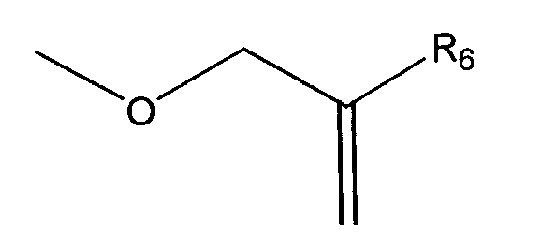
wherein R6 is hydrogen or methyl;
wherein R7 represents C1 - C3 alkyl;
wherein R5 represents C4 - C7 cycloalkyl, C4 - C7 hydroxyalkenyl or tri- C1 - C3 alkyl silyl;
wherein E is hydrogen or
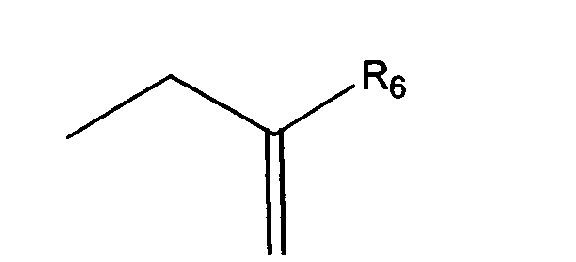
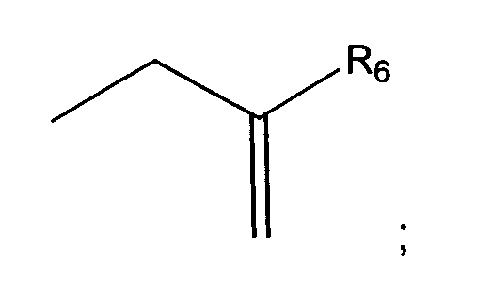
wherein D and E taken together represents the moiety:
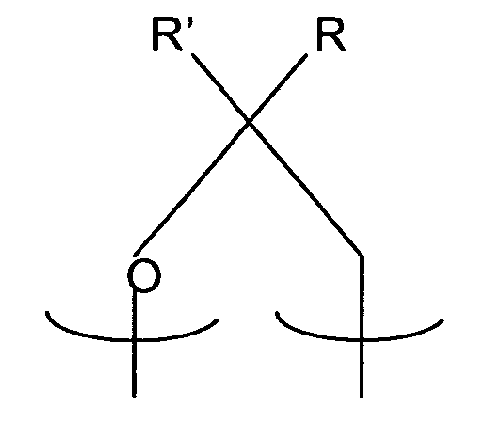
wherein R and R' each represents hydrogen or methyl with the proviso that at least one of R and R' is methyl. Methods for using and making these compounds are also disclosed.
Description
- The present invention relates to new chemical entities and the incorporation and use of the new chemical entities as fragrance chemicals.
- Differences in the chemical structure of the molecule can result in significant differences in the odor, notes and characteristics of a molecule. These variations and the ongoing need to discover and use the new chemicals in the development of new fragrances allows perfumers to apply the new compounds in creating new fragrances.
- U.S. Patent No. 5,227,367 discloses oxypentamethylindane carboxaldehydes and methods for preparing same, organoleptic uses thereof and cosmetic and pharmaceutical compositions containing them.
- U.S. Patent No. 5,733,866 discloses methyl substituted hexahydroindanols and uses thereof in augmenting or enhancing the aroma of perfume compositions, colognes and perfumed articles.
- U.S. Patent No. 5,665,698 discloses methyl substituted tetrahydroindane alkyl enol ethers and uses thereof in augmenting, enhancing or imparting an aroma in or to perfume compositions, colognes and perfumed articles. Also described are processes for preparing the same as well as process intermediates.
- The present invention provides chemicals, and the use of the chemicals to enhance the fragrance of perfumes, toilet waters, colognes, personal products and the like. In addition, the present invention is directed to the use of the chemicals to enhance fragrance in perfumes, toilet waters, colognes, personal products and the like.
- More specifically, the present invention is directed to the compounds, represented by the following structure:wherein m is 0 or 1;

wherein each of the dashed lines represent a carbon-carbon single bond or a carbon-carbon double bond with the proviso that not more than one dashed line represents a carbon-carbon double bond;
wherein X represents hydrogen or methyl;
wherein R1, R2, R3 and R4 each represent methyl or ethyl with the proviso that when X is methyl, each of R1, R2, R3 and R4 is methyl and when X is hydrogen, one of R1, R2, R3 and R4 is ethyl;
wherein D is =O or -OH when neither dashed line is a double bond, -OR5 when either of the dashed lines is a double bond, -OR7 when the dashed line in the Δ4,5 position is a double bond, orwhen the dashed line in the Δ3A,4 position represents a double bond;
wherein R6 is hydrogen or methyl;
wherein R7 represents C1 - C3 alkyl;
wherein R5 represents C4 - C7 cycloalkyl, C4 - C7 hydroxyalkenyl or tri- C1 - C3 alkyl silyl;
wherein E is hydrogen orwhen neither dashed line is a double bond, with the proviso that when D is =O or -OH, E is wherein F is hydrogen when neither dashed line is a double bond and D is not =O;
wherein D and E taken together represents the moiety:when neither dashed line is a double bond;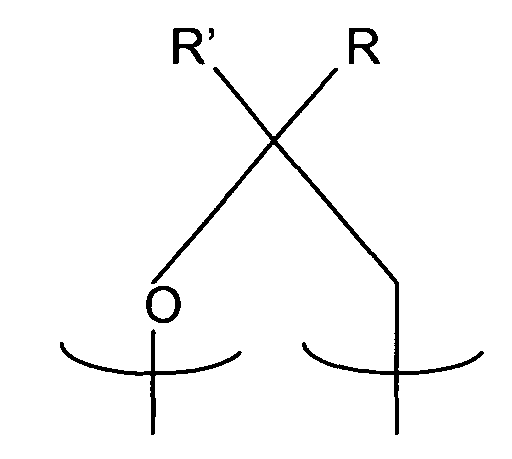
wherein R and R' each represents hydrogen or methyl with the proviso that at least one of R and R' is methyl. - The present invention further provides and processes for preparing such compounds.
- Another embodiment of the invention is a method for enhancing a fragrance by incorporating an olfactory acceptable amount of one or more of the compounds provided above.
- Other embodiments of the invention are processes for preparing the compounds provided above. These and other embodiments of the present invention will be apparent by reading the following specification.
- The novel compounds of the present invention are more fully described by the following structures:
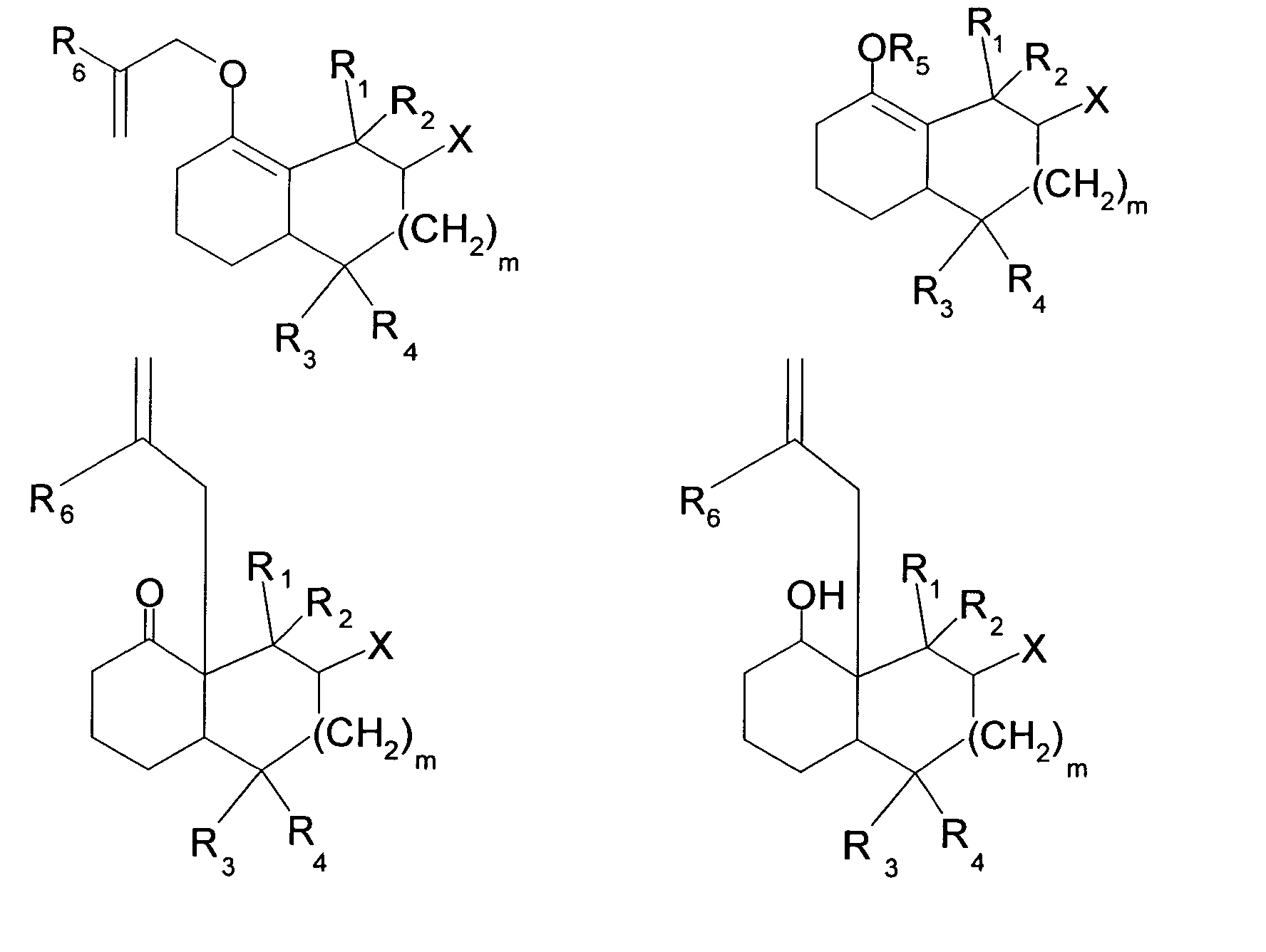 wherein R1, R2, R3, R4, R5, R6, R7, X and m are defined above.
- In a preferred embodiment the molecules contain the ring structure wherein R6 is methyl and m = 0; and such preferred molecules have the following structures:
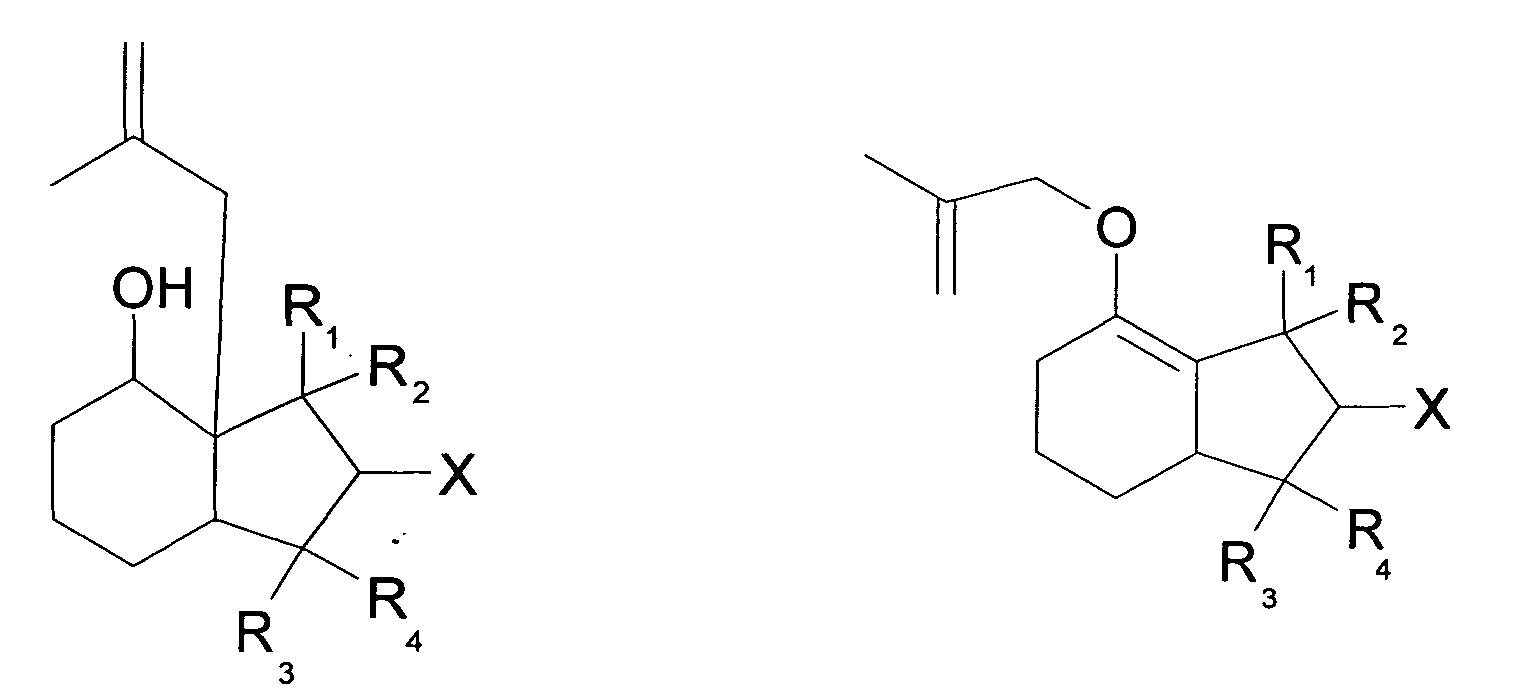 wherein R1, R2, R3, R4, and X are defined above.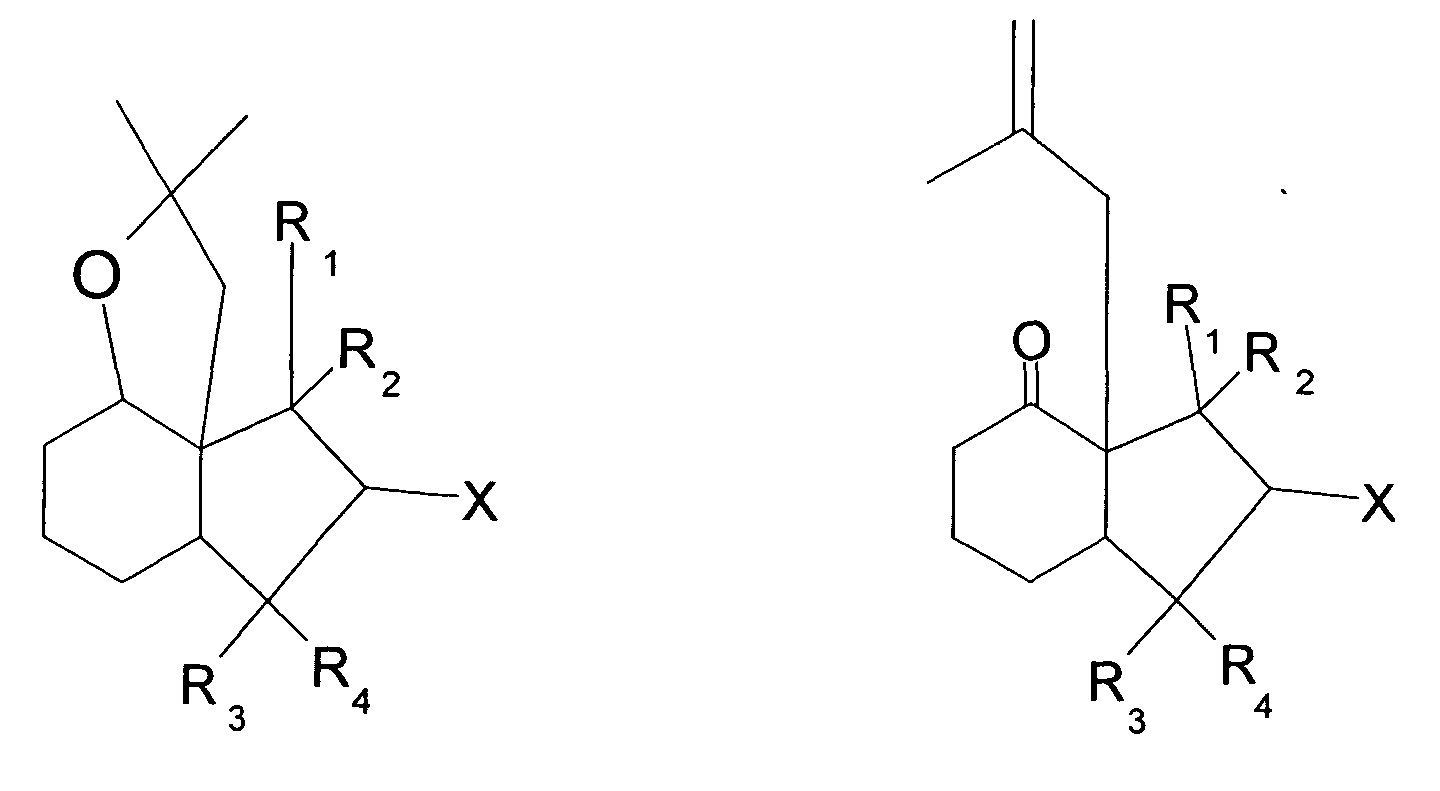
- In a more preferred embodiment, each of the immediately preceding four structures represents mixtures wherein in each of the mixtures the major molecule (greater than or equal to about 90%) is the one where X represents methyl and each of R1, R2, R3, and R4 represents methyl and the molecules in minor amount (less than or equal to about 10%) are the ones where X is hydrogen and one of R1, R2, R3 and R4 is ethyl and each of the other of R1, R2, R3 and R4 is methyl.
- The most preferable compounds of our invention are the compounds defined according to the structure:(3,3,10,10,11,12,12-heptamethyl-4-oxatricyclo[7.3.0.0<1,5>]dodecane; also named decahydro-2,2,4,4,5,6,6-heptamethyl-indeno[4,3A-B]furan) isomers of which have, for example, the structures:
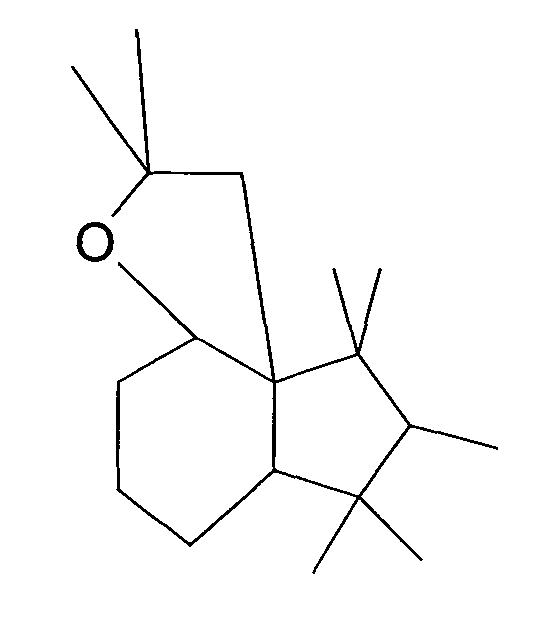
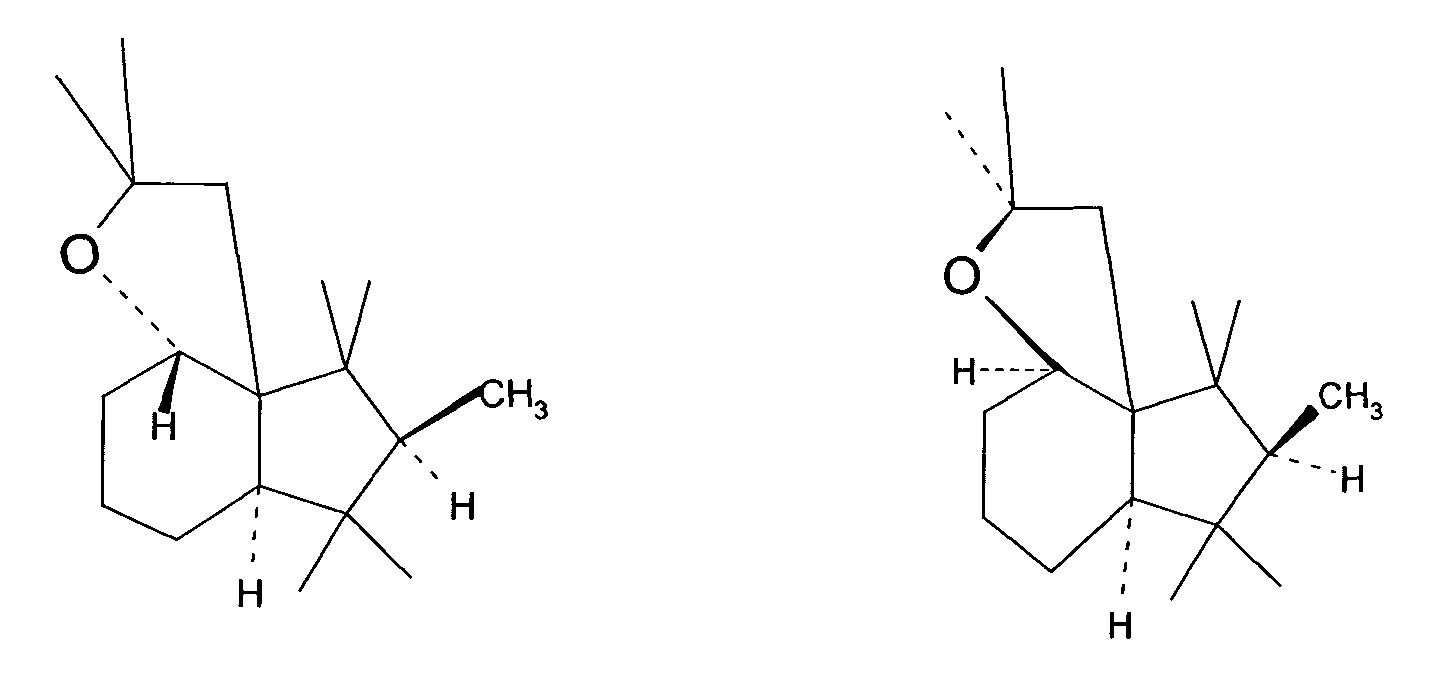
- Such isomers, taken alone or in admixture, are useful in formulating fragrance compositions in accordance with the practice of our invention. More specifically, such isomers are set forth in the following Table I:
(1R,5R,9R,11R)-Z (1R,5S,9R,11S)-Z (1R,5R,9R,11S)-Z (1R,5R,9S,11S)-Z (1R,5R,9S,11R)-Z; (1R,5S,9S, 11 R)-Z (1R,5S,9R,11R)-Z; (1R,5S,9S,11S)-Z (1S,5R,9R,11R)-Z; (1S,5R,9S,11S)-Z (1S,5R,9R,11S)-Z; (1S,5S,9R,11S)-Z (1S,5R,9S,11 R)-Z; (1S,5S,9S,11R)-Z (1S,5S,9R,11R)-Z; (1S,5S,9S,11S)-Z wherein "Z" represents the compound name, "3,3,10,10,11,12,12-heptamethyl-4-oxatricyclo[7.3.0.0<1,5>]dodecane". - Thus, those with skill in the art will recognize that the compounds of the present invention have a number of chiral centers, thereby providing numerous isomers of the claimed compounds. It is intended herein that the compounds described herein include isomeric mixtures of such compounds, as well as those isomers that may be separated using techniques known to those having skill in the art. Suitable techniques include chromatography such as HPLC, and particularly gel chromatography and solid phase microextraction ("SPME").
- The compounds defined according to the structure:are prepared by means of an exchange reaction of allyl alcohol or methallyl alcohol with the corresponding C1 - C3 alkyl enol ether in the presence of a catalytic amount of a protonic acid, preferably para-toluene sulfonic acid or methane sulfonic acid at a temperature in the range of 85°C to about 105°C. according to the reaction:
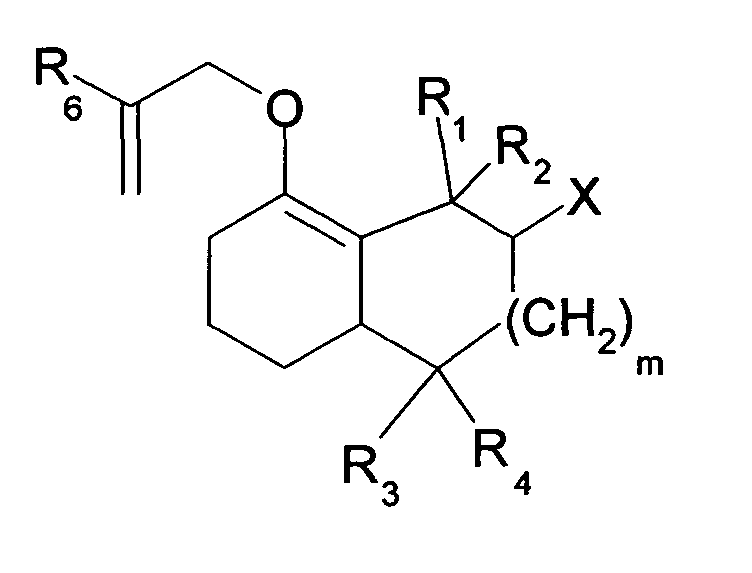
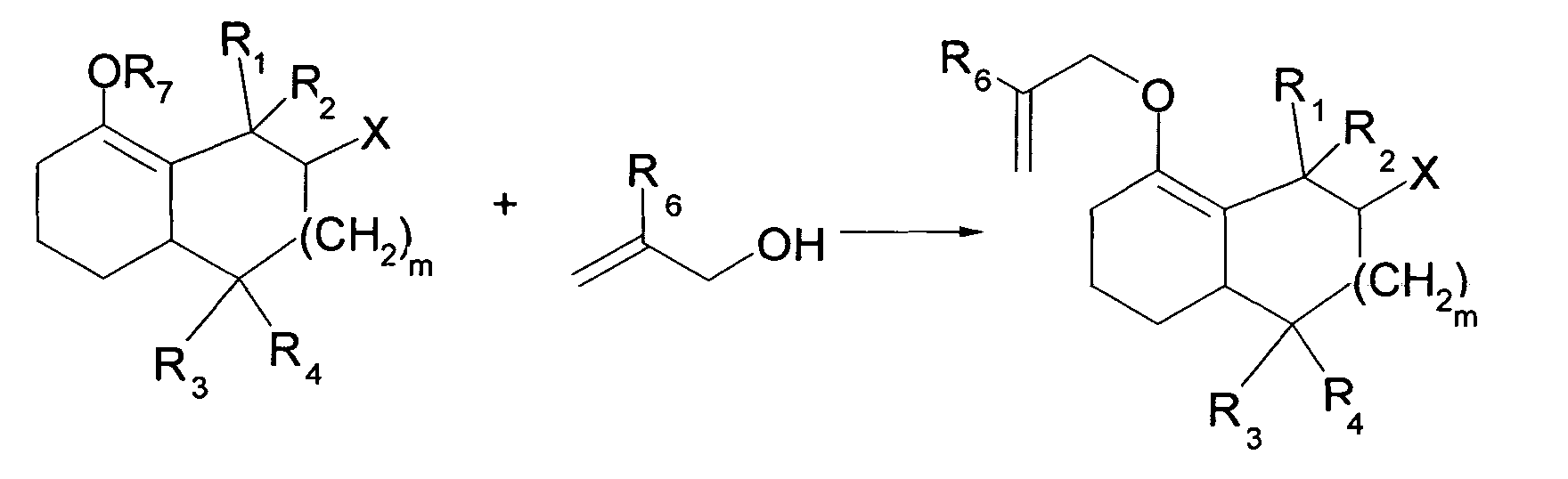
- The resulting allyl or methallyl enol ethers may be recovered and used for their organoleptic properties, or each of them may be rearranged via a Claisen rearrangement at about 190 - 210°C in the presence of an acid catalyst, preferably a mild acid catalyst such as phosphoric acid, potassium diacid phosphate, sodium diacid phosphate, sodium bisulfate, the acid ion exchange catalyst, AMBERLYST 15 (trademark of the Rohm and Haas Company of Philadelphia, Pa., U.S.A.), disodium citrate, or hydroquinone according to the reaction:

- The resulting 3A-allyl or 3A-methallyl-4-ketone derivatives may be isolated and used for their respective organoleptic properties, or they may be subjected to carbonyl moiety-reduction using a metal hydride reducing agent, for example LiAIH4 or sodium bis(2-methoxyethoxy)aluminum hydride (VITRIDE) to form the corresponding 3A-allyl or 3A-methallyl-4-hydroxy derivative according to the reaction:
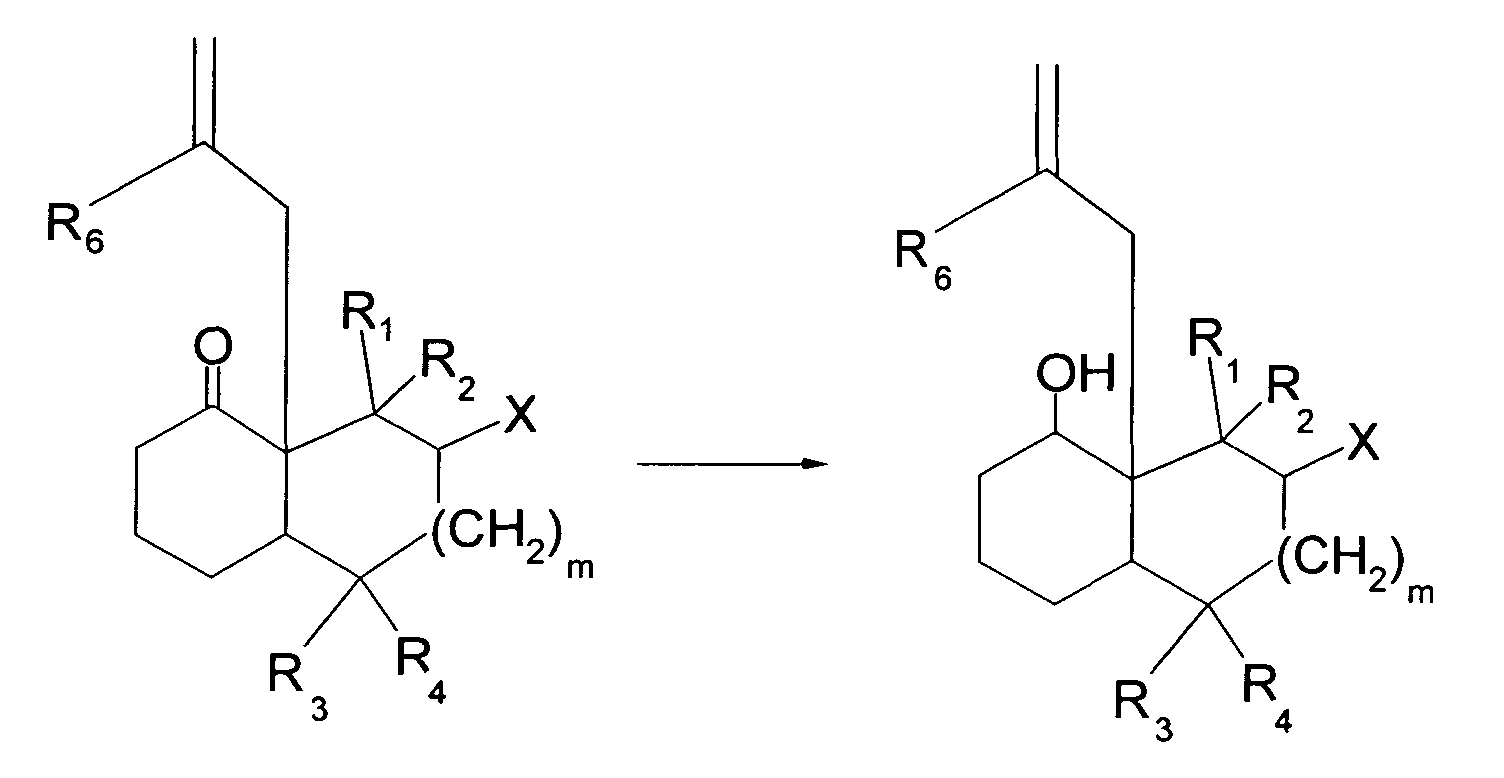
- The resulting 3A-allyl or 3A-methallyl-4-hydroxy derivative may be recovered and used for its organoleptic properties or it may be cyclized with a protonic acid cyclizing reagent, preferably methane sulfonic acid in nitropropane at 18 - 40°C, according to the reaction:

- The compounds having the structure:are prepared either according to the reaction:
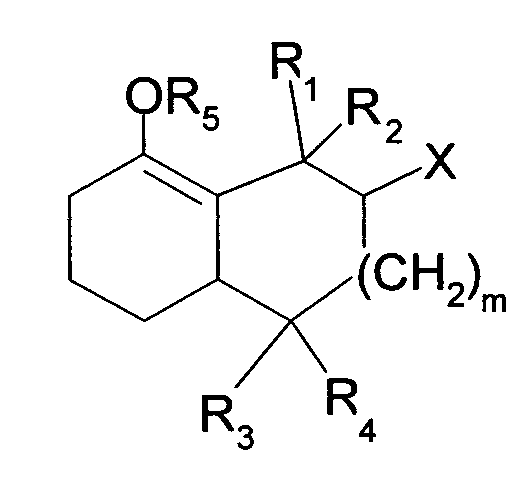 where R5 is trialkyl silyl, or according to the reaction:
 where R5 is C4 - C7 cycloalkyl or C4 - C7 hydroxyalkenyl and where the dashed lines are indicative of mixtures of double bond position isomers wherein in such mixtures, one of the dashed lines represents a carbon-carbon double bond and the other of the dashed lines represents a carbon-carbon single bond. In both cases, the Δ3A,4 and Δ4,5 double bond position isomers are produced in admixture, and may, if desired, be separated prior to use for their respective organoleptic properties, according to techniques well known to those having ordinary skill in the art.
- The compounds having the structure:are prepared according to one of the following reactions:
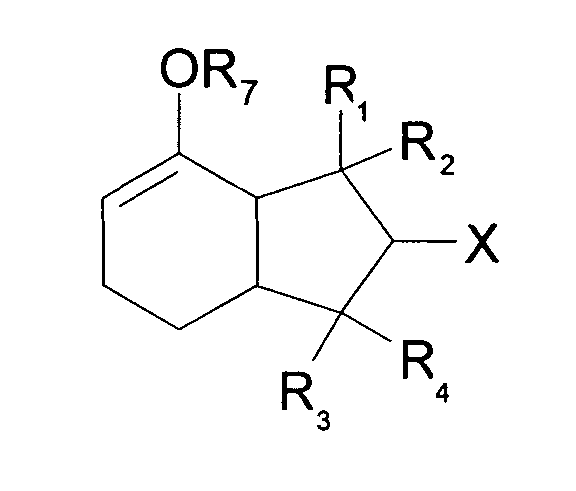 taking place in the presence of γ-alumina, or
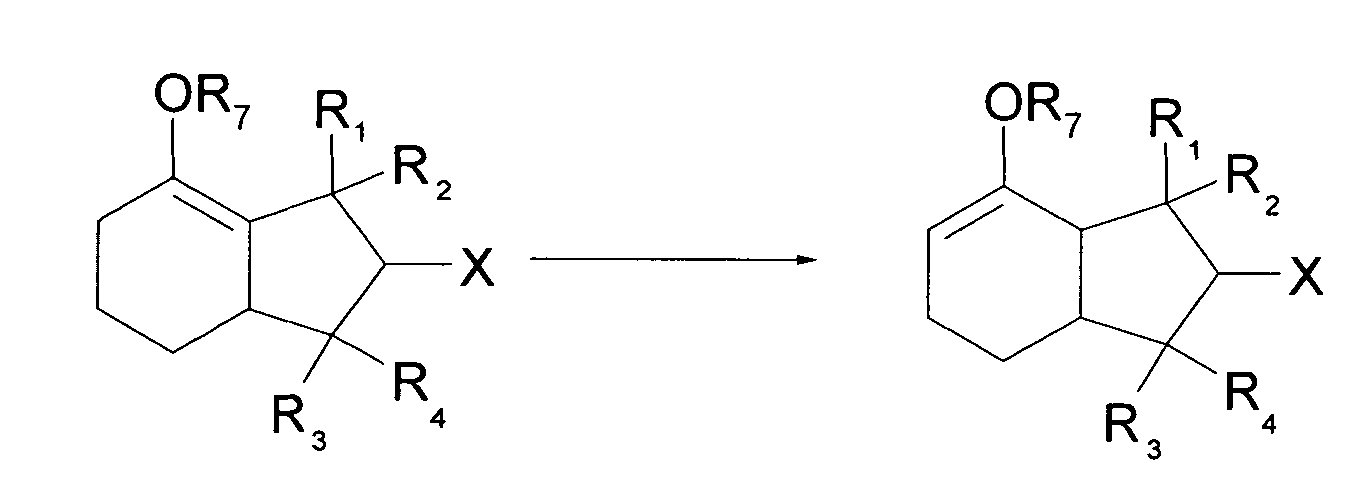 wherein a mixture of double-bond position isomers is formed, wherein one of the dashed lines is a carbon-carbon double bond and the other of the dashed lines is a carbon-carbon single bond, or
 taking place at a temperature in the range of from about 125 to about 150°C in the presence of ϒ-alumina and an inert solvent having a boiling point at atmospheric pressure of greater than 160°C, preferably toluene or p-dimethyl benzene. Most preferably, R7 is methyl.
- The latter two reactions each effect the formation of the mixture of the Δ3A,4 and Δ4,5 double bond position isomers which may, if desired, be separated using techniques well known to those having ordinary skill in the art.
- The compounds and mixtures of compounds of the present invention have powerful and substantive woody, cigar box, amber aromas, with sweet musky, amber, creamy topnotes and strong floral, cedar, balsamic, sweet musky, amber and woody undertones.
- The use of the compounds of the present invention is widely applicable in current perfumery products, including the preparation of perfumes and colognes, the perfuming of personal care products such as soaps, shower gels, and hair care products as well as air fresheners and cosmetic preparations. The present invention can also be used to perfume cleaning agents, such as, but not limited to detergents, dishwashing materials, scrubbing compositions, window cleaners and the like.
- In these preparations, the compounds of the present invention can be used alone or in combination with other perfuming compositions, solvents, adjuvants and the like. The nature and variety of the other ingredients that can also be employed are known to those with skill in the art.
- Many types of fragrances can be employed in the present invention, the only limitation being the compatibility with the other components being employed. Suitable fragrances include but are not limited to fruits such as almond, apple, cherry, grape, pear, pineapple, orange, strawberry, raspberry; and musk and flower scents such as lavender-like, rose-like, iris-like, and carnation-like. Other pleasant scents include herbal and woodland scents derived from pine, spruce and other forest smells. Fragrances may also be derived from various oils, such as essential oils, or from plant materials such as peppermint, spearmint and the like.
- A list of suitable fragrances is provided in U.S. Patent No. 4,534,891, the contents of which are incorporated by reference as if set forth in its entirety. Another source of suitable fragrances is found in Perfumes. Cosmetics and Soaps, Second Edition, edited by W. A. Poucher, 1959. Among the fragrances provided in this treatise are acacia, cassie, chypre, cyclamen, fern, gardenia, hawthorn, heliotrope, honeysuckle, hyacinth, jasmine, lilac, lily, magnolia, mimosa, narcissus, freshly-cut hay, orange blossom, orchid, reseda, sweet pea, trefle, tuberose, vanilla, violet, wallflower, and the like.
- Olfactory effective amount is understood to mean the amount of compound in perfume compositions the individual component will contribute to its particular olfactory characteristics, but the olfactory effect of the perfume composition will be the sum of the effects of each of the perfumes or fragrance ingredients. Thus the compounds of the invention can be used to alter the aroma characteristics of the perfume composition, or by modifying the olfactory reaction contributed by another ingredient in the composition. The amount will vary depending on many factors including other ingredients, their relative amounts and the effect that is desired.
- The level of compound of the invention employed in the fragranced article varies from about 0.005 to about 10 weight percent, preferably from about 0.5 to about 8 and most preferably from about 1 to about 7 weight percent. In addition to the compounds other agents can be used in conjunction with the fragrance. Well known materials such as surfactants, emulsifiers and polymers to encapsulate the fragrance can also be employed without departing from the scope of the present invention.
- Another method of reporting the level of the compounds of the invention in the perfumed composition, i.e., the compounds as a weight percentage of the materials added to impart the desired fragrance. The compounds of the invention can range widely from 0.005 to about 70 weight percent of the perfumed composition, preferably from about 0.1 to about 50 and most preferably from about 0.2 to about 25 weight percent. Those with skill in the art will be able to employ the desired level of the compounds of the invention to provide the desired fragrance and intensity.
- The following are provided as specific embodiments of the present invention. Other modifications of this invention will be readily apparent to those skilled in the art. Such modifications are understood to be within the scope of this invention.
- As used herein all percentages are weight percent unless otherwise noted, ppm is understood to mean parts per million; mm is understood to be millimeters, ml is understood to be milliliters, Bp is understood to be boiling point, THF is understood to be tetrahydrofuran, Hg is understood to be mercury and g is understood to be grams. IFF as used in the examples is understood to mean International Flavors & Fragrances Inc., New York, N.Y., USA.
-

- Into a 5 liter reaction vessel equipped with a thermocouple, 12" Goodloe packed column attached with take-off rushover still, mechanical stirrer, nitrogen line and addition funnel were placed 507 g (2 moles) of 1,1,2,3,3-pentamethyl-7-(2-methoxy)-2,3,4,5,6,3A-hexahydroindene prepared according to the procedure of Example I of U.S. Patent 5,665,698, 288 g (4 moles) of methallyl alcohol and 1.1 g of p-toluene sulfonic acid.
- The resulting reaction mixture, with stirring, was heated to 85°C and maintained at that temperature for a period of 5 hours, while taking off the methanol reaction product.
- The resulting reaction mixture was then quenched by adding 1.5 g of a 30% sodium methoxide solution and then romoving lights via vacuum evaporation. The resulting product was then transferred to a rushover distillation apparatus and distilled at 1.8 - 2.0 mm Hg.
- The crude material was distilled in an 18" Goodloe Column at a vapor temperature range of 129 - 131°C and a pressure of 3.01-3.25 mm Hg.
- The nmr spectrum of the product having the structure:(a mixture wherein in the major compound (90%) X, R1, R2, R3and R4 each is methyl and in the minor compounds X is hydrogen and one of R1, R2, R3and R4 is ethyl and each of the other of R1,R2,R3and R4 is methyl) is as follows: 0.68-1.1 ppm (ms, 15H); 1.25-2.2 ppm (m, 7H); 1.75 ppm (s, 3H); 4.1 ppm (d, 2H); 4.85-5.1 ppm (2s, 2H)

- The product had an intense and substantive woody, cigar box aroma with cedar undertones.
-

- Into a 5 liter reaction flask equipped with a thermocouple, condenser, mechanical stirrer, nitrogen line and fluid metering pump for addition was placed 50 g Primol (Mineral Oil) and 1 g NaH2PO4.
- With stirring, the resulting mixture was heated to 190-195°C. Using the metering pump, over a period of 1.5 hours while maintaining the reaction mixture temperature at 190-210°C, 538 g (1.72 moles) of the product of Example I, containing 90% 1,1,2,3,3-pentamethyl-7-(2-methylprop-2-enyloxy)-2,3,4,5,6,3A-hexahydroindene was added to the reaction mixture.
- The reaction mixture was then transferred into a rushover distillation apparatus and the crude material was distilled at 1.0 - 2.0 mm Hg. The product was then transferred to an 18" Goodloe column and fractionally distilled at 165°C and 1.8 mm Hg.
- The nmr spectrum of the resulting product having the structure:(a mixture wherein in the major compound (90%) X, R1, R2, R3and R4 each is methyl and in the minor compounds X is hydrogen and one of R1, R2, R3and R4 is ethyl and each of the other of R1,R2,R3and R4 is methyl) is as follows: 0.76-1.13 ppm (ms, 15H); 1.57 ppm (s, 3H); 1.7 ppm (m, 2H); 1.85 ppm (m, 2H); 1.95 - 2.86 ppm (m, 7H); 4.68 -4.86 ppm (2s, 2H).
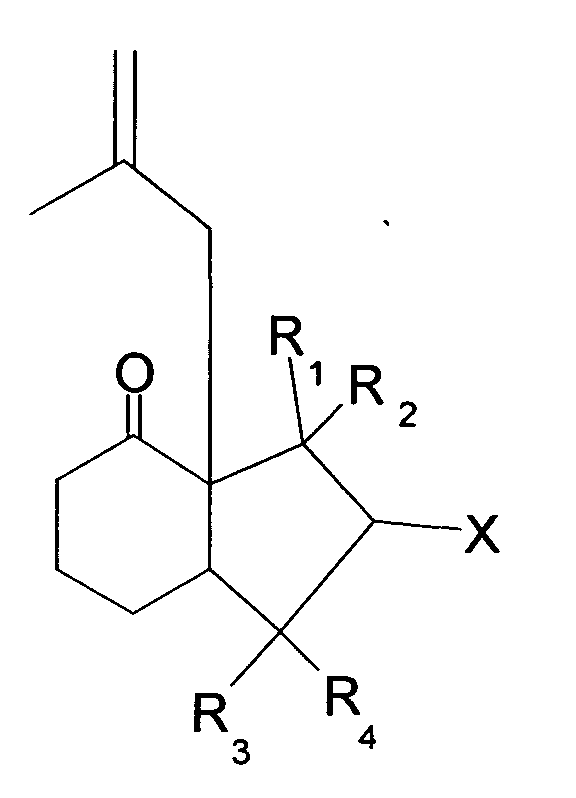
- The product had a woody aroma with intense, amber topnotes.
-

- Into a 5 liter reaction flask equipped with a thermocouple, mechanical stirrer, nitrogen line and addition funnel was placed 718 g (2.74 moles) of the octahydro-1,1,2,3,3-pentamethyl-3A-(2-methyl-2-propenyl)-4H-inden-4-one prepared according to Example II.
- 550 Grams LiAIH4 in 250 ml tetrahydrofuran was slowly added, while carefully cooling the reaction mass, causing the reaction temperature to rise to a maximum of 70°C.
- The reaction mass was maintained, with stirring, at 70°C for a period of 0.5 hours.
- At the end of the 0.5 hour period, the reaction mass was quenched initially with ethyl acetate (in order to decompose the excess LiAIH4) followed by addition of 1000 ml. aqueous 3M NaOH.
- The reaction mass resulted in two phases: an aqueous phase and an organic phase. The aqueous layer was separated and the organic layer was further washed with two 1000 ml. portions of concentrated aqueous NaCl, dried over anhydrous Na2SO4 and filtered through CELITE (World Minerals Inc.)
- The organic layer was then transferred to a rushover distillation apparatus where 470 g solvent was initially removed, followed by distillation to yield crude product over a temperature range of 107-151 °C and a pressure range of 5 - 9 mm. Hg. The product was then distilled on a 18" x 1.5" Goodloe column at 175°C and 6.5 mm Hg pressure.
- The nmr spectrum of the resulting product having the structure:(a mixture wherein in the major compound (90%) X, R1, R2, R3and R4 each is methyl and in the minor compounds X is hydrogen and one of R1, R2, R3and R4 is ethyl and each of the other of R1,R2,R3and R4 is methyl) is as follows: 1.25-1.78 ppm (m, 9H); 0.7-1.1 ppm (ms, 15H); 1.86 ppm (s, 3H); 2.05 - 2.65 ppm (m, 4H); 4.8 - 4.95 ppm (2s, 2H).

- The product had a woody aroma with intense, amber topnotes.
-
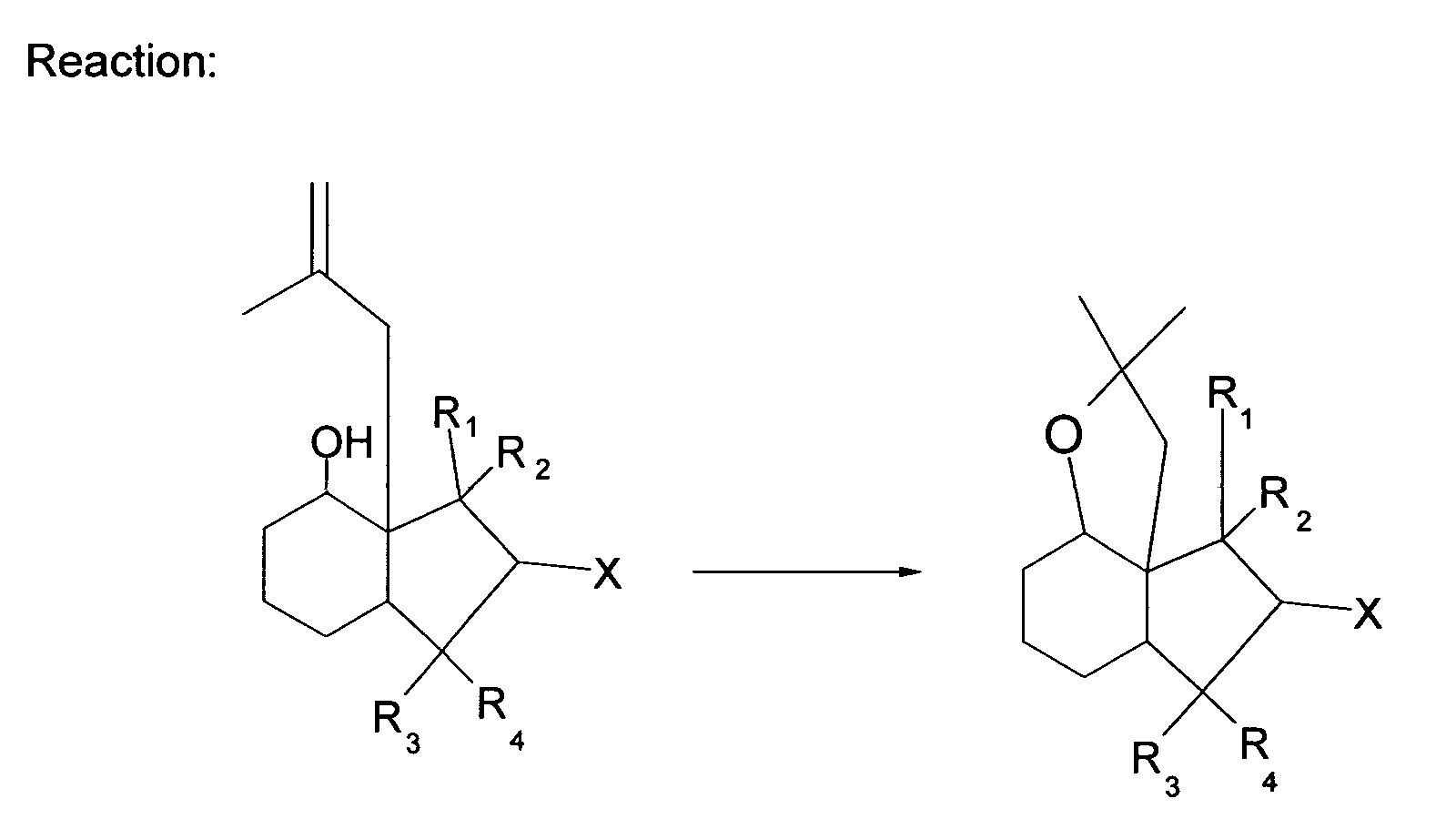
- Into a 5 liter reaction flask equipped with a thermocouple, mechanical stirrer, nitrogen line, addition funnel and rushover distillation column was placed 300 g 1-nitropropane and 452 g (1.17 moles) of the octahydro-1,1,2,3,3-pentamethyl-3A-(2-methyl-2-propenyl)-4H-inden-4-ol prepared according to Example III.
- 10 ml. of methanesulfonic acid was slowly added to the resulting mixture, with stirring, causing the temperature of the mixture to rise to 30°C. The reaction mass was then stirred for a period of 0.5 hours. An additional 5 ml. of methanesulfonic acid was then added, with stirring, to the reaction mixture while maintaining the temperature at 30°C. The reaction mass was then stirred for a period of 0.5 hours. An additional 15 ml. of methanesulfonic acid was then added, with stirring, to the reaction mixture while maintaining the temperature at 30°C. The reaction mass was then stirred for a period of 0.5 hours. The reaction mass was then stirred for an additional 4 hours while maintaining the temperature at 30°C.
- After the four hour period, the reaction mass was quenched with 250 ml. of Na2CO3 and stirred for a period of 15 minutes. At this point in time, the pH of the reaction mass was in the range of 9 - 9.5. 250 ml. Water was then added, with stirring, to the reaction mass and stirring was continued for another 0.5 hours.
- The reaction mass resulted in two phases: an aqueous phase and an organic phase. The organic layer was transferred to a rushover distillation apparatus where 470 g solvent was initially removed followed by unreacted octahydro-1,1,2,3,3-pentamethyl-3A-(2-methyl-2-propenyl)-4H-inden-4-ol at 175°C at 6.5 mm Hg.
- The crude rushed-over material was then fractionally distilled through a 18" x 1.5" Goodloe column at a reflux ratio of 3:1 yielding 17 fractions. Fractions 6-16 distilling at 91 °C at 6.5 mm Hg pressure were bulked.
- The nmr spectrum of the resulting product having the structure:(a mixture wherein in the major compound (90%) X, R1, R2, R3and R4 each is methyl and in the minor compounds X is hydrogen and one of R1, R2, R3and R4 is ethyl and each of the other of R1,R2,R3and R4 is methyl) is as follows: 0.65-1.07 ppm (ms, 15H); 1.3 ppm (s, 3H); 1.4 ppm (s, 3H); 1.55-2.46 ppm (m, 7H).

- The product had an intense and substantive woody amber aroma with sweet musky topnotes and balsamic undertones.
-

- Into a 5 liter reaction vessel equipped with a thermocouple, 12" Goodloe packed column attached with take-off rushover still, mechanical stirrer, nitrogen line and addition funnel were placed 507 g (2 moles) of 1,1,2,3,3-pentamethyl-7-(2-methoxy)-2,3,4,5,6,3A-hexahydroindene prepared according to the procedure of Example I of U.S. Patent 5,665,698, 240 g (4 moles) of allyl alcohol and 1.1 g of p-toluene sulfonic acid.
- The resulting reaction mixture, with stirring, was heated to 85°C and maintained at that temperature for a period of 5 hours, while taking off the methanol reaction product.
- The resulting reaction mixture was then quenched by adding 1.5 g of a 30% sodium methoxide solution and then removing lights via vacuum evaporation.
- The resulting product was then transferred to a rushover distillation apparatus and distilled, yielding the compounds having the structure:(a mixture wherein in the major compound (90%) X, R1, R2, R3and R4 each is methyl and in the minor compounds X is hydrogen and one of R1, R2, R3and R4 is ethyl and each of the other of R1,R2,R3and R4 is methyl).
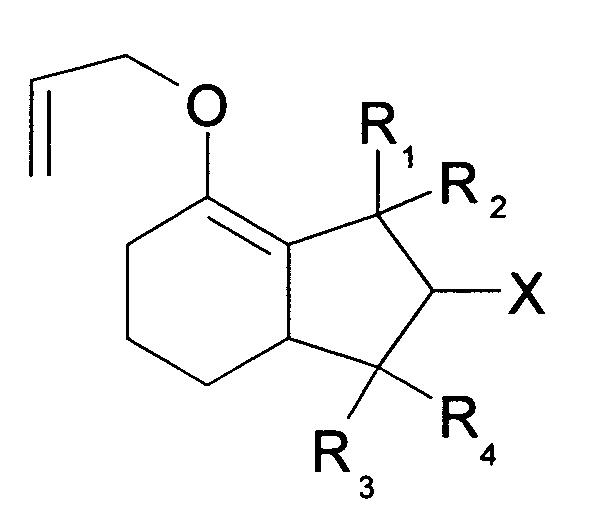
- The product had a mahogany aroma with sweet, musky undertones.
-
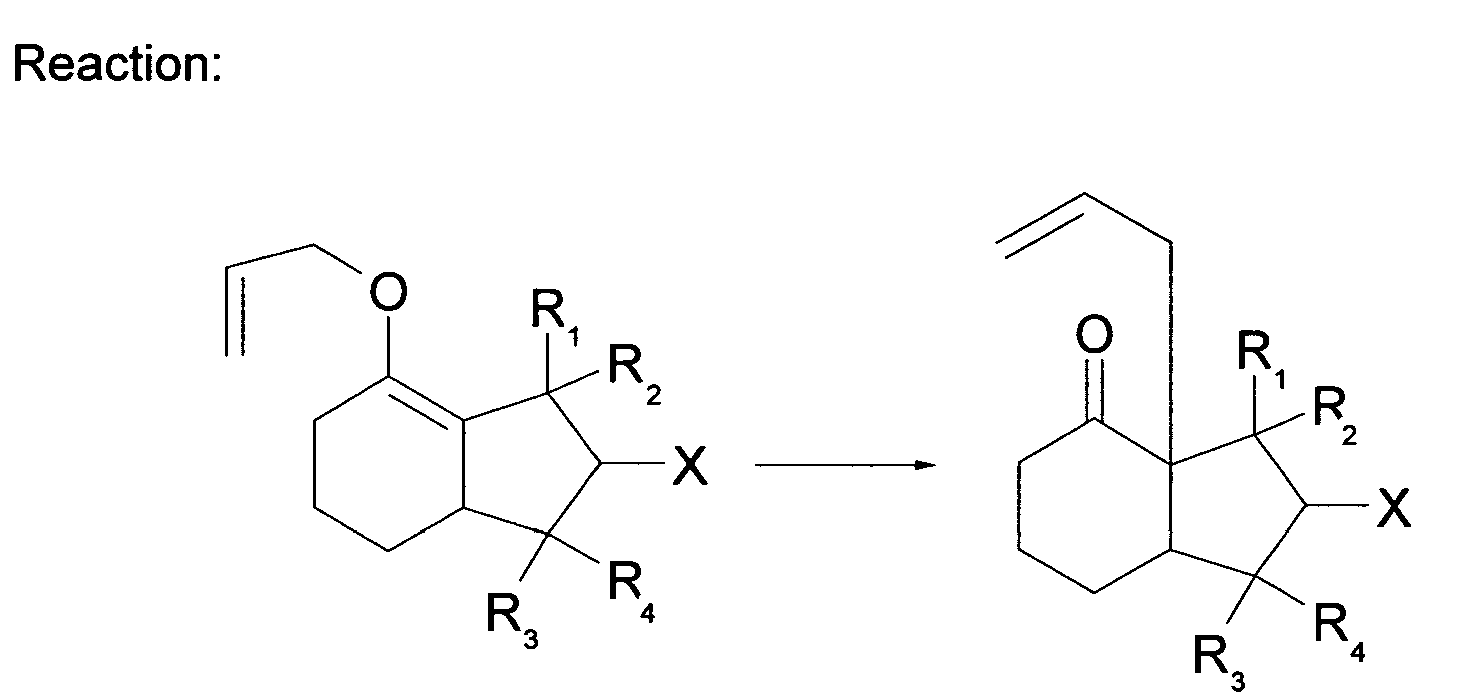
- Into a 5 liter reaction flask equipped with a thermocouple, condenser, mechanical stirrer, nitrogen line and fluid metering pump for addition was placed 50 g Primol (Mineral Oil) and 5 g KH2PO4.
- With stirring, the resulting mixture was heated to 190-195°C. Using the metering pump, over a period of 1.5 hours while maintaining the reaction mixture temperature at 190-210°C, 312 g of the product of Example V, containing 90% 1,1,2,3,3-pentamethyl-7-(prop-2-enyloxy)-2,3,4,5,6,3A-hexahydroindene was added to the reaction mixture.
- The reaction mixture was then transferred into a rushover distillation apparatus and the crude material was distilled.
- The product had an intense woody aroma with amber undertones.
- The nmr spectrum of the resulting product having the structure:a mixture wherein in the major compound (90%) X, R1, R2, R3and R4 each is methyl and in the minor compounds X is hydrogen and one of R1, R2, R3and R4 is ethyl and each of the other of R1,R2,R3and R4 is methyl) is as follows: 0.73-1.06 ppm (ms, 15H); 1.2-2.4 ppm (m, 8H); 5.1 ppm (m, 2H); 5.5 ppm (m, 1 H).

-
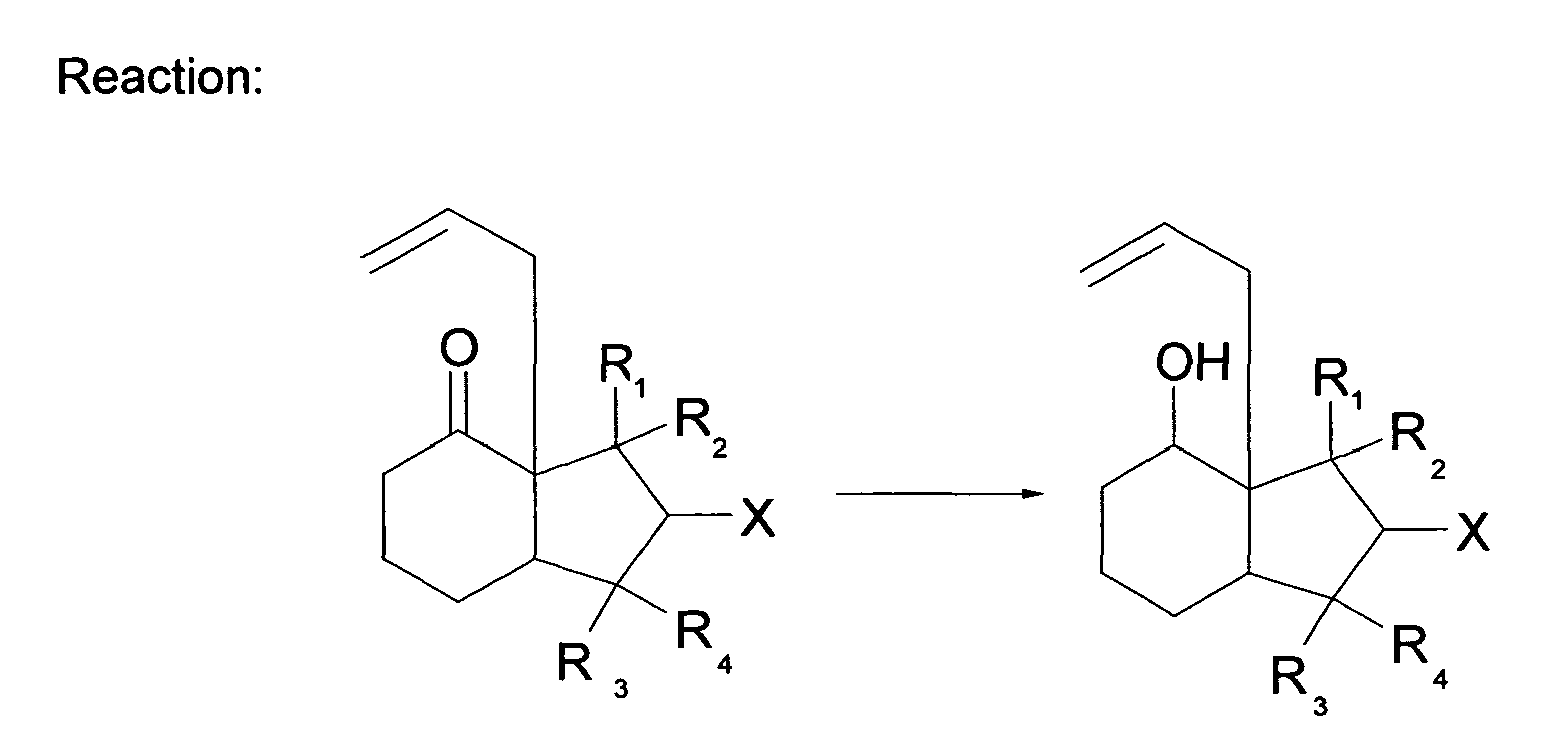
- Into a 5 liter reaction flask equipped with a thermocouple, mechanical stirrer, nitrogen line and addition funnel was placed 656 g (1.77 moles) of the octahydro-1,1,2,3,3-pentamethyl-3A-(2-propenyl)-4H-inden-4-one prepared according to Example VI.
- 21.7 Grams LiAIH4 in 260 ml tetrahydrofuran was slowly added, while carefully cooling the reaction mass, causing the reaction temperature to rise to a maximum of 70°C.
- The reaction mass was maintained, with stirring, at 70°C for a period of 0.5 hours.
- At the end of the 0.5 hour period, the reaction mass was quenched initially with 20% aqueous acetic acid (in order to decompose the excess LiAIH4) followed by addition of 1000 ml. aqueous 20% NaHCO3.
- The reaction mass resulted in two phases: an aqueous phase and an organic phase. The aqueous layer was separated and the organic layer is further washed with two 1000 ml. portions of concentrated aqueous NaCl, dried over anhydrous Na2SO4 and filtered through CELITE.
- The organic layer was then transferred to a rushover distillation apparatus where 470 g solvent was initially removed, followed by distillation to yield crude product. The product was then distilled on a 18" x 1.5" Goodloe column.
- The product had an intense and substantive woody, amber aroma.
- The nmr spectrum of the resulting product having the structure:(a mixture wherein in the major compound (90%) X, R1, R2, R3and R4 each is methyl and in the minor compounds X is hydrogen and one of R1, R2, R3and R4 is ethyl and each of the other of R1,R2,R3and R4 is methyl) is as follows: 0.7-1.1 ppm (ms, 15H); 1.35-1.8 ppm (m, 7H); 2.25-2.6 ppm (m, 2H); 3.95 ppm (m, 1 H); 5.15 ppm (m, 2H); 6 ppm (m, 1 H).

- The infra-red spectrum is as follows:
3431 cm-1 (-OH); 3074, 2958 cm-1 (-CH); 909 cm-1 ( >=CH2). -

- Into a 5 liter reaction flask equipped with a thermocouple, mechanical stirrer, nitrogen line, addition funnel and rushover distillation column was placed 300 g 1-nitropropane and 452 g of the octahydro-1,1,2,3,3-pentamethyl-3A-(2-propenyl)-4H-inden-4-ol prepared according to Example VII.
- 10 ml. of methanesulfonic acid was slowly added to the resulting mixture, with stirring, causing the temperature of the mixture to rise to 30°C. The reaction mass was then stirred for a period of 0.5 hours. An additional 5 ml. of methanesulfonic acid was then added, with stirring, to the reaction mixture while maintaining the temperature at 30°C. The reaction mass was then stirred for a period of 0.5 hours. An additional 15 ml. of methanesulfonic acid was then added, with stirring, to the reaction mixture while maintaining the temperature at 30°C. The reaction mass was then stirred for a period of 0.5 hours. The reaction mass was then stirred for an additional 4 hours while maintaining the temperature at 30°C.
- After the four hour period, the reaction mass was quenched with 250 ml. of Na2CO3 and stirred for a period of 15 minutes. At this point in time, the pH of the reaction mass was in the range of 9 - 9.5. 250 ml. Water was then added, with stirring, to the reaction mass and stirring was continued for another 0.5 hours.
- The reaction mass resulted in two phases: an aqueous phase and an organic phase. The organic layer was transferred to a rushover distillation apparatus where the solvent was initially removed. The product was then transferred to an 18" x 1.5" Goodloe distillation column and fractionally distilled yielding a product having an intense and substantive woody, amber aroma with sweet, musky topnotes and balsamic undertones and compounds having the following structure:(a mixture wherein in the major compound (90%) X, R1, R2, R3and R4 each is methyl and in the minor compounds X is hydrogen and one of R1, R2, R3 and R4 is ethyl and each of the other of R1,R2,R3and R4 is methyl).
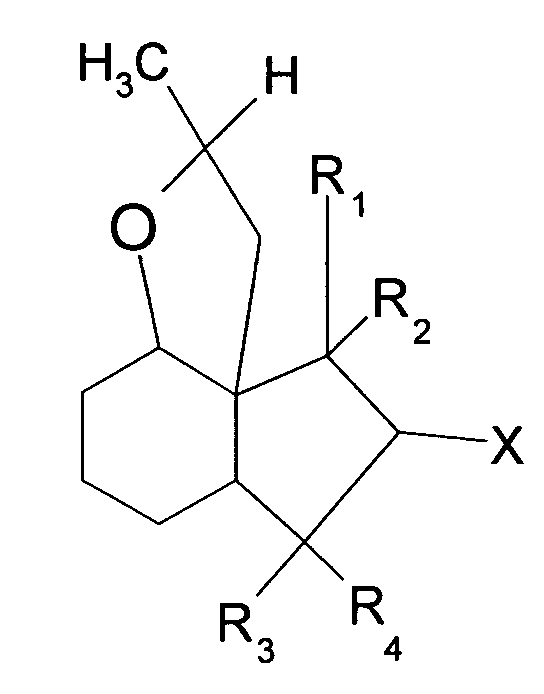
- (wherein the dashed lines indicate a mixture of double bond position isomers wherein in each of the compounds of the mixture one of the dashed lines is a carbon-carbon double bond and the other of the dashed lines is a carbon-carbon single bond)
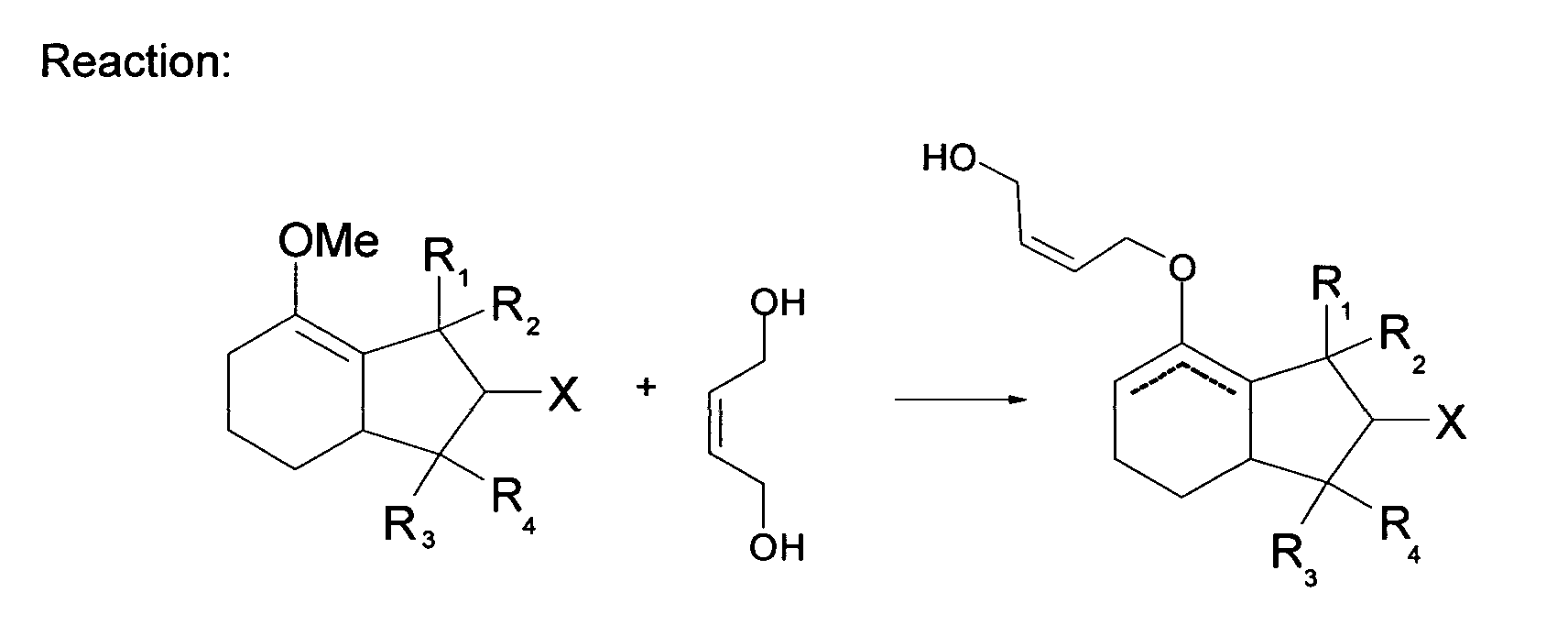
- Into a 5 liter reaction vessel equipped with a thermocouple, 12" Goodloe packed column attached with take-off rushover still, mechanical stirrer, nitrogen line and addition funnel were placed 507 g (2 moles) of 1,1,2,3,3-pentamethyl-7-(2-methoxy)-2,3,4,5,6,3A-hexahydroindene prepared according to the procedure of Example I of U.S. Patent 5,665,698, 240 g of 1,4-dihydroxy-2Z-butene and 1.1 g of p-toluene sulfonic acid.
- The resulting reaction mixture, with stirring, was heated to 85°C and maintained at that temperature for a period of 5 hours, while taking off the methanol reaction product.
- The resulting reaction mixture was then quenched by adding 1.5 g of a 30% sodium methoxide solution and then romoving lights via vacuum evaporation. The resulting product was then transferred to a rushover distillation apparatus and distilled, yielding the compounds having the following structure and the following nmr spectrum:(a mixture wherein in the major compound (90%) X, R1, R2, R3and R4 each is methyl and in the minor compounds X is hydrogen and one of R1, R2, R3and R4 is ethyl and each of the other of R1,R2,R3and R4 is methyl).
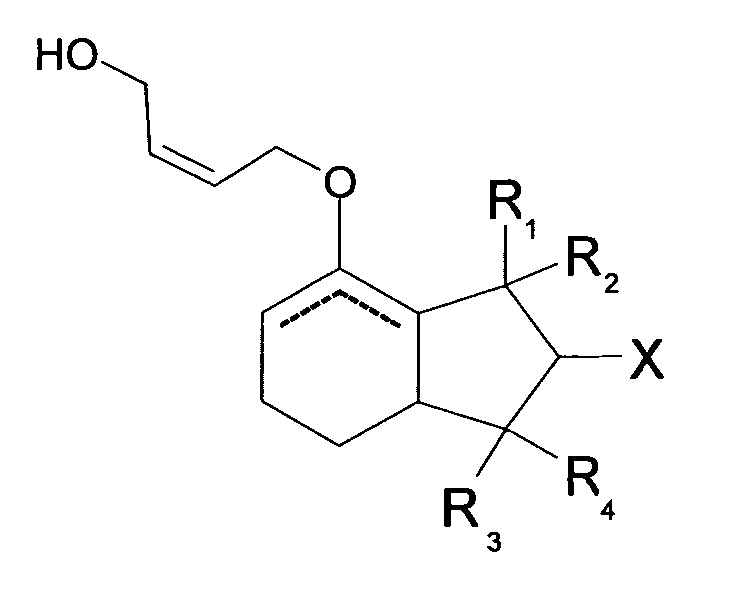
- 0.64-1.09 ppm (ms, 15H); 1.61-2.12 ppm (m, 7H); 2.88 ppm (s, 1 H); 4 ppm (m, 2H); 4.37 ppm (m, 2H); 5.66 ppm (m, 1 H); 5.80 ppm (m, 1 H).
- The product had a woody, sweet musky aroma with floral undertones.
- (wherein the dashed lines indicate a mixture of double bond position isomers wherein in each of the compounds of the mixture one of the dashed lines is a carbon-carbon double bond and the other of the dashed lines is a carbon-carbon single bond).

- Into a 5 liter reaction vessel equipped with a thermocouple, 12" Goodloe packed column attached with take-off rushover still, mechanical stirrer, nitrogen line and addition funnel were placed 109 g of 1,1,2,3,3-pentamethyl-7-(2-methoxy)-2,3,4,5,6,3A-hexahydroindene prepared according to the procedure of Example I of U.S. Patent 5,665,698, 100 g of cyclohexanol and 0.34 g of p-toluene sulfonic acid.
- The resulting reaction mixture, with stirring, was heated to 90°C and maintained at that temperature for a period of 2.5 hours, while taking off the methanol reaction product.
- The resulting reaction mixture was then quenched by adding 1.5 g of a 30% sodium methoxide solution and then romoving lights via vacuum evaporation. The resulting product was then transferred to a rushover distillation apparatus and distilled, yielding the compounds which possess a woody, sweet musky aroma with amber topnotes, and having the following structure (a 2:1 mixture of Δ7,7A and Δ6,7 double-bond position isomeric compounds) and the following nmr spectrum:(a mixture wherein in the major compound (90%) X, R1, R2, R3and R4 each is methyl and in the minor compounds X is hydrogen and one of R1, R2, R3and R4 is ethyl and each of the other of R1,R2,R3and R4 is methyl).
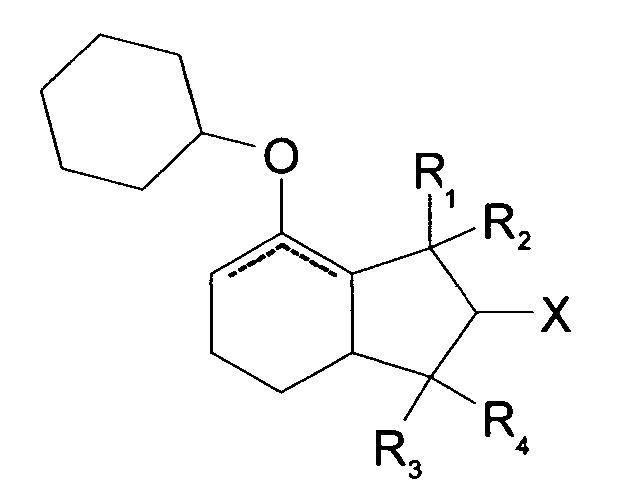
- 0.68-0.95 ppm (ms, 15H); 1.1-2.3 ppm (m, 17H); 3.8 ppm (m, 1H); 5.25 ppm (m, 1 H).
- (wherein the dashed lines indicate a mixture of double bond position isomers wherein in each of the compounds of the mixture one of the dashed lines is a carbon-carbon double bond and the other of the dashed lines is a carbon-carbon single bond).

- Into a 5 liter reactor equipped with stirrer, thermometer, heating mantle, nitrogen tube, addition funnel and reflux condenser were placed dimethyl formamide, triethyl amine and trimethyl silyl chloride. The resulting mixture was heated, with stirring, to 70°C.under a nitrogen atmosphere. Over a period of 0.25 hours, with stirring, dihydrocashmeran, having the structure:was added to the reaction mass. The reaction mass was heated to 80°C and maintained at 80°C for a period of 10 hours. The reaction mass was cooled to ambient temperature and 200 gm toluene was then added, with stirring. The reaction mass was then quenched with 400 ml. water and the resulting organic phase was then washed with one 200 ml. volume of water. The resulting product was distilled at 120°C and 3 mm Hg pressure yielding compounds with the following structure and nmr spectrum:
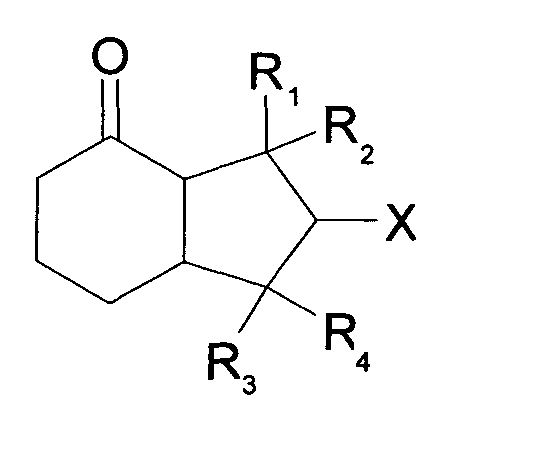 (a mixture wherein in the major compound (90%) X, R1, R2, R3and R4 each is methyl and in the minor compounds X is hydrogen and one of R1, R2, R3and R4 is ethyl and each of the other of R1,R2,R3and R4 is methyl).
- 0.18 ppm (s, 9H); 0.58-1.1 ppm (ms, 15H); 1.38-2.2 ppm (m, 7H).
- The product had a woody, floral aroma with soft woody, creamy topnotes.
-

- Into a 5 liter reactor equipped with thermometer, reflux condenser, dean-stark trap, stirrer and heating mantle were placed 10 g ϒ-alumina (alumina activated for 0.25 hours at 200°C), 100 g toluene and 200 g 1,1,2,3,3-pentamethyl-4,4-dimethoxyindane prepared according to the procedure of U.S. Patent 5,665,698. With stirring, the resulting mixture was heated to reflux and refluxed for a period of 9 hours, while collecting reaction product in a dean-stark trap. The resulting product, prior to distillation was a 6:1 mixture of Δ4,5 and Δ3A,4 double-bond isomers.
- The structure of the major product and the nmr spectrum of the product are as follows:wherein R7 is methyl and wherein the resulting product is a mixture wherein in the major compound (90%) X, R1, R2, R3 and R4 each is methyl and in the minor compounds X is hydrogen and one of R1, R2, R3and R4 is ethyl and each of the other of R1,R2,R3and R4 is methyl.

- 0.68-1.1 ppm (ms, 15H); 1.27-2.15 ppm (m, 7H); 3.45 ppm (s, 3H); 4.45 ppm (m, 1 H).
- The product had an intense and substantive woody, sweet musky aroma with balsamic undertones.
- Fragrances were prepared according to the following formulations:
Materials Parts by weight Example XIII (a) Example XIII(b) Example XIII(c) Decahydro-2,2,4,4,5,6,6-heptamethyl-indeno[4,3A-B]furan prepared according to Example IV 0 0 4 [(2,3,5,6,7,7A-hexahydro-1,1,2,3,3-pentamethyl-1 H-inden-4-yl)oxy]trimethyl-silane prepared according to Example XI 0 4 0 Decahydro-2,4,4,5,6,6-hexamethyl-indeno[4,3A-B]furan prepared according to Example VIII 4 0 0 BORNAFIX® (IFF) 3 3 3 CEDRAFIX® (IFF) 2.5 2.5 2.5 CELESTOLIDE® (IFF) 4 4 4 CITRALVA® (IFF) 1 1 1 Citrus oil distilled 12 12 12 CYCLACET® (IFF) 3 3 3 CYCLOGALBANIFF® (IFF) 1 1 1 Dihydro Myrcenol 40 40 40 FLEURANIL® (IFF) 1 1 1 Geranium Bourbon Oliffac 0.5 0.5 0.5 Hexyl Cinnamic Aldehyde 4.5 4.5 4.5 ISO E SUPER® (IFF) 2.5 2.5 2.5 KHARISMAL® (IFF) 2 2 2 KOAVONE® (IFF) 1.5 1.5 1.5 Linalyl Acetate 5 5 5 PHENOXANOL® (IFF) 3 3 3 PRECYCLEMONE B® (IFF) 1.5 1.5 1.5 Pseudo Linalyl Acetate 5 5 5 Styralyl Acetate 1 1 1 VIGOFLOR® 1 1 1 ZENOLIDE ® (IFF) 4 4 4 - The indenofurans of Examples IV and VIII each impart to this citrus fragrance, intense and substantive woody, amber, and balsamic undertones and sweet musky topnotes. Accordingly, the fragrances of Examples XIII(a) and XIII(c) can be described has being a citrus fragrance with intense and substantive woody, amber, and balsamic undertones and sweet musky topnotes.
- The indenyl silane of Example XI imparts to this citrus fragrance woody and floral undertones and soft woody, and creamy topnotes. Accordingly, the fragrance of Example XIII(B) can be described as being a citrus fragrance with woody and floral undertones and soft woody, and creamy topnotes.
- Cosmetic powder compositions were prepared by mixing in a ball mill 100 grams of talcum powder with 0.25 grams of each of the substances set forth in Table II below. Each of the cosmetic powder compositions had an excellent aroma as described in Table II below.
Substance Aroma Description 1,1,2,3,3-Pentamethyl-7-(2-methylprop-2-enyloxy)-2,3,4,5,6,3A-hexahydroindene prepared according to Example I An intense and substantive woody, cigar box aroma with cedar undertones Decahydro-2,2,4,4,5,6,6-heptamethyl-indeno[4,3A-B]furan prepared according to Example IV An intense and substantive woody, amber aroma with sweet musky topnotes and balsamic undertones [(2,3,5,6,7,7A-Hexahydro-1,1,2,3,3-pentamethyl-1H-inden-4-yl)oxy]trimethyl-silane prepared according to Example XI A woody, floral aroma with soft woody, creamy topnotes Decahydro-2,4,4,5,6,6-hexamethyl-indeno[4,3A-B]furan prepared according to Example VIII An intense and substantive woody amber aroma with sweet, musky topnotes and balsamic undertones 2,3,3A,4,5,7A-Hexahydro-7-methoxy-1,1,2,3,3-pentamthyl-1H-indene prepared according to Example XII An intense and substantive woody, sweet, musky aroma with balsamic undertones Perfume Composition of Example XIII(a) A citrus aroma with intense and substantive woody, amber, and balsamic undertones and sweet musky topnotes Perfume Composition of Example XIII(b) A citrus aroma with woody and floral undertones and soft woody, and creamy topnotes Perfume Composition of Example XIII(c) A citrus aroma with intense and substantive woody, amber, and balsamic undertones and sweet musky topnotes - 100 grams of soap chips (per sample) (IVORY® produced by the Procter & Gamble Company of Cincinnatti, Ohio, U.S.A.) were each mixed with 1 gram samples of substances as set forth in Table II of Example XIV until homogeneous compositions were obtained. In each of the cases, the homogeneous compositions were heated under 8.5 atmospheres pressure at 183°C for a period of 3.5 hours and the resulting liquids were placed in soap molds. The resulting soap cakes, on cooling, provided aromas as set forth in Table II of Example XIV.
Claims (27)
- At least one compound defined according to the structure:wherein m is 0 or 1;

wherein each of the dashed lines represent a carbon-carbon single bond or a carbon-carbon double bond with the proviso that not more than one dashed line represents a carbon-carbon double bond;
wherein X represents hydrogen or methyl;
wherein R1, R2, R3 and R4 each represent methyl or ethyl with the proviso that when X is methyl, each of R1, R2, R3 and R4 is methyl and when X is hydrogen, one of R1, R2, R3 and R4 is ethyl;
wherein D is =O or -OH when neither dashed line is a double bond, -OR5 when either of the dashed lines is a double bond, -OR7 when the dashed line in the Δ4,5 position is a double bond, orwhen the dashed line in the Δ3A,4 position represents a double bond;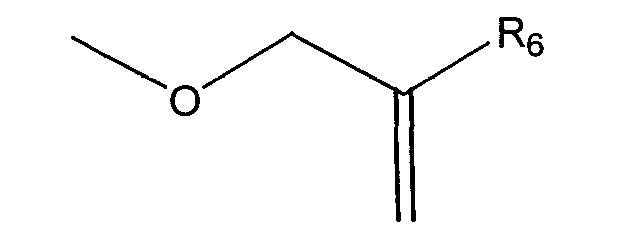
wherein R6 is hydrogen or methyl;
wherein R7 represents C1 - C3 alkyl;
wherein R5 represents C4 - C7 cycloalkyl, C4 - C7 hydroxyalkenyl or tri- C1 - C3 alkyl silyl;
wherein E is hydrogen orwhen neither dashed line is a double bond, with the proviso that when D is =O or -OH, E is wherein F is hydrogen when neither dashed line is a double bond and D is not =O;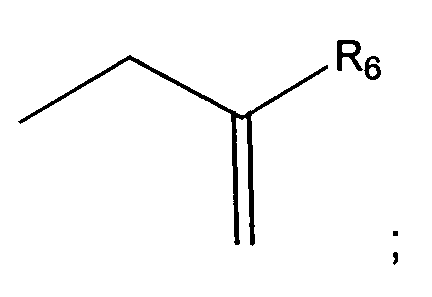
wherein D and E taken together represents the moiety:when neither dashed line is a double bond;
wherein R and R' each represents hydrogen or methyl with the proviso that at least one of R and R' is methyl. - A compound of claim 1 defined according to the structure:wherein m is 0 or 1;

wherein X is methyl or hydrogen;
wherein R1, R2, R3 and R4 each represent methyl or ethyl with the proviso that when X is methyl, each of R1, R2, R3 and R4 is methyl and when X is hydrogen, one of R1, R2, R3 and R4 is ethyl; and
wherein R6 hydrogen or methyl. - A compound of claim 1 defined according to the structure:wherein m is 0 or 1;

wherein X is methyl or hydrogen;
wherein R1, R2, R3 and R4 each represent methyl or ethyl with the proviso that when X is methyl, each of R1, R2, R3 and R4 is methyl and when X is hydrogen, one of R1, R2, R3 and R4 is ethyl; and
wherein R6 hydrogen or methyl. - A compound of claim 1 defined according to the structure:wherein m is 0 or 1;
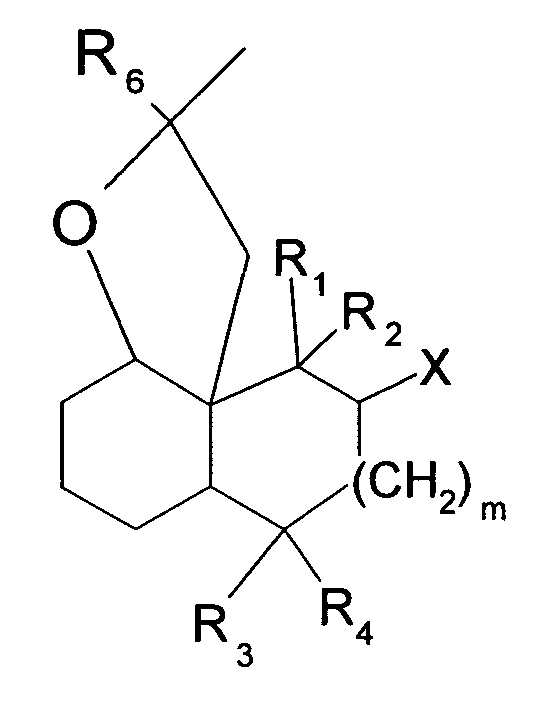
wherein X is methyl or hydrogen;
wherein R1, R2, R3 and R4 each represent methyl or ethyl with the proviso that when X is methyl, each of R1, R2, R3 and R4 is methyl and when X is hydrogen, one of R1, R2, R3 and R4 is ethyl; and
wherein R6 hydrogen or methyl. - A compound of claim 4 defined according to the structure:wherein X is methyl or hydrogen; and
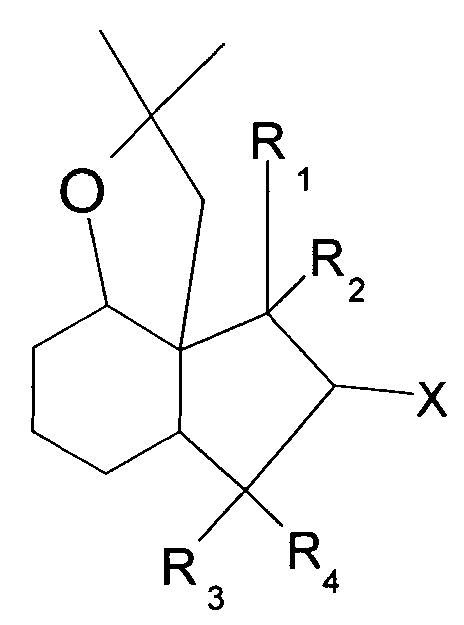
wherein R1, R2, R3 and R4 each represent methyl or ethyl with the proviso that when X is methyl, each of R1, R2, R3 and R4 is methyl and when X is hydrogen, one of R1, R2, R3 and R4 is ethyl. - A compound of claim 1 defined according to the structure:wherein X is methyl or hydrogen;

wherein R1, R2, R3 and R4 each represent methyl or ethyl with the proviso that when X is methyl, each of R1, R2, R3 and R4 is methyl and when X is hydrogen, one of R1, R2, R3 and R4 is ethyl; and
wherein R7 represents C1 - C3 alkyl. - A compound of claim 1 defined according to the structure:wherein m is 0 or 1;

wherein X is methyl or hydrogen;
wherein R1, R2, R3 and R4 each represent methyl or ethyl with the proviso that when X is methyl, each of R1, R2, R3 and R4 is methyl and when X is hydrogen, one of R1, R2, R3 and R4 is ethyl; and
wherein R5 represents C4 - C7 cycloalkyl, C4 - C7 hydroxyalkenyl or tri- C1 - C3 alkyl silyl. - A compound of claim 1 defined according to the structure:wherein m is 0 or 1;

wherein X is methyl or hydrogen;
wherein R1, R2, R3 and R4 each represent methyl or ethyl with the proviso that when X is methyl, each of R1, R2, R3 and R4 is methyl and when X is hydrogen, one of R1, R2, R3 and R4 is ethyl; and
wherein R6 hydrogen or methyl. - A compound of claim 5 having the structure:
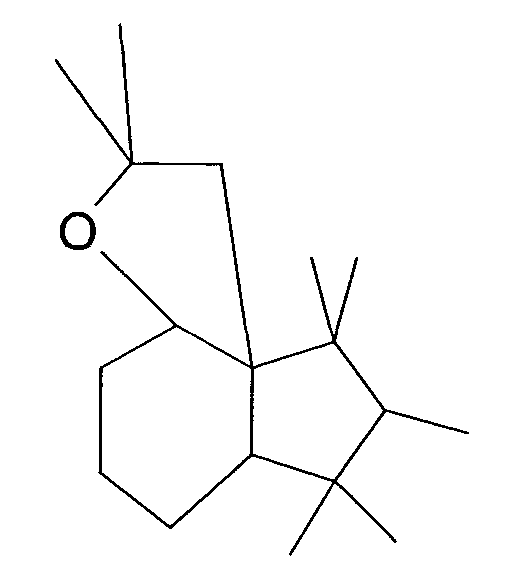
- The optical isomers of the compound of claim 9:
(1R,5R,9R,11R)-Z (1R,5S,9R,11S)-Z (1R,5R,9R,11S)-Z (1R,5R,9S,11S)-Z (1R,5R,9S,11R)-Z; (1R,5S,9S,11R)-Z (1R,5S,9R,11R)-Z; (1R,5S,9S,11S)-Z (1S,5R,9R,11R)-Z; (1S,5R,9S,11S)-Z (1S,5R,9R,11S)-Z; (1S,5S,9R,11S)-Z (1S,5R,9S,11R)-Z; (1S,5S,9S,11R)-Z (1S,5S,9R,11R)-Z; (1S,5S,9S,11S)-Z wherein "Z" represents the compound name, "3,3,10,10,11,12,12-heptamethyl-4-oxatricyclo[7.3.0.0<1,5>]dodecane". - A compound of claim 7 having a structure selected from the group consisting of:and
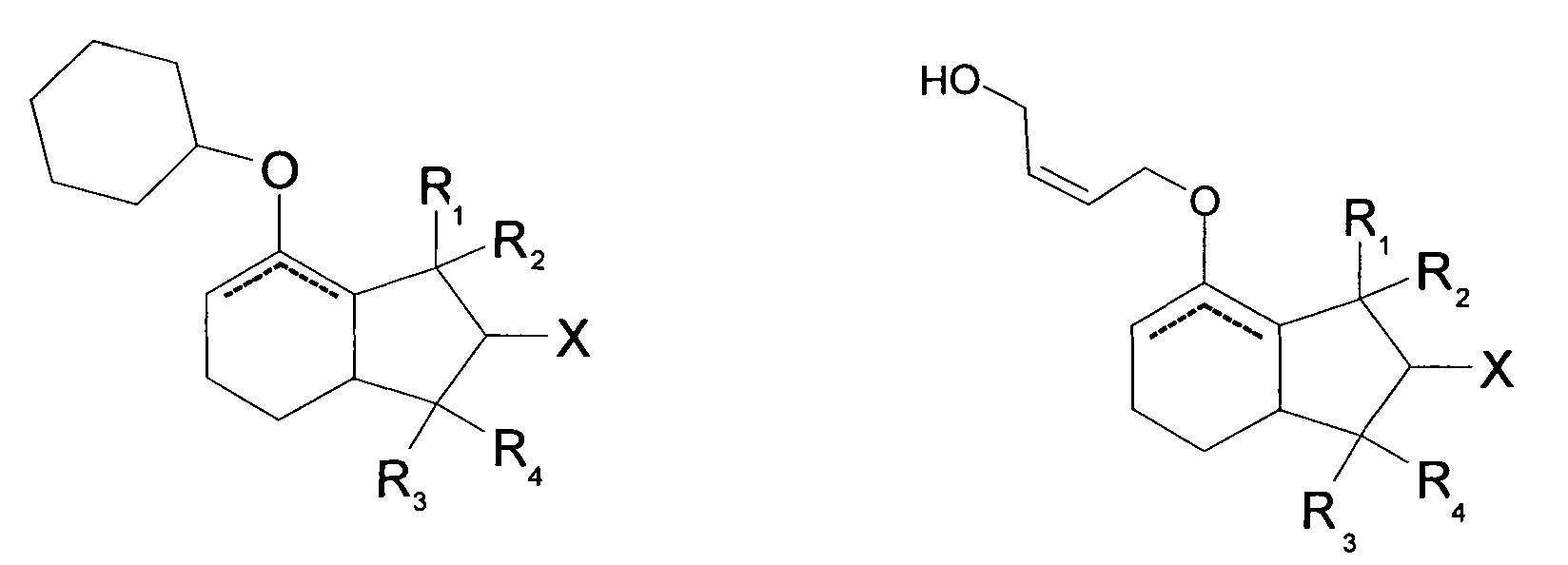 wherein X is methyl or hydrogen;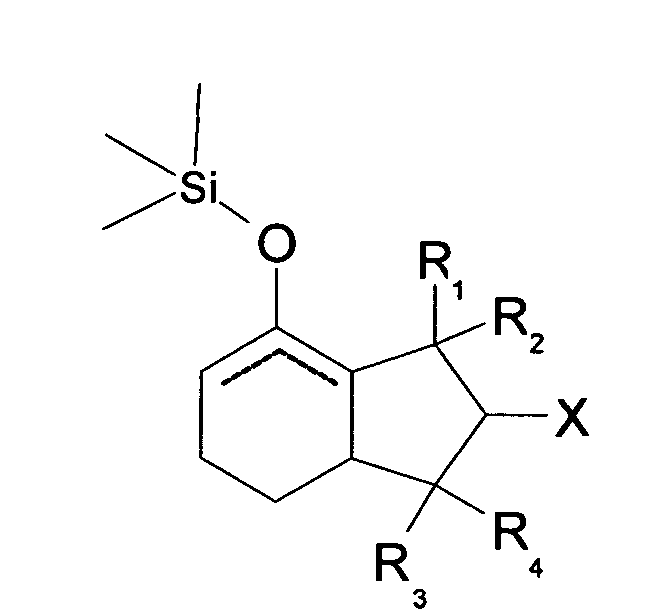
wherein R1, R2, R3 and R4 each represent methyl or ethyl with the proviso that when X is methyl,
each of R1, R2, R3 and R4 is methyl and when X is hydrogen, one of R1, R2, R3 and R4 is ethyl; and
wherein in each of the molecular structures one of the dashed lines represents a carbon-carbon double bond and the other of the dashed lines represents a carbon-carbon single bond. - A mixture of compounds represented by the structure:wherein in the mixture, in each of the compounds, one of the dashed lines represents a carbon-carbon double bond and the other of the dashed lines represents a carbon-carbon single bond;
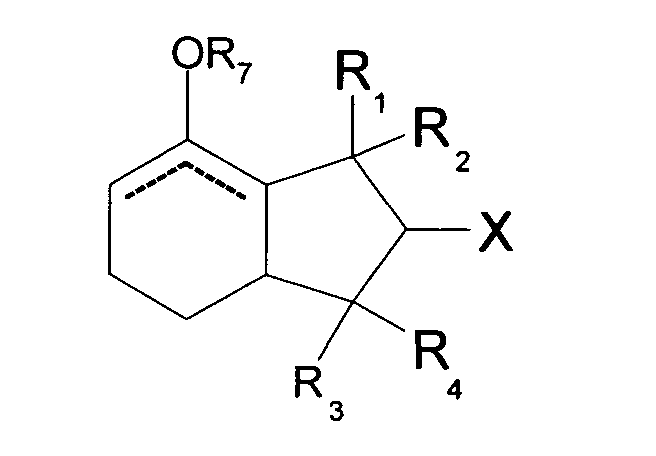
wherein X is methyl or hydrogen;
wherein R7 is C1 - C3 alkyl; and
wherein R1, R2, R3 and R4 each represent methyl or ethyl with the proviso that when X is methyl,
each of R1, R2, R3 and R4 is methyl and when X is hydrogen, one of R1, R2, R3 and R4 is ethyl. - A mixture of compounds defined according to the structure:wherein in the mixture, in each of the compounds, one of the dashed lines represents a carbon-carbon double bond and the other of the dashed lines represents a carbon-carbon single bond;

wherein X is methyl or hydrogen;
wherein R5 represents C4 - C7 cycloalkyl, C4 - C7 hydroxyalkenyl or tri- C1 - C3 alkyl silyl; and
wherein R1, R2, R3 and R4 each represent methyl or ethyl with the proviso that when X is methyl,
each of R1, R2, R3 and R4 is methyl and when X is hydrogen, one of R1, R2, R3 and R4 is ethyl. - At least one compound of claim 1 which is incorporated into a fragrance formulation.
- A method for improving, enhancing or modifying the odor properties of a fragrance by incorporating an olfactory acceptable amount of at least one compound of claim 1.
- The method of claim 15 wherein the fragrance is incorporated into a product selected from perfumes, colognes, toilet waters, personal care products, cleaning products and air fresheners.
- The method of claim 16 wherein the cleaning product is selected from the group consisting of detergents, dishwashing compositions, scrubbing compounds and window cleaners.
- The method of claim 16 wherein the product is a personal care product.
- A method for improving, enhancing or modifying the odor properties of a fragrance by incorporating an olfactory acceptable amount of the mixture of claim 13.
- A method for improving, enhancing or modifying the odor properties of a fragrance by incorporating an olfactory acceptable amount of at least one compound of claim 4.
- A method for improving, enhancing or modifying the odor properties of a fragrance by incorporating an olfactory acceptable amount of at least one compound of claim 5.
- A method for improving, enhancing or modifying the odor properties of a fragrance by incorporating an olfactory acceptable amount of the compound of claim 9.
- A method for improving, enhancing or modifying the odor properties of a fragrance by incorporating an olfactory acceptable amount of at least one isomer of claim 10.
- A method for improving, enhancing or modifying the odor properties of a fragrance by incorporating an olfactory acceptable amount of at least one compound of claim 11.
- A process for synthesizing the compound of claim 2 comprising the step of carrying out the reaction:in the presence of a catalytic amount of a protonic acid.

- A process for synthesizing the compound of claim 8 comprising the step of effecting the reaction:in the presence of an acid catalyst.

- A process for preparing a compound defined according to claim 4 comprising the steps of first carrying out the reaction:using a metal hydride reducing agent; and then carrying out the reaction:
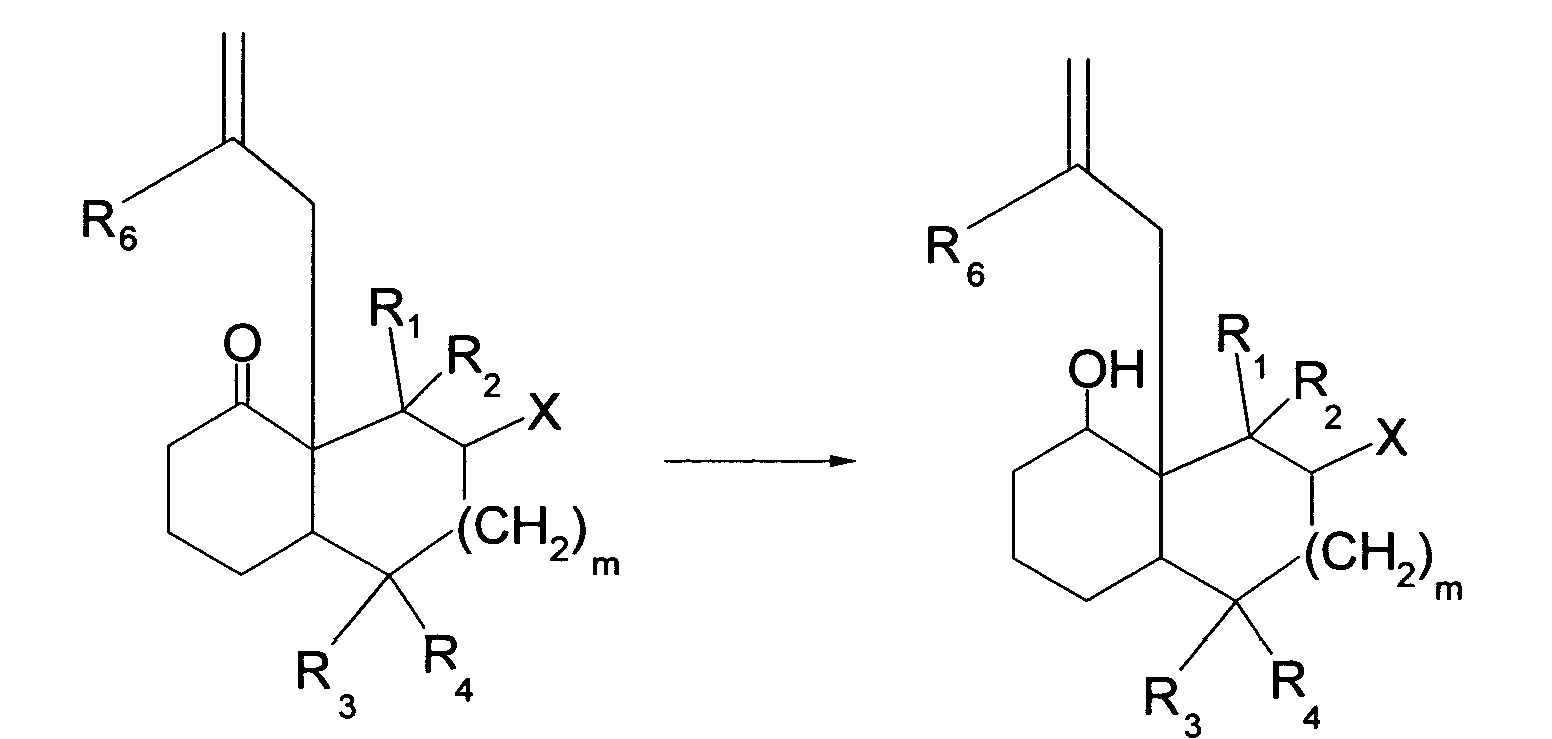 using a protonic acid cyclizing agent.
Applications Claiming Priority (2)
| Application Number | Priority Date | Filing Date | Title |
|---|---|---|---|
| US10/672,339 US7312187B2 (en) | 2001-05-17 | 2003-09-26 | Polyalkylbicyclic derivatives |
| US672339 | 2003-09-26 |
Publications (2)
| Publication Number | Publication Date |
|---|---|
| EP1524255A1 true EP1524255A1 (en) | 2005-04-20 |
| EP1524255B1 EP1524255B1 (en) | 2013-05-01 |
Family
ID=34376332
Family Applications (1)
| Application Number | Title | Priority Date | Filing Date |
|---|---|---|---|
| EP04251077.6A Expired - Lifetime EP1524255B1 (en) | 2003-09-26 | 2004-02-26 | Polyalkylbicyclic derivatives |
Country Status (4)
| Country | Link |
|---|---|
| US (1) | US7312187B2 (en) |
| EP (1) | EP1524255B1 (en) |
| CN (1) | CN1600782B (en) |
| ES (1) | ES2417504T3 (en) |
Families Citing this family (2)
| Publication number | Priority date | Publication date | Assignee | Title |
|---|---|---|---|---|
| US9115330B2 (en) * | 2013-05-07 | 2015-08-25 | International Flavors & Fragrances Inc. | Diethyl-methyl-hexahydro-isobenzofurans and their use in perfume compositions |
| EP3362428B1 (en) | 2015-10-12 | 2020-05-06 | International Flavors & Fragrances Inc. | Novel octahydroindenyl propanal compounds |
Citations (6)
| Publication number | Priority date | Publication date | Assignee | Title |
|---|---|---|---|---|
| US3767713A (en) * | 1969-08-18 | 1973-10-23 | Int Flavors & Fragrances Inc | Saturated indane derivatives and processes for producing same |
| US4902672A (en) * | 1989-06-26 | 1990-02-20 | International Flavors & Fragrances Inc. | Polyalkyl indanyl n-propyl and allyl ethers and perfumery uses thereof |
| US5227367A (en) | 1992-12-17 | 1993-07-13 | International Flavors & Fragrances Inc. | Oxypentamethylindane carboxaldehydes, methods for preparing same, organoleptic uses thereof and cosmetic and pharmaceutical compositions containing them |
| EP0827945A1 (en) * | 1996-09-06 | 1998-03-11 | INTERNATIONAL FLAVORS & FRAGRANCES INC. | Methyl substituted tetrahydroindane methyl enol ethers, perfumery uses thereof, processes for preparing same, and process intermediates therefor |
| US5733866A (en) | 1996-08-22 | 1998-03-31 | International Flavors & Fragrances Inc. | Methyl substituted hexahydroindanols and alkyl ethers thereof, organoleptic uses thereof, processes for preparing same and process intermediates therefor |
| EP1262481A1 (en) * | 2001-05-17 | 2002-12-04 | INTERNATIONAL FLAVORS & FRAGRANCES INC. | Indanone derivatives for use as fragrances |
Family Cites Families (5)
| Publication number | Priority date | Publication date | Assignee | Title |
|---|---|---|---|---|
| US3847993A (en) * | 1971-06-21 | 1974-11-12 | Int Flavors & Fragrances Inc | Allylic oxidation of bicyclic hydrocarbons to alcohols and ketones |
| US3927083A (en) * | 1972-06-15 | 1975-12-16 | Int Flavors & Fragrances Inc | Bicyclic compounds and processes for making and using same |
| US4534891A (en) * | 1982-11-12 | 1985-08-13 | International Flavors & Fragrances Inc. | Branched C13 -alk-1-en-5-ones and use thereof in perfumery |
| US4902840A (en) | 1989-04-28 | 1990-02-20 | International Flavors And Fragrances Inc. | Substituted tetrahydroindane derivatives and organoleptic uses of substituted tetrahydroindanes |
| US6271193B1 (en) * | 2000-10-11 | 2001-08-07 | International Flavors & Fragrances Inc. | Carbon containing functional group substituted 4,5,6,7-tetrahydro-polyalkylated-4-indanes, isomers thereof, processes for preparing same and uses thereof |
-
2003
- 2003-09-26 US US10/672,339 patent/US7312187B2/en not_active Expired - Lifetime
-
2004
- 2004-02-26 ES ES04251077T patent/ES2417504T3/en not_active Expired - Lifetime
- 2004-02-26 EP EP04251077.6A patent/EP1524255B1/en not_active Expired - Lifetime
- 2004-05-19 CN CN200410045639.8A patent/CN1600782B/en not_active Expired - Lifetime
Patent Citations (6)
| Publication number | Priority date | Publication date | Assignee | Title |
|---|---|---|---|---|
| US3767713A (en) * | 1969-08-18 | 1973-10-23 | Int Flavors & Fragrances Inc | Saturated indane derivatives and processes for producing same |
| US4902672A (en) * | 1989-06-26 | 1990-02-20 | International Flavors & Fragrances Inc. | Polyalkyl indanyl n-propyl and allyl ethers and perfumery uses thereof |
| US5227367A (en) | 1992-12-17 | 1993-07-13 | International Flavors & Fragrances Inc. | Oxypentamethylindane carboxaldehydes, methods for preparing same, organoleptic uses thereof and cosmetic and pharmaceutical compositions containing them |
| US5733866A (en) | 1996-08-22 | 1998-03-31 | International Flavors & Fragrances Inc. | Methyl substituted hexahydroindanols and alkyl ethers thereof, organoleptic uses thereof, processes for preparing same and process intermediates therefor |
| EP0827945A1 (en) * | 1996-09-06 | 1998-03-11 | INTERNATIONAL FLAVORS & FRAGRANCES INC. | Methyl substituted tetrahydroindane methyl enol ethers, perfumery uses thereof, processes for preparing same, and process intermediates therefor |
| EP1262481A1 (en) * | 2001-05-17 | 2002-12-04 | INTERNATIONAL FLAVORS & FRAGRANCES INC. | Indanone derivatives for use as fragrances |
Also Published As
| Publication number | Publication date |
|---|---|
| EP1524255B1 (en) | 2013-05-01 |
| CN1600782A (en) | 2005-03-30 |
| US7312187B2 (en) | 2007-12-25 |
| ES2417504T3 (en) | 2013-08-08 |
| US20040110991A1 (en) | 2004-06-10 |
| CN1600782B (en) | 2014-11-12 |
Similar Documents
| Publication | Publication Date | Title |
|---|---|---|
| US3911018A (en) | Novel process and products produced by said process | |
| CN107250090A (en) | Method for preparing 1-[(1R,4R/S,8S)-10,10-dimethyl-7-methylene-4-bicyclo[6.2.0]decyl]ethanone | |
| EP1262481B1 (en) | Indanone derivatives for use as fragrances | |
| US4007137A (en) | Process for producing mixture containing 4-(4-methyl-4-hydroxyamyl)Δ3 -cyclohexenecarboxaldehyde, product produced, and its perfume uses | |
| US7943559B2 (en) | Cyclopropanated macrocyclic ketones and lactones | |
| US7312187B2 (en) | Polyalkylbicyclic derivatives | |
| EP2060567B1 (en) | Regiospecific furan compounds and their use in fragrances | |
| EP1925607B1 (en) | Substituted hydrogenated naphthalene derivatives and their use in fragrance formulations | |
| EP1795518B1 (en) | Organoleptic compounds and their use in perfume compositons | |
| US7468447B1 (en) | Regiospecific Furan Compounds and Their Use in Fragrances | |
| US7189881B2 (en) | Cyclopropanated macrocyclic ketones and lactones | |
| US7410942B2 (en) | Substituted 1-(2-ethyl-1-methyl-cyclopropyl)-one/ol derivatives | |
| EP1674462B1 (en) | Methylene dioxy octahydroindene derivatives, their preparation and use as fragrance materials | |
| US6342612B1 (en) | Indane aldehydes and derivatives | |
| US6340666B1 (en) | Allyl ether | |
| CN105272833A (en) | Novel cyclohexanols and their use in perfume compositions |
Legal Events
| Date | Code | Title | Description |
|---|---|---|---|
| PUAI | Public reference made under article 153(3) epc to a published international application that has entered the european phase |
Free format text: ORIGINAL CODE: 0009012 |
|
| AK | Designated contracting states |
Kind code of ref document: A1 Designated state(s): AT BE BG CH CY CZ DE DK EE ES FI FR GB GR HU IE IT LI LU MC NL PT RO SE SI SK TR |
|
| AX | Request for extension of the european patent |
Extension state: AL LT LV MK |
|
| 17P | Request for examination filed |
Effective date: 20051004 |
|
| AKX | Designation fees paid |
Designated state(s): DE ES FR GB IT |
|
| 17Q | First examination report despatched |
Effective date: 20080311 |
|
| REG | Reference to a national code |
Ref country code: DE Ref legal event code: R079 Ref document number: 602004041949 Country of ref document: DE Free format text: PREVIOUS MAIN CLASS: C07C0035320000 Ipc: C07C0035230000 |
|
| GRAP | Despatch of communication of intention to grant a patent |
Free format text: ORIGINAL CODE: EPIDOSNIGR1 |
|
| RIC1 | Information provided on ipc code assigned before grant |
Ipc: C07C 45/71 20060101ALI20121109BHEP Ipc: C07D 307/92 20060101ALI20121109BHEP Ipc: C07C 45/68 20060101ALI20121109BHEP Ipc: C07C 35/23 20060101AFI20121109BHEP Ipc: C07C 49/477 20060101ALI20121109BHEP Ipc: C07D 307/93 20060101ALI20121109BHEP Ipc: C07C 43/196 20060101ALI20121109BHEP |
|
| GRAS | Grant fee paid |
Free format text: ORIGINAL CODE: EPIDOSNIGR3 |
|
| GRAA | (expected) grant |
Free format text: ORIGINAL CODE: 0009210 |
|
| AK | Designated contracting states |
Kind code of ref document: B1 Designated state(s): DE ES FR GB IT |
|
| REG | Reference to a national code |
Ref country code: GB Ref legal event code: FG4D |
|
| REG | Reference to a national code |
Ref country code: DE Ref legal event code: R096 Ref document number: 602004041949 Country of ref document: DE Effective date: 20130704 |
|
| REG | Reference to a national code |
Ref country code: ES Ref legal event code: FG2A Ref document number: 2417504 Country of ref document: ES Kind code of ref document: T3 Effective date: 20130808 |
|
| PLBE | No opposition filed within time limit |
Free format text: ORIGINAL CODE: 0009261 |
|
| STAA | Information on the status of an ep patent application or granted ep patent |
Free format text: STATUS: NO OPPOSITION FILED WITHIN TIME LIMIT |
|
| 26N | No opposition filed |
Effective date: 20140204 |
|
| REG | Reference to a national code |
Ref country code: DE Ref legal event code: R097 Ref document number: 602004041949 Country of ref document: DE Effective date: 20140204 |
|
| REG | Reference to a national code |
Ref country code: FR Ref legal event code: PLFP Year of fee payment: 13 |
|
| PGFP | Annual fee paid to national office [announced via postgrant information from national office to epo] |
Ref country code: IT Payment date: 20160211 Year of fee payment: 13 |
|
| REG | Reference to a national code |
Ref country code: FR Ref legal event code: PLFP Year of fee payment: 14 |
|
| REG | Reference to a national code |
Ref country code: FR Ref legal event code: PLFP Year of fee payment: 15 |
|
| PG25 | Lapsed in a contracting state [announced via postgrant information from national office to epo] |
Ref country code: IT Free format text: LAPSE BECAUSE OF NON-PAYMENT OF DUE FEES Effective date: 20170226 |
|
| PGFP | Annual fee paid to national office [announced via postgrant information from national office to epo] |
Ref country code: FR Payment date: 20230110 Year of fee payment: 20 Ref country code: ES Payment date: 20230314 Year of fee payment: 20 |
|
| PGFP | Annual fee paid to national office [announced via postgrant information from national office to epo] |
Ref country code: GB Payment date: 20230105 Year of fee payment: 20 Ref country code: DE Payment date: 20221230 Year of fee payment: 20 |
|
| P01 | Opt-out of the competence of the unified patent court (upc) registered |
Effective date: 20230530 |
|
| REG | Reference to a national code |
Ref country code: DE Ref legal event code: R071 Ref document number: 602004041949 Country of ref document: DE |
|
| REG | Reference to a national code |
Ref country code: ES Ref legal event code: FD2A Effective date: 20240304 |
|
| REG | Reference to a national code |
Ref country code: GB Ref legal event code: PE20 Expiry date: 20240225 |
|
| PG25 | Lapsed in a contracting state [announced via postgrant information from national office to epo] |
Ref country code: ES Free format text: LAPSE BECAUSE OF EXPIRATION OF PROTECTION Effective date: 20240227 |
|
| PG25 | Lapsed in a contracting state [announced via postgrant information from national office to epo] |
Ref country code: ES Free format text: LAPSE BECAUSE OF EXPIRATION OF PROTECTION Effective date: 20240227 Ref country code: GB Free format text: LAPSE BECAUSE OF EXPIRATION OF PROTECTION Effective date: 20240225 |