EP1522932A1 - Fast database replication - Google Patents
Fast database replication Download PDFInfo
- Publication number
- EP1522932A1 EP1522932A1 EP03292484A EP03292484A EP1522932A1 EP 1522932 A1 EP1522932 A1 EP 1522932A1 EP 03292484 A EP03292484 A EP 03292484A EP 03292484 A EP03292484 A EP 03292484A EP 1522932 A1 EP1522932 A1 EP 1522932A1
- Authority
- EP
- European Patent Office
- Prior art keywords
- data base
- data
- master
- pdb
- remote
- Prior art date
- Legal status (The legal status is an assumption and is not a legal conclusion. Google has not performed a legal analysis and makes no representation as to the accuracy of the status listed.)
- Granted
Links
Images


Classifications
-
- G—PHYSICS
- G06—COMPUTING OR CALCULATING; COUNTING
- G06F—ELECTRIC DIGITAL DATA PROCESSING
- G06F16/00—Information retrieval; Database structures therefor; File system structures therefor
- G06F16/20—Information retrieval; Database structures therefor; File system structures therefor of structured data, e.g. relational data
- G06F16/27—Replication, distribution or synchronisation of data between databases or within a distributed database system; Distributed database system architectures therefor
- G06F16/275—Synchronous replication
Definitions
- the invention relates to a method for updating at least one remote data base with sets of data of a master data base according to the preamble of claim 1 and to a master data base system according to the preamble of claim 11.
- the master data base e.g. located by a telecommunication service provider. Therefore, the data or subsets of data of a master data base has to be provided to each one of a number of remote slave data bases, e.g. for providing fixed number portability changing between different service providers.
- an instant data filter must be provided between the master data base and said slave data base.
- the master data base contains more data than necessary for the control of the telecommunications network. Moreover, the master data base contains possibly information about states, that are activated in the future. Therefore the master data base has different data structure than proxy- and slave data bases.
- a proxy data base at service providers side is connected between the master data base and the slave data bases. Updates of the master data base are loaded into the proxy data base(s). The proxy data base carries out the further forwarding of the updates to the slave data bases.
- the proxy data base contains exactly the same data (data mirror), that the slave data bases should contain after updating.
- a master data base and an intermediate or proxy data base serving as replication data base for further remote data bases
- the proxy data base serving as replication data base for further remote data bases
- Updating the remote data bases with sets of data of the master data base system, the sets of data that are forwarded to the proxy data base, Said proxy data base and the remote data base system are coupled by means of a synchronisation protocol, said protocol ensuring, that the remote data base is reliably updated in a minimum of time.
- the proxy data base and the master data base are realised as part of a physical data base, the synchronisation effort between the master data base and the proxy data base is minimised.
- the transaction performance is augmented due to the fact, that no two-phase commits are necessary.
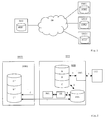
- Fig.1 shows an overall view of a distributed data base system with a service provider system or master data base system SPS and exemplary three remote or slave data base systems SAS1, SAS2 and SAS3.
- the data base systems SPS comprise a master data base MDB and the remote data base systems SAS1, SAS2 and SAS3 comprise each a slave data base SDB1, SDB2 and SDB3 respectively for persistent data storing.
- the data bases systems are connected to a communications network TN, that is preferably realised as a packet data network according to the well transmission control protocol/internet protocol (TCP/IP) suite.
- TCP/IP transmission control protocol/internet protocol
- said data base systems each comprise interface units to the communications network, agents, protocol engines and dynamic data stores.
- the slave data bases SDB1, SDB2 and SDB3 should be loaded with data stored in the master data base. MDB.
- a proxy data base at service providers side not shown here, is connected between the master data base MDB and the slave data bases SDB1, SDB2 and SDB3, the proxy data base being physically independent from the master data base MDB. Updates of the master data base MDB are loaded into the proxy data base. The proxy data base then carries out the further forwarding of the updates to the slave data bases SDB1, SDB2 and SDB3.
- all data bases, master data base MDB, proxy data base PDB and the slave data bases SAS1, SAS2, SAS3 are physically independent data bases. Physical independence means, that the data bases each have their own file system with each their own administration.
- each transaction comprises a first transaction from the master data base to the proxy data base and a second transaction from the proxy data base to the slave data bases.
- a synchronisation of those transactions is necessary.
- a synchronisation is also necessary for backup and restoring.
- Fig.2 shows a block diagram with a customer care system CCS, a master data base system SPS according to the invention and an exemplary remote data base SAS1.
- the master data base system SPS comprises a master data base agent DBA, a master data base MDB exemplary consisting of three logically different data base parts A- C, a proxy data base PDB, an audit monitor AM and a (first) proxy data base agent AG1.
- the (first) remote data base system SAS1 comprises a (first) slave data base SDB1 exemplary consisting of three data base parts A'- C'. Double arrows 1- 7 between these units represent be-directional communication relations.
- a first communication relation user requests e.g. for entering new data is sent from the customer care system CCS to the master data base agent DBA.
- commands for data base actions are transmitted from the master data base agent DBA to the master data base.
- data to be distributed to the remote data base system SAS1 are sent to the proxy data base.
- data distribution from the master data base MDB to the slave data base SDB1 is controlled.
- the proxy data base agent AG1 reads/writes data from/to the proxy data base PDB
- the audit monitor AM serves for supervising and assuring a successful replication.
- the data base objects are transferred from the proxy data base PDB to the slave data base SDB1.
- the master data base MDB and the slave data base SAS1 are each divided into three sections A,B and C or A', B' and C' respectively. Each of these section can be regarded as logical data base.
- the following services for telephone number portability might be exemplary realised, each of these services having assigned one data base segment A, B or C or A', B' or C' respectively:
- FNP Fixed number portability
- the local number portability is the ability of an end user of the PSTN/ISDN (public switched telephone network/integrated services digital network) to retain the same E.164 international public telephone number when changing from one service provider to another without changing their location.
- PSTN/ISDN public switched telephone network/integrated services digital network
- GNP Geographic number portability
- MNP Mobile Number Portability
- each a different data base can be used on service providers side and on remote sides.
- each of these data bases form on each side logically independent data bases A, B, C or A', B', C' respectively one the top of a unique physical data base system SPS or SAS respectively.
- the master data base system SPS typically the following characteristics:
- the master data base MDB can be exemplary realised on a combined Network Element (NE) Management/ Service Management Server (CMC/SPS) with the following hardware and operating system from the company Hewlett Packard and the data base from the company Versant:
- NE Network Element
- CMC/SPS Service Management Server
- the remote data bases system SAS is preferably a highly-available and distributed system with the following exemplary characteristics:
- the proxy data base behaves as well as a logically independent data base from the master data base.
- the data sets stored in the physical data base therefore comprise each a data base identifier for identifying to which of the logically independent data base each data set belongs to.
- replication queues with entries of logical-object-ID's of the changed objects are administered.
- a so-called ReplicationSlaveSiteDriver process running on SAS side reads the entries of this replication queue, takes them into a replication queue on SAS side and copies the changed objects into the corresponding slave data base.
- a cache updater, running on each SAS, eventually reads the replication queue on SAS side and copies the changes into a client cache of a corresponding application process, the changes thus becoming effective.
- Fig.3 exemplary shows a more detailed block diagram of the master data base system SPS of the previous figures.
- the master data base system SPS is connected to a graphical user interface GUI.
- the master data base system SPS is connected to the customer care system CCS Over an alarm interface AL, a backup interface BU, a network element administration interface NA and a logging interface LG, the master data base system SPS is connected to a management system CMC.
- the master data base system SPS comprises a command interpreter CI connected to the customer care API CA.
- this command interpreter is connected to a master data base DBA, that is connected over an audit monitor AM to each one of exemplary proxy data base agents AG1- AG3, to the master data base MDB consisting of exemplary three sub data bases MDB1- MDB3, over a data base adapter ADP to a proxy data base PDB and to the graphical user API GA.
- the proxy data base PDB is connected to the three proxy data base agents AG1- AG3. These agents are each associated to a remote data base system SAS1, SAS2 and SAS3 as well as the proxy data base PDB is associated to each those remote data bases.
- connection means a communication relation on the logical base.
- the connections have basically one main communication direction, the connections are bidirectional, as normally, a feedback (acknowledge or OK) is returned.
- a feedback acknowledge or OK
- This unit receives commands from the customer care system CCS, performs a distribution of this commands to the different master data bases, and manages the return data to be sent back to the customer care system CCS.
- This data is kept to be transferred to the remote slave data bases SAS1, SAS2, SAS3. Further, this data base comprises timing conditions for the transfer of the data (e.g. activation dates) and generates scheduling requests to be sent to the data base scheduler DBS.
- This unit reads and writes data from/to the master data base MDB. It includes the complete application and data manipulation logic, performs syntactical checks, and the maintenance of the corresponding structures for object navigation. Additionally, semantic and consistency checks might be performed.
- This unit allows for time controlling data transfers. Data to be transferred to the proxy data bases with a time delay is handled by this unit.
- These agents read and write data from/to the proxy DB.
- the tasks of these agents include the maintenance of the database structure. They also performs an object navigation.
- the data base agents each maintain a pointer to a data queue of the proxy data base PDB. These pointers mark the data element in the queue, until which the elements before has been already successfully downloaded to the corresponding remote data base SAS1, SAS2, SAS3.
- This data base serves for an intermediate storage of data to be immediately downloaded or transmitted to the remote data bases SAS1, SAS2 and SAS3 in each a one-to-many replication.
- the data elements to be transmitted are packed in a queue.
- This unit converts data from the master data base MDB to the proxy data base PDB. It hides the details of the mapping between both data models (Master DB data model optimised for provisioning, SAS-Proxy for high speed access of service controls).
- This unit carries out a periodical comparison of the state of the master data base MDB, of the SAS proxy data base PDB and the remote data bases to prove the successful replication. On request, the audit monitor sends results back to a supervisor.
- the administration Unit CMC performs administration tasks on the SPS, e.g. alarm handling, backup, network element administration and logging.
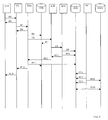
- Fig.4 shows an exemplary scenario of updating a remote database for an immediately executed update request. Therefore commands M1 - M20 are exchanged between the units, explained under Fig.3, as follows:
- a first command M1 with a request is sent from the customer care system CCS to the command dispatcher or interpreter CI.
- the Command interpreter queues this command and sends back a second command M2 as acknowledge.
- the command interpreter CI sends a third command M3 with a request to the master (data base) agent DBA, that return a fourth command M4 as acknowledge.
- the master agent DBA with a fifth command M5 to the master data base MDB, initiates the updating of the corresponding objects.
- the master agent DBA send an object synchronisation request to the (SAS data base) adapter ADP.
- the adapter ADP reads the corresponding objects from the master data base MDB, symbolised as seventh command M7, and sends an eighth command M8 with an update request to exemplary the (first) proxy (data base) agent AG1.
- the proxy agent AG1 with a ninth command M9 to the proxy data base PDB, initiates the updating of the corresponding objects, and with a tenth command M10 to the proxy data base PDB sends a command for creating a transfer request. It returns an eleventh command M11 with an OK back to the adapter ADP, that forwards this OK as twelfth command M12 to the master agent DBA.
- the master agent DBA sends thirteenth command M13 with a commit changes command both to the master data base MDB and to the proxy data base PDB. Thus, a single commit is executed over both data bases MDB and PDB.
- a transaction generally consists of a set of logically dependant single actions. With a transaction, a data base is transferred from one logically consistent state into another logically consistent state. As soon as the changes of a transaction are released, they are permanently available in the data base.
- the master agent DBA sends a fourteenth command M14 as response to the command interpreter CI, that queues this command, before sending a fifteenth command M15 as response to the customer care system CCS.
- the proxy data base PDB queues the transfer requests M10 for each remote data base SAS1, SAS2, SAS3.
- a transfer processor TP reads the (queued) transfer request(s), symbolised as sixteenth command M16, reads the changes, symbolised as seventeenth command M17 and transmits the changes with an eighteenth command M18 to the remote data base SAS1.
- the transfer processor TP sends a nineteenth command M19 with an update transfer request to the proxy data base PDB and sends twentieth command M20 with a commit command to both the proxy data base PDB and the remote data base SAS1.
- Fig.5 shows a variation of the scenario of Fig.4 with a scheduled update request. Therefore, a scheduler DBS is introduced (logically) in between the master data base MDB and the adapter ADP. Instead of the sixth command M6 of Fig.3, five commands M61 - M65 are executed as follows:
- a first varied command M61 with a list of objects to be observed is sent from the master agent DBA to the scheduler DBS, that returns a second varied command M62 as OK.
- the master agent sends a third varied command M63 with a commit command to the master data base MDB.
- the scheduler takes up said objects into a schedule list SL.
- the scheduler DBS sends a fourth varied command M64 to the master data base MDB, therewith initiating the updating of the corresponding objects.
- the master agent DBA send an object synchronisation request to the adapter ADP.
- the scheduler DBS sends the commit command M13' to both the master data base MDB and the proxy data base PDB.
- the further actions of updating the remote data base remains unchanged as described under Fig.3.
- a message object contains the changed attributes of a data base object.
- Delta Replication is a message concept, that offers the advantage to send only changed attributes of a data base object to be updated. This concept thus reduces the data traffic load.
Landscapes
- Engineering & Computer Science (AREA)
- Databases & Information Systems (AREA)
- Theoretical Computer Science (AREA)
- Computing Systems (AREA)
- Data Mining & Analysis (AREA)
- Physics & Mathematics (AREA)
- General Engineering & Computer Science (AREA)
- General Physics & Mathematics (AREA)
- Information Retrieval, Db Structures And Fs Structures Therefor (AREA)
- Gyroscopes (AREA)
- Train Traffic Observation, Control, And Security (AREA)
- Compression, Expansion, Code Conversion, And Decoders (AREA)
Abstract
Description
- Fig.1
- shows a distributed data base system with a master data base system and remote data base systems,
- Fig.2
- exemplary shows a block diagram of a master data base system according to the invention and an exemplary remote data base system communicating to each other,
- Fig.3
- exemplary shows a more detailed block diagram of the master data base system,
- Fig.4
- shows an exemplary scenario of a database update and
- Fig.5
- shows a variation of the scenario of Fig.4.
- ability to handle up to 100 Million entries (per application) for each 10 updates per second,
- maximum delay time per single request shall be 60s in a network of 20 SAS servers,
- for a batch request (1000 single operations) 180s, and
- it shall be guaranteed that no update requests are lost
- Hardware:
- HP A400 or HP A500
- Software:
- Operating System : HP-UX 11
Database : VDS (Versant Development Suite)
6.0.1.
- 950 NP read transactions per second,
- maximum response of 30 ms,
- 20 NP data modifications per second (without restricting the maximum 950 NP real time transactions per second declared above),
- SAS shall operate in a N+1 configuration, and
- not more than 3 minutes out of service per year.
- This unit performs the persistent storage of the complete service data.
Claims (11)
- A method for updating a remote data base (SDB) with sets of data of a master data base system (MDB), wherein said sets of data are forwarded to an intermediate data base (PDB), said intermediate data base (PDB) and the remote data base system (SDB) being coupled by means of a synchronisation protocol, said protocol ensuring, that the remote data base (SAS1, SAS2, SAS3) is reliably updated, characterised in, that said master data base (SPS) and said intermediate data base (PDB) are logically independent data bases each part of a unique data base system (SPS) controlled by a unique data base management.
- A method according to claim 1, wherein the data sets of the data base system (SPS) are identified to be part of the master data base (MDB) or the intermediate data base (PDB) by a data base identifier.
- A method according to claim 1, wherein the master data base system administers a replication queue with entries of identifiers of changed objects, wherein the remote data base system reads the entries of this replication queue, takes them into a further replication queue on the remote side and copies the changed objects into the corresponding slave data base.
- A method according to claim 3, wherein a cache updater, running on the remote side (SAS1, SAS2, SAS3) reads said further replication queue on remote side and copies the changes into a client cache of a corresponding application process.
- A method according to claim 4, wherein an entry in the replication queue in the master data base system (SPS) is cleared, if all remote data base systems have taken over the entry.
- A method according to claim 1, wherein the unique data base management comprises a data backup, data restoration and roll forward archives of both the master data base (MDB) and the proxy data base (PDB) at the same time.
- A method according to claim 1, wherein an object update of both the master data base (MDB) and the intermediate data base (PDB) are executed within a single transaction.
- A method according to claim 1, wherein a data base adapter (ADP) converts data from the master data base (MDB) to the proxy data base (PDB), hiding details of the mapping between both the corresponding data models
- A method according to claim 1, wherein a data base scheduler (DBS) executes received update requests by initiating a transfer of data from the master data base (MDB) to the proxy data base (PDB) at predefined time points.
- A method according to claim 1, wherein message objects are created, which contains information about changed attributes of database objects, wherein these message objects are moved to a replication queue, wherein the remote data base system (SAS1, SAS2, SAS3) reads the entries of this replication queue, takes them into further a replication queue on the remote side and maps the attribute values to the corresponding mirror data base object.
- A master data base system (SPS) comprising sending means for transferring said sets of data to an intermediate data base (PDB), said intermediate data base (PDB) and the remote data base system (SDB) comprising protocol means for performing a synchronisation protocol, said protocol ensuring, that the remote data base (SAS1, SAS2, SAS3) is reliably updated, characterised in, that said master data base (MDB) and said intermediate data base (PDB) are logically independent data bases each part of a unique data base system (SPS), said data base system (SPS) comprising data base management means for uniquely controlling said master data base (MDB) and said intermediate data base (PDB) .
Priority Applications (4)
| Application Number | Priority Date | Filing Date | Title |
|---|---|---|---|
| EP03292484A EP1522932B1 (en) | 2003-10-08 | 2003-10-08 | Fast database replication |
| AT03292484T ATE333680T1 (en) | 2003-10-08 | 2003-10-08 | FAST DATABASE REPLICATION |
| DE60306932T DE60306932T2 (en) | 2003-10-08 | 2003-10-08 | Fast database replication |
| US10/939,882 US7788224B2 (en) | 2003-10-08 | 2004-09-14 | Fast database replication |
Applications Claiming Priority (1)
| Application Number | Priority Date | Filing Date | Title |
|---|---|---|---|
| EP03292484A EP1522932B1 (en) | 2003-10-08 | 2003-10-08 | Fast database replication |
Publications (2)
| Publication Number | Publication Date |
|---|---|
| EP1522932A1 true EP1522932A1 (en) | 2005-04-13 |
| EP1522932B1 EP1522932B1 (en) | 2006-07-19 |
Family
ID=34307030
Family Applications (1)
| Application Number | Title | Priority Date | Filing Date |
|---|---|---|---|
| EP03292484A Expired - Lifetime EP1522932B1 (en) | 2003-10-08 | 2003-10-08 | Fast database replication |
Country Status (4)
| Country | Link |
|---|---|
| US (1) | US7788224B2 (en) |
| EP (1) | EP1522932B1 (en) |
| AT (1) | ATE333680T1 (en) |
| DE (1) | DE60306932T2 (en) |
Cited By (5)
| Publication number | Priority date | Publication date | Assignee | Title |
|---|---|---|---|---|
| EP1801710A1 (en) | 2005-11-17 | 2007-06-27 | Research In Motion Limited | Method and apparatus for synchronizing databases connected by wireless interface |
| US7613739B2 (en) | 2005-11-17 | 2009-11-03 | Research In Motion Limited | Method and apparatus for synchronizing databases connected by wireless interface |
| US8000683B2 (en) | 2005-11-17 | 2011-08-16 | Research In Motion Limited | System and method for communication record logging |
| US8238882B2 (en) | 2006-10-19 | 2012-08-07 | Research In Motion Limited | System and method for storage of electronic mail |
| CN110032558A (en) * | 2019-04-12 | 2019-07-19 | 重庆天蓬网络有限公司 | A kind of method of data synchronization, device, system and storage medium |
Families Citing this family (23)
| Publication number | Priority date | Publication date | Assignee | Title |
|---|---|---|---|---|
| US7827141B2 (en) * | 2005-03-10 | 2010-11-02 | Oracle International Corporation | Dynamically sizing buffers to optimal size in network layers when supporting data transfers related to database applications |
| US8856091B2 (en) * | 2005-09-09 | 2014-10-07 | Open Invention Network, Llc | Method and apparatus for sequencing transactions globally in distributed database cluster |
| US20070061379A1 (en) * | 2005-09-09 | 2007-03-15 | Frankie Wong | Method and apparatus for sequencing transactions globally in a distributed database cluster |
| GB2433610B (en) * | 2005-12-21 | 2010-03-03 | Motorola Inc | Mobile Communication system and method |
| US8462914B2 (en) * | 2006-12-22 | 2013-06-11 | Vitalclick Llc | Automated incident response method and system |
| US8266101B1 (en) * | 2009-07-16 | 2012-09-11 | Binpeng Shuai | Share nothing database cluster and real time synchronization by signaling |
| US8429134B2 (en) * | 2009-09-08 | 2013-04-23 | Oracle International Corporation | Distributed database recovery |
| US8595380B2 (en) * | 2009-12-15 | 2013-11-26 | Red Hat, Inc. | Message bus based replication |
| US9323758B1 (en) * | 2009-12-22 | 2016-04-26 | Emc Corporation | Efficient migration of replicated files from a file server having a file de-duplication facility |
| US8301595B2 (en) * | 2010-06-14 | 2012-10-30 | Red Hat, Inc. | Using AMQP for replication |
| US8719338B2 (en) | 2010-06-14 | 2014-05-06 | Red Hat, Inc. | Servicing database operations using a messaging server |
| US8473953B2 (en) * | 2010-07-21 | 2013-06-25 | International Business Machines Corporation | Batching transactions to apply to a database |
| US8949558B2 (en) | 2011-04-29 | 2015-02-03 | International Business Machines Corporation | Cost-aware replication of intermediate data in dataflows |
| JP2014229088A (en) * | 2013-05-23 | 2014-12-08 | ソニー株式会社 | Data processing system, data processing device, and storage medium |
| US9405643B2 (en) | 2013-11-26 | 2016-08-02 | Dropbox, Inc. | Multi-level lookup architecture to facilitate failure recovery |
| US9547706B2 (en) * | 2014-03-10 | 2017-01-17 | Dropbox, Inc. | Using colocation hints to facilitate accessing a distributed data storage system |
| CN106156112A (en) * | 2015-04-03 | 2016-11-23 | 北京大学 | The operational approach of business form and the operation device of business form |
| US10152246B1 (en) * | 2016-03-28 | 2018-12-11 | EMC IP Holding Company LLC | Application aware AMQP durable messages backup and restore |
| TWI680410B (en) * | 2018-05-07 | 2019-12-21 | 臺灣銀行股份有限公司 | A Smart Number Taking System and Number Taking Method Thereof |
| RU2706482C1 (en) * | 2018-07-25 | 2019-11-19 | федеральное государственное бюджетное образовательное учреждение высшего образования "Российский государственный университет им. А.Н. Косыгина (Технологии. Дизайн. Искусство)" | Method of replication of information in databases |
| US11010087B2 (en) * | 2019-03-29 | 2021-05-18 | Atlassian Pty Ltd. | System and method for consistent mirroring in a cluster |
| US11487743B2 (en) | 2019-07-23 | 2022-11-01 | Hewlett Packard Enterprise Development Lp | Updating subscriber nodes with replication logs that increase scalability |
| RU2745679C1 (en) * | 2020-07-08 | 2021-03-30 | федеральное государственное казенное военное образовательное учреждение высшего образования "Краснодарское высшее военное орденов Жукова и Октябрьской Революции Краснознаменное училище имени генерала армии С.М. Штеменко" Министерства обороны Российской Федерации | Method for conducting migration and data replication using secured database access technology |
Citations (1)
| Publication number | Priority date | Publication date | Assignee | Title |
|---|---|---|---|---|
| US5721914A (en) * | 1995-09-14 | 1998-02-24 | Mci Corporation | System and method for hierarchical data distribution |
Family Cites Families (19)
| Publication number | Priority date | Publication date | Assignee | Title |
|---|---|---|---|---|
| US4432057A (en) * | 1981-11-27 | 1984-02-14 | International Business Machines Corporation | Method for the dynamic replication of data under distributed system control to control utilization of resources in a multiprocessing, distributed data base system |
| JP2557192B2 (en) * | 1993-03-15 | 1996-11-27 | インターナショナル・ビジネス・マシーンズ・コーポレイション | Transaction processing synchronization method, transaction processing monitoring method, and transaction commit processing method |
| US6085192A (en) * | 1997-04-11 | 2000-07-04 | Roampage, Inc. | System and method for securely synchronizing multiple copies of a workspace element in a network |
| US5961590A (en) * | 1997-04-11 | 1999-10-05 | Roampage, Inc. | System and method for synchronizing electronic mail between a client site and a central site |
| US6073141A (en) * | 1997-11-25 | 2000-06-06 | International Business Machine Corporation | System and method for synchronizing local versions of database |
| US6131096A (en) * | 1998-10-05 | 2000-10-10 | Visto Corporation | System and method for updating a remote database in a network |
| US6516327B1 (en) * | 1998-12-24 | 2003-02-04 | International Business Machines Corporation | System and method for synchronizing data in multiple databases |
| US6640278B1 (en) * | 1999-03-25 | 2003-10-28 | Dell Products L.P. | Method for configuration and management of storage resources in a storage network |
| US6728713B1 (en) * | 1999-03-30 | 2004-04-27 | Tivo, Inc. | Distributed database management system |
| US6625651B1 (en) * | 1999-11-30 | 2003-09-23 | Accenture Llp | On-line transaction control during activation of local telecommunication service |
| US6615223B1 (en) * | 2000-02-29 | 2003-09-02 | Oracle International Corporation | Method and system for data replication |
| US20020059299A1 (en) * | 2000-07-14 | 2002-05-16 | Frederic Spaey | System and method for synchronizing databases |
| US6801921B2 (en) * | 2000-09-08 | 2004-10-05 | Hitachi, Ltd. | Method and system for managing multiple database storage units |
| US6877111B2 (en) * | 2001-03-26 | 2005-04-05 | Sun Microsystems, Inc. | Method and apparatus for managing replicated and migration capable session state for a Java platform |
| US6934534B1 (en) * | 2001-04-25 | 2005-08-23 | At&T Corp. | Common mobility management protocol for multimedia applications, systems and services |
| US8868467B2 (en) * | 2002-10-23 | 2014-10-21 | Oleg Serebrennikov | Method for performing transactional communication using a universal transaction account identifier assigned to a customer |
| US6839421B2 (en) * | 2001-10-29 | 2005-01-04 | Telefonaktiebolaget Lm Ericsson (Publ) | Method and apparatus to carry out resolution of entity identifier in circuit-switched networks by using a domain name system |
| US20050114285A1 (en) * | 2001-11-16 | 2005-05-26 | Cincotta Frank A. | Data replication system and method |
| US7315978B2 (en) * | 2003-07-30 | 2008-01-01 | Ameriprise Financial, Inc. | System and method for remote collection of data |
-
2003
- 2003-10-08 DE DE60306932T patent/DE60306932T2/en not_active Expired - Lifetime
- 2003-10-08 AT AT03292484T patent/ATE333680T1/en not_active IP Right Cessation
- 2003-10-08 EP EP03292484A patent/EP1522932B1/en not_active Expired - Lifetime
-
2004
- 2004-09-14 US US10/939,882 patent/US7788224B2/en not_active Expired - Lifetime
Patent Citations (1)
| Publication number | Priority date | Publication date | Assignee | Title |
|---|---|---|---|---|
| US5721914A (en) * | 1995-09-14 | 1998-02-24 | Mci Corporation | System and method for hierarchical data distribution |
Non-Patent Citations (3)
| Title |
|---|
| ORACLE: "Oracle9i - Database Administation's Guide - Chapter 28", INTERNET PUBLICATION, March 2002 (2002-03-01), XP002271722, Retrieved from the Internet <URL:http://download-uk.oracle.com/docs/cd/B10501_01/server.920/a96521.pdf> [retrieved on 20040225] * |
| ORACLE: "Oracle9i Streams - Chapter 22", INTERNET PUBLICATION, October 2002 (2002-10-01), XP002271720, Retrieved from the Internet <URL:http://download-uk.oracle.com/docs/cd/B10501_01/server.920/a96571.pdf> [retrieved on 20040225] * |
| PARDUE H.: "Database Administration - Chapter 1 and 2", INTERNET PUBLICATION - UNIVERSITY OF SOUTH ALABAMA, 2002, XP002271721, Retrieved from the Internet <URL:http://www.hp.isc.usouthal.edu/isc563/ISC563.htm> [retrieved on 20040226] * |
Cited By (5)
| Publication number | Priority date | Publication date | Assignee | Title |
|---|---|---|---|---|
| EP1801710A1 (en) | 2005-11-17 | 2007-06-27 | Research In Motion Limited | Method and apparatus for synchronizing databases connected by wireless interface |
| US7613739B2 (en) | 2005-11-17 | 2009-11-03 | Research In Motion Limited | Method and apparatus for synchronizing databases connected by wireless interface |
| US8000683B2 (en) | 2005-11-17 | 2011-08-16 | Research In Motion Limited | System and method for communication record logging |
| US8238882B2 (en) | 2006-10-19 | 2012-08-07 | Research In Motion Limited | System and method for storage of electronic mail |
| CN110032558A (en) * | 2019-04-12 | 2019-07-19 | 重庆天蓬网络有限公司 | A kind of method of data synchronization, device, system and storage medium |
Also Published As
| Publication number | Publication date |
|---|---|
| US20050080825A1 (en) | 2005-04-14 |
| DE60306932T2 (en) | 2007-05-16 |
| US7788224B2 (en) | 2010-08-31 |
| EP1522932B1 (en) | 2006-07-19 |
| ATE333680T1 (en) | 2006-08-15 |
| DE60306932D1 (en) | 2006-08-31 |
Similar Documents
| Publication | Publication Date | Title |
|---|---|---|
| EP1522932B1 (en) | Fast database replication | |
| US6539381B1 (en) | System and method for synchronizing database information | |
| US5790789A (en) | Method and architecture for the creation, control and deployment of services within a distributed computer environment | |
| EP0467546A2 (en) | Distributed data processing systems | |
| JP2731376B2 (en) | Database management method | |
| US6041350A (en) | Network management system based upon managed objects | |
| US20010039548A1 (en) | File replication system, replication control method, and storage medium | |
| CN105763369B (en) | A kind of terminal unit remote software version distribution method and system | |
| JP2731374B2 (en) | Write conflict resolution | |
| US7219103B2 (en) | System and method for data replication in a computer system | |
| JP2731373B2 (en) | Write collision detection method | |
| US8010607B2 (en) | Management of queues in contact centres | |
| US20060195487A1 (en) | Systems and Methods for Managing the Synchronization of Replicated Version-Managed Databases | |
| US7328213B2 (en) | Transaction processing method, transaction control apparatus and program thereof | |
| US20110022672A1 (en) | Method and Apparatus for Scalable Transport Processing Fulfillment System | |
| JP2003022209A (en) | Distributed server system | |
| EP0850447A1 (en) | System and method for multi-site distributed object management environment | |
| CN104468722B (en) | A kind of method of training data classification storage in aviation management training system | |
| CZ2003563A3 (en) | System for controlling a network-building element | |
| EP1708094A1 (en) | Computer network system for constructing, synchronizing and/or managing a second database from/with a first database, and methods therefore | |
| Duan et al. | Service management of blockchain networks | |
| WO1996017460A9 (en) | Methods and systems for preventing unnecessary file transfers between a server and a remote node | |
| US7024371B2 (en) | High availability planning and scheduling architecture | |
| JP3296570B2 (en) | File transfer method | |
| JP2023151706A (en) | Room inventory management system based on block chain |
Legal Events
| Date | Code | Title | Description |
|---|---|---|---|
| PUAI | Public reference made under article 153(3) epc to a published international application that has entered the european phase |
Free format text: ORIGINAL CODE: 0009012 |
|
| 17P | Request for examination filed |
Effective date: 20040824 |
|
| AK | Designated contracting states |
Kind code of ref document: A1 Designated state(s): AT BE BG CH CY CZ DE DK EE ES FI FR GB GR HU IE IT LI LU MC NL PT RO SE SI SK TR |
|
| AX | Request for extension of the european patent |
Extension state: AL LT LV MK |
|
| AKX | Designation fees paid |
Designated state(s): AT BE BG CH CY CZ DE DK EE ES FI FR GB GR HU IE IT LI LU MC NL PT RO SE SI SK TR |
|
| GRAP | Despatch of communication of intention to grant a patent |
Free format text: ORIGINAL CODE: EPIDOSNIGR1 |
|
| GRAS | Grant fee paid |
Free format text: ORIGINAL CODE: EPIDOSNIGR3 |
|
| GRAA | (expected) grant |
Free format text: ORIGINAL CODE: 0009210 |
|
| AK | Designated contracting states |
Kind code of ref document: B1 Designated state(s): AT BE BG CH CY CZ DE DK EE ES FI FR GB GR HU IE IT LI LU MC NL PT RO SE SI SK TR |
|
| PG25 | Lapsed in a contracting state [announced via postgrant information from national office to epo] |
Ref country code: IT Free format text: LAPSE BECAUSE OF FAILURE TO SUBMIT A TRANSLATION OF THE DESCRIPTION OR TO PAY THE FEE WITHIN THE PRESCRIBED TIME-LIMIT;WARNING: LAPSES OF ITALIAN PATENTS WITH EFFECTIVE DATE BEFORE 2007 MAY HAVE OCCURRED AT ANY TIME BEFORE 2007. THE CORRECT EFFECTIVE DATE MAY BE DIFFERENT FROM THE ONE RECORDED. Effective date: 20060719 Ref country code: BE Free format text: LAPSE BECAUSE OF FAILURE TO SUBMIT A TRANSLATION OF THE DESCRIPTION OR TO PAY THE FEE WITHIN THE PRESCRIBED TIME-LIMIT Effective date: 20060719 Ref country code: CH Free format text: LAPSE BECAUSE OF FAILURE TO SUBMIT A TRANSLATION OF THE DESCRIPTION OR TO PAY THE FEE WITHIN THE PRESCRIBED TIME-LIMIT Effective date: 20060719 Ref country code: NL Free format text: LAPSE BECAUSE OF FAILURE TO SUBMIT A TRANSLATION OF THE DESCRIPTION OR TO PAY THE FEE WITHIN THE PRESCRIBED TIME-LIMIT Effective date: 20060719 Ref country code: RO Free format text: LAPSE BECAUSE OF FAILURE TO SUBMIT A TRANSLATION OF THE DESCRIPTION OR TO PAY THE FEE WITHIN THE PRESCRIBED TIME-LIMIT Effective date: 20060719 Ref country code: CZ Free format text: LAPSE BECAUSE OF FAILURE TO SUBMIT A TRANSLATION OF THE DESCRIPTION OR TO PAY THE FEE WITHIN THE PRESCRIBED TIME-LIMIT Effective date: 20060719 Ref country code: FI Free format text: LAPSE BECAUSE OF FAILURE TO SUBMIT A TRANSLATION OF THE DESCRIPTION OR TO PAY THE FEE WITHIN THE PRESCRIBED TIME-LIMIT Effective date: 20060719 Ref country code: AT Free format text: LAPSE BECAUSE OF FAILURE TO SUBMIT A TRANSLATION OF THE DESCRIPTION OR TO PAY THE FEE WITHIN THE PRESCRIBED TIME-LIMIT Effective date: 20060719 Ref country code: SK Free format text: LAPSE BECAUSE OF FAILURE TO SUBMIT A TRANSLATION OF THE DESCRIPTION OR TO PAY THE FEE WITHIN THE PRESCRIBED TIME-LIMIT Effective date: 20060719 Ref country code: SI Free format text: LAPSE BECAUSE OF FAILURE TO SUBMIT A TRANSLATION OF THE DESCRIPTION OR TO PAY THE FEE WITHIN THE PRESCRIBED TIME-LIMIT Effective date: 20060719 Ref country code: LI Free format text: LAPSE BECAUSE OF FAILURE TO SUBMIT A TRANSLATION OF THE DESCRIPTION OR TO PAY THE FEE WITHIN THE PRESCRIBED TIME-LIMIT Effective date: 20060719 |
|
| REG | Reference to a national code |
Ref country code: GB Ref legal event code: FG4D |
|
| REG | Reference to a national code |
Ref country code: CH Ref legal event code: EP |
|
| REG | Reference to a national code |
Ref country code: IE Ref legal event code: FG4D |
|
| REF | Corresponds to: |
Ref document number: 60306932 Country of ref document: DE Date of ref document: 20060831 Kind code of ref document: P |
|
| PG25 | Lapsed in a contracting state [announced via postgrant information from national office to epo] |
Ref country code: IE Free format text: LAPSE BECAUSE OF NON-PAYMENT OF DUE FEES Effective date: 20061009 |
|
| PG25 | Lapsed in a contracting state [announced via postgrant information from national office to epo] |
Ref country code: SE Free format text: LAPSE BECAUSE OF FAILURE TO SUBMIT A TRANSLATION OF THE DESCRIPTION OR TO PAY THE FEE WITHIN THE PRESCRIBED TIME-LIMIT Effective date: 20061019 Ref country code: DK Free format text: LAPSE BECAUSE OF FAILURE TO SUBMIT A TRANSLATION OF THE DESCRIPTION OR TO PAY THE FEE WITHIN THE PRESCRIBED TIME-LIMIT Effective date: 20061019 Ref country code: BG Free format text: LAPSE BECAUSE OF FAILURE TO SUBMIT A TRANSLATION OF THE DESCRIPTION OR TO PAY THE FEE WITHIN THE PRESCRIBED TIME-LIMIT Effective date: 20061019 |
|
| PG25 | Lapsed in a contracting state [announced via postgrant information from national office to epo] |
Ref country code: ES Free format text: LAPSE BECAUSE OF FAILURE TO SUBMIT A TRANSLATION OF THE DESCRIPTION OR TO PAY THE FEE WITHIN THE PRESCRIBED TIME-LIMIT Effective date: 20061030 |
|
| PG25 | Lapsed in a contracting state [announced via postgrant information from national office to epo] |
Ref country code: MC Free format text: LAPSE BECAUSE OF NON-PAYMENT OF DUE FEES Effective date: 20061031 |
|
| PG25 | Lapsed in a contracting state [announced via postgrant information from national office to epo] |
Ref country code: PT Free format text: LAPSE BECAUSE OF FAILURE TO SUBMIT A TRANSLATION OF THE DESCRIPTION OR TO PAY THE FEE WITHIN THE PRESCRIBED TIME-LIMIT Effective date: 20061219 |
|
| ET | Fr: translation filed | ||
| NLV1 | Nl: lapsed or annulled due to failure to fulfill the requirements of art. 29p and 29m of the patents act | ||
| RAP2 | Party data changed (patent owner data changed or rights of a patent transferred) |
Owner name: ALCATEL LUCENT |
|
| PLBE | No opposition filed within time limit |
Free format text: ORIGINAL CODE: 0009261 |
|
| STAA | Information on the status of an ep patent application or granted ep patent |
Free format text: STATUS: NO OPPOSITION FILED WITHIN TIME LIMIT |
|
| 26N | No opposition filed |
Effective date: 20070420 |
|
| PG25 | Lapsed in a contracting state [announced via postgrant information from national office to epo] |
Ref country code: GR Free format text: LAPSE BECAUSE OF FAILURE TO SUBMIT A TRANSLATION OF THE DESCRIPTION OR TO PAY THE FEE WITHIN THE PRESCRIBED TIME-LIMIT Effective date: 20061020 |
|
| PG25 | Lapsed in a contracting state [announced via postgrant information from national office to epo] |
Ref country code: EE Free format text: LAPSE BECAUSE OF FAILURE TO SUBMIT A TRANSLATION OF THE DESCRIPTION OR TO PAY THE FEE WITHIN THE PRESCRIBED TIME-LIMIT Effective date: 20060719 |
|
| PG25 | Lapsed in a contracting state [announced via postgrant information from national office to epo] |
Ref country code: LU Free format text: LAPSE BECAUSE OF NON-PAYMENT OF DUE FEES Effective date: 20061008 Ref country code: TR Free format text: LAPSE BECAUSE OF FAILURE TO SUBMIT A TRANSLATION OF THE DESCRIPTION OR TO PAY THE FEE WITHIN THE PRESCRIBED TIME-LIMIT Effective date: 20060719 Ref country code: HU Free format text: LAPSE BECAUSE OF FAILURE TO SUBMIT A TRANSLATION OF THE DESCRIPTION OR TO PAY THE FEE WITHIN THE PRESCRIBED TIME-LIMIT Effective date: 20070120 |
|
| PG25 | Lapsed in a contracting state [announced via postgrant information from national office to epo] |
Ref country code: CY Free format text: LAPSE BECAUSE OF FAILURE TO SUBMIT A TRANSLATION OF THE DESCRIPTION OR TO PAY THE FEE WITHIN THE PRESCRIBED TIME-LIMIT Effective date: 20060719 |
|
| REG | Reference to a national code |
Ref country code: FR Ref legal event code: GC Effective date: 20140717 |
|
| REG | Reference to a national code |
Ref country code: FR Ref legal event code: CA Effective date: 20150521 |
|
| REG | Reference to a national code |
Ref country code: FR Ref legal event code: CA Effective date: 20150521 |
|
| REG | Reference to a national code |
Ref country code: FR Ref legal event code: PLFP Year of fee payment: 13 |
|
| REG | Reference to a national code |
Ref country code: FR Ref legal event code: PLFP Year of fee payment: 14 |
|
| REG | Reference to a national code |
Ref country code: FR Ref legal event code: PLFP Year of fee payment: 15 |
|
| REG | Reference to a national code |
Ref country code: FR Ref legal event code: PLFP Year of fee payment: 16 |
|
| PGFP | Annual fee paid to national office [announced via postgrant information from national office to epo] |
Ref country code: FR Payment date: 20180913 Year of fee payment: 16 |
|
| REG | Reference to a national code |
Ref country code: DE Ref legal event code: R079 Ref document number: 60306932 Country of ref document: DE Free format text: PREVIOUS MAIN CLASS: G06F0017300000 Ipc: G06F0016000000 |
|
| PGFP | Annual fee paid to national office [announced via postgrant information from national office to epo] |
Ref country code: DE Payment date: 20180925 Year of fee payment: 16 |
|
| PGFP | Annual fee paid to national office [announced via postgrant information from national office to epo] |
Ref country code: GB Payment date: 20181003 Year of fee payment: 16 Ref country code: IT Payment date: 20181018 Year of fee payment: 16 |
|
| REG | Reference to a national code |
Ref country code: DE Ref legal event code: R119 Ref document number: 60306932 Country of ref document: DE |
|
| PG25 | Lapsed in a contracting state [announced via postgrant information from national office to epo] |
Ref country code: DE Free format text: LAPSE BECAUSE OF NON-PAYMENT OF DUE FEES Effective date: 20200501 |
|
| GBPC | Gb: european patent ceased through non-payment of renewal fee |
Effective date: 20191008 |
|
| PG25 | Lapsed in a contracting state [announced via postgrant information from national office to epo] |
Ref country code: IT Free format text: LAPSE BECAUSE OF NON-PAYMENT OF DUE FEES Effective date: 20191008 Ref country code: FR Free format text: LAPSE BECAUSE OF NON-PAYMENT OF DUE FEES Effective date: 20191031 Ref country code: GB Free format text: LAPSE BECAUSE OF NON-PAYMENT OF DUE FEES Effective date: 20191008 |