EP1521096A2 - Distributed wireless positioning engine method and assembly - Google Patents
Distributed wireless positioning engine method and assembly Download PDFInfo
- Publication number
- EP1521096A2 EP1521096A2 EP04023202A EP04023202A EP1521096A2 EP 1521096 A2 EP1521096 A2 EP 1521096A2 EP 04023202 A EP04023202 A EP 04023202A EP 04023202 A EP04023202 A EP 04023202A EP 1521096 A2 EP1521096 A2 EP 1521096A2
- Authority
- EP
- European Patent Office
- Prior art keywords
- wid
- estimates
- estimate
- space
- sub
- Prior art date
- Legal status (The legal status is an assumption and is not a legal conclusion. Google has not performed a legal analysis and makes no representation as to the accuracy of the status listed.)
- Withdrawn
Links
- 238000000034 method Methods 0.000 title claims description 90
- 230000008569 process Effects 0.000 claims description 28
- 238000004891 communication Methods 0.000 claims description 12
- 238000009877 rendering Methods 0.000 claims description 7
- 230000006870 function Effects 0.000 description 23
- 230000000875 corresponding effect Effects 0.000 description 17
- 230000000712 assembly Effects 0.000 description 9
- 238000000429 assembly Methods 0.000 description 9
- 238000012935 Averaging Methods 0.000 description 8
- 238000004519 manufacturing process Methods 0.000 description 7
- 230000007257 malfunction Effects 0.000 description 5
- 238000010586 diagram Methods 0.000 description 4
- 101100136062 Mycobacterium tuberculosis (strain ATCC 25618 / H37Rv) PE10 gene Proteins 0.000 description 3
- 238000011161 development Methods 0.000 description 3
- 230000018109 developmental process Effects 0.000 description 3
- 230000000694 effects Effects 0.000 description 3
- 238000012544 monitoring process Methods 0.000 description 3
- 238000007619 statistical method Methods 0.000 description 3
- 230000008901 benefit Effects 0.000 description 2
- 230000005540 biological transmission Effects 0.000 description 2
- 230000002596 correlated effect Effects 0.000 description 2
- 238000013461 design Methods 0.000 description 2
- 238000012986 modification Methods 0.000 description 2
- 230000004048 modification Effects 0.000 description 2
- 101100136063 Mycobacterium tuberculosis (strain ATCC 25618 / H37Rv) PE11 gene Proteins 0.000 description 1
- 230000009471 action Effects 0.000 description 1
- 230000032683 aging Effects 0.000 description 1
- 238000004458 analytical method Methods 0.000 description 1
- 230000001276 controlling effect Effects 0.000 description 1
- 238000013497 data interchange Methods 0.000 description 1
- 230000001419 dependent effect Effects 0.000 description 1
- 238000007429 general method Methods 0.000 description 1
- 230000009191 jumping Effects 0.000 description 1
- 239000002184 metal Substances 0.000 description 1
- 230000006855 networking Effects 0.000 description 1
- 238000011160 research Methods 0.000 description 1
- 238000013341 scale-up Methods 0.000 description 1
Images





Classifications
-
- G—PHYSICS
- G01—MEASURING; TESTING
- G01S—RADIO DIRECTION-FINDING; RADIO NAVIGATION; DETERMINING DISTANCE OR VELOCITY BY USE OF RADIO WAVES; LOCATING OR PRESENCE-DETECTING BY USE OF THE REFLECTION OR RERADIATION OF RADIO WAVES; ANALOGOUS ARRANGEMENTS USING OTHER WAVES
- G01S5/00—Position-fixing by co-ordinating two or more direction or position line determinations; Position-fixing by co-ordinating two or more distance determinations
- G01S5/02—Position-fixing by co-ordinating two or more direction or position line determinations; Position-fixing by co-ordinating two or more distance determinations using radio waves
- G01S5/0257—Hybrid positioning
- G01S5/0263—Hybrid positioning by combining or switching between positions derived from two or more separate positioning systems
-
- G—PHYSICS
- G01—MEASURING; TESTING
- G01S—RADIO DIRECTION-FINDING; RADIO NAVIGATION; DETERMINING DISTANCE OR VELOCITY BY USE OF RADIO WAVES; LOCATING OR PRESENCE-DETECTING BY USE OF THE REFLECTION OR RERADIATION OF RADIO WAVES; ANALOGOUS ARRANGEMENTS USING OTHER WAVES
- G01S5/00—Position-fixing by co-ordinating two or more direction or position line determinations; Position-fixing by co-ordinating two or more distance determinations
- G01S5/02—Position-fixing by co-ordinating two or more direction or position line determinations; Position-fixing by co-ordinating two or more distance determinations using radio waves
- G01S5/0257—Hybrid positioning
- G01S5/0268—Hybrid positioning by deriving positions from different combinations of signals or of estimated positions in a single positioning system
-
- G—PHYSICS
- G01—MEASURING; TESTING
- G01S—RADIO DIRECTION-FINDING; RADIO NAVIGATION; DETERMINING DISTANCE OR VELOCITY BY USE OF RADIO WAVES; LOCATING OR PRESENCE-DETECTING BY USE OF THE REFLECTION OR RERADIATION OF RADIO WAVES; ANALOGOUS ARRANGEMENTS USING OTHER WAVES
- G01S5/00—Position-fixing by co-ordinating two or more direction or position line determinations; Position-fixing by co-ordinating two or more distance determinations
- G01S5/02—Position-fixing by co-ordinating two or more direction or position line determinations; Position-fixing by co-ordinating two or more distance determinations using radio waves
- G01S5/0284—Relative positioning
Definitions
- the field of the invention is wireless position determination and more specifically distributed positioning engines for determining the locations of wireless information devices within a space.
- Wireless information systems have been developed that allows wireless computing within defined spaces.
- 802.11 b systems have been developed wherein access points are spaced apart within a facility (e.g., an airport, an office building, a coffee house, etc.) to facilitate communication.
- Each access point typically includes a transceiver (i.e., a wireless transmitter and receiver) that is linked to a server.
- the server communicates with wireless information devices (WIDs) within the facility via the access points.
- WIDs wireless information devices
- a server may determine WID location and provide an application or content to the WID that is related to specific exhibit.
- a server recognizes WID location and provides information (e.g., operating characteristics, current assembly settings, selectable on screen icons for altering assembly operation, etc.) related to the assembly to the WID for presentation to the WID user.
- information e.g., operating characteristics, current assembly settings, selectable on screen icons for altering assembly operation, etc.
- One type of wireless position estimating system uses signal strength information generated by the access points and a WID to determine WID location. For instance, in some cases a WID may be programmed to transmit signals of known strength to access points where the signal strength drops off as the signal travels to the access points. When the access points receive the WID signals, the access points provide signal strength data along with an access point indication indicating which of the access points received the signal associated with the strength data to a server that runs a positioning engine. The server uses the signal strength data from the access points to determine WID location and then performs some type of location based service (LBS) based on the estimated location information.
- LBS location based service
- access points transmit known strength signals to WIDs
- the WIDs repackage signal strength data received from the access points and retransmit that data back to the position determining server via one of the access points.
- Positioning algorithms are known in the wireless position estimating art and therefore are not described here in detail.
- typical wireless position estimating systems include a single positioning engine running on a single server to determine the locations of all WIDs within a facility.
- the computational and memory requirements of the server hardware is a function of both the size/complexity (e.g., the number of access points deployed in the facility) of the facility in which the system is employed as well as the number of WIDs within the facility.
- size/complexity e.g., the number of access points deployed in the facility
- five differently sized facilities where 100 WIDs are expected to be simultaneously used in each of the facilities may include five differently sized servers for determining WID location.
- legacy server systems are often expensive to scale up when a facility expands. For instance, assuming an existing server for supporting 50 access points and 20 WIDs where the associated facility is expanded and will include 200 access points and where it is expected that as many as 200 WIDs will be employed simultaneously.
- the server hardware would have to be replaced or at least reconfigured to accommodate additional required hardware.
- any part of a wireless position estimating system as described above fails all of the location estimates generated by the system may become suspect or the system may fail altogether. Thus, for instance, where a single access point malfunctions and fails to generate signal strength data, resulting WID location estimates may be faulty or, in some cases, may not be able to be made. As another instance, where the positioning engine server malfunctions the entire position determining system fails and applications that rely on the positioning engine estimates cannot be run.
- more than one positioning engine may be run within a facility to generate multiple WID position estimates for each WID operating within the facility space. Thereafter any of several different algorithms may be used to generate a final WID position estimate as a function of the multiple estimates. For instance, the estimates for all or a sub-set of the engines may be averaged or weighted and then averaged. As another instance, some type of confidence factor may be determined for each estimate that indicates likelihood that the associated estimate is accurate and then the confidence factors may be used to select one of the multiple estimates as a final estimate. Thus, position estimating accuracy can be increased appreciably via use of multiple engines.
- the engines can provide redundancy within a system.
- other engine estimates can be used to provide position estimates on the fly.
- the engines may be associated with identical subspaces or regions within a facility, overlapping regions or adjacent regions.
- the position determining algorithms run by the engines are identical while in other cases the algorithms may be different. In some cases each engine runs only one algorithm while in other cases at least a subset of the engines may run different algorithms as a function of general WID location. In some cases at least a subset of engines may run one algorithm and, when a related confidence factor is considered inadequate, may run another algorithm in an attempt to generate a more likely accurate position estimate.
- At least some embodiments of the invention include a system for use with a portable wireless information device (WID) within a space, the WID including a transmitter for transmitting wireless WID signals, the system comprising a plurality of communication units spaced apart within the space, each unit cooperating with the WID to generate position information, the position information useable to generate a WID position estimate, the plurality of units including at least first and second sub-sets, each unit including at least one of a wireless receiver and a wireless transmitter, at least a first receiver and at least a first processor linked to the at least a first receiver for receiving position information therefrom, the at least a first processor running at least first and second position estimating programs on position information associated with the first and second sub-sets, respectively, for identifying at least first and second WID position estimates within the space, respectively.
- WID portable wireless information device
- Some embodiments include an apparatus for use with a portable wireless information device (WID) and a plurality of receivers spaced apart within a facility having a space, the receivers and WID cooperating to generate position information indicative of the distances of signal paths between the receivers and the WID, the apparatus comprising at least a first processor linked to the receivers for receiving signal strength information therefrom, the at least a first processor running at least first and second position estimating programs on signal strength information associated with first and second sub-sets of the receivers, respectively, for identifying first and second position estimates of the WID within the space, respectively.
- WID portable wireless information device
- some embodiments include a method for use with a portable wireless information device (WID) within a space, the WID including a transmitter for transmitting wireless WID signals, the method comprising the steps of obtaining position information indicative of the distances of signal paths between the WID and specific locations within the space, using a first sub-set of the position information to identify a first estimate of WID location, using a second sub-set of the position information to identify a second estimate of WID position and using the first and second estimates to identifying a final estimate of the WID location.
- WID portable wireless information device
- some embodiments include a method for use with a portable wireless information device (WID) within a space, the WID including a transmitter for transmitting wireless WID signals, the method for tracking the position of the WID within the space and comprising the steps of obtaining position information indicative of the distances of signal paths between the WID and specific locations within the space, attempting to use a first sub-set of the position information to identify a first estimate of WID location, attempting to use a second sub-set of the position information to identify a second estimate of the WID location, when one of the first and second estimates is identified, rendering the one of the first and second estimates accessible by applications requiring WID location and when the one of the first and second estimates is not identified and the other of the first and second estimates is identified, rendering the other of the first and second estimates accessible by applications requiring WID location.
- WID portable wireless information device
- some embodiments include a method for use with a portable wireless information device (WID) within a space, the WID including a transmitter for transmitting wireless WID signals, the method for tracking location of the WID within the space and comprising the steps of tracking WID location with a first wireless position estimating system to generate a first position estimate, tracking WID location with a second wireless position estimating system to generate a second position estimate and using the first and second estimates to identifying a final WID position estimate.
- WID portable wireless information device
- Some embodiments also include an apparatus for use with a portable wireless information device (WID) within a space, the WID including a transmitter for transmitting wireless WID signals, the apparatus for tracking WID location within the space and comprising a plurality of receivers spaced apart within the space, each receiver receiving signals transmitted by the WID and determining signal strength of the received signals, the plurality of receivers including N sub-sets of receivers associated with N separate regions within the space and at least a first processor linked to the receivers for receiving signal strength information therefrom, the at least a first processor running first through Nth separate position estimating programs on signal strength information associated with the first through Nth sub-sets, respectively, for identifying first through Nth estimates of the WID location within the space, respectively.
- WID portable wireless information device
- some embodiments include a method for estimating the position of a wireless information device (WID) within a space, the method comprising the steps of a) estimating WID position via a first estimating program, b) identifying a confidence factor for the WID position estimate, c) when the confidence factor fails to meet a threshold requirement, repeating steps (a) through (b) with a second estimating program and when the confidence factor meets a threshold requirement, rendering the position estimate accessible to other applications.
- WID wireless information device
- At least some embodiments include a method for estimating the position of a wireless information device (WID) within a space, the method comprising the steps of generating a first WID position estimate via a first estimating program, generating a second WID position estimate via a second estimating program and using the first and second estimates to identify a final WID position estimate.
- WID wireless information device
- Fig. 1 is a schematic diagram of an exemplary system according to at least one aspect of the present invention
- Fig. 2a is a perspective view of an exemplary wireless information device that may be used with at least some embodiments of the present invention
- Fig. 2b is a schematic diagram illustrating various components of the wireless information device of Fig. 2a;
- Fig. 3 is a schematic diagram illustrating a facility space including a plurality of access points and an overlayed representation of one arrangement of position engine regions;
- Fig. 4 is a schematic diagram of part of Fig. 3 where exemplary expanded regions corresponding to access point sub-sets are also illustrated;
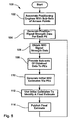
- Fig. 5 is a flowchart according to at least one embodiment of the present invention.
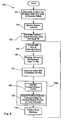
- Fig. 6 is a flowchart according to another embodiment of the invention.
- Fig. 7 is a subprocess that may be substituted for one of the process blocks of Fig. 7 according to yet another embodiment of the invention.
- Fig. 8 is similar to Fig. 7, albeit illustrating another subprocess
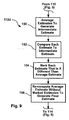
- Fig. 9 is similar to Fig. 7, albeit illustrating yet one other subprocess
- Fig. 10 is a subprocess that may be used to augment the process of Fig. 5;
- Fig. 11 is a subprocess that may be substituted for a portion of the subprocess of Fig. 10 according to another embodiment of the invention.
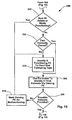
- Fig. 12 is a flow chart of another inventive method
- Fig 13 is a flow chart of yet another method according to the present invention where confidence factors are generated for intermediate position estimates and used to identify a final position estimate;
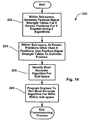
- Fig. 14 is a flow chart illustrating a commissioning procedure whereby positioning engines are programmed with optimal position determining algorithms.
- FIG. 1 the present invention will be described in the context of an exemplary, albeit simplified, manufacturing facility 10 that includes a rectilinear floor space or area 13 confined by four facility walls collectively identified by numeral 12.
- a typical manufacturing facility 10 many different machines and automated assemblies would be spaced out within space 13 and would be arranged to perform various manufacturing functions.
- assemblies and machines located within space 13 would include both sensors for sensing assembly and machine activity and actuators for controlling assembly and machine activity.
- exemplary facility 10 also includes a plurality of communication units or access points 16 (only three labeled in Fig. 1), first, second, and third servers 60, 62 and 64, respectively and a data and communication network 34 (e.g., an Ethernet, LAN, etc.).
- a plurality of wireless information devices such as palm type computing devices, lap top computers, wireless transmitting identification badges, etc., are also included as part of system 10.
- WIDs may also include wireless receivers.
- each communication access point 16 includes a two-way wireless transceiver that, as well known in the computer arts, is capable of transmitting and receiving electromagnetic (e.g., radio or infrared) signals within an area proximate the transceiver.
- Wireless transceivers like access point 16 are well known in the industry and, therefore, in the interest of simplifying this explanation, will not be described here in detail.
- each transceiver 16 transmits information signals which decrease in strength as distance from the transceiver increases.
- 81 separate access points 16 are provided within area 13 and are generally equispaced within area 13.
- access points 16 will be mounted on the ceiling within an area 13 to allow relatively unobstructed communication between each access point 16 and other devices that communicate via wireless communication therewith.
- all or at least a subset of the access points may be integrated into other automated assembly components such as human-machine interfaces that are already linked to network 34 for other purposes. While access points 16 are illustrated as being substantially equispaced within area 13, it should be appreciated that other access point arrangements are contemplated and that, in many cases, other access point arrangements may be most suitable given specific assembly layouts and the physical characteristics of the assemblies within space 13.
- all or at least a sub-set of access points 16 may be replaced by simple wireless receiver units that, as the label implies, only receive wireless signals and cannot wirelessly transmit signals.
- servers 60, 62 and 64 may be positioned within facility 10 or may be located at some remote location such as, for instance, a separate building, in a separate room within the facility that includes area 13 or at a completely different location such as a remote campus associated with facility 10. In addition, servers 60, 62 and 64 may be distributed within space 13 or in one or more affiliated locations.
- Each of exemplary servers 60, 62 and 64 perform similar functions and, therefore, in the interest of simplifying this explanation, unless indicated otherwise, only server 60 will be described here in any detail.
- each of servers 60, 62 and 64 is linked via network 34 to each of access points 16 for two-way communication therewith.
- any of servers 60, 62 or 64 may obtain data from any of access points 16 and may provide information to any of access points 16 for transmission within area 13.
- Information transmitted from one of the access points 16 to one of the servers 60, 62 or 64 is typically tagged by the access points so that the receiving server can determine which access point 16 provided the received information.
- This tagging may either be performed by the access points 16 earmarking data packets with an access point identifier (e.g., an access point number) or, in the alternative, may be facilitated by simply providing separate hardwires from each of the access points 16 to each of the servers 60, 62 or 64.
- an access point identifier e.g., an access point number
- each of servers 60, 62 and 64 is configured such that the server can address information to each separate and specific access points 16.
- server 60 is, in at least some embodiments, a processor based workstation that performs various software programs. While server 60 may perform control, monitoring, safety, etc., programs related to the machines and automated assemblies operating within space 13, for the purposes of the present invention, server 60 runs at least one positioning engine software program and, in some embodiments, runs several positioning engine software programs to estimate the position or positions of one or more WIDs 30 located within space 13.
- server 60 may publish that estimate on network 34 so that other servers or processors that require WID location estimates to perform various facility applications have access to the location information.
- server 60 itself may be programmed to facilitate various applications as a function of WID location.
- server 60 may control automated assembly processes as a function of WID 30 location.
- server 60 may provide data associated with one or more automated assemblies within space 13 to a WID 30 when the WID 30 is proximate the automated assembly or assemblies. Other control, monitoring and safety functions are contemplated.
- each engine program will be referred to as though it is its own separate entity unless indicated otherwise.
- server 60 runs four separate positioning engine programs
- each program will be referred to as a distinct positioning engine.
- exemplary WID 30 is illustrated which may be usable to obtain data related to automated assemblies within space 13 (see again Fig. 1) and, in at least some cases, to control automated assemblies.
- Exemplary WID 30 includes, generally, a plurality of components that are mounted within a hardened plastic or metallic housing identified by numeral 32.
- WID 30 components include a processor 71, an input device (e.g., keyboard 36), a display screen 35, a speaker 51 for audio output, a transceiver 38 and a memory 69.
- Processor 71 is linked to each of the input device, display screen 35, speaker 51, transceiver 38 and memory 69 for communication therewith.
- Processor 71 is equipped to run various programs for both displaying information via screen 35 and for receiving control signals and communicating those control signals to access points 16 via transceiver 38 in a manner consistent with the comments above.
- the input device may include any of several different types of components including a push button keyboard 36, separate selection buttons 40 and 42, a rocker type selection button 44, and/or selectable icons that may be provided via display screen 35 such as, for instance, icons 45. It is contemplated that, in at least some embodiments, a pointing cursor 46 may be moveable about screen 35 and placed over one of the selectable icons after which a conventional type mouse clicking action may be used to select one of the icons and cause some display or control function to occur. In other embodiments display 35 may comprise a touch screen where icons are selectable via a stylus or the tip of an operator's finger.
- Display screen 35 may be any type of conventional display screen suitable for hand-held devices and, for example, may be equipped to display numeric information, icons, graphs such as graph 47 or any other type of monitoring and control information that may be associated with facility assemblies.
- Speaker 51 is a conventional small audio output speaker.
- Transceiver 38 is mounted approximately at the top end of housing 32. As in the case of the transceivers that comprise access points 16, transceiver 38 is capable of transmitting electromagnetic signals and also receiving such signals so that information can be provided to servers 60, 62 and 64 or received therefrom via access points 16.
- Memory 69 stores programs performed by processor 71 and, in at least some embodiments of the invention, stores a WID identifier (e.g., a WID identification number, user ID number, etc.).
- a plurality of different positioning engine software programs are stored for access by servers 60, 62 and 64 wherein each of the positioning engines is associated with a different region of and sub-set of access points 16 within space 13.
- PEs positioning engine software programs
- a commissioning procedure is performed whereby positions within space 13 are correlated with specific sets of WID signal strength data and that correlated information is stored for each of the positioning engines.
- each server 60, 62 and 64 receive data from the access points that are associated with the positioning engines run by specific the server and use that data to determine WID location.
- one or a sub-set of servers 60, 62 and 64 identify one of the positioning engines that will "own” the task of generating a final WID position estimate.
- the "owning" engine thereafter performs an additional position estimating process which generates a final WID position estimate.
- additional position estimating processes are contemplated and several examples are discussed below. Where a PE assumes ownership of the final position estimating task, that PE will be referred to hereinafter as an owing PE with respect to the specific WID being tracked. Where an owing PE requires data from one or more other PEs to generate the final WID position estimate, the other PEs from which data is required will be referred to hereinafter as supporting PEs.
- the WID 30 regardless of the position of a WID 30 within space 13, it is desirable for the WID 30 to be located within one of the regions associated with at least one of the positioning engines so that optimal ownership of the final position estimating task can be facilitated.
- the idea here is that when a WID resides within a region associated with a specific engine, the specific engine may be the optimal engine for determining WID location and therefore should at least be a candidate for ownership.
- twelve exemplary circular engine regions R1 through R12 that are associated with space 13 are illustrated wherein almost every location within space 13 is in at least one of engine regions R1 through R12.
- a WID 30 will be located within more than one region R1 through R12.
- WID 30 as illustrated is within each of regions R1 and R2 and is also on the borders of each of regions R5 and R6.
- ownership of the final estimating task cannot be determined solely by determining which region WID 30 resided in.
- One way to resolve ownership where a WID is within more than one region is to create a rule set to resolve the matter.
- One exemplary rule is to compare distances between initial position estimates and central points of each region that generates an initial position estimate and to assign ownership to the engine associated with the region in which the shortest distance occurs.
- suitable sub-sets of access points 16 have to be identified for each of the regions for generating the data required by the positioning engines to generate the initial position estimates.
- One way to identify suitable access point sub-sets is to identify all of the access points either within a region or proximate the region as a sub-set to be associated with a corresponding engine.
- the upper left-hand corner of Fig. 3 is illustrated again in Fig. 4 including a plurality of access points 16 and engine regions R1 and R2.
- extended regions for identifying access point sub-sets associated with each one of engine regions R1 and R2 are also illustrated.
- the region labeled APS1 corresponds to engine region R1 while extended region APS2 corresponds to second engine region R2.
- access points within each one of the extended regions may be selected to comprise a sub-set of the facility access points 16 that are used by the positioning engine associated with a corresponding engine region.
- the seventeen access points within extended region APS1 or at least partially within region APS1 may be selected as the sub-set of points used by first positioning engine PE1 associated with first region R1 to generate at least initial WID location estimates.
- the 22 access points 16 that reside within extended region APS2 may be selected as the sub-set of points used by second position engine PE2 associated with region R2 to generate initial WID position estimates.
- extended regions like regions APS1 and APS2 in Fig. 4 are not illustrated for third through twelfth regions R3 through R12, it is contemplated that extended regions or something akin thereto would be used to identify access point sub-sets associated with each of regions RC3 and R12.
- each positioning engine will have been programmed to use data from an associated sub-set of access points to determine WID location and, in the present example, with a central point of an associated region (e.g., R1).
- each server 60, 62 and 64 runs four separate positioning engines corresponding to four of the regions R1 through R12 indicated in Fig. 3.
- server 60 runs positioning engines PE1, PE5, PE9 and PE10 corresponding to engine regions R1, R5, R9 and R10.
- server 62 runs positioning engines PE2, PE6, PE7 and PE11 corresponding to regions R2, R6, R7 and R11 while server 64 runs engines PE3, PE4, PE8 and PE12 corresponding to engine regions R3, R4, R8 and R12, respectively.
- adjacent engines often require data from at least some of the same access points 16 and therefore, by grouping the engine regions together in which positioning engines run by each server estimate position the data interchange on network can be minimized.
- blocks 102 and 104 generally correspond to a commissioning process while blocks 106 through 114 correspond to subprocesses that occur after commissioning has been completed and during normal system operation to estimate WID position.
- blocks 106 through 114 correspond to subprocesses that occur after commissioning has been completed and during normal system operation to estimate WID position.
- a process is used to associate positioning engines PE1 through PE12 with sub-sets of access points 16 to be used by the positioning engines PE1 through PE12 to generate the initial position estimates.
- position-signal strength data tables for each of positioning engines PE1 through PE12 are generated. Processes of this type for single engines are known in the art and therefore are not described here in detail. Here, it should suffice to say that one of the known processes for a single engine is simply performed for each separate engine PE1-PE12.
- each access point 16 transmits a data packet including the signal strength data and an indication of which access point is transmitting the data onto network 34.
- each servers 60, 62 and 64 monitor network 34 for data packets from access points associated with the position engines run by the specific server. For example, server 60 monitors network 34 for access point data packets from access points in any of the access point sub-sets associated with positioning engines PE1, PE5, PE9 and PE10. Servers 60, 62 and 64 provide the access point data to the positioning engines that require the data.
- initial WID position estimates are generated by each positioning engine PE1 through PE12.
- one or a sub-set of the positioning engines use the initial estimates to identify a final estimate and at block 114 the final estimate is published or broadcast on network 34 so that other servers or processors requiring the WID position estimate can obtain that estimate therefrom.
- control passes back up to block 106 where the process is repeated to update the final estimate and actively track WID movement within space 13.
- Method 120 differs from method 100 in that method 120 includes a step of identifying engine region center points (e.g., RC1, RC2, etc., in Fig. 3) and includes a more specific subprocess 112a for identifying a final WID position estimate.
- each of positioning engines R1 through R12 is associated with a sub-set of access points 16 as in block 102 of method 100.
- control passes to block 124 where the region center points RC1 through RC12 associated with each of positioning engines PE1 through PE12, respectively, are identified.
- control cycles through blocks 121 through 127 which are identical to blocks 104 through 110 in Fig 5 above where WID signal strength data is obtained and used by each positioning engine PE1 through PE12 to generate initial WID position estimates.
- block 112a which is akin to block 112 in method 100, includes two process blocks 128 and 130.
- at block 128, at least one of the positioning engines PE1 through PE12 identifies which of the initial WID position estimates is closest to an associated region center point.
- each one of the positioning engines PE1 through PE12 may independently compare its initial WID position estimate to the region center point RC1 through RC12 associated therewith. For instance, engine PE1 compares its initial position estimate to region center point RC1, engine PE2 compares its initial position estimate to region center point RC2, and so on.
- each engine PE1 through PE12 generates a distance value indicating the distance between its initial estimate and the region center point associated therewith and broadcasts its distance value on network 44.
- the difference values are akin to one type of confidence factor.
- each engine PE1 - PE12 also monitors network 34 for distance values broadcast by each of the other eleven positioning engines.
- the receiving engine determines whether or not its distance value is less than the other distance values. Where an engine's distance value is less than the other distance values at block 130, the positioning engine asserts ownership of the final estimating task and selects its initial position estimate as the final estimate.
- the engine that generated the smallest distance value publishes its WID position estimate on network 34. After publishing the final estimate control passes back up to block 123 where the loop above is again repeated.
- one of the engines PE1-PE12 may be programmed to determine ownership by comparing the distance values and to then assign ownership to the engine that generates the shortest distance value.
- each engine may also broadcast its initial position estimate to the comparing engine. Thereafter, when the comparing estimate identifies the shortest distance value, the comparing engine may be programmed to publish the position estimate associated with the shortest distance value.
- a subprocess 112b that may replace subprocess 112 in method 100 of Fig. 5 is illustrated.
- control passes to block 112b in Fig. 7.
- the positioning engines average the initial estimates to generate a final WID position estimate after which control again passes block 114 in Fig. 5 where the final estimate is published.
- one of the positioning engines is programmed to perform the averaging process of block 112b.
- first positioning engine PE1 may be programmed to perform the averaging process.
- engine PE1 obtains the initial estimates from engines PE5, PE9 and PE10 and performs the averaging process based on all of the obtained initial estimates.
- each of engines PE1 through PE12 identifies the distance between its initial WID position estimate and the region center point associated with the specific positioning engine as a distance value.
- each of the engines weights its initial estimate as a function of the distance value identified in block 140. Thus, for instance, where distance identified by first positioning engine PE1 is less than the distance identified by second positioning engine PE2, first positioning engine PE1 weights its initial estimate more heavily than does second positioning engine PE2.
- one of the engines averages the weighted estimates to generate the final estimate.
- control again passes to block 132 in Fig. 6 where the final estimate is published.
- one of the positioning engines is programmed to perform the averaging function after obtaining the weighted initial estimates from the other positioning engines.
- the averaging task may be negotiated between the engines so that ownership of that task is dependent on other factors such as the shortest distance estimate.
- the weighting steps may be performed by an owning positioning engine. For example, where first engine PE1 owns the task of generating the final position estimate (e.g., the first engine distance value is less than the other distance values), the first engine may apply distance value based weights to associated position estimates prior to performing the averaging subprocess. Other orders of steps are contemplated.
- FIG. 9 yet one additional subprocess 112d that may be used to replace subprocess 112 in Fig. 5 is illustrated.
- control passes to block 150 in Fig. 9 where the initial estimates are averaged to generate an intermediate WID position estimate.
- the positioning engine that generates the intermediate estimate compares each initial estimate to the intermediate estimate.
- the initial estimate is marked. For example, in some cases, where an initial estimate is more than four feet away from the intermediate estimate (e.g., the average estimate), that initial estimate may be marked.
- the initial estimate may be marked. For instance, where the distance between the first initial estimate (i.e., the estimate generated by engine PE1) and the intermediate estimate is eight feet and the average distance between all twelve of the initial estimates and the intermediate estimate is four feet, the first initial estimate would be marked.
- the engine that performed the averaging process at block 150 recomputes the average estimate without using the marked estimates to generate a final estimate.
- control again passes to block 114 in Fig. 5 where the final estimate is published.
- the recomputed final estimate would be more accurate than the first average estimate.
- a subprocess 160 that may be used to replace subprocess blocks 106 through 114 in Fig. 5 is illustrated.
- control passes to block 157 in Fig. 10.
- Blocks 157, 159 and 163 in Fig. 10 are identical to blocks 106, 108 and 110 in Fig. 5, respectively.
- block 164 After block 163 where the positioning engines each generate initial position estimates, control passes to block 164.
- block 164 during the first pass through subprocess 160 where the final estimating task has not yet been assigned to one of the positioning engines, control passes to block 170.
- position engines PE1-PE12 determine which position engine shall own the final position estimating task for the specific WID. As above, in at least some embodiments this ownership determination may be via a comparison of distance values between initial position estimates and region center points (e.g., see RC1, RC2, etc., in Fig. 3). Other ownership algorithms are contemplated.
- the owning positioning engine uses the initial estimates to identify a final WID position estimate.
- the owning engine determines if the final estimate is within the engine region associated with the owning engine. Where the final estimate is not within the associated engine region control passes back up to block 170 where ownership of the final estimating task is re-determined and control loops back through blocks 172 and 168.
- control passes to block 174.
- the final estimate is published by transmission on network 34. After block 174, control passes back up to block 157 where signal strength data is again obtained and the process is repeated.
- subprocess 160 the number of task ownership determinations can be minimized by re-determining ownership only when a WID is moved out of a region that is clearly associated with a specific positioning engine.
- At least some inventive ownership embodiments include redundancy functions wherein, if one or more of the positioning engines malfunction, the other engines may nevertheless still generate a useable final position estimate.
- a subprocess 180 that may be substituted for subprocess blocks 170 and 172 in Fig. 10 is illustrated.
- control passes to block 182 in Fig. 11.
- any engine previously marked as malfunctioning will not be includes in the arbitration process.
- the owning engine After ownership is established, at block 184 the owning engine generates a final position estimate.
- the owning engine determine if the final estimate is a possible estimate.
- the estimate is not possible.
- the owning engine may track most recent estimates and where some inconsistency is identified, the owning engine may identify the inconsistency as not possible. For example, if recent WID position estimates place a WID 300 feet away from the current estimate, the current final estimate may be deemed not possible. As yet one other instance, where an owning engine's initial estimate is way off from a final estimate, the final estimate may be deemed not possible.
- the owing engine is marked as a malfunctioning engine and control passes to block 182 where a different currently functioning engine is assigned ownership.
- the new owning engine runs another algorithm to generate a final estimate.
- the arbitration process may be reinitiated to optimize PE ownership based upon current PE environment. Similarly, when a new PE is added to the system the arbitration process may be reinitiated to optimize ownership.
- another sub-process 298 that may be substituted for the sub-process corresponding to blocks 164, 170 and 172 in Fig. 10 is illustrated. Referring also to Fig. 10, after the initial WID position estimates have been generated at block 163 in Fig. 10 control passes to block 300 in Fig. 15.
- one of the position engines determines if a new PE has been added to the system and commissioned or if one of the previously malfunctioning PEs has again become functional (i.e., capable of generating possible WID position estimates.
- This task may be aided by a facility employee that actually indicates a new PE or a PE that is again functioning in some embodiments.
- the PE when a PE malfunctions, the PE may be programmed to still perform its positioning engine functions and it or another PE may be programmed to monitor the engine to determine if the engine is still malfunctioning. Where the engine is no longer malfunctioning (i.e., the resulting position estimate is a possible estimate), the engine may automatically be re-added to the function engines at block 300.
- control passes to block 302 where the engines determine if one of the engines owns the final estimating task. Where one of the engines owns the final estimating task control passes to block 306. Blocks 306, 308 and 310 are akin to blocks 184, 186 and 188 in Fig. 11 and therefore will not be described again here in detail. At block 302, where the final estimating task is not currently owned control passes to block 304 which is akin to block 182 in Fig. 11 and therefore is not described here again in detail.
- This dynamic reconfiguration or "re-ownership", both dropping and adding PEs, is important to some embodiments of the present invention.
- the engines may be programmed to use initial estimates from only a sub-set of the engines proximate the general location of the WID 30 to generate the final estimate. For example, referring again to Fig. 3, when a WID 30 is initially sensed within space 13, engines PE1, PE4, PE9 and PE12 corresponding to a corner regions R1, R4, R9 and R12 may cooperate to determine a general location of WID 30 within space 13. Where the WID 30 is located as illustrated (i.e., in the upper left-hand quadrant of space 13), the engines associated with the upper left-hand quadrant of space 13 may be selected to form a sub-set for position estimating purposes.
- engines PE1, PE2, PE5 and PE6 may cooperate to estimate WID 30 location and the other engines would not take part in the estimation. Thereafter, the engine sub-set would operate in any of the manners describes above to estimate position until the general location of WID 30 is modified.
- each engine PE1 through PE12 will run an identical estimating program, the only difference being the subsets of access points associated with each engine.
- each engine will be identical.
- engine PE1 associated with region R1 weights its initial estimate by a factor of two and all other initial estimates by a factor of one when it establishes final estimate ownership
- each of engines PE2 through PE12 would similarly weight their initial estimates by a factor of two and all other initial estimates by a factor of one when they establish ownership.
- system 10 is particularly easy to scale by simply adding additional instances of positioning engines associated with new regions (e.g., R1, R2, etc.) within a facility space 13.
- the initial and/or final estimating programs run by each of the engines may be different or, at least subsets of the programs may be different.
- the first engine PE1 associated with region R1 may run a first estimating program to generate an initial estimate while second engine PE2 associated with region R2 runs a second program to generate an initial estimate that is different than the first program.
- the first program may be based on a statistical analysis while the second program is a triangulation type program as well known in the wireless positioning arts.
- first engine PE1 may run a weighting and averaging program to generate a final position estimate while second engine PE2 runs a simple averaging program.
- a single positioning engine may run several different position estimating algorithms depending upon location within an associated region. For instance, referring again to Fig. 3, engine PE1 associated with region R1 may apply weights differently to initial estimates from the engines as a function of the distance value from central point RC1 of the initial estimate generated by engine PE1 when engine PE1 owns the final estimating task.
- the initial estimate generated by engine PE1 may be weighted a factor of two while other estimates are weighted by a factor of one and, when the initial estimate-central point distance value identified by engine PE1 is greater than 30 feet, the initial estimate generated by engine PE1 may be weighted by a factor of one while other estimates are also weighted by a factor of one.
- engine PE1 may provide its initial estimate as the final estimate and, when the initial estimate-central point distance value identified by engine PE1 is greater than 30 feet, engine PE1 may average initial estimates from the four engines associated with proximate regions.
- Other algorithm determining processes and contingencies are contemplated.
- more than one method may be used to generate intermediate estimates of WID position and also to generate a separate confidence factor for each of the intermediate estimates. Thereafter the confidence factors may be used to select one or the other of the intermediate estimates as the final estimate for publication.
- each of engines PE1 and PE2 may generate intermediate estimates of WID position along with associated confidence factors.
- the intermediate estimates may be akin to the initial estimates described above or may be more complex averages, weighted averages, etc., of the initial estimates described above or, in some cases, may be generated via triangulation.
- the confidence factors may be based on any suitable system data including eradicity of position data (e.g., degree to which data is jumping around), signal to noise ratio of data, a comparison of position to known recent position, a comparison of position estimate to other intermediate position estimates, position with respect to a central point of an associated region, position with respect to the access points from which data was obtained to generate the intermediate estimate (e.g., is position within triangular space defined by three access points that generated data to perform triangulation position estimate), etc., or a subset of the above.
- Other considerations in determining confidence factor values are contemplated.
- stationary access points at known locations may be used to transmit known intensity signals to other access points
- position estimates of the transmitting points may be generated and compared to the known positions. Differences between the estimates and known positions can be used to generate confidence factors.
- a processor may be programmed to select the intermediate estimate having the greatest confidence factor as the final estimate for publication.
- Fig. 13 illustrates one process 200 for generating intermediate position estimates and confidence factors and then generating a final estimate as a function thereof.
- access points 16 are used to obtain WID signal strength data.
- the obtained data is provided to the positioning engines PE1 through PE12.
- each positioning engine PE1 through PE12 generates an initial WID position estimate.
- the engines identify two or more of the engines to own the intermediate estimating task.
- the first and second engines corresponding to regions R1 and R2 may be designated as owning the intermediate estimating task.
- each of the engines corresponding to regions R1, R2, R5 and R6 may be designated as an owning intermediate estimating engine.
- each of the intermediate estimating engines identified at block 208 identifies an intermediate estimate.
- each of the intermediate estimating engines also generates a confidence factor indicating the likelihood that the associated intermediate estimate is accurate.
- one of the intermediate estimating engines compares the confidence factors and, block 216, the comparing estimate published the intermediate estimate with the highest confidence factor as the final estimate. After block 216, control passes again back up to block 202 where the loop illustrated is repeated.
- a semi-automated commissioning procedure 220 is illustrated wherein the positioning engines are used during a commissioning procedure to, in effect, self-select algorithms to be used during normal system operation to identify WID position.
- a system user uses a WID 30 to generate position signal strength tables for a plurality (e.g., X where X may be 10 or 20 positions) of known positions for each of the system positioning engines using a plurality (e.g., Z where Z may be 5 or 10) different position estimating algorithms.
- a plurality e.g., X where X may be 10 or 20 positions
- Z where Z may be 5 or 10
- each of regions R1 through R12 may be a separate subspace within facility space 13.
- 144 different position-signal strength tables would be generated wherein each table includes data corresponding each of the X known positions within the associated subspace.
- the system user causes the system to estimate WID positions within each one of the subspaces or regions R1 through R12 at other known positions.
- the phrase "other known positions" is used to refer to positions within the subspace other than the X known positions for which the associated position-signal strength tables were generated at block 222.
- the user may cause the engines to estimate WID position at ten additional known positions within subspace R1 where the additional positions are different than the known positions.
- each of the engines PE1 through PE12 identifies the most accurate algorithm for each specific subspace.
- first positioning engine PE1 may identify a first algorithm to be performed when a WID 30 is located within region R1, a second position estimating algorithm to be performed when the WID is located within region R5, a third position estimating algorithm to be performed when the WID is located within region R8, and so on.
- each of the other positioning engines PE2 through PE12 would identify most accurate algorithms for each of the subspaces R1 through R12 for that particular engine.
- the engines PE1 through PE12 are programmed to run the most accurate algorithms for those particular engines when a WID is located in each one of the different regions R1 through R12. After block 228 the commissioning procedure ends and normal system operation can begin.
- a single engine or several engines may be programmed so that the estimate generated by one of the engines running a specific algorithm is always selected when an associated confidence factor is above a threshold value and so that some other algorithm is only performed if the confidence factor associated with the specific algorithm is below the threshold value.
- WID position is estimated using a first or current position determining algorithm.
- a confidence factor for the estimate is generated.
- one of the engines compares the confidence factor to the threshold value. Where the confidence factor is above the threshold value the estimate is published or otherwise rendered accessible.
- the substituted algorithm is used to estimate position. The process continues to loop until an acceptable confidence factor results.
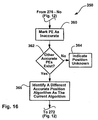
- the position engine determines whether other position algorithms that have not already been attempted and marked inaccurate exist. Where at least one other position algorithm exists that has not been marked inaccurate, control passes to block 366 where the positioning engines identify a different one of the algorithms that has not been attempted as the current algorithm. Thereafter, control passes back up to block 272 in Fig. 12 where the loop described above is repeated.
- the positioning engines indicate that the WID position is unknown.
- one of the engines may publish the position estimate corresponding to the algorithms associated with the highest confidence factor along with some indication that the estimate is at least suspect given the low confidence factor value.
- Other possible functions at block 364 are contemplated.
- one or more of the engines may be programmed to perform a low confidence function when none of the confidence factors is above some minimal level.
- the low confidence function may include suggesting via the WID or some other suitable device (e.g., human-machine interface) in communication with network 34 that a learning process should be performed.
- a region location for region R1 may include the upper right hand corner of space 13 as illustrated in Fig. 3 as opposed to central point RC1.
- an apparatus for use with a portable wireless information device (WID) and a plurality of receivers spaced apart within a facility having a space comprising at least a first processor linked to the receivers for receiving signal strength information therefrom, the at least a first processor running at least first and second position estimating programs on signal strength information associated with first and second sub-sets of the receivers, respectively, for identifying first and second position estimates of the WID within the space, respectively.
- WID portable wireless information device
Landscapes
- Physics & Mathematics (AREA)
- Engineering & Computer Science (AREA)
- General Physics & Mathematics (AREA)
- Radar, Positioning & Navigation (AREA)
- Remote Sensing (AREA)
- Position Fixing By Use Of Radio Waves (AREA)
- Mobile Radio Communication Systems (AREA)
Abstract
Description
Claims (36)
- A system for use with a portable wireless information device (WID) within a space, the WID including a transmitter for transmitting wireless WID signals, the system comprising:a plurality of communication units spaced apart within the space, each unit cooperating with the WID to generate position information, the position information useable to generate a WID position estimate, the plurality of units including at least first and second sub-sets, each unit including at least one of a wireless receiver and a wireless transmitter;at least a first receiver; andat least a first processor linked to the at least a first receiver for receiving position information therefrom, the at least a first processor running at least first and second position estimating programs on position information associated with the first and second sub-sets, respectively, for identifying at least first and second WID position estimates within the space, respectively.
- The system of claim 1 wherein each communication unit includes at least a wireless receiver.
- The system of claim 2 wherein the facility area includes at least first and second regions associated with the first and second receiver sub-sets, the first region including at least a portion of the second region and the second region including at least some area outside the first region.
- The system of claim 1 wherein the at least a first processor, after identifying the at least first and second estimates, compares the estimates and selects one of the position estimates as the WID position.
- The system of claim 4 wherein the process is repeated such that when a WID is moved within the space, the selected one of the position estimates may change.
- The system of claim 5 wherein the first and second receiver sub-sets are associated with first and second regions of the space, the first and second regions including first and second region locations, respectively, and, wherein, the processor selects one of the position estimates by comparing the position estimates to the region locations of the first and second regions and selecting the position estimate at least in part as a function of the position estimate that is closest to one of the first and second region locations.
- The system of claim 6 wherein the region locations are central points of the regions.
- The system of claim 4 wherein the at least a first processor generates a confidence factor for each of the first and second estimates indicating a likelihood that the estimates are accurate and wherein the processor selects by comparing the confidence factors and selecting the position estimate with an associated highest confidence factor.
- The system of claim 8 wherein the first and second sub-sets are associated with first and second regions of the space, respectively, and, wherein, the confidence factors are based at least in part on at least one of relative positions of the first and second estimates, the locations of the estimates relative to the first and second areas, recent WID position estimates, eradicity of the position information and signal to noise ratio.
- The system of claim 1 wherein the at least a first processor, after identifying the at least first and second estimates, mathematically combines the estimates to generate a final WID position estimate.
- The system of claim 10 wherein the at least a first processor generates a confidence factor for each of the at least first and second estimates indicating a likelihood that the estimates are accurate and wherein the processor mathematically combines as a function of the confidence factors.
- The system of claim 1 wherein first and second regions of the space are associated with the at least first and second receiver sub-sets and each of the first and second regions includes the same portion of the space.
- The system of claim 1 wherein the at least a first processor also identifies a confidence factor for each of the estimates and, wherein, when none of the confidence factors exceeds a minimum required confidence factor, the processor performs a low confidence function.
- The system of claim 1 wherein at least the first position estimating program includes different estimating algorithms as a function of the general location of the WID.
- An apparatus for use with a portable wireless information device (WID) and a plurality of receivers spaced apart within a facility having a space, the receivers and WID cooperating to generate position information indicative of the distances of signal paths between the receivers and the WID, the apparatus comprising:at least a first processor linked to the receivers for receiving signal strength information therefrom, the at least a first processor running at least first and second position estimating programs on signal strength information associated with first and second sub-sets of the receivers, respectively, for identifying first and second position estimates of the WID within the space, respectively.
- The apparatus of claim 15 wherein the at least a first processor, after identifying the first and second estimates, selects one of the position estimates as a final WID position estimate.
- The apparatus of claim 16 wherein the at least a first processor generates a confidence factor for each of the first and second estimates indicating a likelihood that the estimates are accurate and wherein the processor selects by comparing the confidence factors and selecting the position estimate with an associated highest confidence factor.
- The apparatus of claim 15 wherein the space also includes N-2 additional regions, each region at least in part overlapping at least one other region, the receivers including N-2 additional sub-sets, each of the additional sub-sets associated with a different one of the additional regions, the at least a first processor running an additional N-2 position estimating programs on signal strength information associated with the additional sub-sets for identifying N-2 additional position estimates for the WID within the space.
- The apparatus of claim 18 wherein the at least a first processor, after identifying N position estimates, selects one of the position estimates as a final position estimate.
- The apparatus of claim 15 further including at least a second processor and wherein the first processor runs the first position estimating program and the second processor runs the second position estimating program.
- A method for use with a portable wireless information device (WID) within a space, the WID including a transmitter for transmitting wireless WID signals, the method comprising the steps of:obtaining position information indicative of the distances of signal paths between the WID and specific locations within the space;using a first sub-set of the position information to identify a first estimate of WID location;using a second sub-set of the position information to identify a second estimate of WID position; andusing the first and second estimates to identifying a final estimate of the WID location.
- The method of claim 21 wherein the step of using the first and second estimates includes generating a confidence factor for each of the estimates where the confidence factors are indicative of the accuracy of the estimates.
- The method of claim 22 wherein the step of using the first and second estimates further includes identifying the estimate having the highest confidence factor as the final estimate.
- The method of claim 22 wherein the step of using the first and second estimates further includes mathematically combining the first and second estimates to provide a final estimate of WID location as a function of the confidence factors.
- The method of claim 21 wherein first and second facility regions are associated with the first and second position information sub-sets and wherein the first and second regions overlap.
- The method of claim 21 further including the step of using N-2 additional sub-sets of the position information to identify N-2 additional estimates of WID position wherein the step of using the first and second estimates to identify a final estimate of the WID position includes using a sub-set of the first through Nth estimates to identify a final estimate of the WID location.
- The method of claim 21 wherein the step of using a first sub-set includes running a first program to estimate WID position and the step of using a second sub-set includes running a second program to estimate WID position.
- The method of claim 27 wherein the first and second programs are different.
- A method for use with a portable wireless information device (WID) within a space, the WID including a transmitter for transmitting wireless WID signals, the method for tracking the position of the WID within the space and comprising the steps of:obtaining position information indicative of the distances of signal paths between the WID and specific locations within the space;attempting to use a first sub-set of the position information to identify a first estimate of WID location;attempting to use a second sub-set of the position information to identify a second estimate of the WID location;when one of the first and second estimates is identified, rendering the one of the first and second estimates accessible by applications requiring WID location; andwhen the one of the first and second estimates is not identified and the other of the first and second estimates is identified, rendering the other of the first and second estimates accessible by applications requiring WID location.
- The method of claim 29 further including the step of, when both the first and second estimates are identified, identifying a confidence factor for each of the first and second estimates where the confidence factors are indicative of the accuracy of the estimates and identifying the estimate associated with the greatest confidence factor as a final estimate to be rendered accessible.
- A method for estimating the position of a wireless information device (WID) within a space, the method comprising the steps of:a) estimating WID position via a first estimating program;b) identifying a confidence factor for the WID position estimate;c) when the confidence factor meets a threshold requirement, rendering the position estimate accessible to other applications; andd) when the confidence factor fails to meet a threshold requirement, repeating steps (a) through (c) with a second estimating program.
- The method of claim 31 wherein step (d) is performed for each of a plurality of estimating programs until one of WID position has been estimated at least once via each of the estimating programs and an estimate that meets the threshold requirement has been identified.
- The method of claim 32 wherein, after WID position has been estimated via each of the estimating programs, when none of the estimates meets the threshold requirement, the method includes the step of performing another function.
- A method for use with a portable wireless information device (WID) within a space, the WID including a transmitter for transmitting wireless WID signals, the method for tracking the position of the WID within the space and comprising the steps of:obtaining position information indicative of the distances of signal paths between the WID and specific locations within the space;attempting to use a first sub-set of the position information to identify a first estimate of WID location;attempting to use a second sub-set of the position information to identify a second estimate of the WID location;determining if at least one of the estimates is sufficiently accurate;when at least one of the estimates is sufficiently accurate, rendering the likely most accurate of the estimates accessible as the final estimate; andwhen none of the estimates is sufficiently accurate, performing another function.
- The method of claim 34 wherein the step of performing another function includes indicating that the WID position is unknown.
- The method of claim 34 wherein the step of determining if at least one of the estimates is sufficiently accurate includes generating a confidence factor for each of the estimates and comparing the confidence factor to a threshold factor and, when a confidence factor is greater than the threshold factor, determining that the associated estimate is sufficiently accurate.
Applications Claiming Priority (2)
| Application Number | Priority Date | Filing Date | Title |
|---|---|---|---|
| US675608 | 2003-09-30 | ||
| US10/675,608 US20050070304A1 (en) | 2003-09-30 | 2003-09-30 | Distributed wireless positioning engine method and assembly |
Publications (2)
| Publication Number | Publication Date |
|---|---|
| EP1521096A2 true EP1521096A2 (en) | 2005-04-06 |
| EP1521096A3 EP1521096A3 (en) | 2005-09-28 |
Family
ID=34314002
Family Applications (1)
| Application Number | Title | Priority Date | Filing Date |
|---|---|---|---|
| EP04023202A Withdrawn EP1521096A3 (en) | 2003-09-30 | 2004-09-29 | Distributed wireless positioning engine method and assembly |
Country Status (3)
| Country | Link |
|---|---|
| US (1) | US20050070304A1 (en) |
| EP (1) | EP1521096A3 (en) |
| CN (1) | CN1645160A (en) |
Cited By (1)
| Publication number | Priority date | Publication date | Assignee | Title |
|---|---|---|---|---|
| GB2457030A (en) * | 2008-01-30 | 2009-08-05 | In2Games Ltd | Filtering or cancelling noise present in data received from three-dimensional position measurement apparatus |
Families Citing this family (12)
| Publication number | Priority date | Publication date | Assignee | Title |
|---|---|---|---|---|
| US20030125045A1 (en) * | 2001-12-27 | 2003-07-03 | Riley Wyatt Thomas | Creating and using base station almanac information in a wireless communication system having a position location capability |
| US7123928B2 (en) | 2003-07-21 | 2006-10-17 | Qualcomm Incorporated | Method and apparatus for creating and using a base station almanac for position determination |
| BRPI0418696A (en) * | 2004-04-02 | 2007-06-12 | Qualcomm Inc | methods and equipment for signaling assisted position determination systems |
| US7239277B2 (en) * | 2004-04-12 | 2007-07-03 | Time Domain Corporation | Method and system for extensible position location |
| US7043277B1 (en) * | 2004-05-27 | 2006-05-09 | Autocell Laboratories, Inc. | Automatically populated display regions for discovered access points and stations in a user interface representing a wireless communication network deployed in a physical environment |
| US20070132577A1 (en) * | 2005-12-09 | 2007-06-14 | Honeywell International Inc. | Method and apparatus for estimating the location of a signal transmitter |
| US7737840B2 (en) * | 2006-04-10 | 2010-06-15 | The Boeing Company | Container security system |
| US20070294032A1 (en) * | 2006-06-14 | 2007-12-20 | Zumsteg Philip J | Navigation using tracking system multi-function devices |
| US20090291672A1 (en) * | 2007-11-14 | 2009-11-26 | Ron Treves | System And Method For Providing Personalized Automated And Autonomously Initiated Information Delivery And Chaperone Service |
| US8587402B2 (en) * | 2008-03-07 | 2013-11-19 | Palm, Inc. | Context aware data processing in mobile computing device |
| US8478228B2 (en) * | 2008-10-20 | 2013-07-02 | Qualcomm Incorporated | Mobile receiver with location services capability |
| US8600297B2 (en) * | 2009-07-28 | 2013-12-03 | Qualcomm Incorporated | Method and system for femto cell self-timing and self-locating |
Family Cites Families (61)
| Publication number | Priority date | Publication date | Assignee | Title |
|---|---|---|---|---|
| US4309600A (en) * | 1967-12-15 | 1982-01-05 | Cincinnati Milacron Inc. | Machine tool |
| US3812947A (en) * | 1969-07-29 | 1974-05-28 | Texas Instruments Inc | Automatic slice processing |
| US4518958A (en) * | 1982-02-02 | 1985-05-21 | E. I. Du Pont De Nemours And Company | Capacitively coupled machine tool safety having a self-test network |
| US4742470A (en) * | 1985-12-30 | 1988-05-03 | Gte Valeron Corporation | Tool identification system |
| US4803039A (en) * | 1986-02-03 | 1989-02-07 | Westinghouse Electric Corp. | On line interactive monitoring of the execution of process operating procedures |
| US5121331A (en) * | 1988-09-23 | 1992-06-09 | El Paso Technologies | Method and apparatus for tracking a workpiece through a multi-station machine |
| US5119401A (en) * | 1989-11-17 | 1992-06-02 | Nec Corporation | Decision feedback equalizer including forward part whose signal reference point is shiftable depending on channel response |
| US5347463A (en) * | 1990-07-03 | 1994-09-13 | Honda Giken Kogyo Kabushiki Kaisha | System and method for line production management |
| US5519878A (en) * | 1992-03-18 | 1996-05-21 | Echelon Corporation | System for installing and configuring (grouping and node address assignment) household devices in an automated environment |
| JP3116710B2 (en) * | 1994-03-18 | 2000-12-11 | 株式会社日立製作所 | Information terminal system |
| US5432702A (en) * | 1994-06-17 | 1995-07-11 | Advanced Micro Devices Inc. | Bar code recipe selection system using workstation controllers |
| CH693065A5 (en) * | 1994-08-30 | 2003-02-14 | Inventio Ag | Elevator installation. |
| US5602903A (en) * | 1994-09-28 | 1997-02-11 | Us West Technologies, Inc. | Positioning system and method |
| SE504846C2 (en) * | 1994-09-28 | 1997-05-12 | Jan G Faeger | Control equipment with a movable control means |
| US5825759A (en) * | 1994-10-26 | 1998-10-20 | Telefonaktiebolaget Lm Ericsson | Distributing network services and resources in a mobile communications network |
| US5835061A (en) * | 1995-06-06 | 1998-11-10 | Wayport, Inc. | Method and apparatus for geographic-based communications service |
| US5956465A (en) * | 1996-04-04 | 1999-09-21 | Nissan Motor Co., Ltd. | Production facility with automatic movable body for man-machine cooperation |
| US6236335B1 (en) * | 1996-09-17 | 2001-05-22 | Ncr Corporation | System and method of tracking short range transmitters |
| US6011487A (en) * | 1996-09-17 | 2000-01-04 | Ncr Corporation | System and method of locating wireless devices |
| US5978753A (en) * | 1997-03-18 | 1999-11-02 | Hewlett-Packard Company | Context parameters for establishing data communication patterns in a distributed control and measurement system |
| US6418352B1 (en) * | 1997-12-12 | 2002-07-09 | Brooks Automation Gmbh | Integrated material management module |
| US6133876A (en) * | 1998-03-23 | 2000-10-17 | Time Domain Corporation | System and method for position determination by impulse radio |
| DE19829366C2 (en) * | 1998-07-01 | 2000-06-29 | Stefan Gleis | Method for providing manufacturing-related data in a series production of manufacturing objects, in particular motor vehicles |
| US6453210B1 (en) * | 1998-07-23 | 2002-09-17 | Vulcan Engineering Company, Inc. | Autonomous control method and process for an investment casting shell |
| US6314337B1 (en) * | 1998-08-27 | 2001-11-06 | Dell Usa, L.P. | Automated consolidation station |
| US6321092B1 (en) * | 1998-11-03 | 2001-11-20 | Signal Soft Corporation | Multiple input data management for wireless location-based applications |
| US6184829B1 (en) * | 1999-01-08 | 2001-02-06 | Trueposition, Inc. | Calibration for wireless location system |
| US6507762B1 (en) * | 1999-03-31 | 2003-01-14 | International Business Machines Corporation | Method and system for remotely controlling an appliance using a personal digital assistant |
| US6453168B1 (en) * | 1999-08-02 | 2002-09-17 | Itt Manufacturing Enterprises, Inc | Method and apparatus for determining the position of a mobile communication device using low accuracy clocks |
| US6516239B1 (en) * | 1999-08-03 | 2003-02-04 | Honda Of Canada Incorporated | Assembly line control system |
| US6539393B1 (en) * | 1999-09-30 | 2003-03-25 | Hill-Rom Services, Inc. | Portable locator system |
| US6813608B1 (en) * | 1999-10-11 | 2004-11-02 | Park Tours, Inc. | System and method for enhancing user experience in a wide-area facility having a distributed, bounded environment |
| US20020008621A1 (en) * | 2000-01-06 | 2002-01-24 | Isogon Corporation | Method and system for determining the inventory and location of assets |
| GB0004455D0 (en) * | 2000-02-26 | 2000-04-19 | Glaxo Group Ltd | Manufacturing method |
| US7038584B2 (en) * | 2000-03-31 | 2006-05-02 | Ge Medical Systems Information Technologies, Inc. | Object location monitoring within buildings |
| MXPA02010342A (en) * | 2000-04-20 | 2004-09-06 | Cogiscan Inc | Automated manufacturing control system. |
| US6546304B2 (en) * | 2000-05-30 | 2003-04-08 | Marel Hf. | Integrated meat processing and information handling method |
| US6600476B2 (en) * | 2000-08-24 | 2003-07-29 | The Boeing Company | Video aid system for automatic display of electronic manufacturing drawings |
| DE10055025B4 (en) * | 2000-11-07 | 2017-08-17 | Trützschler GmbH & Co Kommanditgesellschaft | Spinning preparation plant with a higher-level operating and display device |
| US6600418B2 (en) * | 2000-12-12 | 2003-07-29 | 3M Innovative Properties Company | Object tracking and management system and method using radio-frequency identification tags |
| JP2002221570A (en) * | 2001-01-26 | 2002-08-09 | Nec Corp | Track tracking device and track tracking method |
| US7043310B2 (en) * | 2001-02-16 | 2006-05-09 | Siemens Aktiengesellschaft | Device and process for operation of automation components |
| US6574549B2 (en) * | 2001-03-09 | 2003-06-03 | International Business Machines Corporation | Method and system for the visually impaired to navigate a route through a facility |
| US6842454B2 (en) * | 2001-03-14 | 2005-01-11 | Schneider Automation Inc. | Method and system for device addressing on a computer network |
| US7242306B2 (en) * | 2001-05-08 | 2007-07-10 | Hill-Rom Services, Inc. | Article locating and tracking apparatus and method |
| CA2445161A1 (en) * | 2001-05-08 | 2002-11-14 | Hill-Rom Services, Inc. | Article locating and tracking system |
| US6944443B2 (en) * | 2001-07-11 | 2005-09-13 | International Business Machines Corporation | Method, apparatus and system for notifying a user of a portable wireless device |
| US20030023882A1 (en) * | 2001-07-26 | 2003-01-30 | Charlie Udom | Biometric characteristic security system |
| US7143149B2 (en) * | 2001-09-21 | 2006-11-28 | Abb Ab | Dynamic operator functions based on operator position |
| US6662068B1 (en) * | 2001-10-12 | 2003-12-09 | Touraj Ghaffari | Real time total asset visibility system |
| DE10163534A1 (en) * | 2001-12-21 | 2003-07-10 | Siemens Ag | Device for monitoring areas of space |
| US6956527B2 (en) * | 2002-06-24 | 2005-10-18 | Intel Corporation | Wireless network access point configuration |
| US6895301B2 (en) * | 2002-07-15 | 2005-05-17 | Distrobot Systems, Inc. | Material handling system using autonomous mobile drive units and movable inventory trays |
| US6957073B2 (en) * | 2002-09-18 | 2005-10-18 | Motorola, Inc. | Mobile location explorer and methods therefor |
| US7116993B2 (en) * | 2002-09-27 | 2006-10-03 | Rockwell Automation Technologies, Inc. | System and method for providing location based information |
| US20040203895A1 (en) * | 2002-12-16 | 2004-10-14 | Senaka Balasuriya | Locking of communication device based on proximity |
| US7085576B2 (en) * | 2002-12-30 | 2006-08-01 | Motorola, Inc. | Method and apparatus for providing streaming information to a wireless mobile wireless device |
| US20040235468A1 (en) * | 2003-05-19 | 2004-11-25 | Luebke Charles J. | Wireless network clustering communication system, wireless communication network, and access port for same |
| US7010379B2 (en) * | 2003-06-25 | 2006-03-07 | Arvin Technologies, Inc. | Converter substrate verification |
| EP1501062B1 (en) * | 2003-07-22 | 2012-01-04 | Siemens Aktiengesellschaft | Method and HMI system for operating and observing a technical installation |
| US6993405B2 (en) * | 2003-11-05 | 2006-01-31 | International Business Machines Corporation | Manufacturing product carrier environment and event monitoring system |
-
2003
- 2003-09-30 US US10/675,608 patent/US20050070304A1/en not_active Abandoned
-
2004
- 2004-09-29 EP EP04023202A patent/EP1521096A3/en not_active Withdrawn
- 2004-09-30 CN CN200410103894.3A patent/CN1645160A/en active Pending
Cited By (4)
| Publication number | Priority date | Publication date | Assignee | Title |
|---|---|---|---|---|
| GB2457030A (en) * | 2008-01-30 | 2009-08-05 | In2Games Ltd | Filtering or cancelling noise present in data received from three-dimensional position measurement apparatus |
| US20110153269A1 (en) * | 2008-01-30 | 2011-06-23 | Steven Lavache | Methods and apparatus for filtering noise in a three-dimensional position measurement system |
| GB2457030B (en) * | 2008-01-30 | 2012-02-29 | Performance Designed Products Ltd | Methods and apparatus for filtering noise in a three-dimensional position measurement system |
| US8660815B2 (en) * | 2008-01-30 | 2014-02-25 | Performance Designed Products Llc | Methods and apparatus for filtering noise in a three-dimensional position measurement system |
Also Published As
| Publication number | Publication date |
|---|---|
| EP1521096A3 (en) | 2005-09-28 |
| US20050070304A1 (en) | 2005-03-31 |
| CN1645160A (en) | 2005-07-27 |
Similar Documents
| Publication | Publication Date | Title |
|---|---|---|
| EP1355505B1 (en) | Localization of radio-frequency transceivers | |
| US20050070304A1 (en) | Distributed wireless positioning engine method and assembly | |
| EP2456251B1 (en) | Automatic access point location, planning, and coverage optimization | |
| US7873368B2 (en) | Method for tracking location of a mobile unit | |
| RU2605347C2 (en) | Automatic preparation for operation of network control system devices | |
| US7248880B2 (en) | Methods and apparatus for determining a location of a device | |
| US8983491B2 (en) | Adaptive location tracking system | |
| US9454336B1 (en) | System and method for improving user experience with proximity estimation | |
| US20030005160A1 (en) | Dynamic logical control of network units in ad-hoc communications networks | |
| WO2016036991A1 (en) | Systems, methods and devices for asset status determination | |
| US12235345B2 (en) | Pair-assignment of RF-sensing nodes for a RF context-sensing arrangement | |
| US10264404B2 (en) | Information processing apparatus, system, and method | |
| WO2017142995A1 (en) | Systems and methods for improving indoor position detection | |
| KR20190064345A (en) | Apparatus and method for indoor positioning | |
| EP4449157B1 (en) | A control device for controlling a radiofrequency-based sensing system and a method thereof | |
| WO2021018564A1 (en) | Wireless parameter adjustment based on node location | |
| Papapostolou et al. | Scene analysis indoor positioning enhancements | |
| JP6539461B2 (en) | Position estimation system, control system, position estimation method, control method and program | |
| US12108360B2 (en) | Dual-band real-time location tracking | |
| Zhang et al. | AIDE: Augmented onboarding of IoT devices at ease | |
| US20050141302A1 (en) | Method for surveying layout of information devices | |
| JP2017010391A (en) | Individual detection system | |
| US20250374004A1 (en) | Positioning and communication system for dynamic location tracking in an indoor environment | |
| WO2023145358A1 (en) | Area determination system, area determination method, and program | |
| CA3120387C (en) | Determining a location of motion detected from wireless signals based on prior probability |
Legal Events
| Date | Code | Title | Description |
|---|---|---|---|
| PUAI | Public reference made under article 153(3) epc to a published international application that has entered the european phase |
Free format text: ORIGINAL CODE: 0009012 |
|
| AK | Designated contracting states |
Kind code of ref document: A2 Designated state(s): AT BE BG CH CY CZ DE DK EE ES FI FR GB GR HU IE IT LI LU MC NL PL PT RO SE SI SK TR |
|
| AX | Request for extension of the european patent |
Extension state: AL HR LT LV MK |
|
| PUAL | Search report despatched |
Free format text: ORIGINAL CODE: 0009013 |
|
| AK | Designated contracting states |
Kind code of ref document: A3 Designated state(s): AT BE BG CH CY CZ DE DK EE ES FI FR GB GR HU IE IT LI LU MC NL PL PT RO SE SI SK TR |
|
| AX | Request for extension of the european patent |
Extension state: AL HR LT LV MK |
|
| 17P | Request for examination filed |
Effective date: 20051208 |
|
| AKX | Designation fees paid |
Designated state(s): DE FR GB |
|
| STAA | Information on the status of an ep patent application or granted ep patent |
Free format text: STATUS: THE APPLICATION IS DEEMED TO BE WITHDRAWN |
|
| 18D | Application deemed to be withdrawn |
Effective date: 20100401 |