EP1520805A1 - A clothes wrapper - Google Patents
A clothes wrapper Download PDFInfo
- Publication number
- EP1520805A1 EP1520805A1 EP04022995A EP04022995A EP1520805A1 EP 1520805 A1 EP1520805 A1 EP 1520805A1 EP 04022995 A EP04022995 A EP 04022995A EP 04022995 A EP04022995 A EP 04022995A EP 1520805 A1 EP1520805 A1 EP 1520805A1
- Authority
- EP
- European Patent Office
- Prior art keywords
- wrapper
- clothes
- longitudinal
- along
- sheet
- Prior art date
- Legal status (The legal status is an assumption and is not a legal conclusion. Google has not performed a legal analysis and makes no representation as to the accuracy of the status listed.)
- Withdrawn
Links
- 229920002994 synthetic fiber Polymers 0.000 claims abstract description 6
- -1 polyethylene Polymers 0.000 claims description 10
- 239000004698 Polyethylene Substances 0.000 claims description 6
- 229920000573 polyethylene Polymers 0.000 claims description 6
- 239000002390 adhesive tape Substances 0.000 claims description 5
- 239000000463 material Substances 0.000 claims description 3
- 230000001464 adherent effect Effects 0.000 claims 1
- 239000010408 film Substances 0.000 description 4
- 239000004743 Polypropylene Substances 0.000 description 3
- 239000003795 chemical substances by application Substances 0.000 description 3
- 239000000428 dust Substances 0.000 description 3
- 238000003780 insertion Methods 0.000 description 3
- 230000037431 insertion Effects 0.000 description 3
- 238000004519 manufacturing process Methods 0.000 description 3
- 238000000034 method Methods 0.000 description 3
- 229920001155 polypropylene Polymers 0.000 description 3
- 230000007613 environmental effect Effects 0.000 description 2
- 238000009434 installation Methods 0.000 description 1
- 238000012986 modification Methods 0.000 description 1
- 230000004048 modification Effects 0.000 description 1
- 230000001681 protective effect Effects 0.000 description 1
- 239000010409 thin film Substances 0.000 description 1
- 238000011144 upstream manufacturing Methods 0.000 description 1
- 238000003466 welding Methods 0.000 description 1
Images

Classifications
-
- B—PERFORMING OPERATIONS; TRANSPORTING
- B65—CONVEYING; PACKING; STORING; HANDLING THIN OR FILAMENTARY MATERIAL
- B65D—CONTAINERS FOR STORAGE OR TRANSPORT OF ARTICLES OR MATERIALS, e.g. BAGS, BARRELS, BOTTLES, BOXES, CANS, CARTONS, CRATES, DRUMS, JARS, TANKS, HOPPERS, FORWARDING CONTAINERS; ACCESSORIES, CLOSURES, OR FITTINGS THEREFOR; PACKAGING ELEMENTS; PACKAGES
- B65D75/00—Packages comprising articles or materials partially or wholly enclosed in strips, sheets, blanks, tubes or webs of flexible sheet material, e.g. in folded wrappers
- B65D75/52—Details
- B65D75/58—Opening or contents-removing devices added or incorporated during package manufacture
- B65D75/5855—Peelable seals
-
- A—HUMAN NECESSITIES
- A47—FURNITURE; DOMESTIC ARTICLES OR APPLIANCES; COFFEE MILLS; SPICE MILLS; SUCTION CLEANERS IN GENERAL
- A47G—HOUSEHOLD OR TABLE EQUIPMENT
- A47G25/00—Household implements used in connection with wearing apparel; Dress, hat or umbrella holders
- A47G25/54—Dust- or moth-proof garment bags, e.g. with suit hangers
-
- B—PERFORMING OPERATIONS; TRANSPORTING
- B65—CONVEYING; PACKING; STORING; HANDLING THIN OR FILAMENTARY MATERIAL
- B65D—CONTAINERS FOR STORAGE OR TRANSPORT OF ARTICLES OR MATERIALS, e.g. BAGS, BARRELS, BOTTLES, BOXES, CANS, CARTONS, CRATES, DRUMS, JARS, TANKS, HOPPERS, FORWARDING CONTAINERS; ACCESSORIES, CLOSURES, OR FITTINGS THEREFOR; PACKAGING ELEMENTS; PACKAGES
- B65D85/00—Containers, packaging elements or packages, specially adapted for particular articles or materials
- B65D85/18—Containers, packaging elements or packages, specially adapted for particular articles or materials for wearing apparel, headwear or footwear
Definitions
- This invention is concerned with a clothes wrapper made of a film of a synthetic material such as polyethylene or polypropylene.
- the invention is concerned with throwaway wrappers to be mass-produced on processing lines handling polyethylene or polypropylene.
- wrappers consist substantially of a thin-film tube that is closed at one end and is open at the opposite end for insertion of a garment, the latter usually being carried on a dress-hanger.
- a clothes wrapper 10 consists of a sheet of a synthetic material, preferably polyethylene, that has been folded about a longitudinal line LC and joined along a lower transverse border by a cross-weld ST and along an upper transverse border by a profiled weld SS extending along a line defining the shoulder profile of a generic garment.
- One of the two free flaps BL1, BL2 extends to project laterally farther than the other longitudinal flap (flap BL1 in the Figures), is folded outwardly upon the adjoining wall to form a longitudinal stripe SL, and is joined to the sheet along welds ST and SS.
- a side opening A in the wrapper is thus provided on the longitudinal border opposite longitudinal line LC.
- Profiled weld SS is broken over an intermediate space to provide a passage 12, for purposes described below.
- a longitudinal piece of double-face adhesive tape 14 is applied on the outward surface of the sheet opposite to the surface upon which the longitudinal stripe SL is folded, near the corresponding free flap (BL1 in the Figures).
- transverse pre-cut T defming a transverse portion of the bottom F which can be torn away by hand for purposes appearing below.
- a generic garment 16 hanging on a dress-hanger 18 is inserted sidewise into wrapper 10 through opening A, in the direction of arrows F, while a hook G of the dress-hanger is pushed through passage 12.
- the longitudinal stripe SL on the opposite wall of the wrapper (Figs. 4 and 5) is then folded so that it will act as a flap to close opening A, and the closure is then ensured by fastening the longitudinal stripe SL to the material of the wrapper by means of the double-face adhesive tape 14.
- the bottom transverse portion F is torn away so that the wrapper is opened at its base and allows the garment to project outwardly.
- a preferred process for mass-manufacturing the wrapper of the invention is described below, with reference to a processing line for handling file of polyethylene or polypropylene.
- a ribbon of polyethylene N unwinds from a drum (not shown) to be progressively folded upon itself along a longitudinal line LC, which is offset from the midline LM of the ribbon, so that one of both side borders ML1, ML2 will project from the sheet laterally (ML2 in the figures).
- the projecting lateral strip ML2 is then folded externally to the wall with which it is integral, along the edge of the opposite border ML1.
- a sequence of transverse welds ST1, ST2, ..., and of profiled welds SS1, SS2, ..., the latter extending along lines substantially defining the shoulder contour of a generic garment, are made at uniform intervals upon the unwinding sheet.
- the profiled welds SS1, SS2 are made by a pair of symmetrical welding bars (not shown), each intended to make a weld on one of the "shoulders" of the wrapper, while the cut at the neck, intended to provide the passage 12, is made by a blade integral with the bars (not shown).
- Welds ST and SS are made at a temperature and pressure such that they will also cause the material to be cut, thereby automatically separating the wrappers from the ribbon.
- Pre-cuts T1, T2, ... are also made parallelly and in proximity to the welds.
- the double-face adhesive tape may be applied manually onto every individual wrapper, or on the ribbon, upstream of the process, by techniques that are common in the art.
Landscapes
- Engineering & Computer Science (AREA)
- Mechanical Engineering (AREA)
- Preparation Of Compounds By Using Micro-Organisms (AREA)
- Protection Of Plants (AREA)
- Physical Vapour Deposition (AREA)
- Packaging Of Annular Or Rod-Shaped Articles, Wearing Apparel, Cassettes, Or The Like (AREA)
Abstract
A clothes wrapper comprises a double sheet of a film of a synthetic material, bound
by two straight, longitudinal borders, by an upper transverse border (SS) and by a
lower transverse border (ST), and joined together along one of the straight,
longitudinal borders (LC) and along the upper transverse border (SS). The other
longitudinal border is provided with two free longitudinal flaps (BL1, BL2). A
longitudinal stripe (SL), adjacent to and integral with one of the free longitudinal
flaps (BL2) extends substantially for the entire length of the sheet and is joined to it
along the upper transverse border (SS).
Description
- This invention is concerned with a clothes wrapper made of a film of a synthetic material such as polyethylene or polypropylene.
- In homes, as well as in shops, laundries, etc., it is usual to cover clothes such as coats, jackets and the like, inside protective wrappers during periods of non-use, in order to protect them from dust, moths and other damaging environmental agents. More particularly, the invention is concerned with throwaway wrappers to be mass-produced on processing lines handling polyethylene or polypropylene. Such wrappers consist substantially of a thin-film tube that is closed at one end and is open at the opposite end for insertion of a garment, the latter usually being carried on a dress-hanger.
- The above wrappers are inconvenient in use, because the user must hold the garment with one hand, and has only one free hand for fitting the wrapper around it. Moreover, the position of the opening at the bottom of the wrapper makes the operation awkward.
- Another drawback of the above known wrappers, while they do protect clothes from dust, they allow moths and other damaging environmental agents to attack and damage the garment through their bottom openings.
- It is therefore the main object of this invention to provide a clothes wrapper made of a film of a synthetic material, which is easier to be fitted onto a garment and which will provide a better protection for the item of clothing against moths and other possible harmful agents such as moisture, dust, and the like.
- The above and other objects and advantages, such as will appear below, are achieved by the press-and-blow machine having the features recited in claim 1, while the subordinate claims identify other advantageous though unessential features of the machine.
- The invention will now be described in more detail, as shown by way of indicative and not limiting example in the attached drawings, wherein:
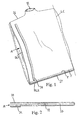
- Figure 1 is a perspective view of a clothes wrapper according to the invention;
- Figure 2 is a in view in transverse cross-section of the clothes wrapper according to the invention;
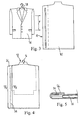
- Figure 3 is a front view of the wrapper in a first step of insertion of a garment;
- Figure 4 is a front view of the wrapper in a second step of insertion of a garment;
- Figure 5 is an enlarged view in cross-section of a detail of the wrapper, made along line V-V of Fig. 4;
- Figures 6 to 8 show three successive steps in the manufacture of the wrapper.
-
- It should be noted that the thickness of the film comprising the wrapper has been exaggerated in the drawings for the sake of clarity.
- With initial reference to Figure 1 and 2, a
clothes wrapper 10 according to the invention consists of a sheet of a synthetic material, preferably polyethylene, that has been folded about a longitudinal line LC and joined along a lower transverse border by a cross-weld ST and along an upper transverse border by a profiled weld SS extending along a line defining the shoulder profile of a generic garment. One of the two free flaps BL1, BL2 (flap BL2 in the Figures) extends to project laterally farther than the other longitudinal flap (flap BL1 in the Figures), is folded outwardly upon the adjoining wall to form a longitudinal stripe SL, and is joined to the sheet along welds ST and SS. A side opening A in the wrapper is thus provided on the longitudinal border opposite longitudinal line LC. Profiled weld SS is broken over an intermediate space to provide apassage 12, for purposes described below. - A longitudinal piece of double-face
adhesive tape 14 is applied on the outward surface of the sheet opposite to the surface upon which the longitudinal stripe SL is folded, near the corresponding free flap (BL1 in the Figures). - Finally, near the lower transverse weld ST extends a transverse pre-cut T, defming a transverse portion of the bottom F which can be torn away by hand for purposes appearing below.
- As shown on Figs. 3 and 4, a
generic garment 16, hanging on a dress-hanger 18, is inserted sidewise intowrapper 10 through opening A, in the direction of arrows F, while a hook G of the dress-hanger is pushed throughpassage 12. The longitudinal stripe SL on the opposite wall of the wrapper (Figs. 4 and 5) is then folded so that it will act as a flap to close opening A, and the closure is then ensured by fastening the longitudinal stripe SL to the material of the wrapper by means of the double-faceadhesive tape 14. - Should the garment to be covered be longer than the longitudinal length of the wrapper, the bottom transverse portion F is torn away so that the wrapper is opened at its base and allows the garment to project outwardly.
- A preferred process for mass-manufacturing the wrapper of the invention is described below, with reference to a processing line for handling file of polyethylene or polypropylene.
- As shown on Figs. 6 to 8, a ribbon of polyethylene N unwinds from a drum (not shown) to be progressively folded upon itself along a longitudinal line LC, which is offset from the midline LM of the ribbon, so that one of both side borders ML1, ML2 will project from the sheet laterally (ML2 in the figures). The projecting lateral strip ML2 is then folded externally to the wall with which it is integral, along the edge of the opposite border ML1. A sequence of transverse welds ST1, ST2, ..., and of profiled welds SS1, SS2, ..., the latter extending along lines substantially defining the shoulder contour of a generic garment, are made at uniform intervals upon the unwinding sheet. The profiled welds SS1, SS2 are made by a pair of symmetrical welding bars (not shown), each intended to make a weld on one of the "shoulders" of the wrapper, while the cut at the neck, intended to provide the
passage 12, is made by a blade integral with the bars (not shown). Welds ST and SS are made at a temperature and pressure such that they will also cause the material to be cut, thereby automatically separating the wrappers from the ribbon. Pre-cuts T1, T2, ... are also made parallelly and in proximity to the welds. Finally, the double-face adhesive tape may be applied manually onto every individual wrapper, or on the ribbon, upstream of the process, by techniques that are common in the art. - A preferred embodiment of the invention has been described above, but it is understood that a person skilled in the art may make, depending on circumstances, various changes and modifications to it within the inventive idea. In particular, where the wrapper of the invention should be manufactured manually, or by equipment differing from what has been shown above, certain constructive differences may be envisaged with respect to the preferred embodiment disclosed above, which is particularly suitable for mass manufacture at a low cost on conventional installations used for processing synthetic films: the scope of the invention should not limited thereby. For instance, rather than a single sheet folded about a longitudinal line LC, the wrapper might comprise two superposed sheets that are welded along one border. Moreover, the sheets might be glued rather than welded. Finally, any details which, though useful, are unessential for carrying out the invention can be dispensed with: for instance, although the double-face adhesive tape effectively helps to isolate the wrapper from the outside environment, such tape is not essential to achieve the stated objects.
Claims (9)
- A clothes wrapper comprising a double sheet of a film of a synthetic material, bound by two straight, longitudinal borders, by an upper transverse border (SS) and by a lower transverse border (ST), and joined together along a first of said straight, longitudinal borders (LC) and along said upper transverse border (SS), characterized in that the second of said longitudinal borders is provided with two free longitudinal flaps (BL1, BL2) and in that it comprises a longitudinal stripe (SL), adjacent to and integral with one of said free longitudinal flaps (BL2) extending substantially for the entire length of the sheet and joined to it along said upper transverse border (SS).
- The clothes wrapper of claim 1, characterized in that said double sheet is also joined along said lower transverse border (ST).
- The clothes wrapper of claim 2, characterized in that said longitudinal stripe (SL) is joined to said double sheet also along said lower transverse border (ST).
- The clothes wrapper of any of claims 1 to 3, characterized in that said upper transverse border (SS) has a passage (12) in an intermediate space.
- The clothes wrapper of any of claims 1 to 4, characterized in that it further comprises fastening means (14) on the stripe and on the sheet, arranged for cooperating to keep the longitudinal stripe (SL) adherent to the sheet material when the stripe is folded over the longitudinal flap opposite the flap with which it is integral.
- The clothes wrapper of claim 5, characterized in that said fastening means (14) consist of a strip of double-face adhesive tape (14), glued externally to the sheet along said opposite flap.
- The clothes wrapper of any of claims 1 to 6, characterized in that said upper transverse border is contoured along a line defining essentially the profile of the shoulder of a generic garment.
- The clothes wrapper of any of claims 1 to 7, characterized in that said synthetic material is polyethylene.
- The clothes wrapper of any of claims 2 to 8, characterized in that it has a transverse pre-cut (T) extending near said lower transverse border (ST) and defining a transverse portion of the bottom (F) which is tearable by hand.
Applications Claiming Priority (2)
| Application Number | Priority Date | Filing Date | Title |
|---|---|---|---|
| ITTO20030146 ITTO20030146U1 (en) | 2003-10-01 | 2003-10-01 | CASE FOR DRESSES IN SYNTHETIC FILM FILM. |
| ITTO20030146U | 2003-10-01 |
Publications (1)
| Publication Number | Publication Date |
|---|---|
| EP1520805A1 true EP1520805A1 (en) | 2005-04-06 |
Family
ID=34308149
Family Applications (1)
| Application Number | Title | Priority Date | Filing Date |
|---|---|---|---|
| EP04022995A Withdrawn EP1520805A1 (en) | 2003-10-01 | 2004-09-28 | A clothes wrapper |
Country Status (2)
| Country | Link |
|---|---|
| EP (1) | EP1520805A1 (en) |
| IT (1) | ITTO20030146U1 (en) |
Cited By (2)
| Publication number | Priority date | Publication date | Assignee | Title |
|---|---|---|---|---|
| US8201684B2 (en) | 2010-01-12 | 2012-06-19 | Torrellas Tonia P | Reusable garment bag |
| EP3305684A1 (en) * | 2016-10-04 | 2018-04-11 | Papier-Mettler KG | Carried shipping bag and carried shipping bag system for textile products |
Citations (7)
| Publication number | Priority date | Publication date | Assignee | Title |
|---|---|---|---|---|
| FR896981A (en) * | 1943-08-04 | 1945-03-08 | Improvements to garment bags | |
| GB1486009A (en) * | 1974-12-07 | 1977-09-14 | Gould D | Bag manufacture |
| FR2478989A2 (en) * | 1980-03-28 | 1981-10-02 | Decomatic Sa | Clothing article protective cover - has insertion opening in lengthwise direction and with overlapping edges |
| US5078668A (en) * | 1990-09-17 | 1992-01-07 | Elizabeth Endres | Garment protector and method of making said protector |
| DE29616611U1 (en) * | 1996-09-24 | 1996-12-05 | Lakufol-Kunststoffe GmbH & Co KG, 91239 Henfenfeld | Protective clothing cover |
| GB2333281A (en) * | 1998-01-20 | 1999-07-21 | Stephen Peter Smyth | Hanging garment bag formed from tubular extrusion |
| CA2284749A1 (en) * | 1999-09-30 | 2001-03-30 | Omniplast Inc. | Garment bag |
-
2003
- 2003-10-01 IT ITTO20030146 patent/ITTO20030146U1/en unknown
-
2004
- 2004-09-28 EP EP04022995A patent/EP1520805A1/en not_active Withdrawn
Patent Citations (7)
| Publication number | Priority date | Publication date | Assignee | Title |
|---|---|---|---|---|
| FR896981A (en) * | 1943-08-04 | 1945-03-08 | Improvements to garment bags | |
| GB1486009A (en) * | 1974-12-07 | 1977-09-14 | Gould D | Bag manufacture |
| FR2478989A2 (en) * | 1980-03-28 | 1981-10-02 | Decomatic Sa | Clothing article protective cover - has insertion opening in lengthwise direction and with overlapping edges |
| US5078668A (en) * | 1990-09-17 | 1992-01-07 | Elizabeth Endres | Garment protector and method of making said protector |
| DE29616611U1 (en) * | 1996-09-24 | 1996-12-05 | Lakufol-Kunststoffe GmbH & Co KG, 91239 Henfenfeld | Protective clothing cover |
| GB2333281A (en) * | 1998-01-20 | 1999-07-21 | Stephen Peter Smyth | Hanging garment bag formed from tubular extrusion |
| CA2284749A1 (en) * | 1999-09-30 | 2001-03-30 | Omniplast Inc. | Garment bag |
Cited By (3)
| Publication number | Priority date | Publication date | Assignee | Title |
|---|---|---|---|---|
| US8201684B2 (en) | 2010-01-12 | 2012-06-19 | Torrellas Tonia P | Reusable garment bag |
| EP3305684A1 (en) * | 2016-10-04 | 2018-04-11 | Papier-Mettler KG | Carried shipping bag and carried shipping bag system for textile products |
| US10518963B2 (en) | 2016-10-04 | 2019-12-31 | Mettler Packaging LLC | Carriable shipping bag and carriable shipping bag system for textile products |
Also Published As
| Publication number | Publication date |
|---|---|
| ITTO20030146U1 (en) | 2005-04-02 |
Similar Documents
| Publication | Publication Date | Title |
|---|---|---|
| US5941393A (en) | Easy opening plastic bag pack of the star-seal type | |
| CN100457562C (en) | Bag (CN) | |
| US8137254B2 (en) | Method of making bag with interrupted side gussets | |
| RU2585715C2 (en) | Tamper-proof protective bag | |
| TR201802663T4 (en) | TOBACCO | |
| WO2016020461A1 (en) | Resealable label | |
| US8136661B2 (en) | Wrapped bundle of smoking articles | |
| EP1520805A1 (en) | A clothes wrapper | |
| US10661947B2 (en) | Pouch with slide-in pocket | |
| WO2019068705A1 (en) | Improvements in or relating to transit packaging | |
| EP2067711B1 (en) | Package | |
| EP2342141A1 (en) | A blister-type packaging unit having a weakened region to be torn | |
| KR101119530B1 (en) | Laundry packing materials | |
| CA2345510A1 (en) | Bag for automated filling and sealing machine | |
| WO1997047444A1 (en) | Dispenser package for flat rolled paper products and method of use | |
| US20070012581A1 (en) | Adjustable reusable garment bag | |
| KR100291468B1 (en) | Manufacturing method of synthetic tube film wrapping paper | |
| JP2005509573A (en) | Wrapping with internal coupon | |
| GB2350345A (en) | Packaging means for tools having head and handle portions | |
| JPH0630047U (en) | Product packaging hanging bag | |
| JP7176865B2 (en) | packaging bags, packaging materials | |
| JP3070840B2 (en) | Clothes bag | |
| US10518963B2 (en) | Carriable shipping bag and carriable shipping bag system for textile products | |
| JP3200097U (en) | Food packaging material | |
| EP3184004B1 (en) | Bag made of synthetic material for preserving clothes |
Legal Events
| Date | Code | Title | Description |
|---|---|---|---|
| PUAI | Public reference made under article 153(3) epc to a published international application that has entered the european phase |
Free format text: ORIGINAL CODE: 0009012 |
|
| AK | Designated contracting states |
Kind code of ref document: A1 Designated state(s): AT BE BG CH CY CZ DE DK EE ES FI FR GB GR HU IE IT LI LU MC NL PL PT RO SE SI SK TR |
|
| AX | Request for extension of the european patent |
Extension state: AL HR LT LV MK |
|
| AKX | Designation fees paid | ||
| REG | Reference to a national code |
Ref country code: DE Ref legal event code: 8566 |
|
| STAA | Information on the status of an ep patent application or granted ep patent |
Free format text: STATUS: THE APPLICATION IS DEEMED TO BE WITHDRAWN |
|
| 18D | Application deemed to be withdrawn |
Effective date: 20051007 |