EP1519029A1 - Stirling cycle engine - Google Patents
Stirling cycle engine Download PDFInfo
- Publication number
- EP1519029A1 EP1519029A1 EP04016123A EP04016123A EP1519029A1 EP 1519029 A1 EP1519029 A1 EP 1519029A1 EP 04016123 A EP04016123 A EP 04016123A EP 04016123 A EP04016123 A EP 04016123A EP 1519029 A1 EP1519029 A1 EP 1519029A1
- Authority
- EP
- European Patent Office
- Prior art keywords
- piston
- displacer
- cylinder
- cycle engine
- stirling cycle
- Prior art date
- Legal status (The legal status is an assumption and is not a legal conclusion. Google has not performed a legal analysis and makes no representation as to the accuracy of the status listed.)
- Withdrawn
Links
Images

Classifications
-
- F—MECHANICAL ENGINEERING; LIGHTING; HEATING; WEAPONS; BLASTING
- F02—COMBUSTION ENGINES; HOT-GAS OR COMBUSTION-PRODUCT ENGINE PLANTS
- F02G—HOT GAS OR COMBUSTION-PRODUCT POSITIVE-DISPLACEMENT ENGINE PLANTS; USE OF WASTE HEAT OF COMBUSTION ENGINES; NOT OTHERWISE PROVIDED FOR
- F02G1/00—Hot gas positive-displacement engine plants
- F02G1/04—Hot gas positive-displacement engine plants of closed-cycle type
- F02G1/043—Hot gas positive-displacement engine plants of closed-cycle type the engine being operated by expansion and contraction of a mass of working gas which is heated and cooled in one of a plurality of constantly communicating expansible chambers, e.g. Stirling cycle type engines
- F02G1/044—Hot gas positive-displacement engine plants of closed-cycle type the engine being operated by expansion and contraction of a mass of working gas which is heated and cooled in one of a plurality of constantly communicating expansible chambers, e.g. Stirling cycle type engines having at least two working members, e.g. pistons, delivering power output
-
- F—MECHANICAL ENGINEERING; LIGHTING; HEATING; WEAPONS; BLASTING
- F02—COMBUSTION ENGINES; HOT-GAS OR COMBUSTION-PRODUCT ENGINE PLANTS
- F02G—HOT GAS OR COMBUSTION-PRODUCT POSITIVE-DISPLACEMENT ENGINE PLANTS; USE OF WASTE HEAT OF COMBUSTION ENGINES; NOT OTHERWISE PROVIDED FOR
- F02G2243/00—Stirling type engines having closed regenerative thermodynamic cycles with flow controlled by volume changes
- F02G2243/02—Stirling type engines having closed regenerative thermodynamic cycles with flow controlled by volume changes having pistons and displacers in the same cylinder
-
- F—MECHANICAL ENGINEERING; LIGHTING; HEATING; WEAPONS; BLASTING
- F02—COMBUSTION ENGINES; HOT-GAS OR COMBUSTION-PRODUCT ENGINE PLANTS
- F02G—HOT GAS OR COMBUSTION-PRODUCT POSITIVE-DISPLACEMENT ENGINE PLANTS; USE OF WASTE HEAT OF COMBUSTION ENGINES; NOT OTHERWISE PROVIDED FOR
- F02G2258/00—Materials used
- F02G2258/50—Materials used having frictional properties
-
- F—MECHANICAL ENGINEERING; LIGHTING; HEATING; WEAPONS; BLASTING
- F02—COMBUSTION ENGINES; HOT-GAS OR COMBUSTION-PRODUCT ENGINE PLANTS
- F02G—HOT GAS OR COMBUSTION-PRODUCT POSITIVE-DISPLACEMENT ENGINE PLANTS; USE OF WASTE HEAT OF COMBUSTION ENGINES; NOT OTHERWISE PROVIDED FOR
- F02G2280/00—Output delivery
- F02G2280/10—Linear generators
Definitions
- the present invention relates to a Stirling cycle engine.
- the disclosed Stirling cycle engine has a piston and a displacer slidably inserted into a cylinder provided within a casing, the piston being reciprocated by a driving mechanism.
- a gas which is in a compression chamber provided between the piston and the displacer, is compressed and flows into an expansion chamber provided between a distal end of the displacer and a distal portion of the casing, through a heat dissipating fin, a regenerator and a heat absorbing fin.
- the displacer is pushed downwardly with a predetermined phase difference relative to the piston.
- the piston travels in the cylinder away from the displacer, the inside of the compression chamber is subjected to negative pressure, and the gas in the expansion chamber flows back to the compression chamber through the heat absorbing fin, the regenerator and the heat dissipating fin. Accordingly, the displacer is pressed upwardly with the predetermined phase difference relative to the piston.
- a reversible cycle consisting of two changes: an isothermal change; and an isovolumetric change is carried out, and thus a portion adjacent to the expansion chamber is brought into a low-temperature state and a portion adjacent to the compression chamber is brought into a high-temperature state.
- the piston is reciprocated in the cylinder along the axial direction of the cylinder by the driving mechanism for operating the piston, while the displacer is reciprocated in the cylinder in conjunction with the piston along the axial direction of the cylinder. Since the piston and displacer move inside the cylinder, abrasion resistances and lubricities of the piston, displacer and cylinder are extremely important in this kind of the Stirling cycle engine.
- the lubricating oil may fly in all directions within the Stirling cycle engine, so that the flied lubricating oil may cause the regenerator to be clogged therewith, and thus the flow of the gas is blocked.
- gas lubrication mechanisms have conventionally been formed on the surfaces of the piston and/or displacer, or coatings of PTFE (polytetrafluorethylene) having self-lubricities have been formed on the surfaces of the piston and/or displacer, or on the inner peripheral surface of the cylinder.
- the present invention has been made to solve the above problems. It is, therefore, an object of the present invention to simplify a structure of a Stirling cycle engine so as to simplify the assembling thereof and to enhance the abrasion resistance and lubricity of a cylinder, displacer and piston so as to improve the reliability of the Stirling cycle engine.
- a Stirling cycle engine comprising : a casing (1); a cylinder (7) coaxially inserted into the casing (1); a displacer (8) slidably inserted into the inside of a distal portion of the cylinder (7); a piston (15) slidably inserted into the inside of a proximal portion of the cylinder (7); and a driving mechanism (16) provided at an outer periphery of the proximal portion of the cylinder (7), the driving mechanism (16) reciprocating the piston (15), characterized in that either an inner peripheral surface of the cylinder (7) or an inner peripheral surface(s) of the piston (15) and/or displacer (8) is made from an engineering plastic having fine abrasion resistance, dimensional stability, mechanical strength and formability.
- the cylinder (7), piston (15), displacer (8) etc. can have necessary abrasion resistances, precisions and strengths. Accordingly, reliability, durability and effectiveness of the Stirling cycle engine can be enhanced. Further, those cylinder (7), piston (15), displacer (8) and, etc. can be simply made by a well-known plastic molding.
- a Stirling cycle engine comprising: a piston (15); a displacer(8), and a cylinder (7) slidably including the piston (15) and the displacer (8), characterized in that either an inner peripheral surface of the cylinder (7) or an outer peripheral surface(s) of the piston (15) and/or displacer (8) is made from an engineering plastic having fine abrasion resistance, dimensional stability, mechanical strength and formability.
- the cylinder (7), piston (15), displacer (8) etc. can have necessary abrasion resistances, precisions and strengths. Accordingly, reliability, durability and effectiveness of the Stirling cycle engine can be enhanced. Further, those cylinder (7), piston (15), displacer (8), etc. can be simply made by a well-known plastic molding.
- a Stirling cycle engine comprising: a piston (36); a displacer (8); and a cylinder (7) slidably including the piston (36) and the displacer (8), a piston ring(s) (38) attached to an outer surface(es) of the piston (36) and/or the displacer (8), characterized in that either an inner peripheral surface of the cylinder (7) or the piston ring (38) is made from an engineering plastic having fine abrasion resistance, dimensional stability, mechanical strength and formability.
- the cylinder (7) or the piston ring(s) (38) can have necessary abrasion resistance, precision and strength. Accordingly, reliability, durability and effectiveness of the Stirling cycle engine can be enhanced. Further, the cylinder (7) or the piston rings (38) can be simply made by a well-known plastic molding.
- a Stirling cycle engine comprising: a cylinder (7); a displacer (8) slidably inserted into the inside of a distal portion of the cylinder (7); a piston (15) slidably inserted into the inside of a proximal portion of the cylinder (7), the piston (15) having a through-hole (15B) along an axis of the piston (15); and a displacer rod (22) inserted into the through-hole (15B), one end of the displacer rod (22) connected to the displacer (8) so as to limit a reciprocation movement of the displacer (8), characterized in that either an inner surface of the through-hole (15B) or an outer peripheral surface of the displacer rod (22) is made from an engineering plastic having fine abrasion resistance, dimensional stability, mechanical strength and formability.
- the piston (15) or the displacer rod (22) can have necessary abrasion resistance, precision and strength. Accordingly, reliability, durability and effectiveness of the Stirling cycle engine can be enhanced. Further, the piston (15), displacer rod (22), etc. can be simply made by a well-known plastic molding.
- a Stirling cycle engine comprising : a cylinder (7); a displacer (8) slidably inserted into the inside of a distal portion of the cylinder (7); a piston (39) slidably inserted into the inside of a proximal portion of the cylinder (7), the piston (39) having a through-hole (39A) along an axis of the piston (39); at least a sliding-contacting means (40) inserted into the through-hole (39A); and a displacer rod (22) inserted into the sliding-contacting means (40) in the through-hole (39A), one end of the displacer rod (22) connected to the displacer (8) so as to limit a reciprocation movement of the displacer (8), characterized in that either the sliding-contacting means (40) or an outer peripheral surface of the displacer rod (22) is made from an engineering plastic having fine abrasion resistance, dimensional stability, mechanical strength and
- the sliding-contacting means (40) or the displacer rod (22) can have necessary abrasion resistance, precision and strength. Accordingly, reliability, durability and effectiveness of the Stirling cycle engine can be enhanced. Further, the sliding-contacting means (40) or the displacer rod (22) can be simply made by a well-known plastic molding.
- the engineering plastic may comprise a fiber-reinforced plastic.
- solid lubricity agent may be added to the engineering plastic.
- reference number 1 denotes a casing which comprises: a cylindrical portion 2 formed in a substantially cylindrical shape; and a main body portion 3 also formed in a substantially cylindrical shape.
- the cylindrical portion 2 is made from, for example, stainless steel and comprises a proximal portion 4, an intermediate portion 5 and a distal portion 6, while these three portions are integrated with one another.
- a cylinder 7 extending to the inside of the main body portion 3 is coaxially inserted.
- An extended cylinder portion 7A which is a discrete portion from the cylinder 7 is coaxially connected to the distal end of the cylinder 7 adjacent to the distal portion 6.
- the cylinder 7 locating adjacent to the main body portion 3 is integrally formed with mounts 26, 27 (described later) and a plurality of connecting arms 30 (also described later) by casting such as die casting, using a metallic material such as aluminum, and the inner and the outer peripheries thereof are formed by cutting after casting.
- a displacer 8 is slidably accommodated inside the distal part of the cylinder 7 and that of the extended cylinder portion 7A so as to slide along the axial direction thereof.
- An expansion chamber E is provided between the distal end of the displacer 8 and the distal portion 6 of the cylindrical portion 2, while the inside and outside of the extended cylinder portion 7A are communicated with each other via an aperture 9.
- a regenerator 10 is provided between the inner periphery of the cylindrical portion 2 and the outer periphery of the cylinder 7.
- a communication hole 11 for allowing the inside of the cylinder 7 to communicate with the outside thereof is formed on the cylinder 7.
- a heat absorbing fin 12 is provided between the inner periphery of the distal portion 6 included in the cylindrical portion 2 and the outer periphery of the distal end of the extended cylinder portion 7A, while a heat dissipating fin 13 is provided between the inner periphery of the cylindrical portion 2 and the outer periphery of the cylinder 7 in between the regenerator 10 and the communication hole 11.
- a path 14 is formed so as to connect the distal end of the inside of the extended cylinder portion 7A to the compression chamber C provided inside the cylinder 7 through the aperture 9, the heat absorbing fin 12, the regenerator 10, the heat dissipating fin 13 and the communication hole 11.
- a piston 15 is slidably accommodated inside the proximal side of the cylinder 7 in a manner capable of sliding in the axial direction of the cylinder 7.
- a proximal portion of the piston 15 is coaxially connected to a driving mechanism 16.
- the driving mechanism 16 comprises: a short-cylindrical supporting member 17 connected to the proximal portion of the piston 15 via a connecting member 15A and coaxially provided on the outer periphery of the proximal side of the cylinder 7; a permanent magnet 18 formed in a short-cylindrical shape and fixed to the inner peripheral surface of the distal portion of the supporting member 17; an annular electromagnetic coil 19 provided adjacent to the outer periphery of the permanent magnet 18; and a magnetism introducing portion 20 provided adjacent to the inner periphery of the permanent magnet 18. Further, a rod through-hole 15B is coaxially formed on the piston 15, while a rod 22 (described later) is inserted into the rod through-hole 15B.
- a smoothed coating layer 7B is formed on the inner peripheral surface of the cylinder 7 by electroless plating of chromated zinc, nickel or the like to enhance hardness of the inner surface and to improve abrasion resistance thereof
- the piston 15 and displacer 8 are made from PPS (polyphenylene sulfide) so as to be integrated with each other, wherein PPS is an engineering plastic having fine abrasion resistance, dimensional stability, mechanical strength and formability.
- PPS forming the piston 15 and displacer 8 becomes CFRP (Carbon Fiber Reinforced Plastic) when discontinuous fibers of carbon are mixed therein, so that its dimensional stability, mechanical strength and abrasion resistance is further improved.
- lubricity is added by adding solid lubricity agent such as molybdenum disulfide, PTFE or the like.
- the piston 15 and the displacer 8 can be made by a well-known plastic molding technique.
- a first flat spring 21 for controlling the operation of the piston 15 is attached to the connecting member 15A for connecting the piston 15 to the supporting member 17.
- one end of the rod 22 (displacer rod) is connected for controlling the operation of the displacer 8, while the other end thereof is connected to a second flat spring 23.
- the rod 22 extends in a manner that it penetrates the piston 15 throughout the rod through-hole 15B.
- the rod 22 is made of, for example, relatively rigid stainless steel.
- a pair of the flat springs 21, 23 is placed outside the proximal part of the cylinder 7 in the main body portion 3, while the second flat spring 23 is placed in a position away from the proximal part of the cylinder 7 compared to a position where the first flat spring 21 is placed.
- the electromagnetic coil 19 is wound around an electromagnetic core 24, while the electromagnetic core 24 is integrated with the electromagnetic coil 19.
- the mount 26 coaxially protruding along with the cylinder 7 is integrally formed, while at a position more closer to the proximal end of the cylinder 7 compared to the position where the mount 26 is placed, the flange-type mount 27 is integrally formed on the cylinder 7.
- the pair of mounts 26, 27 is placed so as to have a predetermined interval, while the mount 26 contacts the proximal portion 4 of the cylindrical portion 2 via O-rings 26A and fixes the cylinder 7 to the cylindrical portion 2 of the casing 1.
- the mount 27 employs a structure such that one side surface 27A thereof contacts a mount portion 3A locating the inside of the main body portion 3.
- the mount 27 is fixed to the mount portion 3A by at least one screw, while the other side surface 27B thereof contacts one end of the electromagnetic core 24 comprising the driving mechanism 16.
- the other end of the electromagnetic core 24 contacts a fixation ring 28.
- the mount 27 and the fixation ring 28 sandwiches it while a screw 29 fastens them.
- the electromagnetic core 24 and the electromagnetic coil 19 integrated with it are mounted onto the mount 27.
- the plurality of connecting arms 30 are provided so as to protrude from the other side surface 27B along the axial direction of the cylinder 7.
- the connecting arms 30 are integrally formed with the mount 27 via proximal portions 30A thereof.
- the first flat spring 21 is attached to the distal portions of the connecting arms 30 via spacers 31, while the second flat spring 23 is attached to the spacers 31 by screws 32.
- reference number 33 denotes a vibration absorbing unit provided at the other end of the casing 1, while the vibration absorbing unit 33 comprises plural flat springs 34 and a balancing weight 35.
- the plural blade springs 34 and the balancing weight 35 coaxially stack on with each other through a connecting portion arranged on the axial line of the cylinder 7.
- the cylinder 7 is thus fixed to the casing 1 by allowing: the mount 26 to contact the inside of the proximal portion 4 included in the cylindrical portion 2 via the O-ring 26A; the one side surface 27A of the mount 27 to contact the mount portion 3A in the main body portion 3; and the mount 27 to be screwed on the mount portion 3A via an non-illustrated screw. Since the mount 26 contacts the inner surface of the cylindrical portion 2 via the O-ring 26A, the cylinder 7 can be coaxially arranged relative to the cylindrical portion 2.
- the cylinder 7 allows the magnetism introducing portion 20 to be attached to the outer periphery of the proximal end thereof, while it also allows the electromagnetic coil 19 and the electromagnetic core 24 both included in the driving mechanism 16 to be fixed to the mount 27 integrally formed on the cylinder 7 by the fixation ring 28 and the screw 29.
- the displacer 8 and the piston 15 or the like are installed in the cylinder 7, the first flat spring 21 attached to the connecting member 15A adjacent to the proximal portion of the piston 15 is sandwiched and supported between the connecting arms 30 and the spacers 31, while the second flat spring 23 in which the center part is connected to the other end of the rod 22 connected to the displacer 8 is fixed to the other ends of the spacers 31.
- the main body portion 3 and the cylindrical portion 2 are connected to each other, while the vibration absorbing unit 33 pre-assembled is then attached to the main body portion 3.
- the compressed gas then flows into the expansion chamber E locating in between the distal end of the displacer 8 and the distal portion 6 of the cylindrical portion 2, through the communication hole 11, the heat dissipating fin 13, the regenerator 10, the heat absorbing fin 12 and the aperture 9, and thus the displacer 8 is pressed downwardly with a predetermined phase difference relative to the piston 15.
- the piston 15 travels away from the displacer 8
- the inside of the compression chamber C is subjected to negative pressure and the gas in the expansion chamber E flows back to the compression chamber C through the aperture 9, the heat absorbing fin 12, the regenerator 10, the heat dissipating fin 13 and the communication hole 11, and thus the displacer 8 is pressed upwardly with the predetermined phase difference relative to the piston 15.
- the force for allowing the permanent magnet 18 to reciprocate along the axial direction of the cylinder 7 is generated by the alternate magnetic field generated from the electromagnetic coil 19 of the driving mechanism 16, and thus the piston 15 connected to the supporting member 17 supporting the permanent magnet 18 reciprocates in the cylinder 7 along the axial direction thereof due to the force, while the displacer 8 reciprocates in conjunction with the reciprocation of the piston 15 with the predetermined phase difference relative to the piston 15.
- the piston 15 and the displacer 8 contact the inner peripheral surface of the cylinder 7 and slide across the inner peripheral surface thereof, while the rod 22 slides in contact with the inner surface of the rod through-hole 15B of the piston 15 at the same time.
- the abrasion of the piston 15, displacer 8, cylinder 7 and rod 22 can be considerably prevented since : the abrasion resistance of the inner peripheral surface of the cylinder 7 working as a sliding surface for the piston 15 and displacer 8 is enhanced by the coating layer 7B having fine abrasion resistance, formed on the inner peripheral surface of the cylinder 7; the abrasion resistance of the rod 22 is enhanced because it is made from relatively rigid stainless steel; and the piston 15 and the displacer 8 are made from PPS so as to be integrated with each other, PPS having fine abrasion resistance.
- the piston 15 and the displacer 8 are made from PPS having fine mechanical strength and dimensional stability, a possibility that the piston 15 and the displacer 8 will be broken can be minimized, while the possibility that the piston 15 and the displacer 8 will be immobilized in the cylinder 7 due to the piston 15 and the displacer 8 thermally expanding and clinging to the inner peripheral surface of the cylinder 7, can also be minimized.
- abrasion of the portions where the sliding between the piston 15/the displacer 8 and the cylinder 7 occur can be further suppressed, as well as abrasion of the portion where the sliding between the rod 22 and the rod through-hole 15B of the piston 15 occur can also be further suppressed, while ensuring the improvement of lubricities thereof. Therefore, the reliability and durability of the cylinder 7, piston 15 and displacer 8 can be enhanced.
- the piston 15 and the displacer 8 made from PPS and integrated with each other are incorporated into the cylinder 7 in which the coating layer 7B is formed on the inner peripheral surface thereof by electroless plating, the structures of the cylinder 7, piston 15 and displacer 8 can be simplified compared to the conventional ones, and thus a forming process of the Stirling cycle engine can be simplified. Besides, since a gas lubrication mechanism or the like is not necessary, the number of assembled parts can be decreased, and thus the assembling workability of the Stirling cycle engine can be improved. Still further, the piston 15 and the displacer 8 can be easily made by a well-known plastic molding technique.
- the piston 15 and the displacer 8 are made from PPS and integrated with each other in the above embodiment, the cylinder 7 may be made from PPS, and/or the surface of the rod 22 may be coated with PPS.
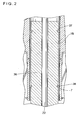
- FIG. 2 is a cross sectional view showing a part of a piston of a Stirling cycle engine according to the second embodiment.
- the Stirling cycle engine of this embodiment employs the same structure as that of the first embodiment except a piston 36, and thus the same reference numbers will denote the same structural portions, and detailed explanations thereof will be omitted.
- two grooves 37 are formed along the outer periphery of the piston 36 on the outer surface thereof, while piston rings 38 made from PPS are fitted in the grooves 37, and thus the piston rings 38 slide on the inner peripheral surface of the cylinder 7 when the piston 36 reciprocates.
- PPS is an engineering plastic having fine mechanical strength and formability, accordingly dimensional stability, mechanical strength and abrasion resistance are further added by mixing discontinuous fibers of carbon, while lubricity is added by adding solid lubricity agent such as molybdenum disulfide, PTFE or the like.
- the piston 36 does not directly contact the inner peripheral surface of the cylinder 7 when reciprocates, and thus the piston 36 itself does not abrade. Accordingly, only the piston rings 38 may be replaced in a regular maintenance and replacement thereof is simple, and thus the maintenance cost would be inexpensive. Further, the piston rings 38 are easy to form, do not easily deform or abrade, and has excellent durability since those are made from PPS. Still further, the abrasion of the inner peripheral surface of the cylinder 7 can be decreased due to the lubricity of the piston rings 38, and thus the durability of the cylinder 7 can be improved.
- grooves 37 are formed on the outer surface of the piston 36 and the piston rings 38 are fitted to the grooves 37 in this embodiment, forming the grooves 37 is not necessarily required.
- the piston rings 38 may be fitted without forming the grooves 37.
- the piston rings 38 may be fitted to the outer surface of the displacer 8.
- the piston rings 38 are made from PPS in this embodiment, the cylinder 7 may be made from PPS instead.
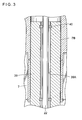
- FIG. 3 is a cross sectional view showing a part of a piston of a Stirling cycle engine according to the third embodiment.
- the Stirling cycle engine of this embodiment employs the same structure as that of the first embodiment except a piston 39, and thus the same reference numbers will denote the same structural portions, and detailed explanations thereof will be omitted.
- two sleeves 40 sliding-contacting means
- the sleeves 40 and the rod 22 are to slide.
- the sleeves 40 are made from PPS, an engineering plastic having fine mechanical strength and formability, to which are added dimensional stability, mechanical strength and abrasion resistance by mixing discontinuous fibers of carbon, while lubricity is added by adding solid lubricity agent such as molybdenum disulfide, PTFE or the like.
- the piston 39 itself does not abrade when the piston 39 and the rod 22 relatively move, since the inner surface of the rod through-hole 39A of the piston 39 does not directly contact the rod 22, and thus only the sleeves 40 may be replaced when maintenance thereof is carried out. Accordingly, maintenance cost would be inexpensive.
- each sleeve 40 is made from PPS, it has less abrasion, fine dimensional stability, mechanical strength and high lubricity. Accordingly, the stable movement thereof can be assured over a long period of time, while the durability can be improved. Further, since each sleeves 40 itself has high lubricity, the abrasion of the rod 22 sliding with the sleeves 40 can be decreased, and thus the durability of the rod 22 can be improved.
- the sleeves 40 are made from PPS in the foregoing embodiment, the outer peripheral surface of the rod 22 may be coated with PPS instead.
- PPS is used as an engineering plastic having fine abrasion resistance, dimensional stability, mechanical strength and formability in the above-described embodiments, but other kinds of engineering plastics, such as POM (polyoxymethylene), PEEK (Poly Ether Ether Ketone, registered trademark) may be used.
- POM polyoxymethylene
- PEEK Poly Ether Ether Ketone, registered trademark
- discontinuous fibers of carbon are mixed in the engineering plastic satisfying the above-described conditions in the above-described embodiments so as to form CFPR, but discontinuous fibers of glass may be mixed so as to form GFRP (Glass Fiber Reinforced Plastic).
- the free-piston type reverse Stirling cycle Stirling cooler is taken as an example of the Stirling cycle engine in the above-described embodiments, the present invention may be applied to other kinds or types of Stirling cycle engine, such as non free-piston type Stirling cooler, Stirling engine using the Stirling cycle, or the like.
- the invention provides a Stirling engine wherein when the piston reciprocates in the cylinder along the axial direction thereof by the driving mechanism, the displacer reciprocates in the cylinder along the axial direction thereof accompanying the reciprocation of the piston.
- the piston and the displacer slide in contact with the inner peripheral surface of the cylinder, but the piston and the displacer are molded into a single piece by an engineering plastic such as PPS having fme strength, dimensional stability, abrasion resistance and formability, while PPS is made CFRP.
- solid lubricity agent is added to PPS. Accordingly, abrasion resistance, lubricity, strength and precision of the piston and displacer are enhanced, while the piston and the displacer can be simply produced by a well- known plastic molding.
Landscapes
- Engineering & Computer Science (AREA)
- Chemical & Material Sciences (AREA)
- Combustion & Propulsion (AREA)
- Mechanical Engineering (AREA)
- General Engineering & Computer Science (AREA)
- Pistons, Piston Rings, And Cylinders (AREA)
Abstract
Description
- The present invention relates to a Stirling cycle engine.
- An example of a conventional Stirling cycle engine is disclosed in Japanese Patent Unexamined Publication No. 2001-355513. The disclosed Stirling cycle engine has a piston and a displacer slidably inserted into a cylinder provided within a casing, the piston being reciprocated by a driving mechanism. When the piston is operated by the driving mechanism so that it travels in the cylinder and comes close to the displacer, a gas, which is in a compression chamber provided between the piston and the displacer, is compressed and flows into an expansion chamber provided between a distal end of the displacer and a distal portion of the casing, through a heat dissipating fin, a regenerator and a heat absorbing fin. Accordingly, the displacer is pushed downwardly with a predetermined phase difference relative to the piston. On the other hand, when the piston travels in the cylinder away from the displacer, the inside of the compression chamber is subjected to negative pressure, and the gas in the expansion chamber flows back to the compression chamber through the heat absorbing fin, the regenerator and the heat dissipating fin. Accordingly, the displacer is pressed upwardly with the predetermined phase difference relative to the piston. Throughout these processes, a reversible cycle consisting of two changes: an isothermal change; and an isovolumetric change is carried out, and thus a portion adjacent to the expansion chamber is brought into a low-temperature state and a portion adjacent to the compression chamber is brought into a high-temperature state.
- As described, in the above-described Stirling cycle engine, the piston is reciprocated in the cylinder along the axial direction of the cylinder by the driving mechanism for operating the piston, while the displacer is reciprocated in the cylinder in conjunction with the piston along the axial direction of the cylinder. Since the piston and displacer move inside the cylinder, abrasion resistances and lubricities of the piston, displacer and cylinder are extremely important in this kind of the Stirling cycle engine. In the case of using lubricating oil in order to improve the abrasion resistance and lubricity thereof, the lubricating oil may fly in all directions within the Stirling cycle engine, so that the flied lubricating oil may cause the regenerator to be clogged therewith, and thus the flow of the gas is blocked. Accordingly, gas lubrication mechanisms have conventionally been formed on the surfaces of the piston and/or displacer, or coatings of PTFE (polytetrafluorethylene) having self-lubricities have been formed on the surfaces of the piston and/or displacer, or on the inner peripheral surface of the cylinder.
- In the case of forming the gas lubrication mechanisms, however, since it is necessary to form gas-films by continuously blowing the gas inside the Stirling cycle engine to small clearances between the cylinder and the piston and/or displacer, the structures of the piston and/or displacer become complicated. Accordingly, a complicated processing is necessary, and thus not only the cost thereof would be increased, but also the reliability thereof would be jeopardized. Moreover, in the case of forming the PTFE coating, the PTFE on the surfaces may be abraded due to the movement of the piston and/or displacer in the cylinder even if it has self-lubricity, while the worn PTFE is liable to be reduced to powder and cause the regenerator to be clogged therewith.
- The present invention has been made to solve the above problems. It is, therefore, an object of the present invention to simplify a structure of a Stirling cycle engine so as to simplify the assembling thereof and to enhance the abrasion resistance and lubricity of a cylinder, displacer and piston so as to improve the reliability of the Stirling cycle engine.
- In order to attain the above object, according to a first aspect of the present invention, there is provided a Stirling cycle engine comprising: a casing (1); a cylinder (7) coaxially inserted into the casing (1); a displacer (8) slidably inserted into the inside of a distal portion of the cylinder (7); a piston (15) slidably inserted into the inside of a proximal portion of the cylinder (7); and a driving mechanism (16) provided at an outer periphery of the proximal portion of the cylinder (7), the driving mechanism (16) reciprocating the piston (15), characterized in that either an inner peripheral surface of the cylinder (7) or an inner peripheral surface(s) of the piston (15) and/or displacer (8) is made from an engineering plastic having fine abrasion resistance, dimensional stability, mechanical strength and formability.
- By employing the above-described structure, the cylinder (7), piston (15), displacer (8) etc. can have necessary abrasion resistances, precisions and strengths. Accordingly, reliability, durability and effectiveness of the Stirling cycle engine can be enhanced. Further, those cylinder (7), piston (15), displacer (8) and, etc. can be simply made by a well-known plastic molding.
- In order to attain the above object, according to a second aspect of the present invention, there is provided a Stirling cycle engine comprising: a piston (15); a displacer(8), and a cylinder (7) slidably including the piston (15) and the displacer (8), characterized in that either an inner peripheral surface of the cylinder (7) or an outer peripheral surface(s) of the piston (15) and/or displacer (8) is made from an engineering plastic having fine abrasion resistance, dimensional stability, mechanical strength and formability.
- By employing the above-described structure, the cylinder (7), piston (15), displacer (8) etc. can have necessary abrasion resistances, precisions and strengths. Accordingly, reliability, durability and effectiveness of the Stirling cycle engine can be enhanced. Further, those cylinder (7), piston (15), displacer (8), etc. can be simply made by a well-known plastic molding.
- In order to attain the above object, according to a third aspect of the present invention, there is provided a Stirling cycle engine comprising: a piston (36); a displacer (8); and a cylinder (7) slidably including the piston (36) and the displacer (8), a piston ring(s) (38) attached to an outer surface(es) of the piston (36) and/or the displacer (8), characterized in that either an inner peripheral surface of the cylinder (7) or the piston ring (38) is made from an engineering plastic having fine abrasion resistance, dimensional stability, mechanical strength and formability.
- By employing the above-described structure, the cylinder (7) or the piston ring(s) (38) can have necessary abrasion resistance, precision and strength. Accordingly, reliability, durability and effectiveness of the Stirling cycle engine can be enhanced. Further, the cylinder (7) or the piston rings (38) can be simply made by a well-known plastic molding.
- In order to attain the above object, according to a fourth embodiment of the present invention, there is provided a Stirling cycle engine comprising: a cylinder (7); a displacer (8) slidably inserted into the inside of a distal portion of the cylinder (7); a piston (15) slidably inserted into the inside of a proximal portion of the cylinder (7), the piston (15) having a through-hole (15B) along an axis of the piston (15); and a displacer rod (22) inserted into the through-hole (15B), one end of the displacer rod (22) connected to the displacer (8) so as to limit a reciprocation movement of the displacer (8), characterized in that either an inner surface of the through-hole (15B) or an outer peripheral surface of the displacer rod (22) is made from an engineering plastic having fine abrasion resistance, dimensional stability, mechanical strength and formability.
- By employing the above-described structure, the piston (15) or the displacer rod (22) can have necessary abrasion resistance, precision and strength. Accordingly, reliability, durability and effectiveness of the Stirling cycle engine can be enhanced. Further, the piston (15), displacer rod (22), etc. can be simply made by a well-known plastic molding.
- In order to attain the above object, according to a fifth aspect of the present invention, there is provided a Stirling cycle engine comprising: a cylinder (7); a displacer (8) slidably inserted into the inside of a distal portion of the cylinder (7); a piston (39) slidably inserted into the inside of a proximal portion of the cylinder (7), the piston (39) having a through-hole (39A) along an axis of the piston (39); at least a sliding-contacting means (40) inserted into the through-hole (39A); and a displacer rod (22) inserted into the sliding-contacting means (40) in the through-hole (39A), one end of the displacer rod (22) connected to the displacer (8) so as to limit a reciprocation movement of the displacer (8), characterized in that either the sliding-contacting means (40) or an outer peripheral surface of the displacer rod (22) is made from an engineering plastic having fine abrasion resistance, dimensional stability, mechanical strength and formability.
- By employing the above-described structure, the sliding-contacting means (40) or the displacer rod (22) can have necessary abrasion resistance, precision and strength. Accordingly, reliability, durability and effectiveness of the Stirling cycle engine can be enhanced. Further, the sliding-contacting means (40) or the displacer rod (22) can be simply made by a well-known plastic molding.
- Alternatively, in the Stirling cycle engine employing the above-structures, the engineering plastic may comprise a fiber-reinforced plastic.
- Further, solid lubricity agent may be added to the engineering plastic.
- FIG. 1 is a cross sectional view entirely showing a Stirling cycle engine according to a first embodiment of the present invention;
- FIG. 2 is a cross sectional view showing a part of a piston of a Stirling cycle engine according to a second embodiment; and
- FIG. 3 is a cross sectional view showing a part of a piston of a Stirling cycle engine according to a third embodiment.
-
- Preferred embodiments of the present invention will now be described in detail with reference to the accompanying drawings, taking a free-piston type Stirling cooler as an example of a Stirling cycle engine. In the following description, which is top and which is bottom goes by a posturing shown in FIG. 1.
- In FIG. 1,
reference number 1 denotes a casing which comprises: acylindrical portion 2 formed in a substantially cylindrical shape; and amain body portion 3 also formed in a substantially cylindrical shape. Thecylindrical portion 2 is made from, for example, stainless steel and comprises aproximal portion 4, anintermediate portion 5 and adistal portion 6, while these three portions are integrated with one another. - Inside the
cylindrical portion 2, acylinder 7 extending to the inside of themain body portion 3 is coaxially inserted. An extendedcylinder portion 7A which is a discrete portion from thecylinder 7 is coaxially connected to the distal end of thecylinder 7 adjacent to thedistal portion 6. Thecylinder 7 locating adjacent to themain body portion 3 is integrally formed withmounts 26, 27 (described later) and a plurality of connecting arms 30 (also described later) by casting such as die casting, using a metallic material such as aluminum, and the inner and the outer peripheries thereof are formed by cutting after casting. Adisplacer 8 is slidably accommodated inside the distal part of thecylinder 7 and that of the extendedcylinder portion 7A so as to slide along the axial direction thereof. An expansion chamber E is provided between the distal end of thedisplacer 8 and thedistal portion 6 of thecylindrical portion 2, while the inside and outside of the extendedcylinder portion 7A are communicated with each other via anaperture 9. In theintermediate portion 5, aregenerator 10 is provided between the inner periphery of thecylindrical portion 2 and the outer periphery of thecylinder 7. In theproximal portion 4, acommunication hole 11 for allowing the inside of thecylinder 7 to communicate with the outside thereof is formed on thecylinder 7. Aheat absorbing fin 12 is provided between the inner periphery of thedistal portion 6 included in thecylindrical portion 2 and the outer periphery of the distal end of the extendedcylinder portion 7A, while aheat dissipating fin 13 is provided between the inner periphery of thecylindrical portion 2 and the outer periphery of thecylinder 7 in between theregenerator 10 and thecommunication hole 11. Apath 14 is formed so as to connect the distal end of the inside of the extendedcylinder portion 7A to the compression chamber C provided inside thecylinder 7 through theaperture 9, theheat absorbing fin 12, theregenerator 10, theheat dissipating fin 13 and thecommunication hole 11. Moreover, in themain body portion 3, apiston 15 is slidably accommodated inside the proximal side of thecylinder 7 in a manner capable of sliding in the axial direction of thecylinder 7. A proximal portion of thepiston 15 is coaxially connected to adriving mechanism 16. Thedriving mechanism 16 comprises: a short-cylindrical supportingmember 17 connected to the proximal portion of thepiston 15 via a connectingmember 15A and coaxially provided on the outer periphery of the proximal side of thecylinder 7; apermanent magnet 18 formed in a short-cylindrical shape and fixed to the inner peripheral surface of the distal portion of the supportingmember 17; an annularelectromagnetic coil 19 provided adjacent to the outer periphery of thepermanent magnet 18; and amagnetism introducing portion 20 provided adjacent to the inner periphery of thepermanent magnet 18. Further, a rod through-hole 15B is coaxially formed on thepiston 15, while a rod 22 (described later) is inserted into the rod through-hole 15B. - A smoothed
coating layer 7B is formed on the inner peripheral surface of thecylinder 7 by electroless plating of chromated zinc, nickel or the like to enhance hardness of the inner surface and to improve abrasion resistance thereof, Correspondingly, thepiston 15 anddisplacer 8 are made from PPS (polyphenylene sulfide) so as to be integrated with each other, wherein PPS is an engineering plastic having fine abrasion resistance, dimensional stability, mechanical strength and formability. Meanwhile, PPS forming thepiston 15 and displacer 8 becomes CFRP (Carbon Fiber Reinforced Plastic) when discontinuous fibers of carbon are mixed therein, so that its dimensional stability, mechanical strength and abrasion resistance is further improved. Moreover, lubricity is added by adding solid lubricity agent such as molybdenum disulfide, PTFE or the like. Thepiston 15 and thedisplacer 8 can be made by a well-known plastic molding technique. - To the connecting
member 15A for connecting thepiston 15 to the supportingmember 17, a firstflat spring 21 for controlling the operation of thepiston 15 is attached. Moreover, to the proximal side of thedisplacer 8, one end of the rod 22 (displacer rod) is connected for controlling the operation of thedisplacer 8, while the other end thereof is connected to a secondflat spring 23. Therod 22 extends in a manner that it penetrates thepiston 15 throughout the rod through-hole 15B. Therod 22 is made of, for example, relatively rigid stainless steel. As illustrated, a pair of theflat springs cylinder 7 in themain body portion 3, while the secondflat spring 23 is placed in a position away from the proximal part of thecylinder 7 compared to a position where the firstflat spring 21 is placed. Meanwhile, theelectromagnetic coil 19 is wound around anelectromagnetic core 24, while theelectromagnetic core 24 is integrated with theelectromagnetic coil 19. - At the outer peripheral surface of the intermediate part of the
cylinder 7, themount 26 coaxially protruding along with thecylinder 7 is integrally formed, while at a position more closer to the proximal end of thecylinder 7 compared to the position where themount 26 is placed, the flange-type mount 27 is integrally formed on thecylinder 7. The pair ofmounts mount 26 contacts theproximal portion 4 of thecylindrical portion 2 via O-rings 26A and fixes thecylinder 7 to thecylindrical portion 2 of thecasing 1. Themount 27 employs a structure such that oneside surface 27A thereof contacts amount portion 3A locating the inside of themain body portion 3. Themount 27 is fixed to themount portion 3A by at least one screw, while theother side surface 27B thereof contacts one end of theelectromagnetic core 24 comprising thedriving mechanism 16. The other end of theelectromagnetic core 24 contacts afixation ring 28. For supporting theelectromagnetic core 24, themount 27 and thefixation ring 28 sandwiches it while ascrew 29 fastens them. Accordingly, theelectromagnetic core 24 and theelectromagnetic coil 19 integrated with it are mounted onto themount 27. Moreover, at theother side surface 27B of themount 27, the plurality of connectingarms 30 are provided so as to protrude from theother side surface 27B along the axial direction of thecylinder 7. As illustrated, the connectingarms 30 are integrally formed with themount 27 viaproximal portions 30A thereof. The firstflat spring 21 is attached to the distal portions of the connectingarms 30 viaspacers 31, while the secondflat spring 23 is attached to thespacers 31 byscrews 32. - Meanwhile,
reference number 33 denotes a vibration absorbing unit provided at the other end of thecasing 1, while thevibration absorbing unit 33 comprises pluralflat springs 34 and a balancingweight 35. The plural blade springs 34 and the balancingweight 35 coaxially stack on with each other through a connecting portion arranged on the axial line of thecylinder 7. - The
cylinder 7 is thus fixed to thecasing 1 by allowing: themount 26 to contact the inside of theproximal portion 4 included in thecylindrical portion 2 via the O-ring 26A; the oneside surface 27A of themount 27 to contact themount portion 3A in themain body portion 3; and themount 27 to be screwed on themount portion 3A via an non-illustrated screw. Since themount 26 contacts the inner surface of thecylindrical portion 2 via the O-ring 26A, thecylinder 7 can be coaxially arranged relative to thecylindrical portion 2. Thecylinder 7 allows themagnetism introducing portion 20 to be attached to the outer periphery of the proximal end thereof, while it also allows theelectromagnetic coil 19 and theelectromagnetic core 24 both included in thedriving mechanism 16 to be fixed to themount 27 integrally formed on thecylinder 7 by thefixation ring 28 and thescrew 29. Thedisplacer 8 and thepiston 15 or the like are installed in thecylinder 7, the firstflat spring 21 attached to the connectingmember 15A adjacent to the proximal portion of thepiston 15 is sandwiched and supported between the connectingarms 30 and thespacers 31, while the secondflat spring 23 in which the center part is connected to the other end of therod 22 connected to thedisplacer 8 is fixed to the other ends of thespacers 31. Themain body portion 3 and thecylindrical portion 2 are connected to each other, while thevibration absorbing unit 33 pre-assembled is then attached to themain body portion 3. - In the Stirling cycle engine employing the above-described structure, when an alternate current is applied to the
electromagnetic coil 19, an alternate magnetic field is generated from theelectromagnetic coil 19 and concentrated around theelectromagnetic core 24. A force for allowing thepermanent magnet 18 to reciprocate along the axial direction of thecylinder 7 is then generated by the generated alternate magnetic field. Due to this force, thepiston 15 connected to the supportingmember 17 supporting thepermanent magnet 18 starts reciprocating in thecylinder 7 along the axial direction of thecylinder 7. When thepiston 15 travels toward thedisplacer 8, a gas in a compression chamber C locating in between thedisplacer 8 and thepiston 15 is compressed. The compressed gas then flows into the expansion chamber E locating in between the distal end of thedisplacer 8 and thedistal portion 6 of thecylindrical portion 2, through thecommunication hole 11, theheat dissipating fin 13, theregenerator 10, theheat absorbing fin 12 and theaperture 9, and thus thedisplacer 8 is pressed downwardly with a predetermined phase difference relative to thepiston 15. On the other hand, when thepiston 15 travels away from thedisplacer 8, the inside of the compression chamber C is subjected to negative pressure and the gas in the expansion chamber E flows back to the compression chamber C through theaperture 9, theheat absorbing fin 12, theregenerator 10, theheat dissipating fin 13 and thecommunication hole 11, and thus thedisplacer 8 is pressed upwardly with the predetermined phase difference relative to thepiston 15. Throughout these processes, a reversible cycle consisting of two changes: an isothermal change; and an isovolumetric change is carried out, thus the adjacent part of the expansion chamber E is brought into a low-temperature state, while the compression chamber C is brought into a high-temperature state. - The force for allowing the
permanent magnet 18 to reciprocate along the axial direction of thecylinder 7 is generated by the alternate magnetic field generated from theelectromagnetic coil 19 of thedriving mechanism 16, and thus thepiston 15 connected to the supportingmember 17 supporting thepermanent magnet 18 reciprocates in thecylinder 7 along the axial direction thereof due to the force, while thedisplacer 8 reciprocates in conjunction with the reciprocation of thepiston 15 with the predetermined phase difference relative to thepiston 15. Thepiston 15 and thedisplacer 8 contact the inner peripheral surface of thecylinder 7 and slide across the inner peripheral surface thereof, while therod 22 slides in contact with the inner surface of the rod through-hole 15B of thepiston 15 at the same time. However, the abrasion of thepiston 15,displacer 8,cylinder 7 androd 22 can be considerably prevented since: the abrasion resistance of the inner peripheral surface of thecylinder 7 working as a sliding surface for thepiston 15 anddisplacer 8 is enhanced by thecoating layer 7B having fine abrasion resistance, formed on the inner peripheral surface of thecylinder 7; the abrasion resistance of therod 22 is enhanced because it is made from relatively rigid stainless steel; and thepiston 15 and thedisplacer 8 are made from PPS so as to be integrated with each other, PPS having fine abrasion resistance. Moreover, since thepiston 15 and thedisplacer 8 are made from PPS having fine mechanical strength and dimensional stability, a possibility that thepiston 15 and thedisplacer 8 will be broken can be minimized, while the possibility that thepiston 15 and thedisplacer 8 will be immobilized in thecylinder 7 due to thepiston 15 and thedisplacer 8 thermally expanding and clinging to the inner peripheral surface of thecylinder 7, can also be minimized. Conversely, even if the gap is made further smaller, yet the possibility of thepiston 15 and thedisplacer 8 clinging to the inner peripheral surface of thecylinder 7 and being immobilized therein due to the thermal expansion thereof can be minimized, and thus the gap can be safely made further smaller so that the amount of a gas leaking from a gap between thepiston 15/thedisplacer 8 and thecylinder 7 can be reduced, thus enhancing the effectiveness of the Stirling cycle. Further, by allowing PPS to be CFRP and allowing solid lubricity agent such as molybdenum disulfide, PTFE or the like to be added, strength, precision and abrasion resistance of thepiston 15 and thedisplacer 8 are further improved, while lubricity thereof also is added. Accordingly, abrasion of the portions where the sliding between thepiston 15/thedisplacer 8 and thecylinder 7 occur can be further suppressed, as well as abrasion of the portion where the sliding between therod 22 and the rod through-hole 15B of thepiston 15 occur can also be further suppressed, while ensuring the improvement of lubricities thereof. Therefore, the reliability and durability of thecylinder 7,piston 15 anddisplacer 8 can be enhanced. Further, by employing a structure such that thepiston 15 and thedisplacer 8 made from PPS and integrated with each other are incorporated into thecylinder 7 in which thecoating layer 7B is formed on the inner peripheral surface thereof by electroless plating, the structures of thecylinder 7,piston 15 anddisplacer 8 can be simplified compared to the conventional ones, and thus a forming process of the Stirling cycle engine can be simplified. Besides, since a gas lubrication mechanism or the like is not necessary, the number of assembled parts can be decreased, and thus the assembling workability of the Stirling cycle engine can be improved. Still further, thepiston 15 and thedisplacer 8 can be easily made by a well-known plastic molding technique. - Meanwhile, whilst the
piston 15 and thedisplacer 8 are made from PPS and integrated with each other in the above embodiment, thecylinder 7 may be made from PPS, and/or the surface of therod 22 may be coated with PPS. - Next, a second embodiment of the present invention will now be described. FIG. 2 is a cross sectional view showing a part of a piston of a Stirling cycle engine according to the second embodiment. Meanwhile, the Stirling cycle engine of this embodiment employs the same structure as that of the first embodiment except a
piston 36, and thus the same reference numbers will denote the same structural portions, and detailed explanations thereof will be omitted. In this embodiment, twogrooves 37 are formed along the outer periphery of thepiston 36 on the outer surface thereof, while piston rings 38 made from PPS are fitted in thegrooves 37, and thus the piston rings 38 slide on the inner peripheral surface of thecylinder 7 when thepiston 36 reciprocates. As with the first embodiment, PPS is an engineering plastic having fine mechanical strength and formability, accordingly dimensional stability, mechanical strength and abrasion resistance are further added by mixing discontinuous fibers of carbon, while lubricity is added by adding solid lubricity agent such as molybdenum disulfide, PTFE or the like. - According to this embodiment, the
piston 36 does not directly contact the inner peripheral surface of thecylinder 7 when reciprocates, and thus thepiston 36 itself does not abrade. Accordingly, only the piston rings 38 may be replaced in a regular maintenance and replacement thereof is simple, and thus the maintenance cost would be inexpensive. Further, the piston rings 38 are easy to form, do not easily deform or abrade, and has excellent durability since those are made from PPS. Still further, the abrasion of the inner peripheral surface of thecylinder 7 can be decreased due to the lubricity of the piston rings 38, and thus the durability of thecylinder 7 can be improved. - Whilst the
grooves 37 are formed on the outer surface of thepiston 36 and the piston rings 38 are fitted to thegrooves 37 in this embodiment, forming thegrooves 37 is not necessarily required. The piston rings 38 may be fitted without forming thegrooves 37. Moreover, the piston rings 38 may be fitted to the outer surface of thedisplacer 8. Alternatively, whilst the piston rings 38 are made from PPS in this embodiment, thecylinder 7 may be made from PPS instead. - Next, a third embodiment of the present invention will now be described. FIG. 3 is a cross sectional view showing a part of a piston of a Stirling cycle engine according to the third embodiment. Meanwhile, the Stirling cycle engine of this embodiment employs the same structure as that of the first embodiment except a
piston 39, and thus the same reference numbers will denote the same structural portions, and detailed explanations thereof will be omitted. In this embodiment, two sleeves 40 (sliding-contacting means) are passed through a rod-through-hole 39A of apiston 39, while thesleeves 40 and therod 22 are to slide. Thesleeves 40 are made from PPS, an engineering plastic having fine mechanical strength and formability, to which are added dimensional stability, mechanical strength and abrasion resistance by mixing discontinuous fibers of carbon, while lubricity is added by adding solid lubricity agent such as molybdenum disulfide, PTFE or the like. - According to this embodiment, the
piston 39 itself does not abrade when thepiston 39 and therod 22 relatively move, since the inner surface of the rod through-hole 39A of thepiston 39 does not directly contact therod 22, and thus only thesleeves 40 may be replaced when maintenance thereof is carried out. Accordingly, maintenance cost would be inexpensive. Moreover, since eachsleeve 40 is made from PPS, it has less abrasion, fine dimensional stability, mechanical strength and high lubricity. Accordingly, the stable movement thereof can be assured over a long period of time, while the durability can be improved. Further, since eachsleeves 40 itself has high lubricity, the abrasion of therod 22 sliding with thesleeves 40 can be decreased, and thus the durability of therod 22 can be improved. - Alternatively, whilst the
sleeves 40 are made from PPS in the foregoing embodiment, the outer peripheral surface of therod 22 may be coated with PPS instead. - Various embodiments and changes may be made thereonto without departing from the broad spirit and scope of the invention. The above-described embodiments are intended to illustrate the present invention, not to limit the scope of the present invention. For example, PPS is used as an engineering plastic having fine abrasion resistance, dimensional stability, mechanical strength and formability in the above-described embodiments, but other kinds of engineering plastics, such as POM (polyoxymethylene), PEEK (Poly Ether Ether Ketone, registered trademark) may be used. Moreover, discontinuous fibers of carbon are mixed in the engineering plastic satisfying the above-described conditions in the above-described embodiments so as to form CFPR, but discontinuous fibers of glass may be mixed so as to form GFRP (Glass Fiber Reinforced Plastic). Further, whilst the free-piston type reverse Stirling cycle Stirling cooler is taken as an example of the Stirling cycle engine in the above-described embodiments, the present invention may be applied to other kinds or types of Stirling cycle engine, such as non free-piston type Stirling cooler, Stirling engine using the Stirling cycle, or the like.
- Summarized, the invention provides a Stirling engine wherein when the piston reciprocates in the cylinder along the axial direction thereof by the driving mechanism, the displacer reciprocates in the cylinder along the axial direction thereof accompanying the reciprocation of the piston. The piston and the displacer slide in contact with the inner peripheral surface of the cylinder, but the piston and the displacer are molded into a single piece by an engineering plastic such as PPS having fme strength, dimensional stability, abrasion resistance and formability, while PPS is made CFRP. Moreover, solid lubricity agent is added to PPS. Accordingly, abrasion resistance, lubricity, strength and precision of the piston and displacer are enhanced, while the piston and the displacer can be simply produced by a well- known plastic molding.
Claims (7)
- A Stirling cycle engine comprising:characterized in that either an inner peripheral surface of said cylinder (7) or an outer peripheral surface(s) of said piston (15) and/or displacer (8) is made from an engineering plastic having fine abrasion resistance, dimensional stability, mechanical strength and formability.a casing (1);a cylinder (7) coaxially inserted into said casing (1);a displacer (8) slidably inserted into the inside of a distal portion of said cylinder (7);a piston (15) slidably inserted into the inside of a proximal portion of said cylinder (7); anda driving mechanism (16) provided at an outer periphery of the proximal portion of said cylinder (7), said driving mechanism (16) reciprocating said piston (15),
- A Stirling cycle engine comprising:characterized in that either an inner peripheral surface of said cylinder (7) or an outer peripheral surface(s) of said piston (15) and/or displacer (8) is made from an engineering plastic having fine abrasion resistance, dimensional stability, mechanical strength and formability.a piston (15);a displacer(8); anda cylinder (7) slidably including said piston (15) and said displacer (8),
- A Stirling cycle engine comprising:characterized in that either an inner peripheral surface of said cylinder (7) or said piston ring (38) is made from an engineering plastic having fine abrasion resistance, dimensional stability, mechanical strength and formability.a piston (36);a displacer (8); anda cylinder (7) slidably including said piston (36) and said displacer (8),a piston ring(s) (38) attached to an outer surface(es) of said piston (36) and/or said displacer (8),
- A Stirling cycle engine comprising:characterized in that either an inner peripheral surface of said through-hole (15B) or an outer peripheral surface of said displacer rod (22) is made from an engineering plastic having fine abrasion resistance, dimensional stability, mechanical strength and formability.a cylinder (7);a displacer (8) slidably inserted into the inside of a distal portion of said cylinder (7);a piston (15) slidably inserted into the inside of a proximal portion of said cylinder (7), said piston (15) having a through-hole (15B) along an axis of said piston (15); anda displacer rod (22) inserted into said through-hole (15B), one end of said displacer rod (22) connected to said displacer (8) so as to limit a reciprocation movement of said displacer (8),
- A Stirling cycle engine comprising:characterized in that either said sliding-contacting means (40) or an outer peripheral surface of said displacer rod (22) is made from an engineering plastic having fine abrasion resistance, dimensional stability, mechanical strength and formability.a cylinder (7);a displacer (8) slidably inserted into the inside of a distal portion of said cylinder (7);a piston (39) slidably inserted into the inside of a proximal portion of said cylinder (7), said piston (39) having a through-hole (39A) along an axis of said piston (39);at least a sliding-contacting means (40) inserted into said through-hole (39A); anda displacer rod (22) inserted into said sliding-contacting means (40) in said through-hole (39A), one end of said displacer rod (22) connected to said displacer (8) so as to limit a reciprocation movement of said displacer (8),
- The Stirling cycle engine according to any one of claims 1 to 5, characterized in that said engineering plastic is a fiber-reinforced plastic.
- The Stirling cycle engine according to any one of claims 1 to 6, characterized in that solid lubricity agent is added to the engineering plastic.
Applications Claiming Priority (2)
| Application Number | Priority Date | Filing Date | Title |
|---|---|---|---|
| JP2003334275A JP3799411B2 (en) | 2003-05-23 | 2003-09-25 | Stirling cycle engine |
| JP2003334275 | 2003-09-25 |
Publications (1)
| Publication Number | Publication Date |
|---|---|
| EP1519029A1 true EP1519029A1 (en) | 2005-03-30 |
Family
ID=34191503
Family Applications (1)
| Application Number | Title | Priority Date | Filing Date |
|---|---|---|---|
| EP04016123A Withdrawn EP1519029A1 (en) | 2003-09-25 | 2004-07-08 | Stirling cycle engine |
Country Status (3)
| Country | Link |
|---|---|
| US (1) | US20050268604A1 (en) |
| EP (1) | EP1519029A1 (en) |
| CN (1) | CN100404837C (en) |
Cited By (1)
| Publication number | Priority date | Publication date | Assignee | Title |
|---|---|---|---|---|
| GB2455566A (en) * | 2007-12-14 | 2009-06-17 | Sunpower Inc | Free piston Stirling engine with friction element to control excessive movement |
Families Citing this family (15)
| Publication number | Priority date | Publication date | Assignee | Title |
|---|---|---|---|---|
| KR100529934B1 (en) * | 2004-01-06 | 2005-11-22 | 엘지전자 주식회사 | Linear compressor with vibration absorber on the outside |
| KR100680205B1 (en) * | 2005-01-07 | 2007-02-08 | 엘지전자 주식회사 | Linear compressor |
| US7490469B2 (en) * | 2006-08-07 | 2009-02-17 | United Technologies Corporation | Dual-function stirling engine system |
| WO2010067728A1 (en) * | 2008-12-10 | 2010-06-17 | トヨタ自動車株式会社 | Gas lubrication structure for piston, and stirling engine |
| US8726661B2 (en) | 2010-08-09 | 2014-05-20 | GM Global Technology Operations LLC | Hybrid powertrain system including an internal combustion engine and a stirling engine |
| CN103525522B (en) * | 2013-10-21 | 2015-02-18 | 广西大学 | Stirling engine lubricant |
| CN103775241B (en) * | 2014-01-24 | 2016-02-24 | 宁波荣捷特机械制造有限公司 | Regenerator in a kind of Stirling cycle device |
| CN104895697B (en) * | 2015-05-29 | 2016-05-25 | 广西发现科技有限公司 | A kind of free-piston stirling machine |
| US10323604B2 (en) * | 2016-10-21 | 2019-06-18 | Sunpower, Inc. | Free piston stirling engine that remains stable by limiting stroke |
| CN107237733A (en) * | 2017-07-18 | 2017-10-10 | 广州市安途电器有限公司 | A kind of novel plastic air pump movement |
| JP6833881B2 (en) * | 2019-01-25 | 2021-02-24 | ツインバード工業株式会社 | Reciprocating motion engine |
| US10815928B2 (en) | 2019-02-19 | 2020-10-27 | Sunpower, Inc. | Preventing overstroke of free-piston stirling engine from loss of load |
| CN111121334A (en) * | 2019-11-18 | 2020-05-08 | 上海厚酷科技有限公司 | Refrigerating machine power piston component |
| CN111076442A (en) * | 2019-11-18 | 2020-04-28 | 上海厚酷科技有限公司 | Pressure shell of refrigerating machine |
| CN112815565A (en) * | 2021-01-28 | 2021-05-18 | 宁波芯斯特林低温设备有限公司 | Stirling refrigerator |
Citations (6)
| Publication number | Priority date | Publication date | Assignee | Title |
|---|---|---|---|---|
| JPS5985457A (en) * | 1982-11-04 | 1984-05-17 | Mitsubishi Electric Corp | Seal structure of stirling engine |
| FR2541374A1 (en) * | 1982-10-20 | 1984-08-24 | Ae Plc | Composite IC engine piston |
| JPS6079142A (en) * | 1983-10-04 | 1985-05-04 | Mazda Motor Corp | Frp engine parts |
| JPS61223254A (en) * | 1985-03-28 | 1986-10-03 | Mitsubishi Electric Corp | Stirling engine |
| US5174193A (en) * | 1990-06-23 | 1992-12-29 | T&N Technology Limited | Pistons for engines or motors |
| JPH09152213A (en) * | 1995-11-30 | 1997-06-10 | Sanyo Electric Co Ltd | Piston for external combustion engine |
Family Cites Families (11)
| Publication number | Priority date | Publication date | Assignee | Title |
|---|---|---|---|---|
| DE1286807B (en) * | 1966-04-05 | 1969-01-09 | Leybold Heraeus Gmbh & Co Kg | Hot air motor or heat pump based on the Stirling principle |
| DE1293510C2 (en) * | 1966-04-05 | 1973-06-14 | Leybold Heraeus Gmbh & Co Kg | Hot air motor or heat pump |
| DE3044427C2 (en) * | 1980-11-26 | 1986-10-30 | Leybold-Heraeus GmbH, 5000 Köln | Displacement for cryogenic refrigeration machines |
| US4425764A (en) * | 1982-03-16 | 1984-01-17 | Kryovacs Scientific Corporation | Micro-cryogenic system with pseudo two stage cold finger, stationary regenerative material, and pre-cooling of the working fluid |
| US4550571A (en) * | 1983-12-28 | 1985-11-05 | Helix Technology Corporation | Balanced integral Stirling cryogenic refrigerator |
| US4662176A (en) * | 1985-04-15 | 1987-05-05 | Mitsubishi Denki Kabushiki Kaisha | Heat exchanger for a Stirling engine |
| JPH0679142A (en) | 1992-09-07 | 1994-03-22 | Mitsubishi Heavy Ind Ltd | Method for supplying liquid in reverse osmosis module |
| US5647217A (en) * | 1996-01-11 | 1997-07-15 | Stirling Technology Company | Stirling cycle cryogenic cooler |
| DE19738779C2 (en) * | 1997-09-04 | 2003-06-12 | Almatec Maschb Gmbh | Reversing system for a pressure driven diaphragm pump |
| US6256997B1 (en) * | 2000-02-15 | 2001-07-10 | Intermagnetics General Corporation | Reduced vibration cooling device having pneumatically-driven GM type displacer |
| WO2003001044A1 (en) * | 2001-06-20 | 2003-01-03 | New Power Concepts Llc | Piston ring improvements for a stirling engine |
-
2004
- 2004-07-06 CN CNB2004100634709A patent/CN100404837C/en not_active Expired - Lifetime
- 2004-07-07 US US10/886,133 patent/US20050268604A1/en not_active Abandoned
- 2004-07-08 EP EP04016123A patent/EP1519029A1/en not_active Withdrawn
Patent Citations (6)
| Publication number | Priority date | Publication date | Assignee | Title |
|---|---|---|---|---|
| FR2541374A1 (en) * | 1982-10-20 | 1984-08-24 | Ae Plc | Composite IC engine piston |
| JPS5985457A (en) * | 1982-11-04 | 1984-05-17 | Mitsubishi Electric Corp | Seal structure of stirling engine |
| JPS6079142A (en) * | 1983-10-04 | 1985-05-04 | Mazda Motor Corp | Frp engine parts |
| JPS61223254A (en) * | 1985-03-28 | 1986-10-03 | Mitsubishi Electric Corp | Stirling engine |
| US5174193A (en) * | 1990-06-23 | 1992-12-29 | T&N Technology Limited | Pistons for engines or motors |
| JPH09152213A (en) * | 1995-11-30 | 1997-06-10 | Sanyo Electric Co Ltd | Piston for external combustion engine |
Non-Patent Citations (2)
| Title |
|---|
| PATENT ABSTRACTS OF JAPAN vol. 0081, no. 95 (M - 323) 7 September 1984 (1984-09-07) * |
| PATENT ABSTRACTS OF JAPAN vol. 0092, no. 19 (M - 410) 6 September 1985 (1985-09-06) * |
Cited By (1)
| Publication number | Priority date | Publication date | Assignee | Title |
|---|---|---|---|---|
| GB2455566A (en) * | 2007-12-14 | 2009-06-17 | Sunpower Inc | Free piston Stirling engine with friction element to control excessive movement |
Also Published As
| Publication number | Publication date |
|---|---|
| CN1601074A (en) | 2005-03-30 |
| US20050268604A1 (en) | 2005-12-08 |
| CN100404837C (en) | 2008-07-23 |
Similar Documents
| Publication | Publication Date | Title |
|---|---|---|
| EP1519029A1 (en) | Stirling cycle engine | |
| JP5871801B2 (en) | Bearing support mechanism for free piston Stirling cycle engine | |
| US7168248B2 (en) | Stirling engine | |
| EP1167765B1 (en) | Linear compressor | |
| CA2766411A1 (en) | Linear compressor | |
| EP1208289A1 (en) | Gas bearing and method of making a gas bearing for a free piston machine | |
| EP1867936A1 (en) | Stirling engine | |
| JP3499447B2 (en) | Linear compressor | |
| KR100963548B1 (en) | Low wear piston sleeve | |
| JP3799411B2 (en) | Stirling cycle engine | |
| WO1990012961A1 (en) | Stirling cycle machine and compressor for use therein | |
| US10393411B2 (en) | Stirling cryocooler | |
| CN113217334A (en) | Linear compressor | |
| JP2000045867A (en) | Stirling engine | |
| US6492748B1 (en) | Reciprocator and linear suspension element therefor | |
| JP2000055067A (en) | Sliding key and continuously variable transmission | |
| JP2004003436A (en) | Stirling engine and storage using the same | |
| JP2007263521A (en) | Heat engine | |
| CN116816635B (en) | Linear Stirling refrigerator motor subassembly | |
| KR20210021699A (en) | Stirling Cooler | |
| US20070041854A1 (en) | Linear compressor, particularly refrigerant compressor | |
| JP2010203363A (en) | Vibration type compressor and stirling refrigerating machine | |
| JP2004162587A (en) | Cylinder structure, Stirling engine and compressor | |
| JP3989874B2 (en) | Linear compressor and Stirling engine equipped with the same | |
| JP2003166767A (en) | Stirling Institution |
Legal Events
| Date | Code | Title | Description |
|---|---|---|---|
| PUAI | Public reference made under article 153(3) epc to a published international application that has entered the european phase |
Free format text: ORIGINAL CODE: 0009012 |
|
| 17P | Request for examination filed |
Effective date: 20041206 |
|
| AK | Designated contracting states |
Kind code of ref document: A1 Designated state(s): AT BE BG CH CY CZ DE DK EE ES FI FR GB GR HU IE IT LI LU MC NL PL PT RO SE SI SK TR |
|
| AX | Request for extension of the european patent |
Extension state: AL HR LT LV MK |
|
| 17Q | First examination report despatched |
Effective date: 20050616 |
|
| AKX | Designation fees paid |
Designated state(s): DE FR GB NL |
|
| STAA | Information on the status of an ep patent application or granted ep patent |
Free format text: STATUS: THE APPLICATION IS DEEMED TO BE WITHDRAWN |
|
| 18D | Application deemed to be withdrawn |
Effective date: 20060815 |