EP1518463A1 - Fat emulsions with components with anti platelet activity - Google Patents
Fat emulsions with components with anti platelet activity Download PDFInfo
- Publication number
- EP1518463A1 EP1518463A1 EP03078064A EP03078064A EP1518463A1 EP 1518463 A1 EP1518463 A1 EP 1518463A1 EP 03078064 A EP03078064 A EP 03078064A EP 03078064 A EP03078064 A EP 03078064A EP 1518463 A1 EP1518463 A1 EP 1518463A1
- Authority
- EP
- European Patent Office
- Prior art keywords
- fats
- residue
- propionic acid
- component
- food grade
- Prior art date
- Legal status (The legal status is an assumption and is not a legal conclusion. Google has not performed a legal analysis and makes no representation as to the accuracy of the status listed.)
- Withdrawn
Links
- 230000000694 effects Effects 0.000 title claims abstract description 38
- 239000000839 emulsion Substances 0.000 title claims abstract description 19
- 230000000702 anti-platelet effect Effects 0.000 title claims abstract description 9
- 239000003146 anticoagulant agent Substances 0.000 title claims abstract description 9
- 239000003925 fat Substances 0.000 claims abstract description 51
- XLYOFNOQVPJJNP-UHFFFAOYSA-N water Substances O XLYOFNOQVPJJNP-UHFFFAOYSA-N 0.000 claims abstract description 38
- 235000013305 food Nutrition 0.000 claims abstract description 31
- XBDQKXXYIPTUBI-UHFFFAOYSA-N dimethylselenoniopropionate Natural products CCC(O)=O XBDQKXXYIPTUBI-UHFFFAOYSA-N 0.000 claims abstract description 22
- 235000012041 food component Nutrition 0.000 claims abstract description 20
- 238000000034 method Methods 0.000 claims abstract description 19
- DKVBOUDTNWVDEP-NJCHZNEYSA-N teicoplanin aglycone Chemical group N([C@H](C(N[C@@H](C1=CC(O)=CC(O)=C1C=1C(O)=CC=C2C=1)C(O)=O)=O)[C@H](O)C1=CC=C(C(=C1)Cl)OC=1C=C3C=C(C=1O)OC1=CC=C(C=C1Cl)C[C@H](C(=O)N1)NC([C@H](N)C=4C=C(O5)C(O)=CC=4)=O)C(=O)[C@@H]2NC(=O)[C@@H]3NC(=O)[C@@H]1C1=CC5=CC(O)=C1 DKVBOUDTNWVDEP-NJCHZNEYSA-N 0.000 claims abstract description 15
- 150000005599 propionic acid derivatives Chemical class 0.000 claims abstract description 14
- LFQSCWFLJHTTHZ-UHFFFAOYSA-N Ethanol Chemical group CCO LFQSCWFLJHTTHZ-UHFFFAOYSA-N 0.000 claims abstract description 13
- 239000002960 lipid emulsion Substances 0.000 claims abstract description 13
- 150000002148 esters Chemical class 0.000 claims abstract description 12
- 125000006519 CCH3 Chemical group 0.000 claims abstract description 11
- 125000002887 hydroxy group Chemical group [H]O* 0.000 claims abstract description 11
- 125000004464 hydroxyphenyl group Chemical group 0.000 claims abstract description 11
- 239000000203 mixture Substances 0.000 claims abstract description 11
- 235000019260 propionic acid Nutrition 0.000 claims abstract description 11
- IUVKMZGDUIUOCP-BTNSXGMBSA-N quinbolone Chemical group O([C@H]1CC[C@H]2[C@H]3[C@@H]([C@]4(C=CC(=O)C=C4CC3)C)CC[C@@]21C)C1=CCCC1 IUVKMZGDUIUOCP-BTNSXGMBSA-N 0.000 claims abstract description 11
- 125000003158 alcohol group Chemical group 0.000 claims abstract description 10
- 230000002785 anti-thrombosis Effects 0.000 claims abstract description 5
- 229940111131 antiinflammatory and antirheumatic product propionic acid derivative Drugs 0.000 claims abstract description 3
- 208000007536 Thrombosis Diseases 0.000 claims description 9
- 239000004006 olive oil Substances 0.000 claims description 9
- 235000008390 olive oil Nutrition 0.000 claims description 8
- 241000207836 Olea <angiosperm> Species 0.000 claims description 7
- 238000004519 manufacturing process Methods 0.000 claims description 7
- VPOVFCBNUOUZGG-VAKDEWRISA-N oleocanthal Chemical compound C\C=C(\C=O)[C@@H](CC=O)CC(=O)OCCC1=CC=C(O)C=C1 VPOVFCBNUOUZGG-VAKDEWRISA-N 0.000 claims description 2
- 210000001772 blood platelet Anatomy 0.000 description 28
- JUUBCHWRXWPFFH-UHFFFAOYSA-N Hydroxytyrosol Chemical compound OCCC1=CC=C(O)C(O)=C1 JUUBCHWRXWPFFH-UHFFFAOYSA-N 0.000 description 20
- 108090000190 Thrombin Proteins 0.000 description 19
- 229960004072 thrombin Drugs 0.000 description 19
- YCCILVSKPBXVIP-UHFFFAOYSA-N 2-(4-hydroxyphenyl)ethanol Chemical compound OCCC1=CC=C(O)C=C1 YCCILVSKPBXVIP-UHFFFAOYSA-N 0.000 description 16
- 210000002196 fr. b Anatomy 0.000 description 15
- 208000010110 spontaneous platelet aggregation Diseases 0.000 description 15
- 240000007817 Olea europaea Species 0.000 description 13
- 230000004044 response Effects 0.000 description 13
- RFWGABANNQMHMZ-UHFFFAOYSA-N 8-acetoxy-7-acetyl-6,7,7a,8-tetrahydro-5H-benzo[g][1,3]dioxolo[4',5':4,5]benzo[1,2,3-de]quinoline Natural products CC=C1C(CC(=O)OCCC=2C=C(O)C(O)=CC=2)C(C(=O)OC)=COC1OC1OC(CO)C(O)C(O)C1O RFWGABANNQMHMZ-UHFFFAOYSA-N 0.000 description 11
- HKVGJQVJNQRJPO-UHFFFAOYSA-N Demethyloleuropein Natural products O1C=C(C(O)=O)C(CC(=O)OCCC=2C=C(O)C(O)=CC=2)C(=CC)C1OC1OC(CO)C(O)C(O)C1O HKVGJQVJNQRJPO-UHFFFAOYSA-N 0.000 description 11
- RFWGABANNQMHMZ-HYYSZPHDSA-N Oleuropein Chemical compound O([C@@H]1OC=C([C@H](C1=CC)CC(=O)OCCC=1C=C(O)C(O)=CC=1)C(=O)OC)[C@@H]1O[C@H](CO)[C@@H](O)[C@H](O)[C@H]1O RFWGABANNQMHMZ-HYYSZPHDSA-N 0.000 description 11
- 235000011576 oleuropein Nutrition 0.000 description 11
- RFWGABANNQMHMZ-CARRXEGNSA-N oleuropein Natural products COC(=O)C1=CO[C@@H](O[C@H]2O[C@@H](CO)[C@H](O)[C@@H](O)[C@@H]2O)C(=CC)[C@H]1CC(=O)OCCc3ccc(O)c(O)c3 RFWGABANNQMHMZ-CARRXEGNSA-N 0.000 description 11
- 235000003248 hydroxytyrosol Nutrition 0.000 description 10
- 229940095066 hydroxytyrosol Drugs 0.000 description 10
- 150000002989 phenols Chemical class 0.000 description 10
- DBLDQZASZZMNSL-QMMMGPOBSA-N L-tyrosinol Natural products OC[C@@H](N)CC1=CC=C(O)C=C1 DBLDQZASZZMNSL-QMMMGPOBSA-N 0.000 description 8
- 108010077026 collagen-related peptide Proteins 0.000 description 8
- 150000001875 compounds Chemical class 0.000 description 8
- 238000000338 in vitro Methods 0.000 description 8
- 235000004330 tyrosol Nutrition 0.000 description 8
- 102000008186 Collagen Human genes 0.000 description 7
- 108010035532 Collagen Proteins 0.000 description 7
- 229920001436 collagen Polymers 0.000 description 7
- 230000005764 inhibitory process Effects 0.000 description 7
- QTBSBXVTEAMEQO-UHFFFAOYSA-N Acetic acid Chemical compound CC(O)=O QTBSBXVTEAMEQO-UHFFFAOYSA-N 0.000 description 6
- 102100023038 WD and tetratricopeptide repeats protein 1 Human genes 0.000 description 6
- 230000002776 aggregation Effects 0.000 description 6
- 238000004220 aggregation Methods 0.000 description 6
- 108010089485 convulxin Proteins 0.000 description 6
- UXVMQQNJUSDDNG-UHFFFAOYSA-L Calcium chloride Chemical compound [Cl-].[Cl-].[Ca+2] UXVMQQNJUSDDNG-UHFFFAOYSA-L 0.000 description 5
- 102000003886 Glycoproteins Human genes 0.000 description 5
- 108090000288 Glycoproteins Proteins 0.000 description 5
- 230000004913 activation Effects 0.000 description 5
- 239000000556 agonist Substances 0.000 description 5
- 239000011575 calcium Substances 0.000 description 5
- 239000001110 calcium chloride Substances 0.000 description 5
- 229910001628 calcium chloride Inorganic materials 0.000 description 5
- 239000000284 extract Substances 0.000 description 5
- 238000004128 high performance liquid chromatography Methods 0.000 description 5
- HAGOWCONESKMDW-FRSCJGFNSA-N (2s)-4-amino-2-[[(2s)-2-[[(2s)-2-[[(2s)-2-[[(2s)-2-[[(2s)-2-amino-3-hydroxypropanoyl]amino]-3-phenylpropanoyl]amino]-4-methylpentanoyl]amino]-4-methylpentanoyl]amino]-5-(diaminomethylideneamino)pentanoyl]amino]-4-oxobutanoic acid Chemical compound NC(N)=NCCC[C@@H](C(=O)N[C@@H](CC(N)=O)C(O)=O)NC(=O)[C@H](CC(C)C)NC(=O)[C@H](CC(C)C)NC(=O)[C@@H](NC(=O)[C@@H](N)CO)CC1=CC=CC=C1 HAGOWCONESKMDW-FRSCJGFNSA-N 0.000 description 4
- OYPRJOBELJOOCE-UHFFFAOYSA-N Calcium Chemical compound [Ca] OYPRJOBELJOOCE-UHFFFAOYSA-N 0.000 description 4
- 229910052791 calcium Inorganic materials 0.000 description 4
- 238000010790 dilution Methods 0.000 description 4
- 239000012895 dilution Substances 0.000 description 4
- 238000002474 experimental method Methods 0.000 description 4
- YFHXZQPUBCBNIP-UHFFFAOYSA-N fura-2 Chemical compound CC1=CC=C(N(CC(O)=O)CC(O)=O)C(OCCOC=2C(=CC=3OC(=CC=3C=2)C=2OC(=CN=2)C(O)=O)N(CC(O)=O)CC(O)=O)=C1 YFHXZQPUBCBNIP-UHFFFAOYSA-N 0.000 description 4
- 238000005259 measurement Methods 0.000 description 4
- ISWSIDIOOBJBQZ-UHFFFAOYSA-N phenol group Chemical group C1(=CC=CC=C1)O ISWSIDIOOBJBQZ-UHFFFAOYSA-N 0.000 description 4
- 230000008569 process Effects 0.000 description 4
- 108010063955 thrombin receptor peptide (42-47) Proteins 0.000 description 4
- OKKJLVBELUTLKV-UHFFFAOYSA-N Methanol Chemical compound OC OKKJLVBELUTLKV-UHFFFAOYSA-N 0.000 description 3
- 230000015271 coagulation Effects 0.000 description 3
- 238000005345 coagulation Methods 0.000 description 3
- 230000001419 dependent effect Effects 0.000 description 3
- DEFVIWRASFVYLL-UHFFFAOYSA-N ethylene glycol bis(2-aminoethyl)tetraacetic acid Chemical compound OC(=O)CN(CC(O)=O)CCOCCOCCN(CC(O)=O)CC(O)=O DEFVIWRASFVYLL-UHFFFAOYSA-N 0.000 description 3
- 210000003918 fraction a Anatomy 0.000 description 3
- 210000000540 fraction c Anatomy 0.000 description 3
- 230000010118 platelet activation Effects 0.000 description 3
- 235000013824 polyphenols Nutrition 0.000 description 3
- 238000002360 preparation method Methods 0.000 description 3
- 239000002351 wastewater Substances 0.000 description 3
- KWPACVJPAFGBEQ-IKGGRYGDSA-N (2s)-1-[(2r)-2-amino-3-phenylpropanoyl]-n-[(3s)-1-chloro-6-(diaminomethylideneamino)-2-oxohexan-3-yl]pyrrolidine-2-carboxamide Chemical compound C([C@@H](N)C(=O)N1[C@@H](CCC1)C(=O)N[C@@H](CCCNC(N)=N)C(=O)CCl)C1=CC=CC=C1 KWPACVJPAFGBEQ-IKGGRYGDSA-N 0.000 description 2
- XQXPVVBIMDBYFF-UHFFFAOYSA-N 4-hydroxyphenylacetic acid Chemical compound OC(=O)CC1=CC=C(O)C=C1 XQXPVVBIMDBYFF-UHFFFAOYSA-N 0.000 description 2
- IJGRMHOSHXDMSA-UHFFFAOYSA-N Atomic nitrogen Chemical compound N#N IJGRMHOSHXDMSA-UHFFFAOYSA-N 0.000 description 2
- 241000282412 Homo Species 0.000 description 2
- 102100037600 P2Y purinoceptor 1 Human genes 0.000 description 2
- 108010000499 Thromboplastin Proteins 0.000 description 2
- 102000002262 Thromboplastin Human genes 0.000 description 2
- 239000007983 Tris buffer Substances 0.000 description 2
- 208000027418 Wounds and injury Diseases 0.000 description 2
- 230000015572 biosynthetic process Effects 0.000 description 2
- 210000004369 blood Anatomy 0.000 description 2
- 239000008280 blood Substances 0.000 description 2
- 230000017531 blood circulation Effects 0.000 description 2
- 210000004204 blood vessel Anatomy 0.000 description 2
- 239000012141 concentrate Substances 0.000 description 2
- 230000001086 cytosolic effect Effects 0.000 description 2
- 230000006378 damage Effects 0.000 description 2
- 230000003111 delayed effect Effects 0.000 description 2
- 238000005194 fractionation Methods 0.000 description 2
- 238000002347 injection Methods 0.000 description 2
- 239000007924 injection Substances 0.000 description 2
- 208000014674 injury Diseases 0.000 description 2
- 230000001404 mediated effect Effects 0.000 description 2
- BDAGIHXWWSANSR-UHFFFAOYSA-N methanoic acid Natural products OC=O BDAGIHXWWSANSR-UHFFFAOYSA-N 0.000 description 2
- 210000004623 platelet-rich plasma Anatomy 0.000 description 2
- 238000012545 processing Methods 0.000 description 2
- 230000009467 reduction Effects 0.000 description 2
- 230000019491 signal transduction Effects 0.000 description 2
- 239000002904 solvent Substances 0.000 description 2
- 230000001960 triggered effect Effects 0.000 description 2
- LENZDBCJOHFCAS-UHFFFAOYSA-N tris Chemical compound OCC(N)(CO)CO LENZDBCJOHFCAS-UHFFFAOYSA-N 0.000 description 2
- RYAUSSKQMZRMAI-YESZJQIVSA-N (S)-fenpropimorph Chemical compound C([C@@H](C)CC=1C=CC(=CC=1)C(C)(C)C)N1C[C@H](C)O[C@H](C)C1 RYAUSSKQMZRMAI-YESZJQIVSA-N 0.000 description 1
- AUUIARVPJHGTSA-UHFFFAOYSA-N 3-(aminomethyl)chromen-2-one Chemical compound C1=CC=C2OC(=O)C(CN)=CC2=C1 AUUIARVPJHGTSA-UHFFFAOYSA-N 0.000 description 1
- OSWFIVFLDKOXQC-UHFFFAOYSA-N 4-(3-methoxyphenyl)aniline Chemical compound COC1=CC=CC(C=2C=CC(N)=CC=2)=C1 OSWFIVFLDKOXQC-UHFFFAOYSA-N 0.000 description 1
- WEVYAHXRMPXWCK-UHFFFAOYSA-N Acetonitrile Chemical compound CC#N WEVYAHXRMPXWCK-UHFFFAOYSA-N 0.000 description 1
- 108010017384 Blood Proteins Proteins 0.000 description 1
- 102000004506 Blood Proteins Human genes 0.000 description 1
- 241000196324 Embryophyta Species 0.000 description 1
- 240000005067 Jasminum grandiflorum Species 0.000 description 1
- 235000004412 Jasminum grandiflorum Nutrition 0.000 description 1
- 235000010254 Jasminum officinale Nutrition 0.000 description 1
- 239000004677 Nylon Substances 0.000 description 1
- 235000002725 Olea europaea Nutrition 0.000 description 1
- 108050008996 P2Y purinoceptor 1 Proteins 0.000 description 1
- 108090000430 Phosphatidylinositol 3-kinases Proteins 0.000 description 1
- 102000003993 Phosphatidylinositol 3-kinases Human genes 0.000 description 1
- 108010085249 Purinergic P2 Receptors Proteins 0.000 description 1
- FAPWRFPIFSIZLT-UHFFFAOYSA-M Sodium chloride Chemical compound [Na+].[Cl-] FAPWRFPIFSIZLT-UHFFFAOYSA-M 0.000 description 1
- 241001291279 Solanum galapagense Species 0.000 description 1
- 235000009754 Vitis X bourquina Nutrition 0.000 description 1
- 235000012333 Vitis X labruscana Nutrition 0.000 description 1
- 240000006365 Vitis vinifera Species 0.000 description 1
- 235000014787 Vitis vinifera Nutrition 0.000 description 1
- 238000011481 absorbance measurement Methods 0.000 description 1
- 238000010521 absorption reaction Methods 0.000 description 1
- 150000001241 acetals Chemical class 0.000 description 1
- 230000032683 aging Effects 0.000 description 1
- 238000004458 analytical method Methods 0.000 description 1
- 229940030225 antihemorrhagics Drugs 0.000 description 1
- YXLGWNWVIGXGME-NRFANRHFSA-N benzyl n-[2-[[2-[[(2s)-5-(diaminomethylideneamino)-2-[(4-methyl-2-oxochromen-7-yl)amino]pentanoyl]amino]-2-oxoethyl]amino]-2-oxoethyl]carbamate Chemical compound O=C([C@H](CCCN=C(N)N)NC1=CC=2OC(=O)C=C(C=2C=C1)C)NC(=O)CNC(=O)CNC(=O)OCC1=CC=CC=C1 YXLGWNWVIGXGME-NRFANRHFSA-N 0.000 description 1
- 230000005540 biological transmission Effects 0.000 description 1
- 210000000601 blood cell Anatomy 0.000 description 1
- 238000003776 cleavage reaction Methods 0.000 description 1
- 230000001112 coagulating effect Effects 0.000 description 1
- 239000006071 cream Substances 0.000 description 1
- 235000015071 dressings Nutrition 0.000 description 1
- 238000011067 equilibration Methods 0.000 description 1
- FKRCODPIKNYEAC-UHFFFAOYSA-N ethyl propionate Chemical class CCOC(=O)CC FKRCODPIKNYEAC-UHFFFAOYSA-N 0.000 description 1
- 230000000763 evoking effect Effects 0.000 description 1
- 230000000173 fibrin polymerisation Effects 0.000 description 1
- 235000019253 formic acid Nutrition 0.000 description 1
- 230000006870 function Effects 0.000 description 1
- 230000005182 global health Effects 0.000 description 1
- 125000003827 glycol group Chemical group 0.000 description 1
- 230000000025 haemostatic effect Effects 0.000 description 1
- 230000036541 health Effects 0.000 description 1
- 230000023597 hemostasis Effects 0.000 description 1
- 235000015243 ice cream Nutrition 0.000 description 1
- 239000004615 ingredient Substances 0.000 description 1
- 239000003112 inhibitor Substances 0.000 description 1
- 230000002401 inhibitory effect Effects 0.000 description 1
- 230000003993 interaction Effects 0.000 description 1
- 238000011835 investigation Methods 0.000 description 1
- 239000003446 ligand Substances 0.000 description 1
- 239000007788 liquid Substances 0.000 description 1
- 239000000463 material Substances 0.000 description 1
- 235000010746 mayonnaise Nutrition 0.000 description 1
- 235000020124 milk-based beverage Nutrition 0.000 description 1
- 238000006386 neutralization reaction Methods 0.000 description 1
- 229910052757 nitrogen Inorganic materials 0.000 description 1
- 229920001778 nylon Polymers 0.000 description 1
- 239000003921 oil Substances 0.000 description 1
- 235000019476 oil-water mixture Nutrition 0.000 description 1
- 235000019198 oils Nutrition 0.000 description 1
- 230000001575 pathological effect Effects 0.000 description 1
- -1 phenyl-hexyl Chemical group 0.000 description 1
- 239000002935 phosphatidylinositol 3 kinase inhibitor Substances 0.000 description 1
- 230000004962 physiological condition Effects 0.000 description 1
- 230000006461 physiological response Effects 0.000 description 1
- 210000002381 plasma Anatomy 0.000 description 1
- 150000008442 polyphenolic compounds Chemical class 0.000 description 1
- 230000003389 potentiating effect Effects 0.000 description 1
- 238000011533 pre-incubation Methods 0.000 description 1
- 150000003151 propanoic acid esters Chemical class 0.000 description 1
- 239000000719 purinergic P2Y receptor antagonist Substances 0.000 description 1
- 102000005962 receptors Human genes 0.000 description 1
- 108020003175 receptors Proteins 0.000 description 1
- 230000007017 scission Effects 0.000 description 1
- 230000001624 sedative effect Effects 0.000 description 1
- 230000014860 sensory perception of taste Effects 0.000 description 1
- 238000000926 separation method Methods 0.000 description 1
- 230000000391 smoking effect Effects 0.000 description 1
- 239000011780 sodium chloride Substances 0.000 description 1
- 230000006641 stabilisation Effects 0.000 description 1
- 229910001220 stainless steel Inorganic materials 0.000 description 1
- 230000000638 stimulation Effects 0.000 description 1
- 238000003756 stirring Methods 0.000 description 1
- 239000000758 substrate Substances 0.000 description 1
- 230000002195 synergetic effect Effects 0.000 description 1
- 210000001519 tissue Anatomy 0.000 description 1
- 235000008924 yoghurt drink Nutrition 0.000 description 1
Classifications
-
- A—HUMAN NECESSITIES
- A23—FOODS OR FOODSTUFFS; TREATMENT THEREOF, NOT COVERED BY OTHER CLASSES
- A23D—EDIBLE OILS OR FATS, e.g. MARGARINES, SHORTENINGS OR COOKING OILS
- A23D7/00—Edible oil or fat compositions containing an aqueous phase, e.g. margarines
- A23D7/005—Edible oil or fat compositions containing an aqueous phase, e.g. margarines characterised by ingredients other than fatty acid triglycerides
- A23D7/0056—Spread compositions
-
- A—HUMAN NECESSITIES
- A23—FOODS OR FOODSTUFFS; TREATMENT THEREOF, NOT COVERED BY OTHER CLASSES
- A23D—EDIBLE OILS OR FATS, e.g. MARGARINES, SHORTENINGS OR COOKING OILS
- A23D7/00—Edible oil or fat compositions containing an aqueous phase, e.g. margarines
- A23D7/005—Edible oil or fat compositions containing an aqueous phase, e.g. margarines characterised by ingredients other than fatty acid triglycerides
- A23D7/0053—Compositions other than spreads
-
- A—HUMAN NECESSITIES
- A23—FOODS OR FOODSTUFFS; TREATMENT THEREOF, NOT COVERED BY OTHER CLASSES
- A23L—FOODS, FOODSTUFFS OR NON-ALCOHOLIC BEVERAGES, NOT OTHERWISE PROVIDED FOR; PREPARATION OR TREATMENT THEREOF
- A23L33/00—Modifying nutritive qualities of foods; Dietetic products; Preparation or treatment thereof
- A23L33/10—Modifying nutritive qualities of foods; Dietetic products; Preparation or treatment thereof using additives
- A23L33/105—Plant extracts, their artificial duplicates or their derivatives
Definitions
- thrombosis is considered to be the result of two processes: initial assembly of a platelet plug and stabilisation of the plug due to coagulation. While this haemostasis represents the physiological response to vessel injury, it has a pathological counterpart in the process of thrombosis, e.g.
- thrombosis is a major cause of death in Western industrialised countries (Murray et al., 1996 Global health statistic, a compendium of indices, prevalence and mortality estimates for 200 conditions) many attempts have been made to find health components that could be used to prevent / treat / cure thrombosis, either by inhibiting platelet activity or by reducing the tendency of the blood to clot. However most of the components that were found to be effective are synthetic pharmaceutical compounds, which cannot be used in food.
- extracts from olives contain components that might be active as platelet sedating compounds (cf e.g Petroni et al., Thrombosis Res 78 1995 p. 151-160 and WO 99/38383). These components are present in higher amounts in olive oil extracts but also in the wastewater that is obtained as side stream during the olive oil processing. They can also be obtained from olive leafs or possibly other plants such as jasminum officinale.
- Petroni et al (1995) shows that wastewater has an activity in this respect (80 % inhibition in platelet aggregation). Two purified components of this wastewater were identified to have an effect i.e.: hydroxytyrosol (55 % inhibition) and oleuropein (11 % inhibition).
- These components also can exist in the form of a ring structure which is in equilibrium with the hydrated forms (the acetals)
- These components are in particular present in the wash water of olive oils and are obtained therefrom in the form of concentrates in water that make them very suitable for use in foods.
- the components could be obtained in a form that is food grade while the fat emulsions containing the components do not deteriorate in product performance. These components and concentrates showed a far higher anti thrombotic activity than oleuropein.
- Examples of applicable emulsions are spreads, mayonnaises, dressings, ice creams, creams, drinks in particular yoghurt or milk drinks and bars containing a water phase.
- the effective amount is defined as that amount that results in a inhibition in platelet aggregation of at least 5 %, preferably at least 10 % and most preferably at least 15 % based on platelet activity measurements in blood taken from people after consumption of the product. And in particular at emulsions wherein the emulsion comprises between 2 and 100 mg , preferably between 4 and 75 mg , more preferably between 8 and 50 mg and most preferably between 12 and 30 mg of the propionic derivative per dose.
- the fat emulsion can be any fat emulsion, so independent on the fat level and whether the emulsion is water continuous or fat continuous but we found that in particular emulsions wherein the propionic acid derivative is part of the water phase are very effective for the purpose of our invention. However we also can apply food products wherein at least part of this component is part of the fat phase.
- the active propionic acid derivative can be derived from many sources we prefer to use food grade nutritional components derived from olives, in particular from ( purified ) wash water obtained as a side stream from the production of olive oil.
- These emulsions can be made by any known method for making fat or water continuous emulsions.
- the active component
- the active propionic derivative can also be combined with other ingredients, such as e.g. tomato and / or grape extracts which have similar effects in order to get an even stronger (synergistic) effect by which lower dosing is possible.
- other ingredients such as e.g. tomato and / or grape extracts which have similar effects in order to get an even stronger (synergistic) effect by which lower dosing is possible.
- the above method preferably is applied to make fat emulsions wherein the amount of the effective component is between 2 and 100 mg , preferably between 4 and 75 mg , more preferably between 8 and 50 mg and most preferably between 12 and 30 mg per food serving or dose.
- a Shimadzu Spectrophotometer UV-2101PC (Kyoto, Japan) was used.
- the instrument used for the determination of phenolics profile was a Shimadzu high-performance liquid chromatograph, equipped with two pumps LC- 10ADVP, a photodiode array detector SPD-M10AVP operating in the range 190-800 nm, and an automatic injector SIL-10ADVP.
- the Shimadzu Software package Class-VP 5.032 was used for data acquisition and processing.
- Unstimulated platelets did not show any activity indicating that platelets were not pre-activated.
- DOA fraction has a much higher potential to inhibit platelet aggregation in vitro compared to other olive phenols occurring in ww 1 such as hydroxytyrosol, tyrosol and oleuropein.
- Figure 1 Effect of ww 1, DOA, hydroxytyrosol, tyrosol and oleuropein on agonist induced platelet aggregation. This figure shows the effect of 10 ⁇ M ww 1, DOA, hydroxytyrosol, tyrosol or oleuropein on ADP induced platelet aggregation. Inhibition is relative to the control. The dilutions are the final dilutions. The error bars are the standard deviations of at least 3 different measurements.
- Fig. 2 Effect of olive ww 1 on platelet aggregation in vitro. This is a representative collagen induced platelet aggregation curve in which the light transmission is plotted as a function of time.
- Human citrated PRP (2 x 10 8 platelets/ml) was recalcified in the presence of the fibrin polymerisation inhibitor PPACK (20 ⁇ M) with 16.6 mM CaCl 2 . Platelets were activated with collagen (3 ⁇ g/ml). At 10 min before activation, WW 1 was added (1:100).
- fraction B was unique in causing a considerably delayed Ca 2+ response with CRP or convulxin (Fig. 3.). This suggests that the phenols in fraction B delay the glycoprotein VI- (collagen-) induced platelet activation.
- the glycoprotein VI-induced Ca 2+ response partly depends on PI 3-kinase activation.
- the effect of fraction B differs from that of established PI 3-kinase inhibitors, because the latter compounds only reduce but not delay the Ca 2+ signal with convulxin or CRP.
- Fig . 3 Effect of olive phenols on platelet calcium responses .
- thrombin peak level is the thrombogram parameter that is mostly determined by the degree of platelet activation - i.e. particularly sensitive to ADP receptor blockers -, this result suggests that both WW 1 and faction B reduce platelet activation in the coagulating plasma with, as a consequence, a reduced rate of thrombin formation.
- ETP reflecting the total thrombin-forming activity of the coagulation system, appears not to be changed by the polyphenol fractions.
Landscapes
- Chemical & Material Sciences (AREA)
- Life Sciences & Earth Sciences (AREA)
- Polymers & Plastics (AREA)
- Food Science & Technology (AREA)
- Engineering & Computer Science (AREA)
- Oil, Petroleum & Natural Gas (AREA)
- Nutrition Science (AREA)
- Health & Medical Sciences (AREA)
- Mycology (AREA)
- Botany (AREA)
- Acyclic And Carbocyclic Compounds In Medicinal Compositions (AREA)
- Pharmaceuticals Containing Other Organic And Inorganic Compounds (AREA)
- Medicines Containing Plant Substances (AREA)
Abstract
The invention concerns water- or fat- continuous fat emulsions
with a water content of at least 5 wt % comprising an effective
amount of a food grade nutritional component with anti platelet
activity which food grade nutritional component is selected
from the aglycon form of esters of propionic acid substituted
in the 3-position by a -CH2CH=O residue and by a -C(=C-CH3)CH=O
residue and / or by hydrated forms thereof ,while the
alcohol residue is an ethanol derivative substituted in the 2-position
by a hydroxyphenyl group with at least a hydroxy group
in the 4-position and with a method for making fat emulsions
with anti thrombotic activity by incorporating in a fat
emulsion an effective amount of a food grade nutritional
component which component comprises the aglycon form of esters
of propionic acid substituted in the 3-position by a -CH2CH=O
residue and by a -C(=C-CH3)CH=O residue and / or by hydrated
forms thereof, while the alcohol residue is an ethanol
derivative substituted in the 2-position by a hydroxyphenyl
group with at least a hydroxy group in the 4-position or of an
blend of these propionic acid derivatives and at least one
other component wherein the other component is selected from
the group consisting of water, natural fats, randomised fats,
fractions of natural or randomised fats, hardened fats or
fractions of hardened fats
Description
- Normal blood circulation is secured by a balanced and fine-tuned interaction between plasma proteins, blood cells and tissues of the blood vessel wall. Any disturbance of this balance, e.g. by lifestyle factors (smoking), ageing, an injury of the vessel wall, results in formation of a haemostatic plug or a thrombus. Thrombosis is considered to be the result of two processes: initial assembly of a platelet plug and stabilisation of the plug due to coagulation. While this haemostasis represents the physiological response to vessel injury, it has a pathological counterpart in the process of thrombosis, e.g. the occlusion of an intact vessel by an undesired haemostastic plug which also occludes the blood vessel and impairs or stops the blood circulation As thrombosis is a major cause of death in Western industrialised countries (Murray et al., 1996 Global health statistic, a compendium of indices, prevalence and mortality estimates for 200 conditions) many attempts have been made to find health components that could be used to prevent / treat / cure thrombosis, either by inhibiting platelet activity or by reducing the tendency of the blood to clot. However most of the components that were found to be effective are synthetic pharmaceutical compounds, which cannot be used in food. However in literature indications can also be found that extracts from olives contain components that might be active as platelet sedating compounds (cf e.g Petroni et al., Thrombosis Res 78 1995 p. 151-160 and WO 99/38383). These components are present in higher amounts in olive oil extracts but also in the wastewater that is obtained as side stream during the olive oil processing. They can also be obtained from olive leafs or possibly other plants such as jasminum officinale.
- Petroni et al (1995) shows that wastewater has an activity in this respect (80 % inhibition in platelet aggregation). Two purified components of this wastewater were identified to have an effect i.e.: hydroxytyrosol (55 % inhibition) and oleuropein (11 % inhibition).
- We performed a study to try to find more active and more effective compounds that have a high anti platelet activity. Moreover these compounds should be food grade so that they can be applied in food products and should be obtainable in a relatively easy way. Further these compounds should be applicable in fat emulsions without destroying the required performance of the emulsion both in the sense of taste or mouth feel and in rheological sense.
- When analysing HPLC fractions of olive oil wash water we surprisingly found other components which have in vitro a much stronger/higher activity than hydroxytyrosol and oleuropein.These components are aglycon forms of esters of propionic acid substituted in the 3-position by a -CH2CH=O residue and by a -C(=C-CH3)CH=O residue and / or by hydrated forms thereof , while the alcohol residue is an ethanol derivative substituted in the 2-position by a hydroxyphenyl group with at least a hydroxy group in the 4-position. Particular components being deacetoxyoleuropein aglycon and deacetoxyligstroside aglycon.
These components also can exist in the form of a ring structure which is in equilibrium with the hydrated forms ( the acetals) These components are in particular present in the wash water of olive oils and are obtained therefrom in the form of concentrates in water that make them very suitable for use in foods. - Further it was found that the components could be obtained in a form that is food grade while the fat emulsions containing the components do not deteriorate in product performance. These components and concentrates showed a far higher anti thrombotic activity than oleuropein.
- Therefore our invention concerns in the first instance water or fat continuous fat emulsions with a water content of at least 5 wt % comprising an effective amount of a food grade nutritional component with anti platelet activity which food grade nutritional component is selected from the aglycon form of esters of propionic acid substituted in the 3-position by a -CH2CH=O residue and by a -C(=C-CH3)CH=O residue and / or by hydrated forms thereof, while the ester residue is an ethanol derivative substituted in the 2-position by a hydroxyphenyl group with at least a hydroxy group in the 4-position.
It is likely that the glycol forms of these substituted propionic ester derivatives display similar activities. - Examples of applicable emulsions are spreads, mayonnaises, dressings, ice creams, creams, drinks in particular yoghurt or milk drinks and bars containing a water phase.
- The effective amount is defined as that amount that results in a inhibition in platelet aggregation of at least 5 %, preferably at least 10 % and most preferably at least 15 % based on platelet activity measurements in blood taken from people after consumption of the product.
And in particular at emulsions wherein the emulsion comprises between 2 and 100 mg , preferably between 4 and 75 mg , more preferably between 8 and 50 mg and most preferably between 12 and 30 mg of the propionic derivative per dose. - The fat emulsion can be any fat emulsion, so independent on the fat level and whether the emulsion is water continuous or fat continuous but we found that in particular emulsions wherein the propionic acid derivative is part of the water phase are very effective for the purpose of our invention. However we also can apply food products wherein at least part of this component is part of the fat phase. Although the active propionic acid derivative can be derived from many sources we prefer to use food grade nutritional components derived from olives, in particular from ( purified ) wash water obtained as a side stream from the production of olive oil.
These emulsions can be made by any known method for making fat or water continuous emulsions.
The active propionic derivative could be applied in its pure form ( i.e as a blend of different phenol substituted propionic acid ester derivatives ) but in general we prefer to use the active component as part of a blend with other compounds. Therefore we have a preference for fat emulsions comprising an effective amount of a blend of a food grade nutritional component with anti platelet activity which food grade nutritional component is selected from the aglycon form of esters of propionic acid substituted in the 3-position by a -CH2CH=O residue and by a -C(=C-CH3)CH=O residue and / or by hydrated forms thereof, while the alcohol residue is an ethanol derivative substituted in the 2-position by a hydroxyphenyl group with at least a hydroxy group in the 4-position and at least one other component and wherein the other component is selected from the group consisting of water, natural fats, randomised fats, fractions of natural or randomised fats, hardened fats or fractions of hardened fats. Here again the active component is preferably the component derived from olive wash water. The use of the blends enables us to incorporate the active component directly in the food product as e.g. the water phase or the fat phase of the product. This makes the preparation of these food products easier. - Our products can be applied to treat / prevent or cure thrombosis and therefore our invention also concerns a method for treating / curing / preventing of thrombosis in humans by administering the humans in need of such a treatment an effective daily amount of a food grade nutritional component with anti platelet activity which component is selected from the aglycon form of esters of propionic acid substituted in the 3-position by a -CH2CH=O residue and by a -C(=C-CH3)CH=O residue and / or by hydrated forms thereof, while the alcohol residue is an ethanol derivative substituted in the 2-position by a hydroxyphenyl group with at least a hydroxy group in the 4-position or by administering an effective daily amount of a blend comprising the propionic acid derivative and at least one other component wherein the other component is selected from the group consisting of water, natural fats, randomised fats, fractions of natural or randomised fats, hardened fats or fractions of hardened fats.
In the above method we prefer to apply as food grade nutritional component, components that are derived from olives and in particular from olive wash water as can be obtained as a side stream in the production of olive oil. - The active propionic derivative can also be combined with other ingredients, such as e.g. tomato and / or grape extracts which have similar effects in order to get an even stronger (synergistic) effect by which lower dosing is possible.
- According to another embodiment of our invention we can use our components to make a fat emulsion with the desired anti thrombotic effect. So our invention also concerns a method for making fat emulsions with anti thrombosis activity by incorporating in a fat emulsion an effective amount of a food grade nutritional component which component comprises the aglycon form of esters of propionic acid substituted in the 3-position by a -CH2CH=O residue and by a -C(=C-CH3)CH=O residue and / or by hydrated forms thereof, while the alcohol residue is an ethanol derivative substituted in the 2-position by a hydroxyphenyl group with at least a hydroxy group in the 4-position or of an blend of these propionic acid derivatives and at least one other component wherein the other component is selected from the group consisting of water, natural fats, randomised fats, fractions of natural or randomised fats, hardened fats or fractions of hardened fats.
- Again the components derived from olive wash water are preferred in this process. The above method preferably is applied to make fat emulsions wherein the amount of the effective component is between 2 and 100 mg , preferably between 4 and 75 mg , more preferably between 8 and 50 mg and most preferably between 12 and 30 mg per food serving or dose.
- Greek EVOV produced of unripe Tsounati olives was washed with water on pilot plant scale with demineralised water. The experiment was performed in a stainless steal conical vessel with oil/ water ratio 1/1 at a temperature of 30°C. The oil water mixture was stirred for 15 minutes at a stirring speed of 125 rpm. After settling for 1 hour, the water phase was separated and run over a ~10µm filter. The entire production process was performed under nitrogen. DOA content was determined in the water extract called ww 1.
- Phenolic content in wash water was determined by HPLC analysis: ww1 was filtered through 0.45 µm nylon filter (Millex HN; Millipore) and an aliquot (20 µl) was injected into the HPLC system. Separation on LiChrospher 100 RP-18 column (250 x 4 mm i.d., 5 µm, Merck) with a 10 mm guard cartridge (LiChroCART 250-4) was performed at 27 °C under a constant flow rate of 1 ml/min and the following gradient program (in %): t=0 min, A (0.5 % formic acid, v/v) / B (methanol/acetonitril 50:50, v/v) = 95/5; t=15 min, A/B = 70/30; t=30 min, A/B = 65/35; t=37 min, A/B = 60/40; t=50 min, A/B = 30/70; t=55 min, A/B = 0/100, held for 5 min followed by returning to the starting ratio (for 7 min) and the column equilibration (8 min). Eluted compounds were detected at a wavelength of 280 nm. Phenolic compounds were quantified at 280 nm by means of p-hydroxyphenylacetic acid as an internal standard.
- Apparatus: for the absorbance measurement a Shimadzu Spectrophotometer UV-2101PC (Kyoto, Japan) was used. The instrument used for the determination of phenolics profile was a Shimadzu high-performance liquid chromatograph, equipped with two pumps LC- 10ADVP, a photodiode array detector SPD-M10AVP operating in the range 190-800 nm, and an automatic injector SIL-10ADVP. The Shimadzu Software package Class-VP 5.032 was used for data acquisition and processing.
- The effect of ww 1, DOA fraction 9 fraction B below ), hydroxytyrosol, tyrosol and oleuropein on platelet aggregation according to Born (Born G.V.R. Quantitative investigations into the aggregation of blood platelets. J Physiol Lond 162, 67, 1962) was tested in platelet rich plasma as well as in washed platelets. For all pure molecules a concentration of 10 uM was used. In order to compare the bio-activity of ww 1 (which contain DOA (deacetoxyoleuropein aglycon and many other phenols) with the pure DOA fraction, the ww1 was equilibrated at 10 uM DOA. The molar content of the different phenols in ww1 was: DOA 60 %, oleuropein < 0.02 %, tyrosol 5 %, hydroxytyrosol 10 %.
- WW1 inhibited platelet aggregation with 73% and the DOA fraction with 61% whereas hydroxytyrosol, tyrosol and oleuropein did not show any significant inhibition. As the bioactivity of DOA is approx. 60% compared to the control and ww 1 73% compared to the control, it can be concluded that the bioactivity of ww 1 can be attributed mostly to DOA. Since hydroxytyrosol, tyrosol and oleuropein inhibited platelet aggregation respectively 13%, -9%, 7% and the variation between the different experiments is respectively 35%, 6%, 28%, this inhibition can not be considered as significant.
- Unstimulated platelets did not show any activity indicating that platelets were not pre-activated.
- Based on these results, we conclude that DOA fraction has a much higher potential to inhibit platelet aggregation in vitro compared to other olive phenols occurring in ww 1 such as hydroxytyrosol, tyrosol and oleuropein.
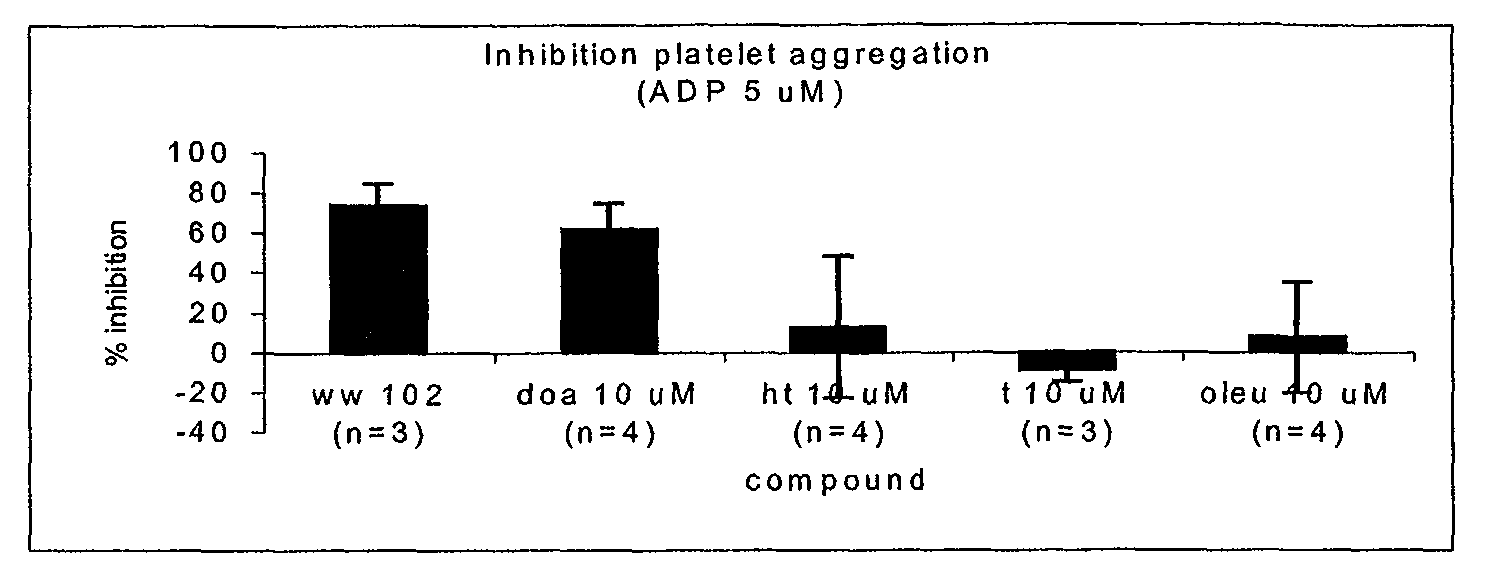
- Figure 1: Effect of ww 1, DOA, hydroxytyrosol, tyrosol and oleuropein on agonist induced platelet aggregation. This figure shows the effect of 10 µM ww 1, DOA, hydroxytyrosol, tyrosol or oleuropein on ADP induced platelet aggregation. Inhibition is relative to the control. The dilutions are the final dilutions. The error bars are the standard deviations of at least 3 different measurements.
- To study the effects of olive phenols on signal transduction processes in human platelets, we first started a series of in vitro measurements in which fractions from olive wash water were added to platelet preparations. Experiments were performed with diluted ww 1. In addition, HPLC fraction, A, B and C were tested of which fraction B contained a major phenol of interest, and fractions A and C served as controls. Fraction B contained 125 ppm DOA whereas fraction A and C contained no DOA. The following procedure was followed for the preparation of fraction A, B and C.
-
- Sample filtered over 0.2 µm.
- First injection 40 µl to determine fractionation times.
- 10 injections of 500µl of sample wash water carried out.
- Three fractions were collected. The peak between 14 and 15 minutes corresponds with the active fraction from previous fractionations. The other fractions have been collected one minute before and after this peak.
-
- HP1090 HPLC system
- UV 280 nm, bw 20 nm; ref 450 nm, bw 80 nm
- Solvent A; water/acetic acid 98/2
- Solvent B; ethanol/acetic acid 98/2
- Gradient, flow 1 ml/min:
0 - 3 min 80% A 20% B 3 - 13 50% A 50% B 13 - 15 50% A 50% B 15 - 16 5% A 95% B 16 - 26 5% A 95% B 26 - 26.5 80% A 20% B
Column thermostat, set at 35°C, equipped with a rheodyne manual
injector 7125 with 500 µl loop. Phenomenex Luna phenyl-hexyl
column 250 x 4.6 mm, 5 µm, placed in Mistral. -
- The effect of 1:100 dilutions in saline of WW 1 and fractions A-C were studied on platelet aggregation in response to various physiologically relevant agonists. It appeared that both WW 1 and fraction B reduced platelet aggregation in response to collagen and ADP (Fig. 2 and Table 1). Fractions A and C were inactive. ADP-induced aggregation is mediated via the P2Y1 and P2Y12 receptors. Collagen-induced aggregation involves the glycoprotein VI receptor, but is also dependent on ADP secreted by the platelets. The effect of WW 1 and fraction B could thus be due to either or both glycoprotein VI and ADP receptor-mediated signalling pathways.
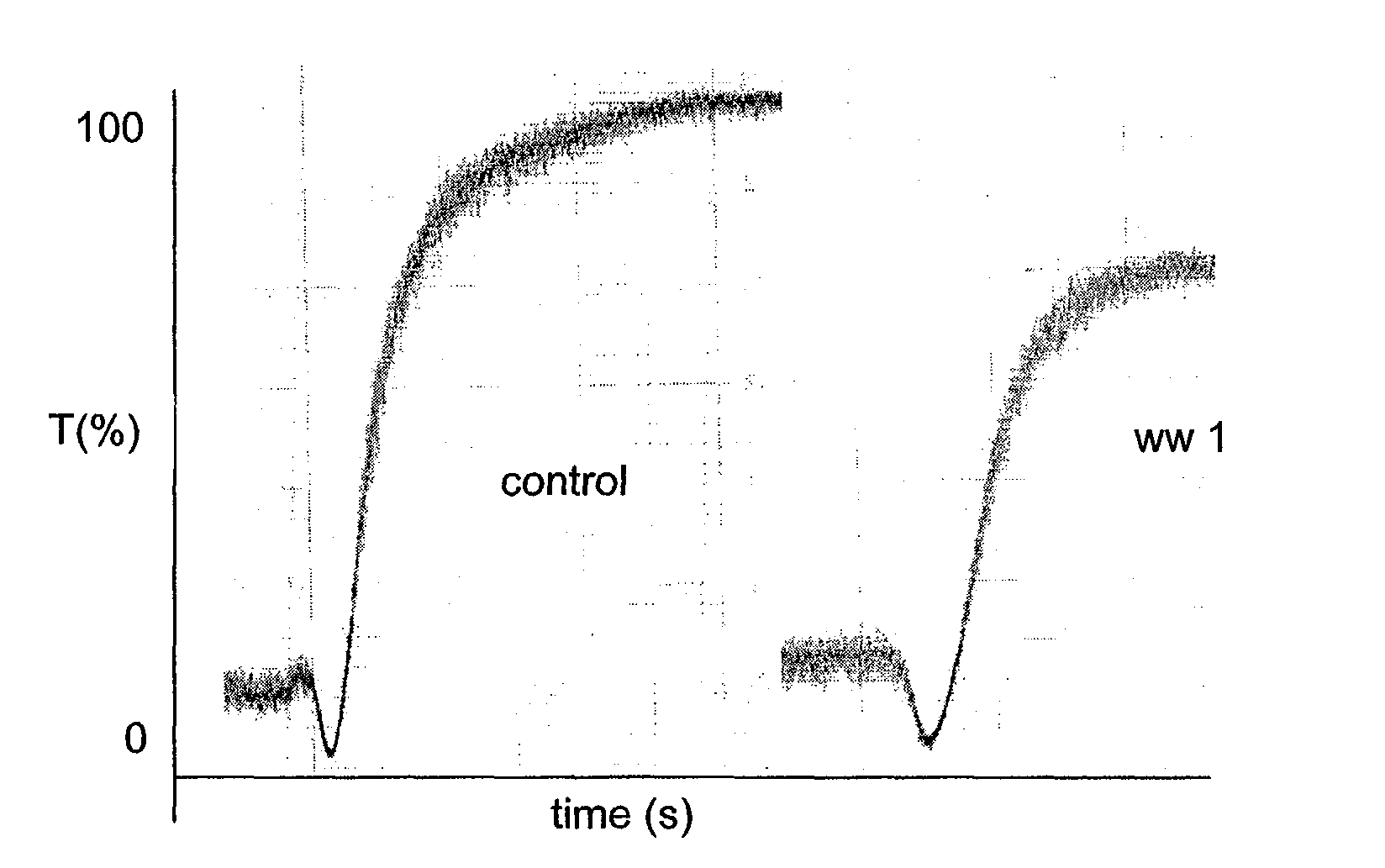
- Fig. 2. Effect of olive ww 1 on platelet aggregation in vitro. This is a representative collagen induced platelet aggregation curve in which the light transmission is plotted as a function of time. Human citrated PRP (2 x 10⁸ platelets/ml) was recalcified in the presence of the fibrin polymerisation inhibitor PPACK (20 µM) with 16.6 mM CaCl2. Platelets were activated with collagen (3 µg/ml). At 10 min before activation, WW 1 was added (1:100).
- Human citrated PRP (2 x 10⁸ platelets/ml) was recalcified in the presence of PPACK (20 µM) with 16.6 mM CaCl2. Platelets in PRP were activated with collagen (3 µg/ml) or ADP (20 µM), and aggregation was measured. At 10 min before activation, WW 1 was added (1:100). Fractions A, B or C were given dilutions of 1:100 (f.c.) after neutralisation with Tris. Maximum aggregation is given as %T (mean ± S.D., n=3-5).
Aggregation (%T) Control WW Fractio n A Fractio n B Fractio n C Collagen 66.7 ± 7.0 53.0 ± 4.7 65.9 ± 1.8 60.5 ± 4.2 63.9 ± 4.4 ADP 78.5 ± 5.9 60.7 ± 5.5 75.8 ± 2.0 63.2 ± 1.0 73.0 ± 3.5 - Calcium responses were measured in Fura-2-loaded platelets to compare direct and indirect collagen-induced effects. The WW 1 extract could not be used here because of its high fluorescence. The fractions A-C also interfered with the Fura-2 fluorescence, in a way resulting in lower apparent increases in cytosolic [Ca2+]i, but measurements could still be performed. As indicated in Table 2, stimulation of the platelets with the glycoprotein VI ligands, CRP (collagen related peptide) or convulxinTR, resulted in a potent rise in [Ca2+] i. This Ca2+ response apparently was reduced in the presence of fractions A-C, but this apparent reduction could be explained by fluorescence artefacts. A similar apparent reduction in Ca2+ response was observed in platelets stimulated with the PAR agonists, thrombin or SFLLRN. Again, interference of fractions A-C with the Fura-2 fluorescence explains the apparently altered responses. However, fraction B was unique in causing a considerably delayed Ca2+ response with CRP or convulxin (Fig. 3.). This suggests that the phenols in fraction B delay the glycoprotein VI- (collagen-) induced platelet activation. The glycoprotein VI-induced Ca2+ response partly depends on PI 3-kinase activation. However, the effect of fraction B differs from that of established PI 3-kinase inhibitors, because the latter compounds only reduce but not delay the Ca2+ signal with convulxin or CRP.
- Table 2. Effect of olive phenols on platelet calcium responses in vitro. Human washed, fura-2-loaded platelets (7 x 10⁷ platelets/ml) were activated with thrombin (4 nM), SFLLRN (15 µM), CRP (5 µg/ml) or convulxin (50 ng/ml) in the presence of 1 mM CaCl2. Where indicated, 1 mM EGTA was present instead of CaCl2. At 10 min before activation, fractions A, B or C were added at 1:100 (f.c.). These fractions were neutralised before adding. Data are maximal rises in cytosolic [Ca2+]i (nM) or [Ca2+]i-time integrals (mM x s) (mean ± S.D., n=3-5).
Agonist Control Fraction A Fraction B Fraction C Rise in [ Ca2 + ] i ( nM ) CRP 396 ± 40 243 ± 8 194 + 6$ 266 ± 10 Convulxin 640 ± 94 243 ± 8 315 ± 34$ 385 ± 54 Thrombin 319 ± 8 182 ± 32 166 ± 52 196 ± 60 Thrombin/EGTA 171 ± 59 119 ± 23 109 ± 37 93 ± 46 SFLLRN 321 ± 80 200 185 ± 21 168 Integral ( mM x s ) CRP 48.1 ± 7.0 8.6 ± 0.2 14.7 ± 0.2 23.1 ± 0.2 Convulxin 93.6 ± 10.9 54.5 ± 4.3 49.2 ± 5.9 56.5 ± 6.0 Thrombin 24.3 ± 6.8 7.6 ± 2.1 8.7 ± 4.2 8.9 ± 1.0 Thrombin/EGTA 4.7 ± 2.8 2.2 ± 0.5 2.8 ± 0.8 1.7 ± 1.2 SFLLRN 16.7 8.4 10.0 6.2 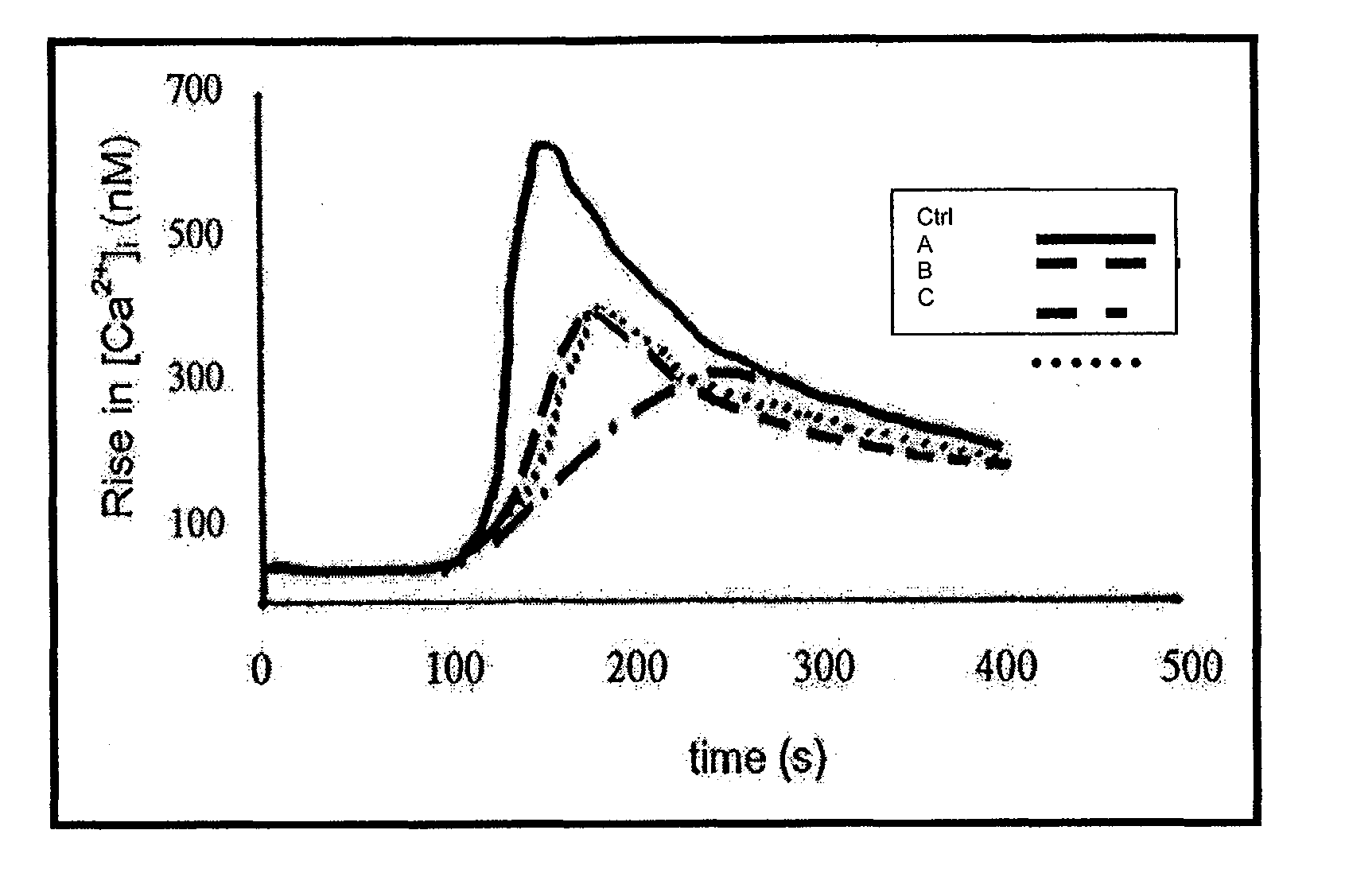
- Fig. 3. Effect of olive phenols on platelet calcium responses. Example of delayed convulxin-induced Ca2+ response (50 ng/ml) evoked by fraction B, but not by fractions A and C. Similar results were obtained with CRP. Representative traces are shown.
- To study the effect of phenols on platelet responses under more physiological conditions, we determined effects on platelet-dependent thrombin generation. In PRP, triggered with tissue factor, thrombin generation completely relies on the presence and activation of platelets. We found that both WW 1 and fraction B significantly reduced the peak level in thrombin generation curves. Other thrombogram parameters such as time-to-peak and area under the curve (i.e. endogenous thrombin potential, ETP) were not influenced by WW 1 or fraction B. Control experiments showed that the reduced peak level was not due to fluorescence artefacts, because of the higher absorption wavelength of generated aminomethyl coumarin. As the thrombin peak level is the thrombogram parameter that is mostly determined by the degree of platelet activation - i.e. particularly sensitive to ADP receptor blockers -, this result suggests that both WW 1 and faction B reduce platelet activation in the coagulating plasma with, as a consequence, a reduced rate of thrombin formation. In contrast, the ETP, reflecting the total thrombin-forming activity of the coagulation system, appears not to be changed by the polyphenol fractions.
- Table 3. Effect of olive phenols on thrombin generation in PRP in vitro. Human, citrated PRP (2 x 10⁸ platelets/ml) was triggered with 0.5 pM tissue factor and 16.6 mM CaCl2. Preincubation was with WW 1 (1:100) or faction B (1:100) for 10 min. Fraction B was neutralised with Tris before use. Thrombin generation was followed from the cleavage of fluorescent thrombin substrate Z-GGR-AMC in 96-well plates. Fluorescence values were converted into thrombin concentrations using an internal thrombin standard. Endogenous thrombin potential (ETP) stands for area under the curve. Data are mean values ± S.D. (n).
Control WW Control Fraction B Time to peak (min) 19.1±1.6(9) 20.7±2.4 (9) 18.8±2.3(9) 18.2±3.1(4) Thrombin peak (nM) 97.1±25.5(9) 80.8±17.4 (9) 113.8±26.6(9) 97.6±24.4(4) ETP (nM x min) 1396±275(9) 1369±252 (9) 1227±217(9) 1471±204(4)
Claims (13)
- Water- or fat- continuous fat emulsions with a water content of at least 5 wt % comprising an effective amount of a food grade nutritional component with anti platelet activity which food grade nutritional component is selected from the aglycon form of esters of propionic acid substituted in the 3-position by a -CH2CH=O residue and by a -C(=C-CH3)CH=O residue and / or by hydrated forms thereof ,while the alcohol residue is an ethanol derivative substituted in the 2-position by a hydroxyphenyl group with at least a hydroxy group in the 4-position.
- Fat emulsion according to claim 1, wherein the propionic acid derivative is an deacetoxyoleuropein aglycon or a deacetoxyligstroside aglycon.
- Fat emulsion according to claims 1 to 2, wherein the fat emulsion comprises between 2 and 100 mg of the propionic acid derivative per dose.
- Fat emulsion according to claims 1 to 3, wherein the propionic acid derivative is part of the water phase.
- Fat emulsion according to claims 1 to 4 wherein the propionic acid derivative is obtained from olives, in particular in the form of wash water obtained as a side stream during the production of olive oil.
- Fat emulsion with a water content of at least 5 wt % comprising an effective amount of a blend of a food grade nutritional component with anti platelet activity which food grade nutritional component is selected from the aglycon form of esters of propionic acid substituted in the 3-position by a -CH2CH=O residue and by a -C(=C-CH3)CH=O residue and / or by hydrated forms thereof ,while the alcohol residue is an ethanol derivative substituted in the 2-position by a hydroxyphenyl group with at least a hydroxy group in the 4-position and wherein the other component is selected from the group consisting of water, natural fats, randomised fats, fractions of natural or randomised fats, hardened fats or fractions of hardened fats.
- Fat emulsion according to claim 6 wherein the blend of food grade nutritional component and other component comprises between 2 and 100 mg of the propionic acid derivative per dose.
- Method for treating / curing / preventing of thrombosis in humans by administering the humans in need of such a treatment an effective daily amount of a food grade nutritional component with anti platelet activity, which component is selected from the aglycon form of esters of propionic acid substituted in the 3-position by a -CH2CH=O residue and by a -C(=C-CH3)CH=O residue and / or by hydrated forms thereof, while the alcohol residue is an ethanol derivative substituted in the 2-position by a hydroxyphenyl group with at least a hydroxy group in the 4-position or by administering an effective daily amount of a blend comprising the propionic acid derivative and at least one other component selected from the group consisting of water, natural fats, randomised fats, fractions of natural or randomised fats, hardened fats or fractions of hardened fats.
- Method according to claim 8 wherein the propionic acid derivative is obtained from olives, in particular in the form of wash water obtained as a side stream during the production of olive oil.
- Method according to claim 8 wherein the effective daily amount of the food grade nutritional component is between 2 and 100 mg.
- Method for making fat emulsions with anti thrombosis activity by incorporating in a fat emulsion an effective amount of a food grade nutritional component which component comprises the aglycon form of esters of propionic acid substituted in the 3-position by a -CH2CH=O residue and by a -C(=C-CH3)CH=O residue and / or by hydrated forms thereof, while the alcohol residue is an ethanol derivative substituted in the 2-position by a hydroxyphenyl group with at least a hydroxy group in the 4-position or of an blend of these propionic acid derivatives and at least one other component wherein the other component is selected from the group consisting of water, natural fats, randomised fats, fractions of natural or randomised fats, hardened fats or fractions of hardened fats
- Method according to claim 11 wherein the food grade nutritional component is derived from olives, in particular from wash water obtained as a side stream from the production of olive oil.
- Method according to claim 11 wherein the effective amount of the propionic acid derivative is more than 2 mg per food serving.
Priority Applications (1)
| Application Number | Priority Date | Filing Date | Title |
|---|---|---|---|
| EP03078064A EP1518463A1 (en) | 2003-09-26 | 2003-09-26 | Fat emulsions with components with anti platelet activity |
Applications Claiming Priority (1)
| Application Number | Priority Date | Filing Date | Title |
|---|---|---|---|
| EP03078064A EP1518463A1 (en) | 2003-09-26 | 2003-09-26 | Fat emulsions with components with anti platelet activity |
Publications (1)
| Publication Number | Publication Date |
|---|---|
| EP1518463A1 true EP1518463A1 (en) | 2005-03-30 |
Family
ID=34178554
Family Applications (1)
| Application Number | Title | Priority Date | Filing Date |
|---|---|---|---|
| EP03078064A Withdrawn EP1518463A1 (en) | 2003-09-26 | 2003-09-26 | Fat emulsions with components with anti platelet activity |
Country Status (1)
| Country | Link |
|---|---|
| EP (1) | EP1518463A1 (en) |
Citations (6)
| Publication number | Priority date | Publication date | Assignee | Title |
|---|---|---|---|---|
| WO2000036936A2 (en) * | 1998-12-22 | 2000-06-29 | Unilever N.V. | Food compositions fortified with anti-oxidants |
| US6187356B1 (en) * | 1998-01-28 | 2001-02-13 | Unilever Patent Holdings Bv | Debittering of olive oil |
| US20020004077A1 (en) * | 1999-12-20 | 2002-01-10 | John Cuomo | Antioxidant compositions extracted from olives and olive by-products |
| US20020198415A1 (en) * | 2000-09-01 | 2002-12-26 | Creagri, Inc. | Method of obtaining a hydroxytyrosol-rich composition from vegetation water |
| US6605296B1 (en) * | 1998-03-24 | 2003-08-12 | Numico Research B.V. | Natural substances based agent |
| US6641847B1 (en) * | 1999-06-01 | 2003-11-04 | Ocean Spray Cranberries, Inc. | Cranberry seed oil extract and compositions containing components thereof |
-
2003
- 2003-09-26 EP EP03078064A patent/EP1518463A1/en not_active Withdrawn
Patent Citations (6)
| Publication number | Priority date | Publication date | Assignee | Title |
|---|---|---|---|---|
| US6187356B1 (en) * | 1998-01-28 | 2001-02-13 | Unilever Patent Holdings Bv | Debittering of olive oil |
| US6605296B1 (en) * | 1998-03-24 | 2003-08-12 | Numico Research B.V. | Natural substances based agent |
| WO2000036936A2 (en) * | 1998-12-22 | 2000-06-29 | Unilever N.V. | Food compositions fortified with anti-oxidants |
| US6641847B1 (en) * | 1999-06-01 | 2003-11-04 | Ocean Spray Cranberries, Inc. | Cranberry seed oil extract and compositions containing components thereof |
| US20020004077A1 (en) * | 1999-12-20 | 2002-01-10 | John Cuomo | Antioxidant compositions extracted from olives and olive by-products |
| US20020198415A1 (en) * | 2000-09-01 | 2002-12-26 | Creagri, Inc. | Method of obtaining a hydroxytyrosol-rich composition from vegetation water |
Non-Patent Citations (5)
| Title |
|---|
| ANDREWES P ET AL: "Sensory properties of virgin olive oil polyphenols: identification of deacetoxy-ligstroside aglycon as a key contributor to pungency.", JOURNAL OF AGRICULTURAL AND FOOD CHEMISTRY 51 (5) 1415-1420 2003 CORRESPONDENCE (REPRINT) ADDRESS, J. L. H. C. BUSCH, TASTE & FLAVOUR SCI. AREA, UNILEVER RES. & DEV. VLAARDINGEN, OLIVIER VAN NOORTLAAN 120, 3133 AT VLAARDINGEN, NETHERLANDS. TEL. +31-, 25 January 2003 (2003-01-25), XP001157199 * |
| BIANCO A ET AL: "Microcomponents of olive oil - III: Glucosides of 2(3,4-dihydroxy-phenyl)ethanol", FOOD CHEMISTRY, ELSEVIER SCIENCE PUBLISHERS LTD, GB, vol. 63, no. 4, 1998, pages 461 - 464, XP002134136, ISSN: 0308-8146 * |
| ROMANI A ET AL: "HPLC and HRGC analyses of polyphenols and secoiridoid in olive oil", CHROMATOGRAPHIA 2001 GERMANY, vol. 53, no. 5-6, 2001, pages 279 - 284, XP009024695, ISSN: 0009-5893 * |
| TOGNA G I ET AL: "Olive oil isochromans inhibit human platelet reactivity.", JOURNAL OF NUTRITION 133 (8) 2532-2536 2003 DEP. OF HUMAN PHYSIOL. & PHARMACOLOGY, UNIV. OF ROME LA SAPIENZA', ROME, ITALY. E-MAIL GIUSEPPINA.TOGNA(A)UNIROMA1.I, August 2003 (2003-08-01), XP001179214 * |
| VISIOLI F ET AL: "'WASTE WATERS FROM OLIVE OIL PRODUCTION ARE RICH IN NATURAL ANTIOXIDANTS", EXPERIENTIA, BIRKHAUSER VERLAG. BASEL, CH, vol. 51, no. 1, 1995, pages 32 - 34, XP000961166, ISSN: 0014-4754 * |
Similar Documents
| Publication | Publication Date | Title |
|---|---|---|
| Mohammad-Beigi et al. | Oleuropein derivatives from olive fruit extracts reduce α-synuclein fibrillation and oligomer toxicity | |
| Pellegrini et al. | Direct analysis of total antioxidant activity of olive oil and studies on the influence of heating | |
| Alasalvar et al. | Review of nut phytochemicals, fat-soluble bioactives, antioxidant components and health effects | |
| Miraj et al. | Bioactivity of Sesamum indicum: A review study | |
| Smith et al. | Aspalathus linearis (Rooibos)–a functional food targeting cardiovascular disease | |
| Park et al. | Inhibition of adipogenesis by oligonol through Akt‐mTOR inhibition in 3T3‐L1 adipocytes | |
| EP0519673B1 (en) | Composition containing dioxabicyclo[3.3.0]octane derivative | |
| Zuo et al. | Understanding the effect of anthocyanin extracted from Lonicera caerulea L. on alcoholic hepatosteatosis | |
| Le Deun et al. | HPLC-DAD-MS profiling of polyphenols responsible for the yellow-orange color in apple juices of different French cider apple varieties | |
| Mezni et al. | Phenolic profile and effect of growing area on Pistacia lentiscus seed oil | |
| US20150196498A1 (en) | Hydroxytrosol containing extract obtained from olives and solids containing residues of olive oil extraction | |
| US20120088896A1 (en) | Drug for inhibiting lectin-like oxidized ldl receptor and drug for preventing arteriosclerosis | |
| Furuuchi et al. | Antihypertensive effect of boysenberry seed polyphenols on spontaneously hypertensive rats and identification of orally absorbable proanthocyanidins with vasorelaxant activity | |
| CN101171266B (en) | Acerola fruit-derived pectin and use thereof | |
| CN102958529B (en) | Be used as the clerodendranthus spicatus extract of cognitive enhancer valuably | |
| JP2011505827A (en) | Additive for edible oil composition | |
| EP1518463A1 (en) | Fat emulsions with components with anti platelet activity | |
| CN119214306A (en) | Composition for improving liver function | |
| ES2236130T3 (en) | OIL PREPARATION PROCEDURE WITH INCREASED POLYPHENOL CONTENT. | |
| JP2025041450A (en) | Platelet aggregation inhibitors | |
| EP1221286B1 (en) | Method for the preparation of oil having increased polyphenol content | |
| KR20160128953A (en) | Composition for prevention or treatment of blood circulation disorders or metabolic disorders comprising an Persimmon leaf extract | |
| Al Awwadi et al. | Effect of Armagnac fractions on human platelet aggregation in vitro and on rat arteriovenous shunt thrombosis in vivo probably not related only to polyphenols | |
| KR20220127772A (en) | How to stabilize resveratrol | |
| Hwang et al. | Indole-3-Carbinol Prevents H2O 2-Induced Inhibition of Gap Junctional Intercellular Communication by Inactivation of PKB/Akt |
Legal Events
| Date | Code | Title | Description |
|---|---|---|---|
| PUAI | Public reference made under article 153(3) epc to a published international application that has entered the european phase |
Free format text: ORIGINAL CODE: 0009012 |
|
| AK | Designated contracting states |
Kind code of ref document: A1 Designated state(s): AT BE BG CH CY CZ DE DK EE ES FI FR GB GR HU IE IT LI LU MC NL PT RO SE SI SK TR |
|
| AX | Request for extension of the european patent |
Extension state: AL LT LV MK |
|
| STAA | Information on the status of an ep patent application or granted ep patent |
Free format text: STATUS: THE APPLICATION HAS BEEN WITHDRAWN |
|
| 18W | Application withdrawn |
Effective date: 20050404 |
|
| RIC1 | Information provided on ipc code assigned before grant |
Ipc: A23L 1/30 20060101ALI20110919BHEP Ipc: A23D 7/00 20060101AFI20110919BHEP |