EP1516376B1 - Zinc air battery with acid electrolyte - Google Patents
Zinc air battery with acid electrolyte Download PDFInfo
- Publication number
- EP1516376B1 EP1516376B1 EP02744708A EP02744708A EP1516376B1 EP 1516376 B1 EP1516376 B1 EP 1516376B1 EP 02744708 A EP02744708 A EP 02744708A EP 02744708 A EP02744708 A EP 02744708A EP 1516376 B1 EP1516376 B1 EP 1516376B1
- Authority
- EP
- European Patent Office
- Prior art keywords
- battery
- zinc
- acid
- electrolyte
- dendrite
- Prior art date
- Legal status (The legal status is an assumption and is not a legal conclusion. Google has not performed a legal analysis and makes no representation as to the accuracy of the status listed.)
- Expired - Lifetime
Links
- 239000011701 zinc Substances 0.000 title claims abstract description 76
- HCHKCACWOHOZIP-UHFFFAOYSA-N Zinc Chemical compound [Zn] HCHKCACWOHOZIP-UHFFFAOYSA-N 0.000 title claims abstract description 69
- 229910052725 zinc Inorganic materials 0.000 title claims abstract description 67
- 239000003792 electrolyte Substances 0.000 title claims abstract description 61
- 239000002253 acid Substances 0.000 title claims abstract description 26
- AFVFQIVMOAPDHO-UHFFFAOYSA-N Methanesulfonic acid Chemical compound CS(O)(=O)=O AFVFQIVMOAPDHO-UHFFFAOYSA-N 0.000 claims description 35
- 229910052751 metal Inorganic materials 0.000 claims description 18
- 239000002184 metal Substances 0.000 claims description 18
- 229940098779 methanesulfonic acid Drugs 0.000 claims description 16
- QVGXLLKOCUKJST-UHFFFAOYSA-N atomic oxygen Chemical compound [O] QVGXLLKOCUKJST-UHFFFAOYSA-N 0.000 claims description 15
- 150000001875 compounds Chemical class 0.000 claims description 12
- 229910052760 oxygen Inorganic materials 0.000 claims description 11
- 239000001301 oxygen Substances 0.000 claims description 11
- 230000003068 static effect Effects 0.000 claims description 10
- 230000002378 acidificating effect Effects 0.000 claims description 9
- QAOWNCQODCNURD-UHFFFAOYSA-N Sulfuric acid Chemical compound OS(O)(=O)=O QAOWNCQODCNURD-UHFFFAOYSA-N 0.000 claims description 8
- RTAQQCXQSZGOHL-UHFFFAOYSA-N Titanium Chemical compound [Ti] RTAQQCXQSZGOHL-UHFFFAOYSA-N 0.000 claims description 8
- 229910021397 glassy carbon Inorganic materials 0.000 claims description 8
- 239000010936 titanium Substances 0.000 claims description 8
- 229910052719 titanium Inorganic materials 0.000 claims description 8
- 229920002554 vinyl polymer Polymers 0.000 claims description 8
- 239000012530 fluid Substances 0.000 claims description 6
- -1 aromatic monocarboxylic acid Chemical class 0.000 claims description 5
- LSNNMFCWUKXFEE-UHFFFAOYSA-M Bisulfite Chemical compound OS([O-])=O LSNNMFCWUKXFEE-UHFFFAOYSA-M 0.000 claims description 4
- 230000002829 reductive effect Effects 0.000 claims description 4
- 150000003934 aromatic aldehydes Chemical class 0.000 claims description 3
- 238000009792 diffusion process Methods 0.000 claims description 3
- 125000002887 hydroxy group Chemical group [H]O* 0.000 claims description 3
- 150000005846 sugar alcohols Polymers 0.000 claims description 3
- ITMCEJHCFYSIIV-UHFFFAOYSA-N triflic acid Chemical compound OS(=O)(=O)C(F)(F)F ITMCEJHCFYSIIV-UHFFFAOYSA-N 0.000 claims description 2
- WZHNBSUIWFUHIR-UHFFFAOYSA-N methane;sulfamic acid Chemical compound C.NS(O)(=O)=O WZHNBSUIWFUHIR-UHFFFAOYSA-N 0.000 claims 1
- 210000001787 dendrite Anatomy 0.000 abstract description 28
- 230000015572 biosynthetic process Effects 0.000 abstract description 18
- PTFCDOFLOPIGGS-UHFFFAOYSA-N Zinc dication Chemical compound [Zn+2] PTFCDOFLOPIGGS-UHFFFAOYSA-N 0.000 abstract description 8
- 125000000129 anionic group Chemical group 0.000 abstract 1
- 210000004027 cell Anatomy 0.000 description 14
- 239000012528 membrane Substances 0.000 description 7
- UFHFLCQGNIYNRP-UHFFFAOYSA-N Hydrogen Chemical compound [H][H] UFHFLCQGNIYNRP-UHFFFAOYSA-N 0.000 description 6
- 229910052739 hydrogen Inorganic materials 0.000 description 6
- 239000001257 hydrogen Substances 0.000 description 6
- 230000009467 reduction Effects 0.000 description 6
- 229910052738 indium Inorganic materials 0.000 description 5
- APFVFJFRJDLVQX-UHFFFAOYSA-N indium atom Chemical compound [In] APFVFJFRJDLVQX-UHFFFAOYSA-N 0.000 description 5
- 150000002739 metals Chemical class 0.000 description 5
- 238000007747 plating Methods 0.000 description 5
- OKTJSMMVPCPJKN-UHFFFAOYSA-N Carbon Chemical compound [C] OKTJSMMVPCPJKN-UHFFFAOYSA-N 0.000 description 4
- CURLTUGMZLYLDI-UHFFFAOYSA-N Carbon dioxide Chemical compound O=C=O CURLTUGMZLYLDI-UHFFFAOYSA-N 0.000 description 4
- 230000008901 benefit Effects 0.000 description 4
- 239000007819 coupling partner Substances 0.000 description 4
- 239000000203 mixture Substances 0.000 description 4
- 150000007524 organic acids Chemical class 0.000 description 4
- 230000003647 oxidation Effects 0.000 description 4
- 238000007254 oxidation reaction Methods 0.000 description 4
- 150000001450 anions Chemical class 0.000 description 3
- WMWLMWRWZQELOS-UHFFFAOYSA-N bismuth(iii) oxide Chemical compound O=[Bi]O[Bi]=O WMWLMWRWZQELOS-UHFFFAOYSA-N 0.000 description 3
- 229910052799 carbon Inorganic materials 0.000 description 3
- 238000006243 chemical reaction Methods 0.000 description 3
- 229910052736 halogen Inorganic materials 0.000 description 3
- 230000000670 limiting effect Effects 0.000 description 3
- 239000000463 material Substances 0.000 description 3
- 238000000034 method Methods 0.000 description 3
- 229910052709 silver Inorganic materials 0.000 description 3
- 239000004332 silver Substances 0.000 description 3
- JIAARYAFYJHUJI-UHFFFAOYSA-L zinc dichloride Chemical compound [Cl-].[Cl-].[Zn+2] JIAARYAFYJHUJI-UHFFFAOYSA-L 0.000 description 3
- WHXSMMKQMYFTQS-UHFFFAOYSA-N Lithium Chemical compound [Li] WHXSMMKQMYFTQS-UHFFFAOYSA-N 0.000 description 2
- LSNNMFCWUKXFEE-UHFFFAOYSA-N Sulfurous acid Chemical compound OS(O)=O LSNNMFCWUKXFEE-UHFFFAOYSA-N 0.000 description 2
- 229910001297 Zn alloy Inorganic materials 0.000 description 2
- 238000010521 absorption reaction Methods 0.000 description 2
- 239000000654 additive Substances 0.000 description 2
- 238000013019 agitation Methods 0.000 description 2
- 239000010405 anode material Substances 0.000 description 2
- 238000013459 approach Methods 0.000 description 2
- 239000011260 aqueous acid Substances 0.000 description 2
- 239000007864 aqueous solution Substances 0.000 description 2
- 229910002092 carbon dioxide Inorganic materials 0.000 description 2
- 239000001569 carbon dioxide Substances 0.000 description 2
- 239000010406 cathode material Substances 0.000 description 2
- 239000002738 chelating agent Substances 0.000 description 2
- 238000000151 deposition Methods 0.000 description 2
- 230000008021 deposition Effects 0.000 description 2
- 238000007599 discharging Methods 0.000 description 2
- 230000000694 effects Effects 0.000 description 2
- 150000002367 halogens Chemical class 0.000 description 2
- 229910001449 indium ion Inorganic materials 0.000 description 2
- 150000002500 ions Chemical class 0.000 description 2
- 229910052744 lithium Inorganic materials 0.000 description 2
- 238000004519 manufacturing process Methods 0.000 description 2
- 229910000474 mercury oxide Inorganic materials 0.000 description 2
- UKWHYYKOEPRTIC-UHFFFAOYSA-N mercury(ii) oxide Chemical compound [Hg]=O UKWHYYKOEPRTIC-UHFFFAOYSA-N 0.000 description 2
- BASFCYQUMIYNBI-UHFFFAOYSA-N platinum Chemical compound [Pt] BASFCYQUMIYNBI-UHFFFAOYSA-N 0.000 description 2
- 238000005086 pumping Methods 0.000 description 2
- 150000003856 quaternary ammonium compounds Chemical class 0.000 description 2
- 230000002441 reversible effect Effects 0.000 description 2
- 150000003839 salts Chemical class 0.000 description 2
- 239000000126 substance Substances 0.000 description 2
- 230000001988 toxicity Effects 0.000 description 2
- 231100000419 toxicity Toxicity 0.000 description 2
- 239000011592 zinc chloride Substances 0.000 description 2
- GYHNNYVSQQEPJS-UHFFFAOYSA-N Gallium Chemical compound [Ga] GYHNNYVSQQEPJS-UHFFFAOYSA-N 0.000 description 1
- UPJLATDXDGHOBW-UHFFFAOYSA-O O[S+]=O.C Chemical compound O[S+]=O.C UPJLATDXDGHOBW-UHFFFAOYSA-O 0.000 description 1
- BQCADISMDOOEFD-UHFFFAOYSA-N Silver Chemical compound [Ag] BQCADISMDOOEFD-UHFFFAOYSA-N 0.000 description 1
- 239000004809 Teflon Substances 0.000 description 1
- 229920006362 Teflon® Polymers 0.000 description 1
- ATJFFYVFTNAWJD-UHFFFAOYSA-N Tin Chemical compound [Sn] ATJFFYVFTNAWJD-UHFFFAOYSA-N 0.000 description 1
- XLOMVQKBTHCTTD-UHFFFAOYSA-N Zinc monoxide Chemical compound [Zn]=O XLOMVQKBTHCTTD-UHFFFAOYSA-N 0.000 description 1
- ZRXYMHTYEQQBLN-UHFFFAOYSA-N [Br].[Zn] Chemical compound [Br].[Zn] ZRXYMHTYEQQBLN-UHFFFAOYSA-N 0.000 description 1
- 150000007513 acids Chemical class 0.000 description 1
- 230000002411 adverse Effects 0.000 description 1
- 230000004888 barrier function Effects 0.000 description 1
- 229910052797 bismuth Inorganic materials 0.000 description 1
- JCXGWMGPZLAOME-UHFFFAOYSA-N bismuth atom Chemical compound [Bi] JCXGWMGPZLAOME-UHFFFAOYSA-N 0.000 description 1
- 229910052795 boron group element Inorganic materials 0.000 description 1
- 150000004649 carbonic acid derivatives Chemical class 0.000 description 1
- ONIOAEVPMYCHKX-UHFFFAOYSA-N carbonic acid;zinc Chemical compound [Zn].OC(O)=O ONIOAEVPMYCHKX-UHFFFAOYSA-N 0.000 description 1
- 239000003054 catalyst Substances 0.000 description 1
- 230000008859 change Effects 0.000 description 1
- 239000008139 complexing agent Substances 0.000 description 1
- 239000004020 conductor Substances 0.000 description 1
- 229920001577 copolymer Polymers 0.000 description 1
- 230000003247 decreasing effect Effects 0.000 description 1
- AJNVQOSZGJRYEI-UHFFFAOYSA-N digallium;oxygen(2-) Chemical compound [O-2].[O-2].[O-2].[Ga+3].[Ga+3] AJNVQOSZGJRYEI-UHFFFAOYSA-N 0.000 description 1
- 238000004070 electrodeposition Methods 0.000 description 1
- 238000009713 electroplating Methods 0.000 description 1
- 230000007613 environmental effect Effects 0.000 description 1
- 230000003203 everyday effect Effects 0.000 description 1
- 230000002349 favourable effect Effects 0.000 description 1
- UQSQSQZYBQSBJZ-UHFFFAOYSA-N fluorosulfonic acid Chemical compound OS(F)(=O)=O UQSQSQZYBQSBJZ-UHFFFAOYSA-N 0.000 description 1
- 229910052733 gallium Inorganic materials 0.000 description 1
- QZQVBEXLDFYHSR-UHFFFAOYSA-N gallium(III) oxide Inorganic materials O=[Ga]O[Ga]=O QZQVBEXLDFYHSR-UHFFFAOYSA-N 0.000 description 1
- 229910002804 graphite Inorganic materials 0.000 description 1
- 239000010439 graphite Substances 0.000 description 1
- PJXISJQVUVHSOJ-UHFFFAOYSA-N indium(iii) oxide Chemical compound [O-2].[O-2].[O-2].[In+3].[In+3] PJXISJQVUVHSOJ-UHFFFAOYSA-N 0.000 description 1
- 239000003562 lightweight material Substances 0.000 description 1
- 229910021645 metal ion Inorganic materials 0.000 description 1
- VNWKTOKETHGBQD-UHFFFAOYSA-N methane Chemical compound C VNWKTOKETHGBQD-UHFFFAOYSA-N 0.000 description 1
- 230000007935 neutral effect Effects 0.000 description 1
- 230000004792 oxidative damage Effects 0.000 description 1
- 238000010525 oxidative degradation reaction Methods 0.000 description 1
- 229910052697 platinum Inorganic materials 0.000 description 1
- 239000005518 polymer electrolyte Substances 0.000 description 1
- 229920001343 polytetrafluoroethylene Polymers 0.000 description 1
- 239000004810 polytetrafluoroethylene Substances 0.000 description 1
- 239000011148 porous material Substances 0.000 description 1
- 239000000843 powder Substances 0.000 description 1
- 230000000135 prohibitive effect Effects 0.000 description 1
- 238000009877 rendering Methods 0.000 description 1
- 239000007787 solid Substances 0.000 description 1
- 238000006467 substitution reaction Methods 0.000 description 1
- 239000000758 substrate Substances 0.000 description 1
- 230000001629 suppression Effects 0.000 description 1
- 229910052716 thallium Inorganic materials 0.000 description 1
- BKVIYDNLLOSFOA-UHFFFAOYSA-N thallium Chemical compound [Tl] BKVIYDNLLOSFOA-UHFFFAOYSA-N 0.000 description 1
- XOLBLPGZBRYERU-UHFFFAOYSA-N tin dioxide Chemical compound O=[Sn]=O XOLBLPGZBRYERU-UHFFFAOYSA-N 0.000 description 1
- 229910001887 tin oxide Inorganic materials 0.000 description 1
- 238000011179 visual inspection Methods 0.000 description 1
- XLYOFNOQVPJJNP-UHFFFAOYSA-N water Substances O XLYOFNOQVPJJNP-UHFFFAOYSA-N 0.000 description 1
- 239000011667 zinc carbonate Substances 0.000 description 1
- 229910000010 zinc carbonate Inorganic materials 0.000 description 1
- 229960001939 zinc chloride Drugs 0.000 description 1
- 235000005074 zinc chloride Nutrition 0.000 description 1
- ONDPHDOFVYQSGI-UHFFFAOYSA-N zinc nitrate Inorganic materials [Zn+2].[O-][N+]([O-])=O.[O-][N+]([O-])=O ONDPHDOFVYQSGI-UHFFFAOYSA-N 0.000 description 1
Images
Classifications
-
- H—ELECTRICITY
- H01—ELECTRIC ELEMENTS
- H01M—PROCESSES OR MEANS, e.g. BATTERIES, FOR THE DIRECT CONVERSION OF CHEMICAL ENERGY INTO ELECTRICAL ENERGY
- H01M12/00—Hybrid cells; Manufacture thereof
- H01M12/04—Hybrid cells; Manufacture thereof composed of a half-cell of the fuel-cell type and of a half-cell of the primary-cell type
- H01M12/06—Hybrid cells; Manufacture thereof composed of a half-cell of the fuel-cell type and of a half-cell of the primary-cell type with one metallic and one gaseous electrode
-
- H—ELECTRICITY
- H01—ELECTRIC ELEMENTS
- H01M—PROCESSES OR MEANS, e.g. BATTERIES, FOR THE DIRECT CONVERSION OF CHEMICAL ENERGY INTO ELECTRICAL ENERGY
- H01M12/00—Hybrid cells; Manufacture thereof
- H01M12/08—Hybrid cells; Manufacture thereof composed of a half-cell of a fuel-cell type and a half-cell of the secondary-cell type
- H01M12/085—Zinc-halogen cells or batteries
-
- H—ELECTRICITY
- H01—ELECTRIC ELEMENTS
- H01M—PROCESSES OR MEANS, e.g. BATTERIES, FOR THE DIRECT CONVERSION OF CHEMICAL ENERGY INTO ELECTRICAL ENERGY
- H01M4/00—Electrodes
- H01M4/02—Electrodes composed of, or comprising, active material
- H01M4/36—Selection of substances as active materials, active masses, active liquids
- H01M4/48—Selection of substances as active materials, active masses, active liquids of inorganic oxides or hydroxides
-
- H—ELECTRICITY
- H01—ELECTRIC ELEMENTS
- H01M—PROCESSES OR MEANS, e.g. BATTERIES, FOR THE DIRECT CONVERSION OF CHEMICAL ENERGY INTO ELECTRICAL ENERGY
- H01M4/00—Electrodes
- H01M4/02—Electrodes composed of, or comprising, active material
- H01M4/36—Selection of substances as active materials, active masses, active liquids
- H01M4/58—Selection of substances as active materials, active masses, active liquids of inorganic compounds other than oxides or hydroxides, e.g. sulfides, selenides, tellurides, halogenides or LiCoFy; of polyanionic structures, e.g. phosphates, silicates or borates
-
- Y—GENERAL TAGGING OF NEW TECHNOLOGICAL DEVELOPMENTS; GENERAL TAGGING OF CROSS-SECTIONAL TECHNOLOGIES SPANNING OVER SEVERAL SECTIONS OF THE IPC; TECHNICAL SUBJECTS COVERED BY FORMER USPC CROSS-REFERENCE ART COLLECTIONS [XRACs] AND DIGESTS
- Y02—TECHNOLOGIES OR APPLICATIONS FOR MITIGATION OR ADAPTATION AGAINST CLIMATE CHANGE
- Y02E—REDUCTION OF GREENHOUSE GAS [GHG] EMISSIONS, RELATED TO ENERGY GENERATION, TRANSMISSION OR DISTRIBUTION
- Y02E60/00—Enabling technologies; Technologies with a potential or indirect contribution to GHG emissions mitigation
- Y02E60/10—Energy storage using batteries
Definitions
- the field of the invention generally pertains to batteries and other types of power cells.
- zinc is coupled with carbon in most simple flashlight batteries to provide a relatively inexpensive and reliable power source.
- manufacture of Zn/C batteries is generally simple and poses only relatively little environmental impact, various disadvantages of Zn/C batteries exist.
- the ratio of power to weight in commonly used Zn/C batteries is relatively poor.
- alternative coupling partners and systems can be employed.
- zinc can be coupled with mercury oxide or silver to achieve an improved power to weight ratio.
- the toxicity of mercury oxide is frequently problematic in manufacture and tends to become even more problematic when such batteries are discarded.
- silver as a coupling partner for zinc is environmentally substantially neutral and significantly improves the power to weight ratio, the use of silver is in many instances economically prohibitive.
- halogens may be employed as a coupling partner for zinc, and most common zinc-halogen couples include zinc-bromine and zinc-chloride (e.g., for load leveling batteries).
- zinc-bromine and zinc-chloride e.g., for load leveling batteries.
- battery configurations are often difficult to integrate into portable or miniaturized devices.
- battery configurations typically require pumping systems and are often prone to leakage leading to significant problems due to the highly corrosive nature of halogens.
- oxygen may be employed in primary batteries as a gaseous redox partner for zinc, thereby generally avoiding problems associated with toxicity, excessive cost for redox partners, or spillage.
- air i . e ., oxygen
- the zinc-oxygen system generally provides a relatively flat discharge curve.
- reasonable shelf life of such primary batteries can often only be achieved by using an airtight seal, and commercial applications of zinc-air batteries have previously been limited to primary or non-rechargeable types.
- complexing agents may be added to the electrolyte to increase solubility of the zinc in the alkaline electrolyte and to thereby improve the quality of the plating as described in U.S. Pat. No. 3,540,935 to Keating et al.
- the anode surface may be mechanically abraded while the alkaline electrolyte is vigorously moved within the battery as described in U.S. Pat. No. 3,822,149 to Hale et al.
- acidic aqueous electrolytes may be employed.
- acid electrolytes have been used in primary or non-reversible electrochemical cells as described in U.S. Pat. No. 3,825,445 to MacKarthy .
- dendrite formation may be reduced to at least some extent using a zinc-containing electrolyte comprising an aqueous acid and containing a quaternary ammonium compound for suppression of formation of dendrites on the anode during charging as described in U.S. Pat. No. 3,944,430 .
- quaternary ammonium compounds may adversely affect longevity of the battery and may further be oxidized over time.
- the relatively limited solubility of zinc ions in such electrolytes may further reduce the capacity of the battery.
- the electrolyte in zinc air batteries may be vigorously circulated to avoid or at least reduce dendrite formation as described in U.S. Pat. No. 4,220,690 to Blurton et al. While Blurton's configuration reduces dendrite formation to at least some extent, continuous pumping of the electrolyte is typically required. Furthermore, Blurton's configuration typically requires separate catholyte and anolyte reservoirs, thereby rendering the battery more space consuming and increasing the weight of such battery systems.
- zinc air batteries may be mechanically recharged by replacing the depleted zinc anode and zinc enriched electrolyte with an externally regenerated zinc anode and acid electrolyte (e.g., Creation of a zinc/air-battery-system-infrastructure for the European union (ZABEU) EU Project TR/00013/94).
- Mechanically recharging zinc air battery systems generally avoids dendrite formation within the battery, however, requires availability of spare anodes and electrolyte at the point of recharge, which may pose a significant logistic problem for everyday use of secondary rechargeable zinc air batteries.
- the present invention is directed to secondary batteries having an acid electrolyte, in which a dendrite-forming metal and oxygen form a redox pair, wherein the battery can be operated over numerous cycles without significant dendrite formation, wherein the acid electrolyte fluid comprises methane sulfonic acid, trifluoromethane sulfonic acid, methane sulfanic acid, polyvinyl sulfonic acid or polyvinyl sulfuric acid and wherein the battery comprises an air diffusion cathode.
- the acid electrolyte fluid comprises methane sulfonic acid, trifluoromethane sulfonic acid, methane sulfanic acid, polyvinyl sulfonic acid or polyvinyl sulfuric acid
- the battery comprises an air diffusion cathode.
- acidity of the electrolyte in particularly preferred batteries is provided at least in part by a compound that reduces dendrite formation.
- the dendrite-forming metal is zinc
- the compound comprises an organic acid comprises an organic acid, most preferably methane sulfonic acid, polyvinyl sulfonic acid, polyvinyl sulfuric acid, or sulfurous acid.
- a further particular advantage of contemplated batteries is the lack of significant absorption of carbon dioxide from the battery environment or from within the battery.
- contemplated batteries may further include a zinc brightener, and preferred brighteners include aromatic monocarboxylic acids, aromatic aldehydes, and polyhydric alcohols having ethoxylated or propoxylated hydroxyl groups.
- preferred brighteners include aromatic monocarboxylic acids, aromatic aldehydes, and polyhydric alcohols having ethoxylated or propoxylated hydroxyl groups.
- the dendrite-forming metal in preferred batteries may form a complex with the compound when the battery discharges.
- contemplated batteries may also include a plurality of cells in which a bipolar electrode separates a first cell from a second cell, and in which at least one side of the bipolar electrode comprises a Magnelli phase titanium suboxide.
- particularly contemplated secondary batteries may have a static catholyte and a static acidic anolyte, wherein at least one of the catholyte and the anolyte includes a dendrite-reducing acid thereby allowing use of the battery through at least 50 cycles at substantially unchanged battery performance.
- zinc air batteries that include an acidic electrolyte may be operated over numerous charge/discharge cycles without substantial change in battery performance when the electrolyte comprises a compound that reduces dendrite formation.
- the term “acid electrolyte” refers to an aqueous or non-aqueous fluid in which the pH is less than 7.0, and in which Zn 2+ ions are disposed ( e . g ., dissolved or in a complex that is dissolved).
- the term “static catholyte” means that the catholyte is enclosed in the cathode compartment without agitation by an agitator, wherein the term “agitator” refers to a pump or other fluid propeller that directly or indirectly circulates the catholyte in the cathode compartment.
- the term static catholyte expressly includes a catholyte that moves in the cathode compartment due to thermal effects and/or movement of the battery comprising the cathode compartment.
- the term “static anolyte” means that the anolyte is enclosed in the anode compartment without agitation by an agitator.
- the term static anolyte expressly includes an anolyte that moves in the anode compartment due to thermal effects and/or movement of the battery comprising the anode compartment.
- the term “battery” as used herein includes an assembly of electrochemical cells as well as a single electrochemical cell.
- dendrite-forming metal refers to any metal or metal containing compound that electrolytically deposits on an electrode surface and forms a dendrite under dendrite-forming conditions (e.g., charging of a battery). Therefore, particularly contemplated dendrite-forming metals include zinc and lithium.
- the term “compound reduces dendrite formation” means that the presence of the compound in the electrolyte of the battery reduces the number of dendrites on an electrode and/or reduces the extent to which a dendrite grows towards the electrode of opposite polarity during charging of the battery as compared to identical charging conditions of the same battery without the compound in the electrolyte.
- the term “dendrite-reducing acid” refers to an acid that reduces dendrite formation. Reduction of dendrite formation may be ascertained by visual inspection of number and size/height of the dendrites. Furthermore, reduction of dendrite formation may be ascertained by non-occurrence of internal short circuits precipitated by dendrites piercing at least one separator.
- the term "use of the battery through at least X cycles” means that the battery is charged and discharged X times over at least 20% of the battery capacity, and as further used herein, the term “substantially unchanged battery performance” means that the capacity of the battery changes less than 20%, more typically less than 10%, and most typically less than 5%.
- redox pair is interchangeably used with the term “redox couple” and refers to a combination of a first element (or ion of the first element) and second element (or ion of the second element) in a battery, in which reduction of the first element and oxidation of the second element produce the current provided by the battery, wherein first and second elements may be in ionic form as well as in non-ionic form.
- anode refers to the negative electrode of a battery ( i . e ., the electrode where oxidation occurs) during discharge of the battery.
- anode compartment refers to the battery compartment that includes the anode
- anolyte refers to the electrolyte in the anode compartment.
- cathode refers to the positive electrode of a battery ( i . e ., the electrode where reduction occurs) during discharge of the battery.
- cathode compartment refers to the battery compartment that includes the cathode
- catholyte refers to the electrolyte in the cathode compartment.
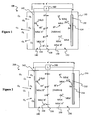
- an exemplary zinc air battery is depicted in Figure 1 during charging.
- the battery 100 includes a cell 110 that is divided by separator 120 into an anode compartment 130 and a cathode compartment 140.
- Both anode and cathode compartments include an aqueous solution of methane sulfonic acid 150 as acid electrolyte, wherein at least some of the anions of the methane sulfonic acid (MSA - ) complex the ionic forms of zinc (here: Zn 2+ ) and wherein at least some of the anions of the methane sulfonic acid (MSA - ) receive the H + that are generated from the oxidation of the oxygen in the water in the catholyte.
- MSA - methane sulfonic acid
- the anode compartment 130 further comprises anode 132 that is at least partially covered by non-ionic plated metallic zinc (Zn 0 ) 134.
- the cathode compartment 140 comprises cathode 142.
- Anode 132 and cathode 142 are electrically coupled to the power source 160, and the arrow above the power source indicates the flow of the electrons from the anode to the cathode during charge.
- FIG. 2 depicts an exemplary battery during discharge.
- the battery 200 includes a cell 210 that is at least partially divided by separator 220 into an anode compartment 230 and a cathode compartment 240.
- Both anode and cathode compartments include an aqueous solution of methane sulfonic acid 250 as acid electrolyte, wherein at least some of the anions of the acid (MSA - ) complex the ionic forms of zinc (here: Zn 2+ ) and wherein at least some of the protonated forms of MSA donate a H + to the electrolyte.
- MSA - methane sulfonic acid
- the anode compartment 230 further comprises anode 232 that is at least partially covered by non-ionic plated metallic zinc (Zn 0 ) 234.
- the cathode compartment 240 comprises cathode 242.
- Anode 232 and cathode 242 are electrically coupled to the load 260, and the arrow above the power source indicates the flow of the electrons during charging of the battery.
- the dendrite-forming metal forms a complex with the compound when the battery discharges.
- zinc is the redox partner for oxygen.
- numerous alternative elements are also suitable for use in conjunction with the teachings presented herein, and particularly preferred alternative elements include lithium. Further suitable elements metals are those that provide an open cell voltage of at least 0.1 V under acidic conditions in combination with oxygen.
- the concentration of dendrite forming metal ions in the electrolyte is at least 0.05 M, preferably at least 0.1 M, more preferably at least 0.3 M, even more preferably at least 0.5 M, and most preferably at least 1.2 M.
- zinc addition to the electrolyte may vary considerably.
- zinc is added to the electrolyte as a commercially available salt, and suitable salts include ZnCl 2 , ZnCO 3 , ZnAcetate, Zn(NO 3 ) 2 , etc.
- suitable salts include ZnCl 2 , ZnCO 3 , ZnAcetate, Zn(NO 3 ) 2 , etc.
- zinc may also be added as Zn-MSA salt.
- the zinc may be present in various forms so long as at least a portion of the zinc is in electric contact with the zinc-electrode in the battery. Consequently, suitable zinc sources in the battery include zinc-plated carbon electrodes, electrodes comprising or essentially consisting of zinc or a zinc alloy, or zinc granules or powder disposed in the electrolyte, which may or may no be gelled.
- the electrolyte need not be limited to a particular composition.
- suitable electrolytes are aqueous acid electrolytes (i . e ., have a pH of less than 7.0), and comprises the acids as defined in claim 1.
- a further especially preferred organic acid that dissolves zinc ions at a relatively high concentration is methane sulfonic acid.
- concentration of the MSA or other acid it should be appreciated that a particular concentration of MSA is not limiting to the inventive subject matter.
- concentration of methane sulfonic acid is in the range of between 1M and 4M, and more preferably between 2.5M and 3.5M.
- additives may be added to the electrolyte, wherein particularly preferred additives include zinc chelating agents and/or zinc brighteners.
- the organic acid in suitable acid electrolytes may be partially or entirely replaced by a zinc chelating agents and/or zinc brighteners.
- zinc brighteners there are numerous zinc brighteners known in the art, and it is contemplated that all of such brighteners are suitable for use herein.
- especially preferred zinc brighteners include aromatic monocarboxylic acids, aromatic aldehydes, and polyhydric alcohols having one or more ethoxylated or propoxylated hydroxyl groups.
- Indium is added to the electrolyte to significantly increase the hydrogen overpotential. Addition of Indium is thought to act as a barrier to hydrogen evolution, thereby forcing zinc deposition upon charging of the battery. While addition of indium to alkaline electrolytes has been previously shown to reduce hydrogen the hydrogen overpotential, the inventors surprisingly discovered that zinc deposition in an acid electrolyte in the presence of indium ions was almost 95% efficient compared to 70-80% without indium (at less than 1% substitution of indium ions for zinc ions in the electrolyte).
- suitable elements include bismuth (Bi), tin (Sn), gallium (Ga), thallium (T1), and various oxides, including diindium trioxide (In 2 O 3 ), dibismuth trioxide (Bi 2 O 3 ), tin oxide (SnO) and digallium trioxide (Ga 2 O 3 ).
- the concentration of such metals and other hydrogen overpotential reducing compounds is generally preferred that the concentration is less than 5 mol% (relative to Zn), more typically less than 2 mol% (relative to Zn), and even more typically less than 1 mol% (relative to Zn).
- concentrations of more than 5 mol% (relative to Zn) are also considered suitable.
- NAFIONTM copolymer of perfluorosulfonic acid and polytetrafluoroethylene
- membranes may operate more satisfactorily than other membranes, it is generally contemplated that the exact physical and/or chemical nature of the membrane is not limiting to the inventive subject matter so long as such membranes allow H + exchange between an anode and cathode compartment in contemplated acidic electrolytes. Consequently, it should be appreciated that numerous alternative membranes other than NAFIONTM are also suitable, and exemplary membranes include all known solid polymer electrolyte membranes, or similar materials.
- the cathode of the battery of the present invention includes a Teflon-coated catalyst containing air diffusion cathodes with a surface area of at least 100m 2 per g electrode.
- Typical cathode materials may therefore include platinum-coated graphite or carbon.
- particularly preferred cathodes include glassy carbon or EBONEXTM, which is the trade name of Magnelli phase titanium suboxide.
- glassy carbon in acidic electrolyte as a cathode material withstands charging the battery at relatively high current densities without apparent oxidative damage.
- Appropriate anode materials include any conductive material that allows for electroplating zinc to the anode. Consequently, suitable anode materials include various metals (e.g., titanium) coated to a conductive support, or zinc/zinc alloys.
- particularly preferred batteries include secondary batteries having an acid electrolyte and in which zinc and oxygen form a redox pair, and wherein the electrolyte further comprises methane sulfonic acid in an amount effective to reduce dendrite formation.
- Such batteries will preferably include a separator separating an anolyte from a catholyte, wherein (a) the methane sulfonic acid is protonated in the anolyte and wherein (b) the methane sulfonic acid is deprotonated in the catholyte when the battery is charging.
- the oxygen in such batteries is reduced on the cathode when the battery is charged, and preferred cathodes may comprise at least one of a Magnelli phase titanium suboxide and glassy carbon.
- contemplated batteries in which a dendrite-forming metal and oxygen form a redox pair
- a dendrite-forming metal and oxygen form a redox pair
- contemplated batteries will include a static catholyte and a static acidic anolyte, wherein at least one of the catholyte and the anolyte includes a dendrite-reducing acid thereby allowing use of the battery through at least 10, more typically at least 20, even more typically at least 50, and most typically at least 100 cycles at substantially unchanged battery performance.
- Particularly preferred dendrite-reducing acid are selected from the group consisting of methane sulfonic acid, polyvinyl sulfonic acid, polyvinyl sulfuric acid, and sulfurous acid.
- suitable batteries may be configured in a battery stack in which a series of battery cells are electrically coupled to each other via a bipolar electrode.
- the particular nature of the bipolar electrode is not limiting to the inventive subject matter, and it is generally contemplated that any material that allows for oxidation of oxygen during charging (and the reverse reaction during discharge) and plating/de-plating of zinc is suitable for use herein.
- a particularly preferred material for a bipolar electrode is glassy carbon (carbon that exhibits has no long-range order in three dimensions). The inventors surprisingly discovered that glassy carbon provides, despite operation in a highly acidic electrolyte, an excellent substrate for plating of zinc during charging.
- glassy carbon is a relatively inexpensive and comparably light-weight material, thereby further improving the ratio of cost/weight to capacity.
- bipolar electrodes are disclosed in US provisional patent application with the title " Electric Devices With Improved Bipolar Electrode” by Robert Lewis Clarke, Brian J. Dougherty, Stephen Harrison, J. Peter Millington and Samaresh Mohanta, which was filed on or about February 12, 2002 , which is incorporated by reference herein.
- suitable electrodes for contemplated batteries also include electrodes comprising Magnelli phase titanium suboxide, which have shown a relatively high resistance to oxidative degradation.
- contemplated electrolytes and electrodes are thought to be particularly advantageous in automotive batteries and especially automotive traction batteries.
Landscapes
- Chemical & Material Sciences (AREA)
- Chemical Kinetics & Catalysis (AREA)
- Electrochemistry (AREA)
- General Chemical & Material Sciences (AREA)
- Engineering & Computer Science (AREA)
- Manufacturing & Machinery (AREA)
- Inorganic Chemistry (AREA)
- Hybrid Cells (AREA)
Abstract
Description
- The field of the invention generally pertains to batteries and other types of power cells.
- Many types of batteries and other power cells are known, based upon a relatively wide range of electrical couples. Among the most popular electrical couples are those containing zinc. Zinc is regarded as the highest energy couple component that can be cycled in an aqueous room temperature battery and is therefore commonly used in numerous battery and power cell applications.
- For example, zinc is coupled with carbon in most simple flashlight batteries to provide a relatively inexpensive and reliable power source. Although manufacture of Zn/C batteries is generally simple and poses only relatively little environmental impact, various disadvantages of Zn/C batteries exist. Among other things, the ratio of power to weight in commonly used Zn/C batteries is relatively poor. To improve the ratio of power to weight, alternative coupling partners and systems can be employed. For example, zinc can be coupled with mercury oxide or silver to achieve an improved power to weight ratio. However, the toxicity of mercury oxide is frequently problematic in manufacture and tends to become even more problematic when such batteries are discarded. On the other hand, while silver as a coupling partner for zinc is environmentally substantially neutral and significantly improves the power to weight ratio, the use of silver is in many instances economically prohibitive.
- Furthermore, halogens may be employed as a coupling partner for zinc, and most common zinc-halogen couples include zinc-bromine and zinc-chloride (e.g., for load leveling batteries). However, such battery configurations are often difficult to integrate into portable or miniaturized devices. Moreover, such battery configurations typically require pumping systems and are often prone to leakage leading to significant problems due to the highly corrosive nature of halogens.
- Alternatively, oxygen may be employed in primary batteries as a gaseous redox partner for zinc, thereby generally avoiding problems associated with toxicity, excessive cost for redox partners, or spillage. Among various advantages in such configurations, using air (i.e., oxygen) as redox partner for zinc typically results in a relatively high power to weight ratio. Moreover, the zinc-oxygen system generally provides a relatively flat discharge curve. However, reasonable shelf life of such primary batteries can often only be achieved by using an airtight seal, and commercial applications of zinc-air batteries have previously been limited to primary or non-rechargeable types.
- In order to further take advantage of the relatively high power-to-weight ratio in zinc air batteries, secondary zinc air batteries have been developed. However, among various other difficulties, electrodeposition of metallic zinc during charging frequently resulted in dendrite formation, thereby changing the zinc electrode shape and consequently decreasing the battery capacity. To reduce at least some of the problems associated with dendrite growth in alkaline electrolyte, various compositions, configurations, and methods have been developed. For example, mechanical movement of the anode to prevent or reduce dendrite growth is described in
U.S. Pat. No. 3,716,413 to Eisner ,U.S. Pat. No. 3,560,261 to Stachurski et al , or inU.S. Pat. No. 3,440,098 to Stachurski . - Alternatively, complexing agents may be added to the electrolyte to increase solubility of the zinc in the alkaline electrolyte and to thereby improve the quality of the plating as described in
U.S. Pat. No. 3,540,935 to Keating et al. In yet another approach to reduce or inhibit dendrite formation on the zinc anode, the anode surface may be mechanically abraded while the alkaline electrolyte is vigorously moved within the battery as described inU.S. Pat. No. 3,822,149 to Hale et al. - However, despite at least some reduction in dendrite formation using the above compositions, configurations, and methods, additional difficulties nevertheless remain. Among other things, the use of alkaline electrolytes frequently leads to absorption of carbon dioxide from the air and other sources, which will consequently form carbonates in the electrolyte, which in turn tend to reduce conductivity and clog the pores in the active surfaces of the electrodes.
- To avoid at least some of the problems associated with the used of alkaline electrolytes in zinc air batteries, acidic aqueous electrolytes may be employed. For example, acid electrolytes have been used in primary or non-reversible electrochemical cells as described in
U.S. Pat. No. 3,825,445 to MacKarthy . Where rechargeable zinc air batteries are desired, dendrite formation may be reduced to at least some extent using a zinc-containing electrolyte comprising an aqueous acid and containing a quaternary ammonium compound for suppression of formation of dendrites on the anode during charging as described inU.S. Pat. No. 3,944,430 . However, quaternary ammonium compounds may adversely affect longevity of the battery and may further be oxidized over time. Moreover, the relatively limited solubility of zinc ions in such electrolytes may further reduce the capacity of the battery. - Alternatively, the electrolyte in zinc air batteries may be vigorously circulated to avoid or at least reduce dendrite formation as described in
U.S. Pat. No. 4,220,690 to Blurton et al. While Blurton's configuration reduces dendrite formation to at least some extent, continuous pumping of the electrolyte is typically required. Furthermore, Blurton's configuration typically requires separate catholyte and anolyte reservoirs, thereby rendering the battery more space consuming and increasing the weight of such battery systems. - In yet further alternative approaches, zinc air batteries may be mechanically recharged by replacing the depleted zinc anode and zinc enriched electrolyte with an externally regenerated zinc anode and acid electrolyte (e.g., Creation of a zinc/air-battery-system-infrastructure for the European union (ZABEU) EU Project TR/00013/94). Mechanically recharging zinc air battery systems generally avoids dendrite formation within the battery, however, requires availability of spare anodes and electrolyte at the point of recharge, which may pose a significant logistic problem for everyday use of secondary rechargeable zinc air batteries.
- Thus, although there are numerous coupling partners for zinc in batteries and power cells known in the art, all or almost all of them suffer from one or more disadvantage. Therefore, there is still a need to provide compositions and methods for improved batteries.
- The present invention is directed to secondary batteries having an acid electrolyte, in which a dendrite-forming metal and oxygen form a redox pair, wherein the battery can be operated over numerous cycles without significant dendrite formation, wherein the acid electrolyte fluid comprises methane sulfonic acid, trifluoromethane sulfonic acid, methane sulfanic acid, polyvinyl sulfonic acid or polyvinyl sulfuric acid and wherein the battery comprises an air diffusion cathode.
- In one aspect of the inventive subject matter, acidity of the electrolyte in particularly preferred batteries is provided at least in part by a compound that reduces dendrite formation. In further especially preferred batteries, the dendrite-forming metal is zinc, and the compound comprises an organic acid comprises an organic acid, most preferably methane sulfonic acid, polyvinyl sulfonic acid, polyvinyl sulfuric acid, or sulfurous acid. A further particular advantage of contemplated batteries is the lack of significant absorption of carbon dioxide from the battery environment or from within the battery.
- In another aspect of the inventive subject matter, contemplated batteries may further include a zinc brightener, and preferred brighteners include aromatic monocarboxylic acids, aromatic aldehydes, and polyhydric alcohols having ethoxylated or propoxylated hydroxyl groups. The dendrite-forming metal in preferred batteries may form a complex with the compound when the battery discharges.
- In further contemplated aspects, oxygen is reduced on the cathode when the battery is charged, wherein the cathode may comprise Magnelli phase titanium suboxide and/or glassy carbon. Furthermore especially preferred configurations of contemplated batteries may also include a plurality of cells in which a bipolar electrode separates a first cell from a second cell, and in which at least one side of the bipolar electrode comprises a Magnelli phase titanium suboxide.
- Therefore, especially suitable batteries will include an acid electrolyte in which zinc and oxygen form a redox pair, and wherein the electrolyte further comprises methane sulfonic acid in an amount effective to reduce dendrite formation. Thus, it should be appreciated that particularly contemplated secondary batteries may have a static catholyte and a static acidic anolyte, wherein at least one of the catholyte and the anolyte includes a dendrite-reducing acid thereby allowing use of the battery through at least 50 cycles at substantially unchanged battery performance.
- Various objects, features, aspects, and advantages of the present invention will become more apparent from the following detailed description of preferred embodiments of the invention, along with the accompanying drawing.
-
-
Figure 1 is a schematic view of an exemplary battery during charging. -
Figure 2 is a schematic view of an exemplary battery during discharge. - The inventors have surprisingly discovered that zinc air batteries that include an acidic electrolyte may be operated over numerous charge/discharge cycles without substantial change in battery performance when the electrolyte comprises a compound that reduces dendrite formation.
- As used herein, the term "acid electrolyte" refers to an aqueous or non-aqueous fluid in which the pH is less than 7.0, and in which Zn2+ ions are disposed (e.g., dissolved or in a complex that is dissolved). As also used herein, the term "static catholyte" means that the catholyte is enclosed in the cathode compartment without agitation by an agitator, wherein the term "agitator" refers to a pump or other fluid propeller that directly or indirectly circulates the catholyte in the cathode compartment. However, the term static catholyte expressly includes a catholyte that moves in the cathode compartment due to thermal effects and/or movement of the battery comprising the cathode compartment. Similarly, the term "static anolyte" means that the anolyte is enclosed in the anode compartment without agitation by an agitator. However, the term static anolyte expressly includes an anolyte that moves in the anode compartment due to thermal effects and/or movement of the battery comprising the anode compartment. Furthermore, the term "battery" as used herein includes an assembly of electrochemical cells as well as a single electrochemical cell.
- As further used herein, the term "dendrite-forming metal" refers to any metal or metal containing compound that electrolytically deposits on an electrode surface and forms a dendrite under dendrite-forming conditions (e.g., charging of a battery). Therefore, particularly contemplated dendrite-forming metals include zinc and lithium.
- As still further used herein, the term "compound reduces dendrite formation" means that the presence of the compound in the electrolyte of the battery reduces the number of dendrites on an electrode and/or reduces the extent to which a dendrite grows towards the electrode of opposite polarity during charging of the battery as compared to identical charging conditions of the same battery without the compound in the electrolyte. Similarly, the term "dendrite-reducing acid" refers to an acid that reduces dendrite formation. Reduction of dendrite formation may be ascertained by visual inspection of number and size/height of the dendrites. Furthermore, reduction of dendrite formation may be ascertained by non-occurrence of internal short circuits precipitated by dendrites piercing at least one separator.
- As also used herein, the term "use of the battery through at least X cycles" means that the battery is charged and discharged X times over at least 20% of the battery capacity, and as further used herein, the term "substantially unchanged battery performance" means that the capacity of the battery changes less than 20%, more typically less than 10%, and most typically less than 5%.
- As further used herein, the term "redox pair" is interchangeably used with the term "redox couple" and refers to a combination of a first element (or ion of the first element) and second element (or ion of the second element) in a battery, in which reduction of the first element and oxidation of the second element produce the current provided by the battery, wherein first and second elements may be in ionic form as well as in non-ionic form.
- As still further used herein, the term "anode" refers to the negative electrode of a battery (i.e., the electrode where oxidation occurs) during discharge of the battery. Thus, the term "anode compartment" refers to the battery compartment that includes the anode, and the term "anolyte" refers to the electrolyte in the anode compartment. Similarly, the term "cathode" refers to the positive electrode of a battery (i.e., the electrode where reduction occurs) during discharge of the battery. Thus, the term "cathode compartment" refers to the battery compartment that includes the cathode, and the term "catholyte" refers to the electrolyte in the cathode compartment.
- In a particularly preferred aspect, an exemplary zinc air battery is depicted in
Figure 1 during charging. Here, thebattery 100 includes acell 110 that is divided byseparator 120 into ananode compartment 130 and acathode compartment 140. Both anode and cathode compartments include an aqueous solution ofmethane sulfonic acid 150 as acid electrolyte, wherein at least some of the anions of the methane sulfonic acid (MSA-) complex the ionic forms of zinc (here: Zn2+) and wherein at least some of the anions of the methane sulfonic acid (MSA-) receive the H+ that are generated from the oxidation of the oxygen in the water in the catholyte. Theanode compartment 130 further comprisesanode 132 that is at least partially covered by non-ionic plated metallic zinc (Zn0) 134. Thecathode compartment 140 comprisescathode 142.Anode 132 andcathode 142 are electrically coupled to thepower source 160, and the arrow above the power source indicates the flow of the electrons from the anode to the cathode during charge. - Similarly,
Figure 2 depicts an exemplary battery during discharge. Here, thebattery 200 includes acell 210 that is at least partially divided byseparator 220 into ananode compartment 230 and acathode compartment 240. Both anode and cathode compartments include an aqueous solution ofmethane sulfonic acid 250 as acid electrolyte, wherein at least some of the anions of the acid (MSA-) complex the ionic forms of zinc (here: Zn2+) and wherein at least some of the protonated forms of MSA donate a H+ to the electrolyte. Theanode compartment 230 further comprisesanode 232 that is at least partially covered by non-ionic plated metallic zinc (Zn0) 234. Thecathode compartment 240 comprisescathode 242.Anode 232 andcathode 242 are electrically coupled to theload 260, and the arrow above the power source indicates the flow of the electrons during charging of the battery. - Thus, the inventors contemplate that zinc will be dissolved into the electrolyte upon discharge of the battery, and plated onto one electrode during charging while oxygen will donate/receive electrons on the other electrode following the equations (I) and (II) below.
Discharging: 2 Zn0 -4e - 2 Zn+2 Charging: 2 Zn+2 +4e - 2 Zn0 (I)
Discharging: O2 + 4e- O2 -2 Charging: O2 -2 - 4e- O2 (II)
- Consequently, in an exemplary Zn/O redox system using aqueous methane sulfonic acid as one component in the electrolyte, it is contemplated that the following reactions occur during charging (The reactions are reversed on discharge):
Cathode: H20 + 2 (CH3S03)- 2 CH3S03H + O2
Anode: Zn (CH3S03)2 + 2H+ Zn0 + 2 CH3S03H
- Therefore, it should be recognized that the dendrite-forming metal forms a complex with the compound when the battery discharges. With respect to the dendrite forming metal, it is generally preferred that zinc is the redox partner for oxygen. However, it should be appreciated that numerous alternative elements are also suitable for use in conjunction with the teachings presented herein, and particularly preferred alternative elements include lithium. Further suitable elements metals are those that provide an open cell voltage of at least 0.1 V under acidic conditions in combination with oxygen. In further preferred aspects of contemplated batteries, and especially where the dendrite forming metal is zinc, the concentration of dendrite forming metal ions in the electrolyte is at least 0.05 M, preferably at least 0.1 M, more preferably at least 0.3 M, even more preferably at least 0.5 M, and most preferably at least 1.2 M.
- Moreover, it should be recognized that the particular chemical form of zinc addition to the electrolyte may vary considerably. For example, it is generally preferred that zinc is added to the electrolyte as a commercially available salt, and suitable salts include ZnCl2, ZnCO3, ZnAcetate, Zn(NO3)2, etc. Furthermore, and particularly where an existing electrolyte is replenished with zinc, it is contemplated that zinc may also be added as Zn-MSA salt.
- Still further, it is contemplated that the zinc may be present in various forms so long as at least a portion of the zinc is in electric contact with the zinc-electrode in the battery. Consequently, suitable zinc sources in the battery include zinc-plated carbon electrodes, electrodes comprising or essentially consisting of zinc or a zinc alloy, or zinc granules or powder disposed in the electrolyte, which may or may no be gelled.
- In yet another aspect of the inventive subject matter, it is contemplated that the electrolyte need not be limited to a particular composition. However, it is generally preferred that suitable electrolytes are aqueous acid electrolytes (i.e., have a pH of less than 7.0), and comprises the acids as defined in claim 1.
- A further especially preferred organic acid that dissolves zinc ions at a relatively high concentration is methane sulfonic acid. With respect to the concentration of the MSA or other acid it should be appreciated that a particular concentration of MSA is not limiting to the inventive subject matter. However, a particularly preferred concentration of methane sulfonic acid is in the range of between 1M and 4M, and more preferably between 2.5M and 3.5M.
- In further alternative aspects of the inventive subject matter, it is contemplated that various additives may be added to the electrolyte, wherein particularly preferred additives include zinc chelating agents and/or zinc brighteners. Thus, it is contemplated that the organic acid in suitable acid electrolytes may be partially or entirely replaced by a zinc chelating agents and/or zinc brighteners. There are numerous zinc brighteners known in the art, and it is contemplated that all of such brighteners are suitable for use herein. However, especially preferred zinc brighteners include aromatic monocarboxylic acids, aromatic aldehydes, and polyhydric alcohols having one or more ethoxylated or propoxylated hydroxyl groups.
- In a still further contemplated aspect of the inventive subject matter, and especially where it is desirable to obtain a relatively high current efficiency of zinc plating during charging, it is preferred that Indium is added to the electrolyte to significantly increase the hydrogen overpotential. Addition of Indium is thought to act as a barrier to hydrogen evolution, thereby forcing zinc deposition upon charging of the battery. While addition of indium to alkaline electrolytes has been previously shown to reduce hydrogen the hydrogen overpotential, the inventors surprisingly discovered that zinc deposition in an acid electrolyte in the presence of indium ions was almost 95% efficient compared to 70-80% without indium (at less than 1% substitution of indium ions for zinc ions in the electrolyte).
- Of course, it should be recognized that reduction of the hydrogen overpotential in contemplated batteries need not be limited to addition of indium to the electrolyte at a particular concentration, but various alternative elements (typically metals, most typically group 13 elements) at numerous other concentrations are also contemplated. For example, suitable elements include bismuth (Bi), tin (Sn), gallium (Ga), thallium (T1), and various oxides, including diindium trioxide (In2O3), dibismuth trioxide (Bi2O3), tin oxide (SnO) and digallium trioxide (Ga2O3). With respect to the concentration of such metals and other hydrogen overpotential reducing compounds, it is generally preferred that the concentration is less than 5 mol% (relative to Zn), more typically less than 2 mol% (relative to Zn), and even more typically less than 1 mol% (relative to Zn). However, and especially where such elements or other compounds exhibit a relatively high solubility, concentrations of more than 5 mol% (relative to Zn) are also considered suitable.
- While in some battery configurations a NAFION™ (copolymer of perfluorosulfonic acid and polytetrafluoroethylene) membrane may operate more satisfactorily than other membranes, it is generally contemplated that the exact physical and/or chemical nature of the membrane is not limiting to the inventive subject matter so long as such membranes allow H+ exchange between an anode and cathode compartment in contemplated acidic electrolytes. Consequently, it should be appreciated that numerous alternative membranes other than NAFION™ are also suitable, and exemplary membranes include all known solid polymer electrolyte membranes, or similar materials.
- The cathode of the battery of the present invention includes a Teflon-coated catalyst containing air diffusion cathodes with a surface area of at least 100m2 per g electrode. Typical cathode materials may therefore include platinum-coated graphite or carbon. However, particularly preferred cathodes include glassy carbon or EBONEX™, which is the trade name of Magnelli phase titanium suboxide. The inventors have surprisingly discovered that glassy carbon in acidic electrolyte as a cathode material withstands charging the battery at relatively high current densities without apparent oxidative damage. Appropriate anode materials include any conductive material that allows for electroplating zinc to the anode. Consequently, suitable anode materials include various metals (e.g., titanium) coated to a conductive support, or zinc/zinc alloys.
- Thus, particularly preferred batteries include secondary batteries having an acid electrolyte and in which zinc and oxygen form a redox pair, and wherein the electrolyte further comprises methane sulfonic acid in an amount effective to reduce dendrite formation. Such batteries will preferably include a separator separating an anolyte from a catholyte, wherein (a) the methane sulfonic acid is protonated in the anolyte and wherein (b) the methane sulfonic acid is deprotonated in the catholyte when the battery is charging. Still further, it is contemplated that the oxygen in such batteries is reduced on the cathode when the battery is charged, and preferred cathodes may comprise at least one of a Magnelli phase titanium suboxide and glassy carbon.
- It should further be especially appreciated that contemplated batteries (in which a dendrite-forming metal and oxygen form a redox pair) will include a static catholyte and a static acidic anolyte, wherein at least one of the catholyte and the anolyte includes a dendrite-reducing acid thereby allowing use of the battery through at least 10, more typically at least 20, even more typically at least 50, and most typically at least 100 cycles at substantially unchanged battery performance. Particularly preferred dendrite-reducing acid are selected from the group consisting of methane sulfonic acid, polyvinyl sulfonic acid, polyvinyl sulfuric acid, and sulfurous acid.
- In yet further alternative aspects of the inventive subject matter, it is contemplated that suitable batteries may be configured in a battery stack in which a series of battery cells are electrically coupled to each other via a bipolar electrode. The particular nature of the bipolar electrode is not limiting to the inventive subject matter, and it is generally contemplated that any material that allows for oxidation of oxygen during charging (and the reverse reaction during discharge) and plating/de-plating of zinc is suitable for use herein. However, a particularly preferred material for a bipolar electrode is glassy carbon (carbon that exhibits has no long-range order in three dimensions). The inventors surprisingly discovered that glassy carbon provides, despite operation in a highly acidic electrolyte, an excellent substrate for plating of zinc during charging.
- Furthermore, glassy carbon is a relatively inexpensive and comparably light-weight material, thereby further improving the ratio of cost/weight to capacity. Further contemplated aspects of bipolar electrodes are disclosed in US provisional patent application with the title "Electric Devices With Improved Bipolar Electrode" by Robert Lewis Clarke, Brian J. Dougherty, Stephen Harrison, J. Peter Millington and Samaresh Mohanta, which was filed on or about February 12, 2002, which is incorporated by reference herein. Alternatively, suitable electrodes for contemplated batteries also include electrodes comprising Magnelli phase titanium suboxide, which have shown a relatively high resistance to oxidative degradation.
- Particularly useful applications of the inventive subject matter presented herein include the use of contemplated electrolytes and electrodes in various battery types where a favorable power-to-weight ratio is desired. For example, contemplated batteries are thought to be particularly advantageous in automotive batteries and especially automotive traction batteries.
Claims (9)
- A secondary zinc-air battery comprising an acid electrolyte fluid and in which oxygen and a dendrite-forming metal form a redox pair, wherein the acid electrolyte fluid comprises methane sulfonic acid, trifluoromethane sulfonic acid, methane sulfamic acid, polyvinyl sulfonic acid, or polyvinyl sulfuric acid, wherein the battery further comprises an air diffusion cathode.
- The battery of claim 1 wherein the dendrite-forming metal is zinc.
- The battery of claim 1 wherein the acid electrolyte fluid comprises methane sulfonic acid.
- The battery of claim 1 wherein the electrolyte is a static catholyte and a static acidic anolyte.
- The battery of claim 1 further comprising a zinc brightener.
- The battery of claim 5 wherein the zinc brightener is selected from the group consisting of an aromatic monocarboxylic acid, an aromatic aldehyde, and a polyhydric alcohol having ethoxylated or propoxylated hydroxyl groups.
- The battery of claim 1 wherein the dendrite-forming metal forms a complex with the compound when the battery discharges.
- The battery of claim 1 wherein the oxygen is reduced on a cathode when the battery is charged and wherein the cathode comprises at least one of a Magnelli phase titanium suboxide and glassy carbon.
- The battery of claim 1 comprising a plurality of cells in which a bipolar electrode separates a first cell from a second cell, and in which at least one side of the bipolar electrode comprises a Magnelli phase titanium suboxide.
Applications Claiming Priority (1)
| Application Number | Priority Date | Filing Date | Title |
|---|---|---|---|
| PCT/US2002/020522 WO2004001879A1 (en) | 2002-06-25 | 2002-06-25 | Zinc air battery with acid electrolyte |
Publications (3)
| Publication Number | Publication Date |
|---|---|
| EP1516376A1 EP1516376A1 (en) | 2005-03-23 |
| EP1516376A4 EP1516376A4 (en) | 2008-05-21 |
| EP1516376B1 true EP1516376B1 (en) | 2009-10-07 |
Family
ID=29998738
Family Applications (1)
| Application Number | Title | Priority Date | Filing Date |
|---|---|---|---|
| EP02744708A Expired - Lifetime EP1516376B1 (en) | 2002-06-25 | 2002-06-25 | Zinc air battery with acid electrolyte |
Country Status (8)
| Country | Link |
|---|---|
| US (1) | US7582385B2 (en) |
| EP (1) | EP1516376B1 (en) |
| AT (1) | ATE445234T1 (en) |
| AU (1) | AU2002345961A1 (en) |
| DE (1) | DE60233979D1 (en) |
| DK (1) | DK1516376T3 (en) |
| ES (1) | ES2331234T3 (en) |
| WO (1) | WO2004001879A1 (en) |
Families Citing this family (21)
| Publication number | Priority date | Publication date | Assignee | Title |
|---|---|---|---|---|
| US7645543B2 (en) | 2002-10-15 | 2010-01-12 | Polyplus Battery Company | Active metal/aqueous electrochemical cells and systems |
| US7282295B2 (en) | 2004-02-06 | 2007-10-16 | Polyplus Battery Company | Protected active metal electrode and battery cell structures with non-aqueous interlayer architecture |
| US8404388B2 (en) | 2005-08-09 | 2013-03-26 | Polyplus Battery Company | Compliant seal structures for protected active metal anodes |
| BRPI0614743A2 (en) | 2005-08-09 | 2011-04-12 | Polyplus Battery Co Inc | flexible sealing frames for protected active metal anodes |
| US8048570B2 (en) | 2005-08-09 | 2011-11-01 | Polyplus Battery Company | Compliant seal structures for protected active metal anodes |
| US8129052B2 (en) | 2005-09-02 | 2012-03-06 | Polyplus Battery Company | Polymer adhesive seals for protected anode architectures |
| TW200734448A (en) * | 2006-02-03 | 2007-09-16 | Advanced Tech Materials | Low pH post-CMP residue removal composition and method of use |
| JPWO2008018455A1 (en) * | 2006-08-10 | 2009-12-24 | パナソニック株式会社 | Alkaline battery |
| US8148020B2 (en) * | 2009-04-01 | 2012-04-03 | The United States Of America As Represented By The Secretary Of The Army | Molybdenum/air battery and cell design |
| US20120021303A1 (en) * | 2010-07-21 | 2012-01-26 | Steven Amendola | Electrically rechargeable, metal-air battery systems and methods |
| US8802304B2 (en) | 2010-08-10 | 2014-08-12 | Eos Energy Storage, Llc | Bifunctional (rechargeable) air electrodes comprising a corrosion-resistant outer layer and conductive inner layer |
| US9234291B2 (en) * | 2010-09-09 | 2016-01-12 | Globalfoundries Inc. | Zinc thin films plating chemistry and methods |
| KR101231929B1 (en) * | 2010-09-30 | 2013-02-08 | 김응진 | Secondary battery |
| WO2012044319A1 (en) * | 2010-09-30 | 2012-04-05 | Empire Technology Development Llc | Rechargeable zinc air battery and anode |
| WO2013090680A2 (en) | 2011-12-14 | 2013-06-20 | Eos Energy Storage, Llc | Electrically rechargeable, metal anode cell and battery systems and methods |
| EP2690701A1 (en) | 2012-07-24 | 2014-01-29 | Solvay Sa | Use of peroxides in metal air batteries |
| US9905860B2 (en) | 2013-06-28 | 2018-02-27 | Polyplus Battery Company | Water activated battery system having enhanced start-up behavior |
| CN105720280B (en) * | 2014-12-01 | 2018-03-02 | 廖文煌 | Air intake circulating system of zinc-air fuel cell |
| US10490316B2 (en) * | 2015-03-31 | 2019-11-26 | Nippon Chemi-Con Corporation | Titanium oxide particles, titanium oxide particle production method, power storage device electrode including titanium oxide particles, and power storage device provided with electrode including titanium oxide particles |
| KR101720417B1 (en) * | 2015-05-13 | 2017-03-27 | 부산대학교 산학협력단 | Zinc air battery comprising alkaline electrolyte containing zinc and tin ions |
| JP2024512677A (en) * | 2021-03-31 | 2024-03-19 | イオス エナジー テクノロジー ホールディングス リミテッド ライアビリティ カンパニー | Halogen complexing agent bonded to the cathode surface in a static zinc halide battery |
Family Cites Families (21)
| Publication number | Priority date | Publication date | Assignee | Title |
|---|---|---|---|---|
| US3440098A (en) * | 1965-03-19 | 1969-04-22 | Yardney International Corp | Rechargeable current-generating electrochemical system with wiper means |
| US3540935A (en) * | 1968-02-26 | 1970-11-17 | Du Pont | Alkaline secondary battery and electrolyte therefor |
| US3560261A (en) * | 1968-07-31 | 1971-02-02 | Yardney International Corp | Method of treating electrode of electrochemical generator during charging |
| US3650837A (en) * | 1970-04-06 | 1972-03-21 | Leesona Corp | Secondary metal/air cell |
| US3716413A (en) * | 1970-07-15 | 1973-02-13 | Norton Co | Rechargeable electrochemical power supply |
| US3944430A (en) * | 1970-09-18 | 1976-03-16 | Union Carbide Corporation | Rechargeable galvanic cell and electrolyte therefor-II |
| US3822149A (en) * | 1972-02-17 | 1974-07-02 | Du Pont | Rechargeable zinc electrochemical energy conversion device |
| US3825445A (en) * | 1973-03-19 | 1974-07-23 | Carthy R Mac | Electrochemical cell with catalyzed acid peroxide electrolyte |
| US4066823A (en) * | 1973-09-11 | 1978-01-03 | Armstrong William A | Method for a low temperature oxygen electrode |
| FR2417556A1 (en) * | 1978-02-17 | 1979-09-14 | Popescu Francine | NEW BRILLIANTS FOR ELECTROLYTIC ACID ZINC PLATES |
| US4220690A (en) * | 1979-06-28 | 1980-09-02 | Institute Of Gas Technology | Secondary zinc/oxygen electrochemical cells using inorganic oxyacid electrolytes |
| JPS57101359A (en) * | 1980-12-15 | 1982-06-23 | Meidensha Electric Mfg Co Ltd | Improvement of zinc-bromine battery |
| US4772362A (en) * | 1985-12-09 | 1988-09-20 | Omi International Corporation | Zinc alloy electrolyte and process |
| US4898652A (en) * | 1986-03-03 | 1990-02-06 | Omi International Corporation | Polyoxalkylated polyhydroxy compounds as additives in zinc alloy electrolytes |
| US5173215A (en) * | 1991-02-21 | 1992-12-22 | Atraverda Limited | Conductive titanium suboxide particulates |
| DE4325941A1 (en) * | 1993-08-03 | 1995-02-09 | Heraeus Elektrochemie | Process for producing an electrode and electrode and their use |
| JP3144410B2 (en) * | 1999-03-11 | 2001-03-12 | 日本電気株式会社 | Battery and capacitor using quinoxaline resin |
| DE10033433A1 (en) * | 2000-07-10 | 2002-01-24 | Basf Ag | Process for electrolytic galvanizing from electrolytes containing alkanesulfonic acid |
| WO2003017407A1 (en) * | 2001-08-10 | 2003-02-27 | Eda, Inc. | Improved load leveling battery and methods therefor |
| US7214443B2 (en) * | 2002-02-12 | 2007-05-08 | Plurion Limited | Secondary battery with autolytic dendrites |
| US7033696B2 (en) * | 2002-02-12 | 2006-04-25 | Plurion Systems, Inc. | Electric devices with improved bipolar electrode |
-
2002
- 2002-06-25 DK DK02744708T patent/DK1516376T3/en active
- 2002-06-25 US US10/518,041 patent/US7582385B2/en not_active Expired - Fee Related
- 2002-06-25 WO PCT/US2002/020522 patent/WO2004001879A1/en not_active Ceased
- 2002-06-25 AT AT02744708T patent/ATE445234T1/en not_active IP Right Cessation
- 2002-06-25 DE DE60233979T patent/DE60233979D1/en not_active Expired - Fee Related
- 2002-06-25 ES ES02744708T patent/ES2331234T3/en not_active Expired - Lifetime
- 2002-06-25 AU AU2002345961A patent/AU2002345961A1/en not_active Abandoned
- 2002-06-25 EP EP02744708A patent/EP1516376B1/en not_active Expired - Lifetime
Also Published As
| Publication number | Publication date |
|---|---|
| US20050208386A1 (en) | 2005-09-22 |
| ATE445234T1 (en) | 2009-10-15 |
| EP1516376A1 (en) | 2005-03-23 |
| US7582385B2 (en) | 2009-09-01 |
| EP1516376A4 (en) | 2008-05-21 |
| DK1516376T3 (en) | 2009-11-16 |
| ES2331234T3 (en) | 2009-12-28 |
| AU2002345961A1 (en) | 2004-01-06 |
| DE60233979D1 (en) | 2009-11-19 |
| WO2004001879A1 (en) | 2003-12-31 |
Similar Documents
| Publication | Publication Date | Title |
|---|---|---|
| EP1516376B1 (en) | Zinc air battery with acid electrolyte | |
| US7625663B2 (en) | Cerium batteries | |
| US6986966B2 (en) | Battery with bifunctional electrolyte | |
| US7214443B2 (en) | Secondary battery with autolytic dendrites | |
| CA2625516C (en) | Battery with bifunctional electrolyte | |
| US7252905B2 (en) | Lanthanide batteries | |
| US9118089B2 (en) | Metal-air cell with ion exchange material | |
| US7297437B2 (en) | Battery with gelled electrolyte | |
| US7270911B2 (en) | Load leveling battery and methods therefor | |
| US7560189B2 (en) | Mixed electrolyte battery | |
| US5571600A (en) | Sulfur/aluminum electrochemical batteries | |
| EP0411614B1 (en) | Method of operating a zinc bromide battery | |
| EP1415354B1 (en) | Cerium batteries | |
| US20080233484A1 (en) | Battery with Gelled Electrolyte | |
| US20250391928A1 (en) | Electrolyte in rechargeable battery | |
| US20260038883A1 (en) | Acetate electrolytes for rechargeable aqueous zinc-ion cells and batteries |
Legal Events
| Date | Code | Title | Description |
|---|---|---|---|
| PUAI | Public reference made under article 153(3) epc to a published international application that has entered the european phase |
Free format text: ORIGINAL CODE: 0009012 |
|
| 17P | Request for examination filed |
Effective date: 20041117 |
|
| AK | Designated contracting states |
Kind code of ref document: A1 Designated state(s): AT BE CH CY DE DK ES FI FR GB GR IE IT LI LU MC NL PT SE TR |
|
| AX | Request for extension of the european patent |
Extension state: AL LT LV MK RO SI |
|
| DAX | Request for extension of the european patent (deleted) | ||
| RIN1 | Information on inventor provided before grant (corrected) |
Inventor name: CLARKE, ROBERT,EDA, INC. |
|
| RAP1 | Party data changed (applicant data changed or rights of an application transferred) |
Owner name: EDA, INC. |
|
| RAP1 | Party data changed (applicant data changed or rights of an application transferred) |
Owner name: APPLIED INTELLECTUAL CAPITAL |
|
| A4 | Supplementary search report drawn up and despatched |
Effective date: 20080421 |
|
| 17Q | First examination report despatched |
Effective date: 20080714 |
|
| GRAP | Despatch of communication of intention to grant a patent |
Free format text: ORIGINAL CODE: EPIDOSNIGR1 |
|
| GRAS | Grant fee paid |
Free format text: ORIGINAL CODE: EPIDOSNIGR3 |
|
| GRAA | (expected) grant |
Free format text: ORIGINAL CODE: 0009210 |
|
| RAP1 | Party data changed (applicant data changed or rights of an application transferred) |
Owner name: APPLIED INTELLECTUAL CAPITAL LIMITED |
|
| AK | Designated contracting states |
Kind code of ref document: B1 Designated state(s): AT BE CH CY DE DK ES FI FR GB GR IE IT LI LU MC NL PT SE TR |
|
| REG | Reference to a national code |
Ref country code: GB Ref legal event code: FG4D |
|
| REG | Reference to a national code |
Ref country code: CH Ref legal event code: NV Representative=s name: BRAUNPAT BRAUN EDER AG Ref country code: CH Ref legal event code: EP |
|
| REG | Reference to a national code |
Ref country code: IE Ref legal event code: FG4D |
|
| REG | Reference to a national code |
Ref country code: DK Ref legal event code: T3 |
|
| REF | Corresponds to: |
Ref document number: 60233979 Country of ref document: DE Date of ref document: 20091119 Kind code of ref document: P |
|
| REG | Reference to a national code |
Ref country code: ES Ref legal event code: FG2A Ref document number: 2331234 Country of ref document: ES Kind code of ref document: T3 |
|
| REG | Reference to a national code |
Ref country code: SE Ref legal event code: TRGR |
|
| NLV1 | Nl: lapsed or annulled due to failure to fulfill the requirements of art. 29p and 29m of the patents act | ||
| PG25 | Lapsed in a contracting state [announced via postgrant information from national office to epo] |
Ref country code: PT Free format text: LAPSE BECAUSE OF FAILURE TO SUBMIT A TRANSLATION OF THE DESCRIPTION OR TO PAY THE FEE WITHIN THE PRESCRIBED TIME-LIMIT Effective date: 20100208 |
|
| PG25 | Lapsed in a contracting state [announced via postgrant information from national office to epo] |
Ref country code: BE Free format text: LAPSE BECAUSE OF FAILURE TO SUBMIT A TRANSLATION OF THE DESCRIPTION OR TO PAY THE FEE WITHIN THE PRESCRIBED TIME-LIMIT Effective date: 20091007 |
|
| PG25 | Lapsed in a contracting state [announced via postgrant information from national office to epo] |
Ref country code: NL Free format text: LAPSE BECAUSE OF FAILURE TO SUBMIT A TRANSLATION OF THE DESCRIPTION OR TO PAY THE FEE WITHIN THE PRESCRIBED TIME-LIMIT Effective date: 20091007 |
|
| PLBE | No opposition filed within time limit |
Free format text: ORIGINAL CODE: 0009261 |
|
| STAA | Information on the status of an ep patent application or granted ep patent |
Free format text: STATUS: NO OPPOSITION FILED WITHIN TIME LIMIT |
|
| 26N | No opposition filed |
Effective date: 20100708 |
|
| PG25 | Lapsed in a contracting state [announced via postgrant information from national office to epo] |
Ref country code: GR Free format text: LAPSE BECAUSE OF FAILURE TO SUBMIT A TRANSLATION OF THE DESCRIPTION OR TO PAY THE FEE WITHIN THE PRESCRIBED TIME-LIMIT Effective date: 20100108 |
|
| REG | Reference to a national code |
Ref country code: CH Ref legal event code: PFA Owner name: APPLIED INTELLECTUAL CAPITAL LIMITED Free format text: APPLIED INTELLECTUAL CAPITAL LIMITED#ORDNANCE HOUSE 31 PIER ROAD#ST. HELIER, JERSEY JE4 8PW (GB) -TRANSFER TO- APPLIED INTELLECTUAL CAPITAL LIMITED#2450 MARINER SQUARE LOOP#ALAMEDA, CA 94501 (US) |
|
| PG25 | Lapsed in a contracting state [announced via postgrant information from national office to epo] |
Ref country code: MC Free format text: LAPSE BECAUSE OF NON-PAYMENT OF DUE FEES Effective date: 20100630 Ref country code: FI Free format text: LAPSE BECAUSE OF NON-PAYMENT OF DUE FEES Effective date: 20100625 |
|
| REG | Reference to a national code |
Ref country code: DK Ref legal event code: EBP Ref country code: CH Ref legal event code: PL |
|
| EUG | Se: european patent has lapsed | ||
| GBPC | Gb: european patent ceased through non-payment of renewal fee |
Effective date: 20100625 |
|
| REG | Reference to a national code |
Ref country code: FR Ref legal event code: CA Ref country code: FR Ref legal event code: ST Effective date: 20110228 |
|
| PG25 | Lapsed in a contracting state [announced via postgrant information from national office to epo] |
Ref country code: IT Free format text: LAPSE BECAUSE OF NON-PAYMENT OF DUE FEES Effective date: 20100625 |
|
| PG25 | Lapsed in a contracting state [announced via postgrant information from national office to epo] |
Ref country code: CH Free format text: LAPSE BECAUSE OF NON-PAYMENT OF DUE FEES Effective date: 20100630 Ref country code: DE Free format text: LAPSE BECAUSE OF NON-PAYMENT OF DUE FEES Effective date: 20110101 Ref country code: LI Free format text: LAPSE BECAUSE OF NON-PAYMENT OF DUE FEES Effective date: 20100630 Ref country code: IE Free format text: LAPSE BECAUSE OF NON-PAYMENT OF DUE FEES Effective date: 20100625 |
|
| PG25 | Lapsed in a contracting state [announced via postgrant information from national office to epo] |
Ref country code: FR Free format text: LAPSE BECAUSE OF NON-PAYMENT OF DUE FEES Effective date: 20100630 |
|
| REG | Reference to a national code |
Ref country code: ES Ref legal event code: FD2A Effective date: 20110713 |
|
| PG25 | Lapsed in a contracting state [announced via postgrant information from national office to epo] |
Ref country code: GB Free format text: LAPSE BECAUSE OF NON-PAYMENT OF DUE FEES Effective date: 20100625 Ref country code: ES Free format text: LAPSE BECAUSE OF NON-PAYMENT OF DUE FEES Effective date: 20110701 |
|
| PG25 | Lapsed in a contracting state [announced via postgrant information from national office to epo] |
Ref country code: AT Free format text: LAPSE BECAUSE OF NON-PAYMENT OF DUE FEES Effective date: 20100625 Ref country code: DK Free format text: LAPSE BECAUSE OF NON-PAYMENT OF DUE FEES Effective date: 20100630 |
|
| PG25 | Lapsed in a contracting state [announced via postgrant information from national office to epo] |
Ref country code: ES Free format text: LAPSE BECAUSE OF NON-PAYMENT OF DUE FEES Effective date: 20100626 |
|
| PG25 | Lapsed in a contracting state [announced via postgrant information from national office to epo] |
Ref country code: CY Free format text: LAPSE BECAUSE OF FAILURE TO SUBMIT A TRANSLATION OF THE DESCRIPTION OR TO PAY THE FEE WITHIN THE PRESCRIBED TIME-LIMIT Effective date: 20091007 |
|
| PG25 | Lapsed in a contracting state [announced via postgrant information from national office to epo] |
Ref country code: SE Free format text: LAPSE BECAUSE OF NON-PAYMENT OF DUE FEES Effective date: 20100626 Ref country code: LU Free format text: LAPSE BECAUSE OF NON-PAYMENT OF DUE FEES Effective date: 20100625 |
|
| PG25 | Lapsed in a contracting state [announced via postgrant information from national office to epo] |
Ref country code: TR Free format text: LAPSE BECAUSE OF FAILURE TO SUBMIT A TRANSLATION OF THE DESCRIPTION OR TO PAY THE FEE WITHIN THE PRESCRIBED TIME-LIMIT Effective date: 20091007 |