EP1515250A2 - Method and apparatus for information search - Google Patents
Method and apparatus for information search Download PDFInfo
- Publication number
- EP1515250A2 EP1515250A2 EP04255450A EP04255450A EP1515250A2 EP 1515250 A2 EP1515250 A2 EP 1515250A2 EP 04255450 A EP04255450 A EP 04255450A EP 04255450 A EP04255450 A EP 04255450A EP 1515250 A2 EP1515250 A2 EP 1515250A2
- Authority
- EP
- European Patent Office
- Prior art keywords
- information
- search
- elements
- query
- information elements
- Prior art date
- Legal status (The legal status is an assumption and is not a legal conclusion. Google has not performed a legal analysis and makes no representation as to the accuracy of the status listed.)
- Withdrawn
Links
Images










Classifications
-
- G—PHYSICS
- G06—COMPUTING OR CALCULATING; COUNTING
- G06F—ELECTRIC DIGITAL DATA PROCESSING
- G06F16/00—Information retrieval; Database structures therefor; File system structures therefor
- G06F16/90—Details of database functions independent of the retrieved data types
- G06F16/95—Retrieval from the web
- G06F16/951—Indexing; Web crawling techniques
-
- G—PHYSICS
- G06—COMPUTING OR CALCULATING; COUNTING
- G06F—ELECTRIC DIGITAL DATA PROCESSING
- G06F16/00—Information retrieval; Database structures therefor; File system structures therefor
- G06F16/20—Information retrieval; Database structures therefor; File system structures therefor of structured data, e.g. relational data
- G06F16/28—Databases characterised by their database models, e.g. relational or object models
- G06F16/289—Object oriented databases
Definitions
- the present invention relates to method of and apparatus for searching an assembly of information for target information.
- Prior art search engines such as those used by Google and Yahoo, search for information (Web pages) available on the Internet by searching for URLs of target Web pages in responding to keywords.
- search result As the great number of Web pages are found as a result of a keyword search, it is difficult to use keyword search for a portable terminal, e.g. a personal digital assistance (PDA) or cellphone, having a small screen for displaying the search result, etc.
- a portable terminal e.g. a personal digital assistance (PDA) or cellphone, having a small screen for displaying the search result, etc.
- PDA personal digital assistance
- an object of the invention is to provide a new and improved information search method and apparatus that can more easily search for target information and obtain information that is narrowed down to some extent from the first time the information is obtained.
- An information search apparatus is an apparatus for searching one or more stored information elements that are related with one another.
- the apparatus is arranged for (1) selecting one or more first information elements as targets to be searched for and one or more second information elements used for the search; and (2) searching third information elements related to the selected second information elements from the selected first information elements.
- the information elements contain one or more elements indicating a substantive thing, one or more relations defined between the elements, one or more roles played by the elements in the relations, one or more attributes of the elements, and one or more attributes of the relations, or one or more combinations thereof.
- the elements are further related with one another by affiliations between the elements.
- the selection includes selecting one or more of the elements having the same relation and role as the first information element, and selects one or more of the elements, the relations, roles, the attributes of the elements and the attribute of the relation as the second information element.
- the first information element, the second information element and the third information element are selected on the basis of a search request or a subordinate search request achieved as an analysis result of the search request.
- the searching there is a selection of one or more of the first information elements and one or more of the second information elements or any one of the first information elements and the second information elements in accordance with the selection of the third information element obtained as the result of the searching.
- the information search apparatus is arranged for accepting selection of one or more of the first information elements and one or more of the second information elements, or the third information elements used as the first information elements or the second information elements.
- the first information elements and the second information elements are selected from the selected third information elements, or the first information elements and the second information elements are selected from the stored information elements and the selected third information elements.
- the selection of the first information and the second information, and the search of the third information are repeated until the third information satisfies a predetermined condition.
- a search method includes searching one or more stored information elements, wherein the information elements are related with one another.
- the method includes selecting one or more first information elements as targets to be searched for and one or more second information elements used for the search.
- the method includes searching third information elements related with the selected second information elements from the selected first information elements.
- the present invention relates to a memory or storage medium that stores programs causing a computer to search for one or more stored information elements related with one another.
- the program causes the computer to execute a step of selecting one or more first information elements as targets to be searched for and one or more second information elements used for the search; and a step of searching third information elements related with the selected second information elements from the selected first information elements.
- the present invention enables target information to be easily searched for.
- the present invention enables searching of information which is useful to users and is narrowed down to some extent from the first time it was used.
- the present invention is able to search for target information.
- Figs 1 to 4 include a concrete example of instantiating the present invention to have it understood plainly.
- Figs. 1 to 4 include an example of target elements to be searched, and the relations/roles among them and the attributes thereof.
- Fig. 1 is a network diagram including the elements (e.g., program 1, store 1, goods, enterprise, campaign, etc.), the relations (relation 1, etc.)/roles (store, member, shop, sponsor etc.) among the elements and the attributes (participant relation, location relation, etc.).
- elements e.g., program 1, store 1, goods, enterprise, campaign, etc.
- relations e.g., relation 1, etc.
- roles store, member, shop, sponsor etc.
- attributes e.g., location relation, etc.
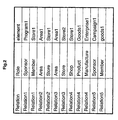
- Fig. 2 is a table of an example of the relations among the elements shown in Fig. 1, wherein the elements constitute the relations and the roles of the elements.
- Fig. 3 is a table of an example of the relations shown in Fig. 1 and the attributes thereof.
- Fig. 4 is a table of an example of the elements shown in Fig. 1 and the attributes thereof.
- the elements to be searched include stores (stores 1, 2) such as retail shops, department stores, etc., programs (program 1) such as point programs, events, etc., areas (area 1) where stores exist, groups of one or more goods (goods 1) with which stores deal, enterprises (enterprise 1) for producing/selling groups of goods, campaigns (campaign 1) to promote sales executed by enterprises, stores, programs, etc.
- the relations 1 to 5 include search targets that are defined as the relations among the elements.
- the rectangles with dashed lines and Fig. 2 also indicate the role each element plays in each relation.
- relation 1 indicates that a program 1 takes a role as a sponsor for a program in which store 1 participates, and that store 1 takes the role of a member participating in program 1.
- Figs. 1 and 2 indicate that, in relation 2, area 1 indicates an area where store 1 is located and that store 1 takes the role of a shop in area 1.
- Figs. 1 and 2 indicate that in relation 3 area 1 takes the role of indicating an area where store 2 is located, and that store 2 takes the role of a shop in area 1.
- goods 1 take the role of a product supplied by an enterprise 1
- store 1 takes the role of a shop
- enterprise 1 takes the role of a manufacturer of goods 1.
- campaign 1 takes the role of a sponsor of a campaign in which the goods of group 1 participate, and the goods of group 1 takes the role of a member participating in campaign 1.
- attributes e.g., programs, stores, areas, goods groups, enterprises, campaigns
- Fig. 4 attributes
- the elements are related with one another by defining the relations and the roles among the elements as shown in Figs. 1 to 4.
- the definitions of the attributes for the elements and the relations make it possible to construct a data base in which pre-related information (element/relation/role) can be searched by indicating elements, relations and the attributes thereof and by tracing the related elements and relations.
- the information (elements/relations/roles) in the pre-related range and the attributes thereof are stored as a data base to be used for searching with the information and the attributes thereof as a keyword, whereby the search result of the useful information and the attributes thereof having a proper amount of information are supplied to each user.
- the constituent elements of data used in the search contain the elements, the relations, the roles, the attributes of the elements and the attributes of the relations.
- a main feature of the search process is that a related "affiliation" can be easily grasped among respective elements which are not directly included as constituent elements of the data base.
- the related affiliation among the respective elements means commonality exists consciously or unconsciously among the respective elements.
- Consciously existing commonality is defined as the commonality among elements which occurs as a result of stores, enterprises, service suppliers, etc. which input the data that construct the data bases while paying their attention to commonality with other stores, enterprises, service suppliers, etc.
- Described information are the cases in which (1) elements are of the same type (that is, store vs. store or the like) and (2) elements are of different types (that is, store vs. campaign or the like).
- Each of cases (1) and (2) is described with reference to an exemplary "consciously existing commonality" case and an "unconsciously existing commonality” case.
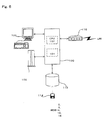
- Fig. 6 is a diagram of exemplary hardware at each of user terminal 2, search server 3, RDB 14, registration terminal 16 and the machines 18 to be searched for, as shown in Fig. 5.
- each of the user terminal 2, the search server 3, RDB 14, the registration terminal 16 and the machines 18 to be searched for comprises a main body 100 including CPU 102, memory 104 and peripheral circuits thereof, a display/input device 106 including a display device, a keyboard, a mouse, etc., peripherals 108 for performing the functions inherent to the respective devices, such as a file system in RDB 14, etc., a communication device 110 for performing the communication function with network 10 or the other constituent parts of the information search system 1, and a digital data recording device 112, such as a hard disk drive (HDD), a compact disc (CD) device or the like.
- HDD hard disk drive
- CD compact disc
- each of the user terminal 2, the search server 3, RDB 14, the registration terminal 16 and the machines 18 to be searched for has a constituent part that is a computer for communicating with the network 10 or the other constituent parts of the information search system 1.
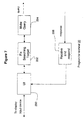
- Fig. 7 is a diagram of a terminal program 20 operating on each user terminal 2 shown in Figs. 5 and 6.
- the terminal program 20 comprises a user interface portion (UI portion) 200, a search target fixing portion 202, an inquiry (query) making portion 204 and receive and response portion 208.
- UI portion user interface portion
- search target fixing portion search target fixing portion
- inquiry query
- the terminal program 20 is supplied to the user terminal 2 through a recording medium 114, and loaded to the memory 104.
- the terminal program 20 makes and transmits to search sensor 3 an inquiry (query) including information that is derived by a user of the above constituent parts.
- the terminal program 20 displays a search result returned from the search server 3 to the display/input device 106.
- Fig. 8 is a diagram of an example of a UI image which is displayed on the display/input device 106 of the user terminal 2 by the terminal program 20 shown in Fig. 7.
- the UI image shown in Fig. 8 corresponds to a communication sequence described later with reference to Fig. 19.
- the UI portion 200 displays the UI image shown in Fig. 8 on the display/input device 106 (Figs. 5, 6) of the user terminal 2 and accepts information used for an element search (element/relation and attributes thereof; Figs. 1 to 4) in accordance with a user supplying an operation to the UI image to output that operation to search target fixing portion 202.
- the UI portion 200 displays information that the user supplies to it as a search result from the receive and response portion 208 on the UI image.
- the UI portion 200 controls the respective constituent parts of the terminal program 20 in accordance with the operation the user supplies to the UI portions, or the like.
- the search target fixing portion 202 derives information for fixing a search target (element/relation and attributes thereof; Figs. 1 to 4) on the basis of the information obtained from the UI image, the search result supplied by the receive and response portion 208, etc. Portion 202 outputs the search target fixing information to the query making portion 204.
- the query making portion 204 makes an inquiry (query) including search target fixing information derived from portion 202 and transmits that information to search server 3 through network 10.
- the receive and response portion 208 receives a response returned from the search server 3 in accordance with the query transmitted from the query making portion 204. Portion 208 outputs to the UI portion 200 the information contained in this response for server 3.
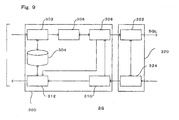
- Fig. 9 is a block diagram of the search program 30 that operates on the search server 3 shown in Figs. 5 and 6.
- search program 30 comprises a search engine 300 and a data base manager 320.
- the search engine 300 comprises a query manager 302, a query data base (query DB) 304, a query analyzer 306, a search controller 308, a record analyzer 310 and a response deriving portion 312.
- the data base manager 320 comprises an SQL generating portion 322 and a record manager 324.
- the search program 30 successively searches an assembly of elements stored in RDB 14 as described above with reference to Figs. 1 to 4 on the basis of the information in the query from the user terminal 2 (the terminal program 20; Fig. 7) by the above constituent parts to return to user terminal 2 an element obtained as a search result.
- the query manager 302 receives a query from the user terminal 2 (terminal program 20); manager 302 stores the query in query DB 304 for management.
- the query analyzer 306 analyzes the query received by the query manager 302 to extract information in the query (Figs. 1 to 4); analyzes 306 supplies to search controller 308.
- the search controller 308 makes an inquiry to RDB 14 on the basis of the information (1) derived by the query analyzer 306, (2) the search result that data base manager 320 derives and the output of record analyzer 310. Controller 308 supplies inquiring data base manager 320.
- the search controller 308 controls derivation of a response by the response generating portion 312 on the basis of the information, (1) derived by query analyzer 306, (2) in response to the search result from RDB 14 through the data base manager 320, and (3) derived by record analyzer 310.
- the inquiry derived by the search controller 308 is further described by citing specific examples.
- Example (1) Query analyzer 306 determines that the query from the user terminal 2 (Fig. 5, Fig. 7) contains one element or relation (Figs. 1 to 4) as a keyword for a search and contains one element, relation, role or the attribute of any one of them (these will be generically referred as information element) as a search target.
- the search controller 308 makes a query for RDB 14 to search for the search target associated with the keyword; RDB 14 outputs the search target to the data base manager 320.
- Example (2) Query analyzer 306 determines that the query from the user terminal 2 (Fig. 5, Fig. 7) contains two or more elements and relations (Figs. 1 to 4) in the information elements as keywords for search and contains two or more information elements as a search target.
- the search controller 308 makes a query for RDB 14 to search for two or more search targets associated with the two or more keywords; the RDB outputs the results of the search to the data base manager 320.
- Example (3) Query analyzer 306 determines that the query from the user terminal 2 (Fig. 5, Fig. 7) contains one information element as a keyword for search, and contains one of the information elements as a search target.
- the search controller 308 generated a query for RDB 14 to search for the search target associated with the keyword; the RDB outputs the search result to data base manager 320.
- Example (4) Query analyzer 306 determines that the query from the user terminal 2 (Fig. 5, Fig. 7) contains two or more of the information elements (Figs. 1 to 4) as keywords for search, and contains two or more of the information elements as search targets.
- the search controller 308 makes a query for RDB 14 to search for two or more search targets associated with the two or more keywords; the RDB outputs the search results to data base manager 320.
- Example(5) Information elements, whose number is too large to enable display of the information elements on the user terminal 2, are returned from RDB 14 as responses to the queries of Examples (1) to (4).
- the search controller 308 properly selects as new keywords one or more search targets contained in the responses from RDB 14. Furthermore, the search controller 308 makes a query for further narrowing the responses from RDB 14 on the basis of the new keywords, and causes controller 3 of command RDB to output the narrowed responses to the data base manager 320.
- Example (6) Search controller 308 repeats the selection of this new keyword and the creation of the query on the basis of the new keyword until the number of information elements contained in the response from RDB 14 satisfies a predetermined condition; for example, the number concerned is reduced to a number suitable for displaying the information elements on the user terminal 2.
- search controller 308 calculates the coincidence rate of keywords in the information elements in the response from RDB 14 and in the query from user terminal 2. Controller 308 repeats the selection of the new keyword and the generation of the query on the basis of the new keyword until all the coincidence rates of the information elements in the response satisfy a predetermined condition (for example, 80% or more).
- a predetermined condition for example, 80% or more.
- the search controller 308 does not make a new query when the information elements in the response from RDB 14 satisfy the predetermined condition and supplies this fact to the response generating portion 312.
- the indication of the keywords and the search targets are be carried out by an explicit/direct indication of the information elements themselves or by an indirect indication of the relations among the information elements.
- the SQL generating portion 322 converts an inquiry from the search controller 308 to an inquiry sentence described in a language, such as SQL or the like, used for searching a data base; the SQL generating portion outputs the connected inquiry sentence to RDB 14.
- SQL generating portion 322 outputs to record manager 324 thus made, described inquiry sentence SQL (SQL sentence).
- the record manager 324 receives a record returned from RDB 14 and manages it in association with the SQL sentence; manager 3 outputs the returned record to the search engine 300.
- the record analyzer 310 analyzes the record received from the data base manager 320 to output the information element obtained as an analysis result to the search controller 308 and the response generating portion 312.
- the response generating portion 312 generates a response containing an information element from the record analyzer 310 in connection with each query from each user terminal 2 (terminal program 20; Fig. 5, Fig. 7). Portion 312 generates the response on the basis of the notification, etc. from the search controller 308 and outputs the response to the user terminal 2.
- the response generating portion 312 receives an information element from the RDB 14 via record analyzer 310. Portion 312 associates this information element with the query from the user terminal 2 and returns the query to the user terminal 2 that is making the query.
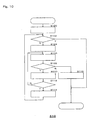
- Fig. 10 a flowchart of processing (S10) performed by the search program 30 shown in Fig. 9.
- step 100 the query manager 302 first accepts and manages queries from the user terminals 2 (terminal program 20; Fig. 5, Fig. 7) in the search program 30.
- step 102 the query manager 302 determines whether the processing of all the queries is finished.
- step S104 viz: start processing of a new query.
- step 104 query analyzer 306 analyzes a query as a processing target. Then, during step 106 (S106), search controller 308 commands RDB 14 to transmit a query to data base manager 320 as described in Examples (1) to (4).
- step 108 the record manager 324 determines whether a record searched by RDB 14 is or is not received by data base manager 320 within a specified time.
- search program 30 goes to analysis record processing step S110 that record analyzer 310 performs. In the other cases, the search program 30 goes to the processing step S116. After step S110 search controller 308 determines whether or not all the inquires to RDB 14 for one query as a processing target are finished.
- search program 30 goes to processing step S114, and in the other cases, program 30 returns to processing step S106.
- step 114 the record analyzer 310 outputs the information element contained in the record input from the record manager 324.
- the information element is derived in response to the output of response generating portion 312.
- response generating portion 312 outputs a response including the information element derived from the record analyzer 310 in response to the output of the user terminal 2 (terminal program 20) which transmitted the query as the processing target.
- step 116 the search program 30 carries out an abnormality processing step and then finishes program 30.
- Fig. 11 is a flowchart of how RDB 14 and the registration terminal 16 shown in Figs. 5 and 6 register information elements during processing operation (S12).
- the information elements (elements, relations, roles and the attributes thereof; Figs. 1 to 4) registered in RDB 14 are registered by using the registration terminal 16 (Fig. 5) or are searched for in machines 18 by using network 10.
- registration terminal 16 receives information elements in accordance with a user's operation of the display/input device 106.
- registration terminal 16 receives information elements prepared in advance on recording media 114 by other computers (Figs. 2 to 4).
- step 122 registration terminal 16 determines whether the registration of all the information elements is not completed.
- the registration terminal 16 finishes the processing when the registration of all the information elements is completed. In the other cases (i.e., all the information elements are not registered) the registration terminal 16 goes to processing step S124 during which registration terminal 16 analyzes the received information elements(Figs. 2 to 4).
- step 126 the registration terminal 16 relates the elements with one another on the basis of the relations and the roles achieved as a result of the analysis shown in Fig 1. Terminal 16 also associates the elements and the relations with the attributes (Fig. 3, Fig. 4) of the elements and the relations to carry out mapping in the storage area of RDB 14.
- step 128 registration terminal 16 stores and registers the information elements thus mapped in RDB 14.
- Fig. 12 is a communication sequence diagram of the basic search processing of the information search system 1 (Fig. 5).
- a user searches the elements (Fig. 1, Fig. 2, Fig. 4) relating to store 1 (S1) by using user terminal 2
- the user terminal 2 transmits the operation content of the search elements to the search engine 300 (Fig. 9) operating on the search server 3.
- the search engine 300 Upon receiving the operation content from the user terminal 2, the search engine 300 transmits a search query (QU11[M, S1]) to data base manager 320.
- the search query designates an element (M) as a search target (output data) and contains store 1 (S1) as a keyword (input element).
- the data base manager 320 Upon receiving the query QU11, the data base manager 320 generates SQL sentence (SQL 11) for searching RDB 14 for the elements relating to the store 1. RDB 14 obtains the search result in response to the SQL sentence (SQL 11).
- the data base manager 320 returns the area 1 (A1), the goods (PG1) and the enterprise (CO1) to the search engine 300.
- the search engine 300 returns the search result to the user terminal 2 that displays the search result to the user.
- Figs. 13 to 17 are five diagrams of types of queries transmitted from the search engine 300 to data base manager 320.
- Figs. 13 to 17 basically conform to Fig. 1 (Fig. 18, described later, is an expansion of Fig. 1; the examples shown in Figs. 13 to 17 correspond to Fig. 18).
- Fig. 13 is a diagram including query types (Q11 to Q17) when one or more of the elements, the relations, the roles and the attributes thereof are designated as search targets (output data), and one or more of the elements and the relations are designated as keywords (input data) for search.
- the search based on selection of any search target and any keyword is performed by the search server 3.
- the search engine 300 transmits to the data base manager 320 in the search processing shown in Fig. 12, a query containing (1) an element as a search target and an element (store 1) as a search keyword.
- the data base manager 320 responds to query Q12 to perform the search on RDB 14. Manager 320 returns the resulting search result containing the elements (store 1, program 1) related to the relation 1.
- the search engine 300 transmits to data base manager 320 a query containing (1) an element as a search target and (2) a relation (relation 1) as a search keyword.
- the data base manager 320 receives the query Q12 to perform the search on RDB 14.
- RDB 14 responds to query Q12 to return a search result containing the relation 1 and the elements related with the relation 1 (store 1, program 1).
- the search engine 300 transmits to data base manager 320 a query containing (1) an element (store 1) and (2) a relation (relation 1) as search keywords and (3) an element as a search target.
- the data base manager 320 Upon receiving the query Q13, the data base manager 320 carries out the search on RDB 14, and returns the search result of RDB 14 that contains an element (program 1) related with store 1 and relation 1.
- search engine 300 transmits to data base manager 320 a query containing (1) a relation between a search target and an element (store 1) as a search keyword.
- the data base manager 320 Upon receiving the query Q14, the data base manager 320 carries out the search on RDB 14 and returns a search result containing relations (relation 1, relation 2, relation 4) related to the store 1.
- the search engine 300 transmits to the data base manager 320 a query containing a relation between a search target and an element (store 1) as a search keyword.
- the data base manager 320 Upon receiving the query Q15, the data base manager 320 carries out the search on RDB 14 and returns the search result containing attributes (participant relation, location relation and supply relation) related to store 1.
- the search engine 300 transmits to data base manager 320 a query containing (1) a relation and (2) the attribute thereof as search targets and (3) an element (store 1) as a search keyword.
- the data base manager 320 Upon receiving the query Q16, the data base manager 320 carries out the search on RDB 14 and returns the search result containing combinations of relations and the attributes thereof ((relation 1, participant relation), (relation 2, location relation), (relation 4, supply relation)) related to the store 1.
- the search engine 300 transmits to the data base manager 320 a query containing (1) an element and the role thereof as search targets and an (2) element (store 1) as a search keyword.
- the data base manager 320 Upon receiving the query Q17, the data base manager 320 carries out the search on RDB 14 that derives a search result containing combinations of elements and the roles thereof ((program 1, sponsor), (area 1, area), (goods 1, product), (enterprise 1, manufacture)) related to the store 1.
- Fig. 14 is a diagram including query types (Q21 to Q26) when one or more of the elements, the relations, the roles and he attributes thereof are designated as search targets, and one or more of the elements and the relations and one or more of the roles and attributes thereof are designated as keywords for search.
- search engine 300 transmits to data base manager 320 a query containing (1)an element (store 1) and (2) the attribute (program) of the element of the search target as search keywords (input element, the attribute of an element of output data) and (3) an element as a search target.
- the data base manager 320 Upon receiving the query Q21, the data base manager 320 carries out the search on RDB 14, and returns a search result containing the program 1 as an element which is related to the store 1 as shown in Fig. 1 and has the attribute of the program.
- the search engine 300 transmits to the data base manager 320 a query containing (1) a relation as a search target and (2) an element (store 1) and (3) the attribute (participant relation) of the relation as the search target as search keywords (input element, the attribute of a relation of output data).
- the data base manager 320 Upon receiving the query Q22, the data base manager 320 (1) carries out the search on RDB 14 and (2) returns the search result containing the relation 1 as a relation which is related to the store 1, as shown in Fig. 1, and has the attribute of the participant relation.
- the search engine 300 transmits to the data base manager 320 a query containing (1) the attribute of an element as a search target and (2) an element (store 1), (3) a relation (relation 1) and (4) the role (sponsor) of the element of the search target as search keywords (input element, input relation, element role of output data).
- the data base manager 320 Upon receiving the query Q22, the data base manager 320 carries out the search on RDB 14 and returns the search result containing a program as the attribute of an element which is related to store 1 and relation 1, as shown in Fig. 1, and plays the role of the sponsor.
- the search engine 300 transmits to the data base manager 320 a search query containing (1) an element (store 1) and (2) the attribute (program) of the element of the search target as search keywords (input element, the attribute of an element of output data) and (3) the role of an element as a search target.
- the data base manager 320 Upon receiving the query Q24, the data base manager 320 carries out the search on RDB 14 and returns the search result containing a sponsor as the role of the element which has the attribute of the program that is related with the store 1, as shown in Fig. 1.
- the search engine 300 transmits to the data base manager 320 a query containing (1) a relation and (2) the attribute thereof as search targets and (3) an element (store 1), (4) the role (sponsor) of the element of the search target and (5) the attribute thereof (program) as search keywords (input element, element role of output data, the attribute of the element of the output data).
- the data base manager 320 Upon receiving the query Q25, the data base manager 320 carries out the search on RDB 14 and returns the search result containing (relation 1, participant relation) as a combination of a relation and the attribute thereof related to the store 1, the sponsor and the program, as shown in Fig. 1.
- the search engine 300 transmits to the data base manager 320 a query containing (1) an element as a search target, and (2) an element (store 1), (3)a relation (relation 1), (4) the role (sponsor) of the element of the search target and the (5) attribute (program) of the element of the search target as search keywords (input element, input relation, element role of output data, element attribute of output data).
- the data base manager 320 Upon receiving the query Q26, the data base manager 320 carries out the search on RDB 14 and returns the search result containing the program 1 which is related with the store 1, the relation 1, the sponsor and the program, as shown in Fig. 1.
- Fig. 15 is a diagram including exemplary query types (Q31 to Q34) that are derived when one or more of the elements, the relations, the roles and the attributes thereof are designated as search targets and plural elements are designated as search keywords.
- the search engine 300 transmits to the data base manager 320 a query containing (1) an element as a search target and (2) two elements (program 1, area 1) as search keywords.
- the data base manager 320 carries out the search on RDB 14 to return a search result containing the store 1 as an element related with the program 1 and the area 1, as shown in Fig. 1.
- the search engine 300 transmits to the data base manager 320 a query containing (1) an element and (2) the attribute of a relation as search targets and (3) two elements (program 1, area 1) as search keywords.
- the data base manager 320 Upon receiving the query Q32, the data base manager 320 carries out the search on RDB 14 and returns a search result containing (store 1, participant relation) and (store 1, location relation) as the combination of an element and the attribute of the relation thereof which are related with the program 1 and the area 1, as shown in Fig. 1.
- the search engine 300 transmits to the data base manager 320 a query containing (1) the attribute of an element as a search target and (2) two elements (program 1, area 1) as search keywords.
- the data base manager 320 Upon receiving the query Q33, the data base manager 320 carries out the search on RDB 14 and returns a search result containing a store as the attribute of an element related with the program 1 and the area 1, as shown in Fig. 1.
- the search engine 300 transmits to the data base manager 320 a query containing (1) an element, (2) a relation and (3) the role of an element of output data as search targets and (4) two elements (program 1, area 1) as search keywords.
- the data base manager 320 Upon receiving the query Q34, the data base manager 320 carries out the search on RDB 14 and returns a search result containing (store 1, relation 1, member), (store 1, relation 2, shop) as combinations of an element, a relation and the role of the element related to the program 1 and the area 1, as shown in Fig. 1.
- Fig. 16 is a diagram of query types (Q41 to Q43) when one or more of the elements, the relations, the roles and the attributes thereof are designated as search targets, and one or more of plural elements, relations, roles and attributes thereof are designated as search keywords.
- the search engine 300 transmits to the data base manager 320 a query containing (1) an element as a search target, and (2) two elements (program 1, area 1) and (3) the attribute (store) of the element of the search target as search keywords (input element, element attribute of output data).
- the data base manager 320 Upon receiving the query Q41, the data base manager 320 carries out the search on RDB 14 and returns a search result containing the store 1 which is related to the program 1 and the area 1, as shown in Fig. 1, and has the attribute of a store.
- the search engine 300 transmits to the data base manager 320 a query containing (1) the attribute of an element as a search target and (2) the combination of (a) an element (program 1) and (b) the role (member) of the element of the search target and (3) the combination of an element (area 1) and the attribute (location relation) of a relation as the keywords (input element, element role of output data, attribute of relation).
- the data base manager 320 Upon receiving the query Q42, the data base manager 320 carries out the search on RDB 14 and returns the search result containing the attribute (store) of an element which is related to the combination of the program 1 and the member and the combination of the area 1 and the location relation as shown in Fig. 1.
- the search engine 300 transmits to the data base manager 320 a query containing an (1) element, (2) an attribute of a relation with the element, and (3) the role of output data as search targets, and (4) two elements (program 1, area 1) and (5) the attribute (store) of the element of the search target as search keywords (input element, element attribute output data).
- the data base manager 320 Upon receiving the query Q43, the data base manager 320 carries out the search on RDB 14 and returns the search result containing combinations of an element which is related to program 1 and area 1, as shown in Fig. 1, and has the attribute of the store, the attribute of relations related with program 1 and area 1 and the role of an element related with program 1 and area 1 (store 1, participant, member), (store 1, location relation, shop).
- Fig. 17 is a diagram including query types (Q51 to Q53) wherein one or more of the elements, the relations, the roles and the attributes thereof are designated as search targets and a previous search result is used as a search keyword.
- search engine 300 transmits to data base manager 320 a query (1) containing an element as a search target (search target 1) and (2) containing, as a search keyword, (2) a search result based on query Q11 (Fig. 13) containing (a) an element as a search target (search target 2) and (b) an element (store 1) as a search keyword (input element).
- data base manager 320 Upon receiving the query Q51, data base manager 320 carries out the search on RDB 14 and returns the search result containing elements (campaign 1, store 2) related to the element (the search result based on Q11) and related to the store 1 as shown in Fig. 1.
- all the search targets and all the search keywords are not necessarily information elements achieved by previous search operations. That is, in the types of the queries shown in Fig. 17, some of the search targets may be information elements achieved by previous search operations, some of the search keywords may be information elements achieved by previous operations, or some of the search targets and some of the search keywords may be information elements achieved by previous search operations.
- the search engine 300 transmits to the data base manager 320 a query (1) containing an element as a search target (search target 1) and (2) also containing, as a search keyword, a search result based on query Q21 (Fig. 14) (a) containing an element as a search target (search target 2), (b) containing an element (store 1) and (c) containing the attribute (goods) of the element of the search target 2, as the search keywords (input element, the attribute of the element of the search target 2).
- the data base manager 320 Upon receiving the query Q52, the data base manager 320 carries out the search on RDB 14 and returns a search result containing an element (campaign 1) related to the element (the search result based on Q21) which is related to the store 1 as shown in Fig. 1 and has the attribute of the goods.
- an element campaign 1
- the search result based on Q21 the search result based on Q21
- the search engine 300 transmits to the data base manager 320 a query containing (1) an element as a search target (search target 1), and, (2) as an input element 1, a search result based on query Q11 (Fig. 13) containing (a) an element as a search target (search target 2) and (b) an element (store 1) as a search keyword (input element 2) and (3) containing an element attribute (store) of the search target 1 as the search keywords (input element 1, element attribute of search target 1).
- the data base manager 320 Upon receiving the query Q53, the data base manager 320 carries out the search on RDB 14 and returns a search result containing an element (store 2) which is related to the element (the search result of Q11) related to the store 1, as shown in Fig. 1, and has the attribute of the store.
- each search result obtained by each basic search result is properly used as a search target and a keyword as shown in Fig. 17, and used for a search that efficiently narrows the relevant information elements.
- Fig. 18 is a second diagram of a network structure of elements (program1, store 1, etc.) and the attributes thereof (program, store, etc.), relations (relation 1, etc.)/roles (shops, etc.) among the elements and the attributes thereof (participant relation, location relation, etc.).
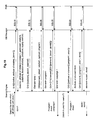
- Fig. 19 is a communication sequence diagram of the second search processing of Fig. 18 in the information search system 1 (Fig. 5).
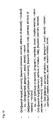
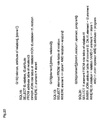
- Figs. 20 to 23 are four diagrams including an SQL sentence supplied by data base manager 320 (Fig. 9) to RDB 14, such that: Fig. 20 includes the contents of SQL 16, SQL 13, and SQL 26 of Fig. 19, Fig. 21 includes the content of SQL 52 of Fig. 19, Fig. 22 includes the content of SQL 33 of Fig. 19, and Fig. 23 includes the content of SQL 41 of Fig. 19.
- the user terminal 2 responds to a user's input to output a request to search engine 300 (Fig. 9).
- the request includes information to search for a store affiliated with, for example, store 1.
- the user of the user terminal 2 starts "store search" on the UI screen 1 of Fig. 8.
- the search engine 300 starts the search based on the affiliation.
- Search engine 300 transmits to data base manager 320 a query containing (1) the relation and (2) a relation attribute as search targets (output data) and (3) the store 1 as a keyword as shown by query Q16 in Fig. 13.
- the data base manager 320 Upon receiving the query Q16 from the search engine 300, the data base manager 320 generates SQL sentence (SQL 16) (indicated at the upper stage of Fig. 20) and transmits SQL 16 to RDB 14.
- SQL 16 SQL sentence
- RDB 14 searches a relation and the attribute thereof related to store 1, as shown in Fig. 18, and returns to the data base manager 320 a response containing a combination of the relation and the attribute thereof (relation 1, participant relation), (relation 2, location relation) and (relation 4, supply relation).
- Data base manager 320 transmits this response to search engine 300.
- search engine 300 transmits to data base manager 320 query Q13 (Fig. 13) containing an element as a search target and containing the store 1 and the relation 2 as keywords.
- data base manager 320 Upon receiving the query Q13 from the search engine 300, data base manager 320 generates an SQL sentence (SQL 13), indicated at the intermediate stage of Fig. 20, and transmits SQL 13 to RDB 14.
- SQL 13 an SQL sentence
- RDB 14 searches for an element related with the store 1 and the relation 2, as shown in Fig. 18, and returns to data base manager 320 a response containing an element (area 1). Data base manager 320 transmits this response to search engine 300.
- search engine 300 transmits to data base manager 320 a query containing (1) an element as a search target and (2) store 1, (3) relation 1, (4) an element role of output data (sponsor), and (5) element attribute of output data (program) as keywords.
- the data base manager 320 Upon receiving the query Q26 from the search engine 300, the data base manager 320 generates an SQL sentence (SQL 26) at the lower stage of Fig. 20, and transmits SQL 26 to RDB 14.
- SQL 26 In response to SQL 26, RDB 14 returns to the data base manager 320 a response containing (1) an element (program 1) related to store 1 and (2) relation 1 having the role (sponsor) and (3) the element attribute (program), as shown in Fig. 18.
- the data base manager 320 transmits this response to the search engine 300.
- search engine 300 transmits to the data base manager 320 a query which (1) contains an element as a search target and (2) contains as a keyword a search result based on the query (Q21) containing an element as a search target and (3) the element (store 1) and (4) the attribute (goods) of the element of the search target as keywords.
- the data base manager 320 Upon receiving query Q52 from the search engine 300, the data base manager 320 generates an SQL sentence (SQL 52), Fig. 21, and transmits SQL 52 to RDB 14.
- RDB 14 In response to sentence (SQL 52) RDB 14 returns to the data base manager 320 a response (1) containing an element (campaign 1) related to the element (the search result based on Q21) which is related to the store 1 and has goods as the element attribute as shown in Fig. 18. Data base manager 320 transmits this response to search engine 300.
- the search engine 300 transmits to the user terminal 2 (1) program 1, (2) area 1 and (3) campaign 1 which have been obtained as the current search results.
- Search engine 300 also causes user interface (UI) 200 to activate the display of user terminal 2 and provide the user with an image that prompts the user to instruct whether a search using any one or more of the search results is to be carried out.
- UI user interface
- the user operates on the UI image to instruct conducting a search using program 1 and area 1, for example.
- the search engine 300 Upon receiving this instruction, the search engine 300 transmits to the data base manager 320 a query containing an element attribute as a search target and program 1 and area 1 as keywords, as shown as query Q33 in Fig. 15.
- the data base manager 320 Upon receiving the query Q33 from the search engine 300, the data base manager 320 generates an SQL sentence (SQL 33), Fig. 22, and transmits SQL 33 to RDB 14. In response to SQL 33, RDB 14 returns to the data base manager 320 a response containing an element attribute (store) related to program 1 and area 1, as shown in Fig. 18. The data base manager 320 transmits this response to search engine 300.
- SQL 33 an SQL sentence
- Fig. 22 Upon receiving the query Q33 from the search engine 300, the data base manager 320 generates an SQL sentence (SQL 33), Fig. 22, and transmits SQL 33 to RDB 14.
- RDB 14 returns to the data base manager 320 a response containing an element attribute (store) related to program 1 and area 1, as shown in Fig. 18.
- the data base manager 320 transmits this response to search engine 300.
- the search engine 300 also generates a query by using the search target and the keyword or the search target designated by a user. Search engine 300 transmits the generated query to data base manager 320.
- search engine 300 may generate a query containing the information element thus designated and the information element properly selected, as in the case of the processing of query SQL 52 or preceding processing as a search target and a search keyword, or any one of them. Search engine 300 then transmits the generated query to data base manager 320.
- the search engine 300 generates a query containing the information element thus designated and the information element properly selected, as in the case of the processing of query SQL 52, and the proceeding processing as a search target and a search keyword or any one of them. Search engine 300 transmits the generated query to data base manager 320.
- search engine 300 transmits to the data base manager 320 a query containing an element as a search target, and program 1, area 1 and the element attribute (store) as keywords.
- the data base manager 320 Upon receiving the query Q41 from the search engine 300, the data base manager 320 generates an SQL sentence (SQL 41), Fig. 23 and then transmits the generated SQL sentence to RDB 14.
- RDB 14 In response to SQL 41, RDB 14 returns to the data base manager 320 a response containing elements (store 1, store 2) related with the program 1 and the area 1 and having the attribute of the store, as shown in Fig. 18.
- the data base manager 320 transmits this response to the search engine 300 that displays on user terminal 2 the search result, store 1, store 2.
Landscapes
- Engineering & Computer Science (AREA)
- Databases & Information Systems (AREA)
- Theoretical Computer Science (AREA)
- Data Mining & Analysis (AREA)
- Physics & Mathematics (AREA)
- General Engineering & Computer Science (AREA)
- General Physics & Mathematics (AREA)
- Information Retrieval, Db Structures And Fs Structures Therefor (AREA)
- Management, Administration, Business Operations System, And Electronic Commerce (AREA)
Abstract
Description
Claims (18)
- An information search apparatus for searching one or more stored information elements that are related to one another, comprising:selecting means for selecting one or more first information elements as targets to be searched for and one or more second information elements used for the search; andsearching means for searching, from the selected first information elements, third information elements related to the selected second information elements.
- The information search apparatus according to claim 1, wherein the information elements include one or more elements indicating a substantive thing, one or more relations between the elements, one or more roles played by the elements in the relations, one or more attributes of the elements, and one or more attributes of the relations, or one or more combinations thereof.
- The information search apparatus according to claim 2, wherein the elements are further related with one another by affiliations between the elements.
- The information search apparatus according to claim 1, 2 or 3, wherein the selecting means is arranged to select one or more of the elements, the relation and the role as the first information element, and select, as the second information element, one or more of the elements, the relation, role, the attribute of the elements and the attributes of the relation.
- The information search apparatus according to claim 1, 2 or 3, wherein the selecting means is arranged to select the first information element, the second information element and the third information element on the basis of a search request or a subordinate search request achieved as an analysis result of the search request.
- The information search apparatus according to claim 1, 2 or 3, wherein the selecting means is arranged to select one or more of the first information elements and one or more of the second information elements or any one of the first information elements and the second information elements in accordance with the selection of the third information element obtained as a result of the searching.
- The information search apparatus according to claim 1, 2 or 3, further comprisingwherein the selecting means is arranged to select the first information elements and the second information elements from the selected third information elements, or to select the first information elements and the second information elements from the stored information elements and the selected third information elements.accepting means for accepting selection of one or more of the first information elements and one or more of the second information elements, or the third information elements used as the first information elements or the second information elements,
- The information search apparatus according to claim 1, 2 or 3, whereinthe selecting means is arranged for selecting the first information, and second information, and the search means is arranged for repeatedly searching the third information until the third information satisfies a predetermined condition.
- A method of searching one or more stored information elements, the information elements being related with one another, comprisingselecting one or more first information elements as targets to be searched for and one or more second information elements used for the search, andsearching, from the selected first information elements, third information elements related to the selected second information elements.
- The information search method according to claim 9, wherein the information elements includes (a) one or more elements indicating a substantive thing, (b) one or more defined relations between the elements, (c) one or more roles played by the elements, (d) one or more attributes of the elements and (e) one or more attributes of the relations, or one or more combinations thereof.
- The information search method according to claim 10, wherein the elements are also related to one another by affiliations between the elements.
- The information search method according to claim 9, 10 or 11, further including repeating the selection of the first information and the second information, and the search of the third information until the third information satisfies a predetermined condition.
- The information search method according to any of claims 9 to 12, wherein the step of selecting one or more of the elements includes selecting (a) the relation and the role as the first information element, and (b) one or more of the elements, the relations, roles, the attributes of the element and the attribute of the relation as the second information element.
- The information search method according to any of claims 9 to 12, wherein the selecting step includes selecting the first information element, the second information element and the third information element on the basis of a search request or a subordinate search request achieved as an analysis result of the search request.
- The information search method according to any of claims 9 to 12, wherein the selecting step includes selecting one or more of the first information elements and one or more of the second information elements or any one of the first information elements and the second information elements in accordance with the selection of the third information element obtained as a result of the searching.
- The information search method according to any of claims 9 to 12, further comprising:wherein the selecting step includes selecting the first information elements and the second information elements from the third information elements thus selected, or selecting the first information elements and the second information elements from the stored information elements and the selected third information elements.accepting a selection of one or more of the first information elements and one or more of the second information elements, or the third information elements used as the first information elements or the second information elements,
- A computer program comprising computer program code means for performing all of the steps of any of claims 9 to 16 when said program is run on a computer.
- A computer program as claimed in claim 17 embodied on a computer readable medium.
Applications Claiming Priority (2)
| Application Number | Priority Date | Filing Date | Title |
|---|---|---|---|
| JP2003321654A JP2005092331A (en) | 2003-09-12 | 2003-09-12 | Information retrieval device and method |
| JP2003321654 | 2003-09-12 |
Publications (2)
| Publication Number | Publication Date |
|---|---|
| EP1515250A2 true EP1515250A2 (en) | 2005-03-16 |
| EP1515250A3 EP1515250A3 (en) | 2006-06-07 |
Family
ID=34132059
Family Applications (1)
| Application Number | Title | Priority Date | Filing Date |
|---|---|---|---|
| EP04255450A Withdrawn EP1515250A3 (en) | 2003-09-12 | 2004-09-08 | Method and apparatus for information search |
Country Status (5)
| Country | Link |
|---|---|
| US (1) | US20050091207A1 (en) |
| EP (1) | EP1515250A3 (en) |
| JP (1) | JP2005092331A (en) |
| KR (1) | KR20050027075A (en) |
| CN (1) | CN1595402A (en) |
Families Citing this family (12)
| Publication number | Priority date | Publication date | Assignee | Title |
|---|---|---|---|---|
| US8078604B2 (en) | 2007-03-19 | 2011-12-13 | Microsoft Corporation | Identifying executable scenarios in response to search queries |
| US7797311B2 (en) * | 2007-03-19 | 2010-09-14 | Microsoft Corporation | Organizing scenario-related information and controlling access thereto |
| US7818341B2 (en) * | 2007-03-19 | 2010-10-19 | Microsoft Corporation | Using scenario-related information to customize user experiences |
| US20080235170A1 (en) * | 2007-03-19 | 2008-09-25 | Microsoft Corporation | Using scenario-related metadata to direct advertising |
| US8533186B2 (en) * | 2010-01-15 | 2013-09-10 | Blackberry Limited | Method and device for storing and accessing retail contacts |
| US20110246330A1 (en) * | 2010-04-01 | 2011-10-06 | Anup Tikku | System and method for searching content |
| JP5858456B2 (en) * | 2011-01-21 | 2016-02-10 | 国立研究開発法人情報通信研究機構 | Information retrieval service providing apparatus and computer program |
| JP5697256B2 (en) * | 2011-11-24 | 2015-04-08 | 楽天株式会社 | SEARCH DEVICE, SEARCH METHOD, SEARCH PROGRAM, AND RECORDING MEDIUM |
| JP6351219B2 (en) * | 2012-08-23 | 2018-07-04 | キヤノン株式会社 | Image search apparatus, image search method and program |
| CN104731903A (en) * | 2015-03-23 | 2015-06-24 | 魏强 | Method for searching for enterprise on basis of products and search device |
| KR20180032233A (en) * | 2016-09-21 | 2018-03-30 | 엔에이치엔엔터테인먼트 주식회사 | System and method for distribution management using distribution network and big data |
| JP6771503B2 (en) | 2018-03-27 | 2020-10-21 | 株式会社日立製作所 | Data management system and related data recommendation method |
Family Cites Families (8)
| Publication number | Priority date | Publication date | Assignee | Title |
|---|---|---|---|---|
| NL1009376C1 (en) * | 1998-06-11 | 1998-07-06 | Boardwalk Ag | Data system for providing relationship patterns between people. |
| CA2281331A1 (en) * | 1999-09-03 | 2001-03-03 | Cognos Incorporated | Database management system |
| US7533107B2 (en) * | 2000-09-08 | 2009-05-12 | The Regents Of The University Of California | Data source integration system and method |
| GB2371884A (en) * | 2000-10-12 | 2002-08-07 | Abb Ab | Queries in an object-oriented computer system |
| US6701311B2 (en) * | 2001-02-07 | 2004-03-02 | International Business Machines Corporation | Customer self service system for resource search and selection |
| JP3842577B2 (en) * | 2001-03-30 | 2006-11-08 | 株式会社東芝 | Structured document search method, structured document search apparatus and program |
| US20030101170A1 (en) * | 2001-05-25 | 2003-05-29 | Joseph Edelstein | Data query and location through a central ontology model |
| AU2003233119A1 (en) * | 2002-05-08 | 2003-11-11 | Neuronova Ab | Modulation of neural stem cells with s1p or lpa receptor agonists |
-
2003
- 2003-09-12 JP JP2003321654A patent/JP2005092331A/en not_active Withdrawn
-
2004
- 2004-09-08 EP EP04255450A patent/EP1515250A3/en not_active Withdrawn
- 2004-09-10 KR KR1020040072634A patent/KR20050027075A/en not_active Withdrawn
- 2004-09-10 CN CNA2004100770811A patent/CN1595402A/en active Pending
- 2004-09-13 US US10/938,941 patent/US20050091207A1/en not_active Abandoned
Also Published As
| Publication number | Publication date |
|---|---|
| US20050091207A1 (en) | 2005-04-28 |
| EP1515250A3 (en) | 2006-06-07 |
| KR20050027075A (en) | 2005-03-17 |
| JP2005092331A (en) | 2005-04-07 |
| CN1595402A (en) | 2005-03-16 |
Similar Documents
| Publication | Publication Date | Title |
|---|---|---|
| US20230093606A1 (en) | Knowledge search engine platform for enhanced business listings | |
| CN103150352B (en) | System to generate related search queries | |
| US8712996B2 (en) | Information repository search system | |
| US20050256766A1 (en) | Method and system for targeted internet search engine | |
| US20100070387A1 (en) | Local availability of products and services on a sales user interface | |
| KR20080004567A (en) | Method, system and apparatus for enabling multi-mode location based e-directory services | |
| JP2010503071A (en) | Providing local advertising | |
| NZ546156A (en) | Methods and systems for improving a search ranking using location awareness | |
| US8688696B2 (en) | Multi-part search result ranking | |
| US20110119265A1 (en) | Dynamically linking relevant documents to regions of interest | |
| US20100042611A1 (en) | Location-based search mash-up engine, web site, and application programming interface | |
| EP1515250A2 (en) | Method and apparatus for information search | |
| US12020286B1 (en) | Immersive content items | |
| JP2020064498A (en) | Information processor, information processing method, and information processing program | |
| JP6056327B2 (en) | Electronic commerce server device | |
| US20090025017A1 (en) | Simplifying Interaction With Multiple Applications When Using Forms Via A Common Interface | |
| US20130268361A1 (en) | Systems and methods for implementing a user-directed landing page for generating enhanced user contact information based on user interactive computer searches | |
| US20020010656A1 (en) | Link engine computer and method | |
| US8595225B1 (en) | Systems and methods for correlating document topicality and popularity | |
| US12554786B2 (en) | Matching search queries to application content | |
| JP3933617B2 (en) | Shared information search method, shared information search program, and information sharing system | |
| KR100347799B1 (en) | Method for searching an information in internet and apparatus for performing the same | |
| JP3823691B2 (en) | Information retrieval method and system, and recording medium on which information retrieval program is recorded | |
| JP6895189B1 (en) | Recommender systems and methods | |
| McCarthy et al. | Search Without Keywords |
Legal Events
| Date | Code | Title | Description |
|---|---|---|---|
| PUAI | Public reference made under article 153(3) epc to a published international application that has entered the european phase |
Free format text: ORIGINAL CODE: 0009012 |
|
| AK | Designated contracting states |
Kind code of ref document: A2 Designated state(s): AT BE BG CH CY CZ DE DK EE ES FI FR GB GR HU IE IT LI LU MC NL PL PT RO SE SI SK TR |
|
| AX | Request for extension of the european patent |
Extension state: AL HR LT LV MK |
|
| PUAL | Search report despatched |
Free format text: ORIGINAL CODE: 0009013 |
|
| AK | Designated contracting states |
Kind code of ref document: A3 Designated state(s): AT BE BG CH CY CZ DE DK EE ES FI FR GB GR HU IE IT LI LU MC NL PL PT RO SE SI SK TR |
|
| AX | Request for extension of the european patent |
Extension state: AL HR LT LV MK |
|
| AKX | Designation fees paid | ||
| REG | Reference to a national code |
Ref country code: DE Ref legal event code: 8566 |
|
| STAA | Information on the status of an ep patent application or granted ep patent |
Free format text: STATUS: THE APPLICATION IS DEEMED TO BE WITHDRAWN |
|
| 18D | Application deemed to be withdrawn |
Effective date: 20061208 |