EP1513319A2 - Procédé de protection d'un contenu numérique - Google Patents
Procédé de protection d'un contenu numérique Download PDFInfo
- Publication number
- EP1513319A2 EP1513319A2 EP04300454A EP04300454A EP1513319A2 EP 1513319 A2 EP1513319 A2 EP 1513319A2 EP 04300454 A EP04300454 A EP 04300454A EP 04300454 A EP04300454 A EP 04300454A EP 1513319 A2 EP1513319 A2 EP 1513319A2
- Authority
- EP
- European Patent Office
- Prior art keywords
- server
- digital content
- identifier
- user
- tattoo
- Prior art date
- Legal status (The legal status is an assumption and is not a legal conclusion. Google has not performed a legal analysis and makes no representation as to the accuracy of the status listed.)
- Granted
Links
Images

Classifications
-
- G—PHYSICS
- G06—COMPUTING OR CALCULATING; COUNTING
- G06F—ELECTRIC DIGITAL DATA PROCESSING
- G06F17/00—Digital computing or data processing equipment or methods, specially adapted for specific functions
-
- H—ELECTRICITY
- H04—ELECTRIC COMMUNICATION TECHNIQUE
- H04L—TRANSMISSION OF DIGITAL INFORMATION, e.g. TELEGRAPHIC COMMUNICATION
- H04L63/00—Network architectures or network communication protocols for network security
- H04L63/12—Applying verification of the received information
-
- G—PHYSICS
- G06—COMPUTING OR CALCULATING; COUNTING
- G06F—ELECTRIC DIGITAL DATA PROCESSING
- G06F21/00—Security arrangements for protecting computers, components thereof, programs or data against unauthorised activity
- G06F21/10—Protecting distributed programs or content, e.g. vending or licensing of copyrighted material ; Digital rights management [DRM]
- G06F21/106—Enforcing content protection by specific content processing
- G06F21/1063—Personalisation
-
- H—ELECTRICITY
- H04—ELECTRIC COMMUNICATION TECHNIQUE
- H04L—TRANSMISSION OF DIGITAL INFORMATION, e.g. TELEGRAPHIC COMMUNICATION
- H04L9/00—Cryptographic mechanisms or cryptographic arrangements for secret or secure communications; Network security protocols
- H04L9/32—Cryptographic mechanisms or cryptographic arrangements for secret or secure communications; Network security protocols including means for verifying the identity or authority of a user of the system or for message authentication, e.g. authorization, entity authentication, data integrity or data verification, non-repudiation, key authentication or verification of credentials
-
- H—ELECTRICITY
- H04—ELECTRIC COMMUNICATION TECHNIQUE
- H04L—TRANSMISSION OF DIGITAL INFORMATION, e.g. TELEGRAPHIC COMMUNICATION
- H04L2463/00—Additional details relating to network architectures or network communication protocols for network security covered by H04L63/00
- H04L2463/101—Additional details relating to network architectures or network communication protocols for network security covered by H04L63/00 applying security measures for digital rights management
-
- H—ELECTRICITY
- H04—ELECTRIC COMMUNICATION TECHNIQUE
- H04L—TRANSMISSION OF DIGITAL INFORMATION, e.g. TELEGRAPHIC COMMUNICATION
- H04L2463/00—Additional details relating to network architectures or network communication protocols for network security covered by H04L63/00
- H04L2463/103—Additional details relating to network architectures or network communication protocols for network security covered by H04L63/00 applying security measure for protecting copyright
Definitions
- the subject of the invention is a method for protecting a content digital.
- Digital content is a succession of recordable bits on any medium among at least those designated by random access memory, ROM, CD-ROM, DVD, floppy disk, ... the list is not exhaustive. Digital content therefore belongs at least to the group formed by the music files, image files, video files, programs, and the list is not yet complete.
- the domain of the invention is therefore that of the distribution of digital contents, which whether the distribution media, in particular that the distribution is performed online or on a physical medium.
- An object of the invention is to limit the illegal distribution of content digital.
- Another object of the invention is to limit the illegal distribution of digital content in a way that is not very demanding for the consumer of these digital contents.
- Another object of the invention is to facilitate the detection of distributions illegal digital content.
- Another object of the invention is to make it possible to simply go back to the source of illegal distribution of digital content.
- the application of current protection techniques may extremely negative effects such as some media become illegible by the very fact of protection.
- the consumer having legally acquired digital content may become incapacitated to access this digital content due to the inadequacy of its reading.
- This case is becoming more common for audio CDs. Indeed some protected audio CDs are no longer compatible with some decks of living room.
- the effect obtained goes totally against the desired effect since in the short term, consumer confidence will be eroded.
- the consumer does not wish to purchase a platinum specific for each technique of protecting a digital content. The effect obtained is even more harmful as these protections do not resist long and that digital content always ends up being looted.
- these problems are solved by customizing the digital content without altering their format, and therefore their compatibility with all approved materials to read the format in question.
- This customization consists of imperceptible marking without the tools the marking does not interfere with the equipment and reading, because said marking respects the format of the digital content.
- marking is also called a tattoo, a technique also known the skilled person under the name of 'watermarking'.
- personalize this tattoo by tattooing digital content at least with an identifier of the person legally obtaining the digital content.
- the tattoo is made from a secret key algorithm which makes it particularly robust, that is hard to erase.
- the secret key is known only to licensees authorized to distribute the digital content.
- tattoo is affixed at the time of ordering digital content.
- the person controlling the digital content is then placed in front of his responsibilities and knows that it will be easy to find if it makes use illegal digital content it has just acquired, or if it does not surround it no minimum protections preventing its diversion Techniques cryptographic services providing mutual authentication services, confidentiality, integrity and non-repudiation of an act may be used exchanges necessary to provide tattooed content to guarantee the quality of the tattoo act and allow a fight against fraud effective at the legal level.
- the invention is also characterized in that the tattoo information include digital management information rights associated with digital content.
- the invention is also characterized in that the tattoo information include limitation information use of digital content.
- the invention is also characterized in that the private network is a telephony network.
- the invention is also characterized in that all or part of the user's durable civilian identifier is a phone number.
- the invention is also characterized in that the Tattoo server is managed by the operator controlling the private network.
- the invention is also characterized in that the Tattoo server is managed by the provider of digital content.
- the invention is also characterized in that the Presentation server is managed by the digital content provider.
- the invention is also characterized in that obtaining a durable civilian user identifier by the server of presentation is subject to approval by the identification server, this approval being based on an identifier of the issuer of a request for identification or authentication of the sender of the request.
- the exchanges between the presentation servers, identification, tattooing, contents and connection are protected by mutual authentication of the parties by means of control mechanisms integrity, through mechanisms ensuring the confidentiality of trade, through mechanisms guaranteeing the non-repudiation of trade, mechanisms that can implement cryptographic means and conventions.
- a server is equivalent to a computer.
- this action is performed by a server microprocessor controlled by instruction codes from a server memory.
- a waiter also includes all the means necessary for its connection to one or several networks of the Internet, Ethernet, or other type.
- FIG. 1 shows a step 101 in which a user of a client terminal establishes a connection with a presentation server.
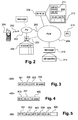
- FIG. 2 shows a terminal 201 client connected by a link 202 to a private 203 network.
- the terminal 201 is a mobile telephone connected to the network 203 of a telephone operator mobile in a GPRS mode.
- the implementation Network 203 in terms of infrastructure, protocols and law access, is at the sole discretion of the operator managing the private 203 network.
- a public or open network 204 such as the Internet
- protocols and modes of access are known and usable by all.
- Figure 2 shows that the 203 private and 204 public networks are interconnected via a connection 205.
- connection 205 is made through gateways managed by the operator of the private network 203. These bridges implement the policy of the operator of the private network 203 vis-à-vis the public network 204. This policy covers both incoming connections and outgoing from the private 203 network. In a simplified way, this policy is summarizes to allow or deny these connections according to various criteria, like the identity of the participants to the connection, the nature of the connection, the volume of data linked to the connection ..., the list not being of course not comprehensive
- FIG. 2 also shows a presentation server 206 connected to the public network 204.
- a presentation server is also known as the web server, or HTTP server (hyper text transfer protocol, for hypertext transfer protocol).
- HTTP server hyper text transfer protocol, for hypertext transfer protocol
- Such a server allows the hosting of websites, also known as websites.
- a website has at least one page, also called a web page. Each web page contains links to other web pages, or other digital content.
- a web page is digital content.
- the user of the terminal 201 establishes a connection with the presentation server 206. This connection is established via the 203 private and 204 public networks. This connection is established by executing on the terminal 201 a program of Internet browser type, also called Internet Explorer. In fact, the user of the terminal 201 connects to a website hosted by the server 206.
- This website allows the presentation to the user of the terminal 201 of a certain number of digital contents, for example pieces of music. , movies, programs, available for distribution.
- an implementation of the invention based on an http connection is described.
- the invention supports all types of protocols, among which ftp (file transfer protocol, for file transfer protocol), wtp (wireless transfer protocol), the list of course not exhaustive.
- the invention can also be based on unconnected protocols, as well as asynchronous protocols, for example using messaging streams, among which there may be mentioned SMTP (Simple Mail Transfer Protocol for the Internet messaging protocol).
- SMS and MMS service in the context of a mobile network
- the presentation server can directly consume SMS and MMS.
- the terminal 201 can not be limited to a terminal of mobile telephony. in fact, the terminal 201 can also be a computer personnel or any device allowing to connect to a server of type Web server.
- the private 203 network is generally the private network an Internet Service Provider (ISP).
- ISP Internet Service Provider
- Step 102 ends when the server 206 has obtained the confirmation of the selection made by the user of the terminal 201, this confirmation corresponding to a validation action, via a page of the site web presentation, from the user of the terminal 201.
- This confirmation allows the user of the terminal 101 to indicate to the server 206 which digital content the user wishes to obtain.
- the user can inform the mode of delivery of the selected content, for example through an e-mail address, a phone number or delivery address if a support Physical is required.
- a memory of the server 206 of presentation allows to associate with each digital content presented a digital content identifier. The selection of digital content so allows at the same time the selection of a content identifier number associated with the selected digital content.
- step 102 From step 102 then we go to a step 103 of obtaining a identifier of the user of the terminal 201 by the server 206.
- This identifier is here called a durable civilian identifier. It's an identifier that allows to identify a person civilly for several years, or even several decades. Generally this identifier is relevant to the lifetime of the intellectual property rights attached to the digital content.
- the Presentation server 206 produces an identification request request.
- the presentation server 206 issues this request request identification to an identification server 207.
- the identification server is either connected to the private 203 network or directly connected to the network 204 public.
- the server 206 includes a memory 208 enabling it to store an address of the identification server 207. This memory 208 is is entered in the configuration of the presentation server 206 or entered via the contents of a field of messages exchanged between the presentation server 206 and terminal 201 in steps 101 and 102.
- IP addresses Internet Protocol, for Internet protocol is understood by IP protocol the IPv4 and IPv6 protocols
- IP protocol the IPv4 and IPv6 protocols
- the 206 server is so in practice able to associate with each incoming connection (step 101) an address of an identification server.
- the server 206 of presentation is therefore able to determine which identification server send an identification request based on the IP address that he has presented the user who selected the digital content.
- the memory 208 is divided into several lines, each line corresponding to a range of IP addresses. Each line has two columns, a first column to describe a beach IP address, a second column to associate with the description of the range an IP address of an identification server.
- the request 300 once produced, is sent to the server. 207.
- the first verification is done via a table 209 of the server 207 Identification.
- This table associates with an identifier, for example an address IP, a value indicating whether or not to answer a request identification from a device with this identifier.
- This authorization to request an identifier can also be based on the partarge information between the server 207 and the requesting server (for example a password or a secret key), in the same way this authorization may be subordinated to the result of cryptographic calculations used to validate an authentication, mutual or one-way, or even a signature Electronics (PKI type technology: Public Key Infrastructure and Certificates X509).
- PKI type technology Public Key Infrastructure and Certificates X509
- an operator obviously knows the way to address his subscriber during his connections.
- the ranges of addresses which have been assigned to the network operator 203 at connection 205 make it easy to do this check.
- the operator of the network 203 has assigned the terminal 201 an IP address. The operator is able, at the time of receipt of the identification request by the 207, to civilly identify the user of the terminal 201.
- the network operator 203 and therefore the server 207, can civilly identify the person to whom this IP address has been assigned. Indeed the server 207 has access, at least by delegation of authorization from the operator managing the network 203, to the network 203 and its equipment.
- the identification server 207 has in particular access to the equipment responsible for assigning IP addresses to 203 private network subscribers wishing to establish a connection via the network 204 public. These devices do not allocate an IP address to a terminal that they can not identify.
- HLR Home Rental rRgister, for nominal location recorder
- VLR Visitor Location Register, for visitor location recorder geographic
- GGSN Gateway GPRS Support Node, for GPRS gateway.
- the server 207 having access to the equipment of the private network 203, can therefore provide in response to the identification request, a civil identifier sustainable.
- a durable civil identifier is, for example, a number of MSISDN type phone, a social security number, a number of identity card, the url of the place of storage of an electronic identity certificate (for example of type X509), or any other identifier that the operator of the network 203 undertakes to be able to attribute to a civilian person during a sustainable period.
- sustainable means a period comparable to the duration of rights attached to digital content, and / or comparable to the lifetime of the digital content media. A period sustainable is therefore measured in years, and preferably in decades.
- the durable civil identifier is dated.
- the durable civil identifier is thus the concatenation of an identifier and a date or a unique serial number or any other information allowing the identification in time of the user associated with this ID.
- This allows in particular to manage the reallocation of numbers MSISDN.
- the use of an identifier based on an IPV4 IP address is made possible, but in this case it is necessary to store a large amount of data over a very long time. Indeed, he would have to store all IP sessions of all subscribers, in addition to their number MSISDN, which would make the identification of a person through a cost-effective durable civilian identifier.
- a v6 IP address can be assigned so subscriber (like a social security number).
- this durable civilian identifier is the result of encryption MSISDN type number and parameters associated with the operator of the network 203 using a secret encryption method. This allows to use processes producing variable durable civil identifiers in the time, which prevents the server 206 from doing statistics on a identifier of type MSISDN for example.
- the answer to an authorized identification request is a message 400 to the server 206.
- the message 400 then comprises at least a field 401 durable civil identifier and a recipient field 402 having an address of the presentation server 206. So optional message 400 has a field 403 identical to the field 302.
- This response can be authenticated, protected in integrity, and confidentiality by established cryptographic techniques and conventions between servers 206 and 207 so as to have a high level of trust in the data exchanged.
- this identifier is actually transmitted when the terminal 201 is connected to presentation server 206.
- the connection of the terminal 201 is via the private 203 network.
- the network operator 203 is therefore capable to intercept, for preprocessing, the requests sent by the terminal 201 during of this connection.
- a network equipment 203 can process the frames sent by the terminal 201 according to the address of the recipient of these frames. If this address is present in table 209, then the network 203 modifies the frame so as to include a civilian identifier end-user of the terminal 201.
- the server 206 is thus directly aware of a durable civilian identifier of the user.
- this durable civil identifier is associated with a electronic signature technique to authenticate the origin of the request and therefore to certify the validity of the identifier used upon receipt by the server 206.
- this durable civilian identifier can be protected in confidentiality when it is sent to the server 206.
- the message 500 is sent to the server 210 of tattoo and we go to a step 105 tattoo digital content selected in step 102.
- the server 210 uses the information of the fields 502 and 503 to obtain the digital content itself.
- the server 210 of tattooing therefore issues a request to the content server 213 to obtain digital content.
- This digital content is the one identified by the field 502.
- the message 500 also includes an identifier of the presentation server 206 so that the content server can check that the request to obtain digital content originated an entity authorized to issue it.
- this identifier of the server 206 is also transmitted by the tattoo server 210 to the server 213 of contents.
- the content server can also try to identify the tattoo server. This identification being done or simply by the reply address of the request by which the tattoo server 210 seeks to obtain digital content, ie, by more advanced non-limiting cryptographic means of the invention.
- Be the content server 213 knows this response address and it accesses the request, or he does not know it and he does not transmit digital content in response to the request. This knowledge is materialized, for example, by an identification memory in the server 213. This memory identification then allows to save a list of identifiers which are then known to the server 213. If the request to obtain digital content is validated, the server 213 transmits the digital content identified by the field 502 to the tattoo server 210. We are talking about digital content obtained by the tattoo server 210.
- the tattoo server implements a secret key tattoo algorithm, the secret key being registered in a memory 214 of the tattoo server 210.
- a secret key tattoo algorithm the secret key being registered in a memory 214 of the tattoo server 210.
- We prefer an algorithm to secret key because this type of algorithms is at present much more robust than are the public key algorithms. In the future trend could equilibrate or reverse itself, and public-key algorithms could become more relevant then.
- the information tattooed on the digital content obtained is those contained in fields 505 and 506.
- the result of the tattoo is a obtained and tattooed digital content that is emitted to the contained address in the field 504 during a step 106 of transmitting the content obtained digital and tattooed.
- the address contained in field 504 may be the IP address of the terminal 201, that is to say the same as it had during the steps precedents, in particular steps 101 and 102.
- the address contained in the field 504 may be the IP address of the server 206, in which case it is the server 206 which is responsible for the distribution of the digital content obtained and tattooed.
- the address contained in field 504 can be an e-mail address (for e-mail address).
- the address contained in the field 504 may be the subscriber's MSISDN or any other telephone number at choice of subscriber acquirer of digital content. In this case distribution of digital content is done by telephone call from the purchaser and sound broadcast or download.
- the address contained in the field 504 can be a postal address in which case the content obtained and tattooed digital is recorded on a medium, floppy disk, CD, removable disk, said medium being sent by postal mail to the postal address.
- the method according to the invention thus allows many modes of Implementation. Among these modes there are so-called on-the-fly modes of those called disconnected modes.
- An offline mode is a mode of embodiment in which the user of the terminal 201 receives the content selected by a different channel than the one he used for the to select.
- the tattooed digital content is typically received by the user of the terminal 201 is, by techniques of download that may or may not use one of the terminal extension ports 201 (infrared port, bluetooth, serial link port), either by e-mail or by Postal route.
- tattooed digital content is transmitted as if the presentation site was also a site of download. In this case the digital content is either, tattooed then transmitted to the user of the terminal 201, that is, tattooed as it is transmitted to the user of the terminal 201.
- the tattoo server is managed by the operator controlling the private network.
- the tattoo server is managed by the provider of digital content.
- the server of presentation is managed by the digital content provider.
- the presentation server and the tattoo server are managed by the provider of digital content, finally again in another variant the tattoo server ensures the delivery of the content to the user of the terminal.
- An interesting variant is that where the user accesses the server presentation via voice communication (telephone call) and where browsing content offers can be driven by the use of extended DTMF frequencies.
Landscapes
- Engineering & Computer Science (AREA)
- Computer Security & Cryptography (AREA)
- Theoretical Computer Science (AREA)
- General Engineering & Computer Science (AREA)
- Software Systems (AREA)
- Computer Hardware Design (AREA)
- Computer Networks & Wireless Communication (AREA)
- Signal Processing (AREA)
- Physics & Mathematics (AREA)
- General Physics & Mathematics (AREA)
- Computing Systems (AREA)
- Databases & Information Systems (AREA)
- Data Mining & Analysis (AREA)
- Multimedia (AREA)
- Technology Law (AREA)
- Mathematical Physics (AREA)
- Storage Device Security (AREA)
- Management, Administration, Business Operations System, And Electronic Commerce (AREA)
- Two-Way Televisions, Distribution Of Moving Picture Or The Like (AREA)
- Television Systems (AREA)
- Image Processing (AREA)
- Editing Of Facsimile Originals (AREA)
- Data Exchanges In Wide-Area Networks (AREA)
- Computer And Data Communications (AREA)
- Telephonic Communication Services (AREA)
Abstract
Description
- un serveur de présentation accepte une connexion d'un utilisateur abonné à un opérateur contrôlant un réseau privé et se connectant en utilisant un terminal client et via au moins ce réseau privé audit serveur de présentation d'un prestataire proposant l'accès à des contenus numériques,
- l'utilisateur sélectionne un contenu numérique parmi ceux présentés par le serveur de présentation,
- le serveur de présentation obtient, d'un serveur d'identification, un identifiant appelé identifiant civil durable de l'utilisateur, cet identifiant civil durable permettant à l'opérateur contrôlant le réseau privé, et ayant fourni ledit identifiant civil durable, d'identifier durablement et civilement l'utilisateur,
- le serveur de présentation transmet des informations de tatouage comportant au moins l'identifiant civil durable de l'utilisateur et un identifiant du contenu numérique sélectionné par l'utilisateur à un serveur de tatouage, pour le tatouage du contenu numérique sélectionné.
- le serveur de tatouage obtient le contenu numérique sélectionné du serveur de contenus et produit un contenu numérique tatoué incorporant les informations de tatouage transmises par le serveur de présentation et le contenu numérique sélectionné et obtenu, le contenu numérique tatoué étant un fichier au format du contenu numérique sélectionné et obtenu,
- le serveur de tatouage délivre le contenu numérique tatoué à l'utilisateur.
- un terminal client apte à se connecter à un serveur de présentation via au moins un réseau privé, le serveur de présentation étant apte à présenter à l'utilisateur du terminal client des contenus numériques, le serveur de présentation étant de plus apte à obtenir, d'un serveur d'identification, un identifiant civil durable d'utilisateur permettant à l'opérateur contrôlant le réseau privé, et ayant fourni ledit identifiant civil durable d'utilisateur, d'identifier civilement l'utilisateur, le serveur d'identification étant apte àautoriser ou non la délivrance de l'identifiant civil durable en fonction de l'émetteur de la requête d'identification, le serveur de présentation étant aussi apte à transmettre à un serveur de tatouage l'identifiant civil durable d'utilisateur et un identifiant d'un contenu numérique pour que le serveur de tatouage produise un contenu numérique tatoué, le serveur de tatouage étant apte à obtenir le contenu numérique à tatouer auprès d'un serveur de contenus numériques, le serveur de tatouage étant aussi apte àdélivrer le contenu numérique tatoué.
- Figure 1 : une illustration d'étapes du procédé selon l'invention.
- Figure 2: une illustration d'une architecture réseau dans laquelle le procédé selon l'invention est mis en oeuvre.
- Figure 3: une illustration de champs d'une demande d'identification.
- Figure 4: une illustration de champs d'une réponse à une demande d'identification.
- Figure 5: une illustration de champs d'un message de tatouage.
Dans l'étape 101, l'utilisateur du terminal 201 établit une connexion avec le serveur 206 de présentation. Cette connexion est établie via les réseaux 203 privé et 204 public. Cette connexion est établie en exécutant sur le terminal 201 un programme de type navigateur Internet, aussi appelé explorateur Internet. Dans les faits, l'utilisateur du terminal 201 se connecte à un site web hébergé par le serveur 206. Ce site web permet la présentation à l'utilisateur du terminal 201 d'un certain nombre de contenus numériques, par exemple des morceaux de musique, des films, des programmes, disponibles pour la distribution. Ici on décrit une mise en oeuvre de l'invention basée sur une connexion http. Dans la pratique l'invention supporte tout type de protocoles, parmi lesquels on peut citer ftp (file transfer protocol, pour protocole de transfert de fichier), wtp (wireless transfer protocol, pour protocole de transmission sans fil)..., la liste n'étant bien sûr pas exhaustive. Dans la pratique, l'invention peut aussi être basée sur des protocoles non connectés, ainsi que des protocoles asynchrones, en utilisant par exemple des flux de messagerie parmi lesquels on peut citer smtp (Simple Mail Transfer Protocol pour le protocole de messagerie sur Internet), ou en utilisant les services offerts par les réseaux 203 privés (service SMS et MMS dans le cadre d'un réseau mobile), dans cette variante le serveur de présentation peut être directement consommateur des SMS et MMS.
- un champ 301 destinataire qui comporte l'adresse du serveur 207 d'identification, adresse lue dans la mémoire 208,
- un champ 302 identifiant d'utilisateur qui comporte un identifiant avec lequel un utilisateur s'est présenté au serveur 206 de présentation,
- un champ 303 facultatif de commande indiquant au serveur recevant la requête qu'il s'agit d'une requête de demande d'identification,
- un champ 304 émetteur qui comporte un identifiant, une adresse IP en général, du serveur 206 de présentation émettant la demande d'identification, ce champ pouvant, suivant une variante, être complété par une information chiffrée ou une signature électronique si une authentification est requise par le serveur 207.
- un champ 501 destinataire comportant une adresse du serveur de tatouage, cette adresse est connue du serveur 206 de présentation via une mémoire 211 d'adresse de serveur de tatouage. La mémoire 211 est le pendant de la mémoire 208 mais pour les serveurs de tatouage. De la même manière que pour une adresse de serveur d'identification, une adresse de serveur de tatouage peut être associée à une plage d'adresse utilisateur,
- un champ 502 identifiant un contenu numérique, le champ 502 comporte un identifiant du contenu numérique sélectionné lors de l'étape 102, cet identifiant est donc connu du serveur 206,
- un champ 503 adresse d'un serveur 213 d'un fournisseur de contenus susceptible de fournir le contenu numérique sélectionné à l'étape 102. Le serveur 206 de présentation comporte une table 212 associant à chaque identifiant de contenu numérique une adresse d'un serveur de contenus d'un fournisseur de contenus, cette table est remplie grâce à un accord entre le prestataire gérant le serveur 206 de présentation et au moins le fournisseur de contenus gérant le serveur 213. Le but est de pouvoir associer à chaque contenu numérique une adresse d'un serveur de contenus. Les échanges entre les serveurs 206 et 213 peuvent mettre en oeuvre des moyens cryptographiques pour assurer l'authentification mutuelle des parties, la confidentialité et l'intégrité des échanges,
- un champ 504 d'adresse de distribution, cette adresse de distribution ayant été fournie par l'utilisateur du terminal 201 lors de l'une des étapes 101 ou 102, une telle adresse de distribution est, par exemple, une adresse IP (dans ce dernier cas, cette adresse IP peut être l'adresse du champ 302), un numéro de téléphone (MSISDN) si la distribution se fait en ligne, ou encore, par exemple, une adresse mail, une adresse postale de livraison si la distribution se fait hors ligne,
- un champ 505 comportant l'identifiant civil durable obtenu à l'étape 103,
- un champ 506 comportant éventuellement d'autres informations devant être tatouées, comme la date courante , une durée de validité des droits acquis sur le contenu numérique, l'identité de l'auteur du contenu numérique, un identifiant du prestataire de service gérant le serveur 206 de présentation, la description des droits acquis (par exemple nombre d'utilisations, autorisation de distribution...).
Claims (12)
- Procédé de protection d'un contenu numérique fourni par un serveur (213) de contenus d'un fournisseur de contenus numériques comportant les étapes suivantes:caractérisé en ce que le procédé comporte les étapes suivantes:un serveur (206) de présentation accepte (101) une connexion d'un utilisateur abonné à un opérateur contrôlant un réseau (203) privé et se connectant en utilisant un terminal (201) client et via au moins ce réseau privé audit serveur de présentation d'un prestataire proposant l'accès à des contenus numériques,l'utilisateur sélectionne (102) un contenu numérique parmi ceux présentés par le serveur de présentation,le serveur de présentation obtient (103), d'un serveur (207) d'identification, un identifiant appelé identifiant civil durable de l'utilisateur, cet identifiant civil durable permettant à l'opérateur contrôlant le réseau privé, et ayant fourni ledit identifiant civil durable, d'identifier durablement et civilement l'utilisateur,le serveur de présentation transmet (104) des informations de tatouage comportant au moins l'identifiant civil durable de l'utilisateur et un identifiant du contenu numérique sélectionné par l'utilisateur à un serveur (210) de tatouage, pour le tatouage du contenu numérique sélectionné.
- Procédé selon la revendication 1, caractérisé en ce que :le serveur de tatouage obtient (105) le contenu numérique sélectionné du serveur de contenus et produit un contenu numérique tatoué incorporant les informations de tatouage transmises par le serveur de présentation et le contenu numérique sélectionné et obtenu, le contenu numérique tatoué étant un fichier au format du contenu numérique sélectionné et obtenu,le serveur de tatouage délivre (106) le contenu numérique tatoué à l'utilisateur.
- Procédé selon l'une des revendications 1 ou 2, caractérisé en ce que les informations de tatouage comportent des informations (506) de gestion numérique des droits associés au contenu numérique.
- Procédé selon l'une des revendications 1 à 3, caractérisé en ce que les informations de tatouage comportent des informations (506) de limitation d'utilisation du contenu numérique.
- Procédé selon l'une des revendications 1 à 4, caractérisé en ce que le réseau (203) privé est un réseau de téléphonie.
- Procédé selon l'une des revendications 1 à 5, caractérisé en ce que tout ou partie de l'identifiant civil durable de l'utilisateur est un numéro de téléphone.
- Procédé selon l'une des revendications 1 à 6, caractérisé en ce que le serveur de tatouage est géré par l'opérateur contrôlant le réseau privé.
- Procédé selon l'une des revendications 1 à 6, caractérisé en ce que le serveur de tatouage est géré par le fournisseur de contenus numériques.
- Procédé selon l'une des revendications 1 à 8, caractérisé en ce que le serveur de présentation est géré par le fournisseur de contenus numériques.
- Procédé selon l'une des revendications 1 à 9, caractérisé en ce que l'obtention d'un identifiant civil durable d'utilisateur par le serveur de présentation est soumise à une approbation par le serveur d'identification, cette approbation se faisant en fonction d'un identifiant de l'émetteur d'une requête d'identification ou d'une authentification de l'émetteur de la requête.
- Procédé selon l'une des revendications 1 à 10, caractérisé en ce que les échanges entre les serveurs de présentation (206), didentification (207), de tatouage (210), de contenus (213) et la connexion 205 peuvent être protégés par une authentification mutuelle des parties, par des mécanismes de contrôle d'intégrité, par des mécanismes assurant la confidentialité des échanges, par des mécanismes garantissant la non-répudiation des échanges, ces mécanismes mettant en oeuvre des moyens et conventions cryptographiques.
- Dispositif de protection d'un contenu numérique fourni par un serveur (213) de contenus d'un fournisseur de contenus numériques caractérisé en ce qu'il comporte un terminal client (201) apte à se connecter à un serveur (206) de présentation via au moins un réseau (203) privé, le serveur (206) de présentation étant apte à présenter à un utilisateur d'un terminal (201) client des contenus numériques, le serveur de présentation étant de plus apte à obtenir, d'un serveur (207) d'identification, un identifiant civil durable d'utilisateur permettant à l'opérateur contrôlant un réseau privé auquel est connecté le terminal et ayant fourni ledit identifiant civil durable d'utilisateur, d'identifier civilement l'utilisateur, le serveur d'identification étant apte à autoriser ou non la délivrance de l'identifiant civil durable en fonction de l'émetteur de la requête d'identification, le serveur de présentation étant aussi apte à transmettre à un serveur (210) de tatouage l'identifiant civil durable d'utilisateur et un identifiant d'un contenu numérique pour que le serveur de tatouage produise un contenu numérique tatoué, le serveur de tatouage étant apte à obtenir le contenu numérique à tatouer auprès d'un serveur (213) de contenus numériques, le serveur de tatouage étant aussi apte à délivrer le contenu numérique tatoué.
Applications Claiming Priority (2)
| Application Number | Priority Date | Filing Date | Title |
|---|---|---|---|
| FR0350396A FR2858733B1 (fr) | 2003-08-04 | 2003-08-04 | Procede de protection d'un contenu numerique |
| FR0350396 | 2003-08-04 |
Publications (3)
| Publication Number | Publication Date |
|---|---|
| EP1513319A2 true EP1513319A2 (fr) | 2005-03-09 |
| EP1513319A3 EP1513319A3 (fr) | 2012-02-22 |
| EP1513319B1 EP1513319B1 (fr) | 2015-05-13 |
Family
ID=34073127
Family Applications (1)
| Application Number | Title | Priority Date | Filing Date |
|---|---|---|---|
| EP20040300454 Expired - Lifetime EP1513319B1 (fr) | 2003-08-04 | 2004-07-21 | Procédé de protection d'un contenu numérique |
Country Status (6)
| Country | Link |
|---|---|
| US (1) | US20050102236A1 (fr) |
| EP (1) | EP1513319B1 (fr) |
| JP (1) | JP2005057769A (fr) |
| KR (1) | KR20050016131A (fr) |
| CN (1) | CN1581338A (fr) |
| FR (1) | FR2858733B1 (fr) |
Families Citing this family (9)
| Publication number | Priority date | Publication date | Assignee | Title |
|---|---|---|---|---|
| KR101047238B1 (ko) * | 2005-05-30 | 2011-07-06 | 박정규 | 이동통신망을 이용한 녹음/녹화 데이터의 워터마킹 방법 |
| DE102005059139A1 (de) * | 2005-12-10 | 2007-06-21 | Arndt Seehawer | Verfahren zum Verknüpfen eines digitalen Inhalts mit einer Person |
| US20070136207A1 (en) * | 2005-12-13 | 2007-06-14 | Nokia Corporation | Locking of applications for specially marked content |
| JP5016610B2 (ja) * | 2005-12-21 | 2012-09-05 | ディジマーク コーポレイション | ルール駆動パンidメタデータルーティングシステム及びネットワーク |
| EP2410759B1 (fr) * | 2010-07-21 | 2018-09-05 | Nagravision S.A. | Procédé et appareil pour fournir sur demande un support numérique tatoué à un utilisateur |
| CA2832522C (fr) | 2011-04-19 | 2021-09-07 | Nagravision S.A. | Dispositif decodeur ethernet et procede d'acces a du contenu protege |
| CN102761790B (zh) * | 2011-04-27 | 2014-12-17 | 航天信息股份有限公司 | 基于数字水印的iptv终端的数字版权管理方法及装置 |
| EP2690593A1 (fr) | 2012-07-24 | 2014-01-29 | Nagravision S.A. | Procédé de marquage et de transmission d'un contenu et procédé de détection d'un identificateur dudit contenu |
| US10754979B2 (en) | 2017-03-17 | 2020-08-25 | Miruws Co., Ltd | Information management terminal device |
Family Cites Families (10)
| Publication number | Priority date | Publication date | Assignee | Title |
|---|---|---|---|---|
| US5920861A (en) * | 1997-02-25 | 1999-07-06 | Intertrust Technologies Corp. | Techniques for defining using and manipulating rights management data structures |
| US7426750B2 (en) * | 2000-02-18 | 2008-09-16 | Verimatrix, Inc. | Network-based content distribution system |
| US7155415B2 (en) * | 2000-04-07 | 2006-12-26 | Movielink Llc | Secure digital content licensing system and method |
| KR20010097834A (ko) * | 2000-04-26 | 2001-11-08 | 이영아 | 암호화된 알고리즘을 이용하여 실시간으로디지털워터마킹을 하는 시스템 및 그 방법 |
| ATE552562T1 (de) * | 2000-11-10 | 2012-04-15 | Aol Musicnow Llc | Verteilungs und -abonnementsystem für digitalen inhalt |
| IL158096A0 (en) * | 2001-03-28 | 2004-03-28 | Vidius Inc | Method and system for creation, management and analysis of distribution syndicates |
| US7240196B2 (en) * | 2001-06-22 | 2007-07-03 | Verimatrix, Inc. | Method and system for protecting ownership rights of digital content files |
| FR2834163B1 (fr) * | 2001-12-20 | 2004-11-19 | Cegetel Groupe | Procede de controle d'acces a un contenu et systeme pour le controle d'acces a un contenu |
| US20030225854A1 (en) * | 2002-05-28 | 2003-12-04 | Peng Zhang | Digital rights management system on a virtual private network |
| US20040249763A1 (en) * | 2003-06-04 | 2004-12-09 | Isogon Corporation | License management for computing on demand |
-
2003
- 2003-08-04 FR FR0350396A patent/FR2858733B1/fr not_active Expired - Lifetime
-
2004
- 2004-07-21 EP EP20040300454 patent/EP1513319B1/fr not_active Expired - Lifetime
- 2004-07-29 US US10/901,523 patent/US20050102236A1/en not_active Abandoned
- 2004-08-03 CN CNA2004100704788A patent/CN1581338A/zh active Pending
- 2004-08-03 JP JP2004226320A patent/JP2005057769A/ja active Pending
- 2004-08-04 KR KR1020040061331A patent/KR20050016131A/ko not_active Ceased
Also Published As
| Publication number | Publication date |
|---|---|
| EP1513319A3 (fr) | 2012-02-22 |
| FR2858733B1 (fr) | 2005-10-07 |
| JP2005057769A (ja) | 2005-03-03 |
| EP1513319B1 (fr) | 2015-05-13 |
| US20050102236A1 (en) | 2005-05-12 |
| KR20050016131A (ko) | 2005-02-21 |
| CN1581338A (zh) | 2005-02-16 |
| FR2858733A1 (fr) | 2005-02-11 |
Similar Documents
| Publication | Publication Date | Title |
|---|---|---|
| EP2294776B1 (fr) | Procédé et système d'accès par un utilisateur à au moins un service offert par au moins un autre utilisateur | |
| EP1103935A2 (fr) | Procédé de transmission d'information et serveur le mettant en oeuvre | |
| EP1253564A2 (fr) | Procédé et dispositif de paiement électronique | |
| EP2756626B1 (fr) | Procédé d'échanges sécurisés de données, dispositif et système de communication le mettant en oeuvre | |
| WO2006021661A2 (fr) | Procede d'authentification securisee pour la mise en œuvre de services sur un reseau de transmission de donnees | |
| EP1513319B1 (fr) | Procédé de protection d'un contenu numérique | |
| EP4196898B1 (fr) | Procédé de connexion à une visioconférence sécurisée par authentification forte | |
| WO2022137192A1 (fr) | Procédé et dispositif de contrôle de l'accès à un service utilisant une chaîne de blocs | |
| EP1348279B1 (fr) | Certification des transactions | |
| FR3116133A1 (fr) | Procédé de délégation d’accès à une chaîne de blocs | |
| FR2819967A1 (fr) | Procede et systeme de communication d'un certificat entre un module de securisation et un serveur | |
| FR3047622B1 (fr) | Procede de controle d'un parametre indicatif d'un niveau de confiance associe a un compte utilisateur d'un service en ligne | |
| EP1408670A1 (fr) | Procédé de production d'un premier identifiant isolant un utilisateur se connectant à un réseau télématique | |
| FR2844942A1 (fr) | Procede de production, pour un fournisseur d'acces, d'un identifiant isolant multimedia | |
| WO2022214768A1 (fr) | Méthode de contrôle d'accès à un bien ou service distribué par un réseau de communication de données | |
| EP1992104B1 (fr) | Authentification d'un dispositif informatique au niveau utilisateur | |
| FR3116978A1 (fr) | Contrôle d’accès à un réseau de communication local, et passerelle d’accès mettant en œuvre un tel contrôle | |
| FR2963131A1 (fr) | Procede de protection des donnees privees sur un reseau | |
| FR2881254A1 (fr) | Procede de restitution d'un flux numerique par un fichier executable | |
| EP4100905A1 (fr) | Plateforme de gestion des preferences en matiere de donnees personnelles | |
| EP4128717B1 (fr) | Délégation d'une fonction de résolution d'identifiants de nommage | |
| WO2017089710A1 (fr) | Procédé de distribution de droits sur un service et plateforme de service | |
| EP2339775A1 (fr) | Procédé et dispositif de chiffrement distribué basé sur un serveur de clés | |
| EP1484895A1 (fr) | Procédé d'accès à un réseau ou à un service en utilisant un protocole de la famille de protocoles PPPoX, et architecture mettant en oeuvre une tel procédé | |
| FR2923110A1 (fr) | Authentification securisee perfectionnee d'un client mobile. |
Legal Events
| Date | Code | Title | Description |
|---|---|---|---|
| PUAI | Public reference made under article 153(3) epc to a published international application that has entered the european phase |
Free format text: ORIGINAL CODE: 0009012 |
|
| AK | Designated contracting states |
Kind code of ref document: A2 Designated state(s): AT BE BG CH CY CZ DE DK EE ES FI FR GB GR HU IE IT LI LU MC NL PL PT RO SE SI SK TR |
|
| AX | Request for extension of the european patent |
Extension state: AL HR LT LV MK |
|
| PUAL | Search report despatched |
Free format text: ORIGINAL CODE: 0009013 |
|
| AK | Designated contracting states |
Kind code of ref document: A3 Designated state(s): AT BE BG CH CY CZ DE DK EE ES FI FR GB GR HU IE IT LI LU MC NL PL PT RO SE SI SK TR |
|
| AX | Request for extension of the european patent |
Extension state: AL HR LT LV MK |
|
| RIC1 | Information provided on ipc code assigned before grant |
Ipc: H04L 29/06 20060101AFI20120116BHEP |
|
| 17P | Request for examination filed |
Effective date: 20120821 |
|
| AKX | Designation fees paid |
Designated state(s): AT BE BG CH CY CZ DE DK EE ES FI FR GB GR HU IE IT LI LU MC NL PL PT RO SE SI SK TR |
|
| 17Q | First examination report despatched |
Effective date: 20121221 |
|
| GRAP | Despatch of communication of intention to grant a patent |
Free format text: ORIGINAL CODE: EPIDOSNIGR1 |
|
| INTG | Intention to grant announced |
Effective date: 20150127 |
|
| RIN1 | Information on inventor provided before grant (corrected) |
Inventor name: WARY, M. JEAN-PHILIPPE |
|
| GRAS | Grant fee paid |
Free format text: ORIGINAL CODE: EPIDOSNIGR3 |
|
| GRAA | (expected) grant |
Free format text: ORIGINAL CODE: 0009210 |
|
| AK | Designated contracting states |
Kind code of ref document: B1 Designated state(s): AT BE BG CH CY CZ DE DK EE ES FI FR GB GR HU IE IT LI LU MC NL PL PT RO SE SI SK TR |
|
| REG | Reference to a national code |
Ref country code: GB Ref legal event code: FG4D Free format text: NOT ENGLISH |
|
| REG | Reference to a national code |
Ref country code: CH Ref legal event code: EP |
|
| REG | Reference to a national code |
Ref country code: IE Ref legal event code: FG4D Free format text: LANGUAGE OF EP DOCUMENT: FRENCH |
|
| REG | Reference to a national code |
Ref country code: AT Ref legal event code: REF Ref document number: 727175 Country of ref document: AT Kind code of ref document: T Effective date: 20150615 |
|
| REG | Reference to a national code |
Ref country code: DE Ref legal event code: R096 Ref document number: 602004047169 Country of ref document: DE Effective date: 20150625 |
|
| REG | Reference to a national code |
Ref country code: AT Ref legal event code: MK05 Ref document number: 727175 Country of ref document: AT Kind code of ref document: T Effective date: 20150513 |
|
| REG | Reference to a national code |
Ref country code: NL Ref legal event code: MP Effective date: 20150513 |
|
| PG25 | Lapsed in a contracting state [announced via postgrant information from national office to epo] |
Ref country code: ES Free format text: LAPSE BECAUSE OF FAILURE TO SUBMIT A TRANSLATION OF THE DESCRIPTION OR TO PAY THE FEE WITHIN THE PRESCRIBED TIME-LIMIT Effective date: 20150513 Ref country code: FI Free format text: LAPSE BECAUSE OF FAILURE TO SUBMIT A TRANSLATION OF THE DESCRIPTION OR TO PAY THE FEE WITHIN THE PRESCRIBED TIME-LIMIT Effective date: 20150513 Ref country code: PT Free format text: LAPSE BECAUSE OF FAILURE TO SUBMIT A TRANSLATION OF THE DESCRIPTION OR TO PAY THE FEE WITHIN THE PRESCRIBED TIME-LIMIT Effective date: 20150914 |
|
| PG25 | Lapsed in a contracting state [announced via postgrant information from national office to epo] |
Ref country code: BG Free format text: LAPSE BECAUSE OF FAILURE TO SUBMIT A TRANSLATION OF THE DESCRIPTION OR TO PAY THE FEE WITHIN THE PRESCRIBED TIME-LIMIT Effective date: 20150813 Ref country code: GR Free format text: LAPSE BECAUSE OF FAILURE TO SUBMIT A TRANSLATION OF THE DESCRIPTION OR TO PAY THE FEE WITHIN THE PRESCRIBED TIME-LIMIT Effective date: 20150814 Ref country code: AT Free format text: LAPSE BECAUSE OF FAILURE TO SUBMIT A TRANSLATION OF THE DESCRIPTION OR TO PAY THE FEE WITHIN THE PRESCRIBED TIME-LIMIT Effective date: 20150513 |
|
| PG25 | Lapsed in a contracting state [announced via postgrant information from national office to epo] |
Ref country code: DK Free format text: LAPSE BECAUSE OF FAILURE TO SUBMIT A TRANSLATION OF THE DESCRIPTION OR TO PAY THE FEE WITHIN THE PRESCRIBED TIME-LIMIT Effective date: 20150513 Ref country code: EE Free format text: LAPSE BECAUSE OF FAILURE TO SUBMIT A TRANSLATION OF THE DESCRIPTION OR TO PAY THE FEE WITHIN THE PRESCRIBED TIME-LIMIT Effective date: 20150513 |
|
| REG | Reference to a national code |
Ref country code: DE Ref legal event code: R097 Ref document number: 602004047169 Country of ref document: DE |
|
| PG25 | Lapsed in a contracting state [announced via postgrant information from national office to epo] |
Ref country code: CZ Free format text: LAPSE BECAUSE OF FAILURE TO SUBMIT A TRANSLATION OF THE DESCRIPTION OR TO PAY THE FEE WITHIN THE PRESCRIBED TIME-LIMIT Effective date: 20150513 Ref country code: MC Free format text: LAPSE BECAUSE OF FAILURE TO SUBMIT A TRANSLATION OF THE DESCRIPTION OR TO PAY THE FEE WITHIN THE PRESCRIBED TIME-LIMIT Effective date: 20150513 Ref country code: RO Free format text: LAPSE BECAUSE OF NON-PAYMENT OF DUE FEES Effective date: 20150513 Ref country code: PL Free format text: LAPSE BECAUSE OF FAILURE TO SUBMIT A TRANSLATION OF THE DESCRIPTION OR TO PAY THE FEE WITHIN THE PRESCRIBED TIME-LIMIT Effective date: 20150513 Ref country code: SK Free format text: LAPSE BECAUSE OF FAILURE TO SUBMIT A TRANSLATION OF THE DESCRIPTION OR TO PAY THE FEE WITHIN THE PRESCRIBED TIME-LIMIT Effective date: 20150513 |
|
| PLBE | No opposition filed within time limit |
Free format text: ORIGINAL CODE: 0009261 |
|
| STAA | Information on the status of an ep patent application or granted ep patent |
Free format text: STATUS: NO OPPOSITION FILED WITHIN TIME LIMIT |
|
| PG25 | Lapsed in a contracting state [announced via postgrant information from national office to epo] |
Ref country code: LU Free format text: LAPSE BECAUSE OF FAILURE TO SUBMIT A TRANSLATION OF THE DESCRIPTION OR TO PAY THE FEE WITHIN THE PRESCRIBED TIME-LIMIT Effective date: 20150721 |
|
| 26N | No opposition filed |
Effective date: 20160216 |
|
| REG | Reference to a national code |
Ref country code: IE Ref legal event code: MM4A |
|
| PG25 | Lapsed in a contracting state [announced via postgrant information from national office to epo] |
Ref country code: IT Free format text: LAPSE BECAUSE OF FAILURE TO SUBMIT A TRANSLATION OF THE DESCRIPTION OR TO PAY THE FEE WITHIN THE PRESCRIBED TIME-LIMIT Effective date: 20150513 |
|
| PG25 | Lapsed in a contracting state [announced via postgrant information from national office to epo] |
Ref country code: SI Free format text: LAPSE BECAUSE OF FAILURE TO SUBMIT A TRANSLATION OF THE DESCRIPTION OR TO PAY THE FEE WITHIN THE PRESCRIBED TIME-LIMIT Effective date: 20150513 |
|
| REG | Reference to a national code |
Ref country code: FR Ref legal event code: PLFP Year of fee payment: 13 |
|
| PG25 | Lapsed in a contracting state [announced via postgrant information from national office to epo] |
Ref country code: IE Free format text: LAPSE BECAUSE OF NON-PAYMENT OF DUE FEES Effective date: 20150721 |
|
| PG25 | Lapsed in a contracting state [announced via postgrant information from national office to epo] |
Ref country code: HU Free format text: LAPSE BECAUSE OF FAILURE TO SUBMIT A TRANSLATION OF THE DESCRIPTION OR TO PAY THE FEE WITHIN THE PRESCRIBED TIME-LIMIT; INVALID AB INITIO Effective date: 20040721 |
|
| PG25 | Lapsed in a contracting state [announced via postgrant information from national office to epo] |
Ref country code: NL Free format text: LAPSE BECAUSE OF FAILURE TO SUBMIT A TRANSLATION OF THE DESCRIPTION OR TO PAY THE FEE WITHIN THE PRESCRIBED TIME-LIMIT Effective date: 20150513 Ref country code: SE Free format text: LAPSE BECAUSE OF FAILURE TO SUBMIT A TRANSLATION OF THE DESCRIPTION OR TO PAY THE FEE WITHIN THE PRESCRIBED TIME-LIMIT Effective date: 20150513 Ref country code: CY Free format text: LAPSE BECAUSE OF FAILURE TO SUBMIT A TRANSLATION OF THE DESCRIPTION OR TO PAY THE FEE WITHIN THE PRESCRIBED TIME-LIMIT Effective date: 20150513 |
|
| REG | Reference to a national code |
Ref country code: FR Ref legal event code: PLFP Year of fee payment: 14 |
|
| PG25 | Lapsed in a contracting state [announced via postgrant information from national office to epo] |
Ref country code: TR Free format text: LAPSE BECAUSE OF FAILURE TO SUBMIT A TRANSLATION OF THE DESCRIPTION OR TO PAY THE FEE WITHIN THE PRESCRIBED TIME-LIMIT Effective date: 20150513 |
|
| REG | Reference to a national code |
Ref country code: FR Ref legal event code: GC Effective date: 20180111 |
|
| REG | Reference to a national code |
Ref country code: FR Ref legal event code: PLFP Year of fee payment: 15 |
|
| REG | Reference to a national code |
Ref country code: DE Ref legal event code: R079 Ref document number: 602004047169 Country of ref document: DE Free format text: PREVIOUS MAIN CLASS: H04L0029060000 Ipc: H04L0065000000 |
|
| PGFP | Annual fee paid to national office [announced via postgrant information from national office to epo] |
Ref country code: FR Payment date: 20230621 Year of fee payment: 20 |
|
| PGFP | Annual fee paid to national office [announced via postgrant information from national office to epo] |
Ref country code: BE Payment date: 20230622 Year of fee payment: 20 |
|
| PGFP | Annual fee paid to national office [announced via postgrant information from national office to epo] |
Ref country code: GB Payment date: 20230620 Year of fee payment: 20 Ref country code: CH Payment date: 20230801 Year of fee payment: 20 |
|
| PGFP | Annual fee paid to national office [announced via postgrant information from national office to epo] |
Ref country code: DE Payment date: 20230620 Year of fee payment: 20 |
|
| REG | Reference to a national code |
Ref country code: DE Ref legal event code: R071 Ref document number: 602004047169 Country of ref document: DE |
|
| REG | Reference to a national code |
Ref country code: CH Ref legal event code: PL |
|
| REG | Reference to a national code |
Ref country code: BE Ref legal event code: MK Effective date: 20240721 |
|
| REG | Reference to a national code |
Ref country code: GB Ref legal event code: PE20 Expiry date: 20240720 |
|
| PG25 | Lapsed in a contracting state [announced via postgrant information from national office to epo] |
Ref country code: GB Free format text: LAPSE BECAUSE OF EXPIRATION OF PROTECTION Effective date: 20240720 |
|
| PG25 | Lapsed in a contracting state [announced via postgrant information from national office to epo] |
Ref country code: GB Free format text: LAPSE BECAUSE OF EXPIRATION OF PROTECTION Effective date: 20240720 |