FIELD OF THE INVENTION
-
The present invention relates to a sharing method
of sharing data with a communication partner, a
processing method of processing a computation request,
a program, and an apparatus.
BACKGROUND OF THE INVENTION
-
The advent of IPv6 makes it possible to connect
to a network an apparatus which is conventionally
unable to connect to a network. An example is an
end-user digital camera which can be directly connected
to the Internet.
-
A case in which an IPv6 communication apparatus
performs cryptographic communication by using IPsec
will be explained below.
-
IPsec is a protocol such that two apparatuses on
the Internet sharing secret data unknown to anybody
else perform encryption and authentication on the basis
of this secret data. To communicate with each other,
these two apparatuses must securely share the secret
data, their IPv6 addresses, and the like. Data such as
the secret data and IPv6 addresses is called SA
(Security Association). A protocol by which SA is
securely shared is called IKE (Internet Key Exchange),
and defined in RFC2409 "The Internet Key Exchange
(IKE)". "Securely sharing SA" is to reliably share SA
only with an intended partner, and requires reliable
authentication of the partner. IKE uses the
Diffie-Hellman public-key distribution scheme (to be
referred to as DH hereinafter) as a secret data sharing
method, and four authentication methods are defined.
-
Of processes performed during the execution of
IKE, the process of DH has the heaviest load. In this
process of DH, modular exponentiation of a large
integer (e.g., 512 bits in around 1990, and desirably
about 1,024 bits in recent years) particularly has a
heavy load. Modular exponentiation is to calculate A
which satisfies A = B∧{C} mod D, i.e., calculate a
residue A obtained by dividing Bc by D, from B, C, and
D. Note that B∧{C} or Bc mean B to the C-th power.
When modular exponentiation is to be performed using a
K-bit integer, K + (the number of 1's in the binary
representation of the exponent C) - 1 modular
multiplications are necessary. If K is 512, 767 (= 512
+ 256 - 1) modular multiplications are necessary on
average.
-
Apparatuses which communicate by IPv6 do not
always have high computation capability like that of
the end-user digital camera as described above. If
such an apparatus executes IKE, the processing time may
take a few minutes, so it is important to reduce this
processing time. Note that not only IKE but many
public-key cryptography such as DH, RSA cryptosystem,
ElGamal encryption scheme, and ElGamal signature
scheme require modular exponentiation. To use
public-key cryptography, therefore, it is useful to
efficiently execute modular exponentiation.
-
The inverse operation of this modular
exponentiation is called the discrete logarithm
problem, i.e., given a modulus D, a base B, and a
number A, obtaining an exponent C such that A=B∧C mod
D. If the modulus is large, the discrete logarithm
problem is practically unsolvable. This is (one of)
the bases of the security of the public-key
cryptography described above. As a mathematical
setting for implementing DH, it is possible to use a
multiplicative group of a finite field, or an elliptic
curve over a finite field. Although the following
explanation will be made by taking a multiplicative
group as an example, the present invention is also
effective when an elliptic curve is used.
-
Research and development are being made on a
method by which an apparatus having low computation
capability requests an apparatus having high
computation capability to perform computations, while
hiding secret information necessary for the
computations (Tsutomu MATSUMOTO, Koki KATO, Hideki
IMAI, "Smart cards can compute secret heavy functions
with powerful terminals", The 10th Symposium on
Information Theory and Its Applications (1987),
Tsutomu MATSUMOTO, Koki KATO, Hideki IMAI, "Speeding up
secret computations with insecure auxiliary devices",
Advances in Cryptology--CRYPTO '88, pp. 497-506,
Springer-Verlag (1988)). Such a method is referred to
as server-aided computation (SAC for short),
hereinafter.
-
As a practical example of SAC, RSA cryptosystem's
secret transformation (decryption or signature
generation) is most typical. In this method, an
apparatus (client) having low computation capability
has a secret key and requests an apparatus (server)
having high computation capability to perform a modular
exponentiation using the secret key as an exponent,
without revealing the secret key to the server. The
modulus is a composite number in RSA cryptosystem's
secret transformation, and is a prime number in DH.
However, the both are modular exponentiation using a
secret key as an exponent.
-
A plurality of SAC methods for RSA cryptosystem's
secret transformation are proposed, and these methods
include methods applicable to modular exponentiation
of DH. One of the methods (RSA-S1 to be described
later) is based on the assumption that the discrete
logarithm problem is infeasible and the security of
the method is evaluated by the number of possible
combinations when the method is broken by exhaustive
search of possible combinations. When parameters are
so determined that the number of possible combinations
is about 10∧20, RSA-S1 requires 20 modular
multiplications.
-
Another SAC method for RSA cryptosystem's secret
transformation is also proposed (USP5,046,094).
-
Some of these methods are presumably applicable
to modular exponentiation of DH. In these methods,
computations performed by a client and computations
performed by a server can be executed in parallel,
thereby optimally reducing the total processing time
even when the computation capabilities or communication
line speeds are different. In these methods, a client
also performs modular exponentiation. Therefore, if
the method is broken by exhaustive search of possible
combinations and the number of the possible
combinations is about 10∧20 (= approximately 2∧67), the
client must perform modular exponentiation using an
exponent of about 67 bits. The average number of
modular multiplication is about 100, which is larger
than that in the method (RSA-S1) by MATSUMOTO et. al.
-
Still another SAC method for RSA cryptosystem's
secret transformation is also proposed, and this method
is presumably applicable to DH (USP5,369,708).
-
The main purpose of this method is not to leak
any secret information necessary for secret
transformation, and the processing efficiency of the
method is made higher than those of similar
conventional methods. However, when the number of bits
is 512, a client must perform 100 or more modular
multiplication. This number is larger than that in the
method (RSA-S1) by MATSUMOTO et. al.
-
The above SAC methods can be used to request one
modular exponentiation.
-
In DH, however, a modular exponentiation is
repeated twice as follows.
-
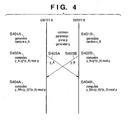
A protocol when entities A and B execute DH by
using a prime p and a generator g as common parameters
will be described below with reference to Fig. 4.
-
In step S401A, the entity A generates secret
information x_A. In step S401B, the entity B generates
secret information x_B.
-
In step S402A, the entity A computes y_A =
g∧(x_A) mod p. In step S403A, the entity A sends y_A
to the entity B.
-
In step S402B, the entity B computes y_B =
g∧(x_B) mod p. In step S403B, the entity B sends y_B
to the entity A.
-
In step S404A, the entity A computes y_AB =
(y_B)∧(x_A) mod p. In step S404B, the entity B
computes y_BA = (y_A)∧(x_B) mod p.
-
Since y_AB = (g∧(x_B))∧(x_A) mod p = g∧(x_A*x_B)
mod p = (g∧(x_A))∧(x_B) mod p = y_BA, y_AB = y_BA is
used as common secret data to generate an encryption
key or the like.
-
As described above, when DH is executed by using
SAC, two modular exponentiations using the same secret
information (x_A or x_B) must be performed by SAC.
Taking this point into consideration, when the SAC
described above is applied to DH, the processing may be
vulnerable to an attack explained below.
-
Assume that the entity A executes a SAC protocol
as a client. As a practical SAC method, the protocol
RSA-S1 described in the paper by MATSUMOTO et. al will
be explained. The client has integers x, d, and n, and
intends to obtain y = x∧d mod n. d is a secret of the
client, and n is open to the public. The Carmichael
function of n is represented as λ(n). The process will
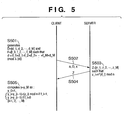
be described below with reference to Fig. 5.
-
In step S501, the client randomly generates an
integer vector D = [d_1, d_2,..., d_M] and a binary
vector F = [f_1, f_2,..., f_M] such that d = f_1*d_1 +
f_2*d_2 + ··· + f_M*d_M (mod λ(n)). M and L are some
integers, d_i is more than or equal to 1 and less than
n, and the weight of F (the number of elements having a
value of 1, of the elements f_1, f_2,..., f_M of F) is
less than or equal to L. The above equation indicates
that the residue obtained by dividing d by λ(n) equals
the residue obtained by dividing the result of f_1*d_1
+ f_2*d_2 + · · · + f_M*d_M by λ(n).
-
In step S502, the client sends n, D, and x to the
server.
-
In step S503, the server computes Z = [z_1,
z_2,..., z_M] by which z_i = x∧(d_i) mod n. In step
S504, the server sends Z to the client.
-
In step S505, the client computes y = y_M as
follows. That is, let y_0 = 1, the client computes y_i
= y_(i - 1)*z_i mod n if f_i = 1, and computes y_i =
y_(i - 1) if f_i = 0, for i = 1, 2,..., M. The client
repeats this computation from i = 1 to i = M. That is,
the client sequentially obtains y_1, y_2,..., and
obtains y_M by repeating the computation.
-
If the modulus n of this protocol is the prime p,
λ(n) = λ(p) = p - 1, so the protocol can be applied to
DH. Accordingly, the client executes the SAC protocol
of the modular exponentiation using secret exponent d =
x_A twice. The first one is a SAC protocol for
obtaining y_A = g∧(x_A) mod p, and the second one is a
SAC protocol for obtaining y_AB = (y_B)∧(x_A) mod p.
Since y_A is a value sent to the entity B in IKE
executed on the Internet, any attacker (any third party
or a SAC server on the Internet) is probably able to
obtain the value of y_A. In principle, therefore, this
attacker can obtain F which matches the value of y_A by
exhaustive search of possible combinations from D and
Z. The parameters M and L are so set that the number
of possible combinations makes it impossible to obtain
F within a practical time. As long as the value of y_A
is known, however, it is in principle possible to
obtain F (determine at least one combination for y_A).
-
Assume that an efficient attacking method which
breaks the first SAC protocol by exhaustive search is
possible in some way. For example, since p and g used
in IKE are standardized, a novel distributed algorithm
may be found such that each of a large number of
computers on the Internet forms a table in which g∧i
mod p is computed for a number of different i's in
advance, and these computers efficiently execute
exhaustive search in parallel. If such an attack is
possible, as long as the same exponent and the same F
are used, the result (y_AB) of the second SAC protocol
can be immediately obtained by using D and F which is
found by attacking the first SAC protocol. As a
consequence, DH is broken. Note that the exhaustive
search attack as described above does not hold for the
second SAC protocol alone, because in the second SAC
protocol the value of the base (y_B) changes every
time.
-
In the method of USP5,046,094 described above, a
client itself performs a modular exponentiation by
using a secret exponent which the client alone knows.
As already pointed out, however, the computation amount
is larger than that of RSA-S1 if the security against
exhaustive search is equivalent to that of RSA-S1.
Accordingly, when this method is applied to DH in which
SAC is performed twice, the computation amount also
doubles. So, this method does not satisfy the initial
purpose (i.e., to allow an apparatus having low
computation capability to obtain the result of modular
exponentiation without performing any heavy-load
computation by itself).
-
On the other hand, the method of USP5,369,708
described above is the most secure in that no exponent
leaks at all, but the computation amount increases.
Therefore, when this method is applied to DH in which
SAC is performed twice, the computation amount also
doubles. So, this method does not satisfy the initial
purpose (i.e., to allow an apparatus having low
computation capability to obtain the result of modular
exponentiation without performing any heavy-load
computation by itself).
-
Among the problems to be addressed by embodiments of
the present invention are that SAC by which the amount
of computation to be performed by a communication
apparatus itself is small has low security, and SAC
having high security increases the amount of
computation to be performed by a communication
apparatus itself.
-
Embodiments of the present invention
decrease the amount of computation to be performed by a
communication apparatus itself and increase the
security at the same time.
-
To achieve this, a first embodiment
generates parameters such
that parameters used in the first SAC and parameters
used in the second SAC are independent.
-
When SAC is to be performed twice, the embodiment
increases the resistance against exhaustive
search attack as mentioned earlier.
-
To achieve the above, a second embodiment
uses the result of the
first SAC for obtaining the first shared data in the
first SAC for obtaining the second shared data.
-
The second embodiment saves a communication
apparatus the trouble of calculating parameters used in
the first SAC for obtaining the second shared data.
-
In the second embodiment, the resistance which the
first SAC for obtaining the second shared data has
against exhaustive search attack is the product of the
resistance which the first SAC for obtaining the first
shared data has against exhaustive search attack and
the resistance which the first SAC for obtaining the
second shared data has against exhaustive search
attack.
-
Embodiments of the present
invention will be described
in conjunction with the accompanying
drawings, in which like reference characters designate
the same or similar parts throughout the figures
thereof, and in which:
- Fig. 1 is a view of a server-aided computation
(SAC) protocol;
- Fig. 2 is a schematic view of an Ethernet (R)
LAN;
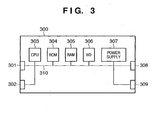
- Fig. 3 is a view showing the structure of a node;
- Fig. 4 is a view of the Diffie-Hellman public-key
distribution scheme;
- Fig. 5 is a view of a protocol RSA-S1;
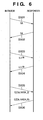
- Fig. 6 is a view of an abstracting IKE protocol
(main mode);
- Fig. 7 is a view of an integrated IKE protocol
(when a responder also serves as a server-aided
computation (SAC) server);
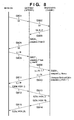
- Fig. 8 is a view of an integrated IKE protocol
(when a gateway also serves as a server-aided
computation server);
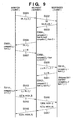
- Fig. 9 is a view of an IKE-proxy protocol;
- Fig. 10 is a view of a protocol in a main mode
which adopts an authentication method using a
pre-shared key; and
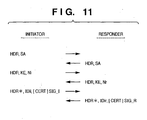
- Fig. 11 is a view of a protocol in a main mode
which adopts an authentication method using a digital
signature.
-
DETAILED DESCRIPTION OF THE PREFERRED EMBODIMENT
-
In this embodiment, when a node (node A)
communicates with another node (node B) by IPsec using
IKE, the node A executes DH by executing a SAC protocol
together with a SAC server (node S).
-
Fig. 2 schematically shows a connection
environment in this embodiment. That is, Fig. 2 shows
an environment in which hosts 204, 205, and 206
connected to a LAN access the Internet 201 via a
default gateway 202. In this embodiment, each host
connects by a link 207, more specifically, the Ethernet
(R). A link is a facility or medium which allows a
connected apparatus to communicate via it, and is in
contact with the lower side of an IP layer. Links
other than the Ethernet (R) are a PPP link, X. 25, a
frame relay, and an ATM network. An IPv6 apparatus
connected to a link is called a node.
-
Fig. 3 shows a typical example of the internal
structure of a node. A node is either a router or a
host. A router transfers packets not addressed to it,
but a host does not. As shown in Fig. 3, a node is a
computer having, e.g., a CPU 303, ROM 304, RAM 305, HD
(Hard Disk) 306, power supply 307, keyboard/pointing
device interface 308, monitor interface 309, and
network interfaces 301 and 302. While a router has a
plurality of network interfaces, a host has one network
interface in many cases. Some nodes have no HD.
-
The following process contents (procedures) are
implemented as a device or program, and a node having
this device executes the procedures, or a node having
the ROM 304 or HD 306 in which the program is stored
executes the procedures. For example, when the
procedures are implemented as a program, the CPU 303
loads the program, and encrypts data of interest to
compute a cipher text via a bus 310, while using the
RAM 305 as a computation space as needed.
-
As will be described in detail below, the node
shown in Fig. 3 is a data sharing apparatus which
shares first data y_AB with a communication partner.
-
The protocol of this embodiment will be explained
below with reference to Fig. 1. In the following
explanation, the node A is the host 204, and the node B
is a host 209. The node S is the host 206 or a host
(not shown) capable of communication via the default
gateway 202 or Internet 201.
-
Fig. 1 shows a protocol (of two SAC) performed
when the client and server execute DH. The client (the
node A, e.g., the host 204 shown in Fig. 2) has secret
information x_A, and intends to obtain y_AB =
(y_B)∧(x_A) mod p to be finally shared with the
communication partner (the node B, e.g., the host 209
shown in Fig. 2) which performs IPsec communication,
and y_A = g∧(x_A) mod p which is necessary during the
course of the processing in order to obtain y_AB, by
using the SAC protocol. The x_A is a secret of the
client, and g and p are open to the public. The
Carmichael function of p is λ(p). The client knows the
IP address of the server (the node S, e.g., the host
206).
-
In step S101, the client (host 204) prepares
random numbers r_init and y_init = g∧(r_init) mod p.
The r_init is an integer greater than or equal to 1 and
less than p. If the protocol shown in Fig. 1 was
executed in the past, r and g∧r mod p calculated last
are used as r_init and y_init = g∧(r_init) mod p,
respectively. If the protocol shown in Fig. 1 was
executed in the past, r and g∧r mod p calculated last
are stored in the RAM 305 or HD 306.
-
Also, if this protocol is to be executed for the
first time, the client is shipped such that y_init =
g∧(r_init) mod p already calculated by generating the
random number r_init during the manufacture is recorded
in the ROM 304 or HD 306. Alternatively, in another
embodiment, the random number r_init is generated to
calculate y_init = g∧(r_init) mod p in a standby state
(in which the SAC protocol is not executed), and the
result of the calculation is recorded in the RAM 305 or
HD 306. Furthermore, in still another embodiment, the
client executes, together with the server, an
unconditionally secure SAC protocol (to be described
later), before SAC (a protocol to be explained with
reference to Fig. 6) for IKE.
-
In step S102, the client randomly generates an
integer vector D = [d_1, d_2,.... d_M] and a binary
vector F = [f_1, f_2,..., f_M] such that r_1st =
f_1*d_1 + f_2*d_2 + ··· + f_M*d_M (mod λ(p)). Note that
M and L are some integers, d_i is greater than or equal
to 1 and less than p, and the weight of F (the number
of elements having a value of 1, of the elements f_1
f_2,..., f_M of F) is less than L. The above equation
indicates that the residue obtained by dividing d by
λ(n) equals the residue obtained by dividing the result
of f_1*d_1 + f_2*d_2 + · · · + f_M*d_M by λ(n).
-
In step S103, the client sends p, D, and g to the
server.
-
In step S104, the server computes Z = [z_1,
z_2,..., z_M] such that z_i = g∧(d_i) mod p. In step
S105, the server sends Z to the client.
-
In step S106, the client computes y_M as follows.
That is, let y_0 = 1, the client computes y_i = y_(i -
1)*(z_i) mod p if f_i = 1, and computes y_i = y_(i - 1)
if f_i = 0, for i = 1, 2,..., M. The client repeats
this computation from i = 1 to i = M. That is, the
client sequentially obtains y_1, y_2,..., and obtains
y_M by repeating the computation. The y_M is used as
y_1st.
-
The client then records r_1st and y_1st (=
g∧(r_1st) mod p) in the RAM 305, and obtains y_A by y_A
= y_init*y_1st mod p. The r_1st and y_1st recorded in
the RAM 305 are used as r_init and y_init,
respectively, for the next time.
-
Since the client (the node A, e.g., the host 204
shown in Fig. 2) has executed IKE together with the
node B (e.g., the host 209 shown in Fig. 2), it sends
y_A to the node B and receives y_B from the node B (not
shown). Note that although the node B computes y_B as
explained in step S401B of Fig. 4, it may also obtain
y_B following the same procedure as in steps S101 to
S106 of Fig. 1.
-
In step S107, the client randomly generates an
integer vector D' = [d_1', d_2',..., d_M'] and a binary
vector F' = [f_1', f_2',.... f_M'] such that r_init +
r_1st = f_1'*d_1' + f_2'*d_2' + ··· + f_M'*d_M' (mod
λ(p)). Note that M' and L are some integers, d_i' is
greater than or equal to 1 and less than p, and the
weight of F' (the number of elements having a value of
1, of the elements f_1' , f_2',..., f_M' of F') is less
than L.
-
In step S108, the client sends p, D', and y_B to
the server.
-
In step S109, the server computes Z' = [z_1',
z_2',..., z_M'] such that z_i' = y_B∧(d_i') mod p. In
step S110, the server sends Z' to the client.
-
In step S111, the client computes y_M' as
follows. That is, let y_0' - 1, the client computes
y_i' = y_(i - 1)'*(z_i') mod p if f_i' = 1, and
computes y_i' = y_(i - 1)' if f_i' = 0, for i = 1,
2,..., M. The client repeats this computation from i =
1 to i = M. That is, the client sequentially obtains
y_1', y_2',.. , and obtains y_M' by repeating the
computation. The y_M' is used as y_2nd. The y_2nd is
used as y_AB (y_AB: = y_2nd).
-
It is now clear that DH is executed once by
executing the SAC protocol twice. To execute DH next,
r_1st and y_1st = g∧(r_1st) mod p calculated from the
random numbers r_init and y_init = g∧(r_init) mod p and
stored in the RAM 305 are used.
-
As described above, Fig. 1 shows the program by
which the CPU 303 executes the data sharing method of
sharing the first data y_AB with the communication
partner (node B).
-
That is, in Fig. 1 as explained above, the second
data y_1st is obtained from the third data r_1st by
using SAC, and the communication partner generates the
fourth data y_A for obtaining the first data y_AB from
the second data y_1st and fifth data y_init (steps S102
and S106). Also, the first data y_AB to be shared with
the communication partner is obtained by using SAC from
the sixth data (r_init + r_1st) generated from the
third data r_1st and seventh data r_init (steps S107
and S111).
-
More specifically, in the SAC (steps S106 and
S107) for obtaining the second data y_1st from the
third data r_1st, the ninth data Z is obtained from the
eighth data D which is obtained from the third data
r_1st by the first conversion (decomposition using the
data F), and the second data y_1st is generated from
the ninth data Z by using the second conversion
(synthesis using the data F) corresponding to the first
conversion. Also, in the SAC (steps S107 and S111) for
obtaining the first data y_AB from the sixth data
(r_init + r_1st), the 11th data Z' is obtained from the
10th data D' which is obtained from the sixth data
(r_init + r_1st) by the third conversion (decomposition
using the data F'), and the first data y_AB is
generated from the 11th data Z' by using the fourth
conversion (synthesis using the data F') corresponding
to the third conversion.
-
The second data y_1st is the residue obtained by
dividing gr_1st (g to the "third data r_1st"th) by p.
The first data y_AB is the residue obtained by dividing
the 12th data y_AB(r_init + r_1st) (y_AB to the "sixth data
(r_init + r_1st)"th) by p. The fourth data y_A is the
residue obtained by dividing the product of the second
data y_1st and fifth data y_init by p. The sixth data
(r_init + r_1st is the sum of the third data r_1st and
seventh data r_init (step S107). The fifth data y_init
is the residue obtained by dividing gr_init (g to the
"seventh data r_init"th) by p.
-
In this embodiment, the second data y_1st and
third data r_1st for obtaining the firs shared data
y_AB are used as the fifth data y_init and seventh data
r_init, respectively, for obtaining the second shared
data.
-
Additionally, on the basis of the first data
y_AB, an encryption key used in communication with the
communication partner is generated.
-
Referring to Fig. 3, the CPU 303 operates as a
SAC means for generating the third data r_1st, and
obtaining the second data y_1st from the third data
r_1st by SAC by using the network interface 301.
-
The CPU 303 also operates as a generating means
for generating the fourth data y_A, by which the
communication partner obtains the first data y_AB, from
the second data y_1st obtained by the SAC and the fifth
data y_init stored in the RAM 305.
-
By using the third data r_1st generated
beforehand and the seventh data r_init stored in the
RAM 305, the CPU 303 which operates as the SAC means
obtains, by using SAC, the first data y_AB to be shared
with the communication partner from the sixth data
(r_init + r_1st) generated from the third data r_1st
and seventh data r_init.
-
In the two SAC protocols described above, the
vectors D and F in the first SAC protocol and the
vectors D' and F' in the second SAC protocol are
independent. That is, the first SAC protocol is SAC
using r_1st as secret information, but the second SAC
protocol is SAC using r_init + r_1st (mod λ(p)) as
secret information. This expression indicates the
calculated value of r_init + r_1st, or the residue
obtained by dividing the calculated value of r_init +
r_1st by λ(p). The secrets r_init and y_init =
g∧(r_init) mod p of the client are random numbers
unknown to anyone else except the client. Therefore,
any third party observes these two SAC protocols as
independent different SAC protocols.
-
Also, even if any third party tries to obtain
r_1st (i.e., F) by exhaustive search from y_A and D,
r_1st cannot be uniquely determined because the random
number r_init exists. This disables the attack
mentioned as the problem, i.e., the attack which breaks
DH by obtaining the result (y_AB) of the second SAC
protocol by using D and F which is found by attacking
the first SAC protocol.
-
The second SAC protocol is SAC of modular
exponentiation using r_init + r_1st (mod λ(p)) as an
exponent. The r_init is a secret value, and the
information y_init for uniquely specifying r_init is
secret. Therefore, r_init cannot be specified from the
second SAC protocol.
-
The execution of the second DH will be described
below. Symbols formed by adding '~{n}' to variables
indicate variables when the nth DH is executed.
-
y_init~(2} = g∧(r_init~{2}) mod p to be used in
the second DH is calculated by the server when the
first DH is executed (y_1st~{1} = g∧(r_1st~{1}) mod p),
so the client need not calculate it.
-
The resistance which the first SAC protocol has
against an exhaustive search attack when the second DH
is executed will be described below. Unlike in the
execution of the first DH, r_init~{2} and y_init~{2} =
g∧(r_init~{2}) mod p to be used in the execution of the
second DH are values calculated when the first DH is
executed. That is, r_init~{2} = r_1st~{1} and
y_init~{2} = y_1st~{1} (= g∧(r_1st~{1}) mod p) are
values obtained by combining elements of D~{1} and
Z~{1} when the first DH is executed.
-
The result (y_init~{2}*y_1st~{2} mod p) obtained
by modular multiplication of y_init~(2) = y_1st∼{1} (=
g∧(r_1st-{1}) mod p) and the value y_1st~{2} obtained
by combining elements of D~{2} and Z~{2} and used when
the second DH is executed is transmitted as y_A~{2} to
the communication partner across the Internet.
Therefore, any attacker is presumably capable of
acquiring y_A~{2}.
-
On the other hand, the value of y_1st~{2} is
locally calculated by the client, but is not
communicated on the Internet, so any attacker cannot
acquire this value.
-
Accordingly, to obtain the exponent value
r_init~{2} + r_1st∼{2} mod λ(p) of y_A~{2} by
exhaustive search attack, it is necessary to
simultaneously succeed in an attack of obtaining the
exponent value of y_init~{2} = y_1st~{1} (=
g∧(r_1st~{1}) mod p) by exhaustive search, and an
attack of obtaining the exponent value of y_1st~{2} (=
g∧(r_1st~{2}) mod p) by exhaustive search. That is,
the resistance which the first SAC protocol has against
exhaustive search attack when the second DH is executed
is the product of the resistance which the first SAC
protocol has against exhaustive search attack when the
first DH is executed and the resistance which the first
SAC protocol has against exhaustive search attack when
the second DH is executed.
-
This makes it necessary to break the SAC protocol
of modular exponentiation twice by exhaustive search
attack as described above. If the process of breaking
the protocol once requires exhaustive search of 10∧20
combinations, exhaustive search of 10∧20*10∧20 = 10∧40
combinations is necessary. This increases the
resistance against exhaustive search attack as
described above.
-
A similar relationship holds between the
execution of the kth DH and the execution of the (k +
1)th DH. Therefore, if the process of obtaining the
exponent of the first SAC when DH is executed requires
exhaustive search of 10∧20 combinations, the process of
obtaining the exponent r_1st~{k + 1} of the first SAC
when the (k + 1)th DH is executed during the execution
of two arbitrary consecutive DH's (the execution of the
kth DH and the execution of the (k + 1)th DH) requires
exhaustive search of 10∧20 × 10∧20 = 10∧40
combinations.
-
On the other hand, during the execution of the
first and third DH's, no common variables are used in
y_init~{1} = g∧(r_init~{1}) mod p, y_1st~{1} =
g∧(r_1st~{1}) mod p, y_init~{3} = y_1st~{2} =
g∧(r_1st~{2}) mod p, and y_1st~{3} = g∧(r_1st~{3}) mod
p. Hence, the execution of the first DH and the
execution of the third DH are independent of each
other. Therefore, if y_init∼(3) = y_init~{1}*y_1st~{2}
mod p is used as y_init~{3} when the third DH is
executed, y_init~{1} (i.e., r_init~{1}) is unknown to
any attacker. This makes it impossible to uniquely
obtain r_1st~{3} from y_A~{3} = y_init~{3}*y_1st~{3} =
y_init~{1}*y_1st~{2}*y_1st~{3} =
g∧(r_init~{1})*g∧(r_1st∼{2})*g∧(r_1st∼{3})(mod p) when
the third DH is executed.
-
Assume that the same processing is repeated on
and after the fourth DH. That is, assume that
y_init∼(4) = y_init~{1}*y_1st~{3} mod p is used as
y_init~{4} when the fourth DH is executed, y_init~{5} =
y_init~{1}*y_1st∼{4} mod p is used as y_init~{5} when
the fifth DH is executed,..., y_init~{k} =
y_init~{1}*y_1st~{k - 1} mod p is used as y_init~{k}
when the kth DH is executed.
-
When the kth DH is executed (k is greater than or
equal to 4), y_init~{k} = y_init~{1}*y_1st~{k - 1} =
g∧(r_init~{1})*g∧{r_1st~{k - 1}}(mod p), and y_init~{1}
and r_init~{1} are unknown to any attacker. Therefore,
it is impossible to uniquely specify the value of
y_1st~{k - 1} = g∧(r_1st~{k - 1}) mod p from D~{k} and
Z~{k}, so the value of r_1st~{k - 1} cannot be obtained
by exhaustive search attack. This disables, when the
nth DH is executed ( n is greater than or equal to 3),
the attack mentioned as the problem, i.e., the attack
of breaking DH by obtaining the result (y_AB~{n}) of
the second SAC protocol by using D~{n} and F∼{n} which
is found by attacking the first SAC protocol.
-
In short, if y_init∼{n} = y_init~{1}*y_1st∼{n -
1} mod p, the attack mentioned as the problem cannot
hold after the nth DH is executed (n is greater than or
equal to 3).
-
From the foregoing, only when the second DH is
executed, this DH may be broken by exhaustive search of
10∧40 possibilities. To nullify (disable) this attack,
it is only necessary to form r_init2 and y_init2 =
g∧(r_init2) mod p which the client alone knows, and
perform computation by using y_init∼{2} =
y_init2*y_1st-{1} mod p. That is, the two random
numbers r_init and r_init2 and their exponential
calculated values y_init = g∧(r_init) mod p and y_init2
= g∧(r_init2) mod p are initially prepared, and
computation is performed using y_init~{2} =
y_init2*y_1st-{1} mod p, and y_init-{n} =
y_init-{1}*y_1st∼{n - 1} mod p (n = 3, 4,....) This
disables the attack mentioned as a problem.
[ Unconditionally Secure SAC Protocol]
-
A SAC protocol for obtaining y_init (= g∧(r_init)
mod p) used in the protocol shown in Fig. 1 will be
described below.
-
This SAC protocol has the characteristic feature
that SAC server or third party cannot specify secret
information x of a client in an information theoretic
sense. Assume that a binary representation of the
secret information x (a K-bit integer) is x_(K -
1)|x_(K - 2)|...|x_2|x_1|x_0 ('|' is a symbol for
explicitly separating each bit, and each bit is x_i.
The value of x_i is 0 or 1.)
- (1) The client sends the modulus p, generator g, and
K to the server.
- (2) The server computes z_i = g∧(b_i) mod p where b_i
= 2∧i (i = 0, 1,..., K - 1), and sends Z = [z_0, z_1,
z_2,..., z_(K - 1)] to the client.
- (3) The client computes g∧x mod p = y_K as follows.
That is, let y_0 = 1, the client computes y_(i + 1) =
y_i mod p if x_i = 0, and computes y_(i + 1) = y_i*z_i
mod p if x_i = 1, for i = 0, 1,..., K - 1. The client
repeats this computation from i = 1 to i = K - 1. That
is, the client sequentially obtains y_1, y_2,..., and
obtains y_K by repeating the computation.
-
-
In the protocol shown in Fig. 1, the secret
information x is used as r_init, and y_K is used as
y_init (= g∧(r_init) mod p).
[End of Unconditionally Secure SAC Protocol]
-
In the above embodiment, as a mathematical
setting, a multiplicative group in which the discrete
logarithm problem is infeasible and modular
exponentiation using a random number of this
multiplicative group as an exponent are explained.
However, it is also possible to use an elliptic curve
in which the discrete logarithm problem is infeasible
and multiplication of a point on this elliptic curve by
a random number (integer).
-
In the above setting using a multiplicative
group, an integer x is used as a secret key, a prime p
and a generator g of GF(p) are used as parameters, and
y = g∧{x} mod p is used as a public key. In the
setting using an elliptic curve, an integer x is used
as a secret key, an elliptic curve and a point P on
the curve are used as parameters, and y = x*P is used
as a public key.
-
A protocol shown in Fig. 4 is as follows. An
entity A generates a secret key x_A, computes y_A =
x_A*P, and sends y_A to an entity B. The entity B
generates a secret key x_B, computes y_B = x_B*P, and
sends y_B to the entity A. The entity A receives y_B,
and computes y_AB = x_A*y_B. The entity B receives
y_A, and computes y_BA = x_B*y_A.
-
In this setting using an elliptic curve, an
element (integer) of a multiplicative group corresponds
to a point (having x- and y-coordinates) on an elliptic
curve, and multiplication of elements of a
multiplicative group corresponds to addition of points
on an elliptic curve. Exponentiation (i.e., raising to
the kth power) in a multiplicative group is equivalent
to adding a point multiple times (i.e., k times) on an
elliptic curve, and hence corresponds to multiplication
of a point by an integer (i.e., k).
-
Accordingly, the exponent (integer) r_init +
r_1st (in step S107 of Fig. 1) used in modular
exponentiation in the multiplicative group setting is
still (integer) r_init + r_1st in the elliptic curve
setting, and y_A = y_init*y_1st mod p (in step S106 of
Fig. 1) in the multiplicative group setting is y_A =
y_init + y_1st on the elliptic curve in the elliptic
curve setting. Note that addition (an operation
indicated by +) of points on an elliptic curve and
multiplication (an operation indicated by *) of a point
on an elliptic curve by an integer are mathematically
defined precisely. The precise definitions can be found
in mathematical text books such as "A Course in Number
Theory and Cryptography, 2nd edition" by Neal Koblitz,
Springer-Verlag (1994).
-
In the protocol shown in Fig. 1, the second data
y_1st is obtained by multiplication of the point P on
the elliptic curve by the third data r_1st (integer),
and the fourth data y_A is obtained by addition of the
second data y_1st (point) on the elliptic curve and the
fifth data y_init (point) on the elliptic curve. Also,
the first data y_AB is obtained by multiplication of
the 12th data y_B (point) on the elliptic curve by the
sixth data (r_1st + r_init) (integer), and the sixth
data (r_init + r_1st) is obtained by addition of the
third data r_1st (integer) and seventh data r_init
(integer). The fifth data y_init is obtained by
multiplication of the point P on the elliptic curve by
the seventh data r_init (integer).
-
In step S103 of Fig. 1, the client sends
parameters (including P) which define the elliptic
curve and D to the server. In step S108, the client
sends D' and y_B to the server.
-
In the following embodiment, instead of a
multiplicative group in which the discrete logarithm
problem is infeasible and modular exponentiation which
uses a random number of this multiplicative group as an
exponent, it is possible to use an elliptic curve in
which the discrete logarithm problem is infeasible and
multiplication of a point on the elliptic curve by a
random number.
-
The server of the SAC protocol is formed on a LAN
as a single node, e.g., the host 206 shown in Fig. 2,
and another IPv6 apparatus (the host 204) on the LAN
can request this SAC server to compute DH.
Alternatively, a PC having high computation capability,
e.g., the host 205 shown in Fig. 2 can be installed on
a LAN in an office or home to operate as a SAC server.
In this case, another IPv6 apparatus on the LAN, e.g.,
a digital camera (the host 204) having low computation
capability can perform IPsec communication with still
another IPv6 apparatus (the host 209) on the Internet
201 by IKE by requesting the server (host 204) to
perform computation.
-
The present invention is explained on the basis
of the preferred embodiment. However, the present
invention is not limited to the above embodiment, and
can be variously modified within the scope of claims.
For example, the server of the SAC protocol may also be
installed on the Internet 201.
-
A case in which a protocol is formed by
integrating the above-mentioned SAC protocol (Fig. 1)
with IKE, and a node which performs IKE also functions
as a server of the SAC protocol will be described
below.
-
For example, this is a case in which a server of
a Web site on the Internet also operates as a SAC
server, and, when another IPv6 apparatus on the
Internet, e.g., a portable terminal having low
computation capability accesses the Web site and
performs IPsec communication by IKE, the other IPv6
apparatus executes IKE together with the server and at
the same time requests the server to perform
computation.
-
In this embodiment, in the form shown in Fig. 1,
a communication partner is requested to perform the SAC
for obtaining the second data y_1st from the third data
r_1st, and the SAC for obtaining the first data y_AB
from the sixth data (r_init + r_1st).
-
First, IKE will be briefly described below.
Details of IKE is described in RFC2409, "The Internet
Key Exchange (IKE)".
-
IKE consists of phase 1 and phase 2. ISAKMP SA
is established in phase 1, and IPsec SA is established
in phase 2. In phase 1, a main mode (six times of data
transmission/reception) or an aggressive mode (three
times of data transmission/reception) is executed in
combination with four authentication methods.
Accordingly, eight combinations exist in phase 1 alone.
Data to be transmitted/received changes from one
combination to another in each mode. Of the four
authentication methods, DH data is encrypted in two
methods using encryption of a public-key cryptography.
On the other hand, phase 2 has only a quick mode, and
DH is an option. The substances of IKE are mutual
agreement of SA and execution of DH. Therefore, if
data transmission/reception related to these factors is
not encrypted, the SAC protocol (Fig. 1) described
above is directly applicable.
-
According to RFC2409, the main mode which adopts
an authentication method using a pre-shared key is a
protocol as shown in Fig. 10 (details of data will be
explained later).
-
HDR in Fig. 10 indicates an ISAKMP header, and
data described to the right of this header represents a
payload. For example, "HDR, SA" indicates that the
payload of an ISAKMP packet is SA. HDR* indicates that
the payload of the packet is encrypted. KE is
information exchanged by Diffie-Hellman, Ni and Nr are
Nonce (random numbers), IDii and IDir are
identification payloads, and HASH_I and HASH_R are hash
values generated from data exchanged to that point.
The last two encrypted data are encrypted by using an
encryption key generated on the basis of secret
information shared by Diffie-Hellman.
-
The main mode which adopts an authentication
method using a digital signature is a protocol as shown
in Fig. 11.
-
SIG_I and SIG_R are the results of application of
digital signatures to HASH_I and HASH_R, respectively.
That is, these two protocols described above are
substantially the same, as can be seen by comparing
them.
-
Accordingly, by taking as an example the main
mode which must be supported when IKE is used, a
protocol (to be referred to as an abstracting IKE
protocol (main mode) hereinafter) which extracts the
substances of an authentication method using a
pre-shared key and an authentication method using a
digital signature in the main mode will be described
below with reference to Fig. 6.
[Abstracting IKE Protocol (Main Mode)]
-
In step S601, an initiator of IKE sends SA
proposals (one or more security associations) to a
responder.
-
In step S602, the responder selects a security
association to be used from the proposals, and sends it
to the initiator (when a security association is
determined, p and g are determined).
-
In step S603, the initiator sends y_i (= g∧(x_i)
mod p) and Nonce Ni to the responder (x_i is secret
information of the initiator).
-
In step S604, the responder sends y_r (= g∧(x_r)
mod p) and Nonce Ni to the initiator (x_r is secret
information of the responder).
-
In step S605, the initiator computes
(g∧(x_r))∧(x_i) mod p from y_r = g∧(x_r) mod p received
from the responder and its own secret information x_i,
generates an encryption key on the basis of the result,
and sends, to the responder, data obtained by
encrypting identification payloads IDii and HASH_I by
using the key (the encryption key and HASH_I are
generated in accordance with the method described in
RFC2409).
-
In step S606, the responder computes
(g∧(x_i))∧(x_r) mod p from y_i = g∧(x_i) mod p received
from the initiator and its own secret information x_r,
generates an encryption key on the basis of the result,
and sends, to the initiator, data obtained by
encrypting identification payloads IDir and HASH_R by
using the key (the encryption key and HASH_R are
generated in accordance with the method described in
RFC2409).
-
A case in which the SAC protocol shown in Fig. 1
is applied to the above abstracting IKE protocol (main
mode), and a node (responder) for performing IKE also
functions as a server of the SAC protocol will be
explained below with reference to Fig. 7. Fig. 7 is a
protocol obtained by integrating the SAC protocol shown
in Fig. 1 with the abstracting IKE protocol (main mode)
shown in Fig. 6. A responder processes a request for
computation for obtaining y_ir (the first data) which
an initiator (communication apparatus) shares with the
responder (communication partner). This processing is
executed on the basis of a program stored in the ROM
304 or HD 306. Referring to Fig. 7, both IKE data and
SAC data are included in one data transfer. However,
the same effect can also be obtained by simultaneously
executing the two protocols in parallel, so the two
data need not be included in one data transfer. Note
that each of the initiator and responder has the
structure shown in Fig. 3. The network interface 301
(an interface which connects the link 207) of the
responder is a receiving means for receiving a request
from the initiator (communication apparatus), and a
transmitting means for transmitting the result of
computation to the initiator (communication apparatus).
The CPU 303 of the responder is a computing means for
performing SAC.
-
The initiator knows that the responder is a SAC
server and the partner of IPsec communication performed
by IKE, and has the address and the settings, as a SAC
server, of the responder.
-
In step S701, as in steps S101 and S102 of
Fig. 1, the initiator determines a random number r (=
r_1st) and parameters D and F of SAC, and sends SA
proposals and D to the responder. The responder
receives D (the first request) for obtaining y_1st (the
second data) from r_1st (the third data).
-
In step S702, the responder selects a security
association to be used from the proposals. Since p and
g are determined, the responder computes Z (z_i =
g∧(d_i) mod p) from p, g, and D, and sends the selected
security association and Z to the initiator. That is,
in accordance with D (the first request), the responder
performs the first computation to obtain Z (the first
computation result), and sends Z (the first computation
result) to the initiator.
-
In step S703, as in step S106 of Fig. 1, the
initiator obtains y_1st from (F and) Z, and also
computes y_i. This y_i is the same as y_A (=
y_init*y_1st mod p) in step S106 of Fig. 1. Similar to
Fig. 1, y_init is prepared beforehand. Also, as in
step S107 of Fig. 1, the initiator determines
parameters D' and F' of SAC from r_init + r. Similar
to Fig. 1, r_init is prepared beforehand. Then, the
initiator sends y_i, Nonce Ni, and D' to the responder.
The responder receives the request D' (the second
request) for obtaining y_ir (the first data) from
r_init + r_1st (the sixth data) generated from r_1st
(the third data) and r_init (the seventh data).
-
In step S704, the responder determines y_r. This
y_r can be calculated in the same manner as y_A and y_B
shown in Fig. 4. Also, the responder computes Z' (z_i'
= (y_r)∧(d_i') mod p) from y_r and D'. The responder
sends y_r, Nonce Nr, and Z' to the initiator. That is,
in accordance with D' (the second request), the
responder performs the second computation by using y_r
(the 12th data) to obtain Z' (the second computation
result), and sends Z' (the second computation result)
to the initiator.
-
In step S705, the initiator obtains y_ir from (F'
and) Z'. This y_ir can be obtained in the same manner
as y_AB in step S111 of Fig. 1. Also, the initiator
generates an encryption key on the basis of y_ir, and
obtains HASH_I (the encryption key and HASH_I are
generated in accordance with the method described in
RFC2409). The initiator sends encrypted data of
identification payloads IDii and HASH_I to the
responder.
-
In step S706, the responder obtains y_ri. This
y_ri can be obtained in the same manner as in steps
S404A and S404B of Fig. 4. The responder generates an
encryption key on the basis of y_ri, and obtains
HASH_R. The responder sends encrypted data of
identification payloads IDir and HASH_R to the
initiator.
-
When an IPv6 apparatus having low computation
capability and an IPv6 apparatus having high
computation capability perform IKE, the above protocol
allows secure execution of IKE while distributing the
load.
-
Note that D' which the initiator sends to the
responder in step S703 may also be sent in step S701.
-
In this embodiment, a case in which a protocol is
formed by integrating the SAC protocol shown in Fig. 1
with IKE, and a server of the SAC protocol is running
on, e.g., a gateway of a home LAN will be described
below.
-
For example, this is a case in which a user
performs IPsec communication by IKE when accessing an
internal IPv6 terminal of a home LAN across the
Internet by using a PC or portable terminal from an
Internet cafe at the destination or by using a PC in
the office. In this case, the internal IPv6 terminal
of the home LAN operates as a responder. However, the
gateway (the gateway 202 shown in Fig. 2) is positioned
between the initiator (e.g., the host 209 shown in
Fig. 2) and the responder (e.g., the host 204 shown in
Fig. 2), and relays IKE packets. This makes it
possible to provide a SAC service while combining the
IKE protocol and SAC protocol. The network interface
301 (an interface which connects the link 207) of the
gateway is a receiving means for receiving a request
from the responder (communication apparatus), and a
transmitting means for transmitting the result of
computation to the responder (communication apparatus).
Also, the CPU 303 of the gateway is a computing means
for performing SAC.
-
This embodiment is an example in which, in the
form shown in Fig. 1, a server located between a
communication apparatus and a communication partner is
requested to perform the SAC for obtaining the second
data y_1st from the third data r_1st, and the SAC for
obtaining the first data y_AB from the sixth data
(r_init + r_1st).
-
The embodiment will be explained with reference
to Fig. 8. The gateway (server) 202 processes a
request for computation for obtaining y_ri (the first
data) which the responder (communication apparatus)
shares with the initiator (communication partner).
This processing is executed on the basis a program
stored in the ROM 304 or HD 306. Referring to Fig. 8,
both the IKE data and SAC data are included in one data
transfer. However, the same effect can also be
obtained by simultaneously executing the two protocols
in synchronism with each other, so the two data need
not be included in one data transfer.
-
The responder (e.g., the host 204 shown in
Fig. 2) sets the gateway (server) 202 as a default
gateway & SAC server. The initiator (e.g., the host
209 shown in Fig. 2) knows the address of the
responder.
-
In step S801, the initiator sends SA proposals
(one or more security associations) to the responder.
-
In step S802, the gateway relays the SA proposals
(one or more security associations) from the initiator
to the responder.
-
In step S803, the responder determines r_1st,
obtains (r_init + r_1st), determines parameters D and F
of the SAC, and determines parameters D' and F' of the
SAC from (r_init + r_1st). Similar to Fig. 1, r_init
is prepared beforehand. The responder selects one
security association from the proposals, sends it to
the initiator via the gateway, and also sends it to the
gateway together with D and D'.
-
In step S804, the gateway computes Z (z_r =
g∧(d_r) mod p) from the selected security association
(p and g are determined) and D. That is, the gateway
receives D (the first request) by which the responder
(communication apparatus) obtains y_1st (the second
data) from r_1st (the third data), and D' (the second
request) by which the responder (communication
apparatus) obtains y_ri (the first data) from r_init +
r_1st (the sixth data) generated from r_1st (the third
data) and r_init (the seventh data), and performs the
first computation to obtain Z (the first computation
result) in response to D (the first request).
-
In step S805, the gateway relays the selected
security association to the initiator. Note that steps
S804 and S805 need not always be executed in this
order.
-
In step S806, the initiator sends y_i (=g∧(x_i)
mod p) and Nonce Ni to the responder via the gateway
(x_i is secret information of the initiator).
-
In step S807, the gateway computes Z' ((z_r)' =
(y_i)∧(d_r') mod p) from y_i and D' which the gateway
receives from the initiator (to relay them to the
responder). That is, the gateway receives y_i (the
12th data) from the initiator (communication partner),
and, in response to D' (the second request), performs
the second computation by using y_i (the 12th data) to
obtain Z' (the second computation result).
-
In step S808, the gateway relays y_i and Ni to
the responder, and sends Z and Z' (the first and second
computation results) to the responder.
-
In step S809, as in step S106 of Fig. 1, the
responder obtains y_1st from (F and) and Z, and also
computes y_r. This y_r is the same as y_A (=
y_init*y_1st mod p) in step S106 of Fig. 1. Note that
y_init is prepared beforehand as in Fig. 1.
-
In step S810, the responder sends y_r and Nonce
Nr to the initiator.
-
Between steps S810 and S814, the responder
computes y_ri from (F' and) Z', generates an encryption
key on the basis of y_ri, and obtains HASH_R. This
y_ri can be obtained in the same manner as y_AB in step
S111 of Fig. 1.
-
In step S811, the gateway relays y_r and Nonce Nr
to the initiator.
-
In step S812, the initiator obtains y_ir (=
(y_r)∧(x_i) mod p) from y_r received from the responder
and its own secret information x_i, generates an
encryption key on the basis of y_ir, obtains HASH_I,
and sends encrypted data of identification payload IDii
and HASH_I to the responder.
-
In step S813, the gateway relays the encrypted
data of identification payloads IDii and HASH_I to the
responder.
-
In step S814, the responder sends encrypted data
of identification payloads IDir and HASH_R to the
initiator. In this encryption, a key generated on the
basis of y_ri is used.
-
In step S815, the gateway relays the encrypted
data of identification payloads IDir and HASH_R to the
initiator.
-
The above protocol allows an IPv6 apparatus
having low computation capability to securely execute
IKE by using the gateway as a SAC server.
-
In this embodiment, a case in which a protocol is
formed by combining the SAC protocol of the first
embodiment with IKE, a server of the SAC protocol is
installed on the Internet as a node which exclusively
provides SAC services, and this node operates like a
proxy will be explained.
-
For example, this is a case in which when two
IPv6 apparatuses on the Internet perform IPsec
communication by IKE, both of these two apparatuses
perform IKE by requesting the SAC server to perform
computation, and IKE packets are always transmitted via
the SAC server. In this case, the SAC server can be
regarded as operating as a so-called IKE proxy.
-
This embodiment is an example in which, in the
form shown in Fig. 1, a server located between a
communication apparatus and a communication partner is
requested to perform the SAC for obtaining the second
data y_1st from the third data r_1st, and the SAC for
obtaining the first data y_AB from the sixth data
(r_init + r_1st).
-
Note that this embodiment may also be regarded as
a protocol formed by combining the protocols shown in
Figs. 7 and 8. That is, a SAC server is present
between an initiator and responder, and SAC services
are provided to both the initiator and responder while
IKE packets are relayed. This embodiment will be
described below with reference to Fig. 9. The IKE
proxy processes a request for computation for obtaining
y_ir (the first data) which the initiator
(communication apparatus) shares with the responder
(communication partner). The IKE proxy also processes
a request for computation for obtaining y_ri which the
responder shares with the initiator. This processing
is executed on the basis of a program stored in the ROM
304 or HD 306.
-
Each of the initiator, responder, and IKE proxy
has the structure shown in Fig. 3. The network
interfaces 301 and 302 of the IKE proxy are receiving
means for receiving requests from the initiator
(communication apparatus) and responder, and
transmitting means for transmitting the results of
computation to the initiator (communication apparatus)
and responder. The CPU 303 of the IKE proxy is a
computing means for performing SAC.
-
Referring to Fig. 9, both IKE data and SAC data
are included in one data transfer. However, the same
effect can also be obtained by simultaneously executing
the two protocols in synchronism with each other, so
the two data need not be included in one data transfer.
-
The initiator and responder set the IKE-proxy
(server) as an IKE-proxy & SAC server. The initiator
knows the address of the responder.
-
In step S901, the initiator determines parameters
D_i, F_i, D_i', and F_i' of SAC, and sends SA proposals
to the responder via the IKE-proxy. The initiator also
sends D_i and D_i' to the IKE-proxy. The IKE-proxy
receives D_i (the first request) and D_i' (the second
request). Similar to Fig. 1, D_i (the first request)
is a request for obtaining y_1st (the second data) from
r_1st (the third data), and D_i' (the second request)
is a request for obtaining y_ri (the first data) from
r_init + r_1st (the sixth data) generated from r_1st
(the third data) and r_init (the seventh data).
-
In step S902, the IKE-proxy relays the SA
proposals (one or more security associations) from the
initiator to the responder.
-
In step S903, the responder determines parameters
D_r, F_r, D_r', and F_r' of SAC. The responder also
selects one security association from the proposals,
and sends the selected security association to the
initiator via the IKE-proxy. In addition, the
responder sends D_r and D_r' to the IKE-proxy.
-
In step S904, as in step S104 of Fig. 1, the
IKE-proxy computes Z_i and Z_r, respectively, from D_i
and D_r by using the selected security association (p
and g are determined). That is, the IKE-proxy performs
the first computation to obtain Z_i (the first
computation result) in response to D_i (the first
request).
-
In step S905, the IKE-proxy sends the selected
security association and Z_i (the first computation
result) to the initiator. In step S906, the initiator
computes y_i from (F_i and) Z_i. This y_i is
equivalent to y_A (= y_init*y_1st mod p) in step S106
of Fig. 1.
-
In step S907, the initiator sends y_i and Nonce
Ni to the responder via the IKE-proxy.
-
In step S908, as in step S109 of Fig. 1, the
IKE-proxy computes Z_r' (z_r' = (y_i)∧(d_r') mod p)
from y_i and D_r' which the IKE-proxy receives from the
initiator (to relay them to the responder).
-
In step S909, the IKE-proxy relays y_i and Ni to
the responder, and sends Z_r and Z_r' to the responder.
-
In step S910, the responder computes y_r from
(F_r and) Z_r. This y_r is equivalent to y_A (=
y_init*y_1st mod p) in step S106 of Fig. 1.
-
In step S911, the responder sends y_r and Nonce
Nr to the initiator via the IKE-proxy.
-
Between steps S911 and S917, the responder
computes y_ri from (F_r' and) Z_r', generates an
encryption key on the basis of y_ri, and obtains
HASH_R. This y_ri can be obtained in the same manner
as y_AB in step S111 of Fig. 1.
-
In step S912, the IKE-proxy computes Z_i' (z_i' =
(y_r)∧(d_i') mod p) from y_r and D_i' which the
IKE-proxy receives from the responder (to relay them to
the initiator). That is, the IKE-proxy receives y_r
(the 12th data) from the responder (communication
partner), and, in response to D_i' (the second
request), performs the second computation by using y_r
(the 12th data) to obtain Z_i' (the second computation
result).
-
In step S913, the IKE-proxy relays y_r and Nonce
Nr to the initiator, and sends Z_i' (the second
computation result) to the initiator.
-
In step S914, the initiator obtains y_ir from
Z_i'. This y_ir can be obtained in the same manner as
y_AB in step S111 of Fig. 1. The initiator generates
an encryption key on the basis of y_ir, and obtains
HASH_I. In step S915, the initiator sends encrypted
data of identification payloads IDii and HASH_I to the
responder via the IKE-proxy.
-
In step S916, the IKE-proxy relays the encrypted
data of identification payloads IDii and HASH_I to the
responder.
-
In step S917, the responder sends, to the
initiator, data obtained by encrypting identification
payloads IDir and HASH_R by using a key generated on
the basis of y_ri.
-
In step S918, the IKE-proxy relays the encrypted
data of identification payloads IDir and HASH_R to the
initiator.
-
By using the above protocol, two IPv6 apparatuses
having low computation capability can securely execute
IKE while using the IKE-proxy as a SAC server. Note
that even if the IKE-proxy tries to execute a
man-in-the-middle-attack, this attack is detected by an
authentication method (based on a pre-shared key or
digital signature) executed during IKE, and fails.
-
Many widely different embodiments
of the present invention can be made and
the invention is not limited to the specific
embodiments above.
-
The processing operations in the embodiments
described above may be effected by a processor
operating in accordance with computer program
instructions. Accordingly, a carrier carrying such
computer program instructions constitutes an
embodiment of the invention. The carrier may be a
signal or a storage medium.