EP1512577A2 - Service door for a motor vehicle - Google Patents
Service door for a motor vehicle Download PDFInfo
- Publication number
- EP1512577A2 EP1512577A2 EP04020941A EP04020941A EP1512577A2 EP 1512577 A2 EP1512577 A2 EP 1512577A2 EP 04020941 A EP04020941 A EP 04020941A EP 04020941 A EP04020941 A EP 04020941A EP 1512577 A2 EP1512577 A2 EP 1512577A2
- Authority
- EP
- European Patent Office
- Prior art keywords
- members
- door
- door assembly
- frame
- subassembly
- Prior art date
- Legal status (The legal status is an assumption and is not a legal conclusion. Google has not performed a legal analysis and makes no representation as to the accuracy of the status listed.)
- Granted
Links
Images




Classifications
-
- B—PERFORMING OPERATIONS; TRANSPORTING
- B60—VEHICLES IN GENERAL
- B60P—VEHICLES ADAPTED FOR LOAD TRANSPORTATION OR TO TRANSPORT, TO CARRY, OR TO COMPRISE SPECIAL LOADS OR OBJECTS
- B60P3/00—Vehicles adapted to transport, to carry or to comprise special loads or objects
- B60P3/32—Vehicles adapted to transport, to carry or to comprise special loads or objects comprising living accommodation for people, e.g. caravans, camping, or like vehicles
- B60P3/36—Auxiliary arrangements; Arrangements of living accommodation; Details
-
- B—PERFORMING OPERATIONS; TRANSPORTING
- B60—VEHICLES IN GENERAL
- B60J—WINDOWS, WINDSCREENS, NON-FIXED ROOFS, DOORS, OR SIMILAR DEVICES FOR VEHICLES; REMOVABLE EXTERNAL PROTECTIVE COVERINGS SPECIALLY ADAPTED FOR VEHICLES
- B60J5/00—Doors
- B60J5/04—Doors arranged at the vehicle sides
- B60J5/0486—Special type
- B60J5/0491—Special type lid, e.g. for luggage compartment accessible at vehicle side
Definitions
- This invention is related to doors for recreational vehicles (RVs) which are used to alternatively seal off and provide access to internal compartments and more particularly to an improved type of flush mounted service door assembly for a recreational vehicle which offers substantial improvements in appearance and assembly.
- RVs recreational vehicles
- Vehicles including but not limited to recreational vehicles which are commonly referred to in the United States as RVs and in Europe as caravans, often incorporate exterior service doors for accessing internal compartments.
- RVs recreational vehicles
- caravans often incorporate exterior service doors for accessing internal compartments.
- known service doors are shown and described in commonly assigned U.S. Patent Nos. 5,746,466 and 4,906,033 which are hereby incorporated by reference as if fully set forth herein.
- United States Patent No. 5,746,466 discloses a service door assembly attached to a cutout in the side wall of a recreational vehicle for alternatively closing off and providing access to an internal compartment.
- a body frame of the service door assembly is attached to the cut out in the side wall.
- a door panel is attached by a hinge to the body frame.
- a pair of push button latch mechanisms one of which contains an integrated lock, retains the door panel in the closed position.
- the door panel includes a separate door wall and inner and outer door frames which are joined by a retaining clip.
- the metal retaining clip has a return bent upon itself shape and pointed wedge shaped upset portions for joining the outer and inner door frames.
- the hinge is formed by portions of the frame and door panel that are flush with or recessed from the maximum protrusion distance of the door panel from the side wall, joined by a hinge pin that is not accessible when the door is closed and which is designed to break away if destructive forces are placed on the door assembly.
- a service door arrangement in which hinge members mount the upper end of the door member on the frame for up and down swinging movement between an open position disposed above the access opening and a closed position fitting in the opening.
- a continuous seal carried by the door engages the frame in order to maintain the compartment water tight.
- Separate latching and locking functions are incorporated in the door assembly and are separately accessed from side-by-side latch and lock members in the frame at a convenient position above the door.
- the present invention provides a service door assembly for mounting in an opening of a sidewall
- the service door assembly includes a door frame and a door mounted to the door frame.
- the door frame is adapted to be disposed in the opening and includes a frame inner member and a frame outer member.
- the frame inner and outer members include cooperating means for automatically facilitating engagement between the first and second members as a portion of the sidewall is captured between the first and second members and prevent disengagement after the portion of the sidewall is captured between the first and second members.
- the cooperating means may also secure the frame inner member to the frame outer member to define a variable door frame thickness for accommodating variations in a thickness in the sidewall.
- the cooperating means may include one or more teeth.
- the present invention provides a service door assembly for mounting in an opening of a sidewall.
- the service door assembly includes a door frame adapted to be disposed in the opening and a door mounted to the door frame.
- the door includes a door inner member and a door outer member.
- the door inner and outer members include cooperating means for securing the door inner member to the door outer member to define a variable door thickness for accommodating variations in a thickness of the sidewall.
- the cooperating means may include first and second pluralities of cooperating teeth defined by the door inner and outer members, respectively.
- the present invention provides a subassembly of a service door assembly for mounting in an opening of a sidewall having a thickness.
- the subassembly includes a first member and a second member secured to the first member.
- the first and second members capture at least a portion of the sidewall therebetween.
- the first and second members include cooperating male and female elements for securing the first and second members to one another.
- Figure 1 is a perspective view of a recreational vehicle incorporating a service door assembly constructed in accordance with the teachings of a first embodiment of the present invention.
- Figure 2 is an enlarged perspective view of the service door assembly of the present invention shown removed from the recreational vehicle for purposes of illustration.
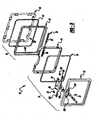
- Figure 3 is an exploded perspective view of the service door assembly of the first embodiment of the present invention.
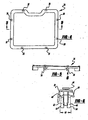
- Figure 4 is an enlarged front view of an inner member of the door of the service door assembly of the first embodiment of the present invention.
- Figure 5 is a cross-sectional view taken along the line 5-5 of Figure 4.
- Figure 6 is an enlarged view of the detail shown in circle 6 of Figure 5.
- Figures 7A-7C represent a series of simplified views showing attachment of the door inner with the door outer.
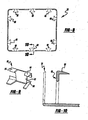
- Figure 8 is an enlarged side view of an inner member of the frame of the service door assembly of the first embodiment of the present invention.
- Figure 9 is an enlarged view of the detail shown in circle 9 of Figure 3.
- Figure 10 is a cross-sectional view taken along the line 10-10 of Figure 8.
- Figure 11 is a cross-sectional view taken through a portion of the service door assembly of the first embodiment of the present invention and an adjacent portion of a sidewall of the recreational vehicle, one of the integrally formed mounting tabs of the frame shown in solid lines prior to engagement with the sidewall and shown in hidden lines subsequent to engagement with the sidewall.
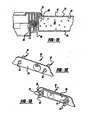
- Figure 12 is an enlarged perspective view of a cover plate of a locking mechanism of the service door assembly of the first embodiment of the present invention.
- Figure 13 is a rear perspective view of the cover plate of Figure 12.
- Figure 14 is an enlarged perspective view of one of the hinge members of a hinge assembly of the first embodiment of the present invention.
- Figure 15 is a front view of the hinge member of Figure 14.
- Figure 16 is a cross-sectional view taken along lines 16-16 of Figure 1, illustrating the door articulated to a closed position.
- Figure 17 is a cross-sectional view similar to Figure 16 showing the door in a partially opened position in which it extends in a direction 90° to the sidewall of the recreational vehicle.
- Figure 18 is another cross-sectional view similar to Figure 16 illustrating the door articulated to a fully opened position and extending in a direction parallel to the sidewall of the recreational vehicle.
- Figure 19 is a front view of a door of a service door assembly of first embodiment of the present invention.
- Figure 20 is a partially exploded, rear perspective view of the door of Figure 19.
- Figure 21 is a cross-sectional view taken along the line 21-21 of Figure 19.
- Figure 22 is an enlarged view of the detail shown in the circle A of Figure 21.
- Figure 23 is a cross-sectional view taken along the line 23-23 of Figure 19.
- Figure 24 is an enlarged view of the detail shown in the circle B of Figure 23.
- Figure 25 is a front view of a frame of the service door assembly of the second embodiment of the present invention.
- Figure 26 is a cross-sectional view taken along the line 26-26 of Figure 25.
- Figure 27 is an enlarged view of the detail shown in circle C of Figure 26.
- Figure 28 is an exploded view of a frame inner member and a frame outer member of a service door assembly of a third embodiment of the present invention.
- Figure 29 is a cross-sectional view similar to Figure 19 illustrating the service door assembly of Figure 28.
- Figure 30 is an enlarged cross-sectional view of the detail shown in circle D of Figure 29.
- a service door assembly constructed in accordance with the teachings of a first embodiment of the present invention is illustrated and generally identified at reference element 10.
- the service door assembly 10 is shown operatively associated with a recreational vehicle 12. It will be understood by those skilled in the art that the particular recreational vehicle 12 shown in the environmental view of Figure 1 is merely exemplary and that the teachings of the present invention are applicable to other recreational vehicles, tractor trailers and virtually any other type of moving vehicle for which it is desired to provide an exterior service door for accessing external compartments. It will be further understood by those skilled in the art that the service door assembly 10 may also be for non-motorized trailers and stationary applications.
- the service door assembly 10 is shown mounted within an opening (not particularly shown with respect to Figure 1) of a sidewall 14 of the recreational vehicle 12.
- the service door assembly 10 of the present invention is shown to generally include a door or door proper 16 and a frame 18.
- the door 16 and the frame 18 are connected by a hinge assembly 20.
- the hinge assembly 20 defines a pivot axis about which the door 16 can articulate relative to the frame 18 between an opened position and a closed position.
- the closed position is shown in the environmental view of Figure 1.
- the open position is shown in the cross-sectional view of Figure 18, for example.
- the door 16 is constructed to incorporate a portion of the sidewall 14 removed from the vehicle 12 to create the opening.
- the door 16 is preferably a laminated structure having an inner wall, an outer wall and a foam core.
- the door 16 is shown to generally include an outer member 22 and an inner member 24 (see Figure 3, for example) between which the portion of the sidewall 14 is captured.
- a seal 26 is also captured between the outer and inner members 22 and 24.
- the door 16 is further illustrated to include a locking mechanism 28 for selectively securing the door 16 to the frame 18.
- the frame 18 is illustrated to similarly generally include an inner member 30 and an outer member 32. Further similarly, a seal 34 is captured between the inner and outer member 30 and 32. In a manner to be more fully discussed below, the frame 18 is mounted within an aperture 36 (see Figure 11) defined by the sidewall 14 of the recreational vehicle 12.
- the door 16 is shown to include a plurality of connecting members 38 for securely connecting the inner and outer member 22 and 24 of the door 16 without discrete fasteners.
- the connecting members 38 are preferably integrally formed with one of the inner and outer members 22 and 24 and in a manner discussed below are adapted to engage and be retained within openings 40 defined by the other of the inner and outer members 22 and 24 of the door 16.
- the connecting members 38 are integrally formed with the inner member 24 of the door 16 and the cooperating openings 40 are defined by the outer member 22.
- the door 16 could be designed such that the connecting members were integrally formed with the outer member 22 and the openings 40 defined by the inner member 24.
- the inner member 24 of the door is illustrated to include eight connecting members 38 spaced about the perimeter. Further in the first embodiment, each of the four sides of the inner member 24 are shown to include two connecting members 38. Those skilled in the art will readily appreciate that a greater or lesser number of connecting members 38 may be provided within the scope of the present invention so long as the connecting members 38 function to securely connect the inner and outer members 22 and 24 of the door 16.
- each of the connecting members 38 of the door 16 will be understood to be substantially identical to one another. For this reason, this detailed description need only to address one of the connecting members 38 for a complete understanding.
- each of the connecting members 38 includes first and second parallel and spaced apart fingers 42 and 44.
- Each connecting member 38 further includes a pin 46 positioned between the first and second fingers 42 and 44. The pin 46 is movable relative to the first and second fingers 42 and 44 between a first position and a second position.
- the first position of the pin 46 relative to the first and second fingers 42 and 44 is a molded position and is shown, for example, in Figure 6.
- the pin 46 In the first position, the pin 46 is connected to the first and second fingers 42 and 44 through breakaway connections at points 48 and 50, respectively.
- the pin 46 In the second position, which will be further described immediately hereafter, the pin 46 is moved downward relative to the first and second fingers 42 and 44 and the breakaway connection at the points 48 and 50 is destroyed.
- FIG. 7A the connecting member 38 is shown prior to insertion into the associated opening 40.
- the opening is defined by a pair of walls or fins 52.
- the fins 52 are substantially parallel to one another and spaced apart a distance which is slightly less than a maximum width w (see Figure 6) of the first and second fingers 42 and 44.
- Figure 7B upon insertion of the connecting members 38 in the direction of arrow A (see Figure 7A), the free ends of the first and second fingers 42 and 44 are urged toward one another.
- the pin 46 is struck with a hammer or similar tool to destroy the breakaway connection at the points 48 and 50 and force a lower end of the pin between the free end of the first and second fingers 42 and 44.
- the first and second fingers 42 and 44 are returned to their initial parallel orientations and points 58 carried by the first and second fingers 42 and 44 engage the fins 52 to prevent withdrawal of the connecting member 38 relative to the opening 40.
- the frame 18 of the assembly 10 of the present invention is illustrated to include a plurality of integrally formed locking members or tabs 60.
- the locking tabs are substantially identical and are integrally formed with the inner member 30 of the frame 18.
- the present invention can be adapted such that the locking tabs 60 are integrally formed with the outer member 32 of the frame 18.
- the locking tabs 60 function to secure the frame 18 to the sidewall 14 of the recreational vehicle 12 without the need for discrete fasteners.
- the inner member 30 of the frame 18 is formed to integrally include ten locking tabs 60.
- the locking tabs 60 are spaced about the perimeter of the inner member 30 of the frame 18 such that three locking tabs 60 are provided on each of the top and bottom sides of the inner member 30 and two locking tabs 60 are provided on each of the lateral sides of the inner 30.
- the particular number of locking tabs 60 is a matter of design choice and may be adjusted up or down within the scope of the present invention. It may be necessary to adjust the number of locking tabs 60 in response to factors such as the size of the frame 18, the construction of the recreational vehicle sidewall 14, and the like.
- Each of the locking tabs 60 generally include a generally planar base portion 62 and a pair of prongs 64 depending from and generally perpendicular to the base portion 62.
- the base portion 62 is connected to the remainder of the inner portion 30 of the frame 18 through a living hinge 66.
- the living hinge 66 defines an axis about which each locking tab 60 articulates between a first position and a second position.
- the first position is shown, for example, in Figures 3, 9, 10 and in solid lines in Figure 11.
- the second position is shown, for example, in hidden lines in Figure 11.
- the locking tabs 60 articulate from their first positions to their second positions so to engage a foam core 68 provided in a cavity 70 defined between inner and outer panels 72 and 74 of the sidewall 14.
- This articulation from the first position to the second position also functions to securely connect the inner and outer members 30 and 32 of the frame 18.
- the prongs 64 of the locking tabs 60 extend through openings 76 (see Figure 2) of the outer member 32 of the frame 18.
- the prongs 64 displace a portion of the foam core 68.
- the outer panels 72 of the sidewall 14 is effectively captured between the prongs 64 and a peripheral flange portion 78 of the outer member 32 of the frame 18.
- a surface 80 of the prong 64 positioned adjacent an inner side of the outer panel 72 has an arcuate shape to facilitate insertion of the prong 64 into the cavity 70 and also to wedge the outer panel 72 between the prongs 64 and the peripheral flange 78.
- cover plate 82 of the locking mechanism 28 of the assembly 10 is illustrated.
- the cover plate 82 is also shown in Figure 3.
- the cover plate 82 is shown to include a pair of integrally formed locking members 38 substantially identical to those described above in connection with the inner member 24 of the door 16.
- the head of the pin 46 of the locking members 38 extends from a rearward surface 84.
- the fingers 42 and 44 extend from a forward facing surface 86 of the cover member 82.
- the locking members 38 of the cover plate 82 engage apertures (not shown) defined by the outer member 22 of the door 16.
- Substantially identical locking members are used to secure a sliding lock plate 88 of the lock assembly to the outer member 22 of the door 16.
- the locking members 38 are not carried by a component, but are rather discrete.
- the discrete locking members 38 pass through elongated apertures provided by the locking plate 88 and engage apertures (not shown) defined by the outer member 22 of the door 16 substantially as described above. In this matter, the locking plate 88 may slide relative to the outer member 22.
- a button 100 is attached to the locking plate 88.
- the button 100 is normally biased along with the locking plate 88 to a latched position by a spring.
- the latched position is to the left direction in the drawings.
- the button 100 is manually movable to an unlatched position, again along with the locking plate 88, when the locking mechanism 28 is unlocked.
- the particular construction of the door assembly 10 allows for this movement from the latched to unlatched position to be accomplished with a single hand.
- the user can insert his or her thumb into an aperture 102 adjacent the button 100 and his or her finger in a second aperture 104.
- the locking plate 88 is shown to include a plurality of tabs 106.
- the locking plate 88 includes five tabs 106.
- the tabs 106 cooperate with a corresponding number of apertures or slots (not particularly shown) carried by the outer member 32.
- the slots are provided in an upper side of an inwardly extending flange 108.
- the button 100 and locking plate 88 are translated to the unlatched position, the tabs 106 align with the slots. In this position, the door proper 16 can be articulated to its open position.
- the spring force translates the locking plate 88 to its latched position and the tabs 106 are positioned behind the flange 108.
- the plurality of tabs 106 at spaced apart positions along the locking plate 88 serve to secure the door proper 16 to the frame 18 in an improved manner. In this regard, the door proper 16 is secured along the length of an upper side of the frame 18.
- the hinge assembly 20 includes a pair of hinge members 90 that support the door 16 in a manner to be more fully described below.
- the hinge members 90 will be understood to be identical in all respects.
- an alternatively constructed hinge member 90' is shown removed from the door assembly 10. Both the hinge members 90 and 90' are shown to includes a plurality of hinge bars 92 connected by a generally planar plate 94.
- the primary difference between the hinge members 90 and the hinge members 90' is that the hinge bars 92 of the former are foreshortened. Otherwise, insofar as the present invention is concerned the hinge members 90 and 90' are identical.
- the hinge bars 92 are generally parallel to and spaced from the plate 94. In the embodiments illustrated, the hinge bars 92 are four (4) in number and arranged in pairs. Each pair of hinge bars 92 have an upper hinge bar 92A and a lower hinge bar 92B.
- the hinge assembly 20 will be further described.
- the upper hinge bars 92A are rotatably mounted on the outer member 22 of the door 16.
- the lower hinge bars 92B are rotatably mounted on the outer member 32 of the frame 18.
- a first one of the hinge members 90 or 90' is oriented with its hinge bars 92 extending in an outboard direction.
- the hinge bars 92 engage apertures defined by the door 16 and the frame 18 by moving the hinge member 90 in the outboard direction.
- This outboard direction is generally identified in Figure 15 at arrow A.
- the second one of the hinge members 90 or 90' is oriented with its hinge bars 92 extending in an opposite direction.
- the apertures defined by the door 16 and the frame 18 are engaged by the second hinge member 90 or 90' by moving the second hinge member 90 or 90' in this opposite direction.
- adjacent ends abut one another to thereby prevent inboard movement.
- the hinge members 90 or 90' are preferably constructed of plastic or other suitable material that may be inelastically deformed to facilitate assembly.
- the service door assembly of the second embodiment is intended to be mounted in an opening of a sidewall 14 and generally includes a door or door proper 102 and a frame 104.
- the service door assembly of the second embodiment differs from the service door assembly 10 of the first embodiment by incorporating cooperating means for automatically facilitating engagement between the first and second members as a portion of the sidewall is captured between the first and second members and prevent disengagement after the portion of the sidewall is captured between the first and second members.
- the cooperating means may also accommodate a variation in the thickness of the sidewall 14 in to both the door 102 and frame 104.
- the teachings of the first embodiment of the present invention typically require a specific frame inner member 30 for a particular sidewall thickness. Similar limitations are associated with the door 16.
- the teachings of the second embodiment of the present invention utilize a common door 102 and a common frame 104 that are adapted to accommodate variations in sidewall thickness. To the extent not otherwise differentiated herein, it will be understood that the construction and operation (including the intended uses) of the service door assembly of the second embodiment are identical to the service door assembly 10 of the first embodiment.
- the door 102 is illustrated to include an outer member 106 and an inner member 108.
- a portion of the sidewall 14 removed to create the opening in the vehicle 12 is captured between the outer member 106 and the inner member 108 to create a laminated structure.
- This portion of the sidewall 14 is not particularly shown in connection with the door 102, but is illustrated in the environmental view of Figure 1 in connection with the first embodiment of the present invention.
- the door outer and inner members 106 and 108 include cooperating means for securing the door inner member 108 to the door outer member 106 to define a variable door thickness for accommodating variations in a thickness of the sidewall 14.
- the cooperating means include first and second ratchet means.
- the cooperating means may include at least one tooth.
- the cooperating means may include at least a first plurality of teeth 112 carried by the door outer member 106 and a second plurality of teeth 114 carried by the door inner member 108.
- the first and second pluralities of cooperating teeth 112 and 114 are shown most particularly in the cross-sectional views of Figures 22 and 24.
- the door 102 of the second embodiment of the present invention is shown to include multiple pairs of cooperating teeth.
- the door 102 includes two pair of cooperating teeth associated with each of the four sides of the door 102.
- the pluralities of teeth 112 of the door outer member 106 are integrally defined on the arms 116 which rearwardly extend from a main body portion of the door outer member 106.
- the second plurality of teeth 114 of the door inner member 108 are integrally formed on a horizontally extending flange 118 which peripherally surrounds the door inner member 108.
- An opening 120 with a tapered lead-in portion 122 is positioned adjacent the second plurality of teeth 114 for receiving the arm 116.
- the portion of the sidewall 14 removed to define the opening in the vehicle 12 is trimmed to an appropriate size and positioned between the door outer and inner members 106 and 108.
- Advancement of the door outer and inner members 106 and 108 toward one another causes a ratcheted-engagement between the first and second pluralities of teeth 112 and 114.
- the teeth 112 and 114 are angled to facilitate insertion of the arm 116 into the opening 120 and prevent subsequent withdrawal of the arm 116 from the opening 120.
- the minimal thickness of the arm 116 permits slight deflection thereof.
- Continued insertion of the arm 116 into the opening 120 slightly compresses the core defined by the portion of the sidewall 14 captured between the door outer and inner members 106 and 108.
- the inherent resiliency of the core maintains a tension between the first and second pluralities of teeth 112 and 114.
- the frame 104 of the second embodiment of the present invention similarly includes a frame inner member 130 and a frame outer member 132 including cooperating means for securing the frame inner member 130 to the frame outer member 132 and defining a variable frame thickness for accommodating variations in a thickness of the sidewall 14 (shown in Figure 26 in hidden lines).
- the cooperating means include first and second ratchet means.
- the cooperating means include at least a first plurality of teeth 134 carried by the frame inner member 130 and a second plurality of teeth 136 carried by the frame outer member 132.
- the first and second pluralities of cooperating teeth 134 and 136 are shown most particularly in the cross-sectional view of Figure 27.
- the frame 104 of the second embodiment of the present invention is shown to include multiple pairs of cooperating teeth.
- the pluralities of teeth 134 of the frame inner member 130 are integrally defined on the inside of a forwardly extending flange which peripherally surrounds the frame inner member 130.
- the second plurality of teeth 136 of the frame outer member 136 are carried on an insert mounted to a horizontally extending flange which peripherally surrounds the frame outer member 132.
- the second plurality of teeth 136 may be formed integrally with the frame outer member 136.
- a portion of the sidewall 14 is captured between outer peripheral edges of the frame inner and outer members 130 and 132.
- Advancement of the frame inner and outer members 130 and 132 toward one another causes a ratcheted-engagement between the first and second pluralities of teeth 134 and 136.
- the teeth 134 and 136 are angled to facilitate engagement and prevent subsequent disengagement.
- the portion of the sidewall 14 captured between the outer peripheral edges of the frame inner and outer members 130 and 132 is slightly compressed. The inherent resiliency of the sidewall 14 maintains a tension between the first and second pluralities of teeth 130 and 132.
- a service door assembly constructed in accordance with the teachings of a third embodiment of the present invention is illustrated and identified generally at reference character 200.
- the service door assembly 200 differs from the service door assembly 100 by incorporating an alternative arrangement for securing inner 130 and outer members 132 of the door frame 104 to one another.
- like reference numbers will be used to identify similar elements throughout the views.
- One of the frame inner member 130 and the frame outer member 132 includes one or more male elements 202 that cooperate with a corresponding number of female elements 204 defined by the other of the inner and outer members 130 and 132.
- the one or more male elements 202 and the one or more female elements 204 serve as cooperating means for automatically facilitating engagement between the first and second members as a portion of the sidewall is captured between the first and second members and prevent disengagement after the portion of the sidewall is captured between the first and second members.
- the inner member 130 may be formed to include a plurality of male elements in the form of integrally formed teeth or snaps 202.
- the snaps 202 are received in corresponding apertures 204 of the outer member 132 upon assembly of the frame inner and outer members 130 and 132.
- the snaps 202 may be configured to define an angled lead-in face or surface and a generally perpendicular trailing face or surface.
- the lead-in surface facilitates assembly of the inner and outer members 130 and 132.
- the trailing surface prevents the inner and outer members 130 and 132 from inadvertently becoming disassembled.
Landscapes
- Engineering & Computer Science (AREA)
- Mechanical Engineering (AREA)
- Health & Medical Sciences (AREA)
- Public Health (AREA)
- Transportation (AREA)
- Lock And Its Accessories (AREA)
- Body Structure For Vehicles (AREA)
- Power-Operated Mechanisms For Wings (AREA)
Abstract
Description
- This application claims priority to United States Provisional Application Serial No. 60/499,933, filed September 3, 2004. United States Provisional Application Serial No. 60/499,933 is hereby incorporated by reference as if fully set forth herein.
- This invention is related to doors for recreational vehicles (RVs) which are used to alternatively seal off and provide access to internal compartments and more particularly to an improved type of flush mounted service door assembly for a recreational vehicle which offers substantial improvements in appearance and assembly.
- Vehicles, including but not limited to recreational vehicles which are commonly referred to in the United States as RVs and in Europe as caravans, often incorporate exterior service doors for accessing internal compartments. For example, known service doors are shown and described in commonly assigned U.S. Patent Nos. 5,746,466 and 4,906,033 which are hereby incorporated by reference as if fully set forth herein.
- United States Patent No. 5,746,466 discloses a service door assembly attached to a cutout in the side wall of a recreational vehicle for alternatively closing off and providing access to an internal compartment. A body frame of the service door assembly is attached to the cut out in the side wall. A door panel is attached by a hinge to the body frame. A pair of push button latch mechanisms, one of which contains an integrated lock, retains the door panel in the closed position. The door panel includes a separate door wall and inner and outer door frames which are joined by a retaining clip. The metal retaining clip has a return bent upon itself shape and pointed wedge shaped upset portions for joining the outer and inner door frames. The hinge is formed by portions of the frame and door panel that are flush with or recessed from the maximum protrusion distance of the door panel from the side wall, joined by a hinge pin that is not accessible when the door is closed and which is designed to break away if destructive forces are placed on the door assembly.
- In U.S. Patent No. 4,906,033, a service door arrangement is disclosed in which hinge members mount the upper end of the door member on the frame for up and down swinging movement between an open position disposed above the access opening and a closed position fitting in the opening. A continuous seal carried by the door engages the frame in order to maintain the compartment water tight. Separate latching and locking functions are incorporated in the door assembly and are separately accessed from side-by-side latch and lock members in the frame at a convenient position above the door.
- While known service doors including those described above have proven to be satisfactory for their intended uses, a need exists to continually advance the pertinent art.
- It is one general object of the present invention to provide a service door assembly having a reduced width frame that provides for an improved aesthetic appearance.
- It is another object of the present invention to provide a service door assembly which reduces the required number of discrete fasteners for securing the door assembly to a recreational vehicle and for connecting components of the door assembly.
- It is a related object of the present invention to provide a service door assembly having a frame with integrally formed locking tabs for engaging a sidewall of the recreational vehicle.
- It is another related object of the present invention to provide a service door assembly having a door proper with inner and outer members, one of the inner and outer members being integrally formed to include a break-away element which can be hit with a hammer to operatively engage the inner and outer members.
- It is another general object of the present invention to provide a service door assembly for a recreational vehicle having a reduced width frame which reduces required materials and enhances visual appearance.
- It is a related object of the present invention to provide a service door assembly for a recreational vehicle having a door with inner and outer members with integrally molded attachment members to facilitate engagement and maintain a narrow profile.
- It is yet another object of the present invention to provide a service door assembly for a recreational vehicle that latches at a plurality of spaced apart points.
- It is another object of the present invention to provide a service door assembly for a motor vehicle that readily accommodates vehicle walls of varying thicknesses.
- In one form, the present invention provides a service door assembly for mounting in an opening of a sidewall, the service door assembly includes a door frame and a door mounted to the door frame. The door frame is adapted to be disposed in the opening and includes a frame inner member and a frame outer member. The frame inner and outer members include cooperating means for automatically facilitating engagement between the first and second members as a portion of the sidewall is captured between the first and second members and prevent disengagement after the portion of the sidewall is captured between the first and second members. The cooperating means may also secure the frame inner member to the frame outer member to define a variable door frame thickness for accommodating variations in a thickness in the sidewall. The cooperating means may include one or more teeth.
- In another form, the present invention provides a service door assembly for mounting in an opening of a sidewall. The service door assembly includes a door frame adapted to be disposed in the opening and a door mounted to the door frame. The door includes a door inner member and a door outer member. The door inner and outer members include cooperating means for securing the door inner member to the door outer member to define a variable door thickness for accommodating variations in a thickness of the sidewall. The cooperating means may include first and second pluralities of cooperating teeth defined by the door inner and outer members, respectively.
- In yet another form, the present invention provides a subassembly of a service door assembly for mounting in an opening of a sidewall having a thickness. The subassembly includes a first member and a second member secured to the first member. The first and second members capture at least a portion of the sidewall therebetween. The first and second members include cooperating male and female elements for securing the first and second members to one another.
- Additional advantages and features of the present invention will become apparent from the following description and appended claims, taken in conjunction with the accompanying drawings.
- Further areas of applicability of the present invention will become apparent from the detailed description provided hereinafter. It should be understood that the detailed description and specific examples, while indicating the particular embodiments of the invention, are intended for purposes of illustration only and are not intended to limit the scope of the invention.
- The present invention will become more fully understood from the detailed description and the accompanying drawings, wherein:
- Figure 1 is a perspective view of a recreational vehicle incorporating a service door assembly constructed in accordance with the teachings of a first embodiment of the present invention.
- Figure 2 is an enlarged perspective view of the service door assembly of the present invention shown removed from the recreational vehicle for purposes of illustration.
- Figure 3 is an exploded perspective view of the service door assembly of the first embodiment of the present invention.
- Figure 4 is an enlarged front view of an inner member of the door of the service door assembly of the first embodiment of the present invention.
- Figure 5 is a cross-sectional view taken along the line 5-5 of Figure 4.
- Figure 6 is an enlarged view of the detail shown in
circle 6 of Figure 5. - Figures 7A-7C represent a series of simplified views showing attachment of the door inner with the door outer.
- Figure 8 is an enlarged side view of an inner member of the frame of the service door assembly of the first embodiment of the present invention.
- Figure 9 is an enlarged view of the detail shown in circle 9 of Figure 3.
- Figure 10 is a cross-sectional view taken along the line 10-10 of Figure 8.
- Figure 11 is a cross-sectional view taken through a portion of the service door assembly of the first embodiment of the present invention and an adjacent portion of a sidewall of the recreational vehicle, one of the integrally formed mounting tabs of the frame shown in solid lines prior to engagement with the sidewall and shown in hidden lines subsequent to engagement with the sidewall.
- Figure 12 is an enlarged perspective view of a cover plate of a locking mechanism of the service door assembly of the first embodiment of the present invention.
- Figure 13 is a rear perspective view of the cover plate of Figure 12.
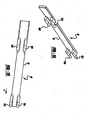
- Figure 14 is an enlarged perspective view of one of the hinge members of a hinge assembly of the first embodiment of the present invention.
- Figure 15 is a front view of the hinge member of Figure 14.
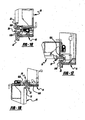
- Figure 16 is a cross-sectional view taken along lines 16-16 of Figure 1, illustrating the door articulated to a closed position.
- Figure 17 is a cross-sectional view similar to Figure 16 showing the door in a partially opened position in which it extends in a direction 90° to the sidewall of the recreational vehicle.
- Figure 18 is another cross-sectional view similar to Figure 16 illustrating the door articulated to a fully opened position and extending in a direction parallel to the sidewall of the recreational vehicle.
- Figure 19 is a front view of a door of a service door assembly of first embodiment of the present invention.
- Figure 20 is a partially exploded, rear perspective view of the door of Figure 19.
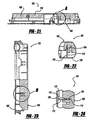
- Figure 21 is a cross-sectional view taken along the line 21-21 of Figure 19.
- Figure 22 is an enlarged view of the detail shown in the circle A of Figure 21.
- Figure 23 is a cross-sectional view taken along the line 23-23 of Figure 19.
- Figure 24 is an enlarged view of the detail shown in the circle B of Figure 23.
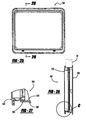
- Figure 25 is a front view of a frame of the service door assembly of the second embodiment of the present invention.
- Figure 26 is a cross-sectional view taken along the line 26-26 of Figure 25.
- Figure 27 is an enlarged view of the detail shown in circle C of Figure 26.
- Figure 28 is an exploded view of a frame inner member and a frame outer member of a service door assembly of a third embodiment of the present invention.
- Figure 29 is a cross-sectional view similar to Figure 19 illustrating the service door assembly of Figure 28.
- Figure 30 is an enlarged cross-sectional view of the detail shown in circle D of Figure 29.
- The following description of the embodiments of the present invention is merely exemplary in nature and is in no way intended to limit the invention, its application, or uses.
- With initial reference to the environmental view of Figure 1, a service door assembly constructed in accordance with the teachings of a first embodiment of the present invention is illustrated and generally identified at
reference element 10. Theservice door assembly 10 is shown operatively associated with a recreational vehicle 12. It will be understood by those skilled in the art that the particular recreational vehicle 12 shown in the environmental view of Figure 1 is merely exemplary and that the teachings of the present invention are applicable to other recreational vehicles, tractor trailers and virtually any other type of moving vehicle for which it is desired to provide an exterior service door for accessing external compartments. It will be further understood by those skilled in the art that theservice door assembly 10 may also be for non-motorized trailers and stationary applications. Theservice door assembly 10 is shown mounted within an opening (not particularly shown with respect to Figure 1) of asidewall 14 of the recreational vehicle 12. - With continued reference to the environmental view of Figure 1 and additional reference to Figures 2 and 3, the
service door assembly 10 of the present invention is shown to generally include a door or door proper 16 and aframe 18. Thedoor 16 and theframe 18 are connected by ahinge assembly 20. Thehinge assembly 20 defines a pivot axis about which thedoor 16 can articulate relative to theframe 18 between an opened position and a closed position. The closed position is shown in the environmental view of Figure 1. The open position is shown in the cross-sectional view of Figure 18, for example. - The
door 16 is constructed to incorporate a portion of thesidewall 14 removed from the vehicle 12 to create the opening. As a result, thedoor 16 is preferably a laminated structure having an inner wall, an outer wall and a foam core. Thedoor 16 is shown to generally include anouter member 22 and an inner member 24 (see Figure 3, for example) between which the portion of thesidewall 14 is captured. Aseal 26 is also captured between the outer andinner members 22 and 24. Thedoor 16 is further illustrated to include alocking mechanism 28 for selectively securing thedoor 16 to theframe 18. - The
frame 18 is illustrated to similarly generally include aninner member 30 and an outer member 32. Further similarly, a seal 34 is captured between the inner andouter member 30 and 32. In a manner to be more fully discussed below, theframe 18 is mounted within an aperture 36 (see Figure 11) defined by thesidewall 14 of the recreational vehicle 12. - With additional reference to Figures 4-7C, the
door 16 is shown to include a plurality of connectingmembers 38 for securely connecting the inner andouter member 22 and 24 of thedoor 16 without discrete fasteners. The connectingmembers 38 are preferably integrally formed with one of the inner andouter members 22 and 24 and in a manner discussed below are adapted to engage and be retained withinopenings 40 defined by the other of the inner andouter members 22 and 24 of thedoor 16. In the exemplary embodiment illustrated, the connectingmembers 38 are integrally formed with the inner member 24 of thedoor 16 and the cooperatingopenings 40 are defined by theouter member 22. Alternatively, it will become apparent to those skilled in the art that thedoor 16 could be designed such that the connecting members were integrally formed with theouter member 22 and theopenings 40 defined by the inner member 24. - As particularly shown in Figure 4, the inner member 24 of the door is illustrated to include eight connecting
members 38 spaced about the perimeter. Further in the first embodiment, each of the four sides of the inner member 24 are shown to include two connectingmembers 38. Those skilled in the art will readily appreciate that a greater or lesser number of connectingmembers 38 may be provided within the scope of the present invention so long as the connectingmembers 38 function to securely connect the inner andouter members 22 and 24 of thedoor 16. - In the particular embodiment illustrated, the connecting
members 38 of thedoor 16 will be understood to be substantially identical to one another. For this reason, this detailed description need only to address one of the connectingmembers 38 for a complete understanding. As perhaps most particularly shown in the enlarged detailed view of the Figure 6, each of the connectingmembers 38 includes first and second parallel and spaced apartfingers member 38 further includes a pin 46 positioned between the first andsecond fingers second fingers - The first position of the pin 46 relative to the first and
second fingers second fingers second fingers - With particular reference to the series of views provided at Figures 7A-7C, cooperation of one of the connecting
members 38 with an associatedopening 40 defined by theinner member 22 of thedoor 16 will be described. In Figure 7A, the connectingmember 38 is shown prior to insertion into the associatedopening 40. The opening is defined by a pair of walls orfins 52. Thefins 52 are substantially parallel to one another and spaced apart a distance which is slightly less than a maximum width w (see Figure 6) of the first andsecond fingers members 38 in the direction of arrow A (see Figure 7A), the free ends of the first andsecond fingers surfaces 54 carried by the first andsecond fingers member 38 is limited by flanges 56 carried at the fixed ends of the first and second fingers which abut the free ends of thefins 52. - At this point of engagement between the connecting
members 38 and theopenings 40, the pin 46 is struck with a hammer or similar tool to destroy the breakaway connection at the points 48 and 50 and force a lower end of the pin between the free end of the first andsecond fingers second fingers second fingers fins 52 to prevent withdrawal of the connectingmember 38 relative to theopening 40. - With continued reference to the exploded view of Figure 3 and additional reference to Figures 8-11, the
frame 18 of theassembly 10 of the present invention is illustrated to include a plurality of integrally formed locking members ortabs 60. In the embodiment illustrated, the locking tabs are substantially identical and are integrally formed with theinner member 30 of theframe 18. Alternatively, it will be understood by those skilled in the art that the present invention can be adapted such that the lockingtabs 60 are integrally formed with the outer member 32 of theframe 18. The lockingtabs 60 function to secure theframe 18 to thesidewall 14 of the recreational vehicle 12 without the need for discrete fasteners. - In the particular embodiment illustrated, the
inner member 30 of theframe 18 is formed to integrally include ten lockingtabs 60. The lockingtabs 60 are spaced about the perimeter of theinner member 30 of theframe 18 such that three lockingtabs 60 are provided on each of the top and bottom sides of theinner member 30 and two lockingtabs 60 are provided on each of the lateral sides of the inner 30. It will be understood by those skilled in the art that the particular number of lockingtabs 60 is a matter of design choice and may be adjusted up or down within the scope of the present invention. It may be necessary to adjust the number of lockingtabs 60 in response to factors such as the size of theframe 18, the construction of therecreational vehicle sidewall 14, and the like. - Each of the locking
tabs 60 generally include a generally planar base portion 62 and a pair of prongs 64 depending from and generally perpendicular to the base portion 62. The base portion 62 is connected to the remainder of theinner portion 30 of theframe 18 through a livinghinge 66. The livinghinge 66 defines an axis about which eachlocking tab 60 articulates between a first position and a second position. The first position is shown, for example, in Figures 3, 9, 10 and in solid lines in Figure 11. The second position is shown, for example, in hidden lines in Figure 11. The lockingtabs 60 articulate from their first positions to their second positions so to engage a foam core 68 provided in acavity 70 defined between inner and outer panels 72 and 74 of thesidewall 14. This articulation from the first position to the second position also functions to securely connect the inner andouter members 30 and 32 of theframe 18. Explaining further, the prongs 64 of the lockingtabs 60 extend through openings 76 (see Figure 2) of the outer member 32 of theframe 18. The prongs 64 displace a portion of the foam core 68. The outer panels 72 of thesidewall 14 is effectively captured between the prongs 64 and a peripheral flange portion 78 of the outer member 32 of theframe 18. In the embodiment, a surface 80 of the prong 64 positioned adjacent an inner side of the outer panel 72 has an arcuate shape to facilitate insertion of the prong 64 into thecavity 70 and also to wedge the outer panel 72 between the prongs 64 and the peripheral flange 78. - With reference to Figures 12 and 13, a cover plate 82 of the
locking mechanism 28 of theassembly 10 is illustrated. The cover plate 82 is also shown in Figure 3. In the embodiment illustrated, the cover plate 82 is shown to include a pair of integrally formed lockingmembers 38 substantially identical to those described above in connection with the inner member 24 of thedoor 16. The head of the pin 46 of the lockingmembers 38 extends from a rearward surface 84. Thefingers members 38 of the cover plate 82 engage apertures (not shown) defined by theouter member 22 of thedoor 16. - Substantially identical locking members are used to secure a sliding lock plate 88 of the lock assembly to the
outer member 22 of thedoor 16. Different from those previously described, the lockingmembers 38 are not carried by a component, but are rather discrete. Thediscrete locking members 38 pass through elongated apertures provided by the locking plate 88 and engage apertures (not shown) defined by theouter member 22 of thedoor 16 substantially as described above. In this matter, the locking plate 88 may slide relative to theouter member 22. - A
button 100 is attached to the locking plate 88. Thebutton 100 is normally biased along with the locking plate 88 to a latched position by a spring. The latched position is to the left direction in the drawings. Thebutton 100 is manually movable to an unlatched position, again along with the locking plate 88, when thelocking mechanism 28 is unlocked. The particular construction of thedoor assembly 10 allows for this movement from the latched to unlatched position to be accomplished with a single hand. In this regard, the user can insert his or her thumb into anaperture 102 adjacent thebutton 100 and his or her finger in asecond aperture 104. - In the particular embodiment illustrated, the locking plate 88 is shown to include a plurality of
tabs 106. As shown, the locking plate 88 includes fivetabs 106. Thetabs 106 cooperate with a corresponding number of apertures or slots (not particularly shown) carried by the outer member 32. The slots are provided in an upper side of an inwardly extendingflange 108. When thebutton 100 and locking plate 88 are translated to the unlatched position, thetabs 106 align with the slots. In this position, the door proper 16 can be articulated to its open position. Upon releasing thebutton 100, the spring force translates the locking plate 88 to its latched position and thetabs 106 are positioned behind theflange 108. The plurality oftabs 106 at spaced apart positions along the locking plate 88 serve to secure the door proper 16 to theframe 18 in an improved manner. In this regard, the door proper 16 is secured along the length of an upper side of theframe 18. - As shown in Figure 3, the
hinge assembly 20 includes a pair of hinge members 90 that support thedoor 16 in a manner to be more fully described below. The hinge members 90 will be understood to be identical in all respects. With reference to Figures 14 and 15, an alternatively constructed hinge member 90' is shown removed from thedoor assembly 10. Both the hinge members 90 and 90' are shown to includes a plurality of hinge bars 92 connected by a generally planar plate 94. The primary difference between the hinge members 90 and the hinge members 90' is that the hinge bars 92 of the former are foreshortened. Otherwise, insofar as the present invention is concerned the hinge members 90 and 90' are identical. - The hinge bars 92 are generally parallel to and spaced from the plate 94. In the embodiments illustrated, the hinge bars 92 are four (4) in number and arranged in pairs. Each pair of hinge bars 92 have an
upper hinge bar 92A and alower hinge bar 92B. - With continued reference to Figures 3, 14 and 15, and additional reference to the cross-sectional views of Figures 16-18, the
hinge assembly 20 will be further described. The upper hinge bars 92A are rotatably mounted on theouter member 22 of thedoor 16. The lower hinge bars 92B are rotatably mounted on the outer member 32 of theframe 18. - During assembly of the
door assembly 10, a first one of the hinge members 90 or 90' is oriented with its hinge bars 92 extending in an outboard direction. The hinge bars 92 engage apertures defined by thedoor 16 and theframe 18 by moving the hinge member 90 in the outboard direction. This outboard direction is generally identified in Figure 15 at arrow A. The second one of the hinge members 90 or 90' is oriented with its hinge bars 92 extending in an opposite direction. In a similar manner, the apertures defined by thedoor 16 and theframe 18 are engaged by the second hinge member 90 or 90' by moving the second hinge member 90 or 90' in this opposite direction. When the hinge members 90 or 90' are in place, adjacent ends abut one another to thereby prevent inboard movement. In some application, it may be desirable to incorporate a tongue and groove arrangement between the opposing ends of the hinge members 90 or 90'. The hinge members 90 or 90' are preferably constructed of plastic or other suitable material that may be inelastically deformed to facilitate assembly. - Turning to Figures 19-27, a service door assembly constructed in accordance with the teachings of a second embodiment of the present invention will be described. Similar to the
service door assembly 10 of the first embodiment, the service door assembly of the second embodiment is intended to be mounted in an opening of asidewall 14 and generally includes a door or door proper 102 and aframe 104. Insofar as the present invention is concerned, the service door assembly of the second embodiment differs from theservice door assembly 10 of the first embodiment by incorporating cooperating means for automatically facilitating engagement between the first and second members as a portion of the sidewall is captured between the first and second members and prevent disengagement after the portion of the sidewall is captured between the first and second members. The cooperating means may also accommodate a variation in the thickness of thesidewall 14 in to both thedoor 102 andframe 104. In this regard, the teachings of the first embodiment of the present invention typically require a specific frameinner member 30 for a particular sidewall thickness. Similar limitations are associated with thedoor 16. As will become apparent below, the teachings of the second embodiment of the present invention utilize acommon door 102 and acommon frame 104 that are adapted to accommodate variations in sidewall thickness. To the extent not otherwise differentiated herein, it will be understood that the construction and operation (including the intended uses) of the service door assembly of the second embodiment are identical to theservice door assembly 10 of the first embodiment. - With particular reference to Figures 19-24, the
door 102 is illustrated to include anouter member 106 and aninner member 108. As with theservice door assembly 10, a portion of thesidewall 14 removed to create the opening in the vehicle 12 is captured between theouter member 106 and theinner member 108 to create a laminated structure. This portion of thesidewall 14 is not particularly shown in connection with thedoor 102, but is illustrated in the environmental view of Figure 1 in connection with the first embodiment of the present invention. - The door outer and
inner members inner member 108 to the doorouter member 106 to define a variable door thickness for accommodating variations in a thickness of thesidewall 14. In the embodiment illustrated, the cooperating means include first and second ratchet means. In one particular application, the cooperating means may include at least one tooth. As illustrated, the cooperating means may include at least a first plurality ofteeth 112 carried by the doorouter member 106 and a second plurality ofteeth 114 carried by the doorinner member 108. The first and second pluralities of cooperatingteeth - In the embodiment illustrated throughout the drawings, the
door 102 of the second embodiment of the present invention is shown to include multiple pairs of cooperating teeth. In one particular application, thedoor 102 includes two pair of cooperating teeth associated with each of the four sides of thedoor 102. - The pluralities of
teeth 112 of the doorouter member 106 are integrally defined on thearms 116 which rearwardly extend from a main body portion of the doorouter member 106. The second plurality ofteeth 114 of the doorinner member 108 are integrally formed on a horizontally extendingflange 118 which peripherally surrounds the doorinner member 108. Anopening 120 with a tapered lead-inportion 122 is positioned adjacent the second plurality ofteeth 114 for receiving thearm 116. - In use, the portion of the
sidewall 14 removed to define the opening in the vehicle 12 is trimmed to an appropriate size and positioned between the door outer andinner members inner members teeth teeth arm 116 into theopening 120 and prevent subsequent withdrawal of thearm 116 from theopening 120. As thearm 116 is inserted into theopening 120, the minimal thickness of thearm 116 permits slight deflection thereof. Continued insertion of thearm 116 into theopening 120 slightly compresses the core defined by the portion of thesidewall 14 captured between the door outer andinner members teeth - Referring to Figures 25 - 27, the
frame 104 of the second embodiment of the present invention will be further described. As with thedoor 102, theframe 104 similarly includes a frameinner member 130 and a frameouter member 132 including cooperating means for securing the frameinner member 130 to the frameouter member 132 and defining a variable frame thickness for accommodating variations in a thickness of the sidewall 14 (shown in Figure 26 in hidden lines). In the embodiment illustrated, the cooperating means include first and second ratchet means. In one particular application, the cooperating means include at least a first plurality ofteeth 134 carried by the frameinner member 130 and a second plurality ofteeth 136 carried by the frameouter member 132. The first and second pluralities of cooperatingteeth frame 104 of the second embodiment of the present invention is shown to include multiple pairs of cooperating teeth. - The pluralities of
teeth 134 of the frameinner member 130 are integrally defined on the inside of a forwardly extending flange which peripherally surrounds the frameinner member 130. The second plurality ofteeth 136 of the frameouter member 136 are carried on an insert mounted to a horizontally extending flange which peripherally surrounds the frameouter member 132. Alternatively, the second plurality ofteeth 136 may be formed integrally with the frameouter member 136. - In use, a portion of the
sidewall 14 is captured between outer peripheral edges of the frame inner andouter members outer members teeth teeth outer members sidewall 14 captured between the outer peripheral edges of the frame inner andouter members sidewall 14 maintains a tension between the first and second pluralities ofteeth - Turning to Figures 28-30, a service door assembly constructed in accordance with the teachings of a third embodiment of the present invention is illustrated and identified generally at
reference character 200. Insofar as the present invention is concerned, theservice door assembly 200 differs from theservice door assembly 100 by incorporating an alternative arrangement for securing inner 130 andouter members 132 of thedoor frame 104 to one another. In view of the similarities between these embodiments, like reference numbers will be used to identify similar elements throughout the views. - One of the frame
inner member 130 and the frameouter member 132 includes one or moremale elements 202 that cooperate with a corresponding number offemale elements 204 defined by the other of the inner andouter members male elements 202 and the one or morefemale elements 204 serve as cooperating means for automatically facilitating engagement between the first and second members as a portion of the sidewall is captured between the first and second members and prevent disengagement after the portion of the sidewall is captured between the first and second members. As particularly shown, theinner member 130 may be formed to include a plurality of male elements in the form of integrally formed teeth or snaps 202. Thesnaps 202 are received in correspondingapertures 204 of theouter member 132 upon assembly of the frame inner andouter members - The
snaps 202 may be configured to define an angled lead-in face or surface and a generally perpendicular trailing face or surface. The lead-in surface facilitates assembly of the inner andouter members outer members - The description of the invention is merely exemplary in nature and, thus, variations that do not depart from the gist of the invention are intended to be within the scope of the invention. Such variations are not to be regarded as a departure from the spirit and scope of the invention.
Claims (10)
- A subassembly of a service door assembly for mounting in an opening of a sidewall having a thickness, the subassembly comprising:wherein the cooperating means are configured to automatically facilitate engagement between the first and second members as a portion of the sidewall is captured between the first and second members and prevent disengagement after the portion of the sidewall is captured between the first and second members.a first member; anda second member secured to the first member and capturing at least a portion of the sidewall therebetween; andthe first and second members including cooperating means for securing the first and second members together,
- The subassembly of a service door assembly of claim 1, wherein the cooperating means includes a first element carried by the first member and a cooperating second element carried by the second member, at least one of the first and second elements including at least one tooth.
- The subassembly of a service door assembly of claim 2, wherein the cooperating means includes first and second pluralities of teeth carried by the first and second members, respectively.
- The subassembly of a service door assembly of claim 3, wherein the first and second pluralities of teeth are integrally formed by the first and second members, respectively.
- The subassembly of a service door assembly of claim 2, wherein the first element is a tooth and the second element is an aperture for receiving the tooth.
- The subassembly of a service door assembly of claim 5, wherein the tooth defines an angled lead-in face for facilitating engagement between the first and second members and a generally vertical trailing face for preventing disengagement of the first and second members.
- The subassembly of a service door assembly of claim 1, wherein the cooperating means defines a variable thickness for accommodating variations in a thickness of the sidewall.
- The subassembly of a service door assembly of claim 3, wherein at least one of the first and second pluralities of teeth is defined by a toothed insert attached to a main body portion of a corresponding one of the first and second members.
- The subassembly of a service door assembly of claim 1, wherein the subassembly is a door for mounting to a frame, a portion of the sidewall captured between the first and second members.
- The subassembly of a service door assembly of claim 1, wherein the subassembly is a frame.
Applications Claiming Priority (2)
| Application Number | Priority Date | Filing Date | Title |
|---|---|---|---|
| US49993303P | 2003-09-03 | 2003-09-03 | |
| US499933P | 2003-09-03 |
Publications (3)
| Publication Number | Publication Date |
|---|---|
| EP1512577A2 true EP1512577A2 (en) | 2005-03-09 |
| EP1512577A3 EP1512577A3 (en) | 2006-12-27 |
| EP1512577B1 EP1512577B1 (en) | 2009-12-09 |
Family
ID=34135364
Family Applications (1)
| Application Number | Title | Priority Date | Filing Date |
|---|---|---|---|
| EP04020941A Expired - Lifetime EP1512577B1 (en) | 2003-09-03 | 2004-09-03 | Service door for a motor vehicle |
Country Status (4)
| Country | Link |
|---|---|
| US (1) | US20050076576A1 (en) |
| EP (1) | EP1512577B1 (en) |
| AT (1) | ATE451272T1 (en) |
| DE (1) | DE602004024480D1 (en) |
Families Citing this family (4)
| Publication number | Priority date | Publication date | Assignee | Title |
|---|---|---|---|---|
| US8176683B2 (en) * | 2010-03-01 | 2012-05-15 | Dexter Chassis Group, Inc. | Vehicle door |
| US11008790B2 (en) * | 2019-02-13 | 2021-05-18 | Tim Peterson Inc. | Trailer cleanout portal assembly |
| IT201900020342A1 (en) * | 2019-11-05 | 2021-05-05 | Lci Italy Srl | Recreational vehicle door |
| US11333392B1 (en) * | 2020-06-26 | 2022-05-17 | Eagan Manufacturing, Inc. | Wall vent door assembly |
Citations (4)
| Publication number | Priority date | Publication date | Assignee | Title |
|---|---|---|---|---|
| US4906033A (en) | 1988-11-02 | 1990-03-06 | Thetford Corporation | RV door assembly |
| US5746466A (en) | 1996-04-02 | 1998-05-05 | Thetford Corporation | Flush service door for RV |
| EP1087087A2 (en) | 1999-09-21 | 2001-03-28 | Thetford Corporation, Inc. | Rv mounted service door having concealed hinges |
| EP1362729A2 (en) | 2002-05-13 | 2003-11-19 | Thetford Corporation | Service door for a motor vehicle |
Family Cites Families (7)
| Publication number | Priority date | Publication date | Assignee | Title |
|---|---|---|---|---|
| US3750358A (en) * | 1971-09-09 | 1973-08-07 | Rimar Mfg Inc | Self locking door light molding |
| US5222287A (en) * | 1991-07-16 | 1993-06-29 | Fleetwood Enterprises, Inc. | Method of making a compartment door for recreational vehicles |
| US5596852A (en) * | 1994-07-20 | 1997-01-28 | Mid-America Building Products Corporation | Plastic building product |
| US6272801B1 (en) * | 1999-07-12 | 2001-08-14 | Jason Suh | Decorative window assembly |
| US6467226B2 (en) * | 2000-11-17 | 2002-10-22 | Fukuvi Usa, Inc. | Window frame, window frame assembly and method of fabrication |
| DE10146920A1 (en) * | 2001-09-24 | 2003-04-30 | Guenter Wichelhaus | Device with hinge unit for caravans has first and second swivel axes and seal which is positioned in front of hinge unit on outside when closure is closed |
| US7010888B2 (en) * | 2002-11-01 | 2006-03-14 | L.L. Culmat, L.P. | Molded snap-together frame |
-
2004
- 2004-09-03 DE DE602004024480T patent/DE602004024480D1/en not_active Expired - Lifetime
- 2004-09-03 EP EP04020941A patent/EP1512577B1/en not_active Expired - Lifetime
- 2004-09-03 US US10/934,330 patent/US20050076576A1/en not_active Abandoned
- 2004-09-03 AT AT04020941T patent/ATE451272T1/en not_active IP Right Cessation
Patent Citations (4)
| Publication number | Priority date | Publication date | Assignee | Title |
|---|---|---|---|---|
| US4906033A (en) | 1988-11-02 | 1990-03-06 | Thetford Corporation | RV door assembly |
| US5746466A (en) | 1996-04-02 | 1998-05-05 | Thetford Corporation | Flush service door for RV |
| EP1087087A2 (en) | 1999-09-21 | 2001-03-28 | Thetford Corporation, Inc. | Rv mounted service door having concealed hinges |
| EP1362729A2 (en) | 2002-05-13 | 2003-11-19 | Thetford Corporation | Service door for a motor vehicle |
Also Published As
| Publication number | Publication date |
|---|---|
| DE602004024480D1 (en) | 2010-01-21 |
| EP1512577B1 (en) | 2009-12-09 |
| ATE451272T1 (en) | 2009-12-15 |
| US20050076576A1 (en) | 2005-04-14 |
| EP1512577A3 (en) | 2006-12-27 |
Similar Documents
| Publication | Publication Date | Title |
|---|---|---|
| US6719332B2 (en) | Load floor latch | |
| CA2996885C (en) | Hinged door with latch | |
| US4525004A (en) | Lid lock structure | |
| US6409234B1 (en) | Latch assembly for a movable closure | |
| US6793270B2 (en) | Service door for a motor vehicle | |
| KR20070029108A (en) | Load floor latch | |
| CA2230733A1 (en) | Slam-latch and method of assembly | |
| US6629339B2 (en) | Refrigerator handle mounting arrangement | |
| US6052948A (en) | Snap-on door handle assembly | |
| US6666504B2 (en) | Sliding cover for tie down anchor | |
| TWI399183B (en) | A slide fastener with an automatic stop device | |
| US5524944A (en) | Latch | |
| JP3220671B2 (en) | Locking device for storage section opening / closing lid | |
| ITTO960920A1 (en) | FIXING DEVICE | |
| EP1512577B1 (en) | Service door for a motor vehicle | |
| US5784758A (en) | Low profile self-latching knife hinge | |
| US20020117864A1 (en) | Actuator handle mechanism | |
| US4728131A (en) | Camper shell inside door lock | |
| EP0799743A3 (en) | Flush service door for recreational vehicule | |
| US7506913B2 (en) | Bed covering apparatus | |
| JP2002081233A (en) | Lever handle | |
| JP3691350B2 (en) | Equipment with a lid | |
| JPS589148Y2 (en) | Air conditioner grill fixing device | |
| CN222891929U (en) | Vehicle-mounted armrest refrigerator | |
| RU2798561C2 (en) | Furniture fittings |
Legal Events
| Date | Code | Title | Description |
|---|---|---|---|
| PUAI | Public reference made under article 153(3) epc to a published international application that has entered the european phase |
Free format text: ORIGINAL CODE: 0009012 |
|
| AK | Designated contracting states |
Kind code of ref document: A2 Designated state(s): AT BE BG CH CY CZ DE DK EE ES FI FR GB GR HU IE IT LI LU MC NL PL PT RO SE SI SK TR |
|
| AX | Request for extension of the european patent |
Extension state: AL HR LT LV MK |
|
| PUAL | Search report despatched |
Free format text: ORIGINAL CODE: 0009013 |
|
| AK | Designated contracting states |
Kind code of ref document: A3 Designated state(s): AT BE BG CH CY CZ DE DK EE ES FI FR GB GR HU IE IT LI LU MC NL PL PT RO SE SI SK TR |
|
| AX | Request for extension of the european patent |
Extension state: AL HR LT LV MK |
|
| 17P | Request for examination filed |
Effective date: 20070627 |
|
| AKX | Designation fees paid |
Designated state(s): AT BE BG CH CY CZ DE DK EE ES FI FR GB GR HU IE IT LI LU MC NL PL PT RO SE SI SK TR |
|
| AXX | Extension fees paid |
Extension state: LV Payment date: 20070627 Extension state: HR Payment date: 20070627 Extension state: LT Payment date: 20070627 Extension state: AL Payment date: 20070627 Extension state: MK Payment date: 20070627 |
|
| 17Q | First examination report despatched |
Effective date: 20070912 |
|
| GRAP | Despatch of communication of intention to grant a patent |
Free format text: ORIGINAL CODE: EPIDOSNIGR1 |
|
| GRAS | Grant fee paid |
Free format text: ORIGINAL CODE: EPIDOSNIGR3 |
|
| GRAA | (expected) grant |
Free format text: ORIGINAL CODE: 0009210 |
|
| AK | Designated contracting states |
Kind code of ref document: B1 Designated state(s): AT BE BG CH CY CZ DE DK EE ES FI FR GB GR HU IE IT LI LU MC NL PL PT RO SE SI SK TR |
|
| AX | Request for extension of the european patent |
Extension state: AL HR LT LV MK |
|
| REG | Reference to a national code |
Ref country code: GB Ref legal event code: FG4D |
|
| REG | Reference to a national code |
Ref country code: CH Ref legal event code: EP |
|
| REG | Reference to a national code |
Ref country code: IE Ref legal event code: FG4D |
|
| REF | Corresponds to: |
Ref document number: 602004024480 Country of ref document: DE Date of ref document: 20100121 Kind code of ref document: P |
|
| PG25 | Lapsed in a contracting state [announced via postgrant information from national office to epo] |
Ref country code: SE Free format text: LAPSE BECAUSE OF FAILURE TO SUBMIT A TRANSLATION OF THE DESCRIPTION OR TO PAY THE FEE WITHIN THE PRESCRIBED TIME-LIMIT Effective date: 20091209 Ref country code: FI Free format text: LAPSE BECAUSE OF FAILURE TO SUBMIT A TRANSLATION OF THE DESCRIPTION OR TO PAY THE FEE WITHIN THE PRESCRIBED TIME-LIMIT Effective date: 20091209 |
|
| LTIE | Lt: invalidation of european patent or patent extension |
Effective date: 20091209 |
|
| PG25 | Lapsed in a contracting state [announced via postgrant information from national office to epo] |
Ref country code: SI Free format text: LAPSE BECAUSE OF FAILURE TO SUBMIT A TRANSLATION OF THE DESCRIPTION OR TO PAY THE FEE WITHIN THE PRESCRIBED TIME-LIMIT Effective date: 20091209 Ref country code: PL Free format text: LAPSE BECAUSE OF FAILURE TO SUBMIT A TRANSLATION OF THE DESCRIPTION OR TO PAY THE FEE WITHIN THE PRESCRIBED TIME-LIMIT Effective date: 20091209 |
|
| PG25 | Lapsed in a contracting state [announced via postgrant information from national office to epo] |
Ref country code: AT Free format text: LAPSE BECAUSE OF FAILURE TO SUBMIT A TRANSLATION OF THE DESCRIPTION OR TO PAY THE FEE WITHIN THE PRESCRIBED TIME-LIMIT Effective date: 20091209 |
|
| PG25 | Lapsed in a contracting state [announced via postgrant information from national office to epo] |
Ref country code: PT Free format text: LAPSE BECAUSE OF FAILURE TO SUBMIT A TRANSLATION OF THE DESCRIPTION OR TO PAY THE FEE WITHIN THE PRESCRIBED TIME-LIMIT Effective date: 20100409 Ref country code: ES Free format text: LAPSE BECAUSE OF FAILURE TO SUBMIT A TRANSLATION OF THE DESCRIPTION OR TO PAY THE FEE WITHIN THE PRESCRIBED TIME-LIMIT Effective date: 20100320 Ref country code: EE Free format text: LAPSE BECAUSE OF FAILURE TO SUBMIT A TRANSLATION OF THE DESCRIPTION OR TO PAY THE FEE WITHIN THE PRESCRIBED TIME-LIMIT Effective date: 20091209 Ref country code: BG Free format text: LAPSE BECAUSE OF FAILURE TO SUBMIT A TRANSLATION OF THE DESCRIPTION OR TO PAY THE FEE WITHIN THE PRESCRIBED TIME-LIMIT Effective date: 20100309 Ref country code: RO Free format text: LAPSE BECAUSE OF FAILURE TO SUBMIT A TRANSLATION OF THE DESCRIPTION OR TO PAY THE FEE WITHIN THE PRESCRIBED TIME-LIMIT Effective date: 20091209 |
|
| PG25 | Lapsed in a contracting state [announced via postgrant information from national office to epo] |
Ref country code: CZ Free format text: LAPSE BECAUSE OF FAILURE TO SUBMIT A TRANSLATION OF THE DESCRIPTION OR TO PAY THE FEE WITHIN THE PRESCRIBED TIME-LIMIT Effective date: 20091209 Ref country code: SK Free format text: LAPSE BECAUSE OF FAILURE TO SUBMIT A TRANSLATION OF THE DESCRIPTION OR TO PAY THE FEE WITHIN THE PRESCRIBED TIME-LIMIT Effective date: 20091209 Ref country code: BE Free format text: LAPSE BECAUSE OF FAILURE TO SUBMIT A TRANSLATION OF THE DESCRIPTION OR TO PAY THE FEE WITHIN THE PRESCRIBED TIME-LIMIT Effective date: 20091209 |
|
| PLBE | No opposition filed within time limit |
Free format text: ORIGINAL CODE: 0009261 |
|
| STAA | Information on the status of an ep patent application or granted ep patent |
Free format text: STATUS: NO OPPOSITION FILED WITHIN TIME LIMIT |
|
| PG25 | Lapsed in a contracting state [announced via postgrant information from national office to epo] |
Ref country code: GR Free format text: LAPSE BECAUSE OF FAILURE TO SUBMIT A TRANSLATION OF THE DESCRIPTION OR TO PAY THE FEE WITHIN THE PRESCRIBED TIME-LIMIT Effective date: 20100310 Ref country code: CY Free format text: LAPSE BECAUSE OF FAILURE TO SUBMIT A TRANSLATION OF THE DESCRIPTION OR TO PAY THE FEE WITHIN THE PRESCRIBED TIME-LIMIT Effective date: 20091209 |
|
| 26N | No opposition filed |
Effective date: 20100910 |
|
| PG25 | Lapsed in a contracting state [announced via postgrant information from national office to epo] |
Ref country code: DK Free format text: LAPSE BECAUSE OF FAILURE TO SUBMIT A TRANSLATION OF THE DESCRIPTION OR TO PAY THE FEE WITHIN THE PRESCRIBED TIME-LIMIT Effective date: 20091209 |
|
| PG25 | Lapsed in a contracting state [announced via postgrant information from national office to epo] |
Ref country code: IT Free format text: LAPSE BECAUSE OF FAILURE TO SUBMIT A TRANSLATION OF THE DESCRIPTION OR TO PAY THE FEE WITHIN THE PRESCRIBED TIME-LIMIT Effective date: 20091209 |
|
| PG25 | Lapsed in a contracting state [announced via postgrant information from national office to epo] |
Ref country code: MC Free format text: LAPSE BECAUSE OF NON-PAYMENT OF DUE FEES Effective date: 20100930 |
|
| REG | Reference to a national code |
Ref country code: CH Ref legal event code: PL |
|
| GBPC | Gb: european patent ceased through non-payment of renewal fee |
Effective date: 20100903 |
|
| REG | Reference to a national code |
Ref country code: FR Ref legal event code: ST Effective date: 20110531 |
|
| PG25 | Lapsed in a contracting state [announced via postgrant information from national office to epo] |
Ref country code: CH Free format text: LAPSE BECAUSE OF NON-PAYMENT OF DUE FEES Effective date: 20100930 Ref country code: IE Free format text: LAPSE BECAUSE OF NON-PAYMENT OF DUE FEES Effective date: 20100903 Ref country code: FR Free format text: LAPSE BECAUSE OF NON-PAYMENT OF DUE FEES Effective date: 20100930 Ref country code: LI Free format text: LAPSE BECAUSE OF NON-PAYMENT OF DUE FEES Effective date: 20100930 |
|
| PG25 | Lapsed in a contracting state [announced via postgrant information from national office to epo] |
Ref country code: GB Free format text: LAPSE BECAUSE OF NON-PAYMENT OF DUE FEES Effective date: 20100903 |
|
| PG25 | Lapsed in a contracting state [announced via postgrant information from national office to epo] |
Ref country code: LU Free format text: LAPSE BECAUSE OF NON-PAYMENT OF DUE FEES Effective date: 20100903 Ref country code: HU Free format text: LAPSE BECAUSE OF FAILURE TO SUBMIT A TRANSLATION OF THE DESCRIPTION OR TO PAY THE FEE WITHIN THE PRESCRIBED TIME-LIMIT Effective date: 20100610 |
|
| PG25 | Lapsed in a contracting state [announced via postgrant information from national office to epo] |
Ref country code: TR Free format text: LAPSE BECAUSE OF FAILURE TO SUBMIT A TRANSLATION OF THE DESCRIPTION OR TO PAY THE FEE WITHIN THE PRESCRIBED TIME-LIMIT Effective date: 20091209 |
|
| REG | Reference to a national code |
Ref country code: DE Ref legal event code: R081 Ref document number: 602004024480 Country of ref document: DE Owner name: THETFORD BV, NL Free format text: FORMER OWNER: THETFORD CORP., ANN ARBOR, MICH., US Ref country code: DE Ref legal event code: R082 Ref document number: 602004024480 Country of ref document: DE Representative=s name: GLEISS GROSSE SCHRELL UND PARTNER MBB PATENTAN, DE |
|
| P01 | Opt-out of the competence of the unified patent court (upc) registered |
Effective date: 20230524 |
|
| P02 | Opt-out of the competence of the unified patent court (upc) changed |
Effective date: 20230710 |
|
| PGFP | Annual fee paid to national office [announced via postgrant information from national office to epo] |
Ref country code: NL Payment date: 20230926 Year of fee payment: 20 |
|
| PGFP | Annual fee paid to national office [announced via postgrant information from national office to epo] |
Ref country code: DE Payment date: 20230927 Year of fee payment: 20 |
|
| REG | Reference to a national code |
Ref country code: DE Ref legal event code: R071 Ref document number: 602004024480 Country of ref document: DE |
|
| REG | Reference to a national code |
Ref country code: NL Ref legal event code: MK Effective date: 20240902 |