EP1511611B1 - Process for the preparation of film coatings for the finishing of moulded articles - Google Patents
Process for the preparation of film coatings for the finishing of moulded articles Download PDFInfo
- Publication number
- EP1511611B1 EP1511611B1 EP03712021A EP03712021A EP1511611B1 EP 1511611 B1 EP1511611 B1 EP 1511611B1 EP 03712021 A EP03712021 A EP 03712021A EP 03712021 A EP03712021 A EP 03712021A EP 1511611 B1 EP1511611 B1 EP 1511611B1
- Authority
- EP
- European Patent Office
- Prior art keywords
- process according
- mould
- ranging
- glycol
- micro
- Prior art date
- Legal status (The legal status is an assumption and is not a legal conclusion. Google has not performed a legal analysis and makes no representation as to the accuracy of the status listed.)
- Expired - Lifetime
Links
Images

Classifications
-
- B—PERFORMING OPERATIONS; TRANSPORTING
- B29—WORKING OF PLASTICS; WORKING OF SUBSTANCES IN A PLASTIC STATE IN GENERAL
- B29C—SHAPING OR JOINING OF PLASTICS; SHAPING OF MATERIAL IN A PLASTIC STATE, NOT OTHERWISE PROVIDED FOR; AFTER-TREATMENT OF THE SHAPED PRODUCTS, e.g. REPAIRING
- B29C41/00—Shaping by coating a mould, core or other substrate, i.e. by depositing material and stripping-off the shaped article; Apparatus therefor
- B29C41/02—Shaping by coating a mould, core or other substrate, i.e. by depositing material and stripping-off the shaped article; Apparatus therefor for making articles of definite length, i.e. discrete articles
- B29C41/18—Slush casting, i.e. pouring moulding material into a hollow mould with excess material being poured off
-
- B—PERFORMING OPERATIONS; TRANSPORTING
- B29—WORKING OF PLASTICS; WORKING OF SUBSTANCES IN A PLASTIC STATE IN GENERAL
- B29C—SHAPING OR JOINING OF PLASTICS; SHAPING OF MATERIAL IN A PLASTIC STATE, NOT OTHERWISE PROVIDED FOR; AFTER-TREATMENT OF THE SHAPED PRODUCTS, e.g. REPAIRING
- B29C41/00—Shaping by coating a mould, core or other substrate, i.e. by depositing material and stripping-off the shaped article; Apparatus therefor
- B29C41/003—Shaping by coating a mould, core or other substrate, i.e. by depositing material and stripping-off the shaped article; Apparatus therefor characterised by the choice of material
-
- B—PERFORMING OPERATIONS; TRANSPORTING
- B29—WORKING OF PLASTICS; WORKING OF SUBSTANCES IN A PLASTIC STATE IN GENERAL
- B29C—SHAPING OR JOINING OF PLASTICS; SHAPING OF MATERIAL IN A PLASTIC STATE, NOT OTHERWISE PROVIDED FOR; AFTER-TREATMENT OF THE SHAPED PRODUCTS, e.g. REPAIRING
- B29C41/00—Shaping by coating a mould, core or other substrate, i.e. by depositing material and stripping-off the shaped article; Apparatus therefor
- B29C41/02—Shaping by coating a mould, core or other substrate, i.e. by depositing material and stripping-off the shaped article; Apparatus therefor for making articles of definite length, i.e. discrete articles
- B29C41/04—Rotational or centrifugal casting, i.e. coating the inside of a mould by rotating the mould
- B29C41/06—Rotational or centrifugal casting, i.e. coating the inside of a mould by rotating the mould about two or more axes
-
- B—PERFORMING OPERATIONS; TRANSPORTING
- B29—WORKING OF PLASTICS; WORKING OF SUBSTANCES IN A PLASTIC STATE IN GENERAL
- B29K—INDEXING SCHEME ASSOCIATED WITH SUBCLASSES B29B, B29C OR B29D, RELATING TO MOULDING MATERIALS OR TO MATERIALS FOR MOULDS, REINFORCEMENTS, FILLERS OR PREFORMED PARTS, e.g. INSERTS
- B29K2067/00—Use of polyesters or derivatives thereof, as moulding material
-
- B—PERFORMING OPERATIONS; TRANSPORTING
- B29—WORKING OF PLASTICS; WORKING OF SUBSTANCES IN A PLASTIC STATE IN GENERAL
- B29K—INDEXING SCHEME ASSOCIATED WITH SUBCLASSES B29B, B29C OR B29D, RELATING TO MOULDING MATERIALS OR TO MATERIALS FOR MOULDS, REINFORCEMENTS, FILLERS OR PREFORMED PARTS, e.g. INSERTS
- B29K2105/00—Condition, form or state of moulded material or of the material to be shaped
- B29K2105/25—Solid
- B29K2105/251—Particles, powder or granules
-
- B—PERFORMING OPERATIONS; TRANSPORTING
- B29—WORKING OF PLASTICS; WORKING OF SUBSTANCES IN A PLASTIC STATE IN GENERAL
- B29K—INDEXING SCHEME ASSOCIATED WITH SUBCLASSES B29B, B29C OR B29D, RELATING TO MOULDING MATERIALS OR TO MATERIALS FOR MOULDS, REINFORCEMENTS, FILLERS OR PREFORMED PARTS, e.g. INSERTS
- B29K2995/00—Properties of moulding materials, reinforcements, fillers, preformed parts or moulds
- B29K2995/0037—Other properties
- B29K2995/0094—Geometrical properties
-
- B—PERFORMING OPERATIONS; TRANSPORTING
- B29—WORKING OF PLASTICS; WORKING OF SUBSTANCES IN A PLASTIC STATE IN GENERAL
- B29L—INDEXING SCHEME ASSOCIATED WITH SUBCLASS B29C, RELATING TO PARTICULAR ARTICLES
- B29L2031/00—Other particular articles
- B29L2031/30—Vehicles, e.g. ships or aircraft, or body parts thereof
- B29L2031/3005—Body finishings
Definitions
- the present invention relates to a process for the preparation of film coatings for the finishing of moulded articles.
- the present invention relates to a process for the preparation of film coatings, for the finishing of moulded articles, for example made of thermoplastic and/or thermosetting material, based on elastomeric polyester resins.
- the dashboards, or analogous parts made of synthetic material are prepared by injection moulding a basic structure starting from not particularly sophisticated materials which above all must have suitable physico-mechanical properties for guaranteeing, among other characteristics, the dimensional stability with time of the moulded article.
- both alloys and filled polymers are appropriate.
- the basic structure is subsequently coated with a synthetic foam, to improve the feel, and is finally refined with a coating or skin, which is glued onto the foam layer, for refining the surface.
- the skin is prepared with the slush moulding technique which essentially consists in three phases.
- a metallic mould preferably nickel, having the negative shape of the article to be surface finished, is heated to a high temperature.
- a thin layer of powder of the refining thermoplastic material is distributed on the mould, applying a multi-rotating movement to the mould, immediately after the distribution of the powder and closing with a counter-mould.
- the mould is cooled and the skin is extracted.
- the critical phase of the slush moulding is the second phase. As it is distributed onto the mould at a high temperature, the powder melts and, as a result of the multi-rotating movement, it flows homogeneously and is distributed onto the whole surface of the mould, totally covering it. It is also evident that the fluidity of the refining powder material is a key characteristic for reaching all the critical points of the mould, including the undercuts, without producing holes or localized thickening which would reduce the value of the skin.
- the main thermoplastic material with appropriate characteristics for allowing it to be used in slush moulding is polyvinylchloride (PVC) as, in addition to having an excellent fluidity in the molten state which makes it compatible with this moulding technique, it also has surface softness suitable, for example, for dashboards or other internal parts of luxury cars.
- PVC polyvinylchloride
- Document EP-A-723 844 discloses a slush moulding process using a pulverized mixture of a polypropylene resin and a styrene series thermoplastic elastomer with fluidity enhancing fillers.
- the Applicant has now found an alternative material, consisting of an elastomeric polyester, which, in the form of micro-pellets, can be an excellent substitute of PVC in the preparation of thin films or skins for the coating of articles which must undergo surface refining.
- an object of the present invention a process for the preparation of film coatings for the finishing of moulded articles which comprises:
- the metallic mould is heated to a temperature higher than 200°C, generally from 220 to 270°C, to obtain the immediate melting of the polyester resin powder.
- the mould consists of a plate made of a metallic material with a high thermal conductivity, such as, for example, nickel, copper or silver. Among these, nickel is preferred.
- thermoplastic micro-pellet melts almost instantaneously, also causing the cooling of the mould and consequently the hardening of the skin.
- the time between the distribution of the micro-pellet on the mould, the relative closing with the counter-mould, and the start of the multi-rotating movement must be as reduced as possible in order to leave the thermoplastic material in the molten state for a sufficient time for it to be homogeneously distributed on the metallic surface of the plate. Details on the slush moulding technology can be found in European patent 476,742 or in published international patent applications WO 94/12331 and 96/33060 .
- the mould is further cooled and the skin, which has a homogeneous thickness ranging from 0.5 to 2.5 mm, is extracted.
- the micro-pellet used in the preparation of the film coating has a particle-size preferably ranging from 150 to 300 micrometres and is obtained by the extrusion and cutting, through a cooled die, of the (co)polyester in granular form optionally already mixed with conventional additives such as dyes, pigments, stabilizers, plasticizers, etc., or of the (co)polyester in powder form coming directly from the synthesis, to which the optional additives are added during the micro-pelletization phase.
- any (co)polyester resin can be used in the preferred preparation of the film coatings object of the present invention, provided it has a melting point lower than 260-270°C and an average molecular weight Mw ranging from 20,000 to 100,000.
- preferred (co)polyester resins are those obtained by polycondensation between units deriving from at least one dicarboxylic acid and a mixture comprising at least one diol with a low molecular weight, for example lower than 250, and/or at least one poly(alkyleneoxide)glycol, in which the alkyleneoxide group contains from 1 to 10 carbon atoms, with an average molecular weight ranging from 250 to 6000 and a carbon/oxygen ratio ranging from 1.8 to 4.3.
- the resin which is obtained therefore consists essentially of several recurrent long-chain and short-chain interlinear ester units connected with each other by ester bonds.
- elastomeric (co)polyester resins obtained from the polycondensation of units deriving from at least one aromatic dicarboxylic acid selected from phthalic, isophthalic and terephthalic acids, or from di-benzoic acid, 1,5-naphthalenedicarboxylic acid, 2,6-naphthalenedicarboyxlic acid, 2,7-naphthalenedicarboyxlic acid, phenanthralenedicarboxylic acid, etc.
- C 2 -C 10 alkyl diols selected from ethylene-, propylene-, tetramethylene-, isobutylene-, pentamethylene-glycols in mixture with the poly(alkyleneoxide)-glycol selected from poly(1,2 and 1,3-propylene-oxide)glycol, poly(tetramethyleneoxide)glycol, poly(penta-methyleneoxide) glycol, etc.
- elastomeric copolyester resins obtained from the condensation of terephthalic acid with a mixture of tetramethylene glycol and poly(tetramethyleneoxide)glycol, with an average molecular weight Mw ranging from 500 to 6000, preferably from 1000 to 4000, wherein the unit deriving from poly(tetramethylene)glycol is present in quantities greater than or equal to 60% by weight.
- all blends comprising the same (co)polyesters with other compatible or compatizable thermoplastic (co)polymers having an elastomeric behaviour or with a shore hardness D ⁇ 40 can be included, said other (co)polymers being present in a quantity of less than 30% by weight.
- a film coating is produced with the slush moulding technique, having a thickness of 0.8 mm to be glued onto a car dashboard structure having a thickness of 2 mm made of polymer alloy or filled polymer, where an expanded resin (PU) having a thickness of 6-10 mm, is sandwich inserted between the skin and the structure.
- PU expanded resin
- a coating is obtained, with a homogeneous thickness of 0.8 mm, which does not have any surface defects visible to the naked eye, and which adheres perfectly through the expanded resin to the dashboard structure.
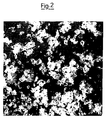
- Example 2 The test of Example 1 is repeated except for the use of a powder of the same copolyester resin cryogenically ground to a particle-size of about 250 micrometres ( Figure 2 ).
Landscapes
- Engineering & Computer Science (AREA)
- Mechanical Engineering (AREA)
- Moulding By Coating Moulds (AREA)
- Processes Of Treating Macromolecular Substances (AREA)
- Processing And Handling Of Plastics And Other Materials For Molding In General (AREA)
- Application Of Or Painting With Fluid Materials (AREA)
Abstract
Description
- The present invention relates to a process for the preparation of film coatings for the finishing of moulded articles.
- More specifically, the present invention relates to a process for the preparation of film coatings, for the finishing of moulded articles, for example made of thermoplastic and/or thermosetting material, based on elastomeric polyester resins.
- As it is now known from industrial practice, when articles with high-quality surface characteristics are to be produced, a basic structure is first moulded with the conventional forming techniques, such as injection moulding, and with traditional materials such as polypropylene, then the article undergoes surface finishing and refining by coating with synthetic skins or film coatings prepared separately and using, on the contrary, particular techniques and materials.
- For example, in the luxury car industry, the dashboards, or analogous parts made of synthetic material, are prepared by injection moulding a basic structure starting from not particularly sophisticated materials which above all must have suitable physico-mechanical properties for guaranteeing, among other characteristics, the dimensional stability with time of the moulded article. For these purposes both alloys and filled polymers are appropriate.
- The basic structure is subsequently coated with a synthetic foam, to improve the feel, and is finally refined with a coating or skin, which is glued onto the foam layer, for refining the surface.
- The skin is prepared with the slush moulding technique which essentially consists in three phases. In the first phase, a metallic mould, preferably nickel, having the negative shape of the article to be surface finished, is heated to a high temperature. In the second phase, a thin layer of powder of the refining thermoplastic material is distributed on the mould, applying a multi-rotating movement to the mould, immediately after the distribution of the powder and closing with a counter-mould. In the third phase, the mould is cooled and the skin is extracted.
- As it is evident, the critical phase of the slush moulding is the second phase. As it is distributed onto the mould at a high temperature, the powder melts and, as a result of the multi-rotating movement, it flows homogeneously and is distributed onto the whole surface of the mould, totally covering it. It is also evident that the fluidity of the refining powder material is a key characteristic for reaching all the critical points of the mould, including the undercuts, without producing holes or localized thickening which would reduce the value of the skin.
- At present, the main thermoplastic material with appropriate characteristics for allowing it to be used in slush moulding, is polyvinylchloride (PVC) as, in addition to having an excellent fluidity in the molten state which makes it compatible with this moulding technique, it also has surface softness suitable, for example, for dashboards or other internal parts of luxury cars.
- Unfortunately, for environmental and recycling reasons, PVC cannot be used as refining material due to the regulations issued by the major European countries which forbid its use. Document
EP-A-723 844 - The Applicant has now found an alternative material, consisting of an elastomeric polyester, which, in the form of micro-pellets, can be an excellent substitute of PVC in the preparation of thin films or skins for the coating of articles which must undergo surface refining.
- It is, therefore, an object of the present invention a process for the preparation of film coatings for the finishing of moulded articles which comprises:
- a. heating to a temperature higher than 200°C a metallic mould which negatively reproduces the shape of the article to be coated;
- b. distributing onto the metallic mould a micro-pellet of a (co)polyester thermoplastic resin having a spheroidal physical form and a granulometry, measured with an electronic microscope, of less than 500 micrometres;
- c. subjecting the mould, immediately after the distribution of the micro-pellet, to a multi-rotating movement according to the slush-moulding technique;
- d. cooling and extracting the polyester resin coating from the mould.
- According to the present invention, the metallic mould is heated to a temperature higher than 200°C, generally from 220 to 270°C, to obtain the immediate melting of the polyester resin powder. In order to have a favourable thermal exchange for the slush moulding technique, the mould consists of a plate made of a metallic material with a high thermal conductivity, such as, for example, nickel, copper or silver. Among these, nickel is preferred.
- As a result of the high thermal conductivity of the metal, the thermoplastic micro-pellet melts almost instantaneously, also causing the cooling of the mould and consequently the hardening of the skin. For this reason, the time between the distribution of the micro-pellet on the mould, the relative closing with the counter-mould, and the start of the multi-rotating movement must be as reduced as possible in order to leave the thermoplastic material in the molten state for a sufficient time for it to be homogeneously distributed on the metallic surface of the plate. Details on the slush moulding technology can be found in
European patent 476,742 WO 94/12331 96/33060 - At the end of the slush moulding, the mould is further cooled and the skin, which has a homogeneous thickness ranging from 0.5 to 2.5 mm, is extracted.
- According to the present invention, the micro-pellet used in the preparation of the film coating has a particle-size preferably ranging from 150 to 300 micrometres and is obtained by the extrusion and cutting, through a cooled die, of the (co)polyester in granular form optionally already mixed with conventional additives such as dyes, pigments, stabilizers, plasticizers, etc., or of the (co)polyester in powder form coming directly from the synthesis, to which the optional additives are added during the micro-pelletization phase.
- Any (co)polyester resin can be used in the preferred preparation of the film coatings object of the present invention, provided it has a melting point lower than 260-270°C and an average molecular weight Mw ranging from 20,000 to 100,000. In particular, preferred (co)polyester resins are those obtained by polycondensation between units deriving from at least one dicarboxylic acid and a mixture comprising at least one diol with a low molecular weight, for example lower than 250, and/or at least one poly(alkyleneoxide)glycol, in which the alkyleneoxide group contains from 1 to 10 carbon atoms, with an average molecular weight ranging from 250 to 6000 and a carbon/oxygen ratio ranging from 1.8 to 4.3. The resin which is obtained therefore consists essentially of several recurrent long-chain and short-chain interlinear ester units connected with each other by ester bonds.
- Particularly preferred are elastomeric (co)polyester resins obtained from the polycondensation of units deriving from at least one aromatic dicarboxylic acid selected from phthalic, isophthalic and terephthalic acids, or from di-benzoic acid, 1,5-naphthalenedicarboxylic acid, 2,6-naphthalenedicarboyxlic acid, 2,7-naphthalenedicarboyxlic acid, phenanthralenedicarboxylic acid, etc. and their C1-C4 alkyl derivatives with C2-C10 alkyl diols selected from ethylene-, propylene-, tetramethylene-, isobutylene-, pentamethylene-glycols in mixture with the poly(alkyleneoxide)-glycol selected from poly(1,2 and 1,3-propylene-oxide)glycol, poly(tetramethyleneoxide)glycol, poly(penta-methyleneoxide) glycol, etc.
- Particularly preferred according to the present invention are elastomeric copolyester resins obtained from the condensation of terephthalic acid with a mixture of tetramethylene glycol and poly(tetramethyleneoxide)glycol, with an average molecular weight Mw ranging from 500 to 6000, preferably from 1000 to 4000, wherein the unit deriving from poly(tetramethylene)glycol is present in quantities greater than or equal to 60% by weight.
- In addition to the segmented (co)polyesters, according to the present invention, all blends comprising the same (co)polyesters with other compatible or compatizable thermoplastic (co)polymers having an elastomeric behaviour or with a shore hardness D < 40 can be included, said other (co)polymers being present in a quantity of less than 30% by weight.
- Generally, either the (co)polyesters described above or the relative blends with other thermoplastic resins are generally materials having the following characteristics:
Shore Hardness D < 40; MVR 220°C/2.16 kg > 10cc/10'; Melting point = 150-210°C. - Products with the physico-chemical characteristics described above are commercially available under the tradename of PIBIFLEX of the Applicant.
- Some illustrative but non-limiting examples are provided for a better understanding of the present invention and for its embodiment.
- A film coating is produced with the slush moulding technique, having a thickness of 0.8 mm to be glued onto a car dashboard structure having a thickness of 2 mm made of polymer alloy or filled polymer, where an expanded resin (PU) having a thickness of 6-10 mm, is sandwich inserted between the skin and the structure.
- A micro-pellet, having an average spheroidal particle-size of 250-400 micrometres (
Figure 1 ), of an elastomeric copolyester resin having the following characteristics, is distributed on a nickel slush-moulding mould brought to a temperature of about 250°C:Melting point = 175°C; MVR 220°C/2.16 kg = 40 cc/10'; Shore Hardness D = 25. - At the end of the moulding, a coating is obtained, with a homogeneous thickness of 0.8 mm, which does not have any surface defects visible to the naked eye, and which adheres perfectly through the expanded resin to the dashboard structure.
- The test of Example 1 is repeated except for the use of a powder of the same copolyester resin cryogenically ground to a particle-size of about 250 micrometres (
Figure 2 ). - At the end of the moulding, a coating is obtained, which, although it adheres to the dashboard structure, has evident surface defects, for example holes and streaks, and a heterogeneous thickness.
Claims (12)
- A process for the preparation of film coatings for the finishing of moulded articles which comprises:a. heating to a temperature higher than 200°C a metallic mould which negatively reproduces the shape of the article to be coated;b. distributing onto the metallic mould a micro-pellet of a (co)polyester thermoplastic resin having a spheroidal physical form and granulometry, measured with an electronic microscope, of less than 500 micrometres;c. subjecting the mould, immediately after the distribution of the micro-pellet, to a multi-rotating movement according to the slush-moulding technique;d. cooling and extracting the polyester resin coating from the mould.
- The process according to claim 1, wherein the metallic mould is heated to a temperature ranging from 220 to 270°C.
- The process according to claim 1, wherein the mould is made of nickel.
- The process according to any of the previous claims, wherein the coating has a homogeneous thickness ranging from 0.5 to 2.5 mm.
- The process according to any of the previous claims, wherein the micro-pellet has a particle-size ranging from 150 to 300 micrometres.
- The process according to claim 5, wherein the micro-pellet is obtained by extrusion and cutting through a cooled die.
- The process according to any of the previous claims, wherein the (co)polyester resins have a melting point lower than 260-270°C and an average molecular weight Mw ranging from 20,000 to 100,000.
- The process according to claim 7, wherein the (co)polyester resins are obtained by polycondensation between units deriving from at least one dicarboxylic acid and a mixture comprising at least one diol with a low molecular weight and/or at least one poly(alkyleneoxide)glycol, in which the alkyleneoxide group contains from 1 to 10 carbon atoms, with an average molecular weight ranging from 250 to 6000 and a carbon/oxygen ratio ranging from 1.8 to 4.3.
- The process according to claim 8, wherein the (co)polyester resins are elastomeric obtained from the polycondensation of units deriving from at least one aromatic dicarboxylic acid with C2-C10 alkyl diols mixed with a poly(alkyeneoxide)glycol, in which the alkyleneoxide group contains from 1 to 10 carbon atoms.
- The process according to claim 9, wherein the elastomeric copolyester resins are obtained from the condensation of terephthalic acid with a mixture of tetramethylene glycol and poly(tetramethyleneoxide)-glycol, with an average molecular weight Mw ranging from 500 to 6000, preferably from 1000 to 4000, wherein the unit deriving from poly(tetramethylene)glycol is present in quantities greater than or equal to 60% by weight.
- The process according to any of the previous claims, wherein the (co)polyester resins have the following characteristics:
Shore Hardness D < 40; MVR 220°C/2.16 kg > 10cc/10' Melting point = 150-210°C. - The process according to any of the previous claims, wherein the elastomeric copolyester resins are mixed with other compatible or compatizable thermoplastic (co)polymers having an elastomeric behaviour or with a shore hardness D < 40, said other (co)polymers being present in a quantity lower than 30% by weight.
Applications Claiming Priority (3)
| Application Number | Priority Date | Filing Date | Title |
|---|---|---|---|
| ITMI20021010 | 2002-05-13 | ||
| IT2002MI001010A ITMI20021010A1 (en) | 2002-05-13 | 2002-05-13 | PROCEDURE FOR THE PREPARATION OF FILM COATINGS FOR THE FINISHING OF PRINTED ITEMS |
| PCT/EP2003/002697 WO2003095174A1 (en) | 2002-05-13 | 2003-03-12 | Process for the preparation of film coatings for the finishing of moulded articles |
Publications (2)
| Publication Number | Publication Date |
|---|---|
| EP1511611A1 EP1511611A1 (en) | 2005-03-09 |
| EP1511611B1 true EP1511611B1 (en) | 2008-05-14 |
Family
ID=11449882
Family Applications (1)
| Application Number | Title | Priority Date | Filing Date |
|---|---|---|---|
| EP03712021A Expired - Lifetime EP1511611B1 (en) | 2002-05-13 | 2003-03-12 | Process for the preparation of film coatings for the finishing of moulded articles |
Country Status (6)
| Country | Link |
|---|---|
| EP (1) | EP1511611B1 (en) |
| AT (1) | ATE395175T1 (en) |
| AU (1) | AU2003218766A1 (en) |
| DE (1) | DE60320986D1 (en) |
| IT (1) | ITMI20021010A1 (en) |
| WO (1) | WO2003095174A1 (en) |
Families Citing this family (3)
| Publication number | Priority date | Publication date | Assignee | Title |
|---|---|---|---|---|
| GB2417462A (en) * | 2004-08-31 | 2006-03-01 | Eastman Chem Co | Moulding of thermoplastic polyesters |
| KR101405525B1 (en) * | 2013-11-29 | 2014-06-27 | 화인케미칼 주식회사 | Powder slush molding composition |
| US11427675B2 (en) * | 2019-11-21 | 2022-08-30 | Eastman Chemical Company | Copolyesters for use in low shear melt applications |
Family Cites Families (4)
| Publication number | Priority date | Publication date | Assignee | Title |
|---|---|---|---|---|
| CA1006644A (en) * | 1972-04-11 | 1977-03-08 | Zedron | Rotational molding of tires |
| EP0539802A1 (en) * | 1991-10-28 | 1993-05-05 | Bayer Ag | Free-flowing, optionally expandable, thermoplastic processable and therewith post-crosslinkable polyurethane powder |
| JPH06226763A (en) * | 1993-02-08 | 1994-08-16 | Du Pont Mitsui Polychem Co Ltd | Production of slush molding |
| TW438657B (en) * | 1995-01-27 | 2001-06-07 | Mitsuboshi Belting Ltd | Resin molding and production method for same |
-
2002
- 2002-05-13 IT IT2002MI001010A patent/ITMI20021010A1/en unknown
-
2003
- 2003-03-12 DE DE60320986T patent/DE60320986D1/en not_active Expired - Fee Related
- 2003-03-12 AU AU2003218766A patent/AU2003218766A1/en not_active Abandoned
- 2003-03-12 EP EP03712021A patent/EP1511611B1/en not_active Expired - Lifetime
- 2003-03-12 WO PCT/EP2003/002697 patent/WO2003095174A1/en not_active Ceased
- 2003-03-12 AT AT03712021T patent/ATE395175T1/en not_active IP Right Cessation
Also Published As
| Publication number | Publication date |
|---|---|
| ATE395175T1 (en) | 2008-05-15 |
| WO2003095174A1 (en) | 2003-11-20 |
| EP1511611A1 (en) | 2005-03-09 |
| DE60320986D1 (en) | 2008-06-26 |
| ITMI20021010A1 (en) | 2003-11-13 |
| ITMI20021010A0 (en) | 2002-05-13 |
| AU2003218766A1 (en) | 2003-11-11 |
Similar Documents
| Publication | Publication Date | Title |
|---|---|---|
| MXPA97007363A (en) | Composite plastic material for laser select sinterization | |
| US3420729A (en) | Molded hollow plastic articles of manufacture rigidified with rigid resinous compositions and process for their manufacture | |
| CN108672695A (en) | A kind of metal powder injection molding feeding and preparation method thereof | |
| US5277864A (en) | Toughened thermoplastic polyester compositions | |
| GB2417462A (en) | Moulding of thermoplastic polyesters | |
| CN1020109C (en) | Thermoformed, non-oriented, heat-cured thin-walled article and method of making same | |
| JPH11286604A5 (en) | Sinterable thermoplastic aliphatic polyurethane molding compositions having reduced mechanical strength - Patents.com | |
| EP1545857A1 (en) | Process for making a plastic moulded article with a metallized surface | |
| CN111171541A (en) | Modified PC/ABS composition for 3D printing and preparation method thereof | |
| US20070228595A1 (en) | Instrument panel comprising a layer of a thermoplastic copolyester elastomer composition | |
| WO2002078927A1 (en) | Process for making a plastic moulded article with a decorated surface | |
| WO2003095174A1 (en) | Process for the preparation of film coatings for the finishing of moulded articles | |
| KR100960622B1 (en) | Styrene-based thermoplastic resin composition excellent in impact resistance and paintability | |
| CN111087780B (en) | Modified polycarbonate/aliphatic aromatic copolyester composition, preparation method and application | |
| JP2004155797A (en) | Metallized polyester composition | |
| JP2003533371A (en) | Thermoplastic non-slip member and method of manufacturing the same | |
| JP4090848B2 (en) | Method for providing metallic-tone crystalline resin molded product | |
| JP4265768B2 (en) | Polyester film for coating metal plate, method for producing the same, and method for producing polyester film-coated metal plate | |
| JP3396254B2 (en) | Mold and its manufacturing method | |
| JP3875582B2 (en) | Thermoplastic resin composition and polyester sheet | |
| KR102912928B1 (en) | Thermoplastic resin composition and molded product therefrom | |
| JPH06143278A (en) | Forming method for recovered resin | |
| CN117866335B (en) | High-resistant Wen Xiaoguang master batch and preparation method and application thereof | |
| JPH08290428A (en) | Molding method using glass fiber-blended thermoplastic resin recovery material | |
| CN116904010A (en) | A spray-free flow pattern polycarbonate plastic material and its preparation method |
Legal Events
| Date | Code | Title | Description |
|---|---|---|---|
| PUAI | Public reference made under article 153(3) epc to a published international application that has entered the european phase |
Free format text: ORIGINAL CODE: 0009012 |
|
| 17P | Request for examination filed |
Effective date: 20041022 |
|
| AK | Designated contracting states |
Kind code of ref document: A1 Designated state(s): AT BE BG CH CY CZ DE DK EE ES FI FR GB GR HU IE IT LI LU MC NL PT RO SE SI SK TR |
|
| AX | Request for extension of the european patent |
Extension state: AL LT LV MK |
|
| DAX | Request for extension of the european patent (deleted) | ||
| GRAP | Despatch of communication of intention to grant a patent |
Free format text: ORIGINAL CODE: EPIDOSNIGR1 |
|
| GRAS | Grant fee paid |
Free format text: ORIGINAL CODE: EPIDOSNIGR3 |
|
| GRAA | (expected) grant |
Free format text: ORIGINAL CODE: 0009210 |
|
| AK | Designated contracting states |
Kind code of ref document: B1 Designated state(s): AT BE BG CH CY CZ DE DK EE ES FI FR GB GR HU IE IT LI LU MC NL PT RO SE SI SK TR |
|
| REG | Reference to a national code |
Ref country code: GB Ref legal event code: FG4D |
|
| REG | Reference to a national code |
Ref country code: CH Ref legal event code: EP |
|
| REG | Reference to a national code |
Ref country code: IE Ref legal event code: FG4D Free format text: LANGUAGE OF EP DOCUMENT: FRENCH |
|
| REF | Corresponds to: |
Ref document number: 60320986 Country of ref document: DE Date of ref document: 20080626 Kind code of ref document: P |
|
| PG25 | Lapsed in a contracting state [announced via postgrant information from national office to epo] |
Ref country code: SI Free format text: LAPSE BECAUSE OF FAILURE TO SUBMIT A TRANSLATION OF THE DESCRIPTION OR TO PAY THE FEE WITHIN THE PRESCRIBED TIME-LIMIT Effective date: 20080514 |
|
| PG25 | Lapsed in a contracting state [announced via postgrant information from national office to epo] |
Ref country code: FI Free format text: LAPSE BECAUSE OF FAILURE TO SUBMIT A TRANSLATION OF THE DESCRIPTION OR TO PAY THE FEE WITHIN THE PRESCRIBED TIME-LIMIT Effective date: 20080514 Ref country code: ES Free format text: LAPSE BECAUSE OF FAILURE TO SUBMIT A TRANSLATION OF THE DESCRIPTION OR TO PAY THE FEE WITHIN THE PRESCRIBED TIME-LIMIT Effective date: 20080825 |
|
| NLV1 | Nl: lapsed or annulled due to failure to fulfill the requirements of art. 29p and 29m of the patents act | ||
| PG25 | Lapsed in a contracting state [announced via postgrant information from national office to epo] |
Ref country code: AT Free format text: LAPSE BECAUSE OF FAILURE TO SUBMIT A TRANSLATION OF THE DESCRIPTION OR TO PAY THE FEE WITHIN THE PRESCRIBED TIME-LIMIT Effective date: 20080514 Ref country code: NL Free format text: LAPSE BECAUSE OF FAILURE TO SUBMIT A TRANSLATION OF THE DESCRIPTION OR TO PAY THE FEE WITHIN THE PRESCRIBED TIME-LIMIT Effective date: 20080514 |
|
| PG25 | Lapsed in a contracting state [announced via postgrant information from national office to epo] |
Ref country code: PT Free format text: LAPSE BECAUSE OF FAILURE TO SUBMIT A TRANSLATION OF THE DESCRIPTION OR TO PAY THE FEE WITHIN THE PRESCRIBED TIME-LIMIT Effective date: 20081014 Ref country code: DK Free format text: LAPSE BECAUSE OF FAILURE TO SUBMIT A TRANSLATION OF THE DESCRIPTION OR TO PAY THE FEE WITHIN THE PRESCRIBED TIME-LIMIT Effective date: 20080514 Ref country code: CZ Free format text: LAPSE BECAUSE OF FAILURE TO SUBMIT A TRANSLATION OF THE DESCRIPTION OR TO PAY THE FEE WITHIN THE PRESCRIBED TIME-LIMIT Effective date: 20080514 Ref country code: SE Free format text: LAPSE BECAUSE OF FAILURE TO SUBMIT A TRANSLATION OF THE DESCRIPTION OR TO PAY THE FEE WITHIN THE PRESCRIBED TIME-LIMIT Effective date: 20080814 |
|
| PG25 | Lapsed in a contracting state [announced via postgrant information from national office to epo] |
Ref country code: SK Free format text: LAPSE BECAUSE OF FAILURE TO SUBMIT A TRANSLATION OF THE DESCRIPTION OR TO PAY THE FEE WITHIN THE PRESCRIBED TIME-LIMIT Effective date: 20080514 Ref country code: BE Free format text: LAPSE BECAUSE OF FAILURE TO SUBMIT A TRANSLATION OF THE DESCRIPTION OR TO PAY THE FEE WITHIN THE PRESCRIBED TIME-LIMIT Effective date: 20080514 Ref country code: RO Free format text: LAPSE BECAUSE OF FAILURE TO SUBMIT A TRANSLATION OF THE DESCRIPTION OR TO PAY THE FEE WITHIN THE PRESCRIBED TIME-LIMIT Effective date: 20080514 |
|
| PLBE | No opposition filed within time limit |
Free format text: ORIGINAL CODE: 0009261 |
|
| STAA | Information on the status of an ep patent application or granted ep patent |
Free format text: STATUS: NO OPPOSITION FILED WITHIN TIME LIMIT |
|
| 26N | No opposition filed |
Effective date: 20090217 |
|
| PG25 | Lapsed in a contracting state [announced via postgrant information from national office to epo] |
Ref country code: EE Free format text: LAPSE BECAUSE OF FAILURE TO SUBMIT A TRANSLATION OF THE DESCRIPTION OR TO PAY THE FEE WITHIN THE PRESCRIBED TIME-LIMIT Effective date: 20080514 Ref country code: BG Free format text: LAPSE BECAUSE OF FAILURE TO SUBMIT A TRANSLATION OF THE DESCRIPTION OR TO PAY THE FEE WITHIN THE PRESCRIBED TIME-LIMIT Effective date: 20080814 |
|
| PG25 | Lapsed in a contracting state [announced via postgrant information from national office to epo] |
Ref country code: IT Free format text: LAPSE BECAUSE OF FAILURE TO SUBMIT A TRANSLATION OF THE DESCRIPTION OR TO PAY THE FEE WITHIN THE PRESCRIBED TIME-LIMIT Effective date: 20080514 |
|
| PG25 | Lapsed in a contracting state [announced via postgrant information from national office to epo] |
Ref country code: MC Free format text: LAPSE BECAUSE OF NON-PAYMENT OF DUE FEES Effective date: 20090331 |
|
| REG | Reference to a national code |
Ref country code: CH Ref legal event code: PL |
|
| GBPC | Gb: european patent ceased through non-payment of renewal fee |
Effective date: 20090312 |
|
| REG | Reference to a national code |
Ref country code: FR Ref legal event code: ST Effective date: 20091130 |
|
| PG25 | Lapsed in a contracting state [announced via postgrant information from national office to epo] |
Ref country code: LI Free format text: LAPSE BECAUSE OF NON-PAYMENT OF DUE FEES Effective date: 20090331 Ref country code: IE Free format text: LAPSE BECAUSE OF NON-PAYMENT OF DUE FEES Effective date: 20090312 Ref country code: CH Free format text: LAPSE BECAUSE OF NON-PAYMENT OF DUE FEES Effective date: 20090331 Ref country code: DE Free format text: LAPSE BECAUSE OF NON-PAYMENT OF DUE FEES Effective date: 20091001 |
|
| PG25 | Lapsed in a contracting state [announced via postgrant information from national office to epo] |
Ref country code: GB Free format text: LAPSE BECAUSE OF NON-PAYMENT OF DUE FEES Effective date: 20090312 Ref country code: FR Free format text: LAPSE BECAUSE OF NON-PAYMENT OF DUE FEES Effective date: 20091123 |
|
| PG25 | Lapsed in a contracting state [announced via postgrant information from national office to epo] |
Ref country code: GR Free format text: LAPSE BECAUSE OF FAILURE TO SUBMIT A TRANSLATION OF THE DESCRIPTION OR TO PAY THE FEE WITHIN THE PRESCRIBED TIME-LIMIT Effective date: 20080815 |
|
| PG25 | Lapsed in a contracting state [announced via postgrant information from national office to epo] |
Ref country code: LU Free format text: LAPSE BECAUSE OF NON-PAYMENT OF DUE FEES Effective date: 20090312 |
|
| PG25 | Lapsed in a contracting state [announced via postgrant information from national office to epo] |
Ref country code: HU Free format text: LAPSE BECAUSE OF FAILURE TO SUBMIT A TRANSLATION OF THE DESCRIPTION OR TO PAY THE FEE WITHIN THE PRESCRIBED TIME-LIMIT Effective date: 20081115 |
|
| PG25 | Lapsed in a contracting state [announced via postgrant information from national office to epo] |
Ref country code: TR Free format text: LAPSE BECAUSE OF FAILURE TO SUBMIT A TRANSLATION OF THE DESCRIPTION OR TO PAY THE FEE WITHIN THE PRESCRIBED TIME-LIMIT Effective date: 20080514 |
|
| PG25 | Lapsed in a contracting state [announced via postgrant information from national office to epo] |
Ref country code: CY Free format text: LAPSE BECAUSE OF FAILURE TO SUBMIT A TRANSLATION OF THE DESCRIPTION OR TO PAY THE FEE WITHIN THE PRESCRIBED TIME-LIMIT Effective date: 20080514 |