EP1511273A1 - Packet receiving method for use in a mobile terminal - Google Patents
Packet receiving method for use in a mobile terminal Download PDFInfo
- Publication number
- EP1511273A1 EP1511273A1 EP20040020538 EP04020538A EP1511273A1 EP 1511273 A1 EP1511273 A1 EP 1511273A1 EP 20040020538 EP20040020538 EP 20040020538 EP 04020538 A EP04020538 A EP 04020538A EP 1511273 A1 EP1511273 A1 EP 1511273A1
- Authority
- EP
- European Patent Office
- Prior art keywords
- task
- packets
- priority
- signals
- queue
- Prior art date
- Legal status (The legal status is an assumption and is not a legal conclusion. Google has not performed a legal analysis and makes no representation as to the accuracy of the status listed.)
- Granted
Links
- 238000000034 method Methods 0.000 title claims abstract description 49
- 230000005540 biological transmission Effects 0.000 claims description 10
- 238000012544 monitoring process Methods 0.000 claims 6
- 238000004891 communication Methods 0.000 claims 1
- 230000003287 optical effect Effects 0.000 description 2
- 238000004590 computer program Methods 0.000 description 1
- 238000012986 modification Methods 0.000 description 1
- 230000004048 modification Effects 0.000 description 1
Images
Classifications
-
- H—ELECTRICITY
- H04—ELECTRIC COMMUNICATION TECHNIQUE
- H04W—WIRELESS COMMUNICATION NETWORKS
- H04W80/00—Wireless network protocols or protocol adaptations to wireless operation
-
- H—ELECTRICITY
- H04—ELECTRIC COMMUNICATION TECHNIQUE
- H04L—TRANSMISSION OF DIGITAL INFORMATION, e.g. TELEGRAPHIC COMMUNICATION
- H04L47/00—Traffic control in data switching networks
- H04L47/10—Flow control; Congestion control
- H04L47/30—Flow control; Congestion control in combination with information about buffer occupancy at either end or at transit nodes
-
- H—ELECTRICITY
- H04—ELECTRIC COMMUNICATION TECHNIQUE
- H04L—TRANSMISSION OF DIGITAL INFORMATION, e.g. TELEGRAPHIC COMMUNICATION
- H04L69/00—Network arrangements, protocols or services independent of the application payload and not provided for in the other groups of this subclass
- H04L69/16—Implementation or adaptation of Internet protocol [IP], of transmission control protocol [TCP] or of user datagram protocol [UDP]
- H04L69/163—In-band adaptation of TCP data exchange; In-band control procedures
-
- H—ELECTRICITY
- H04—ELECTRIC COMMUNICATION TECHNIQUE
- H04L—TRANSMISSION OF DIGITAL INFORMATION, e.g. TELEGRAPHIC COMMUNICATION
- H04L9/00—Cryptographic mechanisms or cryptographic arrangements for secret or secure communications; Network security protocols
- H04L9/40—Network security protocols
-
- H—ELECTRICITY
- H04—ELECTRIC COMMUNICATION TECHNIQUE
- H04W—WIRELESS COMMUNICATION NETWORKS
- H04W28/00—Network traffic management; Network resource management
- H04W28/02—Traffic management, e.g. flow control or congestion control
-
- H—ELECTRICITY
- H04—ELECTRIC COMMUNICATION TECHNIQUE
- H04W—WIRELESS COMMUNICATION NETWORKS
- H04W8/00—Network data management
- H04W8/02—Processing of mobility data, e.g. registration information at HLR [Home Location Register] or VLR [Visitor Location Register]; Transfer of mobility data, e.g. between HLR, VLR or external networks
- H04W8/04—Registration at HLR or HSS [Home Subscriber Server]
-
- H—ELECTRICITY
- H04—ELECTRIC COMMUNICATION TECHNIQUE
- H04W—WIRELESS COMMUNICATION NETWORKS
- H04W80/00—Wireless network protocols or protocol adaptations to wireless operation
- H04W80/06—Transport layer protocols, e.g. TCP [Transport Control Protocol] over wireless
-
- H—ELECTRICITY
- H04—ELECTRIC COMMUNICATION TECHNIQUE
- H04L—TRANSMISSION OF DIGITAL INFORMATION, e.g. TELEGRAPHIC COMMUNICATION
- H04L67/00—Network arrangements or protocols for supporting network services or applications
- H04L67/01—Protocols
- H04L67/10—Protocols in which an application is distributed across nodes in the network
- H04L67/1001—Protocols in which an application is distributed across nodes in the network for accessing one among a plurality of replicated servers
-
- H—ELECTRICITY
- H04—ELECTRIC COMMUNICATION TECHNIQUE
- H04L—TRANSMISSION OF DIGITAL INFORMATION, e.g. TELEGRAPHIC COMMUNICATION
- H04L67/00—Network arrangements or protocols for supporting network services or applications
- H04L67/01—Protocols
- H04L67/10—Protocols in which an application is distributed across nodes in the network
- H04L67/1001—Protocols in which an application is distributed across nodes in the network for accessing one among a plurality of replicated servers
- H04L67/10015—Access to distributed or replicated servers, e.g. using brokers
-
- H—ELECTRICITY
- H04—ELECTRIC COMMUNICATION TECHNIQUE
- H04L—TRANSMISSION OF DIGITAL INFORMATION, e.g. TELEGRAPHIC COMMUNICATION
- H04L67/00—Network arrangements or protocols for supporting network services or applications
- H04L67/01—Protocols
- H04L67/10—Protocols in which an application is distributed across nodes in the network
- H04L67/1001—Protocols in which an application is distributed across nodes in the network for accessing one among a plurality of replicated servers
- H04L67/1004—Server selection for load balancing
- H04L67/1012—Server selection for load balancing based on compliance of requirements or conditions with available server resources
-
- H—ELECTRICITY
- H04—ELECTRIC COMMUNICATION TECHNIQUE
- H04L—TRANSMISSION OF DIGITAL INFORMATION, e.g. TELEGRAPHIC COMMUNICATION
- H04L69/00—Network arrangements, protocols or services independent of the application payload and not provided for in the other groups of this subclass
- H04L69/16—Implementation or adaptation of Internet protocol [IP], of transmission control protocol [TCP] or of user datagram protocol [UDP]
Definitions
- the present invention relates to a mobile terminal, and more particularly to a packet receiving method of a mobile terminal that increases a reception performance of packet data from a wireless network to a mobile terminal.
- a transmission control protocol is a protocol applied in a wire network including a server and client.
- An operation system such as Windows or a Unix operating system based on a multi-task or a multi-thread method is generally implemented in the client and server and TCP is used to transfer files between the client and server.
- a mobile terminal used as a TCP client in a wireless network has a much lower operation system capability than a server or a client in a wire network.
- One example of an operation system of the mobile terminal is a REX system included in software provided by QUALCOMMTM.
- the REX system is a real-time operating system (RTOS) and is a very simple operating system compared to an operating system used in a wire network.
- RTOS real-time operating system
- the sliding window method is for transmitting several packets at one time and receiving a consecutive response that the transmitted packets are received from the receiving side. If the transmission side receives a response that the transmitted packets are not successfully received from the receiving side, the transmission side re-transmits the packets.
- the mobile terminal transmits a number of packets it can receive before an application is processed to an advertised window at the time of requesting a TCP setting, and waits to receive the packets.
- the application is performed whenever a new packet is received
- the flow control of the mobile terminal is performed using a stop and wait method, which has a lower function than the sliding window method.
- the stop and wait method is for receiving a response whenever one packet is transmitted, and has much lower link efficiency than the sliding window method. Further, the full application bandwidth is not effectively utilized with the stop and wait method.
- one object of the present invention is to at least address the above-noted and other problems.
- Another object of the present invention is to optimize a wireless internet downloading function by controlling a task priority so that a window size can be efficiently controlled at the time of a TCP connection of a mobile terminal.
- the present invention provides a novel packet receiving method of a mobile terminal, which includes setting a call between a mobile terminal and a base station, setting a session between the terminal and a packet data serving node (PDSN), and setting a transmission control protocol (TCP) connection between the mobile terminal and a server.
- the method also includes receiving packets by altering a task priority when the setting is completed, and processing the received packets by re-altering the task priority when the number of packets or signals is more than a certain level.
- the present invention controls a task priority for modules of an operating system of a mobile terminal for an optimized flow control during a transmission control protocol (TCP) connection between the mobile terminal and a server.
- the tasks includes, for example, a user interface (UI) task for displaying information, key-inputting, and performing a TCP application; a protocol stack (PS) task for handling a protocol such as an internet protocol (IP), a point-to-point protocol (PPP), etc.; and a reception/transmission (Rx/Tx) task for transmitting a protocol data unit (PDU) to a base station through a wireless network or receiving the PDU from the base station.
- UI user interface
- PS protocol stack
- IP internet protocol
- PPP point-to-point protocol
- Rx/Tx reception/transmission
- the packet receiving method includes setting a call between a mobile terminal and a base station, setting a session between the mobile terminal and a packet data serving node (PDSN), and setting a transmission control protocol (TCP) connection between the mobile terminal and a server (S1).
- the method also includes receiving packets by altering a task priority when the setting is completed (S2) and processing the received packets by re-altering the task priority when more than a certain amount of packets are received or a number of signals is more than a certain amount (S3).
- the task priority is initially set so that the priority of the UI task is higher than that of the PS task. Then, when the TCP connection between the terminal and the server is set, the task priority is altered so that the priority of the PS task is higher than that of the UI task, thereby receiving and storing packets. Then, when more than a certain amount of packets are received or the number of signals is more than a certain level, the task priority is again altered so that the priority of the UI task is higher than that of the PS task, thereby processing the received packets.
- the task priority is again altered so that the priority of the PS task is higher than that of the UI task, thereby re-starting the reception of packets.
- the amount of packets received correspond with a size of a TCP receiving queue (e.g., an advertised window at the time of the TCP setting).
- the received packets are stored in the TCP reception queue (S40).
- a control unit (not shown) of the mobile terminal monitors the packets received in the TCP reception queue, and determines whether or not the number of packets reaches an upper threshold value of a certain level (S50).
- the reception queue is a queue for receiving TCP packets and the received packets are stored in the reception queue. Further, packets are also read from the reception queue when an application reads data from the packets.
- the control unit also monitors the number of signals of a UI task signal queue, and determines whether the number of signals reaches a preset upper threshold value (S60).
- the signal queue is for storing a signal used for communicating between each task, and is also referred to as a mail box in some operating systems. For example, if packets are stored in the reception queue, the PS task transmits a signal to the UI task to inform the UI task about a state of the received packets. Then, the UI task certifies the signal received from the signal queue, and performs an operation such as reading packets from the reception queue.
- the priority of the PS task is altered to be lower than that of the UI task, thereby beginning the processing of the stored packets by the application (S70).
- the control unit of the mobile terminal While performing the step S70, the control unit of the mobile terminal continuously monitors packets received in the TCP reception queue, and determines whether or not the number of packets reaches a lower threshold value of a certain level (S80). The control unit of the mobile terminal also monitors the number of signals of the UI task signal queue, and determines whether the number of signals reaches a lower threshold value (S90).
- the TCP flow control is smoothly operated by a sliding window method in a wireless network.
- each task priority is controlled according to an amount of packets received in the terminal, a state and a degree that the received packets are processed, etc., thereby efficiently controlling a window size at the time of the TCP connection between the mobile terminal and the server and thus having an optimized wireless internet downloading function.
- This invention may be conveniently implemented using a conventional general purpose digital computer or microprocessor programmed according to the teachings of the present specification, as well be apparent to those skilled in the computer art.
- Appropriate software coding can readily be prepared by skilled programmers based on the teachings of the present disclosure, as will be apparent to those skilled in the software art.
- the invention may also be implemented by the preparation of application specific integrated circuits or by interconnecting an appropriate network of conventional component circuits, as will be readily apparent to those skilled in the art.
- the present invention includes a computer program product which is a storage medium including instructions which can be used to program a computer to perform a process of the invention.
- the storage medium can include, but is not limited to, any type of disk including floppy disks, optical discs, CD-ROMs, and magneto-optical disks, ROMs, RAMS, EPROMs, EEPROMs, magnetic or optical cards, or any type of media suitable for storing electronic instructions.
Landscapes
- Engineering & Computer Science (AREA)
- Computer Networks & Wireless Communication (AREA)
- Signal Processing (AREA)
- Computer Security & Cryptography (AREA)
- Databases & Information Systems (AREA)
- Mobile Radio Communication Systems (AREA)
- Data Exchanges In Wide-Area Networks (AREA)
- Communication Control (AREA)
Abstract
Description
- The present invention relates to a mobile terminal, and more particularly to a packet receiving method of a mobile terminal that increases a reception performance of packet data from a wireless network to a mobile terminal.
- A transmission control protocol (TCP) is a protocol applied in a wire network including a server and client. An operation system such as Windows or a Unix operating system based on a multi-task or a multi-thread method is generally implemented in the client and server and TCP is used to transfer files between the client and server.
- However, a mobile terminal used as a TCP client in a wireless network has a much lower operation system capability than a server or a client in a wire network. One example of an operation system of the mobile terminal is a REX system included in software provided by QUALCOMM™. The REX system is a real-time operating system (RTOS) and is a very simple operating system compared to an operating system used in a wire network.
- Therefore, it is difficult to sufficiently utilize a flow control based on a sliding window method operated by the TCP in the mobile terminal. In more detail, the sliding window method is for transmitting several packets at one time and receiving a consecutive response that the transmitted packets are received from the receiving side. If the transmission side receives a response that the transmitted packets are not successfully received from the receiving side, the transmission side re-transmits the packets.
- Further, the mobile terminal transmits a number of packets it can receive before an application is processed to an advertised window at the time of requesting a TCP setting, and waits to receive the packets. However, because the application is performed whenever a new packet is received, the flow control of the mobile terminal is performed using a stop and wait method, which has a lower function than the sliding window method. The stop and wait method is for receiving a response whenever one packet is transmitted, and has much lower link efficiency than the sliding window method. Further, the full application bandwidth is not effectively utilized with the stop and wait method.
- Accordingly, one object of the present invention is to at least address the above-noted and other problems.
- Another object of the present invention is to optimize a wireless internet downloading function by controlling a task priority so that a window size can be efficiently controlled at the time of a TCP connection of a mobile terminal.
- To achieve these and other advantages and in accordance with the purpose of the present invention, as embodied and broadly described herein, the present invention provides a novel packet receiving method of a mobile terminal, which includes setting a call between a mobile terminal and a base station, setting a session between the terminal and a packet data serving node (PDSN), and setting a transmission control protocol (TCP) connection between the mobile terminal and a server. The method also includes receiving packets by altering a task priority when the setting is completed, and processing the received packets by re-altering the task priority when the number of packets or signals is more than a certain level.
- Additional advantages, objects, and features of the invention will be set forth in part in the description which follows and in part will become apparent to those having ordinary skill in the art upon examination of the following or may be learned from practice of the invention. The objects and advantages of the invention may be realized and attained as particularly pointed out in the appended claims.
- The invention will be described in detail with reference to the following drawings in which like reference numerals refer to like elements wherein:
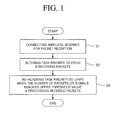
- FIG. 1 is a flowchart showing a packet receiving method of a mobile terminal according to the present invention; and
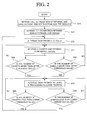
- FIG. 2 is a flowchart showing a detailed process of the packet receiving method of a mobile terminal according to the present invention.
-
- Reference will now be made in detail to the preferred embodiments of the present invention, examples of which are illustrated in the accompanying drawings.
- The present invention controls a task priority for modules of an operating system of a mobile terminal for an optimized flow control during a transmission control protocol (TCP) connection between the mobile terminal and a server. The tasks includes, for example, a user interface (UI) task for displaying information, key-inputting, and performing a TCP application; a protocol stack (PS) task for handling a protocol such as an internet protocol (IP), a point-to-point protocol (PPP), etc.; and a reception/transmission (Rx/Tx) task for transmitting a protocol data unit (PDU) to a base station through a wireless network or receiving the PDU from the base station.
- Turning now to FIG. 1, which is a flowchart showing a packet receiving method of a mobile terminal according to the present invention. As shown, the packet receiving method includes setting a call between a mobile terminal and a base station, setting a session between the mobile terminal and a packet data serving node (PDSN), and setting a transmission control protocol (TCP) connection between the mobile terminal and a server (S1). The method also includes receiving packets by altering a task priority when the setting is completed (S2) and processing the received packets by re-altering the task priority when more than a certain amount of packets are received or a number of signals is more than a certain amount (S3).
- Preferably, the task priority is initially set so that the priority of the UI task is higher than that of the PS task. Then, when the TCP connection between the terminal and the server is set, the task priority is altered so that the priority of the PS task is higher than that of the UI task, thereby receiving and storing packets. Then, when more than a certain amount of packets are received or the number of signals is more than a certain level, the task priority is again altered so that the priority of the UI task is higher than that of the PS task, thereby processing the received packets.
- In addition, when the number of the received packets and signals is less than a certain level, preferably the task priority is again altered so that the priority of the PS task is higher than that of the UI task, thereby re-starting the reception of packets.
- Next, FIG. 2 is a flowchart showing a detailed process for the packet receiving method of a mobile terminal according to the present invention. As shown, a call is set between the mobile terminal and a base station to receive packets, thereby setting a PDSN and a point-to-point protocol (PPP) session (S10). As noted above, the priority of the PS task is initially set to be lower than that of the UI task.
- Then, the mobile terminal sets a TCP connection with a server having the requested data to be received (S20). If the setting is completed, the priority is altered so the priority of the PS task is higher than that of the UI task (S30). Thus, the data packets are received and stored.
- Further, the amount of packets received correspond with a size of a TCP receiving queue (e.g., an advertised window at the time of the TCP setting). The received packets are stored in the TCP reception queue (S40).
- In addition, a control unit (not shown) of the mobile terminal monitors the packets received in the TCP reception queue, and determines whether or not the number of packets reaches an upper threshold value of a certain level (S50). As discussed above, the reception queue is a queue for receiving TCP packets and the received packets are stored in the reception queue. Further, packets are also read from the reception queue when an application reads data from the packets.
- The control unit also monitors the number of signals of a UI task signal queue, and determines whether the number of signals reaches a preset upper threshold value (S60). Note that the signal queue is for storing a signal used for communicating between each task, and is also referred to as a mail box in some operating systems. For example, if packets are stored in the reception queue, the PS task transmits a signal to the UI task to inform the UI task about a state of the received packets. Then, the UI task certifies the signal received from the signal queue, and performs an operation such as reading packets from the reception queue.
- Then, when the number of packets stored in the reception queue reaches an upper threshold value or when the number of signals of the UI task signal queue reaches an upper threshold value (Yes in S60 and S70), the priority of the PS task is altered to be lower than that of the UI task, thereby beginning the processing of the stored packets by the application (S70).
- While performing the step S70, the control unit of the mobile terminal continuously monitors packets received in the TCP reception queue, and determines whether or not the number of packets reaches a lower threshold value of a certain level (S80). The control unit of the mobile terminal also monitors the number of signals of the UI task signal queue, and determines whether the number of signals reaches a lower threshold value (S90).
- When the number of packets reaches a lower threshold value or the number of signals of the UI task signal queue reaches a preset threshold value, the task priority is again altered so that the PS task priority is higher than the UI task priority, thereby restarting reception of packets. Thus, the TCP flow control is smoothly operated by a sliding window method in a wireless network.
- As aforementioned, in the packet receiving method of a mobile terminal according to the present invention, each task priority is controlled according to an amount of packets received in the terminal, a state and a degree that the received packets are processed, etc., thereby efficiently controlling a window size at the time of the TCP connection between the mobile terminal and the server and thus having an optimized wireless internet downloading function.
- This invention may be conveniently implemented using a conventional general purpose digital computer or microprocessor programmed according to the teachings of the present specification, as well be apparent to those skilled in the computer art. Appropriate software coding can readily be prepared by skilled programmers based on the teachings of the present disclosure, as will be apparent to those skilled in the software art.
- The invention may also be implemented by the preparation of application specific integrated circuits or by interconnecting an appropriate network of conventional component circuits, as will be readily apparent to those skilled in the art. The present invention includes a computer program product which is a storage medium including instructions which can be used to program a computer to perform a process of the invention. The storage medium can include, but is not limited to, any type of disk including floppy disks, optical discs, CD-ROMs, and magneto-optical disks, ROMs, RAMS, EPROMs, EEPROMs, magnetic or optical cards, or any type of media suitable for storing electronic instructions.
- The foregoing embodiments and advantages are merely exemplary and are not to be construed as limiting the present invention. The present teaching can be readily applied to other types of apparatuses. The description of the present invention is intended to be illustrative, and not to limit the scope of the claims. Many alternatives, modifications, and variations will be apparent to those skilled in the art.
Claims (23)
- A packet receiving method of a mobile terminal, comprising:setting a call between a mobile terminal and a base station, setting a session between the mobile terminal and a packet data serving node (PDSN), and setting a transmission control protocol (TCP) connection between the terminal and a server;receiving packets by altering a task priority when the TCP connection setting is completed; andprocessing the received packets by re-altering the task priority when a number of packets or a number of signals is more than a certain level.
- The method of claim 1, wherein an amount of packets that can be received corresponds to a size of a reception queue at the time of the TCP connection setting, and the received packets and are stored in the TCP reception queue.
- The method of claim 2, wherein the reception queue is a queue for storing TCP reception packets, and the packets are read from the reception queue when an application reads data from the packets.
- The method of claim 1, wherein the number of signals is the number of signals of a UI (User Interface) task signal queue.
- The method of claim 4, wherein the UI task signal queue is a queue for storing a signal used for communication between each task, and the UI task signal queue outputs a signal for making a UI task read packets from the reception queue.
- The method of claim 1, further comprising:determining whether or not the number of packets or signals reaches an upper threshold value by monitoring the number of packets received in the TCP reception queue or the signals of the UI task signal queue.
- The method of claim 1, wherein a task corresponding to the task priority includes a user interface (UI) task, a protocol stack (PS) task, or a reception/transmission (Rx/Tx) task, and wherein the task priority is initially set so the UI task priority is higher than the PS task priority.
- The method of claim 7, wherein when receiving packets, the PS task priority is altered to be higher than the UI task priority
- The method of claim 7, wherein when processing the received packets, the PS task priority is re-altered to be lower than the UI task priority.
- The method of claim 7 further comprising:re-starting reception of packets by altering the PS task priority to be higher than the UI task priority when the number of packets or signals is less than a certain level.
- The method of claim 6, further comprising:determining whether or not the number of packets or signals reaches a lower threshold value by monitoring the number of packets received in the TCP reception queue or the signals of the UI task signal queue.
- A packet receiving method of a mobile terminal comprising:setting a call between a mobile terminal and a base station, setting a point-to-point protocol (PPP) session between the mobile terminal and a packet data serving node (PDSN), and setting a transmission control protocol (TCP) connection between the mobile terminal and a server;setting a priority of a protocol stack (PS) task to be higher than that of a user interface (UI) task when setting the TCP connection is completed;storing packets in a TCP reception queue;determining whether or not a number of stored packets or signals reaches an upper threshold value of a certain level; andprocessing the stored packets by an application by altering a priority of the PS task to be lower than that of the UI task when the number of packets or signals reaches the upper threshold value.
- The method of claim 12, wherein the priority of the UI task is initially set to be higher than that of the PS task.
- The method of claim 12, wherein determining whether or not the number of packets or signals reaches the upper threshold value comprises monitoring the number of packets received in the TCP reception queue or signals in a UI task signal queue.
- The method of claim 12, further comprising:determining whether or not the number of packets and signals reaches a lower threshold value of a certain level.
- The method of claim 15, wherein determining whether or not number of packets and signals reaches the lower threshold value comprises monitoring the number of packets received in the TCP reception queue or signals in a UI task signal queue.
- The method of claim 15, further comprising:re-starting reception of packets by altering the priority of the PS task to be higher than that of the UI task when the number of the packets or the signals reaches the lower threshold value.
- A mobile terminal packet receiving method, comprising:alternating between a User Interface (UI) task that handles user interface functions and a Protocol Stack (PS) task that processes data packets when using an Internet protocol to download the data packets onto the mobile terminal such that the PS task is set to have a higher priority when an Internet connection has been established with a data server including the data packets to be downloaded and the UI task is set to have a higher priority when a number of the downloaded data packets exceeds a first predetermined upper threshold.
- The method of claim 18, further comprising:re-setting the PS task to have the higher priority when the number of downloaded data packets is less than a first predetermined lower threshold.
- The method of claim 19, further comprising:setting the UI task to have the higher priority when a number of UI signals exceeds a second predetermined upper threshold.
- The method of claim 20, further comprising:re-setting the PS task to have the higher priority when the number of UI signals is less than a second predetermined lower threshold.
- The method of claim 20, further comprising:monitoring a reception queue that receives the downloaded data packets to determine whether or not the number of downloaded data packets exceeds the first predetermined upper threshold or is less than the first predetermined lower threshold; andmonitoring a UI signal queue that receives the UI signals to determine whether or not the number of UI signals exceeds the second predetermined upper threshold or is less than the second predetermined lower threshold.
- The method of claim 18, further comprising:initially setting a priority of the UI task to have a higher priority than the PS task.
Applications Claiming Priority (2)
| Application Number | Priority Date | Filing Date | Title |
|---|---|---|---|
| KR2003060593 | 2003-08-30 | ||
| KR20030060593A KR100575734B1 (en) | 2003-08-30 | 2003-08-30 | Packet data reception method of mobile communication terminal |
Publications (2)
| Publication Number | Publication Date |
|---|---|
| EP1511273A1 true EP1511273A1 (en) | 2005-03-02 |
| EP1511273B1 EP1511273B1 (en) | 2006-08-30 |
Family
ID=34101865
Family Applications (1)
| Application Number | Title | Priority Date | Filing Date |
|---|---|---|---|
| EP20040020538 Expired - Lifetime EP1511273B1 (en) | 2003-08-30 | 2004-08-30 | Packet receiving method for use in a mobile terminal |
Country Status (9)
| Country | Link |
|---|---|
| US (1) | US7636303B2 (en) |
| EP (1) | EP1511273B1 (en) |
| JP (1) | JP4001593B2 (en) |
| KR (1) | KR100575734B1 (en) |
| CN (1) | CN1324865C (en) |
| AT (1) | ATE338420T1 (en) |
| DE (1) | DE602004002162T2 (en) |
| ES (1) | ES2271754T3 (en) |
| PT (1) | PT1511273E (en) |
Cited By (3)
| Publication number | Priority date | Publication date | Assignee | Title |
|---|---|---|---|---|
| CN102137345A (en) * | 2010-09-15 | 2011-07-27 | 华为技术有限公司 | System, method and terminal for playing personalized ring tone |
| CN113360260A (en) * | 2021-06-01 | 2021-09-07 | 上海安吉星信息服务有限公司 | Vehicle data acquisition method and system, storage medium and server |
| CN115834730A (en) * | 2022-10-21 | 2023-03-21 | 中国科学院计算技术研究所 | TCP data packet receiving and transmitting method and system supporting priority out-of-order |
Families Citing this family (9)
| Publication number | Priority date | Publication date | Assignee | Title |
|---|---|---|---|---|
| US8086732B1 (en) * | 2006-06-30 | 2011-12-27 | Cisco Technology, Inc. | Method and apparatus for rate limiting client requests |
| JP5501052B2 (en) * | 2010-03-24 | 2014-05-21 | キヤノン株式会社 | COMMUNICATION DEVICE, COMMUNICATION DEVICE CONTROL METHOD, PROGRAM |
| KR101706042B1 (en) * | 2010-10-27 | 2017-02-13 | 에스케이 텔레콤주식회사 | System and method for controlling tethering in mobile communication network |
| CN103152794B (en) * | 2013-02-22 | 2015-08-19 | 中国联合网络通信集团有限公司 | Business access method and access controller |
| CN104734983B (en) * | 2013-12-24 | 2018-10-12 | 中国移动通信集团公司 | Scheduling system, the method and device of service data request |
| CN109565475B (en) * | 2016-08-08 | 2022-08-05 | 三菱电机株式会社 | Transmission device, system control device, train transmission system, and transmission method |
| CN109327730B (en) * | 2018-09-11 | 2020-05-26 | 视联动力信息技术股份有限公司 | Method and device for downloading data packet |
| CN112667368B (en) * | 2019-10-16 | 2024-07-16 | 北京京东乾石科技有限公司 | Task data processing method and device |
| FR3112262B1 (en) * | 2020-07-01 | 2022-06-10 | Sagemcom Energy & Telecom Sas | REGULATION METHOD INTENDED TO RESOLVE CONGESTION OF A MESH COMMUNICATION NETWORK BY ONLINE POWER LINE |
Citations (3)
| Publication number | Priority date | Publication date | Assignee | Title |
|---|---|---|---|---|
| US20020199019A1 (en) * | 2001-06-22 | 2002-12-26 | Battin Robert D. | Method and apparatus for transmitting data in a communication system |
| US20030023956A1 (en) * | 2000-02-14 | 2003-01-30 | Adi Dulberg | Embedded device monitoring agent |
| US20030045308A1 (en) * | 2001-08-30 | 2003-03-06 | Ikhlaq Sidhu | Wireless data access infrastructure based upon an open platform |
Family Cites Families (15)
| Publication number | Priority date | Publication date | Assignee | Title |
|---|---|---|---|---|
| JPH09222986A (en) * | 1996-02-16 | 1997-08-26 | Fuji Xerox Co Ltd | Image processor and information processor |
| FI103005B1 (en) * | 1996-03-25 | 1999-03-31 | Nokia Telecommunications Oy | Priority of sending data in router |
| US6006263A (en) | 1998-01-20 | 1999-12-21 | Compuware Corporation | System and method to expedite the transfer of data within a network system |
| US6192029B1 (en) * | 1998-01-29 | 2001-02-20 | Motorola, Inc. | Method and apparatus for performing flow control in a wireless communications system |
| US5999990A (en) * | 1998-05-18 | 1999-12-07 | Motorola, Inc. | Communicator having reconfigurable resources |
| US6542734B1 (en) | 2000-03-30 | 2003-04-01 | Qualcomm Incorporated | Method and apparatus for detecting specified events in a mobile station |
| US6954429B2 (en) * | 2000-04-05 | 2005-10-11 | Dyband Corporation | Bandwidth control system |
| EP1148689B1 (en) | 2000-04-18 | 2006-06-14 | Motorola, Inc. | Downloading web pages |
| JP2001325176A (en) | 2000-05-17 | 2001-11-22 | Nec Shizuoka Ltd | Providing/receiving communication method of internet access information, its communication system and information recording medium |
| JP2002077308A (en) | 2000-09-04 | 2002-03-15 | Canon Inc | Information processing apparatus, information processing method, and memory medium |
| KR100365788B1 (en) | 2000-09-14 | 2002-12-26 | 삼성전자 주식회사 | Method and Apparatus for deciding traffic capacity in Wireless Packet Data System |
| KR100343745B1 (en) | 2000-10-30 | 2002-07-20 | 엘지전자 주식회사 | Data transmission method for wireless network |
| JP2002171572A (en) * | 2000-12-01 | 2002-06-14 | Hitachi Ltd | Wireless base station, packet relay device, and wireless communication system |
| US6657980B2 (en) * | 2001-04-12 | 2003-12-02 | Qualcomm Incorporated | Method and apparatus for scheduling packet data transmissions in a wireless communication system |
| JP4299475B2 (en) | 2001-04-27 | 2009-07-22 | ティーオーエー株式会社 | Reception device and reception reproduction method |
-
2003
- 2003-08-30 KR KR20030060593A patent/KR100575734B1/en not_active Expired - Fee Related
-
2004
- 2004-08-27 US US10/927,153 patent/US7636303B2/en not_active Expired - Fee Related
- 2004-08-30 AT AT04020538T patent/ATE338420T1/en active
- 2004-08-30 ES ES04020538T patent/ES2271754T3/en not_active Expired - Lifetime
- 2004-08-30 EP EP20040020538 patent/EP1511273B1/en not_active Expired - Lifetime
- 2004-08-30 PT PT04020538T patent/PT1511273E/en unknown
- 2004-08-30 DE DE200460002162 patent/DE602004002162T2/en not_active Expired - Lifetime
- 2004-08-30 CN CNB2004100748057A patent/CN1324865C/en not_active Expired - Fee Related
- 2004-08-30 JP JP2004251053A patent/JP4001593B2/en not_active Expired - Fee Related
Patent Citations (3)
| Publication number | Priority date | Publication date | Assignee | Title |
|---|---|---|---|---|
| US20030023956A1 (en) * | 2000-02-14 | 2003-01-30 | Adi Dulberg | Embedded device monitoring agent |
| US20020199019A1 (en) * | 2001-06-22 | 2002-12-26 | Battin Robert D. | Method and apparatus for transmitting data in a communication system |
| US20030045308A1 (en) * | 2001-08-30 | 2003-03-06 | Ikhlaq Sidhu | Wireless data access infrastructure based upon an open platform |
Cited By (4)
| Publication number | Priority date | Publication date | Assignee | Title |
|---|---|---|---|---|
| CN102137345A (en) * | 2010-09-15 | 2011-07-27 | 华为技术有限公司 | System, method and terminal for playing personalized ring tone |
| CN113360260A (en) * | 2021-06-01 | 2021-09-07 | 上海安吉星信息服务有限公司 | Vehicle data acquisition method and system, storage medium and server |
| CN113360260B (en) * | 2021-06-01 | 2023-03-14 | 上海安吉星信息服务有限公司 | Vehicle data acquisition method and system, storage medium and server |
| CN115834730A (en) * | 2022-10-21 | 2023-03-21 | 中国科学院计算技术研究所 | TCP data packet receiving and transmitting method and system supporting priority out-of-order |
Also Published As
| Publication number | Publication date |
|---|---|
| KR20050022398A (en) | 2005-03-08 |
| CN1324865C (en) | 2007-07-04 |
| CN1592275A (en) | 2005-03-09 |
| JP4001593B2 (en) | 2007-10-31 |
| KR100575734B1 (en) | 2006-05-03 |
| DE602004002162D1 (en) | 2006-10-12 |
| DE602004002162T2 (en) | 2006-12-21 |
| EP1511273B1 (en) | 2006-08-30 |
| JP2005080309A (en) | 2005-03-24 |
| US7636303B2 (en) | 2009-12-22 |
| PT1511273E (en) | 2006-10-31 |
| US20050047418A1 (en) | 2005-03-03 |
| ES2271754T3 (en) | 2007-04-16 |
| ATE338420T1 (en) | 2006-09-15 |
Similar Documents
| Publication | Publication Date | Title |
|---|---|---|
| US6961309B2 (en) | Adaptive TCP delayed acknowledgment | |
| EP1099329B1 (en) | System and method for managing client requests in client-server networks | |
| EP1768339B1 (en) | Method and apparatus for handling timers during re-establishing receiving sides in a wireless communications system | |
| US20030023745A1 (en) | Method and system for adaptively downloading data from a network device | |
| US7636303B2 (en) | Packet receiving method of mobile terminal | |
| CN1981505A (en) | Method and apparatus for content delivery to a mobile device | |
| US20150249702A1 (en) | Client-adjustable window size for connectionless transfer protocols | |
| WO2012034856A1 (en) | Client/subscriber rotation for server resiliency | |
| GB2417391A (en) | Determining connection latency in a network | |
| EP2634949A2 (en) | Method and apparatus for managing transmission of TCP data segments | |
| US20010010061A1 (en) | Communication system, communication method, gateway apparatus, and client | |
| US6338090B1 (en) | Method and apparatus for selectively using input/output buffers as a retransmit vehicle in an information handling system | |
| EP1499086B1 (en) | Internet service synchronization method for mobile communication terminal | |
| US8578040B2 (en) | Method, system and article for client application control of network transmission loss tolerance | |
| US20100240353A1 (en) | Remote control system and facility side control apparatus and control program of facility apparatus and control method of facility apparatus | |
| GB2349723A (en) | Method and apparatus for communication control,and recording medium for communication control program | |
| JP5020470B2 (en) | Wireless communication terminal device and program thereof | |
| US6553415B1 (en) | System for rescheduling cascaded callback functions to complete an asynchronous physical layer initialization process | |
| JPH11113066A (en) | Data communication method, portable data communication device, and recording medium | |
| US6965570B2 (en) | Communication controller and computer product | |
| CN114285529A (en) | Data transmission method, device, equipment and medium | |
| KR100566226B1 (en) | How to download system code of network equipment using SNP | |
| TWI813482B (en) | Speed testing method and speed testing system | |
| EP1744495B1 (en) | Round trip time estimation | |
| CN121619070A (en) | Data transmission method and related device |
Legal Events
| Date | Code | Title | Description |
|---|---|---|---|
| PUAI | Public reference made under article 153(3) epc to a published international application that has entered the european phase |
Free format text: ORIGINAL CODE: 0009012 |
|
| 17P | Request for examination filed |
Effective date: 20040830 |
|
| AK | Designated contracting states |
Kind code of ref document: A1 Designated state(s): AT BE BG CH CY CZ DE DK EE ES FI FR GB GR HU IE IT LI LU MC NL PL PT RO SE SI SK TR |
|
| AX | Request for extension of the european patent |
Extension state: AL HR LT LV MK |
|
| AKX | Designation fees paid |
Designated state(s): AT BE BG CH CY CZ DE DK EE ES FI FR GB GR HU IE IT LI LU MC NL PL PT RO SE SI SK TR |
|
| GRAP | Despatch of communication of intention to grant a patent |
Free format text: ORIGINAL CODE: EPIDOSNIGR1 |
|
| GRAS | Grant fee paid |
Free format text: ORIGINAL CODE: EPIDOSNIGR3 |
|
| GRAA | (expected) grant |
Free format text: ORIGINAL CODE: 0009210 |
|
| AK | Designated contracting states |
Kind code of ref document: B1 Designated state(s): AT BE BG CH CY CZ DE DK EE ES FI FR GB GR HU IE IT LI LU MC NL PL PT RO SE SI SK TR |
|
| PG25 | Lapsed in a contracting state [announced via postgrant information from national office to epo] |
Ref country code: CH Free format text: LAPSE BECAUSE OF FAILURE TO SUBMIT A TRANSLATION OF THE DESCRIPTION OR TO PAY THE FEE WITHIN THE PRESCRIBED TIME-LIMIT Effective date: 20060830 Ref country code: BE Free format text: LAPSE BECAUSE OF FAILURE TO SUBMIT A TRANSLATION OF THE DESCRIPTION OR TO PAY THE FEE WITHIN THE PRESCRIBED TIME-LIMIT Effective date: 20060830 Ref country code: RO Free format text: LAPSE BECAUSE OF FAILURE TO SUBMIT A TRANSLATION OF THE DESCRIPTION OR TO PAY THE FEE WITHIN THE PRESCRIBED TIME-LIMIT Effective date: 20060830 Ref country code: LI Free format text: LAPSE BECAUSE OF FAILURE TO SUBMIT A TRANSLATION OF THE DESCRIPTION OR TO PAY THE FEE WITHIN THE PRESCRIBED TIME-LIMIT Effective date: 20060830 Ref country code: IE Free format text: LAPSE BECAUSE OF NON-PAYMENT OF DUE FEES Effective date: 20060830 Ref country code: PL Free format text: LAPSE BECAUSE OF FAILURE TO SUBMIT A TRANSLATION OF THE DESCRIPTION OR TO PAY THE FEE WITHIN THE PRESCRIBED TIME-LIMIT Effective date: 20060830 Ref country code: SK Free format text: LAPSE BECAUSE OF FAILURE TO SUBMIT A TRANSLATION OF THE DESCRIPTION OR TO PAY THE FEE WITHIN THE PRESCRIBED TIME-LIMIT Effective date: 20060830 Ref country code: SI Free format text: LAPSE BECAUSE OF FAILURE TO SUBMIT A TRANSLATION OF THE DESCRIPTION OR TO PAY THE FEE WITHIN THE PRESCRIBED TIME-LIMIT Effective date: 20060830 |
|
| REG | Reference to a national code |
Ref country code: GB Ref legal event code: FG4D |
|
| PG25 | Lapsed in a contracting state [announced via postgrant information from national office to epo] |
Ref country code: MC Free format text: LAPSE BECAUSE OF NON-PAYMENT OF DUE FEES Effective date: 20060831 |
|
| REG | Reference to a national code |
Ref country code: CH Ref legal event code: EP |
|
| REG | Reference to a national code |
Ref country code: IE Ref legal event code: FG4D |
|
| REF | Corresponds to: |
Ref document number: 602004002162 Country of ref document: DE Date of ref document: 20061012 Kind code of ref document: P |
|
| REG | Reference to a national code |
Ref country code: PT Ref legal event code: SC4A Effective date: 20060901 |
|
| PG25 | Lapsed in a contracting state [announced via postgrant information from national office to epo] |
Ref country code: BG Free format text: LAPSE BECAUSE OF FAILURE TO SUBMIT A TRANSLATION OF THE DESCRIPTION OR TO PAY THE FEE WITHIN THE PRESCRIBED TIME-LIMIT Effective date: 20061130 Ref country code: DK Free format text: LAPSE BECAUSE OF FAILURE TO SUBMIT A TRANSLATION OF THE DESCRIPTION OR TO PAY THE FEE WITHIN THE PRESCRIBED TIME-LIMIT Effective date: 20061130 |
|
| REG | Reference to a national code |
Ref country code: GR Ref legal event code: EP Ref document number: 20060403847 Country of ref document: GR |
|
| REG | Reference to a national code |
Ref country code: SE Ref legal event code: TRGR |
|
| REG | Reference to a national code |
Ref country code: CH Ref legal event code: PL |
|
| ET | Fr: translation filed | ||
| REG | Reference to a national code |
Ref country code: ES Ref legal event code: FG2A Ref document number: 2271754 Country of ref document: ES Kind code of ref document: T3 |
|
| PLBE | No opposition filed within time limit |
Free format text: ORIGINAL CODE: 0009261 |
|
| STAA | Information on the status of an ep patent application or granted ep patent |
Free format text: STATUS: NO OPPOSITION FILED WITHIN TIME LIMIT |
|
| 26N | No opposition filed |
Effective date: 20070531 |
|
| PG25 | Lapsed in a contracting state [announced via postgrant information from national office to epo] |
Ref country code: EE Free format text: LAPSE BECAUSE OF FAILURE TO SUBMIT A TRANSLATION OF THE DESCRIPTION OR TO PAY THE FEE WITHIN THE PRESCRIBED TIME-LIMIT Effective date: 20060830 |
|
| PG25 | Lapsed in a contracting state [announced via postgrant information from national office to epo] |
Ref country code: HU Free format text: LAPSE BECAUSE OF FAILURE TO SUBMIT A TRANSLATION OF THE DESCRIPTION OR TO PAY THE FEE WITHIN THE PRESCRIBED TIME-LIMIT Effective date: 20070301 Ref country code: LU Free format text: LAPSE BECAUSE OF NON-PAYMENT OF DUE FEES Effective date: 20060830 |
|
| PG25 | Lapsed in a contracting state [announced via postgrant information from national office to epo] |
Ref country code: CY Free format text: LAPSE BECAUSE OF FAILURE TO SUBMIT A TRANSLATION OF THE DESCRIPTION OR TO PAY THE FEE WITHIN THE PRESCRIBED TIME-LIMIT Effective date: 20060830 |
|
| REG | Reference to a national code |
Ref country code: FR Ref legal event code: PLFP Year of fee payment: 12 |
|
| PGFP | Annual fee paid to national office [announced via postgrant information from national office to epo] |
Ref country code: NL Payment date: 20150713 Year of fee payment: 12 |
|
| PGFP | Annual fee paid to national office [announced via postgrant information from national office to epo] |
Ref country code: DE Payment date: 20150713 Year of fee payment: 12 Ref country code: GB Payment date: 20150714 Year of fee payment: 12 Ref country code: CZ Payment date: 20150717 Year of fee payment: 12 Ref country code: FI Payment date: 20150713 Year of fee payment: 12 Ref country code: ES Payment date: 20150803 Year of fee payment: 12 Ref country code: PT Payment date: 20150709 Year of fee payment: 12 |
|
| PGFP | Annual fee paid to national office [announced via postgrant information from national office to epo] |
Ref country code: GR Payment date: 20150713 Year of fee payment: 12 Ref country code: TR Payment date: 20150812 Year of fee payment: 12 Ref country code: SE Payment date: 20150714 Year of fee payment: 12 Ref country code: FR Payment date: 20150625 Year of fee payment: 12 Ref country code: AT Payment date: 20150713 Year of fee payment: 12 |
|
| PGFP | Annual fee paid to national office [announced via postgrant information from national office to epo] |
Ref country code: IT Payment date: 20150813 Year of fee payment: 12 |
|
| REG | Reference to a national code |
Ref country code: DE Ref legal event code: R119 Ref document number: 602004002162 Country of ref document: DE |
|
| REG | Reference to a national code |
Ref country code: SE Ref legal event code: EUG |
|
| REG | Reference to a national code |
Ref country code: NL Ref legal event code: MM Effective date: 20160901 |
|
| REG | Reference to a national code |
Ref country code: AT Ref legal event code: MM01 Ref document number: 338420 Country of ref document: AT Kind code of ref document: T Effective date: 20160830 |
|
| GBPC | Gb: european patent ceased through non-payment of renewal fee |
Effective date: 20160830 |
|
| PG25 | Lapsed in a contracting state [announced via postgrant information from national office to epo] |
Ref country code: GR Free format text: LAPSE BECAUSE OF NON-PAYMENT OF DUE FEES Effective date: 20170309 Ref country code: SE Free format text: LAPSE BECAUSE OF NON-PAYMENT OF DUE FEES Effective date: 20160831 Ref country code: FI Free format text: LAPSE BECAUSE OF NON-PAYMENT OF DUE FEES Effective date: 20160830 |
|
| REG | Reference to a national code |
Ref country code: GR Ref legal event code: ML Ref document number: 20060403847 Country of ref document: GR Effective date: 20170309 |
|
| REG | Reference to a national code |
Ref country code: FR Ref legal event code: ST Effective date: 20170428 |
|
| PG25 | Lapsed in a contracting state [announced via postgrant information from national office to epo] |
Ref country code: CZ Free format text: LAPSE BECAUSE OF NON-PAYMENT OF DUE FEES Effective date: 20160830 Ref country code: PT Free format text: LAPSE BECAUSE OF NON-PAYMENT OF DUE FEES Effective date: 20170228 Ref country code: AT Free format text: LAPSE BECAUSE OF NON-PAYMENT OF DUE FEES Effective date: 20160830 |
|
| PG25 | Lapsed in a contracting state [announced via postgrant information from national office to epo] |
Ref country code: NL Free format text: LAPSE BECAUSE OF NON-PAYMENT OF DUE FEES Effective date: 20160901 |
|
| PG25 | Lapsed in a contracting state [announced via postgrant information from national office to epo] |
Ref country code: GB Free format text: LAPSE BECAUSE OF NON-PAYMENT OF DUE FEES Effective date: 20160830 Ref country code: DE Free format text: LAPSE BECAUSE OF NON-PAYMENT OF DUE FEES Effective date: 20170301 Ref country code: FR Free format text: LAPSE BECAUSE OF NON-PAYMENT OF DUE FEES Effective date: 20160831 |
|
| PG25 | Lapsed in a contracting state [announced via postgrant information from national office to epo] |
Ref country code: IT Free format text: LAPSE BECAUSE OF NON-PAYMENT OF DUE FEES Effective date: 20160830 |
|
| PG25 | Lapsed in a contracting state [announced via postgrant information from national office to epo] |
Ref country code: ES Free format text: LAPSE BECAUSE OF NON-PAYMENT OF DUE FEES Effective date: 20160831 |
|
| REG | Reference to a national code |
Ref country code: ES Ref legal event code: FD2A Effective date: 20181128 |
|
| PG25 | Lapsed in a contracting state [announced via postgrant information from national office to epo] |
Ref country code: TR Free format text: LAPSE BECAUSE OF NON-PAYMENT OF DUE FEES Effective date: 20160830 |