EP1511222A2 - WAP XML extension for WIFI and desktop passthrough connections - Google Patents
WAP XML extension for WIFI and desktop passthrough connections Download PDFInfo
- Publication number
- EP1511222A2 EP1511222A2 EP04018742A EP04018742A EP1511222A2 EP 1511222 A2 EP1511222 A2 EP 1511222A2 EP 04018742 A EP04018742 A EP 04018742A EP 04018742 A EP04018742 A EP 04018742A EP 1511222 A2 EP1511222 A2 EP 1511222A2
- Authority
- EP
- European Patent Office
- Prior art keywords
- passthrough
- network
- definition
- mobile device
- meta
- Prior art date
- Legal status (The legal status is an assumption and is not a legal conclusion. Google has not performed a legal analysis and makes no representation as to the accuracy of the status listed.)
- Ceased
Links
Images


Classifications
-
- H—ELECTRICITY
- H04—ELECTRIC COMMUNICATION TECHNIQUE
- H04L—TRANSMISSION OF DIGITAL INFORMATION, e.g. TELEGRAPHIC COMMUNICATION
- H04L12/00—Data switching networks
- H04L12/28—Data switching networks characterised by path configuration, e.g. LAN [Local Area Networks] or WAN [Wide Area Networks]
-
- H—ELECTRICITY
- H04—ELECTRIC COMMUNICATION TECHNIQUE
- H04L—TRANSMISSION OF DIGITAL INFORMATION, e.g. TELEGRAPHIC COMMUNICATION
- H04L12/00—Data switching networks
- H04L12/66—Arrangements for connecting between networks having differing types of switching systems, e.g. gateways
-
- G—PHYSICS
- G06—COMPUTING OR CALCULATING; COUNTING
- G06F—ELECTRIC DIGITAL DATA PROCESSING
- G06F15/00—Digital computers in general; Data processing equipment in general
- G06F15/16—Combinations of two or more digital computers each having at least an arithmetic unit, a program unit and a register, e.g. for a simultaneous processing of several programs
- G06F15/177—Initialisation or configuration control
-
- H—ELECTRICITY
- H04—ELECTRIC COMMUNICATION TECHNIQUE
- H04L—TRANSMISSION OF DIGITAL INFORMATION, e.g. TELEGRAPHIC COMMUNICATION
- H04L41/00—Arrangements for maintenance, administration or management of data switching networks, e.g. of packet switching networks
- H04L41/08—Configuration management of networks or network elements
- H04L41/0803—Configuration setting
- H04L41/0806—Configuration setting for initial configuration or provisioning, e.g. plug-and-play
-
- H—ELECTRICITY
- H04—ELECTRIC COMMUNICATION TECHNIQUE
- H04L—TRANSMISSION OF DIGITAL INFORMATION, e.g. TELEGRAPHIC COMMUNICATION
- H04L65/00—Network arrangements, protocols or services for supporting real-time applications in data packet communication
-
- H—ELECTRICITY
- H04—ELECTRIC COMMUNICATION TECHNIQUE
- H04L—TRANSMISSION OF DIGITAL INFORMATION, e.g. TELEGRAPHIC COMMUNICATION
- H04L67/00—Network arrangements or protocols for supporting network services or applications
- H04L67/01—Protocols
- H04L67/02—Protocols based on web technology, e.g. hypertext transfer protocol [HTTP]
-
- H—ELECTRICITY
- H04—ELECTRIC COMMUNICATION TECHNIQUE
- H04L—TRANSMISSION OF DIGITAL INFORMATION, e.g. TELEGRAPHIC COMMUNICATION
- H04L67/00—Network arrangements or protocols for supporting network services or applications
- H04L67/01—Protocols
- H04L67/04—Protocols specially adapted for terminals or networks with limited capabilities; specially adapted for terminal portability
-
- H—ELECTRICITY
- H04—ELECTRIC COMMUNICATION TECHNIQUE
- H04L—TRANSMISSION OF DIGITAL INFORMATION, e.g. TELEGRAPHIC COMMUNICATION
- H04L67/00—Network arrangements or protocols for supporting network services or applications
- H04L67/2866—Architectures; Arrangements
- H04L67/289—Intermediate processing functionally located close to the data consumer application, e.g. in same machine, in same home or in same sub-network
-
- H—ELECTRICITY
- H04—ELECTRIC COMMUNICATION TECHNIQUE
- H04L—TRANSMISSION OF DIGITAL INFORMATION, e.g. TELEGRAPHIC COMMUNICATION
- H04L67/00—Network arrangements or protocols for supporting network services or applications
- H04L67/50—Network services
- H04L67/56—Provisioning of proxy services
-
- H—ELECTRICITY
- H04—ELECTRIC COMMUNICATION TECHNIQUE
- H04L—TRANSMISSION OF DIGITAL INFORMATION, e.g. TELEGRAPHIC COMMUNICATION
- H04L67/00—Network arrangements or protocols for supporting network services or applications
- H04L67/50—Network services
- H04L67/56—Provisioning of proxy services
- H04L67/568—Storing data temporarily at an intermediate stage, e.g. caching
-
- H—ELECTRICITY
- H04—ELECTRIC COMMUNICATION TECHNIQUE
- H04L—TRANSMISSION OF DIGITAL INFORMATION, e.g. TELEGRAPHIC COMMUNICATION
- H04L69/00—Network arrangements, protocols or services independent of the application payload and not provided for in the other groups of this subclass
- H04L69/30—Definitions, standards or architectural aspects of layered protocol stacks
- H04L69/32—Architecture of open systems interconnection [OSI] 7-layer type protocol stacks, e.g. the interfaces between the data link level and the physical level
- H04L69/322—Intralayer communication protocols among peer entities or protocol data unit [PDU] definitions
- H04L69/329—Intralayer communication protocols among peer entities or protocol data unit [PDU] definitions in the application layer [OSI layer 7]
Definitions
- the mobile devices are "provisioned" with information that allows the user to access the various networks. For example, the user can manually enter the information required to access a particular network. Additionally, the mobile devices can be "pre-provisioned” by a manufacturer or a service provider so that the user does not have to manually enter access information. Provisioning information on mobile devices may have to be added or changed as the user seeks to access networks that have not been provisioned on a particular mobile device.
- the present invention is directed towards improved usability of mobile devices across various networks.
- One aspect in which the usability is improved is by improving the provisioning of the mobile device for communication across specific networks.
- the information When a particular mobile device does not contain any network provisioning information, the information must be entered into the mobile device to enable network communications. Often, the user is required to manually enter provisioning information, which often results in errors and frustration for the user.
- a memory device such as a Subscribers Identification Module (“SIM card”), can be preprogrammed with the provisioning information and inserted into the mobile device.
- SIM card Subscribers Identification Module
- the present invention provides automatic provisioning of mobile devices with WiFi and/or DTPT (DeskTop-PassThrough) connection settings.
- the connection settings allow the users to access meta-networks (such as the Internet or a corporate network) without any manual intervention.
- an XML-based mechanism uses the Wireless Application Protocol (WAP) XML structure and extends the structure to define WiFi and DTPT connections.
- WAP Wireless Application Protocol
- the defined WiFi and DTPT connections are provisioned onto the mobile devices automatically, for example, through wireless communications or by a corporate IT application.
- the present invention is directed at efficiently downloading information of interest to a mobile device.
- the information of interest may be based on file types supported by the mobile device, the amount of storage available on the mobile device, and the like.
- one exemplary system for implementing the invention includes a computing device that may be configured to operate as a mobile device, such as computing device 100.
- computing device 100 typically includes at least one processing unit 102 and system memory 104.
- system memory 104 may be volatile (such as RAM), non-volatile (such as ROM, flash memory, etc.) or some combination of the two.
- System memory 104 typically includes an operating system 105, one or more program modules 106, and may include program data 107. This basic configuration is illustrated in FIGURE 1 by those components within dashed line 108.
- Computing device 100 may have additional features or functionality.
- computing device 100 may also include additional data storage devices (removable and/or non-removable) such as, for example, magnetic disks, optical disks, or tape.
- additional storage is illustrated in FIGURE 1 by removable storage 109 and non-removable storage 110.
- Computer storage media may include volatile and nonvolatile, removable and non-removable media implemented in any method or technology for storage of information, such as computer readable instructions, data structures, program modules, or other data.
- System memory 104, removable storage 109 and non-removable storage 110 are all examples of computer storage media.
- Computer storage media includes, but is not limited to, RAM, ROM, EEPROM, flash memory or other memory technology, CD-ROM, digital versatile disks (DVD) or other optical storage, magnetic cassettes, magnetic tape, magnetic disk storage or other magnetic storage devices, or any other medium which can be used to store the desired information and which can be accessed by computing device 100. Any such computer storage media may be part of device 100.
- Computing device 100 may also have input device(s) 112 such as keyboard, mouse, pen, voice input device, touch input device, etc.
- Output device(s) 114 such as a display, speakers, printer, etc. may also be included. These devices are well known in the art and need not be discussed at length here.
- Computing device 100 may also contain communication connections 116 that allow the device to communicate with other computing devices 118, such as over a network.
- Communication connections 116 are one example of communication media.
- Communication media may typically be embodied by computer readable instructions, data structures, program modules, or other data in a modulated data signal, such as a carrier wave or other transport mechanism, and includes any information delivery media.
- modulated data signal means a signal that has one or more of its characteristics set or changed in such a manner as to encode information in the signal.
- communication media includes wired media such as a wired network or direct-wired connection, and wireless media such as acoustic, RF, infrared and other wireless media.
- the term computer readable media as used herein includes both storage media and communication media.
- one exemplary system for implementing the invention includes a computing device configured as a mobile device, such as mobile device 200.
- the mobile device 200 has a processor 260, a memory 262, a display 228, peripheral device port 230, and a keypad 232.
- the memory 262 generally includes both volatile memory (e.g., RAM) and non-volatile memory (e.g., ROM, Flash Memory, or the like).
- the mobile device 200 includes an operating system 264, such as the Windows CE operating system from Microsoft Corporation or other operating system, which is resident in the memory 262 and executes on the processor 260.
- the keypad 232 may be a push button numeric dialing pad (such as on a typical telephone), a multi-key keyboard (such as a conventional keyboard).
- the display 228 may be a liquid crystal display, or any other type of display commonly used in mobile devices.
- the display 228 may be touch-sensitive, and would then also act as an input device.
- the peripheral device port 230 may be of the type to accept additional memory cards, game cards, modem cards, or other peripheral devices.
- One or more application programs 266 are loaded into memory 262 and run on the operating system 264. Examples of application programs include phone dialer programs, installation wizard programs, email programs, scheduling programs, PIM (personal information management) programs, word processing programs, spreadsheet programs, Internet browser programs, and so forth.
- the mobile computing device 200 also includes non-volatile storage 268 within the memory 262. The non-volatile storage 268 may be used to store persistent information which should not be lost if the mobile computing device 200 is powered down.
- the applications 266 may use and store information in the storage 268, such as e-mail or other messages used by an e-mail application, contact information used by a PIM, appointment information used by a scheduling program, documents used by a word processing program, device driver programs, and the like.
- the mobile computing device 200 has a power supply 270, which may be implemented as one or more batteries.
- the power supply 270 might further include an external power source, such as an AC adapter or a powered docking cradle, that supplements or recharges the batteries.
- the mobile computing device 200 is also shown with two types of external notification mechanisms: an LED 240 and an audio interface 274. These devices may be directly coupled to the power supply 270 so that when activated, they remain on for a duration dictated by the notification mechanism even though the processor 260 and other components might shut down to conserve battery power.
- the LED 240 may be programmed to remain on indefinitely until the user takes action to indicate the powered-on status of the device.
- the audio interface 274 is used to provide audible signals to and receive audible signals from the user.
- the audio interface 274 may be coupled to a speaker for providing audible output and to a microphone for receiving audible input, such as to facilitate a telephone conversation.
- Mobile computing device 200 may also contain communication connections 240 that allow the device to communicate with other computing devices, such as over a wireless network.
- the mobile computing device 200 also includes a radio interface layer 272 that performs the function of transmitting and receiving radio frequency communications.
- the radio interface layer 272 facilitates wireless connectivity between the mobile computing device 200 and the outside world, via a communications carrier or service provider. Transmissions to and from the radio interface layer 272 are conducted under control of the operating system 264. In other words, communications received by the radio interface layer 272 may be disseminated to application programs 266 via the operating system 264, and vice versa.
- FIGURE 3 is a functional block diagram generally illustrating a passthrough provisioning system 300, in accordance with aspects of the invention.
- Server 310 is a computing device such as the one described above in conjunction with FIGURE 1
- the mobile device 320 is a mobile computing device such as the one described above in conjunction with FIGURE 2.
- server 310 is configured as a server on a corporate network creating a secure connection to corporate network 340.
- An example of a WAN is the Internet (350), which connects millions of computers over a host of gateways, routers, switches, hubs, and the like.
- An example of a LAN is a network used to connect computers in a single office.
- a WAN may connect multiple LANs.
- server 310 maintains a passthrough provisioning database with data on passthrough connections, such as WiFi and/or DTPT connections.
- a typical mobile device will have the ability to use multiple connection paths to connect to the Internet or the Corporate Network.
- a WiFi connection enables communication of a mobile device with the Corporate Network and a DTPT connection enable communication of a mobile device with the Internet.
- An XML-based mechanism is specified that uses the WAP XML structure and extends it to define such passthrough connections and provision them onto the devices automatically either over-the-air or by an IT application provided by the corporation or any other means (e.g. through SIM card based provisioning, Bluetooth etc.)
- mobile device 320 is capable of connecting to the Internet 350, WAP web sites 378, MMS web sites 366, and to Corporate Network 340.
- Mobile device 320 connects to corporate web sites 340 using Corp RAS 354 and WiFi 352.
- Mobile device 320 connects to the Internet 350 through DTPT 358, GPRS 2 356, and through proxy 340.
- Mobile device 320 connects to WAP web sites 378 through GPRS 1 (360), RAS 1 (362) and SMSC 364.
- Mobile device 320 connects to MMS web sites 366 through GPRS 3 (370) via MMS gateway 368.
- Passthrough connections are used to establish communications between mobile devices and a meta-network (such as Internet 350 and Corporate Network 340).
- WiFi also known as IEEE standard 802.11
- DTPT such as in a USB connection
- WiFi-based wireless networks are increasingly becoming prevalent inside both corporations and public areas like airports, coffee shops, and the like. Accordingly, many newer laptop computers and mobile devices have built-in WiFi support to take advantage of the proliferation of WiFi networks, which provide high-speed wireless data conductivity that provides higher bandwidth than that which typical cellular data connections provide.
- DTPT DeskTop PassThrough
- Enabling such provisioning via XML provides operators and corporations a well-known and standardized mechanism to bootstrap the devices with the settings for passthrough connections and also to update them periodically.
- the standard WAP XML structure is extended to support passthrough connection settings.
- XML-based provisioning is used as a means for configuring devices with passthrough connections.
- Passthrough definitions are made a part of the WAP XML schema to enable provisioning of passthrough connections, and a stand-alone characteristic (or extend already defined characteristics in WAP XML) is used to define passthrough connections.
- XML based provisioning of passthrough connections enables operators or corporations to bootstrap the device with passthrough connectivity settings in addition to cellular data and proxy connections.
- the passthrough connections can be provisioning by a user interface (UI) program that takes the user input for the first time the user makes a passthrough connection and provisions the user input information onto the device using XML. Provisioning the user input information enables the mobile device to use the information whenever the user, for example, docks the mobile device onto the desktop computer for which the user input information was saved.
- UI user interface
- Provisioning the user input information enables the mobile device to use the information whenever the user, for example, docks the mobile device onto the desktop computer for which the user input information was saved.
- using XML also enables easy updates of these settings on a periodic basis.
- the XML information can be delivered through various means.
- WAP XML already defines XML schema to provision cellular data connections (e.g. GSM-CSD, GSM-GPRS), proxy connections and access characteristics. Together, these enable the device to be provisioned with various connectivity settings and also the application-specific connection preferences.
- GSM-CSD Global System for Mobile communications
- GSM-GPRS Global System for Mobile communications
- NAPDEF can be extended to specify all the settings related to a passthrough connection:
- FIGURE 4 illustrates a process for provisioning a device with passthrough connections, in accordance with aspects of the invention.
- passthrough provisioning parameters are obtained.
- the parameters may be obtained in many different ways.
- the parameters may be stored on a SIM card associated with the mobile device, or the parameters may be transferred to the device by a program.
- the parameters are incorporated onto the device automatically. In this way, the user does not have to manually set all of the parameters associated with the passthrough connection.
- the network connections that the device may used to connect to the passthrough may be determined. This may be accomplished in many different ways. For example, the connections may be already known by the device, or as the device learns of new connections then these connections can be incorporated into the device.
- the passthrough connections are may be updated based on the determined network connections.
- the process then moves to an end block and returns to processing other actions.
Landscapes
- Engineering & Computer Science (AREA)
- Computer Networks & Wireless Communication (AREA)
- Signal Processing (AREA)
- Computer Security & Cryptography (AREA)
- Theoretical Computer Science (AREA)
- Computer Hardware Design (AREA)
- Software Systems (AREA)
- Physics & Mathematics (AREA)
- General Engineering & Computer Science (AREA)
- General Physics & Mathematics (AREA)
- Multimedia (AREA)
- Mobile Radio Communication Systems (AREA)
- Data Exchanges In Wide-Area Networks (AREA)
- Communication Control (AREA)
Abstract
Description
- Today, there are a variety of mobile devices that are designed to interface with a variety of networks. For example, there are personal digital assistants, "smart" phones, pocket PCs, laptop computers, and the like. Increasingly, these devices include capabilities for communicating across an increasing number of networks. Often, users of the mobile devices communicate across various networks of varying kinds as a user travels through different regions having differing connectivity to networks.
- The mobile devices are "provisioned" with information that allows the user to access the various networks. For example, the user can manually enter the information required to access a particular network. Additionally, the mobile devices can be "pre-provisioned" by a manufacturer or a service provider so that the user does not have to manually enter access information. Provisioning information on mobile devices may have to be added or changed as the user seeks to access networks that have not been provisioned on a particular mobile device.
- The present invention is directed towards improved usability of mobile devices across various networks. One aspect in which the usability is improved is by improving the provisioning of the mobile device for communication across specific networks. When a particular mobile device does not contain any network provisioning information, the information must be entered into the mobile device to enable network communications. Often, the user is required to manually enter provisioning information, which often results in errors and frustration for the user. Alternatively, a memory device, such as a Subscribers Identification Module ("SIM card"), can be preprogrammed with the provisioning information and inserted into the mobile device. However, using a preprogrammed memory device involves limitations associated with hardware solutions such as cost, and distribution, and maintenance.
- The present invention provides automatic provisioning of mobile devices with WiFi and/or DTPT (DeskTop-PassThrough) connection settings. The connection settings allow the users to access meta-networks (such as the Internet or a corporate network) without any manual intervention. According to an embodiment of the invention, an XML-based mechanism uses the Wireless Application Protocol (WAP) XML structure and extends the structure to define WiFi and DTPT connections. The defined WiFi and DTPT connections are provisioned onto the mobile devices automatically, for example, through wireless communications or by a corporate IT application.
-
- FIGURE 1 illustrates an exemplary computing device that may be used in one exemplary embodiment, in accordance with aspects of the present invention.
- FIGURE 2 illustrates an exemplary mobile device that may be used in one exemplary embodiment, in accordance with aspects of the present invention.
- FIGURE 3 is a functional block diagram generally illustrating a passthrough provisioning system, in accordance with aspects of the invention.
- FIGURE 4 illustrates a process for provisioning a device with passthrough connections, in accordance with aspects of the invention.
-
- Briefly stated, the present invention is directed at efficiently downloading information of interest to a mobile device. The information of interest may be based on file types supported by the mobile device, the amount of storage available on the mobile device, and the like. These and other aspects of the invention will become apparent to those skilled in the art after reading the following detailed description.
- With reference to FIGURE 1, one exemplary system for implementing the invention includes a computing device that may be configured to operate as a mobile device, such as
computing device 100. In a very basic configuration,computing device 100 typically includes at least oneprocessing unit 102 andsystem memory 104. Depending on the exact configuration and type of computing device,system memory 104 may be volatile (such as RAM), non-volatile (such as ROM, flash memory, etc.) or some combination of the two.System memory 104 typically includes anoperating system 105, one ormore program modules 106, and may includeprogram data 107. This basic configuration is illustrated in FIGURE 1 by those components within dashedline 108. -
Computing device 100 may have additional features or functionality. For example,computing device 100 may also include additional data storage devices (removable and/or non-removable) such as, for example, magnetic disks, optical disks, or tape. Such additional storage is illustrated in FIGURE 1 byremovable storage 109 andnon-removable storage 110. Computer storage media may include volatile and nonvolatile, removable and non-removable media implemented in any method or technology for storage of information, such as computer readable instructions, data structures, program modules, or other data.System memory 104,removable storage 109 andnon-removable storage 110 are all examples of computer storage media. Computer storage media includes, but is not limited to, RAM, ROM, EEPROM, flash memory or other memory technology, CD-ROM, digital versatile disks (DVD) or other optical storage, magnetic cassettes, magnetic tape, magnetic disk storage or other magnetic storage devices, or any other medium which can be used to store the desired information and which can be accessed by computingdevice 100. Any such computer storage media may be part ofdevice 100.Computing device 100 may also have input device(s) 112 such as keyboard, mouse, pen, voice input device, touch input device, etc. Output device(s) 114 such as a display, speakers, printer, etc. may also be included. These devices are well known in the art and need not be discussed at length here. -
Computing device 100 may also containcommunication connections 116 that allow the device to communicate withother computing devices 118, such as over a network.Communication connections 116 are one example of communication media. Communication media may typically be embodied by computer readable instructions, data structures, program modules, or other data in a modulated data signal, such as a carrier wave or other transport mechanism, and includes any information delivery media. The term "modulated data signal" means a signal that has one or more of its characteristics set or changed in such a manner as to encode information in the signal. By way of example, and not limitation, communication media includes wired media such as a wired network or direct-wired connection, and wireless media such as acoustic, RF, infrared and other wireless media. The term computer readable media as used herein includes both storage media and communication media. - With reference to FIGURE 2, one exemplary system for implementing the invention includes a computing device configured as a mobile device, such as
mobile device 200. Themobile device 200 has aprocessor 260, amemory 262, adisplay 228, peripheral device port 230, and akeypad 232. Thememory 262 generally includes both volatile memory (e.g., RAM) and non-volatile memory (e.g., ROM, Flash Memory, or the like). Themobile device 200 includes anoperating system 264, such as the Windows CE operating system from Microsoft Corporation or other operating system, which is resident in thememory 262 and executes on theprocessor 260. Thekeypad 232 may be a push button numeric dialing pad (such as on a typical telephone), a multi-key keyboard (such as a conventional keyboard). Thedisplay 228 may be a liquid crystal display, or any other type of display commonly used in mobile devices. Thedisplay 228 may be touch-sensitive, and would then also act as an input device. The peripheral device port 230 may be of the type to accept additional memory cards, game cards, modem cards, or other peripheral devices. - One or
more application programs 266 are loaded intomemory 262 and run on theoperating system 264. Examples of application programs include phone dialer programs, installation wizard programs, email programs, scheduling programs, PIM (personal information management) programs, word processing programs, spreadsheet programs, Internet browser programs, and so forth. Themobile computing device 200 also includesnon-volatile storage 268 within thememory 262. Thenon-volatile storage 268 may be used to store persistent information which should not be lost if themobile computing device 200 is powered down. Theapplications 266 may use and store information in thestorage 268, such as e-mail or other messages used by an e-mail application, contact information used by a PIM, appointment information used by a scheduling program, documents used by a word processing program, device driver programs, and the like. - The
mobile computing device 200 has apower supply 270, which may be implemented as one or more batteries. Thepower supply 270 might further include an external power source, such as an AC adapter or a powered docking cradle, that supplements or recharges the batteries. - The
mobile computing device 200 is also shown with two types of external notification mechanisms: anLED 240 and anaudio interface 274. These devices may be directly coupled to thepower supply 270 so that when activated, they remain on for a duration dictated by the notification mechanism even though theprocessor 260 and other components might shut down to conserve battery power. TheLED 240 may be programmed to remain on indefinitely until the user takes action to indicate the powered-on status of the device. Theaudio interface 274 is used to provide audible signals to and receive audible signals from the user. For example, theaudio interface 274 may be coupled to a speaker for providing audible output and to a microphone for receiving audible input, such as to facilitate a telephone conversation. -
Mobile computing device 200 may also containcommunication connections 240 that allow the device to communicate with other computing devices, such as over a wireless network. Themobile computing device 200 also includes aradio interface layer 272 that performs the function of transmitting and receiving radio frequency communications. Theradio interface layer 272 facilitates wireless connectivity between themobile computing device 200 and the outside world, via a communications carrier or service provider. Transmissions to and from theradio interface layer 272 are conducted under control of theoperating system 264. In other words, communications received by theradio interface layer 272 may be disseminated toapplication programs 266 via theoperating system 264, and vice versa. - FIGURE 3 is a functional block diagram generally illustrating a
passthrough provisioning system 300, in accordance with aspects of the invention.Server 310 is a computing device such as the one described above in conjunction with FIGURE 1, and themobile device 320 is a mobile computing device such as the one described above in conjunction with FIGURE 2. - In one embodiment of the present invention,
server 310 is configured as a server on a corporate network creating a secure connection tocorporate network 340. An example of a WAN is the Internet (350), which connects millions of computers over a host of gateways, routers, switches, hubs, and the like. An example of a LAN is a network used to connect computers in a single office. A WAN may connect multiple LANs. - Several mobile devices may be associated with one user. For example, the user may have a personal digital assistant, a cellular phone, an email device, and the like. In one embodiment,
server 310 maintains a passthrough provisioning database with data on passthrough connections, such as WiFi and/or DTPT connections. - A typical mobile device will have the ability to use multiple connection paths to connect to the Internet or the Corporate Network. A WiFi connection enables communication of a mobile device with the Corporate Network and a DTPT connection enable communication of a mobile device with the Internet. An XML-based mechanism is specified that uses the WAP XML structure and extends it to define such passthrough connections and provision them onto the devices automatically either over-the-air or by an IT application provided by the corporation or any other means (e.g. through SIM card based provisioning, Bluetooth etc.)
- As illustrated within FIGURE 3,
mobile device 320 is capable of connecting to theInternet 350,WAP web sites 378,MMS web sites 366, and toCorporate Network 340.Mobile device 320 connects tocorporate web sites 340 usingCorp RAS 354 andWiFi 352.Mobile device 320 connects to theInternet 350 throughDTPT 358,GPRS 2 356, and throughproxy 340.Mobile device 320 connects to WAPweb sites 378 through GPRS 1 (360), RAS 1 (362) andSMSC 364.Mobile device 320 connects toMMS web sites 366 through GPRS 3 (370) viaMMS gateway 368. - From the
corporate network 340 to the WAP web sites there is a path fromCorp RAS 354 to a Corp WAP Gateway and to the Internet through a SOCKS proxy and an HTTP proxy. From the Internet to the corporate network a VPN is used. - Passthrough connections are used to establish communications between mobile devices and a meta-network (such as
Internet 350 and Corporate Network 340). WiFi (also known as IEEE standard 802.11) and DTPT (such as in a USB connection) are two examples of passthrough connections that are increasingly being used. - WiFi-based wireless networks are increasingly becoming prevalent inside both corporations and public areas like airports, coffee shops, and the like. Accordingly, many newer laptop computers and mobile devices have built-in WiFi support to take advantage of the proliferation of WiFi networks, which provide high-speed wireless data conductivity that provides higher bandwidth than that which typical cellular data connections provide.
- Desktop computers that have a higher bandwidth data connection to a meta-network can be used by a mobile device to connect to a meta-network. Such DeskTop PassThrough (DTPT) connections provide high-speed data connectivity between the mobile device and the meta-network with the added advantage of relatively minimal power consumption.
- Increasingly, corporations have provided WiFi networks in their offices and would like to automatically provision mobile devices with the WiFi connection settings so that users can access the WiFi networks without any manual intervention. Also, many corporations provide public WiFi access points for which provisioning information is desired to be automatically provisioned onto mobile devices whenever the mobile device is within coverage of the wireless network. Accordingly, initial provisioning information (such as when the mobile device is manually provisioned for a DTPT connection for the first time) is stored and later used for automatic provisioning.
- Enabling such provisioning via XML provides operators and corporations a well-known and standardized mechanism to bootstrap the devices with the settings for passthrough connections and also to update them periodically. The standard WAP XML structure is extended to support passthrough connection settings.
- XML-based provisioning is used as a means for configuring devices with passthrough connections. Passthrough definitions are made a part of the WAP XML schema to enable provisioning of passthrough connections, and a stand-alone characteristic (or extend already defined characteristics in WAP XML) is used to define passthrough connections.
- Using XML based provisioning of passthrough connections enables operators or corporations to bootstrap the device with passthrough connectivity settings in addition to cellular data and proxy connections. The passthrough connections can be provisioning by a user interface (UI) program that takes the user input for the first time the user makes a passthrough connection and provisions the user input information onto the device using XML. Provisioning the user input information enables the mobile device to use the information whenever the user, for example, docks the mobile device onto the desktop computer for which the user input information was saved. In addition to providing a well-known standardized mechanism for provisioning the passthrough settings, using XML also enables easy updates of these settings on a periodic basis. The XML information can be delivered through various means.
- WAP XML already defines XML schema to provision cellular data connections (e.g. GSM-CSD, GSM-GPRS), proxy connections and access characteristics. Together, these enable the device to be provisioned with various connectivity settings and also the application-specific connection preferences. Making WiFi and DTPT definitions a part of WAP XML makes the WAP XML standard more complete and, at the same time, makes it easier for devices to implement the additional XML that are required by using the existing characteristic/parm structure defined by WAP to enable passthrough provisioning. For example, extending the NAPDEF characteristic to include new bearer types allows the mobile device to be automatically provisioned for passthrough connections across WiFi and DTPT networks.
- According to two embodiments of the invention, there are two ways of defining passthrough connections inside WAP XML - either via a stand-alone characteristic or by extending already defined characteristics.
- In one of the embodiments, an already defined characteristic named NAPDEF can be extended to specify all the settings related to a passthrough connection:
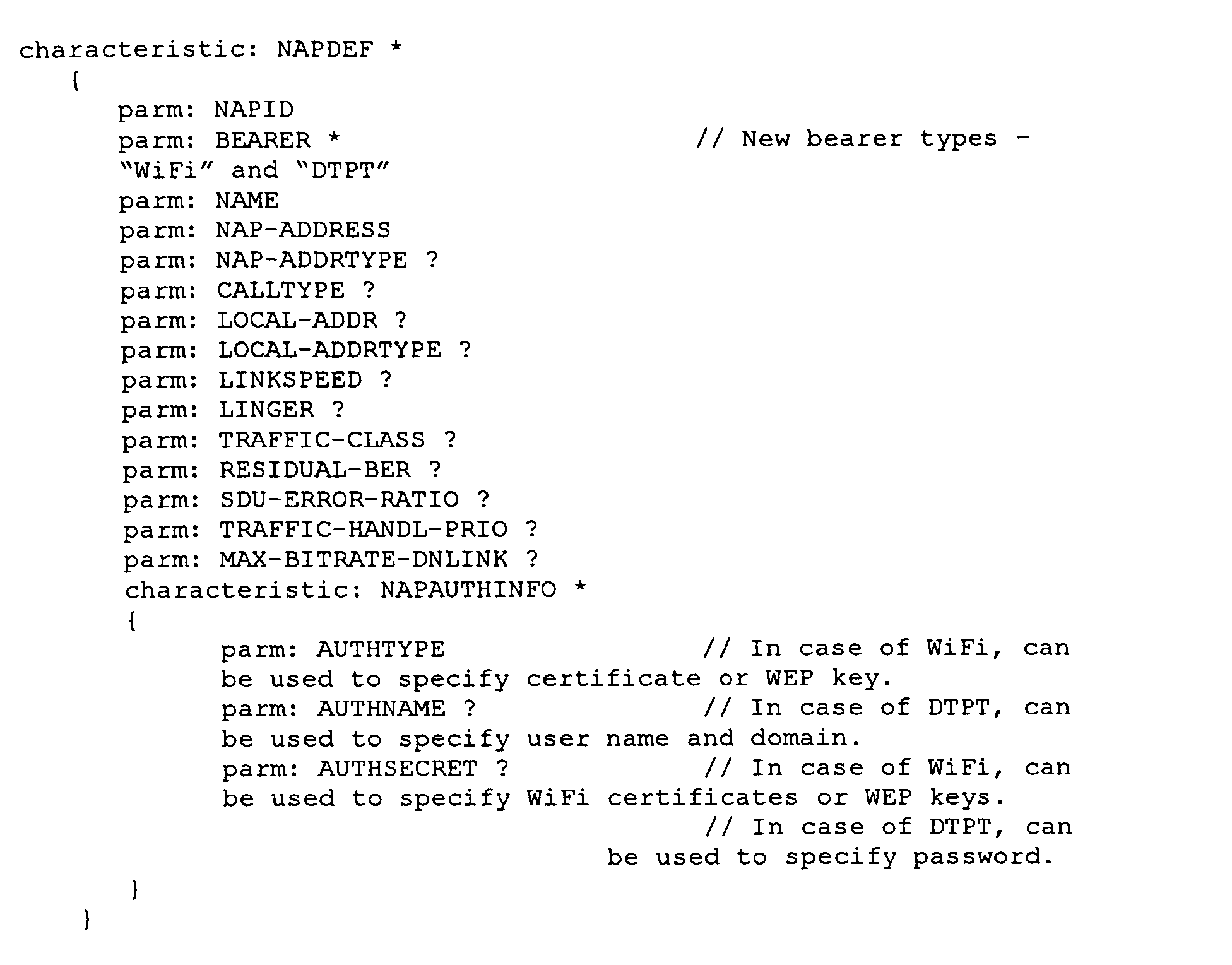
- The following example illustrates how the NAPDEF characteristic can be used to define the settings of a passthrough connection:
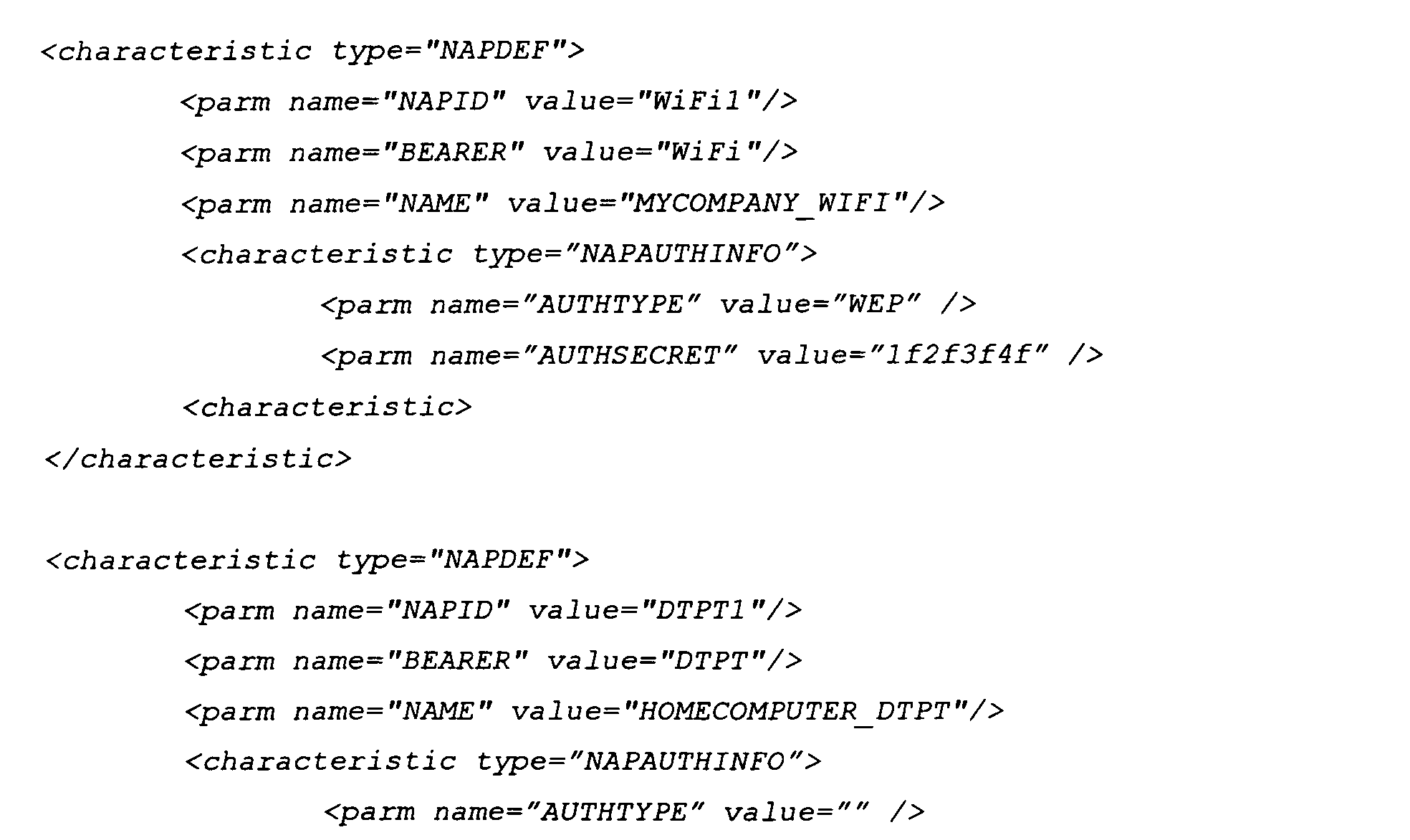

- FIGURE 4 illustrates a process for provisioning a device with passthrough connections, in accordance with aspects of the invention.
- After a start block, the process flows to block 410 where passthrough provisioning parameters are obtained. The parameters may be obtained in many different ways. For example, the parameters may be stored on a SIM card associated with the mobile device, or the parameters may be transferred to the device by a program. Moving to block 420, the parameters are incorporated onto the device automatically. In this way, the user does not have to manually set all of the parameters associated with the passthrough connection. Flowing to block 430, the network connections that the device may used to connect to the passthrough may be determined. This may be accomplished in many different ways. For example, the connections may be already known by the device, or as the device learns of new connections then these connections can be incorporated into the device. Moving to block 440, the passthrough connections are may be updated based on the determined network connections. The process then moves to an end block and returns to processing other actions.
The above specification, examples and data provide a complete description of the manufacture and use of the composition of the invention. Since many embodiments of the invention can be made without departing from the spirit and scope of the invention, the invention resides in the claims hereinafter appended.
Claims (25)
- A method for provisioning passthrough connections between a mobile device and a meta-network, comprising:obtaining a first passthrough definition for the mobile device;using the first passthrough definition to connect the mobile device to the meta-network;receiving in the mobile device a second passthrough definition through the connection to the meta-network; andstoring the second passthrough definition in the mobile device.
- The method of claim 1, further comprising using the second passthrough definition to connect the mobile device to the meta-network.
- The method of claim 1, wherein the passthrough definition is incorporated into a WAP XML schema.
- The method of claim 1, wherein the passthrough connection is a desktop passthrough connection.
- The method of claim 4, wherein the meta-network is the Internet.
- The method of claim 1, wherein the passthrough connection is a WiFi connection.
- The method of claim 4, wherein the meta-network is the a corporate network.
- The method of claim 1, wherein the first passthrough definition is obtained using a SIM card.
- The method of claim 1, wherein the first passthrough definition is obtained by manual input of a user of the mobile device.
- The method of claim 1, further comprising:receiving in the mobile device a third passthrough definition through the connection to the meta-network; andstoring the third passthrough definition in the mobile device.
- A mobile device for using passthrough connections to connect to a meta-network, comprising:an interface that is configured to obtain a first passthrough definition for the mobile device;a network interface that is configured to use the first passthrough definition to connect the mobile device to the meta-network and is further configured to receive a second passthrough definition through the connection to the meta-network; anda memory for storing the second passthrough definition.
- The device of claim 11, wherein the network interface is further configured to use the second passthrough definition to connect the mobile device to the meta-network.
- The device of claim 11, wherein the passthrough definition is incorporated into a WAP XML schema.
- The device of claim 11, wherein the passthrough connection is a desktop passthrough connection.
- The device of claim 14, wherein the meta-network is the Internet.
- The device of claim 11, wherein the passthrough connection is a WiFi connection.
- The device of claim 14, wherein the meta-network is the a corporate network.
- The device of claim 11, wherein the first passthrough definition is obtained using a SIM card.
- The device of claim 11, wherein the first passthrough definition is obtained by manual input of a user of the mobile device.
- The device of claim 11,
wherein the network interface is further configured to receive a third passthrough definition through the connection to the meta-network and to connect to the meta-network using the third passthrough definition. - A computer-readable medium containing instructions for provisioning passthrough connections between a mobile device and a meta-network, comprising:obtaining a first passthrough definition for the mobile device;using the first passthrough definition to connect the mobile device to the meta-network;receiving in the mobile device a second passthrough definition through the connection to the meta-network; andstoring the second passthrough definition in the mobile device.
- The medium of claim 21, further comprising instructions for using the second passthrough definition to connect the mobile device to the meta-network.
- The medium of claim 21, wherein the passthrough definition is incorporated into a WAP XML schema.
- The medium of claim 21, further comprising instructions for receiving in the mobile device a third passthrough definition through the connection to the meta-network and storing the third passthrough definition in the mobile device.
- A mobile device for using passthrough connections to connect to a meta-network, comprising:means for obtaining a first passthrough definition for the mobile device;means for using the first passthrough definition to connect the mobile device to the meta-network and receiving a second passthrough definition through the connection to the meta-network; andmeans for storing the second passthrough definition.
Applications Claiming Priority (4)
| Application Number | Priority Date | Filing Date | Title |
|---|---|---|---|
| US49886503P | 2003-08-29 | 2003-08-29 | |
| US498865P | 2003-08-29 | ||
| US10/701,130 US7451198B2 (en) | 2003-08-29 | 2003-11-03 | WAP XML extension for WiFi and desktop passthrough connections |
| US701130 | 2003-11-03 |
Publications (2)
| Publication Number | Publication Date |
|---|---|
| EP1511222A2 true EP1511222A2 (en) | 2005-03-02 |
| EP1511222A3 EP1511222A3 (en) | 2010-09-29 |
Family
ID=34108125
Family Applications (1)
| Application Number | Title | Priority Date | Filing Date |
|---|---|---|---|
| EP04018742A Ceased EP1511222A3 (en) | 2003-08-29 | 2004-08-06 | WAP XML extension for WIFI and desktop passthrough connections |
Country Status (5)
| Country | Link |
|---|---|
| US (1) | US7451198B2 (en) |
| EP (1) | EP1511222A3 (en) |
| JP (1) | JP4583110B2 (en) |
| KR (1) | KR101292353B1 (en) |
| CN (1) | CN100459537C (en) |
Families Citing this family (10)
| Publication number | Priority date | Publication date | Assignee | Title |
|---|---|---|---|---|
| US7369841B1 (en) * | 2001-09-28 | 2008-05-06 | Durham Logistics Llc | Wireless network infrastructure |
| US20050273825A1 (en) * | 2004-06-02 | 2005-12-08 | Miran Eldeeb | Media converter with detachable media player |
| KR101102391B1 (en) * | 2005-03-03 | 2012-01-05 | 엘지전자 주식회사 | Sending / Receiving Wireless Data Setting Information |
| KR100700145B1 (en) * | 2005-11-21 | 2007-03-28 | 엘지전자 주식회사 | Mobile communication terminal having WiBro modem function and its method |
| US8010959B2 (en) * | 2006-11-29 | 2011-08-30 | Sony Ericsson Mobile Communications Ab | System and method for updating device drivers |
| US9736207B1 (en) * | 2008-06-13 | 2017-08-15 | West Corporation | Passive outdial support for mobile devices via WAP push of an MVSS URL |
| US20100100876A1 (en) * | 2008-10-21 | 2010-04-22 | Enfora, Inc. | Wireless device provisioning hardware tool |
| TWI427969B (en) * | 2010-08-20 | 2014-02-21 | Wu Sheng Huang | Plug-and-play wireless ethernet extension station and method of automatic configuration thereof |
| CN103493550B (en) | 2012-06-25 | 2017-08-11 | 华为终端有限公司 | A method for setting communication mode and Wi‑Fi device |
| US9467334B2 (en) * | 2013-06-07 | 2016-10-11 | Apple Inc. | Configuring computing devices using a bootstrap configuration |
Citations (3)
| Publication number | Priority date | Publication date | Assignee | Title |
|---|---|---|---|---|
| WO2002051188A1 (en) | 2000-12-21 | 2002-06-27 | Nokia Corporation | Over-the-air (ota) service provisioning in a mobile communications system |
| WO2002084975A2 (en) * | 2001-04-12 | 2002-10-24 | Research In Motion Limited | System and method for dynamically pushing information on wireless data communication devices |
| US20030018758A1 (en) | 2001-07-13 | 2003-01-23 | Changguan Fan | Generically provisioning an appliance |
Family Cites Families (33)
| Publication number | Priority date | Publication date | Assignee | Title |
|---|---|---|---|---|
| CA2179349C (en) * | 1996-06-18 | 2000-01-11 | Roger Yiu Ming Cheung | Method and apparatus for providing a 3-way connection between a mobile computing device, a stationary computing device and a computer network |
| EP0964558A1 (en) * | 1998-06-08 | 1999-12-15 | THOMSON multimedia | Method for accessing internet applications from home network devices |
| US6195531B1 (en) * | 1998-11-25 | 2001-02-27 | Telefonaktiebolaget L M Ericsson (Publ) | Method and system for automatic configuration of fixed cellular terminals |
| US6647260B2 (en) * | 1999-04-09 | 2003-11-11 | Openwave Systems Inc. | Method and system facilitating web based provisioning of two-way mobile communications devices |
| DE60024486T2 (en) * | 1999-12-13 | 2006-07-13 | Markport Ltd. | WAPDIENST PERSONALIZATION, MANAGEMENT AND FEES OBJECT-ORIENTED PLATFORM |
| FI108593B (en) * | 1999-12-31 | 2002-02-15 | Nokia Oyj | Routing of packets in a multi-service network |
| DE10007812A1 (en) * | 2000-02-21 | 2001-08-30 | Becker Gmbh | Process for operating a car phone and car phone |
| US20020013831A1 (en) * | 2000-06-30 | 2002-01-31 | Arto Astala | System having mobile terminals with wireless access to the internet and method for doing same |
| US7054924B1 (en) * | 2000-09-29 | 2006-05-30 | Cisco Technology, Inc. | Method and apparatus for provisioning network devices using instructions in extensible markup language |
| US20020131404A1 (en) * | 2000-11-28 | 2002-09-19 | 4Thpass Inc. | Method and system for maintaining and distributing wireless applications |
| US20020101848A1 (en) * | 2000-12-05 | 2002-08-01 | Ivan Lee | Systems and methods for on-location, wireless access of web content |
| FI113129B (en) * | 2001-03-26 | 2004-02-27 | Nokia Corp | Synchronization of application data in a telecommunications system |
| US6973502B2 (en) * | 2001-03-29 | 2005-12-06 | Nokia Mobile Phones Ltd. | Bearer identification tags and method of using same |
| JP2002353980A (en) * | 2001-05-24 | 2002-12-06 | Fuji Xerox Co Ltd | Information processor |
| US8107937B2 (en) * | 2001-07-31 | 2012-01-31 | Nokia Corporation | System and method for automatic provisioning detection and notification |
| KR100423809B1 (en) * | 2001-08-16 | 2004-03-22 | 한국전자통신연구원 | Method and apparatus for controlling internet access and home automation using a home server |
| US20030045311A1 (en) * | 2001-08-30 | 2003-03-06 | Tapani Larikka | Message transfer from a source device via a mobile terminal device to a third device and data synchronization between terminal devices |
| US20030084165A1 (en) * | 2001-10-12 | 2003-05-01 | Openwave Systems Inc. | User-centric session management for client-server interaction using multiple applications and devices |
| JP2003198568A (en) * | 2001-10-16 | 2003-07-11 | Sony Corp | Transmission / reception device, transmission / reception method and transmission / reception system |
| US7506059B2 (en) * | 2001-10-26 | 2009-03-17 | Nokia Corporation | Mobile client provisioning web service |
| JP2003143126A (en) * | 2001-11-05 | 2003-05-16 | Telecommunication Advancement Organization Of Japan | Security maintaining method, its implementation system and its processing process |
| JP2003150462A (en) | 2001-11-12 | 2003-05-23 | Sony Corp | Information remote setting communication system and information processing method |
| JP4040403B2 (en) | 2001-11-27 | 2008-01-30 | ソニー株式会社 | Information processing apparatus and method, recording medium, and program |
| US7363354B2 (en) * | 2001-11-29 | 2008-04-22 | Nokia Corporation | System and method for identifying and accessing network services |
| JP4040298B2 (en) * | 2001-12-26 | 2008-01-30 | 日本電信電話株式会社 | Communication device |
| JP2003218875A (en) * | 2002-01-18 | 2003-07-31 | Seiko Epson Corp | Setting parameters for wireless communication devices |
| US20030210700A1 (en) * | 2002-05-09 | 2003-11-13 | Ambicom, Inc. | System and method of dynamically switching between 802.11b client and access point in MS-Windows environment |
| KR100472458B1 (en) * | 2002-06-26 | 2005-03-10 | 삼성전자주식회사 | Apparatus method for XML parsing utilizing exterior XML validator |
| US20040024660A1 (en) * | 2002-08-05 | 2004-02-05 | General Electric Company | System and method for providing asset management and tracking capabilities |
| US7665125B2 (en) * | 2002-09-23 | 2010-02-16 | Heard Robert W | System and method for distribution of security policies for mobile devices |
| US7437752B2 (en) * | 2002-09-23 | 2008-10-14 | Credant Technologies, Inc. | Client architecture for portable device with security policies |
| US20040075675A1 (en) * | 2002-10-17 | 2004-04-22 | Tommi Raivisto | Apparatus and method for accessing services via a mobile terminal |
| US7433936B2 (en) * | 2004-03-11 | 2008-10-07 | Microsoft Corporation | Connectivity objects under a mobile device management tree |
-
2003
- 2003-11-03 US US10/701,130 patent/US7451198B2/en not_active Expired - Fee Related
-
2004
- 2004-08-06 EP EP04018742A patent/EP1511222A3/en not_active Ceased
- 2004-08-27 CN CNB2004100685876A patent/CN100459537C/en not_active Expired - Fee Related
- 2004-08-27 KR KR1020040067979A patent/KR101292353B1/en not_active Expired - Fee Related
- 2004-08-30 JP JP2004251028A patent/JP4583110B2/en not_active Expired - Fee Related
Patent Citations (3)
| Publication number | Priority date | Publication date | Assignee | Title |
|---|---|---|---|---|
| WO2002051188A1 (en) | 2000-12-21 | 2002-06-27 | Nokia Corporation | Over-the-air (ota) service provisioning in a mobile communications system |
| WO2002084975A2 (en) * | 2001-04-12 | 2002-10-24 | Research In Motion Limited | System and method for dynamically pushing information on wireless data communication devices |
| US20030018758A1 (en) | 2001-07-13 | 2003-01-23 | Changguan Fan | Generically provisioning an appliance |
Also Published As
| Publication number | Publication date |
|---|---|
| US7451198B2 (en) | 2008-11-11 |
| CN100459537C (en) | 2009-02-04 |
| CN1592261A (en) | 2005-03-09 |
| US20050047046A1 (en) | 2005-03-03 |
| KR101292353B1 (en) | 2013-07-31 |
| JP4583110B2 (en) | 2010-11-17 |
| KR20050021913A (en) | 2005-03-07 |
| EP1511222A3 (en) | 2010-09-29 |
| JP2005080308A (en) | 2005-03-24 |
Similar Documents
| Publication | Publication Date | Title |
|---|---|---|
| US8694620B2 (en) | System and method for an OMA DM extension to manage mobile device configuration settings | |
| US7392512B2 (en) | System and method for automatic conversion from WAP client provisioning XML represented objects to OMA DM tree structure represented objects | |
| CN102308561B (en) | ME network parameter configuration by UICC | |
| US7577130B2 (en) | SyncML based OMA connectivity object to provision VPN connections | |
| EP1511223B1 (en) | Wap xml extension to define vpn connections | |
| CN101431564B (en) | Method and mobile terminal for displaying terminal information of another party using presence information | |
| CN101401359B (en) | Communication device and base for an advanced display | |
| CN100499936C (en) | Device management | |
| JP4546801B2 (en) | Method for providing synchronization notification to client device | |
| US20060230395A1 (en) | Embedded device update service | |
| JP2010512062A (en) | User-initiated invitation for automated conference participation by invited guests | |
| US8085756B2 (en) | Automatically sending rich contact information coincident to a telephone call | |
| US7451198B2 (en) | WAP XML extension for WiFi and desktop passthrough connections | |
| CN101167065A (en) | System and method for retrieving electronic mail | |
| FI116499B (en) | Manage storage locations | |
| Schmohl et al. | Mobile services based on client-server or p2p architectures facing issues of context-awareness and heterogeneous environments | |
| KR20070058059A (en) | Meeting address book writing system and method for providing meeting member mobile terminal |
Legal Events
| Date | Code | Title | Description |
|---|---|---|---|
| PUAI | Public reference made under article 153(3) epc to a published international application that has entered the european phase |
Free format text: ORIGINAL CODE: 0009012 |
|
| AK | Designated contracting states |
Kind code of ref document: A2 Designated state(s): AT BE BG CH CY CZ DE DK EE ES FI FR GB GR HU IE IT LI LU MC NL PL PT RO SE SI SK TR |
|
| AX | Request for extension of the european patent |
Extension state: AL HR LT LV MK |
|
| PUAL | Search report despatched |
Free format text: ORIGINAL CODE: 0009013 |
|
| AK | Designated contracting states |
Kind code of ref document: A3 Designated state(s): AT BE BG CH CY CZ DE DK EE ES FI FR GB GR HU IE IT LI LU MC NL PL PT RO SE SI SK TR |
|
| AX | Request for extension of the european patent |
Extension state: AL HR LT LV MK |
|
| RIC1 | Information provided on ipc code assigned before grant |
Ipc: H04L 12/28 20060101AFI20041215BHEP Ipc: H04L 12/24 20060101ALI20100824BHEP Ipc: H04L 29/08 20060101ALI20100824BHEP |
|
| 17P | Request for examination filed |
Effective date: 20110222 |
|
| 17Q | First examination report despatched |
Effective date: 20110406 |
|
| AKX | Designation fees paid |
Designated state(s): AT BE BG CH CY CZ DE DK EE ES FI FR GB GR HU IE IT LI LU MC NL PL PT RO SE SI SK TR |
|
| RAP1 | Party data changed (applicant data changed or rights of an application transferred) |
Owner name: MICROSOFT TECHNOLOGY LICENSING, LLC |
|
| STAA | Information on the status of an ep patent application or granted ep patent |
Free format text: STATUS: THE APPLICATION HAS BEEN REFUSED |
|
| 18R | Application refused |
Effective date: 20170717 |