EP1510582A1 - Method for producing L-amino acid using bacterium of Enterobacteriaceae family, having nir operon inactivated - Google Patents
Method for producing L-amino acid using bacterium of Enterobacteriaceae family, having nir operon inactivated Download PDFInfo
- Publication number
- EP1510582A1 EP1510582A1 EP04020085A EP04020085A EP1510582A1 EP 1510582 A1 EP1510582 A1 EP 1510582A1 EP 04020085 A EP04020085 A EP 04020085A EP 04020085 A EP04020085 A EP 04020085A EP 1510582 A1 EP1510582 A1 EP 1510582A1
- Authority
- EP
- European Patent Office
- Prior art keywords
- bacterium
- amino acid
- operon
- producing
- nir
- Prior art date
- Legal status (The legal status is an assumption and is not a legal conclusion. Google has not performed a legal analysis and makes no representation as to the accuracy of the status listed.)
- Withdrawn
Links
- 241000894006 Bacteria Species 0.000 title claims abstract description 53
- 150000008575 L-amino acids Chemical class 0.000 title claims abstract description 35
- 241000588921 Enterobacteriaceae Species 0.000 title claims abstract description 9
- 238000004519 manufacturing process Methods 0.000 title claims description 12
- ODKSFYDXXFIFQN-BYPYZUCNSA-N L-arginine Chemical compound OC(=O)[C@@H](N)CCCN=C(N)N ODKSFYDXXFIFQN-BYPYZUCNSA-N 0.000 claims abstract description 21
- 229930064664 L-arginine Natural products 0.000 claims abstract description 19
- 235000014852 L-arginine Nutrition 0.000 claims abstract description 19
- 238000000034 method Methods 0.000 claims abstract description 16
- 241000588722 Escherichia Species 0.000 claims abstract description 9
- 101150105804 cysG gene Proteins 0.000 claims description 17
- 101150044129 nirB gene Proteins 0.000 description 22
- 239000002609 medium Substances 0.000 description 21
- 241000588724 Escherichia coli Species 0.000 description 16
- IOVCWXUNBOPUCH-UHFFFAOYSA-M Nitrite anion Chemical compound [O-]N=O IOVCWXUNBOPUCH-UHFFFAOYSA-M 0.000 description 11
- 108090000623 proteins and genes Proteins 0.000 description 10
- 101100404144 Bacillus subtilis (strain 168) nasD gene Proteins 0.000 description 8
- 241000282326 Felis catus Species 0.000 description 8
- 210000004027 cell Anatomy 0.000 description 8
- 239000013612 plasmid Substances 0.000 description 8
- AVBHZKNQGDKVEA-ZTKUHGNGSA-N 3-[(2s,3s,7s,8s)-7,13,17-tris(2-carboxyethyl)-3,8,12,18-tetrakis(carboxymethyl)-3,8-dimethyl-2,7,23,24-tetrahydroporphyrin-2-yl]propanoic acid Chemical compound N1C(C=C2C(=C(CC(O)=O)C(=CC=3[C@@]([C@H](CCC(O)=O)C(=C4)N=3)(C)CC(O)=O)N2)CCC(O)=O)=C(CCC(O)=O)C(CC(O)=O)=C1C=C1[C@@H](CCC(O)=O)[C@](C)(CC(O)=O)C4=N1 AVBHZKNQGDKVEA-ZTKUHGNGSA-N 0.000 description 7
- 230000002779 inactivation Effects 0.000 description 7
- 239000004475 Arginine Substances 0.000 description 6
- IJGRMHOSHXDMSA-UHFFFAOYSA-N Atomic nitrogen Chemical compound N#N IJGRMHOSHXDMSA-UHFFFAOYSA-N 0.000 description 6
- CSNNHWWHGAXBCP-UHFFFAOYSA-L Magnesium sulfate Chemical compound [Mg+2].[O-][S+2]([O-])([O-])[O-] CSNNHWWHGAXBCP-UHFFFAOYSA-L 0.000 description 6
- 229910002651 NO3 Inorganic materials 0.000 description 6
- 108010025915 Nitrite Reductases Proteins 0.000 description 6
- 101100240886 Rattus norvegicus Nptx2 gene Proteins 0.000 description 6
- ODKSFYDXXFIFQN-UHFFFAOYSA-N arginine Natural products OC(=O)C(N)CCCNC(N)=N ODKSFYDXXFIFQN-UHFFFAOYSA-N 0.000 description 6
- 235000009697 arginine Nutrition 0.000 description 6
- 230000015572 biosynthetic process Effects 0.000 description 6
- 101150100899 nirC gene Proteins 0.000 description 6
- 101150045642 nirD gene Proteins 0.000 description 6
- 239000002773 nucleotide Substances 0.000 description 6
- 125000003729 nucleotide group Chemical group 0.000 description 6
- 239000000047 product Substances 0.000 description 6
- 238000003786 synthesis reaction Methods 0.000 description 6
- 238000013518 transcription Methods 0.000 description 6
- 230000035897 transcription Effects 0.000 description 6
- 101100404147 Bacillus subtilis (strain 168) nasE gene Proteins 0.000 description 5
- 108020004414 DNA Proteins 0.000 description 5
- 102000004190 Enzymes Human genes 0.000 description 5
- 108090000790 Enzymes Proteins 0.000 description 5
- 238000009825 accumulation Methods 0.000 description 5
- 230000027455 binding Effects 0.000 description 5
- 238000012217 deletion Methods 0.000 description 5
- QGZKDVFQNNGYKY-UHFFFAOYSA-N Ammonia Chemical compound N QGZKDVFQNNGYKY-UHFFFAOYSA-N 0.000 description 4
- VTYYLEPIZMXCLO-UHFFFAOYSA-L Calcium carbonate Chemical compound [Ca+2].[O-]C([O-])=O VTYYLEPIZMXCLO-UHFFFAOYSA-L 0.000 description 4
- LFQSCWFLJHTTHZ-UHFFFAOYSA-N Ethanol Chemical compound CCO LFQSCWFLJHTTHZ-UHFFFAOYSA-N 0.000 description 4
- NHNBFGGVMKEFGY-UHFFFAOYSA-N Nitrate Chemical compound [O-][N+]([O-])=O NHNBFGGVMKEFGY-UHFFFAOYSA-N 0.000 description 4
- 230000037430 deletion Effects 0.000 description 4
- 230000001419 dependent effect Effects 0.000 description 4
- 239000012634 fragment Substances 0.000 description 4
- 239000001963 growth medium Substances 0.000 description 4
- 244000005700 microbiome Species 0.000 description 4
- 238000010369 molecular cloning Methods 0.000 description 4
- -1 nitrate ions Chemical class 0.000 description 4
- QTBSBXVTEAMEQO-UHFFFAOYSA-N Acetic acid Chemical compound CC(O)=O QTBSBXVTEAMEQO-UHFFFAOYSA-N 0.000 description 3
- CSCPPACGZOOCGX-UHFFFAOYSA-N Acetone Chemical compound CC(C)=O CSCPPACGZOOCGX-UHFFFAOYSA-N 0.000 description 3
- 229920001817 Agar Polymers 0.000 description 3
- OKTJSMMVPCPJKN-UHFFFAOYSA-N Carbon Chemical compound [C] OKTJSMMVPCPJKN-UHFFFAOYSA-N 0.000 description 3
- 241000660147 Escherichia coli str. K-12 substr. MG1655 Species 0.000 description 3
- WQZGKKKJIJFFOK-GASJEMHNSA-N Glucose Natural products OC[C@H]1OC(O)[C@H](O)[C@@H](O)[C@@H]1O WQZGKKKJIJFFOK-GASJEMHNSA-N 0.000 description 3
- PEDCQBHIVMGVHV-UHFFFAOYSA-N Glycerine Chemical compound OCC(O)CO PEDCQBHIVMGVHV-UHFFFAOYSA-N 0.000 description 3
- NINIDFKCEFEMDL-UHFFFAOYSA-N Sulfur Chemical compound [S] NINIDFKCEFEMDL-UHFFFAOYSA-N 0.000 description 3
- JZRWCGZRTZMZEH-UHFFFAOYSA-N Thiamine Natural products CC1=C(CCO)SC=[N+]1CC1=CN=C(C)N=C1N JZRWCGZRTZMZEH-UHFFFAOYSA-N 0.000 description 3
- 239000008272 agar Substances 0.000 description 3
- 235000001014 amino acid Nutrition 0.000 description 3
- 229940024606 amino acid Drugs 0.000 description 3
- AVKUERGKIZMTKX-NJBDSQKTSA-N ampicillin Chemical compound C1([C@@H](N)C(=O)N[C@H]2[C@H]3SC([C@@H](N3C2=O)C(O)=O)(C)C)=CC=CC=C1 AVKUERGKIZMTKX-NJBDSQKTSA-N 0.000 description 3
- 229960000723 ampicillin Drugs 0.000 description 3
- 229910052799 carbon Inorganic materials 0.000 description 3
- 238000006243 chemical reaction Methods 0.000 description 3
- 238000010276 construction Methods 0.000 description 3
- XUJNEKJLAYXESH-UHFFFAOYSA-N cysteine Natural products SCC(N)C(O)=O XUJNEKJLAYXESH-UHFFFAOYSA-N 0.000 description 3
- 235000018417 cysteine Nutrition 0.000 description 3
- 238000004520 electroporation Methods 0.000 description 3
- 238000000855 fermentation Methods 0.000 description 3
- 230000004151 fermentation Effects 0.000 description 3
- 239000008103 glucose Substances 0.000 description 3
- 238000002744 homologous recombination Methods 0.000 description 3
- 230000006801 homologous recombination Effects 0.000 description 3
- 230000010354 integration Effects 0.000 description 3
- 229910052943 magnesium sulfate Inorganic materials 0.000 description 3
- 239000002207 metabolite Substances 0.000 description 3
- 229910052757 nitrogen Inorganic materials 0.000 description 3
- 239000011593 sulfur Substances 0.000 description 3
- 229910052717 sulfur Inorganic materials 0.000 description 3
- 238000011144 upstream manufacturing Methods 0.000 description 3
- 238000012795 verification Methods 0.000 description 3
- 102000007610 Amino-acid N-acetyltransferase Human genes 0.000 description 2
- 108010032178 Amino-acid N-acetyltransferase Proteins 0.000 description 2
- 108091026890 Coding region Proteins 0.000 description 2
- 241001646716 Escherichia coli K-12 Species 0.000 description 2
- WHUUTDBJXJRKMK-UHFFFAOYSA-N Glutamic acid Natural products OC(=O)C(N)CCC(O)=O WHUUTDBJXJRKMK-UHFFFAOYSA-N 0.000 description 2
- XUJNEKJLAYXESH-REOHCLBHSA-N L-Cysteine Chemical compound SC[C@H](N)C(O)=O XUJNEKJLAYXESH-REOHCLBHSA-N 0.000 description 2
- FFEARJCKVFRZRR-BYPYZUCNSA-N L-methionine Chemical compound CSCC[C@H](N)C(O)=O FFEARJCKVFRZRR-BYPYZUCNSA-N 0.000 description 2
- LRHPLDYGYMQRHN-UHFFFAOYSA-N N-Butanol Chemical compound CCCCO LRHPLDYGYMQRHN-UHFFFAOYSA-N 0.000 description 2
- FAPWRFPIFSIZLT-UHFFFAOYSA-M Sodium chloride Chemical compound [Na+].[Cl-] FAPWRFPIFSIZLT-UHFFFAOYSA-M 0.000 description 2
- QAOWNCQODCNURD-UHFFFAOYSA-L Sulfate Chemical compound [O-]S([O-])(=O)=O QAOWNCQODCNURD-UHFFFAOYSA-L 0.000 description 2
- 108010027912 Sulfite Oxidase Proteins 0.000 description 2
- 102000043440 Sulfite oxidase Human genes 0.000 description 2
- LSNNMFCWUKXFEE-UHFFFAOYSA-N Sulfurous acid Chemical compound OS(O)=O LSNNMFCWUKXFEE-UHFFFAOYSA-N 0.000 description 2
- 230000004913 activation Effects 0.000 description 2
- 239000012190 activator Substances 0.000 description 2
- 238000005273 aeration Methods 0.000 description 2
- 150000001413 amino acids Chemical group 0.000 description 2
- 229910021529 ammonia Inorganic materials 0.000 description 2
- BFNBIHQBYMNNAN-UHFFFAOYSA-N ammonium sulfate Chemical compound N.N.OS(O)(=O)=O BFNBIHQBYMNNAN-UHFFFAOYSA-N 0.000 description 2
- 229910052921 ammonium sulfate Inorganic materials 0.000 description 2
- WQZGKKKJIJFFOK-VFUOTHLCSA-N beta-D-glucose Chemical compound OC[C@H]1O[C@@H](O)[C@H](O)[C@@H](O)[C@@H]1O WQZGKKKJIJFFOK-VFUOTHLCSA-N 0.000 description 2
- 229910000019 calcium carbonate Inorganic materials 0.000 description 2
- 229940041514 candida albicans extract Drugs 0.000 description 2
- 101150055766 cat gene Proteins 0.000 description 2
- 229960005091 chloramphenicol Drugs 0.000 description 2
- WIIZWVCIJKGZOK-RKDXNWHRSA-N chloramphenicol Chemical compound ClC(Cl)C(=O)N[C@H](CO)[C@H](O)C1=CC=C([N+]([O-])=O)C=C1 WIIZWVCIJKGZOK-RKDXNWHRSA-N 0.000 description 2
- 210000000349 chromosome Anatomy 0.000 description 2
- 230000002950 deficient Effects 0.000 description 2
- 238000004925 denaturation Methods 0.000 description 2
- 230000036425 denaturation Effects 0.000 description 2
- 230000000694 effects Effects 0.000 description 2
- 230000012010 growth Effects 0.000 description 2
- 229910052500 inorganic mineral Inorganic materials 0.000 description 2
- 239000007788 liquid Substances 0.000 description 2
- 235000019341 magnesium sulphate Nutrition 0.000 description 2
- 230000001404 mediated effect Effects 0.000 description 2
- 229930182817 methionine Natural products 0.000 description 2
- 239000011707 mineral Substances 0.000 description 2
- 235000010755 mineral Nutrition 0.000 description 2
- 238000002703 mutagenesis Methods 0.000 description 2
- 231100000350 mutagenesis Toxicity 0.000 description 2
- 229930027945 nicotinamide-adenine dinucleotide Natural products 0.000 description 2
- BOPGDPNILDQYTO-NNYOXOHSSA-N nicotinamide-adenine dinucleotide Chemical compound C1=CCC(C(=O)N)=CN1[C@H]1[C@H](O)[C@H](O)[C@@H](COP(O)(=O)OP(O)(=O)OC[C@@H]2[C@H]([C@@H](O)[C@@H](O2)N2C3=NC=NC(N)=C3N=C2)O)O1 BOPGDPNILDQYTO-NNYOXOHSSA-N 0.000 description 2
- 230000009467 reduction Effects 0.000 description 2
- 239000011721 thiamine Substances 0.000 description 2
- 229960003495 thiamine Drugs 0.000 description 2
- 235000019157 thiamine Nutrition 0.000 description 2
- KYMBYSLLVAOCFI-UHFFFAOYSA-N thiamine Chemical compound CC1=C(CCO)SCN1CC1=CN=C(C)N=C1N KYMBYSLLVAOCFI-UHFFFAOYSA-N 0.000 description 2
- 230000001960 triggered effect Effects 0.000 description 2
- 108010063664 uroporphyrin-III C-methyltransferase Proteins 0.000 description 2
- 239000012138 yeast extract Substances 0.000 description 2
- IJROUPFSQHMOBK-UHFFFAOYSA-N 1-methyl-3-nitro-1-nitrosoguanidine 2-nitrosoguanidine Chemical compound NC(=N)NN=O.O=NN(C)C(=N)N[N+]([O-])=O IJROUPFSQHMOBK-UHFFFAOYSA-N 0.000 description 1
- FWMNVWWHGCHHJJ-SKKKGAJSSA-N 4-amino-1-[(2r)-6-amino-2-[[(2r)-2-[[(2r)-2-[[(2r)-2-amino-3-phenylpropanoyl]amino]-3-phenylpropanoyl]amino]-4-methylpentanoyl]amino]hexanoyl]piperidine-4-carboxylic acid Chemical compound C([C@H](C(=O)N[C@H](CC(C)C)C(=O)N[C@H](CCCCN)C(=O)N1CCC(N)(CC1)C(O)=O)NC(=O)[C@H](N)CC=1C=CC=CC=1)C1=CC=CC=C1 FWMNVWWHGCHHJJ-SKKKGAJSSA-N 0.000 description 1
- SSPYSWLZOPCOLO-UHFFFAOYSA-N 6-azauracil Chemical compound O=C1C=NNC(=O)N1 SSPYSWLZOPCOLO-UHFFFAOYSA-N 0.000 description 1
- 101100127701 Bacillus subtilis (strain 168) lcfB gene Proteins 0.000 description 1
- 101100376287 Bacillus subtilis (strain 168) yhfC gene Proteins 0.000 description 1
- UXVMQQNJUSDDNG-UHFFFAOYSA-L Calcium chloride Chemical compound [Cl-].[Cl-].[Ca+2] UXVMQQNJUSDDNG-UHFFFAOYSA-L 0.000 description 1
- 108700020911 DNA-Binding Proteins Proteins 0.000 description 1
- 102000052510 DNA-Binding Proteins Human genes 0.000 description 1
- 241000588698 Erwinia Species 0.000 description 1
- 101100262094 Escherichia coli (strain K12) tsgA gene Proteins 0.000 description 1
- 241000701959 Escherichia virus Lambda Species 0.000 description 1
- 239000007836 KH2PO4 Substances 0.000 description 1
- SRBFZHDQGSBBOR-HWQSCIPKSA-N L-arabinopyranose Chemical compound O[C@H]1COC(O)[C@H](O)[C@H]1O SRBFZHDQGSBBOR-HWQSCIPKSA-N 0.000 description 1
- AGPKZVBTJJNPAG-WHFBIAKZSA-N L-isoleucine Chemical compound CC[C@H](C)[C@H](N)C(O)=O AGPKZVBTJJNPAG-WHFBIAKZSA-N 0.000 description 1
- 229930182844 L-isoleucine Natural products 0.000 description 1
- 102000008300 Mutant Proteins Human genes 0.000 description 1
- 108010021466 Mutant Proteins Proteins 0.000 description 1
- VZUNGTLZRAYYDE-UHFFFAOYSA-N N-methyl-N'-nitro-N-nitrosoguanidine Chemical compound O=NN(C)C(=N)N[N+]([O-])=O VZUNGTLZRAYYDE-UHFFFAOYSA-N 0.000 description 1
- 108090000913 Nitrate Reductases Proteins 0.000 description 1
- 108090000818 Nitrite reductase (NAD(P)H) Proteins 0.000 description 1
- 108010061100 Nucleoproteins Proteins 0.000 description 1
- 102000011931 Nucleoproteins Human genes 0.000 description 1
- 108091034117 Oligonucleotide Proteins 0.000 description 1
- 239000001888 Peptone Substances 0.000 description 1
- 108010080698 Peptones Proteins 0.000 description 1
- 108091000080 Phosphotransferase Proteins 0.000 description 1
- 241000588768 Providencia Species 0.000 description 1
- 241000293869 Salmonella enterica subsp. enterica serovar Typhimurium Species 0.000 description 1
- 241000607720 Serratia Species 0.000 description 1
- 229930006000 Sucrose Natural products 0.000 description 1
- CZMRCDWAGMRECN-UGDNZRGBSA-N Sucrose Chemical compound O[C@H]1[C@H](O)[C@@H](CO)O[C@@]1(CO)O[C@@H]1[C@H](O)[C@@H](O)[C@H](O)[C@@H](CO)O1 CZMRCDWAGMRECN-UGDNZRGBSA-N 0.000 description 1
- 108091023040 Transcription factor Proteins 0.000 description 1
- 102000040945 Transcription factor Human genes 0.000 description 1
- 239000002253 acid Substances 0.000 description 1
- 150000007513 acids Chemical class 0.000 description 1
- 230000003213 activating effect Effects 0.000 description 1
- 238000000246 agarose gel electrophoresis Methods 0.000 description 1
- 150000001412 amines Chemical class 0.000 description 1
- 150000003863 ammonium salts Chemical class 0.000 description 1
- 235000011130 ammonium sulphate Nutrition 0.000 description 1
- 230000003321 amplification Effects 0.000 description 1
- 230000009604 anaerobic growth Effects 0.000 description 1
- 101150072344 argA gene Proteins 0.000 description 1
- QVGXLLKOCUKJST-UHFFFAOYSA-N atomic oxygen Chemical compound [O] QVGXLLKOCUKJST-UHFFFAOYSA-N 0.000 description 1
- SRBFZHDQGSBBOR-UHFFFAOYSA-N beta-D-Pyranose-Lyxose Natural products OC1COC(O)C(O)C1O SRBFZHDQGSBBOR-UHFFFAOYSA-N 0.000 description 1
- 230000003115 biocidal effect Effects 0.000 description 1
- 230000006696 biosynthetic metabolic pathway Effects 0.000 description 1
- 238000009395 breeding Methods 0.000 description 1
- 230000001488 breeding effect Effects 0.000 description 1
- 239000000872 buffer Substances 0.000 description 1
- 239000001110 calcium chloride Substances 0.000 description 1
- 229910001628 calcium chloride Inorganic materials 0.000 description 1
- 235000011148 calcium chloride Nutrition 0.000 description 1
- 150000001720 carbohydrates Chemical class 0.000 description 1
- 235000014633 carbohydrates Nutrition 0.000 description 1
- 239000006285 cell suspension Substances 0.000 description 1
- 238000005119 centrifugation Methods 0.000 description 1
- 239000003153 chemical reaction reagent Substances 0.000 description 1
- 239000013611 chromosomal DNA Substances 0.000 description 1
- 238000007796 conventional method Methods 0.000 description 1
- 238000002425 crystallisation Methods 0.000 description 1
- 210000000805 cytoplasm Anatomy 0.000 description 1
- 230000003247 decreasing effect Effects 0.000 description 1
- 230000007812 deficiency Effects 0.000 description 1
- 238000001784 detoxification Methods 0.000 description 1
- 230000029087 digestion Effects 0.000 description 1
- ZPWVASYFFYYZEW-UHFFFAOYSA-L dipotassium hydrogen phosphate Chemical compound [K+].[K+].OP([O-])([O-])=O ZPWVASYFFYYZEW-UHFFFAOYSA-L 0.000 description 1
- 239000003623 enhancer Substances 0.000 description 1
- 230000007613 environmental effect Effects 0.000 description 1
- 230000003721 exogen phase Effects 0.000 description 1
- 239000011790 ferrous sulphate Substances 0.000 description 1
- 235000003891 ferrous sulphate Nutrition 0.000 description 1
- 238000012224 gene deletion Methods 0.000 description 1
- 235000013922 glutamic acid Nutrition 0.000 description 1
- 239000004220 glutamic acid Substances 0.000 description 1
- 150000003278 haem Chemical class 0.000 description 1
- 239000000413 hydrolysate Substances 0.000 description 1
- 101150095957 ilvA gene Proteins 0.000 description 1
- 230000001976 improved effect Effects 0.000 description 1
- 230000006698 induction Effects 0.000 description 1
- 230000001939 inductive effect Effects 0.000 description 1
- 238000005342 ion exchange Methods 0.000 description 1
- BAUYGSIQEAFULO-UHFFFAOYSA-L iron(2+) sulfate (anhydrous) Chemical compound [Fe+2].[O-]S([O-])(=O)=O BAUYGSIQEAFULO-UHFFFAOYSA-L 0.000 description 1
- 229910000359 iron(II) sulfate Inorganic materials 0.000 description 1
- 229960000310 isoleucine Drugs 0.000 description 1
- 229940099596 manganese sulfate Drugs 0.000 description 1
- 239000011702 manganese sulphate Substances 0.000 description 1
- 235000007079 manganese sulphate Nutrition 0.000 description 1
- SQQMAOCOWKFBNP-UHFFFAOYSA-L manganese(II) sulfate Chemical compound [Mn+2].[O-]S([O-])(=O)=O SQQMAOCOWKFBNP-UHFFFAOYSA-L 0.000 description 1
- 239000012528 membrane Substances 0.000 description 1
- 238000005374 membrane filtration Methods 0.000 description 1
- 230000002906 microbiologic effect Effects 0.000 description 1
- 239000000203 mixture Substances 0.000 description 1
- 230000004048 modification Effects 0.000 description 1
- 238000012986 modification Methods 0.000 description 1
- 229910000402 monopotassium phosphate Inorganic materials 0.000 description 1
- FEMOMIGRRWSMCU-UHFFFAOYSA-N ninhydrin Chemical compound C1=CC=C2C(=O)C(O)(O)C(=O)C2=C1 FEMOMIGRRWSMCU-UHFFFAOYSA-N 0.000 description 1
- 229910017464 nitrogen compound Inorganic materials 0.000 description 1
- 150000002830 nitrogen compounds Chemical class 0.000 description 1
- 238000003199 nucleic acid amplification method Methods 0.000 description 1
- 108020004707 nucleic acids Proteins 0.000 description 1
- 150000007523 nucleic acids Chemical class 0.000 description 1
- 102000039446 nucleic acids Human genes 0.000 description 1
- 108091006110 nucleoid-associated proteins Proteins 0.000 description 1
- 235000015097 nutrients Nutrition 0.000 description 1
- 150000007524 organic acids Chemical class 0.000 description 1
- 235000005985 organic acids Nutrition 0.000 description 1
- 230000001590 oxidative effect Effects 0.000 description 1
- 229910052760 oxygen Inorganic materials 0.000 description 1
- 239000001301 oxygen Substances 0.000 description 1
- 238000004816 paper chromatography Methods 0.000 description 1
- 230000037361 pathway Effects 0.000 description 1
- 235000019319 peptone Nutrition 0.000 description 1
- 102000020233 phosphotransferase Human genes 0.000 description 1
- GNSKLFRGEWLPPA-UHFFFAOYSA-M potassium dihydrogen phosphate Chemical compound [K+].OP(O)([O-])=O GNSKLFRGEWLPPA-UHFFFAOYSA-M 0.000 description 1
- 238000002360 preparation method Methods 0.000 description 1
- 238000000746 purification Methods 0.000 description 1
- 150000003230 pyrimidines Chemical class 0.000 description 1
- 238000004064 recycling Methods 0.000 description 1
- 238000011946 reduction process Methods 0.000 description 1
- 230000001105 regulatory effect Effects 0.000 description 1
- 230000010076 replication Effects 0.000 description 1
- 230000000241 respiratory effect Effects 0.000 description 1
- 230000029058 respiratory gaseous exchange Effects 0.000 description 1
- 230000004044 response Effects 0.000 description 1
- 108091008020 response regulators Proteins 0.000 description 1
- 230000035945 sensitivity Effects 0.000 description 1
- 238000002741 site-directed mutagenesis Methods 0.000 description 1
- 239000011780 sodium chloride Substances 0.000 description 1
- 235000002639 sodium chloride Nutrition 0.000 description 1
- 239000007787 solid Substances 0.000 description 1
- 238000003756 stirring Methods 0.000 description 1
- 239000005720 sucrose Substances 0.000 description 1
- 238000012360 testing method Methods 0.000 description 1
- 230000005026 transcription initiation Effects 0.000 description 1
- 238000010361 transduction Methods 0.000 description 1
- 230000026683 transduction Effects 0.000 description 1
- 230000009466 transformation Effects 0.000 description 1
- 238000009281 ultraviolet germicidal irradiation Methods 0.000 description 1
- 239000011782 vitamin Substances 0.000 description 1
- 235000013343 vitamin Nutrition 0.000 description 1
- 229940088594 vitamin Drugs 0.000 description 1
- 229930003231 vitamin Natural products 0.000 description 1
- 239000011691 vitamin B1 Substances 0.000 description 1
- 238000005406 washing Methods 0.000 description 1
- XLYOFNOQVPJJNP-UHFFFAOYSA-N water Substances O XLYOFNOQVPJJNP-UHFFFAOYSA-N 0.000 description 1
- 101150077217 yhfL gene Proteins 0.000 description 1
Images


Classifications
-
- C—CHEMISTRY; METALLURGY
- C12—BIOCHEMISTRY; BEER; SPIRITS; WINE; VINEGAR; MICROBIOLOGY; ENZYMOLOGY; MUTATION OR GENETIC ENGINEERING
- C12N—MICROORGANISMS OR ENZYMES; COMPOSITIONS THEREOF; PROPAGATING, PRESERVING, OR MAINTAINING MICROORGANISMS; MUTATION OR GENETIC ENGINEERING; CULTURE MEDIA
- C12N9/00—Enzymes; Proenzymes; Compositions thereof; Processes for preparing, activating, inhibiting, separating or purifying enzymes
- C12N9/0004—Oxidoreductases (1.)
- C12N9/0012—Oxidoreductases (1.) acting on nitrogen containing compounds as donors (1.4, 1.5, 1.6, 1.7)
- C12N9/0036—Oxidoreductases (1.) acting on nitrogen containing compounds as donors (1.4, 1.5, 1.6, 1.7) acting on NADH or NADPH (1.6)
-
- C—CHEMISTRY; METALLURGY
- C12—BIOCHEMISTRY; BEER; SPIRITS; WINE; VINEGAR; MICROBIOLOGY; ENZYMOLOGY; MUTATION OR GENETIC ENGINEERING
- C12N—MICROORGANISMS OR ENZYMES; COMPOSITIONS THEREOF; PROPAGATING, PRESERVING, OR MAINTAINING MICROORGANISMS; MUTATION OR GENETIC ENGINEERING; CULTURE MEDIA
- C12N15/00—Mutation or genetic engineering; DNA or RNA concerning genetic engineering, vectors, e.g. plasmids, or their isolation, preparation or purification; Use of hosts therefor
- C12N15/09—Recombinant DNA-technology
- C12N15/11—DNA or RNA fragments; Modified forms thereof; Non-coding nucleic acids having a biological activity
- C12N15/52—Genes encoding for enzymes or proenzymes
-
- C—CHEMISTRY; METALLURGY
- C12—BIOCHEMISTRY; BEER; SPIRITS; WINE; VINEGAR; MICROBIOLOGY; ENZYMOLOGY; MUTATION OR GENETIC ENGINEERING
- C12N—MICROORGANISMS OR ENZYMES; COMPOSITIONS THEREOF; PROPAGATING, PRESERVING, OR MAINTAINING MICROORGANISMS; MUTATION OR GENETIC ENGINEERING; CULTURE MEDIA
- C12N9/00—Enzymes; Proenzymes; Compositions thereof; Processes for preparing, activating, inhibiting, separating or purifying enzymes
- C12N9/10—Transferases (2.)
- C12N9/1003—Transferases (2.) transferring one-carbon groups (2.1)
- C12N9/1007—Methyltransferases (general) (2.1.1.)
-
- C—CHEMISTRY; METALLURGY
- C12—BIOCHEMISTRY; BEER; SPIRITS; WINE; VINEGAR; MICROBIOLOGY; ENZYMOLOGY; MUTATION OR GENETIC ENGINEERING
- C12P—FERMENTATION OR ENZYME-USING PROCESSES TO SYNTHESISE A DESIRED CHEMICAL COMPOUND OR COMPOSITION OR TO SEPARATE OPTICAL ISOMERS FROM A RACEMIC MIXTURE
- C12P13/00—Preparation of nitrogen-containing organic compounds
- C12P13/04—Alpha- or beta- amino acids
-
- C—CHEMISTRY; METALLURGY
- C12—BIOCHEMISTRY; BEER; SPIRITS; WINE; VINEGAR; MICROBIOLOGY; ENZYMOLOGY; MUTATION OR GENETIC ENGINEERING
- C12P—FERMENTATION OR ENZYME-USING PROCESSES TO SYNTHESISE A DESIRED CHEMICAL COMPOUND OR COMPOSITION OR TO SEPARATE OPTICAL ISOMERS FROM A RACEMIC MIXTURE
- C12P13/00—Preparation of nitrogen-containing organic compounds
- C12P13/04—Alpha- or beta- amino acids
- C12P13/10—Citrulline; Arginine; Ornithine
Definitions
- the present invention relates to the microbiological industry, and specifically to a method for producing an L-amino acid using bacterium of Enterobacteriaceae family, wherein the nir operon, including the nirBDC-cysG genes, is inactivated.
- Escherichia coli possesses two biochemically distinct nitrite reductase enzymes encoded by the nrfABCDEFG and nirBDC operons, respectively (Cole, J., FEMS Microbiol. Lett. 136:1-11 (1996)).
- a basal expression level of the nir operon is about 8 times higher than that of the nrf operon and can be increased 21-fold by adding nitrate (Wang, H. and Gunsalus, H.P., J. Bacteriol., 182, No. 20, p. 5813-5822 (2000)).
- nirBDC operon Transcription of the nirBDC operon is driven from a single promoter, and expression is activated by two environmental signals: an absence of oxygen and a presence of nitrite or nitrate ions in the growth medium (Jayaraman et al., J. Mol. Biol., 196, 4:781-8 (1987); Page et al., Arch Microbiol., 154:4:349-54, (1990)). Also, the cysG gene is co-transcribed with the nirBDC operon, while the second constitutive promoter is located less than 100 bp upstream of the cysG gene (Peakman, T. et al, Eur. J. Biochem., 191(2):325-331 (1990)).
- siroheme synthase catalyzes the synthesis of a heme cofactor, siroheme, which is employed by sulfite reductase and nitrite reductase enzymes in the sulfate and nitrite reduction processes.
- NirBDC nitrite reductase is a siroheme-containing enzyme that uses NADH as an electron donor to reduce nitrite in the cytoplasm (MacDonald, H. and Cole, J., Mol. Gen. Genet., 200:320-334 (1985); Peakman, T. et al, Eur. J. Biochem., 191:315-323 (1990)).
- E. coli mutants defective in the nirB gene lack NADH-dependent nitrite reductase activity and reduce nitrite slowly during anaerobic growth. These mutants require cysteine for growth (Cole, J.A. et al, J. Gen. Microbiol. 120:475-483 (1980)).
- the auxotrophy of cysG mutants is a result of their failure to produce siroheme, the cofactor of the CysIJ enzyme, sulfite reductase.
- Siroheme-dependent sulfite reduction is required for synthesis of cysteine, methionine, and other sulfur-containing metabolites whenever sulfate or sulfite is utilized as a sulfur source in the synthesis of these metabolites (Becker, M.A. et al, J. Biol. Chem., 244:2418-2427 (1969); Becker, M.A. and Tomkins, G.M., J. Biol. Chem., 244:6023-6030 (1969)).
- nirB nitrite reductase
- cysG mutants are also defective in reduction of nitrite.
- the nir promoter (P nir ) contains an FNR binding site (position -41.5); a NarL/NarP binding site (position -69.5) (Jayaraman, P.S. et al, Nucleic Acids Res. 17:1 135-45 (1989); Tyson, K.L. et al, Mol.
- the nir promoter is repressed by the following three DNA binding proteins: Fis, IHF and H-NS.
- the activation of nir promoter expression is co-dependent on both the FNR protein (an anaerobically triggered transcription activator) and the NarL or NarP proteins (transcription activators triggered by nitrite and nitrate).
- FNR an anaerobically triggered transcription activator
- NarL or NarP proteins transcription activators triggered by nitrite and nitrate.
- FNR an anaerobically triggered transcription activator
- NarL or NarP proteins transcription activators triggered by nitrite and nitrate
- the nir promoter is further regulated by the presence of nitrite or nitrate ions in the medium. This is achieved by two very similar response-regulator family transcription factors, NarL and NarP (reviewed by Darwin, A.J. et al, Mol.
- NarL and NarP are phosphorylated by the membrane-bound sensor kinase proteins, NarX and NarQ. Phosphorylated NarL and NarP then bind to specific heptamer sequences at target promoters and either up- or down-regulate transcription initiation at these promoters (for examples, see Tyson, K.L. et al., Mol. Microbiol., 13:6:1045-55 (1994); Darwin, A.J. et al., Mol. Microbiol., 25:3:583-95 (1997)).
- An object of present invention is to enhance the productivity of L-amino acid producing strains. It is a further object of the invention to provide a method for producing L-amino acids using these strains.
- the bacterium of the present invention is an L-amino acid-producing bacterium of Enterobacteriaceae family, wherein the bacterium has been modified to inactivate the nir operon.
- L-amino acid-producing bacterium means a bacterium, which has an ability to produce and cause accumulation of an L-amino acid in a medium, when the bacterium of the present invention is cultured in the medium.
- the L-amino acid-producing ability may be imparted or enhanced by breeding.
- the term "L-amino acid-producing bacterium” as used herein may also mean a bacterium which is able to produce and cause accumulation of L-amino acid in a culture medium in an amount larger than a wild-type or parental strain of bacterium, such as E . coli K-12 strain.
- the bacterium of Enterobacteriaceae family that can be used in the present invention is not particularly limited, however, for example, bacteria described by Neidhardt, F.C. et al. ( Escherichia coli and Salmonella typhimurium, American Society for Microbiology, Washington D.C., 1208, Table 1) are encompassed.
- the Enterobacteriaceae family of bacteria includes bacteria belonging to the genera Escherichia, Erwinia, Providencia and Serratia. The genus Escherichia is preferred.
- a bacterium belonging to the genus Escherichia means that the bacterium is classified as the genus Escherichia according to the classification known to a person skilled in the art of microbiology.
- a microorganism belonging to the genus Escherichia as used in the present invention inludes, but is not limited to, Escherichia coli ( E. coli ), which is most preferred bacterium for the present invention.
- nir operon is inactivated or "to inactivate the nir operon” means that the target operon is modified in such a way that the modified gene of the operon encodes a mutant protein with decreased or no activity. It is also possible that the modified DNA region is unable to naturally express the operon due to the deletion of a part of the operon, shifting the reading frame of the operon gene(s), or the modification of adjacent regions of the operon, including sequences which control operon expression, such as promoter(s), enhancer(s), attenuator(s) etc..
- nir operon is driven from a single promoter located upstream of the nirB gene, and the constitutive basal expression level of the cysG gene is not sufficient for siroheme synthesis, due to its own weak promoter., It is possible, therefore, to inactivate only the nirB gene so that further expression of genes located downstream of the nirB gene becomes impossible.
- the role of nitrite reductase, encoded by the nirB gene, in L-arginine production remains unclear.
- one embodiment of the present invention includes inactivation or disruption of the cysG gene.
- the nir operon of E. coli includes the following consecutively located genes: nirB, nirD, nirC and cysG.
- the nirB and nirD genes encode a nitrite reductase.
- the nirC gene encodes a nitrite transporter.
- the cysG gene encodes a siroheme synthase.
- nirB gene (gi:16131244; numbers 3491648 to 3494191 in the GenBank accession number NC_000913.1), nirD gene (gi:16131245; numbers 3494188 to 3494514 in the GenBank accession number NC_000913.1), nirC gene (gi:16132233; numbers 3494640 to 3495446 in the GenBank accession number NC_000913.1) and cysG gene (gi:16131246; numbers 3495465 to 3496838 in the GenBank accession number NC_000913.1) are located between the yhfC and yhfL ORFs on the E. coli strain K-12 chromosome.
- the nucleotide sequence of the nir operon from E. coli MG1655 strain is registered in GenBank under accession No. AE000412 U00096.
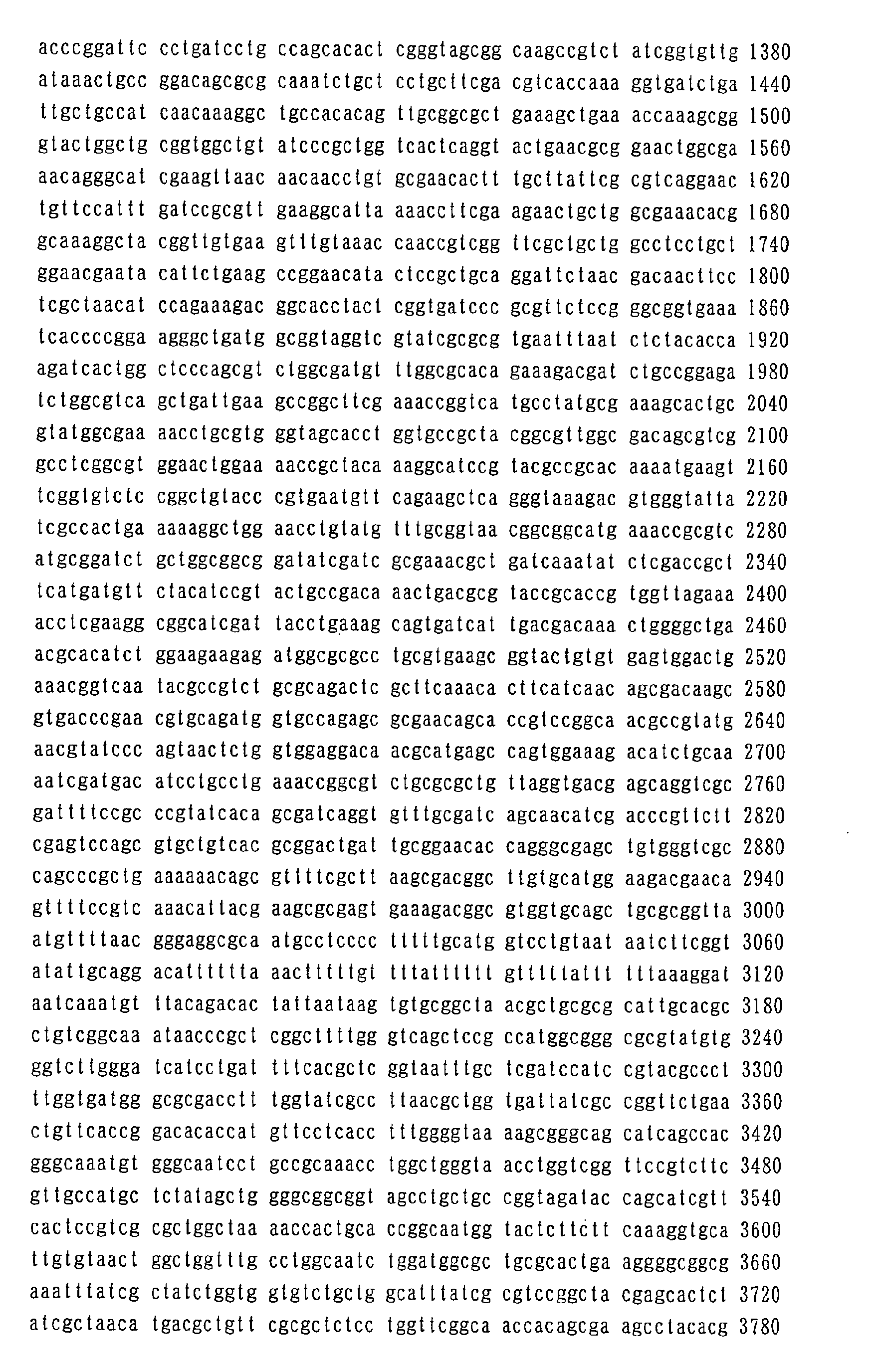
- the nucleotide sequence comprising the nirB, nirD, nirC and cysG genes of the MG1655 strain is shown in SEQ ID NO: 6.
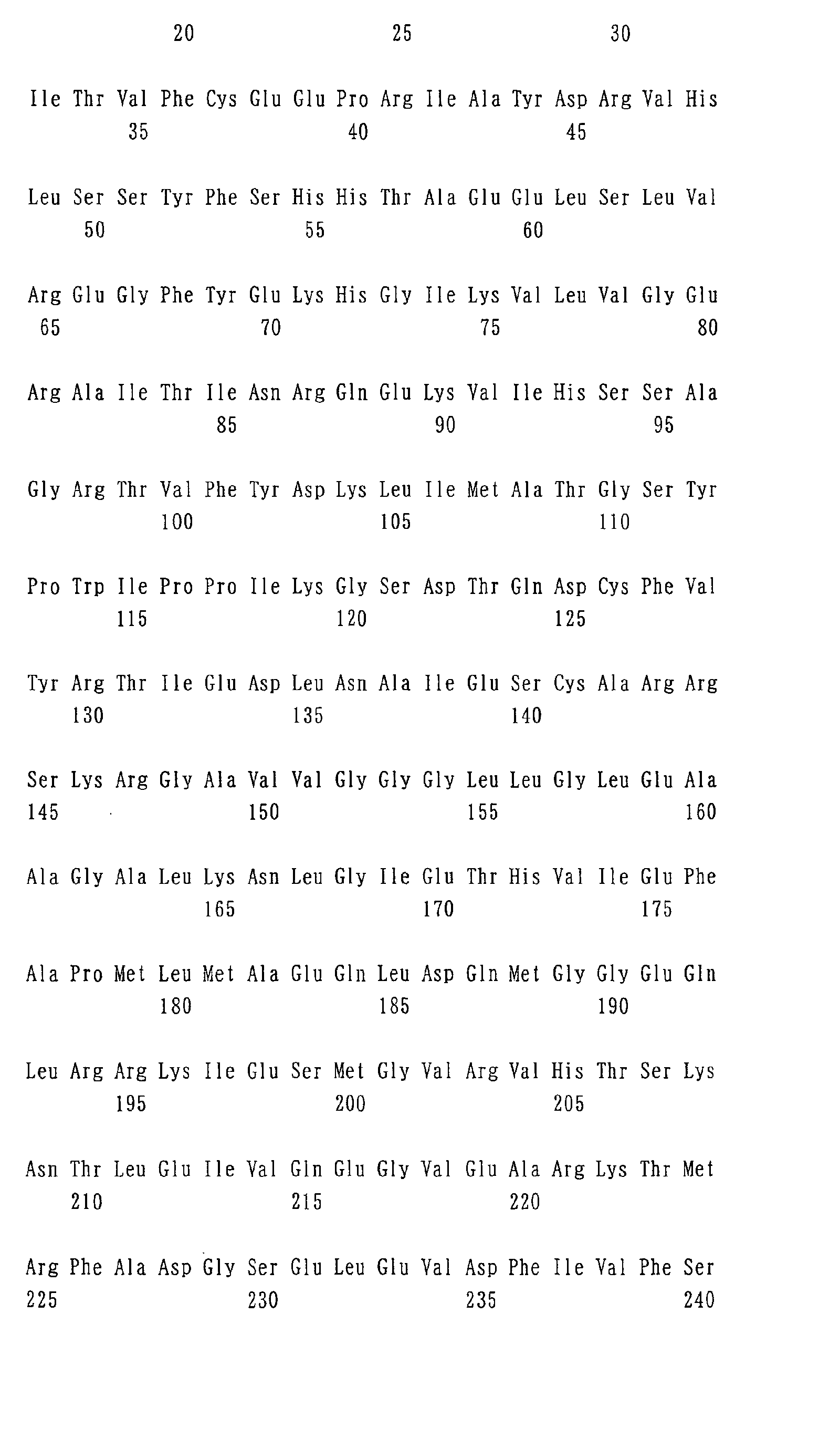
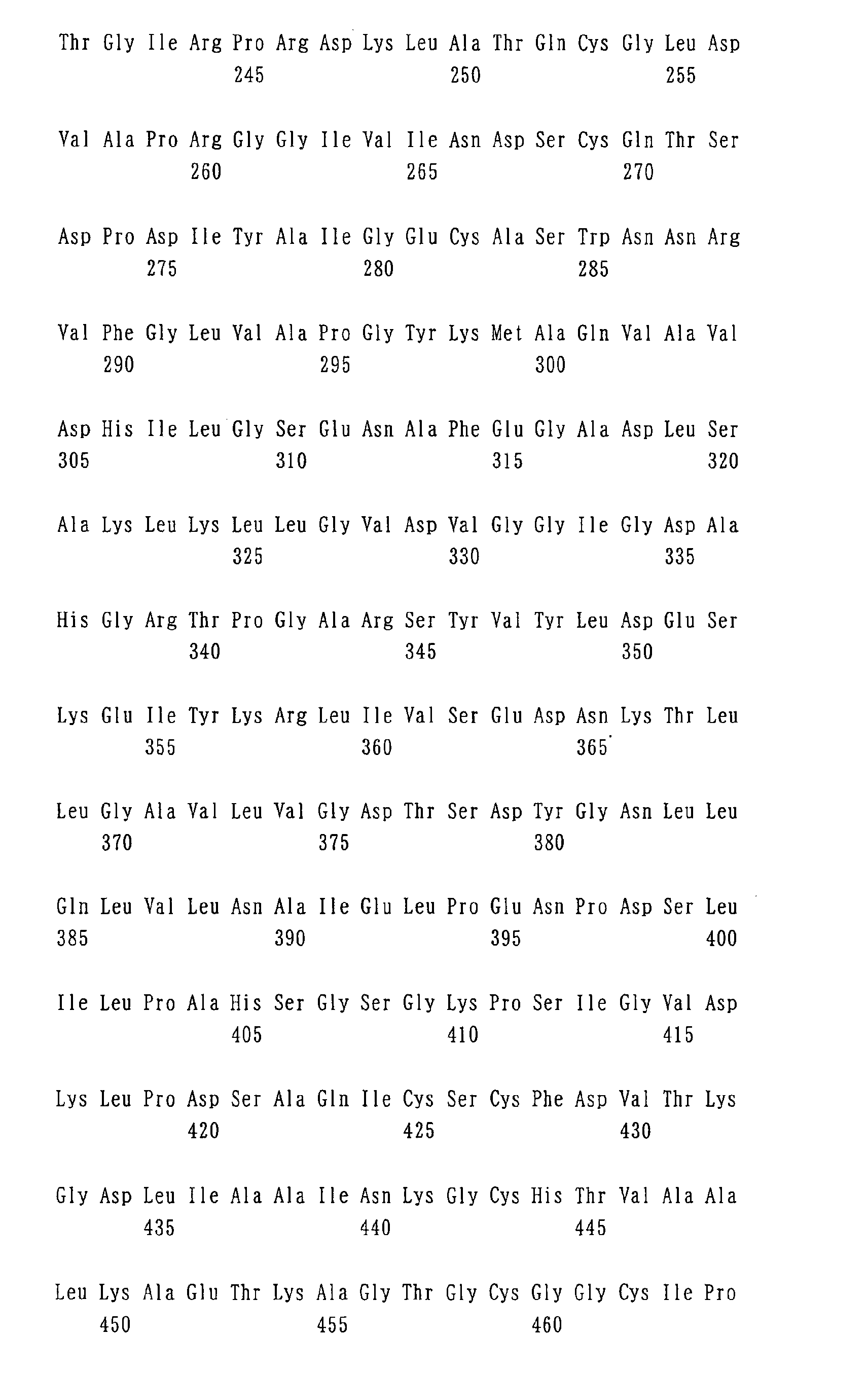
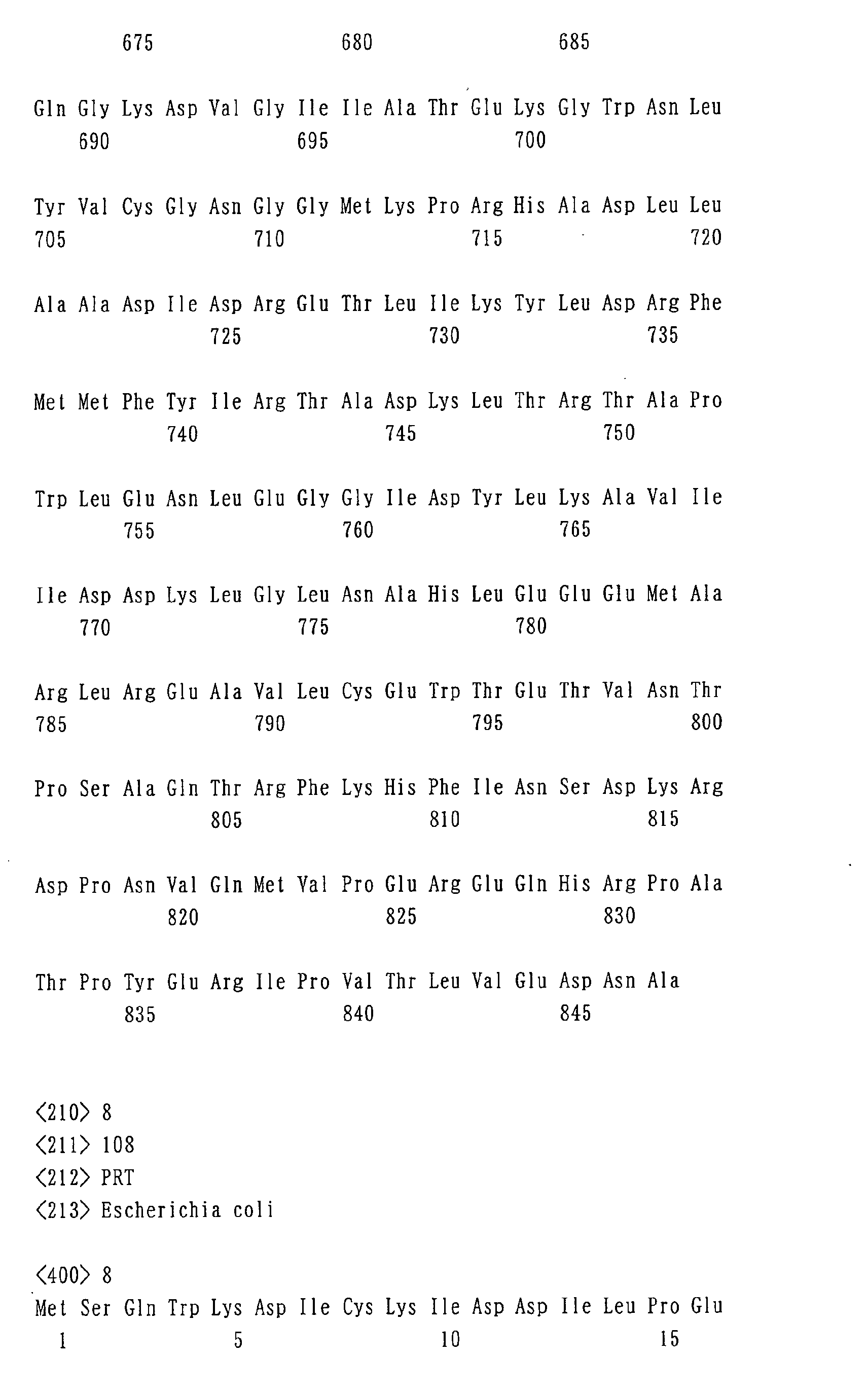
- the amino acid sequences encoded by the nirB, nirD, nirC and cysG genes are shown in SEQ ID NOS: 7, 8, 9 and 10, respectively.
- the coding regions of the nirB, nirD, nirC and cysG genes in the nucleotide sequence of SEQ ID NO: 6 are 135-2678, 2675-3001, 3379-3933 and 3952-5325, respectively.
- Inactivation of the gene can be performed by conventional methods, such as mutagenesis treatment using UV irradiation or nitrosoguanidine (N-methyl-N'-nitro-N-nitrosoguanidine) treatment, site-directed mutagenesis, gene disruption using homologous recombination or/and insertion-deletion mutagenesis (Datsenko K.A. and Wanner B.L., Proc. Natl. Acad. Sci. USA, 2000, 97:12: 6640-45) which is also called "Red-driven integration".
- the nir operon of a bacterium of Enterobacteriaceae family other than E. coli can also be inactivated by homologous recombination using the nir operon fragment from E . coli or a fragment of an inherent nir operon which may be a homologue to the E. coli nir operon.
- a nir operon homologue may have homology of not less than 70 %, preferably not less than 80 %, more preferably not less than 90%, and most preferably not less than 95% to the E. coli nir operon with respect to the nucleotide sequence of respective coding regions.
- L-arginine-producing bacteria are encompassed.
- Bacteria belonging to the genus Escherichia which produce L-arginine include, but are not limited to, E. coli strain 237 (VKPM B-7925) and it's derivative strains harboring a mutant N-acetylglutamate synthase (Russian Patent No. 2215783), and an arginine-producing strain into which the argA gene encoding N-acetylglutamate synthetase is introduced (Japanese Laid-Open Publication No. 57-5693), and the like.
- the strain 237 is a mutant resistant to a pyrimidine analog, 6-azauracil, which was derived from E.
- VKPM National Collection of Industrial Microorganisms
- the bacterium of the present invention can be obtained by inactivation of nir operon in a bacterium which inherently has the ability to produce an L- amino acid.
- the bacterium of present invention can be obtained by imparting the ability to produce an L- amino acid to a bacterium which already has an inactivated nir operon.
- Methods for preparation of plasmid DNA, digestion and ligation of DNA, transformation, selection of an oligonucleotide as a primer and the like may be ordinary methods well known to one skilled in the art. These methods are described, for instance, in Sambrook, J., Fritsch, E.F., and Maniatis, T., "Molecular Cloning A Laboratory Manual, Second Edition", Cold Spring Harbor Laboratory Press (1989).
- the method of the present invention is a method for producing an L-amino acid having the following steps: cultivating the bacterium of the present invention in a culture medium which results in production accumulation of the L-amino acid in the medium, and collecting the accumulated L-amino acid from the medium. More specifically, the method of the present invention is a method for producing L-arginine, which method includes the steps of cultivating the bacterium of the present invention in a culture medium,, and collecting the accumulated L-arginine from the medium.
- the cultivation, collection and purification of L-amino acid from the medium and the like may be performed by conventional fermentation methods typically used for production of an amino acid from a bacterium.
- a medium used for the culture may be either synthetic or natural, so long as the medium includes a carbon source and a nitrogen source and minerals and, if necessary, appropriate amounts of nutrients which the bacterium requires for growth.
- the carbon source may include various carbohydrates such as glucose and sucrose, and various organic acids. Depending on the mode of assimilation of the used microorganism, alcohol including ethanol and glycerol may be used.
- ammonium salts such as ammonia and ammonium sulfate, other nitrogen compounds such as amines, a natural nitrogen source such as peptone, soybean-hydrolysate, and digested fermentative microorganism may be used.
- potassium monophosphate magnesium sulfate, sodium chloride, ferrous sulfate, manganese sulfate, calcium chloride, and the like may be used.
- vitamins thiamine, yeast extract and the like may be used.
- the cultivation is preferably performed under aerobic conditions such as a shaking culture, and stirring culture with aeration, at a temperature of 20 to 40 °C, preferably 30 to 38 °C.
- the pH of the culture is usually between 5 and 9, preferably between 6.5 and 7.2.
- the pH of the culture can be adjusted with ammonia, calcium carbonate, various acids, various bases, and buffers. Usually, a 1 to 5-day cultivation leads to the accumulation of the target L-amino acid in the liquid medium.
- solids such as cells can be removed from the liquid medium by centrifugation or membrane filtration, and then the L-amino acid can be collected and purified by ion-exchange, concentration and/or crystallization methods.
- arginine is of L-configuration.
- Example 1 Construction the strain having an inactivated nir operon.
- nirBL SEQ ID NO: 1
- nirBR SEQ ID NO: 2
- Plasmid pACYC184 NBL Gene Sciences Ltd., UK
- GenBank/EMBL accession number X06403 was used as a template in PCR reaction.
- PCR was conducted as follows: denaturation step for 3 min at 95 °C; profile for two first cycles: 1 min at 95 °C, 30 sec at 50 °C, 40 sec at 72 °C; profile for the last 25 cycles: 30 sec at 95 °C, 30 sec at 54 °C, 40 sec at 72 °C; final step: 5 min at 72 °C.
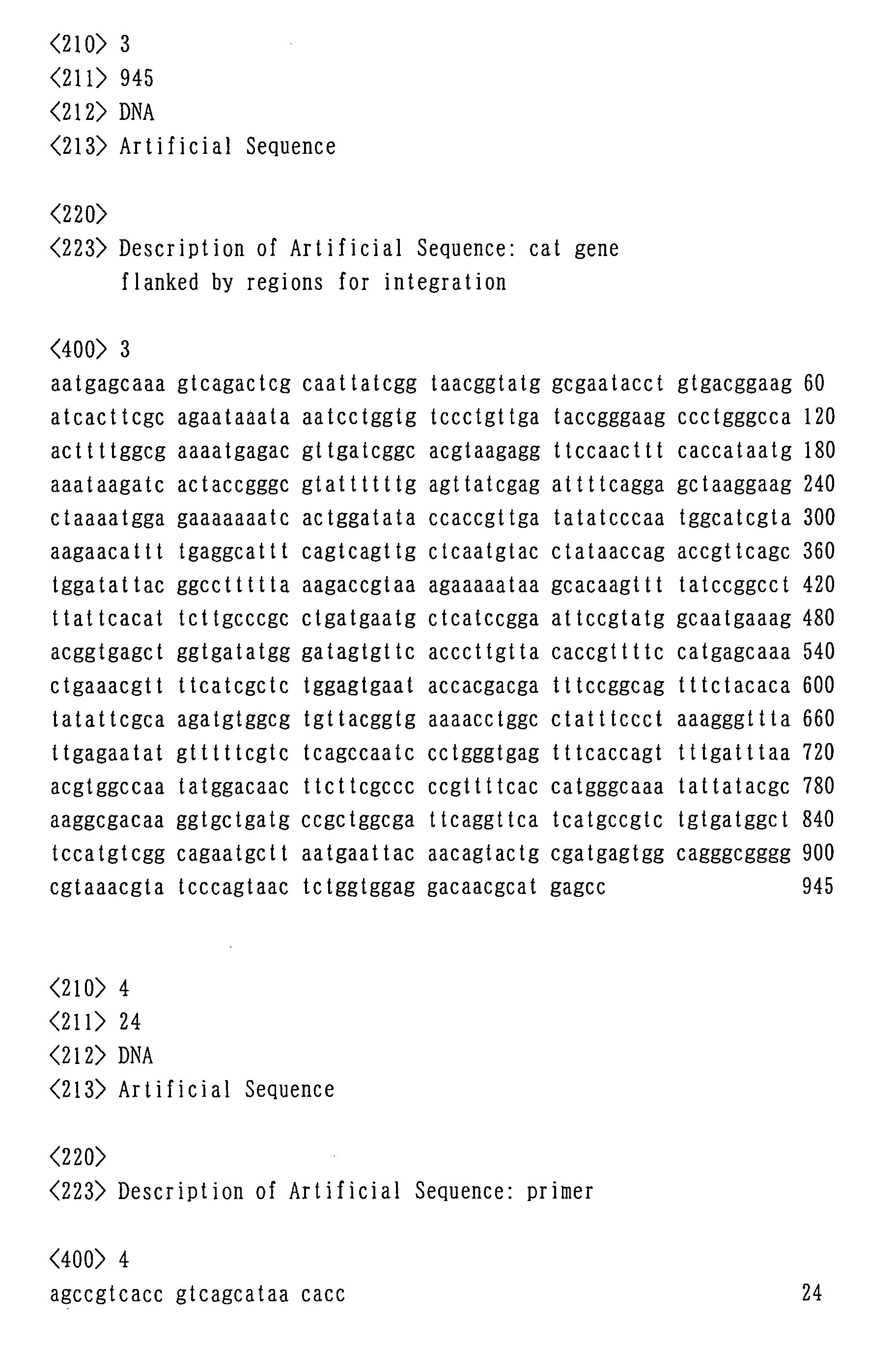
- the obtained 945 bp PCR product (Fig. 1, SEQ ID NO: 3) was purified by agarose gel electrophoresis and used for electroporation of the E . coli strain MG1655 which harbors the plasmid pKD46 with temperature sensitive replication.
- the plasmid pKD46 (Datsenko and Wanner, Proc. Natl. Acad. Sci. USA, 2000, 97:12:6640-45) includes a 2,154 nucleotide (31088-33241) DNA fragment of phage ⁇ (GenBank accession No.
- J02459 which contains the ⁇ Red homologous recombination system genes ( ⁇ , ⁇ , exo genes) under the control of the arabinose-inducible P araB promoter.
- the plasmid pKD46 is necessary for integration of the PCR product into MG1655 strain chromosome.
- Electrocompetent cells were prepared as follows: overnight culture of E . coli strain MG1655 grown at 30 °C in LB medium supplemented with ampicillin (100 mg/l) was diluted 100 times with 5 ml of SOB medium (Sambrook et al, "Molecular Cloning A Laboratory Manual, Second Edition", Cold Spring Harbor Laboratory Press (1989)) with ampicillin and L-arabinose (1 mM). The obtained culture was grown with aeration at 30 °C to an OD 600 of ⁇ 0.6 and then made electrocompetent by concentrating 100-fold and washing three times with ice-cold deionized H 2 O. Electroporation was performed using 70 ⁇ l of a cell suspension and ⁇ 100 ng of PCR product.
- PCR product obtained in the reaction with the cells of parental nirB + strain MG1655 as a template, was 949 bp in length.
- the arginine-producing strain E. coli 237 (VKPM B-7925) was transduced to Cm resistance by the standard P1 transduction procedure (Sambrook et al, "Molecular Cloning A Laboratory Manual, Second Edition", Cold Spring Harbor Laboratory Press (1989)).
- the strain MG1655 ⁇ nirB::cat was used as a donor for cat gene.
- the resulting strain 237 ⁇ nirB::cat was verified by PCR to have ⁇ nirB::cat deletion by means of primers nirB1 (SEQ ID NO: 4) and nirB2 (SEQ ID NO: 5).
- Example 2 Production of L-arginine by E. coli strain with inactivated nirB gene.
- Both E. coli strains 237 and 237 ⁇ nirB::cat were grown overnight at 37 °C on L-agar plates.
- the strain 237 ⁇ nirB::cat plate also contained chloramphenicol (20 ⁇ g/ml). Then one loop of the cells was transferred to 2 ml of minimal medium for fermentation in the 20x200 mm test tubes. Cells were grown for 72 hours at 32 °C with shaking at 250 rpm.
- the amount of arginine which accumulated in the medium was determined by paper chromatography using arginine (1 g/l and 2 g/l) and glutamic acid (1 g/l and 2 g/l) as controls.
- a solution of ninhydrin (0.5%) in acetone was used as a visualizing reagent.
- Glucose and magnesium sulfate are sterilized separately. pH is adjusted to 7.2.
Landscapes
- Chemical & Material Sciences (AREA)
- Life Sciences & Earth Sciences (AREA)
- Health & Medical Sciences (AREA)
- Engineering & Computer Science (AREA)
- Organic Chemistry (AREA)
- Genetics & Genomics (AREA)
- Wood Science & Technology (AREA)
- Zoology (AREA)
- Bioinformatics & Cheminformatics (AREA)
- Biotechnology (AREA)
- General Engineering & Computer Science (AREA)
- Microbiology (AREA)
- Biochemistry (AREA)
- General Health & Medical Sciences (AREA)
- Biomedical Technology (AREA)
- Molecular Biology (AREA)
- General Chemical & Material Sciences (AREA)
- Chemical Kinetics & Catalysis (AREA)
- Medicinal Chemistry (AREA)
- Physics & Mathematics (AREA)
- Biophysics (AREA)
- Plant Pathology (AREA)
- Preparation Of Compounds By Using Micro-Organisms (AREA)
- Micro-Organisms Or Cultivation Processes Thereof (AREA)
Abstract
Description
- cultivating the bacterium as described above in a medium, and
- collecting the accumulated L-amino acid from the medium.
| The composition of the fermentation medium (g/l): | |
| Glucose | 67.0 |
| Yeast extract | 5.0 |
| (NH4)2SO4 | 35.0 |
| KH2PO4 | 2.0 |
| MgSO4•7H2O | 2.0 |
| Thiamine (Vitamin B1 ) | 1.0 |
| CaCO3 | 25.0 |
| L-isoleucine | 0.05 |
| E. coli strain | OD555 | Arg (g/l) | Glu(g/l) |
| 237 | 21.1 | 5.6±0.5 | 4.6±0.5 |
| 237ΔnirB::cat | 19.9 | 6.8±0.6 | traces |






Claims (8)
- An L-amino acid-producing bacterium of the Enterobacteriaceae family, wherein the bacterium has been modified to inactivate the nir operon.
- The L-amino acid-producing bacterium according to claim 1, wherein said nir operon comprises nirBDC and cysG genes.
- The L-amino acid-producing bacterium according to claim 2, wherein said bacterium belongs to the genus Escherichia.
- The L-amino acid-producing bacterium according to claim 1 , wherein said L-amino acid is L-arginine.
- The L-amino acid-producing bacterium according to claim 4, wherein said bacterium has been modified to enhance expression of an L-arginine operon.
- A method for producing an L-amino acid comprising:cultivating the bacterium according to claim 1 in a medium, andcollecting the accumulated L-amino acid from the medium.
- The method according to claim 6, wherein said L-amino acid is L-arginine.
- The method according to claim 7, wherein said bacterium has been modified to enhance expression of an L-arginine operon.
Applications Claiming Priority (2)
| Application Number | Priority Date | Filing Date | Title |
|---|---|---|---|
| RU2003126289 | 2003-08-29 | ||
| RU2003126289/13A RU2276686C2 (en) | 2003-08-29 | 2003-08-29 | Bacterium belonging to genus escherichia as producer of l-arginine and method for preparing l-arginine |
Publications (1)
| Publication Number | Publication Date |
|---|---|
| EP1510582A1 true EP1510582A1 (en) | 2005-03-02 |
Family
ID=34102085
Family Applications (1)
| Application Number | Title | Priority Date | Filing Date |
|---|---|---|---|
| EP04020085A Withdrawn EP1510582A1 (en) | 2003-08-29 | 2004-08-24 | Method for producing L-amino acid using bacterium of Enterobacteriaceae family, having nir operon inactivated |
Country Status (4)
| Country | Link |
|---|---|
| US (1) | US20050069994A1 (en) |
| EP (1) | EP1510582A1 (en) |
| JP (1) | JP2005073696A (en) |
| RU (1) | RU2276686C2 (en) |
Cited By (2)
| Publication number | Priority date | Publication date | Assignee | Title |
|---|---|---|---|---|
| WO2007119881A1 (en) * | 2006-04-13 | 2007-10-25 | Ajinomoto Co., Inc. | A method for producing an l-amino acid using a bacterium of the enterobacteriaceae family with attenuated expression of the ybda gene |
| WO2007116955A3 (en) * | 2006-03-30 | 2008-01-10 | Ajinomoto Kk | Method for producing l-amino acid |
Families Citing this family (8)
| Publication number | Priority date | Publication date | Assignee | Title |
|---|---|---|---|---|
| BR0304860A (en) * | 2002-11-11 | 2004-08-31 | Ajinomoto Kk | Method for producing a target substance by use of a bacterium belonging to the genus Escherichia |
| US20050181488A1 (en) * | 2004-02-12 | 2005-08-18 | Akhverdian Valery Z. | Method for producing L-threonine using bacteria belonging to the genus Escherichia |
| JP2006063002A (en) * | 2004-08-25 | 2006-03-09 | Ajinomoto Co Inc | Methanation inhibitor and composition for feed for ruminant |
| RU2431674C2 (en) * | 2009-12-08 | 2011-10-20 | Закрытое акционерное общество "Научно-исследовательский институт "Аджиномото-Генетика" (ЗАО АГРИ) | Escherichia BACTERIA - PRODUCER OF L-ARGININE WHERE ONE OR MORE artPIQM-artJ CLUSTER GENES ARE INACTIVATED, AND METHOD OF PRODUCING L-ARGININE |
| RU2482188C2 (en) * | 2010-07-21 | 2013-05-20 | Закрытое акционерное общество "Научно-исследовательский институт "Аджиномото-Генетика" (ЗАО АГРИ) | METHOD FOR PREPARING L-ARGININE WITH USE OF BACTERIA OF GENUS Escherichia WHEREIN astCADBE OPERON IS INACTIVATED |
| JP6020443B2 (en) | 2011-04-01 | 2016-11-02 | 味の素株式会社 | Method for producing L-cysteine |
| US9234223B2 (en) | 2011-04-01 | 2016-01-12 | Ajinomoto Co., Inc. | Method for producing L-cysteine |
| WO2014089025A1 (en) * | 2012-12-04 | 2014-06-12 | Genomatica, Inc. | Increased yields of biosynthesized products |
Citations (2)
| Publication number | Priority date | Publication date | Assignee | Title |
|---|---|---|---|---|
| EP1170361A2 (en) * | 2000-06-28 | 2002-01-09 | Ajinomoto Co., Inc. | New mutant N-Acetylglutamate synthase and method for L-Arginine production |
| WO2003006666A2 (en) * | 2001-07-11 | 2003-01-23 | Degussa Ag | Process for the preparation of l-amino acids using strains of the enterobacteriaceae family |
Family Cites Families (2)
| Publication number | Priority date | Publication date | Assignee | Title |
|---|---|---|---|---|
| JPS575693A (en) * | 1980-06-13 | 1982-01-12 | Ajinomoto Co Inc | Production of l-arginine through fermentation process |
| RU2208640C2 (en) * | 2000-07-06 | 2003-07-20 | Закрытое акционерное общество "Научно-исследовательский институт Аджиномото-Генетика" | Methof for preparing l-arginine, strain escherichia coli as producer of l-arginine |
-
2003
- 2003-08-29 RU RU2003126289/13A patent/RU2276686C2/en active
-
2004
- 2004-08-20 JP JP2004240795A patent/JP2005073696A/en active Pending
- 2004-08-24 EP EP04020085A patent/EP1510582A1/en not_active Withdrawn
- 2004-08-27 US US10/927,040 patent/US20050069994A1/en not_active Abandoned
Patent Citations (2)
| Publication number | Priority date | Publication date | Assignee | Title |
|---|---|---|---|---|
| EP1170361A2 (en) * | 2000-06-28 | 2002-01-09 | Ajinomoto Co., Inc. | New mutant N-Acetylglutamate synthase and method for L-Arginine production |
| WO2003006666A2 (en) * | 2001-07-11 | 2003-01-23 | Degussa Ag | Process for the preparation of l-amino acids using strains of the enterobacteriaceae family |
Non-Patent Citations (4)
| Title |
|---|
| COLE JEFF: "Nitrate reduction to ammonia by enteric bacteria: Redundancy, or a strategy for survival during oxygen starvation?", FEMS MICROBIOLOGY LETTERS, vol. 136, no. 1, 1996, pages 1 - 11, XP002306920, ISSN: 0378-1097 * |
| JAYARAMAN P-S ET AL: "MUTATIONAL ANALYSIS OF THE NUCLEOTIDE SEQUENCE AT THE FNR-DEPENDENT NIRB PROMOTER IN ESCHERICHIA-COLI", NUCLEIC ACIDS RESEARCH, vol. 17, no. 1, 1989, pages 135 - 145, XP002306919, ISSN: 0305-1048 * |
| MACDONALD H ET AL: "ISOLATION CHARACTERIZATION AND COMPLEMENTATION ANALYSIS OF NIR-B MUTANTS OF ESCHERICHIA-COLI DEFICIENT ONLY IN NADH-DEPENDENT NITRITE REDUCTASE ACTIVITY", JOURNAL OF GENERAL MICROBIOLOGY, vol. 131, no. 10, 1985, pages 2771 - 2782, XP008039206, ISSN: 0022-1287 * |
| PEAKMAN T ET AL: "NUCLEOTIDE SEQUENCE, ORGANISATION AND STRUCTURAL ANALYSIS OF THE PRODUCTS OF GENES IN THE NIRB - CYSG REGION OF THE ESCHERICHIA COLI K-12 CHROMOSOME", EUROPEAN JOURNAL OF BIOCHEMISTRY, BERLIN, DE, vol. 191, no. 2, July 1990 (1990-07-01), pages 315 - 323, XP001030905, ISSN: 0014-2956 * |
Cited By (5)
| Publication number | Priority date | Publication date | Assignee | Title |
|---|---|---|---|---|
| WO2007116955A3 (en) * | 2006-03-30 | 2008-01-10 | Ajinomoto Kk | Method for producing l-amino acid |
| US7833762B2 (en) | 2006-03-30 | 2010-11-16 | Ajinomoto Co., Inc. | Method for producing L-amino acid |
| RU2422530C2 (en) * | 2006-03-30 | 2011-06-27 | Адзиномото Ко., Инк. | Method of producing l-amino acids |
| KR101053429B1 (en) * | 2006-03-30 | 2011-08-03 | 아지노모토 가부시키가이샤 | Production method of L-amino acid |
| WO2007119881A1 (en) * | 2006-04-13 | 2007-10-25 | Ajinomoto Co., Inc. | A method for producing an l-amino acid using a bacterium of the enterobacteriaceae family with attenuated expression of the ybda gene |
Also Published As
| Publication number | Publication date |
|---|---|
| JP2005073696A (en) | 2005-03-24 |
| RU2003126289A (en) | 2005-02-20 |
| RU2276686C2 (en) | 2006-05-20 |
| US20050069994A1 (en) | 2005-03-31 |
Similar Documents
| Publication | Publication Date | Title |
|---|---|---|
| KR101261147B1 (en) | A microorganism having enhanced l-amino acids productivity and process for producing l-amino acids using the same | |
| EP1611241B1 (en) | Method for producing l-amino acid using bacteria having enhanced expression of the gene pcka | |
| EP1526181B1 (en) | Method for producing l-amino acid using bacteria belonging to the genus escherichia | |
| US7179623B2 (en) | Method of producing amino acids using E. coli transformed with sucrose PTS genes | |
| EP1942183B1 (en) | A mutant acetolactate synthase and a method for producing branched-chain L-amino acids | |
| US7335496B2 (en) | Method for producing target substance | |
| JP2817400B2 (en) | Method of manufacturing substances | |
| KR100823044B1 (en) | Method for preparing threonine and isoleucine | |
| CN100415874C (en) | Escherichia bacterium having L-amino acid-producing ability and method for producing L-amino acid | |
| EP0136359A1 (en) | Process for preparing l-histidine | |
| EP2486123B1 (en) | A METHOD FOR PRODUCING AN L-CYSTEINE, L-CYSTINE, A DERIVATIVE OR PRECURSOR THEREOF OR A MIXTURE THEREOF USING A BACTERIUM OF Enterobacteriaceae FAMILY | |
| AU5416901A (en) | Method for producing substance utilizing microorganism | |
| US20040229320A1 (en) | Method for procucing L-amino acid using bacterium, belonging to the genus Escherichia, lacking active mlc gene | |
| EP2185683B1 (en) | Method for producing l-threonine using bacterium of enterobacteriaceae family, having attenuated expression of the yahn gene | |
| US20050069994A1 (en) | Method for producing L-amino acid using bacterium of Enterobacteriaceae family, having nir operon inactivated | |
| RU2471870C2 (en) | METHOD FOR PRODUCING L-ARGININE AND L-CITRULLINE WITH USE OF BACTERIA OF ENTEROBACTERIACEAE FAMILY WITH ATTENUATED pepA GENE EXPRESSION | |
| CA1306963C (en) | Process for producing l-threonine and l-isoleucine | |
| US7163810B2 (en) | Method for producing target substance | |
| US7220572B2 (en) | Method for producing L-leucine | |
| US8211688B2 (en) | Process for producing L-glutamine using Escherichia coli with deficient glnB and glnE function | |
| US20060057685A1 (en) | Method for producing abnormal amino acids using a bacterium of the Enterobacteriaceae family having all acetohydroxy acid synthases inactivated | |
| RU2458982C2 (en) | Method of producing l-cysteine, l-cystine, s-sulphocysteine or l-cysteine thiazolidine derivative, or mixture thereof using bacteria of enterobacteriaceae family | |
| HK1098786A (en) | Process for producing substances |
Legal Events
| Date | Code | Title | Description |
|---|---|---|---|
| PUAI | Public reference made under article 153(3) epc to a published international application that has entered the european phase |
Free format text: ORIGINAL CODE: 0009012 |
|
| AK | Designated contracting states |
Kind code of ref document: A1 Designated state(s): AT BE BG CH CY CZ DE DK EE ES FI FR GB GR HU IE IT LI LU MC NL PL PT RO SE SI SK TR |
|
| AX | Request for extension of the european patent |
Extension state: AL HR LT LV MK |
|
| 17P | Request for examination filed |
Effective date: 20050830 |
|
| AKX | Designation fees paid |
Designated state(s): DE FR GB |
|
| 17Q | First examination report despatched |
Effective date: 20060516 |
|
| GRAP | Despatch of communication of intention to grant a patent |
Free format text: ORIGINAL CODE: EPIDOSNIGR1 |
|
| RIC1 | Information provided on ipc code assigned before grant |
Ipc: C12P 13/10 20060101ALI20071023BHEP Ipc: C12N 15/52 20060101AFI20071023BHEP |
|
| STAA | Information on the status of an ep patent application or granted ep patent |
Free format text: STATUS: THE APPLICATION IS DEEMED TO BE WITHDRAWN |
|
| 18D | Application deemed to be withdrawn |
Effective date: 20080327 |