EP1509060A1 - Erasure decoding optimization of acknowledgement/negative acknowledgement information in a wireless communication system - Google Patents
Erasure decoding optimization of acknowledgement/negative acknowledgement information in a wireless communication system Download PDFInfo
- Publication number
- EP1509060A1 EP1509060A1 EP04254624A EP04254624A EP1509060A1 EP 1509060 A1 EP1509060 A1 EP 1509060A1 EP 04254624 A EP04254624 A EP 04254624A EP 04254624 A EP04254624 A EP 04254624A EP 1509060 A1 EP1509060 A1 EP 1509060A1
- Authority
- EP
- European Patent Office
- Prior art keywords
- nack
- ack
- feedback information
- erasure
- acknowledgement
- Prior art date
- Legal status (The legal status is an assumption and is not a legal conclusion. Google has not performed a legal analysis and makes no representation as to the accuracy of the status listed.)
- Granted
Links
- 238000004891 communication Methods 0.000 title claims description 3
- 238000005457 optimization Methods 0.000 title description 3
- 238000000034 method Methods 0.000 claims abstract description 14
- 101100465000 Mus musculus Prag1 gene Proteins 0.000 claims description 34
- 238000001514 detection method Methods 0.000 claims description 26
- 230000004044 response Effects 0.000 claims description 5
- 230000005540 biological transmission Effects 0.000 description 17
- 230000007704 transition Effects 0.000 description 5
- 238000012360 testing method Methods 0.000 description 3
- 230000007246 mechanism Effects 0.000 description 2
- 230000003068 static effect Effects 0.000 description 2
- 238000013461 design Methods 0.000 description 1
- 230000004069 differentiation Effects 0.000 description 1
- 238000005562 fading Methods 0.000 description 1
- 239000011159 matrix material Substances 0.000 description 1
- 238000012986 modification Methods 0.000 description 1
- 230000004048 modification Effects 0.000 description 1
Images


Classifications
-
- H—ELECTRICITY
- H04—ELECTRIC COMMUNICATION TECHNIQUE
- H04L—TRANSMISSION OF DIGITAL INFORMATION, e.g. TELEGRAPHIC COMMUNICATION
- H04L1/00—Arrangements for detecting or preventing errors in the information received
- H04L1/12—Arrangements for detecting or preventing errors in the information received by using return channel
- H04L1/16—Arrangements for detecting or preventing errors in the information received by using return channel in which the return channel carries supervisory signals, e.g. repetition request signals
- H04L1/18—Automatic repetition systems, e.g. Van Duuren systems
-
- H—ELECTRICITY
- H04—ELECTRIC COMMUNICATION TECHNIQUE
- H04L—TRANSMISSION OF DIGITAL INFORMATION, e.g. TELEGRAPHIC COMMUNICATION
- H04L1/00—Arrangements for detecting or preventing errors in the information received
- H04L1/12—Arrangements for detecting or preventing errors in the information received by using return channel
- H04L1/16—Arrangements for detecting or preventing errors in the information received by using return channel in which the return channel carries supervisory signals, e.g. repetition request signals
- H04L1/18—Automatic repetition systems, e.g. Van Duuren systems
- H04L1/1867—Arrangements specially adapted for the transmitter end
-
- H—ELECTRICITY
- H04—ELECTRIC COMMUNICATION TECHNIQUE
- H04L—TRANSMISSION OF DIGITAL INFORMATION, e.g. TELEGRAPHIC COMMUNICATION
- H04L1/00—Arrangements for detecting or preventing errors in the information received
- H04L1/12—Arrangements for detecting or preventing errors in the information received by using return channel
- H04L1/16—Arrangements for detecting or preventing errors in the information received by using return channel in which the return channel carries supervisory signals, e.g. repetition request signals
-
- H—ELECTRICITY
- H04—ELECTRIC COMMUNICATION TECHNIQUE
- H04L—TRANSMISSION OF DIGITAL INFORMATION, e.g. TELEGRAPHIC COMMUNICATION
- H04L12/00—Data switching networks
- H04L12/02—Details
-
- H—ELECTRICITY
- H04—ELECTRIC COMMUNICATION TECHNIQUE
- H04L—TRANSMISSION OF DIGITAL INFORMATION, e.g. TELEGRAPHIC COMMUNICATION
- H04L1/00—Arrangements for detecting or preventing errors in the information received
- H04L1/12—Arrangements for detecting or preventing errors in the information received by using return channel
- H04L1/16—Arrangements for detecting or preventing errors in the information received by using return channel in which the return channel carries supervisory signals, e.g. repetition request signals
- H04L1/18—Automatic repetition systems, e.g. Van Duuren systems
- H04L1/1812—Hybrid protocols; Hybrid automatic repeat request [HARQ]
-
- H—ELECTRICITY
- H04—ELECTRIC COMMUNICATION TECHNIQUE
- H04L—TRANSMISSION OF DIGITAL INFORMATION, e.g. TELEGRAPHIC COMMUNICATION
- H04L1/00—Arrangements for detecting or preventing errors in the information received
- H04L1/12—Arrangements for detecting or preventing errors in the information received by using return channel
- H04L2001/125—Arrangements for preventing errors in the return channel
Definitions
- the Ack/Nack (acknowledgment/negative acknowledgement) fields in the R-ACKCH (reverse link acknowledgement channel) in CDMA2001x EV-DV or UL HS-DPCCH (up link high speed - dedicated physical control channel) in UMTS are error controlled independently by repetition block code.
- the R-ACKCH contains 1-bit Ack/Nack per 1.25 ms PCG (power control group) with symbol repetition of 24 times.
- the acknowledgement bit is repetition coded to 10 bits and transmits in one slot. An Ack sent in response to a received transmission indicates the transmission was properly received. A Nack in response to a transmission indicates the transmission was not properly received.
- the transmitter In response to an Ack, the transmitter transmits the next data for transmission. In response to a Nack, however, the transmitter retransmits the Nacked transmission or other redundancy version depending on the HARQ protocol type.
- the Ack/Nack fields in EV-DV and HSDPA are both DTX (i.e., transmitter power set at zero) when no Ack/Nack data is transmitted. Since the R-ACKCH and HS-PDCCH field are not error free, it is important to evaluate the reliability of each received Ack/Nack information.
- a three-state decoding mechanism is included in the rake receiver design of channel elements to support EV-DV and HSDPA (high speed data packet access) for UMTS.
- the three state decoding mechanism adds a new state of erasure to erase any unreliable feedback information.
- the unreliable feedback information is caused by information corruption through unreliable radio channel or no Ack/Nack being sent because of the missed detection of the DL (down link) high speed data.
- two thresholds are set to define whether feedback information qualifies as an Ack, a Nack, or an erasure. When the power level of the received feedback information falls below the first threshold, the feedback information is judged to be an Ack.
- the feedback information When the feedback information is greater than a second threshold, which is greater than the first threshold, the feedback information is judged to be a Nack. And, when the power of the feedback information falls between the first and second thresholds, inclusive, the feedback information undergoes erasure. Erasure results in considering the erased feedback information as a Nack.
- the merit of the three-state decoding strategy is to erase any unreliable feedback information to minimize throughput damaging errors. For example, when a Nack is decoded as an Ack, the receiver losses data, and must make a separate request for retransmission. And, if an Ack is considered a Nack, then needless retransmission of data takes place. Both of these errors will impact the system throughput.
- the three-state decoding strategy is to erase any unreliable feedback information rather than to pass it to the HARQ protocol. This particularly helps mitigate against the more damaging throughput error of considering a Nack as an Ack.
- the erasure of the feedback information has the setback of loosing the desired feedback information, and the consequence of the Ack/Nack erasure is the re-transmission of the downlink high-speed data information at the HARQ.
- the present invention provides a method of erasure decoding of acknowledgement (ACK)/negative acknowledgement (NACK) feedback information.
- the erasure decoding thresholds which are used to detect Ack, Nack or erasure, have been optimized for throughput performance.
- at least one threshold is derived based on the affect on data throughput for at least one possible type of error in detecting a state of the received ACK/NACK feedback information. For example, one possible type of error is missed detection of a NACK.
- the affect is represented as a cost of an average number of total bits to be retransmitted if a NACK is missed in detection.
- the at least one threshold is derived based on the affect on data throughput if the state of the received ACK/NACK feedback information is correctly detected.
- Figure 1 illustrates the three state binary erasure channel transition trellis
- Figure 2 illustrates he testing hypothesis of the received signal detection through AWGN (a white Gaussian noise) channel N(0, ⁇ 2), which has a zero mean and variance ⁇ 2; and
- AWGN white Gaussian noise
- Figure 3 illustrates the results the optimized threshold for the 3-state Ack/Nack erasure decoding using numerical analysis according to the present invention.
- a Universal Mobile Telecommunications System typically includes a radio access network, referred to as a UMTS terrestrial radio access network (UTRAN).
- the UTRAN may interface with a variety of separate core networks (CN).
- the core networks in turn may communicate with other external networks (ISDN/PSDN, etc.) to pass information to and from a plurality of wireless users, or user equipments (UEs), that are served by radio network controllers (RNCs) and base transceiver stations (BTSs, also referred to as Node Bs), within the UTRAN, for example.
- RNCs radio network controllers
- BTSs base transceiver stations
- base transceiver station and Node-B are synonymous and may describe equipment that provides data connectivity between a packet switched data network (PSDN) such as the Internet, and one or more mobile stations.
- PSDN packet switched data network
- UE user equipment
- subscriber mobile
- mobile station and remote station are synonymous and describe a remote user of wireless resources in a wireless communication network.
- H-ARQ requires the Ack/Nack feedbacks from a UE to determine the necessity of retransmission (H-ARQ has normal error control operation to compensate the frame error caused by fading channel if the Ack/Nack feedbacks are error free).
- the average data throughput (D) of the H-ARQ function at any specific frame per user considered by the Node B is as follows, where N Total is the number of information bits for the given packet in a H-ARQ operation, K is the total number of transmissions for a successful H-ARQ operation, P Nack,j is the probability of a negative acknowledgement (Nack) for a j-th transmission decoded by the BTS for retransmission, P Ack,K is the probability of an acknowledgement (Ack) decoded by the BTS and consideration of a successful HARQ operation at the k-th transmisssion, and P Erasure,j is the probability of an erasure of a j-th transmission decided by the BTS when the received Ack/Nack field is considered unreliable.
- a retransmission could be caused by reception of a negative acknowledgement or feedback information erasure.
- the frame error detected by the UE would be the same as that transmitted from the BTS if no error is detected in the Ack/Nack report.
- the illustration of the three state binary erasure channel transition trellis is shown in Figure 1.
- P fe,j is the probability of the DL PDCH/HS-PDSCH (down link packet data channel/high speed -packet data shared channel) frame error at j-th transmission
- P m,j is the probability of the missed detection of the DL PDCCH/HS-SCCH (down link packet data control channel/high speed shared control channel).
- the HARQ protocol at the mobile generates the negative acknowledgement, acknowledgement, and nothing (null) based on the CRC check results of received DL PDCH/HS-PDSCH or no reception with probabilities P fe,j , 1-P fe,j -P m,j and P m,j , respectively, at a j-th transmission of a specific packet.
- P e1 , P e2 , and P e3 are defined as the transition probabilities from the transmitted information at the mobile ( s ) to the received information at the BTS ( r ) in the following, P erasure1 , P erasure2 , and P erasure3 are the transition probabilities of the erasure at the receiver when the mobile sends the acknowledgement, negative acknowledgement, or nothing, respectively.
- P Nack,j,, P Ack,j, and P erasure,j are the probabilities of negative acknowledgement, acknowledgement, and erasure decoding output at the BTS receiver for the j-th transmission, respectively.
- the definition of throughput for a HARQ operation in equation (1) does not capture the penalty of the missed detection of a negative acknowledgment.
- the purpose of erasure decoding is to minimize the probability of this missed detection and to minimize the detection error caused by the probability of no Ack/Nack being sent. If the probability of the erasure is high, based on the set thresholds, the probability of error in the Ack/Nack field is small. Since an erased Ack/Nack bit has the result of retransmission, the high erasure probability also has a high cost in terms of throughput. Thus, this cost needs to be incorporated in the data throughput analysis.
- C f is the throughput cost of falsely detecting a Nack as an Ack
- (-C c ) is the throughput cost of correctly detecting an Ack
- N f is the number of bits of the missed detected packet
- the first term of the risk function is the cost of the average number of total bits to be retransmitted when the negative acknowledgement is missed in detection.
- the 2 nd term of the risk function is the added value (negative risk) of the data throughput when an acknowledgement is correctly detected in the feedback information.
- the Risk function in equation (6) is defined as the difference between the cost of the missed detection of a negative acknowledgement to trigger retransmission and the negative cost of the average data throughput. Substituting equation (1) into the risk function results in the following:
- the detection of the Ack/Nack field may be modeled as the detection of the received signals through a radio channel.
- AWGN white Gaussian noise
- the probability of erasure in the decoding of the feedback information is determined by the thresholds for detecting Ack and Nack.
- a and - B are the mean soft output of the accumulated Negative acknowledgement and Acknowledgement symbols, respectively.
- x and -y are the thresholds for detecting Ack/Nack or determining erasure.
- the decoding has three hypotheses in the testing hypothesis as follows,
- transition probabilities of error receptions ( P e1 , P e2 , and P e3 ) and erasure receptions P erasure1 , P erasure2 , and P erasure3 in AWGN are as follows,
- Equations (8), (9), (10), (11), (12), and (13) are then substituted into equations (3), (4), and (5) to get the probabilities of acknowledgement P Ack,j, , negative acknowledgement P Nack,j , and erasure P erasure,j of a j-th transmission through an AWGN channel.
- the risk function R for the signals through the AWGN channel may then be obtained by plugging the results of P Nack,j,, P Ack,j , and P erasure,j into equation (7).
- the risk function R of signal detection through the AWGN channel becomes a function of the two erasure thresholds x and y . Under the further assumption that the second threshold x equals the first threshold y, the risk function may be expressed as shown in equation (15) below.
- the risk function R is a function of the erasure threshold y only.
- the optimization of the risk function R may obtained by differentiating the risk function with respect to the threshold y alone.
- equation (16) There is no close form solution for y in equation (16). Accordingly, a numerical method is carried out for determining y. Namely, the results of equation (16) for a range of possible y values at a desired resolution are generated, and the y value that produces the result closest to zero is selected as the y value. The x threshold value is then set equal to the selected y value.
- the optimized value of y is also a function of the variables K , P m,j , and P fe .
- the number of transmissions K in a HARQ depends on the power setting of the DL scheduled transmission and the radio channel condition at the time.
- the probabilities of the frame error rate P fe for DL high speed data and missed detection of DL indication channel P m,j for the j-th transmission are considered constant in the static channel modelling. Accordingly, the system designer may utilize the method of the present invention as a tool for adapting the erasure thresholds for a given system, or even a particular service area of a system.
Landscapes
- Engineering & Computer Science (AREA)
- Computer Networks & Wireless Communication (AREA)
- Signal Processing (AREA)
- Detection And Prevention Of Errors In Transmission (AREA)
- Mobile Radio Communication Systems (AREA)
Abstract
Description
- The Ack/Nack (acknowledgment/negative acknowledgement) fields in the R-ACKCH (reverse link acknowledgement channel) in CDMA2001x EV-DV or UL HS-DPCCH (up link high speed - dedicated physical control channel) in UMTS are error controlled independently by repetition block code. In CDMA20001x EV-DV, the R-ACKCH contains 1-bit Ack/Nack per 1.25 ms PCG (power control group) with symbol repetition of 24 times. In UMTS, the acknowledgement bit is repetition coded to 10 bits and transmits in one slot. An Ack sent in response to a received transmission indicates the transmission was properly received. A Nack in response to a transmission indicates the transmission was not properly received. In response to an Ack, the transmitter transmits the next data for transmission. In response to a Nack, however, the transmitter retransmits the Nacked transmission or other redundancy version depending on the HARQ protocol type. The Ack/Nack fields in EV-DV and HSDPA are both DTX (i.e., transmitter power set at zero) when no Ack/Nack data is transmitted. Since the R-ACKCH and HS-PDCCH field are not error free, it is important to evaluate the reliability of each received Ack/Nack information.
- To improve reliability, a three-state decoding mechanism is included in the rake receiver design of channel elements to support EV-DV and HSDPA (high speed data packet access) for UMTS. The three state decoding mechanism adds a new state of erasure to erase any unreliable feedback information. The unreliable feedback information is caused by information corruption through unreliable radio channel or no Ack/Nack being sent because of the missed detection of the DL (down link) high speed data. Currently, two thresholds are set to define whether feedback information qualifies as an Ack, a Nack, or an erasure. When the power level of the received feedback information falls below the first threshold, the feedback information is judged to be an Ack. When the feedback information is greater than a second threshold, which is greater than the first threshold, the feedback information is judged to be a Nack. And, when the power of the feedback information falls between the first and second thresholds, inclusive, the feedback information undergoes erasure. Erasure results in considering the erased feedback information as a Nack.
- The merit of the three-state decoding strategy is to erase any unreliable feedback information to minimize throughput damaging errors. For example, when a Nack is decoded as an Ack, the receiver losses data, and must make a separate request for retransmission. And, if an Ack is considered a Nack, then needless retransmission of data takes place. Both of these errors will impact the system throughput. The three-state decoding strategy is to erase any unreliable feedback information rather than to pass it to the HARQ protocol. This particularly helps mitigate against the more damaging throughput error of considering a Nack as an Ack. However, the erasure of the feedback information has the setback of loosing the desired feedback information, and the consequence of the Ack/Nack erasure is the re-transmission of the downlink high-speed data information at the HARQ. Thus, it is important to determine how to properly erase the feedback information. As will be appreciated, this involves properly determining the thresholds for the Ack/Nack.
- The present invention provides a method of erasure decoding of acknowledgement (ACK)/negative acknowledgement (NACK) feedback information.
- In one exemplary embodiment of the method, the erasure decoding thresholds, which are used to detect Ack, Nack or erasure, have been optimized for throughput performance. In an exemplary embodiment, at least one threshold is derived based on the affect on data throughput for at least one possible type of error in detecting a state of the received ACK/NACK feedback information. For example, one possible type of error is missed detection of a NACK. In this example, the affect is represented as a cost of an average number of total bits to be retransmitted if a NACK is missed in detection. In another exemplary embodiment, the at least one threshold is derived based on the affect on data throughput if the state of the received ACK/NACK feedback information is correctly detected.
- The present invention will become more fully understood from the detailed description given herein below and the accompanying drawings, wherein like elements are represented by like reference numerals, which are given by way of illustration only and thus are not limiting of the present invention and wherein:
- Figure 1 illustrates the three state binary erasure channel transition trellis;
- Figure 2 illustrates he testing hypothesis of the received signal detection through AWGN (a white Gaussian noise) channel N(0,σ2), which has a zero mean and variance σ2; and
- Figure 3 illustrates the results the optimized threshold for the 3-state Ack/Nack erasure decoding using numerical analysis according to the present invention.
- A Universal Mobile Telecommunications System (UMTS) typically includes a radio access network, referred to as a UMTS terrestrial radio access network (UTRAN). The UTRAN may interface with a variety of separate core networks (CN). The core networks in turn may communicate with other external networks (ISDN/PSDN, etc.) to pass information to and from a plurality of wireless users, or user equipments (UEs), that are served by radio network controllers (RNCs) and base transceiver stations (BTSs, also referred to as Node Bs), within the UTRAN, for example.
- Although the following description of the present invention is based on the UMTS network, it should be noted that the exemplary embodiments shown and described herein are meant to be illustrative only and not limiting in any way. For example, the present invention is equally applicable to CDMA2001x EV-DV. As such, various modifications will be apparent to those skilled in the art.
- Where used below, base transceiver station (BTS) and Node-B are synonymous and may describe equipment that provides data connectivity between a packet switched data network (PSDN) such as the Internet, and one or more mobile stations. Additionally where used below, the terms user, user equipment (UE), subscriber, mobile, mobile station and remote station are synonymous and describe a remote user of wireless resources in a wireless communication network.
- As discussed in the Background, H-ARQ requires the Ack/Nack feedbacks from a UE to determine the necessity of retransmission (H-ARQ has normal error control operation to compensate the frame error caused by fading channel if the Ack/Nack feedbacks are error free). The average data throughput (D) of the H-ARQ function at any specific frame per user considered by the Node B is as follows,where NTotal is the number of information bits for the given packet in a H-ARQ operation, K is the total number of transmissions for a successful H-ARQ operation, PNack,j is the probability of a negative acknowledgement (Nack) for a j-th transmission decoded by the BTS for retransmission, PAck,K is the probability of an acknowledgement (Ack) decoded by the BTS and consideration of a successful HARQ operation at the k-th transmisssion, and PErasure,j is the probability of an erasure of a j-th transmission decided by the BTS when the received Ack/Nack field is considered unreliable. Accordingly, a retransmission could be caused by reception of a negative acknowledgement or feedback information erasure. The frame error detected by the UE would be the same as that transmitted from the BTS if no error is detected in the Ack/Nack report. The illustration of the three state binary erasure channel transition trellis is shown in Figure 1.

- In Figure 1, Pfe,j is the probability of the DL PDCH/HS-PDSCH (down link packet data channel/high speed -packet data shared channel) frame error at j-th transmission, and Pm,j is the probability of the missed detection of the DL PDCCH/HS-SCCH (down link packet data control channel/high speed shared control channel). The HARQ protocol at the mobile generates the negative acknowledgement, acknowledgement, and nothing (null) based on the CRC check results of received DL PDCH/HS-PDSCH or no reception with probabilities Pfe,j , 1-Pfe,j-Pm,j and Pm,j , respectively, at a j-th transmission of a specific packet. Pe1 , Pe2 , and Pe3 are defined as the transition probabilities from the transmitted information at the mobile (s) to the received information at the BTS (r) in the following,Perasure1 , Perasure2 , and Perasure3 are the transition probabilities of the erasure at the receiver when the mobile sends the acknowledgement, negative acknowledgement, or nothing, respectively. PNack,j,, PAck,j, and Perasure,j are the probabilities of negative acknowledgement, acknowledgement, and erasure decoding output at the BTS receiver for the j-th transmission, respectively. The probabilities of the negative acknowledgement, acknowledgement, and erasure at the BTS may be formulated as the following:

- The definition of throughput for a HARQ operation in equation (1) does not capture the penalty of the missed detection of a negative acknowledgment. As discussed in the Background, the purpose of erasure decoding is to minimize the probability of this missed detection and to minimize the detection error caused by the probability of no Ack/Nack being sent. If the probability of the erasure is high, based on the set thresholds, the probability of error in the Ack/Nack field is small. Since an erased Ack/Nack bit has the result of retransmission, the high erasure probability also has a high cost in terms of throughput. Thus, this cost needs to be incorporated in the data throughput analysis. To accomplish this, an objective function, referred to herein as a risk function, of a HARQ operation that accounts for the affects of missed detection of a negative acknowledgement is provided as follows,
- where Cf is the throughput cost of falsely detecting a Nack as an Ack, (-Cc) is the throughput cost of correctly detecting an Ack, Nf is the number of bits of the missed detected packet, and Pmissed=detection is the probability of the missed detection, which equals Pfe,K times Pe2. The first term of the risk function is the cost of the average number of total bits to be retransmitted when the negative acknowledgement is missed in detection. The 2nd term of the risk function is the added value (negative risk) of the data throughput when an acknowledgement is correctly detected in the feedback information. The Risk function in equation (6) is defined as the difference between the cost of the missed detection of a negative acknowledgement to trigger retransmission and the negative cost of the average data throughput. Substituting equation (1) into the risk function results in the following:

- The detection of the Ack/Nack field may be modeled as the detection of the received signals through a radio channel. The testing hypothesis of the received signal detection through AWGN (a white Gaussian noise) channel N(0,σ2), which has a zero mean and variance σ2 , is shown in Figure 2.
- The probability of erasure in the decoding of the feedback information is determined by the thresholds for detecting Ack and Nack. In Figure 2, A and -B are the mean soft output of the accumulated Negative acknowledgement and Acknowledgement symbols, respectively. Also in Figure 2, x and -y are the thresholds for detecting Ack/Nack or determining erasure. The decoding has three hypotheses in the testing hypothesis as follows,
- H0 : Positive acknowledgement (bit "1" with signal power amplitude "-B") is sent
- H1 : Negative acknowledgement (bit "0" with signal power amplitude "A") is sent
- H2 : No acknowledgement is sent.
-
- The transition probabilities of error receptions (Pe1 , Pe2 , and Pe3 ) and erasure receptions Perasure1 , Perasure2 , and Perasure3 in AWGN are as follows,


- The erasure decoding risk function R could be optimized by partial differentiation of the risk function R with respect to the two erasure thresholds x and y as shown in equation (14) below.
- Equations (8), (9), (10), (11), (12), and (13) are then substituted into equations (3), (4), and (5) to get the probabilities of acknowledgement PAck,j, , negative acknowledgement PNack,j , and erasure Perasure,j of a j-th transmission through an AWGN channel. The risk function R for the signals through the AWGN channel may then be obtained by plugging the results of PNack,j,, PAck,j , and Perasure,j into equation (7). The risk function R of signal detection through the AWGN channel becomes a function of the two erasure thresholds x and y. Under the further assumption that the second threshold x equals the first threshold y, the risk function may be expressed as shown in equation (15) below.

- From equation (15) it can be seen that the risk function R is a function of the erasure threshold y only. Thus, the optimization of the risk function R may obtained by differentiating the risk function with respect to the threshold y alone. The results of this optimization are shown in the following,where
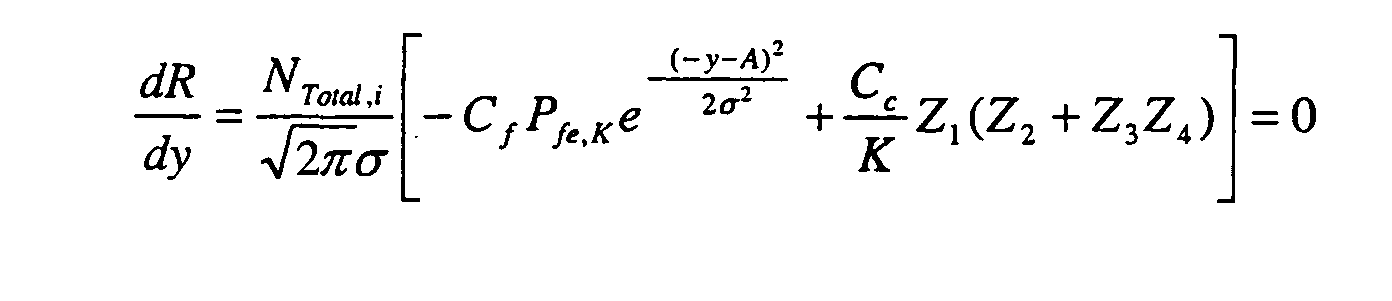


- There is no close form solution for y in equation (16). Accordingly, a numerical method is carried out for determining y. Namely, the results of equation (16) for a range of possible y values at a desired resolution are generated, and the y value that produces the result closest to zero is selected as the y value. The x threshold value is then set equal to the selected y value.
- As will be appreciated, the optimized value of y is also a function of the variables K, Pm,j , and Pfe . The number of transmissions K in a HARQ depends on the power setting of the DL scheduled transmission and the radio channel condition at the time. The probabilities of the frame error rate Pfe for DL high speed data and missed detection of DL indication channel Pm,j for the j-th transmission are considered constant in the static channel modelling. Accordingly, the system designer may utilize the method of the present invention as a tool for adapting the erasure thresholds for a given system, or even a particular service area of a system.
- The following is a demonstration, through numerical analysis, of the optimized threshold for the 3-state Ack/Nack erasure decoding. The static parameters in the number analysis are as follows,
- Pm = 0.01
- Pf,1 =0.05 and Pf,2 =0.005
- Absolute Acknowledgement power = Absoulte Negatiue acknowledgement power (B=A).
- Average Transmission per H-ARQ (K) = 2
- The results of the numerical analysis are shown in Figure 3 for three curves with Cf = 2 Cc, Cf = 4 Cc, and Cf = 6 Cc. The results in Figure 3 show that higher block SNR (signal-to-noise ratio) has lower erasure thresholds when the cost of missed detection Cf is relatively higher than the cost of the correct throughput Cc.
Claims (9)
- A method of erasure decoding of acknowledgement (ACK)/negative acknowledgement (NACK) feedback information, comprising:detecting a state of received ACK/NACK feedback information for associated sent data using at least one threshold derived based on an affect on data throughput for at least one possible type of error in detecting a state of the received ACK/NACK feedback information.
- The method of claim 1, wherein the possible type of error is missed detection of a NACK.
- The method of claim 2, wherein the affect on data throughput is expressed in terms of a cost of an average number of total bits to be retransmitted if a NACK is missed in detection.
- The method of claim 1, wherein the threshold is further derived based on an affect on data throughput if the state of the received ACK/NACK feedback information is correctly detected.
- The method of claim 4, wherein the affect on data throughput if the state of the received ACK/NACK feedback information is correctly detected is expressed as a negative cost of the data throughput if the state of the received ACK/NACK feedback information is correctly detected.
- A method of erasure decoding of acknowledgement (ACK)/negative acknowledgement (NACK) feedback information, comprising:optimizing erasure thresholds for erasure decoding Ack/Nack feedback information based on HARQ throughput performance accounting for throughput cost of retransmissions from at least one higher layer protocol caused by missed detection of a Nack.
- A method of wireless communication comprising:employing an objective function in determining at least one of an ACK, NACK and erasure, the objective function accounting for at least an affect on data throughput in response to at least one error type.
- The method of claim 7, wherein the error type is missed detection of a NACK.
- The method of claim 7, wherein the objective function further accounts for an affect on data throughput if the state of the received ACK/NACK feedback information is correctly detected.
Applications Claiming Priority (2)
| Application Number | Priority Date | Filing Date | Title |
|---|---|---|---|
| US644864 | 2003-08-21 | ||
| US10/644,864 US7331008B2 (en) | 2003-08-21 | 2003-08-21 | Erasure decoding optimization of acknowledgment/negative acknowledgment information in a wireless communication system |
Publications (2)
| Publication Number | Publication Date |
|---|---|
| EP1509060A1 true EP1509060A1 (en) | 2005-02-23 |
| EP1509060B1 EP1509060B1 (en) | 2009-12-02 |
Family
ID=34063485
Family Applications (1)
| Application Number | Title | Priority Date | Filing Date |
|---|---|---|---|
| EP04254624A Expired - Lifetime EP1509060B1 (en) | 2003-08-21 | 2004-07-31 | Erasure decoding optimization of acknowledgement/negative acknowledgement information in a wireless communication system |
Country Status (5)
| Country | Link |
|---|---|
| US (1) | US7331008B2 (en) |
| EP (1) | EP1509060B1 (en) |
| JP (1) | JP4607519B2 (en) |
| KR (1) | KR101123470B1 (en) |
| DE (1) | DE602004024356D1 (en) |
Cited By (4)
| Publication number | Priority date | Publication date | Assignee | Title |
|---|---|---|---|---|
| EP1922704A4 (en) * | 2005-08-18 | 2011-08-03 | Interdigital Tech Corp | Wireless communication method and apparatus for detecting and decoding enhanced dedicated channel hybrid automatic repeat request indicator channel transmissions |
| CN101039171B (en) * | 2007-03-15 | 2011-08-24 | 中兴通讯股份有限公司 | Method for demodulating ACK slot signal of HS-DPCCH channel |
| EP2680508A4 (en) * | 2011-06-21 | 2014-04-02 | Huawei Tech Co Ltd | Error recovery method, access point equipment, site equipment and system thereof |
| CN103916881A (en) * | 2013-01-04 | 2014-07-09 | 中国移动通信集团公司 | Method and device for adjusting packet detection threshold |
Families Citing this family (17)
| Publication number | Priority date | Publication date | Assignee | Title |
|---|---|---|---|---|
| US7290196B1 (en) * | 2003-03-21 | 2007-10-30 | Cypress Semiconductor Corporation | Cyclical redundancy check using nullifiers |
| US7356749B2 (en) * | 2004-02-02 | 2008-04-08 | Lucent Technologies Inc. | Method and apparatus for detecting a three-state signal in a base station in a wireless communications system |
| US7453821B2 (en) * | 2004-05-26 | 2008-11-18 | Lucent Technologies Inc. | Methods of detecting signaling information in a wireless communication system |
| US7693099B2 (en) * | 2004-05-26 | 2010-04-06 | Alcatel-Lucent Usa Inc. | Methods of wireless communication |
| EP1624610B1 (en) | 2004-08-06 | 2006-12-27 | Matsushita Electric Industrial Co., Ltd. | Feedback control for multicast or broadcast services |
| US7398452B2 (en) * | 2004-12-16 | 2008-07-08 | Broadcom Corporation | Method and system for determining a signal quality metric in event of a CRC false positive |
| CN101208894B (en) * | 2005-05-23 | 2011-09-07 | 艾利森电话股份有限公司 | Automatic Repeat Request (ARQ) Protocol with Multiple Complementary Feedback Mechanisms |
| US8042018B2 (en) * | 2006-08-18 | 2011-10-18 | Samsung Electronics Co., Ltd | Method and apparatus for transmitting/receiving ACK/NACK in a frequency division multiple access system |
| EP1936853B1 (en) * | 2006-12-20 | 2018-11-21 | Panasonic Intellectual Property Corporation of America | Avoidance of feedback collision in mobile communications |
| ATE536674T1 (en) * | 2008-02-08 | 2011-12-15 | Ericsson Telefon Ab L M | METHOD AND ARRANGEMENT IN A TELECOMMUNICATIONS SYSTEM |
| KR101615231B1 (en) * | 2008-03-17 | 2016-04-25 | 엘지전자 주식회사 | A method for transmitting group ack/nack in communication system |
| US8250425B2 (en) * | 2008-08-15 | 2012-08-21 | Apple Inc. | Management of ARQ detection threshold in communication networks |
| KR101729134B1 (en) * | 2009-03-27 | 2017-04-25 | 삼성전자주식회사 | Apparatus and method for arq feedback polling in wireless communication system |
| KR101690552B1 (en) * | 2009-12-30 | 2016-12-29 | 삼성전자주식회사 | Apparatus and method for generating mac protocol data unit in wireless communication system |
| US9628411B2 (en) * | 2014-02-21 | 2017-04-18 | Dialogic Corporation | Efficient packet processing at video receiver in multimedia communications over packet networks |
| CN107483282B (en) * | 2016-06-07 | 2021-05-07 | 大唐联仪科技有限公司 | Terminal throughput testing method and terminal testing instrument |
| WO2020243125A1 (en) * | 2019-05-27 | 2020-12-03 | Massachusetts Institute Of Technology | Adaptive causal network coding with feedback |
Citations (3)
| Publication number | Priority date | Publication date | Assignee | Title |
|---|---|---|---|---|
| US20030043764A1 (en) * | 2001-08-23 | 2003-03-06 | Samsung Electronics Co., Ltd. | Method for allocating HARQ channel number for indicating state information in an HSDPA communication system |
| WO2003043218A1 (en) * | 2001-11-16 | 2003-05-22 | Koninklijke Philips Electronics N.V. | Radio communication system |
| EP1326361A1 (en) * | 2002-01-05 | 2003-07-09 | Lg Electronics Inc. | Signal design to transmit binary information of unequal importance |
Family Cites Families (11)
| Publication number | Priority date | Publication date | Assignee | Title |
|---|---|---|---|---|
| US43764A (en) * | 1864-08-09 | Improvement in tuyeres for blast-furnaces | ||
| DE3326839A1 (en) * | 1983-07-26 | 1985-02-14 | Bunawerke Hüls GmbH, 4370 Marl | CATALYST SYSTEM AND ITS USE FOR PRODUCING EPDM RUBBER |
| US6496481B1 (en) * | 1998-07-16 | 2002-12-17 | Industrial Technology Research Institute | Data transfer method for wire real-time communications |
| FI106493B (en) * | 1999-02-09 | 2001-02-15 | Nokia Mobile Phones Ltd | Procedure and arrangement for reliable transmission of packet-shaped data |
| US6640325B1 (en) * | 1999-06-04 | 2003-10-28 | Advanced Micro Devices, Inc. | Immediate negative acknowledgement for a communication network |
| KR100607934B1 (en) * | 1999-08-27 | 2006-08-03 | 삼성전자주식회사 | Error control method of link layer in broadband wireless communication and recording medium therefor |
| US7248841B2 (en) * | 2000-06-13 | 2007-07-24 | Agee Brian G | Method and apparatus for optimization of wireless multipoint electromagnetic communication networks |
| US6999432B2 (en) * | 2000-07-13 | 2006-02-14 | Microsoft Corporation | Channel and quality of service adaptation for multimedia over wireless networks |
| US6977888B1 (en) * | 2000-09-14 | 2005-12-20 | Telefonaktiebolaget L M Ericsson (Publ) | Hybrid ARQ for packet data transmission |
| US7684329B2 (en) * | 2002-05-06 | 2010-03-23 | Qualcomm Incorporated | Method and apparatus for augmenting physical layer ARQ in a wireless data communication system |
| US7352722B2 (en) * | 2002-05-13 | 2008-04-01 | Qualcomm Incorporated | Mitigation of link imbalance in a wireless communication system |
-
2003
- 2003-08-21 US US10/644,864 patent/US7331008B2/en not_active Expired - Fee Related
-
2004
- 2004-07-31 EP EP04254624A patent/EP1509060B1/en not_active Expired - Lifetime
- 2004-07-31 DE DE602004024356T patent/DE602004024356D1/en not_active Expired - Lifetime
- 2004-08-19 KR KR1020040065284A patent/KR101123470B1/en not_active Expired - Fee Related
- 2004-08-20 JP JP2004240194A patent/JP4607519B2/en not_active Expired - Fee Related
Patent Citations (3)
| Publication number | Priority date | Publication date | Assignee | Title |
|---|---|---|---|---|
| US20030043764A1 (en) * | 2001-08-23 | 2003-03-06 | Samsung Electronics Co., Ltd. | Method for allocating HARQ channel number for indicating state information in an HSDPA communication system |
| WO2003043218A1 (en) * | 2001-11-16 | 2003-05-22 | Koninklijke Philips Electronics N.V. | Radio communication system |
| EP1326361A1 (en) * | 2002-01-05 | 2003-07-09 | Lg Electronics Inc. | Signal design to transmit binary information of unequal importance |
Cited By (6)
| Publication number | Priority date | Publication date | Assignee | Title |
|---|---|---|---|---|
| EP1922704A4 (en) * | 2005-08-18 | 2011-08-03 | Interdigital Tech Corp | Wireless communication method and apparatus for detecting and decoding enhanced dedicated channel hybrid automatic repeat request indicator channel transmissions |
| US8286052B2 (en) | 2005-08-18 | 2012-10-09 | Interdigital Technology Corporation | Wireless communication method and apparatus for detecting and decoding enhanced dedicated channel hybrid automatic repeat request indicator channel transmissions |
| CN101039171B (en) * | 2007-03-15 | 2011-08-24 | 中兴通讯股份有限公司 | Method for demodulating ACK slot signal of HS-DPCCH channel |
| EP2680508A4 (en) * | 2011-06-21 | 2014-04-02 | Huawei Tech Co Ltd | Error recovery method, access point equipment, site equipment and system thereof |
| CN103916881A (en) * | 2013-01-04 | 2014-07-09 | 中国移动通信集团公司 | Method and device for adjusting packet detection threshold |
| CN103916881B (en) * | 2013-01-04 | 2018-03-23 | 中国移动通信集团公司 | A kind of method and apparatus for adjusting parcel detection threshold |
Also Published As
| Publication number | Publication date |
|---|---|
| JP4607519B2 (en) | 2011-01-05 |
| JP2005073254A (en) | 2005-03-17 |
| EP1509060B1 (en) | 2009-12-02 |
| KR101123470B1 (en) | 2012-03-26 |
| DE602004024356D1 (en) | 2010-01-14 |
| US7331008B2 (en) | 2008-02-12 |
| US20050042985A1 (en) | 2005-02-24 |
| KR20050021234A (en) | 2005-03-07 |
Similar Documents
| Publication | Publication Date | Title |
|---|---|---|
| EP1509060B1 (en) | Erasure decoding optimization of acknowledgement/negative acknowledgement information in a wireless communication system | |
| EP1540864B1 (en) | Method and apparatus for indicating hsdpa activity information | |
| EP2274859B1 (en) | Pre-emptive acknowledgement for data transmission in a communication system | |
| US7948932B2 (en) | Radio communication apparatus, and mobile station | |
| RU2327296C2 (en) | Method and device for signalling acknowledgment of receipt | |
| US7124343B2 (en) | Radio communication system | |
| KR100978014B1 (en) | Wireless communication system | |
| US20020080719A1 (en) | Scheduling transmission of data over a transmission channel based on signal quality of a receive channel | |
| WO2004091114A1 (en) | Power control and automatic repeat request (arq) in a radio communications system | |
| EP1928117B1 (en) | Method and apparatus for radio communication using HARQ | |
| US20090150738A1 (en) | Data communication apparatus, data receiving apparatus, data transmitting apparatus, and retransmission control method | |
| JP4432645B2 (en) | Communication device, wireless communication system | |
| KR101086807B1 (en) | Capacity increase method of forward link MAC channel in wireless communication system | |
| US20050063344A1 (en) | Methods and apparatus for efficient decoding | |
| US20080074999A1 (en) | Mobile Communication System, Wireless Line Control Station, Mobile Station, And Wireless Base Station | |
| US8121555B2 (en) | Transmission power control in HSPDA | |
| KR20060014572A (en) | Method for transmitting uplink control information in mobile communication system and method for determining reception of control information at receiving side |
Legal Events
| Date | Code | Title | Description |
|---|---|---|---|
| PUAI | Public reference made under article 153(3) epc to a published international application that has entered the european phase |
Free format text: ORIGINAL CODE: 0009012 |
|
| 17P | Request for examination filed |
Effective date: 20040813 |
|
| AK | Designated contracting states |
Kind code of ref document: A1 Designated state(s): AT BE BG CH CY CZ DE DK EE ES FI FR GB GR HU IE IT LI LU MC NL PL PT RO SE SI SK TR |
|
| AX | Request for extension of the european patent |
Extension state: AL HR LT LV MK |
|
| 17Q | First examination report despatched |
Effective date: 20050411 |
|
| AKX | Designation fees paid |
Designated state(s): DE FR GB |
|
| GRAP | Despatch of communication of intention to grant a patent |
Free format text: ORIGINAL CODE: EPIDOSNIGR1 |
|
| RAP3 | Party data changed (applicant data changed or rights of an application transferred) |
Owner name: LUCENT TECHNOLOGIES INC. |
|
| GRAS | Grant fee paid |
Free format text: ORIGINAL CODE: EPIDOSNIGR3 |
|
| GRAA | (expected) grant |
Free format text: ORIGINAL CODE: 0009210 |
|
| RIC1 | Information provided on ipc code assigned before grant |
Ipc: H04L 1/18 20060101ALI20091022BHEP Ipc: H04W 28/04 20090101AFI20091022BHEP |
|
| AK | Designated contracting states |
Kind code of ref document: B1 Designated state(s): DE FR GB |
|
| REG | Reference to a national code |
Ref country code: GB Ref legal event code: FG4D |
|
| REF | Corresponds to: |
Ref document number: 602004024356 Country of ref document: DE Date of ref document: 20100114 Kind code of ref document: P |
|
| PLBE | No opposition filed within time limit |
Free format text: ORIGINAL CODE: 0009261 |
|
| STAA | Information on the status of an ep patent application or granted ep patent |
Free format text: STATUS: NO OPPOSITION FILED WITHIN TIME LIMIT |
|
| 26N | No opposition filed |
Effective date: 20100903 |
|
| REG | Reference to a national code |
Ref country code: GB Ref legal event code: 732E Free format text: REGISTERED BETWEEN 20131121 AND 20131127 |
|
| REG | Reference to a national code |
Ref country code: FR Ref legal event code: CD Owner name: ALCATEL-LUCENT USA INC. Effective date: 20131122 |
|
| REG | Reference to a national code |
Ref country code: FR Ref legal event code: GC Effective date: 20140410 |
|
| REG | Reference to a national code |
Ref country code: FR Ref legal event code: RG Effective date: 20141015 |
|
| REG | Reference to a national code |
Ref country code: FR Ref legal event code: PLFP Year of fee payment: 12 |
|
| REG | Reference to a national code |
Ref country code: FR Ref legal event code: PLFP Year of fee payment: 13 |
|
| REG | Reference to a national code |
Ref country code: FR Ref legal event code: PLFP Year of fee payment: 14 |
|
| REG | Reference to a national code |
Ref country code: DE Ref legal event code: R082 Ref document number: 602004024356 Country of ref document: DE Representative=s name: METACOM LEGAL RECHTSANWAELTE, DE Ref country code: DE Ref legal event code: R082 Ref document number: 602004024356 Country of ref document: DE Representative=s name: METACOM LEGAL, DE Ref country code: DE Ref legal event code: R082 Ref document number: 602004024356 Country of ref document: DE Representative=s name: BARKHOFF REIMANN VOSSIUS, DE Ref country code: DE Ref legal event code: R081 Ref document number: 602004024356 Country of ref document: DE Owner name: WSOU INVESTMENTS, LLC, LOS ANGELES, US Free format text: FORMER OWNER: LUCENT TECHNOLOGIES INC., MURRAY HILL, N.J., US |
|
| REG | Reference to a national code |
Ref country code: DE Ref legal event code: R082 Ref document number: 602004024356 Country of ref document: DE Representative=s name: METACOM LEGAL RECHTSANWAELTE, DE Ref country code: DE Ref legal event code: R082 Ref document number: 602004024356 Country of ref document: DE Representative=s name: METACOM LEGAL, DE |
|
| P01 | Opt-out of the competence of the unified patent court (upc) registered |
Effective date: 20230606 |
|
| PGFP | Annual fee paid to national office [announced via postgrant information from national office to epo] |
Ref country code: GB Payment date: 20231227 Year of fee payment: 20 |
|
| PGFP | Annual fee paid to national office [announced via postgrant information from national office to epo] |
Ref country code: FR Payment date: 20231227 Year of fee payment: 20 |
|
| PGFP | Annual fee paid to national office [announced via postgrant information from national office to epo] |
Ref country code: DE Payment date: 20231229 Year of fee payment: 20 |
|
| REG | Reference to a national code |
Ref country code: DE Ref legal event code: R071 Ref document number: 602004024356 Country of ref document: DE |
|
| REG | Reference to a national code |
Ref country code: GB Ref legal event code: PE20 Expiry date: 20240730 |
|
| PG25 | Lapsed in a contracting state [announced via postgrant information from national office to epo] |
Ref country code: GB Free format text: LAPSE BECAUSE OF EXPIRATION OF PROTECTION Effective date: 20240730 |
|
| PG25 | Lapsed in a contracting state [announced via postgrant information from national office to epo] |
Ref country code: GB Free format text: LAPSE BECAUSE OF EXPIRATION OF PROTECTION Effective date: 20240730 |