EP1509009A2 - Equal-cost source-resolved routing system and method - Google Patents
Equal-cost source-resolved routing system and method Download PDFInfo
- Publication number
- EP1509009A2 EP1509009A2 EP04018514A EP04018514A EP1509009A2 EP 1509009 A2 EP1509009 A2 EP 1509009A2 EP 04018514 A EP04018514 A EP 04018514A EP 04018514 A EP04018514 A EP 04018514A EP 1509009 A2 EP1509009 A2 EP 1509009A2
- Authority
- EP
- European Patent Office
- Prior art keywords
- node
- port
- flow
- inbound
- outbound
- Prior art date
- Legal status (The legal status is an assumption and is not a legal conclusion. Google has not performed a legal analysis and makes no representation as to the accuracy of the status listed.)
- Granted
Links
- 238000000034 method Methods 0.000 title claims abstract description 13
- 238000010187 selection method Methods 0.000 claims description 15
- 230000004044 response Effects 0.000 claims 3
- 238000012544 monitoring process Methods 0.000 claims 1
- 230000003190 augmentative effect Effects 0.000 abstract description 2
- 241001522296 Erithacus rubecula Species 0.000 description 4
- 238000010586 diagram Methods 0.000 description 4
- 239000004744 fabric Substances 0.000 description 3
- 230000000717 retained effect Effects 0.000 description 2
- 238000007796 conventional method Methods 0.000 description 1
- 230000000694 effects Effects 0.000 description 1
- 239000000284 extract Substances 0.000 description 1
- 230000006870 function Effects 0.000 description 1
- 230000000737 periodic effect Effects 0.000 description 1
Images


Classifications
-
- H—ELECTRICITY
- H04—ELECTRIC COMMUNICATION TECHNIQUE
- H04L—TRANSMISSION OF DIGITAL INFORMATION, e.g. TELEGRAPHIC COMMUNICATION
- H04L45/00—Routing or path finding of packets in data switching networks
Definitions
- the invention generally relates to a port selection technique used in a network switching environment where there are multiple equal-cost paths between two nodes.
- the invention relates to a method and system for selecting an outbound port among a plurality of ports associated with minimal equal-cost paths using network layer source learning.
- IP Internet Protocol
- packets are frequently transmitted through many intermediate routers between a source node and a destination node.
- the next-hop in the path to the destination node is determined.
- the next-hop is commonly selected from a plurality of potential next-hop routers based upon the routing tables compiled at the node.
- the next-hop selected is associated with the "shortest path" to the destination node.
- the shortest path is generally the least costly path measured as a function of one or more metrics. Routers exchange these cost metrics using link-state advertisements that are flooded through the network. Upon receipt of a link-state advertisement, the recipient router retains a copy in its link-state database and then propagates the update to other routers.
- OSPF Open Shortest-Path First
- the routers After the link-state database of each router is completed, the routers generate a Shortest Path Tree to all destinations nodes using Dijkstra's algorithm. The destinations nodes, the associated cost, and the next-hop to reach those destinations form the routing table.
- the cost may be based on bandwidth, the expense of a leased line, or administrator assignment, for example.
- the bandwidth of an interface represents the overhead required to send packets across an interface, and the associated bandwidth cost is inversely proportional to the bandwidth of that interface.
- the cost of a path between the source and destination nodes is then the sum of the costs associated for all the interfaces traversed between the source and destination nodes.
- a router will generally transmit the packet toward the destination node using the interface associated with the minimal cost path. In some cases, however, multiple paths may have the same minimal path cost. While each of the associated interfaces may be used to transmit a packet to the destination with minimal cost, the router generally assigns a single interface from which to transmit all outbound packets of a flow to assure the packet order is preserved. A router may employ a round-robin scheme to assign each new outbound flow to one of the plurality of minimal equal-cost paths.
- the interface assigned to an outbound flow need not be the same as the interface of the corresponding inbound flow received.
- conflicts can occur if the outbound interface assigned is different than the interface on which inbound traffic from the same flow is received. There is therefore a need to reconcile inconsistencies between the inbound interface on which traffic is learned and the outbound interface to which outbound traffic is assigned while still providing the port assignment scheme flexibility needed to perform load balancing, for example.
- the equal-cost source-resolved (ECSR) port selection method for transmitting an outbound flow from a first node to a second node comprises the steps of identifying a plurality of ports associated with minimal equal-cost paths from the first node to the second node, and if an inbound flow from the second node is detected on a first port of the plurality of ports of the first node, then transmitting the outbound flow from the first port.
- the minimal equal-cost paths are generally derived from route information exchanged between the first node and one or more other routing devices.
- the first node may also learn of other nodes in the network through source learning operations in which the network addresses of inbound flows are associated with the port on which they are received. In the absence of an inbound flow from the second node, the first node generally selects the port for the outbound flow from the plurality of ports associated with the minimal equal-cost paths using round robin, for example.
- the present invention therefore allows a switching device to take advantage of the path determination made at another router in the network while avoiding inconsistencies between conventional route selection operations and source learning in switching devices adapted to perform bridging on network addresses instead of physical addresses.
- the present invention refers to a equal-cost-source-resolved (ECSR) port selection method for transmitting an outbound flow from a first node to a second node in a distributed network comprising one or more routing devices, the method comprising the steps of:
- the method may further include, after the inbound flow from the second node is detected, the step of retaining a network address associated with the inbound flow at a forwarding database maintained by the first node.
- the forwarding database can comprise entries relating one or more network addresses to an associated inbound port of the plurality of ports.
- the inbound flow from the second node can be detected using a network address source learning.
- the source learning can associate a source IP address retrieved from one or more inbound protocol data units (PDUs) with the port on which the one or more inbound PDUs is received.
- PDUs protocol data units
- the described method can further include the step of, if an inbound flow from the second node is not detected on the plurality of ports, transmitting the outbound flow from a port selected from the plurality of ports associated with the minimal equal-cost paths.
- the selected port can be chosen using round robin.
- the port on which the outbound flow is transmitted is reassigned from the selected port to the first port after the inbound flow from the second node is detected.
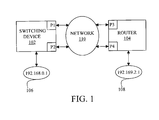
- FIG. 1 Illustrated in FIG. 1 is a functional block diagram of a network including an equal-cost source-resolved (ECSR) switching device 102, according to the preferred embodiment of the present invention.
- the switching device 102 is operably coupled to an end station 106 having the IP address 192.168.0.1 as well as a router 104 via the network 110.
- the switching device 102 is operably coupled to the network 110 by means of a plurality of interfaces including port P1 and port P2, preferably Ethernet ports.
- the router 104 comprises a plurality of interfaces including ports P3 and port P4, and is operatively coupled to a second edge device 108 having the IP address 192.169.2.1.
- the switching device 102 and router 104 are two of a plurality nodes and other addressable entities operatively coupled to network 110, which may further include one or more local area network (LANs), wide area network (WANs), or metropolitan area network (MANs), or combinations thereof, for example.
- network 110 may further include one or more local area network (LANs), wide area network (WANs), or metropolitan area network (MANs), or combinations thereof, for example.
- LANs local area network
- WANs wide area network
- MANs metropolitan area network
- the switching device 102 has the option of assigning the first port P1 or second port P2 to be the designated outbound port for purposes of transmitting traffic from the first end station 106 to the second end station 108.
- each new outbound flow detected at the switching device 102 is assigned a particular outbound interface through which each of the PDUs of the flow are transmitted. Using the same outbound interface for each PDU minimizes the probability of PDUs of a flow arriving at the destination out of sequence.
- FIG. 2 Illustrated in FIG. 2 is a functional block diagram of a switching device for performing the ECSR port selection method, in accordance with the preferred embodiment.
- the switching device 102 of the preferred embodiment comprises a plurality of network interface modules (NIMs) 202-204, one or more routing engines 230, a queue manager 240, and a management module 220.
- NIMs 202-204 comprises one or more external ports, i.e., interfaces, operably coupled to a communications link (not shown) for purposes of receiving and transmitting inbound and outbound data traffic, respectively.
- the interfaces may be physically organized in one or more slots or switch modules that are detachably attached to a common back plane with switch fabric (not shown).
- the duplex traffic flows 250 representing inbound and outbound flows comprising one or more protocol data units (PDUs) are then conveyed between the routing engine 230 and the plurality of NIMs 202-204 via one or more internal data buses 206.
- PDUs protocol data units
- the management module 220 generally comprises a policy manager 222 for retaining and implementing traffic policies uploaded to a configuration manager 224 by a network administrator using simple network management protocol (SNMP) messages 226, for example.
- the policy rules preferably comprise: (a) routing information, (b) quality of service (QoS) rules, (c) class of service (CoS) rules, or combinations thereof.
- QoS quality of service
- CoS class of service
- One or more local copies of the policy rules are preferably retained in high speed look-up cache 212 where they are available in real-time to the routing engine 230 operating at wire speeds.
- the routing engine 230 of the preferred embodiment is generally capable of, but not limited to, performing layer 2 switching operations and layer 3 routing operations using layer 2 through 7 information, as defined in the Open Systems Interconnect (OSI) reference model.
- the routing engine 230 preferably comprises a parsing engine 232, a forwarding database 234, and forwarding processor 238.
- the parsing engine 232 decapsulates the incoming PDUs of the ingress data stream, extracts one or more bits from one or more header(s), and outputs source and destination address information used to make forwarding decisions and identify traffic flows.
- the data link layer destination address e.g., the destination media access control (MAC) address
- the source IP address, and the source MAC address in some embodiments, is used by the source learning module 214 to update and refresh the address table as needed to associate each addresses detected with the port on which it may be reached. Frames directed to an end station attached to the switching device 102 are transparently switched to the outbound port learned in the address table. If the destination address of the inbound PDU indicates a destination node outside the immediate network domain of the switching device 102, the switching device attempts to route the PDU toward the network including the destination.
- the IP destination address is used as a key into a routing table in the forwarding database 234 where it is compared against known network addresses in accordance with route lookup activity. If the IP destination address matches an entry in the routing table, the associated MAC address of an adjacent device to which the packet is to be forwarded, i.e., the next-hop address or the destination swap entry, and the associated output interface are retrieved and conveyed to the forwarding processor 238.
- the routing information in the forwarding database 234 may further include IP addresses compiled by a routing manager 216 that exchanges routing information and periodic updates with other routers to determine the network topology and route metrics. Where there are two or more potential paths through the network 110 to a destination node, the routing manager 216 selects a best path having the least cost metric. The output port for the selected path is incorporated into the routing table of the forwarding database 234 along with the associated MAC address.
- the routing manager 216 and forwarding database 234 are embodied in a Media Switch IXE2424 10/100+Gigabit L2/3/4 Advanced Device manufactured by INTEL@ of Santa Clara, California.
- the next-hop address or destination swap entry retained in the routing table of the forwarding database 234 must be the same as the address table also of the forwarding database 234.
- Inconsistencies between the IP address and MAC address entry in the routing table and one or more IP addresses and MAC addresses acquired by the source learning module 214 may introduce performance irregularities. Such an inconsistency may arise where the assigned outbound port for a flow of a given conversation is different than the port on which the conversation is received, which is possible where the remote host device is reachable through a plurality of minimal equal-cost paths.
- the routing manager 216 of the preferred embodiment is adapted to override the outbound port assignment in the routing table when traffic is received from the same network address but on a different minimal equal-cost path.
- the routing manager 216 assigns or reassigns the outbound flow associated with a particular IP address to the same port on which the corresponding inbound flow is received.
- the MAC address of the destination device or gateway associated with the IP address is generally learned using an address resolution protocol (ARP), although it may also be learned in some implementations from the inbound flow, for example.
- ARP address resolution protocol
- the forwarding processor 238 encapsulates the packet with a data link layer header before transmitting the frame to the queue manager 240.
- the new frame is then enqueued in the ingress queue memory 242, conveyed to the proper outbound port of the egress switching device via the switch fabric (not shown) via the fabric interface module 208, and transmitted toward the destination node.
- the outbound port is preferably the same port on which inbound traffic from the same domain is received, if applicable.
- FIG. 3 Illustrated in FIG. 3 is a flow chart of the equal-cost source-resolved (ECSR) port selection method according to the preferred embodiment of the present invention.
- the routing engine 230 periodically identifies a new outbound traffic flow (step 302).
- a new outbound flow is a flow for which there is no existing next-hop entry in the routing table of forwarding database 234.
- a traffic flow as used herein refers to a set of one or PDUs satisfying a common policy, the policy defined by one or more criteria that may include the destination address and higher layer protocol information, for example.
- the routing manager 216 determines (step 304) whether the set of outbound interfaces, through which the destination node associated with the new flow is directed, is reachable. The routing manager 216 then identifies (step 306) the one or more minimal equal-cost interfaces. If there is only one minimal equal-cost path, the ECMP test (step 308) is answered in the negative and the interface associated with the single minimal cost path is assigned as the outbound interface for purposes of transmitting (step 316) the new outbound flow.
- the ECMP test 308 is answered in the affirmative and routing manager 216 determines whether an incoming flow for the same conversation has been received from the destination node associated with the new flow. If the IP address of the destination node was previously learned by the source learning module 214 and has not expired, the learned path test 310 is answered in the affirmative and the outbound interface assigned (step 312) to be the inbound interface. The new outbound flow is then transmitted (step 316) through the same interface on which the inbound flow was received from the destination node. In this manner, the switching device may take advantage of the equal-cost, multi-path (ECMP) computation made by another router in the network.
- ECMP equal-cost, multi-path
- the routing manager 216 assigns (step 314) the outbound interface using conventional assignment criteria.
- the outbound interface is selected from the plurality of minimal equal-cost paths using a round-robin scheme.
- the assigned interface is used to transmit (step 316) each PDU of the new outbound flow.
- the routing manager 216 later detects or otherwise learns of an inbound flow associated with a conversation for which there is an existing outbound flow, and the inbound flow and outbound flows are on different minimal equal-cost paths, the inbound flow test 318 is answered in the affirmative and the existing outbound flow assigned to the interface associated with the newly detected inbound flow of the same conversation. After an outbound port assignment is made, the ECSR switching device 102 continues to monitor (step 320) incoming flows to maintain consistency between the inbound and outbound ports.
- the ECSR port selection method of the preferred embodiment may be employed by the switching device 102 to choose the appropriate interface with which to route a flow from the first end station 106 to the second end station 108.
- the switching device 102 Upon receipt of the first PDU of a flow, the switching device 102 detects the new flow and identifies the two equal cost paths associated with port P1 and port P2. The switching device 102 first tests to determine if any inbound packets of the same flow have been received on either port P1 or port P2. If, for example, traffic from the second edge device 108 to the first edge device 106 was previously detected by and learned on port P2, then the learned path test 310 of FIG.
- the switching device 102 assigns port P2 as the outbound port for the new flow to the second edge device 108. All subsequent PDUs of the outbound flow from first edge device 106 to the second edge device 108 are then transmitted using P2.
- the learned path test 310 Prior to receiving any inbound flow from the second edge device 108 to the first edge device 106, the learned path test 310 is answered in the negative and the outbound port assigned using conventional techniques such as round robin. Using round robin, port P1 or port P2 may be assigned for purposes of the new outbound flow depending on any previous port assignments that have been made and the load on those ports.
Landscapes
- Engineering & Computer Science (AREA)
- Computer Networks & Wireless Communication (AREA)
- Signal Processing (AREA)
- Data Exchanges In Wide-Area Networks (AREA)
- Telephone Function (AREA)
- Pit Excavations, Shoring, Fill Or Stabilisation Of Slopes (AREA)
- Application Of Or Painting With Fluid Materials (AREA)
Abstract
Description
- FIG. 1
- is a functional block diagram of a network including an equal-cost source-resolved switching device, according to the preferred embodiment of the present invention;
- FIG. 2
- is a functional block diagram of an equal-cost source-resolved switching device, according to the preferred embodiment of the present invention; and
- FIG. 3
- is a flow chart of the equal-cost source-resolved port selection method, according to the preferred embodiment of the present invention.
Claims (10)
- A equal-cost source-resolved (ECSR) port selection method for transmitting an outbound flow from a first node to a second node in a distributed network comprising one or more routing devices, the method comprising the steps of:(a) identifying a plurality of ports associated with minimal equal-cost paths from the first node to the second node; and(b) if an inbound flow from the second node is detected on a first port of the plurality of ports of the first node, then transmitting the outbound flow from the first port.
- A equal-cost source-resolved (ECSR) switching device for transmitting an outbound flow to a second node, the switching device adapted for:(a) identifying a plurality of ports associated with a minimal equal-cost path from the switching device to the second node;(b) if an inbound flow from the second node is not detected on the plurality of ports of the first node, then transmitting the outbound flow from a port selected from the plurality of ports associated with the minimal equal-cost path;(c) monitoring for an inbound flow from the second node on the plurality of ports associated with the minimal equal-cost path; and(d) if the inbound flow from the second node is detected on a first port of the plurality of ports, then transmitting the outbound flow from the first port.
- A method for selecting a port on a first node of a communication network for carrying an outbound flow, the method comprising the steps of:(a) identifying a plurality of ports on the first node associated with minimal equal-cost paths to a second node;(b) determining whether an inbound flow from the second node is present on a first port of the plurality of ports; and(c) selecting the first port for carrying the outbound flow in response to determining that an inbound flow from the second node is present on the first port.
- The port selection method of claim 3, wherein the minimal equal-cost paths are derived from route information exchanged between the first node and one or more routing devices in the network.
- The port selection method of claim 3, wherein the method further comprises the step of retaining a network address associated with the inbound flow in a forwarding database maintained by the first node.
- The port selection method of claim 5, wherein the forwarding database comprises entries associating network addresses with ports.
- The port selection method of claim 3, wherein the determining step includes detecting the inbound flow using address source learning.
- The port selection method of claim 7, wherein the address source learning associates a source address from an inbound PDU with a port on which the inbound PDU is received.
- The port selection method of claim 3, further comprising the step of selecting, using round-robin, a port for carrying the outbound flow in response to determining that an inbound flow from the second node is not present on the first port.
- The port selection method of claim 9, further comprising the step of reassigning the outbound flow from the round-robin-selected port to the first port in response to determining that an inbound flow from the second node has become present on the first port.
Applications Claiming Priority (4)
| Application Number | Priority Date | Filing Date | Title |
|---|---|---|---|
| US49707403P | 2003-08-22 | 2003-08-22 | |
| US497074P | 2003-08-22 | ||
| US746056 | 2003-12-24 | ||
| US10/746,056 US8018852B2 (en) | 2003-08-22 | 2003-12-24 | Equal-cost source-resolved routing system and method |
Publications (3)
| Publication Number | Publication Date |
|---|---|
| EP1509009A2 true EP1509009A2 (en) | 2005-02-23 |
| EP1509009A3 EP1509009A3 (en) | 2008-08-20 |
| EP1509009B1 EP1509009B1 (en) | 2010-04-14 |
Family
ID=34068474
Family Applications (1)
| Application Number | Title | Priority Date | Filing Date |
|---|---|---|---|
| EP04018514A Expired - Lifetime EP1509009B1 (en) | 2003-08-22 | 2004-08-05 | Equal-cost source-resolved routing system and method |
Country Status (4)
| Country | Link |
|---|---|
| US (1) | US8018852B2 (en) |
| EP (1) | EP1509009B1 (en) |
| AT (1) | ATE464720T1 (en) |
| DE (1) | DE602004026513D1 (en) |
Families Citing this family (34)
| Publication number | Priority date | Publication date | Assignee | Title |
|---|---|---|---|---|
| US7433315B2 (en) * | 2004-01-07 | 2008-10-07 | Lucent Technologies Inc. | Method for fast network re-optimization |
| US7606230B1 (en) * | 2004-05-10 | 2009-10-20 | Marvell International Ltd. | Link aggregation for routed ports |
| US8537695B2 (en) * | 2006-08-22 | 2013-09-17 | Centurylink Intellectual Property Llc | System and method for establishing a call being received by a trunk on a packet network |
| JP4751817B2 (en) * | 2006-12-04 | 2011-08-17 | 富士通株式会社 | Packet transfer apparatus and network system |
| US7895345B2 (en) * | 2007-04-13 | 2011-02-22 | Microsoft Corporation | Distributed routing table architecture and design |
| US8638794B1 (en) * | 2010-04-15 | 2014-01-28 | Cellco Partnership | Method and system for routing traffic across multiple interfaces via VPN traffic selectors and local policies |
| US8769148B1 (en) | 2010-07-30 | 2014-07-01 | Google Inc. | Traffic distribution over multiple paths in a network |
| US9716592B1 (en) | 2011-06-10 | 2017-07-25 | Google Inc. | Traffic distribution over multiple paths in a network while maintaining flow affinity |
| WO2013008860A1 (en) * | 2011-07-12 | 2013-01-17 | 古河電気工業株式会社 | Communication apparatus and communication system |
| WO2014141901A1 (en) * | 2013-03-13 | 2014-09-18 | 三菱電機株式会社 | Solenoid-operated device |
| US10110684B1 (en) | 2013-08-15 | 2018-10-23 | Avi Networks | Transparent network service migration across service devices |
| US9843520B1 (en) * | 2013-08-15 | 2017-12-12 | Avi Networks | Transparent network-services elastic scale-out |
| US10015048B2 (en) | 2014-12-27 | 2018-07-03 | Intel Corporation | Programmable protocol parser for NIC classification and queue assignments |
| US11283697B1 (en) | 2015-03-24 | 2022-03-22 | Vmware, Inc. | Scalable real time metrics management |
| IL238001B (en) | 2015-03-29 | 2020-05-31 | Verint Systems Ltd | System and method for identifying communication session participants based on traffic patterns |
| CN106375231B (en) * | 2015-07-22 | 2019-11-05 | 华为技术有限公司 | A kind of flow switching method, equipment and system |
| US9826071B2 (en) | 2015-08-26 | 2017-11-21 | Barefoot Networks, Inc. | Configuring a switch for extracting packet header fields |
| US9825862B2 (en) | 2015-08-26 | 2017-11-21 | Barefoot Networks, Inc. | Packet header field extraction |
| US10469360B1 (en) * | 2015-09-30 | 2019-11-05 | Juniper Networks, Inc. | Reverse metric advertisement for border gateway protocol route reflection inhierarchical networks |
| US9912774B2 (en) | 2015-12-22 | 2018-03-06 | Intel Corporation | Accelerated network packet processing |
| US10063407B1 (en) | 2016-02-08 | 2018-08-28 | Barefoot Networks, Inc. | Identifying and marking failed egress links in data plane |
| IL248306B (en) | 2016-10-10 | 2019-12-31 | Verint Systems Ltd | System and method for generating data sets for learning to identify user actions |
| US11223520B1 (en) | 2017-01-31 | 2022-01-11 | Intel Corporation | Remote control plane directing data plane configurator |
| US10757005B2 (en) | 2017-04-09 | 2020-08-25 | Barefoot Networks, Inc. | Execution of packet-specified actions at forwarding element |
| US10694006B1 (en) | 2017-04-23 | 2020-06-23 | Barefoot Networks, Inc. | Generation of descriptive data for packet fields |
| IL252041B (en) | 2017-04-30 | 2020-09-30 | Verint Systems Ltd | System and method for tracking users of computer applications |
| IL252037B (en) | 2017-04-30 | 2021-12-01 | Verint Systems Ltd | System and method for identifying relationships between users of computer applications |
| US10601732B1 (en) | 2017-07-23 | 2020-03-24 | Barefoot Networks, Inc. | Configurable packet processing pipeline for handling non-packet data |
| US10594630B1 (en) | 2017-09-28 | 2020-03-17 | Barefoot Networks, Inc. | Expansion of packet data within processing pipeline |
| IL256690B (en) | 2018-01-01 | 2022-02-01 | Cognyte Tech Israel Ltd | System and method for identifying pairs of related application users |
| IL260986B (en) | 2018-08-05 | 2021-09-30 | Verint Systems Ltd | System and method for using a user-action log to learn to classify encrypted traffic |
| WO2020188524A1 (en) | 2019-03-20 | 2020-09-24 | Verint Systems Ltd. | System and method for de-anonymizing actions and messages on networks |
| EP4046337A1 (en) | 2019-11-03 | 2022-08-24 | Cognyte Technologies Israel Ltd | System and method for identifying exchanges of encrypted communication traffic |
| US11343188B2 (en) | 2020-02-25 | 2022-05-24 | Cisco Technology, Inc. | Systems and methods for maintaining consistency between interfaces of locally sourced packets |
Family Cites Families (22)
| Publication number | Priority date | Publication date | Assignee | Title |
|---|---|---|---|---|
| JPS5881976A (en) * | 1981-11-06 | 1983-05-17 | Toru Mashida | Preparation of decorative body |
| FR2547775B1 (en) * | 1983-06-23 | 1987-12-18 | Metalem Sa | METHOD FOR DECORATING AN ARTICLE, APPLICATION OF A PROCESS FOR TREATING A SILICON ELEMENT, USE OF A TREATED SILICON PLATE AND DECORATED ARTICLE |
| CA1232068A (en) * | 1984-06-08 | 1988-01-26 | National Research Council Of Canada | Form depicting, optical interference authenticating device |
| US5360628A (en) * | 1986-04-30 | 1994-11-01 | Butland Trust Organization | Technique for labeling an object for its identification and/or verification |
| GB9106128D0 (en) * | 1991-03-22 | 1991-05-08 | Amblehurst Ltd | Article |
| FR2681164A1 (en) * | 1991-09-06 | 1993-03-12 | Thomson Csf | Process for routing a data packet within a digital transmission network |
| EP0573014B1 (en) * | 1992-06-04 | 1998-10-28 | Canon Kabushiki Kaisha | Method for manufacturing ink jet head, ink jet head manufactured by such a method, and ink jet apparatus provided with such a head |
| US5267756A (en) * | 1992-09-30 | 1993-12-07 | The Upper Deck Company | Authentication system |
| US5549953A (en) * | 1993-04-29 | 1996-08-27 | National Research Council Of Canada | Optical recording media having optically-variable security properties |
| US5510163A (en) * | 1994-05-18 | 1996-04-23 | National Research Council Of Canada | Optical storage media having visible logos |
| US5566170A (en) * | 1994-12-29 | 1996-10-15 | Storage Technology Corporation | Method and apparatus for accelerated packet forwarding |
| US5982545A (en) * | 1997-10-17 | 1999-11-09 | Industrial Technology Research Institute | Structure and method for manufacturing surface relief diffractive optical elements |
| US6633544B1 (en) * | 1998-06-24 | 2003-10-14 | At&T Corp. | Efficient precomputation of quality-of-service routes |
| US6646989B1 (en) * | 1998-06-29 | 2003-11-11 | Lucent Technologies Inc. | Hop-by-hop routing with node-dependent topology information |
| US6731599B1 (en) * | 1999-07-01 | 2004-05-04 | Nortel Networks Limited | Automatic load sharing-trunking |
| US6721800B1 (en) * | 2000-04-10 | 2004-04-13 | International Business Machines Corporation | System using weighted next hop option in routing table to include probability of routing a packet for providing equal cost multipath forwarding packets |
| US7274697B2 (en) * | 2000-11-16 | 2007-09-25 | Tensilica, Inc. | Fast IP route lookup with 16/K and 16/Kc compressed data structures |
| US6888838B1 (en) * | 2000-11-16 | 2005-05-03 | Tensilica, Inc. | Fast IP route lookup with configurable processor and compressed routing table |
| US6987735B2 (en) * | 2001-05-24 | 2006-01-17 | International Business Machines Corporation | System and method for enhancing the availability of routing systems through equal cost multipath |
| US7212526B2 (en) * | 2002-01-18 | 2007-05-01 | Hitachi, Ltd. | Method and apparatus for composing virtual links in a label switched network |
| US7190696B1 (en) * | 2002-03-05 | 2007-03-13 | Force10 Networks, Inc. | System and method for distributing packets among a plurality of paths to a destination |
| US7180894B2 (en) * | 2002-05-29 | 2007-02-20 | Intel Corporation | Load balancing engine |
-
2003
- 2003-12-24 US US10/746,056 patent/US8018852B2/en active Active
-
2004
- 2004-08-05 EP EP04018514A patent/EP1509009B1/en not_active Expired - Lifetime
- 2004-08-05 AT AT04018514T patent/ATE464720T1/en not_active IP Right Cessation
- 2004-08-05 DE DE602004026513T patent/DE602004026513D1/en not_active Expired - Lifetime
Non-Patent Citations (1)
| Title |
|---|
| VILLAMIZAR CURTIS: "OSPF Optimized Multipath" INTERNET CITATION, [Online] XP002195148 Retrieved from the Internet: URL:http://www.watersprings.org/pub/id/draft-ietf-ospf-omp-02.txt> [retrieved on 2002-04-04] * |
Also Published As
| Publication number | Publication date |
|---|---|
| ATE464720T1 (en) | 2010-04-15 |
| DE602004026513D1 (en) | 2010-05-27 |
| EP1509009B1 (en) | 2010-04-14 |
| US20050041590A1 (en) | 2005-02-24 |
| US8018852B2 (en) | 2011-09-13 |
| EP1509009A3 (en) | 2008-08-20 |
Similar Documents
| Publication | Publication Date | Title |
|---|---|---|
| EP1509009B1 (en) | Equal-cost source-resolved routing system and method | |
| JP4076586B2 (en) | Systems and methods for multilayer network elements | |
| US11212215B2 (en) | Routing optimizations in a network computing environment | |
| EP1005743B1 (en) | A system and method for a multi-layer network elememt | |
| US6115378A (en) | Multi-layer distributed network element | |
| US7440405B2 (en) | Apparatus and method for packet forwarding with quality of service and rate control | |
| EP0937353B1 (en) | Routing in a multi-layer distributed network element | |
| US6014380A (en) | Mechanism for packet field replacement in a multi-layer distributed network element | |
| US9806994B2 (en) | Routing via multiple paths with efficient traffic distribution | |
| US9106506B2 (en) | Filter-based forwarding in a network | |
| US20120163164A1 (en) | Method and system for remote load balancing in high-availability networks | |
| US7277386B1 (en) | Distribution of label switched packets | |
| JP2000101649A (en) | Method for carrying out layer-3 transfer in network | |
| EP1005744A1 (en) | A system and method for a quality of service in a multi-layer network element | |
| US6868086B1 (en) | Data packet routing | |
| US6373845B1 (en) | Multilayer ATM communication equipment | |
| US20060045014A1 (en) | Method for partially maintaining packet sequences in connectionless packet switching with alternative routing | |
| KR100552518B1 (en) | ECMPU implementation in network processor | |
| Zhang et al. | A qos-oriented network architecture based on virtualization | |
| Lui et al. | Link layer multi-priority frame forwarding | |
| KR20020091203A (en) | Programmable layer 3 address self-learning scheme in a network switch | |
| Pise et al. | Packet Forwarding with Multiprotocol Label Switching. |
Legal Events
| Date | Code | Title | Description |
|---|---|---|---|
| PUAI | Public reference made under article 153(3) epc to a published international application that has entered the european phase |
Free format text: ORIGINAL CODE: 0009012 |
|
| AK | Designated contracting states |
Kind code of ref document: A2 Designated state(s): AT BE BG CH CY CZ DE DK EE ES FI FR GB GR HU IE IT LI LU MC NL PL PT RO SE SI SK TR |
|
| AX | Request for extension of the european patent |
Extension state: AL HR LT LV MK |
|
| RAP1 | Party data changed (applicant data changed or rights of an application transferred) |
Owner name: ALCATEL LUCENT |
|
| PUAL | Search report despatched |
Free format text: ORIGINAL CODE: 0009013 |
|
| AK | Designated contracting states |
Kind code of ref document: A3 Designated state(s): AT BE BG CH CY CZ DE DK EE ES FI FR GB GR HU IE IT LI LU MC NL PL PT RO SE SI SK TR |
|
| AX | Request for extension of the european patent |
Extension state: AL HR LT LV MK |
|
| 17P | Request for examination filed |
Effective date: 20090130 |
|
| 17Q | First examination report despatched |
Effective date: 20090323 |
|
| AKX | Designation fees paid |
Designated state(s): AT BE BG CH CY CZ DE DK EE ES FI FR GB GR HU IE IT LI LU MC NL PL PT RO SE SI SK TR |
|
| RIN1 | Information on inventor provided before grant (corrected) |
Inventor name: RAO, KISHORE C. Inventor name: DIGHE, SAHIL Inventor name: OLAKANGIL, JOSEPH |
|
| GRAP | Despatch of communication of intention to grant a patent |
Free format text: ORIGINAL CODE: EPIDOSNIGR1 |
|
| GRAS | Grant fee paid |
Free format text: ORIGINAL CODE: EPIDOSNIGR3 |
|
| GRAA | (expected) grant |
Free format text: ORIGINAL CODE: 0009210 |
|
| AK | Designated contracting states |
Kind code of ref document: B1 Designated state(s): AT BE BG CH CY CZ DE DK EE ES FI FR GB GR HU IE IT LI LU MC NL PL PT RO SE SI SK TR |
|
| REG | Reference to a national code |
Ref country code: GB Ref legal event code: FG4D |
|
| REG | Reference to a national code |
Ref country code: CH Ref legal event code: EP |
|
| REG | Reference to a national code |
Ref country code: IE Ref legal event code: FG4D |
|
| REF | Corresponds to: |
Ref document number: 602004026513 Country of ref document: DE Date of ref document: 20100527 Kind code of ref document: P |
|
| REG | Reference to a national code |
Ref country code: NL Ref legal event code: VDEP Effective date: 20100414 |
|
| PG25 | Lapsed in a contracting state [announced via postgrant information from national office to epo] |
Ref country code: SE Free format text: LAPSE BECAUSE OF FAILURE TO SUBMIT A TRANSLATION OF THE DESCRIPTION OR TO PAY THE FEE WITHIN THE PRESCRIBED TIME-LIMIT Effective date: 20100414 Ref country code: NL Free format text: LAPSE BECAUSE OF FAILURE TO SUBMIT A TRANSLATION OF THE DESCRIPTION OR TO PAY THE FEE WITHIN THE PRESCRIBED TIME-LIMIT Effective date: 20100414 Ref country code: ES Free format text: LAPSE BECAUSE OF FAILURE TO SUBMIT A TRANSLATION OF THE DESCRIPTION OR TO PAY THE FEE WITHIN THE PRESCRIBED TIME-LIMIT Effective date: 20100725 |
|
| PG25 | Lapsed in a contracting state [announced via postgrant information from national office to epo] |
Ref country code: FI Free format text: LAPSE BECAUSE OF FAILURE TO SUBMIT A TRANSLATION OF THE DESCRIPTION OR TO PAY THE FEE WITHIN THE PRESCRIBED TIME-LIMIT Effective date: 20100414 Ref country code: AT Free format text: LAPSE BECAUSE OF FAILURE TO SUBMIT A TRANSLATION OF THE DESCRIPTION OR TO PAY THE FEE WITHIN THE PRESCRIBED TIME-LIMIT Effective date: 20100414 Ref country code: SI Free format text: LAPSE BECAUSE OF FAILURE TO SUBMIT A TRANSLATION OF THE DESCRIPTION OR TO PAY THE FEE WITHIN THE PRESCRIBED TIME-LIMIT Effective date: 20100414 |
|
| PG25 | Lapsed in a contracting state [announced via postgrant information from national office to epo] |
Ref country code: CY Free format text: LAPSE BECAUSE OF FAILURE TO SUBMIT A TRANSLATION OF THE DESCRIPTION OR TO PAY THE FEE WITHIN THE PRESCRIBED TIME-LIMIT Effective date: 20100421 Ref country code: GR Free format text: LAPSE BECAUSE OF FAILURE TO SUBMIT A TRANSLATION OF THE DESCRIPTION OR TO PAY THE FEE WITHIN THE PRESCRIBED TIME-LIMIT Effective date: 20100715 Ref country code: PL Free format text: LAPSE BECAUSE OF FAILURE TO SUBMIT A TRANSLATION OF THE DESCRIPTION OR TO PAY THE FEE WITHIN THE PRESCRIBED TIME-LIMIT Effective date: 20100414 |
|
| PG25 | Lapsed in a contracting state [announced via postgrant information from national office to epo] |
Ref country code: EE Free format text: LAPSE BECAUSE OF FAILURE TO SUBMIT A TRANSLATION OF THE DESCRIPTION OR TO PAY THE FEE WITHIN THE PRESCRIBED TIME-LIMIT Effective date: 20100414 Ref country code: DK Free format text: LAPSE BECAUSE OF FAILURE TO SUBMIT A TRANSLATION OF THE DESCRIPTION OR TO PAY THE FEE WITHIN THE PRESCRIBED TIME-LIMIT Effective date: 20100414 Ref country code: PT Free format text: LAPSE BECAUSE OF FAILURE TO SUBMIT A TRANSLATION OF THE DESCRIPTION OR TO PAY THE FEE WITHIN THE PRESCRIBED TIME-LIMIT Effective date: 20100816 |
|
| PLBE | No opposition filed within time limit |
Free format text: ORIGINAL CODE: 0009261 |
|
| STAA | Information on the status of an ep patent application or granted ep patent |
Free format text: STATUS: NO OPPOSITION FILED WITHIN TIME LIMIT |
|
| PG25 | Lapsed in a contracting state [announced via postgrant information from national office to epo] |
Ref country code: RO Free format text: LAPSE BECAUSE OF FAILURE TO SUBMIT A TRANSLATION OF THE DESCRIPTION OR TO PAY THE FEE WITHIN THE PRESCRIBED TIME-LIMIT Effective date: 20100414 Ref country code: CZ Free format text: LAPSE BECAUSE OF FAILURE TO SUBMIT A TRANSLATION OF THE DESCRIPTION OR TO PAY THE FEE WITHIN THE PRESCRIBED TIME-LIMIT Effective date: 20100414 Ref country code: SK Free format text: LAPSE BECAUSE OF FAILURE TO SUBMIT A TRANSLATION OF THE DESCRIPTION OR TO PAY THE FEE WITHIN THE PRESCRIBED TIME-LIMIT Effective date: 20100414 Ref country code: BE Free format text: LAPSE BECAUSE OF FAILURE TO SUBMIT A TRANSLATION OF THE DESCRIPTION OR TO PAY THE FEE WITHIN THE PRESCRIBED TIME-LIMIT Effective date: 20100414 |
|
| 26N | No opposition filed |
Effective date: 20110117 |
|
| PG25 | Lapsed in a contracting state [announced via postgrant information from national office to epo] |
Ref country code: IT Free format text: LAPSE BECAUSE OF FAILURE TO SUBMIT A TRANSLATION OF THE DESCRIPTION OR TO PAY THE FEE WITHIN THE PRESCRIBED TIME-LIMIT Effective date: 20100414 Ref country code: MC Free format text: LAPSE BECAUSE OF NON-PAYMENT OF DUE FEES Effective date: 20100831 |
|
| REG | Reference to a national code |
Ref country code: CH Ref legal event code: PL |
|
| PG25 | Lapsed in a contracting state [announced via postgrant information from national office to epo] |
Ref country code: LI Free format text: LAPSE BECAUSE OF NON-PAYMENT OF DUE FEES Effective date: 20100831 Ref country code: CH Free format text: LAPSE BECAUSE OF NON-PAYMENT OF DUE FEES Effective date: 20100831 |
|
| PG25 | Lapsed in a contracting state [announced via postgrant information from national office to epo] |
Ref country code: IE Free format text: LAPSE BECAUSE OF NON-PAYMENT OF DUE FEES Effective date: 20100805 |
|
| PG25 | Lapsed in a contracting state [announced via postgrant information from national office to epo] |
Ref country code: BG Free format text: LAPSE BECAUSE OF FAILURE TO SUBMIT A TRANSLATION OF THE DESCRIPTION OR TO PAY THE FEE WITHIN THE PRESCRIBED TIME-LIMIT Effective date: 20100414 Ref country code: LU Free format text: LAPSE BECAUSE OF NON-PAYMENT OF DUE FEES Effective date: 20100805 Ref country code: HU Free format text: LAPSE BECAUSE OF FAILURE TO SUBMIT A TRANSLATION OF THE DESCRIPTION OR TO PAY THE FEE WITHIN THE PRESCRIBED TIME-LIMIT Effective date: 20101015 |
|
| PG25 | Lapsed in a contracting state [announced via postgrant information from national office to epo] |
Ref country code: TR Free format text: LAPSE BECAUSE OF FAILURE TO SUBMIT A TRANSLATION OF THE DESCRIPTION OR TO PAY THE FEE WITHIN THE PRESCRIBED TIME-LIMIT Effective date: 20100414 |
|
| PG25 | Lapsed in a contracting state [announced via postgrant information from national office to epo] |
Ref country code: BG Free format text: LAPSE BECAUSE OF FAILURE TO SUBMIT A TRANSLATION OF THE DESCRIPTION OR TO PAY THE FEE WITHIN THE PRESCRIBED TIME-LIMIT Effective date: 20100714 |
|
| REG | Reference to a national code |
Ref country code: GB Ref legal event code: 732E Free format text: REGISTERED BETWEEN 20130926 AND 20131002 |
|
| REG | Reference to a national code |
Ref country code: FR Ref legal event code: GC Effective date: 20131018 |
|
| REG | Reference to a national code |
Ref country code: FR Ref legal event code: CA Effective date: 20150521 |
|
| REG | Reference to a national code |
Ref country code: FR Ref legal event code: CA Effective date: 20150521 |
|
| REG | Reference to a national code |
Ref country code: FR Ref legal event code: PLFP Year of fee payment: 12 |
|
| REG | Reference to a national code |
Ref country code: FR Ref legal event code: PLFP Year of fee payment: 13 |
|
| REG | Reference to a national code |
Ref country code: FR Ref legal event code: PLFP Year of fee payment: 14 |
|
| REG | Reference to a national code |
Ref country code: FR Ref legal event code: PLFP Year of fee payment: 15 |
|
| REG | Reference to a national code |
Ref country code: GB Ref legal event code: 732E Free format text: REGISTERED BETWEEN 20190429 AND 20190502 |
|
| REG | Reference to a national code |
Ref country code: DE Ref legal event code: R082 Ref document number: 602004026513 Country of ref document: DE Representative=s name: MENZIETTI WETZEL, DE Ref country code: DE Ref legal event code: R081 Ref document number: 602004026513 Country of ref document: DE Owner name: PROVENANCE ASSET GROUP LLC, PITTSFORD, US Free format text: FORMER OWNER: ALCATEL LUCENT, PARIS, FR Ref country code: DE Ref legal event code: R081 Ref document number: 602004026513 Country of ref document: DE Owner name: PROVEN NETWORKS, LLC, LOS ANGELES, US Free format text: FORMER OWNER: ALCATEL LUCENT, PARIS, FR Ref country code: DE Ref legal event code: R082 Ref document number: 602004026513 Country of ref document: DE Representative=s name: MFG PATENTANWAELTE MEYER-WILDHAGEN MEGGLE-FREU, DE |
|
| REG | Reference to a national code |
Ref country code: DE Ref legal event code: R082 Ref document number: 602004026513 Country of ref document: DE Representative=s name: MFG PATENTANWAELTE MEYER-WILDHAGEN MEGGLE-FREU, DE Ref country code: DE Ref legal event code: R081 Ref document number: 602004026513 Country of ref document: DE Owner name: PROVEN NETWORKS, LLC, LOS ANGELES, US Free format text: FORMER OWNER: PROVENANCE ASSET GROUP LLC, PITTSFORD, NY, US |
|
| REG | Reference to a national code |
Ref country code: DE Ref legal event code: R039 Ref document number: 602004026513 Country of ref document: DE Ref country code: DE Ref legal event code: R008 Ref document number: 602004026513 Country of ref document: DE |
|
| PGFP | Annual fee paid to national office [announced via postgrant information from national office to epo] |
Ref country code: FR Payment date: 20210825 Year of fee payment: 18 |
|
| REG | Reference to a national code |
Ref country code: DE Ref legal event code: R040 Ref document number: 602004026513 Country of ref document: DE |
|
| PGFP | Annual fee paid to national office [announced via postgrant information from national office to epo] |
Ref country code: GB Payment date: 20210827 Year of fee payment: 18 |
|
| PGFP | Annual fee paid to national office [announced via postgrant information from national office to epo] |
Ref country code: DE Payment date: 20220822 Year of fee payment: 19 |
|
| GBPC | Gb: european patent ceased through non-payment of renewal fee |
Effective date: 20220805 |
|
| PG25 | Lapsed in a contracting state [announced via postgrant information from national office to epo] |
Ref country code: FR Free format text: LAPSE BECAUSE OF NON-PAYMENT OF DUE FEES Effective date: 20220831 |
|
| PG25 | Lapsed in a contracting state [announced via postgrant information from national office to epo] |
Ref country code: GB Free format text: LAPSE BECAUSE OF NON-PAYMENT OF DUE FEES Effective date: 20220805 |
|
| REG | Reference to a national code |
Ref country code: DE Ref legal event code: R119 Ref document number: 602004026513 Country of ref document: DE |
|
| PG25 | Lapsed in a contracting state [announced via postgrant information from national office to epo] |
Ref country code: DE Free format text: LAPSE BECAUSE OF NON-PAYMENT OF DUE FEES Effective date: 20240301 |