EP1508994A2 - Message-authenticated apparatus for symmetric-key cipher - Google Patents
Message-authenticated apparatus for symmetric-key cipher Download PDFInfo
- Publication number
- EP1508994A2 EP1508994A2 EP04004380A EP04004380A EP1508994A2 EP 1508994 A2 EP1508994 A2 EP 1508994A2 EP 04004380 A EP04004380 A EP 04004380A EP 04004380 A EP04004380 A EP 04004380A EP 1508994 A2 EP1508994 A2 EP 1508994A2
- Authority
- EP
- European Patent Office
- Prior art keywords
- blocks
- random
- plaintext
- ciphertext
- authentication
- Prior art date
- Legal status (The legal status is an assumption and is not a legal conclusion. Google has not performed a legal analysis and makes no representation as to the accuracy of the status listed.)
- Withdrawn
Links
- 238000012545 processing Methods 0.000 claims description 94
- 230000006870 function Effects 0.000 abstract description 11
- 238000010586 diagram Methods 0.000 description 21
- 238000000034 method Methods 0.000 description 13
- 238000005516 engineering process Methods 0.000 description 6
- 238000001514 detection method Methods 0.000 description 5
- 230000007246 mechanism Effects 0.000 description 2
- 238000012986 modification Methods 0.000 description 1
- 230000004048 modification Effects 0.000 description 1
- 230000001902 propagating effect Effects 0.000 description 1
- 238000006467 substitution reaction Methods 0.000 description 1
Images






Classifications
-
- H—ELECTRICITY
- H04—ELECTRIC COMMUNICATION TECHNIQUE
- H04L—TRANSMISSION OF DIGITAL INFORMATION, e.g. TELEGRAPHIC COMMUNICATION
- H04L9/00—Cryptographic mechanisms or cryptographic arrangements for secret or secure communications; Network security protocols
- H04L9/06—Cryptographic mechanisms or cryptographic arrangements for secret or secure communications; Network security protocols the encryption apparatus using shift registers or memories for block-wise or stream coding, e.g. DES systems or RC4; Hash functions; Pseudorandom sequence generators
- H04L9/0643—Hash functions, e.g. MD5, SHA, HMAC or f9 MAC
-
- H—ELECTRICITY
- H04—ELECTRIC COMMUNICATION TECHNIQUE
- H04L—TRANSMISSION OF DIGITAL INFORMATION, e.g. TELEGRAPHIC COMMUNICATION
- H04L9/00—Cryptographic mechanisms or cryptographic arrangements for secret or secure communications; Network security protocols
- H04L9/06—Cryptographic mechanisms or cryptographic arrangements for secret or secure communications; Network security protocols the encryption apparatus using shift registers or memories for block-wise or stream coding, e.g. DES systems or RC4; Hash functions; Pseudorandom sequence generators
- H04L9/065—Encryption by serially and continuously modifying data stream elements, e.g. stream cipher systems, RC4, SEAL or A5/3
- H04L9/0656—Pseudorandom key sequence combined element-for-element with data sequence, e.g. one-time-pad [OTP] or Vernam's cipher
- H04L9/0662—Pseudorandom key sequence combined element-for-element with data sequence, e.g. one-time-pad [OTP] or Vernam's cipher with particular pseudorandom sequence generator
- H04L9/0668—Pseudorandom key sequence combined element-for-element with data sequence, e.g. one-time-pad [OTP] or Vernam's cipher with particular pseudorandom sequence generator producing a non-linear pseudorandom sequence
-
- H—ELECTRICITY
- H04—ELECTRIC COMMUNICATION TECHNIQUE
- H04L—TRANSMISSION OF DIGITAL INFORMATION, e.g. TELEGRAPHIC COMMUNICATION
- H04L9/00—Cryptographic mechanisms or cryptographic arrangements for secret or secure communications; Network security protocols
- H04L9/32—Cryptographic mechanisms or cryptographic arrangements for secret or secure communications; Network security protocols including means for verifying the identity or authority of a user of the system or for message authentication, e.g. authorization, entity authentication, data integrity or data verification, non-repudiation, key authentication or verification of credentials
- H04L9/3236—Cryptographic mechanisms or cryptographic arrangements for secret or secure communications; Network security protocols including means for verifying the identity or authority of a user of the system or for message authentication, e.g. authorization, entity authentication, data integrity or data verification, non-repudiation, key authentication or verification of credentials using cryptographic hash functions
- H04L9/3242—Cryptographic mechanisms or cryptographic arrangements for secret or secure communications; Network security protocols including means for verifying the identity or authority of a user of the system or for message authentication, e.g. authorization, entity authentication, data integrity or data verification, non-repudiation, key authentication or verification of credentials using cryptographic hash functions involving keyed hash functions, e.g. message authentication codes [MACs], CBC-MAC or HMAC
-
- H—ELECTRICITY
- H04—ELECTRIC COMMUNICATION TECHNIQUE
- H04L—TRANSMISSION OF DIGITAL INFORMATION, e.g. TELEGRAPHIC COMMUNICATION
- H04L2209/00—Additional information or applications relating to cryptographic mechanisms or cryptographic arrangements for secret or secure communication H04L9/00
- H04L2209/20—Manipulating the length of blocks of bits, e.g. padding or block truncation
Definitions
- the present invention relates to technologies for ensuring the security of secret information.
- block ciphers and stream ciphers whose object is to keep data confidential had been proposed. Also, starting with AES (: Advanced Encryption Standard), various types of algorithms have been proposed as the block ciphers.
- AES Advanced Encryption Standard
- the iaPCBC mode which is the mode of using the block cipher, finds it impossible to perform such processings as a parallel processing and an in-advance computation in the above-described encryption processing. Accordingly, it had been difficult to implement the iaPCBC mode into an environment where a high-speed processing is requested.
- a method of generating a forgery-detection-purpose cryptology-based checksum called "Message Authentication Code” (which, hereinafter, will be referred to as "MAC").
- MAC Message Authentication Code
- the stream ciphers which use these operation modes as their modes, allow the simultaneous execution of the encryption processing and the forgery detection.
- processings by the stream ciphers are high-speed ones which are at a rate of two to twenty times higher as compared with the processings by the above-described block ciphers.
- whatever MAC generation method requires pseudo random numbers whose length is two times longer than that of a message. This has resulted in a situation that it takes a time to generate the necessary pseudo random numbers, or the two-time processings need to be performed for a single message, or the like.
- the present invention provides an efficient, provable and secure cryptographic method. More particularly, it provides a message-authenticated cryptographic method and its apparatus that allow a message authenticity simultaneously with a decryption, and that are provable about the security in the sense of a data confidentiality and the data authenticity.
- the present invention provides a common-key cipher method and its apparatus that possess advantages of an in-advance computation and a parallel processing while making the best possible use of the high-speed processing performance of a pseudo random-number generator.
- the present invention provides a cryptographic method and its apparatus that not only allow a processing which is higher than the conventional block ciphers, but also allow a processing which can be implemented on a single path and is exceedingly effective in software.
- the present invention provides a stream-cipher method and its apparatus that can be implemented using a small program.
- the present invention in its one mode, generates random numbers so as to perform an encryption processing and an authentication processing, thereby accomplishing an in-advance computation and a parallel computation. Also, the encryption processing and the authentication processing are performed, using the generated random numbers whose length is shorter than 2N with reference to the message length N.
- the random numbers are generated using the pseudo random-number generator, and the generated random numbers are divided on each block basis. Also, a plaintext is divided on each block basis as well.
- the exclusive-OR logical sum of each random-number block and each plaintext block is figured out, thereby acquiring each ciphertext block.
- the hash function NH addressed in the document 2 performs a key-accompanying input of the random-number blocks, thereby generating the message authentication code of the generated ciphertext.
- the random-number generation is executable by the in-advance computation
- the ciphertext-block generating operation is executable by the parallel processing
- processing the hash function NH is also executable by the parallel processing. This condition allows the implementation of the high-speed computations.
- FIG. 1 illustrates a system configuration which includes a computer A 1002 and a computer B 1003 connected to each other via a network 1001, and the object of which is to perform cryptographic communications from the computer A 1002 to the computer B 1003.
- the computer A 1002 includes therein an operation apparatus (which, hereinafter, will be referred to as "CPU") 1004, a storage apparatus (which, hereinafter, will be referred to as "RAM”, and it is all right whether this apparatus is of volatile property or non-volatile property) 1005, and a network interface 1006.
- CPU central processing unit
- RAM storage apparatus
- a display 1007 and a keyboard 1008 for a user to operate the computer A 1002 are connected thereto at the outside thereof.
- Information stored in the RAM 1005 are as follows: An encryption processing program PROG1_1009, a random-number generation processing program PROG2_1010, a secret key K 1011, i.e., secret information shared only between the computer A 1002 and the computer B 1003, an initial vector I 1013, i.e., data shared between the computer A 1002 and the computer B 1003, and a message M 1014 that the user wishes to encrypt and transmit to the computer B 1003.
- the computer B 1003 includes therein a CPU 1015, a RAM 1016, and a network interface 1017. A display 1018 and a keyboard 1019 for a user to operate the computer B 1003 are connected thereto at the outside thereof.
- Information stored in the RAM 1016 are as follows: A decryption processing program PROG3_1020, a random-number generation processing program PROG2_1021, and the secret key K 1011.
- the computer A 1002 executes the encryption processing program PROG1_1009 so as to create a ciphertext C 1022 of the message M 1014, then transmitting the ciphertext C 1022 to the network 1001 via the network interface 1006.
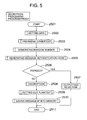
- the computer B 1003 after receiving the ciphertext C 1022 via the network interface 1017, executes the decryption-processing program PROG3_1020. Then, if no forgery has been detected, the computer B 1003 stores the decrypted result into the RAM 1016.
- the respective programs can be installed into the RAMs from the partner computers or another computer via a communications medium, i.e., the network 1001 or a carrier wave propagating on the network 1001, or via a transportable-type storage medium such as a CD or a FD.
- the respective programs can also be configured so that the programs will operate under (not-illustrated) operating systems of the respective computers.
- each CPU reads out each program from each memory and executes each program, thereby implementing the processing by each program on each computer.
- the encryption processing program PROG1_1009 is read out from the RAM 1005, then being executed by the CPU 1004.
- the encryption-processing program PROG1_1009 calls up, as a subroutine, the random-number generation processing program PROG2_1010 in the inside, then outputting the ciphertext C 1022 to the inputted secret key K 1011 and the message M 1014.
- the decryption-processing program PROG3_1020 is read out from the RAM 1016, then being executed by the CPU 1015.
- the decryption-processing program PROG3_1020 calls up, as a subroutine, the random-number generation processing program PROG2_1021 in the inside, then outputting a message or a forgery -detection warning to the inputted secret key K 1011 and the ciphertext C 1022.
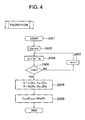
- Step 2802 L' is set as the first 64-bit plaintext block (i.e., P' 1 ).
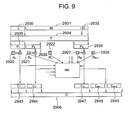
- FIG. 9 is an explanatory diagram of the encryption processing.
- a length 2930 and a proper padding 2932 are each added to a message M 2931, thereby creating a plaintext P 2934.
- This plaintext P 2934 is block-divided on a 64-bit basis, and the resultant plaintext blocks are specified as P 1_ 2935, P 2_ 2936, ..., and P N- 2938, respectively.
- An exclusive-OR logical sum of P 1 _2935 with a random-number block R 1 _2920 is figured out, thereby acquiring a ciphertext block C 1 _2943.
- NH R (S) is computed, selecting R and S as the inputs.
- R results from connecting R 2 _2921, R 3_ 2922, ..., and R N+1 _2928 in this sequence
- S results from connecting C 1 _2943, C 2 _2944, ..., and C N _2947 in this sequence.
- the computed output from NH R (S) is block-divided into C N+1 _2948 and C N+2_ 2949.
- C 1 _2943, C 2 _2944, ..., C N _2947, C N+1_ 2948, and C N+2_ 2949 are connected in this sequence, thereby acquiring a ciphertext C_2956.
- FIG. 10 is an explanatory diagram of the decryption processing.
- a ciphertext C'_4030 is divided into 64-bit blocks, and the resultant ciphertext blocks are specified as C' 1 _4035, C' 2 _4036, ..., C' N _4037, C' N+1 _4038, and C' N+2_ 4039.
- NH R (S) is computed, selecting R and S as the inputs.
- R results from connecting R 2 _4021, R 3 _4022, ..., and R N+1 _4028 in this sequence
- the pseudo random numbers are necessary for the two processings, i.e., the cryptographic processing and the message-authentication-code generation.
- the length of the pseudo random numbers is satisfying enough if it is substantially the same as that of the message.
- the pseudo random-number generator according to the present embodiment allows the implementation of the random-number generation processings which are more than 2 times higher as compared with the ones by AES, i.e., the highest cipher among the block ciphers. Consequently, the present embodiment allows the implementation of the processings which, on one and the same environment, are more than 2 times higher as compared with the iaPCBC mode which is the conventional technology.
- the second embodiment basically, is the same as the first one, and thus only the modified points will be explained below.
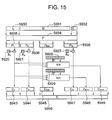
- FIG. 15 is an explanatory diagram of the encryption processing.
- a length 5930 and a proper padding 5932 are each added to a message M 5931, thereby creating a plaintext P 5934.
- This plaintext P 5934 is block-divided on a 64-bit basis, and the resultant plaintext blocks are specified as P 1_ 5935, P 2_ 5936, P N/2_ 5937, ..., and P N _5938, respectively.
- An exclusive-OR logical sum of P 1 _5935 with R 1 _5920 is figured out, thereby acquiring a ciphertext block C 1_ 5943.
- An exclusive-OR logical sum of P 2_ 5936 with R 2 _5921 is figured out, thereby acquiring a ciphertext block C 2_ 5944.
- NH R" (S) is computed, and the output therefrom is specified as C N+2 _5949.
- C 1_ 5943, C 2_ 5944, ..., C N/2_ 5945, ..., C N _5947, C N+1 _5948, and C N+2 _5949 are connected in this sequence, thereby acquiring a ciphertext C_5956.
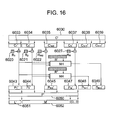
- FIG. 16 is an explanatory diagram of the decryption processing.
- a ciphertext C'_6030 is divided into 64-bit blocks, and the resultant blocks are specified as C' 1_ 6033, C' 2 _6034, ..., C' N_ 6037, C' N+1 _6038, and C' N+2_ 6039.
- NH R (S) is computed, selecting S as the input.
- An exclusive-OR logical sum of C' 1 _6033 with R 1 _6020 is figured out, thereby acquiring a plaintext block P' 1 _6043.
- An exclusive-OR logical sum of C' 2 _6034 with R 2 _6031 is figured out, thereby acquiring a plaintext block P' 2_ 6044.
- the pseudo random numbers are necessary for the two processings, i.e., the cryptographic processing and the message-authentication-code generation.
- the length of the pseudo random numbers is substantially 1.5 times longer than that of the message.
- the pseudo random-number generator according to the present embodiment allows the implementation of the random-number generation processings which are more than 2 times higher as compared with the ones by AES, i.e., the highest cipher among the block ciphers. From the consideration given above, the method according to the second embodiment allows the implementation of the processings which, on one and the same environment, are more than 4/3 times higher as compared with the iaPCBC mode which is the conventional technology.
Landscapes
- Engineering & Computer Science (AREA)
- Computer Security & Cryptography (AREA)
- Computer Networks & Wireless Communication (AREA)
- Signal Processing (AREA)
- Power Engineering (AREA)
- Physics & Mathematics (AREA)
- Nonlinear Science (AREA)
- Storage Device Security (AREA)
Abstract
Description
Inputting the plaintext is awaited, and predetermined paddings are performed after the plaintext has been presented, and finally, the plaintext is separated on a 64-bit basis so as to output a string Pi (1≤i≤N) of plaintext blocks. Here, N is assumed to be an even number.
Claims (23)
- An encryption apparatus for a common-key cipher, comprising:a unit (1009, step 2003) for generating a plurality of plaintext blocks Pi (1≤i≤N) resulting from separating a plaintext on a specific-length basis, the plaintext including redundant data and a message (1014);an encryption operation unit (1009, steps 2004 to 2005) for generating a random-number string R from a secret key (1011),generating random-number blocks Ri (1≤i≤N+1) from the random-number string R, andperforming an encryption operation for ciphertext blocks Ci (1≤i≤N+2) by using the plaintext blocks Pi (1≤i≤N) and the random-number blocks Ri (1≤i≤N+1), the random-number string R being longer than the plaintext, the random-number blocks Ri (1≤i≤N+1) being used for the encryption corresponding to the plaintext blocks Pi (1≤i≤N); andan authentication operation unit (NHR (S), steps 2408 to 2409) forgenerating random-number blocks Ri (2≤i≤N+1) from the random-number string R, andperforming an authentication operation for message-authentication-code blocks (CN+1, CN+2) by using the ciphertext blocks Ci (1≤i≤N+2) and the random-number blocks Ri (2≤i≤N+1), the random-number blocks Ri (2≤i≤N+1) being used for the authentication corresponding to the ciphertext blocks Ci (1≤i≤N+2).
- The encryption apparatus for a common-key cipher according to Claim 1, wherein
the encryption operation unit (1009, steps 2004 to 2005) and the authentication operation unit (NHR (S), steps 2408 to 2409) use the one or more random-number blocks Ri (1≤i≤N+1),
the total-sum length of the one or more random-number blocks Ri (1≤i≤N+1) being longer than the total-sum length of the plaintext blocks Pi (1≤i≤N), and being shorter than two times the total-sum length of the plaintext blocks Pi (1≤i≤N). - The encryption apparatus for a common-key cipher according to Claim 2, wherein
the encryption operation unit (1009, steps 2004 to 2005) performs a binomial operation or a monomial operation one or more times in accordance with predetermined processing steps, the binomial operation or the monomial operation using the plaintext blocks Pi (1≤i≤N),
the authentication operation unit (NHR(S), steps 2408 to 2409) performing a binomial operation or a monomial operation one or more times in accordance with predetermined processing steps, the binomial operation or the monomial operation using the ciphertext blocks Ci (1≤i≤N+2),
the encryption apparatus for a common-key cipher further comprising a unit (1009, step 2006) for combining the plurality of acquired ciphertext blocks Ci (1-≤i≤N+2) with the message-authentication-code blocks (CN+1, CN+2), and outputting the combined result as a ciphertext (1022). - The encryption apparatus for a common-key cipher according to Claim 2, wherein
the encryption operation unit (1009, steps 2004 to 2005) performs the encryption operation by an exclusive-OR logical sum,
the authentication operation unit (NHR(S), steps 2408 to 2409) performing the authentication operation by an arithmetic multiplication and an arithmetic addition. - The encryption apparatus for a common-key cipher according to Claim 2, wherein
the encryption operation unit (1009, steps 2004 to 2005) performs the encryption operation by an exclusive-OR logical sum,
the authentication operation unit (NHR(S), steps 2408 to 2409) performing the authentication operation by a multiplication on a finite field and an arithmetic addition. - The encryption apparatus for a common-key cipher according to Claim 2, wherein
the encryption operation unit (1009, steps 2004 to 2005) and the authentication operation unit (NHR(S), steps 2408 to 2409) share the random-number blocks Ri (1≤i≤N+1) used by the encryption operation unit (1009, steps 2004 to 2005) and the authentication operation unit (NHR(S), steps 2408 to 2409). - The encryption apparatus for a common-key cipher according to Claim 2, wherein
the encryption operation unit (1009, steps 2004 to 2005) and the authentication operation unit (NHR(S), steps 2408 to 2409) use the random-number blocks Ri (1≤i≤N+1) which differ from each other. - The encryption apparatus for a common-key cipher according to Claim 2, further comprising a pseudo random-number generation unit (1010) for generating the random-number string R from said secret key (1011).
- The encryption apparatus for a common-key cipher according to Claim 8, further comprising:a unit (1009, steps 2003 and 2206) for dividing the message (1014) into a plurality of messages (1014), the psuedo random-number generation unit (1010) generating the random-number string R whose random numbers are equivalent to the divided messages (1014) in number; anda unit for allocating either of the divided messages (1014) and the random-number string R to different operation units each, and thereby causing a parallel processing to be performed.
- A decryption apparatus for a common-key cipher, comprising:
a unit (1020, step 2503) for generating a plurality of ciphertext blocks C'i (1≤i≤N+2) resulting from separating a ciphertext (1022) on a specific-length basis;
an authentication operation unit (NHR(S), and 1020, steps 2504 to 2505) for
generating a random-number string R from a secret key (1011),
generating random-number blocks Ri (1≤i≤N+1) from the random-number string R, and
performing an authentication operation for message-authentication-code blocks (C'N+1, C'N+2) by using the ciphertext blocks C'i (1≤i≤N+2) and the random-number blocks Ri (1≤i≤N+1), the random-number string R being longer than the ciphertext (1022), the random-number blocks Ri (1≤i≤N+1) being used for the authentication corresponding to the ciphertext blocks C'i (1≤i≤N+2); and
a decryption operation unit (1020, step 2508) for
generating random-number blocks Ri (1≤i≤N) from the random-number string R, and
performing a decryption operation for plaintext blocks P'i (1≤i≤N) by using the ciphertext blocks C'i (1≤i≤N+2) and the random-number blocks Ri (1≤i≤N), the random-number blocks Ri (1≤i≤N) being used for the decryption corresponding to the ciphertext blocks C'i (1≤i≤N+2). - The decryption apparatus for a common-key cipher according to Claim 10, wherein
the authentication operation unit (NHR(S), and 1020, steps 2504 to 2505) and the decryption operation unit (1020, step 2508) use the one or more random-number blocks Ri (1≤i≤N+1),
the total-sum length of the one or more random-number blocks Ri (1≤i≤N+1) being longer than the total-sum length of the plaintext blocks P'i (1≤i≤N), and being shorter than two times the total-sum length of the plaintext blocks P'i (1≤i≤N). - The decryption apparatus for a common-key cipher according to Claim 11, further comprising:a unit for connecting the plurality of plaintext blocks P'i (1≤i≤N) thereby to generate a plaintext;a unit for extracting redundant data included in the plaintext; anda unit for checking the redundant data thereby to detect the presence or absence of a forgery that may have been performed to the ciphertext (1022).
- A program-storing medium (1005) which stores a program (1009, 1010) for allowing a computer (1002) to execute an encryption processing for a common-key cipher, wherein
the program (1009, 1010) allows the computer (1002)
to generate a plurality of plaintext blocks Pi (1≤i≤N) resulting from separating a plaintext on a specific-length basis, the plaintext including redundant data and a message (1014);
to generate a random-number string R from a secret key (1011),
to generate random-number blocks Ri (1≤i≤N+1) from the random-number string R, and
to perform an encryption operation for ciphertext blocks Ci (1≤i≤N+2) by using the plaintext blocks Pi (1≤i≤N) and the random-number blocks Ri (1≤i≤N+1), the random-number string R being longer than the plaintext, the random-number blocks Ri (1≤i≤N+1) being used for the encryption corresponding to the plaintext blocks Pi (1≤i≤N); and
to generate random-number blocks Ri (2≤i≤N+1) from the random-number string R, and
to perform an authentication operation for message-authentication-code blocks (CN+1, CN+2) by using the ciphertext blocks Ci (1≤i≤N+2) and the random-number blocks Ri (2≤i≤N+1), the random-number blocks Ri (2≤i≤N+1) being used for the authentication corresponding to the ciphertext blocks Ci (1≤i≤N+2). - The program-storing medium (1005) according to Claim 13, wherein
the encryption operation and the authentication operation use the one or more random-number blocks Ri (1≤i≤N+1),
the total-sum length of the one or more random-number blocks Ri (1≤i≤N+1) being longer than the total-sum length of the plaintext blocks Pi (1≤i≤N), and being shorter than two times the total-sum length of the plaintext blocks Pi (1≤i≤N). - The program-storing medium (1005) according to Claim 14, wherein
the program (1009, 1010) allows the computer (1002)
to perform, as the encryption operation, a binomial operation or a monomial operation one or more times in accordance with predetermined processing steps, the binomial operation or the monomial operation using the plaintext blocks Pi (1≤i≤N);
to perform, as the authentication operation, a binomial operation or a monomial operation one or more times in accordance with predetermined processing steps, the binomial operation or the monomial operation using the ciphertext blocks Ci (1≤i≤N+2); and
to combine the plurality of acquired ciphertext blocks Ci (1≤i≤N+2) with the message-authentication-code blocks (CN+1, CN+z) , and to output the combined result as a ciphertext (1022). - The program-storing medium (1005) according to Claim 14, wherein
the program (1009, 1010) allows the computer (1002)
to perform the encryption operation by an exclusive-OR logical sum, and
to perform the authentication operation by an arithmetic multiplication and an arithmetic addition. - The program-storing medium (1005) according to Claim 14, wherein
the program (1009, 1010) allows the computer (1002)
to perform the encryption operation by an exclusive-OR logical sum, and
to perform the authentication operation by a multiplication on a finite field and an arithmetic addition. - The program-storing medium (1005) according to Claim 14, wherein
the program (1009, 1010) allows the encryption operation and the authentication operation to share the random-number blocks Ri (1≤i≤N+1) used by the encryption operation and the authentication operation. - The program-storing medium (1005) according to Claim 14, wherein
the program (1009, 1010) allows the computer (1002) to perform a pseudo random-number generation processing for generating the random-number string R from said secret key (1011). - The program-storing medium (1005) according to Claim 19, wherein
the program (1009, 1010) allows the computer (1002)
to divide the message (1014) into a plurality of messages (1014);
to generate, by the psuedo random-number generation processing, the random-number string R whose random numbers are equivalent to the divided messages (1014) in number; and
to allocate either of the divided messages (1014) and the random-number string R to different operation units each, and thereby to perform a parallel processing. - A program-storing medium (1016) which stores programs (1020, 1021) for allowing a computer (1003) to execute a decryption processing for a common-key cipher, wherein
the program (1020, 1021) allows the computer (1003)
to generate a plurality of ciphertext blocks C'i (1≤i≤N+2) resulting from separating a ciphertext (1022) on a specific-length basis;
to generate a random-number string R from a secret key (1011),
to generate random-number blocks Ri (1≤i≤N+1) from the random-number string R, and
to perform an authentication operation for message-authentication-code blocks (C' N+1, C' N+2) by using the ciphertext blocks C'i (1≤i≤N+2) and the random-number blocks Ri (1≤i≤N+1), the random-number string R being longer than the ciphertext (1022), the random-number blocks Ri (1≤i≤N+1) being used for the authentication corresponding to the ciphertext blocks C'i (1≤i≤N+2); and
to generate random-number blocks Ri (1≤i≤N) from the random-number string R, and
to perform a decryption operation for plaintext blocks P'i (1≤i≤N) by using the ciphertext blocks C'i (1≤i≤N+2) and the random-number blocks Ri (1≤i≤N), the random-number blocks Ri (1≤i≤N) being used for the decryption corresponding to the ciphertext blocks C'i (1≤i≤N+2). - The program-storing medium (1016) according to Claim 21, wherein
the program (1020, 1021) allows the decryption operation and the authentication operation to use the one or more random-number blocks Ri (1≤i≤N+1),
the total-sum length of the one or more random-number blocks Ri (1≤i≤N+1) being longer than the total-sum length of the plaintext blocks P'i (1≤i≤N), and being shorter than two times the total-sum length of the plaintext blocks P'i (1≤i≤N). - The program-storing medium (1016) according to Claim 22, wherein
the program (1020, 1021) allows the computer (1003)
to connect the plurality of plaintext blocks P'i (1≤i≤N) thereby to generate a plaintext;
to extract redundant data included in the plaintext; and
to check the redundant data thereby to detect the presence or absence of a forgery that may have been performed to the ciphertext (1022).
Applications Claiming Priority (2)
| Application Number | Priority Date | Filing Date | Title |
|---|---|---|---|
| JP2003157444 | 2003-06-03 | ||
| JP2003157444A JP2004363739A (en) | 2003-06-03 | 2003-06-03 | Tamper-detectable encryption / decryption device for common key encryption |
Publications (2)
| Publication Number | Publication Date |
|---|---|
| EP1508994A2 true EP1508994A2 (en) | 2005-02-23 |
| EP1508994A3 EP1508994A3 (en) | 2005-03-02 |
Family
ID=33508390
Family Applications (1)
| Application Number | Title | Priority Date | Filing Date |
|---|---|---|---|
| EP04004380A Withdrawn EP1508994A3 (en) | 2003-06-03 | 2004-02-26 | Message-authenticated apparatus for symmetric-key cipher |
Country Status (3)
| Country | Link |
|---|---|
| US (1) | US20040252836A1 (en) |
| EP (1) | EP1508994A3 (en) |
| JP (1) | JP2004363739A (en) |
Families Citing this family (24)
| Publication number | Priority date | Publication date | Assignee | Title |
|---|---|---|---|---|
| DE69939254D1 (en) * | 1999-06-22 | 2008-09-18 | Hitachi Ltd | Cryptographic device and method |
| WO2003013054A1 (en) * | 2001-07-17 | 2003-02-13 | Sharp Kabushiki Kaisha | Apparatus and method for generating data for detecting false alteration of encrypted data during processing |
| US7707417B2 (en) * | 2005-06-23 | 2010-04-27 | Masami Yoshioka | Secure transmission of data between clients over communications network |
| KR20080058462A (en) * | 2005-11-04 | 2008-06-25 | 닛본 덴끼 가부시끼가이샤 | A medium recording a message authentication device, a message authentication method, and a message authentication program |
| US7930551B2 (en) * | 2006-05-15 | 2011-04-19 | Arris Group, Inc. | Method and system for reusing an MMH function to perform a fast MMH-MAC calculation |
| JP5060081B2 (en) | 2006-08-09 | 2012-10-31 | 富士通株式会社 | Relay device that encrypts and relays frames |
| JP2008104040A (en) * | 2006-10-20 | 2008-05-01 | Fujitsu Ltd | Common key generation device and common key generation method |
| KR100930577B1 (en) | 2006-11-13 | 2009-12-09 | 한국전자통신연구원 | Message authentication code generation method using stream cipher, authentication encryption method using stream cipher, and authentication decryption method using stream cipher |
| US8090098B2 (en) * | 2006-11-13 | 2012-01-03 | Electronics And Telecommunications Research Institute | Method of generating message authentication code using stream cipher and authentication/encryption and authentication/decryption methods using stream cipher |
| JP4860708B2 (en) * | 2006-12-27 | 2012-01-25 | 富士通株式会社 | Stream cipher method and cipher system |
| US7827408B1 (en) * | 2007-07-10 | 2010-11-02 | The United States Of America As Represented By The Director Of The National Security Agency | Device for and method of authenticated cryptography |
| JP4535119B2 (en) * | 2007-11-20 | 2010-09-01 | 沖電気工業株式会社 | Common key generation system, common key generation method, and node using the same |
| JP5523675B2 (en) * | 2008-01-08 | 2014-06-18 | 株式会社日立製作所 | ENCRYPTION DEVICE, DECRYPTION DEVICE, ENCRYPTION SYSTEM HAVING THEM, ENCRYPTION PROGRAM, AND DECRYPTION PROGRAM |
| CN101447990B (en) * | 2008-12-02 | 2012-08-08 | 中兴通讯股份有限公司 | System for realizing download server in IPTV system and method thereof |
| CN102687457A (en) * | 2009-05-15 | 2012-09-19 | 里维尔技术有限责任公司 | System for encrypting and decrypting a plaintext message with authentication |
| US9792451B2 (en) * | 2011-12-09 | 2017-10-17 | Echarge2 Corporation | System and methods for using cipher objects to protect data |
| KR101989813B1 (en) * | 2012-06-29 | 2019-06-18 | 펜타시큐리티시스템 주식회사 | Generating and verifying the alternative data in a specified format |
| IN2013MU01164A (en) * | 2013-03-26 | 2015-07-03 | Tata Consultancy Services Ltd | |
| CN111160902B (en) * | 2013-12-02 | 2023-06-23 | 万事达卡国际股份有限公司 | Method and system for secure delivery of remote notification service messages to mobile devices without secure elements |
| US10225087B2 (en) * | 2014-09-12 | 2019-03-05 | Tata Consultancy Services Limited | Methods and systems for randomized message generation for cryptographic hash functions |
| DE102015209709A1 (en) * | 2015-05-27 | 2016-12-01 | Continental Teves Ag & Co. Ohg | Method for ensuring the information security of data transmitted over a data bus and data bus system |
| CN111052670B (en) * | 2017-09-01 | 2024-02-09 | 三菱电机株式会社 | Encryption device, decryption device, encryption method, decryption method, and computer-readable storage medium |
| KR102028092B1 (en) * | 2018-04-20 | 2019-10-02 | 한국전자통신연구원 | Apparatus and method for reliable quantum signature |
| CN117376904B (en) * | 2023-12-08 | 2024-02-02 | 合肥工业大学 | A vehicle group communication method |
Family Cites Families (2)
| Publication number | Priority date | Publication date | Assignee | Title |
|---|---|---|---|---|
| JP3864675B2 (en) * | 2000-03-09 | 2007-01-10 | 株式会社日立製作所 | Common key encryption device |
| US20020048364A1 (en) * | 2000-08-24 | 2002-04-25 | Vdg, Inc. | Parallel block encryption method and modes for data confidentiality and integrity protection |
-
2003
- 2003-06-03 JP JP2003157444A patent/JP2004363739A/en active Pending
-
2004
- 2004-02-26 US US10/786,160 patent/US20040252836A1/en not_active Abandoned
- 2004-02-26 EP EP04004380A patent/EP1508994A3/en not_active Withdrawn
Non-Patent Citations (5)
| Title |
|---|
| BLACK J; HALEVI S; KRAWCZYK H; KROVETZ T; ROGAWAY P: "UMAC: fast and secure message authentication" ADVANCES IN CRYPTOLOGY - CRYPTO'99., 19 August 1999 (1999-08-19), pages 216-233, XP002310896 SANTA BARBARA, CA, USA ISBN: 3-540-66347-9 * |
| FERGUSON N; WHITING D; SCHNEIER B; KELSEY J; LUCKS S; KOHNO T: "Helix: fast encryption and authentication in a single cryptographic primitive" FAST SOFTWARE ENCRYPTION. 10TH INTERNATIONAL WORKSHOP, FSE 2003. REVISED PAPERS (LECTURE NOTES IN COMPUT. SCI. VOL.2887). SPRINGER-VERLAG, 26 February 2003 (2003-02-26), pages 1-17, XP002310897 LUND, SWEDEN * |
| FURUYA S ET AL: "Single-path authenticated-encryption scheme based on universal hashing" SELECTED AREAS IN CRYPTOGRAPHY. ANNUAL INTERNATIONAL WORKSHOP, 16 August 2002 (2002-08-16), pages 94-109, XP002264289 * |
| JAKUBOWSKI M H; VENKATESAN R: "The chain and sum primitive and its applications to MACs and stream ciphers" ADVANCES IN CRYPTOLOGY - EUROCRYPT '98, 4 June 1998 (1998-06-04), pages 281-293, XP002310899 ESPOO, FINLAND ISBN: 3-540-64518-7 * |
| LIM, CHAE HOON: "Message Encryption and Authentication Using One-Way Hash Functions" PROC. OF 3RD ANNUAL WORKSHOP ON SELECTED AREAS IN CRYPTOLOGY-SAC '96, [Online] 1996, pages 1-11, XP002310898 QUEENS UNIVERSITY, KINGSTON, ONTARIO, CANADA Retrieved from the Internet: URL:http://citeseer.ist.psu.edu/cs> [retrieved on 2004-12-15] * |
Also Published As
| Publication number | Publication date |
|---|---|
| EP1508994A3 (en) | 2005-03-02 |
| JP2004363739A (en) | 2004-12-24 |
| US20040252836A1 (en) | 2004-12-16 |
Similar Documents
| Publication | Publication Date | Title |
|---|---|---|
| EP1508994A2 (en) | Message-authenticated apparatus for symmetric-key cipher | |
| US7200232B2 (en) | Method and apparatus for symmetric-key decryption | |
| US6963976B1 (en) | Symmetric key authenticated encryption schemes | |
| KR100296958B1 (en) | Apparatus for encoding block data | |
| Jutla | Encryption modes with almost free message integrity | |
| US5870470A (en) | Method and apparatus for encrypting long blocks using a short-block encryption procedure | |
| US7570759B2 (en) | System and method for secure encryption | |
| US8300828B2 (en) | System and method for a derivation function for key per page | |
| JP5402632B2 (en) | Common key block encryption apparatus, common key block encryption method, and program | |
| KR101091246B1 (en) | A simple and efficient one-pass authenticated encryption scheme | |
| WO2001076130A2 (en) | Authentication method and schemes for data integrity protection | |
| US7894608B2 (en) | Secure approach to send data from one system to another | |
| US12328384B2 (en) | Scrambler apparatus and method in particular for cryptographic applications, and descrambler apparatus and method therefor | |
| Sharma et al. | TEXCEL: text encryption with elliptic curve cryptography for enhanced security | |
| US20230244819A1 (en) | Securing on-chip communication using chaffing and winnowing with all-or-nothing transform | |
| Young et al. | Backdoor attacks on black-box ciphers exploiting low-entropy plaintexts | |
| JP2000047580A (en) | Encryption conversion device, decryption conversion device, encryption communication device, and automatic fee collection device | |
| Fujishiro et al. | Scan-based attack against trivium stream cipher using scan signatures | |
| Ibrahim et al. | A novel diffusion-based cryptographic method for cyber security | |
| JP3864798B2 (en) | Common key encryption decryption device | |
| Trabelsi et al. | DCBC: A Distributed High-performance Block-Cipher Mode of Operation. | |
| Chengqing et al. | Cryptanalysis of a multistage encryption system | |
| KR100554176B1 (en) | Pseudorandom number generation device and method | |
| JP2005027358A (en) | Common key encryption method and apparatus | |
| JP2004347885A (en) | Encryption device processing method, encryption / decryption device processing method, these devices and program |
Legal Events
| Date | Code | Title | Description |
|---|---|---|---|
| PUAI | Public reference made under article 153(3) epc to a published international application that has entered the european phase |
Free format text: ORIGINAL CODE: 0009012 |
|
| PUAL | Search report despatched |
Free format text: ORIGINAL CODE: 0009013 |
|
| AK | Designated contracting states |
Kind code of ref document: A2 Designated state(s): AT BE BG CH CY CZ DE DK EE ES FI FR GB GR HU IE IT LI LU MC NL PT RO SE SI SK TR |
|
| AX | Request for extension of the european patent |
Extension state: AL LT LV MK |
|
| AK | Designated contracting states |
Kind code of ref document: A3 Designated state(s): AT BE BG CH CY CZ DE DK EE ES FI FR GB GR HU IE IT LI LU MC NL PT RO SE SI SK TR |
|
| AX | Request for extension of the european patent |
Extension state: AL LT LV MK |
|
| 17P | Request for examination filed |
Effective date: 20050310 |
|
| AKX | Designation fees paid |
Designated state(s): DE FR GB |
|
| STAA | Information on the status of an ep patent application or granted ep patent |
Free format text: STATUS: THE APPLICATION HAS BEEN WITHDRAWN |
|
| 18W | Application withdrawn |
Effective date: 20080605 |