Technical Field
The present invention relates to a lubricating oil
additive composition for internal combustion engines, and to
a lubricating oil composition for internal combustion engines
containing the additive composition. The lubricating oil
composition for internal combustion engines exhibits
excellent detergency at high temperature, exhibits excellent
heat resistance, has low ash content, and does not affect an
exhaust gas treatment apparatus such as a particulate matter
(hereinafter abbreviated as PM) trap or an oxidation catalyst
member for oxidizing uncombusted fuel or lubricating oil, and
therefore can meet future emission gas regulations.
Background Art
Conventionally, lubricating oils for internal
combustion engines, particularly those for diesel engines,
have employed a metallic detergent-dispersant and an ash-less
detergent-dispersant in combination. Generally employed
metallic detergent-dispersants include sulfonates, phenates,
salicylates, phosphonates of alkali metal or alkaline earth
metal, and perbasic compounds thereof.
Environmental pollution caused by nitrogen oxides
(hereinafter referred to as NOx) and PM contained in exhaust
gas from internal combustion engines, inter alia, diesel
engines, raises a grave problem that remains to be solved,
and there is a pressing need to develop effective measures
therefor. Therefore, reduction of the NOx level and the PM
level of exhaust gas is a problem to be immediately solved.
NOx level has been reduced by taking measures such as
efficiently performing exhaust gas recirculation (EGR) and
lowering combustion peak temperature by retarding the timing
of fuel injection.
However, when the combustion peak temperature is
lowered, generation of black smoke and PM increases, thereby
requiring provision of an exhaust gas post-treatment
apparatus. Such apparatuses which have been studied include
a PM trap and an oxidation catalyst member, both of which
have a filter-like structure. Thus, when a conventional
diesel engine oil is employed, a metallic component contained
in the oil causes plugging of the apparatus. When the
metallic component level of the oil is lowered (i.e., upon
reduction in the amount of a metallic detergent and an anti-wear
agent), detergency and wear resistance are deteriorated.
In particular, reduction of a metallic detergent leads to a
decrease in the initial base number. Thus, there is demand
for development of a novel lubricating oil for internal
combustion engines in order to maintain long-drain
performance (basicity) which is equivalent to that of a
conventional engine oil. In other words, a novel lubricating
oil additive for internal combustion engines is demanded.
Disclosure of the Invention
The present invention has been conceived under such
circumstances, and an object of the present invention is to
provide a lubricating oil additive for internal combustion
engines, which additive enables preparation of a lubricating
oil composition for internal combustion engines having an
enhanced base number without impairing the performance of an
exhaust gas treatment apparatus such as a PM trap or an
oxidation catalyst member. Another object of the invention
is to provide a lubricating oil additive composition for
internal combustion engines. Still another object of the
invention is to provide a lubricating oil composition for
internal combustion engines containing the lubricating oil
additive composition.
The present inventors have found that a lubricating oil
composition for internal combustion engines having an
enhanced base number can be prepared by controlling the
molecular weight and the nitrogen content of an alkenyl- or
alkylsuccinimide compound or a boron-introduced product
thereof serving as a fuel oil additive. The present
invention has been accomplished on the basis of this finding.
Accordingly, the gist of the present invention is as
follows.
Best Modes for Carrying Out the Invention
A first aspect of the present invention is drawn to a
lubricating oil additive for internal combustion engines,
which comprises, a succinimide compound represented by
formula (1).
In the aforementioned formula (1), R1 represents a C6-C30
alkenyl group or alkyl group, which may be a linear chain
or a branched chain. When R1 has five or less carbon atoms,
the succinimide compound may fail to be sufficiently
dissolved in a medium such as a lubricating base oil, whereas
when R1 has 31 or more carbon atoms, a compound of high base
number may fail to be produced. R1 preferably contains 10 to
20 carbon atoms. Specific examples of the above groups
include a decyl group, a decenyl group, a dodecyl group, a
dodecenyl group, a tetradecyl group, a tetradecenyl group, a
hexadecyl group, a hexadecenyl group, an octadecyl group, an
octadecenyl group, an eicosyl group, and an eicosenyl group.
Each of R7, R8, R9, and R10 represents hydrogen or a C1-C3
alkyl group. When both of R7 and R8 are hydrogen or either
of R7 or R8 is a methyl group, both of R9 and R10 are
preferably hydrogen or either of R9 or R10 is preferably a
methyl group. Particularly preferably, all of the R7, R8, R9,
and R10 are hydrogen.
Then, n is an integer from 0 to 3. When n is more than
3, the succinimide compound has excessively large polarity
and cannot be sufficiently dissolved in a medium such as a
lubricating base oil. The number "n" is adjusted by
polyamine serving as a starting material. Examples of the
polyamine include alkylenediamines such as ethylenediamine,
propanediamine, butanediamine, N-methyl-1,3-propanediamine,
and N,N-dimethyl-1,3-propanediamine; polyalkylene-polyamines
such as diethylenetriamine, triethylenetetramine, and
tetraethylenepentamine; and polyalkylene-polyamines having a
cyclic alkyleneamine such as aminoethylpiperazine.
Each of q and r is an integer from 2 to 4.
Although no particular limitation is imposed on the
method for producing the aforementioned succinimide compound,
the compound is preferably produced through the following
method.
Specifically, the compound is produced by reacting an
alkenyl- or alkylsuccinic acid or an alkenyl- or
alkylsuccinic anhydride (a) with the aforementioned polyamine
(b) at a mole ratio of (a) : (b) = 1 : 10 to 10 : 1,
preferably 1 : 2 to 2 : 1. The reaction temperature,
reaction pressure, and reaction time are preferably 140 to
200°C, 0.1 to 1 MPa(G), and 1 to 10 hours, respectively.
The reaction is not necessarily carried out in the
presence of solvent, but a solvent may also be used. The
solvent preferably has a boiling point of 140 to 150°C, and
examples include toluene and xylene.
When solvent is employed, no particular limitation is
imposed on the concentration of a starting material, and the
concentration may be elevated to the corresponding saturated
solubility. Preferably, the concentration is 0.1 to 10 mol/L.
In a preferred order of addition of components (a) and
(b), the component (a) is added to the component (b) during
reaction from the viewpoint of suppression of by-products.
The aforementioned boron-introduced product of the
succinimide compound of the present invention is obtained by
reacting a boron compound (c) with the succinimide compound
produced in the above method, the amount of the boron
compound being a mole ratio (based on polyamine) 1 : 0.01 to
10, preferably 1 : 0.05 to 5. Examples of the boron compound
(c) include boron oxide, boron halides, boric acid, boric
anhydride, and boric acid esters. The reaction of the
succinimide compound with the compound (c) is performed at
about 50 to 250°C, preferably 100 to 200°C. The reaction may
be performed in the presence of a solvent such as an organic
solvent (e.g., hydrocarbon oil).
The aforementioned succinimide compound or a boron-introduced
product thereof has a base number (as determined
through HCl method) of 50 mg KOH/g or more, and therefore
serves as a detergent-dispersant.
The aforementioned succinimide compound or a boron-introduced
product thereof [component (A)] may be employed as
one component of the lubricating oil additive composition for
internal combustion engines. An example of preferred
lubricating oil additive compositions for internal combustion
engines contains component (A) with a substituted
hydroxyaromatic ester derivative [component (B)]. No
particular limitation is imposed on the type of substituted
hydroxyaromatic ester derivative, and examples of preferred
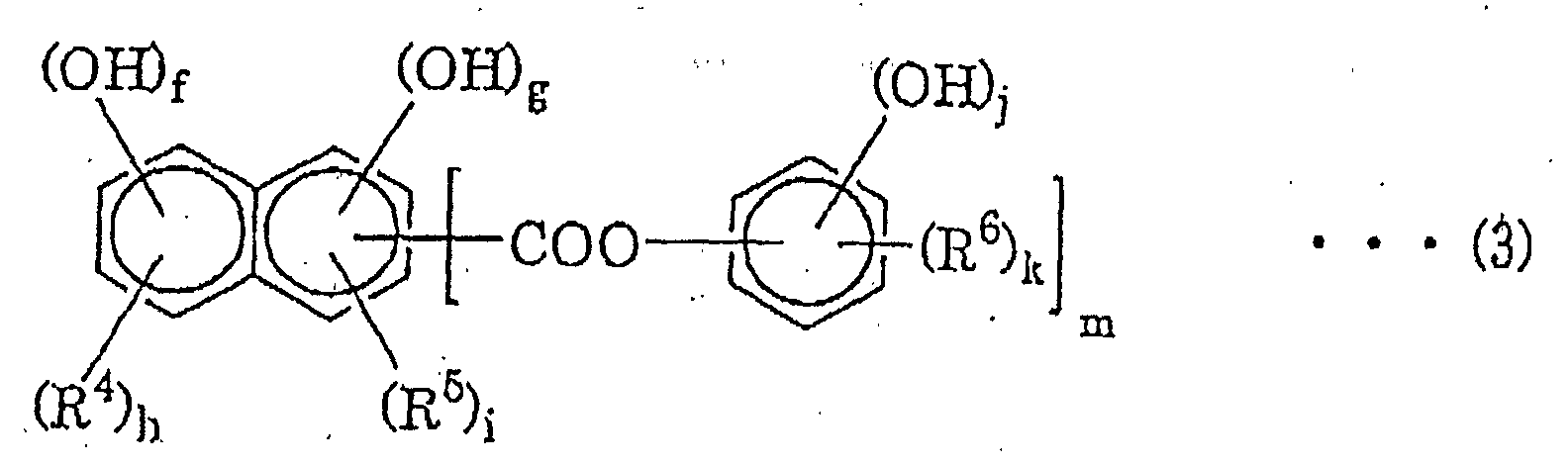
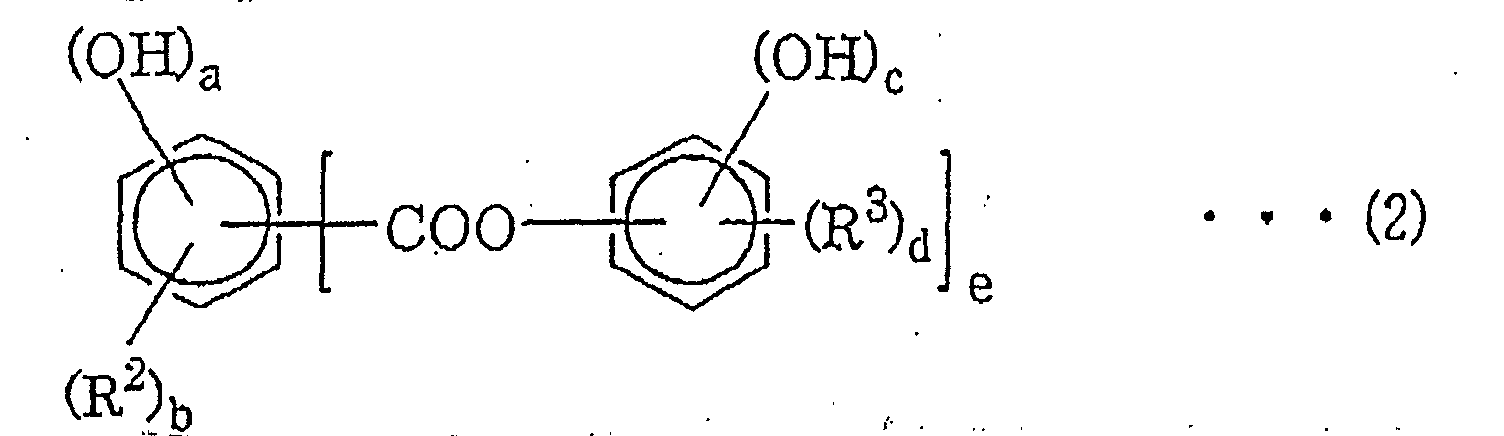
ester derivatives include compounds represented by formula
(2) or (3).
The substituted hydroxyaromatic ester derivative will
next be described in detail.
The aforementioned substituted hydroxyaromatic ester
derivative is at least one compound selected from substituted
hydroxyaromatic carboxylic acid ester derivatives represented
by formula (2) or (3). In the above-mentioned formulas (2)
and (3), each of R2, R3, R4, R5, and R6 represents a organic
group having six or more carbon atoms. Examples of the
organic group having six or more carbon atoms include
hydrocarbon groups having preferably 6 to 100 carbon atoms,
more preferably 8 to 20 carbon atoms. Examples of the
hydrocarbon groups include an alkyl group, an alkenyl group,
a cycloalkyl group, a cycloalkenyl group and an aralkyl group,
and these groups may have a non-hydrocarbon substituent and a
hetero-atom in a chain or a ring. Specific examples of the
hydrocarbon groups include hydrocarbon groups such as a hexyl
group, an octyl group, a nonyl group, a decyl group, a
dodecyl group, a hexadecyl group and a triacontyl group, and
groups derived from olefin polymers such as polyethylene,
polypropylene, and polybutene. In the case where the
substituted hydroxyaromatic carboxylic acid ester derivative
having a low viscosity is desired, it is preferred that R2,
R3, R4, R5, and R6 are substantially straight-chain
hydrocarbon groups. R2 and R3 may be identical to or
different from each other, and R4, R5, and R6 may be identical
to or different from one another.
In the aforementioned formula (2), a, b, c, d, and e
are integers satisfying the relations 1 ≤ a ≤ 3; 1 ≤ b ≤ 3; 0
≤ c ≤ 3; 1 ≤ d ≤ 3; 1 ≤ e ≤ 3; 3 ≤ (a + b + e) ≤ 6; and 1 ≤
(c + d) ≤ 5. In the case where b is 2 or 3, a plurality of
R2s may be identical to or different from one another, and in
the case where d is 2 or 3, a plurality of R3s may be
identical to or different from one another.
In the aforementioned formula (3), f, g, h, i, j, k,
and m are integers satisfying the relations 0 ≤ f ≤ 3; 0 ≤ g
≤ 3; 1 ≤ (f + g) ≤ 3; 0 ≤ h ≤ 4; 0 ≤ i ≤ 3; 1 ≤ (h + i) ≤ 6;
0 ≤ (f + h) ≤ 4; 0 ≤ (g + i + m) ≤ 4; 0 ≤ j ≤ 3; 1 ≤ k ≤ 3; 1
≤ m ≤ 3; 3 ≤ (f + g + h + i + m) ≤ 8; and 1 ≤ (j + K) ≤ 5.
In the case where h is 2, 3, or 4, a plurality of R4 s may be
identical to or different from one another, and in the case
where i is 2 or 3, a plurality of R5s may be identical to or
different from one another. Moreover, in the case where k is
2 or 3, a plurality of R6s may be identical to or different
from one another.
Specific examples of the substituted hydroxyaromatic
carboxylic acid ester derivatives represented by formula (2)
include (hexylhydroxybenzoic acid) hexylphenyl ester,
(hexylhydroxybenzoic acid) dodecylphenyl ester,
(octylhydroxybenzoic acid) octylphenyl ester,
(nonylhydroxybenzoic acid) nonylphenyl ester,
(nonylhydroxybenzoic acid) hexadecylphenyl ester,
(dodecylhydroxybenzoic acid) nonylphenyl ester,
(dodecylhydroxybenzoic acid) dodecylphenyl ester,
(dodecylhydroxybenzoic acid) hexadecylphenyl ester,
(hexadecylhydroxybenzoic acid) hexylphenyl ester,
(hexadecylhydroxybenzoic acid) dodecylphenyl ester,
(hexadecylhydroxybenzoic acid) hexadecylphenyl ester,
eicosylhydroxybenzoic acid) eicosylphenyl ester, (mixed C11-C15
alkylhydroxybenzoic acid) mixed C11-C15 alkylphenyl
esters, long-chain alkyl (e.g., a group derived from a
polydecene having 30 or more carbon atoms, or a group derived
from a polybutene having a weight-average molecular weight of
400 or more) hydroxybenzoic acid dodecylphenyl ester, long-chain
alkyl (e.g., a group derived from a polydecene having
30 or more carbon atoms, or a group derived from a polybutene
having a weight-average molecular weight of 400 or more)
hydroxybenzoic acid long-chain alkyl (e.g., a group derived
from a polydecene having 30 or more carbon atoms, or a group
derived from a polybutene having a weight-average molecular
weight of 400 or more) phenyl ester, (hexylhydroxybenzoic
acid) hexylhydroxyphenyl ester, (octylhydroxybenzoic acid)
octylhydroxyphenyl ester, (dodecylhydroxybenzoic acid)
nonylhydroxyphenyl ester, (dodecylhydroxybenzoic acid)
dodecylhydroxyphenyl ester, (hexadecylhydroxybenzoic acid)
doecylhydroxyphenyl ester, (hexadecylhydroxybenzoic acid)
hexadecylhydroxyphenyl ester, (eicosylhydroxybenzoic acid)
eicosylhydroxyphenyl ester, (mixed C11-C15
alkylhydroxybenzoic acid) mixed C11-C15 alkylhydroxyphenyl
esters, long-chain alkyl (e.g., a group derived from a
polydecene having 30 or more carbon atoms, or a group derived
from a polybutene having a weight-average molecular weight of
400 or more) hydroxybenzoic acid dodecylhydroxyphenyl ester,
long-chain alkyl (e.g., a group derived from a polydecene
having 30 or more carbon atoms, or a group derived from a
polybutene having a weight-average molecular weight of 400 or
more) hydroxybenzoic acid long-chain alkyl (e.g., a group
derived from a polydecene having 30 or more carbon atoms, or
a group derived from a polybutene having a weight-average
molecular weight of 400 or more) hydroxyphenyl ester,
(hexyldihydroxybenzoic acid) hexylphenyl ester,
(nonyldihydroxybenzoic acid) nonylphenyl ester,
(nonyldihydroxybenzoic acid) dodecylphenyl ester,
(dodecyldihydroxybenzoic acid) nonylphenyl ester,
(dodecyldihydroxybenzoic acid) dodecylphenyl ester,
(hexadecyldihydroxybenzoic acid) hexadecylphenyl ester,
(eicosyldihydroxybenzoic acid) hexadecylphenyl ester,
(eicosyldihydroxybenzoic acid) eicosylphenyl ester, (mixed
C11-C15 alkyldihydroxybenzoic acid) mixed C11-C15 alkylphenyl
esters, long-chain alkyl (e.g., a group derived from a
polydecene having 30 or more carbon atoms, or a group derived
from a polybutene having a weight-average molecular weight of
400 or more) dihydroxybenzoic acid dodecylphenyl ester, long-chain
alkyl (e.g., a group derived from a polydecene having
30 or more carbon atoms, or a group derived from a polybutene
having a weight-average molecular weight of 400 or more)
dihydroxybenzoic acid long-chain alkyl (e.g., a group derived
from a polydecene having 30 or more carbon atom, or a group
derived from a polybutene having a weight-average molecular
weight of 400 or more) phenyl ester, (hexyldihydroxybenzoic
acid) hexylhydroxyphenyl ester, (nonyldihydroxybenzoic acid)
nonylhydroxyphenyl ester, (nonyldihydroxybenzoic acid)
dodecylhydroxyphenyl ester, (dodecyldihydroxybenzoic acid)
nonylhydroxyphenyl ester, (dodecyldihydroxybenzoic acid)
dodecylhydroxyphenyl ester, (hexadecyldihydroxybenzoic acid)
hexadecylhydroxyphenyl ester, (eicosyldihydroxybenzoic acid)
hexadecylhydroxyphenyl ester, (eicosyldihydroxybenzoic acid)
eicosylhydroxyphenyl ester, (mixed C11-C15
alkyldihydroxybenzoic acid) mixed C11-C15 alkylhydroxyphenyl
esters, long-chain alkyl (e.g., a group derived from a
polydecene having 30 or more carbon atoms, or a group derived
from a polybutene having a weight-average molecular weight of
400 or more) dihydroxybenzoic acid dodecylhydroxyphenyl ester,
and long-chain alkyl (e.g., a group derived from a polydecene
having 30 or more carbon atoms, or a group derived from a
polybutene having a weight-average molecular weight of 400 or
more) dihydroxybenzoic acid long-chain alkyl (e.g., a group
derived from a polydecene having 30 or more carbon atoms, or
a group derived from a polybutene having a weight-average
molecular weight of 400 or more) hydroxyphenyl ester.
Specific examples of the substituted hydroxyaromatic
carboxylic acid ester derivatives represented by formula (3)
include (hexylhydroxynaphthoic acid) hexylphenyl ester,
(hexylhydroxynaphthoic acid) hexadecylphenyl ester,
(nonylhydroxynaphthoic acid) nonylphenyl ester,
(dodecylhydroxynaphthoic acid) dodecylphenyl ester,
(hexadecylhydroxynaphthoic acid) hexadecylphenyl ester,
(dodecylhydroxynaphthoic acid) eicosylphenyl ester,
(eicosylhydroxynaphthoic acid) eicosylphenyl ester, (mixed
C11-C15 alkylhydroxynaphthoic acid) mixed C11-C15 alkylphenyl
esters, long-chain alkyl (e.g., a group derived from a
polydecene having 30 or more carbon atoms, or a group derived
from a polybutene having a weight-average molecular weight of
400 or more) hydroxynaphthoic acid dodecylphenyl ester, long-chain
alkyl (e.g., a group derived from a polydecene having
30 or more carbon atoms, or a group derived from a polybutene
having a weight-average molecular weight of 400 or more)
hydroxynaphthoic acid long-chain alkyl (e.g., a group derived
from a polydecene having 30 or more carbon atoms, or a group
derived from a polybutene having a weight-average molecular
weight of 400 or more) phenyl ester, (hexylhydroxynaphthoic
acid) dodecylhydroxyphenyl ester, (octylhydroxynaphthoic
acid) dodecylhydroxyphenyl ester, (dodecylhydroxynaphthoic
acid) dodecylhydroxyphenyl ester, (dodecylhydroxynaphthoic
acid) hexadecylhydroxyphenyl ester,
(hexadecylhydroxynaphthoic acid) hexadecylhydroxyphenyl ester,
(hexadecylhydroxynaphthoic acid) eicosylhydroxyphenyl ester,
(mixed C11-C15 alkylhydroxynaphthoic acid) mixed C11-C15
alkylhydroxyphenyl esters, long-chain alkyl (e.g., a group
derived from a polydecene having 30 or more carbon atoms, or
a group derived from a polybutene having a weight-average
molecular weight of 400 or more) hydroxynaphthoic acid
dodecylhydroxyphenyl ester, long-chain alkyl (e.g., a group
derived from a polydecene having 30 or more carbon atoms, or
a group derived from a polybutene having a weight-average
molecular weight of 400 or more) hydroxynaphthoic acid long-chain
alkyl (e.g., a group derived from a polydecene having
30 or more carbon atoms, or a group derived from a polybutene
having a weight-average molecular weight of 400 or more)
hydroxyphenyl ester, (hexyldihydroxynaphthoic acid)
hexylphenyl ester, (hexyldihydroxynaphthoic acid)
hexadecylphenyl ester, (nonyldihydroxynaphthoic acid)
nonylphenyl ester, (dodecyldihydroxynaphthoic acid)
dodecylphenyl ester, (dodecyldihydroxynaphthoic acid)
eicosylphenyl ester, (hexadecyldihydroxynaphthoic acid)
hexadecylphenyl ester, (eicosyldihydroxynaphthoic acid)
eicosylphenyl ester, (mixed C11-C15 alkyldihydroxynaphthoic
acid) mixed C11-C15 alkylphenyl esters, long-chain alkyl
(e.g., a group derived from a polydecene having 30 or more
carbon atoms, or a group derived from a polybutene having a
weight-average molecular weight of 400 or more)
dihydroxynaphthoic acid dodecylphenyl ester, long-chain alkyl
(e.g., a group derived from a polydecene having 30 or more
carbon atoms, or a group derived from a polybutene having a
weight-average molecular weight of 400 or more)
dihydroxynaphthoic acid long-chain alkyl (e.g., a group
derived from a polydecene having 30 or more carbon atoms, or
a group derived from a polybutene having a weight-average
molecular weight of 400 or more) phenyl ester,
(hexyldihydroxynaphthoic acid) dodecylhydroxyphenyl ester,
(octyldihydroxynaphthoic acid) dodecylhydroxyphenyl ester,
(dodecyldihydroxynaphthoic acid) dodecylhydroxyphenyl ester,
(dodecyldihydroxynaphthoic acid) hexadecylhydroxyphenyl ester,
(hexadecyldihydroxynaphthoic acid) hexadecylhydroxyphenyl
ester, (hexadecyldihydroxynaphthoic acid)
eicosylhydroxyphenyl ester, (mixed C11-C15
alkyldihydroxynaphthoic acid) mixed C11-C15
alkylhydroxyphenyl esters, long-chain alkyl (e.g., a group
derived from a polydecene having 30 or more carbon atoms, or
a group derived from a polybutene having a weight-average
molecular weight of 400 or more) dihydroxynaphthoic acid
dodecylhydroxyphenyl ester, and long-chain alkyl (e.g., a
group derived from a polydecene having 30 or more carbon
atoms, or a group derived from a polybutene having a weight-average
molecular weight of 400 or more) dihydroxynaphthoic
acid long-chain alkyl (e.g., a group derived from a
polydecene having 30 or more carbon atoms, or a group derived
from a polybutene having a weight-average molecular weight of
400 or more) hydroxyphenyl ester.
Of these substituted hydroxyaromatic carboxylic acid
ester derivatives, more preferable examples are compounds
represented by formula (4) :
(wherein R
2, R
3, b, d, and e are as defined above, and the
sum of b and e falls within a range of 2 to 5), and compounds
represented by formula (5):
(wherein R
4, R
5, R
6, h, k, and m are as defined above, p is 0,
1 or 2, the sum of h and p falls within a range of 1 to 6,
and the sum of h, p, and m falls within a range of 2 to 7).
In the lubricating oil additive composition of the
present invention for internal combustion engines, component
(B) may be composed of a single compound or two or more
compounds represented by the aforementioned formula (2), or
may be composed of a single compound or two or more compounds
represented by the aforementioned formula (3). Alternatively,
component (B) may be composed of one or more compounds
represented by formula (2) and one or more compounds
represented by formula (3).
In the aforementioned lubricating oil additive
composition for internal combustion engines, the proportion
by mass of component (A) to component (B) falls within a
range of 1 : 99 to 99 : 1, preferably 10 : 90 to 90 : 10.
The lubricating oil composition for internal combustion
engines may be prepared by incorporating the lubricating oil
additive composition(s) for internal combustion engines to
mineral oil or synthetic oil serving as a lubricating base
oil in an amount of 0.1 to 50 mass%. The amount of the
additives incorporated into the lubricating oil composition
preferably falls within a range of 0.1 to 30 mass%.
No particular limitation is imposed on the type of the
mineral oil and synthetic oil serving as a base oil for
lubricating oil, and any oils generally employed as base oils
in lubricating oil for internal combustion engines may be
used. However, the base oil preferably has a kinematic
viscosity at 100°C of 2 to 35 mm2/s, more preferably 3 to 25
mm2/s. When the kinematic viscosity of the base oil is
higher than 35 mm2/s, the fuel cost may undesirably increase,
whereas when the kinematic viscosity lower than 2 mm2/s, the
lubricating oil may have poor lubricating performance and
high volatility may cause excessive oil consumption, which is
not preferred. Although no particular limitation is imposed
on the pour point of the base oil, serving as an index for
low-temperature flowability of the base oil, the pour point
is preferably -10°C or lower in general.
These mineral oils and synthetic oils may be selected
appropriately from a variety of species. Examples of the
mineral oil include paraffin-base mineral oils, naphthenic
mineral oils, and their mixed base oils. More specific
examples include solvent-purified or hydrogenated, light
neutral oils, medium-gravity neutral oils, heavy neutral oils,
and bright stocks.
Examples of the synthetic oil include poly-α-olefins,
α-olefin copolymers, polybutenes, alkylbenzenes, polyolesters,
esters of dibasic acids, esters of polyhydric
alcohols, polyoxyalkylene glycols, polyoxyalkylene glycol
esters, and polyoxyalkylene glycol ethers. These base oils
may be used singly or in combination of two or more species.
Mineral oil and synthetic oil may be used in combination.
So long as the effect of the succinimide compound is
not impaired, the lubricating oil composition of the present
invention for internal combustion engines may further contain
additives generally incorporated into lubricating oil such as
an anti-oxidant, an anti-wear agent, other detergent-dispersants,
a viscosity index improver, and a pour point
improver.
Examples
The present invention will next be described in more
detail by way of examples, which should not be construed as
limiting the invention thereto.
[Example 1]
Diethylenetriamine (DETA) (10.3 g, 0.1 mol) dissolved
in xylene (20 mL) was placed in a 200-mL separable flask, and
purged with nitrogen. The temperature of the solution was
maintained at 50°C. To the solution, hexadecenylsuccinic
anhydride (HDSA) (32.4 g, 0.1 mol) dissolved in xylene (50
mL) and a mineral oil (17.5 g, equivalent to 150 neutral and
to about 30 mass% in the final product) were added dropwise
under sufficient stirring conditions. The temperature of the
reaction mixture rose to about 80°C through exothermic
reaction heat. The mixture was allowed to react at about
100°C for four hours under nitrogen flow while dehydration
was performed. Thereafter, unreacted DETA, formed water, and
xylene were removed under reduced pressure, followed by
cooling and filtration, thereby yielding 57 g of
hexadecenylsuccinimide having a base number (as determined
through the HCl method) of 101 mg KOH/g.
[Example 2]
The procedure of Example 1 was repeated, except that
aminoethylpiperazine (AEP) (12.9 g, 0.1 mol) was used instead
of DETA, to thereby yield 58 g of hexadecenylsuccinimide
having a base number of 98 mg KOH/g.
[Example 3]
The procedure of Example 1 was repeated, except that a
mixture of AEP (6.5 g, 0.05 mol) and DETA (5.2 g, 0.05 mol)
was used instead of DETA, to thereby yield 57 g of
hexadecenylsuccinimide having a base number of 93 mg KOH/g.
[Example 4]
A mixture of AEP (6.5 g, 0.05 mol) and DETA (5.2 g,
0.05 mol) dissolved in xylene (20 mL) was placed in a 200-mL
separable flask, and purged with nitrogen. The temperature
of the solution was maintained at 50°C. To the solution,
dodecenylsuccinic anhydride (DDSA) (26.7 g, 0.1 mol)
dissolved in xylene (50 mL) and a mineral oil (15.5 g,
equivalent to 150 neutral and to about 30 mass% in the final
product) were added dropwise under sufficient stirring
conditions. The mixture was allowed to react at about 150°C
for four hours under nitrogen flow while dehydration was
performed. Thereafter, unreacted AEP, unreacted DETA, formed
water, and xylene were removed under reduced pressure,
followed by cooling and filtration, thereby yielding 50 g of
dodecenylsuccinimide having a base number of 129 mg KOH/g.
[Example 5]
The procedure of Example 4 was repeated, except that
octadecenylsuccinic anhydride (ODSA) (35.2 g, 0.1 mol) and a
mineral oil (18.5 g, equivalent to 150 neutral and to about
30 mass% in the final product) were used instead of DDSA, to
thereby yield 59 g of octadecenylsuccinimide having a base
number of 89 mg KOH/g.
[Example 6]
The procedure of Example 1 was repeated, except that
1,3-propanediamine (PDA) (7.4 g, 0.1 mol) was used instead of
DETA, to thereby yield 54 g of hexadecenylsuccinimide having
a base number of 65 mg KOH/g.
[Example 7]
The procedure of Example 1 was repeated, except that N-methyl-1,3-propanediamine
(MePDA) (8.8 g, 0.1 mol) was used
instead of DETA, to thereby yield 54 g of
hexadecenylsuccinimide having a base number of 66 mg KOH/g.
[Example 8]
The procedure of Example 1 was repeated, except that
N,N-dimethyl-1,3-propanediamine (diMePDA) (10.2 g, 0.1 mol)
was used instead of DETA, to thereby yield 56 g of
hexadecenylsuccinimide having a base number of 95 mg KOH/g.
Properties of products obtained in Examples 1 to 8 are
shown in Table 1.
[Examples 9 to 13]
Each (50 g) of the imide compounds produced in Examples
1 to 5 and boric acid (5.8 g) were placed in a 200-mL
separable flask, and the mixture was allowed to react at
about 150°C for four hours under nitrogen flow. Formed water
was removed at 150°C under reduced pressure, followed by
filtration, thereby yielding a product. Properties of the
products are shown in Table 1.
[Examples 14 to 16]
Each (50 g) of the imide compounds produced in Examples
6 to 8 and boric acid (1.4 g) were placed in a 200-mL
separable flask, and the mixture was allowed to react at
about 150°C for four hours under nitrogen flow. Formed water
was removed at 150°C under reduced pressure, followed by
filtration, thereby yielding a product. Properties of the
products are shown in Table 1.
[Examples 17 to 24]
Each of the succinimide compounds obtained in Examples
1 to 8 was incorporated at 10 mass% into a mineral oil (500-neutral
fraction), to thereby prepare a lubricating oil
composition. The thus-obtained lubricating oil compositions
were evaluated in terms of performance thereof on the basis
of a hot tube test. The results are shown in Table 2.
[Examples 25 to 32]
(Dodecylsalicylic acid) phenyl ester (2 mass%) and each
(10 mass%) of the succinimide compounds obtained in Examples
1 to 8 were incorporated into a mineral oil (500-neutral
fraction), to thereby prepare a lubricating oil composition.
The thus-obtained lubricating oil compositions were evaluated
in terms of performance thereof on the basis of a hot tube
test. The results are shown in Table 3.
[Examples 33 to 40]
Each (10 mass%) of the boron-introduced products of the
succinimide compounds obtained in Examples 9 to 16 was
incorporated into a mineral oil (500-neutral fraction), to
thereby prepare a lubricating oil composition. The thus-obtained
lubricating oil compositions were evaluated in terms
of performance thereof on the basis of a hot tube test. The
results are shown in Table 4.
[Examples 41 to 48]
(Dodecylsalicylic acid) dodecylphenyl ester (2 mass%)
and each (10 mass%) of the boron-introduced products of the
succinimide compounds obtained in Examples 9 to 16 were
incorporated into a mineral oil (500-neutral fraction), to
thereby prepare a lubricating oil composition. The thus-obtained
lubricating oil compositions were evaluated in terms
of performance thereof on the basis of a hot tube test. The
results are shown in Table 5.
[Comparative Example 1]
Polybutene (Mn: 987) (1,100 g), cetyl bromide (6.4 g,
0.021 mol), and maleic anhydride (115 g, 1.2 mol) were placed
in a 1-L autoclave, and the mixture was purged with nitrogen.
Subsequently, the mixture was allowed to react at 240°C for
five hours, followed by cooling to 215°C. Unreacted maleic
anhydride and unreacted cetyl bromide were removed from the
reaction mixture under reduced pressure, followed by cooling
to 140°C and filtration, to thereby yield 1,100 g of
polybutenylsuccinic anhydride having a saponification number
of 80 mg KOH/g. The thus-obtained polybutenylsuccinic
anhydride (100 g), triethylenetetramine (TETA) (9.9 g, 0.068
mol), and a mineral oil (50 g) were placed in a 500-mL
separable flask, and the mixture was allowed to react at
150°C for two hours under nitrogen flow. The reaction
mixture was heated to 200°C, and unreacted TETA and formed
water were removed under reduced pressure, followed by
cooling to 140°C and filtration, to thereby yield 153 g of
polybutenylsuccinimide having a base number of 44 mg KOH/g.
[Comparative Example 2]
The procedure of Comparative Example 1 was repeated,
except that diethylenetriamine (DETA) (7 g, 0.068 mol) was
used instead of DETA, to thereby yield 151 g of
polybutenylsuccinimide having a base number of 33 mg KOH/g.
[Comparative Example 3]
The procedure of Comparative Example 1 was repeated,
except that aminoethylpiperazine (AEP) (8.8 g, 0.068 mol) was
used instead of DETA, to thereby yield 151 g of
polybutenylsuccinimide having a base number of 31 mg KOH/g.
[Comparative Example 4]
Polybutenylsuccinimide produced in Comparative Example
1 (50 g) and boric acid (5.8 g) were placed in a 200-mL
separable flask, and the mixture was allowed to react at
about 150°C for four hours under nitrogen flow. Formed water
was removed at 150°C under reduced pressure, followed by
filtration.
Properties of the products obtained in Comparative
Examples 1 to 4 are shown in Table 1.
[Comparative Examples 5 to 7]
Each of the polybutenylsuccinimide products obtained in
Comparative Examples 1 to 3 was incorporated at 10 mass% into
a mineral oil (500-neutral fraction), to thereby prepare a
lubricating oil composition. The thus-obtained lubricating
oil compositions were evaluated in terms of performance
thereof on the basis of a hot tube test. The results are
shown in Table 2.
[Comparative Example 8]
Polybutenylsuccinimide obtained in Comparative Example
4 was incorporated at 10 mass% into a mineral oil (500-neutral
fraction), to thereby prepare a lubricating oil
composition. The thus-obtained lubricating oil composition
was evaluated in terms of performance thereof on the basis of
a hot tube test. The results are shown in Table 4.
The hot tube test was carried out in the following
manner.
A sample oil and air were caused to continuously flow
at 0.3 mL/hr and 10 mL/min, respectively, through a glass
tube having an inner diameter of 2 mm for 16 hours, while the
temperature of the glass tube was maintained at a temperature
predetermined for evaluation. Next, lacquer deposited onto
the glass tube was compared to a color specimen, and was
graded on the basis of standards of transparency=10 points
and black=0 point. The higher the grade, the more excellent
the performance of the sample oil (i.e., the higher the
residual base number of the evaluated oil).
| | Imide | Hot tube test (230°C) |
| | | Grade | Residual base number (mgKOH/g) |
| Ex. 17 | Ex. 1 | 5 | 3.6 |
| Ex. 18 | Ex. 2 | 5 | 3.8 |
| Ex. 19 | Ex. 3 | 5 | 3.8 |
| Ex. 20 | Ex. 4 | 5 | 4.2 |
| Ex. 21 | Ex. 5 | 5 | 3.5 |
| Ex. 22 | Ex. 6 | 4 | 1.5 |
| Ex. 23 | Ex. 7 | 4 | 1.8 |
| Ex. 24 | Ex. 8 | 4 | 2.1 |
| Comp. Ex. 5 | Comp. Ex. 1 | 1 | 0.1 |
| Comp. Ex. 6 | Comp. Ex. 2 | 1 | 0.1 |
| Comp. Ex. 7 | Comp. Ex. 3 | 1 | 0.1 |
| | Imide | Hot tube test (230°C) |
| | | Grade | Residual base number (mgKOH/g) |
| Ex. 25 | Ex. 1 | 6 | 4.5 |
| Ex. 26 | Ex. 2 | 6 | 5.1 |
| Ex. 27 | Ex. 3 | 6 | 4.8 |
| Ex. 28 | Ex. 4 | 6 | 6.1 |
| Ex. 29 | Ex. 5 | 7 | 4.5 |
| Ex. 30 | Ex. 6 | 7 | 4.9 |
| Ex. 31 | Ex. 7 | 7 | 5.3 |
| Ex. 32 | Ex. 8 | 7 | 5.8 |
| | Imide | Hot tube test (250°C) |
| | | Grade | Residual base number (mgKOH/g) |
| Ex. 33 | Ex. 9 | 8 | 6.3 |
| Ex. 34 | Ex. 10 | 8 | 6.5 |
| Ex. 35 | Ex. 11 | 8 | 6.6 |
| Ex. 36 | Ex. 12 | 8 | 8.0 |
| Ex. 37 | Ex. 13 | 8 | 6.2 |
| Ex. 38 | Ex. 14 | 6 | 2.8 |
| Ex. 39 | Ex. 15 | 6 | 2.7 |
| Ex. 40 | Ex. 16 | 6 | 3.4 |
| Comp. Ex. 8 | Comp. Ex. 4 | 2 | 0.3 |
| | Imide | Hot tube test (270°C) |
| | | Grade | Residual base number (mgKOH/g) |
| Ex. 41 | Ex. 9 | 9 | 3.6 |
| Ex. 42 | Ex. 10 | 9 | 4.1 |
| Ex. 43 | Ex. 11 | 9 | 3.8 |
| Ex. 44 | Ex. 12 | 9 | 4.4 |
| Ex. 45 | Ex. 13 | 9 | 3.6 |
| Ex. 46 | Ex. 14 | 7 | 1.7 |
| Ex. 47 | Ex. 15 | 7 | 1.7 |
| Ex. 48 | Ex. 16 | 7 | 2.5 |
According to the present invention, there can be
provided a lubricating oil additive for internal combustion
engines which additive enables to prepare a lubricating oil
composition for internal combustion engines having an
enhanced base number without impairing the performance of an
exhaust gas treatment apparatus such as a PM trap or an
oxidation catalyst member. In addition, a lubricating oil
additive composition for internal combustion engines and a
lubricating oil composition for internal combustion engines
containing the lubricating oil additive composition can be
also provided.



 (wherein each of R4, R5, and R6, which may be identical to or different from one another, represents a organic group having six or more carbon atoms; f, g, h, i, j, k, and m are integers satisfying the relations 0 ≤ f ≤ 3; 0 ≤ g ≤ 3; 1 ≤ (f + g) ≤ 3; 0 ≤ h ≤ 4; 0 ≤ i ≤ 3; 1 ≤ (h + i) ≤ 6; 0 ≤ (f + h) ≤ 4; 0 ≤ (g + i + m) ≤ 4; 0 ≤ j ≤ 3; 1 ≤ k ≤ 3; 1 ≤ m ≤ 3; 3 ≤ (f + g + h + i + m) ≤ 8; and 1 ≤ (j + K) ≤ 5; when a plurality of R4s, R5s, or R6s are present, these groups may be identical to or different from one another).