EP1507437A1 - A method and apparatus for aggregating incoming packets into optical bursts for an optical burst switched network - Google Patents
A method and apparatus for aggregating incoming packets into optical bursts for an optical burst switched network Download PDFInfo
- Publication number
- EP1507437A1 EP1507437A1 EP03018496A EP03018496A EP1507437A1 EP 1507437 A1 EP1507437 A1 EP 1507437A1 EP 03018496 A EP03018496 A EP 03018496A EP 03018496 A EP03018496 A EP 03018496A EP 1507437 A1 EP1507437 A1 EP 1507437A1
- Authority
- EP
- European Patent Office
- Prior art keywords
- optical
- packets
- optical burst
- binary digit
- value
- Prior art date
- Legal status (The legal status is an assumption and is not a legal conclusion. Google has not performed a legal analysis and makes no representation as to the accuracy of the status listed.)
- Granted
Links
- 230000003287 optical effect Effects 0.000 title claims abstract description 46
- 238000000034 method Methods 0.000 title claims abstract description 18
- 230000004931 aggregating effect Effects 0.000 title claims abstract description 6
- 230000007704 transition Effects 0.000 claims abstract description 10
- 230000002776 aggregation Effects 0.000 description 18
- 238000004220 aggregation Methods 0.000 description 18
- 230000000903 blocking effect Effects 0.000 description 10
- 238000006243 chemical reaction Methods 0.000 description 2
- 239000000835 fiber Substances 0.000 description 2
- 230000003139 buffering effect Effects 0.000 description 1
- 238000011161 development Methods 0.000 description 1
- 230000018109 developmental process Effects 0.000 description 1
- 238000004088 simulation Methods 0.000 description 1
Images

Classifications
-
- H—ELECTRICITY
- H04—ELECTRIC COMMUNICATION TECHNIQUE
- H04Q—SELECTING
- H04Q11/00—Selecting arrangements for multiplex systems
- H04Q11/0001—Selecting arrangements for multiplex systems using optical switching
- H04Q11/0062—Network aspects
- H04Q11/0066—Provisions for optical burst or packet networks
-
- H—ELECTRICITY
- H04—ELECTRIC COMMUNICATION TECHNIQUE
- H04Q—SELECTING
- H04Q11/00—Selecting arrangements for multiplex systems
- H04Q11/0001—Selecting arrangements for multiplex systems using optical switching
- H04Q11/0062—Network aspects
- H04Q2011/0064—Arbitration, scheduling or medium access control aspects
Definitions
- Optical Burst-Switched networks or so called OBS networks
- packets e.g. Internet Protocol (IP) packets, Asynchrony Transfer Mode (ATM) cells or protocol data units (PDUs)
- IP Internet Protocol
- ATM Asynchrony Transfer Mode
- PDUs protocol data units
- the packets Once the packets are transformed into bursts and sent into the OBS network, they travel in the OBS network through a series of optical switches to a certain destination. At best, these optical switches have limited storage capabilities, e.g. fiber delay lines, and at worst, no storage capabilities at all in the normal case. Therefore, collisions among optical bursts occur.
- Major performance parameters of an OBS network are thus the burst blocking probability, the throughput and the delay.
- the two main aggregation strategies timeout and buffer limit have the disadvantage of a certain blocking probability and maximum achievable throughput.
- the novel inventive aggregation strategy is based on the following widely accepted assumption for highly multiplexed traffic (core networks): the packet arrival rate process is determined according to a Poisson distribution. With this assumption, the idea is to consider the random selection property of any Poisson process, in order to obtain a Poisson process of a lower arrival rate.
- This lower-rate Poisson process will mark the beginning of a new optical burst or the end of an optical burst. So it is possible to assure that the burst send and arrival process is Poisson.
- the inter-arrival times between bursts will be negative-exponential distributed, as the inter-arrival times of any Poisson process.
- Figure 3 shows two associated timelines P and B.
- first timeline P packets PA pictured as arrow line
- packets PA are received in chronological order, e.g. IP packets, ATM cells or PDUs. Every packet is associated with a generated random binary digit.
- a binary digit has a first and a second value, e.g. 1 for the first value and 0 for the second value or opposite.
- Every packet is associated either with a 1 or a 0.
- the random binary digits can be generated by a Bernoulli random generator, according to a Bernoulli probability distribution.
- These packets are aggregated in a buffer to accumulate an optical burst.
- a packet with an associated first value, e.g. with a 1 indicates a transition between optical bursts, e.g. the beginning of a new burst. In figure 3 this is labeled with BA.
- the chronological last packet with a 0 before a packet with a 1, is the last packet of the burst, marked with LPB in figure 3.
- the resulting Bursts B1, B2 and B3 are shown.
- the time difference Z between the beginning of two successive bursts is called inter-arrival time.
- the aggregation delay is the delay experienced by a packet in the edge node until the burst to which it belongs is completed. After appearance of a packet with a 1, a new burst begins and the old burst is send into the OBS network.
- the method can also be realized, that the second value indicates a transition between optical bursts.
- the first value indicates, instead of the beginning of a new burst, the end of the aggregated packets and by that the end of the aggregated burst.
- the main idea is, that a generated random digit with a certain probability indicates the beginning or the end of a burst, which consists of aggregated packets, e.g. IP packets.
- the invention can be implemented by the following steps/algorithm:
Landscapes
- Engineering & Computer Science (AREA)
- Computer Networks & Wireless Communication (AREA)
- Data Exchanges In Wide-Area Networks (AREA)
- Optical Communication System (AREA)
Abstract
Description
- A Method for aggregating incoming packets into optical bursts and an edge node apparatus for an Optical Burst Switched Network
- In Optical Burst-Switched networks, or so called OBS networks, packets, e.g. Internet Protocol (IP) packets, Asynchrony Transfer Mode (ATM) cells or protocol data units (PDUs), are aggregated into optical bursts in order to be transferred through the OBS network or respective optical network. The conversion of packets into optical bursts takes place in the edge nodes of an OBS network according to a certain aggregation strategy. The solutions so far provide two main aggregation strategies: the aggregation strategy with timeouts and the aggregation strategy with a buffer limit.
- First we will discuss the aggregation strategy with timeouts. A schematic example is shown in Figure 1. In this scheme,
packets 102 are added or padded to theburst 104 which is being generated in abuffer 106 until a certain timer T expires. Then theburst 108 is sent. - The second, Aggregation strategy with buffer limit will be discussed with reference to Figure 2. In this scheme,
packets 202 are added or padded to theburst 204 which is being generated in abuffer 206 until the buffer is full. Then theburst 208 is sent. - Once the packets are transformed into bursts and sent into the OBS network, they travel in the OBS network through a series of optical switches to a certain destination. At best, these optical switches have limited storage capabilities, e.g. fiber delay lines, and at worst, no storage capabilities at all in the normal case. Therefore, collisions among optical bursts occur. Major performance parameters of an OBS network are thus the burst blocking probability, the throughput and the delay.
- The two main aggregation strategies timeout and buffer limit have the disadvantage of a certain blocking probability and maximum achievable throughput.
- It is an object of the invention to reduce the blocking probability and increase the throughput of an OBS network.
- This object is achieved by the features recited in
claim - The novel inventive aggregation strategy is based on the following widely accepted assumption for highly multiplexed traffic (core networks): the packet arrival rate process is determined according to a Poisson distribution. With this assumption, the idea is to consider the random selection property of any Poisson process, in order to obtain a Poisson process of a lower arrival rate.
- This lower-rate Poisson process will mark the beginning of a new optical burst or the end of an optical burst. So it is possible to assure that the burst send and arrival process is Poisson. In addition, the inter-arrival times between bursts will be negative-exponential distributed, as the inter-arrival times of any Poisson process.
- It shall be appreciated that advantages of the invention are:
- A lower blocking probability in the optical switches is provided, as compared to the standard aggregation strategies.
- Predictability of the blocking probability. The blocking probability can be calculated with the Erlang-B formula. Whereas for the other aggregation strategies no analytical formula is known.
- Due to the lower blocking probability a higher throughput in optical switches of the OBS network is achieved.
- Predictability of the throughput. The throughput, unlike with the prior art strategies, can be calculated with the help of the Erlang B formula.
- It is easier to calculate waiting times for bursts and/or headers of bursts.
- A lower waiting time for the optical headers in the optical switches.
- In the case burst buffering is available, e.g. by the use of fiber delay lines, a lower waiting time for bursts in the optical switch is achieved.
- Further developments of the invention are identified in subclaims.
- An exemplary embodiment of the invention is described in greater detail below with reference to a drawing.
- Shown in the drawing are:
- FIG 1 the initially cited prior art.
- FIG 2 the initially cited prior art.
- FIG 3 an schematically example for the aggregation and random selection process.
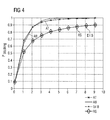
- FIG 4 a graph with the blocking probability as a function of the load for different aggregation strategies.
-
- Figure 3 shows two associated timelines P and B. On the first timeline P packets PA, pictured as arrow line, are received in chronological order, e.g. IP packets, ATM cells or PDUs. Every packet is associated with a generated random binary digit. A binary digit has a first and a second value, e.g. 1 for the first value and 0 for the second value or opposite.
- So, every packet is associated either with a 1 or a 0. The random binary digits can be generated by a Bernoulli random generator, according to a Bernoulli probability distribution. The probability for every value of the random binary digit, thus the probability (p) for the 1's and (1-p) for the 0's, is determined by a certain probability distribution, e.g. p(1)=0,01 and p(0)=0,99. These packets are aggregated in a buffer to accumulate an optical burst. A packet with an associated first value, e.g. with a 1 indicates a transition between optical bursts, e.g. the beginning of a new burst. In figure 3 this is labeled with BA. The chronological last packet with a 0 before a packet with a 1, is the last packet of the burst, marked with LPB in figure 3. On the second timeline B in figure 3 the resulting Bursts B1, B2 and B3 are shown. The time difference Z between the beginning of two successive bursts is called inter-arrival time. The aggregation delay is the delay experienced by a packet in the edge node until the burst to which it belongs is completed. After appearance of a packet with a 1, a new burst begins and the old burst is send into the OBS network.
- The used probability distribution determines the average number of packets per burst. E.g. the average number of packets per burst is equal to 1/p(1). For the example, if p(1)=0,01, the average number of packets per burst is 1/p(1)=100 packets per burst.
- The method can also be realized, that the second value indicates a transition between optical bursts.
- Also the first value indicates, instead of the beginning of a new burst, the end of the aggregated packets and by that the end of the aggregated burst. The main idea is, that a generated random digit with a certain probability indicates the beginning or the end of a burst, which consists of aggregated packets, e.g. IP packets.
- The invention can be implemented by the following steps/algorithm:
- Every time the edge node receives a packet, e.g. an IP packet, it sends it to the buffer.
- Then the edge node reads the generated associated random binary digit / random number corresponding to the next packet.
- If the associated random binary digit / random number for the next packet is a first value, e.g. a 1, the accumulated burst in the buffer is sent.
- Otherwise, do nothing.
- A simulation has been done with Matlab® in order to calculate the blocking probability in an optical switch with no wavelength conversion available as a function of the load. The results are presented in figure 4. In figure 4 AT means aggregation strategy with aggregation timer, AB means aggregation strategy with aggregation buffer, Erl B means theoretically possible load according to Erlang B formula and RS means inventive aggregation strategy with random selection.
- It can be observed that the inventive random selection strategy leads to the lowest blocking probability and furthermore it matches the Erlang-B formula predictions.
Claims (9)
- A method for aggregating incoming packets into optical bursts in an edge node of an Optical Burst Switched Network, comprising the steps of:wherein, a packet with a binary digit having the first value indicates a transition between optical bursts,storing the incoming packets to generate an optical burst;associating each incoming packet with a generated random binary digit with a probability for a first and a second value of the binary digit; and
sending the optical burst with the aggregated packets when a transition is indicated by the first value. - The Method as claimed in claim 1,
characterized in that,
wherein the transition is a beginning of the new optical burst. - The Method as claimed in claim 1,
characterized in that,
wherein the transition is an end of the optical burst. - A method for aggregating incoming packets into optical bursts in an edge node of an Optical Burst Switched Network, whereby every time a received incoming packet is stored and a random binary digit, with a probability for the first and the second value of the binary digit, is generated and compared with the first value of the binary digit and, if equal, the stored packets are sent as an optical burst.
- The Method as claimed in one of claims 1 to 4,
characterized in that,
where said optical burst is sent through the Optical Burst Switched Network. - The Method as claimed in one of claims 1 to 5,
characterized in that,
where said random binary digit is generated according to a Bernoulli probability distribution. - The Method as claimed in one of claims 1 to 6,
characterized in that,
that IP packets are used as incoming packets. - An edge node apparatus for an Optical Burst Switched Network for aggregating incoming packets into optical bursts, comprising:wherein an packet with the first value of the binary digit indicates a transition between optical bursts; anda buffer to accumulate the incoming packets as an optical burst; anda random generator to generate a sequence of binary digits with a probability for a first and a second value of the binary digit, such that every incoming packet is associated with a generated binary digit,
wherein the optical burst with the aggregated packets is sent when a transition is indicated by the first value. - The apparatus as claimed in claim 8,
characterized in that,
wherein the random generator is a Bernoulli random generator that generates a sequence of binary digits in accordance with a Bernoulli probability distribution.
Priority Applications (8)
| Application Number | Priority Date | Filing Date | Title |
|---|---|---|---|
| DE60317783T DE60317783T2 (en) | 2003-08-14 | 2003-08-14 | Method and apparatus for aggregating incoming packets into optical bursts for a burst-switched optical network |
| EP03018496A EP1507437B1 (en) | 2003-08-14 | 2003-08-14 | A method and apparatus for aggregating incoming packets into optical bursts for an optical burst switched network |
| RU2006107920/09A RU2355128C2 (en) | 2003-08-14 | 2004-08-06 | Method and device for incoming packet aggregation to optical packs for network with optical pack commutation |
| US10/568,237 US20060209849A1 (en) | 2003-08-14 | 2004-08-06 | Method for and apparatus for aggregating incoming packets into optical for an optical burst switched network |
| PCT/EP2004/051732 WO2005018272A1 (en) | 2003-08-14 | 2004-08-06 | A method for and apparatus for aggregating incoming packets into optical for an optical burst switched network |
| CNA2004800233379A CN1836462A (en) | 2003-08-14 | 2004-08-06 | Method and apparatus for aggregating inbound packets into optical bursts for an optical burst switched network |
| AU2004301165A AU2004301165B2 (en) | 2003-08-14 | 2004-08-06 | A method and apparatus for aggregating incoming packets into optical bursts for an optical burst switched network |
| CA002535442A CA2535442A1 (en) | 2003-08-14 | 2004-08-06 | A method for and apparatus for aggregating incoming packets into optical for an optical burst switched network |
Applications Claiming Priority (1)
| Application Number | Priority Date | Filing Date | Title |
|---|---|---|---|
| EP03018496A EP1507437B1 (en) | 2003-08-14 | 2003-08-14 | A method and apparatus for aggregating incoming packets into optical bursts for an optical burst switched network |
Publications (2)
| Publication Number | Publication Date |
|---|---|
| EP1507437A1 true EP1507437A1 (en) | 2005-02-16 |
| EP1507437B1 EP1507437B1 (en) | 2007-11-28 |
Family
ID=33560811
Family Applications (1)
| Application Number | Title | Priority Date | Filing Date |
|---|---|---|---|
| EP03018496A Expired - Lifetime EP1507437B1 (en) | 2003-08-14 | 2003-08-14 | A method and apparatus for aggregating incoming packets into optical bursts for an optical burst switched network |
Country Status (8)
| Country | Link |
|---|---|
| US (1) | US20060209849A1 (en) |
| EP (1) | EP1507437B1 (en) |
| CN (1) | CN1836462A (en) |
| AU (1) | AU2004301165B2 (en) |
| CA (1) | CA2535442A1 (en) |
| DE (1) | DE60317783T2 (en) |
| RU (1) | RU2355128C2 (en) |
| WO (1) | WO2005018272A1 (en) |
Cited By (1)
| Publication number | Priority date | Publication date | Assignee | Title |
|---|---|---|---|---|
| WO2012126421A3 (en) * | 2012-05-15 | 2013-04-18 | 华为技术有限公司 | Data processing method in optical transport network, and related device and system |
Families Citing this family (4)
| Publication number | Priority date | Publication date | Assignee | Title |
|---|---|---|---|---|
| US7643753B2 (en) * | 2005-09-29 | 2010-01-05 | Broadlight Ltd. | Enhanced passive optical network (PON) processor |
| CN101924961B (en) * | 2010-07-19 | 2013-04-17 | 浙江工业大学 | Multi-granular optical cross connection device for core nodes in optical burst switching network |
| RU2532730C1 (en) * | 2013-04-30 | 2014-11-10 | Федеральное государственное унитарное предприятие "Центральный научно-исследовательский институт связи" (ФГУП ЦНИИС) | Method for time referencing in measurement systems for evaluating qualitative parameters of ip packet exchange |
| US9538265B2 (en) * | 2014-02-04 | 2017-01-03 | Nec Corporation | Lossless and low-delay optical burst switching using soft reservations and opportunistic transmission |
Citations (2)
| Publication number | Priority date | Publication date | Assignee | Title |
|---|---|---|---|---|
| WO2001084875A2 (en) * | 2000-05-03 | 2001-11-08 | Nokia, Inc. | Robust transport of ip traffic over wdm using optical burst switching |
| US20030099243A1 (en) * | 2001-11-27 | 2003-05-29 | Se-Yoon Oh | Control packet structure and method for generating a data burst in optical burst switching networks |
Family Cites Families (4)
| Publication number | Priority date | Publication date | Assignee | Title |
|---|---|---|---|---|
| RU2163053C2 (en) * | 1999-01-26 | 2001-02-10 | Государственное унитарное предприятие Воронежский научно-исследовательский институт связи | Radio link |
| KR100452945B1 (en) * | 2002-01-07 | 2004-10-14 | 학교법인 한국정보통신학원 | Dynamic Wavelength Management Method in OBS Networks |
| US20030235192A1 (en) * | 2002-06-20 | 2003-12-25 | Masoud Sajadieh | Adaptive delay-based overload control for communications systems |
| ATE418254T1 (en) * | 2002-12-23 | 2009-01-15 | Alcatel Lucent | OVERLOAD CONTROL IN AN OPTICAL NETWORK WITH BURST SWITCHING |
-
2003
- 2003-08-14 EP EP03018496A patent/EP1507437B1/en not_active Expired - Lifetime
- 2003-08-14 DE DE60317783T patent/DE60317783T2/en not_active Expired - Lifetime
-
2004
- 2004-08-06 WO PCT/EP2004/051732 patent/WO2005018272A1/en not_active Ceased
- 2004-08-06 RU RU2006107920/09A patent/RU2355128C2/en not_active IP Right Cessation
- 2004-08-06 CA CA002535442A patent/CA2535442A1/en not_active Abandoned
- 2004-08-06 CN CNA2004800233379A patent/CN1836462A/en active Pending
- 2004-08-06 US US10/568,237 patent/US20060209849A1/en not_active Abandoned
- 2004-08-06 AU AU2004301165A patent/AU2004301165B2/en not_active Expired - Fee Related
Patent Citations (2)
| Publication number | Priority date | Publication date | Assignee | Title |
|---|---|---|---|---|
| WO2001084875A2 (en) * | 2000-05-03 | 2001-11-08 | Nokia, Inc. | Robust transport of ip traffic over wdm using optical burst switching |
| US20030099243A1 (en) * | 2001-11-27 | 2003-05-29 | Se-Yoon Oh | Control packet structure and method for generating a data burst in optical burst switching networks |
Non-Patent Citations (1)
| Title |
|---|
| YOO M ET AL: "NEW OPTICAL BURST SWITCHING PROTOCOL FOR SUPPORTING QUALITY OF SERVICE", PROCEEDINGS OF THE SPIE, SPIE, BELLINGHAM, VA, US, vol. 3531, November 1998 (1998-11-01), pages 396 - 405, XP000950072, ISSN: 0277-786X * |
Cited By (2)
| Publication number | Priority date | Publication date | Assignee | Title |
|---|---|---|---|---|
| WO2012126421A3 (en) * | 2012-05-15 | 2013-04-18 | 华为技术有限公司 | Data processing method in optical transport network, and related device and system |
| US10085078B2 (en) | 2012-05-15 | 2018-09-25 | Huawei Technologies Co., Ltd. | Data processing method, related device, and system for optical transport network |
Also Published As
| Publication number | Publication date |
|---|---|
| WO2005018272A1 (en) | 2005-02-24 |
| US20060209849A1 (en) | 2006-09-21 |
| RU2006107920A (en) | 2007-09-27 |
| CN1836462A (en) | 2006-09-20 |
| DE60317783T2 (en) | 2008-10-30 |
| RU2355128C2 (en) | 2009-05-10 |
| DE60317783D1 (en) | 2008-01-10 |
| CA2535442A1 (en) | 2005-02-24 |
| AU2004301165B2 (en) | 2008-10-30 |
| AU2004301165A1 (en) | 2005-02-24 |
| EP1507437B1 (en) | 2007-11-28 |
Similar Documents
| Publication | Publication Date | Title |
|---|---|---|
| Yoo et al. | New optical burst-switching protocol for supporting quality of service | |
| EP1665868B1 (en) | Method and system to recover optical burst switched network resources upon data burst loss | |
| US20180176131A1 (en) | Apparatus and methods of routing with control vectors in a synchronized adaptive infrastructure (sain) network | |
| Yoo et al. | A novel switching paradigm for buffer-less WDM networks | |
| EP1511232A1 (en) | A method for transmission of data packets through a network | |
| EP1507437B1 (en) | A method and apparatus for aggregating incoming packets into optical bursts for an optical burst switched network | |
| Fumagalli et al. | A low-latency and bandwidth-efficient distributed optical burst switching architecture for metro ring | |
| CA2358739A1 (en) | High-capacity packet-switched ring network | |
| CN1595909A (en) | Polling persisting multicast protocol based on retransmission acknowledgement mechanism in optical burst switching ring network | |
| US20070064729A1 (en) | Method for transmission of data packets through a network | |
| EP1686734A1 (en) | A method and apparatus for transmitting an optical signal in an optical burst switching network using arrival time | |
| Corazza et al. | An optical packet switch with a multi-stage buffer for IP traffic | |
| Angelopoulos et al. | Slotted optical switching with pipelined two-way reservations | |
| EP1511233A1 (en) | A method for transmission of data packets through a network | |
| Riadi et al. | A decision algorithm for efficient hybrid burst retransmission and burst cloning scheme over star OBS networks | |
| Farahmand et al. | Optical burst switching network: A multi-layered approach | |
| KR100680179B1 (en) | Optical burst switching system and method by optical burst repetitive transmission | |
| Bengi | An analytical model for a slotted WDM metro ring with a-posteriori access | |
| Rahbar et al. | Retransmission in slotted optical networks | |
| Riadi et al. | An efficient hybrid burst retransmission and burst cloning scheme over star OBS networks | |
| Um et al. | Centralized resource allocation for time-slotted OBS networks | |
| Jacquet et al. | A method for increasing throughput based on packet striping | |
| Khazali et al. | Control messages delivery protocol | |
| Lazzez et al. | Improving TCP QoS over OBS networks: A scheme based on optical segment retransmission | |
| Riadi et al. | A controlled retransmission scheme for optical burst switching over star networks |
Legal Events
| Date | Code | Title | Description |
|---|---|---|---|
| PUAI | Public reference made under article 153(3) epc to a published international application that has entered the european phase |
Free format text: ORIGINAL CODE: 0009012 |
|
| AK | Designated contracting states |
Kind code of ref document: A1 Designated state(s): AT BE BG CH CY CZ DE DK EE ES FI FR GB GR HU IE IT LI LU MC NL PT RO SE SI SK TR |
|
| AX | Request for extension of the european patent |
Extension state: AL LT LV MK |
|
| 17P | Request for examination filed |
Effective date: 20050816 |
|
| AKX | Designation fees paid |
Designated state(s): DE FR GB |
|
| 17Q | First examination report despatched |
Effective date: 20060410 |
|
| GRAP | Despatch of communication of intention to grant a patent |
Free format text: ORIGINAL CODE: EPIDOSNIGR1 |
|
| RAP1 | Party data changed (applicant data changed or rights of an application transferred) |
Owner name: NOKIA SIEMENS NETWORKS GMBH & CO. KG |
|
| GRAS | Grant fee paid |
Free format text: ORIGINAL CODE: EPIDOSNIGR3 |
|
| GRAA | (expected) grant |
Free format text: ORIGINAL CODE: 0009210 |
|
| RAP3 | Party data changed (applicant data changed or rights of an application transferred) |
Owner name: NOKIA SIEMENS NETWORKS S.P.A. |
|
| AK | Designated contracting states |
Kind code of ref document: B1 Designated state(s): DE FR GB |
|
| REG | Reference to a national code |
Ref country code: GB Ref legal event code: FG4D |
|
| RAP4 | Party data changed (patent owner data changed or rights of a patent transferred) |
Owner name: NOKIA SIEMENS NETWORKS GMBH & CO. KG |
|
| REF | Corresponds to: |
Ref document number: 60317783 Country of ref document: DE Date of ref document: 20080110 Kind code of ref document: P |
|
| ET | Fr: translation filed | ||
| PLBE | No opposition filed within time limit |
Free format text: ORIGINAL CODE: 0009261 |
|
| STAA | Information on the status of an ep patent application or granted ep patent |
Free format text: STATUS: NO OPPOSITION FILED WITHIN TIME LIMIT |
|
| 26N | No opposition filed |
Effective date: 20080829 |
|
| PGFP | Annual fee paid to national office [announced via postgrant information from national office to epo] |
Ref country code: DE Payment date: 20130821 Year of fee payment: 11 |
|
| REG | Reference to a national code |
Ref country code: DE Ref legal event code: R082 Ref document number: 60317783 Country of ref document: DE Representative=s name: BOEHMERT & BOEHMERT, DE |
|
| PGFP | Annual fee paid to national office [announced via postgrant information from national office to epo] |
Ref country code: GB Payment date: 20130821 Year of fee payment: 11 Ref country code: FR Payment date: 20130823 Year of fee payment: 11 |
|
| REG | Reference to a national code |
Ref country code: DE Ref legal event code: R082 Ref document number: 60317783 Country of ref document: DE Representative=s name: BOEHMERT & BOEHMERT, DE Effective date: 20131106 Ref country code: DE Ref legal event code: R082 Ref document number: 60317783 Country of ref document: DE Representative=s name: BOEHMERT & BOEHMERT ANWALTSPARTNERSCHAFT MBB -, DE Effective date: 20131106 Ref country code: DE Ref legal event code: R081 Ref document number: 60317783 Country of ref document: DE Owner name: XIEON NETWORKS S.A.R.L., LU Free format text: FORMER OWNER: NOKIA SIEMENS NETWORKS GMBH & CO. KG, 81541 MUENCHEN, DE Effective date: 20131106 |
|
| REG | Reference to a national code |
Ref country code: GB Ref legal event code: 732E Free format text: REGISTERED BETWEEN 20131212 AND 20131218 |
|
| REG | Reference to a national code |
Ref country code: GB Ref legal event code: 732E Free format text: REGISTERED BETWEEN 20140130 AND 20140205 |
|
| REG | Reference to a national code |
Ref country code: FR Ref legal event code: TP Owner name: XIEON NETWORKS S.A.R.L., LU Effective date: 20140408 Ref country code: FR Ref legal event code: GC Effective date: 20140408 |
|
| REG | Reference to a national code |
Ref country code: DE Ref legal event code: R119 Ref document number: 60317783 Country of ref document: DE |
|
| GBPC | Gb: european patent ceased through non-payment of renewal fee |
Effective date: 20140814 |
|
| REG | Reference to a national code |
Ref country code: DE Ref legal event code: R119 Ref document number: 60317783 Country of ref document: DE Effective date: 20150303 |
|
| REG | Reference to a national code |
Ref country code: FR Ref legal event code: ST Effective date: 20150430 |
|
| PG25 | Lapsed in a contracting state [announced via postgrant information from national office to epo] |
Ref country code: GB Free format text: LAPSE BECAUSE OF NON-PAYMENT OF DUE FEES Effective date: 20140814 Ref country code: DE Free format text: LAPSE BECAUSE OF NON-PAYMENT OF DUE FEES Effective date: 20150303 |
|
| PG25 | Lapsed in a contracting state [announced via postgrant information from national office to epo] |
Ref country code: FR Free format text: LAPSE BECAUSE OF NON-PAYMENT OF DUE FEES Effective date: 20140901 |