EP1507220A1 - Boundary data inside/outside judgment method and program thereof - Google Patents
Boundary data inside/outside judgment method and program thereof Download PDFInfo
- Publication number
- EP1507220A1 EP1507220A1 EP03723379A EP03723379A EP1507220A1 EP 1507220 A1 EP1507220 A1 EP 1507220A1 EP 03723379 A EP03723379 A EP 03723379A EP 03723379 A EP03723379 A EP 03723379A EP 1507220 A1 EP1507220 A1 EP 1507220A1
- Authority
- EP
- European Patent Office
- Prior art keywords
- boundary
- cell
- cells
- data
- space
- Prior art date
- Legal status (The legal status is an assumption and is not a legal conclusion. Google has not performed a legal analysis and makes no representation as to the accuracy of the status listed.)
- Withdrawn
Links
Images


Classifications
-
- G—PHYSICS
- G06—COMPUTING OR CALCULATING; COUNTING
- G06T—IMAGE DATA PROCESSING OR GENERATION, IN GENERAL
- G06T17/00—Three-dimensional [3D] modelling for computer graphics
- G06T17/20—Finite element generation, e.g. wire-frame surface description, tesselation
-
- G—PHYSICS
- G06—COMPUTING OR CALCULATING; COUNTING
- G06T—IMAGE DATA PROCESSING OR GENERATION, IN GENERAL
- G06T15/00—Three-dimensional [3D] image rendering
- G06T15/08—Volume rendering
-
- G—PHYSICS
- G06—COMPUTING OR CALCULATING; COUNTING
- G06T—IMAGE DATA PROCESSING OR GENERATION, IN GENERAL
- G06T7/00—Image analysis
- G06T7/10—Segmentation; Edge detection
- G06T7/11—Region-based segmentation
-
- G—PHYSICS
- G06—COMPUTING OR CALCULATING; COUNTING
- G06T—IMAGE DATA PROCESSING OR GENERATION, IN GENERAL
- G06T7/00—Image analysis
- G06T7/10—Segmentation; Edge detection
- G06T7/162—Segmentation; Edge detection involving graph-based methods
-
- G—PHYSICS
- G06—COMPUTING OR CALCULATING; COUNTING
- G06T—IMAGE DATA PROCESSING OR GENERATION, IN GENERAL
- G06T2207/00—Indexing scheme for image analysis or image enhancement
- G06T2207/20—Special algorithmic details
- G06T2207/20004—Adaptive image processing
- G06T2207/20012—Locally adaptive
-
- G—PHYSICS
- G06—COMPUTING OR CALCULATING; COUNTING
- G06T—IMAGE DATA PROCESSING OR GENERATION, IN GENERAL
- G06T2207/00—Indexing scheme for image analysis or image enhancement
- G06T2207/20—Special algorithmic details
- G06T2207/20016—Hierarchical, coarse-to-fine, multiscale or multiresolution image processing; Pyramid transform
-
- G—PHYSICS
- G06—COMPUTING OR CALCULATING; COUNTING
- G06T—IMAGE DATA PROCESSING OR GENERATION, IN GENERAL
- G06T2207/00—Indexing scheme for image analysis or image enhancement
- G06T2207/20—Special algorithmic details
- G06T2207/20021—Dividing image into blocks, subimages or windows
-
- G—PHYSICS
- G06—COMPUTING OR CALCULATING; COUNTING
- G06T—IMAGE DATA PROCESSING OR GENERATION, IN GENERAL
- G06T2207/00—Indexing scheme for image analysis or image enhancement
- G06T2207/30—Subject of image; Context of image processing
- G06T2207/30108—Industrial image inspection
- G06T2207/30164—Workpiece; Machine component
Definitions
- the present invention relates to a method and a program for determining insides and outsides of two-dimensional or three-dimensional boundary surfaces.
- CAD Computer Aided Design
- CAM Computer Aided Manufacturing
- CAE Computer Aided Engineering
- CAT Computer Aided Testing
- a boundary surface of an object is important.
- the object is expressed by the boundary surface, and the inside of the boundary surface is uniformly treated.
- a ray crossing method As a conventional inside/outside determination method, there is known (1) a ray crossing method, (2) a region growing (expanding) method that uses boundary tracking, (3) raster tracking in image processing, (4) multi-directional tracking, (5) a Curless method, (6) a Szeliski method and a Puli method that use oct-tree, Japanese Laid-Open Patent Publication Nos. 8-153214 and 9-81783, and so on.
- the present invention was made. It is an object of the present invention to provide a method for determining insides and outsides of boundaries, in which the method is robust against a defect of boundary information, inside/outside determination can be performed even when the boundary information has a defect, a processing speed is high, the implementation in a computing machine is easy, there is not a possibility that different spaces are classified into one space, and the method can be applied to multiple spaces.
- a method for determining insides and outsides of boundaries comprising: an external data input step (A) of inputting external data (12) constituted by boundary data of objects; a cell division step (B) of dividing the external data into rectangular parallelepiped cells (13) having boundary planes orthogonal to each other; a cell classification step (C) of classifying the cells into a boundary cell (13a) that includes the boundary data and a non-boundary cell that does not include the boundary data; and a space classification step (D) of classifying the non-boundary cells (13b) into a plurality of spaces that are partitioned by the boundary cells (13a).
- a program for determining insides and outsides of boundaries comprising: an external data input step (A) of inputting external data (12) constituted by boundary data of objects; a cell division step (B) of dividing the external data into rectangular parallelepiped cells (13) having boundary planes orthogonal to each other; a cell classification step (C) of classifying the cells into a boundary cell (13a) that includes the boundary data and a non-boundary cell that does not include the boundary data; and a space classification step (D) of classifying the non-boundary cells (13b) into a plurality of spaces that are partitioned by the boundary cells (13a).
- all the external data (12) is divided into the rectangular parallelepiped cells (13) having the boundary planes orthogonal to each other, and each of the cells is classified into the boundary cell (13a) or the non-boundary cell (13b). Accordingly, each cell is always classified into the boundary cell (13a) or the non-boundary cell (13b) even if the external data (12) has a defect in the boundary information.
- the boundary data that includes only a part of the boundary data (for example, one point) is made to be classified into the boundary cell (13a). Thereby, the boundary data is always included in the boundary cell (13a).
- the boundary data has a defect such as a data lack, as long as a size of the data lack is smaller than a size of the non-boundary cell (13b), the boundary data that includes a data lack is always included in the boundary cell (13a).
- the method and the program of the present invention are robust against a defect of the boundary information so that the inside/outside determination can be performed even when the boundary information has a defect.
- the space classification step (D) comprises: an initial setting step (D1) of initializing a space number k; a labeling step (D2) of successively scanning all of the cells to label the rectangular parallelepiped cells with the space number k; and a label modifying step (D3) of modifying the space numbers k of the labeled cells
- the labeling step (D2) comprises: a step (E1) of labeling the currently scanned cell with the same space number as that of the immediately preceding cell when the immediately preceding cell and the currently scanned cell are the non-boundary cells; a step (E2) of labeling the currently scanned cell with the space number for the boundary cell when the currently scanned cell is the boundary cell; and a step (E3) of updating the space number k to be the space number k+1, and labeling the currently scanned cell with the updated space number k+1 when the immediately preceding cell is the boundary cell, and the currently scanned cell is the non-boundary cell, and the label modifying step (D)
- the processing time is an order of O(n), that is, proportional to the number "n”.
- the present invention can be applied to multiple spaces.
- the external data is repeatedly divided into the cells by oct-tree division until cut points enough to reconstruct boundary shape elements that constitute boundary surfaces included in the external data are obtained.
- voxel data is divided into the rectangular parallelepiped cells (13) that have a same size.
- the present invention can be applied to the V-CAD data. Further, by dividing the external data into the calls having the same size, the present invention can treat the usual voxel data.
- the labeling step (D2) is performed for three directions of X, Y and Z in turn, or is performed in a recursive manner.
- the scanning is repeatedly performed for three directions of x, Y and Z in turn, and in the case of the V-CAD data, the scanning is performed in a recursive manner. Thereby, it is possible to scan the rectangular parallelepiped cells (13) one after another.
- the labeling step (D2) and the label modifying step (D3) are performed in turn per scanned cell, or after the labeling step (D2) is performed on all of the cells, the label modifying step (D3) is performed.
- the inventor of the present invention made a preceding invention "Method for storing substantial data formed by integrating shape and physical property" and this invention was filed as Japanese Patent Application No. 2001-025023.
- this method it is possible to store substantial data formed by unifying a shape and a physical property, with a small memory capacity.
- the above method relates to a method for storing substantial data by which a CAD and a simulation can be integrated.
- the data of this method is referred to as "V-CAD data”
- designing and simulation that uses this data is referred to as "volume CAD" or "V-CAD”.
- a method for determining insides and outsides of boundaries according to the present invention is particularly suitable to application to the V-CAD data.
- the present invention is not limited to this, and can be applied to a usual voxel data.
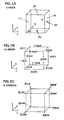
- cell refers to a region (such as a voxel and an octant of oct-tree) including the surface and the inside of a rectangular parallelepiped that is formed by dividing a three-dimensional space when boundary (surface) data is input.
- non-boundary cell refers to a cell that has no surface information.
- volume world a target three-dimensional space
- world a target three-dimensional space
- the world is occupied by two types of cell, i.e., the boundary cells and the non-boundary cells without clearance gap and without the insides of cells being overlapped, which is referred to as cell complex.
- the boundary cell has an intersection point with input boundary data, in the inside constituting the boundary cell, or at the planes, the ridges or the vertexes that are the boundary of the boundary cell.
- the cell that does not have such an intersection point is the non-boundary cell.
- the cells that neighbor each other share only the cell boundary regardless of the types of the cells.
- An object that has two-dimensional manifolds as the boundary and that has a three-dimensional filled inside is referred to as "space”.
- spaces An object that has two-dimensional manifolds as the boundary and that has a three-dimensional filled inside is referred to as "space".
- Respective spaces that are not combined are recognized as different spaces. Accordingly, the space indicates a part (a group of points) that is enclosed by a boundary (surface) expressed by a closed surface, and is used as a unit of an object having the same material in a real world.
- a boundary part that distinguishes the different spaces is referred to as "surface” or "boundary” (that has the same
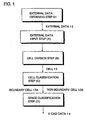
- FIG. 1 is a flowchart of the method for determining insides and outsides of boundaries according to the present invention.
- the method of the present invention includes an external data input step (A), a cell division step (B), a cell classification step (C), and a space classification step (D).
- external data 12 constituted by boundary data (data of plural boundaries) of objects 1 obtained at an external data obtaining step S1 is input to a computer or the like that stores the method (the program) of the present invention.
- the external data 12 is divided into rectangular parallelepiped cells having boundary planes orthogonal to each other.
- the external data 12 may be divided into cubes, instead of rectangular parallelepiped cells 13.
- each cell divided from the external data 12 is classified into a boundary cell 13a that includes boundary data or a non-boundary cell 13b that includes no boundary data.
- the non-boundary cells 13b are classified into a plurality of spaces partitioned by the boundary cells 13a.
- the rectangular parallelepiped cells 13 are repeatedly divided by the oct-tree division until cut points enough to reconstruct boundary shape elements that constitute the boundary surfaces included in the external data are obtained.
- FIG. 2 is a flowchart of the space classification step (D) of FIG. 1.
- the space classification step (D) includes an initial setting step (D1), a labeling step (D2), and a label modifying step (D3).
- the labeling step (D2) all of the rectangular parallelepiped cells 13 are scanned one after another to label the rectangular parallelepiped cells 13 with the space numbers k.
- the label modifying step (D3) the space numbers k attached to the rectangular parallelepiped cells 13 are modified.
- labeling is successively performed for three directions of X, Y and Z.
- labeling is successively performed for three directions of X, Y and Z.
- V-CAD data all of the rectangular parallelepiped cells 13 are scanned one after another by a recursive process.
- the labeling step (D2) includes a step (E1), a step (E2) and a step (E3).
- the currently scanned cell is labeled with the same space number as the space number of the immediately preceding cell.
- the scanned call is a boundary cell 13a
- the scanned cell is labeled with the space number for the boundary cell.
- the space number k is updated to be the space number k+1, and the currently scanned cell is labeled with the updated space number.
- the label modifying step (D3) includes a step (F1) of comparing the space numbers of the neighboring cells that neighbor one another, and a step (F2) of re-labeling all of the neighboring cells with the smallest of the compared space numbers.
- the labeling step (D2) and the label modifying step (D3) may be performed in turn per scanned cell. Alternatively, after the labeling step (D2) is performed on all of the cells, the label modifying step (D3) may be performed.
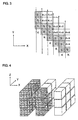
- FIG. 3 is a schematic view showing the labeling step (D2) in a two-dimension case
- FIG. 4 is a schematic view showing the labeling step (D2) in a three-dimension case. The method of the present invention will be described in further detail with reference to FIGS. 3 and 4.
- the boundary information for the space, and the minimum resolution in dividing the world are required as input data.
- the boundary information that is partially lost as a result of conversion or calculation is allowable.
- the external data 12 input from the outside is polygon data expressing polyhedrons, quadrihedron or hexahedrons elements used in a finite element method, curved surface data used in a three-dimensional CAD or a CG tool, or data that expresses surfaces of other three-dimensional shapes by using partial plane surfaces and partial curved surfaces.
- the external data 12 may be data generated directly by user's input by V-CAD's own interface, surface digitized data of a measuring device, a sensor, digitizer or the like, or volume data having internal information such as voxel data used in a CT scan, an MRI and general volume rendering.
- Output data is V-CAD data constituted by the boundaries of the two-dimensional manifolds, and constituted by cells having sizes no smaller than a size of the minimum resolution, and is data where the spaces have different space numbers.
- This V-CAD data has an entire space filled with cells (boundary cells) directly having the boundaries, and cells (non-boundary cells) having no boundaries.
- label is used as the number (space number) for distinguishing the spaces.
- the cell type (boundary cell and non-boundary cell) is previously determined at the cell classification step (C). The cell type can be easily determined based on whether or not there is an intersection of the inside (as well as the boundary) of each cell with the input boundary information.
- an entire range where neighboring vertexes, ridges and planes of only inner cells can be traced is determined as the same space in advance, and a range that is not completely surrounded by the boundary cells becomes the same space. Accordingly, the method of the present invention has the following features.
- FIGS. 6 through 11 show relatively complicated examples. Although the solid modeling is weak on the examples shown FIGS. 6 through 11, the inside/outside determination of the method of the present invention is robust on these examples.
- FIG. 6 shows input data of a pressing mold for an automobile bumper in the form of a solid model.
- FIG. 7 shows cells and boundary data converted from the input data of FIG. 6.
- FIG. 8 is a partial enlarged view of FIG. 7, and shows cells surrounded by thin lines as well as the boundary data.
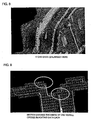
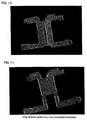
- FIG. 9 partially shows a section of FIG. 7, and the ellipse marks indicate parts that lack boundary data. From FIG. 9, it is understood that the boundary cells can be recognized even if there is a relatively large lack of which size is close to a cell size.
- FIG. 10 shows a configuration where cut points are added to the entire configuration of FIG. 9.
- the boundary cells that have cut points determined by the input data and ridges of the cells are set, and then, other cells (non-boundary cells) are labeled before the boundary cells so that the inside/outside determining process can become robuster.
- FIG. 11 shows another section similar to that of FIG. 10, and shows that the processing by the method of the present invention is robust even when there are a hole and a disconnection.
- the cell division step (B) all the external data 12 is divided into rectangular parallelepiped cells 13 of which boundary planes are orthogonal to each other, and at the cell classification step (C), respective cells divided from the external data 12 are classified into the boundary cell 13a and the non-boundary cell 13b. Accordingly, even if defect boundary data exists in the external data 12, the cells are always classified into the boundary cell 13a and the non-boundary cell 13b.
- the cell that includes only a part of boundary data (for example, one point) is set to be a boundary cell 13a so that the boundary data can always be included in the boundary cells 13a. Furthermore, even when the boundary information has a defect such as a data lack, as long as a size of the data lack is smaller than a size of the non-boundary cell 13, the boundary data that includes the data lack can also be included in the boundary cells 13a.
- the present invention has the following advantages.
- the method and program of the present invention are robust against a defect of the boundary information, so that the inside/outside determination can be performed even when the boundary information has a defect.
- a processing speed is high, the implementation of the present invention in a computing machine is easy, there is a low possibility that different spaces are classified into the same space, and the present invention can be applied to a multiple space.
Landscapes
- Engineering & Computer Science (AREA)
- Physics & Mathematics (AREA)
- General Physics & Mathematics (AREA)
- Theoretical Computer Science (AREA)
- Computer Vision & Pattern Recognition (AREA)
- Computer Graphics (AREA)
- Geometry (AREA)
- Software Systems (AREA)
- Image Analysis (AREA)
- Processing Or Creating Images (AREA)
Abstract
Description
Claims (7)
- A method for determining insides and outsides of boundaries, comprising:an external data input step (A) of inputting external data (12) constituted by boundary data of objects;a cell division step (B) of dividing the external data into rectangular parallelepiped cells (13) having boundary planes orthogonal to each other;a cell classification step (C) of classifying the cells into a boundary cell (13a) that includes the boundary data and a non-boundary cell that does not include the boundary data; anda space classification step (D) of classifying the non-boundary cells (13b) into a plurality of spaces that are partitioned by the boundary cells (13a).
- The method for determining insides and outsides of boundaries according to claim 1, wherein the space classification step (D) comprises:an initial setting step (D1) of initializing a space number k;a labeling step (D2) of successively scanning all of the cells to label the rectangular parallelepiped cells with the space number k; anda label modifying step (D3) of modifying the space numbers k of the labeled cells,the labeling step (D2) comprises:a step (E1) of labeling the currently scanned cell with the same space number as that of the immediately preceding cell when the immediately preceding cell and the currently scanned cell are the non-boundary cells;a step (E2) of labeling the currently scanned cell with the space number for the boundary cell when the currently scanned cell is the boundary cell; anda step (E3) of updating the space number k to be the space number k+1, and labeling the currently scanned cell with the updated space number k+1 when the immediately preceding cell is the boundary cell, and the currently scanned cell is the non-boundary cell, andthe label modifying step (D3) comprises:a step (F1) of comparing the space numbers of the neighboring cells that neighbor one another; anda step (F2) of re-labeling the neighboring cells with the smallest of the compared space numbers.
- The method for determining insides and outsides of boundaries according to claim 1, wherein at the cell division step (B), the external data is repeatedly divided into the cells by oct-tree division until cut points enough to reconstruct boundary shape elements that constitute boundary surfaces included in the external data are obtained.
- The method for determining insides and outsides of boundaries according to claim 1, wherein at the cell division step (B), voxel data is divided into the rectangular parallelepiped cells (13) that have a same size.
- The method for determining insides and outsides of boundaries according to claim 2, wherein in order to scan all the rectangular parallelepiped cells one after another, the labeling step (D2) is performed for three directions of X, Y and Z in turn, or is performed in a recursive manner.
- The method for determining insides and outsides of boundaries according to claim 2, wherein the labeling step (D2) and the label modifying step (D3) are performed in turn per scanned cell, or after the labeling step (D2) is performed on all of the cells, the label modifying step (D3) is performed.
- A program for determining insides and outsides of boundaries that is executed by a computing machine, comprising:an external data input step (A) of inputting external data (12) constituted by boundary data of objects;a cell division step (B) of dividing the external data into rectangular parallelepiped cells (13) having boundary planes orthogonal to each other;a cell classification step (C) of classifying the cells into a boundary cell (13a) that includes the boundary data and a non-boundary cell that does not include the boundary data; anda space classification step (D) of classifying the non-boundary cells (13b) into a plurality of spaces that are partitioned by the boundary cells (13a).
Applications Claiming Priority (3)
| Application Number | Priority Date | Filing Date | Title |
|---|---|---|---|
| JP2002142260 | 2002-05-17 | ||
| JP2002142260A JP4175536B2 (en) | 2002-05-17 | 2002-05-17 | Boundary data inside / outside judgment method and program |
| PCT/JP2003/006053 WO2003098489A1 (en) | 2002-05-17 | 2003-05-15 | Boundary data inside/outside judgment method and program thereof |
Publications (2)
| Publication Number | Publication Date |
|---|---|
| EP1507220A1 true EP1507220A1 (en) | 2005-02-16 |
| EP1507220A4 EP1507220A4 (en) | 2007-04-04 |
Family
ID=29544979
Family Applications (1)
| Application Number | Title | Priority Date | Filing Date |
|---|---|---|---|
| EP03723379A Withdrawn EP1507220A4 (en) | 2002-05-17 | 2003-05-15 | PROGRAM AND METHOD FOR INNER / EXTERIOR DETERMINATION OF FRONTIER DATA |
Country Status (5)
| Country | Link |
|---|---|
| US (1) | US7388584B2 (en) |
| EP (1) | EP1507220A4 (en) |
| JP (1) | JP4175536B2 (en) |
| CN (1) | CN100367284C (en) |
| WO (1) | WO2003098489A1 (en) |
Cited By (2)
| Publication number | Priority date | Publication date | Assignee | Title |
|---|---|---|---|---|
| EP1770566A4 (en) * | 2004-05-06 | 2009-12-02 | Riken | METHOD FOR LABELING VOLUME DATA CELLS AND PROGRAM THEREOF |
| EP1978487A3 (en) * | 2007-04-06 | 2011-01-05 | Hitachi, Ltd. | Numerical analysis mesh generating method and apparatus |
Families Citing this family (10)
| Publication number | Priority date | Publication date | Assignee | Title |
|---|---|---|---|---|
| JP4349562B2 (en) * | 2003-05-09 | 2009-10-21 | 独立行政法人理化学研究所 | Spatial identification method and program |
| WO2006118548A1 (en) * | 2005-05-02 | 2006-11-09 | Agency For Science, Technology And Research | Method and apparatus for registration of an atlas to an image |
| JP4783100B2 (en) * | 2005-09-12 | 2011-09-28 | 独立行政法人理化学研究所 | Method of converting boundary data into in-cell shape data and its conversion program |
| US7620532B2 (en) * | 2006-01-23 | 2009-11-17 | Itt Manufacturing Enterprises, Inc. | Object discretization to particles for computer simulation and analysis |
| US7629985B2 (en) * | 2006-01-26 | 2009-12-08 | Autodesk, Inc. | Method for creation of architectural space objects for area and volume calculation |
| US8274513B1 (en) * | 2007-12-17 | 2012-09-25 | Nvidia Corporation | System, method, and computer program product for obtaining a boundary attribute value from a polygon mesh, during voxelization |
| JP6747116B2 (en) * | 2016-07-08 | 2020-08-26 | 富士通株式会社 | Voxelization processing program, voxelization processing method, and information processing apparatus |
| US10242484B1 (en) | 2017-10-17 | 2019-03-26 | 8i Limited | UV mapping and compression |
| US10896316B2 (en) * | 2019-02-04 | 2021-01-19 | Tokitae, LLC | Automated microscopy scanning systems and methods |
| JP7646473B2 (en) | 2021-06-18 | 2025-03-17 | 株式会社東芝 | DETECTION SYSTEM, PROCESSING DEVICE, MOBILE BODY, DETECTION METHOD, AND PROGRAM |
Family Cites Families (10)
| Publication number | Priority date | Publication date | Assignee | Title |
|---|---|---|---|---|
| US5166876A (en) * | 1991-01-16 | 1992-11-24 | General Electric Company | System and method for detecting internal structures contained within the interior region of a solid object |
| US5345490A (en) * | 1991-06-28 | 1994-09-06 | General Electric Company | Method and apparatus for converting computed tomography (CT) data into finite element models |
| US5458125A (en) * | 1994-01-28 | 1995-10-17 | Board Of Directors Of The Leland Standford Jr. University | Treatment planning method and apparatus for radiosurgery and radiation therapy |
| JPH0896025A (en) | 1994-07-28 | 1996-04-12 | Hitachi Ltd | Graphic processing method and apparatus |
| JP3265879B2 (en) | 1994-11-25 | 2002-03-18 | 日産自動車株式会社 | 3D orthogonal grid data generator |
| JP3683948B2 (en) | 1995-09-11 | 2005-08-17 | キヤノン株式会社 | Finite element model processing system and method |
| US6075538A (en) * | 1996-07-25 | 2000-06-13 | Institute Of High Performance Computing | Time and space efficient data structure and method and apparatus for using the same for surface rendering |
| JP3468464B2 (en) * | 2001-02-01 | 2003-11-17 | 理化学研究所 | Volume data generation method integrating shape and physical properties |
| CN1311390C (en) | 2001-12-04 | 2007-04-18 | 独立行政法人理化学研究所 | Transformation method from 3D shape data to unit internal data |
| JP4349562B2 (en) | 2003-05-09 | 2009-10-21 | 独立行政法人理化学研究所 | Spatial identification method and program |
-
2002
- 2002-05-17 JP JP2002142260A patent/JP4175536B2/en not_active Expired - Fee Related
-
2003
- 2003-05-15 WO PCT/JP2003/006053 patent/WO2003098489A1/en not_active Ceased
- 2003-05-15 CN CNB038074133A patent/CN100367284C/en not_active Expired - Fee Related
- 2003-05-15 EP EP03723379A patent/EP1507220A4/en not_active Withdrawn
- 2003-05-15 US US10/507,623 patent/US7388584B2/en not_active Expired - Fee Related
Cited By (3)
| Publication number | Priority date | Publication date | Assignee | Title |
|---|---|---|---|---|
| EP1770566A4 (en) * | 2004-05-06 | 2009-12-02 | Riken | METHOD FOR LABELING VOLUME DATA CELLS AND PROGRAM THEREOF |
| US7734059B2 (en) | 2004-05-06 | 2010-06-08 | Riken | Method and its program for cell labeling of volume data |
| EP1978487A3 (en) * | 2007-04-06 | 2011-01-05 | Hitachi, Ltd. | Numerical analysis mesh generating method and apparatus |
Also Published As
| Publication number | Publication date |
|---|---|
| US7388584B2 (en) | 2008-06-17 |
| EP1507220A4 (en) | 2007-04-04 |
| US20050162418A1 (en) | 2005-07-28 |
| CN1643526A (en) | 2005-07-20 |
| JP2003330976A (en) | 2003-11-21 |
| WO2003098489A1 (en) | 2003-11-27 |
| JP4175536B2 (en) | 2008-11-05 |
| CN100367284C (en) | 2008-02-06 |
Similar Documents
| Publication | Publication Date | Title |
|---|---|---|
| Patil et al. | Voxel-based representation, display and thickness analysis of intricate shapes | |
| Bischoff et al. | Automatic restoration of polygon models | |
| Ishida et al. | Efficient and robust cartesian mesh generation for building-cube method | |
| Bhandari et al. | 3D polycrystalline microstructure reconstruction from FIB generated serial sections for FE analysis | |
| US7088363B2 (en) | Storage method of substantial data integrating shape and physical properties | |
| US7372460B2 (en) | Method and program for generating volume data from boundary representation data | |
| Wang et al. | GPU-based offset surface computation using point samples | |
| CN100483425C (en) | Method and program for identifying multimedia data | |
| CL Wang et al. | Thickening freeform surfaces for solid fabrication | |
| Liu et al. | Fast intersection-free offset surface generation from freeform models with triangular meshes | |
| Chen et al. | An efficient and robust algorithm for 3D mesh segmentation | |
| JP4526121B2 (en) | Method for calculating intersection of triangle and line segment and its program | |
| US7388584B2 (en) | Method and program for determining insides and outsides of boundaries | |
| Chen et al. | Regulating complex geometries using layered depth‐normal images for rapid prototyping and manufacturing | |
| Oliveira et al. | Scene representations for autonomous driving: an approach based on polygonal primitives | |
| Wang et al. | Efficient boundary extraction of BSP solids based on clipping operations | |
| US7333104B2 (en) | Method and program of converting three-dimensional shape data into cell internal data | |
| EP1406187A1 (en) | Method for storing entity data in which shape and physical quantity are integrated and storing program | |
| Kase et al. | Volume cad | |
| US20070088531A1 (en) | Methods For Generating Digital Or Visual Representations Of A Closed Tessellated Surface Geometry | |
| JP4526063B2 (en) | Volume data cell labeling method and program, and volume data cell labeling device | |
| Patel et al. | Automatic CAD model topology generation | |
| Kwok et al. | Geometric analysis and computation using layered depth-normal images for three-dimensional microfabrication | |
| CN119295639A (en) | A large scene hidden layer fading algorithm based on heterogeneous computing power acceleration | |
| CN120374895A (en) | High-efficiency three-dimensional model method based on parity counting method and flood filling method and application |
Legal Events
| Date | Code | Title | Description |
|---|---|---|---|
| PUAI | Public reference made under article 153(3) epc to a published international application that has entered the european phase |
Free format text: ORIGINAL CODE: 0009012 |
|
| 17P | Request for examination filed |
Effective date: 20040916 |
|
| AK | Designated contracting states |
Kind code of ref document: A1 Designated state(s): AT BE BG CH CY CZ DE DK EE ES FI FR GB GR HU IE IT LI LU MC NL PT RO SE SI SK TR |
|
| RBV | Designated contracting states (corrected) |
Designated state(s): FR |
|
| REG | Reference to a national code |
Ref country code: DE Ref legal event code: 8566 |
|
| A4 | Supplementary search report drawn up and despatched |
Effective date: 20070306 |
|
| 17Q | First examination report despatched |
Effective date: 20080225 |
|
| STAA | Information on the status of an ep patent application or granted ep patent |
Free format text: STATUS: THE APPLICATION IS DEEMED TO BE WITHDRAWN |
|
| 18D | Application deemed to be withdrawn |
Effective date: 20131001 |