EP1506992A1 - Use of detergent additives in ethanol-containing fuel for deposit control - Google Patents
Use of detergent additives in ethanol-containing fuel for deposit control Download PDFInfo
- Publication number
- EP1506992A1 EP1506992A1 EP04254323A EP04254323A EP1506992A1 EP 1506992 A1 EP1506992 A1 EP 1506992A1 EP 04254323 A EP04254323 A EP 04254323A EP 04254323 A EP04254323 A EP 04254323A EP 1506992 A1 EP1506992 A1 EP 1506992A1
- Authority
- EP
- European Patent Office
- Prior art keywords
- fuel
- engine
- ethanol
- detergent
- gasoline
- Prior art date
- Legal status (The legal status is an assumption and is not a legal conclusion. Google has not performed a legal analysis and makes no representation as to the accuracy of the status listed.)
- Withdrawn
Links
Images




Classifications
-
- C—CHEMISTRY; METALLURGY
- C10—PETROLEUM, GAS OR COKE INDUSTRIES; TECHNICAL GASES CONTAINING CARBON MONOXIDE; FUELS; LUBRICANTS; PEAT
- C10L—FUELS NOT OTHERWISE PROVIDED FOR; NATURAL GAS; SYNTHETIC NATURAL GAS OBTAINED BY PROCESSES NOT COVERED BY SUBCLASSES C10G OR C10K; LIQUIFIED PETROLEUM GAS; USE OF ADDITIVES TO FUELS OR FIRES; FIRE-LIGHTERS
- C10L1/00—Liquid carbonaceous fuels
- C10L1/10—Liquid carbonaceous fuels containing additives
- C10L1/14—Organic compounds
- C10L1/22—Organic compounds containing nitrogen
- C10L1/221—Organic compounds containing nitrogen compounds of uncertain formula; reaction products where mixtures of compounds are obtained
-
- C—CHEMISTRY; METALLURGY
- C10—PETROLEUM, GAS OR COKE INDUSTRIES; TECHNICAL GASES CONTAINING CARBON MONOXIDE; FUELS; LUBRICANTS; PEAT
- C10L—FUELS NOT OTHERWISE PROVIDED FOR; NATURAL GAS; SYNTHETIC NATURAL GAS OBTAINED BY PROCESSES NOT COVERED BY SUBCLASSES C10G OR C10K; LIQUIFIED PETROLEUM GAS; USE OF ADDITIVES TO FUELS OR FIRES; FIRE-LIGHTERS
- C10L10/00—Use of additives to fuels or fires for particular purposes
- C10L10/04—Use of additives to fuels or fires for particular purposes for minimising corrosion or incrustation
-
- C—CHEMISTRY; METALLURGY
- C10—PETROLEUM, GAS OR COKE INDUSTRIES; TECHNICAL GASES CONTAINING CARBON MONOXIDE; FUELS; LUBRICANTS; PEAT
- C10L—FUELS NOT OTHERWISE PROVIDED FOR; NATURAL GAS; SYNTHETIC NATURAL GAS OBTAINED BY PROCESSES NOT COVERED BY SUBCLASSES C10G OR C10K; LIQUIFIED PETROLEUM GAS; USE OF ADDITIVES TO FUELS OR FIRES; FIRE-LIGHTERS
- C10L1/00—Liquid carbonaceous fuels
- C10L1/10—Liquid carbonaceous fuels containing additives
- C10L1/14—Organic compounds
- C10L1/18—Organic compounds containing oxygen
- C10L1/182—Organic compounds containing oxygen containing hydroxy groups; Salts thereof
- C10L1/1822—Organic compounds containing oxygen containing hydroxy groups; Salts thereof hydroxy group directly attached to (cyclo)aliphatic carbon atoms
- C10L1/1824—Organic compounds containing oxygen containing hydroxy groups; Salts thereof hydroxy group directly attached to (cyclo)aliphatic carbon atoms mono-hydroxy
Definitions
- the present invention relates to a method for controlling deposit formation on intake valves and combustion chambers in engines by combusting in the engine a fuel composition having a high ethanol content and a detergent additive.
- the invention also relates to a high ethanol content fuel containing a detergent in an amount effective for improving the reduction in valve deposits resulting from the combustion of the fuel.
- Additives for gasoline used in vehicles have been used for many years to improve the performance of the vehicle, reduce the emissions from the combustion of the fuel, and modify the physical and chemical properties of the fuel.
- One additive that has been used for many years is ethanol, or ethyl alcohol, and other oxygenates.
- ethanol or ethyl alcohol, and other oxygenates.
- the use of ethanol in a gasoline combusted in an internal combustion engine is well known to create harmful and undesirable deposits on the fuel intake valves of the engine.
- Additives used in gasoline/ethanol fuel mixtures in internal combustion engines can reduce the formation of these intake valve deposits (IVD), but such remediation typically shifts the problem to the combustion chamber, where unacceptable combustion chamber deposits (CCD) are then formed.
- IVD intake valve deposits
- the present invention is directed to the reduction of engine deposits formed as a result of the combustion of fuels in the engine.
- Engine deposits include intake valve deposits (IVD) and combustion chamber deposits (CCD).
- IVD intake valve deposits
- CCD combustion chamber deposits
- a reduction of IVD meant an increase in CCD.
- the present invention includes a method for reducing all engine deposits (especially IVD) by combusting a fuel having a high concentration of an oxygenate and a detergent-containing fuel additive.
- the oxygenate in the fuel is ethanol
- the detergent is Mannich-based. It has also been discovered that increasing the amount of oxygenate increases the conductivity of the fuel. It is postulated, without limitation to this theory, that the increase in conductivity, in combination with the addition of a detergent, more effectively reduces engine deposits. Good results are obtained in one embodiment when the conductivity of the fuel is in excess of about 1 x 10 3 nS/m.
- fuel or “gasoline” herein is meant a fuel containing hydrocarbons boiling in the gasoline boiling point range of from 80°C to 450°C, and in one example from about 90°C to about 400°C.
- high oxygenate content herein is meant an amount of oxygenate in the fuel of at least about 5 volume percent, preferably at least about 20 volume percent, and most preferably at least about 24 volume percent.
- a common oxygenate that may be used is ethanol.
- the ethanol content in the hydrocarbonaceous fuel is about 24 volume percent and in other examples, the ethanol content is about 25, 50 and 75 volume percent in the fuel.
- intake valves and “combustion chambers” referred to herein describe these conventional parts and portions of an internal combustion engine.
- the particular type of internal combustion engine that may benefit from the methods and compositions herein may be direct-injection gasoline, spark-ignited engines.
- supercharged and turbocharged types of direct-injection gasoline, spark-ignited engines will especially benefit from the methods and compositions herein.
- detergent or “detergent additive” herein is meant any detergent additive included in a gasoline performance additive package known to those of skill in the art.
- the detergent is preferably a Mannich-base detergent, or a Mannich-base polyisobutylene cresol detergent, or a mixture thereof.
- Mannich-base detergent herein is meant the product from the reaction or combination of a hydroxyaromatic compound, an aldehyde or precursor thereof, and an amine.
- hydroxyaromatic herein is meant a phenol, a substituted phenol, a cresol, an alkylsubstituted cresol, a polyalkylene cresol, a polyalkylene phenol.
- the hydroxyaromatic compound is a polyisobutylene-substituted cresol
- the aldehyde is formaldehyde
- the amine is selected from the group consisting of propylenediamine (PDA), diethylenetriamine (DETA), triethylenetetramine (TETA), tetraethylenepentamine (TEPA), and pentaethylenehexamine (PEHA).
- a Mannich-base detergent fuel additive in a gasoline fuel having a high ethanol content greater than about 5%, and especially greater than about 24% by volume results in an unexpected reduction in the amount of deposit formed on the intake valves of an internal combustion engine while the formation of combustion chamber deposits is not increased relative to the amount of combustion chamber deposits formed from the combustion in the engine of the same fuel and ethanol without the addition of the detergent additive.
- ethanol and Mannich-base detergent work synergistically to control the formation of deposits, without a negative impact on combustion chamber deposits. Intake valve deposits are reduced and combustion chamber deposits are not increased when the Mannich-base detergent additive is used with ethanol (> 5% by volume) in the fuel.
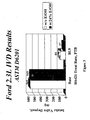
- Figure 1 illustrates the effect of using a Mannich-base detergent additive HiTEC® 6421 Detergent Additive in a gasoline having 24-volume percent ethanol.
- the detergent in HiTEC® 6421 is a Mannich-base detergent (HiTEC® 6410, available from Ethyl Corporation).
- HiTEC® 6410 a Mannich-base detergent
- the results show that without ethanol or the Mannich-base detergent, the base fuel produced about 545.8 milligrams of intake valve deposits in a Ford 2.3 liter engine when tested according to ASTM D6201.
- the Mannich-base detergent was added at levels of 50, 65 and 80.9 pounds per thousand barrels, the amount of IVD measured dropped off dramatically to levels of less than 34 milligrams.
- HiTEC® 6410 Detergent Additive is prepared according to the teaching of U.S. Patent Number 5,725,612, which is incorporated herein by reference in its entirety.
- HiTEC® 6421 is prepared according to the teaching of U.S. Patent Number 6,048,373 which is incorporated herein by reference in its entirety.
- a useful fuel additive herein contains: Component Name Wt% Mannich detergent 40.0 solvent 30.0 alkyl alcohol 3.0 demulsifier 0.5 polyether polyol 13.0 polybutylene polymer 13.0 carboxylic acid in solvent 0.5 Total 100.0
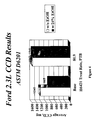
- Figure 2 shows the effect of high ethanol content (24% by volume) with Mannich detergent additive on the combustion chamber deposits when studied in ASTM D6201 in a Ford 2.3 liter engine.
- the Mannich detergent used in the results of Figure 2 was HiTEC® 6410 Detergent Additive.
- the addition of the Mannich detergent supplied as HiTEC® 6421 in gasoline fuel without ethanol caused a steady increase in combustion chamber deposit formation as the detergent treat rate increased.
- the rate of deposit formation increases at a slower rate with ethanol present, and in fact, the rate goes down at 65 to 80.9 pounds per thousand barrel (PTB) treat rate.
- Figures 3 and 4 show similar results in an alternate fuel.
- the fuels containing 24% or 25% ethanol display conductivities in excess of 1000 nS/m.
- fuels having low conductivity result in increased deposits over the combustion of those same fuels that have conductivity much greater than one nS/m.
- Figure 6 shows the fuel analysis for the fuels depicted in Figures 1-4.
- reactants and components referred to by chemical name anywhere in the specification or claims hereof, whether referred to in the singular or plural, are identified as they exist prior to coming into contact with another substance referred to by chemical name or chemical type (e.g., base fuel, solvent, etc.). It matters not what chemical changes, transformations and/or reactions, if any, take place in the resulting mixture or solution or reaction medium as such changes, transformations and/or reactions are the natural result of bringing the specified reactants and/or components together under the conditions called for pursuant to this disclosure.
- the reactants and components are identified as ingredients to be brought together either in performing a desired chemical reaction or in forming a desired composition (such as an additive concentrate or additized fuel blend).
- the additive components can be added or blended into or with the base fuels individually per se and/or as components used in forming preformed additive combinations and/or sub-combinations. Accordingly, even though the claims hereinafter may refer to substances, components and/or ingredients in the present tense ("comprises”, “is”, etc.), the reference is to the substance, components or ingredient as it existed at the time just before it was first blended or mixed with one or more other substances, components and/or ingredients in accordance with the present disclosure. The fact that the substance, components or ingredient may have lost its original identity through a chemical reaction or transformation during the course of such blending or mixing operations or immediately thereafter is thus wholly immaterial for an accurate understanding and appreciation of this disclosure and the claims thereof.
Landscapes
- Chemical & Material Sciences (AREA)
- Oil, Petroleum & Natural Gas (AREA)
- Engineering & Computer Science (AREA)
- Organic Chemistry (AREA)
- Chemical Kinetics & Catalysis (AREA)
- General Chemical & Material Sciences (AREA)
- Combustion & Propulsion (AREA)
- Liquid Carbonaceous Fuels (AREA)
- Output Control And Ontrol Of Special Type Engine (AREA)
Abstract
Description
- The present invention relates to a method for controlling deposit formation on intake valves and combustion chambers in engines by combusting in the engine a fuel composition having a high ethanol content and a detergent additive. The invention also relates to a high ethanol content fuel containing a detergent in an amount effective for improving the reduction in valve deposits resulting from the combustion of the fuel.
- Additives for gasoline used in vehicles have been used for many years to improve the performance of the vehicle, reduce the emissions from the combustion of the fuel, and modify the physical and chemical properties of the fuel. One additive that has been used for many years is ethanol, or ethyl alcohol, and other oxygenates. However, the use of ethanol in a gasoline combusted in an internal combustion engine is well known to create harmful and undesirable deposits on the fuel intake valves of the engine.
- Additives used in gasoline/ethanol fuel mixtures in internal combustion engines can reduce the formation of these intake valve deposits (IVD), but such remediation typically shifts the problem to the combustion chamber, where unacceptable combustion chamber deposits (CCD) are then formed.
- Thus, what is needed is an additive which, when added to a gasoline/ethanol fuel mixture for combustion in an internal combustion engine, will upon combustion exhibit in the engine a significant reduction in IVD, and simultaneously a reduction or at least a "no-harm" on CCD in the engine.
- The present invention is directed to the reduction of engine deposits formed as a result of the combustion of fuels in the engine. Engine deposits include intake valve deposits (IVD) and combustion chamber deposits (CCD). Historically, a reduction of IVD meant an increase in CCD. The present invention includes a method for reducing all engine deposits (especially IVD) by combusting a fuel having a high concentration of an oxygenate and a detergent-containing fuel additive. In one embodiment, the oxygenate in the fuel is ethanol, and the detergent is Mannich-based. It has also been discovered that increasing the amount of oxygenate increases the conductivity of the fuel. It is postulated, without limitation to this theory, that the increase in conductivity, in combination with the addition of a detergent, more effectively reduces engine deposits. Good results are obtained in one embodiment when the conductivity of the fuel is in excess of about 1 x 10³ nS/m.
- By "fuel" or "gasoline" herein is meant a fuel containing hydrocarbons boiling in the gasoline boiling point range of from 80°C to 450°C, and in one example from about 90°C to about 400°C.
- By "high oxygenate content" herein is meant an amount of oxygenate in the fuel of at least about 5 volume percent, preferably at least about 20 volume percent, and most preferably at least about 24 volume percent. A common oxygenate that may be used is ethanol. In one example, the ethanol content in the hydrocarbonaceous fuel is about 24 volume percent and in other examples, the ethanol content is about 25, 50 and 75 volume percent in the fuel. There is no known upper limit on the ethanol (or any oxygenate) content in a fuel which will benefit from the present invention, but ethanol contents above about 80 volume percent, while not outside the scope of the invention, may have certain undesired effects.
- The "intake valves" and "combustion chambers" referred to herein describe these conventional parts and portions of an internal combustion engine. In one example, the particular type of internal combustion engine that may benefit from the methods and compositions herein may be direct-injection gasoline, spark-ignited engines. And by further example, supercharged and turbocharged types of direct-injection gasoline, spark-ignited engines will especially benefit from the methods and compositions herein. These terms are used as they are conventionally and customarily known to those of skill in the art.
- By "detergent" or "detergent additive" herein is meant any detergent additive included in a gasoline performance additive package known to those of skill in the art. The detergent is preferably a Mannich-base detergent, or a Mannich-base polyisobutylene cresol detergent, or a mixture thereof. By "Mannich-base detergent" herein is meant the product from the reaction or combination of a hydroxyaromatic compound, an aldehyde or precursor thereof, and an amine. By "hydroxyaromatic" herein is meant a phenol, a substituted phenol, a cresol, an alkylsubstituted cresol, a polyalkylene cresol, a polyalkylene phenol. In one example, the hydroxyaromatic compound is a polyisobutylene-substituted cresol, the aldehyde is formaldehyde, and the amine is selected from the group consisting of propylenediamine (PDA), diethylenetriamine (DETA), triethylenetetramine (TETA), tetraethylenepentamine (TEPA), and pentaethylenehexamine (PEHA).
- According to an embodiment of the present invention it has been surprisingly discovered that the combination of a Mannich-base detergent fuel additive in a gasoline fuel having a high ethanol content greater than about 5%, and especially greater than about 24% by volume results in an unexpected reduction in the amount of deposit formed on the intake valves of an internal combustion engine while the formation of combustion chamber deposits is not increased relative to the amount of combustion chamber deposits formed from the combustion in the engine of the same fuel and ethanol without the addition of the detergent additive.
- More specifically, it is seen that the ethanol and Mannich-base detergent work synergistically to control the formation of deposits, without a negative impact on combustion chamber deposits. Intake valve deposits are reduced and combustion chamber deposits are not increased when the Mannich-base detergent additive is used with ethanol (> 5% by volume) in the fuel.
- Figure 1 illustrates the effect of using a Mannich-base detergent additive HiTEC® 6421 Detergent Additive in a gasoline having 24-volume percent ethanol. The detergent in HiTEC® 6421 is a Mannich-base detergent (HiTEC® 6410, available from Ethyl Corporation). The results show that without ethanol or the Mannich-base detergent, the base fuel produced about 545.8 milligrams of intake valve deposits in a Ford 2.3 liter engine when tested according to ASTM D6201. The combustion of a comparable base fuel with 24 volume percent ethanol but no Mannich-base detergent actually resulted in an increase in intake valve deposits, resulting in about 630.5 milligrams of deposit. However, as the Mannich-base detergent was added at levels of 50, 65 and 80.9 pounds per thousand barrels, the amount of IVD measured dropped off dramatically to levels of less than 34 milligrams.
- HiTEC® 6410 Detergent Additive is prepared according to the teaching of U.S. Patent Number 5,725,612, which is incorporated herein by reference in its entirety.
- HiTEC® 6421 is prepared according to the teaching of U.S. Patent Number 6,048,373 which is incorporated herein by reference in its entirety.
- A useful fuel additive herein contains:
Component Name Wt% Mannich detergent 40.0 solvent 30.0 alkyl alcohol 3.0 demulsifier 0.5 polyether polyol 13.0 polybutylene polymer 13.0 carboxylic acid in solvent 0.5 Total 100.0 - Figure 2 shows the effect of high ethanol content (24% by volume) with Mannich detergent additive on the combustion chamber deposits when studied in ASTM D6201 in a Ford 2.3 liter engine. The Mannich detergent used in the results of Figure 2 was HiTEC® 6410 Detergent Additive. As Figure 2 shows, the addition of the Mannich detergent supplied as HiTEC® 6421 in gasoline fuel without ethanol caused a steady increase in combustion chamber deposit formation as the detergent treat rate increased. According to the invention, the rate of deposit formation increases at a slower rate with ethanol present, and in fact, the rate goes down at 65 to 80.9 pounds per thousand barrel (PTB) treat rate. Figures 3 and 4 show similar results in an alternate fuel.
- The fuel samples with both detergent and 24 volume percent ethanol, as shown in Figure 2, the combustion chamber deposit formation rate from the combustion stayed steady or declined as the PTB treat rate increased. This desirable combination of reduced intake valve deposits (see Figure 1) with "no-harm" and even reduction on combustion chamber deposit formation is unexpected based on prior use of ethanol in gasoline.
- The interaction of fuel conductivity and engine deposits is demonstrated in Figure 5. In that Figure, it is seen that fuels having relatively higher conductivity exhibit relatively lower amounts of engine deposits such as IVD and CCD. As seen in Figure 5, the conductivity is related, at least in part, to the amount of ethanol blended with the fuel. In each sample without ethanol, the conductivity of the fuel is less than one nS/m. (As measured by ASTM Test D2624-02, "Standard Test Methods for Electrical Conductivity of Aviation and Distillate Fuels"). For each fuel that contains about 5% or more of ethanol, the conductivity increases to more than one nS/m. In another embodiment, a method is provided where a fuel with ethanol has a conductivity greater than about 100 nS/m. Significantly, in another embodiment, the fuels containing 24% or 25% ethanol display conductivities in excess of 1000 nS/m. Thus, fuels having low conductivity (less than one nS/m) result in increased deposits over the combustion of those same fuels that have conductivity much greater than one nS/m.
- Figure 6 shows the fuel analysis for the fuels depicted in Figures 1-4.
- It is to be understood that the reactants and components referred to by chemical name anywhere in the specification or claims hereof, whether referred to in the singular or plural, are identified as they exist prior to coming into contact with another substance referred to by chemical name or chemical type (e.g., base fuel, solvent, etc.). It matters not what chemical changes, transformations and/or reactions, if any, take place in the resulting mixture or solution or reaction medium as such changes, transformations and/or reactions are the natural result of bringing the specified reactants and/or components together under the conditions called for pursuant to this disclosure. Thus the reactants and components are identified as ingredients to be brought together either in performing a desired chemical reaction or in forming a desired composition (such as an additive concentrate or additized fuel blend). It will also be recognized that the additive components can be added or blended into or with the base fuels individually per se and/or as components used in forming preformed additive combinations and/or sub-combinations. Accordingly, even though the claims hereinafter may refer to substances, components and/or ingredients in the present tense ("comprises", "is", etc.), the reference is to the substance, components or ingredient as it existed at the time just before it was first blended or mixed with one or more other substances, components and/or ingredients in accordance with the present disclosure. The fact that the substance, components or ingredient may have lost its original identity through a chemical reaction or transformation during the course of such blending or mixing operations or immediately thereafter is thus wholly immaterial for an accurate understanding and appreciation of this disclosure and the claims thereof.
- At numerous places throughout this specification, reference has been made to a number of U.S. Patents, published foreign patent applications and published technical papers. All such cited documents are expressly incorporated in full into this disclosure as if fully set forth herein.
- This invention is susceptible to considerable variation in its practice. Therefore the foregoing description is not intended to limit, and should not be construed as limiting, the invention to the particular exemplifications presented hereinabove. Rather, what is intended to be covered is as set forth in the ensuing claims and the equivalents thereof permitted as a matter of law.
- Patentee does not intend to dedicate any disclosed embodiments to the public, and to the extent any disclosed modifications or alterations may not literally fall within the scope of the claims, they are considered to be part of the invention under the doctrine of equivalents.
Claims (13)
- A method for reducing the formation of intake valve deposits in an engine having intake valves, the method comprising combusting in an engine a gasoline fuel comprising:a) a gasoline;b) ethanol present in the fuel in an amount of at least about five volume percent, andc) a gasoline performance additive comprising a Mannich-based detergent.
- The method of claim 1, wherein the ethanol is present in an amount of at least 24 volume percent.
- The method of claim 1 or 2, wherein the ethanol is present in an amount of at least about 50 volume percent.
- The method of any one of the preceding claims, wherein the detergent is a Mannich-base polyisobutylene cresol detergent.
- The method of any one of the preceding claims, wherein the fuel has a conductivity greater than 1.0 nS/m.
- The method of any one of the preceding claims, wherein the fuel has a conductivity greater than about 100 nS/m.
- The method of any one of the preceding claims, wherein the engine is a direct-injection gasoline, spark-ignited engine.
- The method of claim 7, wherein the engine is supercharged.
- The method of claim 7, wherein the engine is turbocharged.
- A fuel adapted to be combusted in an engine having intake valves, the fuel comprising:a) a gasoline;b) ethanol present in the fuel in an amount of at least about five volume percent, andc) a gasoline performance additive comprising a Mannich-based detergent in an amount effective for improving the reduction of intake valve deposits resulting from the combustion in the engine of the fuel.
- A fuel according to Claim 10 wherein component (b) or component (c) is defined in any one of Claims 2 to 4 or wherein the conductivity is defined in Claim 5 or 6.
- Use of an oxygenate, such as an alkanol, in a gasoline fuel comprising a detergent to reduce the formation of intake valve deposits in an engine having intake valves in which the fuel is combusted.
- Use according to Claim 12 wherein the alkanol is present in amount from 5% to 80% by volume of the fuel.
Applications Claiming Priority (2)
| Application Number | Priority Date | Filing Date | Title |
|---|---|---|---|
| US10/640,523 US20050034360A1 (en) | 2003-08-13 | 2003-08-13 | Use of detergent additives in high-ethanol fuels for deposit control |
| US640523 | 2003-08-13 |
Publications (1)
| Publication Number | Publication Date |
|---|---|
| EP1506992A1 true EP1506992A1 (en) | 2005-02-16 |
Family
ID=33565261
Family Applications (1)
| Application Number | Title | Priority Date | Filing Date |
|---|---|---|---|
| EP04254323A Withdrawn EP1506992A1 (en) | 2003-08-13 | 2004-07-19 | Use of detergent additives in ethanol-containing fuel for deposit control |
Country Status (5)
| Country | Link |
|---|---|
| US (1) | US20050034360A1 (en) |
| EP (1) | EP1506992A1 (en) |
| BR (1) | BRPI0403263A (en) |
| CA (1) | CA2474320A1 (en) |
| ZA (1) | ZA200405909B (en) |
Cited By (4)
| Publication number | Priority date | Publication date | Assignee | Title |
|---|---|---|---|---|
| EP1914290A1 (en) * | 2006-10-16 | 2008-04-23 | Afton Chemical Corporation | Protecting fuel delivery systems in engines combusting ethanol-containing fuels |
| EP1918355A1 (en) * | 2006-10-16 | 2008-05-07 | Afton Chemical Corporation | Method and compositions for reducing wear in engines combusting ethanol-containing fuels |
| WO2015028391A1 (en) * | 2013-08-27 | 2015-03-05 | Bp Oil International Limited | Methods and uses for controlling deposits on valves in direct-injection spark-ignition engines |
| RU2549179C1 (en) * | 2014-01-30 | 2015-04-20 | Открытое акционерное общество "Всероссийский научно-исследовательский институт по переработке нефти" (ОАО "ВНИИ НП") | Alternative motor fuel |
Families Citing this family (6)
| Publication number | Priority date | Publication date | Assignee | Title |
|---|---|---|---|---|
| US20070245621A1 (en) * | 2006-04-20 | 2007-10-25 | Malfer Dennis J | Additives for minimizing injector fouling and valve deposits and their uses |
| US20080086933A1 (en) * | 2006-10-16 | 2008-04-17 | Cunningham Lawrence J | Volatility agents as fuel additives for ethanol-containing fuels |
| US20080168708A1 (en) * | 2007-01-11 | 2008-07-17 | Cunningham Lawrence J | Method and compositions for reducing deposits in engines combusting ethanol-containing fuels and a corrosion inhibitor |
| WO2008124800A1 (en) * | 2007-04-09 | 2008-10-16 | Ethanol Eex, Llc | Fuel blends |
| US9206373B2 (en) | 2012-08-17 | 2015-12-08 | Afton Chemical Corporation | Calcium neutral and overbased mannich and anhydride adducts as detergents for engine oil lubricants |
| CN118344910B (en) * | 2023-01-14 | 2025-11-14 | 中国石油化工股份有限公司 | Composition with fuel cleaning function |
Citations (6)
| Publication number | Priority date | Publication date | Assignee | Title |
|---|---|---|---|---|
| US4398921A (en) * | 1981-11-02 | 1983-08-16 | Ethyl Corporation | Gasohol compositions |
| EP0117328A1 (en) * | 1983-02-25 | 1984-09-05 | Ethyl Petroleum Additives Limited | Liquid fuels containing corrosion inhibitors, and inhibitor concentrates |
| US5207939A (en) * | 1990-08-23 | 1993-05-04 | Mobil Oil Corporation | Dihydrocarbyl substituted phenylenediamine-derived phenolic products as antioxidants |
| US6048373A (en) * | 1998-11-30 | 2000-04-11 | Ethyl Corporation | Fuels compositions containing polybutenes of narrow molecular weight distribution |
| WO2001042399A1 (en) * | 1999-12-13 | 2001-06-14 | Ethyl Corporation | Fuels compositions for direct injection gasoline engines containing mannich detergents |
| US20030029077A1 (en) * | 2001-08-07 | 2003-02-13 | The Lubrizol Corporation, A Corporation Of The State Of Ohio | Fuel composition containing detergent combination and methods thereof |
Family Cites Families (5)
| Publication number | Priority date | Publication date | Assignee | Title |
|---|---|---|---|---|
| US4231759A (en) * | 1973-03-12 | 1980-11-04 | Standard Oil Company (Indiana) | Liquid hydrocarbon fuels containing high molecular weight Mannich bases |
| US4456454A (en) * | 1983-06-23 | 1984-06-26 | Texaco Inc. | Mannich reaction product for motor fuels |
| US5160350A (en) * | 1988-01-27 | 1992-11-03 | The Lubrizol Corporation | Fuel compositions |
| US5725612A (en) * | 1996-06-07 | 1998-03-10 | Ethyl Corporation | Additives for minimizing intake valve deposits, and their use |
| US5873917A (en) * | 1997-05-16 | 1999-02-23 | The Lubrizol Corporation | Fuel additive compositions containing polyether alcohol and hydrocarbylphenol |
-
2003
- 2003-08-13 US US10/640,523 patent/US20050034360A1/en not_active Abandoned
-
2004
- 2004-07-15 CA CA002474320A patent/CA2474320A1/en not_active Abandoned
- 2004-07-19 EP EP04254323A patent/EP1506992A1/en not_active Withdrawn
- 2004-07-23 ZA ZA200405909A patent/ZA200405909B/en unknown
- 2004-08-13 BR BR0403263-2A patent/BRPI0403263A/en not_active Application Discontinuation
Patent Citations (6)
| Publication number | Priority date | Publication date | Assignee | Title |
|---|---|---|---|---|
| US4398921A (en) * | 1981-11-02 | 1983-08-16 | Ethyl Corporation | Gasohol compositions |
| EP0117328A1 (en) * | 1983-02-25 | 1984-09-05 | Ethyl Petroleum Additives Limited | Liquid fuels containing corrosion inhibitors, and inhibitor concentrates |
| US5207939A (en) * | 1990-08-23 | 1993-05-04 | Mobil Oil Corporation | Dihydrocarbyl substituted phenylenediamine-derived phenolic products as antioxidants |
| US6048373A (en) * | 1998-11-30 | 2000-04-11 | Ethyl Corporation | Fuels compositions containing polybutenes of narrow molecular weight distribution |
| WO2001042399A1 (en) * | 1999-12-13 | 2001-06-14 | Ethyl Corporation | Fuels compositions for direct injection gasoline engines containing mannich detergents |
| US20030029077A1 (en) * | 2001-08-07 | 2003-02-13 | The Lubrizol Corporation, A Corporation Of The State Of Ohio | Fuel composition containing detergent combination and methods thereof |
Cited By (5)
| Publication number | Priority date | Publication date | Assignee | Title |
|---|---|---|---|---|
| EP1914290A1 (en) * | 2006-10-16 | 2008-04-23 | Afton Chemical Corporation | Protecting fuel delivery systems in engines combusting ethanol-containing fuels |
| EP1918355A1 (en) * | 2006-10-16 | 2008-05-07 | Afton Chemical Corporation | Method and compositions for reducing wear in engines combusting ethanol-containing fuels |
| WO2015028391A1 (en) * | 2013-08-27 | 2015-03-05 | Bp Oil International Limited | Methods and uses for controlling deposits on valves in direct-injection spark-ignition engines |
| US11685873B2 (en) | 2013-08-27 | 2023-06-27 | Bp Oil International Limited | Methods and uses for controlling deposits on valves in direct-injection spark-ignition engines |
| RU2549179C1 (en) * | 2014-01-30 | 2015-04-20 | Открытое акционерное общество "Всероссийский научно-исследовательский институт по переработке нефти" (ОАО "ВНИИ НП") | Alternative motor fuel |
Also Published As
| Publication number | Publication date |
|---|---|
| US20050034360A1 (en) | 2005-02-17 |
| ZA200405909B (en) | 2005-01-24 |
| CA2474320A1 (en) | 2005-02-13 |
| BRPI0403263A (en) | 2005-06-07 |
Similar Documents
| Publication | Publication Date | Title |
|---|---|---|
| US7704289B2 (en) | Method of operating a direct injection spark-ignited engine with a fuel composition | |
| US6458172B1 (en) | Fuel additive compositions and fuel compositions containing detergents and fluidizers | |
| US7435272B2 (en) | Friction modifier alkoxyamine salts of carboxylic acids as additives for fuel compositions and methods of use thereof | |
| EP1481041B1 (en) | Gasoline additives | |
| CZ20012854A3 (en) | Fuel composition | |
| AU2001239902A1 (en) | Fuel additive compositions and fuel compositions containing detergents and fluidizers | |
| DE69421784T2 (en) | Fuel compositions, and additives therefor | |
| US20050034360A1 (en) | Use of detergent additives in high-ethanol fuels for deposit control | |
| SG185734A1 (en) | Low-molecular weight polyisobutyl-substituted amines as detergent boosters | |
| RU2226206C2 (en) | Gasoline additive, fuel composition | |
| KR102289662B1 (en) | Fuel additive composition and method of use thereof | |
| CA3203245A1 (en) | Fuel additives and formulations for improving performance of gasoline direct injection engines | |
| US9650583B2 (en) | Additive and fuel compositions containing detergent and fluidizer and method thereof | |
| EP4413100B1 (en) | Fuel additives for lowering deposit and particulate emission | |
| US6514297B1 (en) | Detergents for use in preventing formation of iron complexes in hydrocarbon fuels | |
| AU2003219078B2 (en) | Gasoline additives |
Legal Events
| Date | Code | Title | Description |
|---|---|---|---|
| PUAI | Public reference made under article 153(3) epc to a published international application that has entered the european phase |
Free format text: ORIGINAL CODE: 0009012 |
|
| 17P | Request for examination filed |
Effective date: 20040809 |
|
| AK | Designated contracting states |
Kind code of ref document: A1 Designated state(s): AT BE BG CH CY CZ DE DK EE ES FI FR GB GR HU IE IT LI LU MC NL PL PT RO SE SI SK TR |
|
| AX | Request for extension of the european patent |
Extension state: AL HR LT LV MK |
|
| RAP1 | Party data changed (applicant data changed or rights of an application transferred) |
Owner name: AFTON CHEMICAL CORPORATION |
|
| RAP1 | Party data changed (applicant data changed or rights of an application transferred) |
Owner name: AFTON CHEMICAL CORPORATION |
|
| 17Q | First examination report despatched |
Effective date: 20050609 |
|
| AKX | Designation fees paid |
Designated state(s): BE DE FR GB |
|
| 17Q | First examination report despatched |
Effective date: 20050609 |
|
| STAA | Information on the status of an ep patent application or granted ep patent |
Free format text: STATUS: THE APPLICATION HAS BEEN WITHDRAWN |
|
| 18W | Application withdrawn |
Effective date: 20100726 |