EP1506948A1 - Honeycomb structural body - Google Patents
Honeycomb structural body Download PDFInfo
- Publication number
- EP1506948A1 EP1506948A1 EP03748745A EP03748745A EP1506948A1 EP 1506948 A1 EP1506948 A1 EP 1506948A1 EP 03748745 A EP03748745 A EP 03748745A EP 03748745 A EP03748745 A EP 03748745A EP 1506948 A1 EP1506948 A1 EP 1506948A1
- Authority
- EP
- European Patent Office
- Prior art keywords
- honeycomb structural
- structural body
- ceramic
- silicon
- sealing material
- Prior art date
- Legal status (The legal status is an assumption and is not a legal conclusion. Google has not performed a legal analysis and makes no representation as to the accuracy of the status listed.)
- Granted
Links
Images


Classifications
-
- C—CHEMISTRY; METALLURGY
- C04—CEMENTS; CONCRETE; ARTIFICIAL STONE; CERAMICS; REFRACTORIES
- C04B—LIME, MAGNESIA; SLAG; CEMENTS; COMPOSITIONS THEREOF, e.g. MORTARS, CONCRETE OR LIKE BUILDING MATERIALS; ARTIFICIAL STONE; CERAMICS; REFRACTORIES; TREATMENT OF NATURAL STONE
- C04B35/00—Shaped ceramic products characterised by their composition; Ceramics compositions; Processing powders of inorganic compounds preparatory to the manufacturing of ceramic products
- C04B35/01—Shaped ceramic products characterised by their composition; Ceramics compositions; Processing powders of inorganic compounds preparatory to the manufacturing of ceramic products based on oxide ceramics
- C04B35/10—Shaped ceramic products characterised by their composition; Ceramics compositions; Processing powders of inorganic compounds preparatory to the manufacturing of ceramic products based on oxide ceramics based on aluminium oxide
- C04B35/111—Fine ceramics
- C04B35/117—Composites
-
- B—PERFORMING OPERATIONS; TRANSPORTING
- B01—PHYSICAL OR CHEMICAL PROCESSES OR APPARATUS IN GENERAL
- B01D—SEPARATION
- B01D46/00—Filters or filtering processes specially modified for separating dispersed particles from gases or vapours
- B01D46/0001—Making filtering elements
-
- B—PERFORMING OPERATIONS; TRANSPORTING
- B01—PHYSICAL OR CHEMICAL PROCESSES OR APPARATUS IN GENERAL
- B01D—SEPARATION
- B01D46/00—Filters or filtering processes specially modified for separating dispersed particles from gases or vapours
- B01D46/24—Particle separators, e.g. dust precipitators, using rigid hollow filter bodies
- B01D46/2403—Particle separators, e.g. dust precipitators, using rigid hollow filter bodies characterised by the physical shape or structure of the filtering element
- B01D46/2418—Honeycomb filters
-
- B—PERFORMING OPERATIONS; TRANSPORTING
- B28—WORKING CEMENT, CLAY, OR STONE
- B28B—SHAPING CLAY OR OTHER CERAMIC COMPOSITIONS; SHAPING SLAG; SHAPING MIXTURES CONTAINING CEMENTITIOUS MATERIAL, e.g. PLASTER
- B28B11/00—Apparatus or processes for treating or working the shaped or preshaped articles
- B28B11/003—Apparatus or processes for treating or working the shaped or preshaped articles the shaping of preshaped articles, e.g. by bending
- B28B11/006—Making hollow articles or partly closed articles
-
- B—PERFORMING OPERATIONS; TRANSPORTING
- B28—WORKING CEMENT, CLAY, OR STONE
- B28B—SHAPING CLAY OR OTHER CERAMIC COMPOSITIONS; SHAPING SLAG; SHAPING MIXTURES CONTAINING CEMENTITIOUS MATERIAL, e.g. PLASTER
- B28B11/00—Apparatus or processes for treating or working the shaped or preshaped articles
- B28B11/003—Apparatus or processes for treating or working the shaped or preshaped articles the shaping of preshaped articles, e.g. by bending
- B28B11/006—Making hollow articles or partly closed articles
- B28B11/007—Using a mask for plugging
-
- C—CHEMISTRY; METALLURGY
- C04—CEMENTS; CONCRETE; ARTIFICIAL STONE; CERAMICS; REFRACTORIES
- C04B—LIME, MAGNESIA; SLAG; CEMENTS; COMPOSITIONS THEREOF, e.g. MORTARS, CONCRETE OR LIKE BUILDING MATERIALS; ARTIFICIAL STONE; CERAMICS; REFRACTORIES; TREATMENT OF NATURAL STONE
- C04B35/00—Shaped ceramic products characterised by their composition; Ceramics compositions; Processing powders of inorganic compounds preparatory to the manufacturing of ceramic products
- C04B35/515—Shaped ceramic products characterised by their composition; Ceramics compositions; Processing powders of inorganic compounds preparatory to the manufacturing of ceramic products based on non-oxide ceramics
- C04B35/56—Shaped ceramic products characterised by their composition; Ceramics compositions; Processing powders of inorganic compounds preparatory to the manufacturing of ceramic products based on non-oxide ceramics based on carbides or oxycarbides
- C04B35/565—Shaped ceramic products characterised by their composition; Ceramics compositions; Processing powders of inorganic compounds preparatory to the manufacturing of ceramic products based on non-oxide ceramics based on carbides or oxycarbides based on silicon carbide
-
- C—CHEMISTRY; METALLURGY
- C04—CEMENTS; CONCRETE; ARTIFICIAL STONE; CERAMICS; REFRACTORIES
- C04B—LIME, MAGNESIA; SLAG; CEMENTS; COMPOSITIONS THEREOF, e.g. MORTARS, CONCRETE OR LIKE BUILDING MATERIALS; ARTIFICIAL STONE; CERAMICS; REFRACTORIES; TREATMENT OF NATURAL STONE
- C04B35/00—Shaped ceramic products characterised by their composition; Ceramics compositions; Processing powders of inorganic compounds preparatory to the manufacturing of ceramic products
- C04B35/622—Forming processes; Processing powders of inorganic compounds preparatory to the manufacturing of ceramic products
- C04B35/626—Preparing or treating the powders individually or as batches ; preparing or treating macroscopic reinforcing agents for ceramic products, e.g. fibres; mechanical aspects section B
- C04B35/63—Preparing or treating the powders individually or as batches ; preparing or treating macroscopic reinforcing agents for ceramic products, e.g. fibres; mechanical aspects section B using additives specially adapted for forming the products, e.g.. binder binders
-
- C—CHEMISTRY; METALLURGY
- C04—CEMENTS; CONCRETE; ARTIFICIAL STONE; CERAMICS; REFRACTORIES
- C04B—LIME, MAGNESIA; SLAG; CEMENTS; COMPOSITIONS THEREOF, e.g. MORTARS, CONCRETE OR LIKE BUILDING MATERIALS; ARTIFICIAL STONE; CERAMICS; REFRACTORIES; TREATMENT OF NATURAL STONE
- C04B35/00—Shaped ceramic products characterised by their composition; Ceramics compositions; Processing powders of inorganic compounds preparatory to the manufacturing of ceramic products
- C04B35/622—Forming processes; Processing powders of inorganic compounds preparatory to the manufacturing of ceramic products
- C04B35/626—Preparing or treating the powders individually or as batches ; preparing or treating macroscopic reinforcing agents for ceramic products, e.g. fibres; mechanical aspects section B
- C04B35/63—Preparing or treating the powders individually or as batches ; preparing or treating macroscopic reinforcing agents for ceramic products, e.g. fibres; mechanical aspects section B using additives specially adapted for forming the products, e.g.. binder binders
- C04B35/6303—Inorganic additives
- C04B35/6316—Binders based on silicon compounds
-
- C—CHEMISTRY; METALLURGY
- C04—CEMENTS; CONCRETE; ARTIFICIAL STONE; CERAMICS; REFRACTORIES
- C04B—LIME, MAGNESIA; SLAG; CEMENTS; COMPOSITIONS THEREOF, e.g. MORTARS, CONCRETE OR LIKE BUILDING MATERIALS; ARTIFICIAL STONE; CERAMICS; REFRACTORIES; TREATMENT OF NATURAL STONE
- C04B35/00—Shaped ceramic products characterised by their composition; Ceramics compositions; Processing powders of inorganic compounds preparatory to the manufacturing of ceramic products
- C04B35/622—Forming processes; Processing powders of inorganic compounds preparatory to the manufacturing of ceramic products
- C04B35/626—Preparing or treating the powders individually or as batches ; preparing or treating macroscopic reinforcing agents for ceramic products, e.g. fibres; mechanical aspects section B
- C04B35/63—Preparing or treating the powders individually or as batches ; preparing or treating macroscopic reinforcing agents for ceramic products, e.g. fibres; mechanical aspects section B using additives specially adapted for forming the products, e.g.. binder binders
- C04B35/632—Organic additives
-
- C—CHEMISTRY; METALLURGY
- C04—CEMENTS; CONCRETE; ARTIFICIAL STONE; CERAMICS; REFRACTORIES
- C04B—LIME, MAGNESIA; SLAG; CEMENTS; COMPOSITIONS THEREOF, e.g. MORTARS, CONCRETE OR LIKE BUILDING MATERIALS; ARTIFICIAL STONE; CERAMICS; REFRACTORIES; TREATMENT OF NATURAL STONE
- C04B35/00—Shaped ceramic products characterised by their composition; Ceramics compositions; Processing powders of inorganic compounds preparatory to the manufacturing of ceramic products
- C04B35/622—Forming processes; Processing powders of inorganic compounds preparatory to the manufacturing of ceramic products
- C04B35/626—Preparing or treating the powders individually or as batches ; preparing or treating macroscopic reinforcing agents for ceramic products, e.g. fibres; mechanical aspects section B
- C04B35/63—Preparing or treating the powders individually or as batches ; preparing or treating macroscopic reinforcing agents for ceramic products, e.g. fibres; mechanical aspects section B using additives specially adapted for forming the products, e.g.. binder binders
- C04B35/632—Organic additives
- C04B35/636—Polysaccharides or derivatives thereof
- C04B35/6365—Cellulose or derivatives thereof
-
- C—CHEMISTRY; METALLURGY
- C04—CEMENTS; CONCRETE; ARTIFICIAL STONE; CERAMICS; REFRACTORIES
- C04B—LIME, MAGNESIA; SLAG; CEMENTS; COMPOSITIONS THEREOF, e.g. MORTARS, CONCRETE OR LIKE BUILDING MATERIALS; ARTIFICIAL STONE; CERAMICS; REFRACTORIES; TREATMENT OF NATURAL STONE
- C04B38/00—Porous mortars, concrete, artificial stone or ceramic ware; Preparation thereof
- C04B38/0006—Honeycomb structures
-
- F—MECHANICAL ENGINEERING; LIGHTING; HEATING; WEAPONS; BLASTING
- F01—MACHINES OR ENGINES IN GENERAL; ENGINE PLANTS IN GENERAL; STEAM ENGINES
- F01N—GAS-FLOW SILENCERS OR EXHAUST APPARATUS FOR MACHINES OR ENGINES IN GENERAL; GAS-FLOW SILENCERS OR EXHAUST APPARATUS FOR INTERNAL-COMBUSTION ENGINES
- F01N3/00—Exhaust or silencing apparatus having means for purifying, rendering innocuous, or otherwise treating exhaust
- F01N3/02—Exhaust or silencing apparatus having means for purifying, rendering innocuous, or otherwise treating exhaust for cooling, or for removing solid constituents of, exhaust
- F01N3/021—Exhaust or silencing apparatus having means for purifying, rendering innocuous, or otherwise treating exhaust for cooling, or for removing solid constituents of, exhaust by means of filters
- F01N3/022—Exhaust or silencing apparatus having means for purifying, rendering innocuous, or otherwise treating exhaust for cooling, or for removing solid constituents of, exhaust by means of filters characterised by specially adapted filtering structure, e.g. honeycomb, mesh or fibrous
- F01N3/0222—Exhaust or silencing apparatus having means for purifying, rendering innocuous, or otherwise treating exhaust for cooling, or for removing solid constituents of, exhaust by means of filters characterised by specially adapted filtering structure, e.g. honeycomb, mesh or fibrous the structure being monolithic, e.g. honeycombs
-
- C—CHEMISTRY; METALLURGY
- C04—CEMENTS; CONCRETE; ARTIFICIAL STONE; CERAMICS; REFRACTORIES
- C04B—LIME, MAGNESIA; SLAG; CEMENTS; COMPOSITIONS THEREOF, e.g. MORTARS, CONCRETE OR LIKE BUILDING MATERIALS; ARTIFICIAL STONE; CERAMICS; REFRACTORIES; TREATMENT OF NATURAL STONE
- C04B2111/00—Mortars, concrete or artificial stone or mixtures to prepare them, characterised by specific function, property or use
- C04B2111/00474—Uses not provided for elsewhere in C04B2111/00
- C04B2111/00793—Uses not provided for elsewhere in C04B2111/00 as filters or diaphragms
-
- C—CHEMISTRY; METALLURGY
- C04—CEMENTS; CONCRETE; ARTIFICIAL STONE; CERAMICS; REFRACTORIES
- C04B—LIME, MAGNESIA; SLAG; CEMENTS; COMPOSITIONS THEREOF, e.g. MORTARS, CONCRETE OR LIKE BUILDING MATERIALS; ARTIFICIAL STONE; CERAMICS; REFRACTORIES; TREATMENT OF NATURAL STONE
- C04B2111/00—Mortars, concrete or artificial stone or mixtures to prepare them, characterised by specific function, property or use
- C04B2111/00474—Uses not provided for elsewhere in C04B2111/00
- C04B2111/0081—Uses not provided for elsewhere in C04B2111/00 as catalysts or catalyst carriers
-
- C—CHEMISTRY; METALLURGY
- C04—CEMENTS; CONCRETE; ARTIFICIAL STONE; CERAMICS; REFRACTORIES
- C04B—LIME, MAGNESIA; SLAG; CEMENTS; COMPOSITIONS THEREOF, e.g. MORTARS, CONCRETE OR LIKE BUILDING MATERIALS; ARTIFICIAL STONE; CERAMICS; REFRACTORIES; TREATMENT OF NATURAL STONE
- C04B2111/00—Mortars, concrete or artificial stone or mixtures to prepare them, characterised by specific function, property or use
- C04B2111/34—Non-shrinking or non-cracking materials
- C04B2111/343—Crack resistant materials
-
- C—CHEMISTRY; METALLURGY
- C04—CEMENTS; CONCRETE; ARTIFICIAL STONE; CERAMICS; REFRACTORIES
- C04B—LIME, MAGNESIA; SLAG; CEMENTS; COMPOSITIONS THEREOF, e.g. MORTARS, CONCRETE OR LIKE BUILDING MATERIALS; ARTIFICIAL STONE; CERAMICS; REFRACTORIES; TREATMENT OF NATURAL STONE
- C04B2111/00—Mortars, concrete or artificial stone or mixtures to prepare them, characterised by specific function, property or use
- C04B2111/90—Electrical properties
- C04B2111/94—Electrically conducting materials
-
- C—CHEMISTRY; METALLURGY
- C04—CEMENTS; CONCRETE; ARTIFICIAL STONE; CERAMICS; REFRACTORIES
- C04B—LIME, MAGNESIA; SLAG; CEMENTS; COMPOSITIONS THEREOF, e.g. MORTARS, CONCRETE OR LIKE BUILDING MATERIALS; ARTIFICIAL STONE; CERAMICS; REFRACTORIES; TREATMENT OF NATURAL STONE
- C04B2235/00—Aspects relating to ceramic starting mixtures or sintered ceramic products
- C04B2235/02—Composition of constituents of the starting material or of secondary phases of the final product
- C04B2235/30—Constituents and secondary phases not being of a fibrous nature
- C04B2235/34—Non-metal oxides, non-metal mixed oxides, or salts thereof that form the non-metal oxides upon heating, e.g. carbonates, nitrates, (oxy)hydroxides, chlorides
- C04B2235/3418—Silicon oxide, silicic acids or oxide forming salts thereof, e.g. silica sol, fused silica, silica fume, cristobalite, quartz or flint
-
- C—CHEMISTRY; METALLURGY
- C04—CEMENTS; CONCRETE; ARTIFICIAL STONE; CERAMICS; REFRACTORIES
- C04B—LIME, MAGNESIA; SLAG; CEMENTS; COMPOSITIONS THEREOF, e.g. MORTARS, CONCRETE OR LIKE BUILDING MATERIALS; ARTIFICIAL STONE; CERAMICS; REFRACTORIES; TREATMENT OF NATURAL STONE
- C04B2235/00—Aspects relating to ceramic starting mixtures or sintered ceramic products
- C04B2235/02—Composition of constituents of the starting material or of secondary phases of the final product
- C04B2235/30—Constituents and secondary phases not being of a fibrous nature
- C04B2235/38—Non-oxide ceramic constituents or additives
- C04B2235/3817—Carbides
- C04B2235/3826—Silicon carbides
-
- C—CHEMISTRY; METALLURGY
- C04—CEMENTS; CONCRETE; ARTIFICIAL STONE; CERAMICS; REFRACTORIES
- C04B—LIME, MAGNESIA; SLAG; CEMENTS; COMPOSITIONS THEREOF, e.g. MORTARS, CONCRETE OR LIKE BUILDING MATERIALS; ARTIFICIAL STONE; CERAMICS; REFRACTORIES; TREATMENT OF NATURAL STONE
- C04B2235/00—Aspects relating to ceramic starting mixtures or sintered ceramic products
- C04B2235/02—Composition of constituents of the starting material or of secondary phases of the final product
- C04B2235/30—Constituents and secondary phases not being of a fibrous nature
- C04B2235/38—Non-oxide ceramic constituents or additives
- C04B2235/3817—Carbides
- C04B2235/3826—Silicon carbides
- C04B2235/383—Alpha silicon carbide
-
- C—CHEMISTRY; METALLURGY
- C04—CEMENTS; CONCRETE; ARTIFICIAL STONE; CERAMICS; REFRACTORIES
- C04B—LIME, MAGNESIA; SLAG; CEMENTS; COMPOSITIONS THEREOF, e.g. MORTARS, CONCRETE OR LIKE BUILDING MATERIALS; ARTIFICIAL STONE; CERAMICS; REFRACTORIES; TREATMENT OF NATURAL STONE
- C04B2235/00—Aspects relating to ceramic starting mixtures or sintered ceramic products
- C04B2235/02—Composition of constituents of the starting material or of secondary phases of the final product
- C04B2235/30—Constituents and secondary phases not being of a fibrous nature
- C04B2235/42—Non metallic elements added as constituents or additives, e.g. sulfur, phosphor, selenium or tellurium
- C04B2235/428—Silicon
-
- C—CHEMISTRY; METALLURGY
- C04—CEMENTS; CONCRETE; ARTIFICIAL STONE; CERAMICS; REFRACTORIES
- C04B—LIME, MAGNESIA; SLAG; CEMENTS; COMPOSITIONS THEREOF, e.g. MORTARS, CONCRETE OR LIKE BUILDING MATERIALS; ARTIFICIAL STONE; CERAMICS; REFRACTORIES; TREATMENT OF NATURAL STONE
- C04B2235/00—Aspects relating to ceramic starting mixtures or sintered ceramic products
- C04B2235/02—Composition of constituents of the starting material or of secondary phases of the final product
- C04B2235/30—Constituents and secondary phases not being of a fibrous nature
- C04B2235/44—Metal salt constituents or additives chosen for the nature of the anions, e.g. hydrides or acetylacetonate
- C04B2235/449—Organic acids, e.g. EDTA, citrate, acetate, oxalate
-
- C—CHEMISTRY; METALLURGY
- C04—CEMENTS; CONCRETE; ARTIFICIAL STONE; CERAMICS; REFRACTORIES
- C04B—LIME, MAGNESIA; SLAG; CEMENTS; COMPOSITIONS THEREOF, e.g. MORTARS, CONCRETE OR LIKE BUILDING MATERIALS; ARTIFICIAL STONE; CERAMICS; REFRACTORIES; TREATMENT OF NATURAL STONE
- C04B2235/00—Aspects relating to ceramic starting mixtures or sintered ceramic products
- C04B2235/02—Composition of constituents of the starting material or of secondary phases of the final product
- C04B2235/50—Constituents or additives of the starting mixture chosen for their shape or used because of their shape or their physical appearance
- C04B2235/52—Constituents or additives characterised by their shapes
- C04B2235/5208—Fibers
- C04B2235/5216—Inorganic
- C04B2235/522—Oxidic
- C04B2235/5224—Alumina or aluminates
-
- C—CHEMISTRY; METALLURGY
- C04—CEMENTS; CONCRETE; ARTIFICIAL STONE; CERAMICS; REFRACTORIES
- C04B—LIME, MAGNESIA; SLAG; CEMENTS; COMPOSITIONS THEREOF, e.g. MORTARS, CONCRETE OR LIKE BUILDING MATERIALS; ARTIFICIAL STONE; CERAMICS; REFRACTORIES; TREATMENT OF NATURAL STONE
- C04B2235/00—Aspects relating to ceramic starting mixtures or sintered ceramic products
- C04B2235/02—Composition of constituents of the starting material or of secondary phases of the final product
- C04B2235/50—Constituents or additives of the starting mixture chosen for their shape or used because of their shape or their physical appearance
- C04B2235/52—Constituents or additives characterised by their shapes
- C04B2235/5208—Fibers
- C04B2235/5216—Inorganic
- C04B2235/522—Oxidic
- C04B2235/5228—Silica and alumina, including aluminosilicates, e.g. mullite
-
- C—CHEMISTRY; METALLURGY
- C04—CEMENTS; CONCRETE; ARTIFICIAL STONE; CERAMICS; REFRACTORIES
- C04B—LIME, MAGNESIA; SLAG; CEMENTS; COMPOSITIONS THEREOF, e.g. MORTARS, CONCRETE OR LIKE BUILDING MATERIALS; ARTIFICIAL STONE; CERAMICS; REFRACTORIES; TREATMENT OF NATURAL STONE
- C04B2235/00—Aspects relating to ceramic starting mixtures or sintered ceramic products
- C04B2235/02—Composition of constituents of the starting material or of secondary phases of the final product
- C04B2235/50—Constituents or additives of the starting mixture chosen for their shape or used because of their shape or their physical appearance
- C04B2235/52—Constituents or additives characterised by their shapes
- C04B2235/5208—Fibers
- C04B2235/526—Fibers characterised by the length of the fibers
-
- C—CHEMISTRY; METALLURGY
- C04—CEMENTS; CONCRETE; ARTIFICIAL STONE; CERAMICS; REFRACTORIES
- C04B—LIME, MAGNESIA; SLAG; CEMENTS; COMPOSITIONS THEREOF, e.g. MORTARS, CONCRETE OR LIKE BUILDING MATERIALS; ARTIFICIAL STONE; CERAMICS; REFRACTORIES; TREATMENT OF NATURAL STONE
- C04B2235/00—Aspects relating to ceramic starting mixtures or sintered ceramic products
- C04B2235/02—Composition of constituents of the starting material or of secondary phases of the final product
- C04B2235/50—Constituents or additives of the starting mixture chosen for their shape or used because of their shape or their physical appearance
- C04B2235/54—Particle size related information
- C04B2235/5418—Particle size related information expressed by the size of the particles or aggregates thereof
- C04B2235/5436—Particle size related information expressed by the size of the particles or aggregates thereof micrometer sized, i.e. from 1 to 100 micron
-
- C—CHEMISTRY; METALLURGY
- C04—CEMENTS; CONCRETE; ARTIFICIAL STONE; CERAMICS; REFRACTORIES
- C04B—LIME, MAGNESIA; SLAG; CEMENTS; COMPOSITIONS THEREOF, e.g. MORTARS, CONCRETE OR LIKE BUILDING MATERIALS; ARTIFICIAL STONE; CERAMICS; REFRACTORIES; TREATMENT OF NATURAL STONE
- C04B2235/00—Aspects relating to ceramic starting mixtures or sintered ceramic products
- C04B2235/02—Composition of constituents of the starting material or of secondary phases of the final product
- C04B2235/50—Constituents or additives of the starting mixture chosen for their shape or used because of their shape or their physical appearance
- C04B2235/54—Particle size related information
- C04B2235/5418—Particle size related information expressed by the size of the particles or aggregates thereof
- C04B2235/5445—Particle size related information expressed by the size of the particles or aggregates thereof submicron sized, i.e. from 0,1 to 1 micron
-
- C—CHEMISTRY; METALLURGY
- C04—CEMENTS; CONCRETE; ARTIFICIAL STONE; CERAMICS; REFRACTORIES
- C04B—LIME, MAGNESIA; SLAG; CEMENTS; COMPOSITIONS THEREOF, e.g. MORTARS, CONCRETE OR LIKE BUILDING MATERIALS; ARTIFICIAL STONE; CERAMICS; REFRACTORIES; TREATMENT OF NATURAL STONE
- C04B2235/00—Aspects relating to ceramic starting mixtures or sintered ceramic products
- C04B2235/60—Aspects relating to the preparation, properties or mechanical treatment of green bodies or pre-forms
- C04B2235/602—Making the green bodies or pre-forms by moulding
- C04B2235/6021—Extrusion moulding
-
- C—CHEMISTRY; METALLURGY
- C04—CEMENTS; CONCRETE; ARTIFICIAL STONE; CERAMICS; REFRACTORIES
- C04B—LIME, MAGNESIA; SLAG; CEMENTS; COMPOSITIONS THEREOF, e.g. MORTARS, CONCRETE OR LIKE BUILDING MATERIALS; ARTIFICIAL STONE; CERAMICS; REFRACTORIES; TREATMENT OF NATURAL STONE
- C04B2235/00—Aspects relating to ceramic starting mixtures or sintered ceramic products
- C04B2235/65—Aspects relating to heat treatments of ceramic bodies such as green ceramics or pre-sintered ceramics, e.g. burning, sintering or melting processes
- C04B2235/656—Aspects relating to heat treatments of ceramic bodies such as green ceramics or pre-sintered ceramics, e.g. burning, sintering or melting processes characterised by specific heating conditions during heat treatment
-
- C—CHEMISTRY; METALLURGY
- C04—CEMENTS; CONCRETE; ARTIFICIAL STONE; CERAMICS; REFRACTORIES
- C04B—LIME, MAGNESIA; SLAG; CEMENTS; COMPOSITIONS THEREOF, e.g. MORTARS, CONCRETE OR LIKE BUILDING MATERIALS; ARTIFICIAL STONE; CERAMICS; REFRACTORIES; TREATMENT OF NATURAL STONE
- C04B2235/00—Aspects relating to ceramic starting mixtures or sintered ceramic products
- C04B2235/65—Aspects relating to heat treatments of ceramic bodies such as green ceramics or pre-sintered ceramics, e.g. burning, sintering or melting processes
- C04B2235/656—Aspects relating to heat treatments of ceramic bodies such as green ceramics or pre-sintered ceramics, e.g. burning, sintering or melting processes characterised by specific heating conditions during heat treatment
- C04B2235/6567—Treatment time
-
- C—CHEMISTRY; METALLURGY
- C04—CEMENTS; CONCRETE; ARTIFICIAL STONE; CERAMICS; REFRACTORIES
- C04B—LIME, MAGNESIA; SLAG; CEMENTS; COMPOSITIONS THEREOF, e.g. MORTARS, CONCRETE OR LIKE BUILDING MATERIALS; ARTIFICIAL STONE; CERAMICS; REFRACTORIES; TREATMENT OF NATURAL STONE
- C04B2235/00—Aspects relating to ceramic starting mixtures or sintered ceramic products
- C04B2235/70—Aspects relating to sintered or melt-casted ceramic products
- C04B2235/72—Products characterised by the absence or the low content of specific components, e.g. alkali metal free alumina ceramics
- C04B2235/728—Silicon content
-
- C—CHEMISTRY; METALLURGY
- C04—CEMENTS; CONCRETE; ARTIFICIAL STONE; CERAMICS; REFRACTORIES
- C04B—LIME, MAGNESIA; SLAG; CEMENTS; COMPOSITIONS THEREOF, e.g. MORTARS, CONCRETE OR LIKE BUILDING MATERIALS; ARTIFICIAL STONE; CERAMICS; REFRACTORIES; TREATMENT OF NATURAL STONE
- C04B2235/00—Aspects relating to ceramic starting mixtures or sintered ceramic products
- C04B2235/70—Aspects relating to sintered or melt-casted ceramic products
- C04B2235/74—Physical characteristics
- C04B2235/77—Density
-
- C—CHEMISTRY; METALLURGY
- C04—CEMENTS; CONCRETE; ARTIFICIAL STONE; CERAMICS; REFRACTORIES
- C04B—LIME, MAGNESIA; SLAG; CEMENTS; COMPOSITIONS THEREOF, e.g. MORTARS, CONCRETE OR LIKE BUILDING MATERIALS; ARTIFICIAL STONE; CERAMICS; REFRACTORIES; TREATMENT OF NATURAL STONE
- C04B2235/00—Aspects relating to ceramic starting mixtures or sintered ceramic products
- C04B2235/70—Aspects relating to sintered or melt-casted ceramic products
- C04B2235/80—Phases present in the sintered or melt-cast ceramic products other than the main phase
-
- C—CHEMISTRY; METALLURGY
- C04—CEMENTS; CONCRETE; ARTIFICIAL STONE; CERAMICS; REFRACTORIES
- C04B—LIME, MAGNESIA; SLAG; CEMENTS; COMPOSITIONS THEREOF, e.g. MORTARS, CONCRETE OR LIKE BUILDING MATERIALS; ARTIFICIAL STONE; CERAMICS; REFRACTORIES; TREATMENT OF NATURAL STONE
- C04B2235/00—Aspects relating to ceramic starting mixtures or sintered ceramic products
- C04B2235/70—Aspects relating to sintered or melt-casted ceramic products
- C04B2235/96—Properties of ceramic products, e.g. mechanical properties such as strength, toughness, wear resistance
- C04B2235/9607—Thermal properties, e.g. thermal expansion coefficient
-
- F—MECHANICAL ENGINEERING; LIGHTING; HEATING; WEAPONS; BLASTING
- F01—MACHINES OR ENGINES IN GENERAL; ENGINE PLANTS IN GENERAL; STEAM ENGINES
- F01N—GAS-FLOW SILENCERS OR EXHAUST APPARATUS FOR MACHINES OR ENGINES IN GENERAL; GAS-FLOW SILENCERS OR EXHAUST APPARATUS FOR INTERNAL-COMBUSTION ENGINES
- F01N2330/00—Structure of catalyst support or particle filter
- F01N2330/06—Ceramic, e.g. monoliths
-
- F—MECHANICAL ENGINEERING; LIGHTING; HEATING; WEAPONS; BLASTING
- F01—MACHINES OR ENGINES IN GENERAL; ENGINE PLANTS IN GENERAL; STEAM ENGINES
- F01N—GAS-FLOW SILENCERS OR EXHAUST APPARATUS FOR MACHINES OR ENGINES IN GENERAL; GAS-FLOW SILENCERS OR EXHAUST APPARATUS FOR INTERNAL-COMBUSTION ENGINES
- F01N2330/00—Structure of catalyst support or particle filter
- F01N2330/30—Honeycomb supports characterised by their structural details
-
- F—MECHANICAL ENGINEERING; LIGHTING; HEATING; WEAPONS; BLASTING
- F01—MACHINES OR ENGINES IN GENERAL; ENGINE PLANTS IN GENERAL; STEAM ENGINES
- F01N—GAS-FLOW SILENCERS OR EXHAUST APPARATUS FOR MACHINES OR ENGINES IN GENERAL; GAS-FLOW SILENCERS OR EXHAUST APPARATUS FOR INTERNAL-COMBUSTION ENGINES
- F01N2330/00—Structure of catalyst support or particle filter
- F01N2330/30—Honeycomb supports characterised by their structural details
- F01N2330/34—Honeycomb supports characterised by their structural details with flow channels of polygonal cross section
-
- Y—GENERAL TAGGING OF NEW TECHNOLOGICAL DEVELOPMENTS; GENERAL TAGGING OF CROSS-SECTIONAL TECHNOLOGIES SPANNING OVER SEVERAL SECTIONS OF THE IPC; TECHNICAL SUBJECTS COVERED BY FORMER USPC CROSS-REFERENCE ART COLLECTIONS [XRACs] AND DIGESTS
- Y02—TECHNOLOGIES OR APPLICATIONS FOR MITIGATION OR ADAPTATION AGAINST CLIMATE CHANGE
- Y02T—CLIMATE CHANGE MITIGATION TECHNOLOGIES RELATED TO TRANSPORTATION
- Y02T10/00—Road transport of goods or passengers
- Y02T10/10—Internal combustion engine [ICE] based vehicles
- Y02T10/12—Improving ICE efficiencies
-
- Y—GENERAL TAGGING OF NEW TECHNOLOGICAL DEVELOPMENTS; GENERAL TAGGING OF CROSS-SECTIONAL TECHNOLOGIES SPANNING OVER SEVERAL SECTIONS OF THE IPC; TECHNICAL SUBJECTS COVERED BY FORMER USPC CROSS-REFERENCE ART COLLECTIONS [XRACs] AND DIGESTS
- Y10—TECHNICAL SUBJECTS COVERED BY FORMER USPC
- Y10S—TECHNICAL SUBJECTS COVERED BY FORMER USPC CROSS-REFERENCE ART COLLECTIONS [XRACs] AND DIGESTS
- Y10S55/00—Gas separation
- Y10S55/10—Residue burned
-
- Y—GENERAL TAGGING OF NEW TECHNOLOGICAL DEVELOPMENTS; GENERAL TAGGING OF CROSS-SECTIONAL TECHNOLOGIES SPANNING OVER SEVERAL SECTIONS OF THE IPC; TECHNICAL SUBJECTS COVERED BY FORMER USPC CROSS-REFERENCE ART COLLECTIONS [XRACs] AND DIGESTS
- Y10—TECHNICAL SUBJECTS COVERED BY FORMER USPC
- Y10S—TECHNICAL SUBJECTS COVERED BY FORMER USPC CROSS-REFERENCE ART COLLECTIONS [XRACs] AND DIGESTS
- Y10S55/00—Gas separation
- Y10S55/30—Exhaust treatment
-
- Y—GENERAL TAGGING OF NEW TECHNOLOGICAL DEVELOPMENTS; GENERAL TAGGING OF CROSS-SECTIONAL TECHNOLOGIES SPANNING OVER SEVERAL SECTIONS OF THE IPC; TECHNICAL SUBJECTS COVERED BY FORMER USPC CROSS-REFERENCE ART COLLECTIONS [XRACs] AND DIGESTS
- Y10—TECHNICAL SUBJECTS COVERED BY FORMER USPC
- Y10T—TECHNICAL SUBJECTS COVERED BY FORMER US CLASSIFICATION
- Y10T428/00—Stock material or miscellaneous articles
- Y10T428/24—Structurally defined web or sheet [e.g., overall dimension, etc.]
- Y10T428/24149—Honeycomb-like
Definitions
- This invention relates to a honeycomb structural body used as a filter removing particulates in an exhaust gas discharged from an internal-combustion combustion engine such as a diesel engine or the like, a catalyst carrying body or the like.
- a ceramic filter As such a ceramic filter is known a honeycomb filter constructed by arranging many through-holes side by side in one direction so as to function partition walls separating the through-holes with each other as a filter.
- the through-holes formed in the above honeycomb filter are sealed with a sealing material (plug) at their end portions at inlet side or outlet side of the exhaust gas to form a so-called checkered pattern, so that the exhaust gas flowed into one through-hole is necessarily passed through the partition wall separating the through-holes to flow out from the other through-hole, whereby the particulates are collected by a partition wall portion when the exhaust gas is passed through the partition wall to purify the exhaust gas.
- a sealing material plug
- the particulates are gradually deposited on the partition wall portions separating the through-holes of the honeycomb filter accompanied with the action of purifying the exhaust gas to cause the clogging to obstruct the passing of the gas.
- a heating means such as a heater or the like.
- the honeycomb filter there have hitherto been known ones made from silicon carbide or cordierite.
- the honeycomb filter is heated to a higher temperature by a high-temperature exhaust gas in the catching of the particulates or a heating means such as a heater or the like in the regeneration treatment, so that it is considered that the filter made of silicon carbide having an excellent heat resistance is useful.
- honeycomb filter made of silicon carbide As the honeycomb filter made of silicon carbide is disclosed a honeycomb filter produced by using silicon carbide powder as a starting material and shaping it into a given form and drying and firing (recrystallization method) it, for example, JP-A-6-182228.
- honeycomb structural body formed by bonding ceramic particles of silicon carbide or the like with vitreous oxide selected from the group consisting of SiO 2 , Al 2 O 3 , B 2 O 3 and Na 2 O is disclosed, for example, in JP-A-2001-199777.
- a honeycomb structural body formed by adding metallic silicon and an organic binder to silicon carbide particles and mixing and kneading them and shaping into a honeycomb form and firing to bond the silicon carbide particles with the metallic silicon is disclosed, for example, in JP-A-2002-60279 or JP-A-2002-154876.
- honeycomb structural body disclosed in JP-A-2001-199777 is advantageous in the production cost as compared with the honeycomb filter disclosed in JP-A-6-182228, but is poor in the thermal conductivity and weak in the thermal shock because silicon carbide particles are bonded with each other through the vitreous oxide.
- honeycomb structural bodies disclosed in JP-A-2002-60279 and JP-A-2002-154876 are excellent in the thermal conductivity and the resistance to thermal shock as compared with the honeycomb structural body disclosed in JP-A-2001-199777 because silicon carbide particles are bonded with each other through metallic silicon having a thermal conductivity more than that of the vitreous oxide.
- honeycomb structural bodies disclosed in JP-A-2002-60279 and JP-A-2002-154876 are hardly said to be sufficiently high in the thermal conductivity and have still a problem in the resistance to thermal shock because when a temperature distribution of relatively low temperature is caused or when cold-hot cycle is repeated over a long period, thermal stress is stored and cracks of visually confirmable degree are generated.
- the invention is made for solving the above problems inherent to the conventional technique and is to provide a honeycomb structural body having an excellent thermal conductivity and an excellent resistance to thermal shock causing no occurrence of cracks even in the temperature distribution of relatively low temperature or the repetition of cold-hot cycle over a long period.
- the inventors have made various studies for solving the problems of the conventional technique and found that as a material constituting the honeycomb structural body is effective a composite material consisting of ceramic particles and crystalline silicon, particularly a porous ceramic formed by bonding ceramic particles through crystalline silicon, and as a result the invention having the following contents has been accomplished.
- the invention is a honeycomb structural body constituted with a ceramic block comprising a plurality of through-holes arranged in a longitudinal direction and separated from each other through partition walls, either end portions of which through-holes being sealed, characterized in that the ceramic block is made of a composite material consisting of ceramic particles and crystalline silicon.
- the honeycomb structural body according to the invention is characterized by constituting with a ceramic block made of a composite material consisting of ceramic particles and crystalline silicon in which a plurality of through-holes are arranged in a longitudinal direction and separated from each other through partition walls.
- the ceramic block may be constituted by binding a plurality of columnar ceramic block members having plural through-holes arranged in a longitudinal direction and separated from each other through partition walls with a sealing material layer (this honeycomb structural body is called as an aggregate-type honeycomb structural body hereinafter), or may be made of a ceramic member formed as a ceramic block as a whole (the filter is called as a one-piece type honeycomb structural body hereinafter).
- the wall portion is comprised of partition walls separating the through-holes in the ceramic member, an outer wall of the ceramic member and a sealing material layer functioning as an adhesion material layer between the ceramic members, while in case of the one-piece type honeycomb structural body, it is comprised of only one kind of partition wall.
- the ceramic blocks constituting the honeycomb structural body are preferable that plural through-holes are sealed with a sealing material (plug) at one end portions and through-holes not sealed with the sealing material (plug) are sealed with a sealing material (plug) at the other end portions.
- the particulates can be caught more thinly by passing through the partition walls having an increased surface area, whereby the resistance in the passing of the exhaust gas can be reduced to lower the pressure loss.
- the composite material forming the ceramic block is preferable to be porous ceramic in which ceramic particles are bonded through a crystalline silicon.
- the crystalline silicon is regularly aligned at an atomic level and is relatively high in the thermal conduction and the like.
- the ceramic particles constituting the composite material are preferable to be silicon carbide. Because it is a material having a high thermal conductivity.
- the crystalline silicon bonding ceramic particles for the composite material to each other is very high in the crystallinity.
- the inventors have found that the thermal conductivity of the honeycomb structural body made of the porous ceramic formed by bonding ceramic particles through silicon is largely related to the crystallinity of silicon and the thermal conductivity of the resulting honeycomb structural body is largely changed in accordance with the crystallinity of silicon.
- the thermal diffusion property of the honeycomb structural body is improved, and even if the temperature distribution is generated in the honeycomb structural body or if the cold-heat cycle is repeated, the storing of thermal stress is less and the resistance to thermal shock is excellent.
- Such a crystalline silicon can be prepared by selecting silicon having a higher crystallinity among starting materials and firing under a high temperature firing condition.
- the inventors have found that the change in the storing degree of ash in the filter is observed by the relation of the crystallinity.
- ash used herein means an inorganic compound produced from an engine oil, a fuel additive or the like, for example, phosphate containing calcium, magnesium or the like (calcium phosphate, magnesium phosphate or the like), sulfate (calcium sulfate, magnesium sulfate or the like), iron oxide, cerium oxide or the like.
- phosphate containing calcium, magnesium or the like calcium phosphate, magnesium phosphate or the like
- sulfate calcium sulfate, magnesium sulfate or the like
- iron oxide cerium oxide or the like.
- the peeling is easily caused.
- the crystallinity is made high, it is considered that even if the inorganic compound such as ash contacts with the surface, the reaction at the interface hardly occurs and the ash is liable to be peeled.
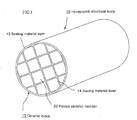
- FIG. 1 is a diagrammatically perspective view showing a concrete example of an aggregate type honeycomb structural body as an embodiment of the honeycomb structural body according to the invention
- FIG. 2a is a diagrammatically perspective view showing an example of the porous ceramic member constituting the honeycomb structural body shown in FIG. 1
- FIG. 2b is a section view at a A-A line of the porous ceramic member shown in FIG. 2a.
- a plurality of porous ceramic members 20 are bundled through sealing material layers 14 to constitute a columnar ceramic block 15, and a sealing material layer 13 is formed around the ceramic block 15.
- the porous ceramic member 20 is desirable to have a structure that either of end portions of the through-hole 21 is sealed with the sealing material 22 as shown in FIG. 2b.
- the exhaust gas flowed into one through-hole 21 always passes through the partition wall 23 separating this through-hole 21 and then flows out from the other through-hole 21, so that the partition wall 23 separating these through-holes 21 from each other can serve as a filter for catching particulates.
- the sealing material layer 13 formed around the ceramic block 15 is formed for preventing the leakage of the exhaust gas from the outer periphery of the ceramic block 15. Therefore, it is not necessarily required in accordance with the application of the honeycomb structural body of the invention.
- FIG. 3a is a diagrammatically perspective view showing a concrete example of a one-piece type honeycomb structural body as another embodiment of the honeycomb structural body of the invention
- FIG. 3b is a section view at B-B line thereof.
- the honeycomb structural body 30 of the invention is constituted with a columnar ceramic block 35 of porous ceramic in which a plurality of through-holes 31 are arranged side by side in a longitudinal direction through partition walls 33.
- the honeycomb structural body 30 of the invention when used as a honeycomb filter for catching particulates in the exhaust gas, as shown in FIG. 3b, it is desirable that either end portions of the through-holes 31 in the ceramic block 35 are sealed with the sealing materials (plugs) 32.
- the exhaust gas flowed into one through-hole 31 always passes through the partition wall 33 separating this through-hole 31 and then flows out from the other through-hole 31, so that the partition wall 33 separating these through-holes 31 from each other can serve as a filter for catching particulates.
- the sealing material layer may be formed around the ceramic block 35 likewise the honeycomb structural body 10 shown in FIG. 1.
- the ceramic block is preferable to be made of the porous ceramic formed by bonding the ceramic particles through silicon.
- oxide ceramic such as cordierite, alumina, silica, mullite, zirconia, yttria or the like
- carbide ceramic such as silicon carbide, zirconium carbide, titanium carbide, tantalum carbide, tungsten carbide or the like
- nitride ceramic such as aluminum nitride, silicon nitride, boron nitride, titanium nitride or the like; and so on.
- the honeycomb structural body according to the invention is an aggregate type honeycomb structural body as shown in FIG. 1, silicon nitride being high in the heat resistance, excellent in the mechanical properties and chemical stability and large in the thermal conductivity is preferable among the above ceramic particles.
- the honeycomb structural body according to the invention is a one-piece type honeycomb structural body as shown in FIG. 3, the oxide such as cordierite or the like is used. It can be produced cheaply and is relatively small in the thermal expansion coefficient and is not broken in the course of the use of honeycomb structural body of the invention as the honeycomb filter and not oxidized.
- the thermal conductivity of the honeycomb structural body according to the invention is determined by the crystallinity of the crystalline silicon, kind of the ceramic particle used and the like, but when carbide ceramic or nitride ceramic is used as the ceramic particles, the thermal conductivity is desirably 3-60 W/m ⁇ k, more desirably 10-40 W/m ⁇ k.
- the thermal conductivity is less than 3 W/m ⁇ k, the thermal conduction is poor and the temperature gradient is liable to be easily caused in the longitudinal direction and the crack is apt to be easily caused.
- the thermal conductivity is desirably 0.1-10 W/m ⁇ k, more desirably 0.3-3 W/m ⁇ k.
- the thermal conductivity is less than 0.1 W/m ⁇ k, the thermal conduction is poor and the temperature gradient is liable to be easily caused in the longitudinal direction and the crack is apt to be easily caused.
- the form of the ceramic block is a cylinder.
- the ceramic block is not limited to the cylinder if it is a column, and may be ellipsoidal column, rectangular column or the like.
- the porosity of the ceramic block is preferable to be about 20-80%.
- the porosity is less than 20%, if the honeycomb structural body of the invention is used as the above honeycomb filter, the clogging may be rapidly caused, while when the porosity exceeds 80%, the strength of the ceramic block lowers and may be easily broken.
- the porosity can be measured by the conventionally known method such as mercury forcing process, Archimedes process, measurement through scanning type electron microscope(SEM) or the like.
- the average pore size of the ceramic block is preferable to be about 5-100 ⁇ m.
- the average pore size is less than 5 ⁇ m, if the honeycomb structural body of the invention is used as the honeycomb filter, the particulates may easily cause the clogging, while when the average pore size exceeds 100 ⁇ m, the particulates pass through the pores and the particulates can not be caught and the function as the filter can not be developed.
- the particle size of the ceramic particles used in the production of the ceramic block is less in the shrinkage at the subsequent firing step.
- the sealing material (plug) is made of the porous ceramic. Since the ceramic block filled with the sealing material (plug) is made of the porous ceramic, when the sealing material (plug) is made of the same porous ceramic as in the ceramic block, the adhesion strength between both can be enhanced, while by adjusting the porosity of the sealing material (plug) to the same as in the ceramic block can be attained the matching between the thermal expansion coefficient of the ceramic block and the thermal expansion coefficient of the sealing material (plug), whereby there can be prevented the formation of gaps between the sealing material (plug) and the wall portion through heat stress in the production or the use, the occurrence of cracks in the sealing material (plug) or the wall portion contacting with the sealing material (plug) .
- the sealing material (plug) is made of the porous ceramic, the same material as the ceramic particles or crystalline silicon constituting the ceramic block is used.
- the sealing material layers 13, 14 are formed between the porous ceramic members 20 and on the outer periphery of the ceramic block 15.
- the sealing material layer 14 formed between the porous ceramic members 20 functions as an adhesive bonding plural porous ceramic members 20 with each other, while the sealing material layer 13 formed on the outer periphery of the ceramic block 15 functions as a adhesive material for preventing leakage of the exhaust gas from the outer periphery of the ceramic block 15 when the honeycomb structural body according to the invention is used as a honeycomb filter and when the honeycomb structural body 10 of the invention is disposed in an exhaust path of an internal-combustion engine.
- an inorganic binder As the material constituting the sealing material layer, there can be used an inorganic binder, an organic binder, inorganic fibers and/or inorganic particles and the like.
- sealing material layers in the honeycomb structural body according to the invention are formed between the porous ceramic members and on the outer periphery of the ceramic block as previously mentioned, but these sealing material layers may be made of the same material or may be made of different materials. Further, when the sealing material layers are made of the same material, the compounding ratio of the materials may be the same or different.
- the inorganic binder constituting the sealing material layer can be used, for example, silica sol, alumina sol and the like. They may be used alone or in a combination of two or more. Among the above inorganic binders, silica sol is desirable.
- organic binder constituting the sealing material layer can be used, for example, polyvinyl alcohol, methyl cellulose, ethyl cellulose, carboxymethyl cellulose and the like. They may be used alone or in a combination of two or more. Among the above organic binders, carboxymethyl cellulose is desirable.
- the inorganic fibers constituting the sealing material layer can be used, for example, ceramic fibers made of silica-alumina, mullite, alumina, silica or the like. They may be used alone or in a combination of two or more. Among the above inorganic fibers, silica-alumina fibers are desirable.
- the inorganic particles constituting the sealing material layer can be used, for example, carbide, nitride and the like.
- inorganic powder, whisker or the like made of silicon carbide, silicon nitride, boron nitride or the like can be used. They may be used alone or in a combination of two or more.
- silicon carbide having an excellent thermal conduction is desirable.
- the sealing material layer 14 may be made of a compact body or a porous body capable of flowing the exhaust gas into the inside thereof when the honeycomb structural body of the invention is used as the honeycomb filter, while the sealing material layer 13 is desirable to be made of a compact body. Because, when the honeycomb structural body 10 of the invention is disposed in the exhaust path of the internal-combustion engine, the sealing material layer 13 is formed so as to prevent the leakage of the exhaust gas from the outer periphery of the ceramic block 15.
- honeycomb structural body As described with reference to FIGS. 1-3, given through-holes in either end portion of the ceramic block constituting the honeycomb structural body are filled and clogged with the sealing material (plug), so that it can be preferably used as a honeycomb filter for the purification of the exhaust gas catching particulates in the exhaust gas discharged from the internal-combustion engine such as diesel engine or the like.
- the sealing material plug
- a catalyst such as Pt or the like for promoting the combustion of the particulate in the regeneration treatment of the honeycomb filter may be carried on the wall portions of the ceramic block.
- a noble metal such as Pt, Rh, Pd or the like, or an alloy thereof as a catalyst is carried on the ceramic block of the honeycomb structural body according to the invention, whereby the honeycomb structural body of the invention can be used as a catalyst carrier for conducting the purification of HC, CO, NOx and the like in the exhaust gas discharged from a thermal engine such as internal-combustion engine or the like or a combustion device such a boiler or the like, or reformulation of a liquid fuel or a gas fuel, and the like.
- the sealing material is not necessarily required.
- the honeycomb structural body according to the invention is constructed so as to include the ceramic block.
- This ceramic block is made of the porous ceramic formed by bonding ceramic particles through crystalline silicon.
- positions of silicon and ceramic can be confirmed, for example, by a reflection electron image of SEM or by mapping through EDS, or the like.
- the thermal diffusibility is improved, and even if the temperature distribution is caused in the honeycomb structural body or the cool-heat cycle is repeated, the storing of heat stress is less and no crack is easily caused and the resistance to thermal shock is excellent.
- the honeycomb structural body according to the invention is a one-piece type honeycomb structural body in which the structure is formed as one ceramic block as a whole as shown in FIG. 3, a starting paste composed mainly of ceramic particles and crystalline silicon powder as mentioned above is first shaped by extrusion to prepare a ceramic shaped body having substantially the same form as the honeycomb structural body 30 shown in FIG. 3.
- the porosity of the ceramic block after the production is 20-80%.
- the binder and the dispersing medium are added to the mixed powder of ceramic particles and silicon powder.
- the silicon powder is preferable to be used by pulverizing silicon having a high crystallinity such as single crystal silicon.
- the silicon powder is fused in the heating treatment after the degreasing treatment as mentioned later to wet the surfaces of the ceramic particles and plays a role as a binding agent bonding the ceramic particles with each other.
- the compounding amount of such a silicon varies in accordance with the particle size, form and the like of the ceramic particle, but is desired to be 5-50 parts by weight per 100 parts by weight of the mixed powder.
- the compounding amount of silicon powder is too small and the sufficient function as a binding agent of bonding the ceramic particles to each other can not be developed, and hence the strength of the resulting honeycomb structural body (ceramic block) may become insufficient.
- the resulting honeycomb structural body is too densified to lower the porosity.
- the honeycomb structural body of the invention is used as a honeycomb filter for the purification of the exhaust gas, the pressure loss in the catching of the particulates becomes rapidly high and there is a fear that the function as the filter can not be sufficiently developed.
- binder for example, methyl cellulose, carboxymethyl cellulose, hydroxyethyl cellulose, polyethylene glycol, phenol resin, epoxy resin and the like.
- dispersing medium for example, organic solvents such as benzene and the like, alcohols such as methanol and the like, water and so on.
- This dispersing medium is compounded so as to make the viscosity of the starting paste within a given range.
- the mixed powder of the ceramic particles and silicon powder, the binder and the dispersing medium are mixed through an attriter or the like and sufficiently milled in a kneader or the like to form the starting paste. Thereafter, the starting paste is extrusion-shaped to prepare the ceramic shaped body.
- the starting paste may be added with a shaping assistant, if necessary.
- a shaping assistant for example, ethylene glycol, dextrin, fatty acid soap, polyvinyl alcohol or the like.
- the starting paste may be added with balloons made of a micro-hollow spherical body of oxide ceramic, spherical acrylic particles, hole-forming agent such as graphite or the like, if necessary.
- the balloon for example, alumina balloon, glass microballoon, silas balloon, fly ash balloon (FA balloon), mullite balloon and the like.
- fly ash balloon is desiable.
- the ceramic shaped body is dried by using a microwave drier, a hot air drier, a dielectric drier, a pressure-reduced drier, a vacuum drier, a freezing drier or the like to form a ceramic dried body, which is then subjected to a sealing treatment by filling a paste as a sealing material (plug) into one ends of the given through-holes to seal these through-holes.
- a sealing material plug
- FIG. 4a is a diagrammatically section view illustrating an example of a sealing device used in the sealing treatment
- FIG. 4b is a partially enlarged section view of a part thereof.
- two sets of closed-type sealing material discharging tanks 110 each provided at its side face with a mask 111 having opening portions 111a formed into a given pattern and filled at its inside with a sealing material paste 120 are arranged so as to oppose the side faces having the masks 111 to each other.
- the ceramic dried body 40 is first fixed between the sealing material discharging tanks 110 so as to contact an end face 40a of the ceramic dried body 40 with the mask 111 formed on the side face of the sealing material discharging tank 110.
- the opening portion 111a of the mask 111 is a position relation of opposing to the respective through-hole 42 of the ceramic dried body 40.
- a constant pressure is applied to the sealing material discharging device 110 by using a pump such as mono-pump or the like, whereby the sealing material paste 120 is discharged from the opening portion 111a of the mask 111 to penetrate the sealing material paste 120 into the end portions of the through-holes 42 in the ceramic dried body 40 and the paste 120 as the sealing material can be filled into the given through-holes 42 of the ceramic dried body 40.
- the sealing device used in the above sealing treatment is not limited to the aforementioned sealing device 100.
- the sealing material paste can be used the same as the starting paste, but it is desirable to add a lubricant, a solvent, a dispersing agent and a binder to the mixed powder used in the starting paste. Because they can prevent the settling of the ceramic particles in the sealing material paste on the way of the sealing treatment.
- the ceramic dried body filled with the sealing material paste is heated to about 150-700°C to remove the binder included in the ceramic dried body, whereby it is subjected to a degreasing treatment to obtain a ceramic degreased body.
- the degreasing treatment is desirable to be conducted at a temperature lower than a temperature fusing silicon.
- the degreasing atmosphere may be an oxidizing atmosphere or an inert gas atmosphere such as nitrogen, argon or the like.
- an optimum atmosphere is selected considering the amount of the binder used, the kind of the ceramic particle and the like.
- the ceramic degreased body is heated to about 1400-1600°C to soften (fuse) the silicon powder to produce a porous ceramic body formed by bonding the ceramic particles through this silicon.
- the porous ceramic body is heated to about 1800-2100°C to crystallize the silicon bonding the ceramic particles to form crystalline silicon, whereby there can be produced the honeycomb structural body (ceramic block) of the invention comprised of porous ceramic and formed into a ceramic block as a whole.
- the honeycomb structural body formed by bonding the ceramic particles through silicon having such a low crystallinity that the half-width value of Si peak in the X-ray diffraction is more than 0.6° it is preferable to take a method wherein a low crystallinity silicon such as amorphous silicon is used as the silicon powder and heated within a temperature range of 1400-1600°C to bond the ceramic particles through the silicon.
- a low crystallinity silicon such as amorphous silicon is used as the silicon powder and heated within a temperature range of 1400-1600°C to bond the ceramic particles through the silicon.
- the thus produced honeycomb structural body of the invention has a structure that one ends of the given through-holes in the ceramic block are filled and sealed with the sealing material (plug), which can be preferably used as a honeycomb filter for the purification of the exhaust gas.
- the sealing material plug
- the catalyst such as Pt or the like for promoting the combustion of the particulates when the honeycomb filter is subjected to a regeneration treatment may be carried on the wall portions of the ceramic block.
- the honeycomb structural body of the invention When the honeycomb structural body of the invention is used as a catalyst carrier for conducting the purification of HC, CO, NOx and the like in the exhaust gas discharged from a heat engine such as an internal-combustion engine or the like, or a combustion device such as a boiler or the like or the quality modification of a liquid fuel or a gas fuel, a noble metal such as Pt, Rh, Pd or the like or an alloy thereof as a catalyst may be carried on the wall portions of the ceramic block.
- the sealing treatment filling the sealing material (plug) is not necessarily required.
- the extrusion shaping is first carried out by using the starting paste composed mainly of the ceramic particles and silicon to prepare a green shaped body having a form of a porous ceramic member 20 as shown in FIG. 2.
- starting paste can be used the same starting paste as described in the aforementioned one-piece type honeycomb structural body.
- the green shaped body is dried by using a microwave drier or the like to obtain a dried body, which is subjected to a sealing treatment wherein one ends of the given through-holes of the dried body are filled with the sealing material paste as a sealing material (plug) to clog these through-holes.
- sealing material paste can be used the same sealing material paste as described in the aforementioned one-piece type honeycomb structural body.
- the sealing treatment differs in the target to be filled with the sealing material paste, but can use the same method as described in the above one-piece type honeycomb structural body.
- the dried body subjected to the above sealing treatment is subjected to a degreasing treatment under the same conditions as in the above one-piece type honeycomb structural body to produce a porous ceramic body, which is heated and fired under the same conditions as in the above one-piece type honeycomb structural body, whereby there can be produced a porous ceramic member in which a plurality of through-holes are arranged side by side through partition walls in a longitudinal direction.
- the porous ceramic member 20 is placed on a base 50 having a V-shaped section at its upper part at an inclined state so that the porous ceramic members 20 can be laminated at a slantly inclined state, and thereafter the sealing material paste forming a sealing material layer 14 is applied to two upper side faces 20a, 20b at a uniform thickness to form a sealing material paste layer 51, and the other porous ceramic member 20 is subsequently piled on the sealing material paste layer 51, and these steps are repeated to prepare a laminate of the prismatic porous ceramic members 20 having a given size.
- the material constituting the sealing material paste layer is previously described in the explanation of the honeycomb structural body according to the invention, so that the explanation thereof is omitted here.
- the laminate of the porous ceramic members 20 is heated to dry and solidify the sealing material paste layer 51 to form the sealing material layer 14, and thereafter the outer peripheral portion of the laminate is cut by using a diamond cutter or the like into a form as shown in FIG. 1 to prepare the ceramic block 15.
- the sealing material layer 13 is formed on the outer periphery of the ceramic block 15 by using the above sealing material paste, whereby there can be produced the honeycomb structural body according to the invention constituted by bundling plural porous ceramic members through the sealing material layers.
- honeycomb structural body according to the invention can be preferably used as a honeycomb filter for the purification of the exhaust gas because the one ends of the given through-holes in the ceramic block (porous ceramic members) are filled and clogged with the sealing material (plug).
- the wall portions of the ceramic block may be carried with a catalyst such as Pt or the like for promoting the combustion of the particulates in the regeneration treatment of the honeycomb filter.
- the honeycomb structural body of the invention When the honeycomb structural body of the invention is used as a catalyst carrier for conducting the purification of HC, CO, NOx and the like in the exhaust gas discharged from a heat engine such as an internal-combustion engine or the like, or a combustion device such as a boiler or the like or the quality modification of a liquid fuel or a gas fuel, a noble metal such as Pt, Rh, Pd or the like or an alloy thereof as a catalyst may be carried on the wall portions of the ceramic block.
- the sealing treatment filling the sealing material (plug) is not necessarily required.
- honeycomb structural body according to the invention When the honeycomb structural body according to the invention is used as a honeycomb filter for the purification of the exhaust gas, it is desirable to arrange in an exhaust gas purification apparatus of a vehicle as shown in FIG. 6.
- FIG. 6 is a diagrammatically section view illustrating an example of the exhaust gas purification apparatus of the vehicle arranging the honeycomb structural body according to the invention (honeycomb filter).
- the exhaust gas purification apparatus 600 is mainly constituted with a honeycomb filter 60 according to the invention, a casing 630 covering the outside of the honeycomb filter 60, a keep seal material 620 disposed between the honeycomb filter 60 and the casing 630, a heating means 610 arranged at an exhaust gas flowing side of the honeycomb filter 60.
- an inlet pipe 640 connected to an internal-combustion engine such as an engine or the like, and the other end portion of the casing 630 is connected with a discharge pipe 650 connected to an exterior.
- an arrow in FIG. 6 shows a flow of the exhaust gas.
- the structure of the honeycomb filter 60 may be the same as the honeycomb structural body 10 shown in FIG. 1 or the same as the honeycomb structural body 30 shown in FIG. 3.
- the exhaust gas discharged from the internal-combustion engine such as engine or the like is introduced into the casing 630 through the inlet pipe 640 and passed from the through-holes of the honeycomb filter 60 through the wall portions (partition walls) to conduct purification by catching particulates with the wall portions (partition walls) and then discharged through the discharge pipe 650 to an exterior.
- the regeneration treatment of the honeycomb filter 60 is conducted.
- a gas heated by using the heating means 610 is flown into the inside of each through-hole of the honeycomb filter 60 to heat the honeycomb filter 60, where the particulates stored on the wall portions (partition walls) are combusted and removed by heating.
- the particulates can be combusted and removed by using a post injection system.
- the combustion temperature of the particulate is lowered, so that the heating temperature of the honeycomb filter 60 by the heating means 610 can be lowered, and the heating through the heating means 610 can be made useless, if necessary.
- the thickness of the sealing material layer bundling the porous ceramic members is adjusted to 1.0 mm.
- a sealing material paste is prepared by mixing and kneading 23.3% by weight of ceramic fibers comprised of alumina silicate as an inorganic fiber (shot content: 3%, fiber length: 0.1-100 mm), 30.2% by weight of silicon carbide powder having an average particle size of 0.3 ⁇ m as an inorganic particle, 7% by weight of silica sol as an inorganic binder (SiO 2 content in sol: 30% by weight), 0.5% by weight of carboxymethyl cellulose as an organic binder and 39% by weight of water.
- the sealing material paste is used to form a sealing material paste layer having a thickness of 1.0 mm on an outer peripheral portion of the ceramic block.
- the sealing material paste layer is dried at 120°C to produce a cylindrical honeycomb structural body functioning as a honeycomb filter for the purification of the exhaust gas.
- the starting paste is filled in an extrusion shaping machine and shaped at an extrusion rate of 10 cm/min to prepare a green shaped body having substantially the same form as a porous ceramic member 30 shown in FIG. 3.
- the green shaped body is dried by using a microwave drier to form a ceramic dried body, a sealing material paste having the same composition as in the green shaped body is filled in one ends of given through-holes and again dried by using the drier and degreased in an oxidizing atmosphere at 550°C for 3 hours to obtain a ceramic degreased body.
- the ceramic degreased body is heated in an argon atmosphere at 1400°C for 2 hours to fuse the single crystal silicon to thereby bond silicon carbide particles through silicon.
- the silicon is crystallized by firing at 2000°C under an argon atmosphere of an atmospheric pressure for 1 hour, whereby there is produced a cylindrical porous ceramic member having a porosity of 45%, an average pore size of 10 ⁇ m and a size of 144 mm in diameter and 254 mm in length. This is rendered into a honeycomb structural body functioning as a honeycomb filter for the purification of the exhaust gas.
- Comparative Examples 1-12 and Test Examples 1-2 are conducted the following evaluation tests (A)-(C).
- X-ray diffraction device used in this analytical measurement is RIGAKU RINT-2500 made by Rigaku Denki Co., Ltd.
- a light source of an X-ray tube is CuK ⁇ 1.
- a sample is first pulverized and uniformized and then filled in a glass sample holder, and the sample holder filled with the sample is set on a sample base of a goniometer, and a power source of the apparatus is switched on while flowing a cooling water to the X-ray tube and a voltage is gradually raised to 40 kV and a current is set to 30 mA by turning a current adjusting knob. Thereafter, the measurement is conducted by setting various conditions.
- the measuring conditions of the X-ray diffraction are as follows. Divergence slit: 0.5°, divergence longitudinal restriction slit: 10 mm, diffusion slit: 0.5°, light receiving slit: 0.3 mm, monochromatic receiving slit: 0.8 mm, scanning mode: continuous, scanning rate: 5.000°/min, step: 0.01°, scanning range: 10.000°-60.000°, monochrometer: use of counter monochrometer, optical system: concentrated optical system.
- honeycomb structural body according to Examples 1-6, Comparative Examples 1-12 and Test examples 1-2 is placed in an electric furnace and slowly heated to 800°C at a temperature rising rate of 10°C/min and held at this temperature for 30 minutes and violently cooled to a lower temperature to generate a temperature distribution, whereby a temperature difference generating crack is visually measured.
- the temperature difference is shown a highest temperature difference among measured values at a distance of 5 mm separated from an axial line (center axis) of the filter in an outward direction and in three places of 10 mm, 125 mm and 240 mm positioned from a one-side end face of the filter in the axial direction thereof (length: 254 mm).
- honeycomb structural body according to Examples 1-6, Comparative Examples 1-12 and Test Examples 1-2 is placed in an exhaust gas purification device disposed in an exhaust path of an engine as shown in FIG. 6.
- the engine is operated at a revolution number of 3000 rpm under a torque of 50 Nm for a given time to catch particulates (8 g/L) and then the regeneration treatment is conducted, and such operations are repeated, during which the occurrence of crack in the honeycomb structural body is visually observed.
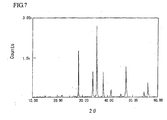
- FIG. 7 shows a graph of X-ray diffraction of the honeycomb structural body of Example 1.
- the temperature difference causing the crack is 110-140°C, which is higher than 100°C.
- the temperature difference causing the crack in the honeycomb structural bodies of the comparative examples is 30-80°C.
- the temperature difference causing the crack is 90-95°C, which is higher than 90°C.
- the temperature difference causing the crack in the honeycomb structural bodies of the comparative examples is 24-73°C.
- the honeycomb structural bodies of the examples do not cause the crack even after the particulate catching and regeneration treatment are repeated 100 times.
- the crack is generated in the honeycomb structural bodies of the comparative examples at a time of repeating the particulate catching and the regeneration treatment 5 times.
- the honeycomb structural body of Test Example 1 does not cause the crack at a time of repeating the particulate catching and the regeneration treatment 5 times, but causes the crack at a time of 100 repeats.
- honeycomb structural bodies of Examples 1-4 and Comparative Examples 1-6 are used as a honeycomb filter in the exhaust gas purification apparatus, and the cycle test repeating the particulate catching and the regeneration treatment is carried out under the same conditions as described in the above item (C), and the thickness of ash after the test is measured and the presence or absence of ash reactivity is observed visually.
- the honeycomb structural body according to the invention is excellent in the thermal diffusibility, and also less in the storing of thermal stress and excellent in the resistance to thermal shock even when the temperature distribution or the cool-heat cycle is repeated because the ceramic block constituting the above body is constituted with a composite material consisting of ceramic particles and crystalline silicon and having an excellent thermal conduction.
- This honeycomb structural body can be used as a filter for the purification of HC, CO and NOx in the exhaust gas discharged from a heat engine such as an internal-combustion engine or the like or a combustion device such as a boiler or the like, or as a catalyst carrier for conducting a quality modification of liquid fuel or gas fuel by carrying a noble metal such as Pt, Rh, Pd or the like or an alloy thereof as a catalyst on the ceramic block, if necessary.
- a heat engine such as an internal-combustion engine or the like or a combustion device such as a boiler or the like
- a catalyst carrier for conducting a quality modification of liquid fuel or gas fuel by carrying a noble metal such as Pt, Rh, Pd or the like or an alloy thereof as a catalyst on the ceramic block, if necessary.
Landscapes
- Chemical & Material Sciences (AREA)
- Engineering & Computer Science (AREA)
- Ceramic Engineering (AREA)
- Manufacturing & Machinery (AREA)
- Structural Engineering (AREA)
- Organic Chemistry (AREA)
- Materials Engineering (AREA)
- Inorganic Chemistry (AREA)
- Mechanical Engineering (AREA)
- Chemical Kinetics & Catalysis (AREA)
- Geometry (AREA)
- Physics & Mathematics (AREA)
- Composite Materials (AREA)
- Combustion & Propulsion (AREA)
- General Engineering & Computer Science (AREA)
- Filtering Materials (AREA)
- Catalysts (AREA)
- Porous Artificial Stone Or Porous Ceramic Products (AREA)
- Exhaust Gas After Treatment (AREA)
- Ceramic Products (AREA)
- Laminated Bodies (AREA)
Abstract
Description

Claims (7)
- A honeycomb structural body constituted with a ceramic block comprising a plurality of through-holes arranged in a longitudinal direction and separated from each other through partition walls, either end portions of which through-holes being sealed, characterized in that the ceramic block is made of a composite material comprising ceramic particles and crystalline silicon.
- A honeycomb structural body according to claim 1, wherein the ceramic block is formed by bundling plural prismatic ceramic members, each having a plurality of through-holes arranged in a longitudinal direction and separated from each other through partition walls, through sealing material layers.
- A honeycomb structural body according to claim 1 or 2, wherein plural through-holes in the ceramic block are sealed with a sealing material at one end portions and through-holes not sealed with the sealing material (plug) are sealed with a sealing material (plug) at the other end portions.
- A honeycomb structural body according to any one of claims 1-3, wherein the composite material is a porous ceramic formed by bonding the ceramic particles through the crystalline silicon.
- A honeycomb structural body according to any one of claims 1-4, wherein the ceramic particle is silicon carbide.
- A honeycomb structural body according to any one of claims 1-5, wherein the crystalline silicon has a half-width value of Si peak (2 = about 28°) in an X-ray diffraction of not more than 0.6°.
- A honeycomb structural body according to claim 6, wherein the crystalline silicon has a half-width value of Si peak (2 = about 28°) in an X-ray diffraction of not less than 0.1°.
Applications Claiming Priority (3)
| Application Number | Priority Date | Filing Date | Title |
|---|---|---|---|
| JP2002293690 | 2002-10-07 | ||
| JP2002293690 | 2002-10-07 | ||
| PCT/JP2003/012841 WO2004031100A1 (en) | 2002-10-07 | 2003-10-07 | Honeycomb structural body |
Publications (3)
| Publication Number | Publication Date |
|---|---|
| EP1506948A1 true EP1506948A1 (en) | 2005-02-16 |
| EP1506948A4 EP1506948A4 (en) | 2006-04-26 |
| EP1506948B1 EP1506948B1 (en) | 2013-02-27 |
Family
ID=32064013
Family Applications (1)
| Application Number | Title | Priority Date | Filing Date |
|---|---|---|---|
| EP03748745A Expired - Lifetime EP1506948B1 (en) | 2002-10-07 | 2003-10-07 | Honeycomb structural body |
Country Status (4)
| Country | Link |
|---|---|
| US (1) | US7387657B2 (en) |
| EP (1) | EP1506948B1 (en) |
| JP (1) | JP4437084B2 (en) |
| WO (1) | WO2004031100A1 (en) |
Cited By (2)
| Publication number | Priority date | Publication date | Assignee | Title |
|---|---|---|---|---|
| EP1703095A4 (en) * | 2003-12-25 | 2007-02-28 | Ibiden Co Ltd | EXHAUST GAS PURIFICATION DEVICE AND METHOD FOR REGENERATING AN EXHAUST GAS PURIFYING DEVICE |
| WO2013040146A1 (en) * | 2011-09-16 | 2013-03-21 | Corning Incorporated | Methods for reducing defects in ceramic articles and precursors |
Families Citing this family (35)
| Publication number | Priority date | Publication date | Assignee | Title |
|---|---|---|---|---|
| EP1604719B1 (en) | 2002-03-15 | 2008-07-16 | Ibiden Co., Ltd. | Ceramic filter for exhaust gas purification |
| US7326270B2 (en) * | 2002-09-13 | 2008-02-05 | Ibiden Co., Ltd. | Filter |
| JP4437084B2 (en) | 2002-10-07 | 2010-03-24 | イビデン株式会社 | Honeycomb structure |
| US20050050870A1 (en) * | 2003-03-03 | 2005-03-10 | Cheng Shi-Wai S. | Method and apparatus for filtering exhaust particulates |
| KR20060018828A (en) * | 2003-05-06 | 2006-03-02 | 이비덴 가부시키가이샤 | Honeycomb structure |
| DE602004011997T2 (en) * | 2003-06-05 | 2009-02-26 | Ibiden Co., Ltd., Ogaki | HONEYCOMB BODY STRUCTURE |
| JP4932256B2 (en) * | 2003-09-12 | 2012-05-16 | イビデン株式会社 | Ceramic sintered body and ceramic filter |
| PL1676620T5 (en) * | 2003-10-20 | 2012-10-31 | Ibiden Co Ltd | Honeycomb structure |
| JP4439236B2 (en) * | 2003-10-23 | 2010-03-24 | イビデン株式会社 | Honeycomb structure |
| WO2005044422A1 (en) | 2003-11-07 | 2005-05-19 | Ibiden Co., Ltd. | Honeycomb structure body |
| EP1686108B1 (en) * | 2003-11-12 | 2011-09-14 | NGK Insulators, Ltd. | Honeycomb structure |
| US7387829B2 (en) | 2004-01-13 | 2008-06-17 | Ibiden Co., Ltd. | Honeycomb structure, porous body, pore forming material for the porous body, and methods for manufacturing the pore forming material, the porous body and the honeycomb structure |
| JP4698585B2 (en) * | 2004-02-23 | 2011-06-08 | イビデン株式会社 | Honeycomb structure and exhaust gas purification device |
| KR100637298B1 (en) * | 2004-04-05 | 2006-10-24 | 이비덴 가부시키가이샤 | Honeycomb structural body, manufacturing method of the honeycomb structural body, and exhaust gas purifying device |
| KR100804933B1 (en) * | 2004-05-06 | 2008-02-20 | 이비덴 가부시키가이샤 | Honeycomb structure and method of manufacturing the same |
| WO2006013652A1 (en) * | 2004-08-04 | 2006-02-09 | Ibiden Co., Ltd. | Continuous firing kiln and process for producing porous ceramic member therewith |
| EP1795262B1 (en) | 2004-09-30 | 2010-01-27 | Ibiden Co., Ltd. | Honeycomb structure |
| WO2006035823A1 (en) * | 2004-09-30 | 2006-04-06 | Ibiden Co., Ltd. | Honeycomb structure |
| CN1906141B (en) | 2004-12-27 | 2010-11-03 | 揖斐电株式会社 | Honeycomb structure and sealing material layer |
| FR2880827B1 (en) * | 2005-01-14 | 2008-07-25 | Snecma Moteurs Sa | HOT MATRIX TYPE FORGING PRESS AND THERMAL INSULATION MEANS FOR THE PRESS |
| JP5237630B2 (en) * | 2005-02-01 | 2013-07-17 | イビデン株式会社 | Honeycomb structure |
| CN1969073B (en) * | 2005-03-02 | 2010-12-08 | 揖斐电株式会社 | Inorganic fiber aggregate and manufacturing method thereof, honeycomb structure and manufacturing method thereof |
| CN101146742B (en) * | 2005-03-30 | 2013-05-01 | 揖斐电株式会社 | Silicon carbide-containing particle, method of manufacturing a silicon carbide-based sintered object, silicon carbide-based sintered object, and filter |
| JP4805823B2 (en) * | 2005-04-07 | 2011-11-02 | イビデン株式会社 | Honeycomb structure |
| DE202006007876U1 (en) * | 2006-05-15 | 2007-09-20 | Bauer Technologies Gmbh | Optimization of cellular structures, in particular for the emission control of combustion units and other applications |
| US7701231B2 (en) * | 2007-03-20 | 2010-04-20 | Cummins Filtration Ip, Inc | Apparatus, system, and method for detecting cracking within an aftertreatment device |
| FR2925689B1 (en) * | 2007-12-21 | 2010-08-13 | Saint Gobain Ct Recherches | DEVICE FOR DETECTING RADIAL CRACKS IN A PARTICLE FILTER |
| US20090218409A1 (en) * | 2008-02-29 | 2009-09-03 | Wen-Lo Chen | Heating system for motor vehicle |
| CN102574121B (en) * | 2009-09-28 | 2014-06-25 | 日本碍子株式会社 | Honeycomb structure |
| WO2012043749A1 (en) * | 2010-09-29 | 2012-04-05 | 日本碍子株式会社 | Silicon carbide ceramic and honeycomb structure |
| JP6231910B2 (en) * | 2014-03-14 | 2017-11-15 | 日本碍子株式会社 | Plugged honeycomb structure |
| CN110319700B (en) * | 2018-03-28 | 2023-09-15 | 日本碍子株式会社 | Heating furnace |
| WO2020131668A1 (en) | 2018-12-21 | 2020-06-25 | Corning Incorporated | Methods of plugging a permeable porous cellular body |
| JP7594471B2 (en) * | 2021-03-16 | 2024-12-04 | 日本碍子株式会社 | Honeycomb structure and electrically heated carrier |
| JP2022149955A (en) * | 2021-03-25 | 2022-10-07 | 日本碍子株式会社 | Composite sintered body, honeycomb structure, electric heating catalyst, and method for manufacturing composite sintered body |
Family Cites Families (35)
| Publication number | Priority date | Publication date | Assignee | Title |
|---|---|---|---|---|
| JPS577215A (en) * | 1980-06-16 | 1982-01-14 | Ngk Insulators Ltd | Preparation of ceramic honeycomb filter |
| JPH0813706B2 (en) * | 1991-07-02 | 1996-02-14 | 工業技術院長 | Silicon carbide / metal silicon composite and method for producing the same |
| JP3548914B2 (en) | 1992-12-16 | 2004-08-04 | イビデン株式会社 | Method for producing catalyst carrier |
| US5447564A (en) * | 1994-02-16 | 1995-09-05 | National Research Council Of Canada | Conductive cement-based compositions |
| JP3632101B2 (en) | 1994-12-22 | 2005-03-23 | 株式会社四国総合研究所 | Power storage device |
| US5914187A (en) * | 1996-01-12 | 1999-06-22 | Ibiden Co., Ltd. | Ceramic structural body |
| US5930994A (en) * | 1996-07-02 | 1999-08-03 | Ibiden Co., Ltd. | Reverse cleaning regeneration type exhaust emission control device and method of regenerating the same |
| JP2000167329A (en) * | 1998-09-30 | 2000-06-20 | Ibiden Co Ltd | Regeneration system for exhaust gas purifying apparatus |
| JP2002530175A (en) * | 1998-11-20 | 2002-09-17 | コーニンクレッカ フィリップス エレクトロニクス エヌ ヴィ | Ultrasound diagnostic imaging system with cordless scan head charger |
| DE20023986U1 (en) * | 1999-09-29 | 2008-09-18 | IBIDEN CO., LTD., Ogaki-shi | Ceramic filter arrangement |
| JP3965007B2 (en) * | 1999-09-29 | 2007-08-22 | イビデン株式会社 | Porous silicon carbide sintered body, honeycomb filter, ceramic filter assembly |
| JP4455708B2 (en) | 2000-01-17 | 2010-04-21 | 日本碍子株式会社 | Honeycomb structure and manufacturing method thereof |
| JP2001329830A (en) * | 2000-03-15 | 2001-11-30 | Ibiden Co Ltd | Regeneration device for exhaust gas purifying filter, and filter regeneration method, regeneration program for exhaust gas purifying filter, and recording medium storing program |
| JP4136319B2 (en) | 2000-04-14 | 2008-08-20 | 日本碍子株式会社 | Honeycomb structure and manufacturing method thereof |
| JP4511065B2 (en) * | 2000-06-05 | 2010-07-28 | 日本碍子株式会社 | Honeycomb structure, honeycomb filter, and manufacturing method thereof |
| US6555031B2 (en) * | 2000-06-19 | 2003-04-29 | Corning Incorporated | Process for producing silicon carbide bodies |
| JP2002037673A (en) * | 2000-07-24 | 2002-02-06 | Ibiden Co Ltd | Manufacturing method of binder and ceramic component, manufacturing method of sintered body and manufacturing method of porous silicon carbide member |
| WO2003071105A1 (en) | 2000-08-24 | 2003-08-28 | Ibiden Co., Ltd. | Exhaust emission control device and casing structure of the control device |
| JP2002154876A (en) * | 2000-11-17 | 2002-05-28 | Ngk Insulators Ltd | Honeycomb structure and manufacturing method thereof |
| JP4404497B2 (en) * | 2001-03-01 | 2010-01-27 | 日本碍子株式会社 | Honeycomb filter and manufacturing method thereof |
| JP2002273130A (en) | 2001-03-22 | 2002-09-24 | Ngk Insulators Ltd | Honeycomb structure |
| JP2002273131A (en) * | 2001-03-22 | 2002-09-24 | Ibiden Co Ltd | Honeycomb filter and method for manufacturing the same |
| WO2002077424A1 (en) * | 2001-03-22 | 2002-10-03 | Ibiden Co., Ltd. | Exhaust gas cleanup apparatus |
| US20040161596A1 (en) * | 2001-05-31 | 2004-08-19 | Noriyuki Taoka | Porous ceramic sintered body and method of producing the same, and diesel particulate filter |
| US6555032B2 (en) * | 2001-08-29 | 2003-04-29 | Corning Incorporated | Method of making silicon nitride-silicon carbide composite filters |
| WO2003093657A1 (en) | 2002-04-10 | 2003-11-13 | Ibiden Co., Ltd. | Honeycomb filter for clarifying exhaust gas |
| WO2003093658A1 (en) | 2002-04-11 | 2003-11-13 | Ibiden Co., Ltd. | Honeycomb filter for clarifying exhaust gas |
| JP4437084B2 (en) | 2002-10-07 | 2010-03-24 | イビデン株式会社 | Honeycomb structure |
| CN1326593C (en) | 2003-02-28 | 2007-07-18 | 揖斐电株式会社 | Ceramic honeycomb structure |
| KR20060018828A (en) | 2003-05-06 | 2006-03-02 | 이비덴 가부시키가이샤 | Honeycomb structure |
| DE602004011997T2 (en) | 2003-06-05 | 2009-02-26 | Ibiden Co., Ltd., Ogaki | HONEYCOMB BODY STRUCTURE |
| ATE369200T1 (en) | 2003-06-10 | 2007-08-15 | Ibiden Co Ltd | HONEYCOMB STRUCTURAL BODY |
| US7611764B2 (en) | 2003-06-23 | 2009-11-03 | Ibiden Co., Ltd. | Honeycomb structure |
| ATE361140T1 (en) | 2003-06-23 | 2007-05-15 | Ibiden Co Ltd | HONEYCOMB STRUCTURAL BODY |
| KR100692356B1 (en) | 2003-07-15 | 2007-03-12 | 이비덴 가부시키가이샤 | Honeycomb structure |
-
2003
- 2003-10-07 JP JP2004541298A patent/JP4437084B2/en not_active Expired - Lifetime
- 2003-10-07 US US10/513,798 patent/US7387657B2/en not_active Expired - Lifetime
- 2003-10-07 EP EP03748745A patent/EP1506948B1/en not_active Expired - Lifetime
- 2003-10-07 WO PCT/JP2003/012841 patent/WO2004031100A1/en not_active Ceased
Cited By (3)
| Publication number | Priority date | Publication date | Assignee | Title |
|---|---|---|---|---|
| EP1703095A4 (en) * | 2003-12-25 | 2007-02-28 | Ibiden Co Ltd | EXHAUST GAS PURIFICATION DEVICE AND METHOD FOR REGENERATING AN EXHAUST GAS PURIFYING DEVICE |
| WO2013040146A1 (en) * | 2011-09-16 | 2013-03-21 | Corning Incorporated | Methods for reducing defects in ceramic articles and precursors |
| US8696962B2 (en) | 2011-09-16 | 2014-04-15 | Corning Incorporated | Methods for reducing defects in ceramic articles and precursors |
Also Published As
| Publication number | Publication date |
|---|---|
| EP1506948B1 (en) | 2013-02-27 |
| US7387657B2 (en) | 2008-06-17 |
| US20050235621A1 (en) | 2005-10-27 |
| EP1506948A4 (en) | 2006-04-26 |
| JPWO2004031100A1 (en) | 2006-02-02 |
| WO2004031100A1 (en) | 2004-04-15 |
| JP4437084B2 (en) | 2010-03-24 |
Similar Documents
| Publication | Publication Date | Title |
|---|---|---|
| US7387657B2 (en) | Honeycomb structural body | |
| JP4437085B2 (en) | Honeycomb structure | |
| JP4932256B2 (en) | Ceramic sintered body and ceramic filter | |
| JP4516017B2 (en) | Ceramic honeycomb structure | |
| JP3997825B2 (en) | Ceramic filter and ceramic filter with catalyst | |
| US7524350B2 (en) | Ceramic honeycomb structural body | |
| EP1707546B1 (en) | Honeycomb structure and seal material | |
| JP4295279B2 (en) | Honeycomb structure | |
| JP5209315B2 (en) | Honeycomb filter | |
| EP2090351B1 (en) | Honeycomb structured body, exhaust-gas-purifying apparatus and method for manufacturing honeycomb structured body | |
| EP1515787A1 (en) | Magnesium aluminum silicate structures for dpf applications | |
| JP5469337B2 (en) | Honeycomb structure | |
| JP4737594B2 (en) | Ceramic honeycomb filter | |
| JP2001097777A (en) | Porous silicon carbide sintered product, honeycomb filter, ceramic filter assembly | |
| JP2011524247A (en) | Catalytic filter or substrate comprising silicon carbide and aluminum titanate | |
| JP2004167482A (en) | Honeycomb filter for exhaust gas cleaning, and its production method | |
| WO2005044425A1 (en) | Honeycomb filter for exhaust gas purification and method of manufacturing the same | |
| ZA200207820B (en) | Cordierite body. |
Legal Events
| Date | Code | Title | Description |
|---|---|---|---|
| PUAI | Public reference made under article 153(3) epc to a published international application that has entered the european phase |
Free format text: ORIGINAL CODE: 0009012 |
|
| 17P | Request for examination filed |
Effective date: 20041122 |
|
| AK | Designated contracting states |
Kind code of ref document: A1 Designated state(s): AT BE BG CH CY CZ DE DK EE ES FI FR GB GR HU IE IT LI LU MC NL PT RO SE SI SK TR |
|
| AX | Request for extension of the european patent |
Extension state: AL LT LV MK |
|
| DAX | Request for extension of the european patent (deleted) | ||
| A4 | Supplementary search report drawn up and despatched |
Effective date: 20060313 |
|
| 17Q | First examination report despatched |
Effective date: 20061002 |
|
| GRAP | Despatch of communication of intention to grant a patent |
Free format text: ORIGINAL CODE: EPIDOSNIGR1 |
|
| GRAS | Grant fee paid |
Free format text: ORIGINAL CODE: EPIDOSNIGR3 |
|
| GRAA | (expected) grant |
Free format text: ORIGINAL CODE: 0009210 |
|
| AK | Designated contracting states |
Kind code of ref document: B1 Designated state(s): AT BE BG CH CY CZ DE DK EE ES FI FR GB GR HU IE IT LI LU MC NL PT RO SE SI SK TR |
|
| REG | Reference to a national code |
Ref country code: GB Ref legal event code: FG4D |
|
| REG | Reference to a national code |
Ref country code: CH Ref legal event code: EP |
|
| REG | Reference to a national code |
Ref country code: AT Ref legal event code: REF Ref document number: 598415 Country of ref document: AT Kind code of ref document: T Effective date: 20130315 |
|
| REG | Reference to a national code |
Ref country code: IE Ref legal event code: FG4D |
|
| REG | Reference to a national code |
Ref country code: DE Ref legal event code: R096 Ref document number: 60343373 Country of ref document: DE Effective date: 20130425 |
|
| REG | Reference to a national code |
Ref country code: AT Ref legal event code: MK05 Ref document number: 598415 Country of ref document: AT Kind code of ref document: T Effective date: 20130227 |
|
| PG25 | Lapsed in a contracting state [announced via postgrant information from national office to epo] |
Ref country code: ES Free format text: LAPSE BECAUSE OF FAILURE TO SUBMIT A TRANSLATION OF THE DESCRIPTION OR TO PAY THE FEE WITHIN THE PRESCRIBED TIME-LIMIT Effective date: 20130607 Ref country code: AT Free format text: LAPSE BECAUSE OF FAILURE TO SUBMIT A TRANSLATION OF THE DESCRIPTION OR TO PAY THE FEE WITHIN THE PRESCRIBED TIME-LIMIT Effective date: 20130227 Ref country code: BG Free format text: LAPSE BECAUSE OF FAILURE TO SUBMIT A TRANSLATION OF THE DESCRIPTION OR TO PAY THE FEE WITHIN THE PRESCRIBED TIME-LIMIT Effective date: 20130527 Ref country code: SE Free format text: LAPSE BECAUSE OF FAILURE TO SUBMIT A TRANSLATION OF THE DESCRIPTION OR TO PAY THE FEE WITHIN THE PRESCRIBED TIME-LIMIT Effective date: 20130227 |
|
| REG | Reference to a national code |
Ref country code: NL Ref legal event code: VDEP Effective date: 20130227 |
|
| PG25 | Lapsed in a contracting state [announced via postgrant information from national office to epo] |
Ref country code: BE Free format text: LAPSE BECAUSE OF FAILURE TO SUBMIT A TRANSLATION OF THE DESCRIPTION OR TO PAY THE FEE WITHIN THE PRESCRIBED TIME-LIMIT Effective date: 20130227 Ref country code: SI Free format text: LAPSE BECAUSE OF FAILURE TO SUBMIT A TRANSLATION OF THE DESCRIPTION OR TO PAY THE FEE WITHIN THE PRESCRIBED TIME-LIMIT Effective date: 20130227 Ref country code: PT Free format text: LAPSE BECAUSE OF FAILURE TO SUBMIT A TRANSLATION OF THE DESCRIPTION OR TO PAY THE FEE WITHIN THE PRESCRIBED TIME-LIMIT Effective date: 20130627 Ref country code: FI Free format text: LAPSE BECAUSE OF FAILURE TO SUBMIT A TRANSLATION OF THE DESCRIPTION OR TO PAY THE FEE WITHIN THE PRESCRIBED TIME-LIMIT Effective date: 20130227 Ref country code: GR Free format text: LAPSE BECAUSE OF FAILURE TO SUBMIT A TRANSLATION OF THE DESCRIPTION OR TO PAY THE FEE WITHIN THE PRESCRIBED TIME-LIMIT Effective date: 20130528 |
|
| PG25 | Lapsed in a contracting state [announced via postgrant information from national office to epo] |
Ref country code: EE Free format text: LAPSE BECAUSE OF FAILURE TO SUBMIT A TRANSLATION OF THE DESCRIPTION OR TO PAY THE FEE WITHIN THE PRESCRIBED TIME-LIMIT Effective date: 20130227 Ref country code: DK Free format text: LAPSE BECAUSE OF FAILURE TO SUBMIT A TRANSLATION OF THE DESCRIPTION OR TO PAY THE FEE WITHIN THE PRESCRIBED TIME-LIMIT Effective date: 20130227 Ref country code: NL Free format text: LAPSE BECAUSE OF FAILURE TO SUBMIT A TRANSLATION OF THE DESCRIPTION OR TO PAY THE FEE WITHIN THE PRESCRIBED TIME-LIMIT Effective date: 20130227 Ref country code: SK Free format text: LAPSE BECAUSE OF FAILURE TO SUBMIT A TRANSLATION OF THE DESCRIPTION OR TO PAY THE FEE WITHIN THE PRESCRIBED TIME-LIMIT Effective date: 20130227 Ref country code: RO Free format text: LAPSE BECAUSE OF FAILURE TO SUBMIT A TRANSLATION OF THE DESCRIPTION OR TO PAY THE FEE WITHIN THE PRESCRIBED TIME-LIMIT Effective date: 20130227 Ref country code: CZ Free format text: LAPSE BECAUSE OF FAILURE TO SUBMIT A TRANSLATION OF THE DESCRIPTION OR TO PAY THE FEE WITHIN THE PRESCRIBED TIME-LIMIT Effective date: 20130227 |
|
| PG25 | Lapsed in a contracting state [announced via postgrant information from national office to epo] |
Ref country code: CY Free format text: LAPSE BECAUSE OF FAILURE TO SUBMIT A TRANSLATION OF THE DESCRIPTION OR TO PAY THE FEE WITHIN THE PRESCRIBED TIME-LIMIT Effective date: 20130227 |
|
| PG25 | Lapsed in a contracting state [announced via postgrant information from national office to epo] |
Ref country code: IT Free format text: LAPSE BECAUSE OF FAILURE TO SUBMIT A TRANSLATION OF THE DESCRIPTION OR TO PAY THE FEE WITHIN THE PRESCRIBED TIME-LIMIT Effective date: 20130227 |
|
| PLBE | No opposition filed within time limit |
Free format text: ORIGINAL CODE: 0009261 |
|
| STAA | Information on the status of an ep patent application or granted ep patent |
Free format text: STATUS: NO OPPOSITION FILED WITHIN TIME LIMIT |
|
| 26N | No opposition filed |
Effective date: 20131128 |
|
| REG | Reference to a national code |
Ref country code: DE Ref legal event code: R097 Ref document number: 60343373 Country of ref document: DE Effective date: 20131128 |
|
| PG25 | Lapsed in a contracting state [announced via postgrant information from national office to epo] |
Ref country code: MC Free format text: LAPSE BECAUSE OF FAILURE TO SUBMIT A TRANSLATION OF THE DESCRIPTION OR TO PAY THE FEE WITHIN THE PRESCRIBED TIME-LIMIT Effective date: 20130227 |
|
| REG | Reference to a national code |
Ref country code: CH Ref legal event code: PL |
|
| GBPC | Gb: european patent ceased through non-payment of renewal fee |
Effective date: 20131007 |
|
| REG | Reference to a national code |
Ref country code: IE Ref legal event code: MM4A |
|
| PG25 | Lapsed in a contracting state [announced via postgrant information from national office to epo] |
Ref country code: LI Free format text: LAPSE BECAUSE OF NON-PAYMENT OF DUE FEES Effective date: 20131031 Ref country code: CH Free format text: LAPSE BECAUSE OF NON-PAYMENT OF DUE FEES Effective date: 20131031 Ref country code: GB Free format text: LAPSE BECAUSE OF NON-PAYMENT OF DUE FEES Effective date: 20131007 |
|
| REG | Reference to a national code |
Ref country code: FR Ref legal event code: ST Effective date: 20140630 |
|
| PG25 | Lapsed in a contracting state [announced via postgrant information from national office to epo] |
Ref country code: FR Free format text: LAPSE BECAUSE OF NON-PAYMENT OF DUE FEES Effective date: 20131031 |
|
| PG25 | Lapsed in a contracting state [announced via postgrant information from national office to epo] |
Ref country code: IE Free format text: LAPSE BECAUSE OF NON-PAYMENT OF DUE FEES Effective date: 20131007 |
|
| PG25 | Lapsed in a contracting state [announced via postgrant information from national office to epo] |
Ref country code: TR Free format text: LAPSE BECAUSE OF FAILURE TO SUBMIT A TRANSLATION OF THE DESCRIPTION OR TO PAY THE FEE WITHIN THE PRESCRIBED TIME-LIMIT Effective date: 20130227 |
|
| PG25 | Lapsed in a contracting state [announced via postgrant information from national office to epo] |
Ref country code: HU Free format text: LAPSE BECAUSE OF FAILURE TO SUBMIT A TRANSLATION OF THE DESCRIPTION OR TO PAY THE FEE WITHIN THE PRESCRIBED TIME-LIMIT; INVALID AB INITIO Effective date: 20031007 Ref country code: LU Free format text: LAPSE BECAUSE OF NON-PAYMENT OF DUE FEES Effective date: 20131007 |
|
| PGFP | Annual fee paid to national office [announced via postgrant information from national office to epo] |
Ref country code: DE Payment date: 20220621 Year of fee payment: 20 |
|
| REG | Reference to a national code |
Ref country code: DE Ref legal event code: R071 Ref document number: 60343373 Country of ref document: DE |