EP1505534A2 - Plural model time series pattern processing - Google Patents
Plural model time series pattern processing Download PDFInfo
- Publication number
- EP1505534A2 EP1505534A2 EP04018616A EP04018616A EP1505534A2 EP 1505534 A2 EP1505534 A2 EP 1505534A2 EP 04018616 A EP04018616 A EP 04018616A EP 04018616 A EP04018616 A EP 04018616A EP 1505534 A2 EP1505534 A2 EP 1505534A2
- Authority
- EP
- European Patent Office
- Prior art keywords
- movement pattern
- learning model
- learning
- pattern learning
- movement
- Prior art date
- Legal status (The legal status is an assumption and is not a legal conclusion. Google has not performed a legal analysis and makes no representation as to the accuracy of the status listed.)
- Ceased
Links
Images







Classifications
-
- G—PHYSICS
- G06—COMPUTING OR CALCULATING; COUNTING
- G06F—ELECTRIC DIGITAL DATA PROCESSING
- G06F18/00—Pattern recognition
- G06F18/20—Analysing
- G06F18/25—Fusion techniques
- G06F18/254—Fusion techniques of classification results, e.g. of results related to same input data
-
- G—PHYSICS
- G06—COMPUTING OR CALCULATING; COUNTING
- G06V—IMAGE OR VIDEO RECOGNITION OR UNDERSTANDING
- G06V40/00—Recognition of biometric, human-related or animal-related patterns in image or video data
- G06V40/20—Movements or behaviour, e.g. gesture recognition
- G06V40/28—Recognition of hand or arm movements, e.g. recognition of deaf sign language
-
- G—PHYSICS
- G06—COMPUTING OR CALCULATING; COUNTING
- G06F—ELECTRIC DIGITAL DATA PROCESSING
- G06F2218/00—Aspects of pattern recognition specially adapted for signal processing
Definitions
- This invention relates to a method and an apparatus for processing the information, a program storage medium, and to a program. More particularly, it relates to a method and an apparatus for processing the information, a program storage medium, and to a program, in which the learning efficiency may be improved and the scale may be extended readily.
- a neural network has been studied as one model pertinent to the brain of the human being or an animal.
- a preset movement pattern may be learned at the outset to check whether or not input data corresponds to the learned movement model.
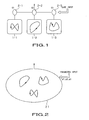
- a movement pattern learning model by a local expression scheme and a movement pattern learning model by a distributed expression scheme are known.
- independent local modules 1-1 to 1-3 are interconnected via associated gates 2-1 to 2-3, as shown in Fig.1.
- the local modules 1-1 to 1-3 learn independent movement patterns.
- the totality of the outputs is determined by controlling the gates 2-1 to 2-3.
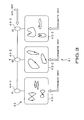
- a module 21 learns plural movement patterns, as shown in Fig.2.
- Patent Publication 1 Japanese Laid-Open Patent Publication H-11-126198
- the present invention provides an information processing apparatus for processing a time-series pattern, comprising a first movement pattern learning model by a distributed expression scheme for learning the time-series pattern, a second movement pattern learning model by a distributed expression scheme for learning the time-series pattern, and a third movement pattern learning model by a local expression scheme, having the first movement pattern learning model and the second movement pattern learning model as elements.
- the first movement pattern learning model and the second movement pattern learning model may each be formed by a recurrent neural network provided with an operating parameter.
- the first movement pattern learning model and the second movement pattern learning model each calculate a learning error, calculate a weighting coefficient of a correction amount of a learning parameter based on the learning error and correct the learning parameter based on the weighting coefficient.
- the present invention provides an information processing method for an information processing apparatus for processing a time-series pattern comprising a step of learning a plurality of first time-series patterns by a first movement pattern learning model by a distributed expression scheme, a step of learning a plurality of second time-series patterns by a second movement pattern learning model by a distributed expression scheme, and a step of recognizing or generating a time-series pattern by a third movement pattern learning model by a local expression scheme, having the first movement pattern learning model and the second movement pattern learning model as elements.
- the first movement pattern learning model and the second movement pattern learning model may each be formed by a recurrent neural network provided with an operating parameter.
- the information processing method may further comprise a first calculating step of calculating a learning error of the first movement pattern learning model and a learning error of the second movement pattern learning model, a second calculating step of calculating weighting coefficients of correction values of the learning parameters of the first movement pattern learning model and the second movement pattern learning model based on the learning errors, and a correction step of correcting the learning parameters of the first movement pattern learning model and the second movement pattern learning model based on the weighting coefficients.
- the present invention provides a program storage medium having stored therein a program for an information processing apparatus configured for processing a time-series pattern, in which the program allows a computer to execute the processing including a step of learning a plurality of first time-series patterns by a first movement pattern learning model by a distributed expression scheme, a step of learning a plurality of second time-series patterns by a second movement pattern learning model by a distributed expression scheme, and a step of recognizing or generating a time-series pattern by a third movement pattern learning model by a local expression scheme, having the first movement pattern learning model and the second movement pattern learning model as elements.
- the first movement pattern learning model and the second movement pattern learning model may each be formed by a recurrent neural network provided with an operating parameter.
- the program for the storage medium according to the present invention may further comprise a first calculating step of calculating a learning error of the first movement pattern learning model and a learning error of the second movement pattern learning model, a second calculating step of calculating weighting coefficients of correction values of the learning parameters of the first movement pattern learning model and the second movement pattern learning model based on the learning errors, and a correction step of correcting the learning parameters of the first movement pattern learning model and the second movement pattern learning model based on the weighting coefficients.
- the present invention provides a program for a computer controlling an information processing apparatus configured for processing a time-series pattern, in which the program allows a computer to execute the processing including a step of learning a plurality of first time-series patterns by a first movement pattern learning model by a distributed expression scheme, a step of learning a plurality of second time-series patterns by a second movement pattern learning model by a distributed expression scheme, and a step of recognizing or generating a time-series pattern by a third movement pattern learning model by a local expression scheme, the third movement pattern learning model having the first movement pattern learning model and the second movement pattern learning model as elements.
- the first movement pattern learning model and the second movement pattern learning model may each be formed by a recurrent neural network provided with an operating parameter.
- the program according to the present invention may further comprise a first calculating step of calculating a learning error of the first movement pattern learning model and a learning error of the second movement pattern learning model, a second calculating step of calculating weighting coefficients of correction values of the learning parameters of the first movement pattern learning model and the second movement pattern learning model based on the learning errors, and a correction step of correcting the learning parameters of the first movement pattern learning model and the second movement pattern learning model based on the weighting coefficients.
- the first and second movement pattern learning models are each a model by a distributed expression scheme
- the third movement pattern learning model by the local expression scheme is formed by the first and second movement pattern learning models.
- the movement pattern can be learned.
- it is possible to improve the learning efficiency and to extend the scale extremely readily.
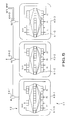
- the present invention provides an information processing apparatus for processing a time-series pattern, for example, a processing apparatus 41 shown in Fig.3.
- This information processing apparatus includes a first movement pattern learning model by a distributed expression scheme, for learning the time-series pattern (such as, for example, a local module 43-1 of Fig.3), a second movement pattern learning model by a distributed expression scheme, for learning the time-series pattern (such as, for example, a local module 43-2 of Fig.3), and a third movement pattern learning model by the local expression scheme, having the first movement pattern learning model and the second movement pattern learning model, as elements (such as, for example, an integrated module 42 of Fig.3).
- the first and second movement pattern learning models of this information processing apparatus may each be constructed by recurrent type neural networks each having operating parameters (such as RNN61-1 and 61-2 of Fig.5).
- the first and second movement pattern learning models of this information processing apparatus may each be able to calculate a learning error (such as a learning error ei of the equation (5)) (by, for example, the processing of a step S 114 of Fig.5), to calculate a weighting coefficient of a correction value of the learning parameter ⁇ w'i of the equation (7), such as a weighting coefficient gi of the equation (6), based on the learning error (for example, the processing of step S 115 of Fig.25), and to correct the learning parameter based on the weighting coefficient (for example, the processing of step S 117 of Fig.25).
- a learning error such as a learning error ei of the equation (5)
- a weighting coefficient of a correction value of the learning parameter ⁇ w'i of the equation (7) such as a weighting coefficient gi of the equation (6)
- the present invention also provides an information processing apparatus (for example, a processing apparatus 41 of Fig.3).
- This method includes a step of learning a plurality of first time-series patterns by a first movement pattern learning model (for example, a local module 43-1 of Fig.3) by a distributed expression scheme (for example, a step S 13 of Fig.7 in case of learning the local module 43-1 of Fig.3), a step of learning a plurality of second time-series patterns by a second movement pattern learning model (for example, a local module 43-2 of Fig.3) by a distributed expression scheme (for example, a step S 13 of Fig.7 in case of learning the local module 43-2 of Fig.3), and a step of recognizing or generating a time-series pattern by a third movement pattern learning model by a local expression scheme, having the first movement pattern learning model and the second movement pattern learning model as elements (for example, a step S3 of Fig.4).
- a first movement pattern learning model for example, a
- the first movement pattern learning model and the second movement pattern learning model of the information processing method may each be formed by a recurrent neural network provided with an operating parameter.
- the information processing method may further include a first calculating step (such as the processing of a step S 114 of Fig.25) of calculating a learning error (learning error ei of the equation (5)) of the first movement pattern learning model and the second movement pattern learning model, a second calculating step (such as the processing of a step S 115 of Fig.25) of calculating the correction value of the learning parameter of the first movement pattern learning model and the second movement pattern learning model (such as the weighting coefficient of the correction values of the learning parameters ( ⁇ w'i) of Fig.7) (such as the weighting coefficient gi of the equation (6)), based on the learning error, and a correction step (such as the processing of the step S 117 of Fig.25) of correcting the learning parameters of the first movement pattern learning model and the second movement pattern learning model based on the weighting coefficients.
- a first calculating step such as the processing of a step S 114 of Fig.25 of calculating a learning error (learning error ei of the equation
- the present invention also provides a program storage medium (such as an optical disc 172) having stored therein a program for processing a time-series pattern.
- the program includes a step (such as a step S 13 of Fig.7 in case of learning the local module 43-1 of Fig.3) of learning a plurality of first time-series patterns by a first movement pattern learning model by a distributed expression scheme (such as local module 43-1 of Fig.3), a step (such as a step S 13 of Fig.7 in case of learning the local module 43-2 of Fig.3) of learning a plurality of second time-series patterns by a second movement pattern learning model by a distributed expression scheme (such as local module 43-2 of Fig.3), and a step (such as step S3 of Fig.4) of recognizing or generating a time-series pattern by a third movement pattern learning model by a local expression scheme.
- the third movement pattern learning model has the first movement pattern learning model and the second movement pattern learning model as elements.
- the first movement pattern learning model and the second movement pattern learning model in the program of the program storage medium may each be formed by a recurrent neural network provided with an operating parameter.
- the program may further include a first calculating step (such as processing of the step S 114 of Fig.25) of calculating a learning error (such as a learning error ei of the equation (5)) of the first movement pattern learning model and the second movement pattern learning model, a second calculating step (such as processing of the step S 115 of Fig.25) of calculating the correction value of the learning parameter of the first movement pattern learning model and the second movement pattern learning model (such as the weighting coefficient of the correction values of the learning parameters ( ⁇ w'i) of Fig.7) (such as the weighting coefficient gi of the equation (6)), based on the learning error, and a correction step (such as the processing of the step S 117 of Fig.25) of correcting the learning parameters of the first movement pattern learning model and the second movement pattern learning model based on the weighting coefficients.
- a learning error such as a learning error ei of the equation (5)
- a second calculating step such as processing of the step S 115 of Fig.25
- the present invention also provides a program for processing a time-series pattern.
- the program includes a step (such as a step S 13 of Fig.7 in case of learning the local module 43-1 of Fig.3) of learning a plurality of first time-series patterns by a first movement pattern learning model by a distributed expression scheme (such as local module 43-1 of Fig.3), a step (such as a step S13 of Fig.7 in case of learning the local module 43-2 of Fig.3) of learning a plurality of second time-series patterns by a second movement pattern learning model by a distributed expression scheme (such as local module 43-2 of Fig.3), and a step (such as step S3 of Fig.4) of recognizing or generating a time-series pattern by a third movement pattern learning model by a local expression scheme.
- the third movement pattern learning model has the first movement pattern learning model and the second movement pattern learning model as elements.
- the first movement pattern learning model and the second movement pattern learning model in the program may each be formed by a recurrent neural network provided with an operating parameter.
- the program may further include a first calculating step (such as processing of the step S 114 of Fig.25) of calculating a learning error (such as a learning error ei of the equation (6)), of the first movement pattern learning model and the second movement pattern learning model in the program, a second calculating step (such as processing of the step S 115 of Fig.25) of calculating the correction value of the learning parameter of the first movement pattern learning model and the second movement pattern learning model (such as the weighting coefficient of the correction values of the learning parameters ( ⁇ w'i) of Fig.7) (such as the weighting coefficient gi of the equation (6)), based on the learning error, and a correction step (such as the processing of the step S 117 of Fig.25) of correcting the learning parameters of the first movement pattern learning model and the second movement pattern learning model based on the weighting coefficients.
- a learning error such as a learning error ei of the equation (6)
- Fig.3 shows an illustrative structure of a processing apparatus 41 embodying the present invention.
- This processing apparatus 41 is formed by the integrated module 42 which is the movement pattern learning model by the local expression scheme.
- the integrated module 42 is formed by plural (herein three) local modules 43-1 to 43-3 and associated gates 44-1 to 44-3. For the gates 44-1 to 44-3, coefficients W1 to W3 are set, respectively.
- the value of I is 1, 2 or 3 and represents one of the local modules 43-1 to 43-3.
- modulei (pi) denotes outputs of the local modules 43-1 to 43-3 in case the value of the parameters is pi.
- a step S1 the processing of generating the integrated module 42 by the local modules 43-1 to 43-3 is executed.
- the outputs of the local modules 43-1 to 43-3 generated are multiplied with the coefficients W1 to W3 in the gates 44-1 to 44-3, respectively, and subsequently synthesized together, and a so synthesized output is sent out.
- step S2 the learning processing is carried out.
- plural movement patterns time-series patterns
- step S2 The learning processing of the step S2 will be explained in detail subsequently by referring to the flowchart of Fig.7.
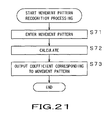
- the processing of utilizing the processing apparatus 41 such as inputting the needed parameters to the respective local modules 43-1 to 43-3 to cause the corresponding patterns to be output, or inputting preset movement patterns to the respective local modules 43-1 to 43-3 to cause the corresponding coefficients to be output, are executed.
- step S3 The utilization processing of the step S3 will be explained in detail subsequently by referring to Figs.21 and 23.
- steps S 1 to S3 are carried out in this order. However, these steps are not necessarily carried out in succession, such that preset time intervals may be provided between the steps S 1 and S2 or between the steps S2 and S3.
- the local modules 43-1 to 43-3 are formed by recurrent neural networks (RNN) 61-1 to 61-3, each having the function of learning the movement pattern, as shown in Fig.5.
- RNN recurrent neural networks
- Fig.6 shows an illustrative structure of the RNN 61.
- This RNN 61 is made up by an input layer 111, an intermediate layer (hidden layer) 112 and an output layer 113.
- the input layer 111, intermediate layer 112 and the output layer 113 are each made up by an optional number of neurons.
- a neuron 111-1 as a part of the input layer 111, is supplied with data xt pertinent to a time-series pattern. Specifically, data pertinent to the a movement pattern of the human body, obtained on picture processing, based on e.g. a camera image (for example, a movement trajectory of a hand's tip), is supplied.
- a camera image for example, a movement trajectory of a hand's tip
- a parametric bias node 111-2 as a neuron of a part of the input layer 111, is supplied with a parameter Pt.
- the number of the parametric bias nodes is one or more.
- the number of the nodes is preferably sufficiently small as compared to the total number of the neurons making up the recurrent neural network, which number determine the number of weight matrices, as parameters of model determining means.
- the total number of the neurons is 50, whilst the number of the parametric bias nodes is on the order of 1 or 2. It is noted that these numbers are merely illustrative and are not limiting the invention.
- the parametric bias nodes modulate the mechanical structure in the non-linear mechanical system and, in the present embodiment, modulate the mechanical structure held by the recurrent neural network.
- the present invention is not limited to the recurrent neural network.
- a neuron 111-3 forming a part of the input layer 111, data output from a neuron 113-2 of the output layer 113, is fed back as a context Ct representing the inner state of the RNU 61.
- the context Ct is a routine term pertinent to the recurrent neural network and is elucidated in, for example, the Reference material (Elman, J.L. (1990). Finding Structure in Time, Cognitive Science, 14. 170-211).
- the neurons of the intermediate layer 112 perform weighted summation of input data to output resultant data sequentially to a downstream side stage. That is, the neurons of the intermediate layer process the data xt, Pt and Ct with calculation processing for preset weighting coefficients (calculation processing based on non-linear functions) to output the result to the output layer 113.
- an input corresponding to the preset weighted sum of the data xt, Pt and Ct is processed with calculations which are based on a function having non-linear output characteristics, such as sigmoid function, to output the result to the to the output layer 113.
- a neuron 113-1 forming a part of the output layer 113, outputs data x*t+1 associated with input data.
- the RNN 61 includes a calculation unit 121 for learning by back propagation.
- a calculation unit 122 sets weighting coefficients for the RNN 61.
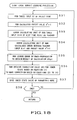
- a step S11 the processing for saving learning parameters (weighting coefficients of the respective neurons) of the local modules 61-1 to 61-3 in the calculation unit 122 is carried out.
- the processing of taking the movement patterns of the subject of learning in each of the local modules 61-1 to 61-3 is carried out.
- the learning processing of the local modules is carried out.
- the learning processing of the local modules will be explained in detail later by referring to the flowchart of Fig. 18. By the processing of this step S 13, a movement pattern is learned by one of the local modules 61-1 to 61-3, for example, the local module 61-1.
- the calculation unit 122 acquires the learning errors of the local modules 61-1 to 61-3 to compare the error values to one another. In this manner, the calculation unit 122 decides on the local module having the smallest value of the learning error.
- the calculation unit 122 performs the processing of returning the learning parameter (weighting coefficient), saved in the processing of the step S11, to the local module other than the local module with the smallest learning error. For example, if the local module with the smallest learning error is the local module 61-1, the learning parameters of the local modules 61-2 and 61-3 are restored to the pre-learning states.
- the calculation unit 122 determines whether or not the learning of the totality of the movement patterns has come to a close. If the totality of the movement patterns has not come to a close, the calculation unit 122 returns to the step S 11 to execute the processing as from this step repeatedly.
- step S16 If it is determined in the step S16 that the learning of the totality of the movement patterns has come to a close, the learning processing comes to a close.
- the sum total of 9 sorts of the movement patterns, shown in Figs.8 to 16 is learned one by one by the local modules 43-1 to 43-3.
- the movement patterns shown in Figs.8 to 10 the movement patterns shown in Figs.11 to 13 and the movement patterns shown in Figs.14 to 16, are learned by the local modules 43-1, 43-2 and 43-3, respectively, as shown in Fig. 17.
- the coefficients W 1 to W3 of preset values are set from a device, not shown.
- the processing shown in the flowchart of Fig. 18 is carried out from one movement pattern to be leaned to the next.
- a number of imaginary RNNs corresponding to the number of the movement patterns to be learned are provided and the processing of Fig. 18 is carried out from one imaginary RNN to the next.
- the neuron 111-1 of the input layer 111 of the RNN 61 takes in an input xt at a preset time t.
- the intermediate layer 112 of the RNN 61 performs calculation processing for weighting coefficients for the input xt, and outputs, from the neuron 113-1 of the output layer 113, a predicted value x*t+1 of the value t+1 of the time series in the input time-series pattern.
- a step S33 the calculation unit 121 takes an input xt+1 of the next time point t+1 as teacher data.
- the calculation unit 121 calculates, in a step S34, an error between the teacher input xt+1, taken by the processing of a step S33, and the predicted value x*t+1, obtained on calculations in the processing of the step S32.
- a step S35 the RNN 61 is supplied from the neuron 113-1 of the output layer 113 with an error obtained on calculations by the processing of the step S34, and back-propagates the input error to the intermediate layer 112 and thence to the input layer 111 to carry out the learning processing to obtain the calculated result dXpt.
- a step S36 the intermediate layer 112 acquires a correction value dXU of the inner state based on the following equation (1):
- a parametric node 111-2 executes the processing of saving the value of the inner state thereof.
- the RNN 61 checks to see whether or not the learning processing is to come to a close. If the learning processing has not come to a close, the parametric node returns to the step S31 to carry out the processing as from this step repeatedly.
- step S38 If it is determined in the step S38 that the learning processing is to come to a close, the learning processing is terminated.
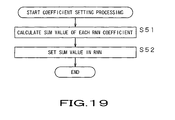
- Fig. 19 shows the processing in this case.
- the calculation unit 122 in a step S51 calculates a synthesized value of the coefficients, obtained by executing the processing shown in the flowchart of Fig. 18 for each imaginary RNN.
- this synthesized value an average value, for example, may be used. That is, an average value of the weighting coefficients of the imaginary RNNs is here calculated.
- the calculation unit 122 executes the processing of setting the synthesized value (average value), calculated by the processing of the step S51, as a weighting coefficient for the neuron of the practical RNN 61.
- the information pertinent to the co-ownable mechanical structure in generating plural teacher movement patterns is held in the weighting coefficients of the respective neurons of the intermediate layer 112, whilst the information needed for switching the co-ownable mechanical structure to the mechanical structure suitable for generating the respective teacher movement patterns is held in the parametric bias node.
- Fig.20 shows the intermediate state in which the movement patterns are being learned by the local modules 43-1 to 43-3.
- the movement patterns, shown in Figs.9 and 10 have already been learned in the local module 43-1
- the movement patterns, shown in Figs. 12 and 13 have already been learned in the local module 43-2
- the movement patterns, shown in Figs.14 and 15 have already been learned in the local module 43-3.
- Fig.20 shows the state in which the movement pattern shown in Fig.11 has further been learned.
- the learning error of the local module 43-1 is 0.9, the learning error of the local module 43-2 is 0.1 and the learning error of the local module 43-3 is 0.4. Thus, it is the local module 43-3 that has the smallest learning error.
- step S 14 of Fig.7 it is determined in the step S 14 of Fig.7 that the learning error of the local module 43-2 is the smallest, so that, in the step S15, the learning parameters, saved in the processing of the step S 11, are returned to the local modules 43-1 and 43-3 in a learning parameter storage buffer 141 which forms the calculation unit 122.
- the movement patterns, shown in Figs.8 to 10, have already been learned in the local module 43-1
- the movement patterns, shown in Figs.11 to 13 have already been learned in the local module 43-2
- the movement patterns, shown in Figs. 14 to 16 have already been learned in the local module 43-3, as shown in Fig.22.
- the respective local modules 43-1 to 43-3 in a step S72 perform calculations on data of the movement pattern entered to the node 111-1.
- the recognition error in the local module 43-1 is 0.9, that in the local module 43-2 is 0.1 and that in the local module 43-3 is 0.4. Since the local module 43-2 has learned and memorized the movement pattern, shown in Fig.11, the recognition error is smaller than that in the other local modules.
- the local modules 43-1 to 43-3 output the results of calculations for the movement patterns to the gates 44-1 to 44-3.
- the output of the integrated module 42 is a sum of these results of calculations multiplied by the coefficients W1 to W3.
- the coefficients W1 to W3 of the gates 44-1 to 44-3 are weighted in inverse proportion to the recognitions errors, that is, so that the smaller the recognition error, the larger is the weighting applied to the local module output.
- the parameters of the local modules 43-1 to 43-3 are P1, P2 and P3, respectively.
- the parameter of the local module 43-2 substantially corresponds to the movement pattern shown in Fig.11.
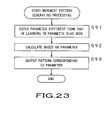
- Fig.23 shows an example of the processing for generating the movement pattern as typical of the use processing in the step S3 of Fig.4.
- a step S91 parameters of preset values, different from those at the time of the learning, are entered to the parametric bias nodes 111-2 of the local modules 43-1 to 43-3.
- the intermediate layer 112 performs calculations based on the parameters entered to the parametric bias nodes 111-2 in the processing of the step S91.
- the neuron 113-1 of the RNN 61 outputs data of a pattern in keeping with the parameters entered in the processing of the step S91.
- the data of the respective patterns are multiplied with the coefficients W1 to W3, by the gates 44-1 to 44-3, respectively, summed together and sent out as output.
- Fig.24 shows a case where the movement pattern is generated in the manner described above.
- parameters P11 to P 13 of the values which are in keeping with the movement patterns not learned so far are entered to the local modules 43-1 to 43-3.
- the coefficients W1 to W3 of the gates 44-1 to 44-3 are set to the values which are in keeping with the recognition errors calculated in the respective local modules 43-1 to 43-3. The result is that the movement pattern analogous with the movement pattern learned so far and which has not been learned is generated as a movement pattern.
- the movement patterns may also be classified on the basis of the correlation with pre-learned learning patterns.
- the number of the local modules 43 is assumed to be three. This number may be increased, if desired, thereby extending the scale. Moreover, since the local modules are constructed by the RNN as the movement patter learning model by the distributed expression scheme, plural movement patterns may be learned efficiently.
- the processing of steps S111 to S 113 is similar to the processing of the steps S11 to S 13 of Fig.7. That is, by this processing, the learning parameters of the local modules 43-1 to 43-3 are saved and the movement patterns of the subject of learning are taken in by the local modules 43-1 to 43-3. The learning processing is carried out in these local modules 43-1 to 43-3.
- This learning error ei is calculated by the following equation: where d(t) denotes the movement pattern to be learned and o(t) is a output pattern obtained on learning.
- the respective local modules 43-1 to 43-3 calculate the weighting coefficients gi of respective learning parameter correction value ⁇ wi based on the respective learning errors ei.
- the weighting coefficients gi may be expressed by the following equation:
- the local modules 43-1 to 43-3 execute the processing of restoring the pre-learning learning parameters, saved in the processing of the step S111, to the original state.
- the result of correction to ⁇ w'i of the correction value ⁇ wi, obtained by the learning processing in the step S 113 is that, the smaller the learning error, the more is the learning performed, and the larger the learning error, the less is the learning performed.
- the learning processing, carried out in the step S 113 is aimed to obtain a learning error, and the substantial learning is carried out in the step S 117.
- next step S 118 it is checked whether or not the learning of the totality of the movement patterns has come to a close. If there is any unlearned movement pattern left, processing reverts to the step S111, and the processing as from this step is executed repeatedly. If it is determined in a step S 118 that the learning of the totality of the learning patterns has come to a close, the learning processing is terminated.
- the learning efficiency is improved by the learning processing of the winner-take-all system shown in Fig.7.
- the learning processing may be improved with the learning processing explained with reference to Fig.25.
- the present invention has been explained in connection with movement patterns.
- the present invention may, however, be applied to a time-series pattern in general. If a pattern prescribing the robot motion is used as a movement pattern (time-series pattern), the present invention may be applied for controlling an autonomous robot.
- a personal computer 160 shown for example in Fig.26, may be used.
- a CPU (central processing unit) 161 executes various processing operations in accordance with a program stored in a ROM (read-only memory) 162 or a program loaded from a storage unit 168 to a RAM (random-access memory) 163.
- ROM read-only memory
- RAM random-access memory
- the CPU 161, ROM 162 and the RAM 163 are interconnected over a bus 164. To this bus 164 is also connected an input/output interface 165.
- an inputting unit 166 such as a keyboard or a mouse, a display, such as CRT or LCD, an outputting unit 167, such as a loudspeaker, a storage unit 168, such as a hard disc, and a communication unit 169, such as a terminal adapter, are connected.
- the communication unit 169 executes communication processing over a network.
- a drive 170 is connected as necessary.
- a magnetic disc 171, an optical disc 172, a magneto-optical disc 173 or a semiconductor memory 174 is loaded in position and a computer program read out therefrom is installed as necessary on the storage unit 168.
- the program forming the software is installed to the personal computer from the network or from the recording medium.
- the recording medium may be formed by package mediums, distributed for providing a program to a user, apart from the main body unit of the apparatus, such as a magnetic disc 171 (inclusive of a floppy disc), an optical disc 172 (inclusive of a CD-ROM (Compact Disc read-Only Memory) or a DVD (Digital Versatile Disc)), or a magneto-optical disc (inclusive of MD (Mini-Disc)) or a semiconductor memory 174. These discs or memory include a program recorded thereon.
- the recording medium may be formed by a ROM 162, provided to the user as it is pre-mounted in the main body unit of the apparatus, and having the program recorded thereon, or a hard disc included in the storage unit 168.
- the steps stating the program recorded on a recording medium include not only the operations carried out chronologically in accordance with the order specified herein but also the processing operations carried out batch-wise or in parallel.
Landscapes
- Engineering & Computer Science (AREA)
- Theoretical Computer Science (AREA)
- Data Mining & Analysis (AREA)
- Computer Vision & Pattern Recognition (AREA)
- General Physics & Mathematics (AREA)
- Physics & Mathematics (AREA)
- General Engineering & Computer Science (AREA)
- Evolutionary Biology (AREA)
- Evolutionary Computation (AREA)
- Bioinformatics & Computational Biology (AREA)
- Bioinformatics & Cheminformatics (AREA)
- Artificial Intelligence (AREA)
- Life Sciences & Earth Sciences (AREA)
- Health & Medical Sciences (AREA)
- General Health & Medical Sciences (AREA)
- Psychiatry (AREA)
- Social Psychology (AREA)
- Human Computer Interaction (AREA)
- Multimedia (AREA)
- Image Analysis (AREA)
Abstract
Description


Claims (12)
- An information processing apparatus for processing a time-series pattern, comprising
a first movement pattern learning model by a distributed expression scheme for learning the time-series pattern;
a second movement pattern learning model by a distributed expression scheme for learning the time-series pattern; and
a third movement pattern learning model by a local expression scheme, having said first movement pattern learning model and the second movement pattern learning model as elements. - The information processing apparatus according to claim 1 wherein said first movement pattern learning model and the second movement pattern learning model are each formed by a recurrent neural network provided with an operating parameter.
- The information processing apparatus according to claim 1 wherein said first movement pattern learning model and the second movement pattern learning model each calculate a learning error, calculate a weighting coefficient of a correction amount of a learning parameter based on said learning error and correct said learning parameter based on said weighting coefficient.
- An information processing method for an information processing apparatus for processing a time-series pattern, said method comprising
a step of learning a plurality of first time-series patterns by a first movement pattern learning model by a distributed expression scheme;
a step of learning a plurality of second time-series patterns by a second movement pattern learning model by a distributed expression scheme; and
a step of recognizing or generating a time-series pattern by a third movement pattern learning model by a local expression scheme, having said first movement pattern learning model and the second movement pattern learning model as elements. - The information processing method according to claim 4 wherein said first movement pattern learning model and the second movement pattern learning model are each formed by a recurrent neural network provided with an operating parameter.
- The information processing method according to claim 4 further comprising
a first calculating step of calculating a learning error of said first movement pattern learning model and a learning error of the second movement pattern learning model;
a second calculating step of calculating weighting coefficients of correction values of the learning parameters of said first movement pattern learning model and said second movement pattern learning model based on said learning errors; and
a correction step of correcting said learning parameters of said first movement pattern learning model and said second movement pattern learning model based on said weighting coefficients. - A program storage medium having stored therein a program for an information processing apparatus configured for processing a time-series pattern, said program allowing a computer to execute the processing including
a step of learning a plurality of first time-series patterns by a first movement pattern learning model by a distributed expression scheme;
a step of learning a plurality of second time-series patterns by a second movement pattern learning model by a distributed expression scheme; and
a step of recognizing or generating a time-series pattern by a third movement pattern learning model by a local expression scheme, having said first movement pattern learning model and the second movement pattern learning model as elements. - The program according to claim 7 wherein said first movement pattern learning model and the second movement pattern learning model are each formed by a recurrent neural network provided with an operating parameter.
- The program according to claim 7 further comprising
a first calculating step of calculating a learning error of said first movement pattern learning model and a learning error of the second movement pattern learning model;
a second calculating step of calculating weighting coefficients of correction values of the learning parameters of said first movement pattern learning model and said second movement pattern learning model based on said learning errors; and
a correction step of correcting said learning parameters of said first movement pattern learning model and said second movement pattern learning model based on said weighting coefficients. - A program for a computer controlling an information processing apparatus configured for processing a time-series pattern, said program allowing a computer to execute the processing including
a step of learning a plurality of first time-series patterns by a first movement pattern learning model by a distributed expression scheme;
a step of learning a plurality of second time-series patterns by a second movement pattern learning model by a distributed expression scheme; and
a step of recognizing or generating a time-series pattern by a third movement pattern learning model by a local expression scheme, said third movement pattern learning model having said first movement pattern learning model and the second movement pattern learning model as elements. - The program according to claim 10 wherein said first movement pattern learning model and the second movement pattern learning model are each formed by a recurrent neural network provided with an operating parameter.
- The program according to claim 10 further comprising
a first calculating step of calculating a learning error of said first movement pattern learning model and a learning error of the second movement pattern learning model;
a second calculating step of calculating weighting coefficients of correction values of the learning parameters of said first movement pattern learning model and said second movement pattern learning model based on said learning errors; and
a correction step of correcting said learning parameters of said first movement pattern learning model and said second movement pattern learning model based on said weighting coefficients.
Applications Claiming Priority (2)
| Application Number | Priority Date | Filing Date | Title |
|---|---|---|---|
| JP2003289138A JP4773680B2 (en) | 2003-08-07 | 2003-08-07 | Information processing apparatus and method, program recording medium, and program |
| JP2003289138 | 2003-08-07 |
Publications (2)
| Publication Number | Publication Date |
|---|---|
| EP1505534A2 true EP1505534A2 (en) | 2005-02-09 |
| EP1505534A3 EP1505534A3 (en) | 2008-01-23 |
Family
ID=33550057
Family Applications (1)
| Application Number | Title | Priority Date | Filing Date |
|---|---|---|---|
| EP04018616A Ceased EP1505534A3 (en) | 2003-08-07 | 2004-08-05 | Plural model time series pattern processing |
Country Status (4)
| Country | Link |
|---|---|
| US (1) | US7373333B2 (en) |
| EP (1) | EP1505534A3 (en) |
| JP (1) | JP4773680B2 (en) |
| CN (1) | CN100580654C (en) |
Cited By (1)
| Publication number | Priority date | Publication date | Assignee | Title |
|---|---|---|---|---|
| EP2216145A1 (en) | 2009-02-06 | 2010-08-11 | Honda Research Institute Europe GmbH | Learning and use of schemata in robotic devices |
Families Citing this family (7)
| Publication number | Priority date | Publication date | Assignee | Title |
|---|---|---|---|---|
| JP5387578B2 (en) * | 2008-09-24 | 2014-01-15 | 日本電気株式会社 | Information analysis apparatus, information analysis method, and program |
| US9015093B1 (en) | 2010-10-26 | 2015-04-21 | Michael Lamport Commons | Intelligent control with hierarchical stacked neural networks |
| US8775341B1 (en) | 2010-10-26 | 2014-07-08 | Michael Lamport Commons | Intelligent control with hierarchical stacked neural networks |
| US10387769B2 (en) | 2016-06-30 | 2019-08-20 | Samsung Electronics Co., Ltd. | Hybrid memory cell unit and recurrent neural network including hybrid memory cell units |
| KR102805830B1 (en) | 2016-06-30 | 2025-05-12 | 삼성전자주식회사 | Memory cell unit and recurrent neural network(rnn) including multiple memory cell units |
| US10514799B2 (en) * | 2016-09-08 | 2019-12-24 | Google Llc | Deep machine learning to perform touch motion prediction |
| US11524401B1 (en) * | 2019-03-28 | 2022-12-13 | Apple Inc. | Learning skills from video demonstrations |
Family Cites Families (11)
| Publication number | Priority date | Publication date | Assignee | Title |
|---|---|---|---|---|
| US5699441A (en) | 1992-03-10 | 1997-12-16 | Hitachi, Ltd. | Continuous sign-language recognition apparatus and input apparatus |
| US5649065A (en) * | 1993-05-28 | 1997-07-15 | Maryland Technology Corporation | Optimal filtering by neural networks with range extenders and/or reducers |
| US6601051B1 (en) * | 1993-08-09 | 2003-07-29 | Maryland Technology Corporation | Neural systems with range reducers and/or extenders |
| US5455891A (en) * | 1993-10-04 | 1995-10-03 | Georgia Tech Research Corporation | System and method for a learning neural network for generating random directions for weight changes |
| JPH0973440A (en) * | 1995-09-06 | 1997-03-18 | Fujitsu Ltd | Time series trend estimation system and method by column-structured recursive neural network |
| US5835633A (en) | 1995-11-20 | 1998-11-10 | International Business Machines Corporation | Concurrent two-stage multi-network optical character recognition system |
| JP3922407B2 (en) * | 1997-10-22 | 2007-05-30 | ソニー株式会社 | Data processing apparatus and method |
| CN1148700C (en) * | 1999-12-03 | 2004-05-05 | 中国科学院上海生理研究所 | Training method of basic artificial nerve network and device for automatical training of artificial nerve network |
| JP2002086378A (en) * | 2000-09-08 | 2002-03-26 | Sony Corp | Motion teaching system and motion teaching method for legged robot |
| JP2002236904A (en) * | 2001-02-08 | 2002-08-23 | Sony Corp | Data processing apparatus and method, recording medium, and program |
| JP2002301674A (en) * | 2001-04-03 | 2002-10-15 | Sony Corp | Legged mobile robot, its motion teaching method, and storage medium |
-
2003
- 2003-08-07 JP JP2003289138A patent/JP4773680B2/en not_active Expired - Fee Related
-
2004
- 2004-07-30 US US10/901,988 patent/US7373333B2/en not_active Expired - Fee Related
- 2004-08-05 EP EP04018616A patent/EP1505534A3/en not_active Ceased
- 2004-08-06 CN CN200410056314A patent/CN100580654C/en not_active Expired - Fee Related
Cited By (1)
| Publication number | Priority date | Publication date | Assignee | Title |
|---|---|---|---|---|
| EP2216145A1 (en) | 2009-02-06 | 2010-08-11 | Honda Research Institute Europe GmbH | Learning and use of schemata in robotic devices |
Also Published As
| Publication number | Publication date |
|---|---|
| JP2005056340A (en) | 2005-03-03 |
| JP4773680B2 (en) | 2011-09-14 |
| US7373333B2 (en) | 2008-05-13 |
| CN1581143A (en) | 2005-02-16 |
| US20050086183A1 (en) | 2005-04-21 |
| EP1505534A3 (en) | 2008-01-23 |
| CN100580654C (en) | 2010-01-13 |
Similar Documents
| Publication | Publication Date | Title |
|---|---|---|
| Pavelka et al. | Algorithms for initialization of neural network weights | |
| US9146546B2 (en) | Systems and apparatus for implementing task-specific learning using spiking neurons | |
| US9104186B2 (en) | Stochastic apparatus and methods for implementing generalized learning rules | |
| US7133744B2 (en) | Information processing apparatus and method, program storage medium, and program | |
| US20040093315A1 (en) | Neural network training | |
| US20050114278A1 (en) | System and methods for incrementally augmenting a classifier | |
| US7373333B2 (en) | Information processing apparatus and method, program storage medium and program | |
| TW202328983A (en) | Hybrid neural network-based object tracking learning method and system | |
| JP7553893B2 (en) | Neural network device, processing method and program | |
| Hung et al. | Training neural networks with the GRG2 nonlinear optimizer | |
| JPH05101028A (en) | Integral decision method for plural feature quantity | |
| CN120258194B (en) | A heterogeneous regional flow prediction method | |
| JP7514141B2 (en) | Learning device, information classification device, and program | |
| US7324980B2 (en) | Information processing apparatus and method | |
| Rekabdar et al. | Artificial neural network ensemble approach for creating a negotiation model with ethical artificial agents | |
| JPH10254846A (en) | Learning method of recurrent neural network | |
| Rashid et al. | A new simple recurrent network with real time recurrent learning process | |
| Tang et al. | An algorithm of supervised learning for multilayer neural networks | |
| Lara | Artificial neural networks: An introduction | |
| Venayagamoorthy | Teaching neural networks concepts and their learning techniques | |
| US20250148269A1 (en) | Apparatus and method for searching for neural network architecture | |
| EP0391404B1 (en) | Data processing system | |
| JP7740560B2 (en) | Learning device, program, and learning method | |
| Thacker | Tutorial: Supervised Neural Networks in Machine Vision. | |
| Dillavou et al. | Physical Reinforcement Learning |
Legal Events
| Date | Code | Title | Description |
|---|---|---|---|
| PUAI | Public reference made under article 153(3) epc to a published international application that has entered the european phase |
Free format text: ORIGINAL CODE: 0009012 |
|
| AK | Designated contracting states |
Kind code of ref document: A2 Designated state(s): AT BE BG CH CY CZ DE DK EE ES FI FR GB GR HU IE IT LI LU MC NL PL PT RO SE SI SK TR |
|
| AX | Request for extension of the european patent |
Extension state: AL HR LT LV MK |
|
| PUAL | Search report despatched |
Free format text: ORIGINAL CODE: 0009013 |
|
| AK | Designated contracting states |
Kind code of ref document: A3 Designated state(s): AT BE BG CH CY CZ DE DK EE ES FI FR GB GR HU IE IT LI LU MC NL PL PT RO SE SI SK TR |
|
| AX | Request for extension of the european patent |
Extension state: AL HR LT LV MK |
|
| RIC1 | Information provided on ipc code assigned before grant |
Ipc: G06K 9/66 20060101ALI20071217BHEP Ipc: G06K 9/00 20060101ALI20071217BHEP Ipc: G06K 9/62 20060101AFI20071217BHEP |
|
| 17P | Request for examination filed |
Effective date: 20080624 |
|
| AKX | Designation fees paid |
Designated state(s): DE FR GB |
|
| 17Q | First examination report despatched |
Effective date: 20090304 |
|
| APBK | Appeal reference recorded |
Free format text: ORIGINAL CODE: EPIDOSNREFNE |
|
| APBN | Date of receipt of notice of appeal recorded |
Free format text: ORIGINAL CODE: EPIDOSNNOA2E |
|
| APBR | Date of receipt of statement of grounds of appeal recorded |
Free format text: ORIGINAL CODE: EPIDOSNNOA3E |
|
| APAF | Appeal reference modified |
Free format text: ORIGINAL CODE: EPIDOSCREFNE |
|
| APBT | Appeal procedure closed |
Free format text: ORIGINAL CODE: EPIDOSNNOA9E |
|
| STAA | Information on the status of an ep patent application or granted ep patent |
Free format text: STATUS: THE APPLICATION HAS BEEN REFUSED |
|
| 18R | Application refused |
Effective date: 20120605 |