EP1505114A1 - HNBR compounds having an improved flowability - Google Patents
HNBR compounds having an improved flowability Download PDFInfo
- Publication number
- EP1505114A1 EP1505114A1 EP04017457A EP04017457A EP1505114A1 EP 1505114 A1 EP1505114 A1 EP 1505114A1 EP 04017457 A EP04017457 A EP 04017457A EP 04017457 A EP04017457 A EP 04017457A EP 1505114 A1 EP1505114 A1 EP 1505114A1
- Authority
- EP
- European Patent Office
- Prior art keywords
- composition
- organopolysiloxane
- carbon atoms
- hydrocarbon radical
- less
- Prior art date
- Legal status (The legal status is an assumption and is not a legal conclusion. Google has not performed a legal analysis and makes no representation as to the accuracy of the status listed.)
- Withdrawn
Links
Classifications
-
- C—CHEMISTRY; METALLURGY
- C08—ORGANIC MACROMOLECULAR COMPOUNDS; THEIR PREPARATION OR CHEMICAL WORKING-UP; COMPOSITIONS BASED THEREON
- C08K—Use of inorganic or non-macromolecular organic substances as compounding ingredients
- C08K5/00—Use of organic ingredients
- C08K5/36—Sulfur-, selenium-, or tellurium-containing compounds
- C08K5/45—Heterocyclic compounds having sulfur in the ring
-
- C—CHEMISTRY; METALLURGY
- C08—ORGANIC MACROMOLECULAR COMPOUNDS; THEIR PREPARATION OR CHEMICAL WORKING-UP; COMPOSITIONS BASED THEREON
- C08L—COMPOSITIONS OF MACROMOLECULAR COMPOUNDS
- C08L15/00—Compositions of rubber derivatives
- C08L15/005—Hydrogenated nitrile rubber
-
- C—CHEMISTRY; METALLURGY
- C08—ORGANIC MACROMOLECULAR COMPOUNDS; THEIR PREPARATION OR CHEMICAL WORKING-UP; COMPOSITIONS BASED THEREON
- C08L—COMPOSITIONS OF MACROMOLECULAR COMPOUNDS
- C08L83/00—Compositions of macromolecular compounds obtained by reactions forming in the main chain of the macromolecule a linkage containing silicon with or without sulfur, nitrogen, oxygen or carbon only; Compositions of derivatives of such polymers
- C08L83/04—Polysiloxanes
Definitions
- the present invention relates to a composition having an improved flowability comprising at least one hydrogenated nitrile rubber, a method of improving the flowability of compositions comprising at least one hydrogenated nitrile rubber and a method of improving the fluid aging of compositions comprising at least one hydrogenated nitrile rubber.
- Hydrogenated nitrile rubber prepared by the selective hydrogenation of acrylonitrile-butadiene rubber (nitrile rubber; NBR, a copolymer comprising at least one conjugated diene, at least one unsaturated nitrile and optionally further comonomers), is a specialty rubber which has very good heat resistance, excellent ozone and chemical resistance, and excellent oil resistance.
- NBR and HNBR have found widespread use in the automotive (seals, hoses, bearing pads) oil (stators, well head seals, valve plates), electrical (cable sheathing), mechanical engineering (wheels, rollers) and shipbuilding (pipe seals, couplings) industries, amongst others.
- HNBR has a Mooney viscosity in the range of from 55 to 105, a molecular weight in the range of from 200,000 to 500,000 g/mol, a polydispersity greater than 3.0 and a residual double bond (RDB) content in the range of from 1 to 18% (by IR spectroscopy).
- HNBR high Mooney viscosity
- HNBR having a lower molecular weight and lower Mooney viscosity would have better processability.
- Attempts have been made to reduce the molecular weight of the polymer by mastication (mechanical breakdown) and by chemical means (for example, using strong acid), but such methods have the disadvantages that they result in the introduction of functional groups (such as carboxylic acid and ester groups) into the polymer, and the altering of the microstructure of the polymer. This results in disadvantageous changes in the properties of the polymer.
- GB-A-2,019,413 discloses rubber compositions comprising organosiloxanes with hydrocarbon radical having more than 4 carbon atoms.
- hydrogenated nitrile rubbers and organosiloxanes with at least one hydrocarbon radical having less than 4 carbon atoms are not disclosed and the teachings of the reference are limited to improvements of heat stability.
- US-3,332,900 discloses adducts of siloxanes and isocyanates. However, hydrogenated nitrile rubbers are not disclosed.
- EP-A-0 045 641 discloses vinyl resin compositions comprising organosiloxanes. However, there is no mention of hydrogenated nitrile rubbers.
- US-3,450,736 discloses modifies siloxane polymers and compositions containing same. However, hydrogenated nitrile rubbers are not disclosed.
- EP-A-0 243 514 discloses a process for production of rubber compositions comprising organosiloxanes as processing aid. However, hydrogenated nitrile rubbers are not disclosed.
- the present invention provides a composition having an improved flowability comprising at least one hydrogenated nitrile rubber and at least one organopolysiloxane with at least one hydrocarbon radical having less than four carbon atoms.
- the invention also provides a method of improving the flowability of compositions comprising at least one hydrogenated nitrile rubber by adding at least one organopolysiloxane with at least one hydrocarbon radical having less than four carbon atoms to said composition.
- the invention provides a method of improving the fluid aging of compositions comprising at least one hydrogenated nitrile rubber by adding at least one organopolysiloxane with at least one hydrocarbon radical having less than four carbon atoms to said composition.
- nitrile rubber or NBR is intended to have a broad meaning and is meant to encompass a copolymer comprising repeating units derived from at least one conjugated diene, at least one alpha,beta-unsaturated nitrile and optionally further one or more copolymerizable monomers.
- Hydrogenated nitrile rubber (HNBR) in this invention is understood by more than 50 % of the residual double bonds (RDB) present in the nitrile rubber/NBR being hydrogenated, preferably more than 90 % of the RDB are hydrogenated, more preferably more than 95 % of the RDB are hydrogenated and most preferably more than 99 % of the RDB are hydrogenated.
- RDB residual double bonds
- the conjugated diene may be any known conjugated diene in particular a C 4 -C 6 conjugated diene.
- Preferred conjugated dienes are butadiene, isoprene, piperylene, 2,3-dimethyl butadiene and mixtures thereof. Even more preferred C 4 -C 6 conjugated dienes are butadiene, isoprene and mixtures thereof. The most preferred C 4 -C 6 conjugated diene is butadiene.
- the alpha,beta-unsaturated nitrile may be any known alpha,beta-unsaturated nitrile, in particular a C 3 -C 5 alpha,beta-unsaturated nitrile.
- Preferred C 3 -C 5 alpha,beta-unsaturated nitriles are acrylonitrile, methacrylonitrile, ethacrylonitrile and mixtures thereof.
- the most preferred C 3 -C 5 alpha,beta-unsaturated nitrile is acrylonitrile.
- the copolymer comprises in the range of from 40 to 85 weight percent of repeating units derived from one or more conjugated dienes and in the range of from 15 to 60 weight percent of repeating units derived from one or more unsaturated nitriles. More preferably, the copolymer comprises in the range of from 60 to 75 weight percent of repeating units derived from one or more conjugated dienes and in the range of from 25 to 40 weight percent of repeating units derived from one or more unsaturated nitriles. Most preferably, the copolymer comprises in the range of from 60 to 70 weight percent of repeating units derived from one or more conjugated dienes and in the range of from 30 to 40 weight percent of repeating units derived from one or more unsaturated nitriles.
- the copolymer may further comprise repeating units derived from one or more copolymerizable monomers, such as unsaturated carboxylic acids.
- suitable unsaturated carboxylic acids are fumaric acid, maleic acid, acrylic acid, methacrylic acid and mixtures thereof.
- Repeating units derived from one or more copolymerizable monomers will replace either the nitrile or the diene portion of the nitrile rubber and it will be apparent to the skilled in the art that the above mentioned figures will have to be adjusted to result in 100 weight percent.
- the nitrile rubber preferably comprises repeating units derived from one or more unsaturated carboxylic acids in the range of from 1 to 10 weight percent of the rubber, with this amount displacing a corresponding amount of the conjugated diolefin.
- Other preferred optionally further monomers are unsaturated mono- or di-carboxylic acids or derivatives thereof (e.g., esters, amides and the like) including mixtures thereof.
- HNBR examples include Therban® A3407, Therban® C3467 or Therban® A3907 all available from Bayer Inc., Canada.
- the HNBR may be used alone or in combination with other elastomers such as:
- the organopolysiloxane may be any known organopolysiloxane with at least one hydrocarbon radical having less than four carbon atoms, preferably all hydrocarbon radicals have less than four carbon atoms.
- Preferred organopolysiloxanes will have the general structure (I) R 2 R'SiO-(RR'SiO) m -(R" 2 SiO) n -SiR'R 2 wherein R and R' and R" may be the same or different and are independently a substituted or unsubstituted monovalent hydrocarbon radical with in the range of from 1 to 3 carbon atoms, and m/n is equal or less than 1, in particular equal or less than 0.1, even more particular equal or less than 0.01.
- the organopolysiloxane will have a cyclic or straight-chain structure without cross-linking between the chains.
- R and R' and R" are selected from the group consisting of methyl, ethyl, propyl, vinyl.
- the organopolysiloxane is polydimethylsiloxane (PDMS) with the general structure (I) in which R and R" are methyl and R' is an organic substituent with less than 4 carbon atoms, such as methyl, ethyl, n-propyl, isopropyl, vinyl.
- PDMS polydimethylsiloxane
- the viscosity of the organopolysiloxane is not critical, preferably, the viscosity is in the range of from 500 to 250000 mPa.s.
- Suitable organopolysiloxanes include PS 447TM, a vinyl dimethyl terminated polydimethylsiloxane from United Technology. PS 047TM, a trimethyl terminated polydimethylsiloxane from United Technology, SiloprenTM U1 and U165, vinyl dimethyl terminated polydimethylsiloxanes from GE-Bayer Silicones.
- composition of the inventive composition may vary in wide ranges.
- the composition comprises in the range of from 1 to 20 phr of the organopolysiloxane, more preferably 1 to 10 phr, most preferably 3 to 7 phr.
- composition further may comprise one or more fillers.
- the filler may be non-mineral or mineral fillers.
- mineral fillers include silica, silicates, clay (such as bentonite), gypsum, alumina, titanium dioxide, talc and the like, as well as mixtures thereof.
- Suitable silica fillers are available under the trademarks HiSil® 210, HiSil® 233 and HiSil® 243 from PPG Industries Inc. Also suitable are Vulkasil® S and Vulkasil® N, from Bayer AG.
- Non-mineral fillers may be carbon blacks such as carbon blacks prepared by the lamp black, furnace black or gas black process, e.g. SAF, ISAF, HAF, FEF or GPF carbon blacks.
- the present rubber composition further comprises a carbodiimide, a polycarbodiimide or mixtures thereof.
- the preferred carbodiimide is available commercially under the tradenames RhenogramTM P50 and StabaxolTM P.
- This ingredient may be used in the present rubber composition in an amount in the range of from 0 to about 15 parts by weight, more preferably in the range of from 0 to about 10 parts by weight, even more preferably in the range of from about 0 to about 2 parts by weight.
- the inventive rubber composition further comprises an acrylic compound.
- TAM trimethylolpropanetrimethacrylate
- BDMA butanedioldimethacrylate
- EDMA ethylenglycoldimethacrylate
- acrylates known from EP-A1-0 319 320 in particular p. 3, I. 16 to 35, from US-5 208 294, in particular Col. 2, I. 25 to 40, and from US-4 983 678, in particular Col. 2, I. 45 to 62.
- Preferred are zinc acrylate, zinc diacrylate or zinc dimethacrylate or a liquid acrylate. It might be advantageous to use a combination of different acrylates and/or metal salts thereof.
- the inventive rubber composition may comprise one or more vulcanization agents or curing systems.
- the invention is not limited to a special curing system, however, peroxide curing system(s) are preferred. Furthermore, the invention is not limited to a special peroxide curing system. For example, inorganic or organic peroxides are suitable.
- organic peroxides such as dialkylperoxides, ketalperoxides, aralkylperoxides, peroxide ethers, peroxide esters, such as di-tert.-butylperoxide, bis-(tert.-butylperoxyisopropyl)-benzene, dicumylperoxide, 2,5-dimethyl-2,5-di(tert.-butylperoxy)-hexane, 2,5-dimethyl-2,5-di(tert.-butylperoxy)-hexene-(3), 1,1-bis-(tert.-butylperoxy)-3,3,5-trimethyl-cyclohexane, benzoylperoxide, tert.-butylcumylperoxide and tert.-butylperbenzoate.
- dialkylperoxides such as dialkylperoxides, ketalperoxides, aralkylperoxide
- the rubber composition according to the invention can contain further auxiliary products for rubbers, such as reaction accelerators, vulcanizing accelerators, vulcanizing acceleration auxiliaries, antioxidants, foaming agents, anti-aging agents, heat stabilizers, light stabilizers, ozone stabilizers, processing aids, plasticizers, tackifiers, blowing agents, dyestuffs, pigments, waxes, extenders, organic acids, inhibitors, metal oxides, and activators such as triethanolamine, polyethylene glycol, hexanetriol, etc., which are known to the rubber industry.
- the rubber aids are used in conventional amounts, which depend inter alia on the intended use. Conventional amounts are e.g. from 0.1 to 50 phr.
- the vulcanizable compound comprising said rubber compound further comprises in the range of 0.1 to 20 phr of one or more organic fatty acids as an auxiliary product, preferably an unsaturated fatty acid having one, two or more carbon double bonds in the molecule which more preferably includes 10% by weight or more of a conjugated diene acid having at least one conjugated carbon-carbon double bond in its molecule.
- those fatty acids have in the range of from 8-22 carbon atoms, more preferably 12-18. Examples include stearic acid, palmitic acid and oleic acid and their calcium-, zinc-, magnesium-, potassium- and ammonium salts.
- the ingredients of the rubber composition are often mixed together, suitably at an elevated temperature that may range from 25 °C to 200 °C. Normally the mixing time does not exceed one hour and a time in the range from 2 to 30 minutes is usually adequate.
- the mixing of the rubber and the organopolysiloxane, optionally the filler(s), optionally vulcanization agent, and/or further ingredients is suitably carried out in an internal mixer such as a Banbury mixer, or a Haake or Brabender internal mixer.
- a two roll mill mixer also provides a good dispersion of the compounds within the final product.
- An extruder also provides good mixing, and permits shorter mixing times.
- the rubber composition is ideally suited to be processed by but not limited to molding injection technology.
- the rubber composition can also be useful to transfer molding, to compression molding, to liquid injection molding.
- the rubber composition comprising a cross-linking system is usually introduced in a conventional injection molding and injected into hot (about 160-230°C) forms where the cross-linking/vulcanization takes place depending on the rubber composition and temperature of the mold.
- the rubber composition is very well suited for the manufacture of a shaped article, such as a seal, hose, bearing pad, stator, well head seal, valve plate, cable sheathing, wheel roller, pipe seal, in place gaskets or footwear component. Furthermore, they are very well suited for wire and cable production.
- the rubber composition provides improved flowability, which provides better molding characteristics in processes such as injection molding, extrusion molding, compression molding.
- the improved processability results in increases flow rates, and parts with sharper edges and smoother surfaces.
- fluid aging behavior is improved over extractable plasticizer.
- the Mooney viscosity was measured according to ASTM D1646.
- the MDR was measured according to D5289.
- the stress-strain and fluid aging were measured according to D412 and D471 respectively.
- the capillary rheometry was measured using the Monsanto Processability Tester (MPT). The procedure is technically equivalent to the ASTM D-5099-93, Method A with the exceptions of the capillary dies specifications (barrel inside diameter: 19mm, barrel length: 25.4mm).
- PS 447TM a vinyl dimethyl terminated polydimethylsiloxane from United Technology
- PS 047TM a trimethyl terminated polydimethylsiloxane from United Technology
- SiloprenTM U5, , U65 and U165 vinyl dimethyl terminated polydimethylsiloxanes from GE-Bayer Silicones
- Struktol® WB-222 is a processing additive available from the Struktol Company
- compositions 3-7 show similar flow properties as measured by capillary rheometry.
- the barrel pressure for the comparative examples is approximately 1.8 times higher then for the inventive compositions.
- the fluid aging results after 168 hours at 150°C in both ASTM Oil #1 and IRM 903 indicate that with soluble low molecular weight plasticizer like Plasthall TOTM, the extraction of TOTM from the polymer matrix in oil #1 results in a ⁇ 2% weight loss (5 phr of TOTM calculates to 2.8%). In comparison, the control compound where no plasticizer was added to the formulation show a small positive weight change.
- the polysiloxane additives show a weight increase of approximately 1% indicating that they are not extracted from the polymer matrix.
- Example 1 * 2* 3 4 5 6 7 Compound Mooney Viscosity ML 1+4 @ 100oC 82.7 76.6 87.4 89.4 86.0 87.8 88.9 MDR Cure Characteristics 1.7 Hz, 1 oarc, 180oC, 30 min, 100 dNm MH (dN.m) 50.9 49.0 54.3 54.8 54.3 54.2 53.5 ML (dN.m) 2.4 2.5 2.8 3.0 2.8 2.9 2.8 Delta MH-ML (dN.m) 48.5 46.5 51.5 51.9 51.5 51.3 50.7 Stress Strain (Dumbells) Cure Time @ 180oC (min) 13 12 12 12 12 12 12 12 12 12 12 12 Ultimate Tensile (MPa) 24.7 26.0 23.6 24.1 25.2 25.2 23.2 Ultimate Elongation (%) 254 283 230 233 223 225 219 Hard
Landscapes
- Chemical & Material Sciences (AREA)
- Health & Medical Sciences (AREA)
- Chemical Kinetics & Catalysis (AREA)
- Medicinal Chemistry (AREA)
- Polymers & Plastics (AREA)
- Organic Chemistry (AREA)
- Compositions Of Macromolecular Compounds (AREA)
Abstract
Description
- The present invention relates to a composition having an improved flowability comprising at least one hydrogenated nitrile rubber, a method of improving the flowability of compositions comprising at least one hydrogenated nitrile rubber and a method of improving the fluid aging of compositions comprising at least one hydrogenated nitrile rubber.
- Hydrogenated nitrile rubber (HNBR), prepared by the selective hydrogenation of acrylonitrile-butadiene rubber (nitrile rubber; NBR, a copolymer comprising at least one conjugated diene, at least one unsaturated nitrile and optionally further comonomers), is a specialty rubber which has very good heat resistance, excellent ozone and chemical resistance, and excellent oil resistance. Coupled with the high level of mechanical properties of the rubber (in particular the high resistance to abrasion) it is not surprising that NBR and HNBR have found widespread use in the automotive (seals, hoses, bearing pads) oil (stators, well head seals, valve plates), electrical (cable sheathing), mechanical engineering (wheels, rollers) and shipbuilding (pipe seals, couplings) industries, amongst others.
- Commercially available HNBR has a Mooney viscosity in the range of from 55 to 105, a molecular weight in the range of from 200,000 to 500,000 g/mol, a polydispersity greater than 3.0 and a residual double bond (RDB) content in the range of from 1 to 18% (by IR spectroscopy).
- One limitation in processing HNBR is the relatively high Mooney viscosity. In principle, HNBR having a lower molecular weight and lower Mooney viscosity would have better processability. Attempts have been made to reduce the molecular weight of the polymer by mastication (mechanical breakdown) and by chemical means (for example, using strong acid), but such methods have the disadvantages that they result in the introduction of functional groups (such as carboxylic acid and ester groups) into the polymer, and the altering of the microstructure of the polymer. This results in disadvantageous changes in the properties of the polymer.
- GB-A-2,019,413 discloses rubber compositions comprising organosiloxanes with hydrocarbon radical having more than 4 carbon atoms. However, hydrogenated nitrile rubbers and organosiloxanes with at least one hydrocarbon radical having less than 4 carbon atoms are not disclosed and the teachings of the reference are limited to improvements of heat stability.
- US-3,332,900 discloses adducts of siloxanes and isocyanates. However, hydrogenated nitrile rubbers are not disclosed.
- EP-A-0 045 641 discloses vinyl resin compositions comprising organosiloxanes. However, there is no mention of hydrogenated nitrile rubbers.
- US-3,450,736 discloses modifies siloxane polymers and compositions containing same. However, hydrogenated nitrile rubbers are not disclosed.
- EP-A-0 243 514 discloses a process for production of rubber compositions comprising organosiloxanes as processing aid. However, hydrogenated nitrile rubbers are not disclosed.
- The present invention provides a composition having an improved flowability comprising at least one hydrogenated nitrile rubber and at least one organopolysiloxane with at least one hydrocarbon radical having less than four carbon atoms. The invention also provides a method of improving the flowability of compositions comprising at least one hydrogenated nitrile rubber by adding at least one organopolysiloxane with at least one hydrocarbon radical having less than four carbon atoms to said composition. In still a further aspect, the invention provides a method of improving the fluid aging of compositions comprising at least one hydrogenated nitrile rubber by adding at least one organopolysiloxane with at least one hydrocarbon radical having less than four carbon atoms to said composition.
- As used throughout this specification, the term "nitrile rubber" or NBR is intended to have a broad meaning and is meant to encompass a copolymer comprising repeating units derived from at least one conjugated diene, at least one alpha,beta-unsaturated nitrile and optionally further one or more copolymerizable monomers.
- Hydrogenated nitrile rubber (HNBR) in this invention is understood by more than 50 % of the residual double bonds (RDB) present in the nitrile rubber/NBR being hydrogenated, preferably more than 90 % of the RDB are hydrogenated, more preferably more than 95 % of the RDB are hydrogenated and most preferably more than 99 % of the RDB are hydrogenated.
- The conjugated diene may be any known conjugated diene in particular a C4-C6 conjugated diene. Preferred conjugated dienes are butadiene, isoprene, piperylene, 2,3-dimethyl butadiene and mixtures thereof. Even more preferred C4-C6 conjugated dienes are butadiene, isoprene and mixtures thereof. The most preferred C4-C6 conjugated diene is butadiene.
- The alpha,beta-unsaturated nitrile may be any known alpha,beta-unsaturated nitrile, in particular a C3-C5 alpha,beta-unsaturated nitrile. Preferred C3-C5 alpha,beta-unsaturated nitriles are acrylonitrile, methacrylonitrile, ethacrylonitrile and mixtures thereof. The most preferred C3-C5 alpha,beta-unsaturated nitrile is acrylonitrile.
- Preferably, the copolymer comprises in the range of from 40 to 85 weight percent of repeating units derived from one or more conjugated dienes and in the range of from 15 to 60 weight percent of repeating units derived from one or more unsaturated nitriles. More preferably, the copolymer comprises in the range of from 60 to 75 weight percent of repeating units derived from one or more conjugated dienes and in the range of from 25 to 40 weight percent of repeating units derived from one or more unsaturated nitriles. Most preferably, the copolymer comprises in the range of from 60 to 70 weight percent of repeating units derived from one or more conjugated dienes and in the range of from 30 to 40 weight percent of repeating units derived from one or more unsaturated nitriles.
- Optionally, the copolymer may further comprise repeating units derived from one or more copolymerizable monomers, such as unsaturated carboxylic acids. Non-limiting examples of suitable unsaturated carboxylic acids are fumaric acid, maleic acid, acrylic acid, methacrylic acid and mixtures thereof. Repeating units derived from one or more copolymerizable monomers will replace either the nitrile or the diene portion of the nitrile rubber and it will be apparent to the skilled in the art that the above mentioned figures will have to be adjusted to result in 100 weight percent. In case of the mentioned unsaturated carboxylic acids, the nitrile rubber preferably comprises repeating units derived from one or more unsaturated carboxylic acids in the range of from 1 to 10 weight percent of the rubber, with this amount displacing a corresponding amount of the conjugated diolefin.
- Other preferred optionally further monomers are unsaturated mono- or di-carboxylic acids or derivatives thereof (e.g., esters, amides and the like) including mixtures thereof.
- Examples of suitable HNBR include Therban® A3407, Therban® C3467 or Therban® A3907 all available from Bayer Inc., Canada.
- The HNBR may be used alone or in combination with other elastomers such as:
- BR - polybutadiene
- ABR - butadiene/C1-C4 alkyl acrylate copolymers
- CR - polychloroprene
- IR - polyisoprene
- SBR - styrene/butadiene copolymers with styrene contents of 1 to 60, preferably 20 to 50 wt.%
- IIR - isobutylene/isoprene copolymers
- NBR - butadiene/acrylonitrile copolymers with acrylonitrile contents of 5 to 60, preferably 10 to 40 wt.%
- EPDM - ethylene/propylene/diene copolymers
-
- The organopolysiloxane may be any known organopolysiloxane with at least one hydrocarbon radical having less than four carbon atoms, preferably all hydrocarbon radicals have less than four carbon atoms. Preferred organopolysiloxanes will have the general structure (I)
- Suitable organopolysiloxanes include PS 447™, a vinyl dimethyl terminated polydimethylsiloxane from United Technology. PS 047™, a trimethyl terminated polydimethylsiloxane from United Technology, Silopren™ U1 and U165, vinyl dimethyl terminated polydimethylsiloxanes from GE-Bayer Silicones.
- Composition of the inventive composition may vary in wide ranges. Preferably, the composition comprises in the range of from 1 to 20 phr of the organopolysiloxane, more preferably 1 to 10 phr, most preferably 3 to 7 phr.
- The composition further may comprise one or more fillers.
- The filler may be non-mineral or mineral fillers. Examples of mineral fillers include silica, silicates, clay (such as bentonite), gypsum, alumina, titanium dioxide, talc and the like, as well as mixtures thereof.
- Further examples are:
- highly disperse silicas, prepared e.g. by the precipitation of silicate solutions or the flame hydrolysis of silicon halides, with specific surface areas of 5 to 1000, preferably 20 to 400 m2/g (BET specific surface area), and with primary particle sizes of 10 to 400 nm; the silicas can optionally also be present as mixed oxides with other metal oxides such as those of Al, Mg, Ca, Ba, Zn, Zr and Ti;
- synthetic silicates, such as aluminum silicate and alkaline earth metal silicate like
- magnesium silicate or calcium silicate, with BET specific surface areas of 20 to 400 m2/g and primary particle diameters of 10 to 400 nm;
- natural silicates, such as kaolin and other naturally occurring silica;
- glass fibres and glass fibre products (matting, extrudates) or glass microspheres;
- metal oxides, such as zinc oxide, calcium oxide, magnesium oxide and aluminium oxide;
- metal carbonates, such as magnesium carbonate, calcium carbonate and zinc carbonate;
- metal hydroxides, e.g. aluminium hydroxide and magnesium hydroxide;
- Suitable silica fillers are available under the trademarks HiSil® 210, HiSil® 233 and HiSil® 243 from PPG Industries Inc. Also suitable are Vulkasil® S and Vulkasil® N, from Bayer AG.
- Non-mineral fillers may be carbon blacks such as carbon blacks prepared by the lamp black, furnace black or gas black process, e.g. SAF, ISAF, HAF, FEF or GPF carbon blacks.
- Optionally, the present rubber composition further comprises a carbodiimide, a polycarbodiimide or mixtures thereof. The preferred carbodiimide is available commercially under the tradenames Rhenogram™ P50 and Stabaxol™ P. This ingredient may be used in the present rubber composition in an amount in the range of from 0 to about 15 parts by weight, more preferably in the range of from 0 to about 10 parts by weight, even more preferably in the range of from about 0 to about 2 parts by weight.
- Optionally, the inventive rubber composition further comprises an acrylic compound. As used throughout this specification, the term "acrylic compound" is intended to have a broad meaning and is meant to encompass compounds of the general structure [R-CH=CR'COO-]n Mn+ wherein R and R' are aliphatic or aromatic hydrocarbon groups or hydrogen and are independently selected and are the same or different from each other and M is a metal ion selected from group 2, 12 or 13 (IUPAC 1985) and n is an integer of 2 or 3 as well as liquid acrylates, such as trimethylolpropanetrimethacrylate (TRIM), butanedioldimethacrylate (BDMA) and ethylenglycoldimethacrylate (EDMA). Particular reference is made to acrylates known from EP-A1-0 319 320, in particular p. 3, I. 16 to 35, from US-5 208 294, in particular Col. 2, I. 25 to 40, and from US-4 983 678, in particular Col. 2, I. 45 to 62. Preferred are zinc acrylate, zinc diacrylate or zinc dimethacrylate or a liquid acrylate. It might be advantageous to use a combination of different acrylates and/or metal salts thereof.
- In the inventive rubber composition acrylic compounds are present in an amount in the range of from 0 to 100 phr (=parts per hundred parts of rubber), preferably 0.1 to 20 phr, more preferably 0.2 - 7 phr.
- The inventive rubber composition may comprise one or more vulcanization agents or curing systems. The invention is not limited to a special curing system, however, peroxide curing system(s) are preferred. Furthermore, the invention is not limited to a special peroxide curing system. For example, inorganic or organic peroxides are suitable. Preferred are organic peroxides such as dialkylperoxides, ketalperoxides, aralkylperoxides, peroxide ethers, peroxide esters, such as di-tert.-butylperoxide, bis-(tert.-butylperoxyisopropyl)-benzene, dicumylperoxide, 2,5-dimethyl-2,5-di(tert.-butylperoxy)-hexane, 2,5-dimethyl-2,5-di(tert.-butylperoxy)-hexene-(3), 1,1-bis-(tert.-butylperoxy)-3,3,5-trimethyl-cyclohexane, benzoylperoxide, tert.-butylcumylperoxide and tert.-butylperbenzoate. Usually the amount of peroxide in the composition is in the range of from 1 to 10 phr, preferably from 4 to 8 phr. Subsequent curing is usually performed at a temperature in the range of from 100 to 200 °C, preferably 130 to 180 °C. Peroxides might be applied advantageously in a polymer-bound form. Suitable systems are commercially available, such as Polydispersion T(VC) D-40 P from Rhein Chemie Rheinau GmbH, D (= polymerbound di-tert.-butylperoxy-isopropylbenzene).
- The rubber composition according to the invention can contain further auxiliary products for rubbers, such as reaction accelerators, vulcanizing accelerators, vulcanizing acceleration auxiliaries, antioxidants, foaming agents, anti-aging agents, heat stabilizers, light stabilizers, ozone stabilizers, processing aids, plasticizers, tackifiers, blowing agents, dyestuffs, pigments, waxes, extenders, organic acids, inhibitors, metal oxides, and activators such as triethanolamine, polyethylene glycol, hexanetriol, etc., which are known to the rubber industry. The rubber aids are used in conventional amounts, which depend inter alia on the intended use. Conventional amounts are e.g. from 0.1 to 50 phr. Preferably the vulcanizable compound comprising said rubber compound further comprises in the range of 0.1 to 20 phr of one or more organic fatty acids as an auxiliary product, preferably an unsaturated fatty acid having one, two or more carbon double bonds in the molecule which more preferably includes 10% by weight or more of a conjugated diene acid having at least one conjugated carbon-carbon double bond in its molecule. Preferably those fatty acids have in the range of from 8-22 carbon atoms, more preferably 12-18. Examples include stearic acid, palmitic acid and oleic acid and their calcium-, zinc-, magnesium-, potassium- and ammonium salts.
- The ingredients of the rubber composition are often mixed together, suitably at an elevated temperature that may range from 25 °C to 200 °C. Normally the mixing time does not exceed one hour and a time in the range from 2 to 30 minutes is usually adequate. The mixing of the rubber and the organopolysiloxane, optionally the filler(s), optionally vulcanization agent, and/or further ingredients is suitably carried out in an internal mixer such as a Banbury mixer, or a Haake or Brabender internal mixer. A two roll mill mixer also provides a good dispersion of the compounds within the final product. An extruder also provides good mixing, and permits shorter mixing times. It is possible to carry out the mixing in two or more stages, and the mixing can be done in different apparatus, for example one stage in an internal mixer and one stage in an extruder. However, it should be taken care that no unwanted pre-crosslinking (= scorch) occurs during the mixing stage. For compounding and vulcanization see also: Encyclopedia of Polymer Science and Engineering, Vol. 4, p. 66 et seq. (Compounding) and Vol. 17, p. 666 et seq. (Vulcanization).
- The rubber composition is ideally suited to be processed by but not limited to molding injection technology. The rubber composition can also be useful to transfer molding, to compression molding, to liquid injection molding. The rubber composition comprising a cross-linking system is usually introduced in a conventional injection molding and injected into hot (about 160-230°C) forms where the cross-linking/vulcanization takes place depending on the rubber composition and temperature of the mold.
- The rubber composition is very well suited for the manufacture of a shaped article, such as a seal, hose, bearing pad, stator, well head seal, valve plate, cable sheathing, wheel roller, pipe seal, in place gaskets or footwear component. Furthermore, they are very well suited for wire and cable production.
- The rubber composition provides improved flowability, which provides better molding characteristics in processes such as injection molding, extrusion molding, compression molding. The improved processability results in increases flow rates, and parts with sharper edges and smoother surfaces. In addition, fluid aging behavior is improved over extractable plasticizer.
- The invention is further illustrated in the following examples.
- The Mooney viscosity was measured according to ASTM D1646. The MDR was measured according to D5289. The stress-strain and fluid aging were measured according to D412 and D471 respectively. The capillary rheometry was measured using the Monsanto Processability Tester (MPT). The procedure is technically equivalent to the ASTM D-5099-93, Method A with the exceptions of the capillary dies specifications (barrel inside diameter: 19mm, barrel length: 25.4mm).
- Compounds were mixed on an open mil in a single mixing step using standard laboratory mixing procedures (40°C, 10 minutes mix). The formulations used in this assessment are based on a simplified peroxide recipe (Table 1).
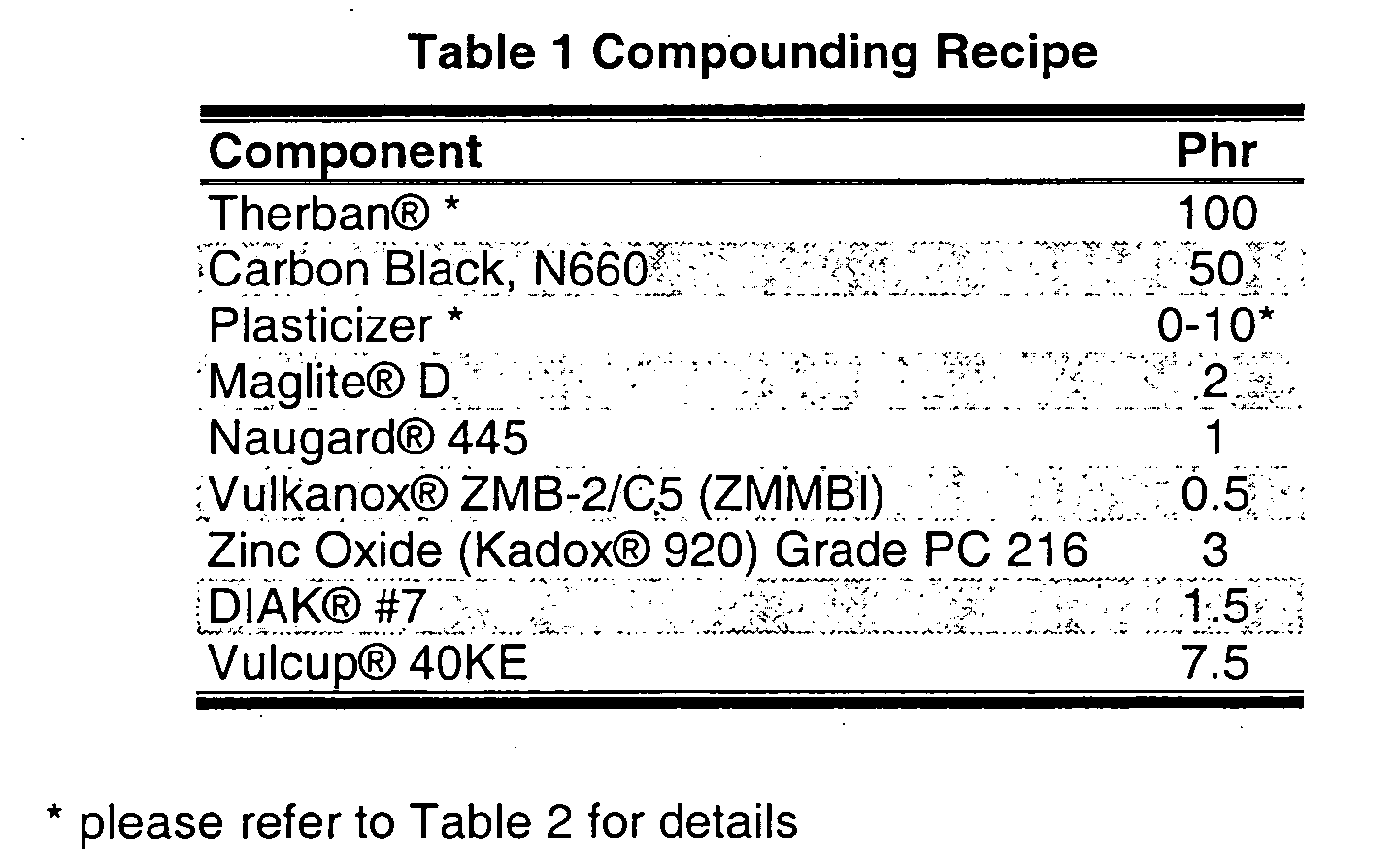
- Carbon black N 660 Sterling-V available from Cabot Tire Blacks
- Maglite® D is a MgO available from C.P. Hall.
- Naugard® 445 is a diphenylamine available from Uniroyal Chemical.
- Plasthall® TOTM is a Trioctyl trimellitate available from C.P. Hall.
- Vulkanox® ZMB-2/C5 is a Zinc salt of 4- and 5-methyl-mercapto benzimidazole available from Bayer AG
- DIAK #7 is a Triallylisocyanurate available from DuPont Dow Elastomers
- Vulcup 40KE is 2,2'-bis (tert-butylperoxy di-isopropylbenzene) available
from Harwick Standard.
Details for Compounding Recipe for each Example Example Therban® Plasticizer 1 (comp) Therban® A 3406 5 phr of Plasthall® TOTM 2 (comp.) Therban® A 3406 5 phr of Struktol® WB-222 3 Therban® A 3406 5 phr of PS 447® 4 Therban® A 3406 5 phr of Silopren® U5 5 Therban® A 3406 5 phr of Silopren® U65 6 Therban® A 3406 5 phr of Silopren® U165 7 Therban® A 3406 5 phr of PS 047® -
- PS 447™, a vinyl dimethyl terminated polydimethylsiloxane from United Technology, PS 047™, a trimethyl terminated polydimethylsiloxane from United Technology, Silopren™ U5, , U65 and U165, vinyl dimethyl terminated polydimethylsiloxanes from GE-Bayer Silicones, Struktol® WB-222 is a processing additive available from the Struktol Company
- The compositions of Ex. 1-7 were tested for their properties. The results are listed in Table 3
- The physical properties (as measured using stress-strain) the inventive compositions 3-7 or comparable to those of the comparative examples 1* and 2*. Compositions 3-7 shows similar flow properties as measured by capillary rheometry. The barrel pressure for the comparative examples is approximately 1.8 times higher then for the inventive compositions. The fluid aging results after 168 hours at 150°C in both ASTM Oil #1 and IRM 903 indicate that with soluble low molecular weight plasticizer like Plasthall TOTM, the extraction of TOTM from the polymer matrix in oil #1 results in a ∼2% weight loss (5 phr of TOTM calculates to 2.8%). In comparison, the control compound where no plasticizer was added to the formulation show a small positive weight change.
- The polysiloxane additives on the other hand show a weight increase of approximately 1% indicating that they are not extracted from the polymer matrix.
Example 1 * 2* 3 4 5 6 7 Compound Mooney Viscosity ML 1+4 @ 100ºC 82.7 76.6 87.4 89.4 86.0 87.8 88.9 MDR Cure Characteristics 1.7 Hz, 1 ºarc, 180ºC, 30 min, 100 dNm MH (dN.m) 50.9 49.0 54.3 54.8 54.3 54.2 53.5 ML (dN.m) 2.4 2.5 2.8 3.0 2.8 2.9 2.8 Delta MH-ML (dN.m) 48.5 46.5 51.5 51.9 51.5 51.3 50.7 Stress Strain (Dumbells) Cure Time @ 180ºC (min) 13 12 12 12 12 12 12 Ultimate Tensile (MPa) 24.7 26.0 23.6 24.1 25.2 25.2 23.2 Ultimate Elongation (%) 254 283 230 233 223 225 219 Hardness Shore A2 (pts.) 65 68 67 68 68 68 67 Aged in ASTM Oil #1 @ 150°C for 168h Hardness Shore A2 (pts.) 67 68 67 67 68 68 69 Ultimate Tensile (MPa) 24.8 25.0 26.2 25.1 23.7 25.2 25.6 Ultimate Elongation (%) 211 218 214 204 179 199 203 Chg. Hard. Shore A2 (pts.) 2 0 0 -1 0 0 2 Chg. Ulti. Tens. (%) 1% -4% 11% 4% -6% 0% 10% Chg. Ulti. Elong. (%) -17% -23% -7% -12% -20% -12% -7% Wt. Change (%) -2.0 -1.3 1.1 1.1 1.1 1.0 1.0 Vol. Change (%) -2.1 -1.3 1.6 1.4 1.5 1.3 1.0 Aged in IRM 903 @ 150°C for 168h Hardness Shore A2 (pts.) 60 54 61 62 62 61 61 Ultimate Tensile (MPa) 21.5 19.7 20.0 15.6 18.9 20.0 17.9 Ultimate Elongation (%) 209 199 174 152 172 178 169 Chg. Hard. Shore A2 (pts.) -5 -14 -6 -6 -6 -7 -6 Chg. Ulti. Tens. (%) -13% -24% -15% -35% -25% -21% -23% Chg. Ulti. Elong. (%) -18% -30% -24% -35% -23% -21% -23% Wt. Change (%) 12.1 13.6 15.9 16.4 16.0 16.3 16.3 Vol. Change (%) 14.9 16.5 19.4 19.9 19.5 19.7 19.4 Capillary Rheometry @ 100°C Pressure @ 28.9 s-1 (psi) 5610 1010 1400 1200 1350 1390 1360 Pressure @ 101.2 s-1 (psi) 7220 3230 2170 1720 2120 2190 2050 Pressure @ 300 s-1 (psi) 7610 5350 3140 2730 3170 3220 3090 Pressure @ 1001.3 s-1 (psi) 8910 8910 4900 4770 4910 4900 4810 Pressure @ 3005.6 s-1 (psi) 8660 N.A. 8470 8800 8710 8390 8520 Pressure @ 9991.2 s-1 (psi) 13730 12990 N.A. N.A. 12910 13260
Claims (10)
- A composition comprising at least one hydrogenated nitrile rubber and at least one organopolysiloxane with at least one hydrocarbon radical having less than four carbon atoms.
- A composition according to claim 1, wherein the organopolysiloxane has at least one hydrocarbon radical having less than four carbon atoms and has the general structure (I)
- A composition according to claim 2 wherein the organopolysiloxane is polydimethylsiloxane (PDMS).
- A composition according to any of claims 1-3, wherein the hydrogenated nitrile rubber comprises repeating units derived from at least one conjugated diene, at least one alpha,beta-unsaturated nitrile and optionally further one or more copolymerizable monomers.
- A composition according to any of claims 1-4 further comprising one or more fillers and/or one or more vulcanization agents or curing systems.
- A composition having an improved flowability according to any of claims 1-5.
- A composition having an improved fluid aging resistance according to any of claims 1-5.
- In a method of improving the flowability of compositions comprising at least one hydrogenated nitrile rubber by adding at least one organopolysiloxane with at least one hydrocarbon radical having less than four carbon atoms to said composition.
- In a method of improving the fluid aging of compositions comprising at least one hydrogenated nitrile rubber by adding at least one organopolysiloxane with at least one hydrocarbon radical having less than four carbon atoms to said composition.
- A manufacturing process for a shaped article wherein a composition according to any of claims 1-7 is subjected to injection molding, extrusion molding or compression molding.
Applications Claiming Priority (2)
| Application Number | Priority Date | Filing Date | Title |
|---|---|---|---|
| CA002436586A CA2436586A1 (en) | 2003-08-05 | 2003-08-05 | Hnbr compounds having an improved flowability |
| CA2436586 | 2003-08-05 |
Publications (1)
| Publication Number | Publication Date |
|---|---|
| EP1505114A1 true EP1505114A1 (en) | 2005-02-09 |
Family
ID=33546127
Family Applications (1)
| Application Number | Title | Priority Date | Filing Date |
|---|---|---|---|
| EP04017457A Withdrawn EP1505114A1 (en) | 2003-08-05 | 2004-07-23 | HNBR compounds having an improved flowability |
Country Status (5)
| Country | Link |
|---|---|
| US (1) | US20050143514A1 (en) |
| EP (1) | EP1505114A1 (en) |
| JP (1) | JP2005054188A (en) |
| CN (1) | CN1597754A (en) |
| CA (1) | CA2436586A1 (en) |
Cited By (2)
| Publication number | Priority date | Publication date | Assignee | Title |
|---|---|---|---|---|
| EP2395034A1 (en) | 2010-06-14 | 2011-12-14 | LANXESS Deutschland GmbH | Blends from partially hydrated nitrile rubber and silicon rubber, vulcanisable mixtures based on same and vulcanisates |
| DE112009000893B4 (en) | 2008-04-16 | 2024-05-23 | Valeo Materiaux De Friction | Silicone resin-based compositions, processes for their preparation and their applications |
Families Citing this family (4)
| Publication number | Priority date | Publication date | Assignee | Title |
|---|---|---|---|---|
| US20110067800A1 (en) * | 2007-11-13 | 2011-03-24 | Pirelli Tyre S.P.A. | Process and plant for producing an elastomeric compound |
| EP2151479A1 (en) | 2008-07-31 | 2010-02-10 | Schill + Seilacher "Struktol" Aktiengesellschaft | Polyorganosiloxanes and their application in processing and vulcanising rubber |
| EP2354145A1 (en) | 2010-02-03 | 2011-08-10 | Schill + Seilacher "Struktol" GmbH | Use of polyorganosiloxanes in processing and vulcanising rubber |
| EP3240661B1 (en) | 2014-12-29 | 2019-08-28 | Pirelli Tyre S.p.A. | Process for producing tyres |
Citations (3)
| Publication number | Priority date | Publication date | Assignee | Title |
|---|---|---|---|---|
| DE3812354A1 (en) * | 1988-04-14 | 1989-10-26 | Karl Joh Gummiwarenfab | Rubber |
| EP0559515A1 (en) * | 1992-02-18 | 1993-09-08 | Nippon Zeon Co., Ltd. | Rubber formulation |
| EP1213323A2 (en) * | 1996-09-11 | 2002-06-12 | The Yokohama Rubber Co., Ltd. | Polysiloxane-containing rubber composition for tire |
Family Cites Families (6)
| Publication number | Priority date | Publication date | Assignee | Title |
|---|---|---|---|---|
| DE1227233B (en) * | 1963-07-11 | 1966-10-20 | Bayer Ag | Lubricant in vinyl polymers in the manufacture of molded articles |
| US3450736A (en) * | 1963-09-12 | 1969-06-17 | Mobil Oil Corp | Modified siloxane polymers and compositions containing same |
| JPS6050386B2 (en) * | 1980-07-31 | 1985-11-08 | ト−レ・シリコ−ン株式会社 | Vinyl resin composition |
| US5070168A (en) * | 1989-12-11 | 1991-12-03 | Siltech Inc. | Ether amine functional silicone polymers |
| JPH05230314A (en) * | 1992-02-18 | 1993-09-07 | Nippon Zeon Co Ltd | Rubber composition |
| FR2743565B1 (en) * | 1996-01-11 | 1998-02-20 | Rhone Poulenc Chimie | USE OF A COMBINATION OF SILICON COMPOUNDS AS A COUPLING AGENT IN SILICA-LOADED ELASTOMER COMPOSITIONS |
-
2003
- 2003-08-05 CA CA002436586A patent/CA2436586A1/en not_active Abandoned
-
2004
- 2004-07-23 EP EP04017457A patent/EP1505114A1/en not_active Withdrawn
- 2004-07-28 US US10/900,806 patent/US20050143514A1/en not_active Abandoned
- 2004-08-05 CN CNA2004100684642A patent/CN1597754A/en active Pending
- 2004-08-05 JP JP2004229386A patent/JP2005054188A/en active Pending
Patent Citations (3)
| Publication number | Priority date | Publication date | Assignee | Title |
|---|---|---|---|---|
| DE3812354A1 (en) * | 1988-04-14 | 1989-10-26 | Karl Joh Gummiwarenfab | Rubber |
| EP0559515A1 (en) * | 1992-02-18 | 1993-09-08 | Nippon Zeon Co., Ltd. | Rubber formulation |
| EP1213323A2 (en) * | 1996-09-11 | 2002-06-12 | The Yokohama Rubber Co., Ltd. | Polysiloxane-containing rubber composition for tire |
Cited By (4)
| Publication number | Priority date | Publication date | Assignee | Title |
|---|---|---|---|---|
| DE112009000893B4 (en) | 2008-04-16 | 2024-05-23 | Valeo Materiaux De Friction | Silicone resin-based compositions, processes for their preparation and their applications |
| DE112009000893B9 (en) | 2008-04-16 | 2025-10-09 | Valeo Materiaux De Friction | Compositions based on silicone resin, processes for their preparation and their applications |
| EP2395034A1 (en) | 2010-06-14 | 2011-12-14 | LANXESS Deutschland GmbH | Blends from partially hydrated nitrile rubber and silicon rubber, vulcanisable mixtures based on same and vulcanisates |
| WO2011157711A1 (en) | 2010-06-14 | 2011-12-22 | Lanxess Deutschland Gmbh | Blends of partially hydrogenated nitrile rubber and silicone rubber, vulcanizable mixtures and vulcanizates based thereon |
Also Published As
| Publication number | Publication date |
|---|---|
| CN1597754A (en) | 2005-03-23 |
| US20050143514A1 (en) | 2005-06-30 |
| JP2005054188A (en) | 2005-03-03 |
| CA2436586A1 (en) | 2005-02-05 |
Similar Documents
| Publication | Publication Date | Title |
|---|---|---|
| EP1554335B1 (en) | Polymer composites comprising low molecular weight nitrile rubber | |
| US8815984B2 (en) | Elastomeric compositions with improved heat resistance, compression set, and processability | |
| US7235601B2 (en) | Hydrogenated nitrile rubber compositions with improved processability | |
| EP2334722B1 (en) | Hnbr compositions with very high filler levels having excellent processability and resistance to aggressive fluids | |
| TWI609037B (en) | Crosslinking of carboxylated nitrile rubber with resol phenolic resin cross-linking system | |
| EP1491583A1 (en) | Polymer blends comprising nitrile rubber | |
| US7741392B2 (en) | Rubber compositions having improved physical and low temperature properties | |
| EP1475405A1 (en) | Rubber compound comprising nitrile rubbers | |
| US20050143514A1 (en) | HNBR compounds having an improved flowability | |
| EP1512716A1 (en) | Nitrile polymer compositions for magnetic seal applications | |
| US20050288439A1 (en) | Elastomeric compositions having improved mechanical properties and scorch resistance | |
| EP1544242A1 (en) | Butyl compositions comprising nitrile polymers | |
| WO2005080492A1 (en) | Curable plasticizer composition | |
| US20060110559A1 (en) | Crosslinking of carboxylated nitrile polymers with organo functional silanes: a curable plasticizer composition | |
| WO2005080493A1 (en) | Crosslinking of carboxylated nitrile polymers using compounds with at least two epoxy groups | |
| HK1076121A (en) | Hnbr compounds having an improved flowability | |
| RU2522622C9 (en) | Hnbr compositions with very high levels of content of filling agents, possessing excellent processability and resistance to aggressive liquids | |
| HK1075907A (en) | Nitrile polymer compounds for magnetic seal applications |
Legal Events
| Date | Code | Title | Description |
|---|---|---|---|
| PUAI | Public reference made under article 153(3) epc to a published international application that has entered the european phase |
Free format text: ORIGINAL CODE: 0009012 |
|
| AK | Designated contracting states |
Kind code of ref document: A1 Designated state(s): AT BE BG CH CY CZ DE DK EE ES FI FR GB GR HU IE IT LI LU MC NL PL PT RO SE SI SK TR |
|
| AX | Request for extension of the european patent |
Extension state: AL HR LT LV MK |
|
| RAP1 | Party data changed (applicant data changed or rights of an application transferred) |
Owner name: LANXESS INC. |
|
| 17P | Request for examination filed |
Effective date: 20050809 |
|
| AKX | Designation fees paid |
Designated state(s): DE FR GB IT |
|
| STAA | Information on the status of an ep patent application or granted ep patent |
Free format text: STATUS: THE APPLICATION IS DEEMED TO BE WITHDRAWN |
|
| 18D | Application deemed to be withdrawn |
Effective date: 20090203 |