EP1505096A1 - NOVEL POLYESTER HAVING &pgr;-CONJUGATED GROUP IN SIDE CHAIN AND CHARGE TRANSPORTING MATERIAL USING THE SAME - Google Patents
NOVEL POLYESTER HAVING &pgr;-CONJUGATED GROUP IN SIDE CHAIN AND CHARGE TRANSPORTING MATERIAL USING THE SAME Download PDFInfo
- Publication number
- EP1505096A1 EP1505096A1 EP03728040A EP03728040A EP1505096A1 EP 1505096 A1 EP1505096 A1 EP 1505096A1 EP 03728040 A EP03728040 A EP 03728040A EP 03728040 A EP03728040 A EP 03728040A EP 1505096 A1 EP1505096 A1 EP 1505096A1
- Authority
- EP
- European Patent Office
- Prior art keywords
- polyester
- electron
- electron donor
- group
- groups
- Prior art date
- Legal status (The legal status is an assumption and is not a legal conclusion. Google has not performed a legal analysis and makes no representation as to the accuracy of the status listed.)
- Granted
Links
Classifications
-
- G—PHYSICS
- G03—PHOTOGRAPHY; CINEMATOGRAPHY; ANALOGOUS TECHNIQUES USING WAVES OTHER THAN OPTICAL WAVES; ELECTROGRAPHY; HOLOGRAPHY
- G03G—ELECTROGRAPHY; ELECTROPHOTOGRAPHY; MAGNETOGRAPHY
- G03G5/00—Recording-members for original recording by exposure, e.g. to light, to heat or to electrons; Manufacture thereof; Selection of materials therefor
- G03G5/02—Charge-receiving layers
- G03G5/04—Photoconductive layers; Charge-generation layers or charge-transporting layers; Additives therefor; Binders therefor
- G03G5/06—Photoconductive layers; Charge-generation layers or charge-transporting layers; Additives therefor; Binders therefor characterised by the photoconductive material being organic
- G03G5/07—Polymeric photoconductive materials
- G03G5/075—Polymeric photoconductive materials obtained otherwise than by reactions only involving carbon-to-carbon unsaturated bonds
-
- C—CHEMISTRY; METALLURGY
- C08—ORGANIC MACROMOLECULAR COMPOUNDS; THEIR PREPARATION OR CHEMICAL WORKING-UP; COMPOSITIONS BASED THEREON
- C08G—MACROMOLECULAR COMPOUNDS OBTAINED OTHERWISE THAN BY REACTIONS ONLY INVOLVING UNSATURATED CARBON-TO-CARBON BONDS
- C08G63/00—Macromolecular compounds obtained by reactions forming a carboxylic ester link in the main chain of the macromolecule
- C08G63/02—Polyesters derived from hydroxycarboxylic acids or from polycarboxylic acids and polyhydroxy compounds
- C08G63/06—Polyesters derived from hydroxycarboxylic acids or from polycarboxylic acids and polyhydroxy compounds derived from hydroxycarboxylic acids
-
- C—CHEMISTRY; METALLURGY
- C08—ORGANIC MACROMOLECULAR COMPOUNDS; THEIR PREPARATION OR CHEMICAL WORKING-UP; COMPOSITIONS BASED THEREON
- C08K—Use of inorganic or non-macromolecular organic substances as compounding ingredients
- C08K5/00—Use of organic ingredients
- C08K5/16—Nitrogen-containing compounds
- C08K5/32—Compounds containing nitrogen bound to oxygen
Definitions
- This invention relates to a novel polymer compound having a fluorene residue in a side chain.
- it relates to a novel polymer compound which can form a charge transfer complex with an electron acceptor compound or an electron donor compound, and a charge transfer complex formed by addition of the electron acceptor compound or electron donor compound.
- a polyester with a fluorene residue is already known.
- This polyester has excellent heat-resistance and transparency, high refractive index, low birefringence and low water absorptivity, and is therefore suitable as an optical instrument material.
- fluorene residues it was difficult to make it express electrical characteristics using the properties of ⁇ -conjugated electrons.
- the inventor made a detailed study of polymer compounds having special electrical qualities due to the properties of n-conjugated electrons. As a result, it was discovered that a polyester having a fluorene residue in a side chain had unique electrical qualities, and forms a charge transfer complex of excellent stability with a suitable electron acceptor compound or electron donor compound, which led to the present invention.
- m is an integer equal to 2 or more.
- Ar is an aromatic group and this aromatic group may contain a heterocyclic ring.
- R 1 is a carbon atom or absent (direct bond)
- R 2 -R 9 are hydrogen atoms, electron donor groups or electron attracting groups
- R 20 , R 21 are hydrogen atoms or organic groups
- X is a hetero atom, hetero atom-containing group, organic group or absent (direct bond).
- R 1 is absent, i.e., that it is the end of a polymerizing unit.
- the hetero atom X in the structural formula 1 is -O-, -NR- or -S-.
- the organic group is preferably -(CH 2 )- or an aromatic group.
- the electron donor group in the aforesaid structural formula 1 of this invention is a functional group which, due to the introduction of a substituent, has an increased electron density in the fluorene residue and enhanced electron donor properties in the fluorene residue.
- R, R 10 and R 11 may be H or an organic group, but preferably an aromatic group or an alkyl group.
- R 20 , R 21 may be a hydrogen atom, alkyl group, aromatic group, -CN or ester group.
- the electron attracting group is a functional group which, due to the introduction of a substituent, has a decreased electron density in the fluorene residue, and enhanced electron acceptor properties in the fluorene residue.
- R 2 -R 9 Preferred combinations of R 2 -R 9 are:
- the electron acceptor compound described above is a compound having a stronger electron affinity than the polymer of structural formula 1.
- Examples are the following halogens, Lewis acids, proton acids and transition metal halogens etc.
- Halogens I 2 , Br 2 , Cl 2 , ICl, ICl 3 , IBr, IF Lewis acids: BF 3 , PF 5 , AsF 5 , SbF 5 , SO 3 , BBr 5 , BF 4 - , PF 6 - , AsF 6 - , SbF 6 - , ClO 4 -
- Proton acids HNO 3 , H 2 SO 4 , HClO 4 , HF, HCl, FSO 3 H, CFSO 3 H
- Transition metal halides FeCl 3 , MoCl 5 , WCl 5 , SnCl 4 , MoF 5 , FeOCl, RuF 5 , TaBr 5 , SnI 4 , LnC
- the electron donor compound is a compound having a smaller ionization potential than the polymer of structural formula 1.
- Examples are hexamethylbenzene, alkali metals, ammonium ion and lanthanoids.
- an electron donor compound When an electron-attracting functional group is introduced into a fluorene residue, an electron donor compound is preferably added, and when an electron donor functional group is introduced into a fluorene residue, an electron acceptor compound is preferably added. A stable charge-transfer type complex is thus obtained.
- the following compounds may be polycondensed using the usual catalyst.
- R 1 -R 9 , and R 20 , R 21 are respectively identical to R 1 -R 9 , and R 20 , R 21 in structural formula 1.
- the molecular weight of the polymer is preferably 400-1 million but more preferably 800-100,000 in terms of number average molecular weight. If it is less than 400, it is rare for an electron acceptor compound or electron donor compound to enter between fluorene residues, and if it is more than 1 million, the solubility decreases.
- the distance between fluorene residues is 4-20 ⁇ , but preferably 5-10 ⁇ . If it is less than 4 ⁇ , the electron acceptor compound or electron donor compound cannot enter between fluorene residues. If it is more than 20 ⁇ , the electron acceptor compound or electron donor compound which entered between fluorene residues cannot easily form an electron donor-acceptor complex.
- Tg of the polymer is preferably 30-300°C, but more preferably 80-200°C. When Tg is less than 30°C, formation of the electron donor-acceptor complex is blocked by structural change of the polymer due to temperature change.
- a stable electron donor -acceptor complex can be obtained.
- a stable electron donor-acceptor complex is suitable as a charge transport material, for example as a hole transport layer of an organic EL or a solar cell.
- a charge transport material can be easily manufactured by a known method, such as spin coating.
- Example 1 (Polymer synthesis).
- 9-fluorene carboxylic acid (4.98g, 23.7mmol) and anhydrous THF (300ml) were introduced into a flame-dried reaction vessel in which the atmosphere had been replaced by nitrogen, the reaction solution was cooled to -78°C, and n-butyl lithium (41.0ml of 1.6M hexane solution, 71.0mmol) was added. After stirring the reaction solution at -78°C for 30 minutes, paraformaldehyde (2.30g, 75.0mmol) dissolved in anhydrous THF (100ml) was added at -78°C, and stirred at room temperature for 13 hours.
- THF-soluble part was re-dissolved in THF (3ml), diazomethane (ether solution, 1ml) was slowly dripped in with stirring, and stirred at room temperature for 5 hours. After 5 hours, the solvent and volatile component were distilled off with the rotary evaporator, the obtained crude product was divided into a methanol-soluble part (8.10mg) and methanol-insoluble part (34.9mg), and the methanol-insoluble part was divided into a THF-soluble part (14.19mg) and a THF-insoluble part (20.64mg).
- the part which was insoluble in methanol but soluble in THF had a molecular weight distribution of approx. 1,000 to 10 5 (SEC, polystyrene conversion).
- the solvent was distilled off under reduced pressure with the rotary evaporator, and the obtained crude product was classified into a hexane-soluble part (111mg) and a hexane-insoluble part (777mg).
- the hexane-insoluble part was dissolved in THF (20ml), diazomethane (ether solution, 3ml) was gradually dripped in with stirring, and the solution stirred at room temperature for 5 hours.
- the reaction product was a mixture of polymers consisting of 2-10 monomers. This polymer mixture was classified by recycling liquid chromatography, and the pure dimer, trimer and tetramer were thus obtained.
- the polymer (2.98mg) and DNB (1.80mg, 0.01mmol) were dissolved in THF for ultraviolet absorption spectra to give 10ml of solution. This was diluted 100 times, and used for absorption spectrum measurements (quartz cell; 10mm) at room temperature.
- the absorption intensity of the polymer and DNB mixture was smaller than the absorption intensity of the polymer alone.
- the intensity which was 0.140 at 242nm changed to 0.108 after adding DNB. This change depended on the concentration, and when the DNB concentration was changed to 2.5 ⁇ 10 -5 M and 5.0 ⁇ 10 -5 M, the absorption intensity at 242nm changed to 0.077 and 0.059, respectively.
- This hypochromic effect proved that the fluorene ring of the polymer and DNB formed a stacked complex.
- the polymer (100mg) and m-nitrobenzene (100mg) were taken up as a CH 2 Cl 2 solution, and the light red solid produced while distilling off the solvent was collected. When this was again dissolved in CH 2 Cl 2 and the solvent was distilled off, thin red acicular crystals were obtained.
- TNFMN (363.3mg, 1.0mmol) was dissolved in methylene chloride solvent for ultraviolet absorption spectra to give 100ml of solution.
- a polymer (10.4mg of a mixture of polymer consisting of 2-10 monomers, 0.05mmol in monomer units) was dissolved using this solution.
- TNFMN (15.1mg, 0.04mmol) and a polymer (10.4mg, 0.05mmol in monomer units) were put into methylene chloride solution, and the solvent was distilled off to dryness to give an orange-red solid.
- a composition analysis by 1 HNMR of this solid showed that the proportion of monomer units:TNFMN was 1:1.
- TNFMN (363.3mg, 1.0mmol) was dissolved in methylene chloride solvent for ultraviolet absorption spectra to give 100ml of solution.
- trimer (10.4mg, 0.05mmol in monomer units) was dissolved using this solution, and the absorption spectrum was measured at room temperature on 1ml of solution (quartz cell; 0.1mm).
- These absorption intensities depended on concentration, and when the concentration of fluorene was changed to 0.03M and 0.04M, the absorption intensity at 388nm changed to 0.022 and 0.029, respectively.
- TNFMN (15.1mg, 0.04mmol) and a trimer (10.4mg, 0.05mmol in monomer units) were put into methylene chloride solution, and the solvent was distilled off to dryness to give an orange solid.
- a composition analysis by 1 HNMR of this solid showed the proportion of monomer units:TNFMN was 1:1.
- a mixture having a polymerization degree of approx. 20 (principal components are dimer-tetramer) was taken in CH 2 Cl 2 solution, 1% 2,4,7-trinitrofluorene malononitrile was added to this, and dissolved. The solution was then spread on an ITO glass substrate, and dried to produce a thin film (1 ⁇ m thickness). Aluminum was deposited on the obtained film (thickness 1000 ⁇ , area 5mm ⁇ 5mm). A voltage of 5.0V was applied between the ITO and aluminum using TOF301 (Optel, Inc.), a 337nm pulse laser (nitrogen laser, pulse width, lns, 150 ⁇ J) was simultaneously irradiated from the ITO side, and the time of flight was measured. From the test results at room temperature, the hole mobility was determined as 1.20 ⁇ 10 -4 cm 2 V -1 sec -1 .
- the polyester of this invention has a fluorene residue in a side chain, and it can form a charge transfer complex having excellent stability with an electron acceptor compound or electron donor compound. It is therefore suitable as a charge transport material such as an organic EL material, or the hole transport layer of a solar cell.
Landscapes
- Chemical & Material Sciences (AREA)
- Chemical Kinetics & Catalysis (AREA)
- Polymers & Plastics (AREA)
- Organic Chemistry (AREA)
- Health & Medical Sciences (AREA)
- Medicinal Chemistry (AREA)
- General Physics & Mathematics (AREA)
- Physics & Mathematics (AREA)
- Polyesters Or Polycarbonates (AREA)
- Polyoxymethylene Polymers And Polymers With Carbon-To-Carbon Bonds (AREA)
- Organic Low-Molecular-Weight Compounds And Preparation Thereof (AREA)
- Photoreceptors In Electrophotography (AREA)
- Compositions Of Macromolecular Compounds (AREA)
Abstract

Description


Lewis acids: BF3, PF5, AsF5, SbF5, SO3, BBr5, BF4 -, PF6 -, AsF6 -, SbF6 -, ClO4 -
Proton acids: HNO3, H2SO4, HClO4, HF, HCl, FSO3H, CFSO3H Transition metal halides: FeCl3, MoCl5, WCl5, SnCl4, MoF5, FeOCl, RuF5, TaBr5, SnI4, LnCl3 (Ln is La, Ce, Pr, Nd or Sm)
Others:(9-fluorenylidene)acetonitrile,
(9-fluorenylidene)malononitrile,
(2,4,7-trinitro-9-fluorenylidene)acetonitrile,
(2,4,7-trinitro-9-fluorenylidene)malononitrile,
o-dinitrobenzene, m-dinitrobenzene, p-dinitrobenzene, 2,4,7-trinitrobenzene, 2,4,7-trinitrotoluene, TCNQ, TCNE, DDQ.


Claims (7)
- A polyester expressed by the following structural formula 1:wherein, R1 is CnH2n, n is an integer equal to 0 or more, R2-R9 are hydrogen atoms, electron donor groups or electron attracting groups, and m is an integer equal to 2 or more.
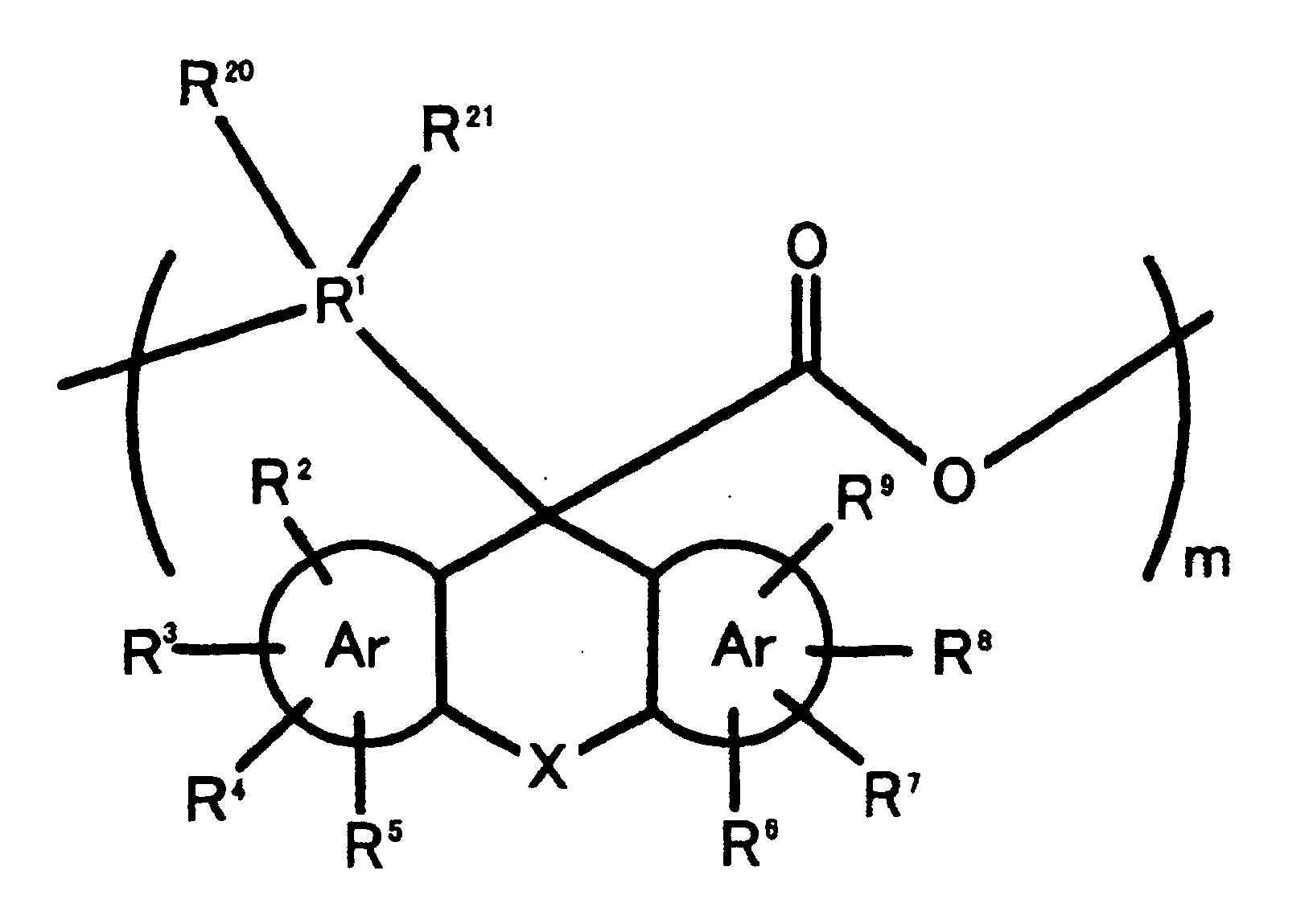
In the aforesaid structural formula, Ar is an aromatic group and this aromatic group may contain a heterocyclic ring.
R1 is a carbon atom or absent (direct bond), R2-R9 are hydrogen atoms, electron donor groups or electron attracting groups, R20, R21 are hydrogen atoms or organic groups, and X is a hetero atom, hetero atom-containing group, organic group or absent (direct bond). - The polyester according to Claim 1, wherein the molecular weight of said polyester is 400-1 million in terms of number average molecular weight.
- The polyester according to Claim 2, wherein the distance between fluorene residues in said polyester is 4-20Å.
- The polyester according to Claim 1, wherein Tg of said polyester is 30-300°C.
- A composition obtained by adding an electron acceptor compound or an electron donor compound to the polyester according to Claim 1.
- The composition according to Claim 5, wherein said composition forms a charge transfer complex.
- A charge transport material formed using the composition according to Claim 6.
Applications Claiming Priority (3)
| Application Number | Priority Date | Filing Date | Title |
|---|---|---|---|
| JP2002132598 | 2002-05-08 | ||
| JP2002132598 | 2002-05-08 | ||
| PCT/JP2003/005727 WO2003095519A1 (en) | 2002-05-08 | 2003-05-07 | NOVEL POLYESTER HAVING π-CONJUGATED GROUP IN SIDE CHAIN AND CHARGE TRANSPORTING MATERIAL USING THE SAME |
Publications (3)
| Publication Number | Publication Date |
|---|---|
| EP1505096A1 true EP1505096A1 (en) | 2005-02-09 |
| EP1505096A4 EP1505096A4 (en) | 2005-11-16 |
| EP1505096B1 EP1505096B1 (en) | 2007-12-05 |
Family
ID=29416643
Family Applications (1)
| Application Number | Title | Priority Date | Filing Date |
|---|---|---|---|
| EP03728040A Expired - Lifetime EP1505096B1 (en) | 2002-05-08 | 2003-05-07 | NOVEL POLYESTER HAVING &pgr;-CONJUGATED GROUP IN SIDE CHAIN AND CHARGE TRANSPORTING MATERIAL USING THE SAME |
Country Status (7)
| Country | Link |
|---|---|
| US (1) | US7235620B2 (en) |
| EP (1) | EP1505096B1 (en) |
| JP (1) | JP4173482B2 (en) |
| AT (1) | ATE380214T1 (en) |
| CA (1) | CA2485512C (en) |
| DE (1) | DE60317892T2 (en) |
| WO (1) | WO2003095519A1 (en) |
Family Cites Families (6)
| Publication number | Priority date | Publication date | Assignee | Title |
|---|---|---|---|---|
| US3433753A (en) | 1963-08-01 | 1969-03-18 | Ici Ltd | Paint composition including a dispersant having a solvatable chain-like component |
| FR1590574A (en) * | 1968-05-09 | 1970-04-20 | ||
| DE4005415C2 (en) * | 1990-02-21 | 1996-04-11 | Boehringer Ingelheim Kg | Process for the preparation of polyesters based on hydroxycarboxylic acids |
| US5225522A (en) * | 1992-07-13 | 1993-07-06 | Eastman Kodak Company | Multiply-branched aliphatic-aromatic polyesters and method for preparing multiply-branched aliphatic-aromatic polyesters |
| JP4933704B2 (en) | 2000-06-23 | 2012-05-16 | 帝人化成株式会社 | Method for producing polycarbonate resin solution |
| CA2453166C (en) * | 2001-04-27 | 2010-01-05 | Japan Science And Technology Agency | A polymer compound with special optical properties and polymerizing monomer used to synthesize this polymer |
-
2003
- 2003-05-07 WO PCT/JP2003/005727 patent/WO2003095519A1/en not_active Ceased
- 2003-05-07 DE DE60317892T patent/DE60317892T2/en not_active Expired - Lifetime
- 2003-05-07 AT AT03728040T patent/ATE380214T1/en not_active IP Right Cessation
- 2003-05-07 US US10/513,659 patent/US7235620B2/en not_active Expired - Lifetime
- 2003-05-07 CA CA2485512A patent/CA2485512C/en not_active Expired - Fee Related
- 2003-05-07 JP JP2004503528A patent/JP4173482B2/en not_active Expired - Fee Related
- 2003-05-07 EP EP03728040A patent/EP1505096B1/en not_active Expired - Lifetime
Also Published As
| Publication number | Publication date |
|---|---|
| JPWO2003095519A1 (en) | 2005-09-15 |
| CA2485512C (en) | 2011-03-22 |
| CA2485512A1 (en) | 2003-11-20 |
| EP1505096A4 (en) | 2005-11-16 |
| US20050228163A1 (en) | 2005-10-13 |
| DE60317892D1 (en) | 2008-01-17 |
| JP4173482B2 (en) | 2008-10-29 |
| ATE380214T1 (en) | 2007-12-15 |
| EP1505096B1 (en) | 2007-12-05 |
| US7235620B2 (en) | 2007-06-26 |
| DE60317892T2 (en) | 2008-12-11 |
| WO2003095519A1 (en) | 2003-11-20 |
Similar Documents
| Publication | Publication Date | Title |
|---|---|---|
| Chen et al. | Small-bandgap conducting polymers based on conjugated poly (heteroarylene methines). 2. Synthesis, structure, and properties | |
| US7126013B2 (en) | Mono-, oligo- and polymers comprising fluorene and aryl groups | |
| US6676857B2 (en) | Mono-, oligo- and poly-4-fluorothiophenes and their use as charge transport materials | |
| Grigalevicius et al. | Synthesis and properties of poly (3, 9-carbazole) and low-molar-mass glass-forming carbazole compounds | |
| Zhao et al. | Synthesis and memory characteristics of novel soluble polyimides based on asymmetrical diamines containing carbazole | |
| JP2003201339A (en) | Conjugated copolymer of dithienothiophene with vinylene or acetylene | |
| US6805922B2 (en) | Mono-, oligo-and polyalkylidenefluorenes and their use as charge transport materials | |
| US6806374B2 (en) | Mono-, oligo- and poly-3-(1,1-difluoroalkyl)thiophenes and their use as charge transport materials | |
| WO2008004751A1 (en) | Aromatic polymers having optical activity and preparation methods thereof | |
| Zhao et al. | Tristable data storage device of soluble polyimides based on novel asymmetrical diamines containing carbazole | |
| EP1279689A2 (en) | Mono-, Oligo and Poly-3-(1,1-difluoroalkyl)thiophenes and their use as charge transport materials | |
| Tsami et al. | Random fluorene copolymers with on‐chain quinoxaline acceptor units | |
| JP2003176337A (en) | Mono, oligo and poly-difluorovinyl- (hetero) arylenes, their synthesis and their use as charge transfer materials | |
| US20040200999A1 (en) | Photorefractive composite | |
| Jin et al. | Color-tunable electroluminescent polymers by substitutents on the poly (p-phenylenevinylene) derivatives for light-emitting diodes | |
| EP1505096B1 (en) | NOVEL POLYESTER HAVING &pgr;-CONJUGATED GROUP IN SIDE CHAIN AND CHARGE TRANSPORTING MATERIAL USING THE SAME | |
| JP2003155289A (en) | Mono, oligo and polydithienopyridines and their use as charge transfer materials | |
| US7012123B2 (en) | Acrylic polymer and charge transport material | |
| CA1039555A (en) | Photoconductive compositions and imaging members and methods employing same | |
| Upadhyay et al. | Studies of luminescence performance on carbazole donor and quinoline acceptor based conjugated polymer | |
| Sonar et al. | Thiophene-based dendronized macromonomers and polymers | |
| Jayalakshmi et al. | Polychalcones based on triphenylamine and carbazole building blocks via Claisen–Schmidt route | |
| Jin et al. | Synthesis and characterization of novel crosslinkable polymers with a nonlinear optical chromophore as a pendant group | |
| Son et al. | Condensation polymerization of triphenylamine derivatives with paraformaldehyde | |
| JP4901718B2 (en) | Reactive mesogenic charge transport compounds |
Legal Events
| Date | Code | Title | Description |
|---|---|---|---|
| PUAI | Public reference made under article 153(3) epc to a published international application that has entered the european phase |
Free format text: ORIGINAL CODE: 0009012 |
|
| 17P | Request for examination filed |
Effective date: 20041103 |
|
| AK | Designated contracting states |
Kind code of ref document: A1 Designated state(s): AT BE BG CH CY CZ DE DK EE ES FI FR GB GR HU IE IT LI LU MC NL PT RO SE SI SK TR |
|
| A4 | Supplementary search report drawn up and despatched |
Effective date: 20051006 |
|
| 17Q | First examination report despatched |
Effective date: 20051214 |
|
| 17Q | First examination report despatched |
Effective date: 20051214 |
|
| GRAP | Despatch of communication of intention to grant a patent |
Free format text: ORIGINAL CODE: EPIDOSNIGR1 |
|
| GRAS | Grant fee paid |
Free format text: ORIGINAL CODE: EPIDOSNIGR3 |
|
| GRAA | (expected) grant |
Free format text: ORIGINAL CODE: 0009210 |
|
| AK | Designated contracting states |
Kind code of ref document: B1 Designated state(s): AT BE BG CH CY CZ DE DK EE ES FI FR GB GR HU IE IT LI LU MC NL PT RO SE SI SK TR |
|
| REG | Reference to a national code |
Ref country code: GB Ref legal event code: FG4D |
|
| REG | Reference to a national code |
Ref country code: IE Ref legal event code: FG4D |
|
| REG | Reference to a national code |
Ref country code: CH Ref legal event code: EP |
|
| REF | Corresponds to: |
Ref document number: 60317892 Country of ref document: DE Date of ref document: 20080117 Kind code of ref document: P |
|
| REG | Reference to a national code |
Ref country code: CH Ref legal event code: NV Representative=s name: KIRKER & CIE S.A. |
|
| REG | Reference to a national code |
Ref country code: SE Ref legal event code: TRGR |
|
| PG25 | Lapsed in a contracting state [announced via postgrant information from national office to epo] |
Ref country code: ES Free format text: LAPSE BECAUSE OF FAILURE TO SUBMIT A TRANSLATION OF THE DESCRIPTION OR TO PAY THE FEE WITHIN THE PRESCRIBED TIME-LIMIT Effective date: 20080316 |
|
| PG25 | Lapsed in a contracting state [announced via postgrant information from national office to epo] |
Ref country code: SI Free format text: LAPSE BECAUSE OF FAILURE TO SUBMIT A TRANSLATION OF THE DESCRIPTION OR TO PAY THE FEE WITHIN THE PRESCRIBED TIME-LIMIT Effective date: 20071205 Ref country code: FI Free format text: LAPSE BECAUSE OF FAILURE TO SUBMIT A TRANSLATION OF THE DESCRIPTION OR TO PAY THE FEE WITHIN THE PRESCRIBED TIME-LIMIT Effective date: 20071205 |
|
| PG25 | Lapsed in a contracting state [announced via postgrant information from national office to epo] |
Ref country code: AT Free format text: LAPSE BECAUSE OF FAILURE TO SUBMIT A TRANSLATION OF THE DESCRIPTION OR TO PAY THE FEE WITHIN THE PRESCRIBED TIME-LIMIT Effective date: 20071205 |
|
| PG25 | Lapsed in a contracting state [announced via postgrant information from national office to epo] |
Ref country code: CZ Free format text: LAPSE BECAUSE OF FAILURE TO SUBMIT A TRANSLATION OF THE DESCRIPTION OR TO PAY THE FEE WITHIN THE PRESCRIBED TIME-LIMIT Effective date: 20071205 |
|
| ET | Fr: translation filed | ||
| PG25 | Lapsed in a contracting state [announced via postgrant information from national office to epo] |
Ref country code: RO Free format text: LAPSE BECAUSE OF FAILURE TO SUBMIT A TRANSLATION OF THE DESCRIPTION OR TO PAY THE FEE WITHIN THE PRESCRIBED TIME-LIMIT Effective date: 20071205 Ref country code: BE Free format text: LAPSE BECAUSE OF FAILURE TO SUBMIT A TRANSLATION OF THE DESCRIPTION OR TO PAY THE FEE WITHIN THE PRESCRIBED TIME-LIMIT Effective date: 20071205 Ref country code: SK Free format text: LAPSE BECAUSE OF FAILURE TO SUBMIT A TRANSLATION OF THE DESCRIPTION OR TO PAY THE FEE WITHIN THE PRESCRIBED TIME-LIMIT Effective date: 20071205 |
|
| PG25 | Lapsed in a contracting state [announced via postgrant information from national office to epo] |
Ref country code: PT Free format text: LAPSE BECAUSE OF FAILURE TO SUBMIT A TRANSLATION OF THE DESCRIPTION OR TO PAY THE FEE WITHIN THE PRESCRIBED TIME-LIMIT Effective date: 20080505 |
|
| PLBE | No opposition filed within time limit |
Free format text: ORIGINAL CODE: 0009261 |
|
| STAA | Information on the status of an ep patent application or granted ep patent |
Free format text: STATUS: NO OPPOSITION FILED WITHIN TIME LIMIT |
|
| PG25 | Lapsed in a contracting state [announced via postgrant information from national office to epo] |
Ref country code: DK Free format text: LAPSE BECAUSE OF FAILURE TO SUBMIT A TRANSLATION OF THE DESCRIPTION OR TO PAY THE FEE WITHIN THE PRESCRIBED TIME-LIMIT Effective date: 20071205 |
|
| 26N | No opposition filed |
Effective date: 20080908 |
|
| PG25 | Lapsed in a contracting state [announced via postgrant information from national office to epo] |
Ref country code: MC Free format text: LAPSE BECAUSE OF NON-PAYMENT OF DUE FEES Effective date: 20080531 |
|
| PG25 | Lapsed in a contracting state [announced via postgrant information from national office to epo] |
Ref country code: GR Free format text: LAPSE BECAUSE OF FAILURE TO SUBMIT A TRANSLATION OF THE DESCRIPTION OR TO PAY THE FEE WITHIN THE PRESCRIBED TIME-LIMIT Effective date: 20080306 Ref country code: EE Free format text: LAPSE BECAUSE OF FAILURE TO SUBMIT A TRANSLATION OF THE DESCRIPTION OR TO PAY THE FEE WITHIN THE PRESCRIBED TIME-LIMIT Effective date: 20071205 |
|
| PG25 | Lapsed in a contracting state [announced via postgrant information from national office to epo] |
Ref country code: IE Free format text: LAPSE BECAUSE OF NON-PAYMENT OF DUE FEES Effective date: 20080507 Ref country code: BG Free format text: LAPSE BECAUSE OF FAILURE TO SUBMIT A TRANSLATION OF THE DESCRIPTION OR TO PAY THE FEE WITHIN THE PRESCRIBED TIME-LIMIT Effective date: 20080305 |
|
| PG25 | Lapsed in a contracting state [announced via postgrant information from national office to epo] |
Ref country code: CY Free format text: LAPSE BECAUSE OF FAILURE TO SUBMIT A TRANSLATION OF THE DESCRIPTION OR TO PAY THE FEE WITHIN THE PRESCRIBED TIME-LIMIT Effective date: 20071205 |
|
| PG25 | Lapsed in a contracting state [announced via postgrant information from national office to epo] |
Ref country code: LU Free format text: LAPSE BECAUSE OF NON-PAYMENT OF DUE FEES Effective date: 20080507 Ref country code: HU Free format text: LAPSE BECAUSE OF FAILURE TO SUBMIT A TRANSLATION OF THE DESCRIPTION OR TO PAY THE FEE WITHIN THE PRESCRIBED TIME-LIMIT Effective date: 20080606 |
|
| PG25 | Lapsed in a contracting state [announced via postgrant information from national office to epo] |
Ref country code: TR Free format text: LAPSE BECAUSE OF FAILURE TO SUBMIT A TRANSLATION OF THE DESCRIPTION OR TO PAY THE FEE WITHIN THE PRESCRIBED TIME-LIMIT Effective date: 20071205 |
|
| PG25 | Lapsed in a contracting state [announced via postgrant information from national office to epo] |
Ref country code: IT Free format text: LAPSE BECAUSE OF NON-PAYMENT OF DUE FEES Effective date: 20080531 |
|
| REG | Reference to a national code |
Ref country code: FR Ref legal event code: PLFP Year of fee payment: 14 |
|
| REG | Reference to a national code |
Ref country code: FR Ref legal event code: PLFP Year of fee payment: 15 |
|
| REG | Reference to a national code |
Ref country code: FR Ref legal event code: PLFP Year of fee payment: 16 |
|
| PGFP | Annual fee paid to national office [announced via postgrant information from national office to epo] |
Ref country code: NL Payment date: 20190521 Year of fee payment: 17 |
|
| PGFP | Annual fee paid to national office [announced via postgrant information from national office to epo] |
Ref country code: DE Payment date: 20190521 Year of fee payment: 17 |
|
| PGFP | Annual fee paid to national office [announced via postgrant information from national office to epo] |
Ref country code: FR Payment date: 20190522 Year of fee payment: 17 Ref country code: SE Payment date: 20190521 Year of fee payment: 17 |
|
| PGFP | Annual fee paid to national office [announced via postgrant information from national office to epo] |
Ref country code: CH Payment date: 20190521 Year of fee payment: 17 |
|
| PGFP | Annual fee paid to national office [announced via postgrant information from national office to epo] |
Ref country code: GB Payment date: 20190521 Year of fee payment: 17 |
|
| REG | Reference to a national code |
Ref country code: DE Ref legal event code: R119 Ref document number: 60317892 Country of ref document: DE |
|
| REG | Reference to a national code |
Ref country code: NL Ref legal event code: MM Effective date: 20200601 |
|
| PG25 | Lapsed in a contracting state [announced via postgrant information from national office to epo] |
Ref country code: CH Free format text: LAPSE BECAUSE OF NON-PAYMENT OF DUE FEES Effective date: 20200531 Ref country code: SE Free format text: LAPSE BECAUSE OF NON-PAYMENT OF DUE FEES Effective date: 20200508 Ref country code: LI Free format text: LAPSE BECAUSE OF NON-PAYMENT OF DUE FEES Effective date: 20200531 |
|
| PG25 | Lapsed in a contracting state [announced via postgrant information from national office to epo] |
Ref country code: NL Free format text: LAPSE BECAUSE OF NON-PAYMENT OF DUE FEES Effective date: 20200601 |
|
| GBPC | Gb: european patent ceased through non-payment of renewal fee |
Effective date: 20200507 |
|
| PG25 | Lapsed in a contracting state [announced via postgrant information from national office to epo] |
Ref country code: GB Free format text: LAPSE BECAUSE OF NON-PAYMENT OF DUE FEES Effective date: 20200507 Ref country code: FR Free format text: LAPSE BECAUSE OF NON-PAYMENT OF DUE FEES Effective date: 20200531 |
|
| PG25 | Lapsed in a contracting state [announced via postgrant information from national office to epo] |
Ref country code: DE Free format text: LAPSE BECAUSE OF NON-PAYMENT OF DUE FEES Effective date: 20201201 |